Cambridge A Level Environmental Management (AS only) 8291 — 2013 Oct/Nov Paper 1 · Variant 1
8291/11/O/N/13 · 80 marks · ≈90 min
The question paper and its mark scheme, free to read here and free to download. This is Cambridge’s own paper, exactly as it was sat.
Question paper12 pages
Mark scheme8 pages
Answers below. Sit the paper first if you are practising.
Paper as text
Question paper, page 1
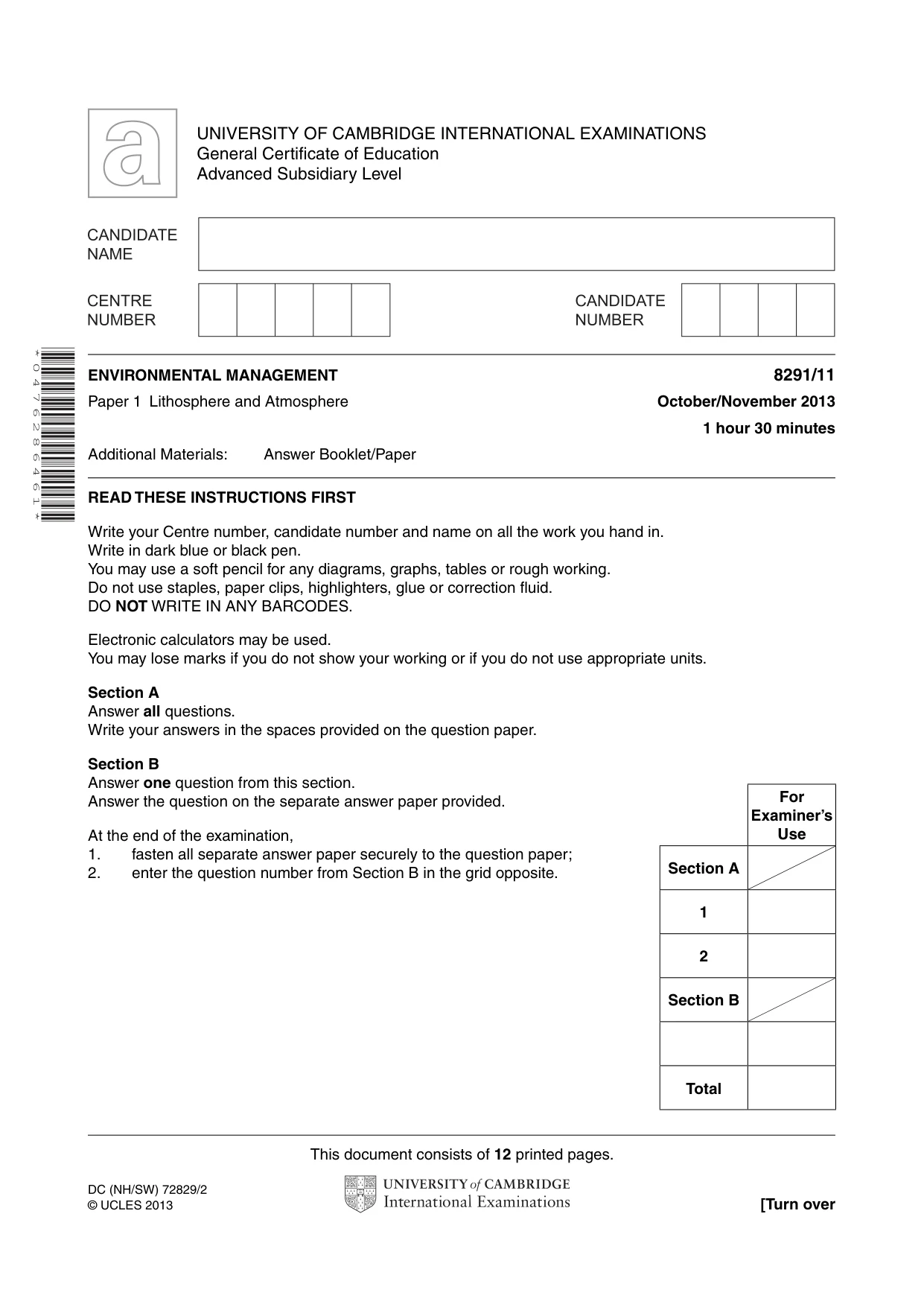
This document consists of 12 printed pages. DC (NH/SW) 72829/2 © UCLES 2013 [Turn over UNIVERSITY OF CAMBRIDGE INTERNATIONAL EXAMINATIONS General Certificate of Education Advanced Subsidiary Level * 0 4 7 6 2 8 6 4 6 1 * ENVIRONMENTAL MANAGEMENT 8291/11 Paper 1 Lithosphere and Atmosphere October/November 2013 1 hour 30 minutes Additional Materials: Answer Booklet/Paper READ THESE INSTRUCTIONS FIRST Write your Centre number, candidate number and name on all the work you hand in. Write in dark blue or black pen. You may use a soft pencil for any diagrams, graphs, tables or rough working. Do not use staples, paper clips, highlighters, glue or correction fluid. DO NOT WRITE IN ANY BARCODES. Electronic calculators may be used. You may lose marks if you do not show your working or if you do not use appropriate units. Section A Answer all questions. Write your answers in the spaces provided on the question paper. Section B Answer one question from this section. Answer the question on the separate answer paper provided. At the end of the examination, 1. fasten all separate answer paper securely to the question paper; 2. enter the question number from Section B in the grid opposite. For Examiner’s Use Section A 1 2 Section B Total
Question paper, page 2
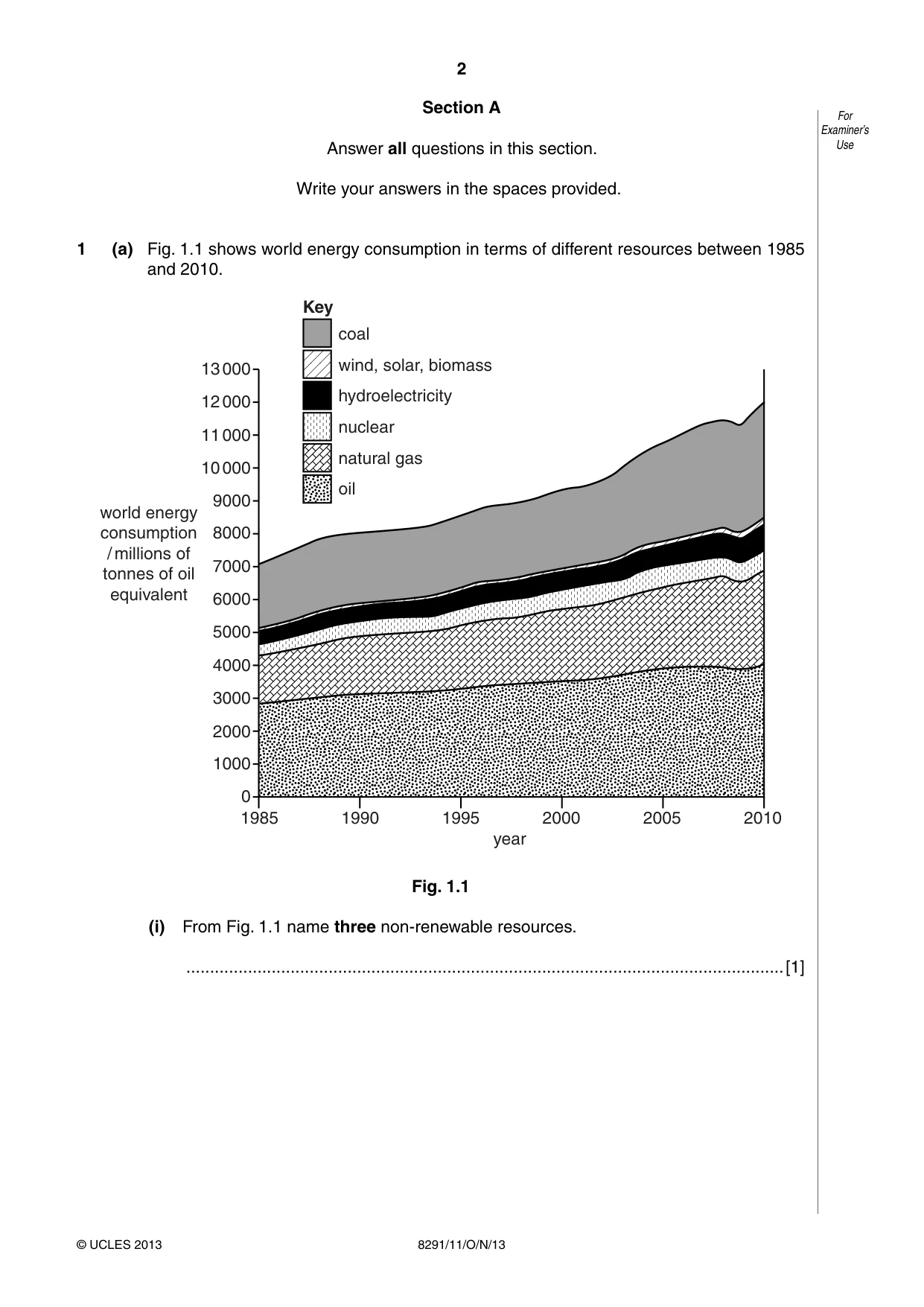
2 8291/11/O/N/13 © UCLES 2013 For Examiner’s Use Section A Answer all questions in this section. Write your answers in the spaces provided. 1 (a) Fig. 1.1 shows world energy consumption in terms of different resources between 1985 and 2010. 0 1000 2000 3000 4000 5000 6000 7000 8000 world energy consumption / millions of tonnes of oil equivalent 9000 10 000 11 000 12 000 13 000 1985 1990 1995 year 2000 2005 2010 coal wind, solar, biomass hydroelectricity nuclear natural gas oil Key Fig. 1.1 (i) From Fig. 1.1 name three non-renewable resources. …[1]
Question paper, page 3
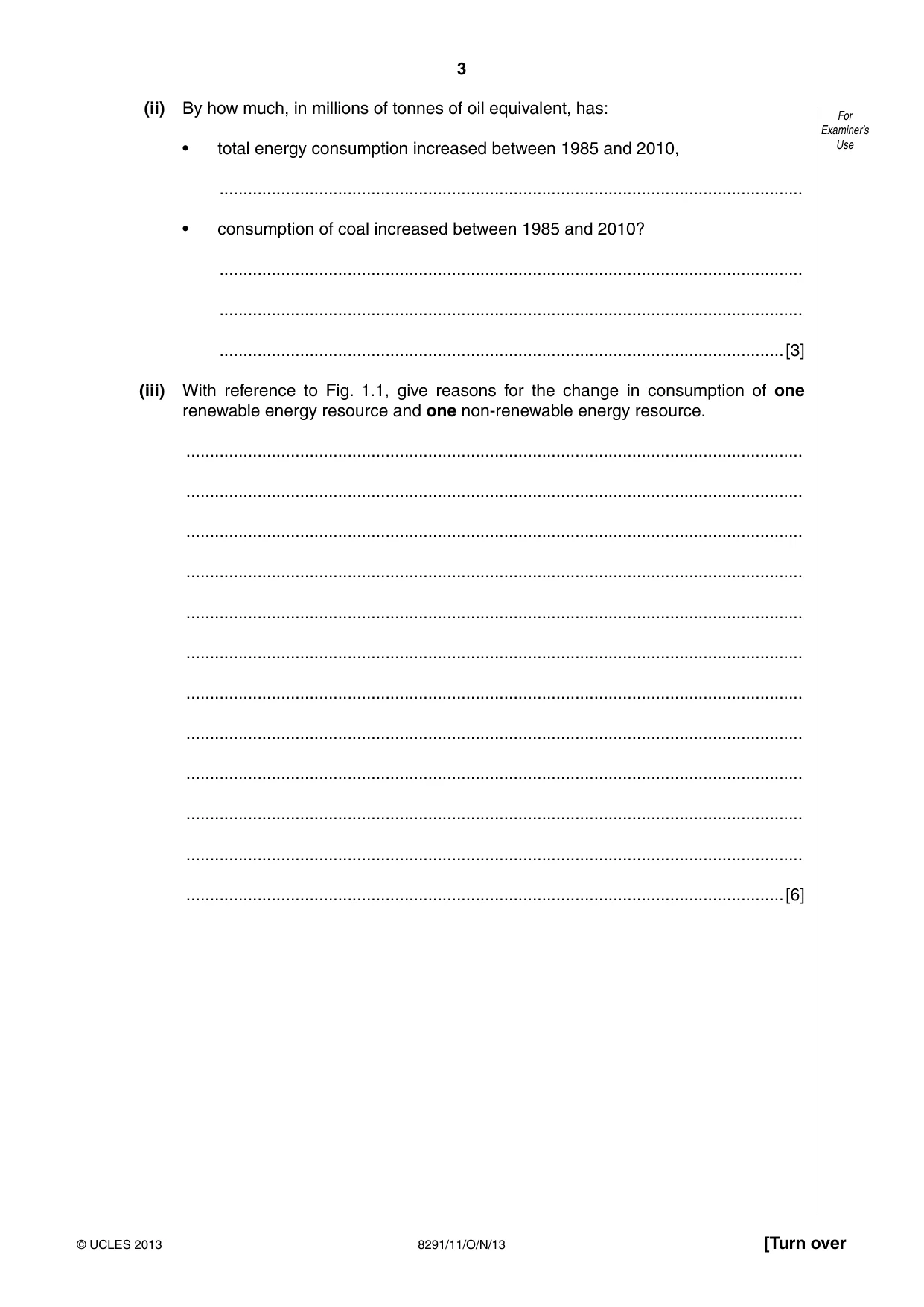
3 8291/11/O/N/13 © UCLES 2013 [Turn over For Examiner’s Use (ii) By how much, in millions of tonnes of oil equivalent, has: • total energy consumption increased between 1985 and 2010, … • consumption of coal increased between 1985 and 2010? … … …[3] (iii) With reference to Fig. 1.1, give reasons for the change in consumption of one renewable energy resource and one non-renewable energy resource. … … … … … … … … … … … …[6]
Question paper, page 4
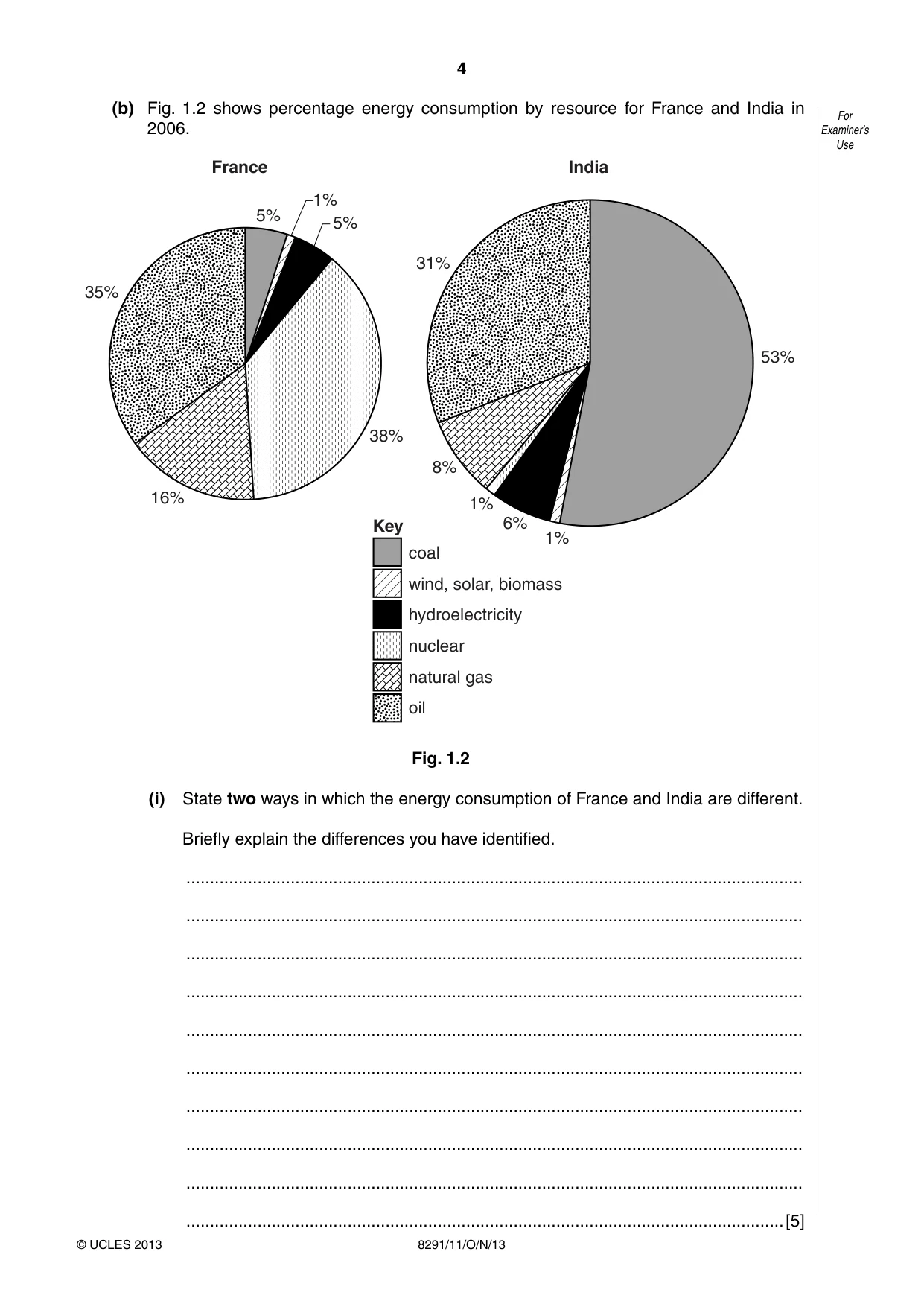
4 8291/11/O/N/13 © UCLES 2013 For Examiner’s Use (b) Fig. 1.2 shows percentage energy consumption by resource for France and India in 2006. coal wind, solar, biomass hydroelectricity nuclear natural gas oil Key 31% 53% 38% 16% 35% 8% 1% 5% 5% 1% 6% 1% India France Fig. 1.2 (i) State two ways in which the energy consumption of France and India are different. Briefly explain the differences you have identified. … … … … … … … … … …[5]
Question paper, page 5
5 8291/11/O/N/13 © UCLES 2013 [Turn over For Examiner’s Use (ii) State two ways in which the energy consumption of France and India are similar. Briefly explain the similarities you have identified. … … … … … … … … … …[5] [Total: 20]
Question paper, page 6
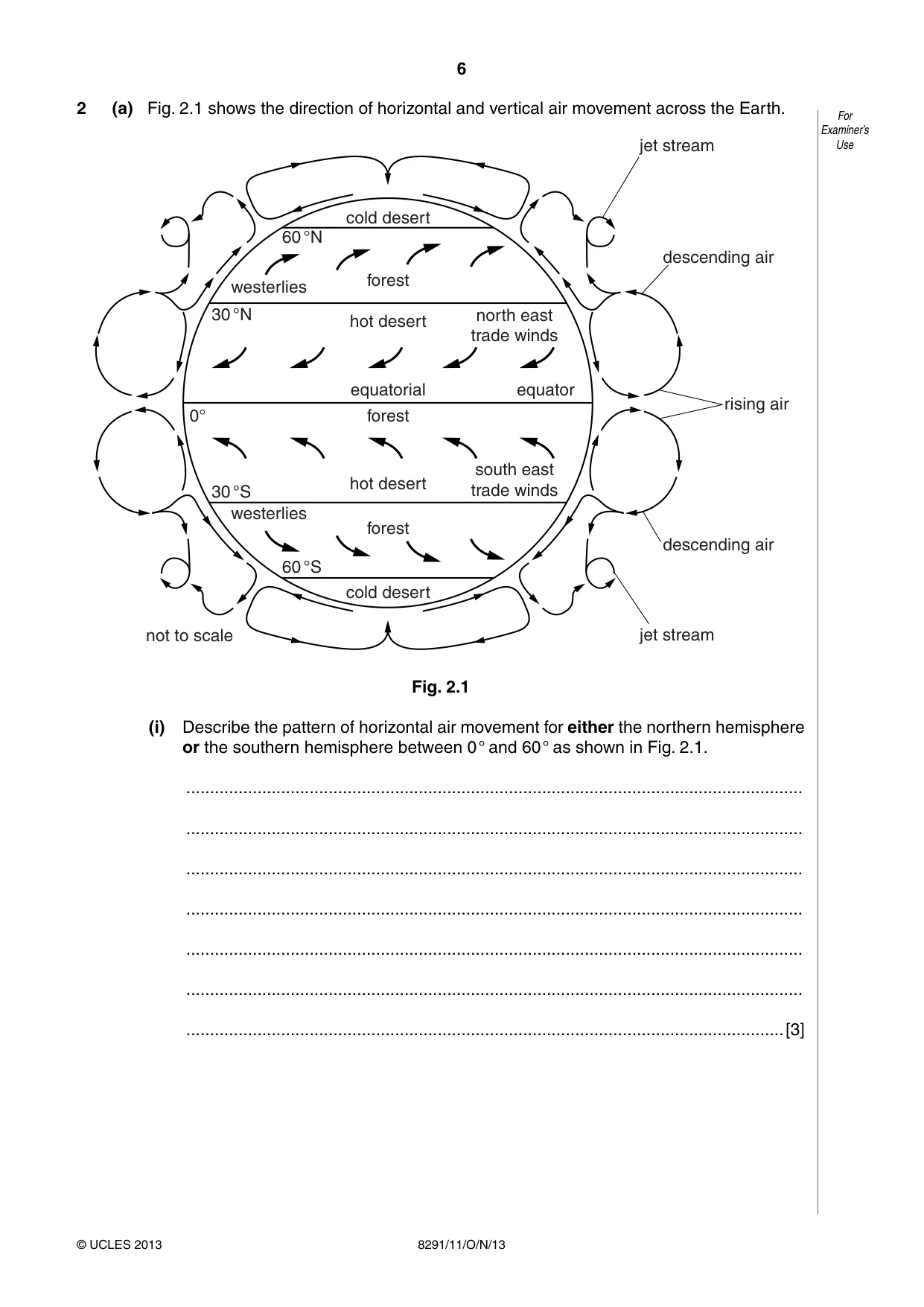
6 8291/11/O/N/13 © UCLES 2013 For Examiner’s Use 2 (a) Fig. 2.1 shows the direction of horizontal and vertical air movement across the Earth. cold desert forest hot desert equatorial equator south east trade winds north east trade winds 0° 30 °N 60 °N jet stream jet stream descending air descending air rising air not to scale 30 °S 60 °S westerlies westerlies forest hot desert forest cold desert Fig. 2.1 (i) Describe the pattern of horizontal air movement for either the northern hemisphere or the southern hemisphere between 0 ° and 60 ° as shown in Fig. 2.1. … … … … … … …[3]
Question paper, page 7
7 8291/11/O/N/13 © UCLES 2013 [Turn over For Examiner’s Use (ii) Using the information in Fig. 2.1, explain how atmospheric pressure influences the direction of horizontal movement of air across the Earth’s surface. … … … … … … … … … … …[3] (iii) State one other factor that influences the direction of horizontal air movement shown in Fig. 2.1. … …[1]
Question paper, page 8
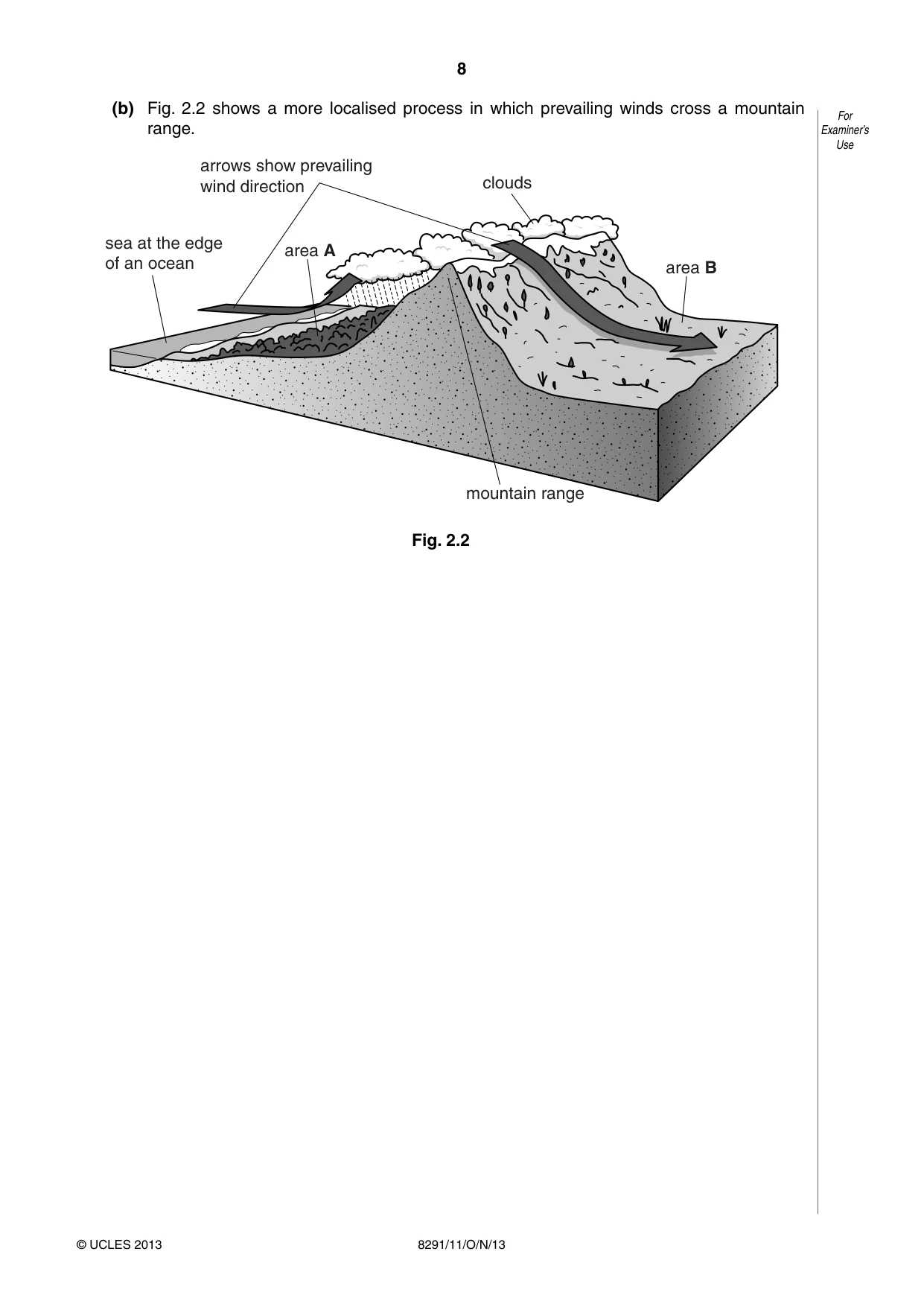
8 8291/11/O/N/13 © UCLES 2013 For Examiner’s Use (b) Fig. 2.2 shows a more localised process in which prevailing winds cross a mountain range. arrows show prevailing wind direction sea at the edge of an ocean clouds area A mountain range area B Fig. 2.2
Question paper, page 9
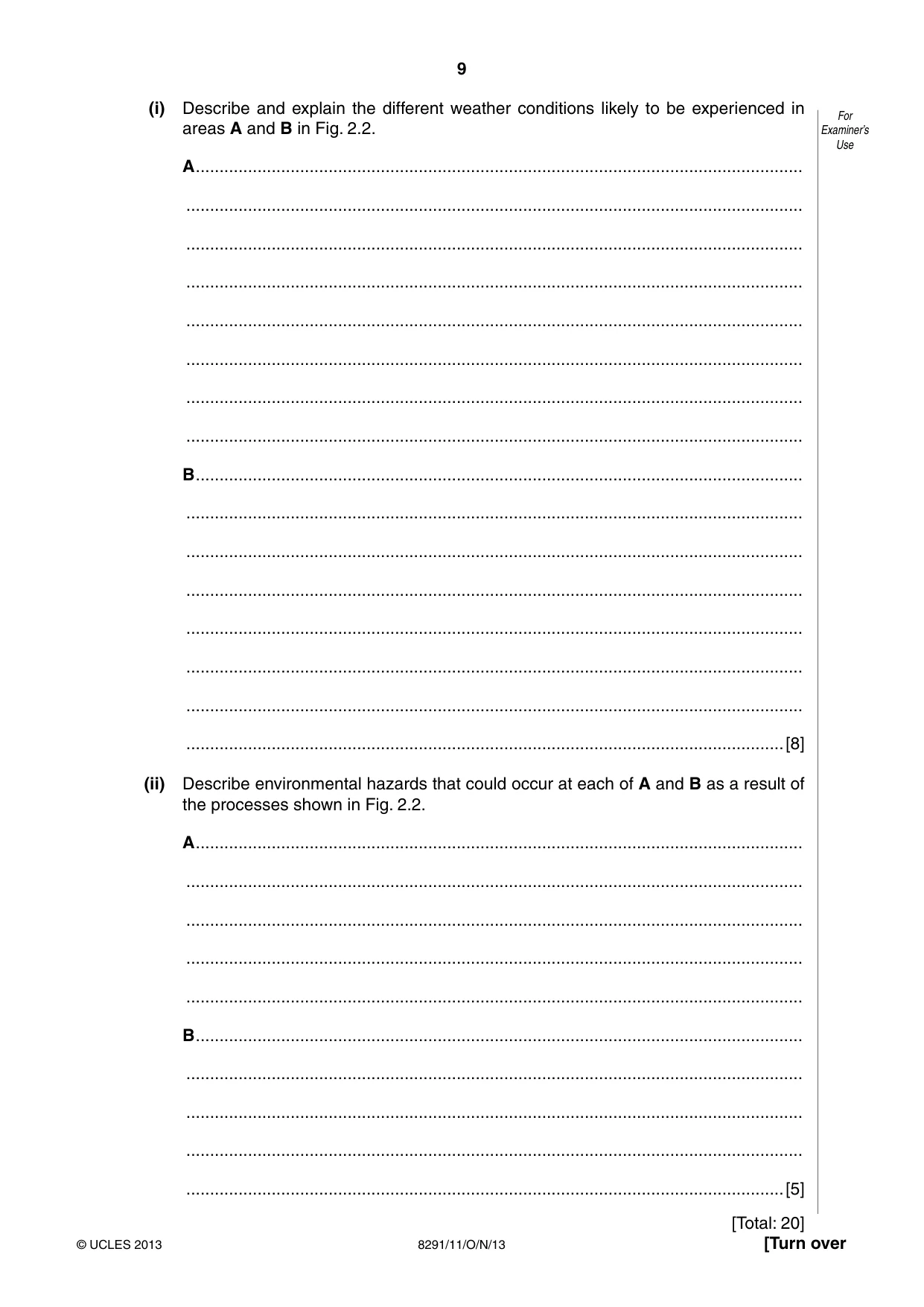
9 8291/11/O/N/13 © UCLES 2013 [Turn over For Examiner’s Use (i) Describe and explain the different weather conditions likely to be experienced in areas A and B in Fig. 2.2. A … … … … … … … … B … … … … … … … …[8] (ii) Describe environmental hazards that could occur at each of A and B as a result of the processes shown in Fig. 2.2. A … … … … … B … … … … …[5] [Total: 20]
Question paper, page 10
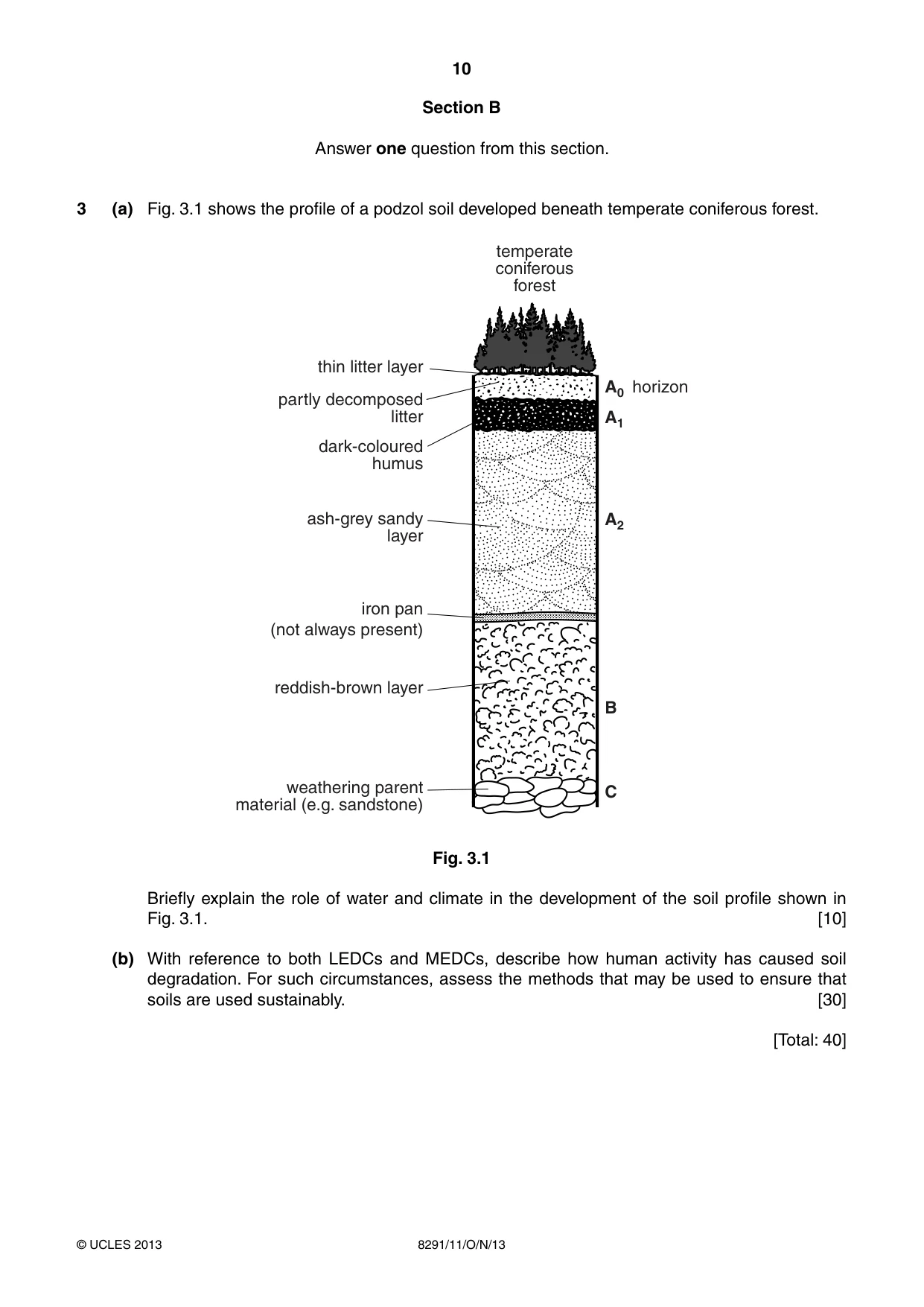
10 8291/11/O/N/13 © UCLES 2013 Section B Answer one question from this section. 3 (a) Fig. 3.1 shows the profile of a podzol soil developed beneath temperate coniferous forest. thin litter layer A0 horizon temperate coniferous forest A1 A2 B C partly decomposed litter dark-coloured humus ash-grey sandy layer iron pan (not always present) reddish-brown layer weathering parent material (e.g. sandstone) Fig. 3.1 Briefly explain the role of water and climate in the development of the soil profile shown in Fig. 3.1. [10] (b) With reference to both LEDCs and MEDCs, describe how human activity has caused soil degradation. For such circumstances, assess the methods that may be used to ensure that soils are used sustainably. [30] [Total: 40]
Question paper, page 11
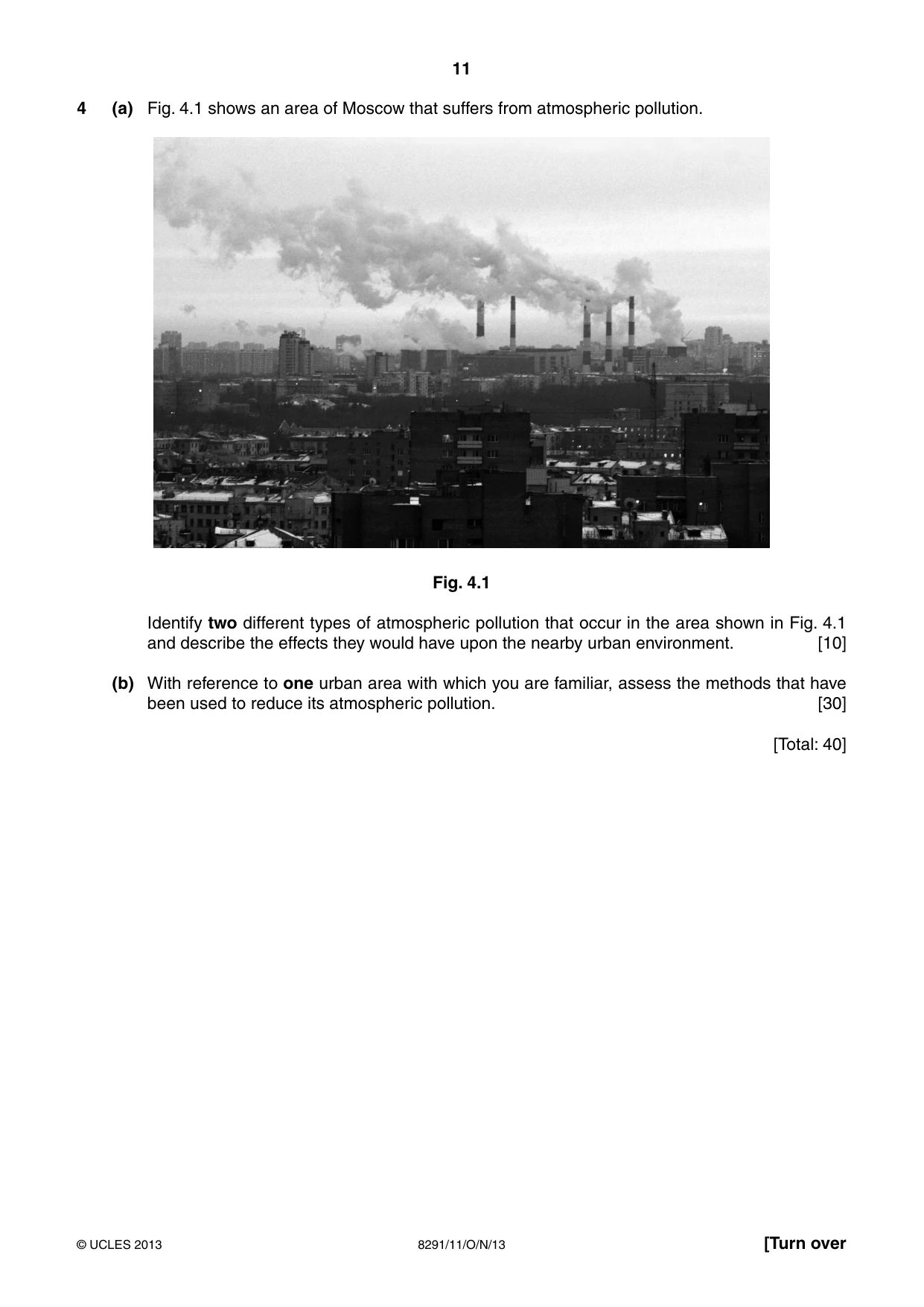
11 8291/11/O/N/13 © UCLES 2013 [Turn over 4 (a) Fig. 4.1 shows an area of Moscow that suffers from atmospheric pollution. Fig. 4.1 Identify two different types of atmospheric pollution that occur in the area shown in Fig. 4.1 and describe the effects they would have upon the nearby urban environment. [10] (b) With reference to one urban area with which you are familiar, assess the methods that have been used to reduce its atmospheric pollution. [30] [Total: 40]
Question paper, page 12
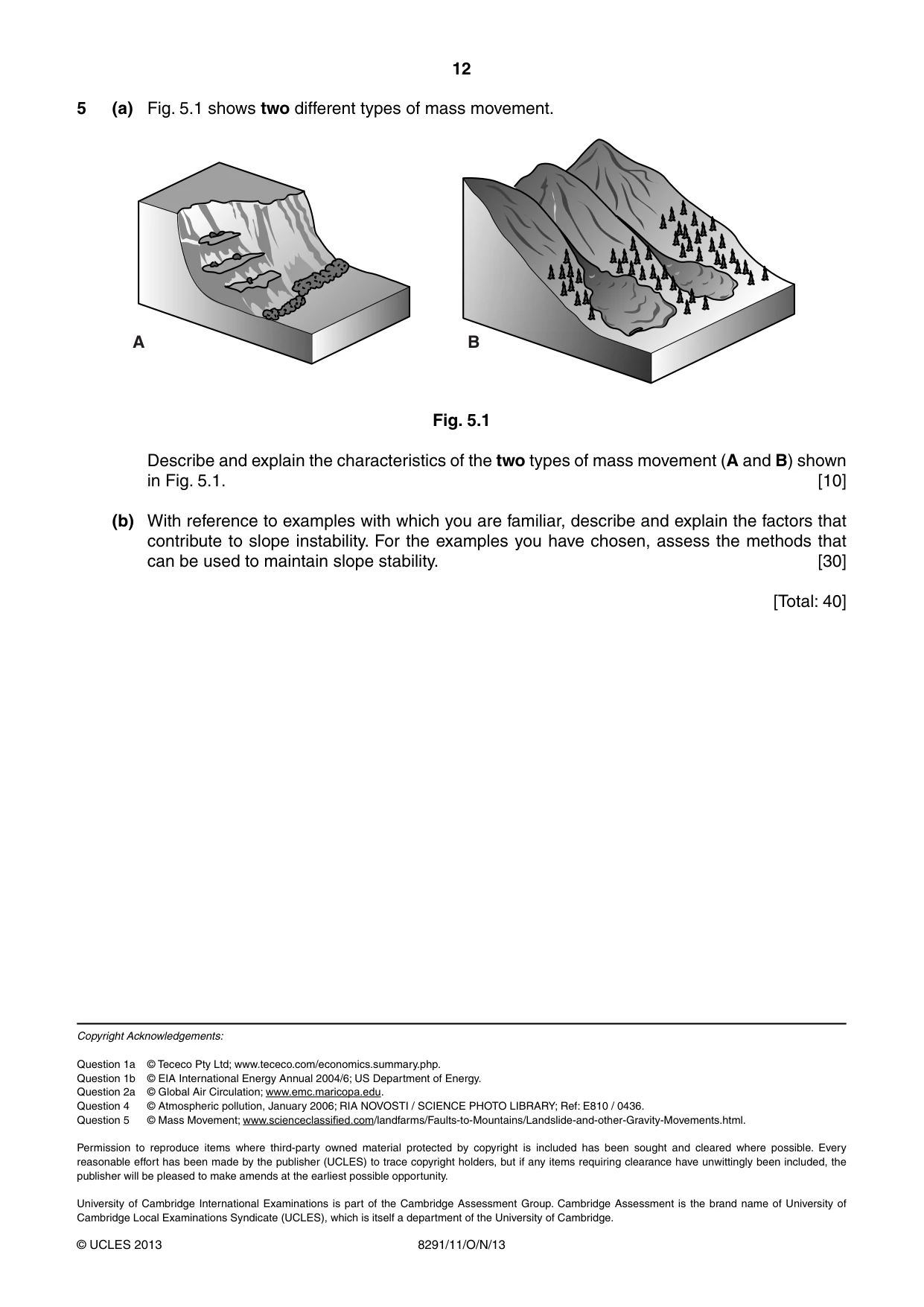
12 8291/11/O/N/13 © UCLES 2013 5 (a) Fig. 5.1 shows two different types of mass movement. A B Fig. 5.1 Describe and explain the characteristics of the two types of mass movement (A and B) shown in Fig. 5.1. [10] (b) With reference to examples with which you are familiar, describe and explain the factors that contribute to slope instability. For the examples you have chosen, assess the methods that can be used to maintain slope stability. [30] [Total: 40] Copyright Acknowledgements: Question 1a © Tececo Pty Ltd; www.tececo.com/economics.summary.php. Question 1b © EIA International Energy Annual 2004/6; US Department of Energy. Question 2a © Global Air Circulation; www.emc.maricopa.edu. Question 4 © Atmospheric pollution, January 2006; RIA NOVOSTI / SCIENCE PHOTO LIBRARY; Ref: E810 / 0436. Question 5 © Mass Movement; www.scienceclassified.com/landfarms/Faults-to-Mountains/Landslide-and-other-Gravity-Movements.html. Permission to reproduce items where third-party owned material protected by copyright is included has been sought and cleared where possible. Every reasonable effort has been made by the publisher (UCLES) to trace copyright holders, but if any items requiring clearance have unwittingly been included, the publisher will be pleased to make amends at the earliest possible opportunity. University of Cambridge International Examinations is part of the Cambridge Assessment Group. Cambridge Assessment is the brand name of University of Cambridge Local Examinations Syndicate (UCLES), which is itself a department of the University of Cambridge.
Mark scheme, page 1
CAMBRIDGE INTERNATIONAL EXAMINATIONS GCE Advanced Subsidiary Level MARK SCHEME for the October/November 2013 series 8291 ENVIRONMENTAL MANAGEMENT 8291/11 Paper 1, maximum raw mark 80 This mark scheme is published as an aid to teachers and candidates, to indicate the requirements of the examination. It shows the basis on which Examiners were instructed to award marks. It does not indicate the details of the discussions that took place at an Examiners’ meeting before marking began, which would have considered the acceptability of alternative answers. Mark schemes should be read in conjunction with the question paper and the Principal Examiner Report for Teachers. Cambridge will not enter into discussions about these mark schemes. Cambridge is publishing the mark schemes for the October/November 2013 series for most IGCSE, GCE Advanced Level and Advanced Subsidiary Level components and some Ordinary Level components.
Mark scheme, page 2
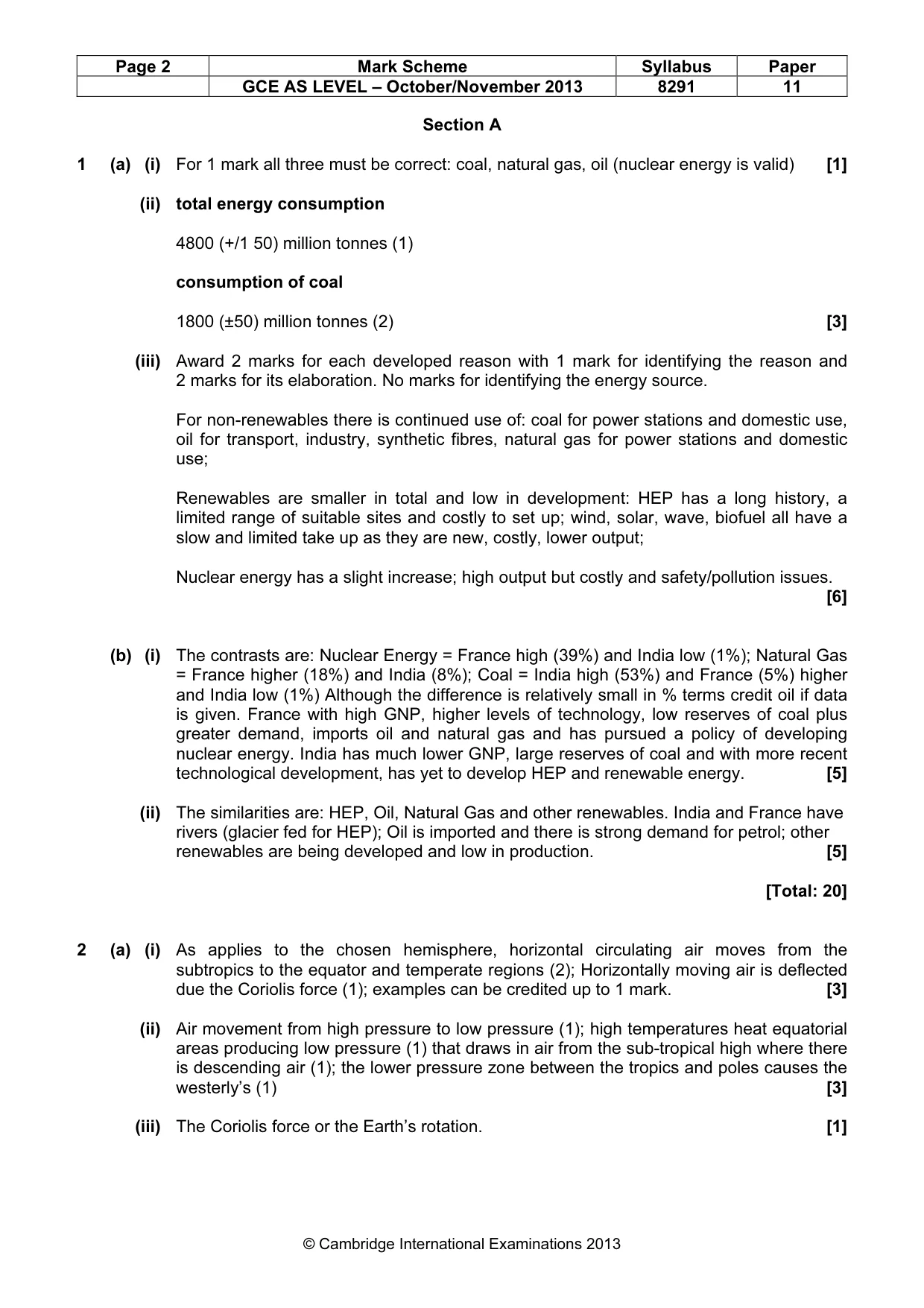
Page 2 Mark Scheme Syllabus Paper GCE AS LEVEL – October/November 2013 8291 11 © Cambridge International Examinations 2013 Section A 1 (a) (i) For 1 mark all three must be correct: coal, natural gas, oil (nuclear energy is valid) [1] (ii) total energy consumption 4800 (+/1 50) million tonnes (1) consumption of coal 1800 (±50) million tonnes (2) [3] (iii) Award 2 marks for each developed reason with 1 mark for identifying the reason and 2 marks for its elaboration. No marks for identifying the energy source. For non-renewables there is continued use of: coal for power stations and domestic use, oil for transport, industry, synthetic fibres, natural gas for power stations and domestic use; Renewables are smaller in total and low in development: HEP has a long history, a limited range of suitable sites and costly to set up; wind, solar, wave, biofuel all have a slow and limited take up as they are new, costly, lower output; Nuclear energy has a slight increase; high output but costly and safety/pollution issues. [6] (b) (i) The contrasts are: Nuclear Energy = France high (39%) and India low (1%); Natural Gas = France higher (18%) and India (8%); Coal = India high (53%) and France (5%) higher and India low (1%) Although the difference is relatively small in % terms credit oil if data is given. France with high GNP, higher levels of technology, low reserves of coal plus greater demand, imports oil and natural gas and has pursued a policy of developing nuclear energy. India has much lower GNP, large reserves of coal and with more recent technological development, has yet to develop HEP and renewable energy. [5] (ii) The similarities are: HEP, Oil, Natural Gas and other renewables. India and France have rivers (glacier fed for HEP); Oil is imported and there is strong demand for petrol; other renewables are being developed and low in production. [5] [Total: 20] 2 (a) (i) As applies to the chosen hemisphere, horizontal circulating air moves from the subtropics to the equator and temperate regions (2); Horizontally moving air is deflected due the Coriolis force (1); examples can be credited up to 1 mark. [3] (ii) Air movement from high pressure to low pressure (1); high temperatures heat equatorial areas producing low pressure (1) that draws in air from the sub-tropical high where there is descending air (1); the lower pressure zone between the tropics and poles causes the westerly’s (1) [3] (iii) The Coriolis force or the Earth’s rotation. [1]
Mark scheme, page 3
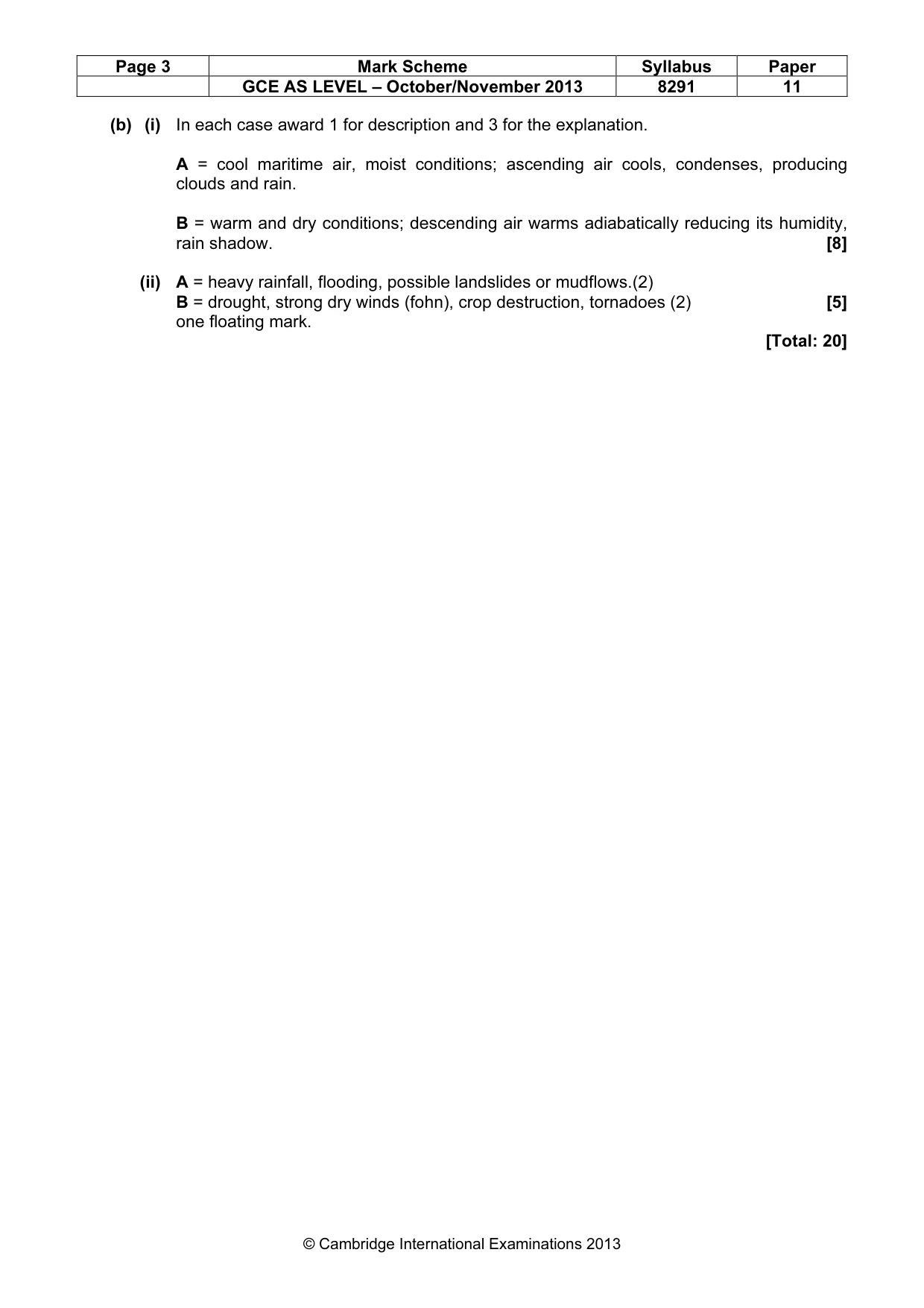
Page 3 Mark Scheme Syllabus Paper GCE AS LEVEL – October/November 2013 8291 11 © Cambridge International Examinations 2013 (b) (i) In each case award 1 for description and 3 for the explanation. A = cool maritime air, moist conditions; ascending air cools, condenses, producing clouds and rain. B = warm and dry conditions; descending air warms adiabatically reducing its humidity, rain shadow. [8] (ii) A = heavy rainfall, flooding, possible landslides or mudflows.(2) B = drought, strong dry winds (fohn), crop destruction, tornadoes (2) [5] one floating mark. [Total: 20]
Mark scheme, page 4
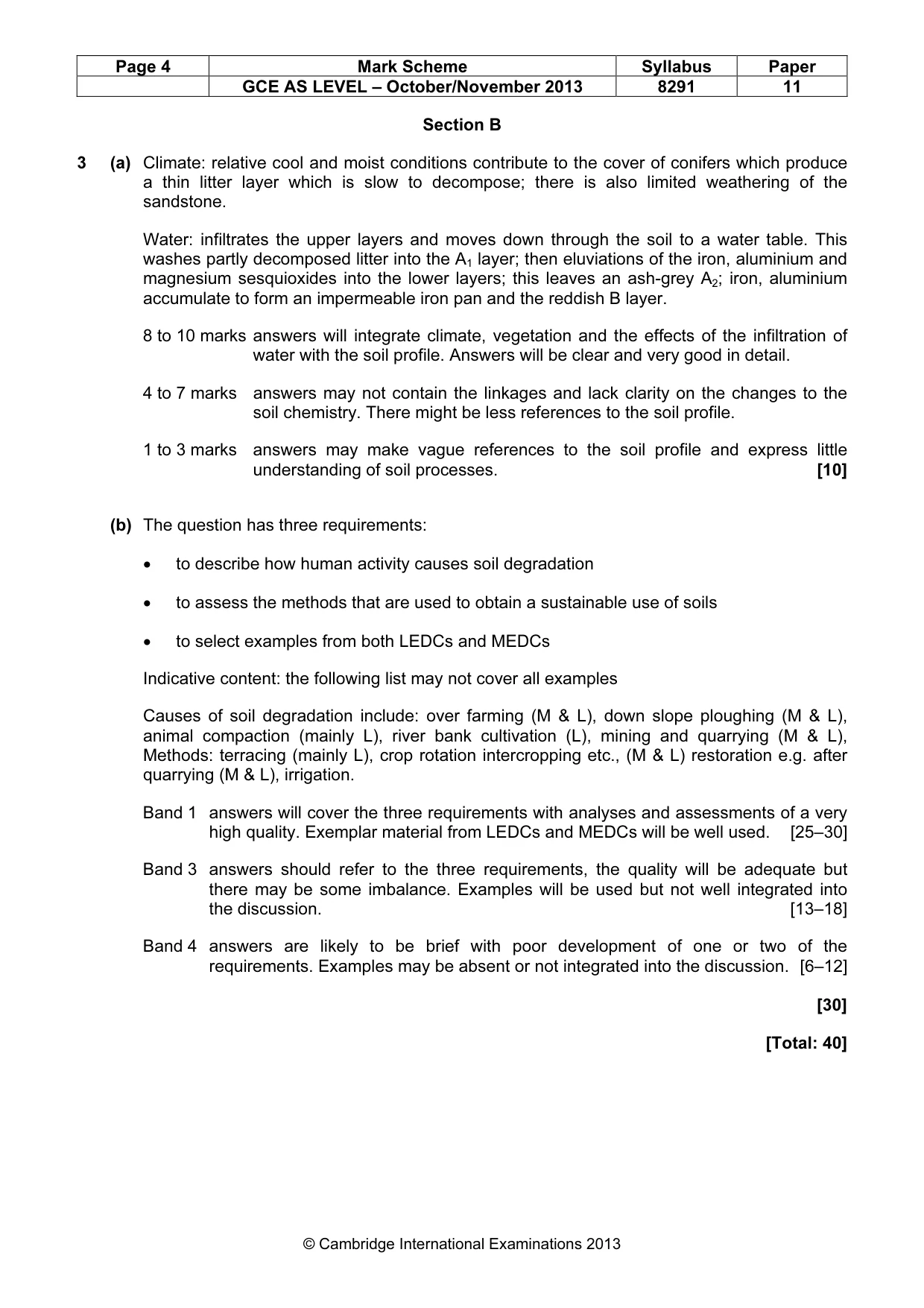
Page 4 Mark Scheme Syllabus Paper GCE AS LEVEL – October/November 2013 8291 11 © Cambridge International Examinations 2013 Section B 3 (a) Climate: relative cool and moist conditions contribute to the cover of conifers which produce a thin litter layer which is slow to decompose; there is also limited weathering of the sandstone. Water: infiltrates the upper layers and moves down through the soil to a water table. This washes partly decomposed litter into the A1 layer; then eluviations of the iron, aluminium and magnesium sesquioxides into the lower layers; this leaves an ash-grey A2; iron, aluminium accumulate to form an impermeable iron pan and the reddish B layer. 8 to 10 marks answers will integrate climate, vegetation and the effects of the infiltration of water with the soil profile. Answers will be clear and very good in detail. 4 to 7 marks answers may not contain the linkages and lack clarity on the changes to the soil chemistry. There might be less references to the soil profile. 1 to 3 marks answers may make vague references to the soil profile and express little understanding of soil processes. [10] (b) The question has three requirements: • to describe how human activity causes soil degradation • to assess the methods that are used to obtain a sustainable use of soils • to select examples from both LEDCs and MEDCs Indicative content: the following list may not cover all examples Causes of soil degradation include: over farming (M & L), down slope ploughing (M & L), animal compaction (mainly L), river bank cultivation (L), mining and quarrying (M & L), Methods: terracing (mainly L), crop rotation intercropping etc., (M & L) restoration e.g. after quarrying (M & L), irrigation. Band 1 answers will cover the three requirements with analyses and assessments of a very high quality. Exemplar material from LEDCs and MEDCs will be well used. [25–30] Band 3 answers should refer to the three requirements, the quality will be adequate but there may be some imbalance. Examples will be used but not well integrated into the discussion. [13–18] Band 4 answers are likely to be brief with poor development of one or two of the requirements. Examples may be absent or not integrated into the discussion. [6–12] [30] [Total: 40]
Mark scheme, page 5
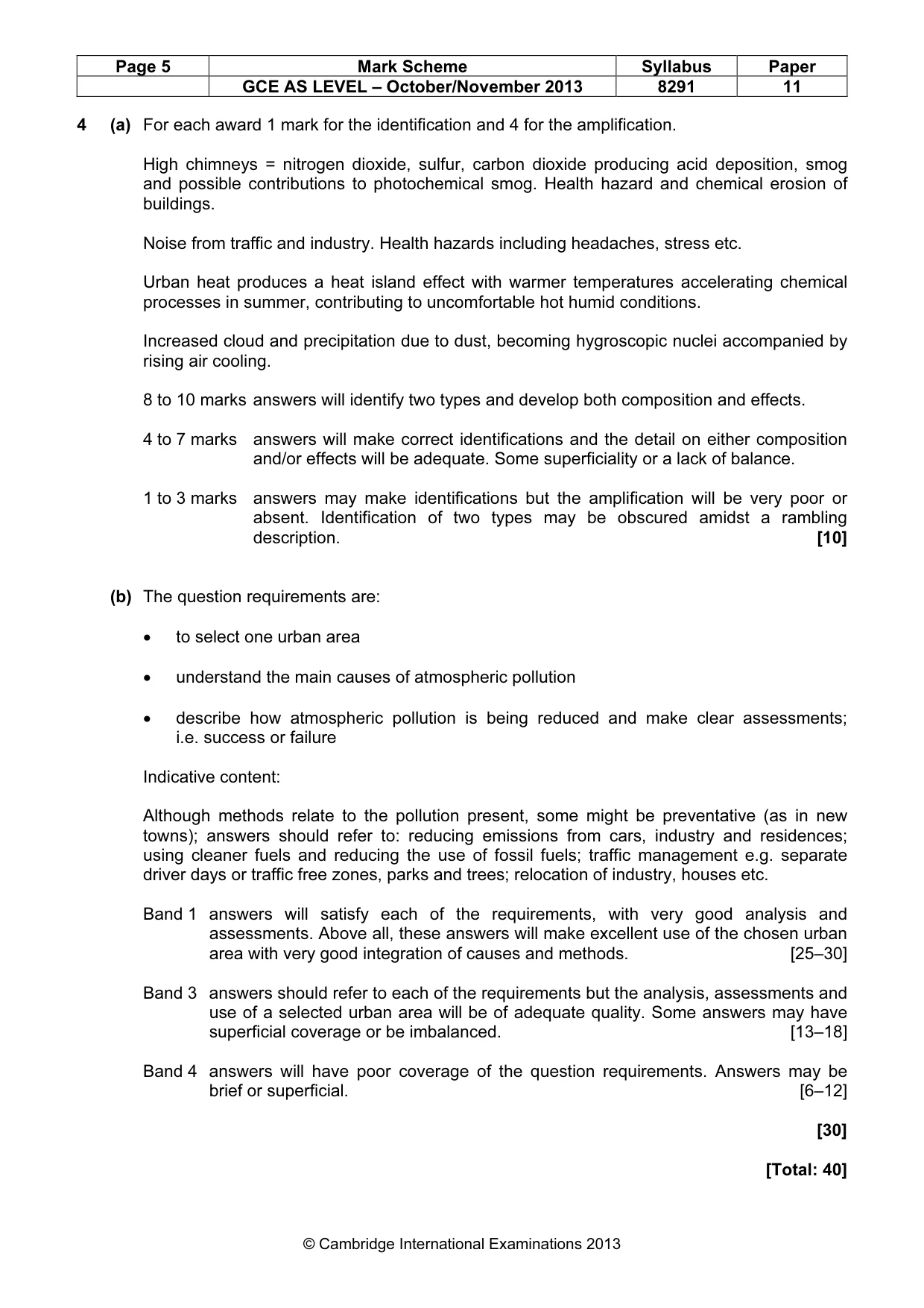
Page 5 Mark Scheme Syllabus Paper GCE AS LEVEL – October/November 2013 8291 11 © Cambridge International Examinations 2013 4 (a) For each award 1 mark for the identification and 4 for the amplification. High chimneys = nitrogen dioxide, sulfur, carbon dioxide producing acid deposition, smog and possible contributions to photochemical smog. Health hazard and chemical erosion of buildings. Noise from traffic and industry. Health hazards including headaches, stress etc. Urban heat produces a heat island effect with warmer temperatures accelerating chemical processes in summer, contributing to uncomfortable hot humid conditions. Increased cloud and precipitation due to dust, becoming hygroscopic nuclei accompanied by rising air cooling. 8 to 10 marks answers will identify two types and develop both composition and effects. 4 to 7 marks answers will make correct identifications and the detail on either composition and/or effects will be adequate. Some superficiality or a lack of balance. 1 to 3 marks answers may make identifications but the amplification will be very poor or absent. Identification of two types may be obscured amidst a rambling description. [10] (b) The question requirements are: • to select one urban area • understand the main causes of atmospheric pollution • describe how atmospheric pollution is being reduced and make clear assessments; i.e. success or failure Indicative content: Although methods relate to the pollution present, some might be preventative (as in new towns); answers should refer to: reducing emissions from cars, industry and residences; using cleaner fuels and reducing the use of fossil fuels; traffic management e.g. separate driver days or traffic free zones, parks and trees; relocation of industry, houses etc. Band 1 answers will satisfy each of the requirements, with very good analysis and assessments. Above all, these answers will make excellent use of the chosen urban area with very good integration of causes and methods. [25–30] Band 3 answers should refer to each of the requirements but the analysis, assessments and use of a selected urban area will be of adequate quality. Some answers may have superficial coverage or be imbalanced. [13–18] Band 4 answers will have poor coverage of the question requirements. Answers may be brief or superficial. [6–12] [30] [Total: 40]
Mark scheme, page 6
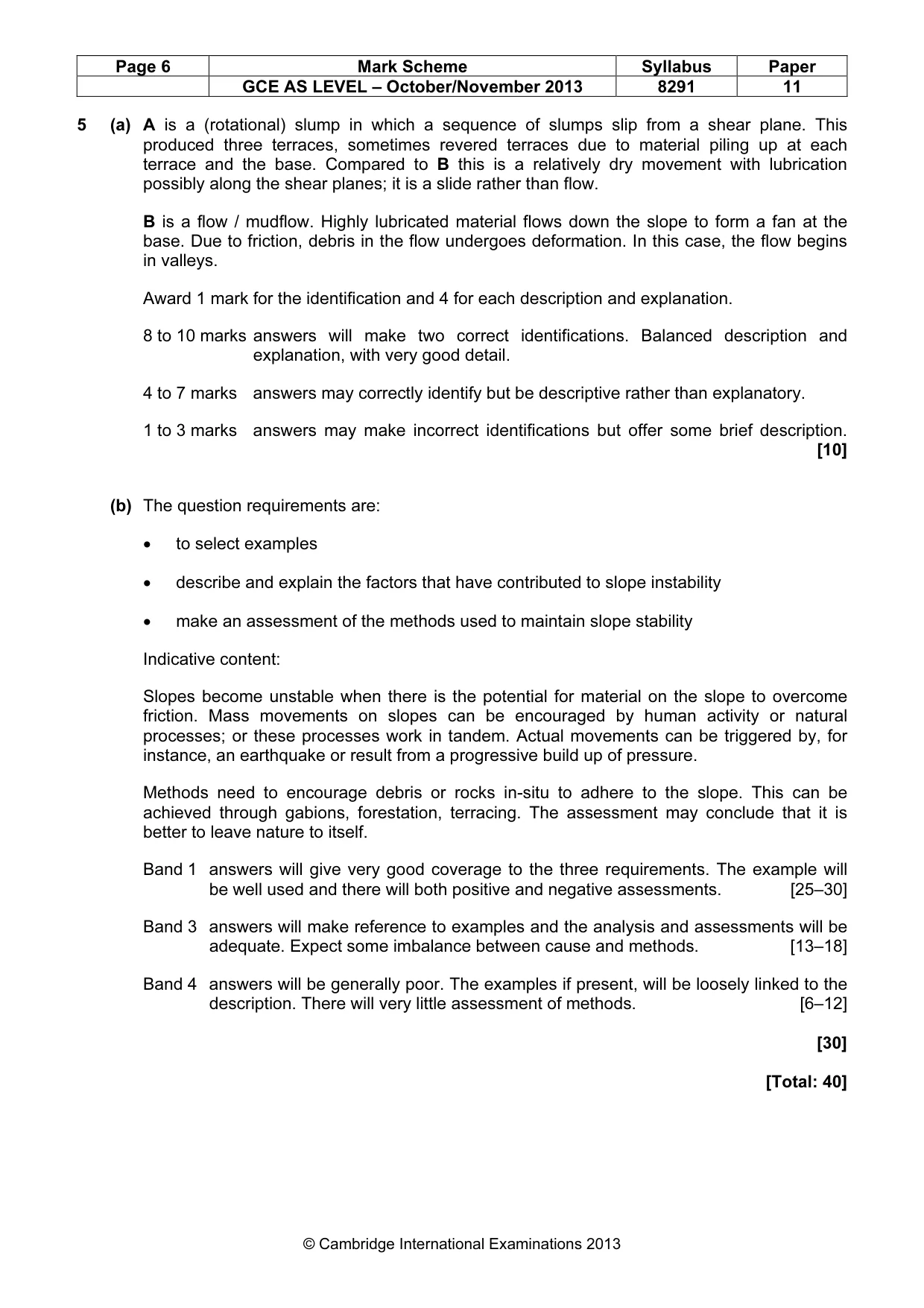
Page 6 Mark Scheme Syllabus Paper GCE AS LEVEL – October/November 2013 8291 11 © Cambridge International Examinations 2013 5 (a) A is a (rotational) slump in which a sequence of slumps slip from a shear plane. This produced three terraces, sometimes revered terraces due to material piling up at each terrace and the base. Compared to B this is a relatively dry movement with lubrication possibly along the shear planes; it is a slide rather than flow. B is a flow / mudflow. Highly lubricated material flows down the slope to form a fan at the base. Due to friction, debris in the flow undergoes deformation. In this case, the flow begins in valleys. Award 1 mark for the identification and 4 for each description and explanation. 8 to 10 marks answers will make two correct identifications. Balanced description and explanation, with very good detail. 4 to 7 marks answers may correctly identify but be descriptive rather than explanatory. 1 to 3 marks answers may make incorrect identifications but offer some brief description. [10] (b) The question requirements are: • to select examples • describe and explain the factors that have contributed to slope instability • make an assessment of the methods used to maintain slope stability Indicative content: Slopes become unstable when there is the potential for material on the slope to overcome friction. Mass movements on slopes can be encouraged by human activity or natural processes; or these processes work in tandem. Actual movements can be triggered by, for instance, an earthquake or result from a progressive build up of pressure. Methods need to encourage debris or rocks in-situ to adhere to the slope. This can be achieved through gabions, forestation, terracing. The assessment may conclude that it is better to leave nature to itself. Band 1 answers will give very good coverage to the three requirements. The example will be well used and there will both positive and negative assessments. [25–30] Band 3 answers will make reference to examples and the analysis and assessments will be adequate. Expect some imbalance between cause and methods. [13–18] Band 4 answers will be generally poor. The examples if present, will be loosely linked to the description. There will very little assessment of methods. [6–12] [30] [Total: 40]
Mark scheme, page 7
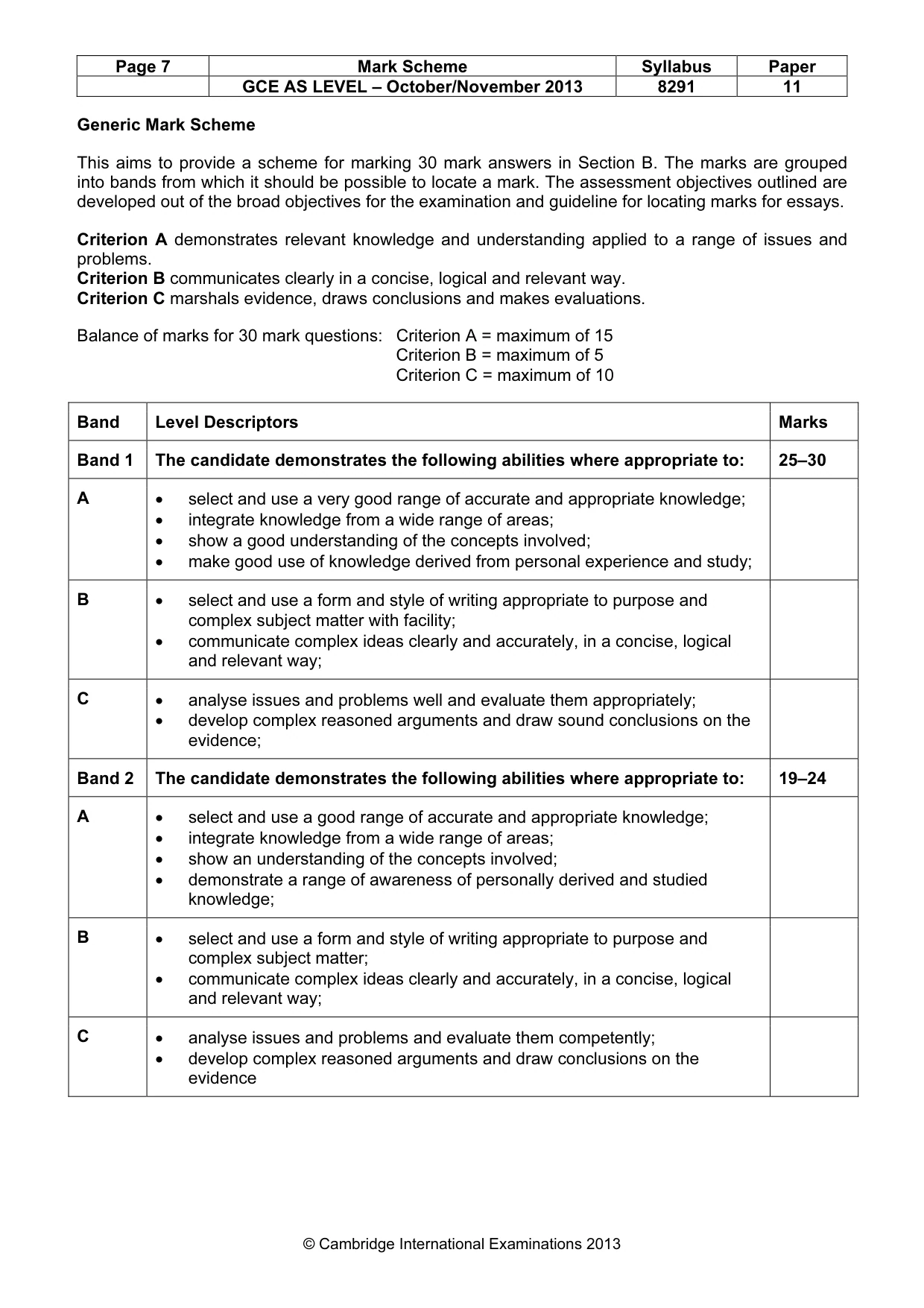
Page 7 Mark Scheme Syllabus Paper GCE AS LEVEL – October/November 2013 8291 11 © Cambridge International Examinations 2013 Generic Mark Scheme This aims to provide a scheme for marking 30 mark answers in Section B. The marks are grouped into bands from which it should be possible to locate a mark. The assessment objectives outlined are developed out of the broad objectives for the examination and guideline for locating marks for essays. Criterion A demonstrates relevant knowledge and understanding applied to a range of issues and problems. Criterion B communicates clearly in a concise, logical and relevant way. Criterion C marshals evidence, draws conclusions and makes evaluations. Balance of marks for 30 mark questions: Criterion A = maximum of 15 Criterion B = maximum of 5 Criterion C = maximum of 10 Band Level Descriptors Marks Band 1 The candidate demonstrates the following abilities where appropriate to: 25–30 A • select and use a very good range of accurate and appropriate knowledge; • integrate knowledge from a wide range of areas; • show a good understanding of the concepts involved; • make good use of knowledge derived from personal experience and study; B • select and use a form and style of writing appropriate to purpose and complex subject matter with facility; • communicate complex ideas clearly and accurately, in a concise, logical and relevant way; C • analyse issues and problems well and evaluate them appropriately; • develop complex reasoned arguments and draw sound conclusions on the evidence; Band 2 The candidate demonstrates the following abilities where appropriate to: 19–24 A • select and use a good range of accurate and appropriate knowledge; • integrate knowledge from a wide range of areas; • show an understanding of the concepts involved; • demonstrate a range of awareness of personally derived and studied knowledge; B • select and use a form and style of writing appropriate to purpose and complex subject matter; • communicate complex ideas clearly and accurately, in a concise, logical and relevant way; C • analyse issues and problems and evaluate them competently; • develop complex reasoned arguments and draw conclusions on the evidence
Mark scheme, page 8
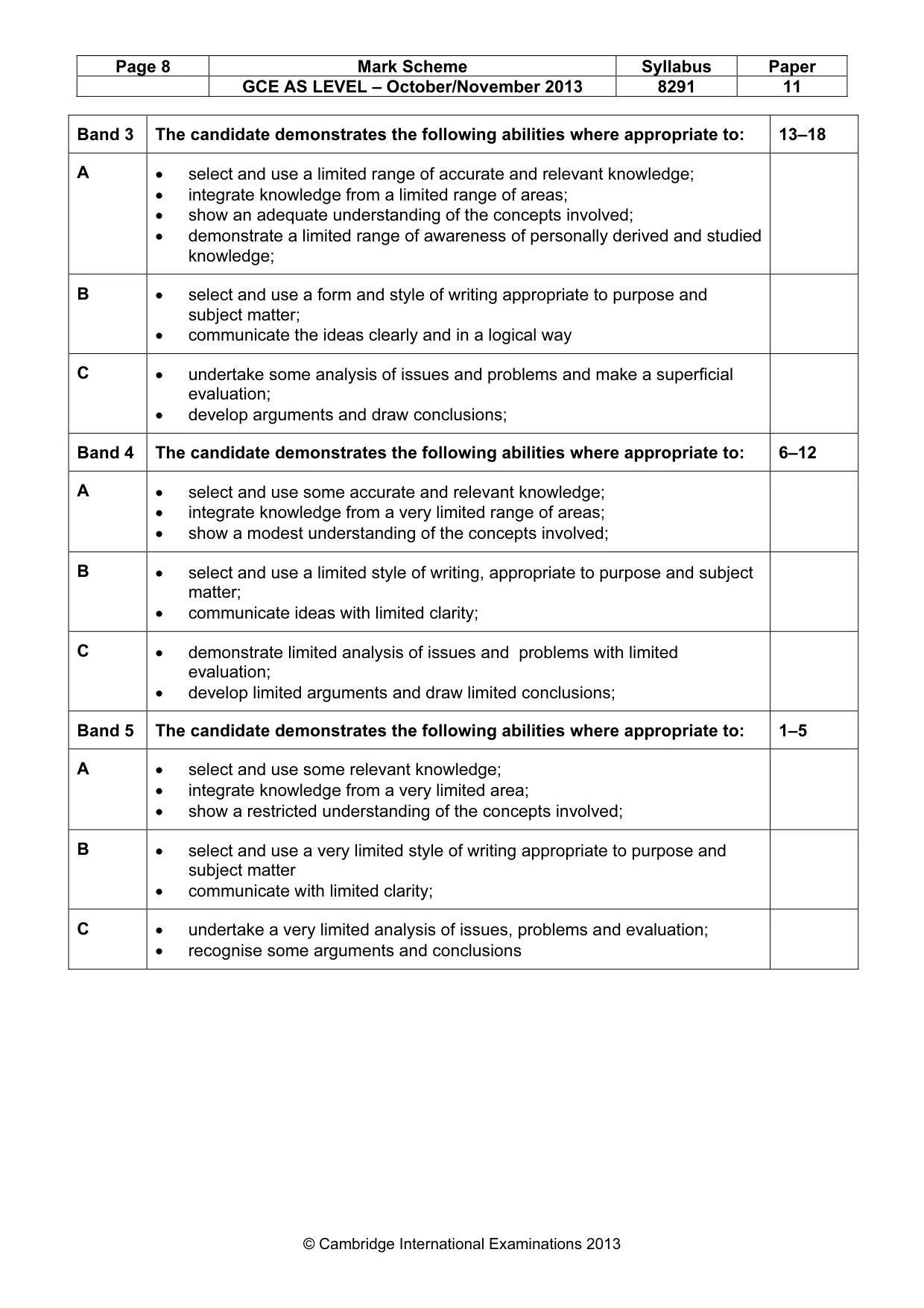
Page 8 Mark Scheme Syllabus Paper GCE AS LEVEL – October/November 2013 8291 11 © Cambridge International Examinations 2013 Band 3 The candidate demonstrates the following abilities where appropriate to: 13–18 A • select and use a limited range of accurate and relevant knowledge; • integrate knowledge from a limited range of areas; • show an adequate understanding of the concepts involved; • demonstrate a limited range of awareness of personally derived and studied knowledge; B • select and use a form and style of writing appropriate to purpose and subject matter; • communicate the ideas clearly and in a logical way C • undertake some analysis of issues and problems and make a superficial evaluation; • develop arguments and draw conclusions; Band 4 The candidate demonstrates the following abilities where appropriate to: 6–12 A • select and use some accurate and relevant knowledge; • integrate knowledge from a very limited range of areas; • show a modest understanding of the concepts involved; B • select and use a limited style of writing, appropriate to purpose and subject matter; • communicate ideas with limited clarity; C • demonstrate limited analysis of issues and problems with limited evaluation; • develop limited arguments and draw limited conclusions; Band 5 The candidate demonstrates the following abilities where appropriate to: 1–5 A • select and use some relevant knowledge; • integrate knowledge from a very limited area; • show a restricted understanding of the concepts involved; B • select and use a very limited style of writing appropriate to purpose and subject matter • communicate with limited clarity; C • undertake a very limited analysis of issues, problems and evaluation; • recognise some arguments and conclusions
What you needed in this session
Cambridge’s own grade thresholds for 2013 Oct/Nov, Paper 1 · Variant 1. A higher threshold means an easier paper — the bar moves with how the cohort did.