Cambridge A Level Environmental Management (AS only) 8291 — 2011 Oct/Nov Paper 1 · Variant 1
8291/11/O/N/11 · 80 marks · ≈90 min
The question paper and its mark scheme, free to read here and free to download. This is Cambridge’s own paper, exactly as it was sat.
Question paper12 pages



Mark scheme12 pages
Answers below. Sit the paper first if you are practising.
Paper as text
Question paper, page 1
This document consists of 12 printed pages. DC (AC/JG) 33945/3 © UCLES 2011 [Turn over UNIVERSITY OF CAMBRIDGE INTERNATIONAL EXAMINATIONS General Certificate of Education Advanced Subsidiary Level READ THESE INSTRUCTIONS FIRST Write your Centre number, candidate number and name on all the work you hand in. Write in dark blue or black pen. You may use a soft pencil for any diagrams, graphs, tables or rough working. Do not use staples, paper clips, highlighters, glue or correction fluid. DO NOT WRITE IN ANY BARCODES. Section A Answer all questions. Write your answers in the spaces provided on the question paper. Section B Answer one question from this section. Answer the question on the separate answer paper provided. At the end of the examination, 1. fasten all separate answer paper securely to the question paper; 2. enter the question number from Section B in the grid opposite. ENVIRONMENTAL MANAGEMENT 8291/01 Paper 1 Lithosphere and Atmosphere October/November 2011 1 hour 30 minutes Additional Materials: Answer Booklet/Paper For Examiner’s Use Section A 1 2 Section B Total * 9 3 0 6 2 2 5 0 3 2 *
Question paper, page 2
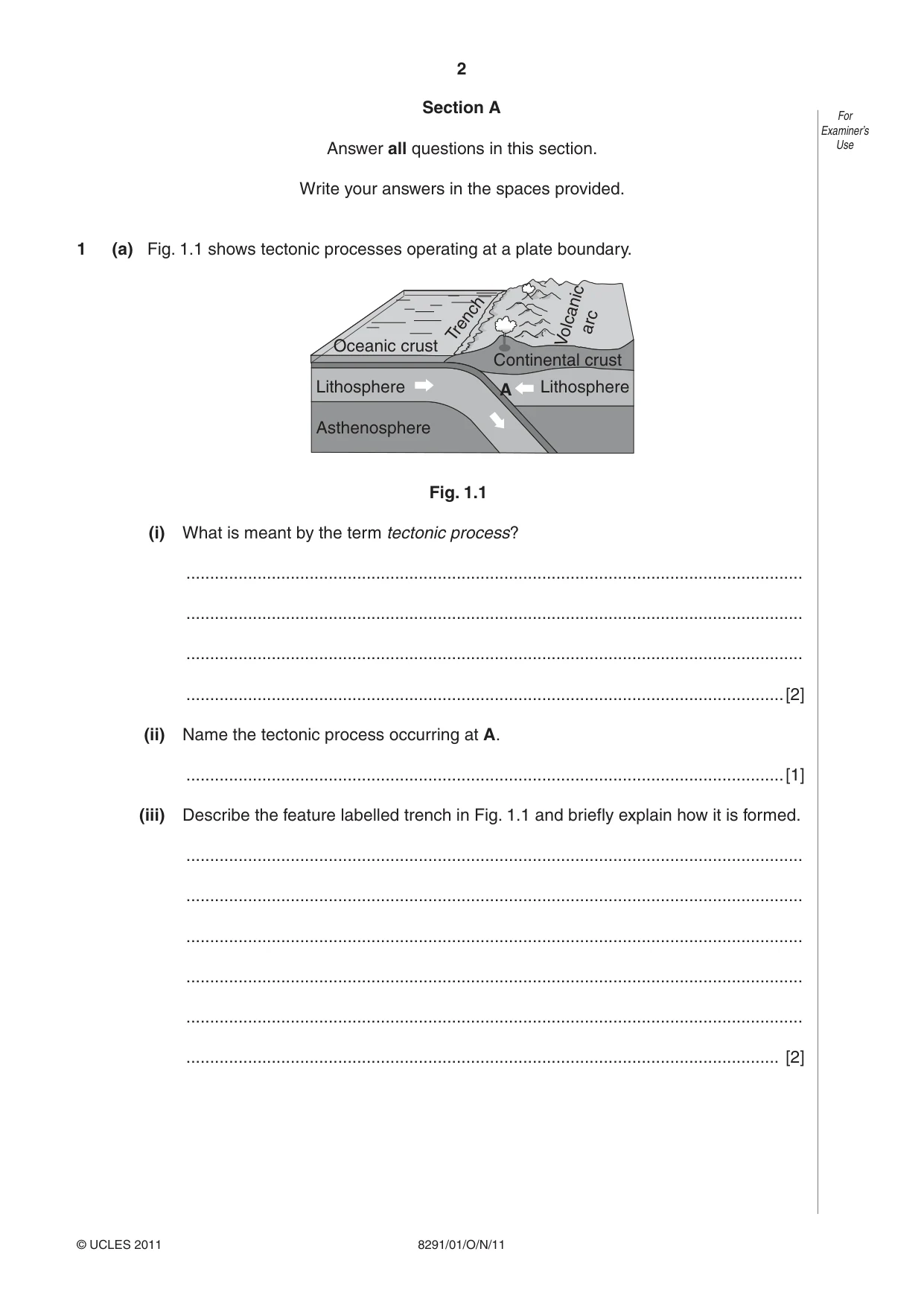
2 8291/01/O/N/11 © UCLES 2011 For Examiner’s Use Section A Answer all questions in this section. Write your answers in the spaces provided. 1 (a) Fig. 1.1 shows tectonic processes operating at a plate boundary. Oceanic crust Continental crust Lithosphere Lithosphere Asthenosphere Trench Volcanic arc A Fig. 1.1 (i) What is meant by the term tectonic process? … … … …[2] (ii) Name the tectonic process occurring at A. …[1] (iii) Describe the feature labelled trench in Fig. 1.1 and briefly explain how it is formed. … … … … … … [2]
Question paper, page 3
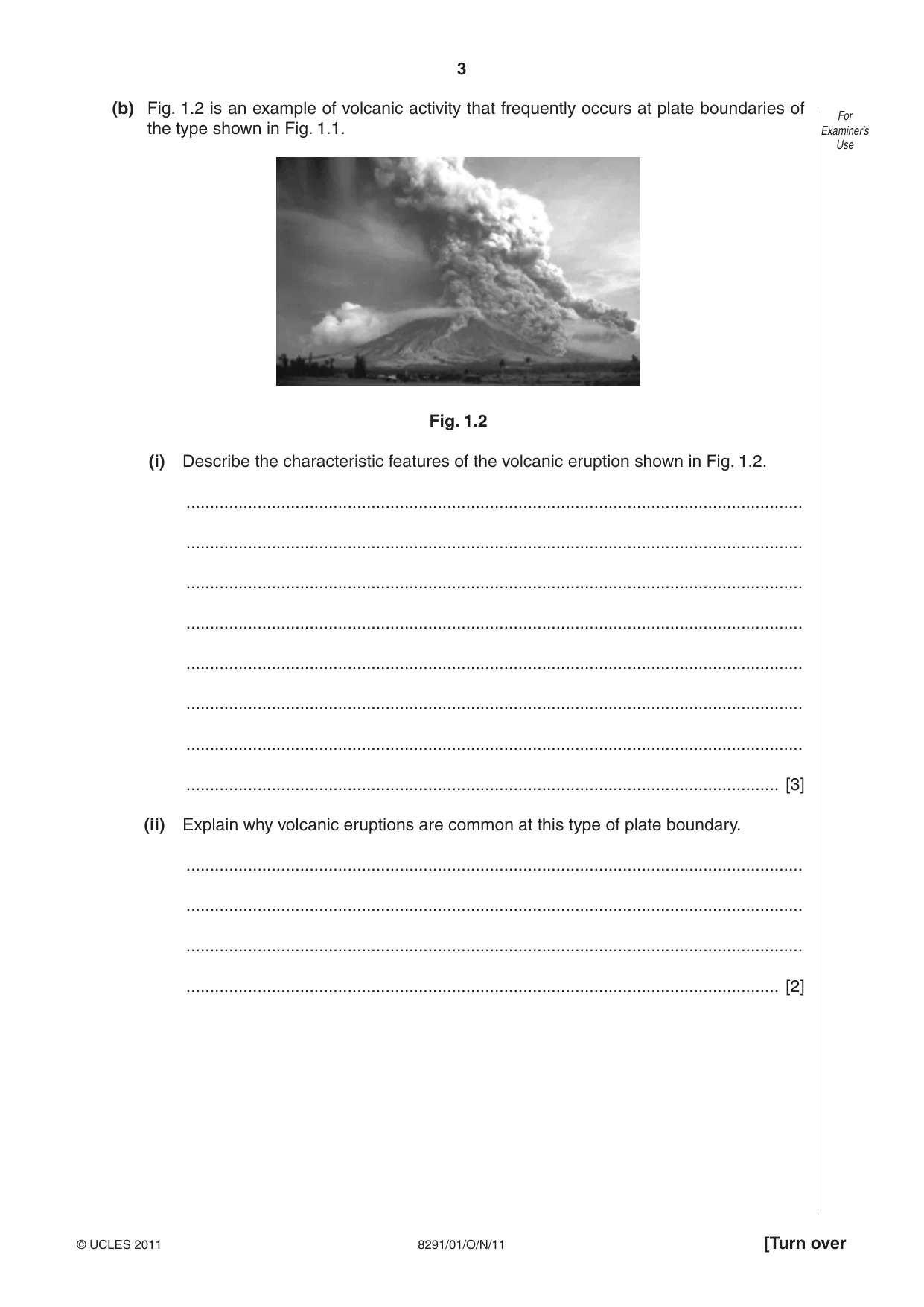
3 8291/01/O/N/11 © UCLES 2011 [Turn over For Examiner’s Use (b) Fig. 1.2 is an example of volcanic activity that frequently occurs at plate boundaries of the type shown in Fig. 1.1. Fig. 1.2 (i) Describe the characteristic features of the volcanic eruption shown in Fig. 1.2. … … … … … … … … [3] (ii) Explain why volcanic eruptions are common at this type of plate boundary. … … … … [2]
Question paper, page 4
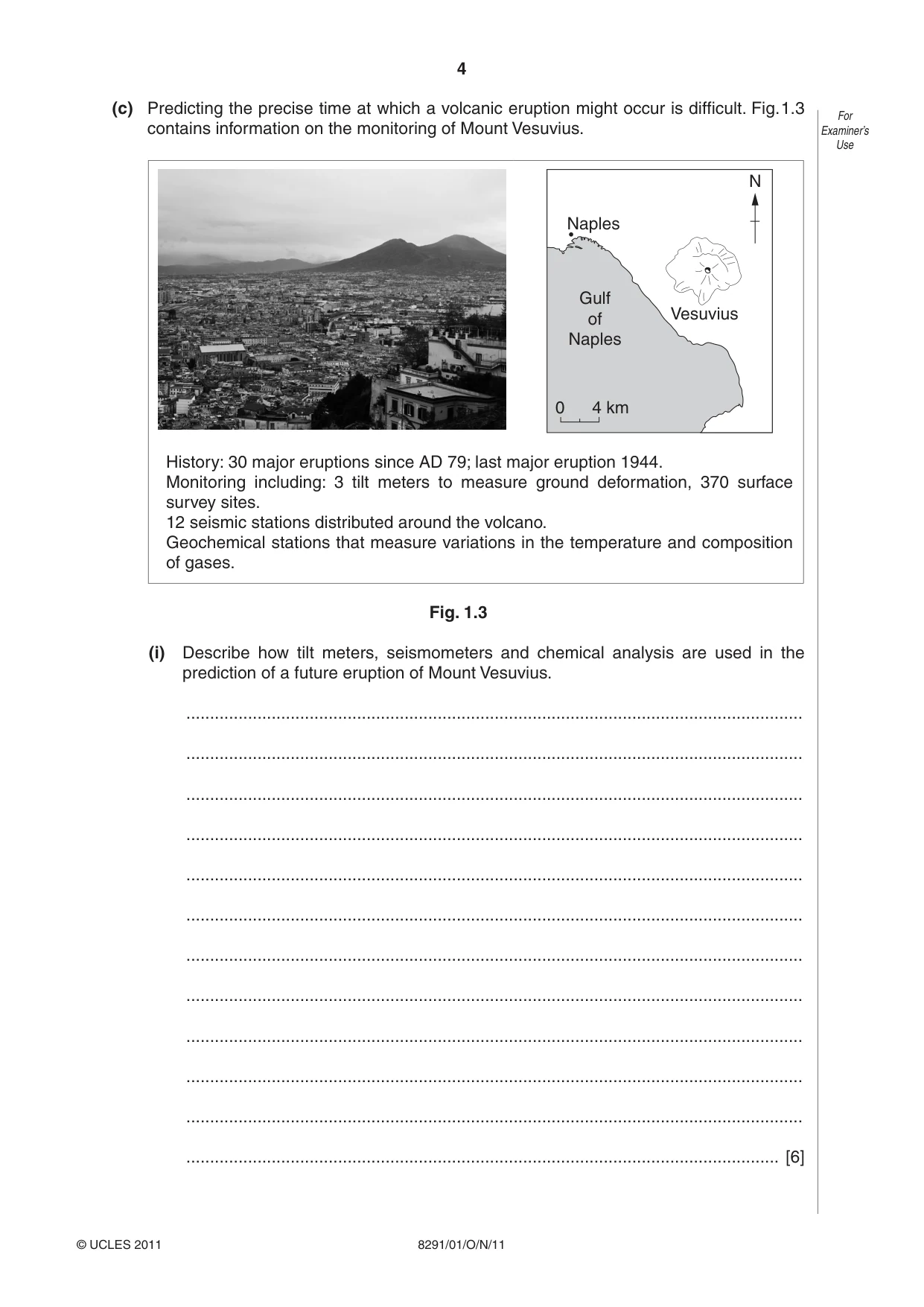
4 8291/01/O/N/11 © UCLES 2011 For Examiner’s Use (c) Predicting the precise time at which a volcanic eruption might occur is difficult. Fig. 1.3 contains information on the monitoring of Mount Vesuvius. 0 4 km Naples Gulf of Naples Vesuvius N History: 30 major eruptions since AD 79; last major eruption 1944. Monitoring including: 3 tilt meters to measure ground deformation, 370 surface survey sites. 12 seismic stations distributed around the volcano. Geochemical stations that measure variations in the temperature and composition of gases. Fig. 1.3 (i) Describe how tilt meters, seismometers and chemical analysis are used in the prediction of a future eruption of Mount Vesuvius. … … … … … … … … … … … … [6]
Question paper, page 5
5 8291/01/O/N/11 © UCLES 2011 [Turn over For Examiner’s Use (ii) In planning for a future eruption, describe other measures that need to be taken into account in addition to monitoring. … … … … … … … … … [4] [Total: 20]
Question paper, page 6
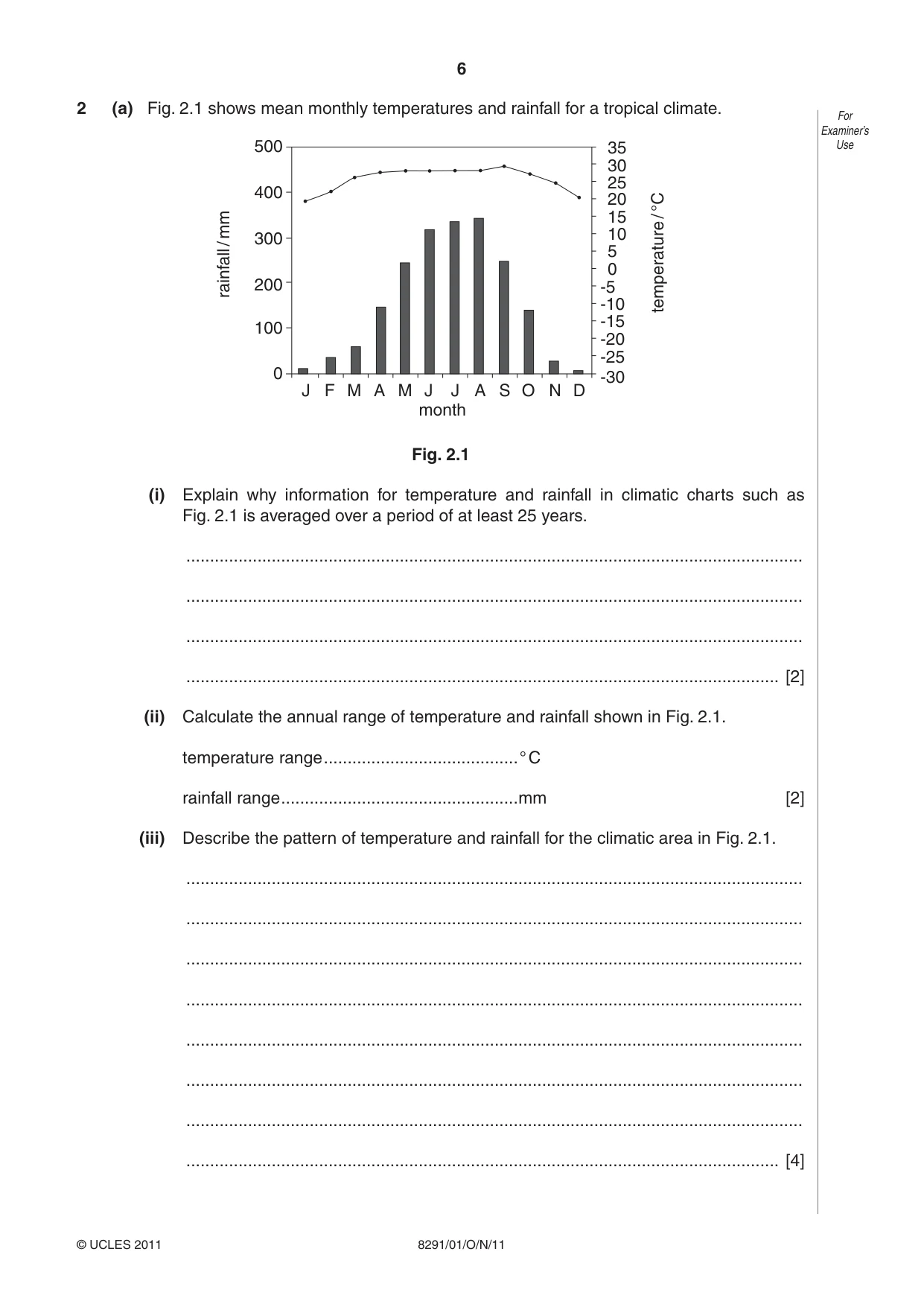
6 8291/01/O/N/11 © UCLES 2011 For Examiner’s Use 2 (a) Fig. 2.1 shows mean monthly temperatures and rainfall for a tropical climate. 500 400 300 200 100 0 -30 -25 -20 -15 -10 -5 0 5 10 15 20 25 30 35 J F M A M J J A S O N D month rainfall / mm temperature / °C Fig. 2.1 (i) Explain why information for temperature and rainfall in climatic charts such as Fig. 2.1 is averaged over a period of at least 25 years. … … … … [2] (ii) Calculate the annual range of temperature and rainfall shown in Fig. 2.1. temperature range …° C rainfall range …mm [2] (iii) Describe the pattern of temperature and rainfall for the climatic area in Fig. 2.1. … … … … … … … … [4]
Question paper, page 7
7 8291/01/O/N/11 © UCLES 2011 [Turn over For Examiner’s Use (iv) Using data from Fig. 2.1 outline one way in which human activity might be influenced by this climate. … … … … … [2]
Question paper, page 8
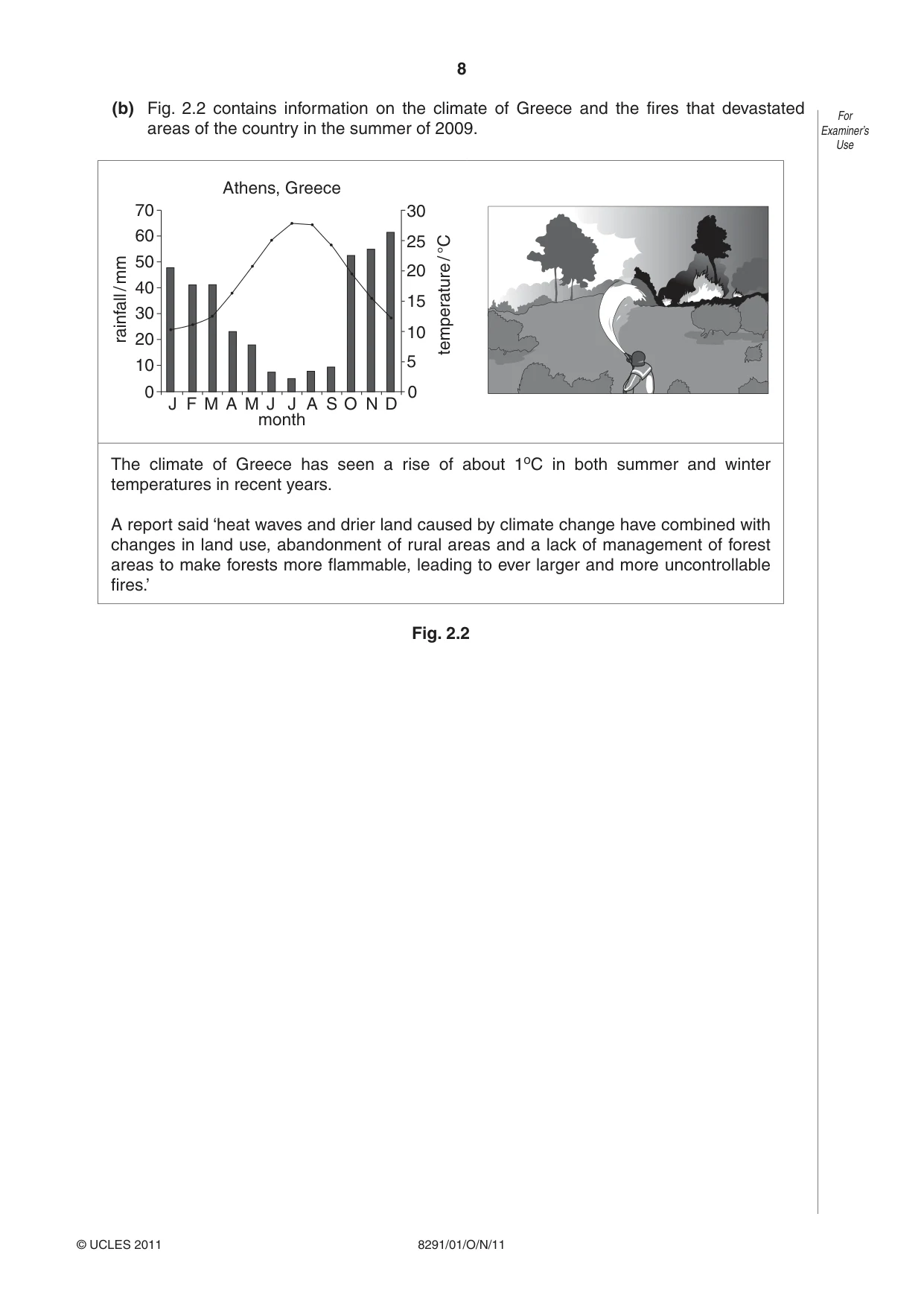
8 8291/01/O/N/11 © UCLES 2011 For Examiner’s Use (b) Fig. 2.2 contains information on the climate of Greece and the fires that devastated areas of the country in the summer of 2009. 20 30 40 50 60 70 10 0 0 5 10 15 20 25 30 J F M A M J J A S O N D month Athens, Greece rainfall / mm temperature / °C The climate of Greece has seen a rise of about 1oC in both summer and winter temperatures in recent years. A report said ‘heat waves and drier land caused by climate change have combined with changes in land use, abandonment of rural areas and a lack of management of forest areas to make forests more flammable, leading to ever larger and more uncontrollable fires.’ Fig. 2.2
Question paper, page 9
9 8291/01/O/N/11 © UCLES 2011 [Turn over For Examiner’s Use (i) Using the information contained in Fig. 2.2, describe how the climate may have contributed to the fires that have affected this region in recent years. … … … … … … … … … … … … [5] (ii) Use the information in Fig. 2.2 to suggest ways in which human activity may have contributed to the risk of fires in Greece. … … … … … … … … … … [5] [Total: 20]
Question paper, page 10
10 8291/01/O/N/11 © UCLES 2011 Section B Answer one question from this section. 3 (a) Describe the process by which stratospheric ozone is depleted and briefly describe the effects ozone depletion may have upon the health of people and vegetation. [10] (b) There are signs that the issue of stratospheric ozone depletion is responding to international actions. The issue of global warming, however, remains a major problem. Describe the international agreements that have been reached in an attempt to solve these key environmental issues. Assess the extent to which MEDCs and LEDCs have been able to comply with agreements in respect of these two issues. [30] [Total: 40]
Question paper, page 11
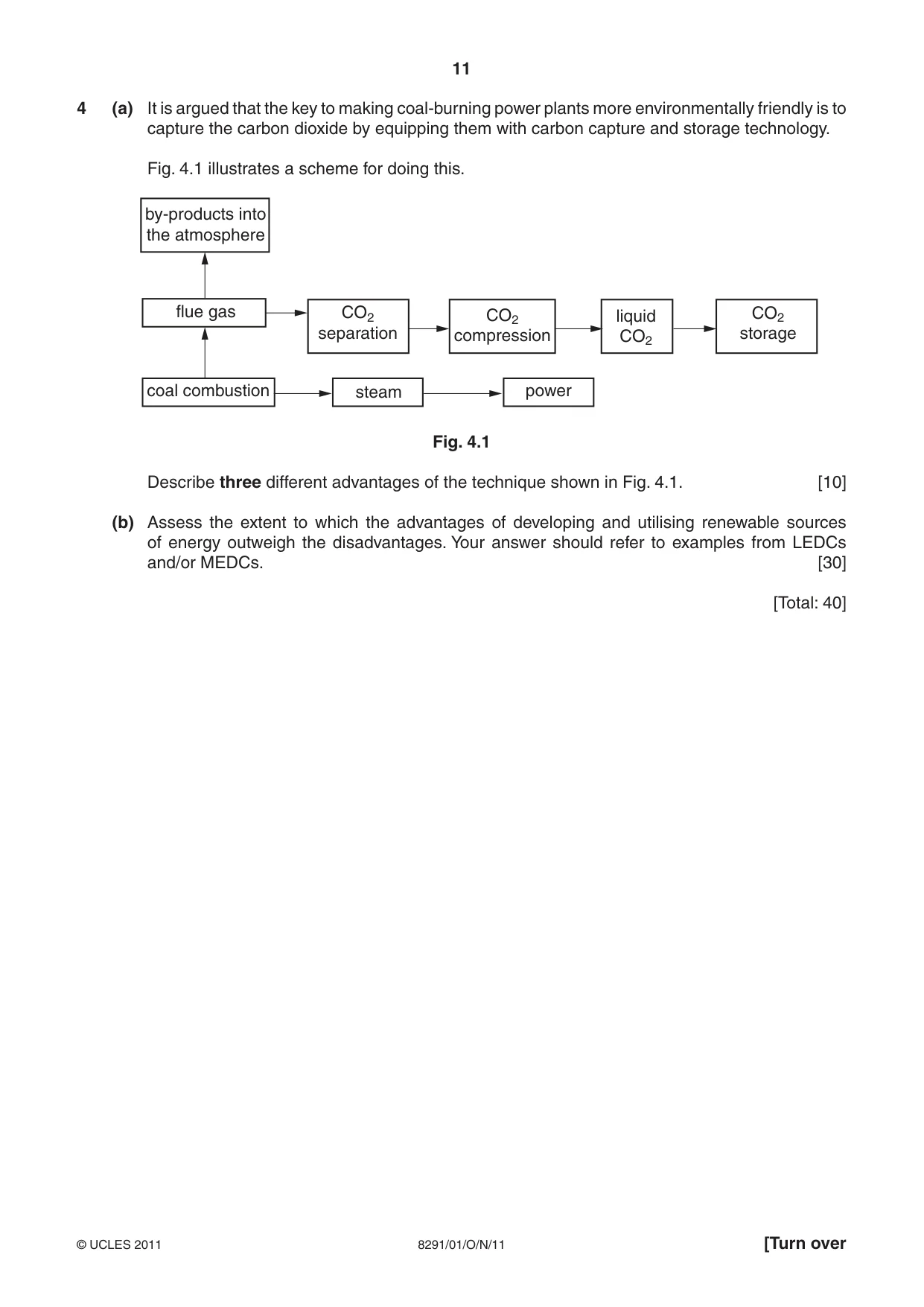
11 8291/01/O/N/11 © UCLES 2011 [Turn over 4 (a) It is argued that the key to making coal-burning power plants more environmentally friendly is to capture the carbon dioxide by equipping them with carbon capture and storage technology. Fig. 4.1 illustrates a scheme for doing this. by-products into the atmosphere flue gas steam power CO2 separation CO2 compression CO2 storage coal combustion liquid CO2 Fig. 4.1 Describe three different advantages of the technique shown in Fig. 4.1. [10] (b) Assess the extent to which the advantages of developing and utilising renewable sources of energy outweigh the disadvantages. Your answer should refer to examples from LEDCs and/or MEDCs. [30] [Total: 40]
Question paper, page 12
12 8291/01/O/N/11 © UCLES 2011 5 (a) Explain how vegetation, water infiltration and weathering have contributed to the soil profile in Fig. 5.1. …[10] thick, acidic, organic debris light-coloured, acidic soil humus, iron, aluminium parent material coniferous forest soil Fig. 5.1 (b) With reference to examples you have studied, assess the extent to which human activity has caused deterioration in soil quality. Assess two methods that could be used to restore degraded soils. [30] [Total: 40] Copyright Acknowledgements: Question 1 Figure 1.3 © Angela Sorrentino; View of Naples City Panorama with Vesuvius; iStock Photo 14877741; www.istockphoto.com Permission to reproduce items where third-party owned material protected by copyright is included has been sought and cleared where possible. Every reasonable effort has been made by the publisher (UCLES) to trace copyright holders, but if any items requiring clearance have unwittingly been included, the publisher will be pleased to make amends at the earliest possible opportunity. University of Cambridge International Examinations is part of the Cambridge Assessment Group. Cambridge Assessment is the brand name of University of Cambridge Local Examinations Syndicate (UCLES), which is itself a department of the University of Cambridge.
Mark scheme, page 1
UNIVERSITY OF CAMBRIDGE INTERNATIONAL EXAMINATIONS GCE Advanced Subsidiary Level MARK SCHEME for the October/November 2011 question paper for the guidance of teachers 8291 ENVIRONMENTAL MANAGEMENT 8291/01 Paper 1, maximum raw mark 80 This mark scheme is published as an aid to teachers and candidates, to indicate the requirements of the examination. It shows the basis on which Examiners were instructed to award marks. It does not indicate the details of the discussions that took place at an Examiners’ meeting before marking began, which would have considered the acceptability of alternative answers. Mark schemes must be read in conjunction with the question papers and the report on the examination. • Cambridge will not enter into discussions or correspondence in connection with these mark schemes. Cambridge is publishing the mark schemes for the October/November 2011 question papers for most IGCSE, GCE Advanced Level and Advanced Subsidiary Level syllabuses and some Ordinary Level syllabuses.
Mark scheme, page 2
Page 2 Mark Scheme: Teachers’ version Syllabus Paper GCE AS LEVEL – October/November 2011 8291 01 © University of Cambridge International Examinations 2011 Section A (Answer all questions in this section.) 1 (a) Fig. 1.1 shows tectonic processes operating at a plate boundary. (i) What is meant by the term tectonic process? [2] The effects of movements of the structural plates (tectons) of the Earth resulting in Earthquakes, volcanoes and fold mountains. Do not credit single words such as ‘volcanoes’. (ii) Name the tectonic process occurring at A. [1] A = subduction (iii) Describe the feature labelled trench in Fig. 1.1 and briefly explain how it is formed. [2] A long narrow region of very deep water (1 mark) caused by the downward dragging of the earth’s crust (subduction) (1 mark) (b) Fig. 1.2 is an example of volcanic activity that frequently occurs at plate boundaries of the type shown in Fig. 1.1. (i) Describe the characteristic features of the volcanic eruption shown in Fig. 1.2. [3] Credit three distinct points To the classicist a plinian eruption. Its characteristic features are: • highly explosive • high incandescent cloud (hot will do) • pyroclastic flow (nueé ardente) • although a lava dome, very little extruded lava. (ii) Explain why volcanic eruptions are common at this type of plate boundary. [2] Credit two linked points that must relate to subduction and rising magma. When a plate is subducted acidic or intermediate magma produces plutons. A release of pressure causes low temperature minerals to ‘melt out’ thus forming viscous magma (as rising plutons) and lava. This blocks the volcanoes’ vents until there is sufficient pressure to cause an explosive eruption. Most of the pyroclastic flow is from the former volcanic structure.
Mark scheme, page 3
Page 3 Mark Scheme: Teachers’ version Syllabus Paper GCE AS LEVEL – October/November 2011 8291 01 © University of Cambridge International Examinations 2011 (c) Predicting the precise time at which a volcanic eruption might occur is difficult. Fig. 1.3 contains information on the monitoring of Mount Vesuvius. (i) Describe how tilt meters, seismometers and chemical analysis are used in the prediction of a future eruption of Mount Vesuvius. [6] The combined contribution of the three monitoring techniques will reveal a true picture (1 mark) • tilt meters record changing slope angles caused by either the swelling or deflation of the sides of the volcano; as it fills up with magma the volcano firstly expands then deflates. (max 2) • seismographs record tremors within the volcano; as magma moves lots of minor earthquakes occur producing harmonic tremors. (max 2) • chemical analysis informs volcanologists of the volcano’s changing chemistry e.g. increases in chlorine, carbon dioxide and sulfur are precursors of an eruption. (max 2) (ii) In planning for a future eruption, describe other measures that need to be taken into account in addition to monitoring. [4] Fig. 1.2 directs candidates towards strategies targeting the protection and evacuation of over 1 million people. These include: evacuation procedures, food, water, medical aid etc. Discerning candidates may mention the suddenness of such eruptions and refer to Pompeii and Herculaneum. Assessments that focus on what to do after the event are perfectly valid. [Total: 20] 2 (a) Fig. 2.1 shows mean monthly temperatures and rainfall for a tropical climate. (i) Explain why information for temperature and rainfall in climatic charts such as Fig. 2.1 is averaged over a period of at least 25 years. [2] Averaging provides a more representative figure (1 mark) which eradicates anomalous years (1 mark). (ii) Calculate the annual range of temperature and rainfall shown in Fig. 2.1. [2] Temperature range = 9o to 10oC rainfall range = 340mm +/- 20 (iii) Describe the pattern of temperature and rainfall for the climatic area in Fig. 2.1. [4] Credit 2 marks for each. Temperature has a small range that peaks at 29 in September/October after the summer rains. A winter minimum of 20 is recorded in January. Rainfall has a seasonal imbalance with a wet season between May and September (wet monsoon) and a winter drought.
Mark scheme, page 4
Page 4 Mark Scheme: Teachers’ version Syllabus Paper GCE AS LEVEL – October/November 2011 8291 01 © University of Cambridge International Examinations 2011 (iv) Using data from Fig. 2.1 outline one way in which human activity might be influenced by this climate. [2] The climate is tropical with a high peak during the May to September period. Therefore: flooding, seasonal drought will have social and economic effects. Credit for an elaboration of the effects rather than a brief statement that repeats (b)(i). 1 mark for a brief description and 2 marks for effective elaboration. (b) Fig. 2.2 contains information on the climate of Greece and the fires that devastated areas of the country in summer of 2009. (i) Using the information contained in Fig. 2.2, describe how the climate may have contributed to the fires that have affected this region in recent years. [5] Credit should be given for use of both temperature and rainfall. Rainfall is seasonal with a winter maximum and summer minimum (1 mark) with data (2 marks). Temperatures average 30oC in July (2 marks with data and 1 without data) when rainfall is at its lowest (relationship + 1 mark). This dries out the vegetation making forest fires more likely (1 mark). (ii) Use the information in Fig. 2.2 to suggest ways in which human activity may have contributed to the risk of fires in Greece. [5] Credit 3/4 marks for the discussion of human influences and 2/1 marks element of doubt e.g. global warming. Influences include increased urbanisation and forest clearance; land use changes that increase the likelihood of drought and fires. Give credit where due e.g. human activity combined with climatic change. [Total: 20]
Mark scheme, page 5
Page 5 Mark Scheme: Teachers’ version Syllabus Paper GCE AS LEVEL – October/November 2011 8291 01 © University of Cambridge International Examinations 2011 Section B (Answer one question from this section.) 3 (a) Describe the process by which stratospheric ozone is depleted and briefly describe the effects ozone depletion may have upon the health of people and vegetation. [10] CFCs are transported into the stratosphere where they are eventually broken down by ultraviolet (UV) rays from the Sun, releasing free chlorine. (2 marks) The chlorine becomes involved in the process of destruction of ozone. Two molecules of ozone are replaced by three of molecular oxygen, leaving the chlorine free to repeat the process: (2 marks) Cl + O3 → ClO + O2 ClO + O → Cl + O2 Ozone is converted to oxygen, leaving the chlorine atom free to repeat the process up to 100,000 times, resulting in a reduced level of ozone. (2 marks) people: over-exposure to UV-B causes skin cancer, cataracts, increased likelihood of malaria and other infectious diseases. (2 marks) vegetation: The life cycles of plants will change, disrupting the food chain; plankton may not be able to survive. (2 marks) The above marks translate into: 8–10 mark answers express a full understanding of processes and products. 4–7 mark answers will tend to be descriptive and lack detail on chemical processes. 1–3 mark answers may indicate the effects of ozone depletion but processes will not be described.
Mark scheme, page 6
Page 6 Mark Scheme: Teachers’ version Syllabus Paper GCE AS LEVEL – October/November 2011 8291 01 © University of Cambridge International Examinations 2011 (b) There are signs that the issue of stratospheric ozone depletion is responding to international actions. The issue of global warming, however, remains a major problem. Describe the international agreements that have been reached in an attempt to solve these key environmental issues. Assess the extent to which MEDCs and LEDCs have been able to comply with agreements in respect of these two issues. [30] Solving the ozone problem has been more successful as there is greater scientific clarity; there are available substitutes for CFCs. Montreal Protocol required the total phasing out of ozone depleting compounds begun in 1987; due to be completed in 2030. LEDCs have found it more difficult due to cost and economic factors. China has been the slowest. Most MEDCs have found the technological and economic difficulties easier to overcome. Global warming is a more difficult issue: Despite protocols from Rio, Kyoto and Bali LEDCs and MEDCs’ responses have varied and dithered e.g. USA and UK are slow, other EU countries quicker; some LEDCs are more responsive. Economic issues lie in reducing the output of greenhouse gases i.e. use of fossil fuels. Developments in alternative energy are varied. The process may have gone too far too quickly. There are uncertainties about the release of methane. There are political barriers and scientific apprehension. Band 1 answers will take on the debate and in a balanced way refer to the differences between the two problems. There will be clear and evaluative references to protocols. Band 3 answers may lack balance and probably show more understanding of the Global Warming issue. Answers at this level may lack detail and appear superficial. Band 4 answers will probably be very superficial, lack clarity on the recommendations of Montreal and Kyoto and focus on either ozone depletion or global warming [Total: 40]
Mark scheme, page 7
Page 7 Mark Scheme: Teachers’ version Syllabus Paper GCE AS LEVEL – October/November 2011 8291 01 © University of Cambridge International Examinations 2011 4 (a) It is argued that the key to making coal-burning power plants more environmentally friendly is to capture the carbon dioxide by equipping them with carbon capture and storage technology. Fig. 4.1 illustrates a scheme for doing this. Describe three different advantages of the technique shown in Fig. 4.1. [10] The question is concerned with one technique for using or storing carbon dioxide thereby enabling many countries to continue using fossil fuels, particularly coal. Credit 1 mark for identifying the advantage and 2 marks for its elaboration. Advantages include: • power via the combustion of coal • separation and storage of carbon • less carbon dioxide entering the atmosphere • selling to industry; carbon by-products • there is immense storage capacity. 8–10 mark answers should identify and detail 3 advantages. 4–7 mark answers will identify and detail at least one advantage. 1–3 mark answers will go as far as identification or very briefly outline one advantage.
Mark scheme, page 8
Page 8 Mark Scheme: Teachers’ version Syllabus Paper GCE AS LEVEL – October/November 2011 8291 01 © University of Cambridge International Examinations 2011 (b) Assess the extent to which the advantages of developing and utilising renewable sources of energy outweigh the disadvantages. Your answer should refer to examples from LEDCs and/or MEDCs. [30] A familiar topic, although one which candidates sometimes find difficult. The question requires candidates to: • express a knowledge of renewable energy sources • express advantages • express disadvantages • select examples; either MEDCs or LEDCs or both. Renewable resources occur in a flow in nature and include water (HEP, waves, tides), wind and solar and if justified wood and geothermal. Nuclear energy is derived from uranium which is non-renewable and arguably plutonium is recycled. Advantages should refer to: in their energy production process are cleaner, reduce our carbon footprint, can replace depleting reserves of fossil fuels, can have economic, social and recreational benefits, HEP stations have a quicker start-up time. Disadvantages include: cost, efficiency, output, aesthetic and environmental and in their manufacturing phase probably produce as much pollution as they will ultimately save. It is worth noting that many LEDCs have a greater use of renewable energy than non- renewable; the scale of production and demand is much lower than MEDCs. Band 1 answers will be clear in their choice of countries and satisfy the four requirements of the question. There will be a good balance of advantages and disadvantages with a high level of evaluation. Band 3 answers will select suitable examples but may only develop 2 of the question requirements. Expect some woolly reasoning and although relevant some superficiality. Band 4 answers although relevant are likely to be brief and poorly balanced. Some candidates may provide a brief listing of points. [Total: 40]
Mark scheme, page 9
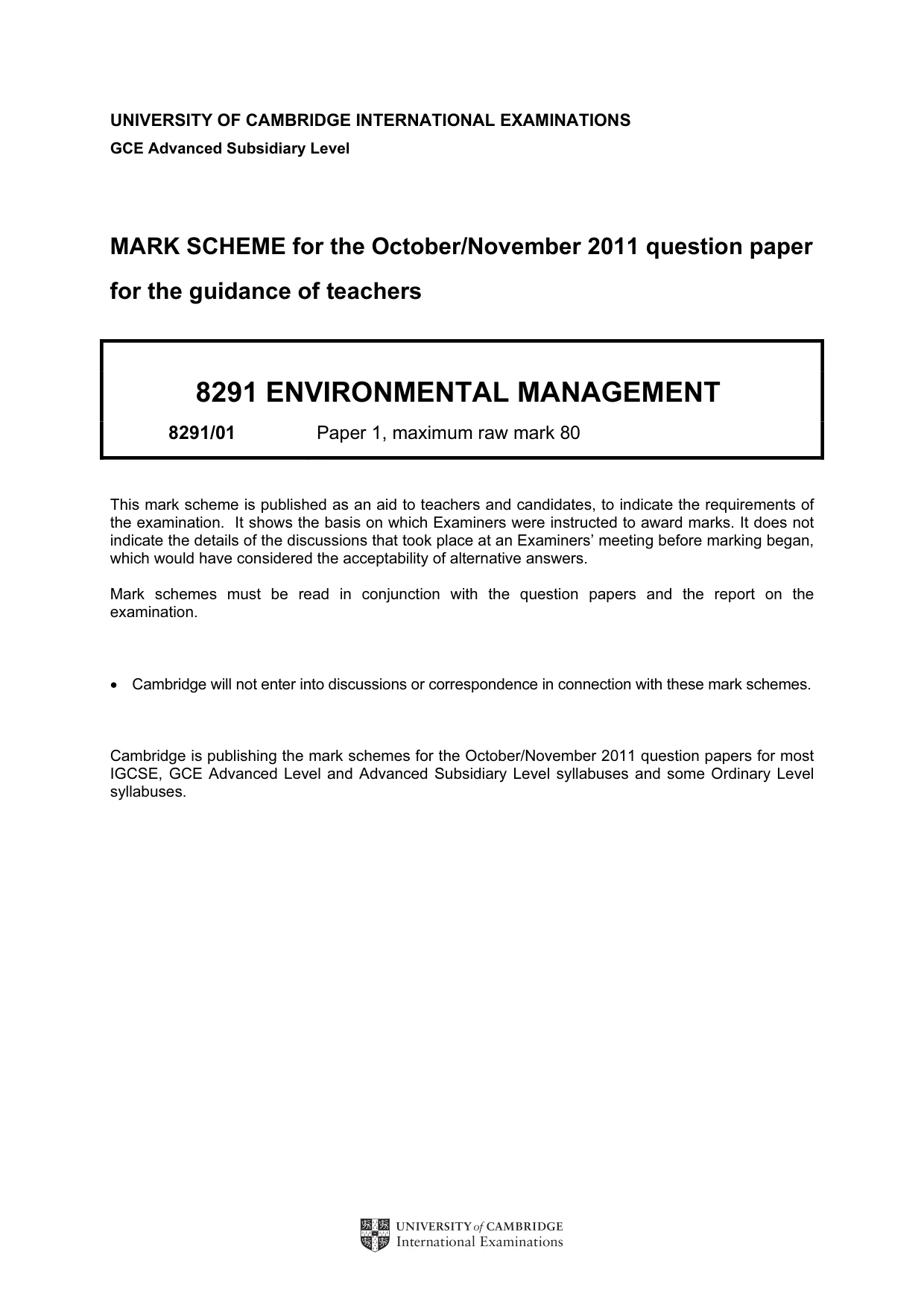
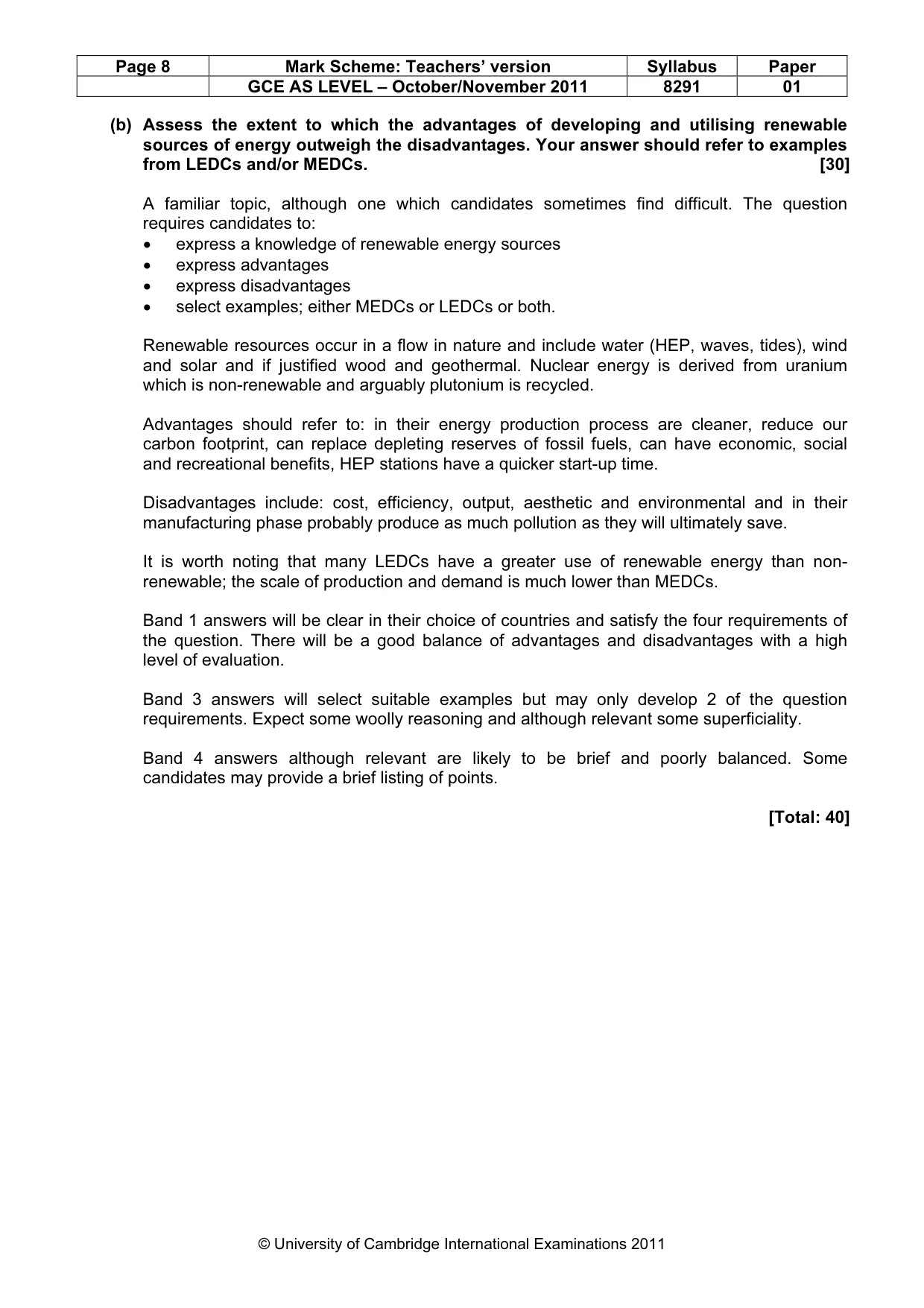
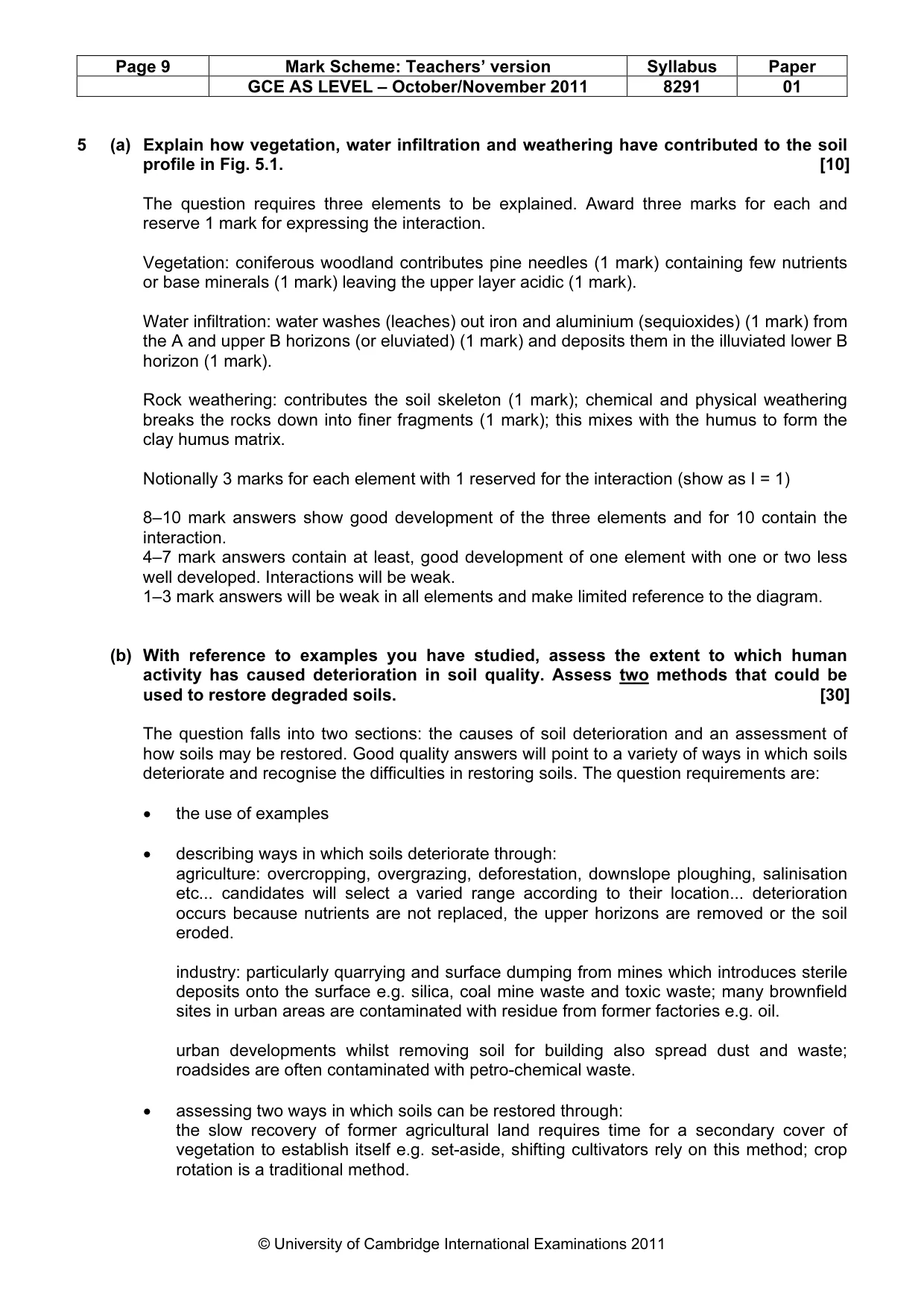
Page 9 Mark Scheme: Teachers’ version Syllabus Paper GCE AS LEVEL – October/November 2011 8291 01 © University of Cambridge International Examinations 2011 5 (a) Explain how vegetation, water infiltration and weathering have contributed to the soil profile in Fig. 5.1. [10] The question requires three elements to be explained. Award three marks for each and reserve 1 mark for expressing the interaction. Vegetation: coniferous woodland contributes pine needles (1 mark) containing few nutrients or base minerals (1 mark) leaving the upper layer acidic (1 mark). Water infiltration: water washes (leaches) out iron and aluminium (sequioxides) (1 mark) from the A and upper B horizons (or eluviated) (1 mark) and deposits them in the illuviated lower B horizon (1 mark). Rock weathering: contributes the soil skeleton (1 mark); chemical and physical weathering breaks the rocks down into finer fragments (1 mark); this mixes with the humus to form the clay humus matrix. Notionally 3 marks for each element with 1 reserved for the interaction (show as I = 1) 8–10 mark answers show good development of the three elements and for 10 contain the interaction. 4–7 mark answers contain at least, good development of one element with one or two less well developed. Interactions will be weak. 1–3 mark answers will be weak in all elements and make limited reference to the diagram. (b) With reference to examples you have studied, assess the extent to which human activity has caused deterioration in soil quality. Assess two methods that could be used to restore degraded soils. [30] The question falls into two sections: the causes of soil deterioration and an assessment of how soils may be restored. Good quality answers will point to a variety of ways in which soils deteriorate and recognise the difficulties in restoring soils. The question requirements are: • the use of examples • describing ways in which soils deteriorate through: agriculture: overcropping, overgrazing, deforestation, downslope ploughing, salinisation etc... candidates will select a varied range according to their location... deterioration occurs because nutrients are not replaced, the upper horizons are removed or the soil eroded. industry: particularly quarrying and surface dumping from mines which introduces sterile deposits onto the surface e.g. silica, coal mine waste and toxic waste; many brownfield sites in urban areas are contaminated with residue from former factories e.g. oil. urban developments whilst removing soil for building also spread dust and waste; roadsides are often contaminated with petro-chemical waste. • assessing two ways in which soils can be restored through: the slow recovery of former agricultural land requires time for a secondary cover of vegetation to establish itself e.g. set-aside, shifting cultivators rely on this method; crop rotation is a traditional method.
Mark scheme, page 10
Page 10 Mark Scheme: Teachers’ version Syllabus Paper GCE AS LEVEL – October/November 2011 8291 01 © University of Cambridge International Examinations 2011 soil stripping that avoids the mixing of horizons; soils are stored and as appropriate laid over the area to be restored; time is needed to enable humus to develop or controlled and limited cultivation. • problems associated with soil restoration are: too little time is given, added fertiliser can be washed out unless a clay-humus complex forms; machinery can compact soils; some restored soils return to full use too early e.g. Sahel and tropical forest. Band 1 answers will consider each of the requirements expressing a clear understanding, with examples, of the causes of soil deterioration including agricultural and urban/industrial inputs. There will be a sound assessment of two restorative measures. Band 3 answers may lack balance and concentrate on agricultural causes with a limited understanding of how soils can be restored. Other answers will be relevant, refer to the four bullet points but be superficial. Band 4 answers will be brief and probably poorly balanced. Soil deterioration will be descriptive without explanations. Restoration of soils might amount to a small number of brief descriptive statements. [Total: 40]
Mark scheme, page 11
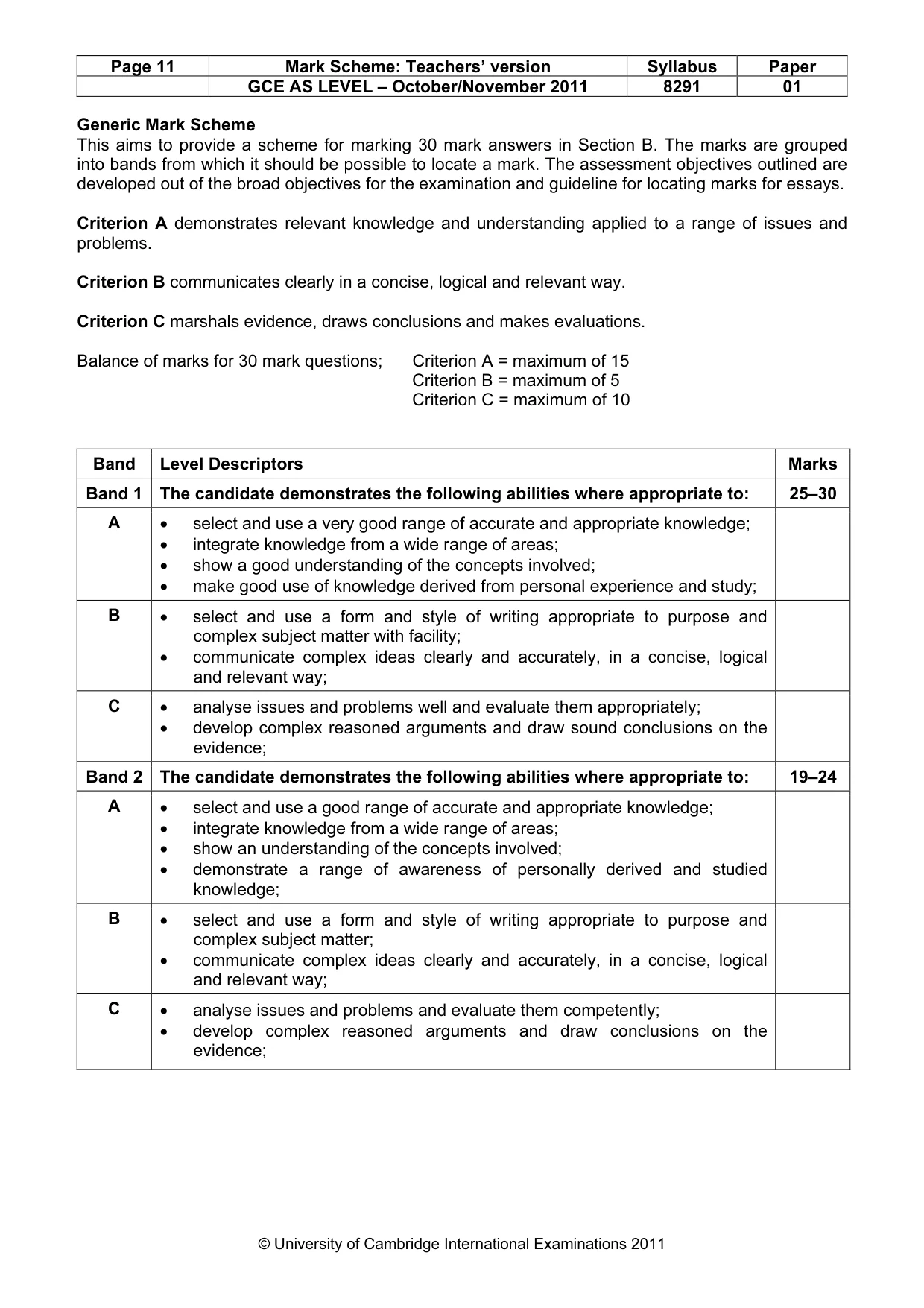
Page 11 Mark Scheme: Teachers’ version Syllabus Paper GCE AS LEVEL – October/November 2011 8291 01 © University of Cambridge International Examinations 2011 Generic Mark Scheme This aims to provide a scheme for marking 30 mark answers in Section B. The marks are grouped into bands from which it should be possible to locate a mark. The assessment objectives outlined are developed out of the broad objectives for the examination and guideline for locating marks for essays. Criterion A demonstrates relevant knowledge and understanding applied to a range of issues and problems. Criterion B communicates clearly in a concise, logical and relevant way. Criterion C marshals evidence, draws conclusions and makes evaluations. Balance of marks for 30 mark questions; Criterion A = maximum of 15 Criterion B = maximum of 5 Criterion C = maximum of 10 Band Level Descriptors Marks Band 1 The candidate demonstrates the following abilities where appropriate to: 25–30 A • select and use a very good range of accurate and appropriate knowledge; • integrate knowledge from a wide range of areas; • show a good understanding of the concepts involved; • make good use of knowledge derived from personal experience and study; B • select and use a form and style of writing appropriate to purpose and complex subject matter with facility; • communicate complex ideas clearly and accurately, in a concise, logical and relevant way; C • analyse issues and problems well and evaluate them appropriately; • develop complex reasoned arguments and draw sound conclusions on the evidence; Band 2 The candidate demonstrates the following abilities where appropriate to: 19–24 A • select and use a good range of accurate and appropriate knowledge; • integrate knowledge from a wide range of areas; • show an understanding of the concepts involved; • demonstrate a range of awareness of personally derived and studied knowledge; B • select and use a form and style of writing appropriate to purpose and complex subject matter; • communicate complex ideas clearly and accurately, in a concise, logical and relevant way; C • analyse issues and problems and evaluate them competently; • develop complex reasoned arguments and draw conclusions on the evidence;
Mark scheme, page 12
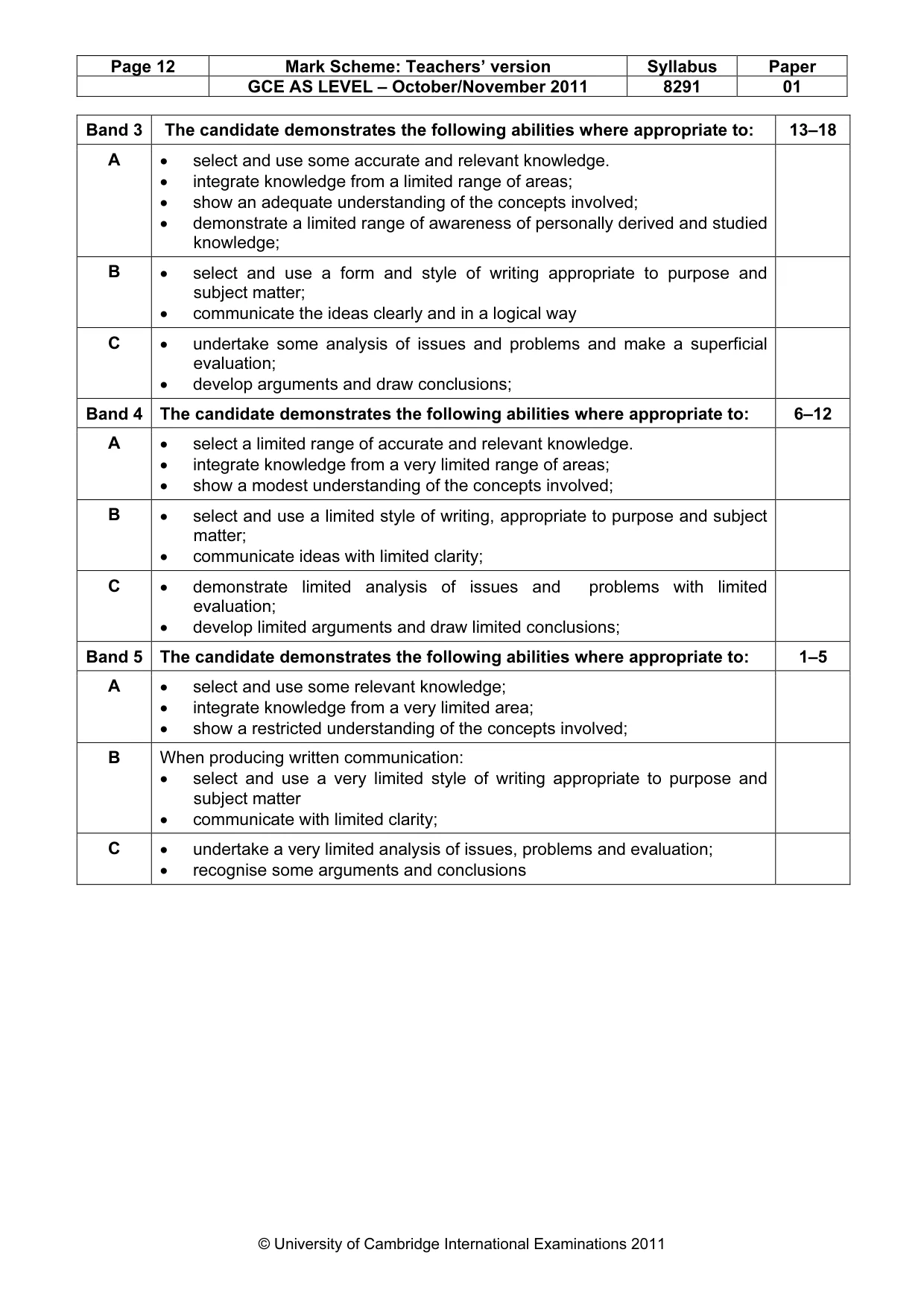
Page 12 Mark Scheme: Teachers’ version Syllabus Paper GCE AS LEVEL – October/November 2011 8291 01 © University of Cambridge International Examinations 2011 Band 3 The candidate demonstrates the following abilities where appropriate to: 13–18 A • select and use some accurate and relevant knowledge. • integrate knowledge from a limited range of areas; • show an adequate understanding of the concepts involved; • demonstrate a limited range of awareness of personally derived and studied knowledge; B • select and use a form and style of writing appropriate to purpose and subject matter; • communicate the ideas clearly and in a logical way C • undertake some analysis of issues and problems and make a superficial evaluation; • develop arguments and draw conclusions; Band 4 The candidate demonstrates the following abilities where appropriate to: 6–12 A • select a limited range of accurate and relevant knowledge. • integrate knowledge from a very limited range of areas; • show a modest understanding of the concepts involved; B • select and use a limited style of writing, appropriate to purpose and subject matter; • communicate ideas with limited clarity; C • demonstrate limited analysis of issues and problems with limited evaluation; • develop limited arguments and draw limited conclusions; Band 5 The candidate demonstrates the following abilities where appropriate to: 1–5 A • select and use some relevant knowledge; • integrate knowledge from a very limited area; • show a restricted understanding of the concepts involved; B When producing written communication: • select and use a very limited style of writing appropriate to purpose and subject matter • communicate with limited clarity; C • undertake a very limited analysis of issues, problems and evaluation; • recognise some arguments and conclusions
What you needed in this session
Cambridge’s own grade thresholds for 2011 Oct/Nov, Paper 1 · Variant 1. A higher threshold means an easier paper — the bar moves with how the cohort did.