Cambridge A Level English - Language AS and A Level (from 2014) 9093 — 2020 Oct/Nov Paper 4 · Variant 3
9093/43/O/N/20 · 50 marks · ≈56 min
The question paper and its mark scheme, free to read here and free to download. This is Cambridge’s own paper, exactly as it was sat.
Question paper8 pages


Mark scheme8 pages
Answers below. Sit the paper first if you are practising.
Paper as text
Question paper, page 1
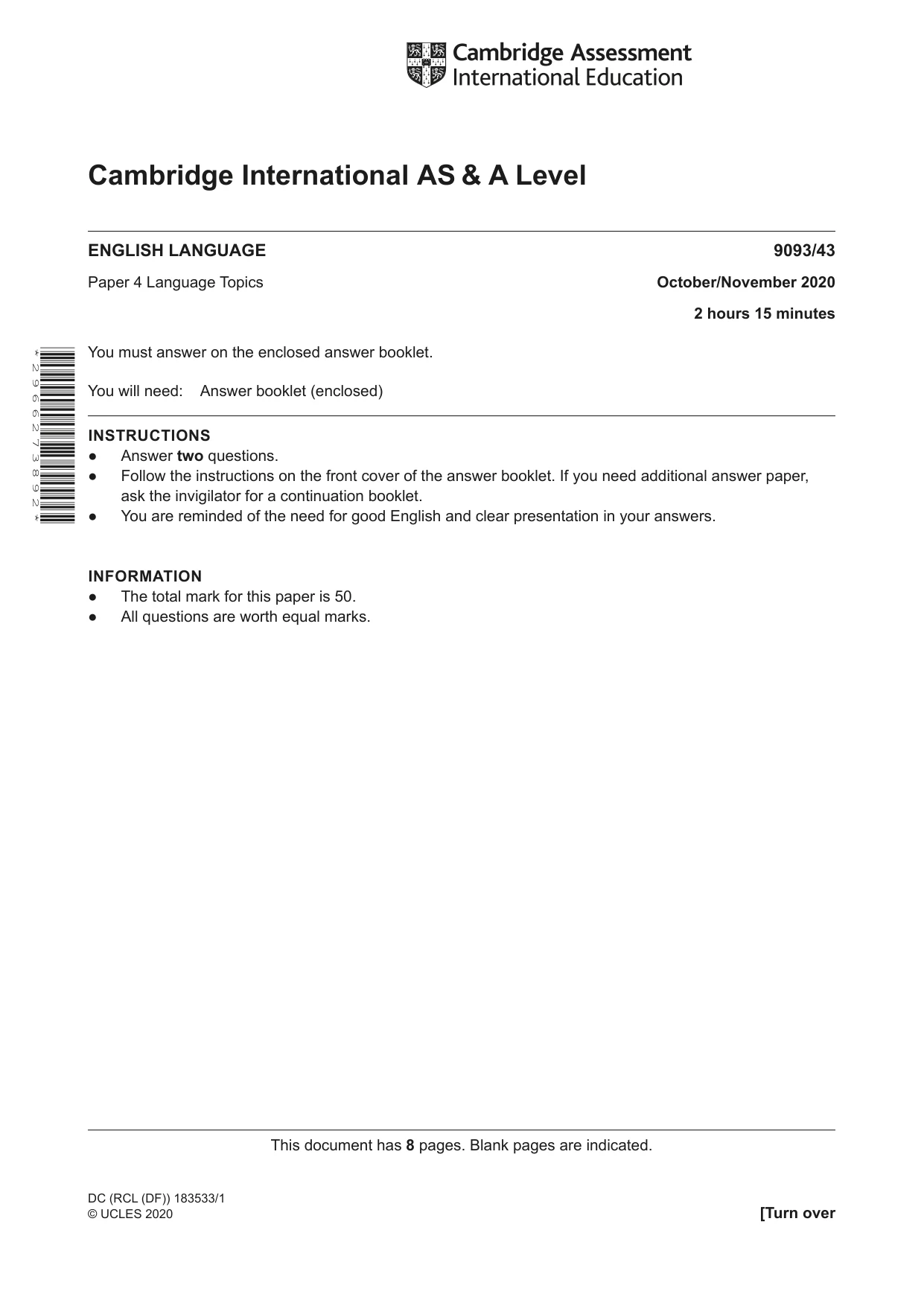
Cambridge International AS & A Level * 2 9 6 6 2 7 3 8 9 2 * This document has 8 pages. Blank pages are indicated. ENGLISH LANGUAGE 9093/43 Paper 4 Language Topics October/November 2020 2 hours 15 minutes You must answer on the enclosed answer booklet. You will need: Answer booklet (enclosed) INSTRUCTIONS ● Answer two questions. ● Follow the instructions on the front cover of the answer booklet. If you need additional answer paper, ask the invigilator for a continuation booklet. ● You are reminded of the need for good English and clear presentation in your answers. INFORMATION ● The total mark for this paper is 50. ● All questions are worth equal marks. DC (RCL (DF)) 183533/1 © UCLES 2020 [Turn over
Question paper, page 2
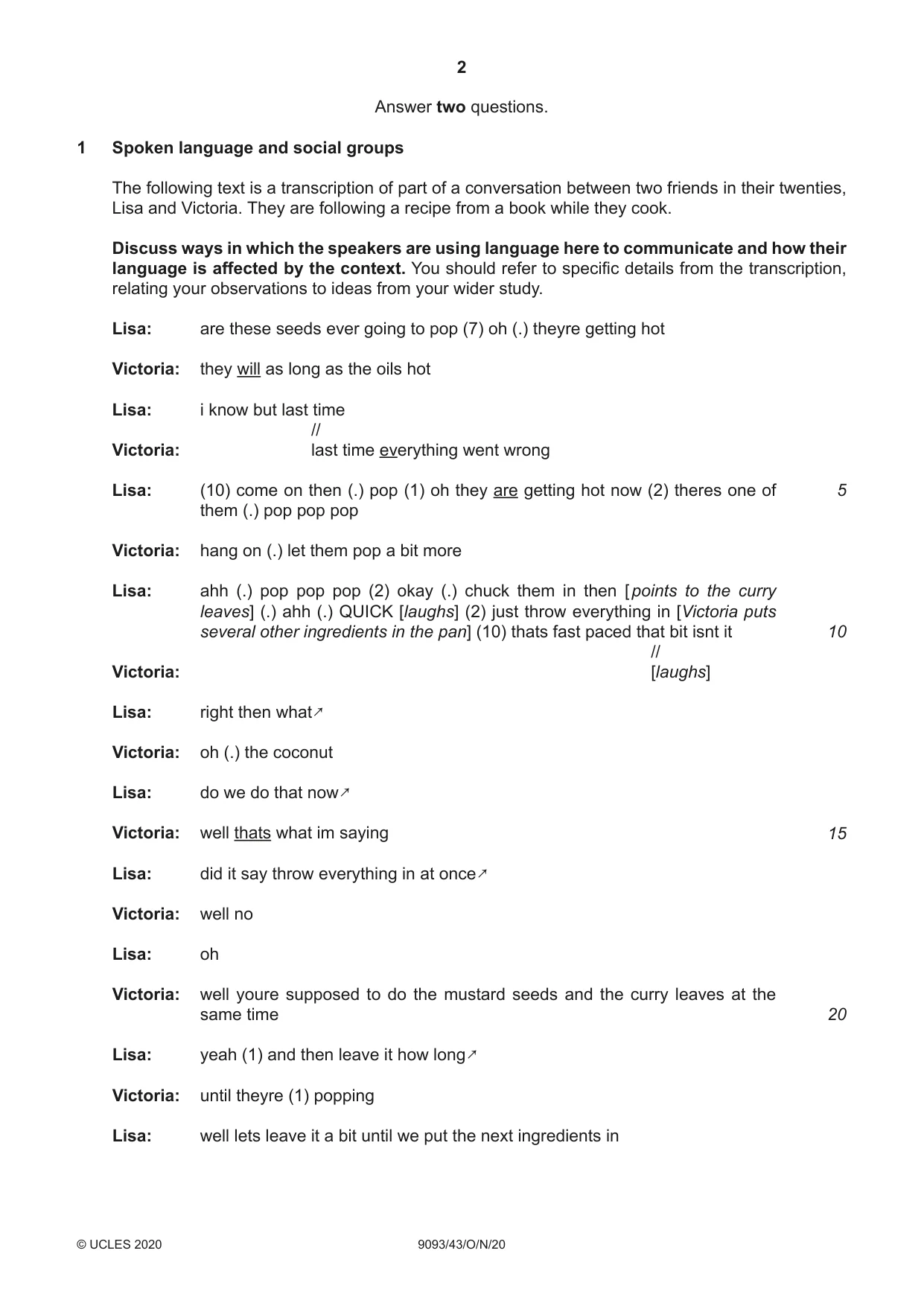
2 9093/43/O/N/20 © UCLES 2020 Answer two questions. 1 Spoken language and social groups The following text is a transcription of part of a conversation between two friends in their twenties, Lisa and Victoria. They are following a recipe from a book while they cook. Discuss ways in which the speakers are using language here to communicate and how their language is affected by the context. You should refer to specific details from the transcription, relating your observations to ideas from your wider study. Lisa: are these seeds ever going to pop (7) oh (.) theyre getting hot Victoria: they will as long as the oils hot Lisa: i know but last time // Victoria: last time everything went wrong Lisa: (10) come on then (.) pop (1) oh they are getting hot now (2) theres one of them (.) pop pop pop Victoria: hang on (.) let them pop a bit more Lisa: ahh (.) pop pop pop (2) okay (.) chuck them in then [ points to the curry leaves] (.) ahh (.) QUICK [laughs] (2) just throw everything in [Victoria puts several other ingredients in the pan] (10) thats fast paced that bit isnt it // Victoria: [laughs] Lisa: right then what↗ Victoria: oh (.) the coconut Lisa: do we do that now↗ Victoria: well thats what im saying Lisa: did it say throw everything in at once↗ Victoria: well no Lisa: oh Victoria: well youre supposed to do the mustard seeds and the curry leaves at the same time Lisa: yeah (1) and then leave it how long↗ Victoria: until theyre (1) popping Lisa: well lets leave it a bit until we put the next ingredients in 5 10 15 20
Question paper, page 3
3 9093/43/O/N/20 © UCLES 2020 [Turn over Victoria: no (.) cause [ picks up recipe book to check the recipe] (8) okay once (.) you do the curry leaves and mustard seeds first (.) and then wait for them to pop and then add the onion // Lisa: okay Victoria: and then when the onions caramelising add the garlic chilli and coconut Lisa: oh well (.) why didnt we do that↗ (.) well anyway we’ll just have to wait // Victoria: because you can cook chilli and garlic for a long time // Lisa: lets just wait (.) lets just wait for the onion to caramelise then Victoria: okay Lisa: and then we’ll add in the rest // Victoria: and then the coconut and cook that a bit and then the vegetables and cook that for a couple of minutes Lisa: okay TRANSCRIPTION KEY (1) = pause in seconds (.) = micropause underlined = stressed sound/syllable(s) // = speech overlap [italics] = paralinguistic features ↗ = upward intonation [UPPER CASE] = words spoken with increased volume 25 30 35
Question paper, page 4
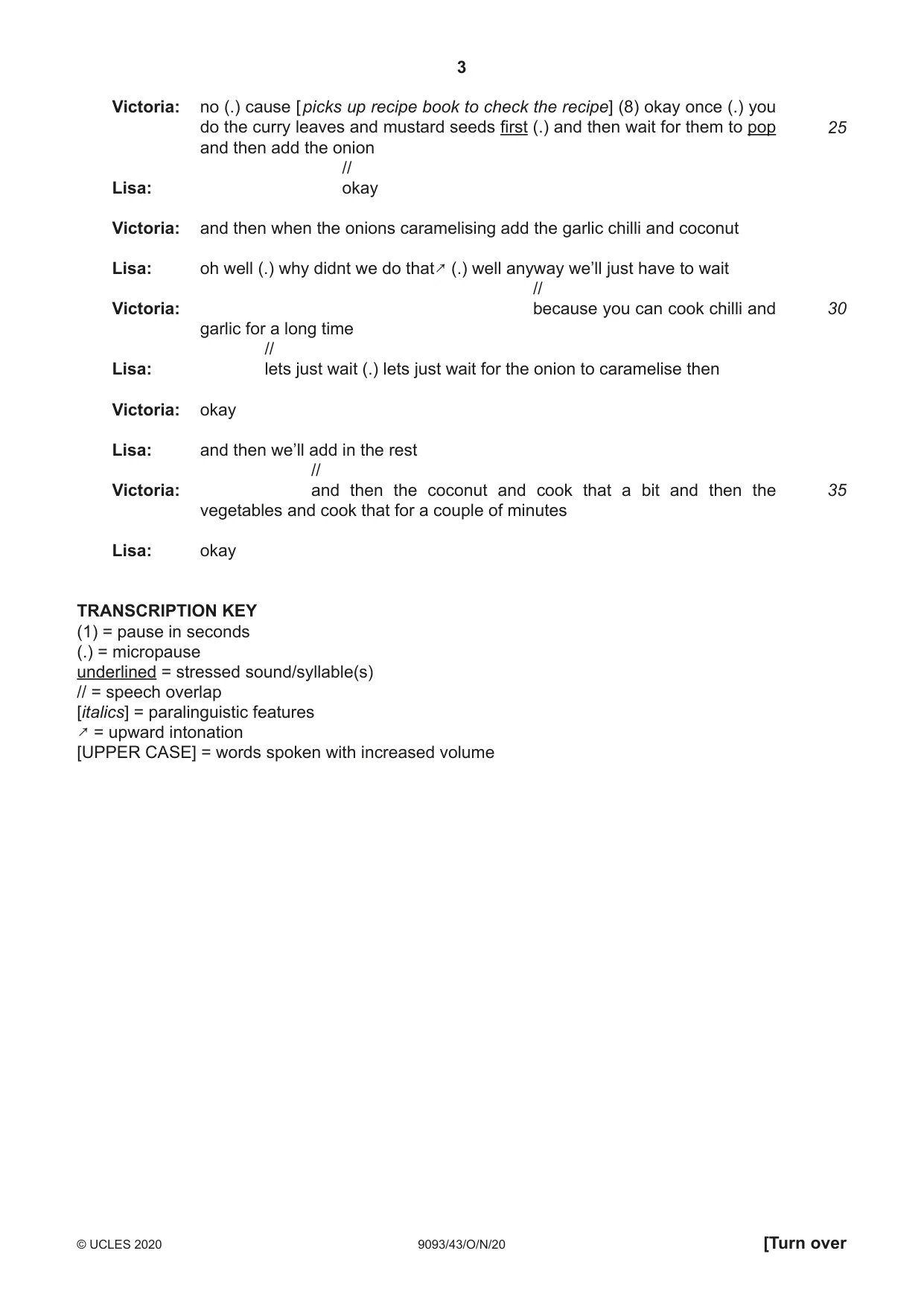
4 9093/43/O/N/20 © UCLES 2020 2 English as a global language The passage below is from a 2015 article which was published on a website called The Conversation. Discuss what you feel are the most important issues raised here relating to the changing use of English as a global language. You should refer to specific details from the passage as well as to ideas and examples from your wider study. What will the English language be like in 100 years? In the use of English around the globe, especially in countries where it functions as a second language, new ‘interlanguages’ are emerging, in which features of English are mingled with those of other native tongues and their pronunciations. Meanwhile, the development of automatic translation software, such as Google Translate, will come to replace English as the preferred means of communication employed in the boardrooms of international corporations and government agencies. So the future for English is one of multiple Englishes. What is being lost? In the 20th century, it was feared that English dialects were dying out with their speakers. But while numerous dialect words were collected in studies for ‘young person in cheap trendy clothes and jewellery’, the word chav was found throughout England, demonstrating how features of the Estuary English spoken in the Greater London area are displacing local dialects, especially among younger generations. Today we are witnessing a process of de-standardisation, and the emergence of competing norms of usage. In the online world, attitudes to consistency and correctness are considerably more relaxed: variant spellings are accepted and punctuation marks omitted, or repurposed to convey a range of attitudes. Research has shown that in electronic discourse exclamation marks can carry a range of exclamatory functions, including apologising, challenging, thanking, agreeing, and showing solidarity. Capital letters are used to show anger, misspellings convey humour and establish group identity, and smiley faces or emoticons express a range of reactions. Getting shorter Some have questioned whether the increasing development and adoption of emoji pictograms, which allow speakers to communicate without the need for language, mean that we will cease to communicate in English at all. ;-) The fast-changing world of social media is also responsible for the coining and spreading of neologisms, or ‘new words’. Recent updates to Oxford Dictionaries give a flavour: mansplaining, awesomesauce, rly, bants, TL;DR (too long; didn’t read). Clipped forms, acronyms, blends and abbreviations have long been productive methods of word formation in English (think of bus, smog and scuba) but the huge increase in such coinages means that they will be far more prominent in the English of 2115. Whether you < or h8 such words, think they are NBD or meh, they are undoubtedly here to stay. 5 10 15 20 25 30 35
Question paper, page 5
5 9093/43/O/N/20 © UCLES 2020 [Turn over BLANK PAGE
Question paper, page 6
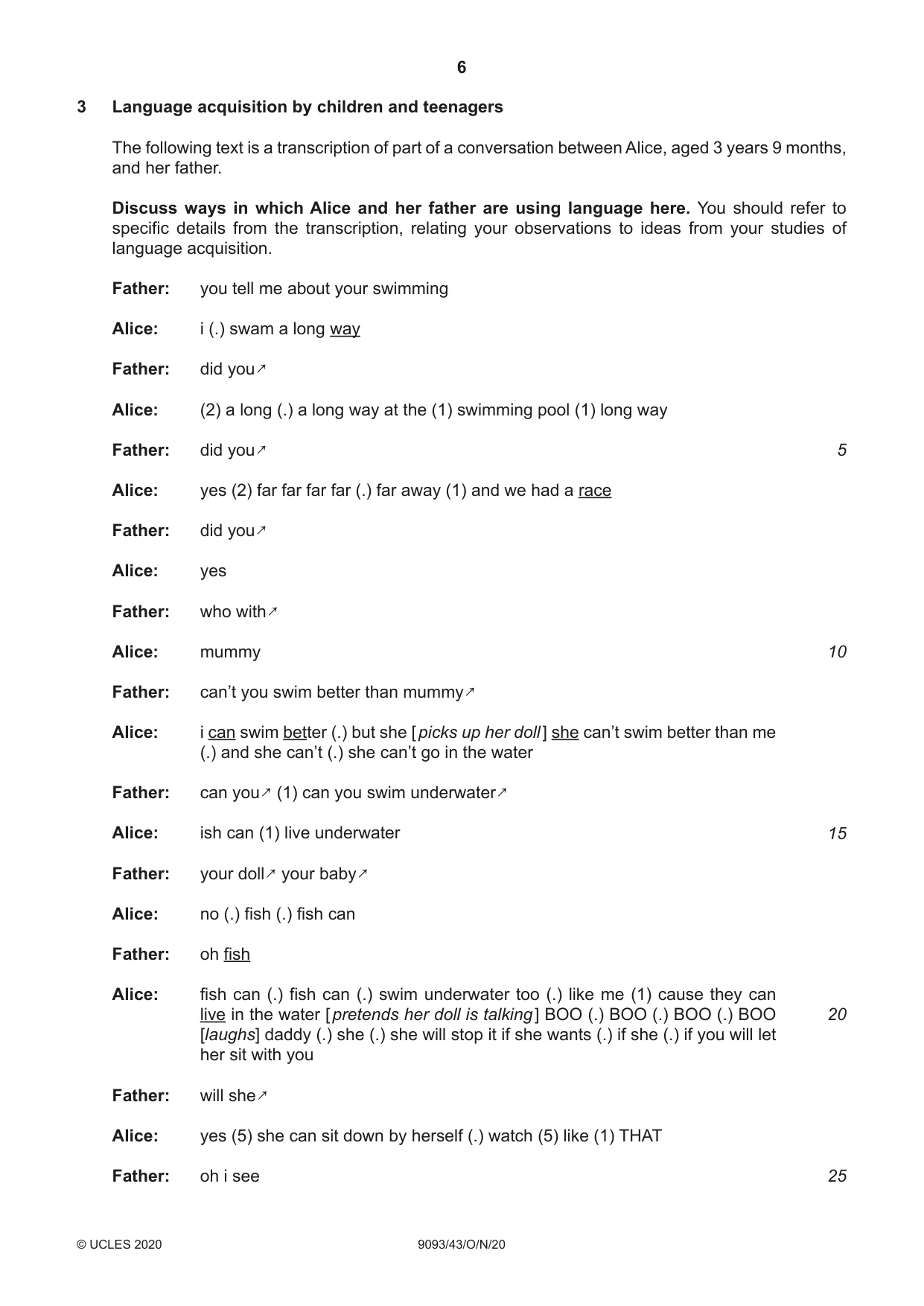
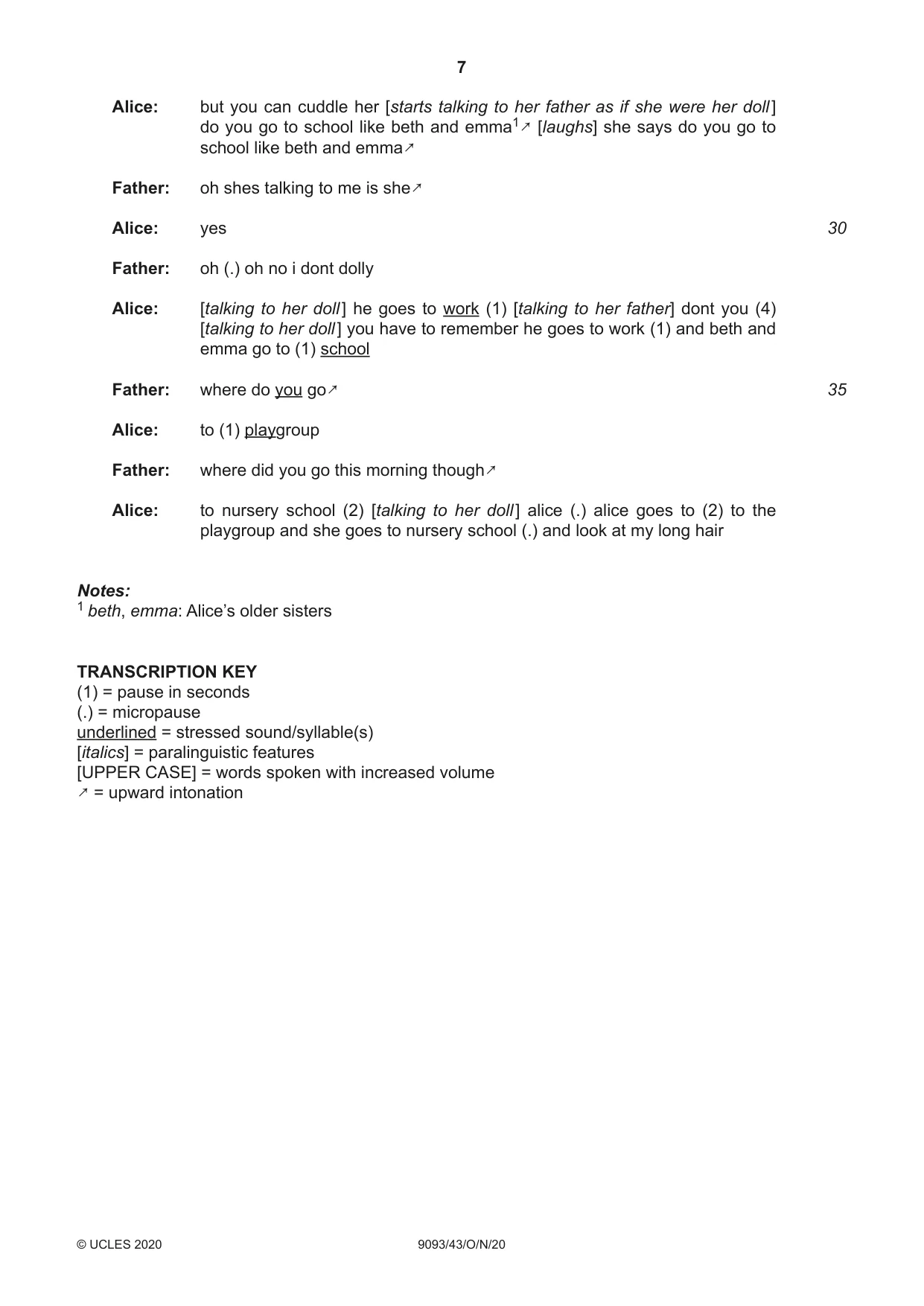
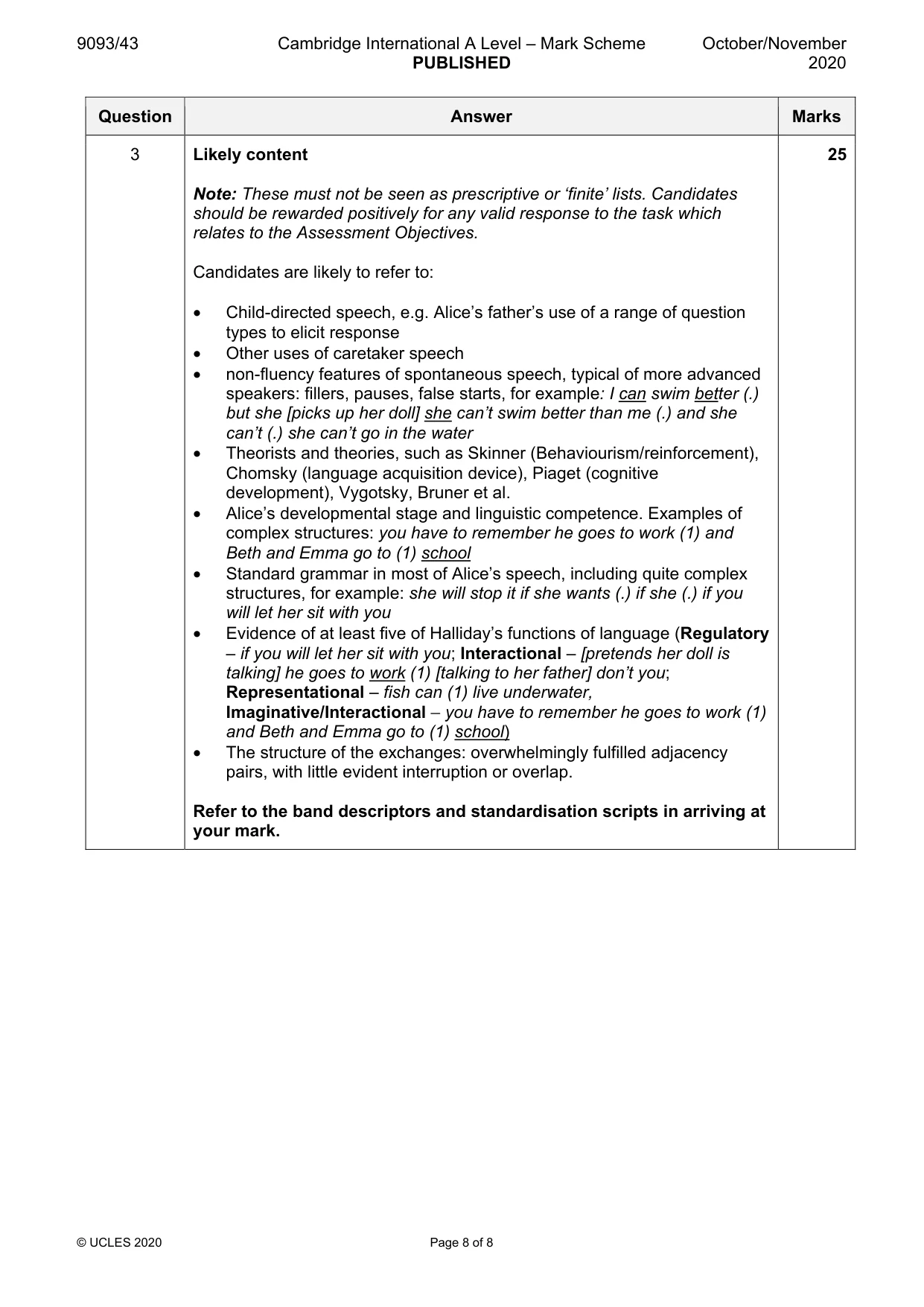
6 9093/43/O/N/20 © UCLES 2020 3 Language acquisition by children and teenagers The following text is a transcription of part of a conversation between Alice, aged 3 years 9 months, and her father. Discuss ways in which Alice and her father are using language here. You should refer to specific details from the transcription, relating your observations to ideas from your studies of language acquisition. Father: you tell me about your swimming Alice: i (.) swam a long way Father: did you↗ Alice: (2) a long (.) a long way at the (1) swimming pool (1) long way Father: did you↗ Alice: yes (2) far far far far (.) far away (1) and we had a race Father: did you↗ Alice: yes Father: who with↗ Alice: mummy Father: can’t you swim better than mummy↗ Alice: i can swim better (.) but she [ picks up her doll ] she can’t swim better than me (.) and she can’t (.) she can’t go in the water Father: can you↗ (1) can you swim underwater↗ Alice: ish can (1) live underwater Father: your doll↗ your baby↗ Alice: no (.) fish (.) fish can Father: oh fish Alice: fish can (.) fish can (.) swim underwater too (.) like me (1) cause they can live in the water [ pretends her doll is talking ] BOO (.) BOO (.) BOO (.) BOO [laughs] daddy (.) she (.) she will stop it if she wants (.) if she (.) if you will let her sit with you Father: will she↗ Alice: yes (5) she can sit down by herself (.) watch (5) like (1) THAT Father: oh i see 5 10 15 20 25
Question paper, page 7
7 9093/43/O/N/20 © UCLES 2020 Alice: but you can cuddle her [starts talking to her father as if she were her doll ] do you go to school like beth and emma1↗ [laughs] she says do you go to school like beth and emma↗ Father: oh shes talking to me is she↗ Alice: yes Father: oh (.) oh no i dont dolly Alice: [talking to her doll ] he goes to work (1) [talking to her father] dont you (4) [talking to her doll ] you have to remember he goes to work (1) and beth and emma go to (1) school Father: where do you go↗ Alice: to (1) playgroup Father: where did you go this morning though↗ Alice: to nursery school (2) [talking to her doll ] alice (.) alice goes to (2) to the playgroup and she goes to nursery school (.) and look at my long hair Notes: 1 beth, emma: Alice’s older sisters TRANSCRIPTION KEY (1) = pause in seconds (.) = micropause underlined = stressed sound/syllable(s) [italics] = paralinguistic features [UPPER CASE] = words spoken with increased volume ↗ = upward intonation 30 35
Question paper, page 8
8 9093/43/O/N/20 © UCLES 2020 Permission to reproduce items where third-party owned material protected by copyright is included has been sought and cleared where possible. Every reasonable effort has been made by the publisher (UCLES) to trace copyright holders, but if any items requiring clearance have unwittingly been included, the publisher will be pleased to make amends at the earliest possible opportunity. To avoid the issue of disclosure of answer-related information to candidates, all copyright acknowledgements are reproduced online in the Cambridge Assessment International Education Copyright Acknowledgements Booklet. This is produced for each series of examinations and is freely available to download at www.cambridgeinternational.org after the live examination series. Cambridge Assessment International Education is part of the Cambridge Assessment Group. Cambridge Assessment is the brand name of the University of Cambridge Local Examinations Syndicate (UCLES), which itself is a department of the University of Cambridge. BLANK PAGE
Mark scheme, page 1
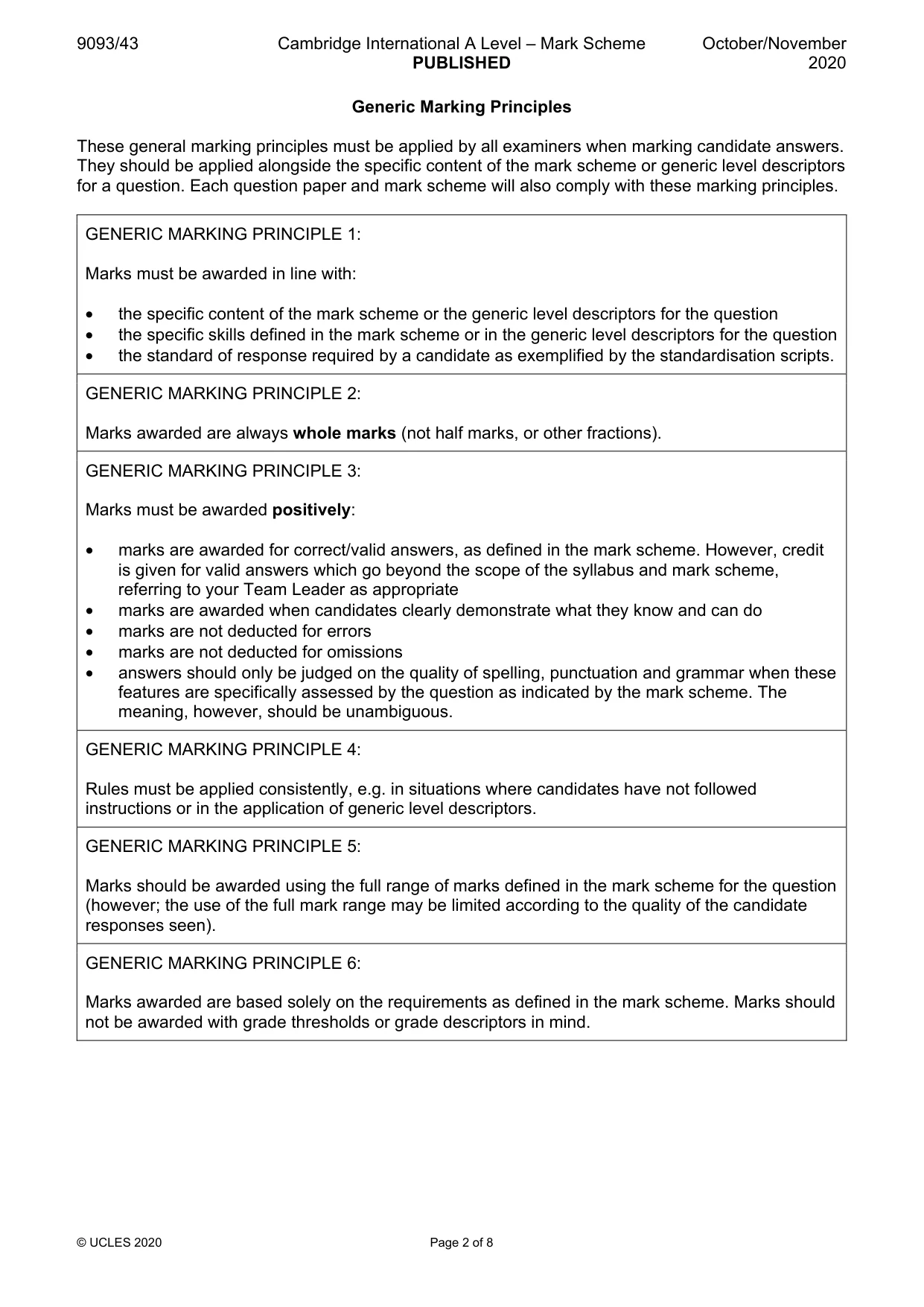
This document consists of 8 printed pages. © UCLES 2020 [Turn over Cambridge International A Level ENGLISH LANGUAGE 9093/43 Paper 4 Language Topics October/November 2020 MARK SCHEME Maximum Mark: 50 Published This mark scheme is published as an aid to teachers and candidates, to indicate the requirements of the examination. It shows the basis on which Examiners were instructed to award marks. It does not indicate the details of the discussions that took place at an Examiners’ meeting before marking began, which would have considered the acceptability of alternative answers. Mark schemes should be read in conjunction with the question paper and the Principal Examiner Report for Teachers. Cambridge International will not enter into discussions about these mark schemes. Cambridge International is publishing the mark schemes for the October/November 2020 series for most Cambridge IGCSE™, Cambridge International A and AS Level and Cambridge Pre-U components, and some Cambridge O Level components.
Mark scheme, page 2
9093/43 Cambridge International A Level – Mark Scheme PUBLISHED October/November 2020 © UCLES 2020 Page 2 of 8 Generic Marking Principles These general marking principles must be applied by all examiners when marking candidate answers. They should be applied alongside the specific content of the mark scheme or generic level descriptors for a question. Each question paper and mark scheme will also comply with these marking principles. GENERIC MARKING PRINCIPLE 1: Marks must be awarded in line with: • the specific content of the mark scheme or the generic level descriptors for the question • the specific skills defined in the mark scheme or in the generic level descriptors for the question • the standard of response required by a candidate as exemplified by the standardisation scripts. GENERIC MARKING PRINCIPLE 2: Marks awarded are always whole marks (not half marks, or other fractions). GENERIC MARKING PRINCIPLE 3: Marks must be awarded positively: • marks are awarded for correct/valid answers, as defined in the mark scheme. However, credit is given for valid answers which go beyond the scope of the syllabus and mark scheme, referring to your Team Leader as appropriate • marks are awarded when candidates clearly demonstrate what they know and can do • marks are not deducted for errors • marks are not deducted for omissions • answers should only be judged on the quality of spelling, punctuation and grammar when these features are specifically assessed by the question as indicated by the mark scheme. The meaning, however, should be unambiguous. GENERIC MARKING PRINCIPLE 4: Rules must be applied consistently, e.g. in situations where candidates have not followed instructions or in the application of generic level descriptors. GENERIC MARKING PRINCIPLE 5: Marks should be awarded using the full range of marks defined in the mark scheme for the question (however; the use of the full mark range may be limited according to the quality of the candidate responses seen). GENERIC MARKING PRINCIPLE 6: Marks awarded are based solely on the requirements as defined in the mark scheme. Marks should not be awarded with grade thresholds or grade descriptors in mind.
Mark scheme, page 3
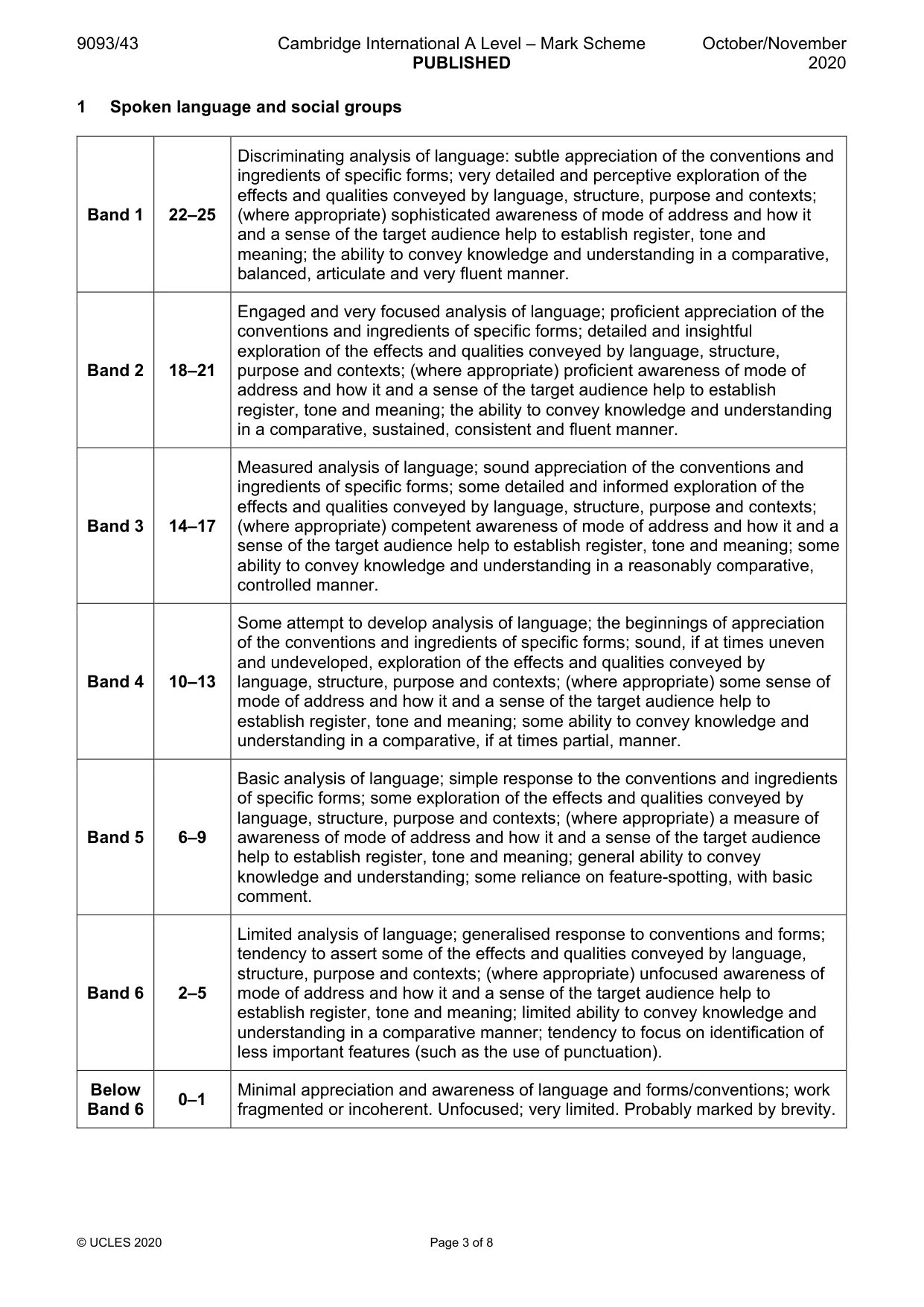
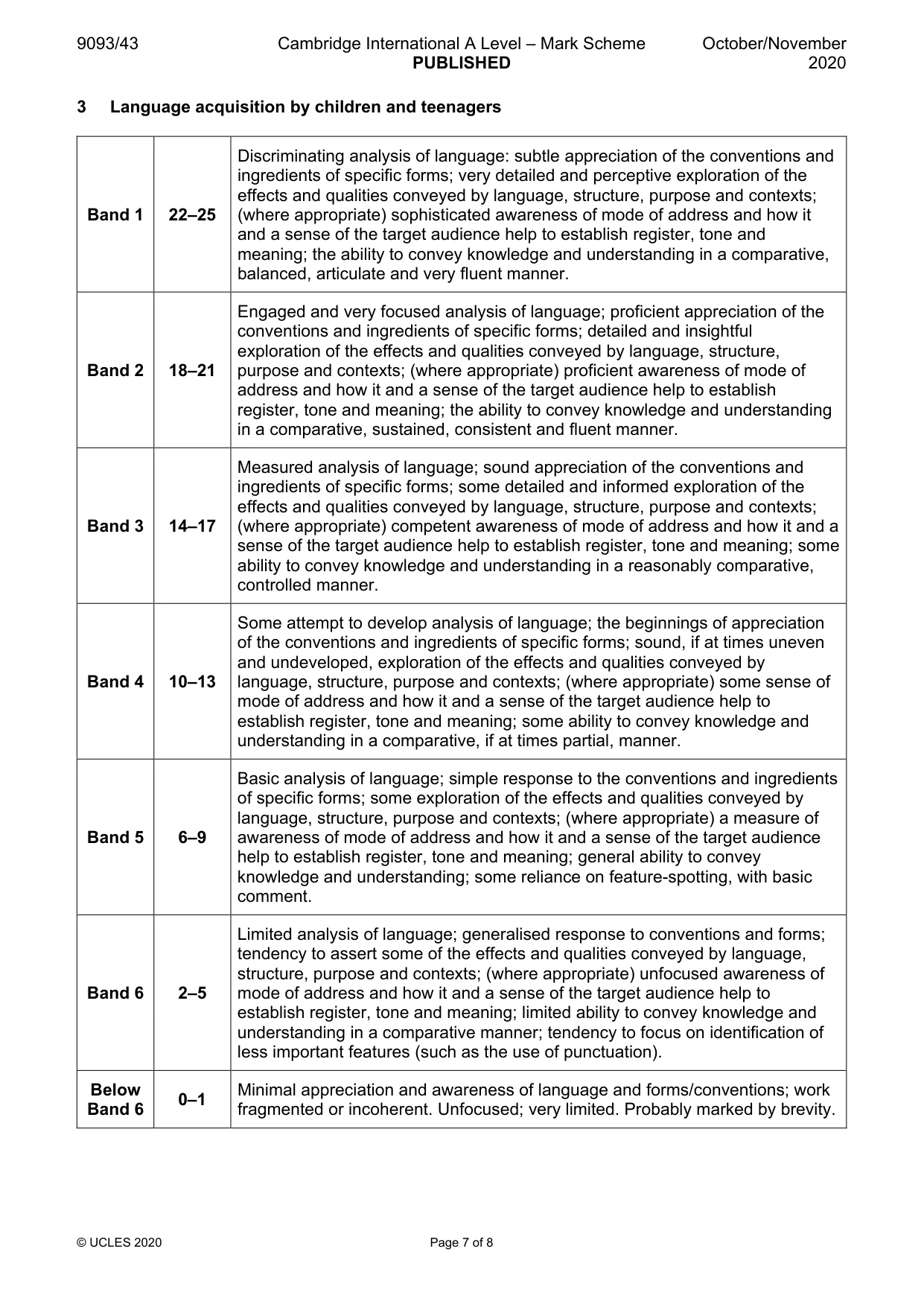
9093/43 Cambridge International A Level – Mark Scheme PUBLISHED October/November 2020 © UCLES 2020 Page 3 of 8 1 Spoken language and social groups Band 1 22–25 Discriminating analysis of language: subtle appreciation of the conventions and ingredients of specific forms; very detailed and perceptive exploration of the effects and qualities conveyed by language, structure, purpose and contexts; (where appropriate) sophisticated awareness of mode of address and how it and a sense of the target audience help to establish register, tone and meaning; the ability to convey knowledge and understanding in a comparative, balanced, articulate and very fluent manner. Band 2 18–21 Engaged and very focused analysis of language; proficient appreciation of the conventions and ingredients of specific forms; detailed and insightful exploration of the effects and qualities conveyed by language, structure, purpose and contexts; (where appropriate) proficient awareness of mode of address and how it and a sense of the target audience help to establish register, tone and meaning; the ability to convey knowledge and understanding in a comparative, sustained, consistent and fluent manner. Band 3 14–17 Measured analysis of language; sound appreciation of the conventions and ingredients of specific forms; some detailed and informed exploration of the effects and qualities conveyed by language, structure, purpose and contexts; (where appropriate) competent awareness of mode of address and how it and a sense of the target audience help to establish register, tone and meaning; some ability to convey knowledge and understanding in a reasonably comparative, controlled manner. Band 4 10–13 Some attempt to develop analysis of language; the beginnings of appreciation of the conventions and ingredients of specific forms; sound, if at times uneven and undeveloped, exploration of the effects and qualities conveyed by language, structure, purpose and contexts; (where appropriate) some sense of mode of address and how it and a sense of the target audience help to establish register, tone and meaning; some ability to convey knowledge and understanding in a comparative, if at times partial, manner. Band 5 6–9 Basic analysis of language; simple response to the conventions and ingredients of specific forms; some exploration of the effects and qualities conveyed by language, structure, purpose and contexts; (where appropriate) a measure of awareness of mode of address and how it and a sense of the target audience help to establish register, tone and meaning; general ability to convey knowledge and understanding; some reliance on feature-spotting, with basic comment. Band 6 2–5 Limited analysis of language; generalised response to conventions and forms; tendency to assert some of the effects and qualities conveyed by language, structure, purpose and contexts; (where appropriate) unfocused awareness of mode of address and how it and a sense of the target audience help to establish register, tone and meaning; limited ability to convey knowledge and understanding in a comparative manner; tendency to focus on identification of less important features (such as the use of punctuation). Below Band 6 0–1 Minimal appreciation and awareness of language and forms/conventions; work fragmented or incoherent. Unfocused; very limited. Probably marked by brevity.
Mark scheme, page 4
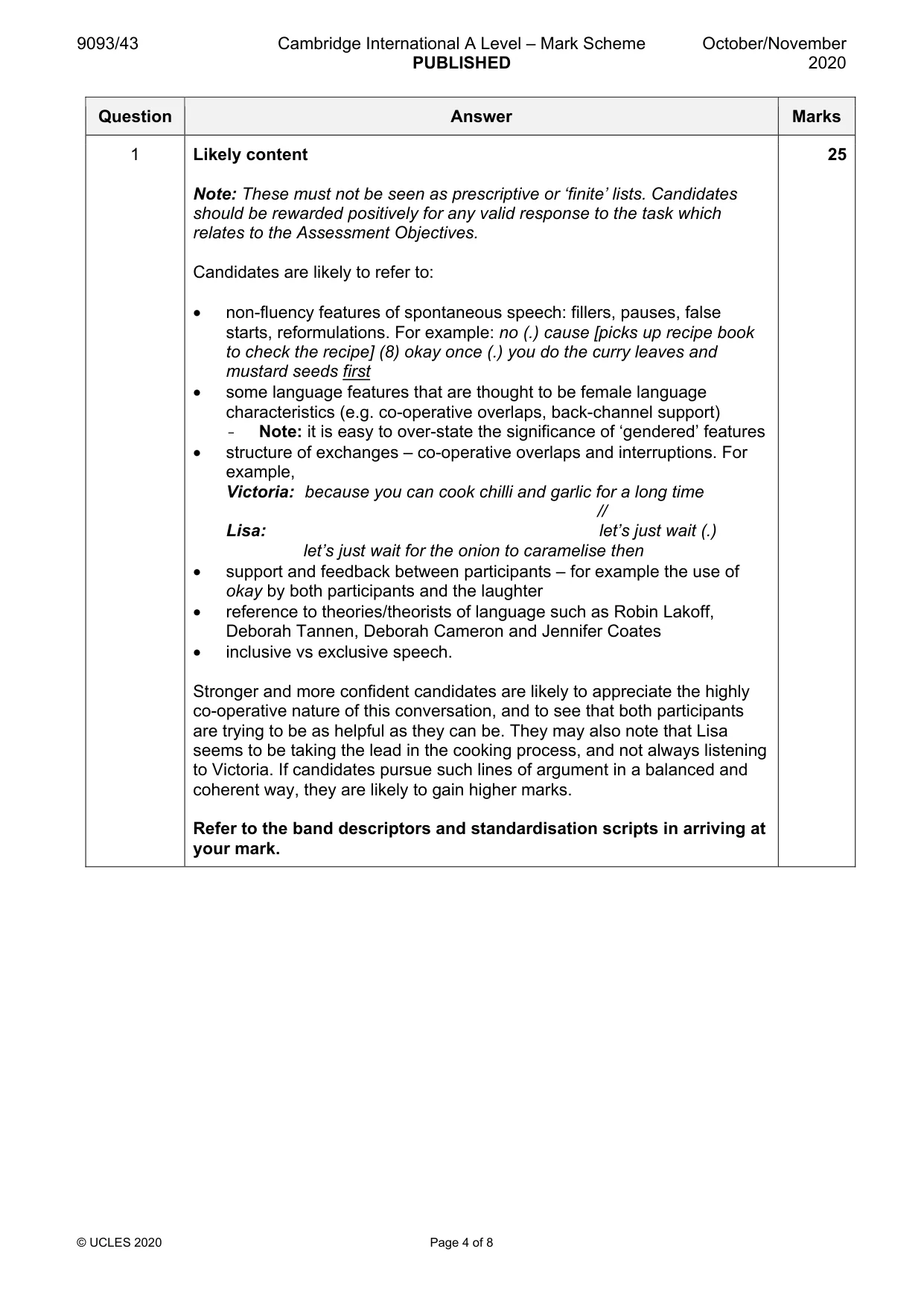
9093/43 Cambridge International A Level – Mark Scheme PUBLISHED October/November 2020 © UCLES 2020 Page 4 of 8 Question Answer Marks 1 Likely content Note: These must not be seen as prescriptive or ‘finite’ lists. Candidates should be rewarded positively for any valid response to the task which relates to the Assessment Objectives. Candidates are likely to refer to: • non-fluency features of spontaneous speech: fillers, pauses, false starts, reformulations. For example: no (.) cause [picks up recipe book to check the recipe] (8) okay once (.) you do the curry leaves and mustard seeds first • some language features that are thought to be female language characteristics (e.g. co-operative overlaps, back-channel support) - Note: it is easy to over-state the significance of ‘gendered’ features • structure of exchanges – co-operative overlaps and interruptions. For example, Victoria: because you can cook chilli and garlic for a long time // Lisa: let’s just wait (.) let’s just wait for the onion to caramelise then • support and feedback between participants – for example the use of okay by both participants and the laughter • reference to theories/theorists of language such as Robin Lakoff, Deborah Tannen, Deborah Cameron and Jennifer Coates • inclusive vs exclusive speech. Stronger and more confident candidates are likely to appreciate the highly co-operative nature of this conversation, and to see that both participants are trying to be as helpful as they can be. They may also note that Lisa seems to be taking the lead in the cooking process, and not always listening to Victoria. If candidates pursue such lines of argument in a balanced and coherent way, they are likely to gain higher marks. Refer to the band descriptors and standardisation scripts in arriving at your mark. 25
Mark scheme, page 5
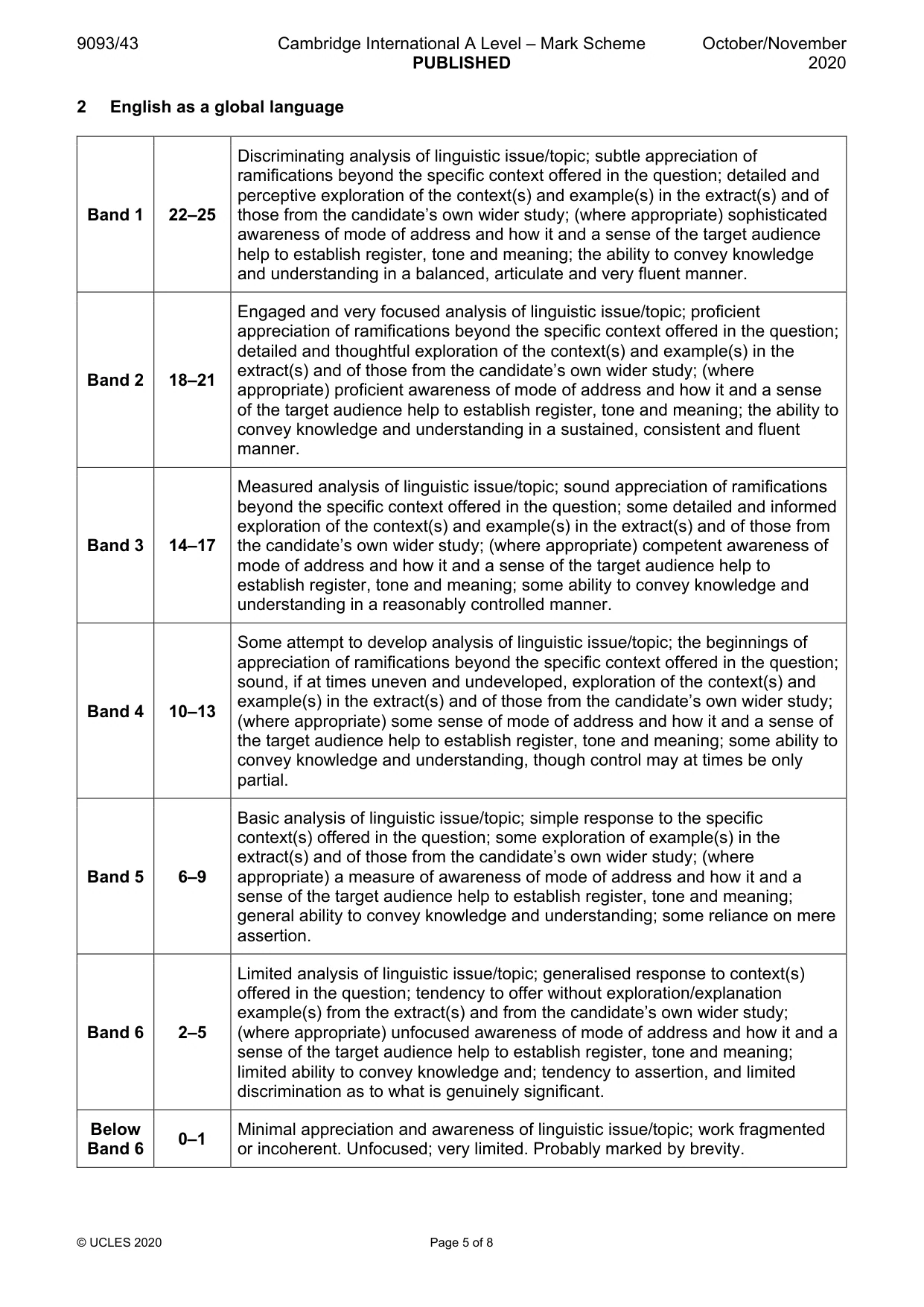
9093/43 Cambridge International A Level – Mark Scheme PUBLISHED October/November 2020 © UCLES 2020 Page 5 of 8 2 English as a global language Band 1 22–25 Discriminating analysis of linguistic issue/topic; subtle appreciation of ramifications beyond the specific context offered in the question; detailed and perceptive exploration of the context(s) and example(s) in the extract(s) and of those from the candidate’s own wider study; (where appropriate) sophisticated awareness of mode of address and how it and a sense of the target audience help to establish register, tone and meaning; the ability to convey knowledge and understanding in a balanced, articulate and very fluent manner. Band 2 18–21 Engaged and very focused analysis of linguistic issue/topic; proficient appreciation of ramifications beyond the specific context offered in the question; detailed and thoughtful exploration of the context(s) and example(s) in the extract(s) and of those from the candidate’s own wider study; (where appropriate) proficient awareness of mode of address and how it and a sense of the target audience help to establish register, tone and meaning; the ability to convey knowledge and understanding in a sustained, consistent and fluent manner. Band 3 14–17 Measured analysis of linguistic issue/topic; sound appreciation of ramifications beyond the specific context offered in the question; some detailed and informed exploration of the context(s) and example(s) in the extract(s) and of those from the candidate’s own wider study; (where appropriate) competent awareness of mode of address and how it and a sense of the target audience help to establish register, tone and meaning; some ability to convey knowledge and understanding in a reasonably controlled manner. Band 4 10–13 Some attempt to develop analysis of linguistic issue/topic; the beginnings of appreciation of ramifications beyond the specific context offered in the question; sound, if at times uneven and undeveloped, exploration of the context(s) and example(s) in the extract(s) and of those from the candidate’s own wider study; (where appropriate) some sense of mode of address and how it and a sense of the target audience help to establish register, tone and meaning; some ability to convey knowledge and understanding, though control may at times be only partial. Band 5 6–9 Basic analysis of linguistic issue/topic; simple response to the specific context(s) offered in the question; some exploration of example(s) in the extract(s) and of those from the candidate’s own wider study; (where appropriate) a measure of awareness of mode of address and how it and a sense of the target audience help to establish register, tone and meaning; general ability to convey knowledge and understanding; some reliance on mere assertion. Band 6 2–5 Limited analysis of linguistic issue/topic; generalised response to context(s) offered in the question; tendency to offer without exploration/explanation example(s) from the extract(s) and from the candidate’s own wider study; (where appropriate) unfocused awareness of mode of address and how it and a sense of the target audience help to establish register, tone and meaning; limited ability to convey knowledge and; tendency to assertion, and limited discrimination as to what is genuinely significant. Below Band 6 0–1 Minimal appreciation and awareness of linguistic issue/topic; work fragmented or incoherent. Unfocused; very limited. Probably marked by brevity.
Mark scheme, page 6
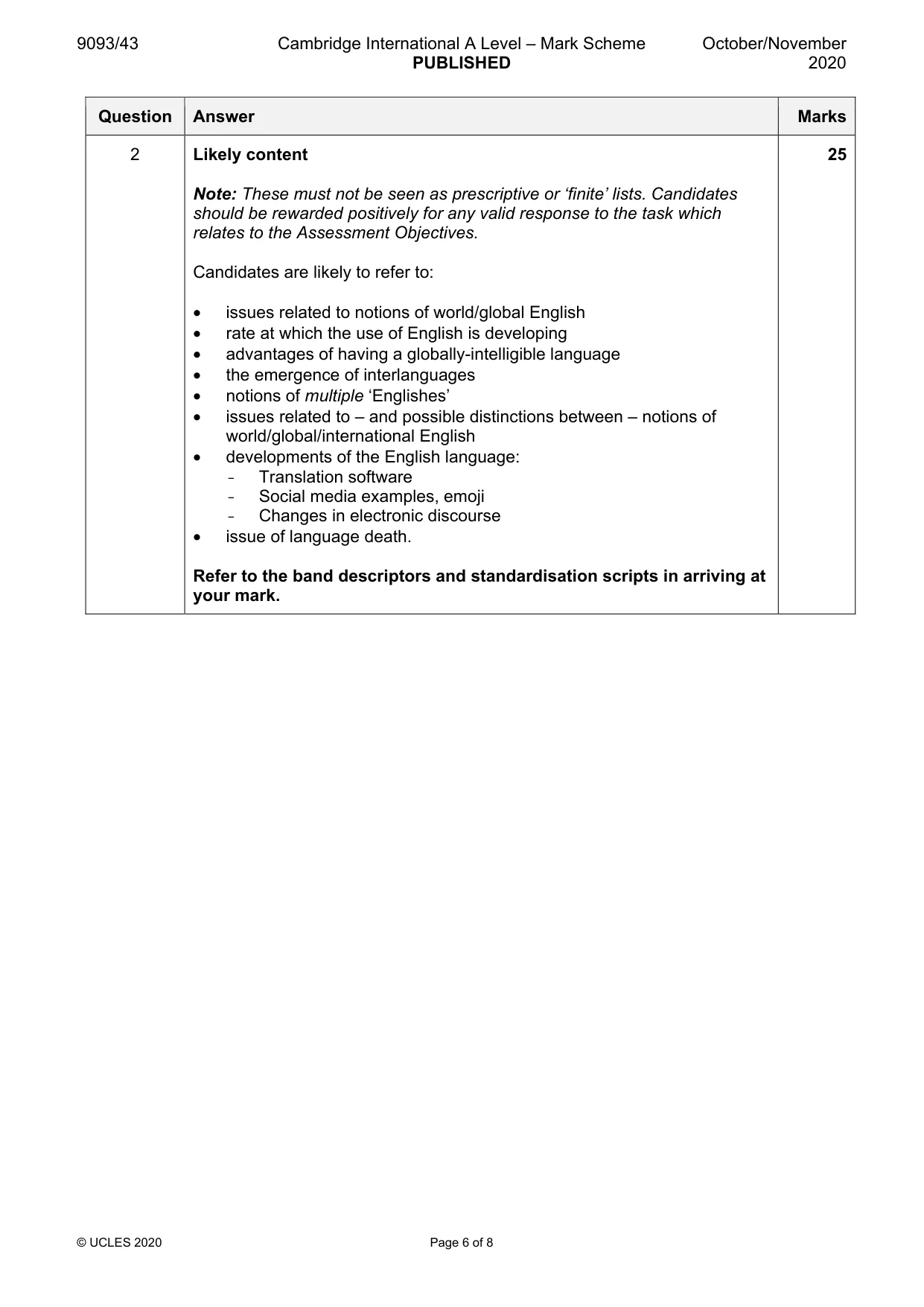
9093/43 Cambridge International A Level – Mark Scheme PUBLISHED October/November 2020 © UCLES 2020 Page 6 of 8 Question Answer Marks 2 Likely content Note: These must not be seen as prescriptive or ‘finite’ lists. Candidates should be rewarded positively for any valid response to the task which relates to the Assessment Objectives. Candidates are likely to refer to: • issues related to notions of world/global English • rate at which the use of English is developing • advantages of having a globally-intelligible language • the emergence of interlanguages • notions of multiple ‘Englishes’ • issues related to – and possible distinctions between – notions of world/global/international English • developments of the English language: - Translation software - Social media examples, emoji - Changes in electronic discourse • issue of language death. Refer to the band descriptors and standardisation scripts in arriving at your mark. 25
Mark scheme, page 7
9093/43 Cambridge International A Level – Mark Scheme PUBLISHED October/November 2020 © UCLES 2020 Page 7 of 8 3 Language acquisition by children and teenagers Band 1 22–25 Discriminating analysis of language: subtle appreciation of the conventions and ingredients of specific forms; very detailed and perceptive exploration of the effects and qualities conveyed by language, structure, purpose and contexts; (where appropriate) sophisticated awareness of mode of address and how it and a sense of the target audience help to establish register, tone and meaning; the ability to convey knowledge and understanding in a comparative, balanced, articulate and very fluent manner. Band 2 18–21 Engaged and very focused analysis of language; proficient appreciation of the conventions and ingredients of specific forms; detailed and insightful exploration of the effects and qualities conveyed by language, structure, purpose and contexts; (where appropriate) proficient awareness of mode of address and how it and a sense of the target audience help to establish register, tone and meaning; the ability to convey knowledge and understanding in a comparative, sustained, consistent and fluent manner. Band 3 14–17 Measured analysis of language; sound appreciation of the conventions and ingredients of specific forms; some detailed and informed exploration of the effects and qualities conveyed by language, structure, purpose and contexts; (where appropriate) competent awareness of mode of address and how it and a sense of the target audience help to establish register, tone and meaning; some ability to convey knowledge and understanding in a reasonably comparative, controlled manner. Band 4 10–13 Some attempt to develop analysis of language; the beginnings of appreciation of the conventions and ingredients of specific forms; sound, if at times uneven and undeveloped, exploration of the effects and qualities conveyed by language, structure, purpose and contexts; (where appropriate) some sense of mode of address and how it and a sense of the target audience help to establish register, tone and meaning; some ability to convey knowledge and understanding in a comparative, if at times partial, manner. Band 5 6–9 Basic analysis of language; simple response to the conventions and ingredients of specific forms; some exploration of the effects and qualities conveyed by language, structure, purpose and contexts; (where appropriate) a measure of awareness of mode of address and how it and a sense of the target audience help to establish register, tone and meaning; general ability to convey knowledge and understanding; some reliance on feature-spotting, with basic comment. Band 6 2–5 Limited analysis of language; generalised response to conventions and forms; tendency to assert some of the effects and qualities conveyed by language, structure, purpose and contexts; (where appropriate) unfocused awareness of mode of address and how it and a sense of the target audience help to establish register, tone and meaning; limited ability to convey knowledge and understanding in a comparative manner; tendency to focus on identification of less important features (such as the use of punctuation). Below Band 6 0–1 Minimal appreciation and awareness of language and forms/conventions; work fragmented or incoherent. Unfocused; very limited. Probably marked by brevity.
Mark scheme, page 8
9093/43 Cambridge International A Level – Mark Scheme PUBLISHED October/November 2020 © UCLES 2020 Page 8 of 8 Question Answer Marks 3 Likely content Note: These must not be seen as prescriptive or ‘finite’ lists. Candidates should be rewarded positively for any valid response to the task which relates to the Assessment Objectives. Candidates are likely to refer to: • Child-directed speech, e.g. Alice’s father’s use of a range of question types to elicit response • Other uses of caretaker speech • non-fluency features of spontaneous speech, typical of more advanced speakers: fillers, pauses, false starts, for example: I can swim better (.) but she [picks up her doll] she can’t swim better than me (.) and she can’t (.) she can’t go in the water • Theorists and theories, such as Skinner (Behaviourism/reinforcement), Chomsky (language acquisition device), Piaget (cognitive development), Vygotsky, Bruner et al. • Alice’s developmental stage and linguistic competence. Examples of complex structures: you have to remember he goes to work (1) and Beth and Emma go to (1) school • Standard grammar in most of Alice’s speech, including quite complex structures, for example: she will stop it if she wants (.) if she (.) if you will let her sit with you • Evidence of at least five of Halliday’s functions of language (Regulatory – if you will let her sit with you; Interactional – [pretends her doll is talking] he goes to work (1) [talking to her father] don’t you; Representational – fish can (1) live underwater, Imaginative/Interactional – you have to remember he goes to work (1) and Beth and Emma go to (1) school) • The structure of the exchanges: overwhelmingly fulfilled adjacency pairs, with little evident interruption or overlap. Refer to the band descriptors and standardisation scripts in arriving at your mark. 25
What you needed in this session
Cambridge’s own grade thresholds for 2020 Oct/Nov, Paper 4 · Variant 3. A higher threshold means an easier paper — the bar moves with how the cohort did.