Cambridge A Level English - Language AS and A Level (from 2014) 9093 — 2020 May/June Paper 4 · Variant 3
9093/43/M/J/20
The question paper and its mark scheme, free to read here and free to download. This is Cambridge’s own paper, exactly as it was sat.
Question paper8 pages



Mark scheme8 pages
Answers below. Sit the paper first if you are practising.
Paper as text
Question paper, page 1
* 8 7 4 6 2 2 4 8 1 9 * Cambridge International AS & A Level DC (KS) 198864/1 © UCLES 2020 [Turn over This document has 8 pages. Blank pages are indicated. ENGLISH LANGUAGE 9093/43 Paper 4 Language Topics May/June 2020 2 hours 15 minutes You must answer on the enclosed answer booklet. You will need: Answer booklet (enclosed) INSTRUCTIONS ● Answer two questions. ● Follow the instructions on the front cover of the answer booklet. If you need additional answer paper, ask the invigilator for a continuation booklet. ● You are reminded of the need for good English and clear presentation in your answers. INFORMATION ● The total mark for this paper is 50. ● All questions are worth equal marks.
Question paper, page 2
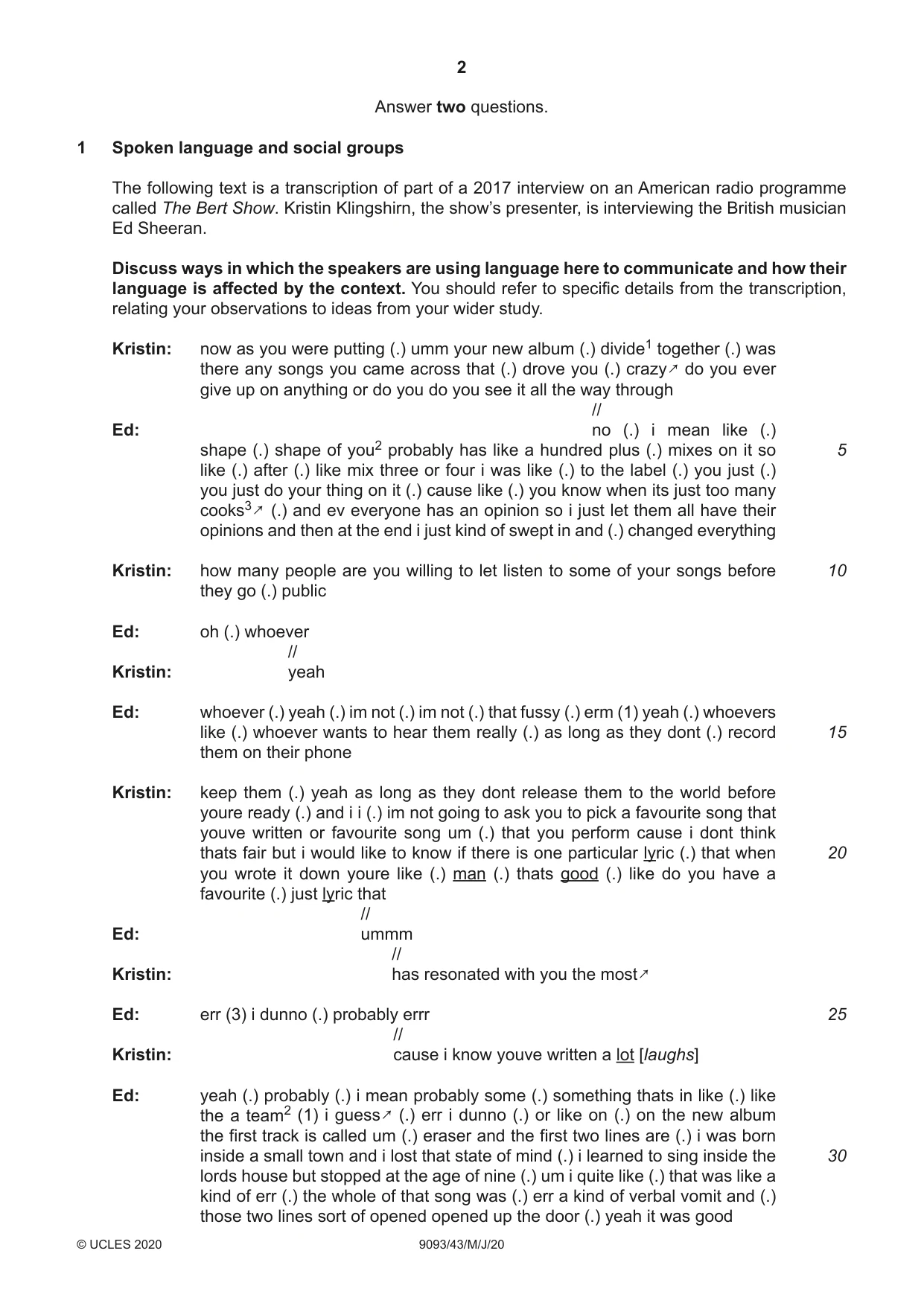
2 9093/43/M/J/20 © UCLES 2020 Answer two questions. 1 Spoken language and social groups The following text is a transcription of part of a 2017 interview on an American radio programme called The Bert Show. Kristin Klingshirn, the show’s presenter, is interviewing the British musician Ed Sheeran. Discuss ways in which the speakers are using language here to communicate and how their language is affected by the context. You should refer to specific details from the transcription, relating your observations to ideas from your wider study. Kristin: now as you were putting (.) umm your new album (.) divide1 together (.) was there any songs you came across that (.) drove you (.) crazy↗ do you ever give up on anything or do you do you see it all the way through // Ed: no (.) i mean like (.) shape (.) shape of you2 probably has like a hundred plus (.) mixes on it so like (.) after (.) like mix three or four i was like (.) to the label (.) you just (.) you just do your thing on it (.) cause like (.) you know when its just too many cooks3↗ (.) and ev everyone has an opinion so i just let them all have their opinions and then at the end i just kind of swept in and (.) changed everything Kristin: how many people are you willing to let listen to some of your songs before they go (.) public Ed: oh (.) whoever // Kristin: yeah Ed: whoever (.) yeah (.) im not (.) im not (.) that fussy (.) erm (1) yeah (.) whoevers like (.) whoever wants to hear them really (.) as long as they dont (.) record them on their phone Kristin: keep them (.) yeah as long as they dont release them to the world before youre ready (.) and i i (.) im not going to ask you to pick a favourite song that youve written or favourite song um (.) that you perform cause i dont think thats fair but i would like to know if there is one particular lyric (.) that when you wrote it down youre like (.) man (.) thats good (.) like do you have a favourite (.) just lyric that // Ed: ummm // Kristin: has resonated with you the most↗ Ed: err (3) i dunno (.) probably errr // Kristin: cause i know youve written a lot [laughs] Ed: yeah (.) probably (.) i mean probably some (.) something thats in like (.) like the a team2 (1) i guess↗ (.) err i dunno (.) or like on (.) on the new album the first track is called um (.) eraser and the first two lines are (.) i was born inside a small town and i lost that state of mind (.) i learned to sing inside the lords house but stopped at the age of nine (.) um i quite like (.) that was like a kind of err (.) the whole of that song was (.) err a kind of verbal vomit and (.) those two lines sort of opened opened up the door (.) yeah it was good 5 10 15 20 25 30
Question paper, page 3
3 9093/43/M/J/20 © UCLES 2020 [Turn over Notes: 1 divide: an album by Ed Sheeran 2 shape of you, the a team: songs by Ed Sheeran 3 too many cooks: a shortened version of the idiom ‘too many cooks spoil the broth’ TRANSCRIPTION KEY (1) = pause in seconds (.) = micropause underlined = stressed sound/syllable(s) // = speech overlap [italics] = paralinguistic features ↗ = upward intonation
Question paper, page 4
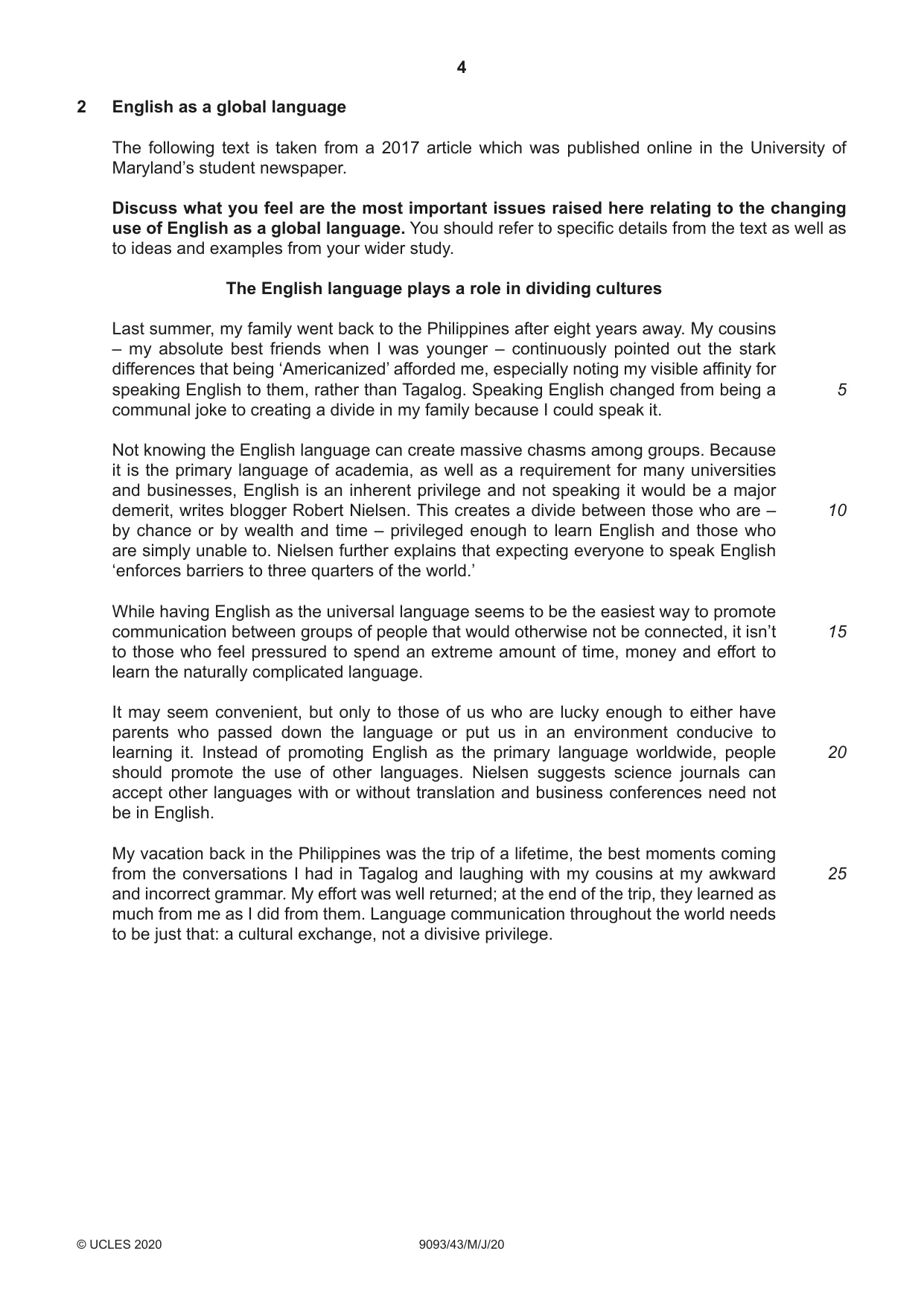
4 9093/43/M/J/20 © UCLES 2020 2 English as a global language The following text is taken from a 2017 article which was published online in the University of Maryland’s student newspaper. Discuss what you feel are the most important issues raised here relating to the changing use of English as a global language. You should refer to specific details from the text as well as to ideas and examples from your wider study. The English language plays a role in dividing cultures Last summer, my family went back to the Philippines after eight years away. My cousins – my absolute best friends when I was younger – continuously pointed out the stark differences that being ‘Americanized’ afforded me, especially noting my visible affinity for speaking English to them, rather than Tagalog. Speaking English changed from being a communal joke to creating a divide in my family because I could speak it. Not knowing the English language can create massive chasms among groups. Because it is the primary language of academia, as well as a requirement for many universities and businesses, English is an inherent privilege and not speaking it would be a major demerit, writes blogger Robert Nielsen. This creates a divide between those who are – by chance or by wealth and time – privileged enough to learn English and those who are simply unable to. Nielsen further explains that expecting everyone to speak English ‘enforces barriers to three quarters of the world.’ While having English as the universal language seems to be the easiest way to promote communication between groups of people that would otherwise not be connected, it isn’t to those who feel pressured to spend an extreme amount of time, money and effort to learn the naturally complicated language. It may seem convenient, but only to those of us who are lucky enough to either have parents who passed down the language or put us in an environment conducive to learning it. Instead of promoting English as the primary language worldwide, people should promote the use of other languages. Nielsen suggests science journals can accept other languages with or without translation and business conferences need not be in English. My vacation back in the Philippines was the trip of a lifetime, the best moments coming from the conversations I had in Tagalog and laughing with my cousins at my awkward and incorrect grammar. My effort was well returned; at the end of the trip, they learned as much from me as I did from them. Language communication throughout the world needs to be just that: a cultural exchange, not a divisive privilege. 5 10 15 20 25
Question paper, page 5
5 9093/43/M/J/20 © UCLES 2020 [Turn over BLANK PAGE
Question paper, page 6
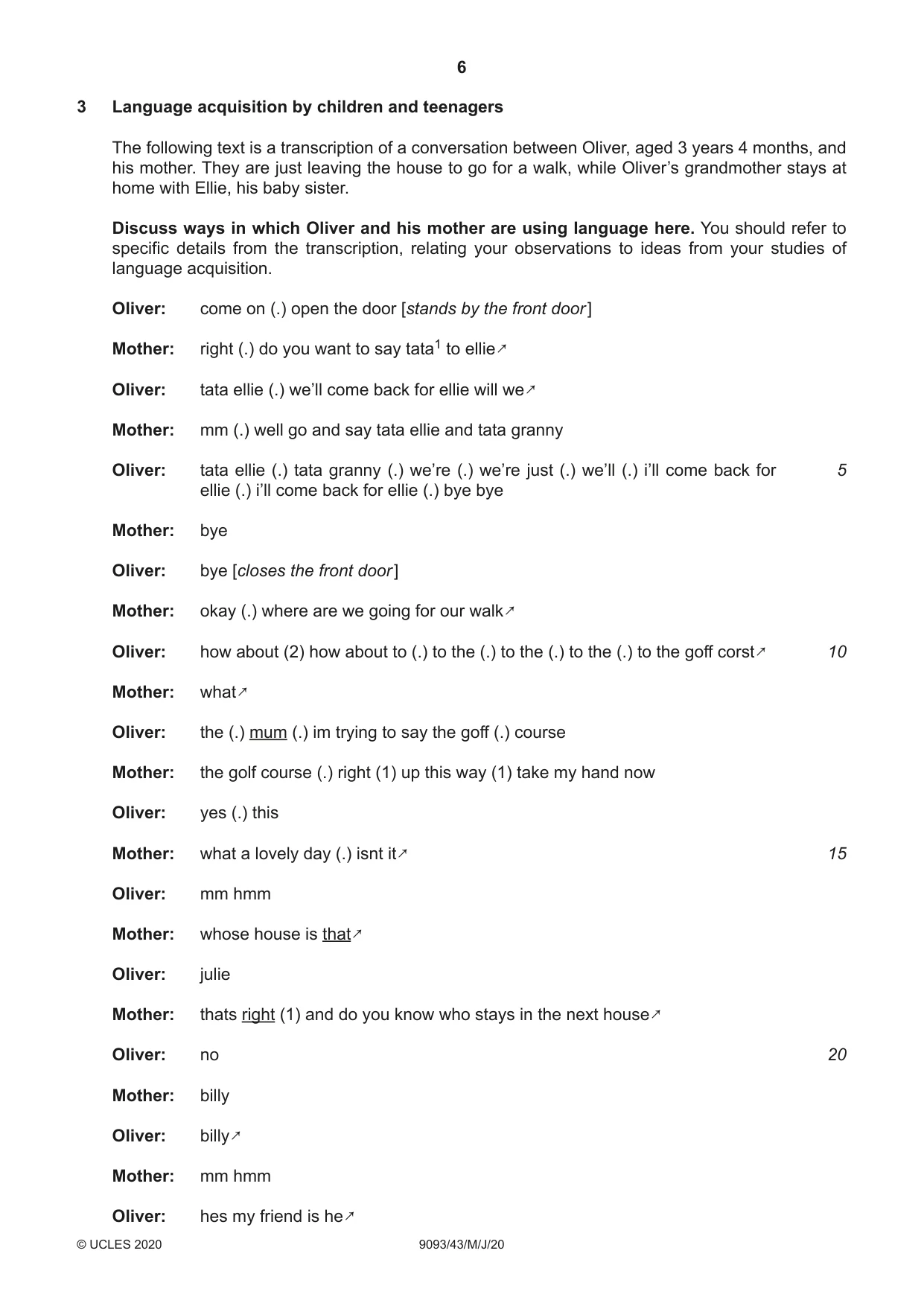
6 9093/43/M/J/20 © UCLES 2020 3 Language acquisition by children and teenagers The following text is a transcription of a conversation between Oliver, aged 3 years 4 months, and his mother. They are just leaving the house to go for a walk, while Oliver’s grandmother stays at home with Ellie, his baby sister. Discuss ways in which Oliver and his mother are using language here. You should refer to specific details from the transcription, relating your observations to ideas from your studies of language acquisition. Oliver: come on (.) open the door [stands by the front door ] Mother: right (.) do you want to say tata1 to ellie↗ Oliver: tata ellie (.) we’ll come back for ellie will we↗ Mother: mm (.) well go and say tata ellie and tata granny Oliver: tata ellie (.) tata granny (.) we’re (.) we’re just (.) we’ll (.) i’ll come back for ellie (.) i’ll come back for ellie (.) bye bye Mother: bye Oliver: bye [closes the front door ] Mother: okay (.) where are we going for our walk↗ Oliver: how about (2) how about to (.) to the (.) to the (.) to the (.) to the goff corst↗ Mother: what↗ Oliver: the (.) mum (.) im trying to say the goff (.) course Mother: the golf course (.) right (1) up this way (1) take my hand now Oliver: yes (.) this Mother: what a lovely day (.) isnt it↗ Oliver: mm hmm Mother: whose house is that↗ Oliver: julie Mother: thats right (1) and do you know who stays in the next house↗ Oliver: no Mother: billy Oliver: billy↗ Mother: mm hmm Oliver: hes my friend is he↗ 5 10 15 20
Question paper, page 7
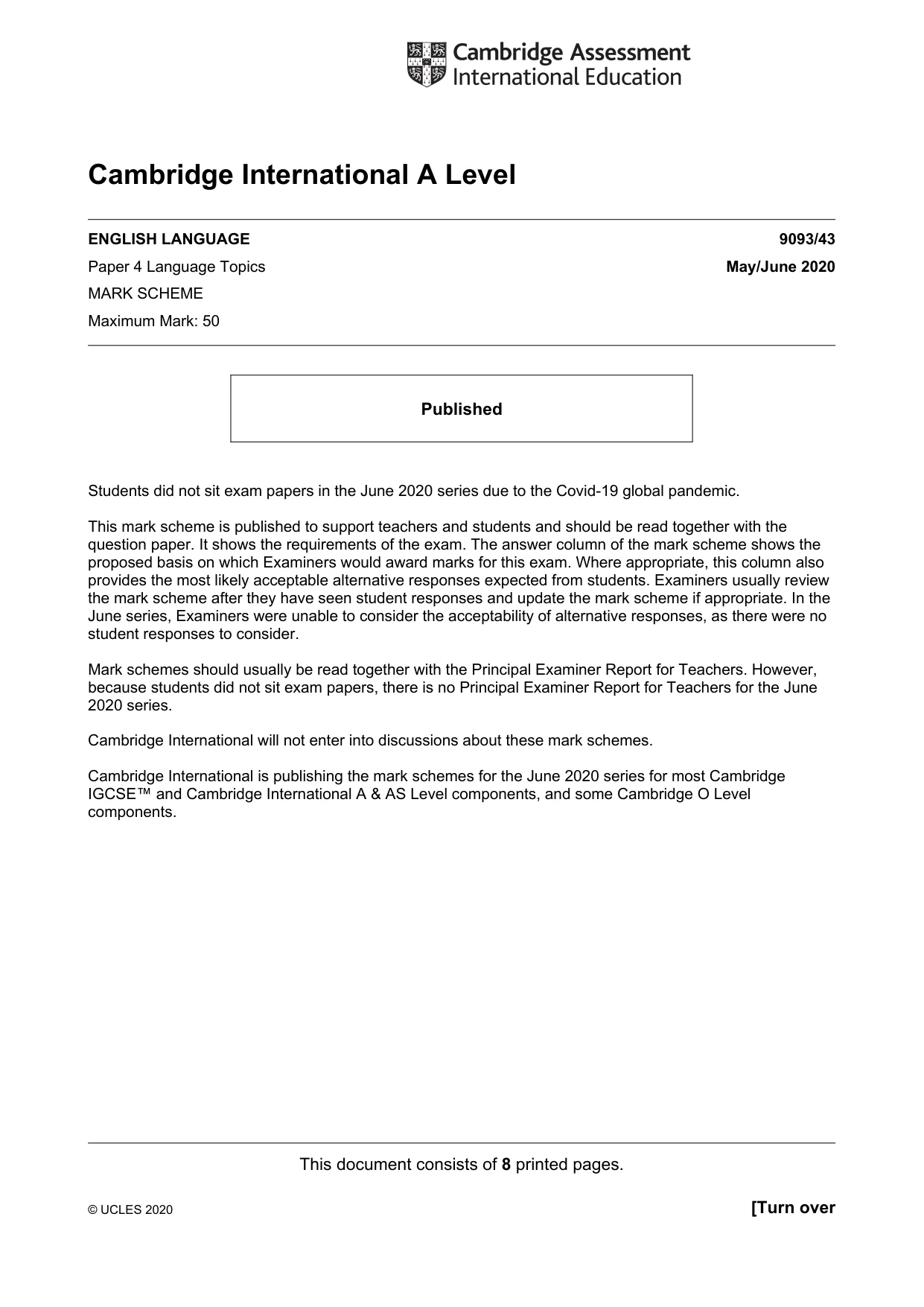
7 9093/43/M/J/20 © UCLES 2020 Mother: is he↗ Oliver: mm hmm (1) see (.) that boy↗ Mother: uh huh (1) what boy↗ (3) what boy↗ Oliver: you remember↗ Mother: no i dont Oliver: yes (.) you remember (2) mum (.) can i (.) can i (.) theres horsies live here Mother: thats right (.) theres horsies that live there (1) how many horsies↗ Oliver: nono Mother: you dont know↗ Oliver: no (1) can we (.) im gonna skip (.) the way [starts skipping ] Mother: (5) oliver look Oliver: what↗ Mother: look at the pretty flowers (.) look at that one Oliver: oh (2) skip (.) skip skip along (.) the path (.) she skipped along the path (3) mum (.) can we see the rabbits are there↗ Mother: uh huh Oliver: great [climbs up onto a low wall ] Mother: (5) dont climb up there oliver (.) look theres somebody there (1) see (.) theres a pussy cat Notes: 1 tata: goodbye TRANSCRIPTION KEY (1) = pause in seconds (.) = micropause underlined = stressed sound/syllable(s) [italics] = paralinguistic features ↗ = upward intonation 25 30 35 40
Question paper, page 8
8 9093/43/M/J/20 © UCLES 2020 Permission to reproduce items where third-party owned material protected by copyright is included has been sought and cleared where possible. Every reasonable effort has been made by the publisher (UCLES) to trace copyright holders, but if any items requiring clearance have unwittingly been included, the publisher will be pleased to make amends at the earliest possible opportunity. To avoid the issue of disclosure of answer-related information to candidates, all copyright acknowledgements are reproduced online in the Cambridge Assessment International Education Copyright Acknowledgements Booklet. This is produced for each series of examinations and is freely available to download at www.cambridgeinternational.org after the live examination series. Cambridge Assessment International Education is part of the Cambridge Assessment Group. Cambridge Assessment is the brand name of the University of Cambridge Local Examinations Syndicate (UCLES), which itself is a department of the University of Cambridge. BLANK PAGE
Mark scheme, page 1
This document consists of 8 printed pages. © UCLES 2020 [Turn over Cambridge International A Level ENGLISH LANGUAGE 9093/43 Paper 4 Language Topics May/June 2020 MARK SCHEME Maximum Mark: 50 Published Students did not sit exam papers in the June 2020 series due to the Covid-19 global pandemic. This mark scheme is published to support teachers and students and should be read together with the question paper. It shows the requirements of the exam. The answer column of the mark scheme shows the proposed basis on which Examiners would award marks for this exam. Where appropriate, this column also provides the most likely acceptable alternative responses expected from students. Examiners usually review the mark scheme after they have seen student responses and update the mark scheme if appropriate. In the June series, Examiners were unable to consider the acceptability of alternative responses, as there were no student responses to consider. Mark schemes should usually be read together with the Principal Examiner Report for Teachers. However, because students did not sit exam papers, there is no Principal Examiner Report for Teachers for the June 2020 series. Cambridge International will not enter into discussions about these mark schemes. Cambridge International is publishing the mark schemes for the June 2020 series for most Cambridge IGCSE™ and Cambridge International A & AS Level components, and some Cambridge O Level components.
Mark scheme, page 2
9093/43 Cambridge International A Level – Mark Scheme PUBLISHED May/June 2020 © UCLES 2020 Page 2 of 8 Generic Marking Principles These general marking principles must be applied by all examiners when marking candidate answers. They should be applied alongside the specific content of the mark scheme or generic level descriptors for a question. Each question paper and mark scheme will also comply with these marking principles. GENERIC MARKING PRINCIPLE 1: Marks must be awarded in line with: • the specific content of the mark scheme or the generic level descriptors for the question • the specific skills defined in the mark scheme or in the generic level descriptors for the question • the standard of response required by a candidate as exemplified by the standardisation scripts. GENERIC MARKING PRINCIPLE 2: Marks awarded are always whole marks (not half marks, or other fractions). GENERIC MARKING PRINCIPLE 3: Marks must be awarded positively: • marks are awarded for correct/valid answers, as defined in the mark scheme. However, credit is given for valid answers which go beyond the scope of the syllabus and mark scheme, referring to your Team Leader as appropriate • marks are awarded when candidates clearly demonstrate what they know and can do • marks are not deducted for errors • marks are not deducted for omissions • answers should only be judged on the quality of spelling, punctuation and grammar when these features are specifically assessed by the question as indicated by the mark scheme. The meaning, however, should be unambiguous. GENERIC MARKING PRINCIPLE 4: Rules must be applied consistently e.g. in situations where candidates have not followed instructions or in the application of generic level descriptors. GENERIC MARKING PRINCIPLE 5: Marks should be awarded using the full range of marks defined in the mark scheme for the question (however; the use of the full mark range may be limited according to the quality of the candidate responses seen). GENERIC MARKING PRINCIPLE 6: Marks awarded are based solely on the requirements as defined in the mark scheme. Marks should not be awarded with grade thresholds or grade descriptors in mind.
Mark scheme, page 3
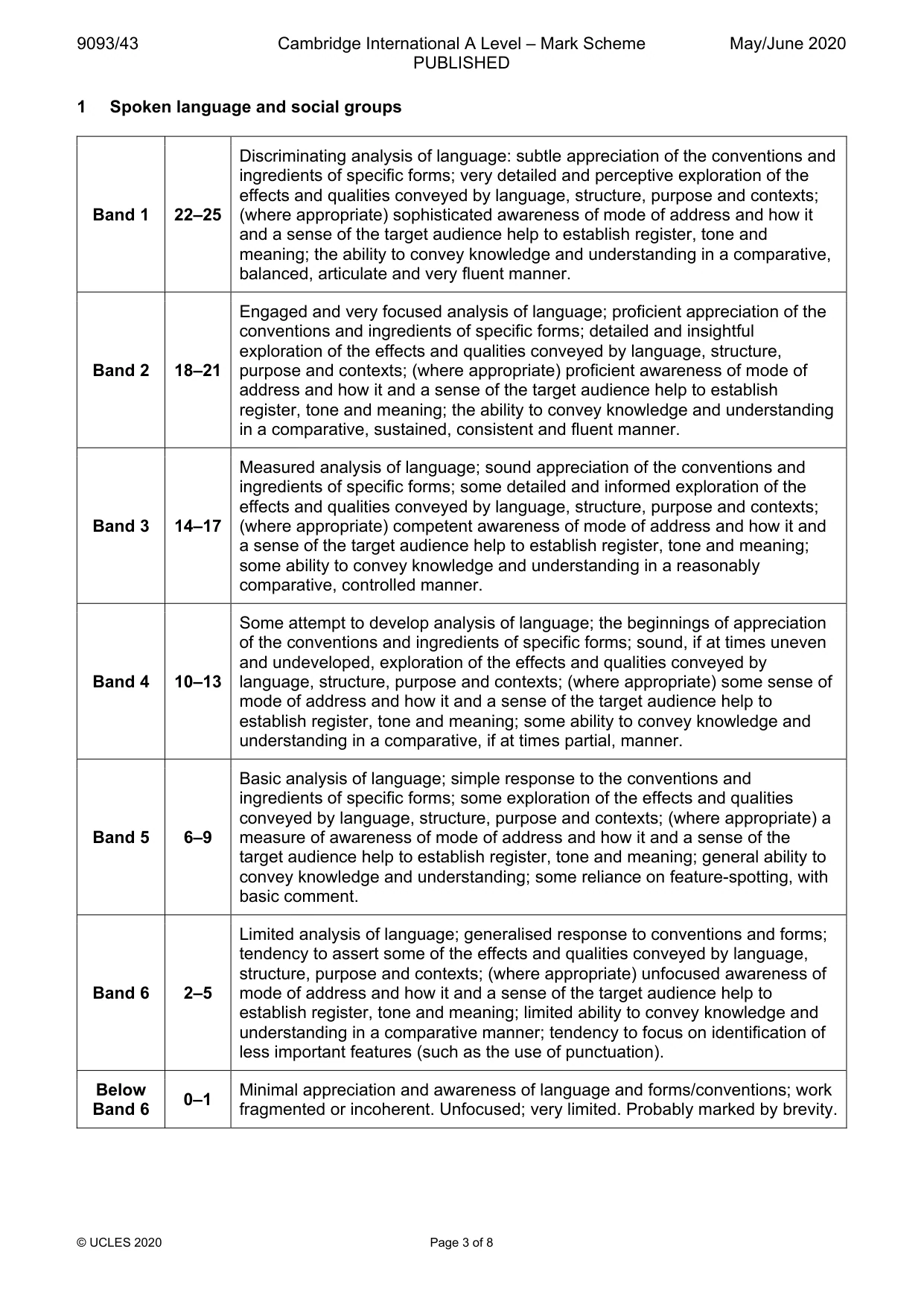
9093/43 Cambridge International A Level – Mark Scheme PUBLISHED May/June 2020 © UCLES 2020 Page 3 of 8 1 Spoken language and social groups Band 1 22–25 Discriminating analysis of language: subtle appreciation of the conventions and ingredients of specific forms; very detailed and perceptive exploration of the effects and qualities conveyed by language, structure, purpose and contexts; (where appropriate) sophisticated awareness of mode of address and how it and a sense of the target audience help to establish register, tone and meaning; the ability to convey knowledge and understanding in a comparative, balanced, articulate and very fluent manner. Band 2 18–21 Engaged and very focused analysis of language; proficient appreciation of the conventions and ingredients of specific forms; detailed and insightful exploration of the effects and qualities conveyed by language, structure, purpose and contexts; (where appropriate) proficient awareness of mode of address and how it and a sense of the target audience help to establish register, tone and meaning; the ability to convey knowledge and understanding in a comparative, sustained, consistent and fluent manner. Band 3 14–17 Measured analysis of language; sound appreciation of the conventions and ingredients of specific forms; some detailed and informed exploration of the effects and qualities conveyed by language, structure, purpose and contexts; (where appropriate) competent awareness of mode of address and how it and a sense of the target audience help to establish register, tone and meaning; some ability to convey knowledge and understanding in a reasonably comparative, controlled manner. Band 4 10–13 Some attempt to develop analysis of language; the beginnings of appreciation of the conventions and ingredients of specific forms; sound, if at times uneven and undeveloped, exploration of the effects and qualities conveyed by language, structure, purpose and contexts; (where appropriate) some sense of mode of address and how it and a sense of the target audience help to establish register, tone and meaning; some ability to convey knowledge and understanding in a comparative, if at times partial, manner. Band 5 6–9 Basic analysis of language; simple response to the conventions and ingredients of specific forms; some exploration of the effects and qualities conveyed by language, structure, purpose and contexts; (where appropriate) a measure of awareness of mode of address and how it and a sense of the target audience help to establish register, tone and meaning; general ability to convey knowledge and understanding; some reliance on feature-spotting, with basic comment. Band 6 2–5 Limited analysis of language; generalised response to conventions and forms; tendency to assert some of the effects and qualities conveyed by language, structure, purpose and contexts; (where appropriate) unfocused awareness of mode of address and how it and a sense of the target audience help to establish register, tone and meaning; limited ability to convey knowledge and understanding in a comparative manner; tendency to focus on identification of less important features (such as the use of punctuation). Below Band 6 0–1 Minimal appreciation and awareness of language and forms/conventions; work fragmented or incoherent. Unfocused; very limited. Probably marked by brevity.
Mark scheme, page 4
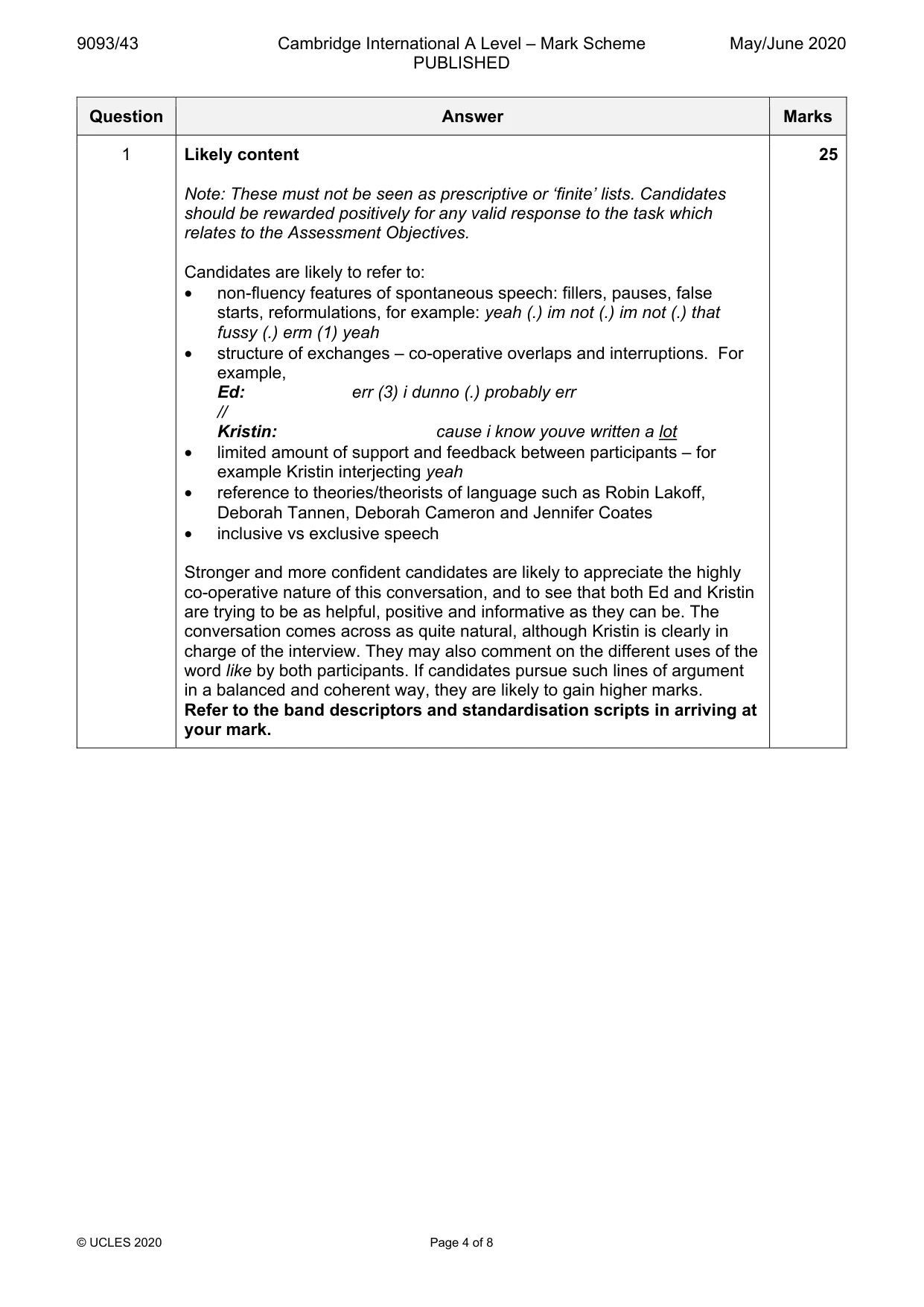
9093/43 Cambridge International A Level – Mark Scheme PUBLISHED May/June 2020 © UCLES 2020 Page 4 of 8 Question Answer Marks 1 Likely content Note: These must not be seen as prescriptive or ‘finite’ lists. Candidates should be rewarded positively for any valid response to the task which relates to the Assessment Objectives. Candidates are likely to refer to: • non-fluency features of spontaneous speech: fillers, pauses, false starts, reformulations, for example: yeah (.) im not (.) im not (.) that fussy (.) erm (1) yeah • structure of exchanges – co-operative overlaps and interruptions. For example, Ed: err (3) i dunno (.) probably err // Kristin: cause i know youve written a lot • limited amount of support and feedback between participants – for example Kristin interjecting yeah • reference to theories/theorists of language such as Robin Lakoff, Deborah Tannen, Deborah Cameron and Jennifer Coates • inclusive vs exclusive speech Stronger and more confident candidates are likely to appreciate the highly co-operative nature of this conversation, and to see that both Ed and Kristin are trying to be as helpful, positive and informative as they can be. The conversation comes across as quite natural, although Kristin is clearly in charge of the interview. They may also comment on the different uses of the word like by both participants. If candidates pursue such lines of argument in a balanced and coherent way, they are likely to gain higher marks. Refer to the band descriptors and standardisation scripts in arriving at your mark. 25
Mark scheme, page 5
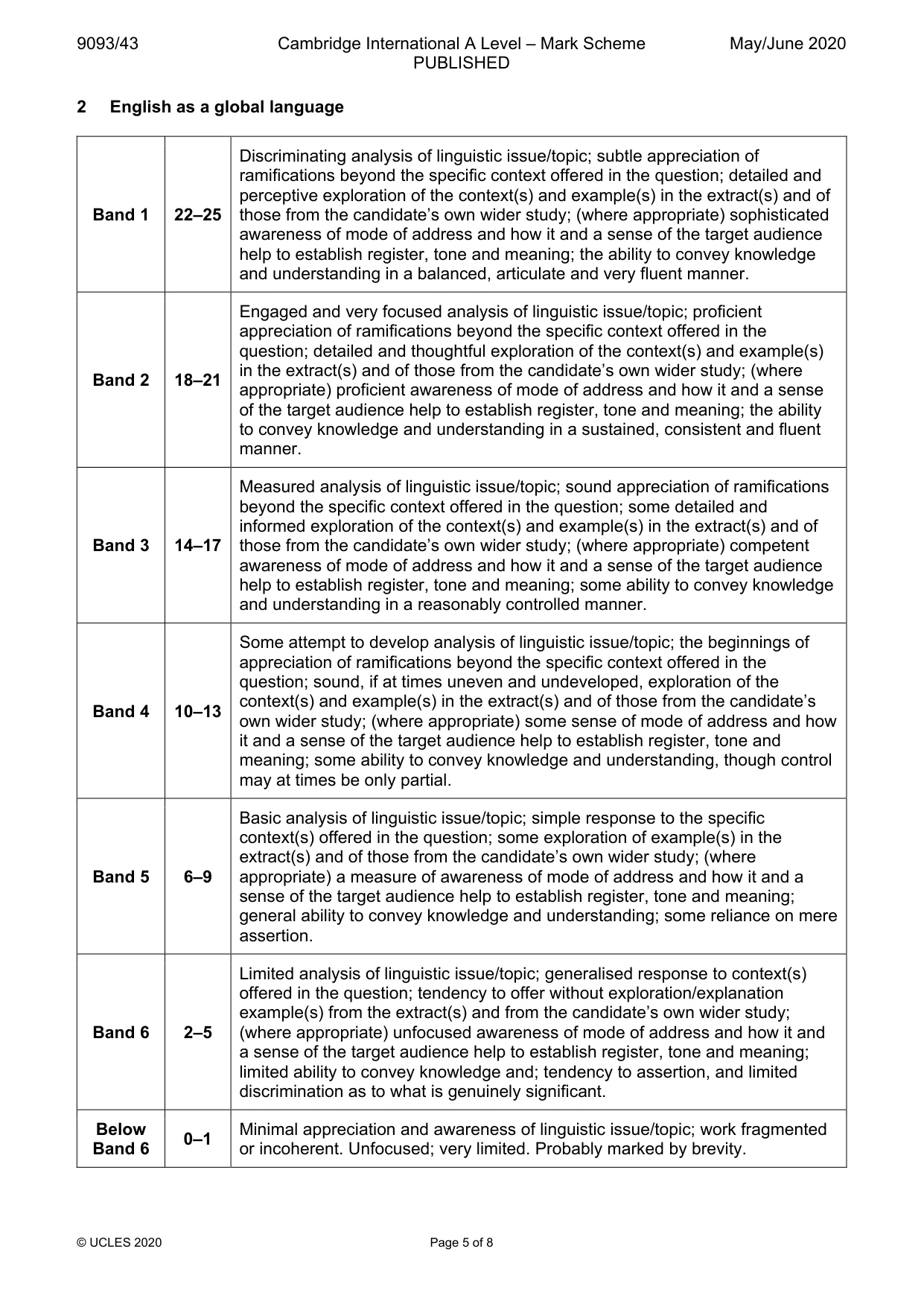
9093/43 Cambridge International A Level – Mark Scheme PUBLISHED May/June 2020 © UCLES 2020 Page 5 of 8 2 English as a global language Band 1 22–25 Discriminating analysis of linguistic issue/topic; subtle appreciation of ramifications beyond the specific context offered in the question; detailed and perceptive exploration of the context(s) and example(s) in the extract(s) and of those from the candidate’s own wider study; (where appropriate) sophisticated awareness of mode of address and how it and a sense of the target audience help to establish register, tone and meaning; the ability to convey knowledge and understanding in a balanced, articulate and very fluent manner. Band 2 18–21 Engaged and very focused analysis of linguistic issue/topic; proficient appreciation of ramifications beyond the specific context offered in the question; detailed and thoughtful exploration of the context(s) and example(s) in the extract(s) and of those from the candidate’s own wider study; (where appropriate) proficient awareness of mode of address and how it and a sense of the target audience help to establish register, tone and meaning; the ability to convey knowledge and understanding in a sustained, consistent and fluent manner. Band 3 14–17 Measured analysis of linguistic issue/topic; sound appreciation of ramifications beyond the specific context offered in the question; some detailed and informed exploration of the context(s) and example(s) in the extract(s) and of those from the candidate’s own wider study; (where appropriate) competent awareness of mode of address and how it and a sense of the target audience help to establish register, tone and meaning; some ability to convey knowledge and understanding in a reasonably controlled manner. Band 4 10–13 Some attempt to develop analysis of linguistic issue/topic; the beginnings of appreciation of ramifications beyond the specific context offered in the question; sound, if at times uneven and undeveloped, exploration of the context(s) and example(s) in the extract(s) and of those from the candidate’s own wider study; (where appropriate) some sense of mode of address and how it and a sense of the target audience help to establish register, tone and meaning; some ability to convey knowledge and understanding, though control may at times be only partial. Band 5 6–9 Basic analysis of linguistic issue/topic; simple response to the specific context(s) offered in the question; some exploration of example(s) in the extract(s) and of those from the candidate’s own wider study; (where appropriate) a measure of awareness of mode of address and how it and a sense of the target audience help to establish register, tone and meaning; general ability to convey knowledge and understanding; some reliance on mere assertion. Band 6 2–5 Limited analysis of linguistic issue/topic; generalised response to context(s) offered in the question; tendency to offer without exploration/explanation example(s) from the extract(s) and from the candidate’s own wider study; (where appropriate) unfocused awareness of mode of address and how it and a sense of the target audience help to establish register, tone and meaning; limited ability to convey knowledge and; tendency to assertion, and limited discrimination as to what is genuinely significant. Below Band 6 0–1 Minimal appreciation and awareness of linguistic issue/topic; work fragmented or incoherent. Unfocused; very limited. Probably marked by brevity.
Mark scheme, page 6
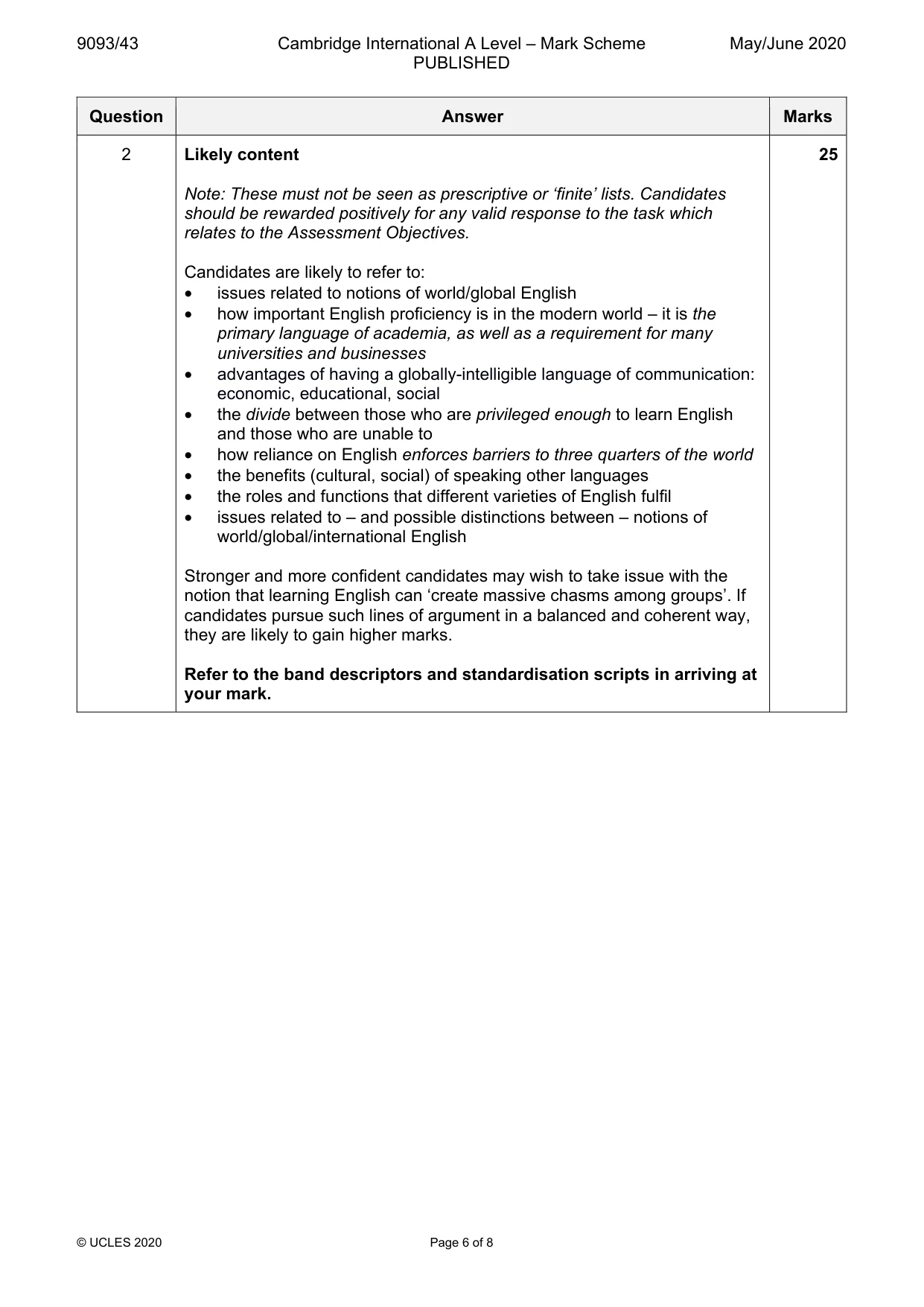
9093/43 Cambridge International A Level – Mark Scheme PUBLISHED May/June 2020 © UCLES 2020 Page 6 of 8 Question Answer Marks 2 Likely content Note: These must not be seen as prescriptive or ‘finite’ lists. Candidates should be rewarded positively for any valid response to the task which relates to the Assessment Objectives. Candidates are likely to refer to: • issues related to notions of world/global English • how important English proficiency is in the modern world – it is the primary language of academia, as well as a requirement for many universities and businesses • advantages of having a globally-intelligible language of communication: economic, educational, social • the divide between those who are privileged enough to learn English and those who are unable to • how reliance on English enforces barriers to three quarters of the world • the benefits (cultural, social) of speaking other languages • the roles and functions that different varieties of English fulfil • issues related to – and possible distinctions between – notions of world/global/international English Stronger and more confident candidates may wish to take issue with the notion that learning English can ‘create massive chasms among groups’. If candidates pursue such lines of argument in a balanced and coherent way, they are likely to gain higher marks. Refer to the band descriptors and standardisation scripts in arriving at your mark. 25
Mark scheme, page 7
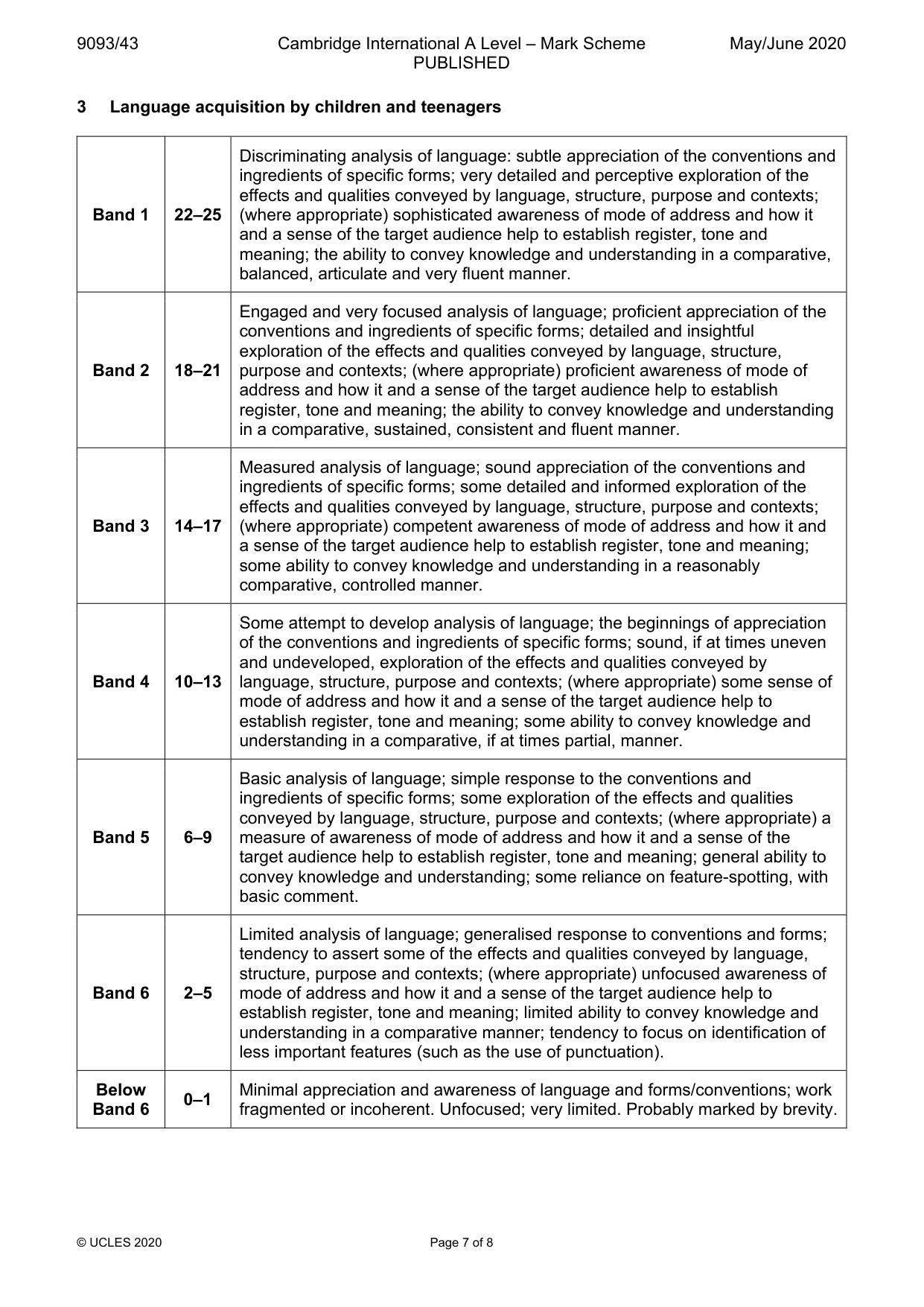
9093/43 Cambridge International A Level – Mark Scheme PUBLISHED May/June 2020 © UCLES 2020 Page 7 of 8 3 Language acquisition by children and teenagers Band 1 22–25 Discriminating analysis of language: subtle appreciation of the conventions and ingredients of specific forms; very detailed and perceptive exploration of the effects and qualities conveyed by language, structure, purpose and contexts; (where appropriate) sophisticated awareness of mode of address and how it and a sense of the target audience help to establish register, tone and meaning; the ability to convey knowledge and understanding in a comparative, balanced, articulate and very fluent manner. Band 2 18–21 Engaged and very focused analysis of language; proficient appreciation of the conventions and ingredients of specific forms; detailed and insightful exploration of the effects and qualities conveyed by language, structure, purpose and contexts; (where appropriate) proficient awareness of mode of address and how it and a sense of the target audience help to establish register, tone and meaning; the ability to convey knowledge and understanding in a comparative, sustained, consistent and fluent manner. Band 3 14–17 Measured analysis of language; sound appreciation of the conventions and ingredients of specific forms; some detailed and informed exploration of the effects and qualities conveyed by language, structure, purpose and contexts; (where appropriate) competent awareness of mode of address and how it and a sense of the target audience help to establish register, tone and meaning; some ability to convey knowledge and understanding in a reasonably comparative, controlled manner. Band 4 10–13 Some attempt to develop analysis of language; the beginnings of appreciation of the conventions and ingredients of specific forms; sound, if at times uneven and undeveloped, exploration of the effects and qualities conveyed by language, structure, purpose and contexts; (where appropriate) some sense of mode of address and how it and a sense of the target audience help to establish register, tone and meaning; some ability to convey knowledge and understanding in a comparative, if at times partial, manner. Band 5 6–9 Basic analysis of language; simple response to the conventions and ingredients of specific forms; some exploration of the effects and qualities conveyed by language, structure, purpose and contexts; (where appropriate) a measure of awareness of mode of address and how it and a sense of the target audience help to establish register, tone and meaning; general ability to convey knowledge and understanding; some reliance on feature-spotting, with basic comment. Band 6 2–5 Limited analysis of language; generalised response to conventions and forms; tendency to assert some of the effects and qualities conveyed by language, structure, purpose and contexts; (where appropriate) unfocused awareness of mode of address and how it and a sense of the target audience help to establish register, tone and meaning; limited ability to convey knowledge and understanding in a comparative manner; tendency to focus on identification of less important features (such as the use of punctuation). Below Band 6 0–1 Minimal appreciation and awareness of language and forms/conventions; work fragmented or incoherent. Unfocused; very limited. Probably marked by brevity.
Mark scheme, page 8
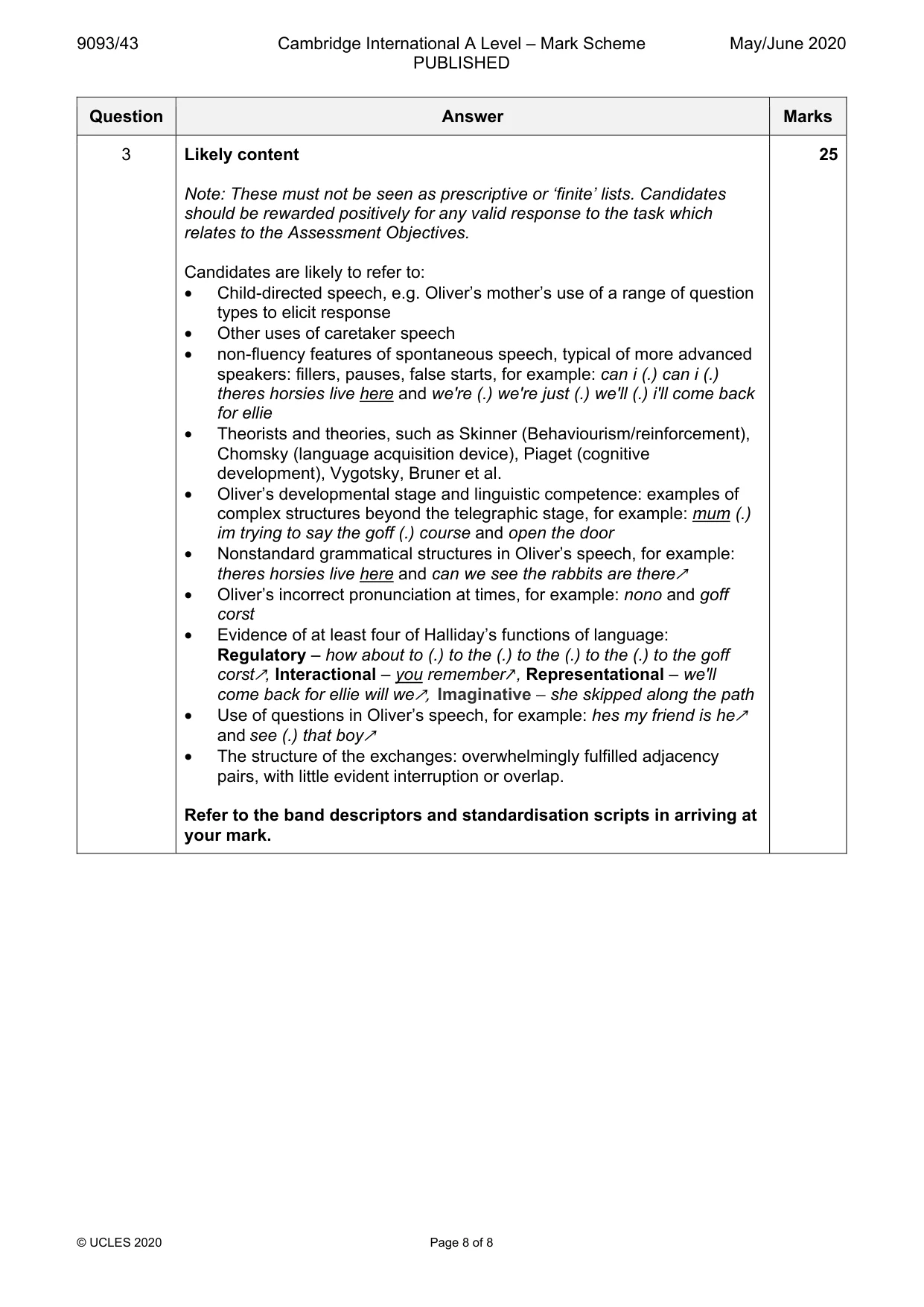
9093/43 Cambridge International A Level – Mark Scheme PUBLISHED May/June 2020 © UCLES 2020 Page 8 of 8 Question Answer Marks 3 Likely content Note: These must not be seen as prescriptive or ‘finite’ lists. Candidates should be rewarded positively for any valid response to the task which relates to the Assessment Objectives. Candidates are likely to refer to: • Child-directed speech, e.g. Oliver’s mother’s use of a range of question types to elicit response • Other uses of caretaker speech • non-fluency features of spontaneous speech, typical of more advanced speakers: fillers, pauses, false starts, for example: can i (.) can i (.) theres horsies live here and we're (.) we're just (.) we'll (.) i'll come back for ellie • Theorists and theories, such as Skinner (Behaviourism/reinforcement), Chomsky (language acquisition device), Piaget (cognitive development), Vygotsky, Bruner et al. • Oliver’s developmental stage and linguistic competence: examples of complex structures beyond the telegraphic stage, for example: mum (.) im trying to say the goff (.) course and open the door • Nonstandard grammatical structures in Oliver’s speech, for example: theres horsies live here and can we see the rabbits are there↗ • Oliver’s incorrect pronunciation at times, for example: nono and goff corst • Evidence of at least four of Halliday’s functions of language: Regulatory – how about to (.) to the (.) to the (.) to the (.) to the goff corst↗, Interactional – you remember↗, Representational – we'll come back for ellie will we↗, Imaginative – she skipped along the path • Use of questions in Oliver’s speech, for example: hes my friend is he↗ and see (.) that boy↗ • The structure of the exchanges: overwhelmingly fulfilled adjacency pairs, with little evident interruption or overlap. Refer to the band descriptors and standardisation scripts in arriving at your mark. 25