Cambridge A Level English - Language AS and A Level (from 2014) 9093 — 2017 Oct/Nov Paper 4 · Variant 3
9093/43/O/N/17 · 50 marks · ≈56 min
The question paper and its mark scheme, free to read here and free to download. This is Cambridge’s own paper, exactly as it was sat.
Question paper8 pages


Mark scheme7 pages
Answers below. Sit the paper first if you are practising.
Paper as text
Question paper, page 1
This document consists of 7 printed pages, 1 blank page and 1 Insert. DC (RCL (DF)) 130803/3 © UCLES 2017 [Turn over Cambridge International Examinations Cambridge International Advanced Subsidiary and Advanced Level * 6 0 1 7 9 1 7 7 4 6 * ENGLISH LANGUAGE 9093/43 Paper 4 Language Topics October/November 2017 2 hours 15 minutes No Additional Materials are required. READ THESE INSTRUCTIONS FIRST An answer booklet is provided inside this question paper. You should follow the instructions on the front cover of the answer booklet. If you need additional answer paper, ask the invigilator for a continuation booklet. Answer two questions. You should spend about 15 minutes reading the passages and questions before you start writing your answers. You are reminded of the need for good English and clear presentation in your answers. All questions in this paper carry equal marks.
Question paper, page 2
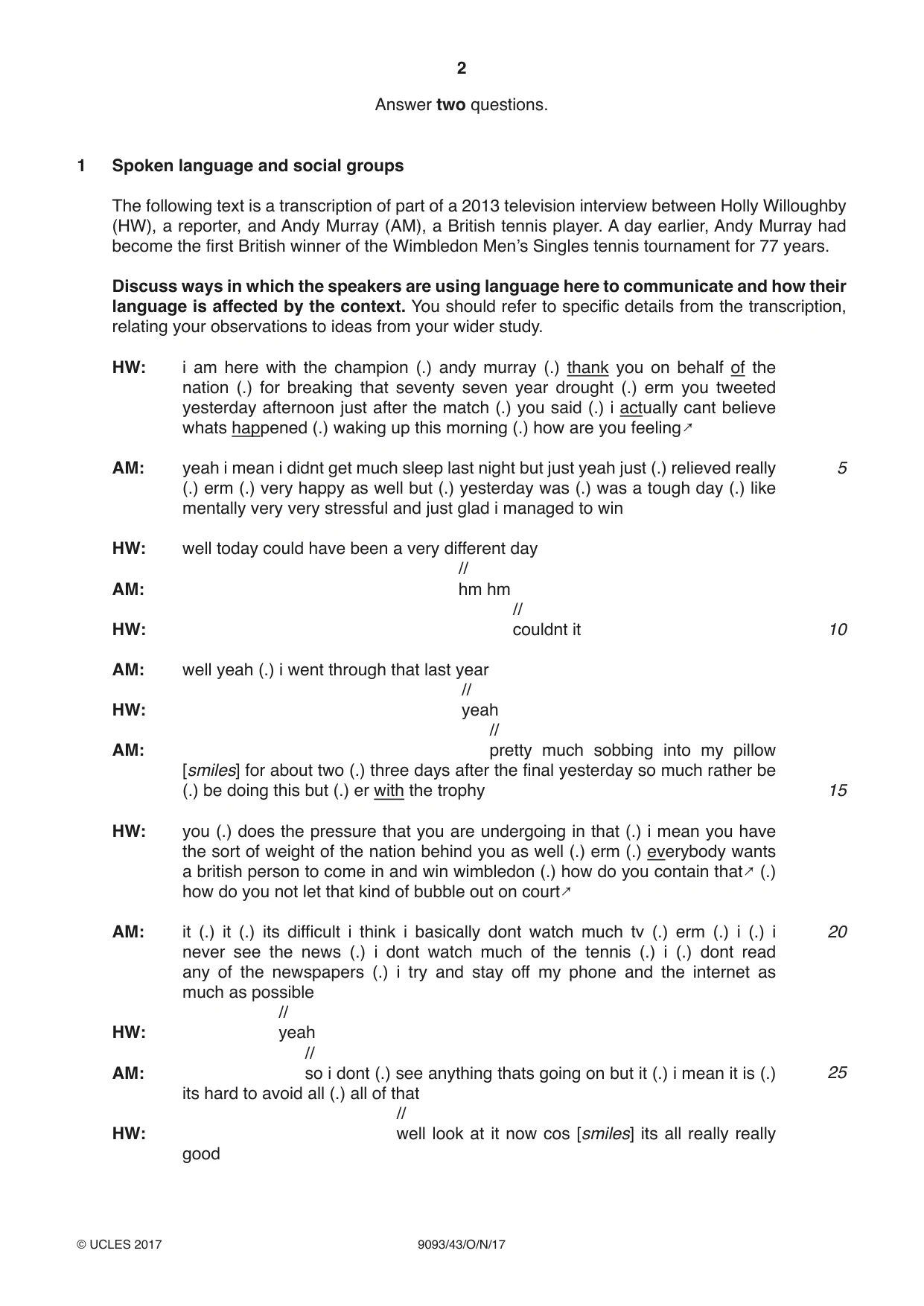
2 9093/43/O/N/17 © UCLES 2017 Answer two questions. 1 Spoken language and social groups The following text is a transcription of part of a 2013 television interview between Holly Willoughby (HW), a reporter, and Andy Murray (AM), a British tennis player. A day earlier, Andy Murray had become the first British winner of the Wimbledon Men’s Singles tennis tournament for 77 years. Discuss ways in which the speakers are using language here to communicate and how their language is affected by the context. You should refer to specific details from the transcription, relating your observations to ideas from your wider study. HW: i am here with the champion (.) andy murray (.) thank you on behalf of the nation (.) for breaking that seventy seven year drought (.) erm you tweeted yesterday afternoon just after the match (.) you said (.) i actually cant believe whats happened (.) waking up this morning (.) how are you feeling↗ AM: yeah i mean i didnt get much sleep last night but just yeah just (.) relieved really (.) erm (.) very happy as well but (.) yesterday was (.) was a tough day (.) like mentally very very stressful and just glad i managed to win HW: well today could have been a very different day // AM: hm hm // HW: couldnt it AM: well yeah (.) i went through that last year // HW: yeah // AM: pretty much sobbing into my pillow [smiles] for about two (.) three days after the final yesterday so much rather be (.) be doing this but (.) er with the trophy HW: you (.) does the pressure that you are undergoing in that (.) i mean you have the sort of weight of the nation behind you as well (.) erm (.) everybody wants a british person to come in and win wimbledon (.) how do you contain that↗ (.) how do you not let that kind of bubble out on court↗ AM: it (.) it (.) its difficult i think i basically dont watch much tv (.) erm (.) i (.) i never see the news (.) i dont watch much of the tennis (.) i (.) dont read any of the newspapers (.) i try and stay off my phone and the internet as much as possible // HW: yeah // AM: so i dont (.) see anything thats going on but it (.) i mean it is (.) its hard to avoid all (.) all of that // HW: well look at it now cos [smiles] its all really really good 5 10 15 20 25
Question paper, page 3
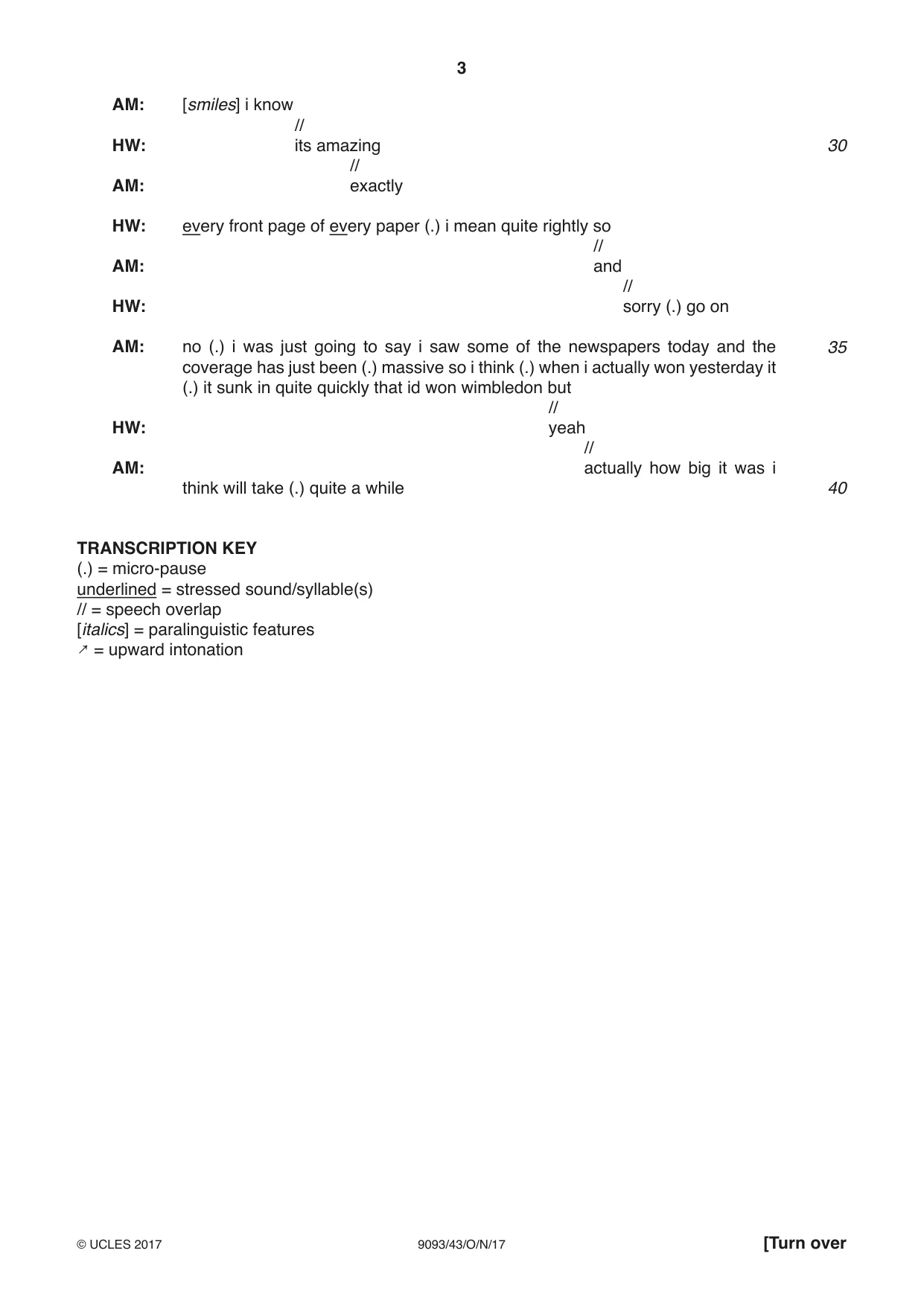
3 9093/43/O/N/17 © UCLES 2017 [Turn over AM: [smiles] i know // HW: its amazing // AM: exactly HW: every front page of every paper (.) i mean quite rightly so // AM: and // HW: sorry (.) go on AM: no (.) i was just going to say i saw some of the newspapers today and the coverage has just been (.) massive so i think (.) when i actually won yesterday it (.) it sunk in quite quickly that id won wimbledon but // HW: yeah // AM: actually how big it was i think will take (.) quite a while TRANSCRIPTION KEY (.) = micro-pause underlined = stressed sound/syllable(s) // = speech overlap [italics] = paralinguistic features ↗ = upward intonation 30 35 40
Question paper, page 4
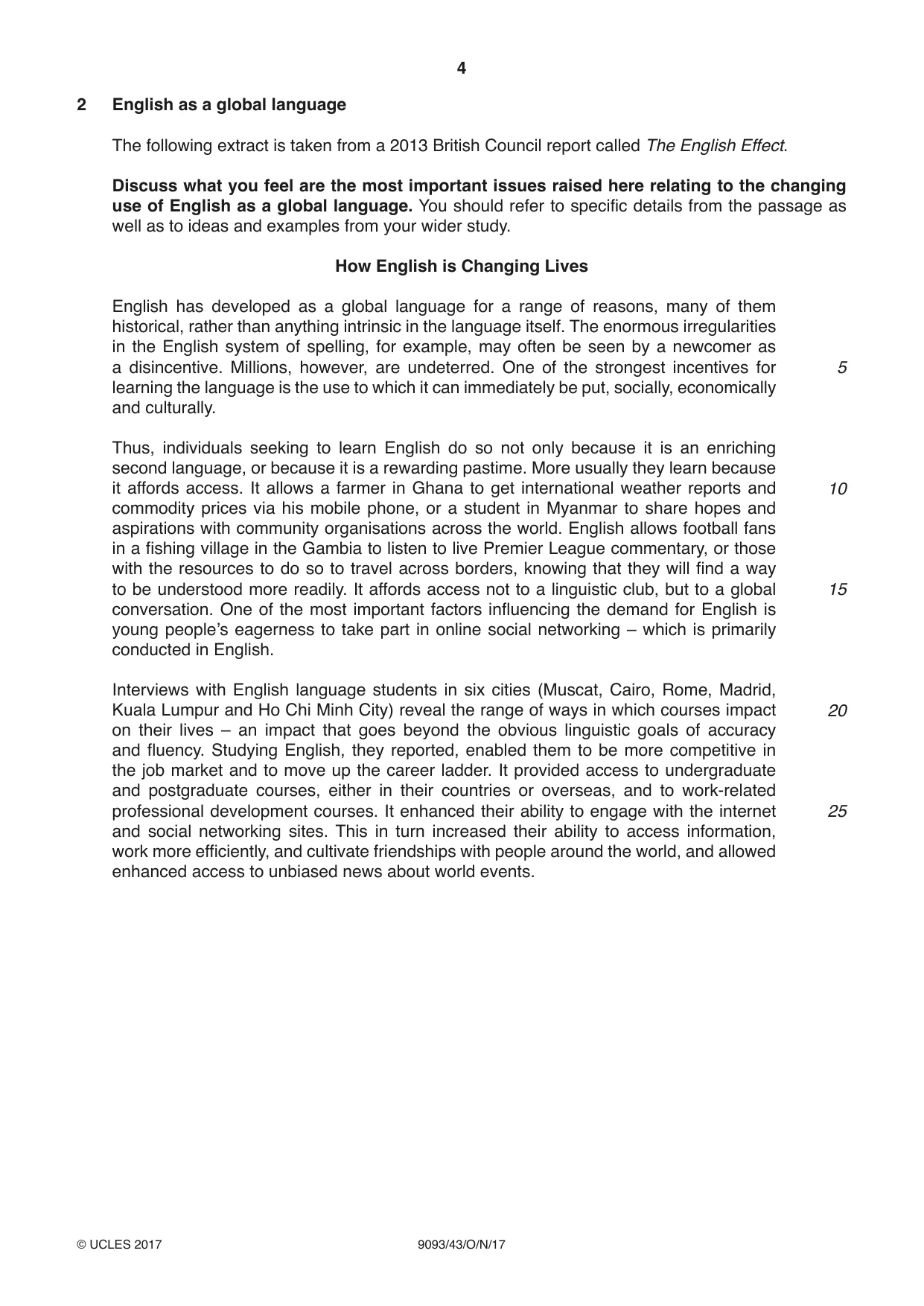
4 9093/43/O/N/17 © UCLES 2017 2 English as a global language The following extract is taken from a 2013 British Council report called The English Effect. Discuss what you feel are the most important issues raised here relating to the changing use of English as a global language. You should refer to specific details from the passage as well as to ideas and examples from your wider study. How English is Changing Lives English has developed as a global language for a range of reasons, many of them historical, rather than anything intrinsic in the language itself. The enormous irregularities in the English system of spelling, for example, may often be seen by a newcomer as a disincentive. Millions, however, are undeterred. One of the strongest incentives for learning the language is the use to which it can immediately be put, socially, economically and culturally. Thus, individuals seeking to learn English do so not only because it is an enriching second language, or because it is a rewarding pastime. More usually they learn because it affords access. It allows a farmer in Ghana to get international weather reports and commodity prices via his mobile phone, or a student in Myanmar to share hopes and aspirations with community organisations across the world. English allows football fans in a fishing village in the Gambia to listen to live Premier League commentary, or those with the resources to do so to travel across borders, knowing that they will find a way to be understood more readily. It affords access not to a linguistic club, but to a global conversation. One of the most important factors influencing the demand for English is young people’s eagerness to take part in online social networking – which is primarily conducted in English. Interviews with English language students in six cities (Muscat, Cairo, Rome, Madrid, Kuala Lumpur and Ho Chi Minh City) reveal the range of ways in which courses impact on their lives – an impact that goes beyond the obvious linguistic goals of accuracy and fluency. Studying English, they reported, enabled them to be more competitive in the job market and to move up the career ladder. It provided access to undergraduate and postgraduate courses, either in their countries or overseas, and to work-related professional development courses. It enhanced their ability to engage with the internet and social networking sites. This in turn increased their ability to access information, work more efficiently, and cultivate friendships with people around the world, and allowed enhanced access to unbiased news about world events. 5 10 15 20 25
Question paper, page 5
5 9093/43/O/N/17 © UCLES 2017 [Turn over TURN OVER FOR QUESTION 3.
Question paper, page 6
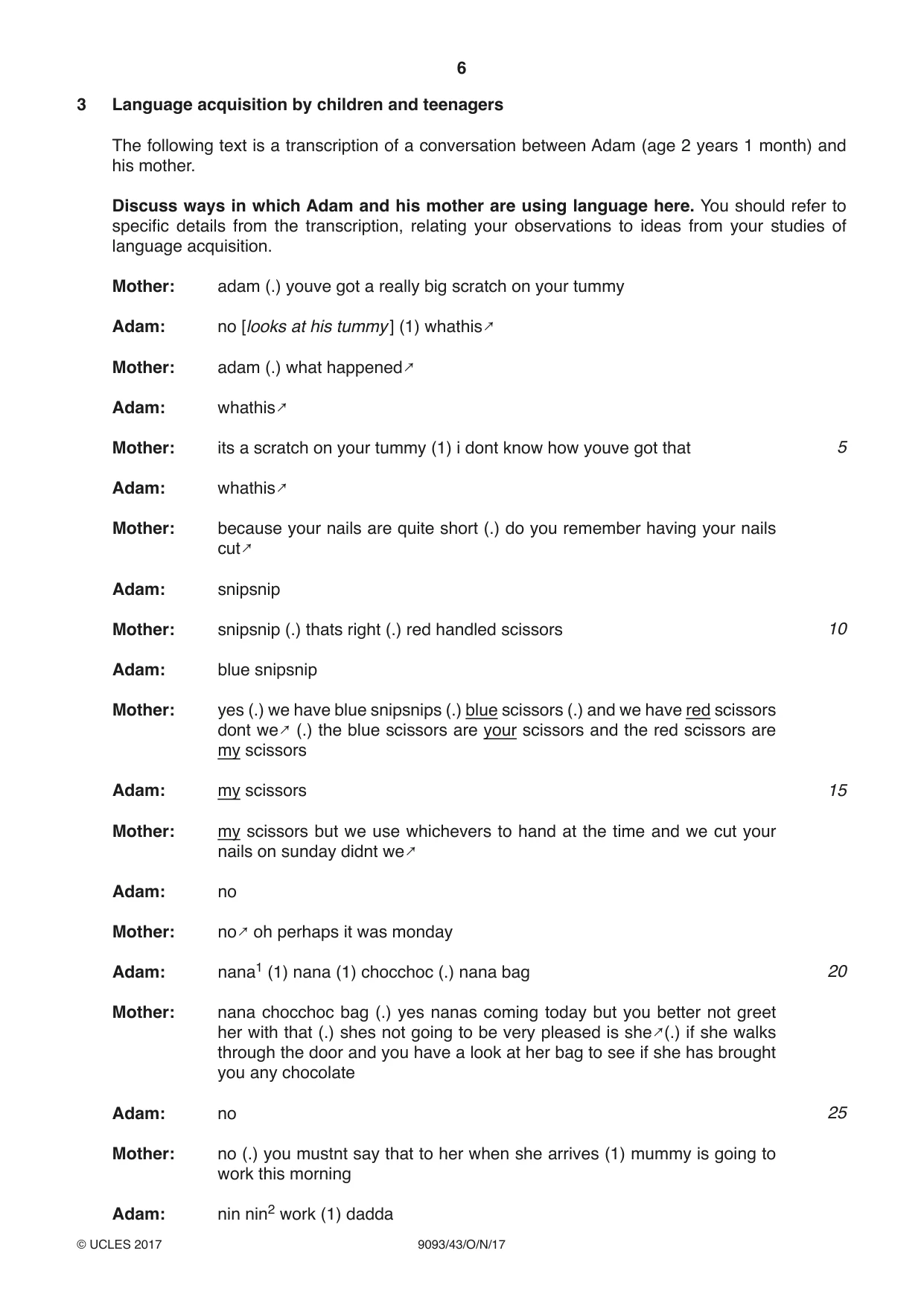
6 9093/43/O/N/17 © UCLES 2017 3 Language acquisition by children and teenagers The following text is a transcription of a conversation between Adam (age 2 years 1 month) and his mother. Discuss ways in which Adam and his mother are using language here. You should refer to specific details from the transcription, relating your observations to ideas from your studies of language acquisition. Mother: adam (.) youve got a really big scratch on your tummy Adam: no [looks at his tummy ] (1) whathis↗ Mother: adam (.) what happened↗ Adam: whathis↗ Mother: its a scratch on your tummy (1) i dont know how youve got that Adam: whathis↗ Mother: because your nails are quite short (.) do you remember having your nails cut↗ Adam: snipsnip Mother: snipsnip (.) thats right (.) red handled scissors Adam: blue snipsnip Mother: yes (.) we have blue snipsnips (.) blue scissors (.) and we have red scissors dont we↗ (.) the blue scissors are your scissors and the red scissors are my scissors Adam: my scissors Mother: my scissors but we use whichevers to hand at the time and we cut your nails on sunday didnt we↗ Adam: no Mother: no↗ oh perhaps it was monday Adam: nana1 (1) nana (1) chocchoc (.) nana bag Mother: nana chocchoc bag (.) yes nanas coming today but you better not greet her with that (.) shes not going to be very pleased is she↗(.) if she walks through the door and you have a look at her bag to see if she has brought you any chocolate Adam: no Mother: no (.) you mustnt say that to her when she arrives (1) mummy is going to work this morning Adam: nin nin2 work (1) dadda 5 10 15 20 25
Question paper, page 7
7 9093/43/O/N/17 © UCLES 2017 Mother: and daddys going to work Adam: dadda work (1) chipshop Mother: no (.) daddy doesnt work at a chip shop Adam: nana chipshops Notes: 1 nana: a short form for grandmother 2 nin nin: Adam’s word for mummy TRANSCRIPTION KEY (1) = pause in seconds (.) = micro-pause underlined = stressed sound/syllable(s) [italics] = paralinguistic features ↗ = upward intonation 30
Question paper, page 8
8 9093/43/O/N/17 © UCLES 2017 BLANK PAGE Permission to reproduce items where third-party owned material protected by copyright is included has been sought and cleared where possible. Every reasonable effort has been made by the publisher (UCLES) to trace copyright holders, but if any items requiring clearance have unwittingly been included, the publisher will be pleased to make amends at the earliest possible opportunity. To avoid the issue of disclosure of answer-related information to candidates, all copyright acknowledgements are reproduced online in the Cambridge International Examinations Copyright Acknowledgements Booklet. This is produced for each series of examinations and is freely available to download at www.cie.org.uk after the live examination series. Cambridge International Examinations is part of the Cambridge Assessment Group. Cambridge Assessment is the brand name of University of Cambridge Local Examinations Syndicate (UCLES), which is itself a department of the University of Cambridge.
Mark scheme, page 1
® IGCSE is a registered trademark. This document consists of 7 printed pages. © UCLES 2017 [Turn over Cambridge Assessment International Education Cambridge International Advanced Level ENGLISH LANGUAGE 9093/43 Paper 4 Language Topics October/November 2017 MARK SCHEME Maximum Mark: 50 Published This mark scheme is published as an aid to teachers and candidates, to indicate the requirements of the examination. It shows the basis on which Examiners were instructed to award marks. It does not indicate the details of the discussions that took place at an Examiners’ meeting before marking began, which would have considered the acceptability of alternative answers. Mark schemes should be read in conjunction with the question paper and the Principal Examiner Report for Teachers. Cambridge International will not enter into discussions about these mark schemes. Cambridge International is publishing the mark schemes for the October/November 2017 series for most Cambridge IGCSE®, Cambridge International A and AS Level components and some Cambridge O Level components.
Mark scheme, page 2
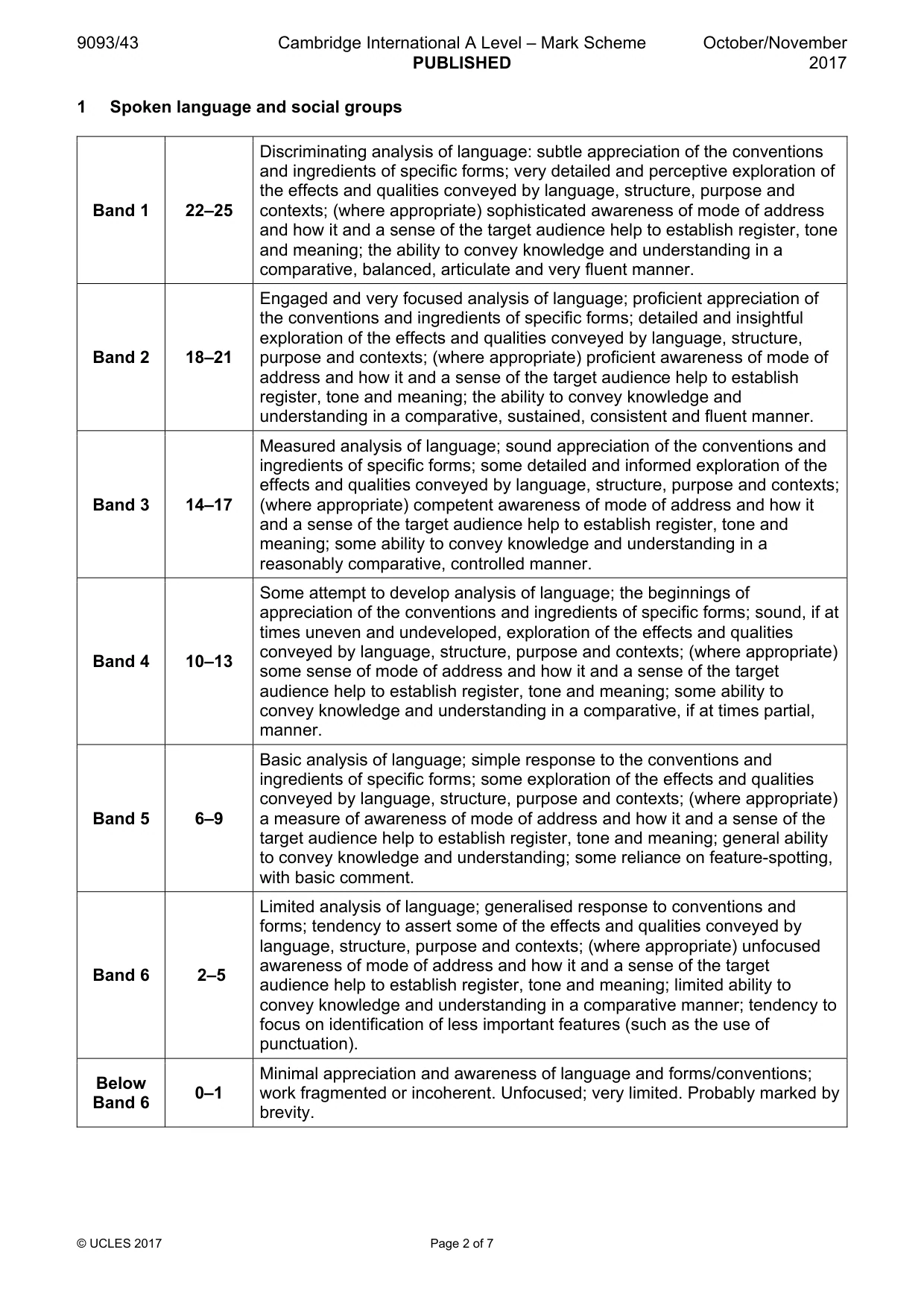
9093/43 Cambridge International A Level – Mark Scheme PUBLISHED October/November 2017 © UCLES 2017 Page 2 of 7 1 Spoken language and social groups Band 1 22–25 Discriminating analysis of language: subtle appreciation of the conventions and ingredients of specific forms; very detailed and perceptive exploration of the effects and qualities conveyed by language, structure, purpose and contexts; (where appropriate) sophisticated awareness of mode of address and how it and a sense of the target audience help to establish register, tone and meaning; the ability to convey knowledge and understanding in a comparative, balanced, articulate and very fluent manner. Band 2 18–21 Engaged and very focused analysis of language; proficient appreciation of the conventions and ingredients of specific forms; detailed and insightful exploration of the effects and qualities conveyed by language, structure, purpose and contexts; (where appropriate) proficient awareness of mode of address and how it and a sense of the target audience help to establish register, tone and meaning; the ability to convey knowledge and understanding in a comparative, sustained, consistent and fluent manner. Band 3 14–17 Measured analysis of language; sound appreciation of the conventions and ingredients of specific forms; some detailed and informed exploration of the effects and qualities conveyed by language, structure, purpose and contexts; (where appropriate) competent awareness of mode of address and how it and a sense of the target audience help to establish register, tone and meaning; some ability to convey knowledge and understanding in a reasonably comparative, controlled manner. Band 4 10–13 Some attempt to develop analysis of language; the beginnings of appreciation of the conventions and ingredients of specific forms; sound, if at times uneven and undeveloped, exploration of the effects and qualities conveyed by language, structure, purpose and contexts; (where appropriate) some sense of mode of address and how it and a sense of the target audience help to establish register, tone and meaning; some ability to convey knowledge and understanding in a comparative, if at times partial, manner. Band 5 6–9 Basic analysis of language; simple response to the conventions and ingredients of specific forms; some exploration of the effects and qualities conveyed by language, structure, purpose and contexts; (where appropriate) a measure of awareness of mode of address and how it and a sense of the target audience help to establish register, tone and meaning; general ability to convey knowledge and understanding; some reliance on feature-spotting, with basic comment. Band 6 2–5 Limited analysis of language; generalised response to conventions and forms; tendency to assert some of the effects and qualities conveyed by language, structure, purpose and contexts; (where appropriate) unfocused awareness of mode of address and how it and a sense of the target audience help to establish register, tone and meaning; limited ability to convey knowledge and understanding in a comparative manner; tendency to focus on identification of less important features (such as the use of punctuation). Below Band 6 0–1 Minimal appreciation and awareness of language and forms/conventions; work fragmented or incoherent. Unfocused; very limited. Probably marked by brevity.
Mark scheme, page 3
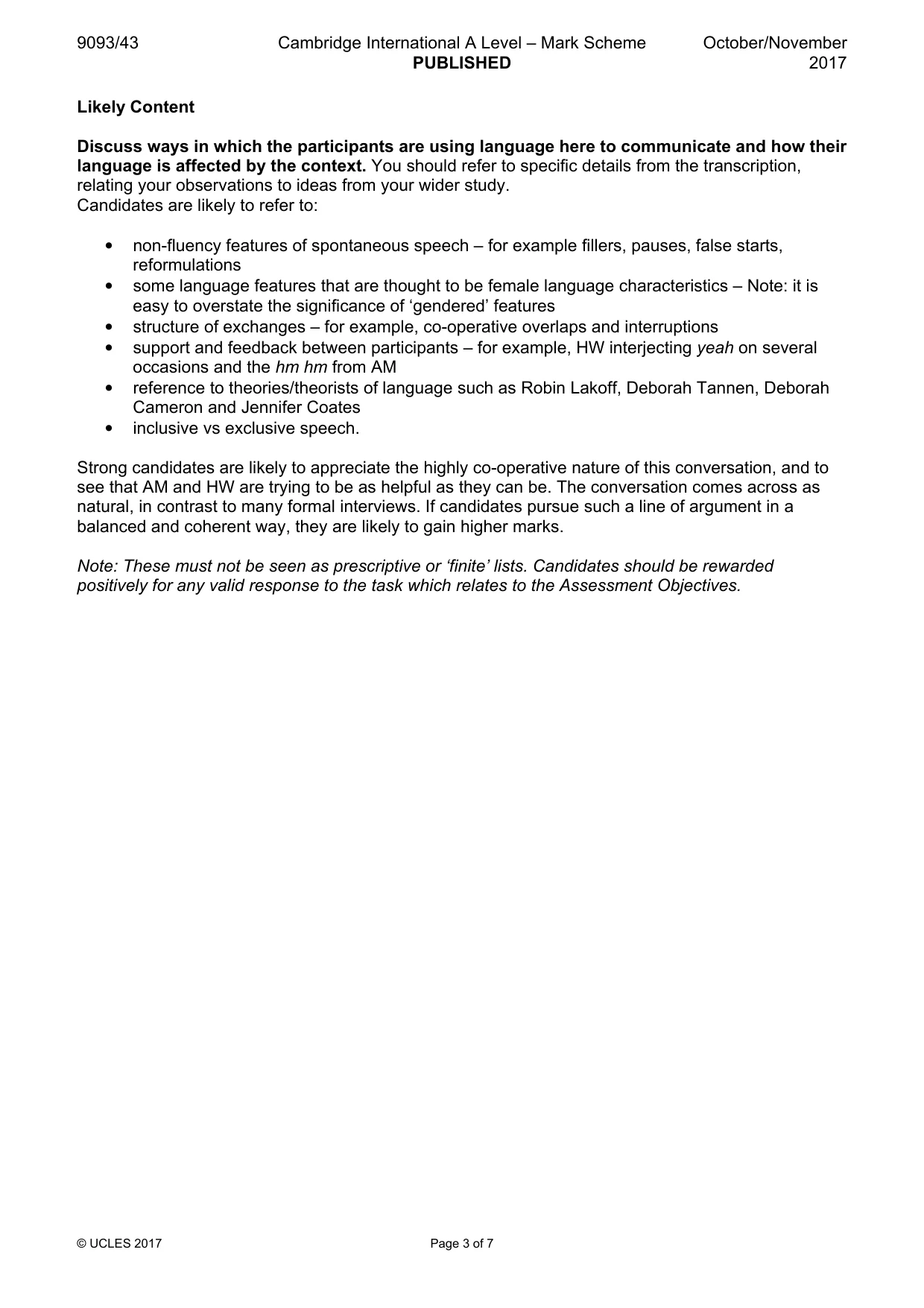
9093/43 Cambridge International A Level – Mark Scheme PUBLISHED October/November 2017 © UCLES 2017 Page 3 of 7 Likely Content Discuss ways in which the participants are using language here to communicate and how their language is affected by the context. You should refer to specific details from the transcription, relating your observations to ideas from your wider study. Candidates are likely to refer to: • non-fluency features of spontaneous speech – for example fillers, pauses, false starts, reformulations • some language features that are thought to be female language characteristics – Note: it is easy to overstate the significance of ‘gendered’ features • structure of exchanges – for example, co-operative overlaps and interruptions • support and feedback between participants – for example, HW interjecting yeah on several occasions and the hm hm from AM • reference to theories/theorists of language such as Robin Lakoff, Deborah Tannen, Deborah Cameron and Jennifer Coates • inclusive vs exclusive speech. Strong candidates are likely to appreciate the highly co-operative nature of this conversation, and to see that AM and HW are trying to be as helpful as they can be. The conversation comes across as natural, in contrast to many formal interviews. If candidates pursue such a line of argument in a balanced and coherent way, they are likely to gain higher marks. Note: These must not be seen as prescriptive or ‘finite’ lists. Candidates should be rewarded positively for any valid response to the task which relates to the Assessment Objectives.
Mark scheme, page 4
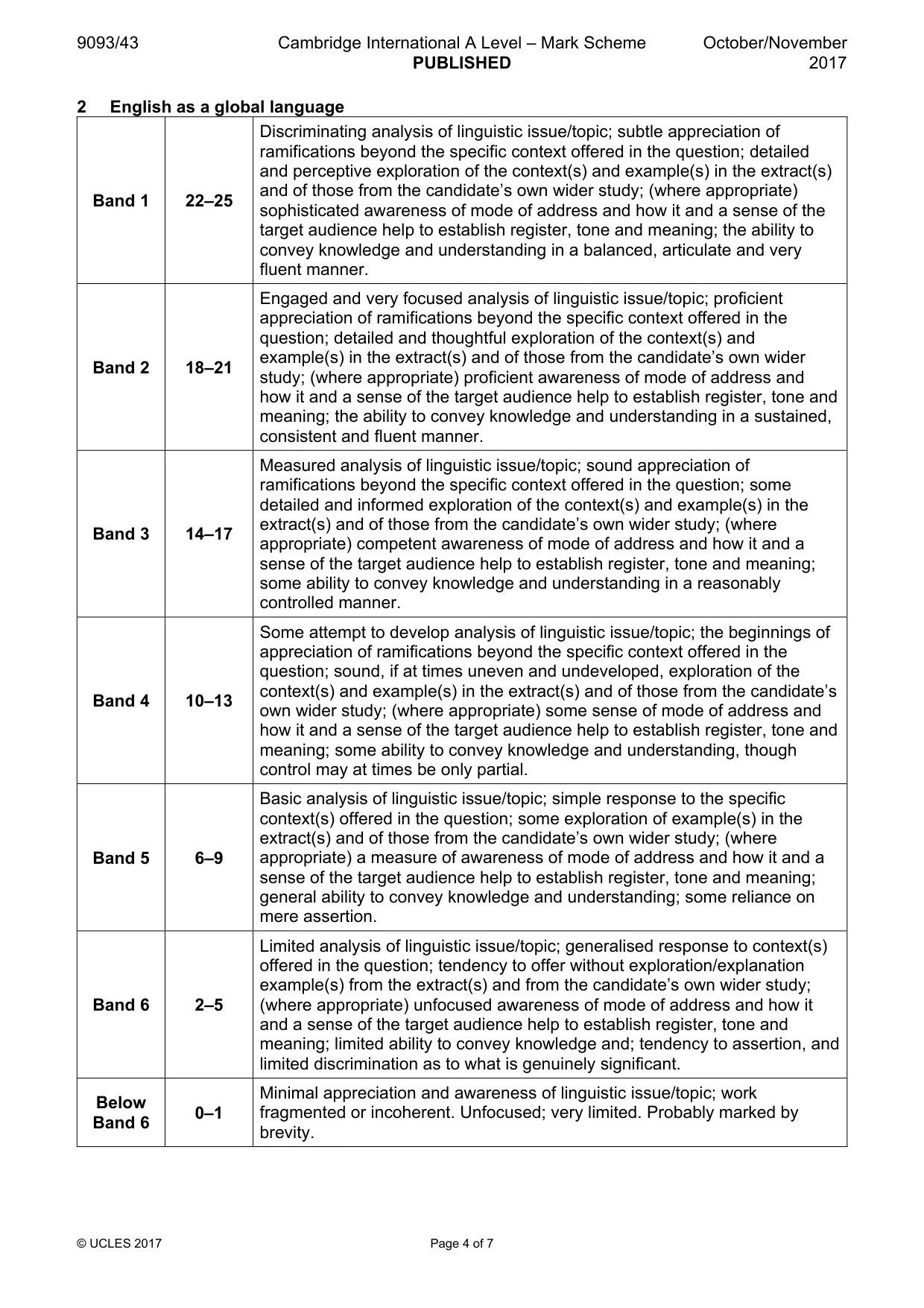
9093/43 Cambridge International A Level – Mark Scheme PUBLISHED October/November 2017 © UCLES 2017 Page 4 of 7 2 English as a global language Band 1 22–25 Discriminating analysis of linguistic issue/topic; subtle appreciation of ramifications beyond the specific context offered in the question; detailed and perceptive exploration of the context(s) and example(s) in the extract(s) and of those from the candidate’s own wider study; (where appropriate) sophisticated awareness of mode of address and how it and a sense of the target audience help to establish register, tone and meaning; the ability to convey knowledge and understanding in a balanced, articulate and very fluent manner. Band 2 18–21 Engaged and very focused analysis of linguistic issue/topic; proficient appreciation of ramifications beyond the specific context offered in the question; detailed and thoughtful exploration of the context(s) and example(s) in the extract(s) and of those from the candidate’s own wider study; (where appropriate) proficient awareness of mode of address and how it and a sense of the target audience help to establish register, tone and meaning; the ability to convey knowledge and understanding in a sustained, consistent and fluent manner. Band 3 14–17 Measured analysis of linguistic issue/topic; sound appreciation of ramifications beyond the specific context offered in the question; some detailed and informed exploration of the context(s) and example(s) in the extract(s) and of those from the candidate’s own wider study; (where appropriate) competent awareness of mode of address and how it and a sense of the target audience help to establish register, tone and meaning; some ability to convey knowledge and understanding in a reasonably controlled manner. Band 4 10–13 Some attempt to develop analysis of linguistic issue/topic; the beginnings of appreciation of ramifications beyond the specific context offered in the question; sound, if at times uneven and undeveloped, exploration of the context(s) and example(s) in the extract(s) and of those from the candidate’s own wider study; (where appropriate) some sense of mode of address and how it and a sense of the target audience help to establish register, tone and meaning; some ability to convey knowledge and understanding, though control may at times be only partial. Band 5 6–9 Basic analysis of linguistic issue/topic; simple response to the specific context(s) offered in the question; some exploration of example(s) in the extract(s) and of those from the candidate’s own wider study; (where appropriate) a measure of awareness of mode of address and how it and a sense of the target audience help to establish register, tone and meaning; general ability to convey knowledge and understanding; some reliance on mere assertion. Band 6 2–5 Limited analysis of linguistic issue/topic; generalised response to context(s) offered in the question; tendency to offer without exploration/explanation example(s) from the extract(s) and from the candidate’s own wider study; (where appropriate) unfocused awareness of mode of address and how it and a sense of the target audience help to establish register, tone and meaning; limited ability to convey knowledge and; tendency to assertion, and limited discrimination as to what is genuinely significant. Below Band 6 0–1 Minimal appreciation and awareness of linguistic issue/topic; work fragmented or incoherent. Unfocused; very limited. Probably marked by brevity.
Mark scheme, page 5
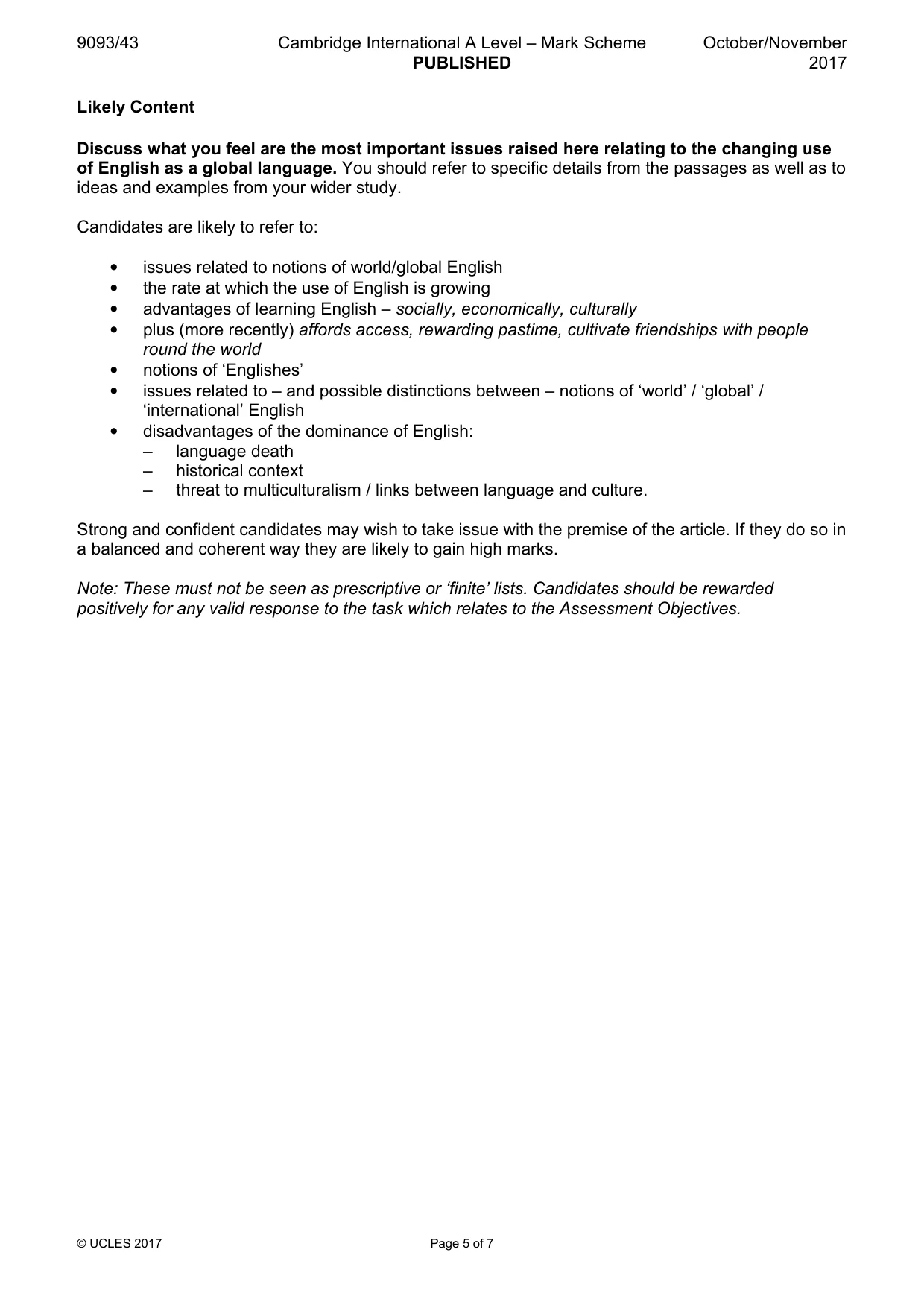
9093/43 Cambridge International A Level – Mark Scheme PUBLISHED October/November 2017 © UCLES 2017 Page 5 of 7 Likely Content Discuss what you feel are the most important issues raised here relating to the changing use of English as a global language. You should refer to specific details from the passages as well as to ideas and examples from your wider study. Candidates are likely to refer to: • issues related to notions of world/global English • the rate at which the use of English is growing • advantages of learning English – socially, economically, culturally • plus (more recently) affords access, rewarding pastime, cultivate friendships with people round the world • notions of ‘Englishes’ • issues related to – and possible distinctions between – notions of ‘world’ / ‘global’ / ‘international’ English • disadvantages of the dominance of English: – language death – historical context – threat to multiculturalism / links between language and culture. Strong and confident candidates may wish to take issue with the premise of the article. If they do so in a balanced and coherent way they are likely to gain high marks. Note: These must not be seen as prescriptive or ‘finite’ lists. Candidates should be rewarded positively for any valid response to the task which relates to the Assessment Objectives.
Mark scheme, page 6
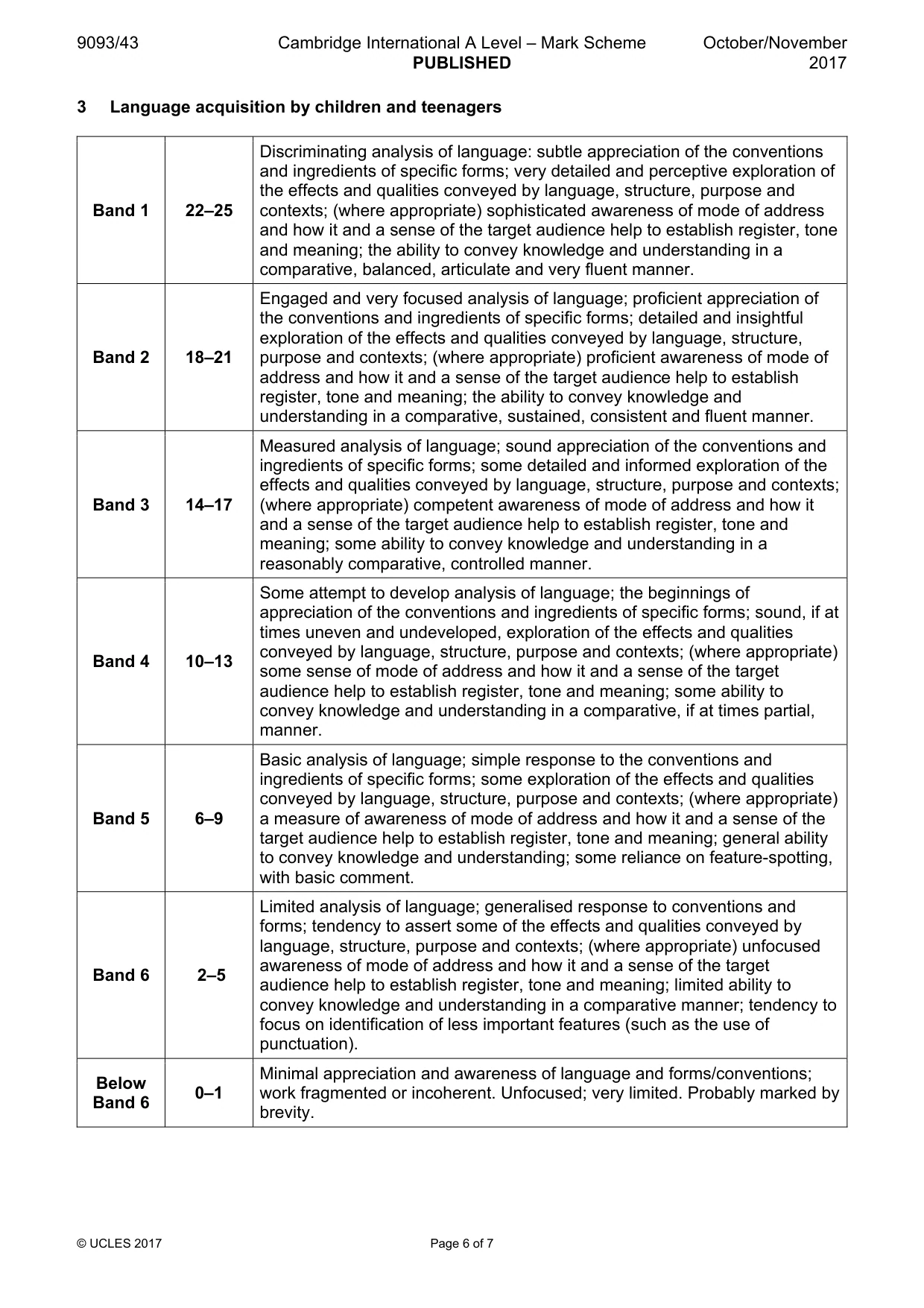
9093/43 Cambridge International A Level – Mark Scheme PUBLISHED October/November 2017 © UCLES 2017 Page 6 of 7 3 Language acquisition by children and teenagers Band 1 22–25 Discriminating analysis of language: subtle appreciation of the conventions and ingredients of specific forms; very detailed and perceptive exploration of the effects and qualities conveyed by language, structure, purpose and contexts; (where appropriate) sophisticated awareness of mode of address and how it and a sense of the target audience help to establish register, tone and meaning; the ability to convey knowledge and understanding in a comparative, balanced, articulate and very fluent manner. Band 2 18–21 Engaged and very focused analysis of language; proficient appreciation of the conventions and ingredients of specific forms; detailed and insightful exploration of the effects and qualities conveyed by language, structure, purpose and contexts; (where appropriate) proficient awareness of mode of address and how it and a sense of the target audience help to establish register, tone and meaning; the ability to convey knowledge and understanding in a comparative, sustained, consistent and fluent manner. Band 3 14–17 Measured analysis of language; sound appreciation of the conventions and ingredients of specific forms; some detailed and informed exploration of the effects and qualities conveyed by language, structure, purpose and contexts; (where appropriate) competent awareness of mode of address and how it and a sense of the target audience help to establish register, tone and meaning; some ability to convey knowledge and understanding in a reasonably comparative, controlled manner. Band 4 10–13 Some attempt to develop analysis of language; the beginnings of appreciation of the conventions and ingredients of specific forms; sound, if at times uneven and undeveloped, exploration of the effects and qualities conveyed by language, structure, purpose and contexts; (where appropriate) some sense of mode of address and how it and a sense of the target audience help to establish register, tone and meaning; some ability to convey knowledge and understanding in a comparative, if at times partial, manner. Band 5 6–9 Basic analysis of language; simple response to the conventions and ingredients of specific forms; some exploration of the effects and qualities conveyed by language, structure, purpose and contexts; (where appropriate) a measure of awareness of mode of address and how it and a sense of the target audience help to establish register, tone and meaning; general ability to convey knowledge and understanding; some reliance on feature-spotting, with basic comment. Band 6 2–5 Limited analysis of language; generalised response to conventions and forms; tendency to assert some of the effects and qualities conveyed by language, structure, purpose and contexts; (where appropriate) unfocused awareness of mode of address and how it and a sense of the target audience help to establish register, tone and meaning; limited ability to convey knowledge and understanding in a comparative manner; tendency to focus on identification of less important features (such as the use of punctuation). Below Band 6 0–1 Minimal appreciation and awareness of language and forms/conventions; work fragmented or incoherent. Unfocused; very limited. Probably marked by brevity.
Mark scheme, page 7
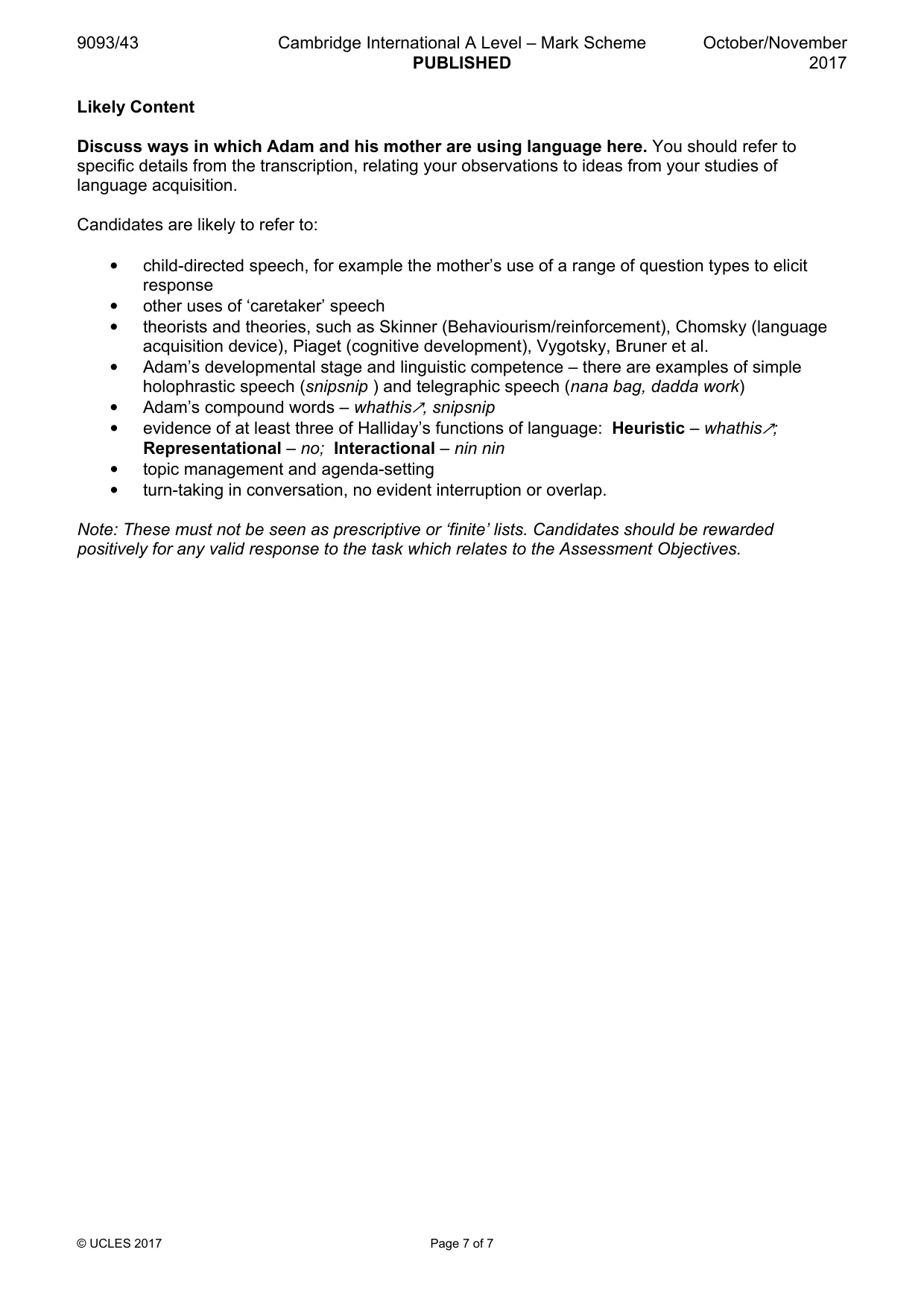
9093/43 Cambridge International A Level – Mark Scheme PUBLISHED October/November 2017 © UCLES 2017 Page 7 of 7 Likely Content Discuss ways in which Adam and his mother are using language here. You should refer to specific details from the transcription, relating your observations to ideas from your studies of language acquisition. Candidates are likely to refer to: • child-directed speech, for example the mother’s use of a range of question types to elicit response • other uses of ‘caretaker’ speech • theorists and theories, such as Skinner (Behaviourism/reinforcement), Chomsky (language acquisition device), Piaget (cognitive development), Vygotsky, Bruner et al. • Adam’s developmental stage and linguistic competence – there are examples of simple holophrastic speech (snipsnip ) and telegraphic speech (nana bag, dadda work) • Adam’s compound words – whathis↗, snipsnip • evidence of at least three of Halliday’s functions of language: Heuristic – whathis↗; Representational – no; Interactional – nin nin • topic management and agenda-setting • turn-taking in conversation, no evident interruption or overlap. Note: These must not be seen as prescriptive or ‘finite’ lists. Candidates should be rewarded positively for any valid response to the task which relates to the Assessment Objectives.
What you needed in this session
Cambridge’s own grade thresholds for 2017 Oct/Nov, Paper 4 · Variant 3. A higher threshold means an easier paper — the bar moves with how the cohort did.