Cambridge A Level English - Language AS and A Level (from 2014) 9093 — 2015 Oct/Nov Paper 3 · Variant 3
9093/33/O/N/15 · 50 marks · ≈56 min
The question paper and its mark scheme, free to read here and free to download. This is Cambridge’s own paper, exactly as it was sat.
Question paper8 pages




Mark scheme3 pages
Answers below. Sit the paper first if you are practising.
Paper as text
Question paper, page 1
This document consists of 5 printed pages, 3 blank pages and 1 insert. DC (LEG/SW) 106014/3 © UCLES 2015 [Turn over Cambridge International Examinations Cambridge International Advanced Subsidiary and Advanced Level * 0 9 6 7 2 2 0 1 0 8 * ENGLISH LANGUAGE 9093/33 Paper 3 Text Analysis October/November 2015 2 hours 15 minutes No Additional Materials are required. READ THESE INSTRUCTIONS FIRST An answer booklet is provided inside this question paper. You should follow the instructions on the front cover of the answer booklet. If you need additional answer paper ask the invigilator for a continuation booklet. Answer Question 1 and Question 2. You should spend about 15 minutes reading the passages and questions before you start writing your answers. Both questions carry equal marks. You are reminded of the need for good English and clear presentation in your answers. The number of marks is given in brackets [ ] at the end of each question or part question.
Question paper, page 2
2 9093/33/O/N/15 © UCLES 2015 1 The following text is a transcription of an interview on a local Australian radio channel. In the interview, inventor Lorraine Sullivan discusses a new product called Hat Gripz. (a) Imagine that you are a manager of a construction company. You want to ensure the safety of your employees. Write a memo to your employees explaining why they should use Hat Gripz in their hard hats. You should write 120–150 words. [10] (b) Compare the language and style of your response with the style and language of the original text. [15] TRANSCRIPTION KEY (1) = pause in seconds (.) = micro-pause underlining = stressed sound/syllable(s) Interviewer: now just remind people lorraine (.) what it (.) what it is this small contraption that keeps hats on heads Lorraine: well theres two (.) theres one that is developed for the hard hat and welding helmet construction (.) safety helmets (.) and because the workers when they bend down or the wind and if theyre very active and turn around fast have to move fast their helmets fall off (.) so ive made one that goes on the back of hard hats and it just (.) you can put your head down shake it like billyo and their helmets wont come off (.) so that gives them a level of security and they can really concentrate fully on their job rather than erm (.) have to be always conscious of their hat falling off (.) everything that goes on our head slips off our hair so once I realised that hair was the problem I thought well how can we bypass the hair (.) and er so I (.) er made a prototype (.) with tiny little fingers that would pass through the hair (.) soft flexible comfortable fingers and then so I put about a hundred of them on a band (.) put them around the hat and wriggled it through my hair and I was amazed at the way it worked (.) once you bypass the hair the slippery hair and sit the hat directly on your head (.) no more problem (.) it doesnt slip off (.) it doesnt fly off (.) and you can bend down do whatever you want and it wont come off Interviewer: how do you go about getting interest from from people to actually stock your item (.) do you just write to them or what do you do Lorraine: yes I went to an expo in america (.) and found contacts there for both products (.) and so there im er distributing there (.) slowly because weve got to get out there yknow we cant sort of move really fast (.) but its all happening and with a lot of people especially the UK I would send them emails (.) er to the companies that erm I think would be interested or that do distribute hard hats and er say what do you think about this you know and one company has got back to me wanting to know what would be involved in exclusive er distributorship (1) and so that sounds promising (.) but I dont think I want to do that because I want everybody to be able to have it not just one company (.) put it out there slowly you know so I want it to take off and spread in different directions at once (1) because it actually saved a man from injury they the hard hat comes off when you knock it it comes off really easy (.) this man he er was hit by an overhead rock (.) and the rock smashed off the front of his helmet light and normally he said (.) he rang me and told me (.) and he said normally he said that twenty five kilo rock approximately (.) smashed it and it would have flipped the hat off he said (.) but what happened was the hard hat gripped the back of the head so it held on (.) cos of course it couldnt get off the slippery hair could it and (.) then a second rock came down and hit him on the 5 10 15 20 25 30 35
Question paper, page 3
3 9093/33/O/N/15 © UCLES 2015 [Turn over head (.) and he said he definitely would have been injured if it wasnt for the erm (.) the hard hat band (.) you know the safe mat on the back of the helmet holding it securely in place so erm the idea for me is to get it out there and protect a lot of people Interviewer: thats fantastic thats a great er testimonial to have somebody that can say it saved them from injury 40
Question paper, page 4
4 9093/33/O/N/15 © UCLES 2015 2 Texts A and B both relate to aeroplanes. Text A is an extract taken from an online magazine column called Ask the Pilot. In this extract a pilot explains what turbulence is. Text B is a page from a website entitled How Stuff Works. Compare the language and style of Text A and Text B. [25] Text A Turbulence: spiller of coffee, jostler of luggage, filler of barf bags, rattler of nerves. But is it a crasher of planes? Judging by the reactions of many airline passengers, one would assume so; turbulence is far and away the number one concern of anxious passengers. Intuitively, this makes sense. Everybody who steps on a plane is uneasy on some level, and there’s no more poignant reminder of flying’s innate precariousness than a good walloping at 37,000 feet. It’s easy to picture the airplane as a helpless dinghy in a stormy sea. Boats are occasionally swamped, capsized, or dashed into reefs by swells, so the same must hold true for airplanes. Everything about it seems dangerous. Except that, in all but the rarest circumstances, it’s not. For all intents and purposes, a plane cannot be flipped upside-down, thrown into a tailspin, or otherwise flung from the sky by even the mightiest gust or air pocket. Conditions might be annoying and uncomfortable, but the plane is not going to crash. Turbulence is an aggravating nuisance for everybody, including the crew, but it’s also, for lack of a better term, normal. From a pilot’s perspective it is ordinarily seen as a convenience issue, not a safety issue. When a flight changes altitude in search of smoother conditions, this is – by and large – in the interest of comfort. The pilots aren’t worried about the wings falling off; they’re trying to keep their customers relaxed and everybody’s coffee where it belongs. Planes themselves are engineered to take a remarkable amount of punishment, and they have to meet stress limits for both positive and negative G-loads. The level of turbulence required to dislodge an engine or bend a wing spar is something even the most frequent flyer – or pilot for that matter – won’t experience in a lifetime of traveling. Predicting turbulence is more of an art than a science. Some meteorological indicators are more reliable than others. For example, those burbling, cotton-ball cumulus clouds – particularly the anvil-topped variety that occur in conjunction with thunderstorms – are always a lumpy encounter. Flights over mountain ranges and through certain frontal boundaries will also get the cabin bells dinging, as will transiting a jet stream boundary. But every now and then it’s totally unforeseen. When we pass on reports to other crews, turbulence is graded from “light” to “extreme”. I’ve never been through an extreme, but I’ve had my share of moderates and a sprinkling of severes. One of those severes took place in July 1992, when I was captain on a fifteen-passenger turboprop. It had been a hot day, and by early evening, a forest of tightly packed cumulus towers stretched across eastern New England. They were beautiful and, it turned out, quite violent – little volcanoes spewing out invisible updrafts. The pummeling came on with a vengeance until it felt like being stuck in an upside-down avalanche. Even with my shoulder harness pulled snug, I remember holding up a hand to brace myself, afraid my head might hit the ceiling. Minutes later, we landed safely. No damage, no injuries. 5 10 15 20 25 30 35
Question paper, page 5
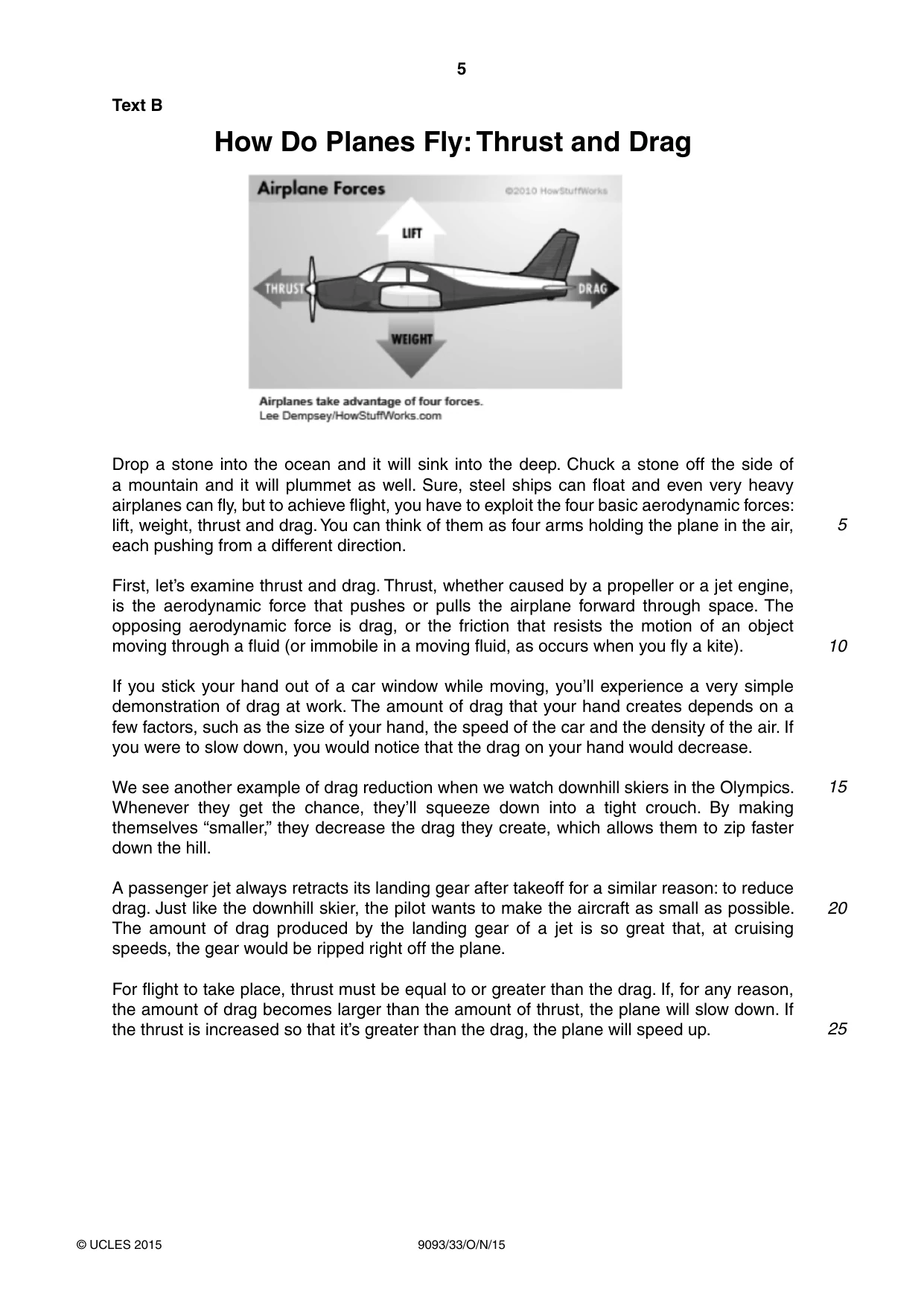
5 9093/33/O/N/15 © UCLES 2015 Text B How Do Planes Fly: Thrust and Drag Drop a stone into the ocean and it will sink into the deep. Chuck a stone off the side of a mountain and it will plummet as well. Sure, steel ships can float and even very heavy airplanes can fly, but to achieve flight, you have to exploit the four basic aerodynamic forces: lift, weight, thrust and drag. You can think of them as four arms holding the plane in the air, each pushing from a different direction. First, let’s examine thrust and drag. Thrust, whether caused by a propeller or a jet engine, is the aerodynamic force that pushes or pulls the airplane forward through space. The opposing aerodynamic force is drag, or the friction that resists the motion of an object moving through a fluid (or immobile in a moving fluid, as occurs when you fly a kite). If you stick your hand out of a car window while moving, you’ll experience a very simple demonstration of drag at work. The amount of drag that your hand creates depends on a few factors, such as the size of your hand, the speed of the car and the density of the air. If you were to slow down, you would notice that the drag on your hand would decrease. We see another example of drag reduction when we watch downhill skiers in the Olympics. Whenever they get the chance, they’ll squeeze down into a tight crouch. By making themselves “smaller,” they decrease the drag they create, which allows them to zip faster down the hill. A passenger jet always retracts its landing gear after takeoff for a similar reason: to reduce drag. Just like the downhill skier, the pilot wants to make the aircraft as small as possible. The amount of drag produced by the landing gear of a jet is so great that, at cruising speeds, the gear would be ripped right off the plane. For flight to take place, thrust must be equal to or greater than the drag. If, for any reason, the amount of drag becomes larger than the amount of thrust, the plane will slow down. If the thrust is increased so that it’s greater than the drag, the plane will speed up. 5 10 15 20 25
Question paper, page 6
6 9093/33/O/N/15 © UCLES 2015 BLANK PAGE
Question paper, page 7
7 9093/33/O/N/15 © UCLES 2015 BLANK PAGE
Question paper, page 8
8 9093/33/O/N/15 © UCLES 2015 BLANK PAGE Permission to reproduce items where third-party owned material protected by copyright is included has been sought and cleared where possible. Every reasonable effort has been made by the publisher (UCLES) to trace copyright holders, but if any items requiring clearance have unwittingly been included, the publisher will be pleased to make amends at the earliest possible opportunity. To avoid the issue of disclosure of answer-related information to candidates, all copyright acknowledgements are reproduced online in the Cambridge International Examinations Copyright Acknowledgements Booklet. This is produced for each series of examinations and is freely available to download at www.cie.org.uk after the live examination series. Cambridge International Examinations is part of the Cambridge Assessment Group. Cambridge Assessment is the brand name of University of Cambridge Local Examinations Syndicate (UCLES), which is itself a department of the University of Cambridge.
Mark scheme, page 1
® IGCSE is the registered trademark of Cambridge International Examinations. CAMBRIDGE INTERNATIONAL EXAMINATIONS Cambridge International Advanced Level MARK SCHEME for the October/November 2015 series 9093 ENGLISH LANGUAGE 9093/33 Paper 3 (Text Analysis), maximum raw mark 50 This mark scheme is published as an aid to teachers and candidates, to indicate the requirements of the examination. It shows the basis on which Examiners were instructed to award marks. It does not indicate the details of the discussions that took place at an Examiners’ meeting before marking began, which would have considered the acceptability of alternative answers. Mark schemes should be read in conjunction with the question paper and the Principal Examiner Report for Teachers. Cambridge will not enter into discussions about these mark schemes. Cambridge is publishing the mark schemes for the October/November 2015 series for most Cambridge IGCSE®, Cambridge International A and AS Level components and some Cambridge O Level components.
Mark scheme, page 2
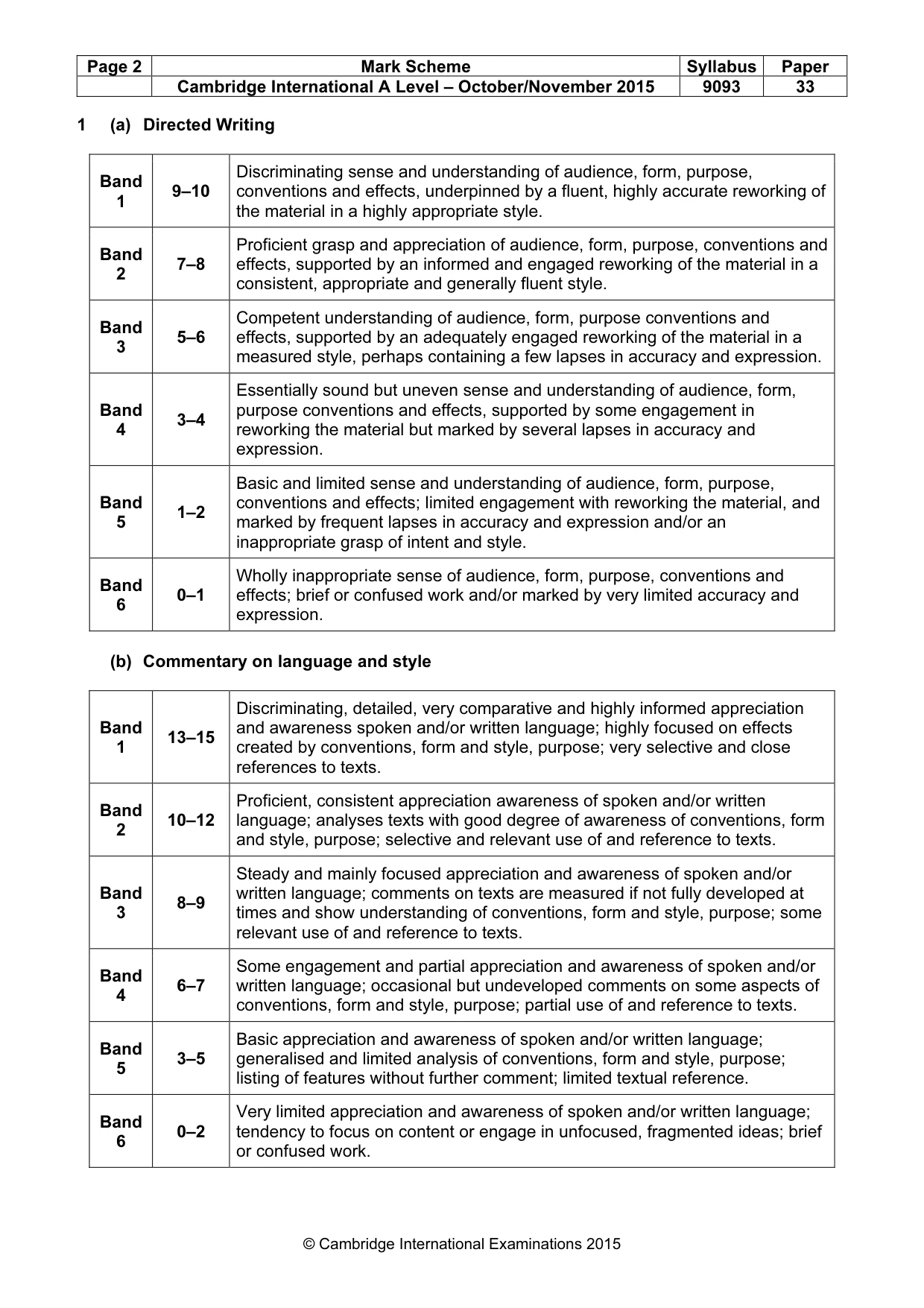
Page 2 Mark Scheme Syllabus Paper Cambridge International A Level – October/November 2015 9093 33 © Cambridge International Examinations 2015 1 (a) Directed Writing Band 1 9–10 Discriminating sense and understanding of audience, form, purpose, conventions and effects, underpinned by a fluent, highly accurate reworking of the material in a highly appropriate style. Band 2 7–8 Proficient grasp and appreciation of audience, form, purpose, conventions and effects, supported by an informed and engaged reworking of the material in a consistent, appropriate and generally fluent style. Band 3 5–6 Competent understanding of audience, form, purpose conventions and effects, supported by an adequately engaged reworking of the material in a measured style, perhaps containing a few lapses in accuracy and expression. Band 4 3–4 Essentially sound but uneven sense and understanding of audience, form, purpose conventions and effects, supported by some engagement in reworking the material but marked by several lapses in accuracy and expression. Band 5 1–2 Basic and limited sense and understanding of audience, form, purpose, conventions and effects; limited engagement with reworking the material, and marked by frequent lapses in accuracy and expression and/or an inappropriate grasp of intent and style. Band 6 0–1 Wholly inappropriate sense of audience, form, purpose, conventions and effects; brief or confused work and/or marked by very limited accuracy and expression. (b) Commentary on language and style Band 1 13–15 Discriminating, detailed, very comparative and highly informed appreciation and awareness spoken and/or written language; highly focused on effects created by conventions, form and style, purpose; very selective and close references to texts. Band 2 10–12 Proficient, consistent appreciation awareness of spoken and/or written language; analyses texts with good degree of awareness of conventions, form and style, purpose; selective and relevant use of and reference to texts. Band 3 8–9 Steady and mainly focused appreciation and awareness of spoken and/or written language; comments on texts are measured if not fully developed at times and show understanding of conventions, form and style, purpose; some relevant use of and reference to texts. Band 4 6–7 Some engagement and partial appreciation and awareness of spoken and/or written language; occasional but undeveloped comments on some aspects of conventions, form and style, purpose; partial use of and reference to texts. Band 5 3–5 Basic appreciation and awareness of spoken and/or written language; generalised and limited analysis of conventions, form and style, purpose; listing of features without further comment; limited textual reference. Band 6 0–2 Very limited appreciation and awareness of spoken and/or written language; tendency to focus on content or engage in unfocused, fragmented ideas; brief or confused work.
Mark scheme, page 3
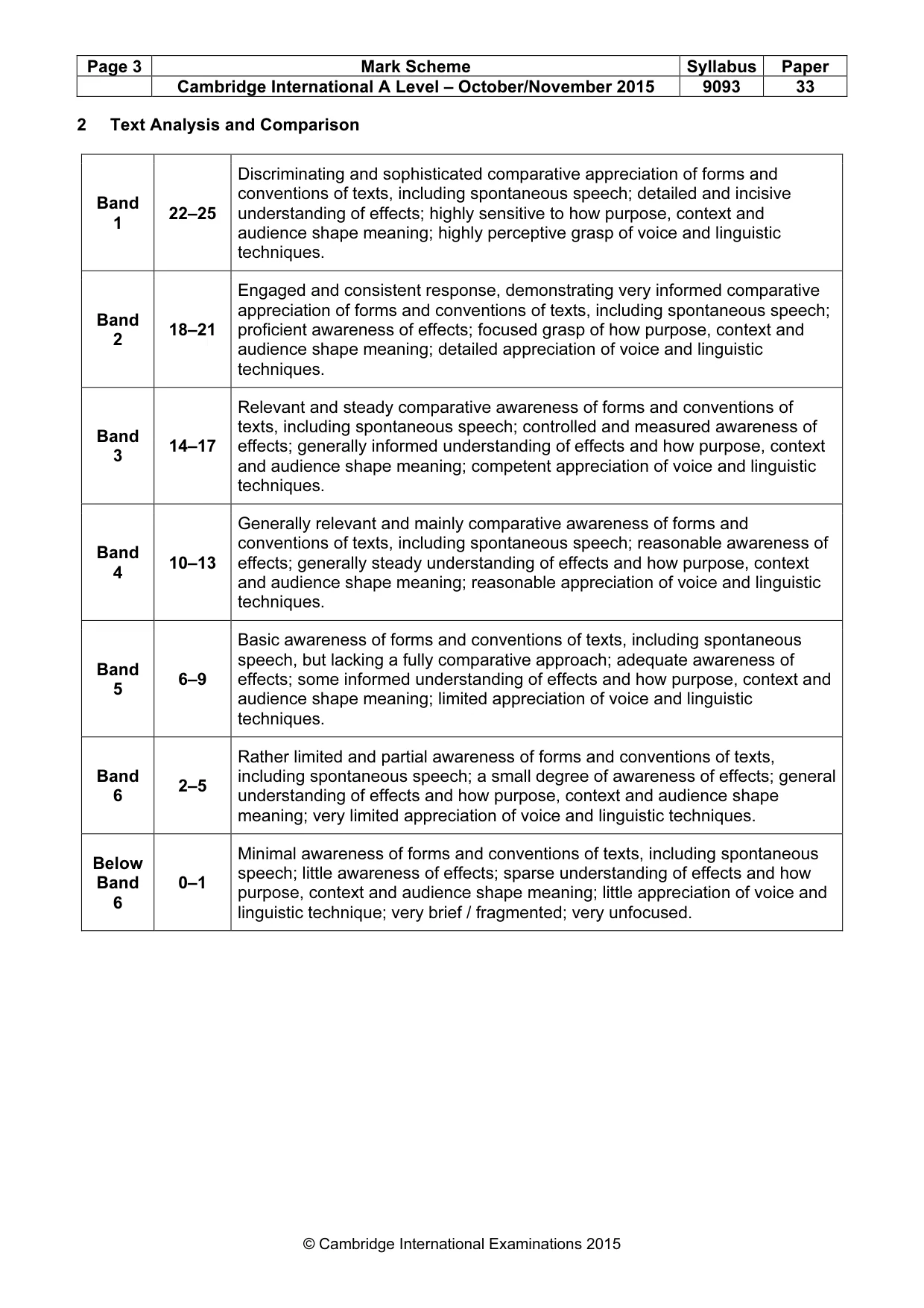
Page 3 Mark Scheme Syllabus Paper Cambridge International A Level – October/November 2015 9093 33 © Cambridge International Examinations 2015 2 Text Analysis and Comparison Band 1 22–25 Discriminating and sophisticated comparative appreciation of forms and conventions of texts, including spontaneous speech; detailed and incisive understanding of effects; highly sensitive to how purpose, context and audience shape meaning; highly perceptive grasp of voice and linguistic techniques. Band 2 18–21 Engaged and consistent response, demonstrating very informed comparative appreciation of forms and conventions of texts, including spontaneous speech; proficient awareness of effects; focused grasp of how purpose, context and audience shape meaning; detailed appreciation of voice and linguistic techniques. Band 3 14–17 Relevant and steady comparative awareness of forms and conventions of texts, including spontaneous speech; controlled and measured awareness of effects; generally informed understanding of effects and how purpose, context and audience shape meaning; competent appreciation of voice and linguistic techniques. Band 4 10–13 Generally relevant and mainly comparative awareness of forms and conventions of texts, including spontaneous speech; reasonable awareness of effects; generally steady understanding of effects and how purpose, context and audience shape meaning; reasonable appreciation of voice and linguistic techniques. Band 5 6–9 Basic awareness of forms and conventions of texts, including spontaneous speech, but lacking a fully comparative approach; adequate awareness of effects; some informed understanding of effects and how purpose, context and audience shape meaning; limited appreciation of voice and linguistic techniques. Band 6 2–5 Rather limited and partial awareness of forms and conventions of texts, including spontaneous speech; a small degree of awareness of effects; general understanding of effects and how purpose, context and audience shape meaning; very limited appreciation of voice and linguistic techniques. Below Band 6 0–1 Minimal awareness of forms and conventions of texts, including spontaneous speech; little awareness of effects; sparse understanding of effects and how purpose, context and audience shape meaning; little appreciation of voice and linguistic technique; very brief / fragmented; very unfocused.
What you needed in this session
Cambridge’s own grade thresholds for 2015 Oct/Nov, Paper 3 · Variant 3. A higher threshold means an easier paper — the bar moves with how the cohort did.