Questions as text
Q1 · In which situation must the terms of trade be moving in a country’s favour? 9708/11 Oct/Nov 2008
22 In which situation must the terms of trade be moving in a country’s favour? A Its import prices are rising at a slower rate than its export prices. B There is a fall in both its import and its export prices. C There is an increase in its official reserves. D The volume of its exports is increasing more than the volume of its imports.
1 marks
Answer: A
This question in 9708/11 Oct/Nov 2008
Q2 · What will cause an improvement in a country’s terms of trade? 9708/12 Oct/Nov 2009
20 What will cause an improvement in a country’s terms of trade? A a fall in incomes abroad B a fall in its exchange rate C a rise in its inflation rate D a rise in the price of its imports
1 marks
Answer: C
This question in 9708/12 Oct/Nov 2009
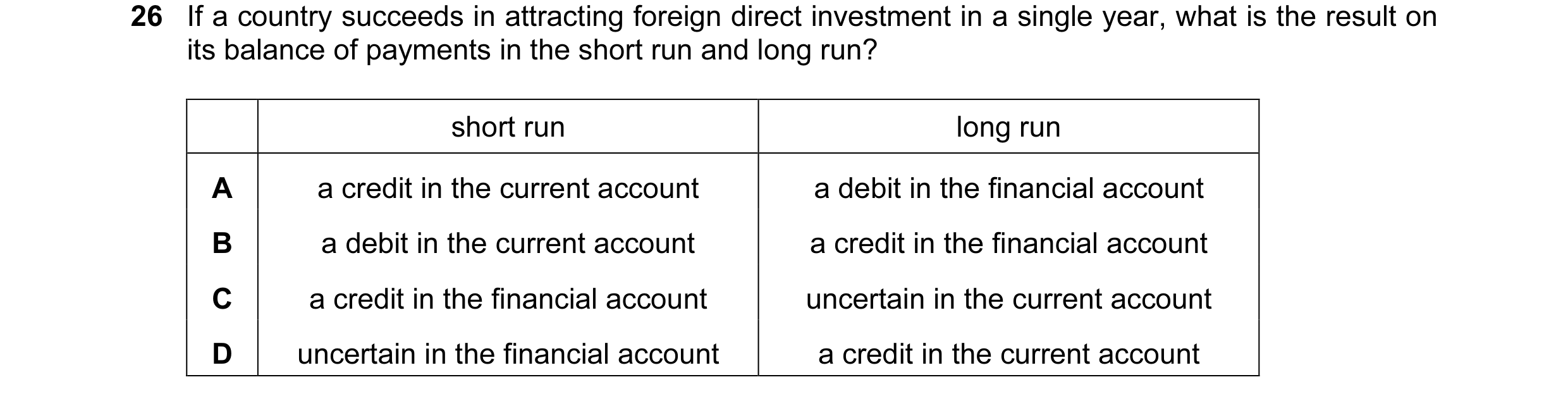
Q3 · If a country succeeds in attracting foreign direct investment in a single year, what is… 9708/11 May/June 2013
26 If a country succeeds in attracting foreign direct investment in a single year, what is the result on its balance of payments in the short run and long run? short run long run A a credit in the current account a debit in the financial account B a debit in the current account a credit in the financial account C a credit in the financial account uncertain in the current account D uncertain in the financial account a credit in the current account
1 marks
Answer: C
This question in 9708/11 May/June 2013
Q4 · What is an expenditure-switching policy measure? 9708/11 May/June 2013
30 What is an expenditure-switching policy measure? A decreasing income tax B decreasing the money supply C devaluing the currency D increasing government spending
1 marks
Answer: C
This question in 9708/11 May/June 2013
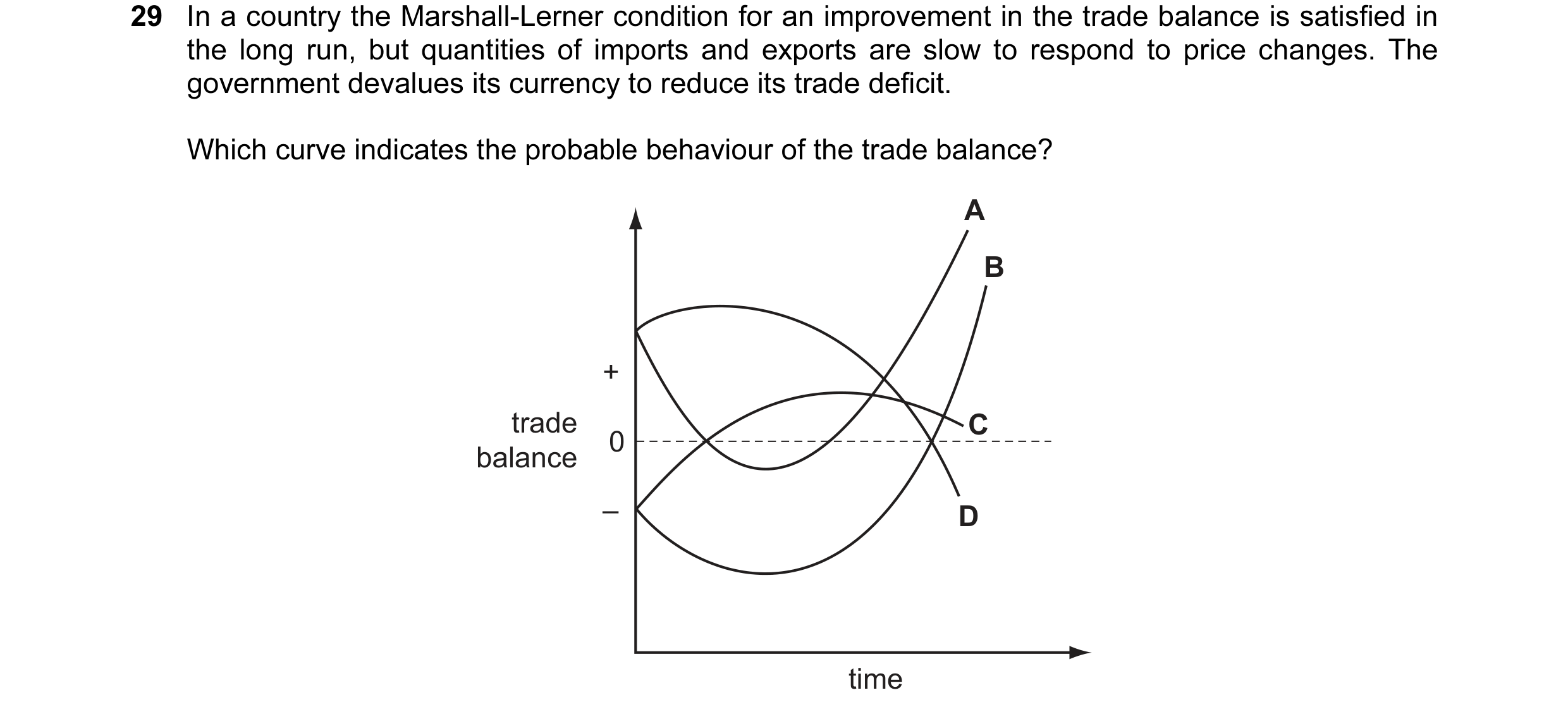
Q5 · In a country the Marshall-Lerner condition for an improvement in the trade balance is… 9708/11 Oct/Nov 2013
29 In a country the Marshall-Lerner condition for an improvement in the trade balance is satisfied in the long run, but quantities of imports and exports are slow to respond to price changes. The government devalues its currency to reduce its trade deficit. Which curve indicates the probable behaviour of the trade balance? A B + trade C 0 balance – D time
1 marks
Answer: B
This question in 9708/11 Oct/Nov 2013
Q6 · A government has low reserves of foreign currency 9708/13 May/June 2015
27 A government has low reserves of foreign currency. When would it be most likely to consider a deficit on current account to be a serious problem? A when the country is experiencing a period of high, sustained growth B when the deficit alternates regularly with a surplus C when the deficit exceeds the sum of errors and omissions in the balance of payments account D when the level of international confidence in the country is low
1 marks
Answer: D
This question in 9708/13 May/June 2015
Q7 · What is an example of an expenditure-dampening policy? 9708/12 May/June 2017
29 What is an example of an expenditure-dampening policy? A an increase in income tax rates B an increase in the level of import tariffs C an upward revaluation of the exchange rate D the introduction of import quotas
1 marks
Answer: A
This question in 9708/12 May/June 2017
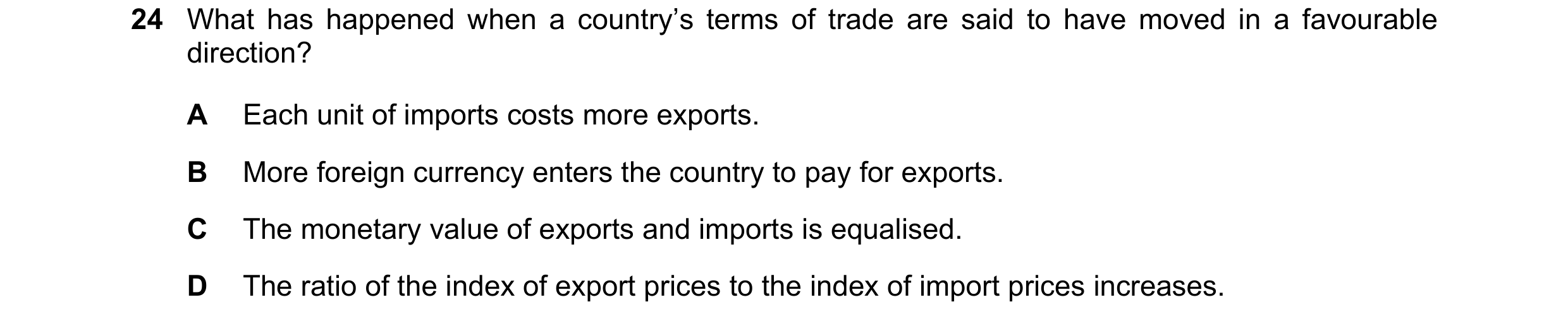
Q8 · What has happened when a country’s terms of trade are said to have moved in a favourable… 9708/13 Oct/Nov 2017
24 What has happened when a country’s terms of trade are said to have moved in a favourable direction? A Each unit of imports costs more exports. B More foreign currency enters the country to pay for exports. C The monetary value of exports and imports is equalised. D The ratio of the index of export prices to the index of import prices increases.
1 marks
Answer: D
This question in 9708/13 Oct/Nov 2017
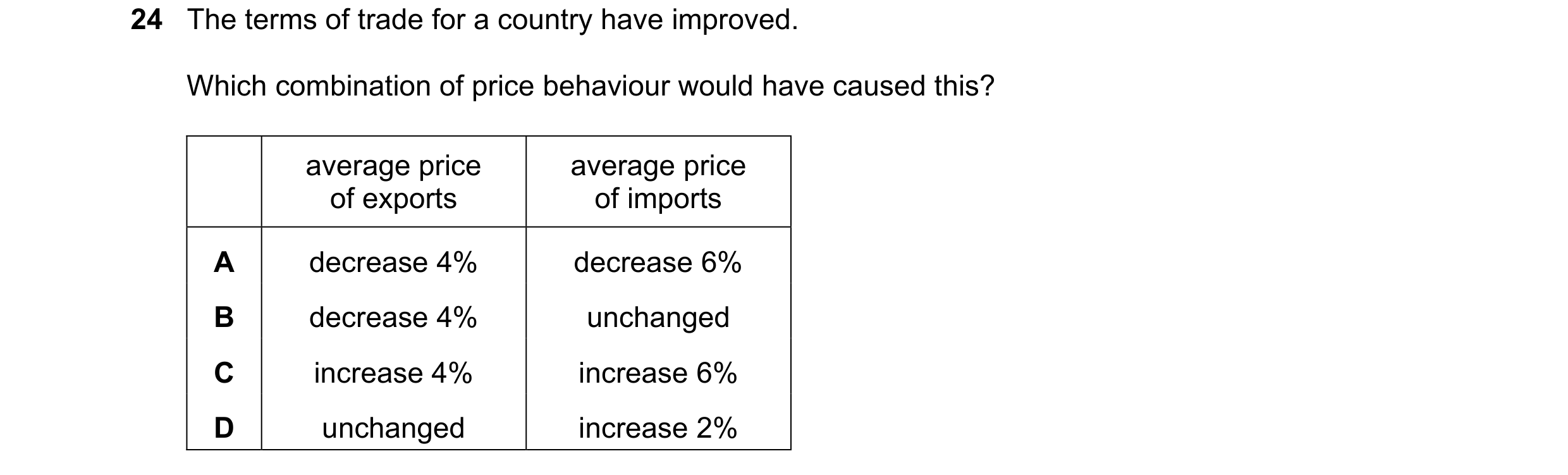
Q9 · The terms of trade for a country have improved 9708/11 May/June 2018
24 The terms of trade for a country have improved. Which combination of price behaviour would have caused this? average price average price of exports of imports A decrease 4% decrease 6% B decrease 4% unchanged C increase 4% increase 6% D unchanged increase 2%
1 marks
Answer: A
This question in 9708/11 May/June 2018
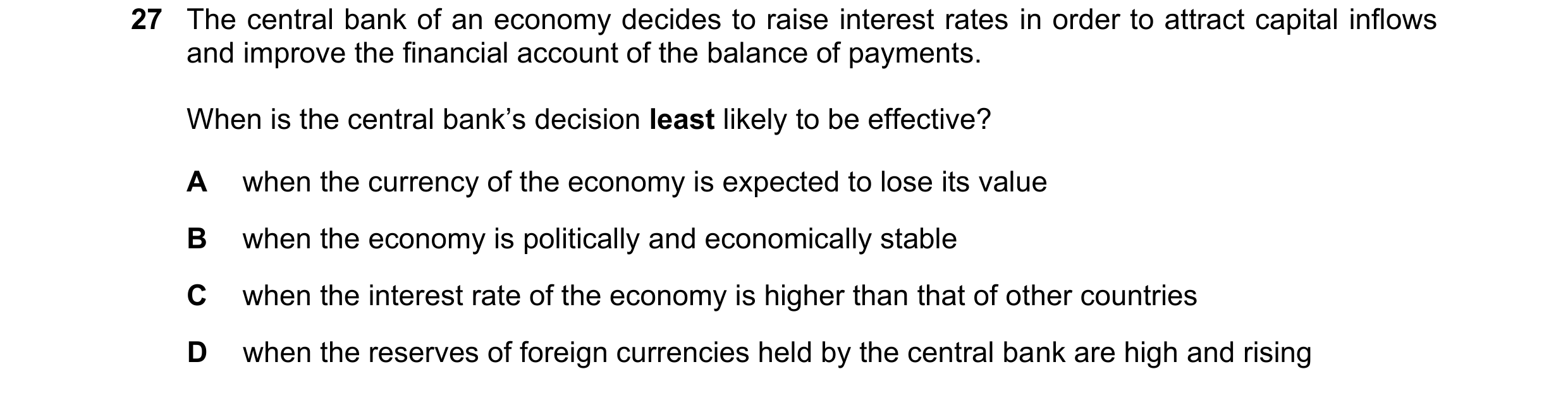
Q10 · The central bank of an economy decides to raise interest rates in order to attract… 9708/11 May/June 2022
27 The central bank of an economy decides to raise interest rates in order to attract capital inflows and improve the financial account of the balance of payments. When is the central bank’s decision least likely to be effective? A when the currency of the economy is expected to lose its value B when the economy is politically and economically stable C when the interest rate of the economy is higher than that of other countries D when the reserves of foreign currencies held by the central bank are high and rising
1 marks
Answer: A
This question in 9708/11 May/June 2022
Q11 · An economy has a balance of payments surplus, which it wishes to eliminate 9708/14 May/June 2022
28 An economy has a balance of payments surplus, which it wishes to eliminate. In order to achieve this objective, which combination of policies would be most appropriate? A a depreciation of the currency and an increase in government spending B an appreciation of the currency and a cut in interest rates C an increase in the money supply and a pay freeze D increases in both direct and indirect taxation
1 marks
Answer: B
This question in 9708/14 May/June 2022
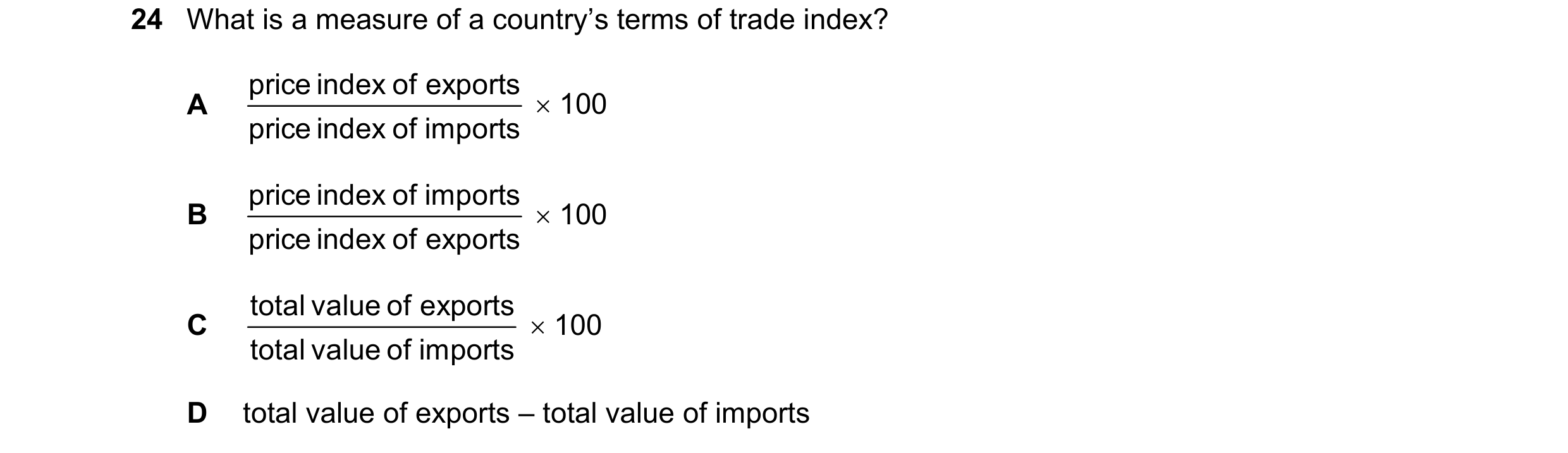
Q12 · What is a measure of a country’s terms of trade index? 9708/11 Oct/Nov 2022
24 What is a measure of a country’s terms of trade index? price index of exports A × 100 price index of imports price index of imports B × 100 price index of exports total value of exports C × 100 total value of imports D total value of exports – total value of imports
1 marks
Answer: A
This question in 9708/11 Oct/Nov 2022
Q13 · An economy has an unemployment rate of 8%, an increase of 2% from the previous year 9708/12 Feb/March 2024
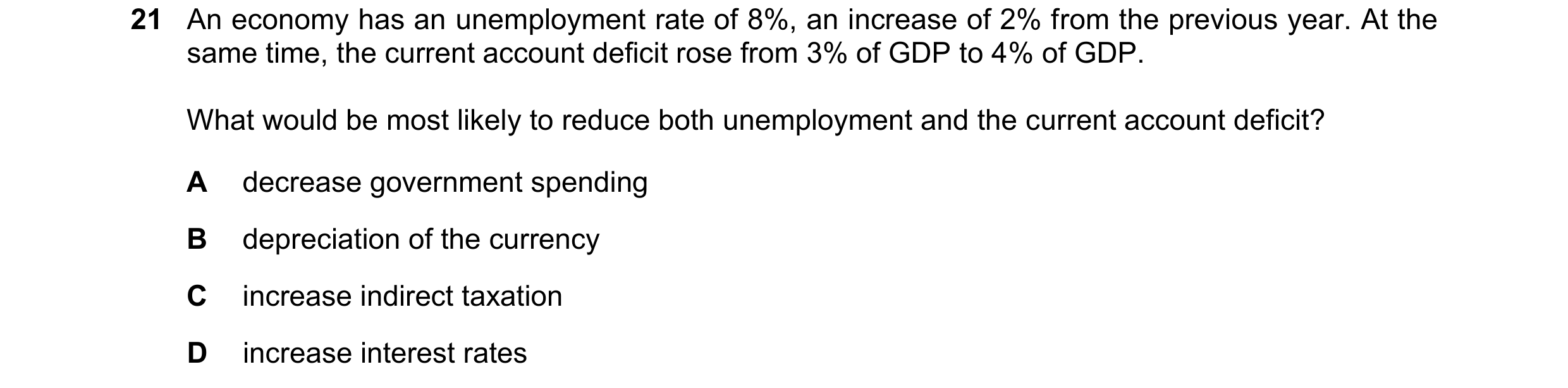
21 An economy has an unemployment rate of 8%, an increase of 2% from the previous year. At the same time, the current account deficit rose from 3% of GDP to 4% of GDP. What would be most likely to reduce both unemployment and the current account deficit? A decrease government spending B depreciation of the currency C increase indirect taxation D increase interest rates
1 marks
Answer: B
This question in 9708/12 Feb/March 2024



 1 / 3
1 / 3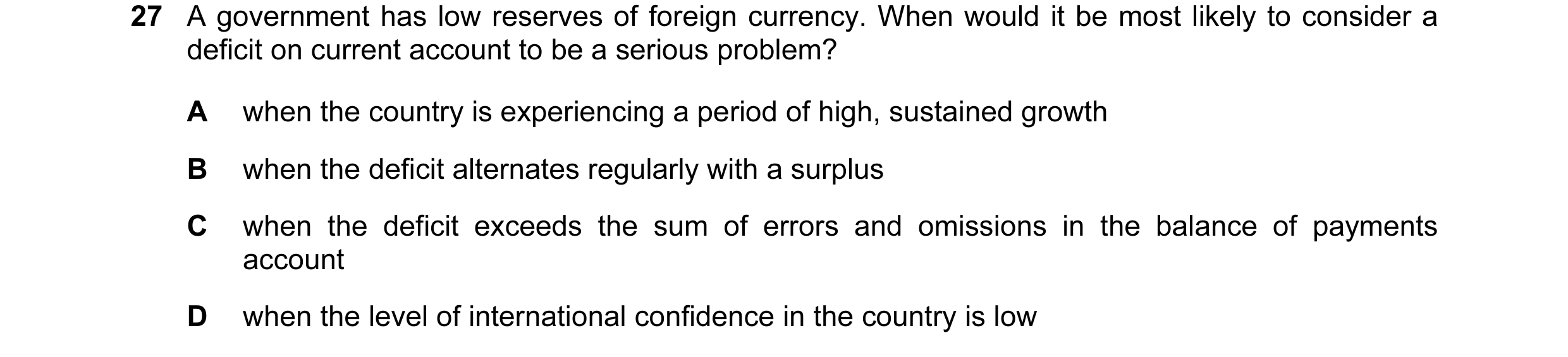

 2 / 3
2 / 3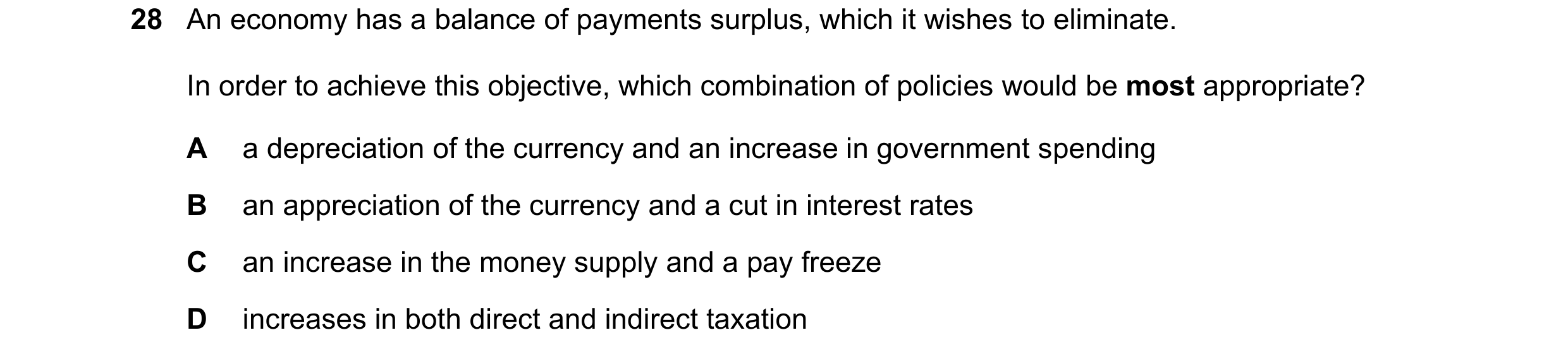
 3 / 3
3 / 3