Cambridge A Level Economics 9708 — 2025 Oct/Nov Paper 4 · Variant 4
9708/44/O/N/25 · 5 questions · 60 marks · ≈68 min
The question paper and its mark scheme, free to read here and free to download. This is Cambridge’s own paper, exactly as it was sat.
Question paper4 pages
Mark scheme16 pages
Answers below. Sit the paper first if you are practising.
Questions as text
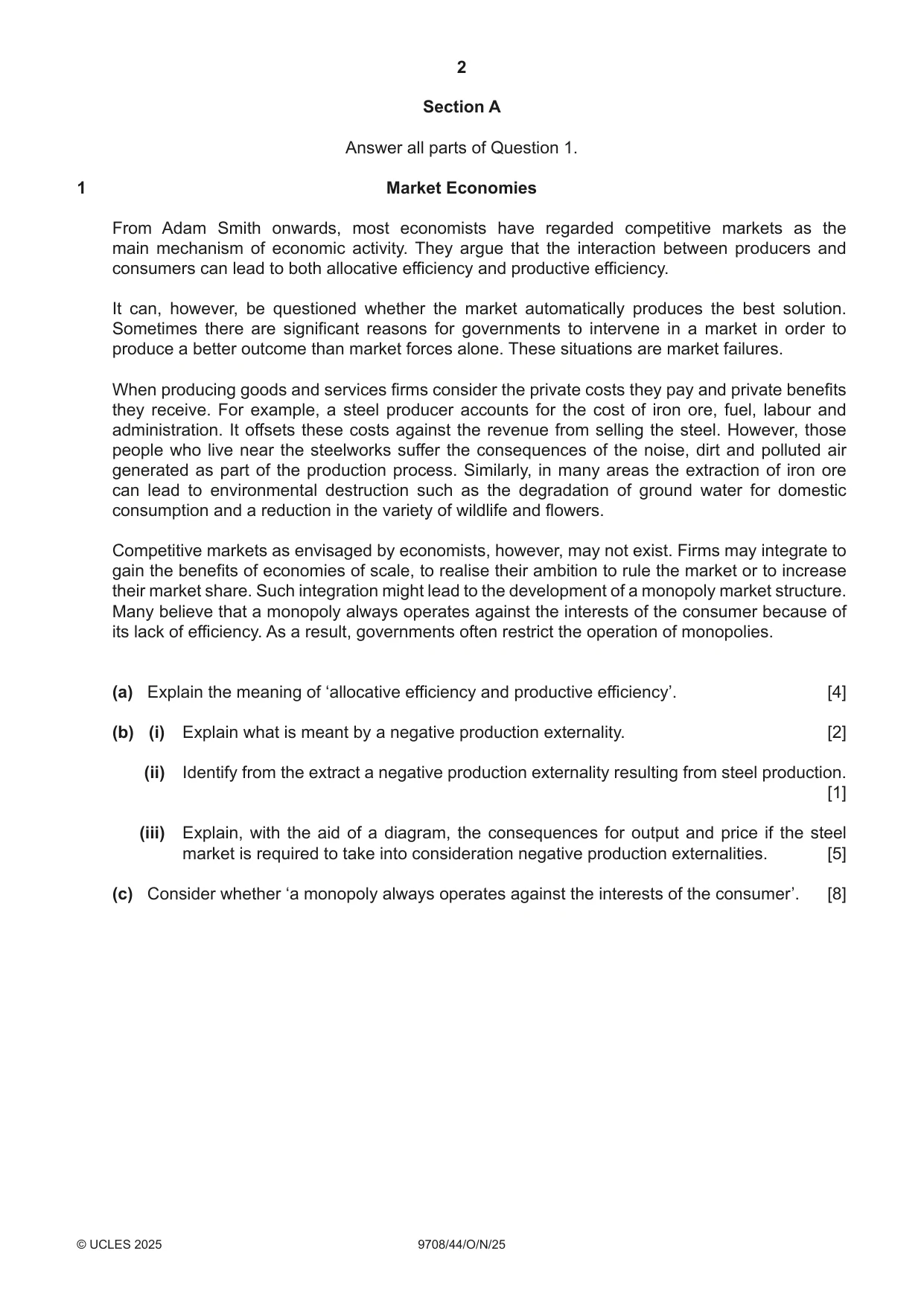
Q1 · Market Economies From Adam Smith onwards, most economists have regarded competitive…
1 Market Economies From Adam Smith onwards, most economists have regarded competitive markets as the main mechanism of economic activity. They argue that the interaction between producers and consumers can lead to both allocative efficiency and productive efficiency. It can, however, be questioned whether the market automatically produces the best solution. Sometimes there are significant reasons for governments to intervene in a market in order to produce a better outcome than market forces alone. These situations are market failures. When producing goods and services firms consider the private costs they pay and private benefits they receive. For example, a steel producer accounts for the cost of iron ore, fuel, labour and administration. It offsets these costs against the revenue from selling the steel. However, those people who live near the steelworks suffer the consequences of the noise, dirt and polluted air generated as part of the production process. Similarly, in many areas the extraction of iron ore can lead to environmental destruction such as the degradation of ground water for domestic consumption and a reduction in the variety of wildlife and flowers. Competitive markets as envisaged by economists, however, may not exist. Firms may integrate to gain the benefits of economies of scale, to realise their ambition to rule the market or to increase their market share. Such integration might lead to the development of a monopoly market structure. Many believe that a monopoly always operates against the interests of the consumer because of its lack of efficiency. As a result, governments often restrict the operation of monopolies. (a) Explain the meaning of ‘allocative efficiency and productive efficiency’. [4] (b) (i) Explain what is meant by a negative production externality. [2] (ii) Identify from the extract a negative production externality resulting from steel production. [1] (iii) Explain, with the aid of a diagram, the consequences for output and price if the steel market is required to take into consideration negative production externalities. [5] (c) Consider whether ‘a monopoly always operates against the interests of the consumer’. [8]
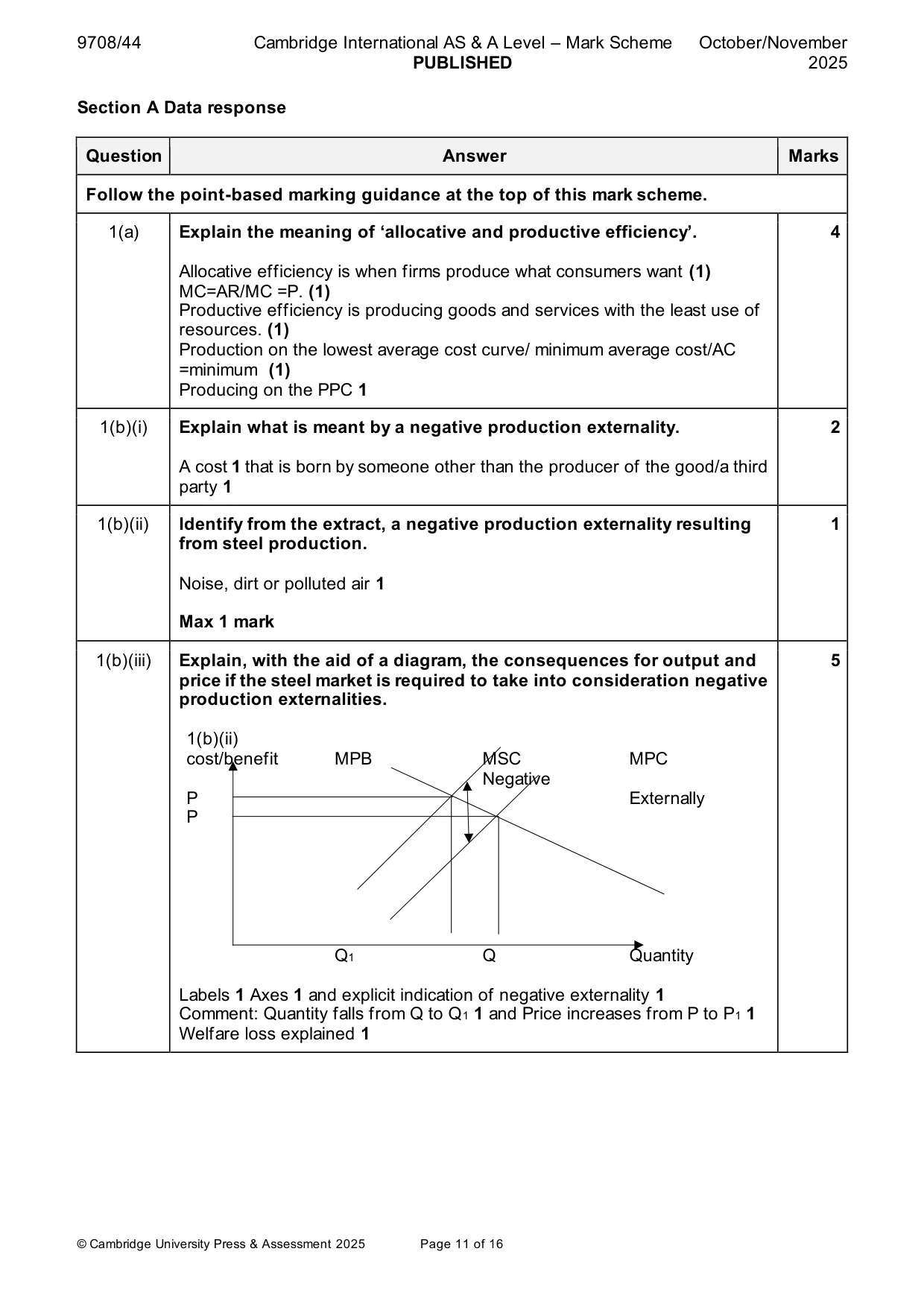
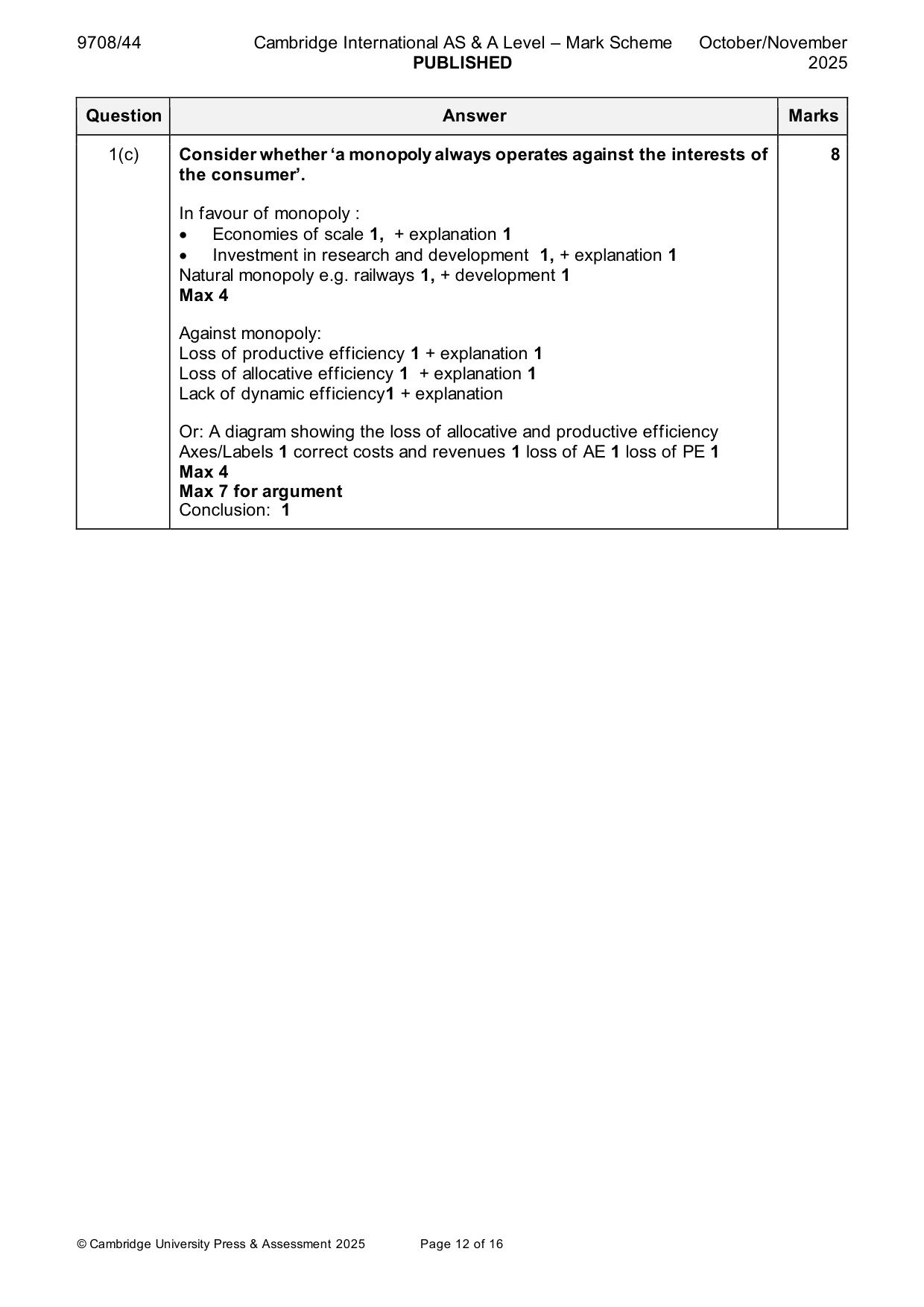
Mark scheme: Question Answer Marks Follow the point-based marking guidance at the top of this mark scheme. 1(a) Explain the meaning of ‘allocative and productive efficiency’. 4 Allocative efficiency is when firms produce what consumers want (1) MC=AR/MC =P. (1) Productive efficiency is producing goods and services with the least use of resources. (1) Production on the lowest average cost curve/ minimum average cost/AC =minimum (1) Producing on the PPC 1 1(b)(i) Explain what is meant by a negative production externality. 2 A cost 1 that is born by someone other than the producer of the good/a third party 1 1(b)(ii) Identify from the extract, a negative production externality resulting 1 from steel production. Noise, dirt or polluted air 1 Max 1 mark 1(b)(iii) Explain, with the aid of a diagram, the consequences for output and 5 price if the steel market is required to take into consideration negative production externalities. 1(b)(ii) cost/benefit MPB MSC MPC Negative P Externally P Q1 Q Quantity Labels 1 Axes 1 and explicit indication of negative externality 1 Comment: Quantity falls from Q to Q1 1 and Price increases from P to P1 1 Welfare loss explained 1 1(c) Consider whether ‘a monopoly always operates against the interests of 8 the consumer’. In favour of monopoly : • Economies of scale 1, + explanation 1 • Investment in research and development 1, + explanation 1 Natural monopoly e.g. railways 1, + development 1 Max 4 Against monopoly: Loss of productive efficiency 1 + explanation 1 Loss of allocative efficiency 1 + explanation 1 Lack of dynamic efficiency1 + explanation Or: A diagram showing the loss of allocative and productive efficiency Axes/Labels 1 correct costs and revenues 1 loss of AE 1 loss of PE 1 Max 4 Max 7 for argument Conclusion: 1 Section B Microeconomics essay
More questions on Private costs and benefits, externalities and social costs and benefits
Q2 · Evaluate, with the aid of a diagram, whether the diminishing marginal utility theory of…
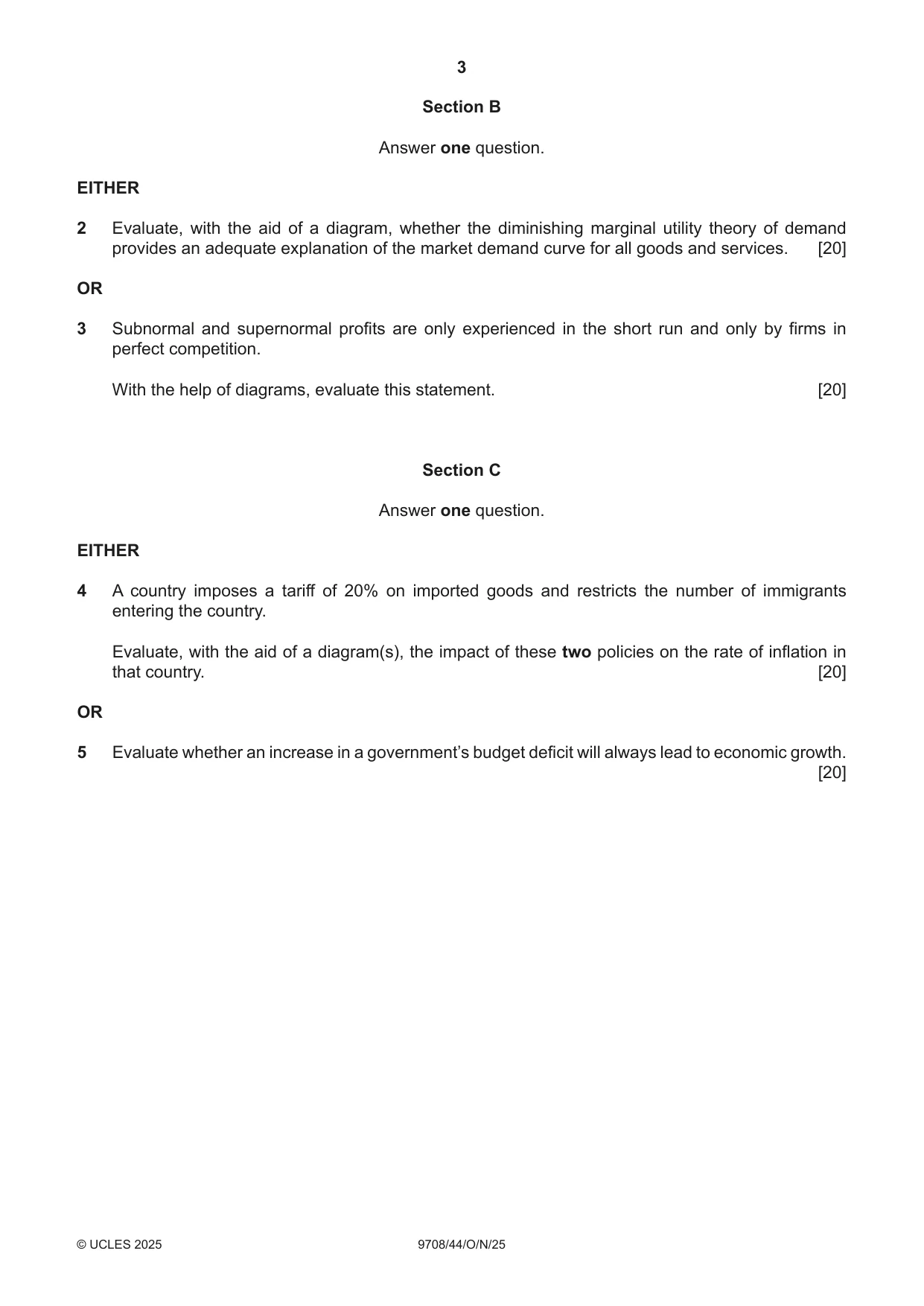
2 Evaluate, with the aid of a diagram, whether the diminishing marginal utility theory of demand provides an adequate explanation of the market demand curve for all goods and services. [20] OR
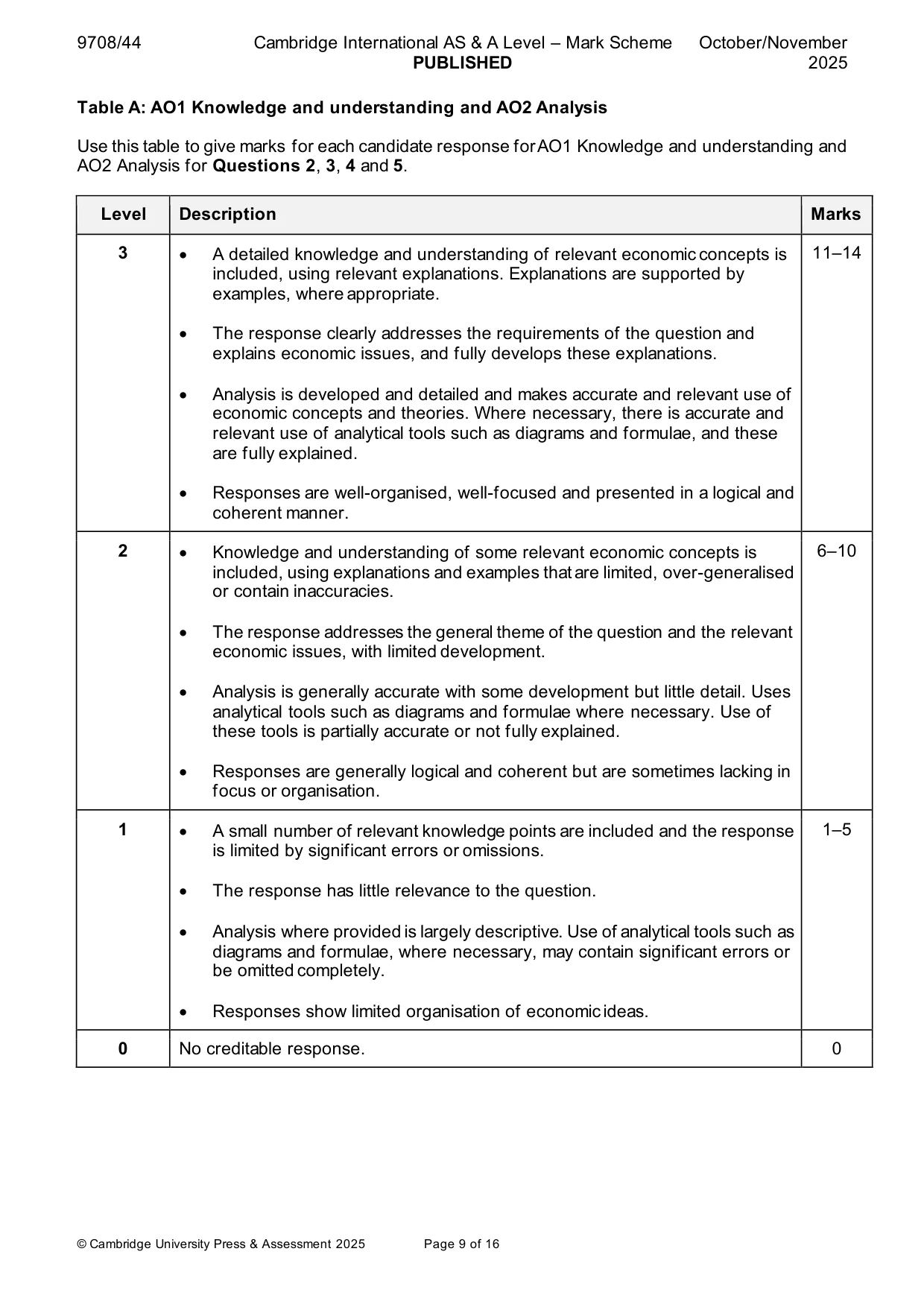
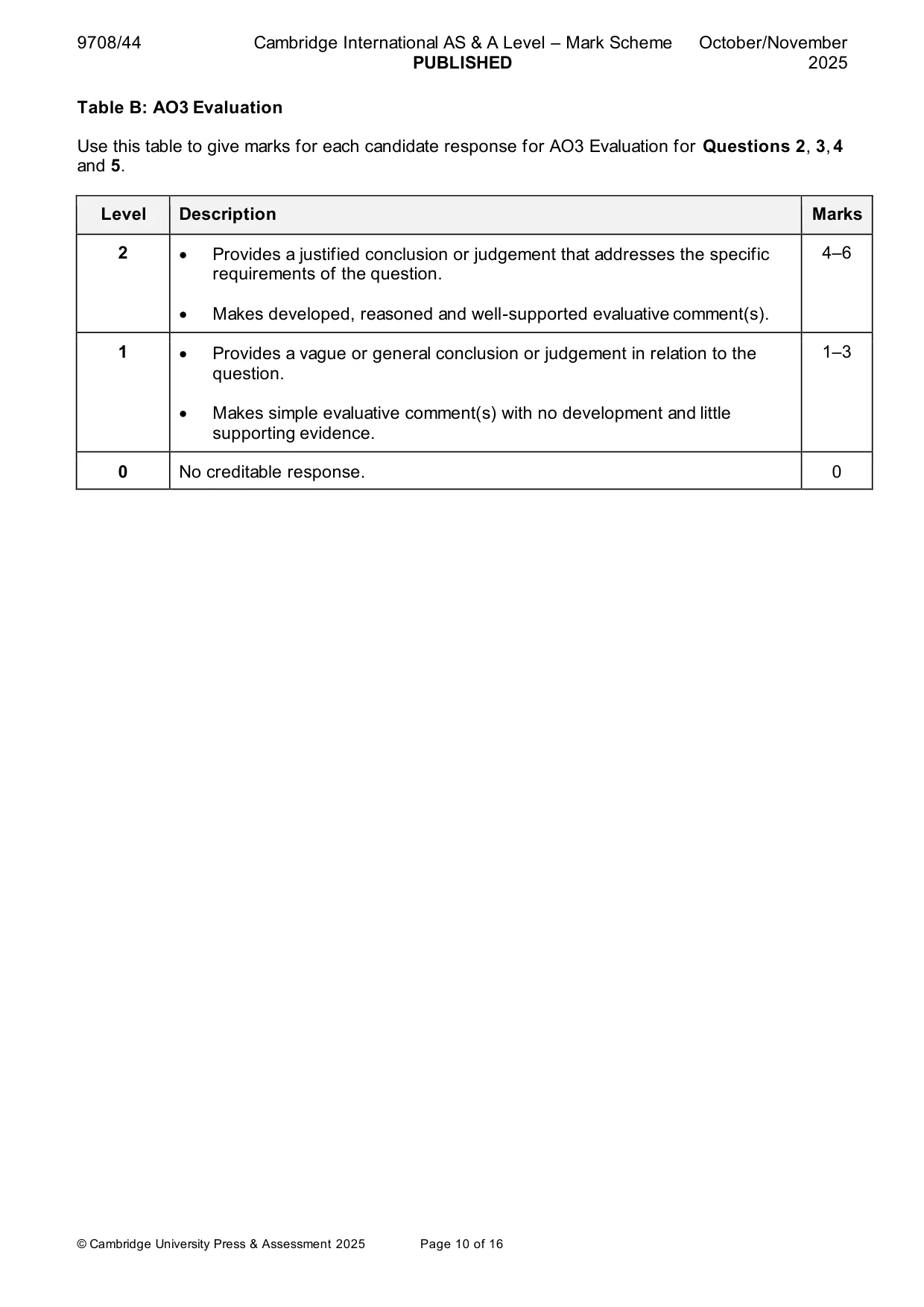
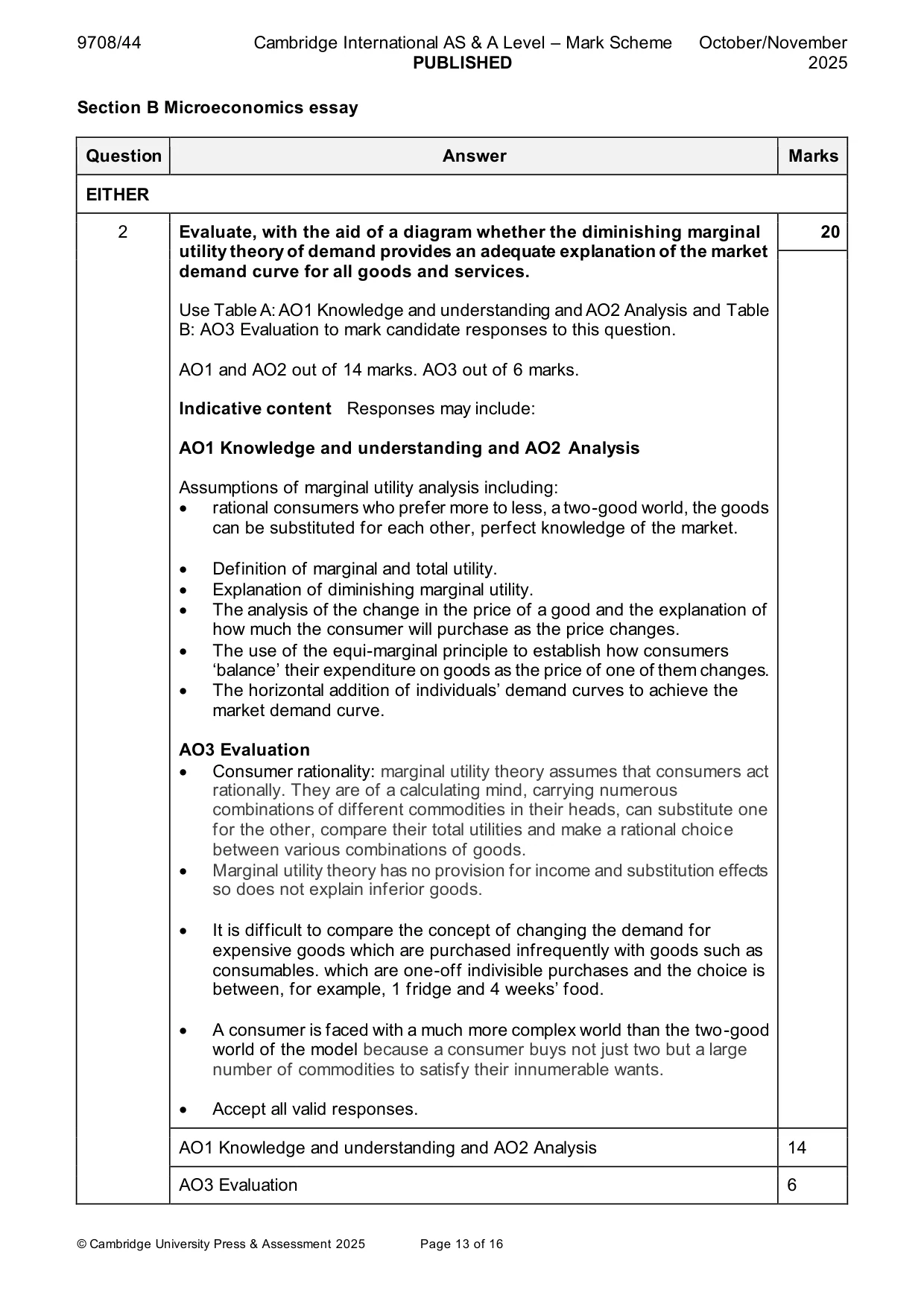
Mark scheme: 2 Evaluate, with the aid of a diagram whether the diminishing marginal 20 utility theory of demand provides an adequate explanation of the market demand curve for all goods and services. Use Table A: AO1 Knowledge and understanding and AO2 Analysis and Table B: AO3 Evaluation to mark candidate responses to this question. AO1 and AO2 out of 14 marks. AO3 out of 6 marks. Indicative content Responses may include: AO1 Knowledge and understanding and AO2 Analysis Assumptions of marginal utility analysis including: • rational consumers who prefer more to less, a two-good world, the goods can be substituted for each other, perfect knowledge of the market. • Definition of marginal and total utility. • Explanation of diminishing marginal utility. • The analysis of the change in the price of a good and the explanation of how much the consumer will purchase as the price changes. • The use of the equi-marginal principle to establish how consumers ‘balance’ their expenditure on goods as the price of one of them changes. • The horizontal addition of individuals’ demand curves to achieve the market demand curve. AO3 Evaluation • Consumer rationality: marginal utility theory assumes that consumers act rationally. They are of a calculating mind, carrying numerous combinations of different commodities in their heads, can substitute one for the other, compare their total utilities and make a rational choice between various combinations of goods. • Marginal utility theory has no provision for income and substitution effects so does not explain inferior goods. • It is difficult to compare the concept of changing the demand for expensive goods which are purchased infrequently with goods such as consumables. which are one-off indivisible purchases and the choice is between, for example, 1 fridge and 4 weeks’ food. • A consumer is faced with a much more complex world than the two-good world of the model because a consumer buys not just two but a large number of commodities to satisfy their innumerable wants. • Accept all valid responses. AO1 Knowledge and understanding and AO2 Analysis 14 AO3 Evaluation 6
Q3 · Subnormal and supernormal profits are only experienced in the short run and only by firms…
3 Subnormal and supernormal profits are only experienced in the short run and only by firms in perfect competition. With the help of diagrams, evaluate this statement. [20] Section C Answer one question. EITHER
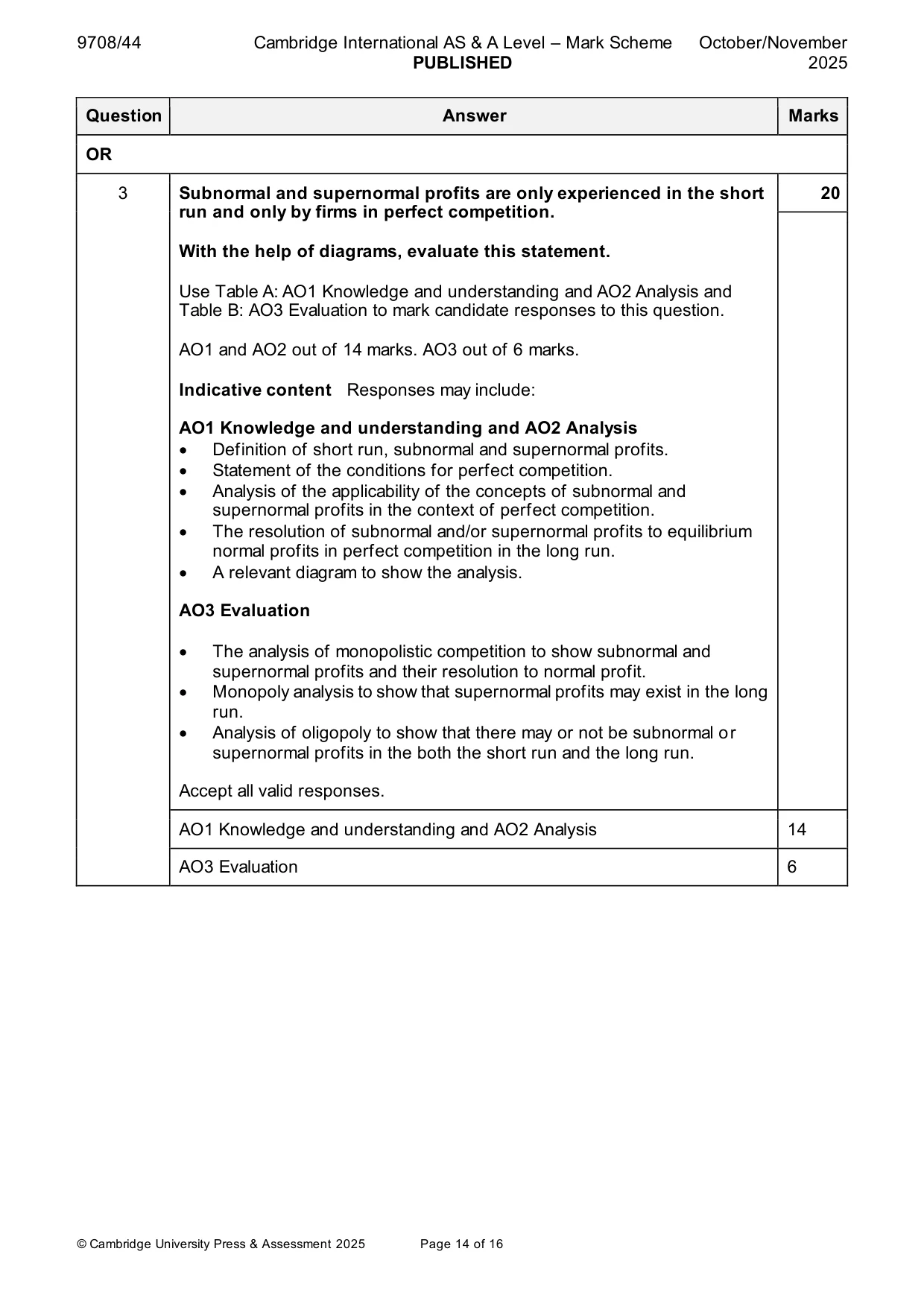
Mark scheme: 3 Subnormal and supernormal profits are only experienced in the short 20 run and only by firms in perfect competition. With the help of diagrams, evaluate this statement. Use Table A: AO1 Knowledge and understanding and AO2 Analysis and Table B: AO3 Evaluation to mark candidate responses to this question. AO1 and AO2 out of 14 marks. AO3 out of 6 marks. Indicative content Responses may include: AO1 Knowledge and understanding and AO2 Analysis • Definition of short run, subnormal and supernormal profits. • Statement of the conditions for perfect competition. • Analysis of the applicability of the concepts of subnormal and supernormal profits in the context of perfect competition. • The resolution of subnormal and/or supernormal profits to equilibrium normal profits in perfect competition in the long run. • A relevant diagram to show the analysis. AO3 Evaluation • The analysis of monopolistic competition to show subnormal and supernormal profits and their resolution to normal profit. • Monopoly analysis to show that supernormal profits may exist in the long run. • Analysis of oligopoly to show that there may or not be subnormal or supernormal profits in the both the short run and the long run. Accept all valid responses. AO1 Knowledge and understanding and AO2 Analysis 14 AO3 Evaluation 6 Section C Macroeconomics
Q4 · A country imposes a tariff of 20% on imported goods and restricts the number of…
4 A country imposes a tariff of 20% on imported goods and restricts the number of immigrants entering the country. Evaluate, with the aid of a diagram(s), the impact of these two policies on the rate of inflation in that country. [20] OR
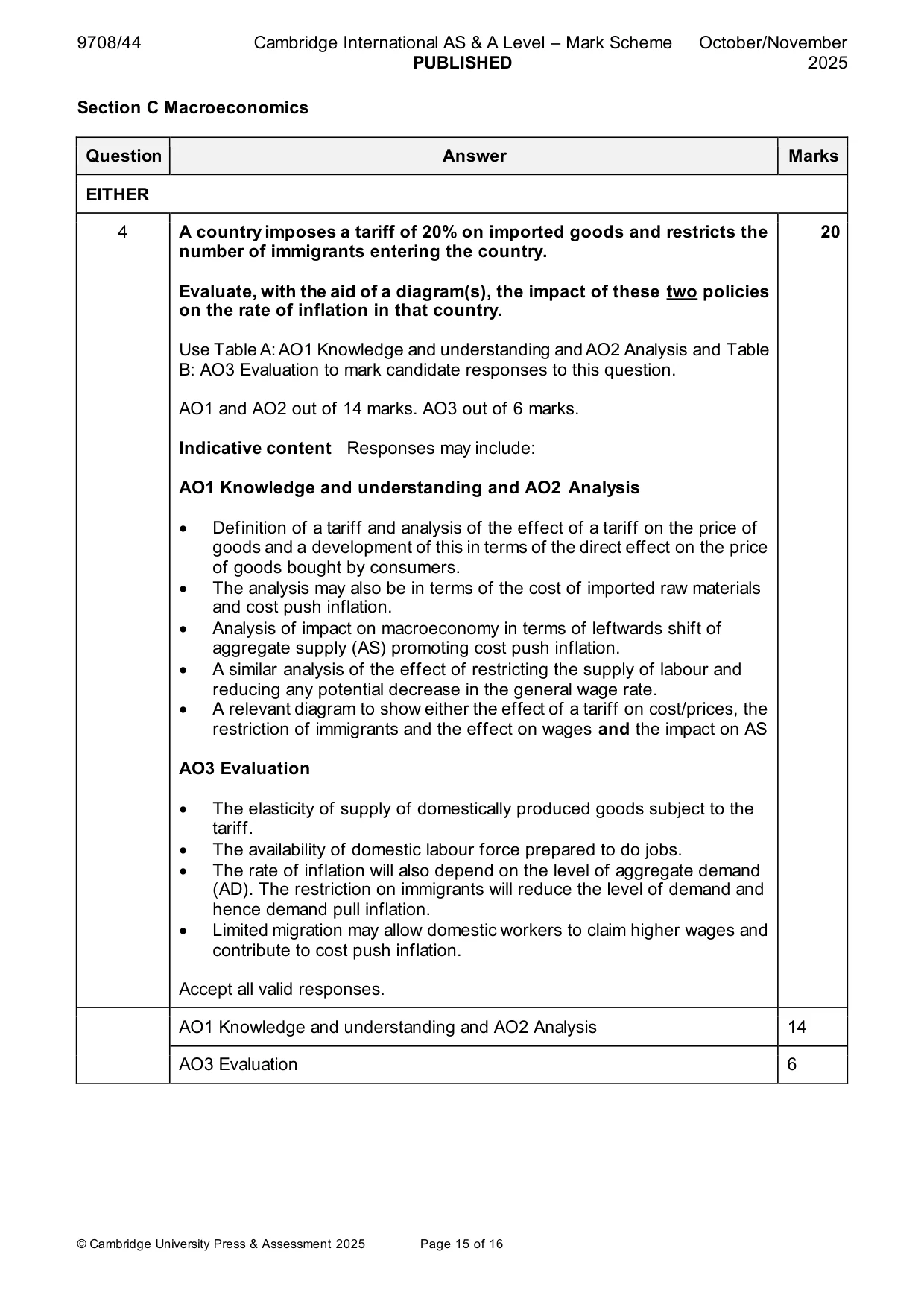
Mark scheme: 4 A country imposes a tariff of 20% on imported goods and restricts the 20 number of immigrants entering the country. Evaluate, with the aid of a diagram(s), the impact of these two policies on the rate of inflation in that country. Use Table A: AO1 Knowledge and understanding and AO2 Analysis and Table B: AO3 Evaluation to mark candidate responses to this question. AO1 and AO2 out of 14 marks. AO3 out of 6 marks. Indicative content Responses may include: AO1 Knowledge and understanding and AO2 Analysis • Definition of a tariff and analysis of the effect of a tariff on the price of goods and a development of this in terms of the direct effect on the price of goods bought by consumers. • The analysis may also be in terms of the cost of imported raw materials and cost push inflation. • Analysis of impact on macroeconomy in terms of leftwards shift of aggregate supply (AS) promoting cost push inflation. • A similar analysis of the effect of restricting the supply of labour and reducing any potential decrease in the general wage rate. • A relevant diagram to show either the effect of a tariff on cost/prices, the restriction of immigrants and the effect on wages and the impact on AS AO3 Evaluation • The elasticity of supply of domestically produced goods subject to the tariff. • The availability of domestic labour force prepared to do jobs. • The rate of inflation will also depend on the level of aggregate demand (AD). The restriction on immigrants will reduce the level of demand and hence demand pull inflation. • Limited migration may allow domestic workers to claim higher wages and contribute to cost push inflation. Accept all valid responses. AO1 Knowledge and understanding and AO2 Analysis 14 AO3 Evaluation 6
Q5 · Evaluate whether an increase in a government’s budget deficit will always lead to…
5 Evaluate whether an increase in a government’s budget deficit will always lead to economic growth. [20]
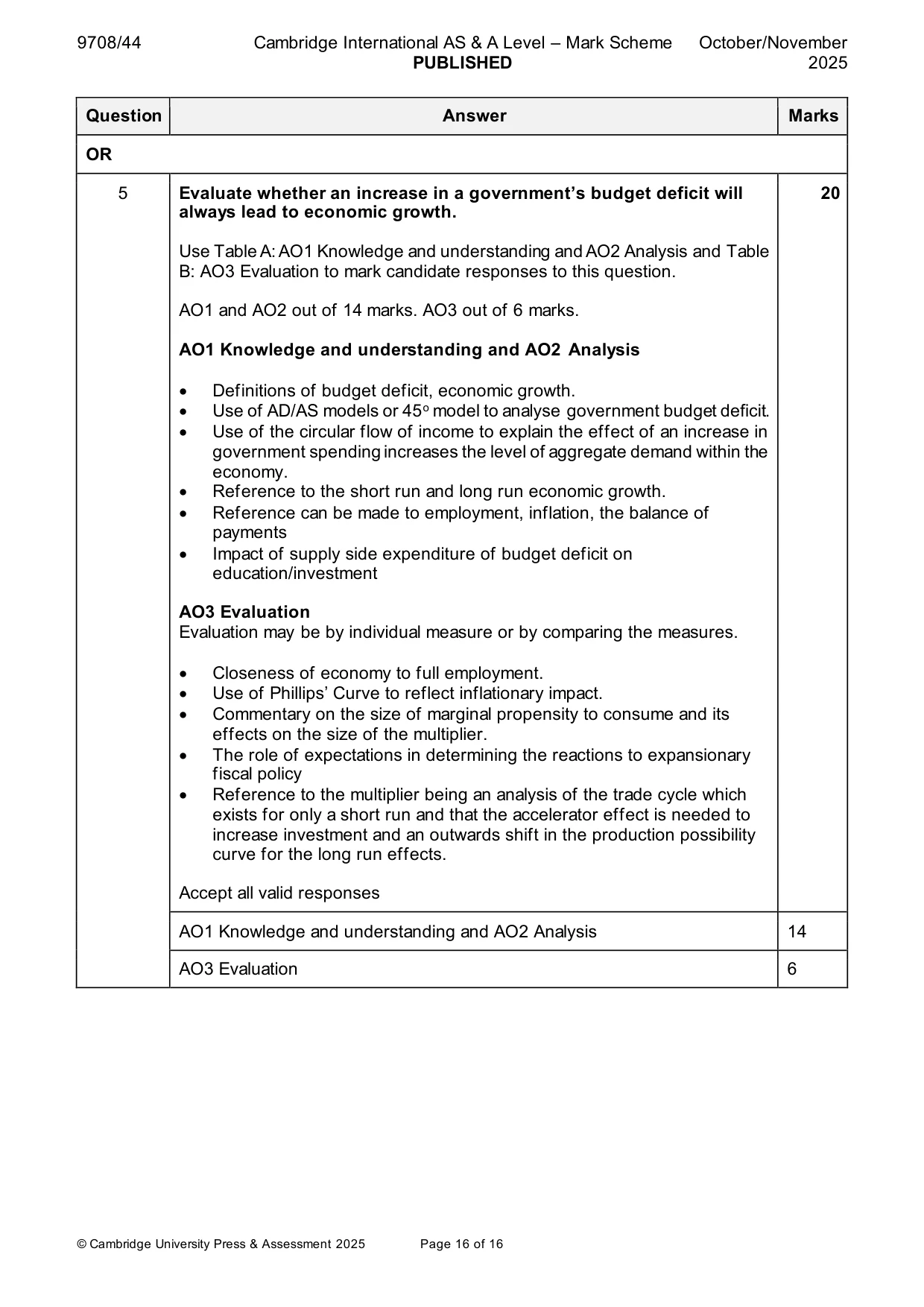
Mark scheme: 5 Evaluate whether an increase in a government’s budget deficit will 20 always lead to economic growth. Use Table A: AO1 Knowledge and understanding and AO2 Analysis and Table B: AO3 Evaluation to mark candidate responses to this question. AO1 and AO2 out of 14 marks. AO3 out of 6 marks. AO1 Knowledge and understanding and AO2 Analysis • Definitions of budget deficit, economic growth. • Use of AD/AS models or 45o model to analyse government budget deficit. • Use of the circular flow of income to explain the effect of an increase in government spending increases the level of aggregate demand within the economy. • Reference to the short run and long run economic growth. • Reference can be made to employment, inflation, the balance of payments • Impact of supply side expenditure of budget deficit on education/investment AO3 Evaluation Evaluation may be by individual measure or by comparing the measures. • Closeness of economy to full employment. • Use of Phillips’ Curve to reflect inflationary impact. • Commentary on the size of marginal propensity to consume and its effects on the size of the multiplier. • The role of expectations in determining the reactions to expansionary fiscal policy • Reference to the multiplier being an analysis of the trade cycle which exists for only a short run and that the accelerator effect is needed to increase investment and an outwards shift in the production possibility curve for the long run effects. Accept all valid responses AO1 Knowledge and understanding and AO2 Analysis 14 AO3 Evaluation 6
What was in this paper
The subtopics covered by these 5 questions, and how many questions each got. Open one in a new tab to see every Cambridge question on it.
What you needed in this session
Cambridge’s own grade thresholds for 2025 Oct/Nov, Paper 4 · Variant 4. A higher threshold means an easier paper — the bar moves with how the cohort did.