Cambridge A Level Economics 9708 — 2025 Oct/Nov Paper 3 · Variant 1
9708/31/O/N/25 · 30 marks · ≈34 min
The question paper and its mark scheme, free to read here and free to download. This is Cambridge’s own paper, exactly as it was sat.
Question paper12 pages

Mark scheme3 pages
Answers below. Sit the paper first if you are practising.
Paper as text
Question paper, page 1
This document has 12 pages. 11_9708_31_2025_1.6b © UCLES 2025 [Turn over *0660658001* Cambridge International AS & A Level ECONOMICS 9708/31 Paper 3 A Level Multiple Choice October/November 2025 1 hour 15 minutes You must answer on the multiple choice answer sheet. You will need: Multiple choice answer sheet Soft clean eraser Soft pencil (type B or HB is recommended) INSTRUCTIONS There are thirty questions on this paper. Answer all questions. For each question there are four possible answers A, B, C and D. Choose the one you consider correct and record your choice in soft pencil on the multiple choice answer sheet. Follow the instructions on the multiple choice answer sheet. Write in soft pencil. Write your name, centre number and candidate number on the multiple choice answer sheet in the spaces provided unless this has been done for you. Do not use correction fluid. Do not write on any bar codes. You may use a calculator. INFORMATION The total mark for this paper is 30. Each correct answer will score one mark. Any rough working should be done on this question paper.
Question paper, page 2
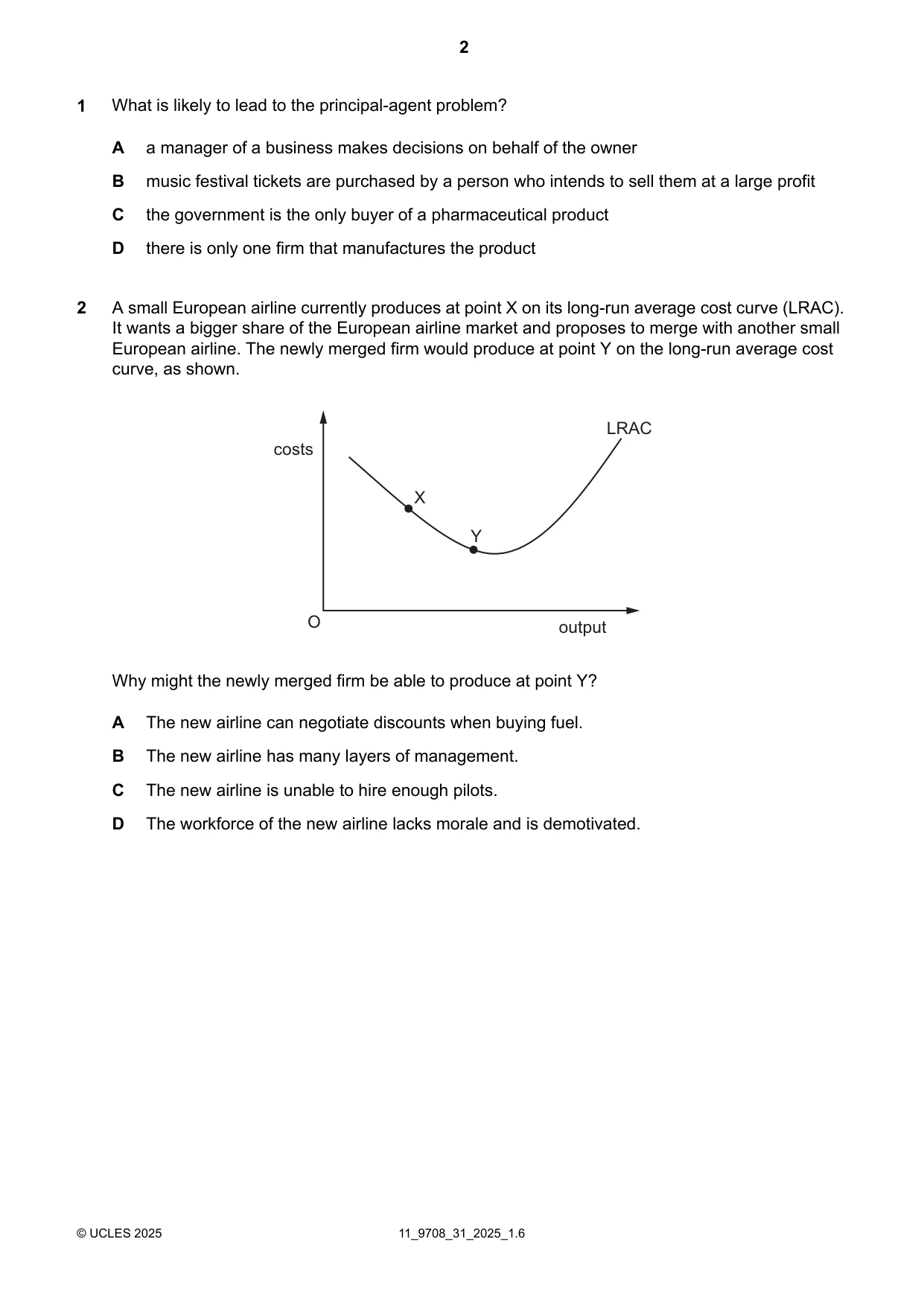
What is likely to lead to the principal-agent problem? 1 a manager of a business makes decisions on behalf of the owner A music festival tickets are purchased by a person who intends to sell them at a large profit B the government is the only buyer of a pharmaceutical product C there is only one firm that manufactures the product D A small European airline currently produces at point X on its long-run average cost curve (LRAC). It wants a bigger share of the European airline market and proposes to merge with another small European airline. The newly merged firm would produce at point Y on the long-run average cost curve, as shown. 2 O costs output LRAC X Y Why might the newly merged firm be able to produce at point Y? The new airline can negotiate discounts when buying fuel. A The new airline has many layers of management. B The new airline is unable to hire enough pilots. C The workforce of the new airline lacks morale and is demotivated. D 11_9708_31_2025_1.6 © UCLES 2025 2
Question paper, page 3
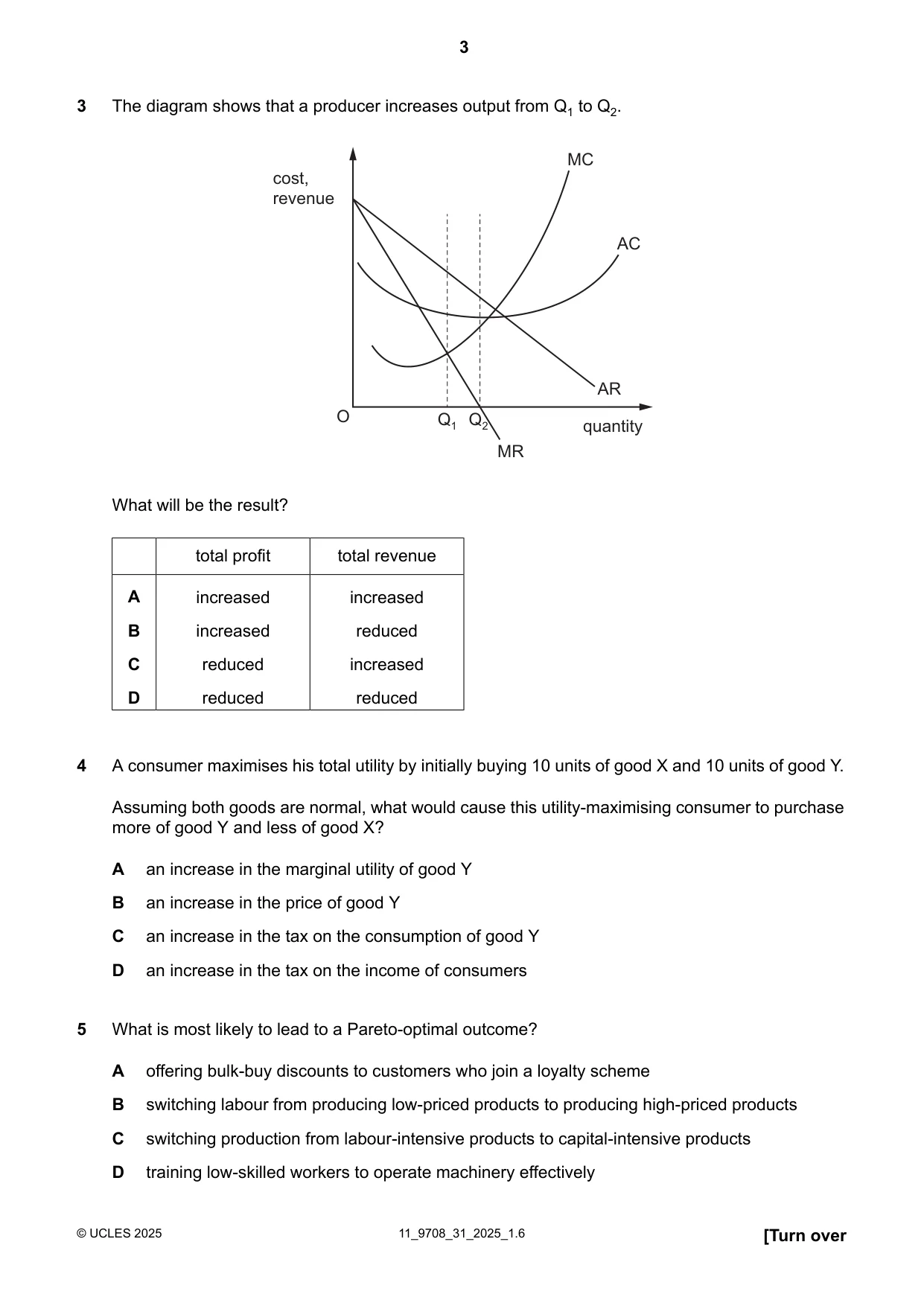
The diagram shows that a producer increases output from Q1 to Q2. 3 cost, revenue quantity O AR AC MC MR Q1 Q2 What will be the result? total revenue total profit increased increased A reduced increased B increased reduced C reduced reduced D A consumer maximises his total utility by initially buying 10 units of good X and 10 units of good Y. Assuming both goods are normal, what would cause this utility-maximising consumer to purchase more of good Y and less of good X? 4 an increase in the marginal utility of good Y A an increase in the price of good Y B an increase in the tax on the consumption of good Y C an increase in the tax on the income of consumers D What is most likely to lead to a Pareto-optimal outcome? 5 offering bulk-buy discounts to customers who join a loyalty scheme A switching labour from producing low-priced products to producing high-priced products B switching production from labour-intensive products to capital-intensive products C training low-skilled workers to operate machinery effectively D [Turn over 11_9708_31_2025_1.6 © UCLES 2025 3
Question paper, page 4
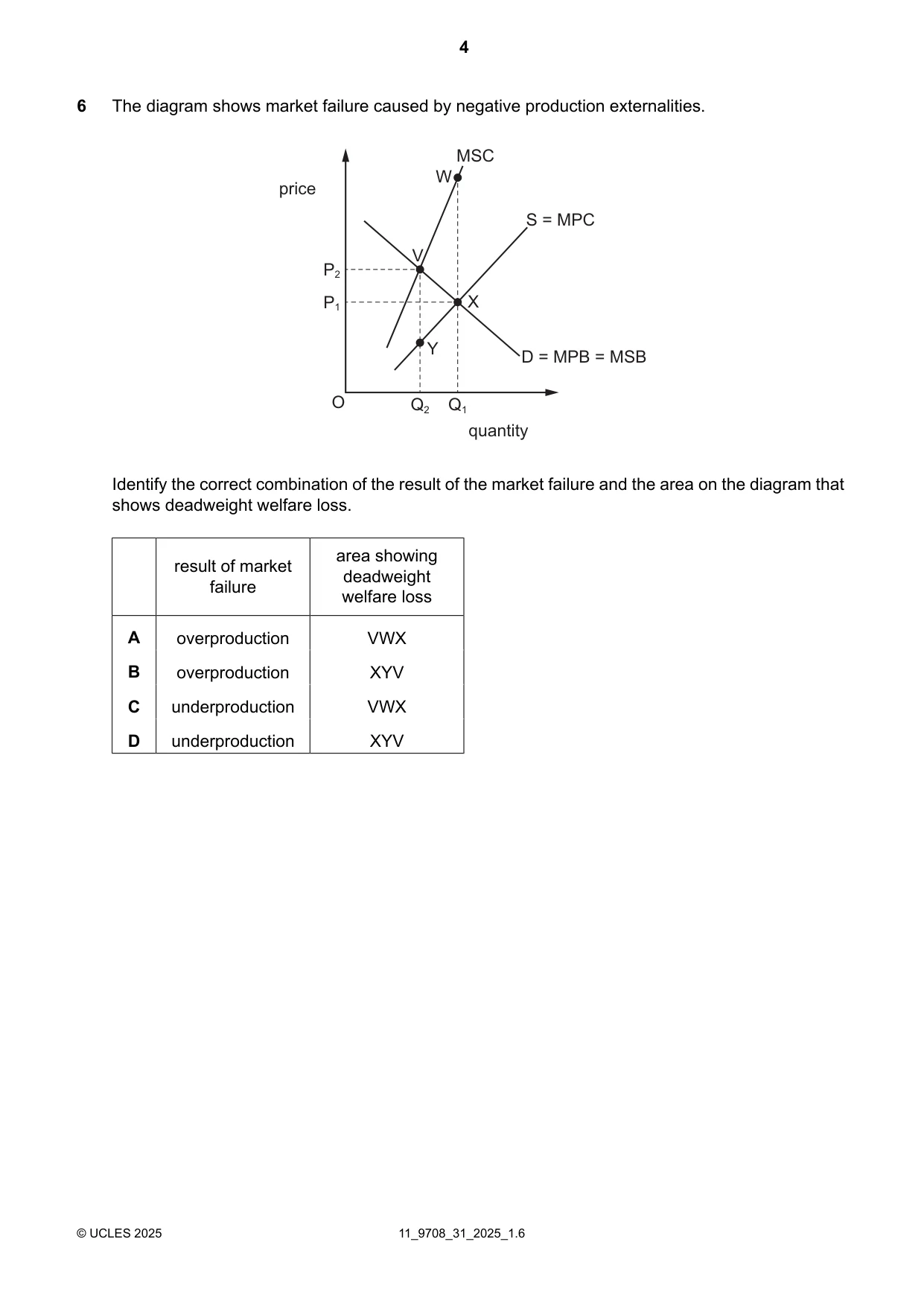
The diagram shows market failure caused by negative production externalities. 6 MSC S = MPC D = MPB = MSB O P1 P2 Q2 Q1 price quantity V W X Y Identify the correct combination of the result of the market failure and the area on the diagram that shows deadweight welfare loss. area showing deadweight welfare loss result of market failure VWX overproduction A XYV overproduction B VWX underproduction C XYV underproduction D 11_9708_31_2025_1.6 © UCLES 2025 4
Question paper, page 5
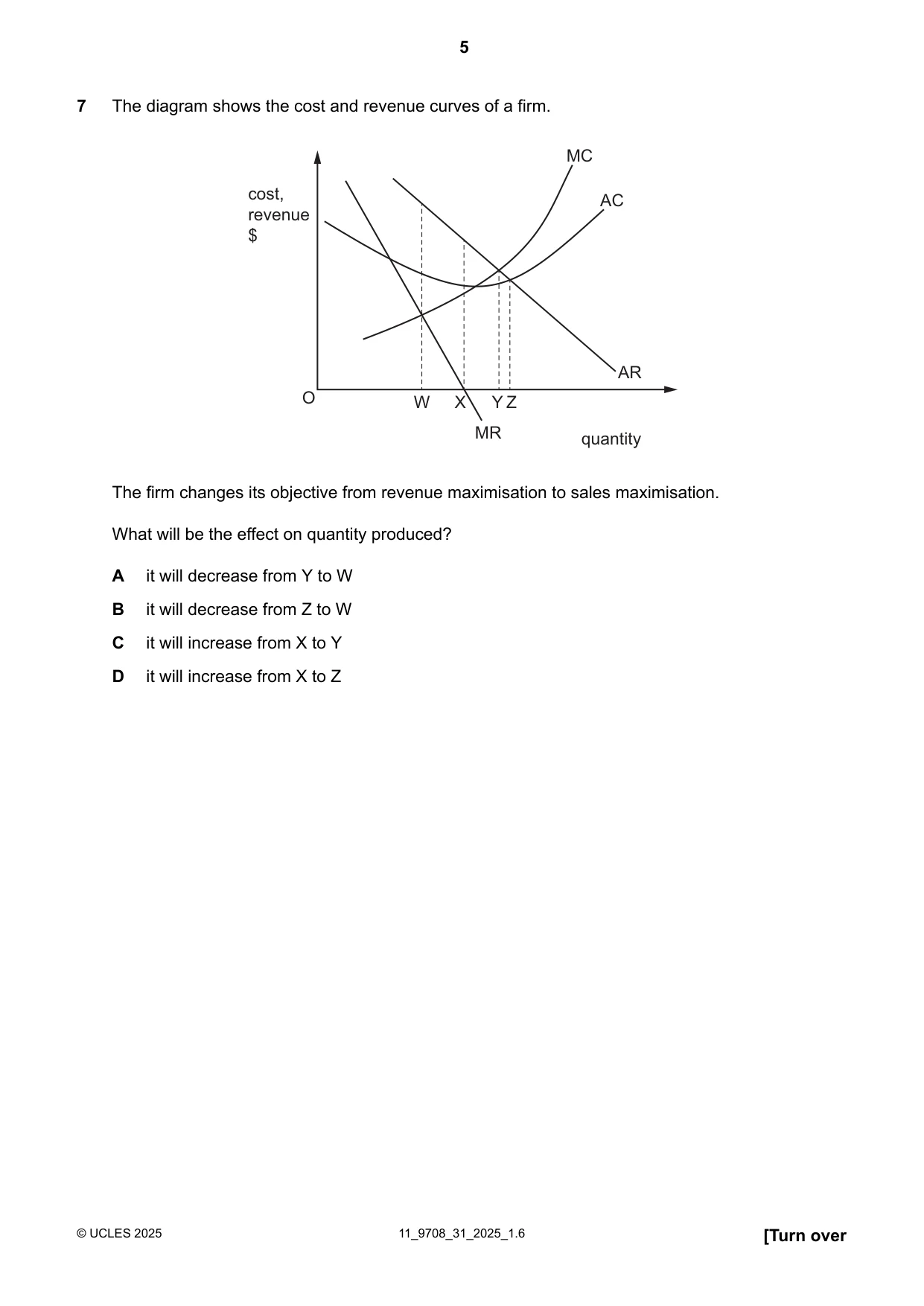
The diagram shows the cost and revenue curves of a firm. 7 O cost, revenue $ W X Y Z MR MC AC AR quantity The firm changes its objective from revenue maximisation to sales maximisation. What will be the effect on quantity produced? it will decrease from Y to W A it will decrease from Z to W B it will increase from X to Y C it will increase from X to Z D [Turn over 11_9708_31_2025_1.6 © UCLES 2025 5
Question paper, page 6
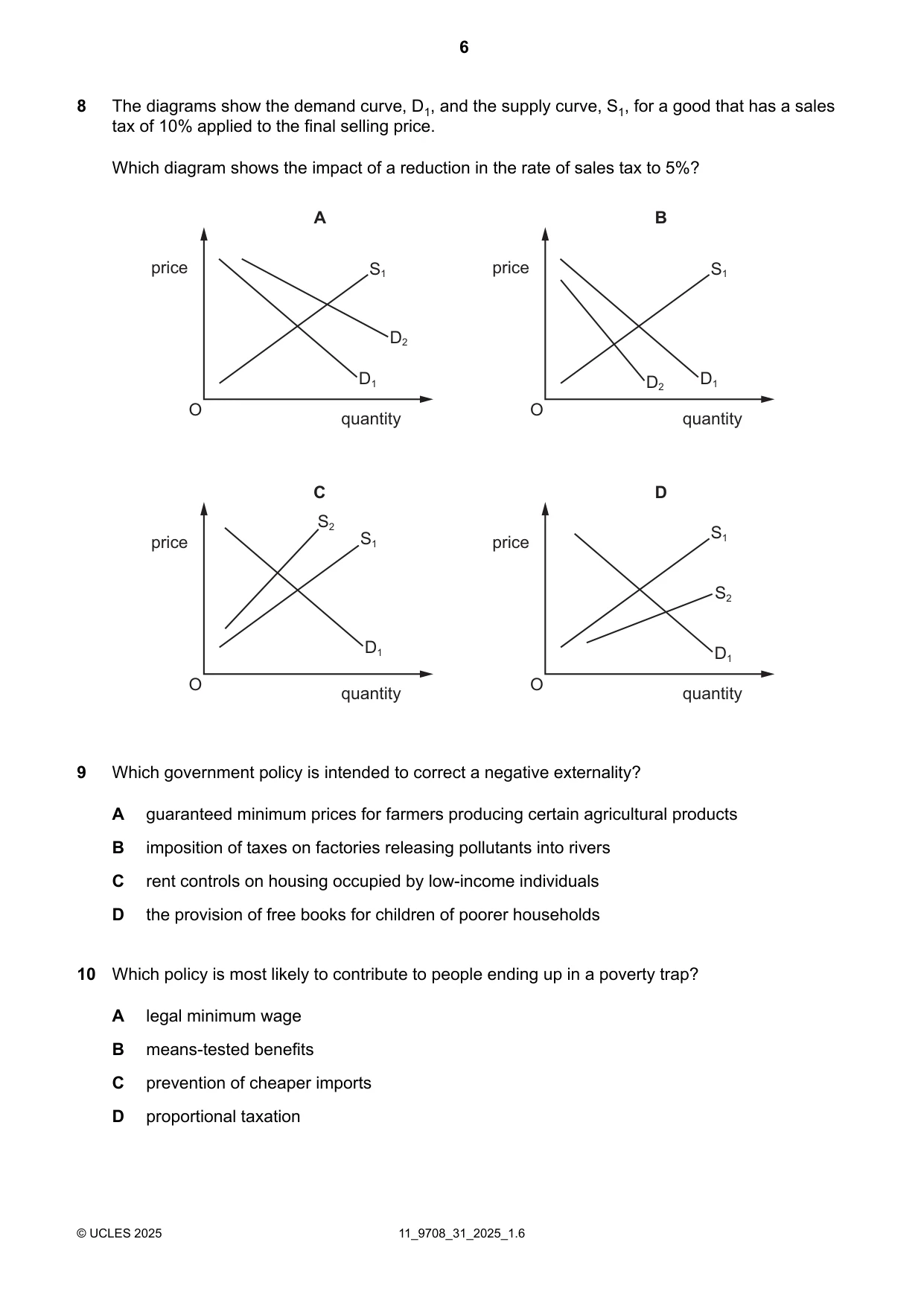
The diagrams show the demand curve, D1, and the supply curve, S1, for a good that has a sales tax of 10% applied to the final selling price. Which diagram shows the impact of a reduction in the rate of sales tax to 5%? 8 O price quantity A S1 D1 D2 O price quantity B S1 D1 D2 O price quantity C S1 S2 D1 O price quantity D S1 D1 S2 Which government policy is intended to correct a negative externality? 9 guaranteed minimum prices for farmers producing certain agricultural products A imposition of taxes on factories releasing pollutants into rivers B rent controls on housing occupied by low-income individuals C the provision of free books for children of poorer households D Which policy is most likely to contribute to people ending up in a poverty trap? 10 legal minimum wage A means-tested benefits B prevention of cheaper imports C proportional taxation D 11_9708_31_2025_1.6 © UCLES 2025 6
Question paper, page 7
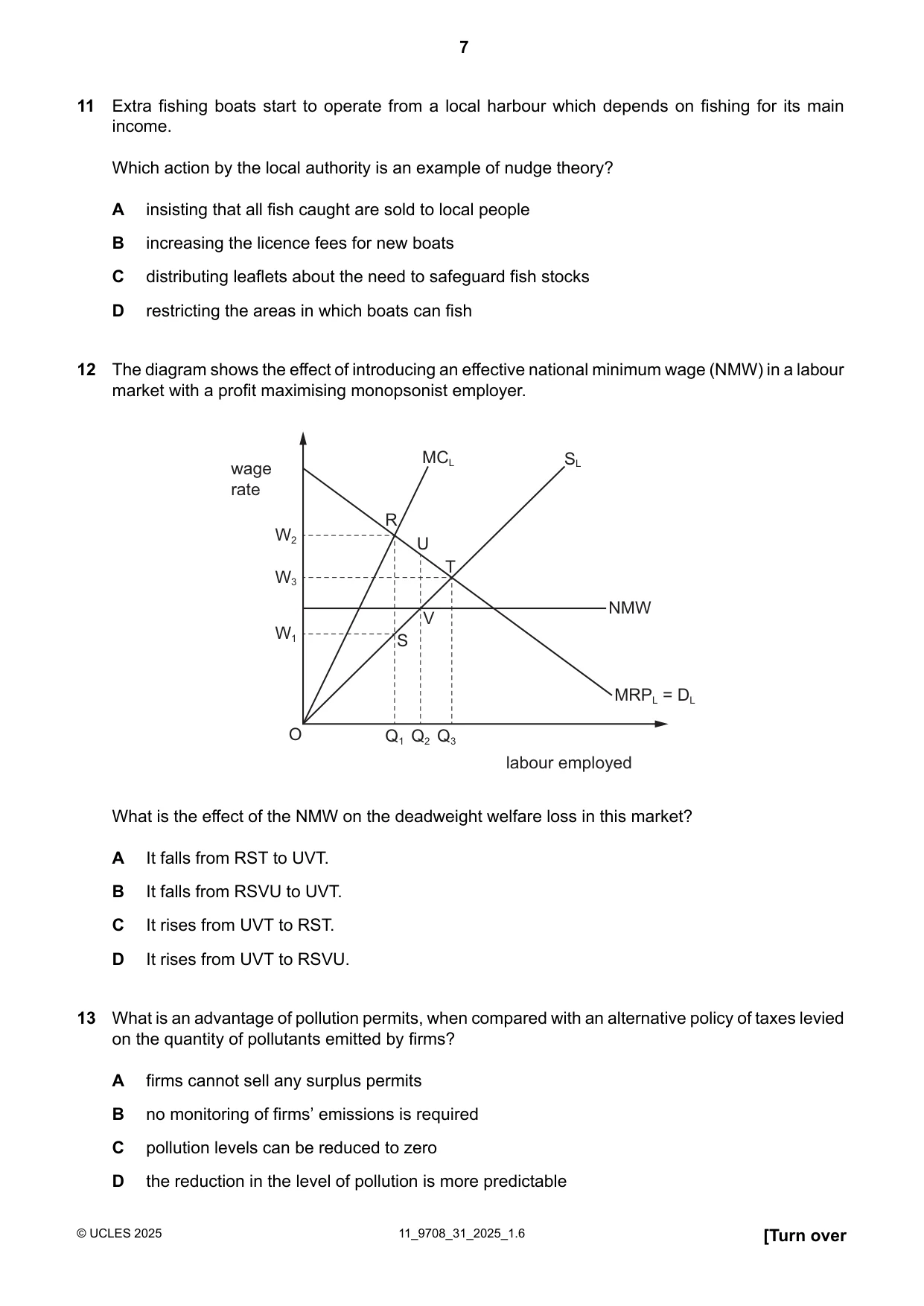
Extra fishing boats start to operate from a local harbour which depends on fishing for its main income. Which action by the local authority is an example of nudge theory? 11 insisting that all fish caught are sold to local people A increasing the licence fees for new boats B distributing leaflets about the need to safeguard fish stocks C restricting the areas in which boats can fish D The diagram shows the effect of introducing an effective national minimum wage (NMW) in a labour market with a profit maximising monopsonist employer. 12 O MCL MRPL = DL NMW SL Q1 Q2 Q3 W3 W2 W1 labour employed wage rate T U R V S What is the effect of the NMW on the deadweight welfare loss in this market? It falls from RST to UVT. A It falls from RSVU to UVT. B It rises from UVT to RST. C It rises from UVT to RSVU. D What is an advantage of pollution permits, when compared with an alternative policy of taxes levied on the quantity of pollutants emitted by firms? 13 firms cannot sell any surplus permits A no monitoring of firms’ emissions is required B pollution levels can be reduced to zero C the reduction in the level of pollution is more predictable D [Turn over 11_9708_31_2025_1.6 © UCLES 2025 7
Question paper, page 8
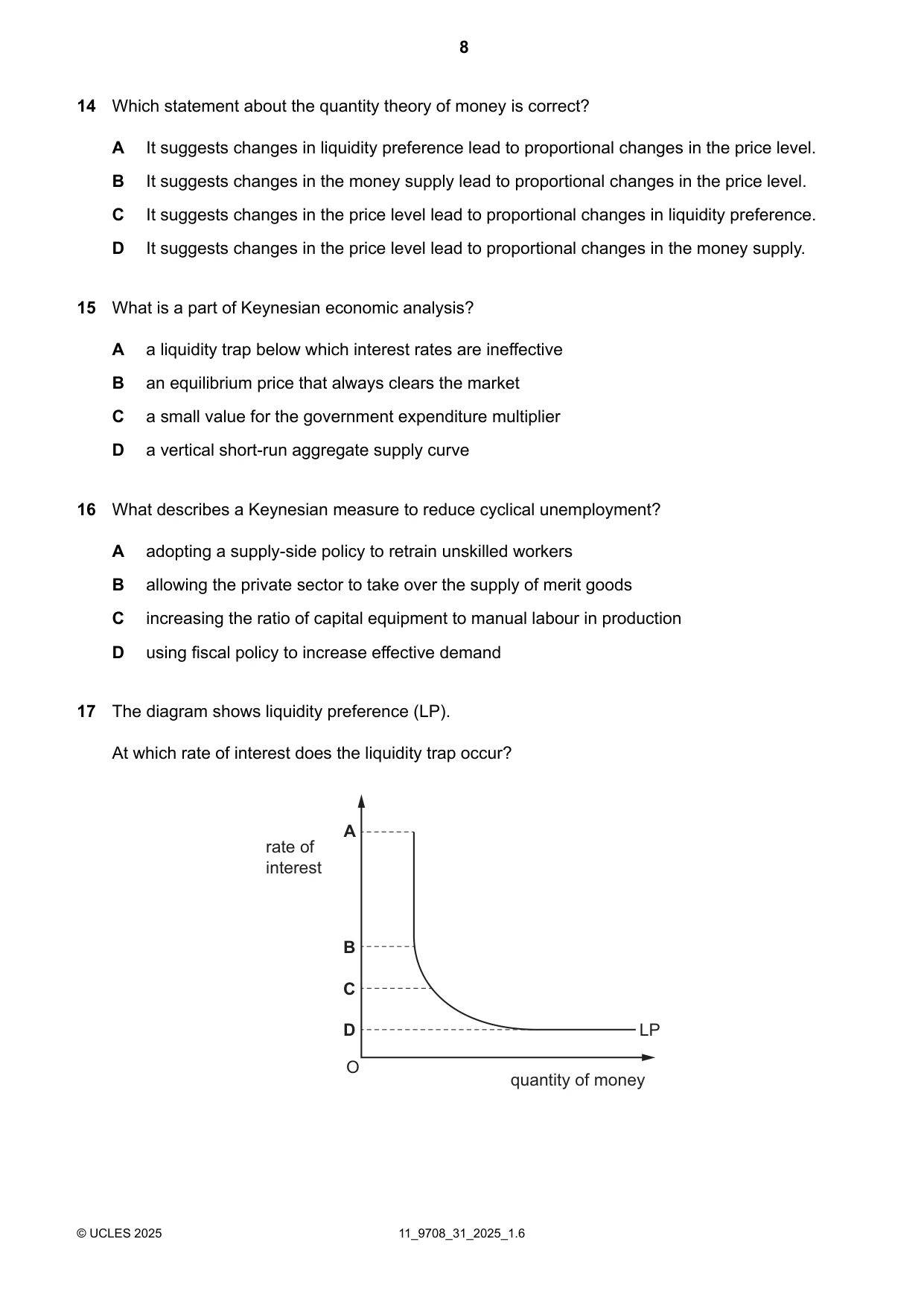
Which statement about the quantity theory of money is correct? 14 It suggests changes in liquidity preference lead to proportional changes in the price level. A It suggests changes in the money supply lead to proportional changes in the price level. B It suggests changes in the price level lead to proportional changes in liquidity preference. C It suggests changes in the price level lead to proportional changes in the money supply. D What is a part of Keynesian economic analysis? 15 a liquidity trap below which interest rates are ineffective A an equilibrium price that always clears the market B a small value for the government expenditure multiplier C a vertical short-run aggregate supply curve D What describes a Keynesian measure to reduce cyclical unemployment? 16 adopting a supply-side policy to retrain unskilled workers A allowing the private sector to take over the supply of merit goods B increasing the ratio of capital equipment to manual labour in production C using fiscal policy to increase effective demand D The diagram shows liquidity preference (LP). At which rate of interest does the liquidity trap occur? 17 O A B C D rate of interest quantity of money LP 11_9708_31_2025_1.6 © UCLES 2025 8
Question paper, page 9
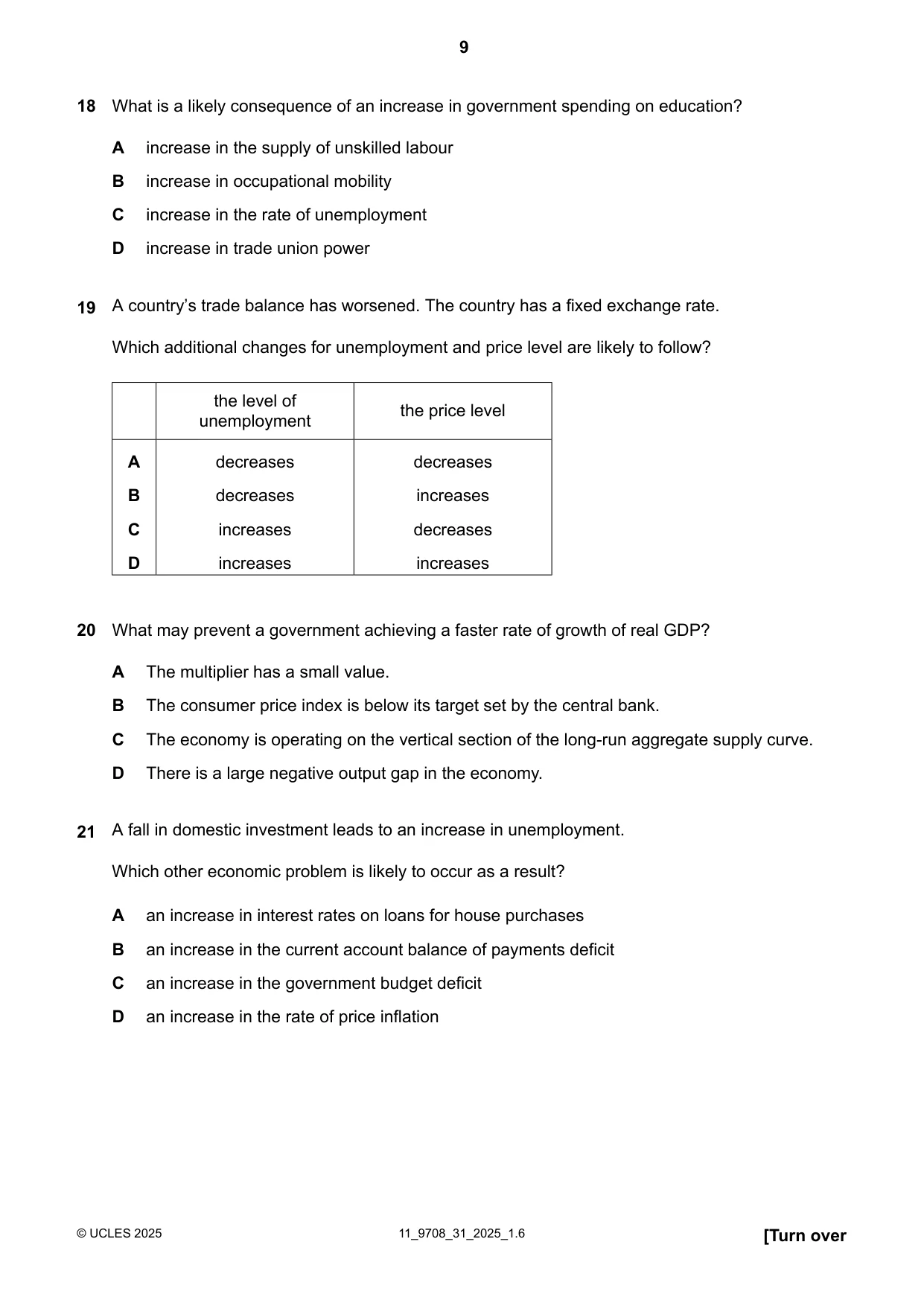
What is a likely consequence of an increase in government spending on education? 18 increase in the supply of unskilled labour A increase in occupational mobility B increase in the rate of unemployment C increase in trade union power D A country’s trade balance has worsened. The country has a fixed exchange rate. Which additional changes for unemployment and price level are likely to follow? 19 the price level the level of unemployment decreases decreases A increases decreases B decreases increases C increases increases D What may prevent a government achieving a faster rate of growth of real GDP? 20 The multiplier has a small value. A The consumer price index is below its target set by the central bank. B The economy is operating on the vertical section of the long-run aggregate supply curve. C There is a large negative output gap in the economy. D A fall in domestic investment leads to an increase in unemployment. Which other economic problem is likely to occur as a result? 21 an increase in interest rates on loans for house purchases A an increase in the current account balance of payments deficit B an increase in the government budget deficit C an increase in the rate of price inflation D [Turn over 11_9708_31_2025_1.6 © UCLES 2025 9
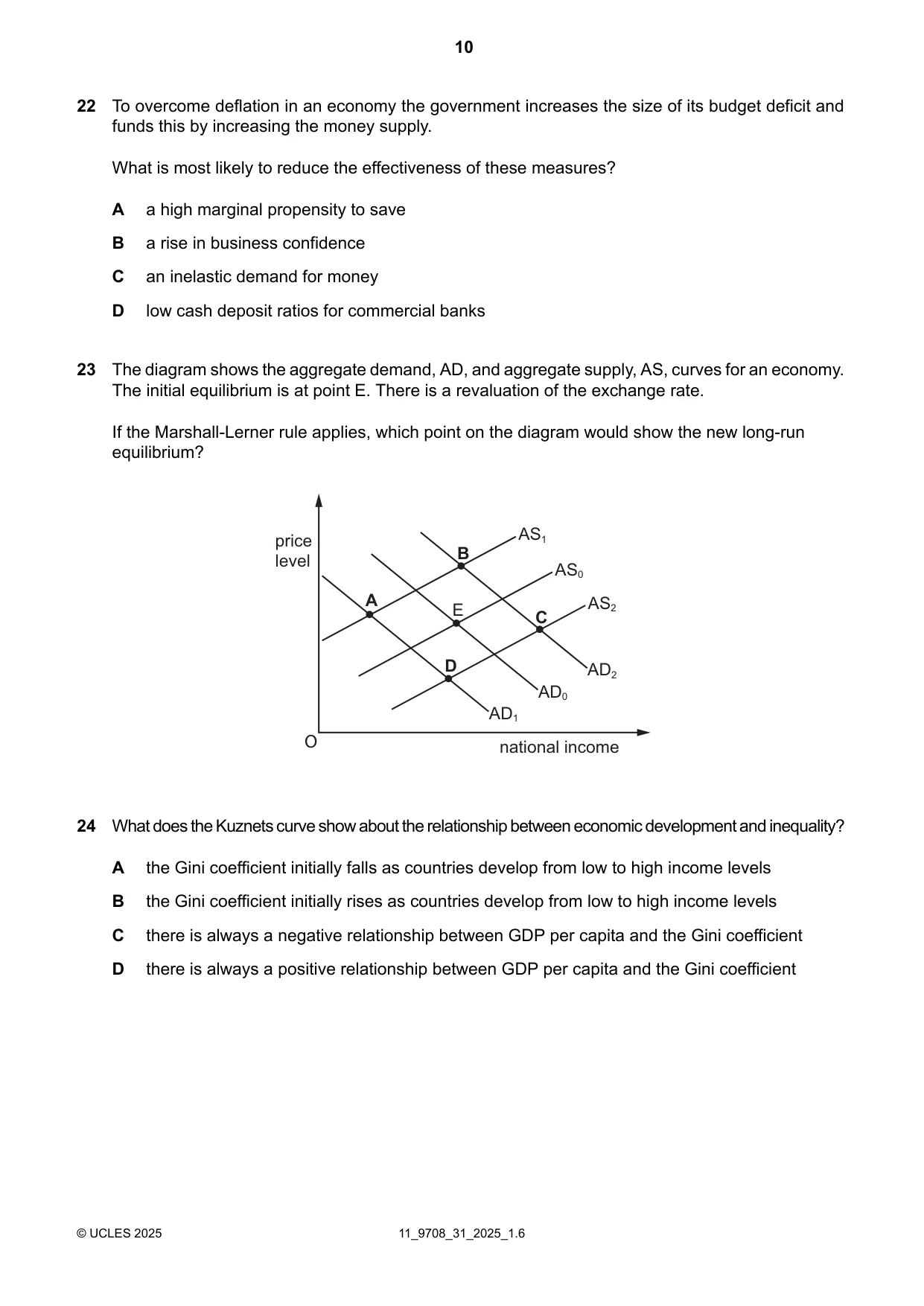
Question paper, page 10
To overcome deflation in an economy the government increases the size of its budget deficit and funds this by increasing the money supply. What is most likely to reduce the effectiveness of these measures? 22 a high marginal propensity to save A a rise in business confidence B an inelastic demand for money C low cash deposit ratios for commercial banks D The diagram shows the aggregate demand, AD, and aggregate supply, AS, curves for an economy. The initial equilibrium is at point E. There is a revaluation of the exchange rate. If the Marshall-Lerner rule applies, which point on the diagram would show the new long-run equilibrium? 23 O price level national income AD1 AS1 AS0 AS2 AD0 AD2 E A B C D What does the Kuznets curve show about the relationship between economic development and inequality? 24 the Gini coefficient initially falls as countries develop from low to high income levels A the Gini coefficient initially rises as countries develop from low to high income levels B there is always a negative relationship between GDP per capita and the Gini coefficient C there is always a positive relationship between GDP per capita and the Gini coefficient D 11_9708_31_2025_1.6 © UCLES 2025 10
Question paper, page 11
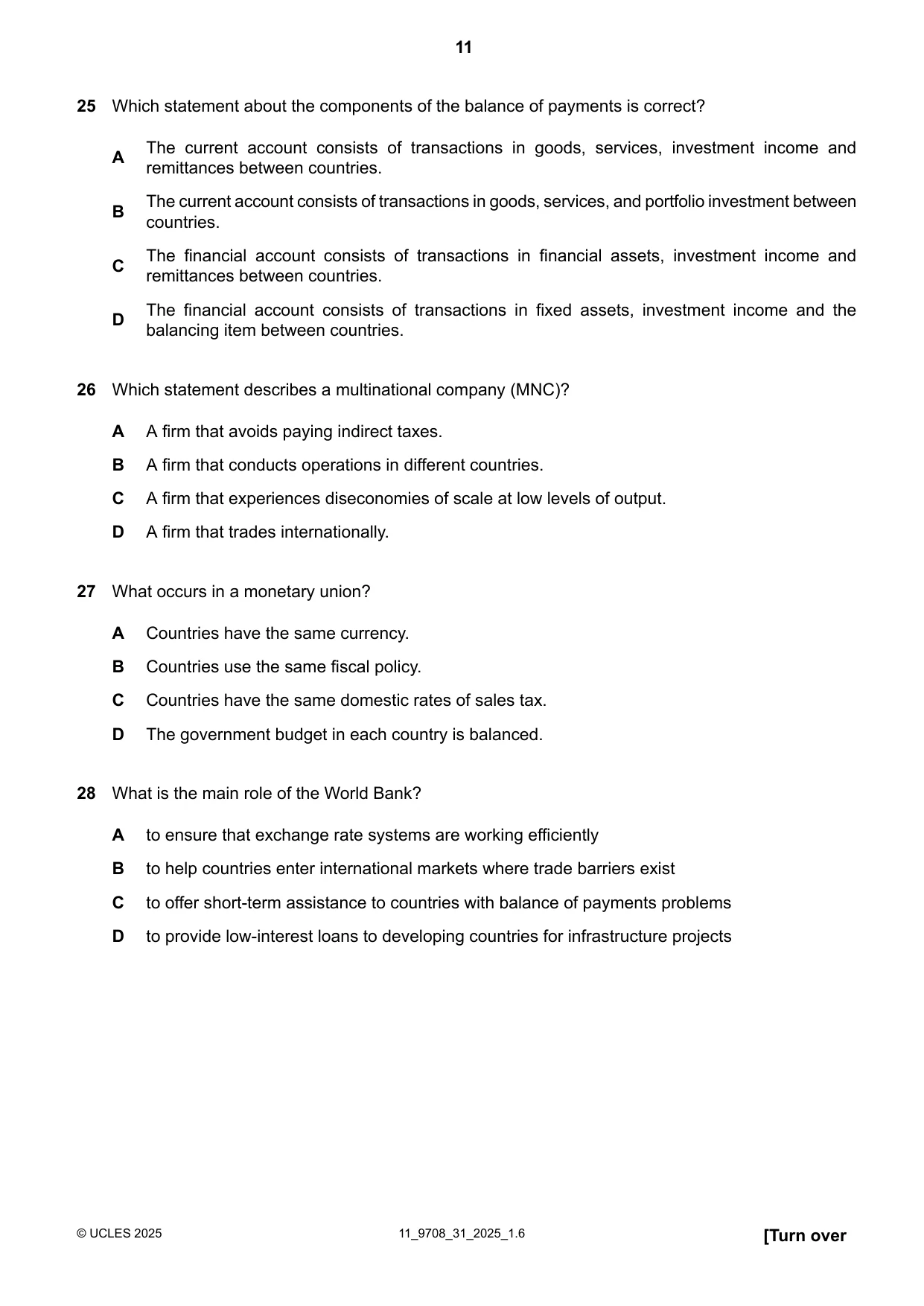
Which statement about the components of the balance of payments is correct? 25 The current account consists of transactions in goods, services, investment income and remittances between countries. A The current account consists of transactions in goods, services, and portfolio investment between countries. B The financial account consists of transactions in financial assets, investment income and remittances between countries. C The financial account consists of transactions in fixed assets, investment income and the balancing item between countries. D Which statement describes a multinational company (MNC)? 26 A firm that avoids paying indirect taxes. A A firm that conducts operations in different countries. B A firm that experiences diseconomies of scale at low levels of output. C A firm that trades internationally. D What occurs in a monetary union? 27 Countries have the same currency. A Countries use the same fiscal policy. B Countries have the same domestic rates of sales tax. C The government budget in each country is balanced. D What is the main role of the World Bank? 28 to ensure that exchange rate systems are working efficiently A to help countries enter international markets where trade barriers exist B to offer short-term assistance to countries with balance of payments problems C to provide low-interest loans to developing countries for infrastructure projects D [Turn over 11_9708_31_2025_1.6 © UCLES 2025 11
Question paper, page 12
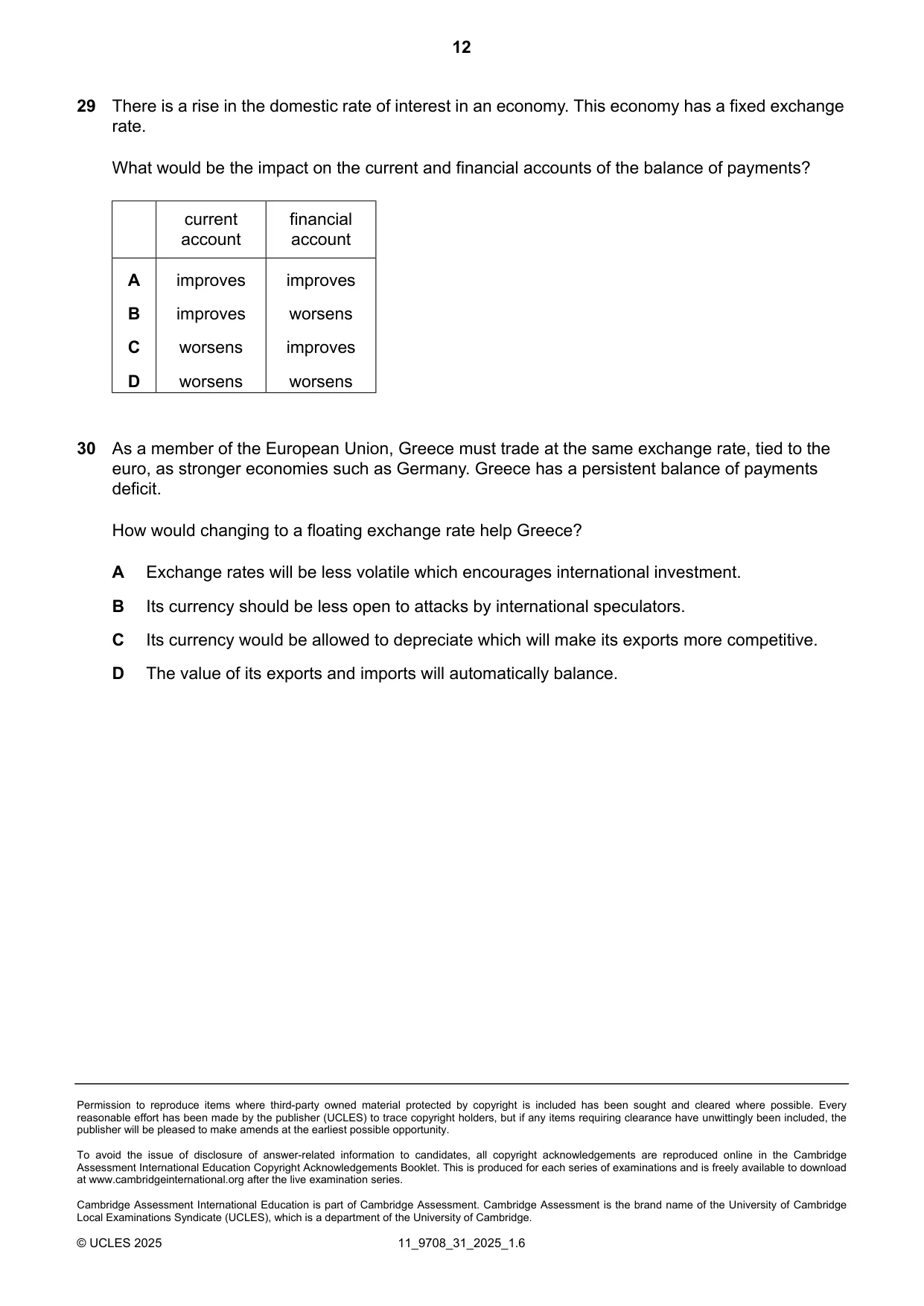
There is a rise in the domestic rate of interest in an economy. This economy has a fixed exchange rate. What would be the impact on the current and financial accounts of the balance of payments? 29 financial account current account improves improves A worsens improves B improves worsens C worsens worsens D As a member of the European Union, Greece must trade at the same exchange rate, tied to the euro, as stronger economies such as Germany. Greece has a persistent balance of payments deficit. How would changing to a floating exchange rate help Greece? 30 Exchange rates will be less volatile which encourages international investment. A Its currency should be less open to attacks by international speculators. B Its currency would be allowed to depreciate which will make its exports more competitive. C The value of its exports and imports will automatically balance. D 12 Permission to reproduce items where third-party owned material protected by copyright is included has been sought and cleared where possible. Every reasonable effort has been made by the publisher (UCLES) to trace copyright holders, but if any items requiring clearance have unwittingly been included, the publisher will be pleased to make amends at the earliest possible opportunity. To avoid the issue of disclosure of answer-related information to candidates, all copyright acknowledgements are reproduced online in the Cambridge Assessment International Education Copyright Acknowledgements Booklet. This is produced for each series of examinations and is freely available to download at www.cambridgeinternational.org after the live examination series. Cambridge Assessment International Education is part of Cambridge Assessment. Cambridge Assessment is the brand name of the University of Cambridge Local Examinations Syndicate (UCLES), which is a department of the University of Cambridge. © UCLES 2025 11_9708_31_2025_1.6
Mark scheme, page 1
This document consists of 3 printed pages. © Cambridge University Press & Assessment 2025 [Turn over Cambridge International AS & A Level ECONOMICS 9708/31 Paper 3 Multiple Choice October/November 2025 MARK SCHEME Maximum Mark: 30 Published This mark scheme is published as an aid to teachers and candidates, to indicate the requirements of the examination. Mark schemes should be read in conjunction with the question paper and the Principal Examiner Report for Teachers. Cambridge International will not enter into discussions about these mark schemes. Cambridge International is publishing the mark schemes for the October/November 2025 series for most Cambridge IGCSE, Cambridge International A and AS Level components, and some Cambridge O Level components.
Mark scheme, page 2
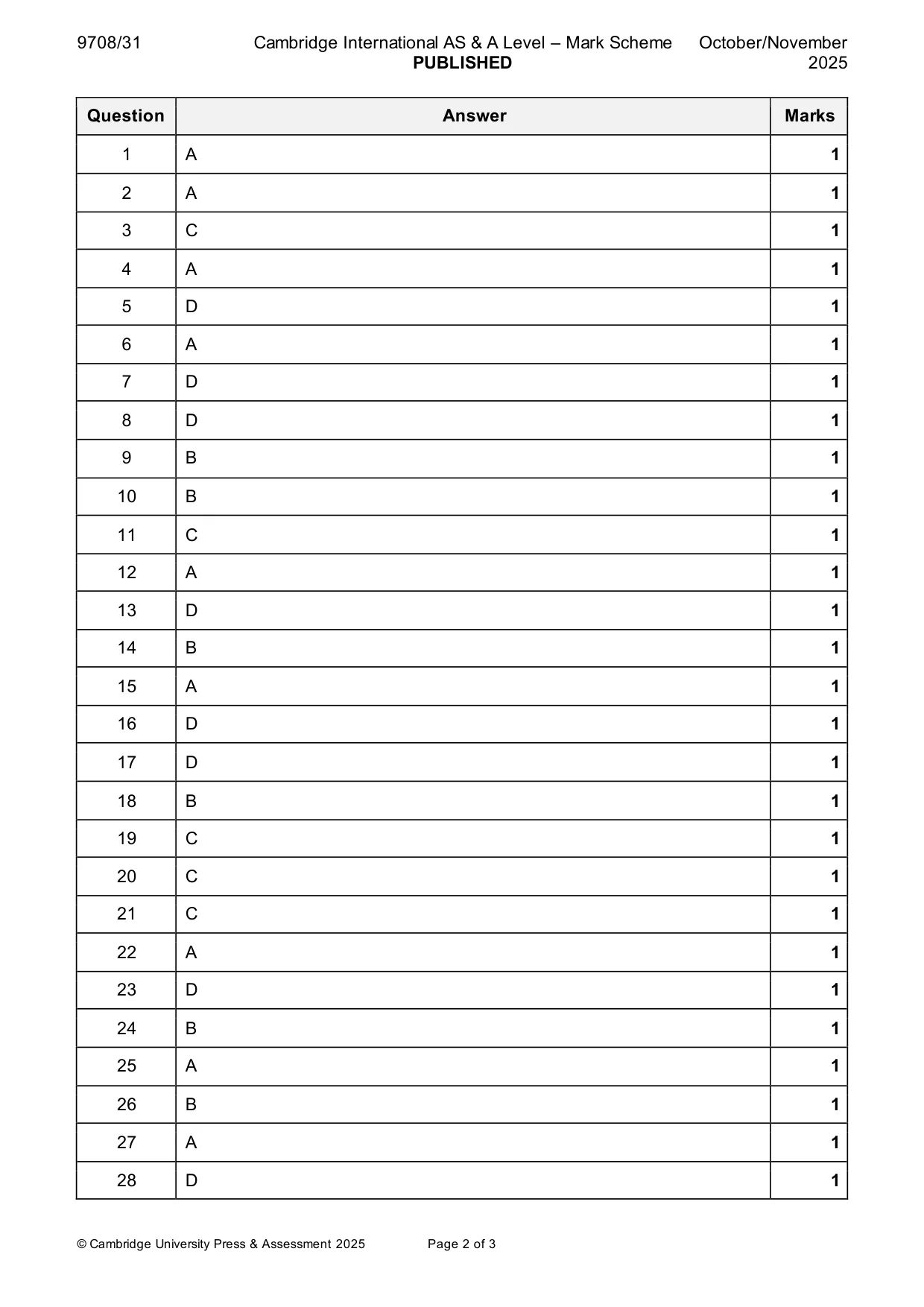
9708/31 Cambridge International AS & A Level – Mark Scheme PUBLISHED October/November 2025 © Cambridge University Press & Assessment 2025 Page 2 of 3 Question Answer Marks 1 A 1 2 A 1 3 C 1 4 A 1 5 D 1 6 A 1 7 D 1 8 D 1 9 B 1 10 B 1 11 C 1 12 A 1 13 D 1 14 B 1 15 A 1 16 D 1 17 D 1 18 B 1 19 C 1 20 C 1 21 C 1 22 A 1 23 D 1 24 B 1 25 A 1 26 B 1 27 A 1 28 D 1
Mark scheme, page 3
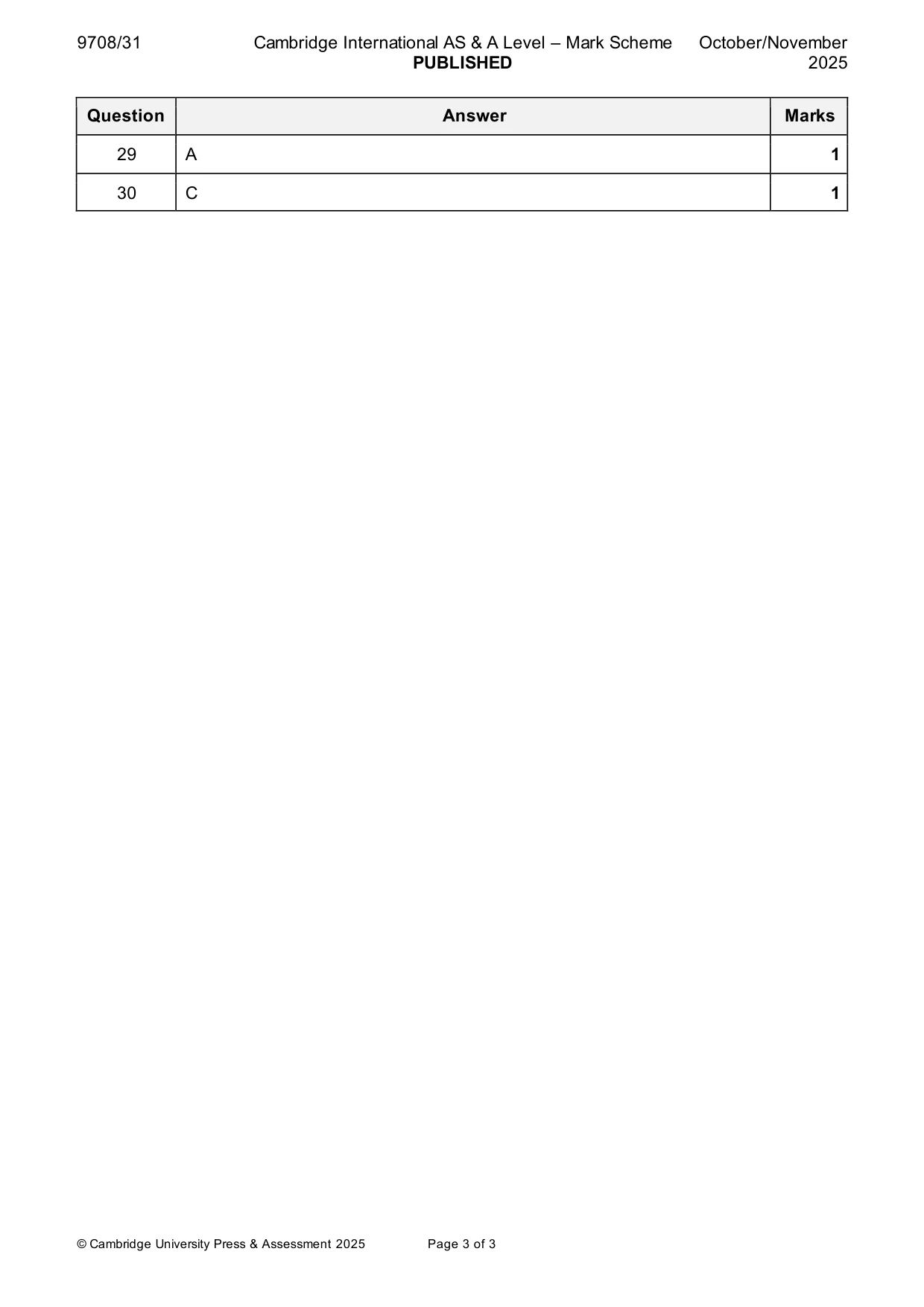
9708/31 Cambridge International AS & A Level – Mark Scheme PUBLISHED October/November 2025 © Cambridge University Press & Assessment 2025 Page 3 of 3 Question Answer Marks 29 A 1 30 C 1
What you needed in this session
Cambridge’s own grade thresholds for 2025 Oct/Nov, Paper 3 · Variant 1. A higher threshold means an easier paper — the bar moves with how the cohort did.