Cambridge A Level Economics 9708 — 2017 Oct/Nov Paper 3 · Variant 2
9708/32/O/N/17 · 30 marks · ≈34 min
The question paper and its mark scheme, free to read here and free to download. This is Cambridge’s own paper, exactly as it was sat.
Question paper12 pages


Mark scheme
No mark scheme is in the library for this paper.
Paper as text
Question paper, page 1
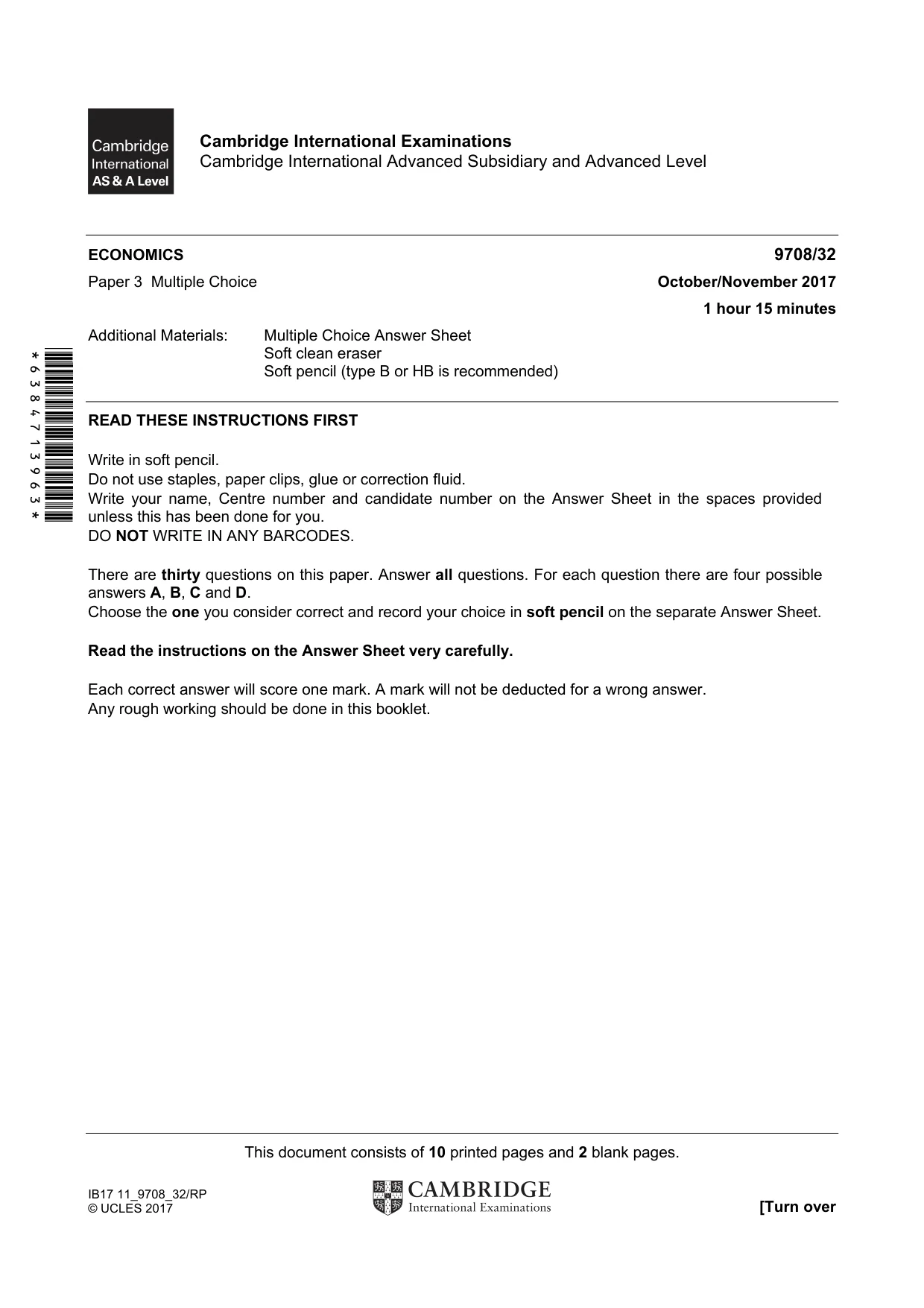
This document consists of 10 printed pages and 2 blank pages. IB17 11_9708_32/RP © UCLES 2017 [Turn over *6384713963* Cambridge International Examinations Cambridge International Advanced Subsidiary and Advanced Level ECONOMICS 9708/32 Paper 3 Multiple Choice October/November 2017 1 hour 15 minutes Additional Materials: Multiple Choice Answer Sheet Soft clean eraser Soft pencil (type B or HB is recommended) READ THESE INSTRUCTIONS FIRST Write in soft pencil. Do not use staples, paper clips, glue or correction fluid. Write your name, Centre number and candidate number on the Answer Sheet in the spaces provided unless this has been done for you. DO NOT WRITE IN ANY BARCODES. There are thirty questions on this paper. Answer all questions. For each question there are four possible answers A, B, C and D. Choose the one you consider correct and record your choice in soft pencil on the separate Answer Sheet. Read the instructions on the Answer Sheet very carefully. Each correct answer will score one mark. A mark will not be deducted for a wrong answer. Any rough working should be done in this booklet.
Question paper, page 2
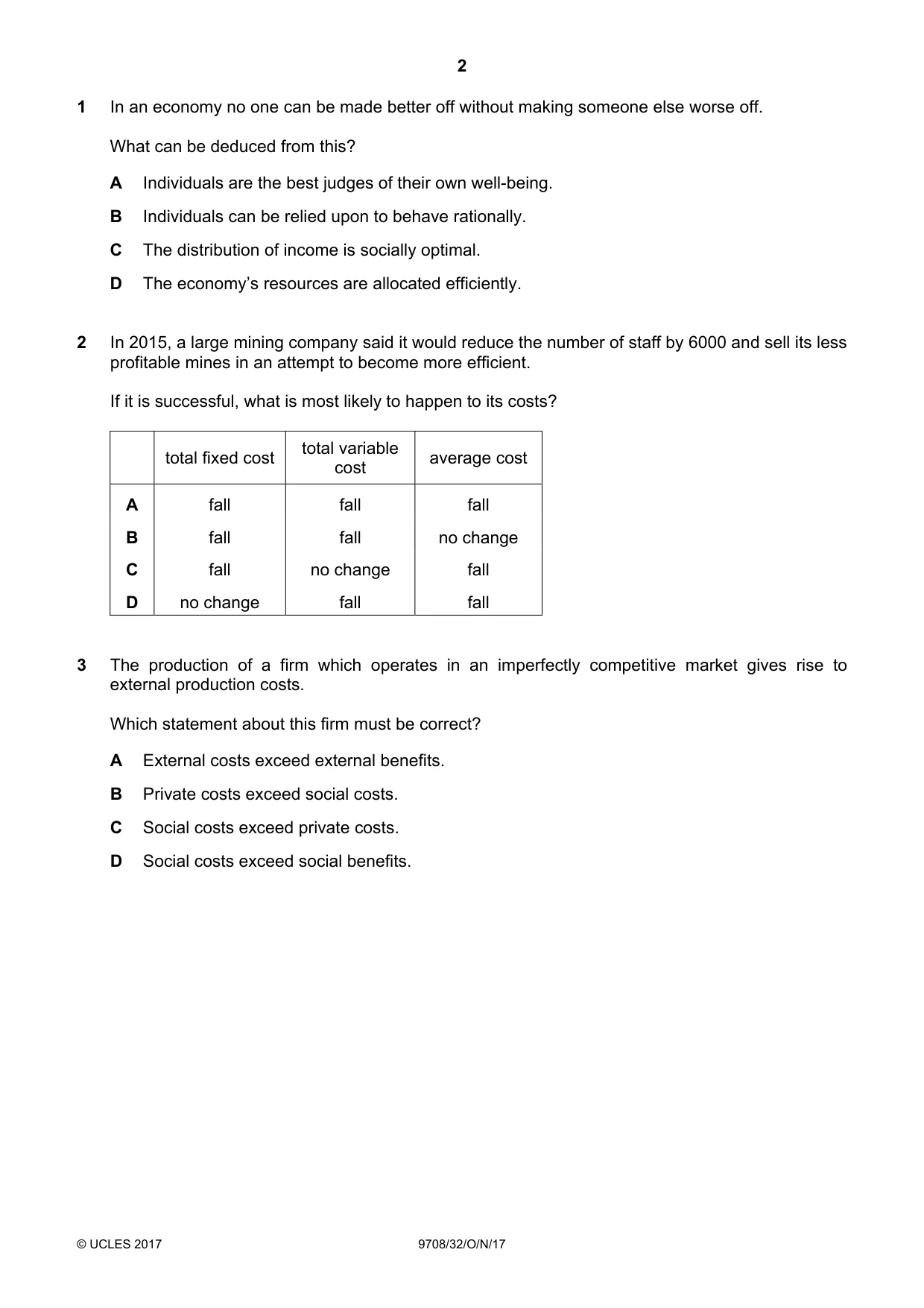
2 © UCLES 2017 9708/32/O/N/17 1 In an economy no one can be made better off without making someone else worse off. What can be deduced from this? A Individuals are the best judges of their own well-being. B Individuals can be relied upon to behave rationally. C The distribution of income is socially optimal. D The economy’s resources are allocated efficiently. 2 In 2015, a large mining company said it would reduce the number of staff by 6000 and sell its less profitable mines in an attempt to become more efficient. If it is successful, what is most likely to happen to its costs? total fixed cost total variable cost average cost A fall fall fall B fall fall no change C fall no change fall D no change fall fall 3 The production of a firm which operates in an imperfectly competitive market gives rise to external production costs. Which statement about this firm must be correct? A External costs exceed external benefits. B Private costs exceed social costs. C Social costs exceed private costs. D Social costs exceed social benefits.
Question paper, page 3
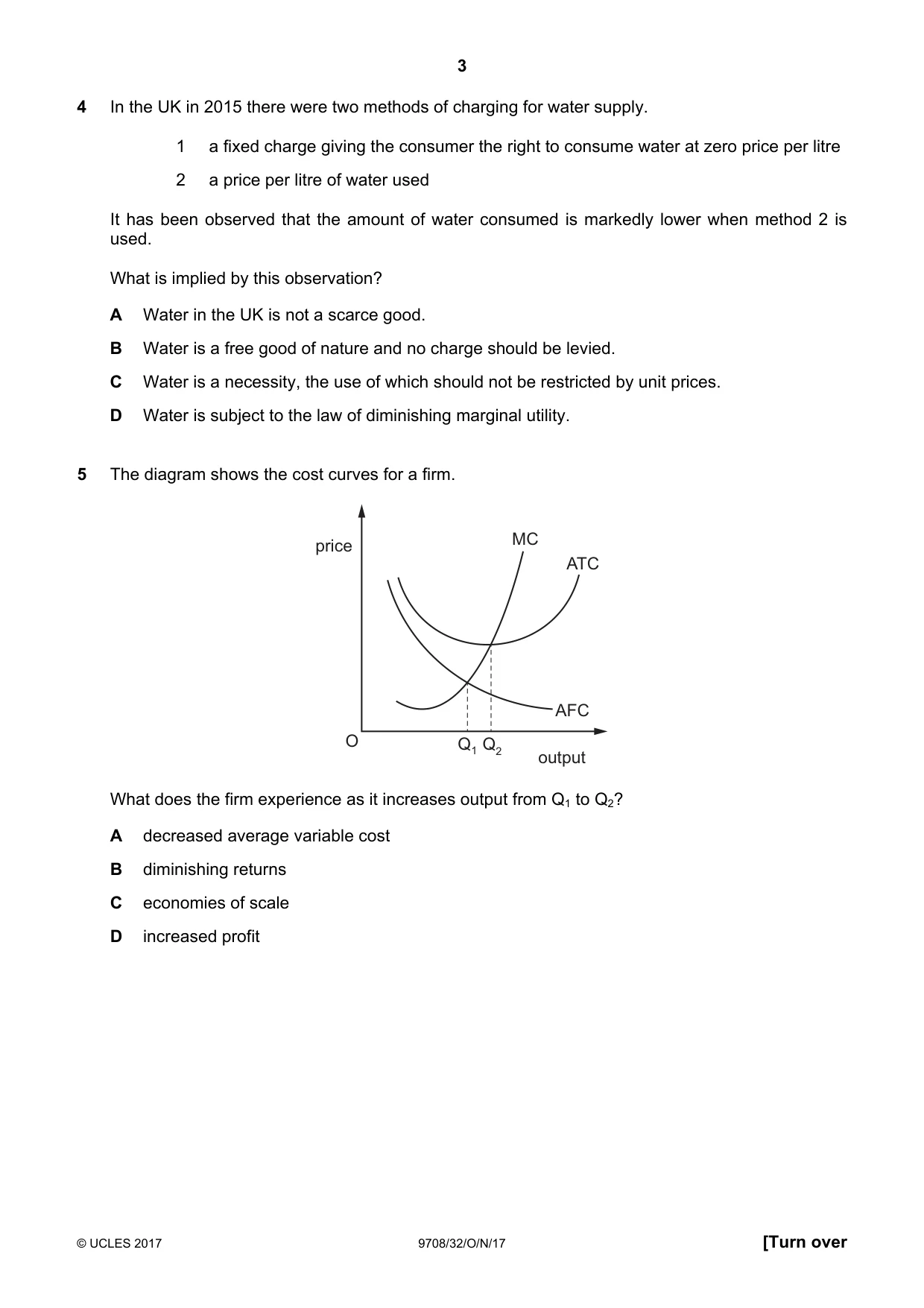
3 © UCLES 2017 9708/32/O/N/17 [Turn over 4 In the UK in 2015 there were two methods of charging for water supply. 1 a fixed charge giving the consumer the right to consume water at zero price per litre 2 a price per litre of water used It has been observed that the amount of water consumed is markedly lower when method 2 is used. What is implied by this observation? A Water in the UK is not a scarce good. B Water is a free good of nature and no charge should be levied. C Water is a necessity, the use of which should not be restricted by unit prices. D Water is subject to the law of diminishing marginal utility. 5 The diagram shows the cost curves for a firm. price output O Q1 Q2 MC ATC AFC What does the firm experience as it increases output from Q1 to Q2? A decreased average variable cost B diminishing returns C economies of scale D increased profit
Question paper, page 4
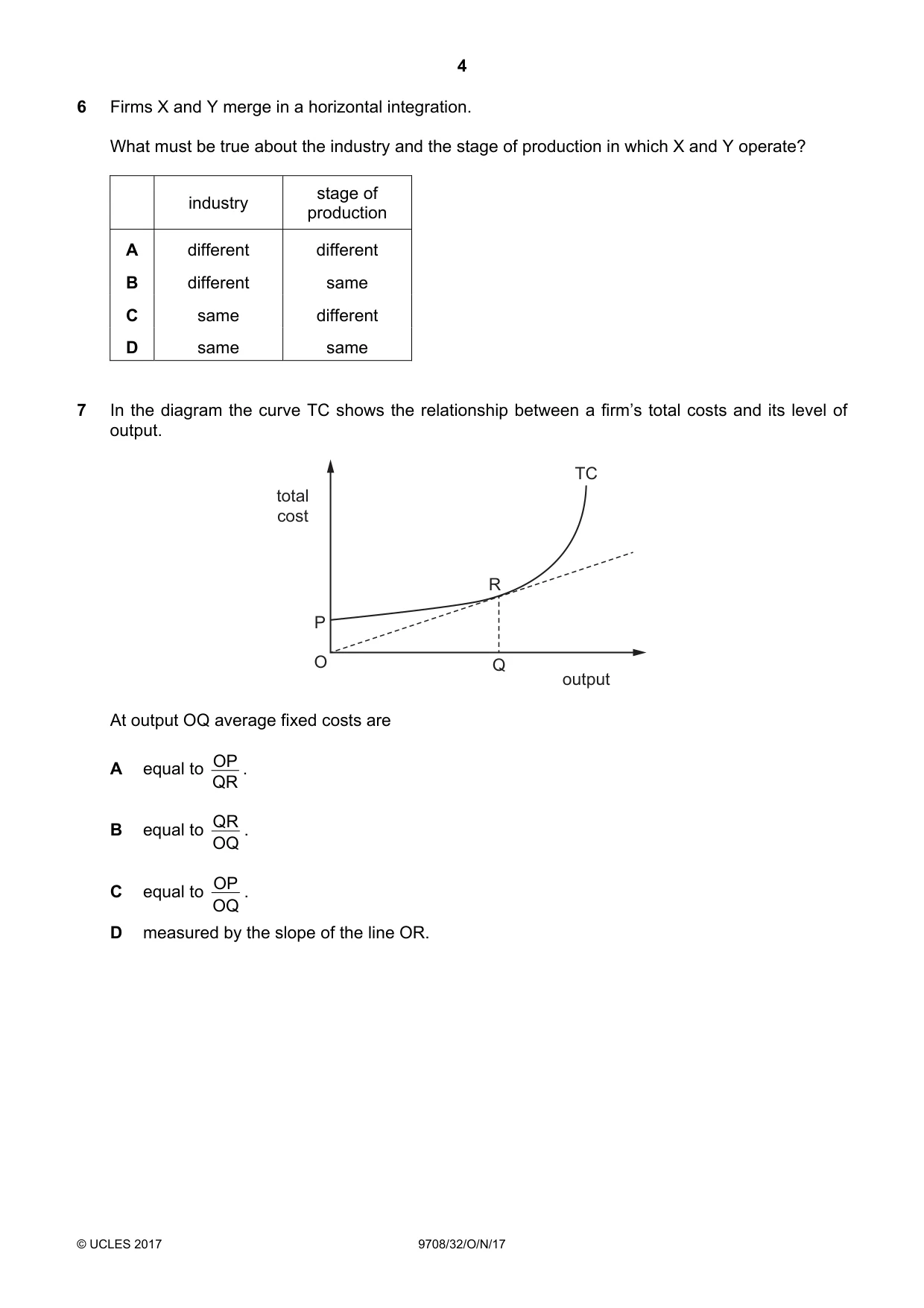
4 © UCLES 2017 9708/32/O/N/17 6 Firms X and Y merge in a horizontal integration. What must be true about the industry and the stage of production in which X and Y operate? industry stage of production A different different B different same C same different D same same 7 In the diagram the curve TC shows the relationship between a firm’s total costs and its level of output. P O Q R TC output total cost At output OQ average fixed costs are A equal to QR OP . B equal to OQ QR . C equal to OQ OP . D measured by the slope of the line OR.
Question paper, page 5
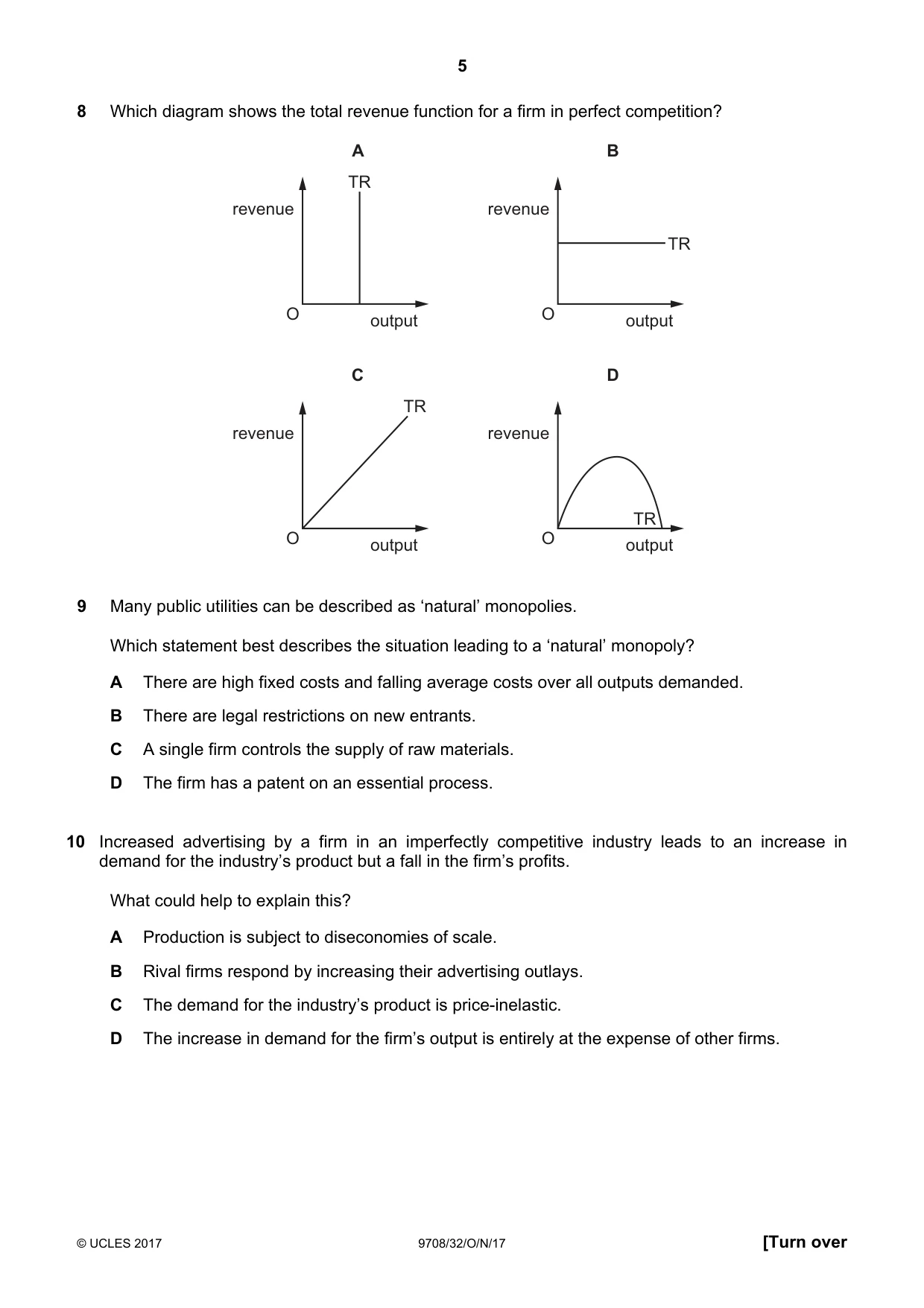
5 © UCLES 2017 9708/32/O/N/17 [Turn over 8 Which diagram shows the total revenue function for a firm in perfect competition? output revenue TR A output revenue TR D output revenue TR C output revenue TR B O O O O 9 Many public utilities can be described as ‘natural’ monopolies. Which statement best describes the situation leading to a ‘natural’ monopoly? A There are high fixed costs and falling average costs over all outputs demanded. B There are legal restrictions on new entrants. C A single firm controls the supply of raw materials. D The firm has a patent on an essential process. 10 Increased advertising by a firm in an imperfectly competitive industry leads to an increase in demand for the industry’s product but a fall in the firm’s profits. What could help to explain this? A Production is subject to diseconomies of scale. B Rival firms respond by increasing their advertising outlays. C The demand for the industry’s product is price-inelastic. D The increase in demand for the firm’s output is entirely at the expense of other firms.
Question paper, page 6
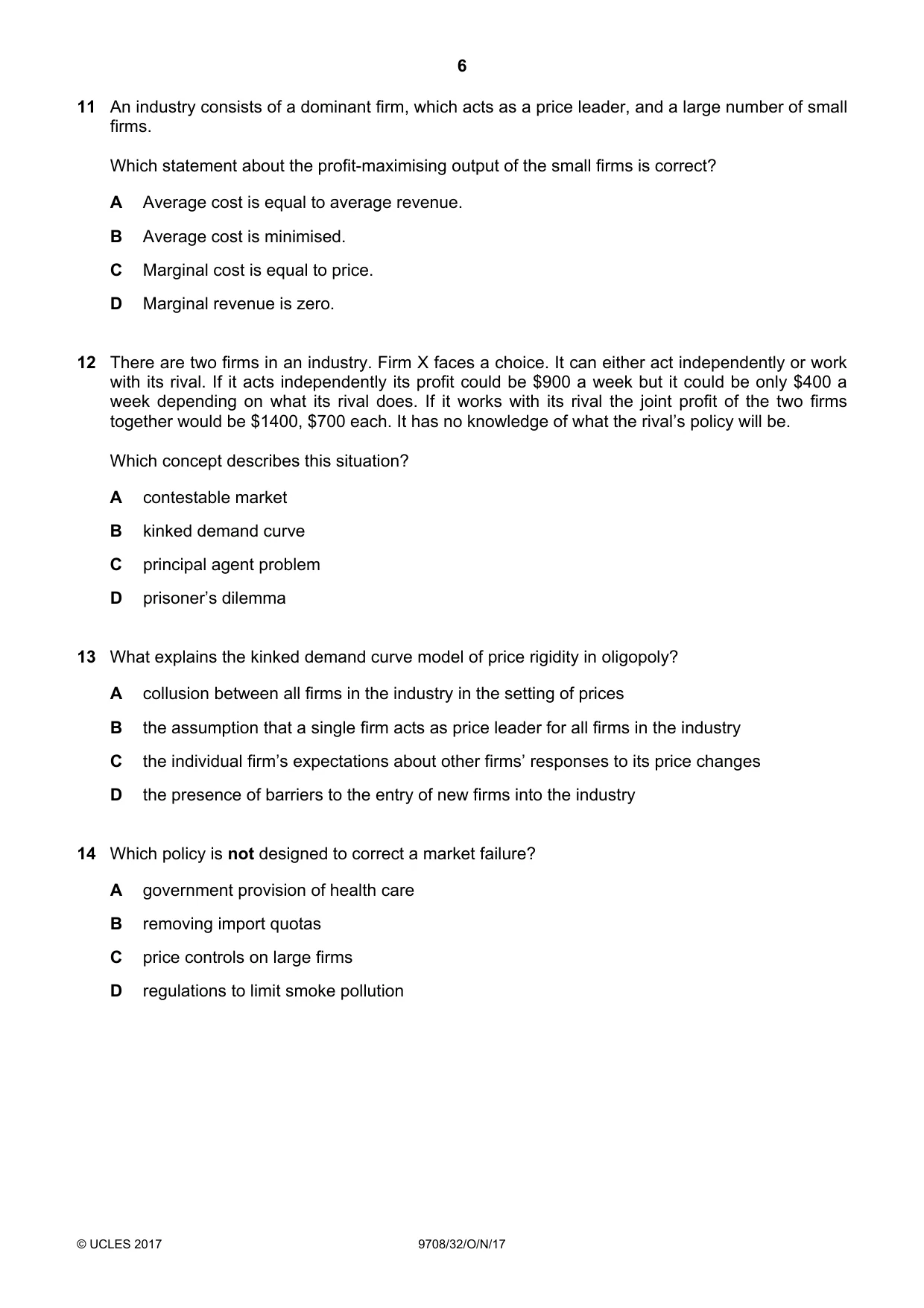
6 © UCLES 2017 9708/32/O/N/17 11 An industry consists of a dominant firm, which acts as a price leader, and a large number of small firms. Which statement about the profit-maximising output of the small firms is correct? A Average cost is equal to average revenue. B Average cost is minimised. C Marginal cost is equal to price. D Marginal revenue is zero. 12 There are two firms in an industry. Firm X faces a choice. It can either act independently or work with its rival. If it acts independently its profit could be $900 a week but it could be only $400 a week depending on what its rival does. If it works with its rival the joint profit of the two firms together would be $1400, $700 each. It has no knowledge of what the rival’s policy will be. Which concept describes this situation? A contestable market B kinked demand curve C principal agent problem D prisoner’s dilemma 13 What explains the kinked demand curve model of price rigidity in oligopoly? A collusion between all firms in the industry in the setting of prices B the assumption that a single firm acts as price leader for all firms in the industry C the individual firm’s expectations about other firms’ responses to its price changes D the presence of barriers to the entry of new firms into the industry 14 Which policy is not designed to correct a market failure? A government provision of health care B removing import quotas C price controls on large firms D regulations to limit smoke pollution
Question paper, page 7
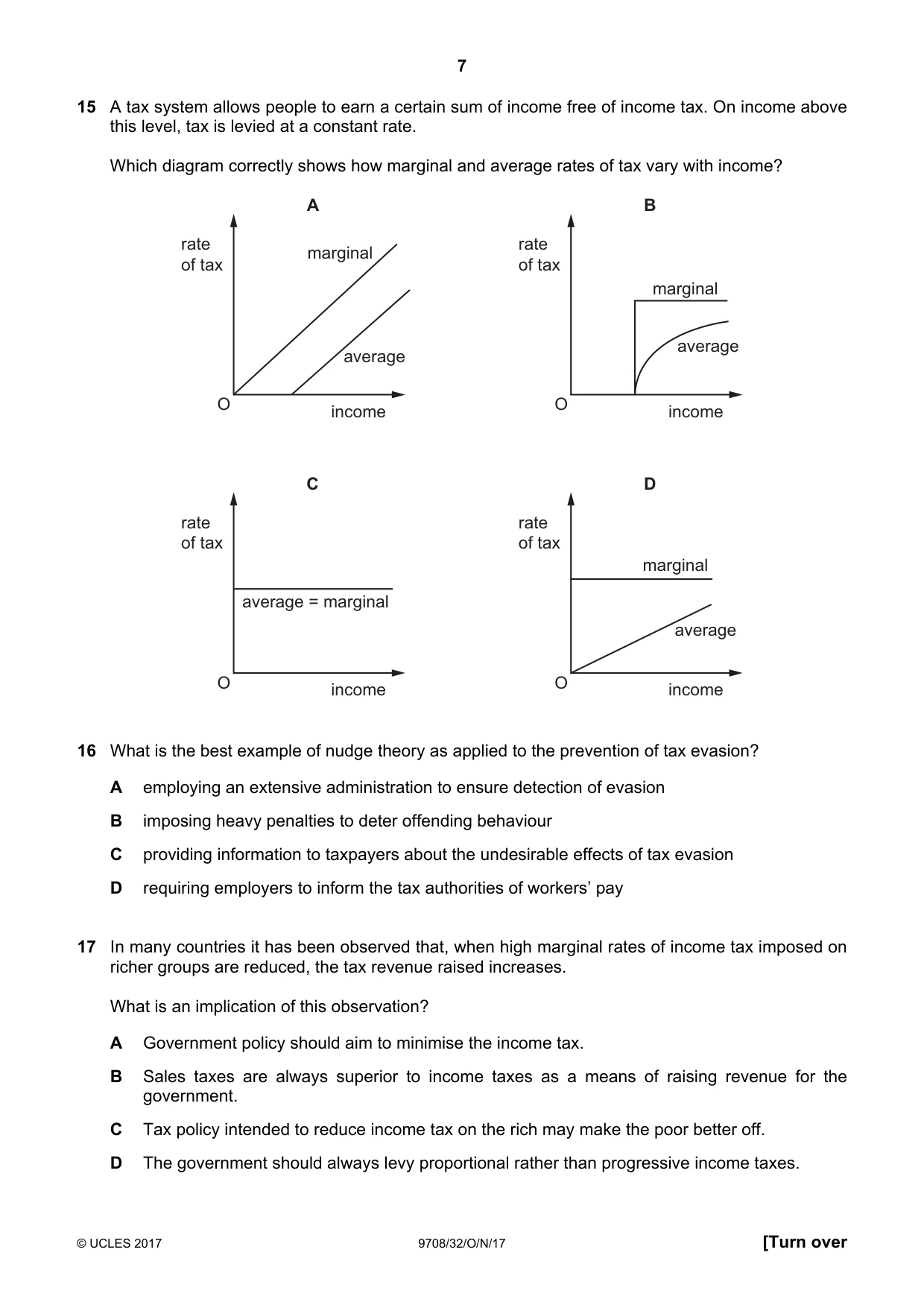
7 © UCLES 2017 9708/32/O/N/17 [Turn over 15 A tax system allows people to earn a certain sum of income free of income tax. On income above this level, tax is levied at a constant rate. Which diagram correctly shows how marginal and average rates of tax vary with income? rate of tax O income marginal average A rate of tax O income marginal average B rate of tax O income average = marginal C rate of tax O income marginal average D 16 What is the best example of nudge theory as applied to the prevention of tax evasion? A employing an extensive administration to ensure detection of evasion B imposing heavy penalties to deter offending behaviour C providing information to taxpayers about the undesirable effects of tax evasion D requiring employers to inform the tax authorities of workers’ pay 17 In many countries it has been observed that, when high marginal rates of income tax imposed on richer groups are reduced, the tax revenue raised increases. What is an implication of this observation? A Government policy should aim to minimise the income tax. B Sales taxes are always superior to income taxes as a means of raising revenue for the government. C Tax policy intended to reduce income tax on the rich may make the poor better off. D The government should always levy proportional rather than progressive income taxes.
Question paper, page 8
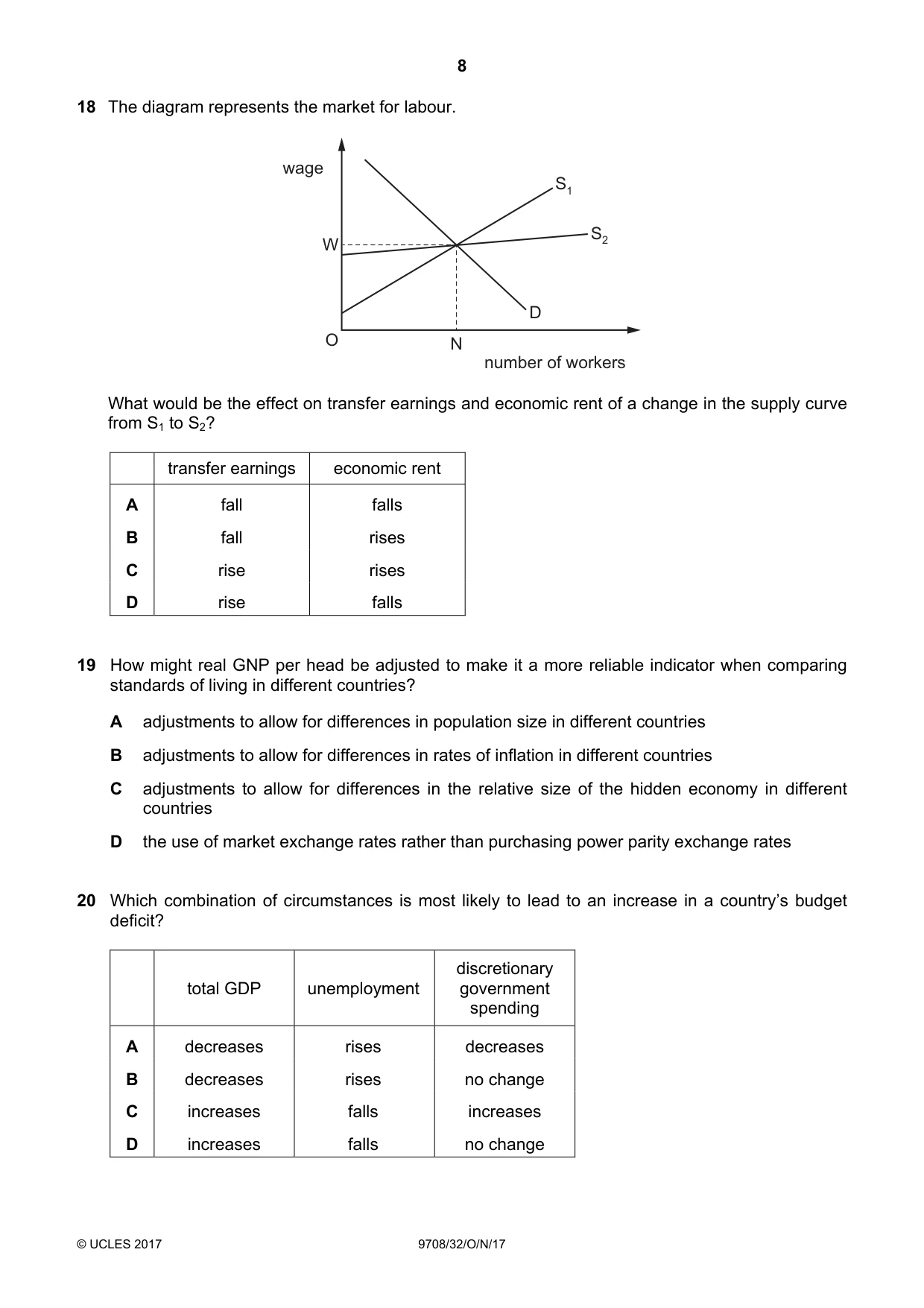
8 © UCLES 2017 9708/32/O/N/17 18 The diagram represents the market for labour. O D number of workers wage S1 S2 W N What would be the effect on transfer earnings and economic rent of a change in the supply curve from S1 to S2? transfer earnings economic rent A fall falls B fall rises C rise rises D rise falls 19 How might real GNP per head be adjusted to make it a more reliable indicator when comparing standards of living in different countries? A adjustments to allow for differences in population size in different countries B adjustments to allow for differences in rates of inflation in different countries C adjustments to allow for differences in the relative size of the hidden economy in different countries D the use of market exchange rates rather than purchasing power parity exchange rates 20 Which combination of circumstances is most likely to lead to an increase in a country’s budget deficit? total GDP unemployment discretionary government spending A decreases rises decreases B decreases rises no change C increases falls increases D increases falls no change
Question paper, page 9
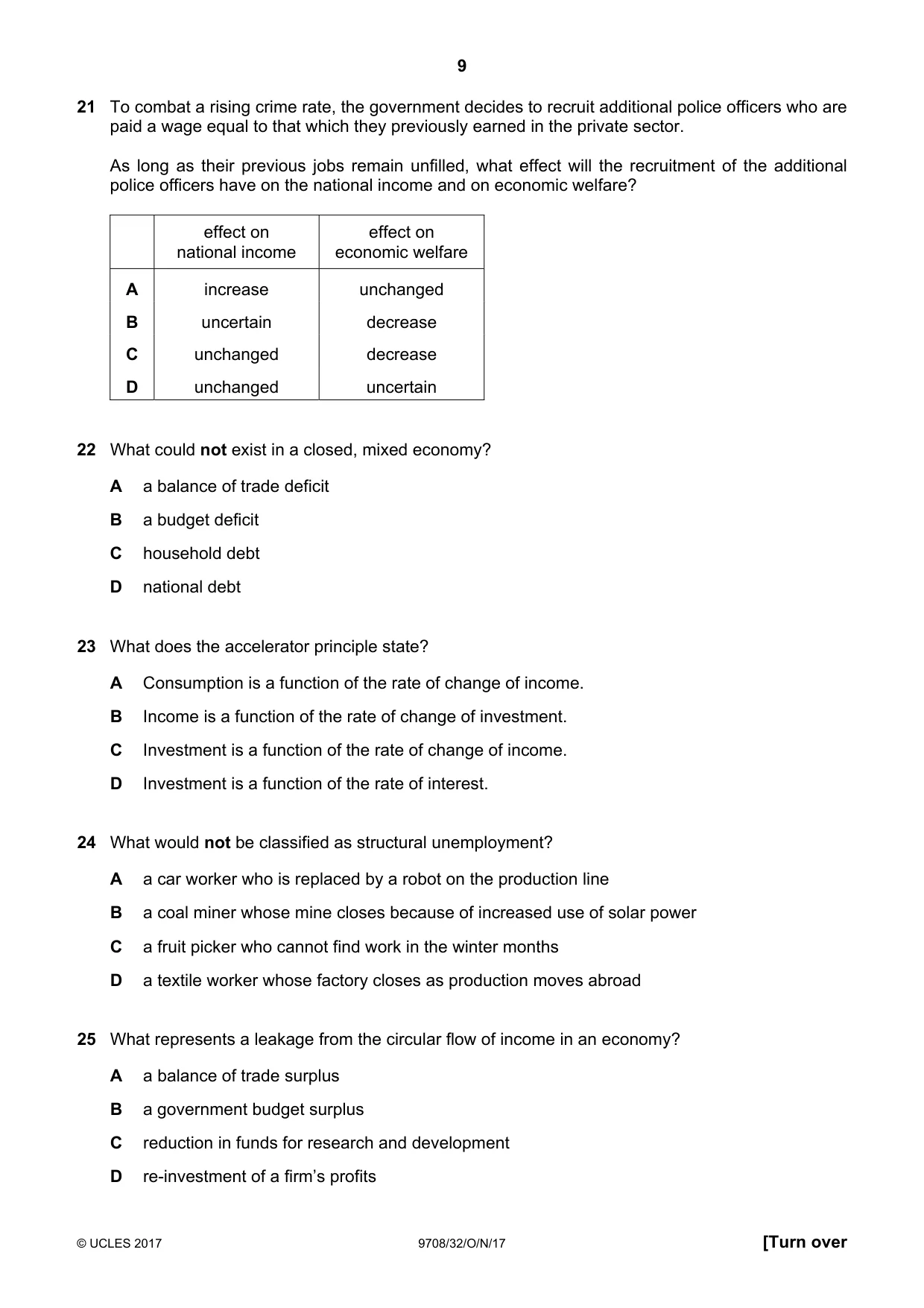
9 © UCLES 2017 9708/32/O/N/17 [Turn over 21 To combat a rising crime rate, the government decides to recruit additional police officers who are paid a wage equal to that which they previously earned in the private sector. As long as their previous jobs remain unfilled, what effect will the recruitment of the additional police officers have on the national income and on economic welfare? effect on national income effect on economic welfare A increase unchanged B uncertain decrease C unchanged decrease D unchanged uncertain 22 What could not exist in a closed, mixed economy? A a balance of trade deficit B a budget deficit C household debt D national debt 23 What does the accelerator principle state? A Consumption is a function of the rate of change of income. B Income is a function of the rate of change of investment. C Investment is a function of the rate of change of income. D Investment is a function of the rate of interest. 24 What would not be classified as structural unemployment? A a car worker who is replaced by a robot on the production line B a coal miner whose mine closes because of increased use of solar power C a fruit picker who cannot find work in the winter months D a textile worker whose factory closes as production moves abroad 25 What represents a leakage from the circular flow of income in an economy? A a balance of trade surplus B a government budget surplus C reduction in funds for research and development D re-investment of a firm’s profits
Question paper, page 10
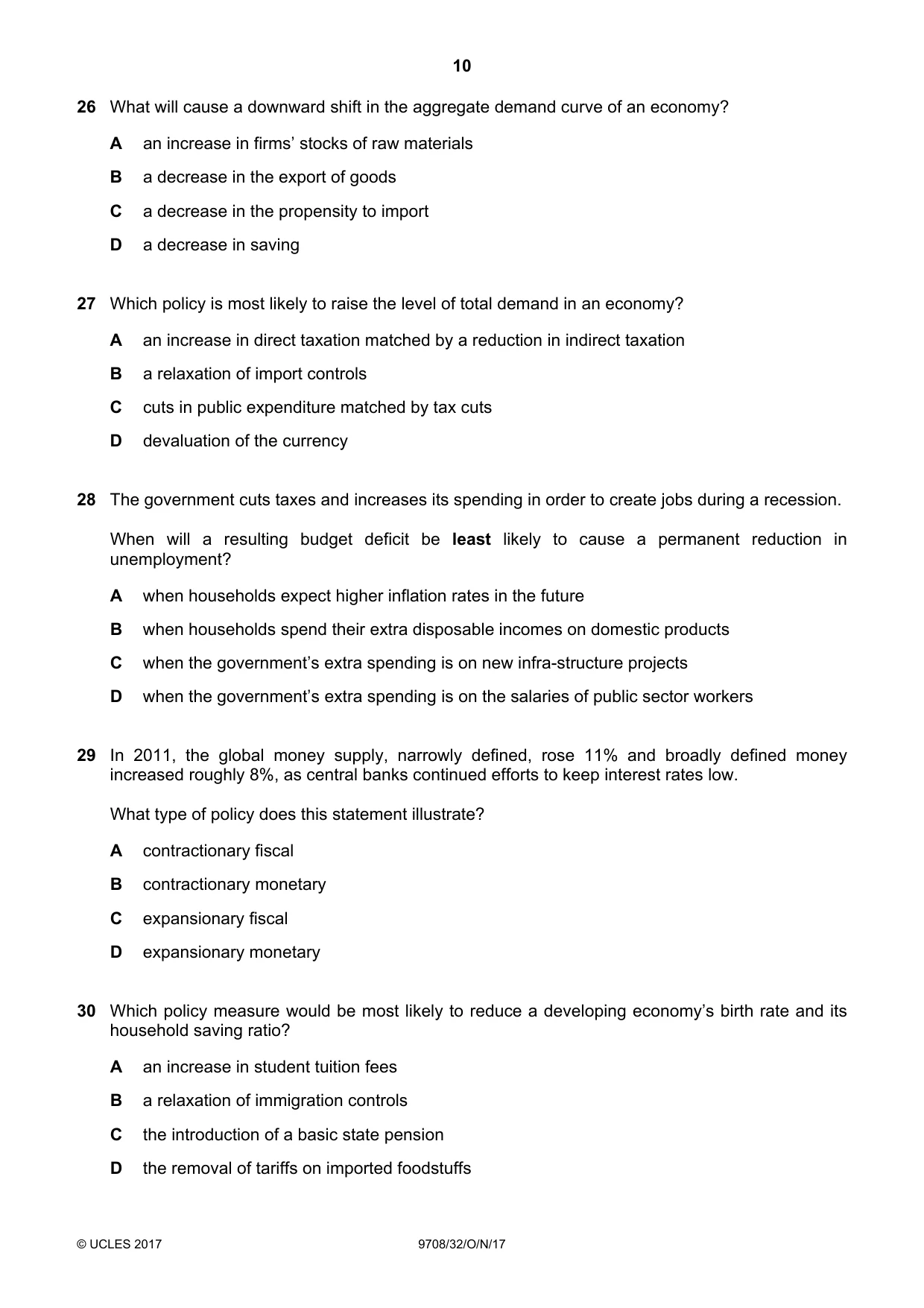
10 © UCLES 2017 9708/32/O/N/17 26 What will cause a downward shift in the aggregate demand curve of an economy? A an increase in firms’ stocks of raw materials B a decrease in the export of goods C a decrease in the propensity to import D a decrease in saving 27 Which policy is most likely to raise the level of total demand in an economy? A an increase in direct taxation matched by a reduction in indirect taxation B a relaxation of import controls C cuts in public expenditure matched by tax cuts D devaluation of the currency 28 The government cuts taxes and increases its spending in order to create jobs during a recession. When will a resulting budget deficit be least likely to cause a permanent reduction in unemployment? A when households expect higher inflation rates in the future B when households spend their extra disposable incomes on domestic products C when the government’s extra spending is on new infra-structure projects D when the government’s extra spending is on the salaries of public sector workers 29 In 2011, the global money supply, narrowly defined, rose 11% and broadly defined money increased roughly 8%, as central banks continued efforts to keep interest rates low. What type of policy does this statement illustrate? A contractionary fiscal B contractionary monetary C expansionary fiscal D expansionary monetary 30 Which policy measure would be most likely to reduce a developing economy’s birth rate and its household saving ratio? A an increase in student tuition fees B a relaxation of immigration controls C the introduction of a basic state pension D the removal of tariffs on imported foodstuffs
Question paper, page 11
11 BLANK PAGE © UCLES 2017 9708/32/O/N/17
Question paper, page 12
12 BLANK PAGE Permission to reproduce items where third-party owned material protected by copyright is included has been sought and cleared where possible. Every reasonable effort has been made by the publisher (UCLES) to trace copyright holders, but if any items requiring clearance have unwittingly been included, the publisher will be pleased to make amends at the earliest possible opportunity. To avoid the issue of disclosure of answer-related information to candidates, all copyright acknowledgements are reproduced online in the Cambridge International Examinations Copyright Acknowledgements Booklet. This is produced for each series of examinations and is freely available to download at www.cie.org.uk after the live examination series. Cambridge International Examinations is part of the Cambridge Assessment Group. Cambridge Assessment is the brand name of University of Cambridge Local Examinations Syndicate (UCLES), which is itself a department of the University of Cambridge. © UCLES 2017 9708/32/O/N/17
What you needed in this session
Cambridge’s own grade thresholds for 2017 Oct/Nov, Paper 3 · Variant 2. A higher threshold means an easier paper — the bar moves with how the cohort did.