Cambridge A Level Economics 9708 — 2017 Oct/Nov Paper 3 · Variant 3
9708/33/O/N/17 · 30 marks · ≈34 min
The question paper and its mark scheme, free to read here and free to download. This is Cambridge’s own paper, exactly as it was sat.
Question paper12 pages





Mark scheme3 pages
Answers below. Sit the paper first if you are practising.

Paper as text
Question paper, page 1
This document consists of 10 printed pages and 2 blank pages. IB17 11_9708_33/RP © UCLES 2017 [Turn over *9493723111* Cambridge International Examinations Cambridge International Advanced Subsidiary and Advanced Level ECONOMICS 9708/33 Paper 3 Multiple Choice October/November 2017 1 hour 15 minutes Additional Materials: Multiple Choice Answer Sheet Soft clean eraser Soft pencil (type B or HB is recommended) READ THESE INSTRUCTIONS FIRST Write in soft pencil. Do not use staples, paper clips, glue or correction fluid. Write your name, Centre number and candidate number on the Answer Sheet in the spaces provided unless this has been done for you. DO NOT WRITE IN ANY BARCODES. There are thirty questions on this paper. Answer all questions. For each question there are four possible answers A, B, C and D. Choose the one you consider correct and record your choice in soft pencil on the separate Answer Sheet. Read the instructions on the Answer Sheet very carefully. Each correct answer will score one mark. A mark will not be deducted for a wrong answer. Any rough working should be done in this booklet.
Question paper, page 2
2 © UCLES 2017 9708/33/O/N/17 1 Why do governments often subsidise the cost of entrance to museums? A Museums are a pure public good. B Social benefits are less than social costs. C Social benefits exceed private benefits. D Social costs exceed private costs. 2 The table shows the marginal costs of production and marginal benefits of consumption. marginal private cost ($) marginal social cost ($) marginal private benefit ($) marginal social benefit ($) 100 150 150 200 What is demonstrated in these values? A a negative consumption externality B a positive production externality C Pareto optimality D resource misallocation 3 A cost-benefit analysis concludes that a nuclear power station project might be socially worthwhile, although it will take 10 years to bring into operation. Why might a government decide not to undertake the project? A Cost-benefit analysis has no method for valuing the long-term impact of a project. B Cost-benefit analysis is only suitable for private sector projects. C The government believes that the project has too high an opportunity cost. D The government’s policy is to restrict the extent of the market system.
Question paper, page 3
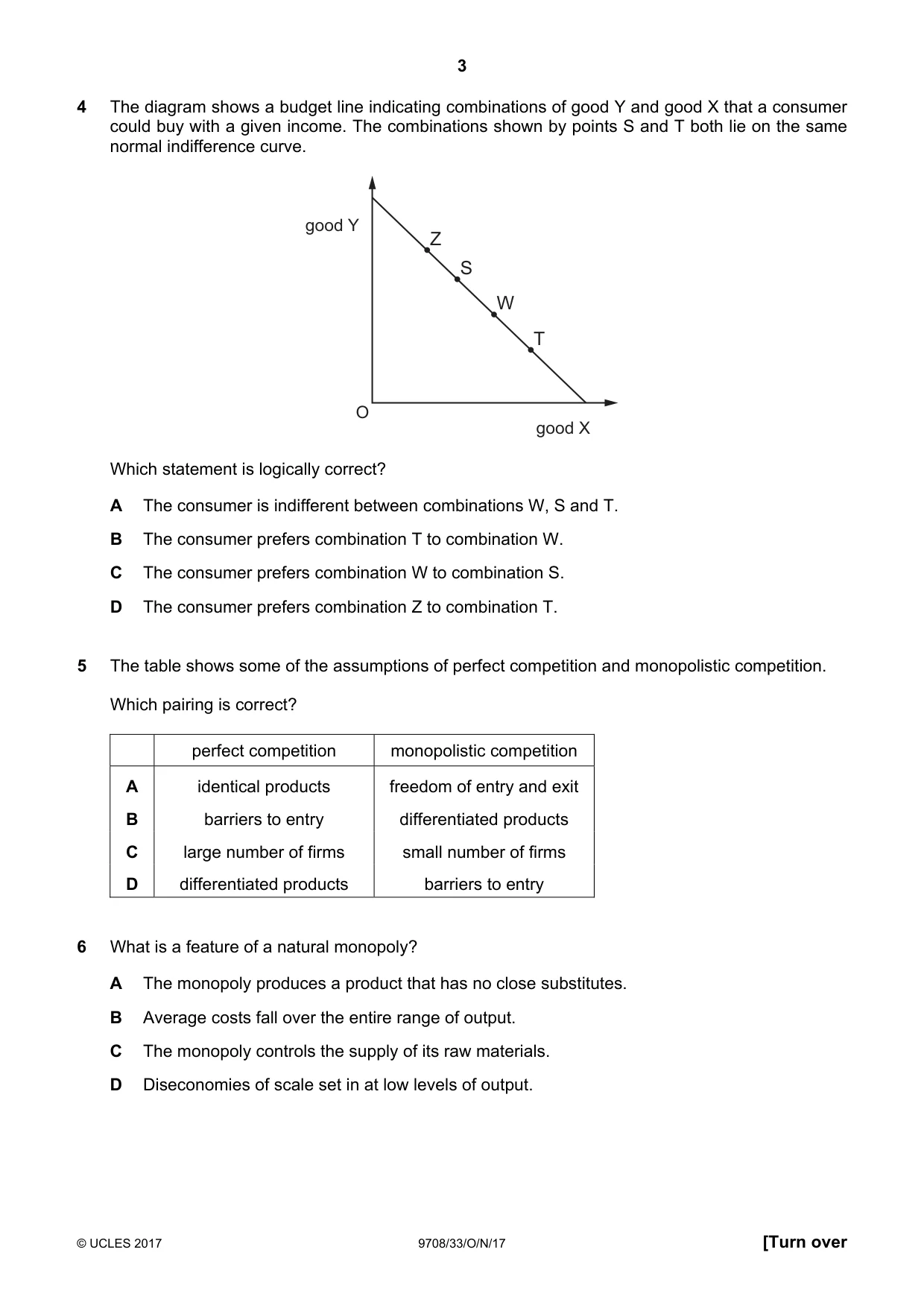
3 © UCLES 2017 9708/33/O/N/17 [Turn over 4 The diagram shows a budget line indicating combinations of good Y and good X that a consumer could buy with a given income. The combinations shown by points S and T both lie on the same normal indifference curve. good Y good X O Z S W T Which statement is logically correct? A The consumer is indifferent between combinations W, S and T. B The consumer prefers combination T to combination W. C The consumer prefers combination W to combination S. D The consumer prefers combination Z to combination T. 5 The table shows some of the assumptions of perfect competition and monopolistic competition. Which pairing is correct? perfect competition monopolistic competition A identical products freedom of entry and exit B barriers to entry differentiated products C large number of firms small number of firms D differentiated products barriers to entry 6 What is a feature of a natural monopoly? A The monopoly produces a product that has no close substitutes. B Average costs fall over the entire range of output. C The monopoly controls the supply of its raw materials. D Diseconomies of scale set in at low levels of output.
Question paper, page 4
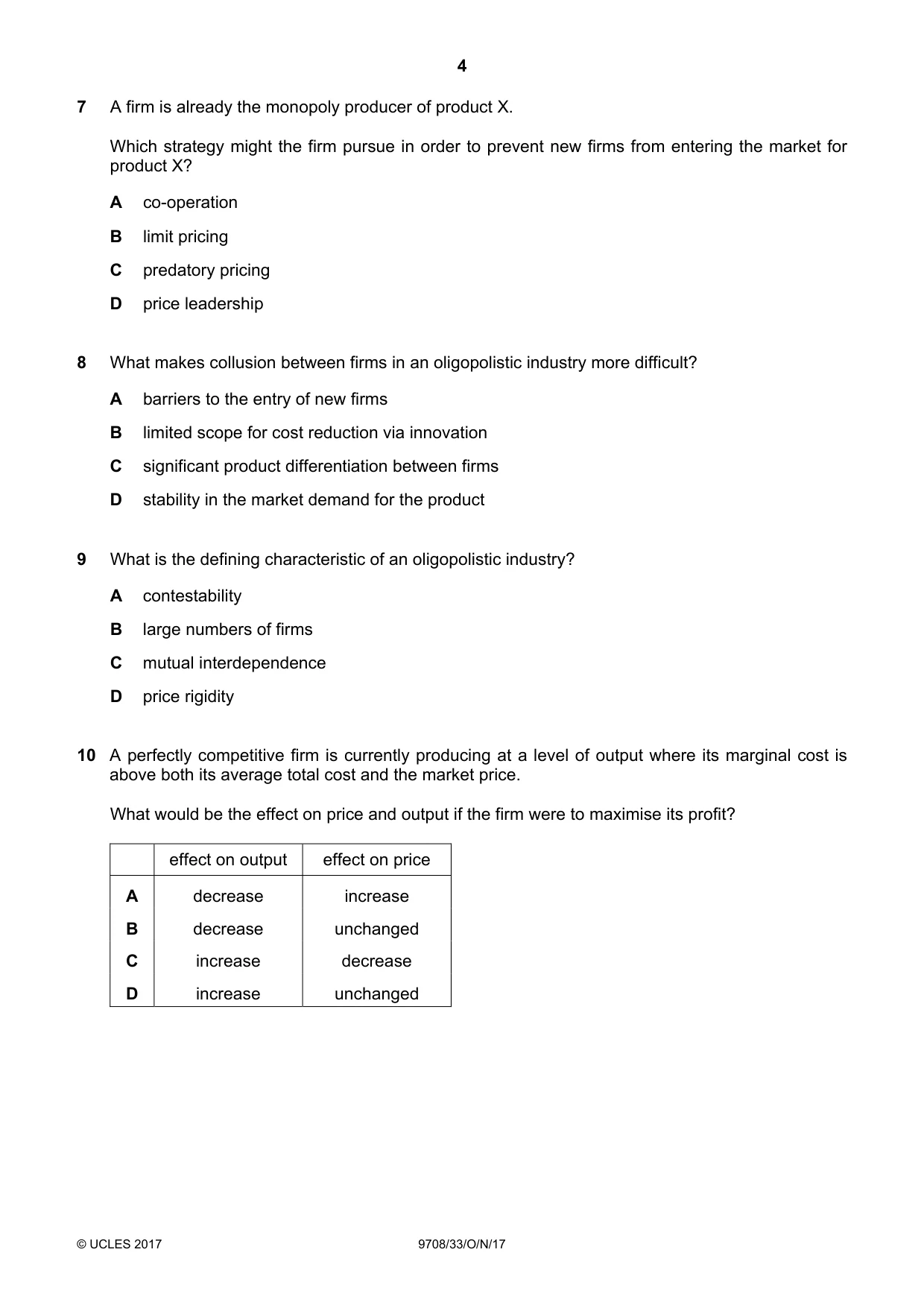
4 © UCLES 2017 9708/33/O/N/17 7 A firm is already the monopoly producer of product X. Which strategy might the firm pursue in order to prevent new firms from entering the market for product X? A co-operation B limit pricing C predatory pricing D price leadership 8 What makes collusion between firms in an oligopolistic industry more difficult? A barriers to the entry of new firms B limited scope for cost reduction via innovation C significant product differentiation between firms D stability in the market demand for the product 9 What is the defining characteristic of an oligopolistic industry? A contestability B large numbers of firms C mutual interdependence D price rigidity 10 A perfectly competitive firm is currently producing at a level of output where its marginal cost is above both its average total cost and the market price. What would be the effect on price and output if the firm were to maximise its profit? effect on output effect on price A decrease increase B decrease unchanged C increase decrease D increase unchanged
Question paper, page 5
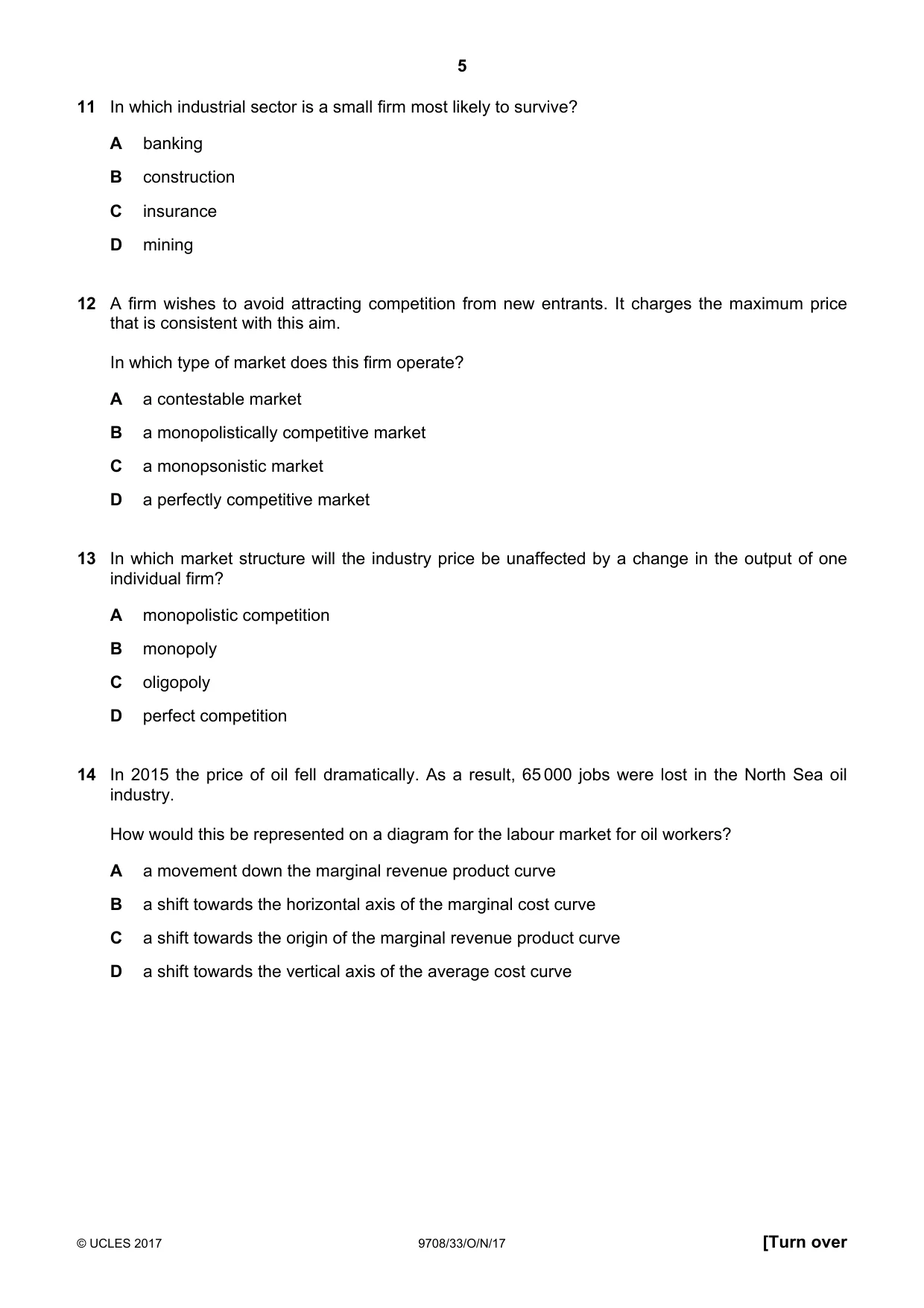
5 © UCLES 2017 9708/33/O/N/17 [Turn over 11 In which industrial sector is a small firm most likely to survive? A banking B construction C insurance D mining 12 A firm wishes to avoid attracting competition from new entrants. It charges the maximum price that is consistent with this aim. In which type of market does this firm operate? A a contestable market B a monopolistically competitive market C a monopsonistic market D a perfectly competitive market 13 In which market structure will the industry price be unaffected by a change in the output of one individual firm? A monopolistic competition B monopoly C oligopoly D perfect competition 14 In 2015 the price of oil fell dramatically. As a result, 65 000 jobs were lost in the North Sea oil industry. How would this be represented on a diagram for the labour market for oil workers? A a movement down the marginal revenue product curve B a shift towards the horizontal axis of the marginal cost curve C a shift towards the origin of the marginal revenue product curve D a shift towards the vertical axis of the average cost curve
Question paper, page 6
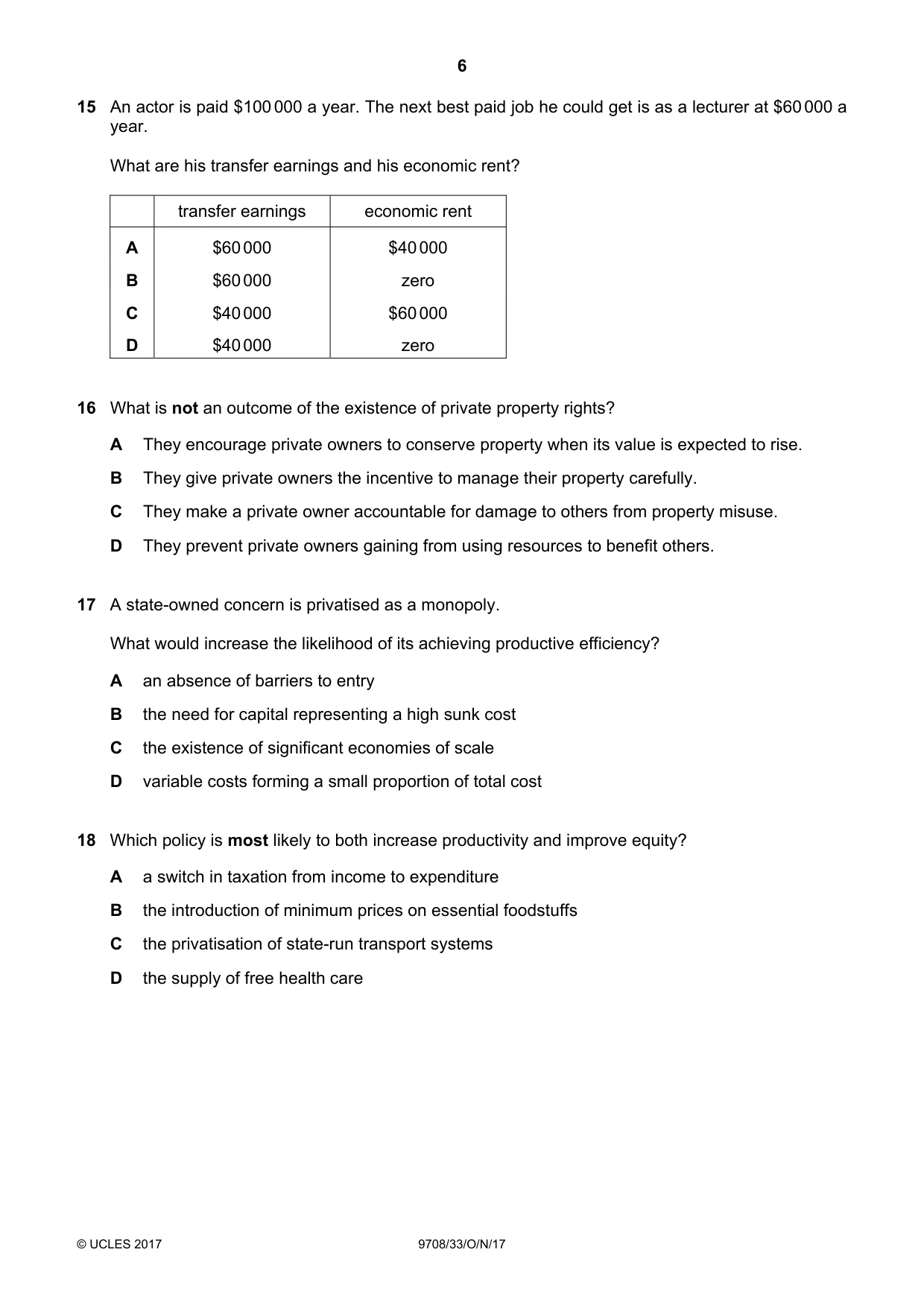
6 © UCLES 2017 9708/33/O/N/17 15 An actor is paid $100 000 a year. The next best paid job he could get is as a lecturer at $60 000 a year. What are his transfer earnings and his economic rent? transfer earnings economic rent A $60 000 $40 000 B $60 000 zero C $40 000 $60 000 D $40 000 zero 16 What is not an outcome of the existence of private property rights? A They encourage private owners to conserve property when its value is expected to rise. B They give private owners the incentive to manage their property carefully. C They make a private owner accountable for damage to others from property misuse. D They prevent private owners gaining from using resources to benefit others. 17 A state-owned concern is privatised as a monopoly. What would increase the likelihood of its achieving productive efficiency? A an absence of barriers to entry B the need for capital representing a high sunk cost C the existence of significant economies of scale D variable costs forming a small proportion of total cost 18 Which policy is most likely to both increase productivity and improve equity? A a switch in taxation from income to expenditure B the introduction of minimum prices on essential foodstuffs C the privatisation of state-run transport systems D the supply of free health care
Question paper, page 7
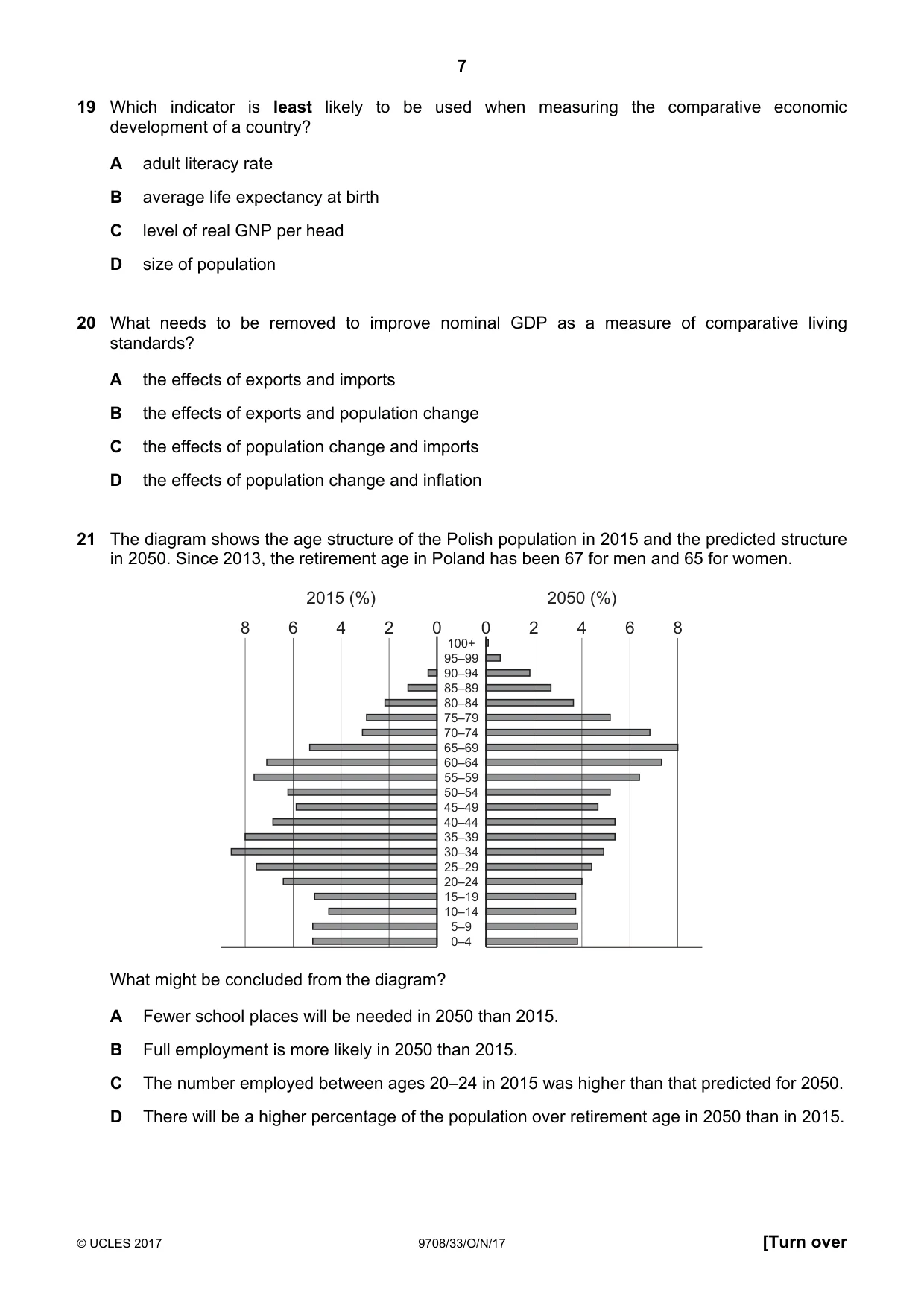
7 © UCLES 2017 9708/33/O/N/17 [Turn over 19 Which indicator is least likely to be used when measuring the comparative economic development of a country? A adult literacy rate B average life expectancy at birth C level of real GNP per head D size of population 20 What needs to be removed to improve nominal GDP as a measure of comparative living standards? A the effects of exports and imports B the effects of exports and population change C the effects of population change and imports D the effects of population change and inflation 21 The diagram shows the age structure of the Polish population in 2015 and the predicted structure in 2050. Since 2013, the retirement age in Poland has been 67 for men and 65 for women. 0 0 2 2 4 4 6 6 8 8 100+ 95–99 90–94 85–89 80–84 75–79 70–74 65–69 60–64 55–59 50–54 45–49 40–44 35–39 30–34 25–29 20–24 15–19 10–14 5–9 0–4 2015 (%) 2050 (%) What might be concluded from the diagram? A Fewer school places will be needed in 2050 than 2015. B Full employment is more likely in 2050 than 2015. C The number employed between ages 20–24 in 2015 was higher than that predicted for 2050. D There will be a higher percentage of the population over retirement age in 2050 than in 2015.
Question paper, page 8
8 © UCLES 2017 9708/33/O/N/17 22 The table gives information on differences between females and males in 2013 in the Human Development Index and Gross National Income per capita in countries with different levels of development. HDI GNI per capita (US $ purchasing power parity 2011) female male female male very high development .871 .887 26 667 53 681 high development .710 .733 9 426 16 966 medium development .565 .622 3 199 8 619 low development .446 .506 2 011 3 789 What can be concluded from the table? A Females are closer to males in earning ability than in development opportunities. B Females are closest to males in development opportunities in countries with low development. C Males have over twice the purchasing power of females in countries with very high development. D The table ignores the different level of educational attainment between females and males. 23 In an economy with no government sector: C = consumption I = investment X = exports M = imports Y = national income. If C = 40 + 0.5Y, I = 80, X = 100 and M = 100, what will be the equilibrium level of Y? A 60 B 240 C 280 D 640
Question paper, page 9
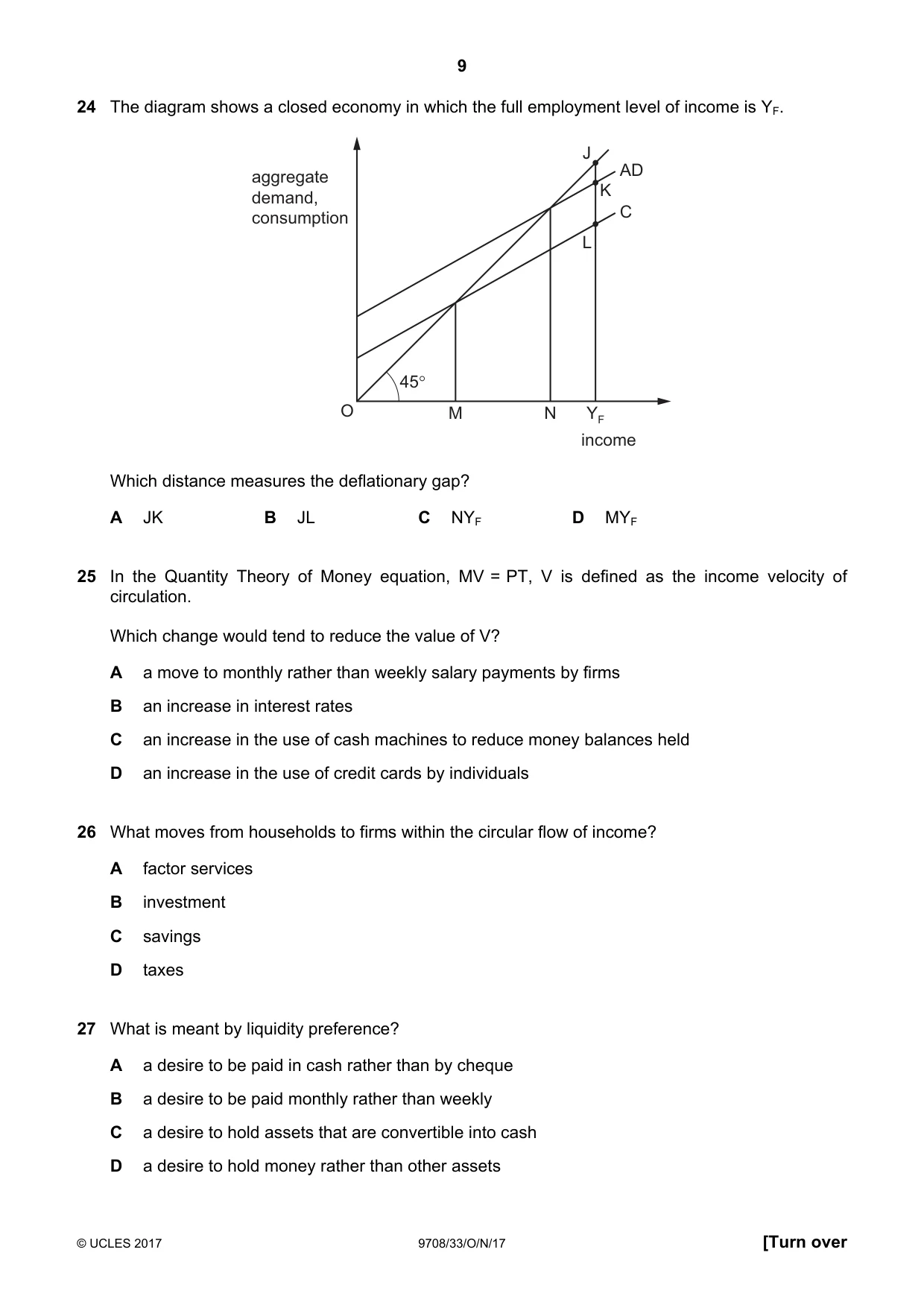
9 © UCLES 2017 9708/33/O/N/17 [Turn over 24 The diagram shows a closed economy in which the full employment level of income is YF. 45° O M N income YF aggregate demand, consumption J AD K C L Which distance measures the deflationary gap? A JK B JL C NYF D MYF 25 In the Quantity Theory of Money equation, MV = PT, V is defined as the income velocity of circulation. Which change would tend to reduce the value of V? A a move to monthly rather than weekly salary payments by firms B an increase in interest rates C an increase in the use of cash machines to reduce money balances held D an increase in the use of credit cards by individuals 26 What moves from households to firms within the circular flow of income? A factor services B investment C savings D taxes 27 What is meant by liquidity preference? A a desire to be paid in cash rather than by cheque B a desire to be paid monthly rather than weekly C a desire to hold assets that are convertible into cash D a desire to hold money rather than other assets
Question paper, page 10
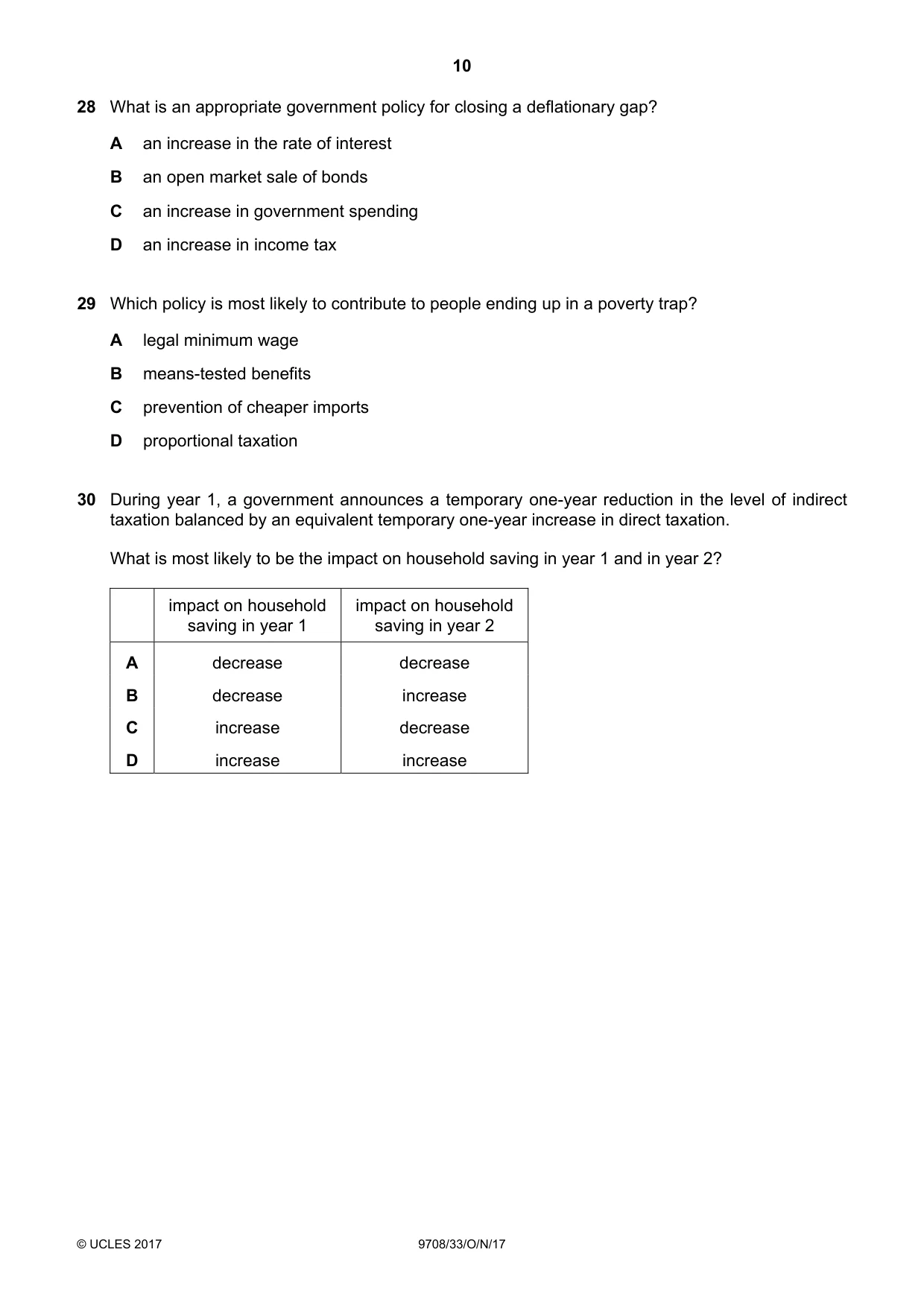
10 © UCLES 2017 9708/33/O/N/17 28 What is an appropriate government policy for closing a deflationary gap? A an increase in the rate of interest B an open market sale of bonds C an increase in government spending D an increase in income tax 29 Which policy is most likely to contribute to people ending up in a poverty trap? A legal minimum wage B means-tested benefits C prevention of cheaper imports D proportional taxation 30 During year 1, a government announces a temporary one-year reduction in the level of indirect taxation balanced by an equivalent temporary one-year increase in direct taxation. What is most likely to be the impact on household saving in year 1 and in year 2? impact on household saving in year 1 impact on household saving in year 2 A decrease decrease B decrease increase C increase decrease D increase increase
Question paper, page 11
11 BLANK PAGE © UCLES 2017 9708/33/O/N/17
Question paper, page 12
12 BLANK PAGE Permission to reproduce items where third-party owned material protected by copyright is included has been sought and cleared where possible. Every reasonable effort has been made by the publisher (UCLES) to trace copyright holders, but if any items requiring clearance have unwittingly been included, the publisher will be pleased to make amends at the earliest possible opportunity. To avoid the issue of disclosure of answer-related information to candidates, all copyright acknowledgements are reproduced online in the Cambridge International Examinations Copyright Acknowledgements Booklet. This is produced for each series of examinations and is freely available to download at www.cie.org.uk after the live examination series. Cambridge International Examinations is part of the Cambridge Assessment Group. Cambridge Assessment is the brand name of University of Cambridge Local Examinations Syndicate (UCLES), which is itself a department of the University of Cambridge. © UCLES 2017 9708/33/O/N/17
Mark scheme, page 1
® IGCSE is a registered trademark. This document consists of 3 printed pages. © UCLES 2017 [Turn over Cambridge Assessment International Education Cambridge International Advanced Subsidiary and Advanced Level ECONOMICS 9708/33 Paper 3 Multiple Choice October/November 2017 MARK SCHEME Maximum Mark: 30 Published This mark scheme is published as an aid to teachers and candidates, to indicate the requirements of the examination. Mark schemes should be read in conjunction with the question paper and the Principal Examiner Report for Teachers. Cambridge International will not enter into discussions about these mark schemes. Cambridge International is publishing the mark schemes for the October/November 2017 series for most Cambridge IGCSE®, Cambridge International A and AS Level components and some Cambridge O Level components.
Mark scheme, page 2
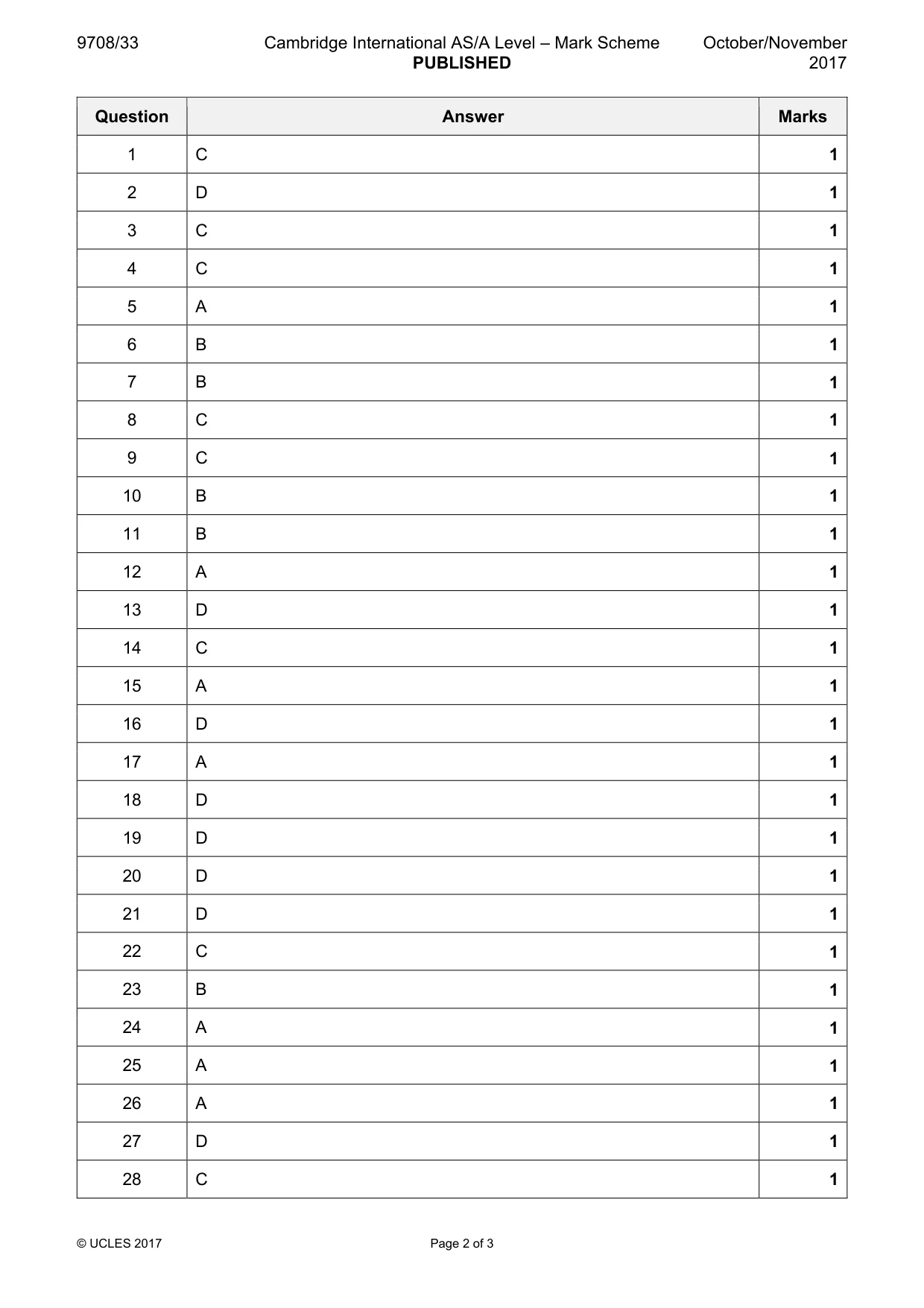
9708/33 Cambridge International AS/A Level – Mark Scheme PUBLISHED October/November 2017 © UCLES 2017 Page 2 of 3 Question Answer Marks 1 C 1 2 D 1 3 C 1 4 C 1 5 A 1 6 B 1 7 B 1 8 C 1 9 C 1 10 B 1 11 B 1 12 A 1 13 D 1 14 C 1 15 A 1 16 D 1 17 A 1 18 D 1 19 D 1 20 D 1 21 D 1 22 C 1 23 B 1 24 A 1 25 A 1 26 A 1 27 D 1 28 C 1
Mark scheme, page 3
9708/33 Cambridge International AS/A Level – Mark Scheme PUBLISHED October/November 2017 © UCLES 2017 Page 3 of 3 Question Answer Marks 29 B 1 30 B 1
What you needed in this session
Cambridge’s own grade thresholds for 2017 Oct/Nov, Paper 3 · Variant 3. A higher threshold means an easier paper — the bar moves with how the cohort did.