Cambridge A Level Design and Textiles 9631 — 2021 Oct/Nov Paper 1 · Variant 0
9631/10/O/N/21 · 75 marks · ≈84 min
The question paper and its mark scheme, free to read here and free to download. This is Cambridge’s own paper, exactly as it was sat.
Question paper4 pages
Mark scheme
No mark scheme is in the library for this paper.
Paper as text
Question paper, page 1
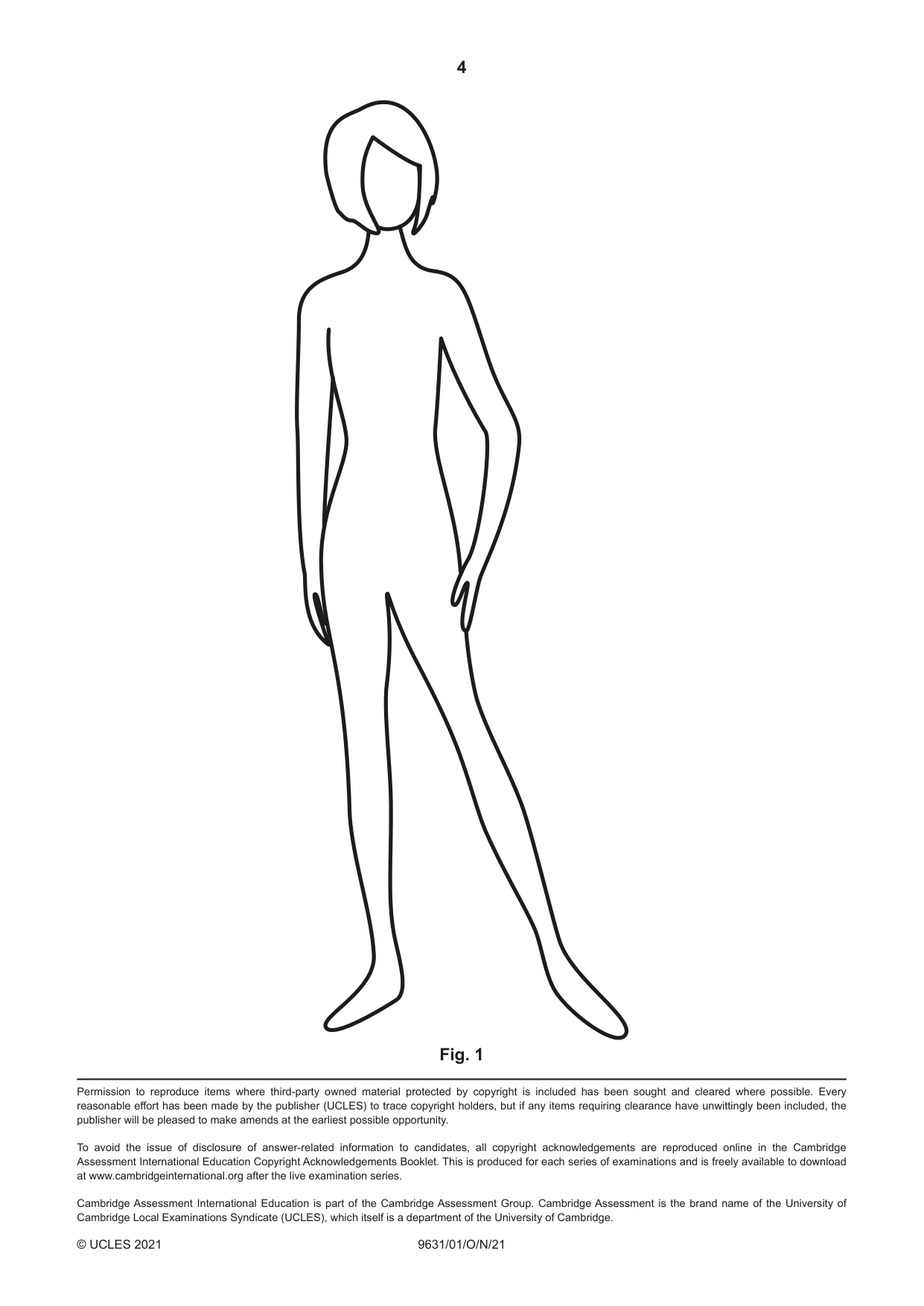
This document has 4 pages. Cambridge International AS & A Level DESIGN & TEXTILES 9631/01 Paper 1 Fibres, Fabrics and Design October/November 2021 2 hours You must answer on the enclosed answer booklet. You will need: Answer booklet (enclosed) INSTRUCTIONS ● Answer three questions in total: Section A: answer both questions. Section B: answer one question. ● Follow the instructions on the front cover of the answer booklet. If you need additional answer paper, ask the invigilator for a continuation booklet. ● You should illustrate your answers with clear, bold diagrams. ● Use Fig. 1 on page 4 to produce outlines for your sketches. Place the figure under a sheet of paper in the answer booklet and trace the outline in pencil. INFORMATION ● The total mark for this paper is 75. ● The number of marks for each question or part question is shown in brackets [ ]. DC (MB) 206070/1 © UCLES 2021 [Turn over * 2 3 7 0 2 4 8 0 3 2 *
Question paper, page 2
2 9631/01/O/N/21 © UCLES 2021 Section A Answer both questions in section A 1 Synthetic fibres and fabrics are widely used in the production of textile items. (a) State the source of the following fibres and for each give one example of its use (i) Polyamide fibre [2] (ii) Chlorofibre [2] (b) Compare the following performance characteristics of polyamide fibres and chlorofibres with reference to (i) Absorbency [3] (ii) Strength [3] (c) Discuss the differences in the care of fabrics made from polyester fibres and fabrics made from cotton fibres. [7] (d) Evaluate the advantages of blending synthetic fibres with natural fibres. Give specific examples of fibres in your answer. [8] [Total: 25] 2 A range of fabric constructions can be used for clothing. (a) (i) Draw a labelled diagram to show how each of the following fabrics are constructed • Satin fabric • Twill fabric [2] (ii) Describe the appearance of each of the fabrics in 2(a)(i). [4] (b) Identify one item of clothing that could be made from each fabric named in 2(a)(i). Explain why each fabric is suitable. [6] (c) Compare loop-pile fabrics and cut-pile fabrics. Include examples to support your answer. [6] (d) Discuss how new developments in fibre technology are producing more environmentally friendly fibres. Include examples of fibres and fabrics to support your answer. [7] [Total: 25]
Question paper, page 3
3 9631/01/O/N/21 © UCLES 2021 [Turn over Section B Answer one question in section B 3 Shorts are a popular summer garment. (a) (i) Sketch and label a design for a pair of summer shorts that includes two style features inspired by a past fashion trend. Identify the fashion trend. [4] (ii) Explain why your design sketched in 3(a)(i) is a good design. [3] (b) Discuss the different manufacturing methods available to produce the shorts sketched in 3(a)(i). [10] (c) Discuss how the fashion cycle influences the design of fashion garments. Include examples to support your answer. [8] [Total: 25] 4 Clothing manufacture includes many processes. (a) Explain what is meant by the following processes used in industrial production (i) Grading [2] (ii) Lay planning [2] (b) Compare one manual process used to mark fabrics with one industrial process used to mark fabrics. [4] (c) Discuss the factors which a manufacturer would need to consider when choosing the type of edge finish for a garment. Include examples to support your answer. [8] (d) Assess the advantages and disadvantages for consumers of using e-commerce compared to retail outlets to purchase fashionable clothing. [9] [Total: 25]
Question paper, page 4
4 9631/01/O/N/21 © UCLES 2021 Permission to reproduce items where third-party owned material protected by copyright is included has been sought and cleared where possible. Every reasonable effort has been made by the publisher (UCLES) to trace copyright holders, but if any items requiring clearance have unwittingly been included, the publisher will be pleased to make amends at the earliest possible opportunity. To avoid the issue of disclosure of answer-related information to candidates, all copyright acknowledgements are reproduced online in the Cambridge Assessment International Education Copyright Acknowledgements Booklet. This is produced for each series of examinations and is freely available to download at www.cambridgeinternational.org after the live examination series. Cambridge Assessment International Education is part of the Cambridge Assessment Group. Cambridge Assessment is the brand name of the University of Cambridge Local Examinations Syndicate (UCLES), which itself is a department of the University of Cambridge. Fig. 1
What you needed in this session
Cambridge’s own grade thresholds for 2021 Oct/Nov, Paper 1 · Variant 0. A higher threshold means an easier paper — the bar moves with how the cohort did.