Cambridge A Level Design and Technology 9705 — 2015 Oct/Nov Paper 1 · Variant 1
9705/11/O/N/15 · 120 marks · ≈135 min
The question paper and its mark scheme, free to read here and free to download. This is Cambridge’s own paper, exactly as it was sat.
Question paper12 pages
Mark scheme5 pages
Answers below. Sit the paper first if you are practising.
Paper as text
Question paper, page 1
This document consists of 11 printed pages and 1 blank page. DC (NF/CGW) 102269/3 © UCLES 2015 [Turn over Cambridge International Examinations Cambridge International Advanced Subsidiary and Advanced Level * 8 6 4 3 1 8 0 8 6 5 * DESIGN AND TECHNOLOGY 9705/11 Paper 1 October/November 2015 3 hours Additional Materials: Answer Booklet/A4 Paper A3 Drawing Paper (2 sheets) Extra sheets of A3 drawing paper for candidates who have used up both sides of their 2 sheets A range of design drawing equipment READ THESE INSTRUCTIONS FIRST If you have been given an Answer Booklet, follow the instructions on the front cover of the Booklet. Write your answers and working on the separate Answer Booklet/Paper provided. Write your name, Centre number and candidate number on all the work you hand in. Write in dark blue or black pen. You may use an HB pencil, or coloured pencils/pens as appropriate, for any diagrams, graphs or rough working. Do not use staples, paper clips, glue or correction fluid. DO NOT WRITE IN ANY BARCODES. Section A Answer one question on the Answer Booklet/A4 Paper provided. Section B Answer one question on the Answer Booklet/A4 Paper provided. Section C Answer one question on plain A3 paper. Use both sides of the paper. You may request additional sheets of A3 paper, but only if you have used up both sides of each of the 2 sheets provided. You are advised to spend 30 minutes on each of Sections A and B and 2 hours on Section C. At the end of the examination, fasten all your work securely together. The number of marks is given in brackets [ ] at the end of each question or part question. All dimensions are in millimetres.
Question paper, page 2
2 9705/11/O/N/15 © UCLES 2015 Section A Answer one question from this section on the Answer Booklet/A4 paper provided. 1 Fig. 1 shows a chair made from one piece of bent plywood. overall size of chair 740 × 605 × 915 seat height 320 Fig. 1 (a) The chair will be manufactured using batch production. Explain what is meant by batch production. [2] (b) Draw, to a suitable size, the outline shape that would need to be cut from a sheet of plywood to make the chair. [6] Fig. 2 shows details about a table which is to be made in a school workshop. M5 socket screw inserted into the end of metal rod part % 15 mm diameter metal rod part $ formed from 3 sheets of thin plywood laminated together overall size of table 450 × 450 × 330 Fig. 2
Question paper, page 3
3 9705/11/O/N/15 © UCLES 2015 [Turn over (c) Use notes and sketches to describe: (i) how three pieces of thin plywood could be laminated to make part A; [6] (ii) how the threaded hole could be made in the end of part B. [6] You must give details about the tools, equipment and processes involved and the safety precautions that have to be undertaken at each stage.
Question paper, page 4
4 9705/11/O/N/15 © UCLES 2015 2 Fig. 3 gives details about a box made from card. Several of these boxes will be made in a school workshop. top of box bottom of box overall size of box 180 × 60 × 270 Fig. 3 (a) Use notes and sketches to describe: (i) stage by stage how the top of the box should be closed; [6] (ii) stage by stage how the bottom of the box should be closed; [6] (iii) how a template could be made, from thin plastic, and used to mark out the development (net), including fold lines required to make the box. [6] (b) Give two reasons why thin plastic has been chosen for the template rather than card. [2] You must give details about the tools, equipment and processes involved and the safety precautions that have to be undertaken at each stage.
Question paper, page 5
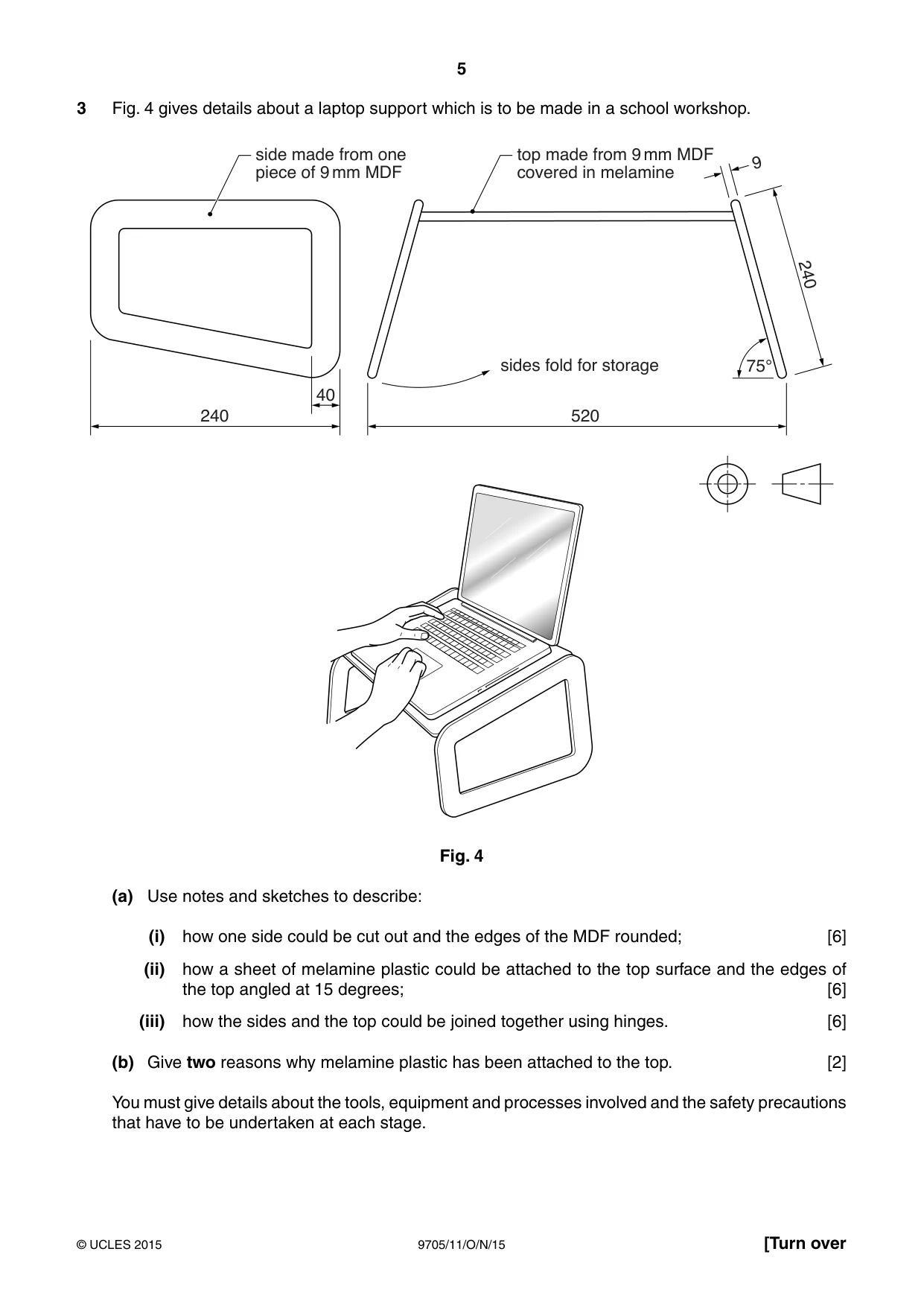
5 9705/11/O/N/15 © UCLES 2015 [Turn over 3 Fig. 4 gives details about a laptop support which is to be made in a school workshop. side made from one piece of 9 mm MDF 240 520 75° 240 9 sides fold for storage 40 top made from 9 mm MDF covered in melamine Fig. 4 (a) Use notes and sketches to describe: (i) how one side could be cut out and the edges of the MDF rounded; [6] (ii) how a sheet of melamine plastic could be attached to the top surface and the edges of the top angled at 15 degrees; [6] (iii) how the sides and the top could be joined together using hinges. [6] (b) Give two reasons why melamine plastic has been attached to the top. [2] You must give details about the tools, equipment and processes involved and the safety precautions that have to be undertaken at each stage.
Question paper, page 6
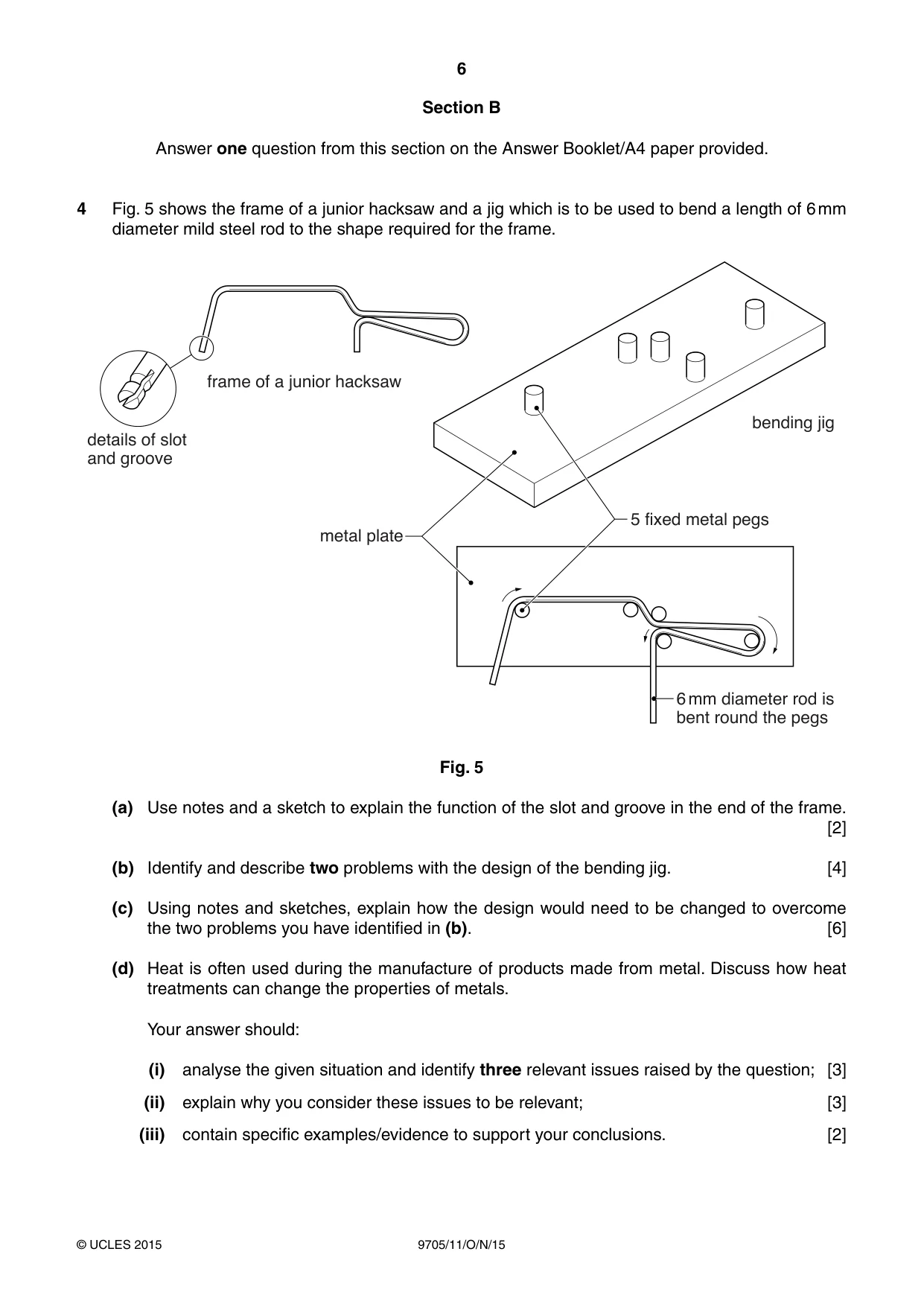
6 9705/11/O/N/15 © UCLES 2015 Section B Answer one question from this section on the Answer Booklet/A4 paper provided. 4 Fig. 5 shows the frame of a junior hacksaw and a jig which is to be used to bend a length of 6 mm diameter mild steel rod to the shape required for the frame. details of slot and groove frame of a junior hacksaw bending jig metal plate 5 fixed metal pegs 6 mm diameter rod is bent round the pegs Fig. 5 (a) Use notes and a sketch to explain the function of the slot and groove in the end of the frame. [2] (b) Identify and describe two problems with the design of the bending jig. [4] (c) Using notes and sketches, explain how the design would need to be changed to overcome the two problems you have identified in (b). [6] (d) Heat is often used during the manufacture of products made from metal. Discuss how heat treatments can change the properties of metals. Your answer should: (i) analyse the given situation and identify three relevant issues raised by the question; [3] (ii) explain why you consider these issues to be relevant; [3] (iii) contain specific examples/evidence to support your conclusions. [2]
Question paper, page 7
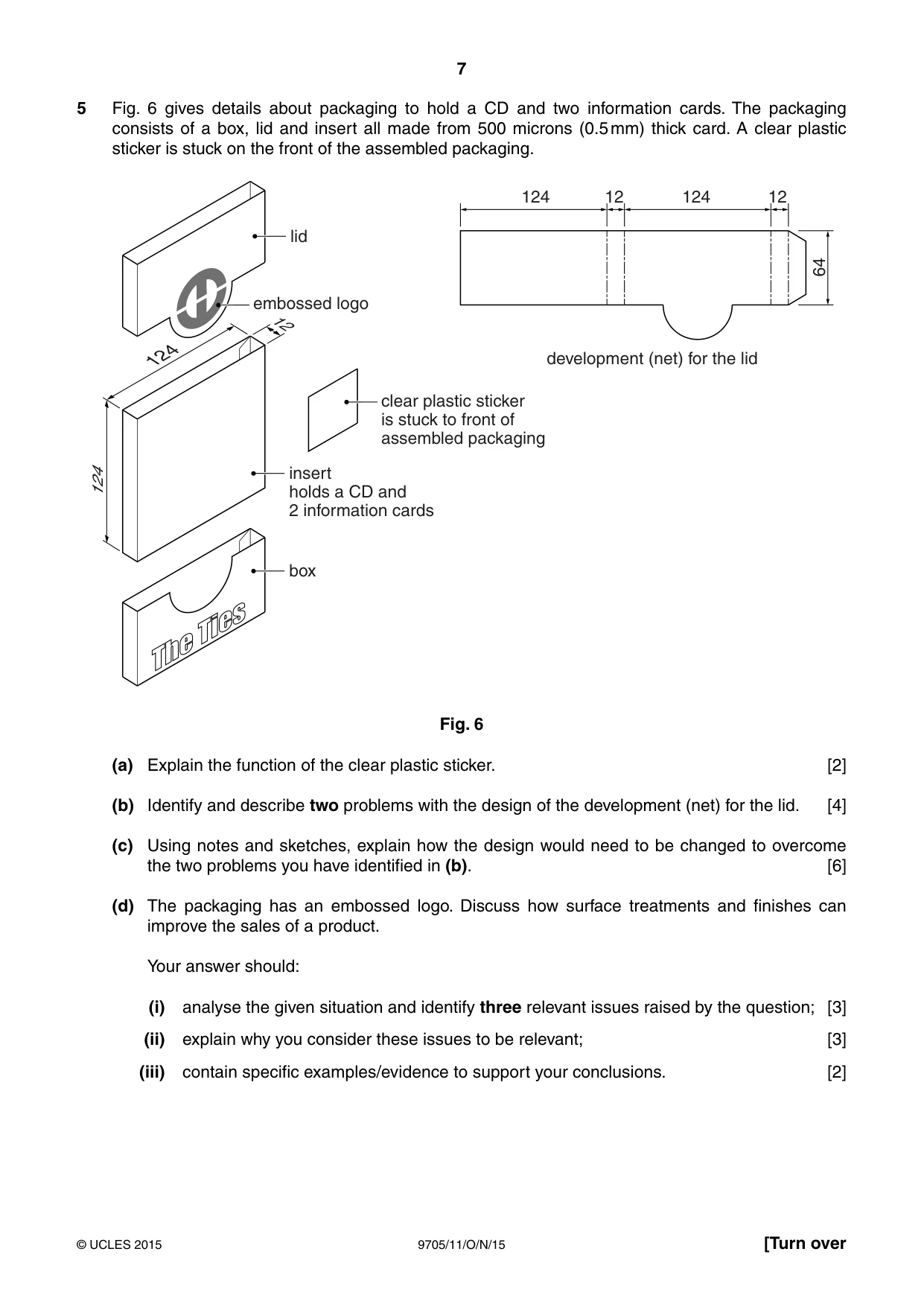
7 9705/11/O/N/15 © UCLES 2015 [Turn over 5 Fig. 6 gives details about packaging to hold a CD and two information cards. The packaging consists of a box, lid and insert all made from 500 microns (0.5 mm) thick card. A clear plastic sticker is stuck on the front of the assembled packaging. lid 124 124 12 12 64 embossed logo clear plastic sticker is stuck to front of assembled packaging development (net) for the lid insert holds a CD and 2 information cards box 124 124 12 Fig. 6 (a) Explain the function of the clear plastic sticker. [2] (b) Identify and describe two problems with the design of the development (net) for the lid. [4] (c) Using notes and sketches, explain how the design would need to be changed to overcome the two problems you have identified in (b). [6] (d) The packaging has an embossed logo. Discuss how surface treatments and finishes can improve the sales of a product. Your answer should: (i) analyse the given situation and identify three relevant issues raised by the question; [3] (ii) explain why you consider these issues to be relevant; [3] (iii) contain specific examples/evidence to support your conclusions. [2]
Question paper, page 8
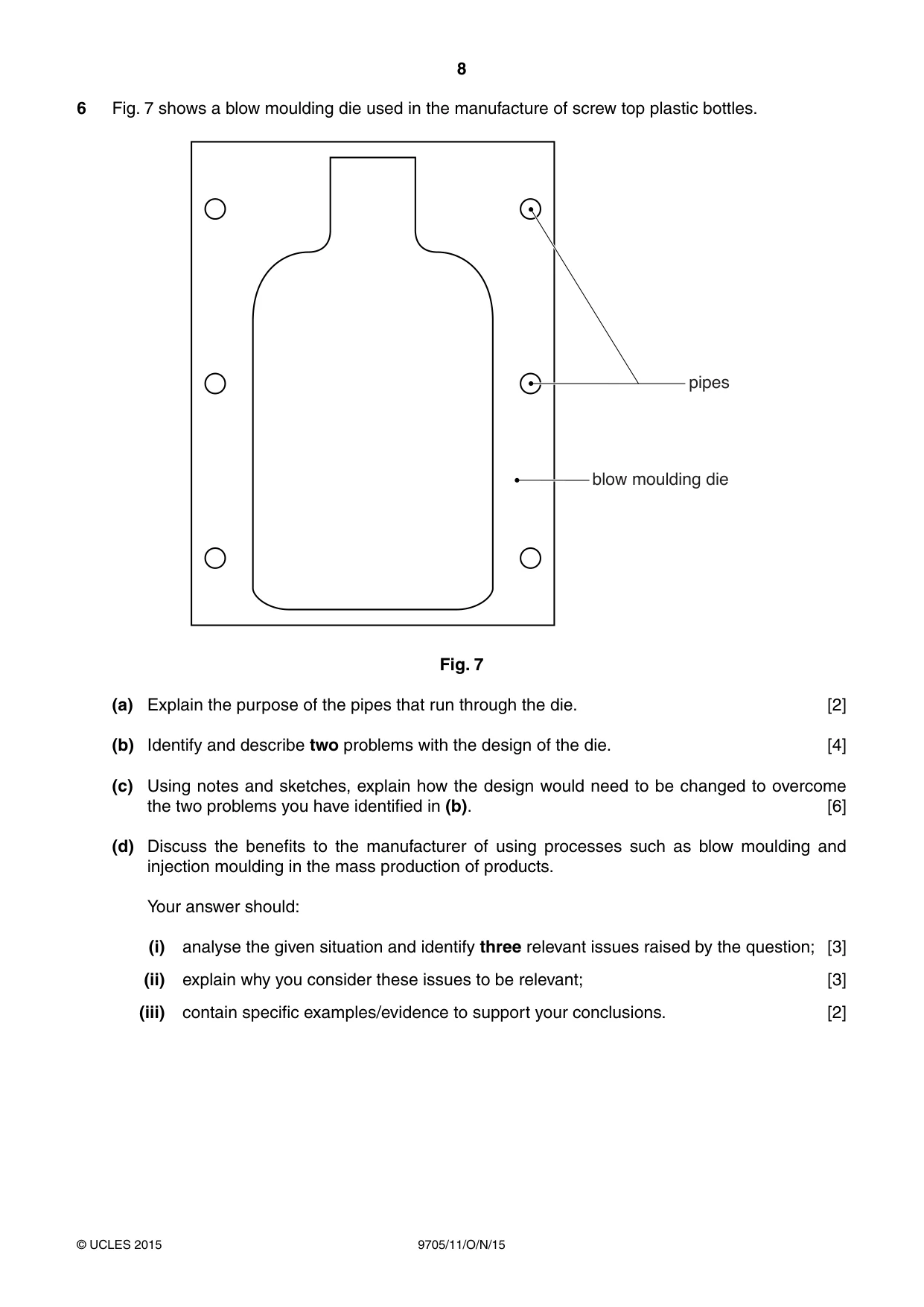
8 9705/11/O/N/15 © UCLES 2015 6 Fig. 7 shows a blow moulding die used in the manufacture of screw top plastic bottles. pipes blow moulding die Fig. 7 (a) Explain the purpose of the pipes that run through the die. [2] (b) Identify and describe two problems with the design of the die. [4] (c) Using notes and sketches, explain how the design would need to be changed to overcome the two problems you have identified in (b). [6] (d) Discuss the benefits to the manufacturer of using processes such as blow moulding and injection moulding in the mass production of products. Your answer should: (i) analyse the given situation and identify three relevant issues raised by the question; [3] (ii) explain why you consider these issues to be relevant; [3] (iii) contain specific examples/evidence to support your conclusions. [2]
Question paper, page 9
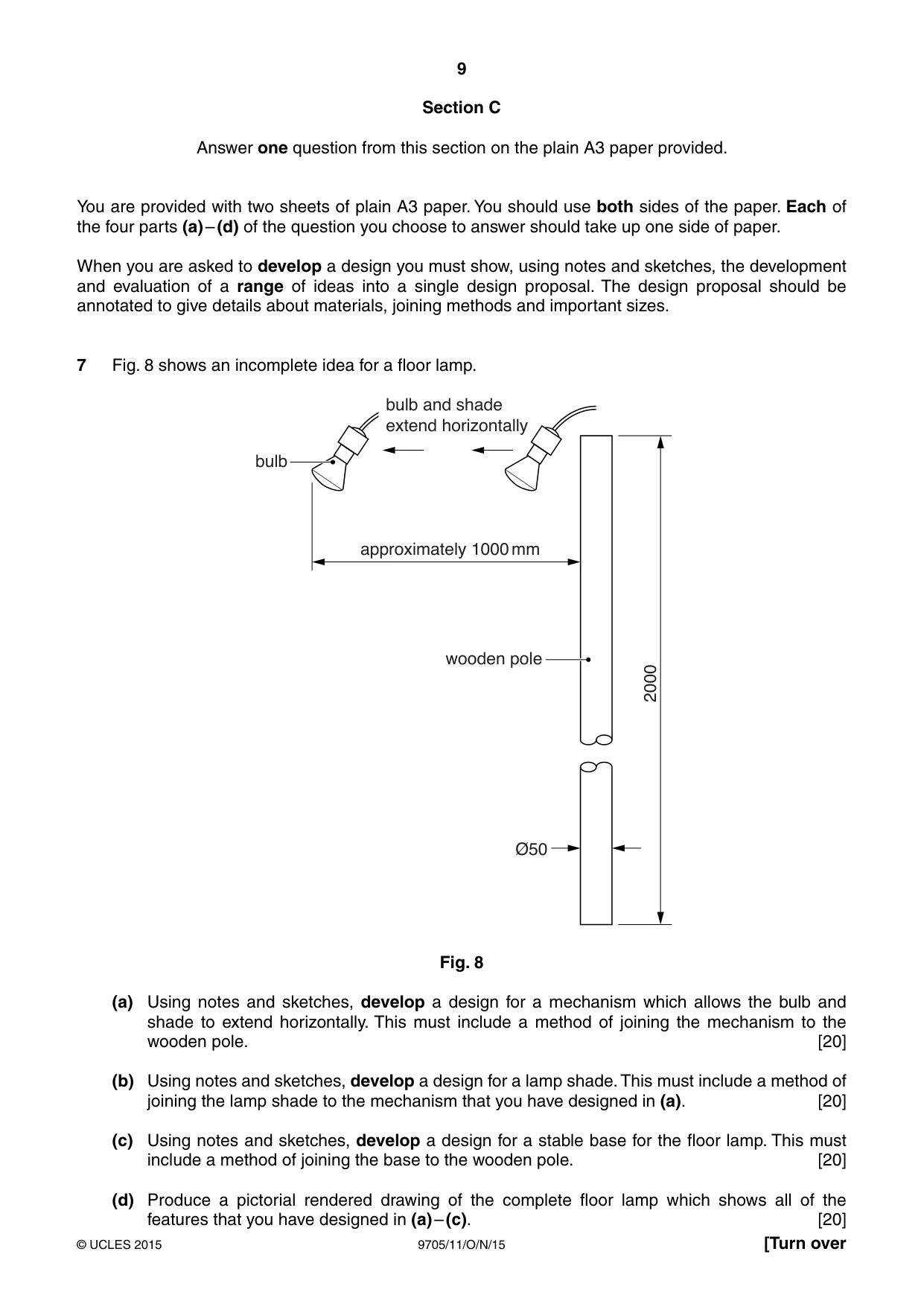
9 9705/11/O/N/15 © UCLES 2015 [Turn over Section C Answer one question from this section on the plain A3 paper provided. You are provided with two sheets of plain A3 paper. You should use both sides of the paper. Each of the four parts (a) – (d) of the question you choose to answer should take up one side of paper. When you are asked to develop a design you must show, using notes and sketches, the development and evaluation of a range of ideas into a single design proposal. The design proposal should be annotated to give details about materials, joining methods and important sizes. 7 Fig. 8 shows an incomplete idea for a floor lamp. bulb wooden pole approximately 1000 mm Ø50 2000 bulb and shade extend horizontally Fig. 8 (a) Using notes and sketches, develop a design for a mechanism which allows the bulb and shade to extend horizontally. This must include a method of joining the mechanism to the wooden pole. [20] (b) Using notes and sketches, develop a design for a lamp shade. This must include a method of joining the lamp shade to the mechanism that you have designed in (a). [20] (c) Using notes and sketches, develop a design for a stable base for the floor lamp. This must include a method of joining the base to the wooden pole. [20] (d) Produce a pictorial rendered drawing of the complete floor lamp which shows all of the features that you have designed in (a) – (c). [20]
Question paper, page 10
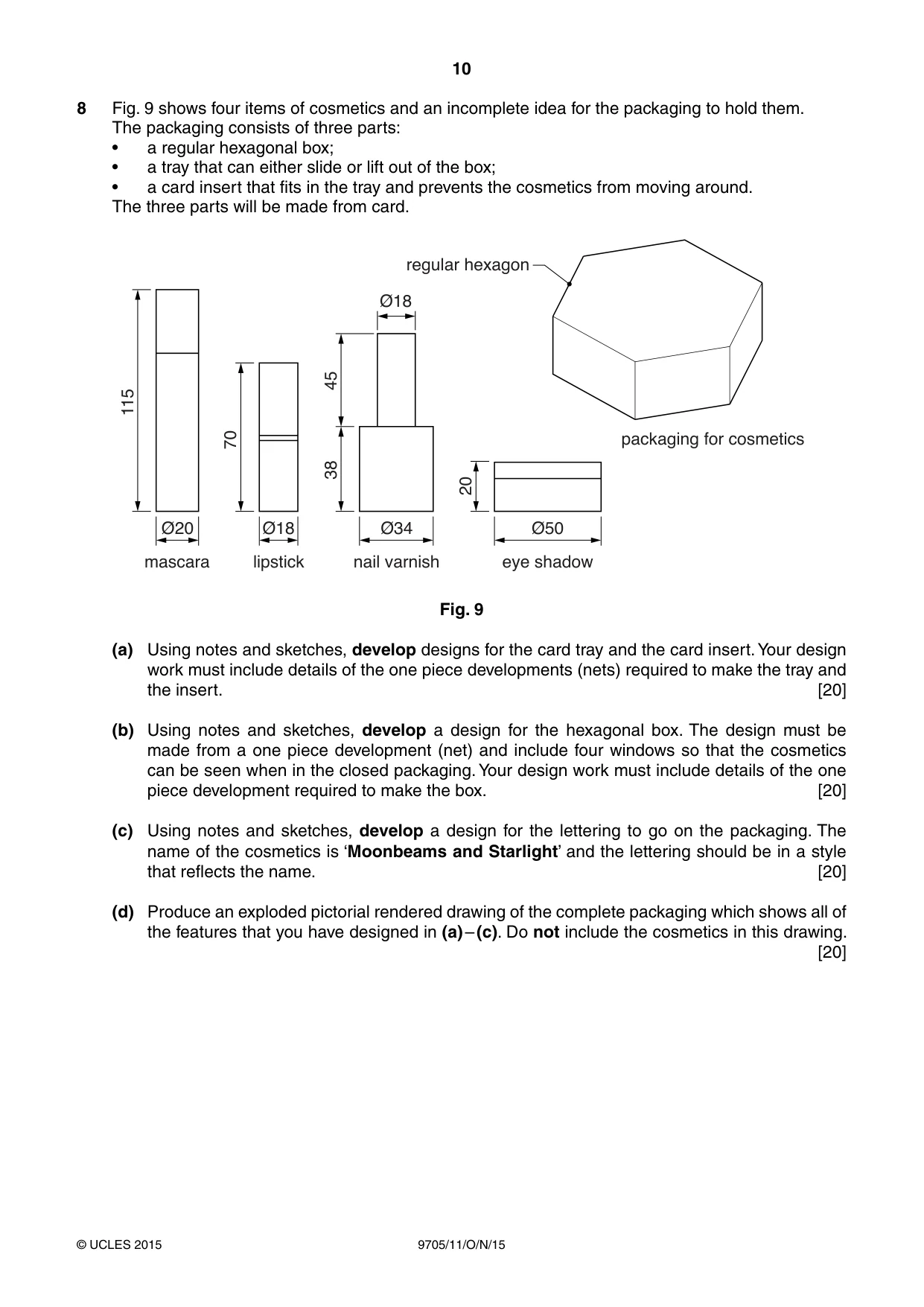
10 9705/11/O/N/15 © UCLES 2015 8 Fig. 9 shows four items of cosmetics and an incomplete idea for the packaging to hold them. The packaging consists of three parts: • a regular hexagonal box; • a tray that can either slide or lift out of the box; • a card insert that fits in the tray and prevents the cosmetics from moving around. The three parts will be made from card. regular hexagon packaging for cosmetics mascara lipstick nail varnish eye shadow Ø18 Ø50 Ø34 Ø18 Ø20 115 70 38 20 45 Fig. 9 (a) Using notes and sketches, develop designs for the card tray and the card insert. Your design work must include details of the one piece developments (nets) required to make the tray and the insert. [20] (b) Using notes and sketches, develop a design for the hexagonal box. The design must be made from a one piece development (net) and include four windows so that the cosmetics can be seen when in the closed packaging. Your design work must include details of the one piece development required to make the box. [20] (c) Using notes and sketches, develop a design for the lettering to go on the packaging. The name of the cosmetics is ‘Moonbeams and Starlight’ and the lettering should be in a style that reflects the name. [20] (d) Produce an exploded pictorial rendered drawing of the complete packaging which shows all of the features that you have designed in (a) – (c). Do not include the cosmetics in this drawing. [20]
Question paper, page 11
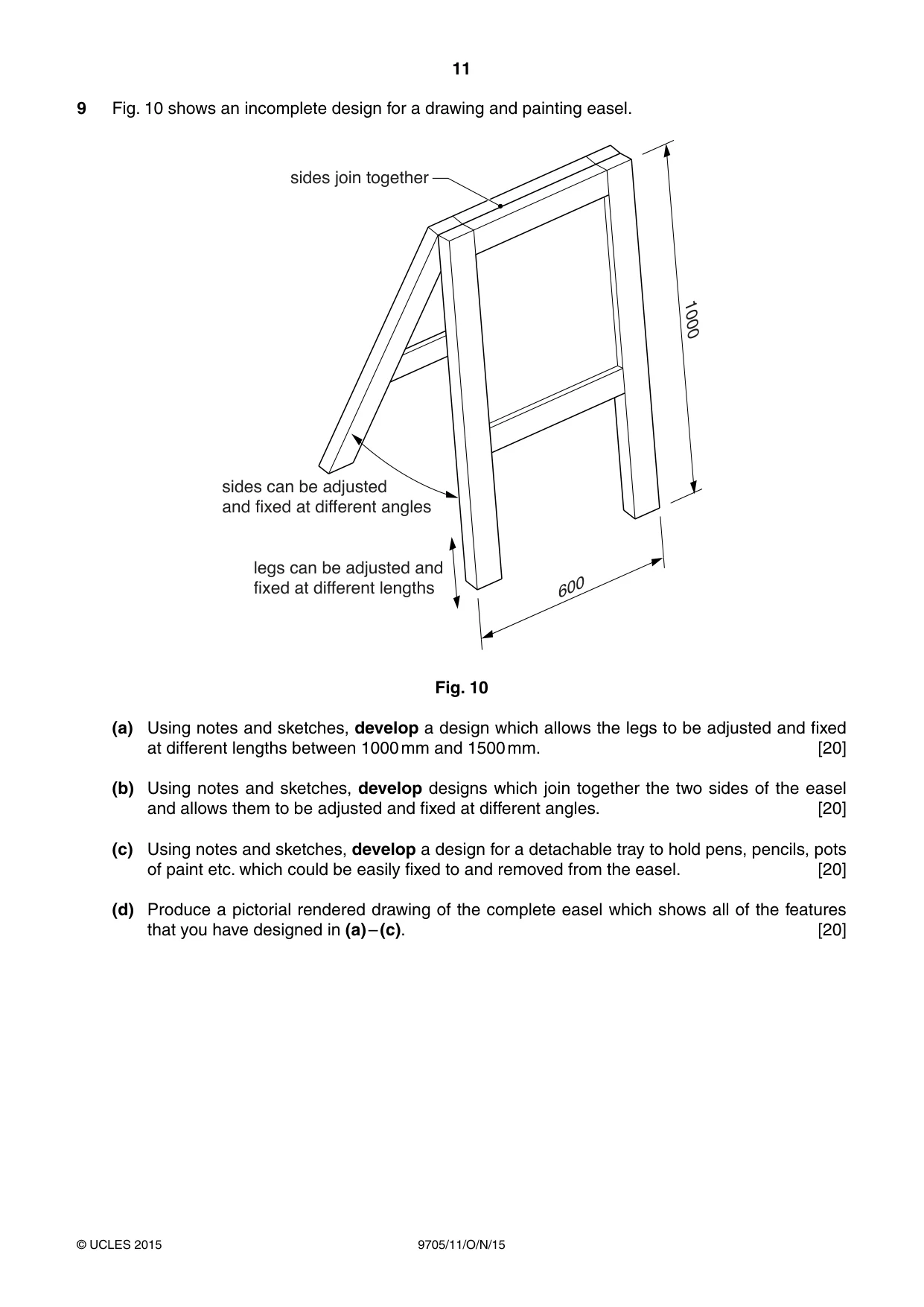
11 9705/11/O/N/15 © UCLES 2015 9 Fig. 10 shows an incomplete design for a drawing and painting easel. sides join together sides can be adjusted and fixed at different angles legs can be adjusted and fixed at different lengths 600 1000 Fig. 10 (a) Using notes and sketches, develop a design which allows the legs to be adjusted and fixed at different lengths between 1000 mm and 1500 mm. [20] (b) Using notes and sketches, develop designs which join together the two sides of the easel and allows them to be adjusted and fixed at different angles. [20] (c) Using notes and sketches, develop a design for a detachable tray to hold pens, pencils, pots of paint etc. which could be easily fixed to and removed from the easel. [20] (d) Produce a pictorial rendered drawing of the complete easel which shows all of the features that you have designed in (a) – (c). [20]
Question paper, page 12
12 9705/11/O/N/15 © UCLES 2015 Permission to reproduce items where third-party owned material protected by copyright is included has been sought and cleared where possible. Every reasonable effort has been made by the publisher (UCLES) to trace copyright holders, but if any items requiring clearance have unwittingly been included, the publisher will be pleased to make amends at the earliest possible opportunity. To avoid the issue of disclosure of answer-related information to candidates, all copyright acknowledgements are reproduced online in the Cambridge International Examinations Copyright Acknowledgements Booklet. This is produced for each series of examinations and is freely available to download at www.cie.org.uk after the live examination series. Cambridge International Examinations is part of the Cambridge Assessment Group. Cambridge Assessment is the brand name of University of Cambridge Local Examinations Syndicate (UCLES), which is itself a department of the University of Cambridge. BLANK PAGE
Mark scheme, page 1
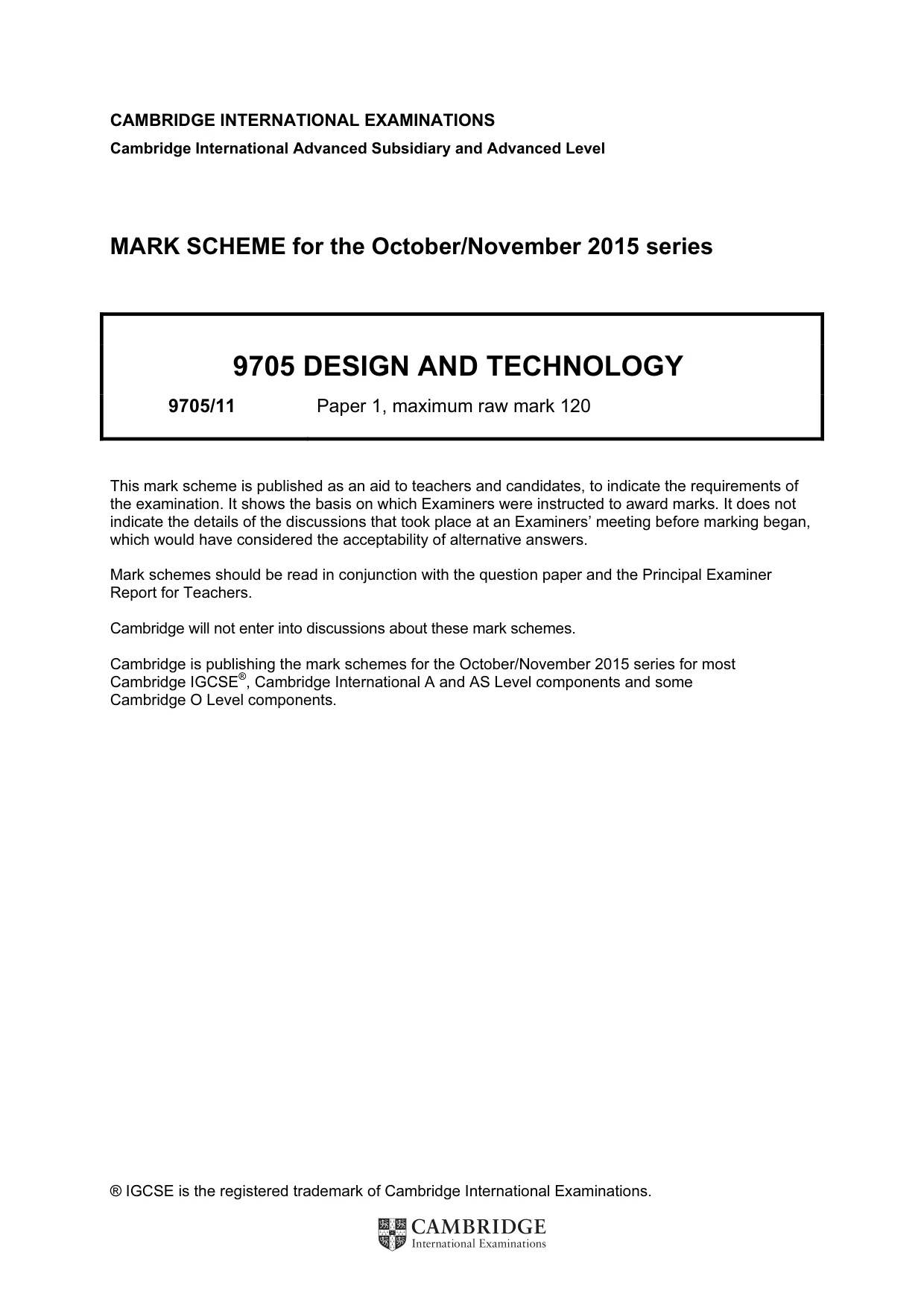
® IGCSE is the registered trademark of Cambridge International Examinations. CAMBRIDGE INTERNATIONAL EXAMINATIONS Cambridge International Advanced Subsidiary and Advanced Level MARK SCHEME for the October/November 2015 series 9705 DESIGN AND TECHNOLOGY 9705/11 Paper 1, maximum raw mark 120 This mark scheme is published as an aid to teachers and candidates, to indicate the requirements of the examination. It shows the basis on which Examiners were instructed to award marks. It does not indicate the details of the discussions that took place at an Examiners’ meeting before marking began, which would have considered the acceptability of alternative answers. Mark schemes should be read in conjunction with the question paper and the Principal Examiner Report for Teachers. Cambridge will not enter into discussions about these mark schemes. Cambridge is publishing the mark schemes for the October/November 2015 series for most Cambridge IGCSE®, Cambridge International A and AS Level components and some Cambridge O Level components.
Mark scheme, page 2
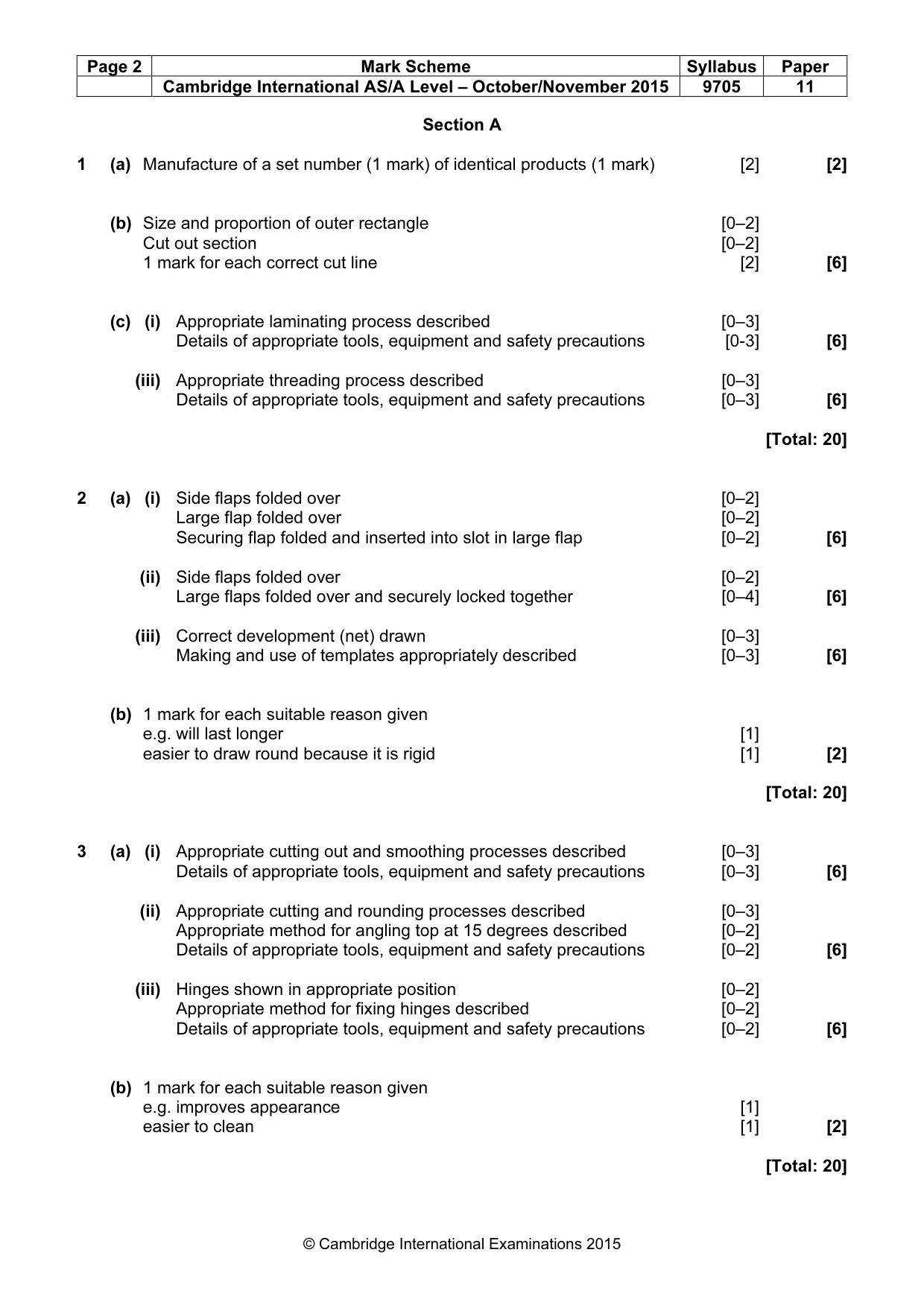
Page 2 Mark Scheme Syllabus Paper Cambridge International AS/A Level – October/November 2015 9705 11 © Cambridge International Examinations 2015 Section A 1 (a) Manufacture of a set number (1 mark) of identical products (1 mark) [2] [2] (b) Size and proportion of outer rectangle [0–2] Cut out section [0–2] 1 mark for each correct cut line [2] [6] (c) (i) Appropriate laminating process described [0–3] Details of appropriate tools, equipment and safety precautions [0-3] [6] (iii) Appropriate threading process described [0–3] Details of appropriate tools, equipment and safety precautions [0–3] [6] [Total: 20] 2 (a) (i) Side flaps folded over [0–2] Large flap folded over [0–2] Securing flap folded and inserted into slot in large flap [0–2] [6] (ii) Side flaps folded over [0–2] Large flaps folded over and securely locked together [0–4] [6] (iii) Correct development (net) drawn [0–3] Making and use of templates appropriately described [0–3] [6] (b) 1 mark for each suitable reason given e.g. will last longer [1] easier to draw round because it is rigid [1] [2] [Total: 20] 3 (a) (i) Appropriate cutting out and smoothing processes described [0–3] Details of appropriate tools, equipment and safety precautions [0–3] [6] (ii) Appropriate cutting and rounding processes described [0–3] Appropriate method for angling top at 15 degrees described [0–2] Details of appropriate tools, equipment and safety precautions [0–2] [6] (iii) Hinges shown in appropriate position [0–2] Appropriate method for fixing hinges described [0–2] Details of appropriate tools, equipment and safety precautions [0–2] [6] (b) 1 mark for each suitable reason given e.g. improves appearance [1] easier to clean [1] [2] [Total: 20]
Mark scheme, page 3
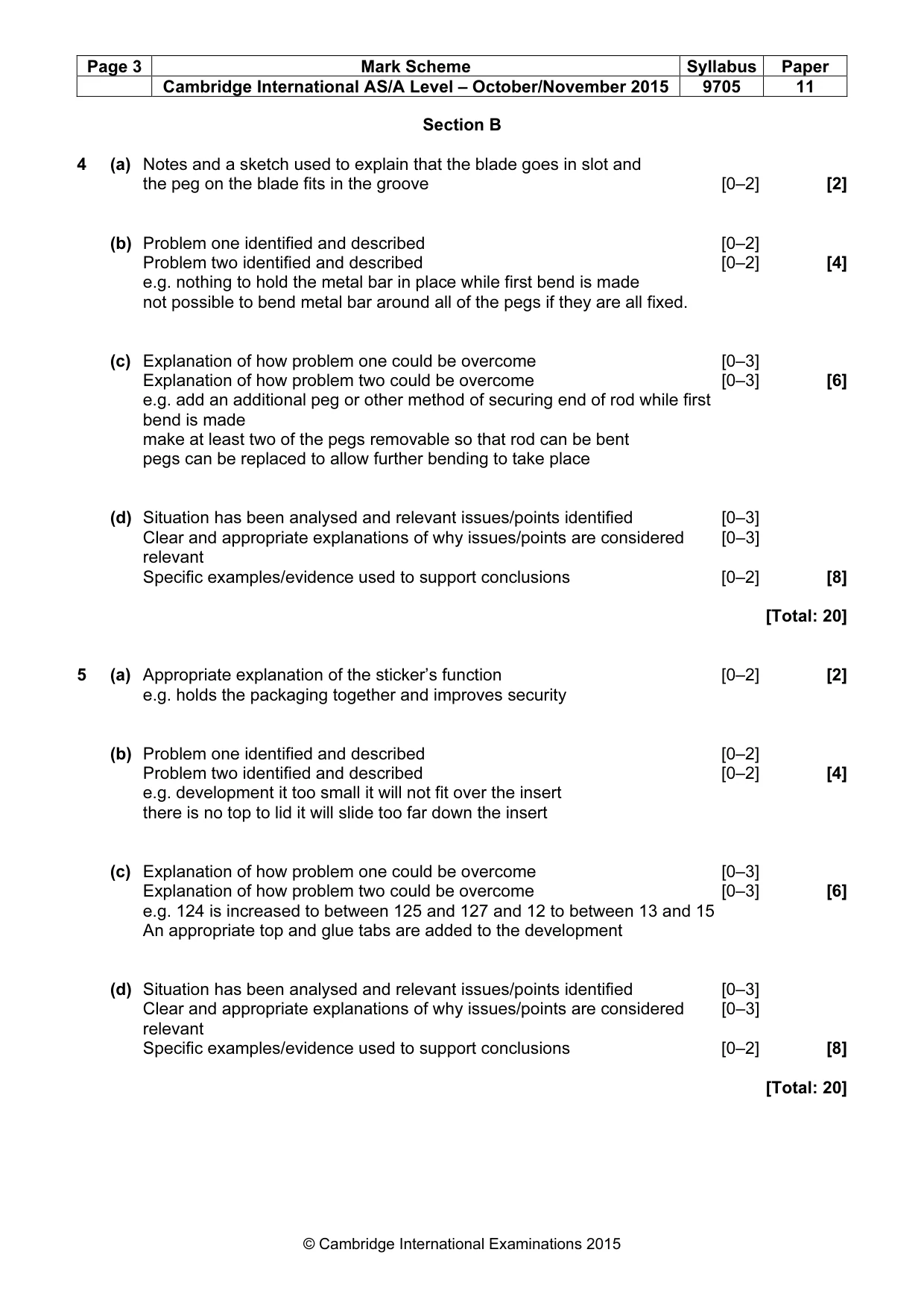
Page 3 Mark Scheme Syllabus Paper Cambridge International AS/A Level – October/November 2015 9705 11 © Cambridge International Examinations 2015 Section B 4 (a) Notes and a sketch used to explain that the blade goes in slot and the peg on the blade fits in the groove [0–2] [2] (b) Problem one identified and described [0–2] Problem two identified and described [0–2] [4] e.g. nothing to hold the metal bar in place while first bend is made not possible to bend metal bar around all of the pegs if they are all fixed. (c) Explanation of how problem one could be overcome [0–3] Explanation of how problem two could be overcome [0–3] [6] e.g. add an additional peg or other method of securing end of rod while first bend is made make at least two of the pegs removable so that rod can be bent pegs can be replaced to allow further bending to take place (d) Situation has been analysed and relevant issues/points identified [0–3] Clear and appropriate explanations of why issues/points are considered [0–3] relevant Specific examples/evidence used to support conclusions [0–2] [8] [Total: 20] 5 (a) Appropriate explanation of the sticker’s function [0–2] [2] e.g. holds the packaging together and improves security (b) Problem one identified and described [0–2] Problem two identified and described [0–2] [4] e.g. development it too small it will not fit over the insert there is no top to lid it will slide too far down the insert (c) Explanation of how problem one could be overcome [0–3] Explanation of how problem two could be overcome [0–3] [6] e.g. 124 is increased to between 125 and 127 and 12 to between 13 and 15 An appropriate top and glue tabs are added to the development (d) Situation has been analysed and relevant issues/points identified [0–3] Clear and appropriate explanations of why issues/points are considered [0–3] relevant Specific examples/evidence used to support conclusions [0–2] [8] [Total: 20]
Mark scheme, page 4
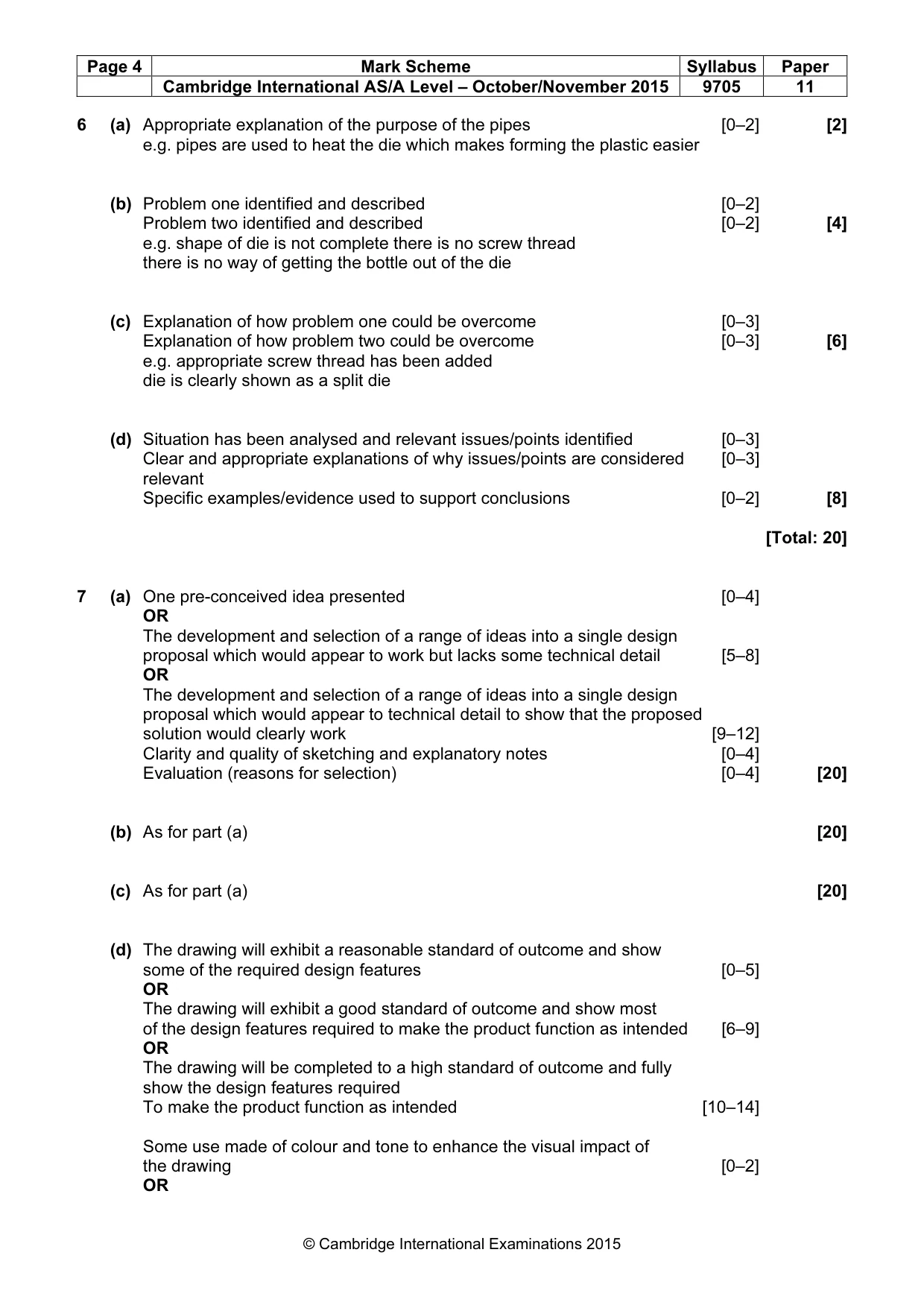
Page 4 Mark Scheme Syllabus Paper Cambridge International AS/A Level – October/November 2015 9705 11 © Cambridge International Examinations 2015 6 (a) Appropriate explanation of the purpose of the pipes [0–2] [2] e.g. pipes are used to heat the die which makes forming the plastic easier (b) Problem one identified and described [0–2] Problem two identified and described [0–2] [4] e.g. shape of die is not complete there is no screw thread there is no way of getting the bottle out of the die (c) Explanation of how problem one could be overcome [0–3] Explanation of how problem two could be overcome [0–3] [6] e.g. appropriate screw thread has been added die is clearly shown as a split die (d) Situation has been analysed and relevant issues/points identified [0–3] Clear and appropriate explanations of why issues/points are considered [0–3] relevant Specific examples/evidence used to support conclusions [0–2] [8] [Total: 20] 7 (a) One pre-conceived idea presented [0–4] OR The development and selection of a range of ideas into a single design proposal which would appear to work but lacks some technical detail [5–8] OR The development and selection of a range of ideas into a single design proposal which would appear to technical detail to show that the proposed solution would clearly work [9–12] Clarity and quality of sketching and explanatory notes [0–4] Evaluation (reasons for selection) [0–4] [20] (b) As for part (a) [20] (c) As for part (a) [20] (d) The drawing will exhibit a reasonable standard of outcome and show some of the required design features [0–5] OR The drawing will exhibit a good standard of outcome and show most of the design features required to make the product function as intended [6–9] OR The drawing will be completed to a high standard of outcome and fully show the design features required To make the product function as intended [10–14] Some use made of colour and tone to enhance the visual impact of the drawing [0–2] OR
Mark scheme, page 5
Page 5 Mark Scheme Syllabus Paper Cambridge International AS/A Level – October/November 2015 9705 11 © Cambridge International Examinations 2015 Good use has been made of colour and tone to enhance the visual impact of the drawing [3–4] OR Very good use has been made of colour, tone and material representation to enhance the visual impact of the drawing [5–6] [20] [Total: 80] Questions 8 and 9 as for Question 7
What you needed in this session
Cambridge’s own grade thresholds for 2015 Oct/Nov, Paper 1 · Variant 1. A higher threshold means an easier paper — the bar moves with how the cohort did.