Cambridge A Level Design and Technology 9705 — 2024 May/June Paper 3 · Variant 1
9705/31/M/J/24 · 120 marks · ≈135 min
The question paper and its mark scheme, free to read here and free to download. This is Cambridge’s own paper, exactly as it was sat.
Question paper12 pages
Mark scheme15 pages
Answers below. Sit the paper first if you are practising.
Paper as text
Question paper, page 1
This document has 12 pages. Any blank pages are indicated. [Turn over Cambridge International AS & A Level * 2 2 0 4 8 6 7 4 6 4 * DC (PQ) 340785 © UCLES 2024 DESIGN & TECHNOLOGY 9705/31 Paper 3 May/June 2024 3 hours You must answer on the answer booklet/paper. You will need: Answer booklet/paper Coloured pencils A3 drawing paper (5 sheets) A range of design drawing equipment INSTRUCTIONS ● Answer three questions in total: Section A: answer two questions from one of the Parts A, B or C. Section B: answer one question. ● If you have been given an answer booklet, follow the instructions on the front cover of the answer booklet. ● Use a black or dark blue pen. ● Write your name, centre number and candidate number on all the work you hand in. ● Do not use an erasable pen or correction fluid. ● You may use an HB pencil, or coloured pencils as appropriate, for any diagrams, graphs or rough working. ● At the end of the examination, fasten all your work together. Do not use staples, paper clips or glue. INFORMATION ● The total mark for this paper is 120. ● The number of marks for each question or part question is shown in brackets [ ]. ● All dimensions are in millimetres.
Question paper, page 2
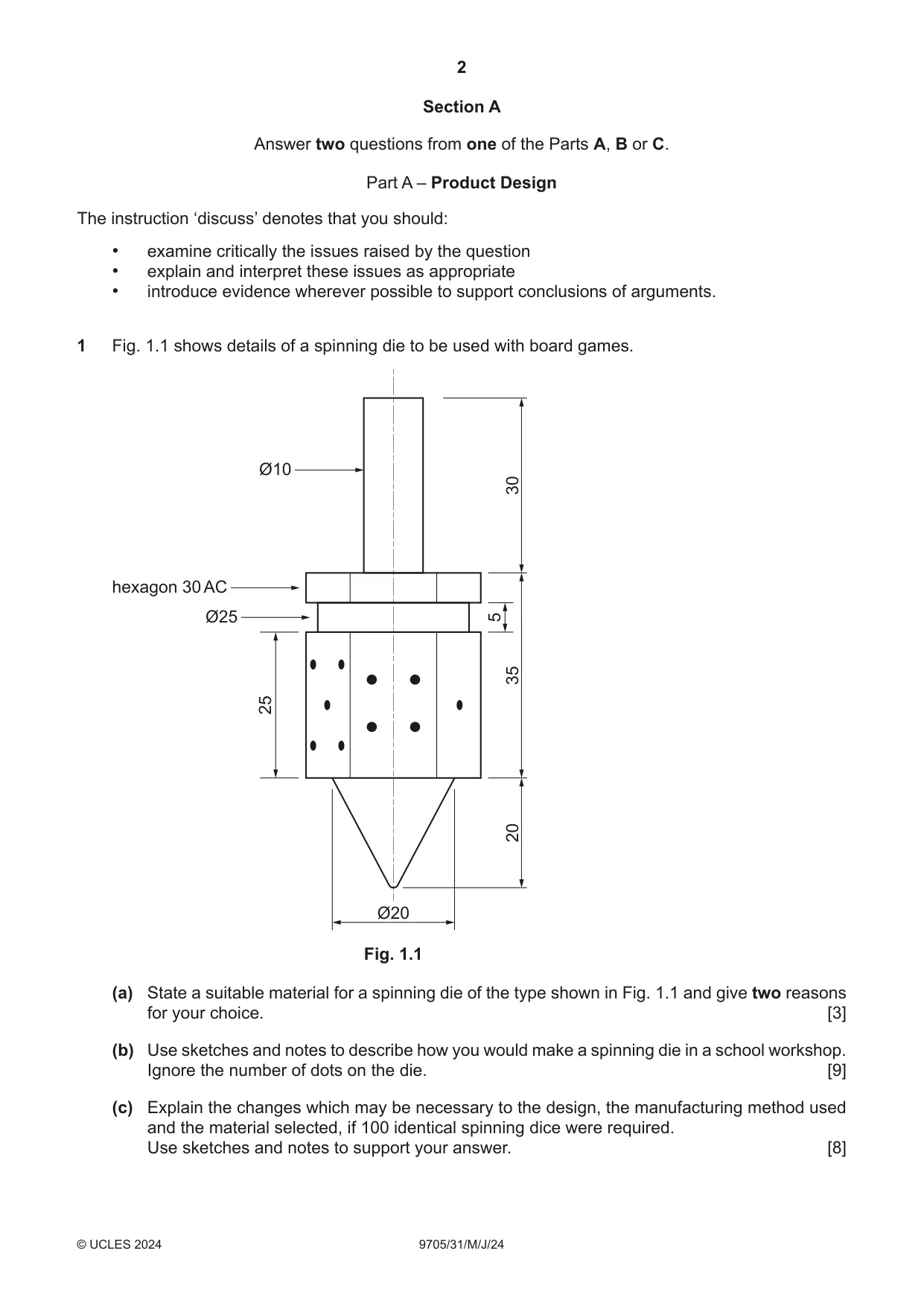
2 9705/31/M/J/24 © UCLES 2024 Section A Answer two questions from one of the Parts A, B or C. Part A – Product Design The instruction ‘discuss’ denotes that you should: • examine critically the issues raised by the question • explain and interpret these issues as appropriate • introduce evidence wherever possible to support conclusions of arguments. 1 Fig. 1.1 shows details of a spinning die to be used with board games. Ø20 Ø25 Ø10 hexagon 30 AC 25 5 35 30 20 Fig. 1.1 (a) State a suitable material for a spinning die of the type shown in Fig. 1.1 and give two reasons for your choice. [3] (b) Use sketches and notes to describe how you would make a spinning die in a school workshop. Ignore the number of dots on the die. [9] (c) Explain the changes which may be necessary to the design, the manufacturing method used and the material selected, if 100 identical spinning dice were required. Use sketches and notes to support your answer. [8]
Question paper, page 3
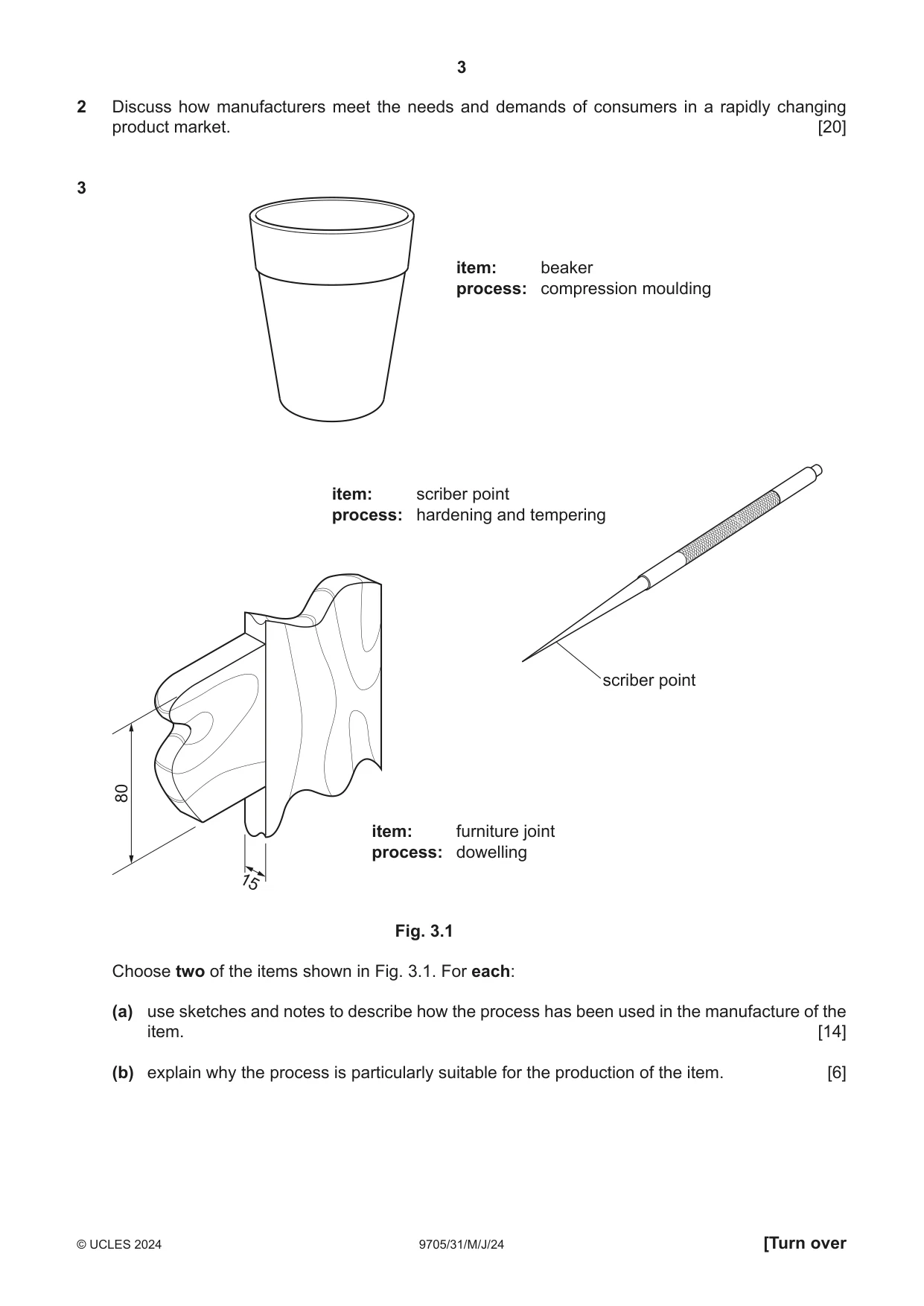
3 9705/31/M/J/24 © UCLES 2024 [Turn over 2 Discuss how manufacturers meet the needs and demands of consumers in a rapidly changing product market. [20] 3 scriber point item: process: beaker compression moulding item: process: scriber point hardening and tempering item: process: furniture joint dowelling 80 15 Fig. 3.1 Choose two of the items shown in Fig. 3.1. For each: (a) use sketches and notes to describe how the process has been used in the manufacture of the item. [14] (b) explain why the process is particularly suitable for the production of the item. [6]
Question paper, page 4
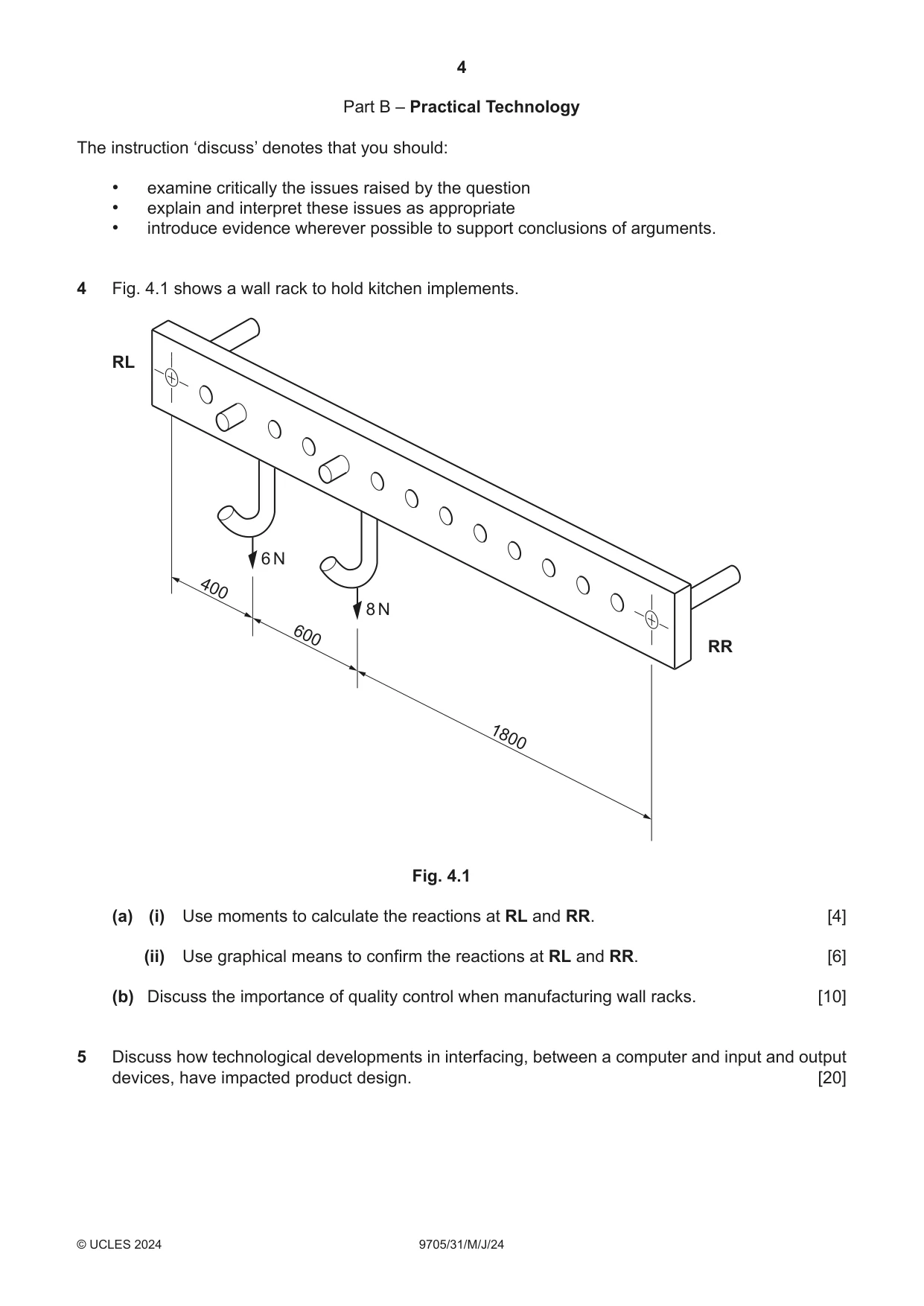
4 9705/31/M/J/24 © UCLES 2024 Part B – Practical Technology The instruction ‘discuss’ denotes that you should: • examine critically the issues raised by the question • explain and interpret these issues as appropriate • introduce evidence wherever possible to support conclusions of arguments. 4 Fig. 4.1 shows a wall rack to hold kitchen implements. 6 N 8 N 600 1800 400 RR RL Fig. 4.1 (a) (i) Use moments to calculate the reactions at RL and RR. [4] (ii) Use graphical means to confirm the reactions at RL and RR. [6] (b) Discuss the importance of quality control when manufacturing wall racks. [10] 5 Discuss how technological developments in interfacing, between a computer and input and output devices, have impacted product design. [20]
Question paper, page 5
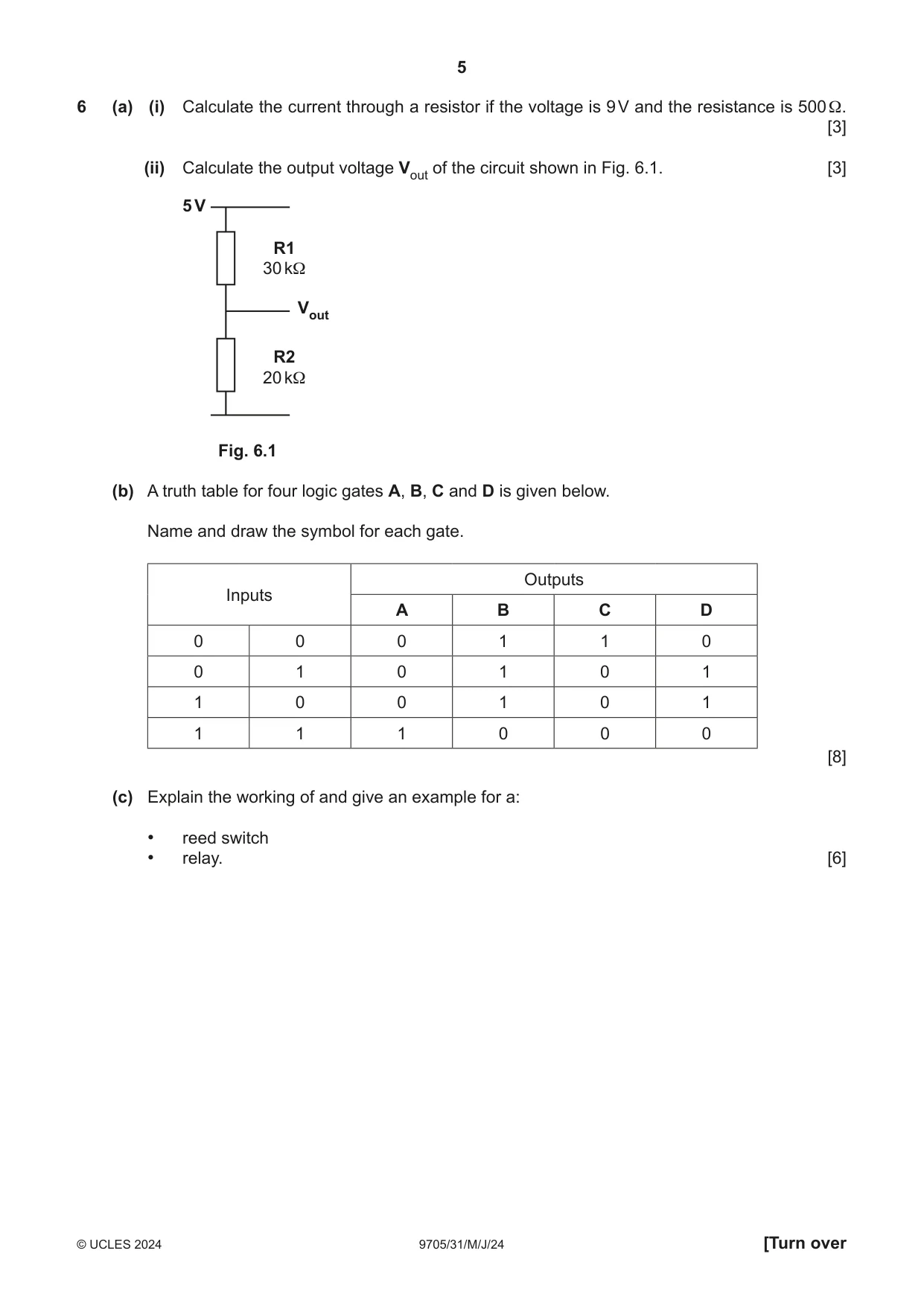
5 9705/31/M/J/24 © UCLES 2024 [Turn over 6 (a) (i) Calculate the current through a resistor if the voltage is 9 V and the resistance is 500 Ω. [3] (ii) Calculate the output voltage Vout of the circuit shown in Fig. 6.1. [3] R1 30 kΩ R2 20 kΩ Vout 5 V Fig. 6.1 (b) A truth table for four logic gates A, B, C and D is given below. Name and draw the symbol for each gate. Inputs Outputs A B C D 0 0 0 1 1 0 0 1 0 1 0 1 1 0 0 1 0 1 1 1 1 0 0 0 [8] (c) Explain the working of and give an example for a: • reed switch • relay. [6]
Question paper, page 6
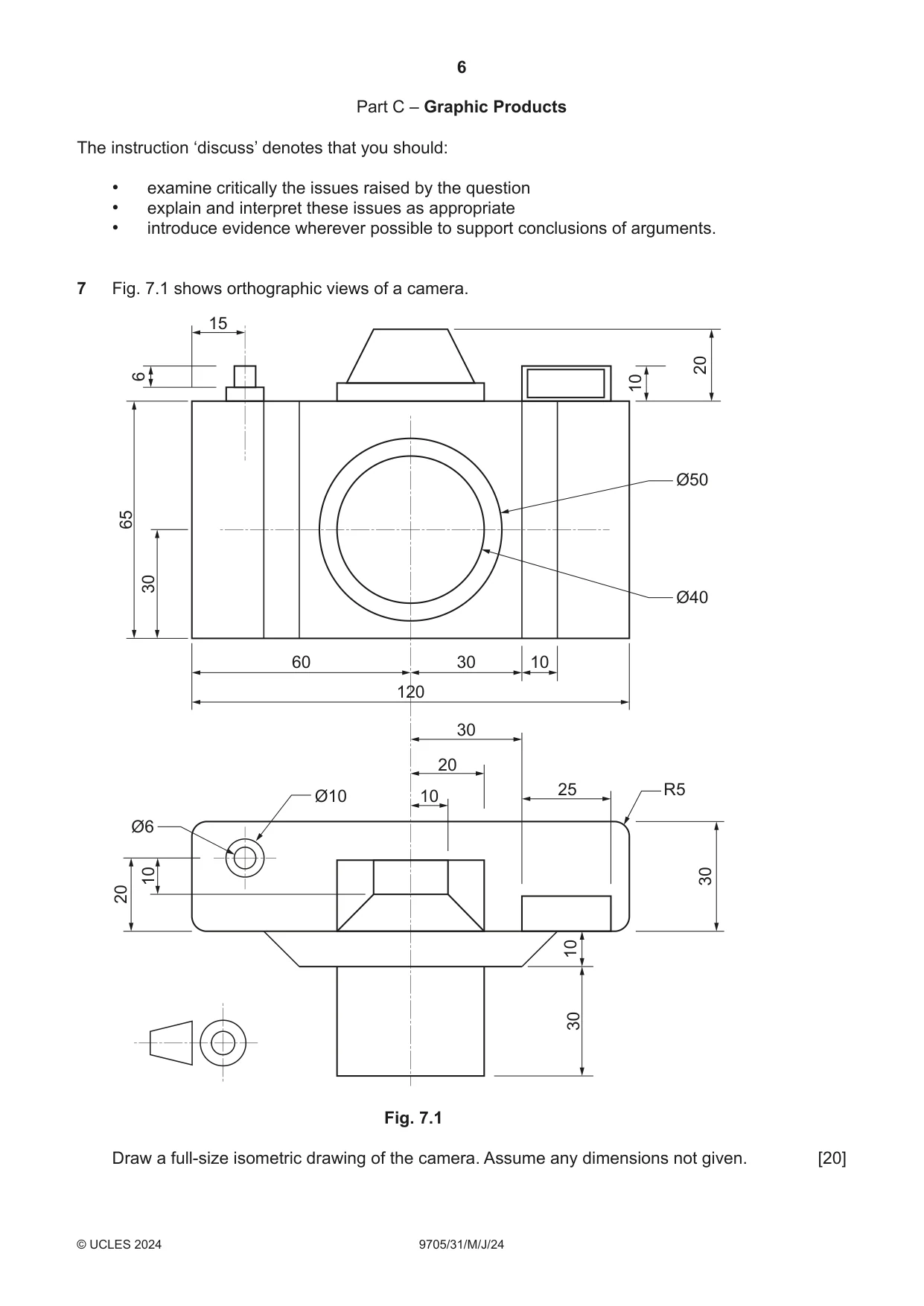
6 9705/31/M/J/24 © UCLES 2024 Part C – Graphic Products The instruction ‘discuss’ denotes that you should: • examine critically the issues raised by the question • explain and interpret these issues as appropriate • introduce evidence wherever possible to support conclusions of arguments. 7 Fig. 7.1 shows orthographic views of a camera. 6 65 30 60 15 120 30 30 20 10 10 25 20 30 30 10 10 R5 Ø10 Ø40 Ø50 Ø6 20 10 Fig. 7.1 Draw a full-size isometric drawing of the camera. Assume any dimensions not given. [20]
Question paper, page 7
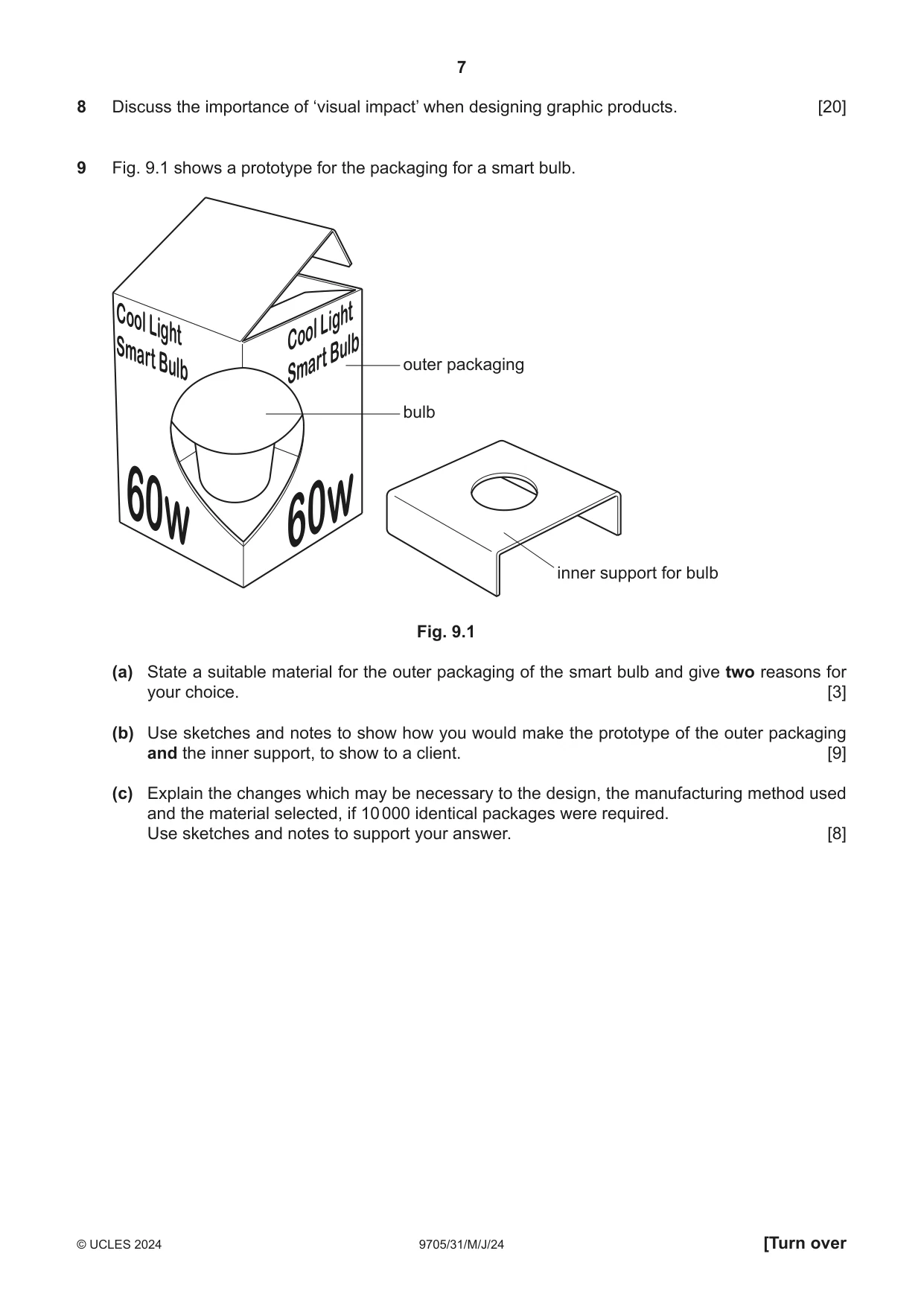
7 9705/31/M/J/24 © UCLES 2024 [Turn over 8 Discuss the importance of ‘visual impact’ when designing graphic products. [20] 9 Fig. 9.1 shows a prototype for the packaging for a smart bulb. outer packaging inner support for bulb bulb Cool Light Smart Bulb 60w Cool Light Smart Bulb 60w Fig. 9.1 (a) State a suitable material for the outer packaging of the smart bulb and give two reasons for your choice. [3] (b) Use sketches and notes to show how you would make the prototype of the outer packaging and the inner support, to show to a client. [9] (c) Explain the changes which may be necessary to the design, the manufacturing method used and the material selected, if 10 000 identical packages were required. Use sketches and notes to support your answer. [8]
Question paper, page 8
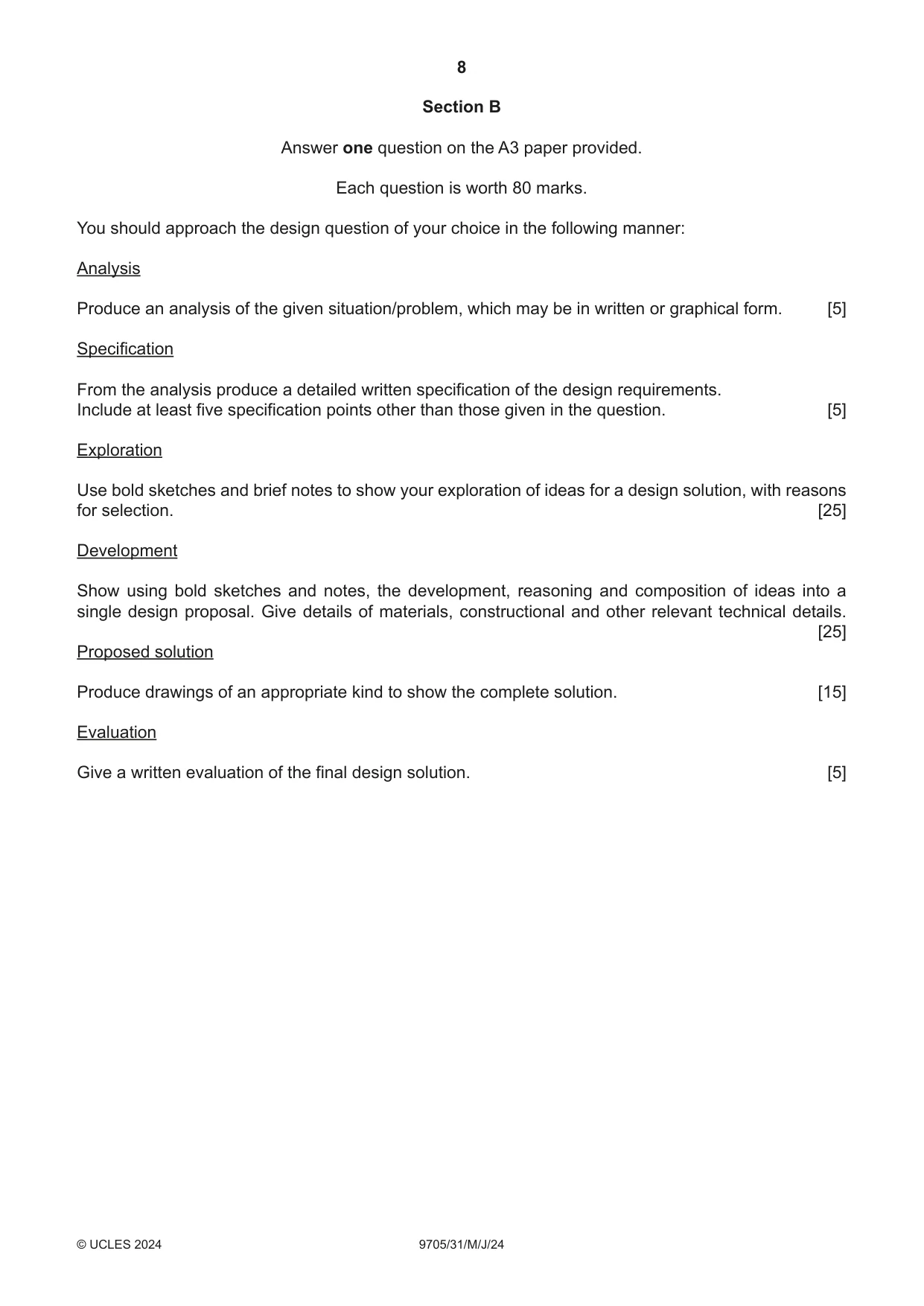
8 9705/31/M/J/24 © UCLES 2024 Section B Answer one question on the A3 paper provided. Each question is worth 80 marks. You should approach the design question of your choice in the following manner: Analysis Produce an analysis of the given situation/problem, which may be in written or graphical form. [5] Specification From the analysis produce a detailed written specification of the design requirements. Include at least five specification points other than those given in the question. [5] Exploration Use bold sketches and brief notes to show your exploration of ideas for a design solution, with reasons for selection. [25] Development Show using bold sketches and notes, the development, reasoning and composition of ideas into a single design proposal. Give details of materials, constructional and other relevant technical details. [25] Proposed solution Produce drawings of an appropriate kind to show the complete solution. [15] Evaluation Give a written evaluation of the final design solution. [5]
Question paper, page 9
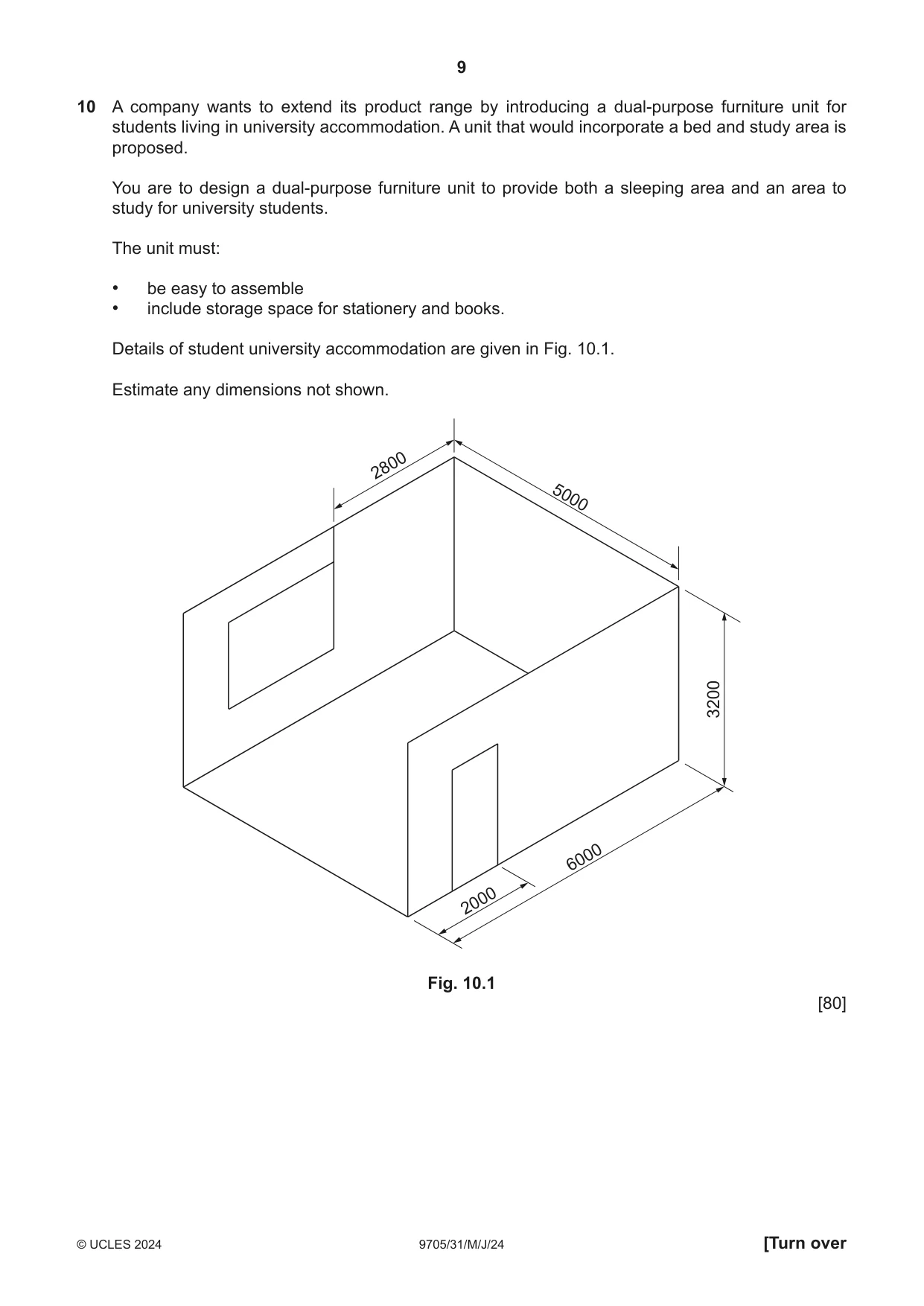
9 9705/31/M/J/24 © UCLES 2024 [Turn over 10 A company wants to extend its product range by introducing a dual-purpose furniture unit for students living in university accommodation. A unit that would incorporate a bed and study area is proposed. You are to design a dual-purpose furniture unit to provide both a sleeping area and an area to study for university students. The unit must: • be easy to assemble • include storage space for stationery and books. Details of student university accommodation are given in Fig. 10.1. Estimate any dimensions not shown. 2800 5000 3200 6000 2000 Fig. 10.1 [80]
Question paper, page 10
10 9705/31/M/J/24 © UCLES 2024 11 A school for children aged 11 to 14 years is to run a cycling safety club. The school will create an obstacle course in the playground with similar size and shape obstacles, where children will learn how to safely control a bicycle. You are to design an obstacle. The obstacle must: • make a sound and/or lighting effect if touched by the cyclist • be easy to store. [80]
Question paper, page 11
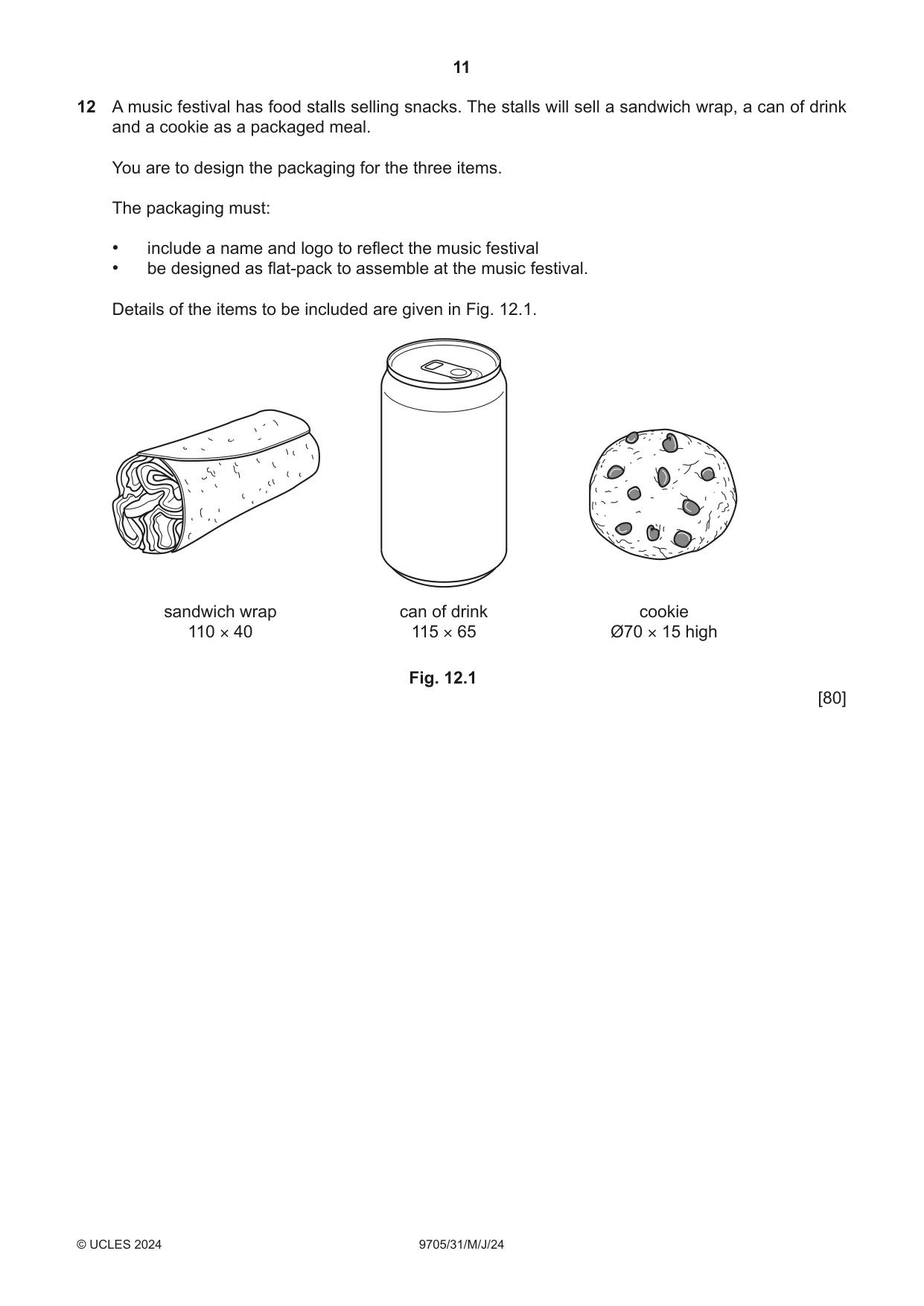
11 9705/31/M/J/24 © UCLES 2024 12 A music festival has food stalls selling snacks. The stalls will sell a sandwich wrap, a can of drink and a cookie as a packaged meal. You are to design the packaging for the three items. The packaging must: • include a name and logo to reflect the music festival • be designed as flat-pack to assemble at the music festival. Details of the items to be included are given in Fig. 12.1. sandwich wrap 110 × 40 can of drink 115 × 65 cookie Ø70 × 15 high Fig. 12.1 [80]
Question paper, page 12
12 9705/31/M/J/24 © UCLES 2024 Permission to reproduce items where third-party owned material protected by copyright is included has been sought and cleared where possible. Every reasonable effort has been made by the publisher (UCLES) to trace copyright holders, but if any items requiring clearance have unwittingly been included, the publisher will be pleased to make amends at the earliest possible opportunity. To avoid the issue of disclosure of answer-related information to candidates, all copyright acknowledgements are reproduced online in the Cambridge Assessment International Education Copyright Acknowledgements Booklet. This is produced for each series of examinations and is freely available to download at www.cambridgeinternational.org after the live examination series. Cambridge Assessment International Education is part of Cambridge Assessment. Cambridge Assessment is the brand name of the University of Cambridge Local Examinations Syndicate (UCLES), which is a department of the University of Cambridge. BLANK PAGE
Mark scheme, page 1
This document consists of 15 printed pages. © Cambridge University Press & Assessment 2024 [Turn over Cambridge International AS & A Level DESIGN AND TECHNOLOGY 9705/31 Paper 3 Written May/June 2024 MARK SCHEME Maximum Mark: 120 Published This mark scheme is published as an aid to teachers and candidates, to indicate the requirements of the examination. It shows the basis on which Examiners were instructed to award marks. It does not indicate the details of the discussions that took place at an Examiners’ meeting before marking began, which would have considered the acceptability of alternative answers. Mark schemes should be read in conjunction with the question paper and the Principal Examiner Report for Teachers. Cambridge International will not enter into discussions about these mark schemes. Cambridge International is publishing the mark schemes for the May/June 2024 series for most Cambridge IGCSE, Cambridge International A and AS Level and Cambridge Pre-U components, and some Cambridge O Level components.
Mark scheme, page 2
9705/31 Cambridge International AS & A Level – Mark Scheme PUBLISHED May/June 2024 © Cambridge University Press & Assessment 2024 Page 2 of 15 Generic Marking Principles These general marking principles must be applied by all examiners when marking candidate answers. They should be applied alongside the specific content of the mark scheme or generic level descriptions for a question. Each question paper and mark scheme will also comply with these marking principles. GENERIC MARKING PRINCIPLE 1: Marks must be awarded in line with: the specific content of the mark scheme or the generic level descriptors for the question the specific skills defined in the mark scheme or in the generic level descriptors for the question the standard of response required by a candidate as exemplified by the standardisation scripts. GENERIC MARKING PRINCIPLE 2: Marks awarded are always whole marks (not half marks, or other fractions). GENERIC MARKING PRINCIPLE 3: Marks must be awarded positively: marks are awarded for correct/valid answers, as defined in the mark scheme. However, credit is given for valid answers which go beyond the scope of the syllabus and mark scheme, referring to your Team Leader as appropriate marks are awarded when candidates clearly demonstrate what they know and can do marks are not deducted for errors marks are not deducted for omissions answers should only be judged on the quality of spelling, punctuation and grammar when these features are specifically assessed by the question as indicated by the mark scheme. The meaning, however, should be unambiguous. GENERIC MARKING PRINCIPLE 4: Rules must be applied consistently, e.g. in situations where candidates have not followed instructions or in the application of generic level descriptors.
Mark scheme, page 3
9705/31 Cambridge International AS & A Level – Mark Scheme PUBLISHED May/June 2024 © Cambridge University Press & Assessment 2024 Page 3 of 15 GENERIC MARKING PRINCIPLE 5: Marks should be awarded using the full range of marks defined in the mark scheme for the question (however; the use of the full mark range may be limited according to the quality of the candidate responses seen). GENERIC MARKING PRINCIPLE 6: Marks awarded are based solely on the requirements as defined in the mark scheme. Marks should not be awarded with grade thresholds or grade descriptors in mind.
Mark scheme, page 4
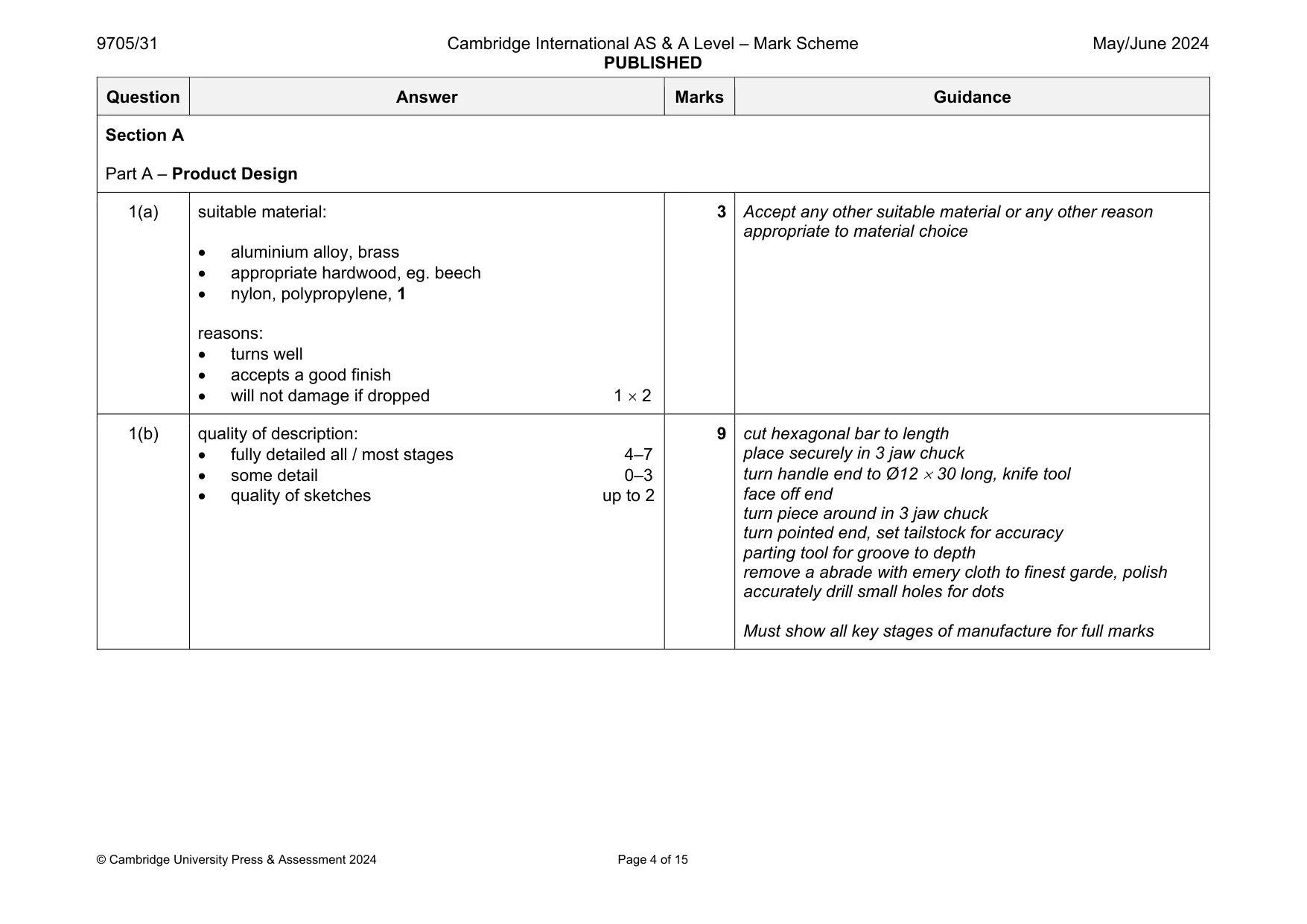
9705/31 Cambridge International AS & A Level – Mark Scheme PUBLISHED May/June 2024 © Cambridge University Press & Assessment 2024 Page 4 of 15 Question Answer Marks Guidance Section A Part A – Product Design 1(a) suitable material: aluminium alloy, brass appropriate hardwood, eg. beech nylon, polypropylene, 1 reasons: turns well accepts a good finish will not damage if dropped 1 2 3 Accept any other suitable material or any other reason appropriate to material choice 1(b) quality of description: fully detailed all / most stages 4–7 some detail 0–3 quality of sketches up to 2 9 cut hexagonal bar to length place securely in 3 jaw chuck turn handle end to Ø12 30 long, knife tool face off end turn piece around in 3 jaw chuck turn pointed end, set tailstock for accuracy parting tool for groove to depth remove a abrade with emery cloth to finest garde, polish accurately drill small holes for dots Must show all key stages of manufacture for full marks
Mark scheme, page 5
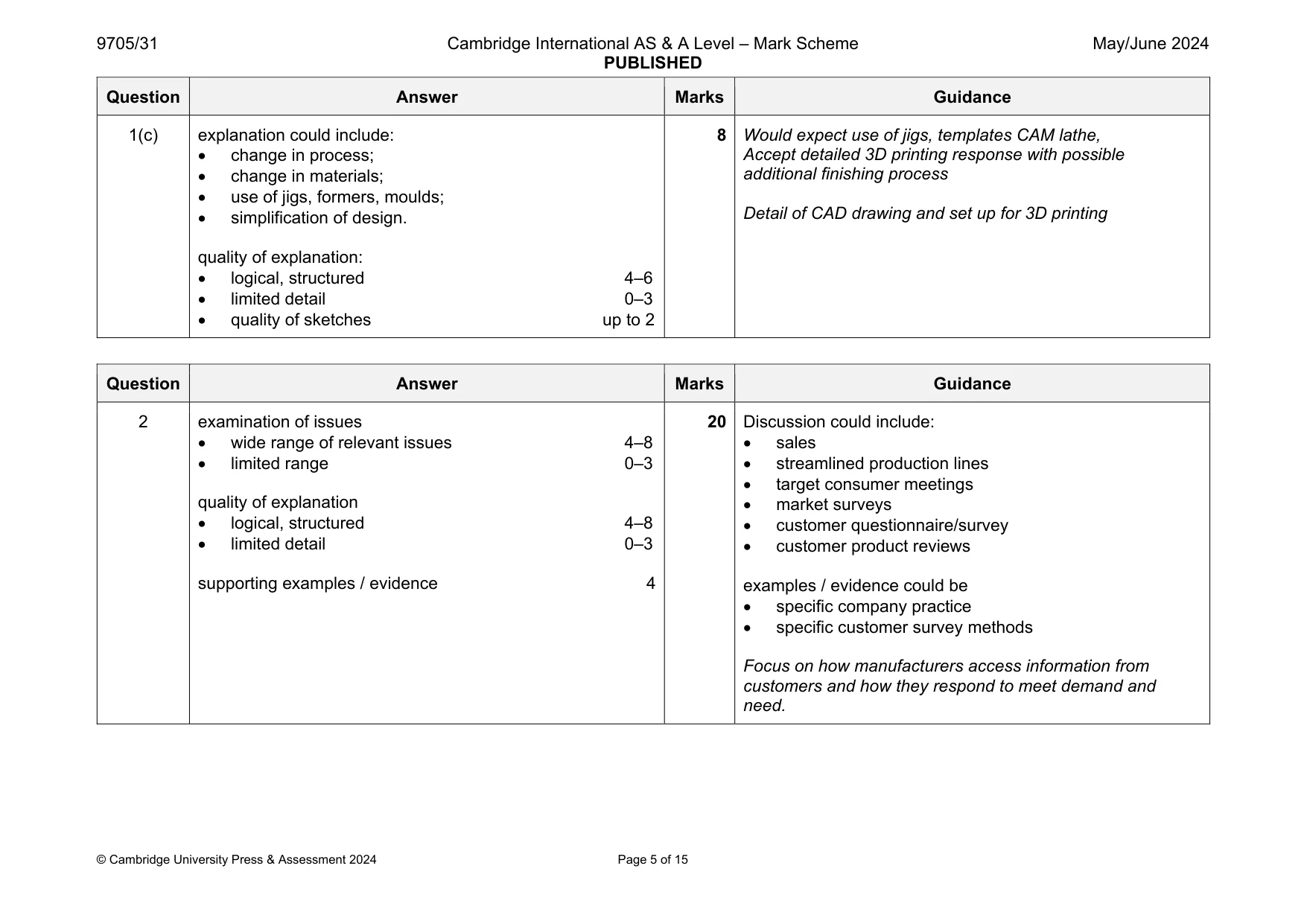
9705/31 Cambridge International AS & A Level – Mark Scheme PUBLISHED May/June 2024 © Cambridge University Press & Assessment 2024 Page 5 of 15 Question Answer Marks Guidance 1(c) explanation could include: change in process; change in materials; use of jigs, formers, moulds; simplification of design. quality of explanation: logical, structured 4–6 limited detail 0–3 quality of sketches up to 2 8 Would expect use of jigs, templates CAM lathe, Accept detailed 3D printing response with possible additional finishing process Detail of CAD drawing and set up for 3D printing Question Answer Marks Guidance 2 examination of issues wide range of relevant issues 4–8 limited range 0–3 quality of explanation logical, structured 4–8 limited detail 0–3 supporting examples / evidence 4 20 Discussion could include: sales streamlined production lines target consumer meetings market surveys customer questionnaire/survey customer product reviews examples / evidence could be specific company practice specific customer survey methods Focus on how manufacturers access information from customers and how they respond to meet demand and need.
Mark scheme, page 6
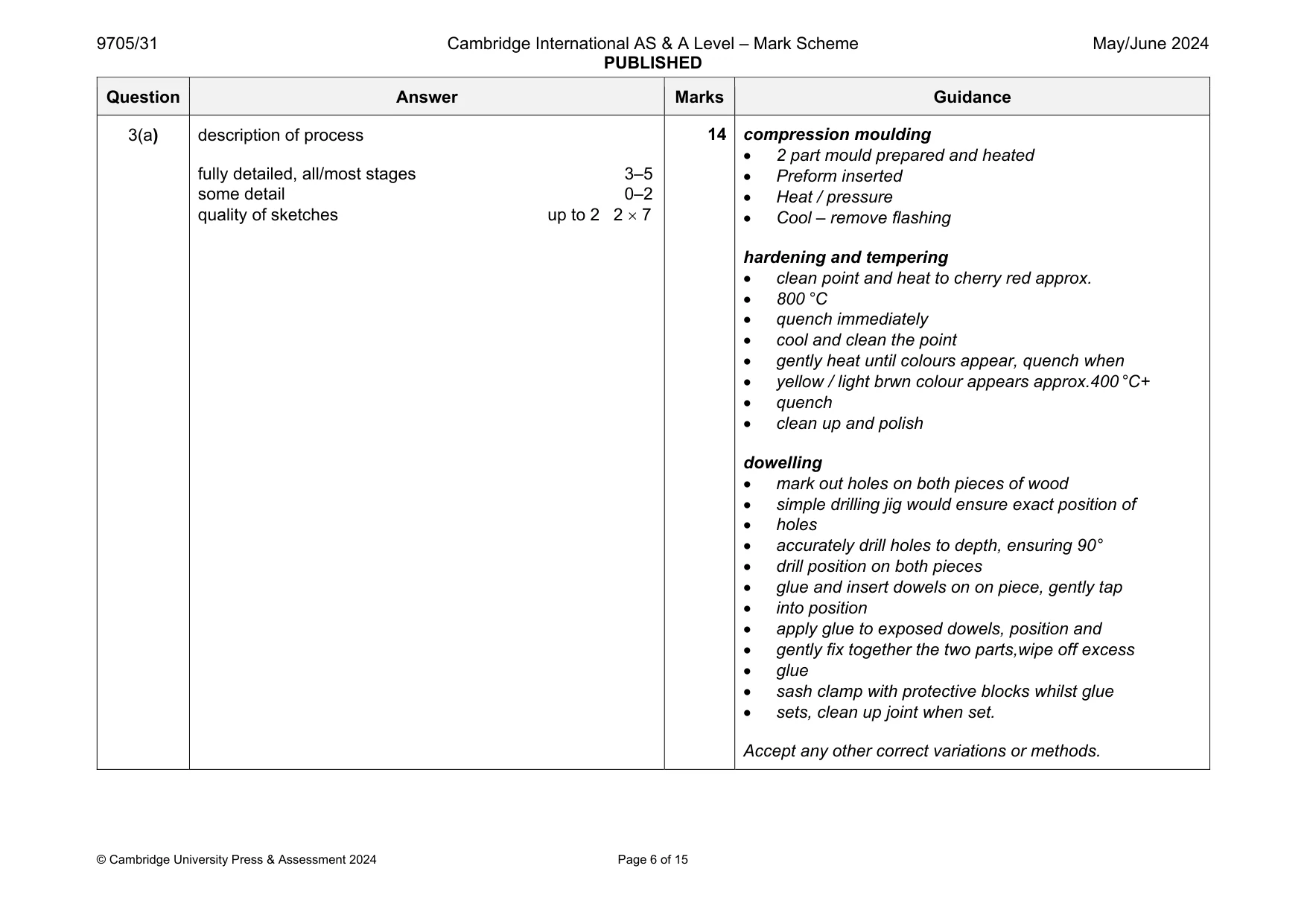
9705/31 Cambridge International AS & A Level – Mark Scheme PUBLISHED May/June 2024 © Cambridge University Press & Assessment 2024 Page 6 of 15 Question Answer Marks Guidance 3(a) description of process fully detailed, all/most stages 3–5 some detail 0–2 quality of sketches up to 2 2 7 14 compression moulding 2 part mould prepared and heated Preform inserted Heat / pressure Cool – remove flashing hardening and tempering clean point and heat to cherry red approx. 800 °C quench immediately cool and clean the point gently heat until colours appear, quench when yellow / light brwn colour appears approx.400 °C+ quench clean up and polish dowelling mark out holes on both pieces of wood simple drilling jig would ensure exact position of holes accurately drill holes to depth, ensuring 90° drill position on both pieces glue and insert dowels on on piece, gently tap into position apply glue to exposed dowels, position and gently fix together the two parts,wipe off excess glue sash clamp with protective blocks whilst glue sets, clean up joint when set. Accept any other correct variations or methods.
Mark scheme, page 7
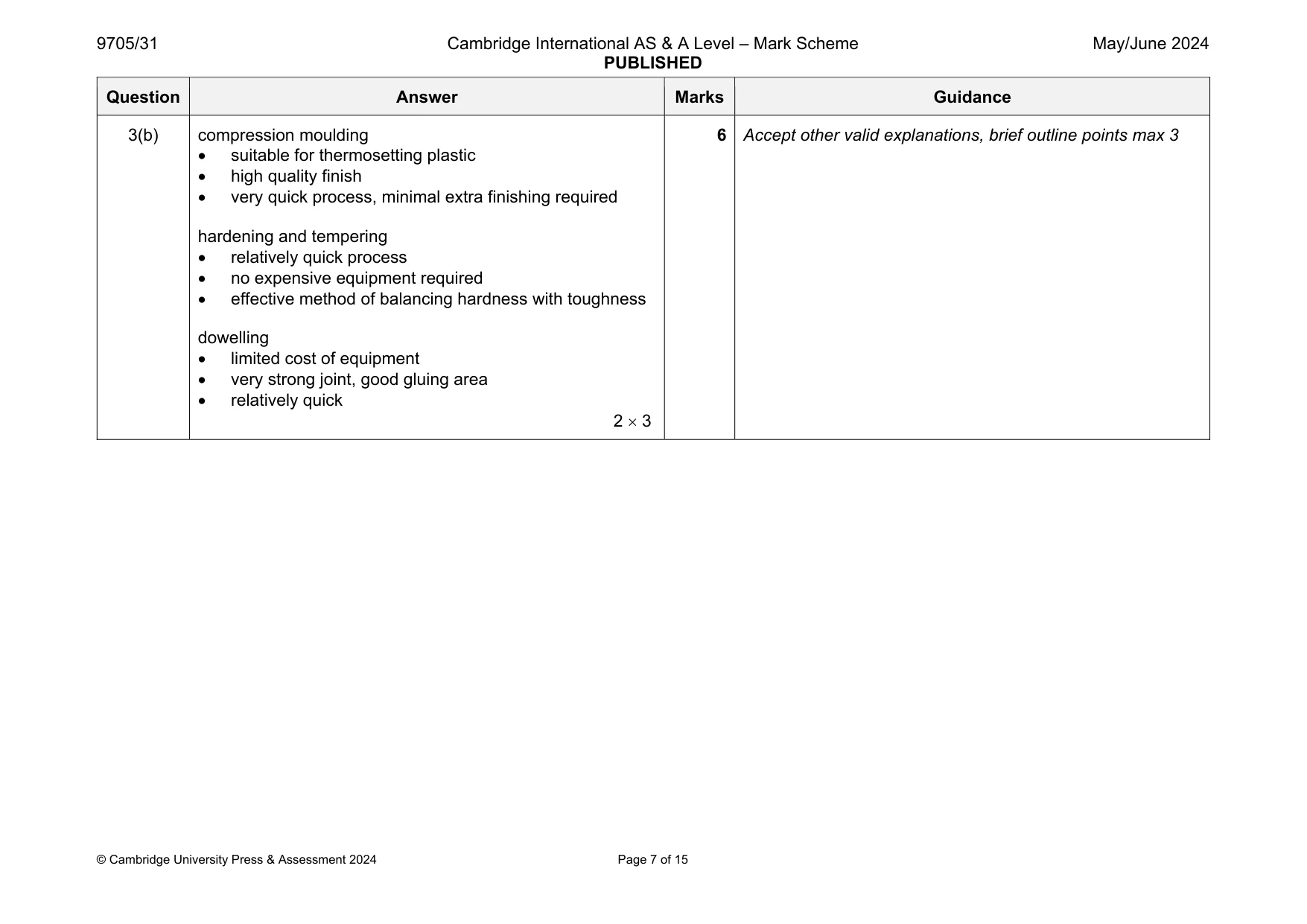
9705/31 Cambridge International AS & A Level – Mark Scheme PUBLISHED May/June 2024 © Cambridge University Press & Assessment 2024 Page 7 of 15 Question Answer Marks Guidance 3(b) compression moulding suitable for thermosetting plastic high quality finish very quick process, minimal extra finishing required hardening and tempering relatively quick process no expensive equipment required effective method of balancing hardness with toughness dowelling limited cost of equipment very strong joint, good gluing area relatively quick 2 3 6 Accept other valid explanations, brief outline points max 3
Mark scheme, page 8
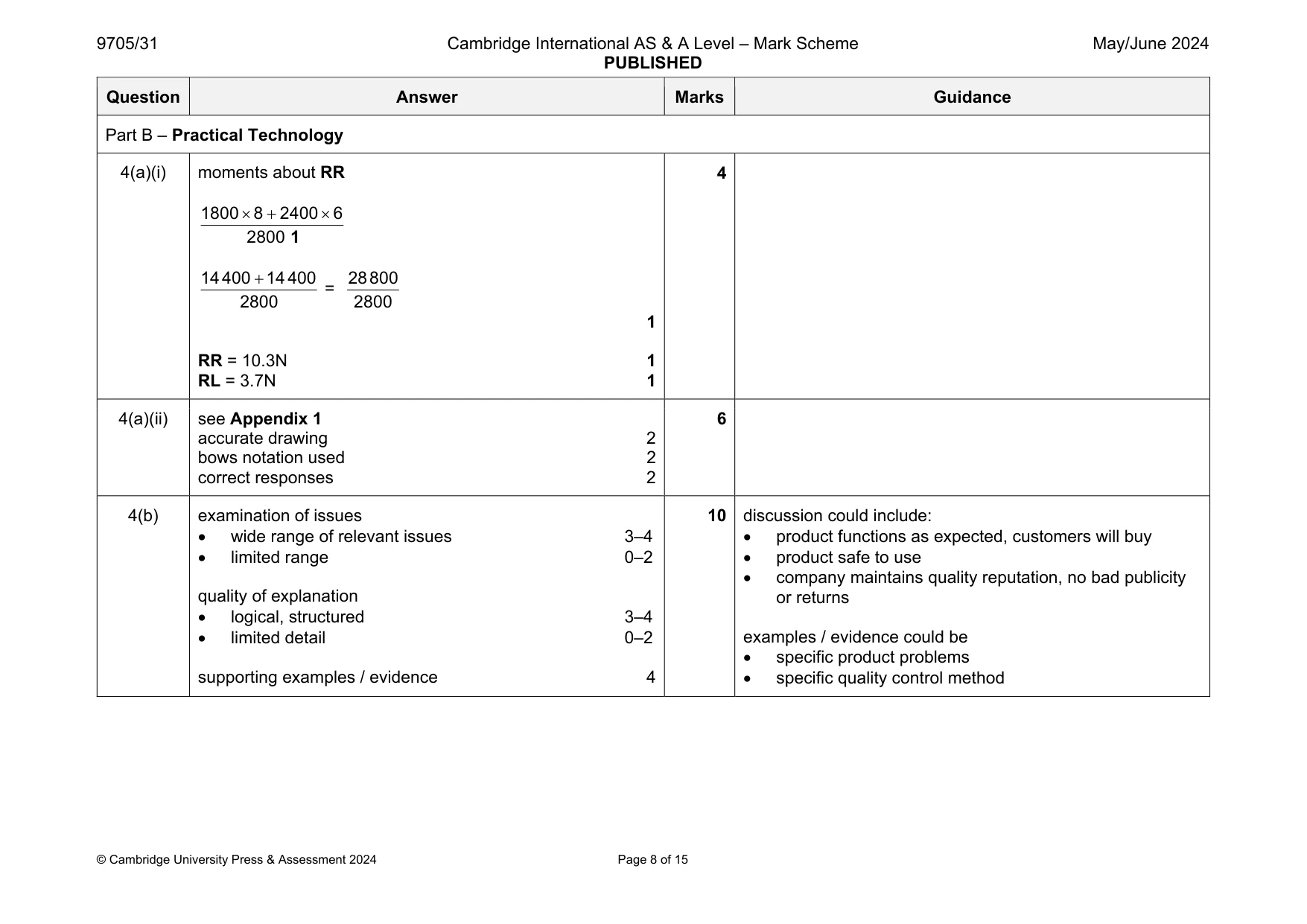
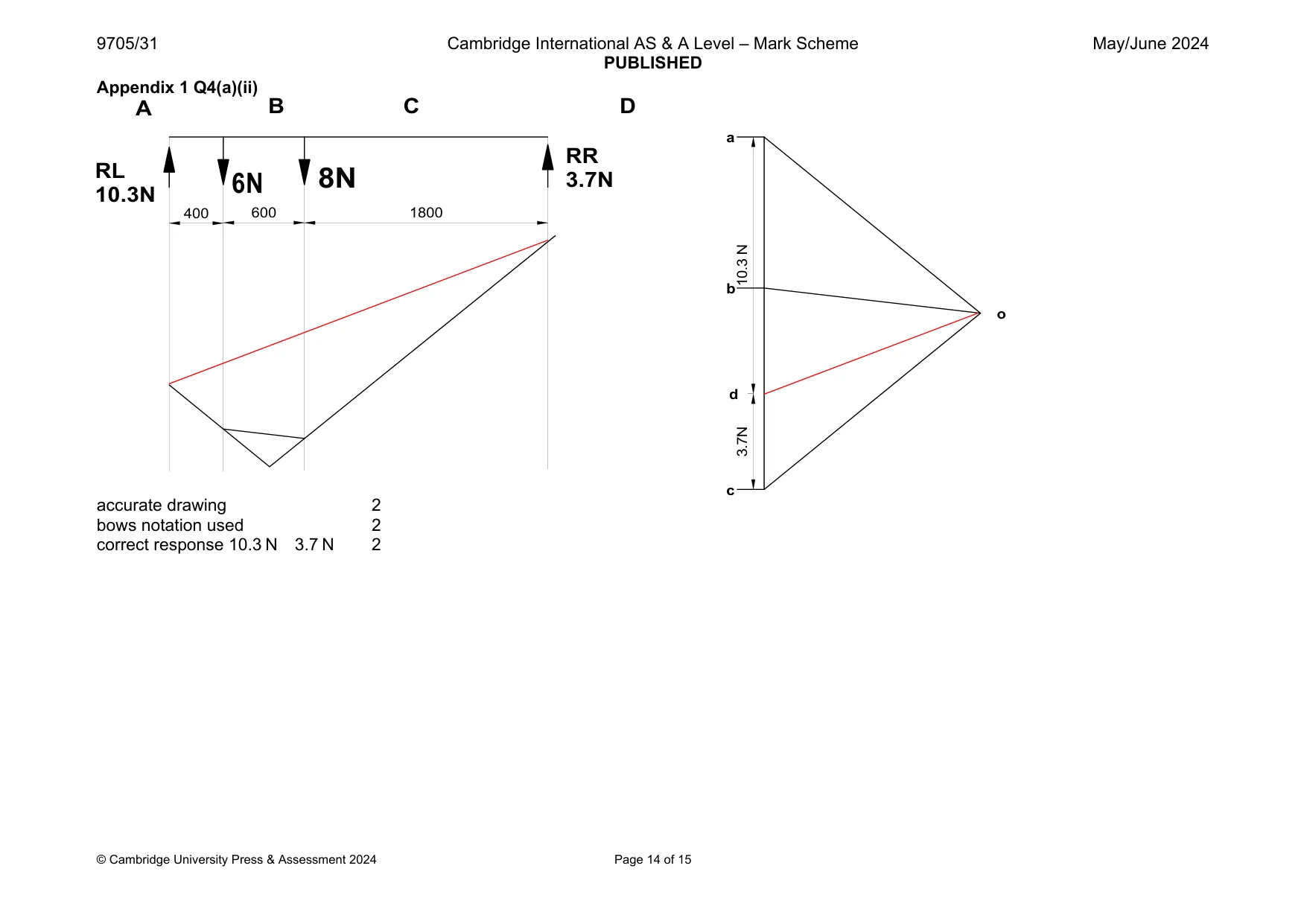
9705/31 Cambridge International AS & A Level – Mark Scheme PUBLISHED May/June 2024 © Cambridge University Press & Assessment 2024 Page 8 of 15 Question Answer Marks Guidance Part B – Practical Technology 4(a)(i) moments about RR 1800 8 2400 6 2800 1 14400 14400 2800 = 28800 2800 1 RR = 10.3N 1 RL = 3.7N 1 4 4(a)(ii) see Appendix 1 accurate drawing 2 bows notation used 2 correct responses 2 6 4(b) examination of issues wide range of relevant issues 3–4 limited range 0–2 quality of explanation logical, structured 3–4 limited detail 0–2 supporting examples / evidence 4 10 discussion could include: product functions as expected, customers will buy product safe to use company maintains quality reputation, no bad publicity or returns examples / evidence could be specific product problems specific quality control method
Mark scheme, page 9
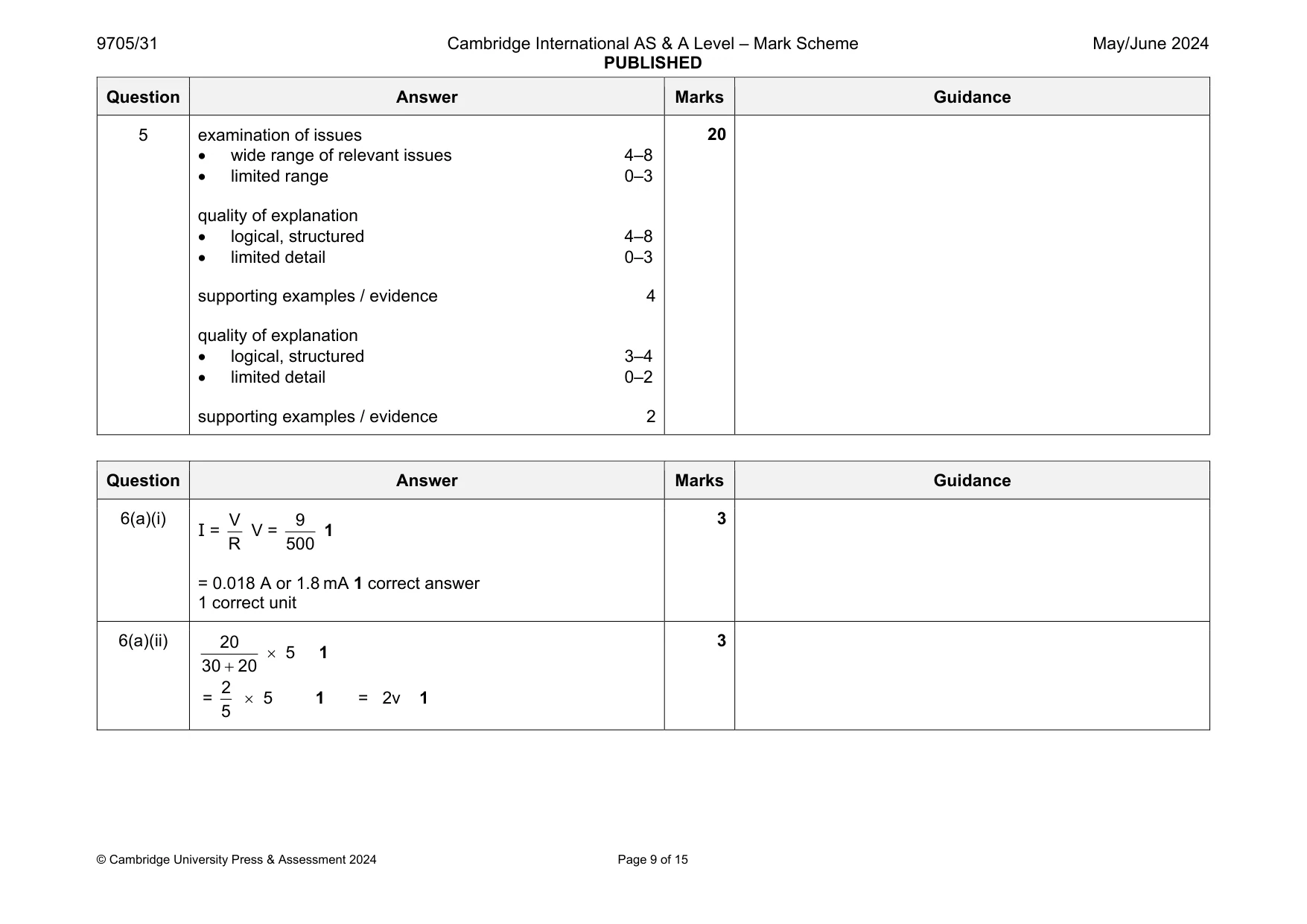
9705/31 Cambridge International AS & A Level – Mark Scheme PUBLISHED May/June 2024 © Cambridge University Press & Assessment 2024 Page 9 of 15 Question Answer Marks Guidance 5 examination of issues wide range of relevant issues 4–8 limited range 0–3 quality of explanation logical, structured 4–8 limited detail 0–3 supporting examples / evidence 4 quality of explanation logical, structured 3–4 limited detail 0–2 supporting examples / evidence 2 20 Question Answer Marks Guidance 6(a)(i) I = V R V = 9 500 1 = 0.018 A or 1.8 mA 1 correct answer 1 correct unit 3 6(a)(ii) 20 30 20 5 1 = 2 5 5 1 = 2v 1 3
Mark scheme, page 10
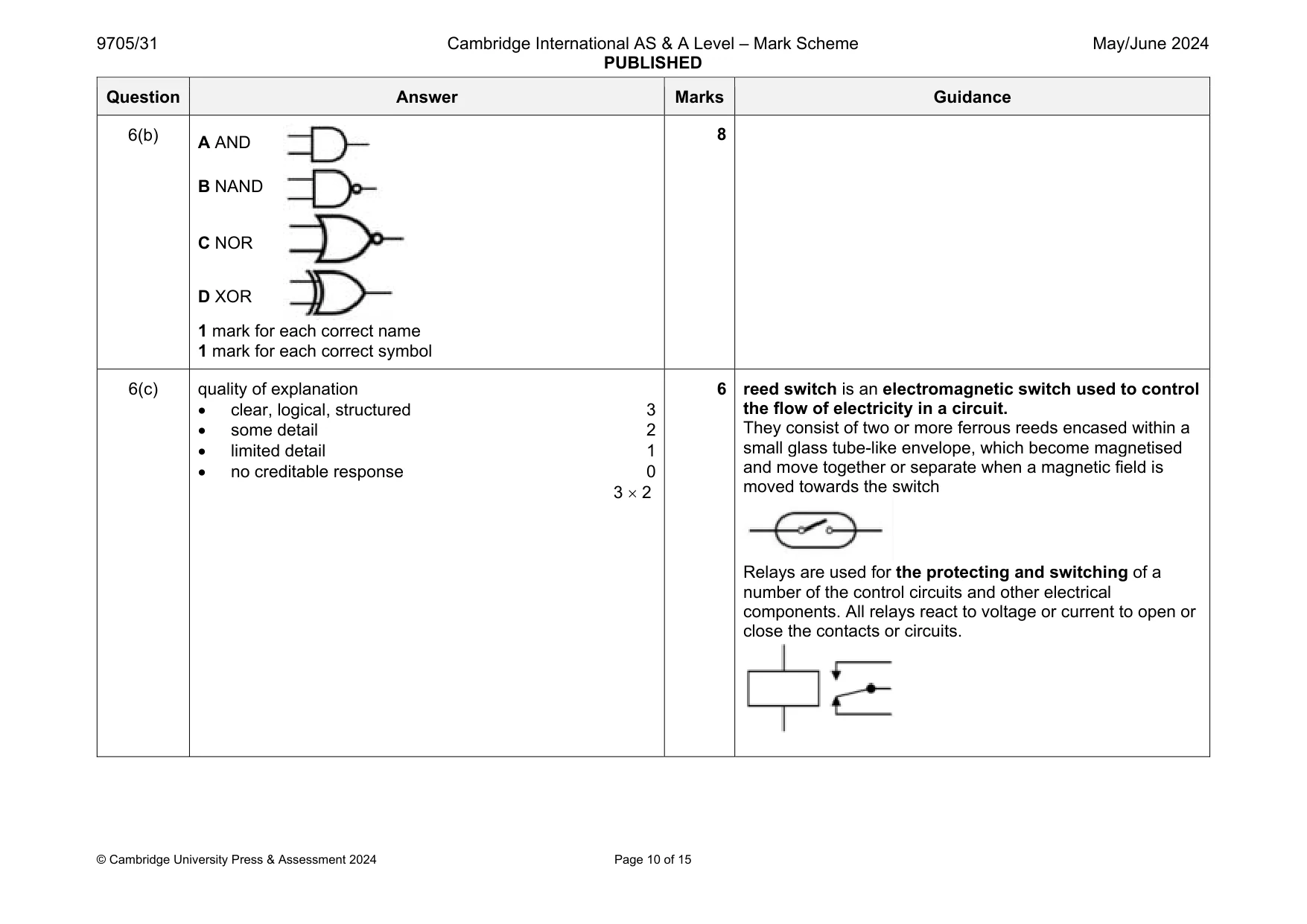
9705/31 Cambridge International AS & A Level – Mark Scheme PUBLISHED May/June 2024 © Cambridge University Press & Assessment 2024 Page 10 of 15 Question Answer Marks Guidance 6(b) A AND B NAND C NOR D XOR 1 mark for each correct name 1 mark for each correct symbol 8 6(c) quality of explanation clear, logical, structured 3 some detail 2 limited detail 1 no creditable response 0 3 2 6 reed switch is an electromagnetic switch used to control the flow of electricity in a circuit. They consist of two or more ferrous reeds encased within a small glass tube-like envelope, which become magnetised and move together or separate when a magnetic field is moved towards the switch Relays are used for the protecting and switching of a number of the control circuits and other electrical components. All relays react to voltage or current to open or close the contacts or circuits.
Mark scheme, page 11
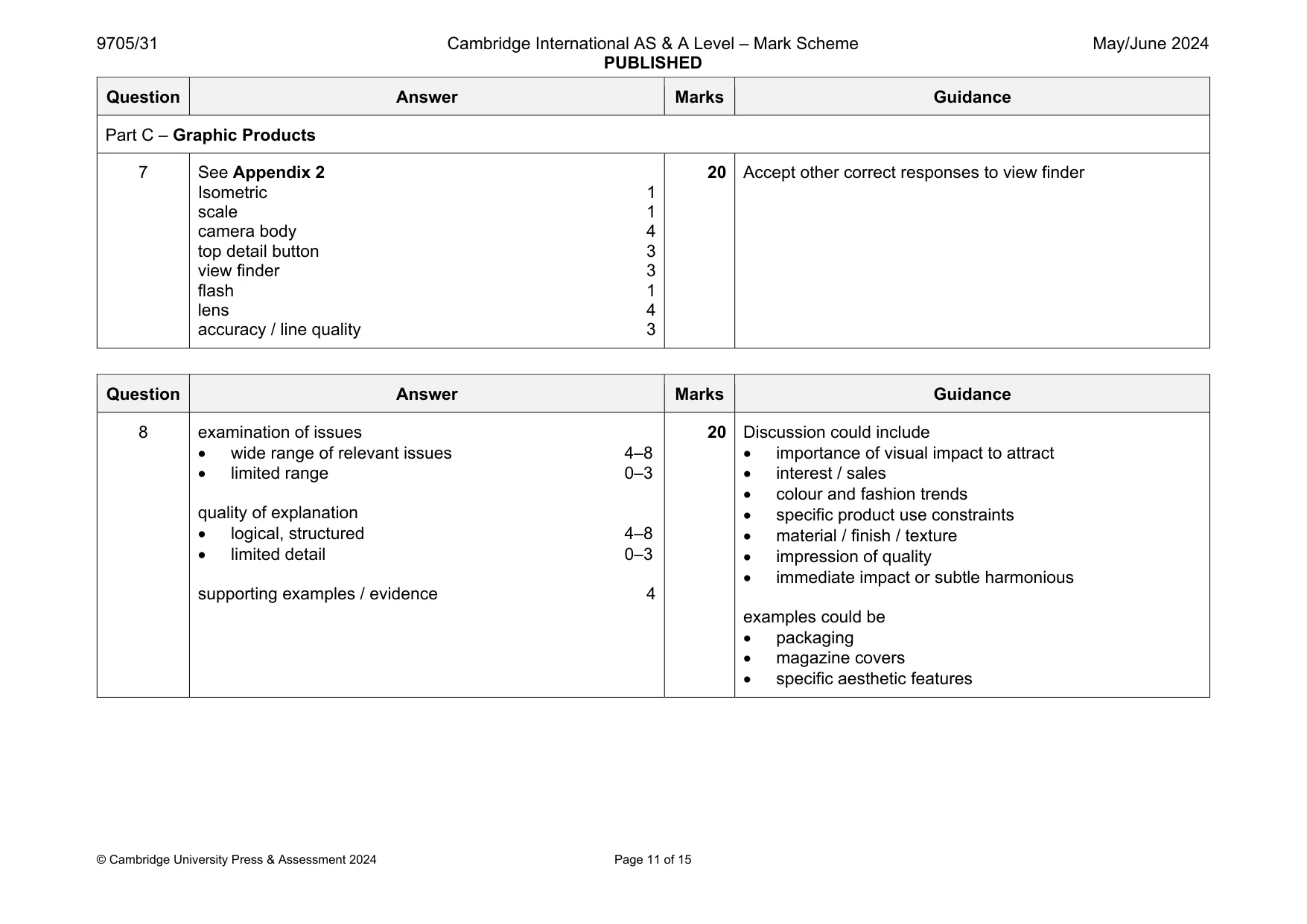
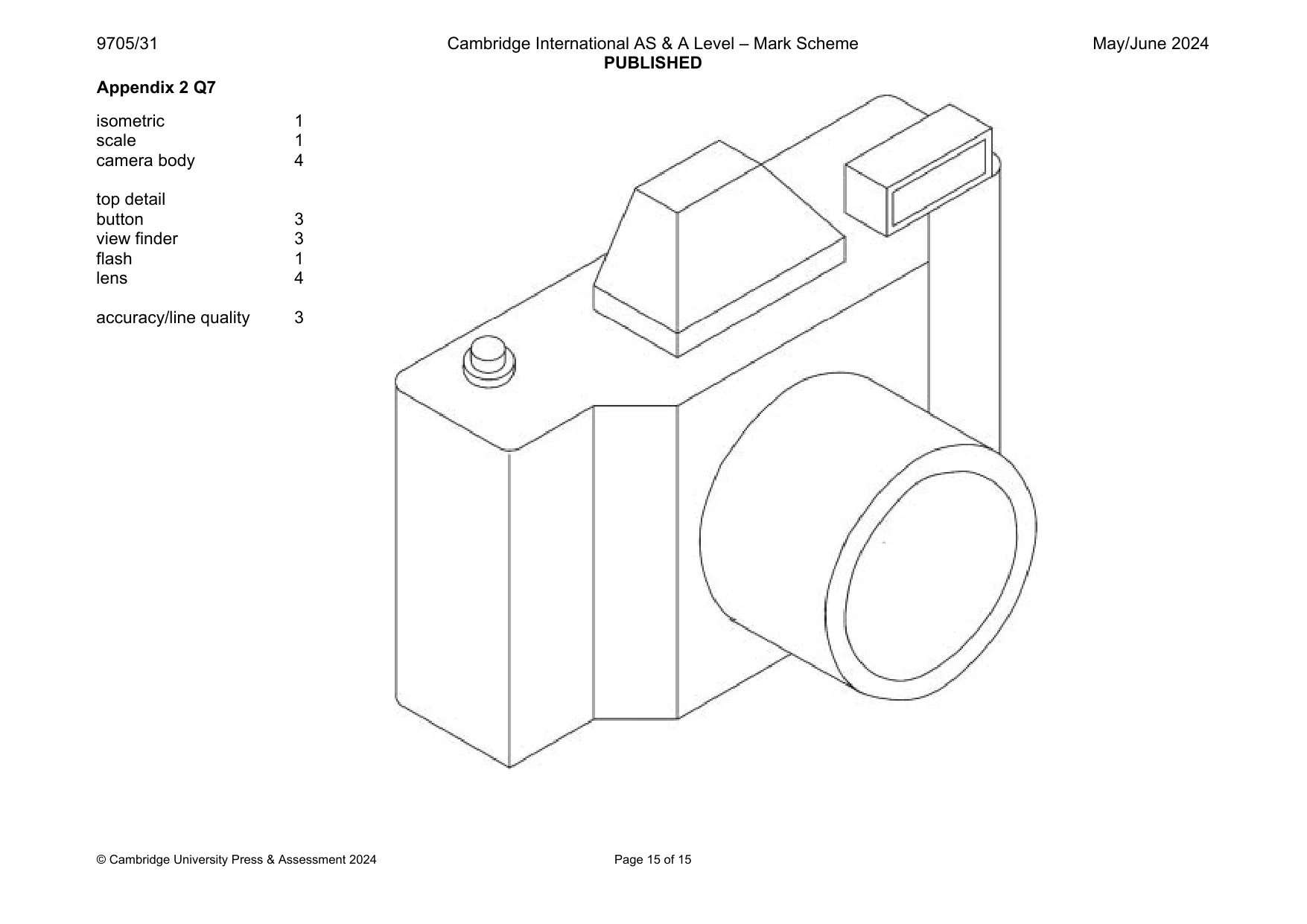
9705/31 Cambridge International AS & A Level – Mark Scheme PUBLISHED May/June 2024 © Cambridge University Press & Assessment 2024 Page 11 of 15 Question Answer Marks Guidance Part C – Graphic Products 7 See Appendix 2 Isometric 1 scale 1 camera body 4 top detail button 3 view finder 3 flash 1 lens 4 accuracy / line quality 3 20 Accept other correct responses to view finder Question Answer Marks Guidance 8 examination of issues wide range of relevant issues 4–8 limited range 0–3 quality of explanation logical, structured 4–8 limited detail 0–3 supporting examples / evidence 4 20 Discussion could include importance of visual impact to attract interest / sales colour and fashion trends specific product use constraints material / finish / texture impression of quality immediate impact or subtle harmonious examples could be packaging magazine covers specific aesthetic features
Mark scheme, page 12
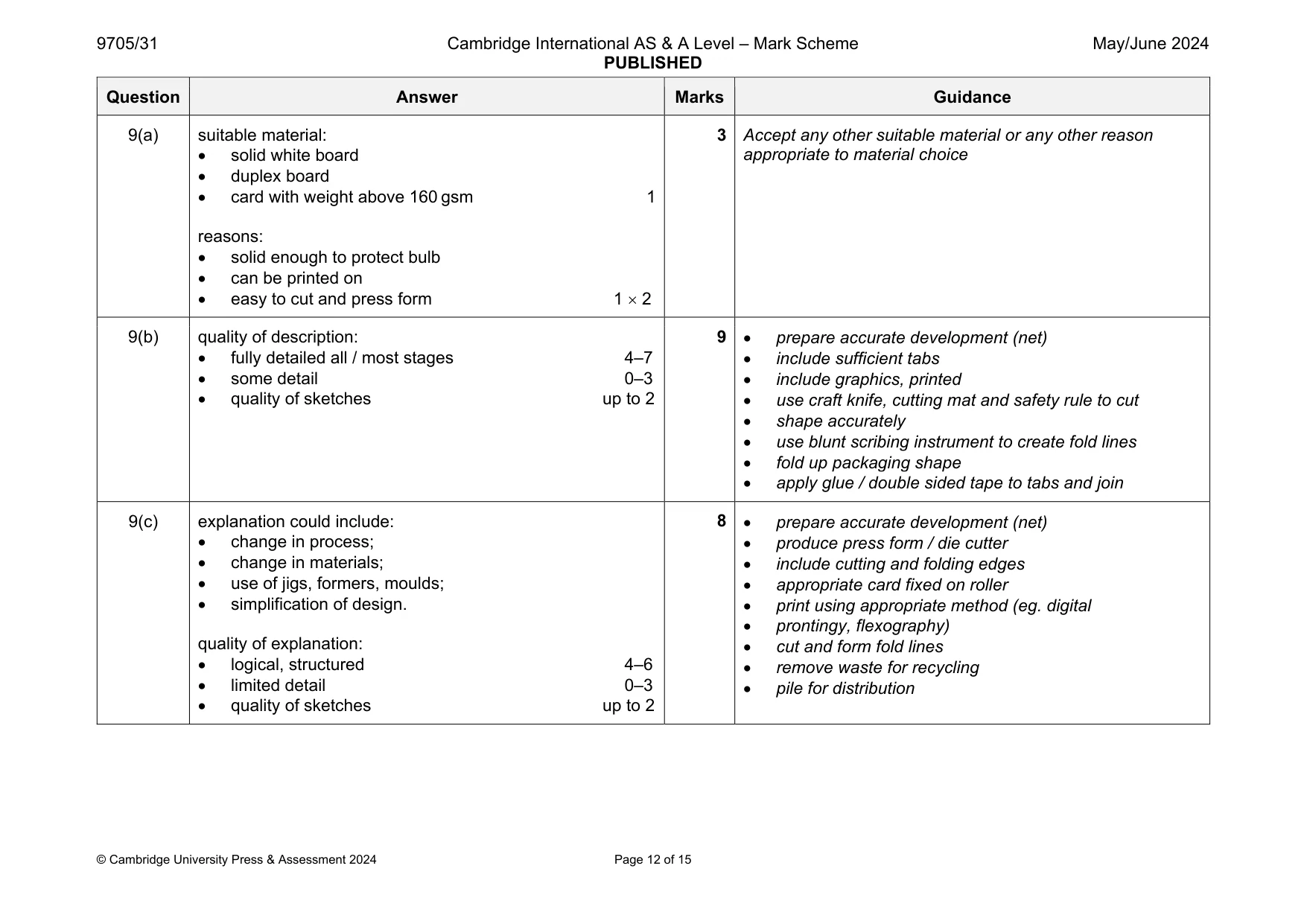
9705/31 Cambridge International AS & A Level – Mark Scheme PUBLISHED May/June 2024 © Cambridge University Press & Assessment 2024 Page 12 of 15 Question Answer Marks Guidance 9(a) suitable material: solid white board duplex board card with weight above 160 gsm 1 reasons: solid enough to protect bulb can be printed on easy to cut and press form 1 2 3 Accept any other suitable material or any other reason appropriate to material choice 9(b) quality of description: fully detailed all / most stages 4–7 some detail 0–3 quality of sketches up to 2 9 prepare accurate development (net) include sufficient tabs include graphics, printed use craft knife, cutting mat and safety rule to cut shape accurately use blunt scribing instrument to create fold lines fold up packaging shape apply glue / double sided tape to tabs and join 9(c) explanation could include: change in process; change in materials; use of jigs, formers, moulds; simplification of design. quality of explanation: logical, structured 4–6 limited detail 0–3 quality of sketches up to 2 8 prepare accurate development (net) produce press form / die cutter include cutting and folding edges appropriate card fixed on roller print using appropriate method (eg. digital prontingy, flexography) cut and form fold lines remove waste for recycling pile for distribution
Mark scheme, page 13
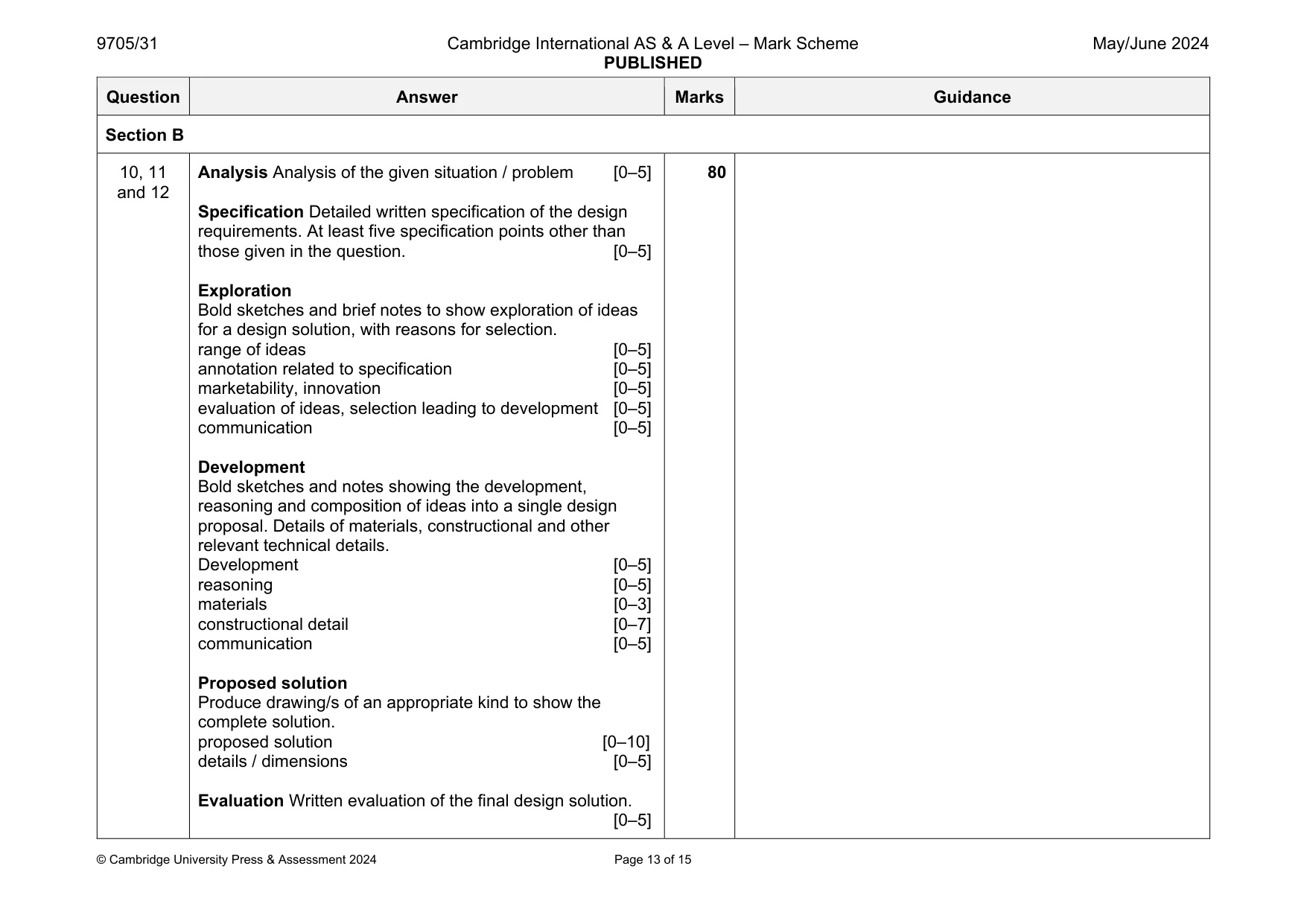
9705/31 Cambridge International AS & A Level – Mark Scheme PUBLISHED May/June 2024 © Cambridge University Press & Assessment 2024 Page 13 of 15 Question Answer Marks Guidance Section B 10, 11 and 12 Analysis Analysis of the given situation / problem [0–5] Specification Detailed written specification of the design requirements. At least five specification points other than those given in the question. [0–5] Exploration Bold sketches and brief notes to show exploration of ideas for a design solution, with reasons for selection. range of ideas [0–5] annotation related to specification [0–5] marketability, innovation [0–5] evaluation of ideas, selection leading to development [0–5] communication [0–5] Development Bold sketches and notes showing the development, reasoning and composition of ideas into a single design proposal. Details of materials, constructional and other relevant technical details. Development [0–5] reasoning [0–5] materials [0–3] constructional detail [0–7] communication [0–5] Proposed solution Produce drawing/s of an appropriate kind to show the complete solution. proposed solution [0–10] details / dimensions [0–5] Evaluation Written evaluation of the final design solution. [0–5] 80
Mark scheme, page 14
9705/31 Cambridge International AS & A Level – Mark Scheme PUBLISHED May/June 2024 © Cambridge University Press & Assessment 2024 Page 14 of 15 Appendix 1 Q4(a)(ii) accurate drawing 2 bows notation used 2 correct response 10.3 N 3.7 N 2 6N 8N 400 600 1800 A B C D a b d o c 10.3 N 3.7N RL 10.3N RR 3.7N
Mark scheme, page 15
9705/31 Cambridge International AS & A Level – Mark Scheme PUBLISHED May/June 2024 © Cambridge University Press & Assessment 2024 Page 15 of 15 Appendix 2 Q7 isometric 1 scale 1 camera body 4 top detail button 3 view finder 3 flash 1 lens 4 accuracy/line quality 3
What you needed in this session
Cambridge’s own grade thresholds for 2024 May/June, Paper 3 · Variant 1. A higher threshold means an easier paper — the bar moves with how the cohort did.