Cambridge A Level Design and Technology 9705 — 2008 Oct/Nov Paper 1 · Variant 1
9705/11/O/N/08 · 120 marks · ≈135 min
The question paper and its mark scheme, free to read here and free to download. This is Cambridge’s own paper, exactly as it was sat.
Question paper12 pages
Mark scheme5 pages
Answers below. Sit the paper first if you are practising.
Paper as text
Question paper, page 1
This document consists of 10 printed pages and 2 blank pages. SPA (SJF4680/CG) T57800/3 © UCLES 2008 [Turn over UNIVERSITY OF CAMBRIDGE INTERNATIONAL EXAMINATIONS General Certificate of Education Advanced Subsidiary Level and Advanced Level READ THESE INSTRUCTIONS FIRST If you have been given an Answer Booklet, follow the instructions on the front cover of the Booklet. Write your answers and working on the separate Answer Booklet/Paper provided. Write your name, Centre number and candidate number on all the work you hand in. Write in dark blue or black pen. You may use a soft pencil, or coloured pencils/pens as appropriate, for any diagrams, graphs or rough working. Do not use staples, paper clips, highlighters, glue or correction fluid. DO NOT WRITE ON ANY BARCODES. Section A Answer one question. Section B Answer one question. Section C Answer one question on plain A3 paper. You are advised to spend 30 minutes on each of Sections A and B and 2 hours on Section C. At the end of the examination, fasten all your work securely together. The number of marks is given in brackets [ ] at the end of each question or part question. All dimensions are in millimetres. * 5 6 5 3 4 4 8 9 7 8 * DESIGN AND TECHNOLOGY 9705/01 Paper 1 October/November 2008 3 hours Additional Materials: Answer Booklet/Paper A3 Drawing paper (3 sheets) A range of design drawing equipment
Question paper, page 2
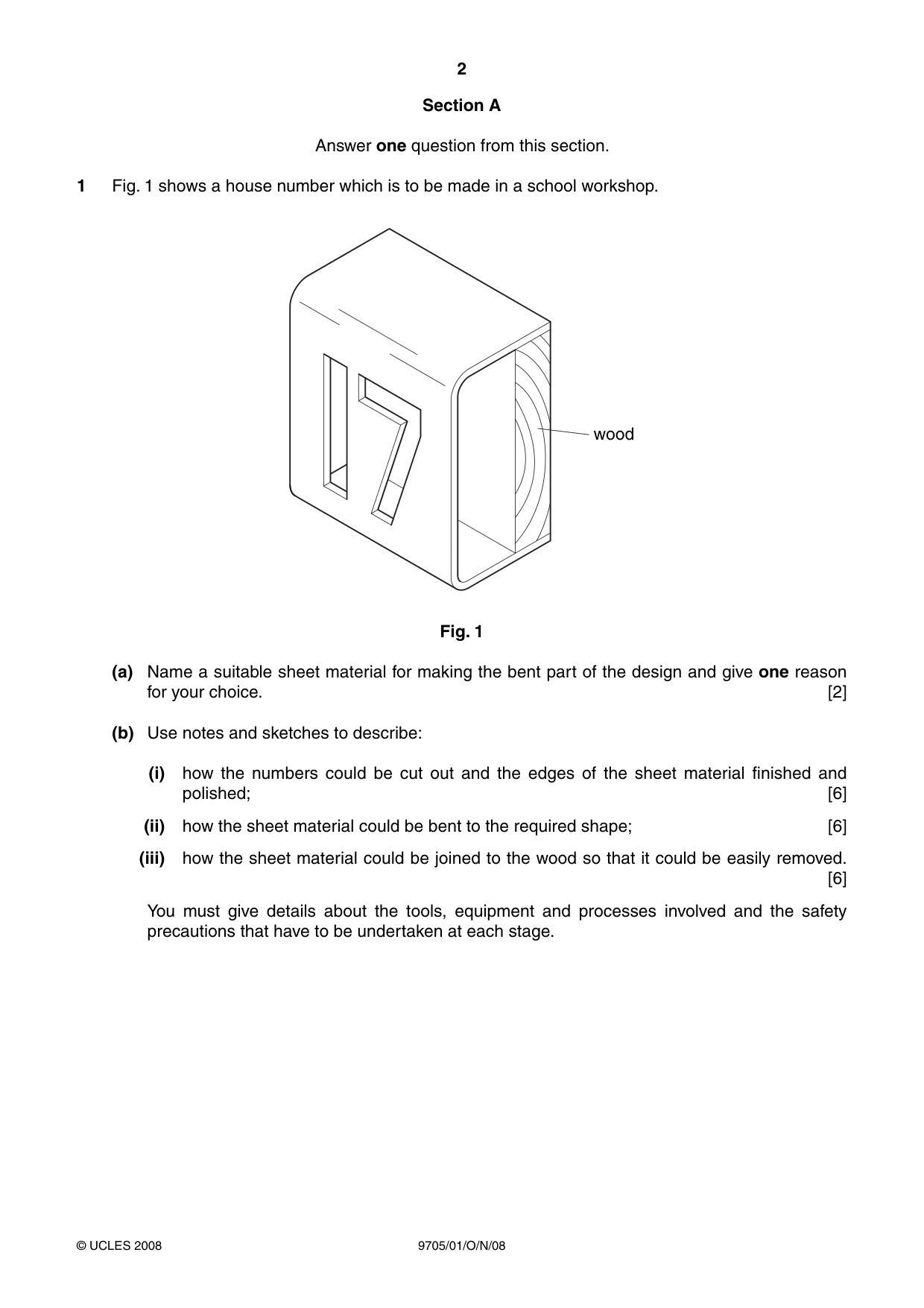
2 9705/01/O/N/08 © UCLES 2008 Section A Answer one question from this section. 1 Fig. 1 shows a house number which is to be made in a school workshop. wood Fig. 1 (a) Name a suitable sheet material for making the bent part of the design and give one reason for your choice. [2] (b) Use notes and sketches to describe: (i) how the numbers could be cut out and the edges of the sheet material finished and polished; [6] (ii) how the sheet material could be bent to the required shape; [6] (iii) how the sheet material could be joined to the wood so that it could be easily removed. [6] You must give details about the tools, equipment and processes involved and the safety precautions that have to be undertaken at each stage.
Question paper, page 3
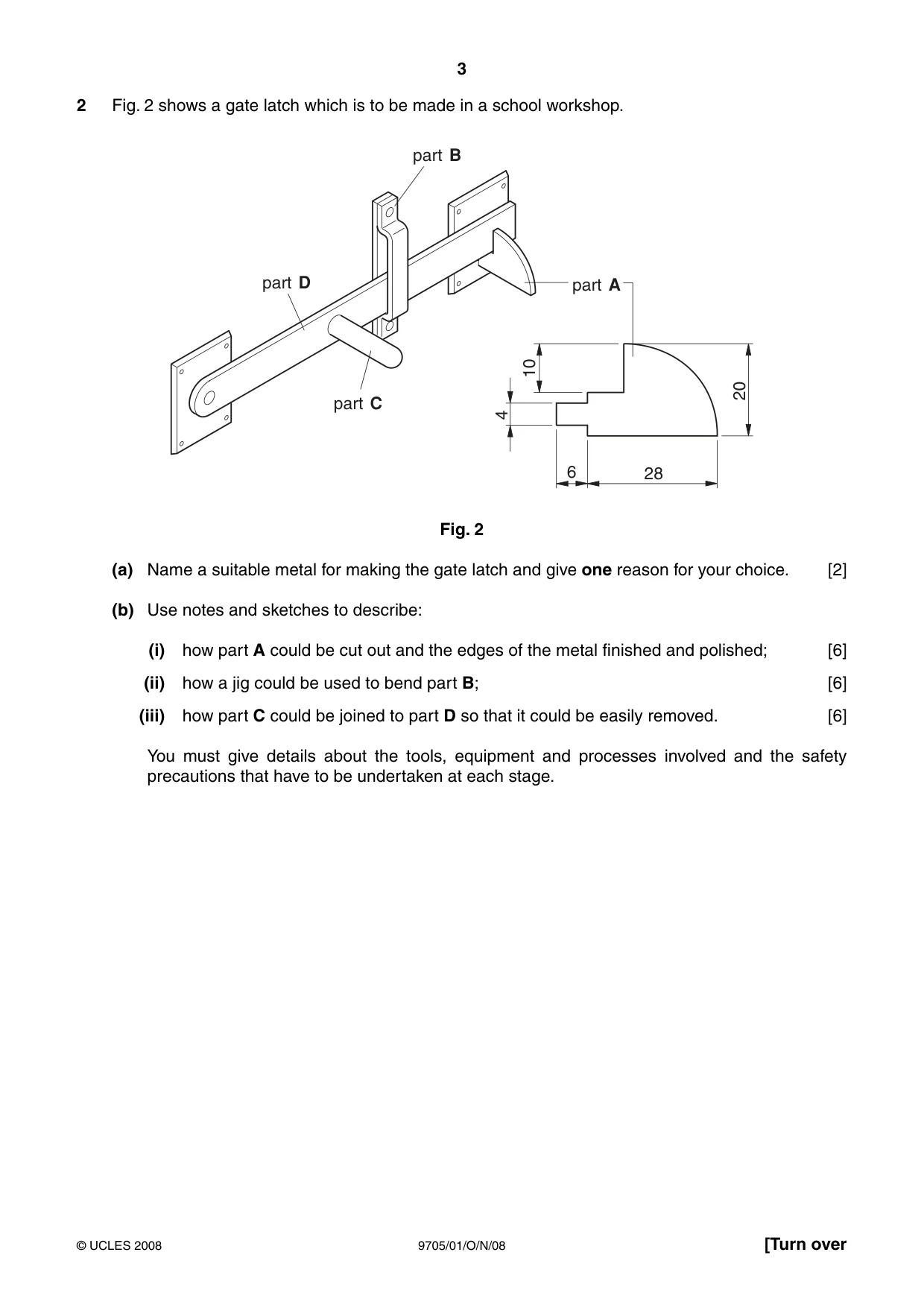
3 9705/01/O/N/08 © UCLES 2008 [Turn over 2 Fig. 2 shows a gate latch which is to be made in a school workshop. 6 28 20 10 4 part B part A part C part D Fig. 2 (a) Name a suitable metal for making the gate latch and give one reason for your choice. [2] (b) Use notes and sketches to describe: (i) how part A could be cut out and the edges of the metal finished and polished; [6] (ii) how a jig could be used to bend part B; [6] (iii) how part C could be joined to part D so that it could be easily removed. [6] You must give details about the tools, equipment and processes involved and the safety precautions that have to be undertaken at each stage.
Question paper, page 4
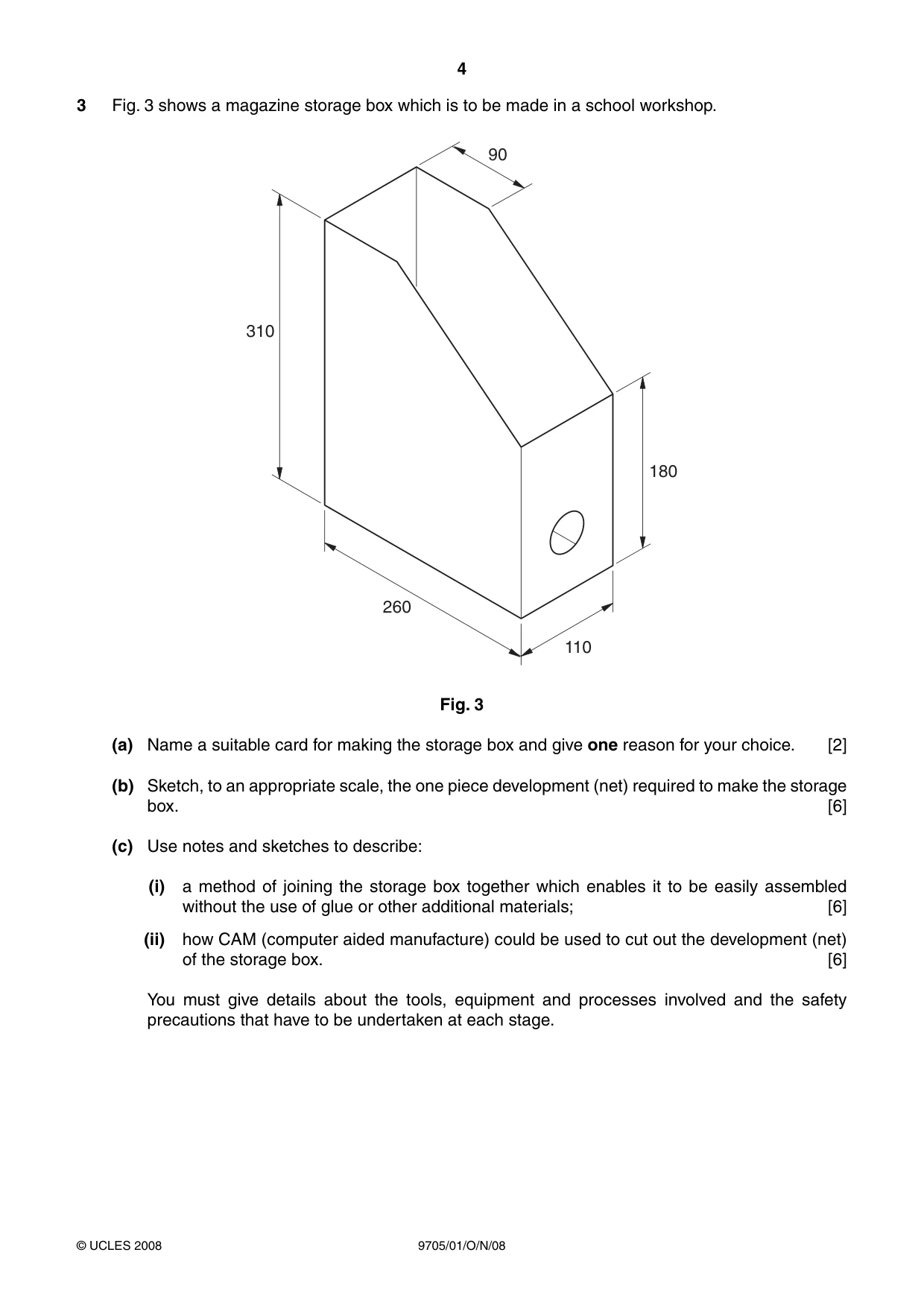
4 9705/01/O/N/08 © UCLES 2008 3 Fig. 3 shows a magazine storage box which is to be made in a school workshop. 180 310 90 260 110 Fig. 3 (a) Name a suitable card for making the storage box and give one reason for your choice. [2] (b) Sketch, to an appropriate scale, the one piece development (net) required to make the storage box. [6] (c) Use notes and sketches to describe: (i) a method of joining the storage box together which enables it to be easily assembled without the use of glue or other additional materials; [6] (ii) how CAM (computer aided manufacture) could be used to cut out the development (net) of the storage box. [6] You must give details about the tools, equipment and processes involved and the safety precautions that have to be undertaken at each stage.
Question paper, page 5
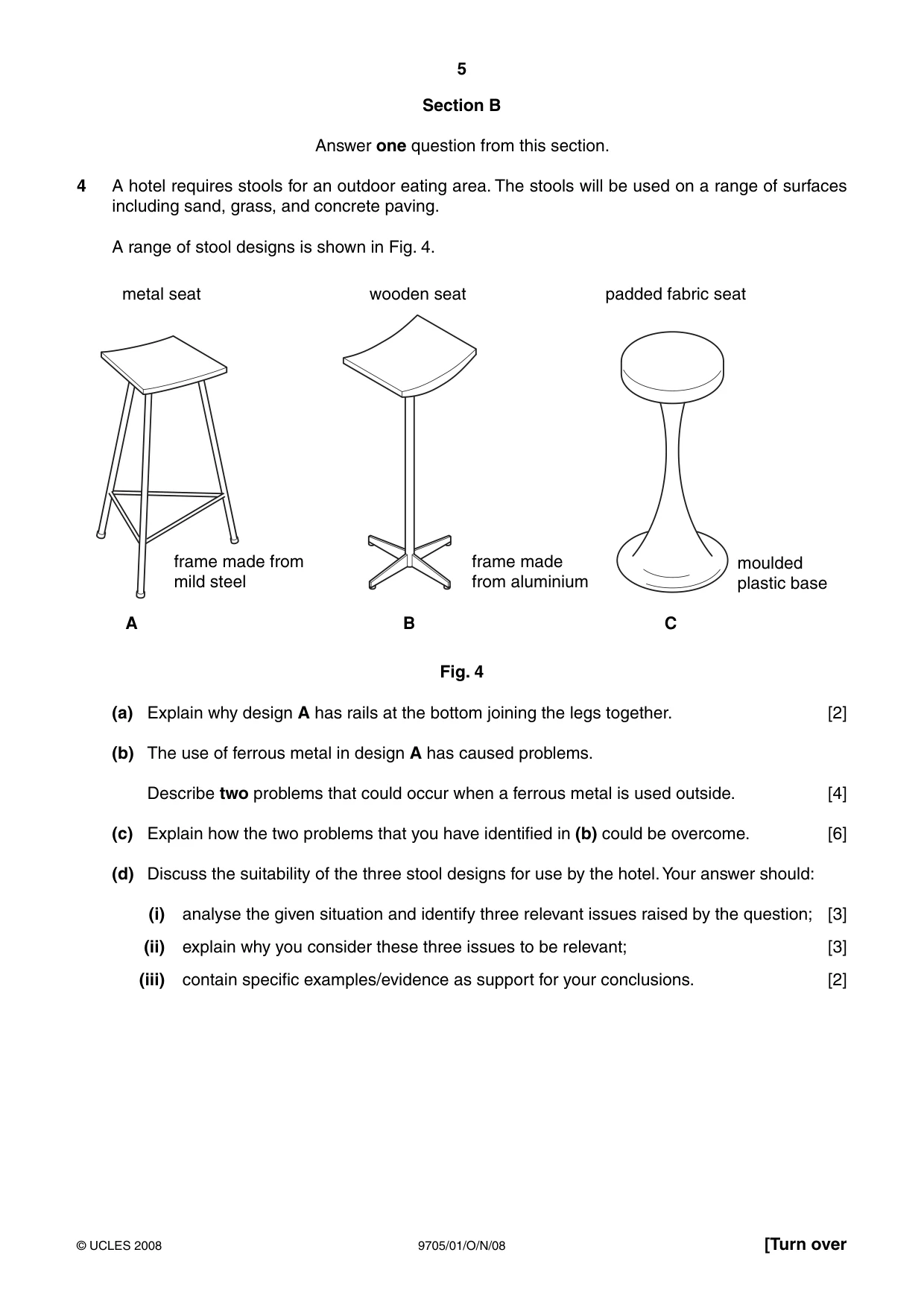
5 9705/01/O/N/08 © UCLES 2008 [Turn over Section B Answer one question from this section. 4 A hotel requires stools for an outdoor eating area. The stools will be used on a range of surfaces including sand, grass, and concrete paving. A range of stool designs is shown in Fig. 4. metal seat frame made from mild steel frame made from aluminium moulded plastic base wooden seat padded fabric seat A B C Fig. 4 (a) Explain why design A has rails at the bottom joining the legs together. [2] (b) The use of ferrous metal in design A has caused problems. Describe two problems that could occur when a ferrous metal is used outside. [4] (c) Explain how the two problems that you have identified in (b) could be overcome. [6] (d) Discuss the suitability of the three stool designs for use by the hotel. Your answer should: (i) analyse the given situation and identify three relevant issues raised by the question; [3] (ii) explain why you consider these three issues to be relevant; [3] (iii) contain specific examples/evidence as support for your conclusions. [2]
Question paper, page 6
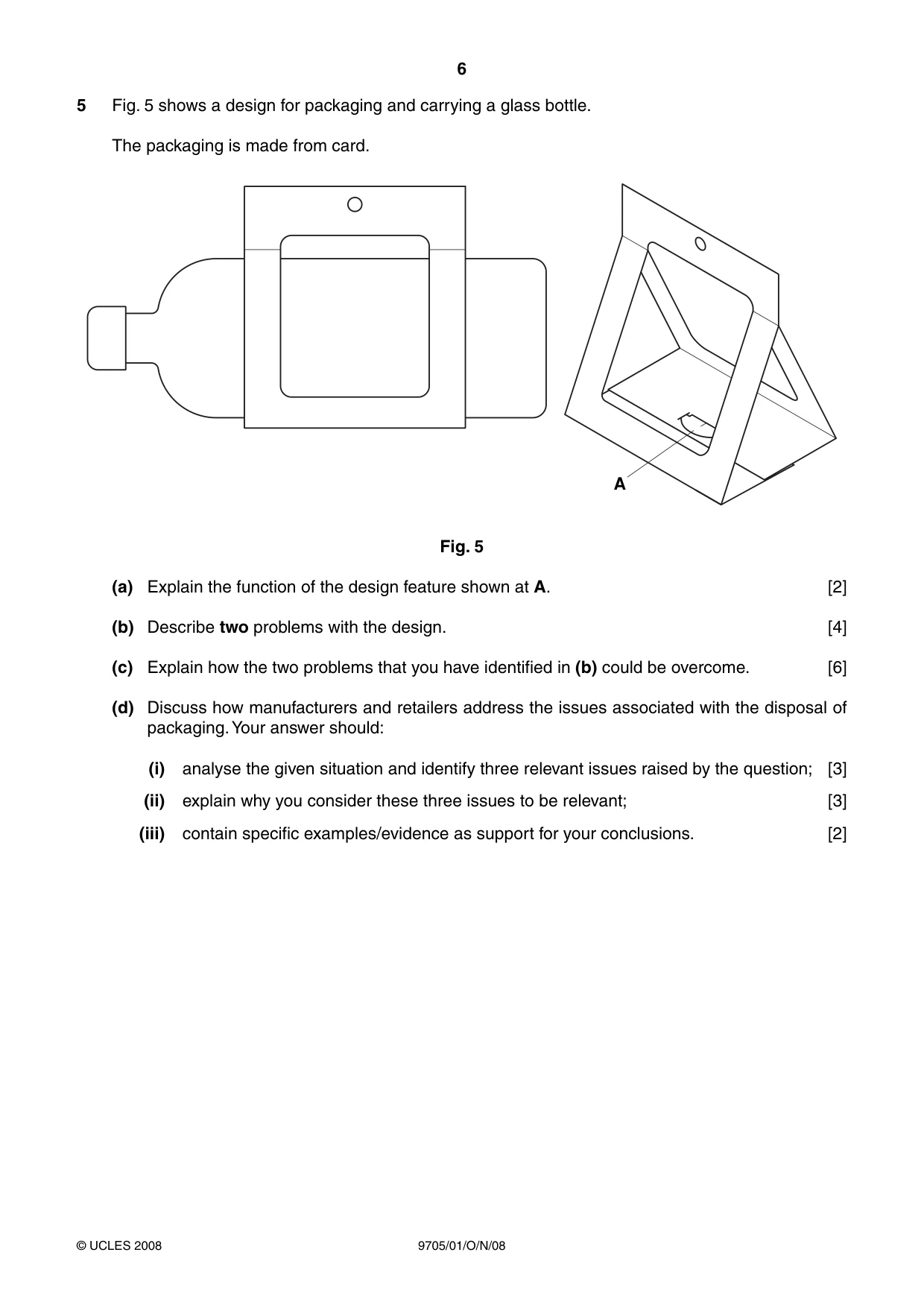
6 9705/01/O/N/08 © UCLES 2008 5 Fig. 5 shows a design for packaging and carrying a glass bottle. The packaging is made from card. A Fig. 5 (a) Explain the function of the design feature shown at A. [2] (b) Describe two problems with the design. [4] (c) Explain how the two problems that you have identified in (b) could be overcome. [6] (d) Discuss how manufacturers and retailers address the issues associated with the disposal of packaging. Your answer should: (i) analyse the given situation and identify three relevant issues raised by the question; [3] (ii) explain why you consider these three issues to be relevant; [3] (iii) contain specific examples/evidence as support for your conclusions. [2]
Question paper, page 7
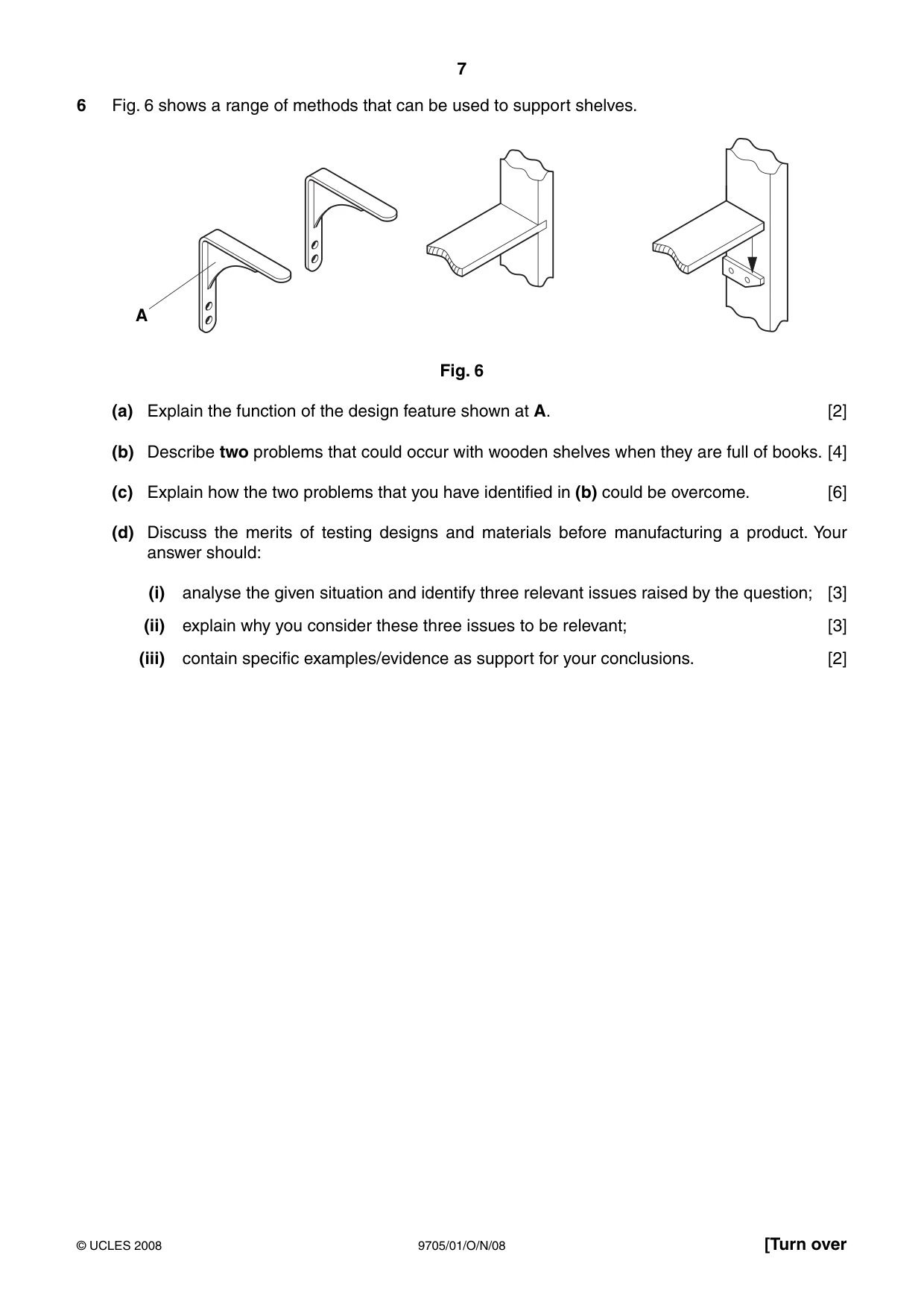
7 9705/01/O/N/08 © UCLES 2008 [Turn over 6 Fig. 6 shows a range of methods that can be used to support shelves. A Fig. 6 (a) Explain the function of the design feature shown at A. [2] (b) Describe two problems that could occur with wooden shelves when they are full of books. [4] (c) Explain how the two problems that you have identified in (b) could be overcome. [6] (d) Discuss the merits of testing designs and materials before manufacturing a product. Your answer should: (i) analyse the given situation and identify three relevant issues raised by the question; [3] (ii) explain why you consider these three issues to be relevant; [3] (iii) contain specific examples/evidence as support for your conclusions. [2]
Question paper, page 8
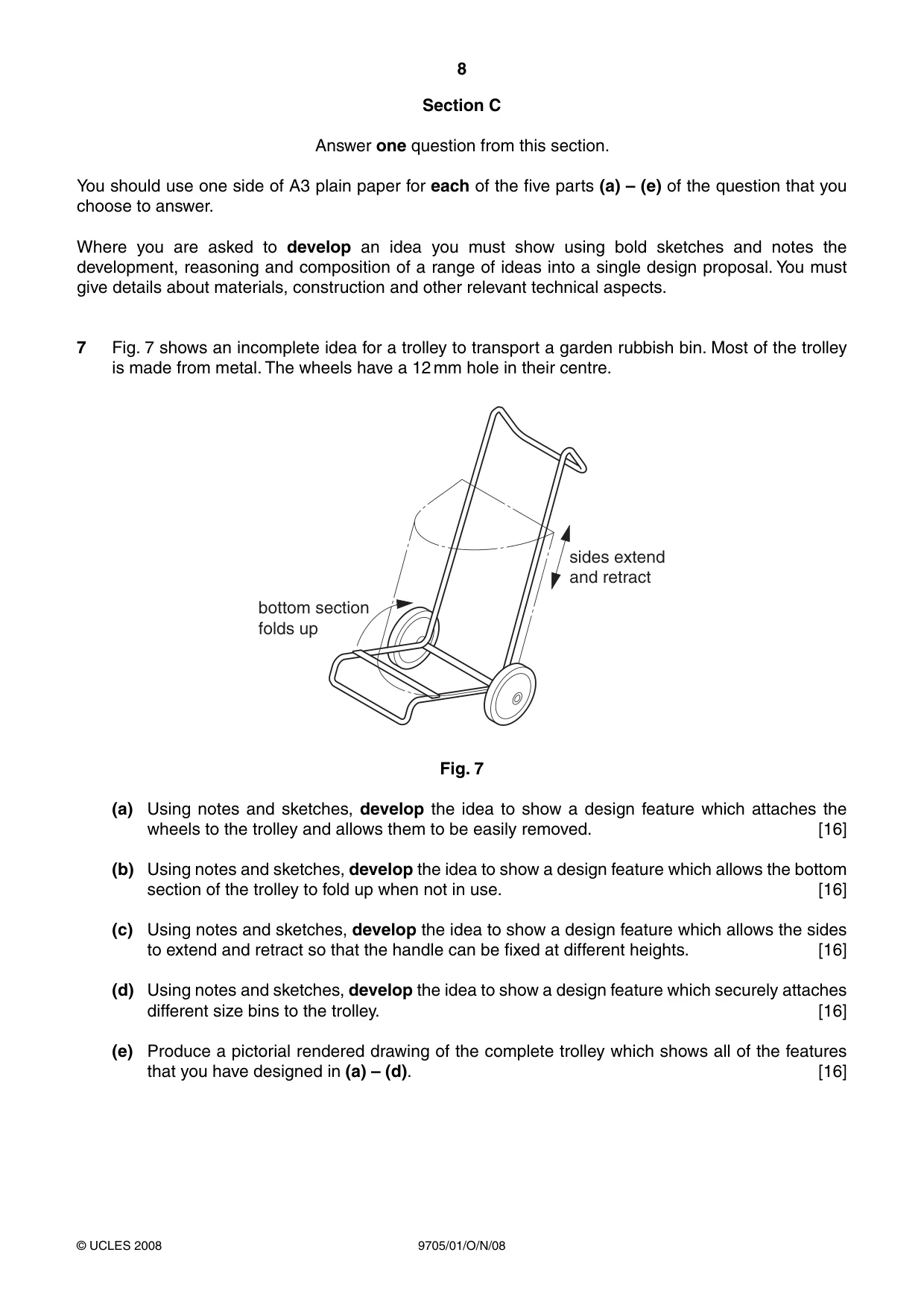
8 9705/01/O/N/08 © UCLES 2008 Section C Answer one question from this section. You should use one side of A3 plain paper for each of the five parts (a) – (e) of the question that you choose to answer. Where you are asked to develop an idea you must show using bold sketches and notes the development, reasoning and composition of a range of ideas into a single design proposal. You must give details about materials, construction and other relevant technical aspects. 7 Fig. 7 shows an incomplete idea for a trolley to transport a garden rubbish bin. Most of the trolley is made from metal. The wheels have a 12mm hole in their centre. sides extend and retract bottom section folds up Fig. 7 (a) Using notes and sketches, develop the idea to show a design feature which attaches the wheels to the trolley and allows them to be easily removed. [16] (b) Using notes and sketches, develop the idea to show a design feature which allows the bottom section of the trolley to fold up when not in use. [16] (c) Using notes and sketches, develop the idea to show a design feature which allows the sides to extend and retract so that the handle can be fixed at different heights. [16] (d) Using notes and sketches, develop the idea to show a design feature which securely attaches different size bins to the trolley. [16] (e) Produce a pictorial rendered drawing of the complete trolley which shows all of the features that you have designed in (a) – (d). [16]
Question paper, page 9
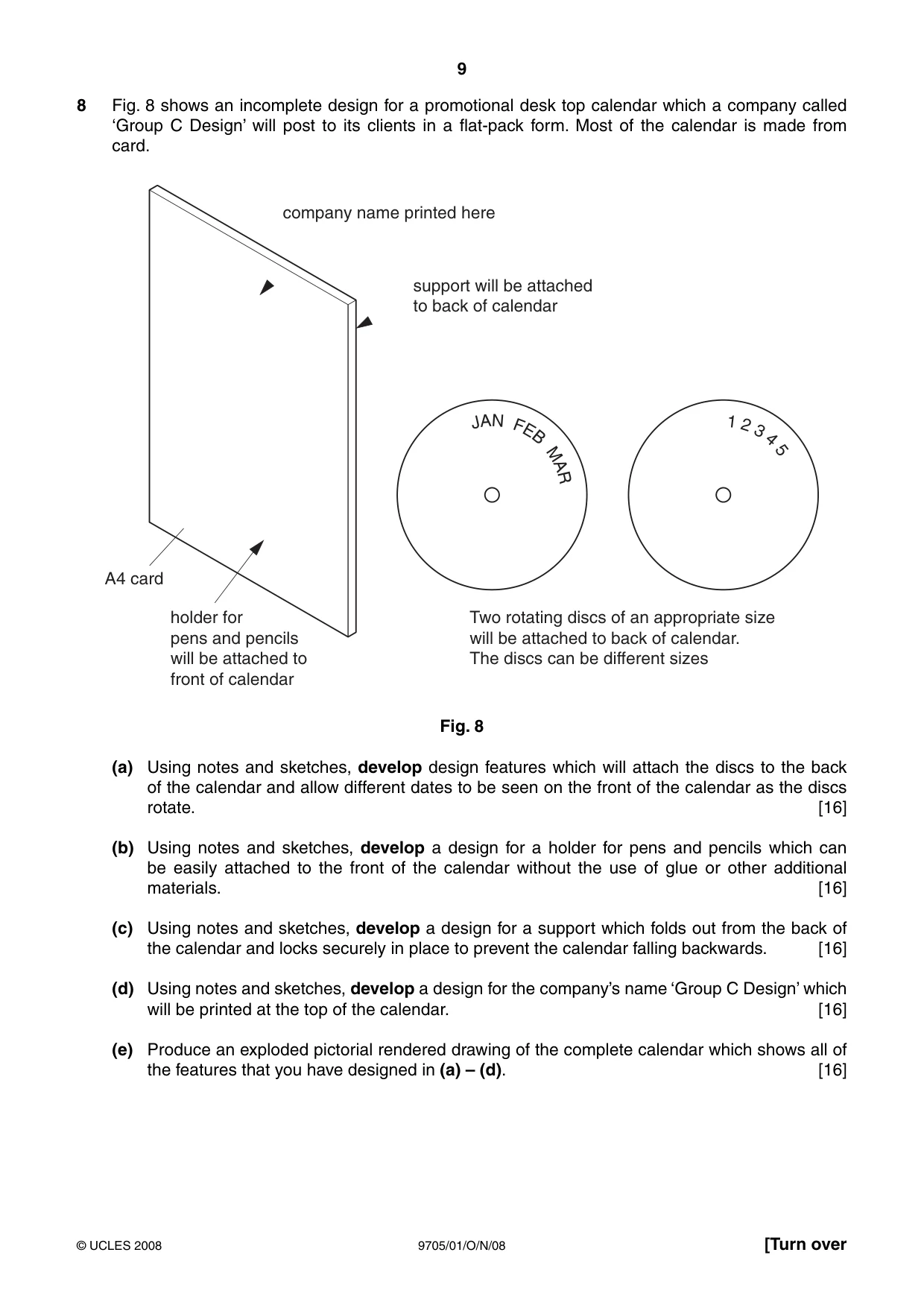
9 9705/01/O/N/08 © UCLES 2008 [Turn over 8 Fig. 8 shows an incomplete design for a promotional desk top calendar which a company called ‘Group C Design’ will post to its clients in a flat-pack form. Most of the calendar is made from card. company name printed here support will be attached to back of calendar A4 card holder for pens and pencils will be attached to front of calendar Two rotating discs of an appropriate size will be attached to back of calendar. The discs can be different sizes Fig. 8 (a) Using notes and sketches, develop design features which will attach the discs to the back of the calendar and allow different dates to be seen on the front of the calendar as the discs rotate. [16] (b) Using notes and sketches, develop a design for a holder for pens and pencils which can be easily attached to the front of the calendar without the use of glue or other additional materials. [16] (c) Using notes and sketches, develop a design for a support which folds out from the back of the calendar and locks securely in place to prevent the calendar falling backwards. [16] (d) Using notes and sketches, develop a design for the company’s name ‘Group C Design’ which will be printed at the top of the calendar. [16] (e) Produce an exploded pictorial rendered drawing of the complete calendar which shows all of the features that you have designed in (a) – (d). [16]
Question paper, page 10
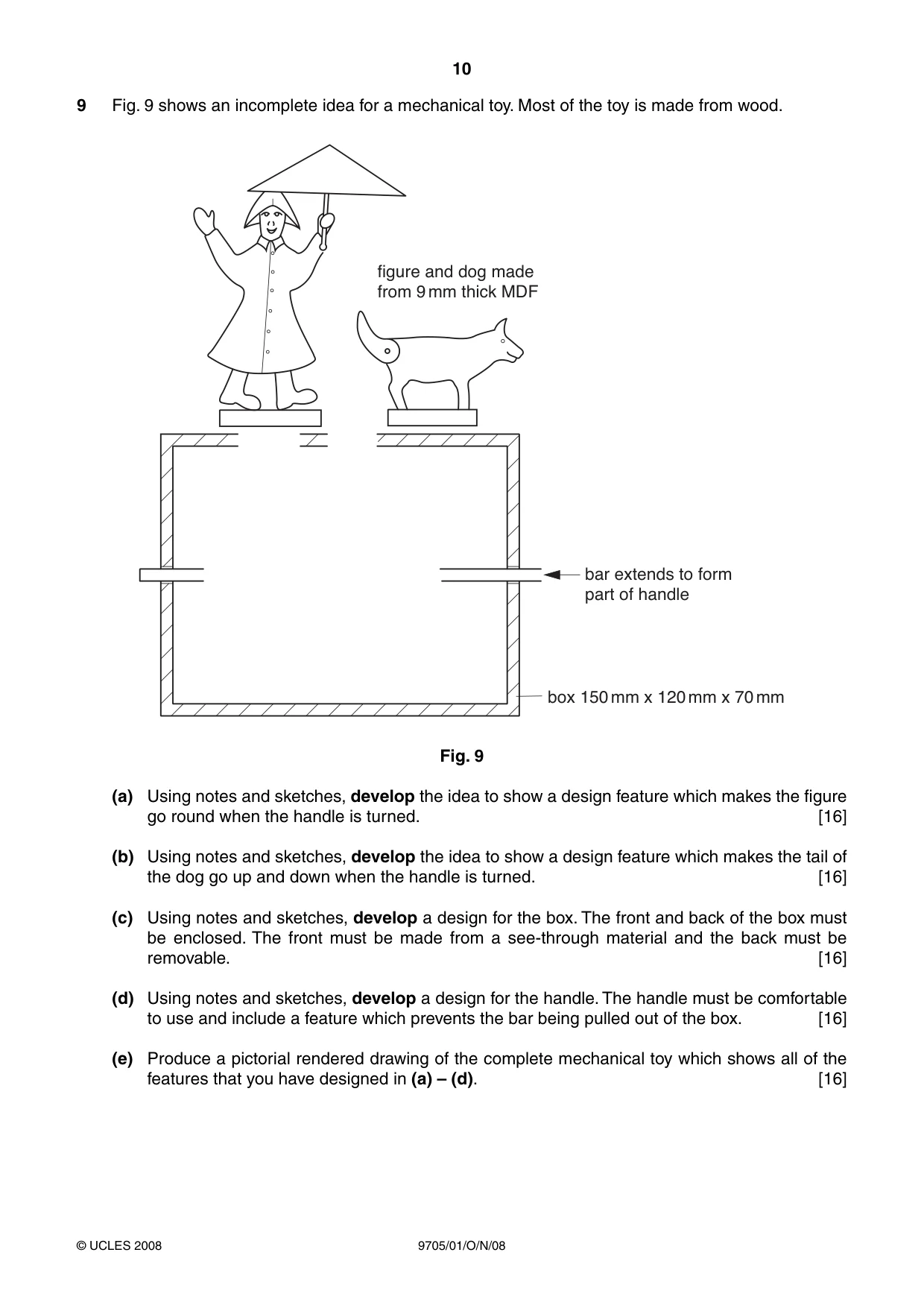
10 9705/01/O/N/08 © UCLES 2008 9 Fig. 9 shows an incomplete idea for a mechanical toy. Most of the toy is made from wood. bar extends to form part of handle box 150 mm x 120 mm x 70 mm figure and dog made from 9 mm thick MDF Fig. 9 (a) Using notes and sketches, develop the idea to show a design feature which makes the figure go round when the handle is turned. [16] (b) Using notes and sketches, develop the idea to show a design feature which makes the tail of the dog go up and down when the handle is turned. [16] (c) Using notes and sketches, develop a design for the box. The front and back of the box must be enclosed. The front must be made from a see-through material and the back must be removable. [16] (d) Using notes and sketches, develop a design for the handle. The handle must be comfortable to use and include a feature which prevents the bar being pulled out of the box. [16] (e) Produce a pictorial rendered drawing of the complete mechanical toy which shows all of the features that you have designed in (a) – (d). [16]
Question paper, page 12
12 9705/01/O/N/08 BLANK PAGE Permission to reproduce items where third-party owned material protected by copyright is included has been sought and cleared where possible. Every reasonable effort has been made by the publisher (UCLES) to trace copyright holders, but if any items requiring clearance have unwittingly been included, the publisher will be pleased to make amends at the earliest possible opportunity. University of Cambridge International Examinations is part of the Cambridge Assessment Group. Cambridge Assessment is the brand name of University of Cambridge Local Examinations Syndicate (UCLES), which is itself a department of the University of Cambridge.
Mark scheme, page 1
UNIVERSITY OF CAMBRIDGE INTERNATIONAL EXAMINATIONS GCE Advanced Subsidiary Level and GCE Advanced Level MARK SCHEME for the October/November 2008 question paper 9705 DESIGN AND TECHNOLOGY 9705/01 Paper 1 (Written 1), maximum raw mark 120 This mark scheme is published as an aid to teachers and candidates, to indicate the requirements of the examination. It shows the basis on which Examiners were instructed to award marks. It does not indicate the details of the discussions that took place at an Examiners’ meeting before marking began. All Examiners are instructed that alternative correct answers and unexpected approaches in candidates’ scripts must be given marks that fairly reflect the relevant knowledge and skills demonstrated. Mark schemes must be read in conjunction with the question papers and the report on the examination. • CIE will not enter into discussions or correspondence in connection with these mark schemes. CIE is publishing the mark schemes for the October/November 2008 question papers for most IGCSE, GCE Advanced Level and Advanced Subsidiary Level syllabuses and some Ordinary Level syllabuses.
Mark scheme, page 2
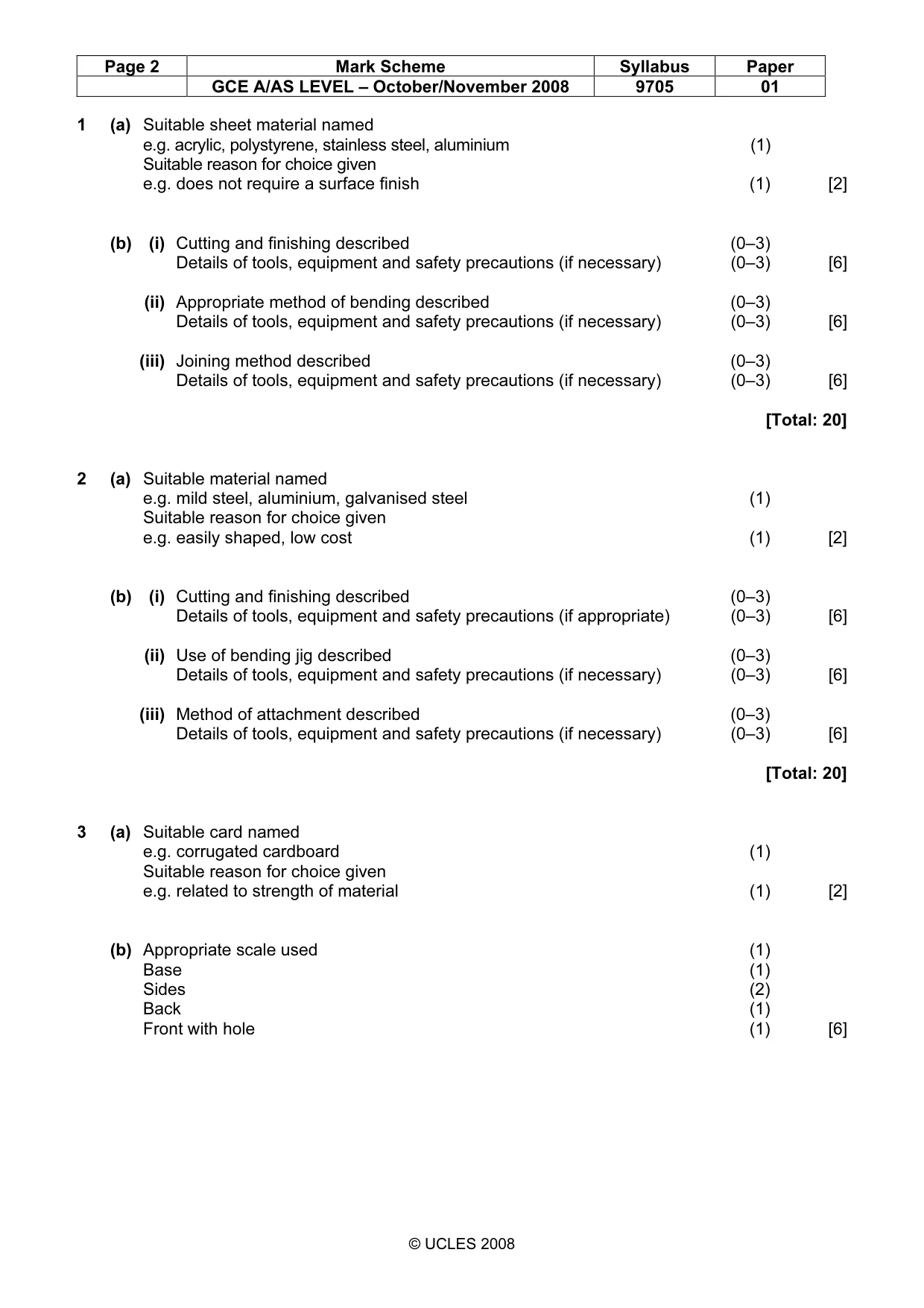
Page 2 Mark Scheme Syllabus Paper GCE A/AS LEVEL – October/November 2008 9705 01 © UCLES 2008 1 (a) Suitable sheet material named e.g. acrylic, polystyrene, stainless steel, aluminium (1) Suitable reason for choice given e.g. does not require a surface finish (1) [2] (b) (i) Cutting and finishing described (0–3) Details of tools, equipment and safety precautions (if necessary) (0–3) [6] (ii) Appropriate method of bending described (0–3) Details of tools, equipment and safety precautions (if necessary) (0–3) [6] (iii) Joining method described (0–3) Details of tools, equipment and safety precautions (if necessary) (0–3) [6] [Total: 20] 2 (a) Suitable material named e.g. mild steel, aluminium, galvanised steel (1) Suitable reason for choice given e.g. easily shaped, low cost (1) [2] (b) (i) Cutting and finishing described (0–3) Details of tools, equipment and safety precautions (if appropriate) (0–3) [6] (ii) Use of bending jig described (0–3) Details of tools, equipment and safety precautions (if necessary) (0–3) [6] (iii) Method of attachment described (0–3) Details of tools, equipment and safety precautions (if necessary) (0–3) [6] [Total: 20] 3 (a) Suitable card named e.g. corrugated cardboard (1) Suitable reason for choice given e.g. related to strength of material (1) [2] (b) Appropriate scale used (1) Base (1) Sides (2) Back (1) Front with hole (1) [6]
Mark scheme, page 3
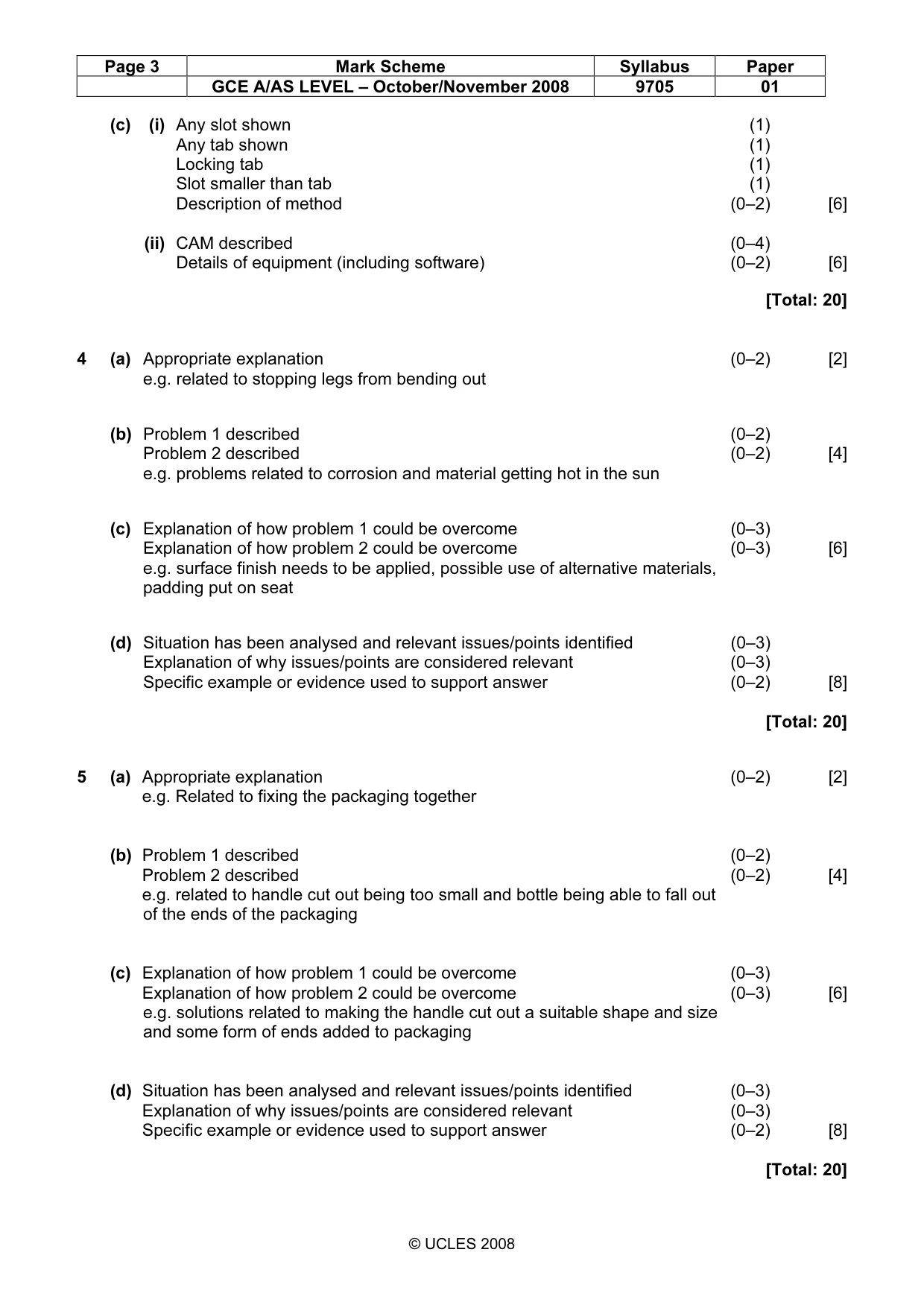
Page 3 Mark Scheme Syllabus Paper GCE A/AS LEVEL – October/November 2008 9705 01 © UCLES 2008 (c) (i) Any slot shown (1) Any tab shown (1) Locking tab (1) Slot smaller than tab (1) Description of method (0–2) [6] (ii) CAM described (0–4) Details of equipment (including software) (0–2) [6] [Total: 20] 4 (a) Appropriate explanation (0–2) [2] e.g. related to stopping legs from bending out (b) Problem 1 described (0–2) Problem 2 described (0–2) [4] e.g. problems related to corrosion and material getting hot in the sun (c) Explanation of how problem 1 could be overcome (0–3) Explanation of how problem 2 could be overcome (0–3) [6] e.g. surface finish needs to be applied, possible use of alternative materials, padding put on seat (d) Situation has been analysed and relevant issues/points identified (0–3) Explanation of why issues/points are considered relevant (0–3) Specific example or evidence used to support answer (0–2) [8] [Total: 20] 5 (a) Appropriate explanation (0–2) [2] e.g. Related to fixing the packaging together (b) Problem 1 described (0–2) Problem 2 described (0–2) [4] e.g. related to handle cut out being too small and bottle being able to fall out of the ends of the packaging (c) Explanation of how problem 1 could be overcome (0–3) Explanation of how problem 2 could be overcome (0–3) [6] e.g. solutions related to making the handle cut out a suitable shape and size and some form of ends added to packaging (d) Situation has been analysed and relevant issues/points identified (0–3) Explanation of why issues/points are considered relevant (0–3) Specific example or evidence used to support answer (0–2) [8] [Total: 20]
Mark scheme, page 4
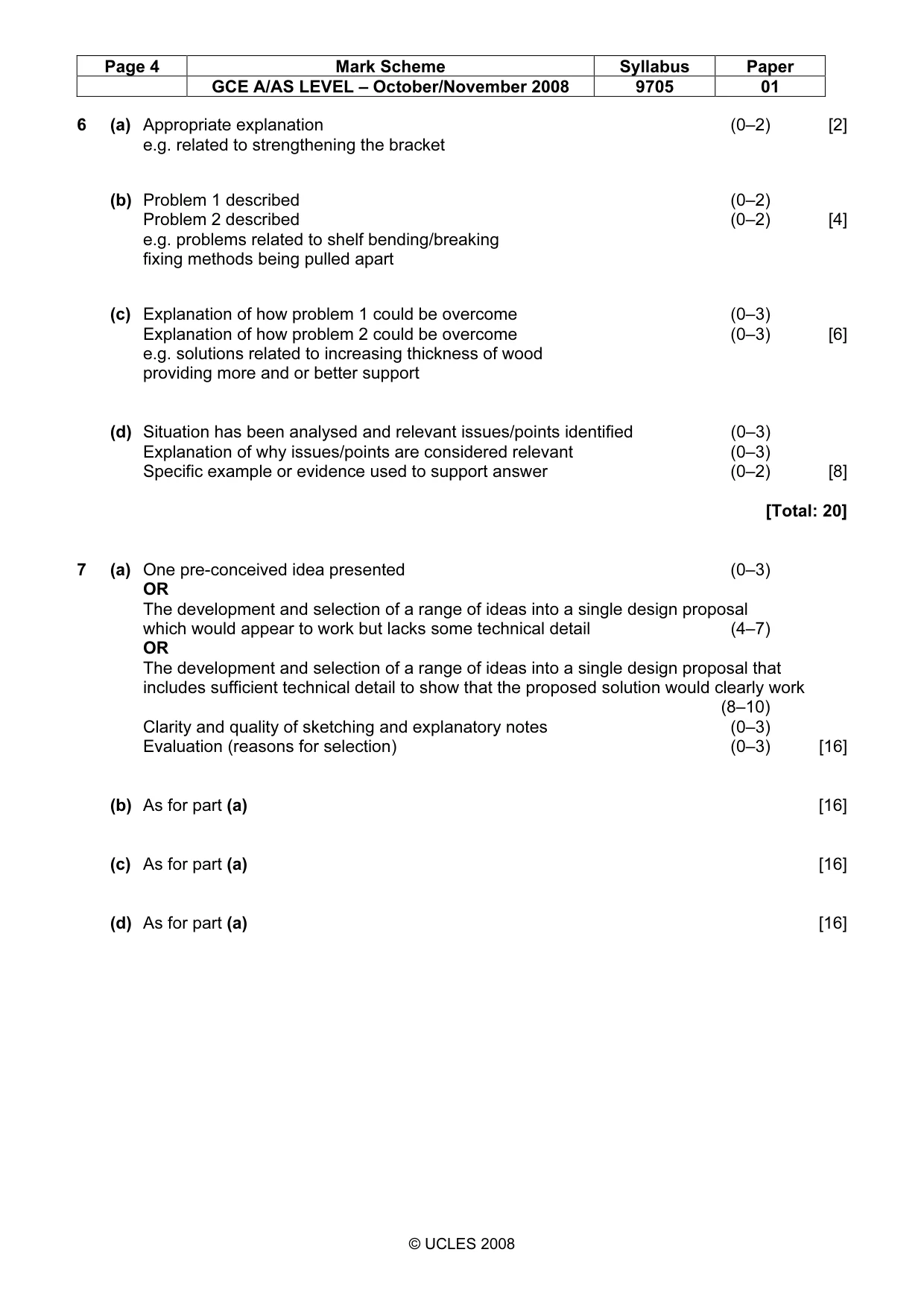
Page 4 Mark Scheme Syllabus Paper GCE A/AS LEVEL – October/November 2008 9705 01 © UCLES 2008 6 (a) Appropriate explanation (0–2) [2] e.g. related to strengthening the bracket (b) Problem 1 described (0–2) Problem 2 described (0–2) [4] e.g. problems related to shelf bending/breaking fixing methods being pulled apart (c) Explanation of how problem 1 could be overcome (0–3) Explanation of how problem 2 could be overcome (0–3) [6] e.g. solutions related to increasing thickness of wood providing more and or better support (d) Situation has been analysed and relevant issues/points identified (0–3) Explanation of why issues/points are considered relevant (0–3) Specific example or evidence used to support answer (0–2) [8] [Total: 20] 7 (a) One pre-conceived idea presented (0–3) OR The development and selection of a range of ideas into a single design proposal which would appear to work but lacks some technical detail (4–7) OR The development and selection of a range of ideas into a single design proposal that includes sufficient technical detail to show that the proposed solution would clearly work (8–10) Clarity and quality of sketching and explanatory notes (0–3) Evaluation (reasons for selection) (0–3) [16] (b) As for part (a) [16] (c) As for part (a) [16] (d) As for part (a) [16]
Mark scheme, page 5
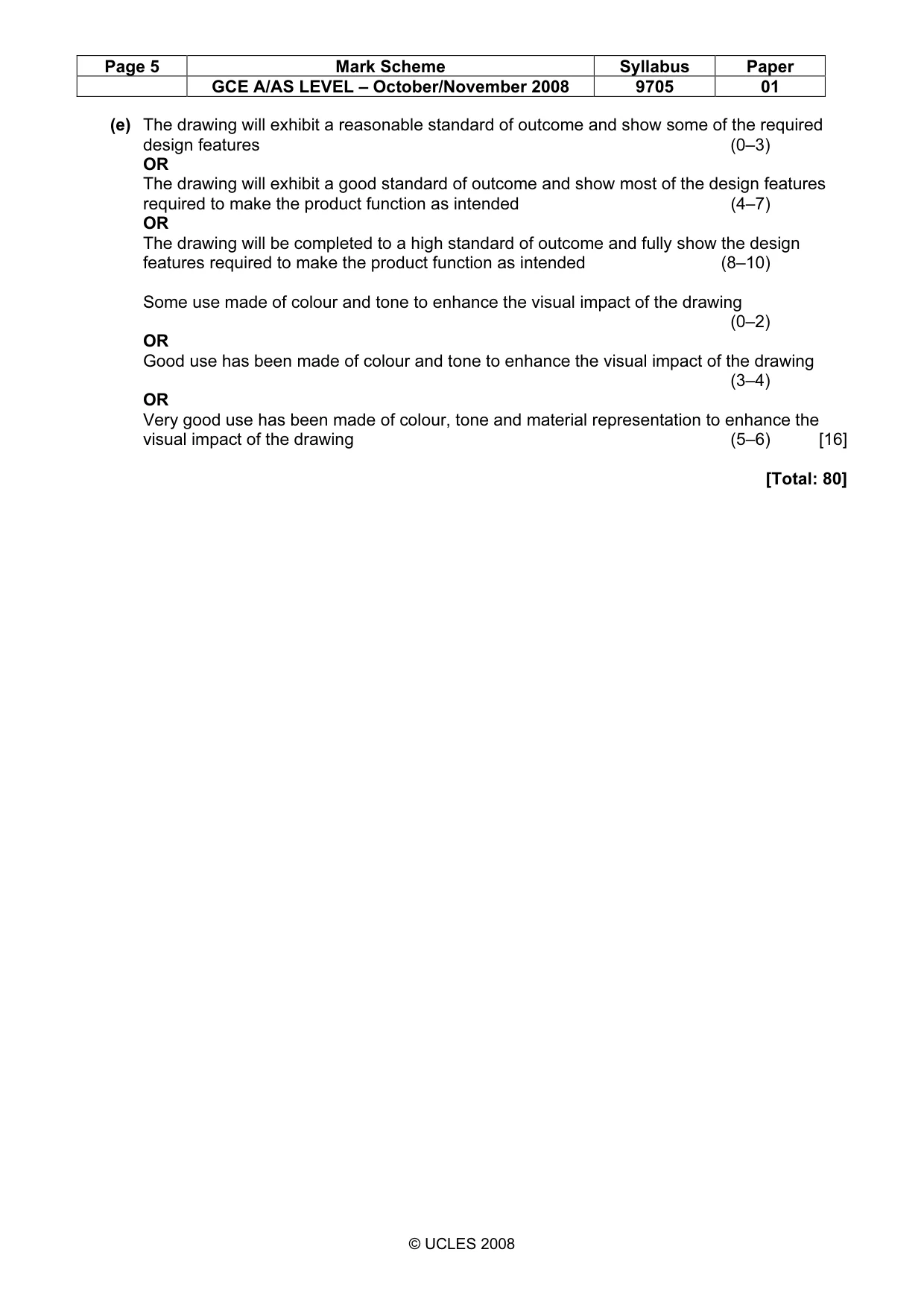
Page 5 Mark Scheme Syllabus Paper GCE A/AS LEVEL – October/November 2008 9705 01 © UCLES 2008 (e) The drawing will exhibit a reasonable standard of outcome and show some of the required design features (0–3) OR The drawing will exhibit a good standard of outcome and show most of the design features required to make the product function as intended (4–7) OR The drawing will be completed to a high standard of outcome and fully show the design features required to make the product function as intended (8–10) Some use made of colour and tone to enhance the visual impact of the drawing (0–2) OR Good use has been made of colour and tone to enhance the visual impact of the drawing (3–4) OR Very good use has been made of colour, tone and material representation to enhance the visual impact of the drawing (5–6) [16] [Total: 80]
What you needed in this session
Cambridge’s own grade thresholds for 2008 Oct/Nov, Paper 1 · Variant 1. A higher threshold means an easier paper — the bar moves with how the cohort did.