Cambridge A Level Computer Science 9618 — 2022 May/June Paper 2 · Variant 3
9618/23/M/J/22 · 9 questions · 75 marks · ≈84 min
The question paper and its mark scheme, free to read here and free to download. This is Cambridge’s own paper, exactly as it was sat.
Question paper20 pages





Mark scheme11 pages
Answers below. Sit the paper first if you are practising.
Questions as text
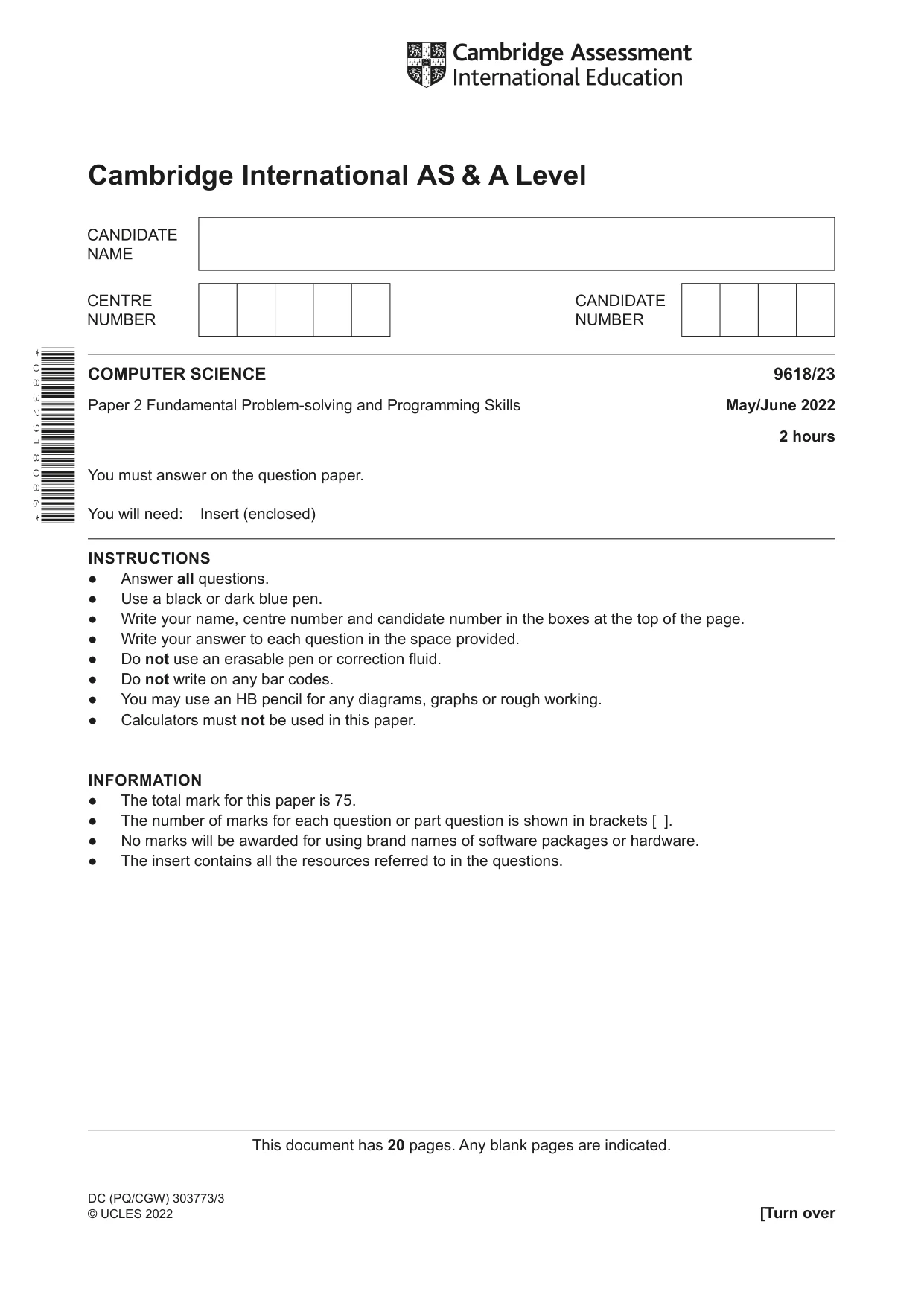
Q1 · The following table contains pseudocode examples
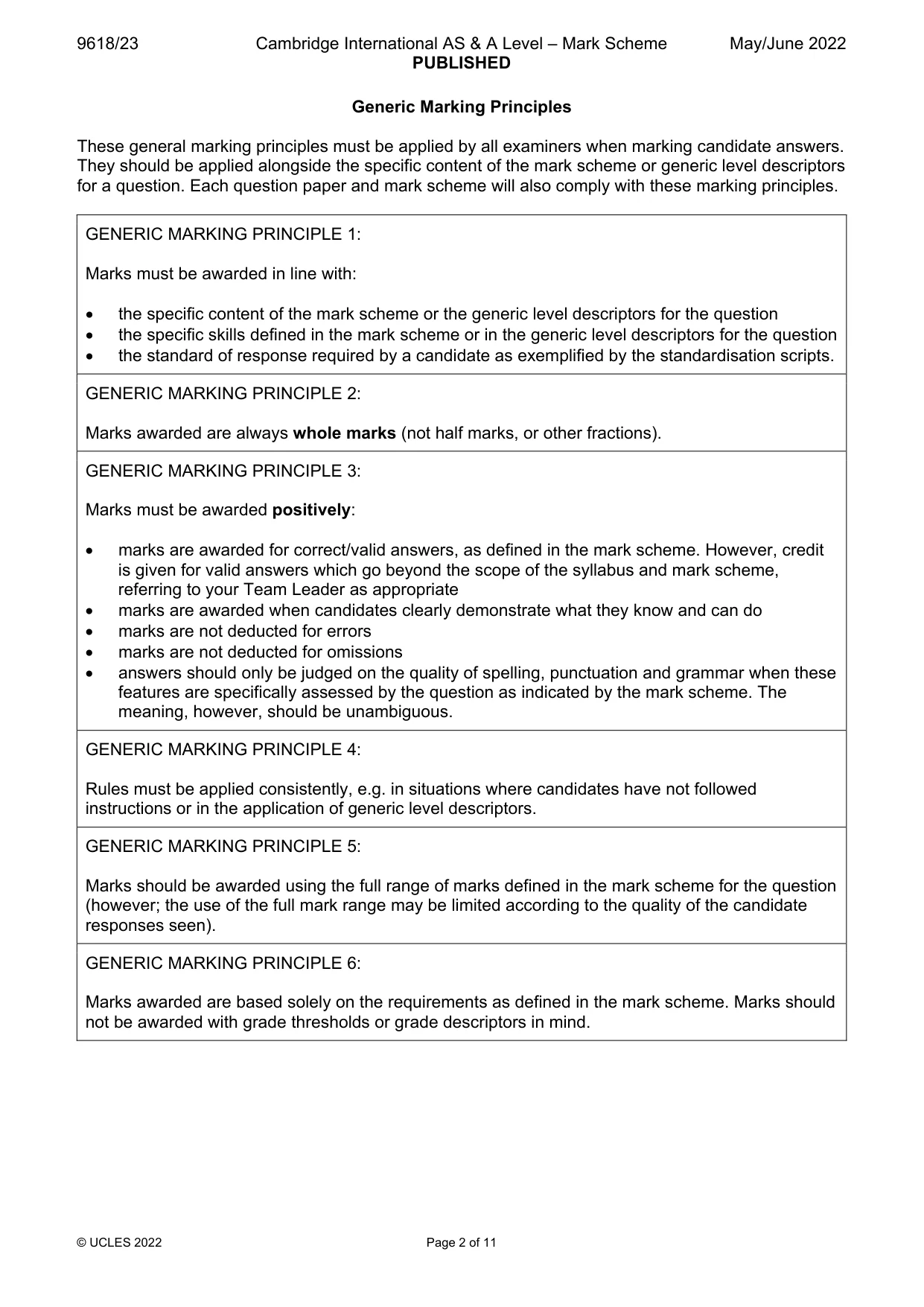
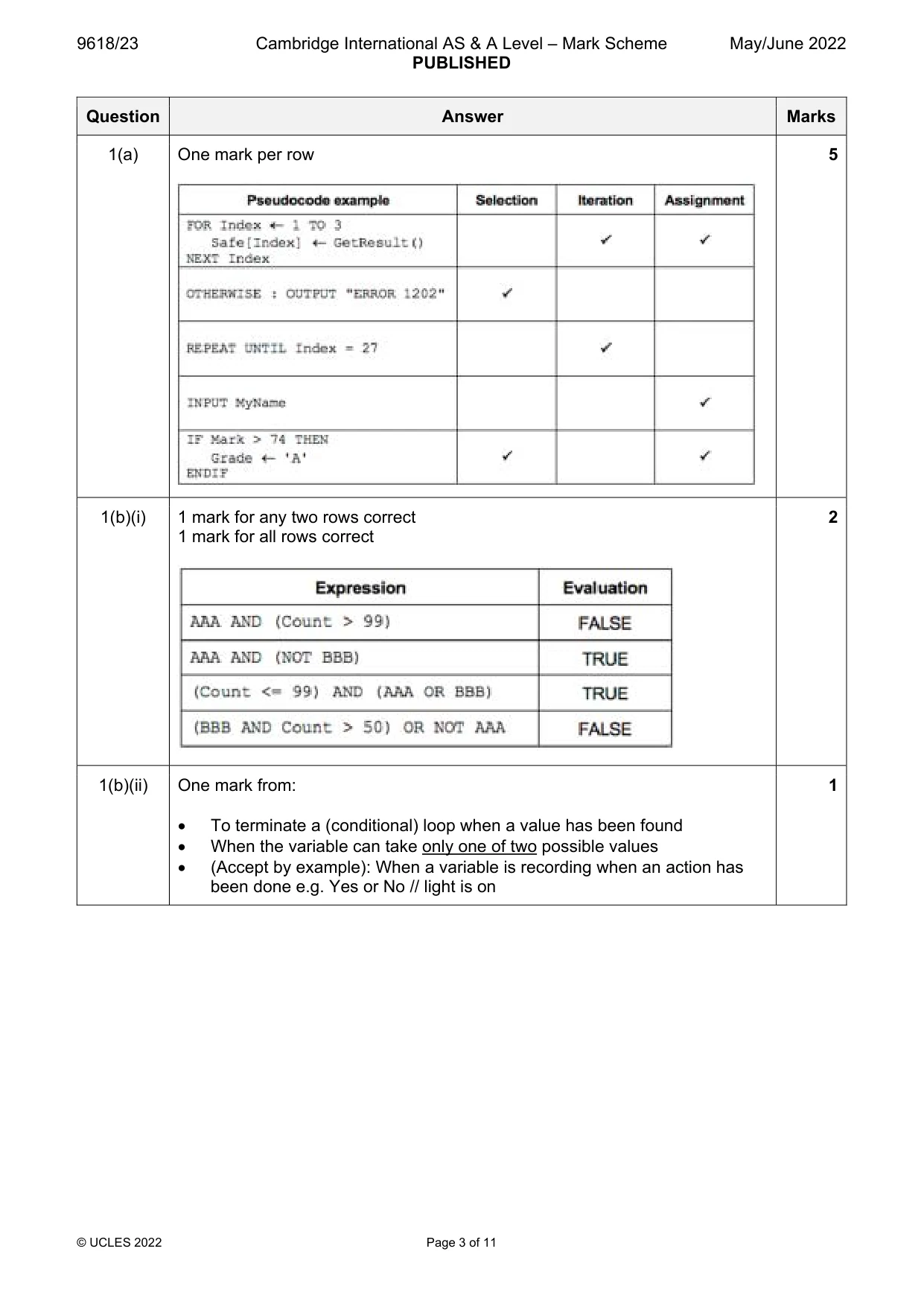
1 (a) The following table contains pseudocode examples. Each example may include all or part of: • selection • iteration (repetition) • assignment. Complete the table by placing one or more ticks (✓) in each row. Pseudocode example Selection Iteration Assignment FOR Index 1 TO 3 Safe[Index] GetResult() NEXT Index OTHERWISE : OUTPUT "ERROR 1202" REPEAT UNTIL Index = 27 INPUT MyName IF Mark > 74 THEN Grade 'A' ENDIF [5] (b) (i) Program variables have values as follows: Variable Value AAA TRUE BBB FALSE Count 99 Complete the table by evaluating each expression. Expression Evaluation AAA AND (Count > 99) AAA AND (NOT BBB) (Count <= 99) AND (AAA OR BBB) (BBB AND Count > 50) OR NOT AAA [2] (ii) Give an example of when a variable of type Boolean would be used. ........................................................................................................................................... ..................................................................................................................................... [1]
Mark scheme: Question Answer Marks 1(a) One mark per row 5 1(b)(i) 1 mark for any two rows correct 2 1 mark for all rows correct 1(b)(ii) One mark from: 1 To terminate a (conditional) loop when a value has been found When the variable can take only one of two possible values (Accept by example): When a variable is recording when an action has been done e.g. Yes or No // light is on
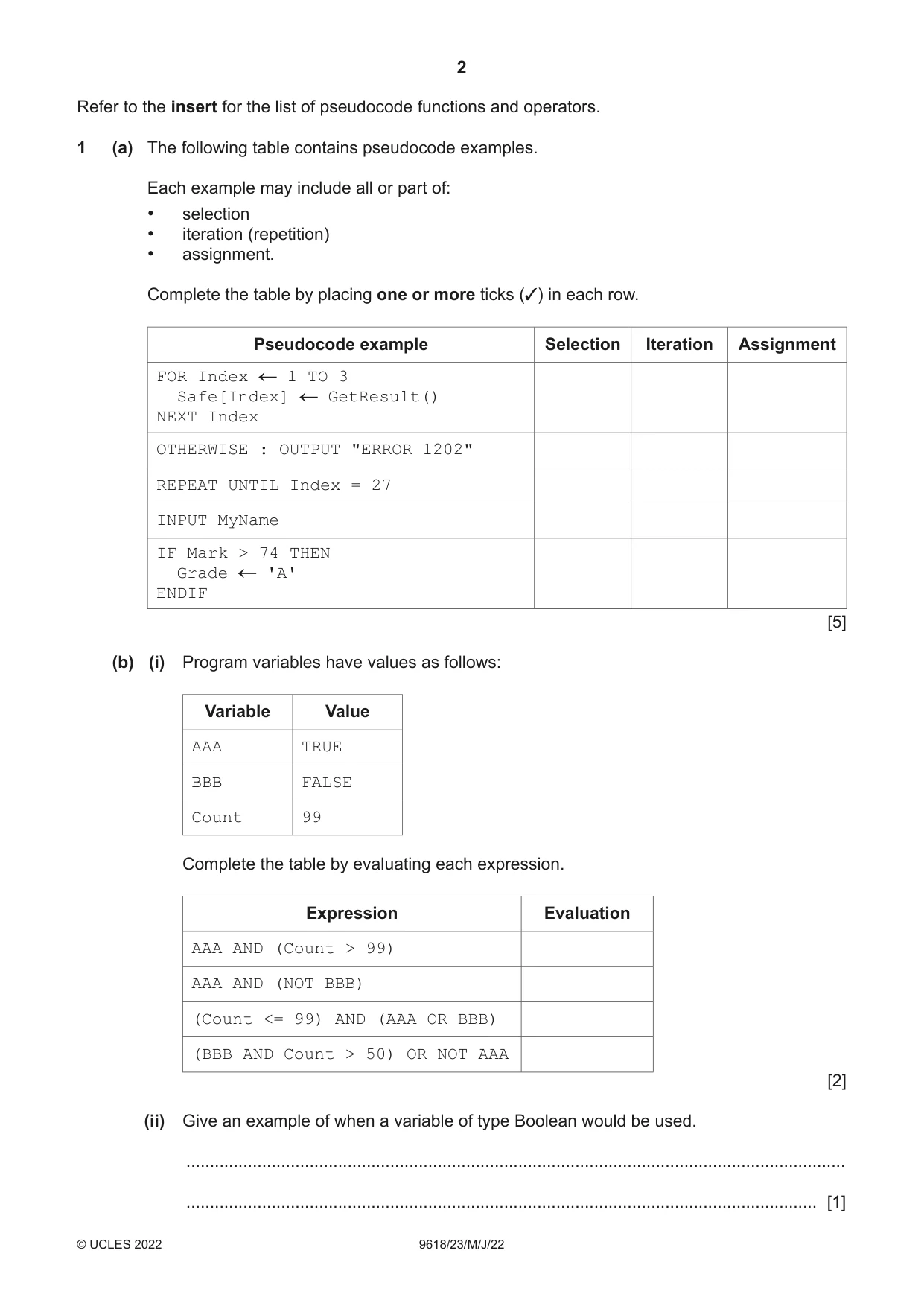
Q2 · A program has been written to implement a website browser and maintenance is now required
2 A program has been written to implement a website browser and maintenance is now required. One type of maintenance is called perfective. Name two other types of maintenance that the program may require and give a reason for each. Type 1 .............................................................................................................................................. Reason ............................................................................................................................................. .......................................................................................................................................................... .......................................................................................................................................................... .......................................................................................................................................................... Type 2 .............................................................................................................................................. Reason ............................................................................................................................................. .......................................................................................................................................................... .......................................................................................................................................................... .......................................................................................................................................................... [4]
Mark scheme: 2 Dependent marks 4 One mark for type; one mark for matching reason Answers include: Type: Adaptive Reason: To accommodate a change in the requirement / technology / legislation e.g. a new HTML version is available Type: Corrective Reason: The program does not operate as expected / contains a bug e.g. passwords are not hidden
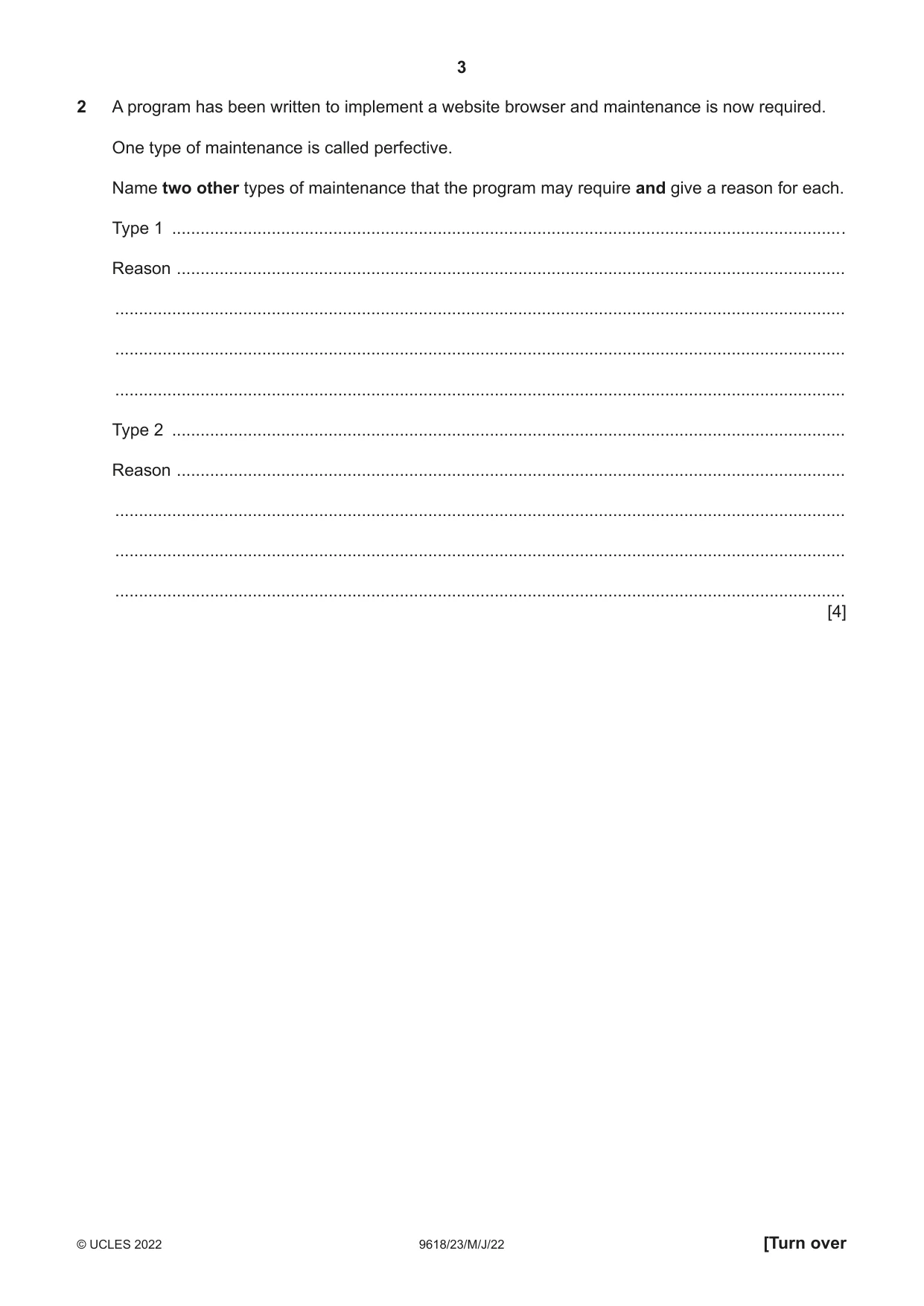
Q3 · Four program modules are defined as follows: Pseudocode module header PROCEDURE Sub1_A(XT…
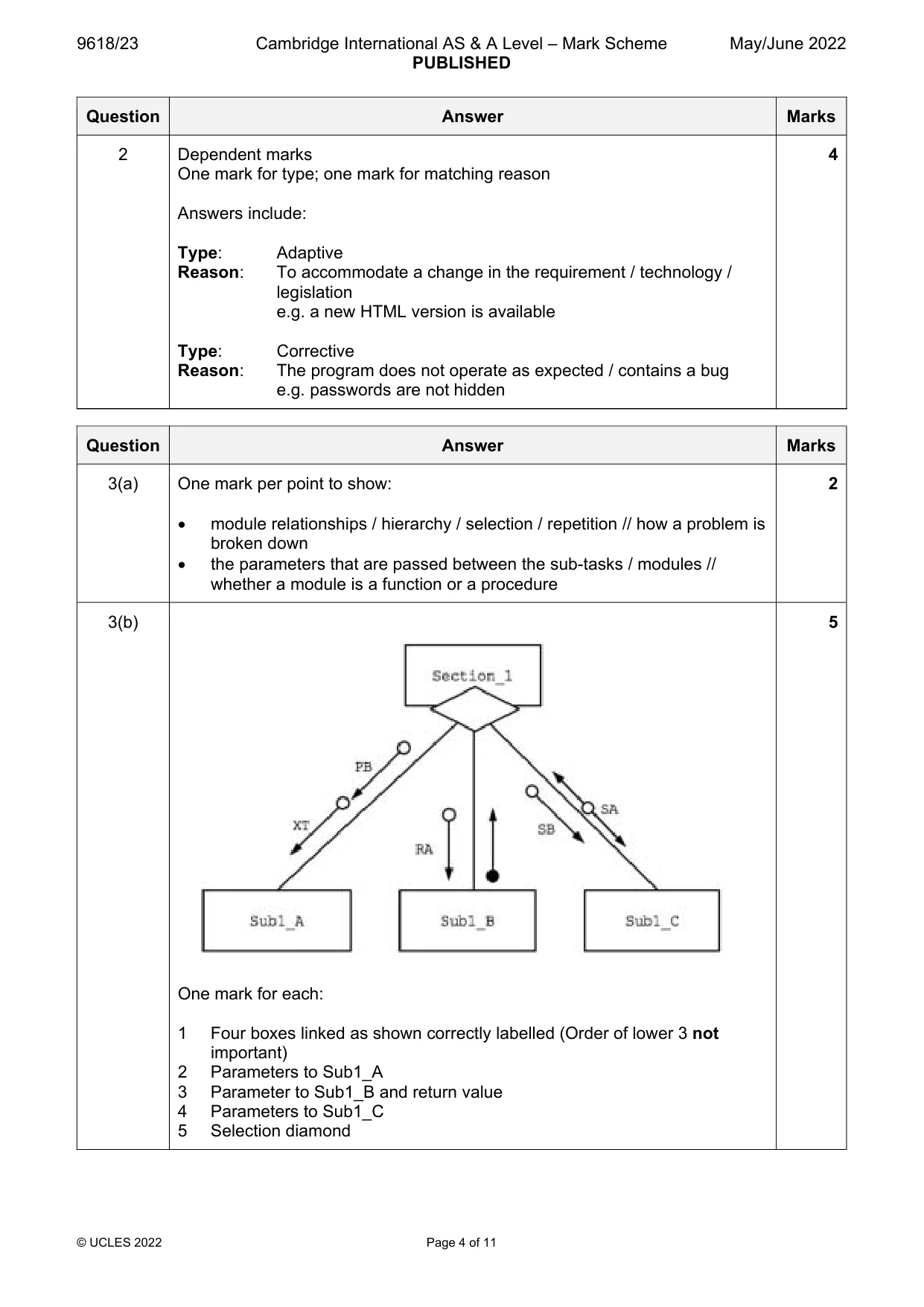
3 Four program modules are defined as follows: Pseudocode module header PROCEDURE Sub1_A(XT : INTEGER, PB : STRING) FUNCTION Sub1_B(RA : INTEGER) RETURNS BOOLEAN PROCEDURE Sub1_C(SB : INTEGER, BYREF SA : STRING) PROCEDURE Section_1() (a) A structure chart will be produced as part of the development process. Describe the purpose of a structure chart. ................................................................................................................................................... ................................................................................................................................................... ................................................................................................................................................... ............................................................................................................................................. [2] (b) Module Section_1() calls one of the other three modules. The module called will be selected when the program runs. Draw the structure chart. [5]
Mark scheme: 3(a) One mark per point to show: 2 module relationships / hierarchy / selection / repetition // how a problem is broken down the parameters that are passed between the sub-tasks / modules // whether a module is a function or a procedure 3(b) 5 One mark for each: 1 Four boxes linked as shown correctly labelled (Order of lower 3 not important) 2 Parameters to Sub1_A 3 Parameter to Sub1_B and return value 4 Parameters to Sub1_C 5 Selection diamond
Q4 · Items in a factory are weighed automatically
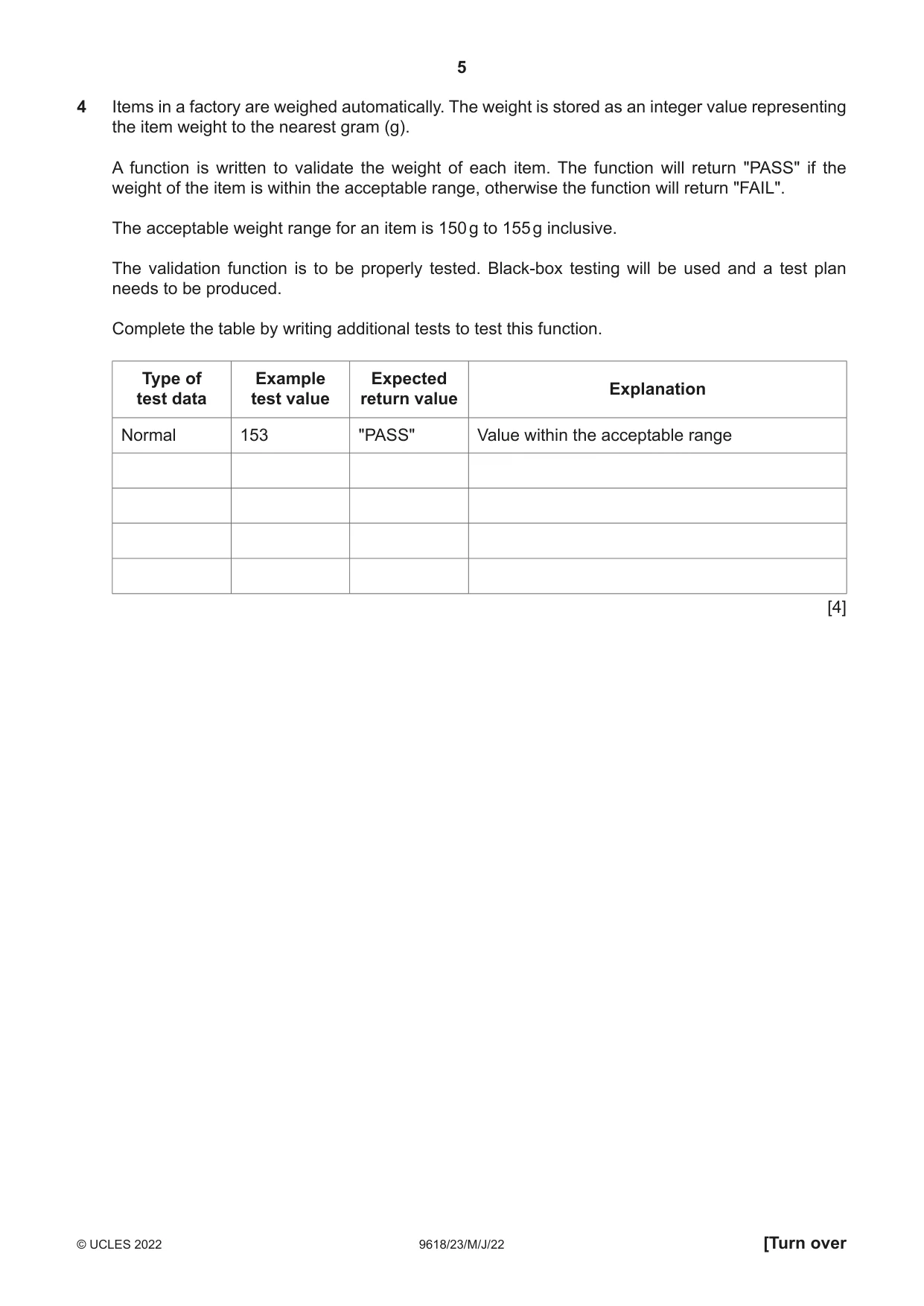
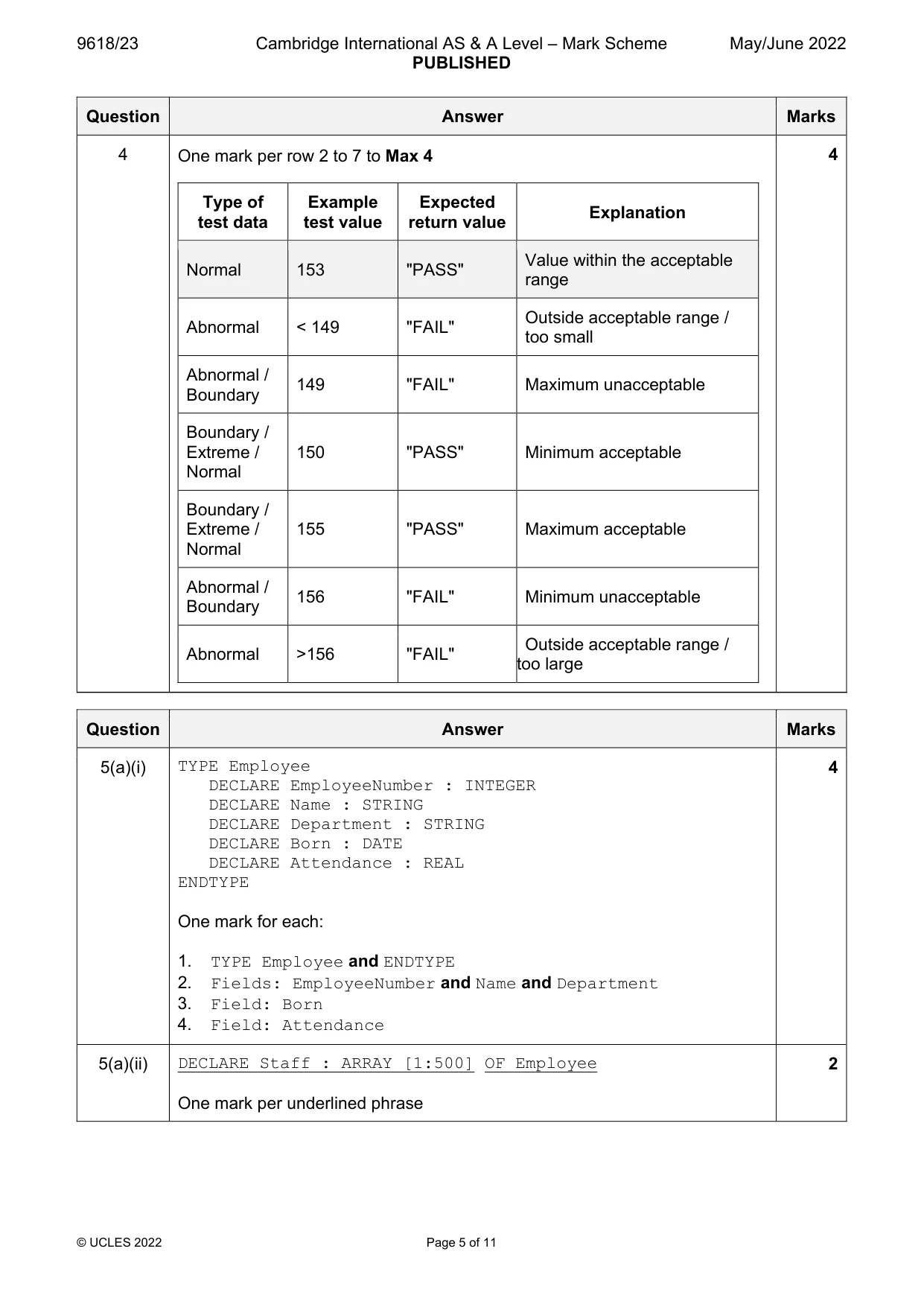
4 Items in a factory are weighed automatically. The weight is stored as an integer value representing the item weight to the nearest gram (g). A function is written to validate the weight of each item. The function will return "PASS" if the weight of the item is within the acceptable range, otherwise the function will return "FAIL". The acceptable weight range for an item is 150 g to 155 g inclusive. The validation function is to be properly tested. Black-box testing will be used and a test plan needs to be produced. Complete the table by writing additional tests to test this function. Type of Example Expected Explanation test data test value return value Normal 153 "PASS" Value within the acceptable range [4]
Mark scheme: 4 One mark per row 2 to 7 to Max 4 4 Type of Example Expected Explanation test data test value return value Value within the acceptable Normal 153 "PASS" range Outside acceptable range / Abnormal < 149 "FAIL" too small Abnormal / 149 "FAIL" Maximum unacceptable Boundary Boundary / Extreme / 150 "PASS" Minimum acceptable Normal Boundary / Extreme / 155 "PASS" Maximum acceptable Normal Abnormal / 156 "FAIL" Minimum unacceptable Boundary Outside acceptable range / Abnormal >156 "FAIL" too large
Q5 · A program will store attendance data about each employee of a company
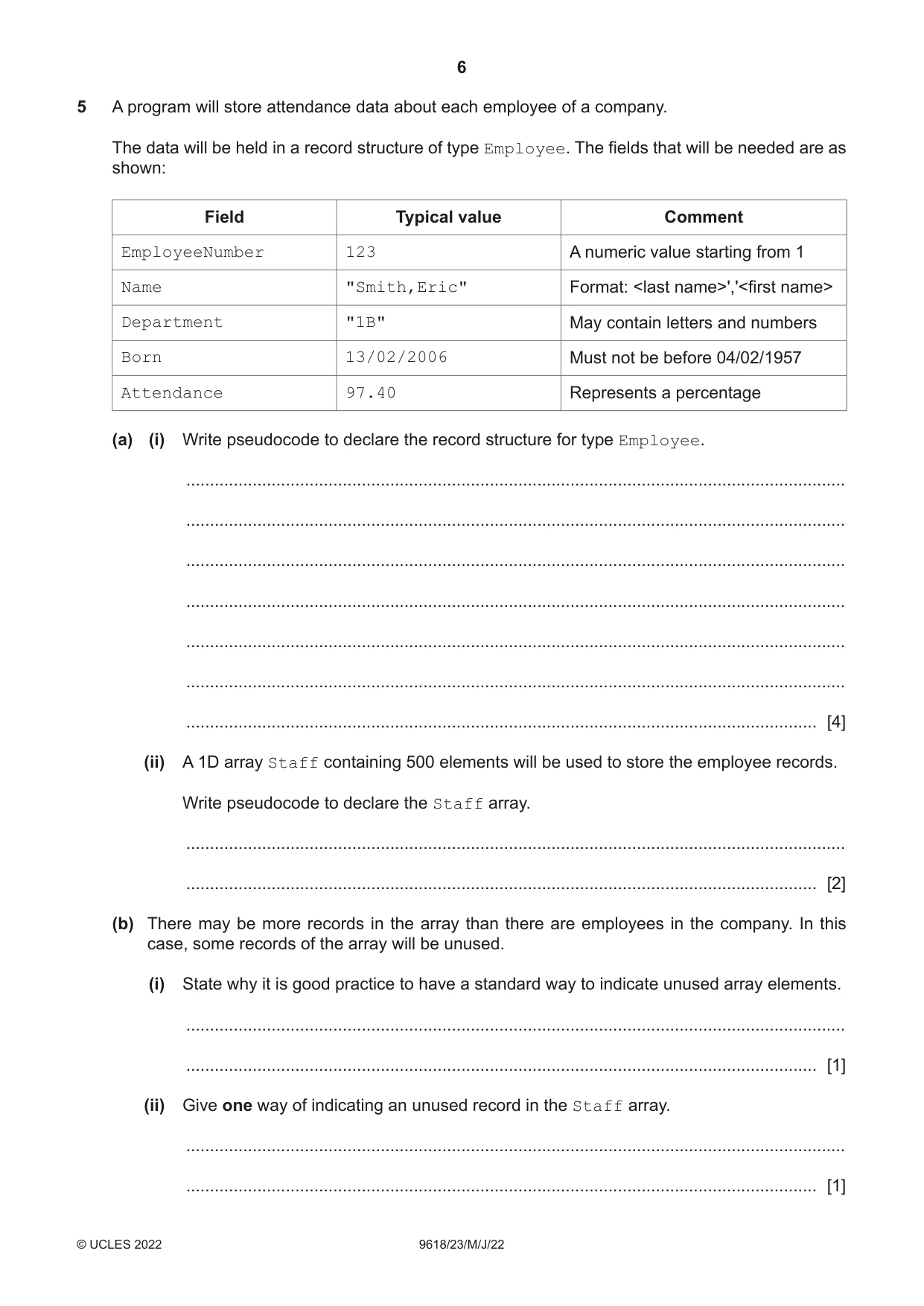
5 A program will store attendance data about each employee of a company. The data will be held in a record structure of type Employee. The fields that will be needed are as shown: Field Typical value Comment EmployeeNumber 123 A numeric value starting from 1 Name "Smith,Eric" Format: <last name>','<first name> Department "1B" May contain letters and numbers Born 13/02/2006 Must not be before 04/02/1957 Attendance 97.40 Represents a percentage (a) (i) Write pseudocode to declare the record structure for type Employee. ........................................................................................................................................... ........................................................................................................................................... ........................................................................................................................................... ........................................................................................................................................... ........................................................................................................................................... ........................................................................................................................................... ..................................................................................................................................... [4] (ii) A 1D array Staff containing 500 elements will be used to store the employee records. Write pseudocode to declare the Staff array. ........................................................................................................................................... ..................................................................................................................................... [2] (b) There may be more records in the array than there are employees in the company. In this case, some records of the array will be unused. (i) State why it is good practice to have a standard way to indicate unused array elements. ........................................................................................................................................... ..................................................................................................................................... [1] (ii) Give one way of indicating an unused record in the Staff array. ........................................................................................................................................... ..................................................................................................................................... [1] (c) A procedure Absentees() will output the EmployeeNumber and the Name of all employees who have an Attendance value of 90.00 or less. Write pseudocode for the procedure Absentees(). Assume that the Staff array is global. ................................................................................................................................................... ................................................................................................................................................... ................................................................................................................................................... ................................................................................................................................................... ................................................................................................................................................... ................................................................................................................................................... ................................................................................................................................................... ................................................................................................................................................... ................................................................................................................................................... ................................................................................................................................................... ................................................................................................................................................... ................................................................................................................................................... ................................................................................................................................................... ................................................................................................................................................... ................................................................................................................................................... ................................................................................................................................................... ................................................................................................................................................... ............................................................................................................................................. [4]
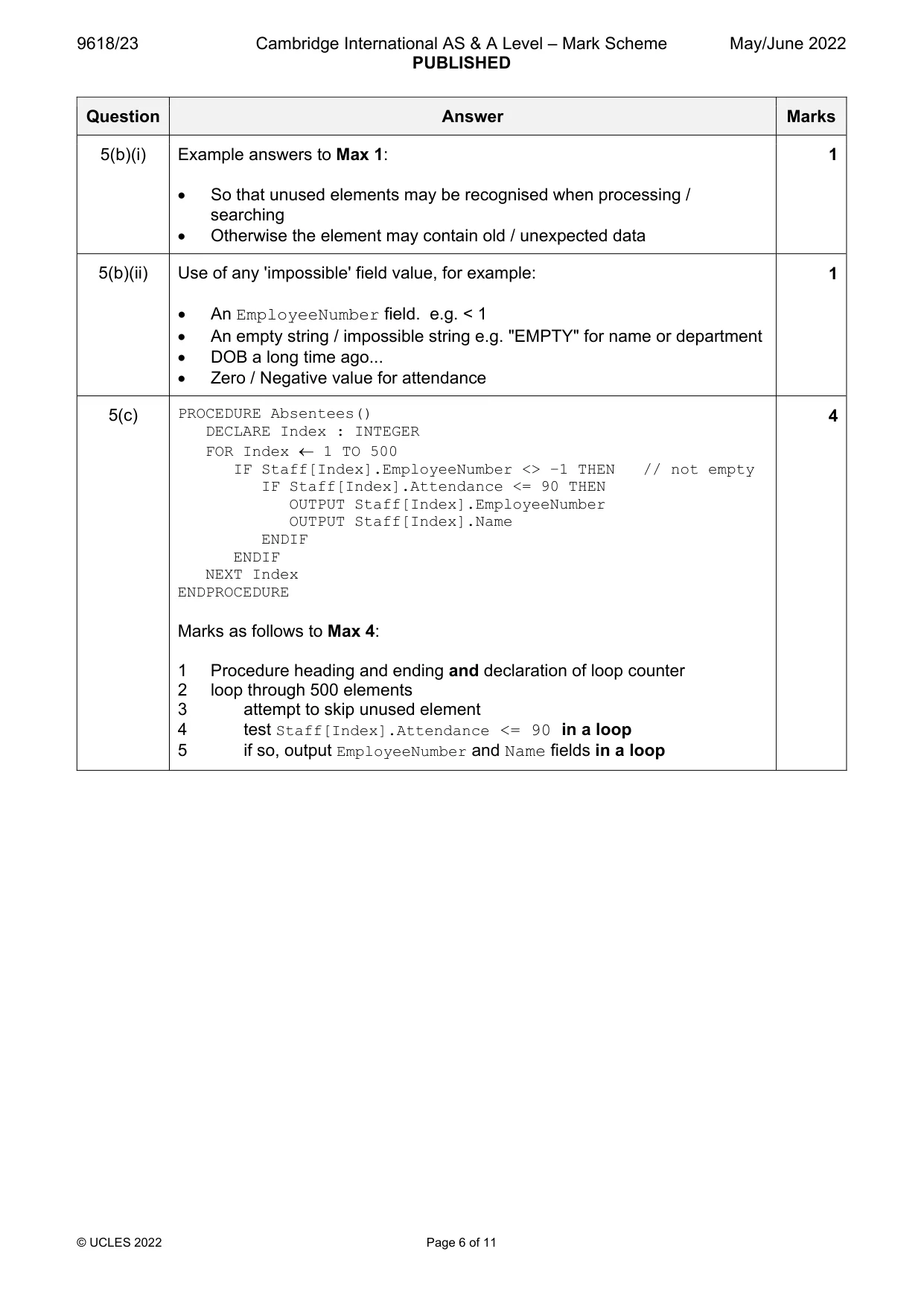
Mark scheme: 5(a)(i) TYPE Employee 4 DECLARE EmployeeNumber : INTEGER DECLARE Name : STRING DECLARE Department : STRING DECLARE Born : DATE DECLARE Attendance : REAL ENDTYPE One mark for each: 1. TYPE Employee and ENDTYPE 2. Fields: EmployeeNumber and Name and Department 3. Field: Born 4. Field: Attendance 5(a)(ii) DECLARE Staff : ARRAY [1:500] OF Employee 2 One mark per underlined phrase 5(b)(i) Example answers to Max 1: 1 So that unused elements may be recognised when processing / searching Otherwise the element may contain old / unexpected data 5(b)(ii) Use of any 'impossible' field value, for example: 1 An EmployeeNumber field. e.g. < 1 An empty string / impossible string e.g. "EMPTY" for name or department DOB a long time ago... Zero / Negative value for attendance 5(c) PROCEDURE Absentees() 4 DECLARE Index : INTEGER FOR Index 1 TO 500 IF Staff[Index].EmployeeNumber <> −1 THEN // not empty IF Staff[Index].Attendance <= 90 THEN OUTPUT Staff[Index].EmployeeNumber OUTPUT Staff[Index].Name ENDIF ENDIF NEXT Index ENDPROCEDURE Marks as follows to Max 4: 1 Procedure heading and ending and declaration of loop counter 2 loop through 500 elements 3 attempt to skip unused element 4 test Staff[Index].Attendance <= 90 in a loop 5 if so, output EmployeeNumber and Name fields in a loop
Q6 · The factorial of a number is the product of all the integers from 1 to that number
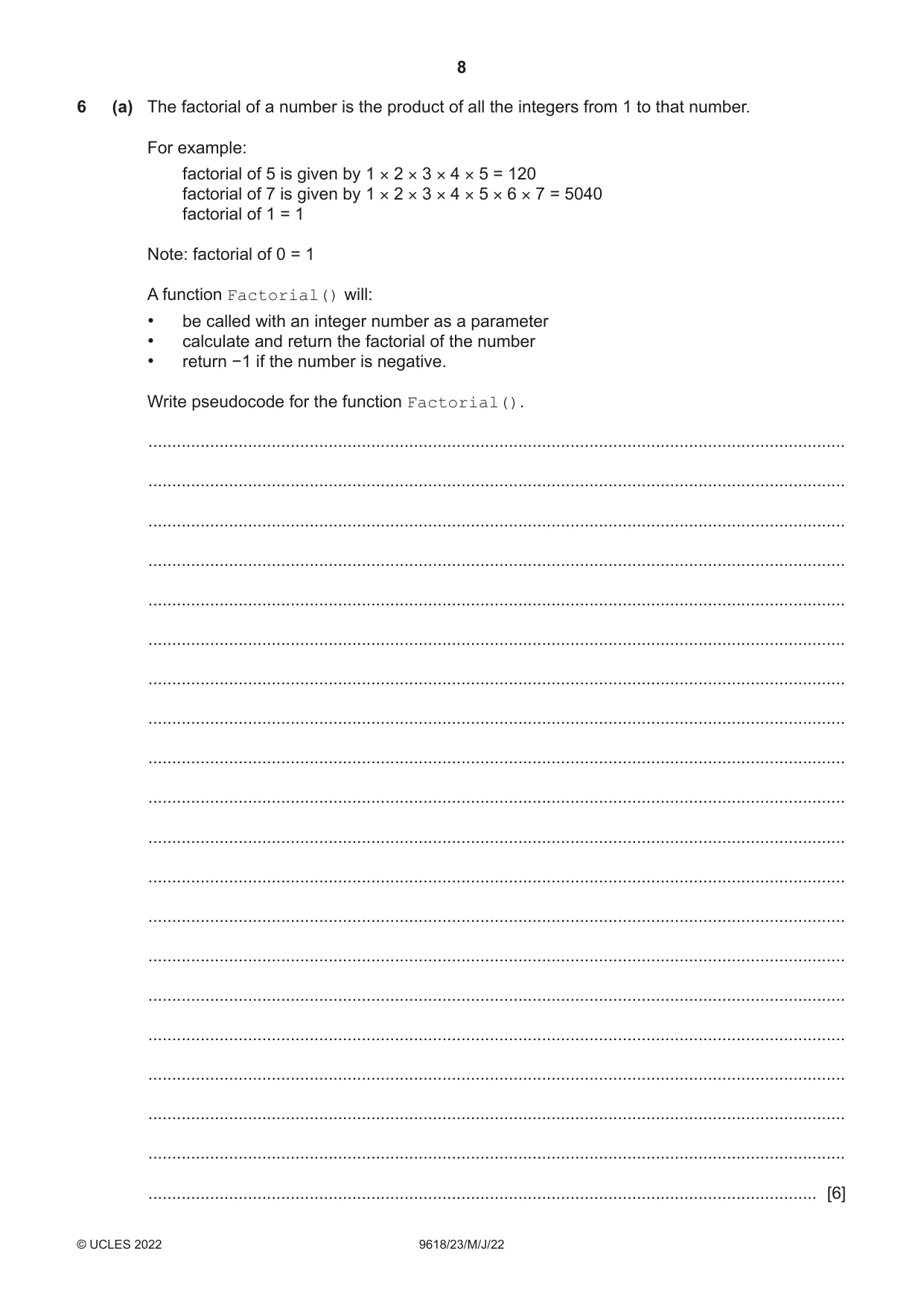
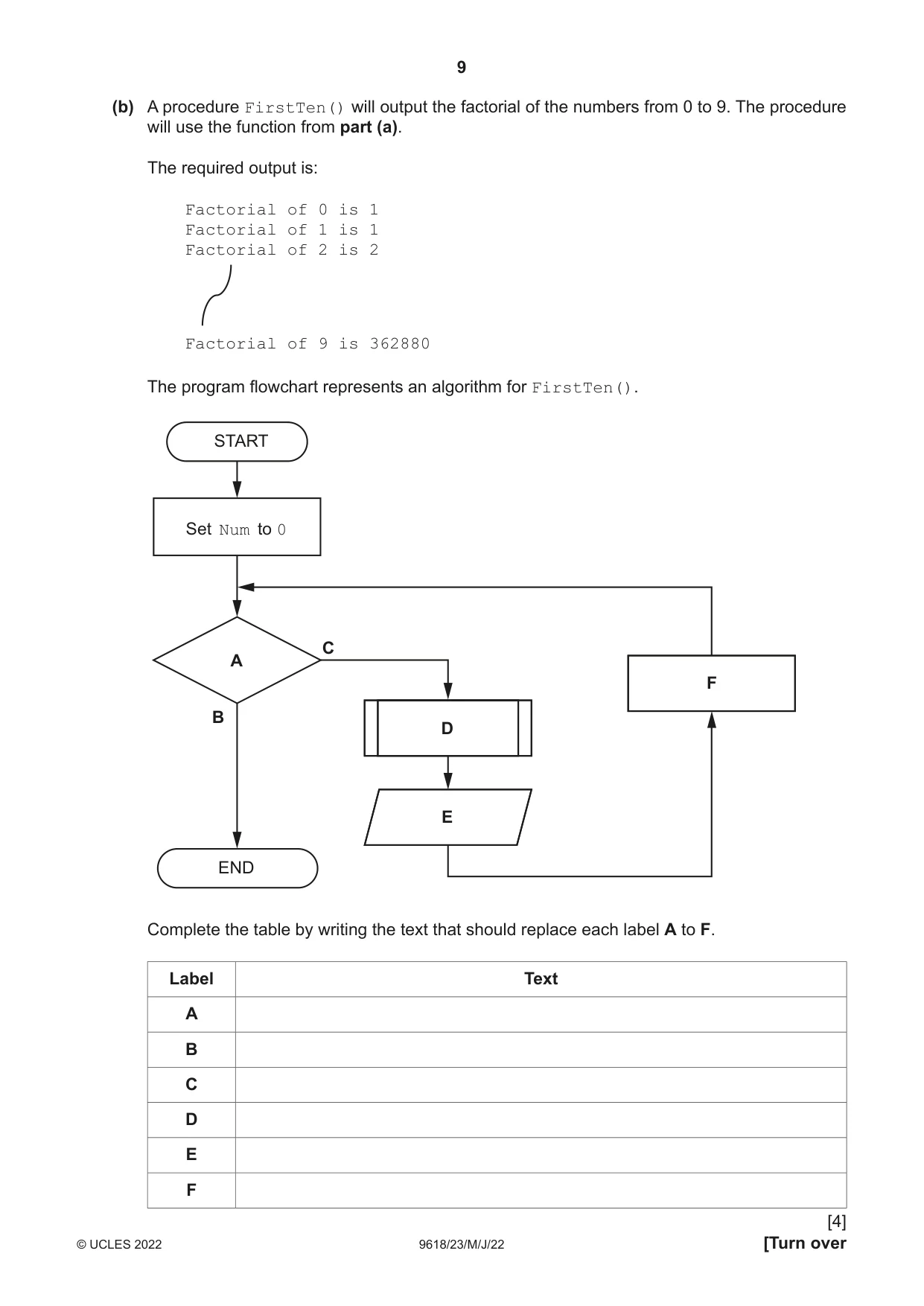
6 (a) The factorial of a number is the product of all the integers from 1 to that number. For example: factorial of 5 is given by 1 × 2 × 3 × 4 × 5 = 120 factorial of 7 is given by 1 × 2 × 3 × 4 × 5 × 6 × 7 = 5040 factorial of 1 = 1 Note: factorial of 0 = 1 A function Factorial() will: • be called with an integer number as a parameter • calculate and return the factorial of the number • return −1 if the number is negative. Write pseudocode for the function Factorial(). ................................................................................................................................................... ................................................................................................................................................... ................................................................................................................................................... ................................................................................................................................................... ................................................................................................................................................... ................................................................................................................................................... ................................................................................................................................................... ................................................................................................................................................... ................................................................................................................................................... ................................................................................................................................................... ................................................................................................................................................... ................................................................................................................................................... ................................................................................................................................................... ................................................................................................................................................... ................................................................................................................................................... ................................................................................................................................................... ................................................................................................................................................... ................................................................................................................................................... ................................................................................................................................................... ............................................................................................................................................. [6] (b) A procedure FirstTen() will output the factorial of the numbers from 0 to 9. The procedure will use the function from part (a). The required output is: Factorial of 0 is 1 Factorial of 1 is 1 Factorial of 2 is 2 Factorial of 9 is 362880 The program flowchart represents an algorithm for FirstTen(). START Set Num to 0 C A F B D E END Complete the table by writing the text that should replace each label A to F. Label Text A B C D E F [4]
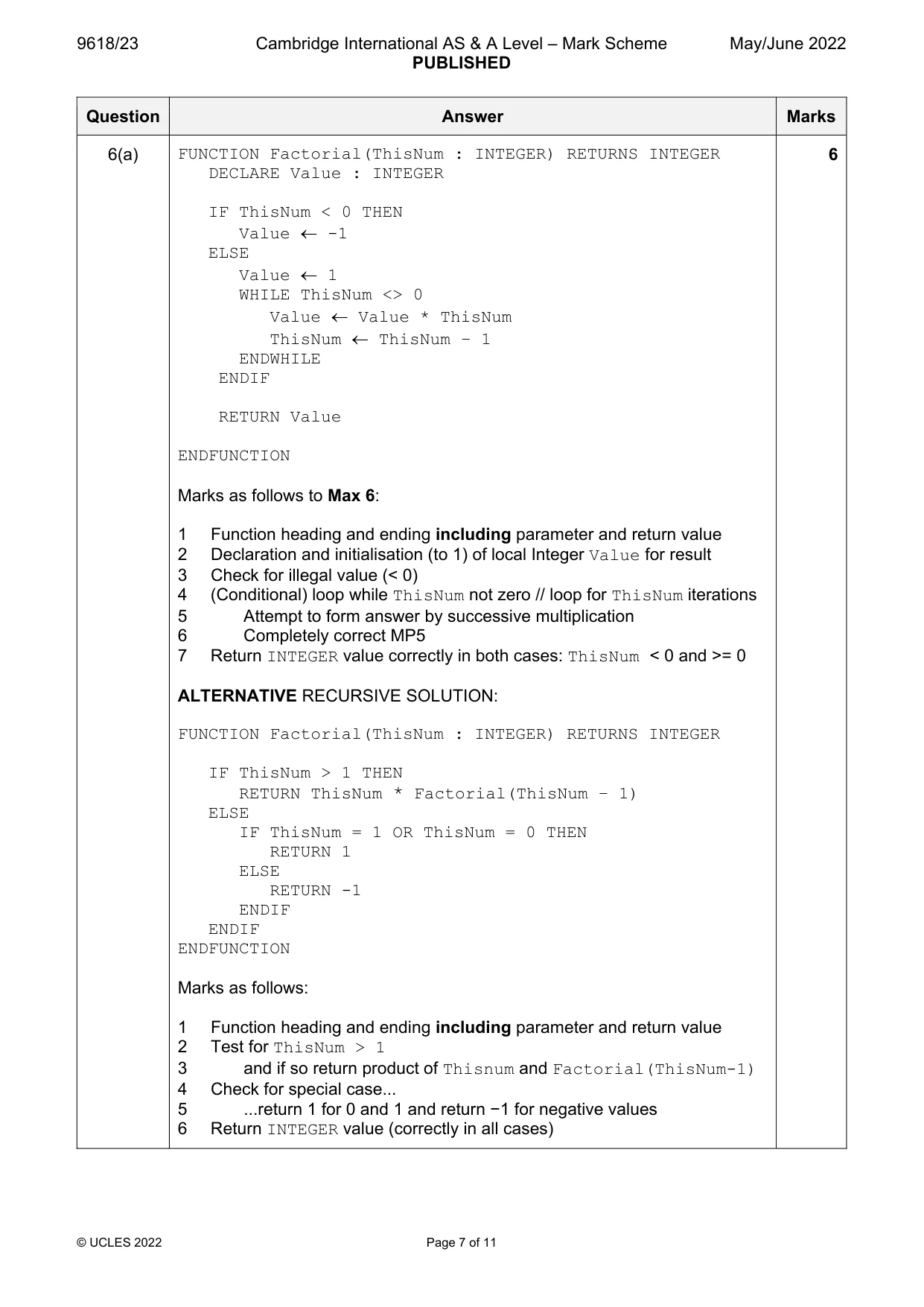
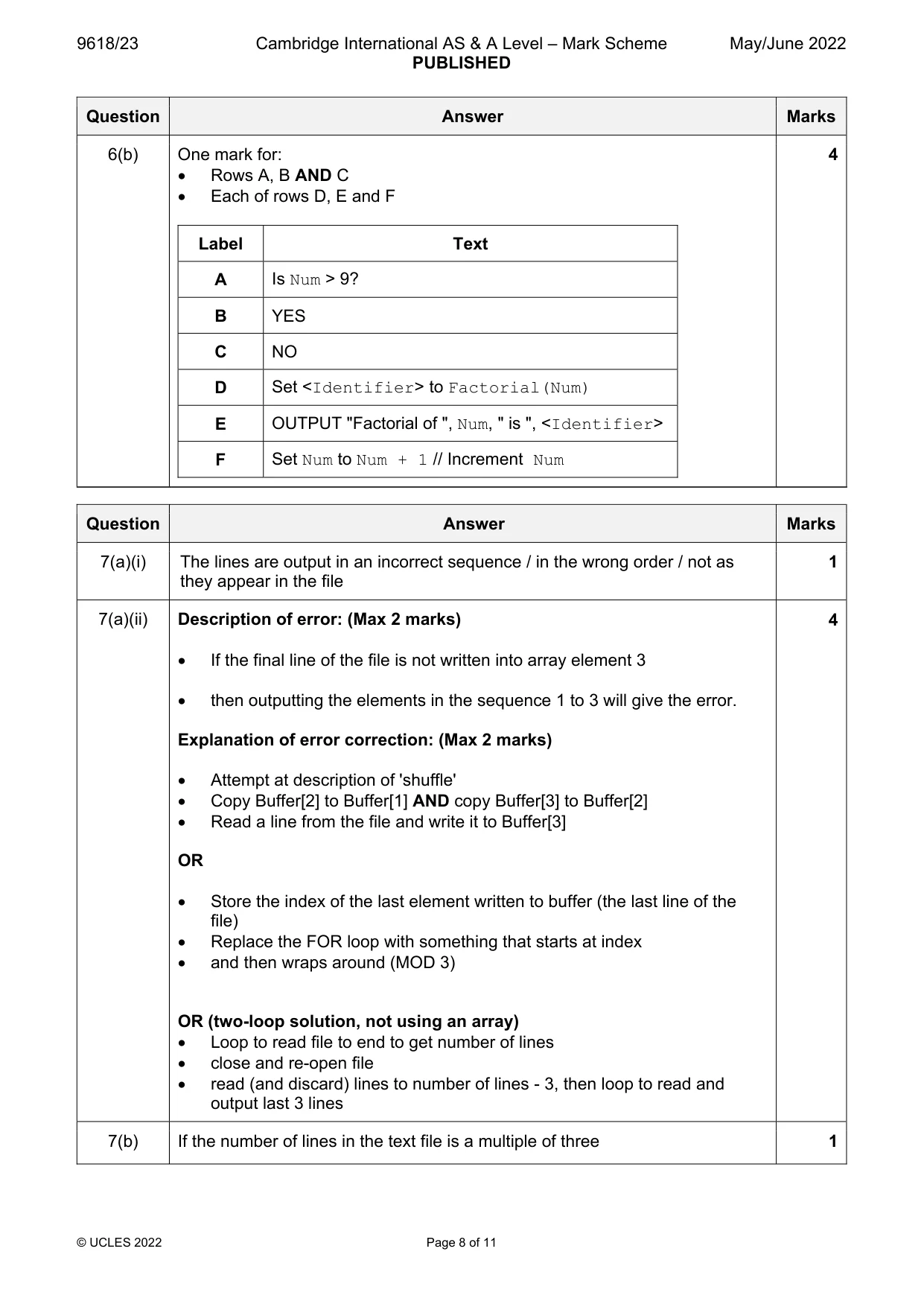
Mark scheme: 6(a) FUNCTION Factorial(ThisNum : INTEGER) RETURNS INTEGER 6 DECLARE Value : INTEGER IF ThisNum < 0 THEN Value -1 ELSE Value 1 WHILE ThisNum <> 0 Value Value * ThisNum ThisNum ThisNum – 1 ENDWHILE ENDIF RETURN Value ENDFUNCTION Marks as follows to Max 6: 1 Function heading and ending including parameter and return value 2 Declaration and initialisation (to 1) of local Integer Value for result 3 Check for illegal value (< 0) 4 (Conditional) loop while ThisNum not zero // loop for ThisNum iterations 5 Attempt to form answer by successive multiplication 6 Completely correct MP5 7 Return INTEGER value correctly in both cases: ThisNum < 0 and >= 0 ALTERNATIVE RECURSIVE SOLUTION: FUNCTION Factorial(ThisNum : INTEGER) RETURNS INTEGER IF ThisNum > 1 THEN RETURN ThisNum * Factorial(ThisNum – 1) ELSE IF ThisNum = 1 OR ThisNum = 0 THEN RETURN 1 ELSE RETURN -1 ENDIF ENDIF ENDFUNCTION Marks as follows: 1 Function heading and ending including parameter and return value 2 Test for ThisNum > 1 3 and if so return product of Thisnum and Factorial(ThisNum-1) 4 Check for special case... 5 ...return 1 for 0 and 1 and return −1 for negative values 6 Return INTEGER value (correctly in all cases) 6(b) One mark for: 4 Rows A, B AND C Each of rows D, E and F Label Text A Is Num > 9? B YES C NO D Set <Identifier> to Factorial(Num) E OUTPUT "Factorial of ", Num, " is ", <Identifier> F Set Num to Num + 1 // Increment Num
Q7 · The following pseudocode represents an algorithm intended to output the last three lines…
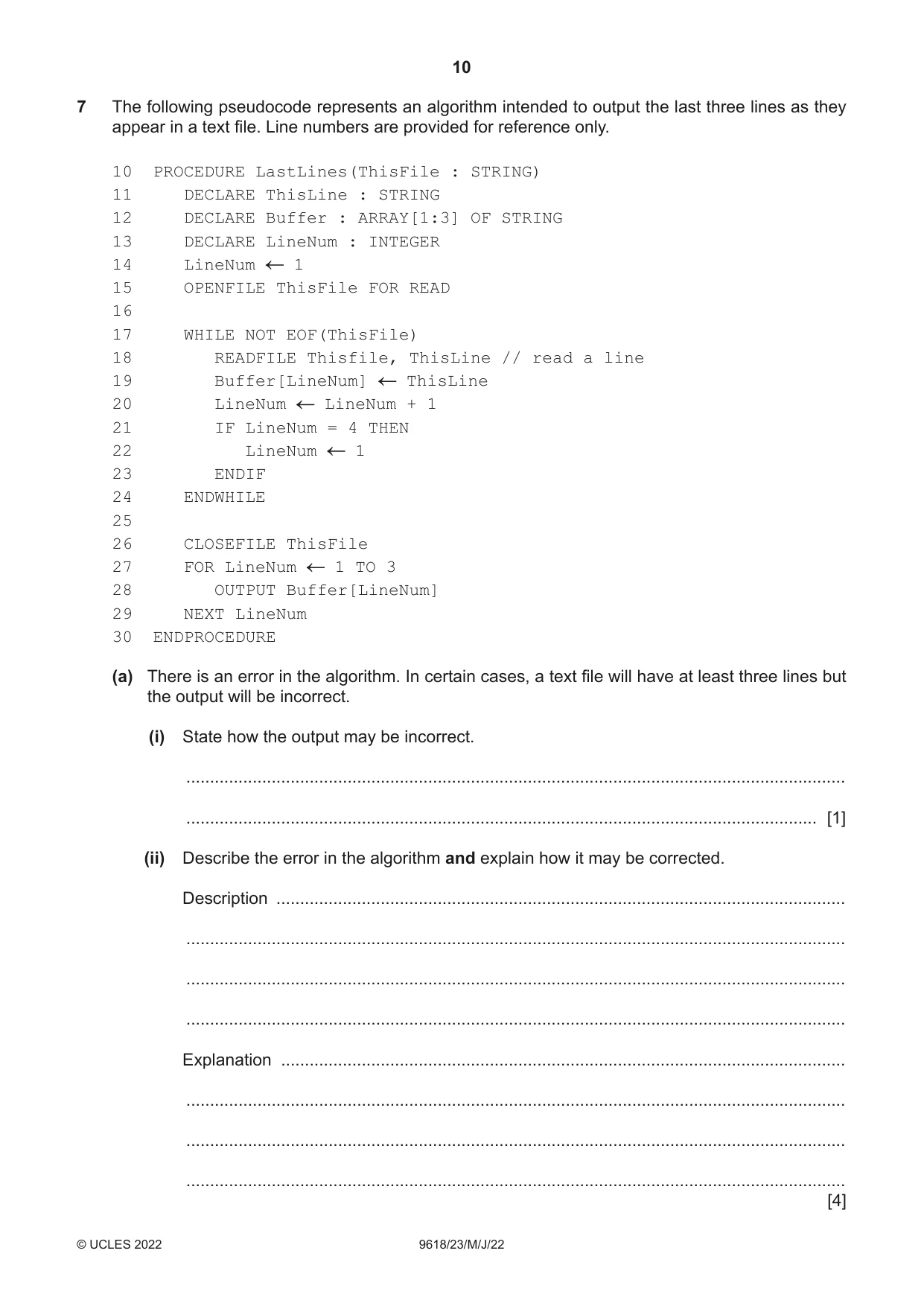
7 The following pseudocode represents an algorithm intended to output the last three lines as they appear in a text file. Line numbers are provided for reference only. 10 PROCEDURE LastLines(ThisFile : STRING) 11 DECLARE ThisLine : STRING 12 DECLARE Buffer : ARRAY[1:3] OF STRING 13 DECLARE LineNum : INTEGER 14 LineNum 1 15 OPENFILE ThisFile FOR READ 16 17 WHILE NOT EOF(ThisFile) 18 READFILE Thisfile, ThisLine // read a line 19 Buffer[LineNum] ThisLine 20 LineNum LineNum + 1 21 IF LineNum = 4 THEN 22 LineNum 1 23 ENDIF 24 ENDWHILE 25 26 CLOSEFILE ThisFile 27 FOR LineNum 1 TO 3 28 OUTPUT Buffer[LineNum] 29 NEXT LineNum 30 ENDPROCEDURE (a) There is an error in the algorithm. In certain cases, a text file will have at least three lines but the output will be incorrect. (i) State how the output may be incorrect. ........................................................................................................................................... ..................................................................................................................................... [1] (ii) Describe the error in the algorithm and explain how it may be corrected. Description ........................................................................................................................ ........................................................................................................................................... ........................................................................................................................................... ........................................................................................................................................... Explanation ....................................................................................................................... ........................................................................................................................................... ........................................................................................................................................... ........................................................................................................................................... [4] (b) The original algorithm is implemented and sometimes the last three lines of the text file are output correctly. State the condition that results in the correct output. ................................................................................................................................................... ............................................................................................................................................. [1] (c) Lines 20 to 23 inclusive could be replaced with a single pseudocode statement. Write the pseudocode statement. ................................................................................................................................................... ............................................................................................................................................. [2]
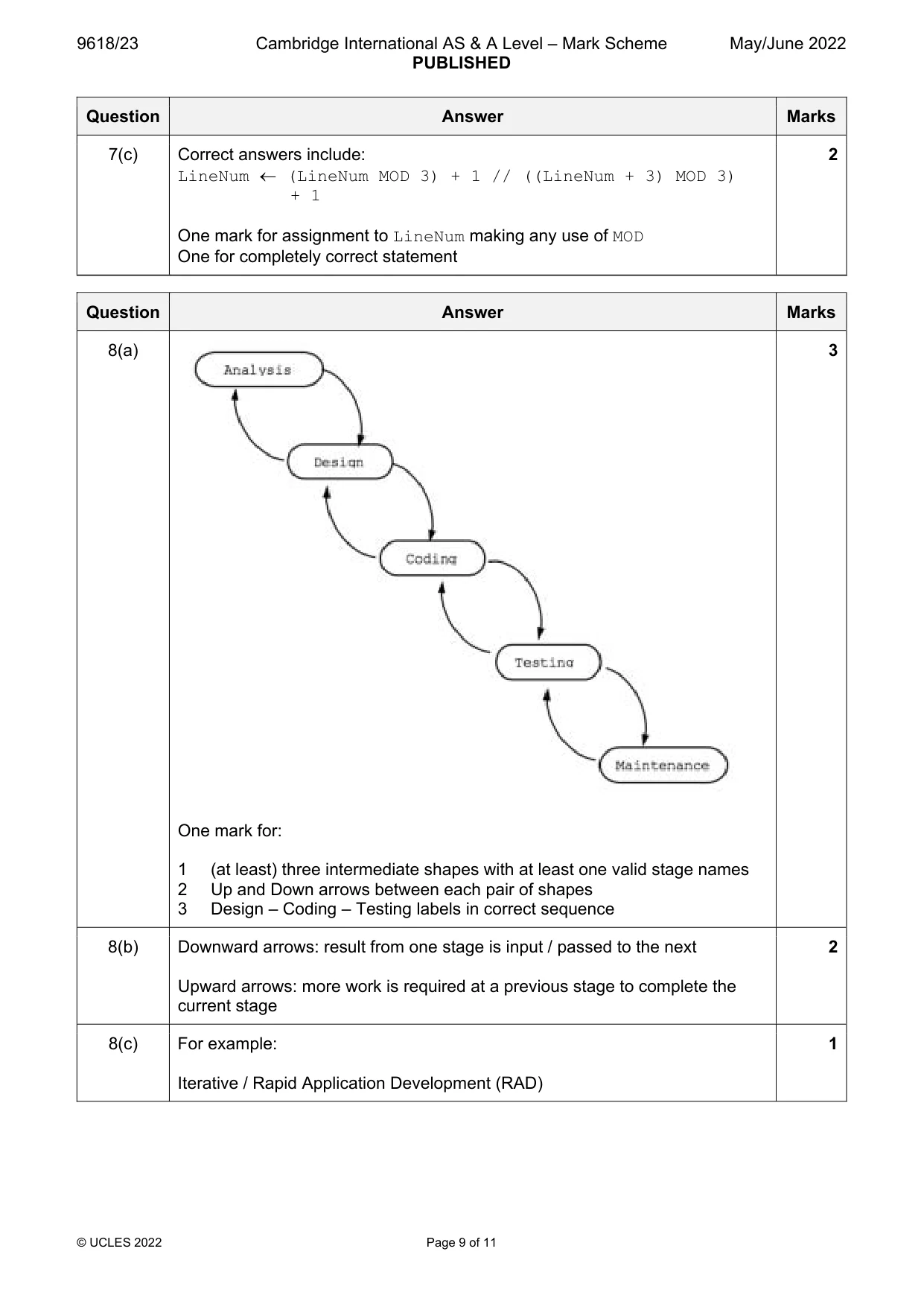
Mark scheme: 7(a)(i) The lines are output in an incorrect sequence / in the wrong order / not as 1 they appear in the file 7(a)(ii) Description of error: (Max 2 marks) 4 If the final line of the file is not written into array element 3 then outputting the elements in the sequence 1 to 3 will give the error. Explanation of error correction: (Max 2 marks) Attempt at description of 'shuffle' Copy Buffer[2] to Buffer[1] AND copy Buffer[3] to Buffer[2] Read a line from the file and write it to Buffer[3] OR Store the index of the last element written to buffer (the last line of the file) Replace the FOR loop with something that starts at index and then wraps around (MOD 3) OR (two-loop solution, not using an array) Loop to read file to end to get number of lines close and re-open file read (and discard) lines to number of lines - 3, then loop to read and output last 3 lines 7(b) If the number of lines in the text file is a multiple of three 1 7(c) Correct answers include: 2 LineNum (LineNum MOD 3) + 1 // ((LineNum + 3) MOD 3) + 1 One mark for assignment to LineNum making any use of MOD One for completely correct statement
Q8 · The following diagram shows the incomplete waterfall model of the program development…
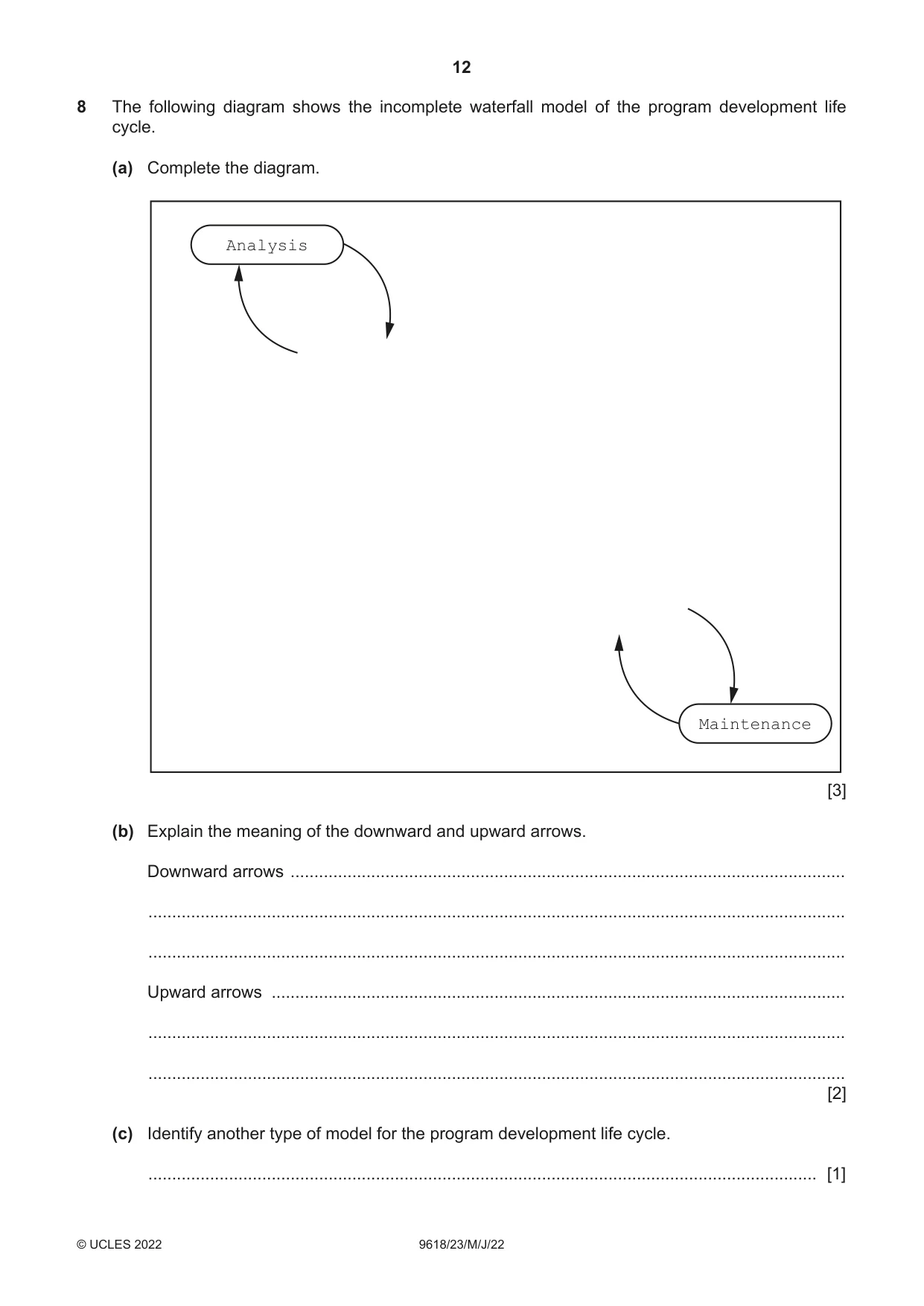
8 The following diagram shows the incomplete waterfall model of the program development life cycle. (a) Complete the diagram. Analysis Maintenance [3] (b) Explain the meaning of the downward and upward arrows. Downward arrows ..................................................................................................................... ................................................................................................................................................... ................................................................................................................................................... Upward arrows ......................................................................................................................... ................................................................................................................................................... ................................................................................................................................................... [2] (c) Identify another type of model for the program development life cycle. ............................................................................................................................................. [1]
Mark scheme: 8(a) 3 One mark for: 1 (at least) three intermediate shapes with at least one valid stage names 2 Up and Down arrows between each pair of shapes 3 Design – Coding – Testing labels in correct sequence 8(b) Downward arrows: result from one stage is input / passed to the next 2 Upward arrows: more work is required at a previous stage to complete the current stage 8(c) For example: 1 Iterative / Rapid Application Development (RAD)
Q9 · A program allows a user to save passwords used to log in to websites
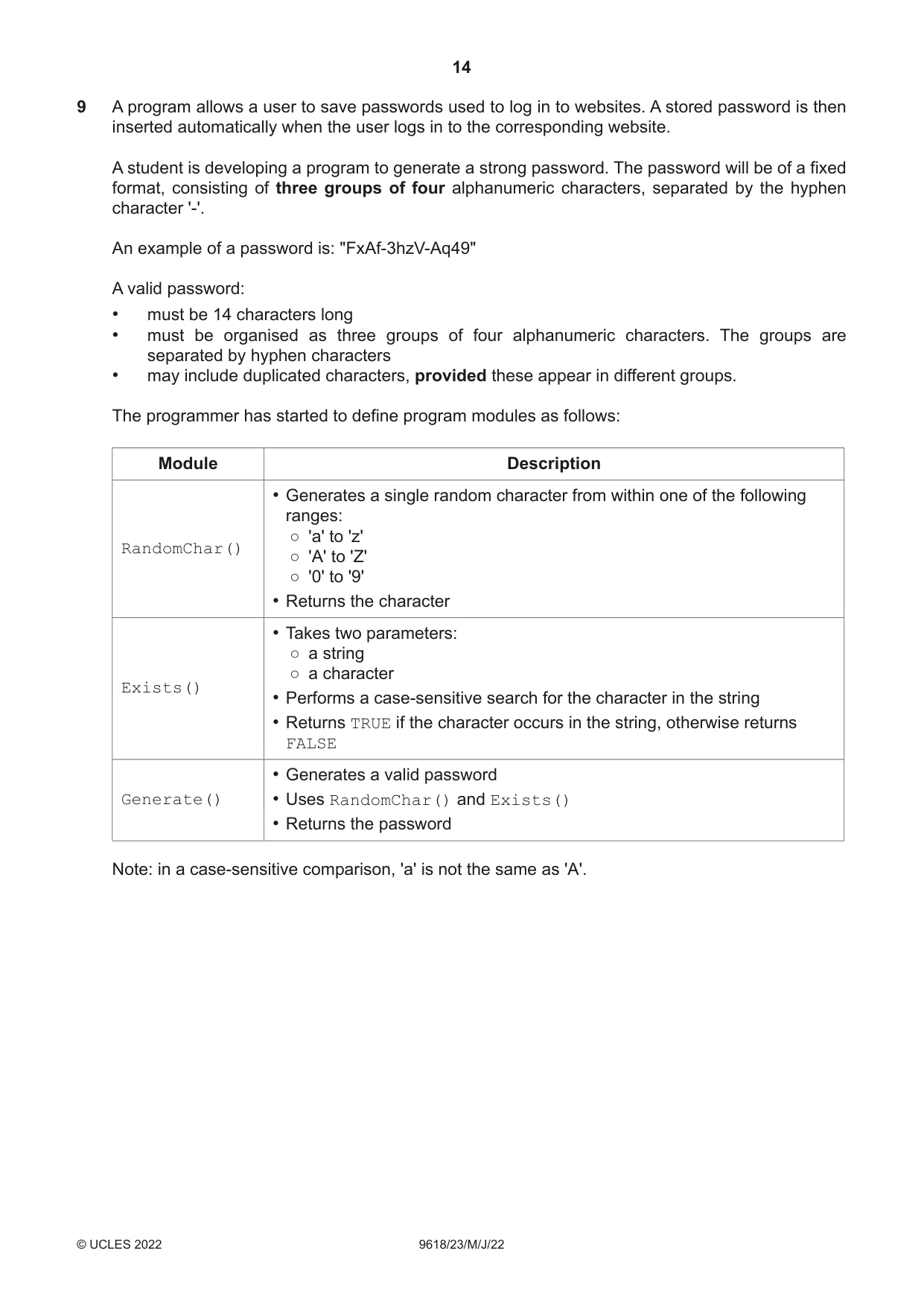
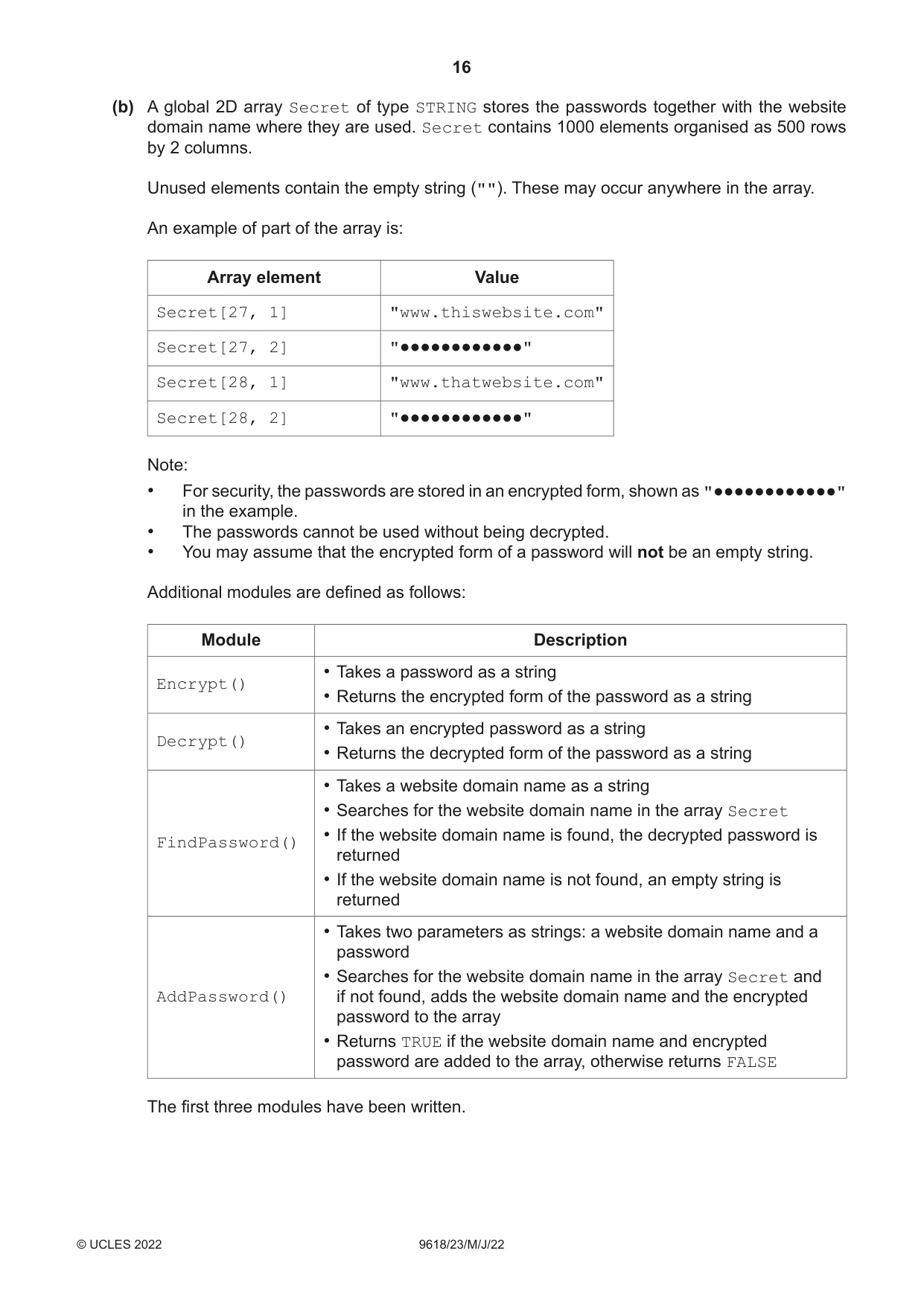
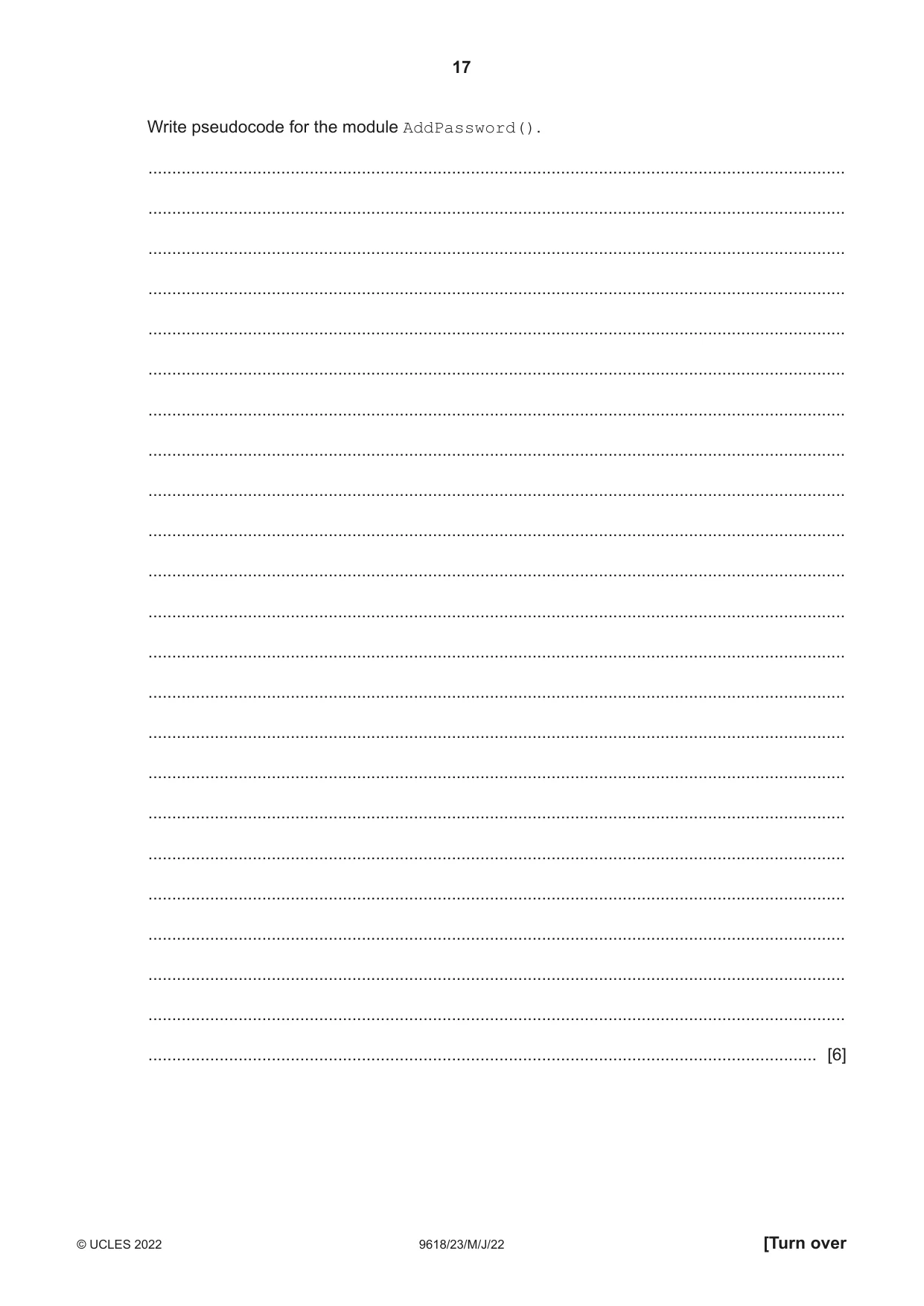
9 A program allows a user to save passwords used to log in to websites. A stored password is then inserted automatically when the user logs in to the corresponding website. A student is developing a program to generate a strong password. The password will be of a fixed format, consisting of three groups of four alphanumeric characters, separated by the hyphen character '-'. An example of a password is: "FxAf-3hzV-Aq49" A valid password: • must be 14 characters long • must be organised as three groups of four alphanumeric characters. The groups are separated by hyphen characters • may include duplicated characters, provided these appear in different groups. The programmer has started to define program modules as follows: Module Description • Generates a single random character from within one of the following ranges: ○ 'a' to 'z' RandomChar() ○ 'A' to 'Z' ○ '0' to '9' • Returns the character • Takes two parameters: ○ a string ○ a character Exists() • Performs a case-sensitive search for the character in the string • Returns TRUE if the character occurs in the string, otherwise returns FALSE • Generates a valid password Generate() • Uses RandomChar() and Exists() • Returns the password Note: in a case-sensitive comparison, 'a' is not the same as 'A'. (a) Write pseudocode for the module Generate(). ................................................................................................................................................... ................................................................................................................................................... ................................................................................................................................................... ................................................................................................................................................... ................................................................................................................................................... ................................................................................................................................................... ................................................................................................................................................... ................................................................................................................................................... ................................................................................................................................................... ................................................................................................................................................... ................................................................................................................................................... ................................................................................................................................................... ................................................................................................................................................... ................................................................................................................................................... ................................................................................................................................................... ................................................................................................................................................... ................................................................................................................................................... ................................................................................................................................................... ................................................................................................................................................... ................................................................................................................................................... ................................................................................................................................................... ................................................................................................................................................... ................................................................................................................................................... ................................................................................................................................................... ................................................................................................................................................... ................................................................................................................................................... ............................................................................................................................................. [7] (b) A global 2D array Secret of type STRING stores the passwords together with the website domain name where they are used. Secret contains 1000 elements organised as 500 rows by 2 columns. Unused elements contain the empty string (""). These may occur anywhere in the array. An example of part of the array is: Array element Value Secret[27, 1] "www.thiswebsite.com" Secret[27, 2] Secret[28, 1] "www.thatwebsite.com" Secret[28, 2] Note: • For security, the passwords are stored in an encrypted form, shown as "●●●●●●●●●●●●" in the example. • The passwords cannot be used without being decrypted. • You may assume that the encrypted form of a password will not be an empty string. Additional modules are defined as follows: Module Description • Takes a password as a string Encrypt() • Returns the encrypted form of the password as a string • Takes an encrypted password as a string Decrypt() • Returns the decrypted form of the password as a string • Takes a website domain name as a string • Searches for the website domain name in the array Secret • If the website domain name is found, the decrypted password is FindPassword() returned • If the website domain name is not found, an empty string is returned • Takes two parameters as strings: a website domain name and a password • Searches for the website domain name in the array Secret and AddPassword() if not found, adds the website domain name and the encrypted password to the array • Returns TRUE if the website domain name and encrypted password are added to the array, otherwise returns FALSE The first three modules have been written.
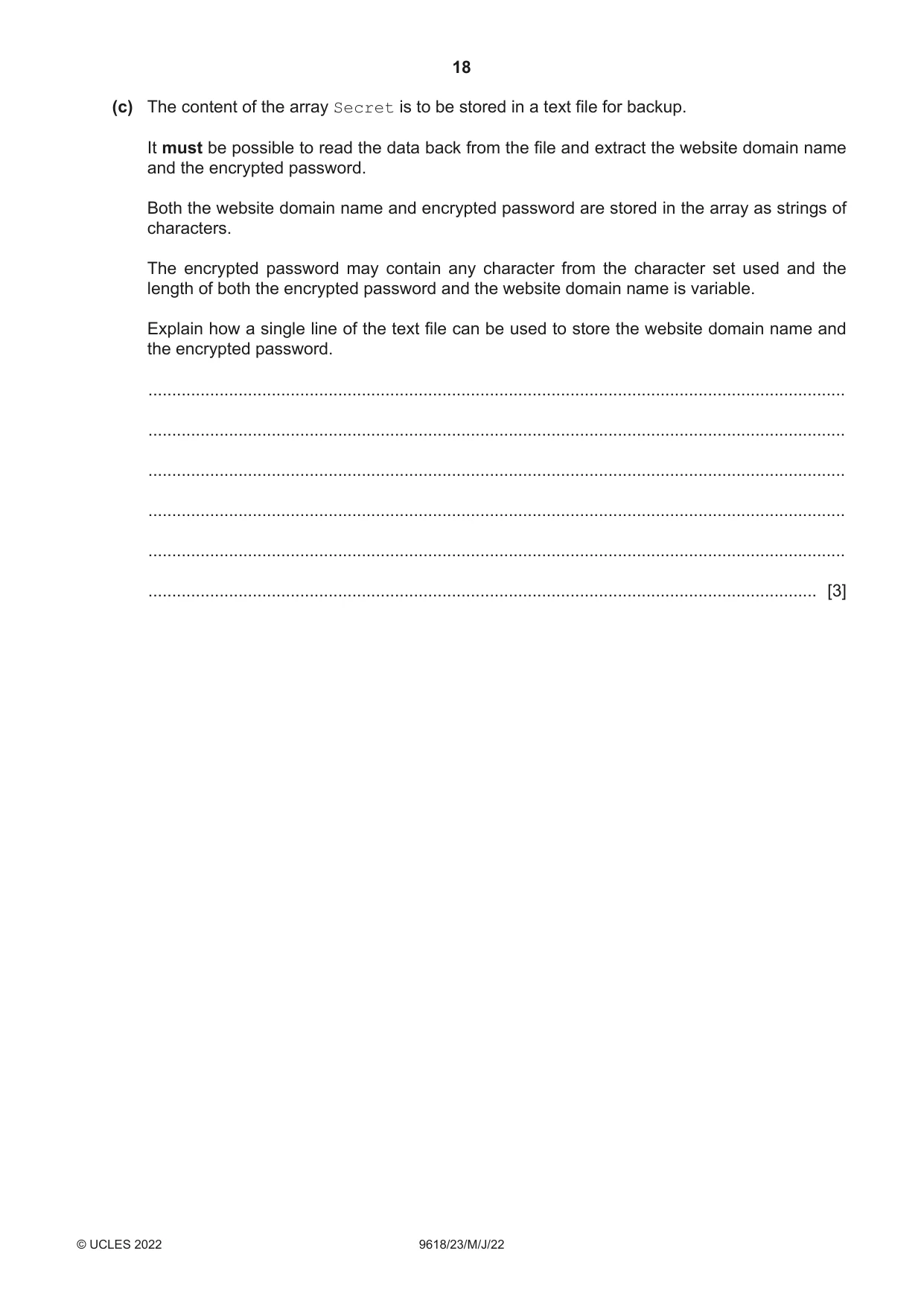
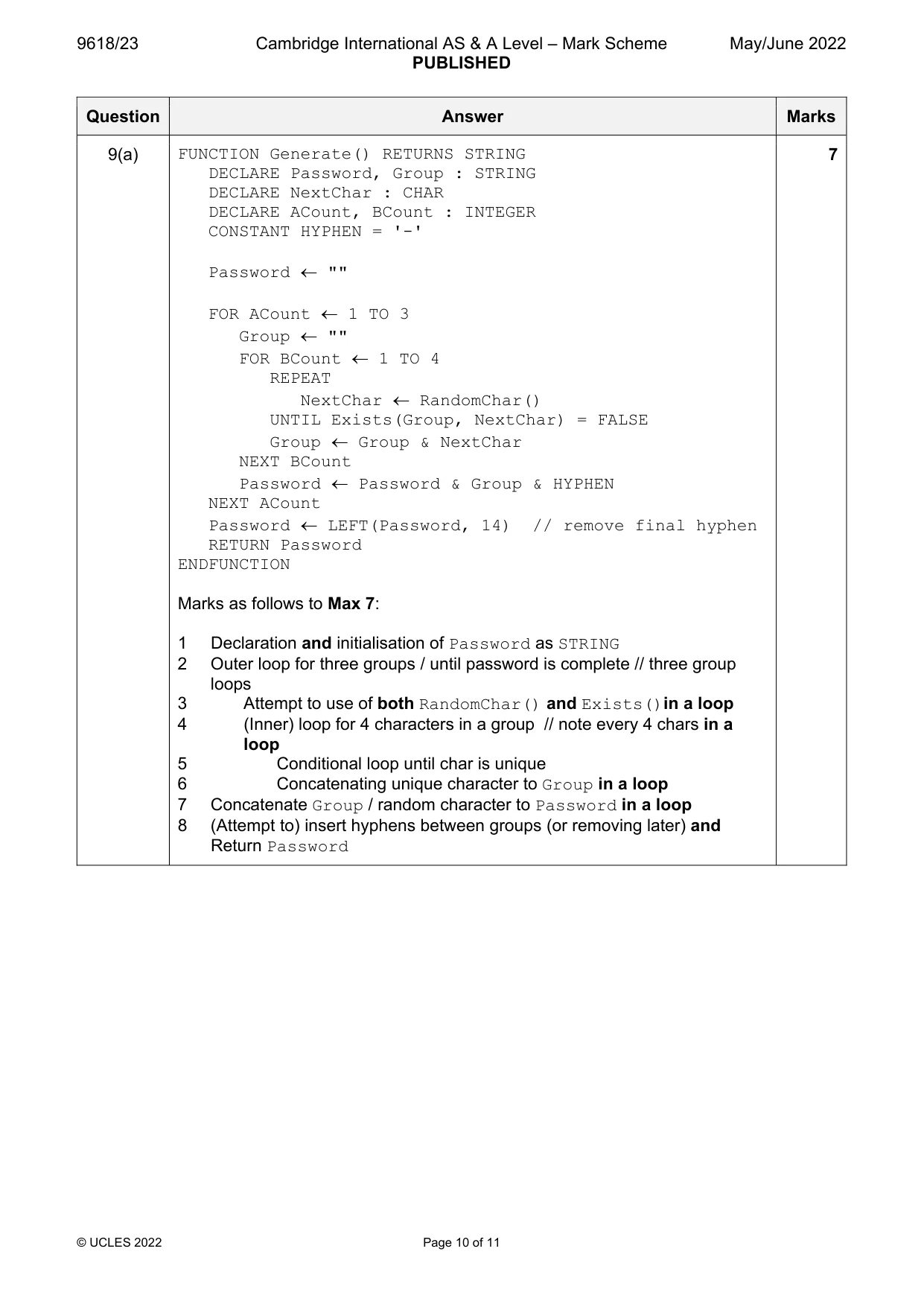
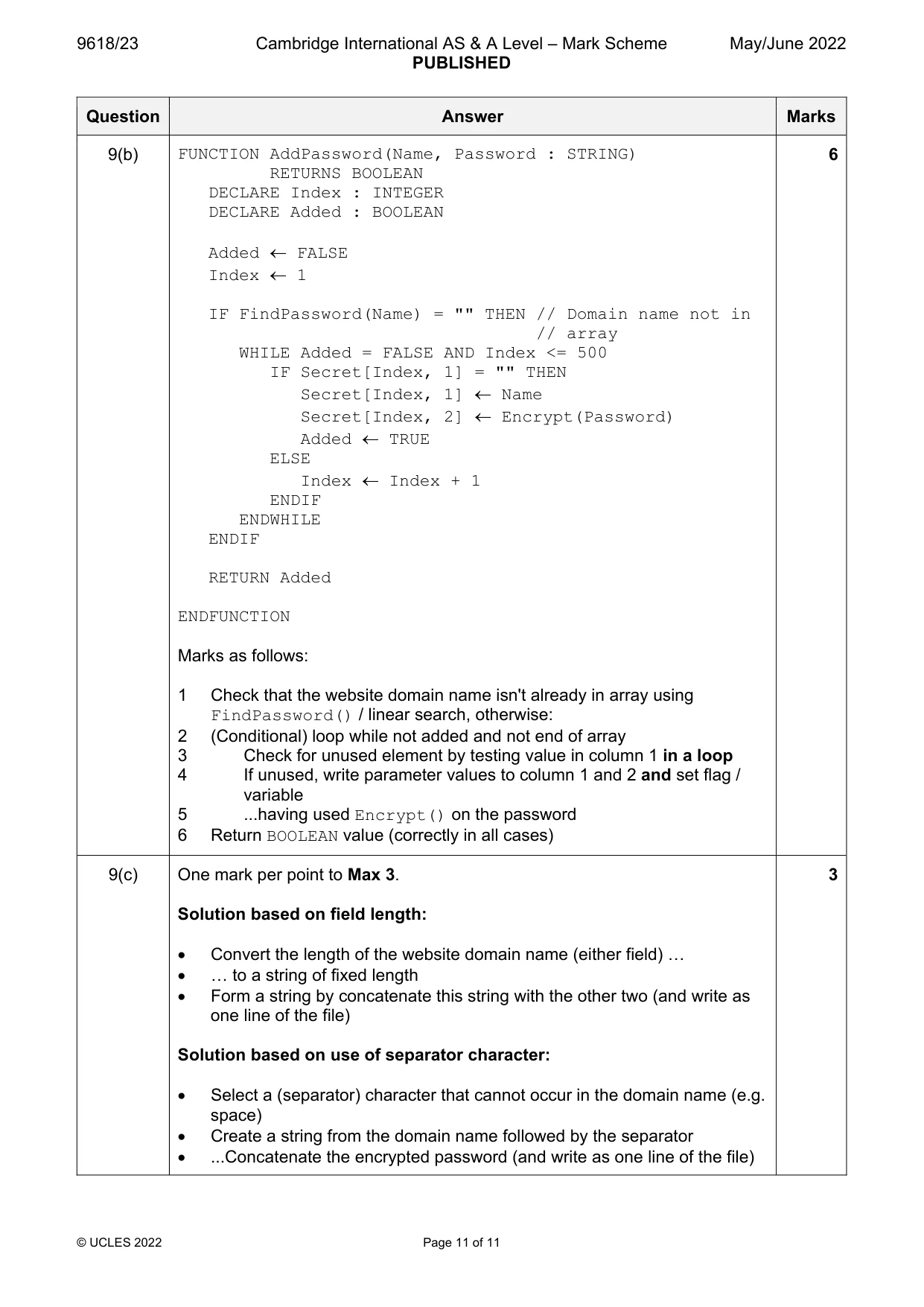
Mark scheme: 9(a) FUNCTION Generate() RETURNS STRING 7 DECLARE Password, Group : STRING DECLARE NextChar : CHAR DECLARE ACount, BCount : INTEGER CONSTANT HYPHEN = '-' Password "" FOR ACount 1 TO 3 Group "" FOR BCount 1 TO 4 REPEAT NextChar RandomChar() UNTIL Exists(Group, NextChar) = FALSE Group Group & NextChar NEXT BCount Password Password & Group & HYPHEN NEXT ACount Password LEFT(Password, 14) // remove final hyphen RETURN Password ENDFUNCTION Marks as follows to Max 7: 1 Declaration and initialisation of Password as STRING 2 Outer loop for three groups / until password is complete // three group loops 3 Attempt to use of both RandomChar() and Exists()in a loop 4 (Inner) loop for 4 characters in a group // note every 4 chars in a loop 5 Conditional loop until char is unique 6 Concatenating unique character to Group in a loop 7 Concatenate Group / random character to Password in a loop 8 (Attempt to) insert hyphens between groups (or removing later) and Return Password 9(b) FUNCTION AddPassword(Name, Password : STRING) 6 RETURNS BOOLEAN DECLARE Index : INTEGER DECLARE Added : BOOLEAN Added FALSE Index 1 IF FindPassword(Name) = "" THEN // Domain name not in // array WHILE Added = FALSE AND Index <= 500 IF Secret[Index, 1] = "" THEN Secret[Index, 1] Name Secret[Index, 2] Encrypt(Password) Added TRUE ELSE Index Index + 1 ENDIF ENDWHILE ENDIF RETURN Added ENDFUNCTION Marks as follows: 1 Check that the website domain name isn't already in array using FindPassword() / linear search, otherwise: 2 (Conditional) loop while not added and not end of array 3 Check for unused element by testing value in column 1 in a loop 4 If unused, write parameter values to column 1 and 2 and set flag / variable 5 ...having used Encrypt() on the password 6 Return BOOLEAN value (correctly in all cases) 9(c) One mark per point to Max 3. 3 Solution based on field length: Convert the length of the website domain name (either field) … … to a string of fixed length Form a string by concatenate this string with the other two (and write as one line of the file) Solution based on use of separator character: Select a (separator) character that cannot occur in the domain name (e.g. space) Create a string from the domain name followed by the separator ...Concatenate the encrypted password (and write as one line of the file)
What was in this paper
The subtopics covered by these 9 questions, and how many questions each got. Open one in a new tab to see every Cambridge question on it.
What you needed in this session
Cambridge’s own grade thresholds for 2022 May/June, Paper 2 · Variant 3. A higher threshold means an easier paper — the bar moves with how the cohort did.