Cambridge A Level Computer Science 9618 — 2025 May/June Paper 2 · Variant 3
9618/23/M/J/25 · 7 questions · 75 marks · ≈84 min
The question paper and its mark scheme, free to read here and free to download. This is Cambridge’s own paper, exactly as it was sat.
Question paper20 pages

Mark scheme14 pages
Answers below. Sit the paper first if you are practising.


Questions as text
Q1 · A program is being developed for the management of a sports centre
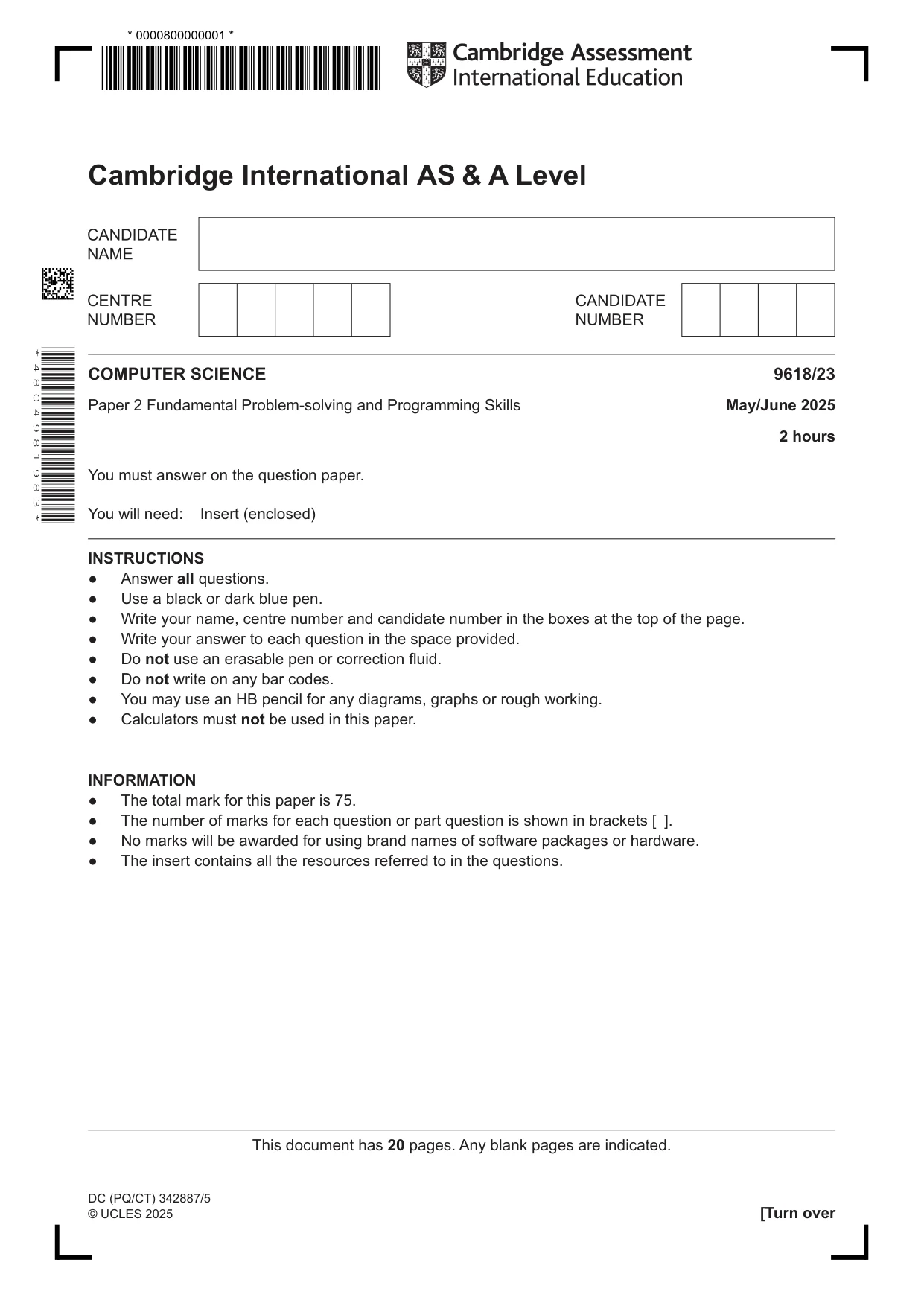
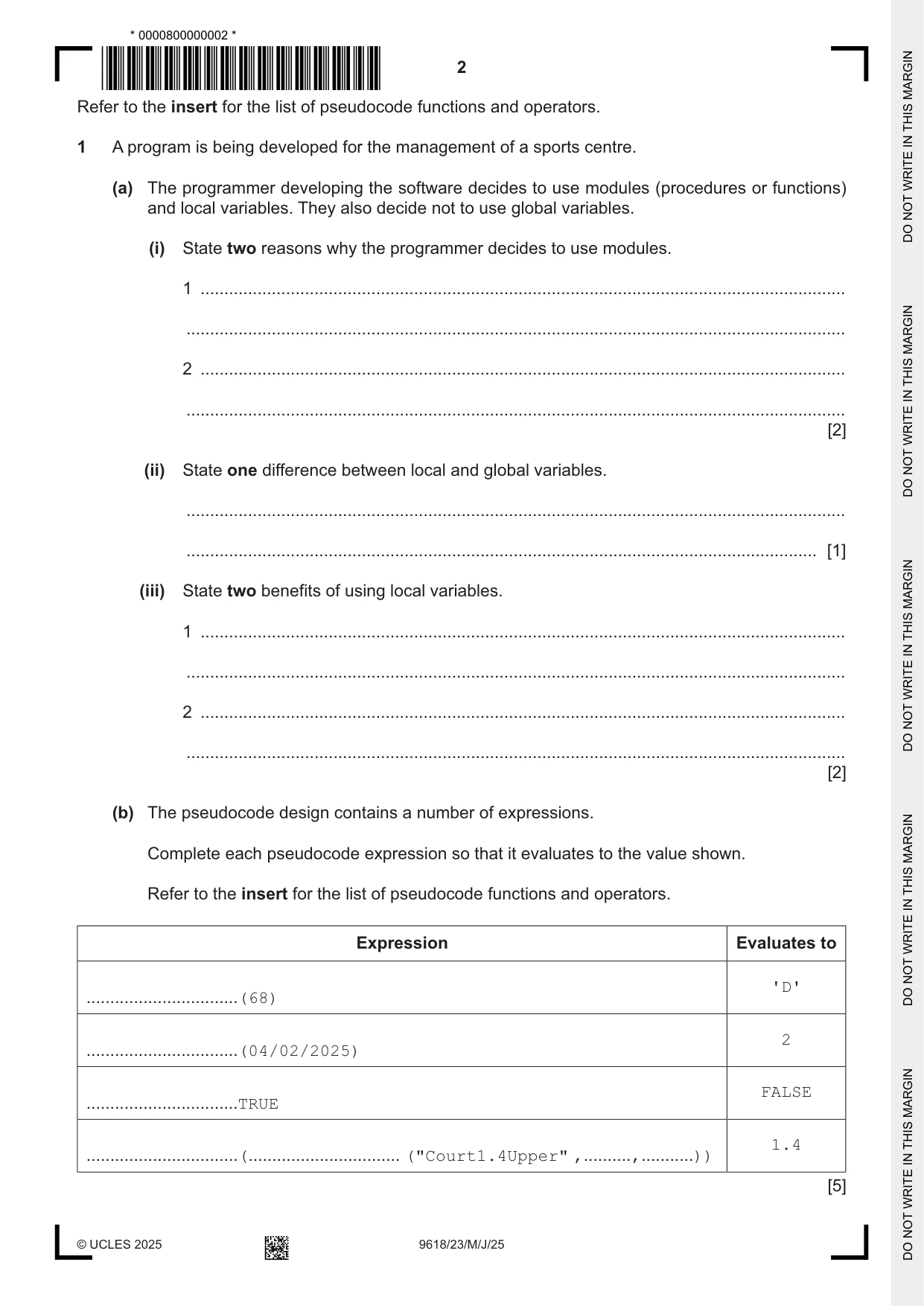
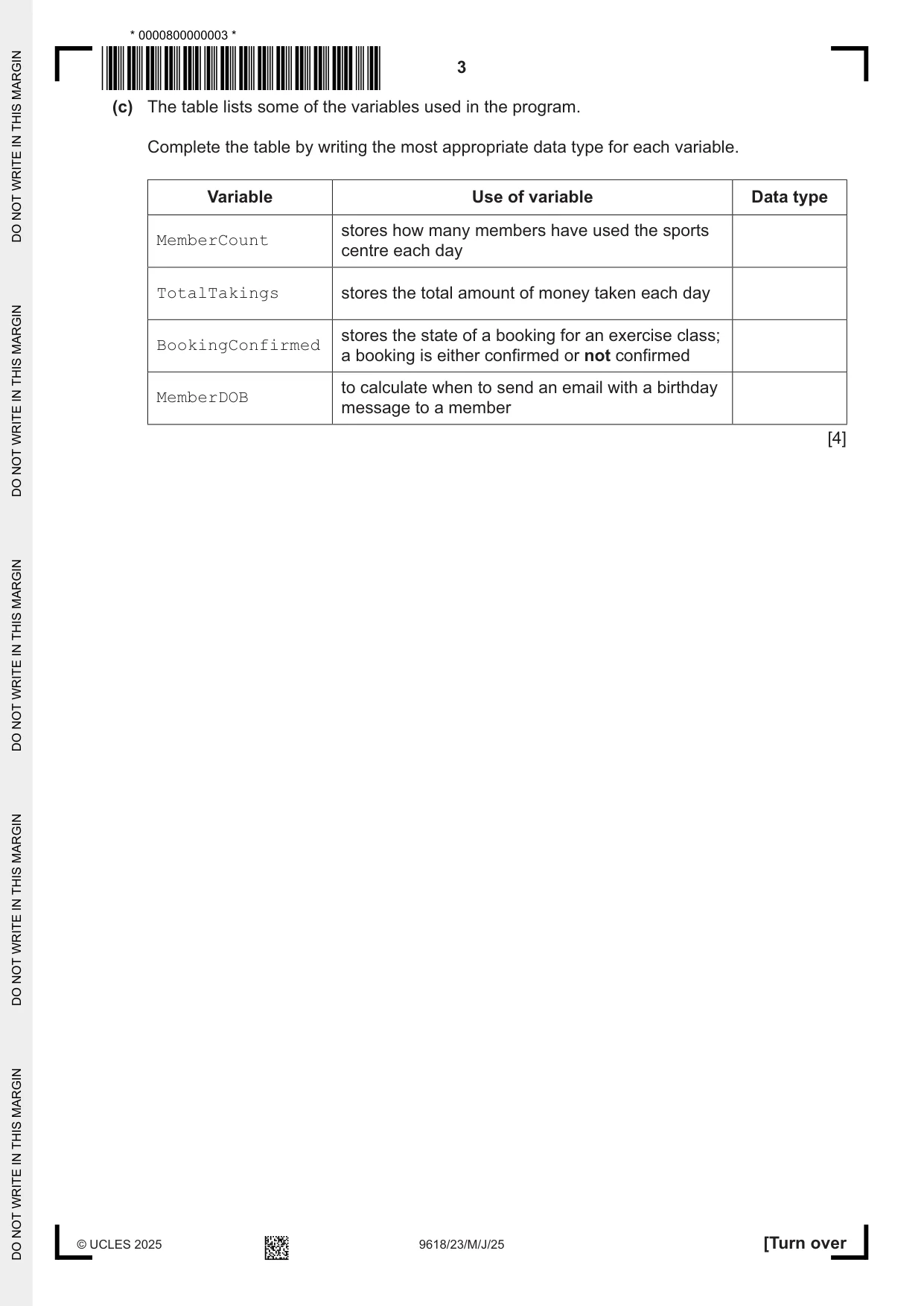
1 A program is being developed for the management of a sports centre. (a) The programmer developing the software decides to use modules (procedures or functions) and local variables. They also decide not to use global variables. (i) State two reasons why the programmer decides to use modules. 1 ........................................................................................................................................ ........................................................................................................................................... 2 ........................................................................................................................................ ........................................................................................................................................... [2] (ii) State one difference between local and global variables. ........................................................................................................................................... ..................................................................................................................................... [1] (iii) State two benefits of using local variables. 1 ........................................................................................................................................ ........................................................................................................................................... 2 ........................................................................................................................................ ........................................................................................................................................... [2] (b) The pseudocode design contains a number of expressions. Complete each pseudocode expression so that it evaluates to the value shown. Refer to the insert for the list of pseudocode functions and operators. Expression Evaluates to 'D' ................................(68) 2 ................................(04/02/2025) FALSE ................................TRUE 1.4 ................................(................................ ("Court1.4Upper" ,..........,...........)) [5] (c) The table lists some of the variables used in the program. Complete the table by writing the most appropriate data type for each variable. Variable Use of variable Data type stores how many members have used the sports MemberCount centre each day TotalTakings stores the total amount of money taken each day stores the state of a booking for an exercise class; BookingConfirmed a booking is either confirmed or not confirmed to calculate when to send an email with a birthday MemberDOB message to a member [4]
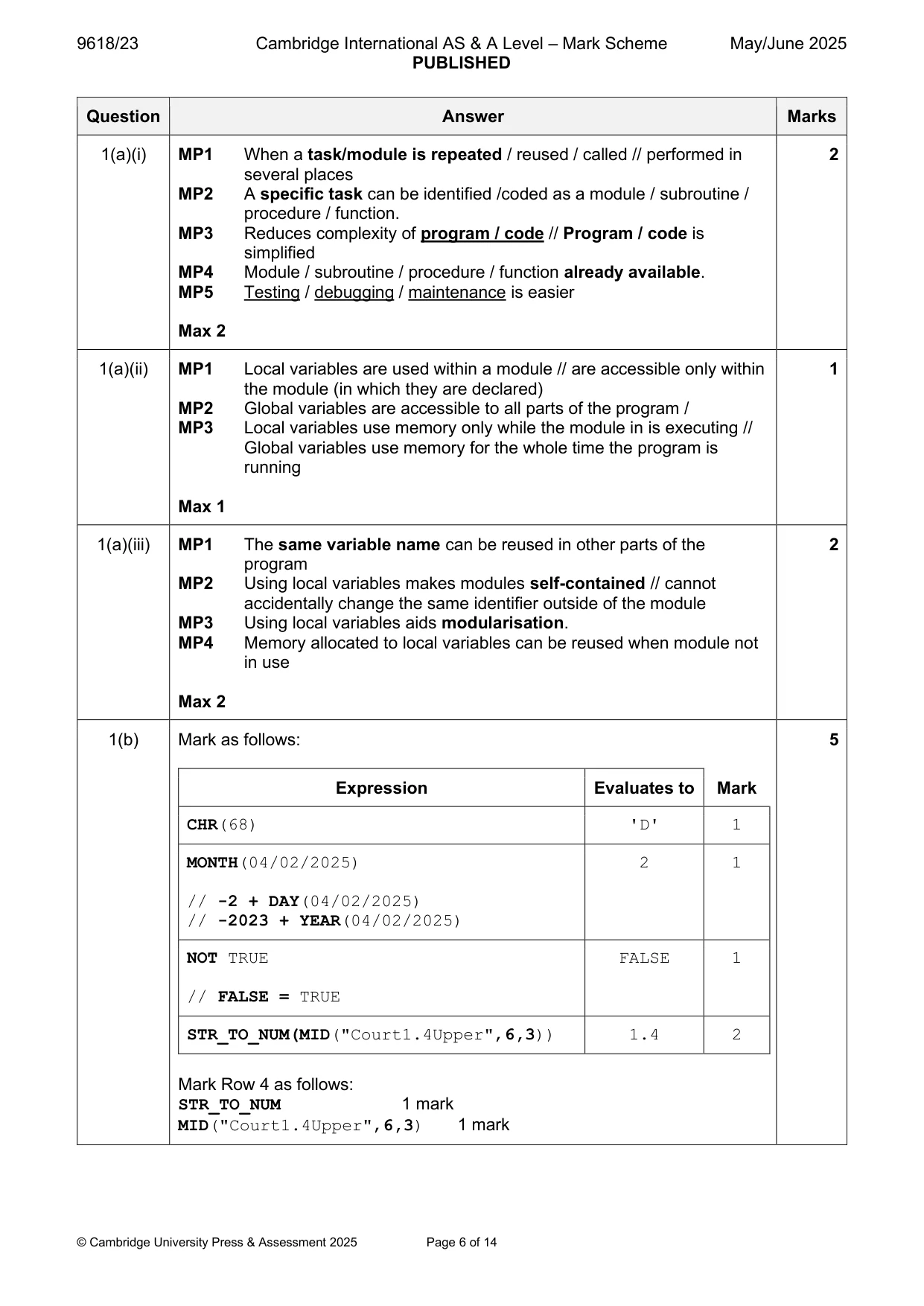
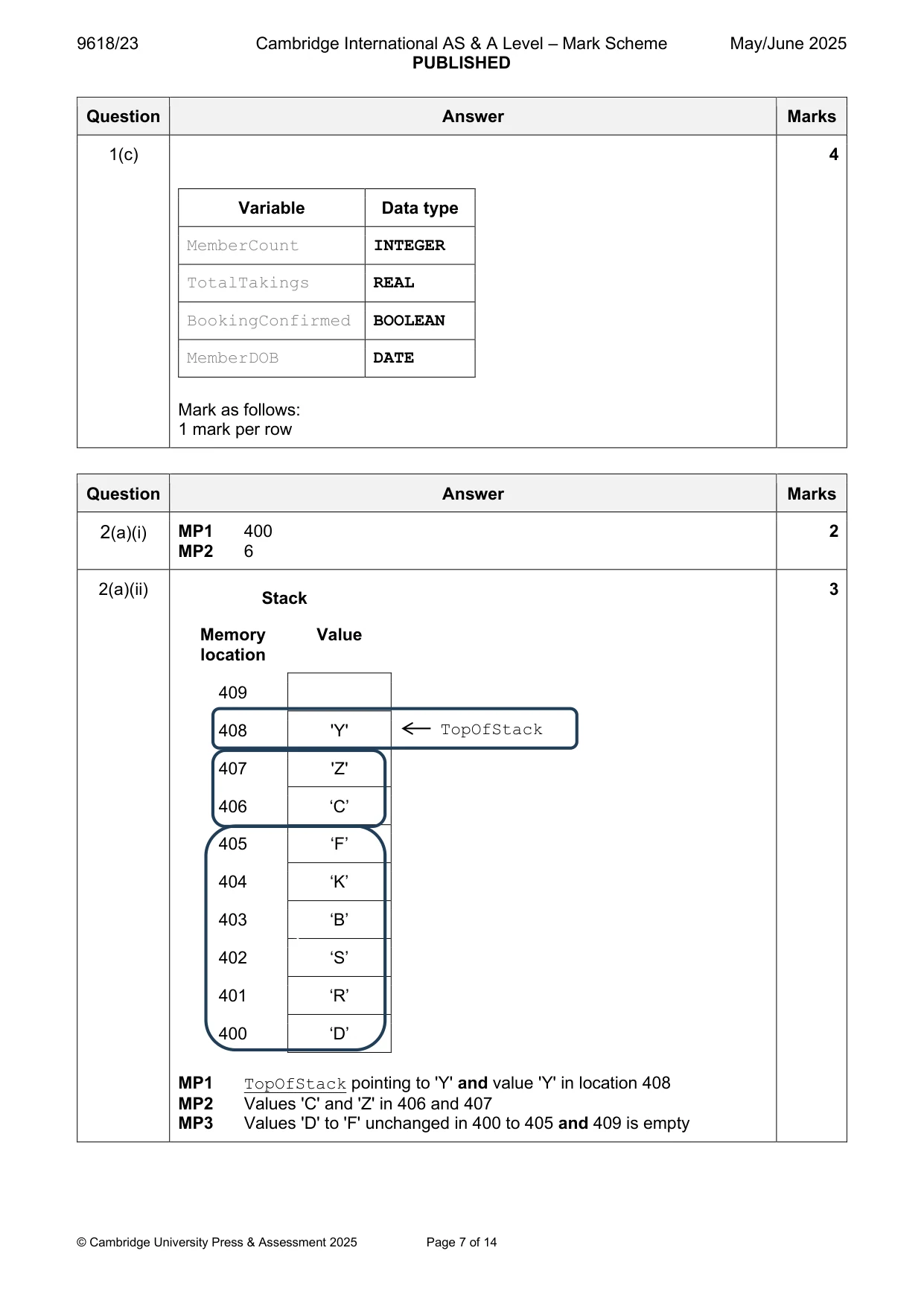
Mark scheme: Question Answer Marks 1(a)(i) MP1 When a task/module is repeated / reused / called // performed in 2 several places MP2 A specific task can be identified /coded as a module / subroutine / procedure / function. MP3 Reduces complexity of program / code // Program / code is simplified MP4 Module / subroutine / procedure / function already available. MP5 Testing / debugging / maintenance is easier Max 2 1(a)(ii) MP1 Local variables are used within a module // are accessible only within 1 the module (in which they are declared) MP2 Global variables are accessible to all parts of the program / MP3 Local variables use memory only while the module in is executing // Global variables use memory for the whole time the program is running Max 1 1(a)(iii) MP1 The same variable name can be reused in other parts of the 2 program MP2 Using local variables makes modules self-contained // cannot accidentally change the same identifier outside of the module MP3 Using local variables aids modularisation. MP4 Memory allocated to local variables can be reused when module not in use Max 2 1(b) Mark as follows: 5 Expression Evaluates to Mark CHR(68) 'D' 1 MONTH(04/02/2025) 2 1 // -2 + DAY(04/02/2025) // -2023 + YEAR(04/02/2025) NOT TRUE FALSE 1 // FALSE = TRUE STR_TO_NUM(MID("Court1.4Upper",6,3)) 1.4 2 Mark Row 4 as follows: STR_TO_NUM 1 mark MID("Court1.4Upper",6,3) 1 mark 1(c) 4 Variable Data type MemberCount INTEGER TotalTakings REAL BookingConfirmed BOOLEAN MemberDOB DATE Mark as follows: 1 mark per row
Q2 · A programmer uses a number of Abstract Data Types (ADT) in the programs that she is…
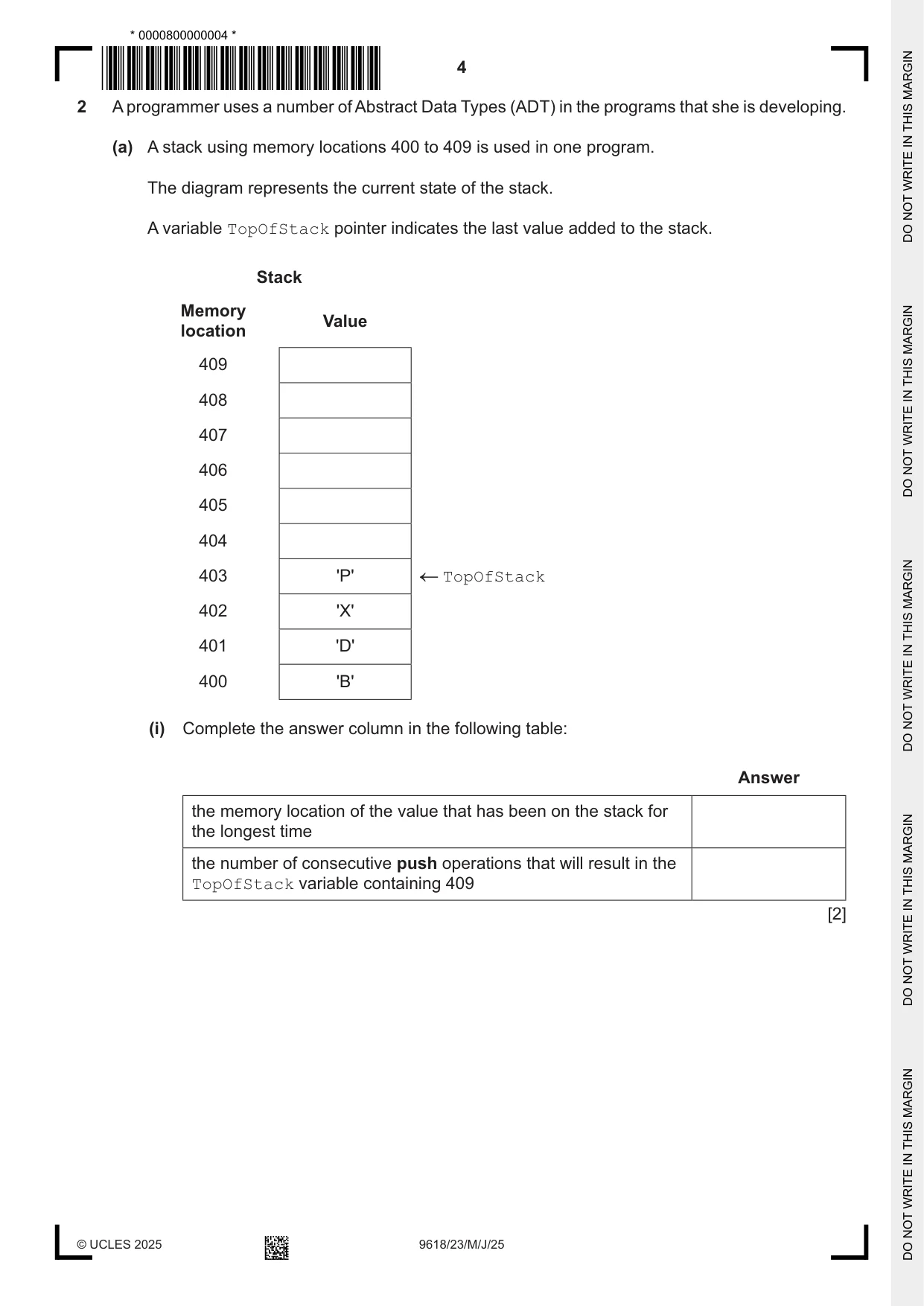
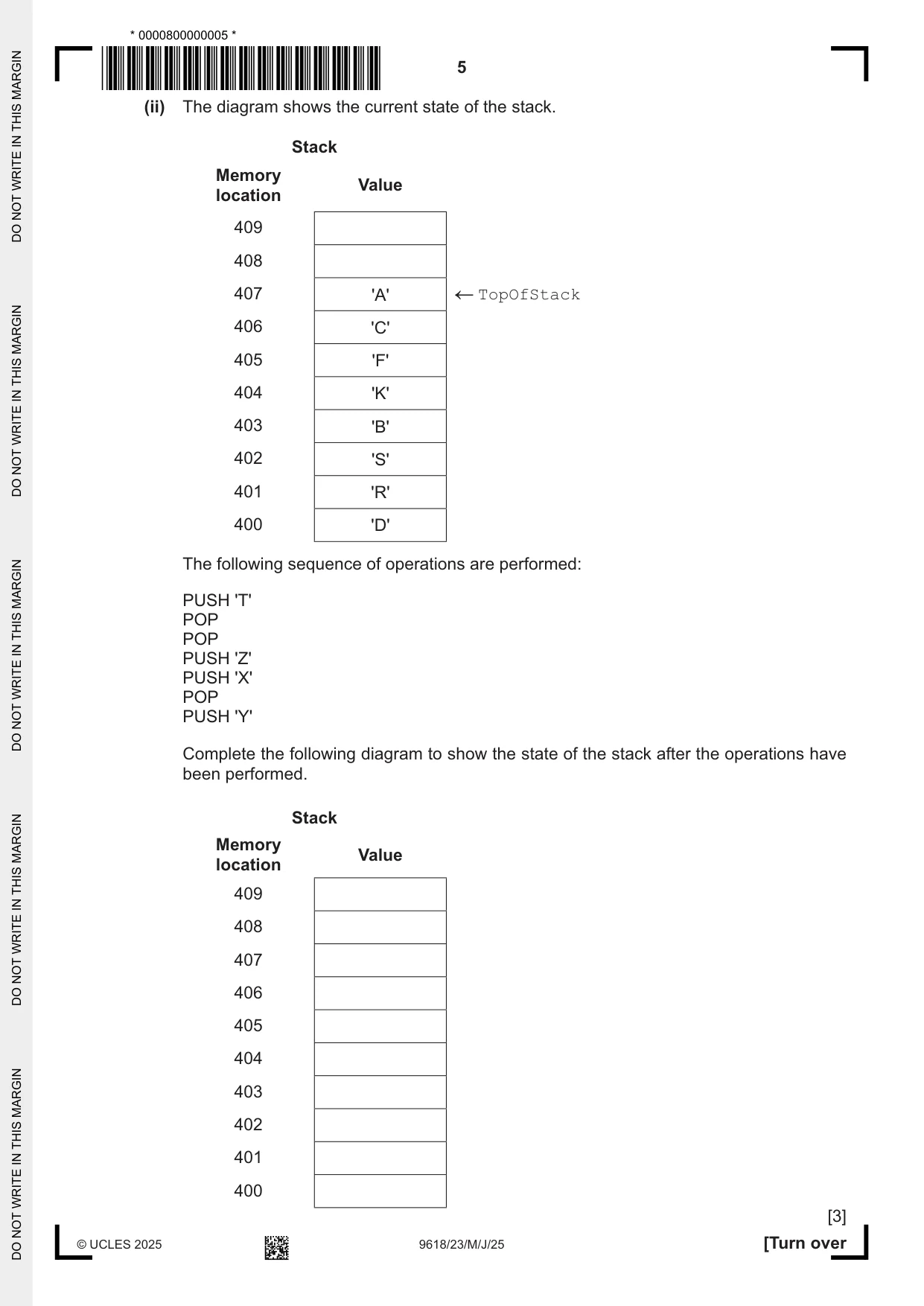
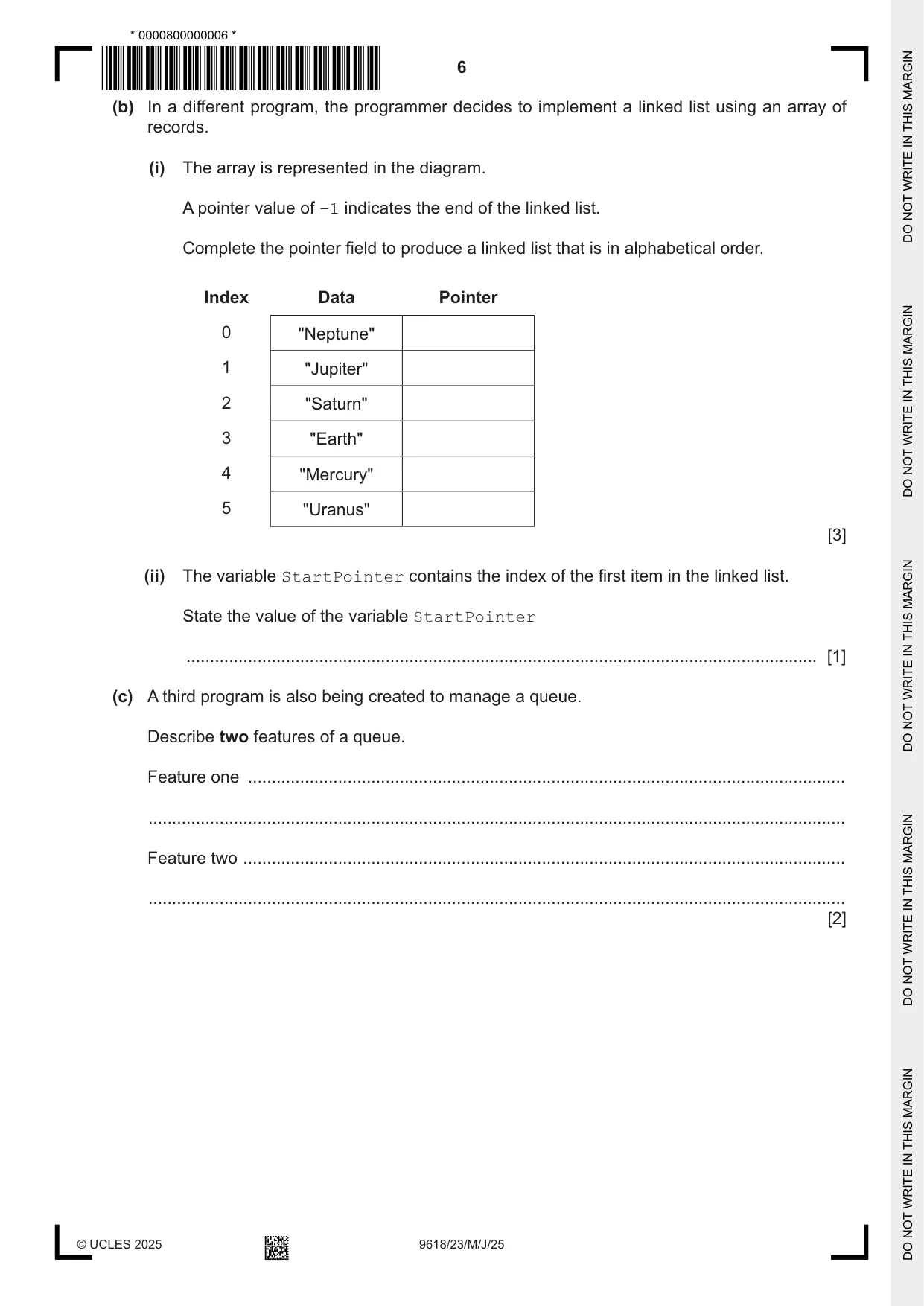
2 A programmer uses a number of Abstract Data Types (ADT) in the programs that she is developing. (a) A stack using memory locations 400 to 409 is used in one program. The diagram represents the current state of the stack. A variable TopOfStack pointer indicates the last value added to the stack. Stack Memory Value location 409 408 407 406 405 404 403 'P' TopOfStack 402 'X' 401 'D' 400 'B' (i) Complete the answer column in the following table: Answer the memory location of the value that has been on the stack for the longest time the number of consecutive push operations that will result in the TopOfStack variable containing 409 [2] (ii) The diagram shows the current state of the stack. Stack Memory Value location 409 408 407 'A' TopOfStack 406 'C' 405 'F' 404 'K' 403 'B' 402 'S' 401 'R' 400 'D' The following sequence of operations are performed: PUSH 'T' POP POP PUSH 'Z' PUSH 'X' POP PUSH 'Y' Complete the following diagram to show the state of the stack after the operations have been performed. Stack Memory Value location 409 408 407 406 405 404 403 402 401 400 [3] (b) In a different program, the programmer decides to implement a linked list using an array of records. (i) The array is represented in the diagram. A pointer value of –1 indicates the end of the linked list. Complete the pointer field to produce a linked list that is in alphabetical order. Index Data Pointer 0 "Neptune" 1 "Jupiter" 2 "Saturn" 3 "Earth" 4 "Mercury" 5 "Uranus" [3] (ii) The variable StartPointer contains the index of the first item in the linked list. State the value of the variable StartPointer ..................................................................................................................................... [1] (c) A third program is also being created to manage a queue. Describe two features of a queue. Feature one .............................................................................................................................. ................................................................................................................................................... Feature two ............................................................................................................................... ................................................................................................................................................... [2]
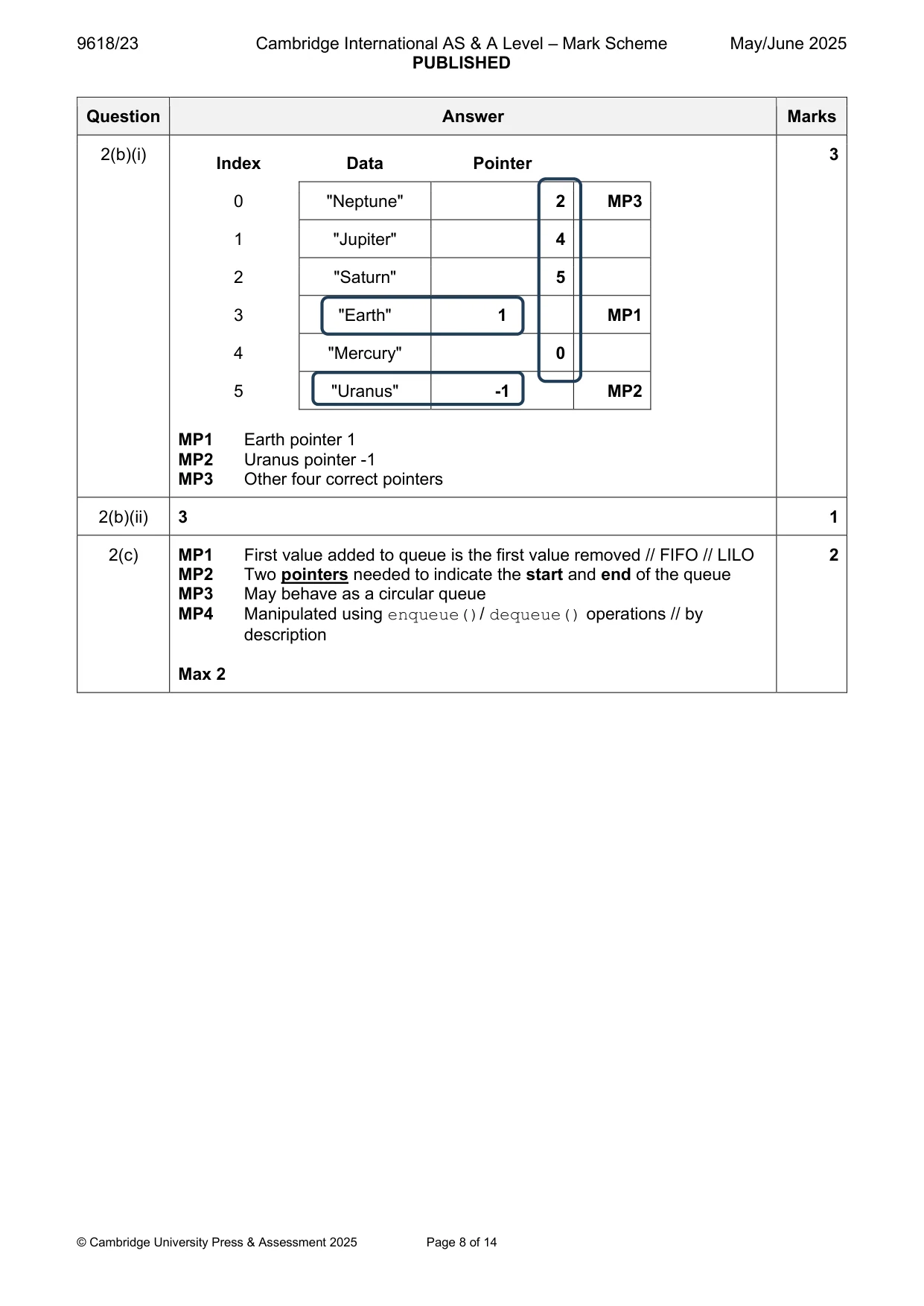
Mark scheme: 2(a)(i) MP1 400 2 MP2 6 2(a)(ii) 3 Stack Memory Value location 409 408 'Y' TopOfStack 407 'Z' 406 ‘C’ 405 ‘F’ 404 ‘K’ 403 ‘B’ 3 402 ‘S’ 401 ‘R’ 400 ‘D’ MP1 TopOfStack pointing to 'Y' and value 'Y' in location 408 MP2 Values 'C' and 'Z' in 406 and 407 MP3 Values 'D' to 'F' unchanged in 400 to 405 and 409 is empty 2(b)(i) 3 Index Data Pointer 0 "Neptune" 2 MP3 1 "Jupiter" 4 2 "Saturn" 5 3 "Earth" 1 MP1 4 "Mercury" 0 5 "Uranus" -1 MP2 MP1 Earth pointer 1 MP2 Uranus pointer -1 MP3 Other four correct pointers 2(b)(ii) 3 1 2(c) MP1 First value added to queue is the first value removed // FIFO // LILO 2 MP2 Two pointers needed to indicate the start and end of the queue MP3 May behave as a circular queue MP4 Manipulated using enqueue()/ dequeue() operations // by description Max 2
Q3 · A programmer has been asked to create a module RollDice() to simulate multiple rolls of a…
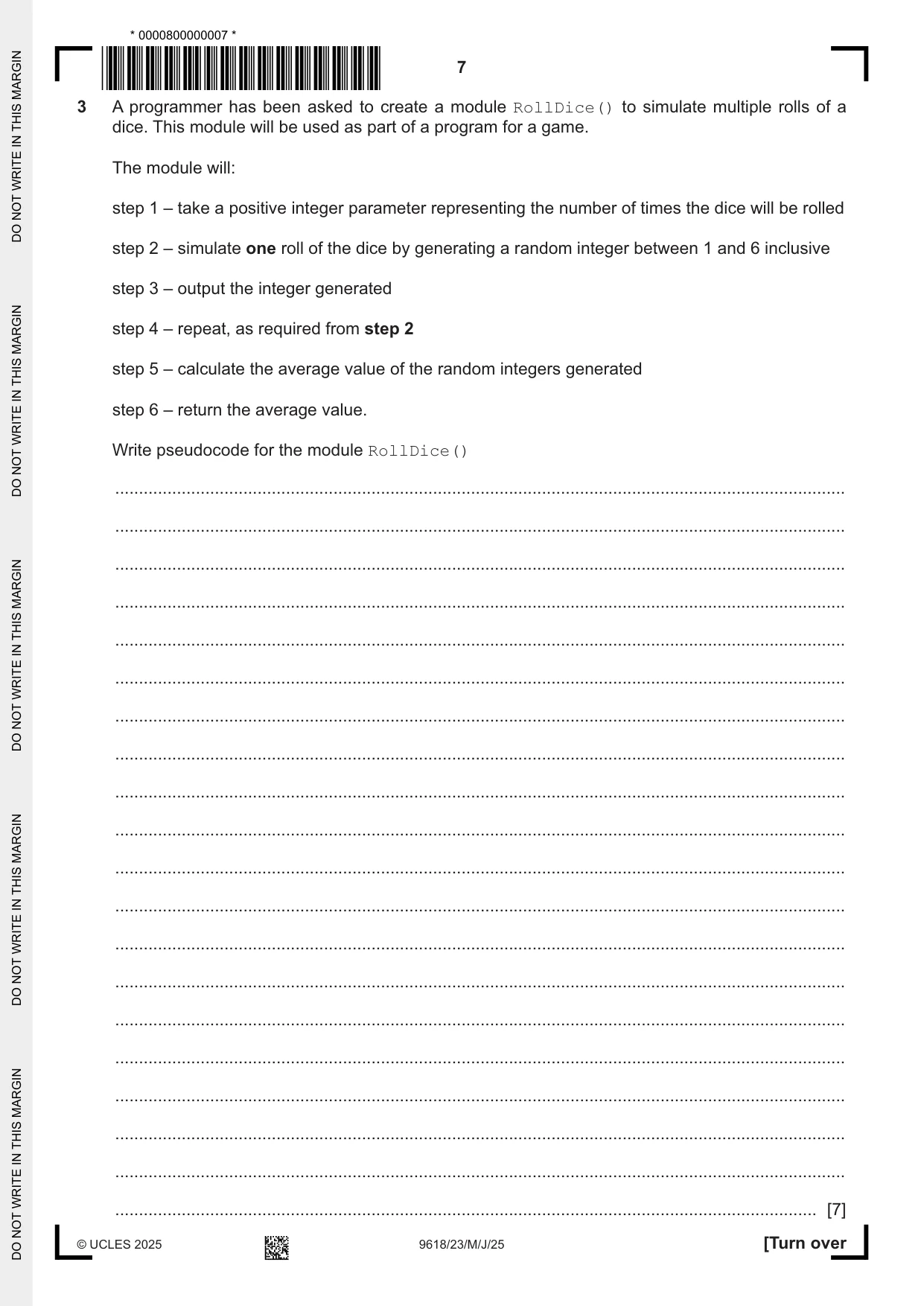
3 A programmer has been asked to create a module RollDice() to simulate multiple rolls of a dice. This module will be used as part of a program for a game. The module will: step 1 – take a positive integer parameter representing the number of times the dice will be rolled step 2 – simulate one roll of the dice by generating a random integer between 1 and 6 inclusive step 3 – output the integer generated step 4 – repeat, as required from step 2 step 5 – calculate the average value of the random integers generated step 6 – return the average value. Write pseudocode for the module RollDice() .......................................................................................................................................................... .......................................................................................................................................................... .......................................................................................................................................................... .......................................................................................................................................................... .......................................................................................................................................................... .......................................................................................................................................................... .......................................................................................................................................................... .......................................................................................................................................................... .......................................................................................................................................................... .......................................................................................................................................................... .......................................................................................................................................................... .......................................................................................................................................................... .......................................................................................................................................................... .......................................................................................................................................................... .......................................................................................................................................................... .......................................................................................................................................................... .......................................................................................................................................................... .......................................................................................................................................................... .......................................................................................................................................................... .................................................................................................................................................... [7]
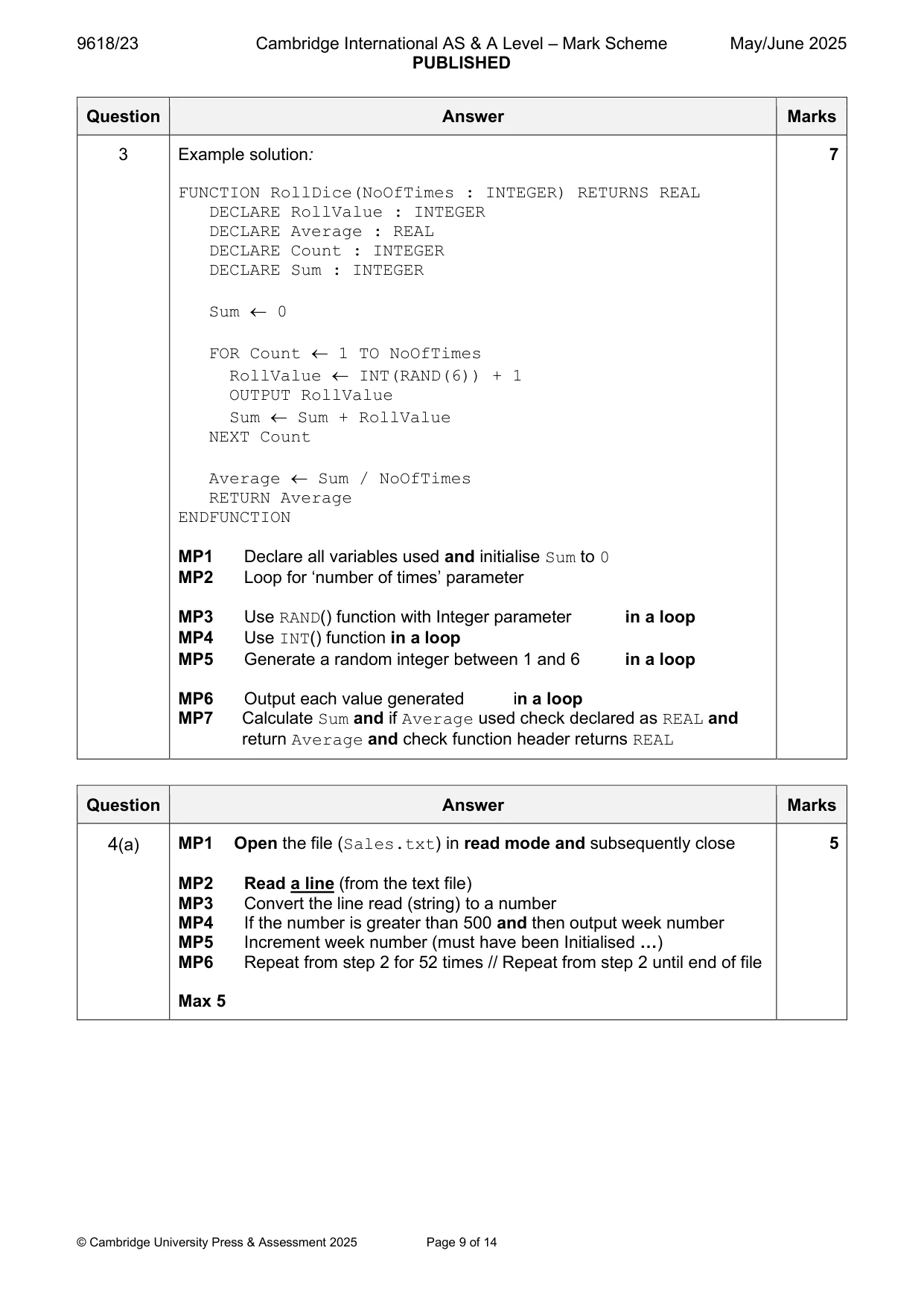
Mark scheme: 3 Example solution: 7 FUNCTION RollDice(NoOfTimes : INTEGER) RETURNS REAL DECLARE RollValue : INTEGER DECLARE Average : REAL DECLARE Count : INTEGER DECLARE Sum : INTEGER Sum 0 FOR Count 1 TO NoOfTimes RollValue INT(RAND(6)) + 1 OUTPUT RollValue Sum Sum + RollValue NEXT Count Average Sum / NoOfTimes RETURN Average ENDFUNCTION MP1 Declare all variables used and initialise Sum to 0 MP2 Loop for ‘number of times’ parameter MP3 Use RAND() function with Integer parameter in a loop MP4 Use INT() function in a loop MP5 Generate a random integer between 1 and 6 in a loop MP6 Output each value generated in a loop MP7 Calculate Sum and if Average used check declared as REAL and return Average and check function header returns REAL
Q4 · A programmer is developing a new stock control program for a shop owner to produce sales…
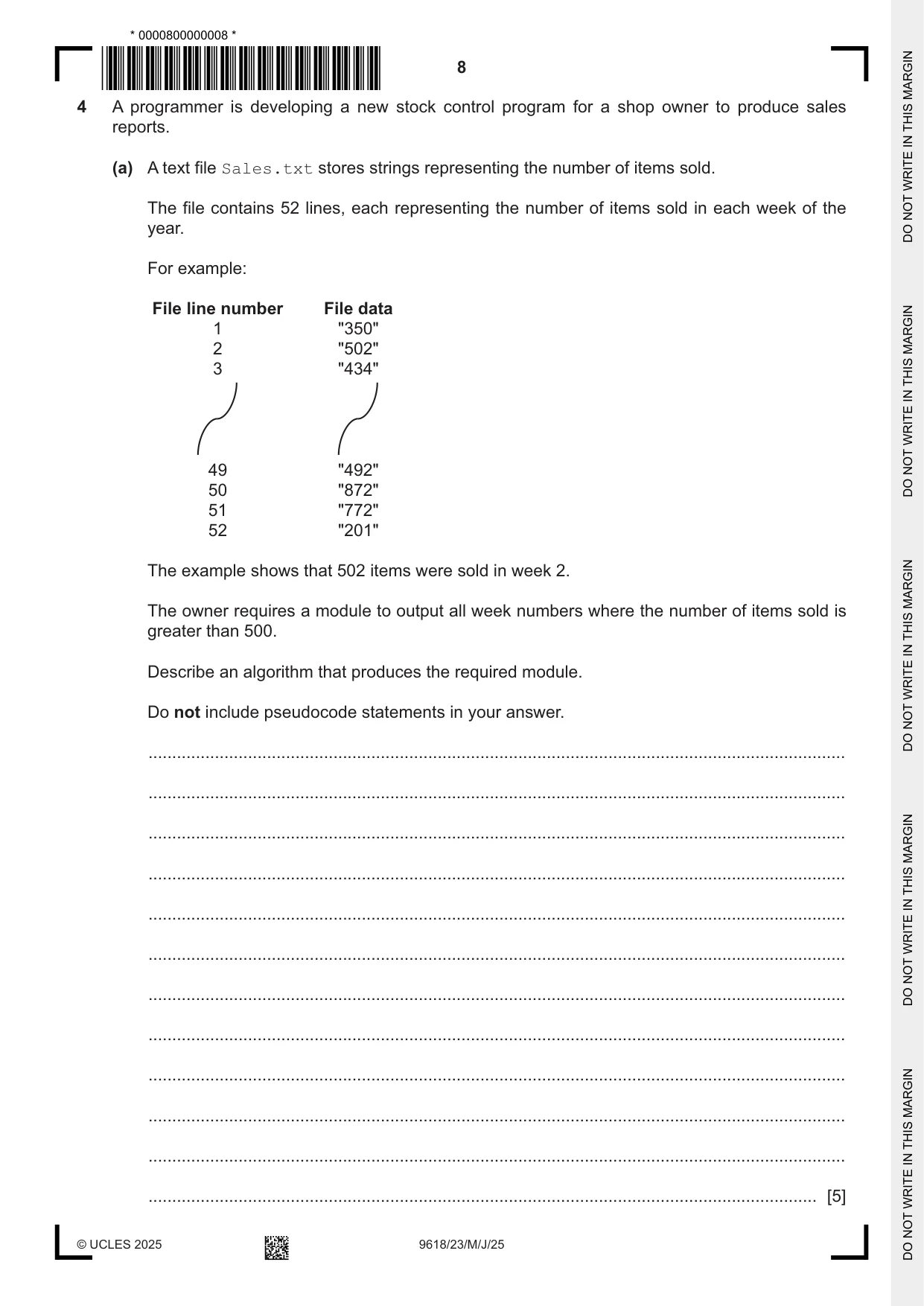
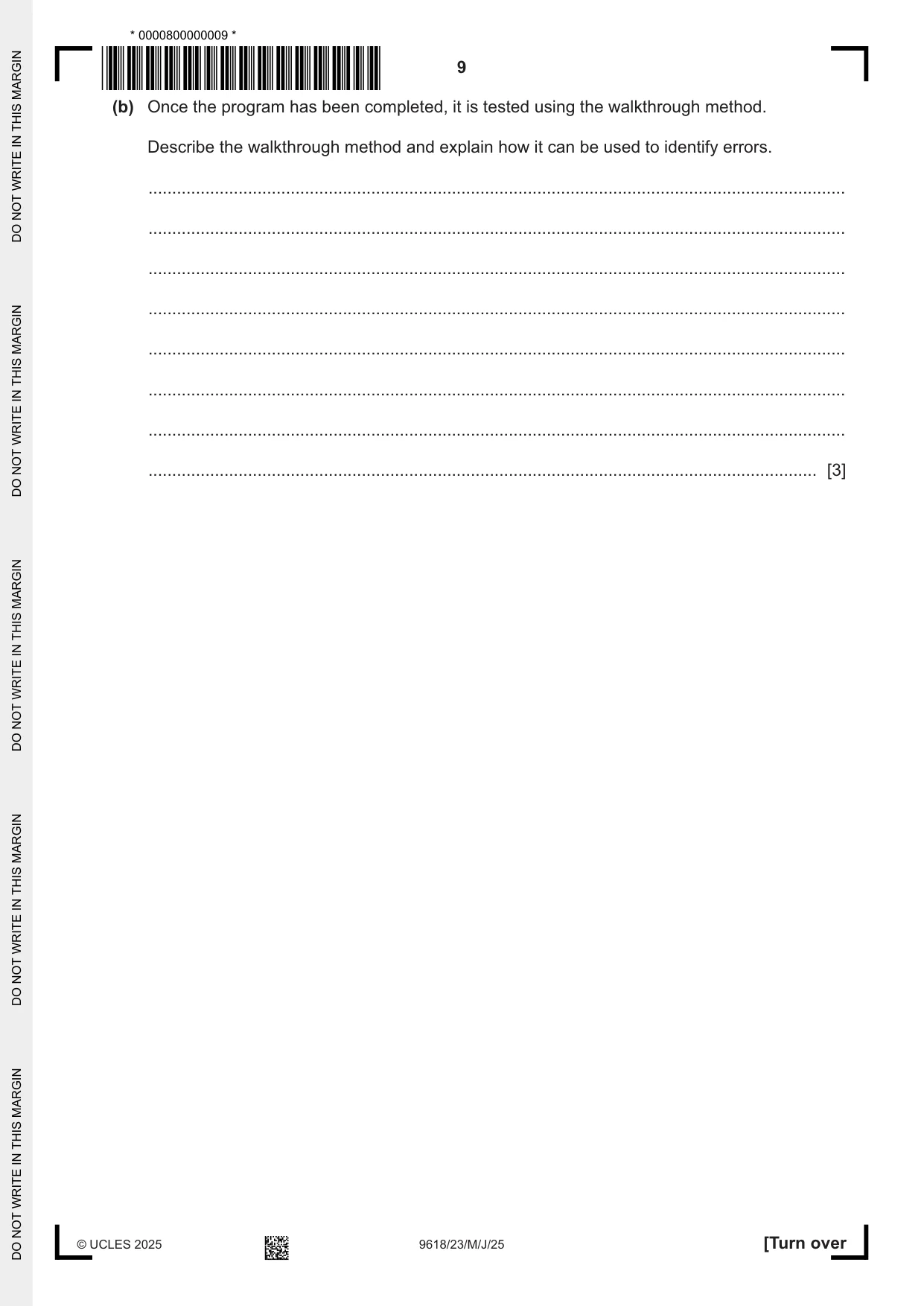
4 A programmer is developing a new stock control program for a shop owner to produce sales reports. (a) A text file Sales.txt stores strings representing the number of items sold. The file contains 52 lines, each representing the number of items sold in each week of the year. For example: File line number File data 1 "350" 2 "502" 3 "434" 49 "492" 50 "872" 51 "772" 52 "201" The example shows that 502 items were sold in week 2. The owner requires a module to output all week numbers where the number of items sold is greater than 500. Describe an algorithm that produces the required module. Do not include pseudocode statements in your answer. ................................................................................................................................................... ................................................................................................................................................... ................................................................................................................................................... ................................................................................................................................................... ................................................................................................................................................... ................................................................................................................................................... ................................................................................................................................................... ................................................................................................................................................... ................................................................................................................................................... ................................................................................................................................................... ................................................................................................................................................... ............................................................................................................................................. [5] (b) Once the program has been completed, it is tested using the walkthrough method. Describe the walkthrough method and explain how it can be used to identify errors. ................................................................................................................................................... ................................................................................................................................................... ................................................................................................................................................... ................................................................................................................................................... ................................................................................................................................................... ................................................................................................................................................... ................................................................................................................................................... ............................................................................................................................................. [3]
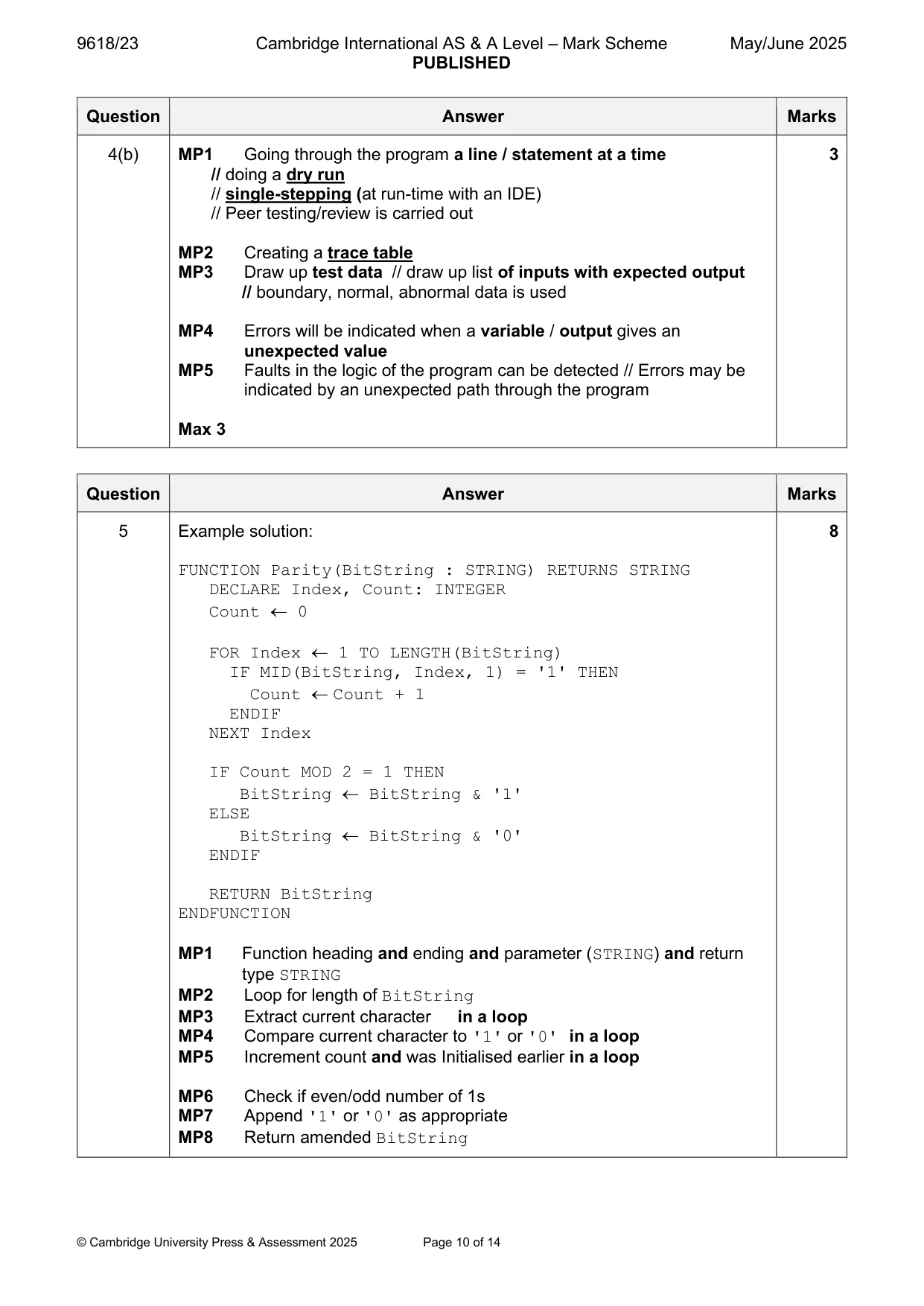
Mark scheme: 4(a) MP1 Open the file (Sales.txt) in read mode and subsequently close 5 MP2 Read a line (from the text file) MP3 Convert the line read (string) to a number MP4 If the number is greater than 500 and then output week number MP5 Increment week number (must have been Initialised …) MP6 Repeat from step 2 for 52 times // Repeat from step 2 until end of file Max 5 4(b) MP1 Going through the program a line / statement at a time 3 // doing a dry run // single-stepping (at run-time with an IDE) // Peer testing/review is carried out MP2 Creating a trace table MP3 Draw up test data // draw up list of inputs with expected output // boundary, normal, abnormal data is used MP4 Errors will be indicated when a variable / output gives an unexpected value MP5 Faults in the logic of the program can be detected // Errors may be indicated by an unexpected path through the program Max 3
Q5 · A module Parity() takes a string as a parameter
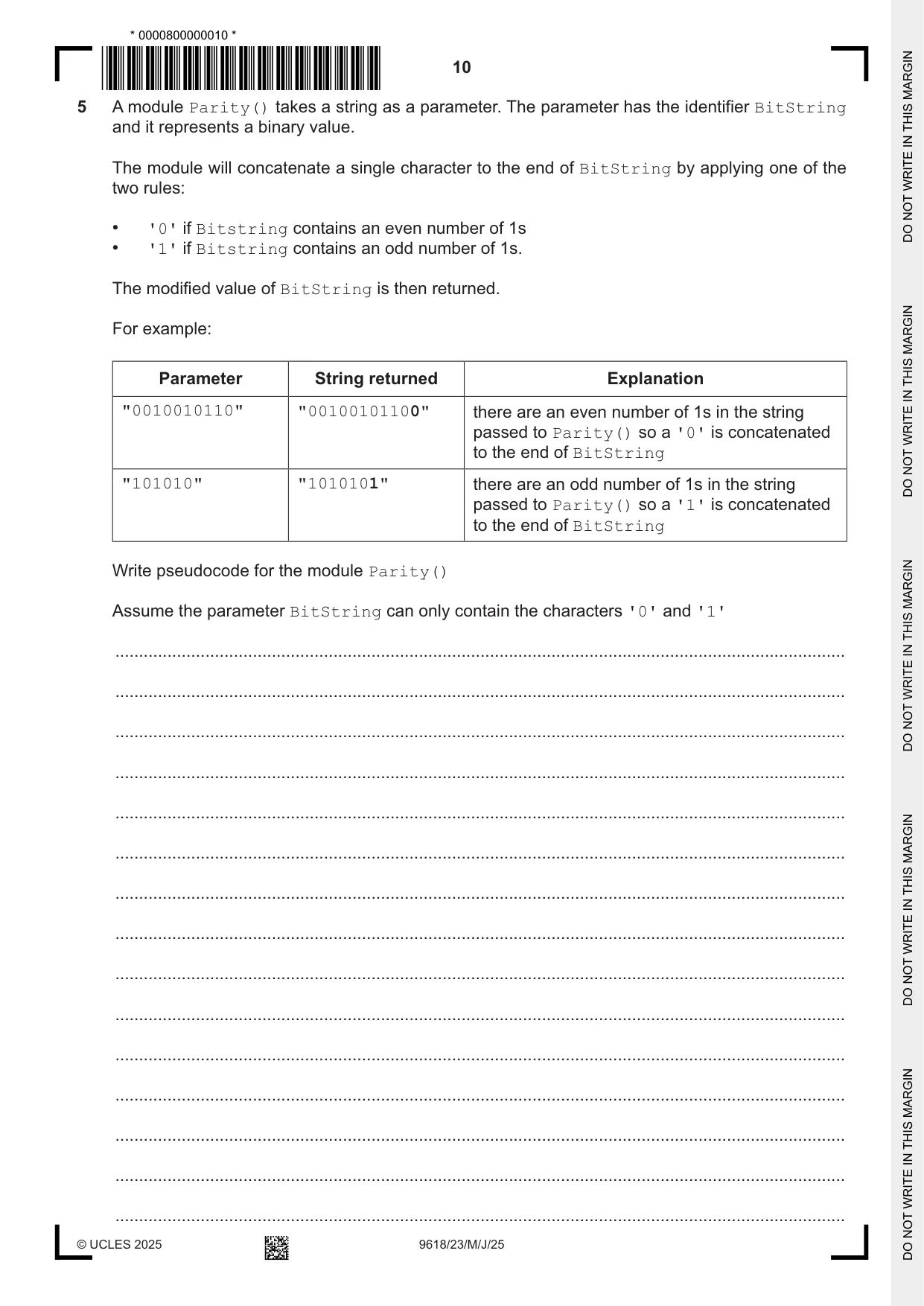
5 A module Parity() takes a string as a parameter. The parameter has the identifier BitString and it represents a binary value. The module will concatenate a single character to the end of BitString by applying one of the two rules: • '0' if Bitstring contains an even number of 1s • '1' if Bitstring contains an odd number of 1s. The modified value of BitString is then returned. For example: Parameter String returned Explanation "0010010110" "00100101100" there are an even number of 1s in the string passed to Parity() so a '0' is concatenated to the end of BitString "101010" "1010101" there are an odd number of 1s in the string passed to Parity() so a '1' is concatenated to the end of BitString Write pseudocode for the module Parity() Assume the parameter BitString can only contain the characters '0' and '1' .......................................................................................................................................................... .......................................................................................................................................................... .......................................................................................................................................................... .......................................................................................................................................................... .......................................................................................................................................................... .......................................................................................................................................................... .......................................................................................................................................................... .......................................................................................................................................................... .......................................................................................................................................................... .......................................................................................................................................................... .......................................................................................................................................................... .......................................................................................................................................................... .......................................................................................................................................................... .......................................................................................................................................................... .......................................................................................................................................................... .......................................................................................................................................................... .......................................................................................................................................................... .......................................................................................................................................................... .......................................................................................................................................................... .......................................................................................................................................................... .......................................................................................................................................................... .......................................................................................................................................................... .......................................................................................................................................................... .......................................................................................................................................................... .................................................................................................................................................... [8]
Mark scheme: 5 Example solution: 8 FUNCTION Parity(BitString : STRING) RETURNS STRING DECLARE Index, Count: INTEGER Count 0 FOR Index 1 TO LENGTH(BitString) IF MID(BitString, Index, 1) = '1' THEN Count Count + 1 ENDIF NEXT Index IF Count MOD 2 = 1 THEN BitString BitString & '1' ELSE BitString BitString & '0' ENDIF RETURN BitString ENDFUNCTION MP1 Function heading and ending and parameter (STRING) and return type STRING MP2 Loop for length of BitString MP3 Extract current character in a loop MP4 Compare current character to '1' or '0' in a loop MP5 Increment count and was Initialised earlier in a loop MP6 Check if even/odd number of 1s MP7 Append '1' or '0' as appropriate MP8 Return amended BitString
Q6 · Study the structure chart: Main M P Sub_A Sub_B V R X W T U Sub_Part1A Sub_Part2A…
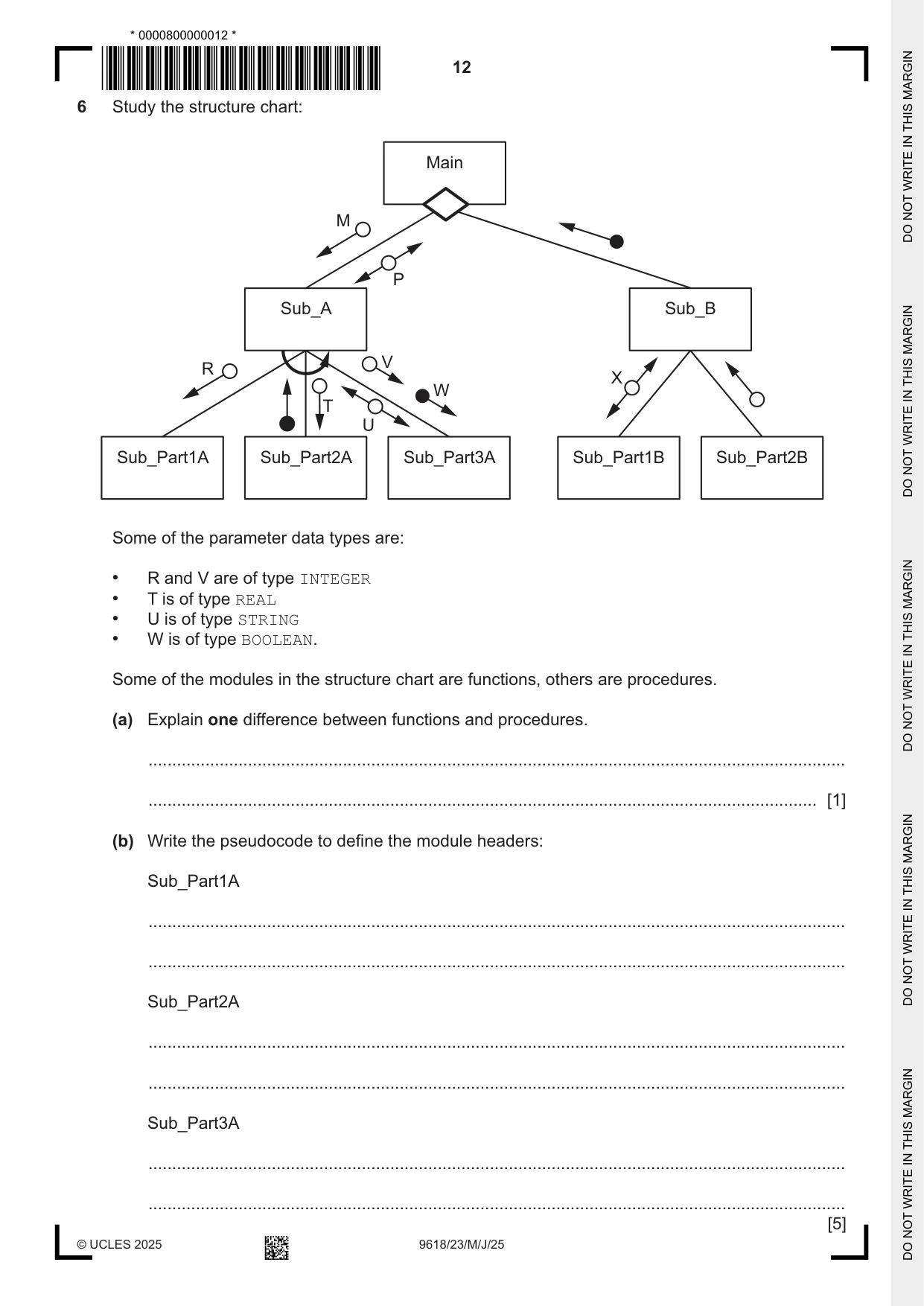
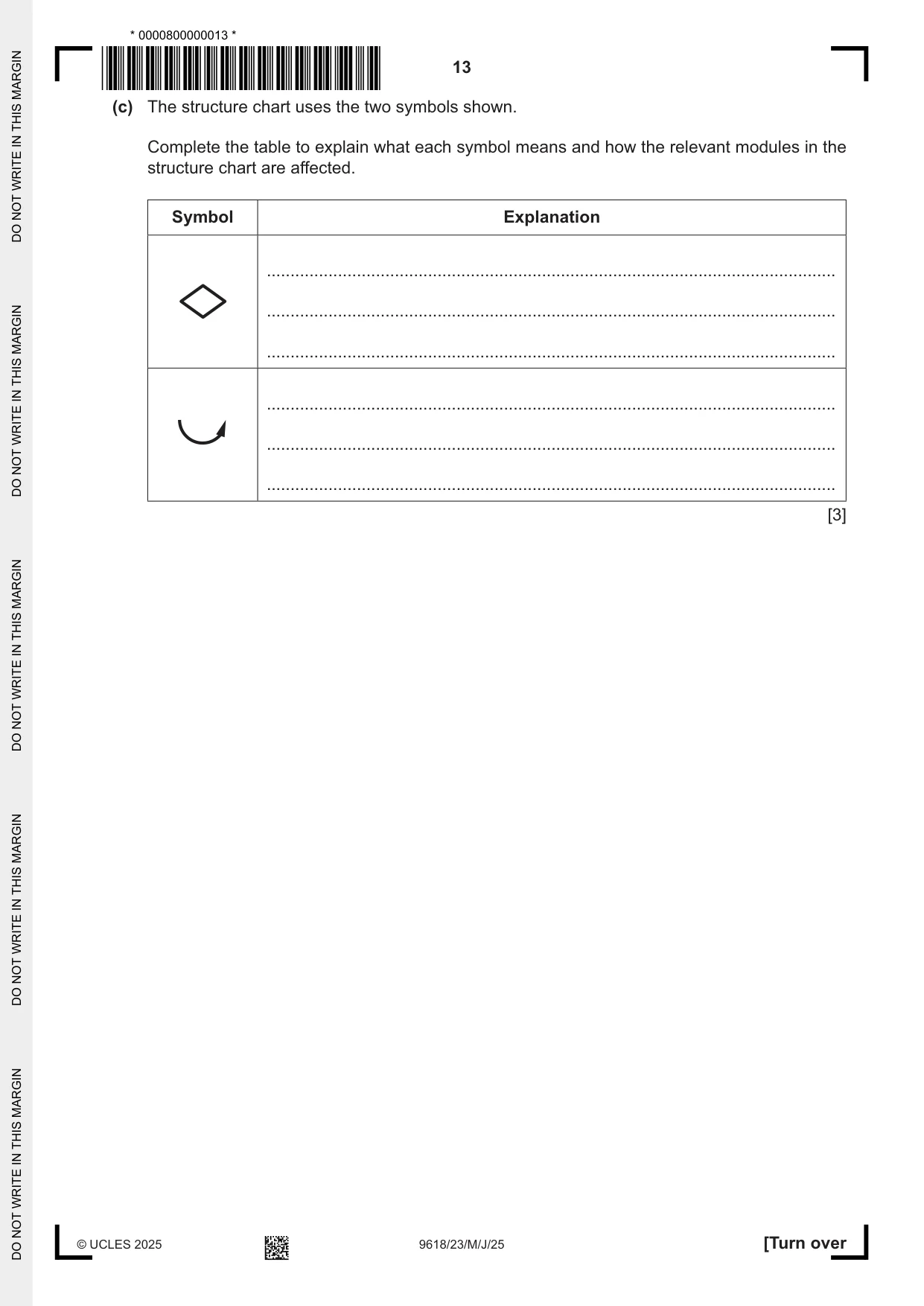
6 Study the structure chart: Main M P Sub_A Sub_B V R X W T U Sub_Part1A Sub_Part2A Sub_Part3A Sub_Part1B Sub_Part2B Some of the parameter data types are: • R and V are of type INTEGER • T is of type REAL • U is of type STRING • W is of type BOOLEAN. Some of the modules in the structure chart are functions, others are procedures. (a) Explain one difference between functions and procedures. ................................................................................................................................................... ............................................................................................................................................. [1] (b) Write the pseudocode to define the module headers: Sub_Part1A ................................................................................................................................................... ................................................................................................................................................... Sub_Part2A ................................................................................................................................................... ................................................................................................................................................... Sub_Part3A ................................................................................................................................................... ................................................................................................................................................... [5] (c) The structure chart uses the two symbols shown. Complete the table to explain what each symbol means and how the relevant modules in the structure chart are affected. Symbol Explanation ........................................................................................................................ ........................................................................................................................ ........................................................................................................................ ........................................................................................................................ ........................................................................................................................ ........................................................................................................................ [3]
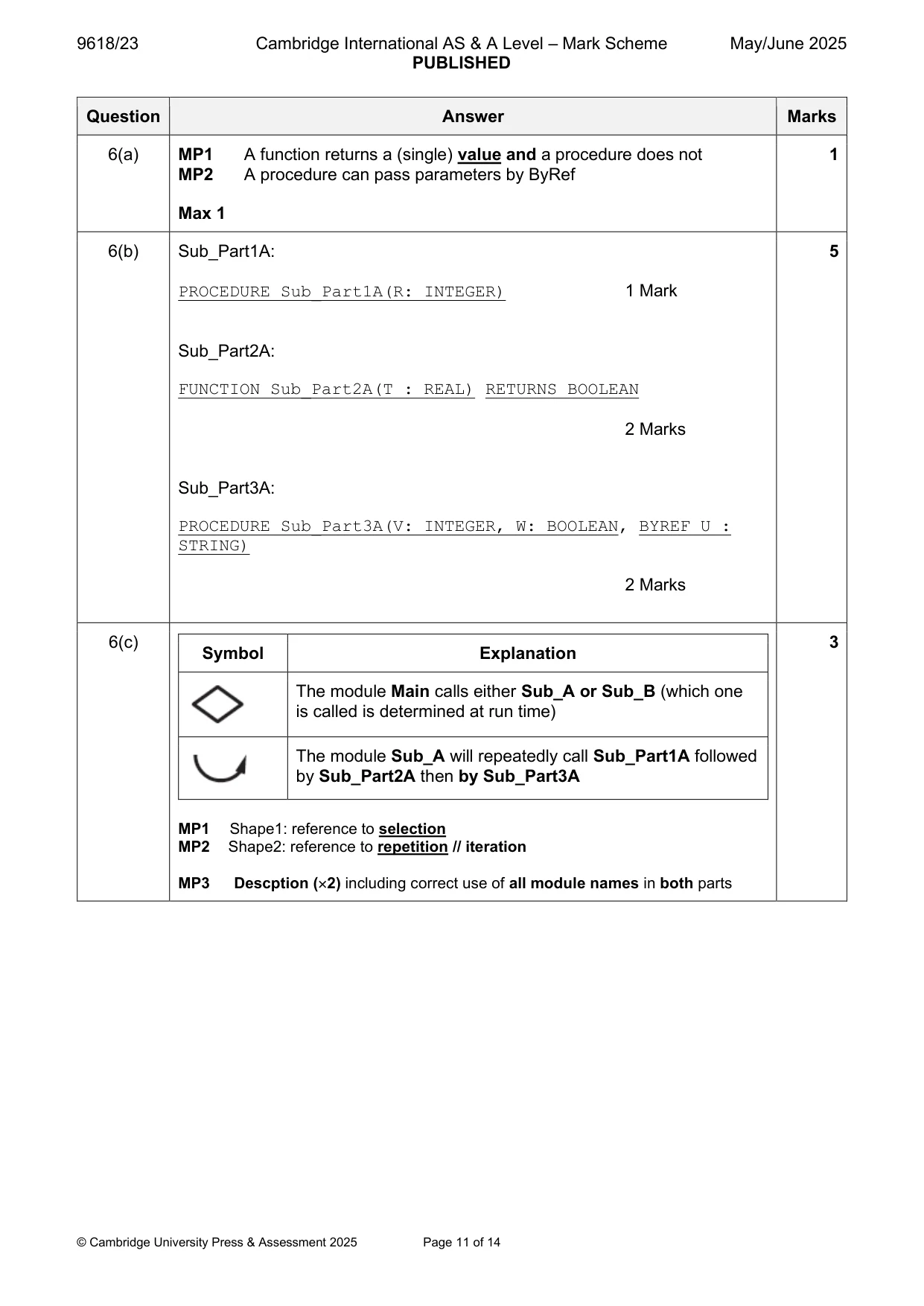
Mark scheme: 6(a) MP1 A function returns a (single) value and a procedure does not 1 MP2 A procedure can pass parameters by ByRef Max 1 6(b) Sub_Part1A: 5 PROCEDURE Sub_Part1A(R: INTEGER) 1 Mark Sub_Part2A: FUNCTION Sub_Part2A(T : REAL) RETURNS BOOLEAN 2 Marks Sub_Part3A: PROCEDURE Sub_Part3A(V: INTEGER, W: BOOLEAN, BYREF U : STRING) 2 Marks 6(c) 3 Symbol Explanation The module Main calls either Sub_A or Sub_B (which one is called is determined at run time) The module Sub_A will repeatedly call Sub_Part1A followed by Sub_Part2A then by Sub_Part3A MP1 Shape1: reference to selection MP2 Shape2: reference to repetition // iteration MP3 Descption (2) including correct use of all module names in both parts
Q7 · A program is being developed to implement a customer loyalty scheme for a coffee shop
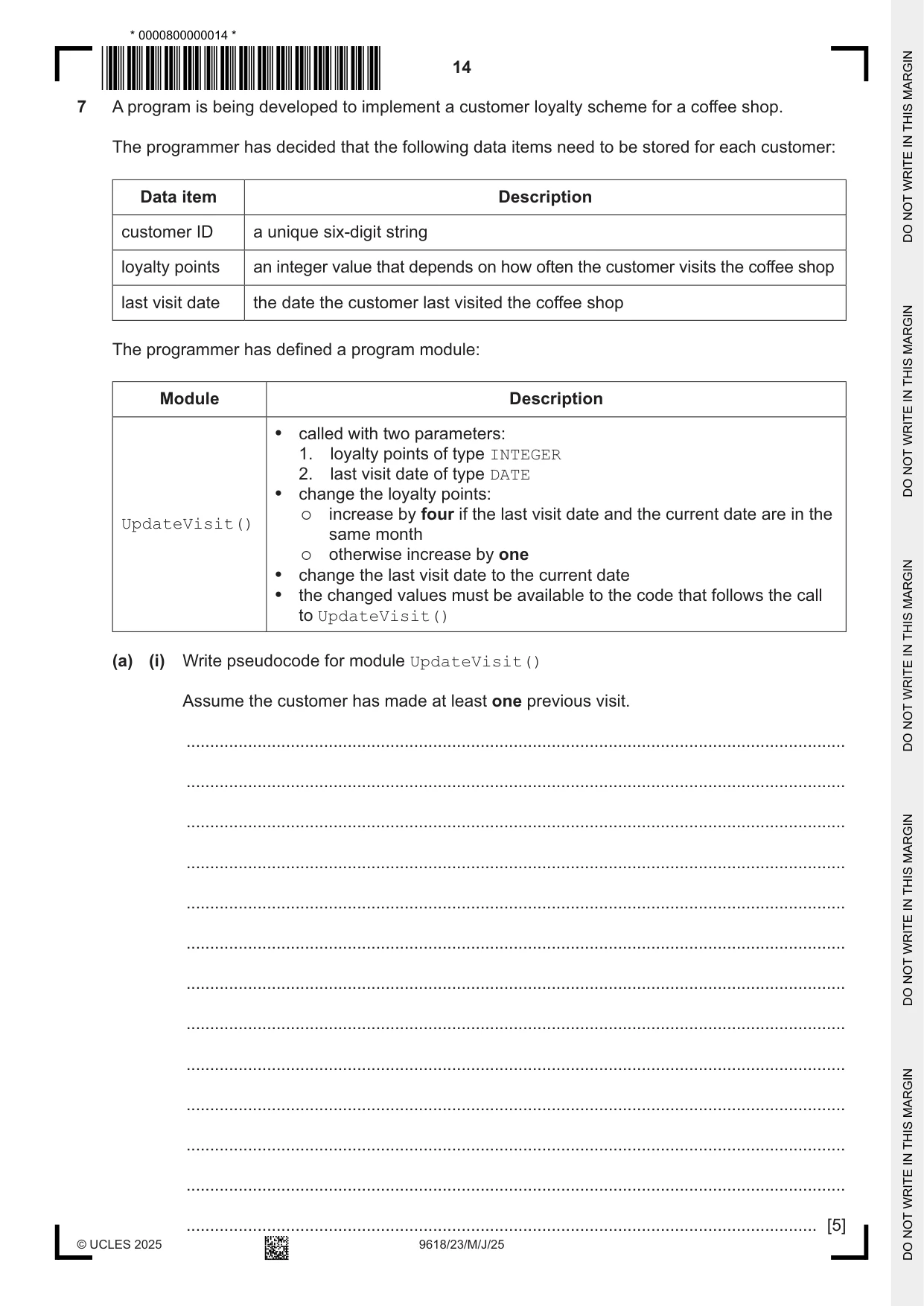
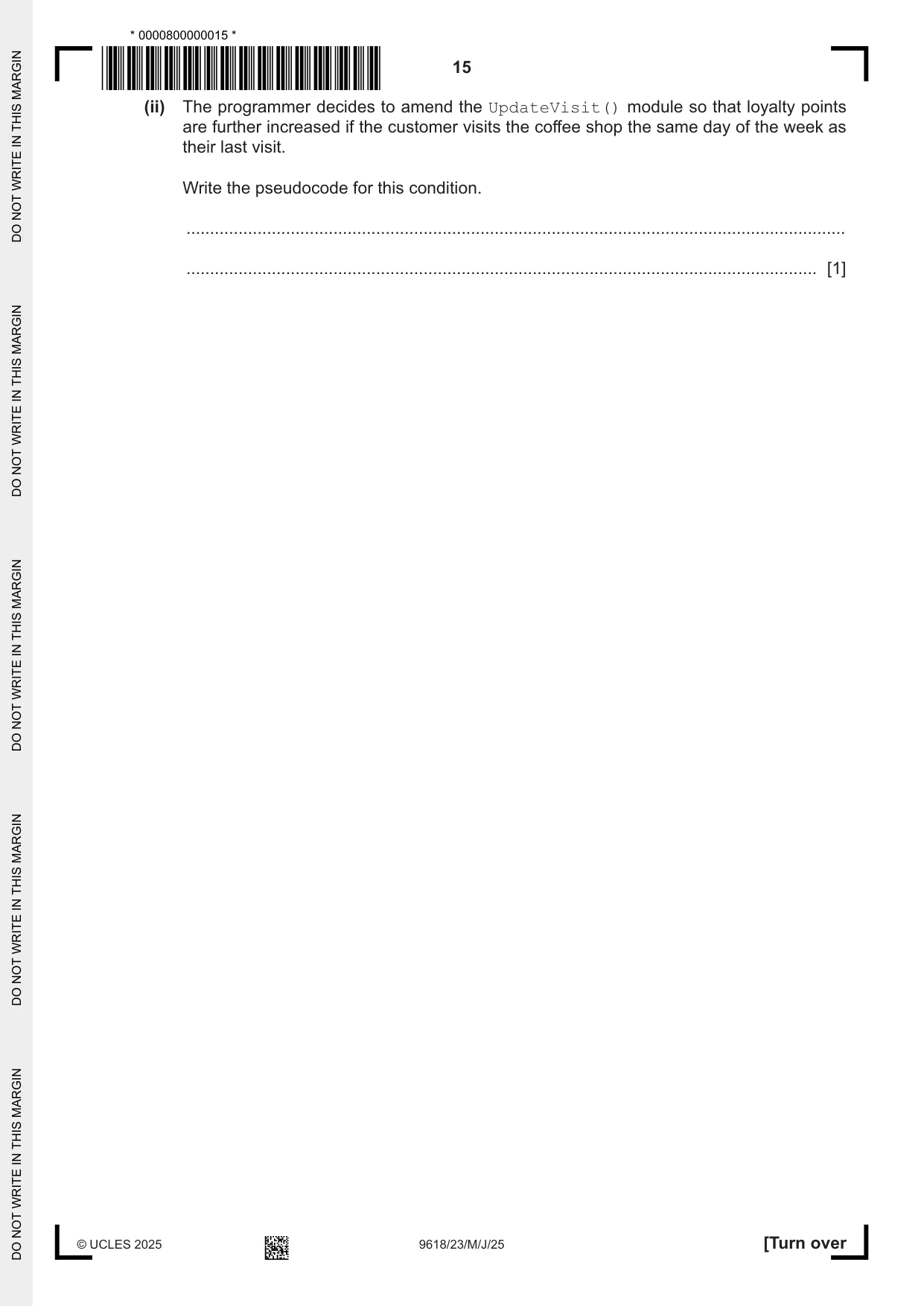
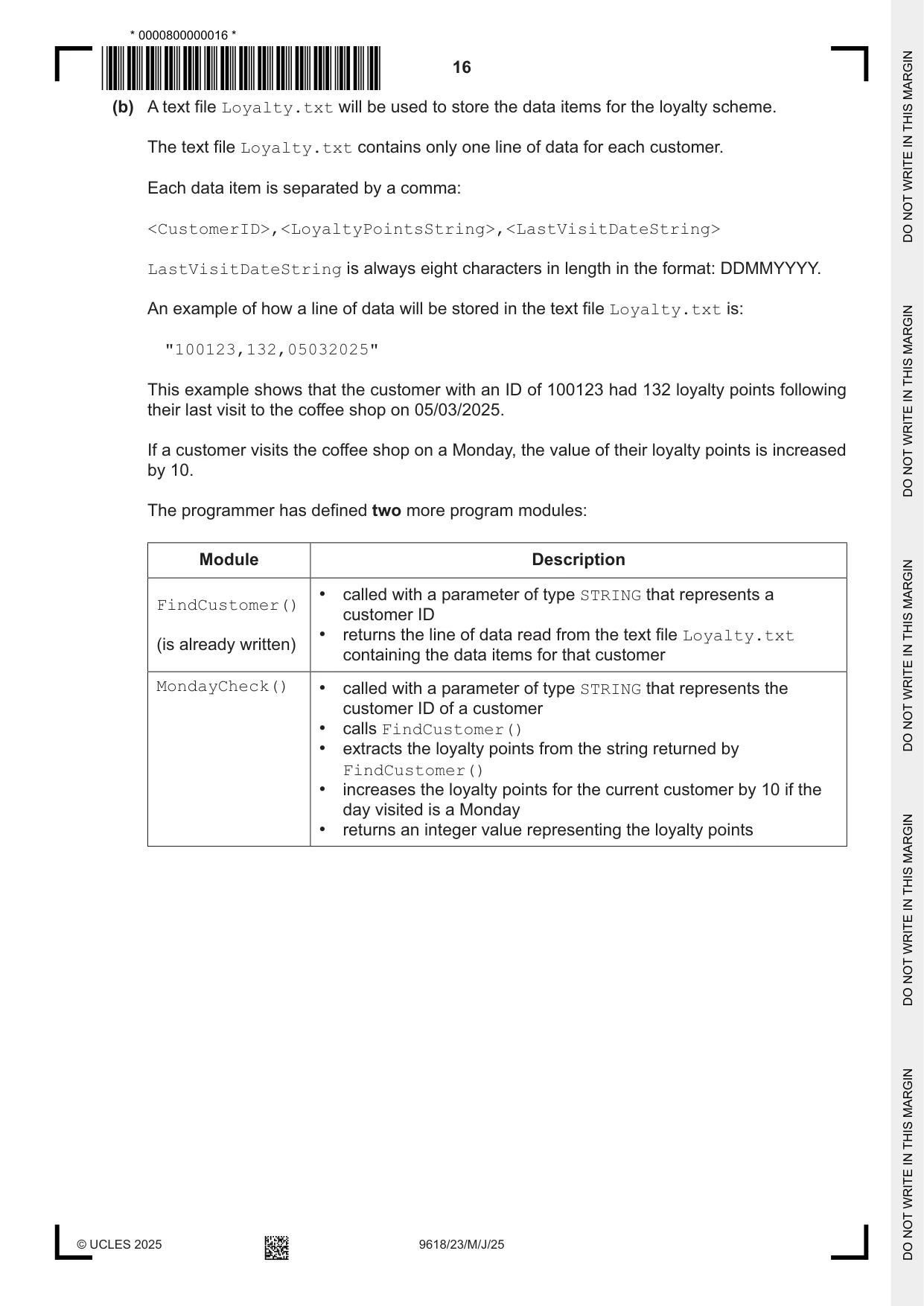
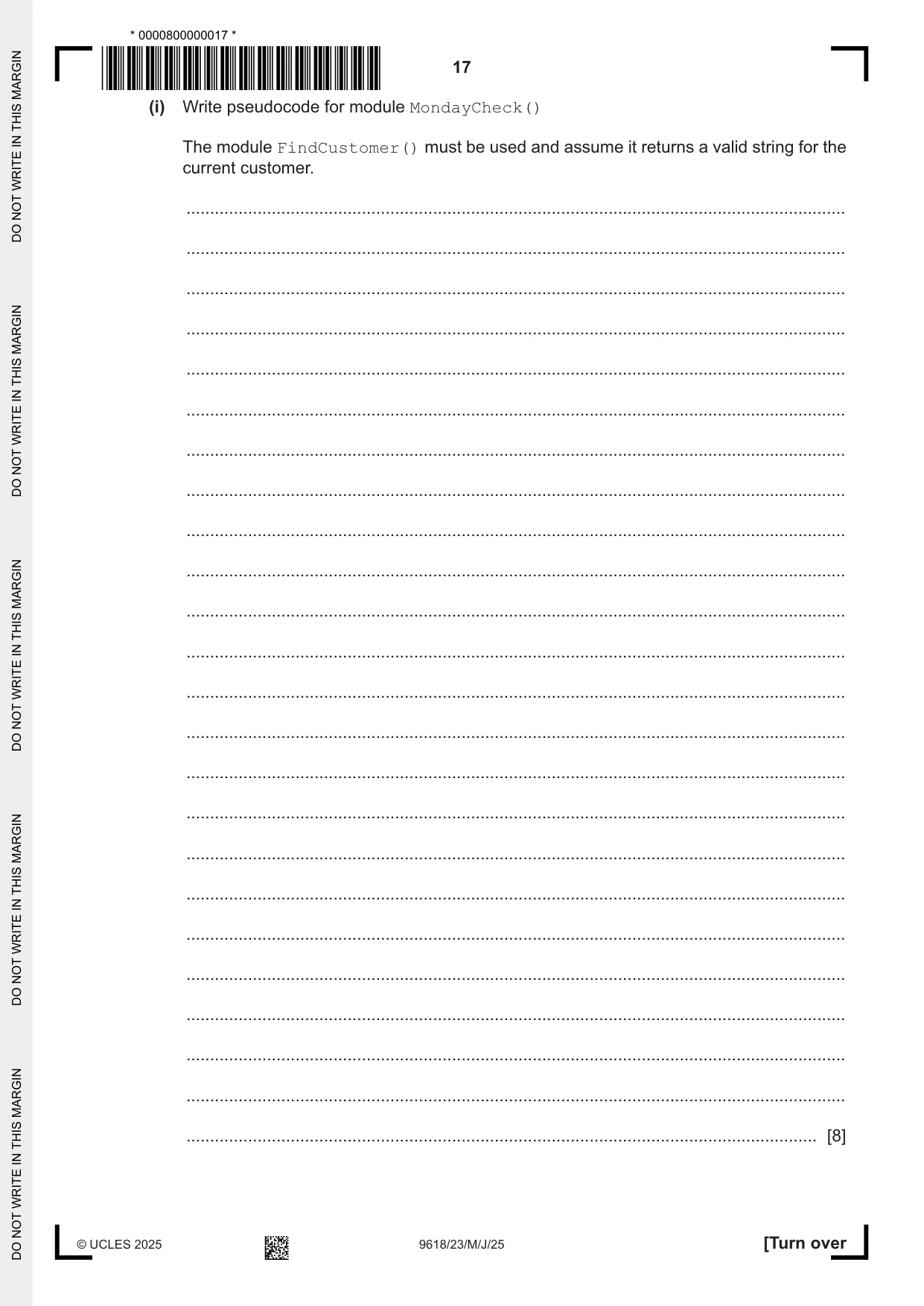
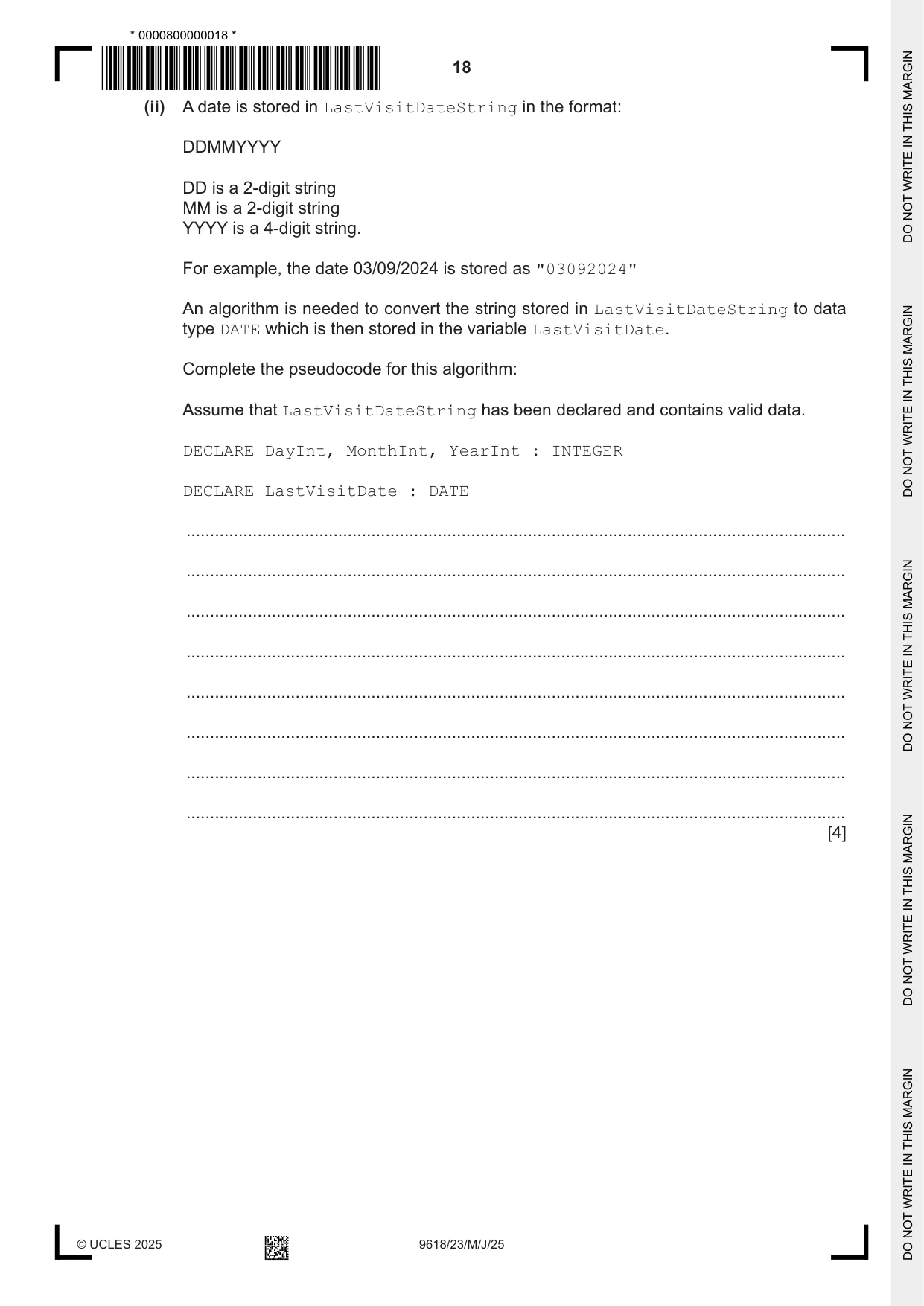
7 A program is being developed to implement a customer loyalty scheme for a coffee shop. The programmer has decided that the following data items need to be stored for each customer: Data item Description customer ID a unique six-digit string loyalty points an integer value that depends on how often the customer visits the coffee shop last visit date the date the customer last visited the coffee shop The programmer has defined a program module: Module Description • called with two parameters: 1. loyalty points of type INTEGER 2. last visit date of type DATE • change the loyalty points: increase by four if the last visit date and the current date are in the UpdateVisit() same month otherwise increase by one • change the last visit date to the current date • the changed values must be available to the code that follows the call to UpdateVisit() (a) (i) Write pseudocode for module UpdateVisit() Assume the customer has made at least one previous visit. ........................................................................................................................................... ........................................................................................................................................... ........................................................................................................................................... ........................................................................................................................................... ........................................................................................................................................... ........................................................................................................................................... ........................................................................................................................................... ........................................................................................................................................... ........................................................................................................................................... ........................................................................................................................................... ........................................................................................................................................... ........................................................................................................................................... ................ ............................................................................................................... [5] (ii) The programmer decides to amend the UpdateVisit() module so that loyalty points are further increased if the customer visits the coffee shop the same day of the week as their last visit. Write the pseudocode for this condition. ........................................................................................................................................... ..................................................................................................................................... [1] (b) A text file Loyalty.txt will be used to store the data items for the loyalty scheme. The text file Loyalty.txt contains only one line of data for each customer. Each data item is separated by a comma: <CustomerID>,<LoyaltyPointsString>,<LastVisitDateString> LastVisitDateString is always eight characters in length in the format: DDMMYYYY. An example of how a line of data will be stored in the text file Loyalty.txt is: "100123,132,05032025" This example shows that the customer with an ID of 100123 had 132 loyalty points following their last visit to the coffee shop on 05/03/2025. If a customer visits the coffee shop on a Monday, the value of their loyalty points is increased by 10. The programmer has defined two more program modules: Module Description • called with a parameter of type STRING that represents a FindCustomer() customer ID • returns the line of data read from the text file Loyalty.txt (is already written) containing the data items for that customer MondayCheck() • called with a parameter of type STRING that represents the customer ID of a customer • calls FindCustomer() • extracts the loyalty points from the string returned by FindCustomer() • increases the loyalty points for the current customer by 10 if the day visited is a Monday • returns an integer value representing the loyalty points
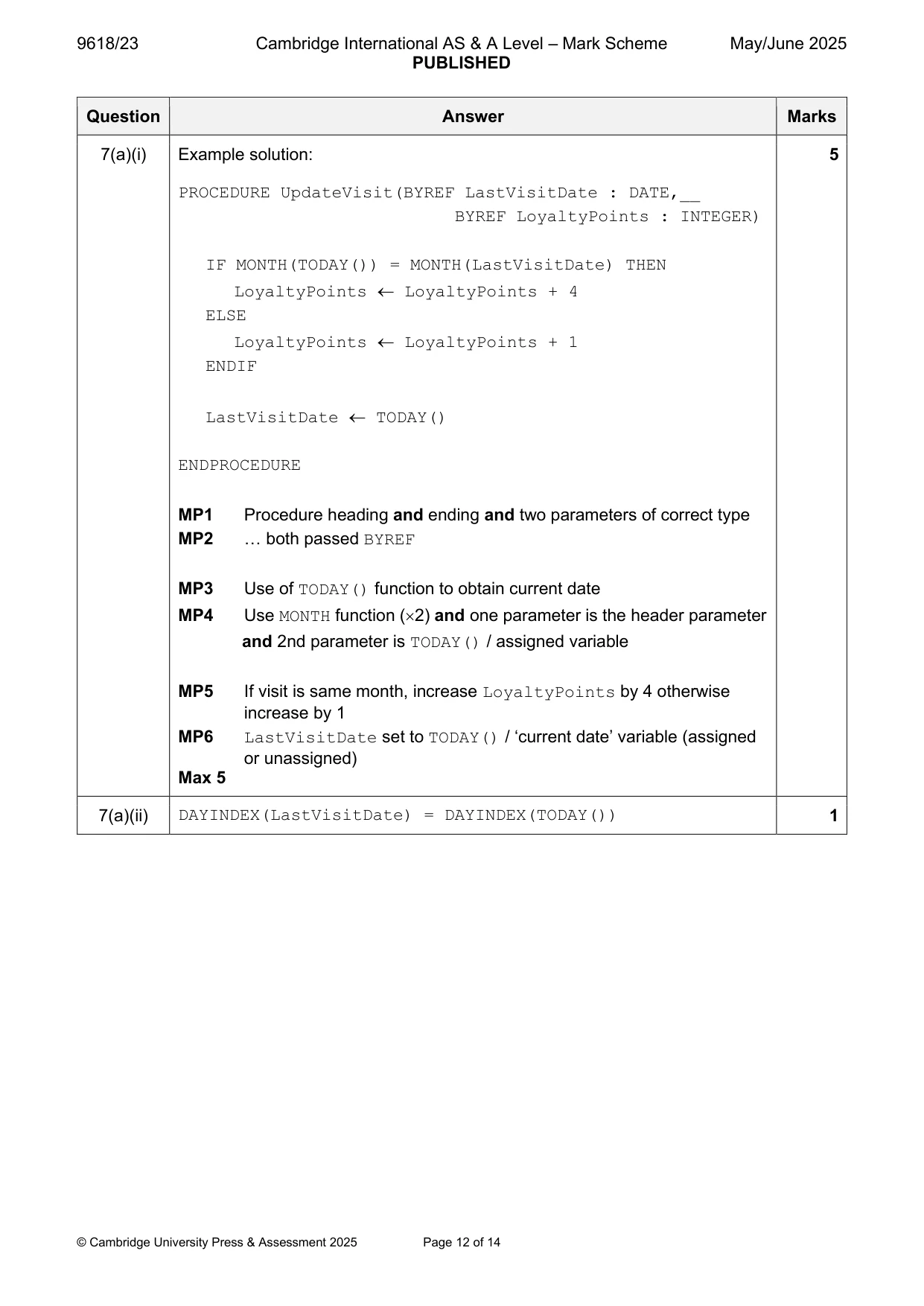
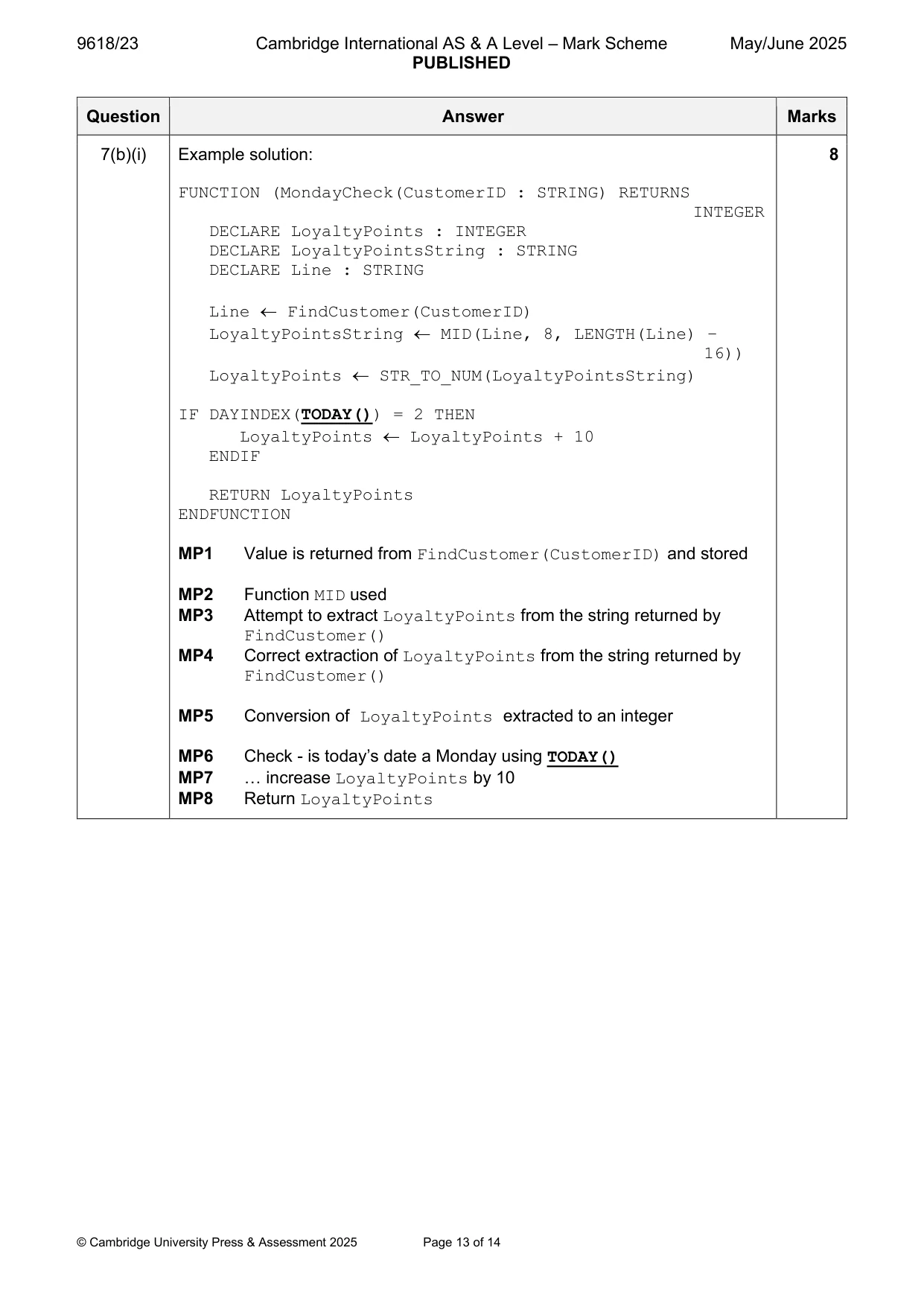
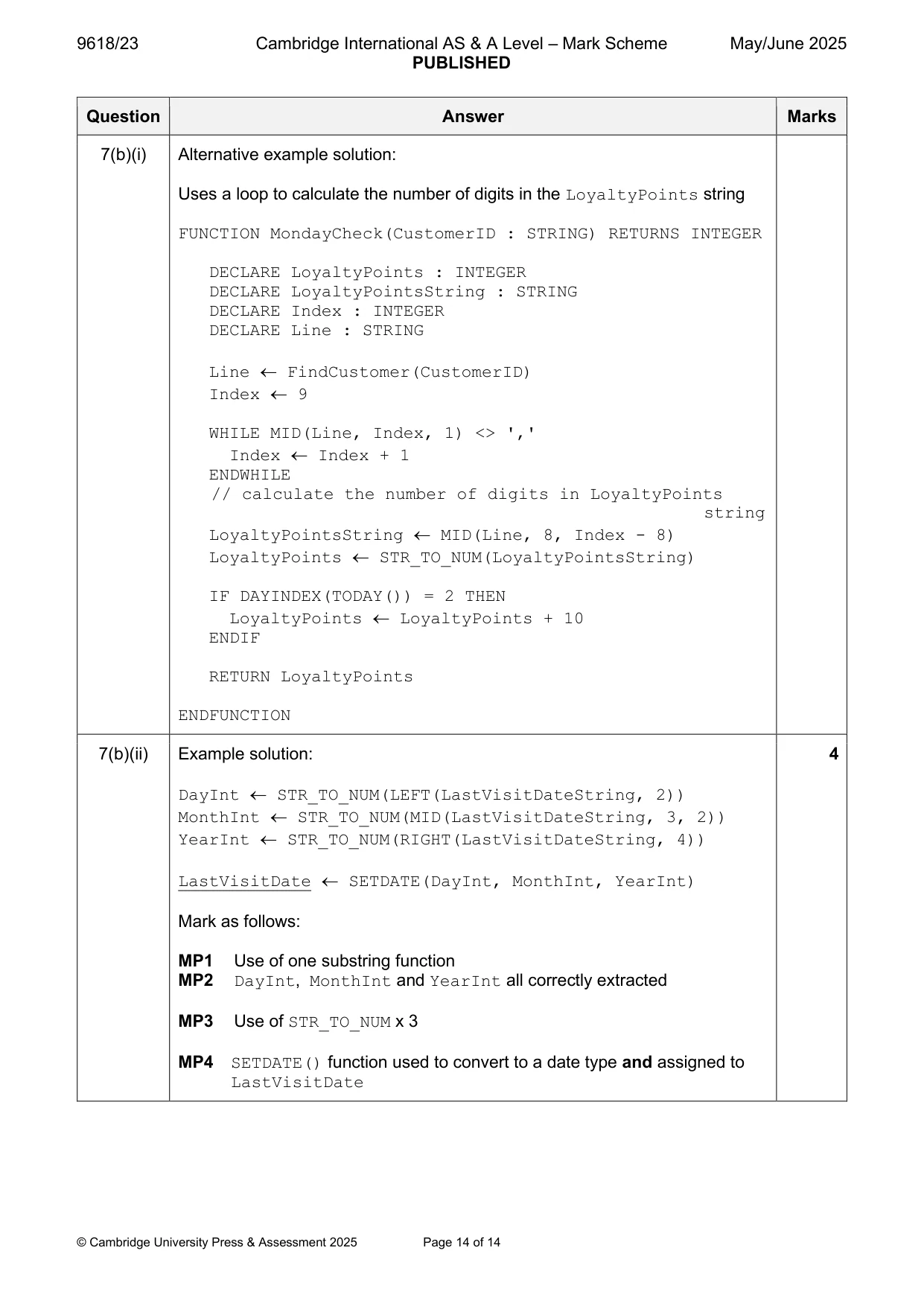
Mark scheme: 7(a)(i) Example solution: 5 PROCEDURE UpdateVisit(BYREF LastVisitDate : DATE,__ BYREF LoyaltyPoints : INTEGER) IF MONTH(TODAY()) = MONTH(LastVisitDate) THEN LoyaltyPoints LoyaltyPoints + 4 ELSE LoyaltyPoints LoyaltyPoints + 1 ENDIF LastVisitDate TODAY() ENDPROCEDURE MP1 Procedure heading and ending and two parameters of correct type MP2 … both passed BYREF MP3 Use of TODAY() function to obtain current date MP4 Use MONTH function (2) and one parameter is the header parameter and 2nd parameter is TODAY() / assigned variable MP5 If visit is same month, increase LoyaltyPoints by 4 otherwise increase by 1 MP6 LastVisitDate set to TODAY() / ‘current date’ variable (assigned or unassigned) Max 5 7(a)(ii) DAYINDEX(LastVisitDate) = DAYINDEX(TODAY()) 1 7(b)(i) Example solution: 8 FUNCTION (MondayCheck(CustomerID : STRING) RETURNS INTEGER DECLARE LoyaltyPoints : INTEGER DECLARE LoyaltyPointsString : STRING DECLARE Line : STRING Line FindCustomer(CustomerID) LoyaltyPointsString MID(Line, 8, LENGTH(Line) – 16)) LoyaltyPoints STR_TO_NUM(LoyaltyPointsString) IF DAYINDEX(TODAY()) = 2 THEN LoyaltyPoints LoyaltyPoints + 10 ENDIF RETURN LoyaltyPoints ENDFUNCTION MP1 Value is returned from FindCustomer(CustomerID) and stored MP2 Function MID used MP3 Attempt to extract LoyaltyPoints from the string returned by FindCustomer() MP4 Correct extraction of LoyaltyPoints from the string returned by FindCustomer() MP5 Conversion of LoyaltyPoints extracted to an integer MP6 Check - is today’s date a Monday using TODAY() MP7 … increase LoyaltyPoints by 10 MP8 Return LoyaltyPoints 7(b)(i) Alternative example solution: Uses a loop to calculate the number of digits in the LoyaltyPoints string FUNCTION MondayCheck(CustomerID : STRING) RETURNS INTEGER DECLARE LoyaltyPoints : INTEGER DECLARE LoyaltyPointsString : STRING DECLARE Index : INTEGER DECLARE Line : STRING Line FindCustomer(CustomerID) Index 9 WHILE MID(Line, Index, 1) <> ',' Index Index + 1 ENDWHILE // calculate the number of digits in LoyaltyPoints string LoyaltyPointsString MID(Line, 8, Index - 8) LoyaltyPoints STR_TO_NUM(LoyaltyPointsString) IF DAYINDEX(TODAY()) = 2 THEN LoyaltyPoints LoyaltyPoints + 10 ENDIF RETURN LoyaltyPoints ENDFUNCTION 7(b)(ii) Example solution: 4 DayInt STR_TO_NUM(LEFT(LastVisitDateString, 2)) MonthInt STR_TO_NUM(MID(LastVisitDateString, 3, 2)) YearInt STR_TO_NUM(RIGHT(LastVisitDateString, 4)) LastVisitDate SETDATE(DayInt, MonthInt, YearInt) Mark as follows: MP1 Use of one substring function MP2 DayInt, MonthInt and YearInt all correctly extracted MP3 Use of STR_TO_NUM x 3 MP4 SETDATE() function used to convert to a date type and assigned to LastVisitDate
What you needed in this session
Cambridge’s own grade thresholds for 2025 May/June, Paper 2 · Variant 3. A higher threshold means an easier paper — the bar moves with how the cohort did.