Cambridge A Level Computer Science 9618 — 2021 May/June Paper 1 · Variant 1
9618/11/M/J/21 · 75 marks · ≈84 min
The question paper and its mark scheme, free to read here and free to download. This is Cambridge’s own paper, exactly as it was sat.
Question paper16 pages





Mark scheme10 pages
Answers below. Sit the paper first if you are practising.

Paper as text
Question paper, page 1
This document has 16 pages. Cambridge International AS & A Level COMPUTER SCIENCE 9618/11 Paper 1 Theory Fundamentals May/June 2021 1 hour 30 minutes You must answer on the question paper. No additional materials are needed. INSTRUCTIONS ● Answer all questions. ● Use a black or dark blue pen. ● Write your name, centre number and candidate number in the boxes at the top of the page. ● Write your answer to each question in the space provided. ● Do not use an erasable pen or correction fluid. ● Do not write on any bar codes. ● You may use an HB pencil for any diagrams, graphs or rough working. ● Calculators must not be used in this paper. INFORMATION ● The total mark for this paper is 75. ● The number of marks for each question or part question is shown in brackets [ ]. ● No marks will be awarded for using brand names of software packages or hardware. * 2 2 1 1 3 9 3 4 1 4 * DC (PQ) 214537 © UCLES 2021 [Turn over
Question paper, page 2
2 9618/11/M/J/21 © UCLES 2021 1 Anya scans an image into her computer for a school project. (a) The scanned image is a bitmapped image. (i) Complete the following table to describe the two terms about graphics. Term Description Pixel … … … File header … … … [2] (ii) The image is scanned with an image resolution of 1024 × 512 pixels, and a colour depth of 8 bits per pixel. Calculate an estimate for the file size, giving your answer in mebibytes. Show your working. Working … … … … Answer … mebibytes [3] (b) The image is compressed using lossless compression. Identify one method of lossless compression that can be used to compress the image and describe how the method will reduce the file size. Lossless compression method … Description … … … … … [3]
Question paper, page 3
3 9618/11/M/J/21 © UCLES 2021 [Turn over (c) One of the colours used in the image has the hexadecimal colour code: #FC238A FC is the amount of red, 23 is the amount of green and 8A is the amount of blue in the colour. (i) Convert the hexadecimal code FC into denary. … [1] (ii) The amount of green in binary is 00100011. This has the denary number 15 added to it to create a second colour. Add the denary number 15 to the binary number 00100011 and give your answer in binary. Perform the addition in binary. Show your working. Working … … … … … Answer (in binary) … [3] (iii) Hexadecimal 23 in two’s complement representation is 00100011. The denary number 10 needs to be subtracted from this value. Subtract the denary number 10 from the two’s complement representation 00100011. Give your answer in binary. Show your working. Working … … … … … Answer (in binary) … [3]
Question paper, page 4
4 9618/11/M/J/21 © UCLES 2021 (d) Anya made sure that the image was not subject to any copyright before scanning it. Describe what is meant by copyright. … … … … [2]
Question paper, page 5
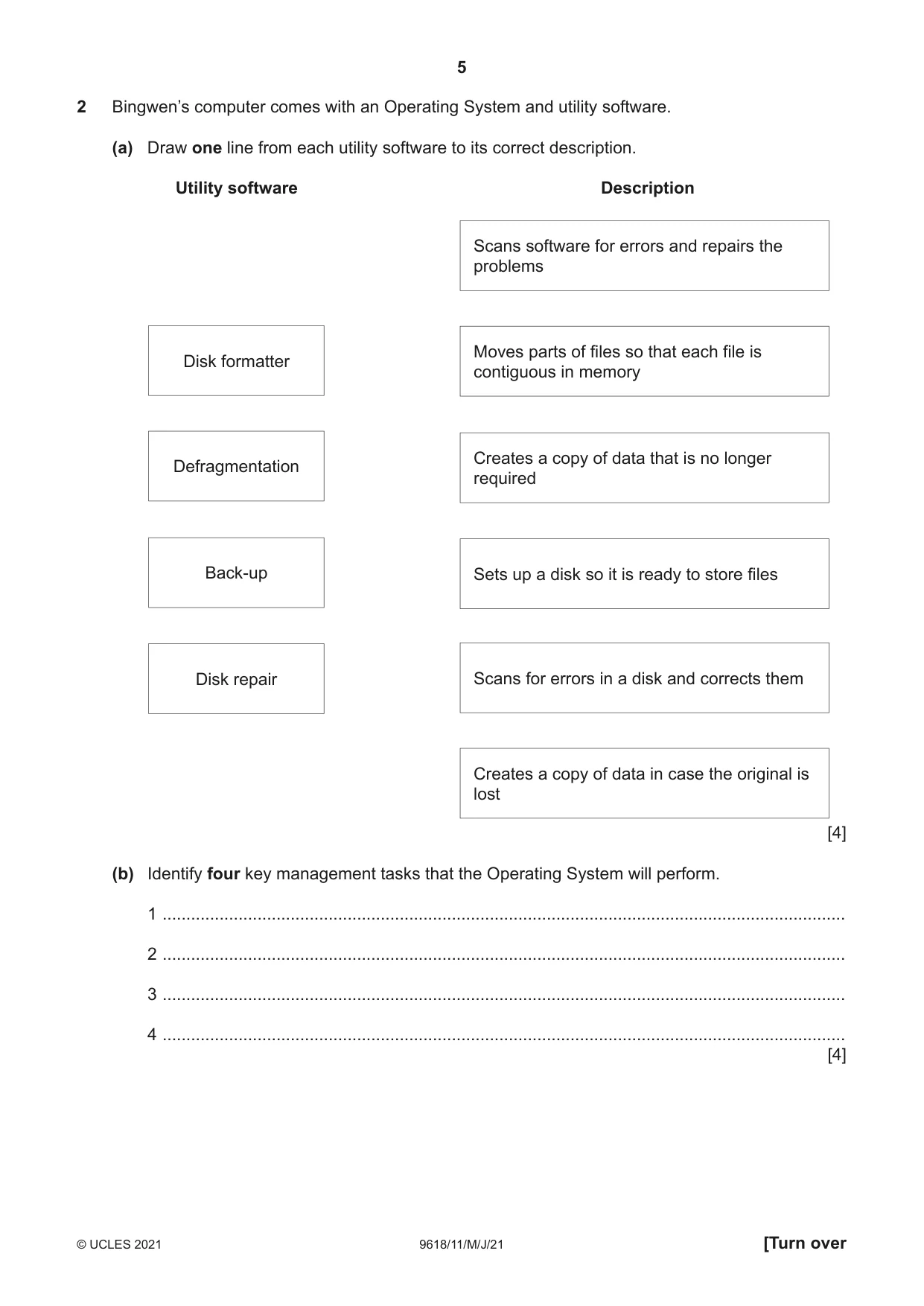
5 9618/11/M/J/21 © UCLES 2021 [Turn over 2 Bingwen’s computer comes with an Operating System and utility software. (a) Draw one line from each utility software to its correct description. Utility software Description [4] (b) Identify four key management tasks that the Operating System will perform. 1 … 2 … 3 … 4 … [4] Disk formatter Defragmentation Back-up Disk repair Scans software for errors and repairs the problems Moves parts of files so that each file is contiguous in memory Creates a copy of data that is no longer required Sets up a disk so it is ready to store files Creates a copy of data in case the original is lost Scans for errors in a disk and corrects them
Question paper, page 6
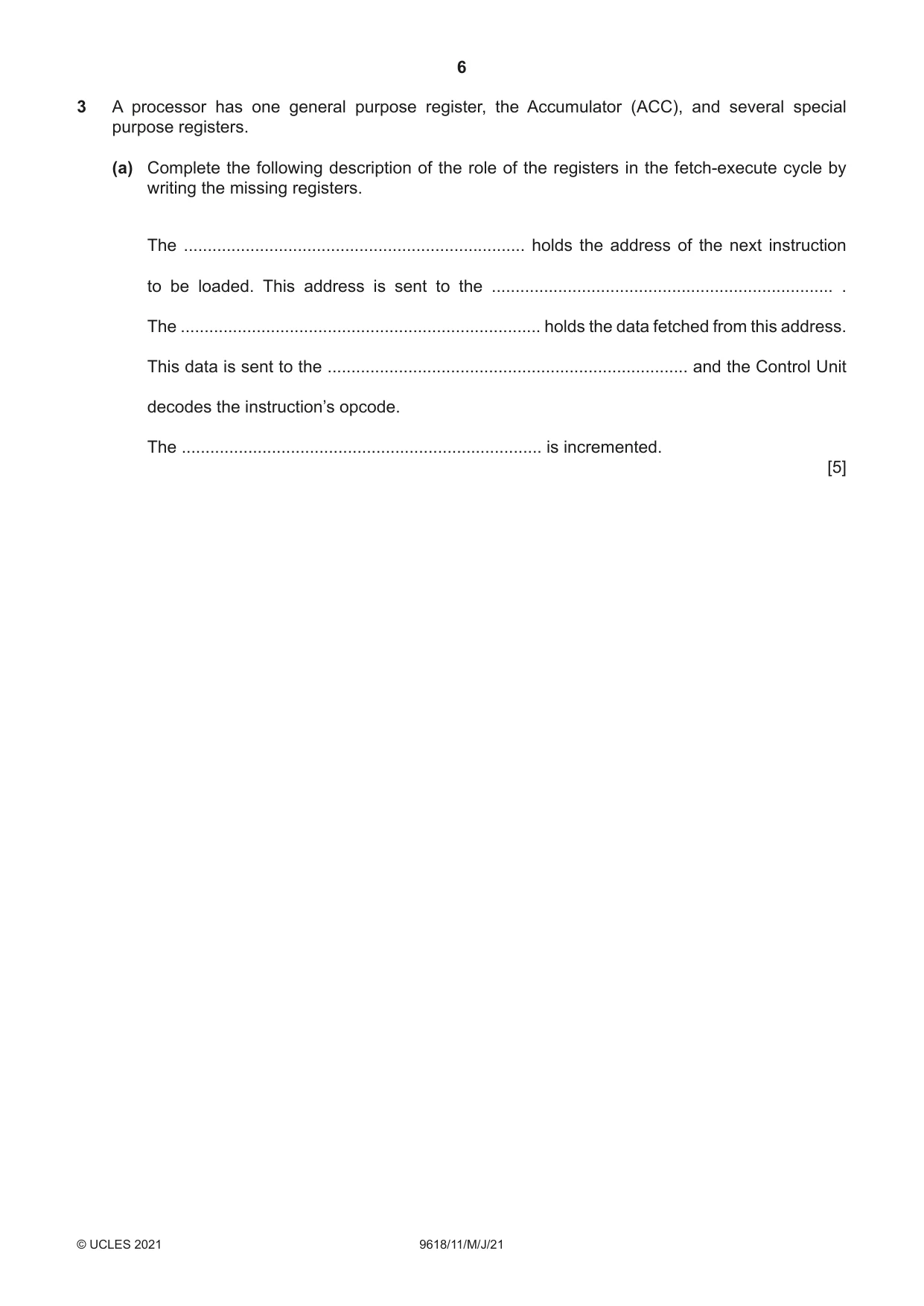
6 9618/11/M/J/21 © UCLES 2021 3 A processor has one general purpose register, the Accumulator (ACC), and several special purpose registers. (a) Complete the following description of the role of the registers in the fetch-execute cycle by writing the missing registers. The … holds the address of the next instruction to be loaded. This address is sent to the … . The … holds the data fetched from this address. This data is sent to the … and the Control Unit decodes the instruction’s opcode. The … is incremented. [5]
Question paper, page 7
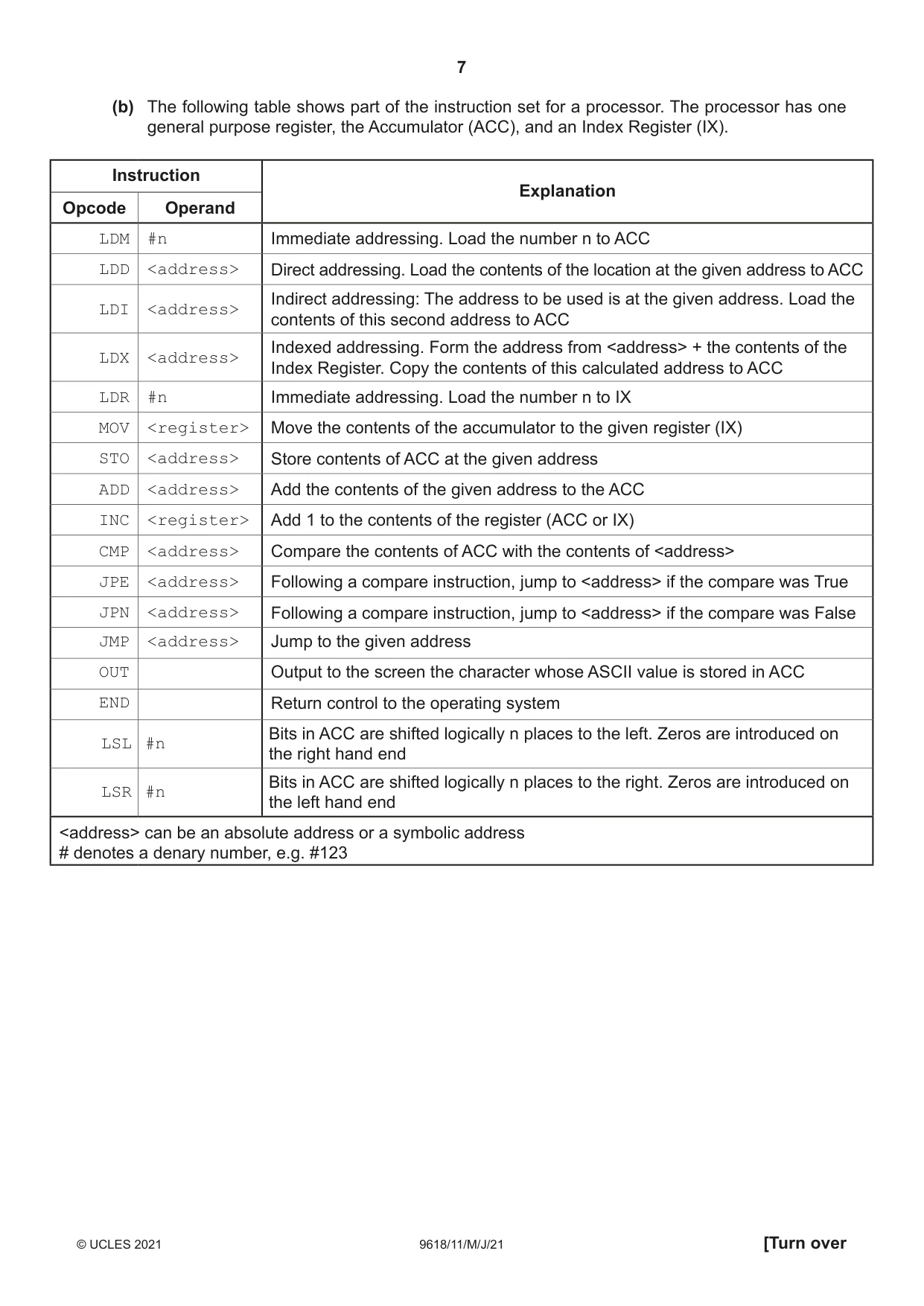
7 9618/11/M/J/21 © UCLES 2021 [Turn over (b) The following table shows part of the instruction set for a processor. The processor has one general purpose register, the Accumulator (ACC), and an Index Register (IX). Instruction Explanation Opcode Operand LDM #n Immediate addressing. Load the number n to ACC LDD <address> Direct addressing. Load the contents of the location at the given address to ACC LDI <address> Indirect addressing: The address to be used is at the given address. Load the contents of this second address to ACC LDX <address> Indexed addressing. Form the address from <address> + the contents of the Index Register. Copy the contents of this calculated address to ACC LDR #n Immediate addressing. Load the number n to IX MOV <register> Move the contents of the accumulator to the given register (IX) STO <address> Store contents of ACC at the given address ADD <address> Add the contents of the given address to the ACC INC <register> Add 1 to the contents of the register (ACC or IX) CMP <address> Compare the contents of ACC with the contents of <address> JPE <address> Following a compare instruction, jump to <address> if the compare was True JPN <address> Following a compare instruction, jump to <address> if the compare was False JMP <address> Jump to the given address OUT Output to the screen the character whose ASCII value is stored in ACC END Return control to the operating system LSL #n Bits in ACC are shifted logically n places to the left. Zeros are introduced on the right hand end LSR #n Bits in ACC are shifted logically n places to the right. Zeros are introduced on the left hand end <address> can be an absolute address or a symbolic address # denotes a denary number, e.g. #123
Question paper, page 8
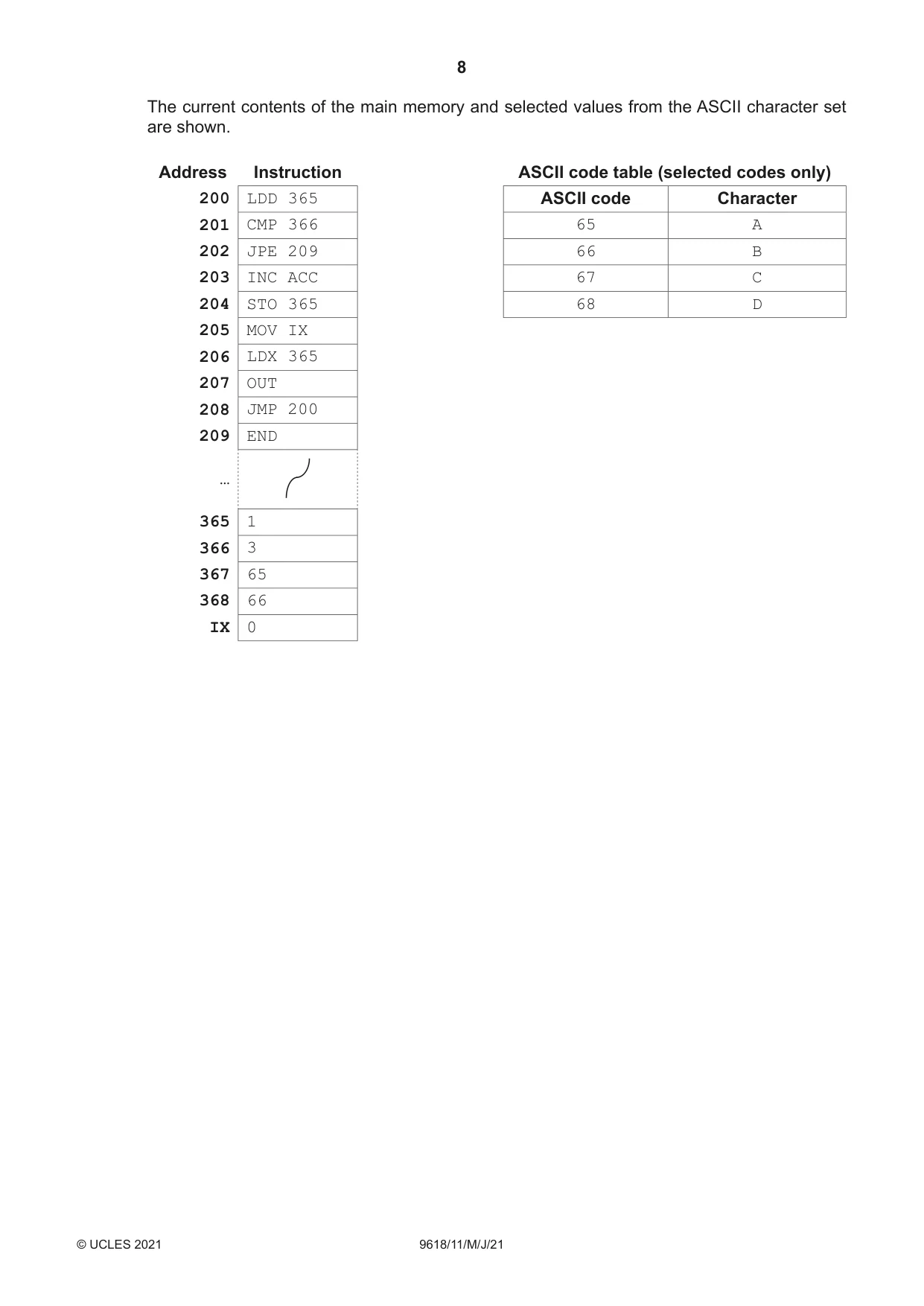
8 9618/11/M/J/21 © UCLES 2021 The current contents of the main memory and selected values from the ASCII character set are shown. Address Instruction ASCII code table (selected codes only) 200 LDD 365 ASCII code Character 201 CMP 366 65 A 202 JPE 209 66 B 203 INC ACC 67 C 204 STO 365 68 D 205 MOV IX 206 LDX 365 207 OUT 208 JMP 200 209 END … 365 1 366 3 367 65 368 66 IX 0
Question paper, page 9
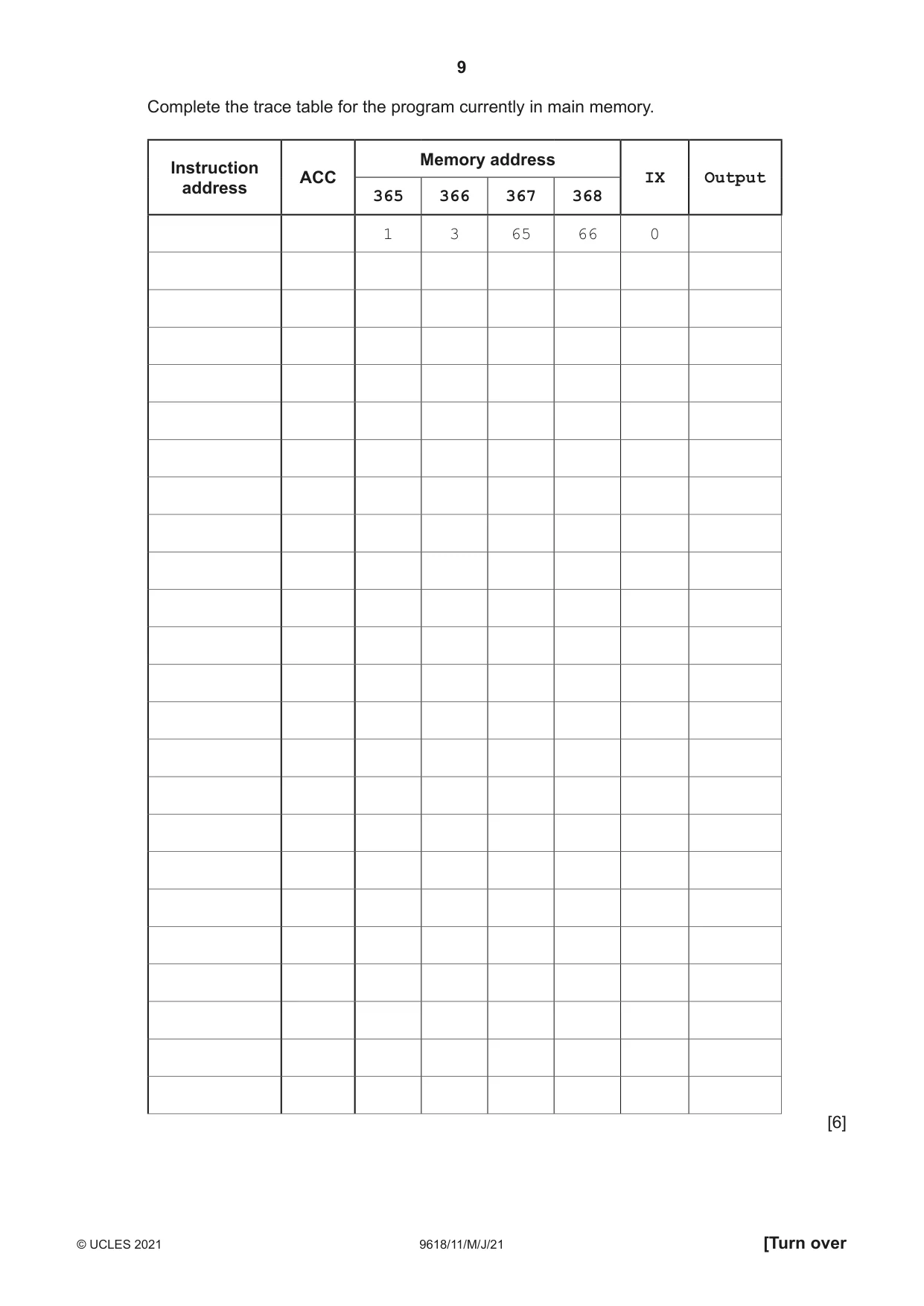
9 9618/11/M/J/21 © UCLES 2021 [Turn over Complete the trace table for the program currently in main memory. Instruction address ACC Memory address IX Output 365 366 367 368 1 3 65 66 0 [6]
Question paper, page 10
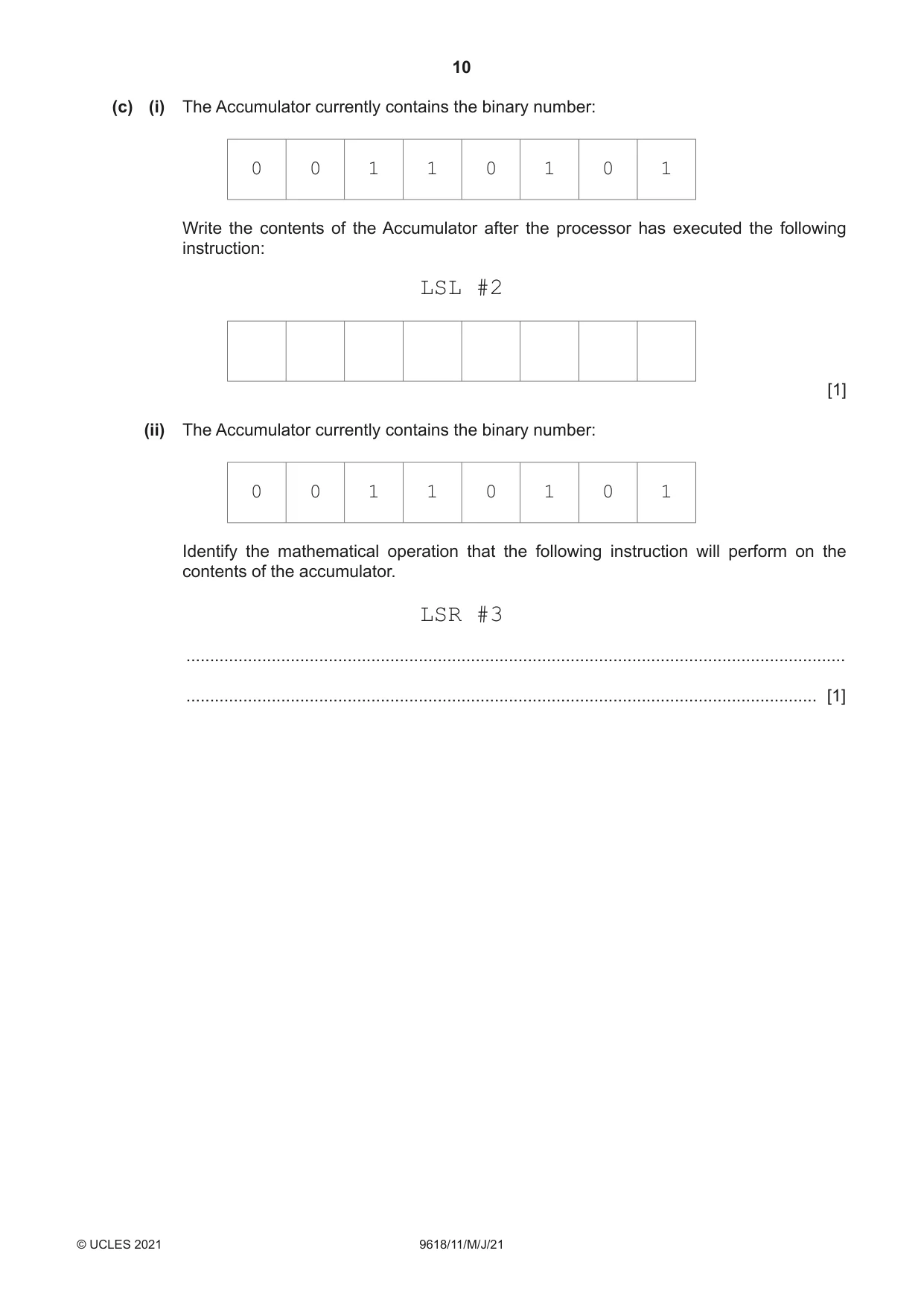
10 9618/11/M/J/21 © UCLES 2021 (c) (i) The Accumulator currently contains the binary number: 0 0 1 1 0 1 0 1 Write the contents of the Accumulator after the processor has executed the following instruction: LSL #2 [1] (ii) The Accumulator currently contains the binary number: 0 0 1 1 0 1 0 1 Identify the mathematical operation that the following instruction will perform on the contents of the accumulator. LSR #3 … … [1]
Question paper, page 11
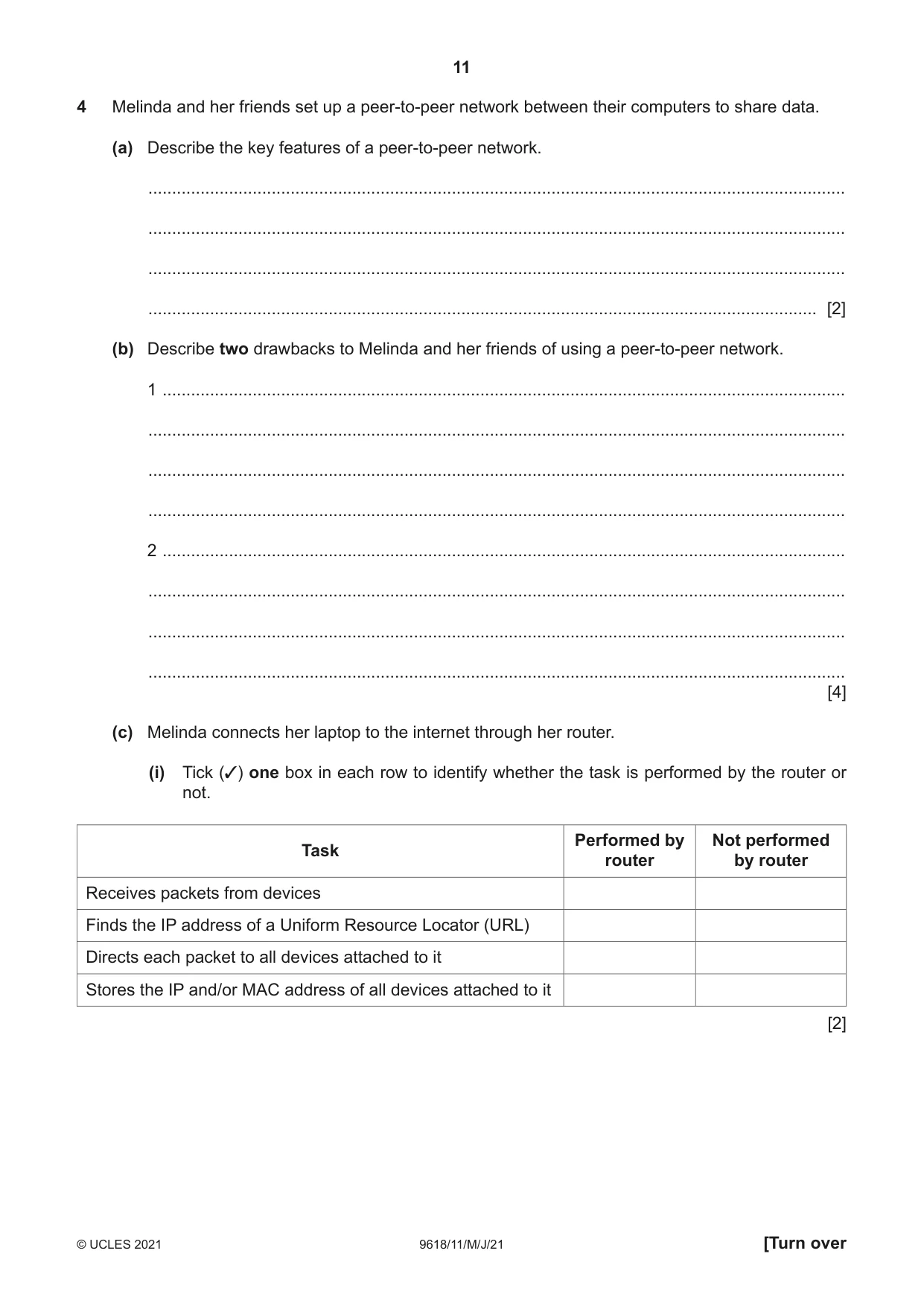
11 9618/11/M/J/21 © UCLES 2021 [Turn over 4 Melinda and her friends set up a peer-to-peer network between their computers to share data. (a) Describe the key features of a peer-to-peer network. … … … … [2] (b) Describe two drawbacks to Melinda and her friends of using a peer-to-peer network. 1 … … … … 2 … … … … [4] (c) Melinda connects her laptop to the internet through her router. (i) Tick (3) one box in each row to identify whether the task is performed by the router or not. Task Performed by router Not performed by router Receives packets from devices Finds the IP address of a Uniform Resource Locator (URL) Directs each packet to all devices attached to it Stores the IP and/or MAC address of all devices attached to it [2]
Question paper, page 12
12 9618/11/M/J/21 © UCLES 2021 (ii) Melinda mainly uses the internet to watch films and play computer games. Tick (3) one box to identify whether Melinda should connect to the router using a wired or wireless network and justify your choice. Wired Wireless Justification … … … … … … [3] (d) Melinda sends emails from her webmail account (email account accessed through a website). Explain whether Melinda is using the internet, or the World Wide Web (WWW), or both. … … … … … … [3]
Question paper, page 13
13 9618/11/M/J/21 © UCLES 2021 [Turn over 5 Kiara has a washing machine and a refrigerator. (a) She has an embedded system in her washing machine. Describe what is meant by an embedded system, using the washing machine as an example. … … … … [2] (b) The washing machine’s embedded system makes use of both Random Access Memory (RAM) and Read Only Memory (ROM). State the purpose of RAM and ROM within the washing machine’s embedded system. RAM … … ROM … … [2] (c) The temperature in her refrigerator must be kept between 4 and 6 degrees Celsius. The microprocessor in the refrigerator turns on the cooling if the temperature is too high, and turns off the cooling if the temperature is too low. Explain why the system in the refrigerator is a control and not a monitoring system. … … … … … … [2]
Question paper, page 14
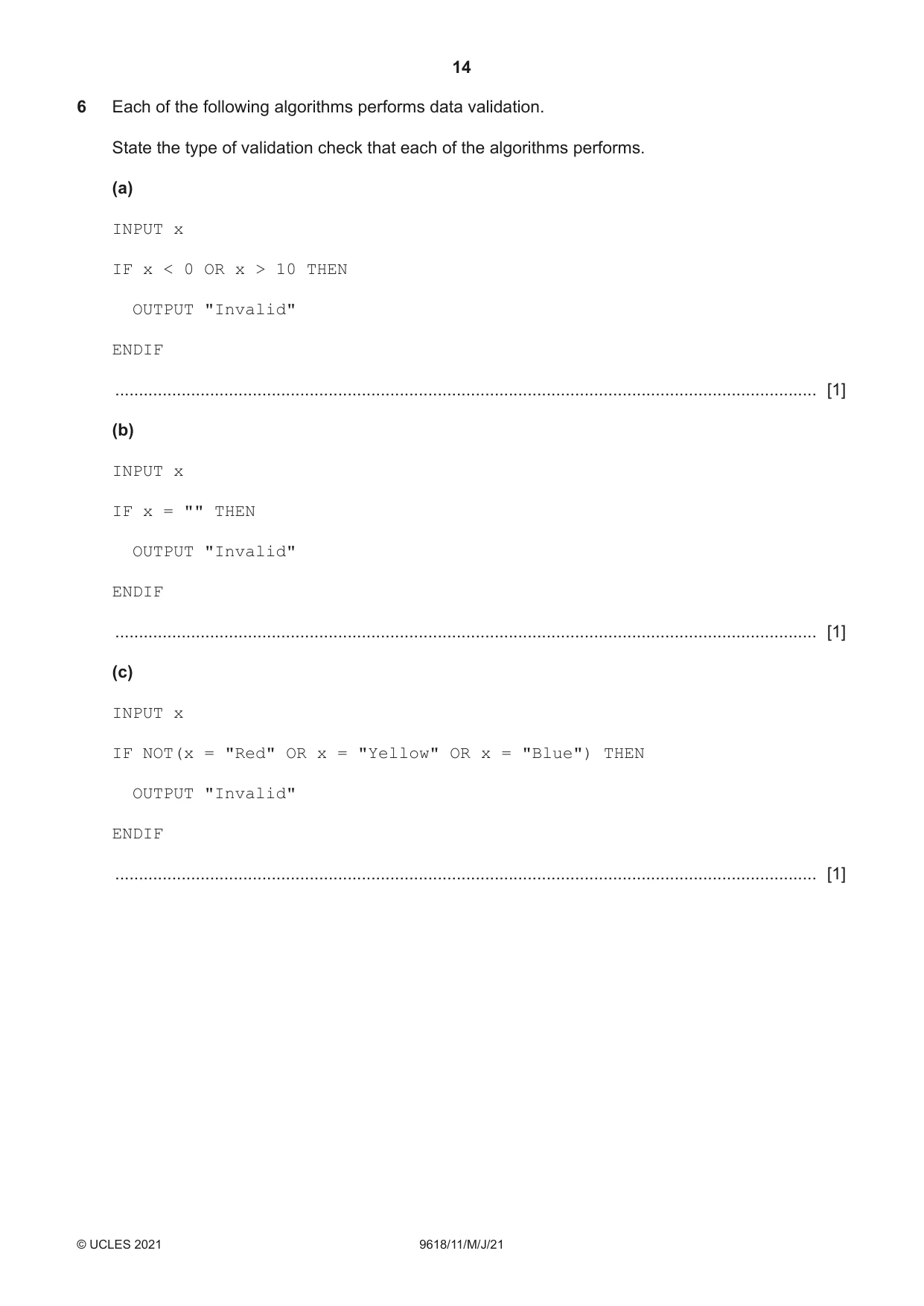
14 9618/11/M/J/21 © UCLES 2021 6 Each of the following algorithms performs data validation. State the type of validation check that each of the algorithms performs. (a) INPUT x IF x < 0 OR x > 10 THEN OUTPUT "Invalid" ENDIF … [1] (b) INPUT x IF x = "" THEN OUTPUT "Invalid" ENDIF … [1] (c) INPUT x IF NOT(x = "Red" OR x = "Yellow" OR x = "Blue") THEN OUTPUT "Invalid" ENDIF … [1]
Question paper, page 15
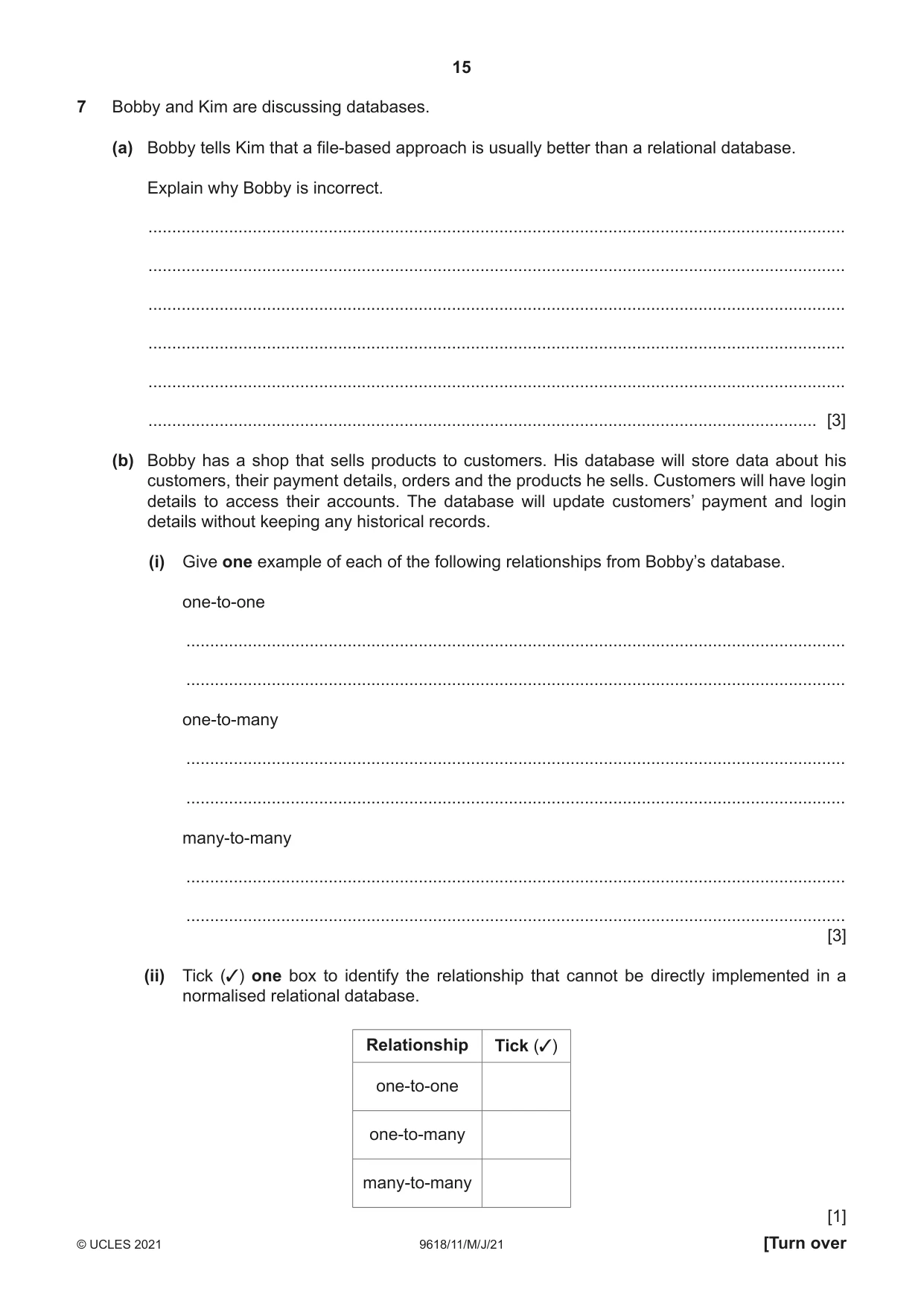
15 9618/11/M/J/21 © UCLES 2021 [Turn over 7 Bobby and Kim are discussing databases. (a) Bobby tells Kim that a file-based approach is usually better than a relational database. Explain why Bobby is incorrect. … … … … … … [3] (b) Bobby has a shop that sells products to customers. His database will store data about his customers, their payment details, orders and the products he sells. Customers will have login details to access their accounts. The database will update customers’ payment and login details without keeping any historical records. (i) Give one example of each of the following relationships from Bobby’s database. one-to-one … … one-to-many … … many-to-many … … [3] (ii) Tick (3) one box to identify the relationship that cannot be directly implemented in a normalised relational database. Relationship Tick (3) one-to-one one-to-many many-to-many [1]
Question paper, page 16
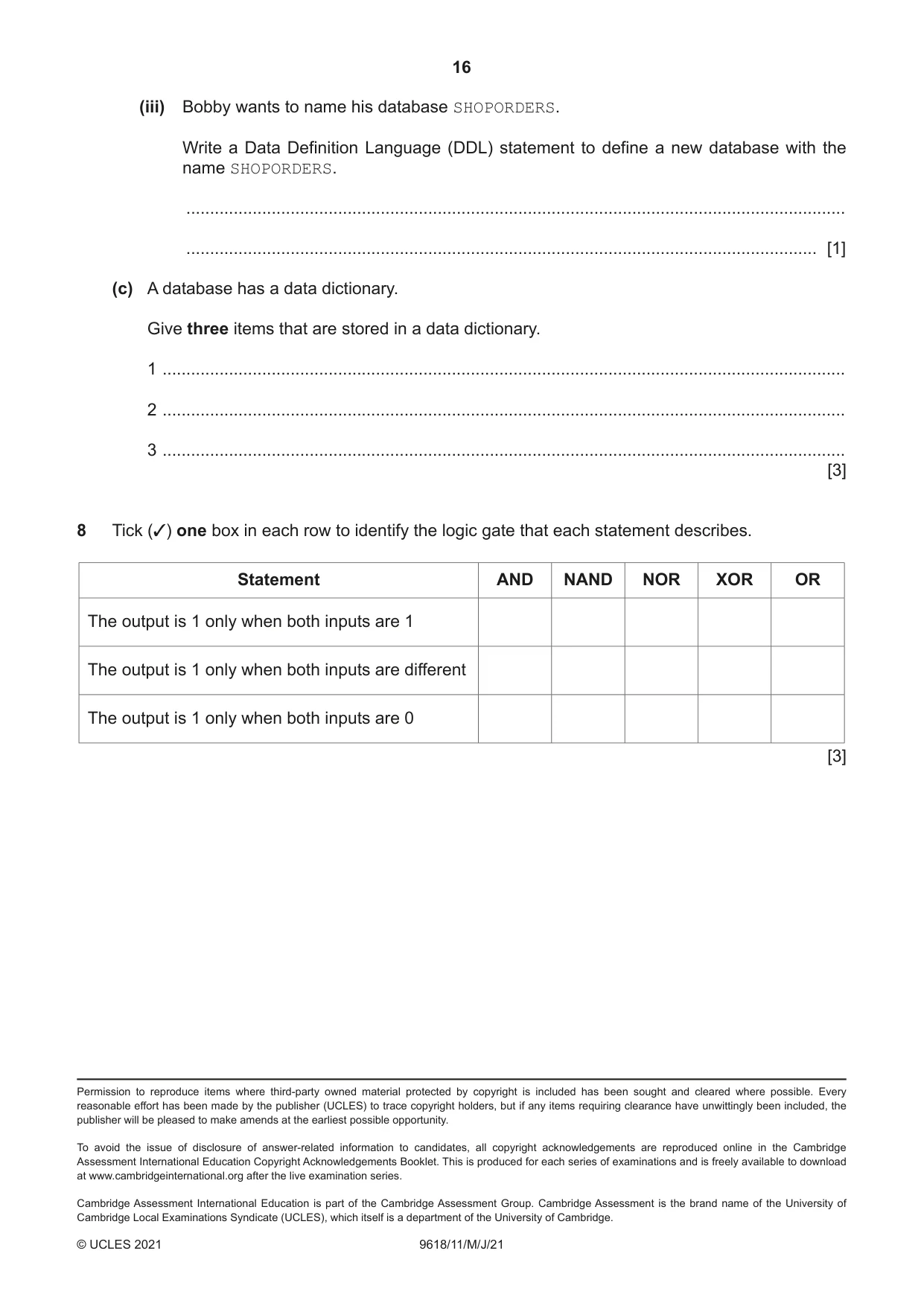
16 9618/11/M/J/21 © UCLES 2021 Permission to reproduce items where third-party owned material protected by copyright is included has been sought and cleared where possible. Every reasonable effort has been made by the publisher (UCLES) to trace copyright holders, but if any items requiring clearance have unwittingly been included, the publisher will be pleased to make amends at the earliest possible opportunity. To avoid the issue of disclosure of answer-related information to candidates, all copyright acknowledgements are reproduced online in the Cambridge Assessment International Education Copyright Acknowledgements Booklet. This is produced for each series of examinations and is freely available to download at www.cambridgeinternational.org after the live examination series. Cambridge Assessment International Education is part of the Cambridge Assessment Group. Cambridge Assessment is the brand name of the University of Cambridge Local Examinations Syndicate (UCLES), which itself is a department of the University of Cambridge. (iii) Bobby wants to name his database SHOPORDERS. Write a Data Definition Language (DDL) statement to define a new database with the name SHOPORDERS. … … [1] (c) A database has a data dictionary. Give three items that are stored in a data dictionary. 1 … 2 … 3 … [3] 8 Tick (3) one box in each row to identify the logic gate that each statement describes. Statement AND NAND NOR XOR OR The output is 1 only when both inputs are 1 The output is 1 only when both inputs are different The output is 1 only when both inputs are 0 [3]
Mark scheme, page 1
This document consists of 10 printed pages. © UCLES 2021 [Turn over Cambridge International AS & A Level COMPUTER SCIENCE 9618/11 Paper 1 Theory Fundamentals May/June 2021 MARK SCHEME Maximum Mark: 75 Published This mark scheme is published as an aid to teachers and candidates, to indicate the requirements of the examination. It shows the basis on which Examiners were instructed to award marks. It does not indicate the details of the discussions that took place at an Examiners’ meeting before marking began, which would have considered the acceptability of alternative answers. Mark schemes should be read in conjunction with the question paper and the Principal Examiner Report for Teachers. Cambridge International will not enter into discussions about these mark schemes. Cambridge International is publishing the mark schemes for the May/June 2021 series for most Cambridge IGCSE™, Cambridge International A and AS Level components and some Cambridge O Level components.
Mark scheme, page 2
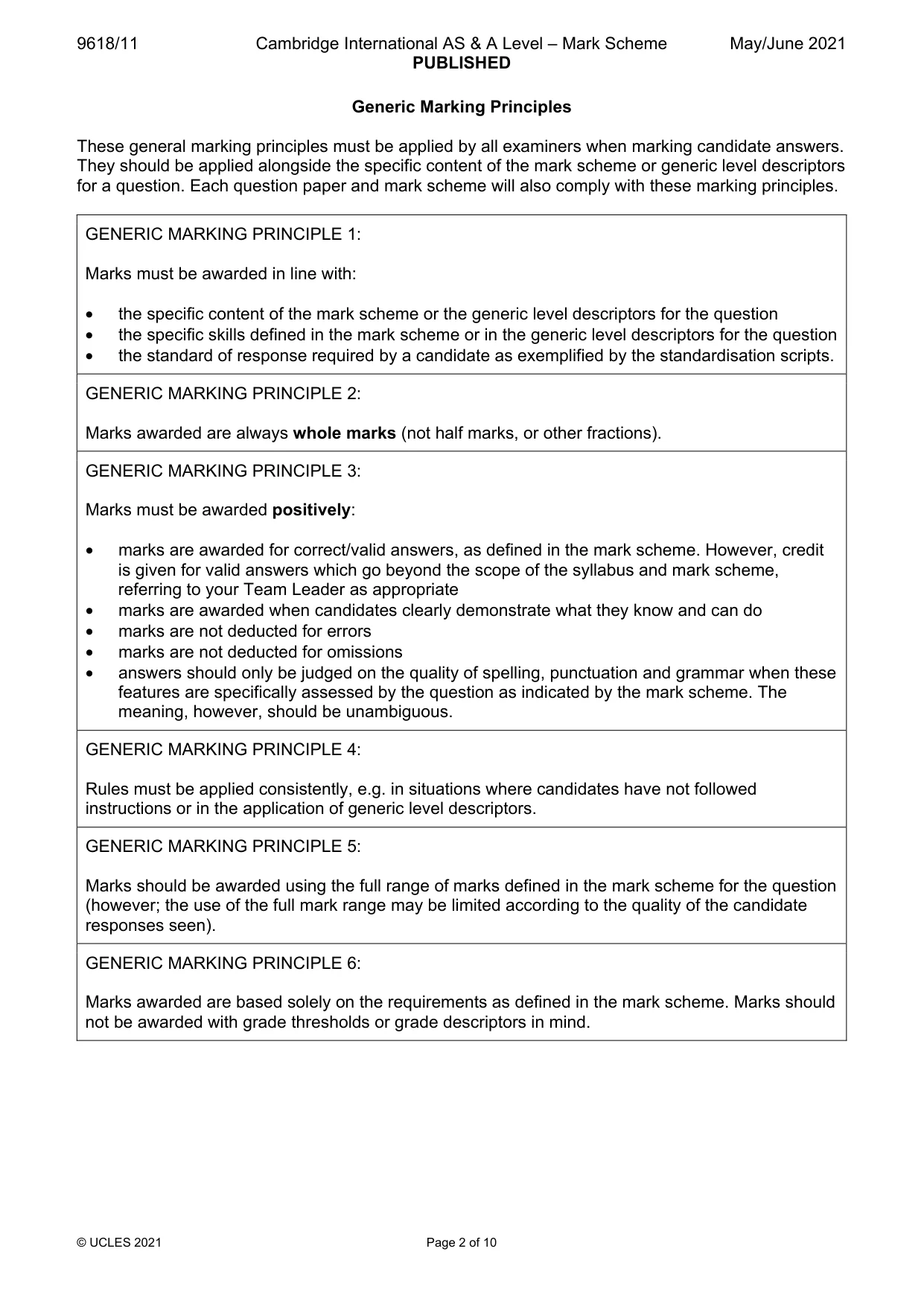
9618/11 Cambridge International AS & A Level – Mark Scheme PUBLISHED May/June 2021 © UCLES 2021 Page 2 of 10 Generic Marking Principles These general marking principles must be applied by all examiners when marking candidate answers. They should be applied alongside the specific content of the mark scheme or generic level descriptors for a question. Each question paper and mark scheme will also comply with these marking principles. GENERIC MARKING PRINCIPLE 1: Marks must be awarded in line with: • the specific content of the mark scheme or the generic level descriptors for the question • the specific skills defined in the mark scheme or in the generic level descriptors for the question • the standard of response required by a candidate as exemplified by the standardisation scripts. GENERIC MARKING PRINCIPLE 2: Marks awarded are always whole marks (not half marks, or other fractions). GENERIC MARKING PRINCIPLE 3: Marks must be awarded positively: • marks are awarded for correct/valid answers, as defined in the mark scheme. However, credit is given for valid answers which go beyond the scope of the syllabus and mark scheme, referring to your Team Leader as appropriate • marks are awarded when candidates clearly demonstrate what they know and can do • marks are not deducted for errors • marks are not deducted for omissions • answers should only be judged on the quality of spelling, punctuation and grammar when these features are specifically assessed by the question as indicated by the mark scheme. The meaning, however, should be unambiguous. GENERIC MARKING PRINCIPLE 4: Rules must be applied consistently, e.g. in situations where candidates have not followed instructions or in the application of generic level descriptors. GENERIC MARKING PRINCIPLE 5: Marks should be awarded using the full range of marks defined in the mark scheme for the question (however; the use of the full mark range may be limited according to the quality of the candidate responses seen). GENERIC MARKING PRINCIPLE 6: Marks awarded are based solely on the requirements as defined in the mark scheme. Marks should not be awarded with grade thresholds or grade descriptors in mind.
Mark scheme, page 3
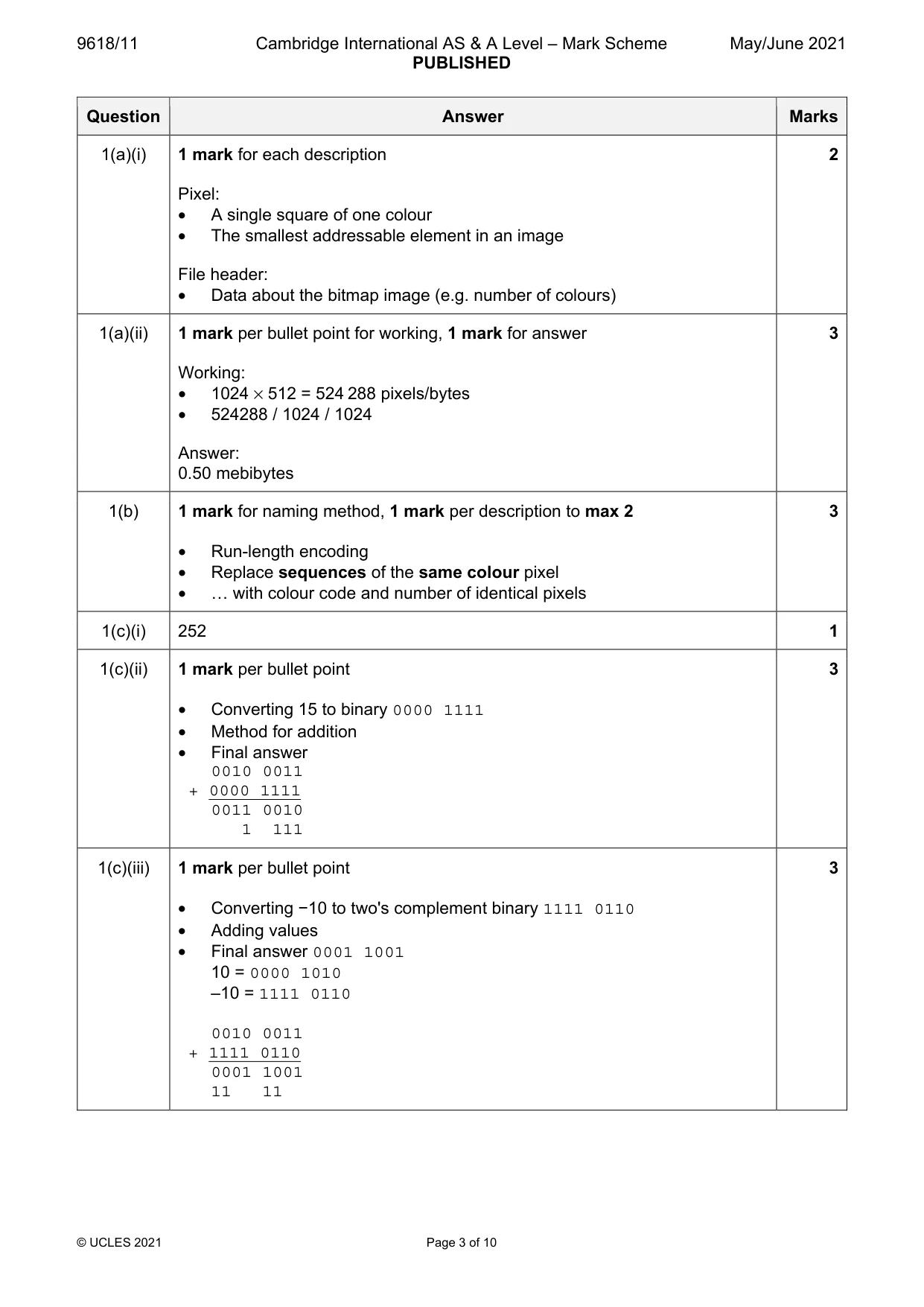
9618/11 Cambridge International AS & A Level – Mark Scheme PUBLISHED May/June 2021 © UCLES 2021 Page 3 of 10 Question Answer Marks 1(a)(i) 1 mark for each description Pixel: • A single square of one colour • The smallest addressable element in an image File header: • Data about the bitmap image (e.g. number of colours) 2 1(a)(ii) 1 mark per bullet point for working, 1 mark for answer Working: • 1024 × 512 = 524 288 pixels/bytes • 524288 / 1024 / 1024 Answer: 0.50 mebibytes 3 1(b) 1 mark for naming method, 1 mark per description to max 2 • Run-length encoding • Replace sequences of the same colour pixel • … with colour code and number of identical pixels 3 1(c)(i) 252 1 1(c)(ii) 1 mark per bullet point • Converting 15 to binary 0000 1111 • Method for addition • Final answer 0010 0011 + 0000 1111 0011 0010 1 111 3 1(c)(iii) 1 mark per bullet point • Converting −10 to two's complement binary 1111 0110 • Adding values • Final answer 0001 1001 10 = 0000 1010 –10 = 1111 0110 0010 0011 + 1111 0110 0001 1001 11 11 3
Mark scheme, page 4
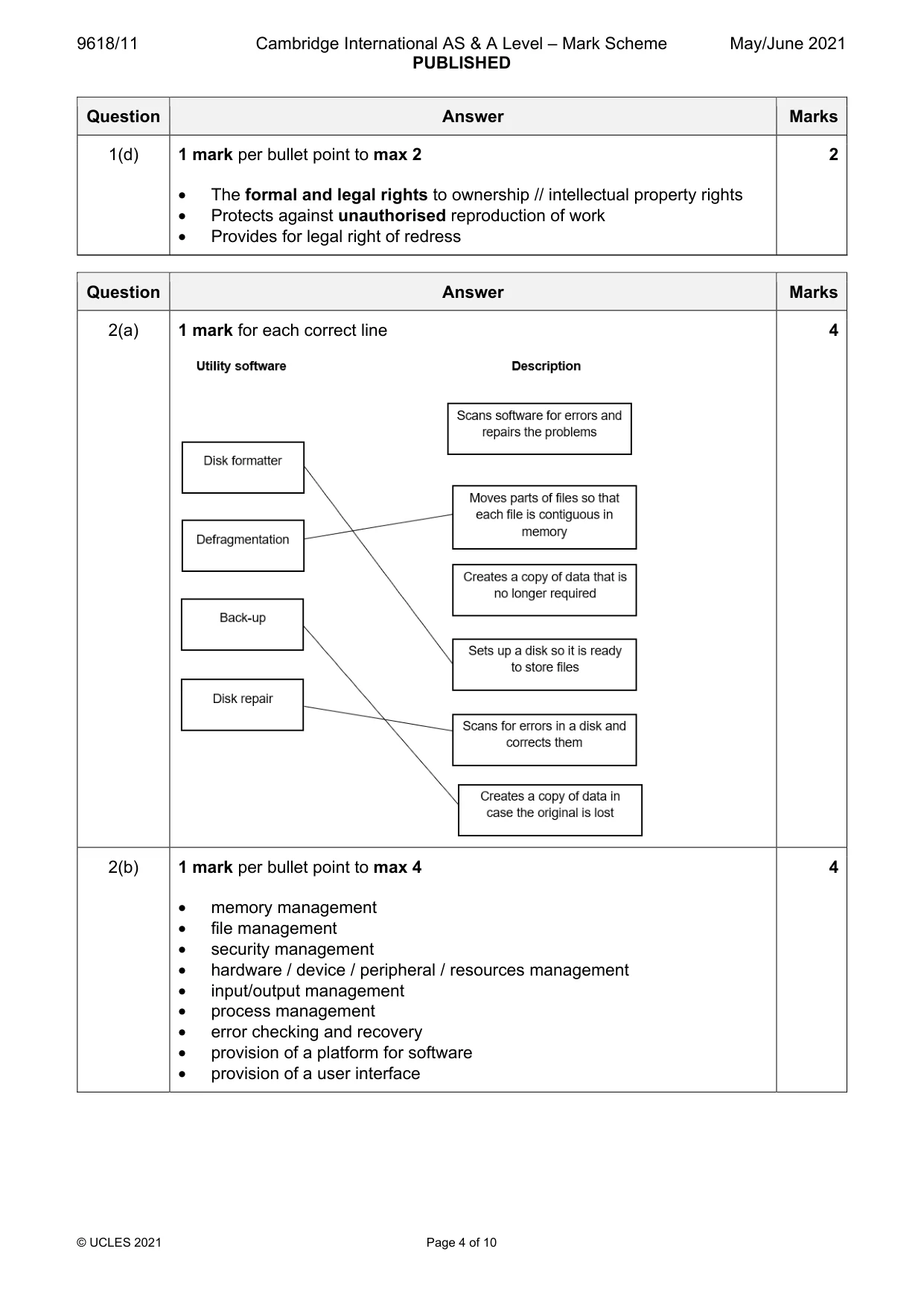
9618/11 Cambridge International AS & A Level – Mark Scheme PUBLISHED May/June 2021 © UCLES 2021 Page 4 of 10 Question Answer Marks 1(d) 1 mark per bullet point to max 2 • The formal and legal rights to ownership // intellectual property rights • Protects against unauthorised reproduction of work • Provides for legal right of redress 2 Question Answer Marks 2(a) 1 mark for each correct line 4 2(b) 1 mark per bullet point to max 4 • memory management • file management • security management • hardware / device / peripheral / resources management • input/output management • process management • error checking and recovery • provision of a platform for software • provision of a user interface 4
Mark scheme, page 5
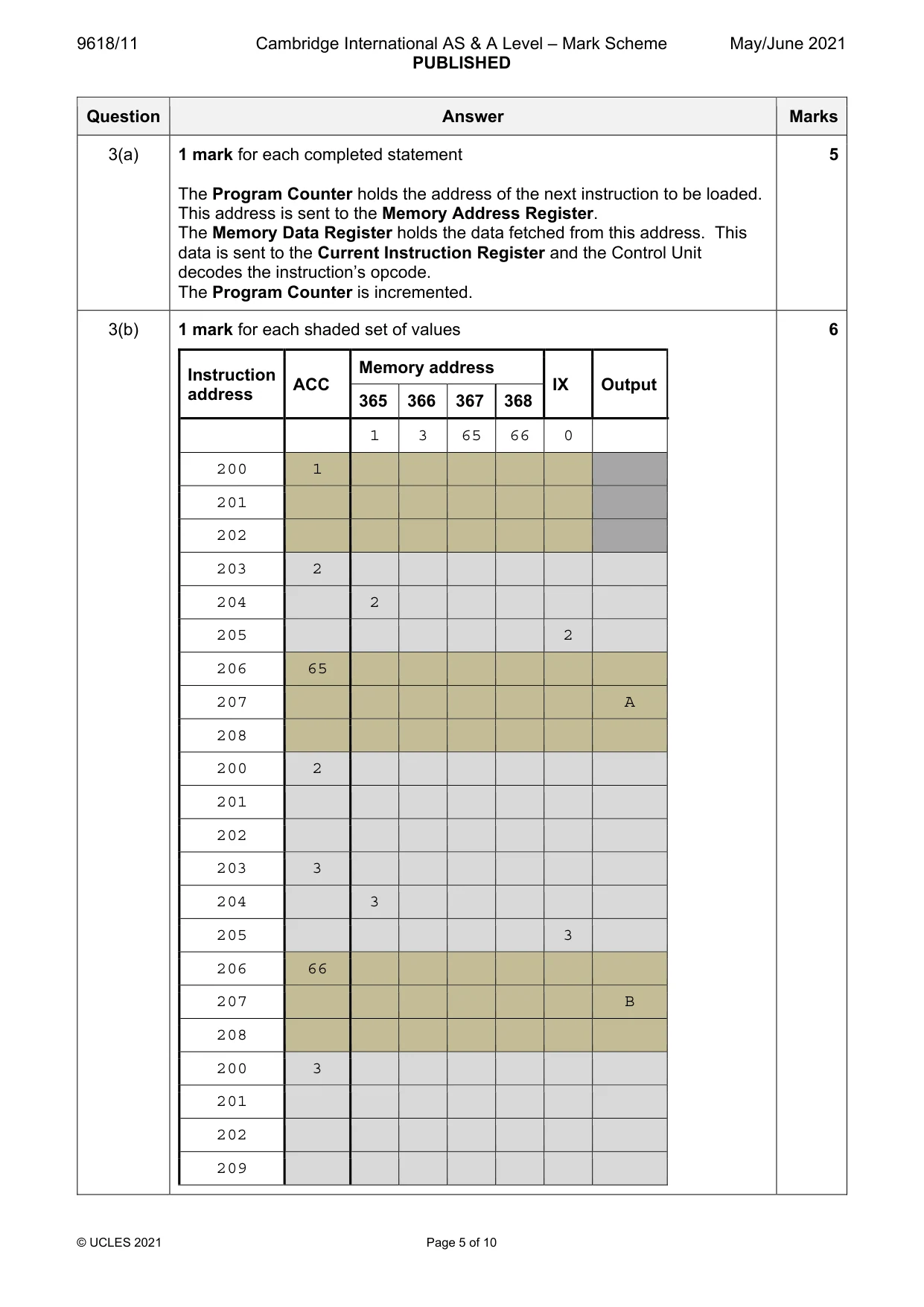
9618/11 Cambridge International AS & A Level – Mark Scheme PUBLISHED May/June 2021 © UCLES 2021 Page 5 of 10 Question Answer Marks 3(a) 1 mark for each completed statement The Program Counter holds the address of the next instruction to be loaded. This address is sent to the Memory Address Register. The Memory Data Register holds the data fetched from this address. This data is sent to the Current Instruction Register and the Control Unit decodes the instruction’s opcode. The Program Counter is incremented. 5 3(b) 1 mark for each shaded set of values Instruction address ACC Memory address IX Output 365 366 367 368 1 3 65 66 0 200 1 201 202 203 2 204 2 205 2 206 65 207 A 208 200 2 201 202 203 3 204 3 205 3 206 66 207 B 208 200 3 201 202 209 6
Mark scheme, page 6
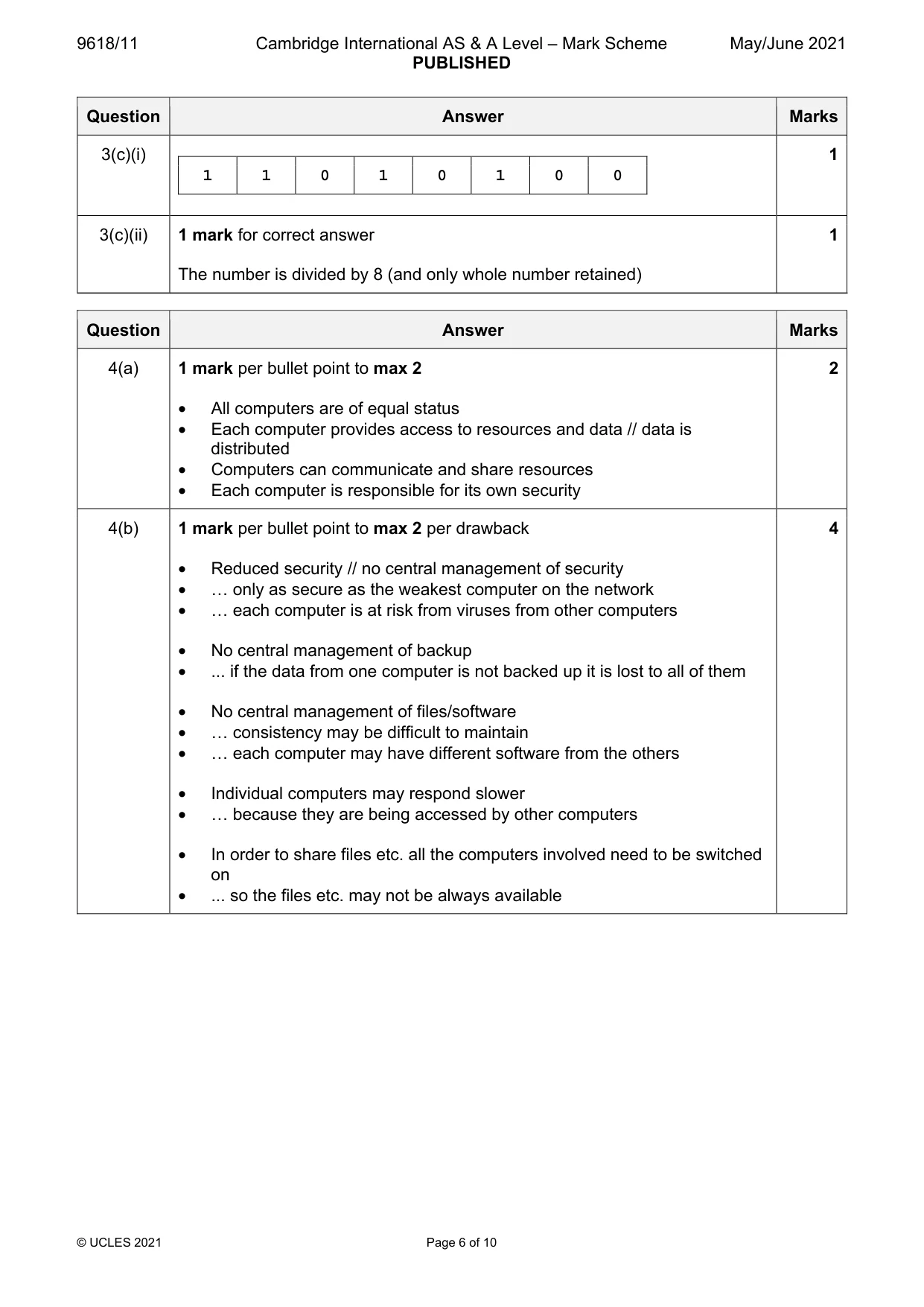
9618/11 Cambridge International AS & A Level – Mark Scheme PUBLISHED May/June 2021 © UCLES 2021 Page 6 of 10 Question Answer Marks 3(c)(i) 1 1 0 1 0 1 0 0 1 3(c)(ii) 1 mark for correct answer The number is divided by 8 (and only whole number retained) 1 Question Answer Marks 4(a) 1 mark per bullet point to max 2 • All computers are of equal status • Each computer provides access to resources and data // data is distributed • Computers can communicate and share resources • Each computer is responsible for its own security 2 4(b) 1 mark per bullet point to max 2 per drawback • Reduced security // no central management of security • … only as secure as the weakest computer on the network • … each computer is at risk from viruses from other computers • No central management of backup • ... if the data from one computer is not backed up it is lost to all of them • No central management of files/software • … consistency may be difficult to maintain • … each computer may have different software from the others • Individual computers may respond slower • … because they are being accessed by other computers • In order to share files etc. all the computers involved need to be switched on • ... so the files etc. may not be always available 4
Mark scheme, page 7
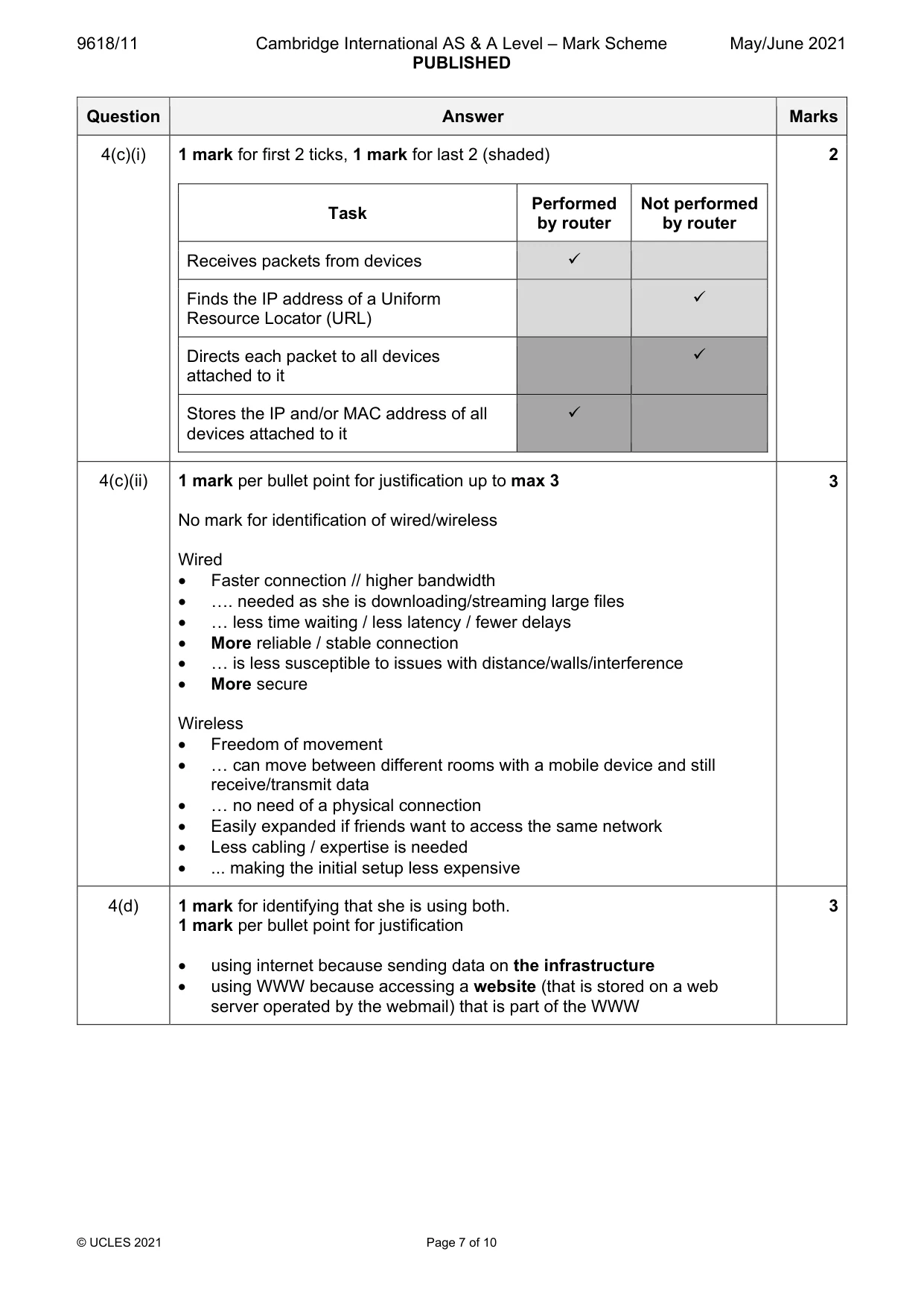
9618/11 Cambridge International AS & A Level – Mark Scheme PUBLISHED May/June 2021 © UCLES 2021 Page 7 of 10 Question Answer Marks 4(c)(i) 1 mark for first 2 ticks, 1 mark for last 2 (shaded) Task Performed by router Not performed by router Receives packets from devices Finds the IP address of a Uniform Resource Locator (URL) Directs each packet to all devices attached to it Stores the IP and/or MAC address of all devices attached to it 2 4(c)(ii) 1 mark per bullet point for justification up to max 3 No mark for identification of wired/wireless Wired • Faster connection // higher bandwidth • …. needed as she is downloading/streaming large files • … less time waiting / less latency / fewer delays • More reliable / stable connection • … is less susceptible to issues with distance/walls/interference • More secure Wireless • Freedom of movement • … can move between different rooms with a mobile device and still receive/transmit data • … no need of a physical connection • Easily expanded if friends want to access the same network • Less cabling / expertise is needed • ... making the initial setup less expensive 3 4(d) 1 mark for identifying that she is using both. 1 mark per bullet point for justification • using internet because sending data on the infrastructure • using WWW because accessing a website (that is stored on a web server operated by the webmail) that is part of the WWW 3
Mark scheme, page 8
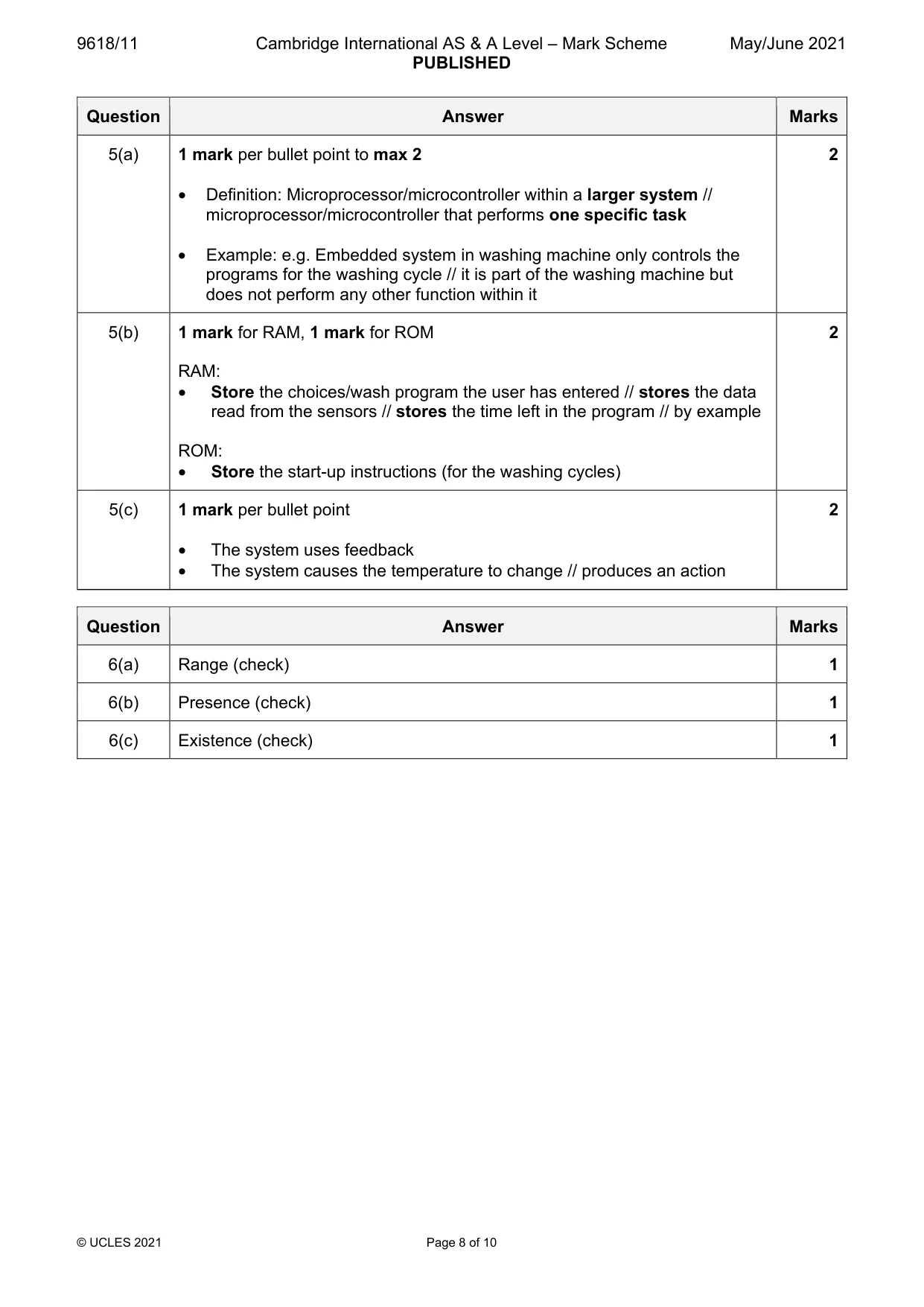
9618/11 Cambridge International AS & A Level – Mark Scheme PUBLISHED May/June 2021 © UCLES 2021 Page 8 of 10 Question Answer Marks 5(a) 1 mark per bullet point to max 2 • Definition: Microprocessor/microcontroller within a larger system // microprocessor/microcontroller that performs one specific task • Example: e.g. Embedded system in washing machine only controls the programs for the washing cycle // it is part of the washing machine but does not perform any other function within it 2 5(b) 1 mark for RAM, 1 mark for ROM RAM: • Store the choices/wash program the user has entered // stores the data read from the sensors // stores the time left in the program // by example ROM: • Store the start-up instructions (for the washing cycles) 2 5(c) 1 mark per bullet point • The system uses feedback • The system causes the temperature to change // produces an action 2 Question Answer Marks 6(a) Range (check) 1 6(b) Presence (check) 1 6(c) Existence (check) 1
Mark scheme, page 9
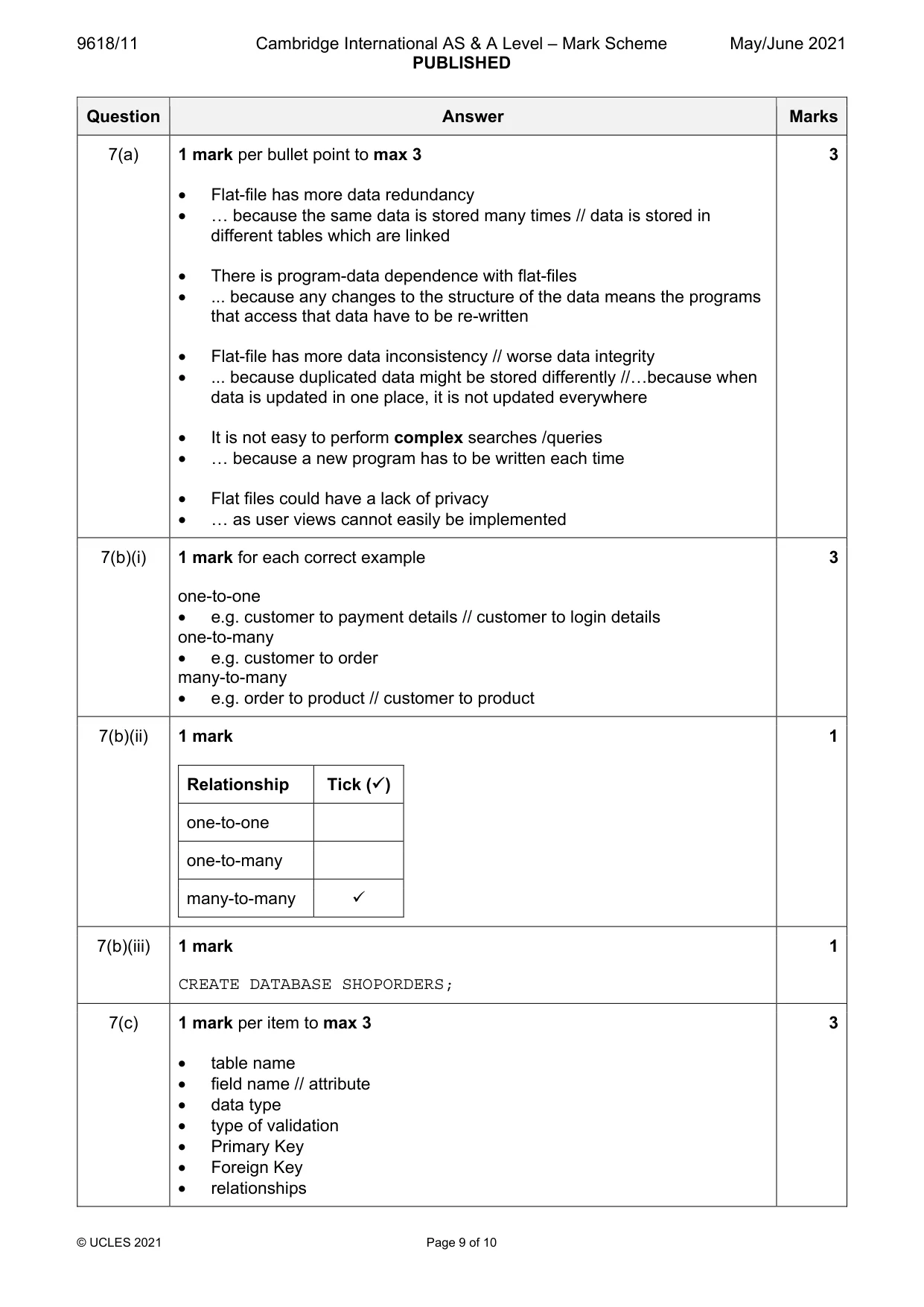
9618/11 Cambridge International AS & A Level – Mark Scheme PUBLISHED May/June 2021 © UCLES 2021 Page 9 of 10 Question Answer Marks 7(a) 1 mark per bullet point to max 3 • Flat-file has more data redundancy • … because the same data is stored many times // data is stored in different tables which are linked • There is program-data dependence with flat-files • ... because any changes to the structure of the data means the programs that access that data have to be re-written • Flat-file has more data inconsistency // worse data integrity • ... because duplicated data might be stored differently //…because when data is updated in one place, it is not updated everywhere • It is not easy to perform complex searches /queries • … because a new program has to be written each time • Flat files could have a lack of privacy • … as user views cannot easily be implemented 3 7(b)(i) 1 mark for each correct example one-to-one • e.g. customer to payment details // customer to login details one-to-many • e.g. customer to order many-to-many • e.g. order to product // customer to product 3 7(b)(ii) 1 mark Relationship Tick () one-to-one one-to-many many-to-many 1 7(b)(iii) 1 mark CREATE DATABASE SHOPORDERS; 1 7(c) 1 mark per item to max 3 • table name • field name // attribute • data type • type of validation • Primary Key • Foreign Key • relationships 3
Mark scheme, page 10
9618/11 Cambridge International AS & A Level – Mark Scheme PUBLISHED May/June 2021 © UCLES 2021 Page 10 of 10 Question Answer Marks 8 1 mark per correct row Statement AND NAND NOR XOR OR The output is 1 only when both inputs are 1 The output is 1 only when both inputs are different The output is 1 only when both inputs are 0 3
What you needed in this session
Cambridge’s own grade thresholds for 2021 May/June, Paper 1 · Variant 1. A higher threshold means an easier paper — the bar moves with how the cohort did.