Cambridge A Level Classical Studies 9274 — 2024 Oct/Nov Paper 3 · Variant 2
9274/32/O/N/24 · 50 marks · ≈56 min
The question paper and its mark scheme, free to read here and free to download. This is Cambridge’s own paper, exactly as it was sat.
Question paper4 pages
Mark scheme13 pages
Answers below. Sit the paper first if you are practising.
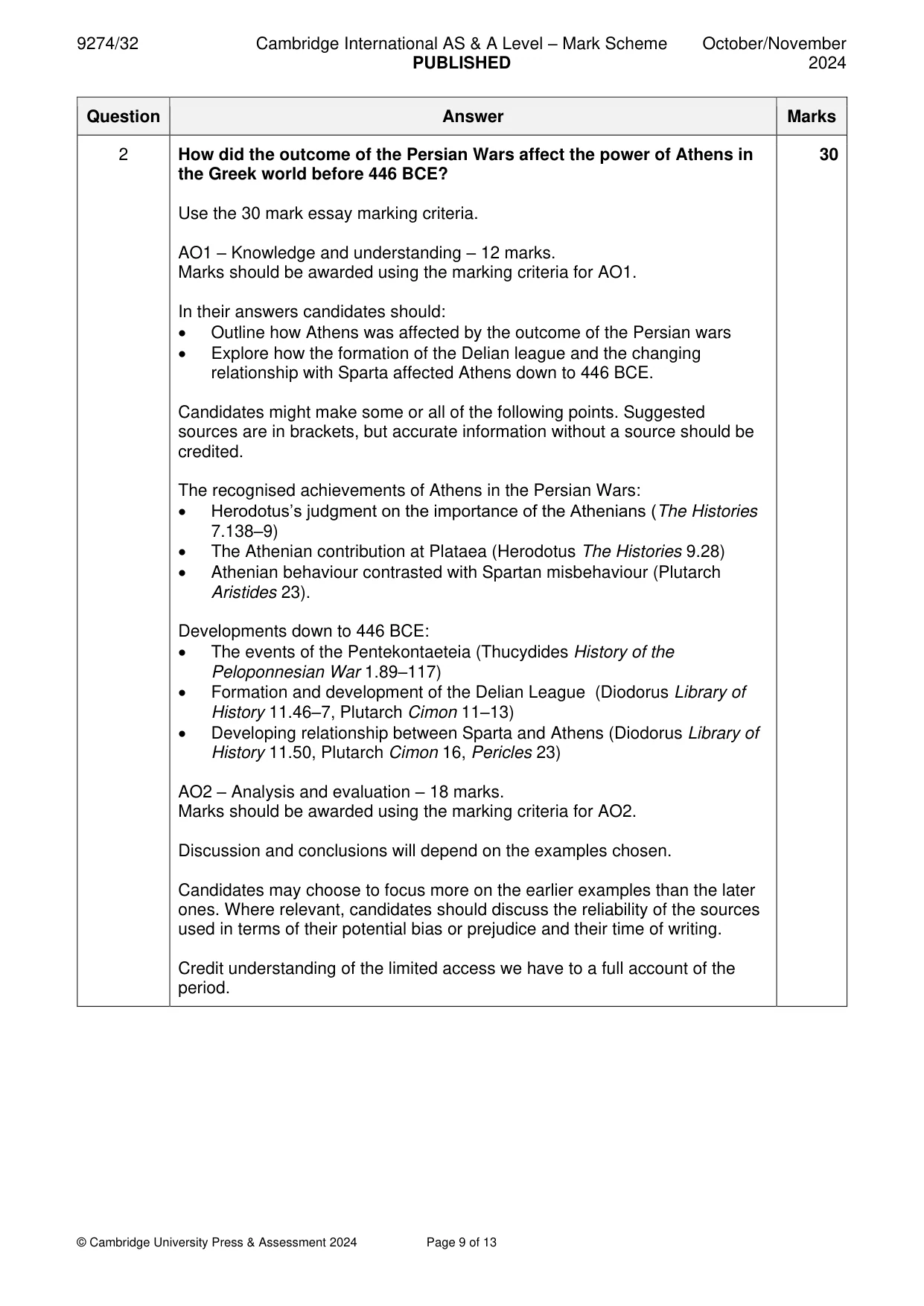
Paper as text
Question paper, page 1
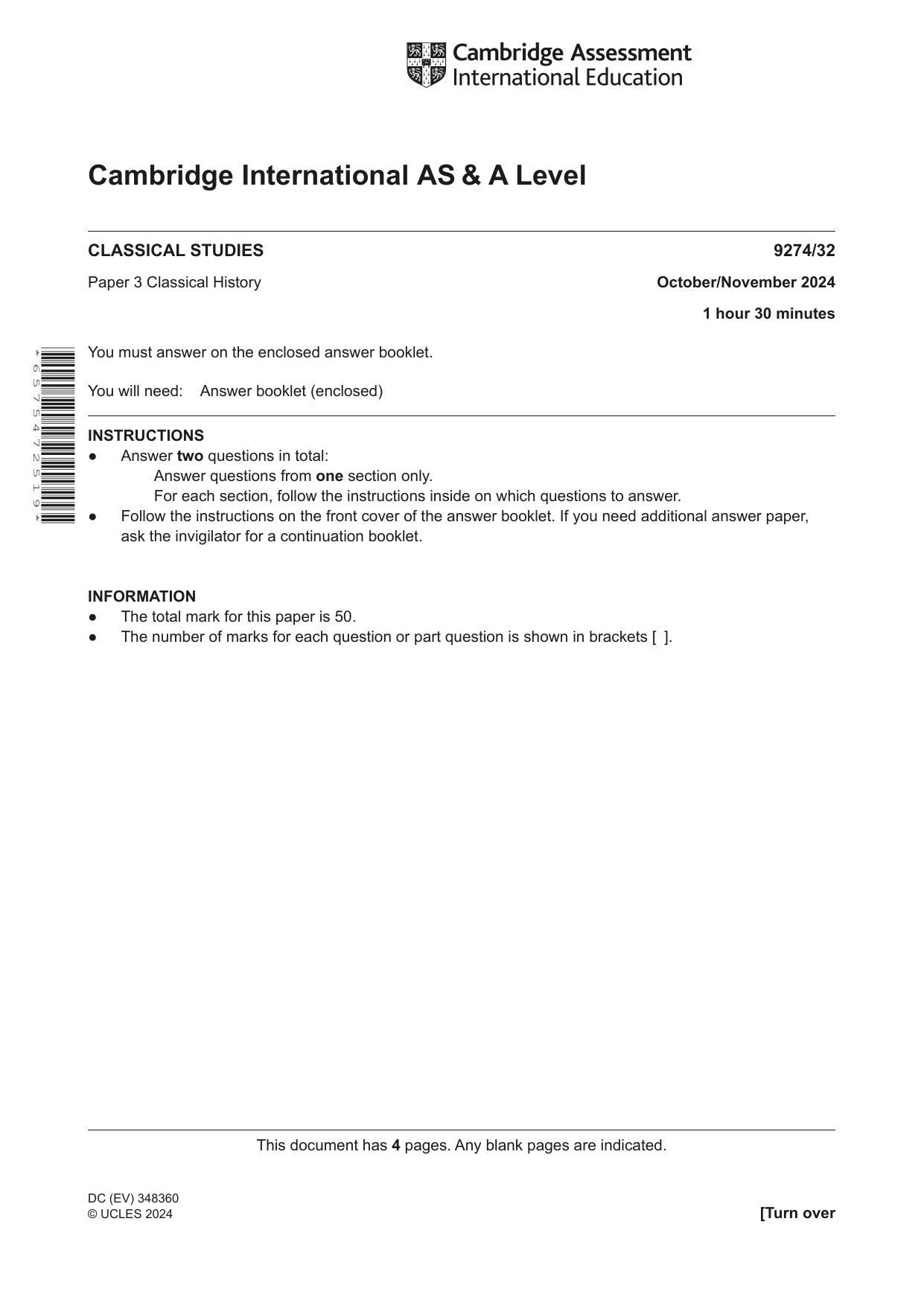
This document has 4 pages. Any blank pages are indicated. [Turn over Cambridge International AS & A Level DC (EV) 348360 © UCLES 2024 * 6 5 7 5 4 7 2 5 1 9 * CLASSICAL STUDIES 9274/32 Paper 3 Classical History October/November 2024 1 hour 30 minutes You must answer on the enclosed answer booklet. You will need: Answer booklet (enclosed) INSTRUCTIONS ● Answer two questions in total: Answer questions from one section only. For each section, follow the instructions inside on which questions to answer. ● Follow the instructions on the front cover of the answer booklet. If you need additional answer paper, ask the invigilator for a continuation booklet. INFORMATION ● The total mark for this paper is 50. ● The number of marks for each question or part question is shown in brackets [ ].
Question paper, page 2
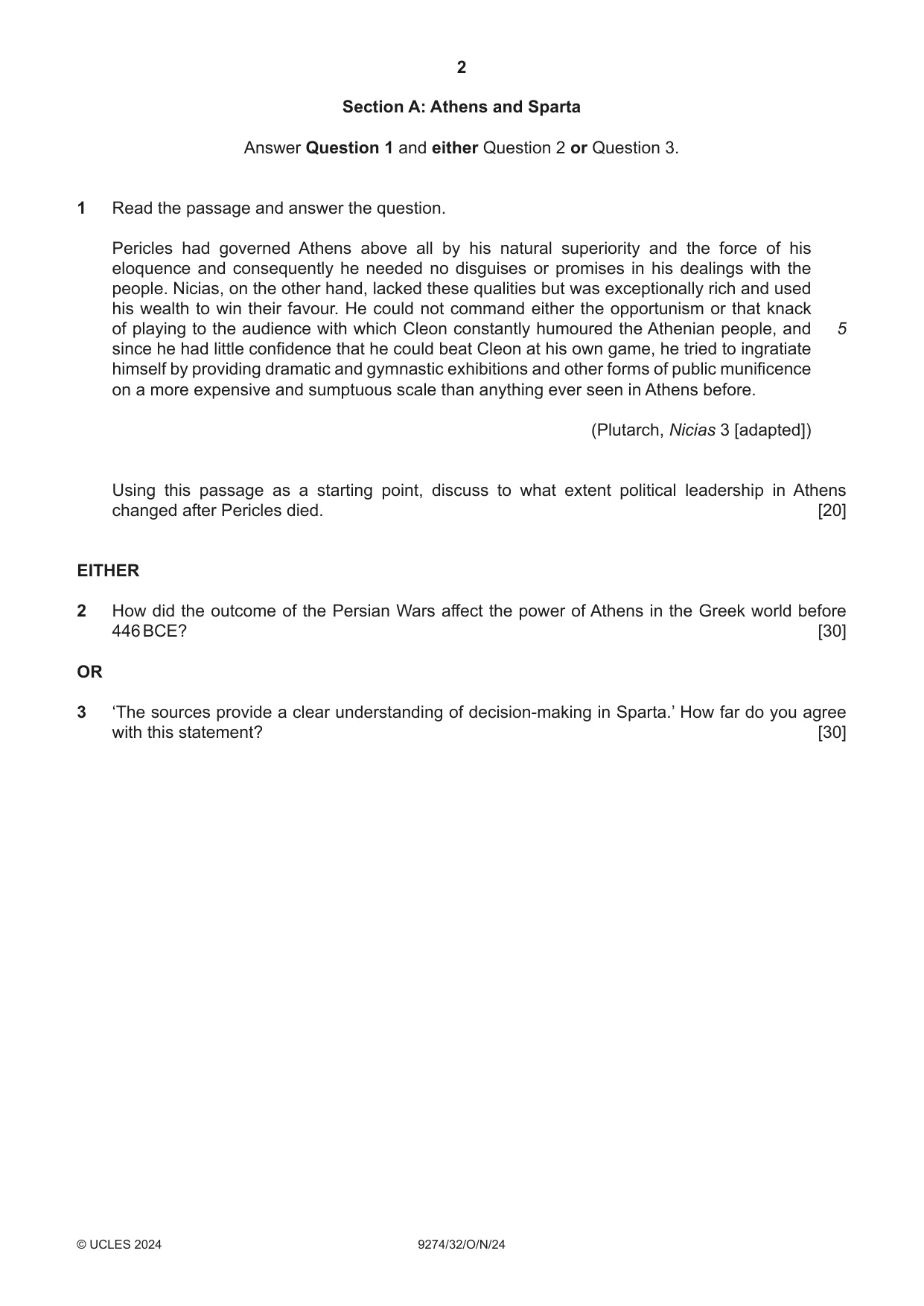
2 9274/32/O/N/24 © UCLES 2024 Section A: Athens and Sparta Answer Question 1 and either Question 2 or Question 3. 1 Read the passage and answer the question. Pericles had governed Athens above all by his natural superiority and the force of his eloquence and consequently he needed no disguises or promises in his dealings with the people. Nicias, on the other hand, lacked these qualities but was exceptionally rich and used his wealth to win their favour. He could not command either the opportunism or that knack of playing to the audience with which Cleon constantly humoured the Athenian people, and since he had little confidence that he could beat Cleon at his own game, he tried to ingratiate himself by providing dramatic and gymnastic exhibitions and other forms of public munificence on a more expensive and sumptuous scale than anything ever seen in Athens before. (Plutarch, Nicias 3 [adapted]) Using this passage as a starting point, discuss to what extent political leadership in Athens changed after Pericles died. [20] EITHER 2 How did the outcome of the Persian Wars affect the power of Athens in the Greek world before 446 BCE? [30] OR 3 ‘The sources provide a clear understanding of decision-making in Sparta.’ How far do you agree with this statement? [30] 5
Question paper, page 3
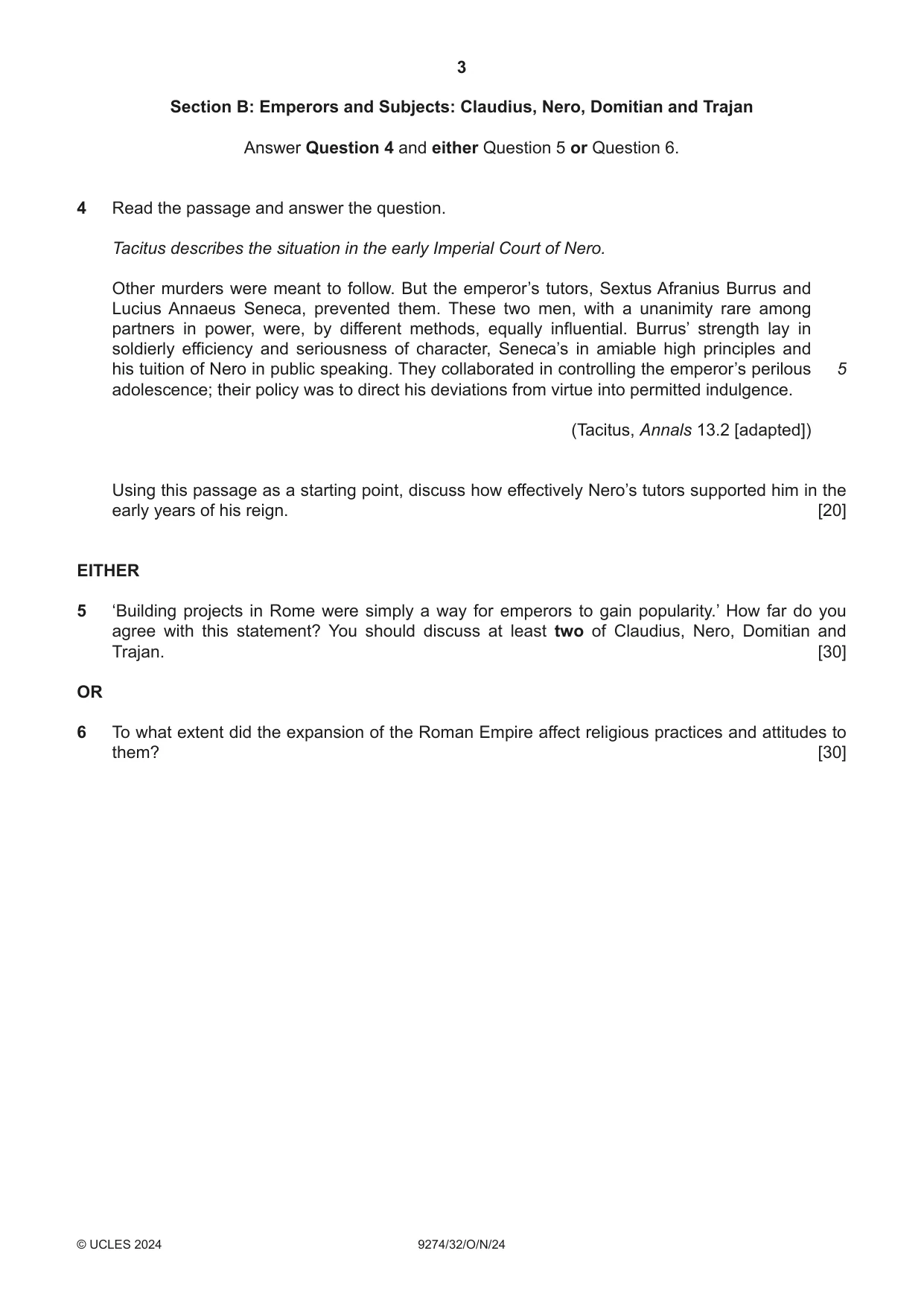
3 9274/32/O/N/24 © UCLES 2024 Section B: Emperors and Subjects: Claudius, Nero, Domitian and Trajan Answer Question 4 and either Question 5 or Question 6. 4 Read the passage and answer the question. Tacitus describes the situation in the early Imperial Court of Nero. Other murders were meant to follow. But the emperor’s tutors, Sextus Afranius Burrus and Lucius Annaeus Seneca, prevented them. These two men, with a unanimity rare among partners in power, were, by different methods, equally influential. Burrus’ strength lay in soldierly efficiency and seriousness of character, Seneca’s in amiable high principles and his tuition of Nero in public speaking. They collaborated in controlling the emperor’s perilous adolescence; their policy was to direct his deviations from virtue into permitted indulgence. (Tacitus, Annals 13.2 [adapted]) Using this passage as a starting point, discuss how effectively Nero’s tutors supported him in the early years of his reign. [20] EITHER 5 ‘Building projects in Rome were simply a way for emperors to gain popularity.’ How far do you agree with this statement? You should discuss at least two of Claudius, Nero, Domitian and Trajan. [30] OR 6 To what extent did the expansion of the Roman Empire affect religious practices and attitudes to them? [30] 5
Question paper, page 4
4 9274/32/O/N/24 © UCLES 2024 Permission to reproduce items where third-party owned material protected by copyright is included has been sought and cleared where possible. Every reasonable effort has been made by the publisher (UCLES) to trace copyright holders, but if any items requiring clearance have unwittingly been included, the publisher will be pleased to make amends at the earliest possible opportunity. To avoid the issue of disclosure of answer-related information to candidates, all copyright acknowledgements are reproduced online in the Cambridge Assessment International Education Copyright Acknowledgements Booklet. This is produced for each series of examinations and is freely available to download at www.cambridgeinternational.org after the live examination series. Cambridge Assessment International Education is part of Cambridge Assessment. Cambridge Assessment is the brand name of the University of Cambridge Local Examinations Syndicate (UCLES), which is a department of the University of Cambridge. BLANK PAGE
Mark scheme, page 1
This document consists of 13 printed pages. © Cambridge University Press & Assessment 2024 [Turn over Cambridge International AS & A Level CLASSICAL STUDIES 9274/32 Paper 3 Classical History October/November 2024 MARK SCHEME Maximum Mark: 50 Published This mark scheme is published as an aid to teachers and candidates, to indicate the requirements of the examination. It shows the basis on which Examiners were instructed to award marks. It does not indicate the details of the discussions that took place at an Examiners’ meeting before marking began, which would have considered the acceptability of alternative answers. Mark schemes should be read in conjunction with the question paper and the Principal Examiner Report for Teachers. Cambridge International will not enter into discussions about these mark schemes. Cambridge International is publishing the mark schemes for the October/November 2024 series for most Cambridge IGCSE, Cambridge International A and AS Level components, and some Cambridge O Level components.
Mark scheme, page 2
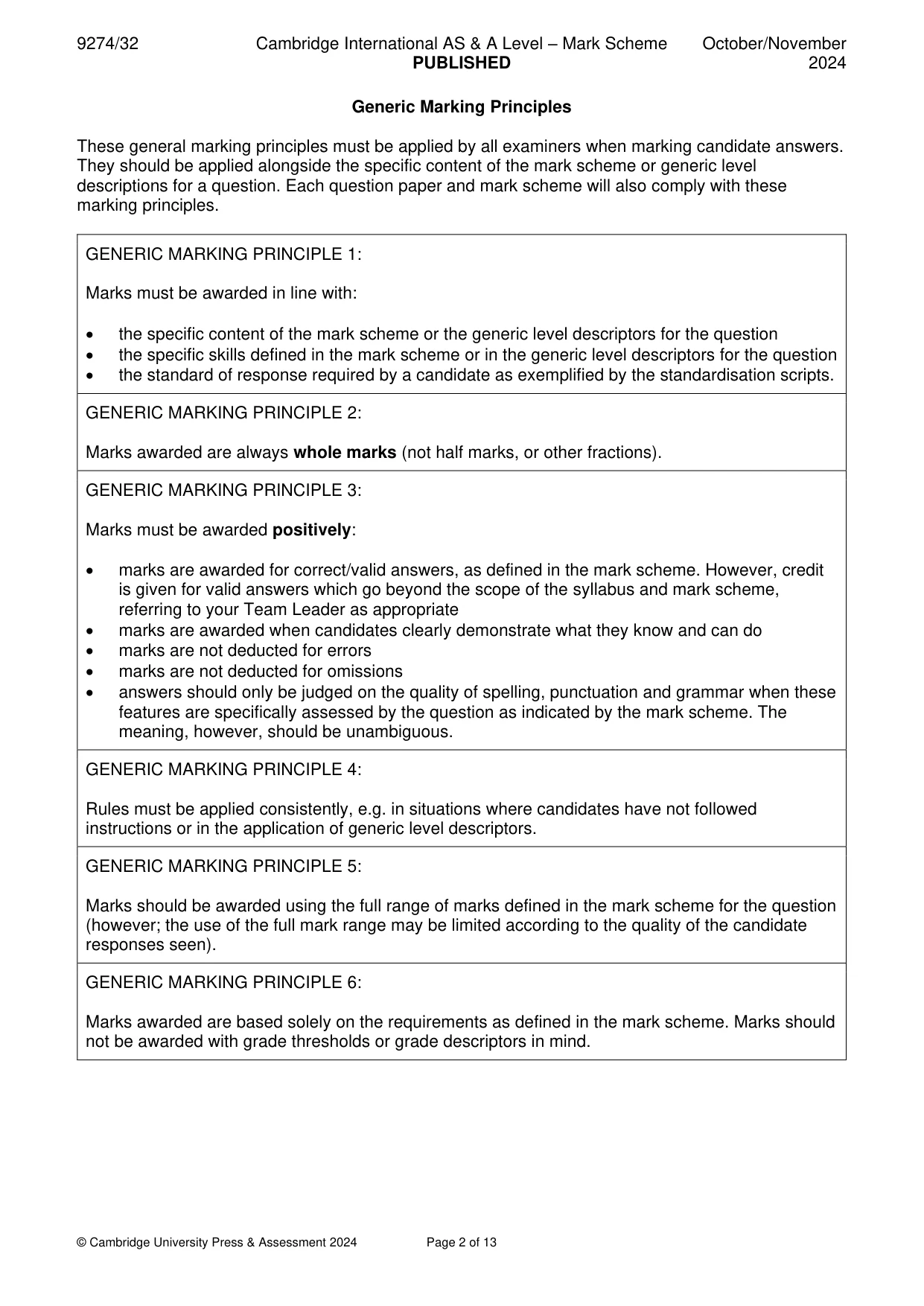
9274/32 Cambridge International AS & A Level – Mark Scheme PUBLISHED October/November 2024 © Cambridge University Press & Assessment 2024 Page 2 of 13 Generic Marking Principles These general marking principles must be applied by all examiners when marking candidate answers. They should be applied alongside the specific content of the mark scheme or generic level descriptions for a question. Each question paper and mark scheme will also comply with these marking principles. GENERIC MARKING PRINCIPLE 1: Marks must be awarded in line with: • the specific content of the mark scheme or the generic level descriptors for the question • the specific skills defined in the mark scheme or in the generic level descriptors for the question • the standard of response required by a candidate as exemplified by the standardisation scripts. GENERIC MARKING PRINCIPLE 2: Marks awarded are always whole marks (not half marks, or other fractions). GENERIC MARKING PRINCIPLE 3: Marks must be awarded positively: • marks are awarded for correct/valid answers, as defined in the mark scheme. However, credit is given for valid answers which go beyond the scope of the syllabus and mark scheme, referring to your Team Leader as appropriate • marks are awarded when candidates clearly demonstrate what they know and can do • marks are not deducted for errors • marks are not deducted for omissions • answers should only be judged on the quality of spelling, punctuation and grammar when these features are specifically assessed by the question as indicated by the mark scheme. The meaning, however, should be unambiguous. GENERIC MARKING PRINCIPLE 4: Rules must be applied consistently, e.g. in situations where candidates have not followed instructions or in the application of generic level descriptors. GENERIC MARKING PRINCIPLE 5: Marks should be awarded using the full range of marks defined in the mark scheme for the question (however; the use of the full mark range may be limited according to the quality of the candidate responses seen). GENERIC MARKING PRINCIPLE 6: Marks awarded are based solely on the requirements as defined in the mark scheme. Marks should not be awarded with grade thresholds or grade descriptors in mind.
Mark scheme, page 3
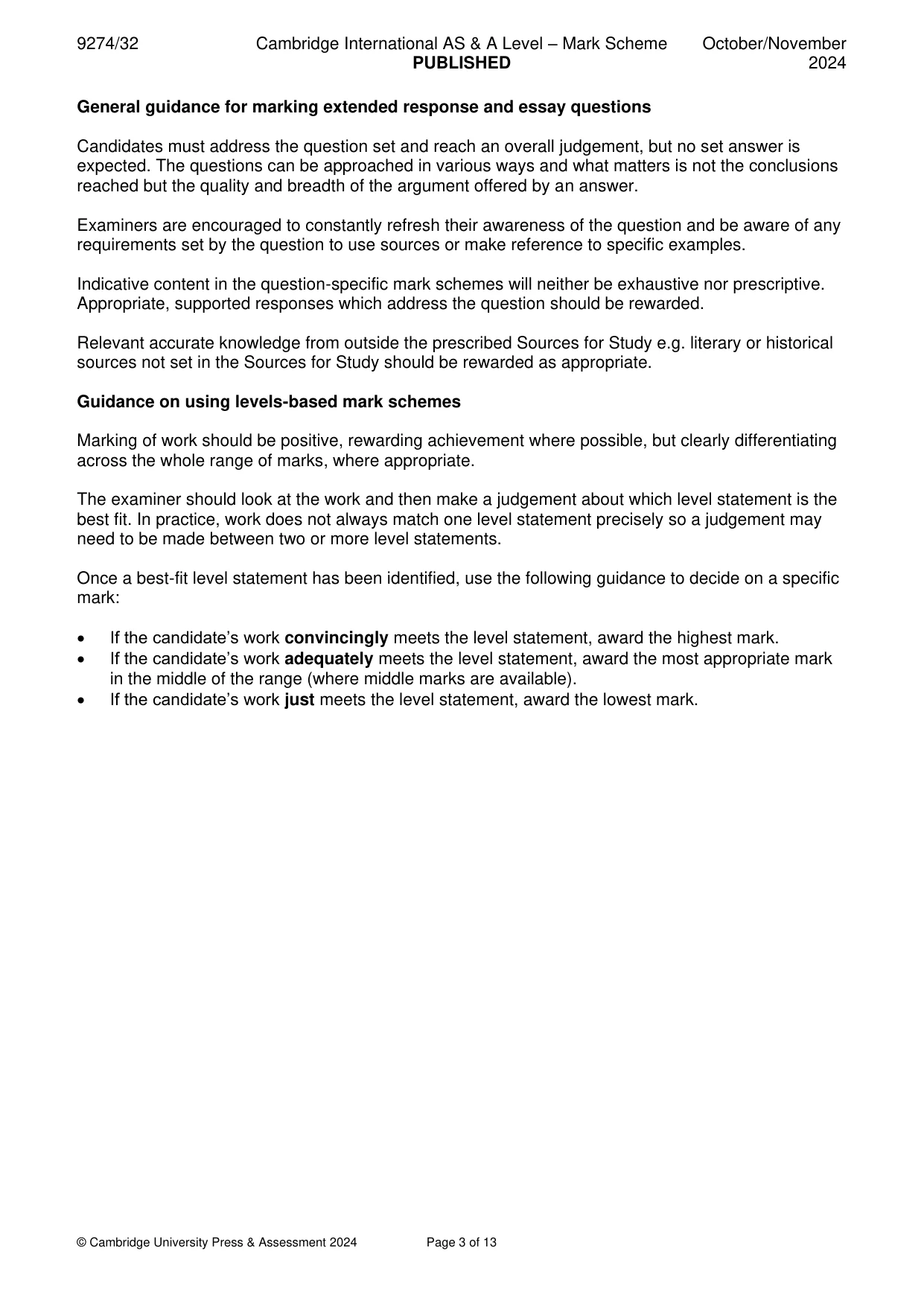
9274/32 Cambridge International AS & A Level – Mark Scheme PUBLISHED October/November 2024 © Cambridge University Press & Assessment 2024 Page 3 of 13 General guidance for marking extended response and essay questions Candidates must address the question set and reach an overall judgement, but no set answer is expected. The questions can be approached in various ways and what matters is not the conclusions reached but the quality and breadth of the argument offered by an answer. Examiners are encouraged to constantly refresh their awareness of the question and be aware of any requirements set by the question to use sources or make reference to specific examples. Indicative content in the question-specific mark schemes will neither be exhaustive nor prescriptive. Appropriate, supported responses which address the question should be rewarded. Relevant accurate knowledge from outside the prescribed Sources for Study e.g. literary or historical sources not set in the Sources for Study should be rewarded as appropriate. Guidance on using levels-based mark schemes Marking of work should be positive, rewarding achievement where possible, but clearly differentiating across the whole range of marks, where appropriate. The examiner should look at the work and then make a judgement about which level statement is the best fit. In practice, work does not always match one level statement precisely so a judgement may need to be made between two or more level statements. Once a best-fit level statement has been identified, use the following guidance to decide on a specific mark: • If the candidate’s work convincingly meets the level statement, award the highest mark. • If the candidate’s work adequately meets the level statement, award the most appropriate mark in the middle of the range (where middle marks are available). • If the candidate’s work just meets the level statement, award the lowest mark.
Mark scheme, page 4
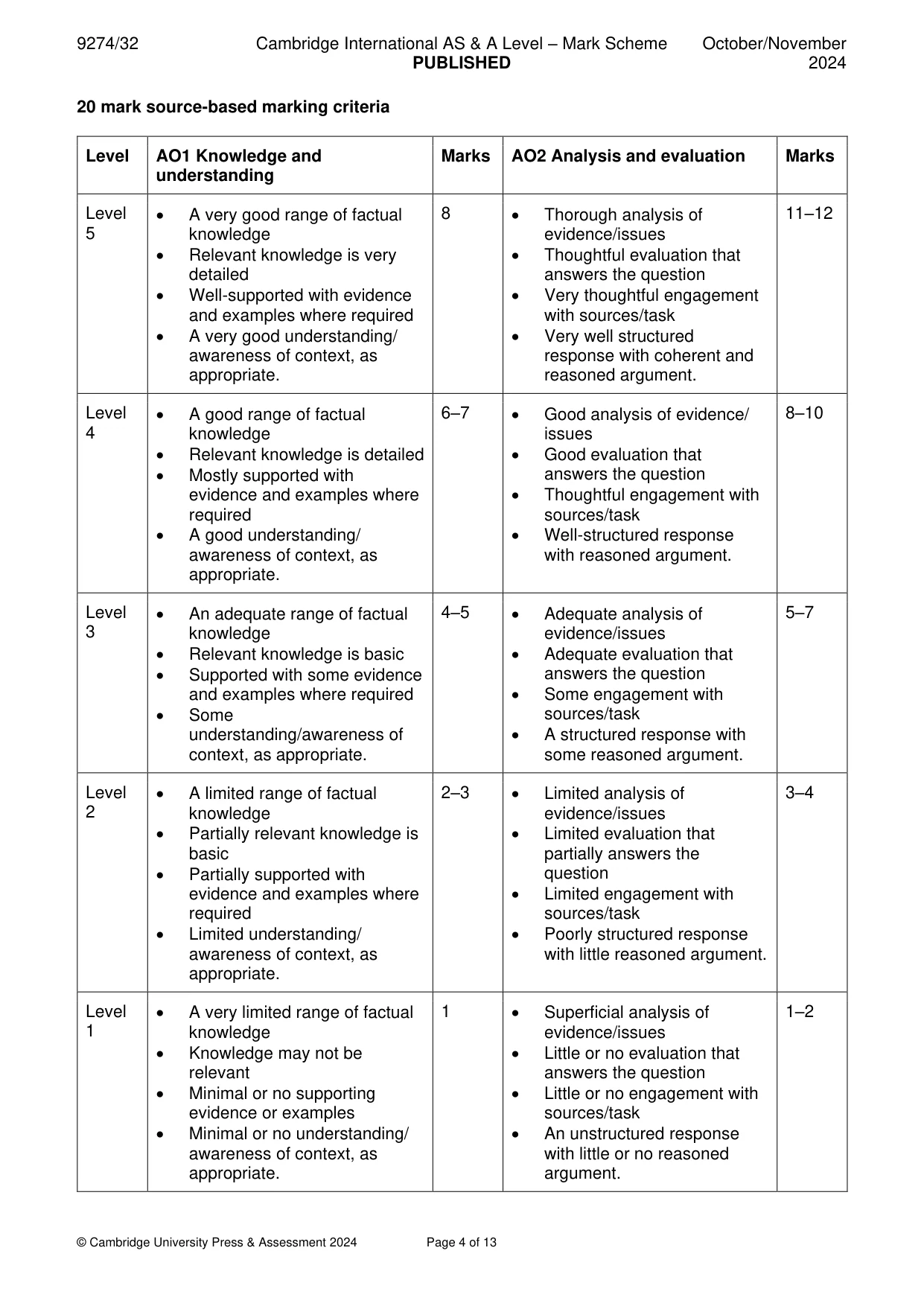
9274/32 Cambridge International AS & A Level – Mark Scheme PUBLISHED October/November 2024 © Cambridge University Press & Assessment 2024 Page 4 of 13 20 mark source-based marking criteria Level AO1 Knowledge and understanding Marks AO2 Analysis and evaluation Marks Level 5 • A very good range of factual knowledge • Relevant knowledge is very detailed • Well-supported with evidence and examples where required • A very good understanding/ awareness of context, as appropriate. 8 • Thorough analysis of evidence/issues • Thoughtful evaluation that answers the question • Very thoughtful engagement with sources/task • Very well structured response with coherent and reasoned argument. 11–12 Level 4 • A good range of factual knowledge • Relevant knowledge is detailed • Mostly supported with evidence and examples where required • A good understanding/ awareness of context, as appropriate. 6–7 • Good analysis of evidence/ issues • Good evaluation that answers the question • Thoughtful engagement with sources/task • Well-structured response with reasoned argument. 8–10 Level 3 • An adequate range of factual knowledge • Relevant knowledge is basic • Supported with some evidence and examples where required • Some understanding/awareness of context, as appropriate. 4–5 • Adequate analysis of evidence/issues • Adequate evaluation that answers the question • Some engagement with sources/task • A structured response with some reasoned argument. 5–7 Level 2 • A limited range of factual knowledge • Partially relevant knowledge is basic • Partially supported with evidence and examples where required • Limited understanding/ awareness of context, as appropriate. 2–3 • Limited analysis of evidence/issues • Limited evaluation that partially answers the question • Limited engagement with sources/task • Poorly structured response with little reasoned argument. 3–4 Level 1 • A very limited range of factual knowledge • Knowledge may not be relevant • Minimal or no supporting evidence or examples • Minimal or no understanding/ awareness of context, as appropriate. 1 • Superficial analysis of evidence/issues • Little or no evaluation that answers the question • Little or no engagement with sources/task • An unstructured response with little or no reasoned argument. 1–2
Mark scheme, page 5
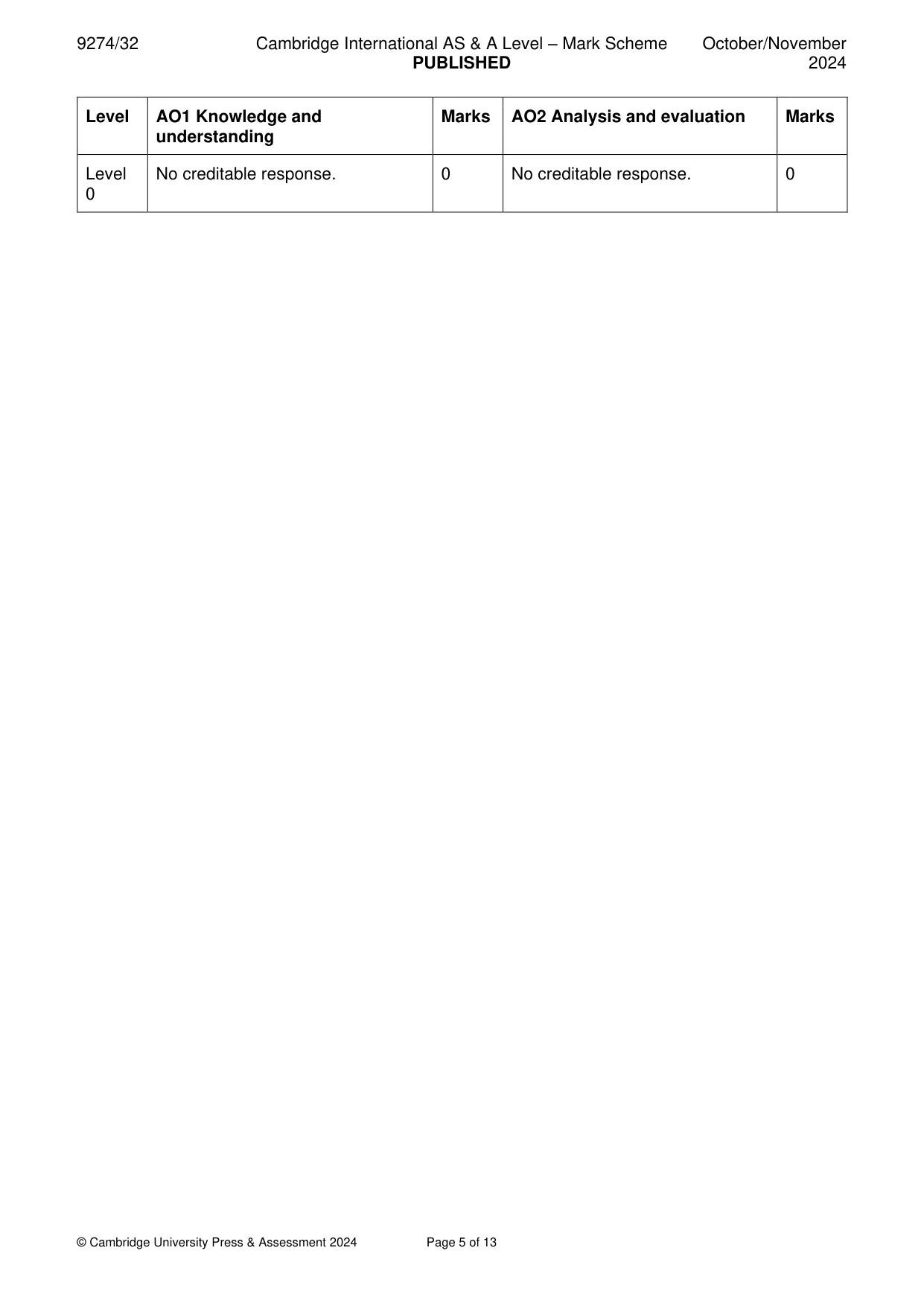
9274/32 Cambridge International AS & A Level – Mark Scheme PUBLISHED October/November 2024 © Cambridge University Press & Assessment 2024 Page 5 of 13 Level AO1 Knowledge and understanding Marks AO2 Analysis and evaluation Marks Level 0 No creditable response. 0 No creditable response. 0
Mark scheme, page 6
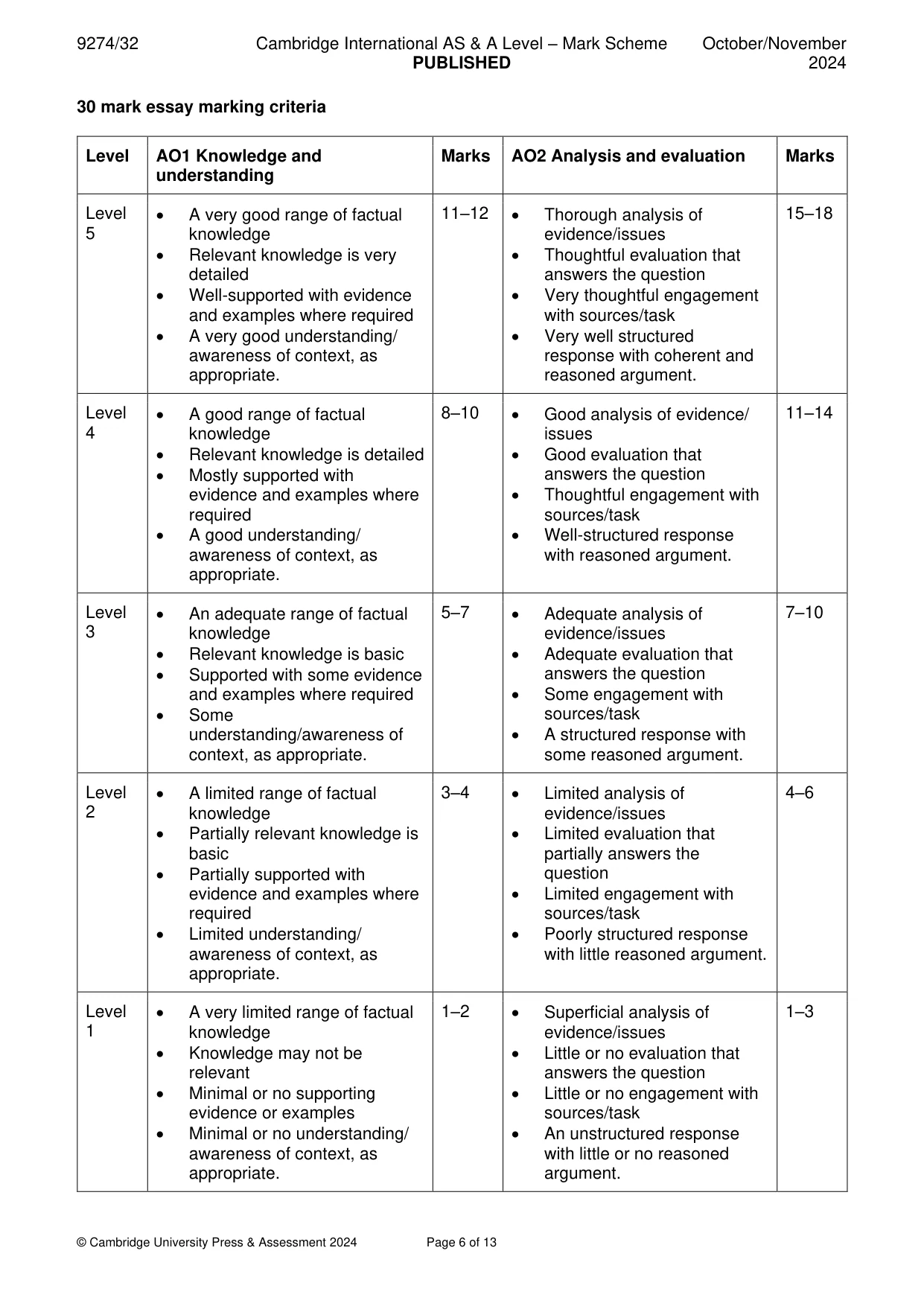
9274/32 Cambridge International AS & A Level – Mark Scheme PUBLISHED October/November 2024 © Cambridge University Press & Assessment 2024 Page 6 of 13 30 mark essay marking criteria Level AO1 Knowledge and understanding Marks AO2 Analysis and evaluation Marks Level 5 • A very good range of factual knowledge • Relevant knowledge is very detailed • Well-supported with evidence and examples where required • A very good understanding/ awareness of context, as appropriate. 11–12 • Thorough analysis of evidence/issues • Thoughtful evaluation that answers the question • Very thoughtful engagement with sources/task • Very well structured response with coherent and reasoned argument. 15–18 Level 4 • A good range of factual knowledge • Relevant knowledge is detailed • Mostly supported with evidence and examples where required • A good understanding/ awareness of context, as appropriate. 8–10 • Good analysis of evidence/ issues • Good evaluation that answers the question • Thoughtful engagement with sources/task • Well-structured response with reasoned argument. 11–14 Level 3 • An adequate range of factual knowledge • Relevant knowledge is basic • Supported with some evidence and examples where required • Some understanding/awareness of context, as appropriate. 5–7 • Adequate analysis of evidence/issues • Adequate evaluation that answers the question • Some engagement with sources/task • A structured response with some reasoned argument. 7–10 Level 2 • A limited range of factual knowledge • Partially relevant knowledge is basic • Partially supported with evidence and examples where required • Limited understanding/ awareness of context, as appropriate. 3–4 • Limited analysis of evidence/issues • Limited evaluation that partially answers the question • Limited engagement with sources/task • Poorly structured response with little reasoned argument. 4–6 Level 1 • A very limited range of factual knowledge • Knowledge may not be relevant • Minimal or no supporting evidence or examples • Minimal or no understanding/ awareness of context, as appropriate. 1–2 • Superficial analysis of evidence/issues • Little or no evaluation that answers the question • Little or no engagement with sources/task • An unstructured response with little or no reasoned argument. 1–3
Mark scheme, page 7
9274/32 Cambridge International AS & A Level – Mark Scheme PUBLISHED October/November 2024 © Cambridge University Press & Assessment 2024 Page 7 of 13 Level AO1 Knowledge and understanding Marks AO2 Analysis and evaluation Marks Level 0 No creditable response. 0 No creditable response. 0
Mark scheme, page 8
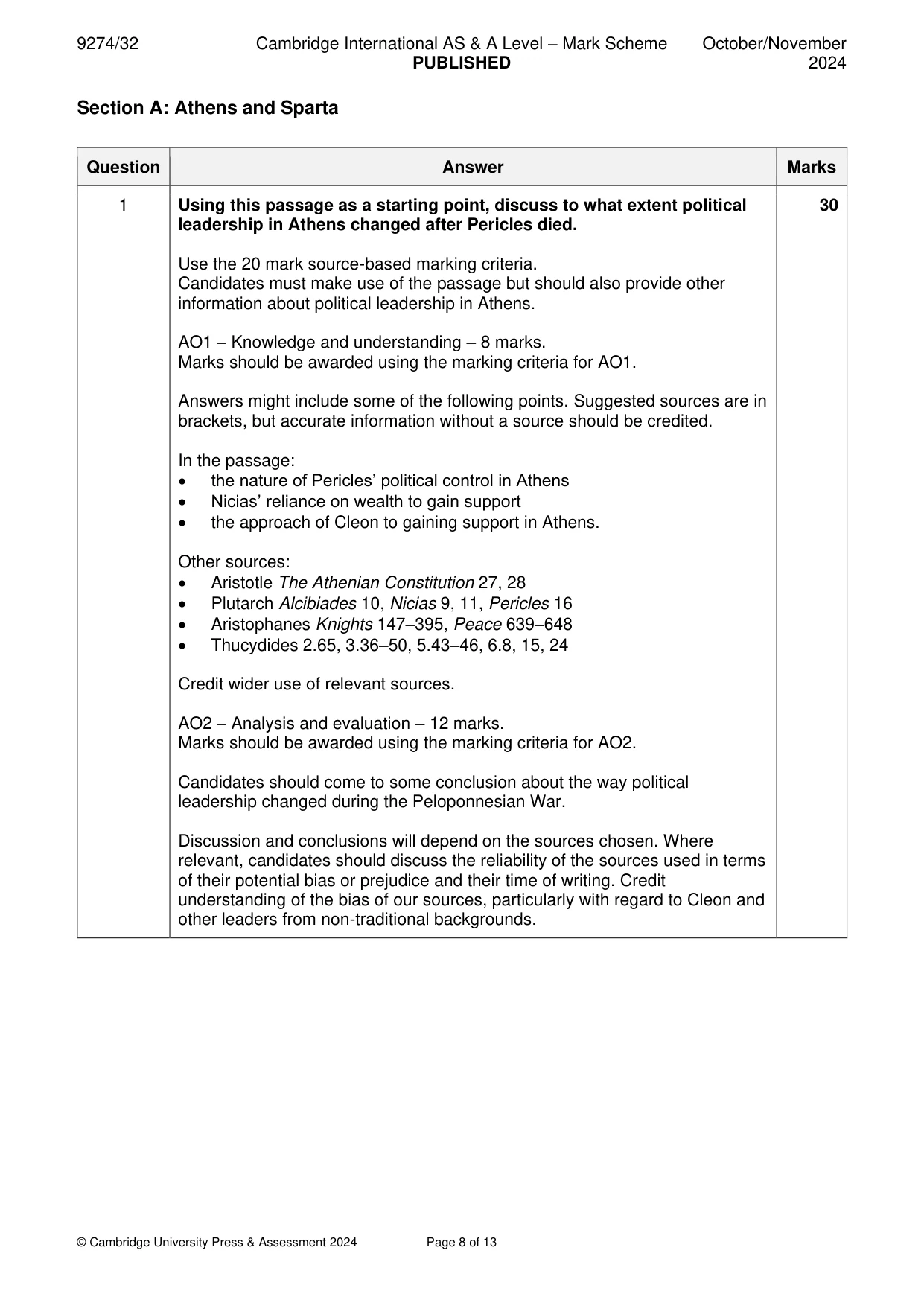
9274/32 Cambridge International AS & A Level – Mark Scheme PUBLISHED October/November 2024 © Cambridge University Press & Assessment 2024 Page 8 of 13 Section A: Athens and Sparta Question Answer Marks 1 Using this passage as a starting point, discuss to what extent political leadership in Athens changed after Pericles died. Use the 20 mark source-based marking criteria. Candidates must make use of the passage but should also provide other information about political leadership in Athens. AO1 – Knowledge and understanding – 8 marks. Marks should be awarded using the marking criteria for AO1. Answers might include some of the following points. Suggested sources are in brackets, but accurate information without a source should be credited. In the passage: • the nature of Pericles’ political control in Athens • Nicias’ reliance on wealth to gain support • the approach of Cleon to gaining support in Athens. Other sources: • Aristotle The Athenian Constitution 27, 28 • Plutarch Alcibiades 10, Nicias 9, 11, Pericles 16 • Aristophanes Knights 147–395, Peace 639–648 • Thucydides 2.65, 3.36–50, 5.43–46, 6.8, 15, 24 Credit wider use of relevant sources. AO2 – Analysis and evaluation – 12 marks. Marks should be awarded using the marking criteria for AO2. Candidates should come to some conclusion about the way political leadership changed during the Peloponnesian War. Discussion and conclusions will depend on the sources chosen. Where relevant, candidates should discuss the reliability of the sources used in terms of their potential bias or prejudice and their time of writing. Credit understanding of the bias of our sources, particularly with regard to Cleon and other leaders from non-traditional backgrounds. 30
Mark scheme, page 9
9274/32 Cambridge International AS & A Level – Mark Scheme PUBLISHED October/November 2024 © Cambridge University Press & Assessment 2024 Page 9 of 13 Question Answer Marks 2 How did the outcome of the Persian Wars affect the power of Athens in the Greek world before 446 BCE? Use the 30 mark essay marking criteria. AO1 – Knowledge and understanding – 12 marks. Marks should be awarded using the marking criteria for AO1. In their answers candidates should: • Outline how Athens was affected by the outcome of the Persian wars • Explore how the formation of the Delian league and the changing relationship with Sparta affected Athens down to 446 BCE. Candidates might make some or all of the following points. Suggested sources are in brackets, but accurate information without a source should be credited. The recognised achievements of Athens in the Persian Wars: • Herodotus’s judgment on the importance of the Athenians (The Histories 7.138–9) • The Athenian contribution at Plataea (Herodotus The Histories 9.28) • Athenian behaviour contrasted with Spartan misbehaviour (Plutarch Aristides 23). Developments down to 446 BCE: • The events of the Pentekontaeteia (Thucydides History of the Peloponnesian War 1.89–117) • Formation and development of the Delian League (Diodorus Library of History 11.46–7, Plutarch Cimon 11–13) • Developing relationship between Sparta and Athens (Diodorus Library of History 11.50, Plutarch Cimon 16, Pericles 23) AO2 – Analysis and evaluation – 18 marks. Marks should be awarded using the marking criteria for AO2. Discussion and conclusions will depend on the examples chosen. Candidates may choose to focus more on the earlier examples than the later ones. Where relevant, candidates should discuss the reliability of the sources used in terms of their potential bias or prejudice and their time of writing. Credit understanding of the limited access we have to a full account of the period. 30
Mark scheme, page 10
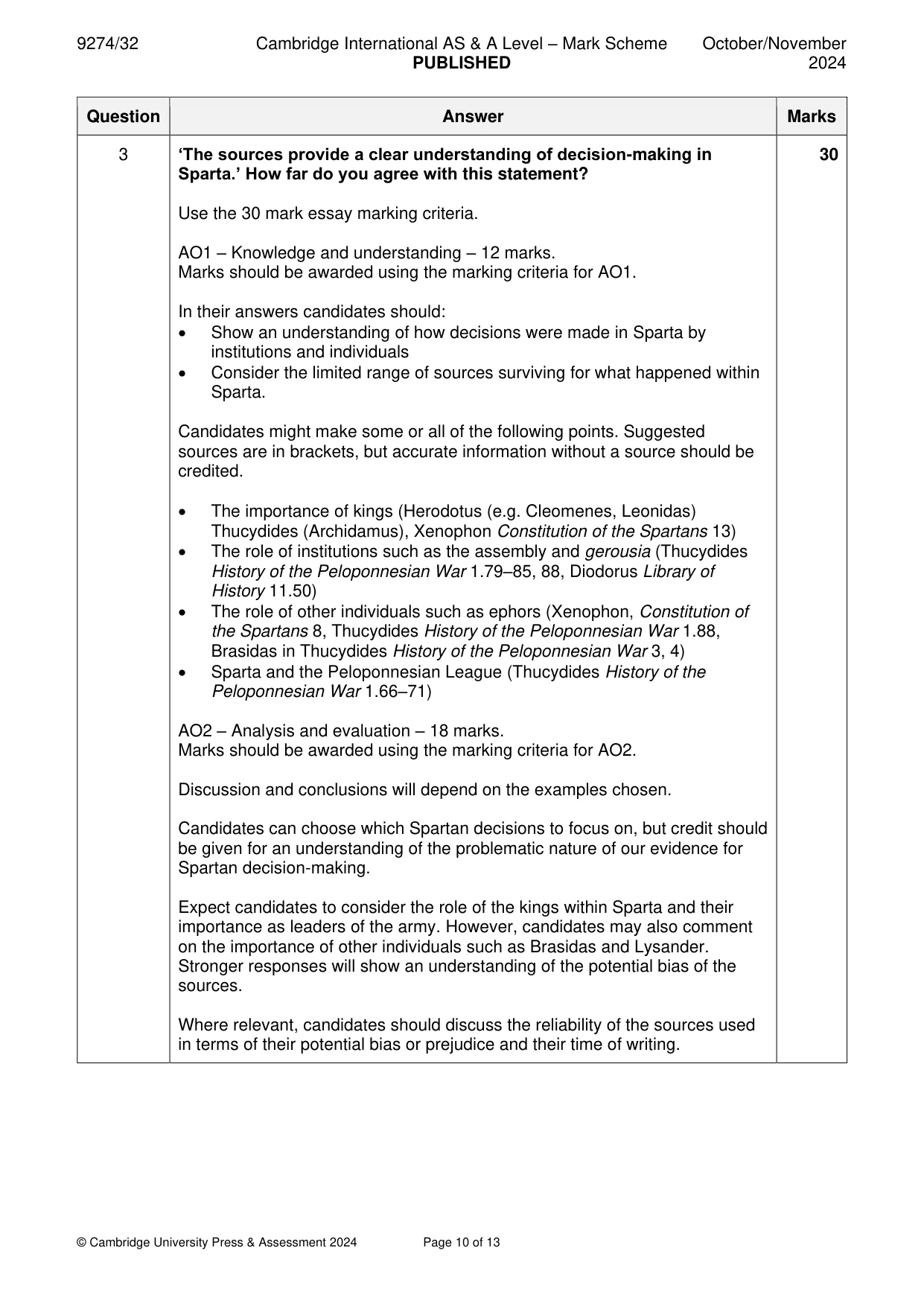
9274/32 Cambridge International AS & A Level – Mark Scheme PUBLISHED October/November 2024 © Cambridge University Press & Assessment 2024 Page 10 of 13 Question Answer Marks 3 ‘The sources provide a clear understanding of decision-making in Sparta.’ How far do you agree with this statement? Use the 30 mark essay marking criteria. AO1 – Knowledge and understanding – 12 marks. Marks should be awarded using the marking criteria for AO1. In their answers candidates should: • Show an understanding of how decisions were made in Sparta by institutions and individuals • Consider the limited range of sources surviving for what happened within Sparta. Candidates might make some or all of the following points. Suggested sources are in brackets, but accurate information without a source should be credited. • The importance of kings (Herodotus (e.g. Cleomenes, Leonidas) Thucydides (Archidamus), Xenophon Constitution of the Spartans 13) • The role of institutions such as the assembly and gerousia (Thucydides History of the Peloponnesian War 1.79–85, 88, Diodorus Library of History 11.50) • The role of other individuals such as ephors (Xenophon, Constitution of the Spartans 8, Thucydides History of the Peloponnesian War 1.88, Brasidas in Thucydides History of the Peloponnesian War 3, 4) • Sparta and the Peloponnesian League (Thucydides History of the Peloponnesian War 1.66–71) AO2 – Analysis and evaluation – 18 marks. Marks should be awarded using the marking criteria for AO2. Discussion and conclusions will depend on the examples chosen. Candidates can choose which Spartan decisions to focus on, but credit should be given for an understanding of the problematic nature of our evidence for Spartan decision-making. Expect candidates to consider the role of the kings within Sparta and their importance as leaders of the army. However, candidates may also comment on the importance of other individuals such as Brasidas and Lysander. Stronger responses will show an understanding of the potential bias of the sources. Where relevant, candidates should discuss the reliability of the sources used in terms of their potential bias or prejudice and their time of writing. 30
Mark scheme, page 11
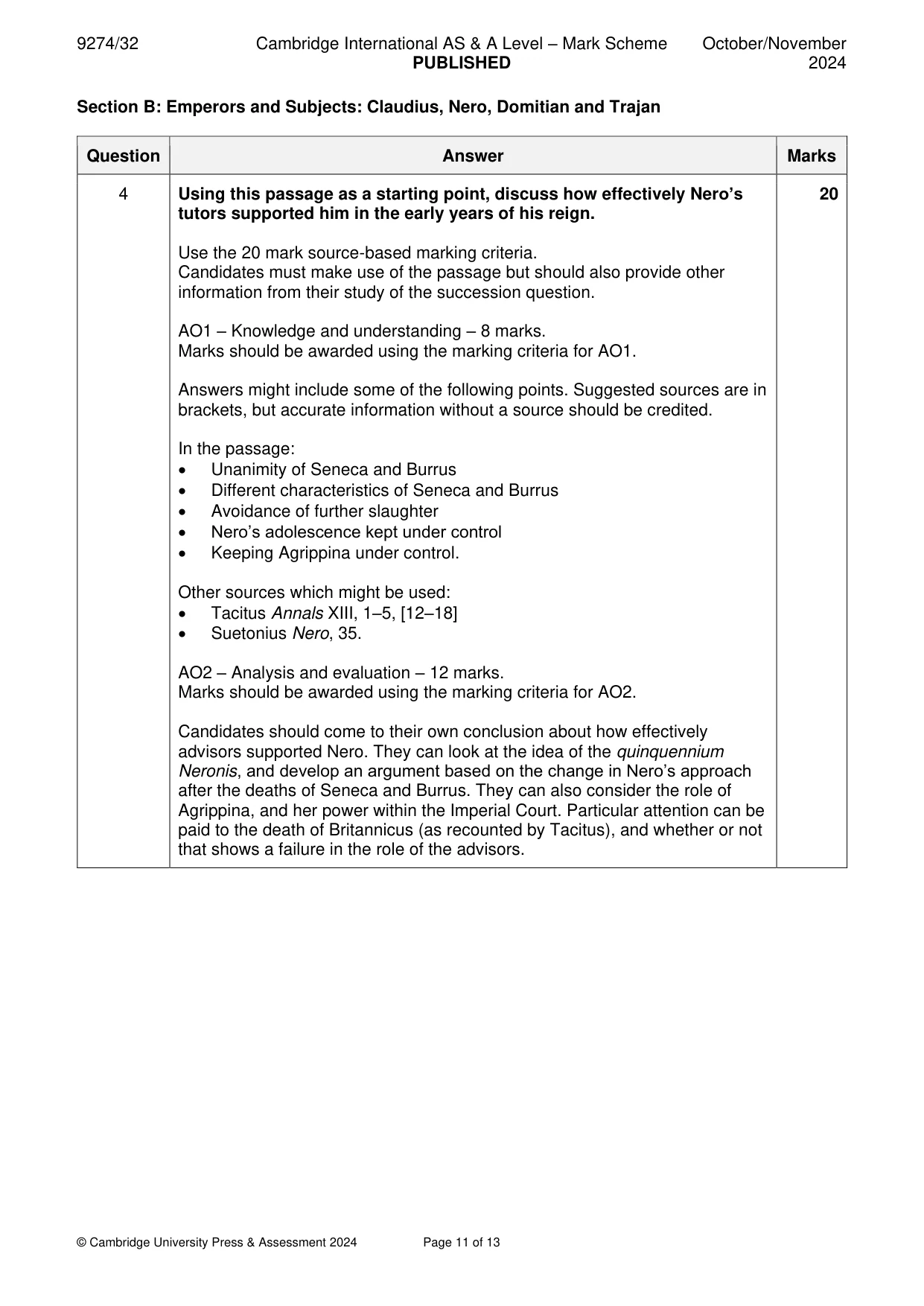
9274/32 Cambridge International AS & A Level – Mark Scheme PUBLISHED October/November 2024 © Cambridge University Press & Assessment 2024 Page 11 of 13 Section B: Emperors and Subjects: Claudius, Nero, Domitian and Trajan Question Answer Marks 4 Using this passage as a starting point, discuss how effectively Nero’s tutors supported him in the early years of his reign. Use the 20 mark source-based marking criteria. Candidates must make use of the passage but should also provide other information from their study of the succession question. AO1 – Knowledge and understanding – 8 marks. Marks should be awarded using the marking criteria for AO1. Answers might include some of the following points. Suggested sources are in brackets, but accurate information without a source should be credited. In the passage: • Unanimity of Seneca and Burrus • Different characteristics of Seneca and Burrus • Avoidance of further slaughter • Nero’s adolescence kept under control • Keeping Agrippina under control. Other sources which might be used: • Tacitus Annals XIII, 1–5, [12–18] • Suetonius Nero, 35. AO2 – Analysis and evaluation – 12 marks. Marks should be awarded using the marking criteria for AO2. Candidates should come to their own conclusion about how effectively advisors supported Nero. They can look at the idea of the quinquennium Neronis, and develop an argument based on the change in Nero’s approach after the deaths of Seneca and Burrus. They can also consider the role of Agrippina, and her power within the Imperial Court. Particular attention can be paid to the death of Britannicus (as recounted by Tacitus), and whether or not that shows a failure in the role of the advisors. 20
Mark scheme, page 12
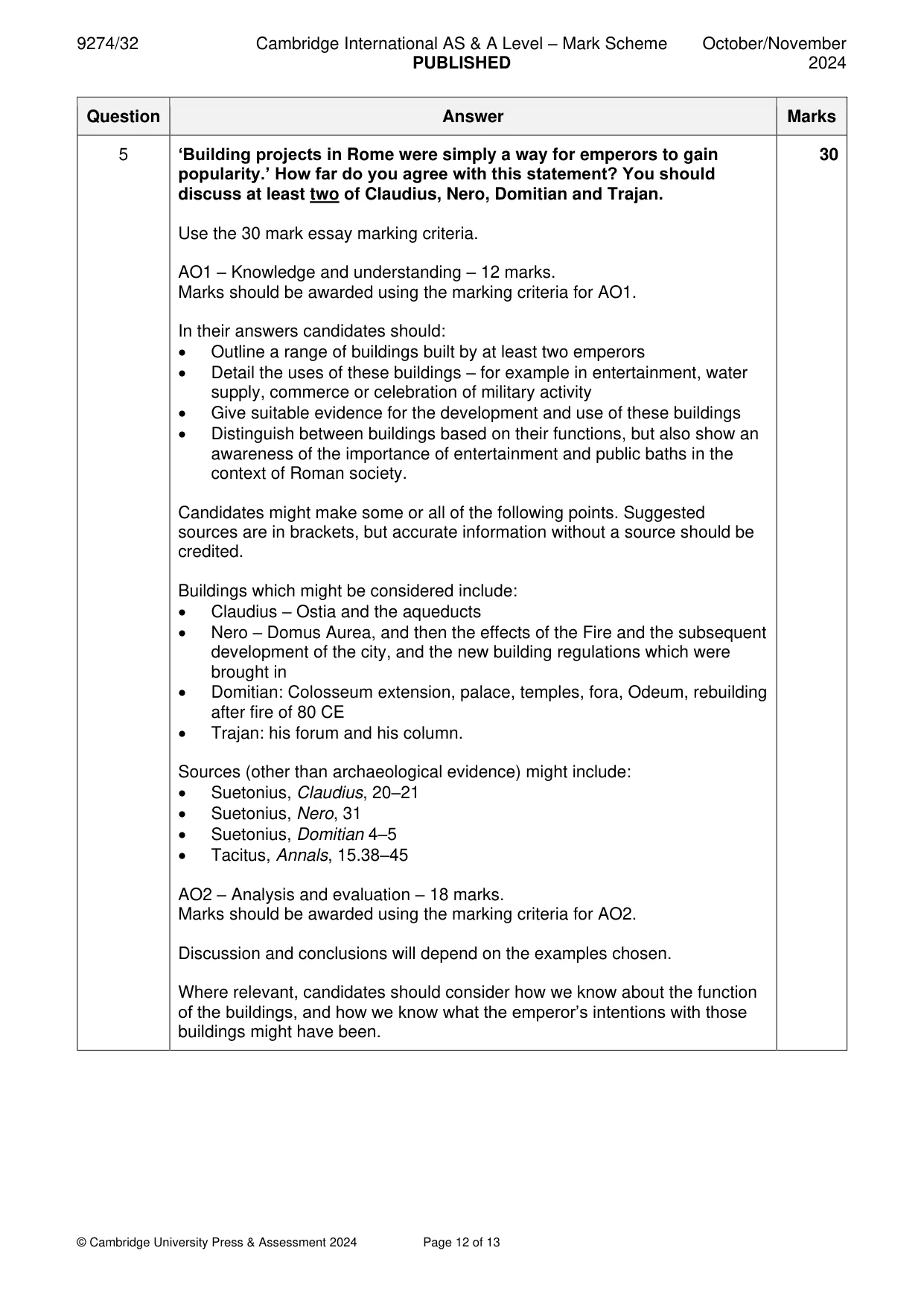
9274/32 Cambridge International AS & A Level – Mark Scheme PUBLISHED October/November 2024 © Cambridge University Press & Assessment 2024 Page 12 of 13 Question Answer Marks 5 ‘Building projects in Rome were simply a way for emperors to gain popularity.’ How far do you agree with this statement? You should discuss at least two of Claudius, Nero, Domitian and Trajan. Use the 30 mark essay marking criteria. AO1 – Knowledge and understanding – 12 marks. Marks should be awarded using the marking criteria for AO1. In their answers candidates should: • Outline a range of buildings built by at least two emperors • Detail the uses of these buildings – for example in entertainment, water supply, commerce or celebration of military activity • Give suitable evidence for the development and use of these buildings • Distinguish between buildings based on their functions, but also show an awareness of the importance of entertainment and public baths in the context of Roman society. Candidates might make some or all of the following points. Suggested sources are in brackets, but accurate information without a source should be credited. Buildings which might be considered include: • Claudius – Ostia and the aqueducts • Nero – Domus Aurea, and then the effects of the Fire and the subsequent development of the city, and the new building regulations which were brought in • Domitian: Colosseum extension, palace, temples, fora, Odeum, rebuilding after fire of 80 CE • Trajan: his forum and his column. Sources (other than archaeological evidence) might include: • Suetonius, Claudius, 20–21 • Suetonius, Nero, 31 • Suetonius, Domitian 4–5 • Tacitus, Annals, 15.38–45 AO2 – Analysis and evaluation – 18 marks. Marks should be awarded using the marking criteria for AO2. Discussion and conclusions will depend on the examples chosen. Where relevant, candidates should consider how we know about the function of the buildings, and how we know what the emperor’s intentions with those buildings might have been. 30
Mark scheme, page 13
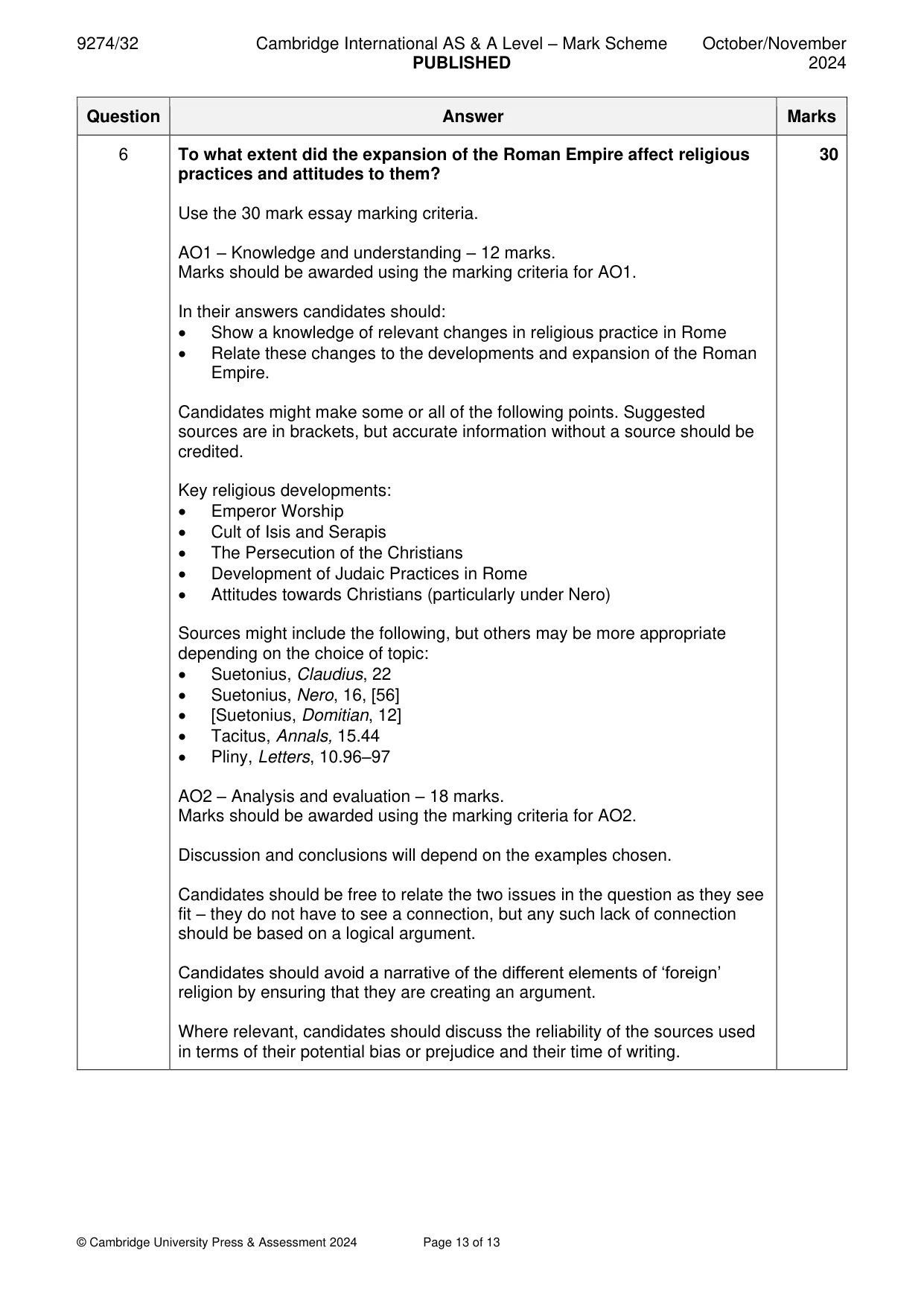
9274/32 Cambridge International AS & A Level – Mark Scheme PUBLISHED October/November 2024 © Cambridge University Press & Assessment 2024 Page 13 of 13 Question Answer Marks 6 To what extent did the expansion of the Roman Empire affect religious practices and attitudes to them? Use the 30 mark essay marking criteria. AO1 – Knowledge and understanding – 12 marks. Marks should be awarded using the marking criteria for AO1. In their answers candidates should: • Show a knowledge of relevant changes in religious practice in Rome • Relate these changes to the developments and expansion of the Roman Empire. Candidates might make some or all of the following points. Suggested sources are in brackets, but accurate information without a source should be credited. Key religious developments: • Emperor Worship • Cult of Isis and Serapis • The Persecution of the Christians • Development of Judaic Practices in Rome • Attitudes towards Christians (particularly under Nero) Sources might include the following, but others may be more appropriate depending on the choice of topic: • Suetonius, Claudius, 22 • Suetonius, Nero, 16, [56] • [Suetonius, Domitian, 12] • Tacitus, Annals, 15.44 • Pliny, Letters, 10.96–97 AO2 – Analysis and evaluation – 18 marks. Marks should be awarded using the marking criteria for AO2. Discussion and conclusions will depend on the examples chosen. Candidates should be free to relate the two issues in the question as they see fit – they do not have to see a connection, but any such lack of connection should be based on a logical argument. Candidates should avoid a narrative of the different elements of ‘foreign’ religion by ensuring that they are creating an argument. Where relevant, candidates should discuss the reliability of the sources used in terms of their potential bias or prejudice and their time of writing. 30
What you needed in this session
Cambridge’s own grade thresholds for 2024 Oct/Nov, Paper 3 · Variant 2. A higher threshold means an easier paper — the bar moves with how the cohort did.