Cambridge A Level Classical Studies 9274 — 2013 Oct/Nov Paper 3 · Variant 2
9274/32/O/N/13 · 50 marks · ≈56 min
The question paper and its mark scheme, free to read here and free to download. This is Cambridge’s own paper, exactly as it was sat.
Question paper4 pages
Mark scheme5 pages
Answers below. Sit the paper first if you are practising.
Paper as text
Question paper, page 1
This document consists of 3 printed pages and 1 blank page. DC (SLM) 79547 © UCLES 2013 [Turn over UNIVERSITY OF CAMBRIDGE INTERNATIONAL EXAMINATIONS General Certificate of Education Advanced Subsidiary Level and Advanced Level * 1 6 4 5 5 8 2 1 1 6 * CLASSICAL STUDIES 9274/32 Paper 3 Classical History – Sources and Evidence October/November 2013 1 hour 30 minutes Additional Materials: Answer Booklet/Paper READ THESE INSTRUCTIONS FIRST If you have been given an Answer Booklet, follow the instructions on the front cover of the Booklet. Write your Centre number, candidate number and name on all the work you hand in. Write in dark blue or black pen. You may use a pencil for any diagrams, graphs or rough working. Do not use staples, paper clips, highlighters, glue or correction fluid. This paper contains two options. Answer one question. Each essay is marked out of 50. You are advised to spend 20 minutes reading and thinking about the three passages on the option you have chosen to answer, and then 10 minutes planning your answer. Answers need to make use of all three passages given for the question you are answering. You are reminded of the need for good English and clear presentation in your answer. At the end of the examination, fasten all your work securely together.
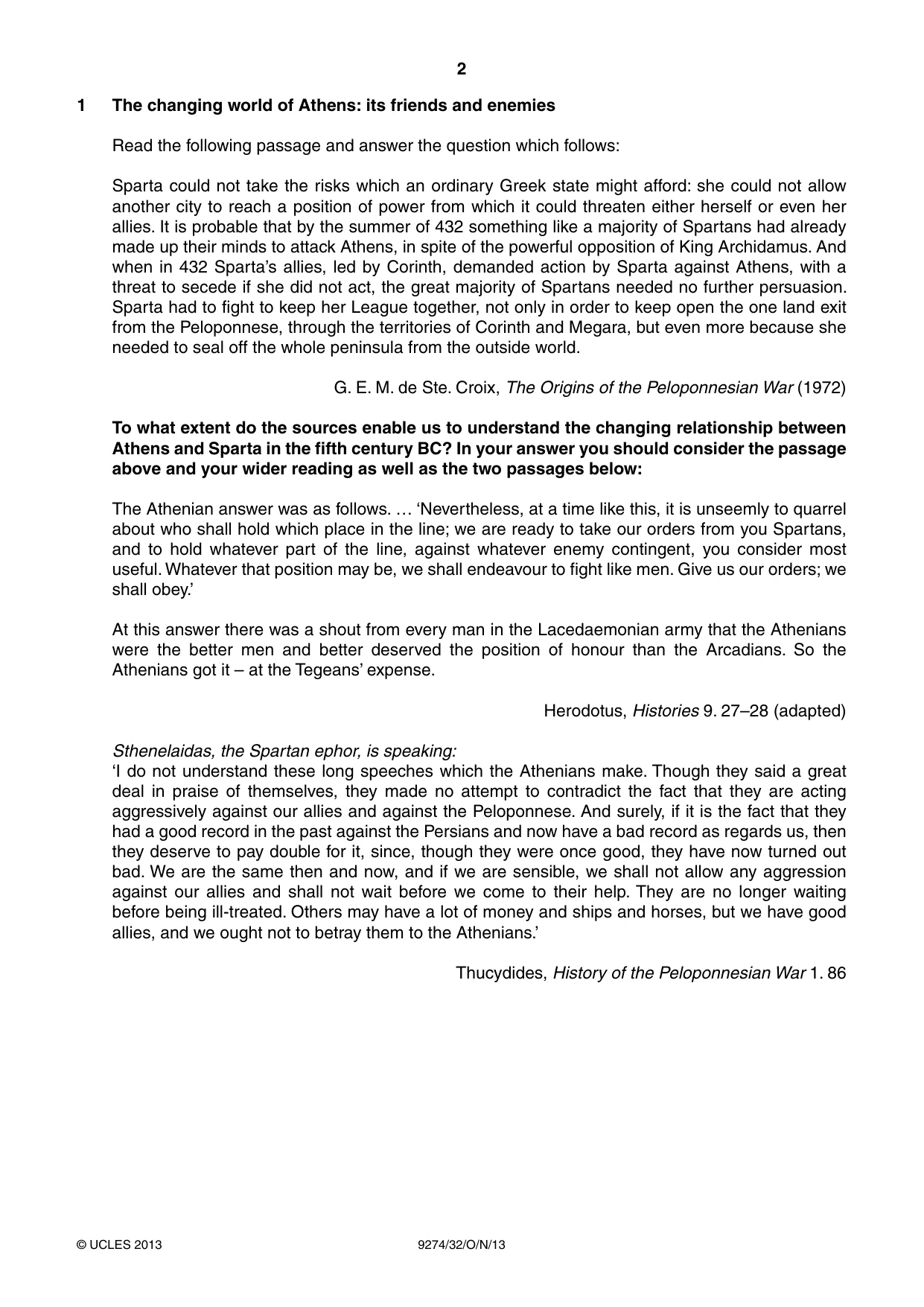
Question paper, page 2
2 9274/32/O/N/13 © UCLES 2013 1 The changing world of Athens: its friends and enemies Read the following passage and answer the question which follows: Sparta could not take the risks which an ordinary Greek state might afford: she could not allow another city to reach a position of power from which it could threaten either herself or even her allies. It is probable that by the summer of 432 something like a majority of Spartans had already made up their minds to attack Athens, in spite of the powerful opposition of King Archidamus. And when in 432 Sparta’s allies, led by Corinth, demanded action by Sparta against Athens, with a threat to secede if she did not act, the great majority of Spartans needed no further persuasion. Sparta had to fight to keep her League together, not only in order to keep open the one land exit from the Peloponnese, through the territories of Corinth and Megara, but even more because she needed to seal off the whole peninsula from the outside world. G. E. M. de Ste. Croix, The Origins of the Peloponnesian War (1972) To what extent do the sources enable us to understand the changing relationship between Athens and Sparta in the fifth century BC? In your answer you should consider the passage above and your wider reading as well as the two passages below: The Athenian answer was as follows. … ‘Nevertheless, at a time like this, it is unseemly to quarrel about who shall hold which place in the line; we are ready to take our orders from you Spartans, and to hold whatever part of the line, against whatever enemy contingent, you consider most useful. Whatever that position may be, we shall endeavour to fight like men. Give us our orders; we shall obey.’ At this answer there was a shout from every man in the Lacedaemonian army that the Athenians were the better men and better deserved the position of honour than the Arcadians. So the Athenians got it – at the Tegeans’ expense. Herodotus, Histories 9. 27–28 (adapted) Sthenelaidas, the Spartan ephor, is speaking: ‘I do not understand these long speeches which the Athenians make. Though they said a great deal in praise of themselves, they made no attempt to contradict the fact that they are acting aggressively against our allies and against the Peloponnese. And surely, if it is the fact that they had a good record in the past against the Persians and now have a bad record as regards us, then they deserve to pay double for it, since, though they were once good, they have now turned out bad. We are the same then and now, and if we are sensible, we shall not allow any aggression against our allies and shall not wait before we come to their help. They are no longer waiting before being ill-treated. Others may have a lot of money and ships and horses, but we have good allies, and we ought not to betray them to the Athenians.’ Thucydides, History of the Peloponnesian War 1. 86
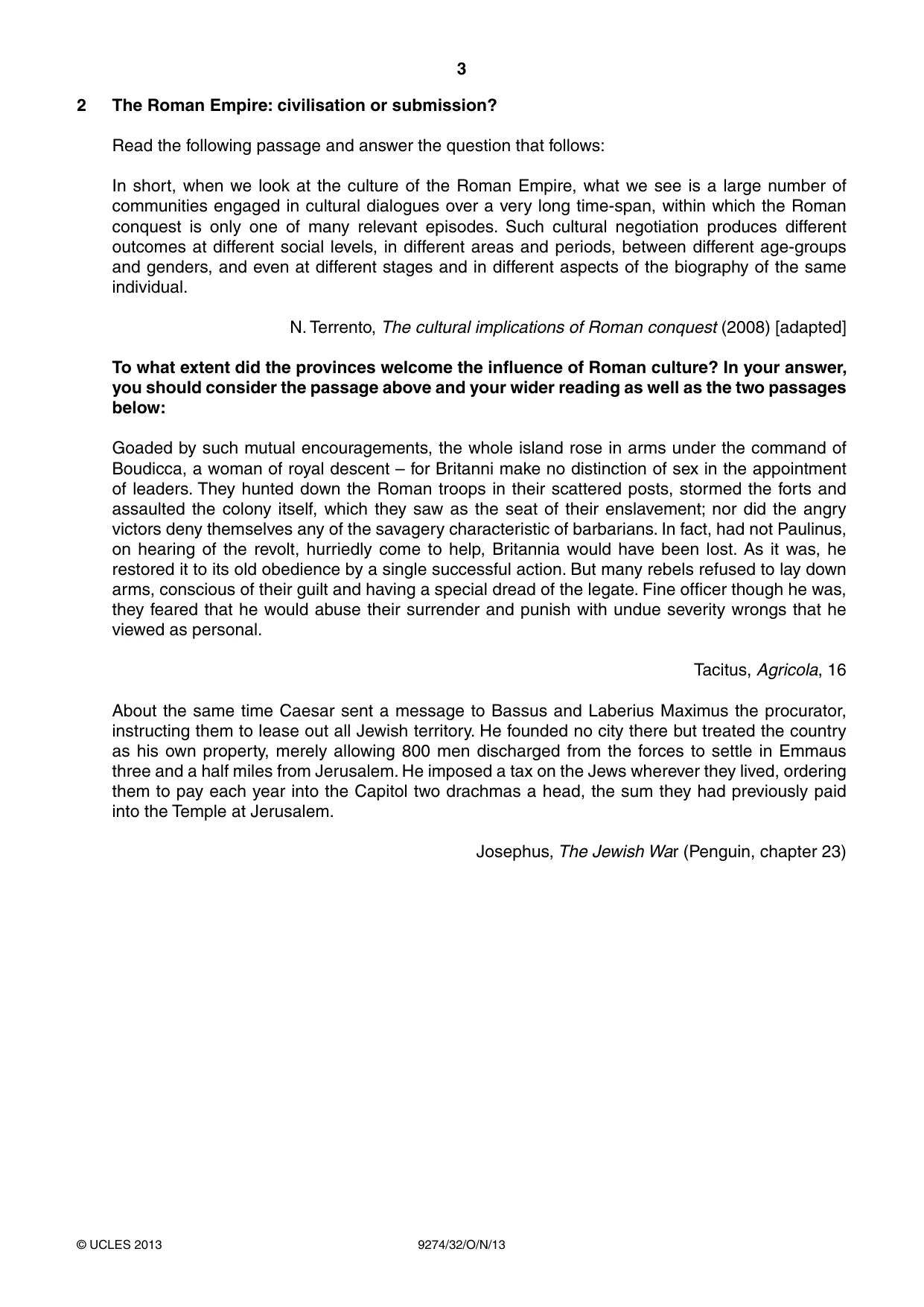
Question paper, page 3
3 9274/32/O/N/13 © UCLES 2013 2 The Roman Empire: civilisation or submission? Read the following passage and answer the question that follows: In short, when we look at the culture of the Roman Empire, what we see is a large number of communities engaged in cultural dialogues over a very long time-span, within which the Roman conquest is only one of many relevant episodes. Such cultural negotiation produces different outcomes at different social levels, in different areas and periods, between different age-groups and genders, and even at different stages and in different aspects of the biography of the same individual. N. Terrento, The cultural implications of Roman conquest (2008) [adapted] To what extent did the provinces welcome the influence of Roman culture? In your answer, you should consider the passage above and your wider reading as well as the two passages below: Goaded by such mutual encouragements, the whole island rose in arms under the command of Boudicca, a woman of royal descent – for Britanni make no distinction of sex in the appointment of leaders. They hunted down the Roman troops in their scattered posts, stormed the forts and assaulted the colony itself, which they saw as the seat of their enslavement; nor did the angry victors deny themselves any of the savagery characteristic of barbarians. In fact, had not Paulinus, on hearing of the revolt, hurriedly come to help, Britannia would have been lost. As it was, he restored it to its old obedience by a single successful action. But many rebels refused to lay down arms, conscious of their guilt and having a special dread of the legate. Fine officer though he was, they feared that he would abuse their surrender and punish with undue severity wrongs that he viewed as personal. Tacitus, Agricola, 16 About the same time Caesar sent a message to Bassus and Laberius Maximus the procurator, instructing them to lease out all Jewish territory. He founded no city there but treated the country as his own property, merely allowing 800 men discharged from the forces to settle in Emmaus three and a half miles from Jerusalem. He imposed a tax on the Jews wherever they lived, ordering them to pay each year into the Capitol two drachmas a head, the sum they had previously paid into the Temple at Jerusalem. Josephus, The Jewish War (Penguin, chapter 23)
Question paper, page 4
4 9274/32/O/N/13 © UCLES 2013 BLANK PAGE Copyright Acknowledgements: Question 1 © G E M de Ste Croix; The Origins of the Peloponnesian War; Duckworth & Co Ltd; 1972. Question 1 © Translated: A de Selincourt; Revised: J Marincola; Herodotus; The Histories; Penguin Books Ltd; 2003. Question 1 © Translated: Rex Warner: Thucydides; History of the Peloponnesian War; Penguin Books Ltd; 1972. Question 2 © Edited: Edward Bispham; N Terrento; Short Oxford History of Europe: Roman Empire; Oxford University Press; 2008. Question 2 © Translated: H Mattingly; Revised: H J Rives; Tacitus; Agricola and Germania; Penguin Books Ltd; 2009. Question 2 © Translated: G A Williamson; Josephus, The Jewish War; Penguin Books Ltd; 1981. Permission to reproduce items where third-party owned material protected by copyright is included has been sought and cleared where possible. Every reasonable effort has been made by the publisher (UCLES) to trace copyright holders, but if any items requiring clearance have unwittingly been included, the publisher will be pleased to make amends at the earliest possible opportunity. University of Cambridge International Examinations is part of the Cambridge Assessment Group. Cambridge Assessment is the brand name of University of Cambridge Local Examinations Syndicate (UCLES), which is itself a department of the University of Cambridge.
Mark scheme, page 1
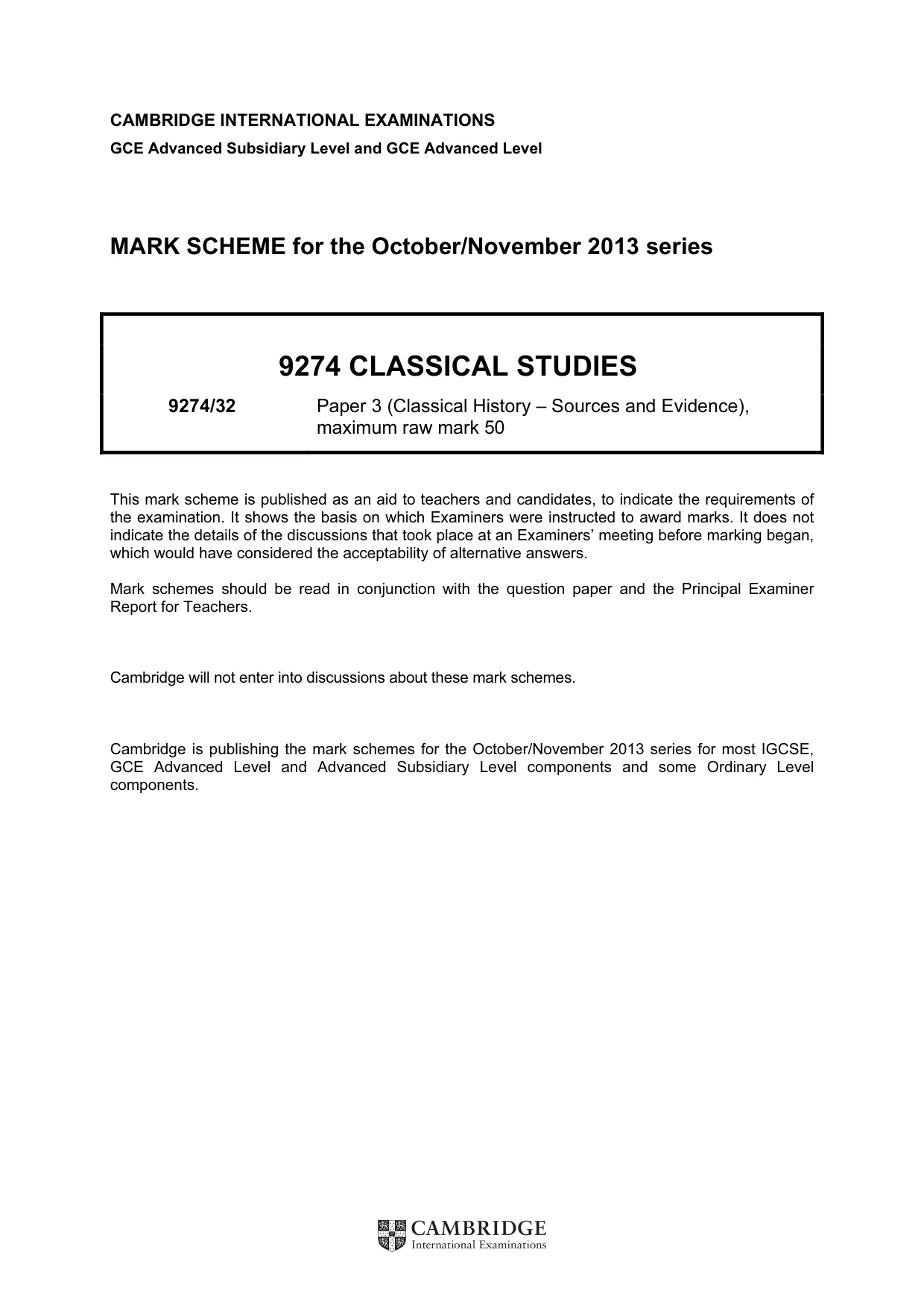
CAMBRIDGE INTERNATIONAL EXAMINATIONS GCE Advanced Subsidiary Level and GCE Advanced Level MARK SCHEME for the October/November 2013 series 9274 CLASSICAL STUDIES 9274/32 Paper 3 (Classical History – Sources and Evidence), maximum raw mark 50 This mark scheme is published as an aid to teachers and candidates, to indicate the requirements of the examination. It shows the basis on which Examiners were instructed to award marks. It does not indicate the details of the discussions that took place at an Examiners’ meeting before marking began, which would have considered the acceptability of alternative answers. Mark schemes should be read in conjunction with the question paper and the Principal Examiner Report for Teachers. Cambridge will not enter into discussions about these mark schemes. Cambridge is publishing the mark schemes for the October/November 2013 series for most IGCSE, GCE Advanced Level and Advanced Subsidiary Level components and some Ordinary Level components.
Mark scheme, page 2
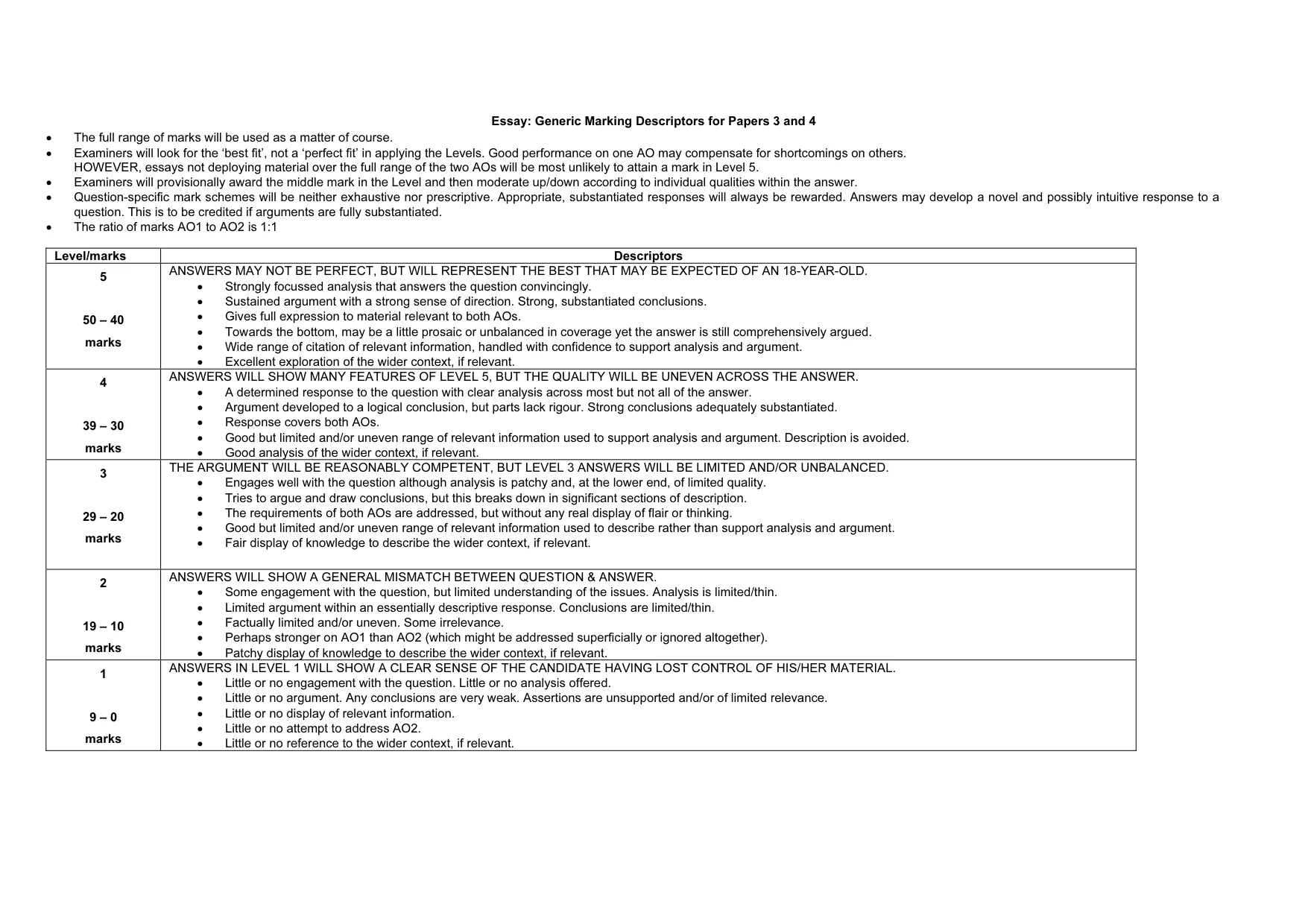
Essay: Generic Marking Descriptors for Papers 3 and 4 • The full range of marks will be used as a matter of course. • Examiners will look for the ‘best fit’, not a ‘perfect fit’ in applying the Levels. Good performance on one AO may compensate for shortcomings on others. HOWEVER, essays not deploying material over the full range of the two AOs will be most unlikely to attain a mark in Level 5. • Examiners will provisionally award the middle mark in the Level and then moderate up/down according to individual qualities within the answer. • Question-specific mark schemes will be neither exhaustive nor prescriptive. Appropriate, substantiated responses will always be rewarded. Answers may develop a novel and possibly intuitive response to a question. This is to be credited if arguments are fully substantiated. • The ratio of marks AO1 to AO2 is 1:1 Level/marks Descriptors 5 50 – 40 marks ANSWERS MAY NOT BE PERFECT, BUT WILL REPRESENT THE BEST THAT MAY BE EXPECTED OF AN 18-YEAR-OLD. • Strongly focussed analysis that answers the question convincingly. • Sustained argument with a strong sense of direction. Strong, substantiated conclusions. • Gives full expression to material relevant to both AOs. • Towards the bottom, may be a little prosaic or unbalanced in coverage yet the answer is still comprehensively argued. • Wide range of citation of relevant information, handled with confidence to support analysis and argument. • Excellent exploration of the wider context, if relevant. 4 39 – 30 marks ANSWERS WILL SHOW MANY FEATURES OF LEVEL 5, BUT THE QUALITY WILL BE UNEVEN ACROSS THE ANSWER. • A determined response to the question with clear analysis across most but not all of the answer. • Argument developed to a logical conclusion, but parts lack rigour. Strong conclusions adequately substantiated. • Response covers both AOs. • Good but limited and/or uneven range of relevant information used to support analysis and argument. Description is avoided. • Good analysis of the wider context, if relevant. 3 29 – 20 marks THE ARGUMENT WILL BE REASONABLY COMPETENT, BUT LEVEL 3 ANSWERS WILL BE LIMITED AND/OR UNBALANCED. • Engages well with the question although analysis is patchy and, at the lower end, of limited quality. • Tries to argue and draw conclusions, but this breaks down in significant sections of description. • The requirements of both AOs are addressed, but without any real display of flair or thinking. • Good but limited and/or uneven range of relevant information used to describe rather than support analysis and argument. • Fair display of knowledge to describe the wider context, if relevant. 2 19 – 10 marks ANSWERS WILL SHOW A GENERAL MISMATCH BETWEEN QUESTION & ANSWER. • Some engagement with the question, but limited understanding of the issues. Analysis is limited/thin. • Limited argument within an essentially descriptive response. Conclusions are limited/thin. • Factually limited and/or uneven. Some irrelevance. • Perhaps stronger on AO1 than AO2 (which might be addressed superficially or ignored altogether). • Patchy display of knowledge to describe the wider context, if relevant. 1 9 – 0 marks ANSWERS IN LEVEL 1 WILL SHOW A CLEAR SENSE OF THE CANDIDATE HAVING LOST CONTROL OF HIS/HER MATERIAL. • Little or no engagement with the question. Little or no analysis offered. • Little or no argument. Any conclusions are very weak. Assertions are unsupported and/or of limited relevance. • Little or no display of relevant information. • Little or no attempt to address AO2. • Little or no reference to the wider context, if relevant.
Mark scheme, page 3
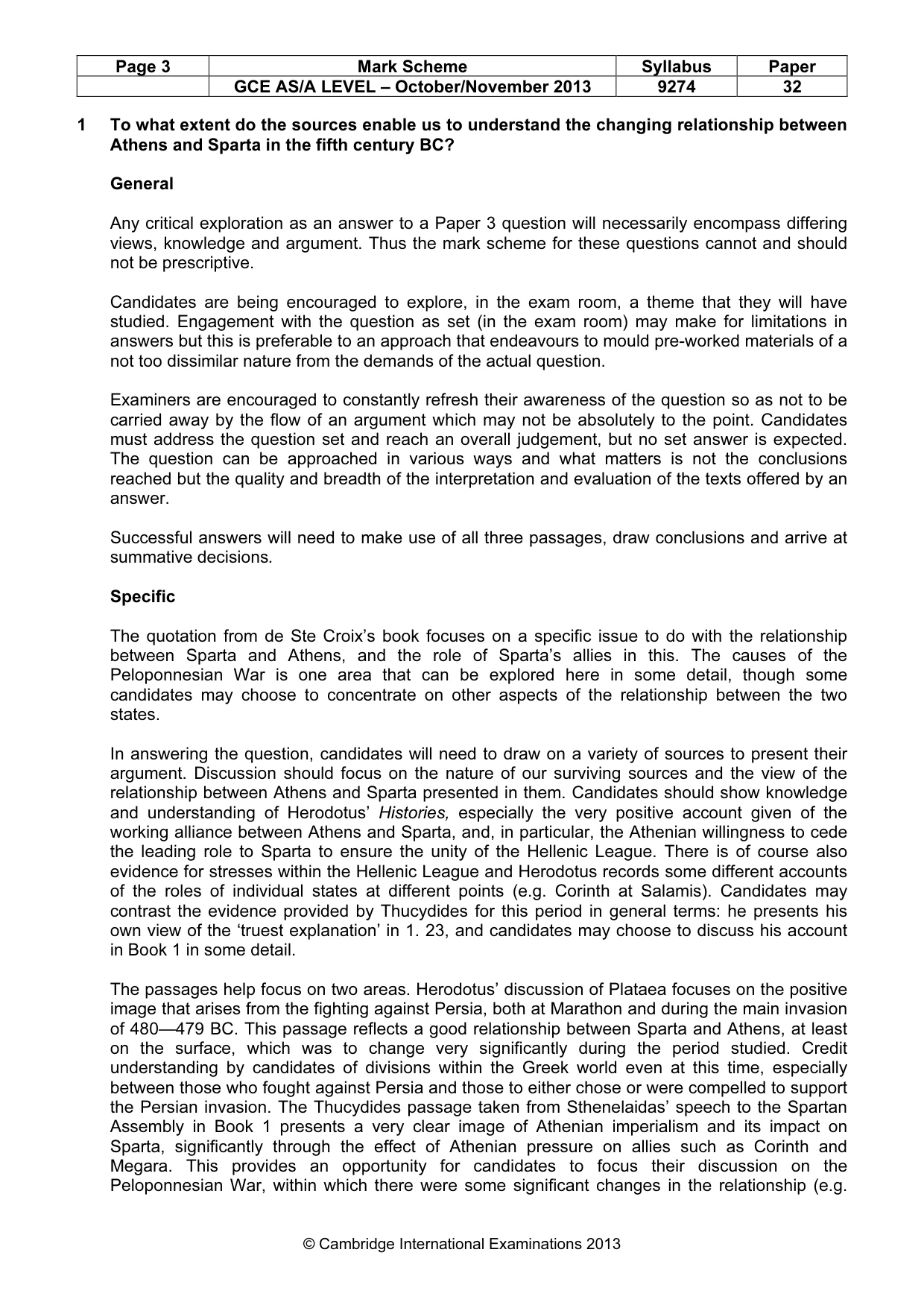
Page 3 Mark Scheme Syllabus Paper GCE AS/A LEVEL – October/November 2013 9274 32 © Cambridge International Examinations 2013 1 To what extent do the sources enable us to understand the changing relationship between Athens and Sparta in the fifth century BC? General Any critical exploration as an answer to a Paper 3 question will necessarily encompass differing views, knowledge and argument. Thus the mark scheme for these questions cannot and should not be prescriptive. Candidates are being encouraged to explore, in the exam room, a theme that they will have studied. Engagement with the question as set (in the exam room) may make for limitations in answers but this is preferable to an approach that endeavours to mould pre-worked materials of a not too dissimilar nature from the demands of the actual question. Examiners are encouraged to constantly refresh their awareness of the question so as not to be carried away by the flow of an argument which may not be absolutely to the point. Candidates must address the question set and reach an overall judgement, but no set answer is expected. The question can be approached in various ways and what matters is not the conclusions reached but the quality and breadth of the interpretation and evaluation of the texts offered by an answer. Successful answers will need to make use of all three passages, draw conclusions and arrive at summative decisions. Specific The quotation from de Ste Croix’s book focuses on a specific issue to do with the relationship between Sparta and Athens, and the role of Sparta’s allies in this. The causes of the Peloponnesian War is one area that can be explored here in some detail, though some candidates may choose to concentrate on other aspects of the relationship between the two states. In answering the question, candidates will need to draw on a variety of sources to present their argument. Discussion should focus on the nature of our surviving sources and the view of the relationship between Athens and Sparta presented in them. Candidates should show knowledge and understanding of Herodotus’ Histories, especially the very positive account given of the working alliance between Athens and Sparta, and, in particular, the Athenian willingness to cede the leading role to Sparta to ensure the unity of the Hellenic League. There is of course also evidence for stresses within the Hellenic League and Herodotus records some different accounts of the roles of individual states at different points (e.g. Corinth at Salamis). Candidates may contrast the evidence provided by Thucydides for this period in general terms: he presents his own view of the ‘truest explanation’ in 1. 23, and candidates may choose to discuss his account in Book 1 in some detail. The passages help focus on two areas. Herodotus’ discussion of Plataea focuses on the positive image that arises from the fighting against Persia, both at Marathon and during the main invasion of 480—479 BC. This passage reflects a good relationship between Sparta and Athens, at least on the surface, which was to change very significantly during the period studied. Credit understanding by candidates of divisions within the Greek world even at this time, especially between those who fought against Persia and those to either chose or were compelled to support the Persian invasion. The Thucydides passage taken from Sthenelaidas’ speech to the Spartan Assembly in Book 1 presents a very clear image of Athenian imperialism and its impact on Sparta, significantly through the effect of Athenian pressure on allies such as Corinth and Megara. This provides an opportunity for candidates to focus their discussion on the Peloponnesian War, within which there were some significant changes in the relationship (e.g.
Mark scheme, page 4
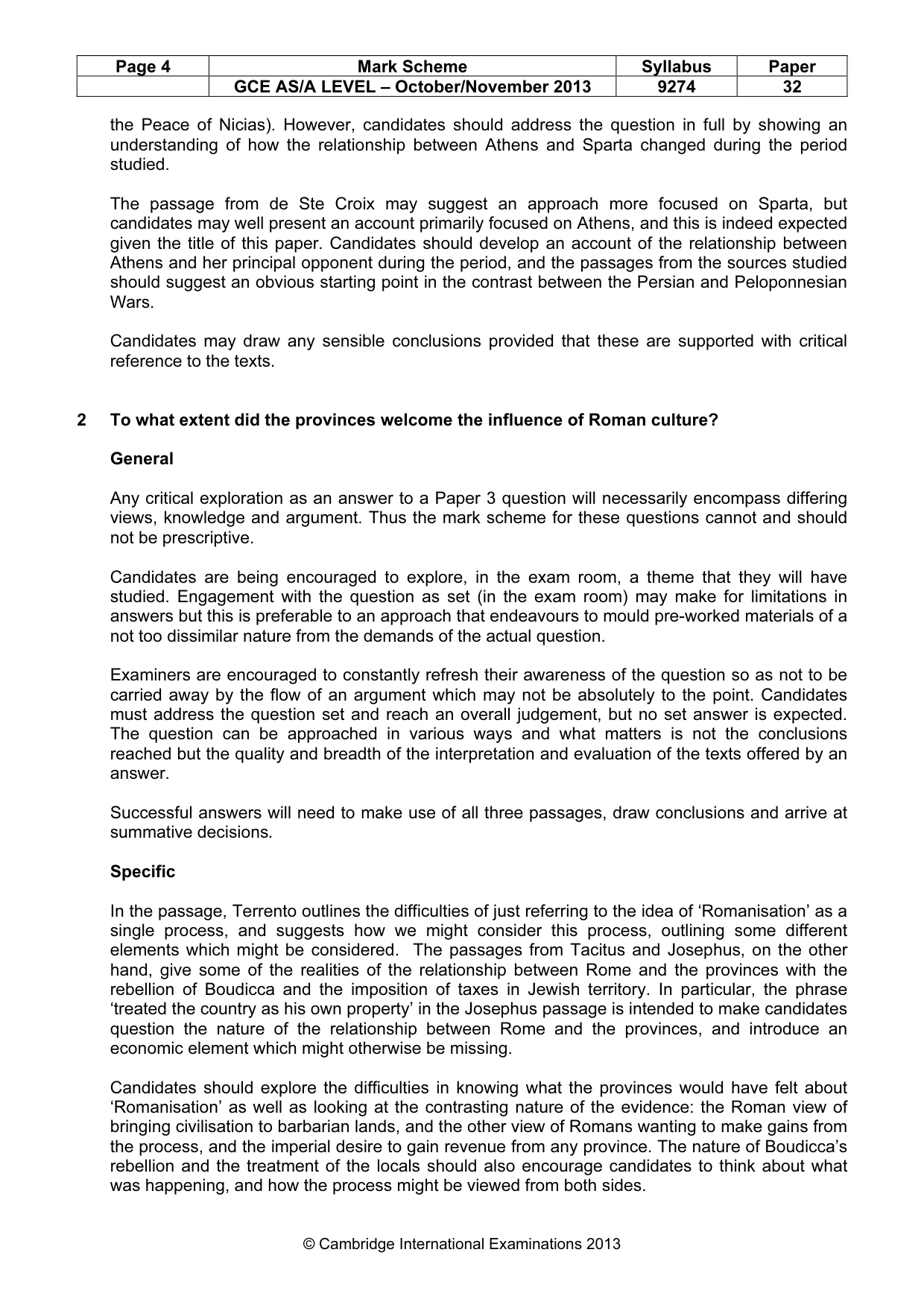
Page 4 Mark Scheme Syllabus Paper GCE AS/A LEVEL – October/November 2013 9274 32 © Cambridge International Examinations 2013 the Peace of Nicias). However, candidates should address the question in full by showing an understanding of how the relationship between Athens and Sparta changed during the period studied. The passage from de Ste Croix may suggest an approach more focused on Sparta, but candidates may well present an account primarily focused on Athens, and this is indeed expected given the title of this paper. Candidates should develop an account of the relationship between Athens and her principal opponent during the period, and the passages from the sources studied should suggest an obvious starting point in the contrast between the Persian and Peloponnesian Wars. Candidates may draw any sensible conclusions provided that these are supported with critical reference to the texts. 2 To what extent did the provinces welcome the influence of Roman culture? General Any critical exploration as an answer to a Paper 3 question will necessarily encompass differing views, knowledge and argument. Thus the mark scheme for these questions cannot and should not be prescriptive. Candidates are being encouraged to explore, in the exam room, a theme that they will have studied. Engagement with the question as set (in the exam room) may make for limitations in answers but this is preferable to an approach that endeavours to mould pre-worked materials of a not too dissimilar nature from the demands of the actual question. Examiners are encouraged to constantly refresh their awareness of the question so as not to be carried away by the flow of an argument which may not be absolutely to the point. Candidates must address the question set and reach an overall judgement, but no set answer is expected. The question can be approached in various ways and what matters is not the conclusions reached but the quality and breadth of the interpretation and evaluation of the texts offered by an answer. Successful answers will need to make use of all three passages, draw conclusions and arrive at summative decisions. Specific In the passage, Terrento outlines the difficulties of just referring to the idea of ‘Romanisation’ as a single process, and suggests how we might consider this process, outlining some different elements which might be considered. The passages from Tacitus and Josephus, on the other hand, give some of the realities of the relationship between Rome and the provinces with the rebellion of Boudicca and the imposition of taxes in Jewish territory. In particular, the phrase ‘treated the country as his own property’ in the Josephus passage is intended to make candidates question the nature of the relationship between Rome and the provinces, and introduce an economic element which might otherwise be missing. Candidates should explore the difficulties in knowing what the provinces would have felt about ‘Romanisation’ as well as looking at the contrasting nature of the evidence: the Roman view of bringing civilisation to barbarian lands, and the other view of Romans wanting to make gains from the process, and the imperial desire to gain revenue from any province. The nature of Boudicca’s rebellion and the treatment of the locals should also encourage candidates to think about what was happening, and how the process might be viewed from both sides.
Mark scheme, page 5
Page 5 Mark Scheme Syllabus Paper GCE AS/A LEVEL – October/November 2013 9274 32 © Cambridge International Examinations 2013 Candidates may draw any sensible conclusions provided that these are supported with critical reference to the texts.
What you needed in this session
Cambridge’s own grade thresholds for 2013 Oct/Nov, Paper 3 · Variant 2. A higher threshold means an easier paper — the bar moves with how the cohort did.