Cambridge A Level Chemistry 9701 — 2024 Oct/Nov Paper 3 · Variant 6
9701/36/O/N/24 · 3 questions · 40 marks · ≈45 min
The question paper and its mark scheme, free to read here and free to download. This is Cambridge’s own paper, exactly as it was sat.
Question paper12 pages
Mark scheme11 pages
Answers below. Sit the paper first if you are practising.
Questions as text
Q1 · Sodium carbonate reacts with hydrochloric acid to release carbon dioxide as shown
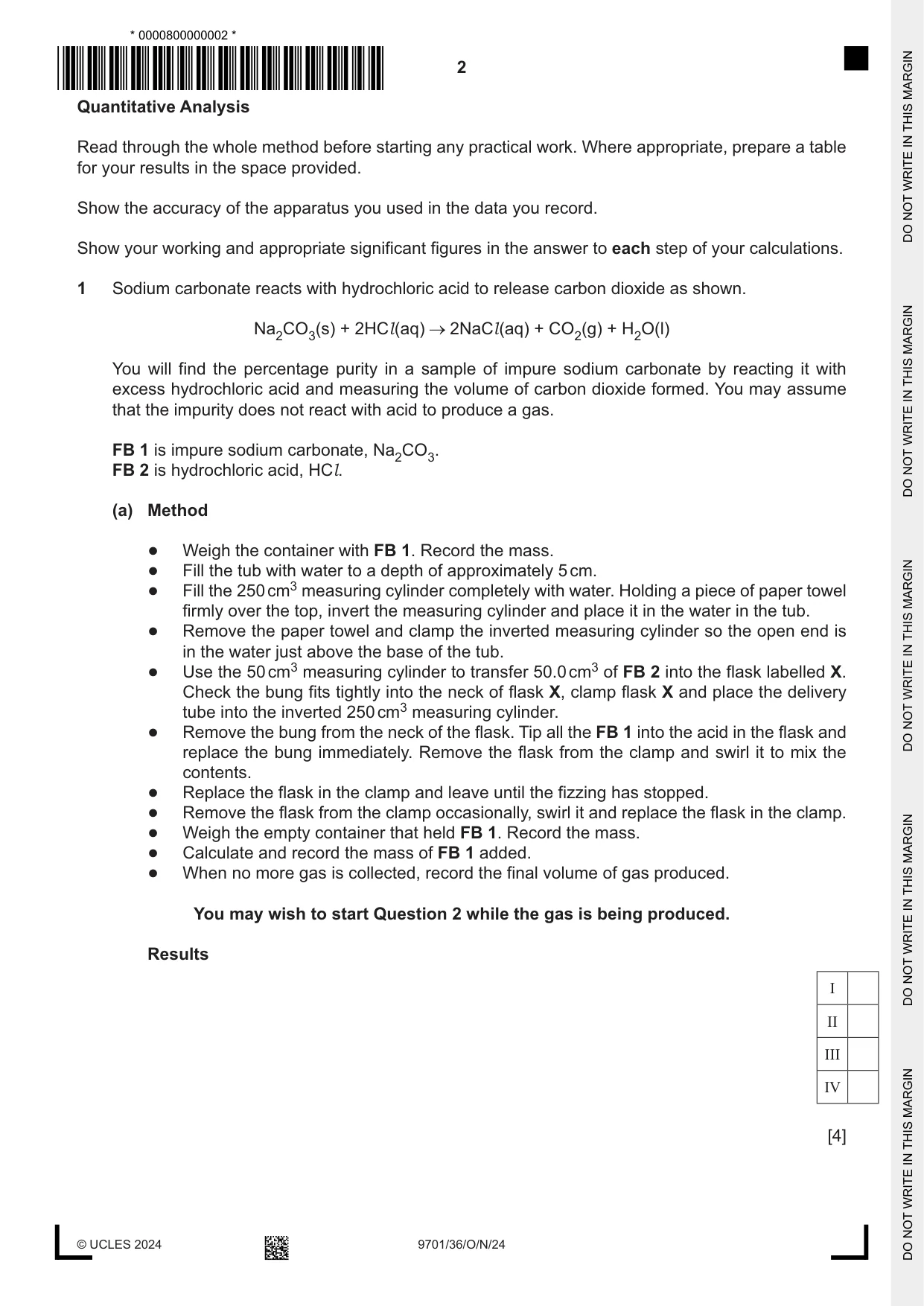
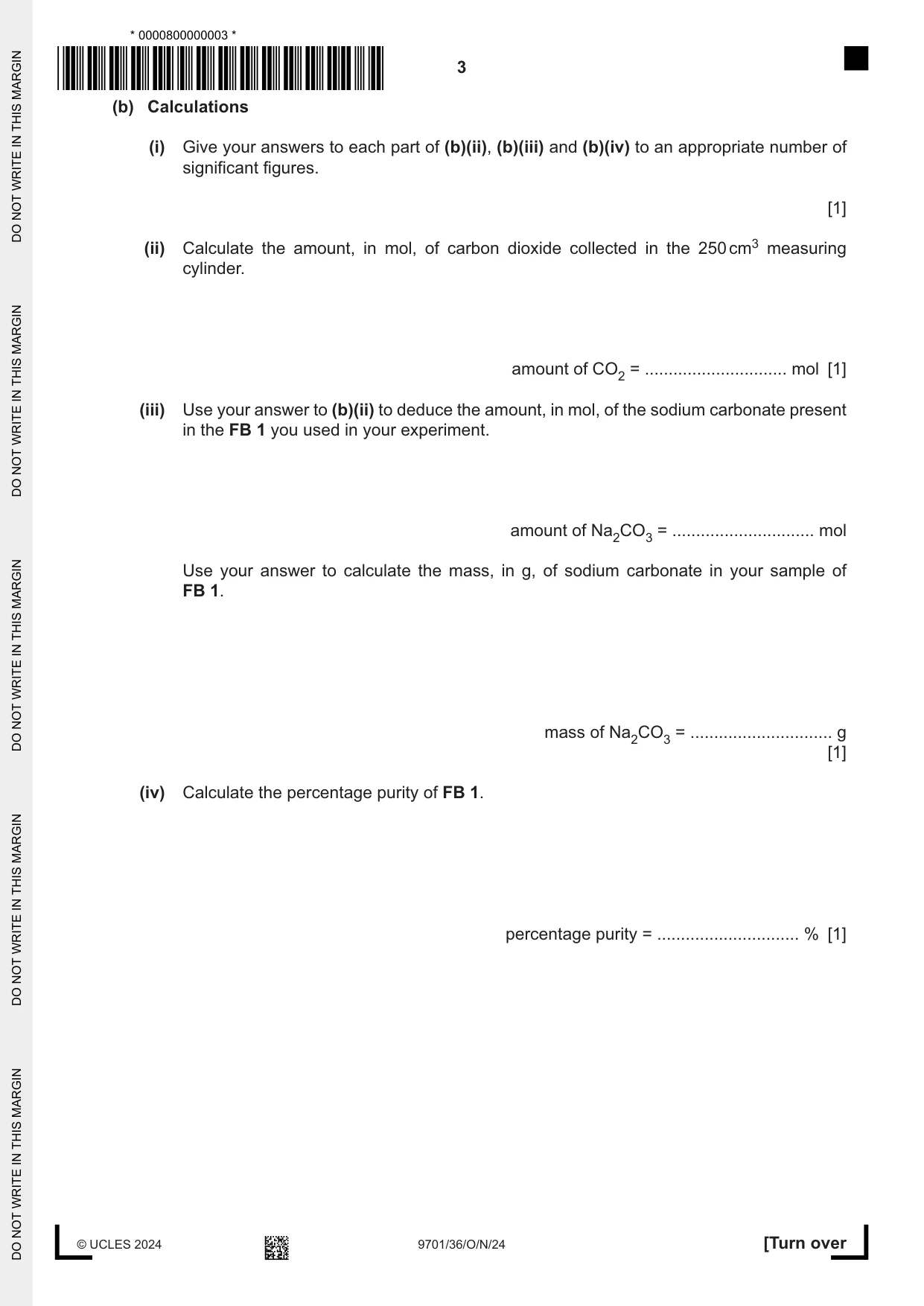
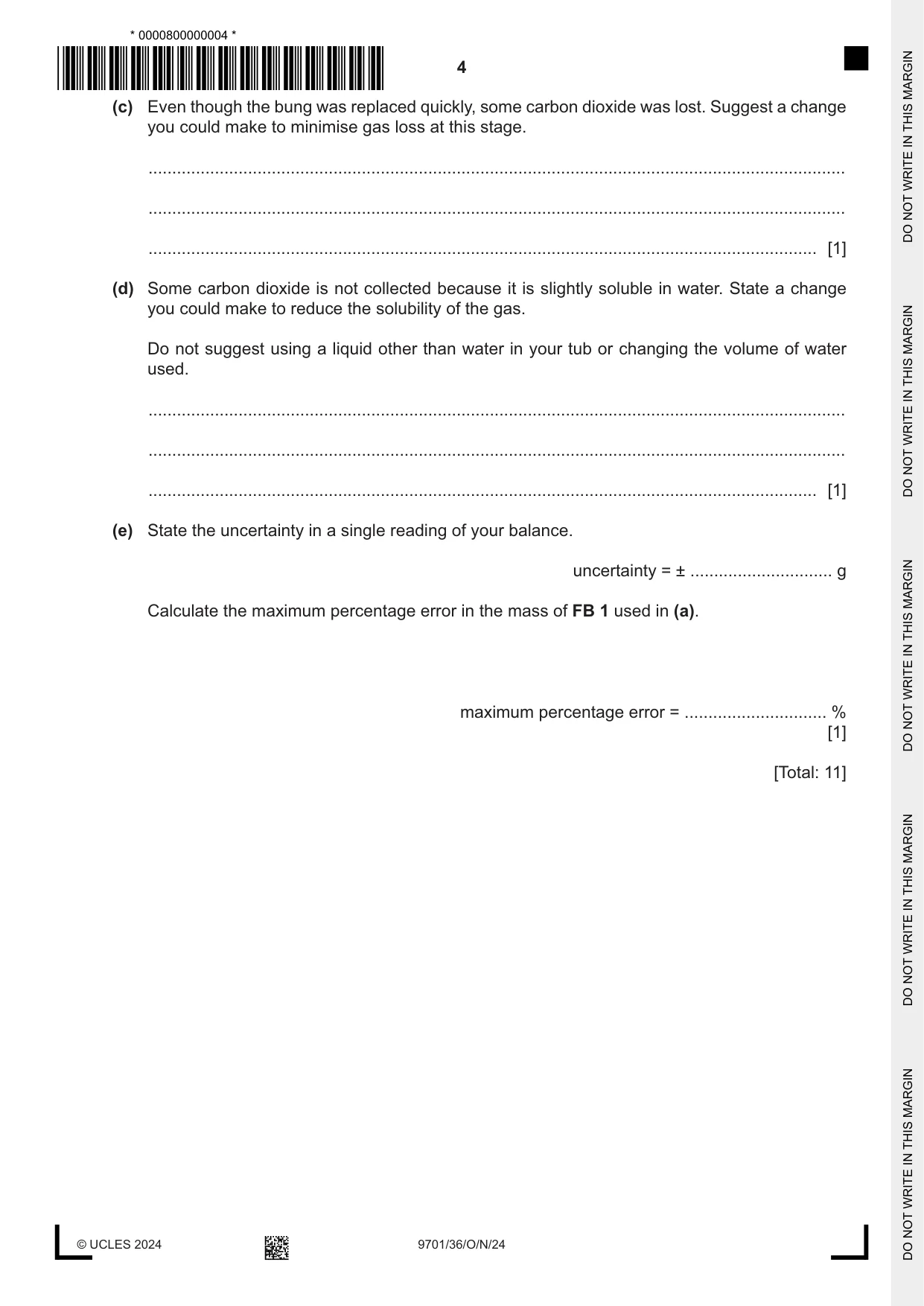
1 Sodium carbonate reacts with hydrochloric acid to release carbon dioxide as shown. Na2CO3(s) + 2HCl (aq) 2NaCl (aq) + CO2(g) + H2O(l) You will find the percentage purity in a sample of impure sodium carbonate by reacting it with excess hydrochloric acid and measuring the volume of carbon dioxide formed. You may assume that the impurity does not react with acid to produce a gas. FB 1 is impure sodium carbonate, Na2CO3. FB 2 is hydrochloric acid, HCl. (a) Method ● Weigh the container with FB 1. Record the mass. ● Fill the tub with water to a depth of approximately 5 cm. ● Fill the 250 cm3 measuring cylinder completely with water. Holding a piece of paper towel firmly over the top, invert the measuring cylinder and place it in the water in the tub. ● Remove the paper towel and clamp the inverted measuring cylinder so the open end is in the water just above the base of the tub. ● Use the 50 cm3 measuring cylinder to transfer 50.0 cm3 of FB 2 into the flask labelled X. Check the bung fits tightly into the neck of flask X, clamp flask X and place the delivery tube into the inverted 250 cm3 measuring cylinder. ● Remove the bung from the neck of the flask. Tip all the FB 1 into the acid in the flask and replace the bung immediately. Remove the flask from the clamp and swirl it to mix the contents. ● Replace the flask in the clamp and leave until the fizzing has stopped. ● Remove the flask from the clamp occasionally, swirl it and replace the flask in the clamp. ● Weigh the empty container that held FB 1. Record the mass. ● Calculate and record the mass of FB 1 added. ● When no more gas is collected, record the final volume of gas produced. You may wish to start Question 2 while the gas is being produced. Results I II III IV [4] (b) Calculations (i) Give your answers to each part of (b)(ii), (b)(iii) and (b)(iv) to an appropriate number of significant figures. [1] (ii) Calculate the amount, in mol, of carbon dioxide collected in the 250 cm3 measuring cylinder. amount of CO2 = .............................. mol [1] (iii) Use your answer to (b)(ii) to deduce the amount, in mol, of the sodium carbonate present in the FB 1 you used in your experiment. amount of Na2CO3 = .............................. mol Use your answer to calculate the mass, in g, of sodium carbonate in your sample of FB 1. mass of Na2CO3 = .............................. g [1] (iv) Calculate the percentage purity of FB 1. percentage purity = .............................. % [1] (c) Even though the bung was replaced quickly, some carbon dioxide was lost. Suggest a change you could make to minimise gas loss at this stage. ................................................................................................................................................... ................................................................................................................................................... ............................................................................................................................................. [1] (d) Some carbon dioxide is not collected because it is slightly soluble in water. State a change you could make to reduce the solubility of the gas. Do not suggest using a liquid other than water in your tub or changing the volume of water used. ................................................................................................................................................... ................................................................................................................................................... ............................................................................................................................................. [1] (e) State the uncertainty in a single reading of your balance. uncertainty = ± .............................. g Calculate the maximum percentage error in the mass of FB 1 used in (a). maximum percentage error = .............................. % [1] [Total: 11]
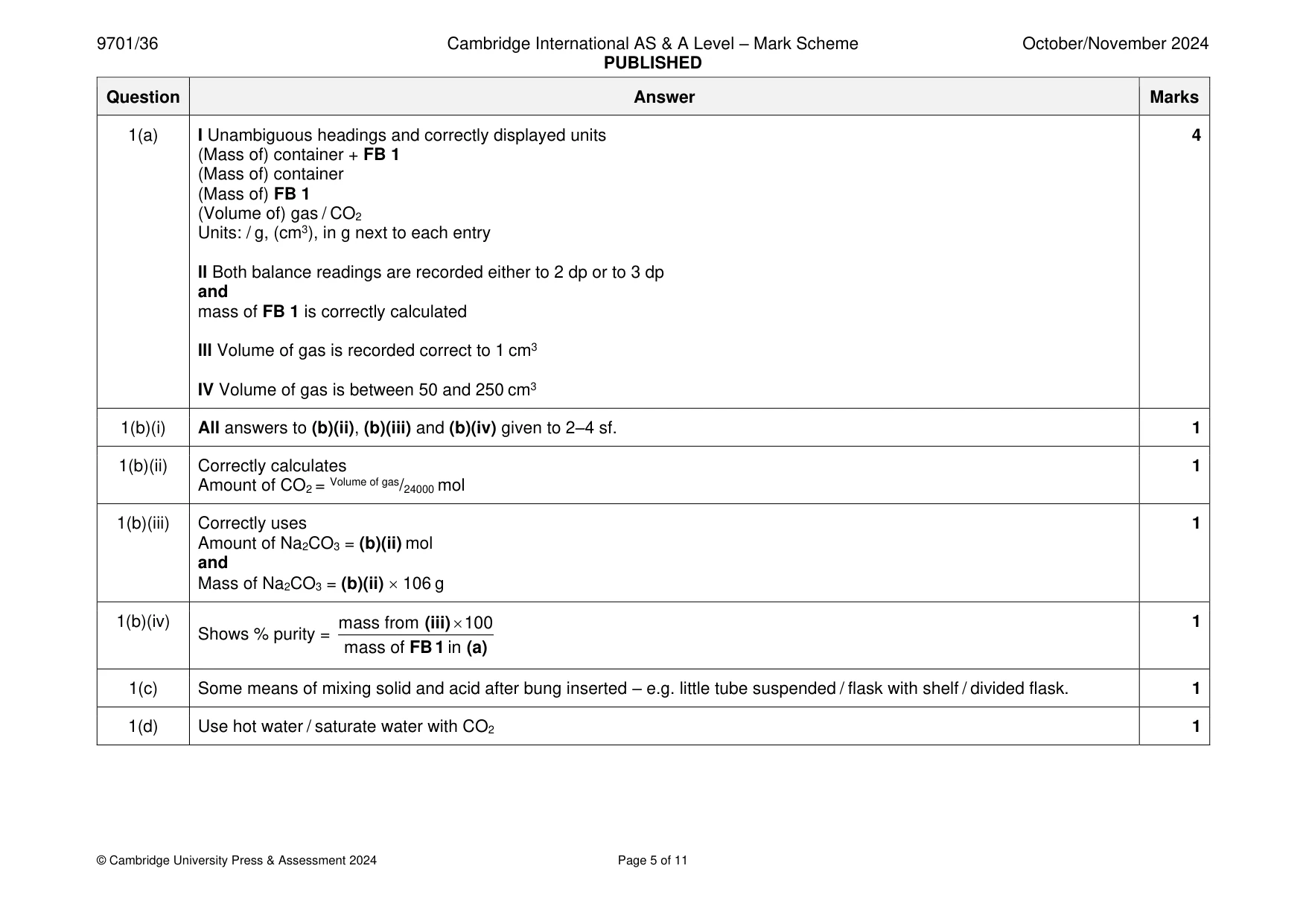
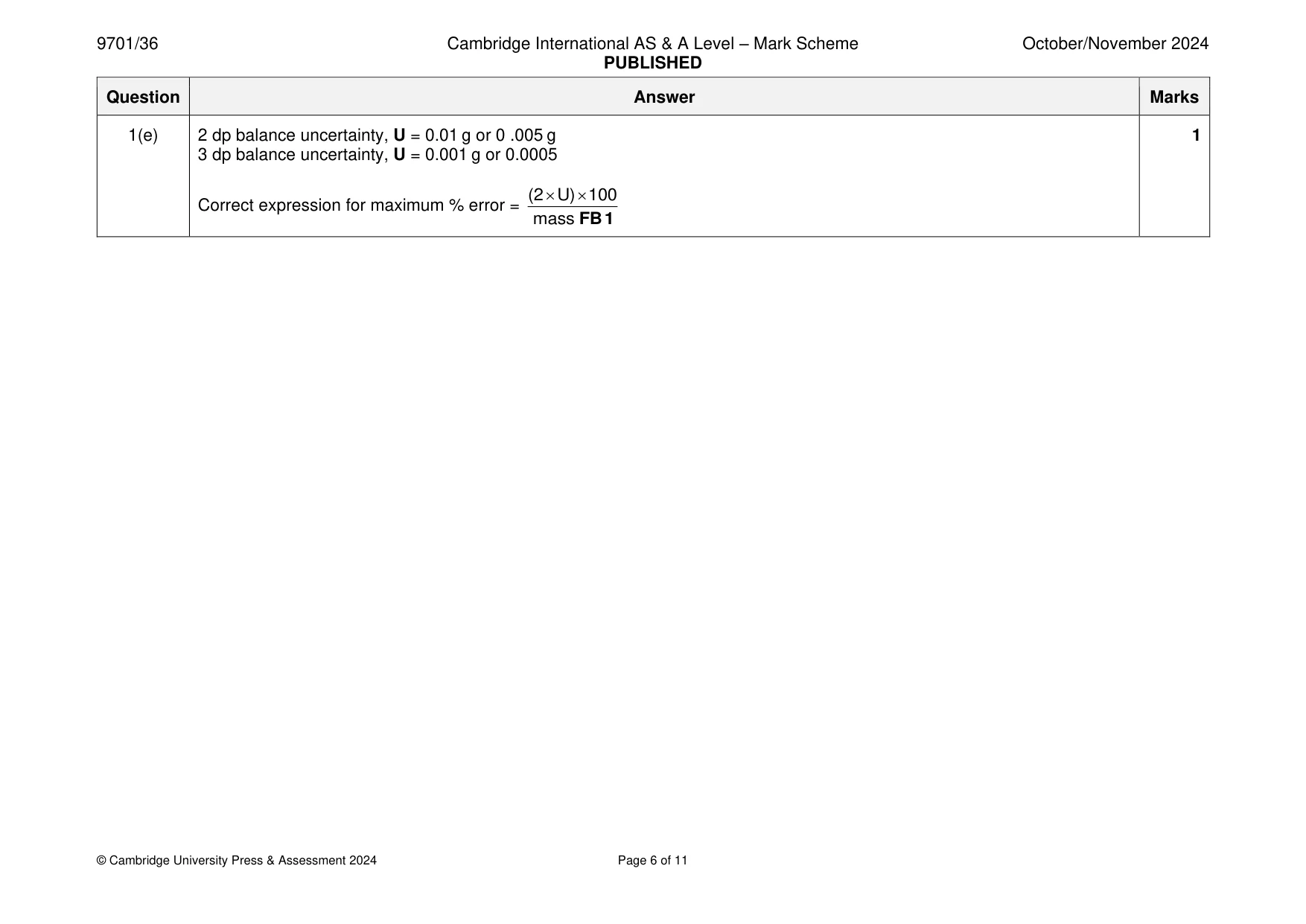
Mark scheme: Question Answer Marks 1(a) I Unambiguous headings and correctly displayed units 4 (Mass of) container + FB 1 (Mass of) container (Mass of) FB 1 (Volume of) gas / CO2 Units: / g, (cm3), in g next to each entry ll Both balance readings are recorded either to 2 dp or to 3 dp and mass of FB 1 is correctly calculated lll Volume of gas is recorded correct to 1 cm3 IV Volume of gas is between 50 and 250 cm3 1(b)(i) All answers to (b)(ii), (b)(iii) and (b)(iv) given to 2–4 sf. 1 1(b)(ii) Correctly calculates 1 Amount of CO2 = Volume of gas/24000 mol 1(b)(iii) Correctly uses 1 Amount of Na2CO3 = (b)(ii) mol and Mass of Na2CO3 = (b)(ii) 106 g 1(b)(iv) mass from (iii) 100 1 Shows % purity = mass of FB 1 in (a) 1(c) Some means of mixing solid and acid after bung inserted – e.g. little tube suspended / flask with shelf / divided flask. 1 1(d) Use hot water / saturate water with CO2 1 1(e) 2 dp balance uncertainty, U = 0.01 g or 0 .005 g 1 3 dp balance uncertainty, U = 0.001 g or 0.0005 (2 U) 100 Correct expression for maximum % error = mass FB 1
More questions on Reacting masses and volumes (of solutions and gases)
Q2 · Many metal carbonates, such as magnesium carbonate, decompose to form the metal oxide…
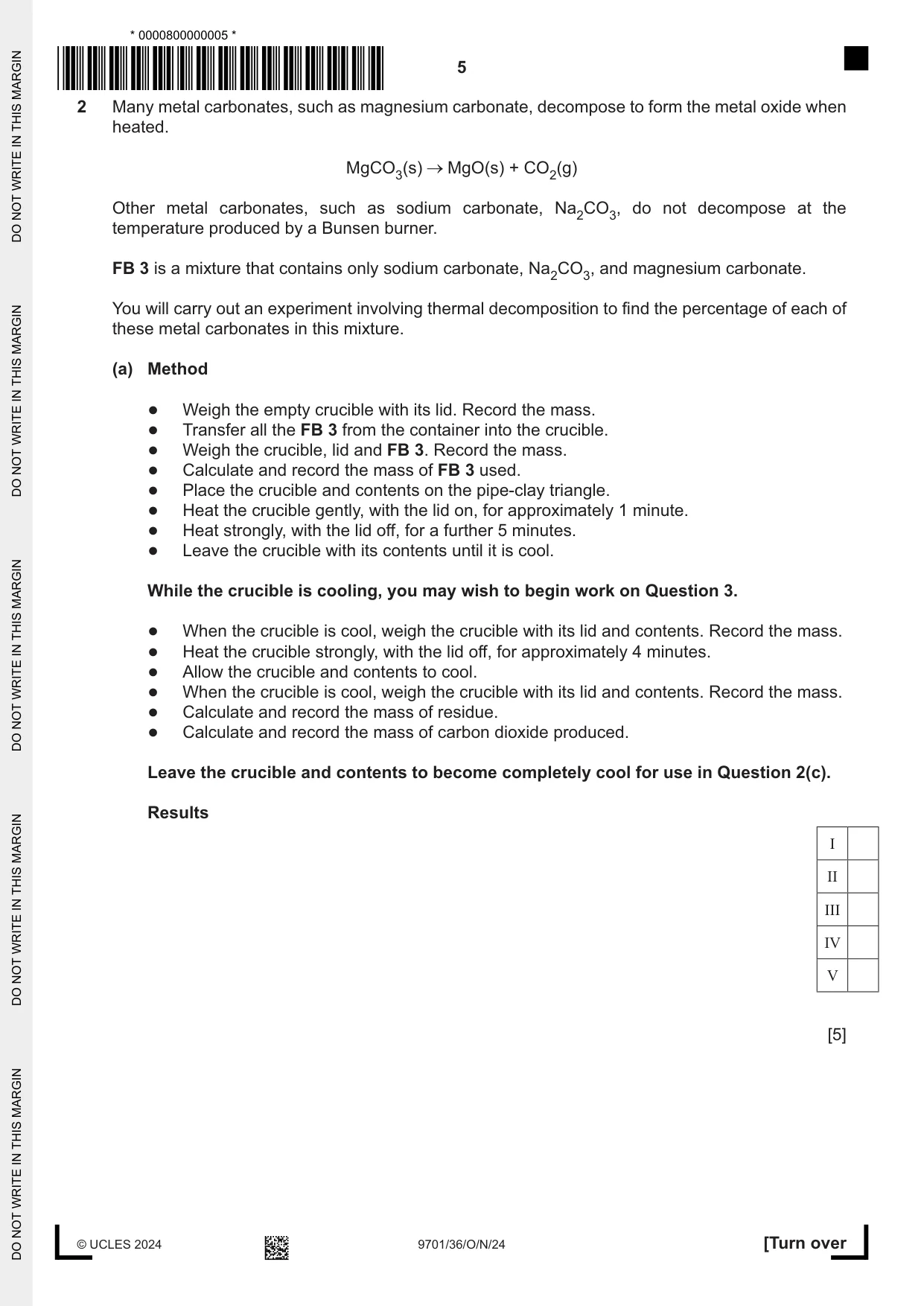
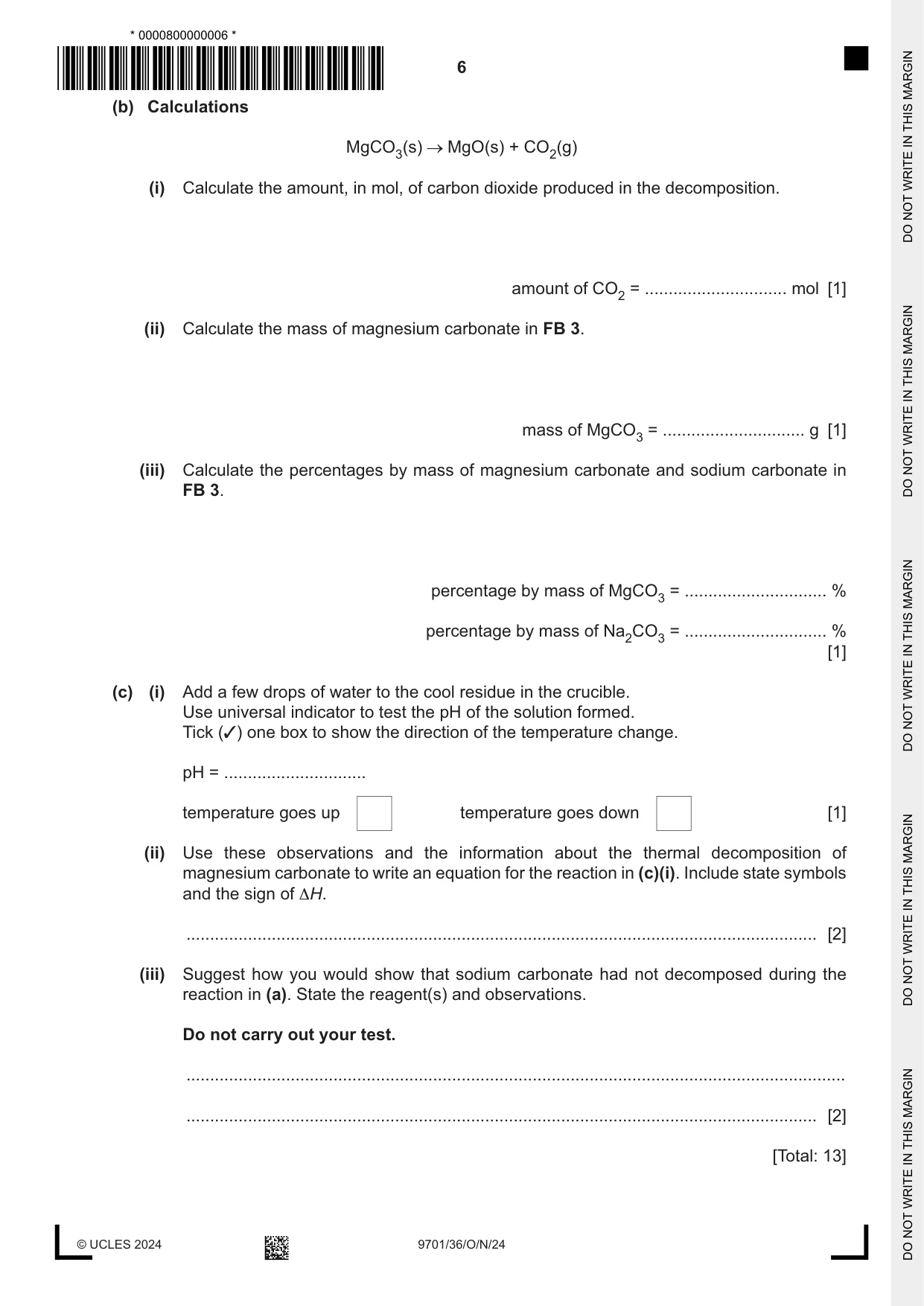
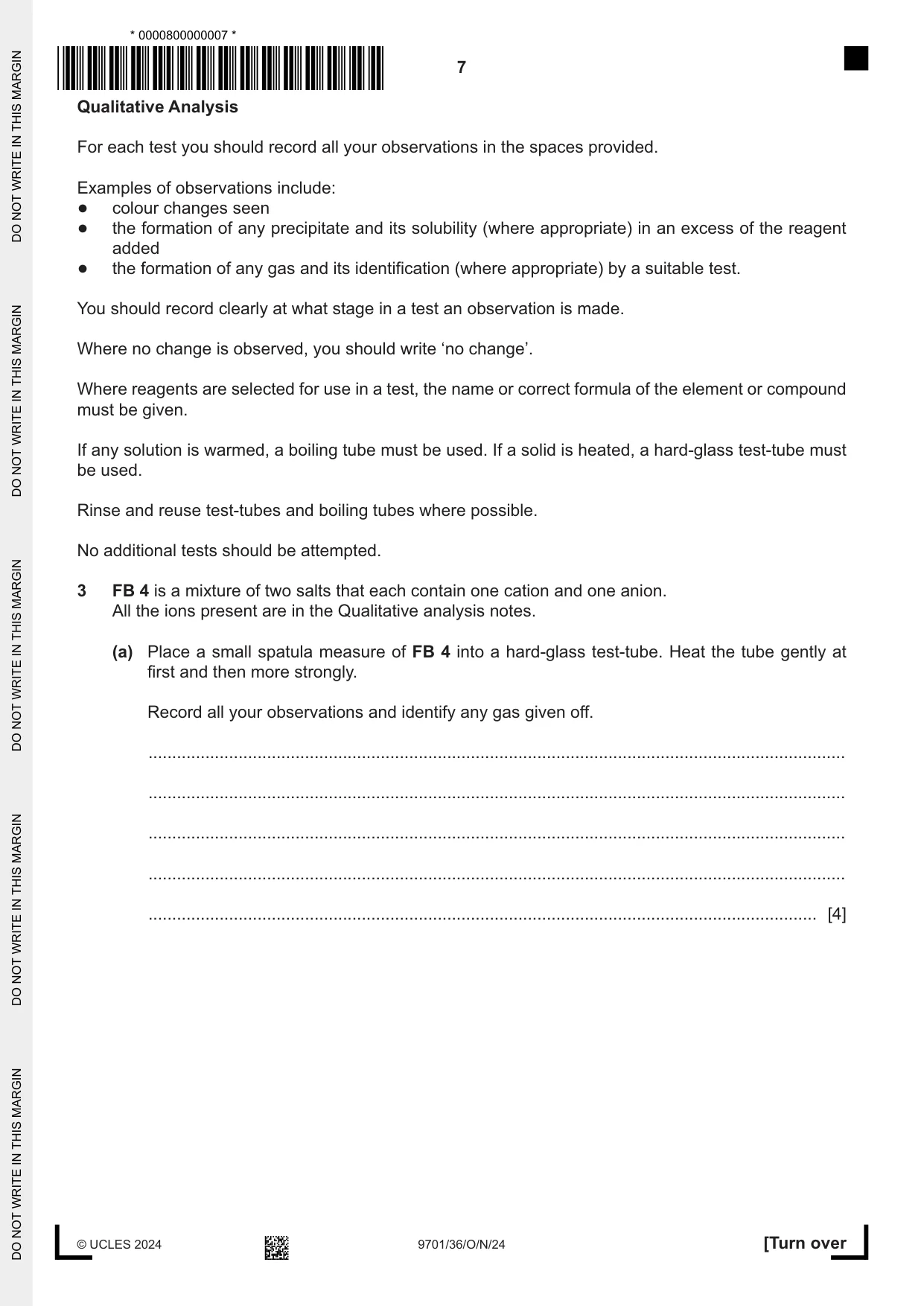
2 Many metal carbonates, such as magnesium carbonate, decompose to form the metal oxide when heated. MgCO3(s) MgO(s) + CO2(g) Other metal carbonates, such as sodium carbonate, Na2CO3, do not decompose at the temperature produced by a Bunsen burner. FB 3 is a mixture that contains only sodium carbonate, Na2CO3, and magnesium carbonate. You will carry out an experiment involving thermal decomposition to find the percentage of each of these metal carbonates in this mixture. (a) Method ● Weigh the empty crucible with its lid. Record the mass. ● Transfer all the FB 3 from the container into the crucible. ● Weigh the crucible, lid and FB 3. Record the mass. ● Calculate and record the mass of FB 3 used. ● Place the crucible and contents on the pipe-clay triangle. ● Heat the crucible gently, with the lid on, for approximately 1 minute. ● Heat strongly, with the lid off, for a further 5 minutes. ● Leave the crucible with its contents until it is cool. While the crucible is cooling, you may wish to begin work on Question 3. ● When the crucible is cool, weigh the crucible with its lid and contents. Record the mass. ● Heat the crucible strongly, with the lid off, for approximately 4 minutes. ● Allow the crucible and contents to cool. ● When the crucible is cool, weigh the crucible with its lid and contents. Record the mass. ● Calculate and record the mass of residue. ● Calculate and record the mass of carbon dioxide produced. Leave the crucible and contents to become completely cool for use in Question 2(c). Results I II III IV V [5] (b) Calculations MgCO3(s) MgO(s) + CO2(g) (i) Calculate the amount, in mol, of carbon dioxide produced in the decomposition. amount of CO2 = .............................. mol [1] (ii) Calculate the mass of magnesium carbonate in FB 3. mass of MgCO3 = .............................. g [1] (iii) Calculate the percentages by mass of magnesium carbonate and sodium carbonate in FB 3. percentage by mass of MgCO3 = .............................. % percentage by mass of Na2CO3 = .............................. % [1] (c) (i) Add a few drops of water to the cool residue in the crucible. Use universal indicator to test the pH of the solution formed. Tick (3) one box to show the direction of the temperature change. pH = .............................. temperature goes up temperature goes down [1] (ii) Use these observations and the information about the thermal decomposition of magnesium carbonate to write an equation for the reaction in (c)(i). Include state symbols and the sign of ΔH. ..................................................................................................................................... [2] (iii) Suggest how you would show that sodium carbonate had not decomposed during the reaction in (a). State the reagent(s) and observations. Do not carry out your test. ........................................................................................................................................... ..................................................................................................................................... [2] [Total: 13] Qualitative Analysis For each test you should record all your observations in the spaces provided. Examples of observations include: ● colour changes seen ● the formation of any precipitate and its solubility (where appropriate) in an excess of the reagent added ● the formation of any gas and its identification (where appropriate) by a suitable test. You should record clearly at what stage in a test an observation is made. Where no change is observed, you should write ‘no change’. Where reagents are selected for use in a test, the name or correct formula of the element or compound must be given. If any solution is warmed, a boiling tube must be used. If a solid is heated, a hard-glass test-tube must be used. Rinse and reuse test-tubes and boiling tubes where possible. No additional tests should be attempted.
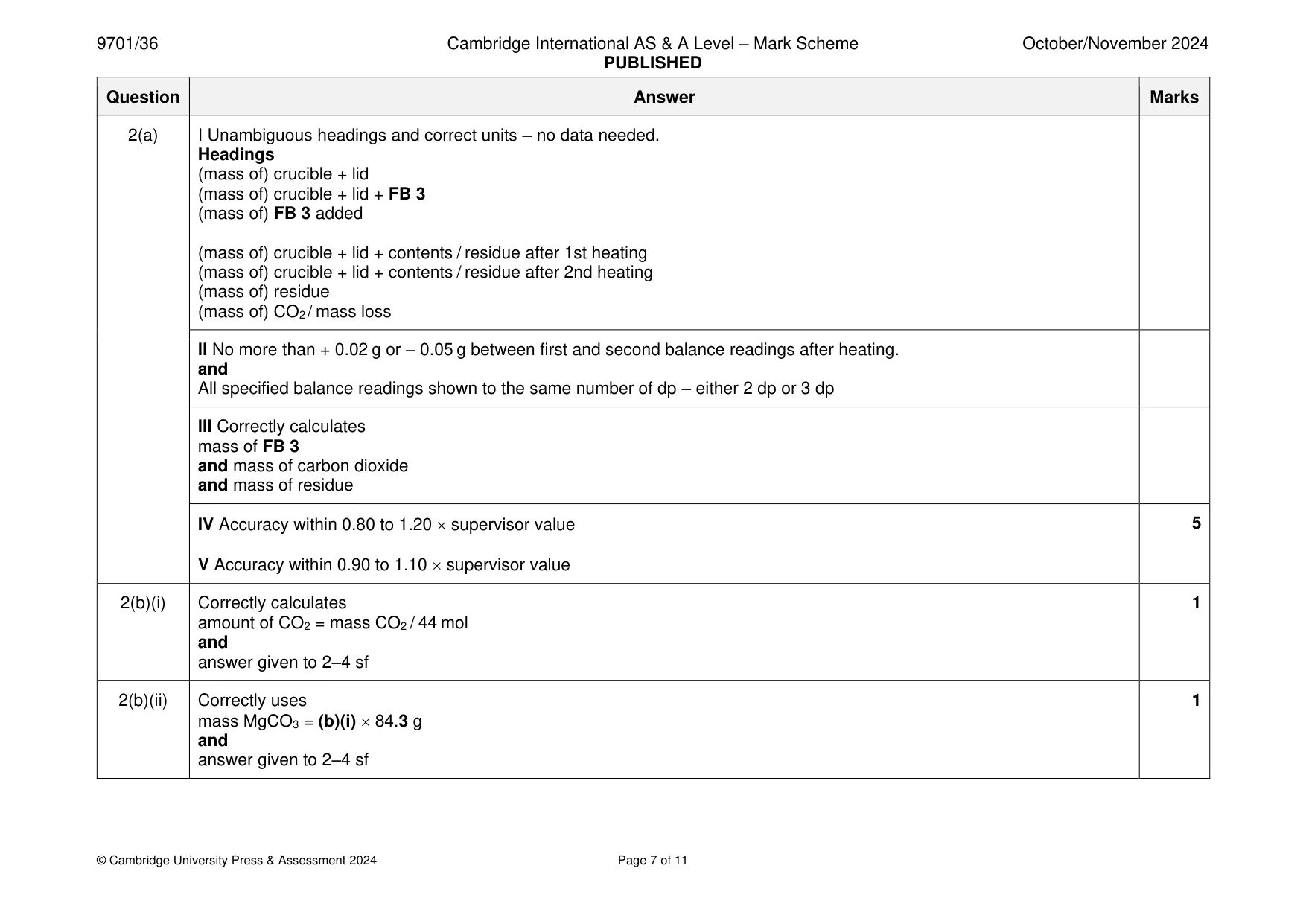
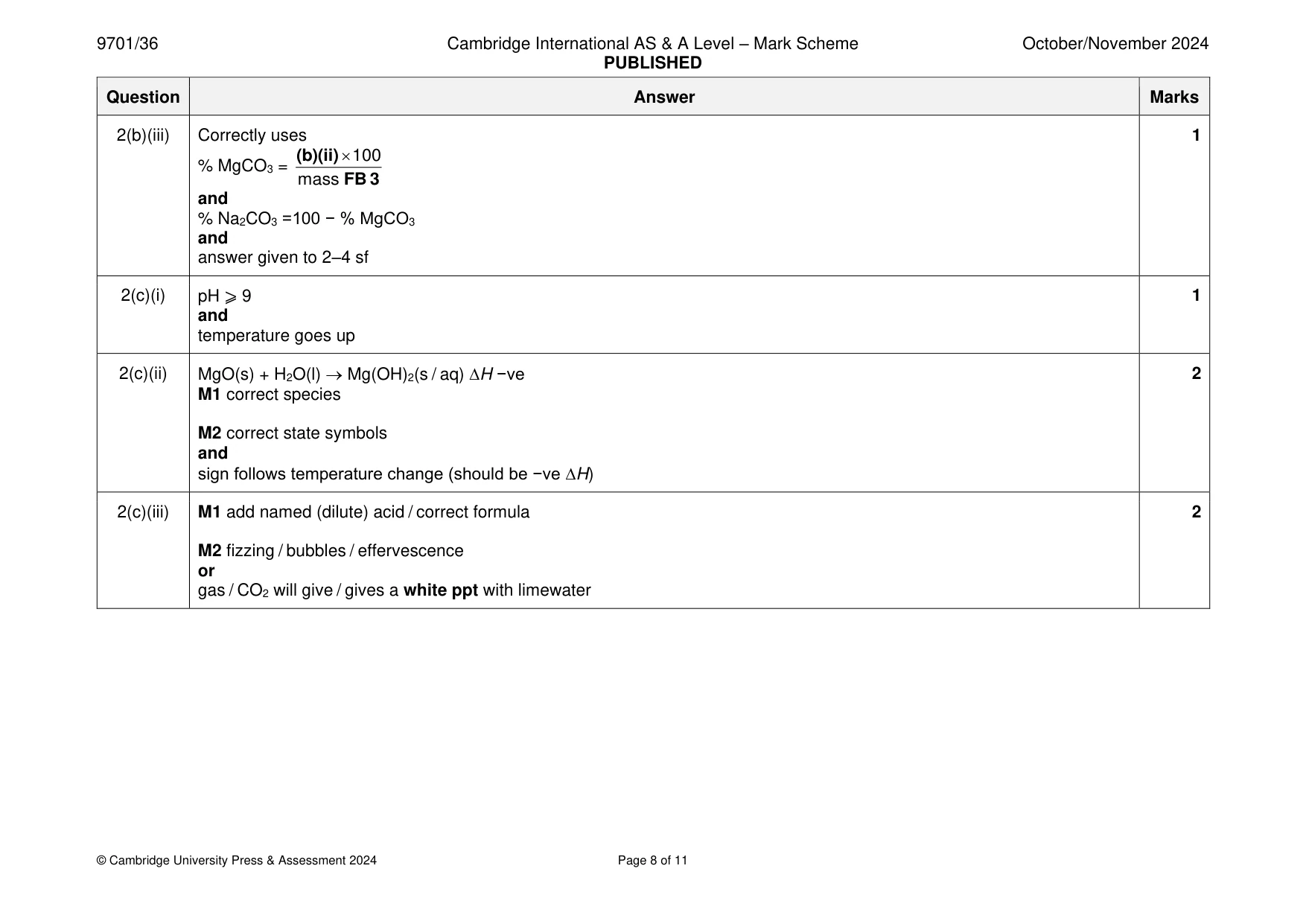
Mark scheme: 2(a) I Unambiguous headings and correct units – no data needed. Headings (mass of) crucible + lid (mass of) crucible + lid + FB 3 (mass of) FB 3 added (mass of) crucible + lid + contents / residue after 1st heating (mass of) crucible + lid + contents / residue after 2nd heating (mass of) residue (mass of) CO2 / mass loss ll No more than + 0.02 g or – 0.05 g between first and second balance readings after heating. and All specified balance readings shown to the same number of dp – either 2 dp or 3 dp lII Correctly calculates mass of FB 3 and mass of carbon dioxide and mass of residue IV Accuracy within 0.80 to 1.20 supervisor value 5 V Accuracy within 0.90 to 1.10 supervisor value 2(b)(i) Correctly calculates 1 amount of CO2 = mass CO2 / 44 mol and answer given to 2–4 sf 2(b)(ii) Correctly uses 1 mass MgCO3 = (b)(i) 84.3 g and answer given to 2–4 sf 2(b)(iii) Correctly uses 1 (b)(ii) 100 % MgCO3 = mass FB 3 and % Na2CO3 =100 − % MgCO3 and answer given to 2–4 sf 2(c)(i) pH ⩾ 9 1 and temperature goes up 2(c)(ii) MgO(s) + H2O(l) → Mg(OH)2(s / aq) H −ve 2 M1 correct species M2 correct state symbols and sign follows temperature change (should be −ve H) 2(c)(iii) M1 add named (dilute) acid / correct formula 2 M2 fizzing / bubbles / effervescence or gas / CO2 will give / gives a white ppt with limewater
More questions on Reacting masses and volumes (of solutions and gases)
Q3 · FB 4 is a mixture of two salts that each contain one cation and one anion
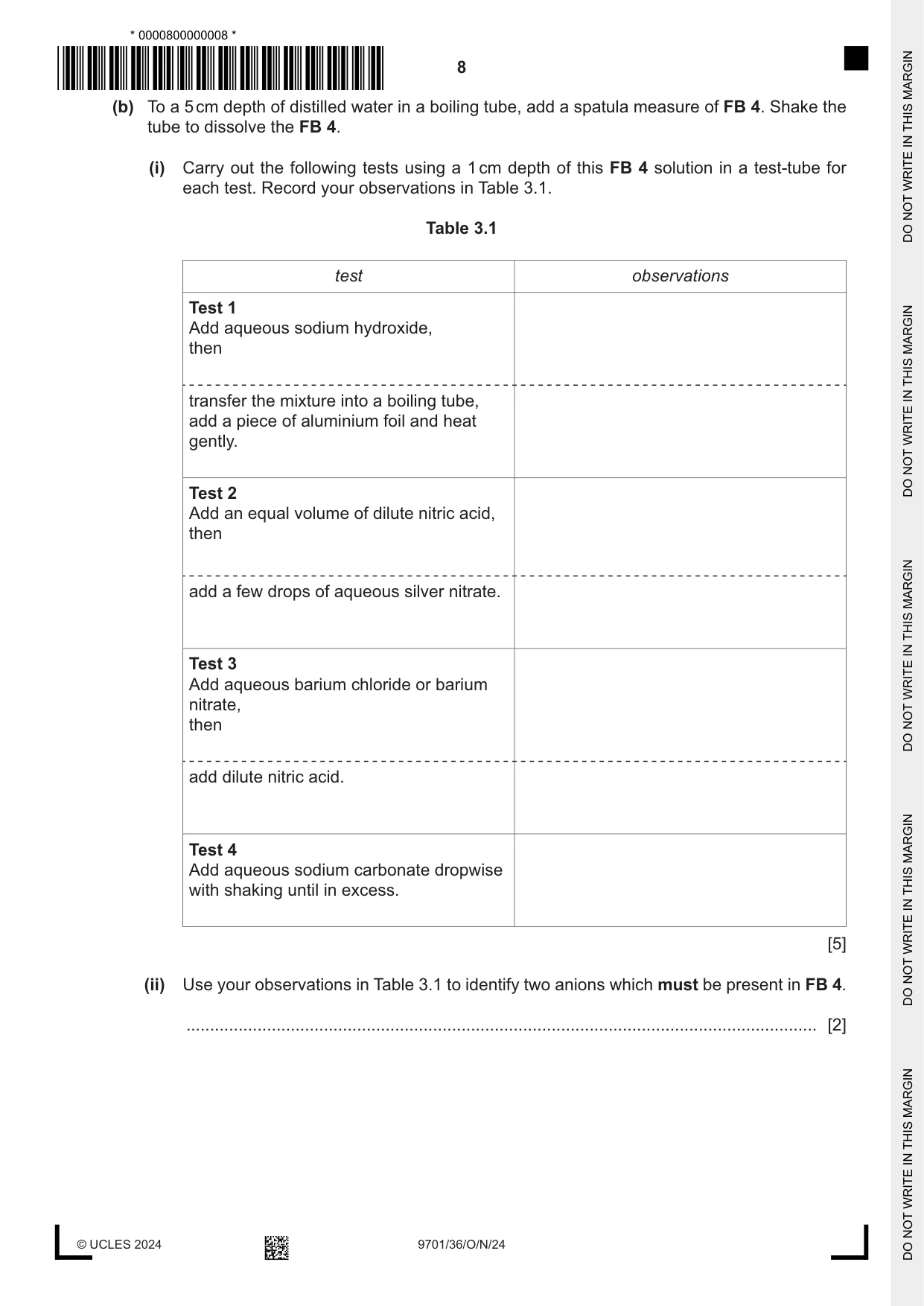
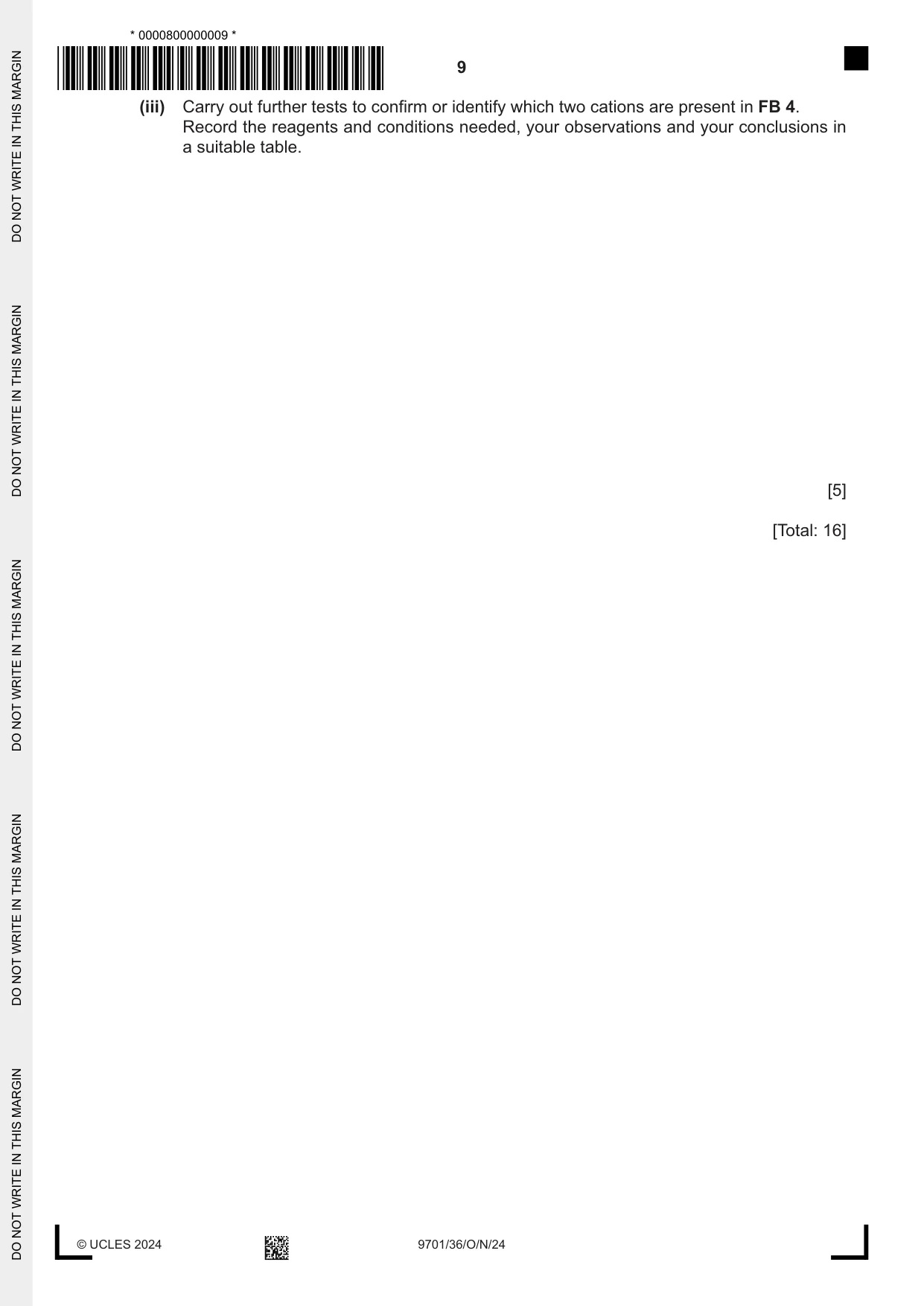
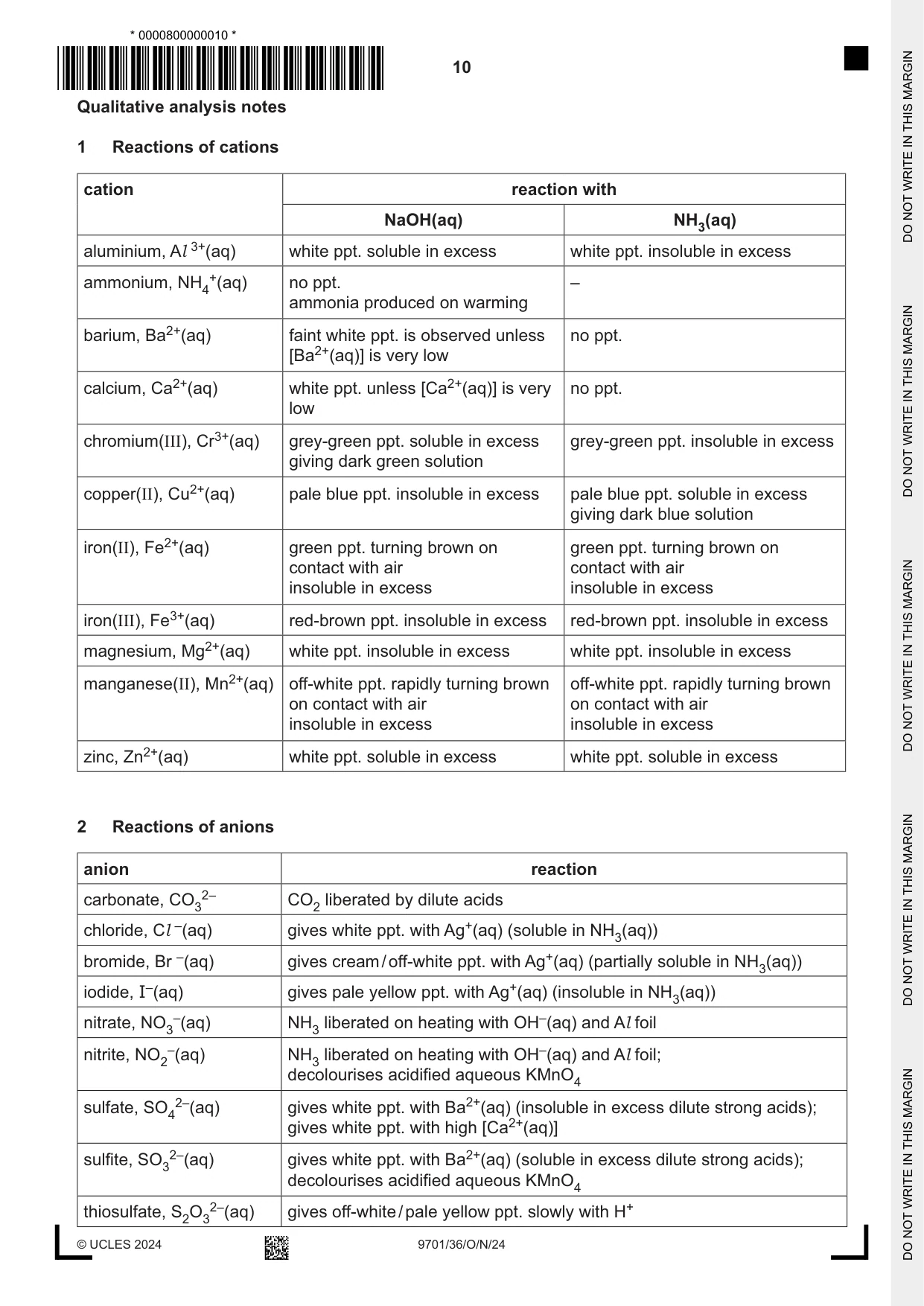
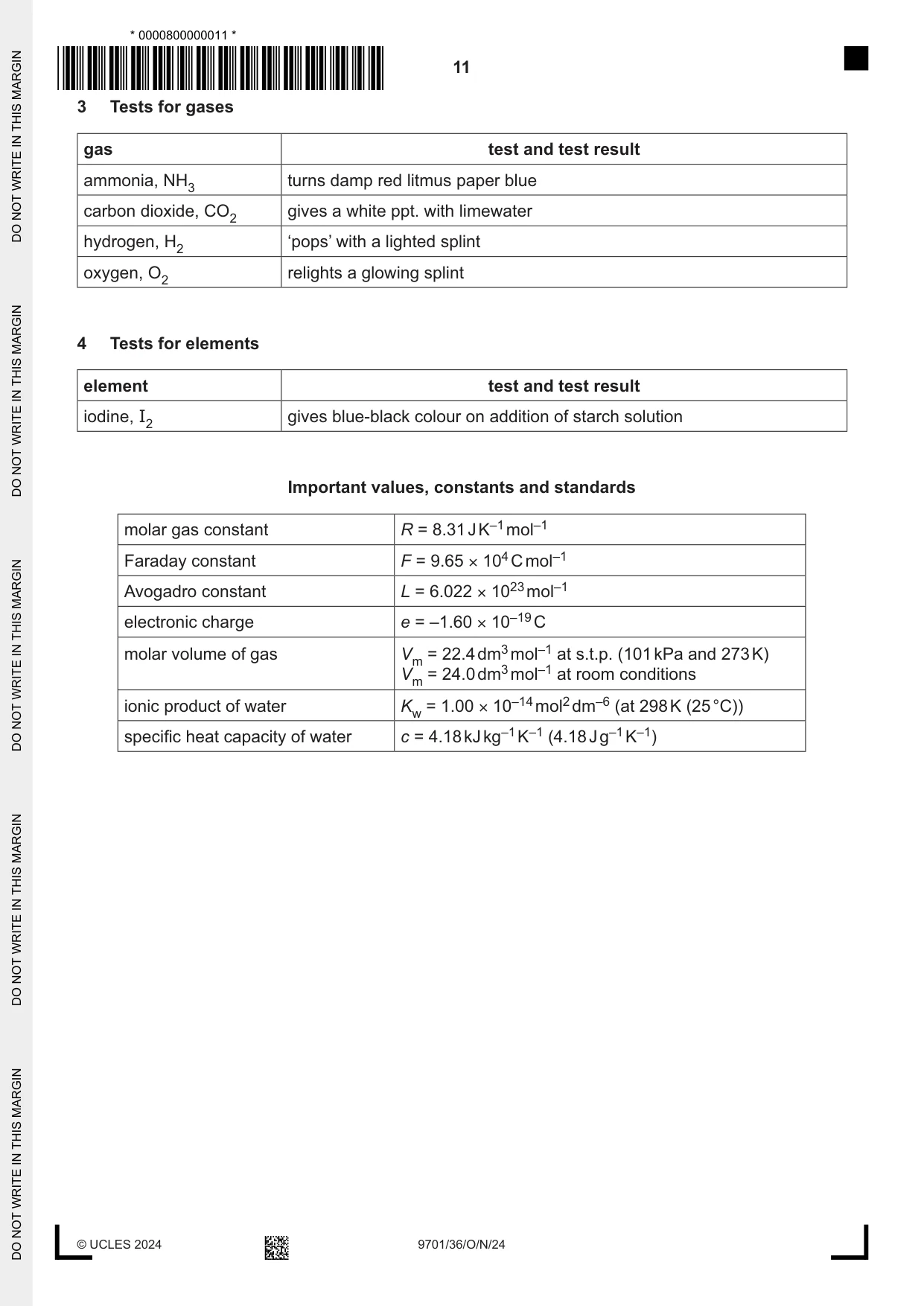
3 FB 4 is a mixture of two salts that each contain one cation and one anion. All the ions present are in the Qualitative analysis notes. (a) Place a small spatula measure of FB 4 into a hard-glass test-tube. Heat the tube gently at first and then more strongly. Record all your observations and identify any gas given off. ................................................................................................................................................... ................................................................................................................................................... ................................................................................................................................................... ................................................................................................................................................... ............................................................................................................................................. [4] (b) To a 5 cm depth of distilled water in a boiling tube, add a spatula measure of FB 4. Shake the tube to dissolve the FB 4. (i) Carry out the following tests using a 1 cm depth of this FB 4 solution in a test-tube for each test. Record your observations in Table 3.1. Table 3.1 test observations Test 1 Add aqueous sodium hydroxide, then transfer the mixture into a boiling tube, add a piece of aluminium foil and heat gently. Test 2 Add an equal volume of dilute nitric acid, then add a few drops of aqueous silver nitrate. Test 3 Add aqueous barium chloride or barium nitrate, then add dilute nitric acid. Test 4 Add aqueous sodium carbonate dropwise with shaking until in excess. [5] (ii) Use your observations in Table 3.1 to identify two anions which must be present in FB 4. ..................................................................................................................................... [2] (iii) Carry out further tests to confirm or identify which two cations are present in FB 4. Record the reagents and conditions needed, your observations and your conclusions in a suitable table. [5] [Total: 16]
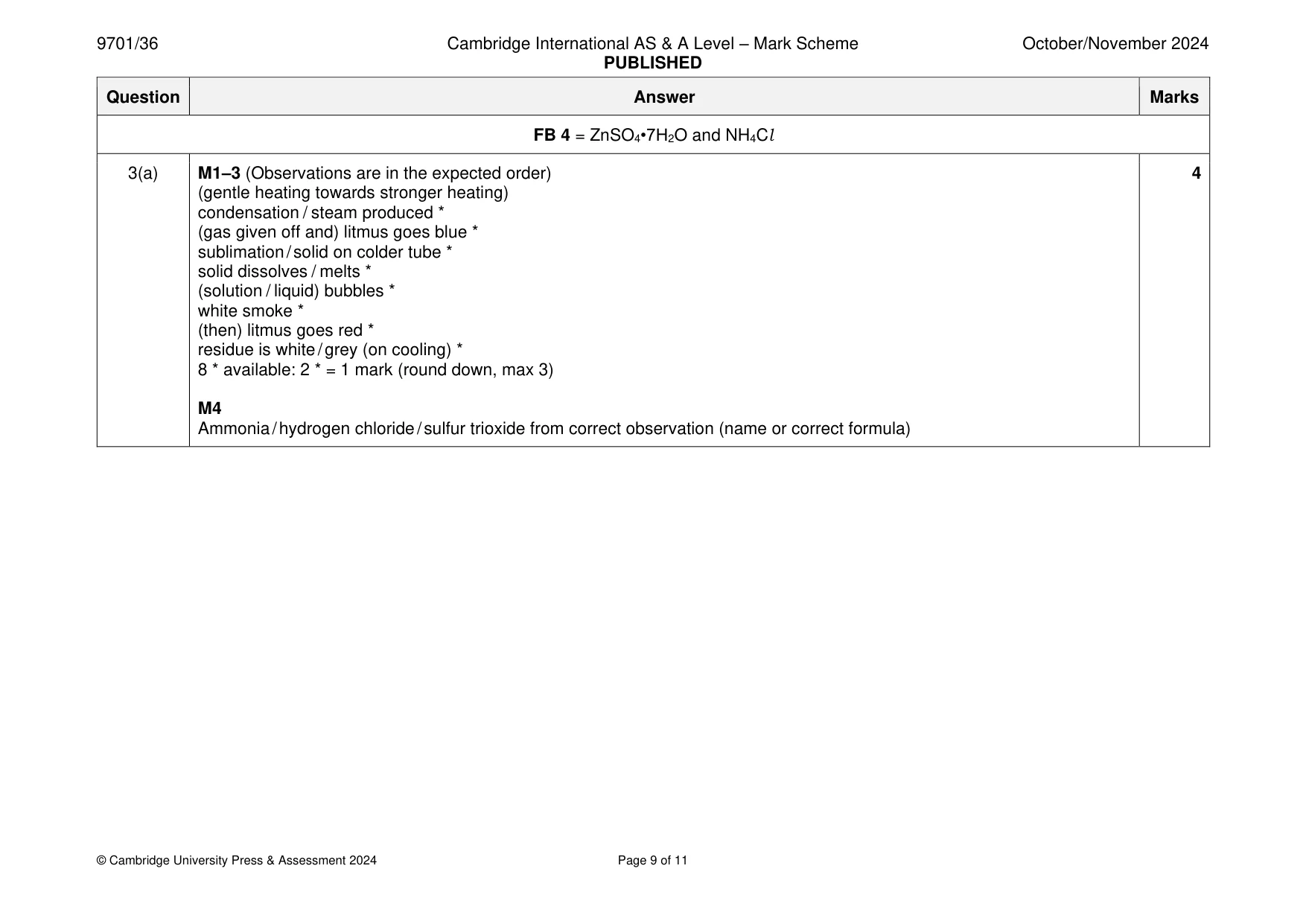
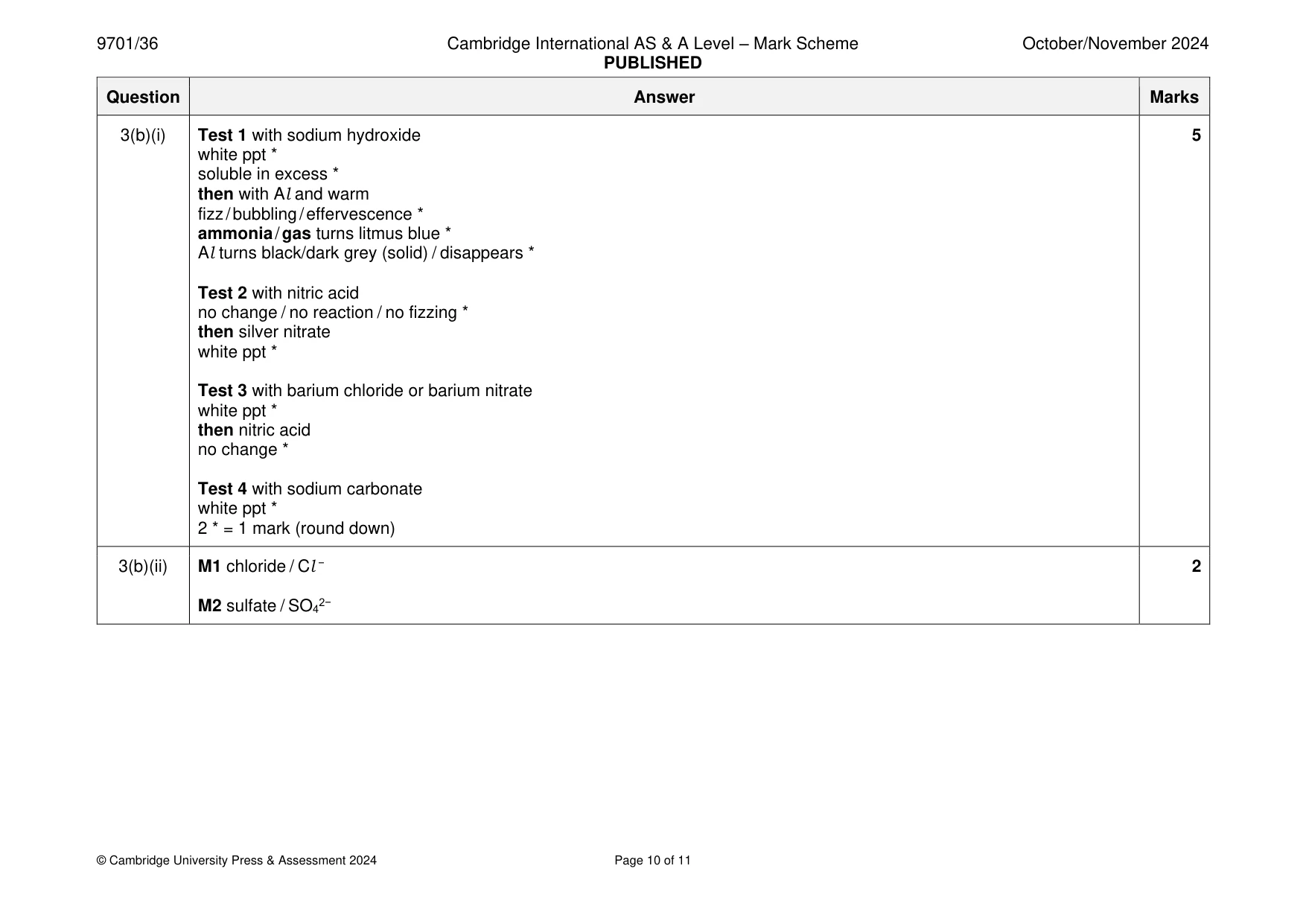
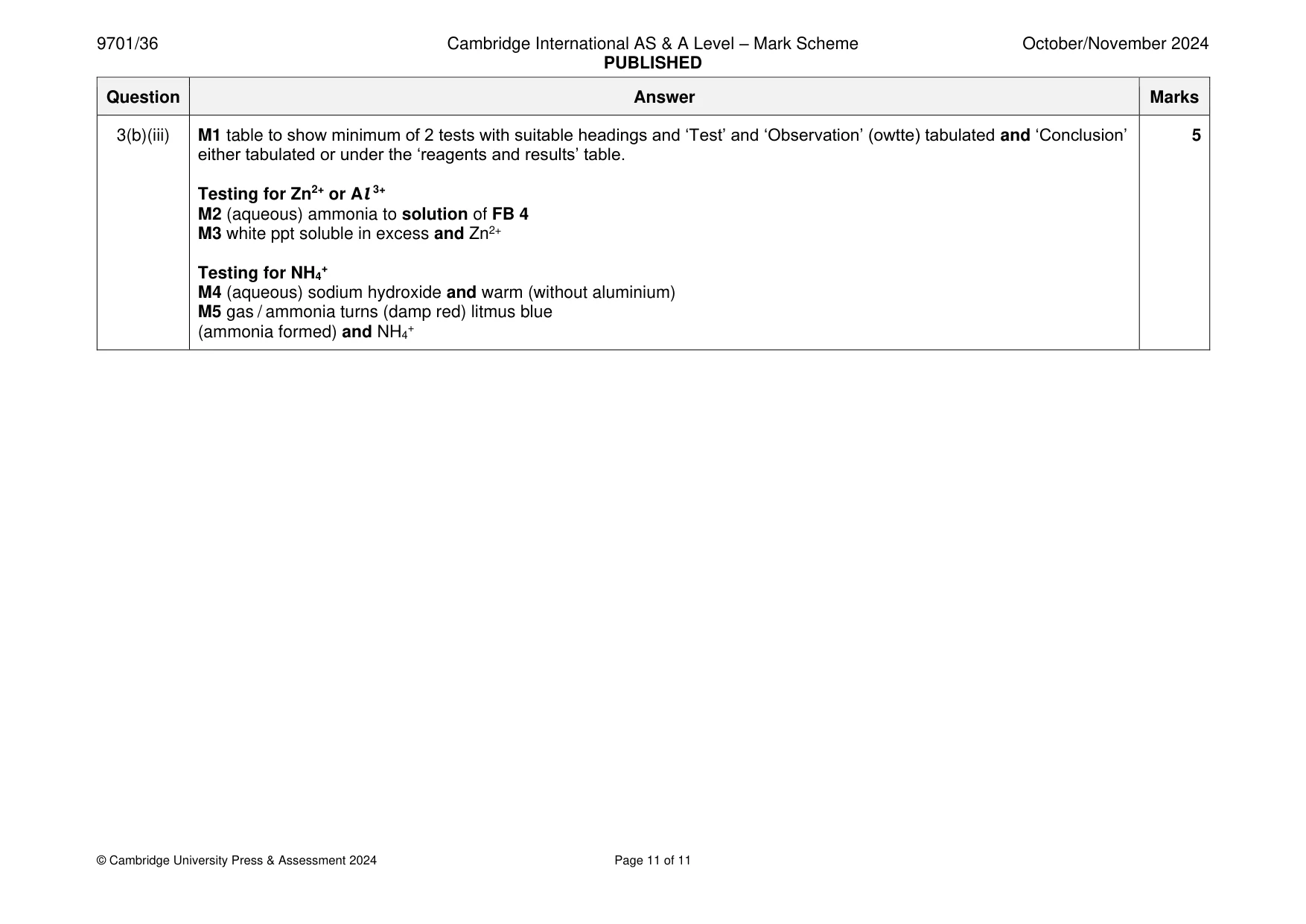
Mark scheme: 3(a) M1–3 (Observations are in the expected order) 4 (gentle heating towards stronger heating) condensation / steam produced * (gas given off and) litmus goes blue * sublimation / solid on colder tube * solid dissolves / melts * (solution / liquid) bubbles * white smoke * (then) litmus goes red * residue is white / grey (on cooling) * 8 * available: 2 * = 1 mark (round down, max 3) M4 Ammonia / hydrogen chloride / sulfur trioxide from correct observation (name or correct formula) 3(b)(i) Test 1 with sodium hydroxide 5 white ppt * soluble in excess * then with Al and warm fizz / bubbling / effervescence * ammonia / gas turns litmus blue * Al turns black/dark grey (solid) / disappears * Test 2 with nitric acid no change / no reaction / no fizzing * then silver nitrate white ppt * Test 3 with barium chloride or barium nitrate white ppt * then nitric acid no change * Test 4 with sodium carbonate white ppt * 2 * = 1 mark (round down) 3(b)(ii) M1 chloride / Cl − 2 M2 sulfate / SO42− 3(b)(iii) M1 table to show minimum of 2 tests with suitable headings and ‘Test’ and ‘Observation’ (owtte) tabulated and ‘Conclusion’ 5 either tabulated or under the ‘reagents and results’ table. Testing for Zn2+ or Al 3+ M2 (aqueous) ammonia to solution of FB 4 M3 white ppt soluble in excess and Zn2+ Testing for NH4+ M4 (aqueous) sodium hydroxide and warm (without aluminium) M5 gas / ammonia turns (damp red) litmus blue (ammonia formed) and NH4+
More questions on Periodicity of chemical properties of the elements in Period 3
What was in this paper
The subtopics covered by these 3 questions, and how many questions each got. Open one in a new tab to see every Cambridge question on it.
What you needed in this session
Cambridge’s own grade thresholds for 2024 Oct/Nov, Paper 3 · Variant 6. A higher threshold means an easier paper — the bar moves with how the cohort did.