Cambridge A Level Chemistry 9701 — 2019 Oct/Nov Paper 3 · Variant 6
9701/36/O/N/19 · 3 questions · 40 marks · ≈45 min
The question paper and its mark scheme, free to read here and free to download. This is Cambridge’s own paper, exactly as it was sat.
Question paper16 pages
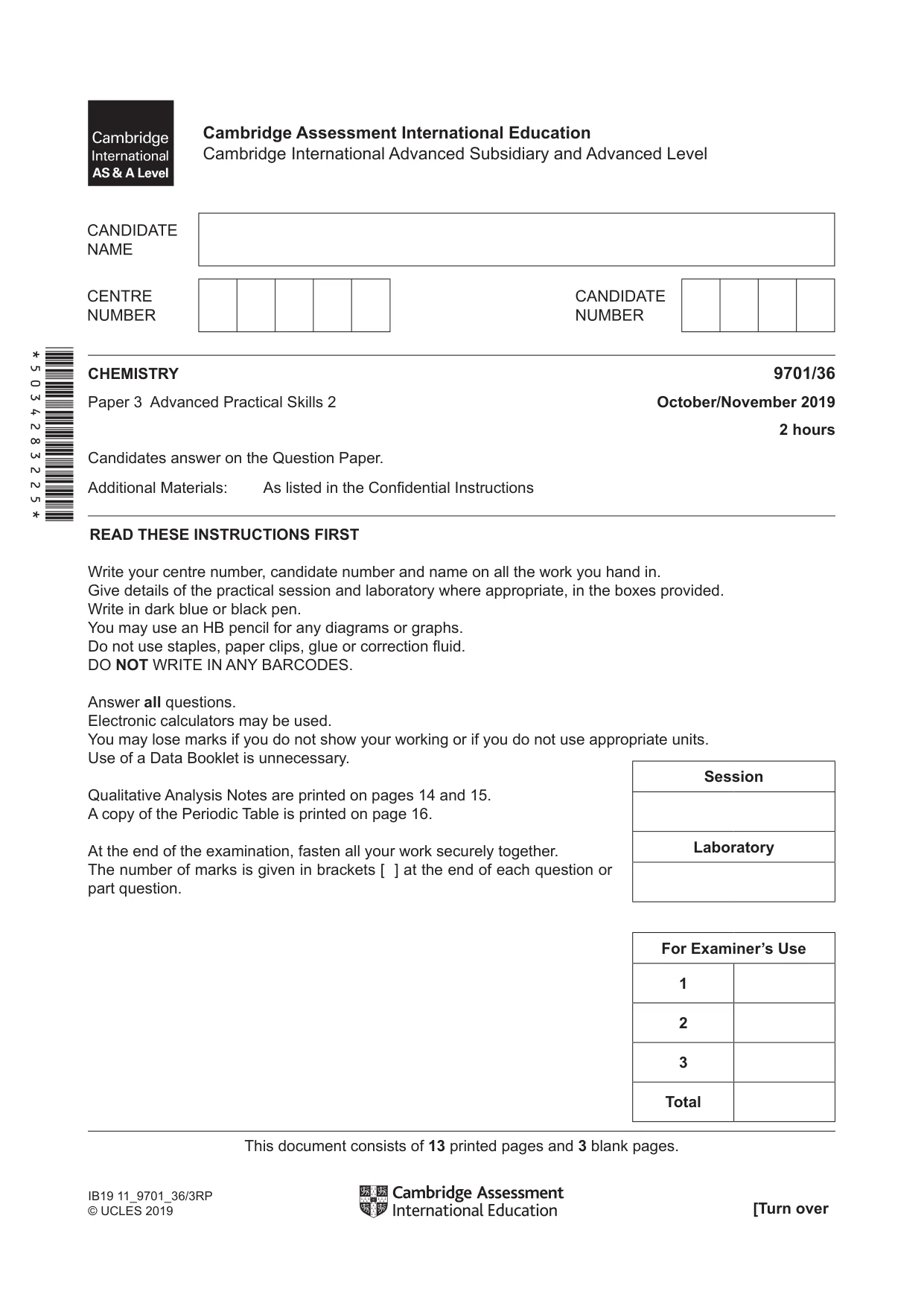



Mark scheme11 pages
Answers below. Sit the paper first if you are practising.
Questions as text
Q1 · Limewater is a saturated solution of calcium hydroxide, Ca(OH)2, in water
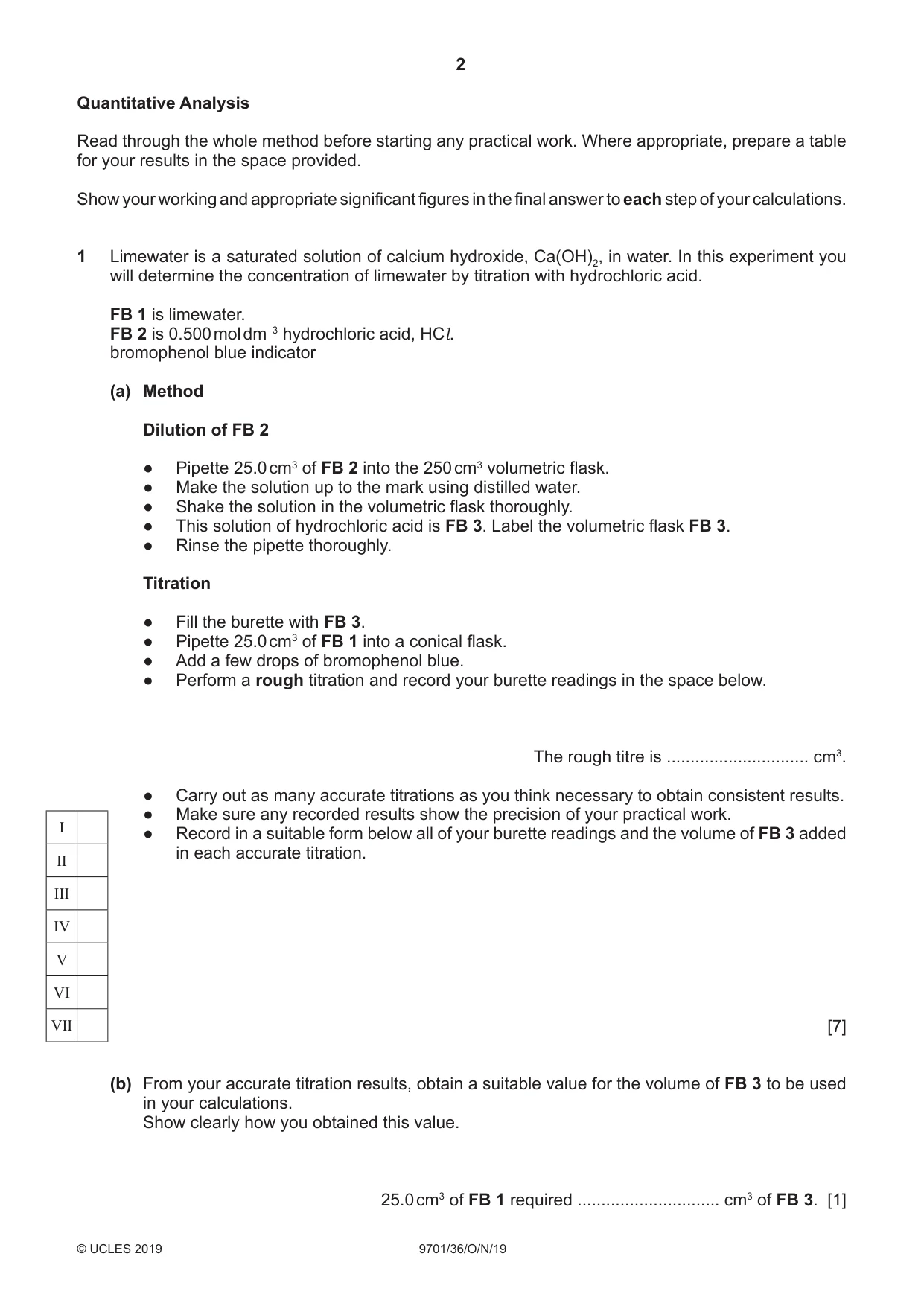
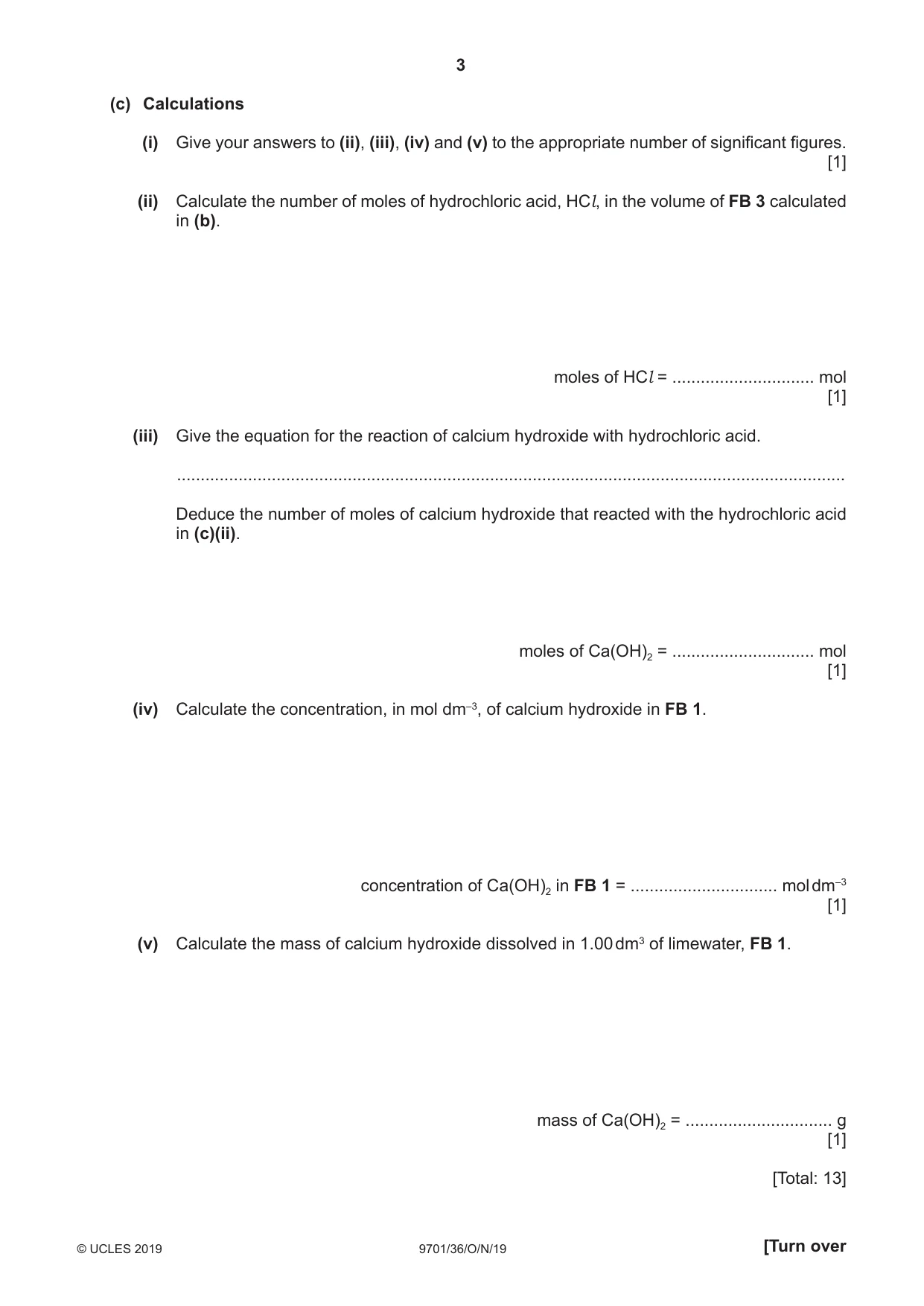
1 Limewater is a saturated solution of calcium hydroxide, Ca(OH)2, in water. In this experiment you will determine the concentration of limewater by titration with hydrochloric acid. FB 1 is limewater. FB 2 is 0.500 mol dm–3 hydrochloric acid, HCl. bromophenol blue indicator (a) Method Dilution of FB 2 ● Pipette 25.0 cm3 of FB 2 into the 250 cm3 volumetric flask. ● Make the solution up to the mark using distilled water. ● Shake the solution in the volumetric flask thoroughly. ● This solution of hydrochloric acid is FB 3. Label the volumetric flask FB 3. ● Rinse the pipette thoroughly. Titration ● Fill the burette with FB 3. ● Pipette 25.0 cm3 of FB 1 into a conical flask. ● Add a few drops of bromophenol blue. ● Perform a rough titration and record your burette readings in the space below. The rough titre is .............................. cm3. ● Carry out as many accurate titrations as you think necessary to obtain consistent results. ● Make sure any recorded results show the precision of your practical work. I ● Record in a suitable form below all of your burette readings and the volume of FB 3 added in each accurate titration. II III IV V VI VII [7] (b) From your accurate titration results, obtain a suitable value for the volume of FB 3 to be used in your calculations. Show clearly how you obtained this value. 25.0 cm3 of FB 1 required .............................. cm3 of FB 3. [1] (ii) Calculate the number of moles of hydrochloric acid, HCl, in the volume of FB 3 calculated in (b). moles of HCl = .............................. mol [1] (iii) Give the equation for the reaction of calcium hydroxide with hydrochloric acid. ............................................................................................................................................. Deduce the number of moles of calcium hydroxide that reacted with the hydrochloric acid in (c)(ii). moles of Ca(OH)2 = .............................. mol [1] (iv) Calculate the concentration, in mol dm–3, of calcium hydroxide in FB 1. concentration of Ca(OH)2 in FB 1 = ............................... mol dm–3 [1] (v) Calculate the mass of calcium hydroxide dissolved in 1.00 dm3 of limewater, FB 1. mass of Ca(OH)2 = ............................... g [1] [Total: 13]
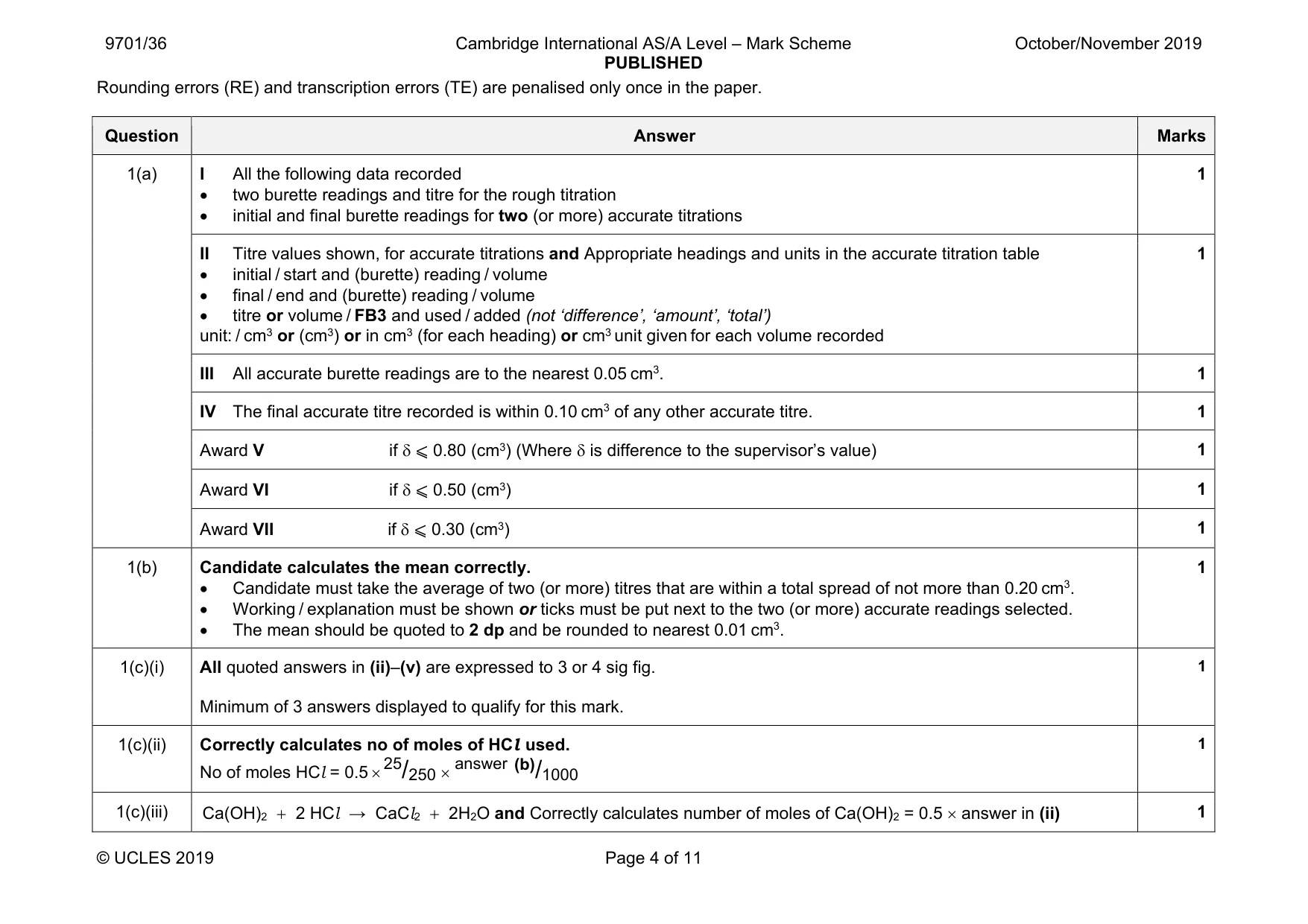
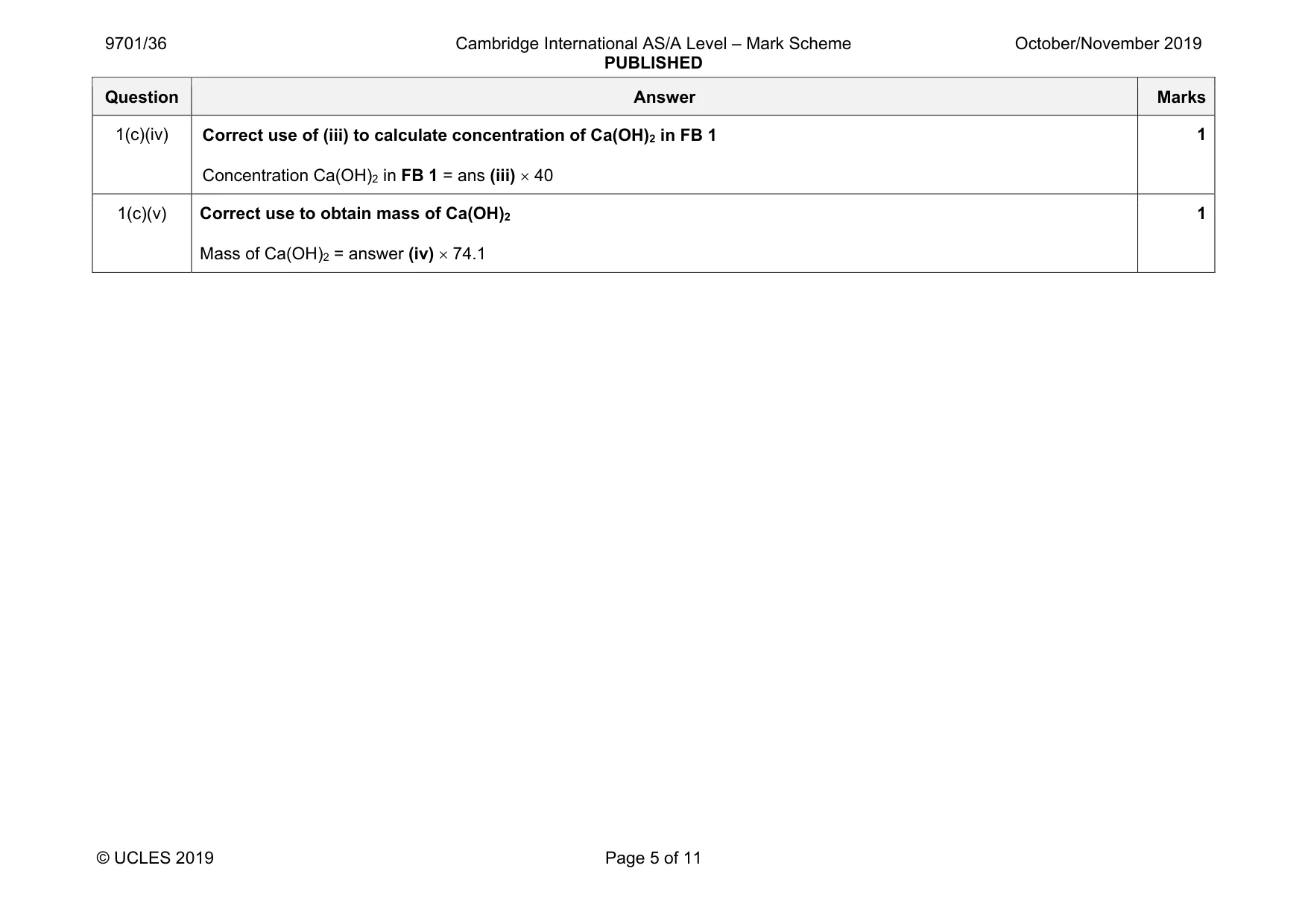
Mark scheme: 1(a) I All the following data recorded • two burette readings and titre for the rough titration • initial and final burette readings for two (or more) accurate titrations 1 II Titre values shown, for accurate titrations and Appropriate headings and units in the accurate titration table • initial / start and (burette) reading / volume • final / end and (burette) reading / volume • titre or volume / FB3 and used / added (not ‘difference’, ‘amount’, ‘total’) unit: / cm3 or (cm3) or in cm3 (for each heading) or cm3 unit given for each volume recorded 1 III All accurate burette readings are to the nearest 0.05 cm3. 1 IV The final accurate titre recorded is within 0.10 cm3 of any other accurate titre. 1 Award V if δ ⩽ 0.80 (cm3) (Where δ is difference to the supervisor’s value) 1 Award VI if δ ⩽ 0.50 (cm3) 1 Award VII if δ ⩽ 0.30 (cm3) 1 1(b) Candidate calculates the mean correctly. • Candidate must take the average of two (or more) titres that are within a total spread of not more than 0.20 cm3. • Working / explanation must be shown or ticks must be put next to the two (or more) accurate readings selected. • The mean should be quoted to 2 dp and be rounded to nearest 0.01 cm3. 1 1(c)(i) All quoted answers in (ii)–(v) are expressed to 3 or 4 sig fig. Minimum of 3 answers displayed to qualify for this mark. 1 1(c)(ii) Correctly calculates no of moles of HCl used. No of moles HCl = 0.5 × 25/250 × answer (b)/1000 1 1(c)(iii) Ca(OH)2 + 2 HCl → CaCl2 + 2H2O and Correctly calculates number of moles of Ca(OH)2 = 0.5 × answer in (ii) 1 Question Answer Marks 1(c)(iv) Correct use of (iii) to calculate concentration of Ca(OH)2 in FB 1 Concentration Ca(OH)2 in FB 1 = ans (iii) × 40 1 1(c)(v) Correct use to obtain mass of Ca(OH)2 Mass of Ca(OH)2 = answer (iv) × 74.1 1
Q2 · In this experiment you will determine the enthalpy change, ΔH, for the decomposition of…
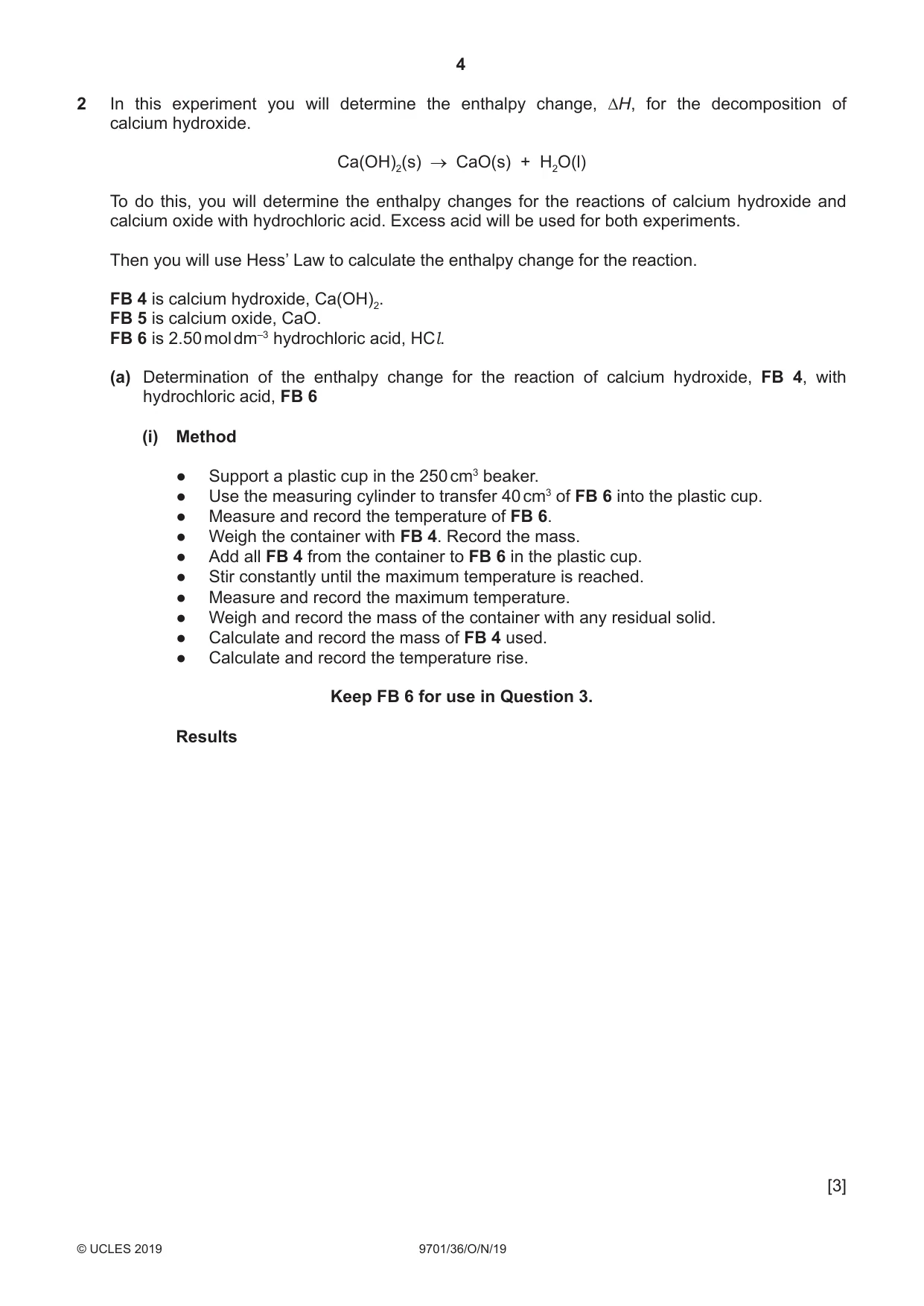
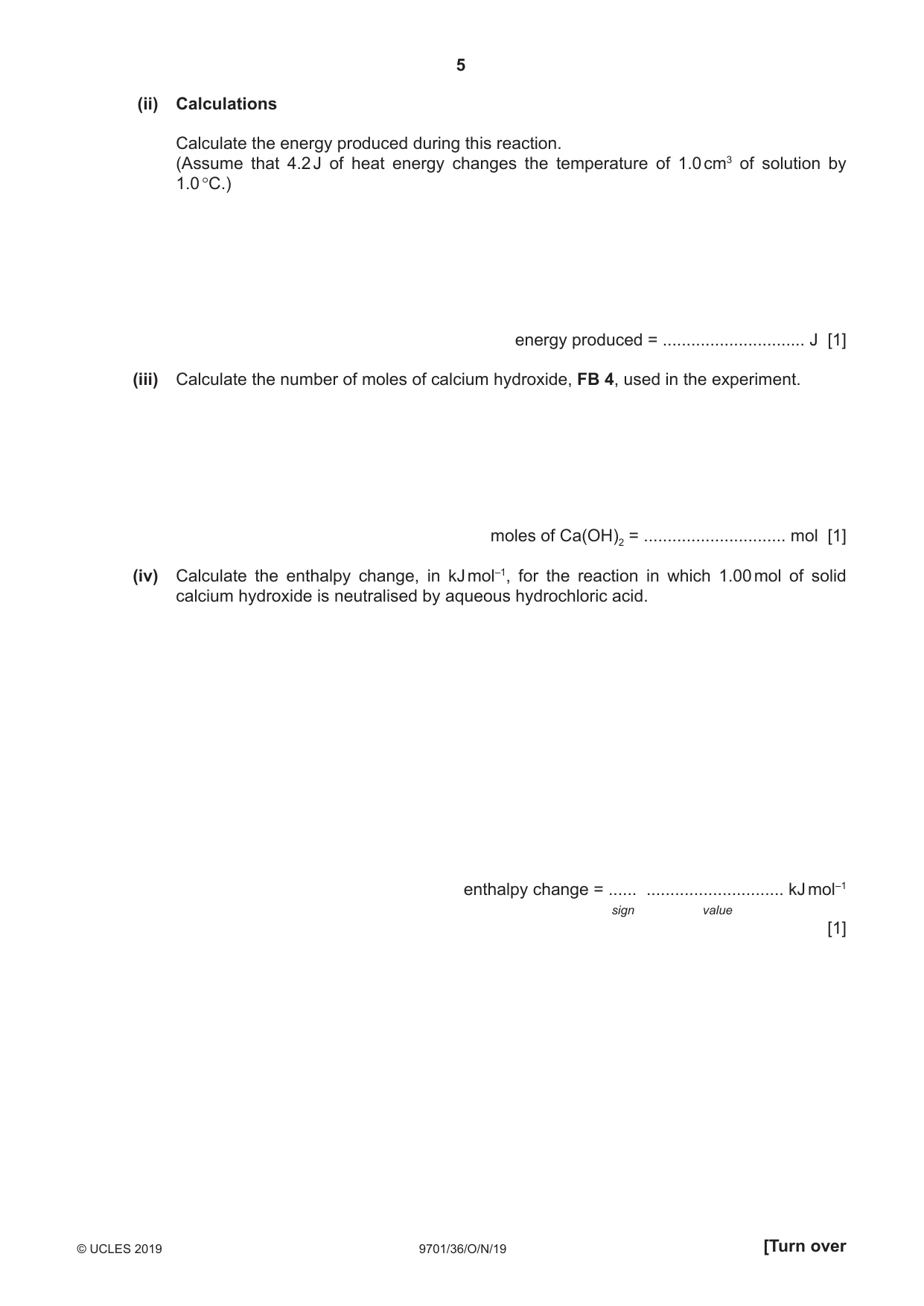
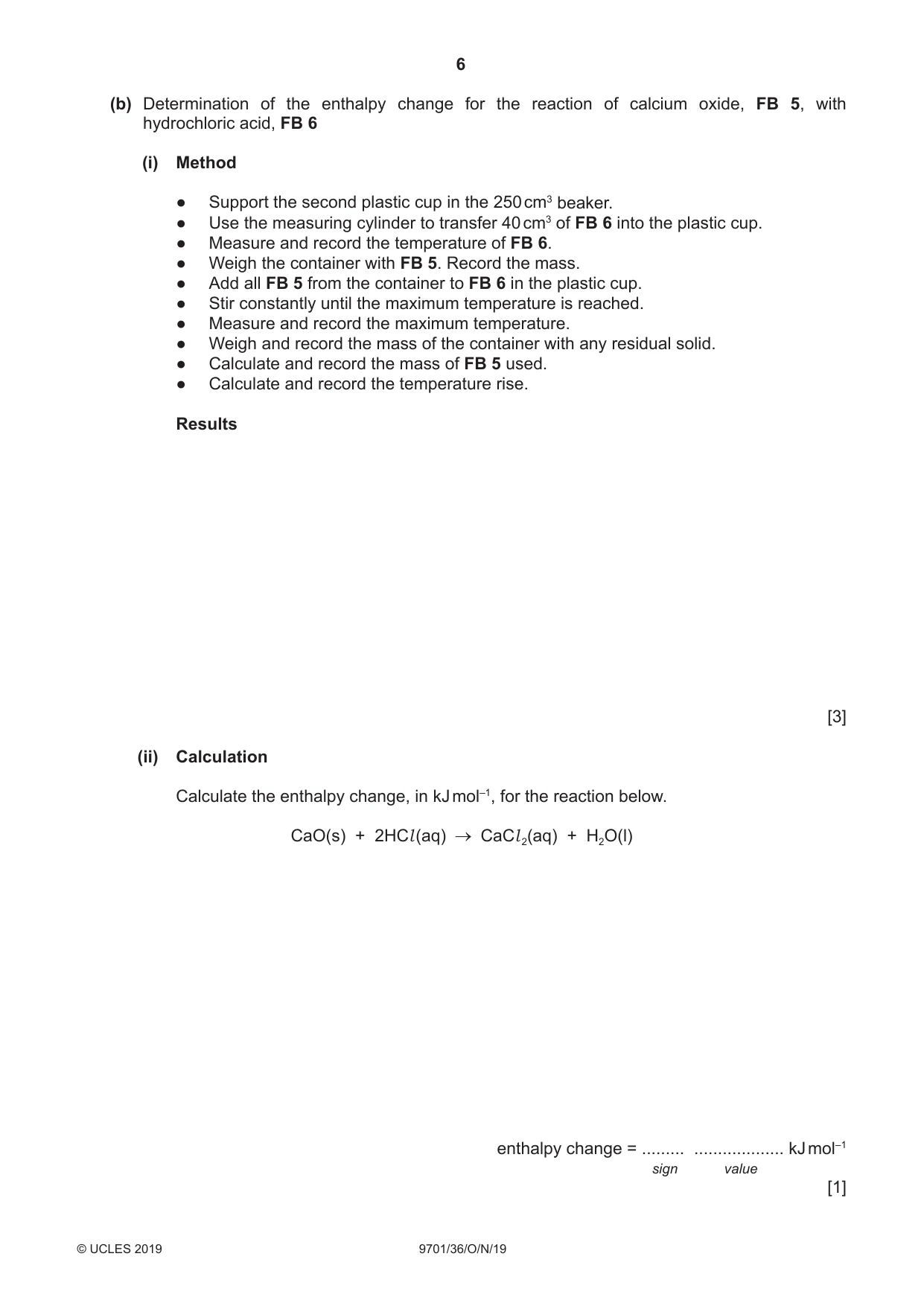
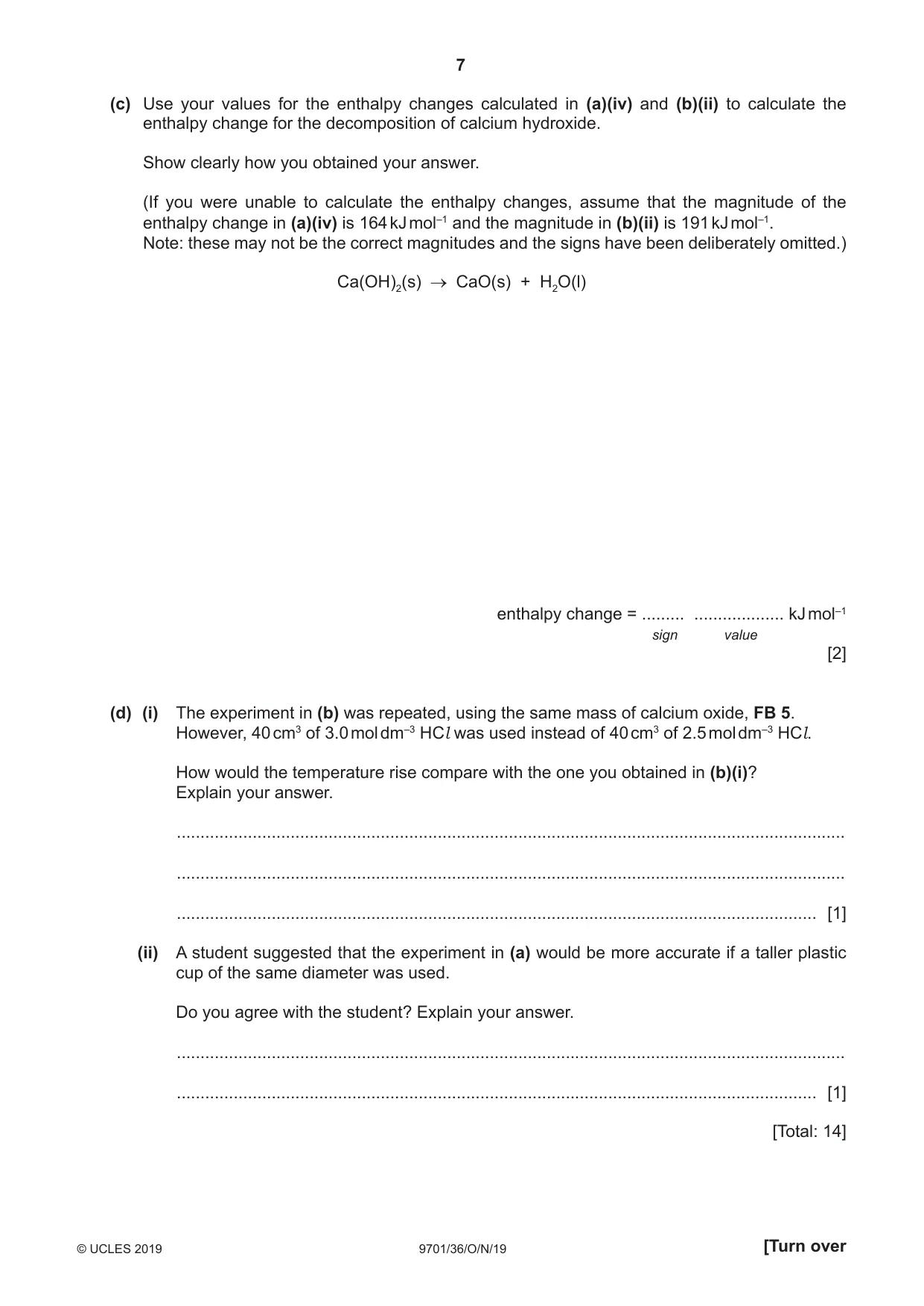
2 In this experiment you will determine the enthalpy change, ΔH, for the decomposition of calcium hydroxide. Ca(OH)2(s) CaO(s) + H2O(l) To do this, you will determine the enthalpy changes for the reactions of calcium hydroxide and calcium oxide with hydrochloric acid. Excess acid will be used for both experiments. Then you will use Hess’ Law to calculate the enthalpy change for the reaction. FB 4 is calcium hydroxide, Ca(OH)2. FB 5 is calcium oxide, CaO. FB 6 is 2.50 mol dm–3 hydrochloric acid, HCl. (a) Determination of the enthalpy change for the reaction of calcium hydroxide, FB 4, with hydrochloric acid, FB 6 (i) Method ● Support a plastic cup in the 250 cm3 beaker. ● Use the measuring cylinder to transfer 40 cm3 of FB 6 into the plastic cup. ● Measure and record the temperature of FB 6. ● Weigh the container with FB 4. Record the mass. ● Add all FB 4 from the container to FB 6 in the plastic cup. ● Stir constantly until the maximum temperature is reached. ● Measure and record the maximum temperature. ● Weigh and record the mass of the container with any residual solid. ● Calculate and record the mass of FB 4 used. ● Calculate and record the temperature rise. Keep FB 6 for use in Question 3. Results [3] (ii) Calculations Calculate the energy produced during this reaction. (Assume that 4.2 J of heat energy changes the temperature of 1.0 cm3 of solution by 1.0 °C.) energy produced = .............................. J [1] (iii) Calculate the number of moles of calcium hydroxide, FB 4, used in the experiment. moles of Ca(OH)2 = .............................. mol [1] (iv) Calculate the enthalpy change, in kJ mol–1, for the reaction in which 1.00 mol of solid calcium hydroxide is neutralised by aqueous hydrochloric acid. enthalpy change = ...... ............................. kJ mol–1 sign value [1] (b) Determination of the enthalpy change for the reaction of calcium oxide, FB 5, with hydrochloric acid, FB 6 (i) Method ● Support the second plastic cup in the 250 cm3 beaker. ● Use the measuring cylinder to transfer 40 cm3 of FB 6 into the plastic cup. ● Measure and record the temperature of FB 6. ● Weigh the container with FB 5. Record the mass. ● Add all FB 5 from the container to FB 6 in the plastic cup. ● Stir constantly until the maximum temperature is reached. ● Measure and record the maximum temperature. ● Weigh and record the mass of the container with any residual solid. ● Calculate and record the mass of FB 5 used. ● Calculate and record the temperature rise. Results [3] (ii) Calculation Calculate the enthalpy change, in kJ mol–1, for the reaction below. CaO(s) + 2HCl (aq) CaCl 2(aq) + H2O(l) enthalpy change = ......... ................... kJ mol–1 sign value [1] (c) Use your values for the enthalpy changes calculated in (a)(iv) and (b)(ii) to calculate the enthalpy change for the decomposition of calcium hydroxide. Show clearly how you obtained your answer. (If you were unable to calculate the enthalpy changes, assume that the magnitude of the enthalpy change in (a)(iv) is 164 kJ mol–1 and the magnitude in (b)(ii) is 191 kJ mol–1. Note: these may not be the correct magnitudes and the signs have been deliberately omitted.) Ca(OH)2(s) CaO(s) + H2O(l) enthalpy change = ......... ................... kJ mol–1 sign value [2] (d) (i) The experiment in (b) was repeated, using the same mass of calcium oxide, FB 5. However, 40 cm3 of 3.0 mol dm–3 HCl was used instead of 40 cm3 of 2.5 mol dm–3 HCl. How would the temperature rise compare with the one you obtained in (b)(i)? Explain your answer. ............................................................................................................................................. ............................................................................................................................................. ....................................................................................................................................... [1] (ii) A student suggested that the experiment in (a) would be more accurate if a taller plastic cup of the same diameter was used. Do you agree with the student? Explain your answer. ............................................................................................................................................. ....................................................................................................................................... [1] [Total: 14] Qualitative Analysis Where reagents are selected for use in a test, the name or correct formula of the element or compound must be given. At each stage of any test you are to record details of the following: ● colour changes seen; ● the formation of any precipitate and its solubility in an excess of the reagent added; ● the formation of any gas and its identification by a suitable test. You should indicate clearly at what stage in a test a change occurs. If any solution is warmed, a boiling tube must be used. Rinse and reuse test-tubes and boiling tubes where possible. No additional tests for ions present should be attempted.
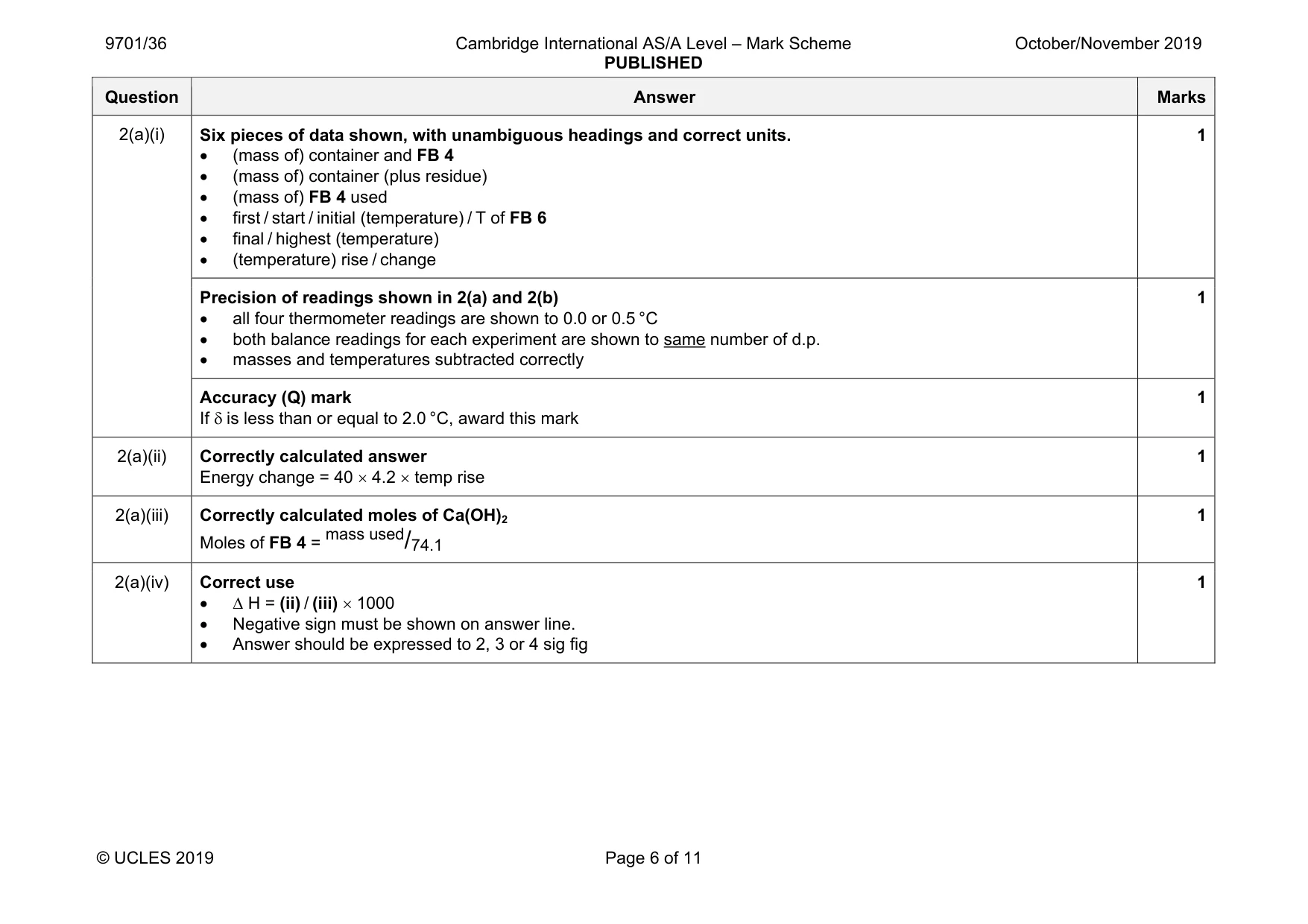
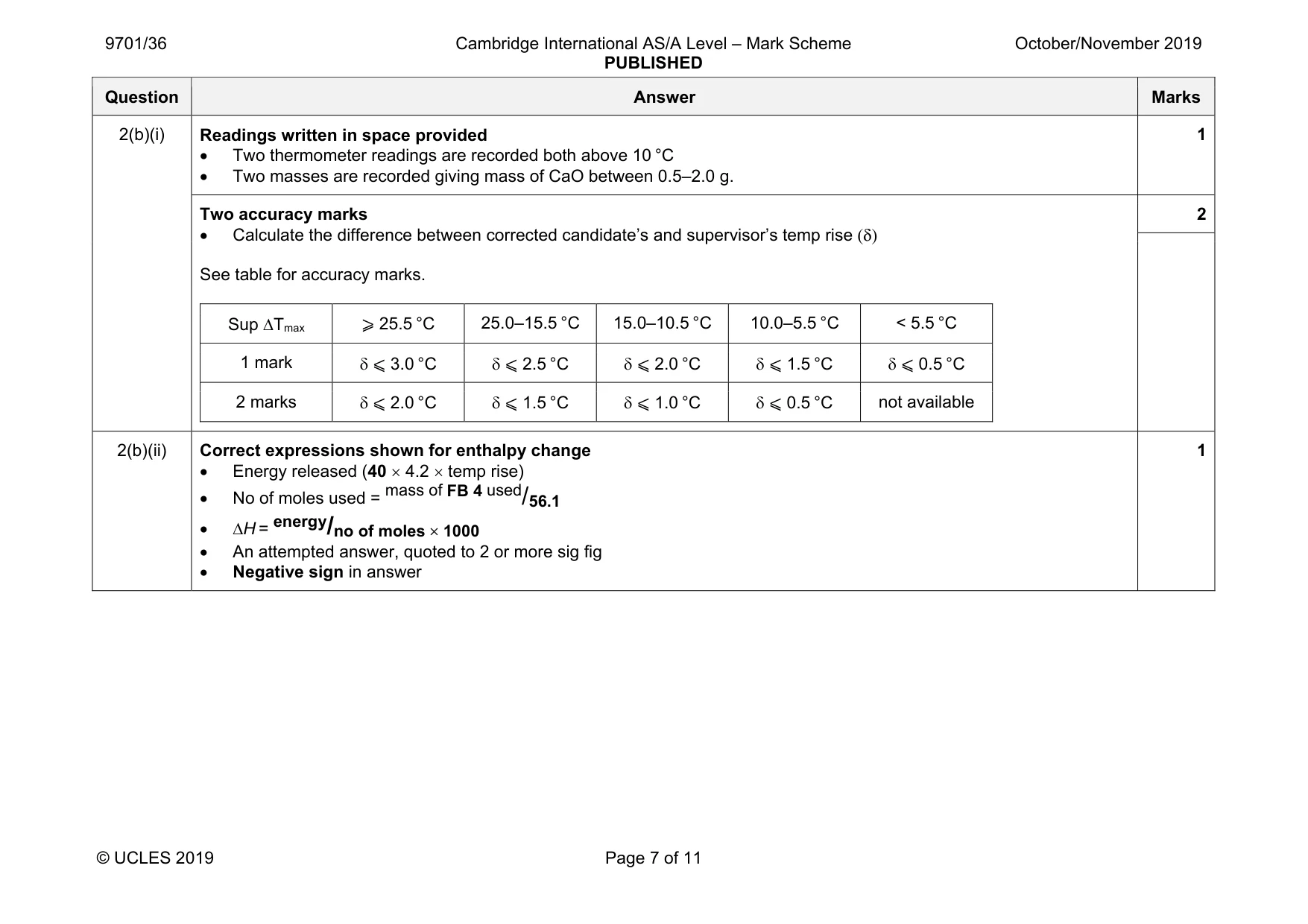
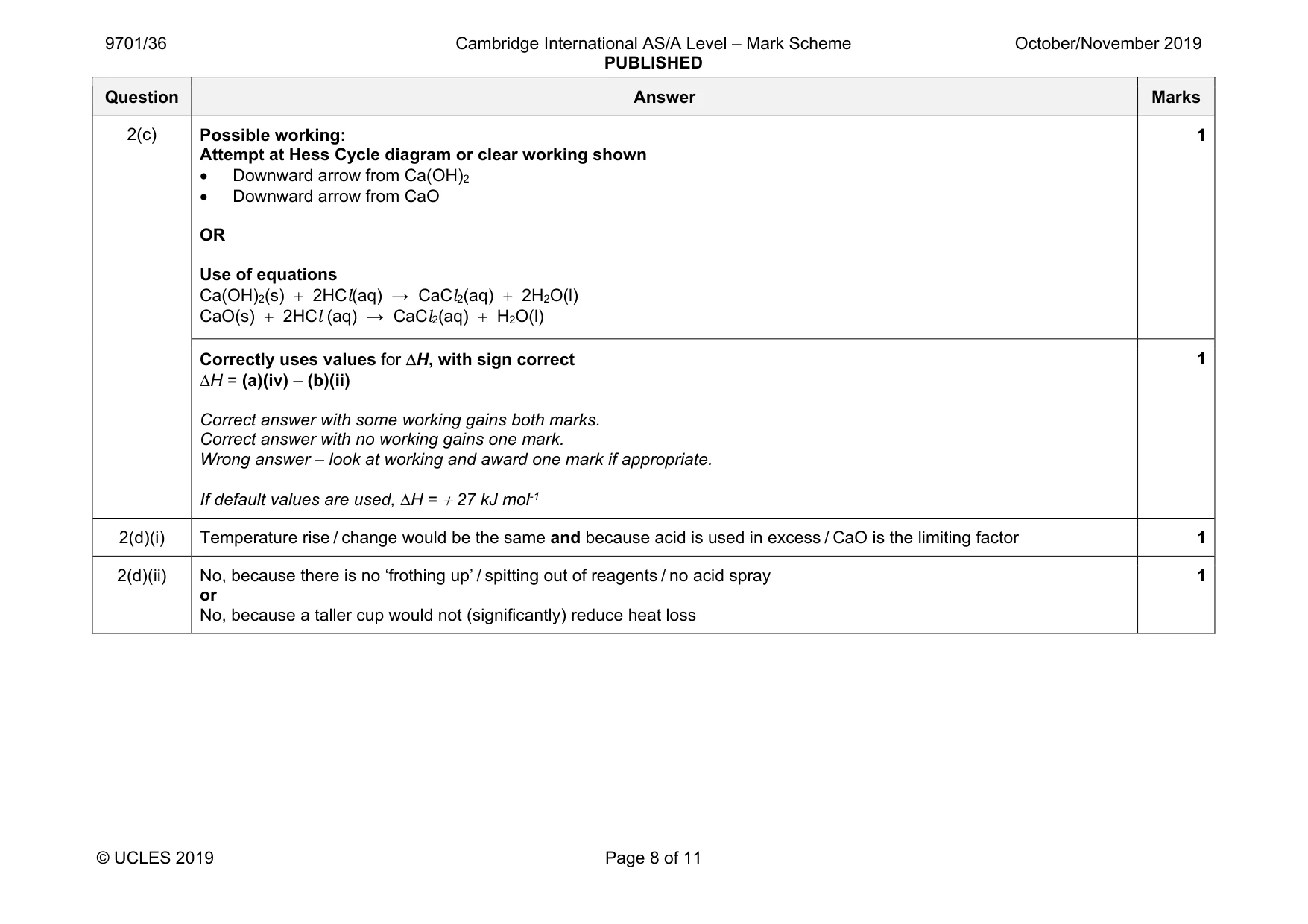
Mark scheme: 2(a)(i) Six pieces of data shown, with unambiguous headings and correct units. • (mass of) container and FB 4 • (mass of) container (plus residue) • (mass of) FB 4 used • first / start / initial (temperature) / T of FB 6 • final / highest (temperature) • (temperature) rise / change 1 Precision of readings shown in 2(a) and 2(b) • all four thermometer readings are shown to 0.0 or 0.5 °C • both balance readings for each experiment are shown to same number of d.p. • masses and temperatures subtracted correctly 1 Accuracy (Q) mark If δ is less than or equal to 2.0 °C, award this mark 1 2(a)(ii) Correctly calculated answer Energy change = 40 × 4.2 × temp rise 1 2(a)(iii) Correctly calculated moles of Ca(OH)2 Moles of FB 4 = mass used/74.1 1 2(a)(iv) Correct use • ∆ H = (ii) / (iii) × 1000 • Negative sign must be shown on answer line. • Answer should be expressed to 2, 3 or 4 sig fig 1 Question Answer Marks 2(b)(i) Readings written in space provided • Two thermometer readings are recorded both above 10 °C • Two masses are recorded giving mass of CaO between 0.5–2.0 g. 1 Two accuracy marks • Calculate the difference between corrected candidate’s and supervisor’s temp rise (δ) See table for accuracy marks. Sup ∆Tmax ⩾ 25.5 °C 25.0–15.5 °C 15.0–10.5 °C 10.0–5.5 °C < 5.5 °C 1 mark δ ⩽ 3.0 °C δ ⩽ 2.5 °C δ ⩽ 2.0 °C δ ⩽ 1.5 °C δ ⩽ 0.5 °C 2 marks δ ⩽ 2.0 °C δ ⩽ 1.5 °C δ ⩽ 1.0 °C δ ⩽ 0.5 °C not available 2 2(b)(ii) Correct expressions shown for enthalpy change • Energy released (40 × 4.2 × temp rise) • No of moles used = mass of FB 4 used/56.1 • ∆H = energy/no of moles × 1000 • An attempted answer, quoted to 2 or more sig fig • Negative sign in answer 1 Question Answer Marks 2(c) Possible working: Attempt at Hess Cycle diagram or clear working shown • Downward arrow from Ca(OH)2 • Downward arrow from CaO OR Use of equations Ca(OH)2(s) + 2HCl(aq) → CaCl2(aq) + 2H2O(l) CaO(s) + 2HCl (aq) → CaCl2(aq) + H2O(l) 1 Correctly uses values for ∆H, with sign correct ∆H = (a)(iv) – (b)(ii) Correct answer with some working gains both marks. Correct answer with no working gains one mark. Wrong answer – look at working and award one mark if appropriate. If default values are used, ∆H = + 27 kJ mol-1 1 2(d)(i) Temperature rise / change would be the same and because acid is used in excess / CaO is the limiting factor 1 2(d)(ii) No, because there is no ‘frothing up’ / spitting out of reagents / no acid spray or No, because a taller cup would not (significantly) reduce heat loss 1
Q3 · FB 7 is a solid containing one of the anions listed in the Qualitative Analysis Notes
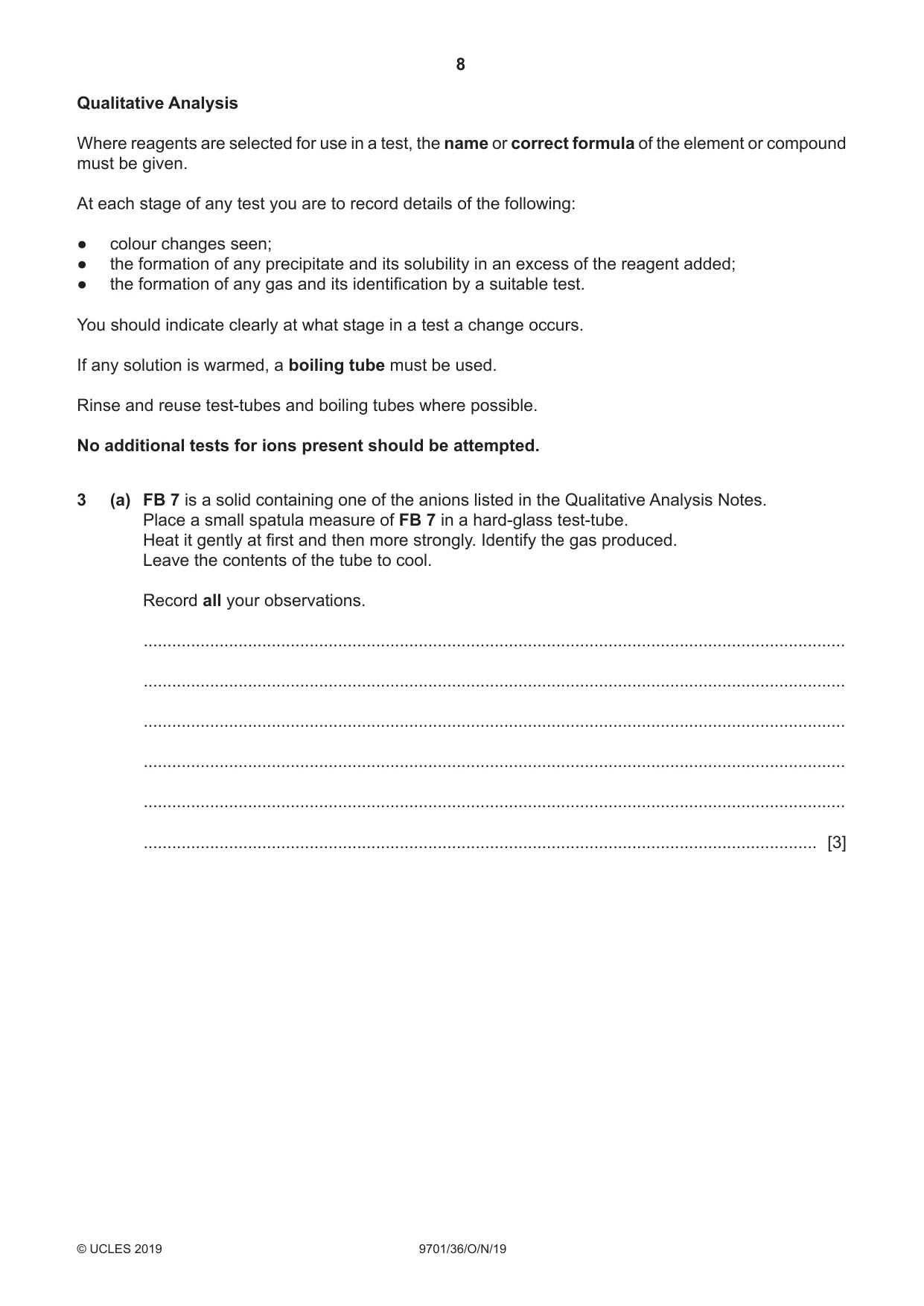
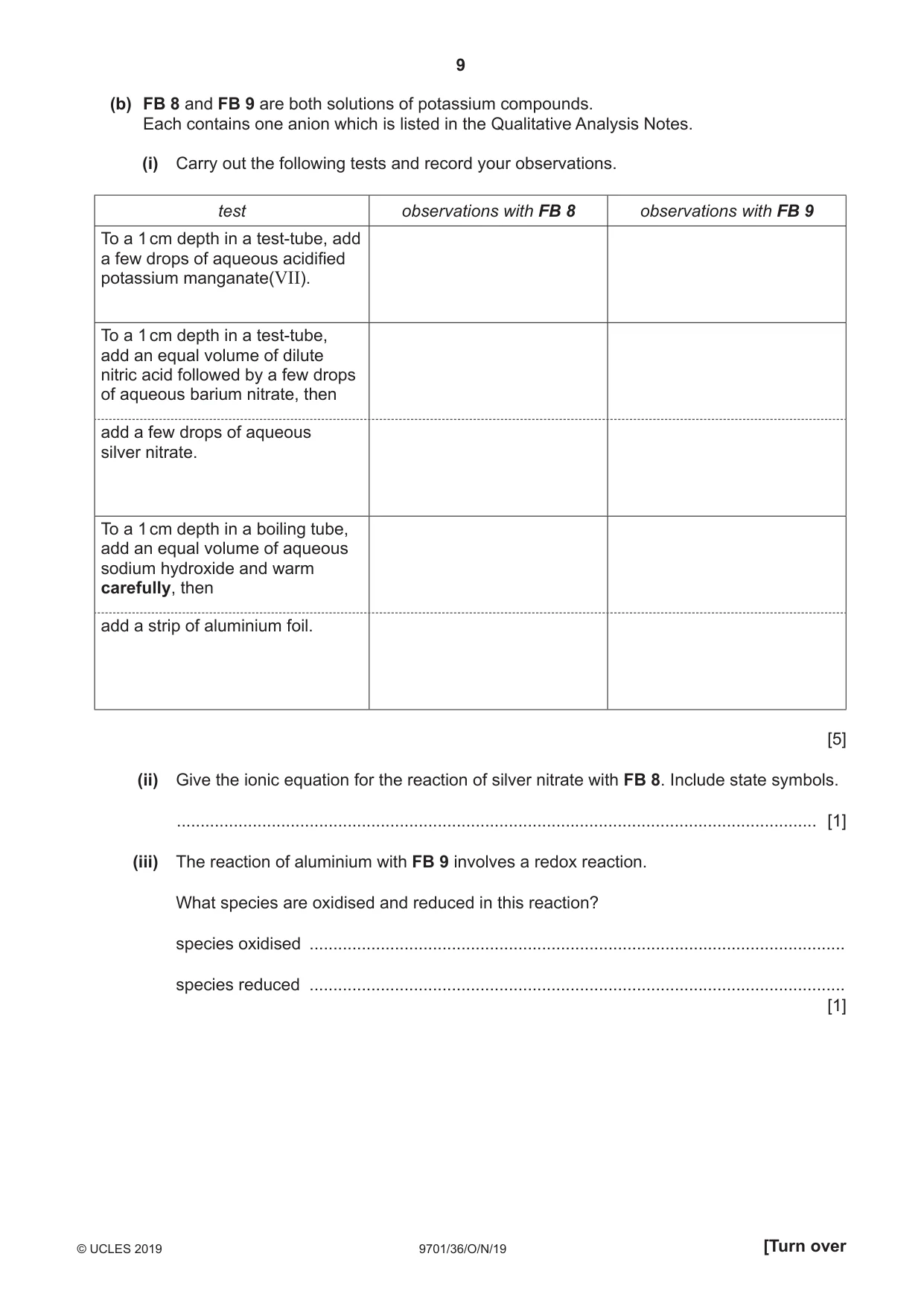
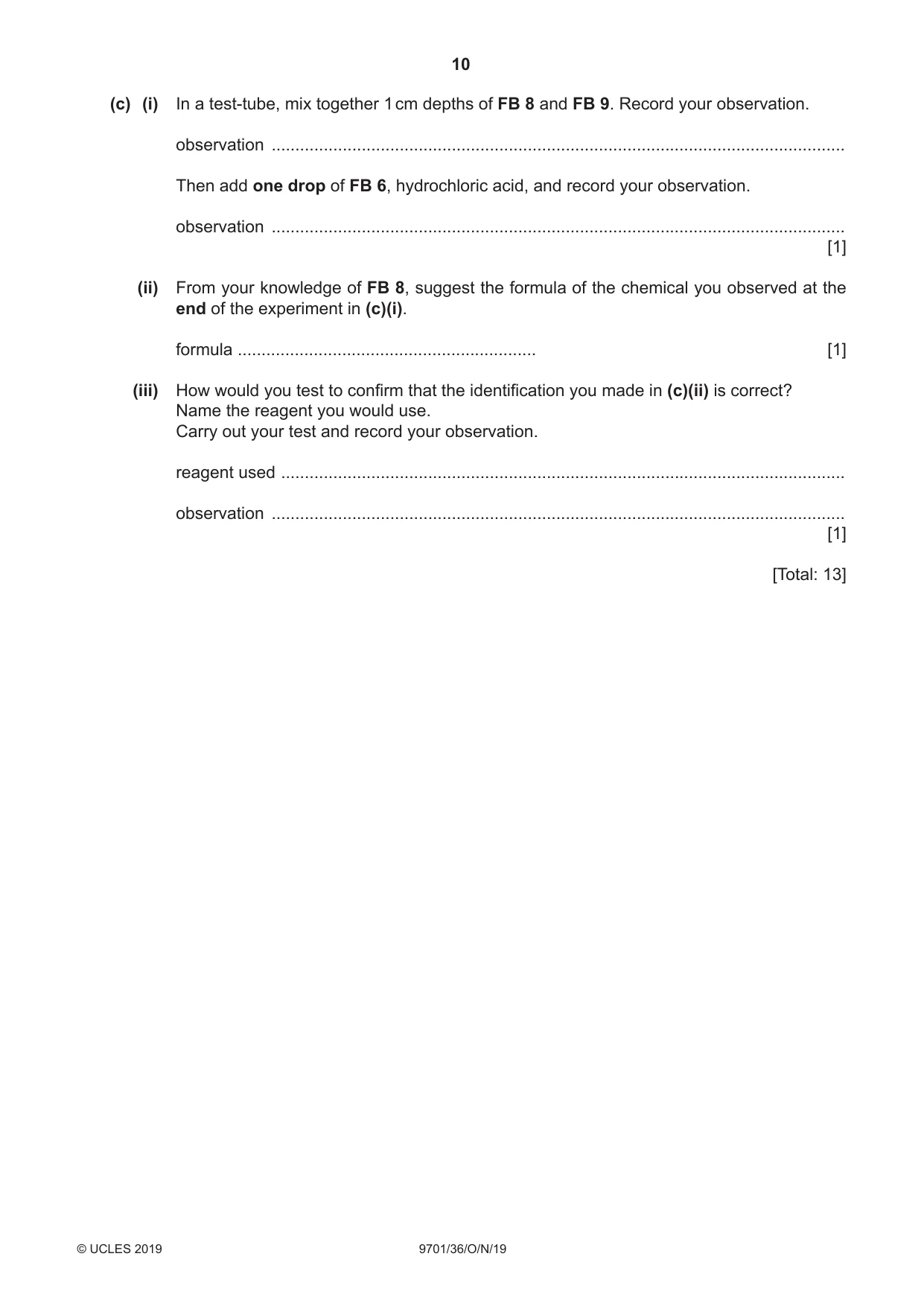
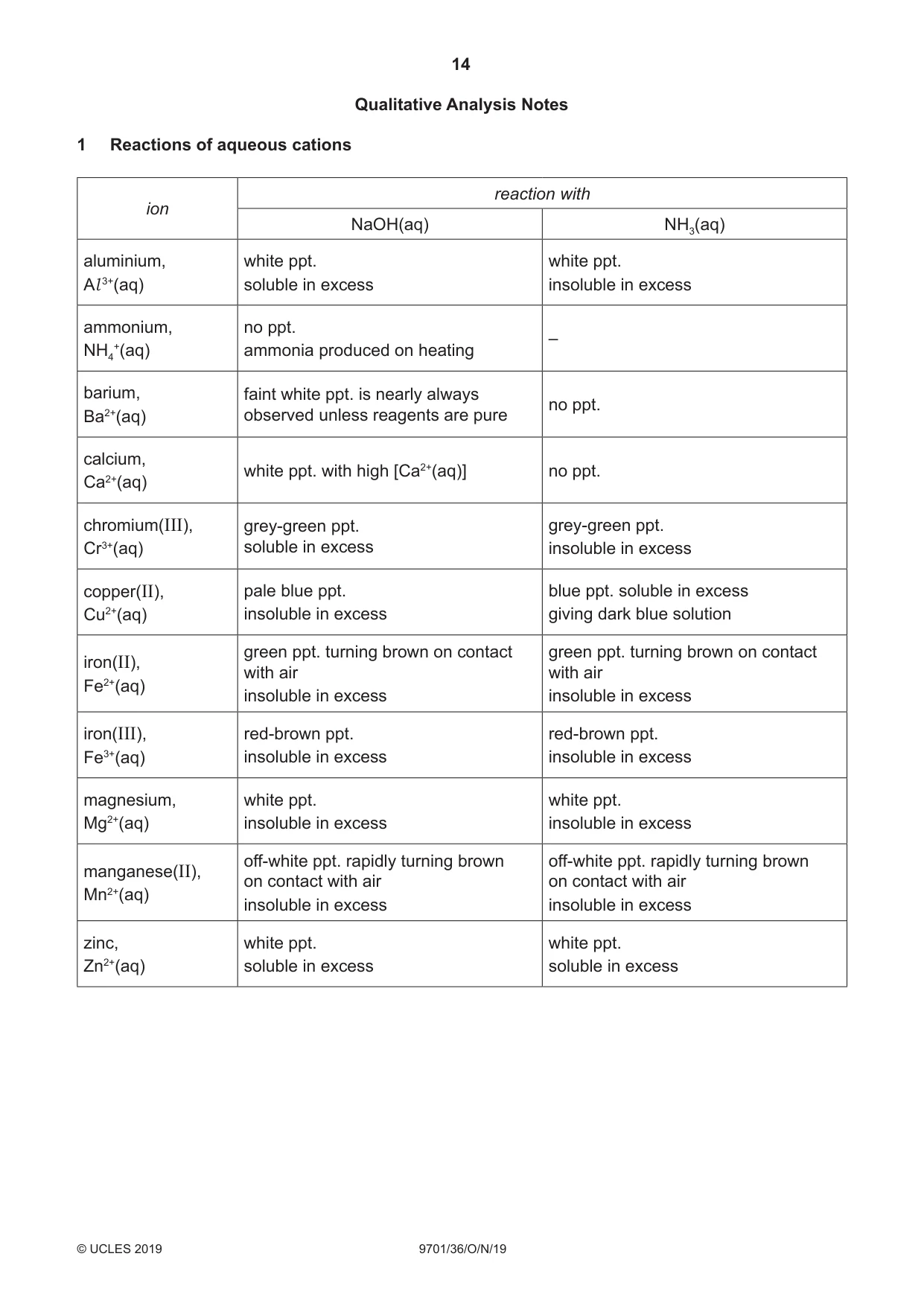
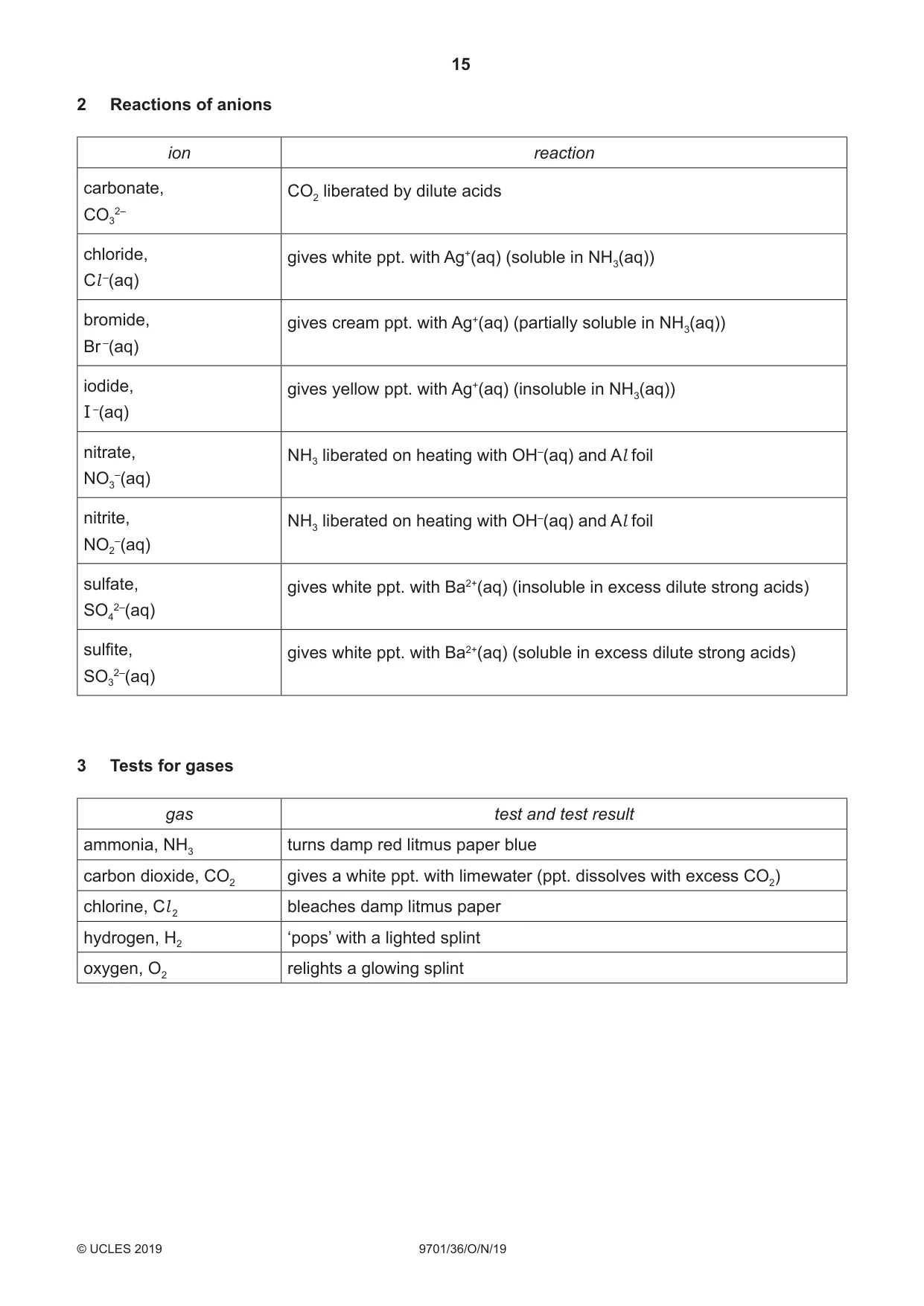
3 (a) FB 7 is a solid containing one of the anions listed in the Qualitative Analysis Notes. Place a small spatula measure of FB 7 in a hard‑glass test‑tube. Heat it gently at first and then more strongly. Identify the gas produced. Leave the contents of the tube to cool. Record all your observations. .................................................................................................................................................... .................................................................................................................................................... .................................................................................................................................................... .................................................................................................................................................... .................................................................................................................................................... .............................................................................................................................................. [3] (b) FB 8 and FB 9 are both solutions of potassium compounds. Each contains one anion which is listed in the Qualitative Analysis Notes. (i) Carry out the following tests and record your observations. test observations with FB 8 observations with FB 9 To a 1 cm depth in a test‑tube, add a few drops of aqueous acidified potassium manganate(VII). To a 1 cm depth in a test‑tube, add an equal volume of dilute nitric acid followed by a few drops of aqueous barium nitrate, then add a few drops of aqueous silver nitrate. To a 1 cm depth in a boiling tube, add an equal volume of aqueous sodium hydroxide and warm carefully, then add a strip of aluminium foil. [5] (ii) Give the ionic equation for the reaction of silver nitrate with FB 8. Include state symbols. ....................................................................................................................................... [1] (iii) The reaction of aluminium with FB 9 involves a redox reaction. What species are oxidised and reduced in this reaction? species oxidised .................................................................................................................. species reduced .................................................................................................................. [1] (c) (i) In a test‑tube, mix together 1 cm depths of FB 8 and FB 9. Record your observation. observation .......................................................................................................................... Then add one drop of FB 6, hydrochloric acid, and record your observation. observation .......................................................................................................................... [1] (ii) From your knowledge of FB 8, suggest the formula of the chemical you observed at the end of the experiment in (c)(i). formula ............................................................... [1] (iii) How would you test to confirm that the identification you made in (c)(ii) is correct? Name the reagent you would use. Carry out your test and record your observation. reagent used ....................................................................................................................... observation .......................................................................................................................... [1] [Total: 13]
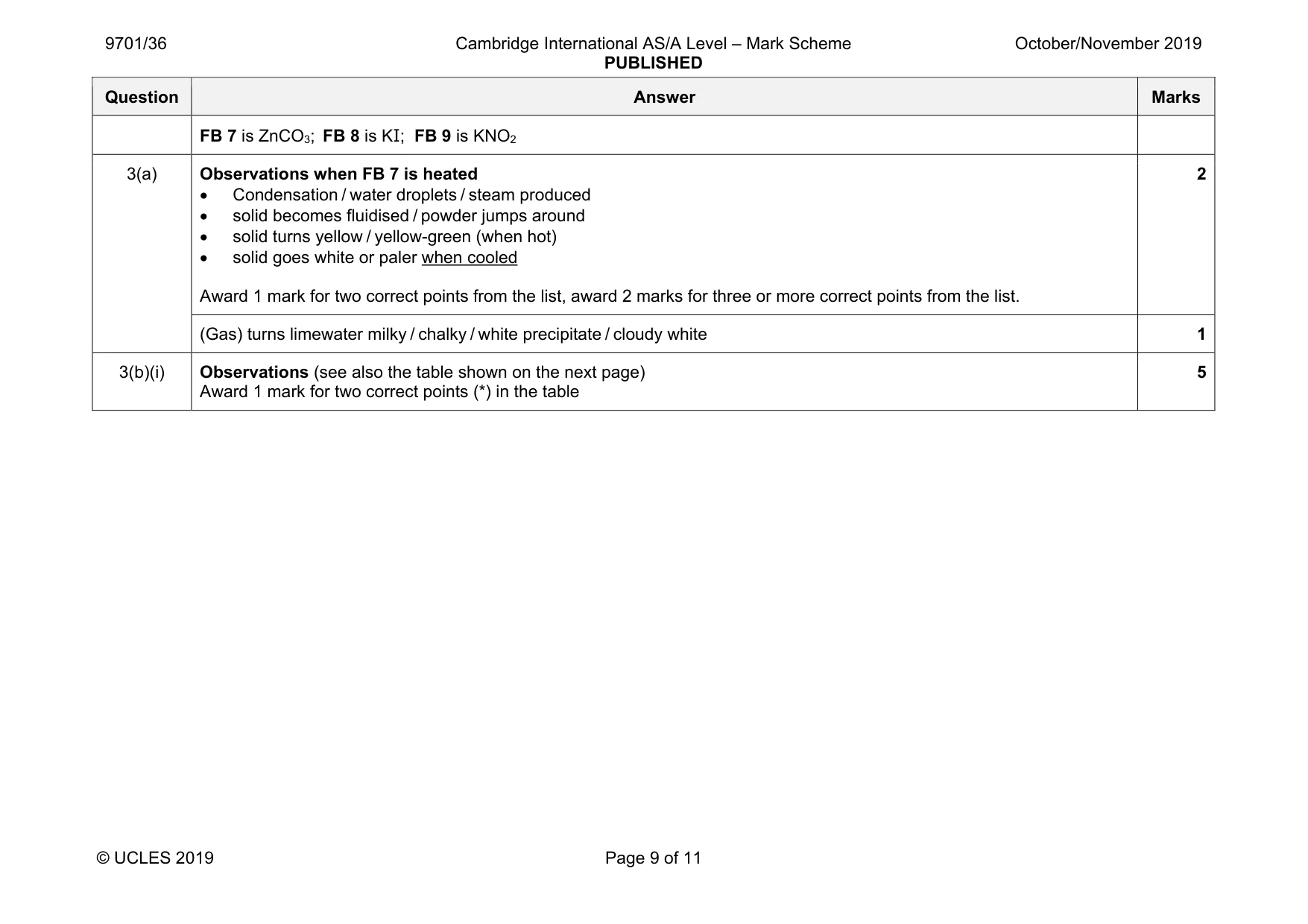
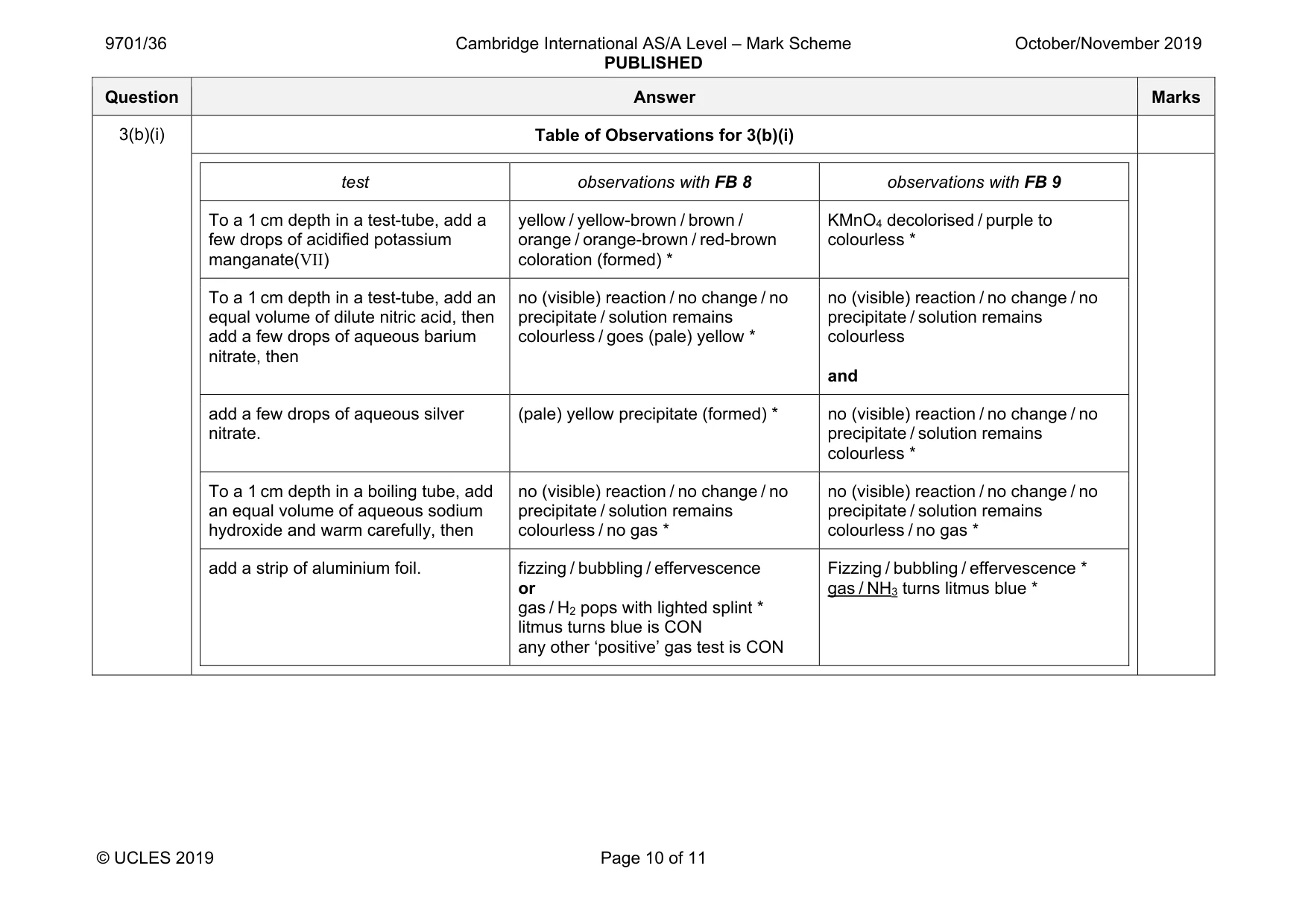
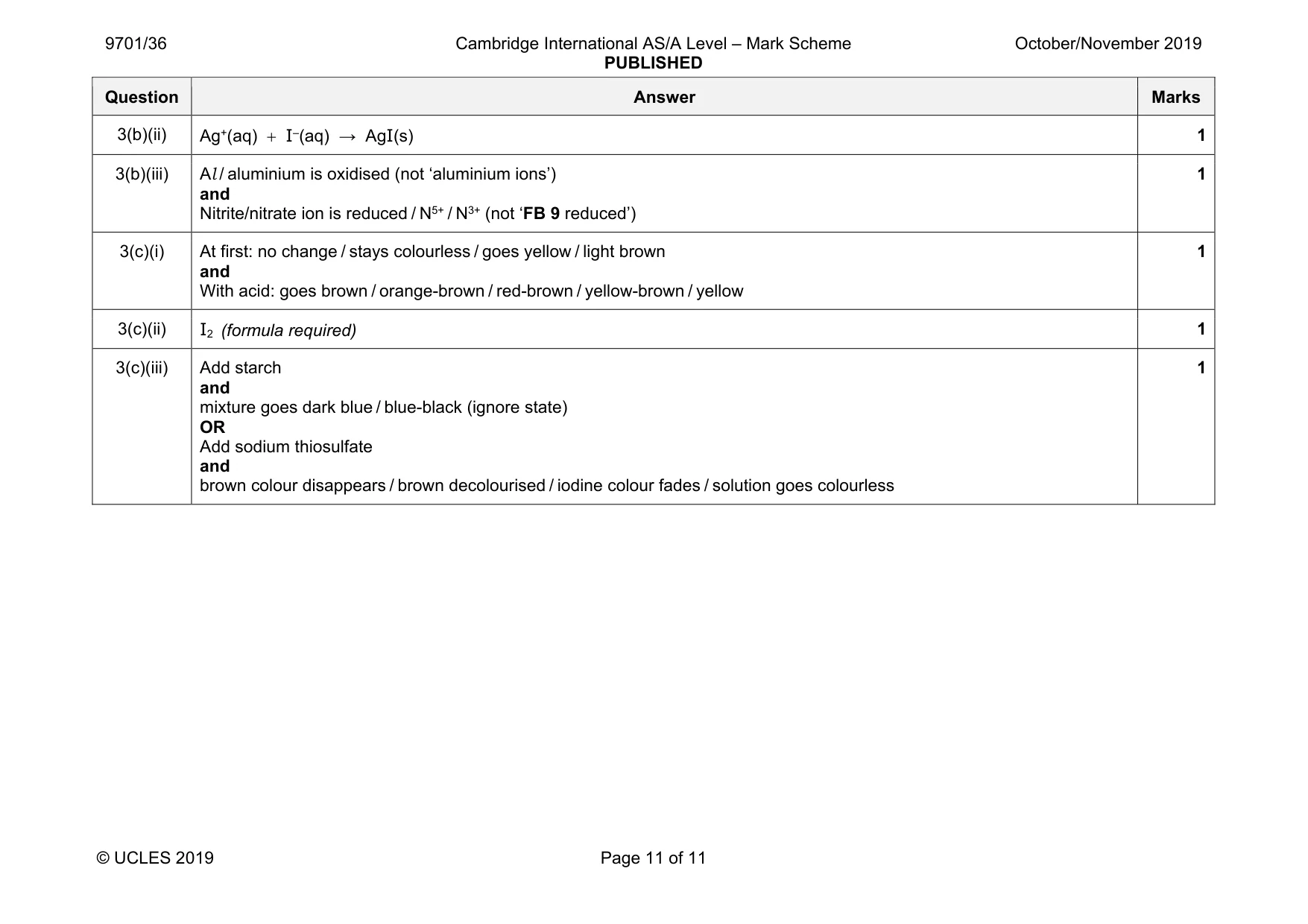
Mark scheme: 3(a) Observations when FB 7 is heated • Condensation / water droplets / steam produced • solid becomes fluidised / powder jumps around • solid turns yellow / yellow-green (when hot) • solid goes white or paler when cooled Award 1 mark for two correct points from the list, award 2 marks for three or more correct points from the list. 2 (Gas) turns limewater milky / chalky / white precipitate / cloudy white 1 3(b)(i) Observations (see also the table shown on the next page) Award 1 mark for two correct points (*) in the table 5 Question Answer Marks 3(b)(i) Table of Observations for 3(b)(i) test observations with FB 8 observations with FB 9 To a 1 cm depth in a test-tube, add a few drops of acidified potassium manganate(VII) yellow / yellow-brown / brown / orange / orange-brown / red-brown coloration (formed) * KMnO4 decolorised / purple to colourless * To a 1 cm depth in a test-tube, add an equal volume of dilute nitric acid, then add a few drops of aqueous barium nitrate, then no (visible) reaction / no change / no precipitate / solution remains colourless / goes (pale) yellow * no (visible) reaction / no change / no precipitate / solution remains colourless and add a few drops of aqueous silver nitrate. (pale) yellow precipitate (formed) * no (visible) reaction / no change / no precipitate / solution remains colourless * To a 1 cm depth in a boiling tube, add an equal volume of aqueous sodium hydroxide and warm carefully, then no (visible) reaction / no change / no precipitate / solution remains colourless / no gas * no (visible) reaction / no change / no precipitate / solution remains colourless / no gas * add a strip of aluminium foil. fizzing / bubbling / effervescence or gas / H2 pops with lighted splint * litmus turns blue is CON any other ‘positive’ gas test is CON Fizzing / bubbling / effervescence * gas / NH3 turns litmus blue * Question Answer Marks 3(b)(ii) Ag+(aq) + I–(aq) → AgI(s) 1 3(b)(iii) Al / aluminium is oxidised (not ‘aluminium ions’) and Nitrite/nitrate ion is reduced / N5+ / N3+ (not ‘FB 9 reduced’) 1 3(c)(i) At first: no change / stays colourless / goes yellow / light brown and With acid: goes brown / orange-brown / red-brown / yellow-brown / yellow 1 3(c)(ii) I2 (formula required) 1 3(c)(iii) Add starch and mixture goes dark blue / blue-black (ignore state) OR Add sodium thiosulfate and brown colour disappears / brown decolourised / iodine colour fades / solution goes colourless 1
What was in this paper
The subtopics covered by these 3 questions, and how many questions each got. Open one in a new tab to see every Cambridge question on it.
What you needed in this session
Cambridge’s own grade thresholds for 2019 Oct/Nov, Paper 3 · Variant 6. A higher threshold means an easier paper — the bar moves with how the cohort did.