Cambridge A Level Chemistry 9701 — 2024 Oct/Nov Paper 3 · Variant 5
9701/35/O/N/24 · 3 questions · 40 marks · ≈45 min
The question paper and its mark scheme, free to read here and free to download. This is Cambridge’s own paper, exactly as it was sat.
Question paper16 pages


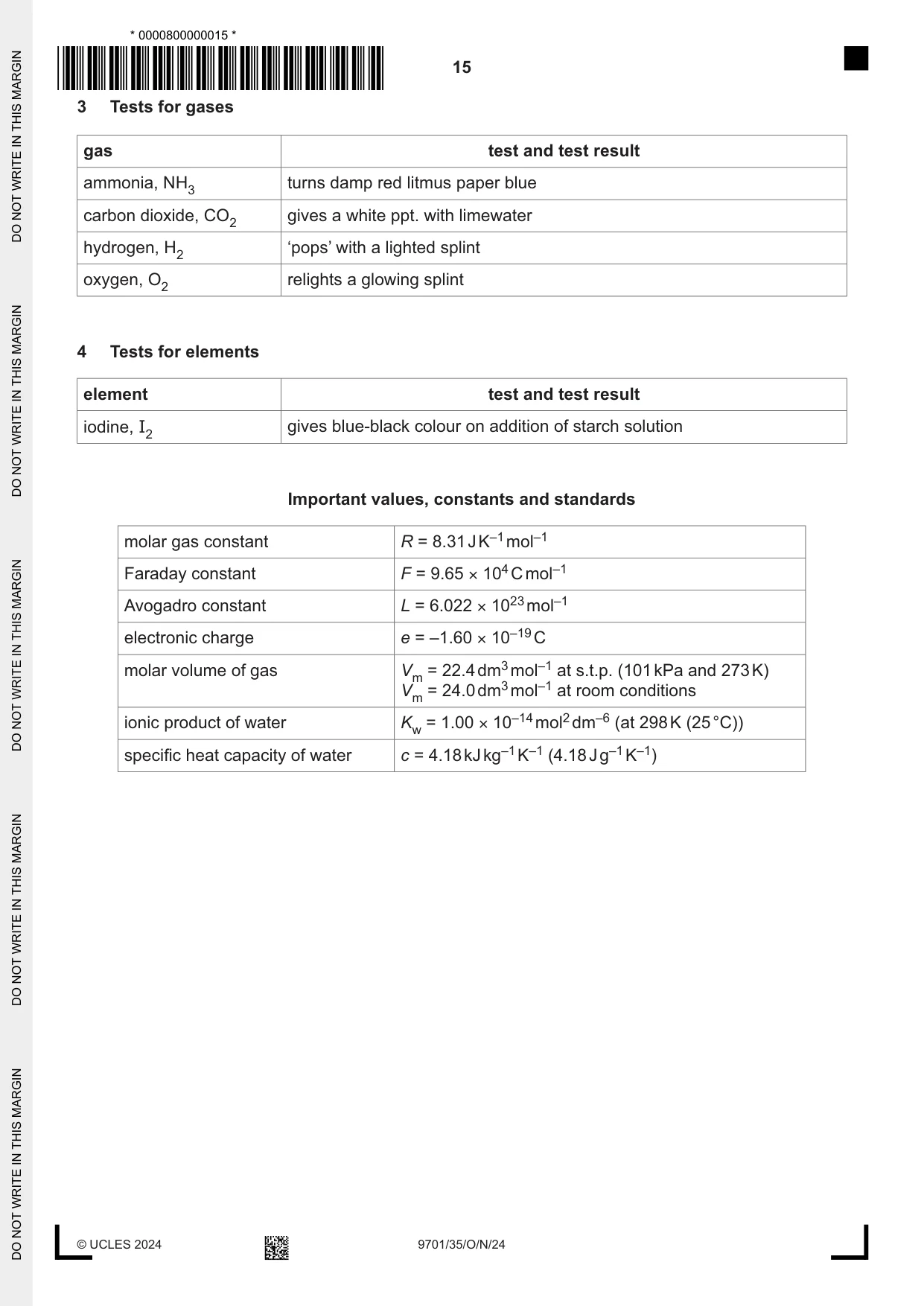
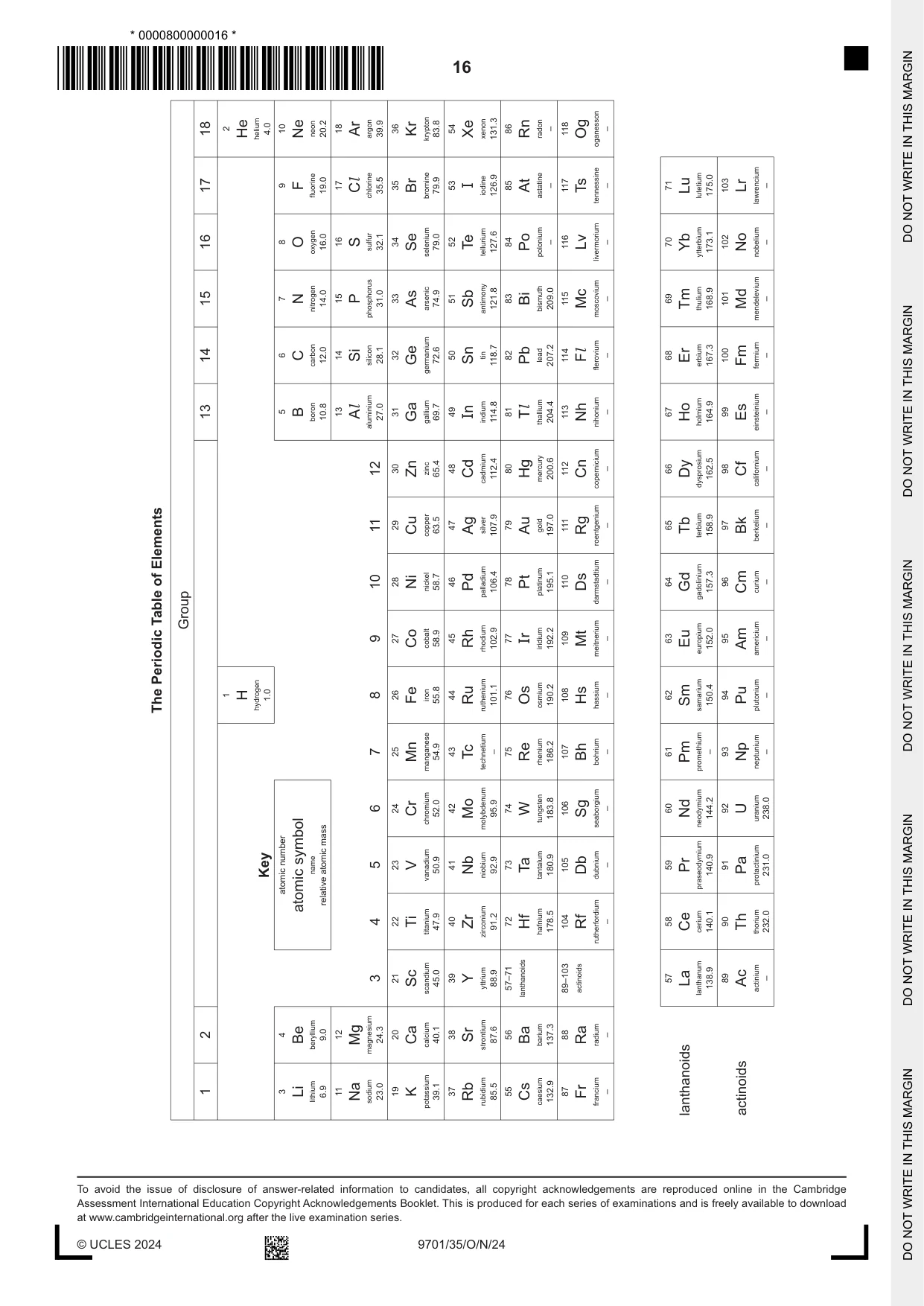
Mark scheme9 pages
Answers below. Sit the paper first if you are practising.
Questions as text
Q1 · The neutralisation of an acid by an alkali is an exothermic reaction
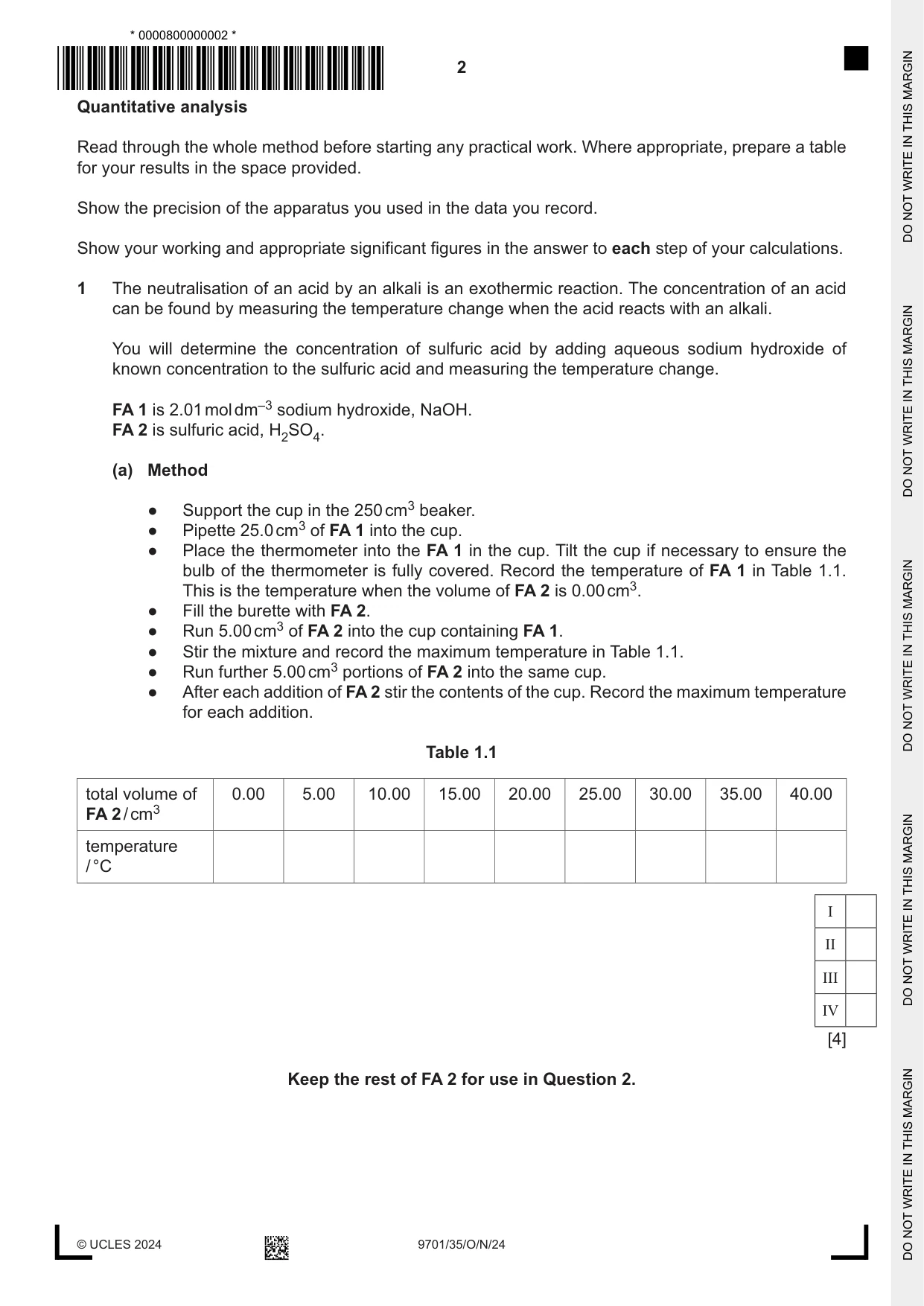
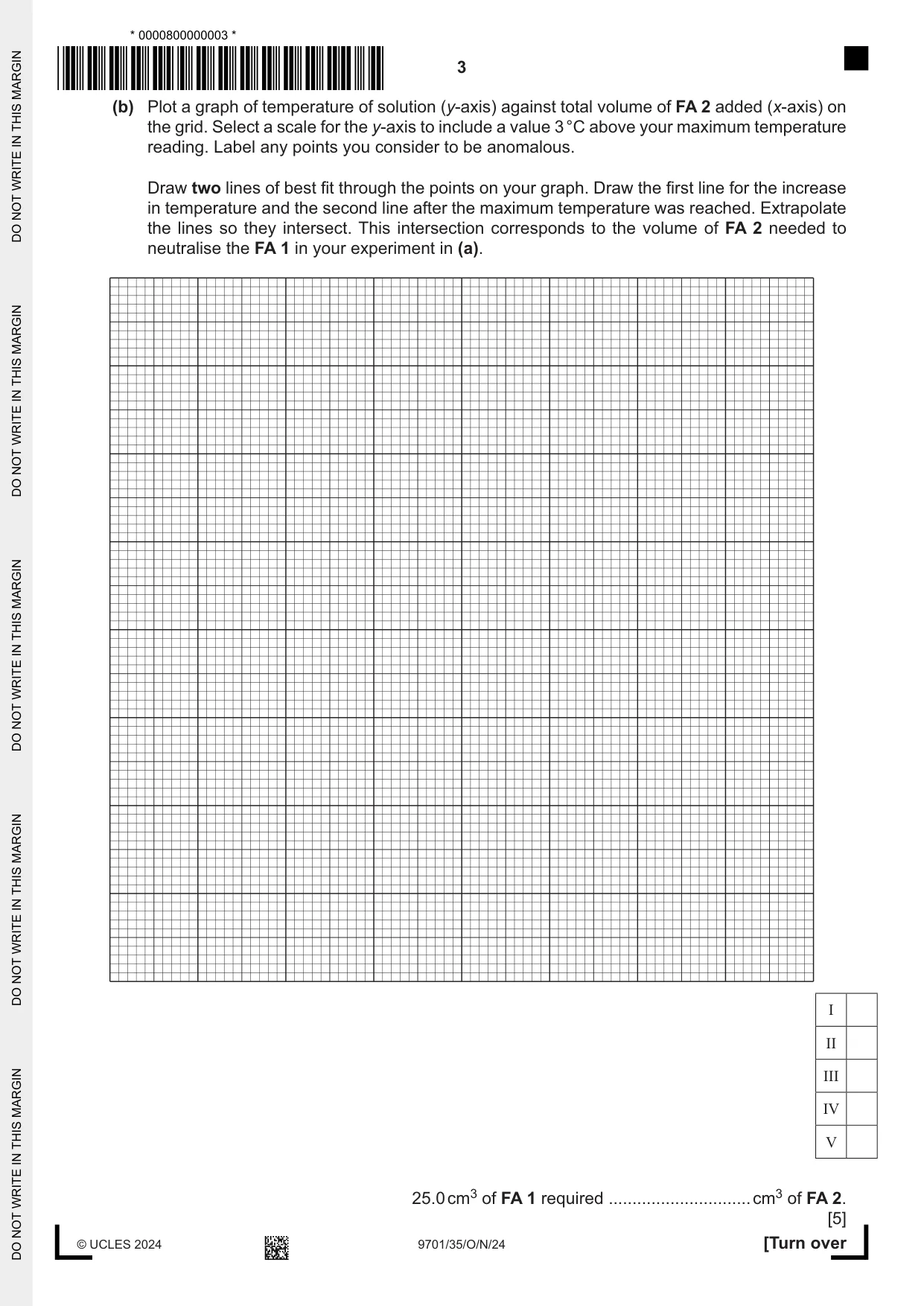
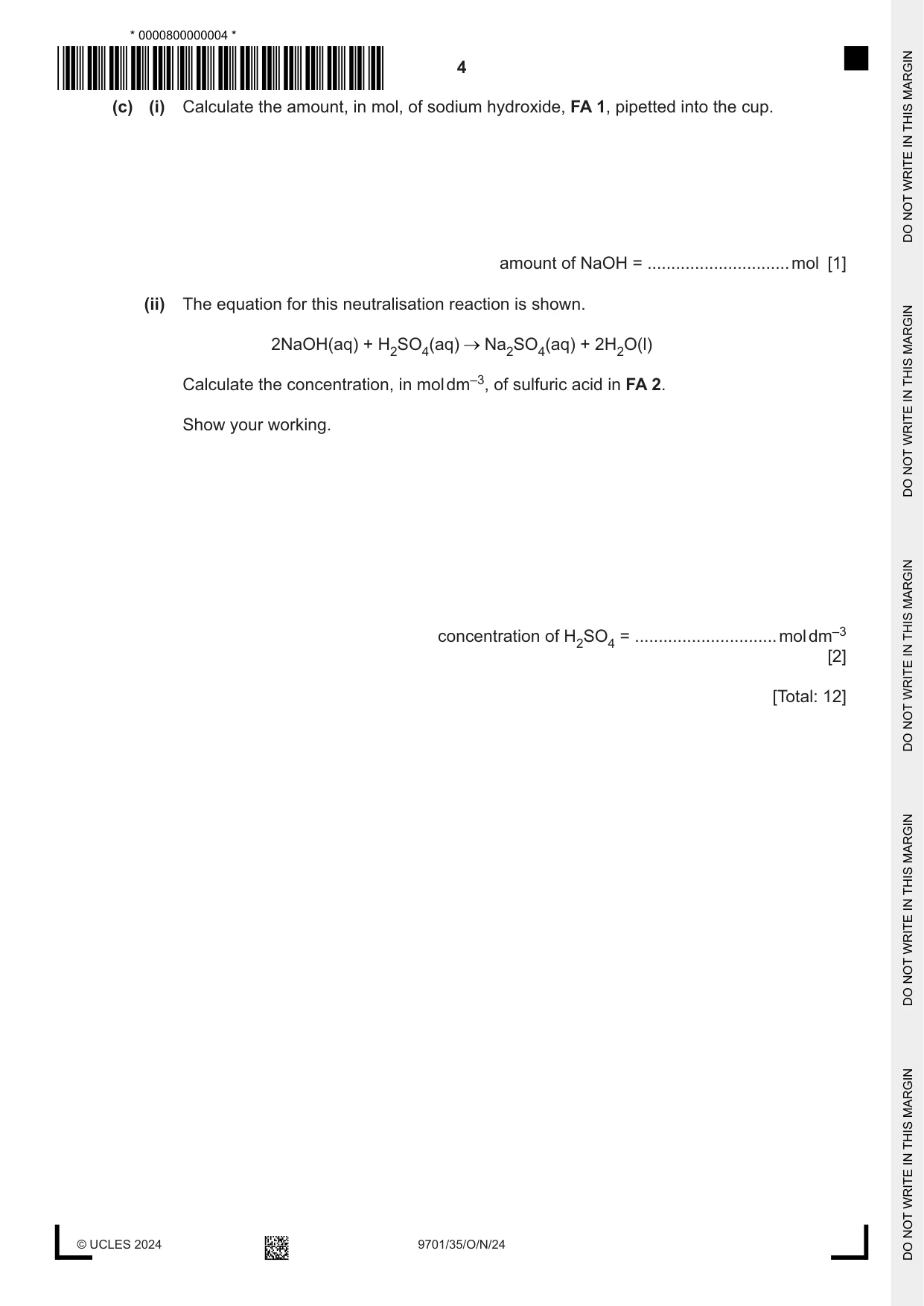
1 The neutralisation of an acid by an alkali is an exothermic reaction. The concentration of an acid can be found by measuring the temperature change when the acid reacts with an alkali. You will determine the concentration of sulfuric acid by adding aqueous sodium hydroxide of known concentration to the sulfuric acid and measuring the temperature change. FA 1 is 2.01 mol dm–3 sodium hydroxide, NaOH. FA 2 is sulfuric acid, H2SO4. (a) Method ● Support the cup in the 250 cm3 beaker. ● Pipette 25.0 cm3 of FA 1 into the cup. ● Place the thermometer into the FA 1 in the cup. Tilt the cup if necessary to ensure the bulb of the thermometer is fully covered. Record the temperature of FA 1 in Table 1.1. This is the temperature when the volume of FA 2 is 0.00 cm3. ● Fill the burette with FA 2. ● Run 5.00 cm3 of FA 2 into the cup containing FA 1. ● Stir the mixture and record the maximum temperature in Table 1.1. ● Run further 5.00 cm3 portions of FA 2 into the same cup. ● After each addition of FA 2 stir the contents of the cup. Record the maximum temperature for each addition. Table 1.1 total volume of 0.00 5.00 10.00 15.00 20.00 25.00 30.00 35.00 40.00 FA 2 / cm3 temperature / °C I II III IV [4] Keep the rest of FA 2 for use in Question 2. (b) Plot a graph of temperature of solution (y-axis) against total volume of FA 2 added (x-axis) on the grid. Select a scale for the y-axis to include a value 3 °C above your maximum temperature reading. Label any points you consider to be anomalous. Draw two lines of best fit through the points on your graph. Draw the first line for the increase in temperature and the second line after the maximum temperature was reached. Extrapolate the lines so they intersect. This intersection corresponds to the volume of FA 2 needed to neutralise the FA 1 in your experiment in (a). I II III IV V 25.0 cm3 of FA 1 required .............................. cm3 of FA 2. [5] (c) (i) Calculate the amount, in mol, of sodium hydroxide, FA 1, pipetted into the cup. amount of NaOH = .............................. mol [1] (ii) The equation for this neutralisation reaction is shown. 2NaOH(aq) + H2SO4(aq) Na2SO4(aq) + 2H2O(l) Calculate the concentration, in mol dm–3, of sulfuric acid in FA 2. Show your working. concentration of H2SO4 = .............................. mol dm–3 [2] [Total: 12]
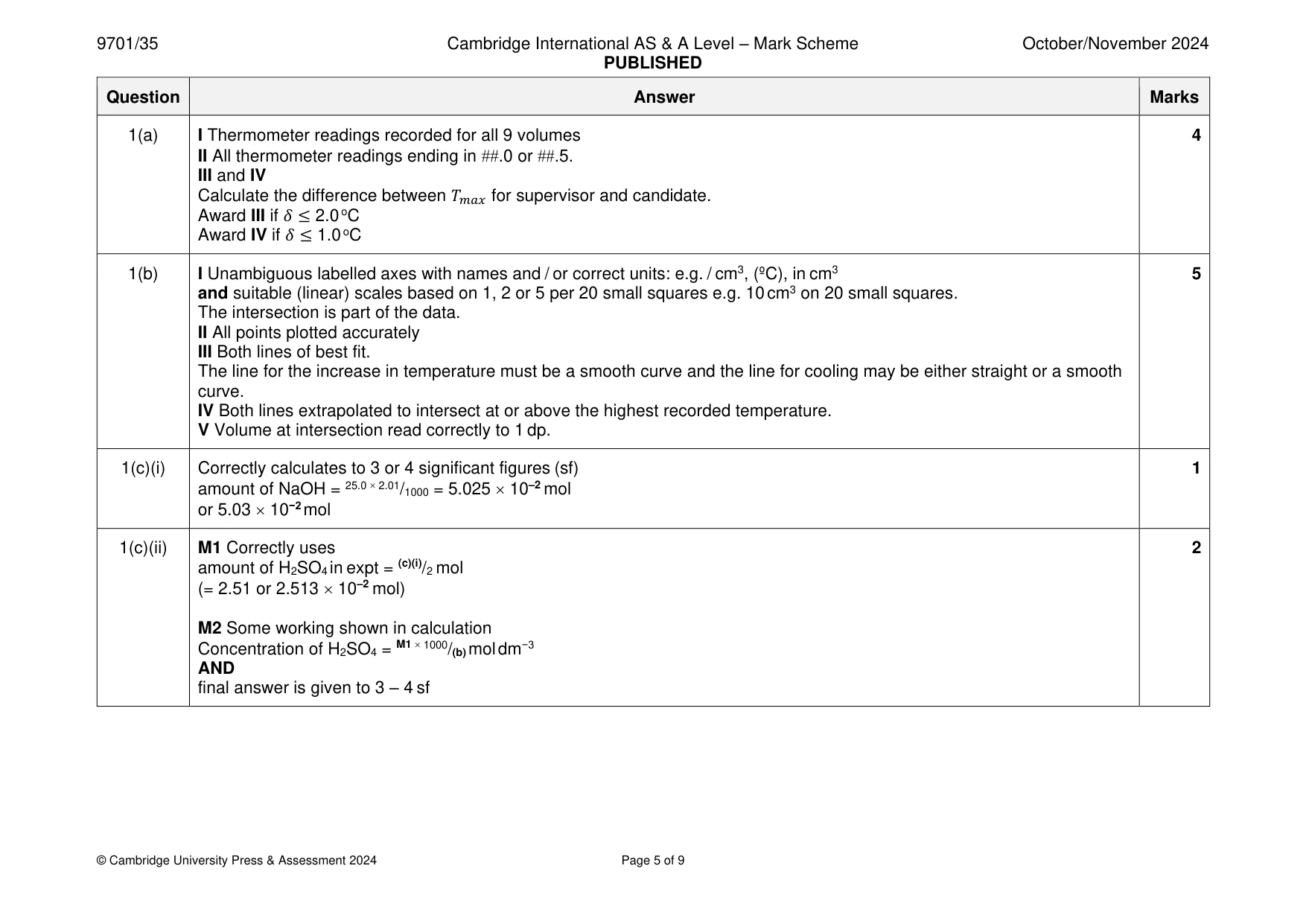
Mark scheme: Question Answer Marks 1(a) I Thermometer readings recorded for all 9 volumes 4 II All thermometer readings ending in .0 or .5. III and IV Calculate the difference between 𝑇𝑚𝑎𝑥 for supervisor and candidate. Award III if 𝛿≤ 2.0 oC Award IV if 𝛿≤ 1.0 oC 1(b) I Unambiguous labelled axes with names and / or correct units: e.g. / cm3, (ºC), in cm3 5 and suitable (linear) scales based on 1, 2 or 5 per 20 small squares e.g. 10 cm3 on 20 small squares. The intersection is part of the data. II All points plotted accurately III Both lines of best fit. The line for the increase in temperature must be a smooth curve and the line for cooling may be either straight or a smooth curve. IV Both lines extrapolated to intersect at or above the highest recorded temperature. V Volume at intersection read correctly to 1 dp. 1(c)(i) Correctly calculates to 3 or 4 significant figures (sf) 1 amount of NaOH = 25.0 2.01/1000 = 5.025 10–2 mol or 5.03 10−2 mol 1(c)(ii) M1 Correctly uses 2 amount of H2SO4 in expt = (c)(i)/2 mol (= 2.51 or 2.513 10–2 mol) M2 Some working shown in calculation Concentration of H2SO4 = M1 1000/(b) mol dm−3 AND final answer is given to 3 – 4 sf
Q2 · Acids react with carbonates to produce carbon dioxide gas
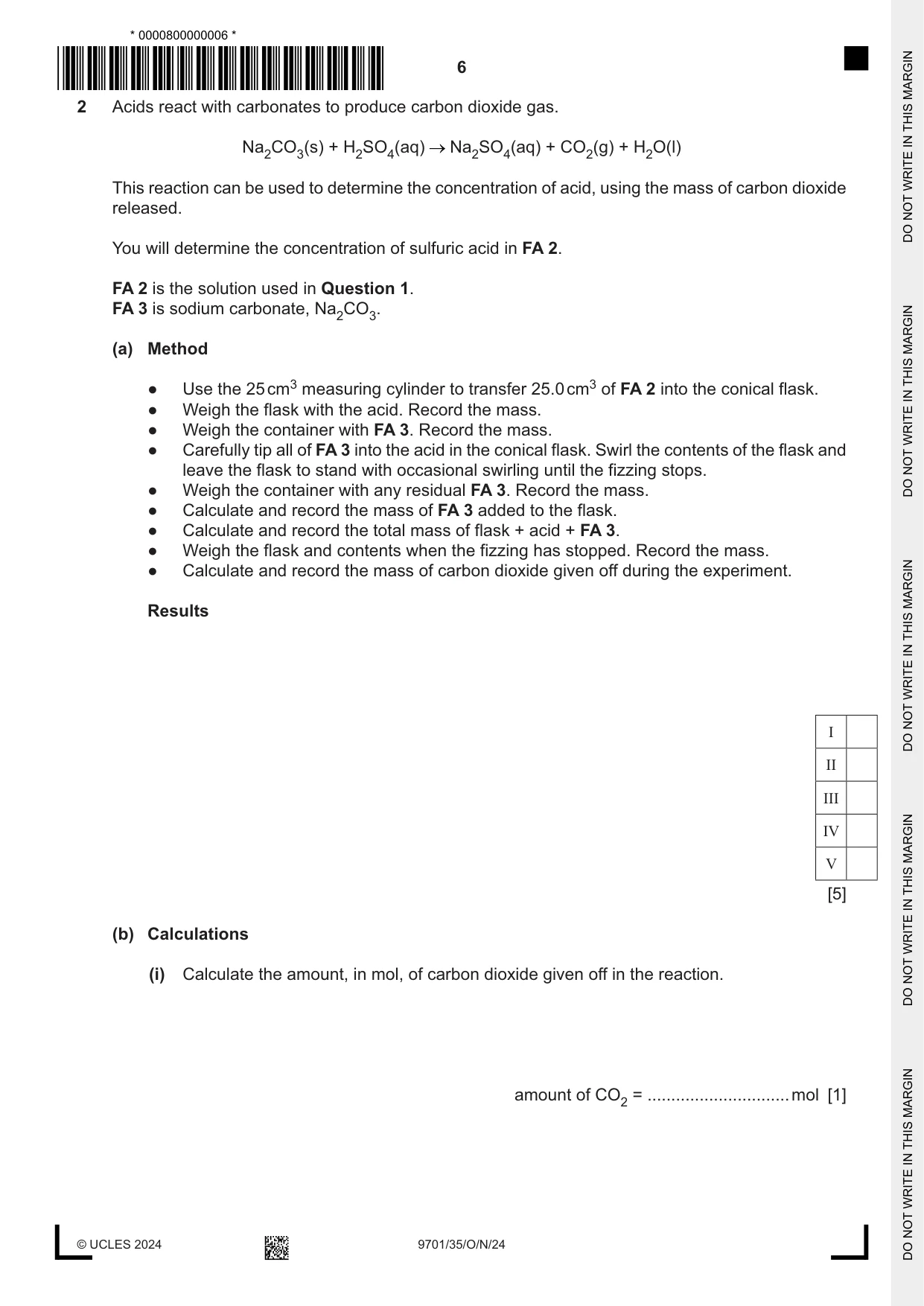
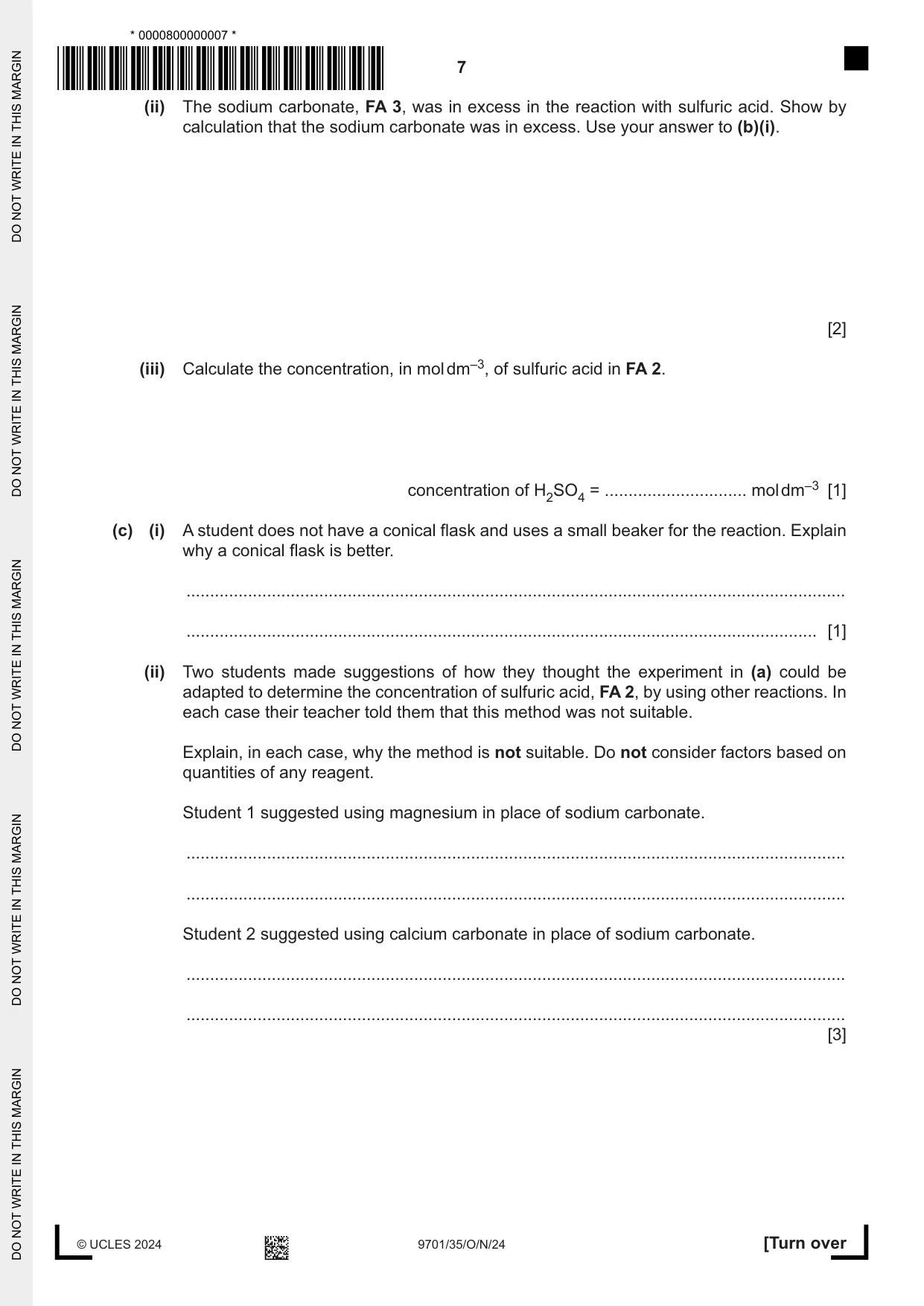
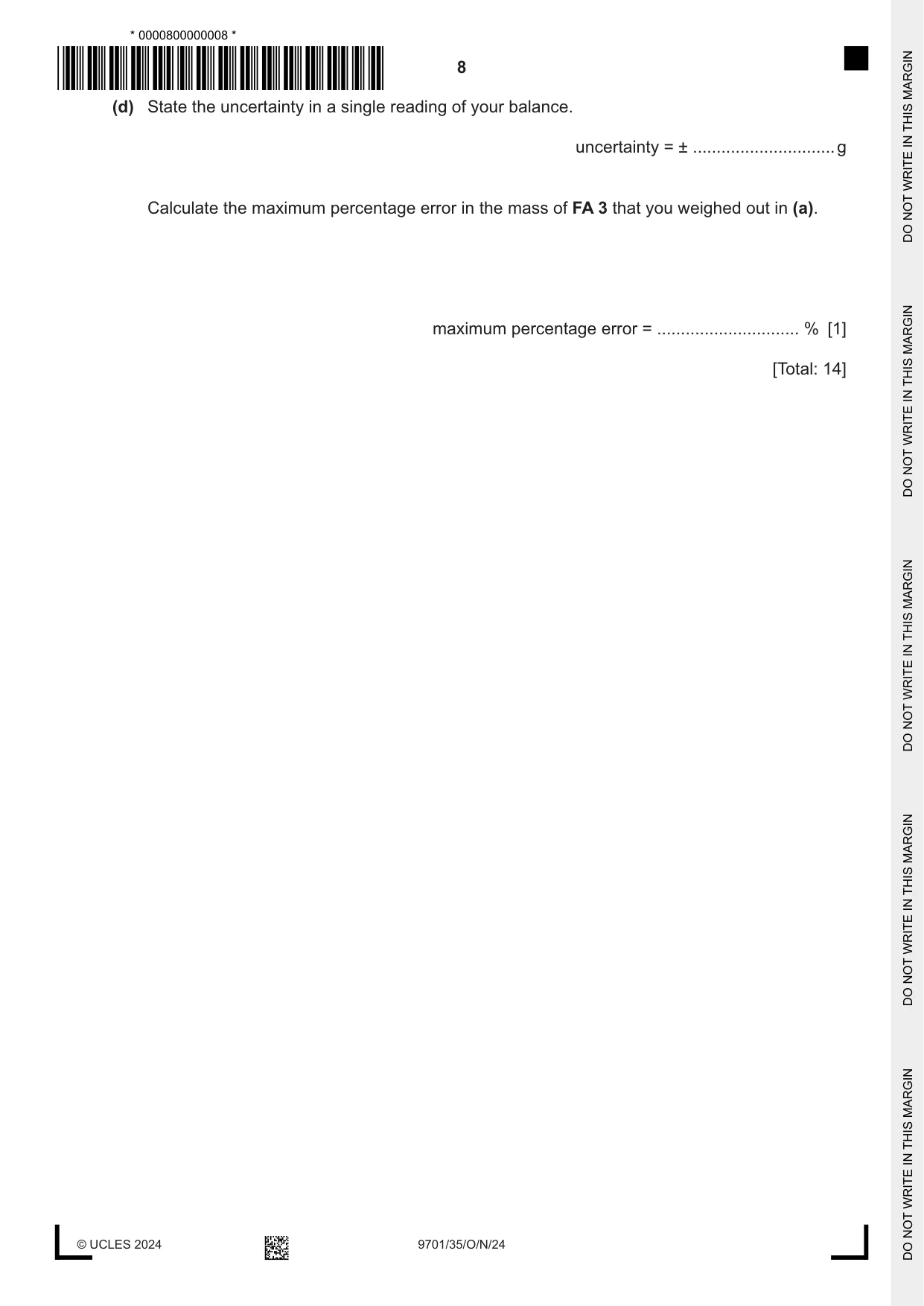
2 Acids react with carbonates to produce carbon dioxide gas. Na2CO3(s) + H2SO4(aq) Na2SO4(aq) + CO2(g) + H2O(l) This reaction can be used to determine the concentration of acid, using the mass of carbon dioxide released. You will determine the concentration of sulfuric acid in FA 2. FA 2 is the solution used in Question 1. FA 3 is sodium carbonate, Na2CO3. (a) Method ● Use the 25 cm3 measuring cylinder to transfer 25.0 cm3 of FA 2 into the conical flask. ● Weigh the flask with the acid. Record the mass. ● Weigh the container with FA 3. Record the mass. ● Carefully tip all of FA 3 into the acid in the conical flask. Swirl the contents of the flask and leave the flask to stand with occasional swirling until the fizzing stops. ● Weigh the container with any residual FA 3. Record the mass. ● Calculate and record the mass of FA 3 added to the flask. ● Calculate and record the total mass of flask + acid + FA 3. ● Weigh the flask and contents when the fizzing has stopped. Record the mass. ● Calculate and record the mass of carbon dioxide given off during the experiment. Results I II III IV V [5] (b) Calculations (i) Calculate the amount, in mol, of carbon dioxide given off in the reaction. amount of CO2 = .............................. mol [1] (ii) The sodium carbonate, FA 3, was in excess in the reaction with sulfuric acid. Show by calculation that the sodium carbonate was in excess. Use your answer to (b)(i). [2] (iii) Calculate the concentration, in mol dm–3, of sulfuric acid in FA 2. concentration of H2SO4 = .............................. mol dm–3 [1] (c) (i) A student does not have a conical flask and uses a small beaker for the reaction. Explain why a conical flask is better. ........................................................................................................................................... ..................................................................................................................................... [1] (ii) Two students made suggestions of how they thought the experiment in (a) could be adapted to determine the concentration of sulfuric acid, FA 2, by using other reactions. In each case their teacher told them that this method was not suitable. Explain, in each case, why the method is not suitable. Do not consider factors based on quantities of any reagent. Student 1 suggested using magnesium in place of sodium carbonate. ........................................................................................................................................... ........................................................................................................................................... Student 2 suggested using calcium carbonate in place of sodium carbonate. ........................................................................................................................................... ........................................................................................................................................... [3] (d) State the uncertainty in a single reading of your balance. uncertainty = ± .............................. g Calculate the maximum percentage error in the mass of FA 3 that you weighed out in (a). maximum percentage error = .............................. % [1] [Total: 14] Qualitative analysis For each test you should record all your observations in the spaces provided. Examples of observations include: ● colour changes seen ● the formation of any precipitate and its solubility (where appropriate) in an excess of the reagent added ● the formation of any gas and its identification (where appropriate) by a suitable test. You should record clearly at what stage in a test an observation is made. Where no change is observed, you should write ‘no change’. Where reagents are selected for use in a test, the name or correct formula of the element or compound must be given. If any solution is warmed, a boiling tube must be used. If a solid is heated, a hard-glass test-tube must be used. Rinse and reuse test-tubes and boiling tubes where possible. No additional tests should be attempted.
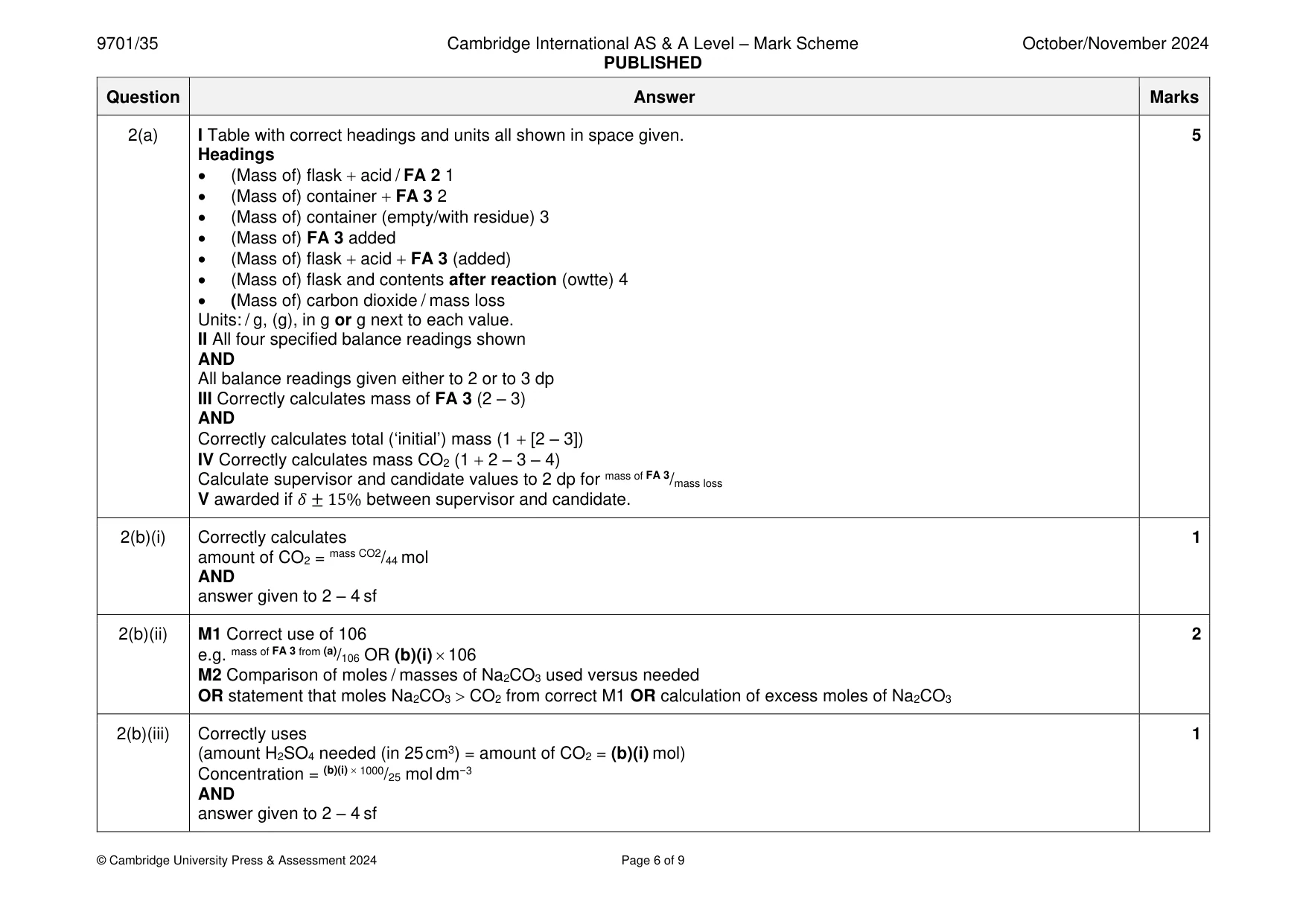
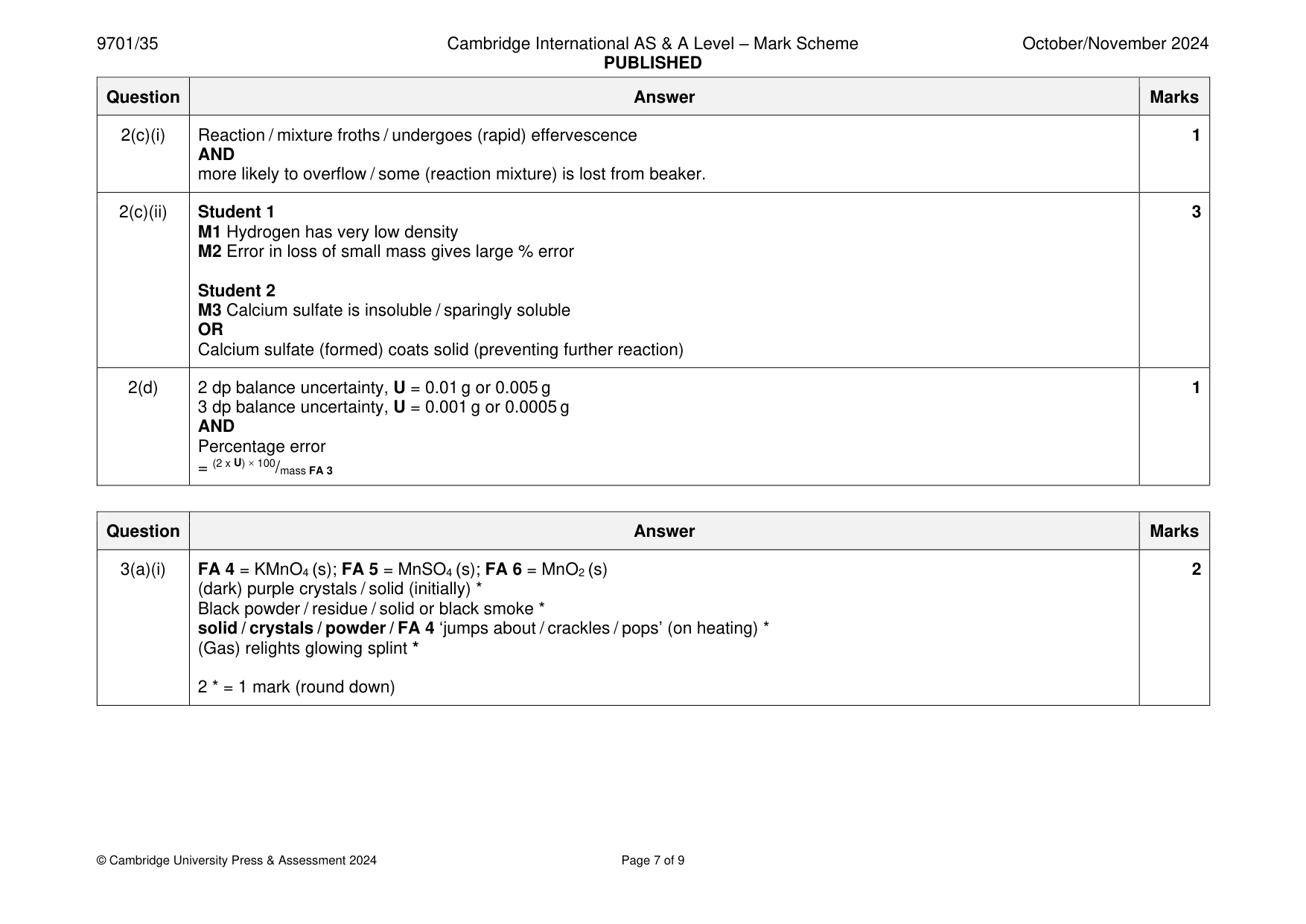
Mark scheme: 2(a) I Table with correct headings and units all shown in space given. 5 Headings • (Mass of) flask + acid / FA 2 1 • (Mass of) container + FA 3 2 • (Mass of) container (empty/with residue) 3 • (Mass of) FA 3 added • (Mass of) flask + acid + FA 3 (added) • (Mass of) flask and contents after reaction (owtte) 4 • (Mass of) carbon dioxide / mass loss Units: / g, (g), in g or g next to each value. II All four specified balance readings shown AND All balance readings given either to 2 or to 3 dp III Correctly calculates mass of FA 3 (2 – 3) AND Correctly calculates total (‘initial’) mass (1 + [2 – 3]) IV Correctly calculates mass CO2 (1 + 2 – 3 – 4) Calculate supervisor and candidate values to 2 dp for mass of FA 3/mass loss V awarded if 𝛿± 15% between supervisor and candidate. 2(b)(i) Correctly calculates 1 amount of CO2 = mass CO2/44 mol AND answer given to 2 – 4 sf 2(b)(ii) M1 Correct use of 106 2 e.g. mass of FA 3 from (a)/106 OR (b)(i) 106 M2 Comparison of moles / masses of Na2CO3 used versus needed OR statement that moles Na2CO3 CO2 from correct M1 OR calculation of excess moles of Na2CO3 2(b)(iii) Correctly uses 1 (amount H2SO4 needed (in 25 cm3) = amount of CO2 = (b)(i) mol) Concentration = (b)(i) 1000/25 mol dm−3 AND answer given to 2 – 4 sf 2(c)(i) Reaction / mixture froths / undergoes (rapid) effervescence 1 AND more likely to overflow / some (reaction mixture) is lost from beaker. 2(c)(ii) Student 1 3 M1 Hydrogen has very low density M2 Error in loss of small mass gives large % error Student 2 M3 Calcium sulfate is insoluble / sparingly soluble OR Calcium sulfate (formed) coats solid (preventing further reaction) 2(d) 2 dp balance uncertainty, U = 0.01 g or 0.005 g 1 3 dp balance uncertainty, U = 0.001 g or 0.0005 g AND Percentage error = (2 x U) 100/mass FA 3
More questions on Reacting masses and volumes (of solutions and gases)
Q3 · FA 4, FA 5 and FA 6 are compounds of the same metal in different oxidation states
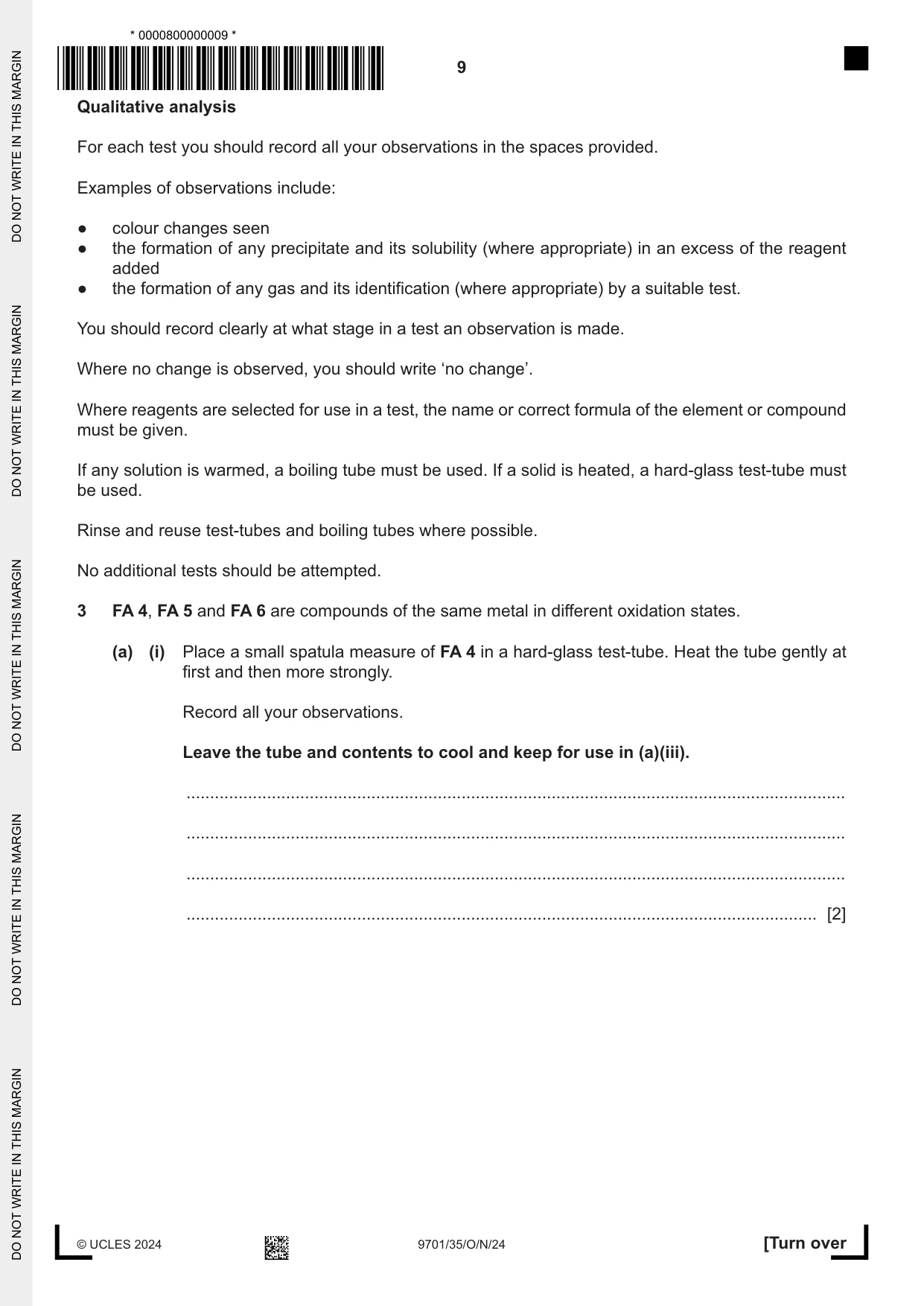
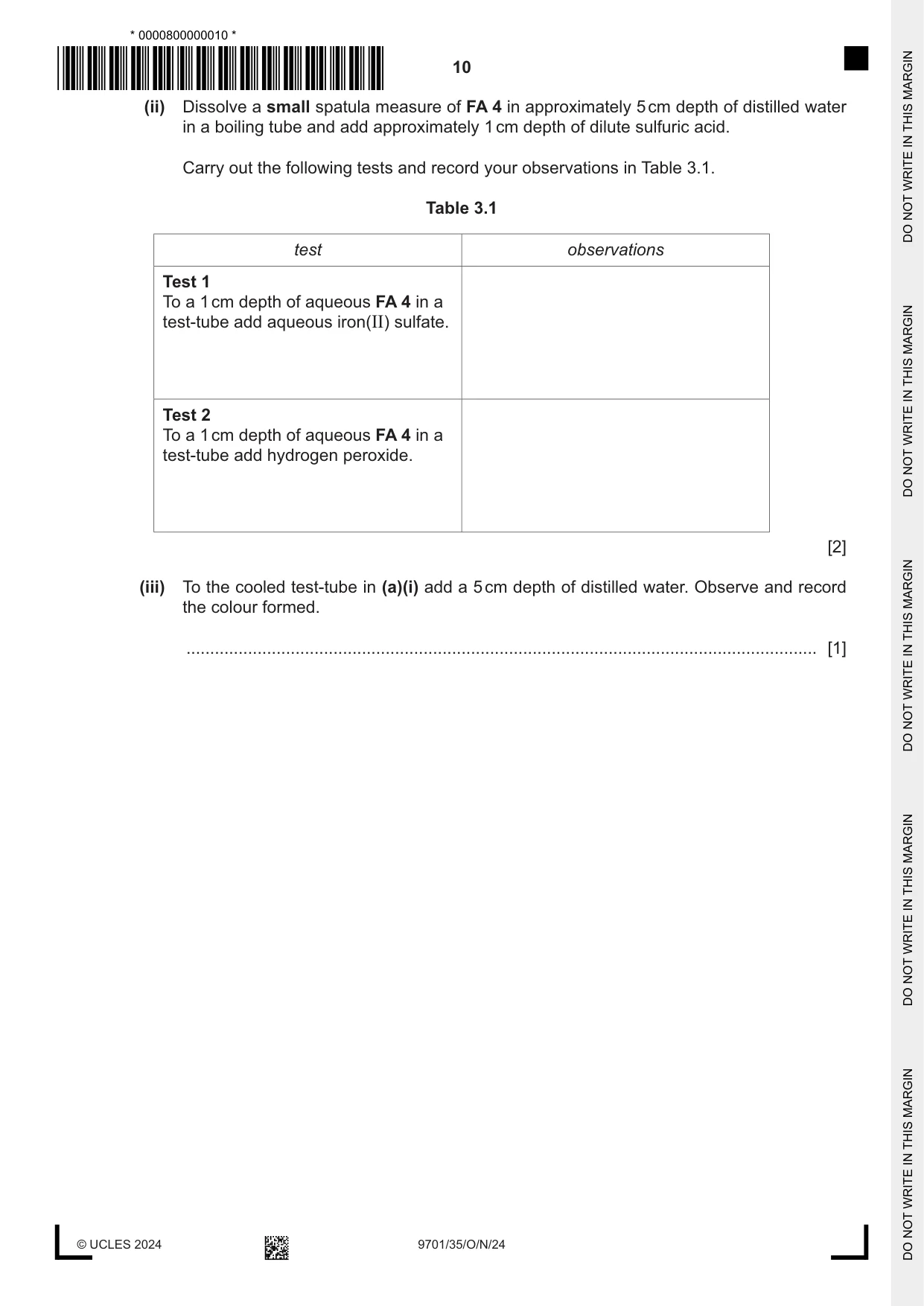
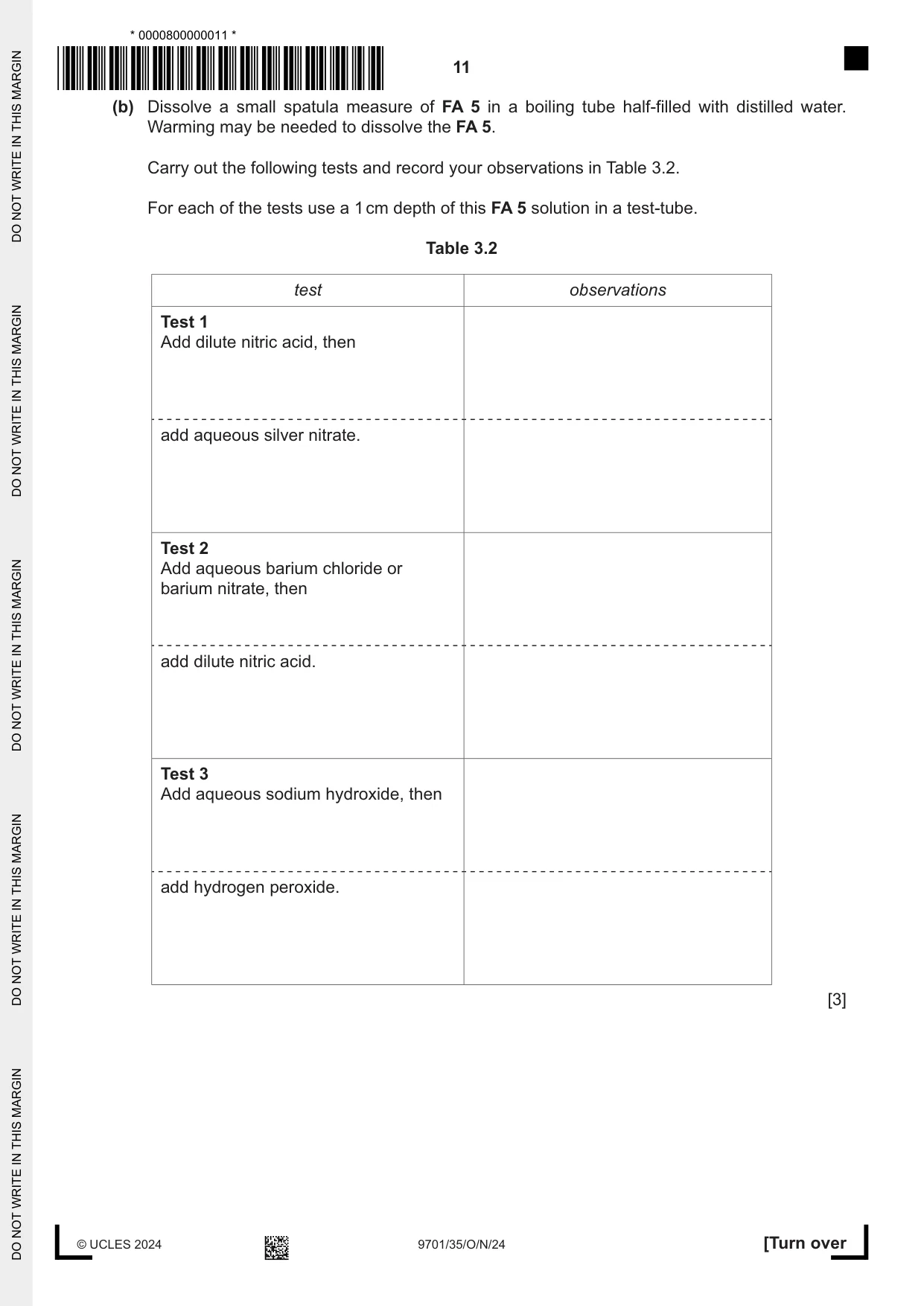
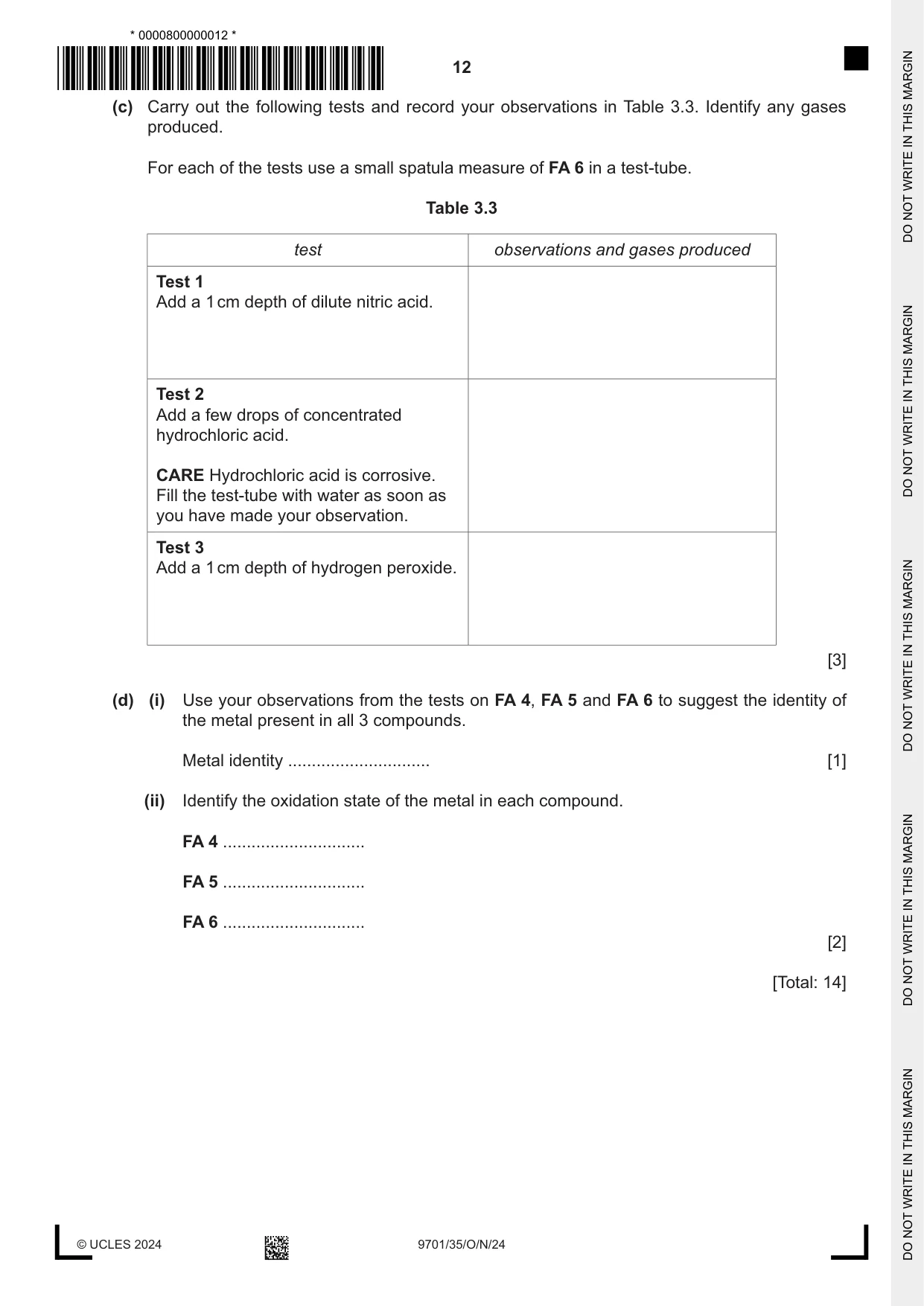
3 FA 4, FA 5 and FA 6 are compounds of the same metal in different oxidation states. (a) (i) Place a small spatula measure of FA 4 in a hard-glass test-tube. Heat the tube gently at first and then more strongly. Record all your observations. Leave the tube and contents to cool and keep for use in (a)(iii). ........................................................................................................................................... ........................................................................................................................................... ........................................................................................................................................... ..................................................................................................................................... [2] (ii) Dissolve a small spatula measure of FA 4 in approximately 5 cm depth of distilled water in a boiling tube and add approximately 1 cm depth of dilute sulfuric acid. Carry out the following tests and record your observations in Table 3.1. Table 3.1 test observations Test 1 To a 1 cm depth of aqueous FA 4 in a test-tube add aqueous iron(II) sulfate. Test 2 To a 1 cm depth of aqueous FA 4 in a test-tube add hydrogen peroxide. [2] (iii) To the cooled test-tube in (a)(i) add a 5 cm depth of distilled water. Observe and record the colour formed. ..................................................................................................................................... [1] (b) Dissolve a small spatula measure of FA 5 in a boiling tube half-filled with distilled water. Warming may be needed to dissolve the FA 5. Carry out the following tests and record your observations in Table 3.2. For each of the tests use a 1 cm depth of this FA 5 solution in a test-tube. Table 3.2 test observations Test 1 Add dilute nitric acid, then add aqueous silver nitrate. Test 2 Add aqueous barium chloride or barium nitrate, then add dilute nitric acid. Test 3 Add aqueous sodium hydroxide, then add hydrogen peroxide. [3]
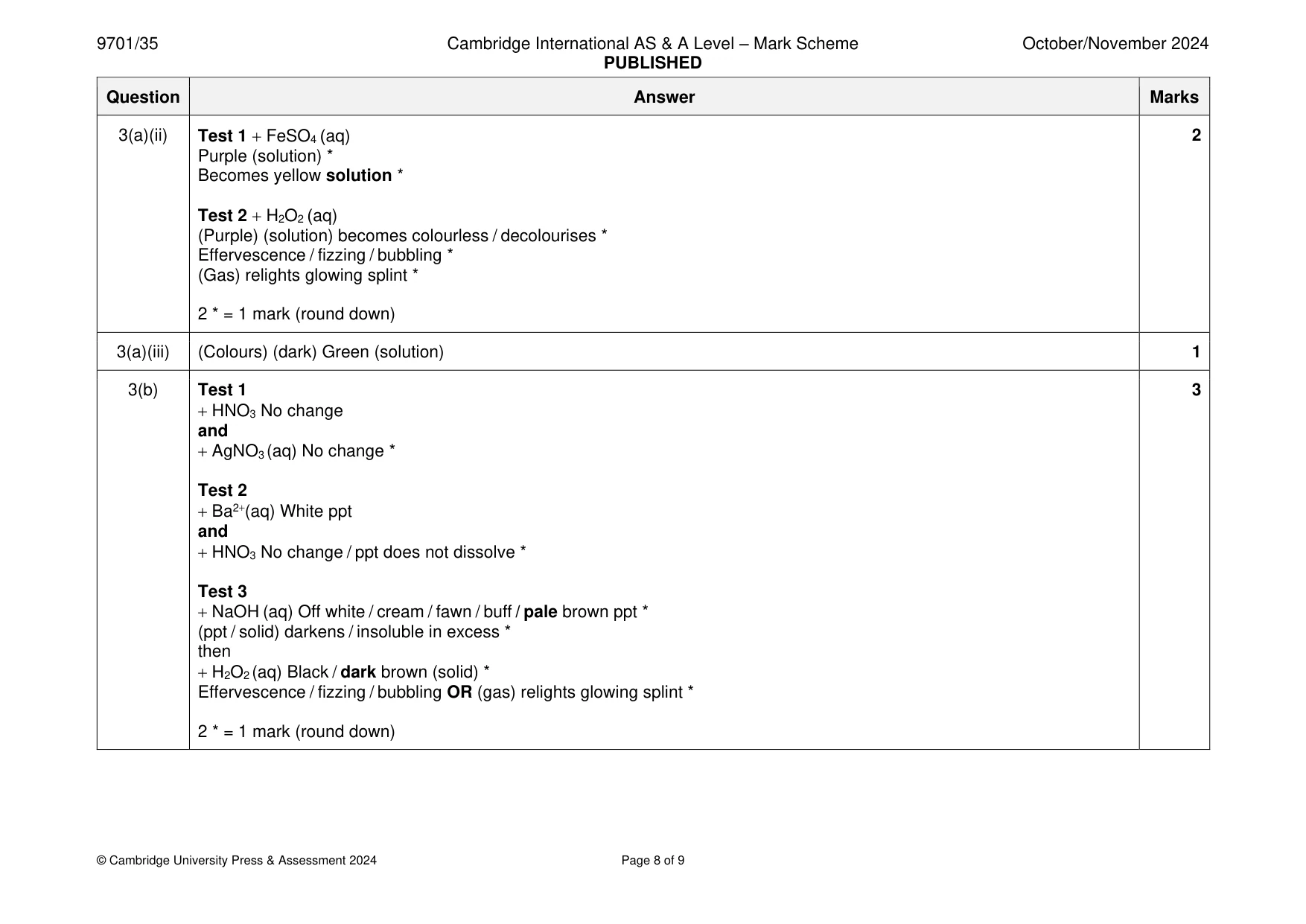
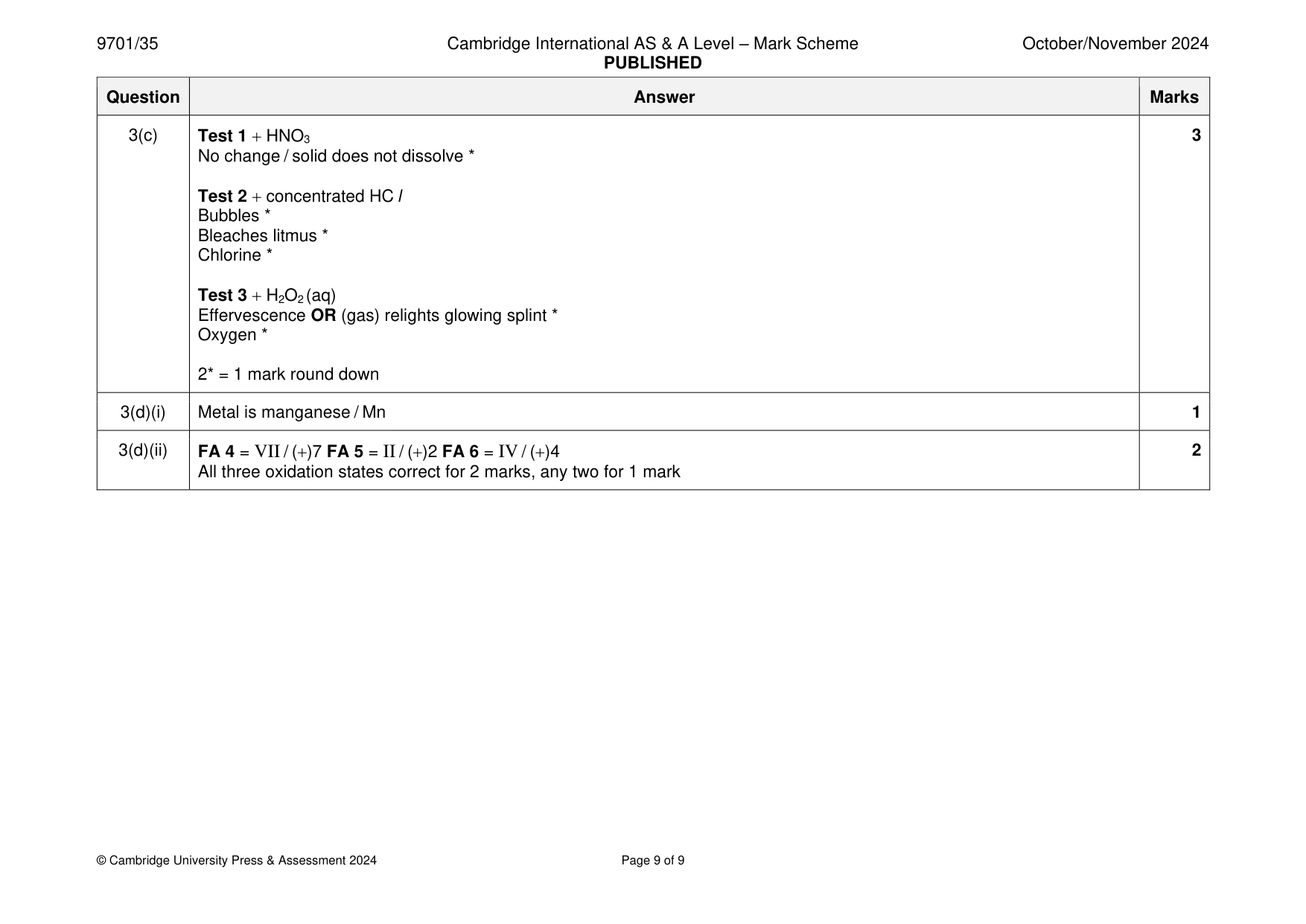
Mark scheme: 3(a)(i) FA 4 = KMnO4 (s); FA 5 = MnSO4 (s); FA 6 = MnO2 (s) 2 (dark) purple crystals / solid (initially) * Black powder / residue / solid or black smoke * solid / crystals / powder / FA 4 ‘jumps about / crackles / pops’ (on heating) * (Gas) relights glowing splint * 2 * = 1 mark (round down) 3(a)(ii) Test 1 + FeSO4 (aq) 2 Purple (solution) * Becomes yellow solution * Test 2 + H2O2 (aq) (Purple) (solution) becomes colourless / decolourises * Effervescence / fizzing / bubbling * (Gas) relights glowing splint * 2 * = 1 mark (round down) 3(a)(iii) (Colours) (dark) Green (solution) 1 3(b) Test 1 3 + HNO3 No change and + AgNO3 (aq) No change * Test 2 + Ba2+(aq) White ppt and + HNO3 No change / ppt does not dissolve * Test 3 + NaOH (aq) Off white / cream / fawn / buff / pale brown ppt * (ppt / solid) darkens / insoluble in excess * then + H2O2 (aq) Black / dark brown (solid) * Effervescence / fizzing / bubbling OR (gas) relights glowing splint * 2 * = 1 mark (round down) 3(c) Test 1 + HNO3 3 No change / solid does not dissolve * Test 2 + concentrated HC l Bubbles * Bleaches litmus * Chlorine * Test 3 + H2O2 (aq) Effervescence OR (gas) relights glowing splint * Oxygen * 2* = 1 mark round down 3(d)(i) Metal is manganese / Mn 1 3(d)(ii) FA 4 = VII / (+)7 FA 5 = II / (+)2 FA 6 = IV / (+)4 2 All three oxidation states correct for 2 marks, any two for 1 mark
What was in this paper
The subtopics covered by these 3 questions, and how many questions each got. Open one in a new tab to see every Cambridge question on it.
What you needed in this session
Cambridge’s own grade thresholds for 2024 Oct/Nov, Paper 3 · Variant 5. A higher threshold means an easier paper — the bar moves with how the cohort did.