Cambridge A Level Chemistry 9701 — 2020 Oct/Nov Paper 3 · Variant 6
9701/36/O/N/20 · 3 questions · 40 marks · ≈45 min
The question paper and its mark scheme, free to read here and free to download. This is Cambridge’s own paper, exactly as it was sat.
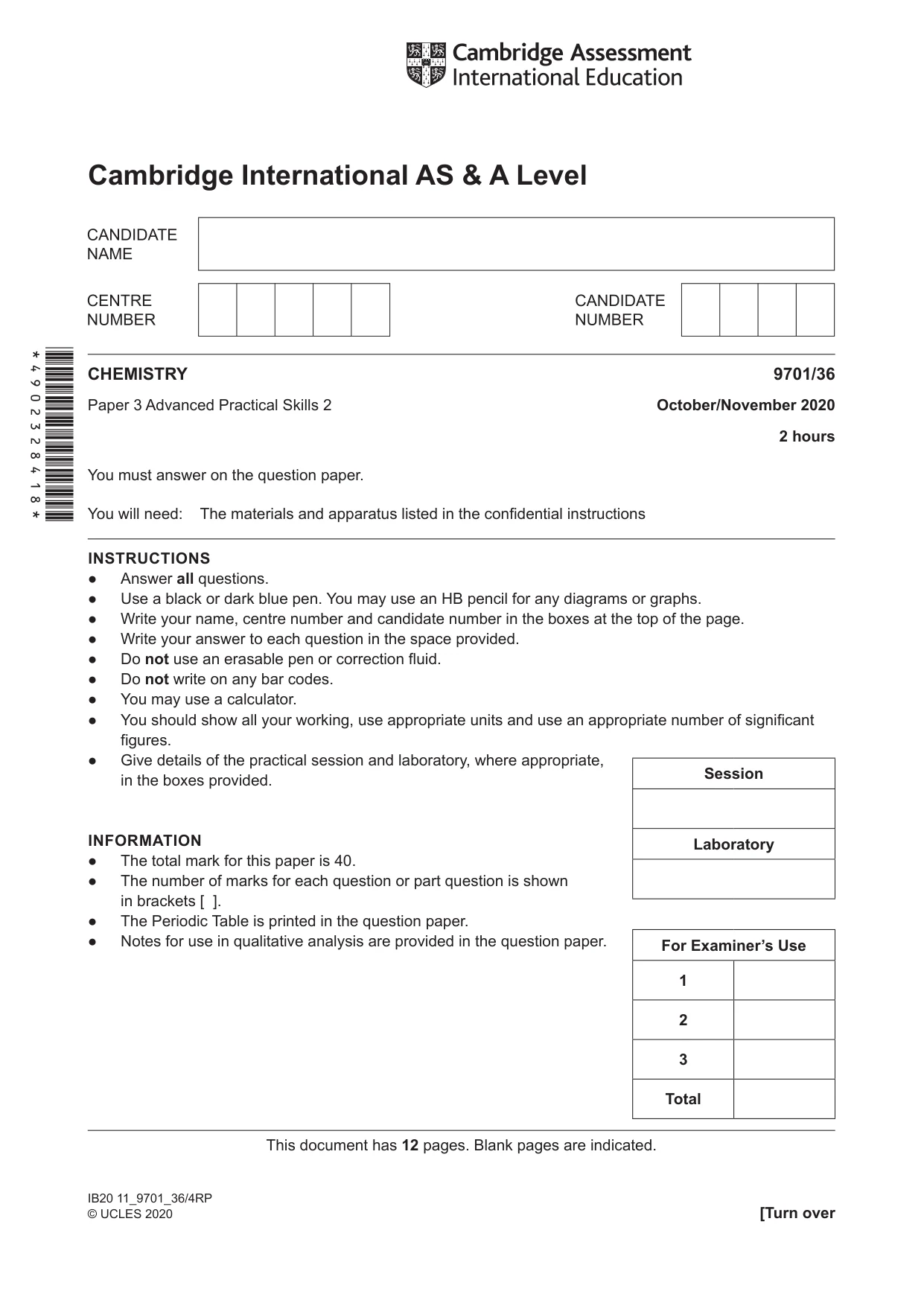
Question paper12 pages
Mark scheme11 pages
Answers below. Sit the paper first if you are practising.
Questions as text
Q1 · Many salts occur in a hydrated form such as hydrated potassium carbonate, K2CO3•xH2O…
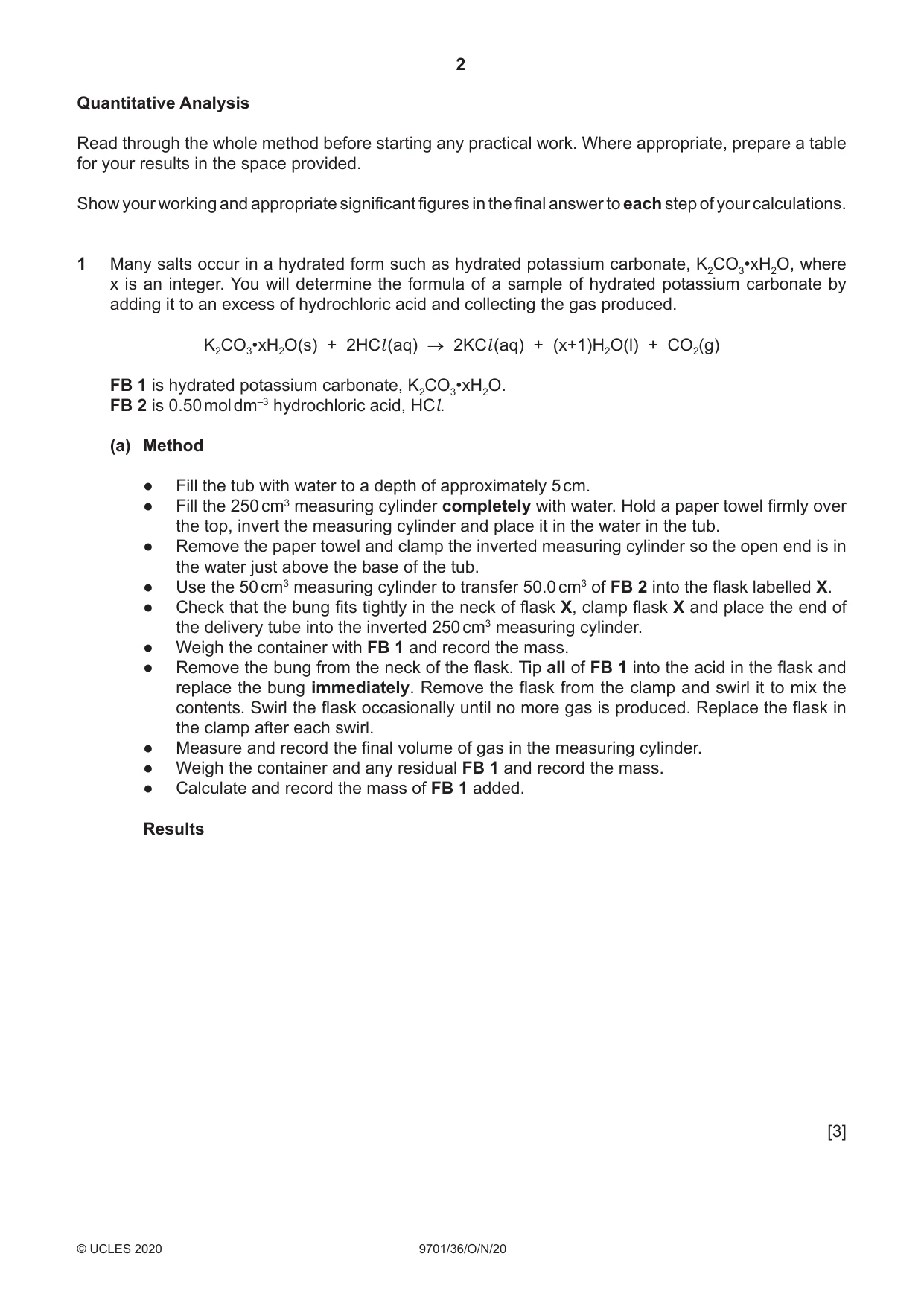
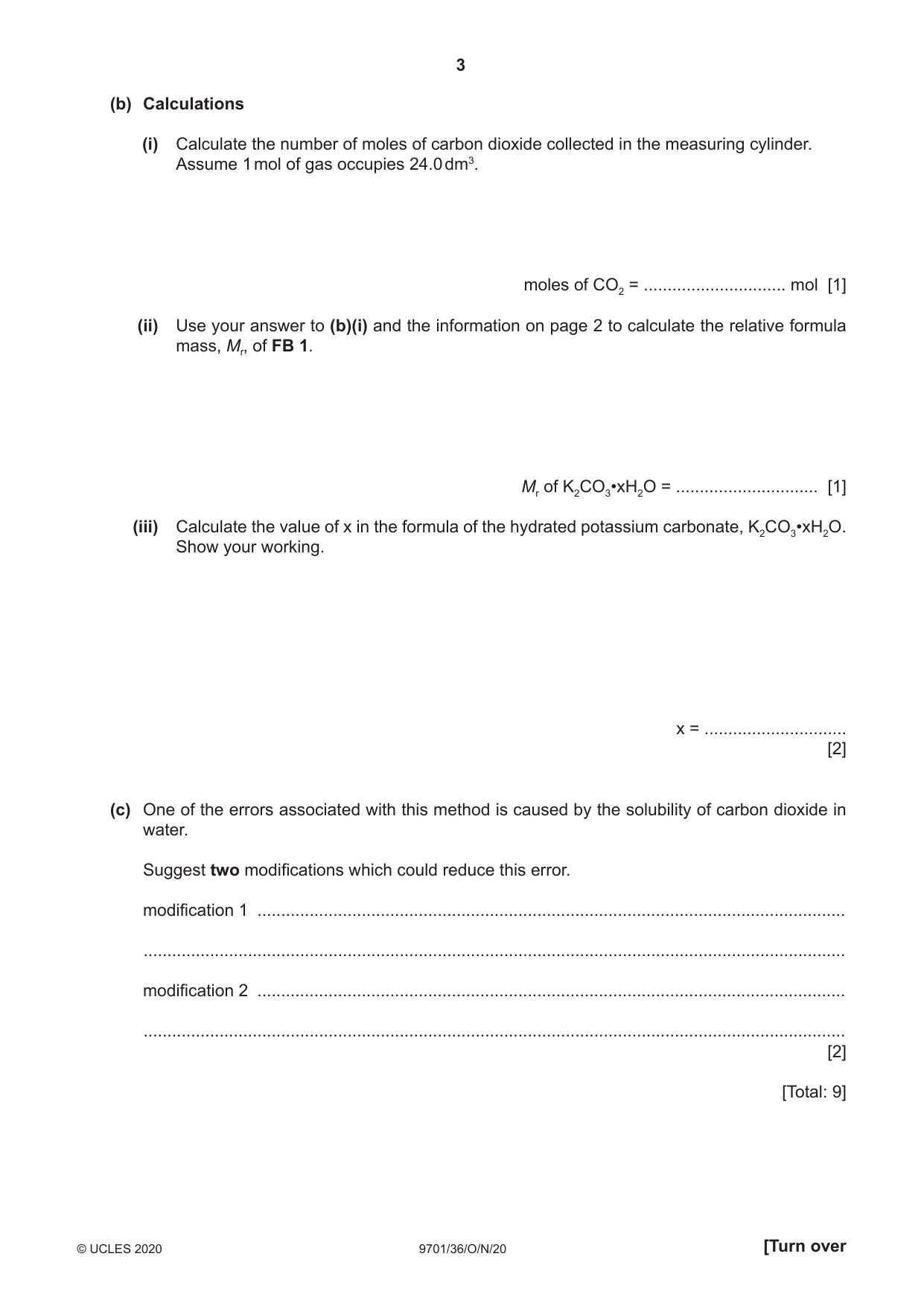
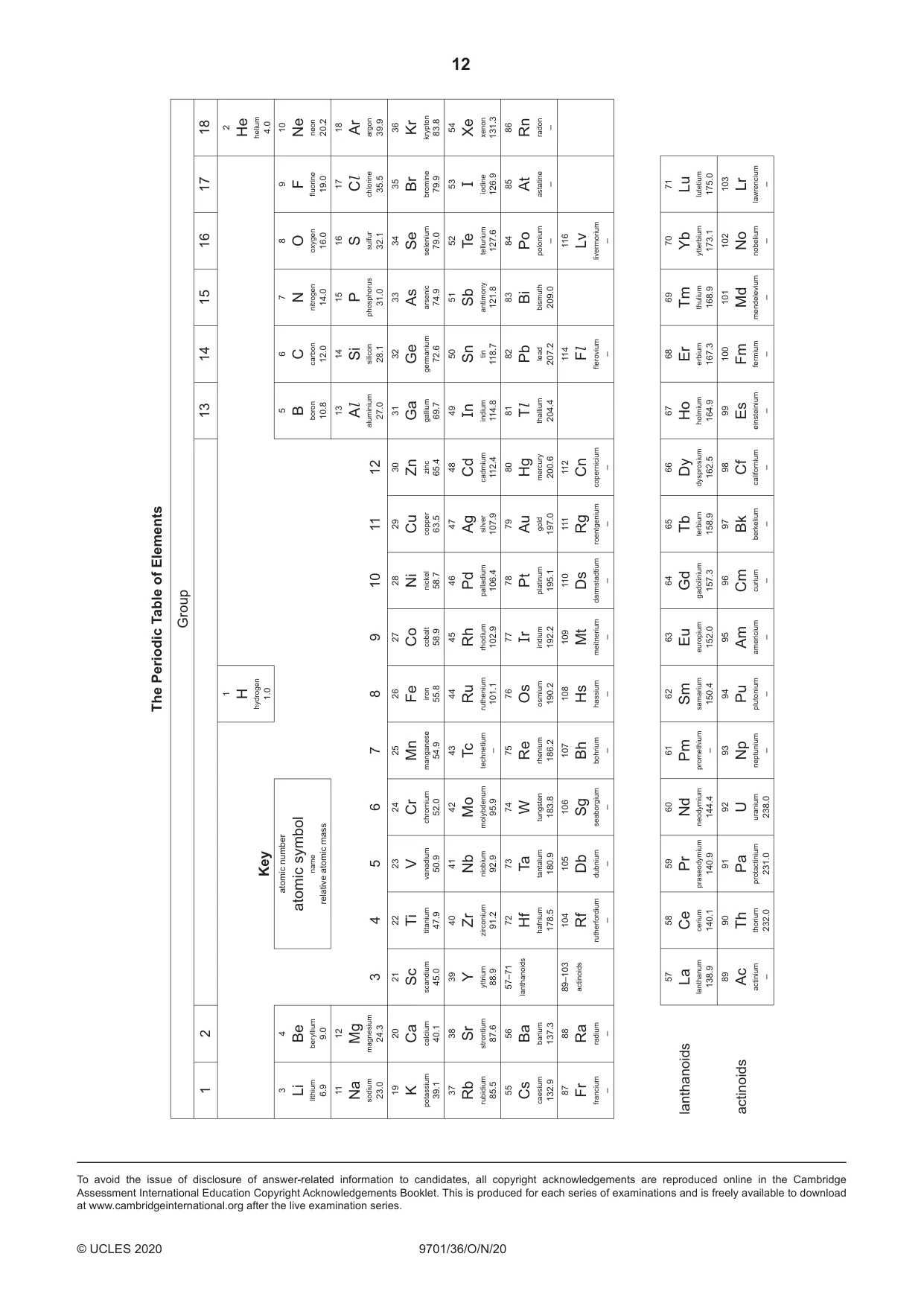
1 Many salts occur in a hydrated form such as hydrated potassium carbonate, K2CO3•xH2O, where x is an integer. You will determine the formula of a sample of hydrated potassium carbonate by adding it to an excess of hydrochloric acid and collecting the gas produced. K2CO3•xH2O(s) + 2HCl (aq) → 2KCl (aq) + (x+1)H2O(l) + CO2(g) FB 1 is hydrated potassium carbonate, K2CO3•xH2O. FB 2 is 0.50 mol dm‒3 hydrochloric acid, HCl. (a) Method ● Fill the tub with water to a depth of approximately 5 cm. ● Fill the 250 cm3 measuring cylinder completely with water. Hold a paper towel firmly over the top, invert the measuring cylinder and place it in the water in the tub. ● Remove the paper towel and clamp the inverted measuring cylinder so the open end is in the water just above the base of the tub. ● Use the 50 cm3 measuring cylinder to transfer 50.0 cm3 of FB 2 into the flask labelled X. ● Check that the bung fits tightly in the neck of flask X, clamp flask X and place the end of the delivery tube into the inverted 250 cm3 measuring cylinder. ● Weigh the container with FB 1 and record the mass. ● Remove the bung from the neck of the flask. Tip all of FB 1 into the acid in the flask and replace the bung immediately. Remove the flask from the clamp and swirl it to mix the contents. Swirl the flask occasionally until no more gas is produced. Replace the flask in the clamp after each swirl. ● Measure and record the final volume of gas in the measuring cylinder. ● Weigh the container and any residual FB 1 and record the mass. ● Calculate and record the mass of FB 1 added. Results [3] (b) Calculations (i) Calculate the number of moles of carbon dioxide collected in the measuring cylinder. Assume 1 mol of gas occupies 24.0 dm3. moles of CO2 = .............................. mol [1] (ii) Use your answer to (b)(i) and the information on page 2 to calculate the relative formula mass, Mr, of FB 1. Mr of K2CO3•xH2O = .............................. [1] (iii) Calculate the value of x in the formula of the hydrated potassium carbonate, K2CO3•xH2O. Show your working. x = .............................. [2] (c) One of the errors associated with this method is caused by the solubility of carbon dioxide in water. Suggest two modifications which could reduce this error. modification 1 ............................................................................................................................. .................................................................................................................................................... modification 2 ............................................................................................................................. .................................................................................................................................................... [2] [Total: 9]
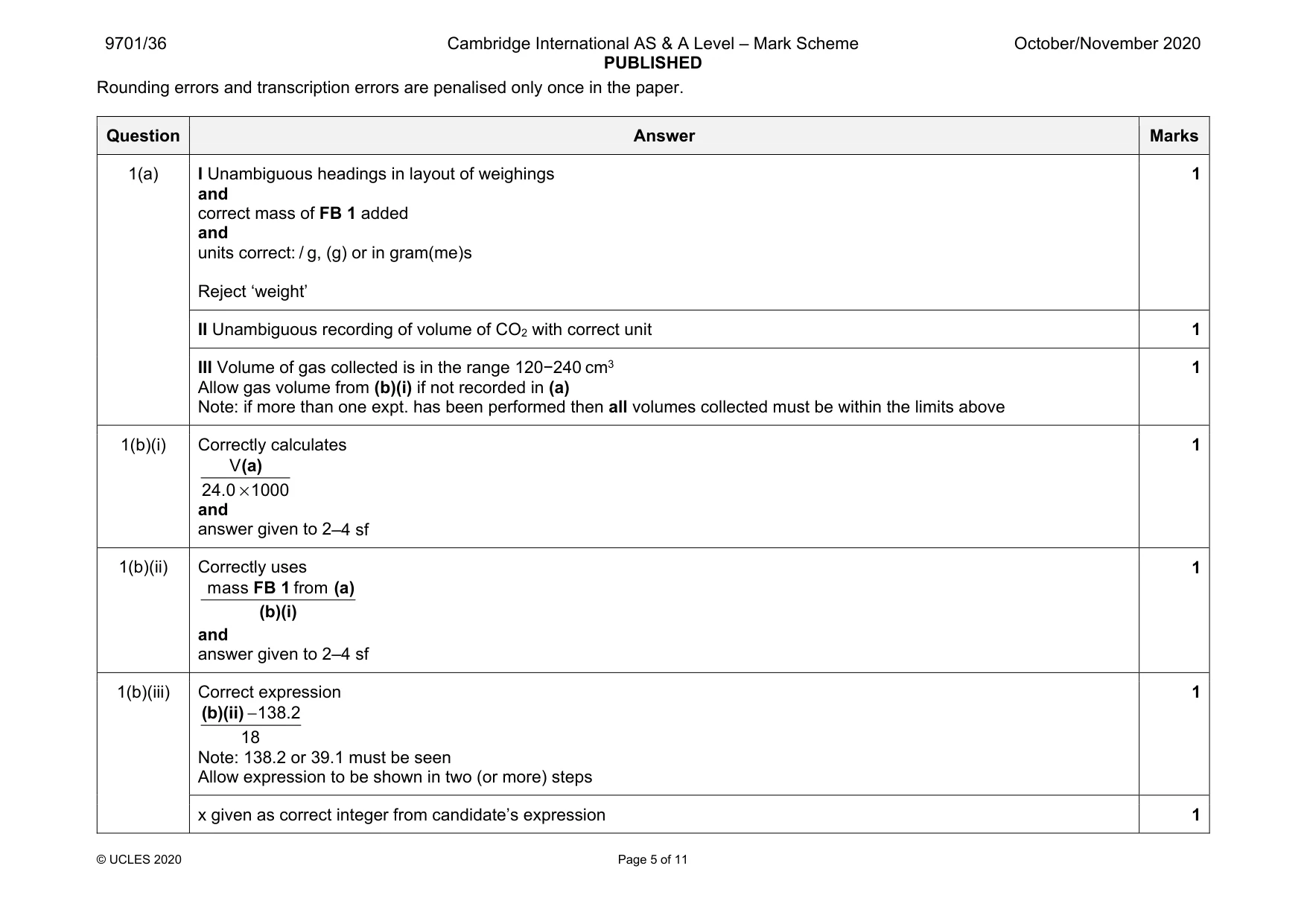
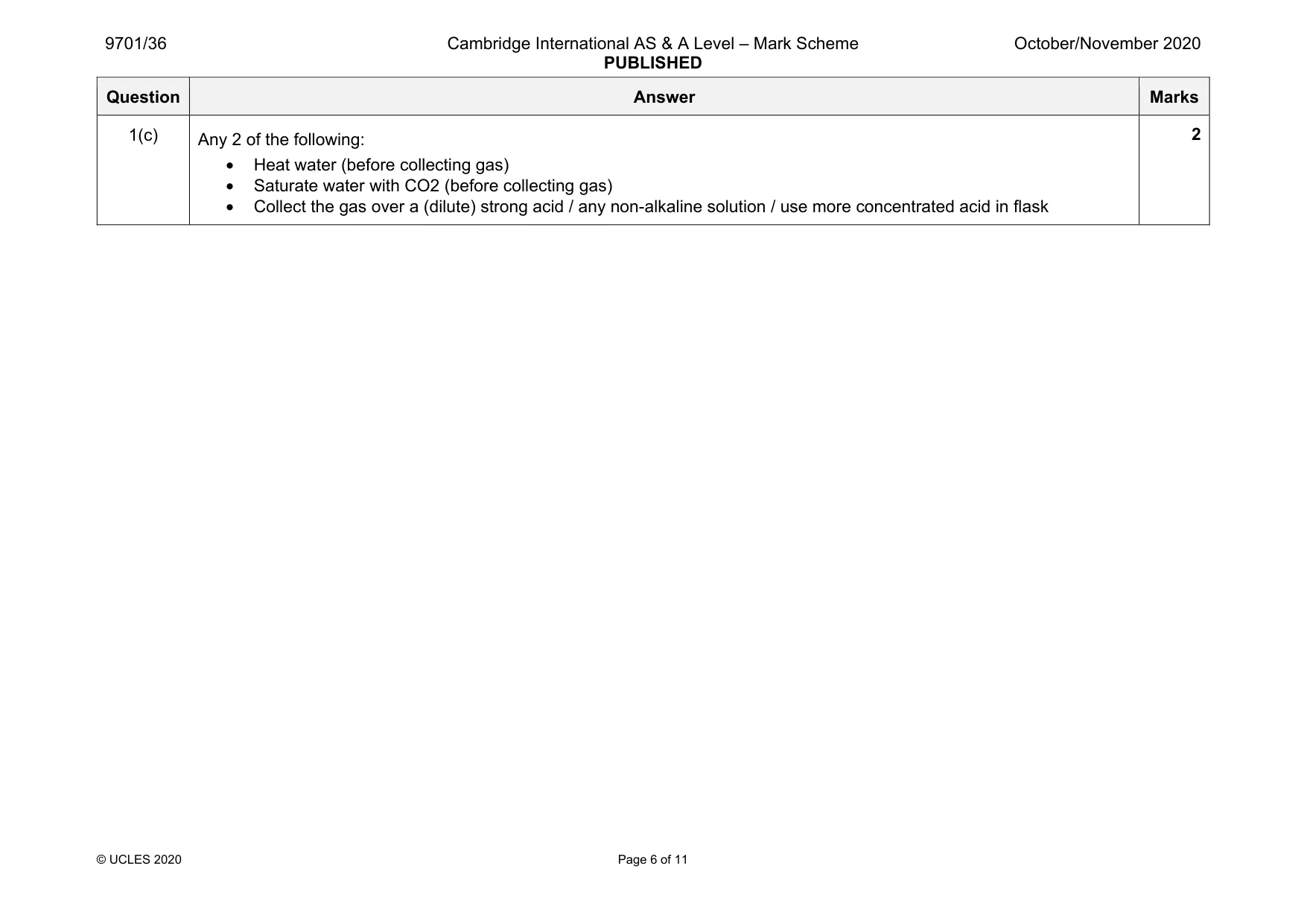
Mark scheme: 1(a) I Unambiguous headings in layout of weighings and correct mass of FB 1 added and units correct: / g, (g) or in gram(me)s Reject ‘weight’ II Unambiguous recording of volume of CO2 with correct unit 1 III Volume of gas collected is in the range 120−240 cm3 Allow gas volume from (b)(i) if not recorded in (a) Note: if more than one expt. has been performed then all volumes collected must be within the limits above 1 1(b)(i) Correctly calculates V 24.0 1000 × (a) and answer given to 2‒4 sf 1 1(b)(ii) Correctly uses mass from ) FB 1 ( ) (b)(i a and answer given to 2‒4 sf 1 1(b)(iii) Correct expression 1 38.2 18 − (b)(ii) Note: 138.2 or 39.1 must be seen Allow expression to be shown in two (or more) steps 1 x given as correct integer from candidate’s expression 1 Question Answer Marks 1(c) Any 2 of the following: • Heat water (before collecting gas) • Saturate water with CO2 (before collecting gas) • Collect the gas over a (dilute) strong acid / any non-alkaline solution / use more concentrated acid in flask 2
More questions on Reacting masses and volumes (of solutions and gases)
Q2 · You will determine the enthalpy change of hydration of anhydrous sodium carbonate
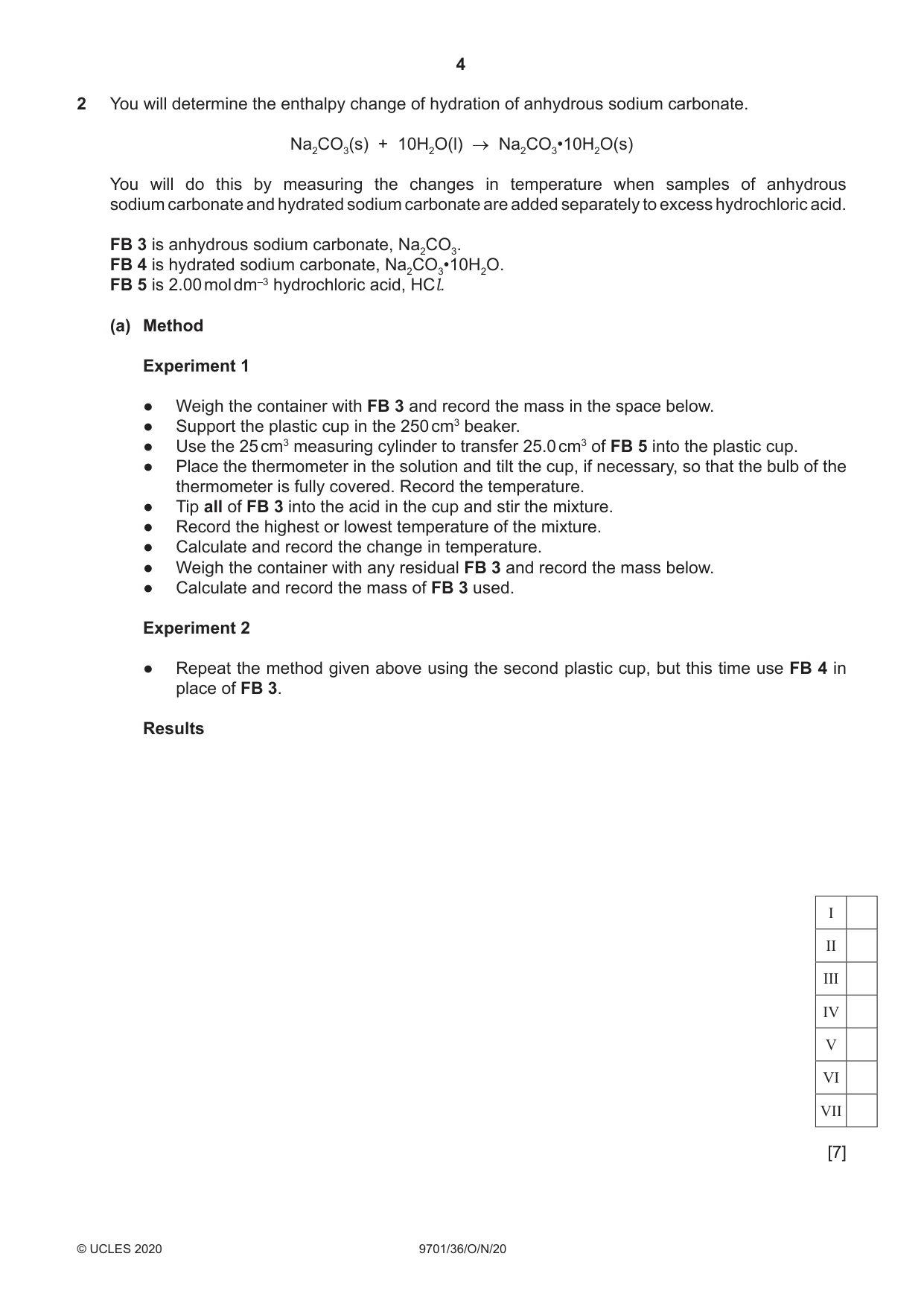
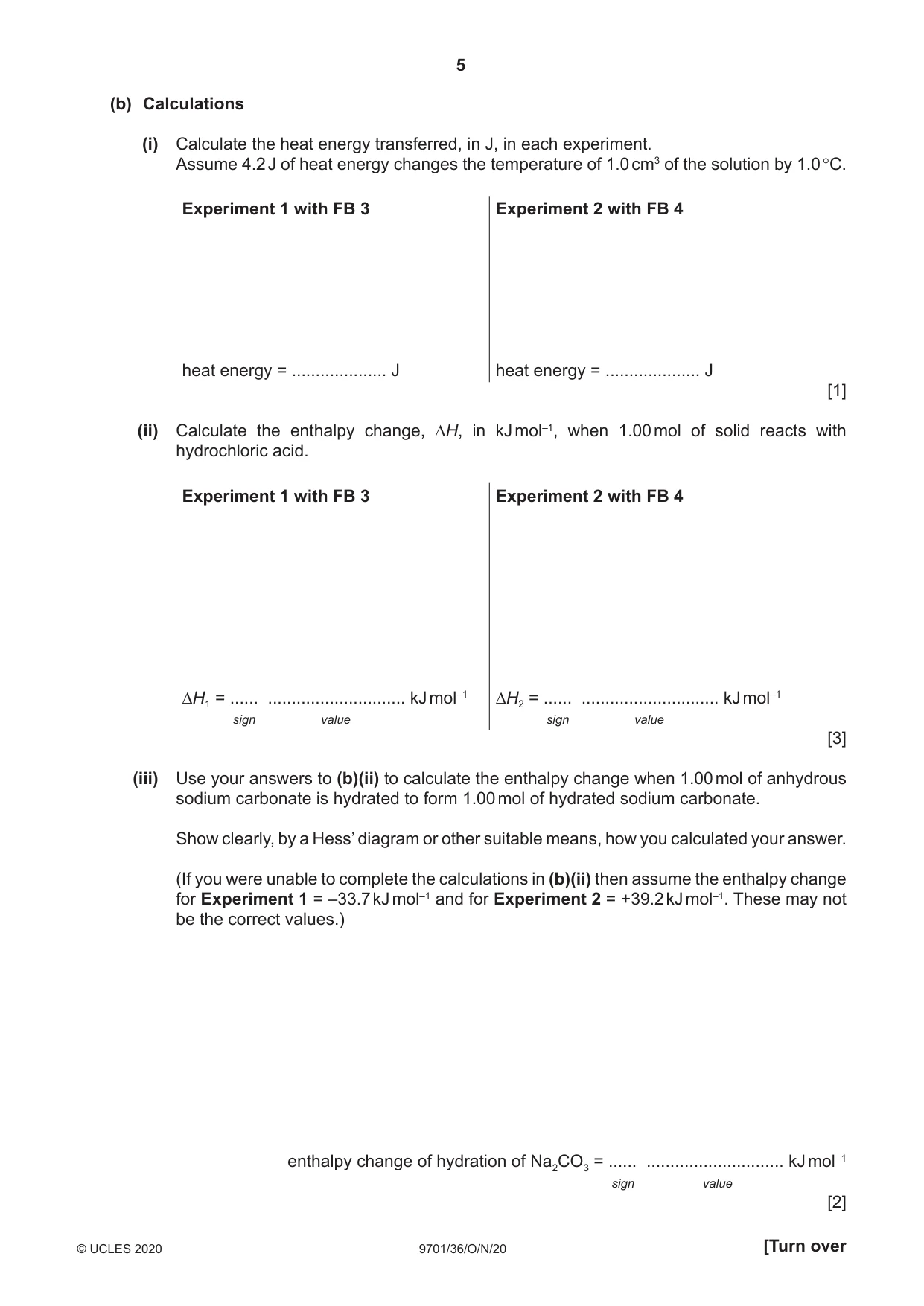
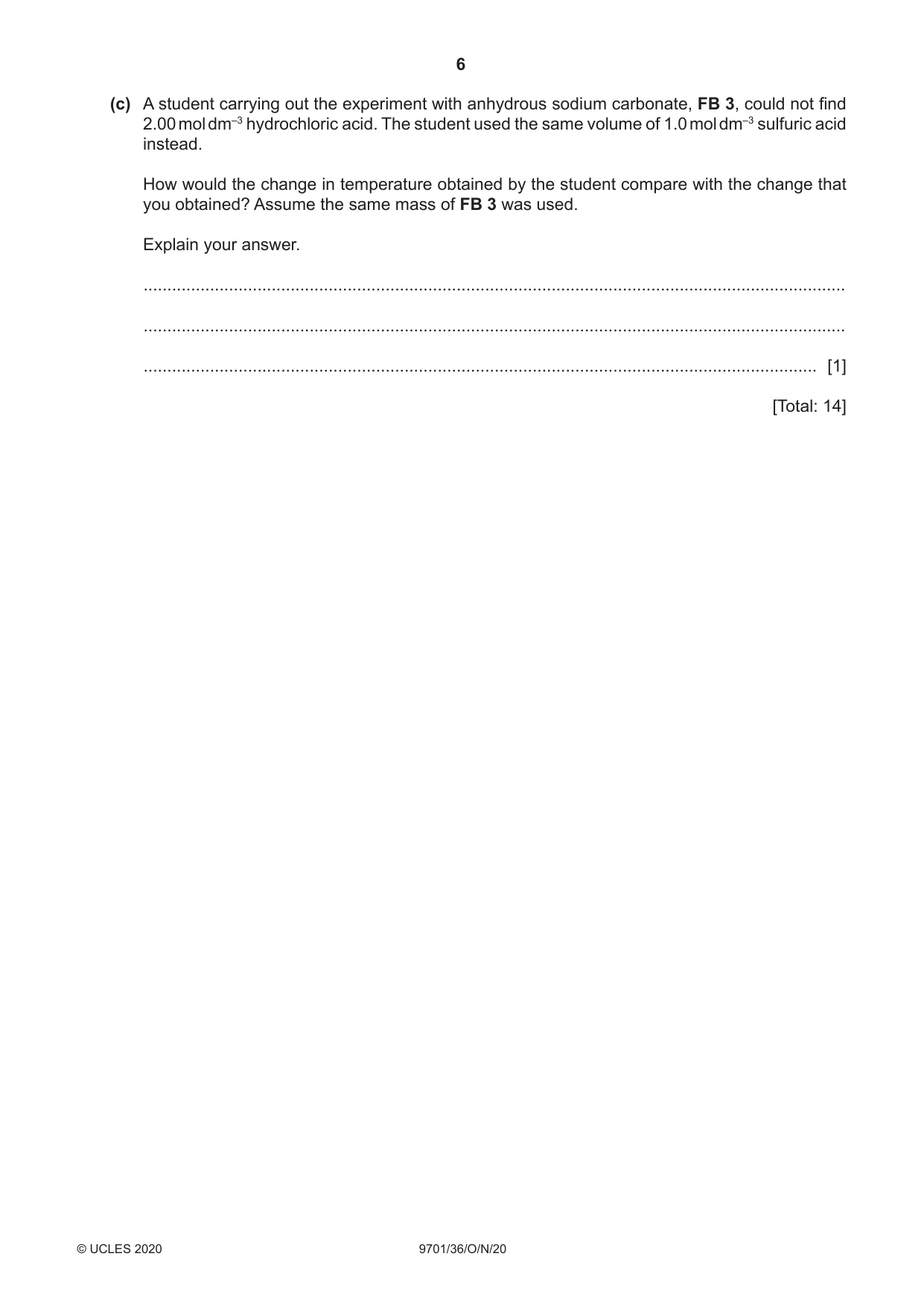
2 You will determine the enthalpy change of hydration of anhydrous sodium carbonate. Na2CO3(s) + 10H2O(l) → Na2CO3•10H2O(s) You will do this by measuring the changes in temperature when samples of anhydrous sodium carbonate and hydrated sodium carbonate are added separately to excess hydrochloric acid. FB 3 is anhydrous sodium carbonate, Na2CO3. FB 4 is hydrated sodium carbonate, Na2CO3•10H2O. FB 5 is 2.00 mol dm‒3 hydrochloric acid, HCl. (a) Method Experiment 1 ● Weigh the container with FB 3 and record the mass in the space below. ● Support the plastic cup in the 250 cm3 beaker. ● Use the 25 cm3 measuring cylinder to transfer 25.0 cm3 of FB 5 into the plastic cup. ● Place the thermometer in the solution and tilt the cup, if necessary, so that the bulb of the thermometer is fully covered. Record the temperature. ● Tip all of FB 3 into the acid in the cup and stir the mixture. ● Record the highest or lowest temperature of the mixture. ● Calculate and record the change in temperature. ● Weigh the container with any residual FB 3 and record the mass below. ● Calculate and record the mass of FB 3 used. Experiment 2 ● Repeat the method given above using the second plastic cup, but this time use FB 4 in place of FB 3. Results I II III IV V VI VII [7] (b) Calculations (i) Calculate the heat energy transferred, in J, in each experiment. Assume 4.2 J of heat energy changes the temperature of 1.0 cm3 of the solution by 1.0 °C. Experiment 1 with FB 3 Experiment 2 with FB 4 heat energy = .................... J heat energy = .................... J [1] (ii) Calculate the enthalpy change, ∆H, in kJ mol–1, when 1.00 mol of solid reacts with hydrochloric acid. Experiment 1 with FB 3 Experiment 2 with FB 4 ∆H1 = ...... ............................. kJ mol–1 ∆H2 = ...... ............................. kJ mol–1 sign value sign value [3] (iii) Use your answers to (b)(ii) to calculate the enthalpy change when 1.00 mol of anhydrous sodium carbonate is hydrated to form 1.00 mol of hydrated sodium carbonate. Show clearly, by a Hess’ diagram or other suitable means, how you calculated your answer. (If you were unable to complete the calculations in (b)(ii) then assume the enthalpy change for Experiment 1 = ‒33.7 kJ mol–1 and for Experiment 2 = +39.2 kJ mol–1. These may not be the correct values.) enthalpy change of hydration of Na2CO3 = ...... ............................. kJ mol–1 sign value [2] (c) A student carrying out the experiment with anhydrous sodium carbonate, FB 3, could not find 2.00 mol dm‒3 hydrochloric acid. The student used the same volume of 1.0 mol dm‒3 sulfuric acid instead. How would the change in temperature obtained by the student compare with the change that you obtained? Assume the same mass of FB 3 was used. Explain your answer. .................................................................................................................................................... .................................................................................................................................................... .............................................................................................................................................. [1] [Total: 14] Qualitative Analysis Where reagents are selected for use in a test, the name or correct formula of the element or compound must be given. At each stage of any test you are to record details of the following: ● colour changes seen ● the formation of any precipitate and its solubility in an excess of the reagent added ● the formation of any gas and its identification by a suitable test. You should indicate clearly at what stage in a test a change occurs. If any solution is warmed, a boiling tube must be used. Rinse and reuse test-tubes and boiling tubes where possible. No additional tests for ions present should be attempted.
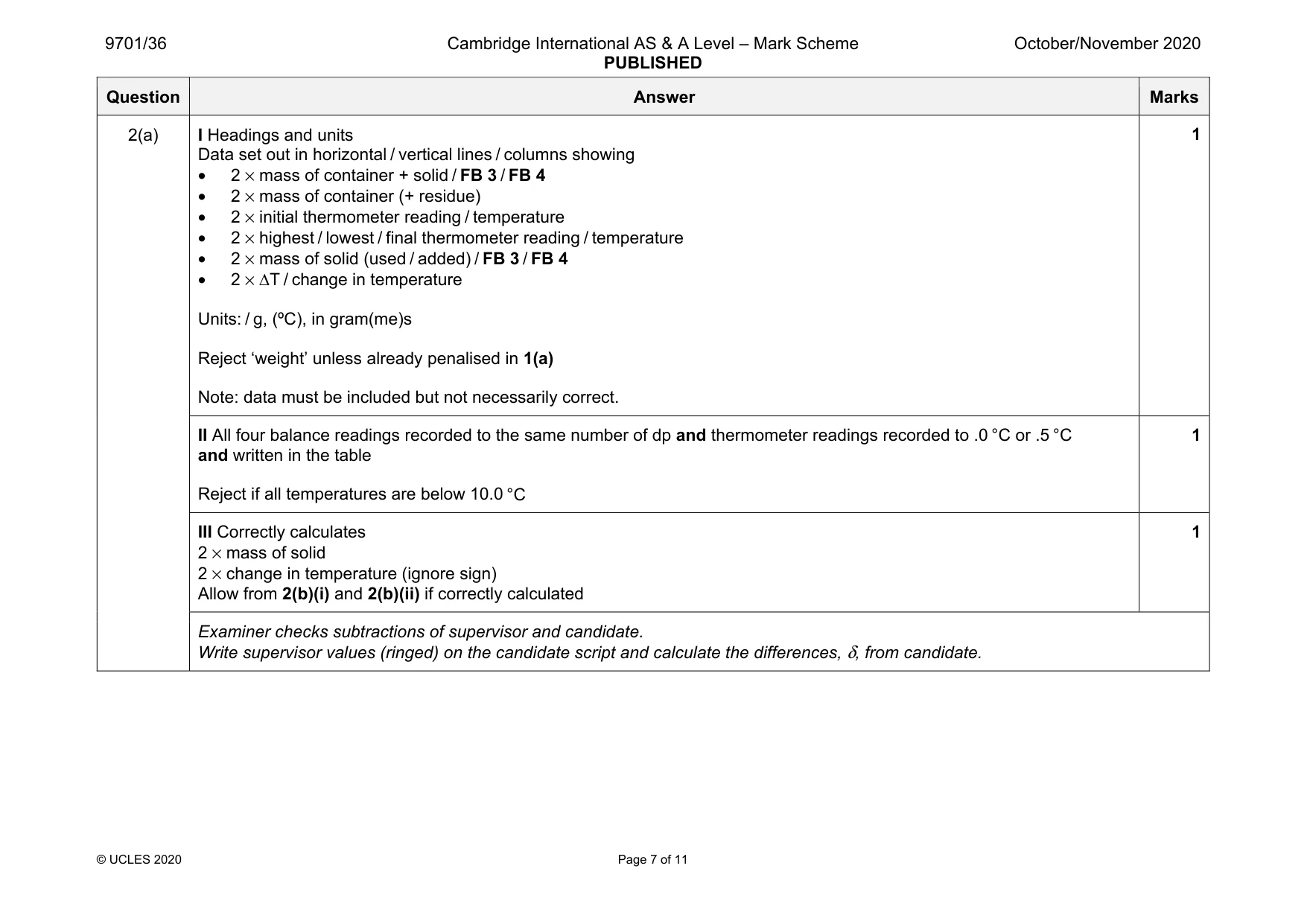
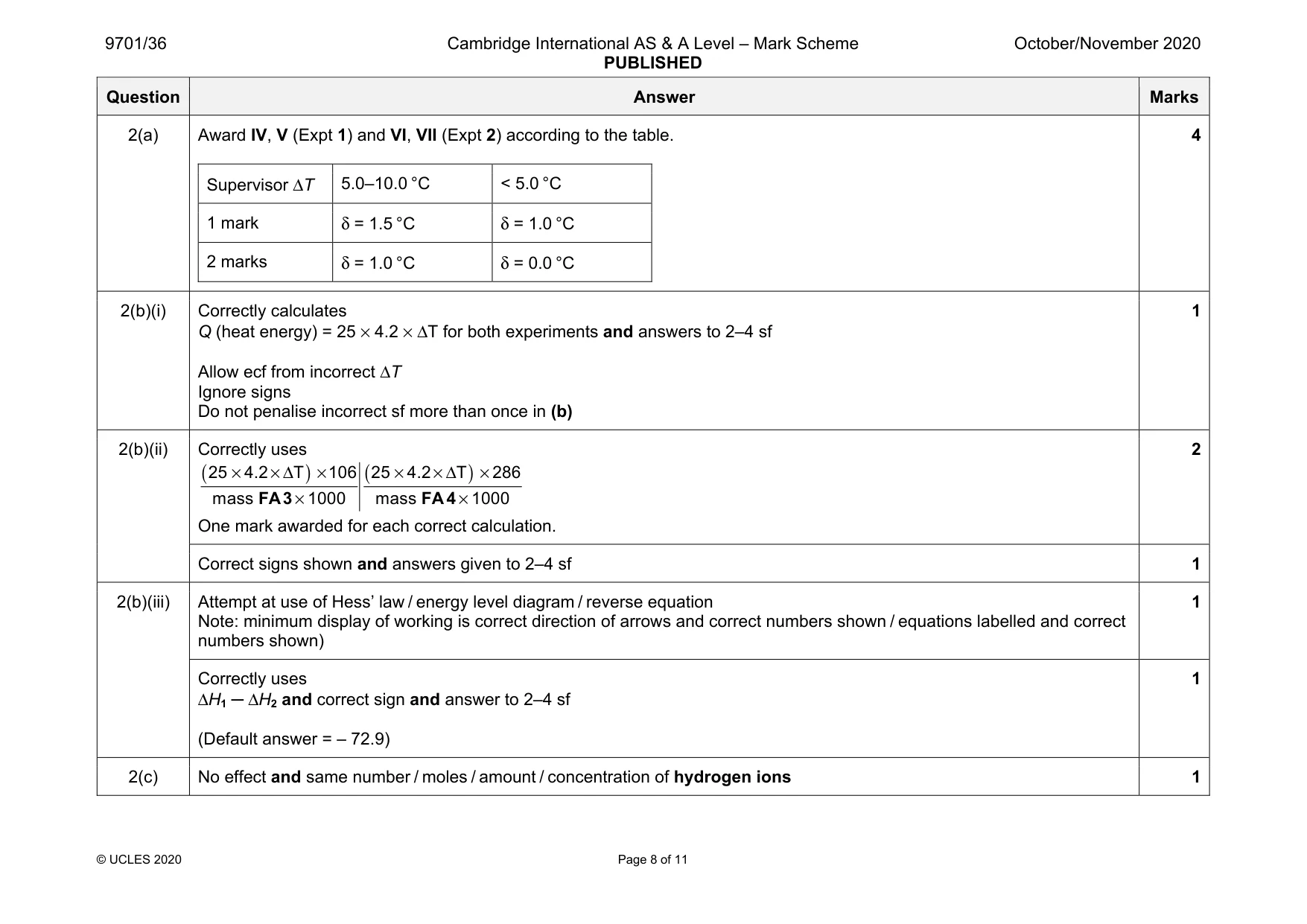
Mark scheme: 2(a) I Headings and units Data set out in horizontal / vertical lines / columns showing • 2 × mass of container + solid / FB 3 / FB 4 • 2 × mass of container (+ residue) • 2 × initial thermometer reading / temperature • 2 × highest / lowest / final thermometer reading / temperature • 2 × mass of solid (used / added) / FB 3 / FB 4 • 2 × ∆T / change in temperature Units: / g, (ºC), in gram(me)s Reject ‘weight’ unless already penalised in 1(a) Note: data must be included but not necessarily correct. II All four balance readings recorded to the same number of dp and thermometer readings recorded to .0 °C or .5 °C and written in the table Reject if all temperatures are below 10.0 °C 1 III Correctly calculates 2 × mass of solid 2 × change in temperature (ignore sign) Allow from 2(b)(i) and 2(b)(ii) if correctly calculated 1 Examiner checks subtractions of supervisor and candidate. Write supervisor values (ringed) on the candidate script and calculate the differences, δ, from candidate. Question Answer Marks 2(a) Award IV, V (Expt 1) and VI, VII (Expt 2) according to the table. Supervisor ΔT 5.0–10.0 °C < 5.0 °C 1 mark δ = 1.5 °C δ = 1.0 °C 2 marks δ = 1.0 °C δ = 0.0 °C 4 2(b)(i) Correctly calculates Q (heat energy) = 25 × 4.2 × ΔT for both experiments and answers to 2–4 sf Allow ecf from incorrect ΔT Ignore signs Do not penalise incorrect sf more than once in (b) 1 2(b)(ii) Correctly uses ( ) ( ) 25 4.2 T 106 25 4.2 T 286 mass 1 000 mass 1 000 × × Δ × × × Δ × × × FA3 FA4 One mark awarded for each correct calculation. 2 Correct signs shown and answers given to 2–4 sf 1 2(b)(iii) Attempt at use of Hess’ law / energy level diagram / reverse equation Note: minimum display of working is correct direction of arrows and correct numbers shown / equations labelled and correct numbers shown) 1 Correctly uses ΔH1 ─ ΔH2 and correct sign and answer to 2–4 sf (Default answer = ‒ 72.9) 1 2(c) No effect and same number / moles / amount / concentration of hydrogen ions 1
Q3 · FB 6, FB 7 and FB 8 are aqueous solutions of salts
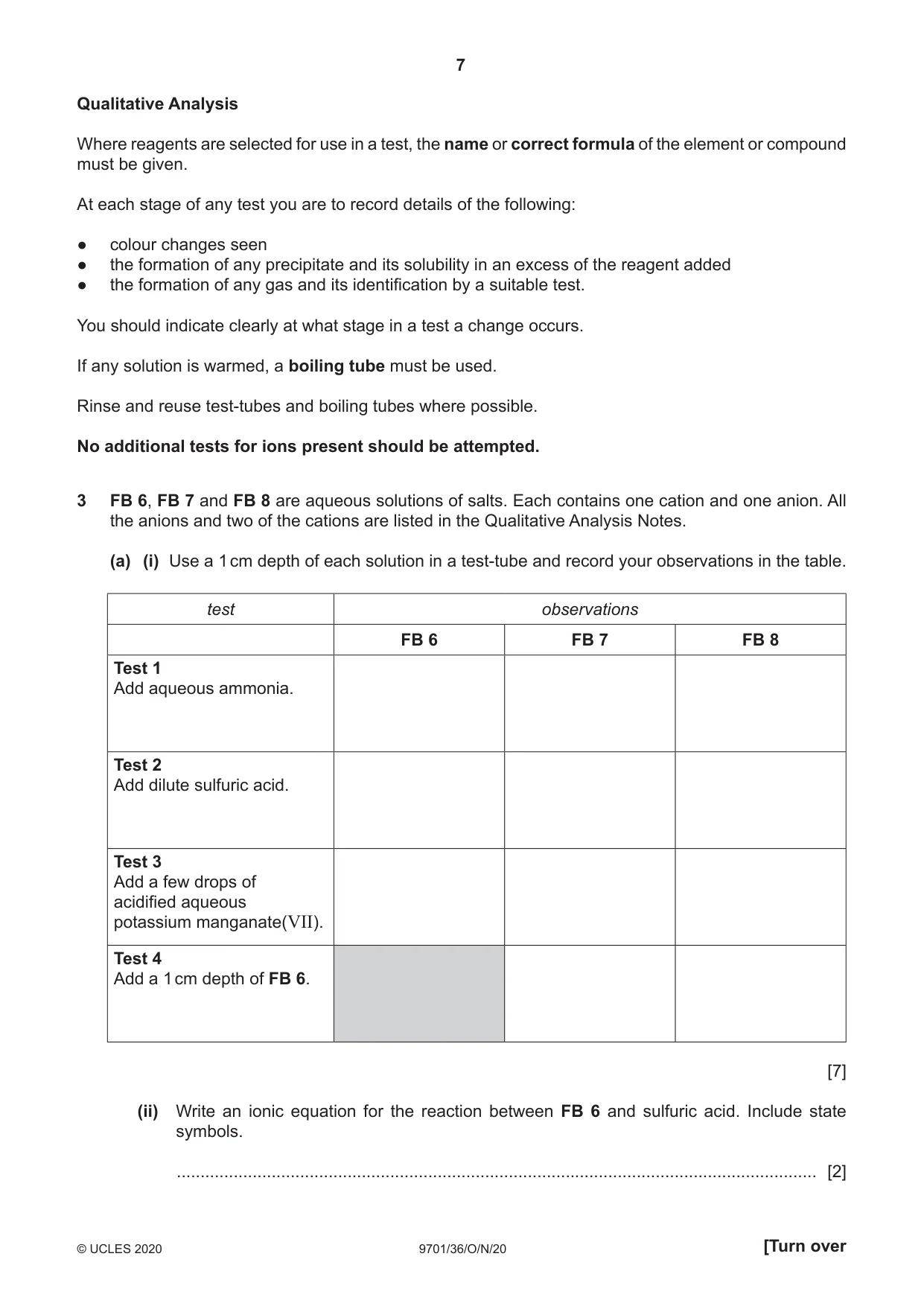
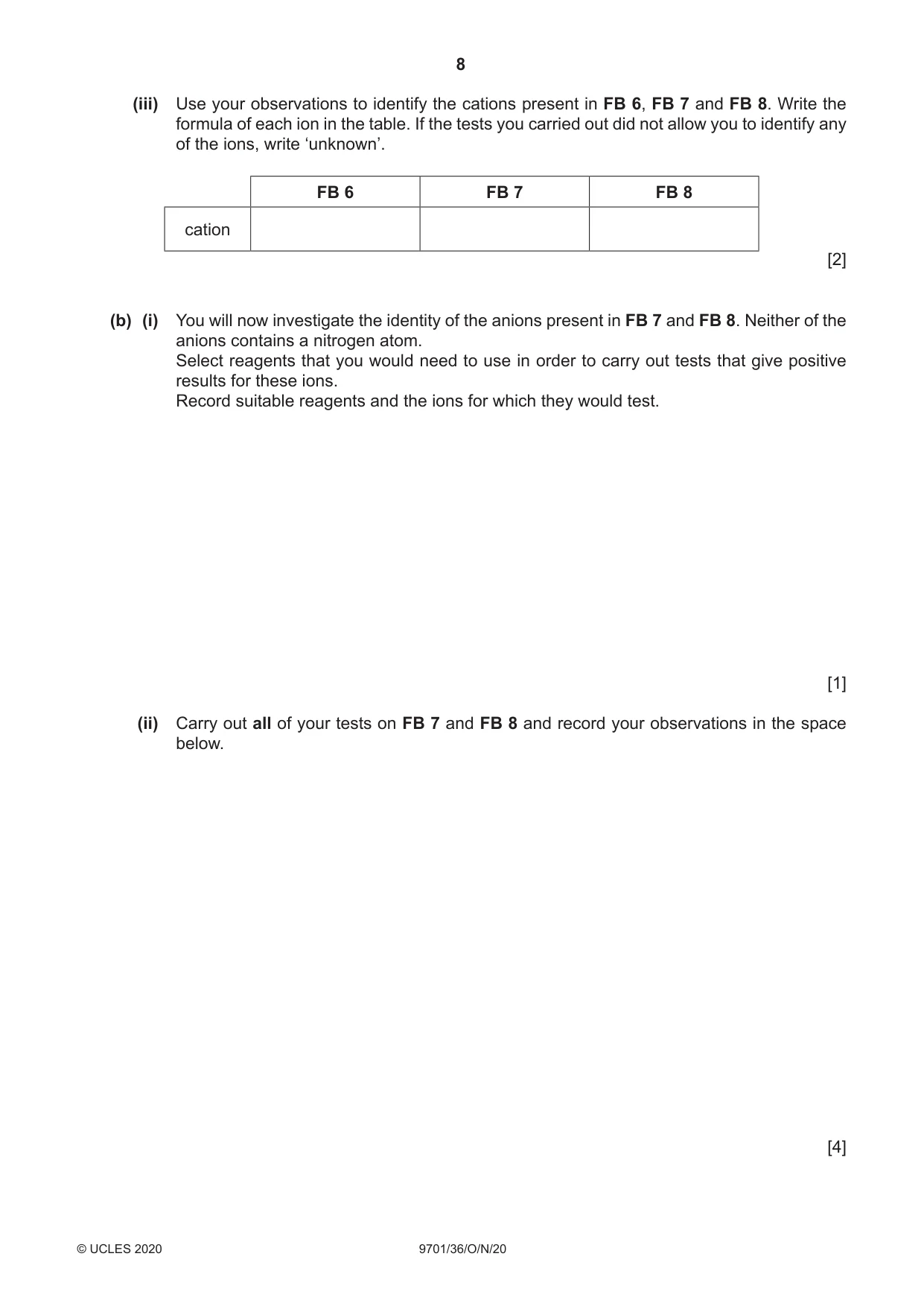
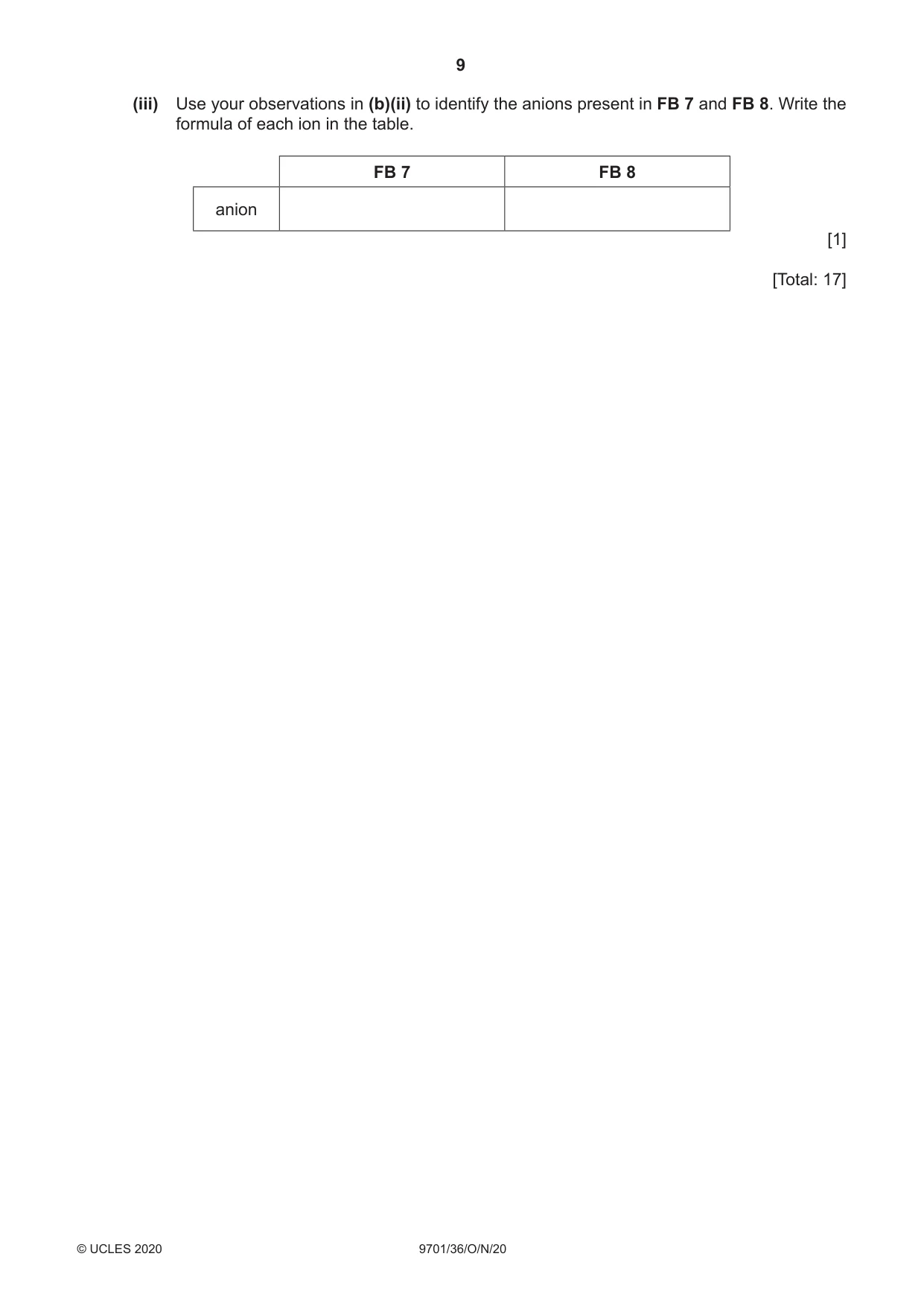
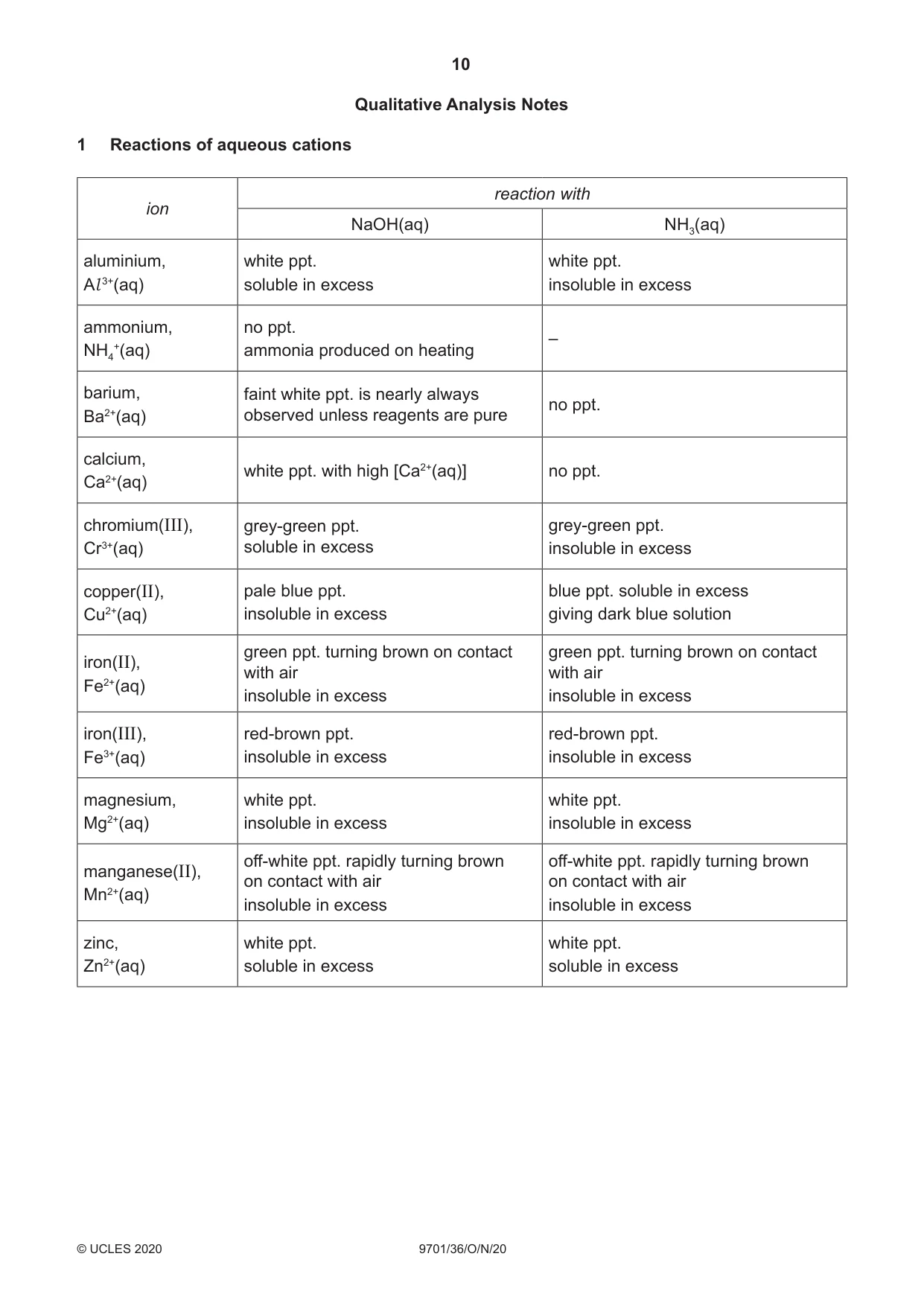
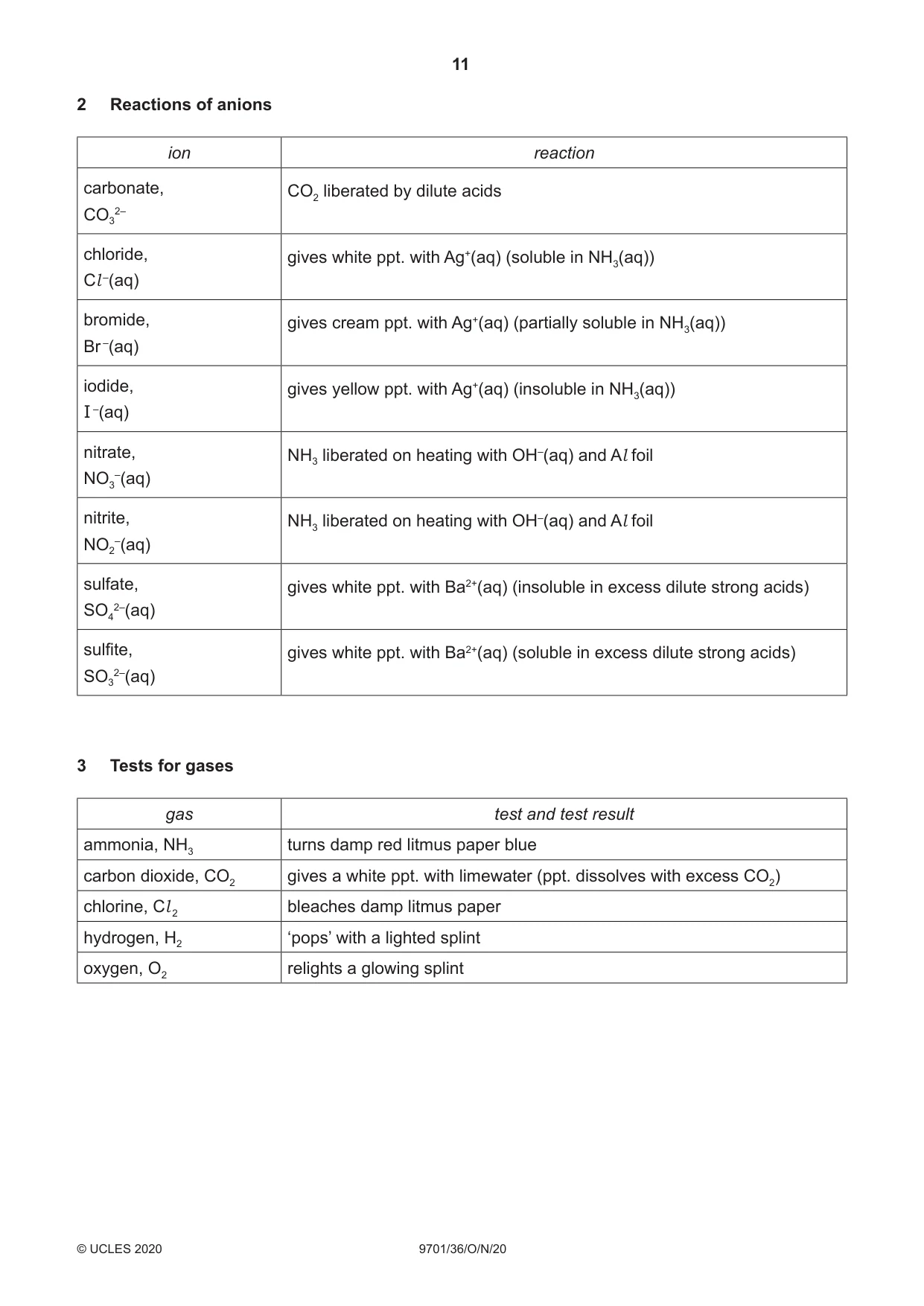
3 FB 6, FB 7 and FB 8 are aqueous solutions of salts. Each contains one cation and one anion. All the anions and two of the cations are listed in the Qualitative Analysis Notes. (a) (i) Use a 1 cm depth of each solution in a test-tube and record your observations in the table. test observations FB 6 FB 7 FB 8 Test 1 Add aqueous ammonia. Test 2 Add dilute sulfuric acid. Test 3 Add a few drops of acidified aqueous potassium manganate(VII). Test 4 Add a 1 cm depth of FB 6. [7] (ii) Write an ionic equation for the reaction between FB 6 and sulfuric acid. Include state symbols. ....................................................................................................................................... [2] (iii) Use your observations to identify the cations present in FB 6, FB 7 and FB 8. Write the formula of each ion in the table. If the tests you carried out did not allow you to identify any of the ions, write ‘unknown’. FB 6 FB 7 FB 8 cation [2] (b) (i) You will now investigate the identity of the anions present in FB 7 and FB 8. Neither of the anions contains a nitrogen atom. Select reagents that you would need to use in order to carry out tests that give positive results for these ions. Record suitable reagents and the ions for which they would test. [1] (ii) Carry out all of your tests on FB 7 and FB 8 and record your observations in the space below. [4] (iii) Use your observations in (b)(ii) to identify the anions present in FB 7 and FB 8. Write the formula of each ion in the table. FB 7 FB 8 anion [1] [Total: 17]
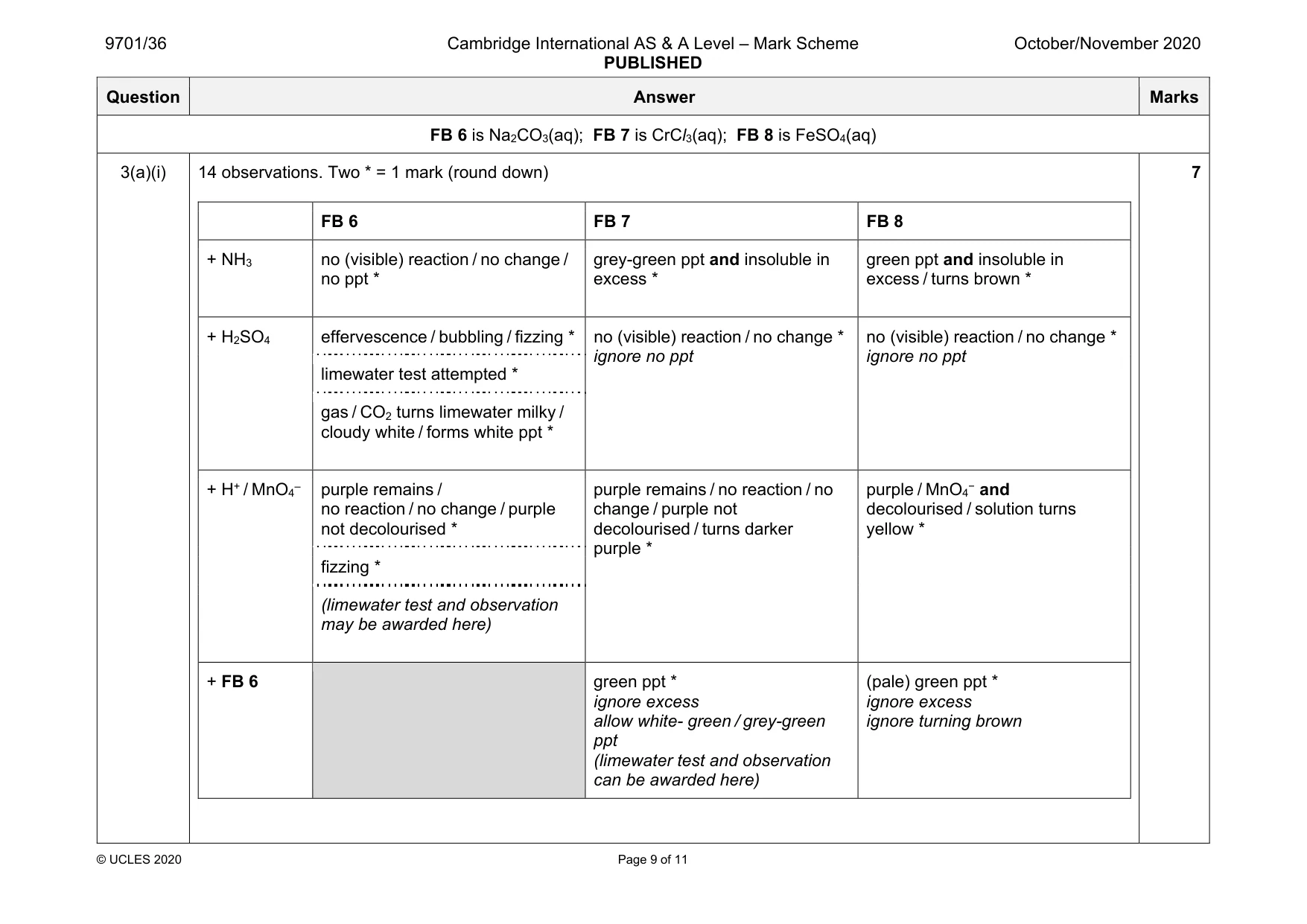
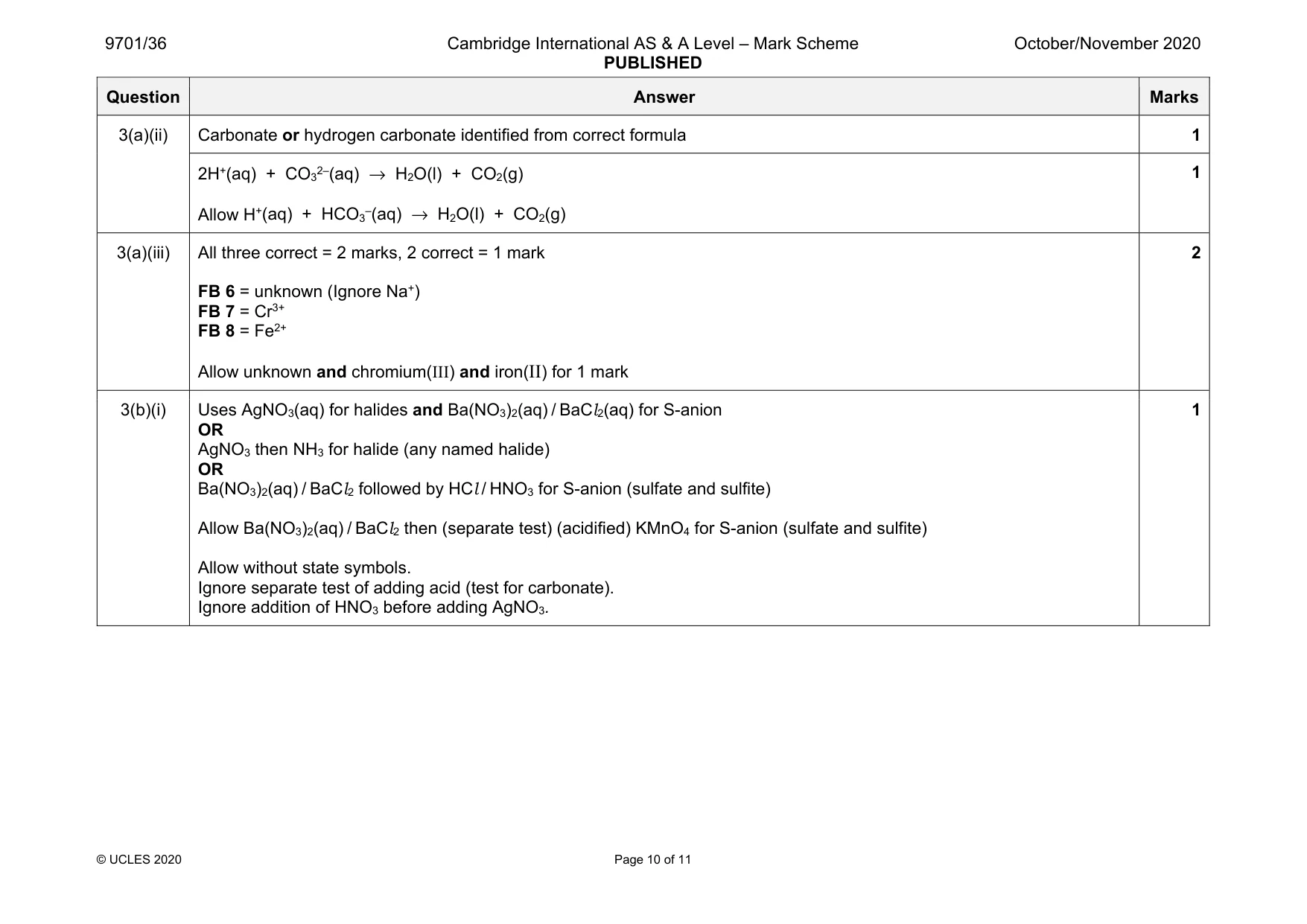
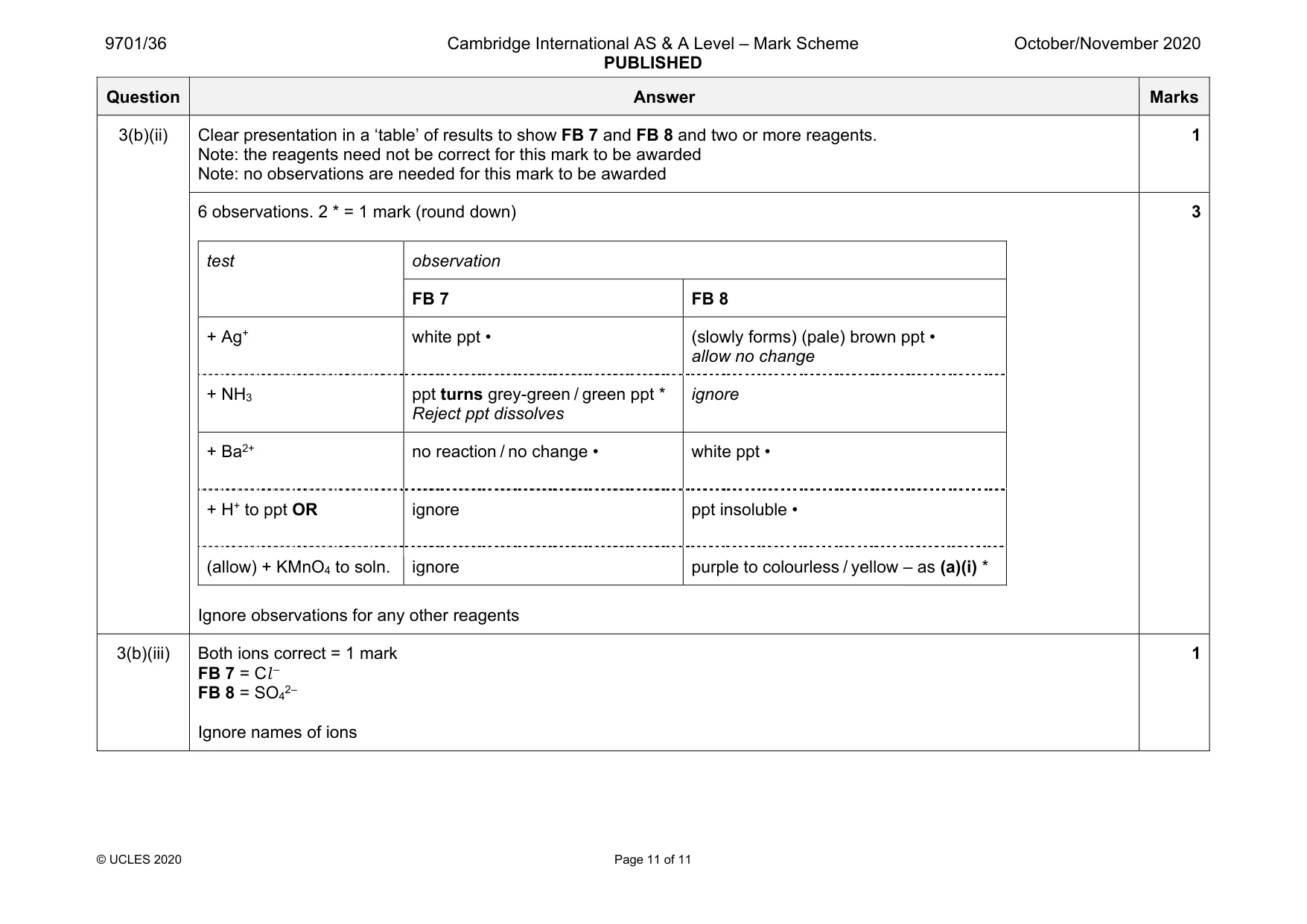
Mark scheme: 3(a)(i) 14 observations. Two * = 1 mark (round down) FB 6 FB 7 FB 8 + NH3 no (visible) reaction / no change / no ppt * grey-green ppt and insoluble in excess * green ppt and insoluble in excess / turns brown * + H2SO4 effervescence / bubbling / fizzing * no (visible) reaction / no change * ignore no ppt no (visible) reaction / no change * ignore no ppt limewater test attempted * gas / CO2 turns limewater milky / cloudy white / forms white ppt * + H+ / MnO4‒ purple remains / no reaction / no change / purple not decolourised * purple remains / no reaction / no change / purple not decolourised / turns darker purple * purple / MnO4− and decolourised / solution turns yellow * fizzing * (limewater test and observation may be awarded here) + FB 6 green ppt * ignore excess allow white- green / grey-green ppt (limewater test and observation can be awarded here) (pale) green ppt * ignore excess ignore turning brown 7 Question Answer Marks 3(a)(ii) Carbonate or hydrogen carbonate identified from correct formula 1 2H+(aq) + CO32‒(aq) → H2O(l) + CO2(g) Allow H+(aq) + HCO3‒(aq) → H2O(l) + CO2(g) 1 3(a)(iii) All three correct = 2 marks, 2 correct = 1 mark FB 6 = unknown (Ignore Na+) FB 7 = Cr3+ FB 8 = Fe2+ Allow unknown and chromium(III) and iron(II) for 1 mark 2 3(b)(i) Uses AgNO3(aq) for halides and Ba(NO3)2(aq) / BaCl2(aq) for S-anion OR AgNO3 then NH3 for halide (any named halide) OR Ba(NO3)2(aq) / BaCl2 followed by HCl / HNO3 for S-anion (sulfate and sulfite) Allow Ba(NO3)2(aq) / BaCl2 then (separate test) (acidified) KMnO4 for S-anion (sulfate and sulfite) Allow without state symbols. Ignore separate test of adding acid (test for carbonate). Ignore addition of HNO3 before adding AgNO3. 1 Question Answer Marks 3(b)(ii) Clear presentation in a ‘table’ of results to show FB 7 and FB 8 and two or more reagents. Note: the reagents need not be correct for this mark to be awarded Note: no observations are needed for this mark to be awarded 1 6 observations. 2 * = 1 mark (round down) test observation FB 7 FB 8 + Ag+ white ppt • (slowly forms) (pale) brown ppt • allow no change + NH3 ppt turns grey-green / green ppt * Reject ppt dissolves ignore + Ba2+ no reaction / no change • white ppt • + H+ to ppt OR ignore ppt insoluble • (allow) + KMnO4 to soln. ignore purple to colourless / yellow – as (a)(i) * Ignore observations for any other reagents 3 3(b)(iii) Both ions correct = 1 mark FB 7 = Cl ‒ FB 8 = SO42‒ Ignore names of ions 1
What was in this paper
The subtopics covered by these 3 questions, and how many questions each got. Open one in a new tab to see every Cambridge question on it.
What you needed in this session
Cambridge’s own grade thresholds for 2020 Oct/Nov, Paper 3 · Variant 6. A higher threshold means an easier paper — the bar moves with how the cohort did.