Cambridge A Level Chemistry 9701 — 2022 Oct/Nov Paper 2 · Variant 1
9701/21/O/N/22 · 5 questions · 60 marks · ≈68 min
The question paper and its mark scheme, free to read here and free to download. This is Cambridge’s own paper, exactly as it was sat.
Question paper16 pages
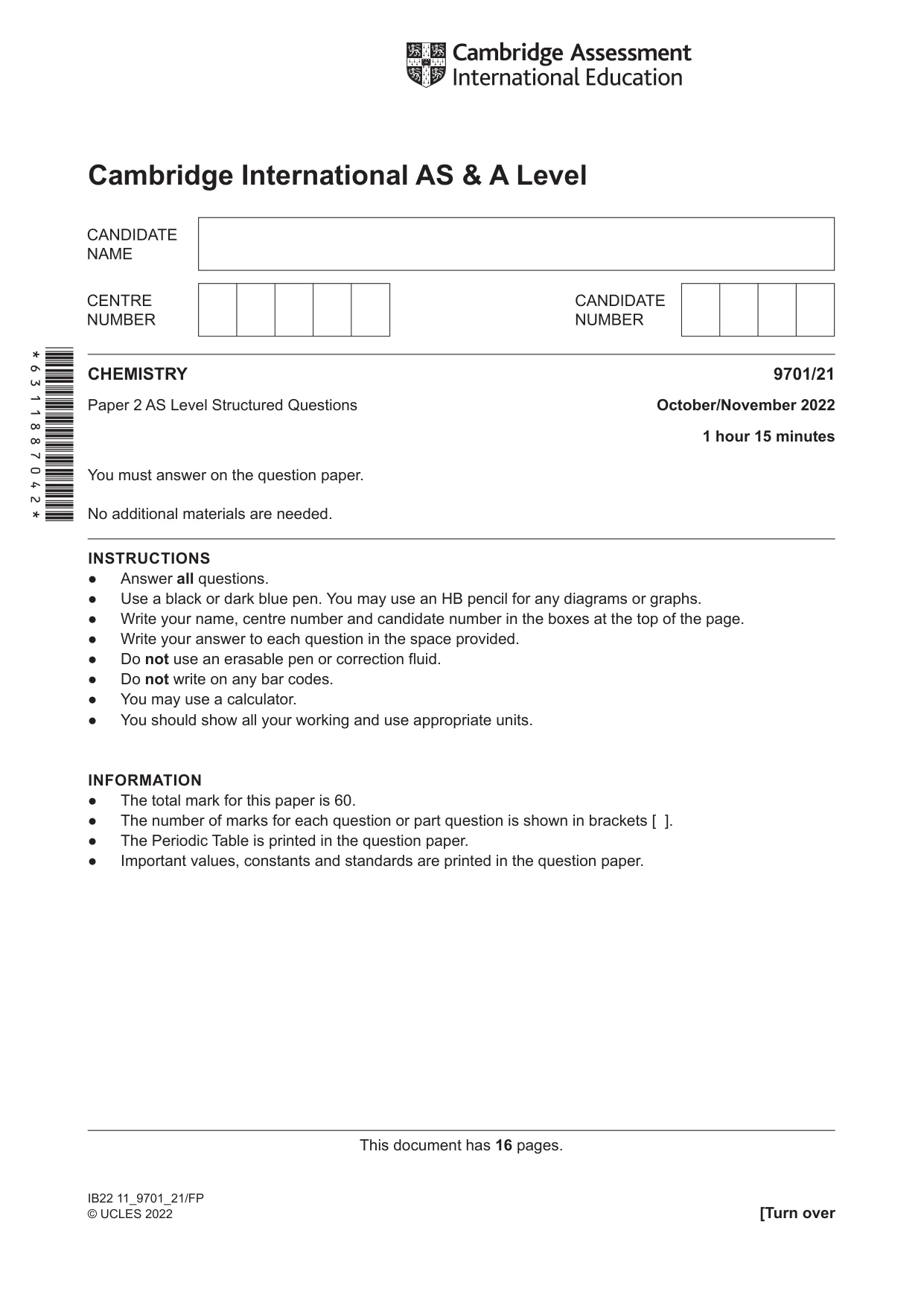

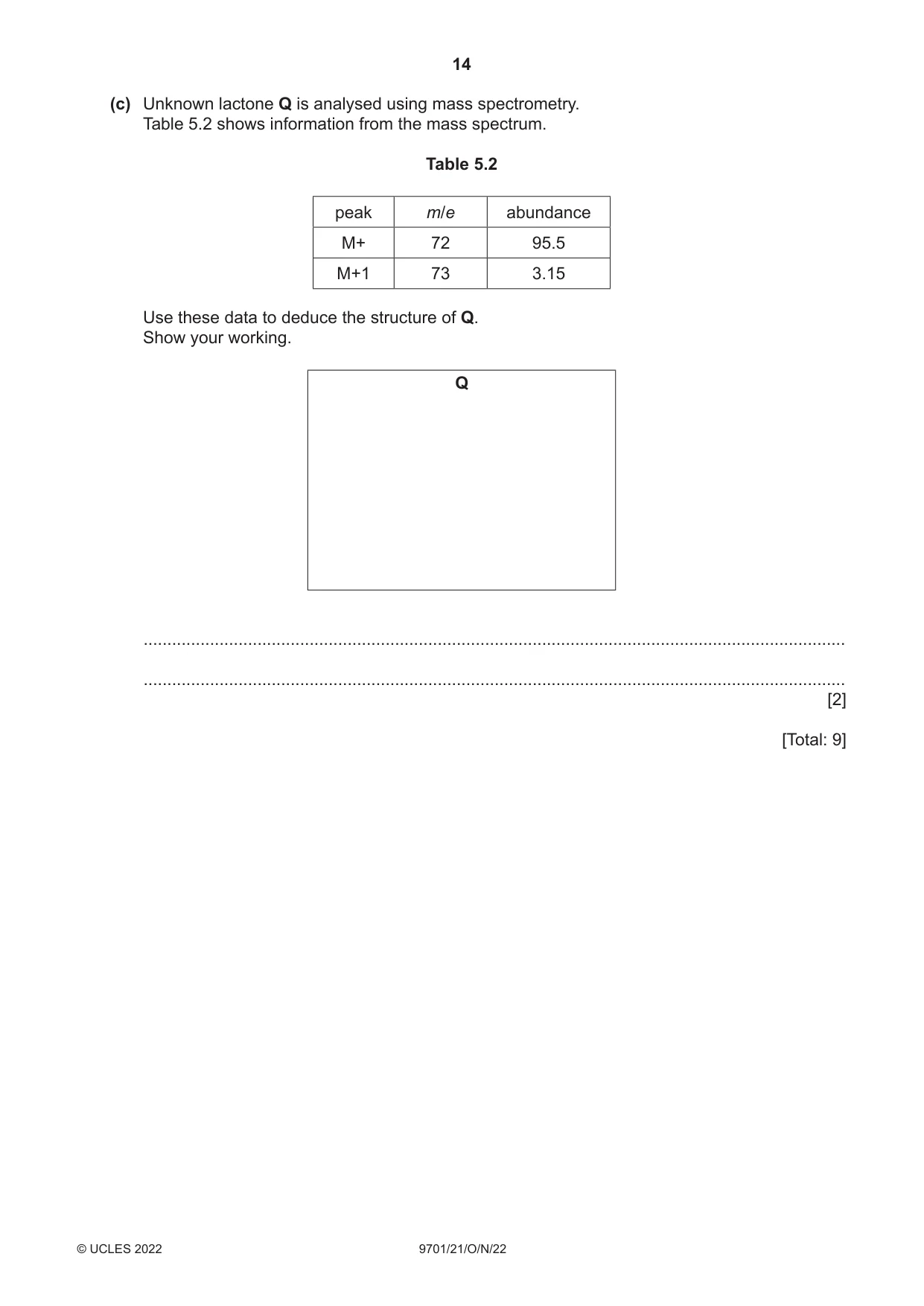
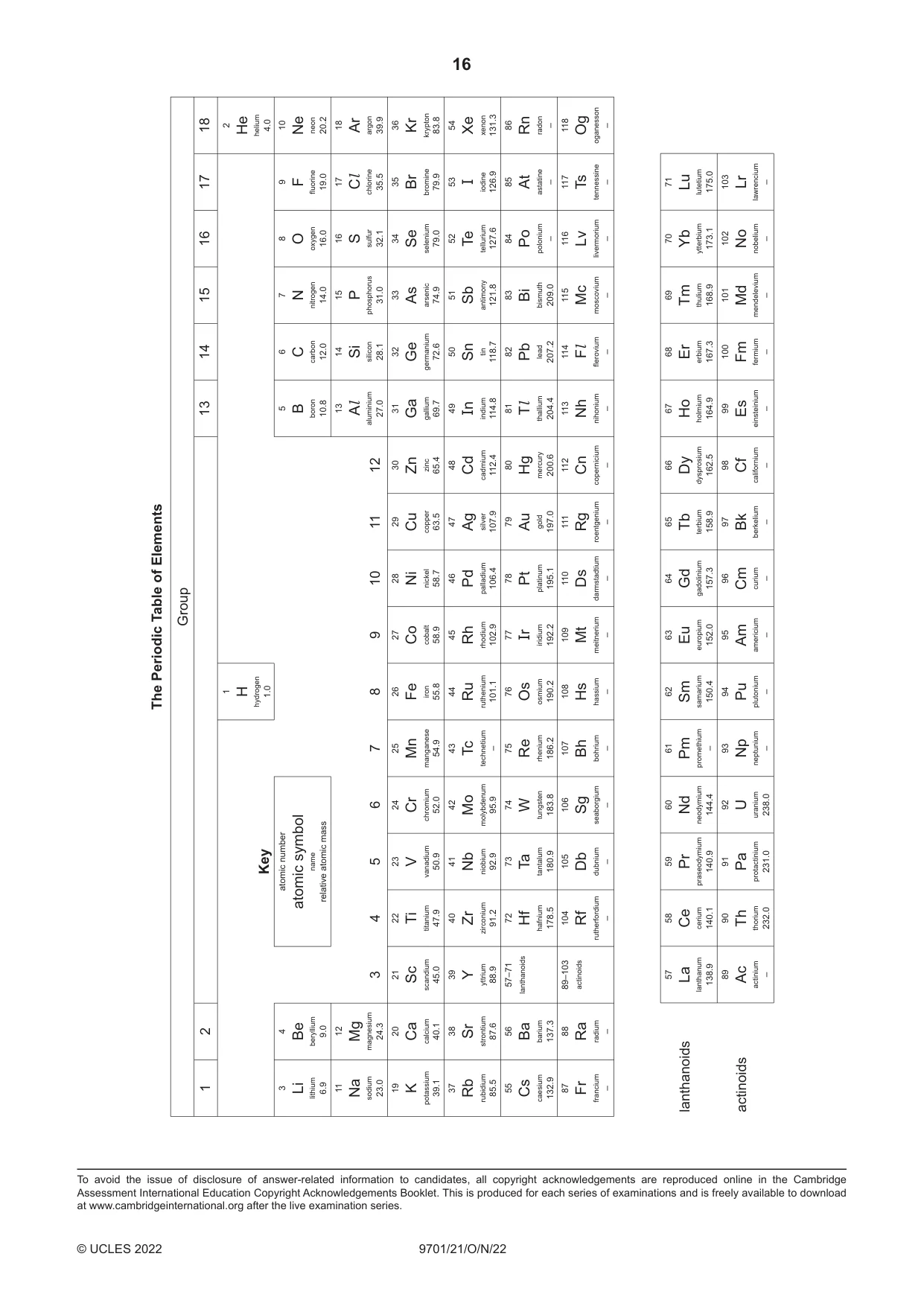
Mark scheme11 pages
Answers below. Sit the paper first if you are practising.
Questions as text
Q1 · Atoms with nuclei containing an odd number of protons tend to have fewer isotopes than…
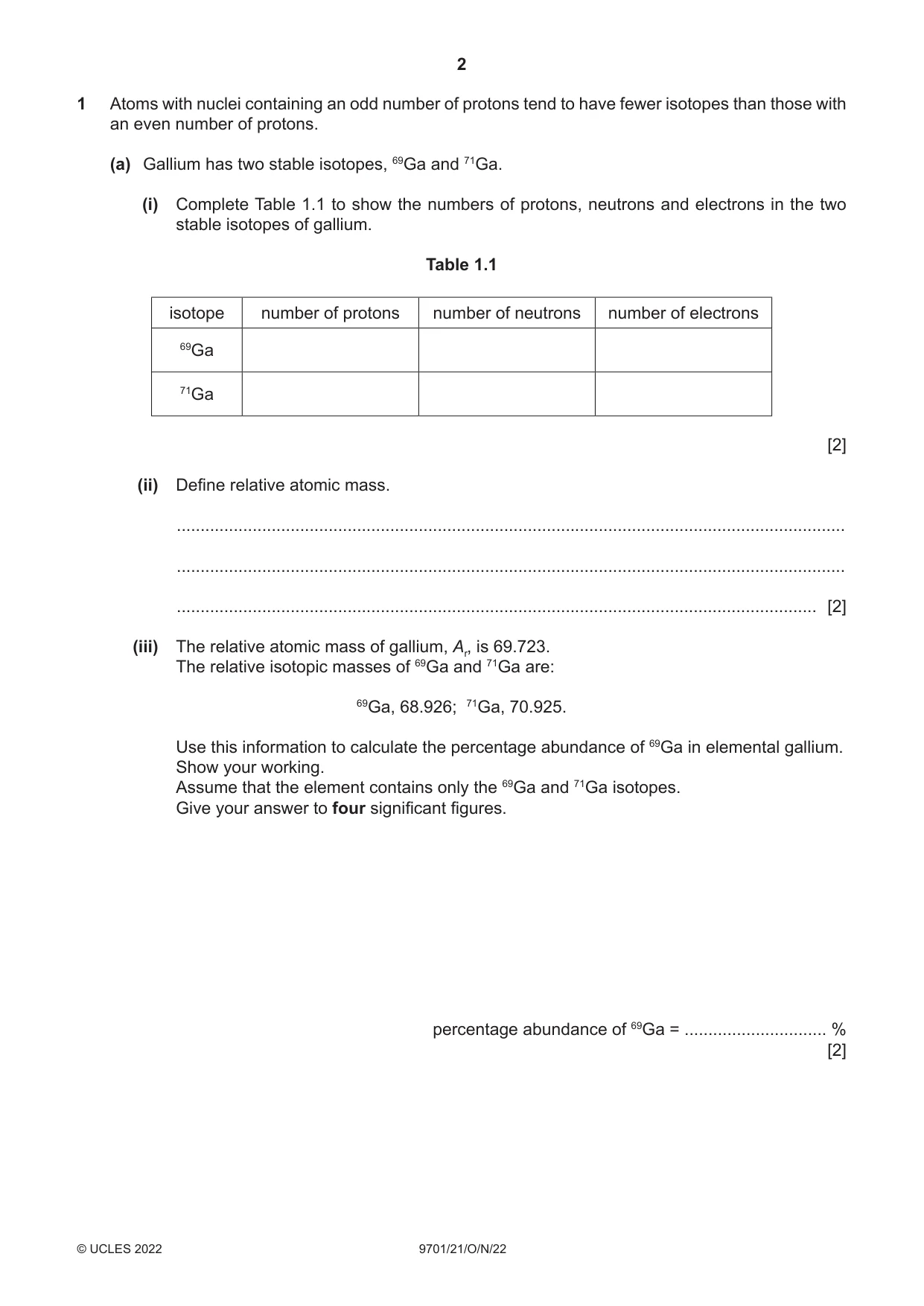
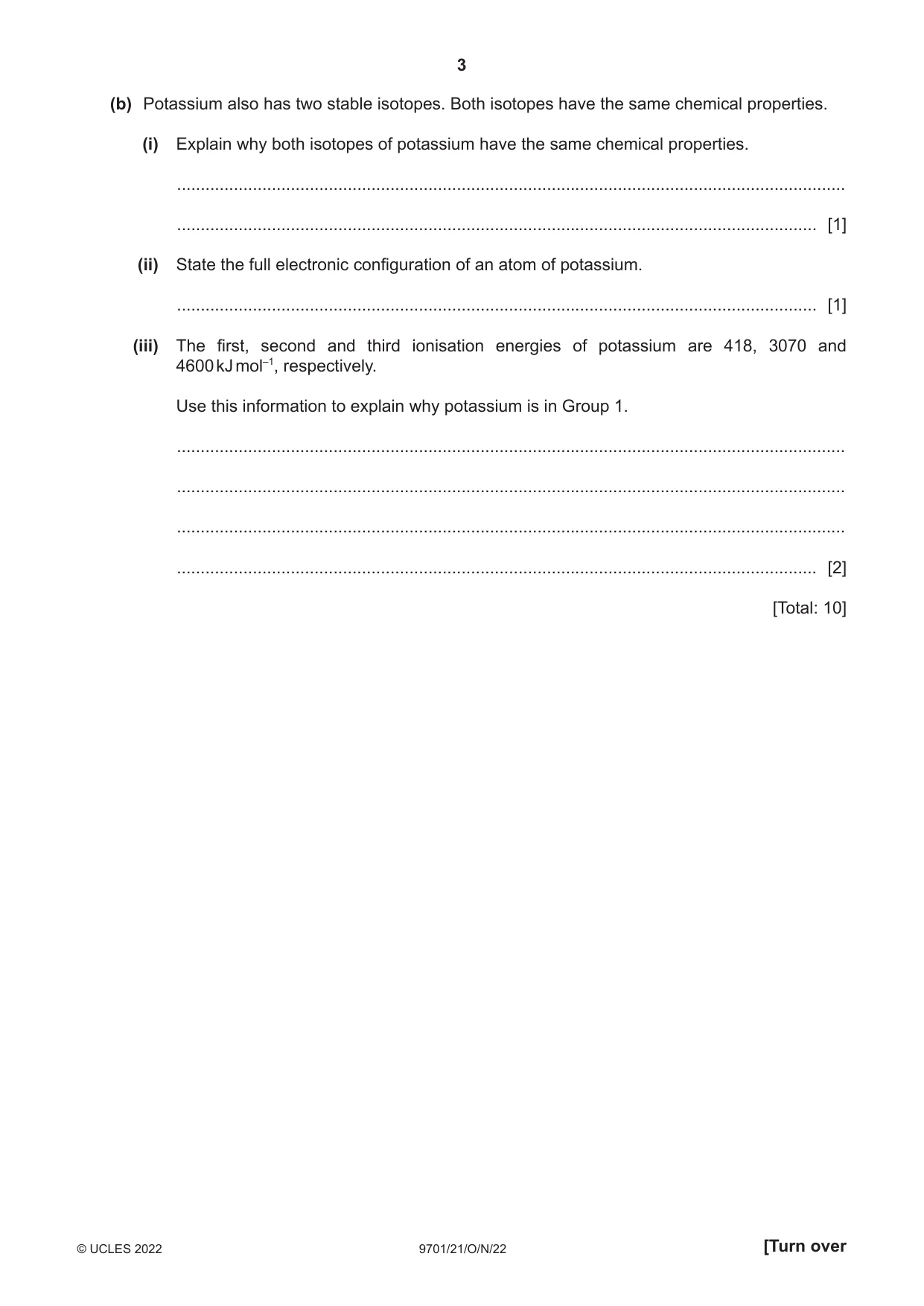
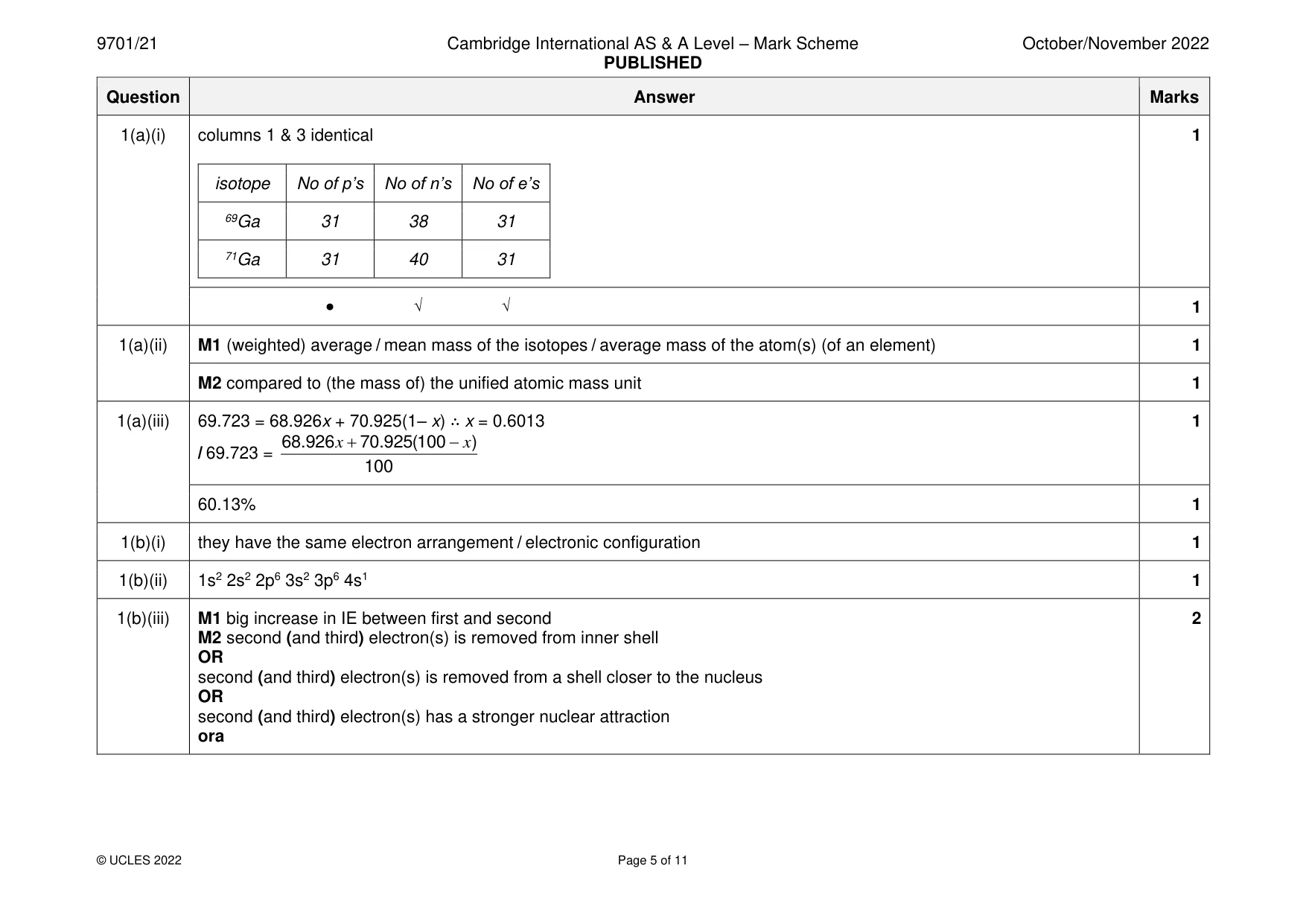
1 Atoms with nuclei containing an odd number of protons tend to have fewer isotopes than those with an even number of protons. (a) Gallium has two stable isotopes, 69Ga and 71Ga. (i) Complete Table 1.1 to show the numbers of protons, neutrons and electrons in the two stable isotopes of gallium. Table 1.1 isotope number of protons number of neutrons number of electrons 69Ga 71Ga [2] (ii) Define relative atomic mass. ............................................................................................................................................. ............................................................................................................................................. ....................................................................................................................................... [2] (iii) The relative atomic mass of gallium, Ar, is 69.723. The relative isotopic masses of 69Ga and 71Ga are: 69Ga, 68.926; 71Ga, 70.925. Use this information to calculate the percentage abundance of 69Ga in elemental gallium. Show your working. Assume that the element contains only the 69Ga and 71Ga isotopes. Give your answer to four significant figures. percentage abundance of 69Ga = .............................. % [2] (b) Potassium also has two stable isotopes. Both isotopes have the same chemical properties. (i) Explain why both isotopes of potassium have the same chemical properties. ............................................................................................................................................. ....................................................................................................................................... [1] (ii) State the full electronic configuration of an atom of potassium. ....................................................................................................................................... [1] (iii) The first, second and third ionisation energies of potassium are 418, 3070 and 4600 kJ mol–1, respectively. Use this information to explain why potassium is in Group 1. ............................................................................................................................................. ............................................................................................................................................. ............................................................................................................................................. ....................................................................................................................................... [2] [Total: 10]
Mark scheme: Question Answer Marks 1(a)(i) columns 1 & 3 identical 1 isotope No of p’s No of n’s No of e’s 69Ga 31 38 31 71Ga 31 40 31 ● √ √ 1 1(a)(ii) M1 (weighted) average / mean mass of the isotopes / average mass of the atom(s) (of an element) 1 M2 compared to (the mass of) the unified atomic mass unit 1 1(a)(iii) 69.723 = 68.926x + 70.925(1– x) ∴ x = 0.6013 1 68.926 x + 70.925(100 − x ) / 69.723 = 100 60.13% 1 1(b)(i) they have the same electron arrangement / electronic configuration 1 1(b)(ii) 1s2 2s2 2p6 3s2 3p6 4s1 1 1(b)(iii) M1 big increase in IE between first and second 2 M2 second (and third) electron(s) is removed from inner shell OR second (and third) electron(s) is removed from a shell closer to the nucleus OR second (and third) electron(s) has a stronger nuclear attraction ora
Q2 · Magnesium shows reactions typical of a Group 2 metal
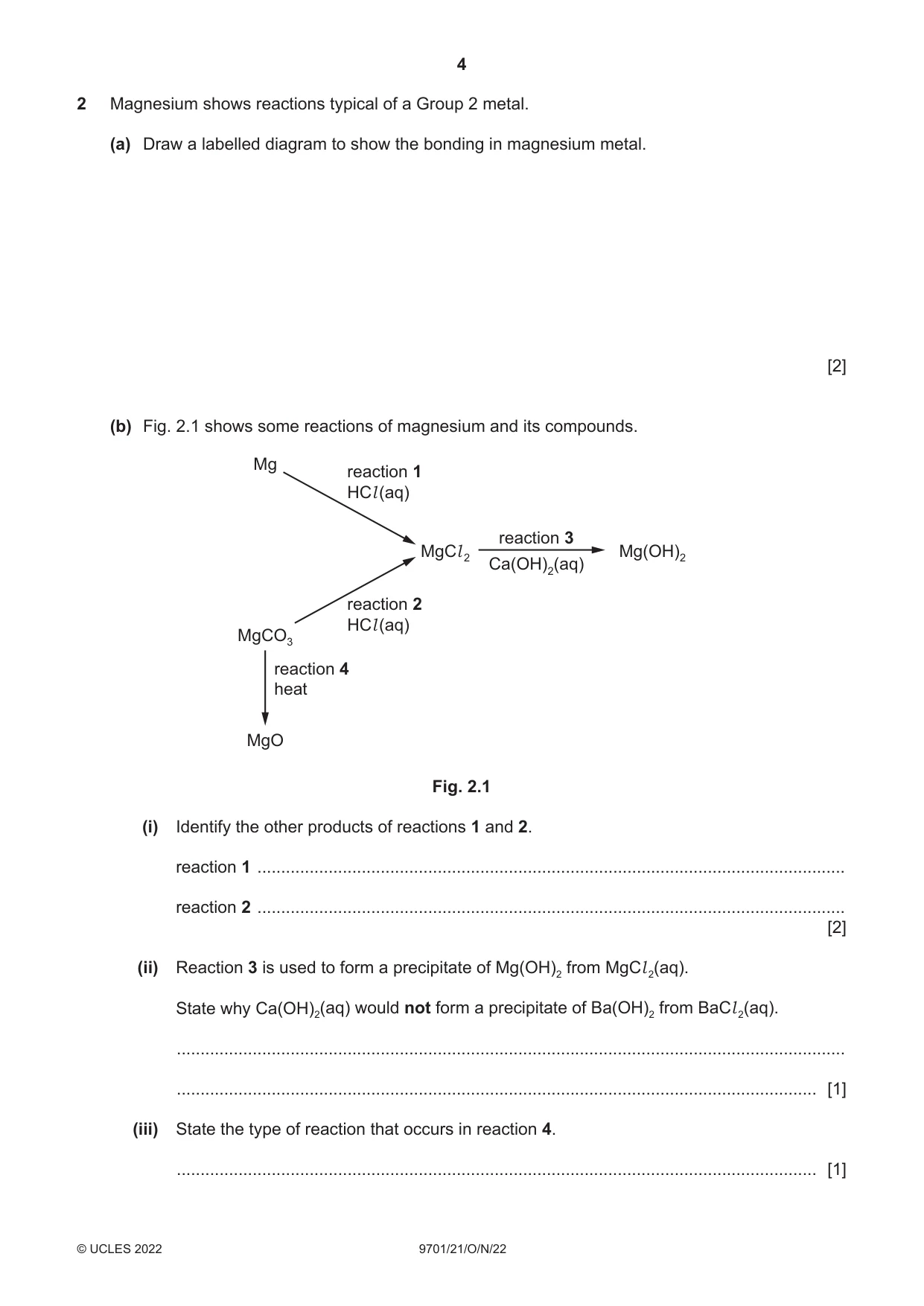
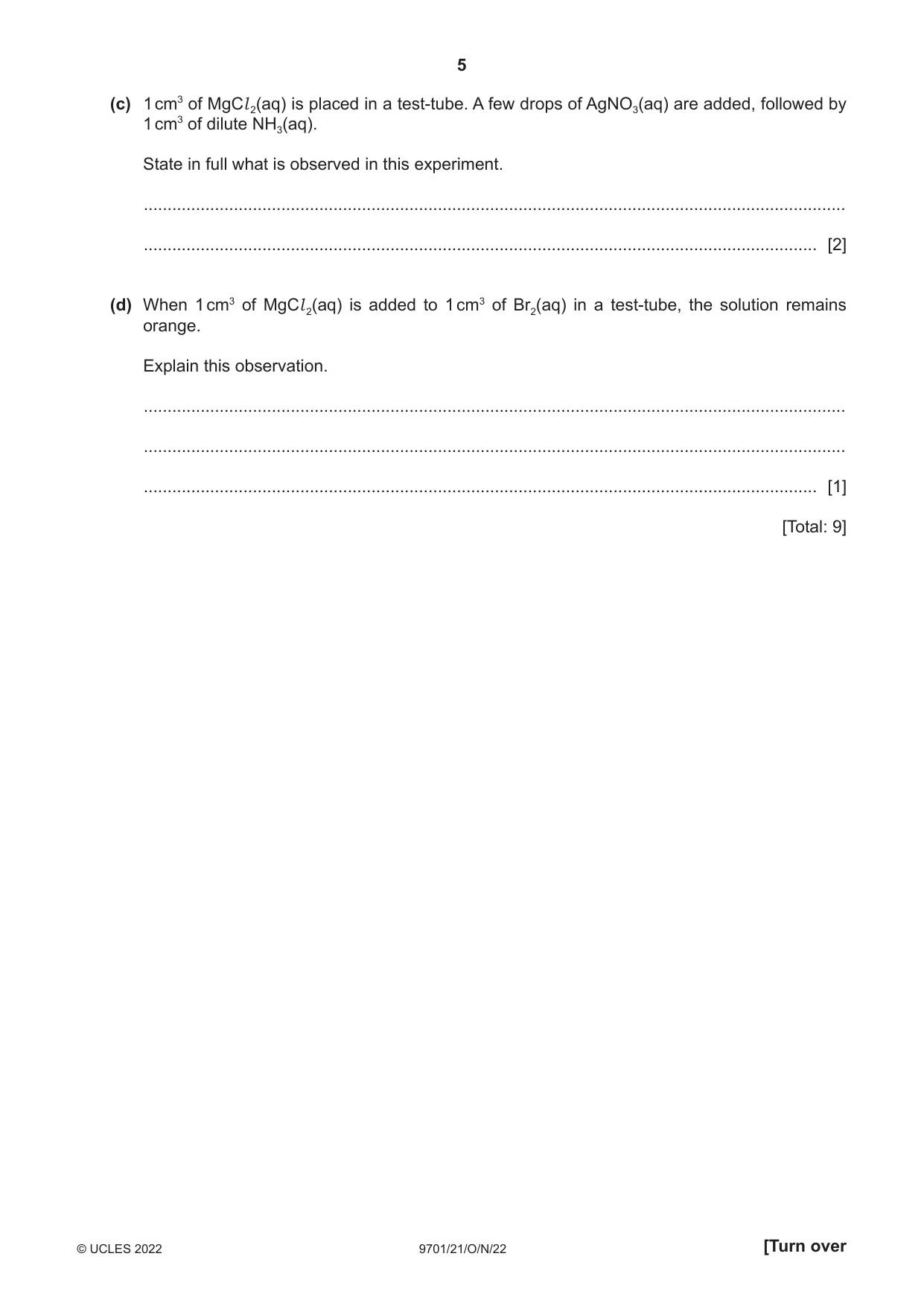
2 Magnesium shows reactions typical of a Group 2 metal. (a) Draw a labelled diagram to show the bonding in magnesium metal. [2] (b) Fig. 2.1 shows some reactions of magnesium and its compounds. Mg reaction 1 HCl (aq) reaction 3 MgCl 2 Mg(OH)2 Ca(OH)2(aq) reaction 2 HCl (aq) MgCO3 reaction 4 heat MgO Fig. 2.1 (i) Identify the other products of reactions 1 and 2. reaction 1 ............................................................................................................................ reaction 2 ............................................................................................................................ [2] (ii) Reaction 3 is used to form a precipitate of Mg(OH)2 from MgCl 2(aq). State why Ca(OH)2(aq) would not form a precipitate of Ba(OH)2 from BaCl 2(aq). ............................................................................................................................................. ....................................................................................................................................... [1] (iii) State the type of reaction that occurs in reaction 4. ....................................................................................................................................... [1] (c) 1 cm3 of MgCl 2(aq) is placed in a test-tube. A few drops of AgNO3(aq) are added, followed by 1 cm3 of dilute NH3(aq). State in full what is observed in this experiment. .................................................................................................................................................... .............................................................................................................................................. [2] (d) When 1 cm3 of MgCl 2(aq) is added to 1 cm3 of Br2(aq) in a test-tube, the solution remains orange. Explain this observation. .................................................................................................................................................... .................................................................................................................................................... .............................................................................................................................................. [1] [Total: 9]
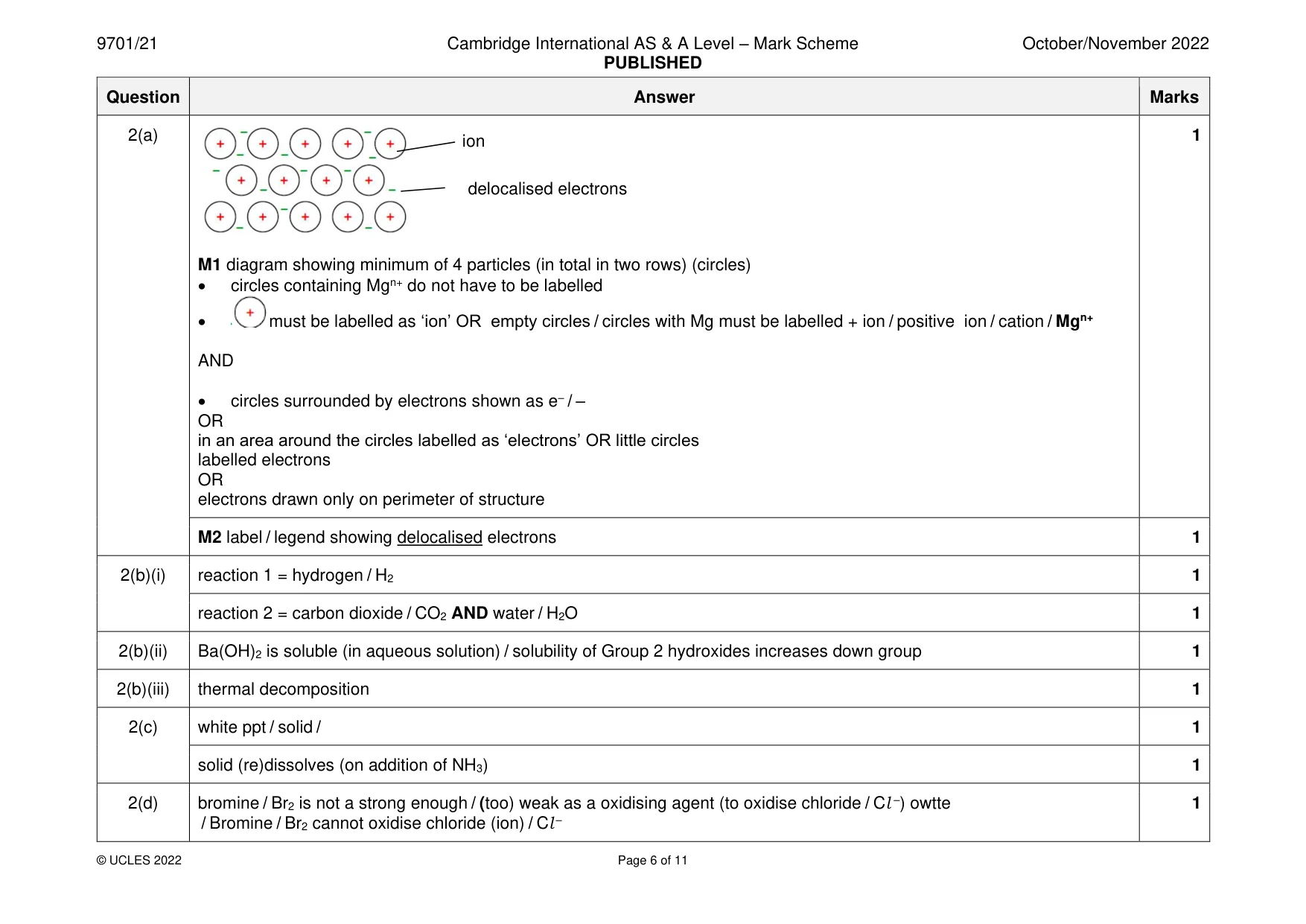
Mark scheme: 2(a) 1 ion delocalised electrons M1 diagram showing minimum of 4 particles (in total in two rows) (circles) • circles containing Mgn+ do not have to be labelled • must be labelled as ‘ion’ OR empty circles / circles with Mg must be labelled + ion / positive ion / cation / Mgn+ AND • circles surrounded by electrons shown as e– / – OR in an area around the circles labelled as ‘electrons’ OR little circles labelled electrons OR electrons drawn only on perimeter of structure M2 label / legend showing delocalised electrons 1 2(b)(i) reaction 1 = hydrogen / H2 1 reaction 2 = carbon dioxide / CO2 AND water / H2O 1 2(b)(ii) Ba(OH)2 is soluble (in aqueous solution) / solubility of Group 2 hydroxides increases down group 1 2(b)(iii) thermal decomposition 1 2(c) white ppt / solid / 1 solid (re)dissolves (on addition of NH3) 1 2(d) bromine / Br2 is not a strong enough / (too) weak as a oxidising agent (to oxidise chloride / Cl –) owtte 1 / Bromine / Br2 cannot oxidise chloride (ion) / Cl –
Q3 · Some of the common chlorides of Period 3 elements are shown in the list
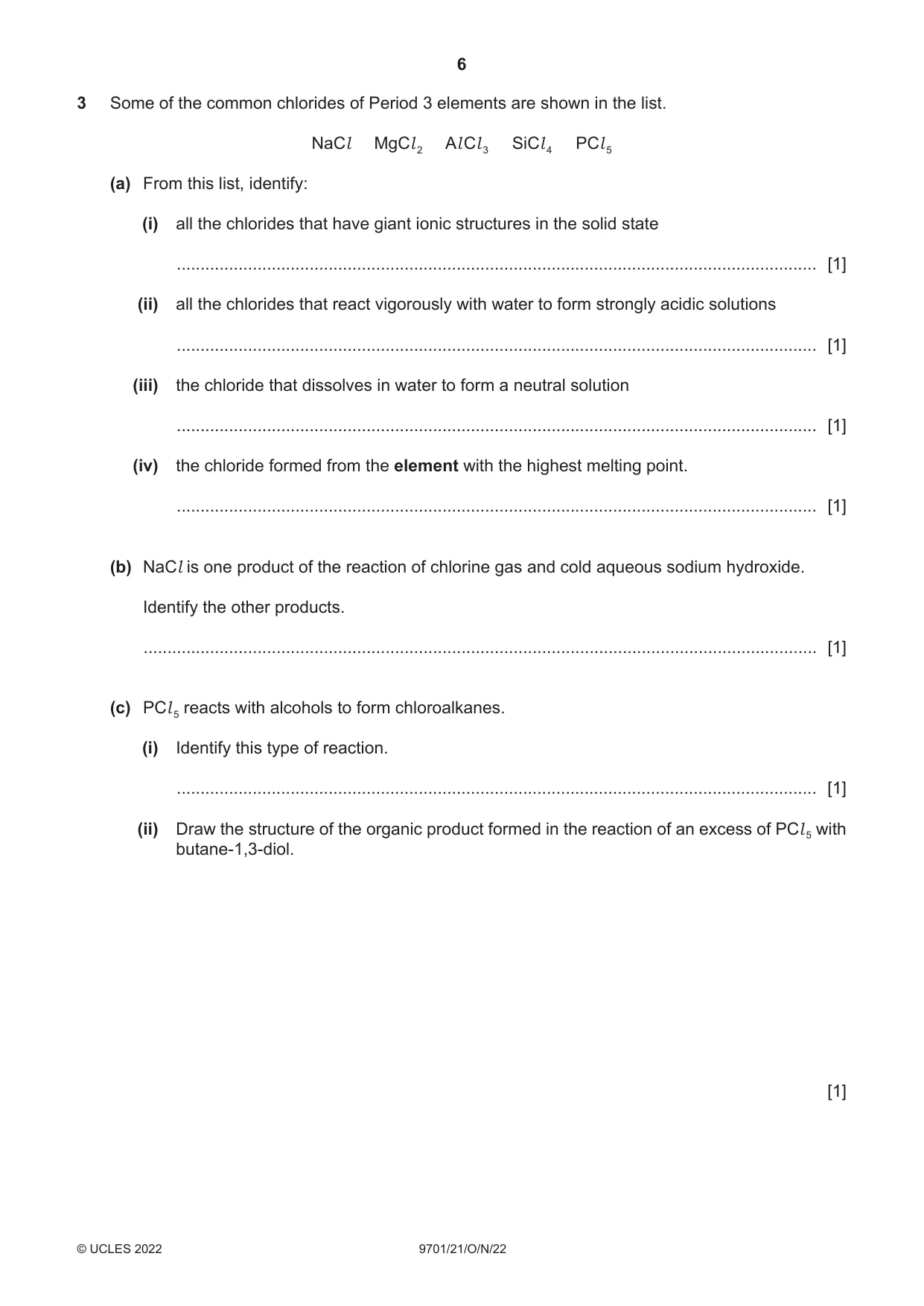
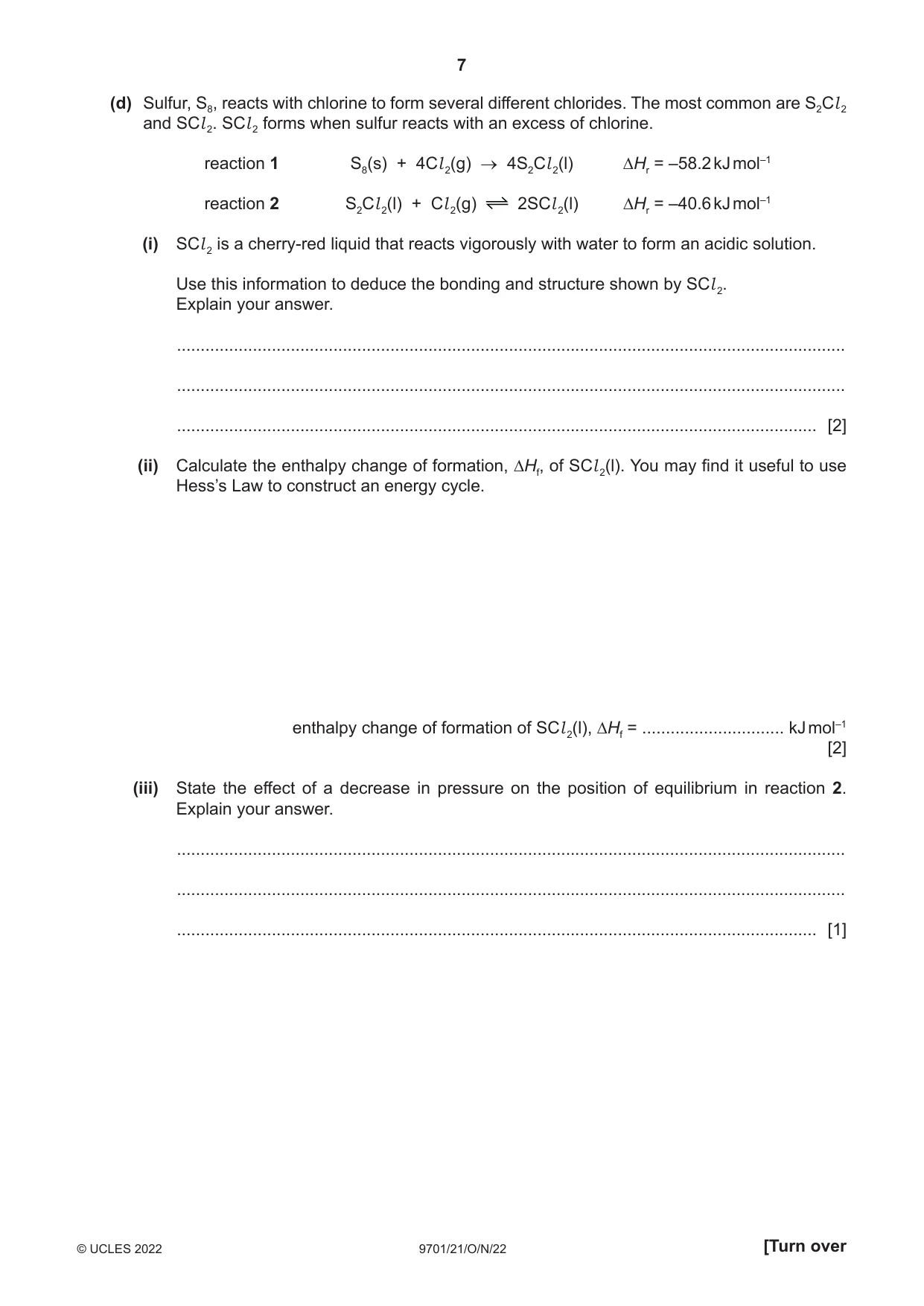
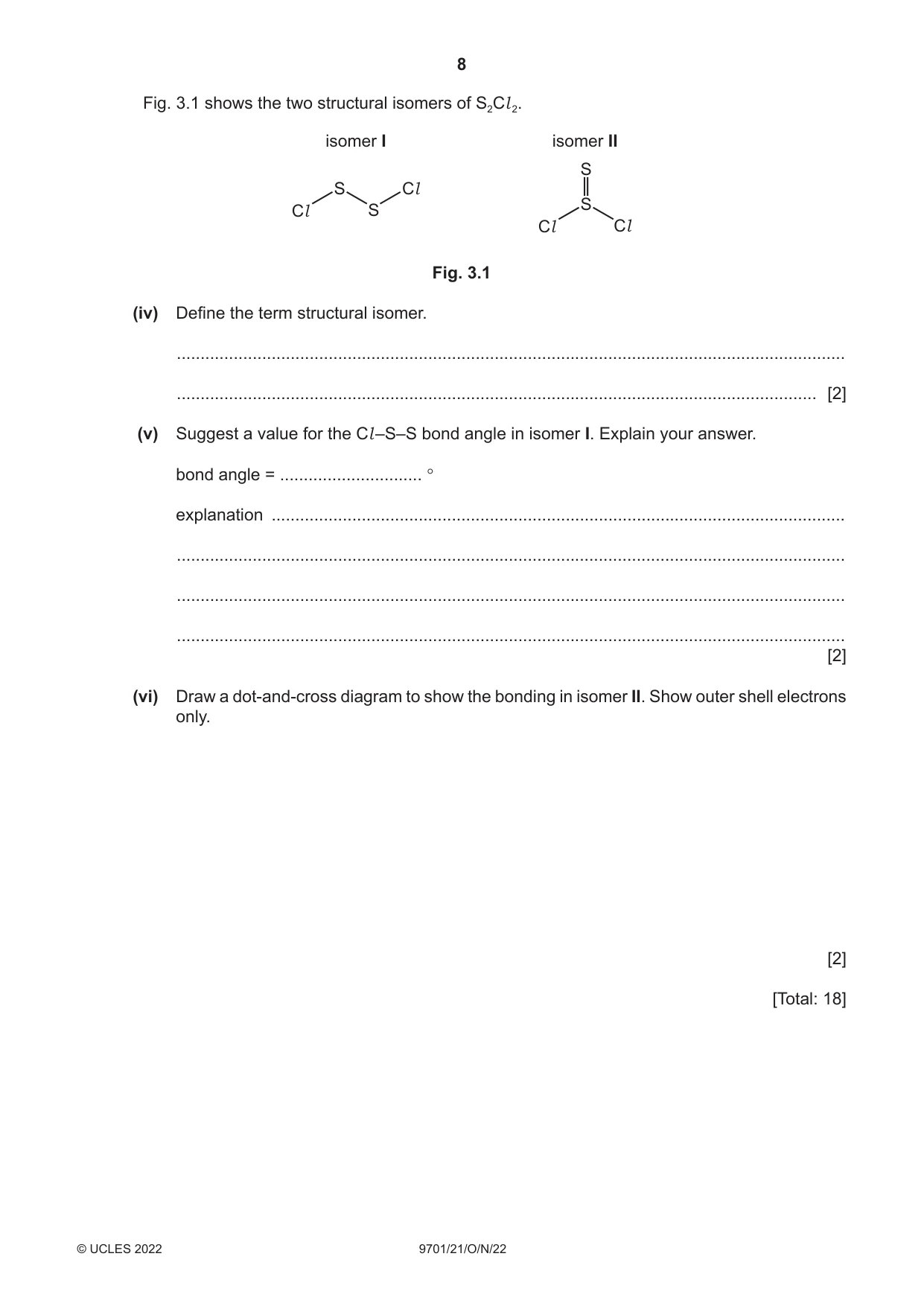
3 Some of the common chlorides of Period 3 elements are shown in the list. NaCl MgCl 2 Al Cl 3 SiCl 4 PCl 5 (a) From this list, identify: (i) all the chlorides that have giant ionic structures in the solid state ....................................................................................................................................... [1] (ii) all the chlorides that react vigorously with water to form strongly acidic solutions ....................................................................................................................................... [1] (iii) the chloride that dissolves in water to form a neutral solution ....................................................................................................................................... [1] (iv) the chloride formed from the element with the highest melting point. ....................................................................................................................................... [1] (b) NaCl is one product of the reaction of chlorine gas and cold aqueous sodium hydroxide. Identify the other products. .............................................................................................................................................. [1] (c) PCl 5 reacts with alcohols to form chloroalkanes. (i) Identify this type of reaction. ....................................................................................................................................... [1] (ii) Draw the structure of the organic product formed in the reaction of an excess of PCl 5 with butane-1,3-diol. [1] (d) Sulfur, S8, reacts with chlorine to form several different chlorides. The most common are S2Cl 2 and SCl 2. SCl 2 forms when sulfur reacts with an excess of chlorine. reaction 1 S8(s) + 4Cl 2(g) → 4S2Cl 2(l) ∆Hr = –58.2 kJ mol–1 reaction 2 S2Cl 2(l) + Cl 2(g) 2SCl 2(l) ∆Hr = –40.6 kJ mol–1 (i) SCl 2 is a cherry-red liquid that reacts vigorously with water to form an acidic solution. Use this information to deduce the bonding and structure shown by SCl 2. Explain your answer. ............................................................................................................................................. ............................................................................................................................................. ....................................................................................................................................... [2] (ii) Calculate the enthalpy change of formation, ∆Hf, of SCl 2(l). You may find it useful to use Hess’s Law to construct an energy cycle. enthalpy change of formation of SCl 2(l), ∆Hf = .............................. kJ mol–1 [2] (iii) State the effect of a decrease in pressure on the position of equilibrium in reaction 2. Explain your answer. ............................................................................................................................................. ............................................................................................................................................. ....................................................................................................................................... [1] Fig. 3.1 shows the two structural isomers of S2Cl 2. isomer I isomer II S S Cl S Cl S Cl Cl Fig. 3.1 (iv) Define the term structural isomer. ............................................................................................................................................. ....................................................................................................................................... [2] (v) Suggest a value for the Cl –S–S bond angle in isomer I. Explain your answer. bond angle = .............................. ° explanation .......................................................................................................................... ............................................................................................................................................. ............................................................................................................................................. ............................................................................................................................................. [2] (vi) Draw a dot-and-cross diagram to show the bonding in isomer II. Show outer shell electrons only. [2] [Total: 18] Question 4 starts on the next page.
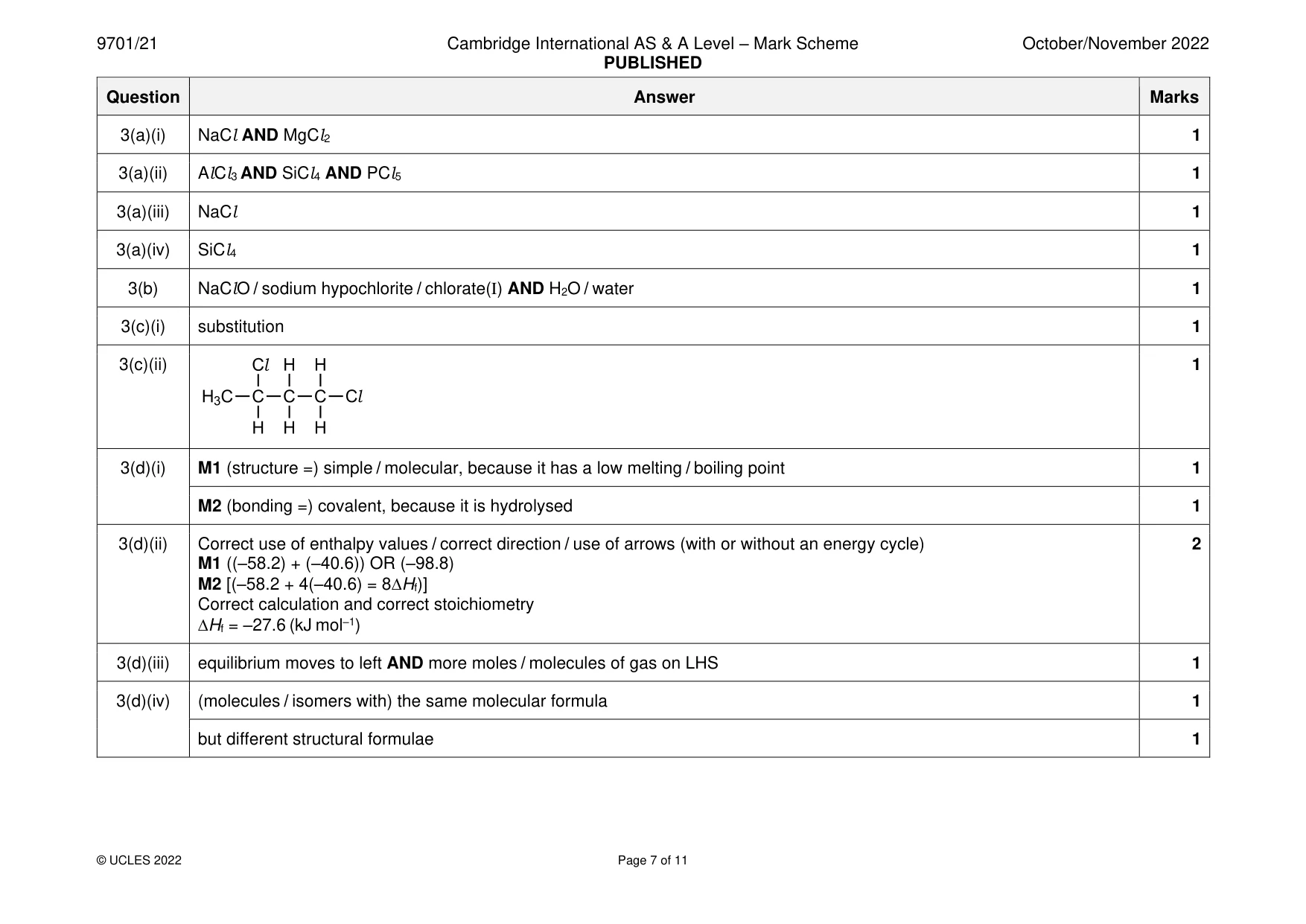
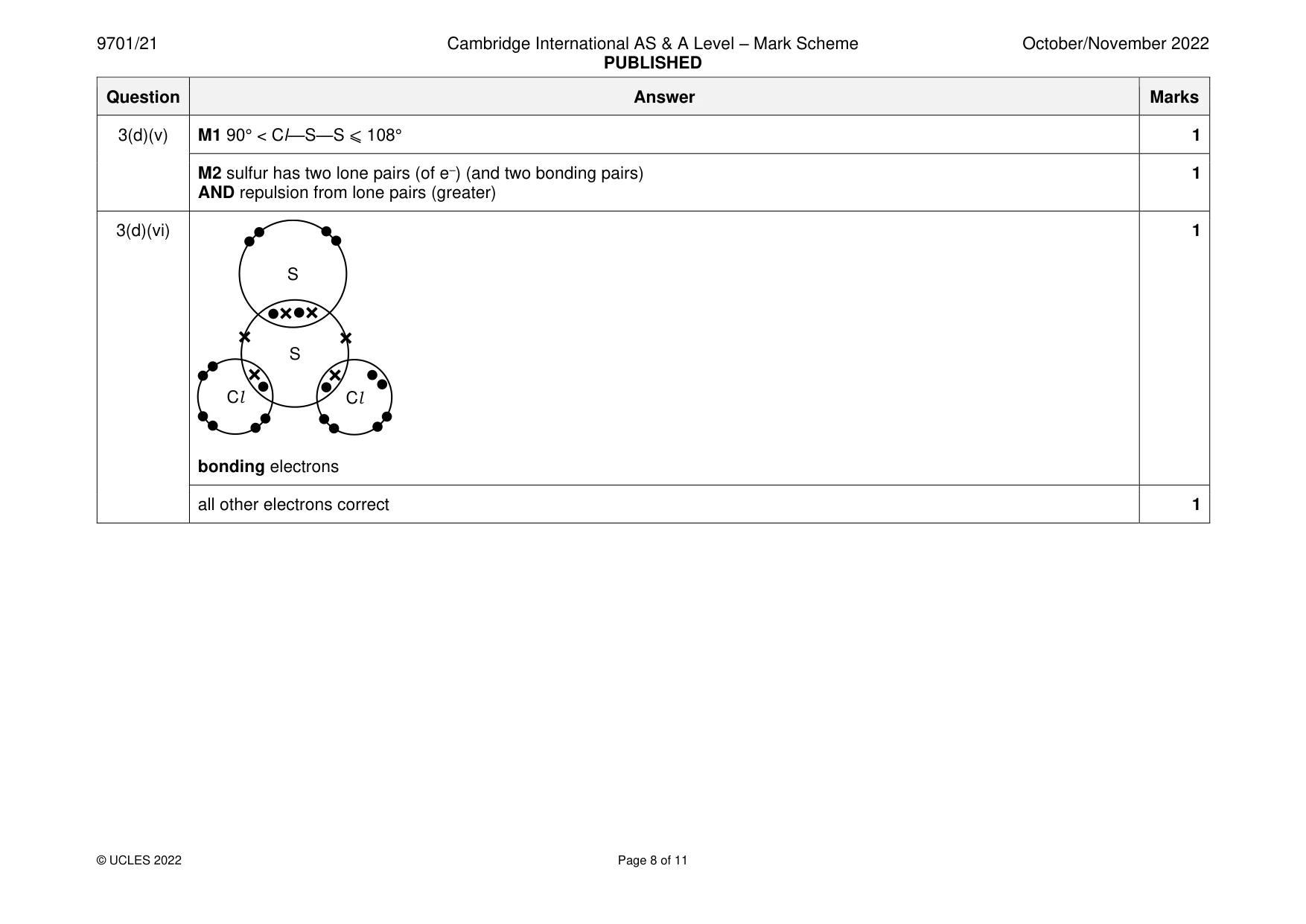
Mark scheme: 3(a)(i) NaCl AND MgCl2 1 3(a)(ii) AlCl3 AND SiCl4 AND PCl5 1 3(a)(iii) NaCl 1 3(a)(iv) SiCl4 1 3(b) NaClO / sodium hypochlorite / chlorate(I) AND H2O / water 1 3(c)(i) substitution 1 3(c)(ii) 1 3(d)(i) M1 (structure =) simple / molecular, because it has a low melting / boiling point 1 M2 (bonding =) covalent, because it is hydrolysed 1 3(d)(ii) Correct use of enthalpy values / correct direction / use of arrows (with or without an energy cycle) 2 M1 ((–58.2) + (–40.6)) OR (–98.8) M2 [(–58.2 + 4(–40.6) = 8Hf)] Correct calculation and correct stoichiometry Hf = –27.6 (kJ mol–1) 3(d)(iii) equilibrium moves to left AND more moles / molecules of gas on LHS 1 3(d)(iv) (molecules / isomers with) the same molecular formula 1 but different structural formulae 1 3(d)(v) M1 90° < Cl—S—S ⩽ 108° 1 M2 sulfur has two lone pairs (of e–) (and two bonding pairs) 1 AND repulsion from lone pairs (greater) 3(d)(vi) 1 S S Cl Cl bonding electrons all other electrons correct 1
More questions on Periodicity of physical properties of the elements in Period 3
Q4 · Organic compounds can be distinguished using chemical tests
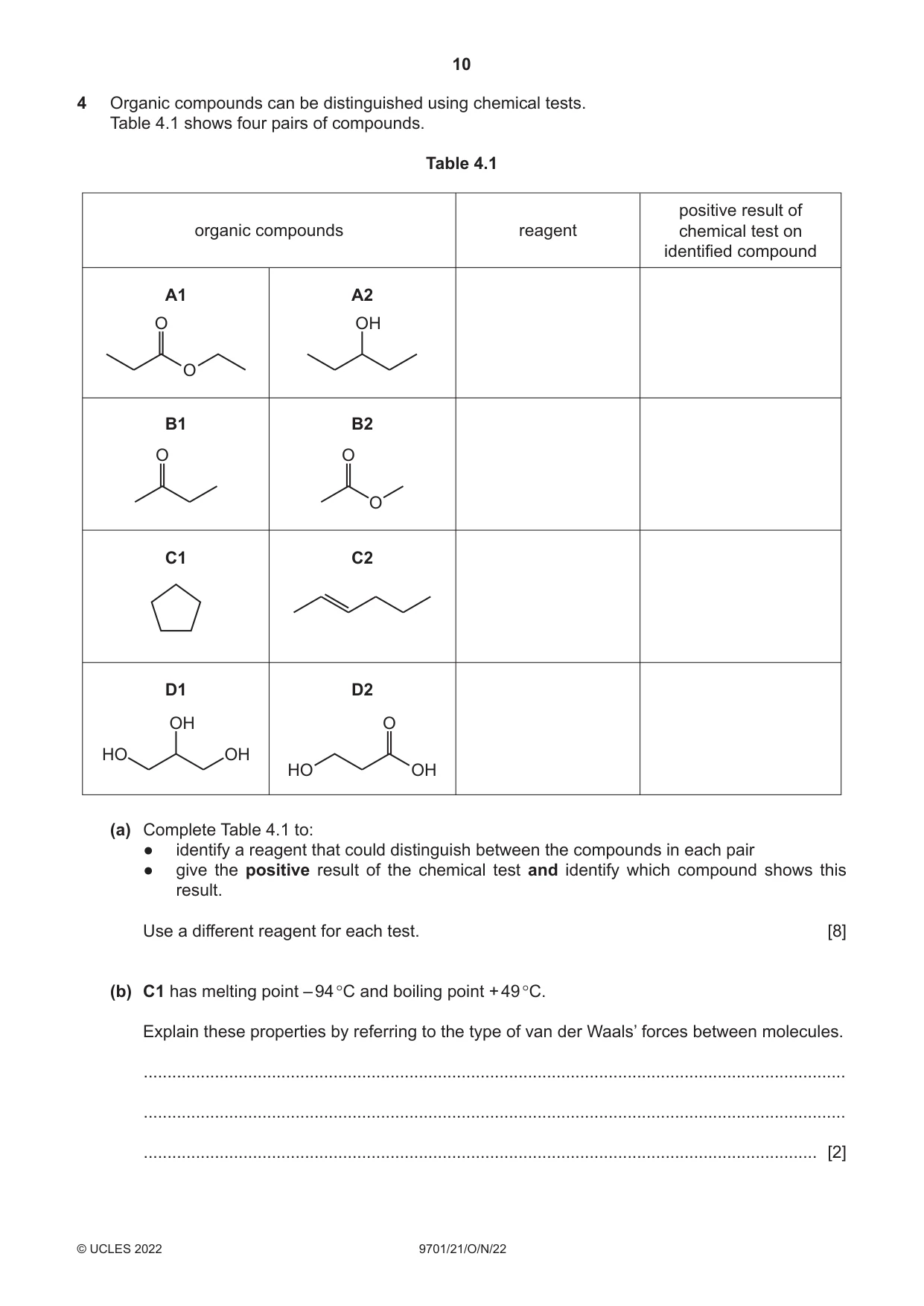
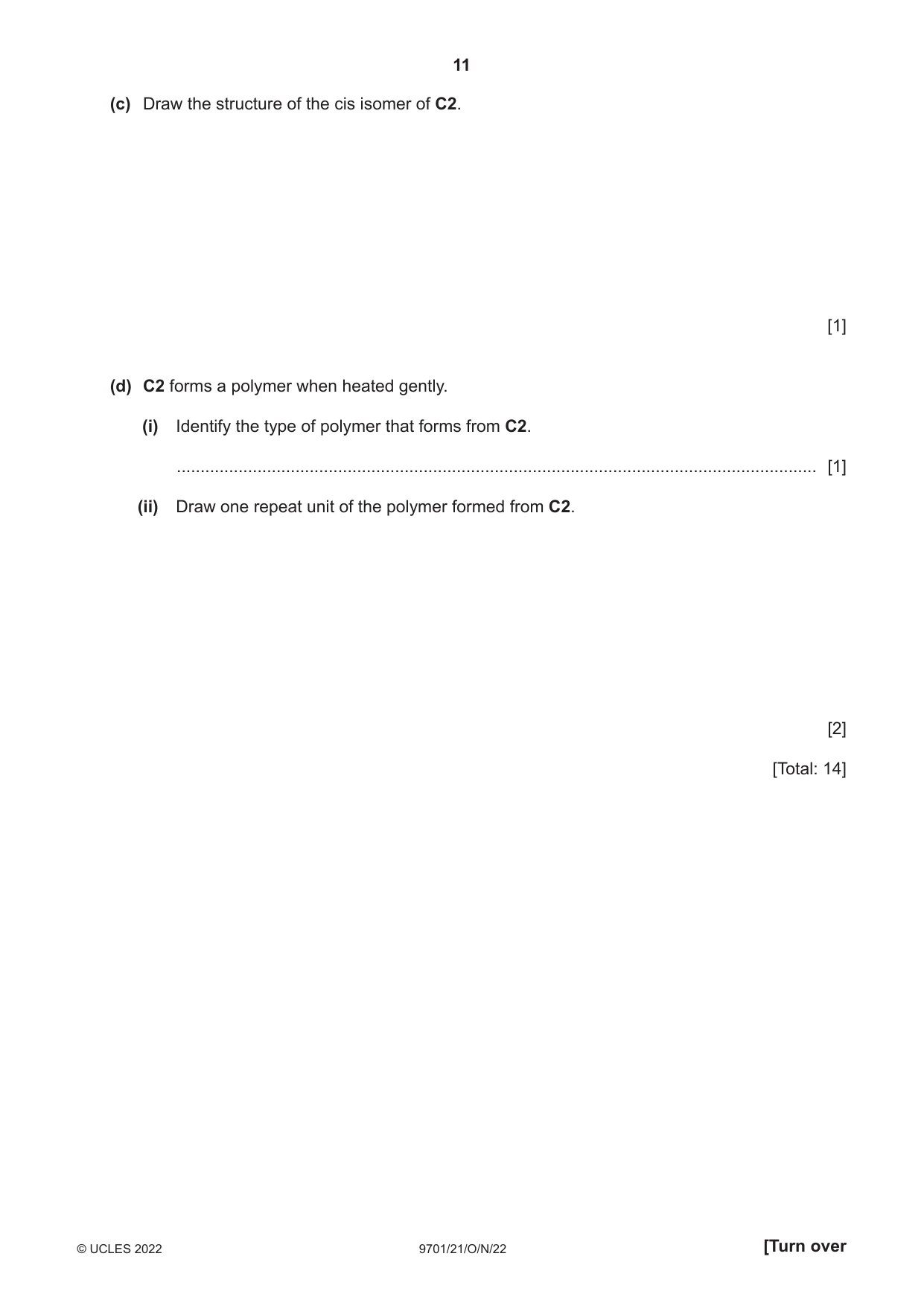
4 Organic compounds can be distinguished using chemical tests. Table 4.1 shows four pairs of compounds. Table 4.1 positive result of organic compounds reagent chemical test on identified compound A1 A2 O OH O B1 B2 O O O C1 C2 D1 D2 OH O HO OH HO OH (a) Complete Table 4.1 to: ● identify a reagent that could distinguish between the compounds in each pair ● give the positive result of the chemical test and identify which compound shows this result. Use a different reagent for each test. [8] (b) C1 has melting point – 94 °C and boiling point + 49 °C. Explain these properties by referring to the type of van der Waals’ forces between molecules. .................................................................................................................................................... .................................................................................................................................................... .............................................................................................................................................. [2] (c) Draw the structure of the cis isomer of C2. [1] (d) C2 forms a polymer when heated gently. (i) Identify the type of polymer that forms from C2. ....................................................................................................................................... [1] (ii) Draw one repeat unit of the polymer formed from C2. [2] [Total: 14]
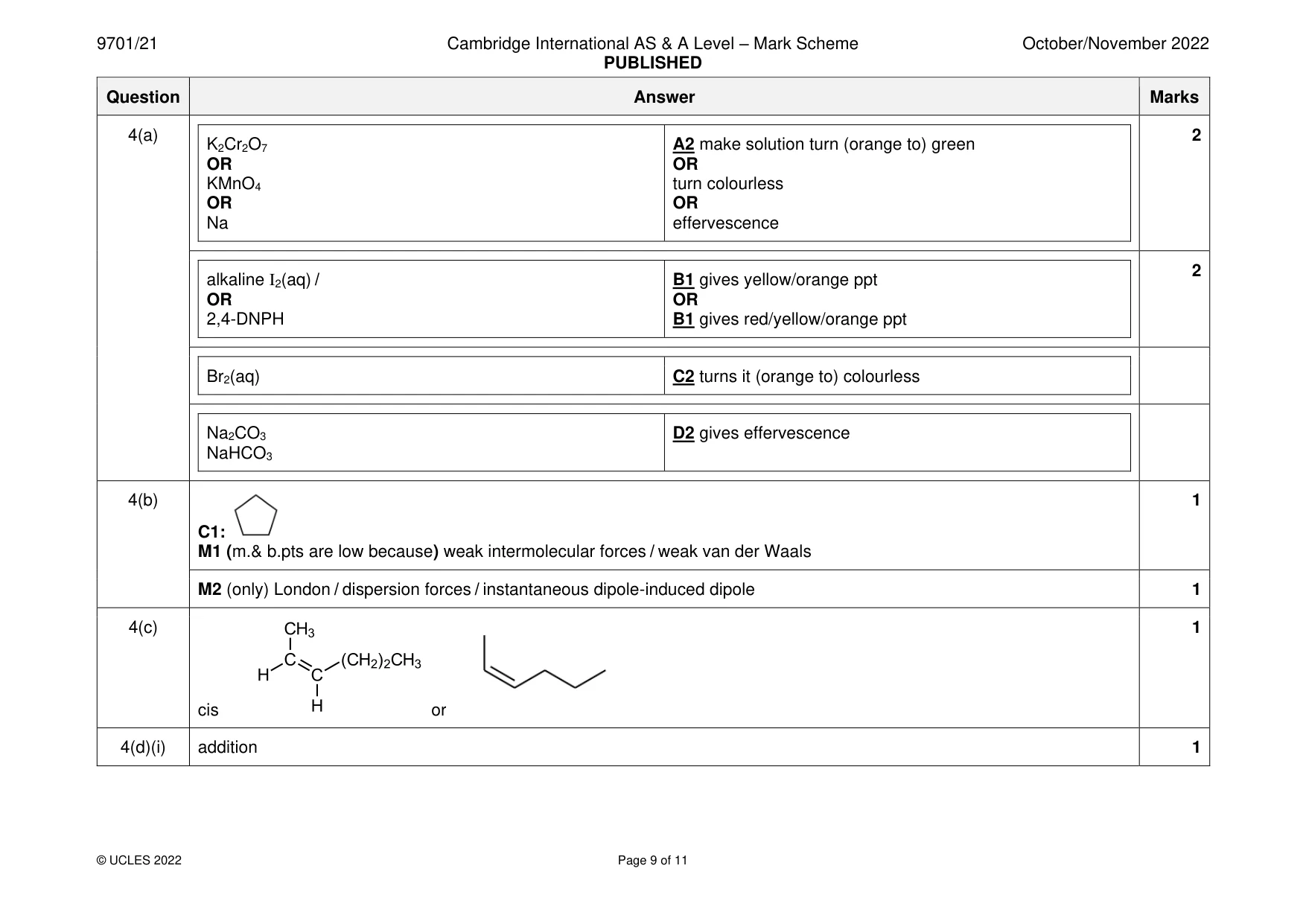
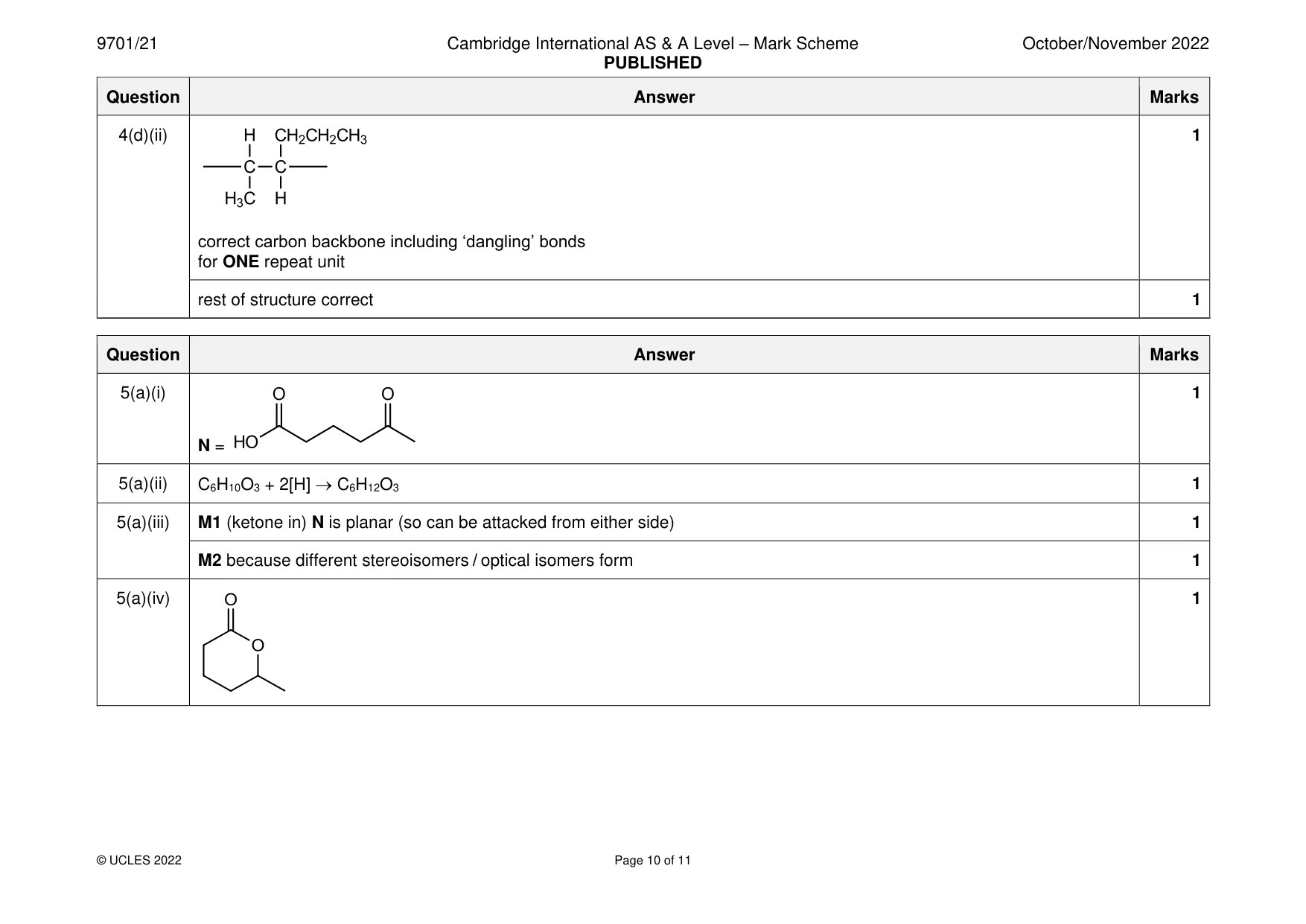
Mark scheme: 4(a) 2 K2Cr2O7 A2 make solution turn (orange to) green OR OR KMnO4 turn colourless OR OR Na effervescence 2 alkaline I2(aq) / B1 gives yellow/orange ppt OR OR 2,4-DNPH B1 gives red/yellow/orange ppt Br2(aq) C2 turns it (orange to) colourless Na2CO3 D2 gives effervescence NaHCO3 4(b) 1 C1: M1 (m.& b.pts are low because) weak intermolecular forces / weak van der Waals M2 (only) London / dispersion forces / instantaneous dipole-induced dipole 1 4(c) 1 cis or 4(d)(i) addition 1 4(d)(ii) 1 correct carbon backbone including ‘dangling’ bonds for ONE repeat unit rest of structure correct 1
Q5 · Lactones are cyclic esters
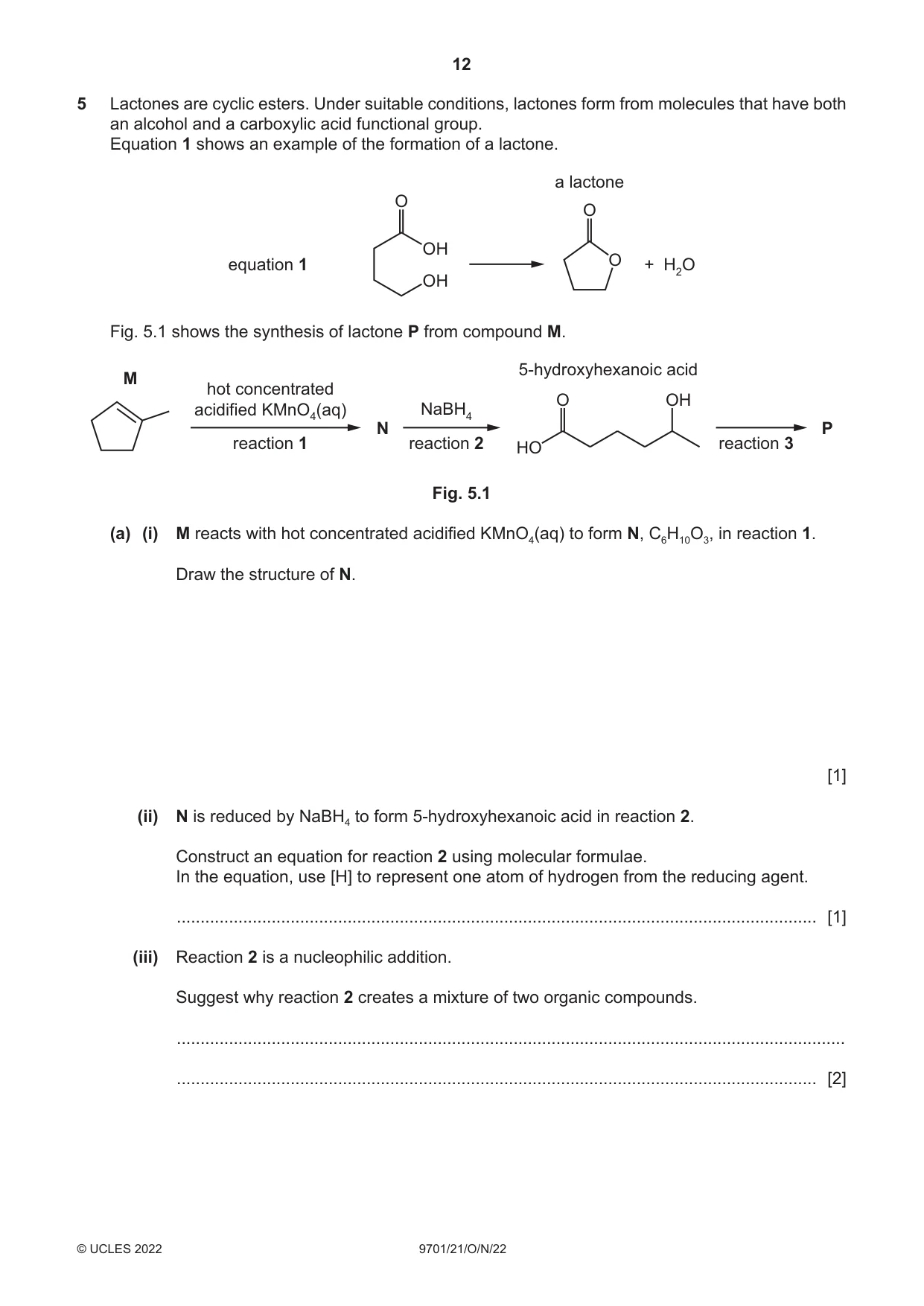
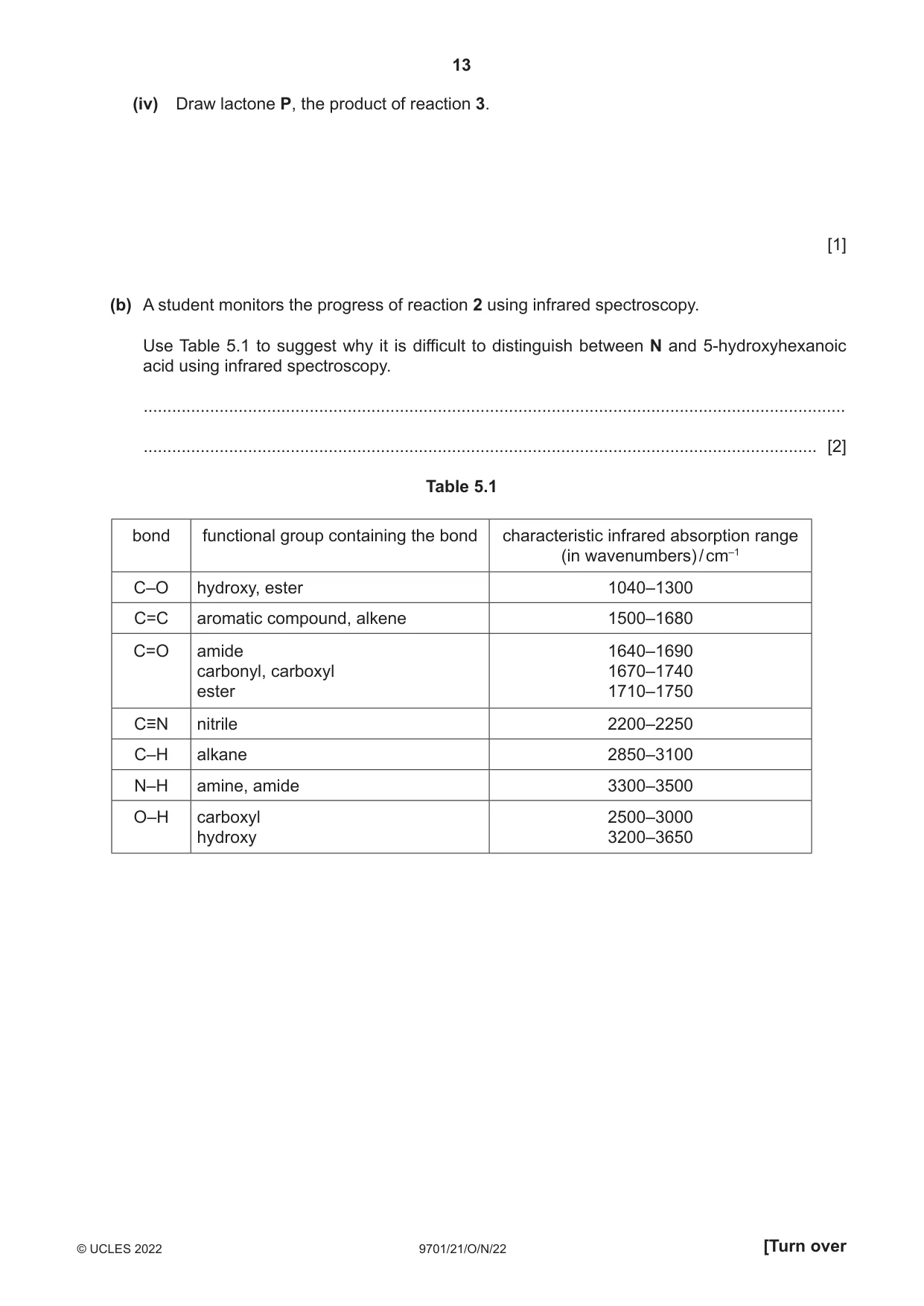
5 Lactones are cyclic esters. Under suitable conditions, lactones form from molecules that have both an alcohol and a carboxylic acid functional group. Equation 1 shows an example of the formation of a lactone. a lactone O O OH equation 1 O + H2O OH Fig. 5.1 shows the synthesis of lactone P from compound M. 5-hydroxyhexanoic acid M hot concentrated O OH acidified KMnO4(aq) NaBH4 N P reaction 1 reaction 2 HO reaction 3 Fig. 5.1 (a) (i) M reacts with hot concentrated acidified KMnO4(aq) to form N, C6H10O3, in reaction 1. Draw the structure of N. [1] (ii) N is reduced by NaBH4 to form 5-hydroxyhexanoic acid in reaction 2. Construct an equation for reaction 2 using molecular formulae. In the equation, use [H] to represent one atom of hydrogen from the reducing agent. ....................................................................................................................................... [1] (iii) Reaction 2 is a nucleophilic addition. Suggest why reaction 2 creates a mixture of two organic compounds. ............................................................................................................................................. ....................................................................................................................................... [2] (iv) Draw lactone P, the product of reaction 3. [1] (b) A student monitors the progress of reaction 2 using infrared spectroscopy. Use Table 5.1 to suggest why it is difficult to distinguish between N and 5‑hydroxyhexanoic acid using infrared spectroscopy. .................................................................................................................................................... .............................................................................................................................................. [2] Table 5.1 bond functional group containing the bond characteristic infrared absorption range (in wavenumbers) / cm–1 C–O hydroxy, ester 1040–1300 C=C aromatic compound, alkene 1500–1680 C=O amide 1640–1690 carbonyl, carboxyl 1670–1740 ester 1710–1750 C≡N nitrile 2200–2250 C–H alkane 2850–3100 N–H amine, amide 3300–3500 O–H carboxyl 2500–3000 hydroxy 3200–3650 (c) Unknown lactone Q is analysed using mass spectrometry. Table 5.2 shows information from the mass spectrum. Table 5.2 peak m/e abundance M+ 72 95.5 M+1 73 3.15 Use these data to deduce the structure of Q. Show your working. Q .................................................................................................................................................... .................................................................................................................................................... [2] [Total: 9]
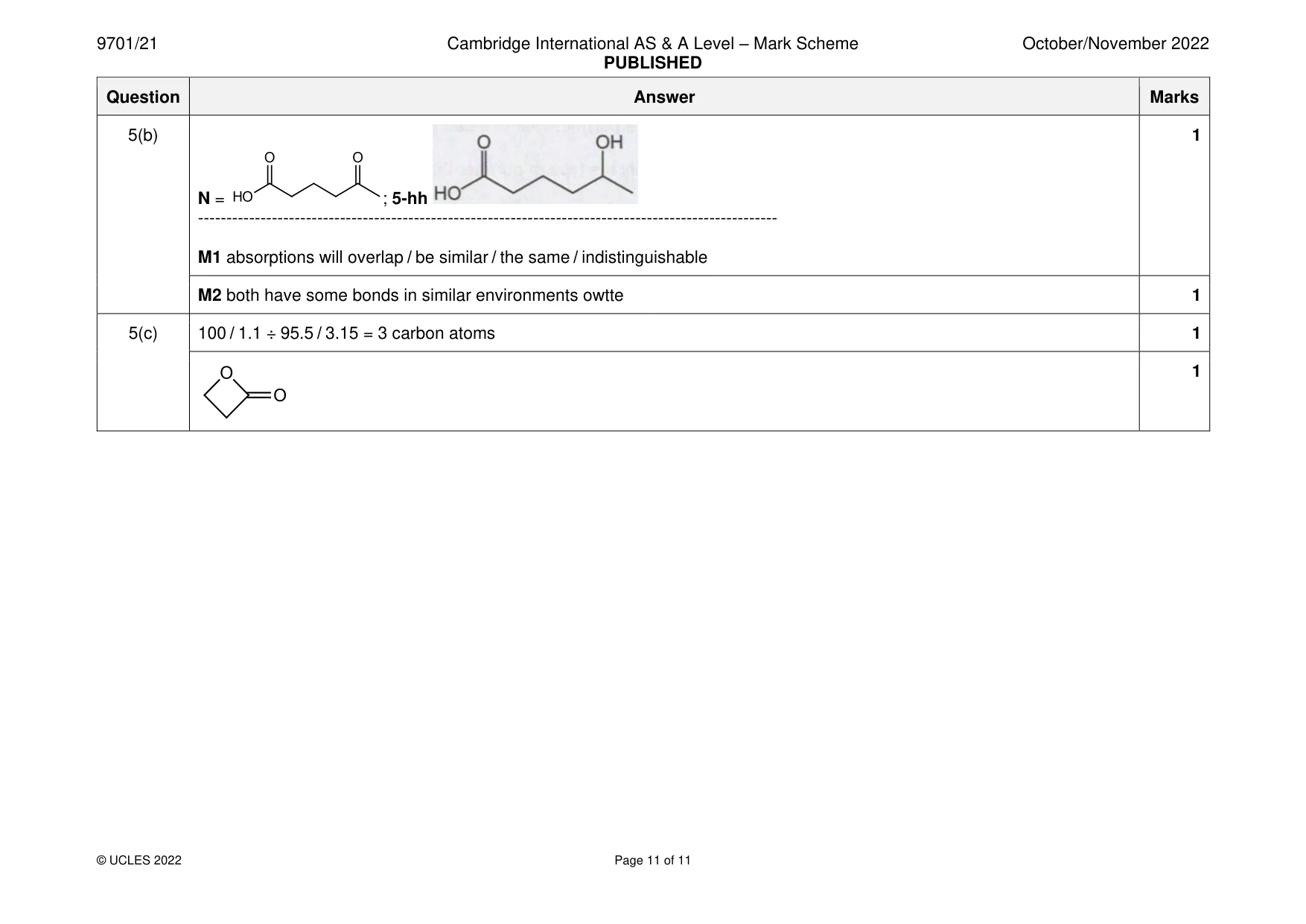
Mark scheme: 5(a)(i) 1 N = 5(a)(ii) C6H10O3 + 2[H] → C6H12O3 1 5(a)(iii) M1 (ketone in) N is planar (so can be attacked from either side) 1 M2 because different stereoisomers / optical isomers form 1 5(a)(iv) 1 5(b) 1 N = ; 5-hh ------------------------------------------------------------------------------------------------------ M1 absorptions will overlap / be similar / the same / indistinguishable M2 both have some bonds in similar environments owtte 1 5(c) 100 / 1.1 ÷ 95.5 / 3.15 = 3 carbon atoms 1 1
What was in this paper
The subtopics covered by these 5 questions, and how many questions each got. Open one in a new tab to see every Cambridge question on it.
What you needed in this session
Cambridge’s own grade thresholds for 2022 Oct/Nov, Paper 2 · Variant 1. A higher threshold means an easier paper — the bar moves with how the cohort did.