Cambridge A Level Chemistry 9701 — 2022 Feb/March Paper 4 · Variant 2
9701/42/F/M/22 · 6 questions · 100 marks · ≈113 min
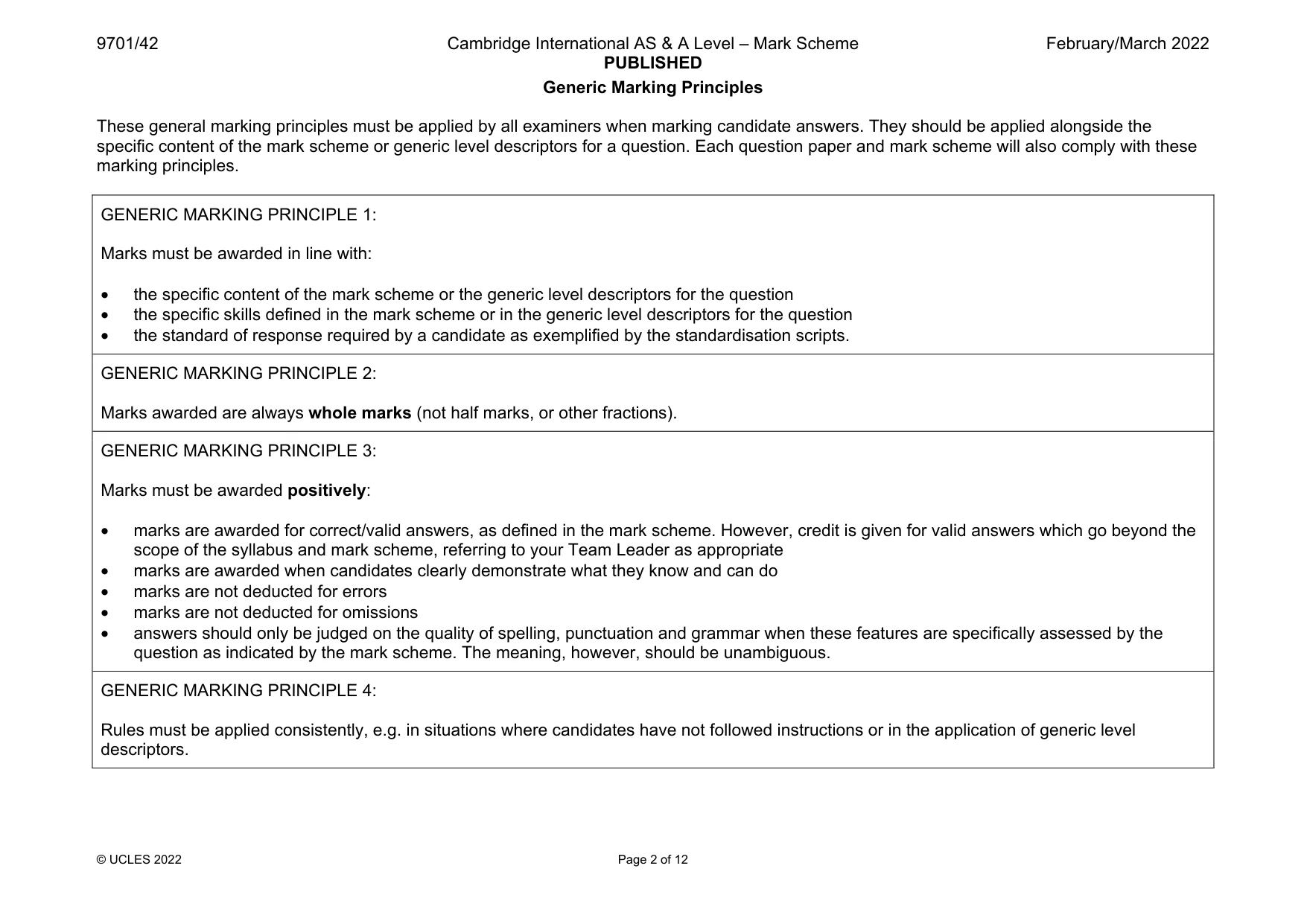
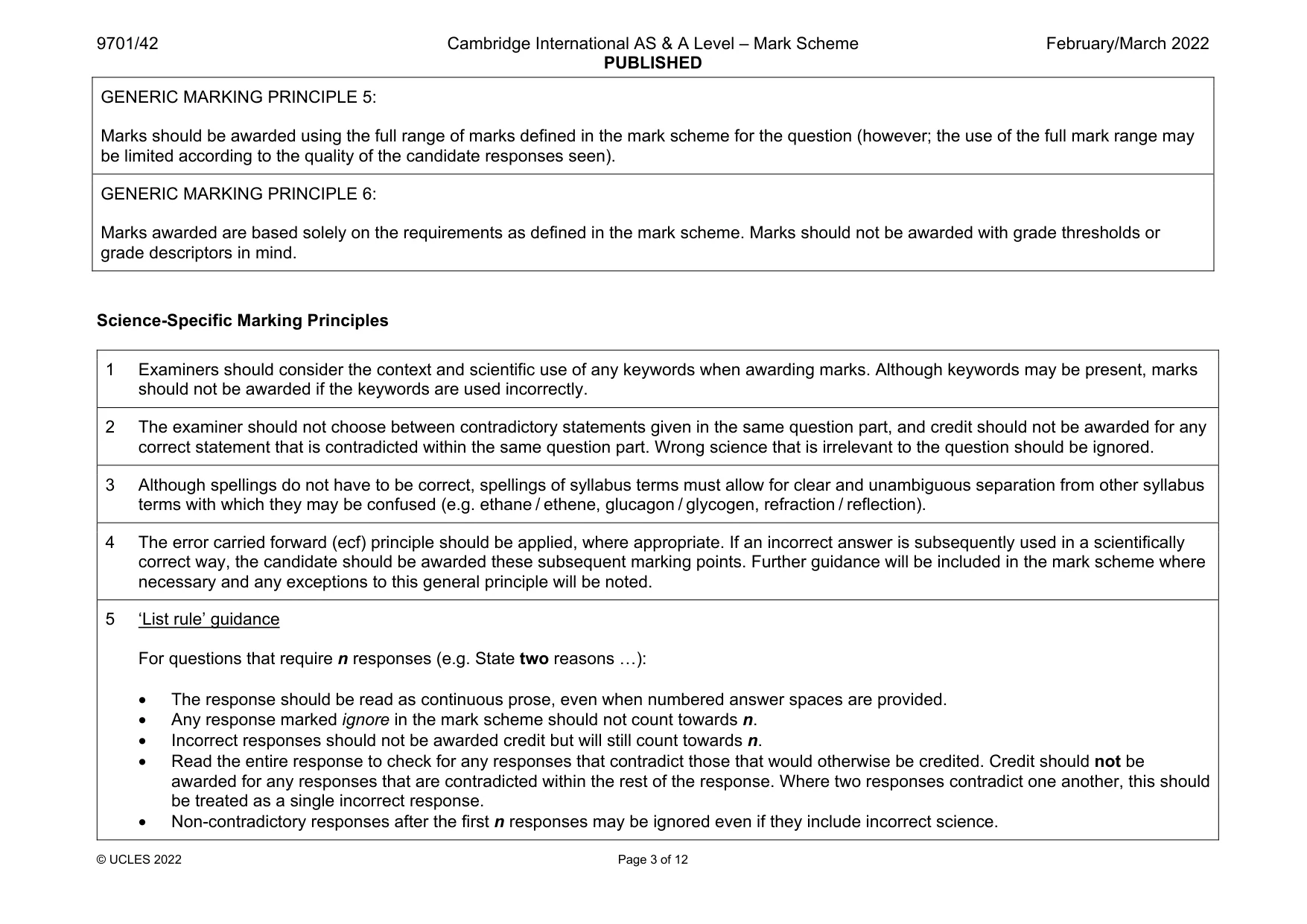
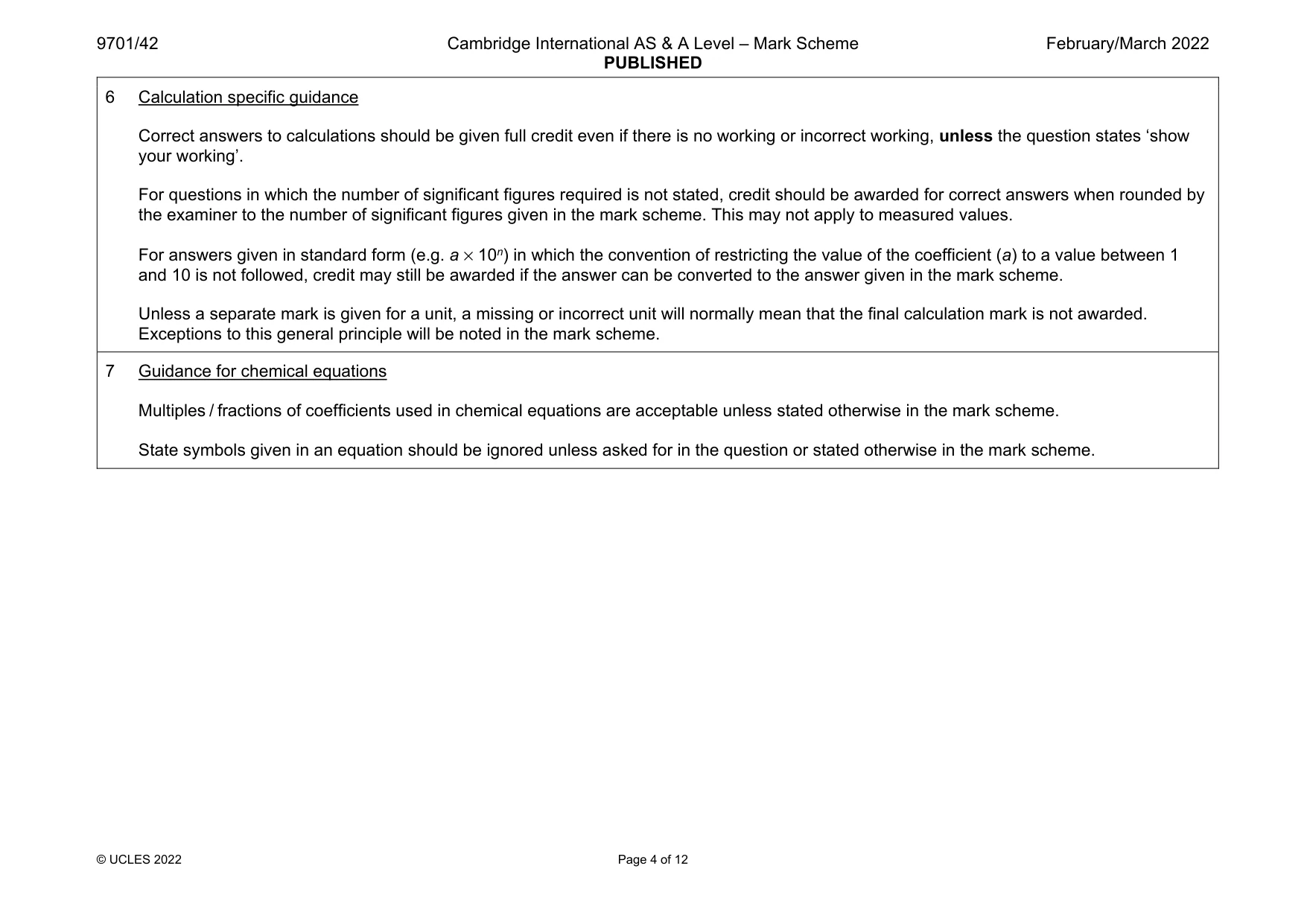
The question paper and its mark scheme, free to read here and free to download. This is Cambridge’s own paper, exactly as it was sat.
Question paper28 pages

Mark scheme12 pages
Answers below. Sit the paper first if you are practising.
Questions as text
Q1 · Iodine is found naturally in compounds in many different oxidation states
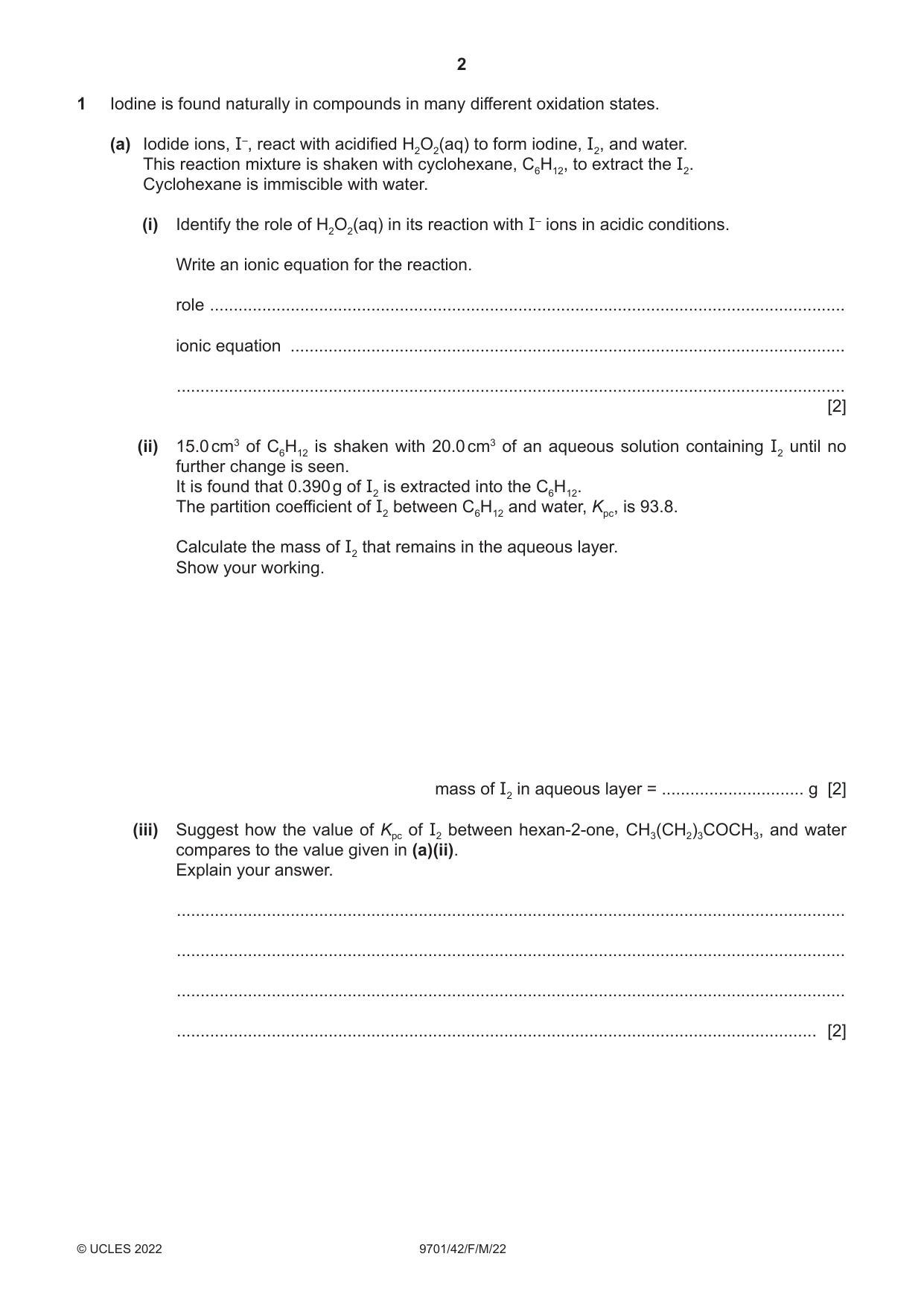
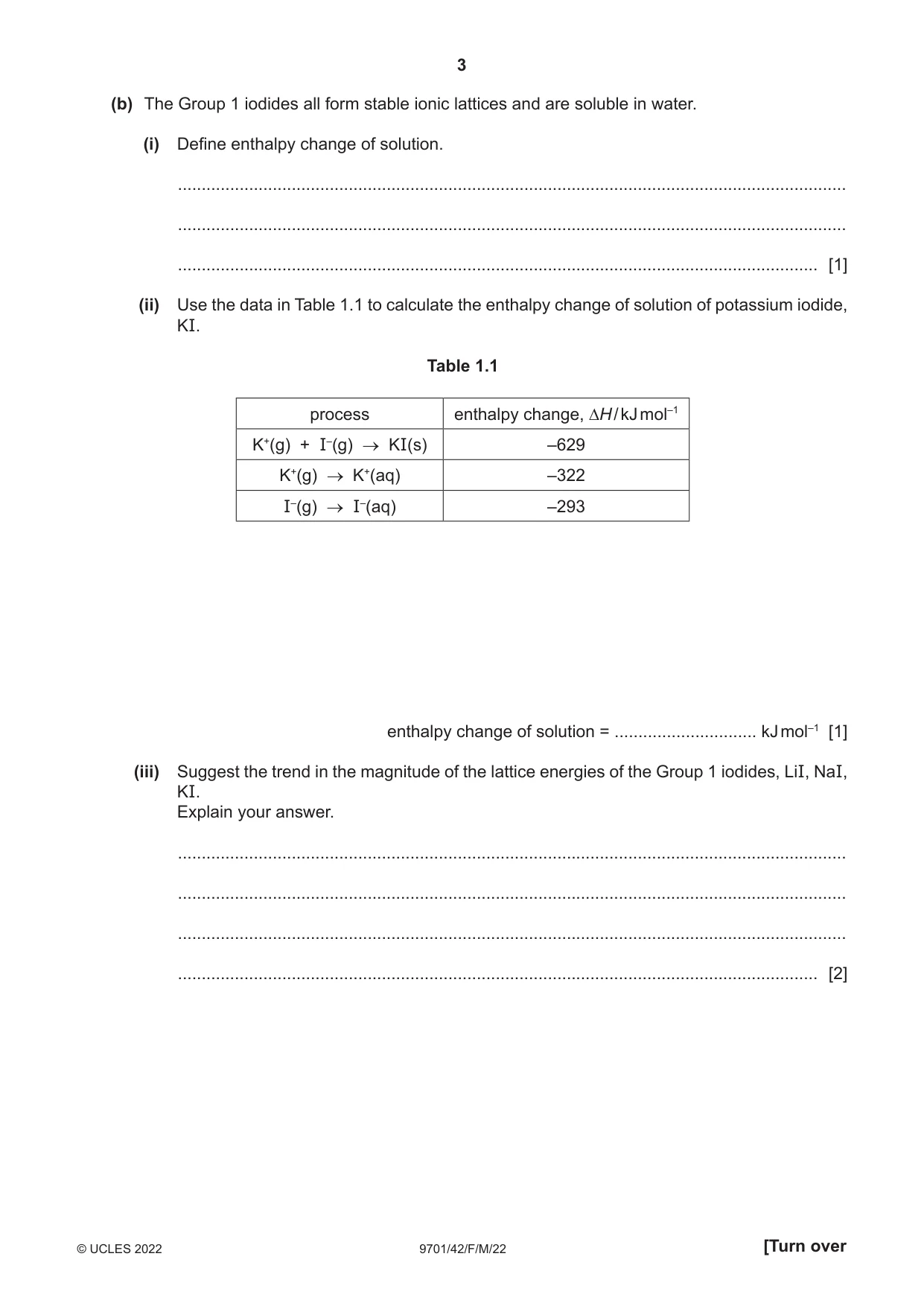
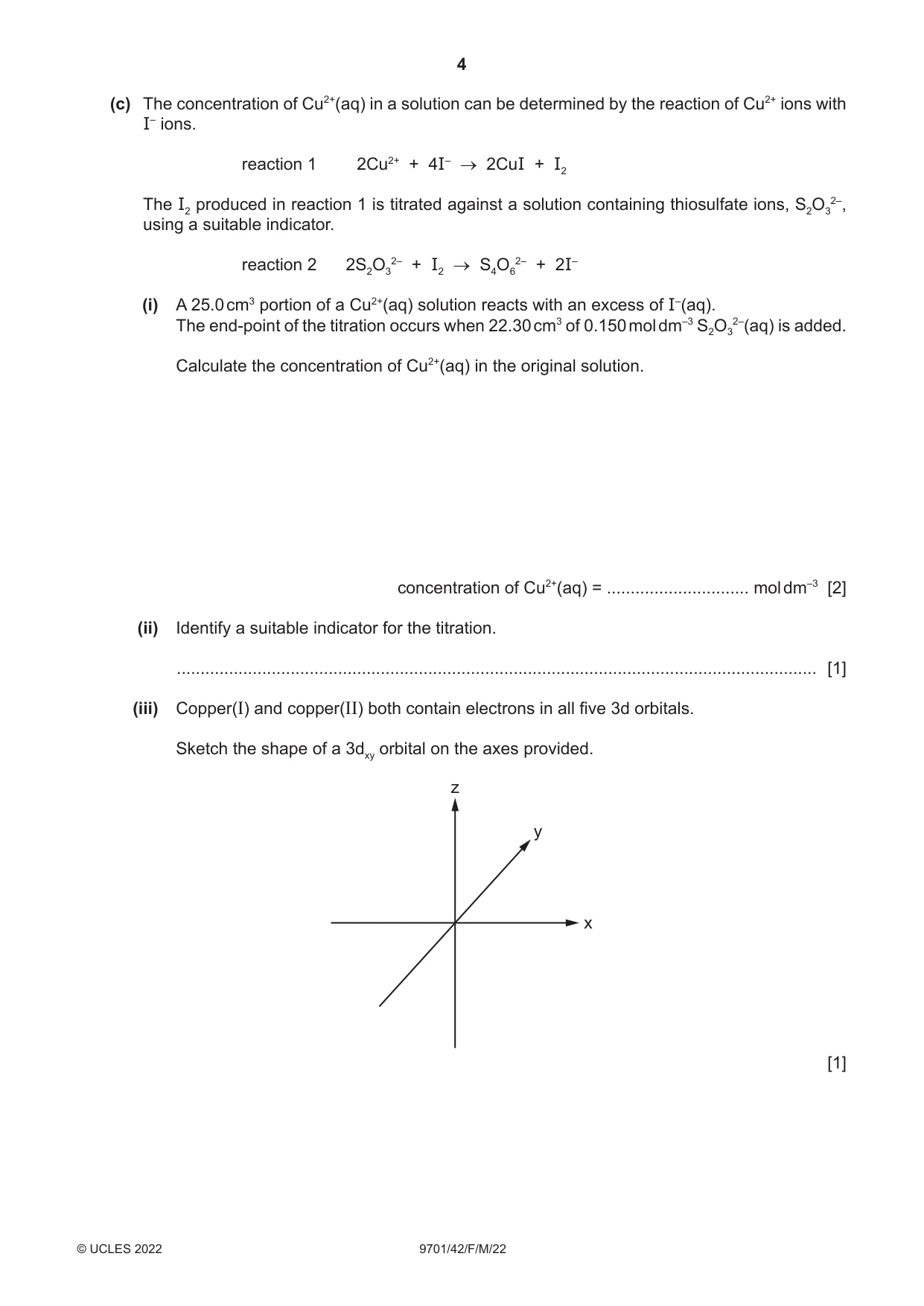
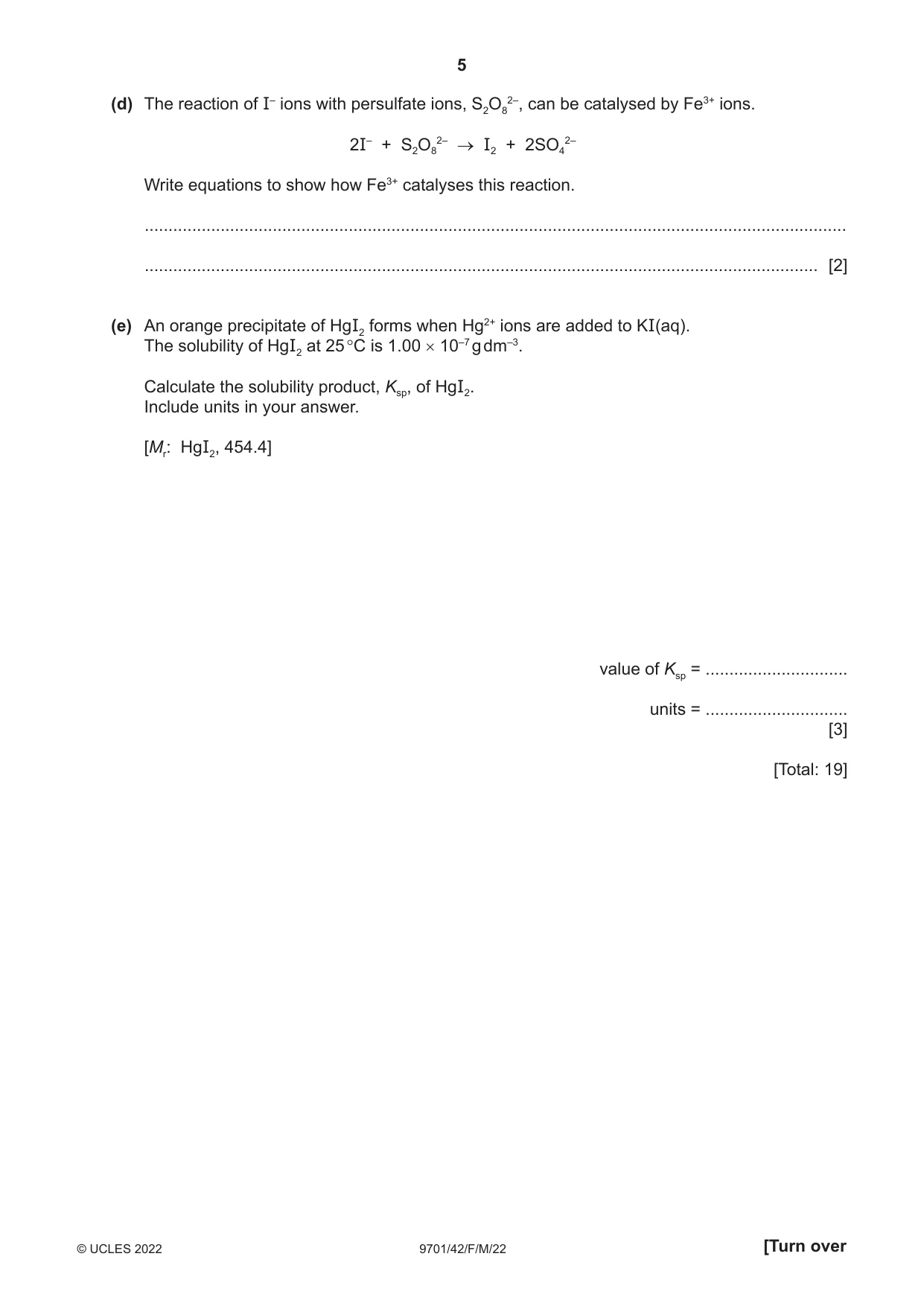
1 Iodine is found naturally in compounds in many different oxidation states. (a) Iodide ions, I–, react with acidified H2O2(aq) to form iodine, I2, and water. This reaction mixture is shaken with cyclohexane, C6H12, to extract the I2. Cyclohexane is immiscible with water. (i) Identify the role of H2O2(aq) in its reaction with I– ions in acidic conditions. Write an ionic equation for the reaction. role ...................................................................................................................................... ionic equation ...................................................................................................................... ............................................................................................................................................. [2] (ii) 15.0 cm3 of C6H12 is shaken with 20.0 cm3 of an aqueous solution containing I2 until no further change is seen. It is found that 0.390 g of I2 is extracted into the C6H12. The partition coefficient of I2 between C6H12 and water, Kpc, is 93.8. Calculate the mass of I2 that remains in the aqueous layer. Show your working. mass of I2 in aqueous layer = .............................. g [2] (iii) Suggest how the value of Kpc of I2 between hexan-2-one, CH3(CH2)3COCH3, and water compares to the value given in (a)(ii). Explain your answer. ............................................................................................................................................. ............................................................................................................................................. ............................................................................................................................................. ....................................................................................................................................... [2] (b) The Group 1 iodides all form stable ionic lattices and are soluble in water. (i) Define enthalpy change of solution. ............................................................................................................................................. ............................................................................................................................................. ....................................................................................................................................... [1] (ii) Use the data in Table 1.1 to calculate the enthalpy change of solution of potassium iodide, KI. Table 1.1 process enthalpy change, ∆H / kJ mol–1 K+(g) + I–(g) → KI(s) –629 K+(g) → K+(aq) –322 I–(g) → I–(aq) –293 enthalpy change of solution = .............................. kJ mol–1 [1] (iii) Suggest the trend in the magnitude of the lattice energies of the Group 1 iodides, LiI, NaI, KI. Explain your answer. ............................................................................................................................................. ............................................................................................................................................. ............................................................................................................................................. ....................................................................................................................................... [2] (c) The concentration of Cu2+(aq) in a solution can be determined by the reaction of Cu2+ ions with I– ions. reaction 1 2Cu2+ + 4I– → 2CuI + I2 The I2 produced in reaction 1 is titrated against a solution containing thiosulfate ions, S2O32–, using a suitable indicator. reaction 2 2S2O32– + I2 → S4O62– + 2I– (i) A 25.0 cm3 portion of a Cu2+(aq) solution reacts with an excess of I–(aq). The end-point of the titration occurs when 22.30 cm3 of 0.150 mol dm–3 S2O32–(aq) is added. Calculate the concentration of Cu2+(aq) in the original solution. concentration of Cu2+(aq) = .............................. mol dm–3 [2] (ii) Identify a suitable indicator for the titration. ....................................................................................................................................... [1] (iii) Copper(I) and copper(II) both contain electrons in all five 3d orbitals. Sketch the shape of a 3dxy orbital on the axes provided. z y x [1] (d) The reaction of I– ions with persulfate ions, S2O82–, can be catalysed by Fe3+ ions. 2I– + S2O82– → I2 + 2SO42– Write equations to show how Fe3+ catalyses this reaction. .................................................................................................................................................... .............................................................................................................................................. [2] (e) An orange precipitate of HgI2 forms when Hg2+ ions are added to KI(aq). The solubility of HgI2 at 25 °C is 1.00 × 10⁻⁷ g dm–3. Calculate the solubility product, Ksp, of HgI2. Include units in your answer. [Mr: HgI2, 454.4] value of Ksp = .............................. units = .............................. [3] [Total: 19]
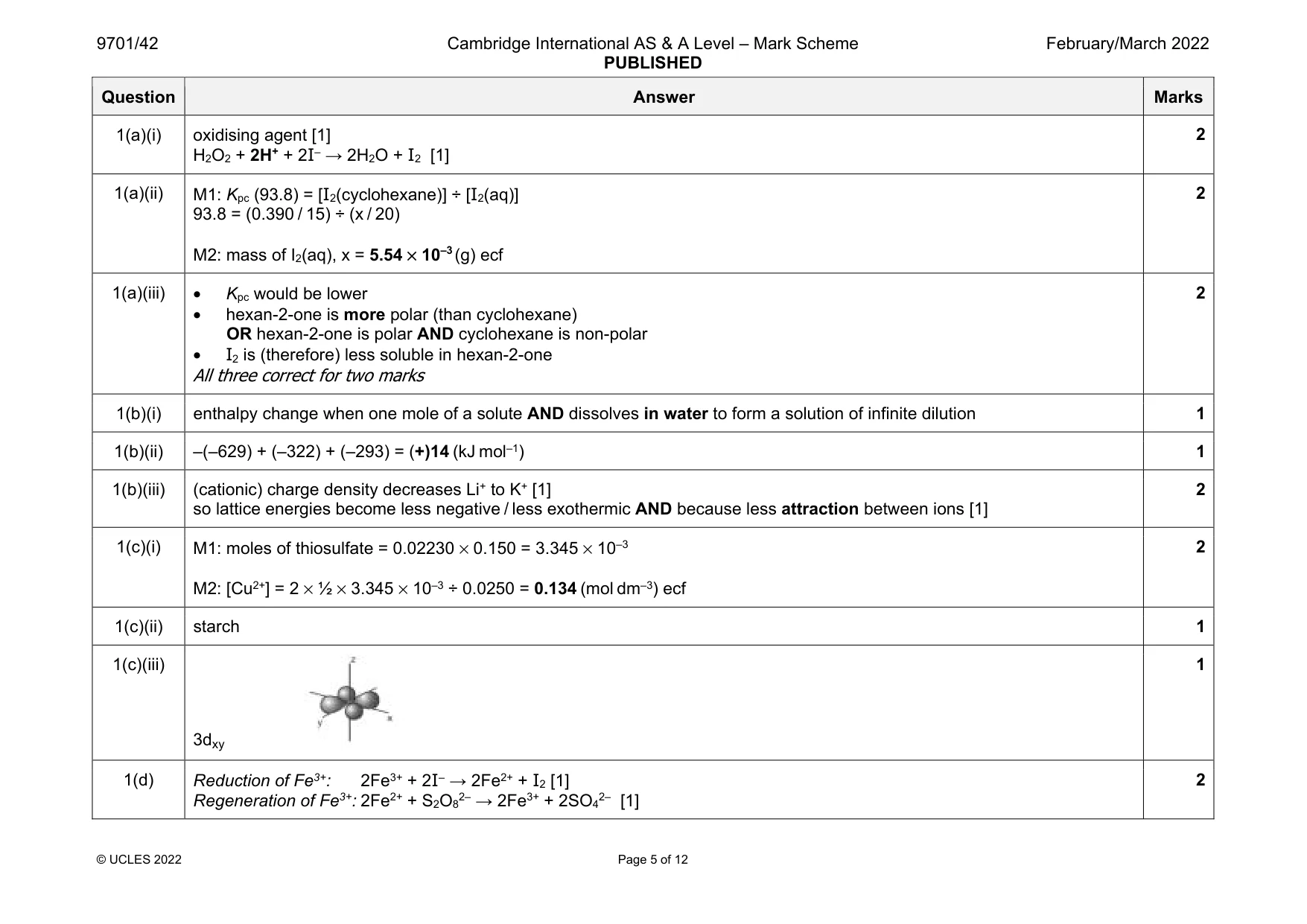
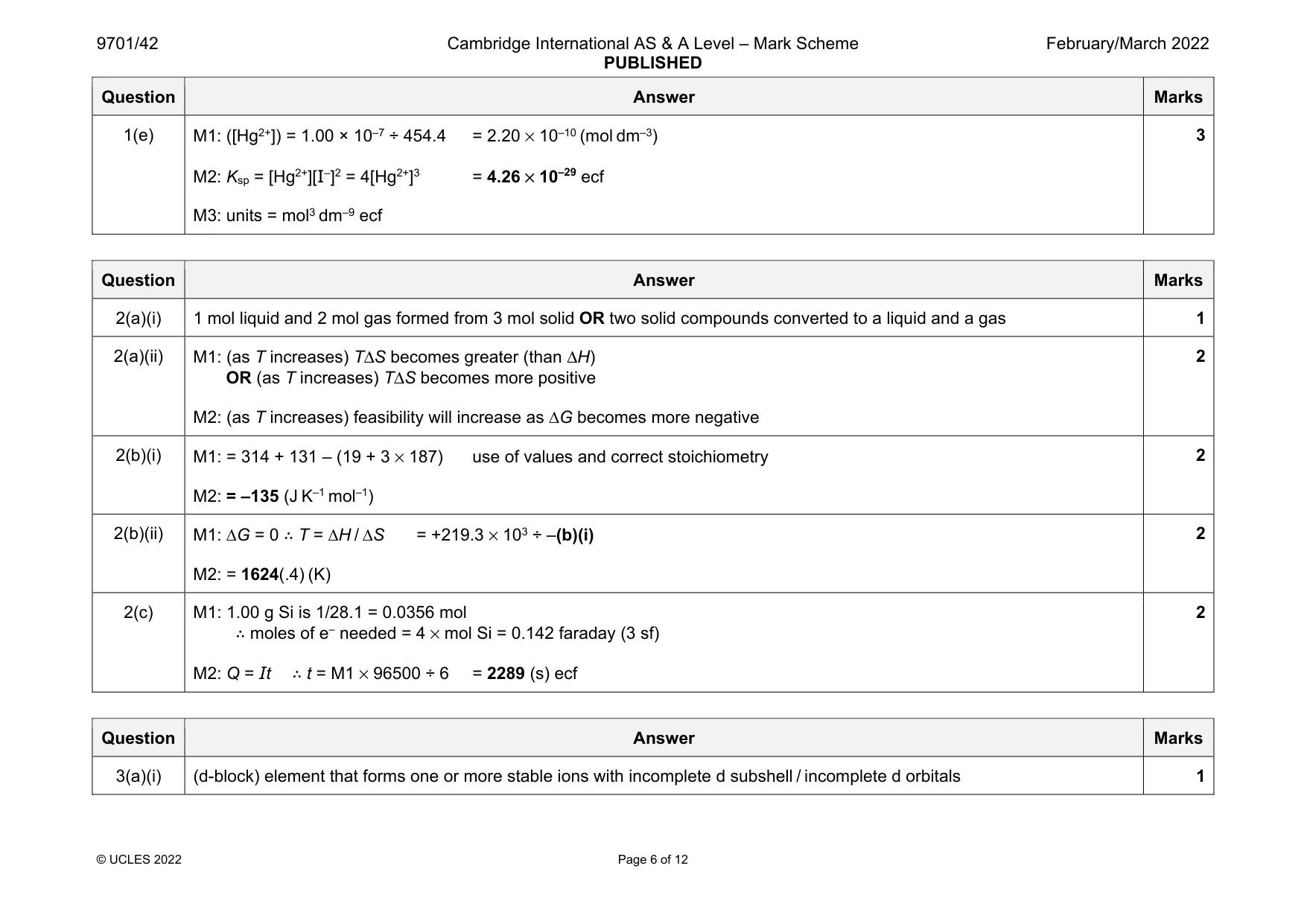
Mark scheme: 1(a)(i) oxidising agent [1] H2O2 + 2H+ + 2I– → 2H2O + I2 [1] 1(a)(ii) M1: Kpc (93.8) = [I2(cyclohexane)] ÷ [I2(aq)] 93.8 = (0.390 / 15) ÷ (x / 20) M2: mass of I2(aq), x = 5.54 × 10⁻³ (g) ecf 2 1(a)(iii) • Kpc would be lower • hexan-2-one is more polar (than cyclohexane) OR hexan-2-one is polar AND cyclohexane is non-polar • I2 is (therefore) less soluble in hexan-2-one All three correct for two marks 2 1(b)(i) enthalpy change when one mole of a solute AND dissolves in water to form a solution of infinite dilution 1 1(b)(ii) –(–629) + (–322) + (–293) = (+)14 (kJ mol–1) 1 1(b)(iii) (cationic) charge density decreases Li+ to K+ [1] so lattice energies become less negative / less exothermic AND because less attraction between ions [1] 2 1(c)(i) M1: moles of thiosulfate = 0.02230 × 0.150 = 3.345 × 10⁻³ M2: [Cu2+] = 2 × ½ × 3.345 × 10⁻³ ÷ 0.0250 = 0.134 (mol dm–3) ecf 2 1(c)(ii) starch 1 1(c)(iii) 3dxy 1 1(d) Reduction of Fe3+: 2Fe3+ + 2I– → 2Fe2+ + I2 [1] Regeneration of Fe3+: 2Fe2+ + S2O82– → 2Fe3+ + 2SO42– [1] 2 Question Answer Marks 1(e) M1: ([Hg2+]) = 1.00 × 10⁻⁷ ÷ 454.4 = 2.20 × 10⁻¹⁰ (mol dm–3) M2: Ksp = [Hg2+][I–]2 = 4[Hg2+]3 = 4.26 × 10⁻²⁹ ecf M3: units = mol3 dm–9 ecf 3
Q2 · Silicon is the second most abundant element by mass in the Earth’s crust
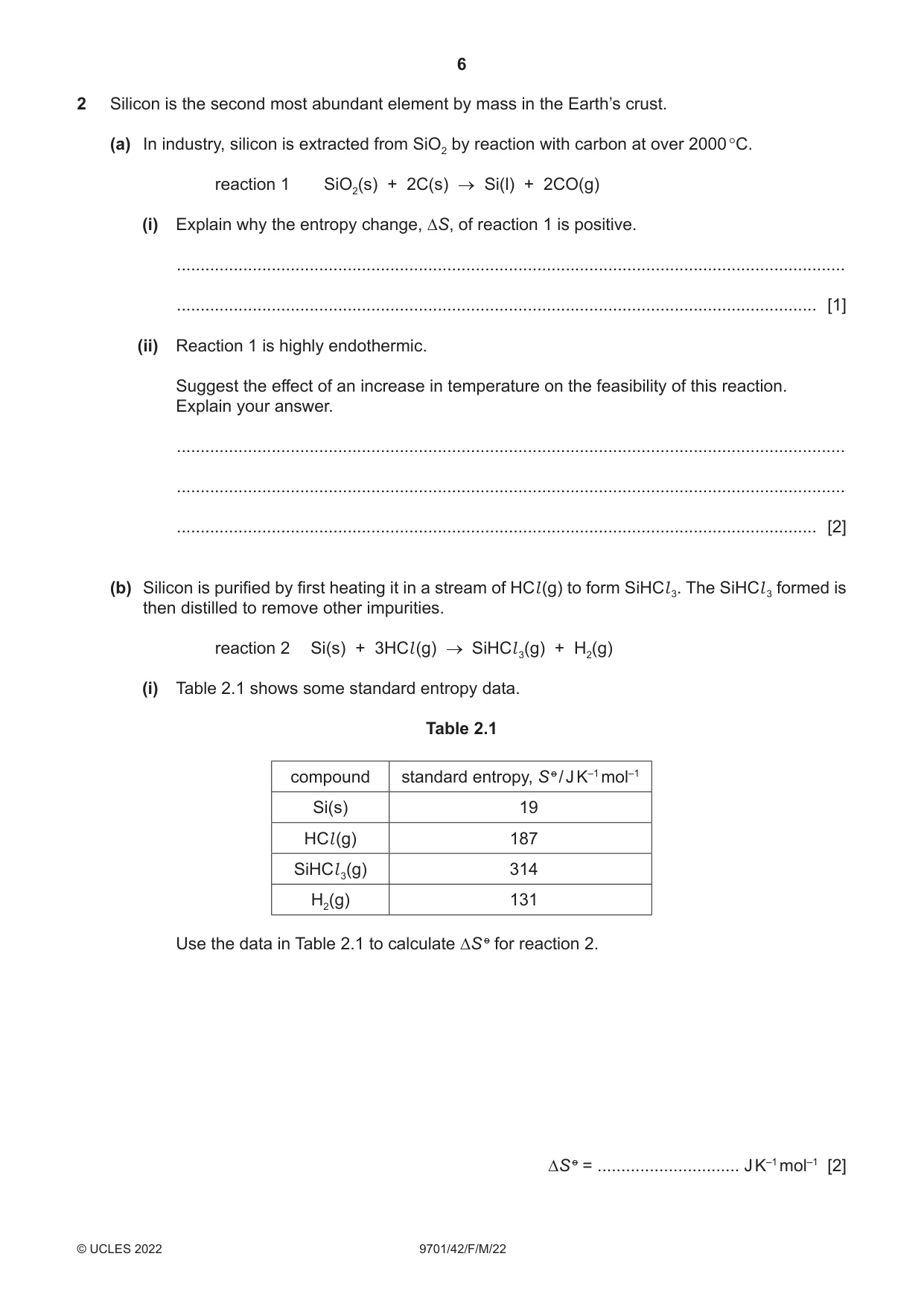
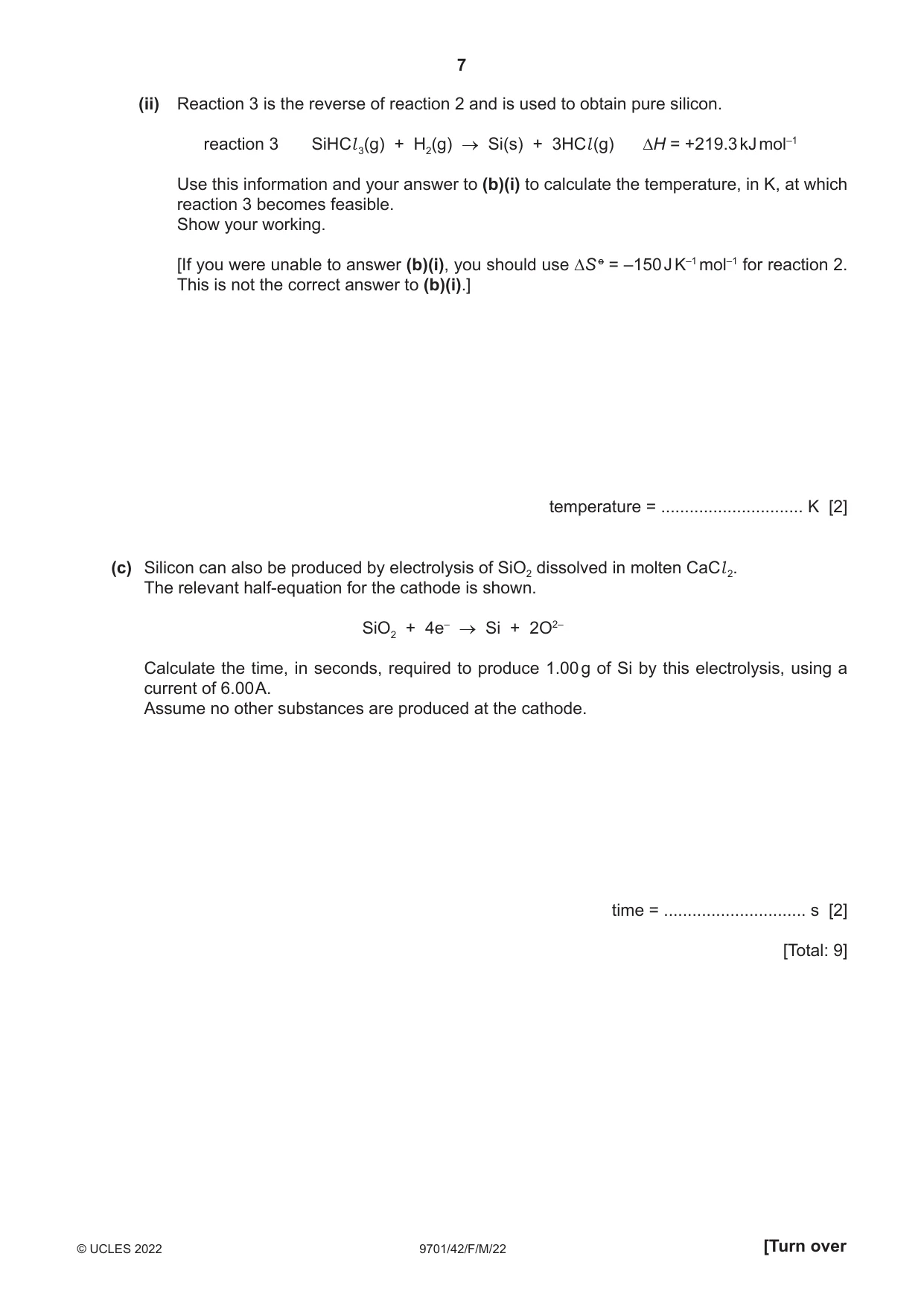
2 Silicon is the second most abundant element by mass in the Earth’s crust. (a) In industry, silicon is extracted from SiO2 by reaction with carbon at over 2000 °C. reaction 1 SiO2(s) + 2C(s) → Si(l) + 2CO(g) (i) Explain why the entropy change, ∆S, of reaction 1 is positive. ............................................................................................................................................. ....................................................................................................................................... [1] (ii) Reaction 1 is highly endothermic. Suggest the effect of an increase in temperature on the feasibility of this reaction. Explain your answer. ............................................................................................................................................. ............................................................................................................................................. ....................................................................................................................................... [2] (b) Silicon is purified by first heating it in a stream of HCl (g) to form SiHCl 3. The SiHCl 3 formed is then distilled to remove other impurities. reaction 2 Si(s) + 3HCl (g) → SiHCl 3(g) + H2(g) (i) Table 2.1 shows some standard entropy data. Table 2.1 compound standard entropy, S o / J K–1 mol–1 Si(s) 19 HCl (g) 187 SiHCl 3(g) 314 H2(g) 131 Use the data in Table 2.1 to calculate ∆S o for reaction 2. ∆S o = .............................. J K–1 mol–1 [2] (ii) Reaction 3 is the reverse of reaction 2 and is used to obtain pure silicon. reaction 3 SiHCl 3(g) + H2(g) → Si(s) + 3HCl (g) ∆H = +219.3 kJ mol–1 Use this information and your answer to (b)(i) to calculate the temperature, in K, at which reaction 3 becomes feasible. Show your working. [If you were unable to answer (b)(i), you should use ∆S o = –150 J K–1 mol–1 for reaction 2. This is not the correct answer to (b)(i).] temperature = .............................. K [2] (c) Silicon can also be produced by electrolysis of SiO2 dissolved in molten CaCl 2. The relevant half-equation for the cathode is shown. SiO2 + 4e– → Si + 2O2– Calculate the time, in seconds, required to produce 1.00 g of Si by this electrolysis, using a current of 6.00 A. Assume no other substances are produced at the cathode. time = .............................. s [2] [Total: 9]
Mark scheme: 2(a)(i) 1 mol liquid and 2 mol gas formed from 3 mol solid OR two solid compounds converted to a liquid and a gas 1 2(a)(ii) M1: (as T increases) TΔS becomes greater (than ΔH) OR (as T increases) TΔS becomes more positive M2: (as T increases) feasibility will increase as ∆G becomes more negative 2 2(b)(i) M1: = 314 + 131 – (19 + 3 × 187) use of values and correct stoichiometry M2: = –135 (J K–1 mol–1) 2 2(b)(ii) M1: ∆G = 0 ∴ T = ∆H / ∆S = +219.3 × 10³ ÷ –(b)(i) M2: = 1624(.4) (K) 2 2(c) M1: 1.00 g Si is 1/28.1 = 0.0356 mol ∴ moles of e– needed = 4 × mol Si = 0.142 faraday (3 sf) M2: Q = It ∴ t = M1 × 96500 ÷ 6 = 2289 (s) ecf 2
Q3 · Titanium is a transition element in Period 4
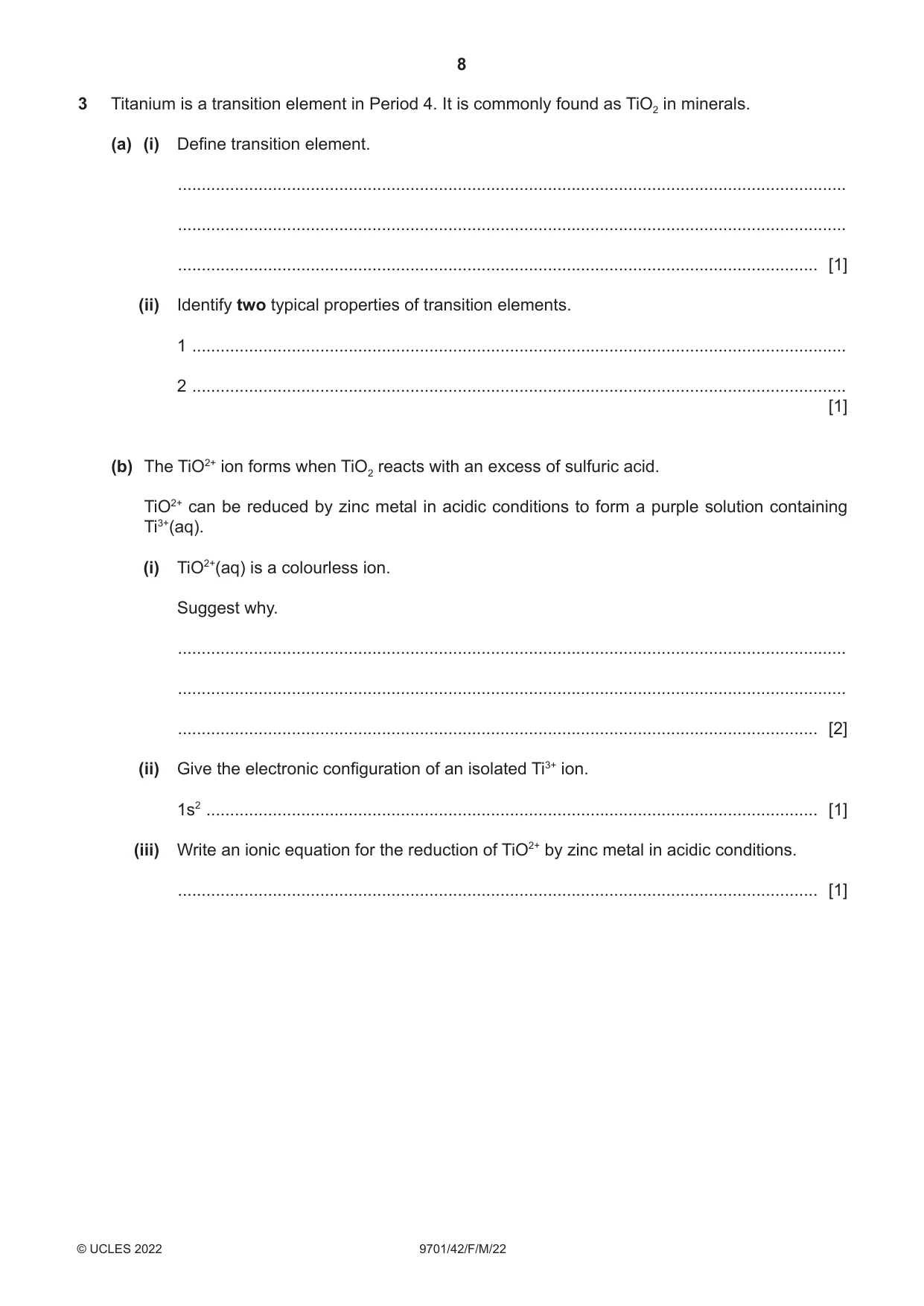
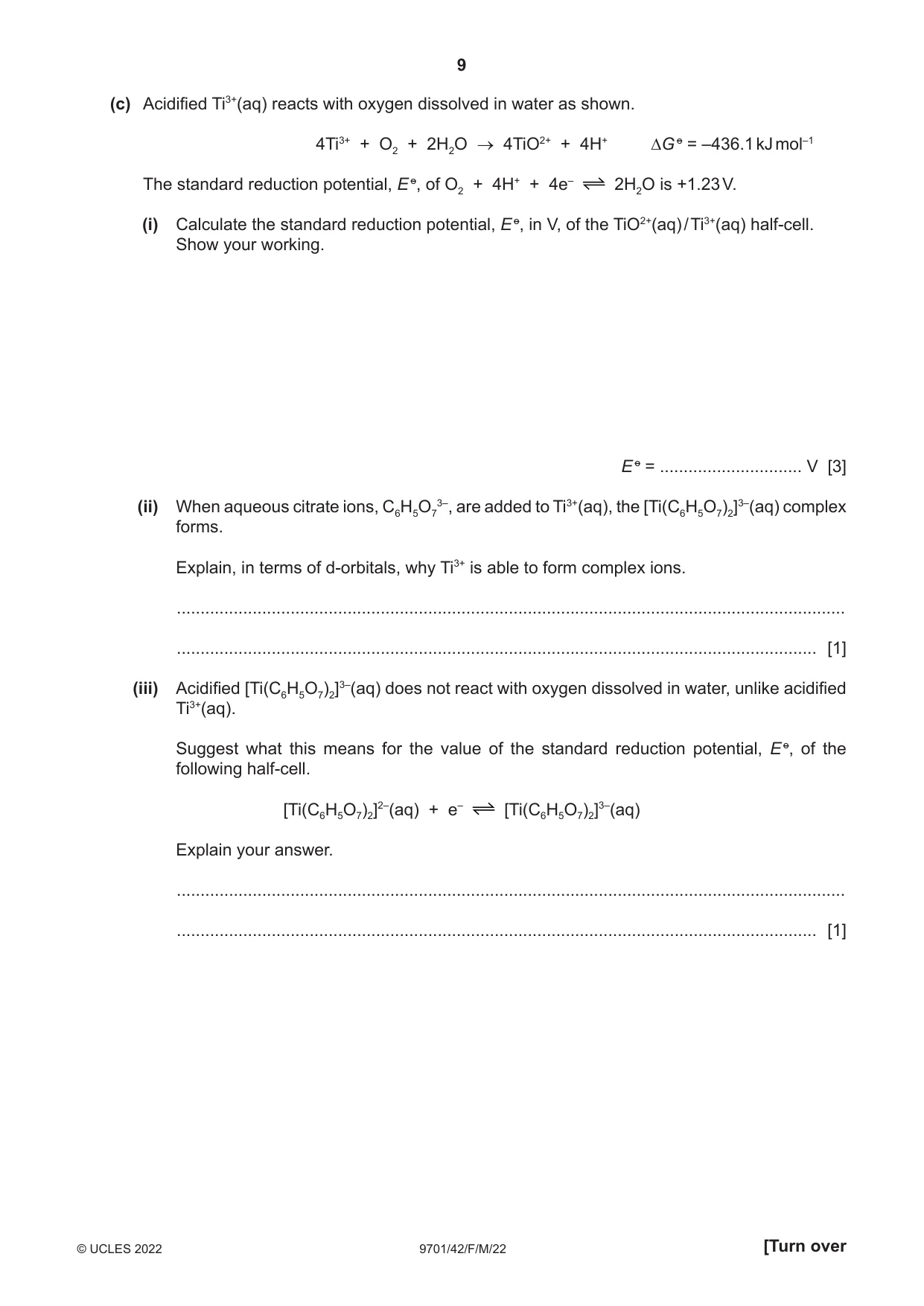
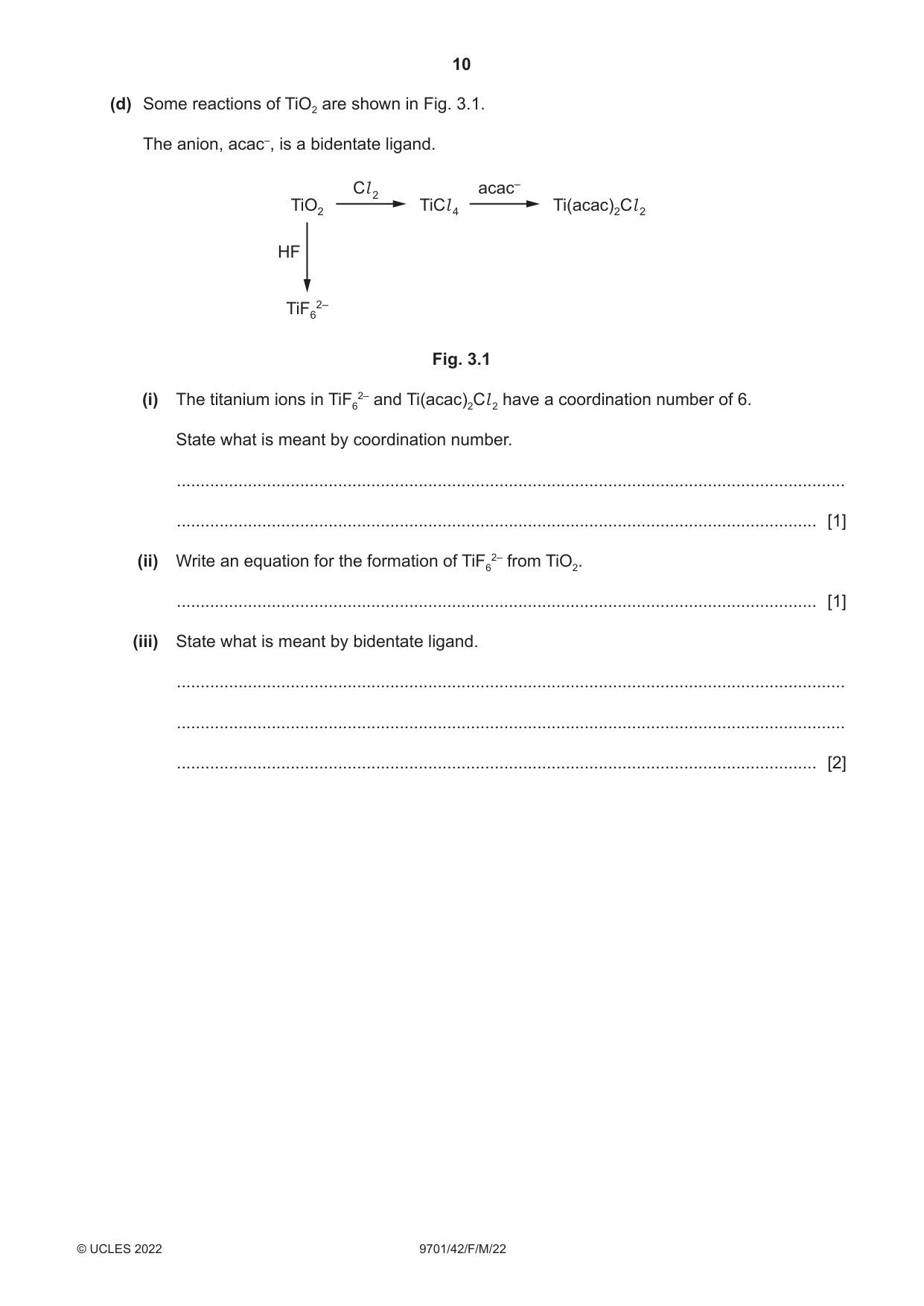
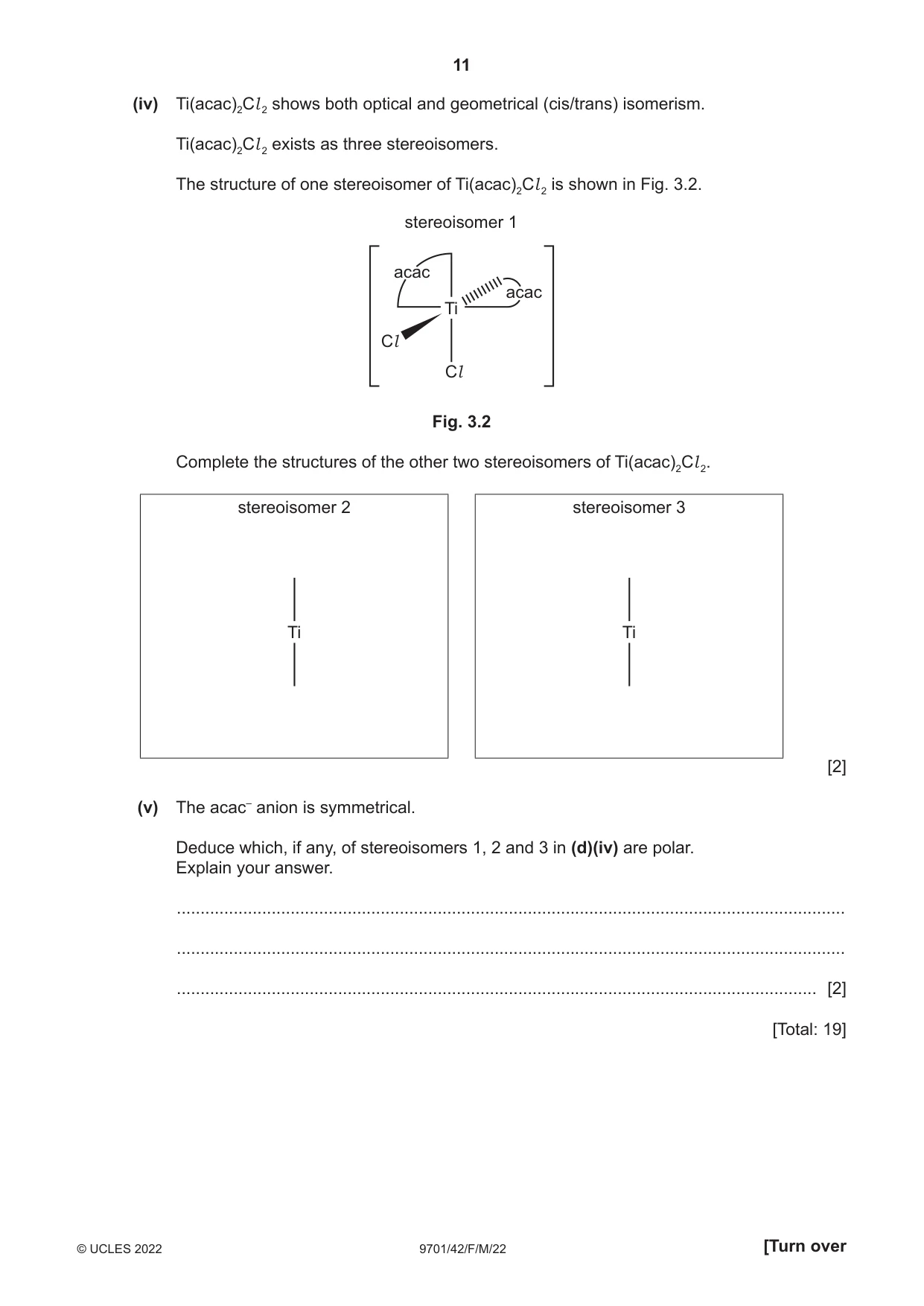
3 Titanium is a transition element in Period 4. It is commonly found as TiO2 in minerals. (a) (i) Define transition element. ............................................................................................................................................. ............................................................................................................................................. ....................................................................................................................................... [1] (ii) Identify two typical properties of transition elements. 1 .......................................................................................................................................... 2 .......................................................................................................................................... [1] (b) The TiO2+ ion forms when TiO2 reacts with an excess of sulfuric acid. TiO2+ can be reduced by zinc metal in acidic conditions to form a purple solution containing Ti3+(aq). (i) TiO2+(aq) is a colourless ion. Suggest why. ............................................................................................................................................. ............................................................................................................................................. ....................................................................................................................................... [2] (ii) Give the electronic configuration of an isolated Ti3+ ion. 1s2 ��������������������������������������������������������������������������������������������������������������������������������� [1] (iii) Write an ionic equation for the reduction of TiO2+ by zinc metal in acidic conditions. ....................................................................................................................................... [1] (c) Acidified Ti3+(aq) reacts with oxygen dissolved in water as shown. 4Ti3+ + O2 + 2H2O → 4TiO2+ + 4H+ ∆G o = –436.1 kJ mol–1 The standard reduction potential, E o, of O2 + 4H+ + 4e– 2H2O is +1.23 V. (i) Calculate the standard reduction potential, E o, in V, of the TiO2+(aq) / Ti3+(aq) half-cell. Show your working. E o = .............................. V [3] (ii) When aqueous citrate ions, C6H5O73–, are added to Ti3+(aq), the [Ti(C6H5O7)2]3–(aq) complex forms. Explain, in terms of d-orbitals, why Ti3+ is able to form complex ions. ............................................................................................................................................. ....................................................................................................................................... [1] (iii) Acidified [Ti(C6H5O7)2]3–(aq) does not react with oxygen dissolved in water, unlike acidified Ti3+(aq). Suggest what this means for the value of the standard reduction potential, E o, of the following half‑cell. [Ti(C6H5O7)2]2–(aq) + e– [Ti(C6H5O7)2]3–(aq) Explain your answer. ............................................................................................................................................. ....................................................................................................................................... [1] (d) Some reactions of TiO2 are shown in Fig. 3.1. The anion, acac–, is a bidentate ligand. Cl 2 acac– TiO2 TiCl 4 Ti(acac)2Cl 2 HF TiF62– Fig. 3.1 (i) The titanium ions in TiF62– and Ti(acac)2Cl 2 have a coordination number of 6. State what is meant by coordination number. ............................................................................................................................................. ....................................................................................................................................... [1] (ii) Write an equation for the formation of TiF62– from TiO2. ....................................................................................................................................... [1] (iii) State what is meant by bidentate ligand. ............................................................................................................................................. ............................................................................................................................................. ....................................................................................................................................... [2] (iv) Ti(acac)2Cl 2 shows both optical and geometrical (cis/trans) isomerism. Ti(acac)2Cl 2 exists as three stereoisomers. The structure of one stereoisomer of Ti(acac)2Cl 2 is shown in Fig. 3.2. stereoisomer 1 acac acac Ti Cl Cl Fig. 3.2 Complete the structures of the other two stereoisomers of Ti(acac)2Cl 2. stereoisomer 2 stereoisomer 3 Ti Ti [2] (v) The acac– anion is symmetrical. Deduce which, if any, of stereoisomers 1, 2 and 3 in (d)(iv) are polar. Explain your answer. ............................................................................................................................................. ............................................................................................................................................. ....................................................................................................................................... [2] [Total: 19]
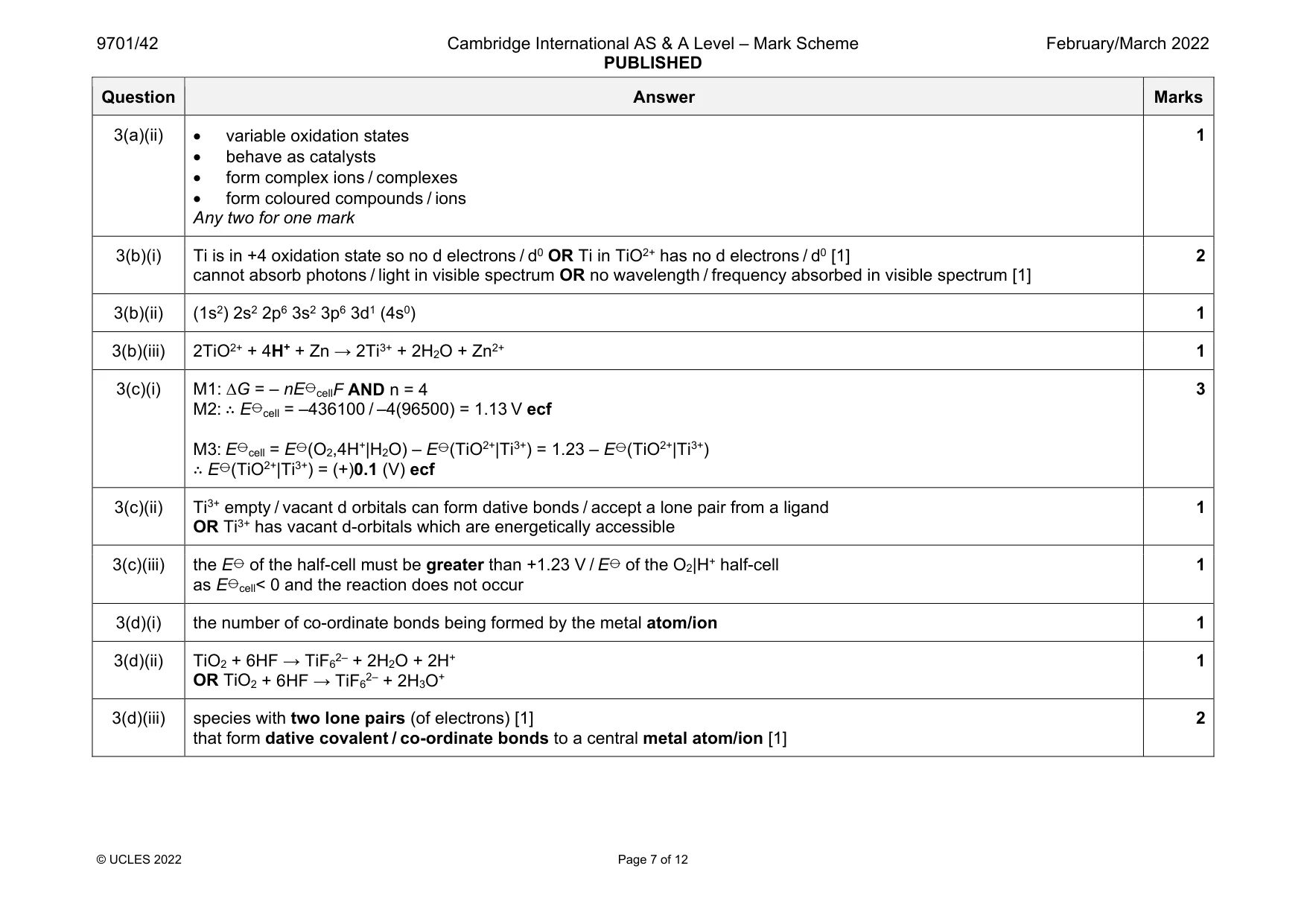
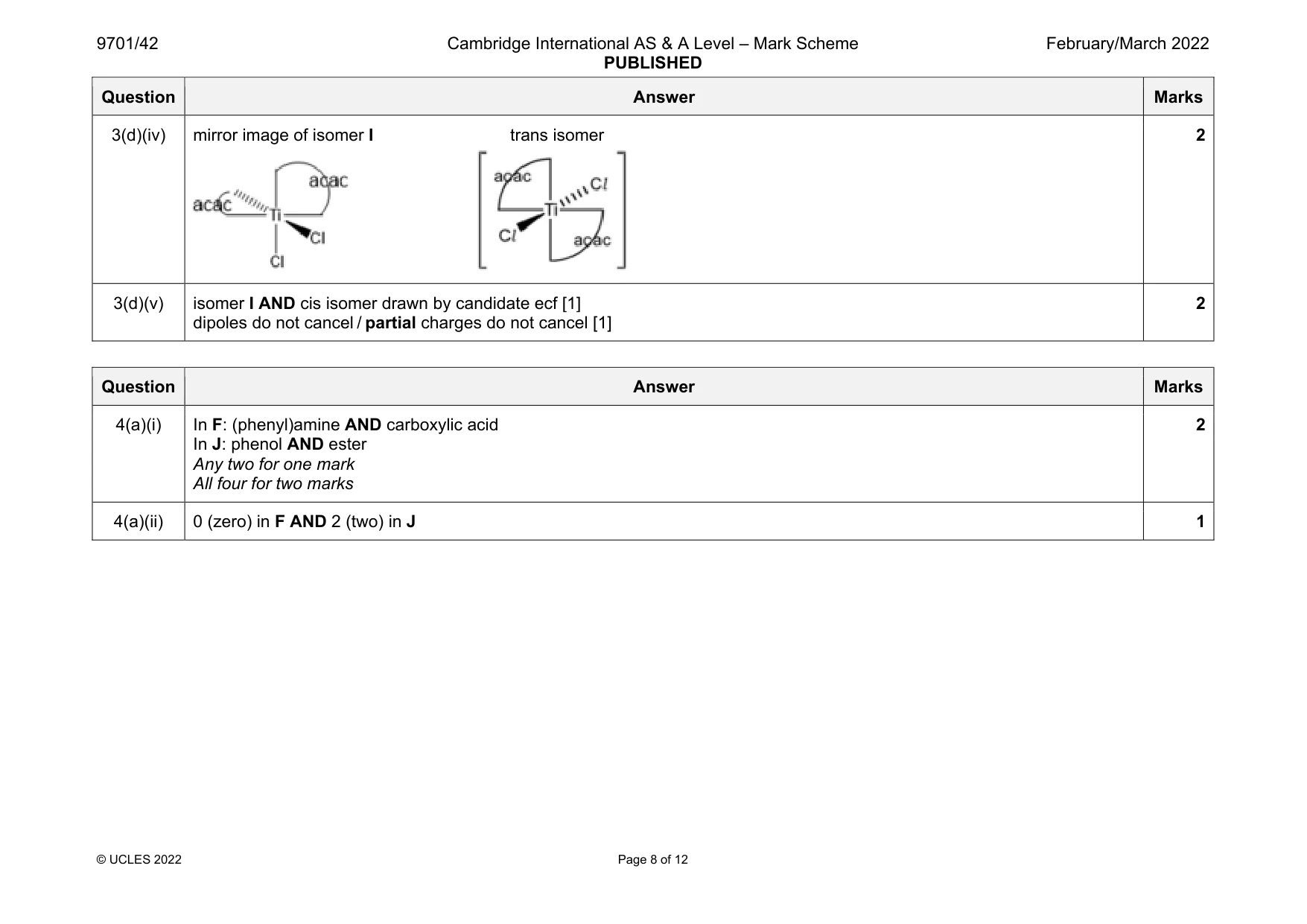
Mark scheme: 3(a)(i) (d-block) element that forms one or more stable ions with incomplete d subshell / incomplete d orbitals 1 Question Answer Marks 3(a)(ii) • variable oxidation states • behave as catalysts • form complex ions / complexes • form coloured compounds / ions Any two for one mark 1 3(b)(i) Ti is in +4 oxidation state so no d electrons / d0 OR Ti in TiO2+ has no d electrons / d0 [1] cannot absorb photons / light in visible spectrum OR no wavelength / frequency absorbed in visible spectrum [1] 2 3(b)(ii) (1s2) 2s2 2p6 3s2 3p6 3d1 (4s0) 1 3(b)(iii) 2TiO2+ + 4H+ + Zn → 2Ti3+ + 2H2O + Zn2+ 1 3(c)(i) M1: ∆G = – nE⦵cellF AND n = 4 M2: ∴ E⦵cell = –436100 / –4(96500) = 1.13 V ecf M3: E⦵cell = E⦵(O2,4H+|H2O) – E⦵(TiO2+|Ti3+) = 1.23 – E⦵(TiO2+|Ti3+) ∴ E⦵(TiO2+|Ti3+) = (+)0.1 (V) ecf 3 3(c)(ii) Ti3+ empty / vacant d orbitals can form dative bonds / accept a lone pair from a ligand OR Ti3+ has vacant d-orbitals which are energetically accessible 1 3(c)(iii) the E⦵ of the half-cell must be greater than +1.23 V / E⦵ of the O2|H+ half-cell as E⦵cell< 0 and the reaction does not occur 1 3(d)(i) the number of co-ordinate bonds being formed by the metal atom/ion 1 3(d)(ii) TiO2 + 6HF → TiF62– + 2H2O + 2H+ OR TiO2 + 6HF → TiF62– + 2H3O+ 1 3(d)(iii) species with two lone pairs (of electrons) [1] that form dative covalent / co-ordinate bonds to a central metal atom/ion [1] 2 Question Answer Marks 3(d)(iv) mirror image of isomer I trans isomer 2 3(d)(v) isomer I AND cis isomer drawn by candidate ecf [1] dipoles do not cancel / partial charges do not cancel [1] 2
Q4 · Compounds F and J are shown in Fig
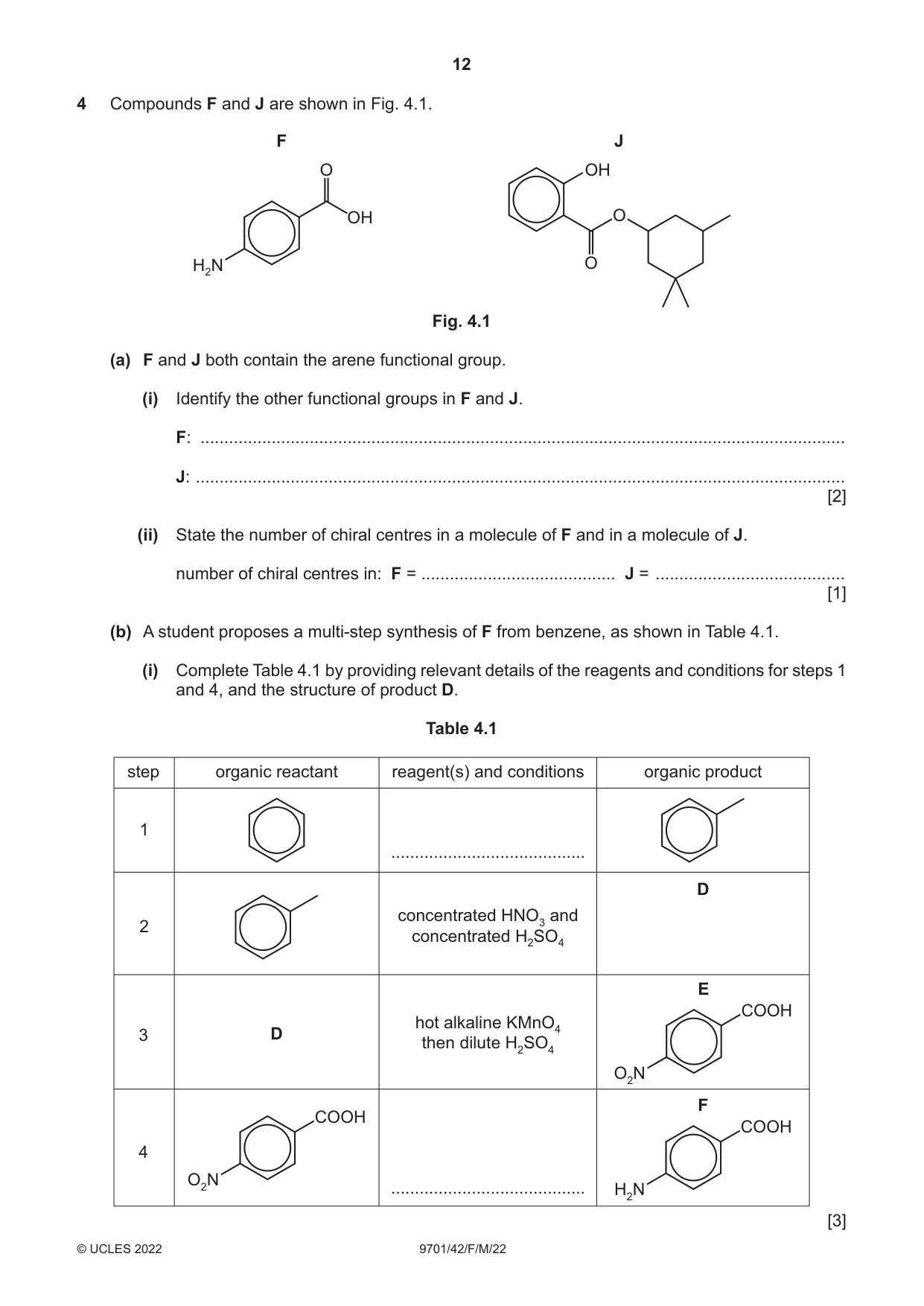
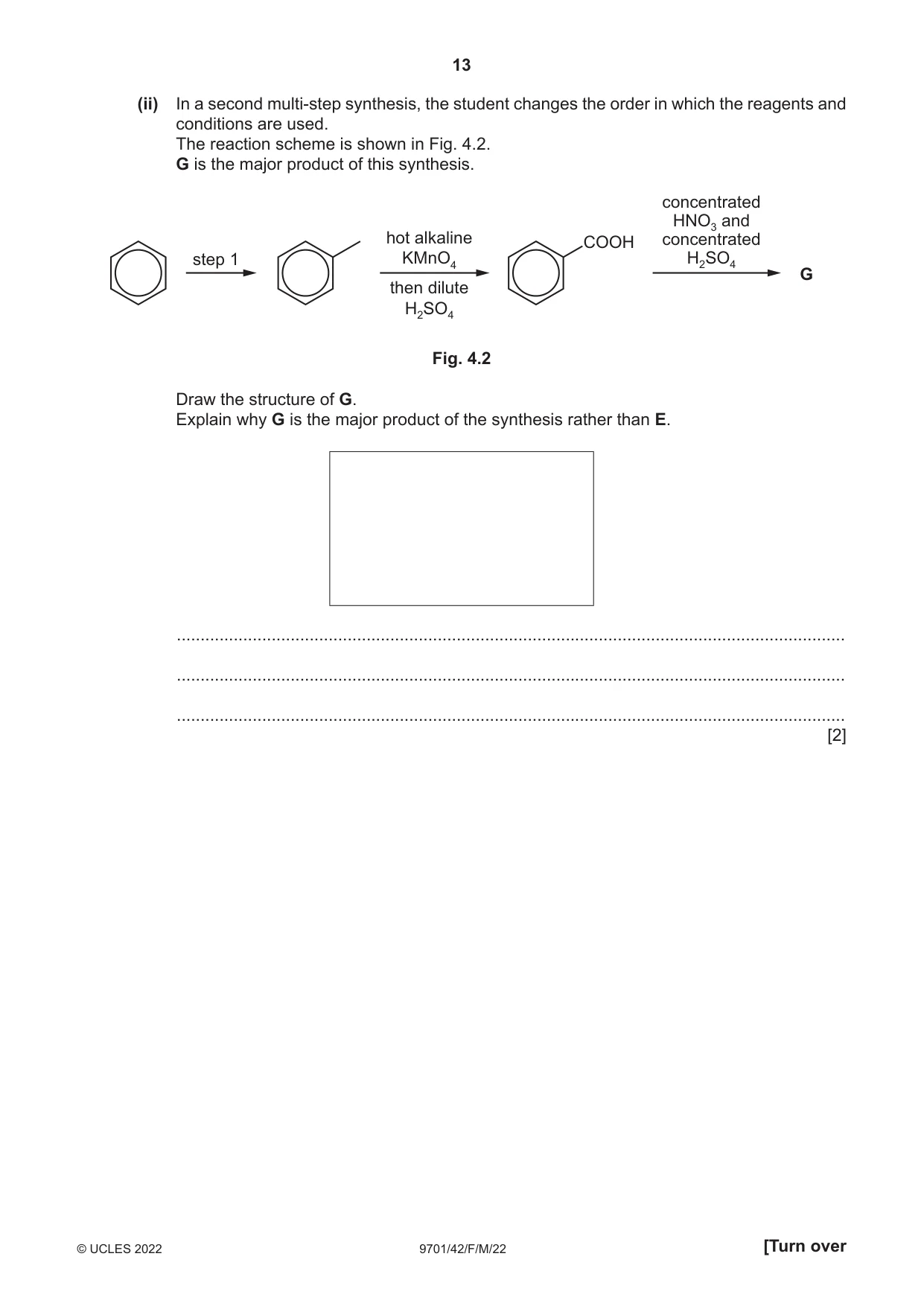
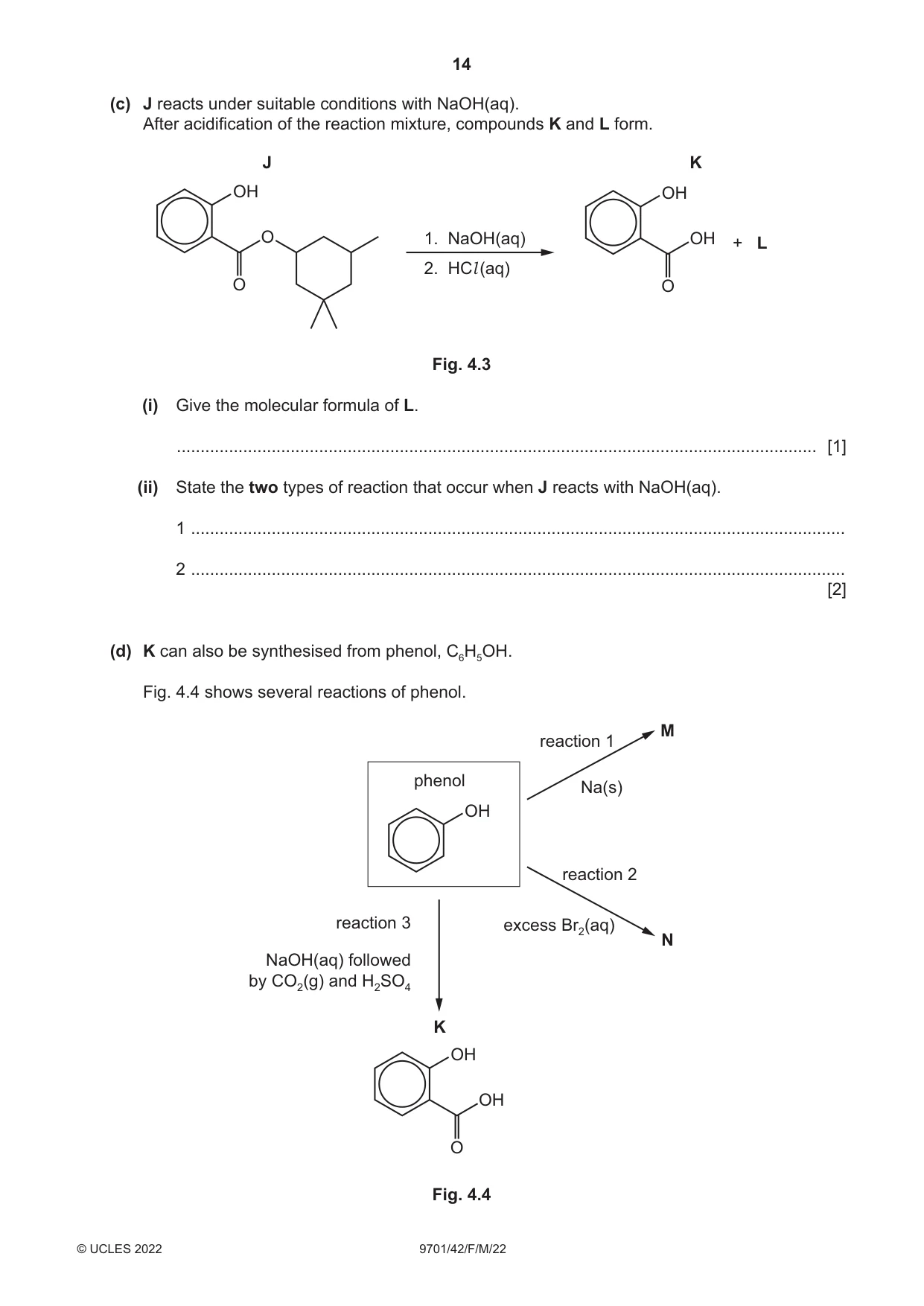
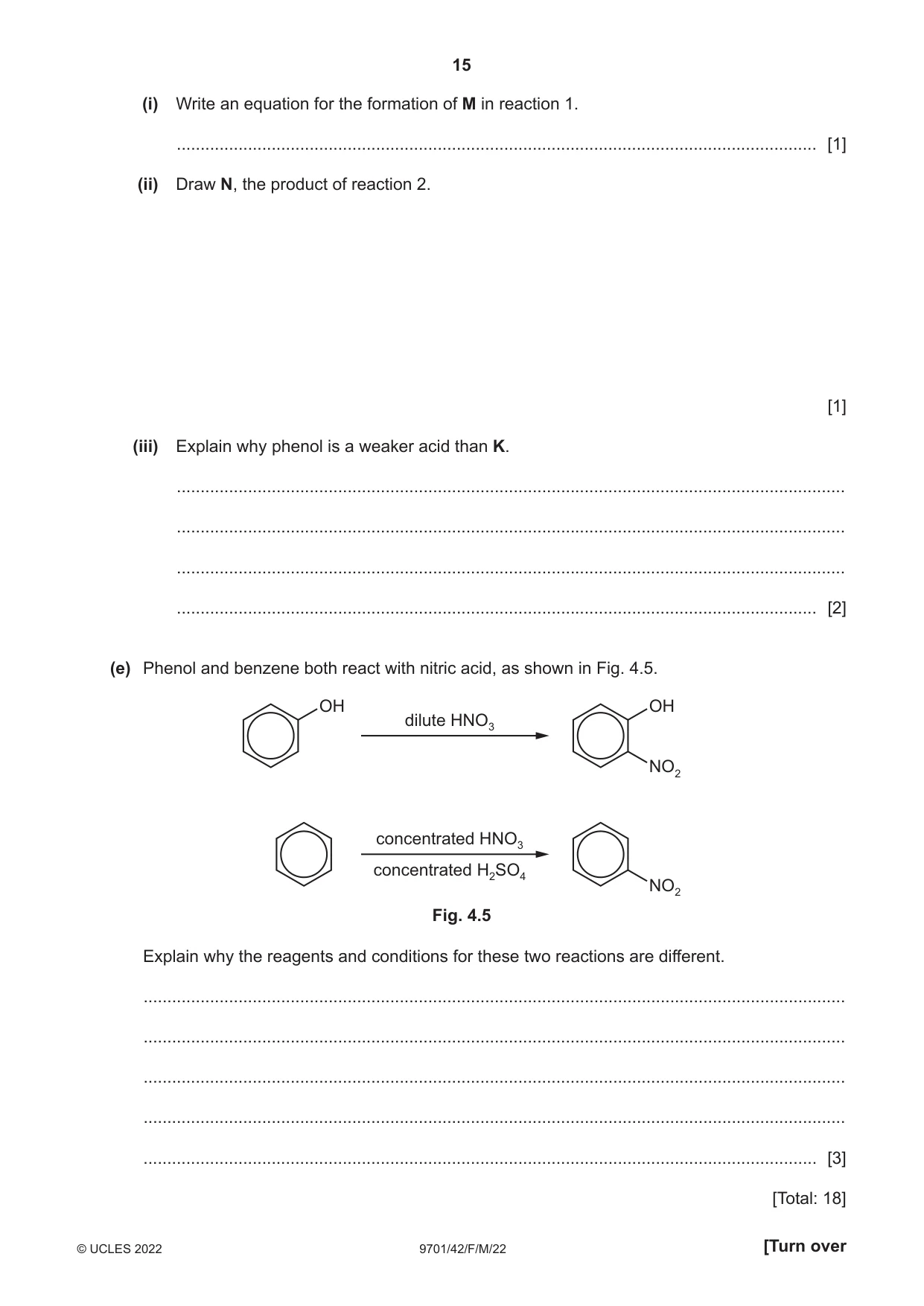
4 Compounds F and J are shown in Fig. 4.1. F J O OH OH O H2N O Fig. 4.1 (a) F and J both contain the arene functional group. (i) Identify the other functional groups in F and J. F: ......................................................................................................................................... J: ......................................................................................................................................... [2] (ii) State the number of chiral centres in a molecule of F and in a molecule of J. number of chiral centres in: F = ......................................... J = ........................................ [1] (b) A student proposes a multi-step synthesis of F from benzene, as shown in Table 4.1. (i) Complete Table 4.1 by providing relevant details of the reagents and conditions for steps 1 and 4, and the structure of product D. Table 4.1 step organic reactant reagent(s) and conditions organic product 1 ......................................... D concentrated HNO3 and 2 concentrated H2SO4 E COOH hot alkaline KMnO4 3 D then dilute H2SO4 O2N F COOH COOH 4 O2N ......................................... H2N [3] (ii) In a second multi-step synthesis, the student changes the order in which the reagents and conditions are used. The reaction scheme is shown in Fig. 4.2. G is the major product of this synthesis. concentrated HNO3 and hot alkaline COOH concentrated step 1 KMnO4 H2SO4 G then dilute H2SO4 Fig. 4.2 Draw the structure of G. Explain why G is the major product of the synthesis rather than E. ............................................................................................................................................. ............................................................................................................................................. ............................................................................................................................................. [2] (c) J reacts under suitable conditions with NaOH(aq). After acidification of the reaction mixture, compounds K and L form. J K OH OH O 1. NaOH(aq) OH + L 2. HCl (aq) O O Fig. 4.3 (i) Give the molecular formula of L. ....................................................................................................................................... [1] (ii) State the two types of reaction that occur when J reacts with NaOH(aq). 1 .......................................................................................................................................... 2 .......................................................................................................................................... [2] (d) K can also be synthesised from phenol, C6H5OH. Fig. 4.4 shows several reactions of phenol. M reaction 1 phenol Na(s) OH reaction 2 reaction 3 excess Br2(aq) N NaOH(aq) followed by CO2(g) and H2SO4 K OH OH O Fig. 4.4 (i) Write an equation for the formation of M in reaction 1. ....................................................................................................................................... [1] (ii) Draw N, the product of reaction 2. [1] (iii) Explain why phenol is a weaker acid than K. ............................................................................................................................................. ............................................................................................................................................. ............................................................................................................................................. ....................................................................................................................................... [2] (e) Phenol and benzene both react with nitric acid, as shown in Fig. 4.5. OH OH dilute HNO3 NO2 concentrated HNO3 concentrated H2SO4 NO2 Fig. 4.5 Explain why the reagents and conditions for these two reactions are different. .................................................................................................................................................... .................................................................................................................................................... .................................................................................................................................................... .................................................................................................................................................... .............................................................................................................................................. [3] [Total: 18]
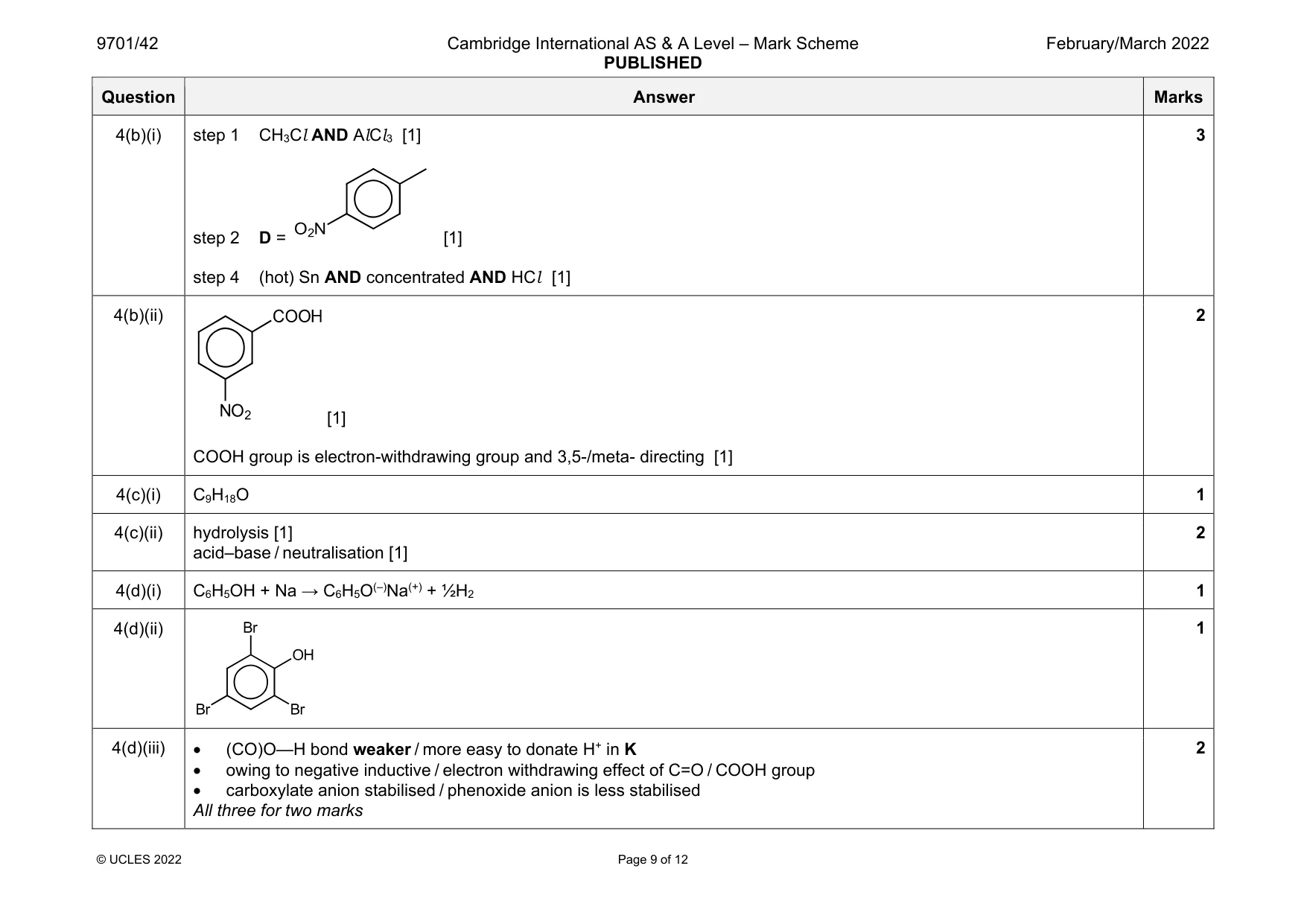
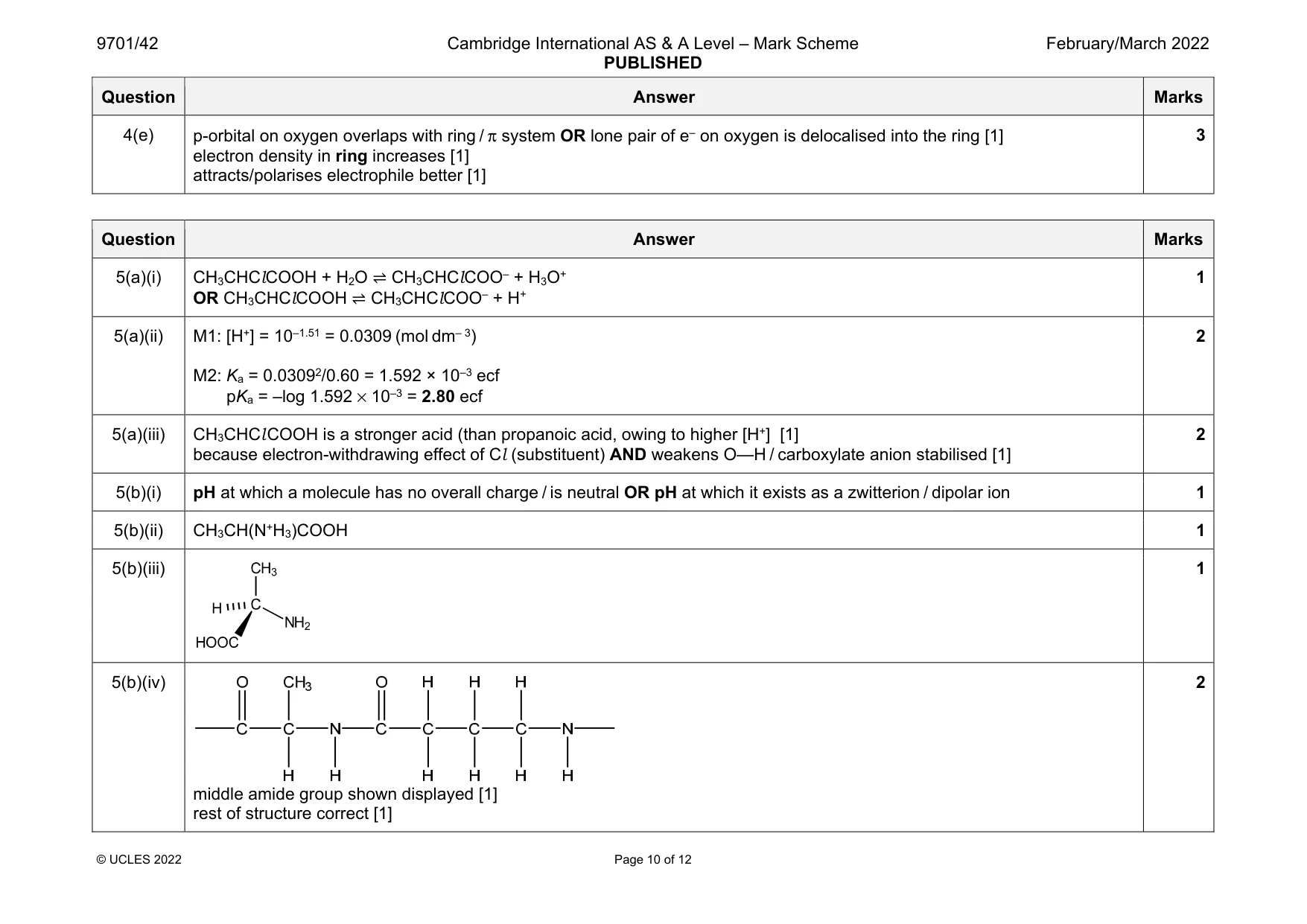
Mark scheme: 4(a)(i) In F: (phenyl)amine AND carboxylic acid In J: phenol AND ester Any two for one mark All four for two marks 4(a)(ii) 0 (zero) in F AND 2 (two) in J 1 Question Answer Marks 4(b)(i) step 1 CH3Cl AND AlCl3 [1] step 2 D = [1] step 4 (hot) Sn AND concentrated AND HCl [1] 3 4(b)(ii) [1] COOH group is electron-withdrawing group and 3,5-/meta- directing [1] 2 4(c)(i) C9H18O 1 4(c)(ii) hydrolysis [1] acid–base / neutralisation [1] 2 4(d)(i) C6H5OH + Na → C6H5O(–)Na(+) + ½H2 1 4(d)(ii) 1 4(d)(iii) • (CO)O—H bond weaker / more easy to donate H+ in K • owing to negative inductive / electron withdrawing effect of C=O / COOH group • carboxylate anion stabilised / phenoxide anion is less stabilised All three for two marks 2 Question Answer Marks 4(e) p-orbital on oxygen overlaps with ring / π system OR lone pair of e– on oxygen is delocalised into the ring [1] electron density in ring increases [1] attracts/polarises electrophile better [1] 3
Q5 · 2-Chloropropanoic acid, CH3CHCl COOH, is used in many chemical syntheses
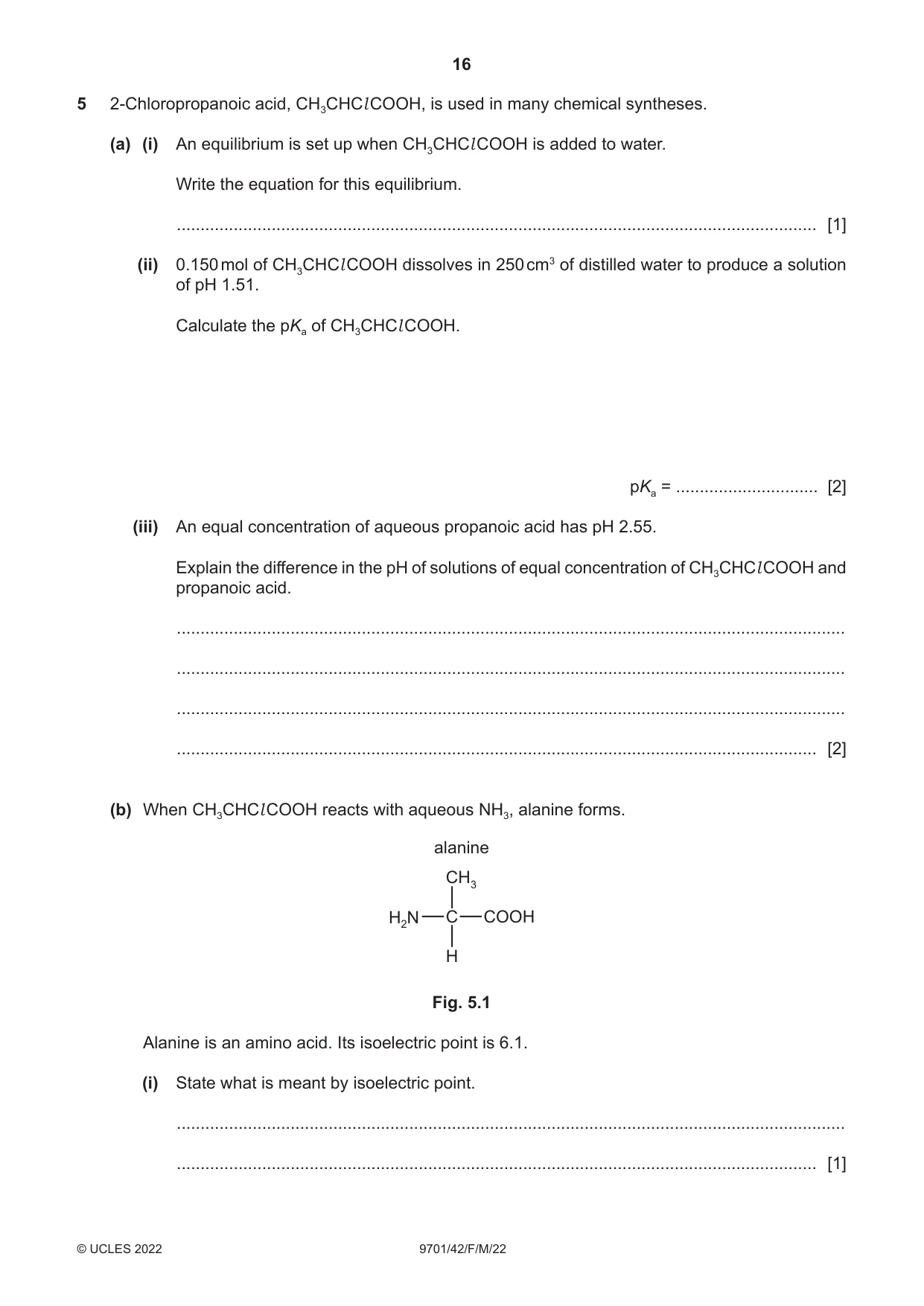
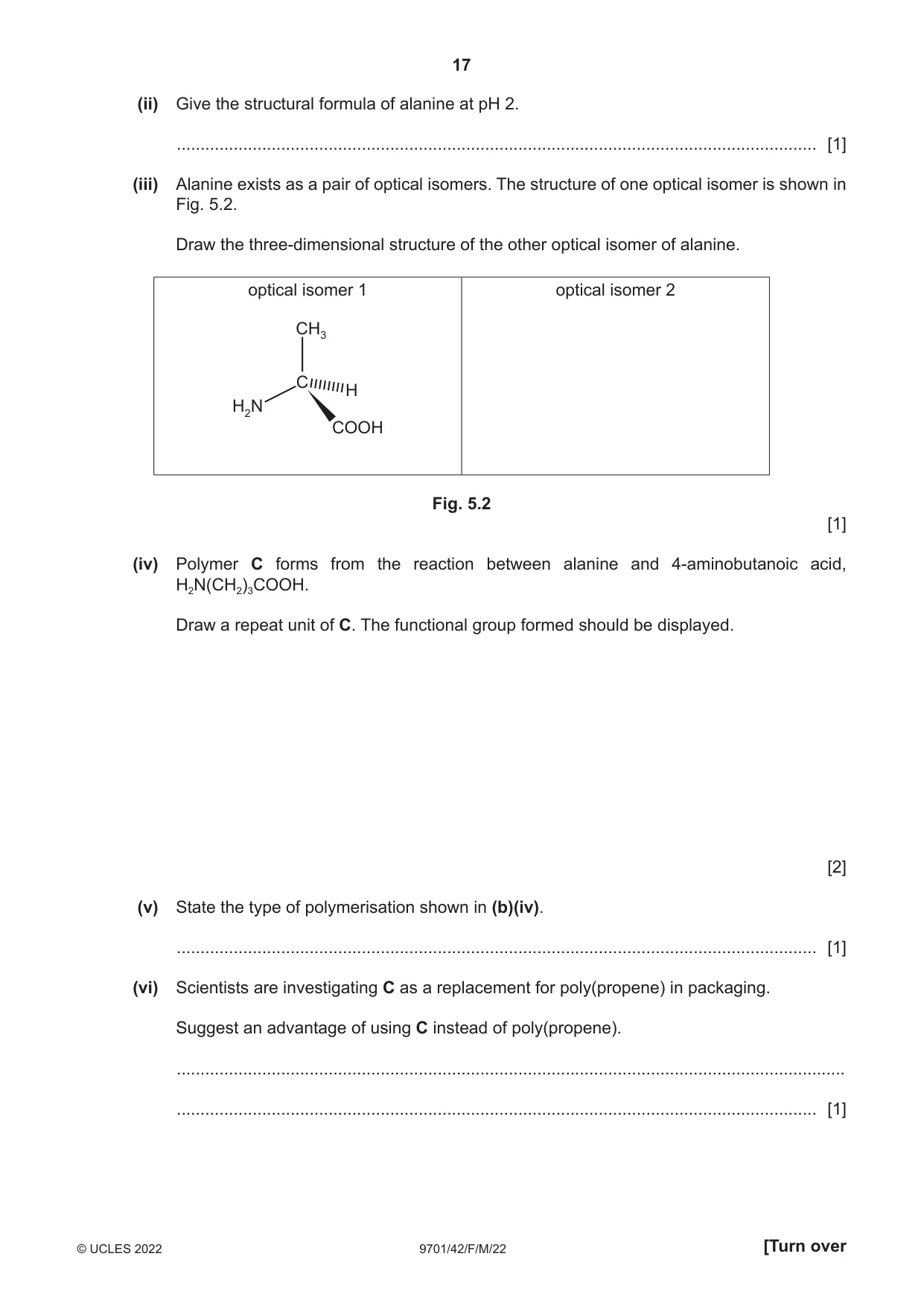
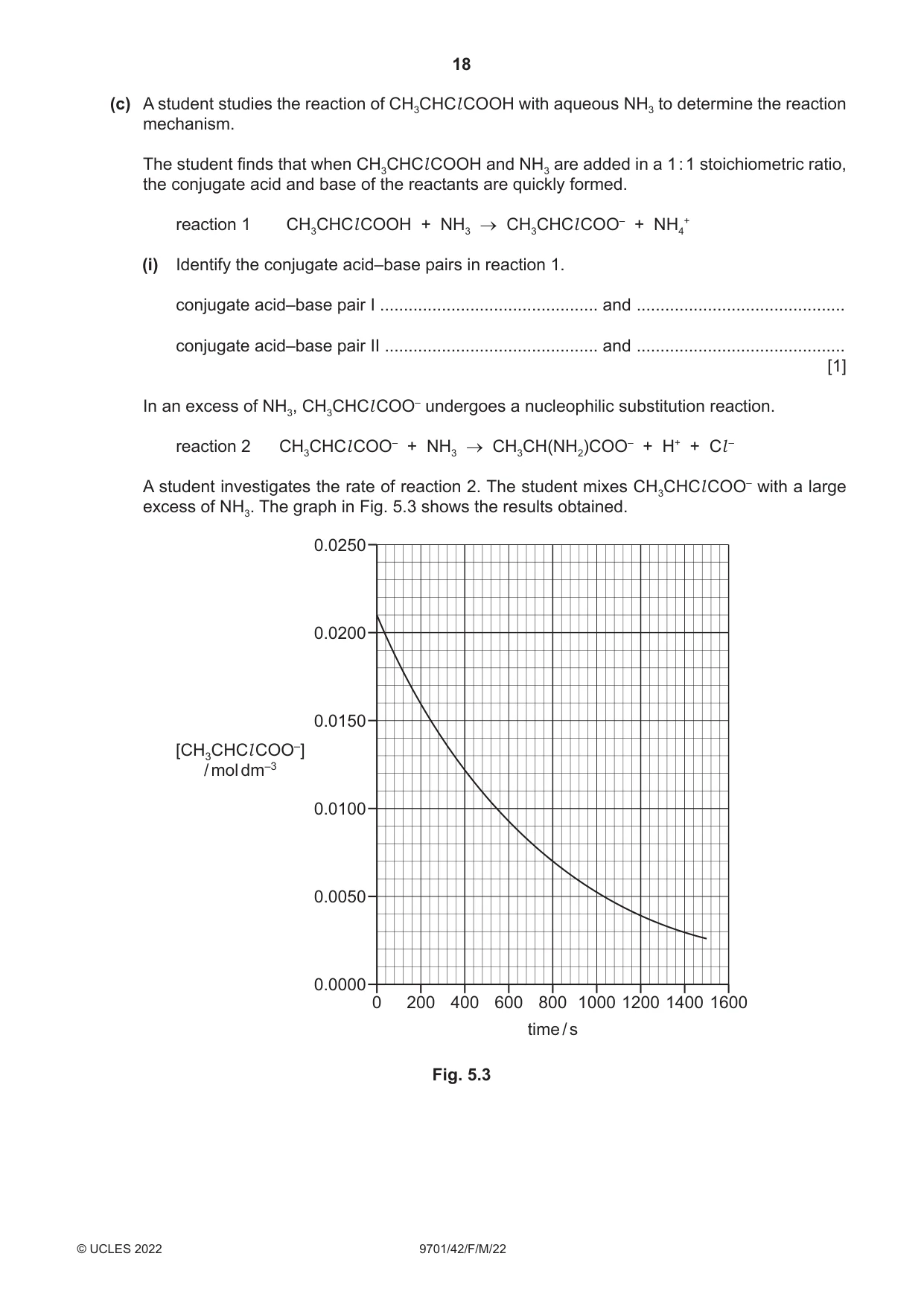
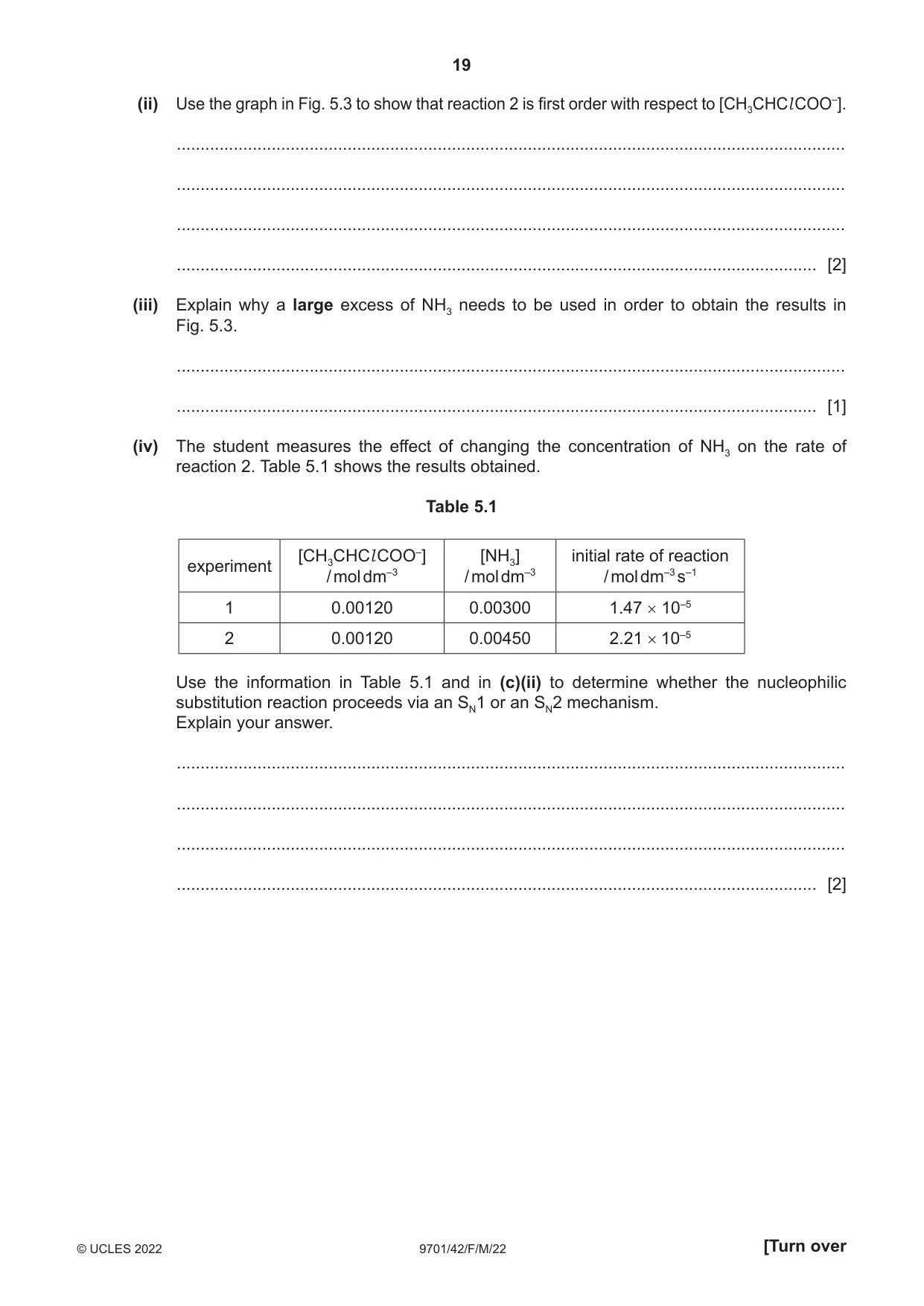
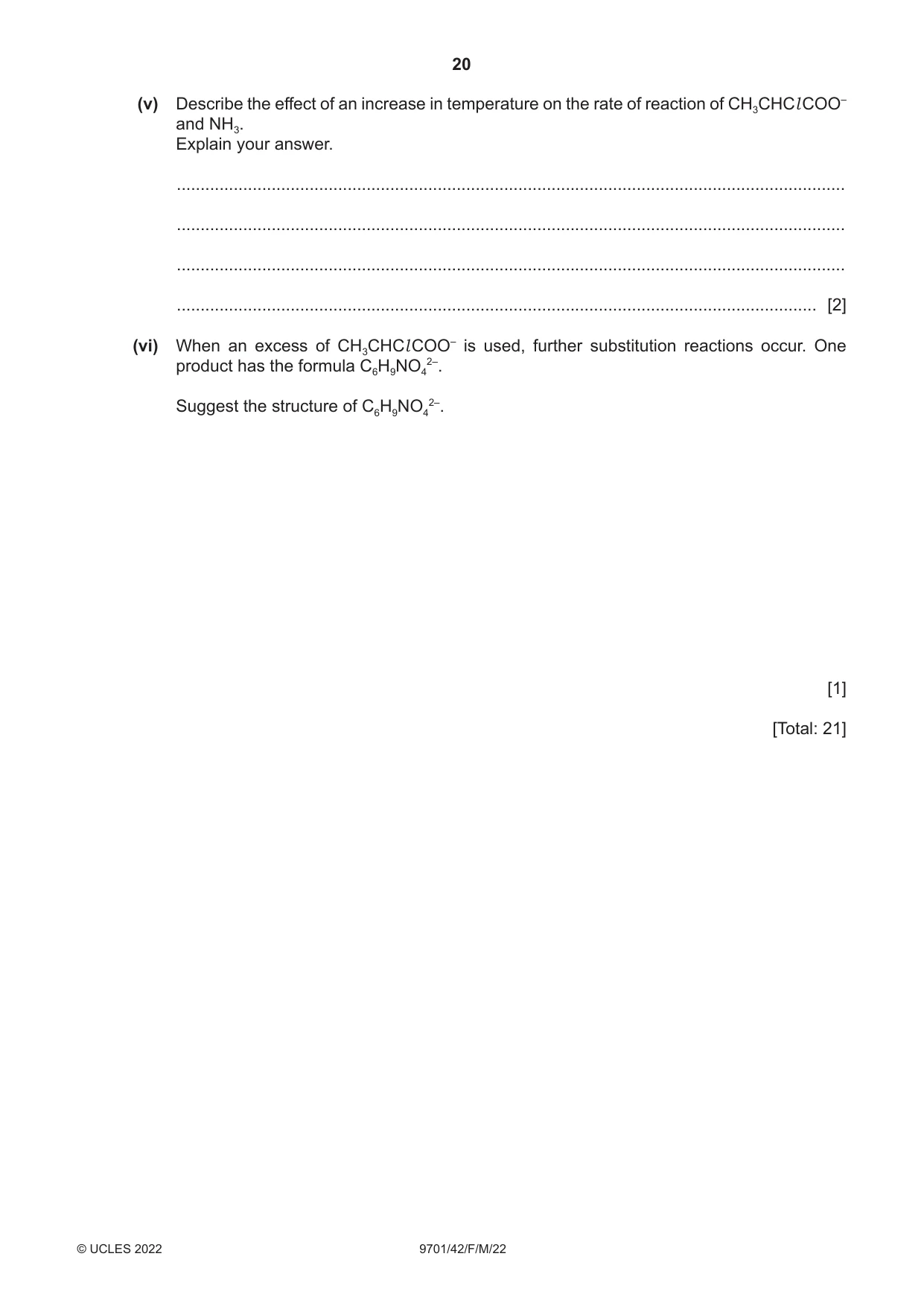
5 2-Chloropropanoic acid, CH3CHCl COOH, is used in many chemical syntheses. (a) (i) An equilibrium is set up when CH3CHCl COOH is added to water. Write the equation for this equilibrium. ....................................................................................................................................... [1] (ii) 0.150 mol of CH3CHCl COOH dissolves in 250 cm3 of distilled water to produce a solution of pH 1.51. Calculate the pKa of CH3CHCl COOH. pKa = .............................. [2] (iii) An equal concentration of aqueous propanoic acid has pH 2.55. Explain the difference in the pH of solutions of equal concentration of CH3CHCl COOH and propanoic acid. ............................................................................................................................................. ............................................................................................................................................. ............................................................................................................................................. ....................................................................................................................................... [2] (b) When CH3CHCl COOH reacts with aqueous NH3, alanine forms. alanine CH3 H2N C COOH H Fig. 5.1 Alanine is an amino acid. Its isoelectric point is 6.1. (i) State what is meant by isoelectric point. ............................................................................................................................................. ....................................................................................................................................... [1] (ii) Give the structural formula of alanine at pH 2. ....................................................................................................................................... [1] (iii) Alanine exists as a pair of optical isomers. The structure of one optical isomer is shown in Fig. 5.2. Draw the three-dimensional structure of the other optical isomer of alanine. optical isomer 1 optical isomer 2 CH3 C H H2N COOH Fig. 5.2 [1] (iv) Polymer C forms from the reaction between alanine and 4-aminobutanoic acid, H2N(CH2)3COOH. Draw a repeat unit of C. The functional group formed should be displayed. [2] (v) State the type of polymerisation shown in (b)(iv). ....................................................................................................................................... [1] (vi) Scientists are investigating C as a replacement for poly(propene) in packaging. Suggest an advantage of using C instead of poly(propene). ............................................................................................................................................. ....................................................................................................................................... [1] (c) A student studies the reaction of CH3CHCl COOH with aqueous NH3 to determine the reaction mechanism. The student finds that when CH3CHCl COOH and NH3 are added in a 1 : 1 stoichiometric ratio, the conjugate acid and base of the reactants are quickly formed. reaction 1 CH3CHCl COOH + NH3 → CH3CHCl COO– + NH4+ (i) Identify the conjugate acid–base pairs in reaction 1. conjugate acid–base pair I .............................................. and ............................................ conjugate acid–base pair II ............................................. and ............................................ [1] In an excess of NH3, CH3CHCl COO– undergoes a nucleophilic substitution reaction. reaction 2 CH3CHCl COO– + NH3 → CH3CH(NH2)COO– + H+ + Cl – A student investigates the rate of reaction 2. The student mixes CH3CHCl COO– with a large excess of NH3. The graph in Fig. 5.3 shows the results obtained. 0.0250 0.0200 0.0150 [CH3CHCl COO–] / mol dm–3 0.0100 0.0050 0.0000 0 200 400 600 800 1000 1200 1400 1600 time / s Fig. 5.3 (ii) Use the graph in Fig. 5.3 to show that reaction 2 is first order with respect to [CH3CHCl COO–]. ............................................................................................................................................. ............................................................................................................................................. ............................................................................................................................................. ....................................................................................................................................... [2] (iii) Explain why a large excess of NH3 needs to be used in order to obtain the results in Fig. 5.3. ............................................................................................................................................. ....................................................................................................................................... [1] (iv) The student measures the effect of changing the concentration of NH3 on the rate of reaction 2. Table 5.1 shows the results obtained. Table 5.1 [CH3CHCl COO–] [NH3] initial rate of reaction experiment / mol dm–3 / mol dm–3 / mol dm–3 s–1 1 0.00120 0.00300 1.47 × 10⁻⁵ 2 0.00120 0.00450 2.21 × 10⁻⁵ Use the information in Table 5.1 and in (c)(ii) to determine whether the nucleophilic substitution reaction proceeds via an SN1 or an SN2 mechanism. Explain your answer. ............................................................................................................................................. ............................................................................................................................................. ............................................................................................................................................. ....................................................................................................................................... [2] (v) Describe the effect of an increase in temperature on the rate of reaction of CH3CHCl COO– and NH3. Explain your answer. ............................................................................................................................................. ............................................................................................................................................. ............................................................................................................................................. ....................................................................................................................................... [2] (vi) When an excess of CH3CHCl COO– is used, further substitution reactions occur. One product has the formula C6H9NO42–. Suggest the structure of C6H9NO42–. [1] [Total: 21]
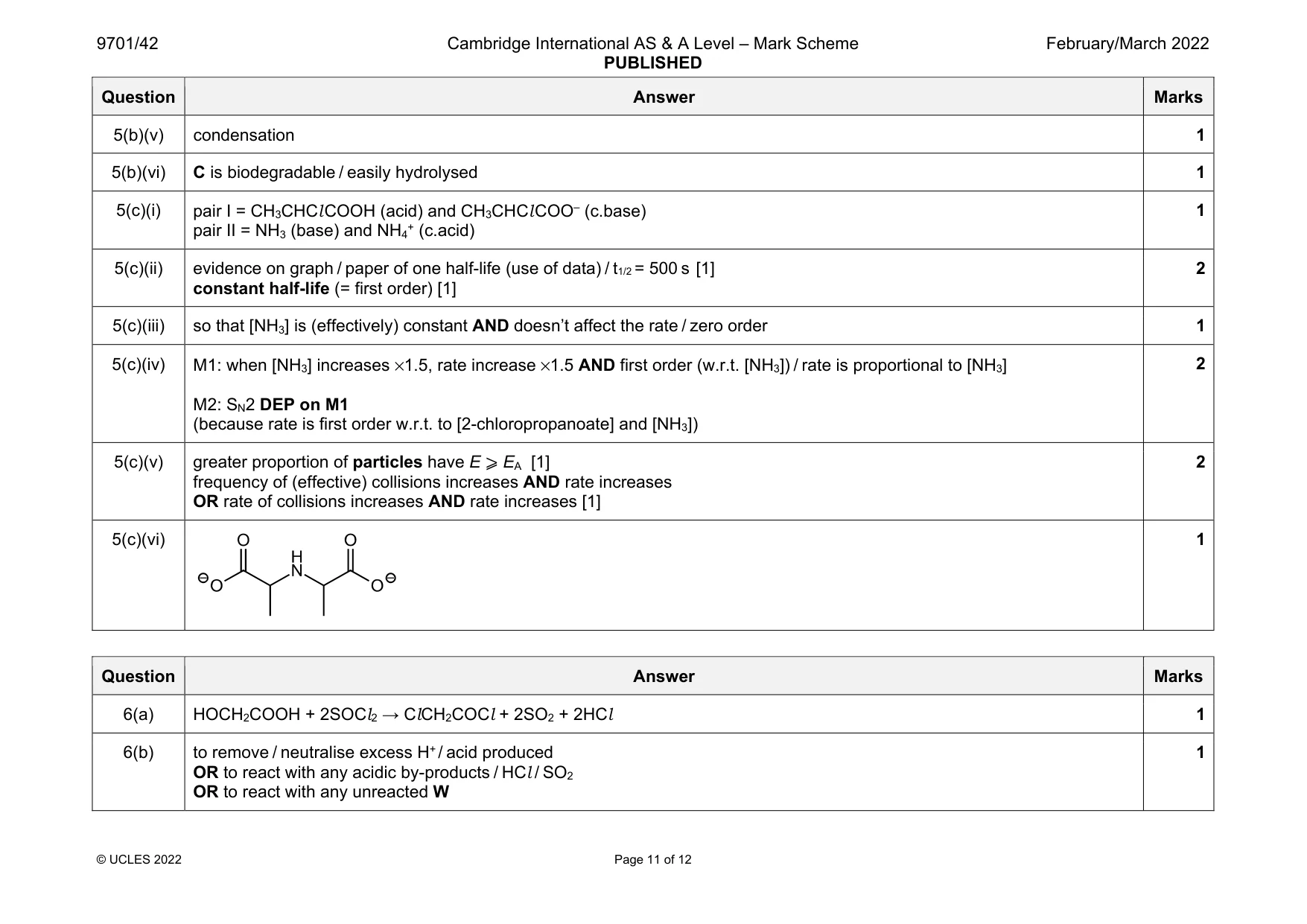
Mark scheme: 5(a)(i) OR CH3CHClCOOH ⇌ CH3CHClCOO– + H+ 1 5(a)(ii) M1: [H+] = 10–1.51 = 0.0309 (mol dm– 3) M2: Ka = 0.03092/0.60 = 1.592 × 10⁻³ ecf pKa = –log 1.592 × 10–3 = 2.80 ecf 2 5(a)(iii) CH3CHCl COOH is a stronger acid (than propanoic acid, owing to higher [H+] [1] because electron-withdrawing effect of Cl (substituent) AND weakens O—H / carboxylate anion stabilised [1] 2 5(b)(i) pH at which a molecule has no overall charge / is neutral OR pH at which it exists as a zwitterion / dipolar ion 1 5(b)(ii) CH3CH(N+H3)COOH 1 5(b)(iii) 1 5(b)(iv) middle amide group shown displayed [1] rest of structure correct [1] 2 Question Answer Marks 5(b)(v) condensation 1 5(b)(vi) C is biodegradable / easily hydrolysed 1 5(c)(i) pair I = CH3CHCl COOH (acid) and CH3CHCl COO– (c.base) pair II = NH3 (base) and NH4+ (c.acid) 1 5(c)(ii) evidence on graph / paper of one half-life (use of data) / t1/2 = 500 s [1] constant half-life (= first order) [1] 2 5(c)(iii) so that [NH3] is (effectively) constant AND doesn’t affect the rate / zero order 1 5(c)(iv) M1: when [NH3] increases ×1.5, rate increase ×1.5 AND first order (w.r.t. [NH3]) / rate is proportional to [NH3] M2: SN2 DEP on M1 (because rate is first order w.r.t. to [2-chloropropanoate] and [NH3]) 2 5(c)(v) greater proportion of particles have E ⩾ EA [1] frequency of (effective) collisions increases AND rate increases OR rate of collisions increases AND rate increases [1] 2 5(c)(vi) 1
Q6 · Lidocaine is used as an anaesthetic
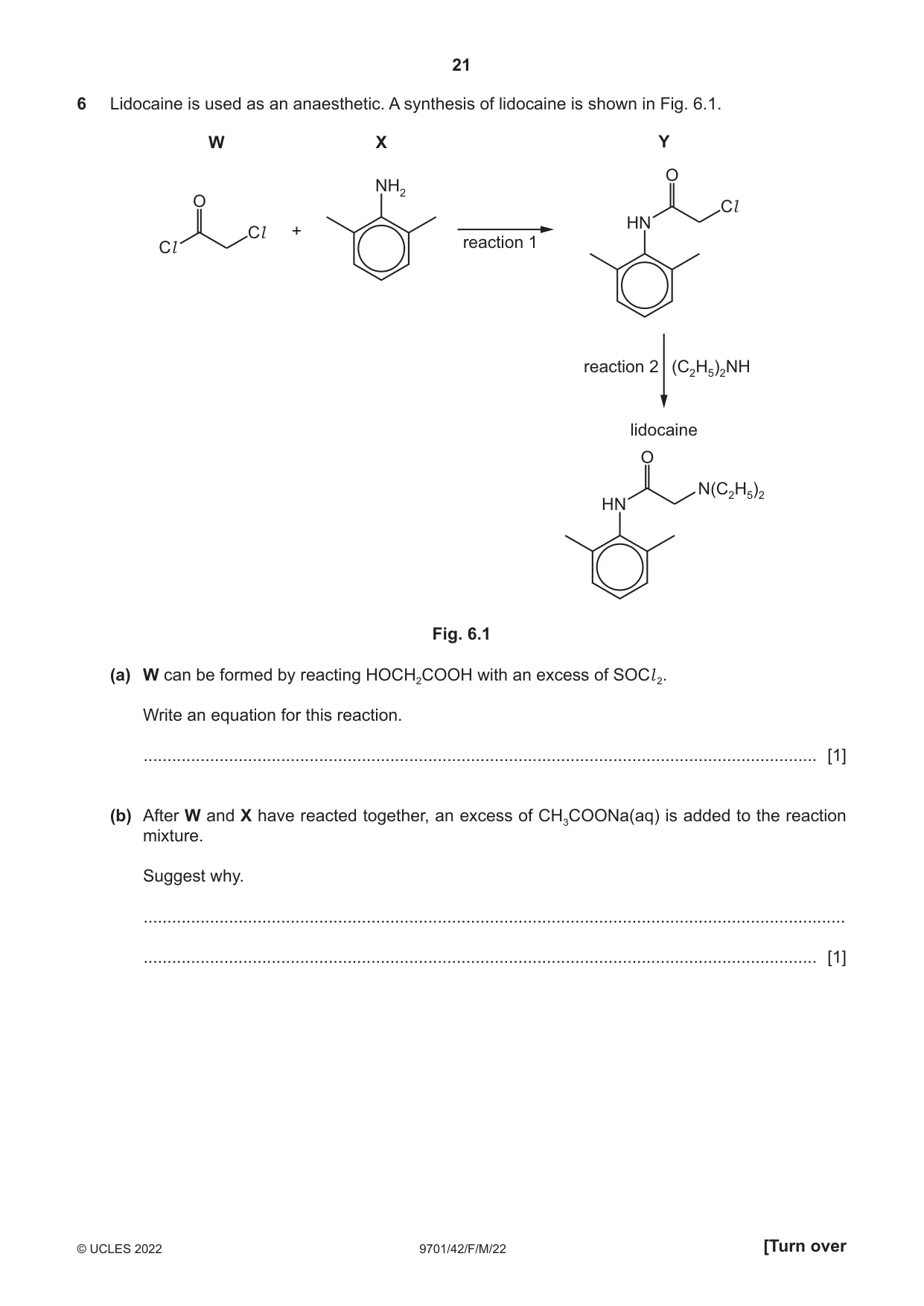
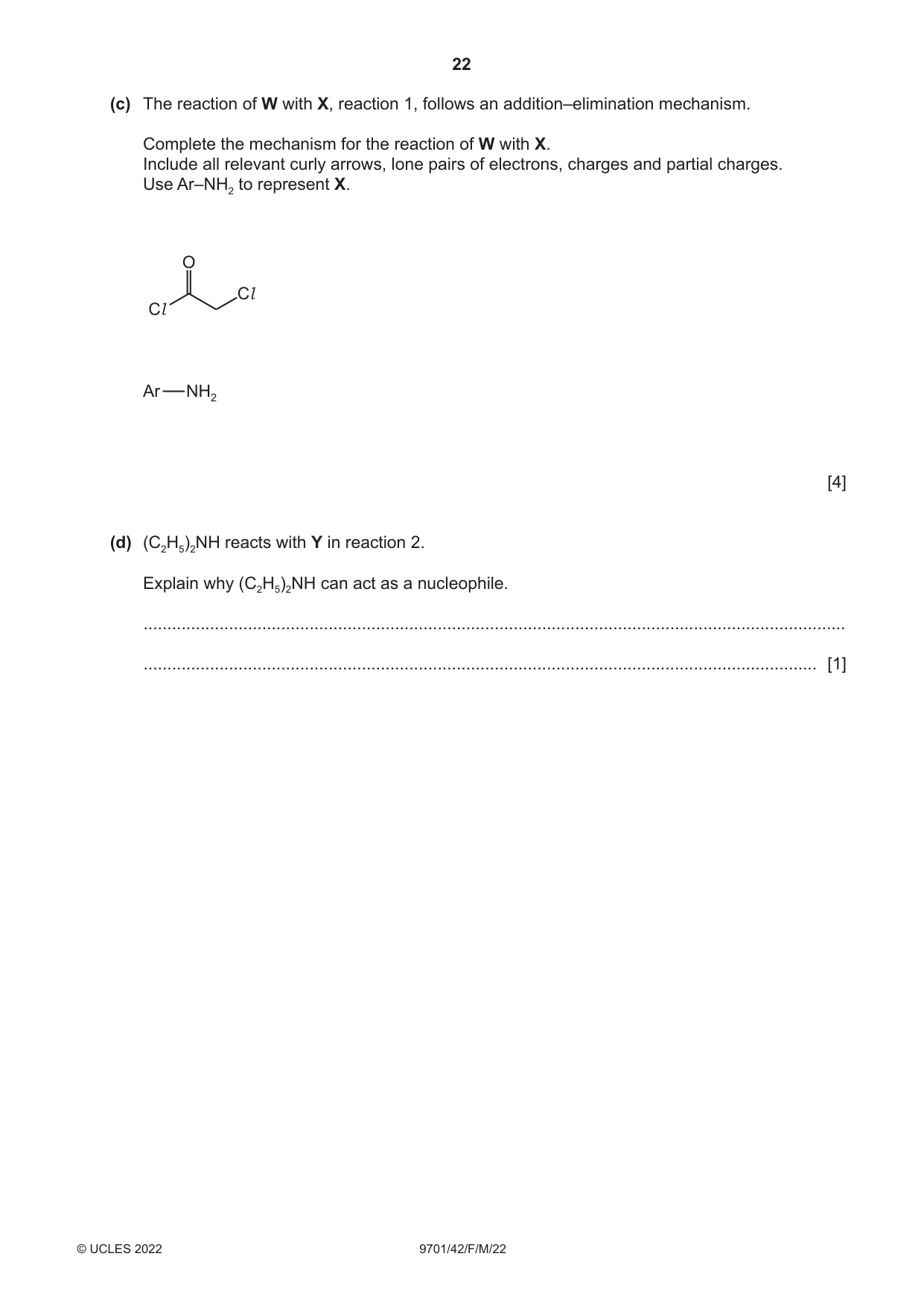
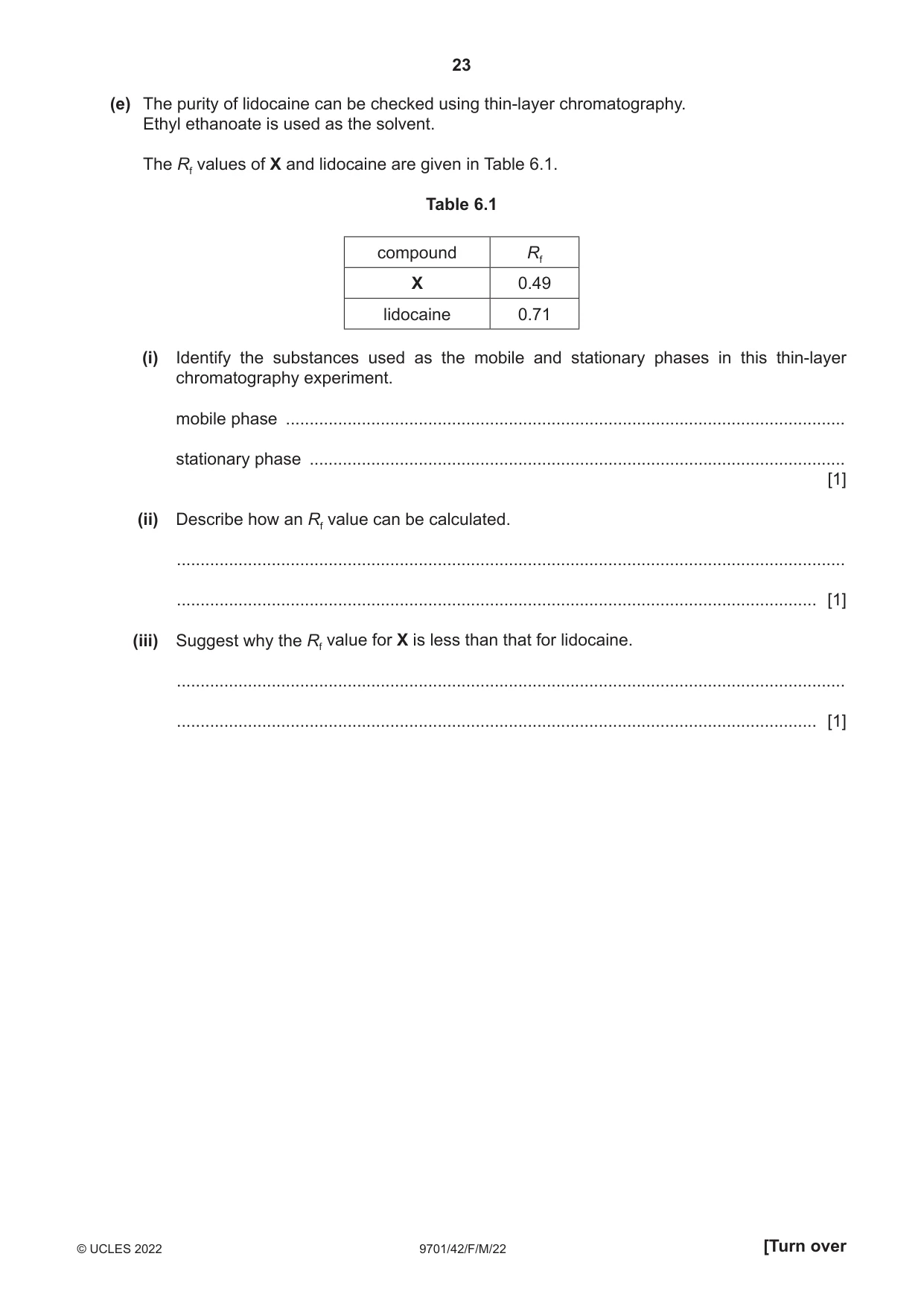
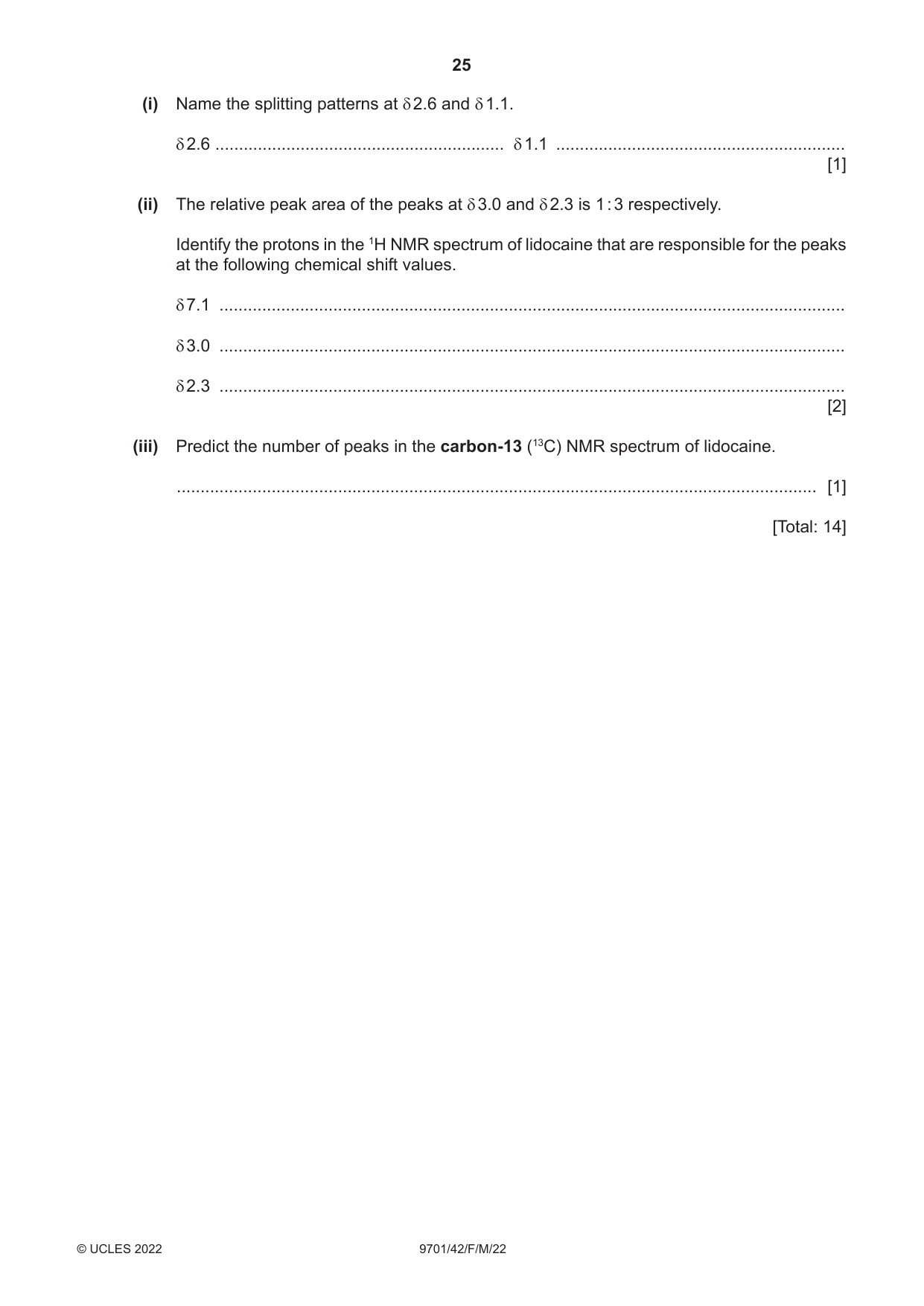
6 Lidocaine is used as an anaesthetic. A synthesis of lidocaine is shown in Fig. 6.1. W X Y O NH2 O Cl HN Cl + reaction 1 Cl reaction 2 (C2H5)2NH lidocaine O N(C2H5)2 HN Fig. 6.1 (a) W can be formed by reacting HOCH2COOH with an excess of SOCl 2. Write an equation for this reaction. .............................................................................................................................................. [1] (b) After W and X have reacted together, an excess of CH3COONa(aq) is added to the reaction mixture. Suggest why. .................................................................................................................................................... .............................................................................................................................................. [1] (c) The reaction of W with X, reaction 1, follows an addition–elimination mechanism. Complete the mechanism for the reaction of W with X. Include all relevant curly arrows, lone pairs of electrons, charges and partial charges. Use Ar–NH2 to represent X. O Cl Cl Ar NH2 [4] (d) (C2H5)2NH reacts with Y in reaction 2. Explain why (C2H5)2NH can act as a nucleophile. .................................................................................................................................................... .............................................................................................................................................. [1] (e) The purity of lidocaine can be checked using thin-layer chromatography. Ethyl ethanoate is used as the solvent. The Rf values of X and lidocaine are given in Table 6.1. Table 6.1 compound Rf X 0.49 lidocaine 0.71 (i) Identify the substances used as the mobile and stationary phases in this thin‑layer chromatography experiment. mobile phase ....................................................................................................................... stationary phase .................................................................................................................. [1] (ii) Describe how an Rf value can be calculated. ............................................................................................................................................. ....................................................................................................................................... [1] (iii) Suggest why the Rf value for X is less than that for lidocaine. ............................................................................................................................................. ....................................................................................................................................... [1]
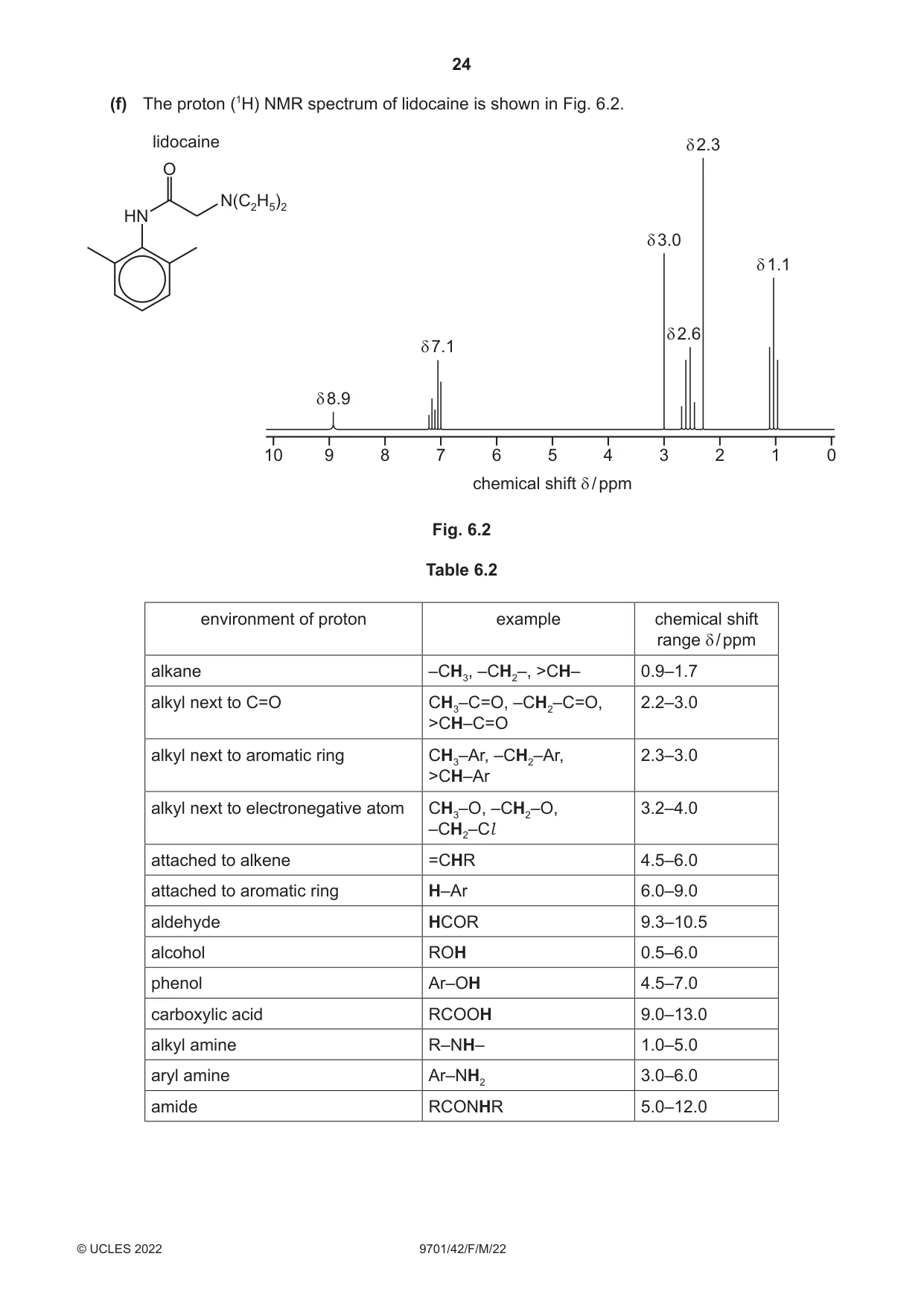
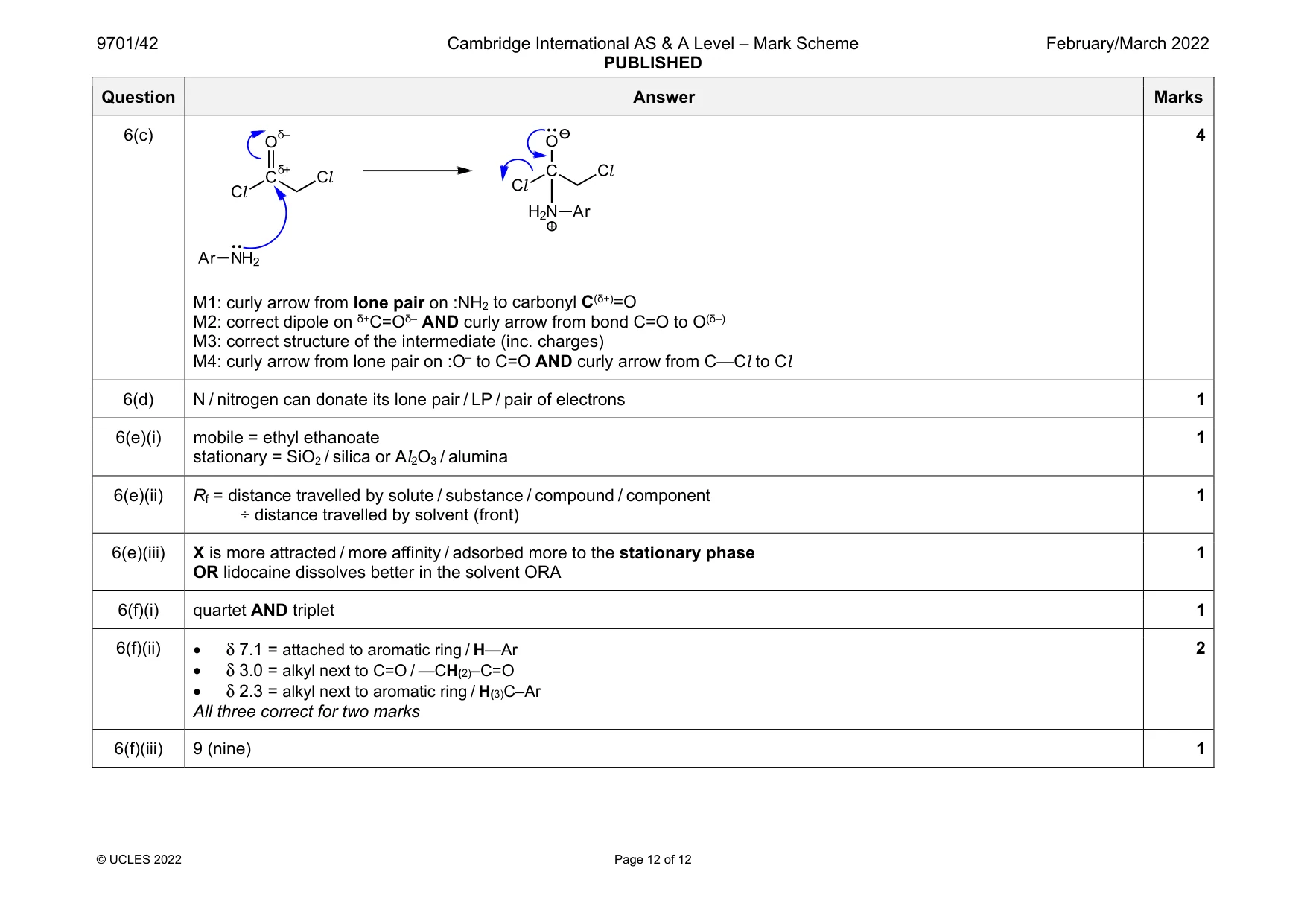
Mark scheme: 6(a) 6(b) to remove / neutralise excess H+ / acid produced OR to react with any acidic by-products / HCl / SO2 OR to react with any unreacted W 1 Question Answer Marks 6(c) M1: curly arrow from lone pair on :NH2 to carbonyl C(δ+)=O M2: correct dipole on δ+C=Oδ– AND curly arrow from bond C=O to O(δ–) M3: correct structure of the intermediate (inc. charges) M4: curly arrow from lone pair on :O– to C=O AND curly arrow from C—Cl to Cl 4 6(d) N / nitrogen can donate its lone pair / LP / pair of electrons 1 6(e)(i) mobile = ethyl ethanoate stationary = SiO2 / silica or Al2O3 / alumina 1 6(e)(ii) Rf = distance travelled by solute / substance / compound / component ÷ distance travelled by solvent (front) 1 6(e)(iii) X is more attracted / more affinity / adsorbed more to the stationary phase OR lidocaine dissolves better in the solvent ORA 1 6(f)(i) quartet AND triplet 1 6(f)(ii) • δ 7.1 = attached to aromatic ring / H—Ar • δ 3.0 = alkyl next to C=O / —CH(2)–C=O • δ 2.3 = alkyl next to aromatic ring / H(3)C–Ar All three correct for two marks 2 6(f)(iii) 9 (nine) 1
What was in this paper
The subtopics covered by these 6 questions, and how many questions each got. Open one in a new tab to see every Cambridge question on it.
What you needed in this session
Cambridge’s own grade thresholds for 2022 Feb/March, Paper 4 · Variant 2. A higher threshold means an easier paper — the bar moves with how the cohort did.