Cambridge A Level Chemistry 9701 — 2020 Oct/Nov Paper 5 · Variant 3
9701/53/O/N/20 · 2 questions · 30 marks · ≈34 min
The question paper and its mark scheme, free to read here and free to download. This is Cambridge’s own paper, exactly as it was sat.
Question paper12 pages



Mark scheme8 pages
Answers below. Sit the paper first if you are practising.
Questions as text
Q1 · Aqueous potassium manganate(VII) can be used to determine the amount of iron present in a…
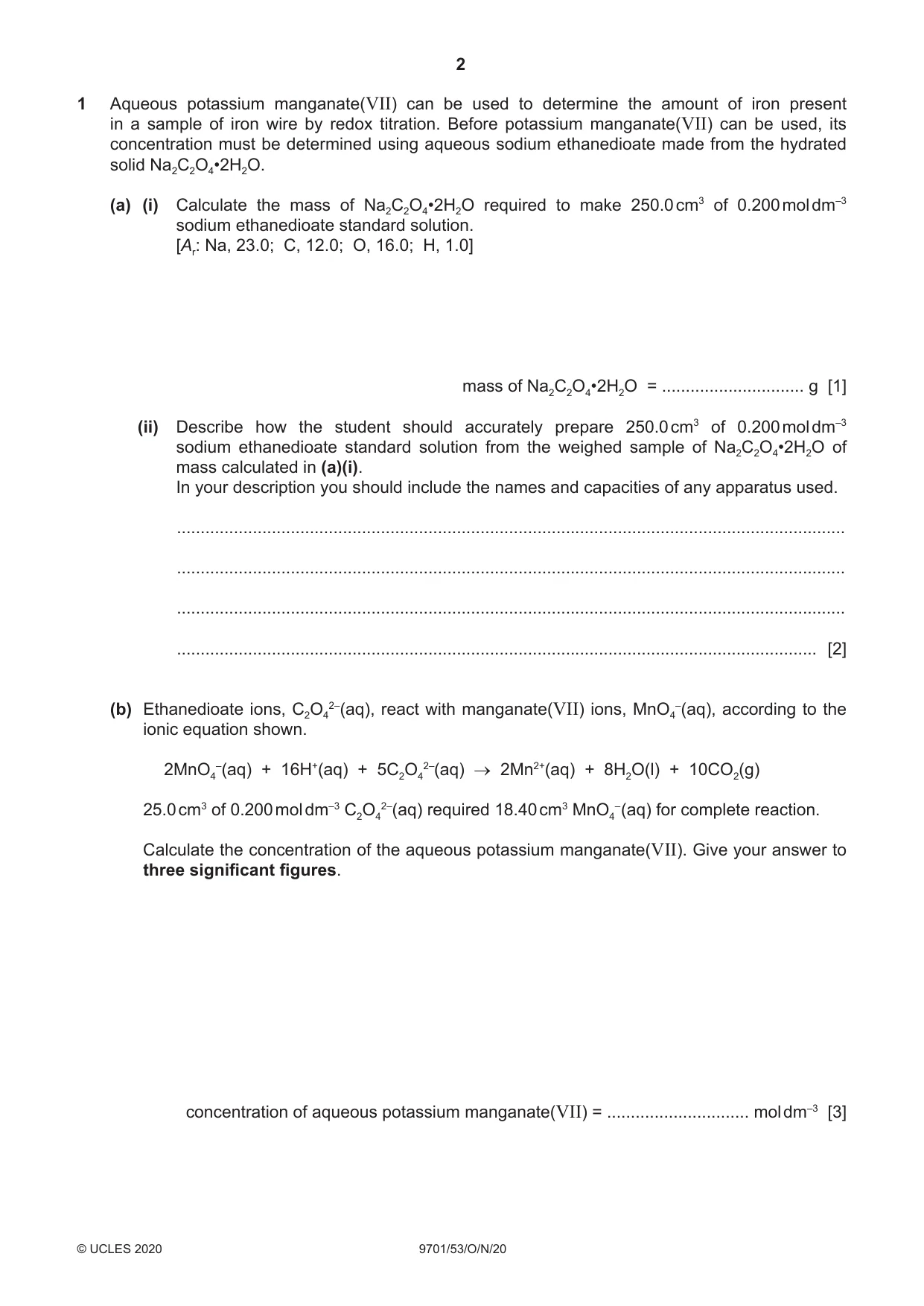
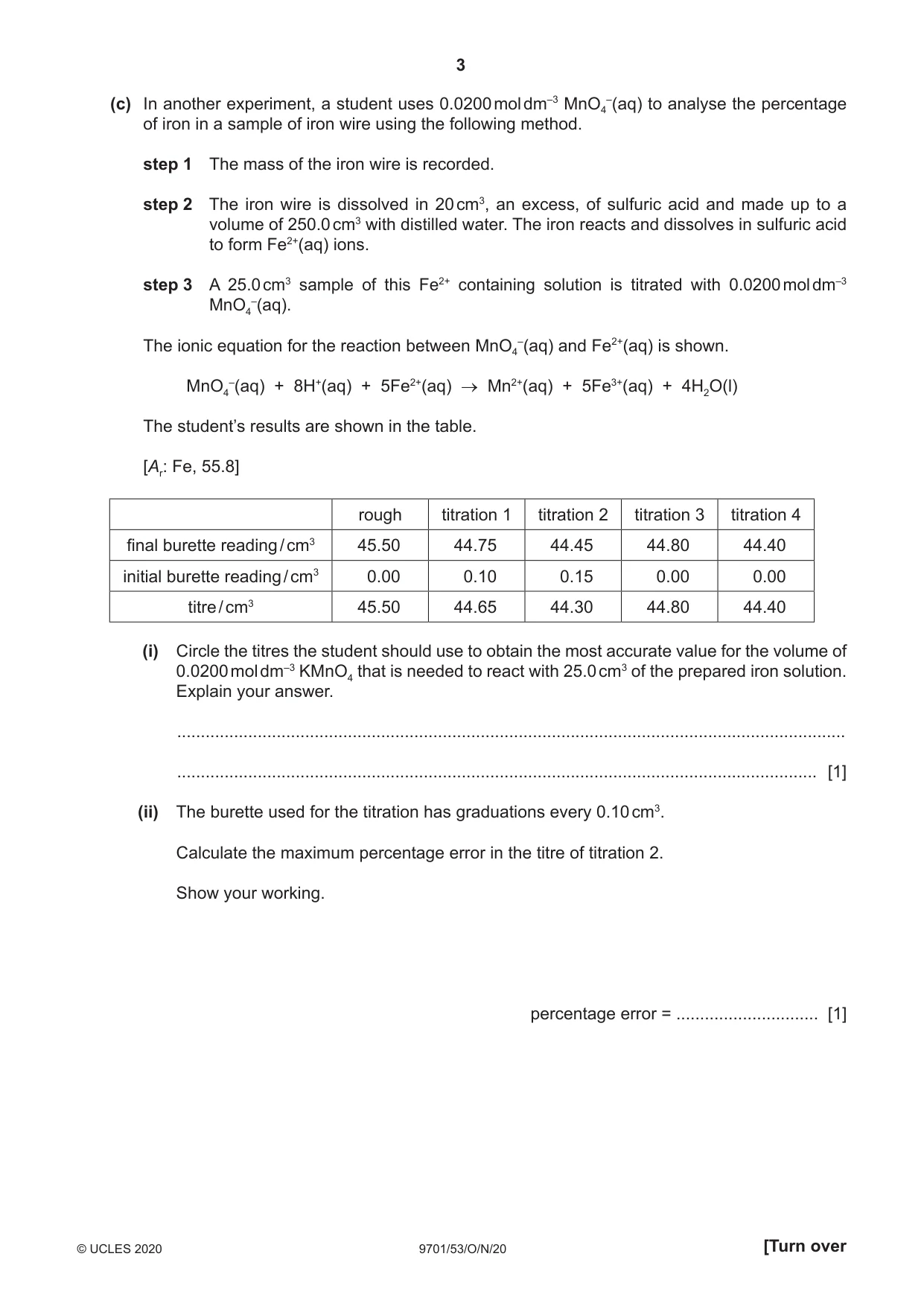
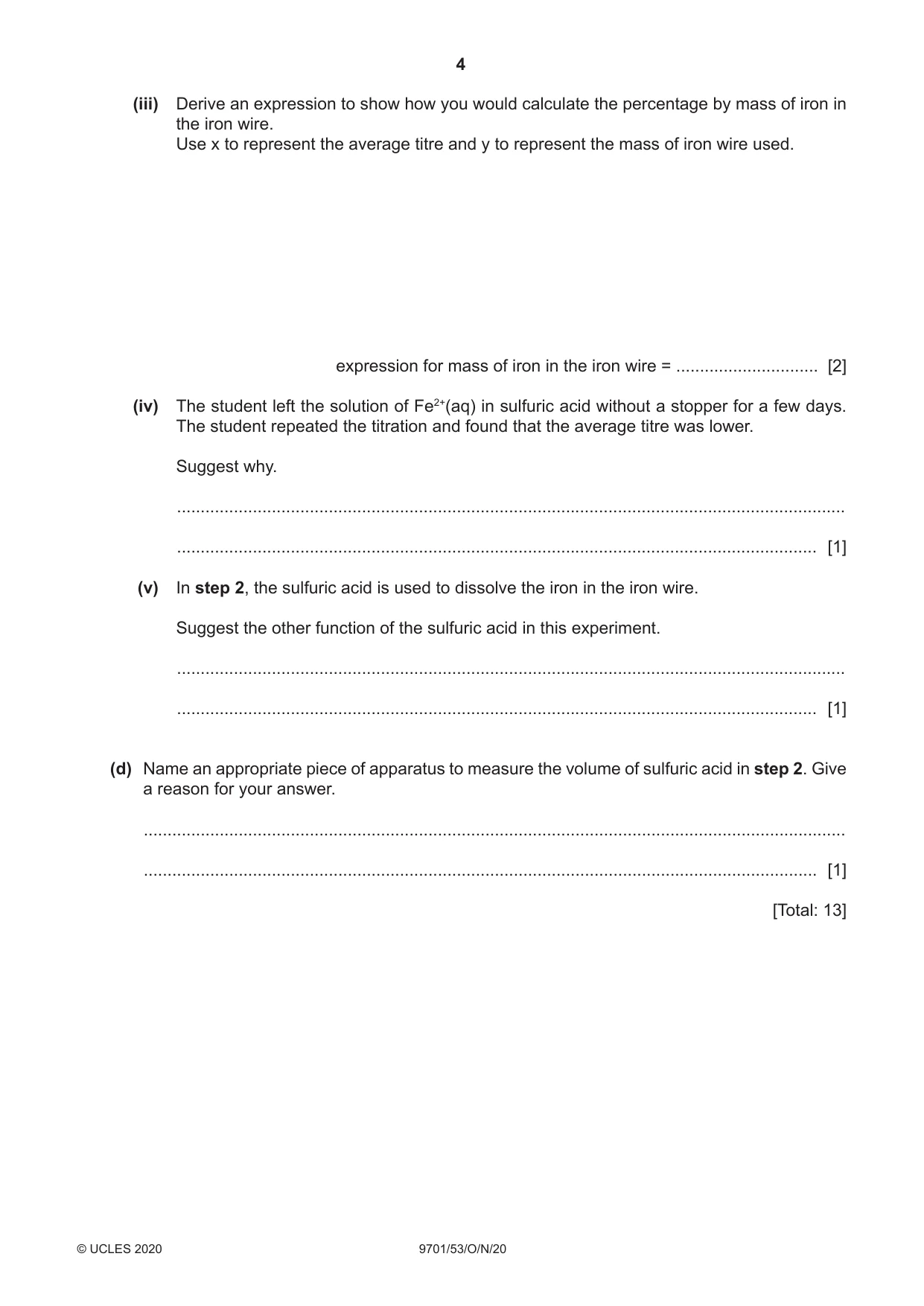
1 Aqueous potassium manganate(VII) can be used to determine the amount of iron present in a sample of iron wire by redox titration. Before potassium manganate(VII) can be used, its concentration must be determined using aqueous sodium ethanedioate made from the hydrated solid Na2C2O4•2H2O. (a) (i) Calculate the mass of Na2C2O4•2H2O required to make 250.0 cm3 of 0.200 mol dm–3 sodium ethanedioate standard solution. [Ar: Na, 23.0; C, 12.0; O, 16.0; H, 1.0] mass of Na2C2O4•2H2O = .............................. g [1] (ii) Describe how the student should accurately prepare 250.0 cm3 of 0.200 mol dm–3 sodium ethanedioate standard solution from the weighed sample of Na2C2O4•2H2O of mass calculated in (a)(i). In your description you should include the names and capacities of any apparatus used. ............................................................................................................................................. ............................................................................................................................................. ............................................................................................................................................. ....................................................................................................................................... [2] (b) Ethanedioate ions, C2O42–(aq), react with manganate(VII) ions, MnO4–(aq), according to the ionic equation shown. 2MnO4–(aq) + 16H+(aq) + 5C2O42–(aq) → 2Mn2+(aq) + 8H2O(l) + 10CO2(g) 25.0 cm3 of 0.200 mol dm–3 C2O42–(aq) required 18.40 cm3 MnO4–(aq) for complete reaction. Calculate the concentration of the aqueous potassium manganate(VII). Give your answer to three significant figures. concentration of aqueous potassium manganate(VII) = .............................. mol dm–3 [3] (c) In another experiment, a student uses 0.0200 mol dm–3 MnO4–(aq) to analyse the percentage of iron in a sample of iron wire using the following method. step 1 The mass of the iron wire is recorded. step 2 The iron wire is dissolved in 20 cm3, an excess, of sulfuric acid and made up to a volume of 250.0 cm3 with distilled water. The iron reacts and dissolves in sulfuric acid to form Fe2+(aq) ions. step 3 A 25.0 cm3 sample of this Fe2+ containing solution is titrated with 0.0200 mol dm–3 MnO4–(aq). The ionic equation for the reaction between MnO4–(aq) and Fe2+(aq) is shown. MnO4–(aq) + 8H+(aq) + 5Fe2+(aq) → Mn2+(aq) + 5Fe3+(aq) + 4H2O(l) The student’s results are shown in the table. [Ar: Fe, 55.8] rough titration 1 titration 2 titration 3 titration 4 final burette reading / cm3 45.50 44.75 44.45 44.80 44.40 initial burette reading / cm3 0.00 0.10 0.15 0.00 0.00 titre / cm3 45.50 44.65 44.30 44.80 44.40 (i) Circle the titres the student should use to obtain the most accurate value for the volume of 0.0200 mol dm–3 KMnO4 that is needed to react with 25.0 cm3 of the prepared iron solution. Explain your answer. ............................................................................................................................................. ....................................................................................................................................... [1] (ii) The burette used for the titration has graduations every 0.10 cm3. Calculate the maximum percentage error in the titre of titration 2. Show your working. percentage error = .............................. [1] (iii) Derive an expression to show how you would calculate the percentage by mass of iron in the iron wire. Use x to represent the average titre and y to represent the mass of iron wire used. expression for mass of iron in the iron wire = .............................. [2] (iv) The student left the solution of Fe2+(aq) in sulfuric acid without a stopper for a few days. The student repeated the titration and found that the average titre was lower. Suggest why. ............................................................................................................................................. ....................................................................................................................................... [1] (v) In step 2, the sulfuric acid is used to dissolve the iron in the iron wire. Suggest the other function of the sulfuric acid in this experiment. ............................................................................................................................................. ....................................................................................................................................... [1] (d) Name an appropriate piece of apparatus to measure the volume of sulfuric acid in step 2. Give a reason for your answer. .................................................................................................................................................... .............................................................................................................................................. [1] [Total: 13] Question 2 starts on the next page.
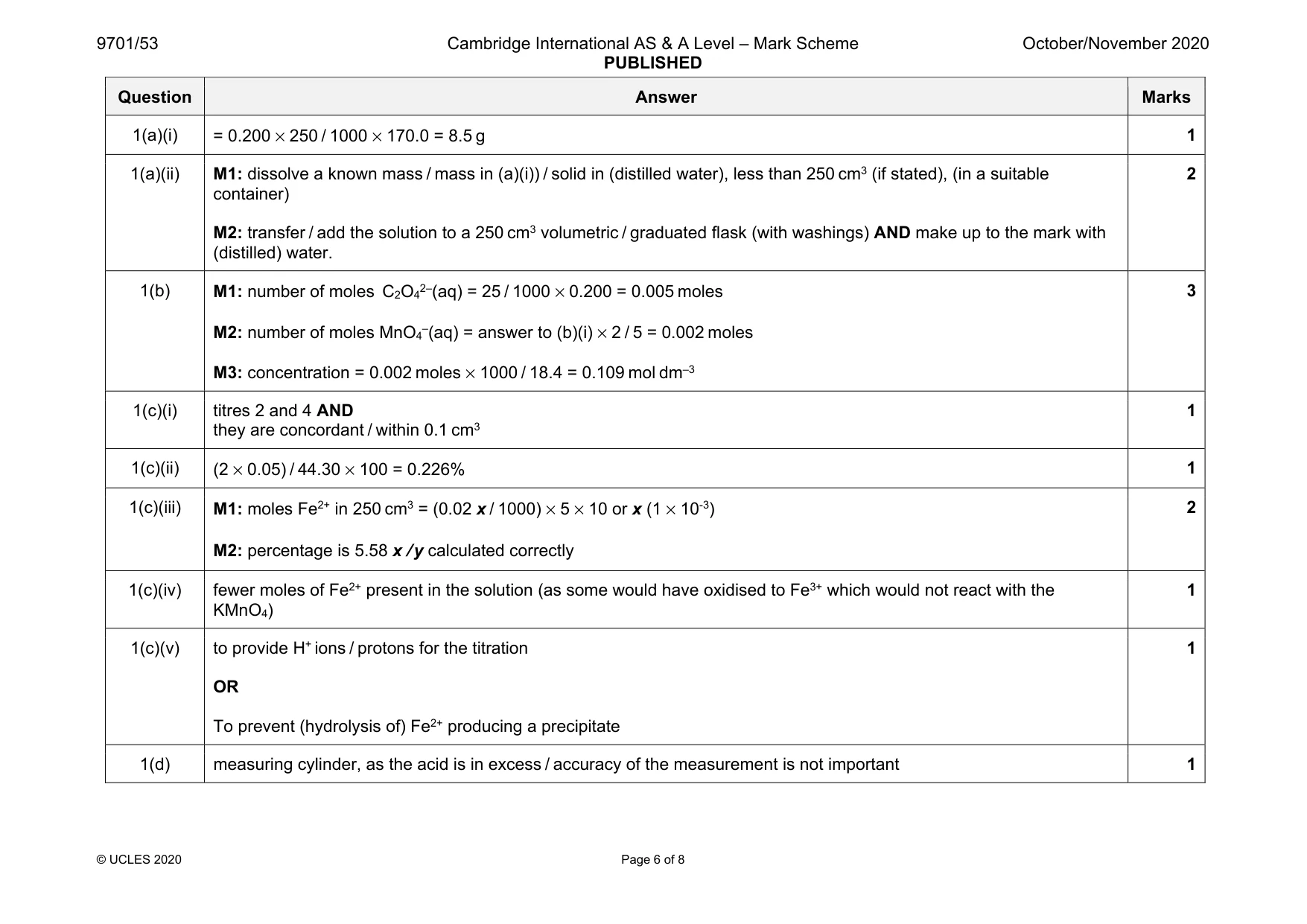
Mark scheme: 1(a)(i) = 0.200 × 250 / 1000 × 170.0 = 8.5 g 1 1(a)(ii) M1: dissolve a known mass / mass in (a)(i)) / solid in (distilled water), less than 250 cm3 (if stated), (in a suitable container) M2: transfer / add the solution to a 250 cm3 volumetric / graduated flask (with washings) AND make up to the mark with (distilled) water. 2 1(b) M1: number of moles C2O42–(aq) = 25 / 1000 × 0.200 = 0.005 moles M2: number of moles MnO4–(aq) = answer to (b)(i) × 2 / 5 = 0.002 moles M3: concentration = 0.002 moles × 1000 / 18.4 = 0.109 mol dm–3 3 1(c)(i) titres 2 and 4 AND they are concordant / within 0.1 cm3 1 1(c)(ii) (2 × 0.05) / 44.30 × 100 = 0.226% 1 1(c)(iii) M1: moles Fe2+ in 250 cm3 = (0.02 x / 1000) × 5 × 10 or x (1 × 10-3) M2: percentage is 5.58 x / y calculated correctly 2 1(c)(iv) fewer moles of Fe2+ present in the solution (as some would have oxidised to Fe3+ which would not react with the KMnO4) 1 1(c)(v) to provide H+ ions / protons for the titration OR To prevent (hydrolysis of) Fe2+ producing a precipitate 1 1(d) measuring cylinder, as the acid is in excess / accuracy of the measurement is not important 1
More questions on Reacting masses and volumes (of solutions and gases)
Q2 · A student uses the apparatus shown to calculate the relative molecular mass, Mr, of a…
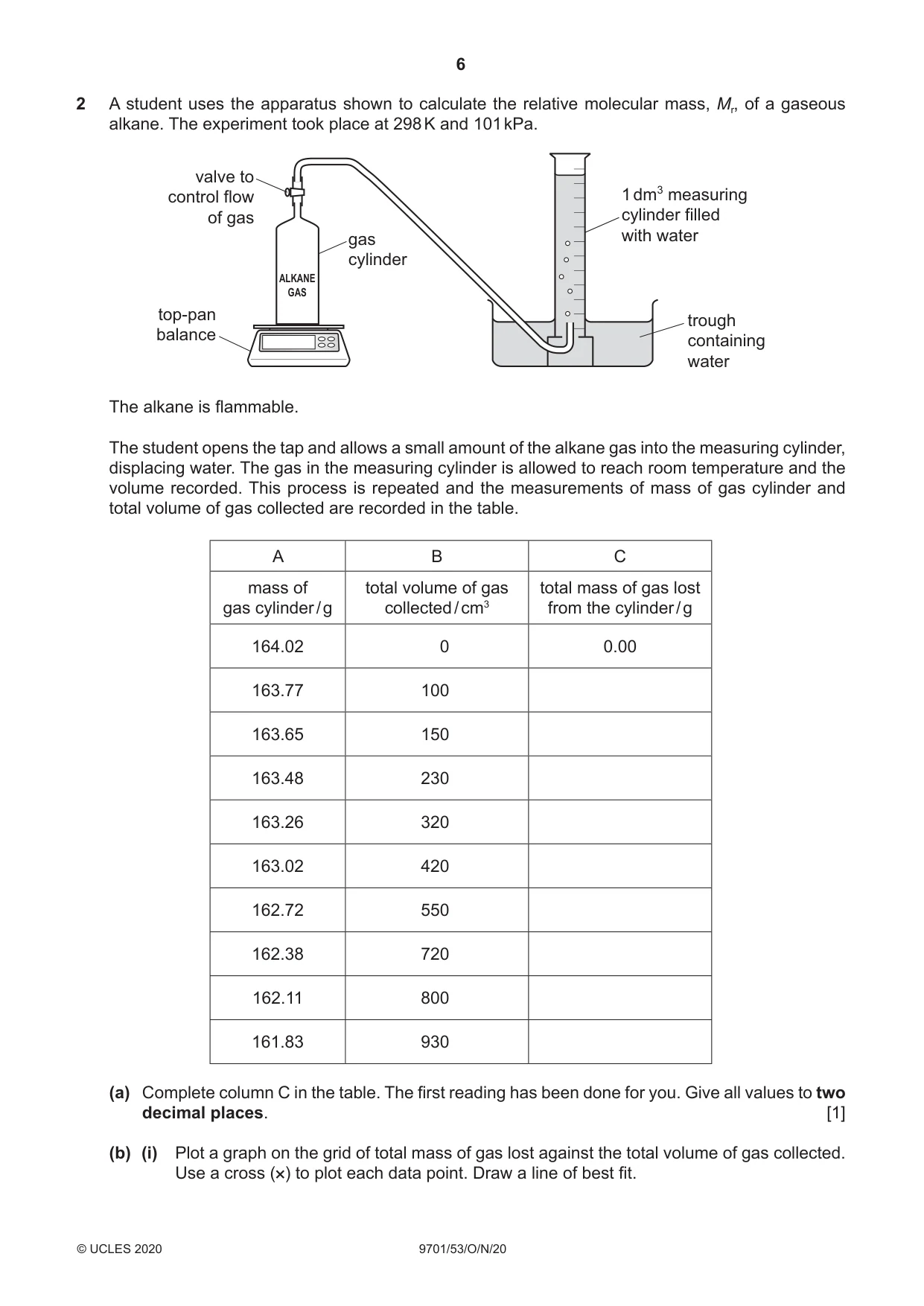
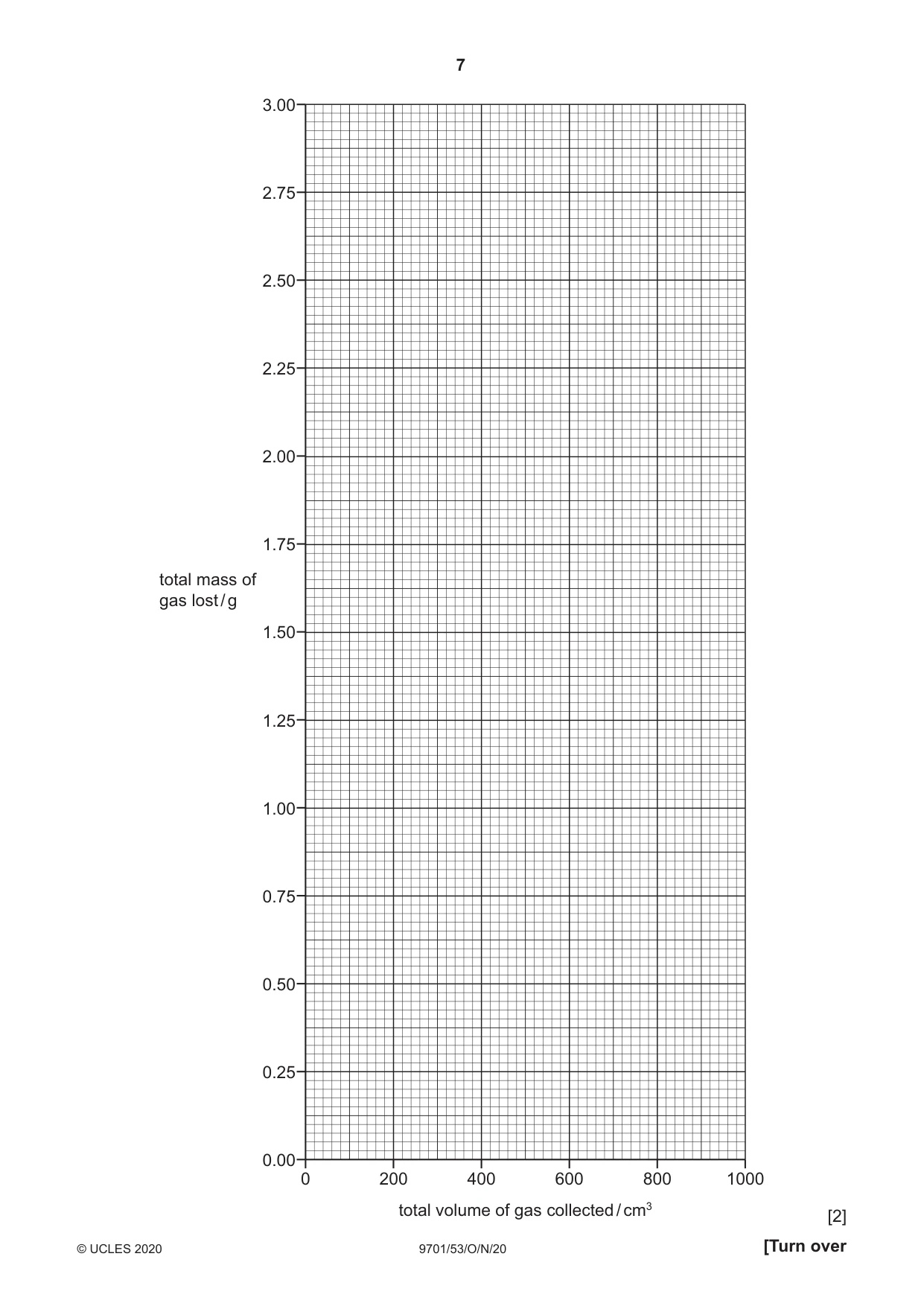
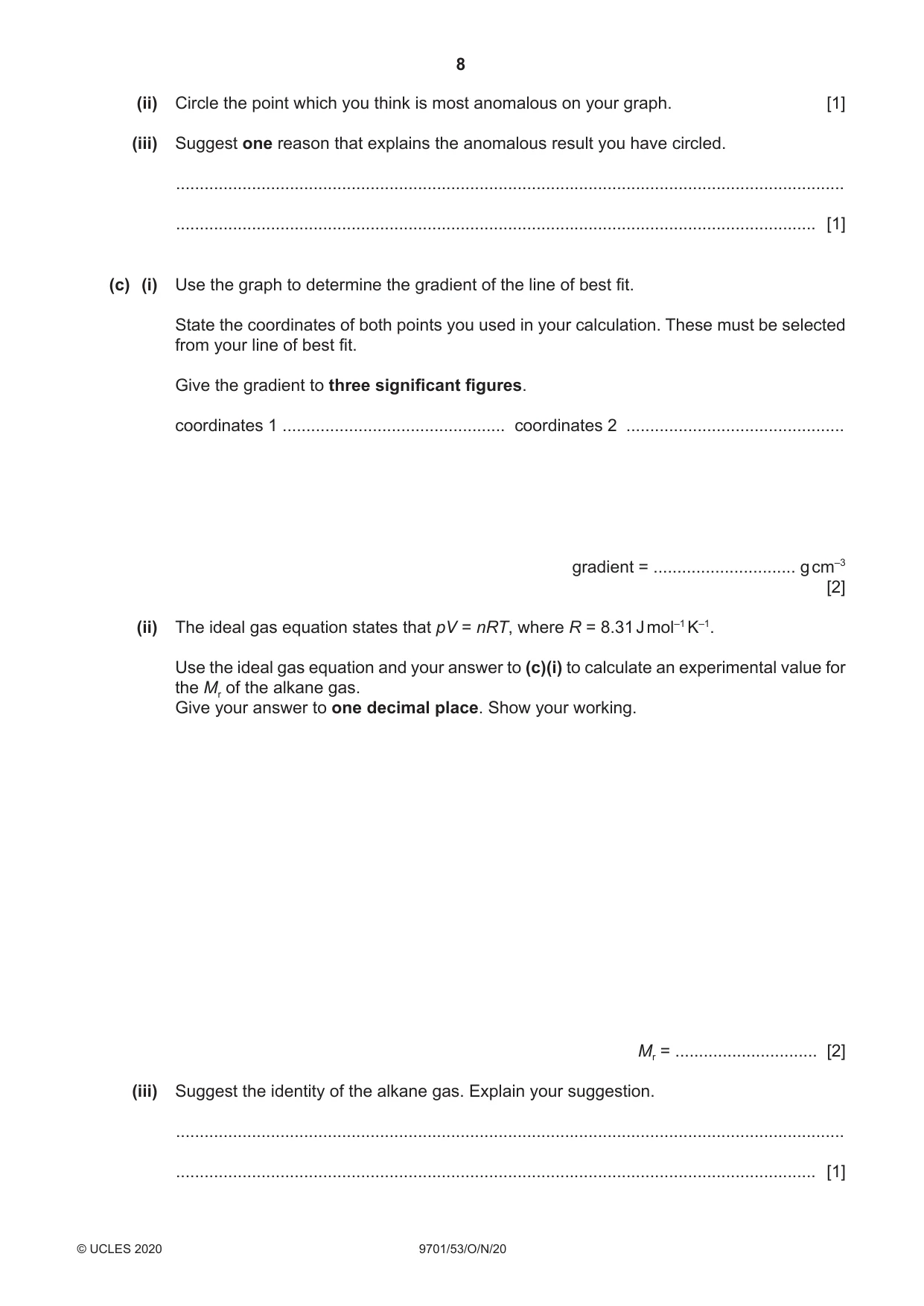
2 A student uses the apparatus shown to calculate the relative molecular mass, Mr, of a gaseous alkane. The experiment took place at 298 K and 101 kPa. valve to control flow 1 dm3 measuring of gas cylinder filled gas with water cylinder ALKANE GAS top-pan trough balance containing water The alkane is flammable. The student opens the tap and allows a small amount of the alkane gas into the measuring cylinder, displacing water. The gas in the measuring cylinder is allowed to reach room temperature and the volume recorded. This process is repeated and the measurements of mass of gas cylinder and total volume of gas collected are recorded in the table. A B C mass of total volume of gas total mass of gas lost gas cylinder / g collected / cm3 from the cylinder / g 164.02 0 0.00 163.77 100 163.65 150 163.48 230 163.26 320 163.02 420 162.72 550 162.38 720 162.11 800 161.83 930 (a) Complete column C in the table. The first reading has been done for you. Give all values to two decimal places. [1] (b) (i) Plot a graph on the grid of total mass of gas lost against the total volume of gas collected. Use a cross (×) to plot each data point. Draw a line of best fit. 400 olume of (ii) Circle the point which you think is most anomalous on your graph. [1] (iii) Suggest one reason that explains the anomalous result you have circled. ............................................................................................................................................. ....................................................................................................................................... [1] (c) (i) Use the graph to determine the gradient of the line of best fit. State the coordinates of both points you used in your calculation. These must be selected from your line of best fit. Give the gradient to three significant figures. coordinates 1 ............................................... coordinates 2 ............................................... gradient = .............................. g cm–3 [2] (ii) The ideal gas equation states that pV = nRT, where R = 8.31 J mol–1 K–1. Use the ideal gas equation and your answer to (c)(i) to calculate an experimental value for the Mr of the alkane gas. Give your answer to one decimal place. Show your working. Mr = .............................. [2] (iii) Suggest the identity of the alkane gas. Explain your suggestion. ............................................................................................................................................. ....................................................................................................................................... [1]
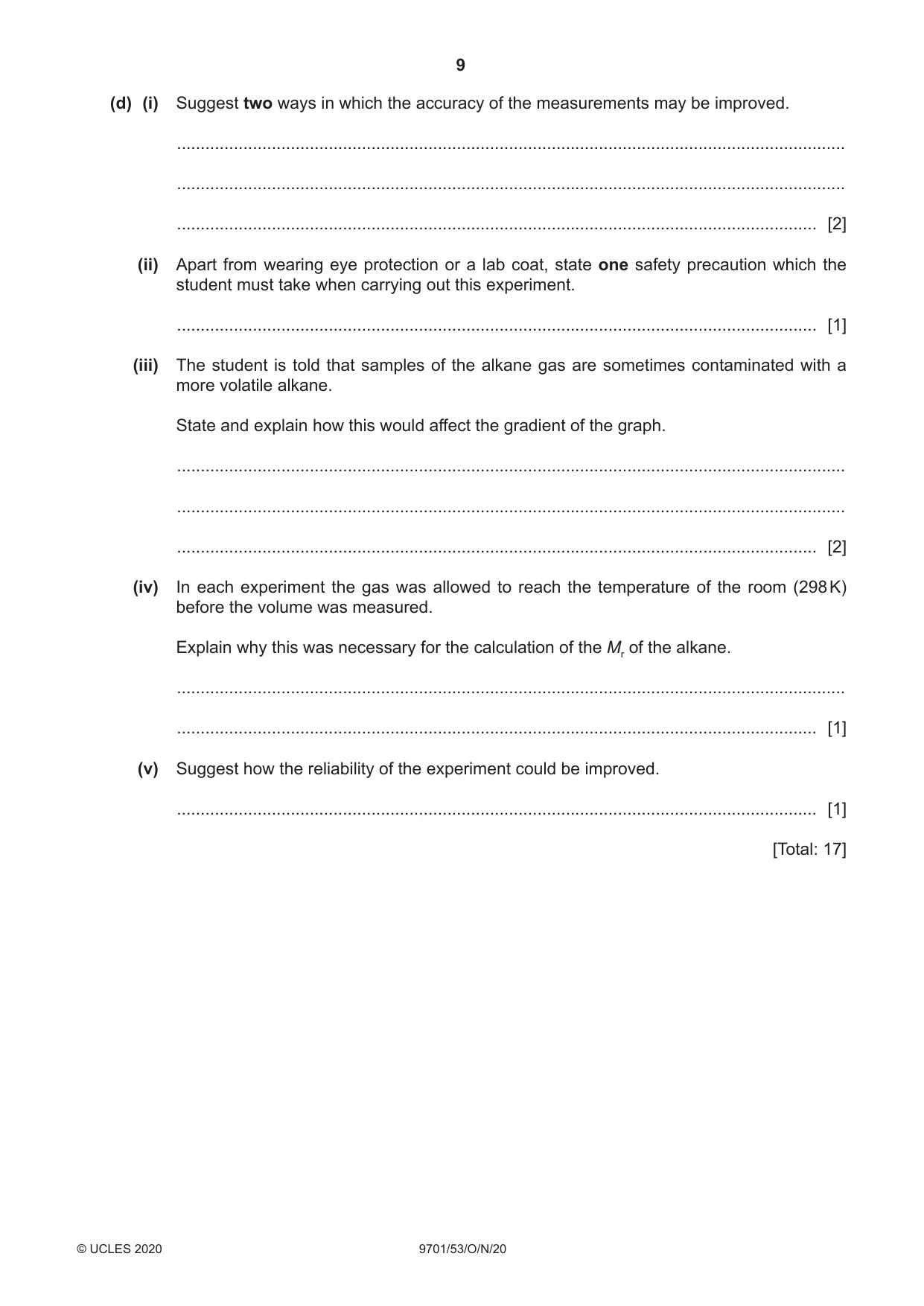
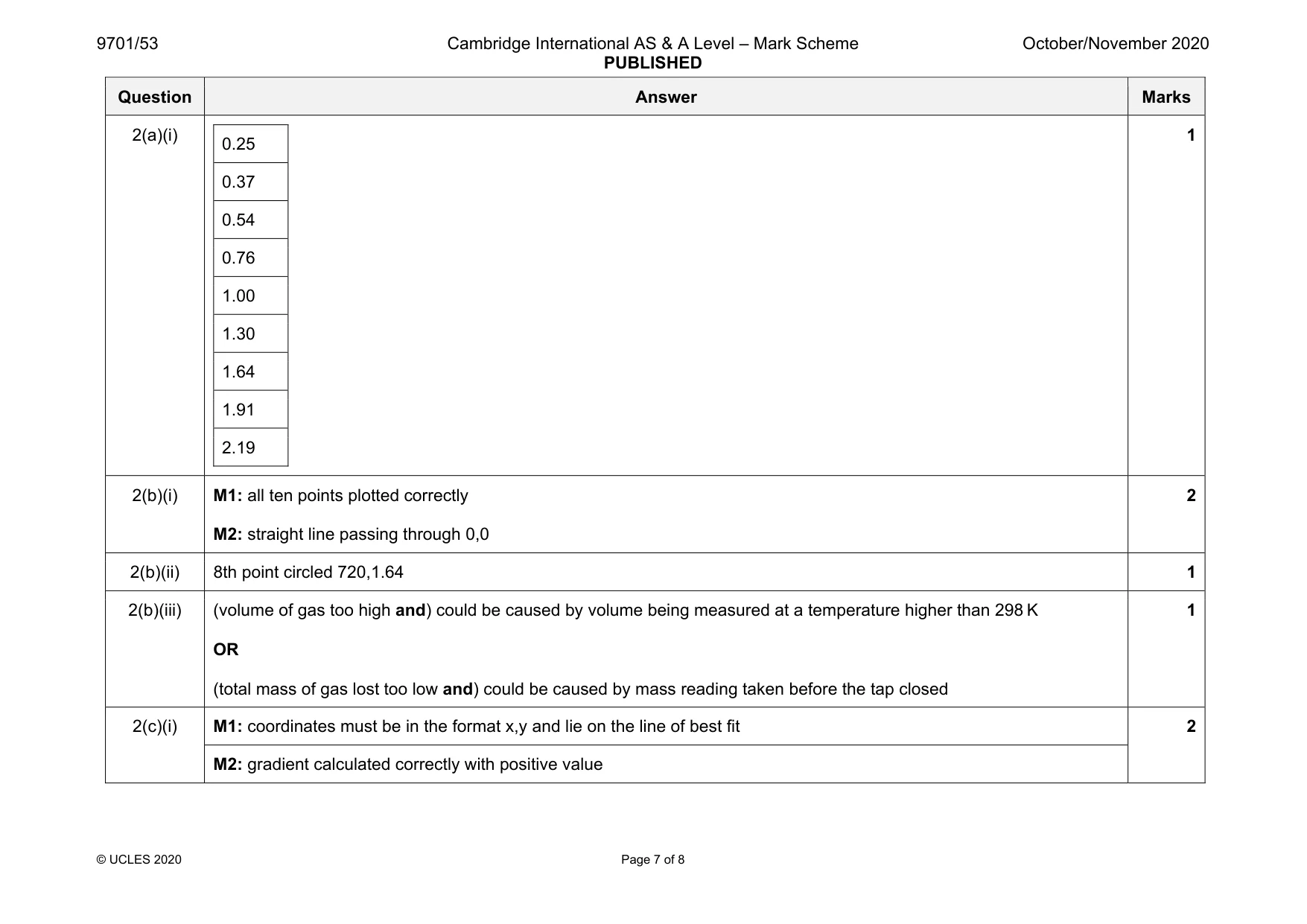
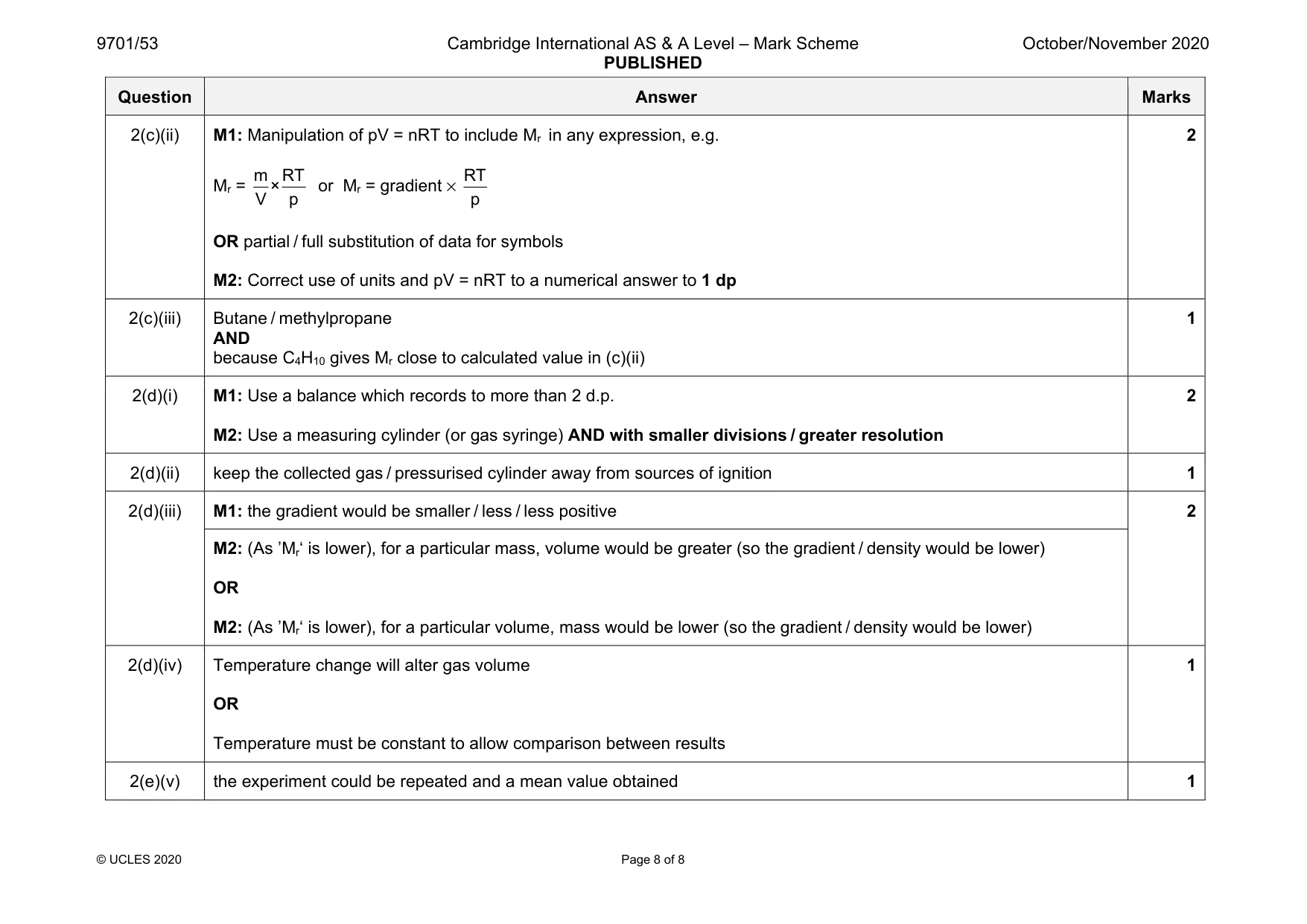
Mark scheme: 2(a)(i) 0.25 0.37 0.54 0.76 1.00 1.30 1.64 1.91 2.19 1 2(b)(i) M1: all ten points plotted correctly M2: straight line passing through 0,0 2 2(b)(ii) 8th point circled 720,1.64 1 2(b)(iii) (volume of gas too high and) could be caused by volume being measured at a temperature higher than 298 K OR (total mass of gas lost too low and) could be caused by mass reading taken before the tap closed 1 2(c)(i) M1: coordinates must be in the format x,y and lie on the line of best fit 2 M2: gradient calculated correctly with positive value Question Answer Marks 2(c)(ii) M1: Manipulation of pV = nRT to include Mr in any expression, e.g. Mr = m RT × V p or Mr = gradient × RT p OR partial / full substitution of data for symbols M2: Correct use of units and pV = nRT to a numerical answer to 1 dp 2 2(c)(iii) Butane / methylpropane AND because C4H10 gives Mr close to calculated value in (c)(ii) 1 2(d)(i) M1: Use a balance which records to more than 2 d.p. M2: Use a measuring cylinder (or gas syringe) AND with smaller divisions / greater resolution 2 2(d)(ii) keep the collected gas / pressurised cylinder away from sources of ignition 1 2(d)(iii) M1: the gradient would be smaller / less / less positive 2 M2: (As ’Mr‘ is lower), for a particular mass, volume would be greater (so the gradient / density would be lower) OR M2: (As ’Mr‘ is lower), for a particular volume, mass would be lower (so the gradient / density would be lower) 2(d)(iv) Temperature change will alter gas volume OR Temperature must be constant to allow comparison between results 1 2(e)(v) the experiment could be repeated and a mean value obtained 1
More questions on Reacting masses and volumes (of solutions and gases)
What was in this paper
The subtopics covered by these 2 questions, and how many questions each got. Open one in a new tab to see every Cambridge question on it.
What you needed in this session
Cambridge’s own grade thresholds for 2020 Oct/Nov, Paper 5 · Variant 3. A higher threshold means an easier paper — the bar moves with how the cohort did.