Cambridge A Level Chemistry 9701 — 2020 Oct/Nov Paper 3 · Variant 3
9701/33/O/N/20 · 2 questions · 40 marks · ≈45 min
The question paper and its mark scheme, free to read here and free to download. This is Cambridge’s own paper, exactly as it was sat.
Question paper16 pages





Mark scheme12 pages
Answers below. Sit the paper first if you are practising.
Questions as text
Q1 · In acidic solutions iron(III) ions are reduced by iodide ions to form iron(II) ions
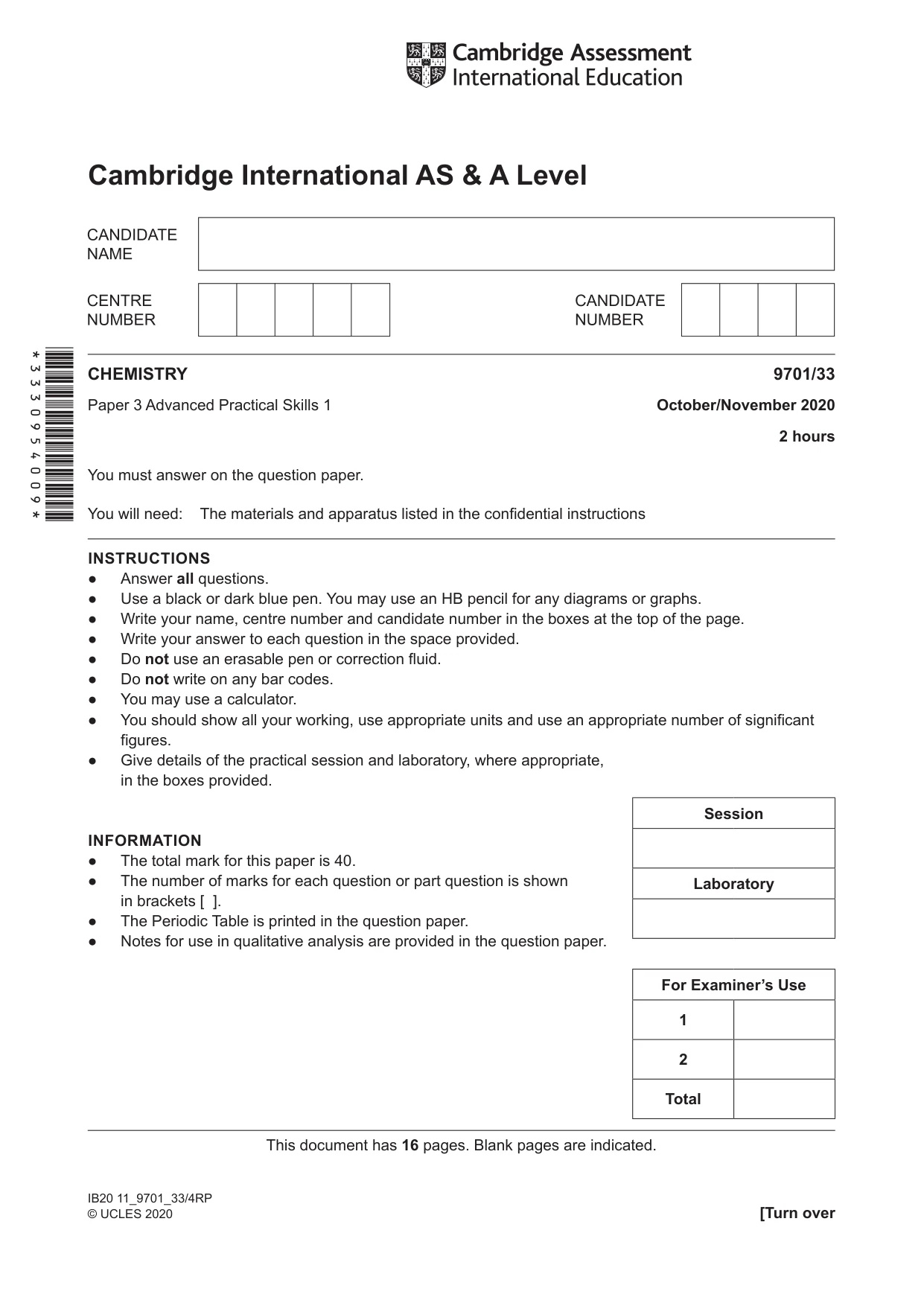
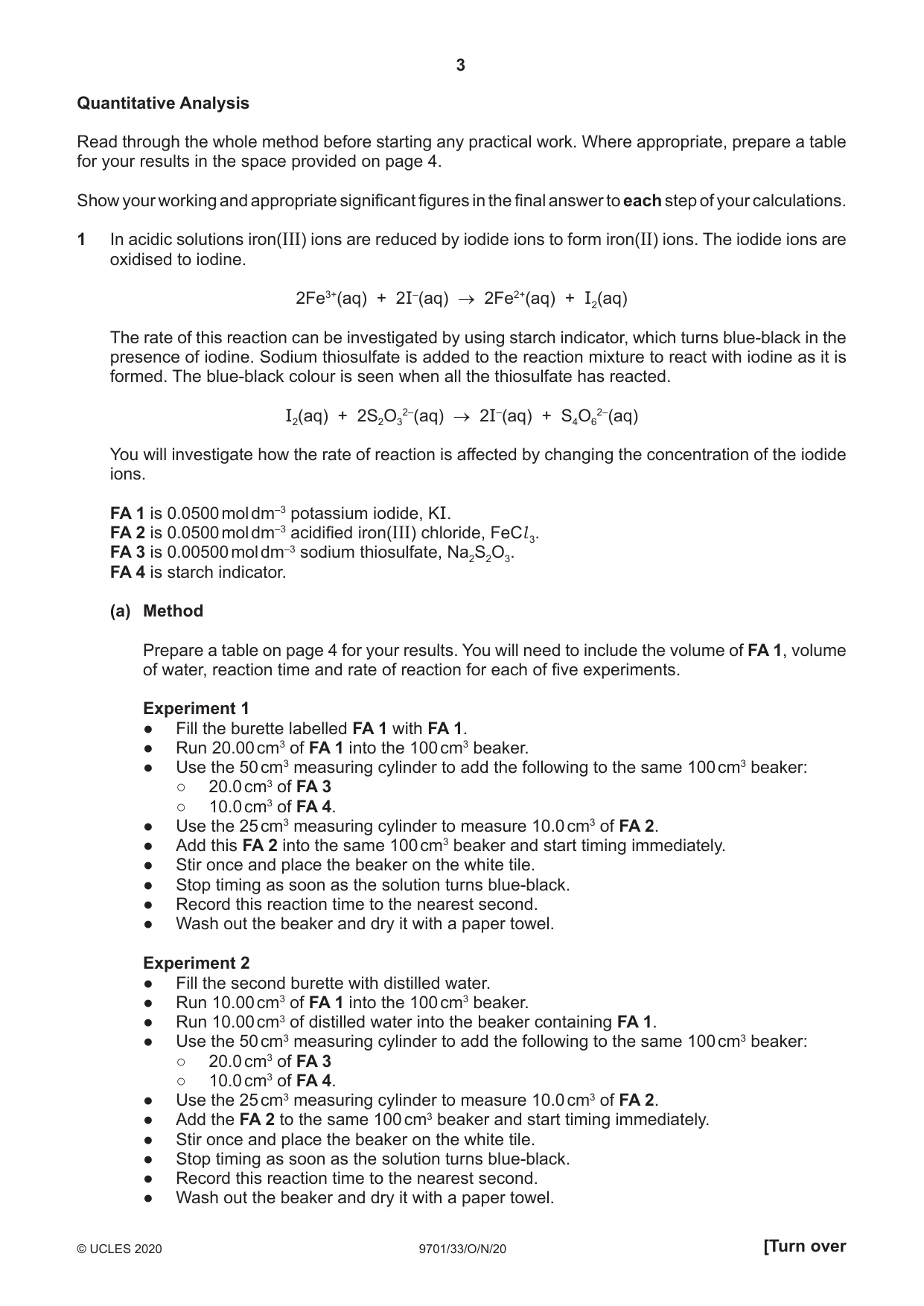
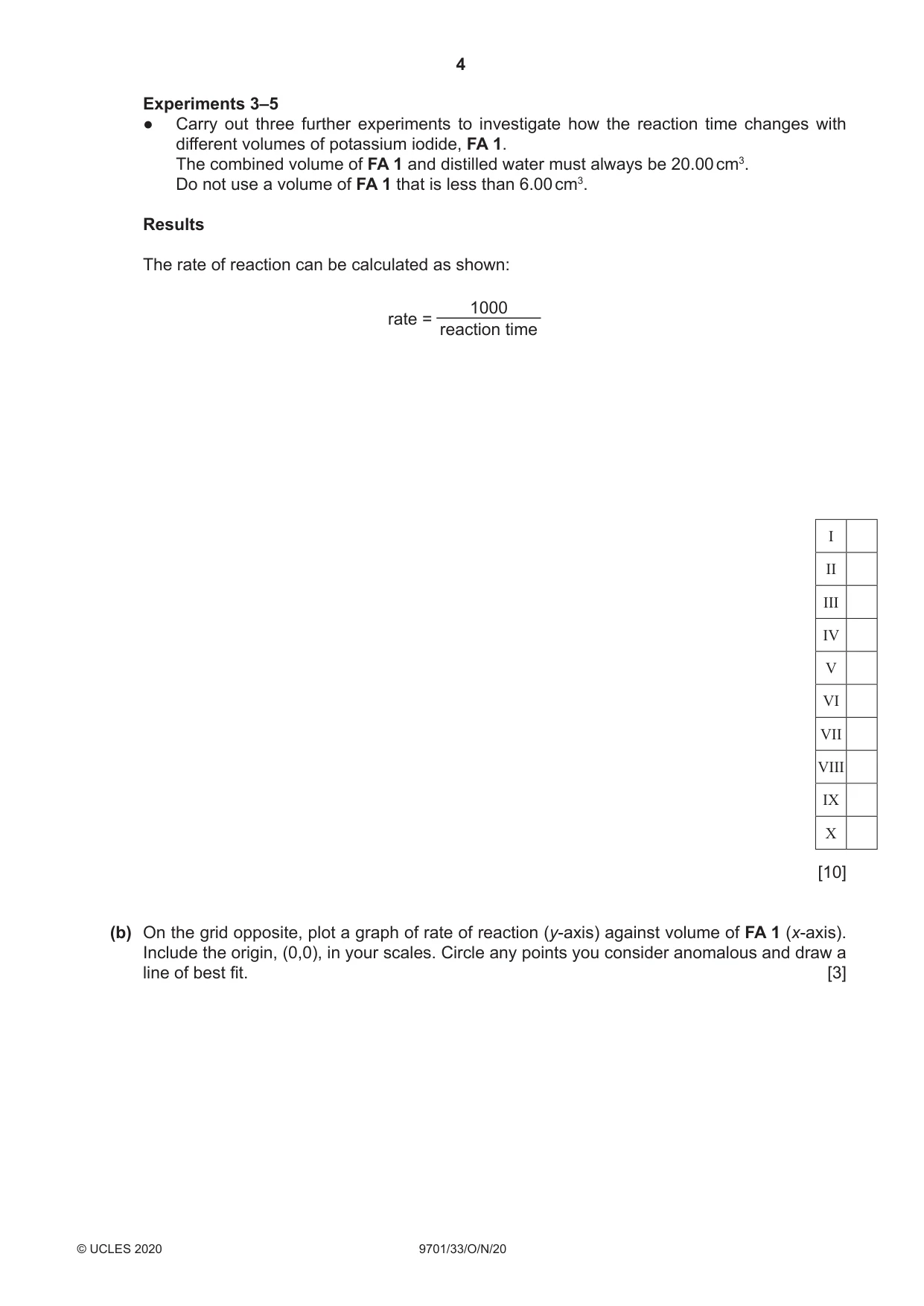
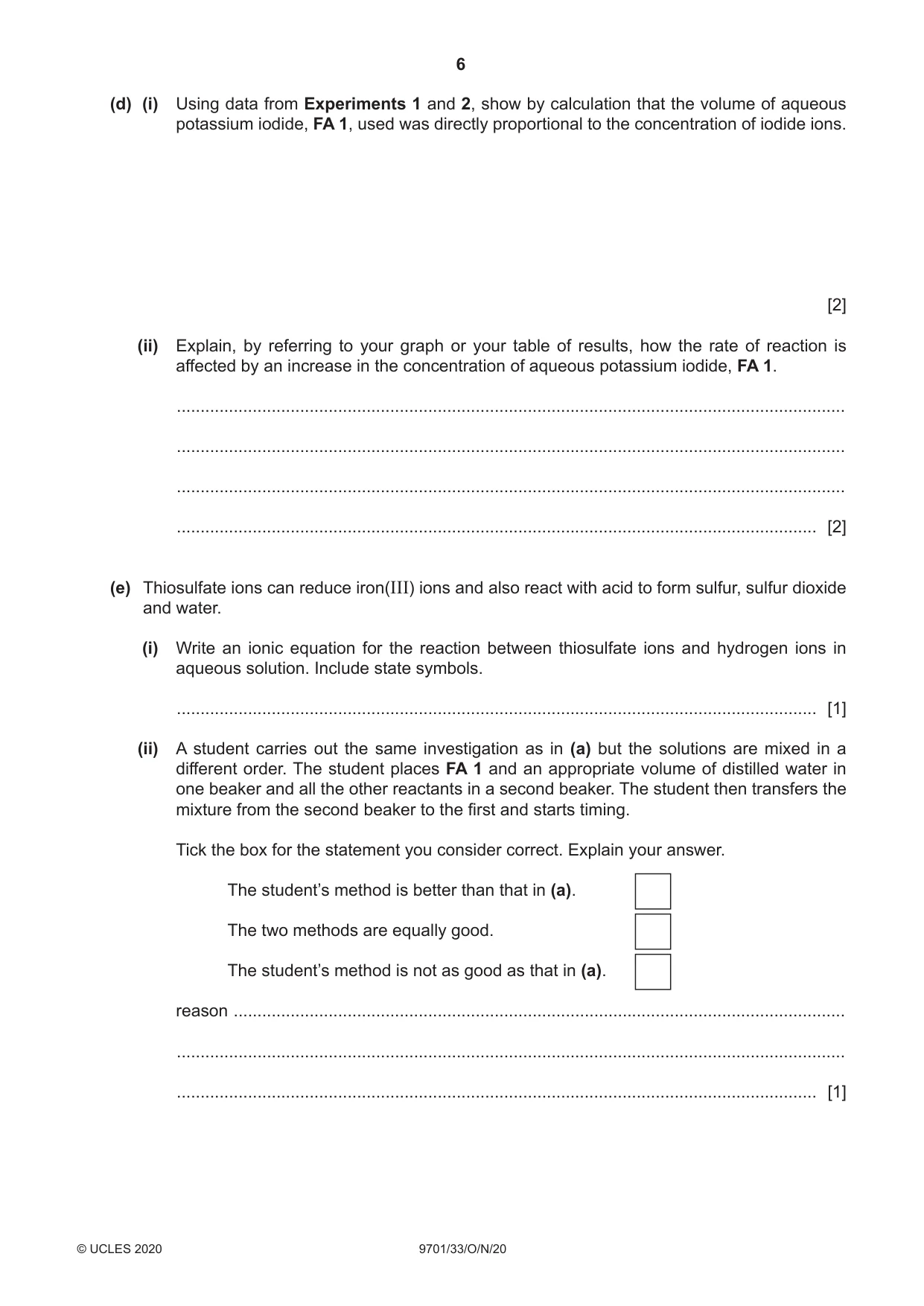
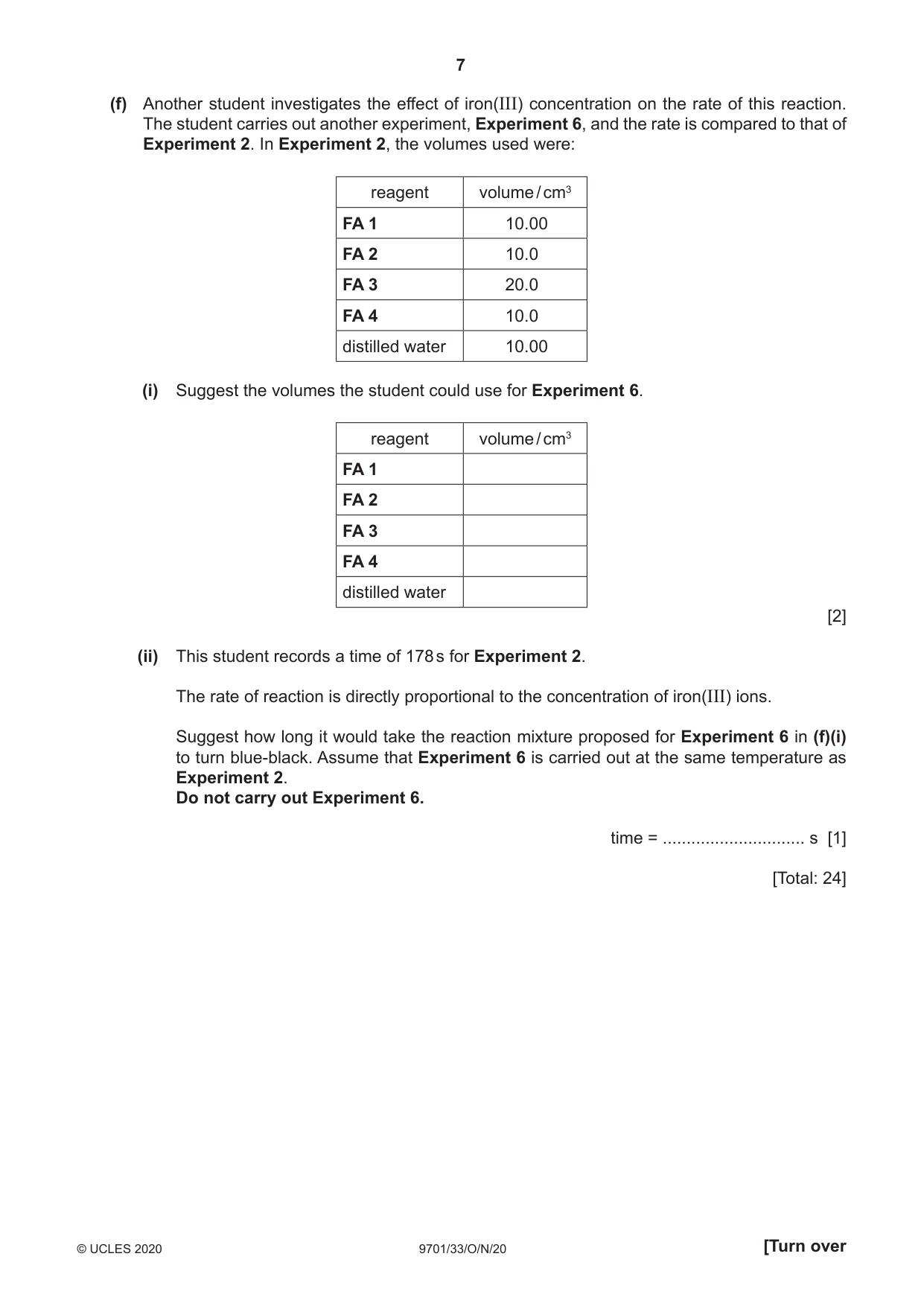
1 In acidic solutions iron(III) ions are reduced by iodide ions to form iron(II) ions. The iodide ions are oxidised to iodine. 2Fe3+(aq) + 2I‒(aq) → 2Fe2+(aq) + I2(aq) The rate of this reaction can be investigated by using starch indicator, which turns blue-black in the presence of iodine. Sodium thiosulfate is added to the reaction mixture to react with iodine as it is formed. The blue-black colour is seen when all the thiosulfate has reacted. I2(aq) + 2S2O32‒(aq) → 2I‒(aq) + S4O62‒(aq) You will investigate how the rate of reaction is affected by changing the concentration of the iodide ions. FA 1 is 0.0500 mol dm‒3 potassium iodide, KI. FA 2 is 0.0500 mol dm‒3 acidified iron(III) chloride, FeCl 3. FA 3 is 0.00500 mol dm‒3 sodium thiosulfate, Na2S2O3. FA 4 is starch indicator. (a) Method Prepare a table on page 4 for your results. You will need to include the volume of FA 1, volume of water, reaction time and rate of reaction for each of five experiments. Experiment 1 ● Fill the burette labelled FA 1 with FA 1. ● Run 20.00 cm3 of FA 1 into the 100 cm3 beaker. ● Use the 50 cm3 measuring cylinder to add the following to the same 100 cm3 beaker: ○ 20.0 cm3 of FA 3 ○ 10.0 cm3 of FA 4. ● Use the 25 cm3 measuring cylinder to measure 10.0 cm3 of FA 2. ● Add this FA 2 into the same 100 cm3 beaker and start timing immediately. ● Stir once and place the beaker on the white tile. ● Stop timing as soon as the solution turns blue-black. ● Record this reaction time to the nearest second. ● Wash out the beaker and dry it with a paper towel. Experiment 2 ● Fill the second burette with distilled water. ● Run 10.00 cm3 of FA 1 into the 100 cm3 beaker. ● Run 10.00 cm3 of distilled water into the beaker containing FA 1. ● Use the 50 cm3 measuring cylinder to add the following to the same 100 cm3 beaker: ○ 20.0 cm3 of FA 3 ○ 10.0 cm3 of FA 4. ● Use the 25 cm3 measuring cylinder to measure 10.0 cm3 of FA 2. ● Add the FA 2 to the same 100 cm3 beaker and start timing immediately. ● Stir once and place the beaker on the white tile. ● Stop timing as soon as the solution turns blue-black. ● Record this reaction time to the nearest second. ● Wash out the beaker and dry it with a paper towel. Experiments 3–5 ● Carry out three further experiments to investigate how the reaction time changes with different volumes of potassium iodide, FA 1. The combined volume of FA 1 and distilled water must always be 20.00 cm3. Do not use a volume of FA 1 that is less than 6.00 cm3. Results The rate of reaction can be calculated as shown: 1000 rate = reaction time I II III IV V VI VII VIII IX X [10] (b) On the grid opposite, plot a graph of rate of reaction (y-axis) against volume of FA 1 (x-axis). Include the origin, (0,0), in your scales. Circle any points you consider anomalous and draw a line of best fit. [3] (d) (i) Using data from Experiments 1 and 2, show by calculation that the volume of aqueous potassium iodide, FA 1, used was directly proportional to the concentration of iodide ions. [2] (ii) Explain, by referring to your graph or your table of results, how the rate of reaction is affected by an increase in the concentration of aqueous potassium iodide, FA 1. ............................................................................................................................................. ............................................................................................................................................. ............................................................................................................................................. ....................................................................................................................................... [2] (e) Thiosulfate ions can reduce iron(III) ions and also react with acid to form sulfur, sulfur dioxide and water. (i) Write an ionic equation for the reaction between thiosulfate ions and hydrogen ions in aqueous solution. Include state symbols. ....................................................................................................................................... [1] (ii) A student carries out the same investigation as in (a) but the solutions are mixed in a different order. The student places FA 1 and an appropriate volume of distilled water in one beaker and all the other reactants in a second beaker. The student then transfers the mixture from the second beaker to the first and starts timing. Tick the box for the statement you consider correct. Explain your answer. The student’s method is better than that in (a). The two methods are equally good. The student’s method is not as good as that in (a). reason ................................................................................................................................. ............................................................................................................................................. ....................................................................................................................................... [1] (f) Another student investigates the effect of iron(III) concentration on the rate of this reaction. The student carries out another experiment, Experiment 6, and the rate is compared to that of Experiment 2. In Experiment 2, the volumes used were: reagent volume / cm3 FA 1 10.00 FA 2 10.0 FA 3 20.0 FA 4 10.0 distilled water 10.00 (i) Suggest the volumes the student could use for Experiment 6. reagent volume / cm3 FA 1 FA 2 FA 3 FA 4 distilled water [2] (ii) This student records a time of 178 s for Experiment 2. The rate of reaction is directly proportional to the concentration of iron(III) ions. Suggest how long it would take the reaction mixture proposed for Experiment 6 in (f)(i) to turn blue-black. Assume that Experiment 6 is carried out at the same temperature as Experiment 2. Do not carry out Experiment 6. time = .............................. s [1] [Total: 24] Qualitative Analysis Where reagents are selected for use in a test, the name or correct formula of the element or compound must be given. At each stage of any test you are to record details of the following: ● colour changes seen ● the formation of any precipitate and its solubility in an excess of the reagent added ● the formation of any gas and its identification by a suitable test. You should indicate clearly at what stage in a test a change occurs. If any solution is warmed, a boiling tube must be used. Rinse and reuse test-tubes and boiling tubes where possible. No additional tests for ions present should be attempted.
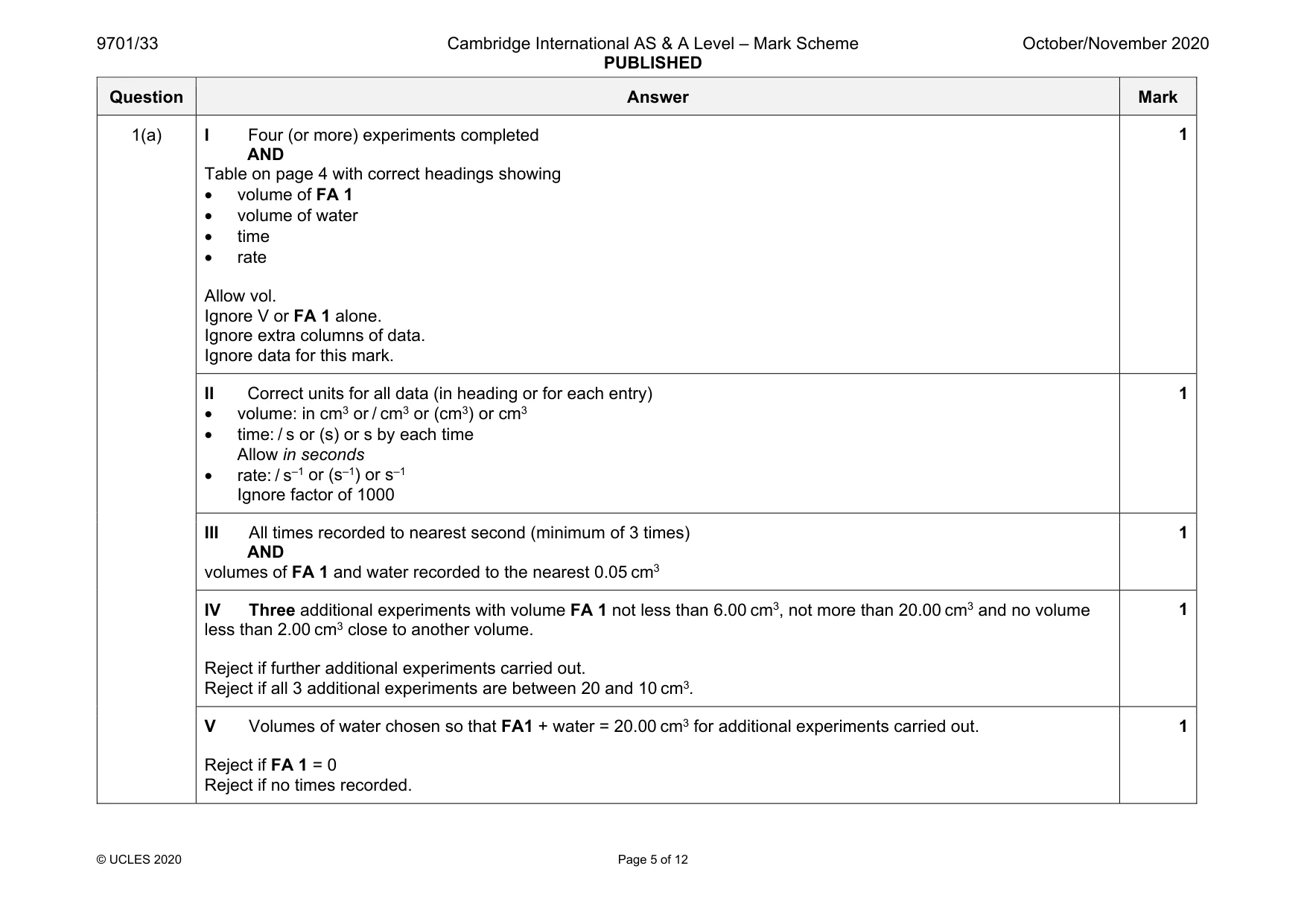
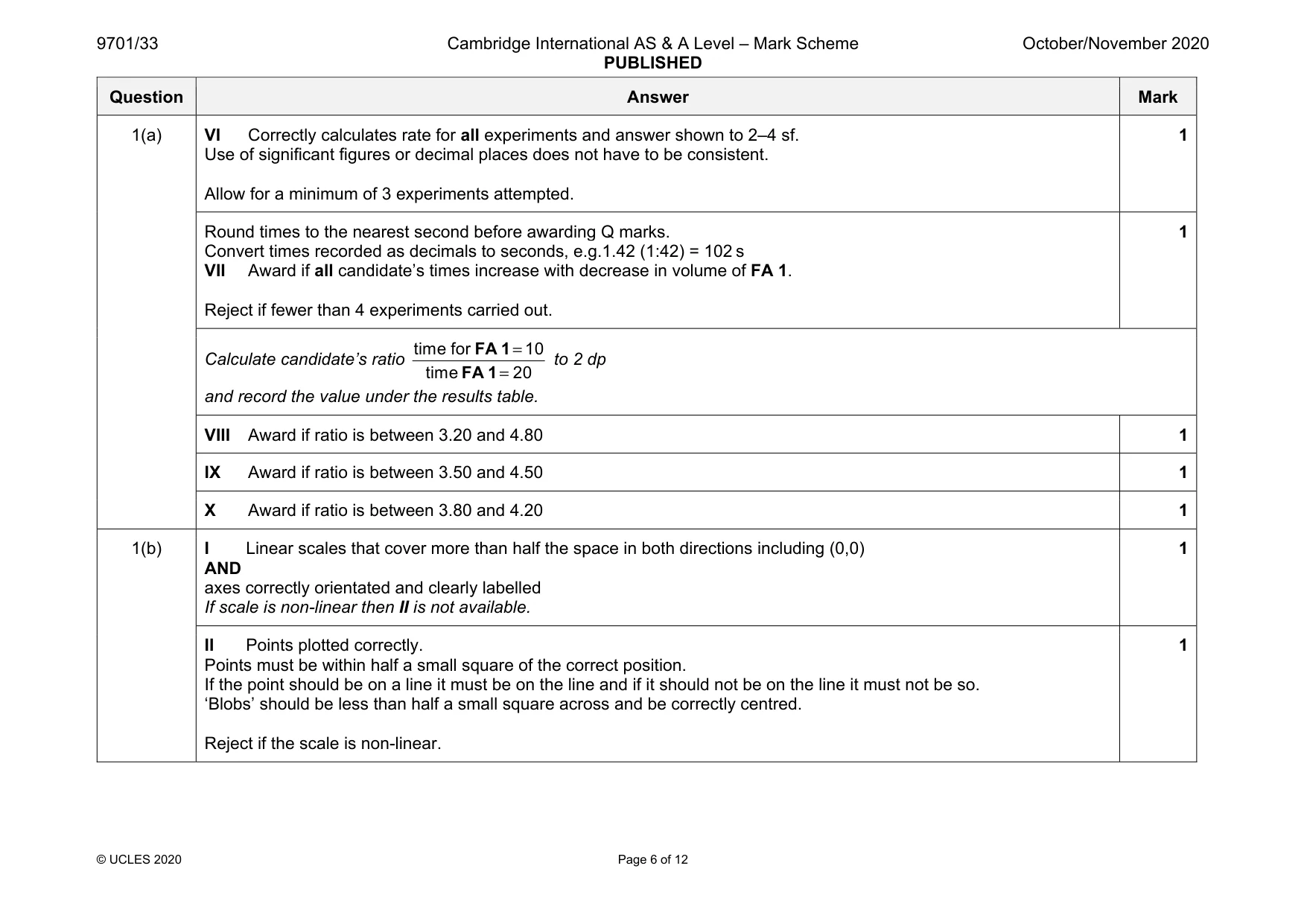
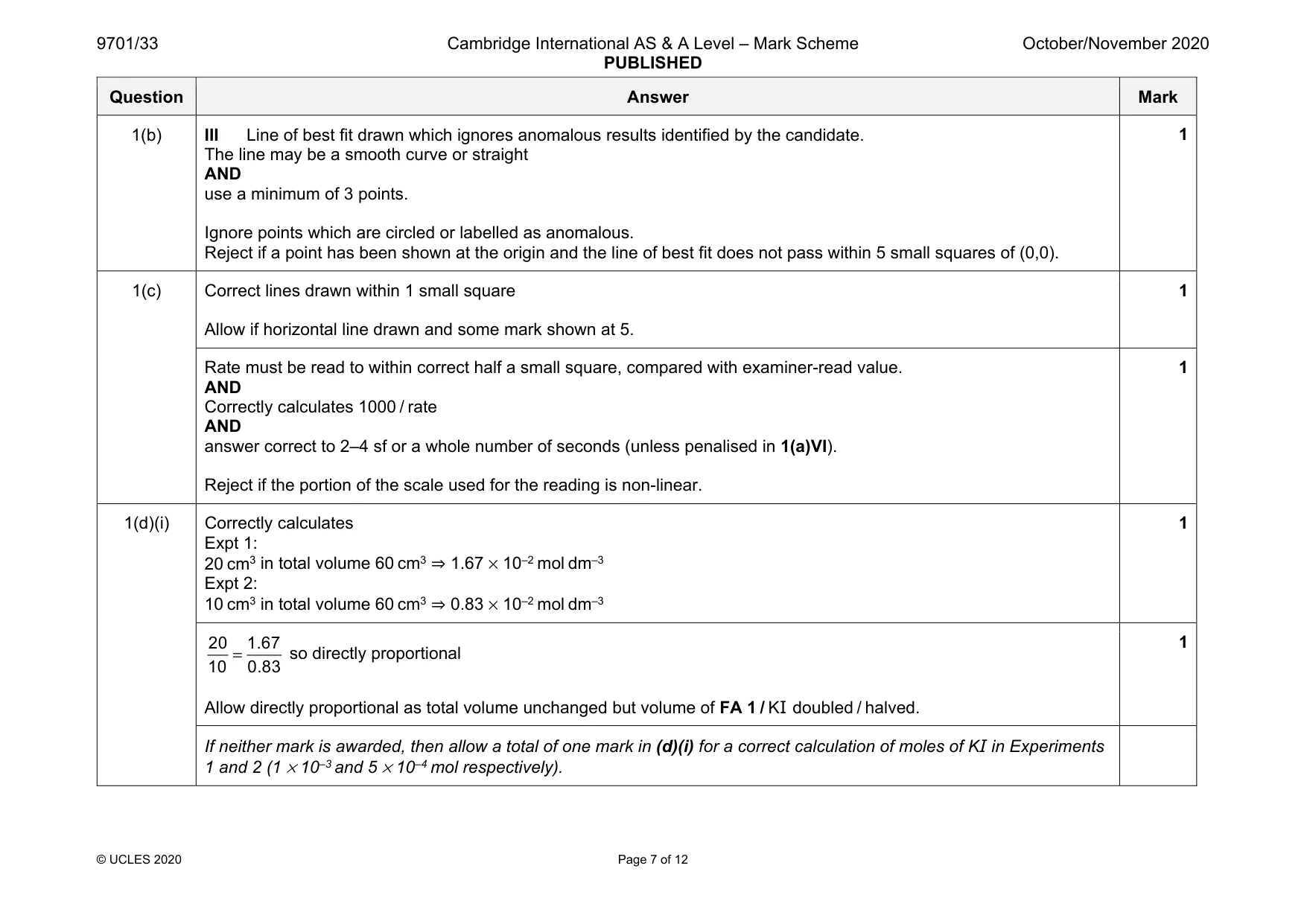
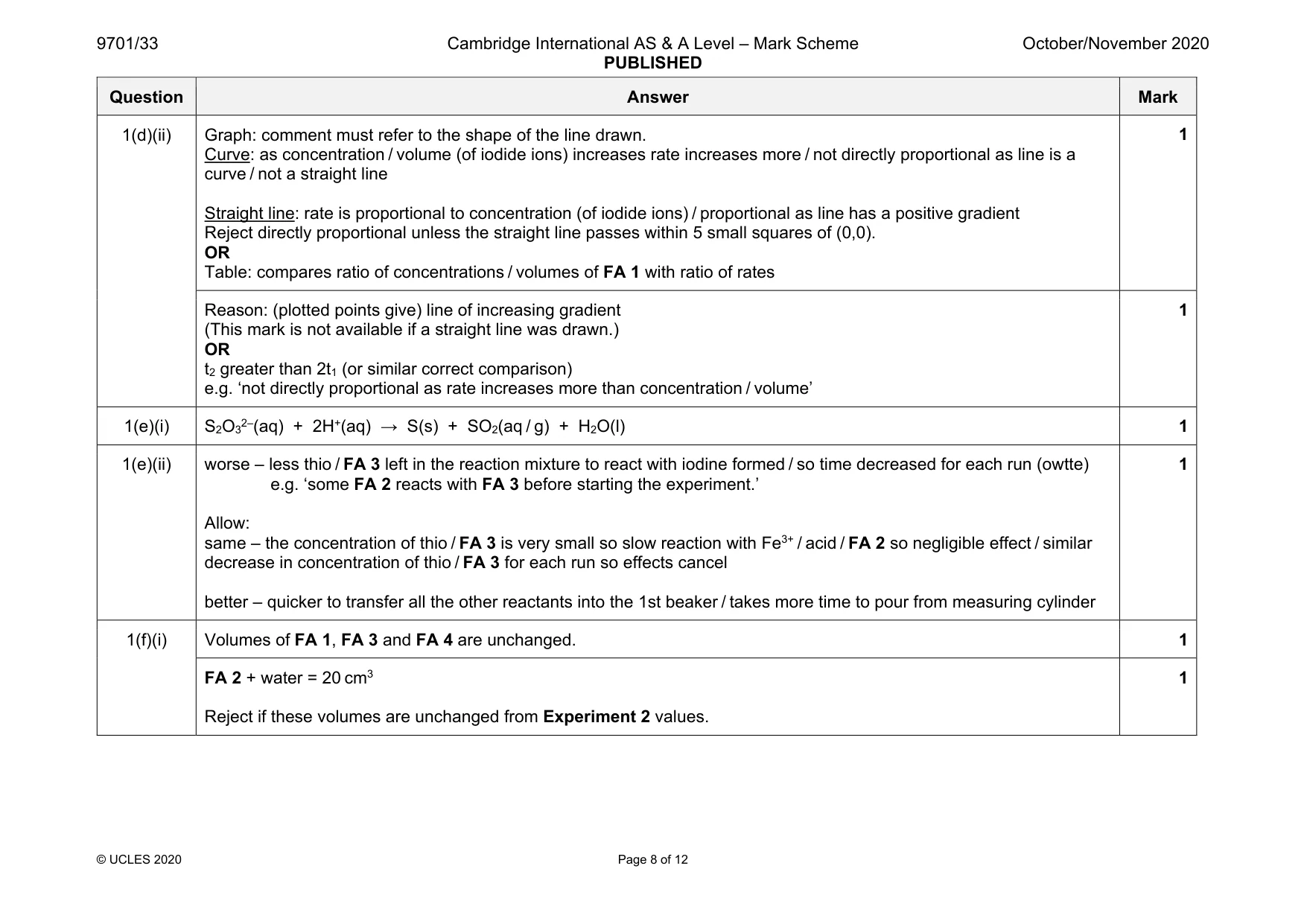
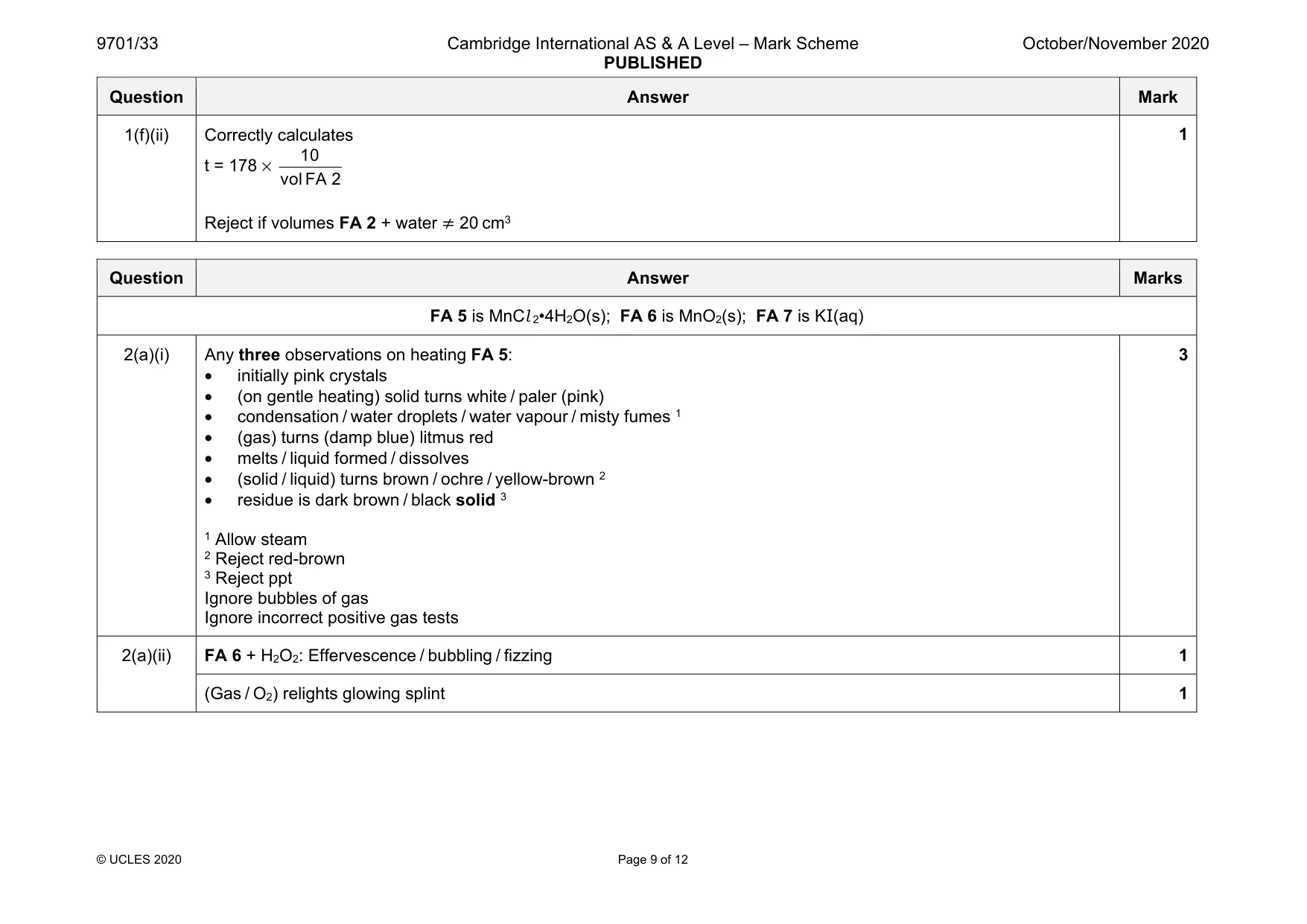
Mark scheme: 1(a) I Four (or more) experiments completed AND Table on page 4 with correct headings showing • volume of FA 1 • volume of water • time • rate Allow vol. Ignore V or FA 1 alone. Ignore extra columns of data. Ignore data for this mark. II Correct units for all data (in heading or for each entry) • volume: in cm3 or / cm3 or (cm3) or cm3 • time: / s or (s) or s by each time Allow in seconds • rate: / s–1 or (s–1) or s–1 Ignore factor of 1000 1 III All times recorded to nearest second (minimum of 3 times) AND volumes of FA 1 and water recorded to the nearest 0.05 cm3 1 IV Three additional experiments with volume FA 1 not less than 6.00 cm3, not more than 20.00 cm3 and no volume less than 2.00 cm3 close to another volume. Reject if further additional experiments carried out. Reject if all 3 additional experiments are between 20 and 10 cm3. 1 V Volumes of water chosen so that FA1 + water = 20.00 cm3 for additional experiments carried out. Reject if FA 1 = 0 Reject if no times recorded. 1 Question Answer Mark 1(a) VI Correctly calculates rate for all experiments and answer shown to 2–4 sf. Use of significant figures or decimal places does not have to be consistent. Allow for a minimum of 3 experiments attempted. 1 Round times to the nearest second before awarding Q marks. Convert times recorded as decimals to seconds, e.g.1.42 (1:42) = 102 s VII Award if all candidate’s times increase with decrease in volume of FA 1. Reject if fewer than 4 experiments carried out. 1 Calculate candidate’s ratio = = time for 10 time 20 FA 1 FA 1 to 2 dp and record the value under the results table. VIII Award if ratio is between 3.20 and 4.80 1 IX Award if ratio is between 3.50 and 4.50 1 X Award if ratio is between 3.80 and 4.20 1 1(b) I Linear scales that cover more than half the space in both directions including (0,0) AND axes correctly orientated and clearly labelled If scale is non-linear then II is not available. 1 II Points plotted correctly. Points must be within half a small square of the correct position. If the point should be on a line it must be on the line and if it should not be on the line it must not be so. ‘Blobs’ should be less than half a small square across and be correctly centred. Reject if the scale is non-linear. 1 Question Answer Mark 1(b) III Line of best fit drawn which ignores anomalous results identified by the candidate. The line may be a smooth curve or straight AND use a minimum of 3 points. Ignore points which are circled or labelled as anomalous. Reject if a point has been shown at the origin and the line of best fit does not pass within 5 small squares of (0,0). 1 1(c) Correct lines drawn within 1 small square Allow if horizontal line drawn and some mark shown at 5. 1 Rate must be read to within correct half a small square, compared with examiner-read value. AND Correctly calculates 1000 / rate AND answer correct to 2–4 sf or a whole number of seconds (unless penalised in 1(a)VI). Reject if the portion of the scale used for the reading is non-linear. 1 1(d)(i) Correctly calculates Expt 1: 20 cm3 in total volume 60 cm3 ⇒ 1.67 × 10‒2 mol dm‒3 Expt 2: 10 cm3 in total volume 60 cm3 ⇒ 0.83 × 10‒2 mol dm‒3 1 = 20 1.67 10 0.83 so directly proportional Allow directly proportional as total volume unchanged but volume of FA 1 / KI doubled / halved. 1 If neither mark is awarded, then allow a total of one mark in (d)(i) for a correct calculation of moles of KI in Experiments 1 and 2 (1 × 10⁻³ and 5 × 10⁻⁴ mol respectively). Question Answer Mark 1(d)(ii) Graph: comment must refer to the shape of the line drawn. Curve: as concentration / volume (of iodide ions) increases rate increases more / not directly proportional as line is a curve / not a straight line Straight line: rate is proportional to concentration (of iodide ions) / proportional as line has a positive gradient Reject directly proportional unless the straight line passes within 5 small squares of (0,0). OR Table: compares ratio of concentrations / volumes of FA 1 with ratio of rates 1 Reason: (plotted points give) line of increasing gradient (This mark is not available if a straight line was drawn.) OR t2 greater than 2t1 (or similar correct comparison) e.g. ‘not directly proportional as rate increases more than concentration / volume’ 1 1(e)(i) S2O32‒(aq) + 2H+(aq) → S(s) + SO2(aq / g) + H2O(l) 1 1(e)(ii) worse – less thio / FA 3 left in the reaction mixture to react with iodine formed / so time decreased for each run (owtte) e.g. ‘some FA 2 reacts with FA 3 before starting the experiment.’ Allow: same – the concentration of thio / FA 3 is very small so slow reaction with Fe3+ / acid / FA 2 so negligible effect / similar decrease in concentration of thio / FA 3 for each run so effects cancel better – quicker to transfer all the other reactants into the 1st beaker / takes more time to pour from measuring cylinder 1 1(f)(i) Volumes of FA 1, FA 3 and FA 4 are unchanged. 1 FA 2 + water = 20 cm3 Reject if these volumes are unchanged from Experiment 2 values. 1 Question Answer Mark 1(f)(ii) Correctly calculates t = 178 × 10 vol FA 2 Reject if volumes FA 2 + water ≠ 20 cm3 1
More questions on Simple rate equations, orders of reaction and rate constants
Q2 · FA 5 is a salt consisting of two ions both of which are listed in the Qualitative…
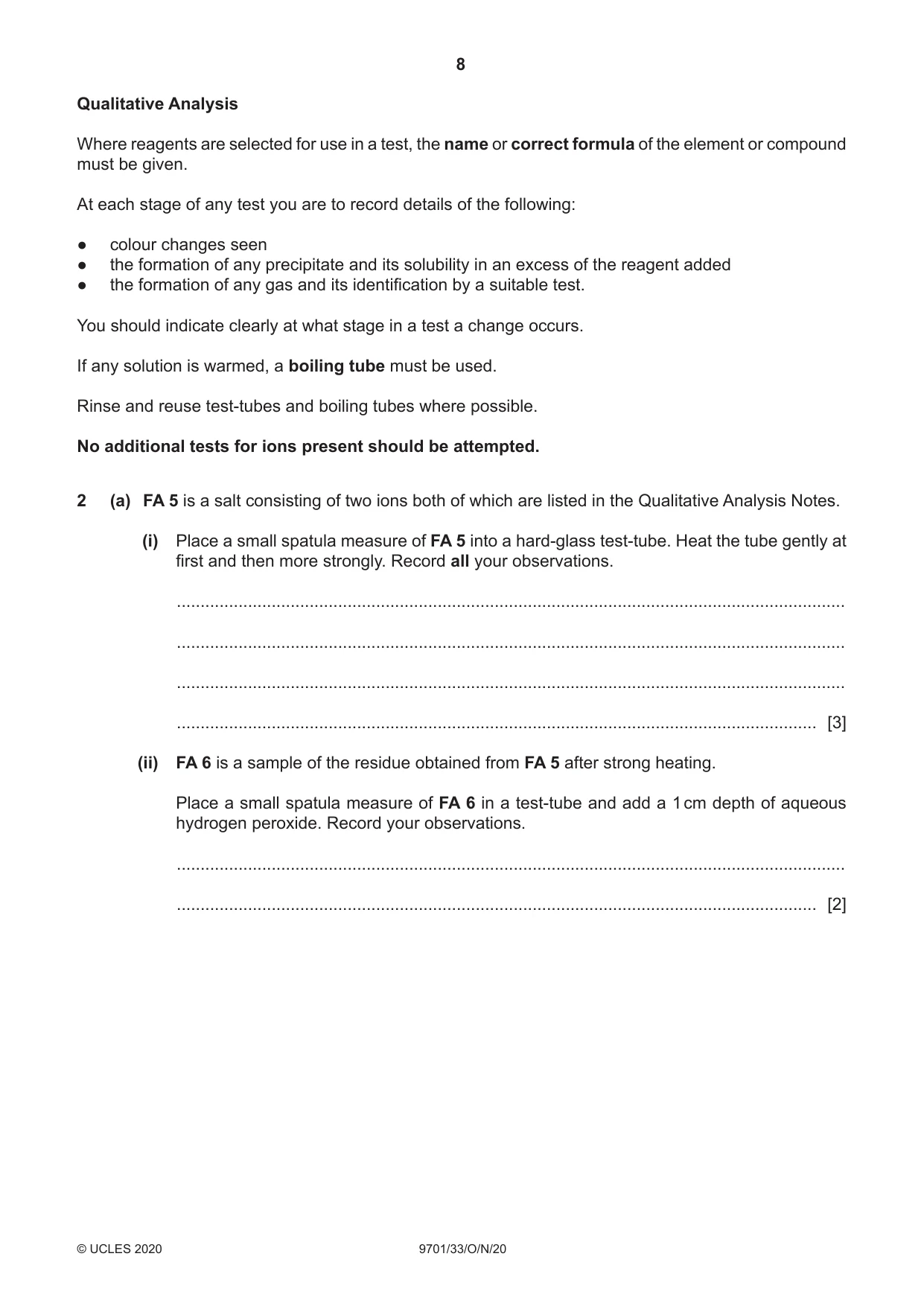
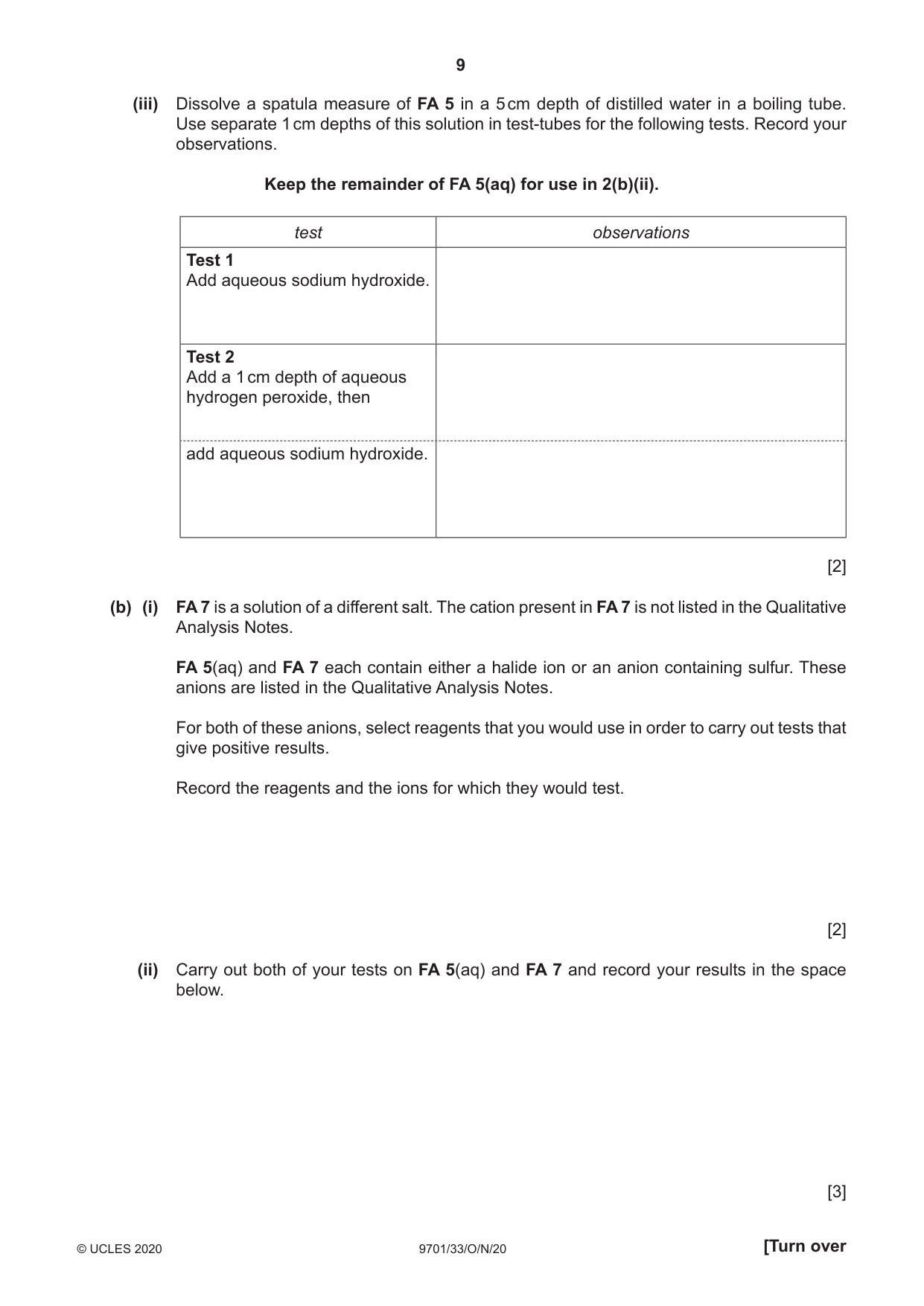
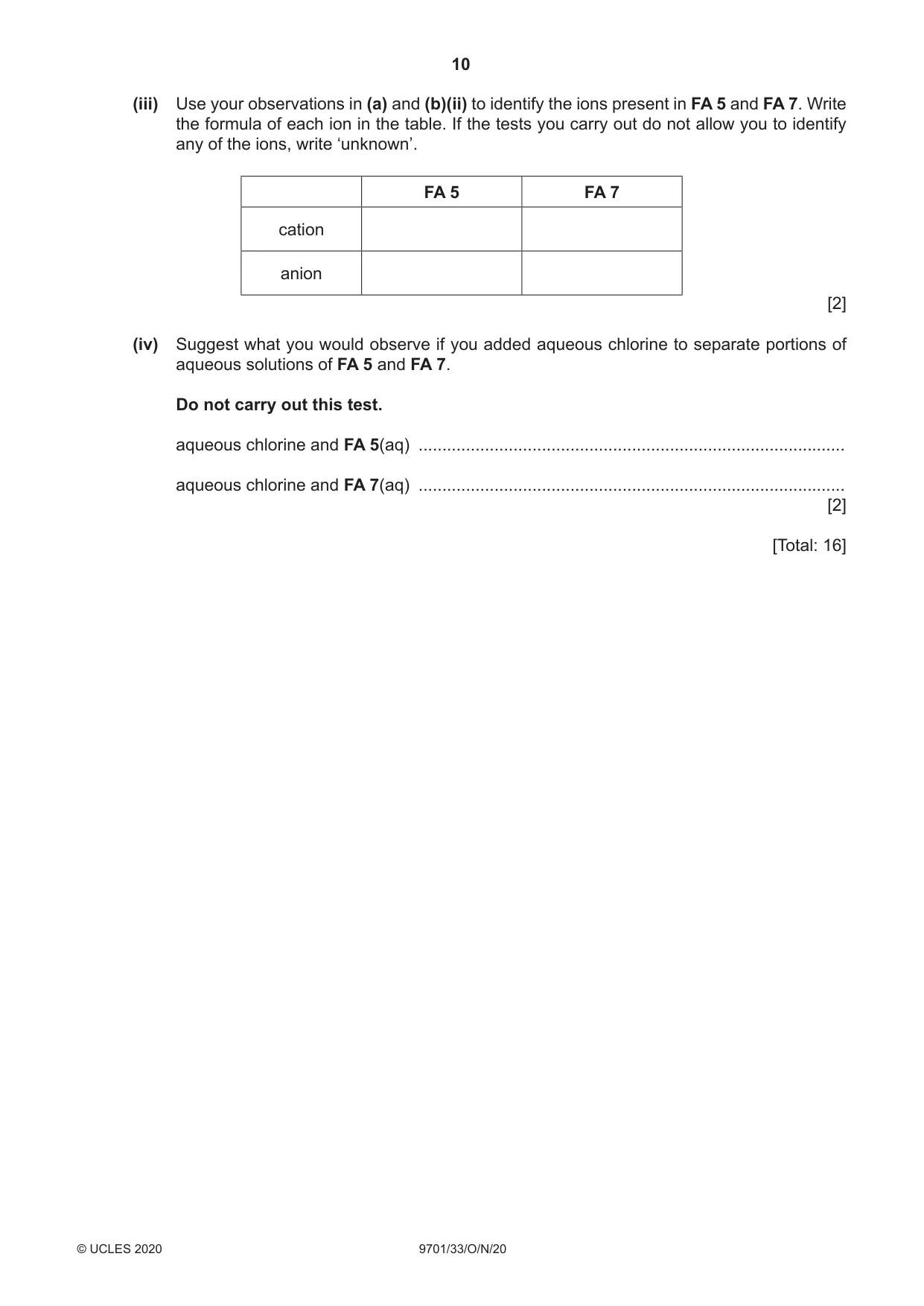
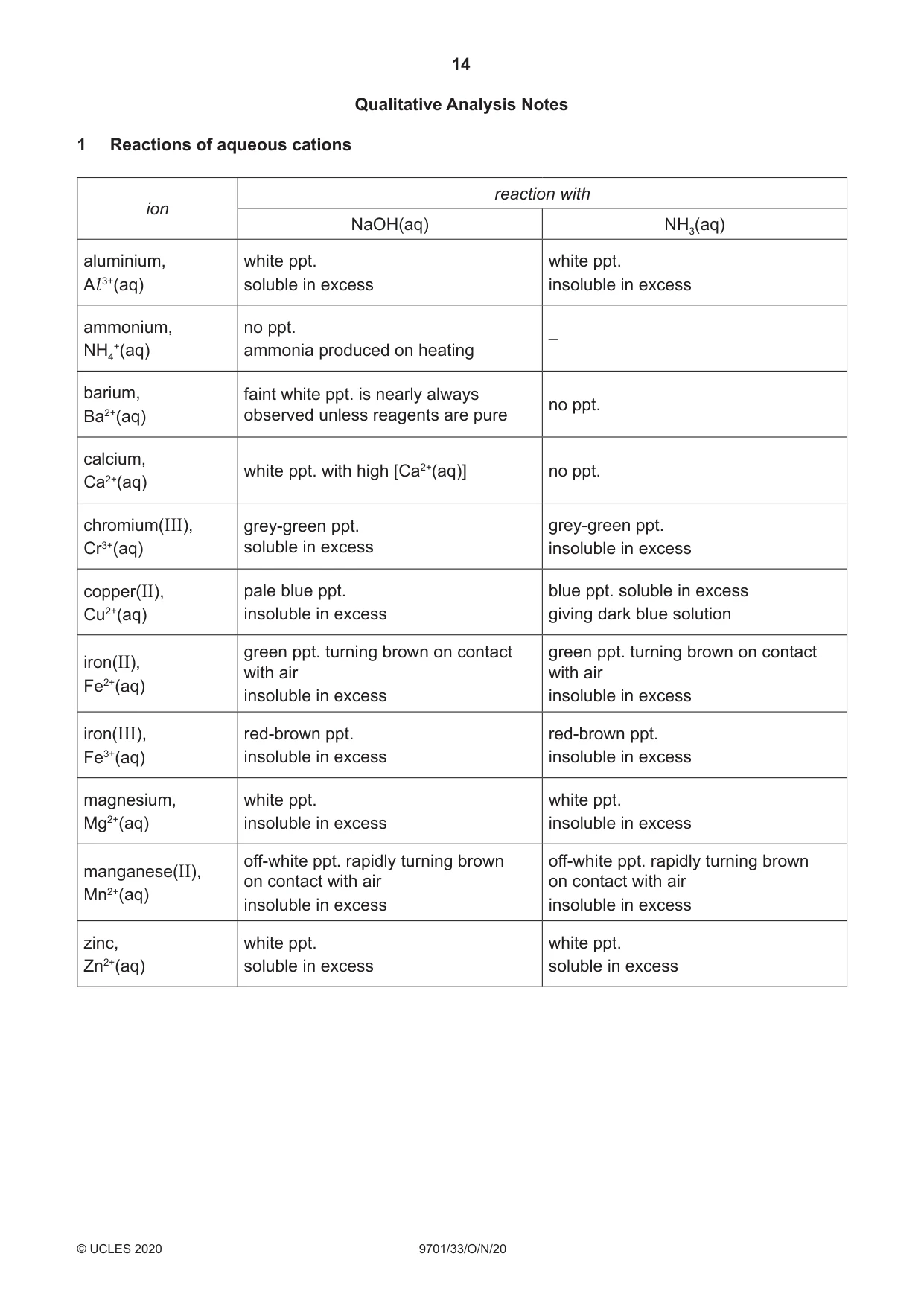
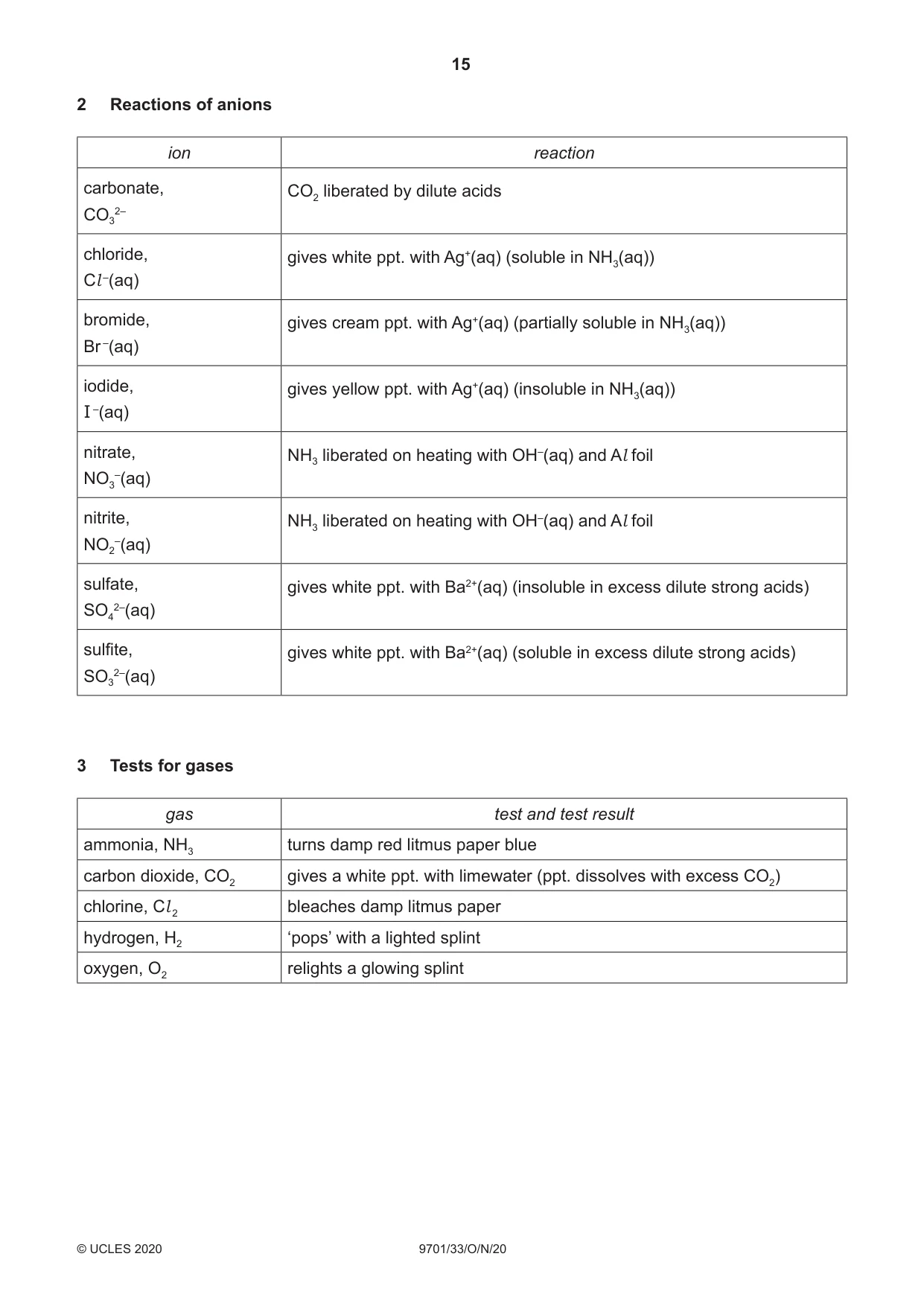
2 (a) FA 5 is a salt consisting of two ions both of which are listed in the Qualitative Analysis Notes. (i) Place a small spatula measure of FA 5 into a hard‑glass test‑tube. Heat the tube gently at first and then more strongly. Record all your observations. ............................................................................................................................................. ............................................................................................................................................. ............................................................................................................................................. ....................................................................................................................................... [3] (ii) FA 6 is a sample of the residue obtained from FA 5 after strong heating. Place a small spatula measure of FA 6 in a test‑tube and add a 1 cm depth of aqueous hydrogen peroxide. Record your observations. ............................................................................................................................................. ....................................................................................................................................... [2] (iii) Dissolve a spatula measure of FA 5 in a 5 cm depth of distilled water in a boiling tube. Use separate 1 cm depths of this solution in test‑tubes for the following tests. Record your observations. Keep the remainder of FA 5(aq) for use in 2(b)(ii). test observations Test 1 Add aqueous sodium hydroxide. Test 2 Add a 1 cm depth of aqueous hydrogen peroxide, then add aqueous sodium hydroxide. [2] (b) (i) FA 7 is a solution of a different salt. The cation present in FA 7 is not listed in the Qualitative Analysis Notes. FA 5(aq) and FA 7 each contain either a halide ion or an anion containing sulfur. These anions are listed in the Qualitative Analysis Notes. For both of these anions, select reagents that you would use in order to carry out tests that give positive results. Record the reagents and the ions for which they would test. [2] (ii) Carry out both of your tests on FA 5(aq) and FA 7 and record your results in the space below. [3] (iii) Use your observations in (a) and (b)(ii) to identify the ions present in FA 5 and FA 7. Write the formula of each ion in the table. If the tests you carry out do not allow you to identify any of the ions, write ‘unknown’. FA 5 FA 7 cation anion [2] (iv) Suggest what you would observe if you added aqueous chlorine to separate portions of aqueous solutions of FA 5 and FA 7. Do not carry out this test. aqueous chlorine and FA 5(aq) ........................................................................................... aqueous chlorine and FA 7(aq) ........................................................................................... [2] [Total: 16]
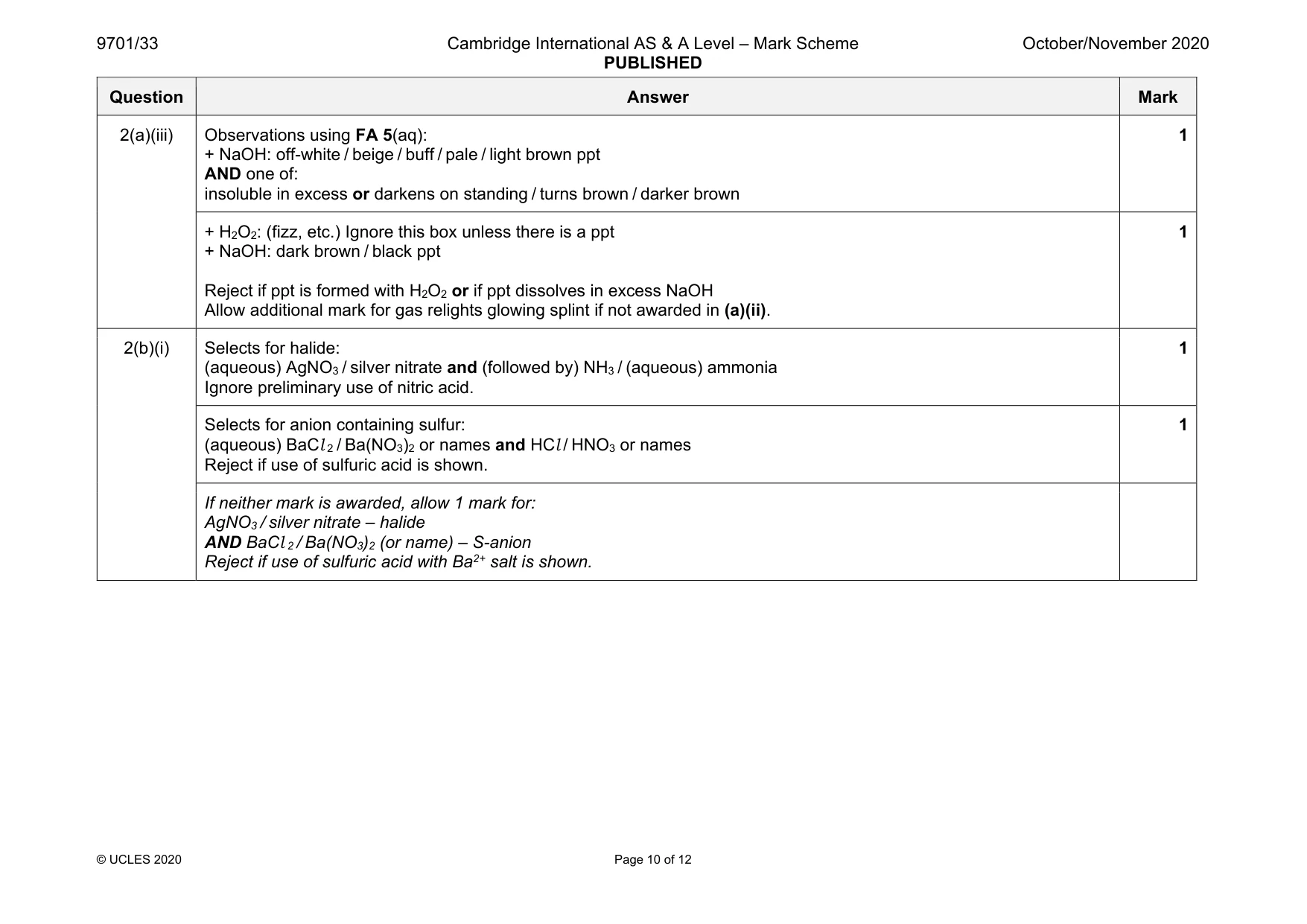
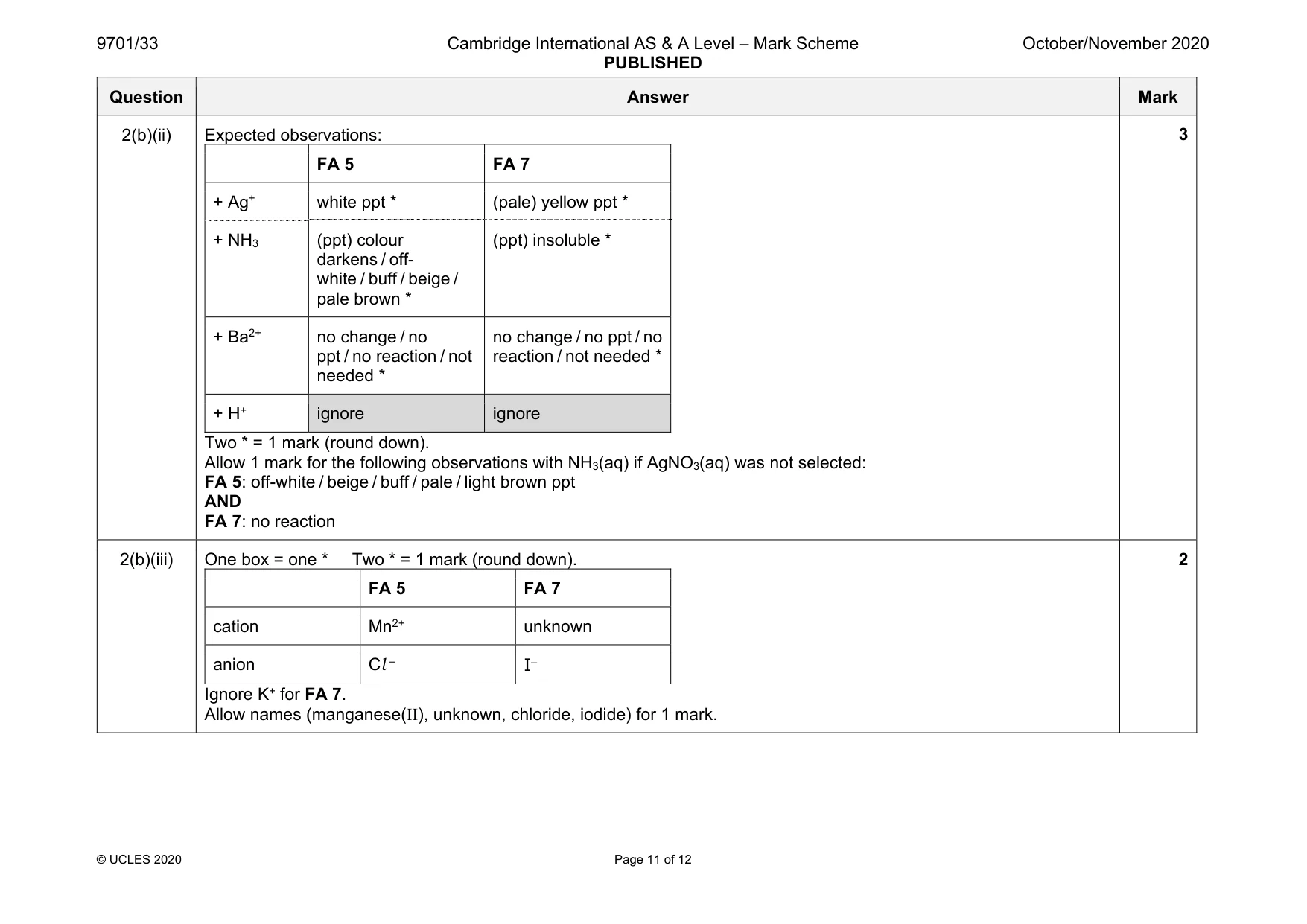
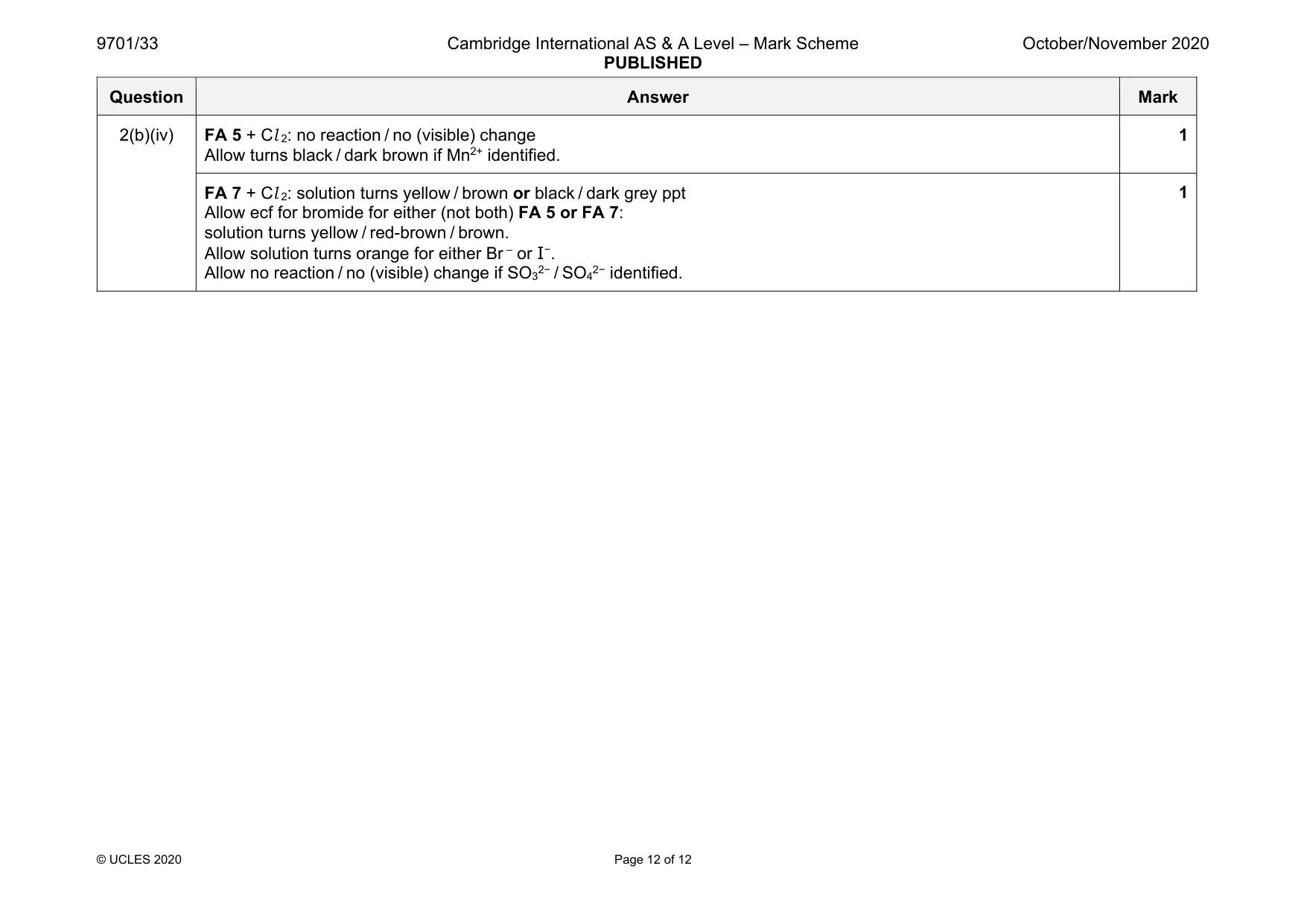
Mark scheme: 2(a)(i) Any three observations on heating FA 5: • initially pink crystals • (on gentle heating) solid turns white / paler (pink) • condensation / water droplets / water vapour / misty fumes 1 • (gas) turns (damp blue) litmus red • melts / liquid formed / dissolves • (solid / liquid) turns brown / ochre / yellow-brown 2 • residue is dark brown / black solid 3 1 Allow steam 2 Reject red-brown 3 Reject ppt Ignore bubbles of gas Ignore incorrect positive gas tests 2(a)(ii) FA 6 + H2O2: Effervescence / bubbling / fizzing 1 (Gas / O2) relights glowing splint 1 Question Answer Mark 2(a)(iii) Observations using FA 5(aq): + NaOH: off-white / beige / buff / pale / light brown ppt AND one of: insoluble in excess or darkens on standing / turns brown / darker brown 1 + H2O2: (fizz, etc.) Ignore this box unless there is a ppt + NaOH: dark brown / black ppt Reject if ppt is formed with H2O2 or if ppt dissolves in excess NaOH Allow additional mark for gas relights glowing splint if not awarded in (a)(ii). 1 2(b)(i) Selects for halide: (aqueous) AgNO3 / silver nitrate and (followed by) NH3 / (aqueous) ammonia Ignore preliminary use of nitric acid. 1 Selects for anion containing sulfur: (aqueous) BaCl 2 / Ba(NO3)2 or names and HCl / HNO3 or names Reject if use of sulfuric acid is shown. 1 If neither mark is awarded, allow 1 mark for: AgNO3 / silver nitrate – halide AND BaCl 2 / Ba(NO3)2 (or name) – S-anion Reject if use of sulfuric acid with Ba2+ salt is shown. Question Answer Mark 2(b)(ii) Expected observations: FA 5 FA 7 + Ag+ white ppt * (pale) yellow ppt * + NH3 (ppt) colour darkens / off- white / buff / beige / pale brown * (ppt) insoluble * + Ba2+ no change / no ppt / no reaction / not needed * no change / no ppt / no reaction / not needed * + H+ ignore ignore Two * = 1 mark (round down). Allow 1 mark for the following observations with NH3(aq) if AgNO3(aq) was not selected: FA 5: off-white / beige / buff / pale / light brown ppt AND FA 7: no reaction 3 2(b)(iii) One box = one * Two * = 1 mark (round down). FA 5 FA 7 cation Mn2+ unknown anion Cl ‒ I– Ignore K+ for FA 7. Allow names (manganese(II), unknown, chloride, iodide) for 1 mark. 2 Question Answer Mark 2(b)(iv) FA 5 + Cl 2: no reaction / no (visible) change Allow turns black / dark brown if Mn2+ identified. 1 FA 7 + Cl 2: solution turns yellow / brown or black / dark grey ppt Allow ecf for bromide for either (not both) FA 5 or FA 7: solution turns yellow / red-brown / brown. Allow solution turns orange for either Br – or I−. Allow no reaction / no (visible) change if SO32−/ SO42− identified. 1
What was in this paper
The subtopics covered by these 2 questions, and how many questions each got. Open one in a new tab to see every Cambridge question on it.
What you needed in this session
Cambridge’s own grade thresholds for 2020 Oct/Nov, Paper 3 · Variant 3. A higher threshold means an easier paper — the bar moves with how the cohort did.