Cambridge A Level Chemistry 9701 — 2020 Oct/Nov Paper 2 · Variant 3
9701/23/O/N/20 · 4 questions · 60 marks · ≈68 min
The question paper and its mark scheme, free to read here and free to download. This is Cambridge’s own paper, exactly as it was sat.
Question paper16 pages

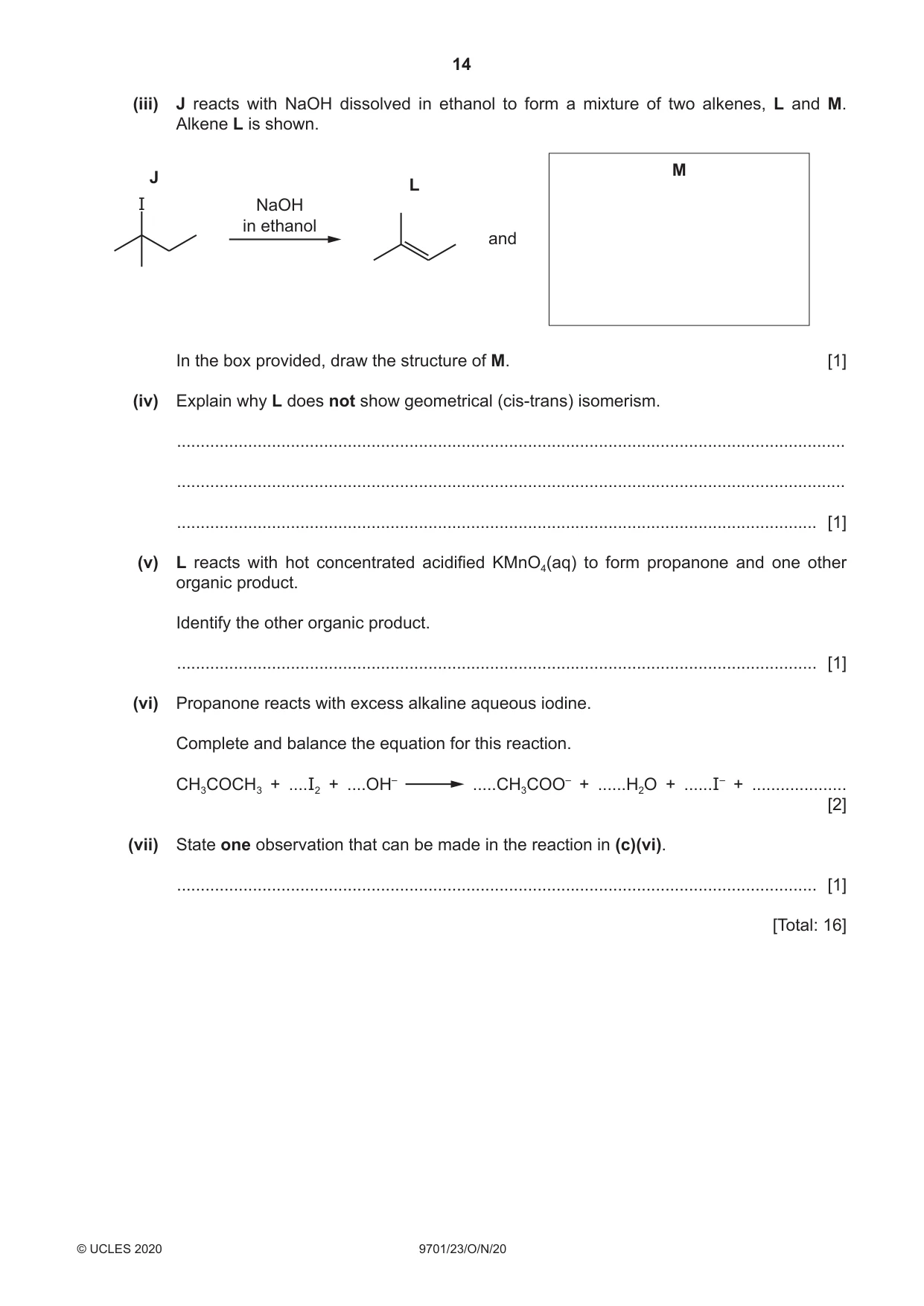

Mark scheme11 pages
Answers below. Sit the paper first if you are practising.
Questions as text
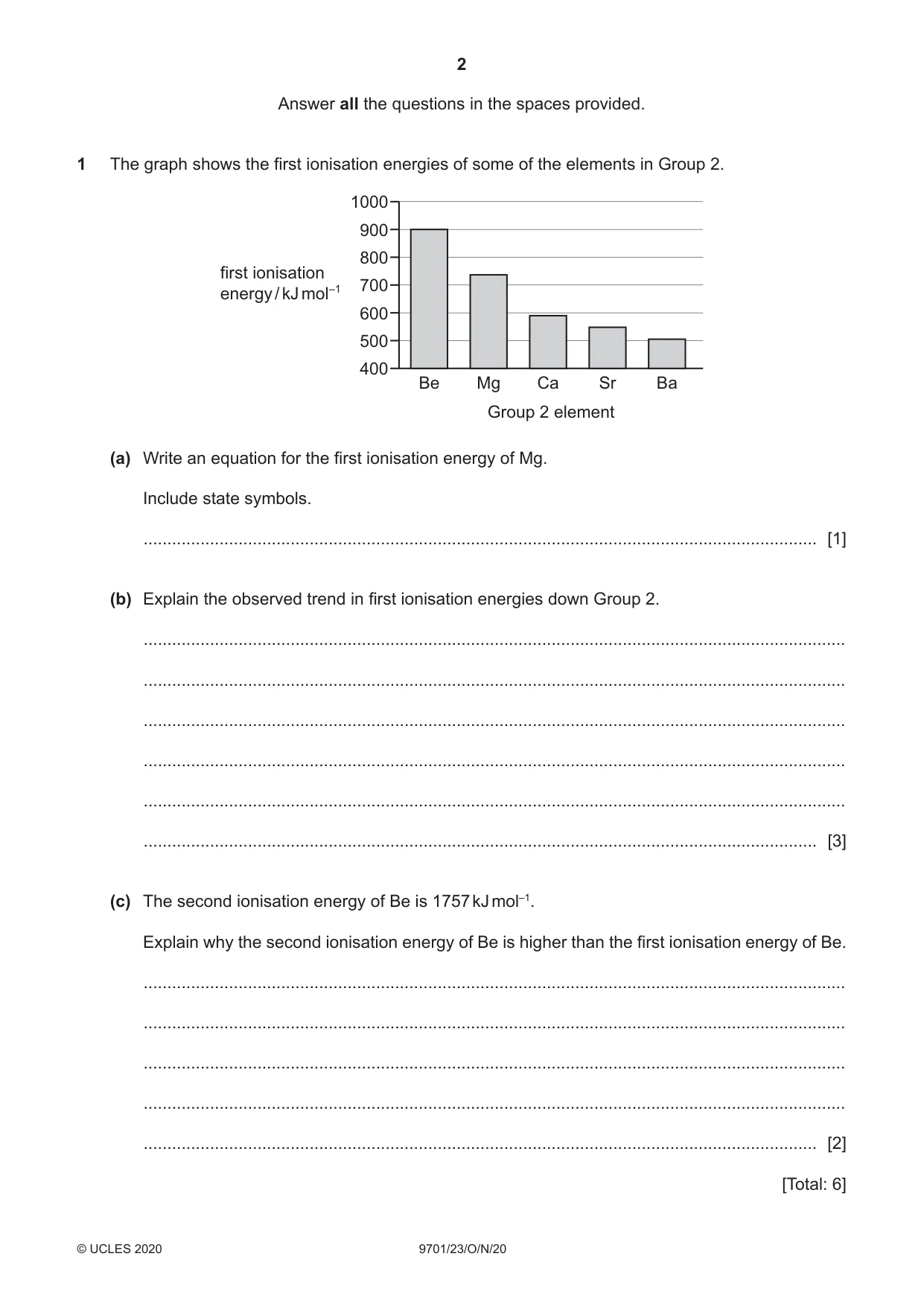
Q1 · The graph shows the first ionisation energies of some of the elements in Group 2
1 The graph shows the first ionisation energies of some of the elements in Group 2. 1000 900 800 first ionisation 700 energy / kJ mol–1 600 500 400 Be Mg Ca Sr Ba Group 2 element (a) Write an equation for the first ionisation energy of Mg. Include state symbols. .............................................................................................................................................. [1] (b) Explain the observed trend in first ionisation energies down Group 2. .................................................................................................................................................... .................................................................................................................................................... .................................................................................................................................................... .................................................................................................................................................... .................................................................................................................................................... .............................................................................................................................................. [3] (c) The second ionisation energy of Be is 1757 kJ mol–1. Explain why the second ionisation energy of Be is higher than the first ionisation energy of Be. .................................................................................................................................................... .................................................................................................................................................... .................................................................................................................................................... .................................................................................................................................................... .............................................................................................................................................. [2] [Total: 6]
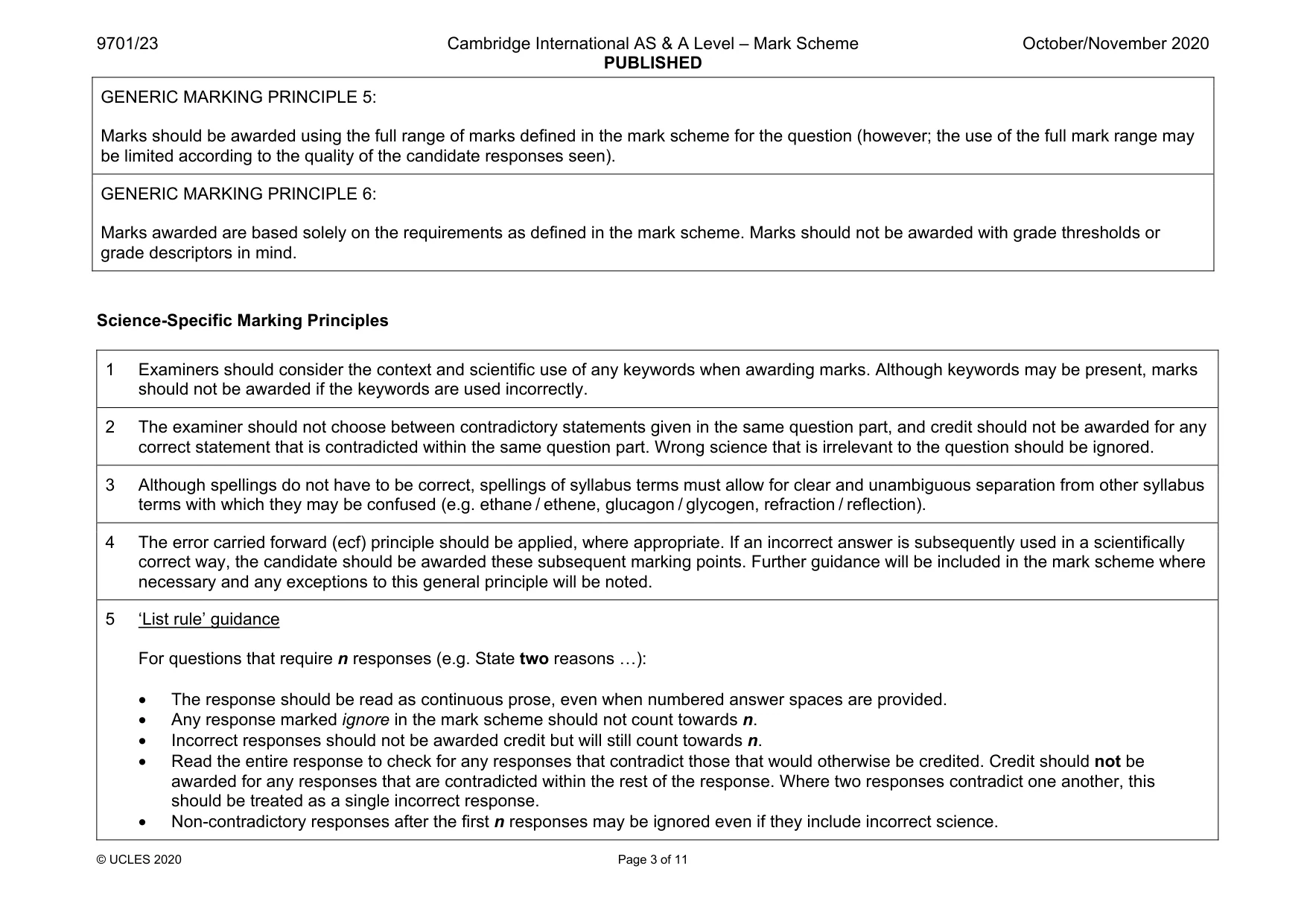
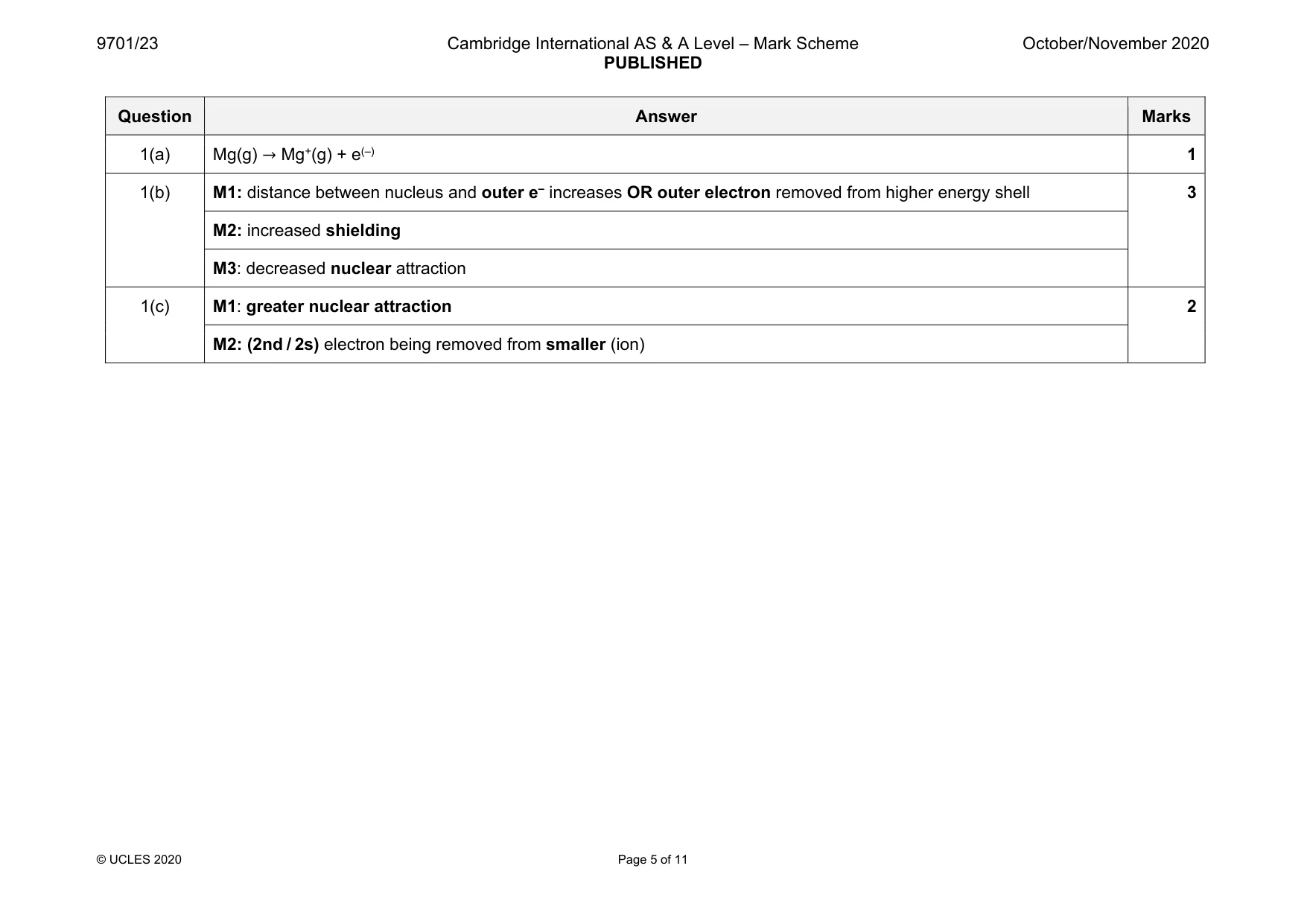
Mark scheme: 1(a) 1 1(b) M1: distance between nucleus and outer e– increases OR outer electron removed from higher energy shell 3 M2: increased shielding M3: decreased nuclear attraction 1(c) M1: greater nuclear attraction 2 M2: (2nd / 2s) electron being removed from smaller (ion)
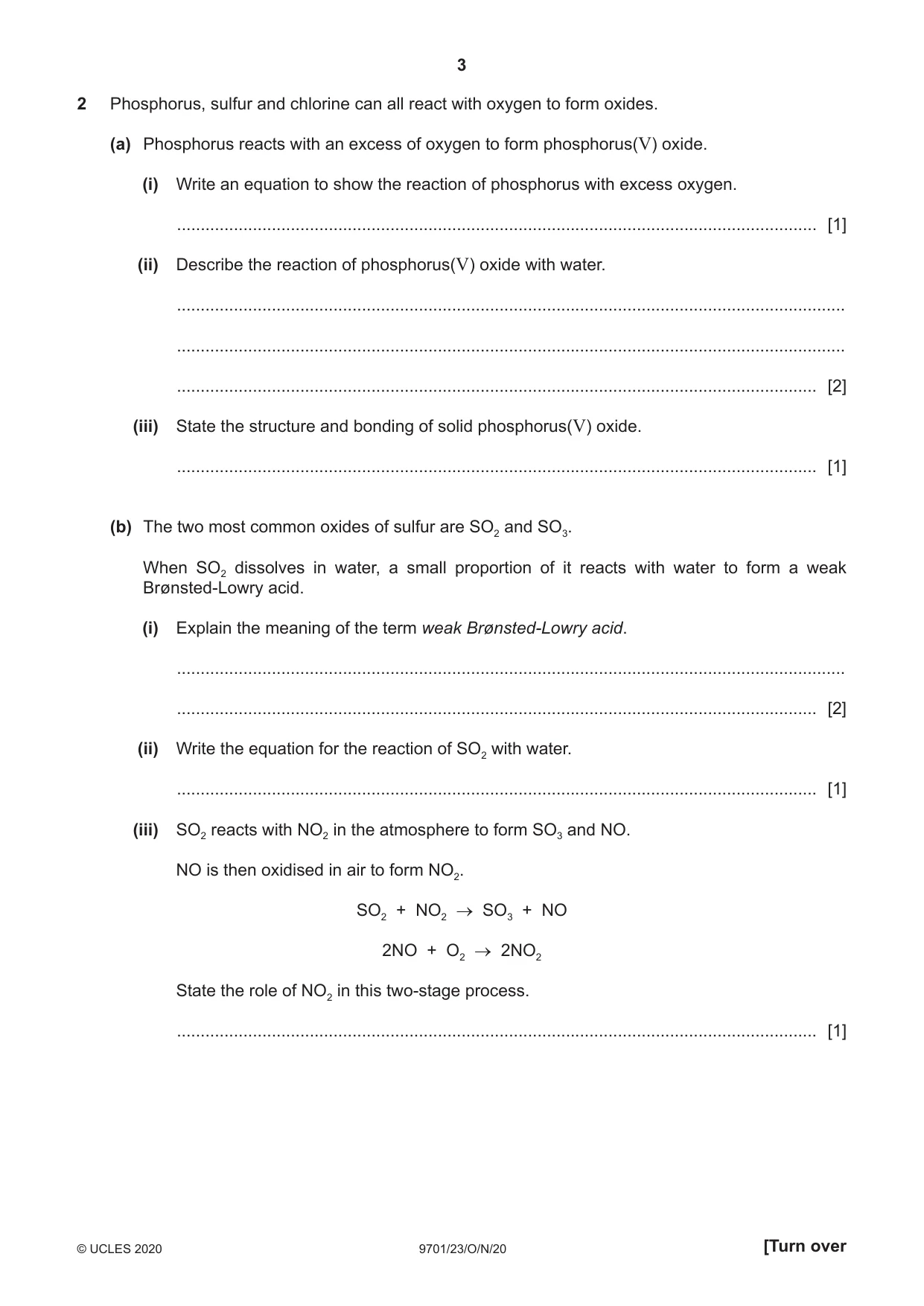
Q2 · Phosphorus, sulfur and chlorine can all react with oxygen to form oxides
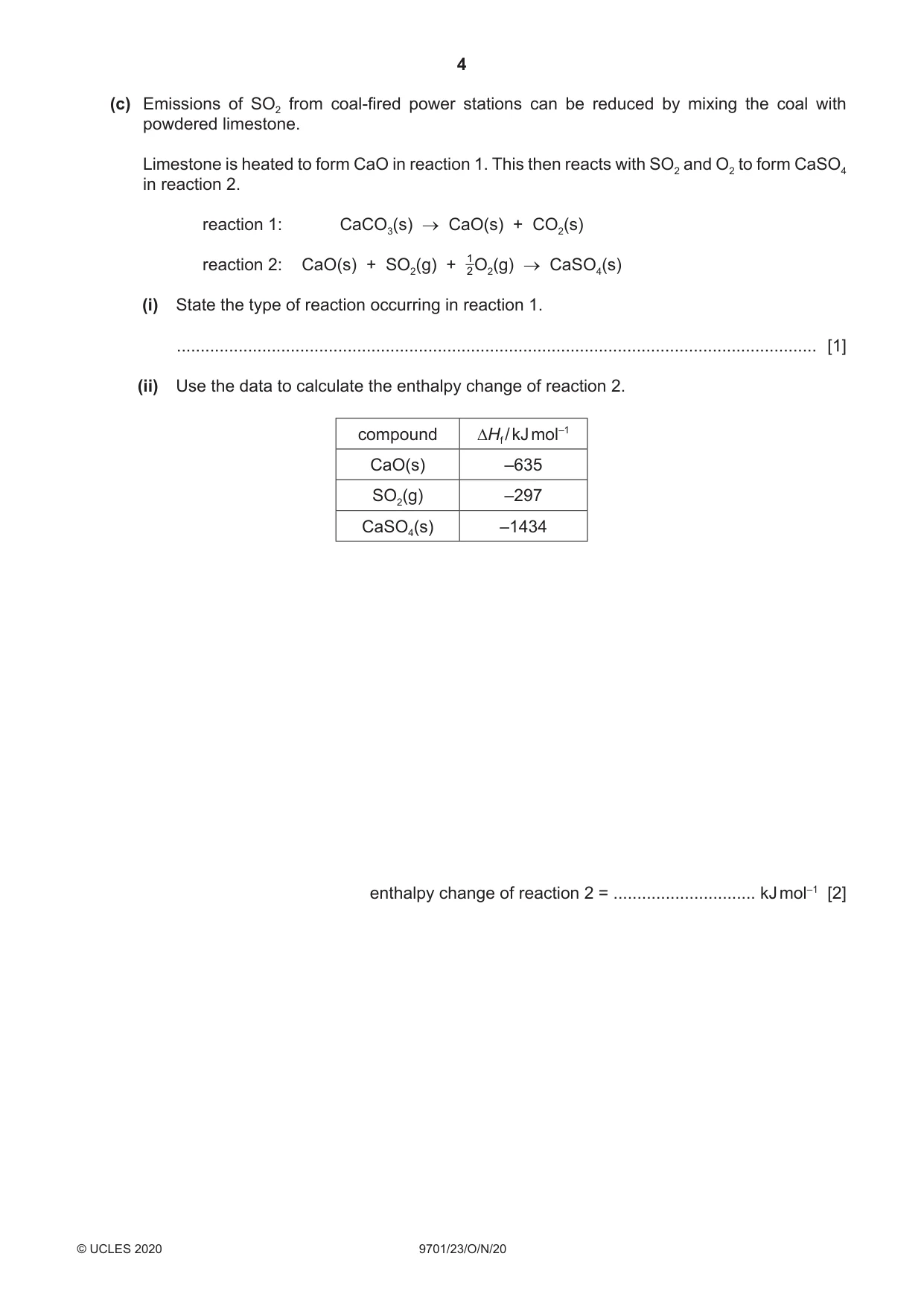
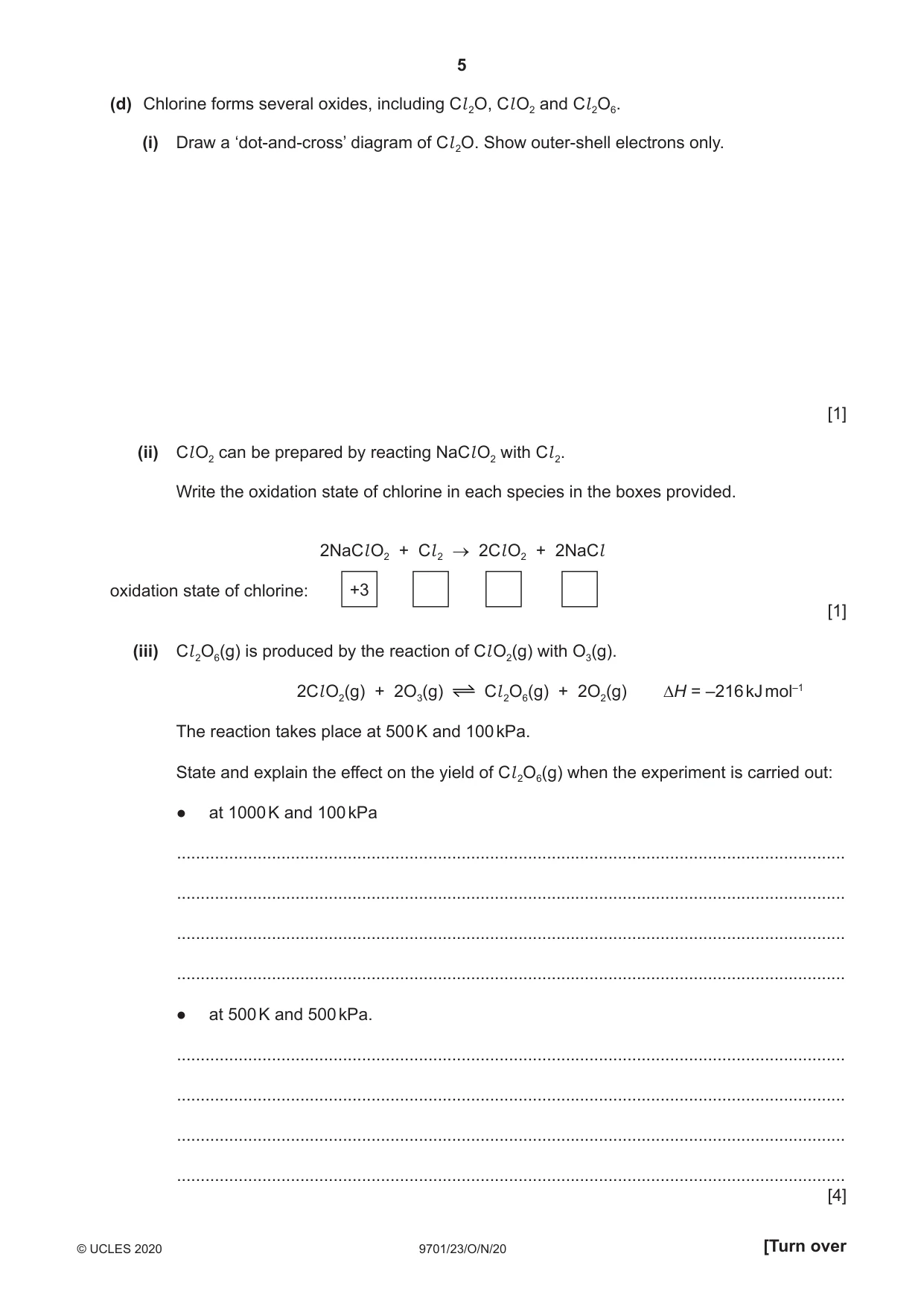
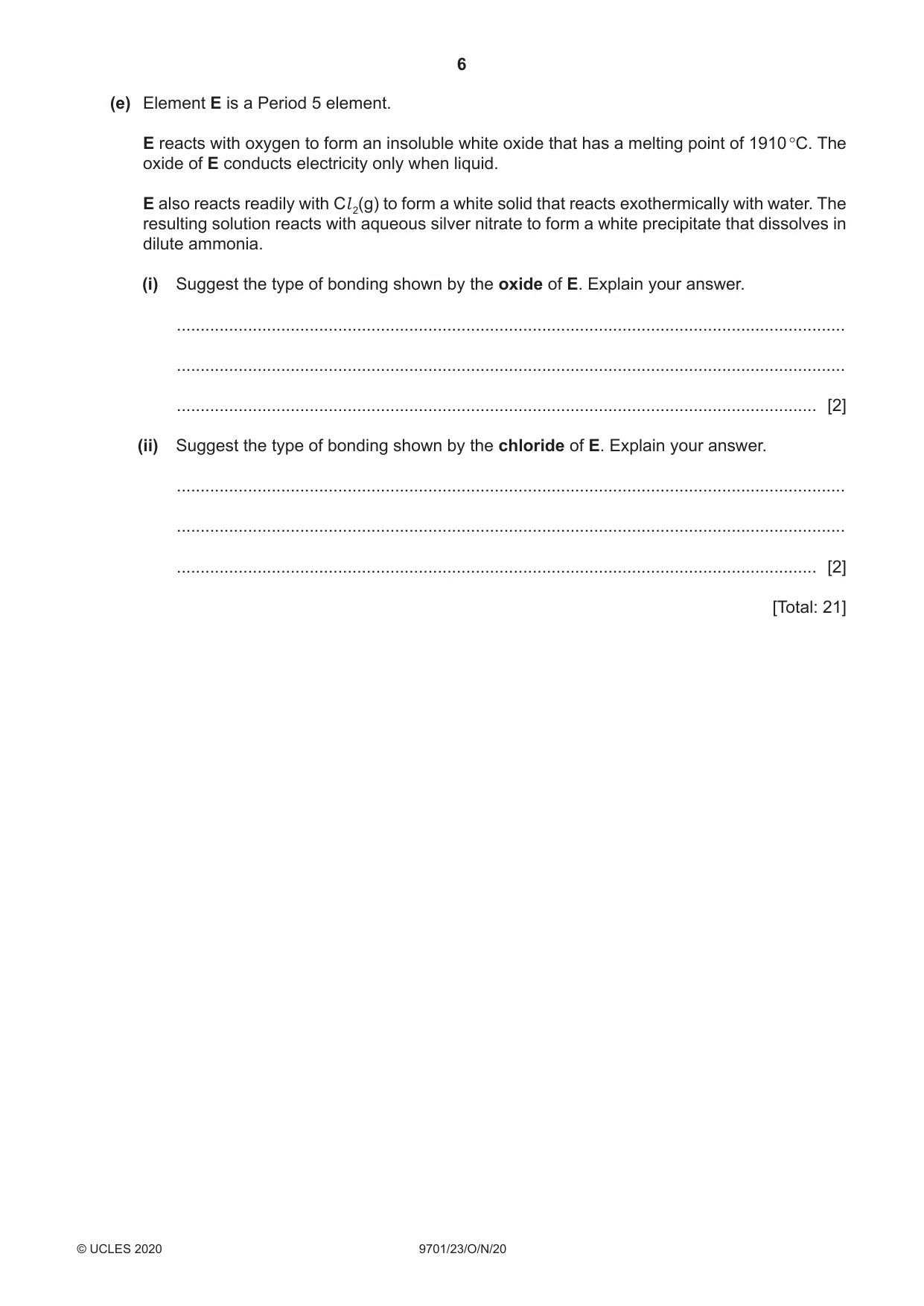
2 Phosphorus, sulfur and chlorine can all react with oxygen to form oxides. (a) Phosphorus reacts with an excess of oxygen to form phosphorus(V) oxide. (i) Write an equation to show the reaction of phosphorus with excess oxygen. ....................................................................................................................................... [1] (ii) Describe the reaction of phosphorus(V) oxide with water. ............................................................................................................................................. ............................................................................................................................................. ....................................................................................................................................... [2] (iii) State the structure and bonding of solid phosphorus(V) oxide. ....................................................................................................................................... [1] (b) The two most common oxides of sulfur are SO2 and SO3. When SO2 dissolves in water, a small proportion of it reacts with water to form a weak Brønsted‑Lowry acid. (i) Explain the meaning of the term weak Brønsted-Lowry acid. ............................................................................................................................................. ....................................................................................................................................... [2] (ii) Write the equation for the reaction of SO2 with water. ....................................................................................................................................... [1] (iii) SO2 reacts with NO2 in the atmosphere to form SO3 and NO. NO is then oxidised in air to form NO2. SO2 + NO2 → SO3 + NO 2NO + O2 → 2NO2 State the role of NO2 in this two-stage process. ....................................................................................................................................... [1] (c) Emissions of SO2 from coal-fired power stations can be reduced by mixing the coal with powdered limestone. Limestone is heated to form CaO in reaction 1. This then reacts with SO2 and O2 to form CaSO4 in reaction 2. reaction 1: CaCO3(s) → CaO(s) + CO2(s) reaction 2: CaO(s) + SO2(g) + 12O2(g) → CaSO4(s) (i) State the type of reaction occurring in reaction 1. ....................................................................................................................................... [1] (ii) Use the data to calculate the enthalpy change of reaction 2. compound ∆Hf / kJ mol–1 CaO(s) –635 SO2(g) –297 CaSO4(s) –1434 enthalpy change of reaction 2 = .............................. kJ mol–1 [2] (d) Chlorine forms several oxides, including Cl 2O, Cl O2 and Cl 2O6. (i) Draw a ‘dot-and-cross’ diagram of Cl 2O. Show outer-shell electrons only. [1] (ii) Cl O2 can be prepared by reacting NaCl O2 with Cl 2. Write the oxidation state of chlorine in each species in the boxes provided. 2NaCl O2 + Cl 2 → 2Cl O2 + 2NaCl oxidation state of chlorine: +3 [1] (iii) Cl 2O6(g) is produced by the reaction of Cl O2(g) with O3(g). 2Cl O2(g) + 2O3(g) Cl 2O6(g) + 2O2(g) ∆H = –216 kJ mol–1 The reaction takes place at 500 K and 100 kPa. State and explain the effect on the yield of Cl 2O6(g) when the experiment is carried out: ● at 1000 K and 100 kPa ............................................................................................................................................. ............................................................................................................................................. ............................................................................................................................................. ............................................................................................................................................. ● at 500 K and 500 kPa. ............................................................................................................................................. ............................................................................................................................................. ............................................................................................................................................. ............................................................................................................................................. [4] (e) Element E is a Period 5 element. E reacts with oxygen to form an insoluble white oxide that has a melting point of 1910 °C. The oxide of E conducts electricity only when liquid. E also reacts readily with Cl 2(g) to form a white solid that reacts exothermically with water. The resulting solution reacts with aqueous silver nitrate to form a white precipitate that dissolves in dilute ammonia. (i) Suggest the type of bonding shown by the oxide of E. Explain your answer. ............................................................................................................................................. ............................................................................................................................................. ....................................................................................................................................... [2] (ii) Suggest the type of bonding shown by the chloride of E. Explain your answer. ............................................................................................................................................. ............................................................................................................................................. ....................................................................................................................................... [2] [Total: 21] Question 3 starts on the next page.
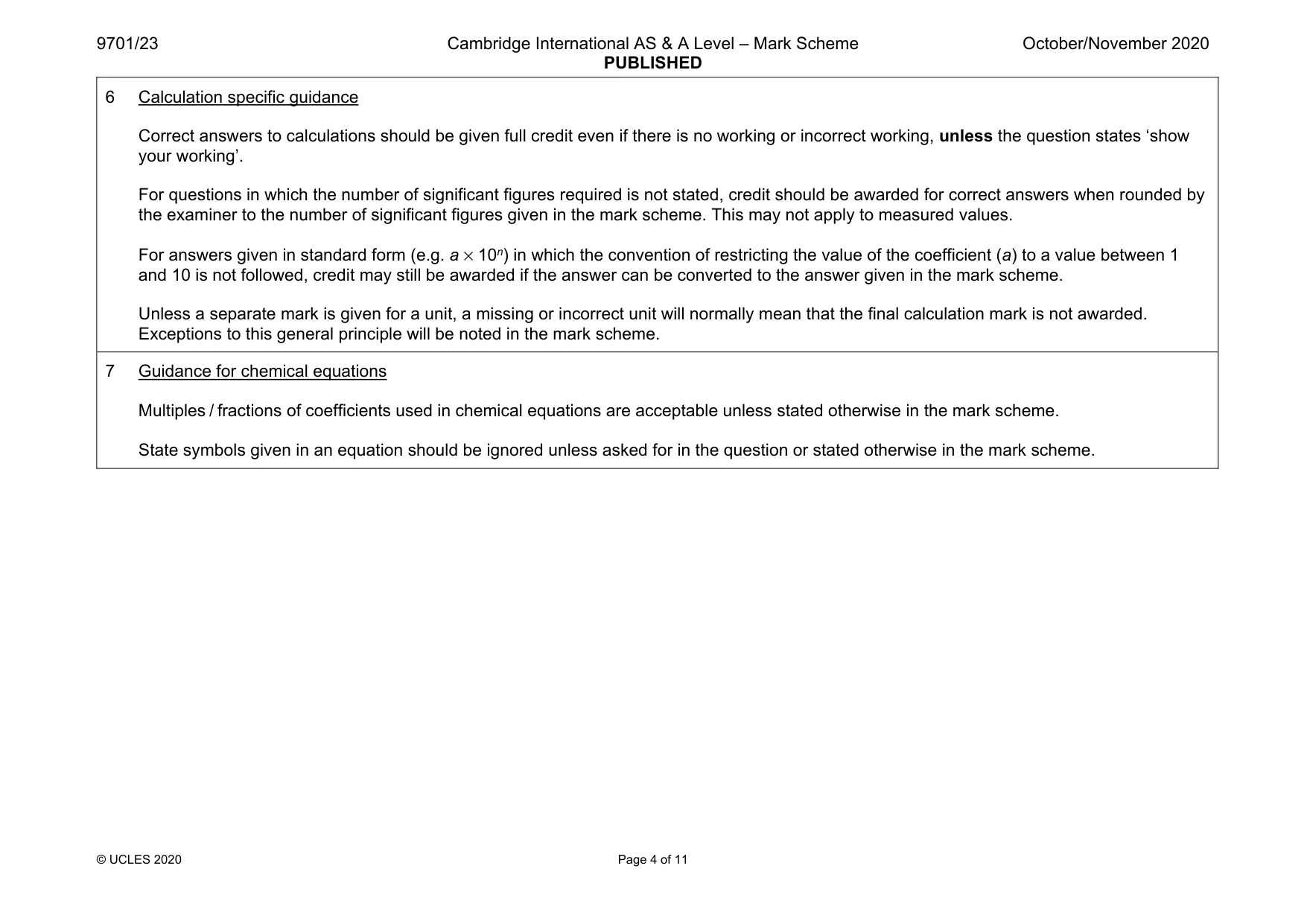
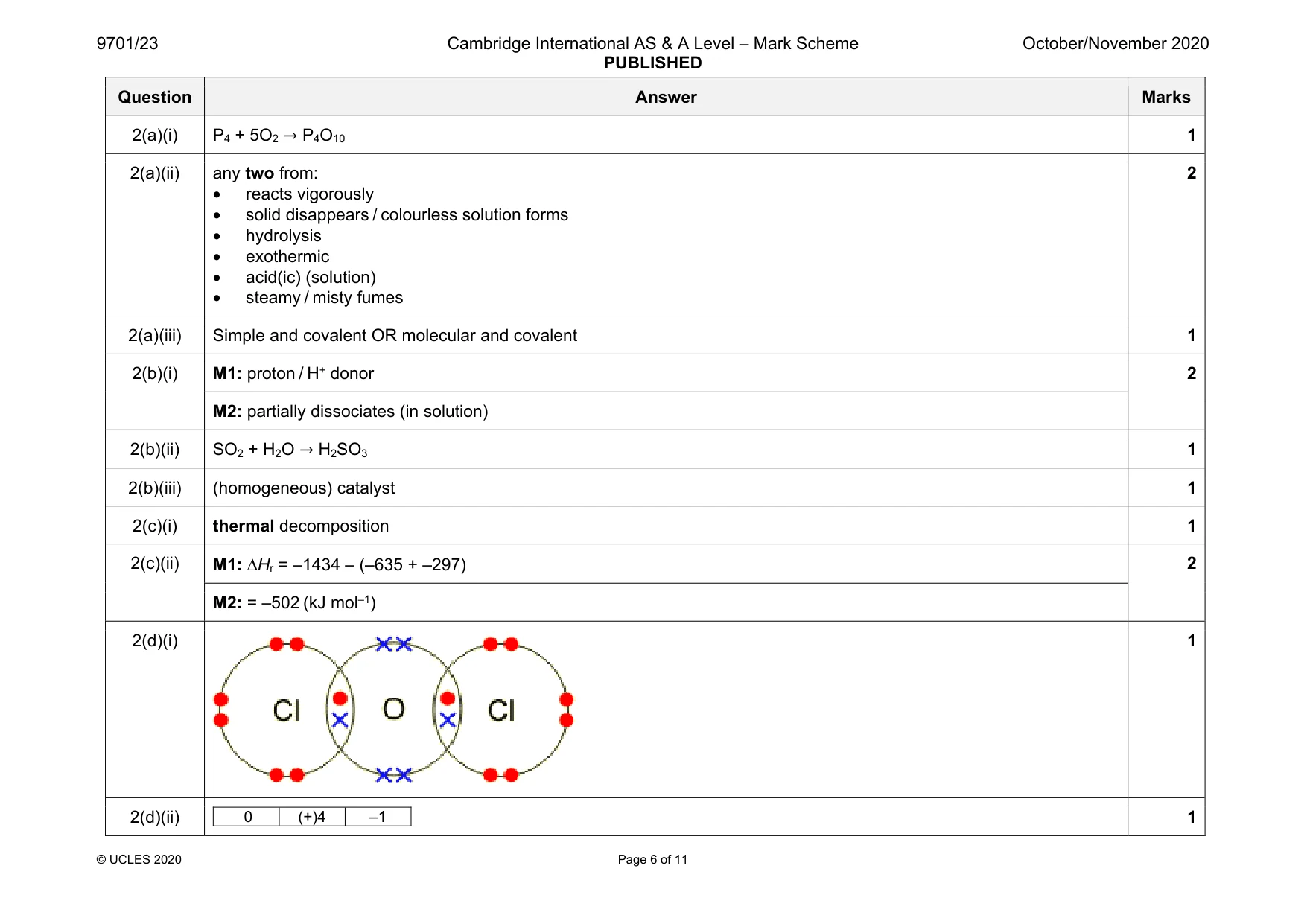
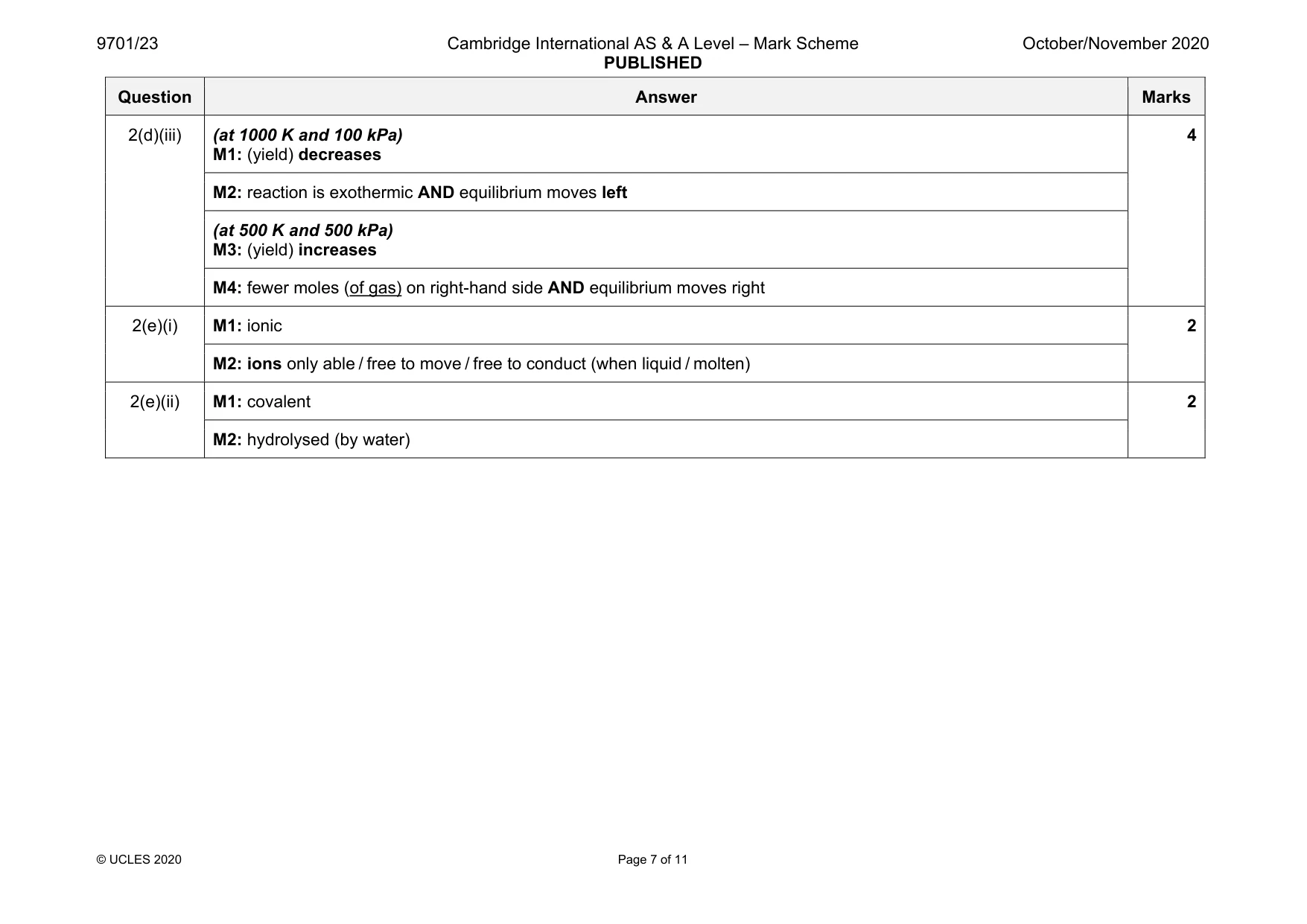
Mark scheme: 2(a)(i) 1 2(a)(ii) any two from: • reacts vigorously • solid disappears / colourless solution forms • hydrolysis • exothermic • acid(ic) (solution) • steamy / misty fumes 2 2(a)(iii) Simple and covalent OR molecular and covalent 1 2(b)(i) M1: proton / H+ donor 2 M2: partially dissociates (in solution) 2(b)(ii) SO2 + H2O → H2SO3 1 2(b)(iii) (homogeneous) catalyst 1 2(c)(i) thermal decomposition 1 2(c)(ii) M1: ΔHr = –1434 – (–635 + –297) 2 M2: = –502 (kJ mol–1) 2(d)(i) 1 2(d)(ii) 0 (+)4 –1 1 Question Answer Marks 2(d)(iii) (at 1000 K and 100 kPa) M1: (yield) decreases 4 M2: reaction is exothermic AND equilibrium moves left (at 500 K and 500 kPa) M3: (yield) increases M4: fewer moles (of gas) on right-hand side AND equilibrium moves right 2(e)(i) M1: ionic 2 M2: ions only able / free to move / free to conduct (when liquid / molten) 2(e)(ii) M1: covalent 2 M2: hydrolysed (by water)
More questions on Periodicity of chemical properties of the elements in Period 3
Q3 · The reducing agent LiAl H4 can be synthesised by reacting aluminium chloride with lithium…
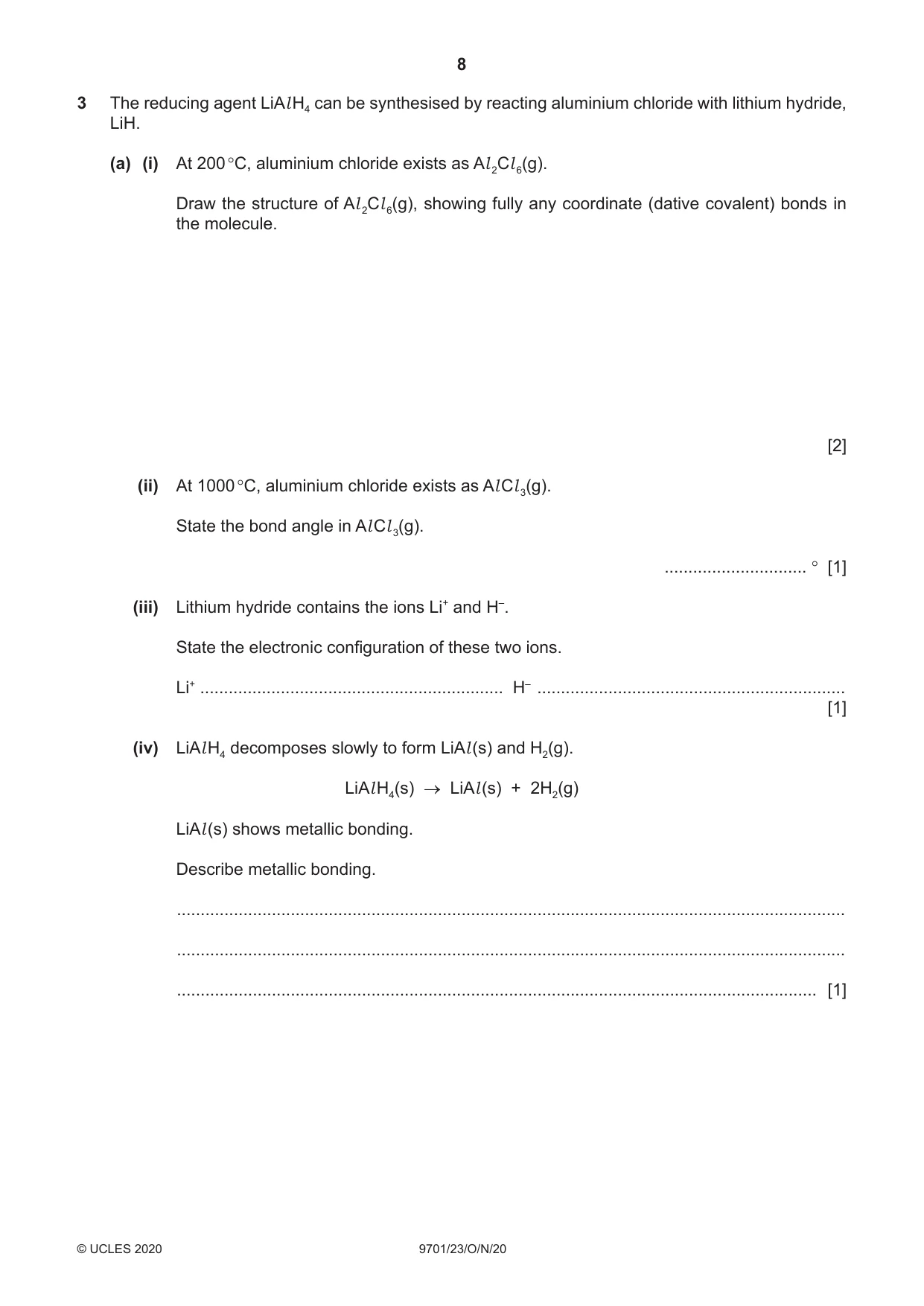
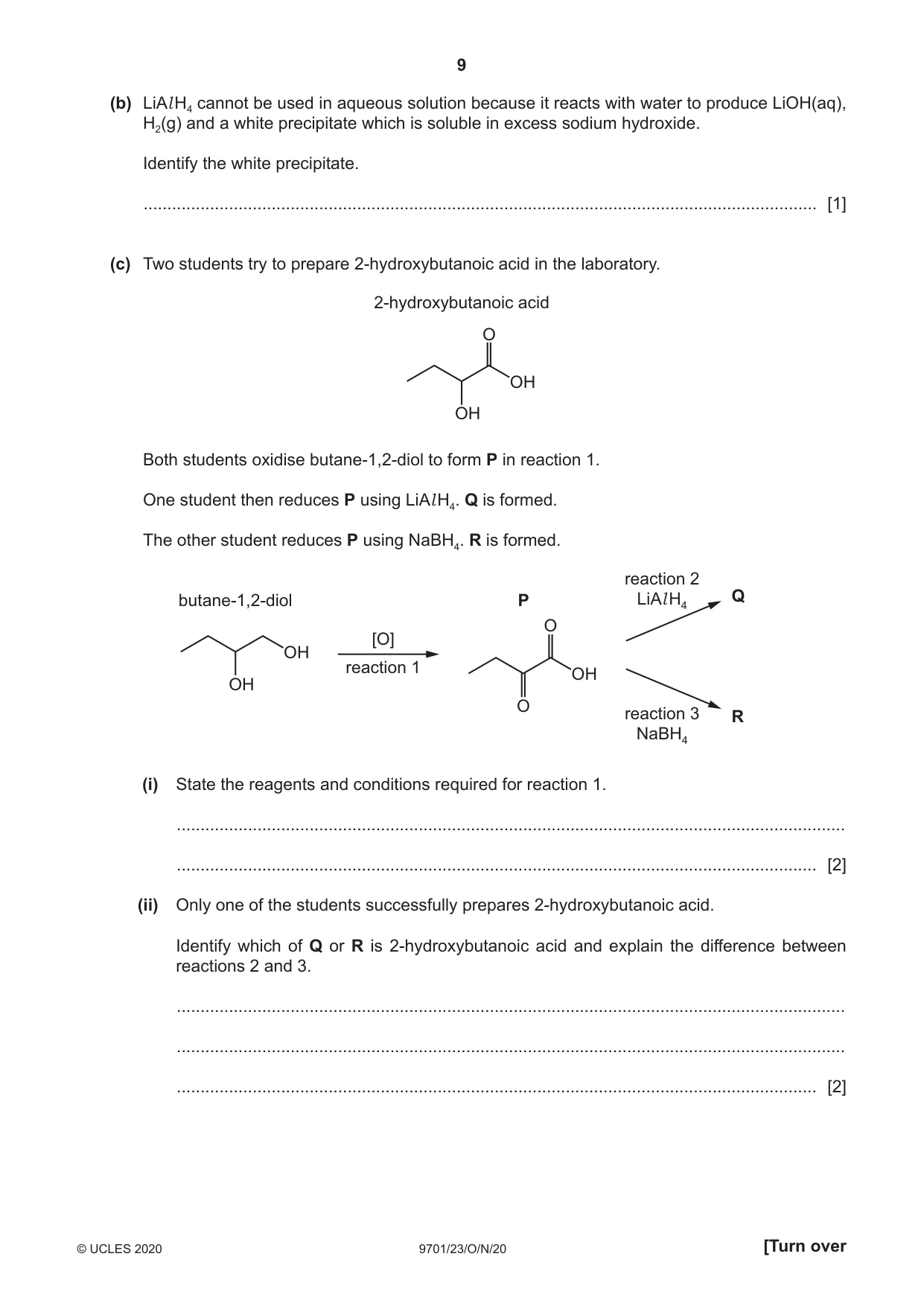
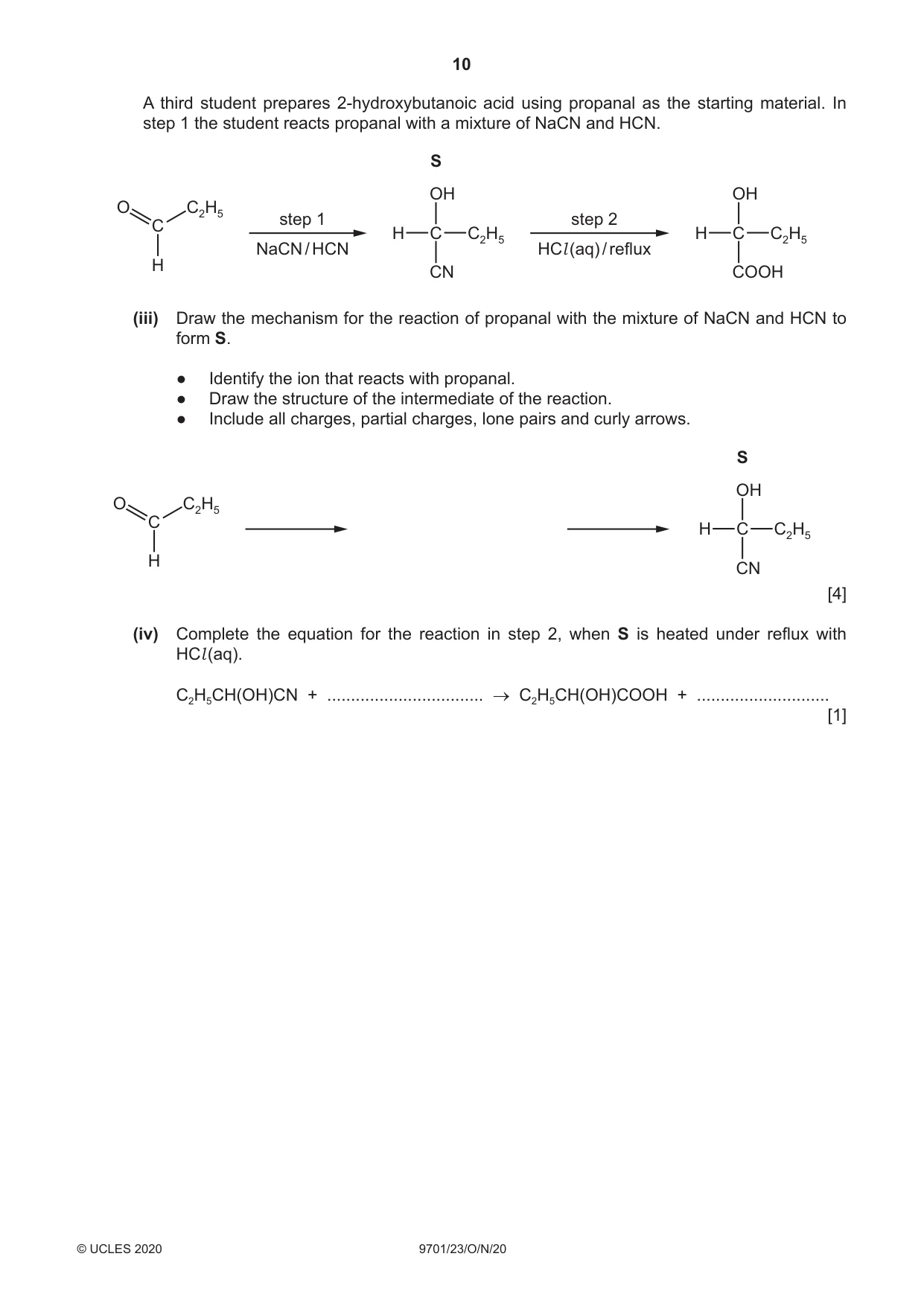
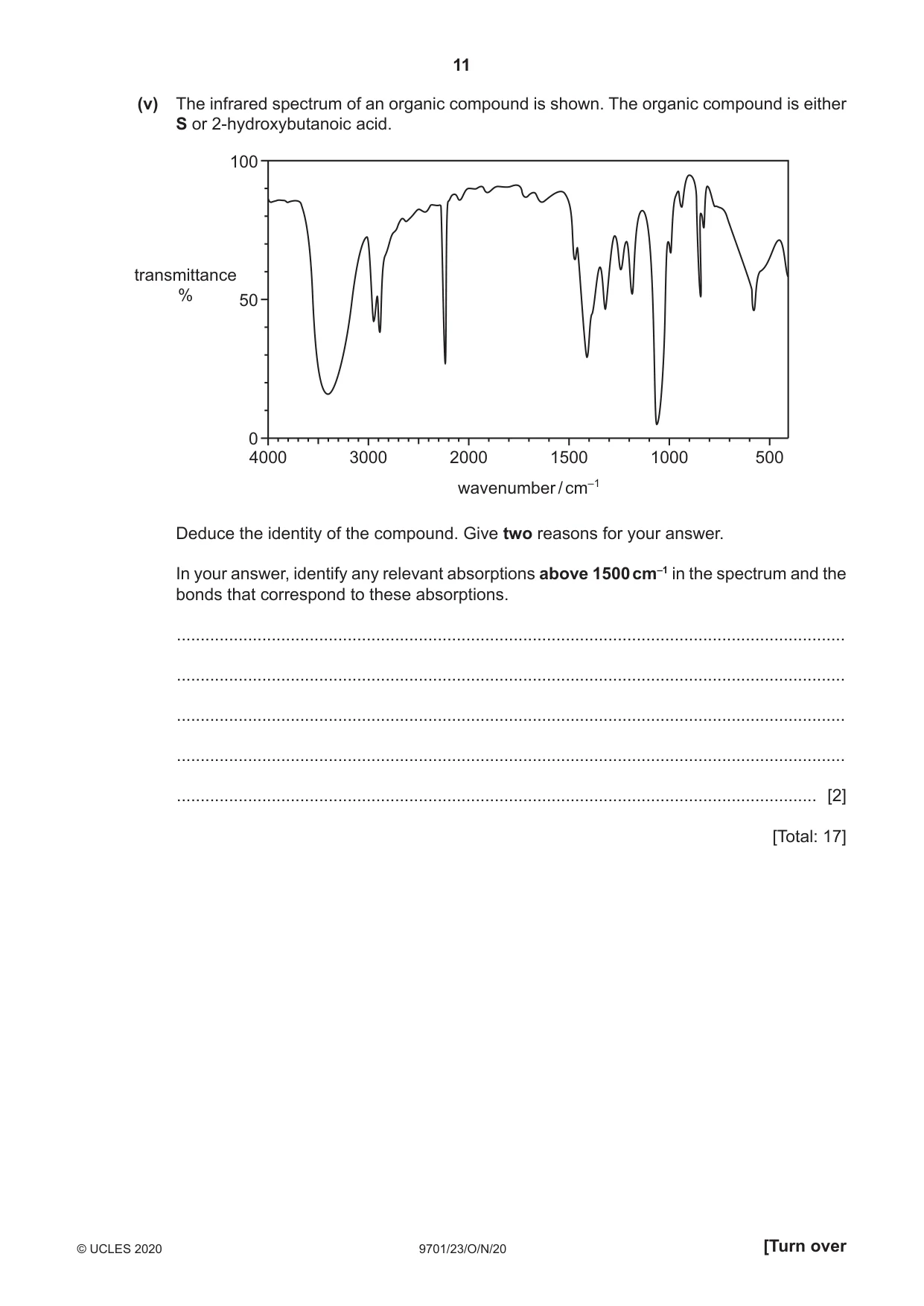
3 The reducing agent LiAl H4 can be synthesised by reacting aluminium chloride with lithium hydride, LiH. (a) (i) At 200 °C, aluminium chloride exists as Al 2Cl 6(g). Draw the structure of Al 2Cl 6(g), showing fully any coordinate (dative covalent) bonds in the molecule. [2] (ii) At 1000 °C, aluminium chloride exists as Al Cl 3(g). State the bond angle in Al Cl 3(g). .............................. ° [1] (iii) Lithium hydride contains the ions Li+ and H–. State the electronic configuration of these two ions. Li+ ................................................................ H– ................................................................. [1] (iv) LiAl H4 decomposes slowly to form LiAl (s) and H2(g). LiAl H4(s) → LiAl (s) + 2H2(g) LiAl (s) shows metallic bonding. Describe metallic bonding. ............................................................................................................................................. ............................................................................................................................................. ....................................................................................................................................... [1] (b) LiAl H4 cannot be used in aqueous solution because it reacts with water to produce LiOH(aq), H2(g) and a white precipitate which is soluble in excess sodium hydroxide. Identify the white precipitate. .............................................................................................................................................. [1] (c) Two students try to prepare 2‑hydroxybutanoic acid in the laboratory. 2-hydroxybutanoic acid O OH OH Both students oxidise butane‑1,2‑diol to form P in reaction 1. One student then reduces P using LiAl H4. Q is formed. The other student reduces P using NaBH4. R is formed. reaction 2 butane-1,2-diol P LiAl H4 Q O [O] OH reaction 1 OH OH O reaction 3 R NaBH4 (i) State the reagents and conditions required for reaction 1. ............................................................................................................................................. ....................................................................................................................................... [2] (ii) Only one of the students successfully prepares 2‑hydroxybutanoic acid. Identify which of Q or R is 2‑hydroxybutanoic acid and explain the difference between reactions 2 and 3. ............................................................................................................................................. ............................................................................................................................................. ....................................................................................................................................... [2] A third student prepares 2‑hydroxybutanoic acid using propanal as the starting material. In step 1 the student reacts propanal with a mixture of NaCN and HCN. S OH OH O C2H5 step 1 step 2 C H C C2H5 H C C2H5 NaCN / HCN HCl (aq) / reflux H CN COOH (iii) Draw the mechanism for the reaction of propanal with the mixture of NaCN and HCN to form S. ● Identify the ion that reacts with propanal. ● Draw the structure of the intermediate of the reaction. ● Include all charges, partial charges, lone pairs and curly arrows. S OH O C2H5 C H C C2H5 H CN [4] (iv) Complete the equation for the reaction in step 2, when S is heated under reflux with HCl (aq). C2H5CH(OH)CN + ................................. → C2H5CH(OH)COOH + ............................ [1] (v) The infrared spectrum of an organic compound is shown. The organic compound is either S or 2‑hydroxybutanoic acid. 100 transmittance % 50 0 4000 3000 2000 1500 1000 500 wavenumber / cm–1 Deduce the identity of the compound. Give two reasons for your answer. In your answer, identify any relevant absorptions above 1500 cm–1 in the spectrum and the bonds that correspond to these absorptions. ............................................................................................................................................. ............................................................................................................................................. ............................................................................................................................................. ............................................................................................................................................. ....................................................................................................................................... [2] [Total: 17]
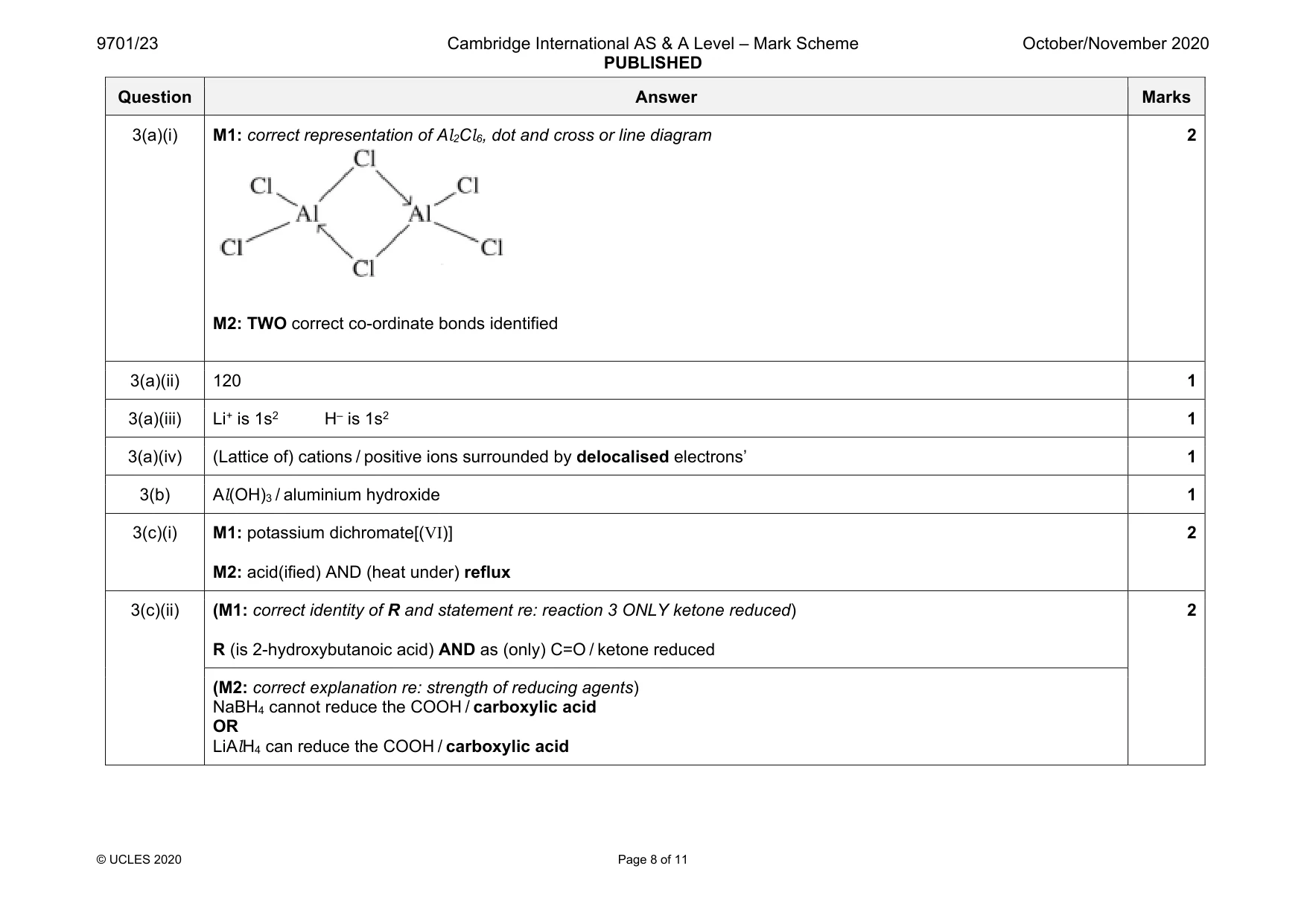
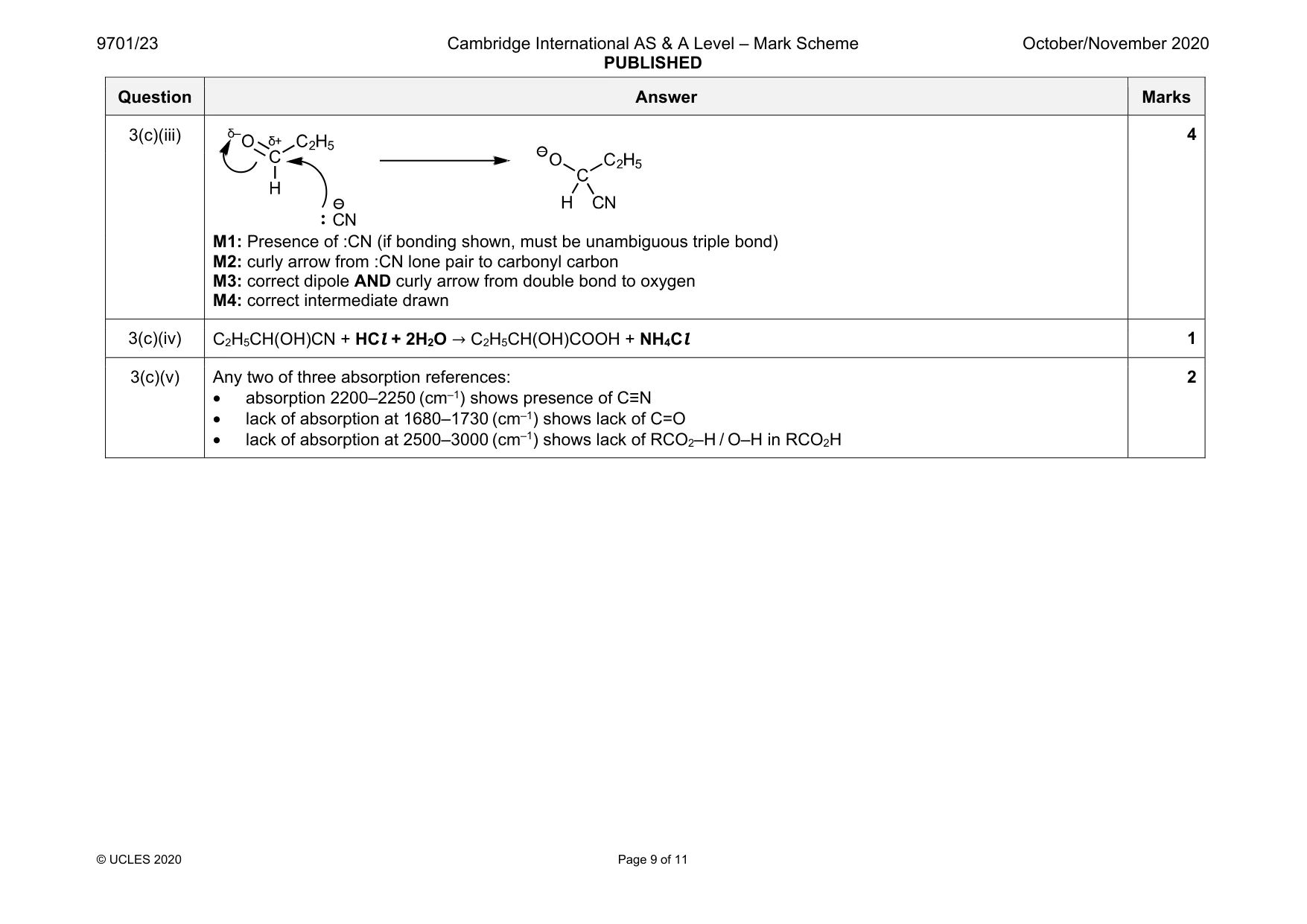
Mark scheme: 3(a)(i) M2: TWO correct co-ordinate bonds identified 2 3(a)(ii) 120 1 3(a)(iii) Li+ is 1s2 H– is 1s2 1 3(a)(iv) (Lattice of) cations / positive ions surrounded by delocalised electrons’ 1 3(b) Al(OH)3 / aluminium hydroxide 1 3(c)(i) M1: potassium dichromate[(VI)] M2: acid(ified) AND (heat under) reflux 2 3(c)(ii) (M1: correct identity of R and statement re: reaction 3 ONLY ketone reduced) R (is 2-hydroxybutanoic acid) AND as (only) C=O / ketone reduced 2 (M2: correct explanation re: strength of reducing agents) NaBH4 cannot reduce the COOH / carboxylic acid OR LiAlH4 can reduce the COOH / carboxylic acid Question Answer Marks 3(c)(iii) M1: Presence of :CN (if bonding shown, must be unambiguous triple bond) M2: curly arrow from :CN lone pair to carbonyl carbon M3: correct dipole AND curly arrow from double bond to oxygen M4: correct intermediate drawn 4 3(c)(iv) C2H5CH(OH)CN + HCl + 2H2O → C2H5CH(OH)COOH + NH4Cl 1 3(c)(v) Any two of three absorption references: • absorption 2200–2250 (cm–1) shows presence of C≡N • lack of absorption at 1680–1730 (cm–1) shows lack of C=O • lack of absorption at 2500–3000 (cm–1) shows lack of RCO2–H / O–H in RCO2H 2
More questions on Electrons, energy levels and atomic orbitals
Q4 · Iodine is used in many inorganic and organic reactions
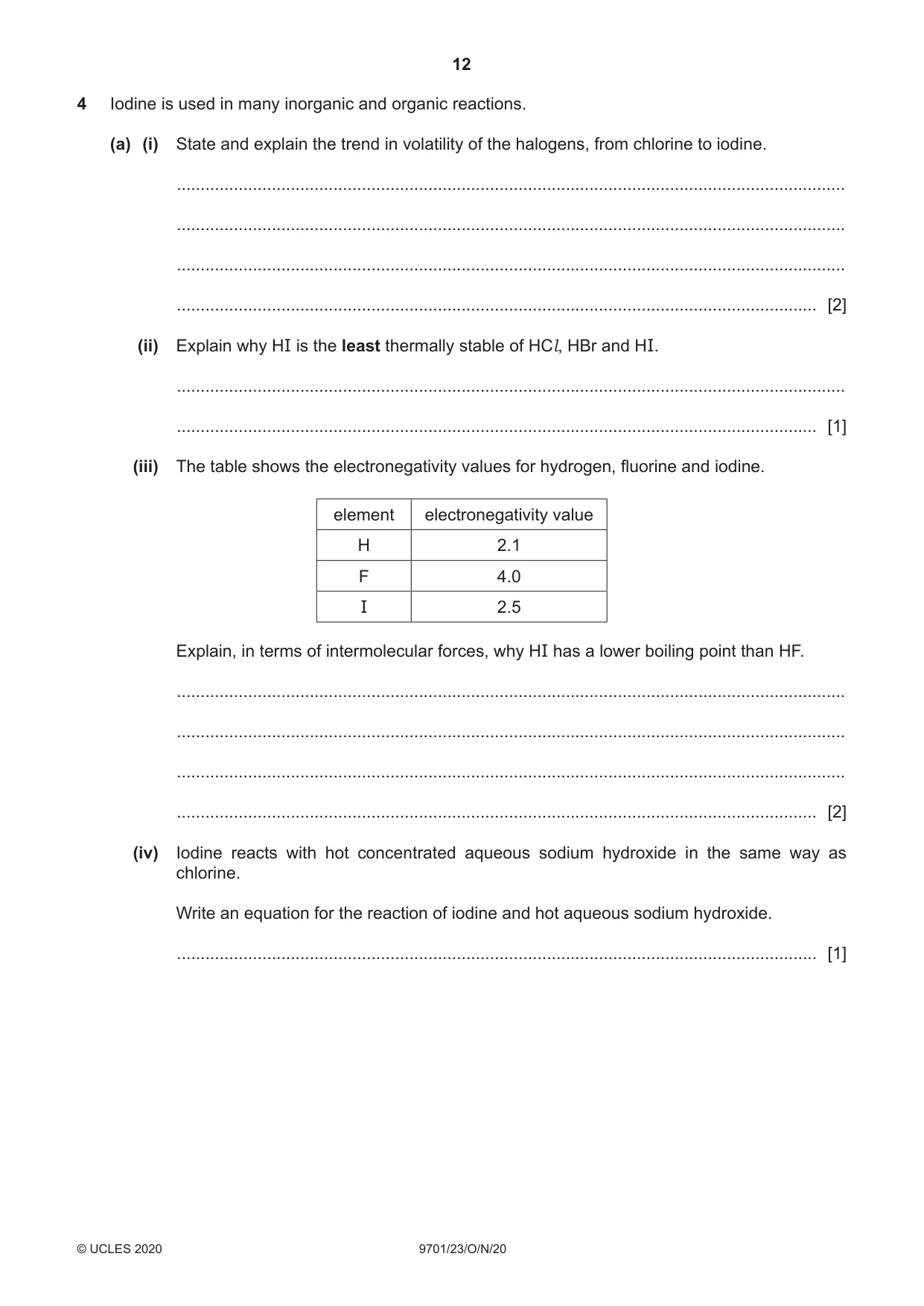
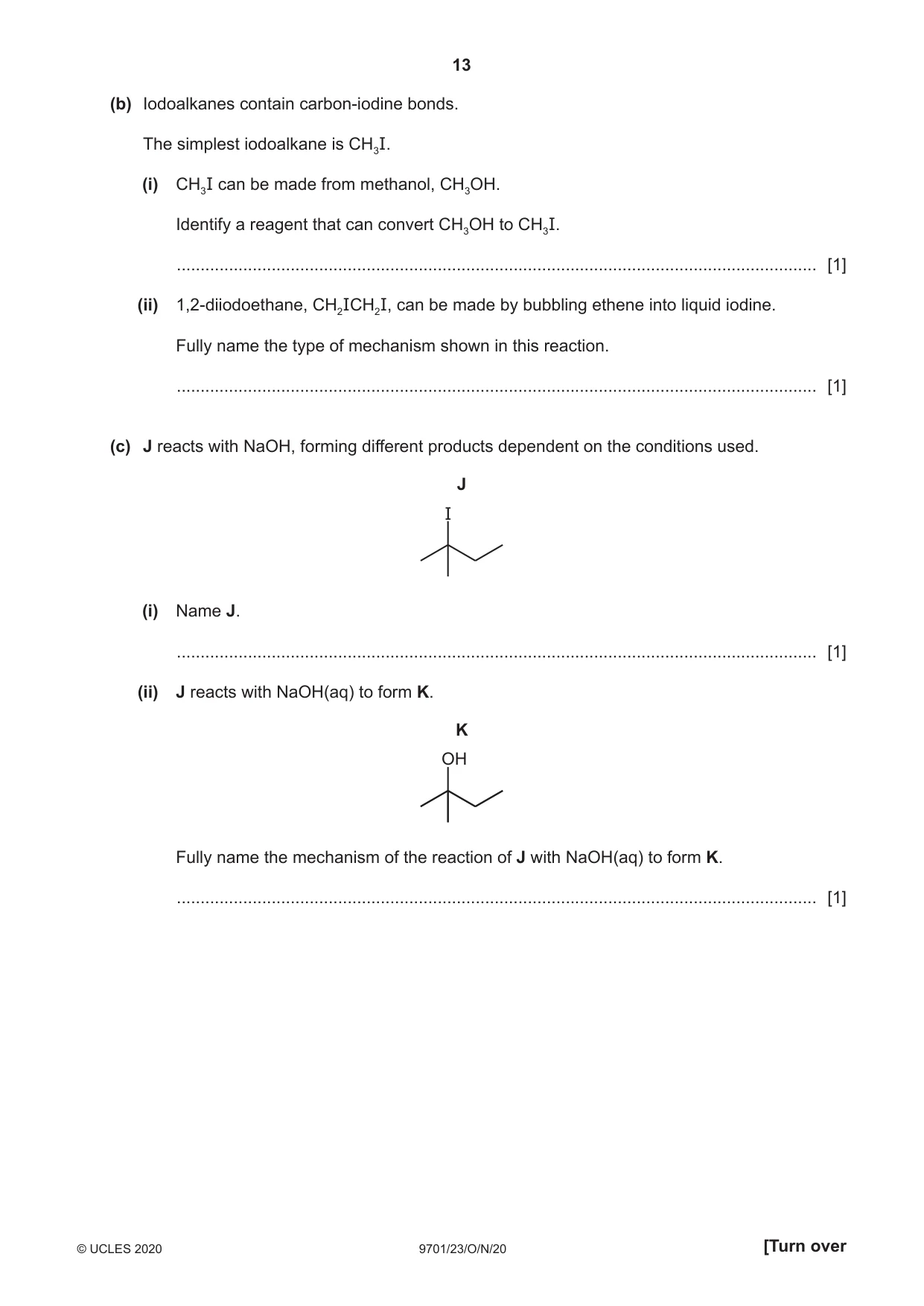
4 Iodine is used in many inorganic and organic reactions. (a) (i) State and explain the trend in volatility of the halogens, from chlorine to iodine. ............................................................................................................................................. ............................................................................................................................................. ............................................................................................................................................. ....................................................................................................................................... [2] (ii) Explain why HI is the least thermally stable of HCl, HBr and HI. ............................................................................................................................................. ....................................................................................................................................... [1] (iii) The table shows the electronegativity values for hydrogen, fluorine and iodine. element electronegativity value H 2.1 F 4.0 I 2.5 Explain, in terms of intermolecular forces, why HI has a lower boiling point than HF. ............................................................................................................................................. ............................................................................................................................................. ............................................................................................................................................. ....................................................................................................................................... [2] (iv) Iodine reacts with hot concentrated aqueous sodium hydroxide in the same way as chlorine. Write an equation for the reaction of iodine and hot aqueous sodium hydroxide. ....................................................................................................................................... [1] (b) Iodoalkanes contain carbon-iodine bonds. The simplest iodoalkane is CH3I. (i) CH3I can be made from methanol, CH3OH. Identify a reagent that can convert CH3OH to CH3I. ....................................................................................................................................... [1] (ii) 1,2‑diiodoethane, CH2ICH2I, can be made by bubbling ethene into liquid iodine. Fully name the type of mechanism shown in this reaction. ....................................................................................................................................... [1] (c) J reacts with NaOH, forming different products dependent on the conditions used. J I (i) Name J. ....................................................................................................................................... [1] (ii) J reacts with NaOH(aq) to form K. K OH Fully name the mechanism of the reaction of J with NaOH(aq) to form K. ....................................................................................................................................... [1] (iii) J reacts with NaOH dissolved in ethanol to form a mixture of two alkenes, L and M. Alkene L is shown. M J L I NaOH in ethanol and In the box provided, draw the structure of M. [1] (iv) Explain why L does not show geometrical (cis-trans) isomerism. ............................................................................................................................................. ............................................................................................................................................. ....................................................................................................................................... [1] (v) L reacts with hot concentrated acidified KMnO4(aq) to form propanone and one other organic product. Identify the other organic product. ....................................................................................................................................... [1] (vi) Propanone reacts with excess alkaline aqueous iodine. Complete and balance the equation for this reaction. CH3COCH3 + ....I2 + ....OH– .....CH3COO– + ......H2O + ......I– + .................... [2] (vii) State one observation that can be made in the reaction in (c)(vi). ....................................................................................................................................... [1] [Total: 16]
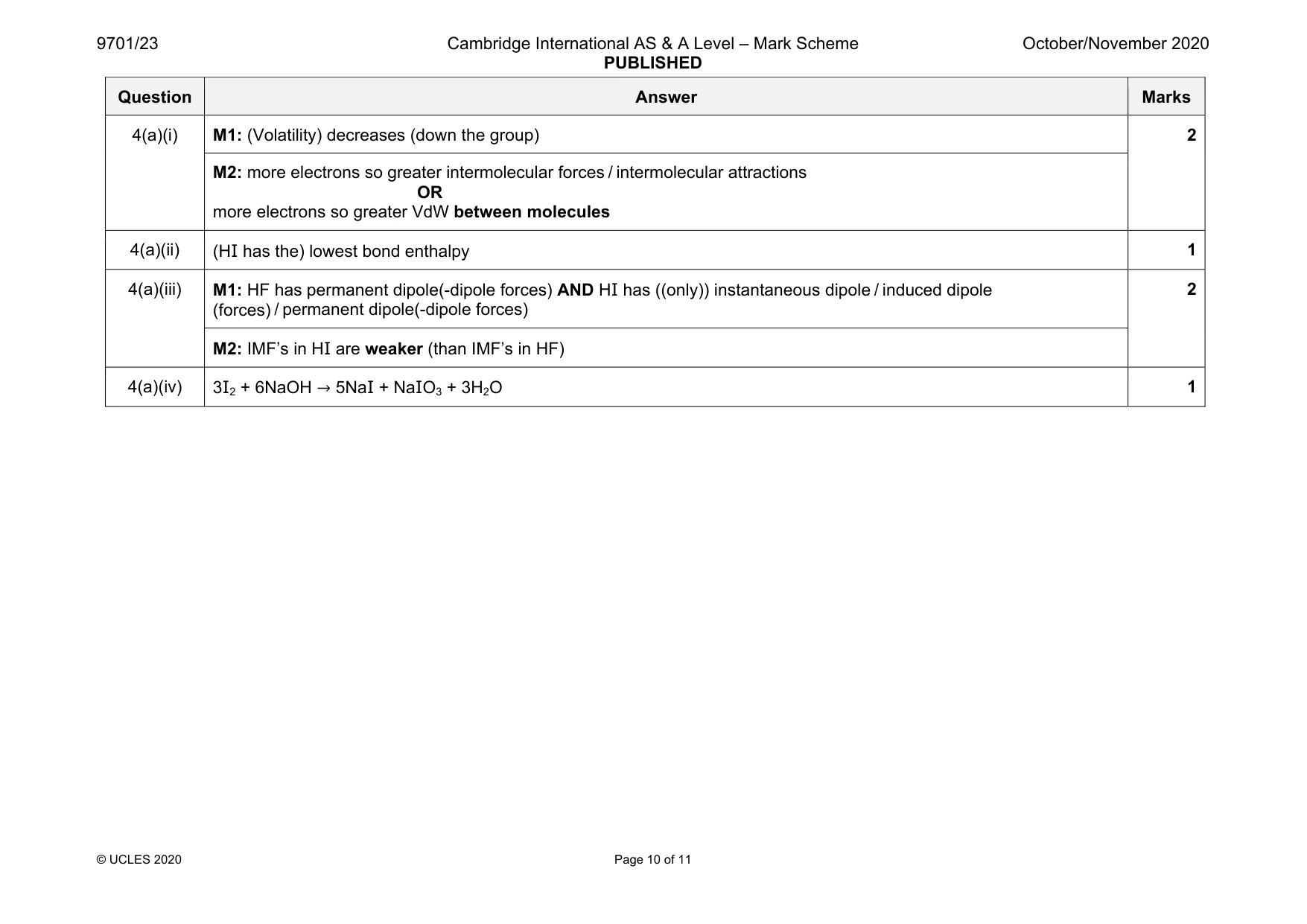
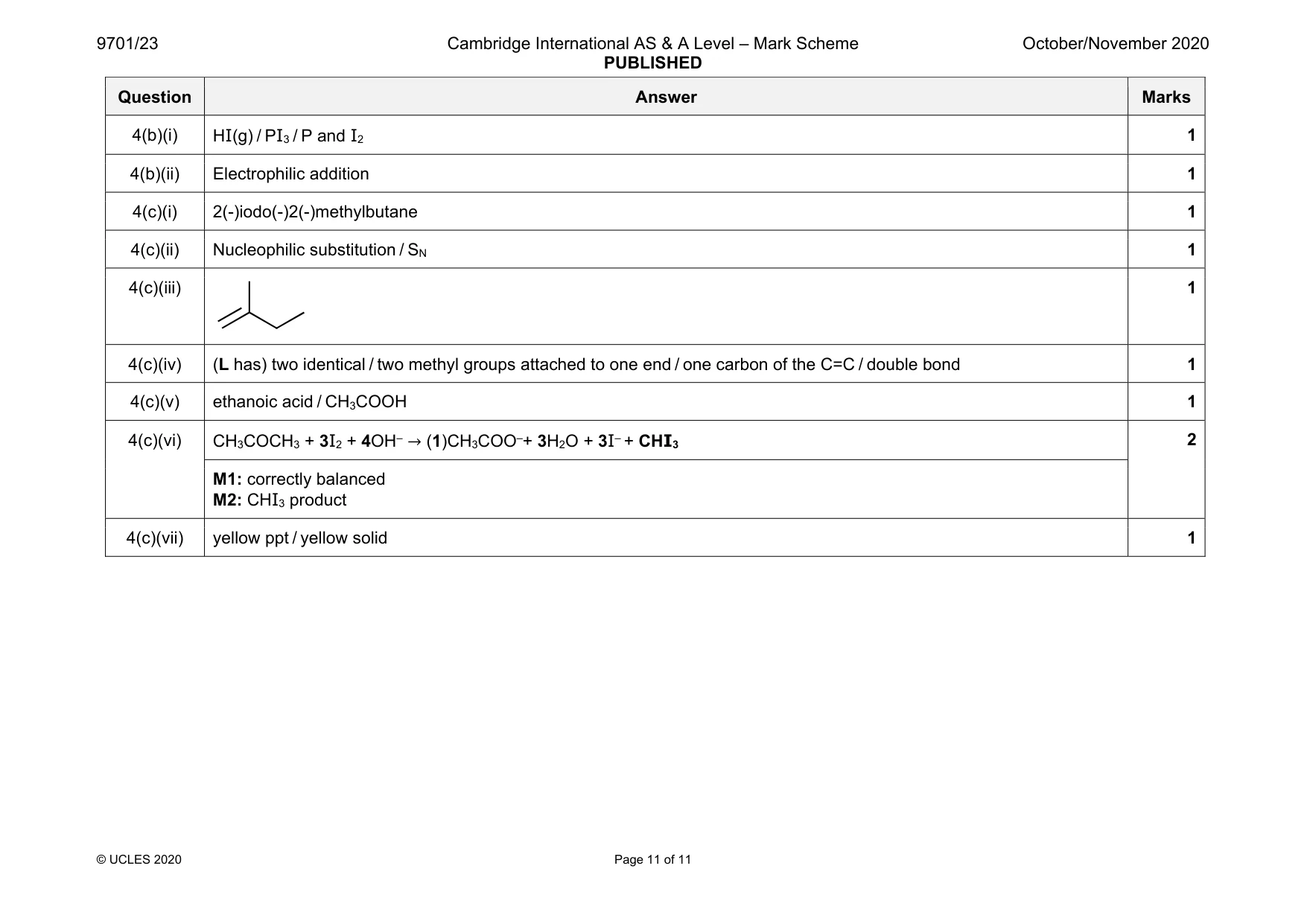
Mark scheme: 4(a)(i) M1: (Volatility) decreases (down the group) 2 M2: more electrons so greater intermolecular forces / intermolecular attractions OR more electrons so greater VdW between molecules 4(a)(ii) (HI has the) lowest bond enthalpy 1 4(a)(iii) M1: HF has permanent dipole(-dipole forces) AND HI has ((only)) instantaneous dipole / induced dipole (forces) / permanent dipole(-dipole forces) 2 M2: IMF’s in HI are weaker (than IMF’s in HF) 4(a)(iv) 3I2 + 6NaOH → 5NaI + NaIO3 + 3H2O 1 Question Answer Marks 4(b)(i) HI(g) / PI3 / P and I2 1 4(b)(ii) Electrophilic addition 1 4(c)(i) 2(-)iodo(-)2(-)methylbutane 1 4(c)(ii) Nucleophilic substitution / SN 1 4(c)(iii) 1 4(c)(iv) (L has) two identical / two methyl groups attached to one end / one carbon of the C=C / double bond 1 4(c)(v) ethanoic acid / CH3COOH 1 4(c)(vi) CH3COCH3 + 3I2 + 4OH– → (1)CH3COO–+ 3H2O + 3I– + CHI3 2 M1: correctly balanced M2: CHI3 product 4(c)(vii) yellow ppt / yellow solid 1
More questions on Intermolecular forces, electronegativity and bond properties
What was in this paper
The subtopics covered by these 4 questions, and how many questions each got. Open one in a new tab to see every Cambridge question on it.
What you needed in this session
Cambridge’s own grade thresholds for 2020 Oct/Nov, Paper 2 · Variant 3. A higher threshold means an easier paper — the bar moves with how the cohort did.