Cambridge A Level Chemistry 9701 — 2020 May/June Paper 2 · Variant 3
9701/23/M/J/20 · 5 questions · 60 marks · ≈68 min
The question paper and its mark scheme, free to read here and free to download. This is Cambridge’s own paper, exactly as it was sat.
Question paper12 pages
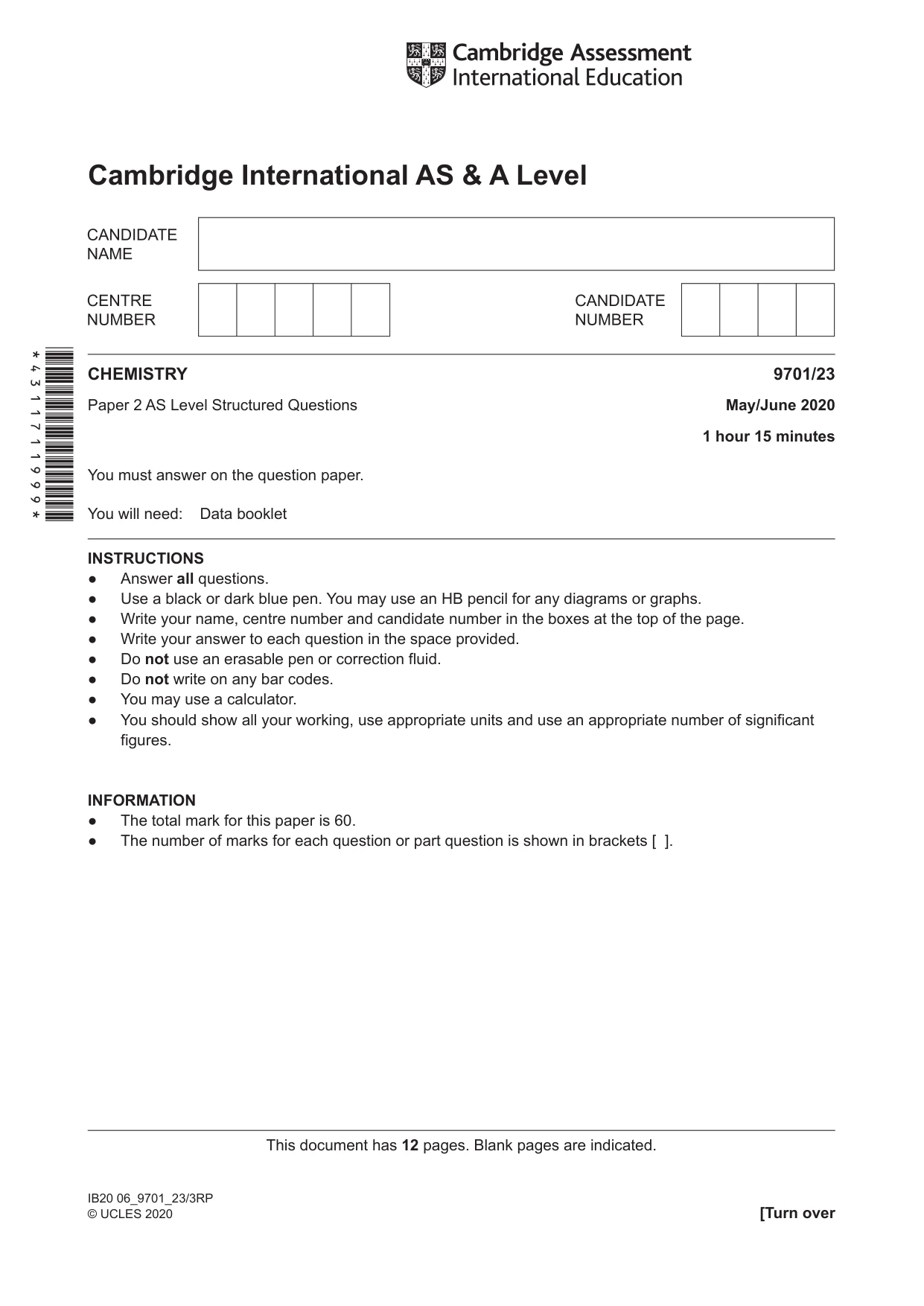
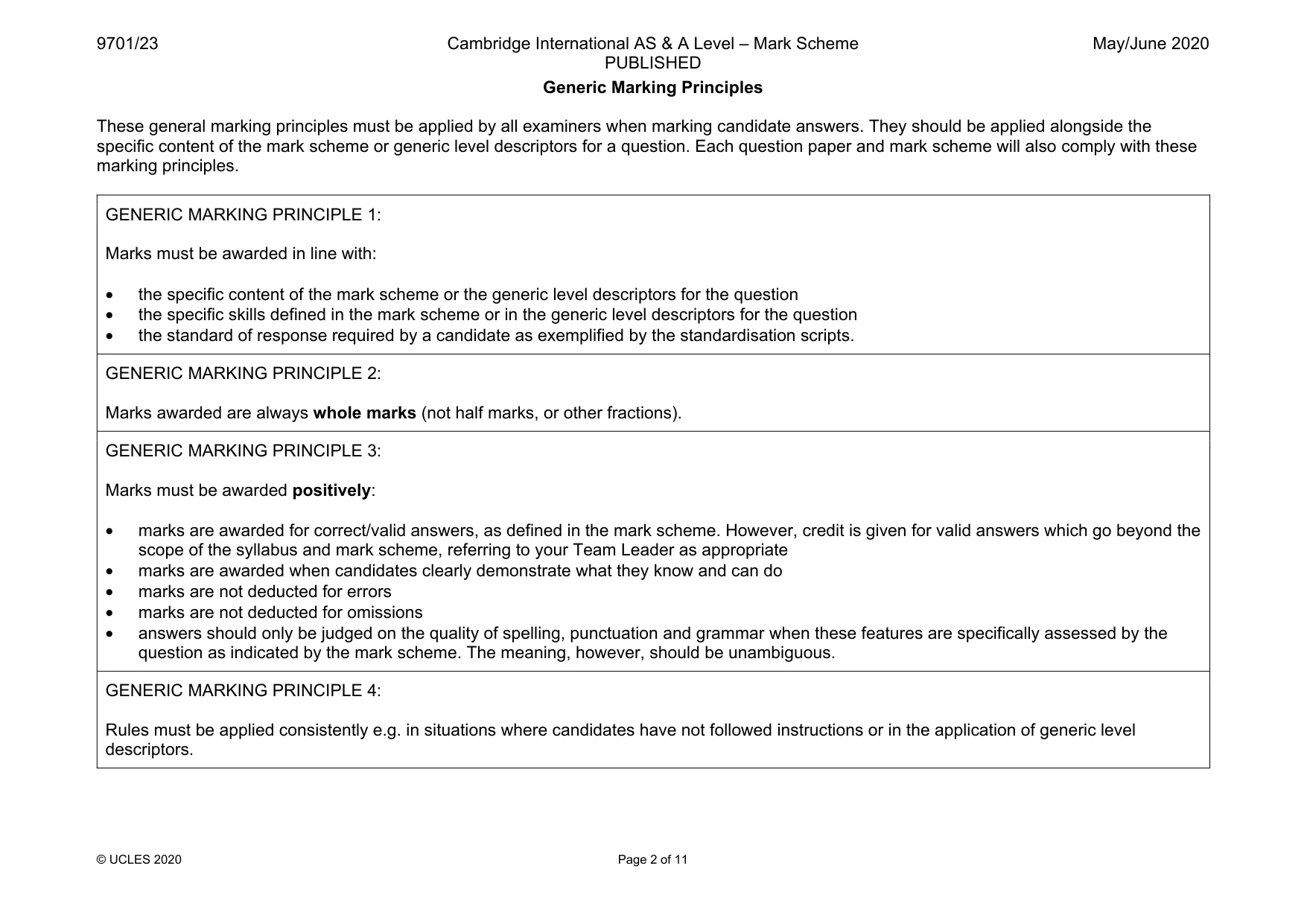
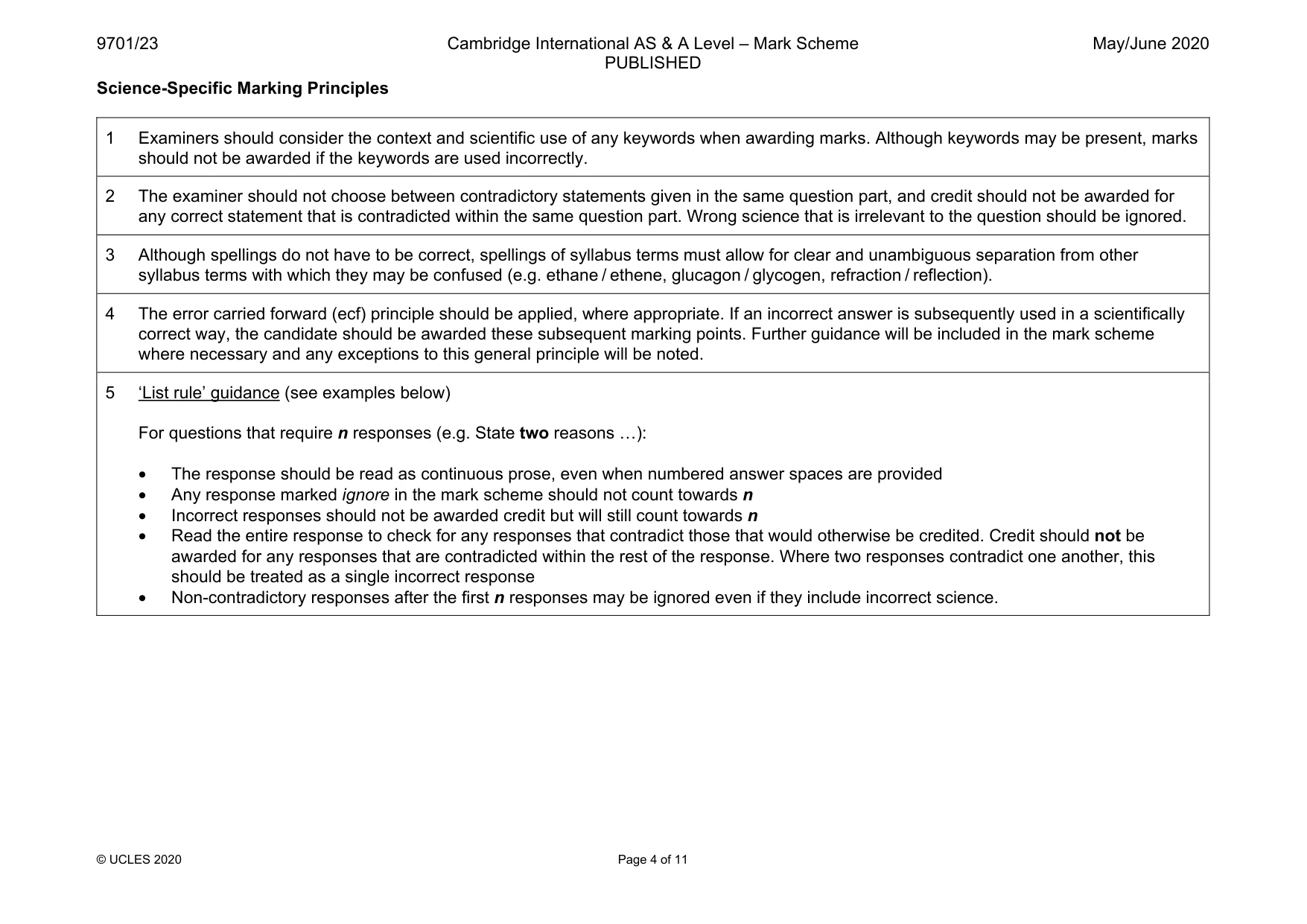
Mark scheme11 pages
Answers below. Sit the paper first if you are practising.
Questions as text
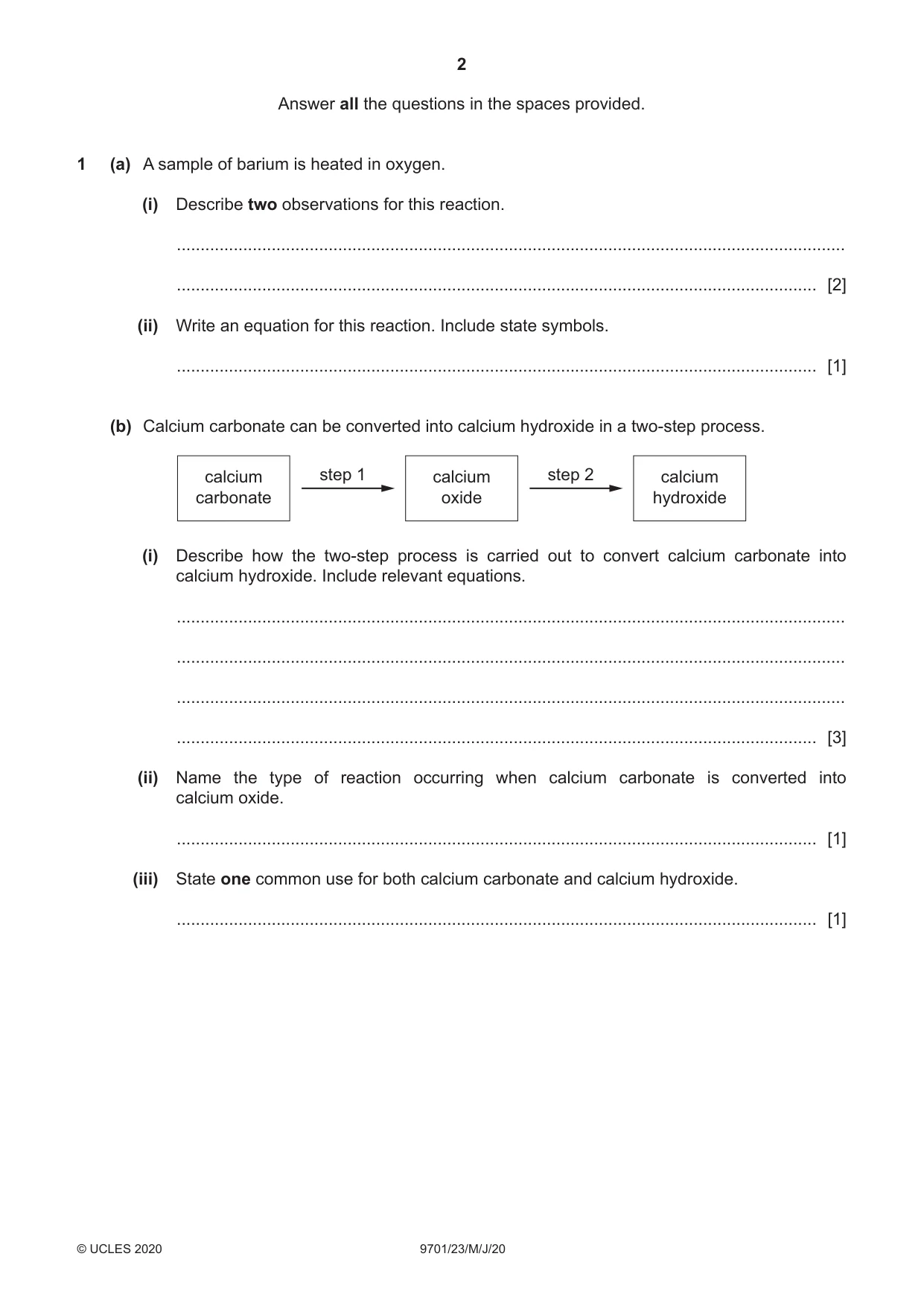
Q1 · A sample of barium is heated in oxygen
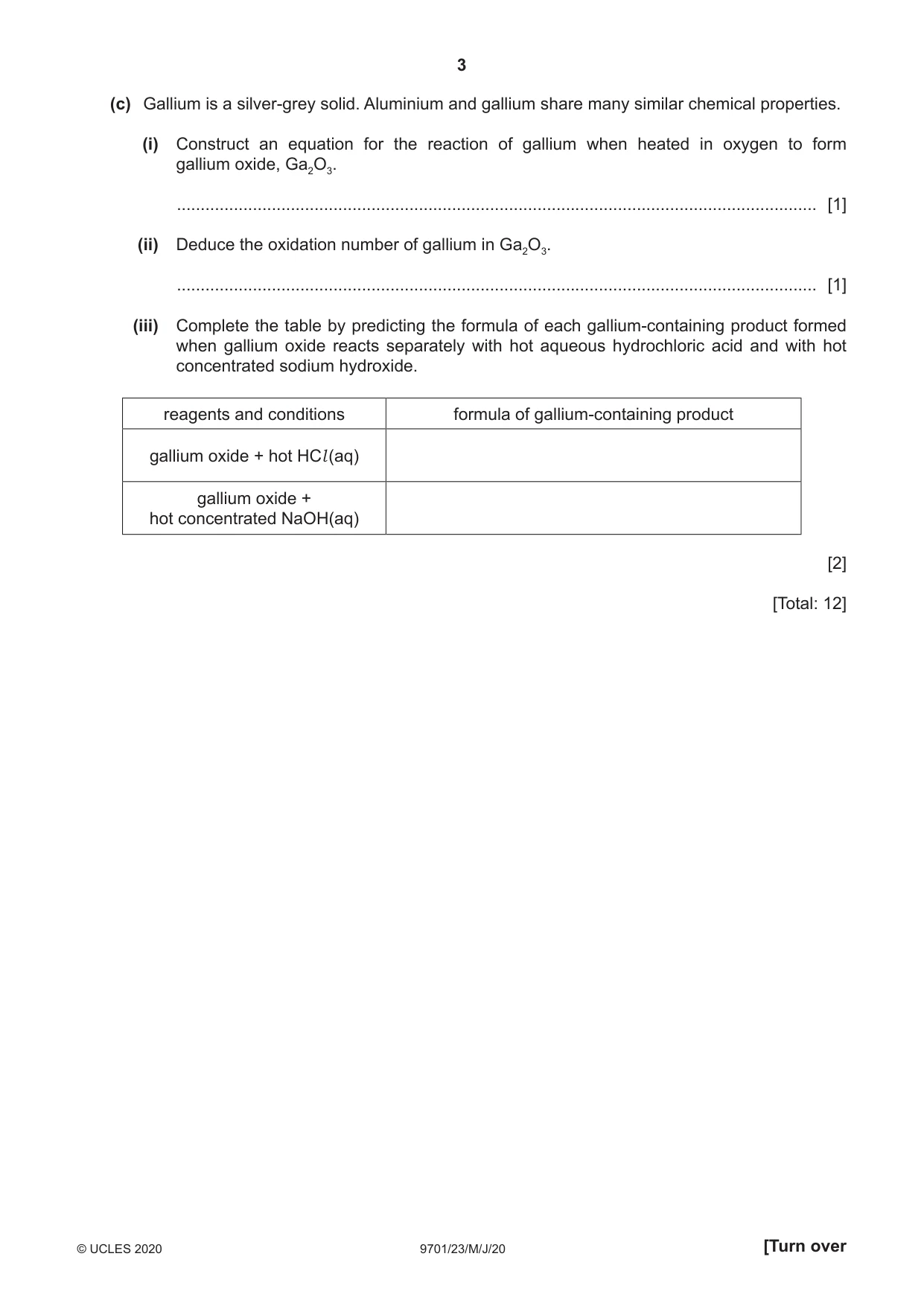
1 (a) A sample of barium is heated in oxygen. (i) Describe two observations for this reaction. ............................................................................................................................................. ....................................................................................................................................... [2] (ii) Write an equation for this reaction. Include state symbols. ....................................................................................................................................... [1] (b) Calcium carbonate can be converted into calcium hydroxide in a two-step process. calcium step 1 calcium step 2 calcium carbonate oxide hydroxide (i) Describe how the two-step process is carried out to convert calcium carbonate into calcium hydroxide. Include relevant equations. ............................................................................................................................................. ............................................................................................................................................. ............................................................................................................................................. ....................................................................................................................................... [3] (ii) Name the type of reaction occurring when calcium carbonate is converted into calcium oxide. ....................................................................................................................................... [1] (iii) State one common use for both calcium carbonate and calcium hydroxide. ....................................................................................................................................... [1] (c) Gallium is a silver-grey solid. Aluminium and gallium share many similar chemical properties. (i) Construct an equation for the reaction of gallium when heated in oxygen to form gallium oxide, Ga2O3. ....................................................................................................................................... [1] (ii) Deduce the oxidation number of gallium in Ga2O3. ....................................................................................................................................... [1] (iii) Complete the table by predicting the formula of each gallium-containing product formed when gallium oxide reacts separately with hot aqueous hydrochloric acid and with hot concentrated sodium hydroxide. reagents and conditions formula of gallium-containing product gallium oxide + hot HCl (aq) gallium oxide + hot concentrated NaOH(aq) [2] [Total: 12]
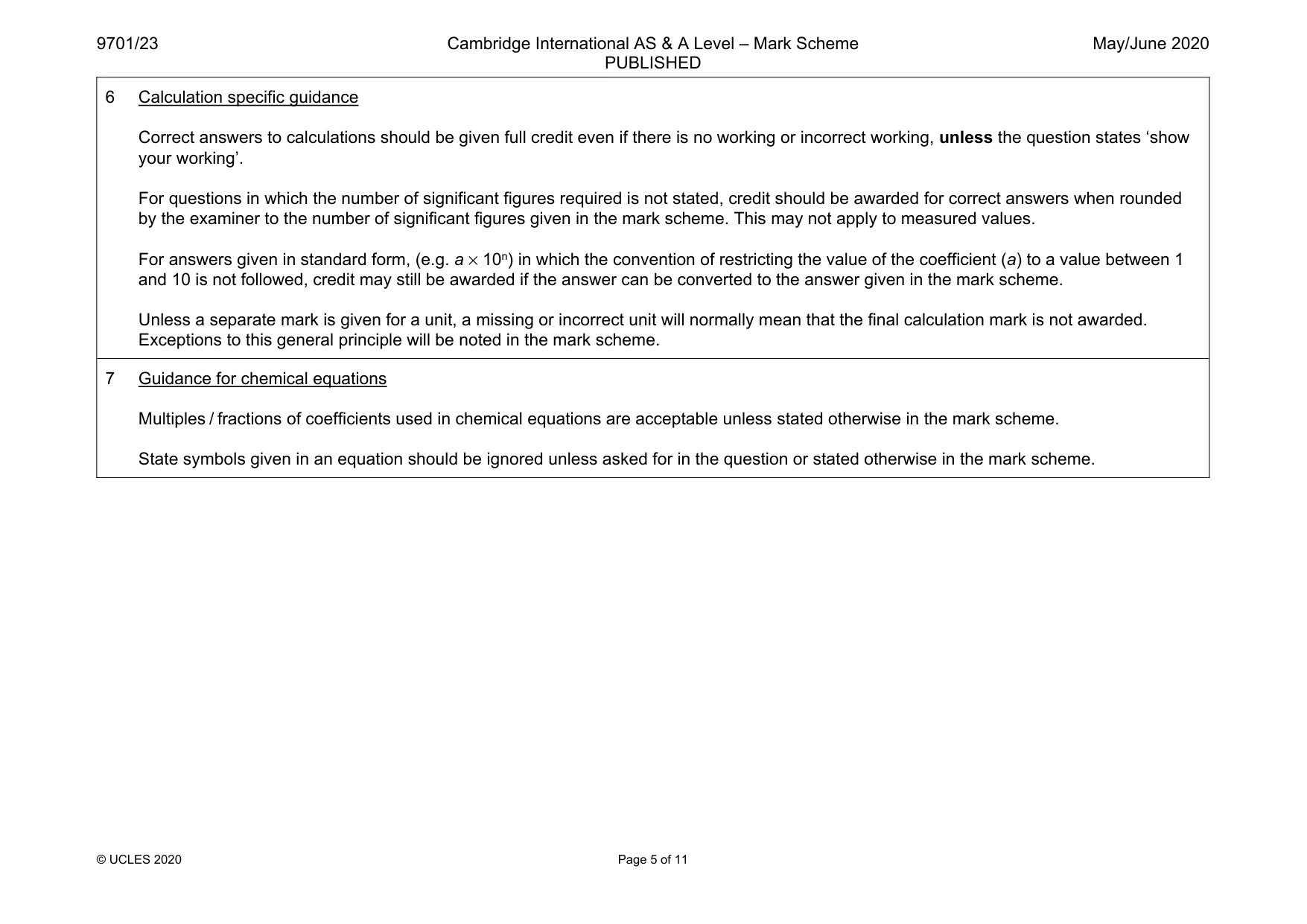
Mark scheme: 1(a)(i) M1 green flame / white flame (with green tinge) M2 white solid formed 2 1(a)(ii) 2Ba(s) + O2(g) → 2BaO(s) 1 1(b)(i) M1 heat (followed by) add water M2 CaCO3 CaO + CO2 M3 CaO + H2O Ca(OH)2 3 1(b)(ii) thermal decomposition. 1 1(b)(iii) neutralise acid soil / reduce the acidity in soil / increase the pH in soil 1 1(c)(i) 4Ga + 3O2 → 2Ga2O3 1 1(c)(ii) (+)3 1 1(c)(ii) reagent and conditions Formula of gallium containing product M1 gallium oxide+ hot HCl(aq) M1 GaCl3 M2 gallium oxide+hot concentrated NaOH(aq) M2 NaGa(OH)4 OR NaGaO2 2
Q2 · Explain what is meant by the term relative isotopic mass
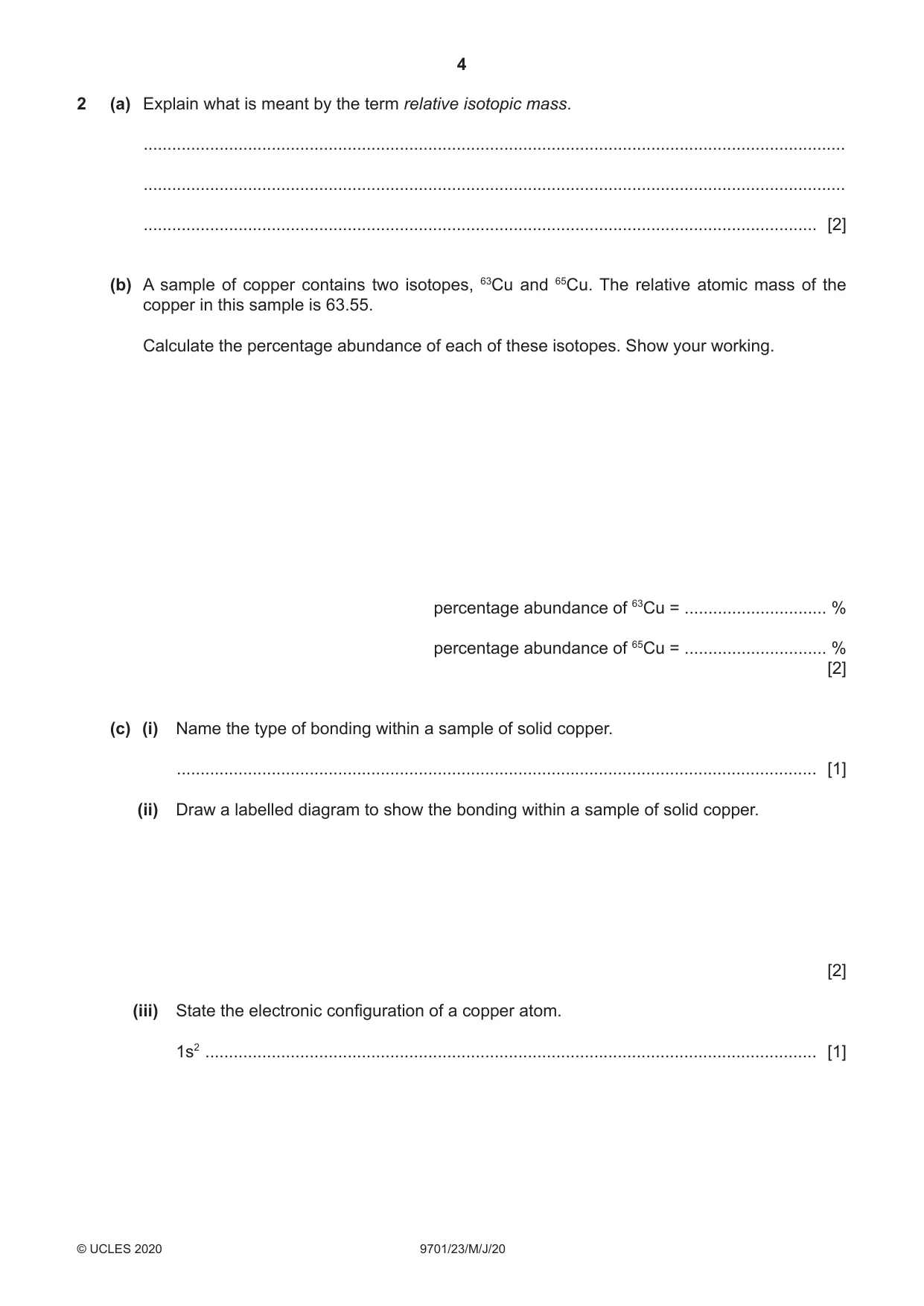
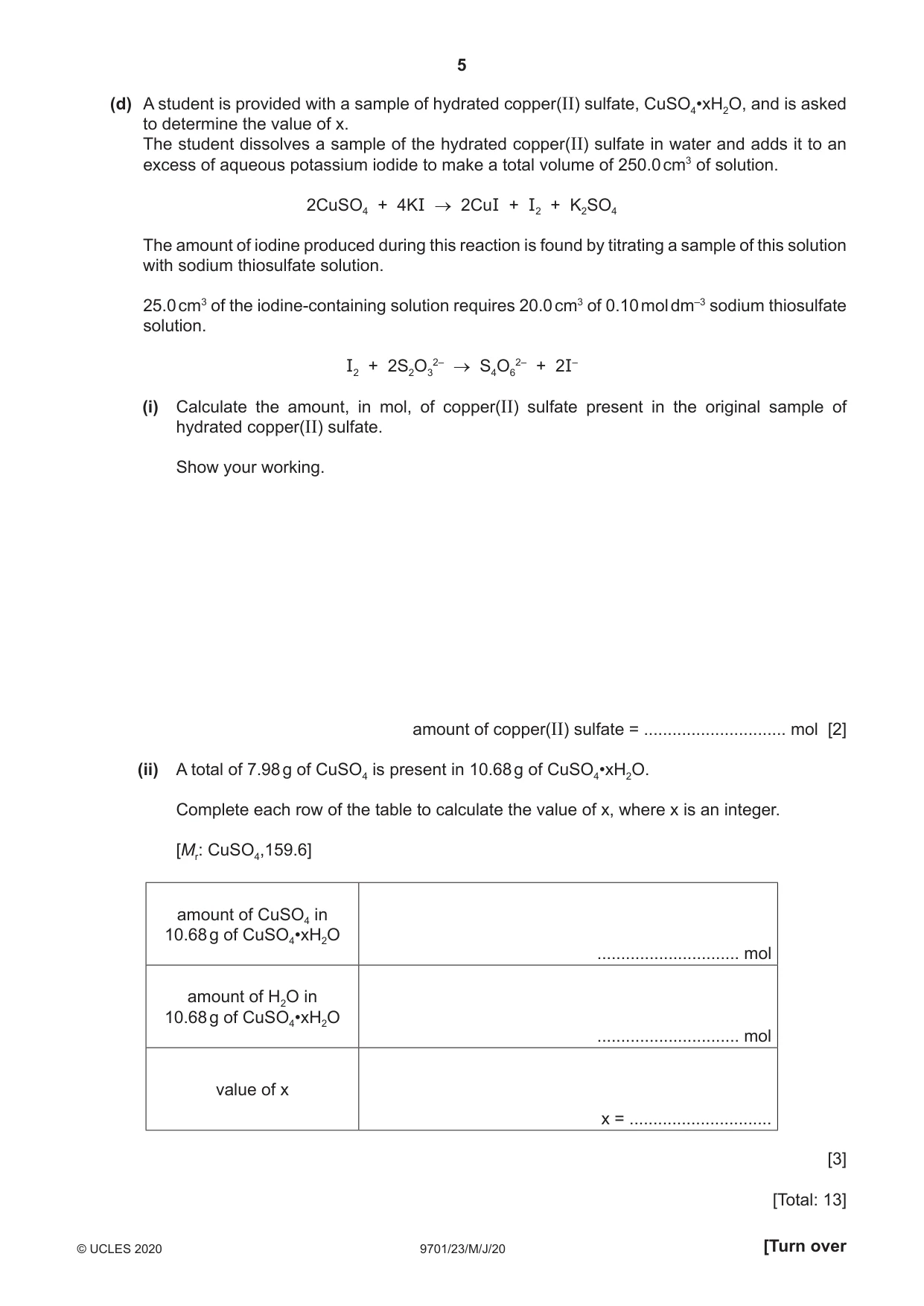
2 (a) Explain what is meant by the term relative isotopic mass. .................................................................................................................................................... .................................................................................................................................................... .............................................................................................................................................. [2] (b) A sample of copper contains two isotopes, 63Cu and 65Cu. The relative atomic mass of the copper in this sample is 63.55. Calculate the percentage abundance of each of these isotopes. Show your working. percentage abundance of 63Cu = .............................. % percentage abundance of 65Cu = .............................. % [2] (c) (i) Name the type of bonding within a sample of solid copper. ....................................................................................................................................... [1] (ii) Draw a labelled diagram to show the bonding within a sample of solid copper. [2] (iii) State the electronic configuration of a copper atom. 1s2 ................................................................................................................................. [1] (d) A student is provided with a sample of hydrated copper(II) sulfate, CuSO4•xH2O, and is asked to determine the value of x. The student dissolves a sample of the hydrated copper(II) sulfate in water and adds it to an excess of aqueous potassium iodide to make a total volume of 250.0 cm3 of solution. 2CuSO4 + 4KI → 2CuI + I2 + K2SO4 The amount of iodine produced during this reaction is found by titrating a sample of this solution with sodium thiosulfate solution. 25.0 cm3 of the iodine-containing solution requires 20.0 cm3 of 0.10 mol dm–3 sodium thiosulfate solution. I2 + 2S2O32– → S4O62– + 2I– (i) Calculate the amount, in mol, of copper(II) sulfate present in the original sample of hydrated copper(II) sulfate. Show your working. amount of copper(II) sulfate = .............................. mol [2] (ii) A total of 7.98 g of CuSO4 is present in 10.68 g of CuSO4•xH2O. Complete each row of the table to calculate the value of x, where x is an integer. [Mr: CuSO4,159.6] amount of CuSO4 in 10.68 g of CuSO4•xH2O .............................. mol amount of H2O in 10.68 g of CuSO4•xH2O .............................. mol value of x x = .............................. [3] [Total: 13]
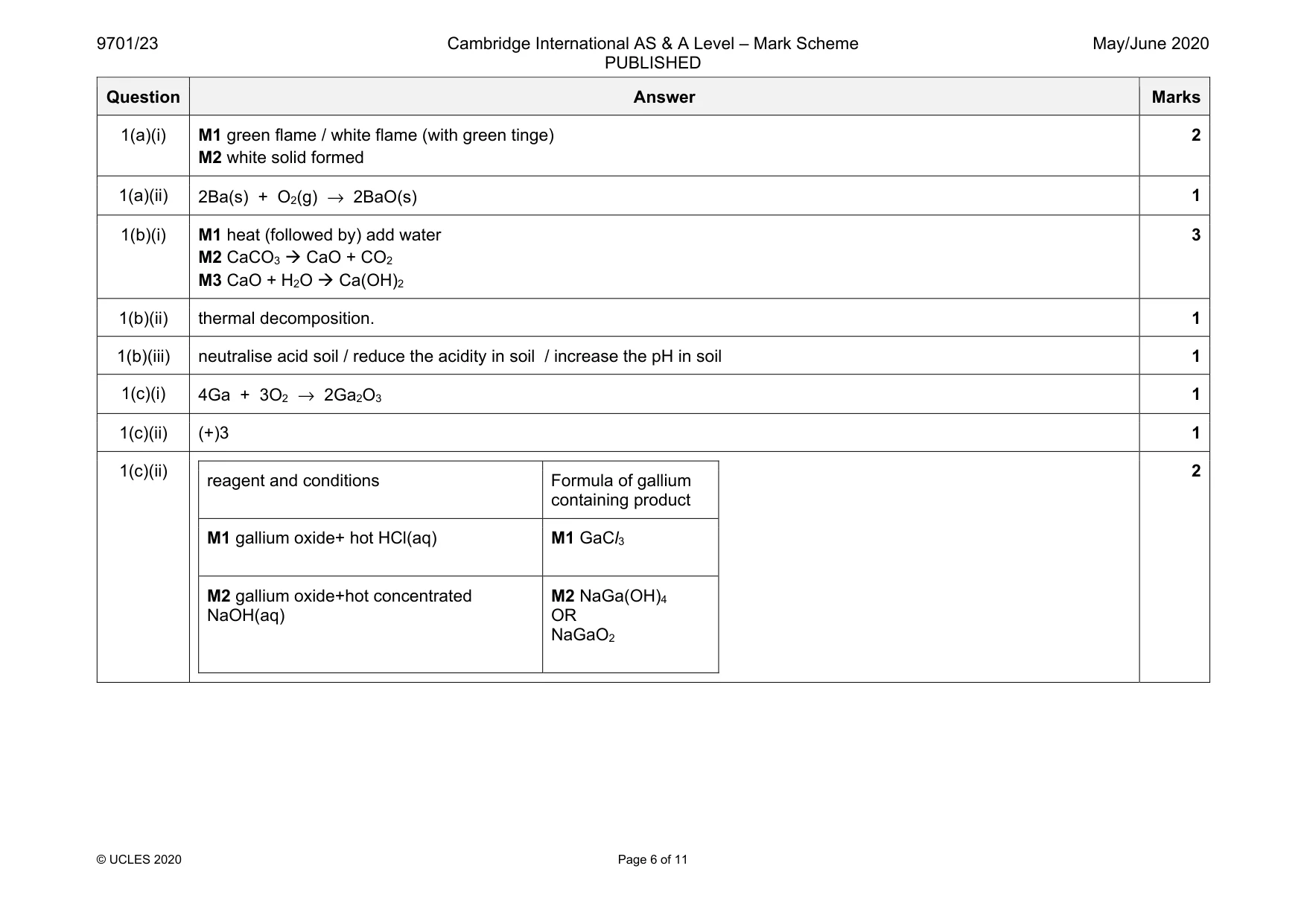
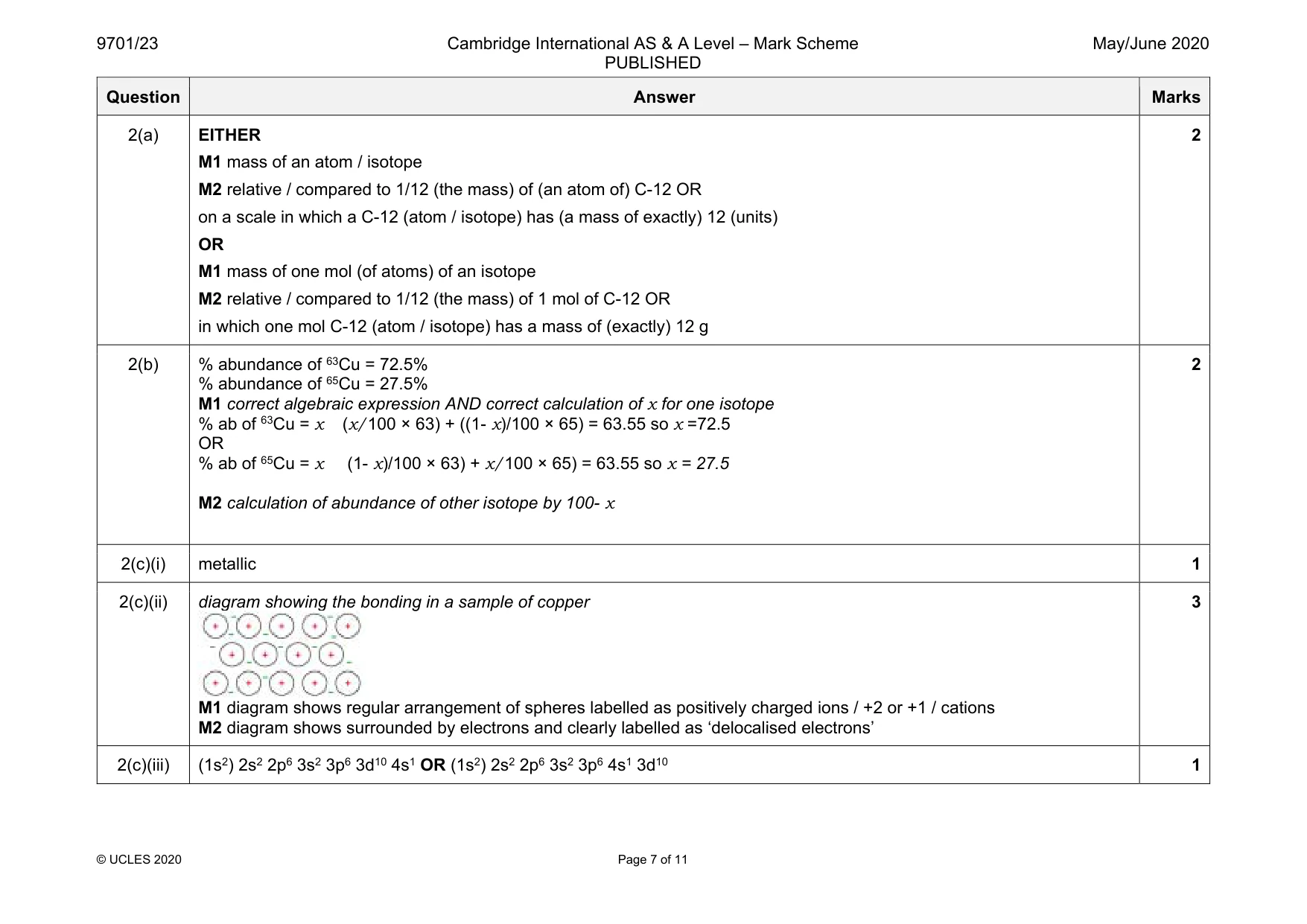
Mark scheme: 2(a) EITHER M1 mass of an atom / isotope M2 relative / compared to 1/12 (the mass) of (an atom of) C-12 OR on a scale in which a C-12 (atom / isotope) has (a mass of exactly) 12 (units) OR M1 mass of one mol (of atoms) of an isotope M2 relative / compared to 1/12 (the mass) of 1 mol of C-12 OR in which one mol C-12 (atom / isotope) has a mass of (exactly) 12 g 2 2(b) % abundance of 63Cu = 72.5% % abundance of 65Cu = 27.5% M1 correct algebraic expression AND correct calculation of x for one isotope % ab of 63Cu = x (x/100 × 63) + ((1- x)/100 × 65) = 63.55 so x =72.5 OR % ab of 65Cu = x (1- x)/100 × 63) + x/100 × 65) = 63.55 so x = 27.5 M2 calculation of abundance of other isotope by 100- x 2 2(c)(i) metallic 1 2(c)(ii) diagram showing the bonding in a sample of copper M1 diagram shows regular arrangement of spheres labelled as positively charged ions / +2 or +1 / cations M2 diagram shows surrounded by electrons and clearly labelled as ‘delocalised electrons’ 3 2(c)(iii) (1s2) 2s2 2p6 3s2 3p6 3d10 4s1 OR (1s2) 2s2 2p6 3s2 3p6 4s1 3d10 1 Question Answer Marks 2(d)(i) M1 calculate the number mol S2O3 2-added 20/1000 x 0.10 = 2x10-3 = 0.002 (mol S2O3 2- ) M2 calculate number mol CuSO4 in 250cm3 (1mol S2O3 2- : 1 mol CuSO4 ) = 0.002 mol CuSO4 in 25cm3 so 0.02 mol CuSO4 in 250cm3 2 2(d)(ii) M1 amount of CuSO4 in 10.68 g of CuSO4·xH2O 7.98 / (159.6) = 0.05 (mol) M2 amount of H2O in 10.68 g of CuSO4·xH2O (10.68 – 7.98) / 18 = 2.7 / 18 =) 0.15 (mol) M3 value of x (mol H2O ÷ mol CuSO4 =) 3 3
More questions on Electrons, energy levels and atomic orbitals
Q3 · Sucrose is a white crystalline solid, C12H22O11
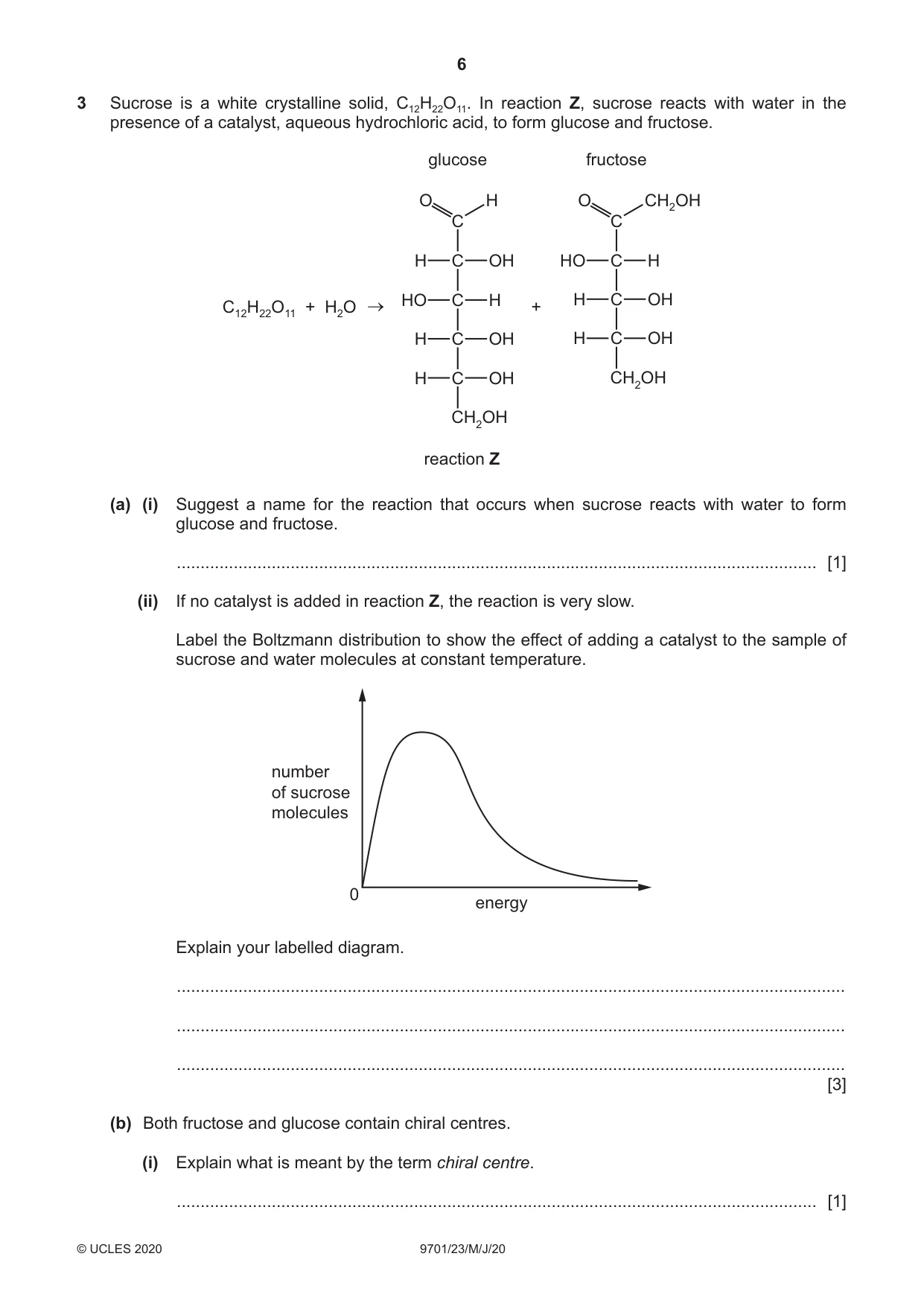
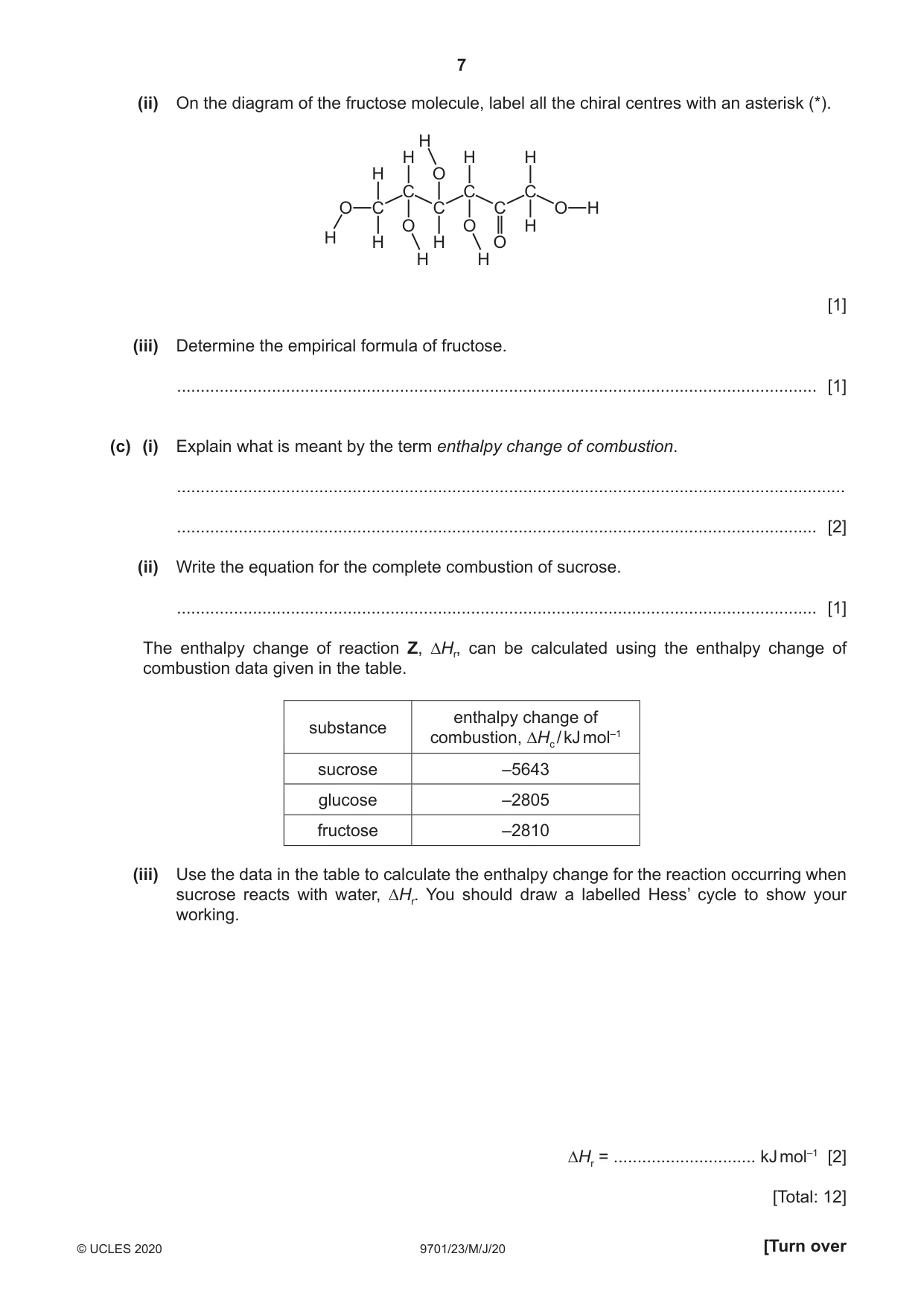
3 Sucrose is a white crystalline solid, C12H22O11. In reaction Z, sucrose reacts with water in the presence of a catalyst, aqueous hydrochloric acid, to form glucose and fructose. glucose fructose O H O CH2OH C C H C OH HO C H HO C H H C OH C12H22O11 + H2O + H C OH H C OH H C OH CH2OH CH2OH reaction Z (a) (i) Suggest a name for the reaction that occurs when sucrose reacts with water to form glucose and fructose. ....................................................................................................................................... [1] (ii) If no catalyst is added in reaction Z, the reaction is very slow. Label the Boltzmann distribution to show the effect of adding a catalyst to the sample of sucrose and water molecules at constant temperature. number of sucrose molecules 0 energy Explain your labelled diagram. ............................................................................................................................................. ............................................................................................................................................. ............................................................................................................................................. [3] (b) Both fructose and glucose contain chiral centres. (i) Explain what is meant by the term chiral centre. ....................................................................................................................................... [1] (ii) On the diagram of the fructose molecule, label all the chiral centres with an asterisk (*). H H H H H O C C C O C C C O H O O H H H H O H H [1] (iii) Determine the empirical formula of fructose. ....................................................................................................................................... [1] (c) (i) Explain what is meant by the term enthalpy change of combustion. ............................................................................................................................................. ....................................................................................................................................... [2] (ii) Write the equation for the complete combustion of sucrose. ....................................................................................................................................... [1] The enthalpy change of reaction Z, ∆Hr, can be calculated using the enthalpy change of combustion data given in the table. enthalpy change of substance combustion, ∆Hc / kJ mol–1 sucrose –5643 glucose –2805 fructose –2810 (iii) Use the data in the table to calculate the enthalpy change for the reaction occurring when sucrose reacts with water, ∆Hr. You should draw a labelled Hess’ cycle to show your working. ∆Hr = .............................. kJ mol–1 [2] [Total: 12]
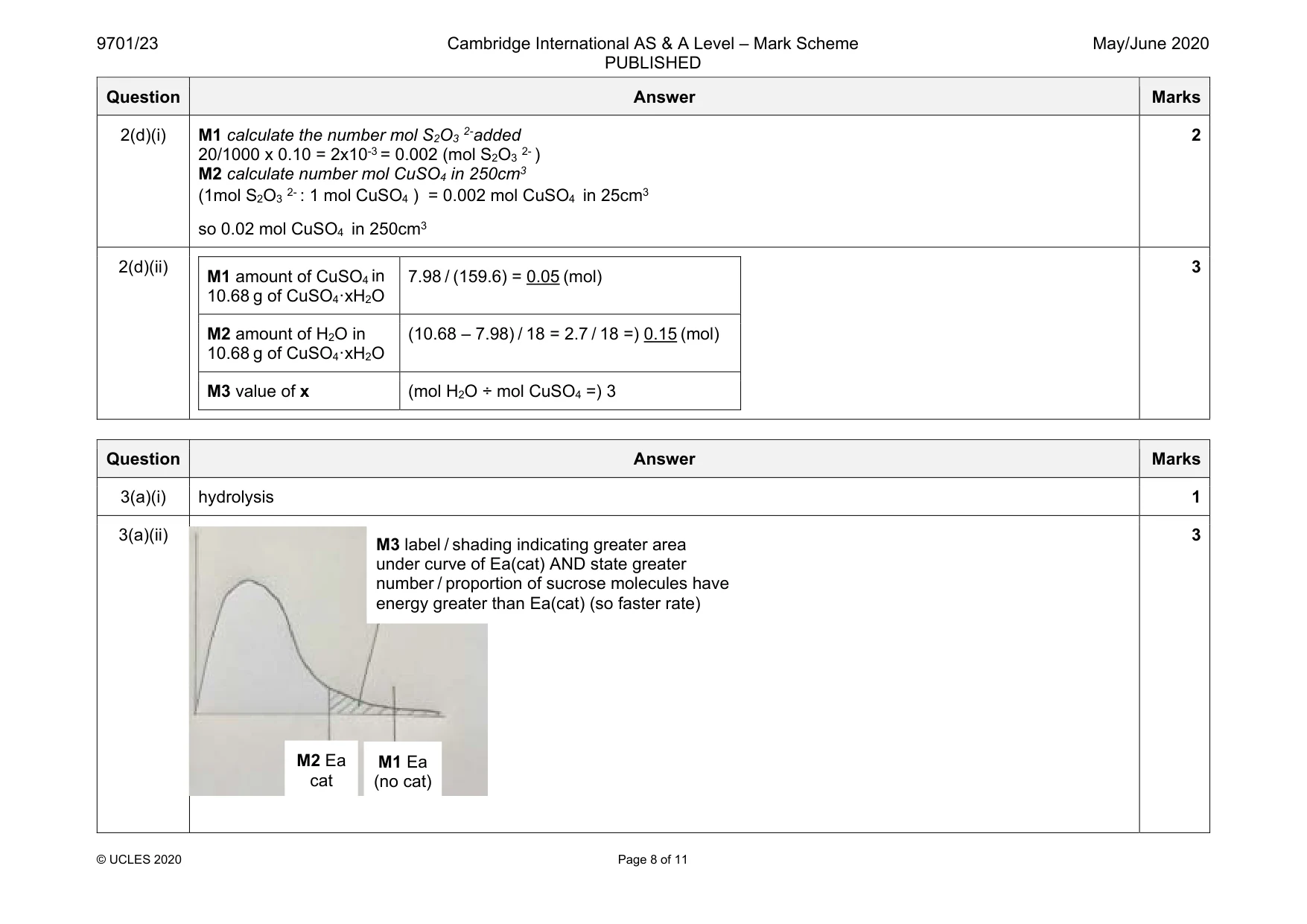
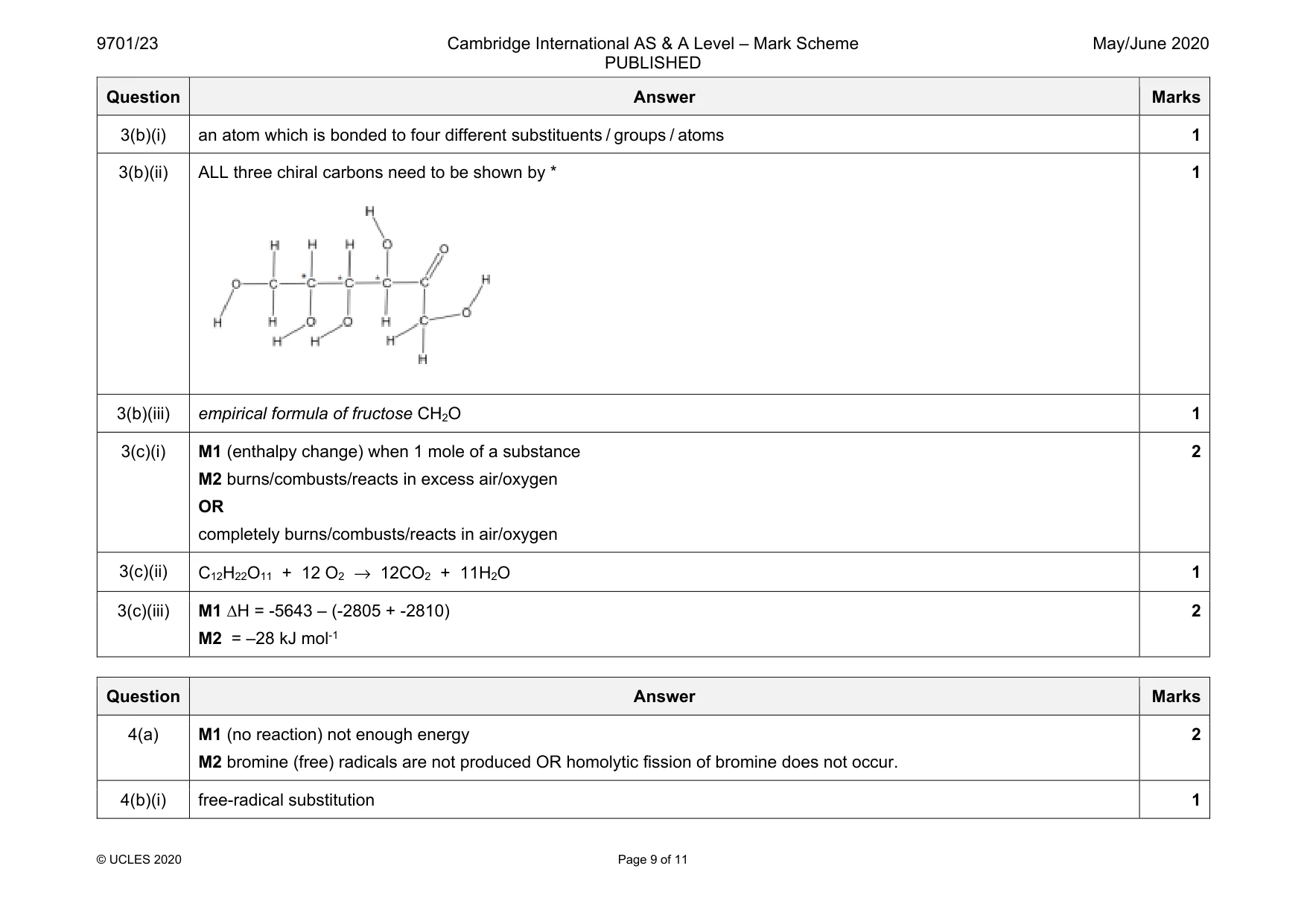
Mark scheme: 3(a)(i) hydrolysis 1 3(a)(ii) 3 M2 Ea cat M1 Ea (no cat) M3 label / shading indicating greater area under curve of Ea(cat) AND state greater number / proportion of sucrose molecules have energy greater than Ea(cat) (so faster rate) Question Answer Marks 3(b)(i) an atom which is bonded to four different substituents / groups / atoms 1 3(b)(ii) ALL three chiral carbons need to be shown by * 1 3(b)(iii) empirical formula of fructose CH2O 1 3(c)(i) M1 (enthalpy change) when 1 mole of a substance M2 burns/combusts/reacts in excess air/oxygen OR completely burns/combusts/reacts in air/oxygen 2 3(c)(ii) C12H22O11 + 12 O2 → 12CO2 + 11H2O 1 3(c)(iii) M1 ∆H = -5643 – (-2805 + -2810) M2 = –28 kJ mol-1 2
More questions on Isomerism: structural isomerism and stereoisomerism
Q4 · Hexane, C6H14, is a colourless liquid
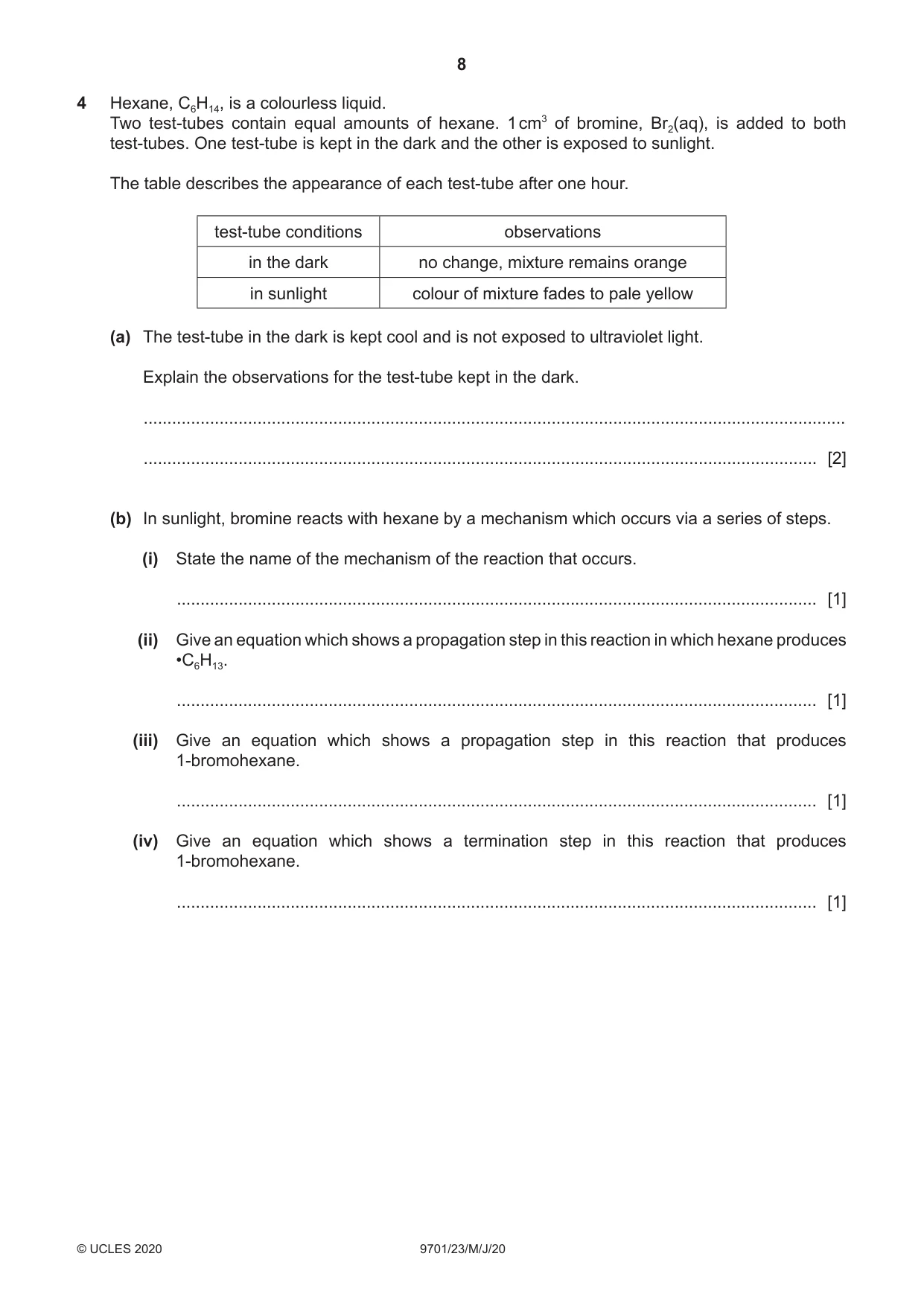
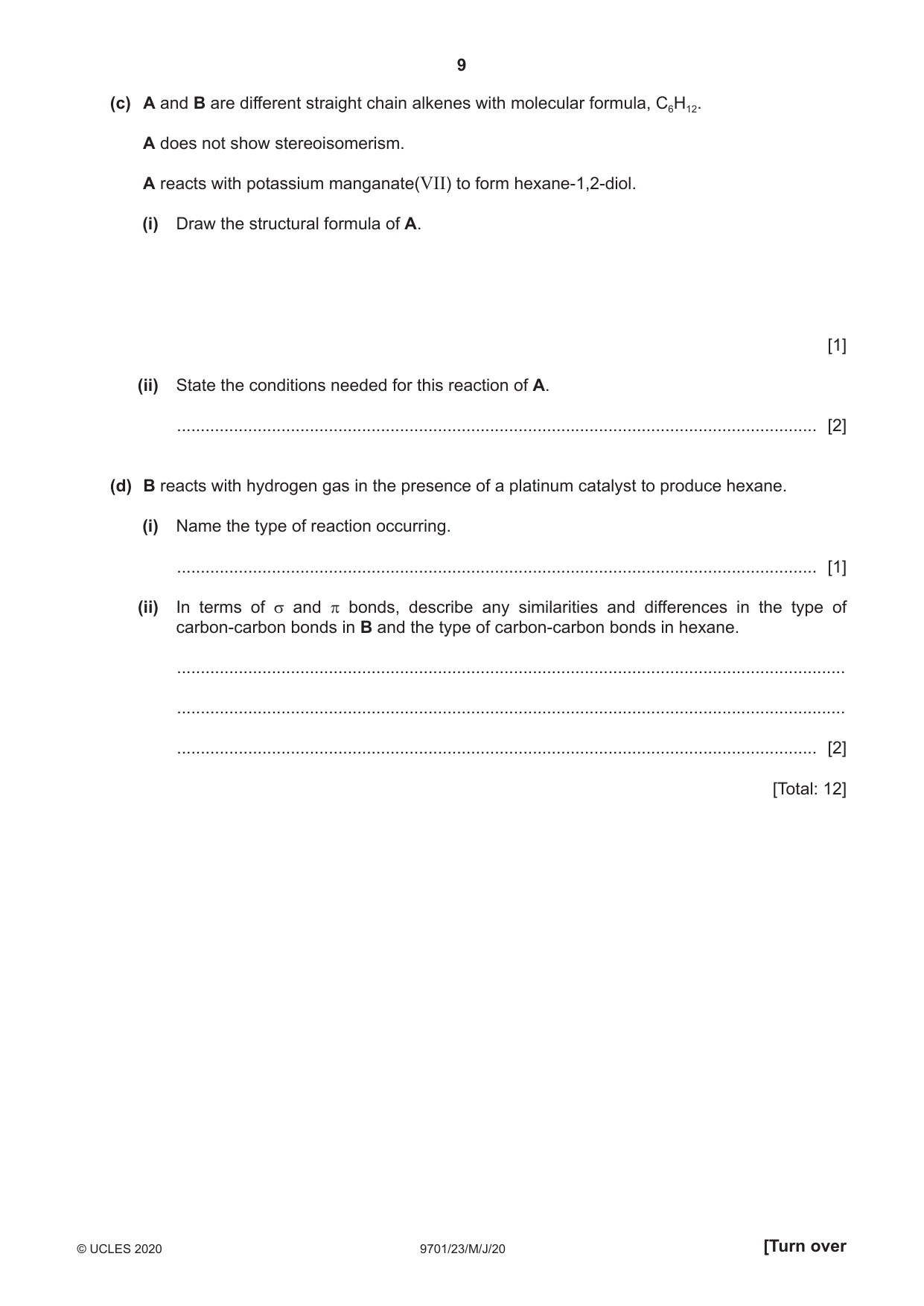
4 Hexane, C6H14, is a colourless liquid. Two test-tubes contain equal amounts of hexane. 1 cm3 of bromine, Br2(aq), is added to both test‑tubes. One test-tube is kept in the dark and the other is exposed to sunlight. The table describes the appearance of each test-tube after one hour. test-tube conditions observations in the dark no change, mixture remains orange in sunlight colour of mixture fades to pale yellow (a) The test-tube in the dark is kept cool and is not exposed to ultraviolet light. Explain the observations for the test-tube kept in the dark. .................................................................................................................................................... .............................................................................................................................................. [2] (b) In sunlight, bromine reacts with hexane by a mechanism which occurs via a series of steps. (i) State the name of the mechanism of the reaction that occurs. ....................................................................................................................................... [1] (ii) Give an equation which shows a propagation step in this reaction in which hexane produces •C6H13. ....................................................................................................................................... [1] (iii) Give an equation which shows a propagation step in this reaction that produces 1-bromohexane. ....................................................................................................................................... [1] (iv) Give an equation which shows a termination step in this reaction that produces 1-bromohexane. ....................................................................................................................................... [1] (c) A and B are different straight chain alkenes with molecular formula, C6H12. A does not show stereoisomerism. A reacts with potassium manganate(VII) to form hexane-1,2-diol. (i) Draw the structural formula of A. [1] (ii) State the conditions needed for this reaction of A. ....................................................................................................................................... [2] (d) B reacts with hydrogen gas in the presence of a platinum catalyst to produce hexane. (i) Name the type of reaction occurring. ....................................................................................................................................... [1] (ii) In terms of σ and π bonds, describe any similarities and differences in the type of carbon‑carbon bonds in B and the type of carbon‑carbon bonds in hexane. ............................................................................................................................................. ............................................................................................................................................. ....................................................................................................................................... [2] [Total: 12]
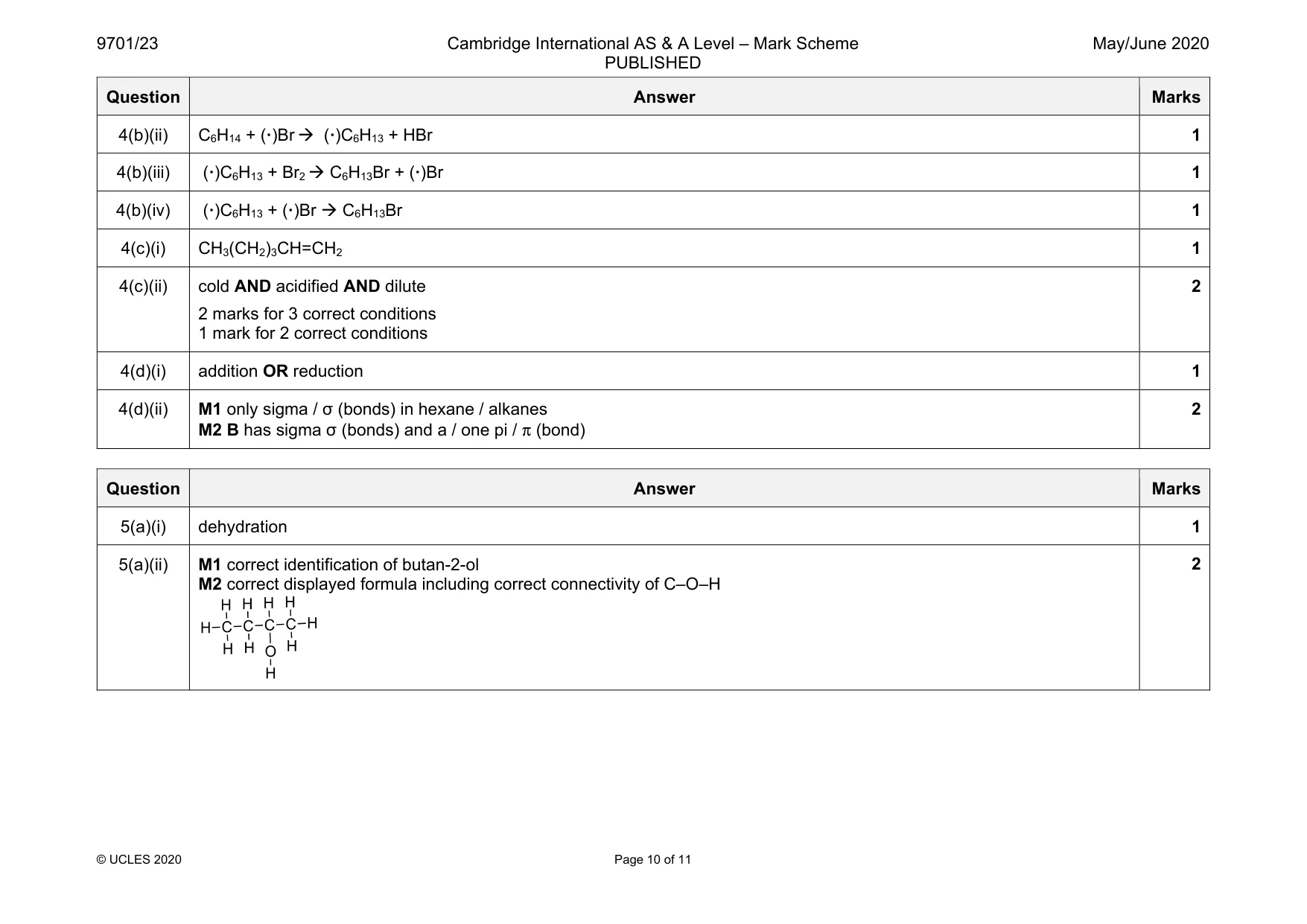
Mark scheme: 4(a) M1 (no reaction) not enough energy M2 bromine (free) radicals are not produced OR homolytic fission of bromine does not occur. 2 4(b)(i) free-radical substitution 1 Question Answer Marks 4(b)(ii) C6H14 + (·)Br (·)C6H13 + HBr 1 4(b)(iii) (·)C6H13 + Br2 C6H13Br + (·)Br 1 4(b)(iv) (·)C6H13 + (·)Br C6H13Br 1 4(c)(i) CH3(CH2)3CH=CH2 1 4(c)(ii) cold AND acidified AND dilute 2 marks for 3 correct conditions 1 mark for 2 correct conditions 2 4(d)(i) addition OR reduction 1 4(d)(ii) M1 only sigma / σ (bonds) in hexane / alkanes M2 B has sigma σ (bonds) and a / one pi / π (bond) 2
Q5 · C, D and E are isomers of each other
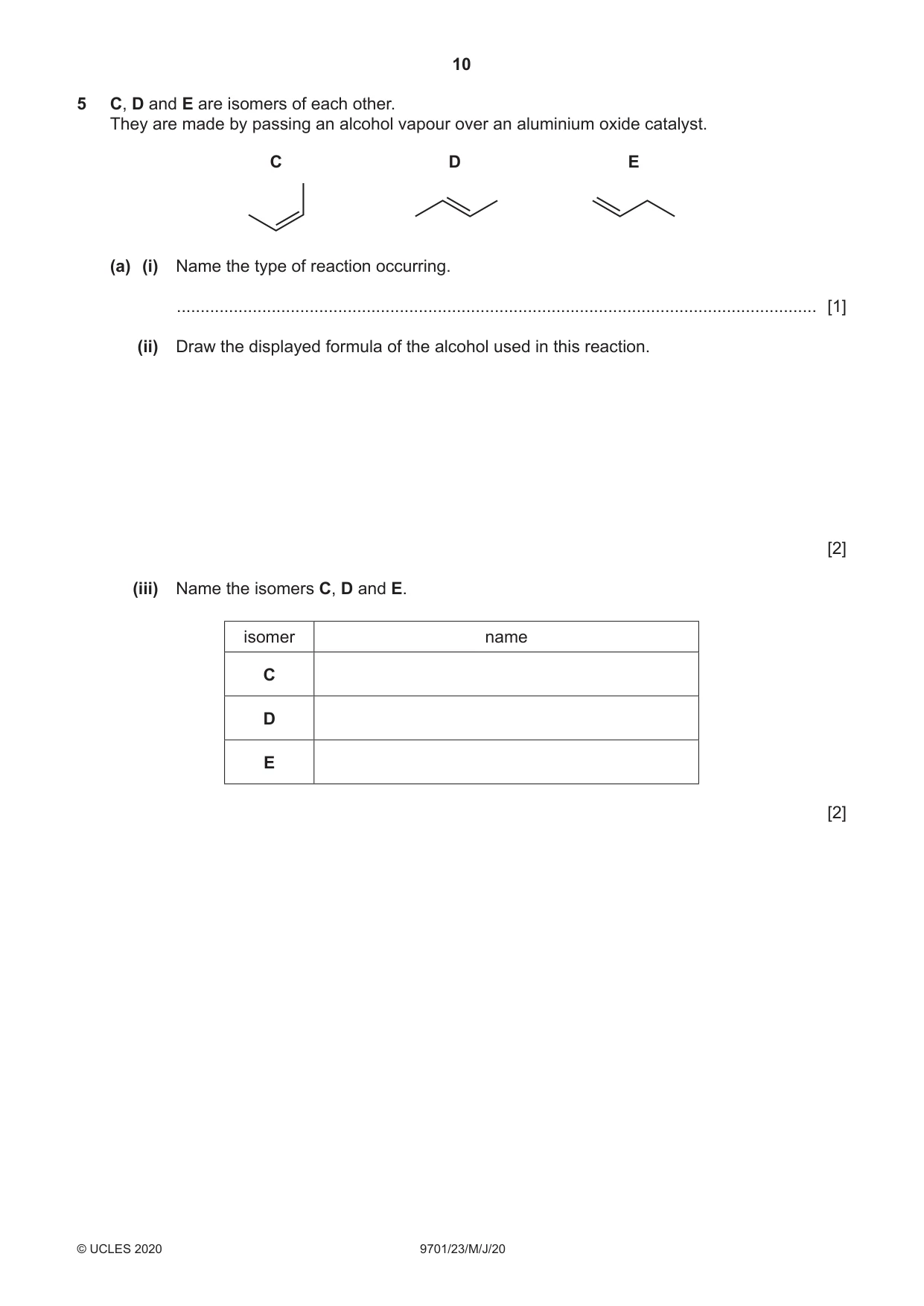
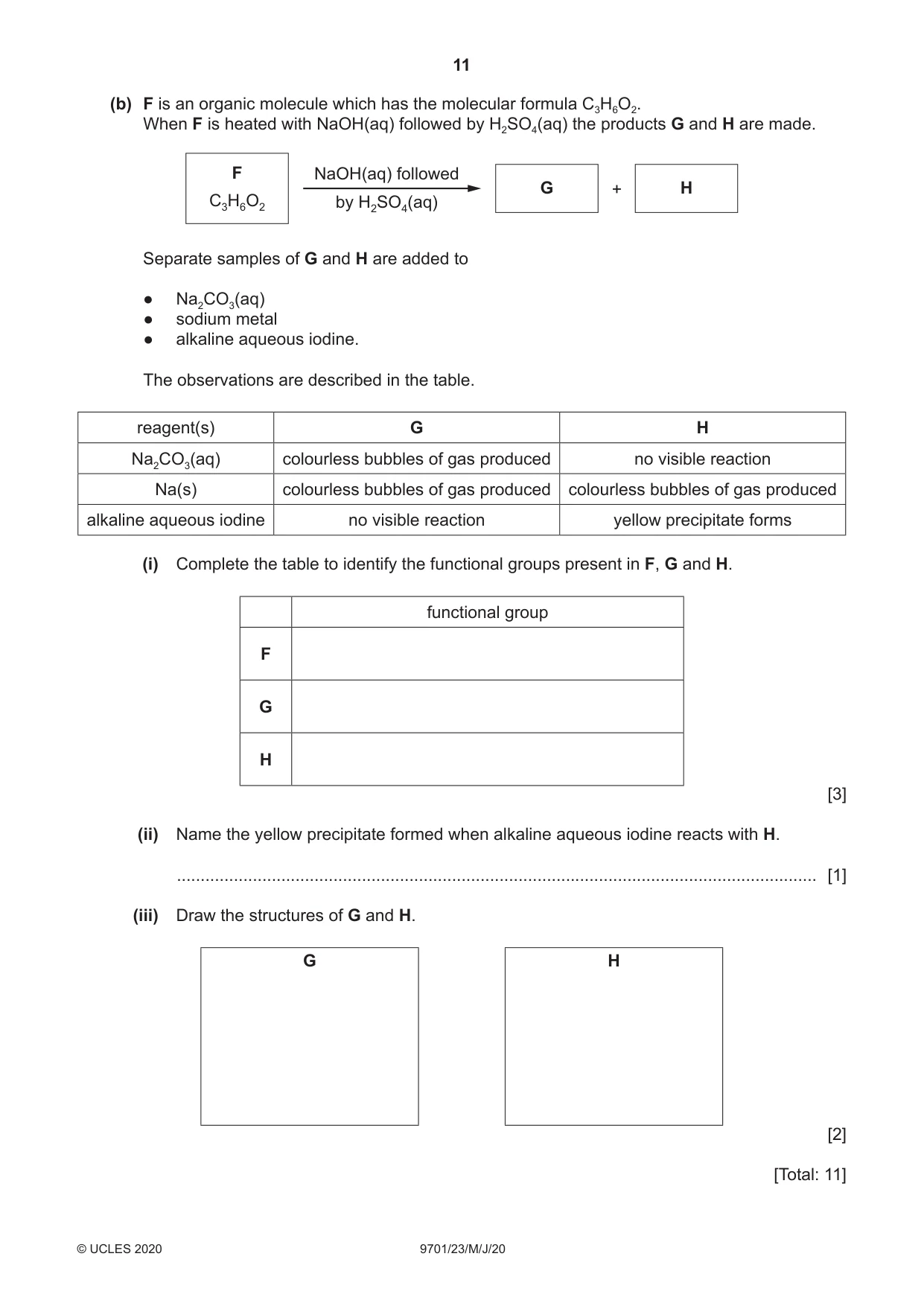
5 C, D and E are isomers of each other. They are made by passing an alcohol vapour over an aluminium oxide catalyst. C D E (a) (i) Name the type of reaction occurring. ....................................................................................................................................... [1] (ii) Draw the displayed formula of the alcohol used in this reaction. [2] (iii) Name the isomers C, D and E. isomer name C D E [2] (b) F is an organic molecule which has the molecular formula C3H6O2. When F is heated with NaOH(aq) followed by H2SO4(aq) the products G and H are made. F NaOH(aq) followed G + H C3H6O2 by H2SO4(aq) Separate samples of G and H are added to ●● Na2CO3(aq) ●● sodium metal ●● alkaline aqueous iodine. The observations are described in the table. reagent(s) G H Na2CO3(aq) colourless bubbles of gas produced no visible reaction Na(s) colourless bubbles of gas produced colourless bubbles of gas produced alkaline aqueous iodine no visible reaction yellow precipitate forms (i) Complete the table to identify the functional groups present in F, G and H. functional group F G H [3] (ii) Name the yellow precipitate formed when alkaline aqueous iodine reacts with H. ....................................................................................................................................... [1] (iii) Draw the structures of G and H. G H [2] [Total: 11]
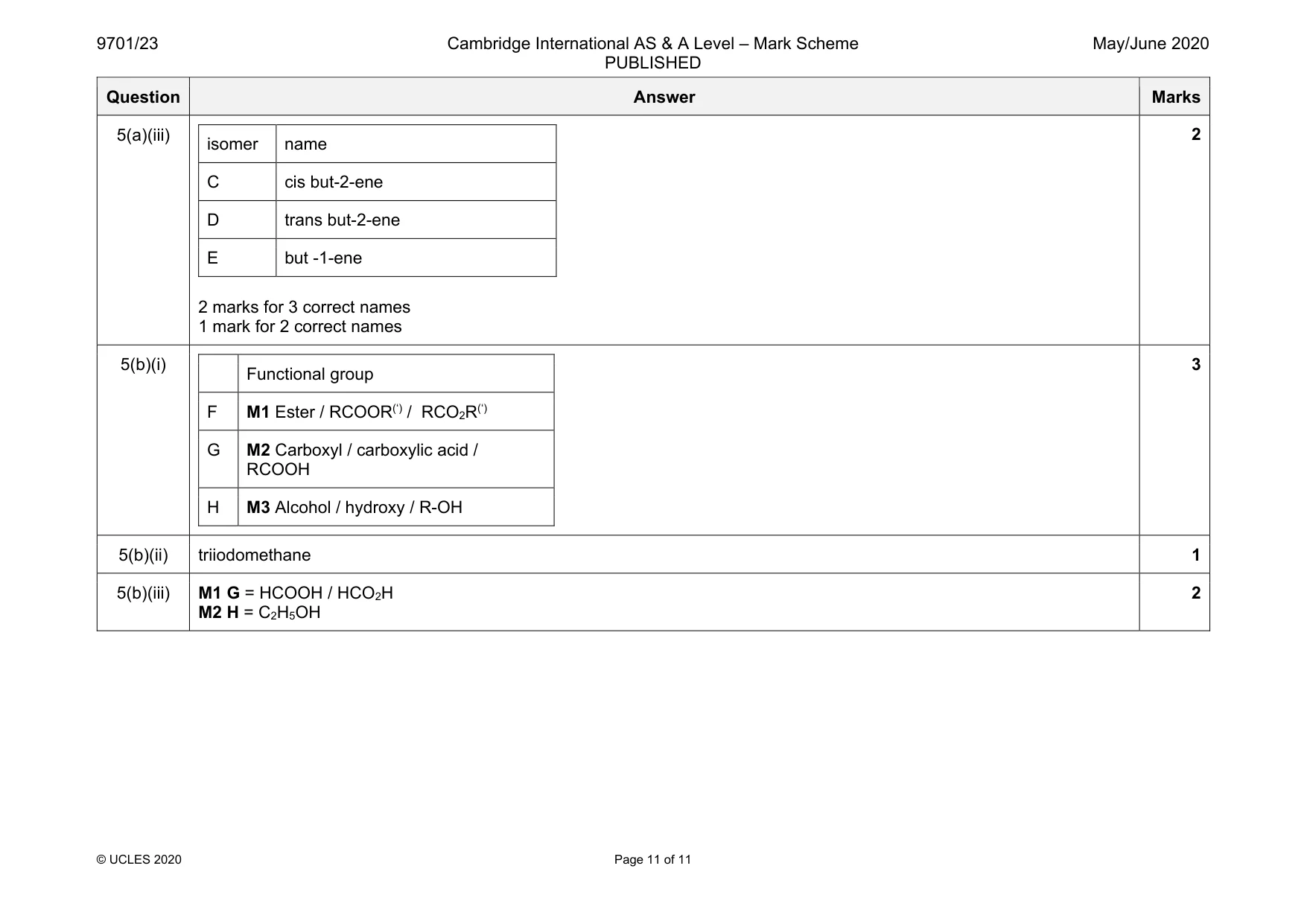
Mark scheme: 5(a)(i) dehydration 1 5(a)(ii) M1 correct identification of butan-2-ol M2 correct displayed formula including correct connectivity of C–O–H 2 Question Answer Marks 5(a)(iii) isomer name C cis but-2-ene D trans but-2-ene E but -1-ene 2 marks for 3 correct names 1 mark for 2 correct names 2 5(b)(i) Functional group F M1 Ester / RCOOR(‘) / RCO2R(‘) G M2 Carboxyl / carboxylic acid / RCOOH H M3 Alcohol / hydroxy / R-OH 3 5(b)(ii) triiodomethane 1 5(b)(iii) M1 G = HCOOH / HCO2H M2 H = C2H5OH 2
What was in this paper
The subtopics covered by these 5 questions, and how many questions each got. Open one in a new tab to see every Cambridge question on it.