Cambridge A Level Chemistry 9701 — 2020 Feb/March Paper 4 · Variant 2
9701/42/F/M/20 · 6 questions · 100 marks · ≈113 min
The question paper and its mark scheme, free to read here and free to download. This is Cambridge’s own paper, exactly as it was sat.
Question paper24 pages

Mark scheme14 pages
Answers below. Sit the paper first if you are practising.
Questions as text
Q1 · Iron is a transition element in the fourth period
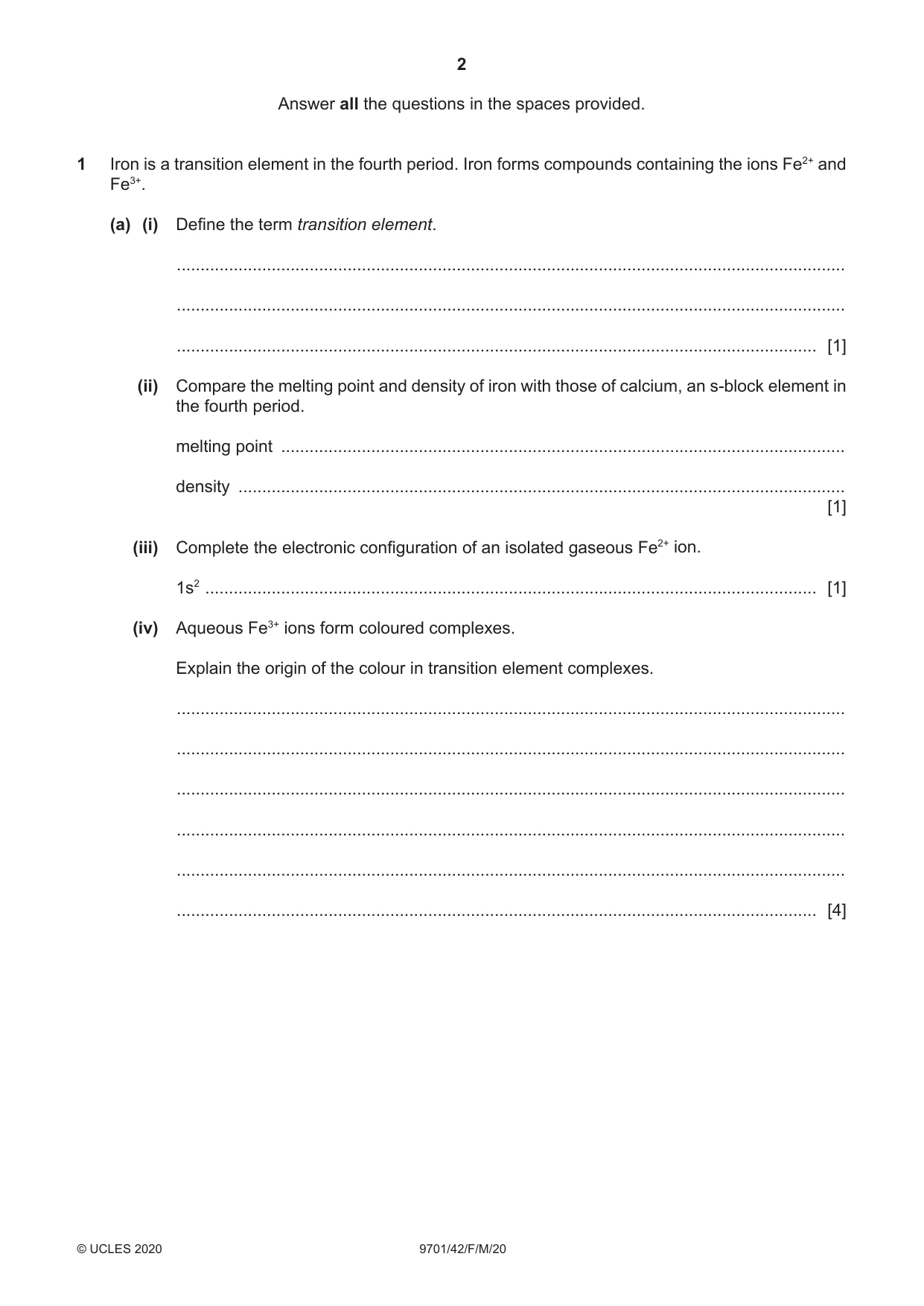
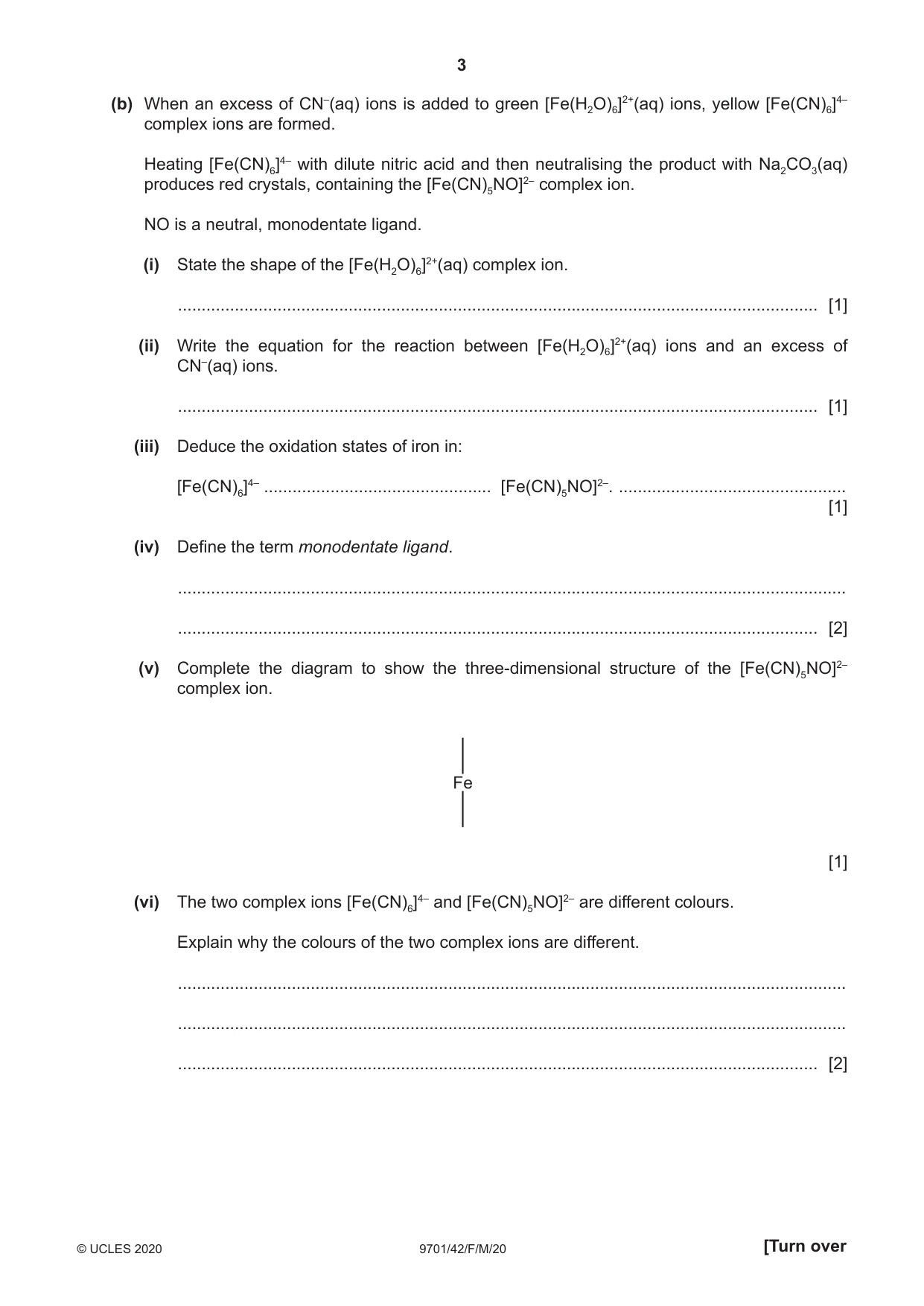
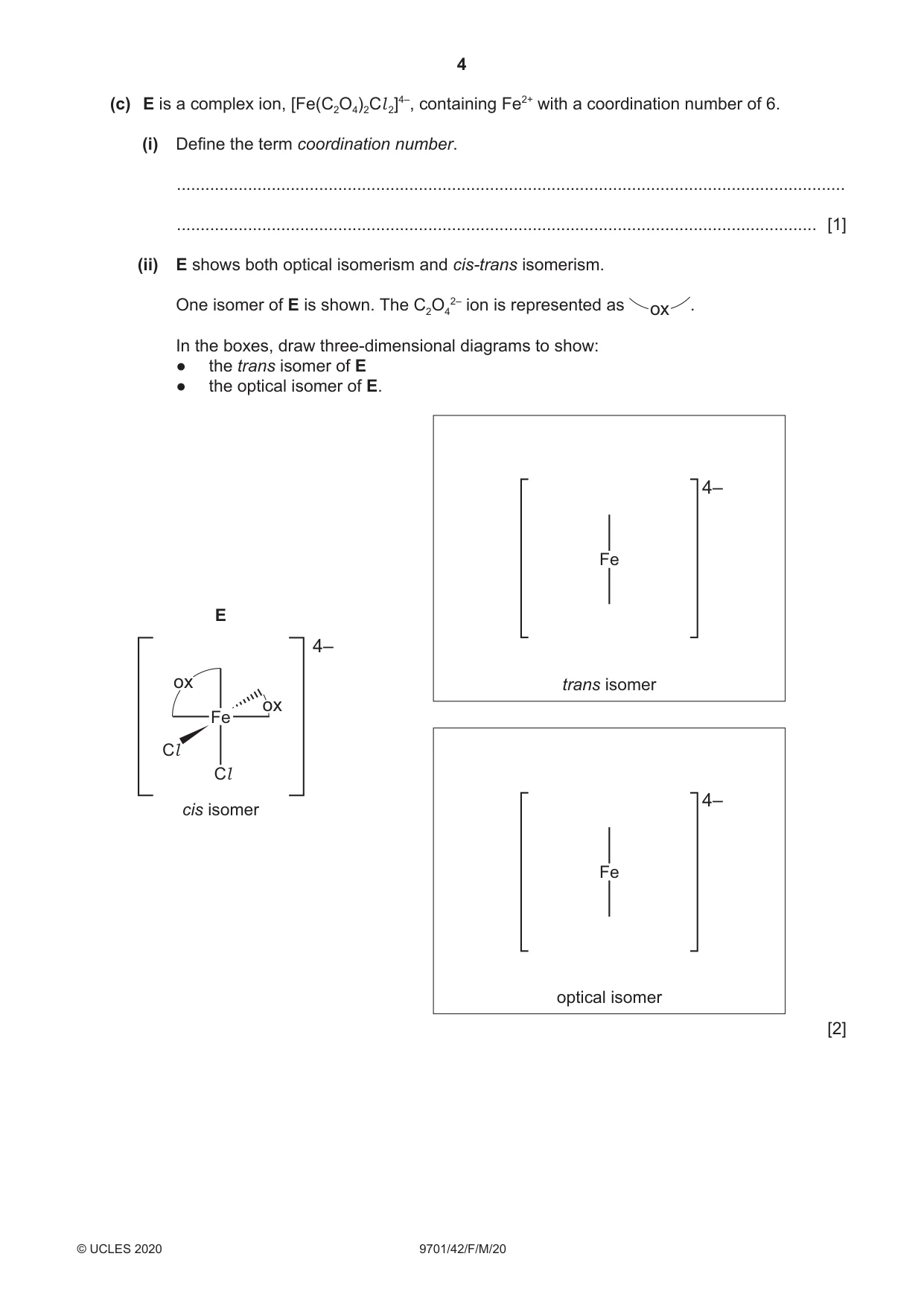
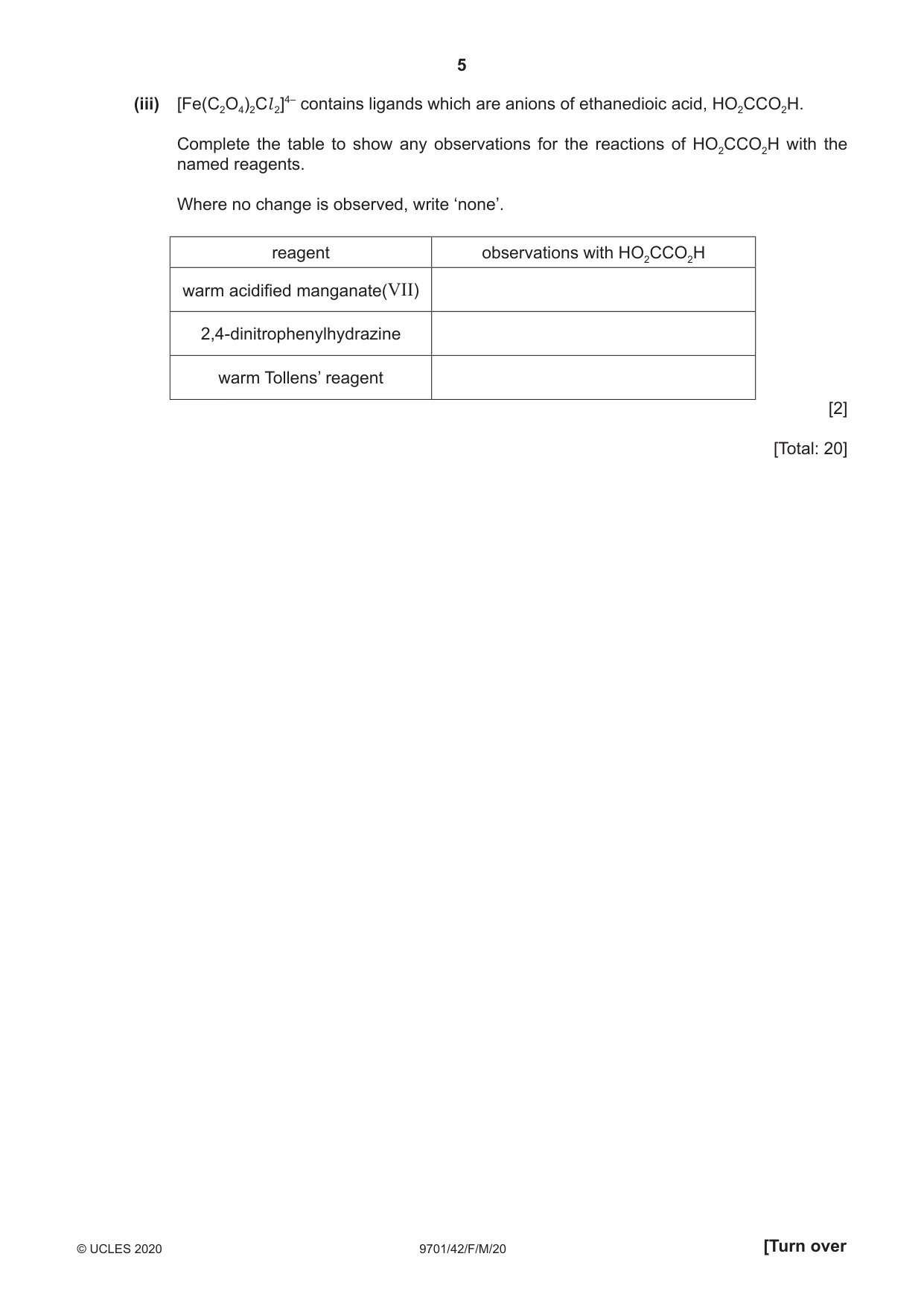
1 Iron is a transition element in the fourth period. Iron forms compounds containing the ions Fe2+ and Fe3+. (a) (i) Define the term transition element. ............................................................................................................................................. ............................................................................................................................................. ....................................................................................................................................... [1] (ii) Compare the melting point and density of iron with those of calcium, an s-block element in the fourth period. melting point ........................................................................................................................ density ................................................................................................................................. [1] (iii) Complete the electronic configuration of an isolated gaseous Fe2+ ion. 1s2 ................................................................................................................................. [1] (iv) Aqueous Fe3+ ions form coloured complexes. Explain the origin of the colour in transition element complexes. ............................................................................................................................................. ............................................................................................................................................. ............................................................................................................................................. ............................................................................................................................................. ............................................................................................................................................. ....................................................................................................................................... [4] (b) When an excess of CN–(aq) ions is added to green [Fe(H2O)6]2+(aq) ions, yellow [Fe(CN)6]4– complex ions are formed. Heating [Fe(CN)6]4– with dilute nitric acid and then neutralising the product with Na2CO3(aq) produces red crystals, containing the [Fe(CN)5NO]2– complex ion. NO is a neutral, monodentate ligand. (i) State the shape of the [Fe(H2O)6]2+(aq) complex ion. ....................................................................................................................................... [1] (ii) Write the equation for the reaction between [Fe(H2O)6]2+(aq) ions and an excess of CN–(aq) ions. ....................................................................................................................................... [1] (iii) Deduce the oxidation states of iron in: [Fe(CN)6]4– ................................................ [Fe(CN)5NO]2–. ................................................ [1] (iv) Define the term monodentate ligand. ............................................................................................................................................. ....................................................................................................................................... [2] (v) Complete the diagram to show the three-dimensional structure of the [Fe(CN)5NO]2– complex ion. Fe [1] (vi) The two complex ions [Fe(CN)6]4– and [Fe(CN)5NO]2– are different colours. Explain why the colours of the two complex ions are different. ............................................................................................................................................. ............................................................................................................................................. ....................................................................................................................................... [2] (c) E is a complex ion, [Fe(C2O4)2Cl 2]4–, containing Fe2+ with a coordination number of 6. (i) Define the term coordination number. ............................................................................................................................................. ....................................................................................................................................... [1] (ii) E shows both optical isomerism and cis-trans isomerism. One isomer of E is shown. The C2O42– ion is represented as ox . In the boxes, draw three-dimensional diagrams to show: ●● the trans isomer of E ●● the optical isomer of E. 4– Fe E 4– ox trans isomer ox Fe Cl Cl 4– cis isomer Fe optical isomer [2] (iii) [Fe(C2O4)2Cl 2]4– contains ligands which are anions of ethanedioic acid, HO2CCO2H. Complete the table to show any observations for the reactions of HO2CCO2H with the named reagents. Where no change is observed, write ‘none’. reagent observations with HO2CCO2H warm acidified manganate(VII) 2,4-dinitrophenylhydrazine warm Tollens’ reagent [2] [Total: 20]
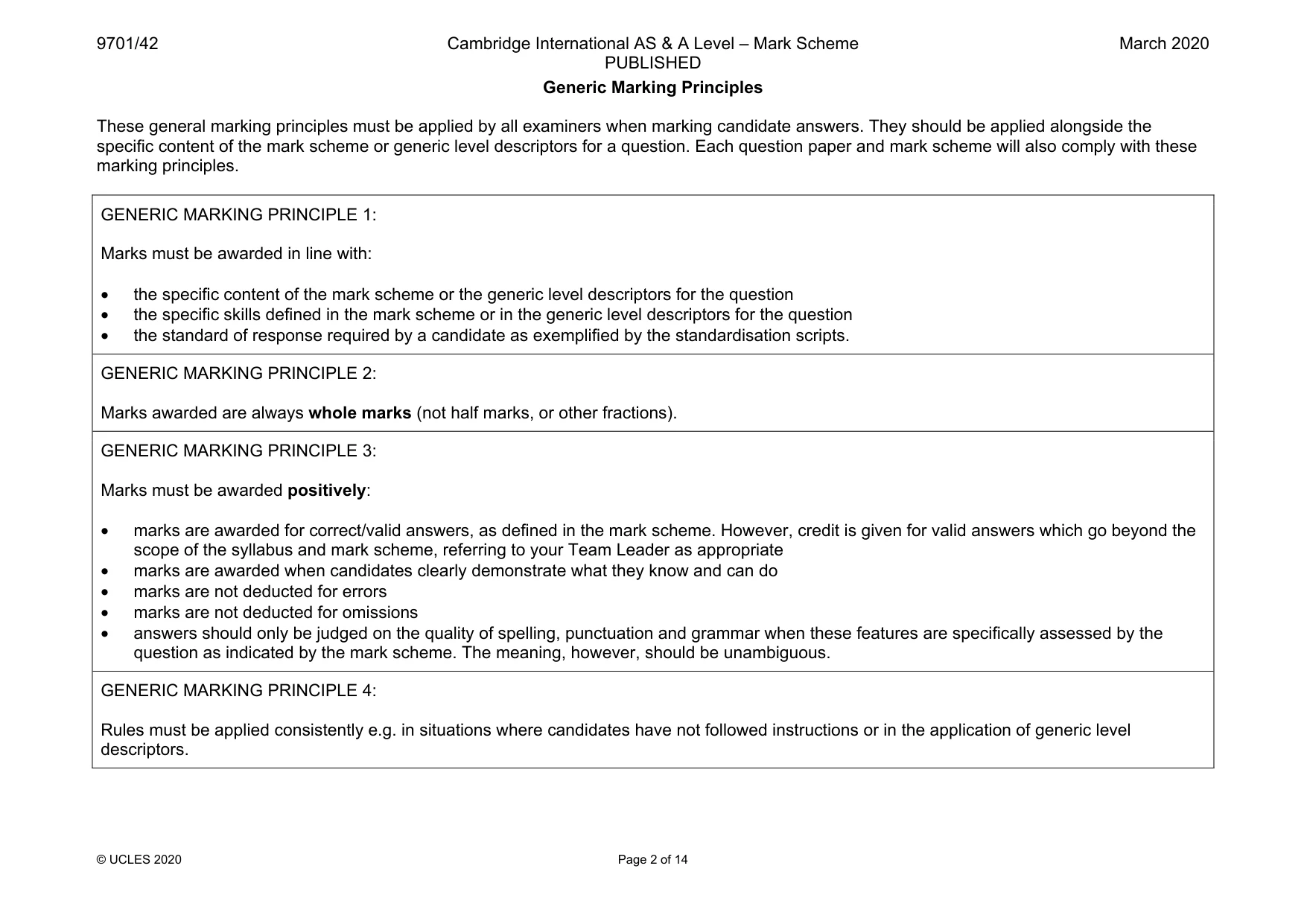
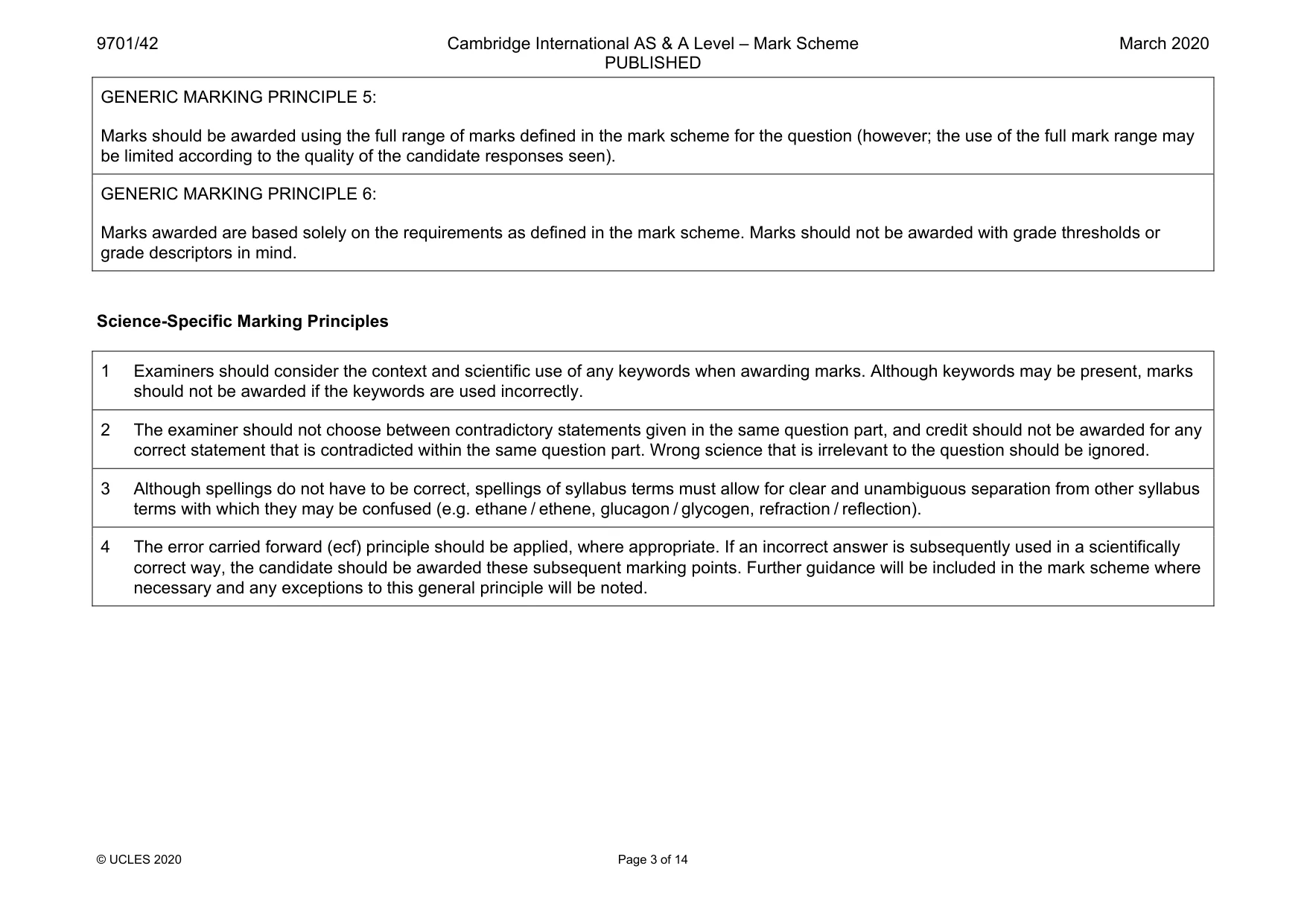
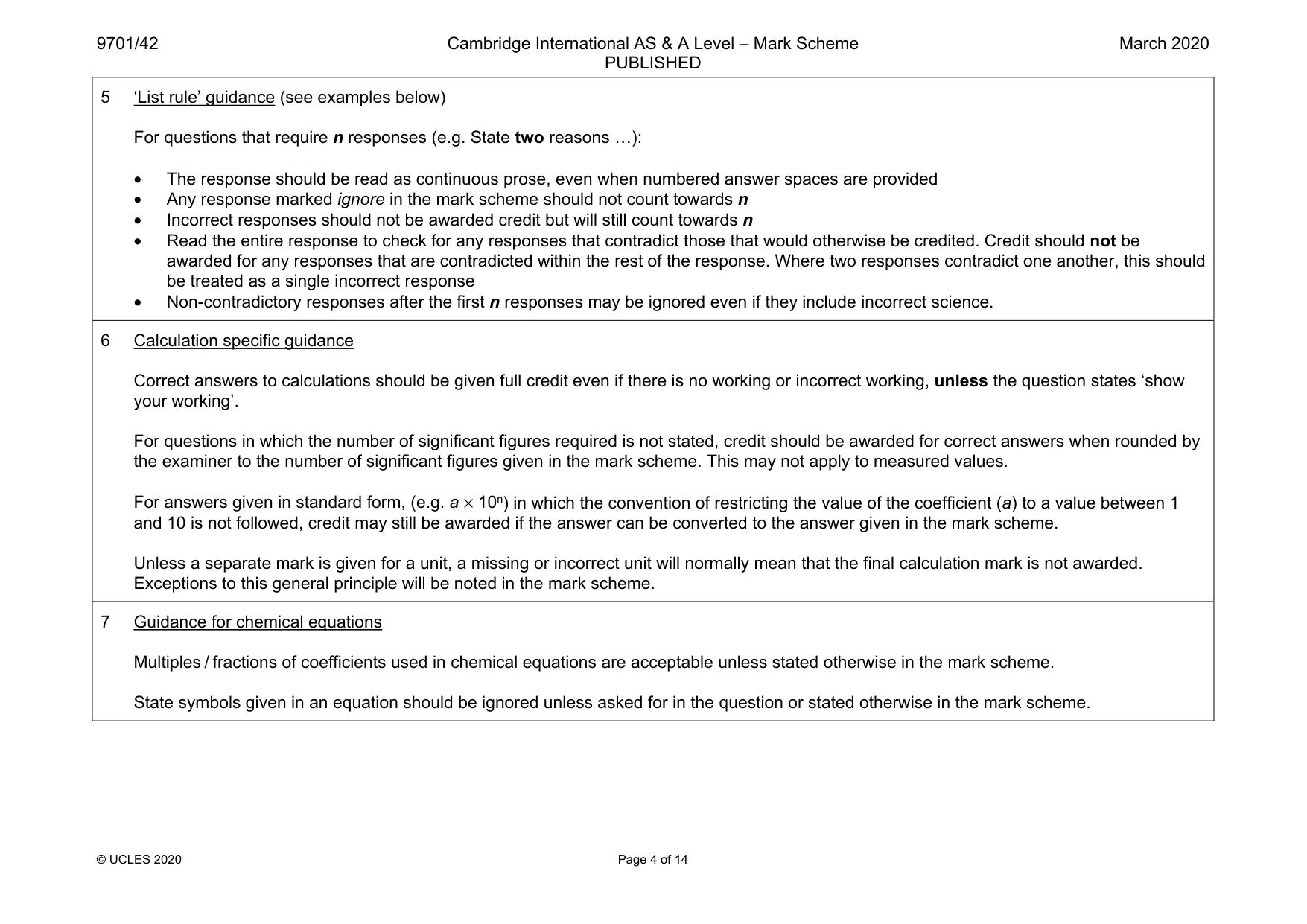
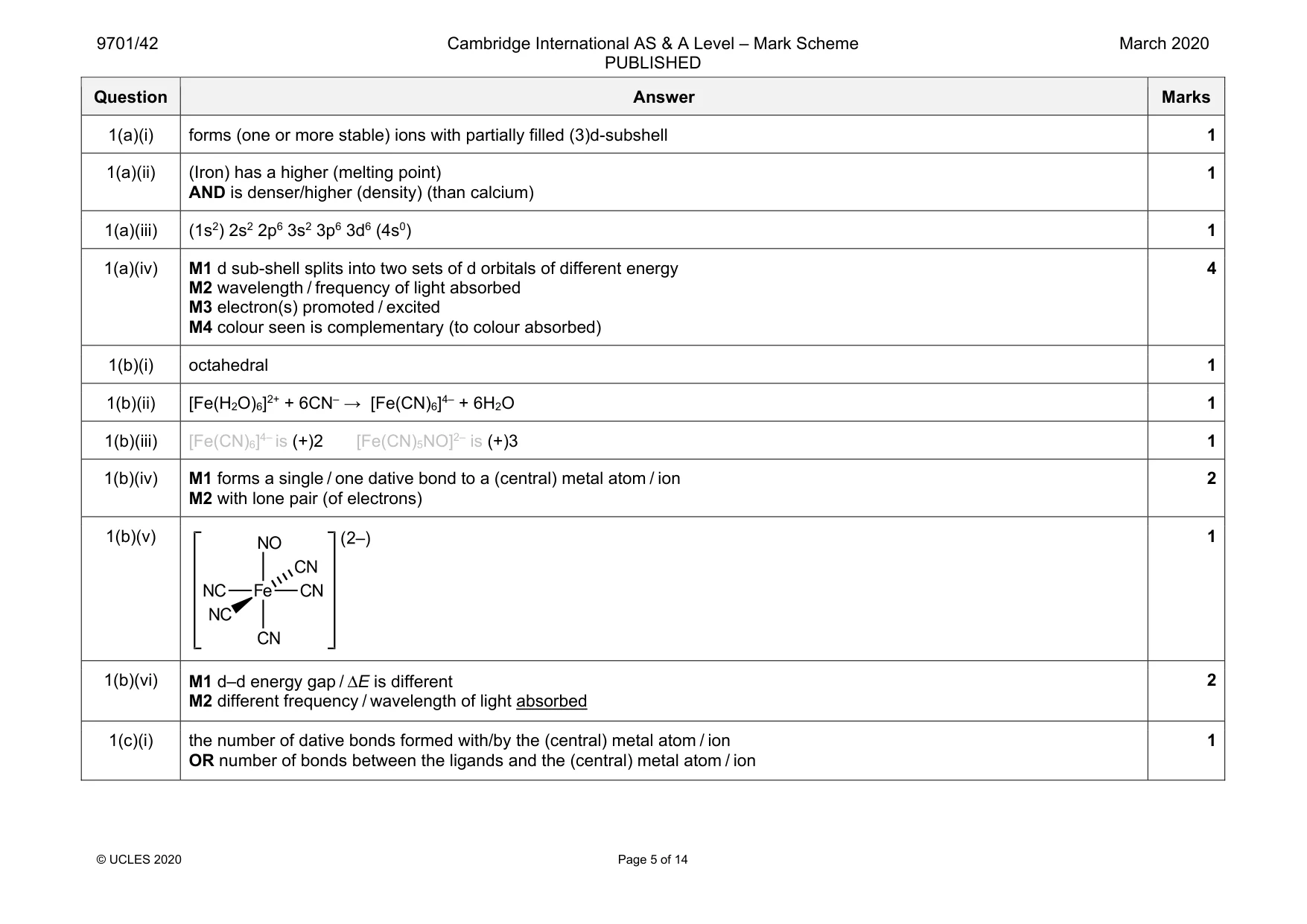
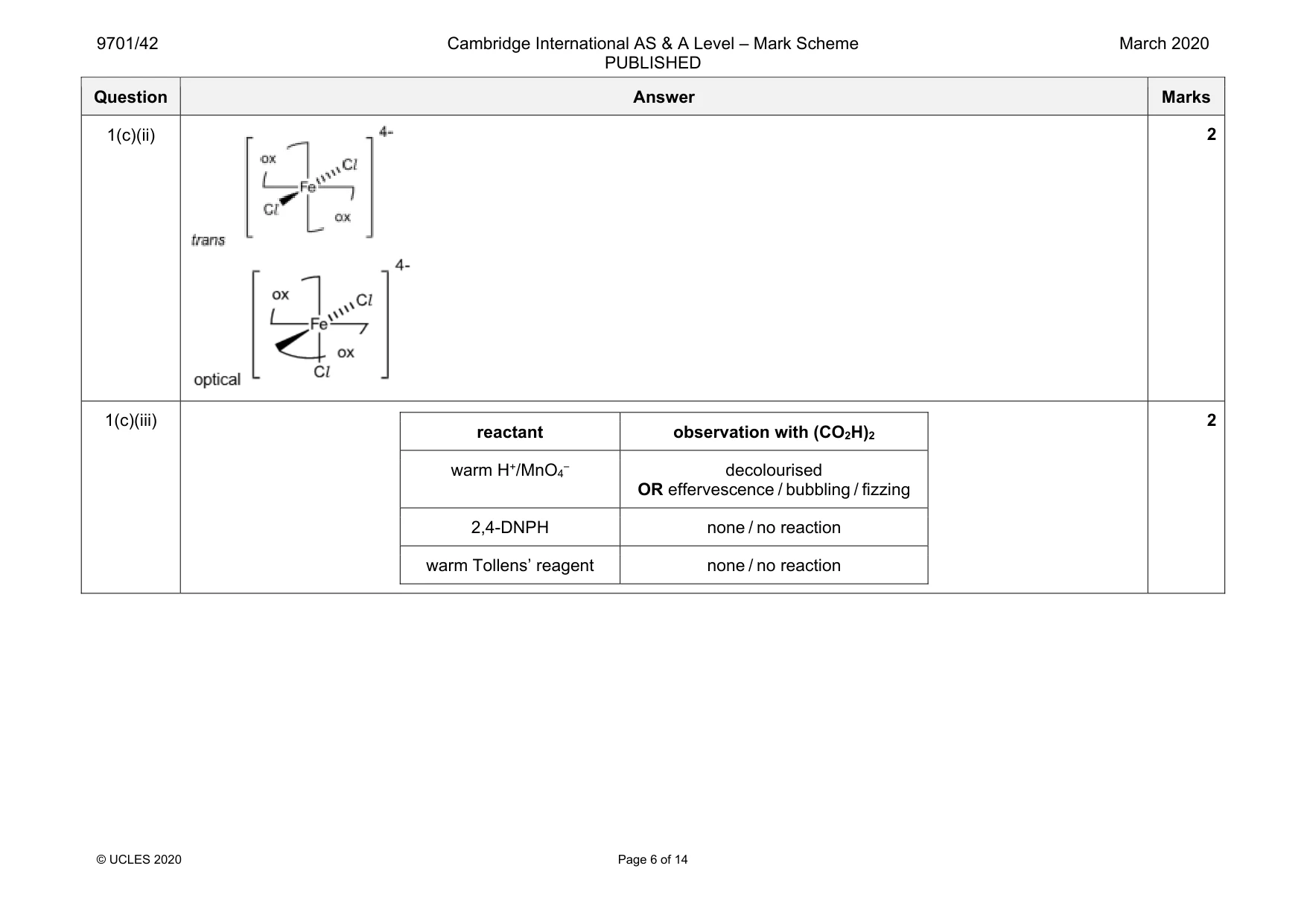
Mark scheme: 1(a)(i) forms (one or more stable) ions with partially filled (3)d-subshell 1 1(a)(ii) (Iron) has a higher (melting point) AND is denser/higher (density) (than calcium) 1 1(a)(iii) (1s2) 2s2 2p6 3s2 3p6 3d6 (4s0) 1 1(a)(iv) M1 d sub-shell splits into two sets of d orbitals of different energy M2 wavelength / frequency of light absorbed M3 electron(s) promoted / excited M4 colour seen is complementary (to colour absorbed) 4 1(b)(i) octahedral 1 1(b)(ii) [Fe(H2O)6]2+ + 6CN– → [Fe(CN)6]4– + 6H2O 1 1(b)(iii) [Fe(CN)6]4– is (+)2 [Fe(CN)5NO]2– is (+)3 1 1(b)(iv) M1 forms a single / one dative bond to a (central) metal atom / ion M2 with lone pair (of electrons) 2 1(b)(v) 1 1(b)(vi) M1 d–d energy gap / ΔE is different M2 different frequency / wavelength of light absorbed 2 1(c)(i) the number of dative bonds formed with/by the (central) metal atom / ion OR number of bonds between the ligands and the (central) metal atom / ion 1 Question Answer Marks 1(c)(ii) 2 1(c)(iii) reactant observation with (CO2H)2 warm H+/MnO4– decolourised OR effervescence / bubbling / fizzing 2,4-DNPH none / no reaction warm Tollens’ reagent none / no reaction 2
Q2 · Group 2 metals form stable carbonates and sulfates
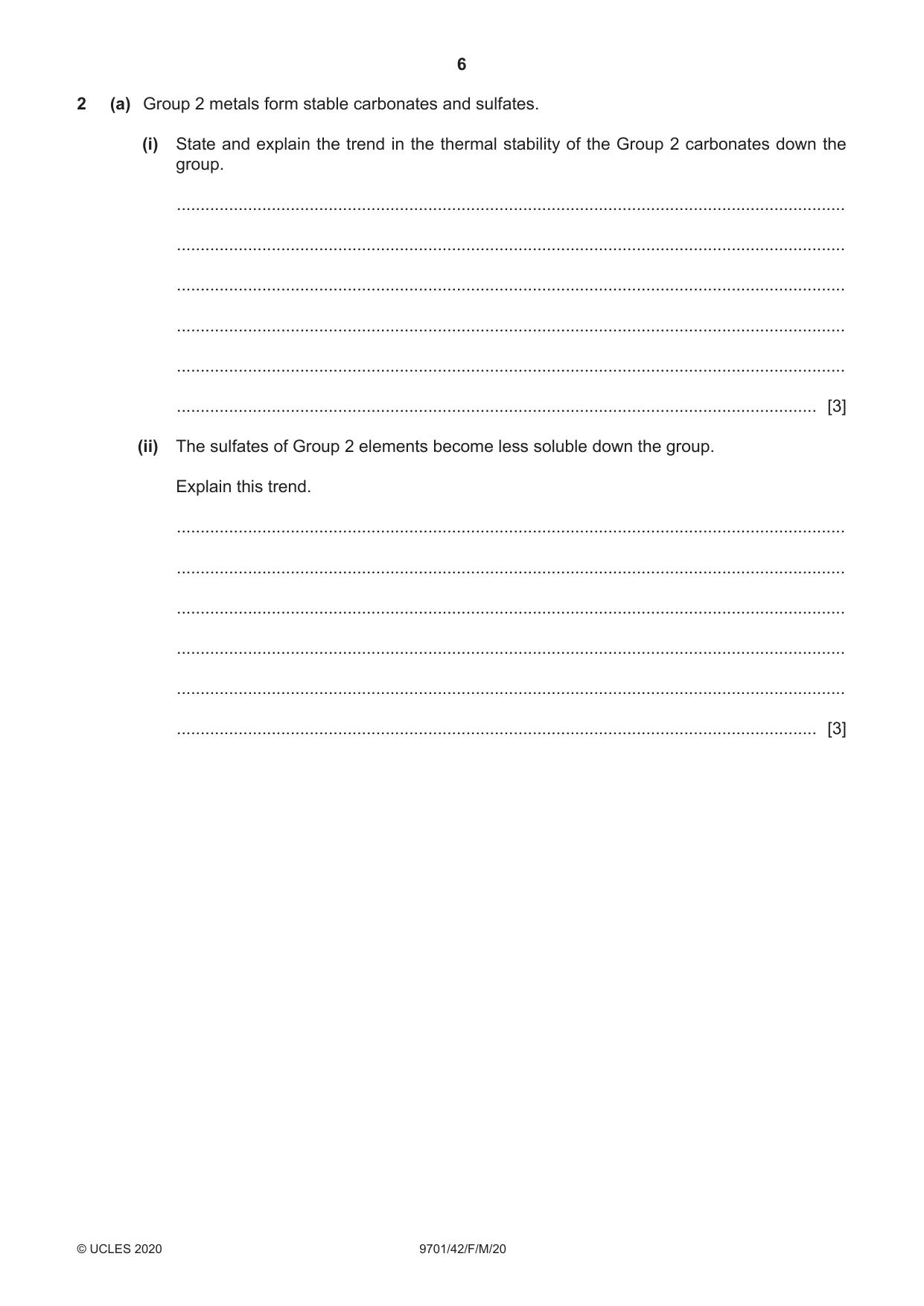
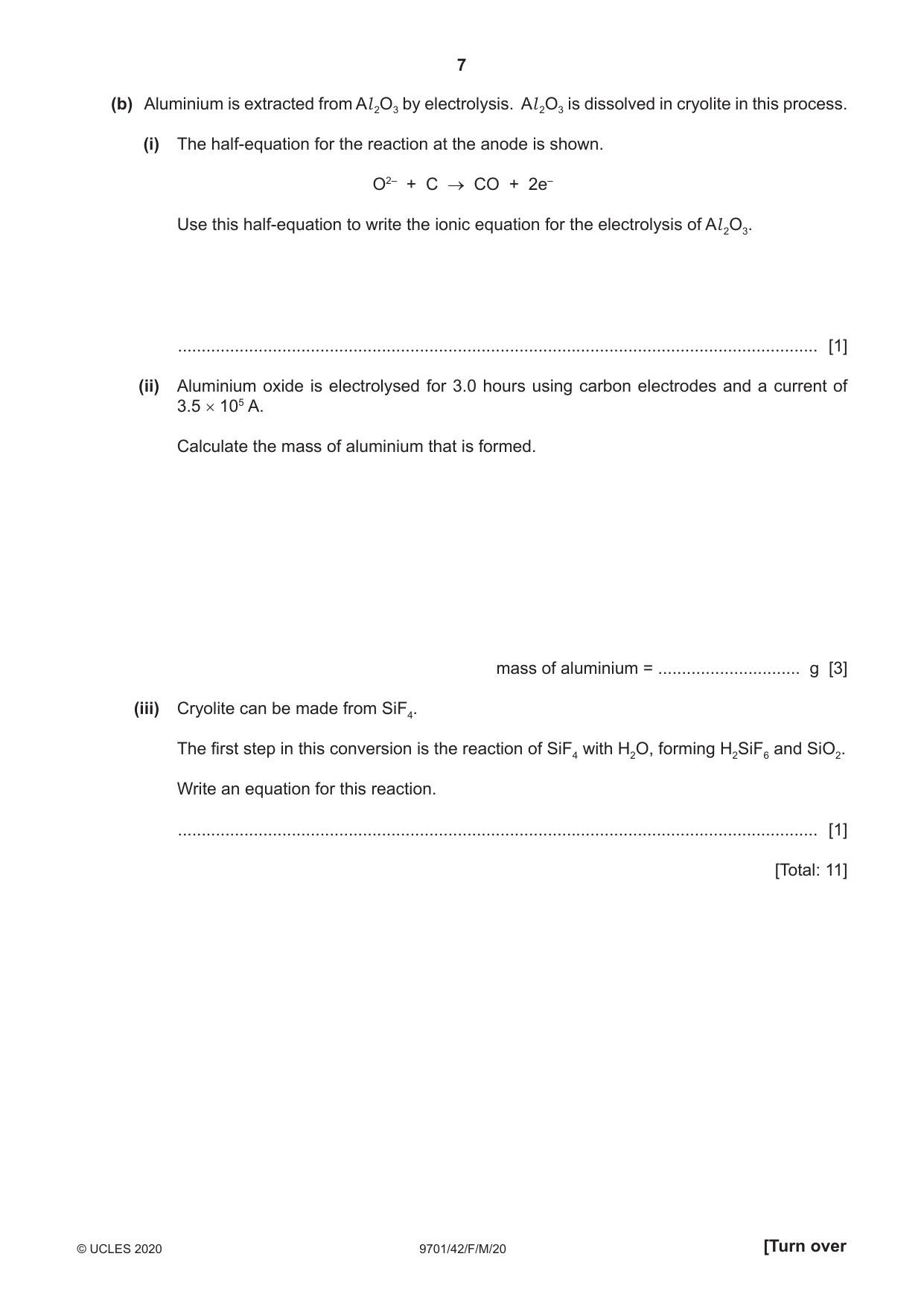
2 (a) Group 2 metals form stable carbonates and sulfates. (i) State and explain the trend in the thermal stability of the Group 2 carbonates down the group. ............................................................................................................................................. ............................................................................................................................................. ............................................................................................................................................. ............................................................................................................................................. ............................................................................................................................................. ....................................................................................................................................... [3] (ii) The sulfates of Group 2 elements become less soluble down the group. Explain this trend. ............................................................................................................................................. ............................................................................................................................................. ............................................................................................................................................. ............................................................................................................................................. ............................................................................................................................................. ....................................................................................................................................... [3] (b) Aluminium is extracted from Al 2O3 by electrolysis. Al 2O3 is dissolved in cryolite in this process. (i) The half-equation for the reaction at the anode is shown. O2– + C → CO + 2e– Use this half-equation to write the ionic equation for the electrolysis of Al 2O3. ....................................................................................................................................... [1] (ii) Aluminium oxide is electrolysed for 3.0 hours using carbon electrodes and a current of 3.5 × 10⁵ A. Calculate the mass of aluminium that is formed. mass of aluminium = .............................. g [3] (iii) Cryolite can be made from SiF4. The first step in this conversion is the reaction of SiF4 with H2O, forming H2SiF6 and SiO2. Write an equation for this reaction. ....................................................................................................................................... [1] [Total: 11]
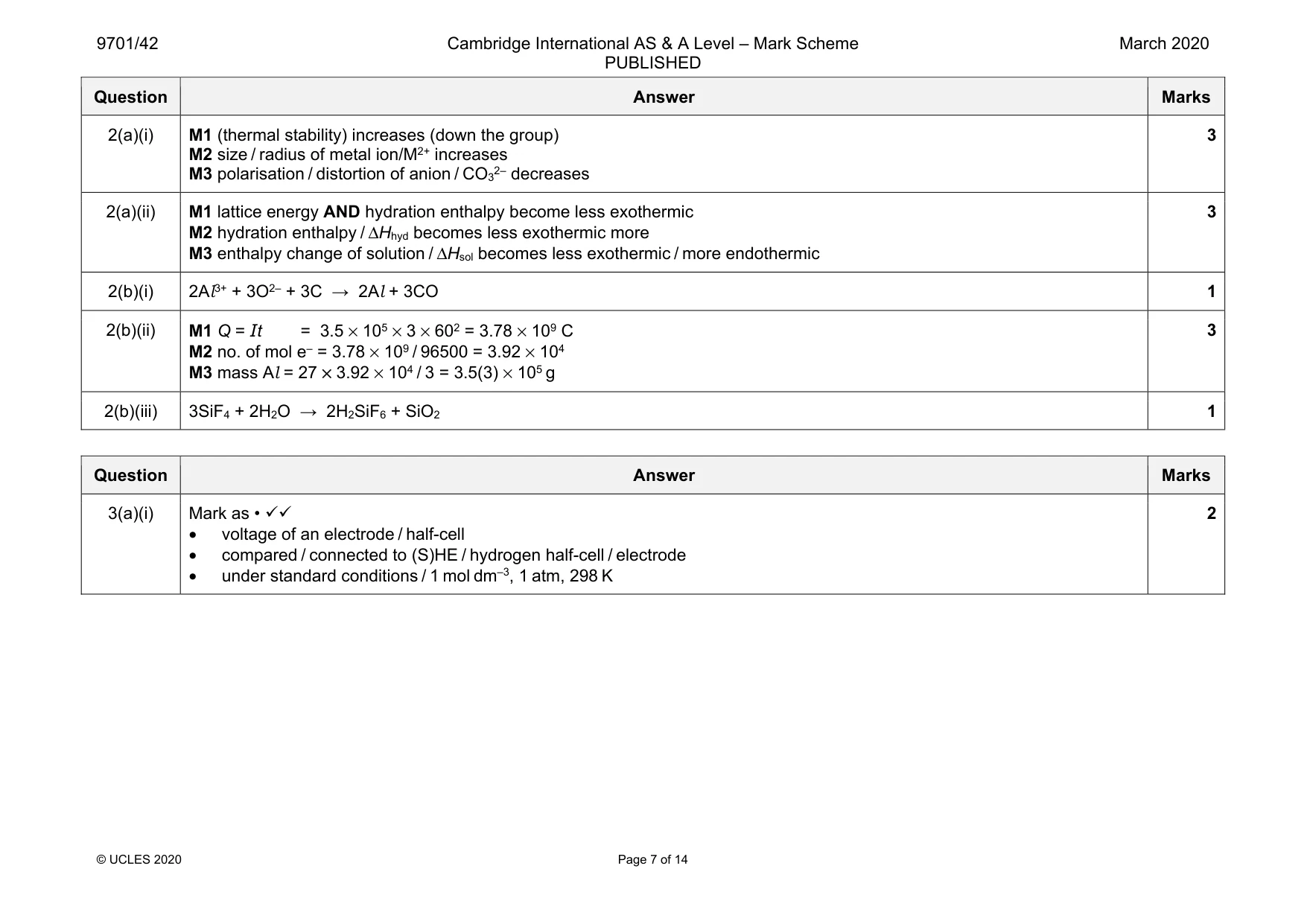
Mark scheme: 2(a)(i) M1 (thermal stability) increases (down the group) M2 size / radius of metal ion/M2+ increases M3 polarisation / distortion of anion / CO32– decreases 3 2(a)(ii) M1 lattice energy AND hydration enthalpy become less exothermic M2 hydration enthalpy / ΔHhyd becomes less exothermic more M3 enthalpy change of solution / ΔHsol becomes less exothermic / more endothermic 3 2(b)(i) 2Al3+ + 3O2– + 3C → 2Al + 3CO 1 2(b)(ii) M1 Q = It = 3.5 × 105 × 3 × 602 = 3.78 × 10⁹ C M2 no. of mol e– = 3.78 × 10⁹ / 96500 = 3.92 × 10⁴ M3 mass Al = 27 × 3.92 × 104 / 3 = 3.5(3) × 105 g 3 2(b)(iii) 3SiF4 + 2H2O → 2H2SiF6 + SiO2 1
Q3 · Gold is an unreactive metal that can only be oxidised under specific conditions
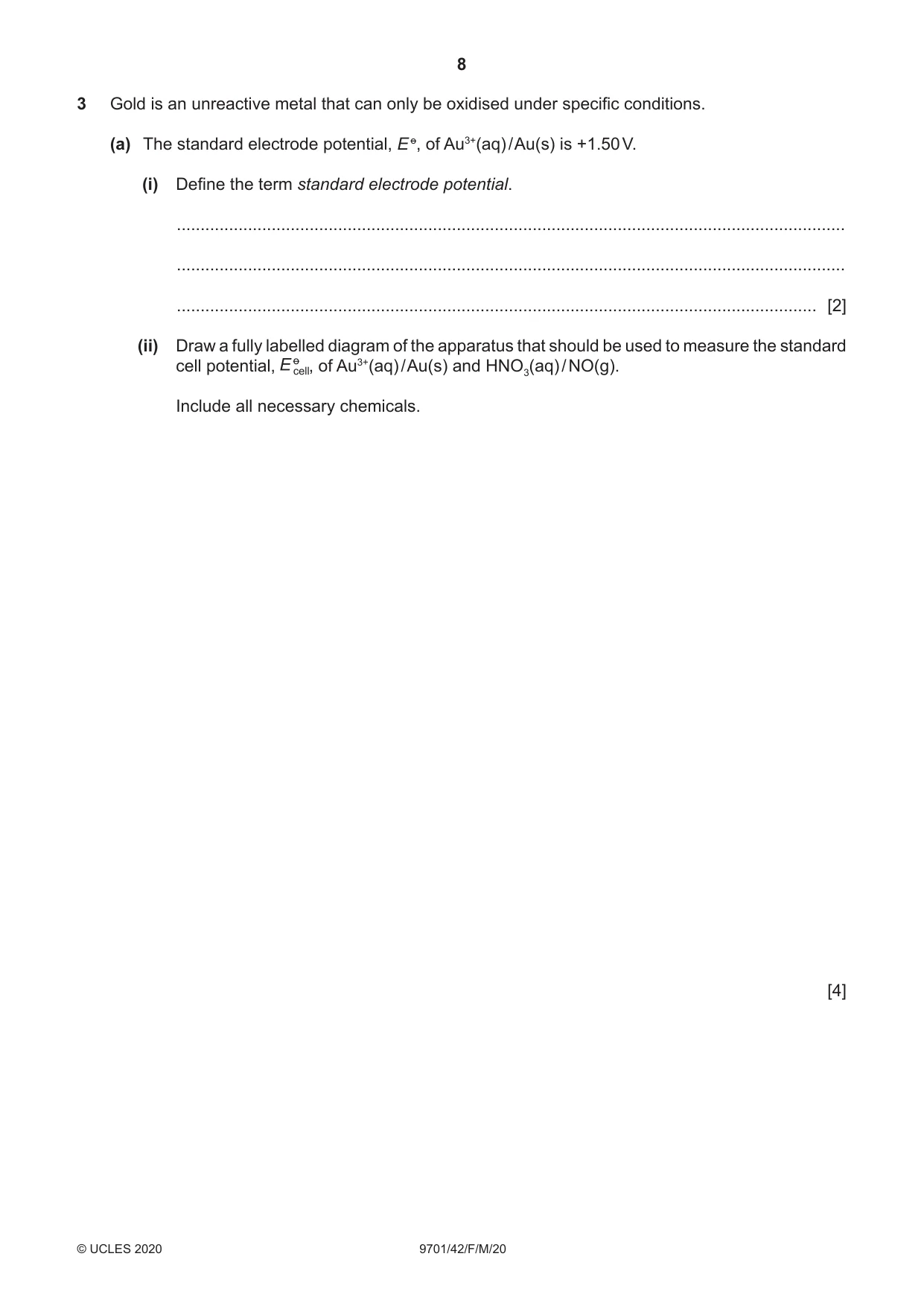
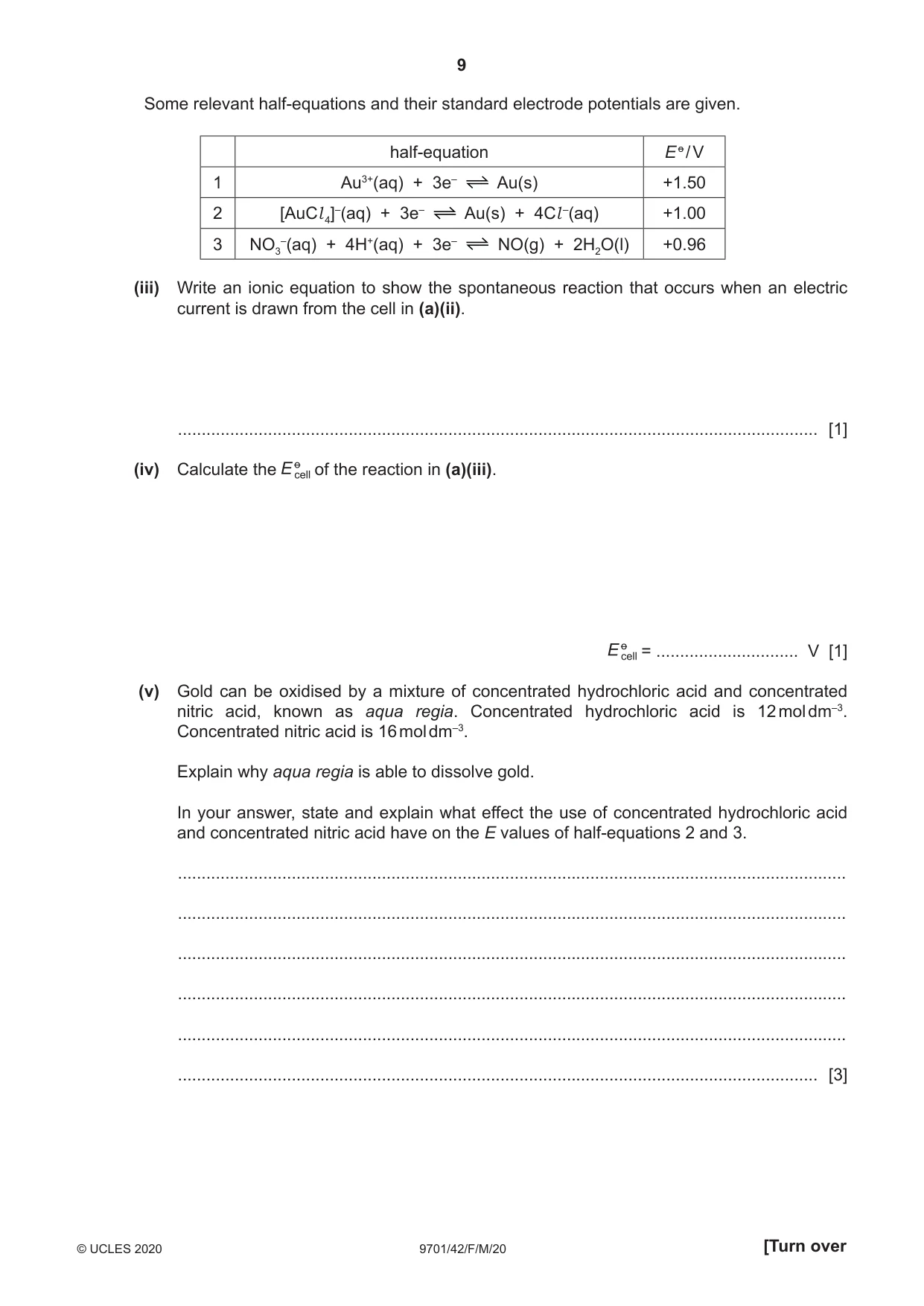
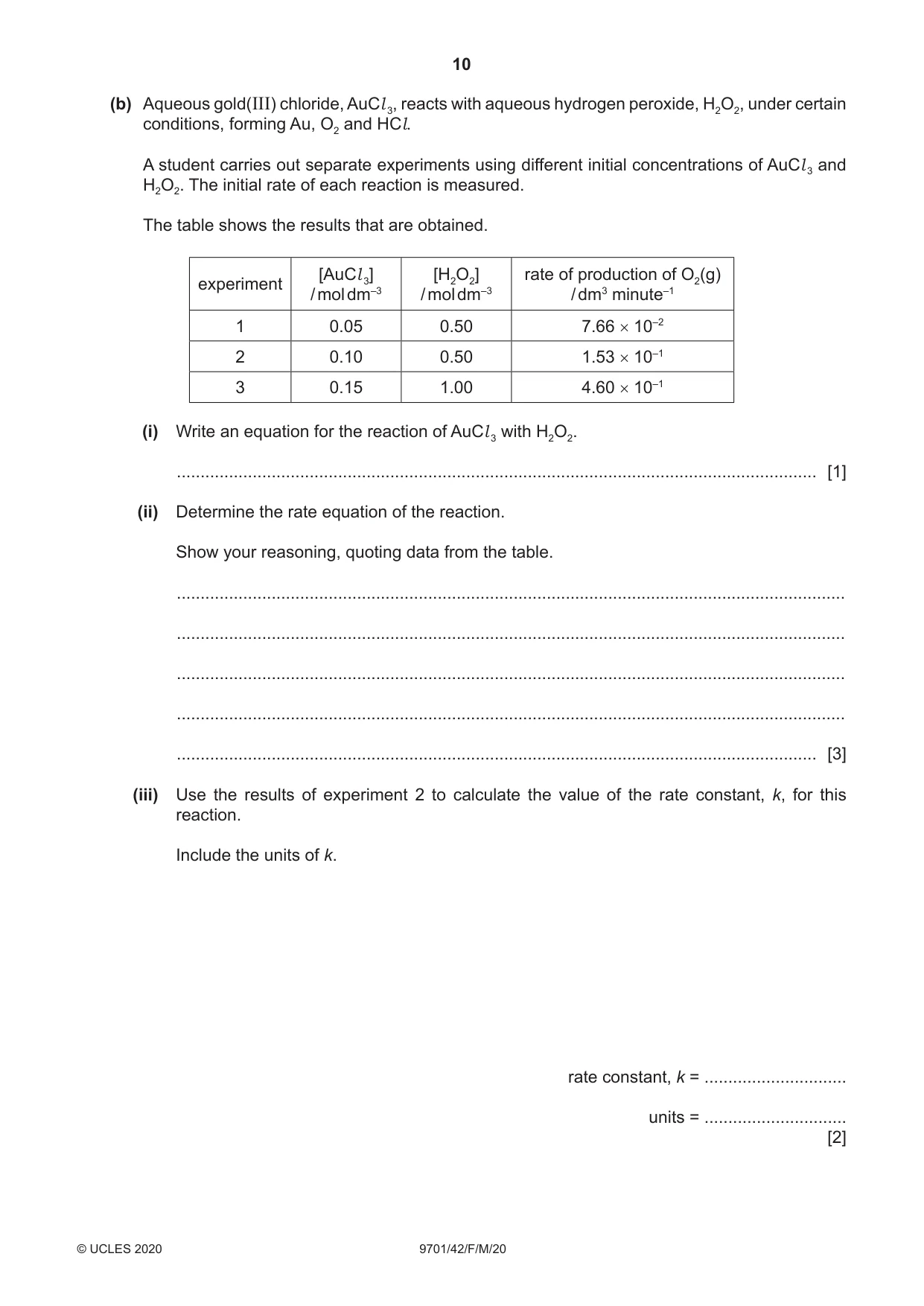
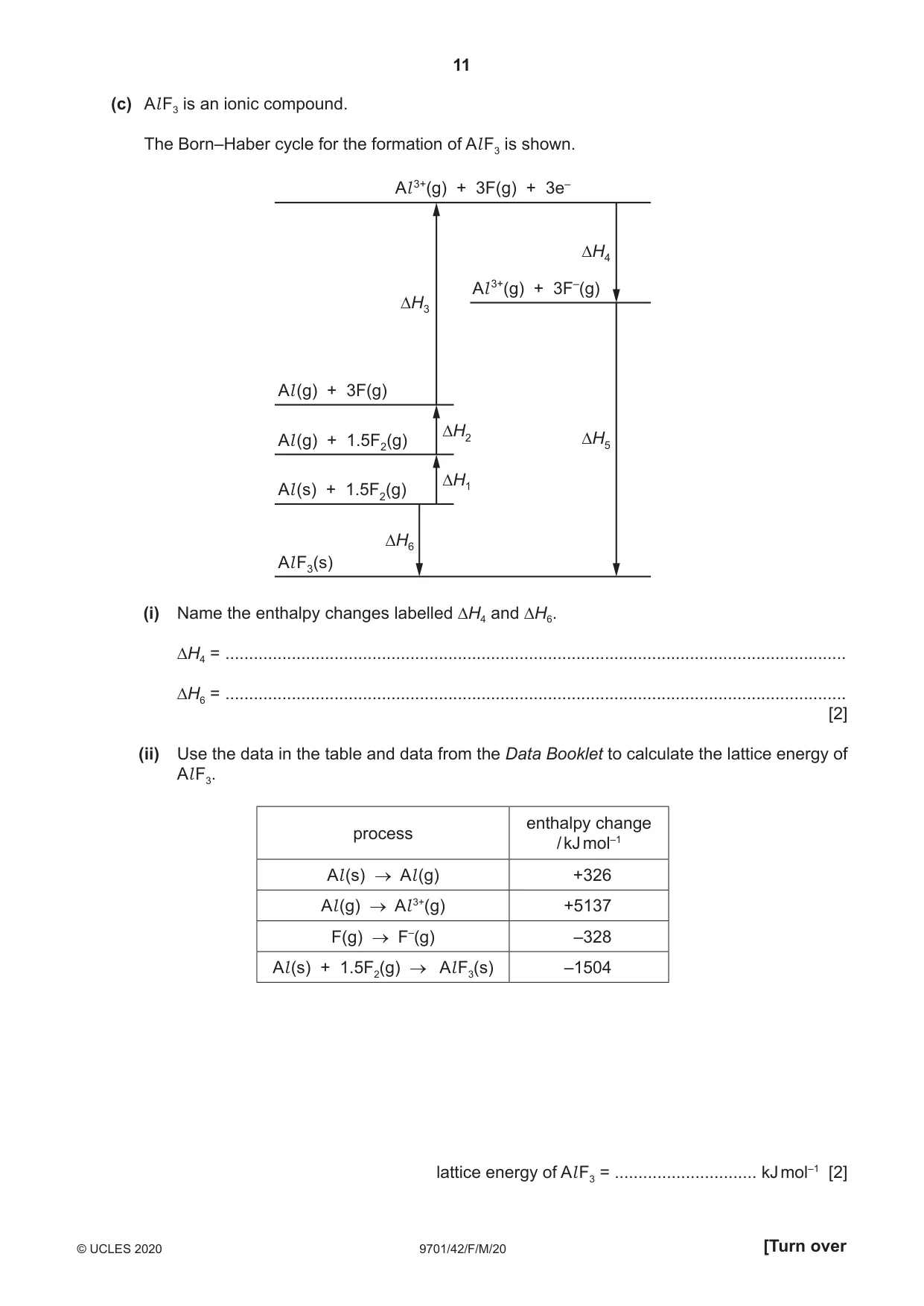
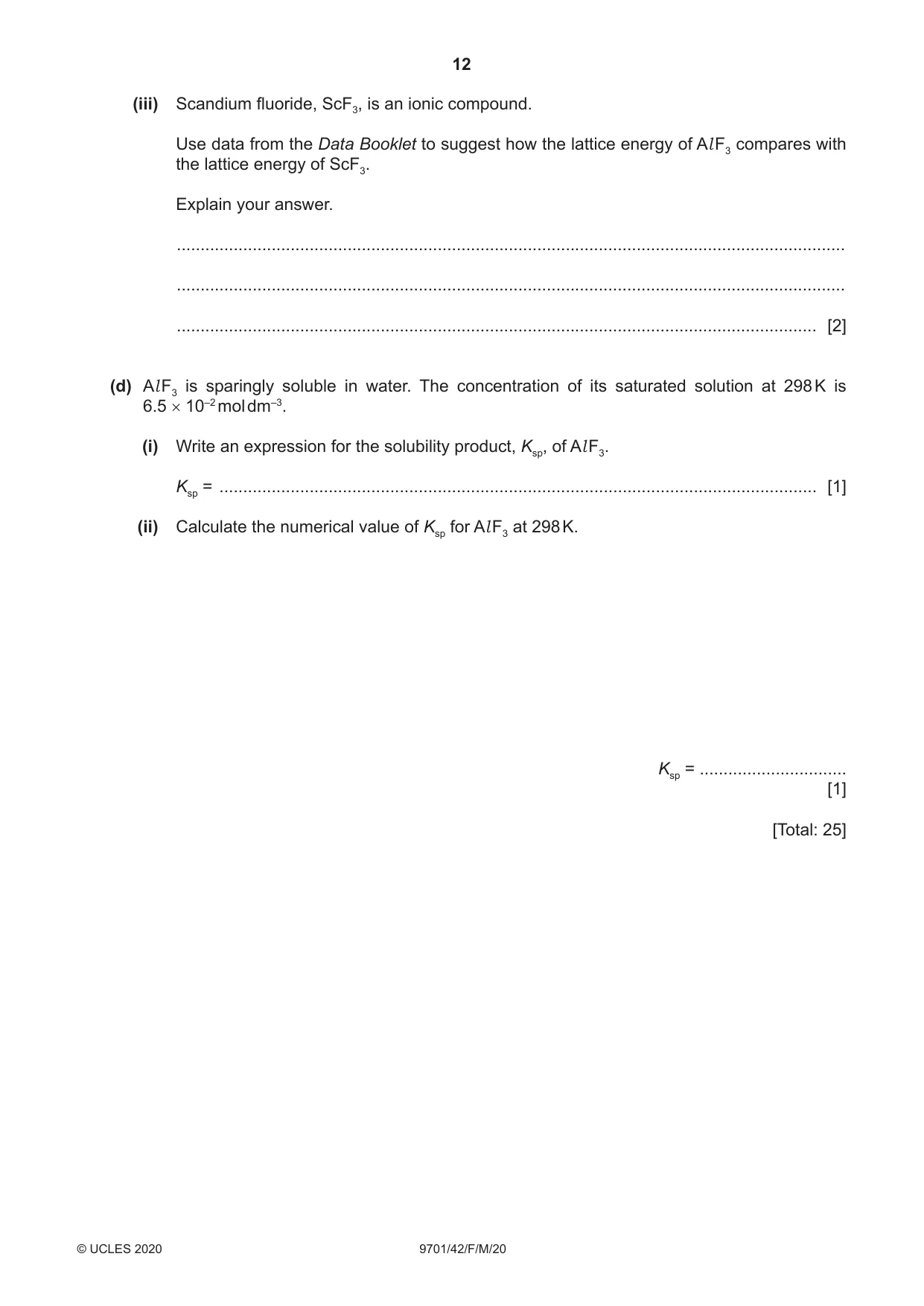
3 Gold is an unreactive metal that can only be oxidised under specific conditions. (a) The standard electrode potential, E o, of Au3+(aq) / Au(s) is +1.50 V. (i) Define the term standard electrode potential. ............................................................................................................................................. ............................................................................................................................................. ....................................................................................................................................... [2] (ii) Draw a fully labelled diagram of the apparatus that should be used to measure the standard cell potential, , of Au3+(aq) / Au(s) and HNO3(aq) / NO(g). Include all necessary chemicals. [4] Some relevant half-equations and their standard electrode potentials are given. half-equation E o / V 1 Au3+(aq) + 3e– Au(s) +1.50 2 [AuCl 4]–(aq) + 3e– Au(s) + 4Cl –(aq) +1.00 3 NO3–(aq) + 4H+(aq) + 3e– NO(g) + 2H2O(l) +0.96 (iii) Write an ionic equation to show the spontaneous reaction that occurs when an electric current is drawn from the cell in (a)(ii). ....................................................................................................................................... [1] (iv) Calculate the of the reaction in (a)(iii). = .............................. V [1] (v) Gold can be oxidised by a mixture of concentrated hydrochloric acid and concentrated nitric acid, known as aqua regia. Concentrated hydrochloric acid is 12 mol dm–3. Concentrated nitric acid is 16 mol dm–3. Explain why aqua regia is able to dissolve gold. In your answer, state and explain what effect the use of concentrated hydrochloric acid and concentrated nitric acid have on the E values of half-equations 2 and 3. ............................................................................................................................................. ............................................................................................................................................. ............................................................................................................................................. ............................................................................................................................................. ............................................................................................................................................. ....................................................................................................................................... [3] (b) Aqueous gold(III) chloride, AuCl 3, reacts with aqueous hydrogen peroxide, H2O2, under certain conditions, forming Au, O2 and HCl. A student carries out separate experiments using different initial concentrations of AuCl 3 and H2O2. The initial rate of each reaction is measured. The table shows the results that are obtained. [AuCl 3] [H2O2] rate of production of O2(g) experiment / mol dm–3 / mol dm–3 / dm3 minute–1 1 0.05 0.50 7.66 × 10⁻² 2 0.10 0.50 1.53 × 10⁻¹ 3 0.15 1.00 4.60 × 10⁻¹ (i) Write an equation for the reaction of AuCl 3 with H2O2. ....................................................................................................................................... [1] (ii) Determine the rate equation of the reaction. Show your reasoning, quoting data from the table. ............................................................................................................................................. ............................................................................................................................................. ............................................................................................................................................. ............................................................................................................................................. ....................................................................................................................................... [3] (iii) Use the results of experiment 2 to calculate the value of the rate constant, k, for this reaction. Include the units of k. rate constant, k = .............................. units = .............................. [2] (c) Al F3 is an ionic compound. The Born–Haber cycle for the formation of Al F3 is shown. Al 3+(g) + 3F(g) + 3e– ∆H4 Al 3+(g) + 3F–(g) ∆H3 Al (g) + 3F(g) ∆H2 Al (g) + 1.5F2(g) ∆H5 ∆H1 Al (s) + 1.5F2(g) ∆H6 Al F3(s) (i) Name the enthalpy changes labelled ∆H4 and ∆H6. ∆H4 = ................................................................................................................................... ∆H6 = ................................................................................................................................... [2] (ii) Use the data in the table and data from the Data Booklet to calculate the lattice energy of Al F3. enthalpy change process / kJ mol–1 Al (s) → Al (g) +326 Al (g) → Al 3+(g) +5137 F(g) → F–(g) –328 Al (s) + 1.5F2(g) → Al F3(s) –1504 lattice energy of Al F3 = .............................. kJ mol–1 [2] (iii) Scandium fluoride, ScF3, is an ionic compound. Use data from the Data Booklet to suggest how the lattice energy of Al F3 compares with the lattice energy of ScF3. Explain your answer. ............................................................................................................................................. ............................................................................................................................................. ....................................................................................................................................... [2] (d) Al F3 is sparingly soluble in water. The concentration of its saturated solution at 298 K is 6.5 × 10⁻² mol dm–3. (i) Write an expression for the solubility product, Ksp, of Al F3. Ksp = ............................................................................................................................... [1] (ii) Calculate the numerical value of Ksp for Al F3 at 298 K. Ksp = ............................... [1] [Total: 25]
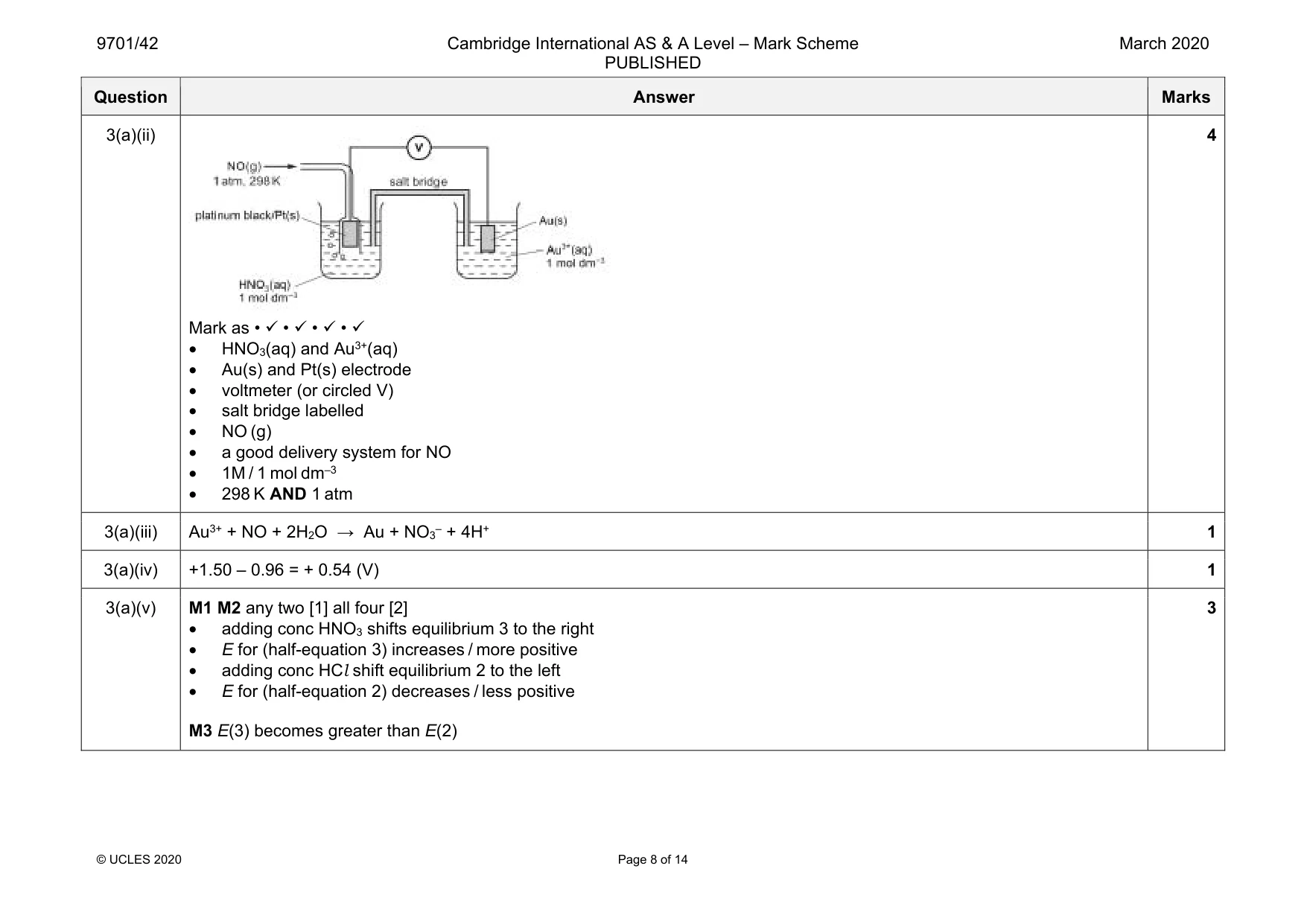
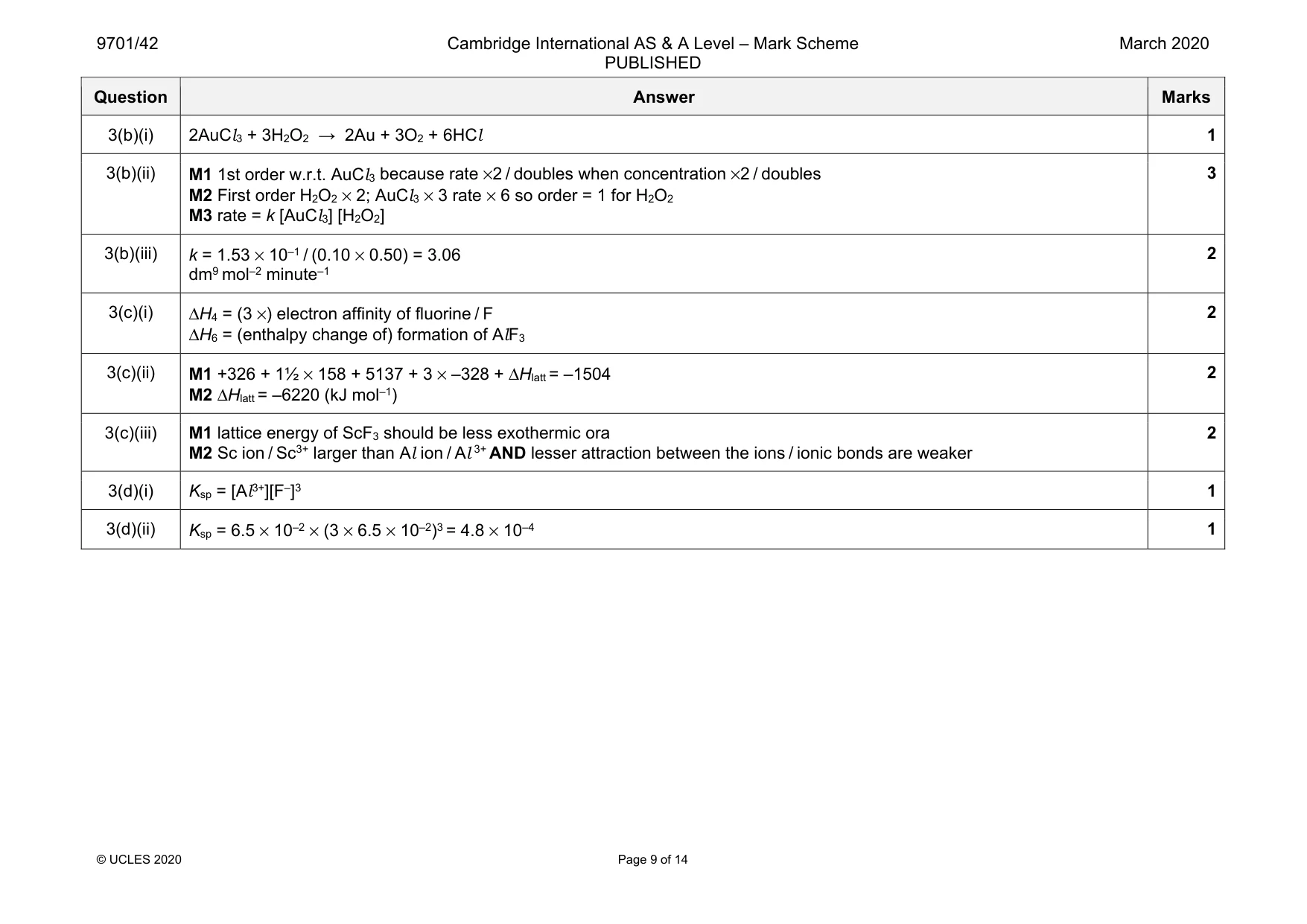
Mark scheme: 3(a)(i) Mark as • • voltage of an electrode / half-cell • compared / connected to (S)HE / hydrogen half-cell / electrode • under standard conditions / 1 mol dm–3, 1 atm, 298 K 2 Question Answer Marks 3(a)(ii) Mark as • • • • • HNO3(aq) and Au3+(aq) • Au(s) and Pt(s) electrode • voltmeter (or circled V) • salt bridge labelled • NO (g) • a good delivery system for NO • 1M / 1 mol dm–3 • 298 K AND 1 atm 4 3(a)(iii) Au3+ + NO + 2H2O → Au + NO3– + 4H+ 1 3(a)(iv) +1.50 – 0.96 = + 0.54 (V) 1 3(a)(v) M1 M2 any two [1] all four [2] • adding conc HNO3 shifts equilibrium 3 to the right • E for (half-equation 3) increases / more positive • adding conc HCl shift equilibrium 2 to the left • E for (half-equation 2) decreases / less positive M3 E(3) becomes greater than E(2) 3 Question Answer Marks 3(b)(i) 2AuCl3 + 3H2O2 → 2Au + 3O2 + 6HCl 1 3(b)(ii) M1 1st order w.r.t. AuCl3 because rate ×2 / doubles when concentration ×2 / doubles M2 First order H2O2 × 2; AuCl3 × 3 rate × 6 so order = 1 for H2O2 M3 rate = k [AuCl3] [H2O2] 3 3(b)(iii) k = 1.53 × 10⁻¹ / (0.10 × 0.50) = 3.06 dm9 mol–2 minute–1 2 3(c)(i) ΔH4 = (3 ×) electron affinity of fluorine / F ΔH6 = (enthalpy change of) formation of AlF3 2 3(c)(ii) M1 +326 + 1½ × 158 + 5137 + 3 × –328 + ΔHlatt = –1504 M2 ΔHlatt = –6220 (kJ mol–1) 2 3(c)(iii) M1 lattice energy of ScF3 should be less exothermic ora M2 Sc ion / Sc3+ larger than Al ion / Al 3+ AND lesser attraction between the ions / ionic bonds are weaker 2 3(d)(i) Ksp = [Al3+][F–]3 1 3(d)(ii) Ksp = 6.5 × 10–2 × (3 × 6.5 × 10–2)3 = 4.8 × 10⁻⁴ 1
Q4 · Compound F has been found in small quantities in some cereals and dried fruit
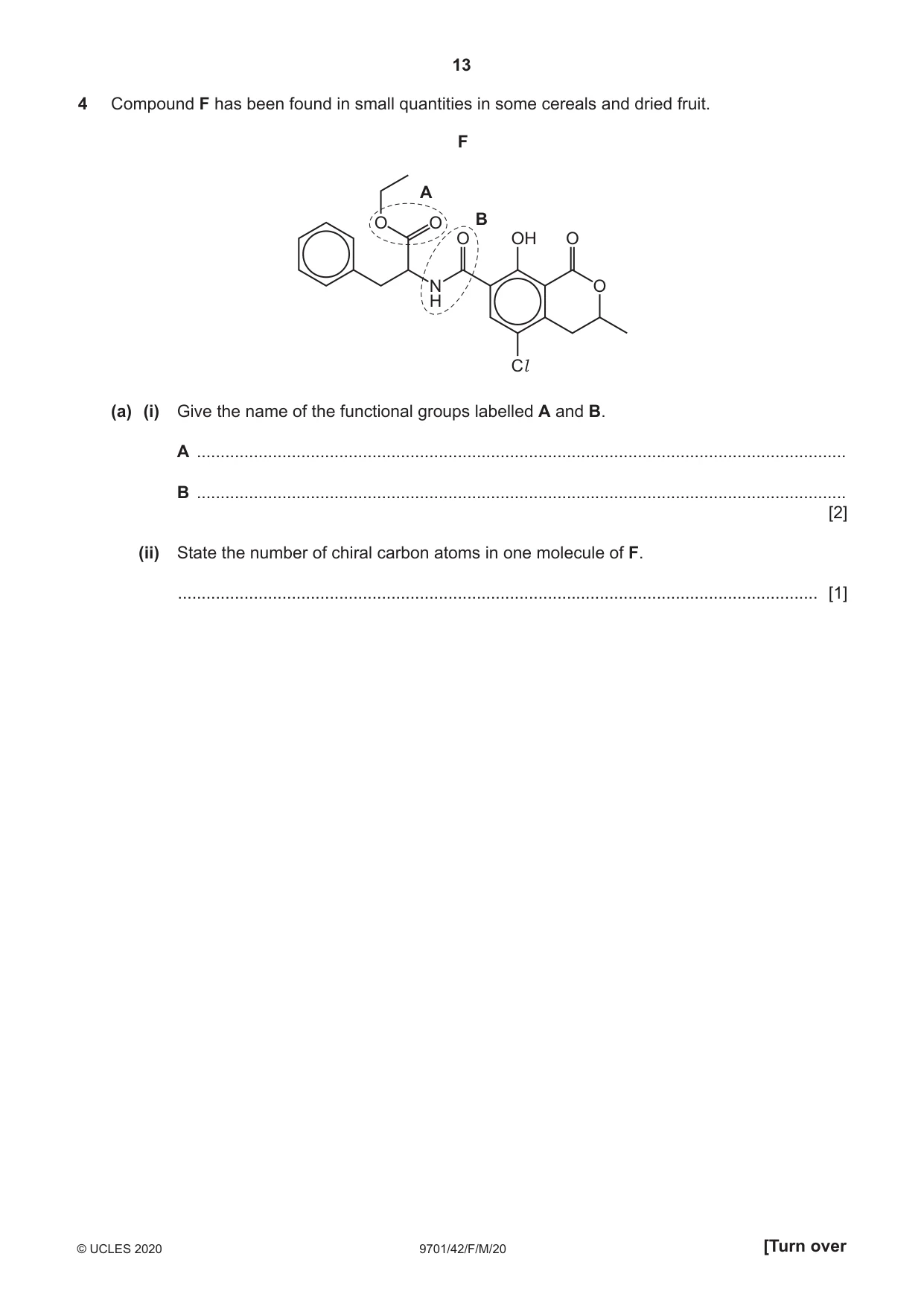
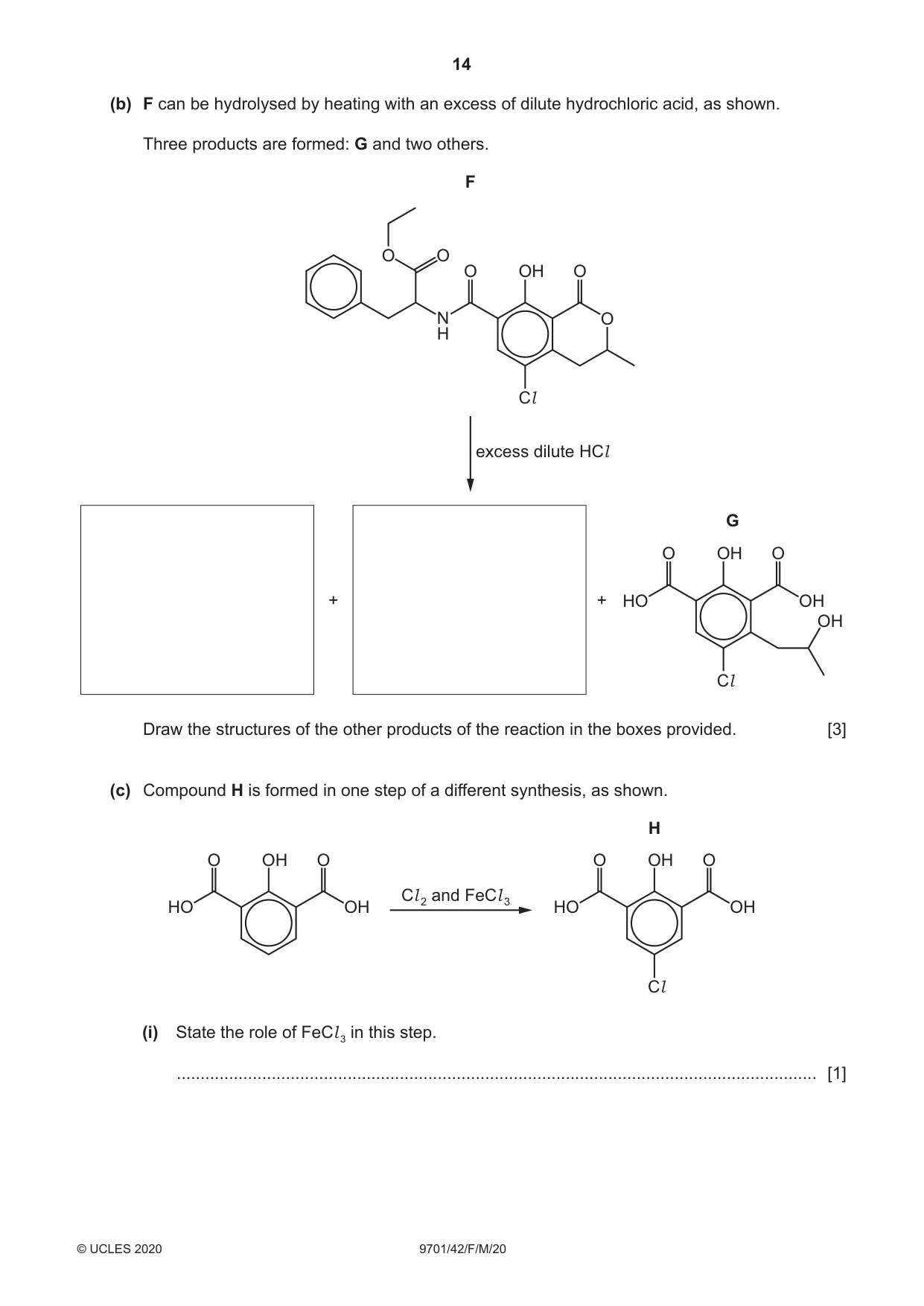
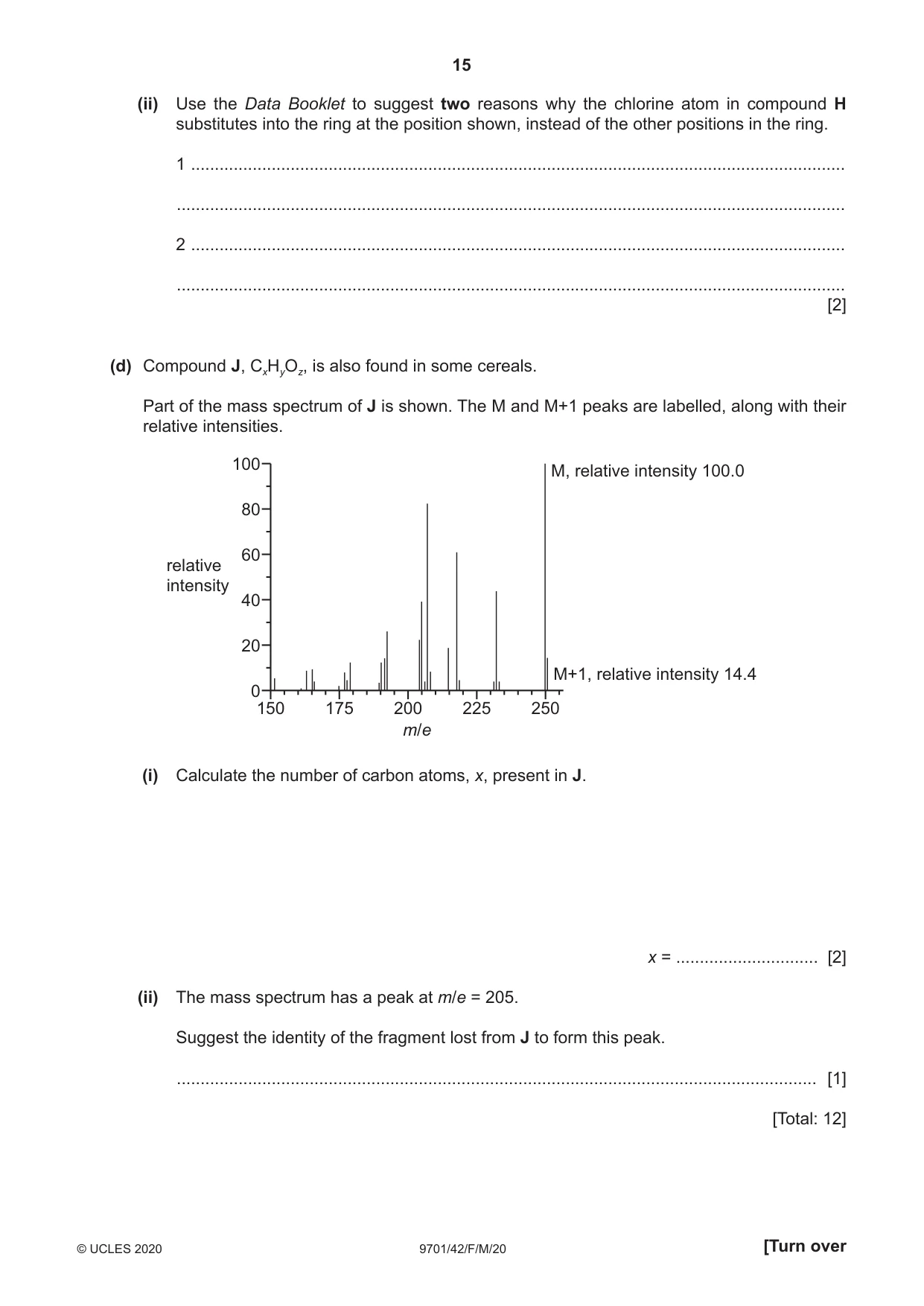
4 Compound F has been found in small quantities in some cereals and dried fruit. F A O O B O OH O N O H Cl (a) (i) Give the name of the functional groups labelled A and B. A .......................................................................................................................................... B .......................................................................................................................................... [2] (ii) State the number of chiral carbon atoms in one molecule of F. ....................................................................................................................................... [1] (b) F can be hydrolysed by heating with an excess of dilute hydrochloric acid, as shown. Three products are formed: G and two others. F O O O OH O N O H Cl excess dilute HCl G O OH O + + HO OH OH Cl Draw the structures of the other products of the reaction in the boxes provided. [3] (c) Compound H is formed in one step of a different synthesis, as shown. H O OH O O OH O Cl 2 and FeCl 3 HO OH HO OH Cl (i) State the role of FeCl 3 in this step. ....................................................................................................................................... [1] (ii) Use the Data Booklet to suggest two reasons why the chlorine atom in compound H substitutes into the ring at the position shown, instead of the other positions in the ring. 1 .......................................................................................................................................... ............................................................................................................................................. 2 .......................................................................................................................................... ............................................................................................................................................. [2] (d) Compound J, CxHyOz, is also found in some cereals. Part of the mass spectrum of J is shown. The M and M+1 peaks are labelled, along with their relative intensities. 100 M, relative intensity 100.0 80 60 relative intensity 40 20 M+1, relative intensity 14.4 0 150 175 200 225 250 m/e (i) Calculate the number of carbon atoms, x, present in J. x = .............................. [2] (ii) The mass spectrum has a peak at m/e = 205. Suggest the identity of the fragment lost from J to form this peak. ....................................................................................................................................... [1] [Total: 12]
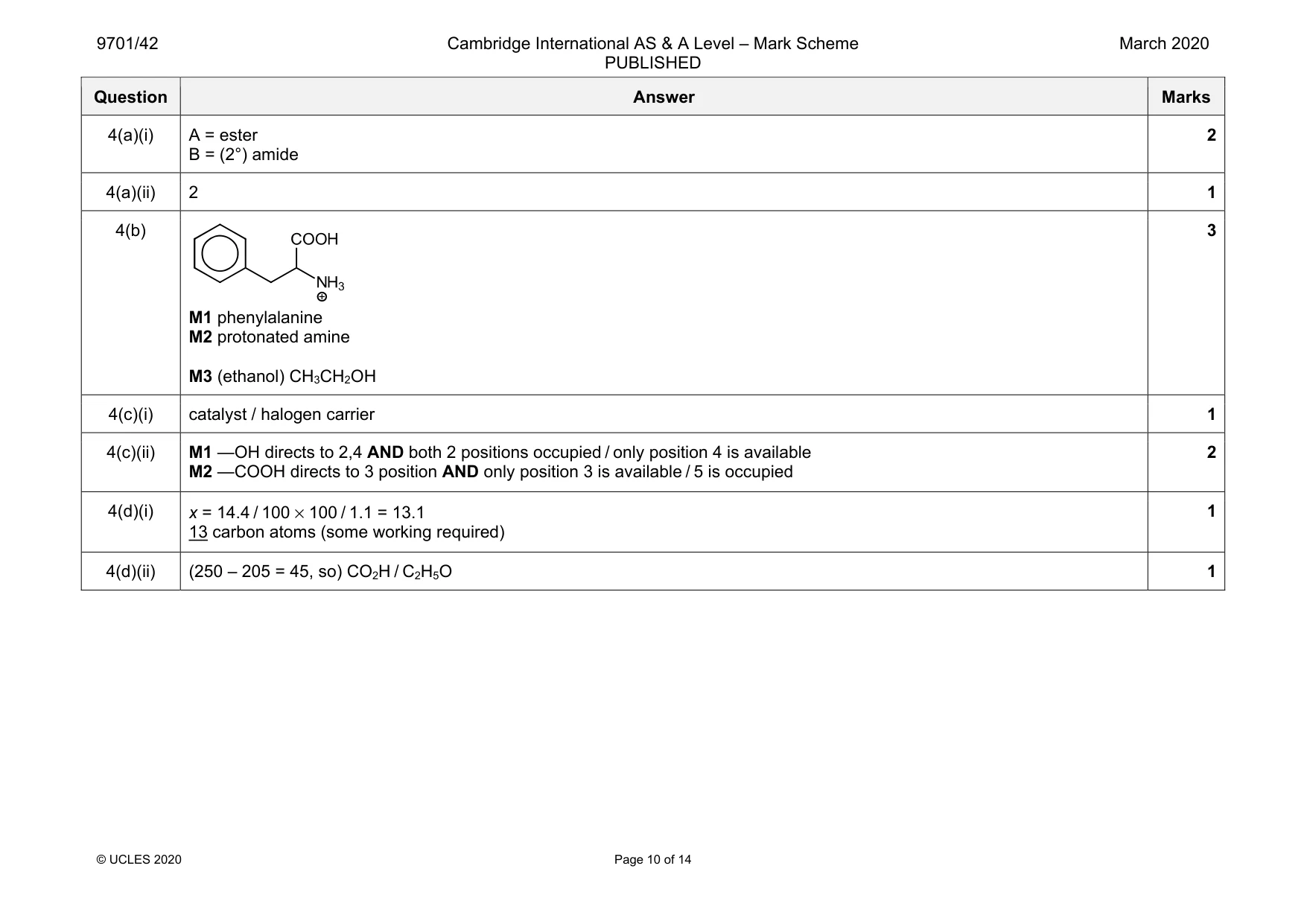
Mark scheme: 4(a)(i) A = ester B = (2°) amide 2 4(a)(ii) 2 1 4(b) M1 phenylalanine M2 protonated amine M3 (ethanol) CH3CH2OH 3 4(c)(i) catalyst / halogen carrier 1 4(c)(ii) M1 —OH directs to 2,4 AND both 2 positions occupied / only position 4 is available M2 —COOH directs to 3 position AND only position 3 is available / 5 is occupied 2 4(d)(i) x = 14.4 / 100 × 100 / 1.1 = 13.1 13 carbon atoms (some working required) 1 4(d)(ii) (250 – 205 = 45, so) CO2H / C2H5O 1
More questions on Formulas, functional groups and the naming of organic compounds
Q5 · Gallic acid, C7H6O5, is a naturally occurring aromatic molecule
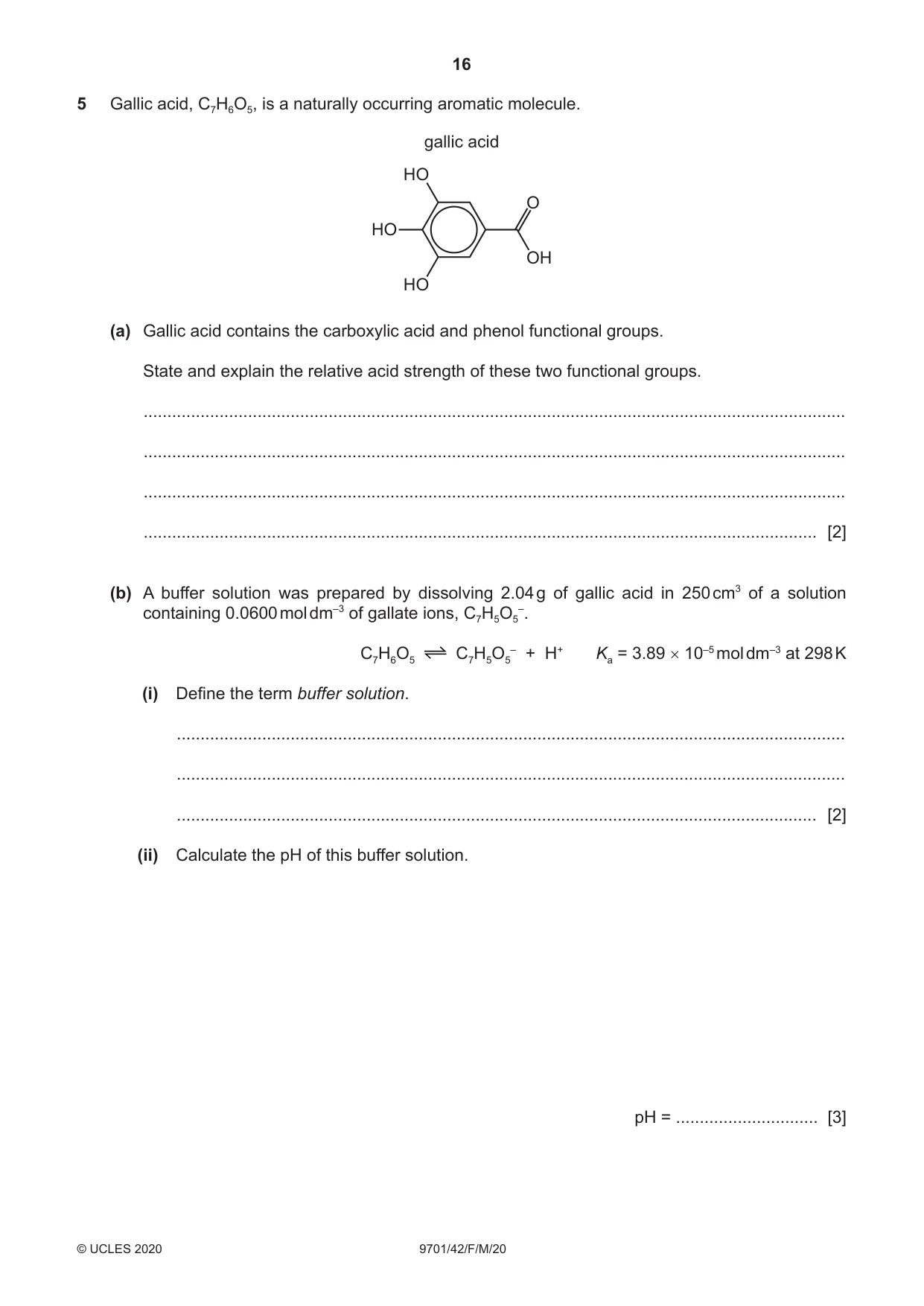
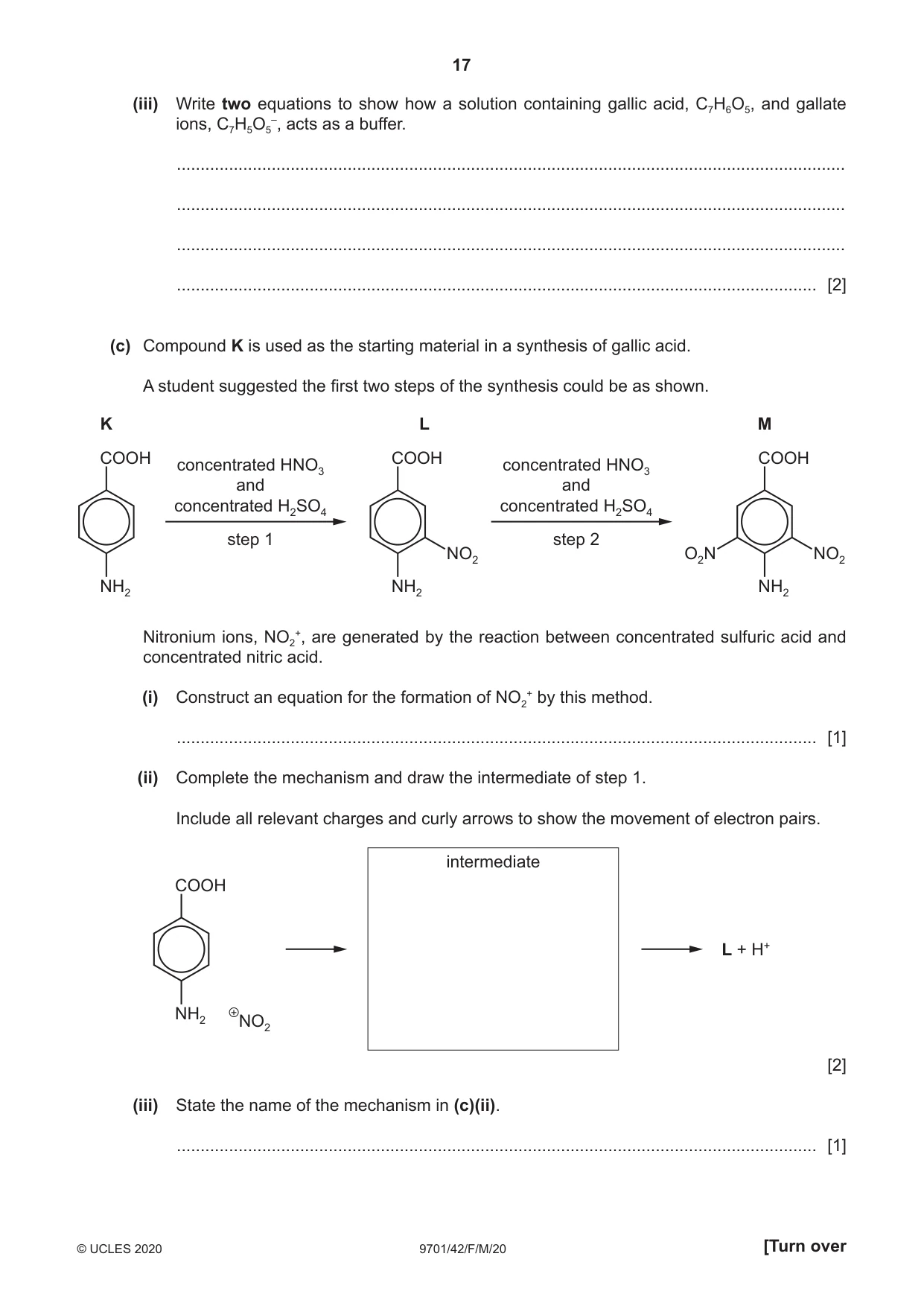
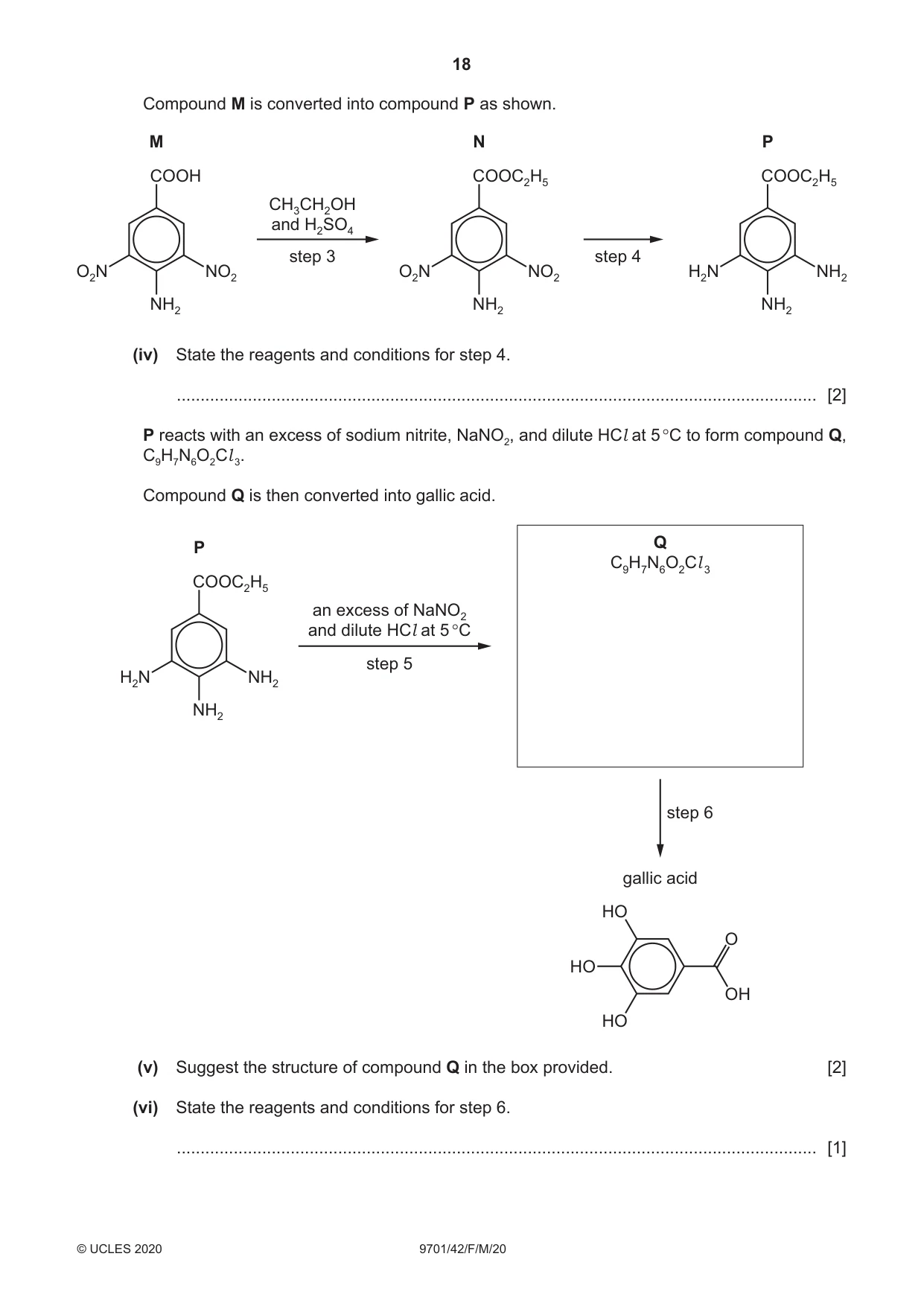
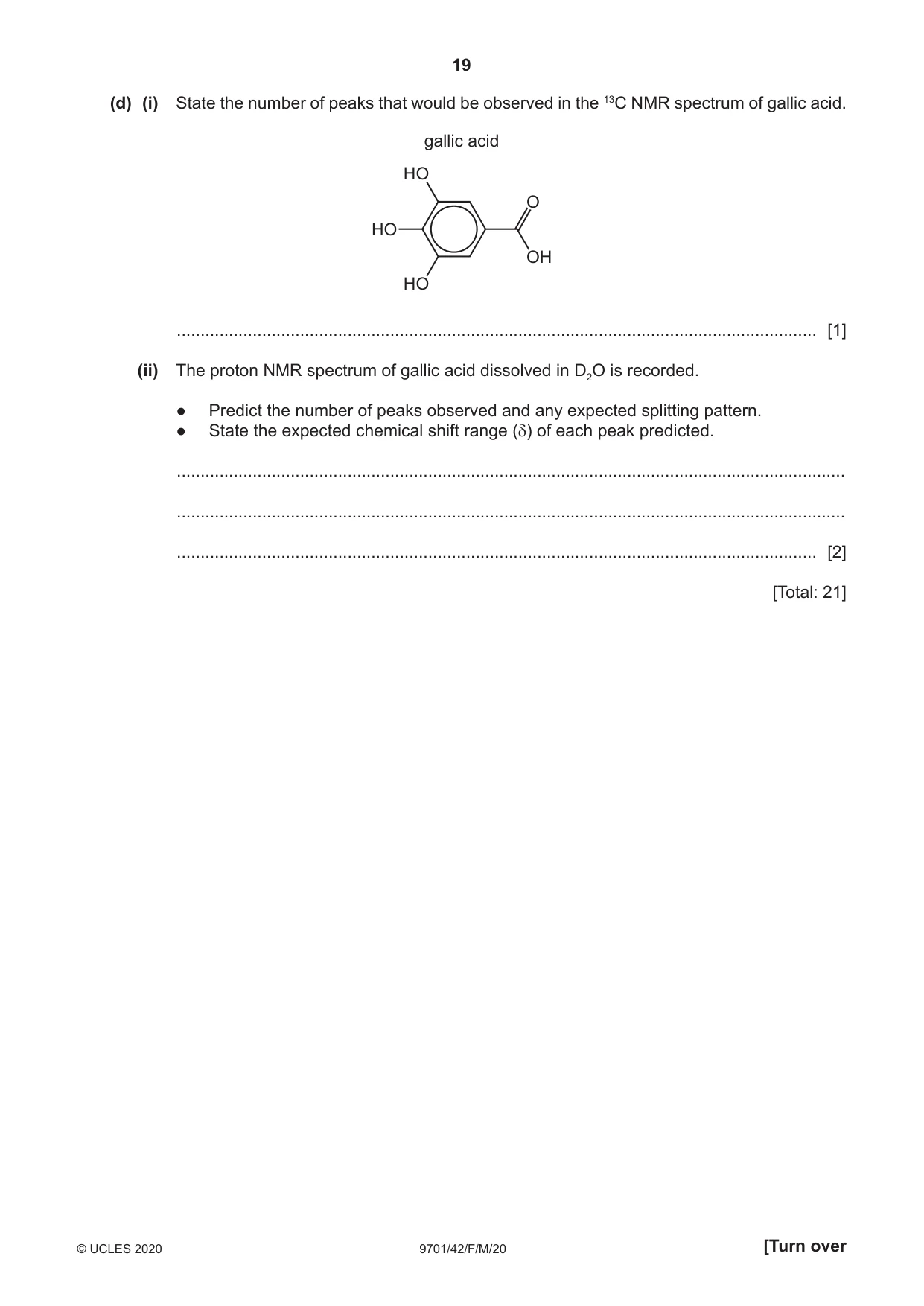
5 Gallic acid, C7H6O5, is a naturally occurring aromatic molecule. gallic acid HO O HO OH HO (a) Gallic acid contains the carboxylic acid and phenol functional groups. State and explain the relative acid strength of these two functional groups. .................................................................................................................................................... .................................................................................................................................................... .................................................................................................................................................... .............................................................................................................................................. [2] (b) A buffer solution was prepared by dissolving 2.04 g of gallic acid in 250 cm3 of a solution containing 0.0600 mol dm–3 of gallate ions, C7H5O5–. C7H6O5 C7H5O5– + H+ Ka = 3.89 × 10⁻⁵ mol dm–3 at 298 K (i) Define the term buffer solution. ............................................................................................................................................. ............................................................................................................................................. ....................................................................................................................................... [2] (ii) Calculate the pH of this buffer solution. pH = .............................. [3] (iii) Write two equations to show how a solution containing gallic acid, C7H6O5, and gallate ions, C7H5O5–, acts as a buffer. ............................................................................................................................................. ............................................................................................................................................. ............................................................................................................................................. ....................................................................................................................................... [2] (c) Compound K is used as the starting material in a synthesis of gallic acid. A student suggested the first two steps of the synthesis could be as shown. K L M COOH COOH COOH concentrated HNO3 concentrated HNO3 and and concentrated H2SO4 concentrated H2SO4 step 1 step 2 NO2 O2N NO2 NH2 NH2 NH2 Nitronium ions, NO2+, are generated by the reaction between concentrated sulfuric acid and concentrated nitric acid. (i) Construct an equation for the formation of NO2+ by this method. ....................................................................................................................................... [1] (ii) Complete the mechanism and draw the intermediate of step 1. Include all relevant charges and curly arrows to show the movement of electron pairs. intermediate COOH L + H+ NH2 + NO2 [2] (iii) State the name of the mechanism in (c)(ii). ....................................................................................................................................... [1] Compound M is converted into compound P as shown. M N P COOH COOC2H5 COOC2H5 CH3CH2OH and H2SO4 step 3 step 4 O2N NO2 O2N NO2 H2N NH2 NH2 NH2 NH2 (iv) State the reagents and conditions for step 4. ....................................................................................................................................... [2] P reacts with an excess of sodium nitrite, NaNO2, and dilute HCl at 5 °C to form compound Q, C9H7N6O2Cl 3. Compound Q is then converted into gallic acid. Q P C9H7N6O2Cl 3 COOC2H5 an excess of NaNO2 and dilute HCl at 5 °C step 5 H2N NH2 NH2 step 6 gallic acid HO O HO OH HO (v) Suggest the structure of compound Q in the box provided. [2] (vi) State the reagents and conditions for step 6. ....................................................................................................................................... [1] (d) (i) State the number of peaks that would be observed in the 13C NMR spectrum of gallic acid. gallic acid HO O HO OH HO ....................................................................................................................................... [1] (ii) The proton NMR spectrum of gallic acid dissolved in D2O is recorded. ●● Predict the number of peaks observed and any expected splitting pattern. ●● State the expected chemical shift range (δ) of each peak predicted. ............................................................................................................................................. ............................................................................................................................................. ....................................................................................................................................... [2] [Total: 21]
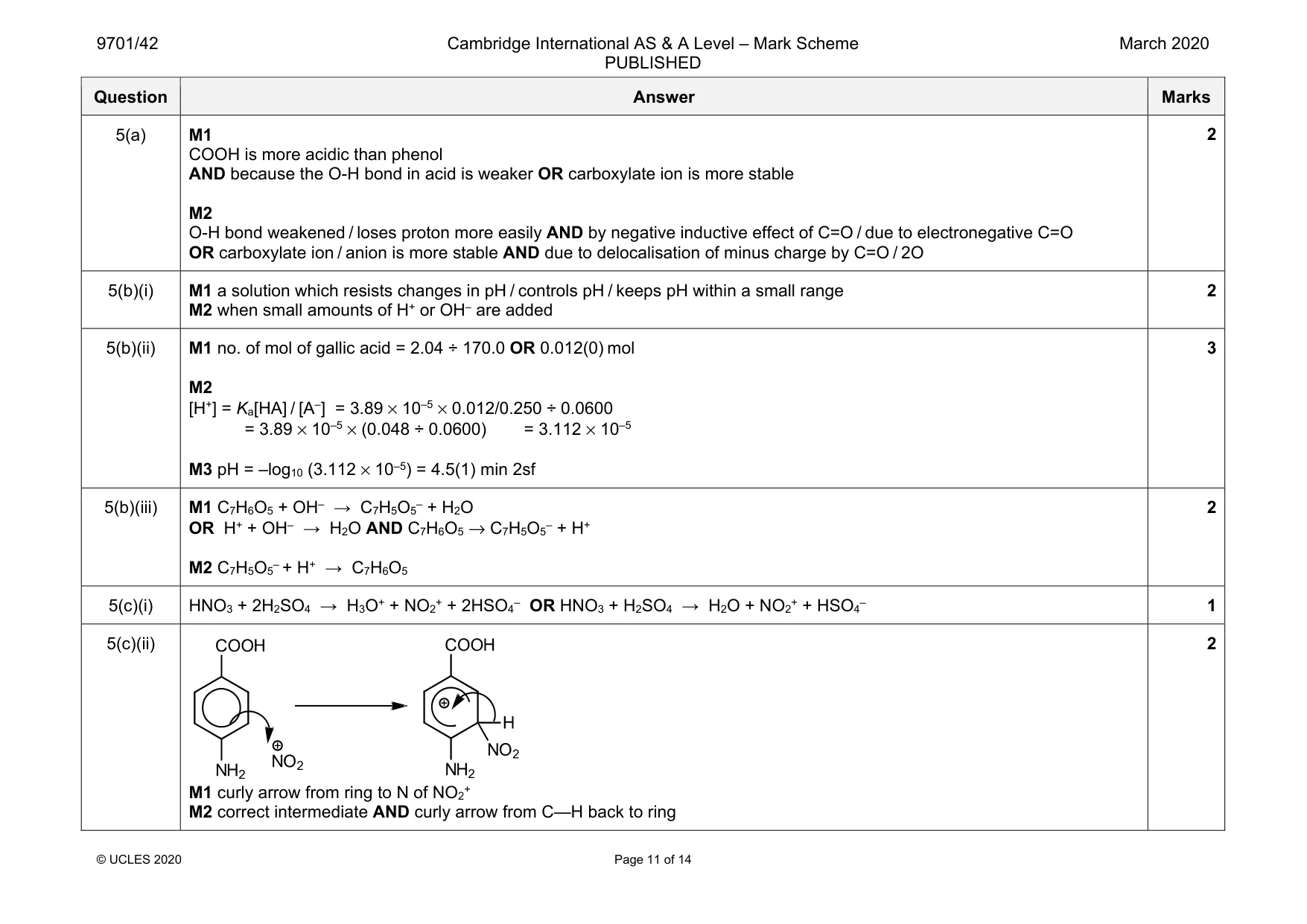
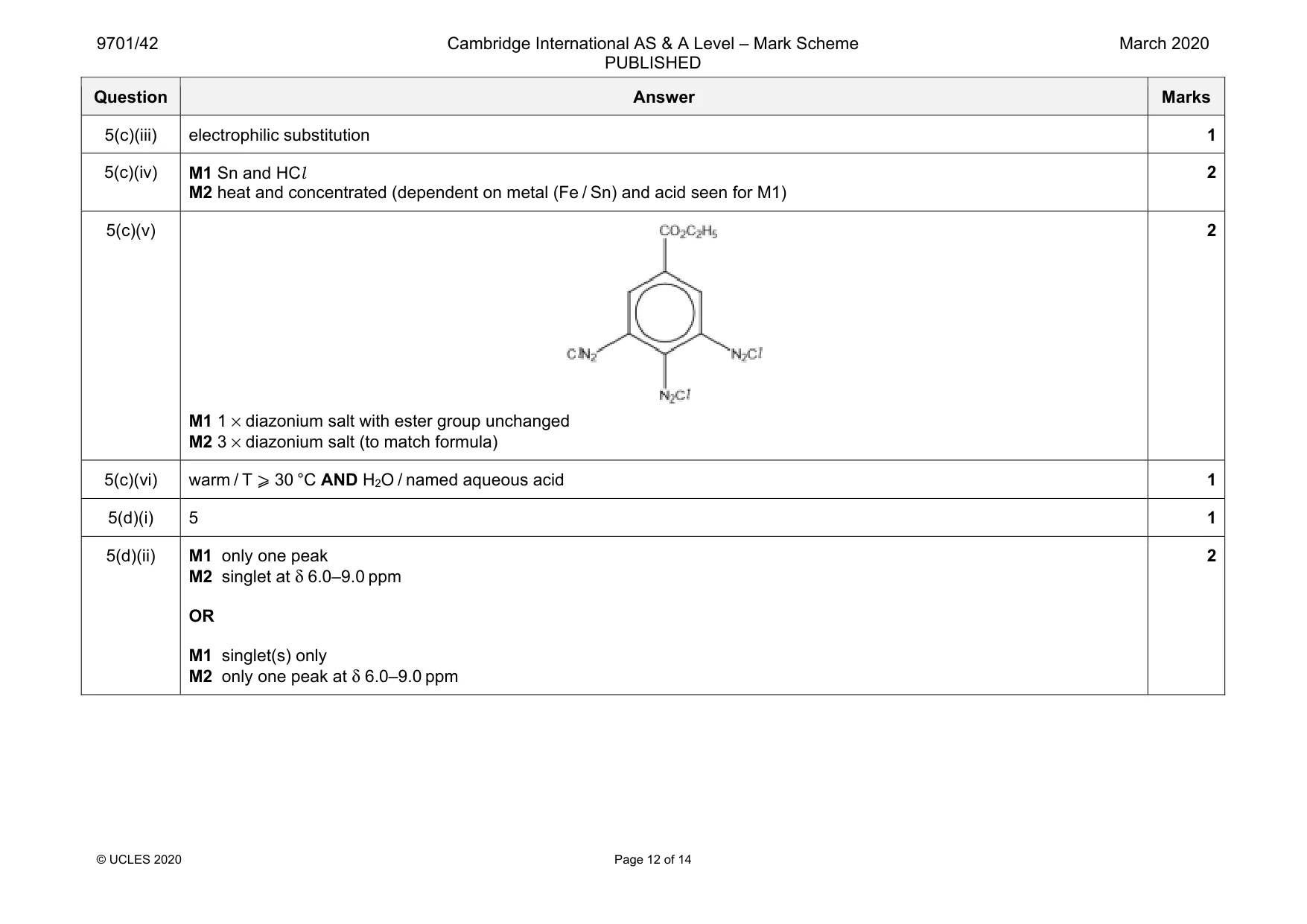
Mark scheme: 5(a) M1 COOH is more acidic than phenol AND because the O-H bond in acid is weaker OR carboxylate ion is more stable M2 O-H bond weakened / loses proton more easily AND by negative inductive effect of C=O / due to electronegative C=O OR carboxylate ion / anion is more stable AND due to delocalisation of minus charge by C=O / 2O 5(b)(i) M1 a solution which resists changes in pH / controls pH / keeps pH within a small range M2 when small amounts of H+ or OH– are added 2 5(b)(ii) M1 no. of mol of gallic acid = 2.04 ÷ 170.0 OR 0.012(0) mol M2 [H+] = Ka[HA] / [A–] = 3.89 × 10–5 × 0.012/0.250 ÷ 0.0600 = 3.89 × 10–5 × (0.048 ÷ 0.0600) = 3.112 × 10⁻⁵ M3 pH = –log10 (3.112 × 10⁻⁵) = 4.5(1) min 2sf 3 5(b)(iii) M1 C7H6O5 + OH– → C7H5O5– + H2O OR H+ + OH– → H2O AND C7H6O5 → C7H5O5– + H+ M2 C7H5O5– + H+ → C7H6O5 2 5(c)(i) HNO3 + 2H2SO4 → H3O+ + NO2+ + 2HSO4– OR HNO3 + H2SO4 → H2O + NO2+ + HSO4– 1 5(c)(ii) M1 curly arrow from ring to N of NO2+ M2 correct intermediate AND curly arrow from C—H back to ring 2 Question Answer Marks 5(c)(iii) electrophilic substitution 1 5(c)(iv) M1 Sn and HCl M2 heat and concentrated (dependent on metal (Fe / Sn) and acid seen for M1) 2 5(c)(v) M1 1 × diazonium salt with ester group unchanged M2 3 × diazonium salt (to match formula) 2 5(c)(vi) warm / T ⩾ 30 °C AND H2O / named aqueous acid 1 5(d)(i) 5 1 5(d)(ii) M1 only one peak M2 singlet at δ 6.0–9.0 ppm OR M1 singlet(s) only M2 only one peak at δ 6.0–9.0 ppm 2
Q6 · Valinol can be synthesised by the following reactions
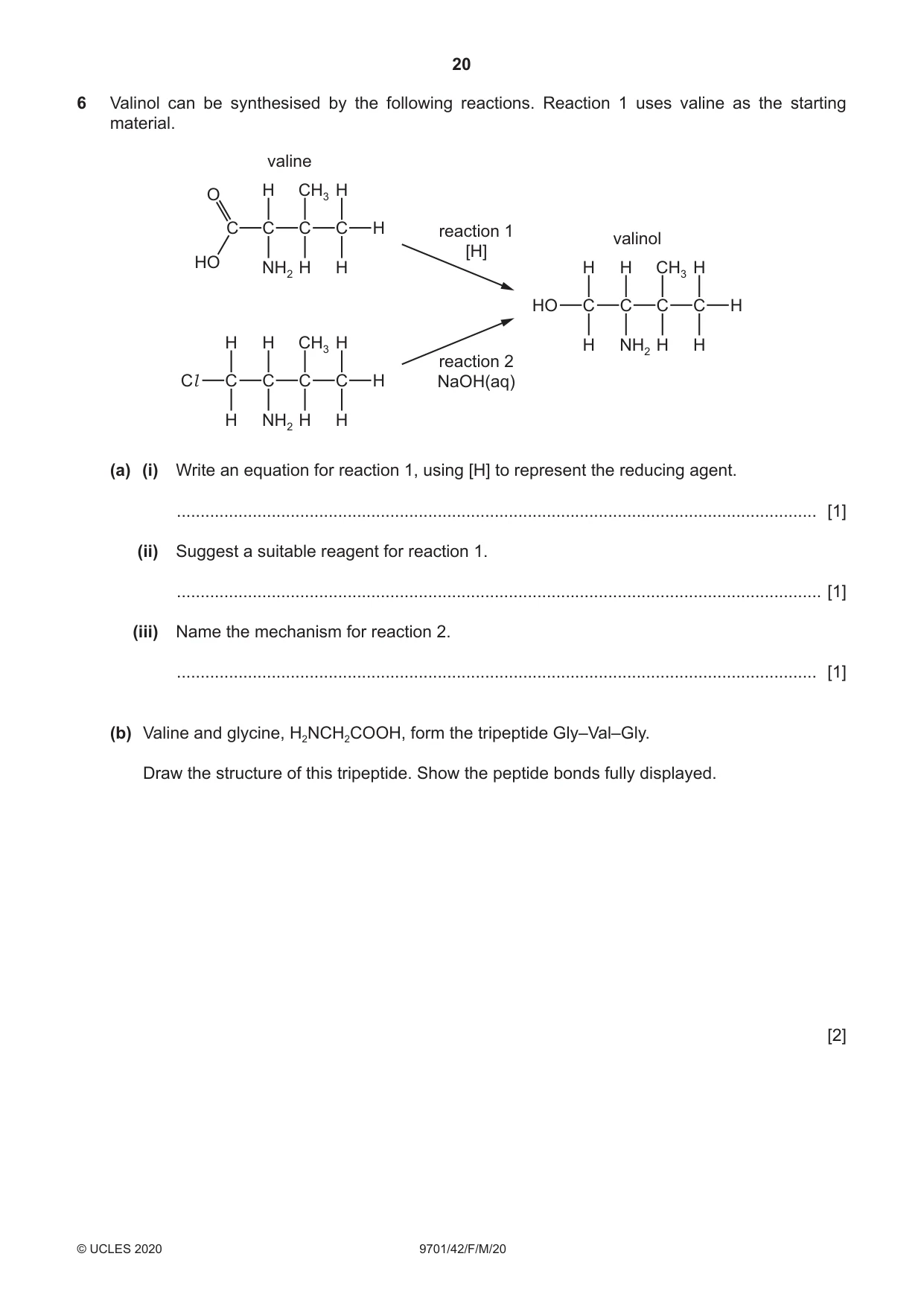
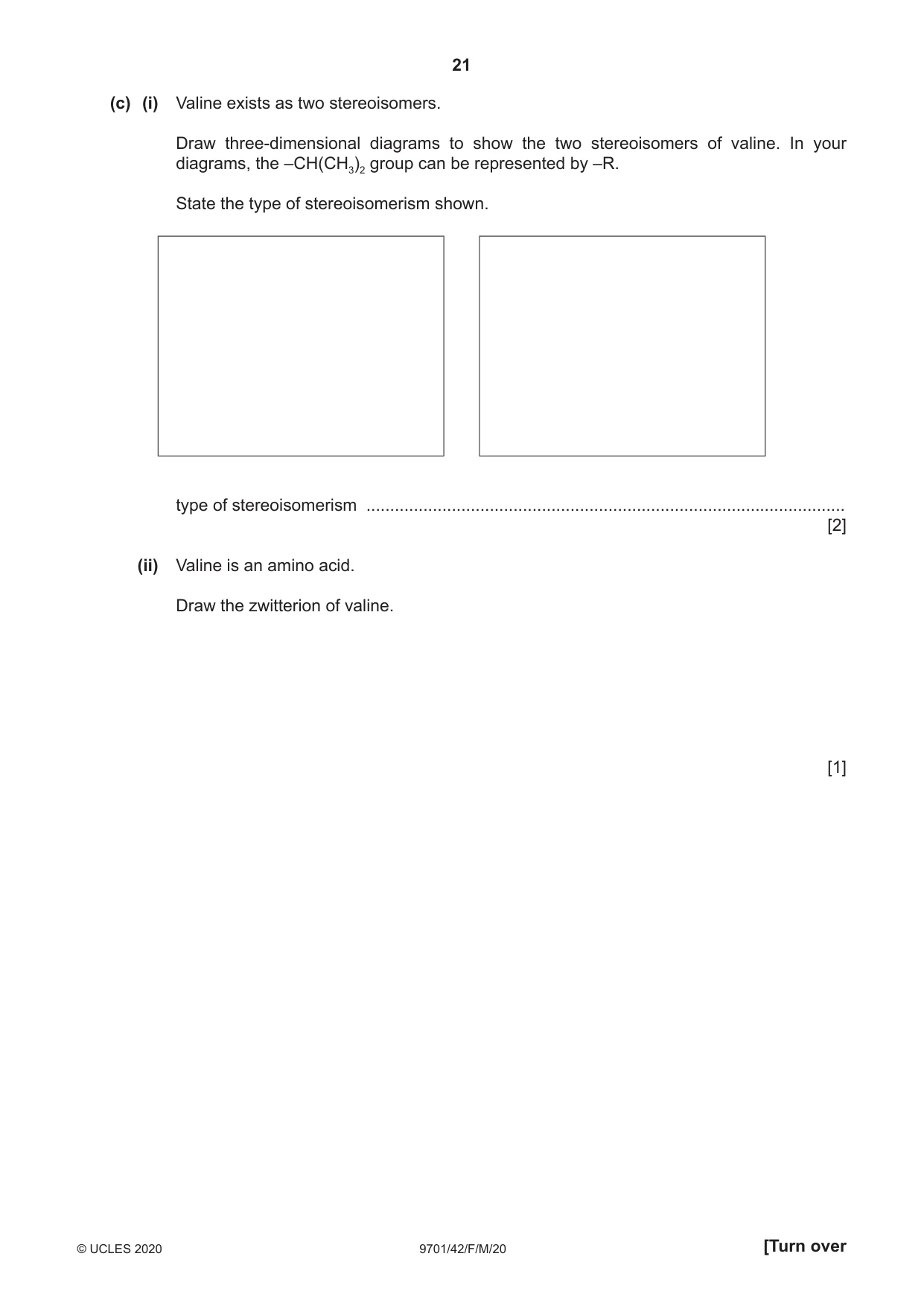
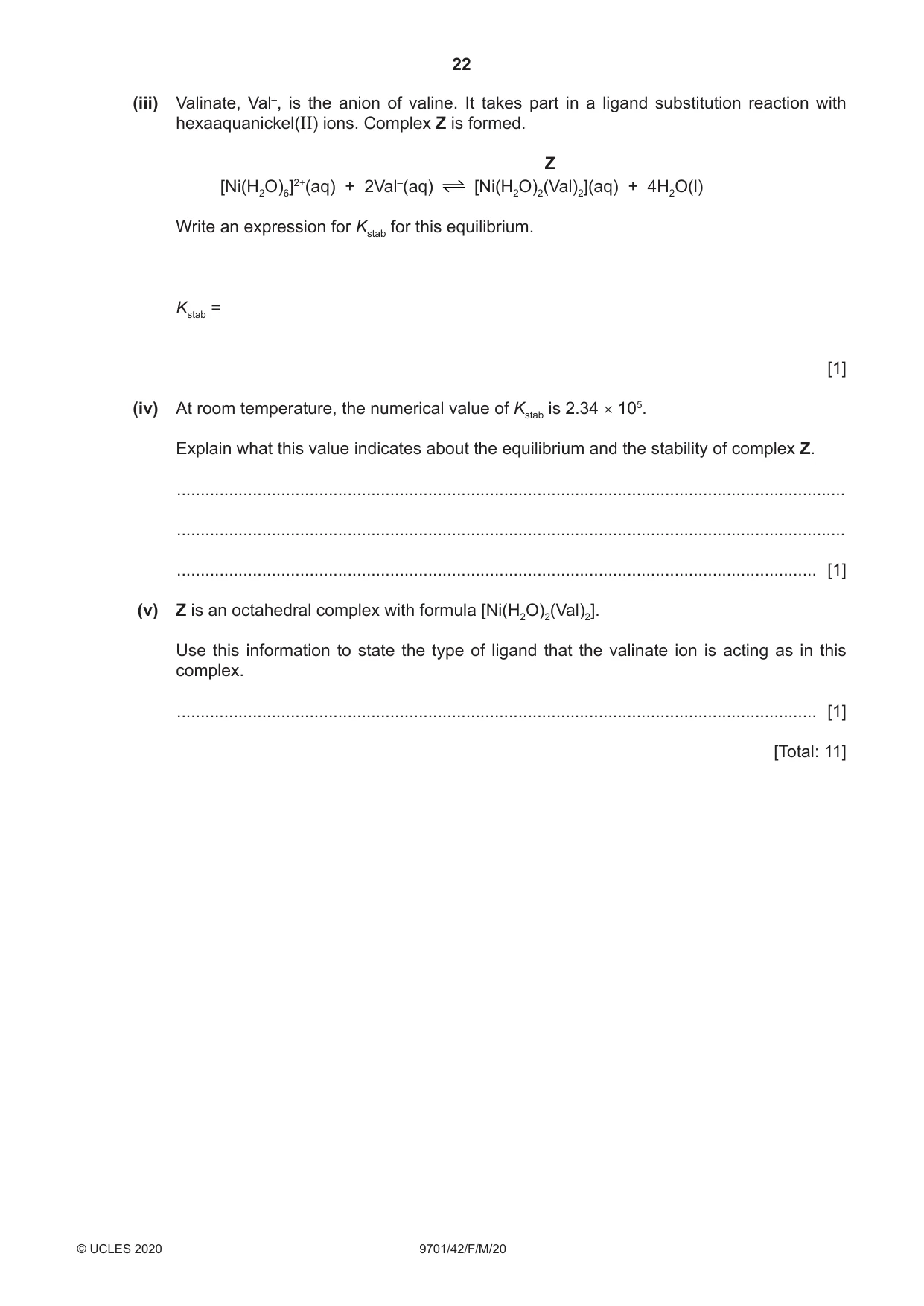
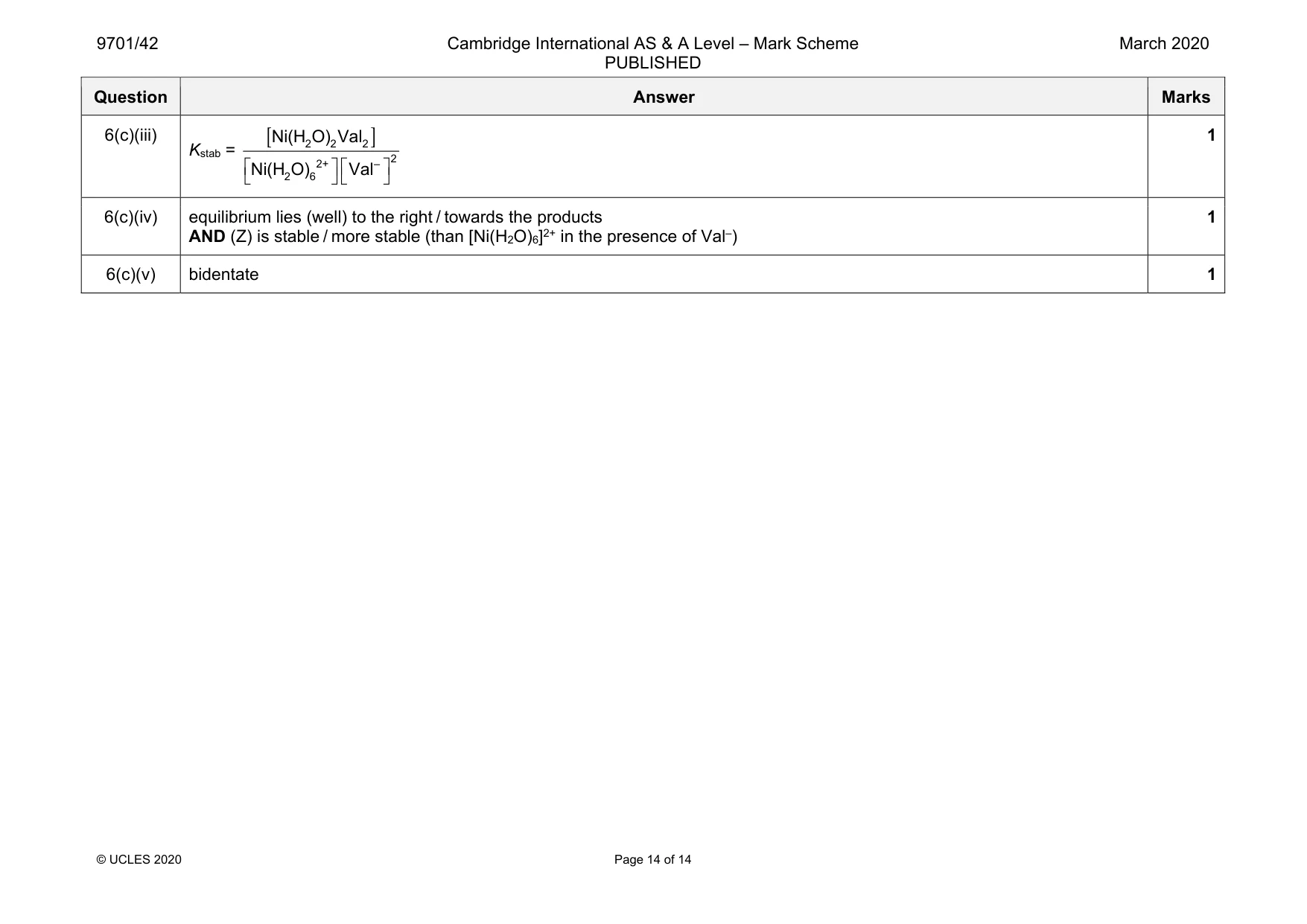
6 Valinol can be synthesised by the following reactions. Reaction 1 uses valine as the starting material. valine O H CH3 H C C C C H reaction 1 valinol [H] HO NH2 H H H H CH3 H HO C C C C H H H CH3 H H NH2 H H reaction 2 Cl C C C C H NaOH(aq) H NH2 H H (a) (i) Write an equation for reaction 1, using [H] to represent the reducing agent. ....................................................................................................................................... [1] (ii) Suggest a suitable reagent for reaction 1. ........................................................................................................................................ [1] (iii) Name the mechanism for reaction 2. ....................................................................................................................................... [1] (b) Valine and glycine, H2NCH2COOH, form the tripeptide Gly–Val–Gly. Draw the structure of this tripeptide. Show the peptide bonds fully displayed. [2] (c) (i) Valine exists as two stereoisomers. Draw three‑dimensional diagrams to show the two stereoisomers of valine. In your diagrams, the –CH(CH3)2 group can be represented by –R. State the type of stereoisomerism shown. type of stereoisomerism ...................................................................................................... [2] (ii) Valine is an amino acid. Draw the zwitterion of valine. [1] (iii) Valinate, Val–, is the anion of valine. It takes part in a ligand substitution reaction with hexaaquanickel(II) ions. Complex Z is formed. Z [Ni(H2O)6]2+(aq) + 2Val–(aq) [Ni(H2O)2(Val)2](aq) + 4H2O(l) Write an expression for Kstab for this equilibrium. Kstab = [1] (iv) At room temperature, the numerical value of Kstab is 2.34 × 10⁵. Explain what this value indicates about the equilibrium and the stability of complex Z. ............................................................................................................................................. ............................................................................................................................................. ....................................................................................................................................... [1] (v) Z is an octahedral complex with formula [Ni(H2O)2(Val)2]. Use this information to state the type of ligand that the valinate ion is acting as in this complex. ....................................................................................................................................... [1] [Total: 11]
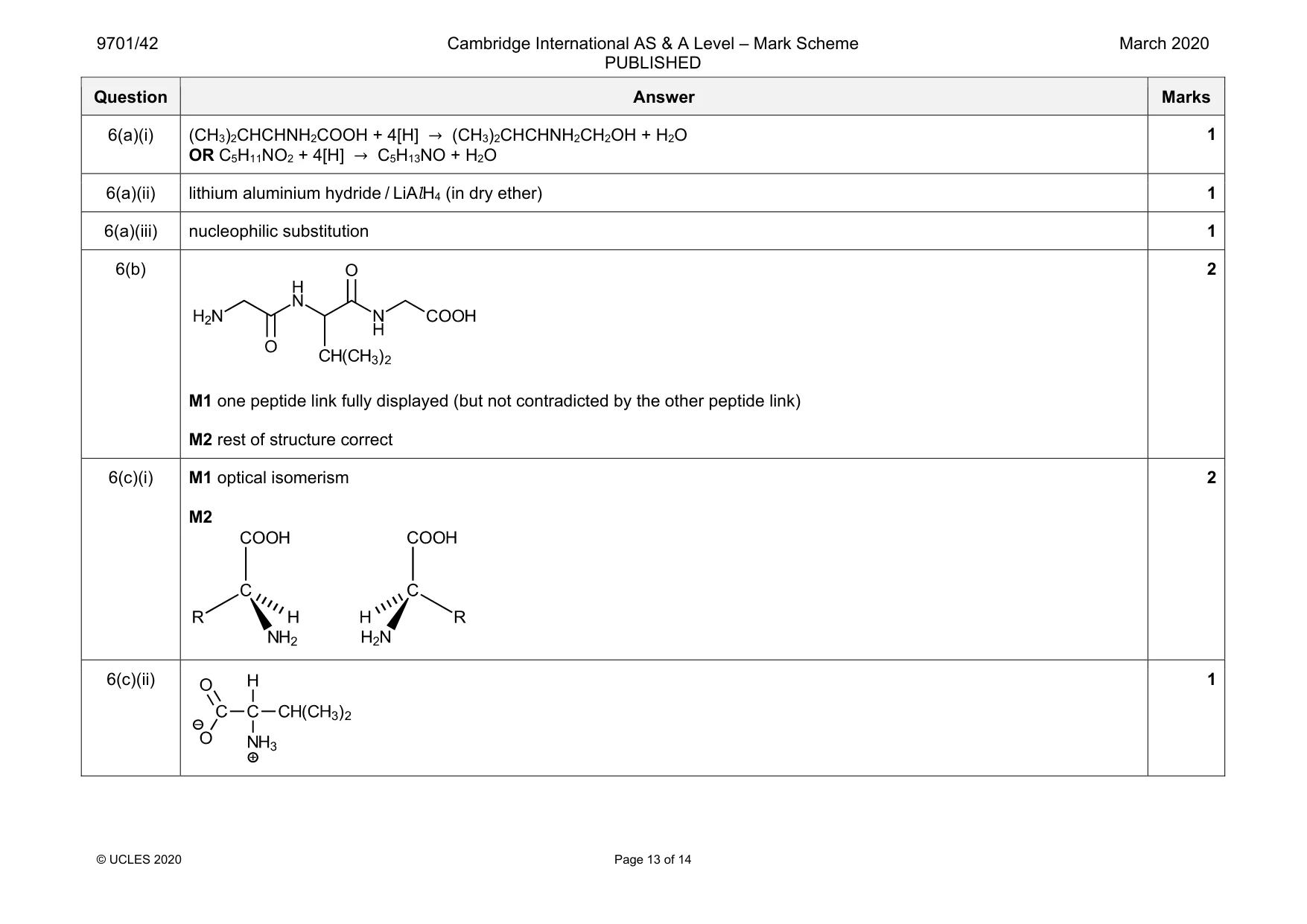
Mark scheme: 6(a)(i) OR C5H11NO2 + 4[H] → C5H13NO + H2O 6(a)(ii) lithium aluminium hydride / LiAlH4 (in dry ether) 1 6(a)(iii) nucleophilic substitution 1 6(b) M1 one peptide link fully displayed (but not contradicted by the other peptide link) M2 rest of structure correct 2 6(c)(i) M1 optical isomerism M2 2 6(c)(ii) 1 Question Answer Marks 6(c)(iii) Kstab = [ ] 2 2 2 2 2+ – 2 6 Ni(H O) Val Ni(H O) Val 1 6(c)(iv) equilibrium lies (well) to the right / towards the products AND (Z) is stable / more stable (than [Ni(H2O)6]2+ in the presence of Val–) 1 6(c)(v) bidentate 1
What was in this paper
The subtopics covered by these 6 questions, and how many questions each got. Open one in a new tab to see every Cambridge question on it.
1Formulas, functional groups and the naming of organic compounds1General physical and chemical properties of the first row of transition elements, titanium to copper1Halogenoalkanes1Similarities and trends in the properties of the Group 2 metals, magnesium to barium, and their compounds1Standard electrode potentials E ⦵, standard cell potentials E ⦵ cell and the Nernst equation1What you needed in this session
Cambridge’s own grade thresholds for 2020 Feb/March, Paper 4 · Variant 2. A higher threshold means an easier paper — the bar moves with how the cohort did.