Cambridge A Level Chemistry 9701 — 2019 Oct/Nov Paper 3 · Variant 4
9701/34/O/N/19 · 3 questions · 40 marks · ≈45 min
The question paper and its mark scheme, free to read here and free to download. This is Cambridge’s own paper, exactly as it was sat.
Question paper12 pages
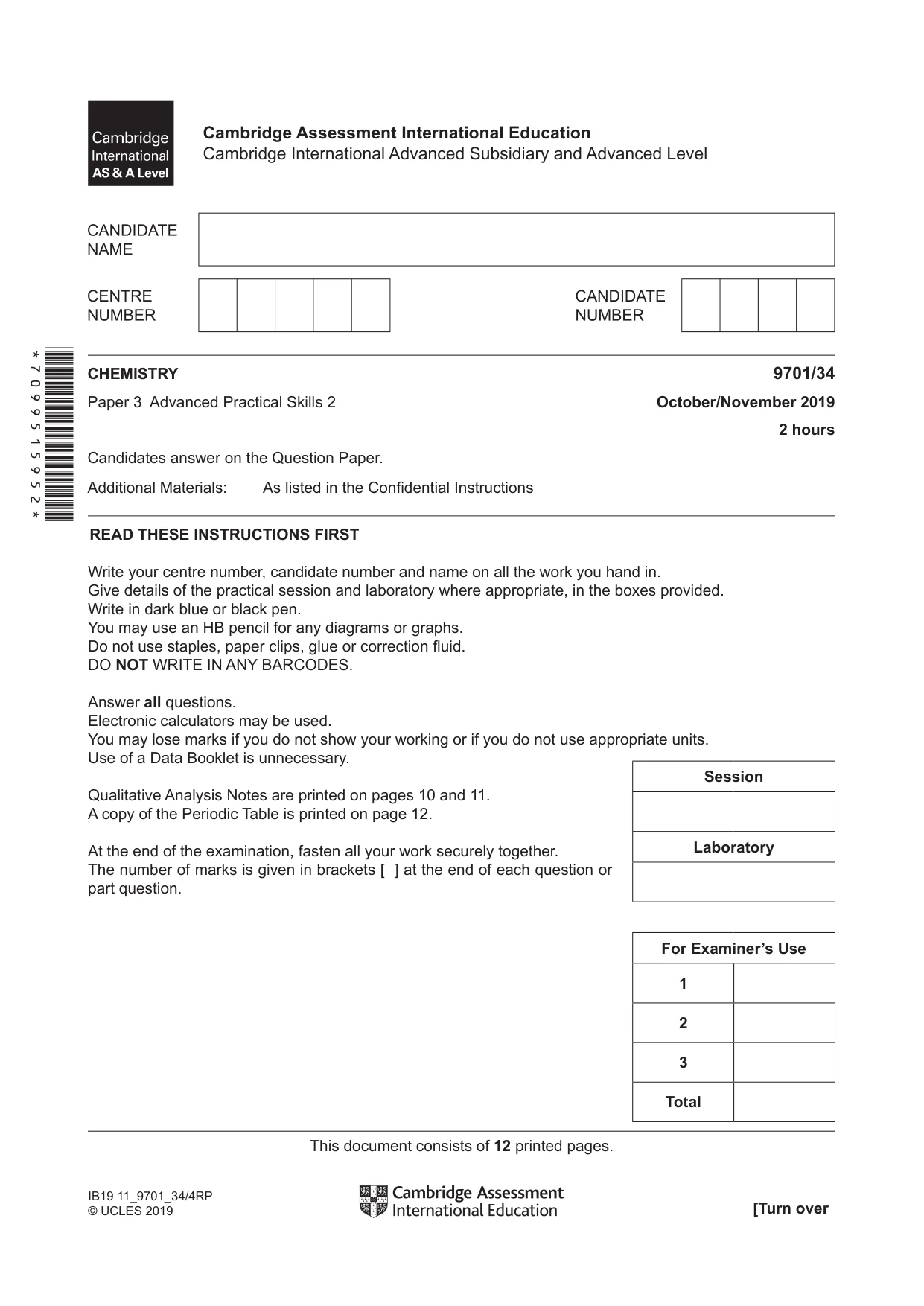
Mark scheme9 pages
Answers below. Sit the paper first if you are practising.
Questions as text
Q1 · Hydrogen peroxide decomposes in a reaction catalysed by manganese(IV) oxide
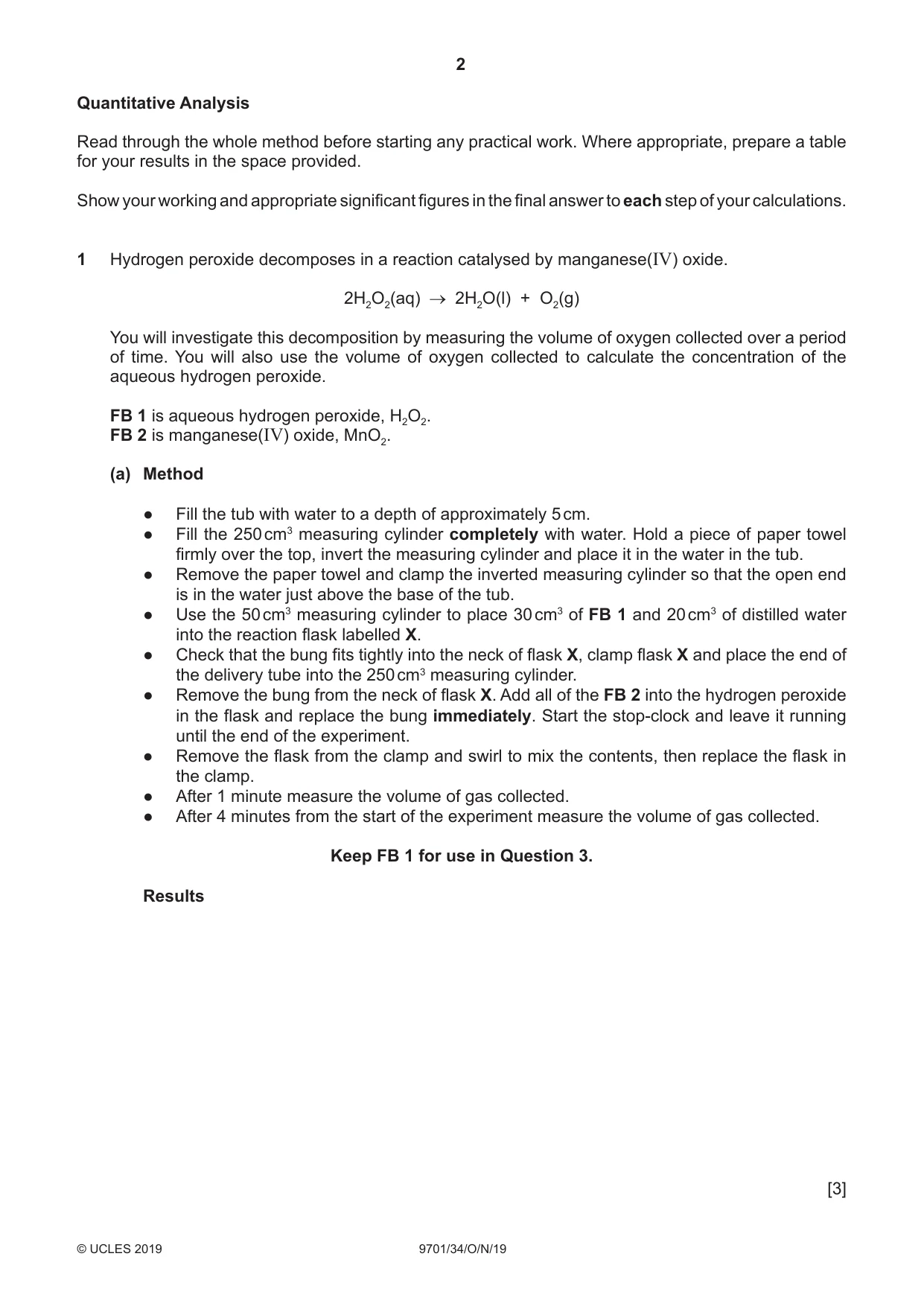
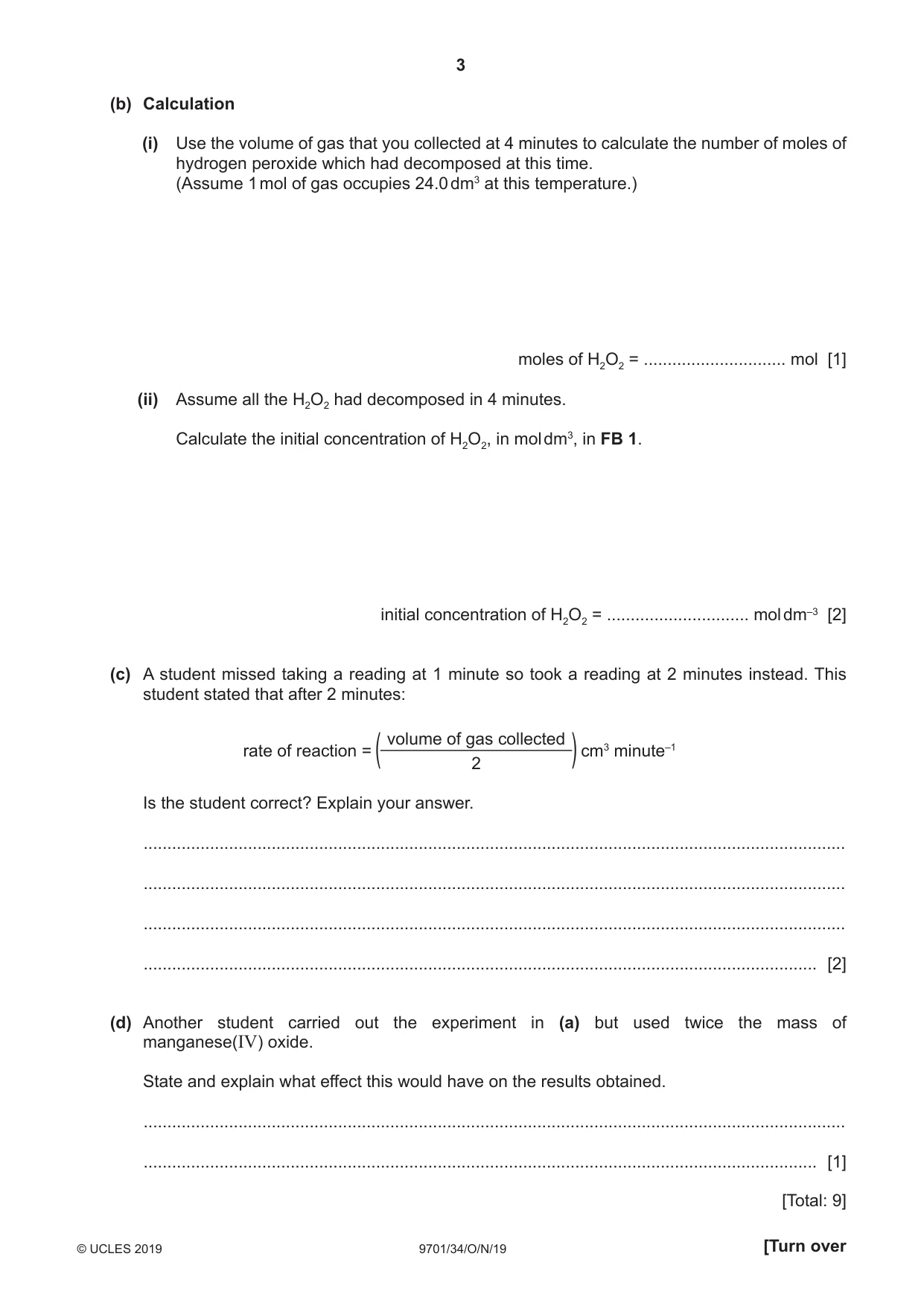
1 Hydrogen peroxide decomposes in a reaction catalysed by manganese(IV) oxide. 2H2O2(aq) 2H2O(l) + O2(g) You will investigate this decomposition by measuring the volume of oxygen collected over a period of time. You will also use the volume of oxygen collected to calculate the concentration of the aqueous hydrogen peroxide. FB 1 is aqueous hydrogen peroxide, H2O2. FB 2 is manganese(IV) oxide, MnO2. (a) Method ● Fill the tub with water to a depth of approximately 5 cm. ● Fill the 250 cm3 measuring cylinder completely with water. Hold a piece of paper towel firmly over the top, invert the measuring cylinder and place it in the water in the tub. ● Remove the paper towel and clamp the inverted measuring cylinder so that the open end is in the water just above the base of the tub. ● Use the 50 cm3 measuring cylinder to place 30 cm3 of FB 1 and 20 cm3 of distilled water into the reaction flask labelled X. ● Check that the bung fits tightly into the neck of flask X, clamp flask X and place the end of the delivery tube into the 250 cm3 measuring cylinder. ● Remove the bung from the neck of flask X. Add all of the FB 2 into the hydrogen peroxide in the flask and replace the bung immediately. Start the stop-clock and leave it running until the end of the experiment. ● Remove the flask from the clamp and swirl to mix the contents, then replace the flask in the clamp. ● After 1 minute measure the volume of gas collected. ● After 4 minutes from the start of the experiment measure the volume of gas collected. Keep FB 1 for use in Question 3. Results [3] (b) Calculation (i) Use the volume of gas that you collected at 4 minutes to calculate the number of moles of hydrogen peroxide which had decomposed at this time. (Assume 1 mol of gas occupies 24.0 dm3 at this temperature.) moles of H2O2 = .............................. mol [1] (ii) Assume all the H2O2 had decomposed in 4 minutes. Calculate the initial concentration of H2O2, in mol dm3, in FB 1. initial concentration of H2O2 = .............................. mol dm–3 [2] (c) A student missed taking a reading at 1 minute so took a reading at 2 minutes instead. This student stated that after 2 minutes: volume of gas collected rate of reaction = cm3 minute–1 2 Is the student correct? Explain your answer. .................................................................................................................................................... .................................................................................................................................................... .................................................................................................................................................... .............................................................................................................................................. [2] (d) Another student carried out the experiment in (a) but used twice the mass of manganese(IV) oxide. State and explain what effect this would have on the results obtained. .................................................................................................................................................... .............................................................................................................................................. [1] [Total: 9]
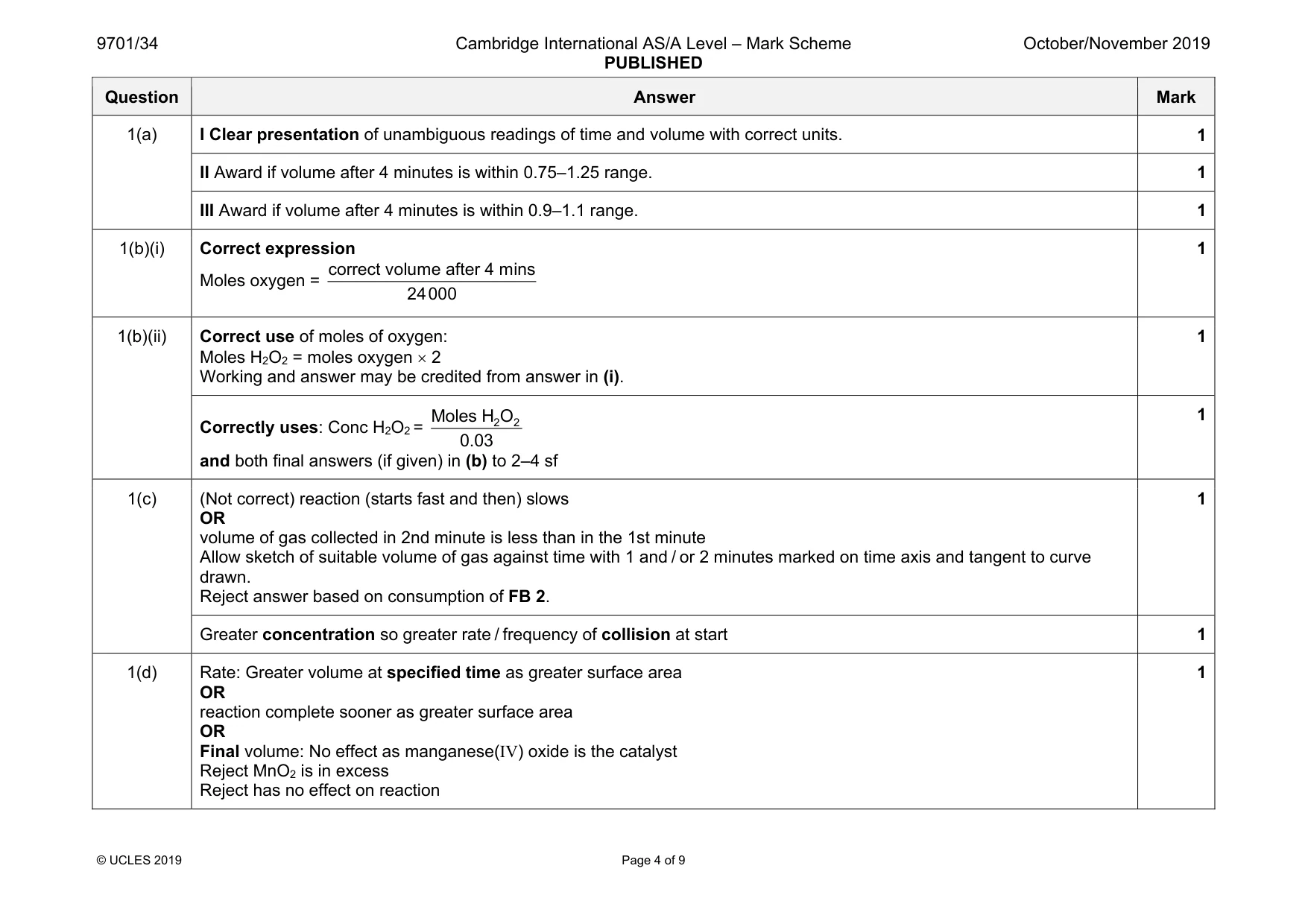
Mark scheme: 1(a) I Clear presentation of unambiguous readings of time and volume with correct units. 1 II Award if volume after 4 minutes is within 0.75–1.25 range. 1 III Award if volume after 4 minutes is within 0.9–1.1 range. 1 1(b)(i) Correct expression Moles oxygen = correct volume after 4 mins 24000 1 1(b)(ii) Correct use of moles of oxygen: Moles H2O2 = moles oxygen × 2 Working and answer may be credited from answer in (i). 1 Correctly uses: Conc H2O2 = 2 2 Moles H O 0.03 and both final answers (if given) in (b) to 2–4 sf 1 1(c) (Not correct) reaction (starts fast and then) slows OR volume of gas collected in 2nd minute is less than in the 1st minute Allow sketch of suitable volume of gas against time with 1 and / or 2 minutes marked on time axis and tangent to curve drawn. Reject answer based on consumption of FB 2. 1 Greater concentration so greater rate / frequency of collision at start 1 1(d) Rate: Greater volume at specified time as greater surface area OR reaction complete sooner as greater surface area OR Final volume: No effect as manganese(IV) oxide is the catalyst Reject MnO2 is in excess Reject has no effect on reaction 1
Q2 · In Question 1 you determined the concentration of a sample of aqueous hydrogen peroxide…
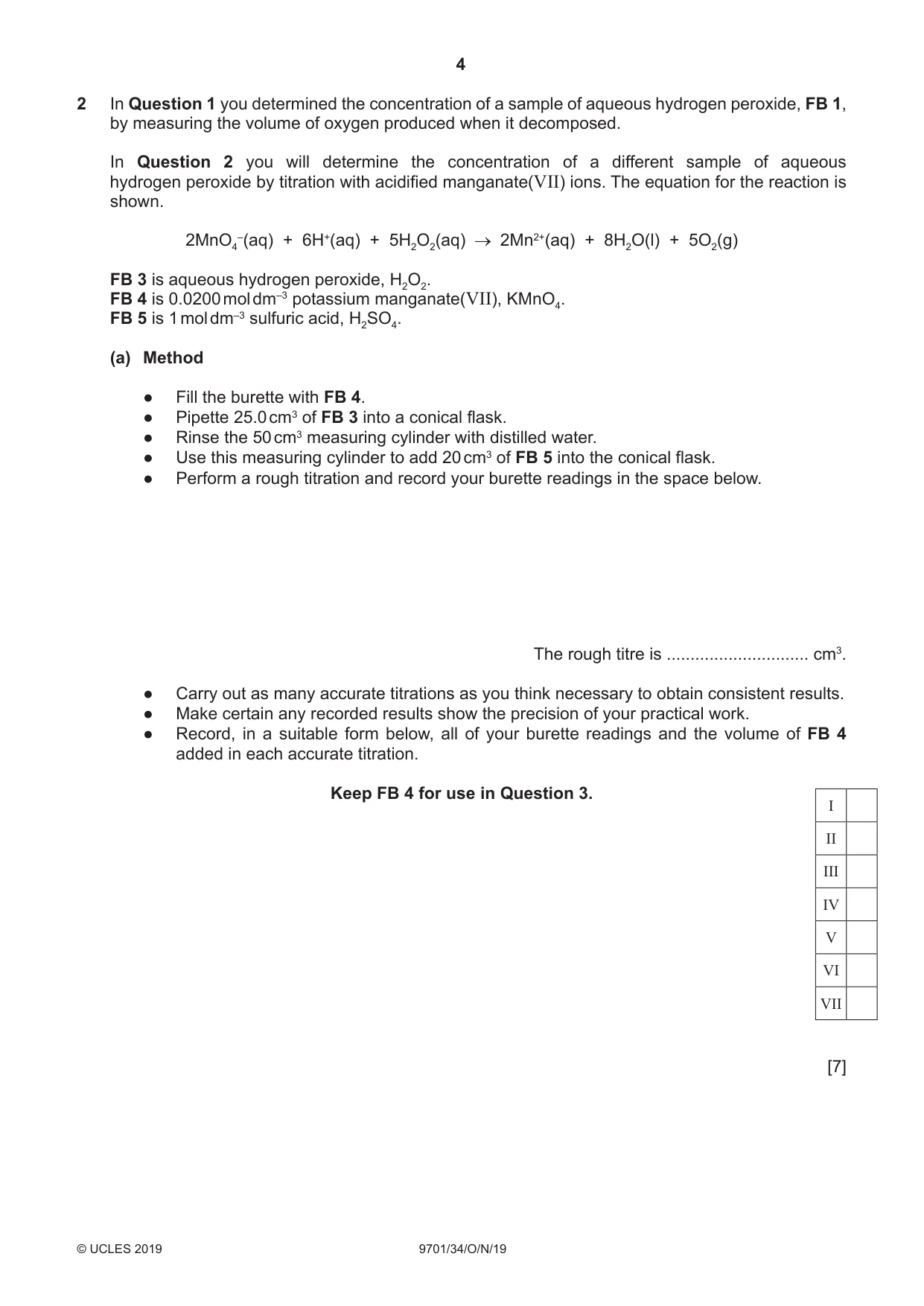
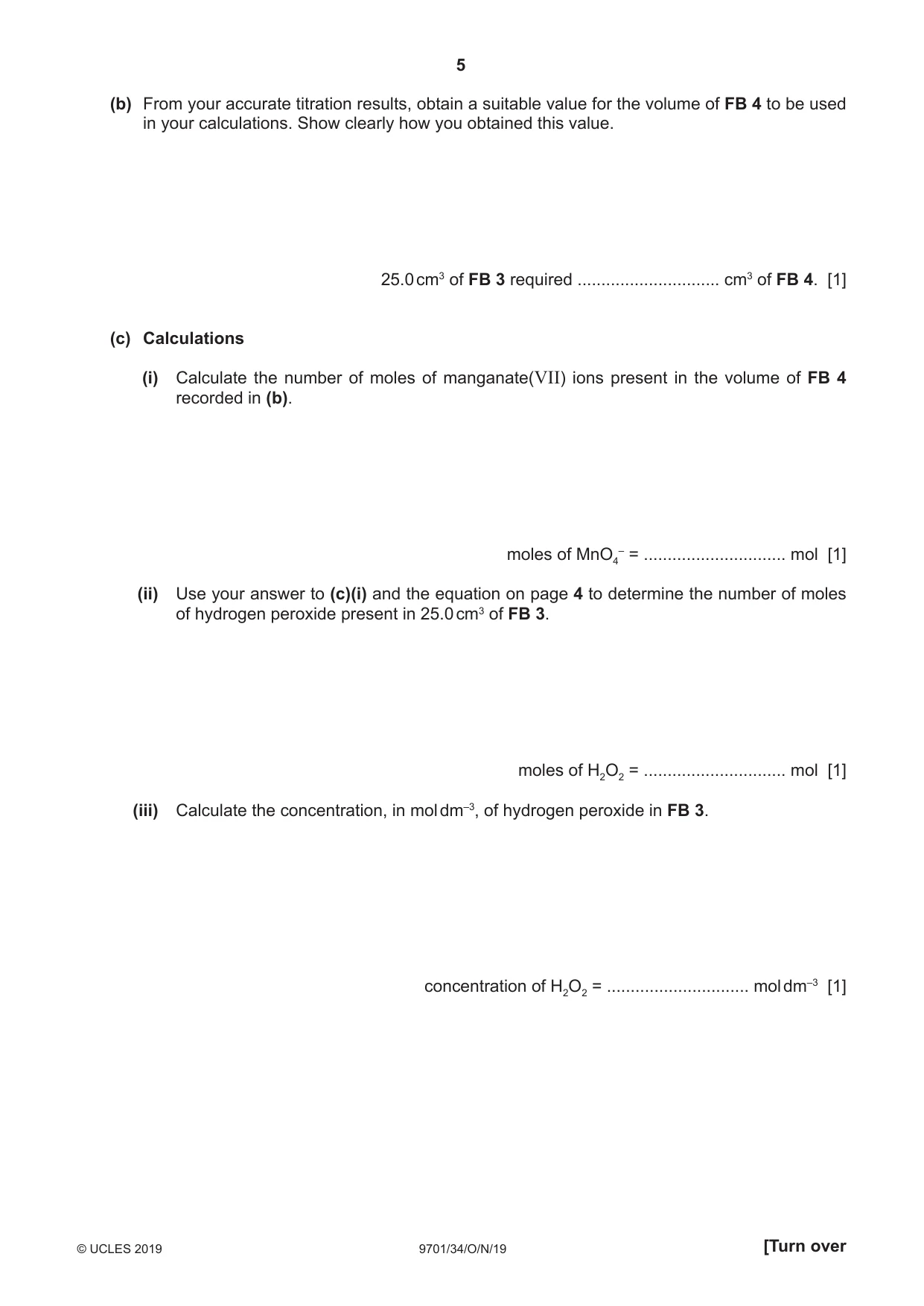
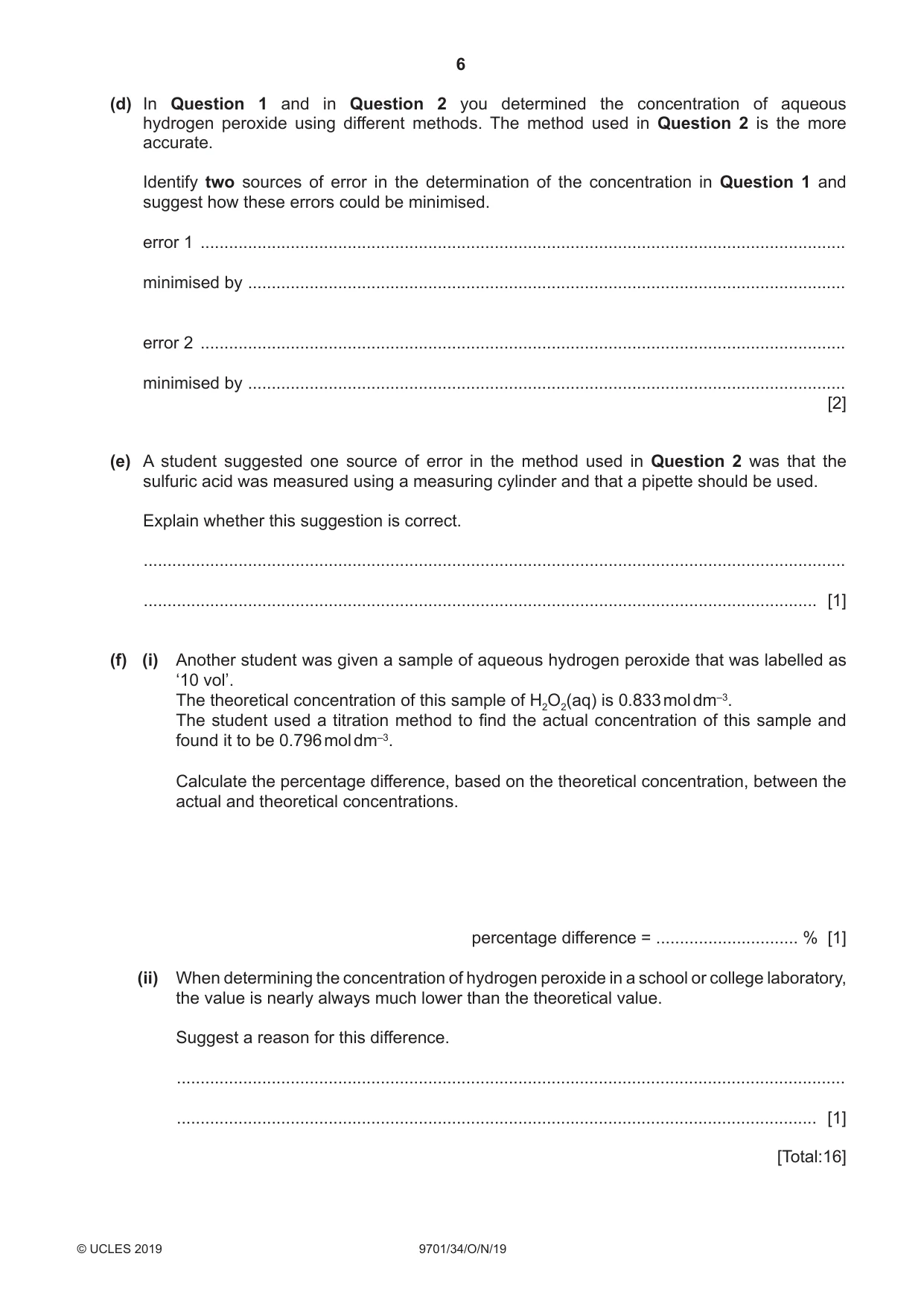
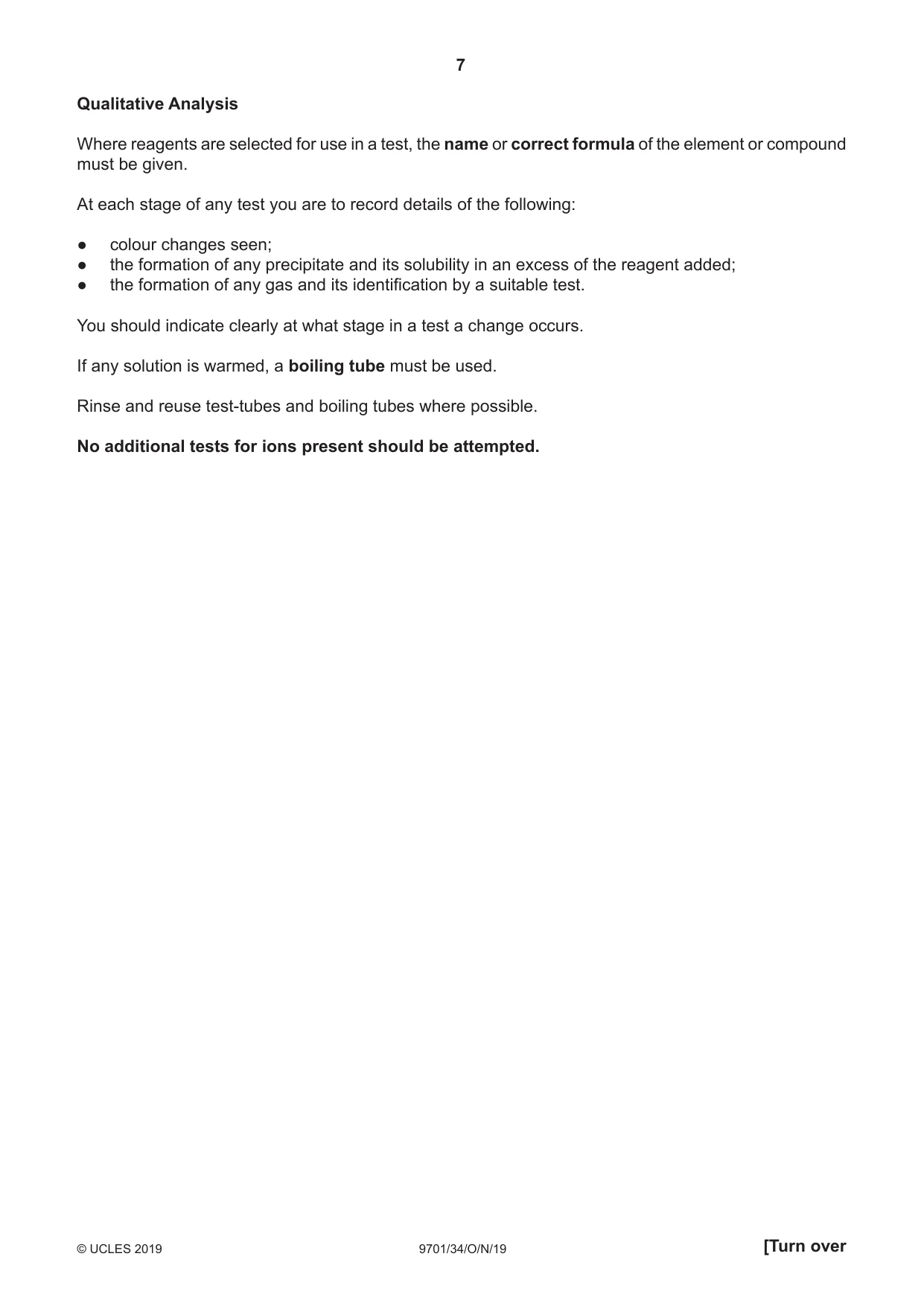
2 In Question 1 you determined the concentration of a sample of aqueous hydrogen peroxide, FB 1, by measuring the volume of oxygen produced when it decomposed. In Question 2 you will determine the concentration of a different sample of aqueous hydrogen peroxide by titration with acidified manganate(VII) ions. The equation for the reaction is shown. 2MnO4–(aq) + 6H+(aq) + 5H2O2(aq) 2Mn2+(aq) + 8H2O(l) + 5O2(g) FB 3 is aqueous hydrogen peroxide, H2O2. FB 4 is 0.0200 mol dm–3 potassium manganate(VII), KMnO4. FB 5 is 1 mol dm–3 sulfuric acid, H2SO4. (a) Method ● Fill the burette with FB 4. ● Pipette 25.0 cm3 of FB 3 into a conical flask. ● Rinse the 50 cm3 measuring cylinder with distilled water. ● Use this measuring cylinder to add 20 cm3 of FB 5 into the conical flask. ● Perform a rough titration and record your burette readings in the space below. The rough titre is .............................. cm3. ● Carry out as many accurate titrations as you think necessary to obtain consistent results. ● Make certain any recorded results show the precision of your practical work. ● Record, in a suitable form below, all of your burette readings and the volume of FB 4 added in each accurate titration. Keep FB 4 for use in Question 3. I II III IV V VI VII [7] (b) From your accurate titration results, obtain a suitable value for the volume of FB 4 to be used in your calculations. Show clearly how you obtained this value. 25.0 cm3 of FB 3 required .............................. cm3 of FB 4. [1] (c) Calculations (i) Calculate the number of moles of manganate(VII) ions present in the volume of FB 4 recorded in (b). moles of MnO4– = .............................. mol [1] (ii) Use your answer to (c)(i) and the equation on page 4 to determine the number of moles of hydrogen peroxide present in 25.0 cm3 of FB 3. moles of H2O2 = .............................. mol [1] (iii) Calculate the concentration, in mol dm–3, of hydrogen peroxide in FB 3. concentration of H2O2 = .............................. mol dm–3 [1] (d) In Question 1 and in Question 2 you determined the concentration of aqueous hydrogen peroxide using different methods. The method used in Question 2 is the more accurate. Identify two sources of error in the determination of the concentration in Question 1 and suggest how these errors could be minimised. error 1 ......................................................................................................................................... minimised by .............................................................................................................................. error 2 ......................................................................................................................................... minimised by .............................................................................................................................. [2] (e) A student suggested one source of error in the method used in Question 2 was that the sulfuric acid was measured using a measuring cylinder and that a pipette should be used. Explain whether this suggestion is correct. .................................................................................................................................................... .............................................................................................................................................. [1] (f) (i) Another student was given a sample of aqueous hydrogen peroxide that was labelled as ‘10 vol’. The theoretical concentration of this sample of H2O2(aq) is 0.833 mol dm–3. The student used a titration method to find the actual concentration of this sample and found it to be 0.796 mol dm–3. Calculate the percentage difference, based on the theoretical concentration, between the actual and theoretical concentrations. percentage difference = .............................. % [1] (ii) When determining the concentration of hydrogen peroxide in a school or college laboratory, the value is nearly always much lower than the theoretical value. Suggest a reason for this difference. ............................................................................................................................................. ....................................................................................................................................... [1] [Total:16] Qualitative Analysis Where reagents are selected for use in a test, the name or correct formula of the element or compound must be given. At each stage of any test you are to record details of the following: ● colour changes seen; ● the formation of any precipitate and its solubility in an excess of the reagent added; ● the formation of any gas and its identification by a suitable test. You should indicate clearly at what stage in a test a change occurs. If any solution is warmed, a boiling tube must be used. Rinse and reuse test-tubes and boiling tubes where possible. No additional tests for ions present should be attempted.
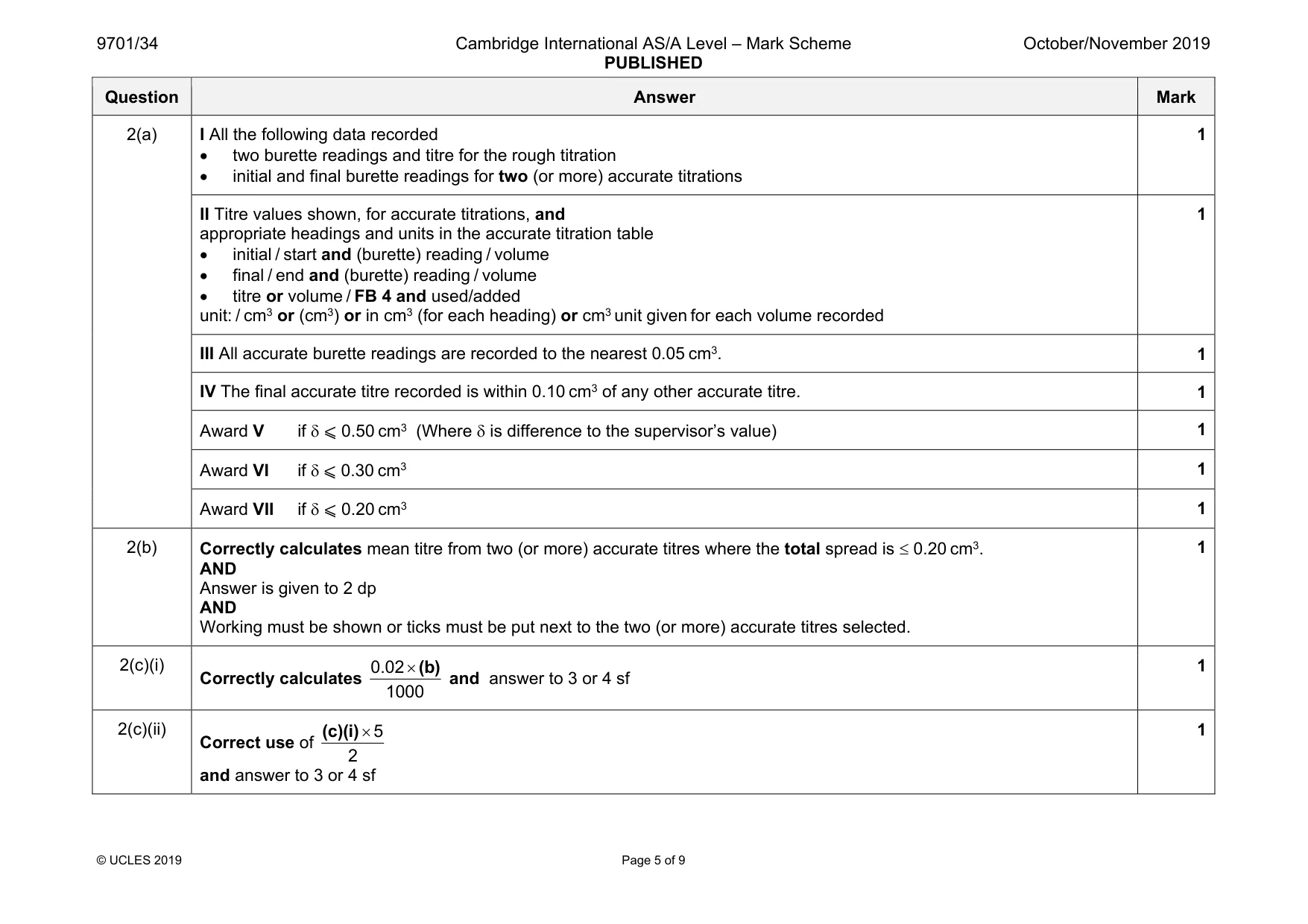
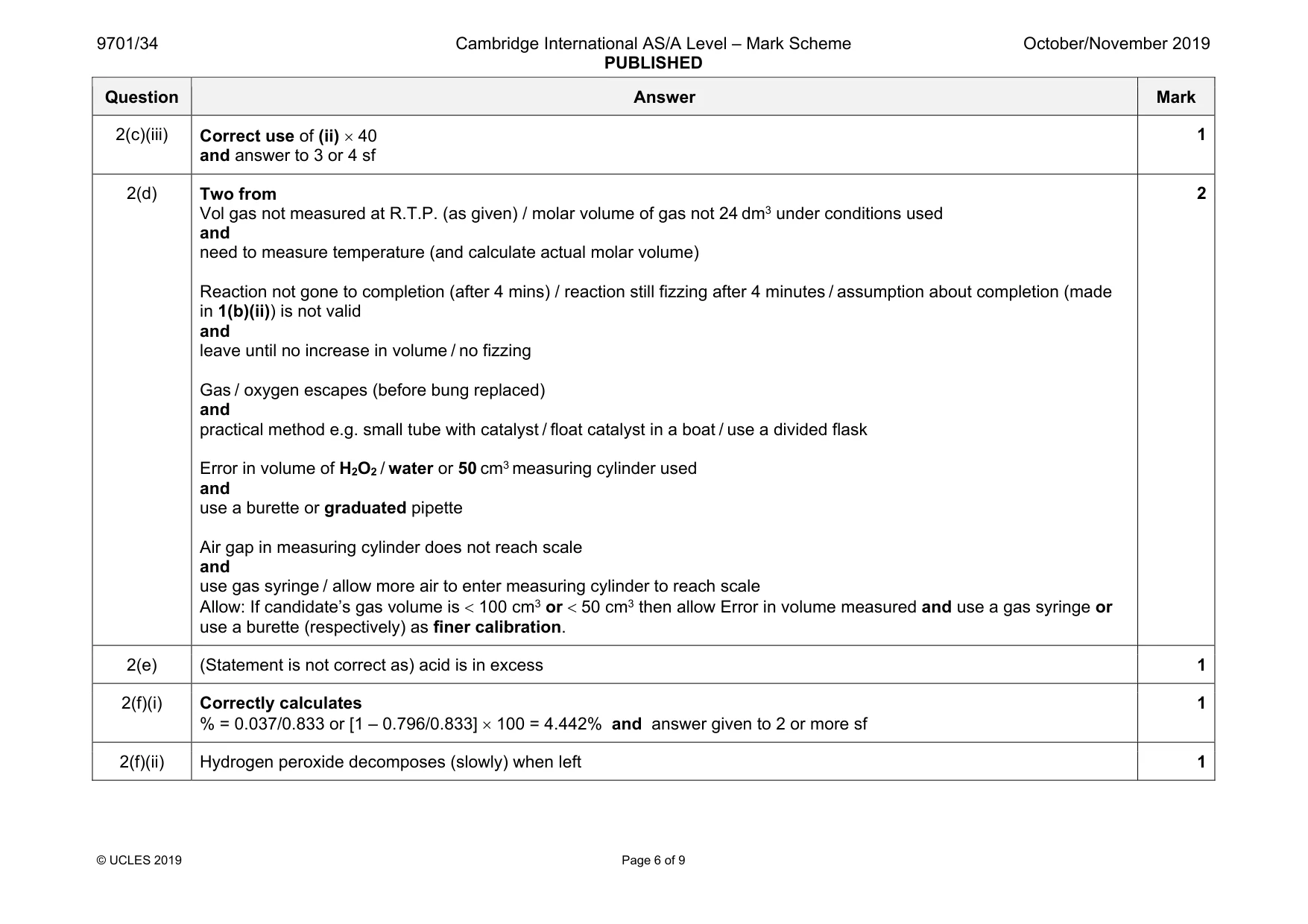
Mark scheme: 2(a) I All the following data recorded • two burette readings and titre for the rough titration • initial and final burette readings for two (or more) accurate titrations 1 II Titre values shown, for accurate titrations, and appropriate headings and units in the accurate titration table • initial / start and (burette) reading / volume • final / end and (burette) reading / volume • titre or volume / FB 4 and used/added unit: / cm3 or (cm3) or in cm3 (for each heading) or cm3 unit given for each volume recorded 1 III All accurate burette readings are recorded to the nearest 0.05 cm3. 1 IV The final accurate titre recorded is within 0.10 cm3 of any other accurate titre. 1 Award V if δ ⩽ 0.50 cm3 (Where δ is difference to the supervisor’s value) 1 Award VI if δ ⩽ 0.30 cm3 1 Award VII if δ ⩽ 0.20 cm3 1 2(b) Correctly calculates mean titre from two (or more) accurate titres where the total spread is ≤ 0.20 cm3. AND Answer is given to 2 dp AND Working must be shown or ticks must be put next to the two (or more) accurate titres selected. 1 2(c)(i) Correctly calculates 0.02 1000 ×(b) and answer to 3 or 4 sf 1 2(c)(ii) Correct use of 5 2 × (c)(i) and answer to 3 or 4 sf 1 Question Answer Mark 2(c)(iii) Correct use of (ii) × 40 and answer to 3 or 4 sf 1 2(d) Two from Vol gas not measured at R.T.P. (as given) / molar volume of gas not 24 dm3 under conditions used and need to measure temperature (and calculate actual molar volume) Reaction not gone to completion (after 4 mins) / reaction still fizzing after 4 minutes / assumption about completion (made in 1(b)(ii)) is not valid and leave until no increase in volume / no fizzing Gas / oxygen escapes (before bung replaced) and practical method e.g. small tube with catalyst / float catalyst in a boat / use a divided flask Error in volume of H2O2 / water or 50 cm3 measuring cylinder used and use a burette or graduated pipette Air gap in measuring cylinder does not reach scale and use gas syringe / allow more air to enter measuring cylinder to reach scale Allow: If candidate’s gas volume is < 100 cm3 or < 50 cm3 then allow Error in volume measured and use a gas syringe or use a burette (respectively) as finer calibration. 2 2(e) (Statement is not correct as) acid is in excess 1 2(f)(i) Correctly calculates % = 0.037/0.833 or [1 – 0.796/0.833] × 100 = 4.442% and answer given to 2 or more sf 1 2(f)(ii) Hydrogen peroxide decomposes (slowly) when left 1
More questions on Reacting masses and volumes (of solutions and gases)
Q3 · FB 6, FB 7 and FB 8 are all aqueous solutions
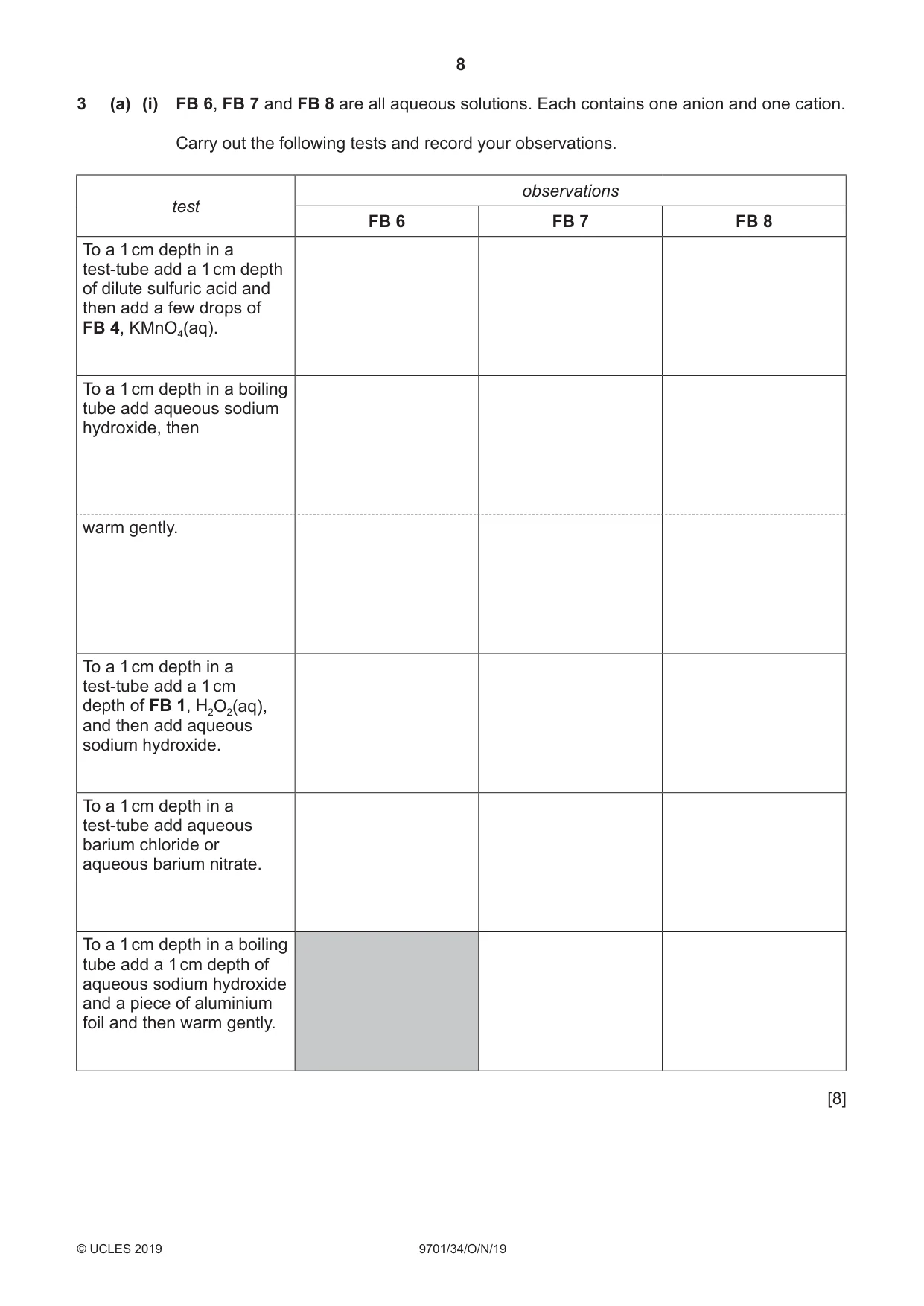
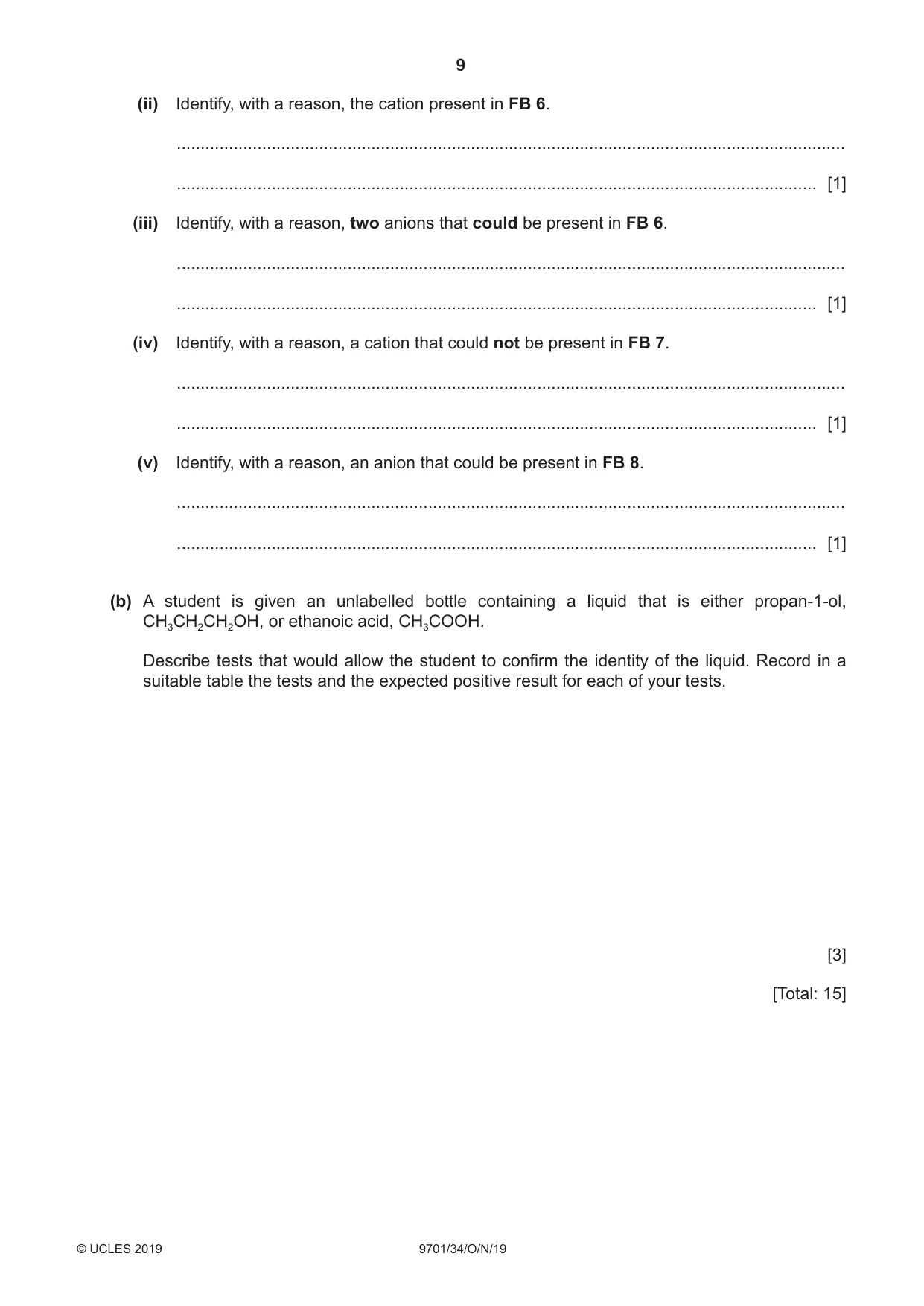
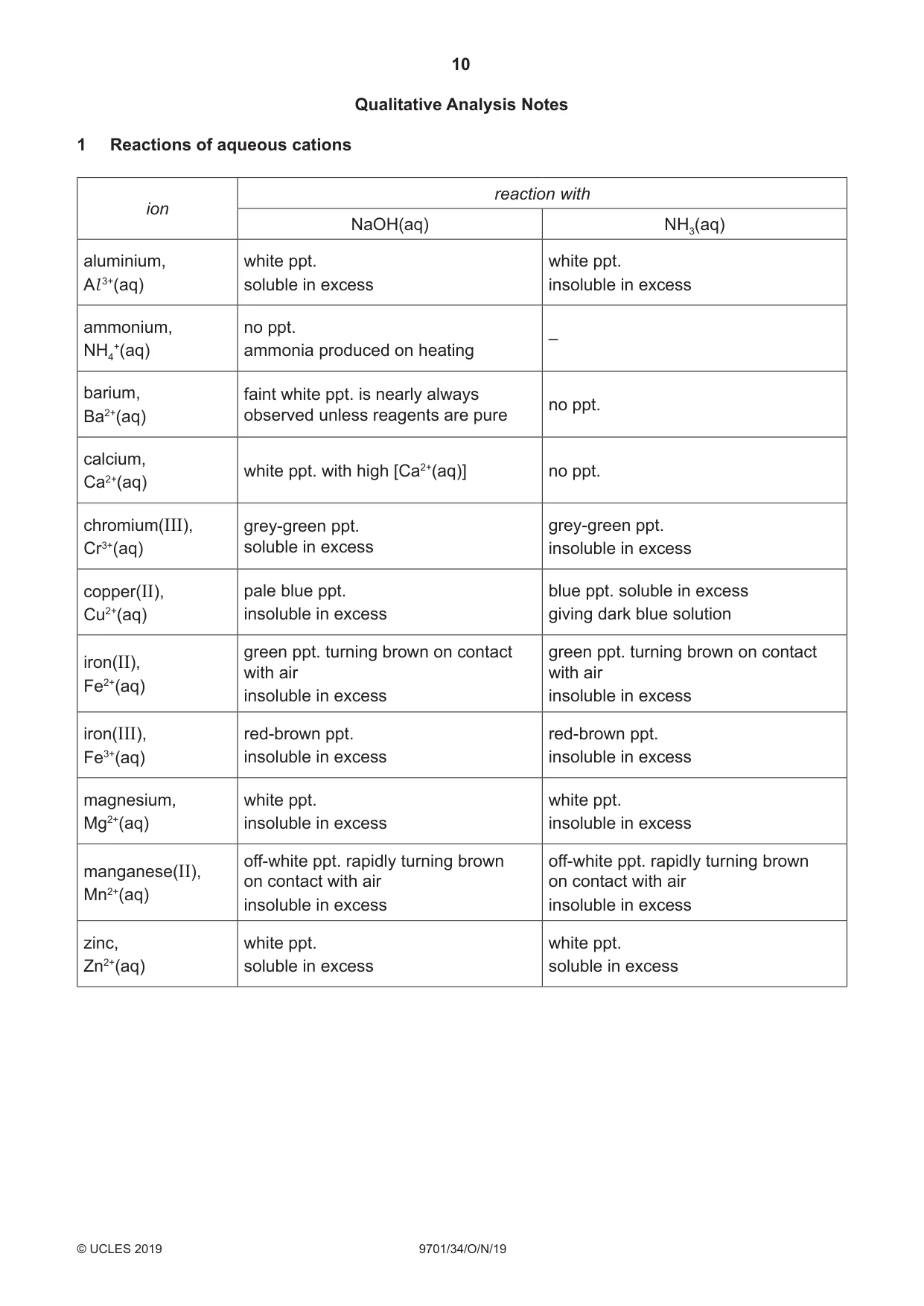
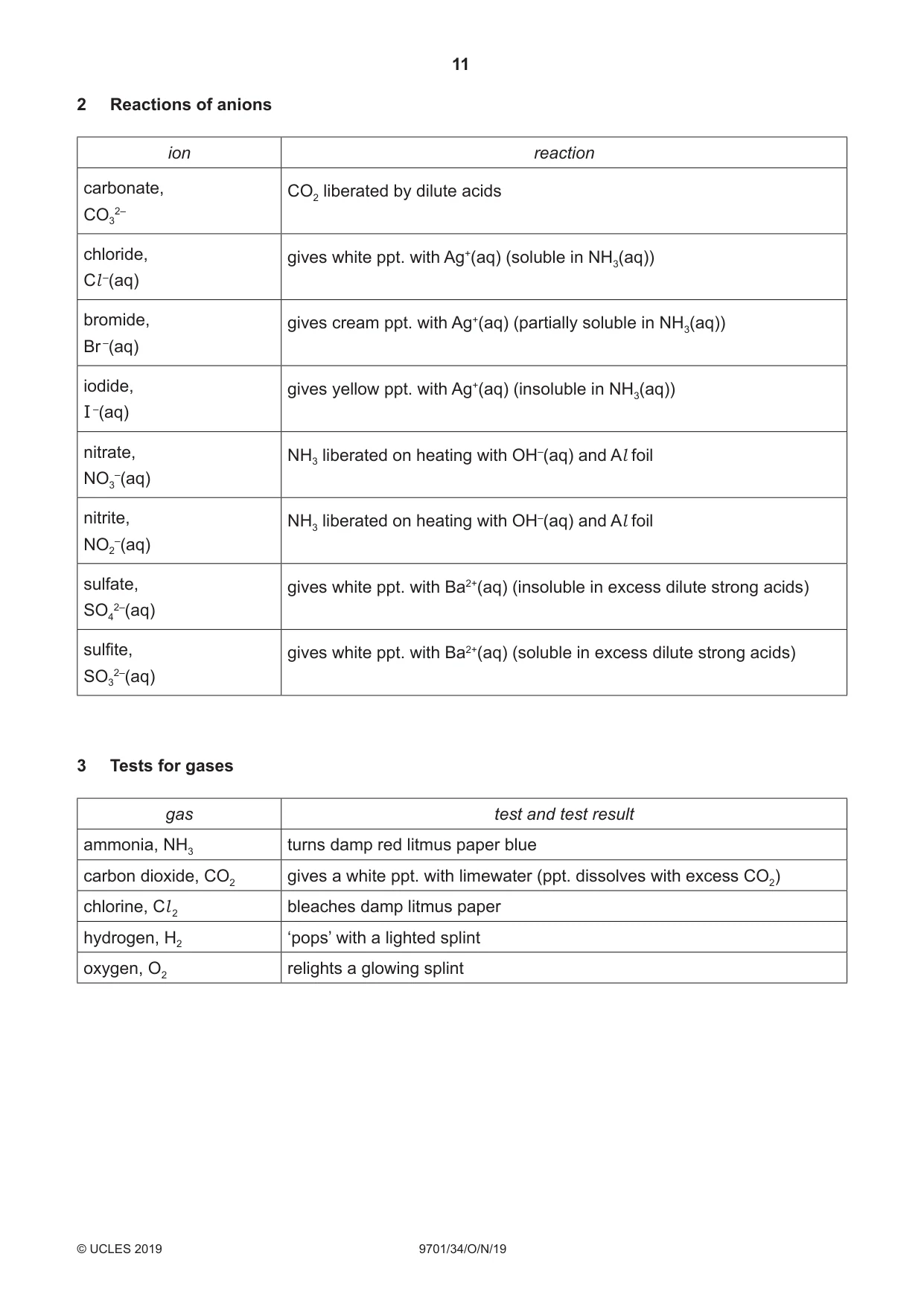
3 (a) (i) FB 6, FB 7 and FB 8 are all aqueous solutions. Each contains one anion and one cation. Carry out the following tests and record your observations. observations test FB 6 FB 7 FB 8 To a 1 cm depth in a test‑tube add a 1 cm depth of dilute sulfuric acid and then add a few drops of FB 4, KMnO4(aq). To a 1 cm depth in a boiling tube add aqueous sodium hydroxide, then warm gently. To a 1 cm depth in a test‑tube add a 1 cm depth of FB 1, H2O2(aq), and then add aqueous sodium hydroxide. To a 1 cm depth in a test‑tube add aqueous barium chloride or aqueous barium nitrate. To a 1 cm depth in a boiling tube add a 1 cm depth of aqueous sodium hydroxide and a piece of aluminium foil and then warm gently. [8] (ii) Identify, with a reason, the cation present in FB 6. ............................................................................................................................................. ....................................................................................................................................... [1] (iii) Identify, with a reason, two anions that could be present in FB 6. ............................................................................................................................................. ....................................................................................................................................... [1] (iv) Identify, with a reason, a cation that could not be present in FB 7. ............................................................................................................................................. ....................................................................................................................................... [1] (v) Identify, with a reason, an anion that could be present in FB 8. ............................................................................................................................................. ....................................................................................................................................... [1] (b) A student is given an unlabelled bottle containing a liquid that is either propan‑1‑ol, CH3CH2CH2OH, or ethanoic acid, CH3COOH. Describe tests that would allow the student to confirm the identity of the liquid. Record in a suitable table the tests and the expected positive result for each of your tests. [3] [Total: 15] Qualitative Analysis Notes 1 Reactions of aqueous cations reaction with ion NaOH(aq) NH3(aq) aluminium, white ppt. white ppt. Al 3+(aq) soluble in excess insoluble in excess ammonium, no ppt. – NH4+(aq) ammonia produced on heating barium, faint white ppt. is nearly always no ppt. Ba2+(aq) observed unless reagents are pure calcium, white ppt. with high [Ca2+(aq)] no ppt. Ca2+(aq) chromium(III), grey-green ppt. grey-green ppt. Cr3+(aq) soluble in excess insoluble in excess copper(II), pale blue ppt. blue ppt. soluble in excess Cu2+(aq) insoluble in excess giving dark blue solution green ppt. turning brown on contact green ppt. turning brown on contact iron(II), with air with air Fe2+(aq) insoluble in excess insoluble in excess iron(III), red-brown ppt. red-brown ppt. Fe3+(aq) insoluble in excess insoluble in excess magnesium, white ppt. white ppt. Mg2+(aq) insoluble in excess insoluble in excess off-white ppt. rapidly turning brown off-white ppt. rapidly turning brown manganese(II), on contact with air on contact with air Mn2+(aq) insoluble in excess insoluble in excess zinc, white ppt. white ppt. Zn2+(aq) soluble in excess soluble in excess
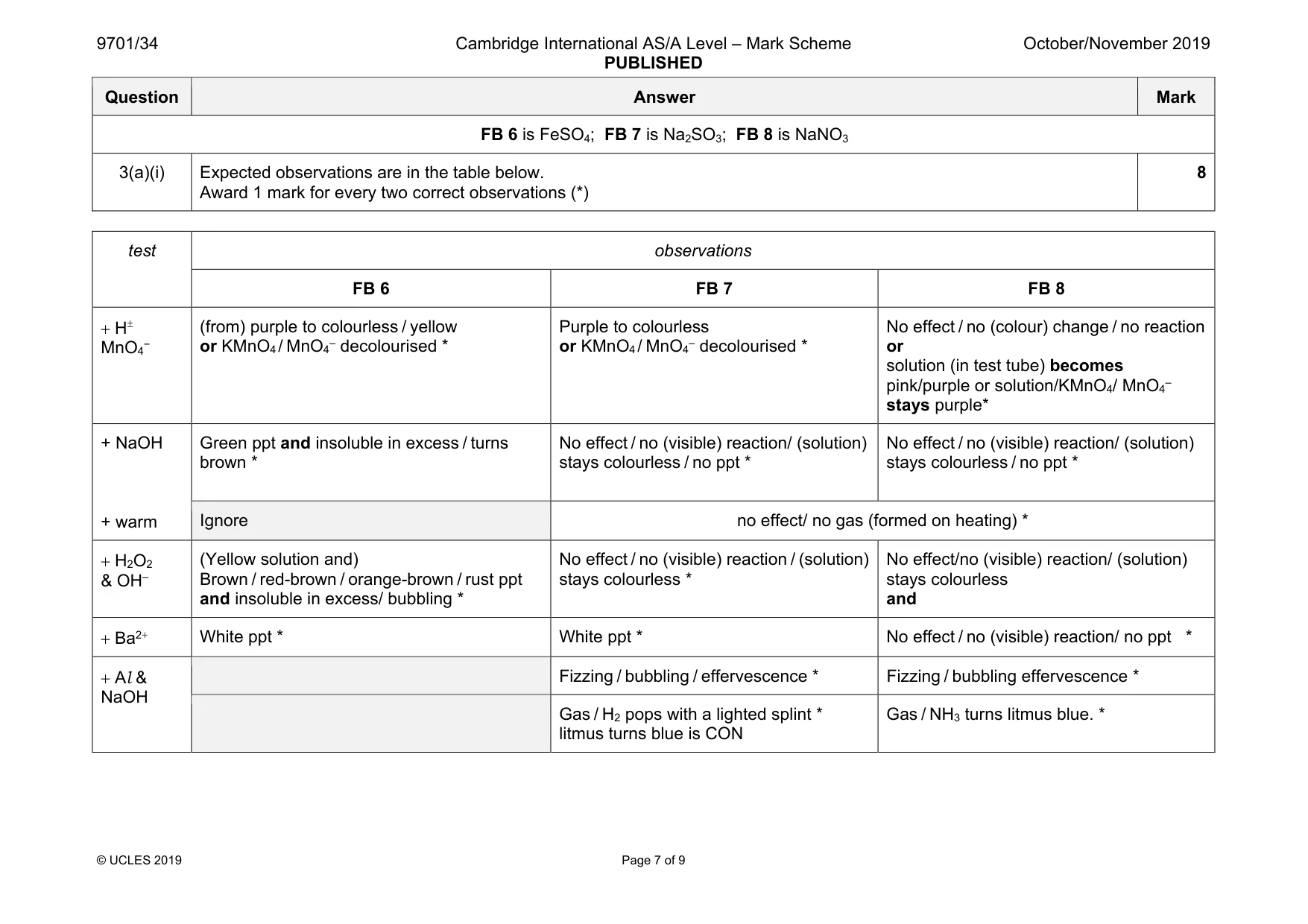
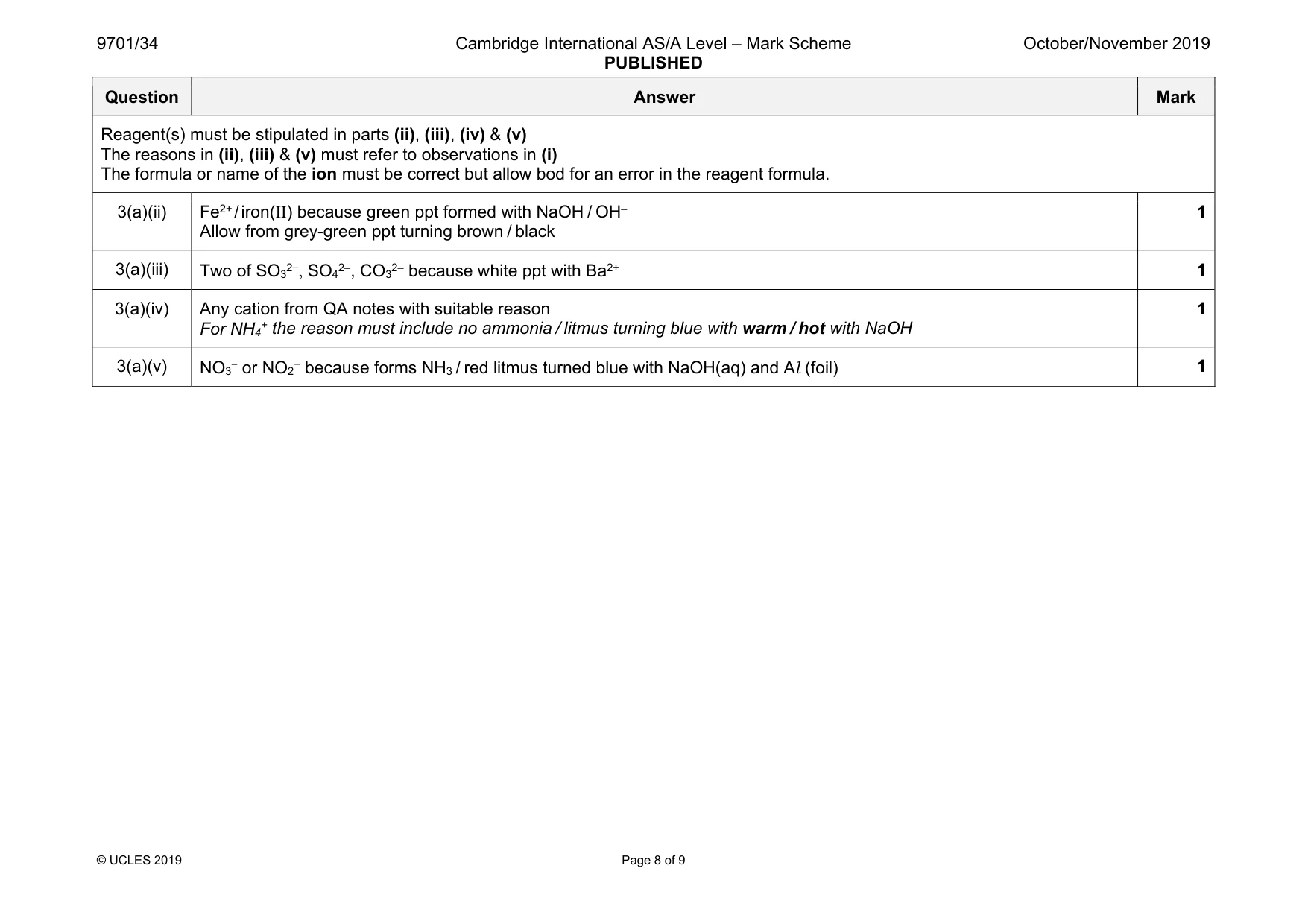
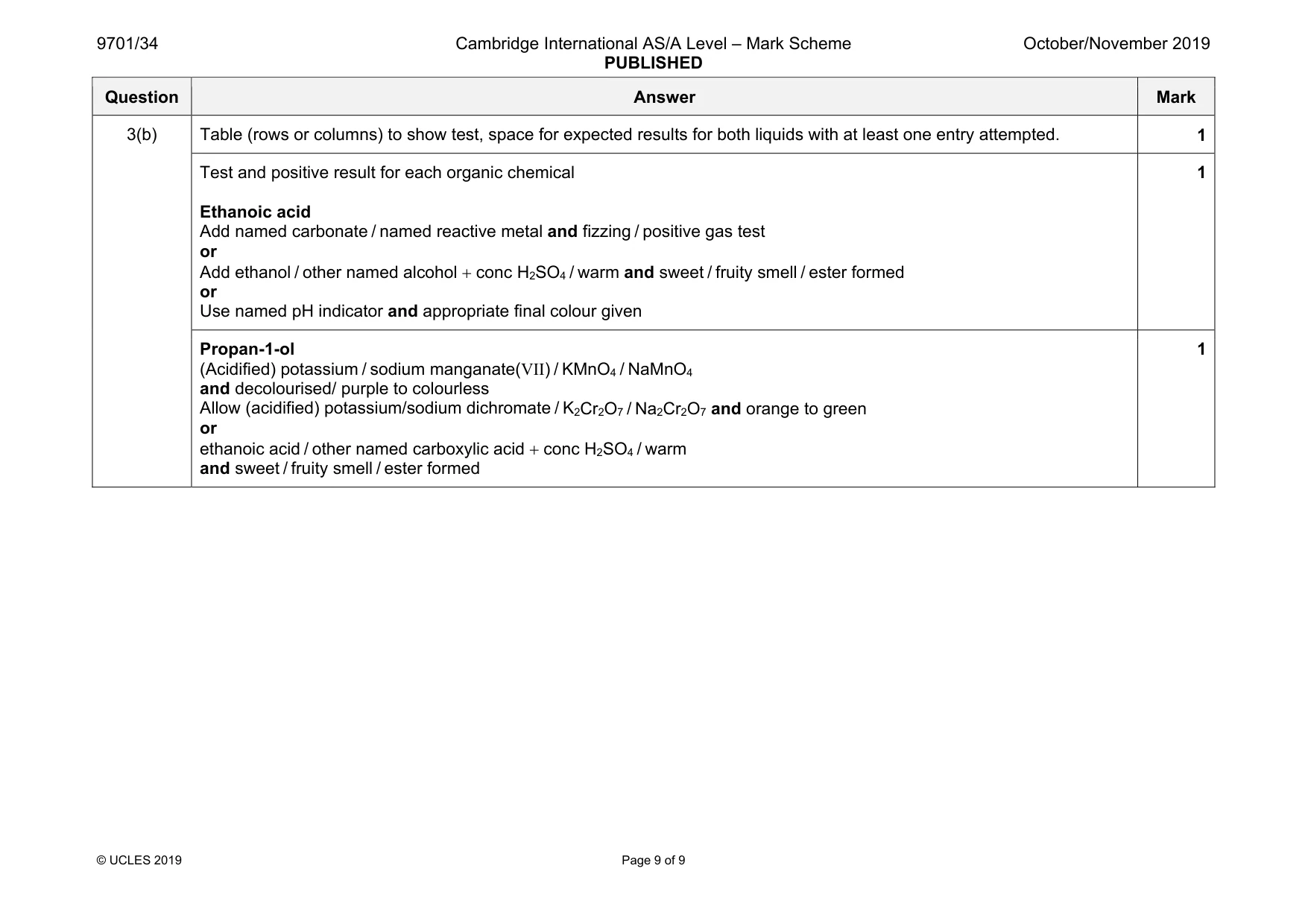
Mark scheme: 3(a)(i) Expected observations are in the table below. Award 1 mark for every two correct observations (*) 8 test observations FB 6 FB 7 FB 8 + H± MnO4− (from) purple to colourless / yellow or KMnO4 / MnO4– decolourised * Purple to colourless or KMnO4 / MnO4– decolourised * No effect / no (colour) change / no reaction or solution (in test tube) becomes pink/purple or solution/KMnO4/ MnO4– stays purple* + NaOH + warm Green ppt and insoluble in excess / turns brown * No effect / no (visible) reaction/ (solution) stays colourless / no ppt * No effect / no (visible) reaction/ (solution) stays colourless / no ppt * Ignore no effect/ no gas (formed on heating) * + H2O2 & OH– (Yellow solution and) Brown / red-brown / orange-brown / rust ppt and insoluble in excess/ bubbling * No effect / no (visible) reaction / (solution) stays colourless * No effect/no (visible) reaction/ (solution) stays colourless and + Ba2+ White ppt * White ppt * No effect / no (visible) reaction/ no ppt * + Al & NaOH Fizzing / bubbling / effervescence * Fizzing / bubbling effervescence * Gas / H2 pops with a lighted splint * litmus turns blue is CON Gas / NH3 turns litmus blue. * Question Answer Mark Reagent(s) must be stipulated in parts (ii), (iii), (iv) & (v) The reasons in (ii), (iii) & (v) must refer to observations in (i) The formula or name of the ion must be correct but allow bod for an error in the reagent formula. 3(a)(ii) Fe2+ / iron(II) because green ppt formed with NaOH / OH– Allow from grey-green ppt turning brown / black 1 3(a)(iii) Two of SO32−, SO42–, CO32– because white ppt with Ba2+ 1 3(a)(iv) Any cation from QA notes with suitable reason For NH4+ the reason must include no ammonia / litmus turning blue with warm / hot with NaOH 1 3(a)(v) NO3− or NO2− because forms NH3 / red litmus turned blue with NaOH(aq) and Al (foil) 1 Question Answer Mark 3(b) Table (rows or columns) to show test, space for expected results for both liquids with at least one entry attempted. 1 Test and positive result for each organic chemical Ethanoic acid Add named carbonate / named reactive metal and fizzing / positive gas test or Add ethanol / other named alcohol + conc H2SO4 / warm and sweet / fruity smell / ester formed or Use named pH indicator and appropriate final colour given 1 Propan-1-ol (Acidified) potassium / sodium manganate(VII) / KMnO4 / NaMnO4 and decolourised/ purple to colourless Allow (acidified) potassium/sodium dichromate / K2Cr2O7 / Na2Cr2O7 and orange to green or ethanoic acid / other named carboxylic acid + conc H2SO4 / warm and sweet / fruity smell / ester formed 1
More questions on Periodicity of chemical properties of the elements in Period 3
What was in this paper
The subtopics covered by these 3 questions, and how many questions each got. Open one in a new tab to see every Cambridge question on it.
What you needed in this session
Cambridge’s own grade thresholds for 2019 Oct/Nov, Paper 3 · Variant 4. A higher threshold means an easier paper — the bar moves with how the cohort did.