Cambridge A Level Chemistry 9701 — 2024 May/June Paper 5 · Variant 1
9701/51/M/J/24 · 2 questions · 30 marks · ≈34 min
The question paper and its mark scheme, free to read here and free to download. This is Cambridge’s own paper, exactly as it was sat.
Question paper12 pages


Mark scheme7 pages
Answers below. Sit the paper first if you are practising.
Questions as text
Q1 · Titration can be used to determine the concentration of dissolved oxygen in samples of…
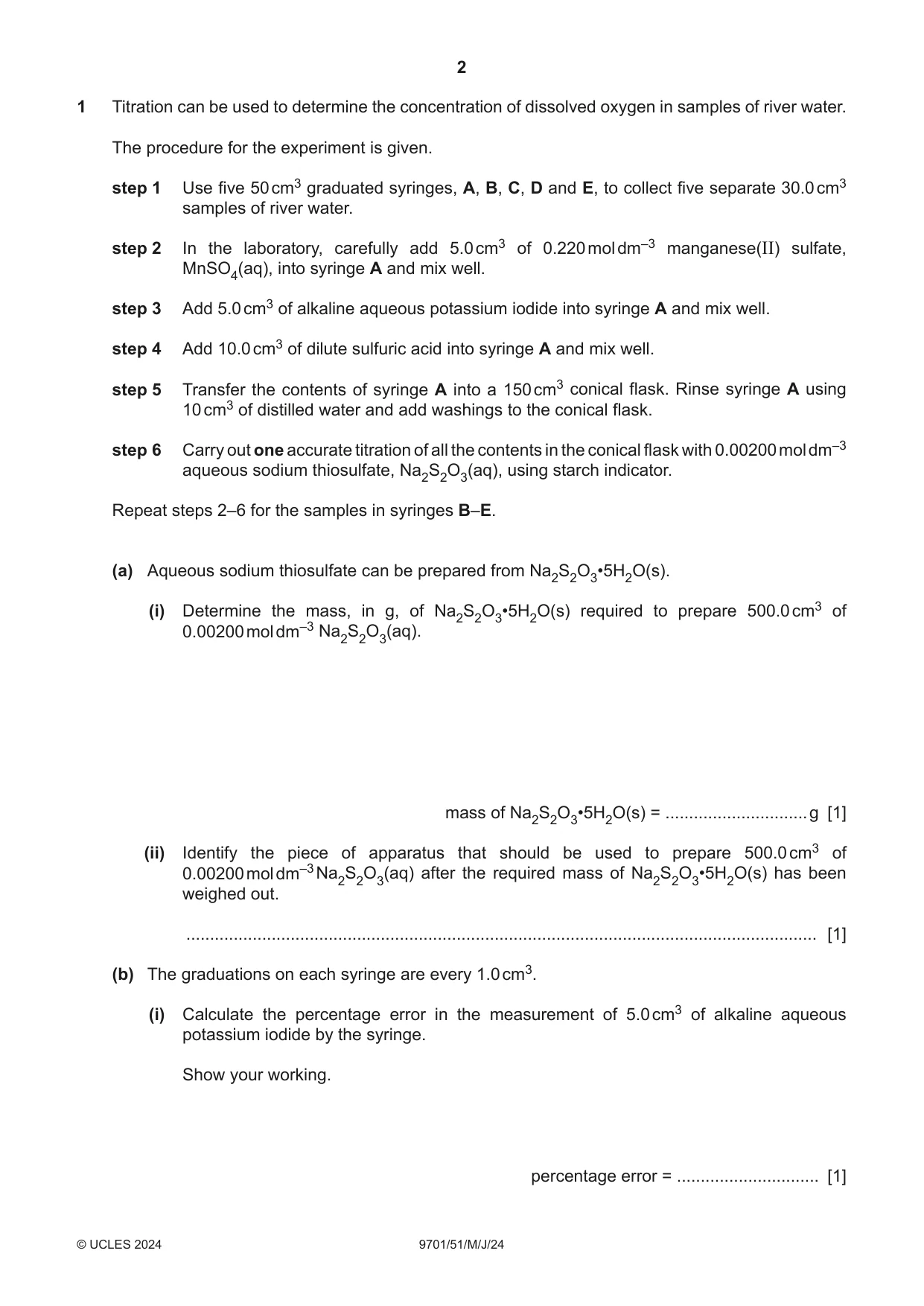
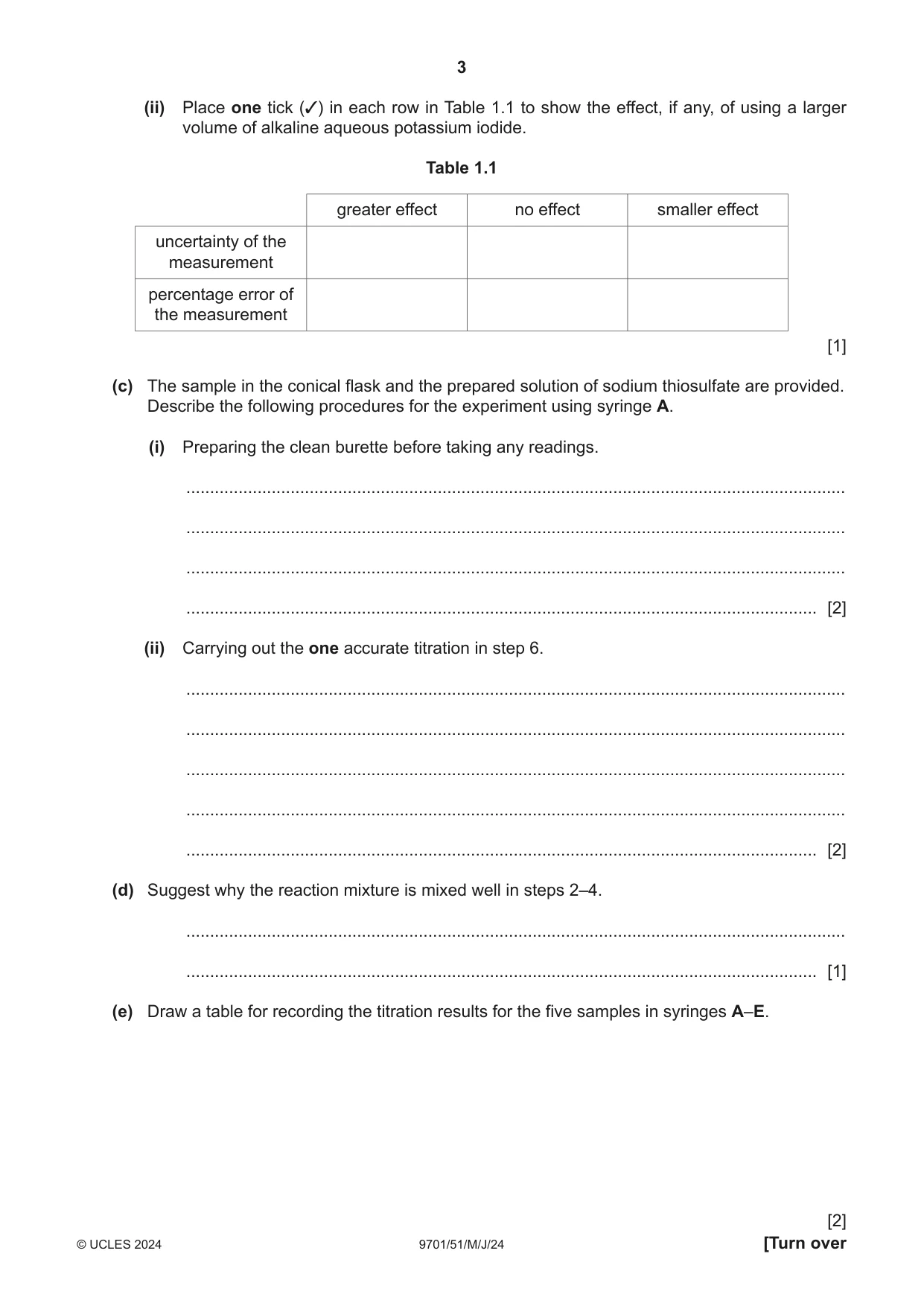
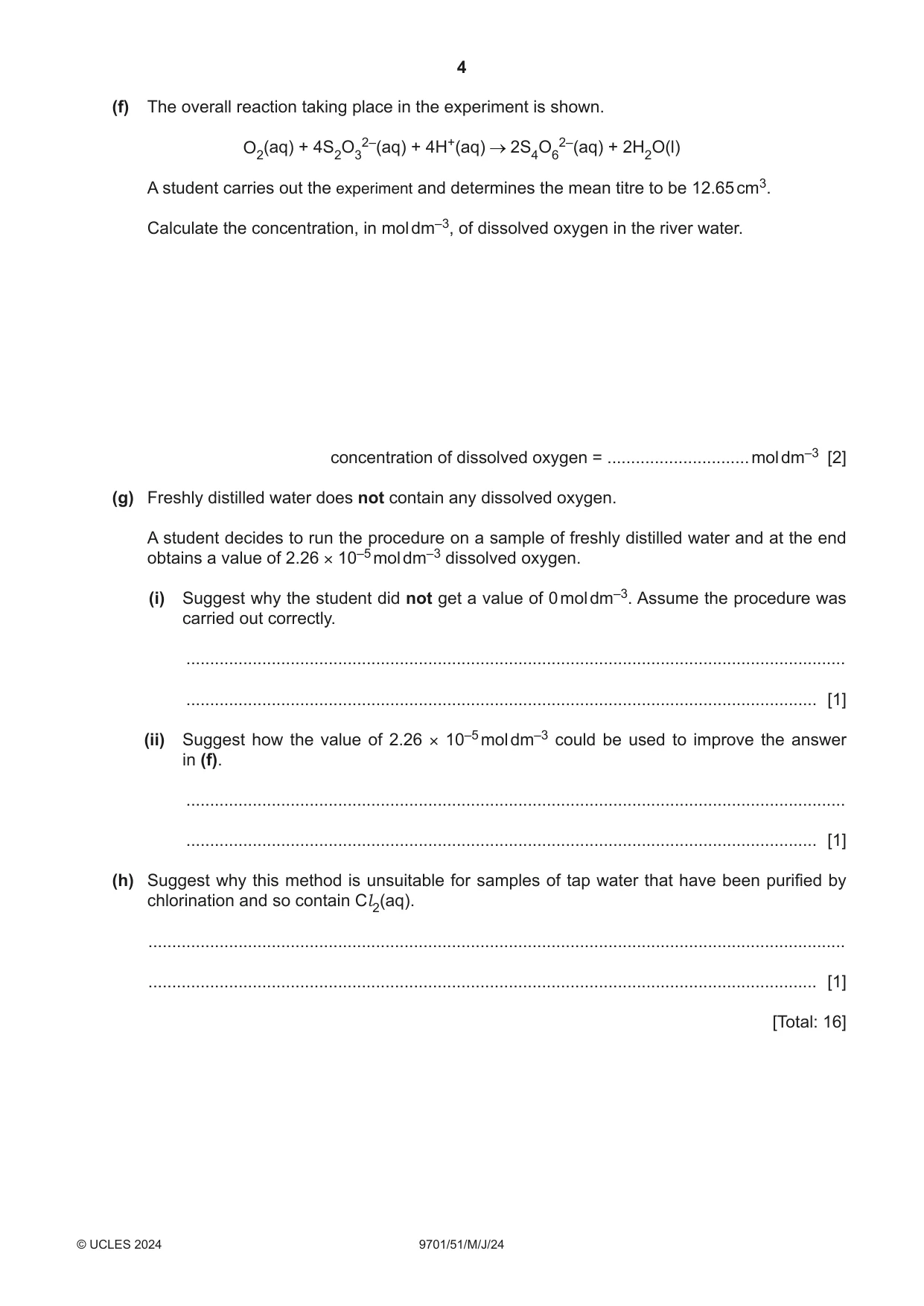
1 Titration can be used to determine the concentration of dissolved oxygen in samples of river water. The procedure for the experiment is given. step 1 Use five 50 cm3 graduated syringes, A, B, C, D and E, to collect five separate 30.0 cm3 samples of river water. step 2 In the laboratory, carefully add 5.0 cm3 of 0.220 mol dm–3 manganese(II) sulfate, MnSO4(aq), into syringe A and mix well. step 3 Add 5.0 cm3 of alkaline aqueous potassium iodide into syringe A and mix well. step 4 Add 10.0 cm3 of dilute sulfuric acid into syringe A and mix well. step 5 Transfer the contents of syringe A into a 150 cm3 conical flask. Rinse syringe A using 10 cm3 of distilled water and add washings to the conical flask. step 6 Carry out one accurate titration of all the contents in the conical flask with 0.00200 mol dm–3 aqueous sodium thiosulfate, Na2S2O3(aq), using starch indicator. Repeat steps 2–6 for the samples in syringes B–E. (a) Aqueous sodium thiosulfate can be prepared from Na2S2O3•5H2O(s). (i) Determine the mass, in g, of Na2S2O3•5H2O(s) required to prepare 500.0 cm3 of 0.00200 mol dm–3 Na2S2O3(aq). mass of Na2S2O3•5H2O(s) = .............................. g [1] (ii) Identify the piece of apparatus that should be used to prepare 500.0 cm3 of 0.00200 mol dm–3 Na2S2O3(aq) after the required mass of Na2S2O3•5H2O(s) has been weighed out. ..................................................................................................................................... [1] (b) The graduations on each syringe are every 1.0 cm3. (i) Calculate the percentage error in the measurement of 5.0 cm3 of alkaline aqueous potassium iodide by the syringe. Show your working. percentage error = .............................. [1] (ii) Place one tick (✓) in each row in Table 1.1 to show the effect, if any, of using a larger volume of alkaline aqueous potassium iodide. Table 1.1 greater effect no effect smaller effect uncertainty of the measurement percentage error of the measurement [1] (c) The sample in the conical flask and the prepared solution of sodium thiosulfate are provided. Describe the following procedures for the experiment using syringe A. (i) Preparing the clean burette before taking any readings. ........................................................................................................................................... ........................................................................................................................................... ........................................................................................................................................... ..................................................................................................................................... [2] (ii) Carrying out the one accurate titration in step 6. ........................................................................................................................................... ........................................................................................................................................... ........................................................................................................................................... ........................................................................................................................................... ..................................................................................................................................... [2] (d) Suggest why the reaction mixture is mixed well in steps 2–4. ........................................................................................................................................... ..................................................................................................................................... [1] (e) Draw a table for recording the titration results for the five samples in syringes A–E. [2] (f) The overall reaction taking place in the experiment is shown. O2(aq) + 4S2O32–(aq) + 4H+(aq) 2S4O62–(aq) + 2H2O(l) A student carries out the experiment and determines the mean titre to be 12.65 cm3. Calculate the concentration, in mol dm–3, of dissolved oxygen in the river water. concentration of dissolved oxygen = .............................. mol dm–3 [2] (g) Freshly distilled water does not contain any dissolved oxygen. A student decides to run the procedure on a sample of freshly distilled water and at the end obtains a value of 2.26 × 10⁻⁵ mol dm–3 dissolved oxygen. (i) Suggest why the student did not get a value of 0 mol dm–3. Assume the procedure was carried out correctly. ........................................................................................................................................... ..................................................................................................................................... [1] (ii) Suggest how the value of 2.26 × 10⁻⁵ mol dm–3 could be used to improve the answer in (f). ........................................................................................................................................... ..................................................................................................................................... [1] (h) Suggest why this method is unsuitable for samples of tap water that have been purified by chlorination and so contain Cl2(aq). ................................................................................................................................................... ............................................................................................................................................. [1] [Total: 16]
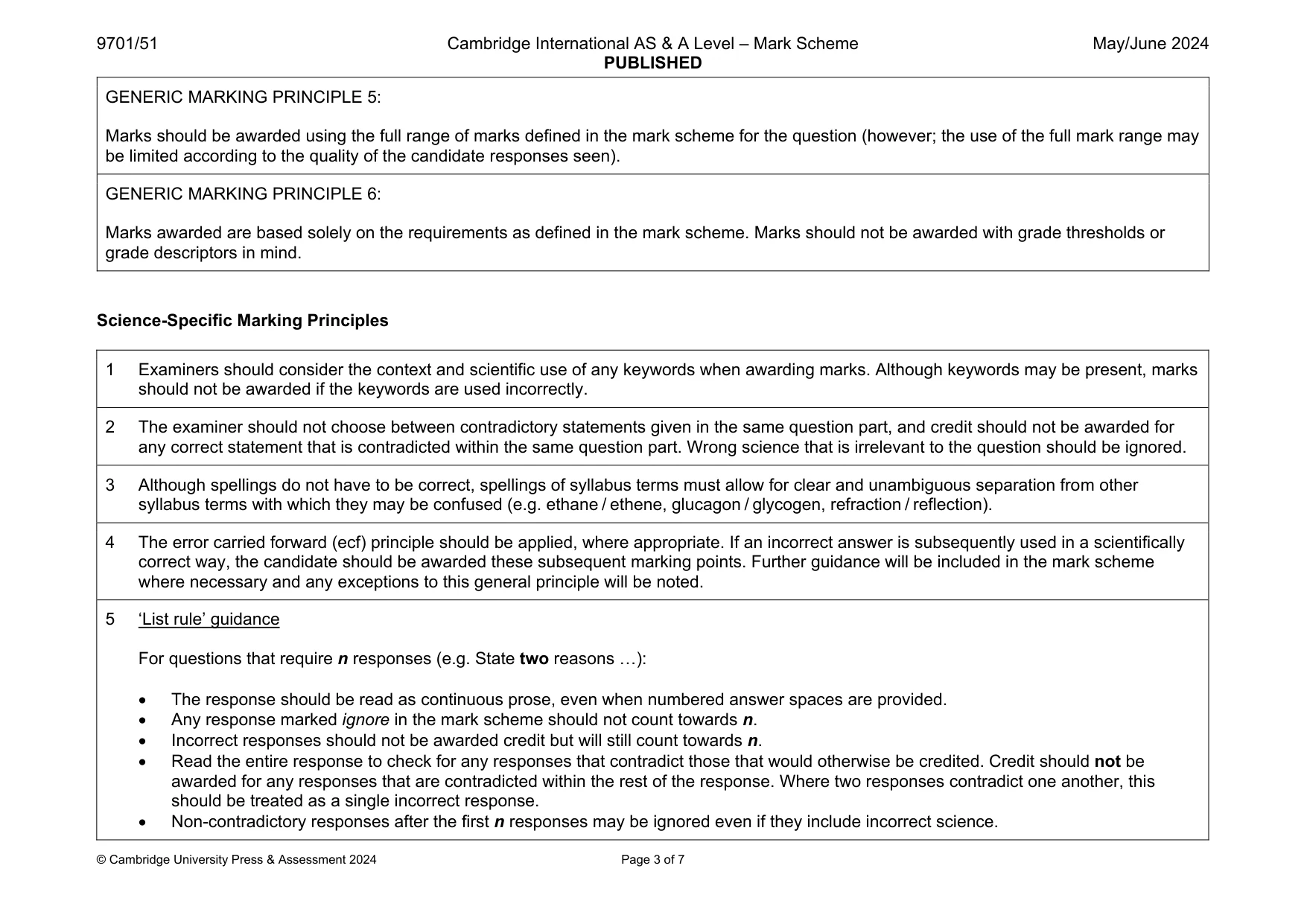
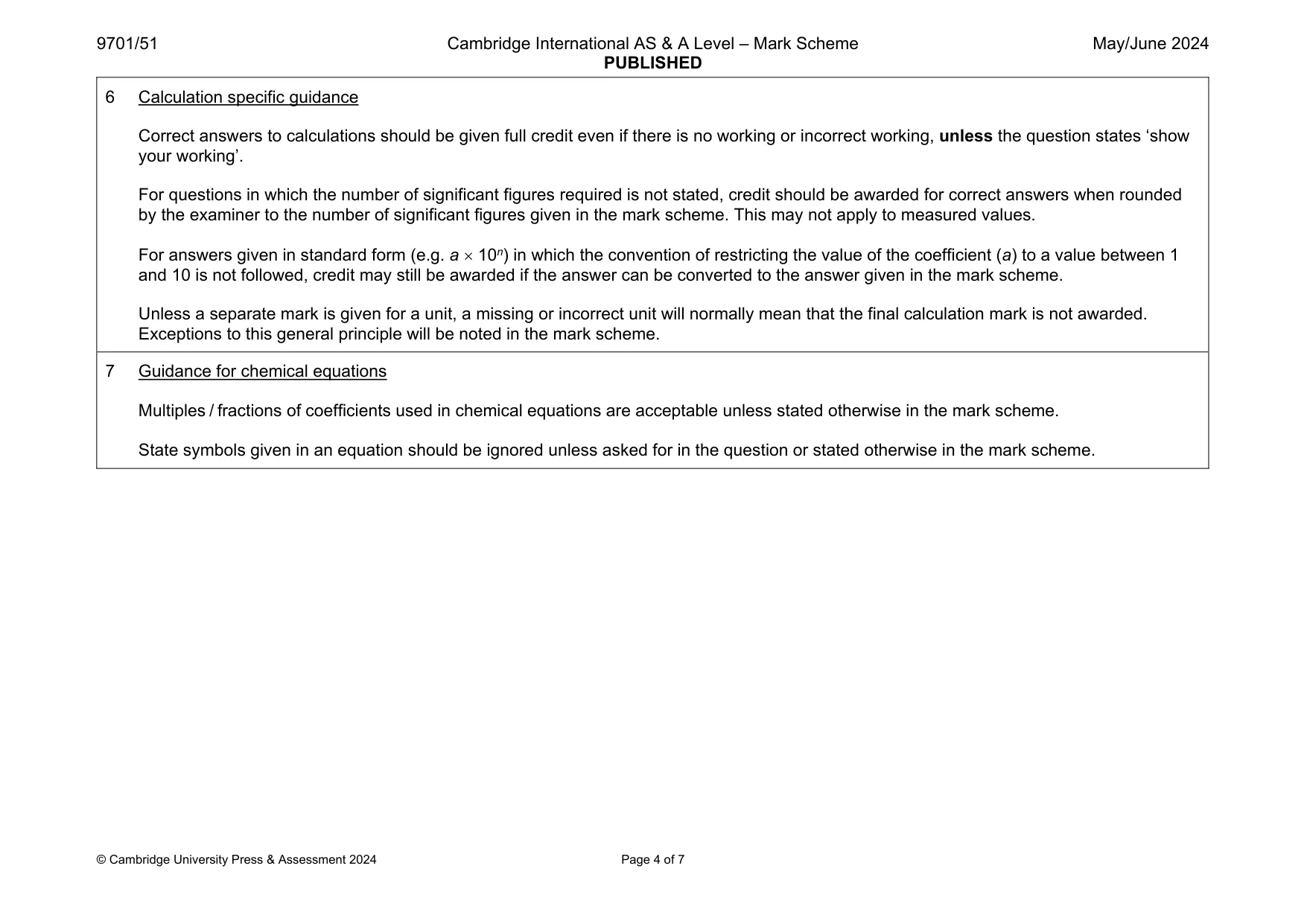
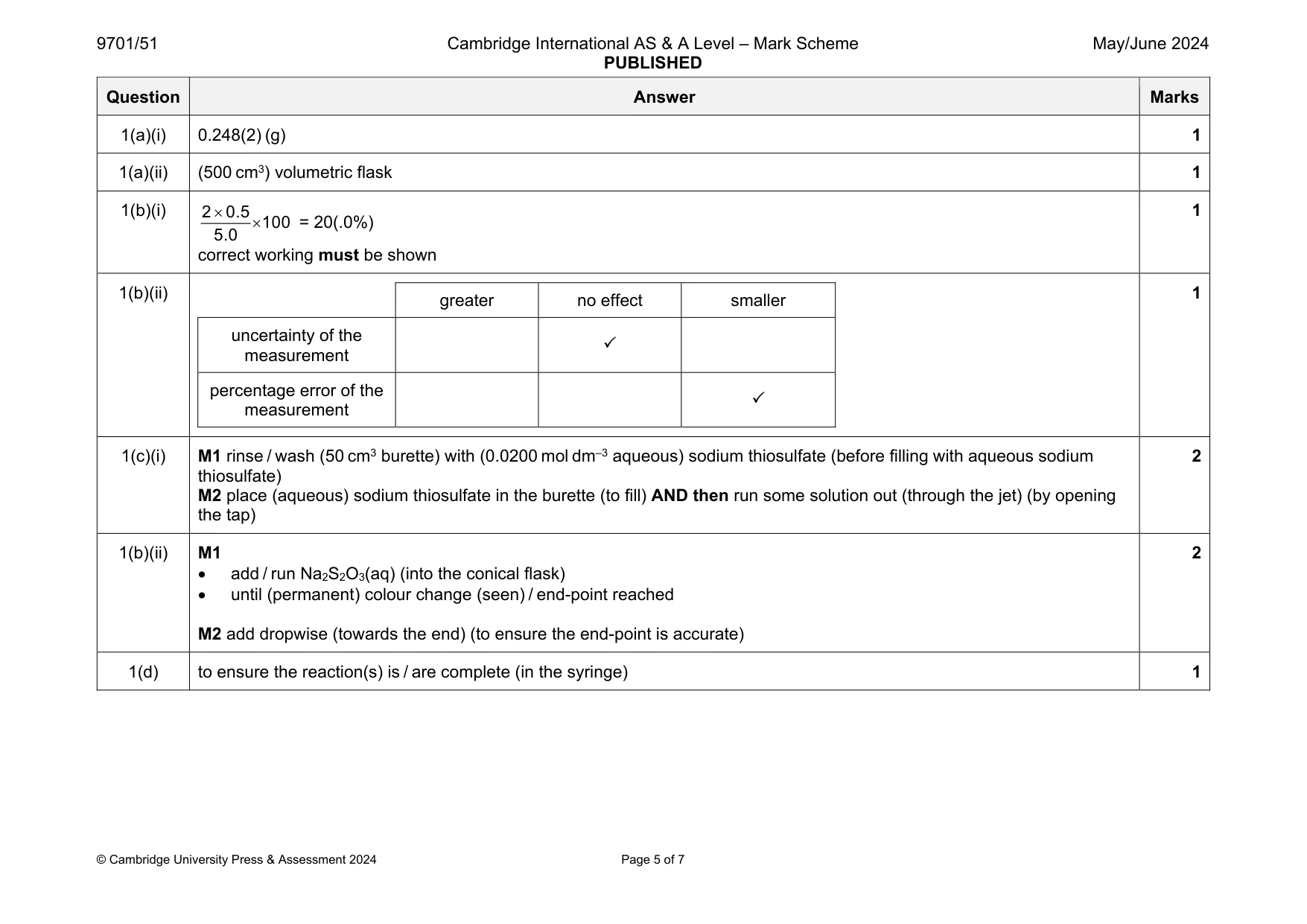
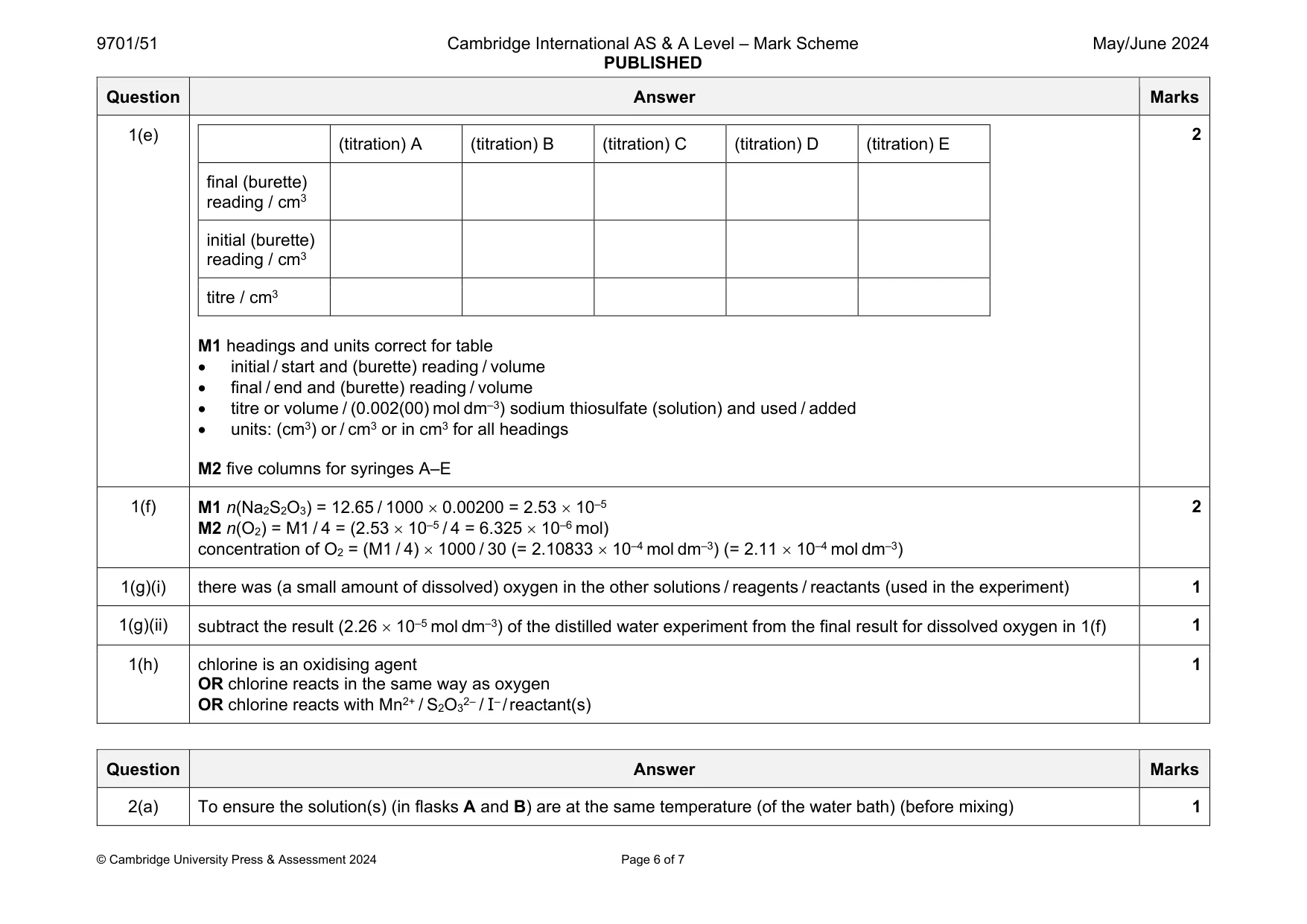
Mark scheme: 1(a)(i) 0.248(2) (g) 1 1(a)(ii) (500 cm3) volumetric flask 1 1(b)(i) 2 0.5 100 5.0 = 20(.0%) correct working must be shown 1 1(b)(ii) greater no effect smaller uncertainty of the measurement percentage error of the measurement 1 1(c)(i) M1 rinse / wash (50 cm3 burette) with (0.0200 mol dm–3 aqueous) sodium thiosulfate (before filling with aqueous sodium thiosulfate) M2 place (aqueous) sodium thiosulfate in the burette (to fill) AND then run some solution out (through the jet) (by opening the tap) 2 1(b)(ii) M1 add / run Na2S2O3(aq) (into the conical flask) until (permanent) colour change (seen) / end-point reached M2 add dropwise (towards the end) (to ensure the end-point is accurate) 2 1(d) to ensure the reaction(s) is / are complete (in the syringe) 1 Question Answer Marks 1(e) (titration) A (titration) B (titration) C (titration) D (titration) E final (burette) reading / cm3 initial (burette) reading / cm3 titre / cm3 M1 headings and units correct for table initial / start and (burette) reading / volume final / end and (burette) reading / volume titre or volume / (0.002(00) mol dm–3) sodium thiosulfate (solution) and used / added units: (cm3) or / cm3 or in cm3 for all headings M2 five columns for syringes A–E 2 1(f) M1 n(Na2S2O3) = 12.65 / 1000 0.00200 = 2.53 10–5 M2 n(O2) = M1 / 4 = (2.53 10–5 / 4 = 6.325 10–6 mol) concentration of O2 = (M1 / 4) 1000 / 30 (= 2.10833 10–4 mol dm–3) (= 2.11 10–4 mol dm–3) 2 1(g)(i) there was (a small amount of dissolved) oxygen in the other solutions / reagents / reactants (used in the experiment) 1 1(g)(ii) subtract the result (2.26 10–5 mol dm–3) of the distilled water experiment from the final result for dissolved oxygen in 1(f) 1 1(h) chlorine is an oxidising agent OR chlorine reacts in the same way as oxygen OR chlorine reacts with Mn2+ / S2O32– / I– / reactant(s) 1
More questions on Reacting masses and volumes (of solutions and gases)
Q2 · The activation energy, EA, for the reaction between dilute hydrochloric acid, HCl (aq)…
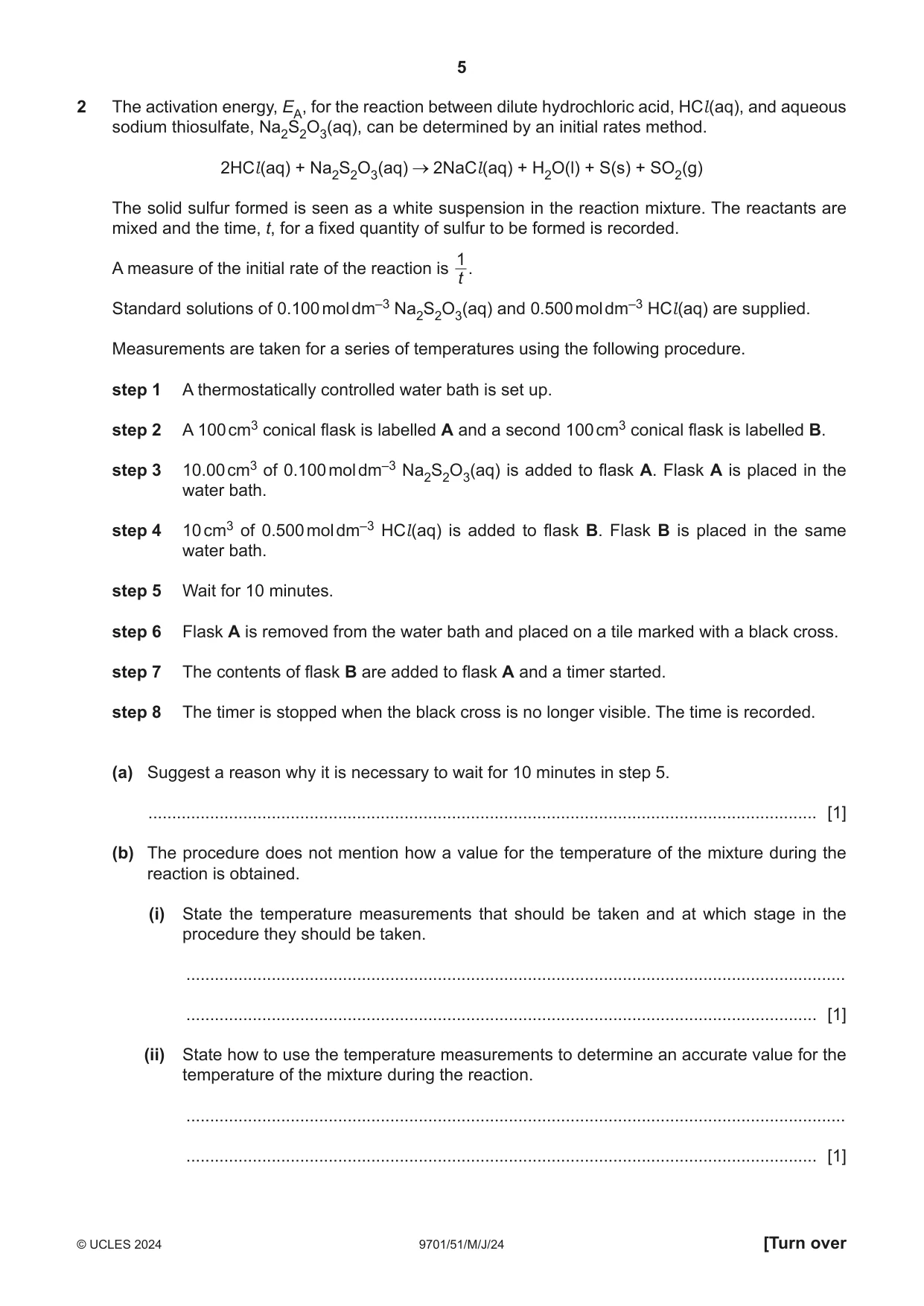
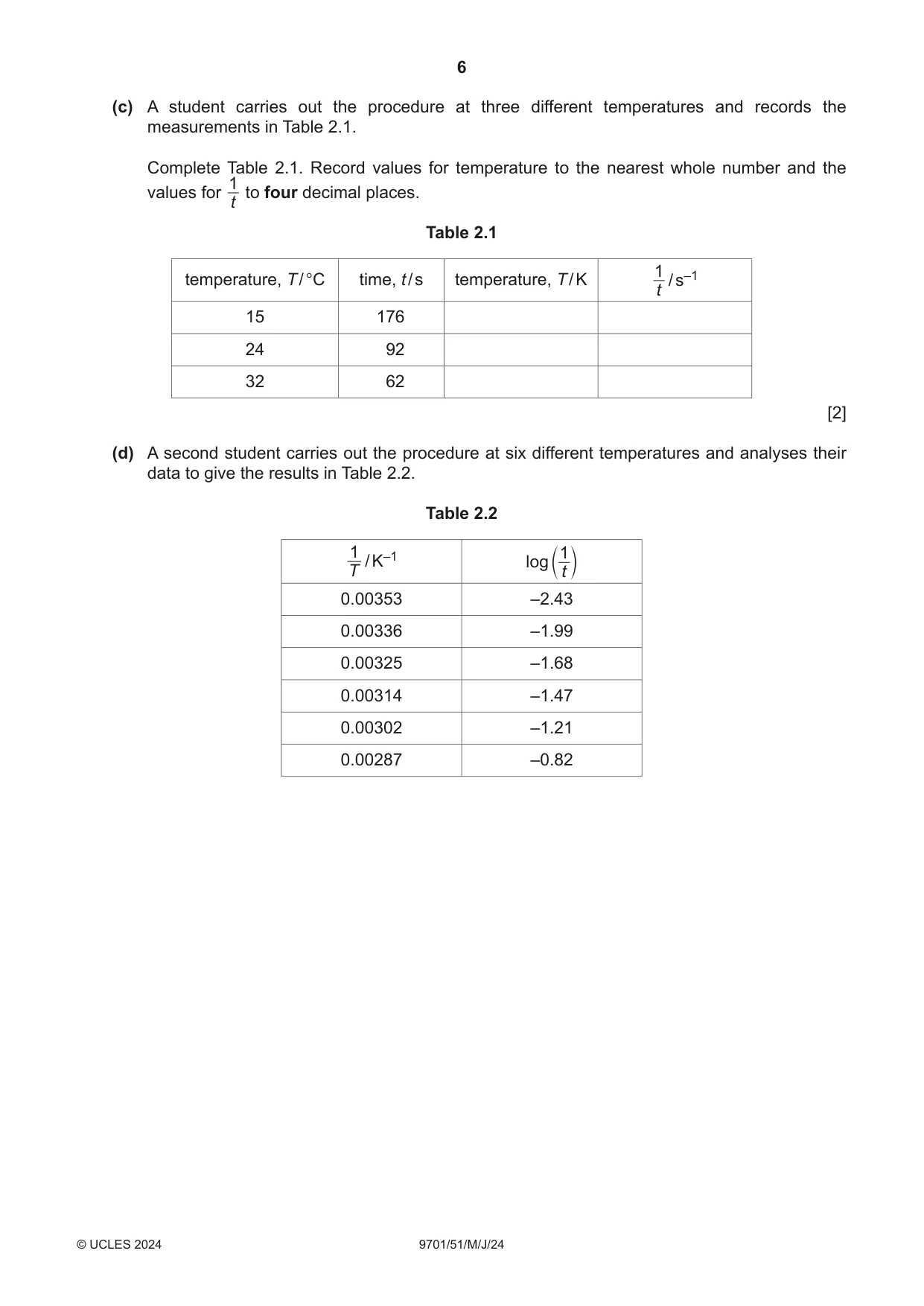
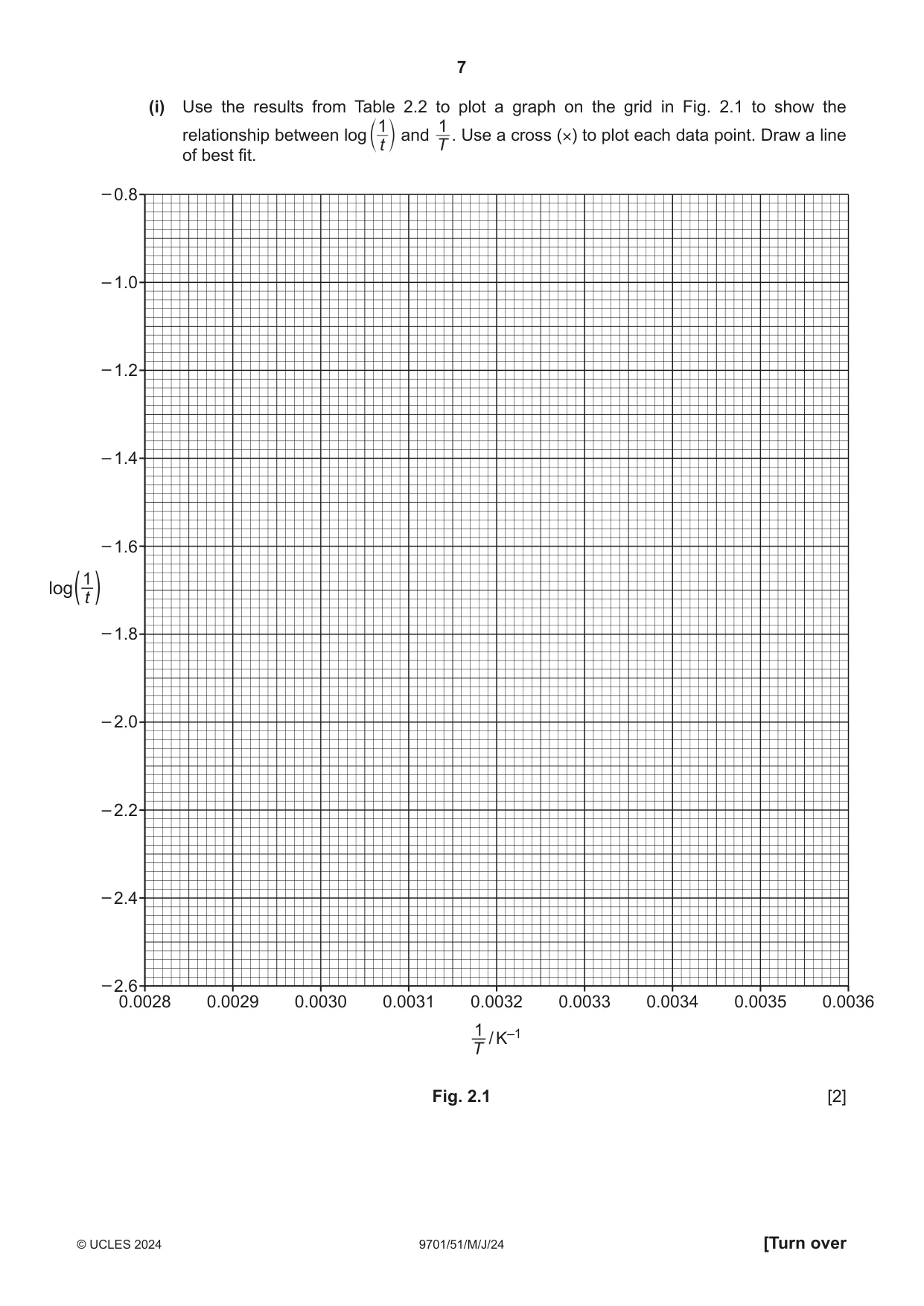
2 The activation energy, EA, for the reaction between dilute hydrochloric acid, HCl (aq), and aqueous sodium thiosulfate, Na2S2O3(aq), can be determined by an initial rates method. 2HCl (aq) + Na2S2O3(aq) 2NaCl (aq) + H2O(l) + S(s) + SO2(g) The solid sulfur formed is seen as a white suspension in the reaction mixture. The reactants are mixed and the time, t, for a fixed quantity of sulfur to be formed is recorded. 1 A measure of the initial rate of the reaction is . t Standard solutions of 0.100 mol dm–3 Na2S2O3(aq) and 0.500 mol dm–3 HCl (aq) are supplied. Measurements are taken for a series of temperatures using the following procedure. step 1 A thermostatically controlled water bath is set up. step 2 A 100 cm3 conical flask is labelled A and a second 100 cm3 conical flask is labelled B. step 3 10.00 cm3 of 0.100 mol dm–3 Na2S2O3(aq) is added to flask A. Flask A is placed in the water bath. step 4 10 cm3 of 0.500 mol dm–3 HCl (aq) is added to flask B. Flask B is placed in the same water bath. step 5 Wait for 10 minutes. step 6 Flask A is removed from the water bath and placed on a tile marked with a black cross. step 7 The contents of flask B are added to flask A and a timer started. step 8 The timer is stopped when the black cross is no longer visible. The time is recorded. (a) Suggest a reason why it is necessary to wait for 10 minutes in step 5. ............................................................................................................................................. [1] (b) The procedure does not mention how a value for the temperature of the mixture during the reaction is obtained. (i) State the temperature measurements that should be taken and at which stage in the procedure they should be taken. ........................................................................................................................................... ..................................................................................................................................... [1] (ii) State how to use the temperature measurements to determine an accurate value for the temperature of the mixture during the reaction. ........................................................................................................................................... ..................................................................................................................................... [1] (c) A student carries out the procedure at three different temperatures and records the measurements in Table 2.1. Complete Table 2.1. Record values for temperature to the nearest whole number and the 1 values for to four decimal places. t Table 2.1 1 temperature, T / °C time, t / s temperature, T / K / s–1 t 15 176 24 92 32 62 [2] (d) A second student carries out the procedure at six different temperatures and analyses their data to give the results in Table 2.2. Table 2.2 1 1 / K–1 log T c t m 0.00353 –2.43 0.00336 –1.99 0.00325 –1.68 0.00314 –1.47 0.00302 –1.21 0.00287 –0.82
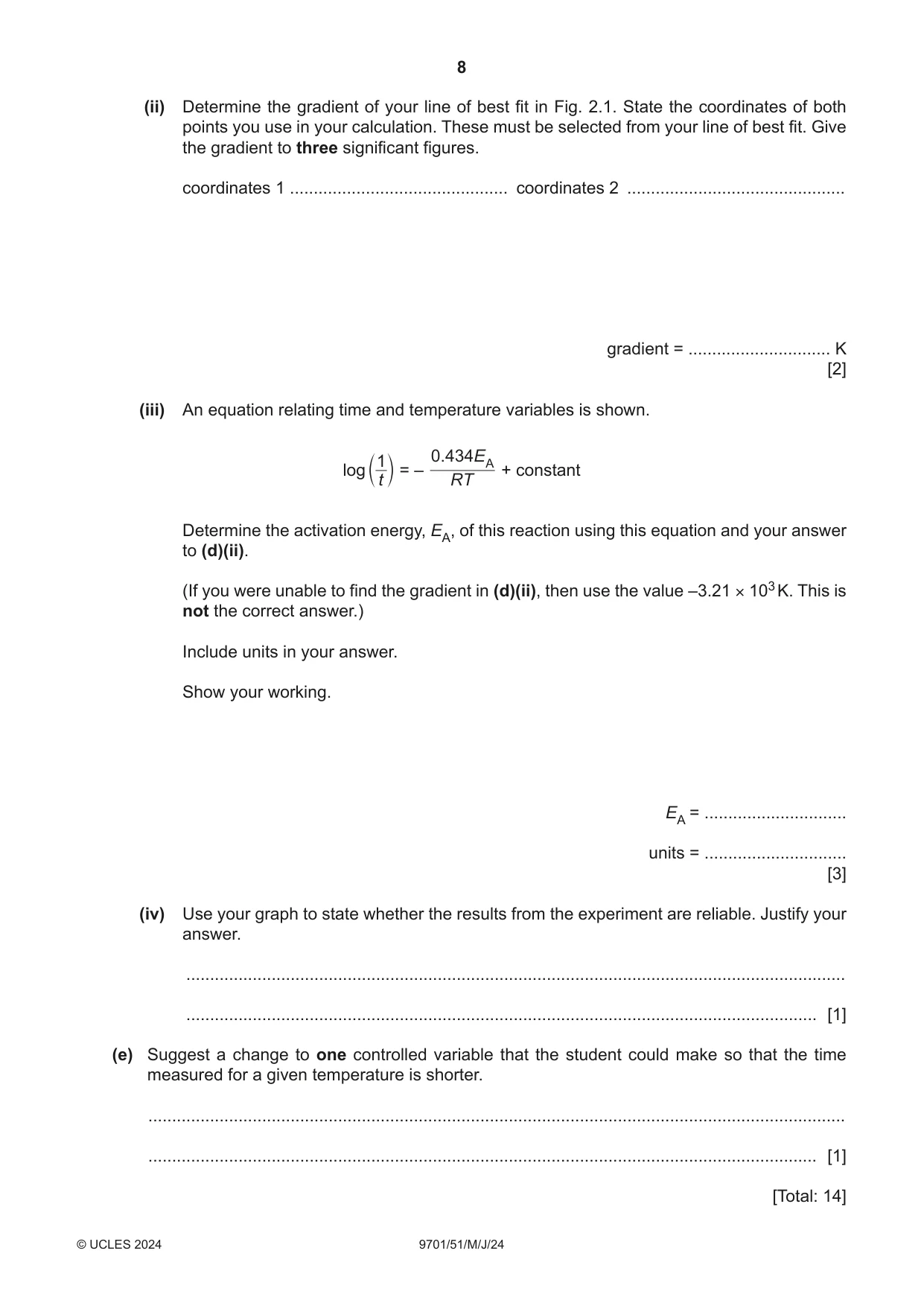
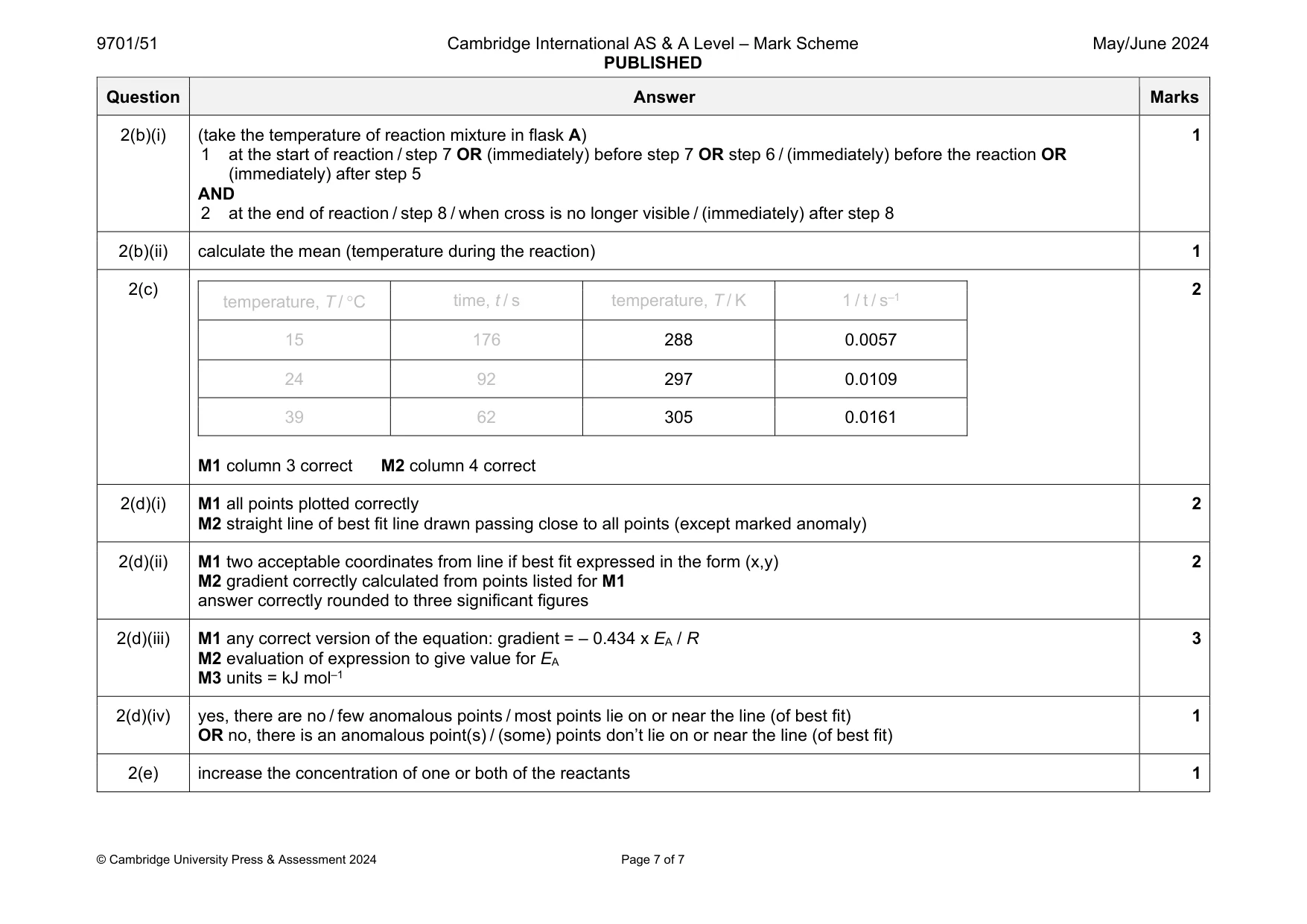
Mark scheme: 2(a) To ensure the solution(s) (in flasks A and B) are at the same temperature (of the water bath) (before mixing) 1 Question Answer Marks 2(b)(i) (take the temperature of reaction mixture in flask A) 1 at the start of reaction / step 7 OR (immediately) before step 7 OR step 6 / (immediately) before the reaction OR (immediately) after step 5 AND 2 at the end of reaction / step 8 / when cross is no longer visible / (immediately) after step 8 1 2(b)(ii) calculate the mean (temperature during the reaction) 1 2(c) temperature, T / C time, t / s temperature, T / K 1 / t / s–1 15 176 288 0.0057 24 92 297 0.0109 39 62 305 0.0161 M1 column 3 correct M2 column 4 correct 2 2(d)(i) M1 all points plotted correctly M2 straight line of best fit line drawn passing close to all points (except marked anomaly) 2 2(d)(ii) M1 two acceptable coordinates from line if best fit expressed in the form (x,y) M2 gradient correctly calculated from points listed for M1 answer correctly rounded to three significant figures 2 2(d)(iii) M1 any correct version of the equation: gradient = – 0.434 x EA / R M2 evaluation of expression to give value for EA M3 units = kJ mol–1 3 2(d)(iv) yes, there are no / few anomalous points / most points lie on or near the line (of best fit) OR no, there is an anomalous point(s) / (some) points don’t lie on or near the line (of best fit) 1 2(e) increase the concentration of one or both of the reactants 1
More questions on Effect of temperature on reaction rates and the concept of activation energy
What was in this paper
The subtopics covered by these 2 questions, and how many questions each got. Open one in a new tab to see every Cambridge question on it.
What you needed in this session
Cambridge’s own grade thresholds for 2024 May/June, Paper 5 · Variant 1. A higher threshold means an easier paper — the bar moves with how the cohort did.