Cambridge A Level Chemistry 9701 — 2019 Feb/March Paper 4 · Variant 2
9701/42/F/M/19 · 7 questions · 100 marks · ≈113 min
The question paper and its mark scheme, free to read here and free to download. This is Cambridge’s own paper, exactly as it was sat.
Question paper20 pages
Mark scheme11 pages
Answers below. Sit the paper first if you are practising.
Questions as text
Q1 · State one natural and one man-made occurrence of oxides of nitrogen
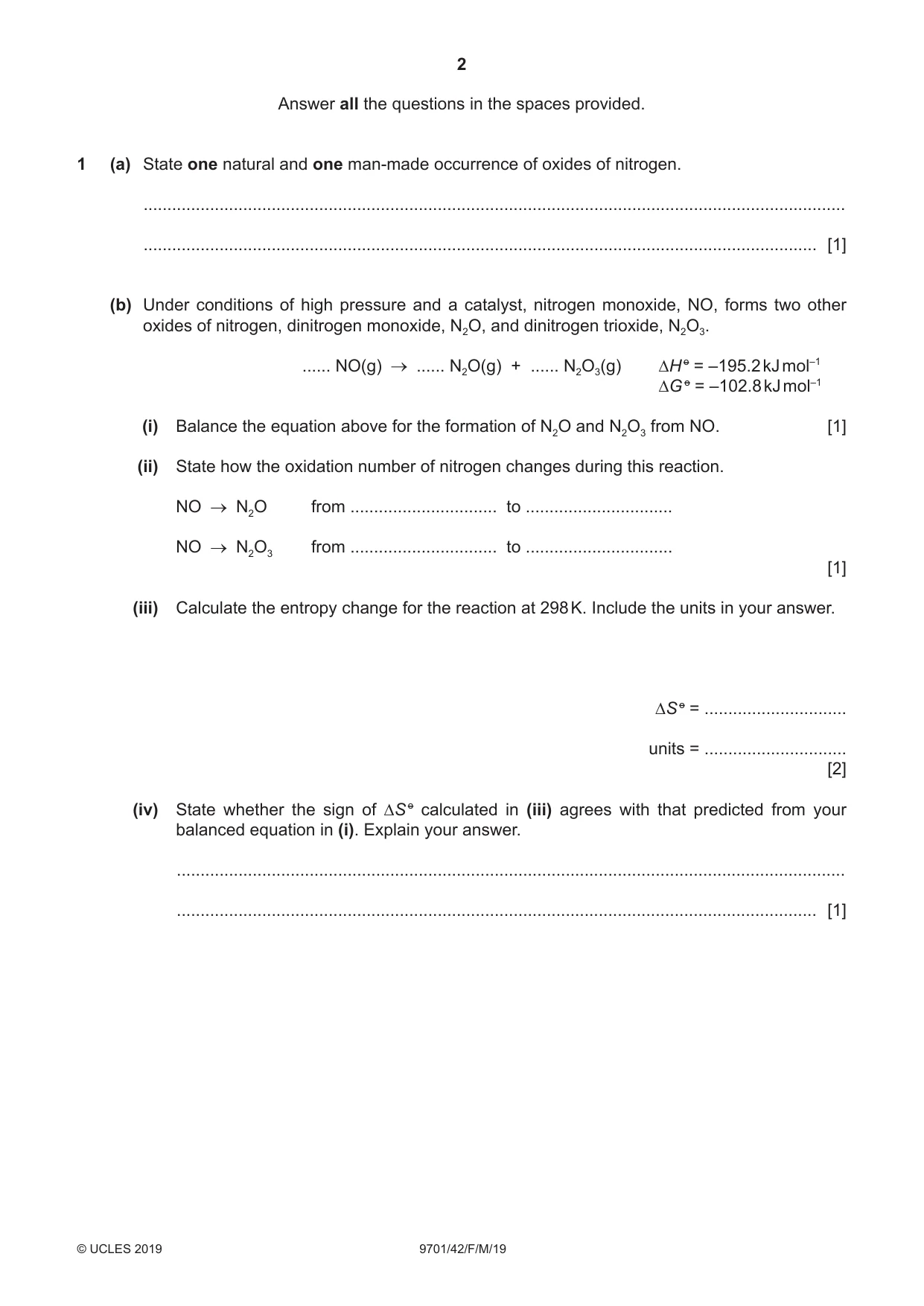
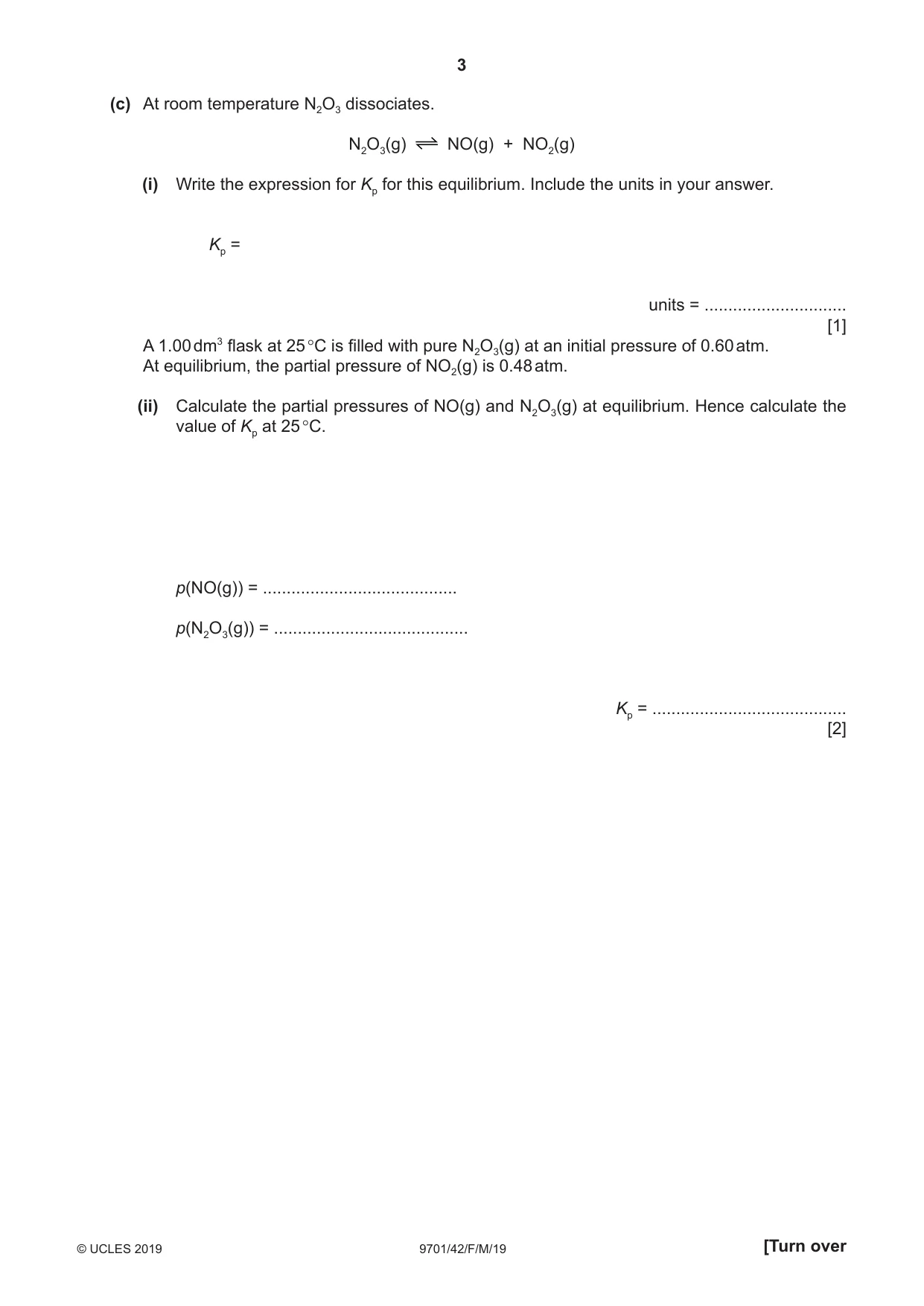
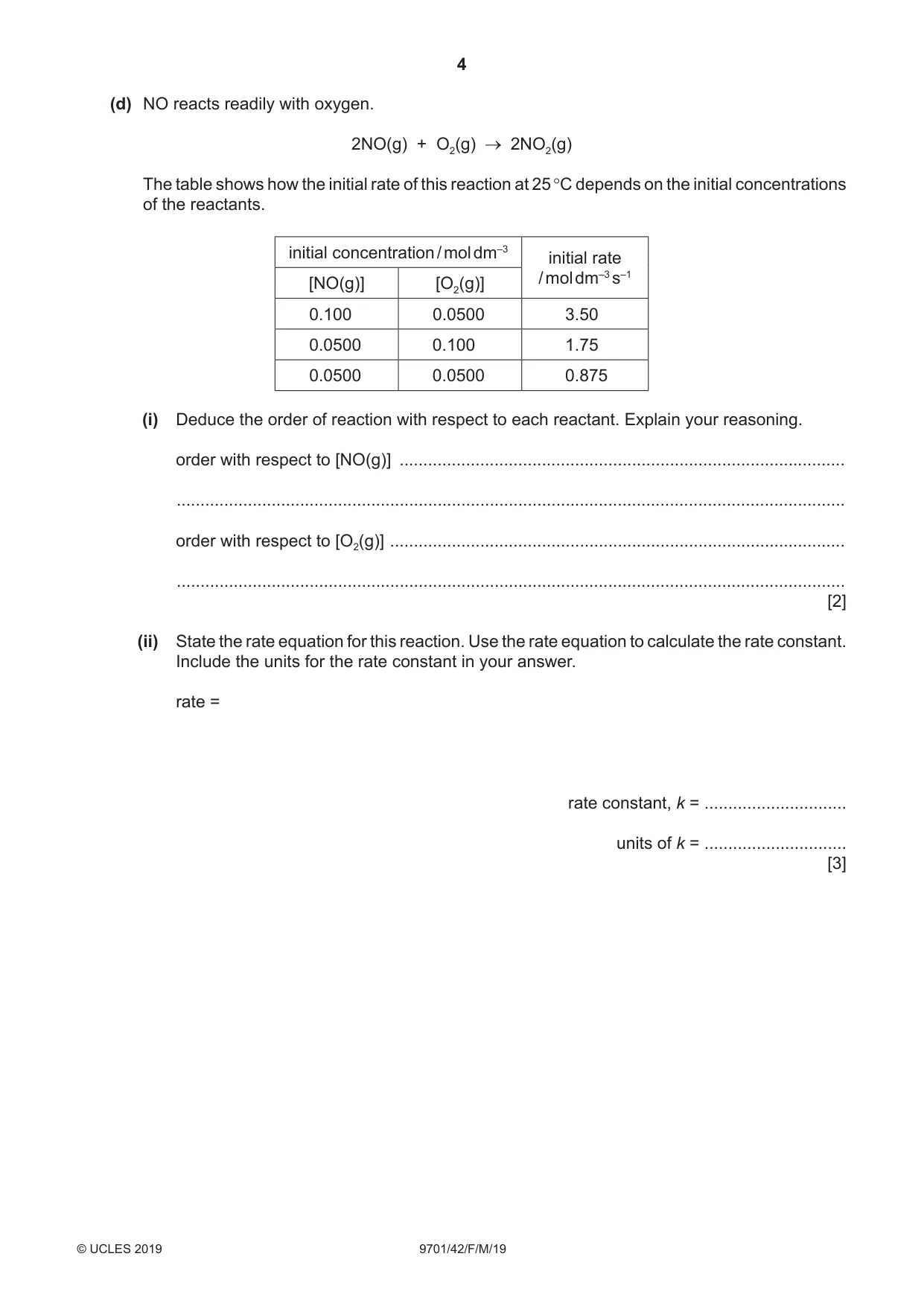
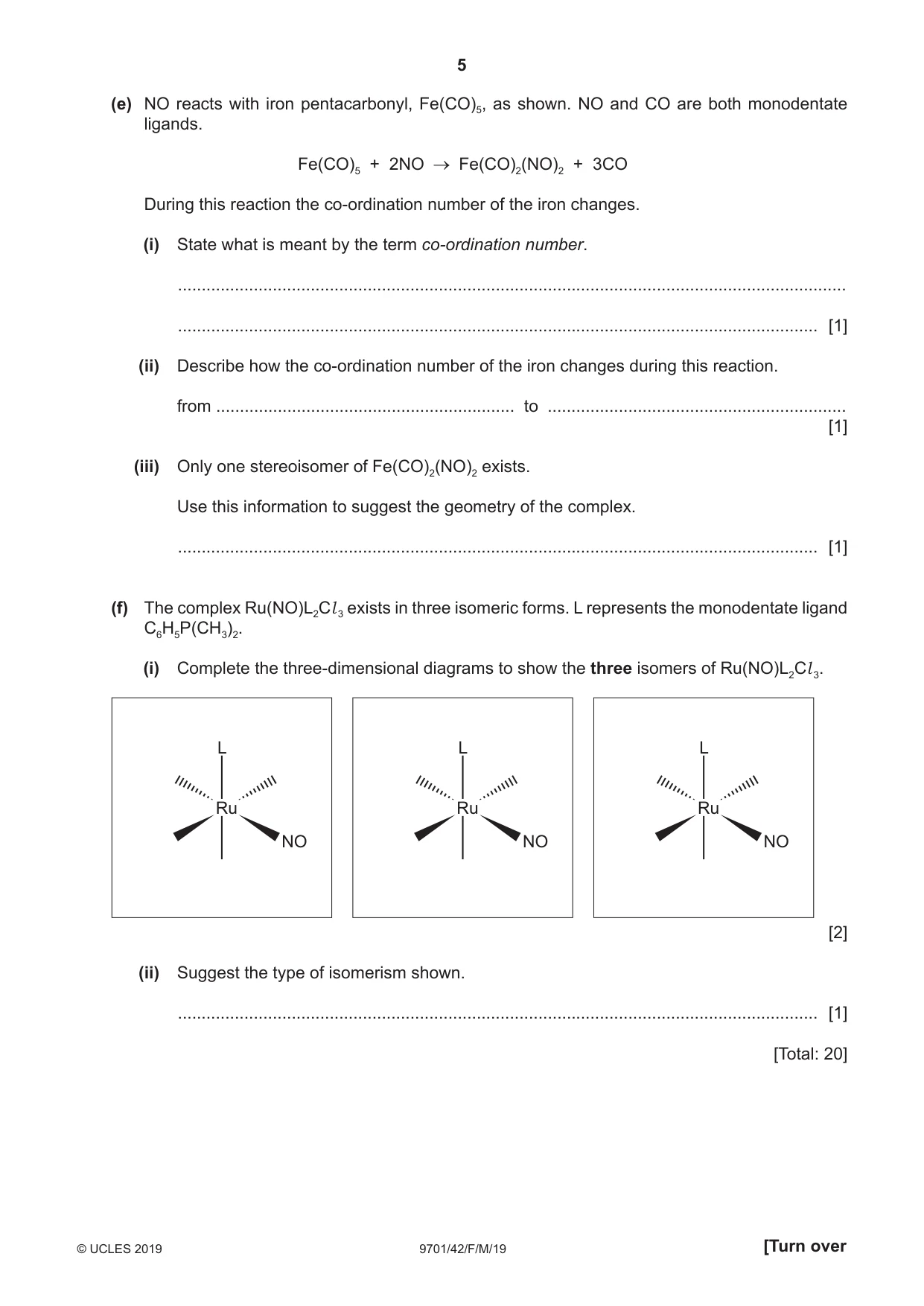
1 (a) State one natural and one man-made occurrence of oxides of nitrogen. .................................................................................................................................................... .............................................................................................................................................. [1] (b) Under conditions of high pressure and a catalyst, nitrogen monoxide, NO, forms two other oxides of nitrogen, dinitrogen monoxide, N2O, and dinitrogen trioxide, N2O3. ...... NO(g) ...... N2O(g) + ...... N2O3(g) ΔH o = –195.2 kJ mol–1 ΔG o = –102.8 kJ mol–1 (i) Balance the equation above for the formation of N2O and N2O3 from NO. [1] (ii) State how the oxidation number of nitrogen changes during this reaction. NO N2O from ............................... to ............................... NO N2O3 from ............................... to ............................... [1] (iii) Calculate the entropy change for the reaction at 298 K. Include the units in your answer. ΔS o = .............................. units = .............................. [2] (iv) State whether the sign of ΔS o calculated in (iii) agrees with that predicted from your balanced equation in (i). Explain your answer. ............................................................................................................................................. ....................................................................................................................................... [1] (c) At room temperature N2O3 dissociates. N2O3(g) NO(g) + NO2(g) (i) Write the expression for Kp for this equilibrium. Include the units in your answer. Kp = units = .............................. [1] A 1.00 dm3 flask at 25 °C is filled with pure N2O3(g) at an initial pressure of 0.60 atm. At equilibrium, the partial pressure of NO2(g) is 0.48 atm. (ii) Calculate the partial pressures of NO(g) and N2O3(g) at equilibrium. Hence calculate the value of Kp at 25 °C. p(NO(g)) = ......................................... p(N2O3(g)) = ......................................... Kp = ......................................... [2] (d) NO reacts readily with oxygen. 2NO(g) + O2(g) 2NO2(g) The table shows how the initial rate of this reaction at 25 °C depends on the initial concentrations of the reactants. initial concentration / mol dm–3 initial rate / mol dm–3 s–1 [NO(g)] [O2(g)] 0.100 0.0500 3.50 0.0500 0.100 1.75 0.0500 0.0500 0.875 (i) Deduce the order of reaction with respect to each reactant. Explain your reasoning. order with respect to [NO(g)] ............................................................................................... ............................................................................................................................................. order with respect to [O2(g)] ................................................................................................ ............................................................................................................................................. [2] (ii) State the rate equation for this reaction. Use the rate equation to calculate the rate constant. Include the units for the rate constant in your answer. rate = rate constant, k = .............................. units of k = .............................. [3] (e) NO reacts with iron pentacarbonyl, Fe(CO)5, as shown. NO and CO are both monodentate ligands. Fe(CO)5 + 2NO Fe(CO)2(NO)2 + 3CO During this reaction the co-ordination number of the iron changes. (i) State what is meant by the term co-ordination number. ............................................................................................................................................. ....................................................................................................................................... [1] (ii) Describe how the co-ordination number of the iron changes during this reaction. from ............................................................... to ................................................................ [1] (iii) Only one stereoisomer of Fe(CO)2(NO)2 exists. Use this information to suggest the geometry of the complex. ....................................................................................................................................... [1] (f) The complex Ru(NO)L2Cl 3 exists in three isomeric forms. L represents the monodentate ligand C6H5P(CH3)2. (i) Complete the three-dimensional diagrams to show the three isomers of Ru(NO)L2Cl 3. L L L Ru Ru Ru NO NO NO [2] (ii) Suggest the type of isomerism shown. ....................................................................................................................................... [1] [Total: 20]
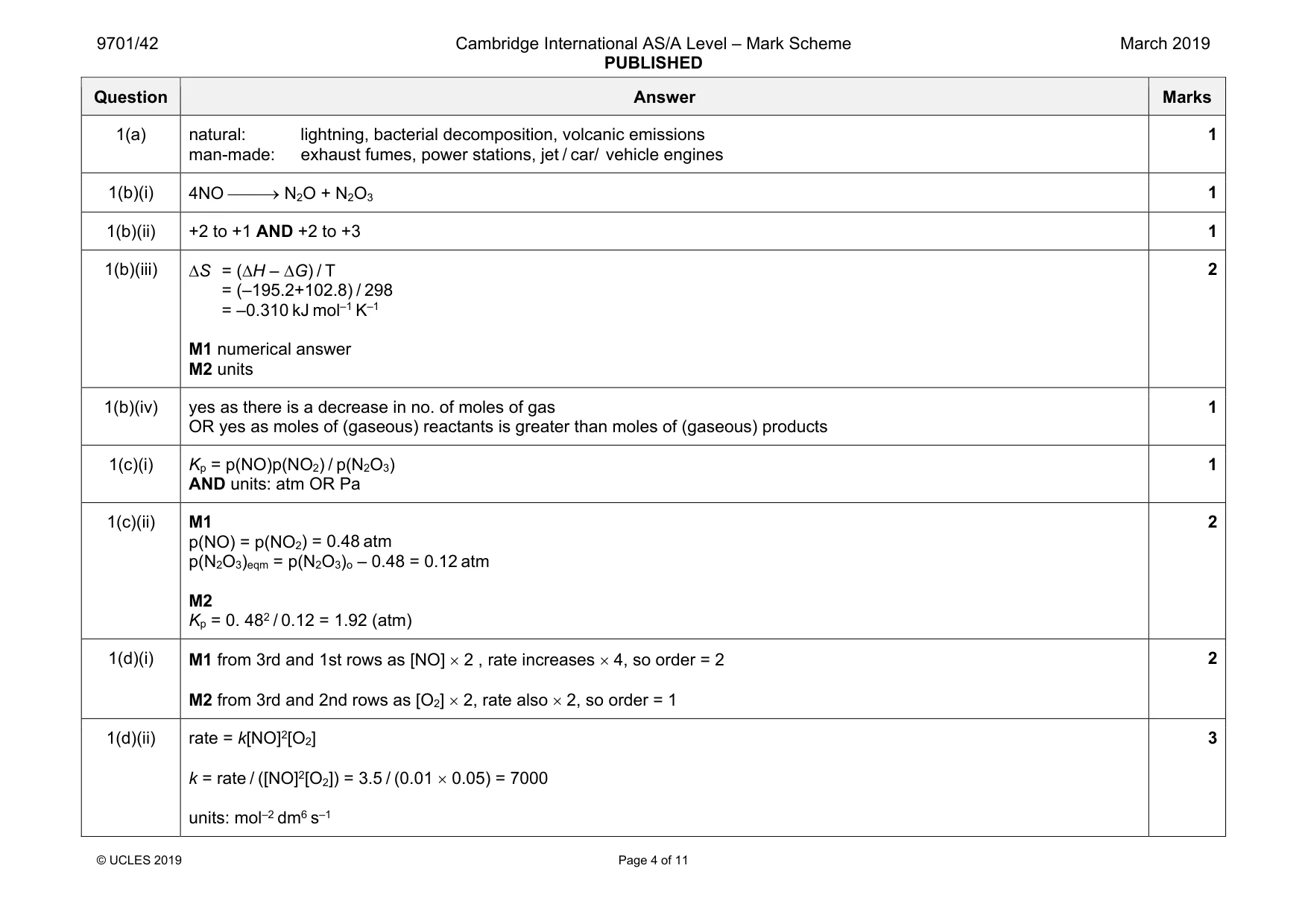
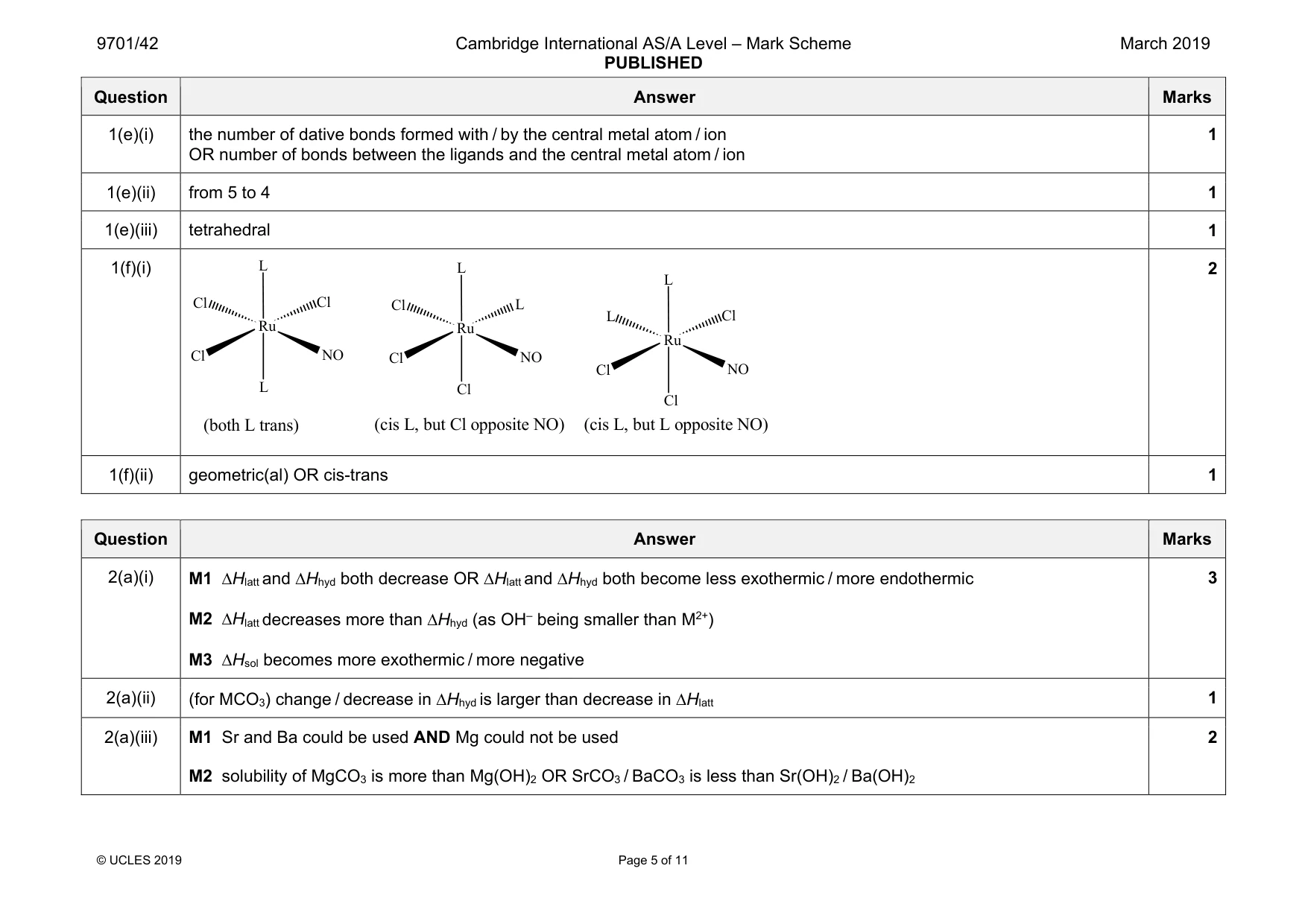
Mark scheme: 1(a) natural: lightning, bacterial decomposition, volcanic emissions man-made: exhaust fumes, power stations, jet / car/ vehicle engines 1 1(b)(i) 4NO → N2O + N2O3 1 1(b)(ii) +2 to +1 AND +2 to +3 1 1(b)(iii) ∆S = (∆H – ∆G) / T = (–195.2+102.8) / 298 = –0.310 kJ mol–1 K–1 M1 numerical answer M2 units 2 1(b)(iv) yes as there is a decrease in no. of moles of gas OR yes as moles of (gaseous) reactants is greater than moles of (gaseous) products 1 1(c)(i) Kp = p(NO)p(NO2) / p(N2O3) AND units: atm OR Pa 1 1(c)(ii) M1 p(NO) = p(NO2) = 0.48 atm p(N2O3)eqm = p(N2O3)o – 0.48 = 0.12 atm M2 Kp = 0. 482 / 0.12 = 1.92 (atm) 2 1(d)(i) M1 from 3rd and 1st rows as [NO] × 2 , rate increases × 4, so order = 2 M2 from 3rd and 2nd rows as [O2] × 2, rate also × 2, so order = 1 2 1(d)(ii) rate = k[NO]2[O2] k = rate / ([NO]2[O2]) = 3.5 / (0.01 × 0.05) = 7000 units: mol–2 dm6 s–1 3 Question Answer Marks 1(e)(i) the number of dative bonds formed with / by the central metal atom / ion OR number of bonds between the ligands and the central metal atom / ion 1 1(e)(ii) from 5 to 4 1 1(e)(iii) tetrahedral 1 1(f)(i) NO Ru Cl Cl Cl L L NO Ru L Cl Cl L Cl NO Ru Cl L Cl L Cl (both L trans) (cis L, but Cl opposite NO) (cis L, but L opposite NO) 2 1(f)(ii) geometric(al) OR cis-trans 1
More questions on Simple rate equations, orders of reaction and rate constants
Q2 · The following table lists the solubilities of the hydroxides and carbonates of some of…
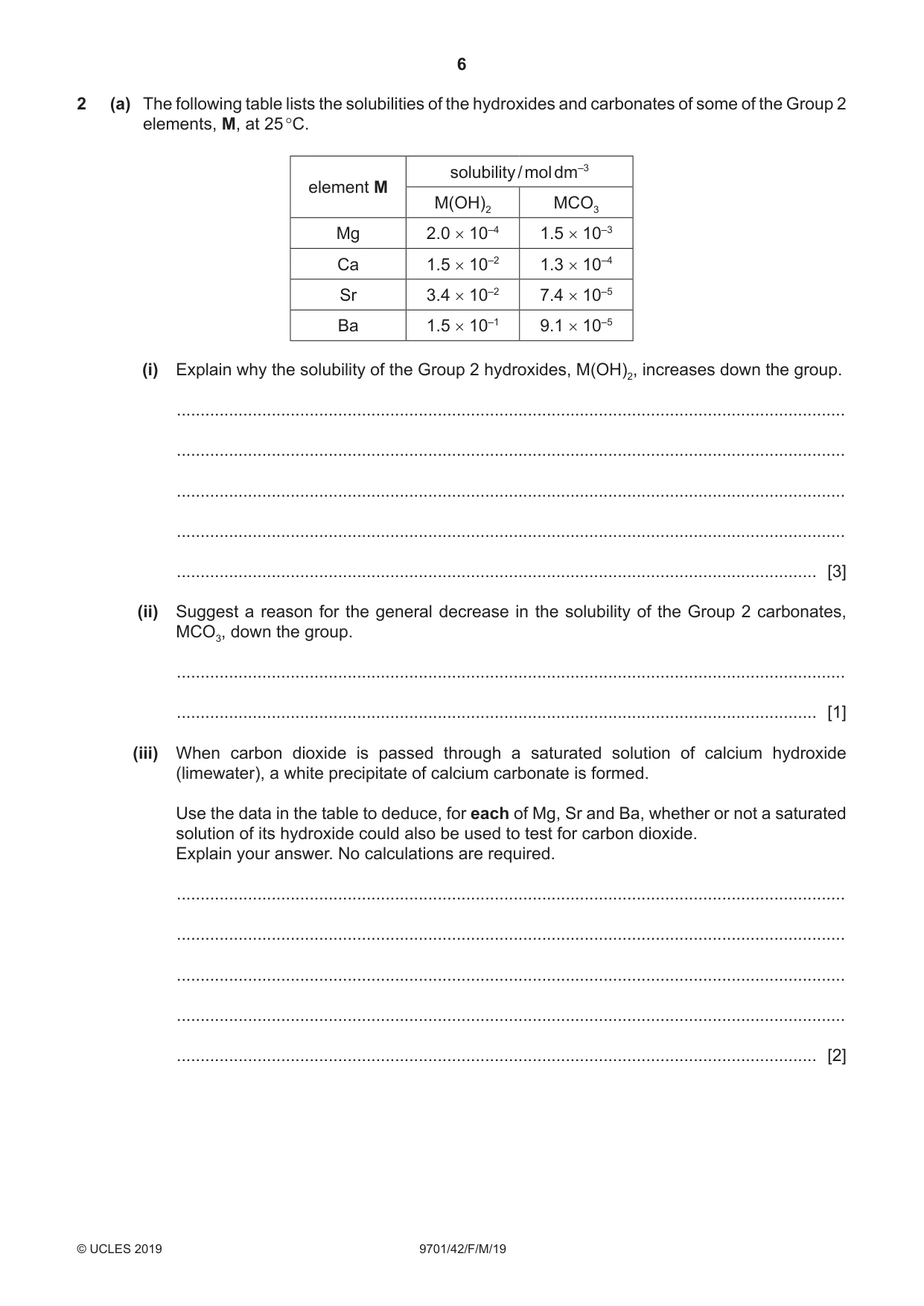
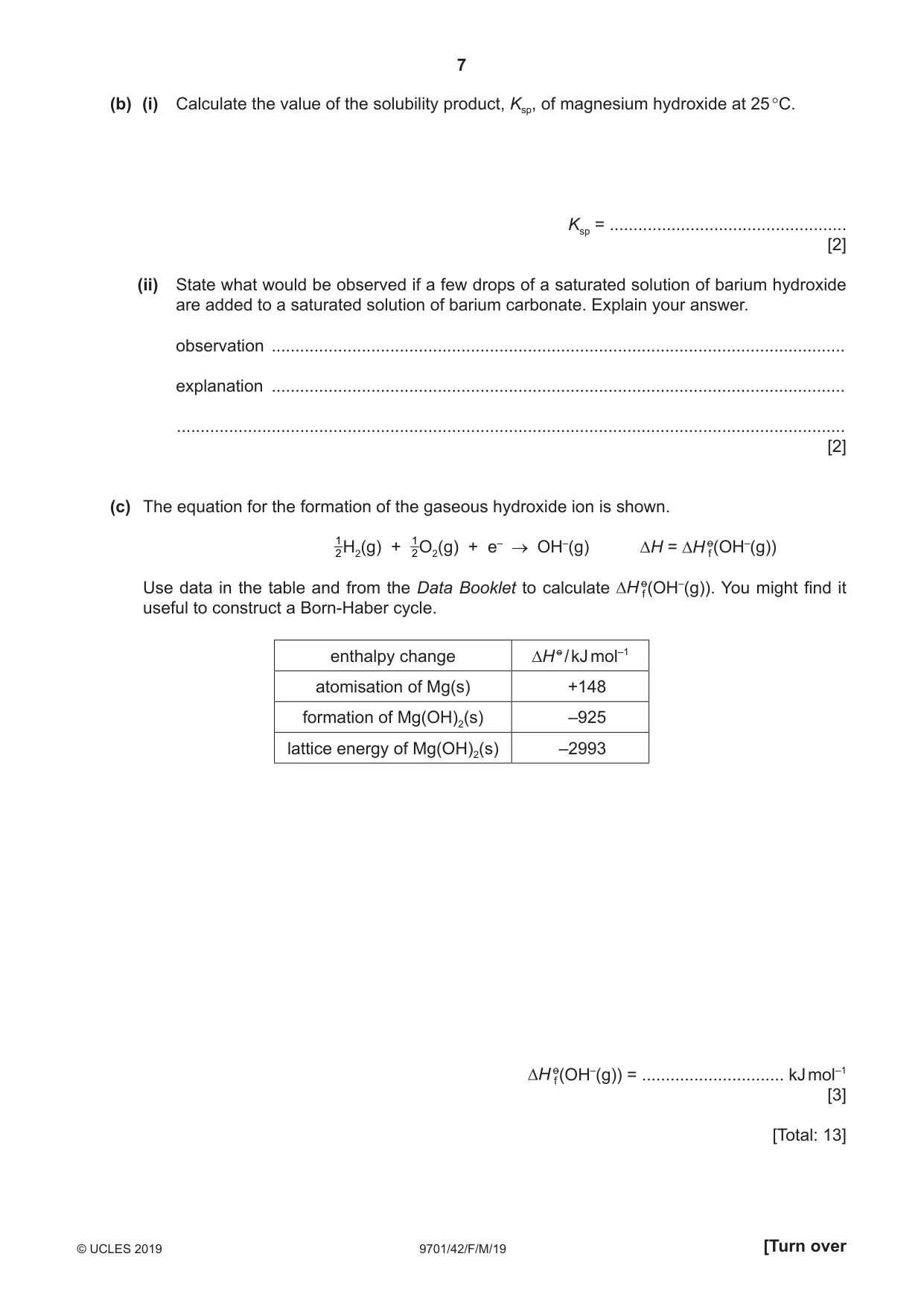
2 (a) The following table lists the solubilities of the hydroxides and carbonates of some of the Group 2 elements, M, at 25 °C. solubility / mol dm–3 element M M(OH)2 MCO3 Mg 2.0 × 10⁻⁴ 1.5 × 10⁻³ Ca 1.5 × 10⁻² 1.3 × 10⁻⁴ Sr 3.4 × 10⁻² 7.4 × 10⁻⁵ Ba 1.5 × 10⁻¹ 9.1 × 10⁻⁵ (i) Explain why the solubility of the Group 2 hydroxides, M(OH)2, increases down the group. ............................................................................................................................................. ............................................................................................................................................. ............................................................................................................................................. ............................................................................................................................................. ....................................................................................................................................... [3] (ii) Suggest a reason for the general decrease in the solubility of the Group 2 carbonates, MCO3, down the group. ............................................................................................................................................. ....................................................................................................................................... [1] (iii) When carbon dioxide is passed through a saturated solution of calcium hydroxide (limewater), a white precipitate of calcium carbonate is formed. Use the data in the table to deduce, for each of Mg, Sr and Ba, whether or not a saturated solution of its hydroxide could also be used to test for carbon dioxide. Explain your answer. No calculations are required. ............................................................................................................................................. ............................................................................................................................................. ............................................................................................................................................. ............................................................................................................................................. ....................................................................................................................................... [2] (b) (i) Calculate the value of the solubility product, Ksp, of magnesium hydroxide at 25 °C. Ksp = .................................................. [2] (ii) State what would be observed if a few drops of a saturated solution of barium hydroxide are added to a saturated solution of barium carbonate. Explain your answer. observation .......................................................................................................................... explanation .......................................................................................................................... ............................................................................................................................................. [2] (c) The equation for the formation of the gaseous hydroxide ion is shown. 12H2(g) + 12O2(g) + e– OH–(g) ΔH = (OH–(g)) Use data in the table and from the Data Booklet to calculate (OH–(g)). You might find it useful to construct a Born-Haber cycle. enthalpy change ΔH o / kJ mol–1 atomisation of Mg(s) +148 formation of Mg(OH)2(s) –925 lattice energy of Mg(OH)2(s) –2993 (OH–(g)) = .............................. kJ mol–1 [3] [Total: 13]
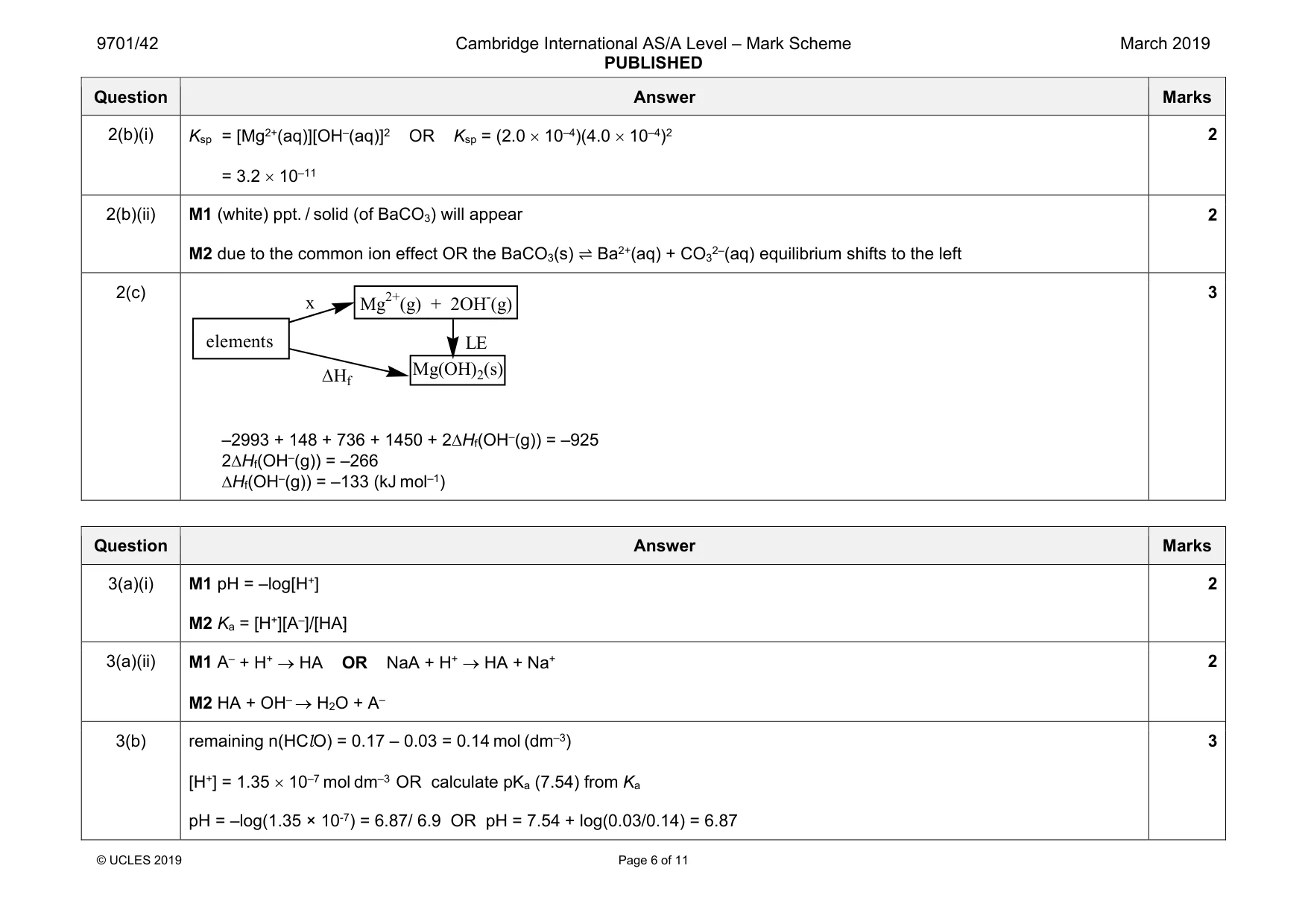
Mark scheme: 2(a)(i) M2 ∆Hlatt decreases more than ∆Hhyd (as OH– being smaller than M2+) M3 ∆Hsol becomes more exothermic / more negative 3 2(a)(ii) (for MCO3) change / decrease in ∆Hhyd is larger than decrease in ∆Hlatt 1 2(a)(iii) M1 Sr and Ba could be used AND Mg could not be used M2 solubility of MgCO3 is more than Mg(OH)2 OR SrCO3 / BaCO3 is less than Sr(OH)2 / Ba(OH)2 2 Question Answer Marks 2(b)(i) Ksp = [Mg2+(aq)][OH–(aq)]2 OR Ksp = (2.0 × 10⁻⁴)(4.0 × 10⁻⁴)2 = 3.2 × 10⁻¹¹ 2 2(b)(ii) M1 (white) ppt. / solid (of BaCO3) will appear M2 due to the common ion effect OR the BaCO3(s) ⇌ Ba2+(aq) + CO32–(aq) equilibrium shifts to the left 2 2(c) Mg2+(g) + 2OH-(g) elements Mg(OH)2(s) ∆Hf LE x –2993 + 148 + 736 + 1450 + 2∆Hf(OH–(g)) = –925 2∆Hf(OH–(g)) = –266 ∆Hf(OH–(g)) = –133 (kJ mol–1) 3
Q3 · Use mathematical expressions to define the following terms
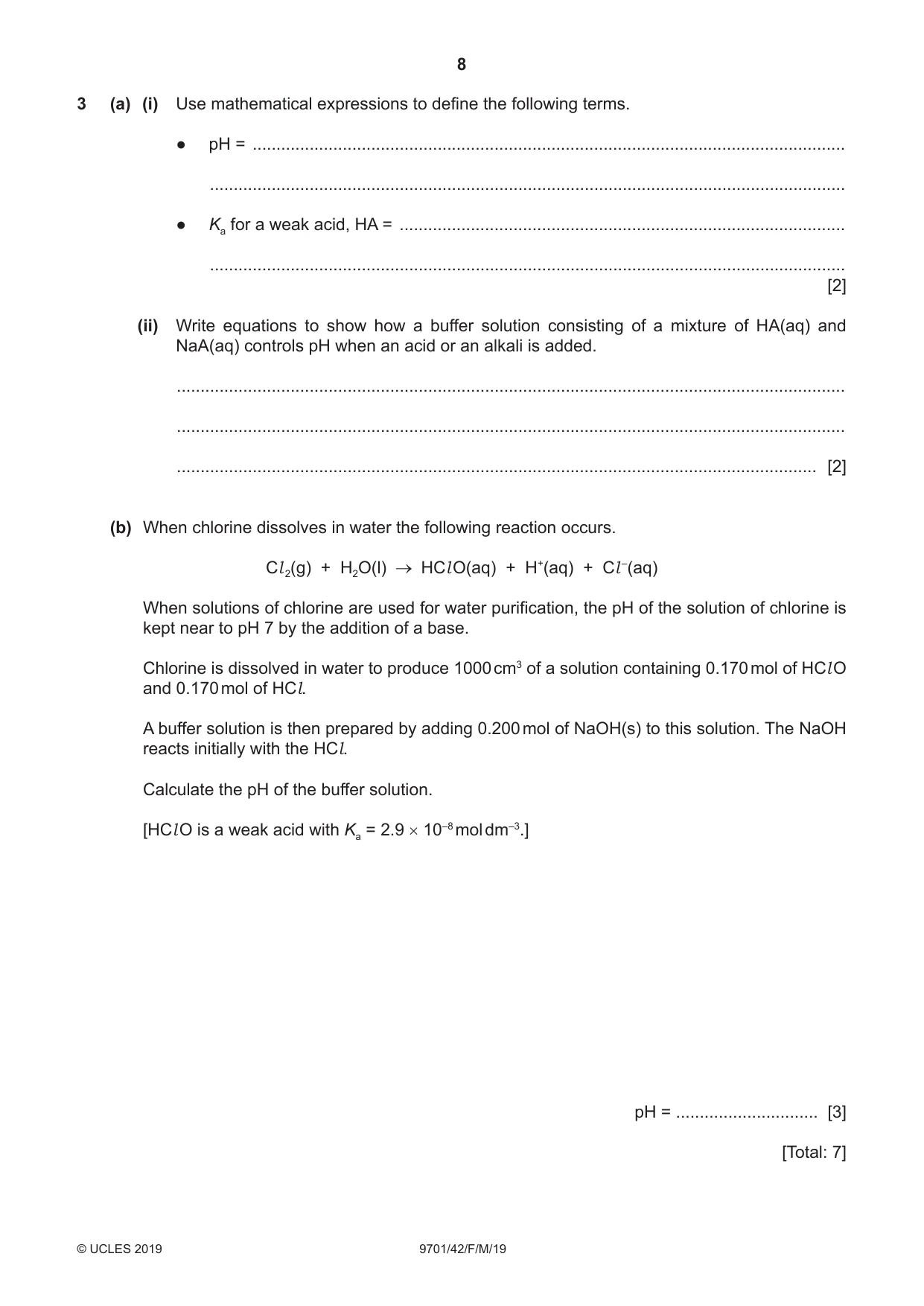
3 (a) (i) Use mathematical expressions to define the following terms. ● pH = .............................................................................................................................. ...................................................................................................................................... ● Ka for a weak acid, HA = ............................................................................................... ...................................................................................................................................... [2] (ii) Write equations to show how a buffer solution consisting of a mixture of HA(aq) and NaA(aq) controls pH when an acid or an alkali is added. ............................................................................................................................................. ............................................................................................................................................. ....................................................................................................................................... [2] (b) When chlorine dissolves in water the following reaction occurs. Cl 2(g) + H2O(l) HCl O(aq) + H+(aq) + Cl –(aq) When solutions of chlorine are used for water purification, the pH of the solution of chlorine is kept near to pH 7 by the addition of a base. Chlorine is dissolved in water to produce 1000 cm3 of a solution containing 0.170 mol of HCl O and 0.170 mol of HCl. A buffer solution is then prepared by adding 0.200 mol of NaOH(s) to this solution. The NaOH reacts initially with the HCl. Calculate the pH of the buffer solution. [HCl O is a weak acid with Ka = 2.9 × 10⁻⁸ mol dm–3.] pH = .............................. [3] [Total: 7]
Mark scheme: 3(a)(i) M1 pH = –log[H+] M2 Ka = [H+][A–]/[HA] 2 3(a)(ii) M1 A– + H+ → HA OR NaA + H+ → HA + Na+ M2 HA + OH– → H2O + A– 2 3(b) remaining n(HClO) = 0.17 – 0.03 = 0.14 mol (dm–3) [H+] = 1.35 × 10⁻⁷ mol dm–3 OR calculate pKa (7.54) from Ka pH = –log(1.35 × 10⁻⁷) = 6.87/ 6.9 OR pH = 7.54 + log(0.03/0.14) = 6.87 3
Q4 · Complete the electronic configuration of a copper atom
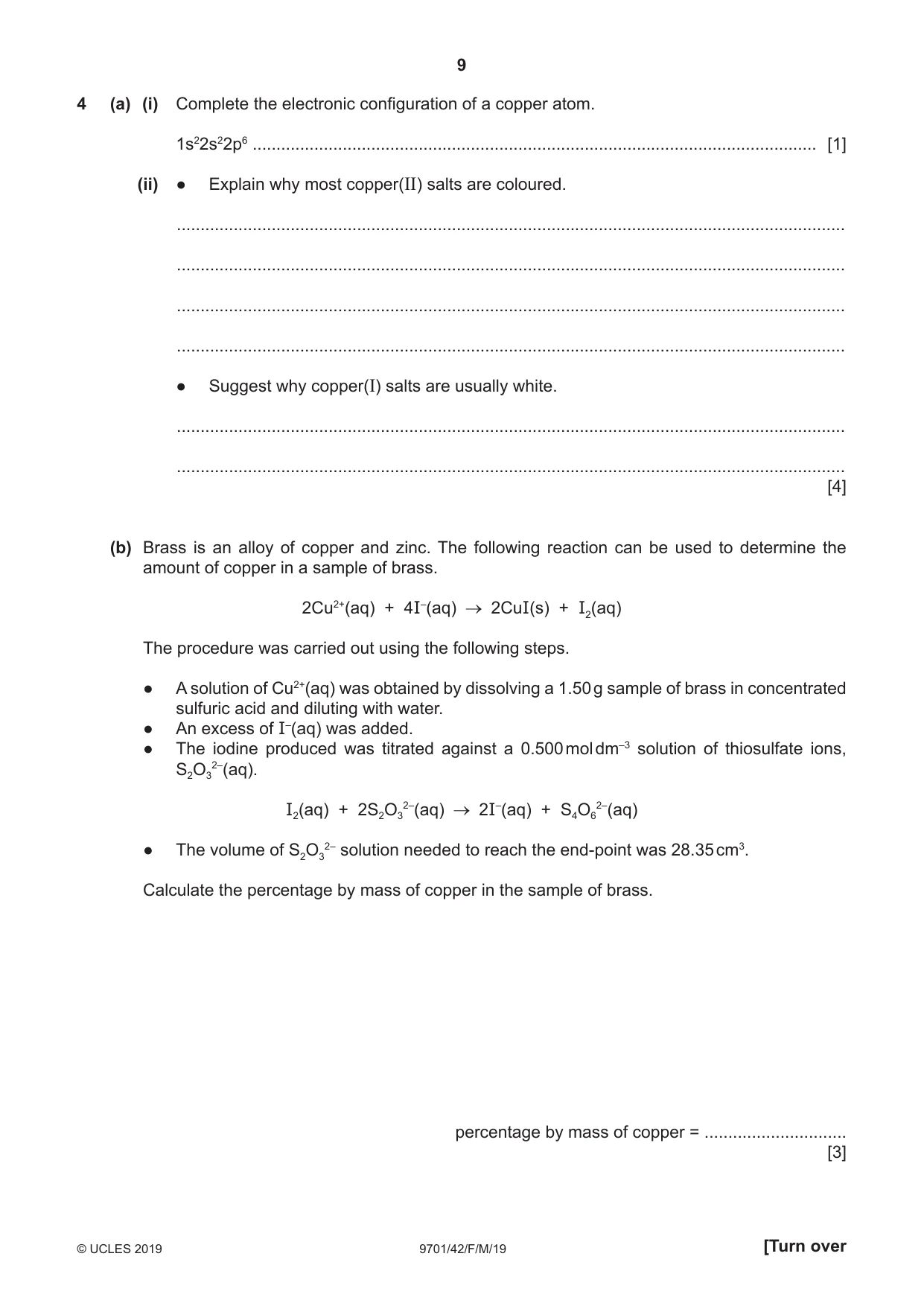
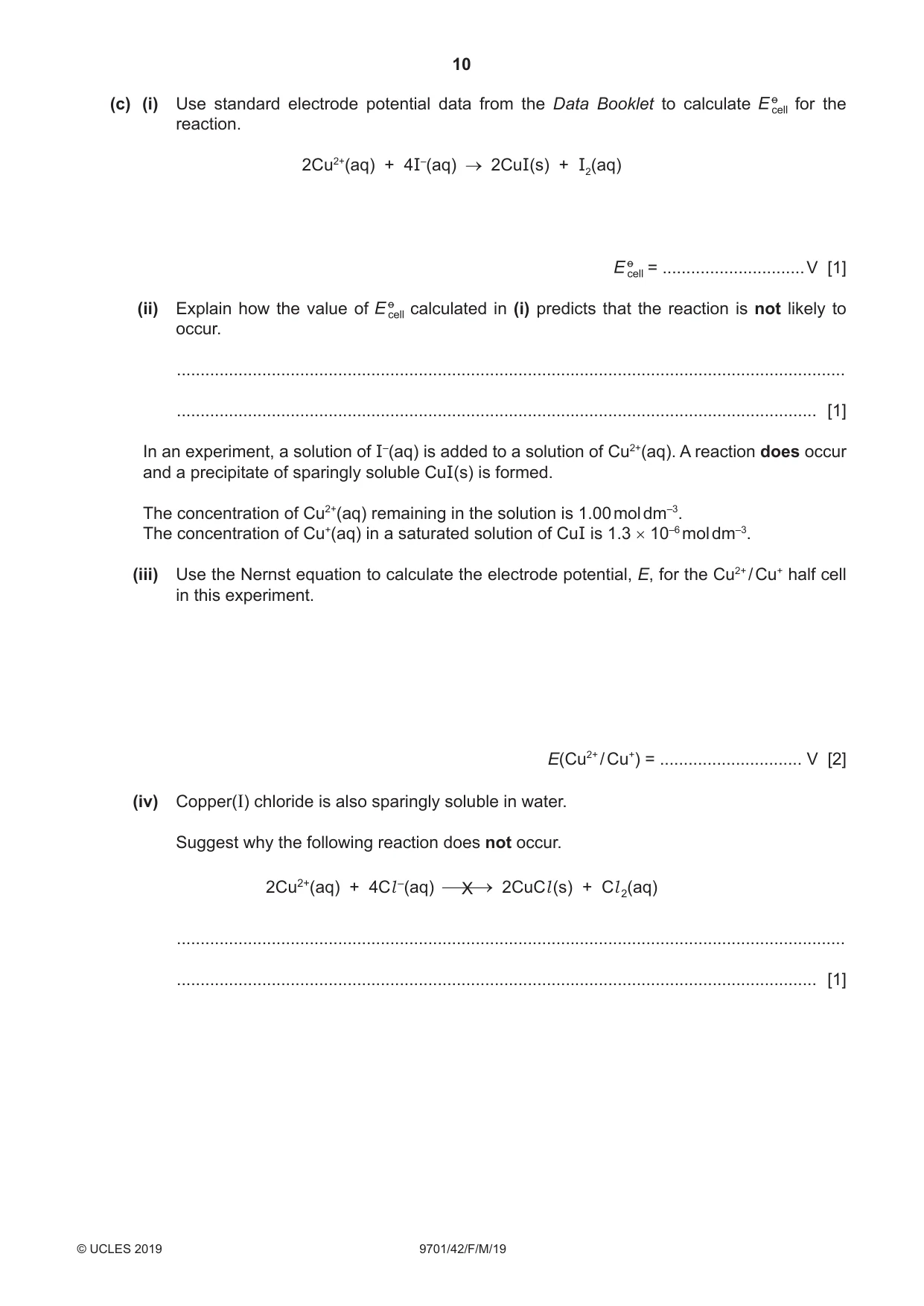
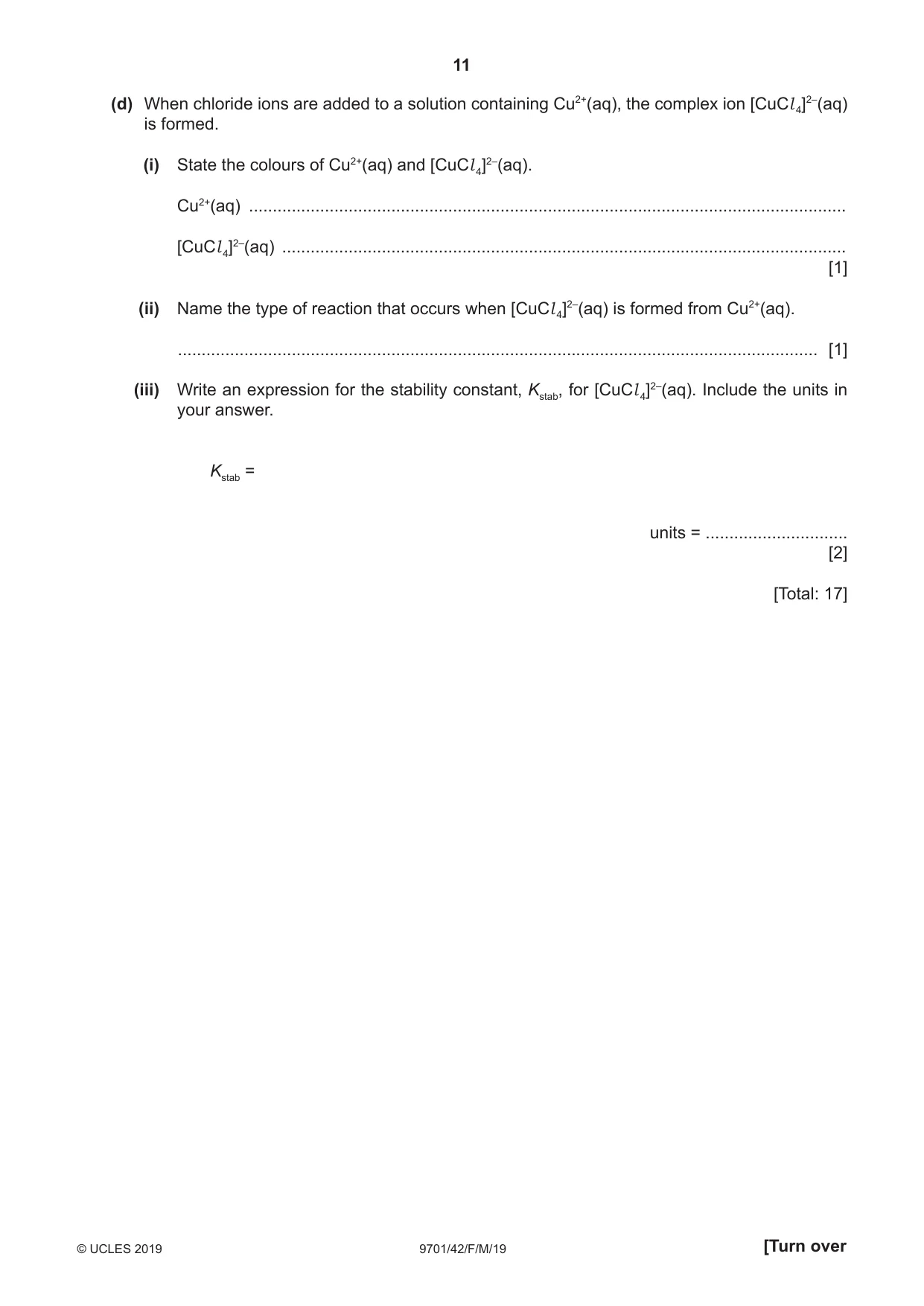
4 (a) (i) Complete the electronic configuration of a copper atom. 1s22s22p6 ....................................................................................................................... [1] (ii) ● Explain why most copper(II) salts are coloured. ............................................................................................................................................. ............................................................................................................................................. ............................................................................................................................................. ............................................................................................................................................. ● Suggest why copper(I) salts are usually white. ............................................................................................................................................. ............................................................................................................................................. [4] (b) Brass is an alloy of copper and zinc. The following reaction can be used to determine the amount of copper in a sample of brass. 2Cu2+(aq) + 4I–(aq) 2CuI(s) + I2(aq) The procedure was carried out using the following steps. ●● A solution of Cu2+(aq) was obtained by dissolving a 1.50 g sample of brass in concentrated sulfuric acid and diluting with water. ●● An excess of I–(aq) was added. ●● The iodine produced was titrated against a 0.500 mol dm–3 solution of thiosulfate ions, S2O32–(aq). I2(aq) + 2S2O32–(aq) 2I–(aq) + S4O62–(aq) ●● The volume of S2O32– solution needed to reach the end-point was 28.35 cm3. Calculate the percentage by mass of copper in the sample of brass. percentage by mass of copper = .............................. [3] (c) (i) Use standard electrode potential data from the Data Booklet to calculate for the reaction. 2Cu2+(aq) + 4I–(aq) 2CuI(s) + I2(aq) = .............................. V [1] (ii) Explain how the value of calculated in (i) predicts that the reaction is not likely to occur. ............................................................................................................................................. ....................................................................................................................................... [1] In an experiment, a solution of I–(aq) is added to a solution of Cu2+(aq). A reaction does occur and a precipitate of sparingly soluble CuI(s) is formed. The concentration of Cu2+(aq) remaining in the solution is 1.00 mol dm–3. The concentration of Cu+(aq) in a saturated solution of CuI is 1.3 × 10⁻⁶ mol dm–3. (iii) Use the Nernst equation to calculate the electrode potential, E, for the Cu2+ / Cu+ half cell in this experiment. E(Cu2+ / Cu+) = .............................. V [2] (iv) Copper(I) chloride is also sparingly soluble in water. Suggest why the following reaction does not occur. 2Cu2+(aq) + 4Cl –(aq) X 2CuCl (s) + Cl 2(aq) ............................................................................................................................................. ....................................................................................................................................... [1] (d) When chloride ions are added to a solution containing Cu2+(aq), the complex ion [CuCl 4]2–(aq) is formed. (i) State the colours of Cu2+(aq) and [CuCl 4]2–(aq). Cu2+(aq) ............................................................................................................................... [CuCl 4]2–(aq) ........................................................................................................................ [1] (ii) Name the type of reaction that occurs when [CuCl 4]2–(aq) is formed from Cu2+(aq). ....................................................................................................................................... [1] (iii) Write an expression for the stability constant, Kstab, for [CuCl 4]2–(aq). Include the units in your answer. Kstab = units = .............................. [2] [Total: 17]
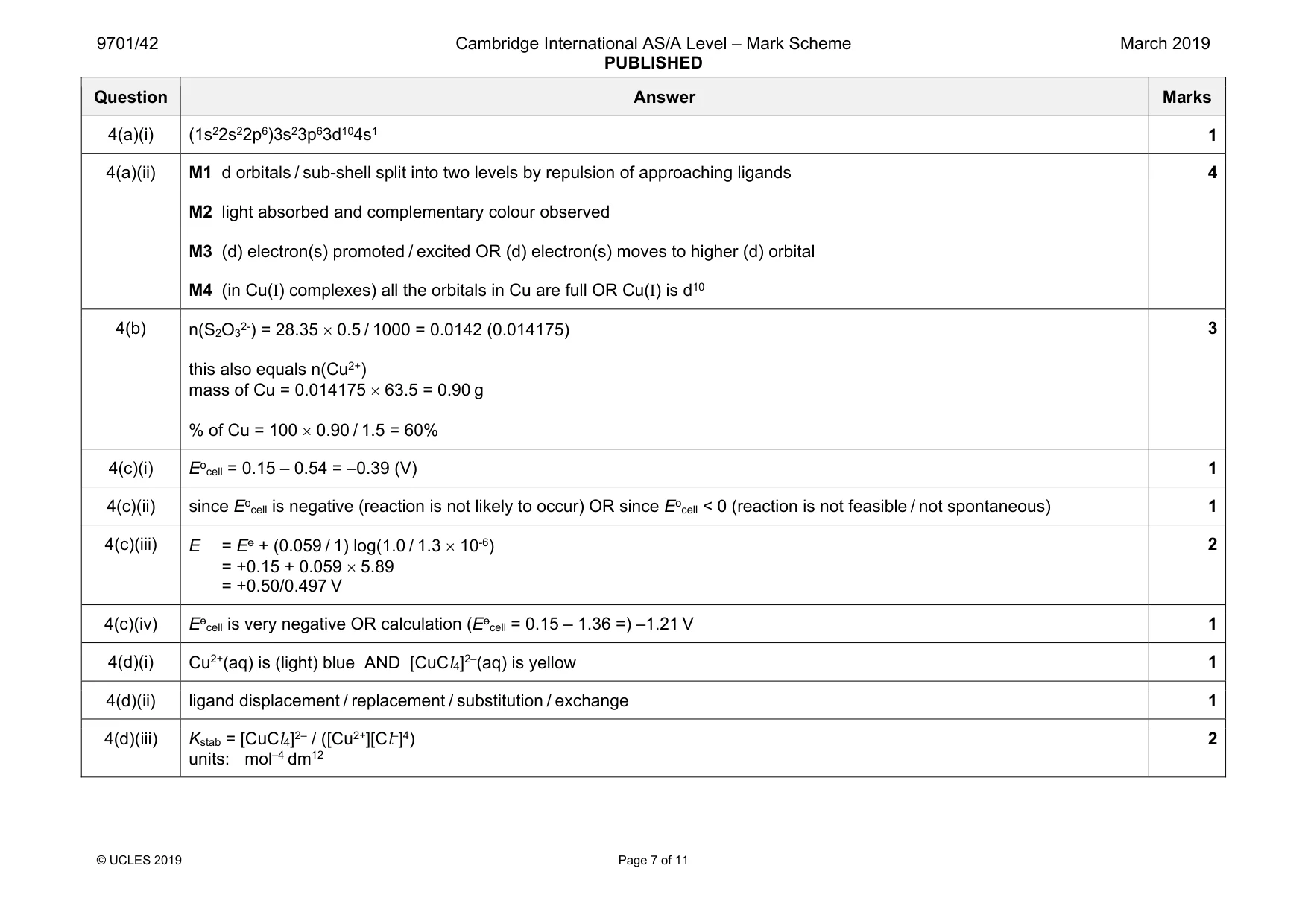
Mark scheme: 4(a)(i) (1s22s22p6)3s23p63d104s1 1 4(a)(ii) M1 d orbitals / sub-shell split into two levels by repulsion of approaching ligands M2 light absorbed and complementary colour observed M3 (d) electron(s) promoted / excited OR (d) electron(s) moves to higher (d) orbital M4 (in Cu(I) complexes) all the orbitals in Cu are full OR Cu(I) is d10 4 4(b) n(S2O32-) = 28.35 × 0.5 / 1000 = 0.0142 (0.014175) this also equals n(Cu2+) mass of Cu = 0.014175 × 63.5 = 0.90 g % of Cu = 100 × 0.90 / 1.5 = 60% 3 4(c)(i) Eocell = 0.15 – 0.54 = –0.39 (V) 1 4(c)(ii) since Eocell is negative (reaction is not likely to occur) OR since Eocell < 0 (reaction is not feasible / not spontaneous) 1 4(c)(iii) E = Eo + (0.059 / 1) log(1.0 / 1.3 × 10⁻⁶) = +0.15 + 0.059 × 5.89 = +0.50/0.497 V 2 4(c)(iv) Eocell is very negative OR calculation (Eocell = 0.15 – 1.36 =) –1.21 V 1 4(d)(i) Cu2+(aq) is (light) blue AND [CuCl4]2–(aq) is yellow 1 4(d)(ii) ligand displacement / replacement / substitution / exchange 1 4(d)(iii) Kstab = [CuCl4]2– / ([Cu2+][Cl–]4) units: mol–4 dm12 2
More questions on Electrons, energy levels and atomic orbitals
Q5 · Methyl 2-cyanoprop-2-enoate, W, is the major component of Super Glue, a rapid-setting…
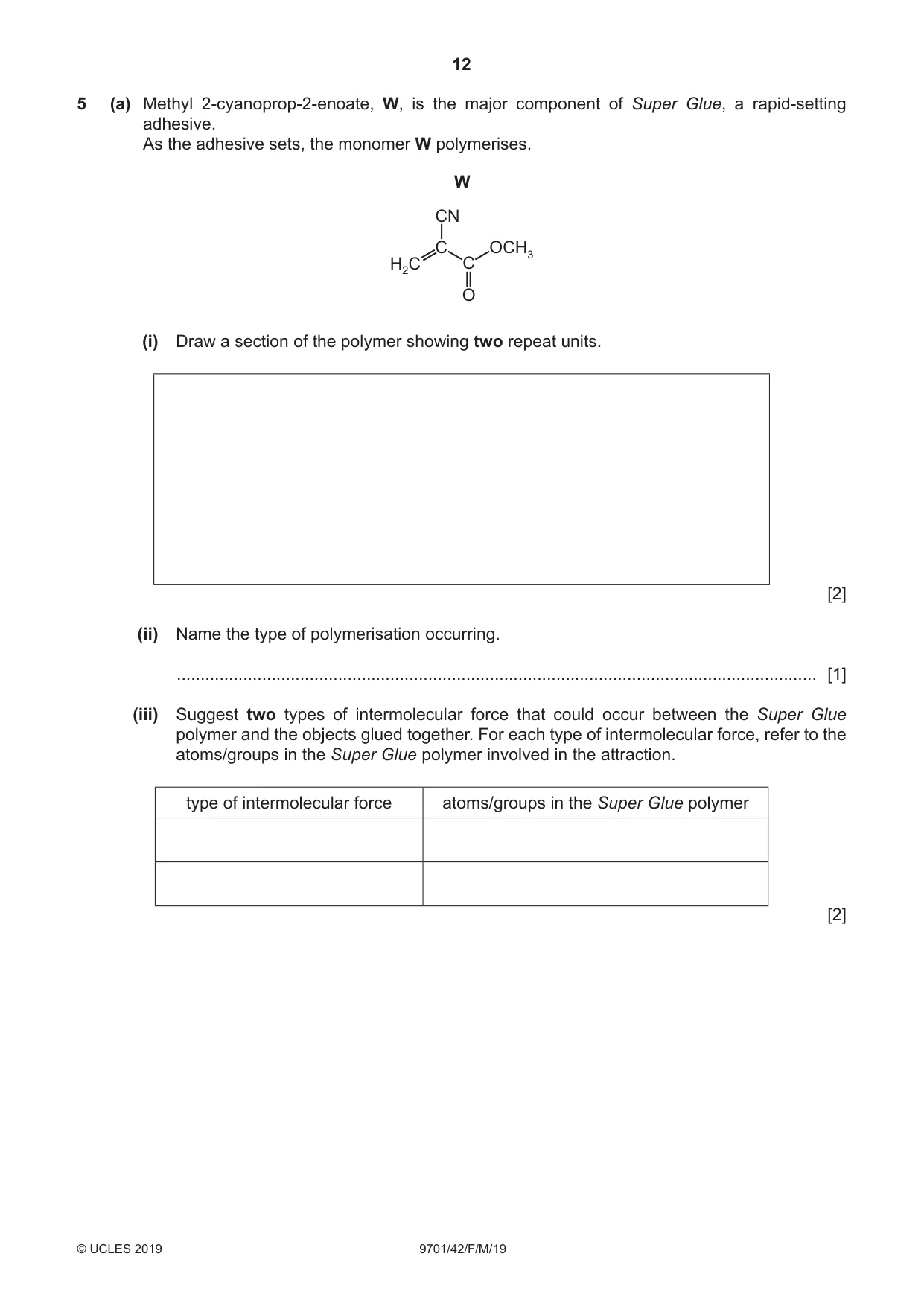
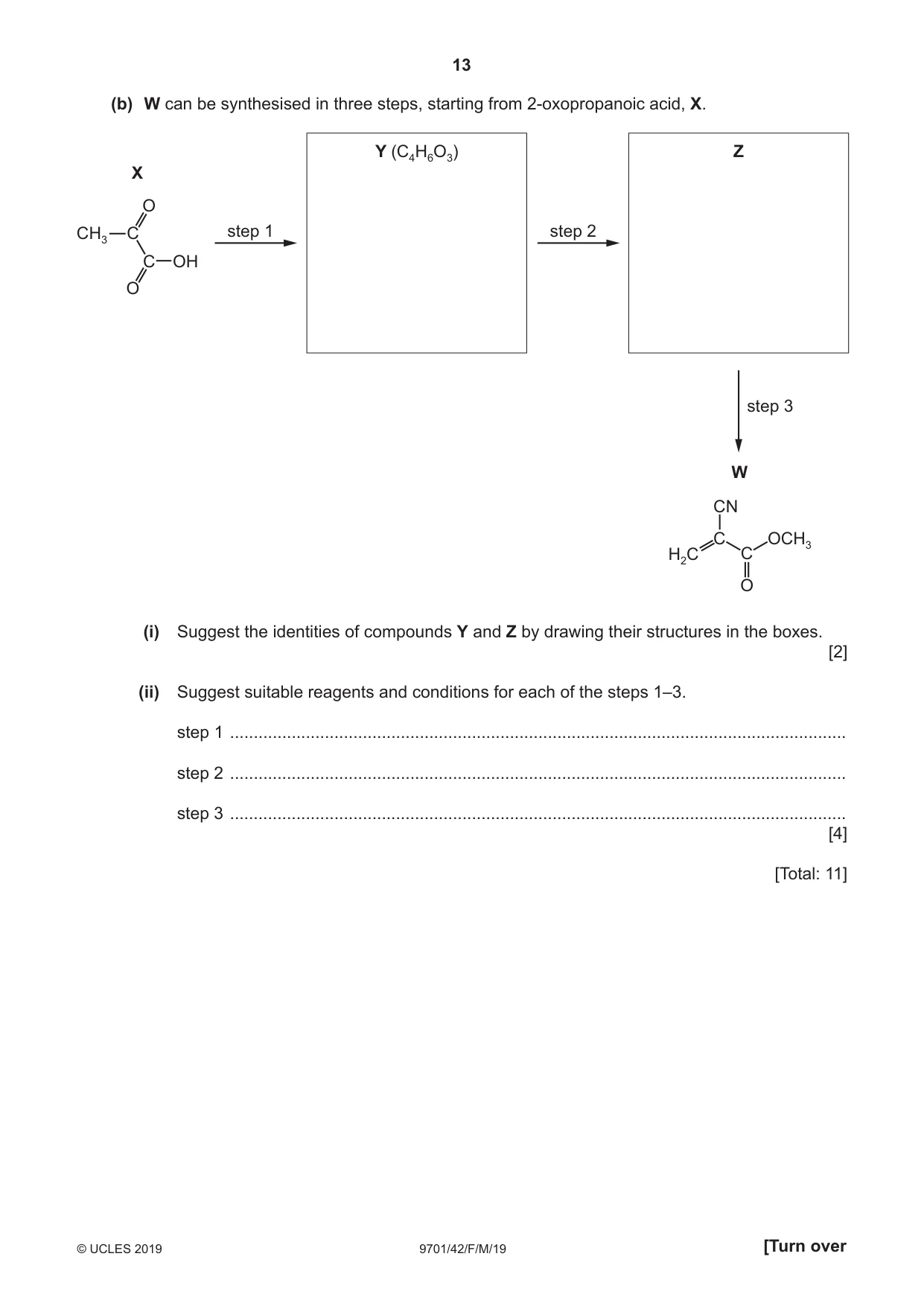
5 (a) Methyl 2-cyanoprop-2-enoate, W, is the major component of Super Glue, a rapid-setting adhesive. As the adhesive sets, the monomer W polymerises. W CN C OCH3 H2C C O (i) Draw a section of the polymer showing two repeat units. [2] (ii) Name the type of polymerisation occurring. ....................................................................................................................................... [1] (iii) Suggest two types of intermolecular force that could occur between the Super Glue polymer and the objects glued together. For each type of intermolecular force, refer to the atoms/groups in the Super Glue polymer involved in the attraction. type of intermolecular force atoms/groups in the Super Glue polymer [2] (b) W can be synthesised in three steps, starting from 2-oxopropanoic acid, X. Y (C4H6O3) Z X O CH3 C step 1 step 2 C OH O step 3 W CN C OCH3 H2C C O (i) Suggest the identities of compounds Y and Z by drawing their structures in the boxes. [2] (ii) Suggest suitable reagents and conditions for each of the steps 1–3. step 1 .................................................................................................................................. step 2 .................................................................................................................................. step 3 .................................................................................................................................. [4] [Total: 11]
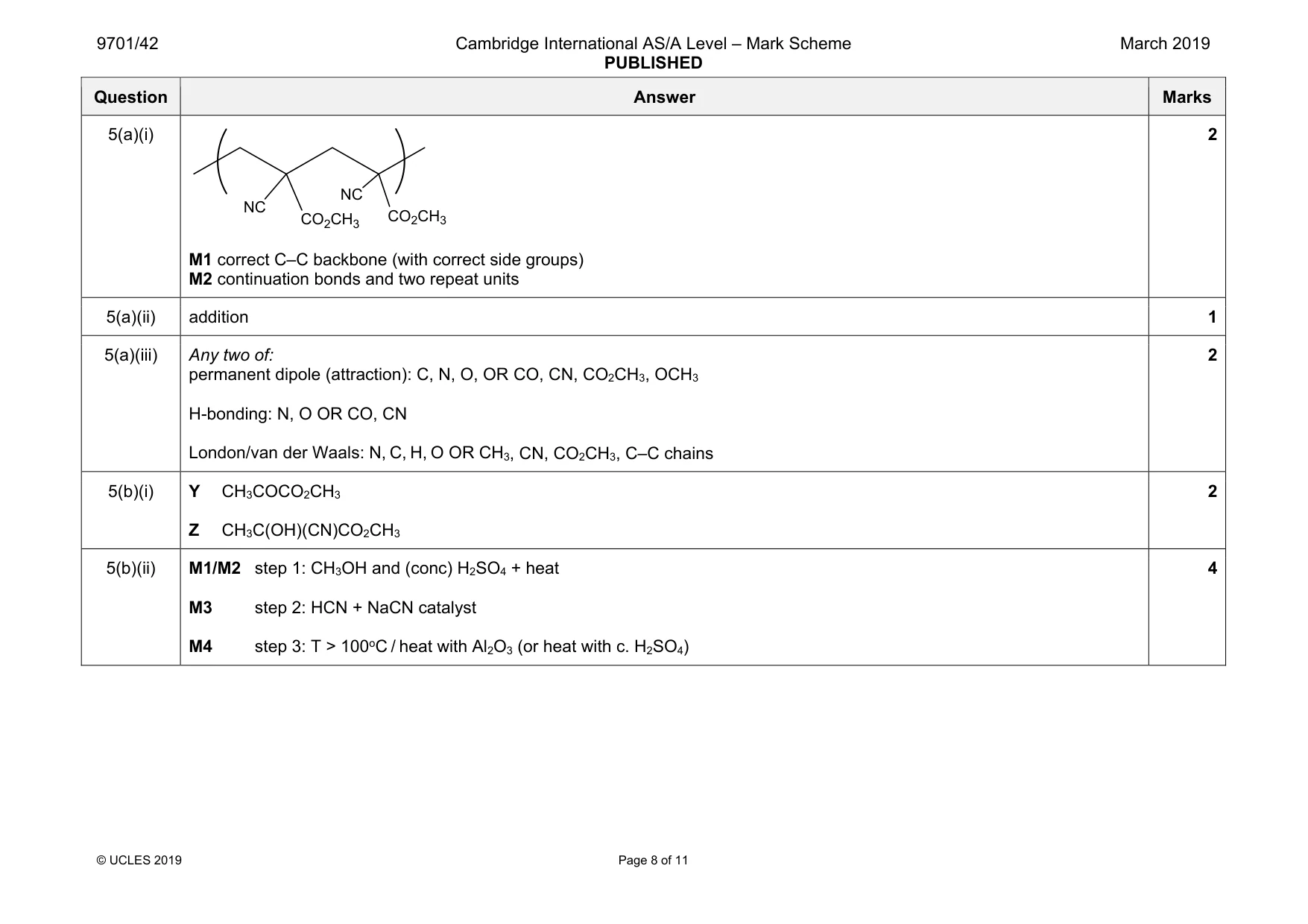
Mark scheme: 5(a)(i) NC CO2CH3 NC CO2CH3 M1 correct C–C backbone (with correct side groups) M2 continuation bonds and two repeat units 2 5(a)(ii) addition 1 5(a)(iii) Any two of: permanent dipole (attraction): C, N, O, OR CO, CN, CO2CH3, OCH3 H-bonding: N, O OR CO, CN London/van der Waals: N, C, H, O OR CH3, CN, CO2CH3, C–C chains 2 5(b)(i) Y CH3COCO2CH3 Z CH3C(OH)(CN)CO2CH3 2 5(b)(ii) M1/M2 step 1: CH3OH and (conc) H2SO4 + heat M3 step 2: HCN + NaCN catalyst M4 step 3: T > 100oC / heat with Al2O3 (or heat with c. H2SO4) 4
Q6 · The names of many drugs used in medicine often include parts of the names of the…
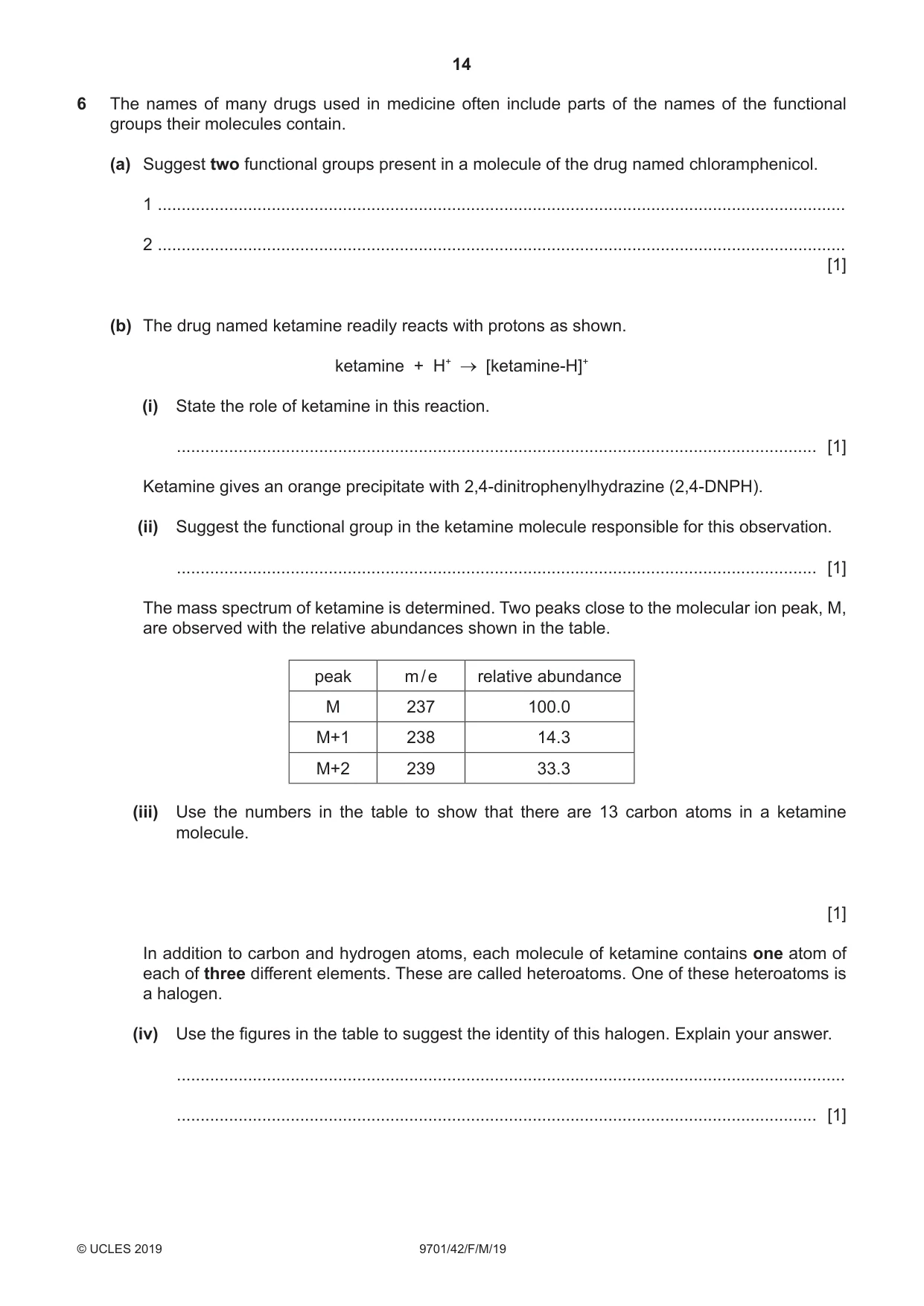
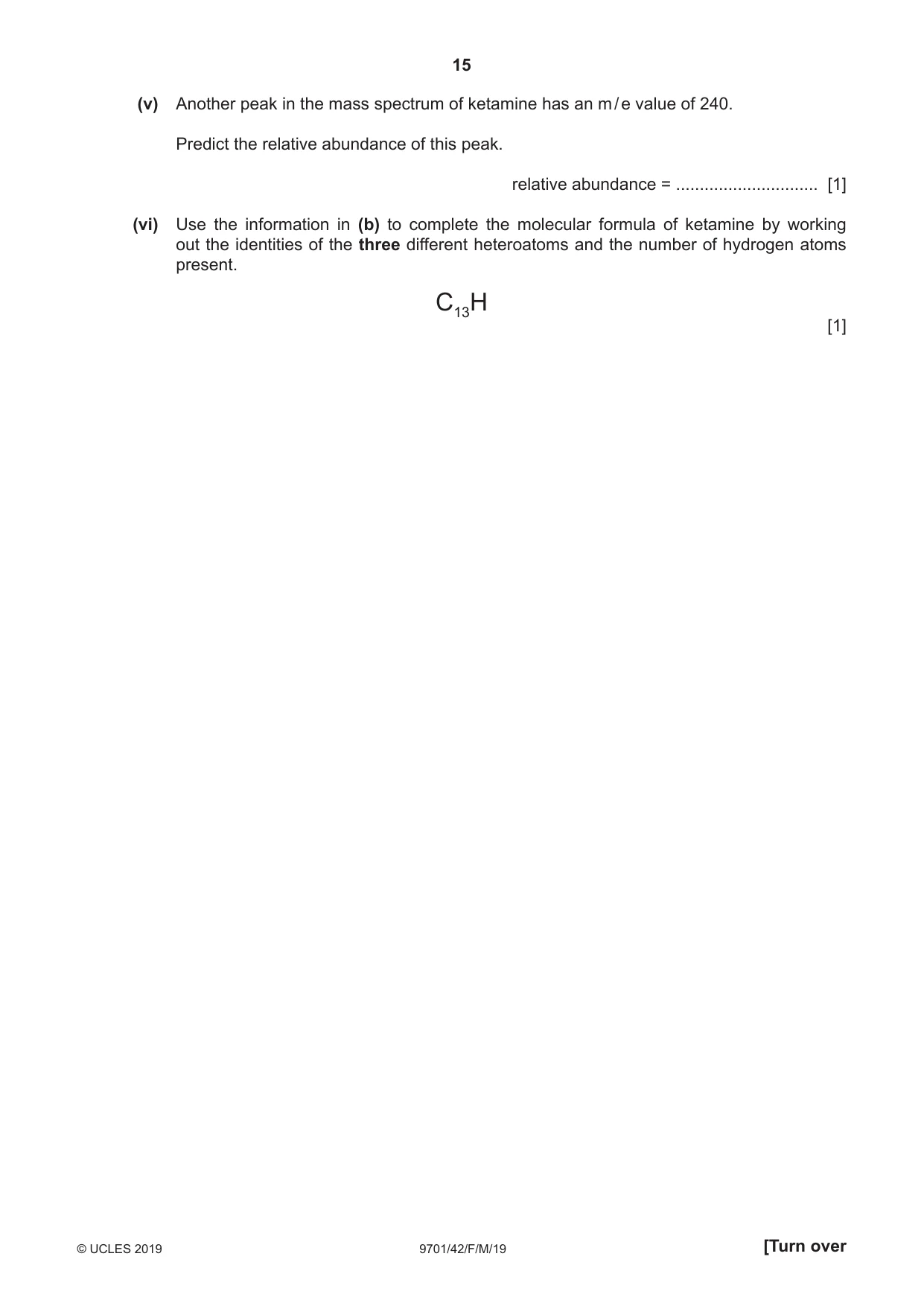
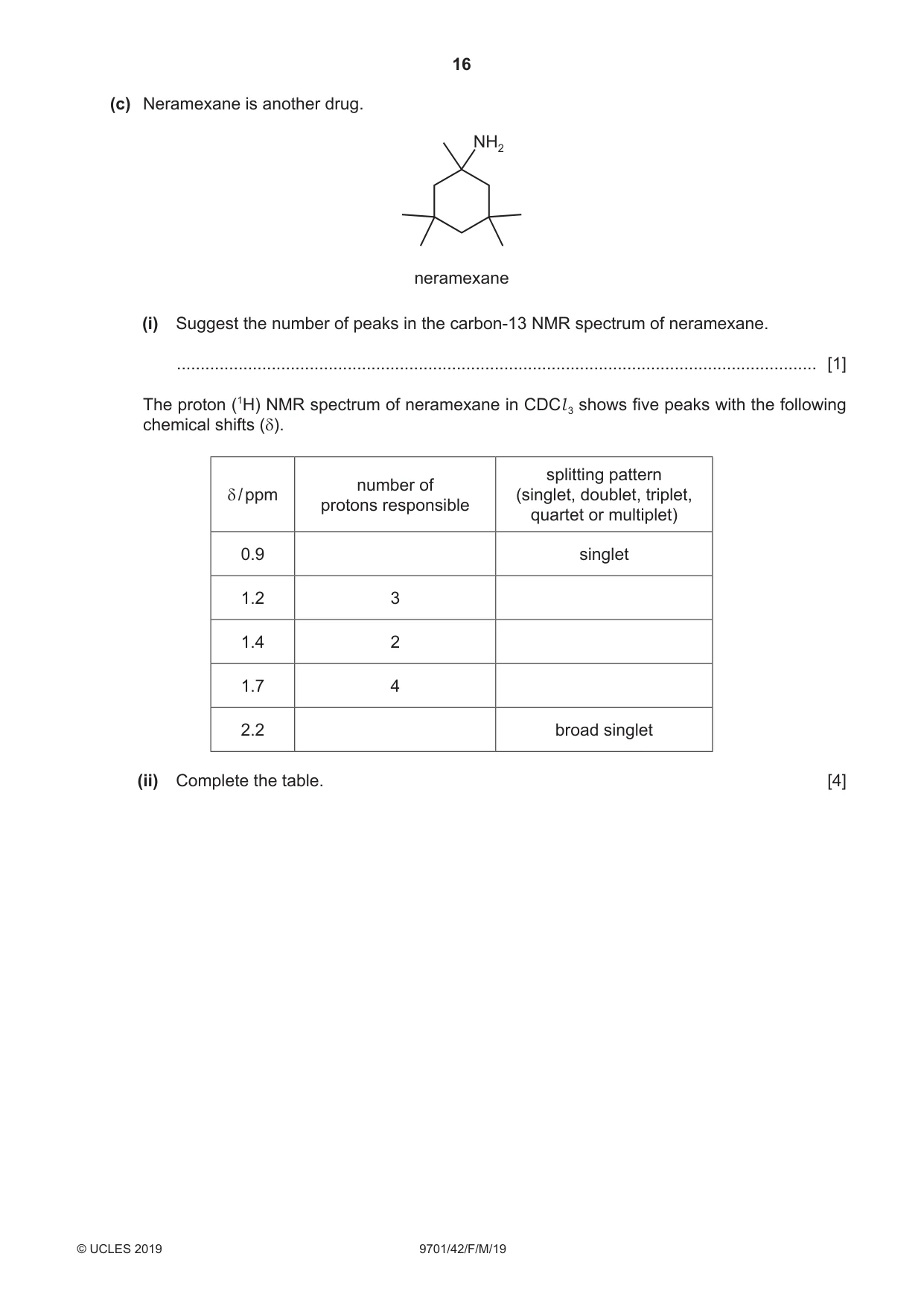
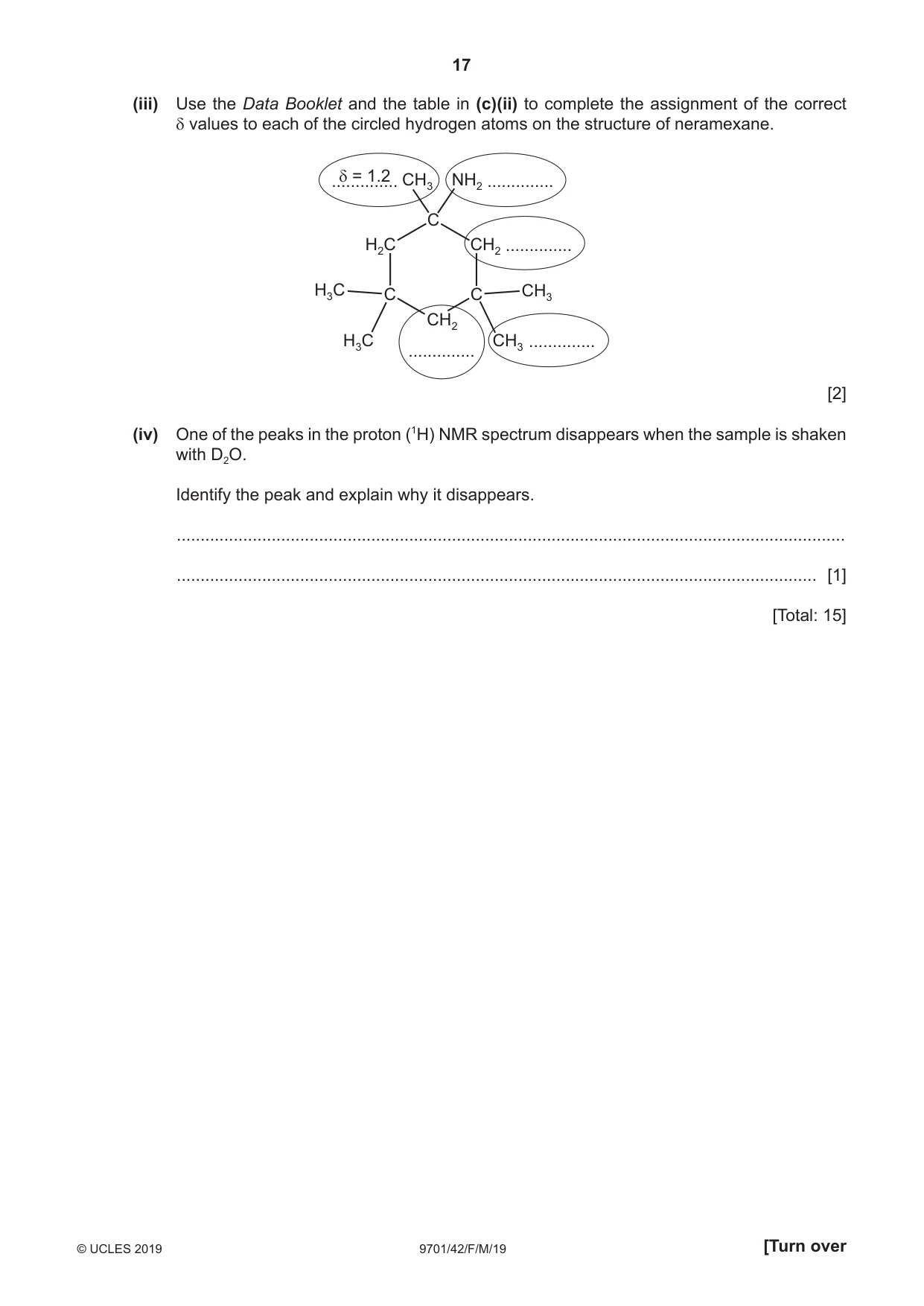
6 The names of many drugs used in medicine often include parts of the names of the functional groups their molecules contain. (a) Suggest two functional groups present in a molecule of the drug named chloramphenicol. 1 ................................................................................................................................................. 2 ................................................................................................................................................. [1] (b) The drug named ketamine readily reacts with protons as shown. ketamine + H+ [ketamine-H]+ (i) State the role of ketamine in this reaction. ....................................................................................................................................... [1] Ketamine gives an orange precipitate with 2,4-dinitrophenylhydrazine (2,4-DNPH). (ii) Suggest the functional group in the ketamine molecule responsible for this observation. ....................................................................................................................................... [1] The mass spectrum of ketamine is determined. Two peaks close to the molecular ion peak, M, are observed with the relative abundances shown in the table. peak m / e relative abundance M 237 100.0 M+1 238 14.3 M+2 239 33.3 (iii) Use the numbers in the table to show that there are 13 carbon atoms in a ketamine molecule. [1] In addition to carbon and hydrogen atoms, each molecule of ketamine contains one atom of each of three different elements. These are called heteroatoms. One of these heteroatoms is a halogen. (iv) Use the figures in the table to suggest the identity of this halogen. Explain your answer. ............................................................................................................................................. ....................................................................................................................................... [1] (vi) Use the information in (b) to complete the molecular formula of ketamine by working out the identities of the three different heteroatoms and the number of hydrogen atoms present. C13H [1] (c) Neramexane is another drug. NH2 neramexane (i) Suggest the number of peaks in the carbon-13 NMR spectrum of neramexane. ....................................................................................................................................... [1] The proton (1H) NMR spectrum of neramexane in CDCl 3 shows five peaks with the following chemical shifts (δ). splitting pattern number of δ / ppm (singlet, doublet, triplet, protons responsible quartet or multiplet) 0.9 singlet 1.2 3 1.4 2 1.7 4 2.2 broad singlet (ii) Complete the table. [4] (iii) Use the Data Booklet and the table in (c)(ii) to complete the assignment of the correct δ values to each of the circled hydrogen atoms on the structure of neramexane. ..............δ = 1.2 CH3 NH2 .............. C H2C CH2 .............. H3C C C CH3 CH2 H3C CH3 .............. .............. [2] (iv) One of the peaks in the proton (1H) NMR spectrum disappears when the sample is shaken with D2O. Identify the peak and explain why it disappears. ............................................................................................................................................. ....................................................................................................................................... [1] [Total: 15]
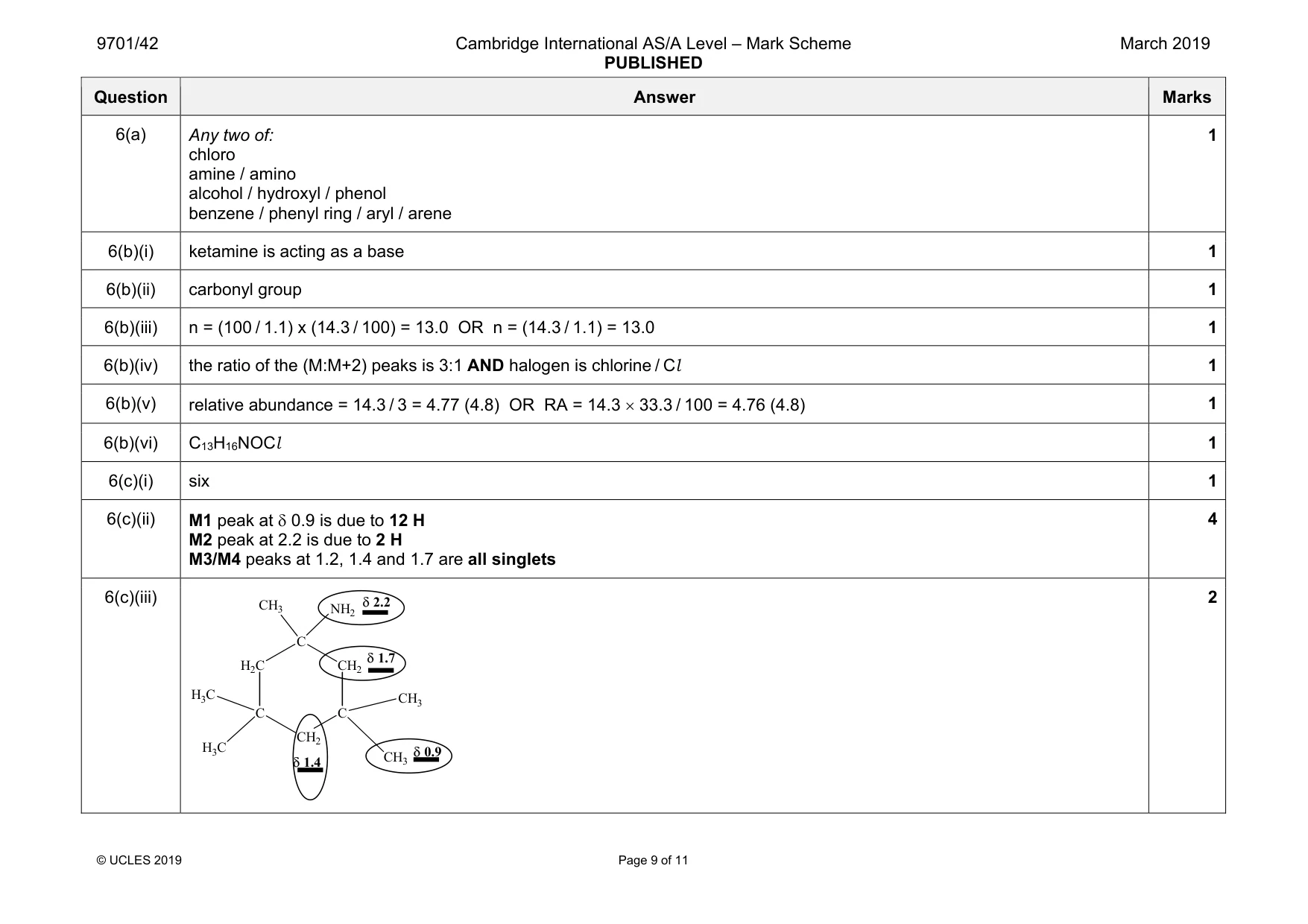
Mark scheme: 6(a) Any two of: chloro amine / amino alcohol / hydroxyl / phenol benzene / phenyl ring / aryl / arene 1 6(b)(i) ketamine is acting as a base 1 6(b)(ii) carbonyl group 1 6(b)(iii) n = (100 / 1.1) x (14.3 / 100) = 13.0 OR n = (14.3 / 1.1) = 13.0 1 6(b)(iv) the ratio of the (M:M+2) peaks is 3:1 AND halogen is chlorine / Cl 1 6(b)(v) relative abundance = 14.3 / 3 = 4.77 (4.8) OR RA = 14.3 × 33.3 / 100 = 4.76 (4.8) 1 6(b)(vi) C13H16NOCl 1 6(c)(i) six 1 6(c)(ii) M1 peak at δ 0.9 is due to 12 H M2 peak at 2.2 is due to 2 H M3/M4 peaks at 1.2, 1.4 and 1.7 are all singlets 4 6(c)(iii) H2C C CH2 C CH2 C CH3 NH2 H3C H3C CH3 CH3 δ 2.2 δ 1.7 δ 0.9 δ 1.4 2 Question Answer Marks 6(c)(iv) NH / NH2 protons AND exchange with D2O / D OR –NH2 + D2O → –ND2 + H2O 1
Q7 · Ethanedioyl dichloride, Cl COCOCl, is a useful reagent in organic synthesis
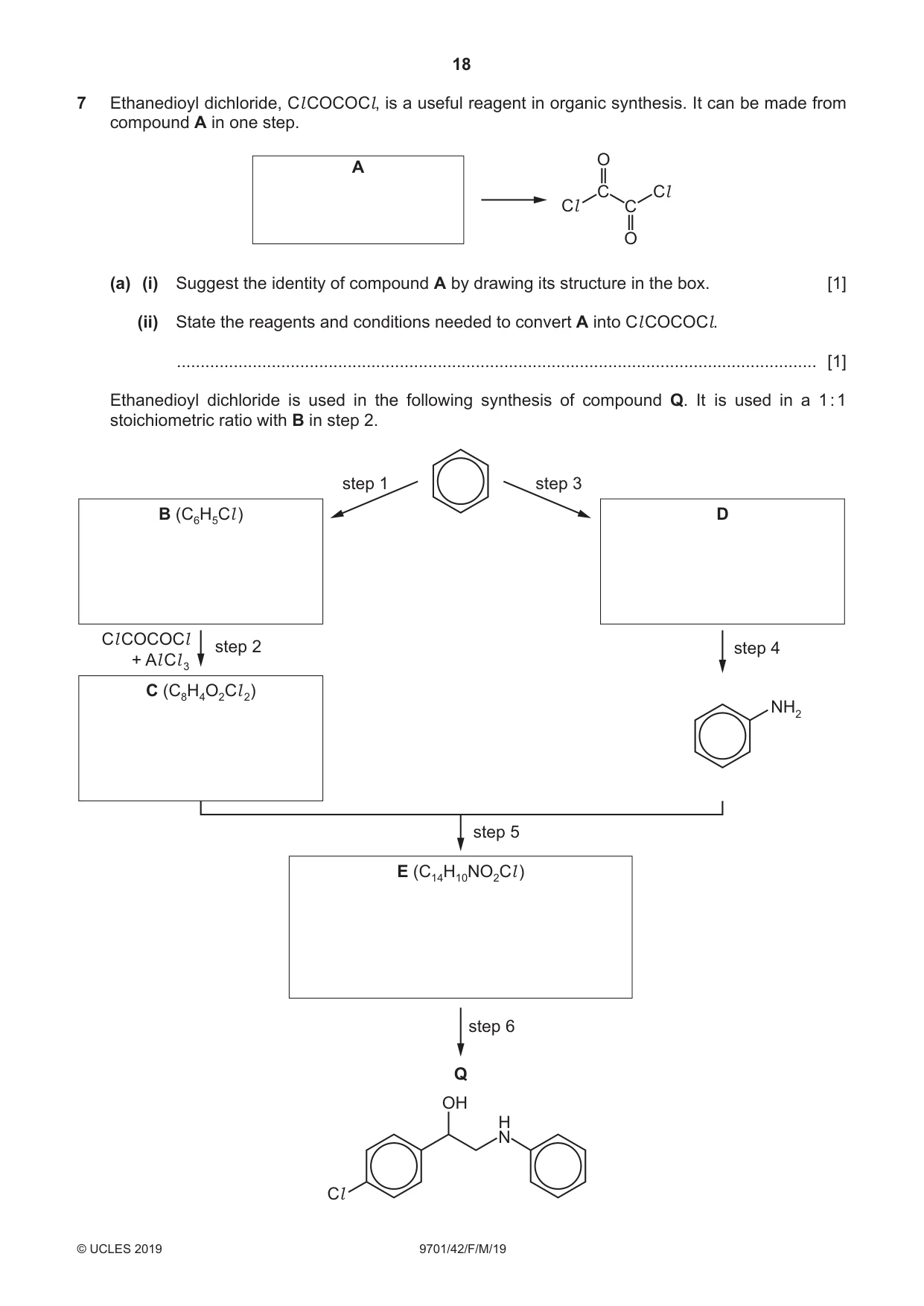
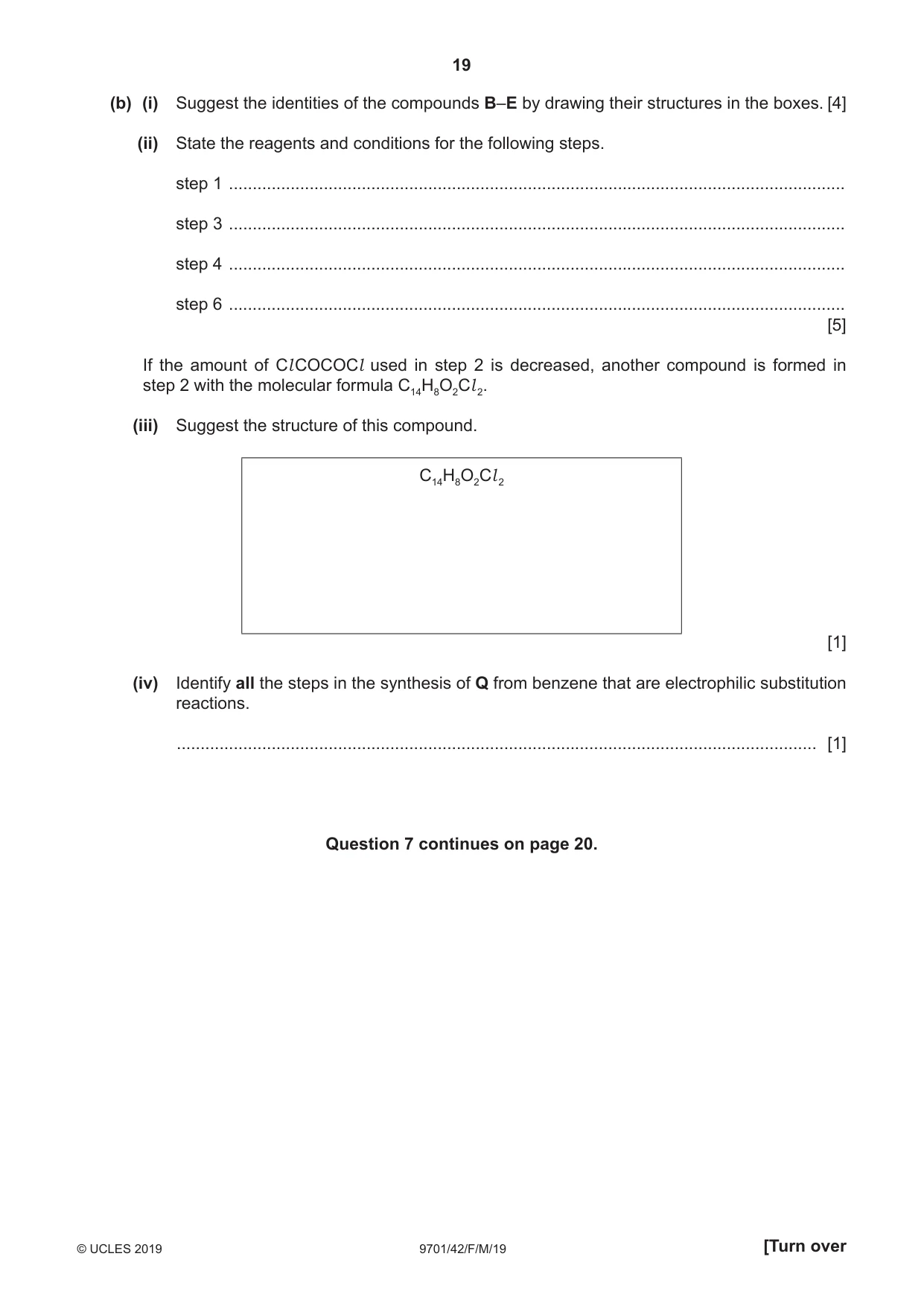
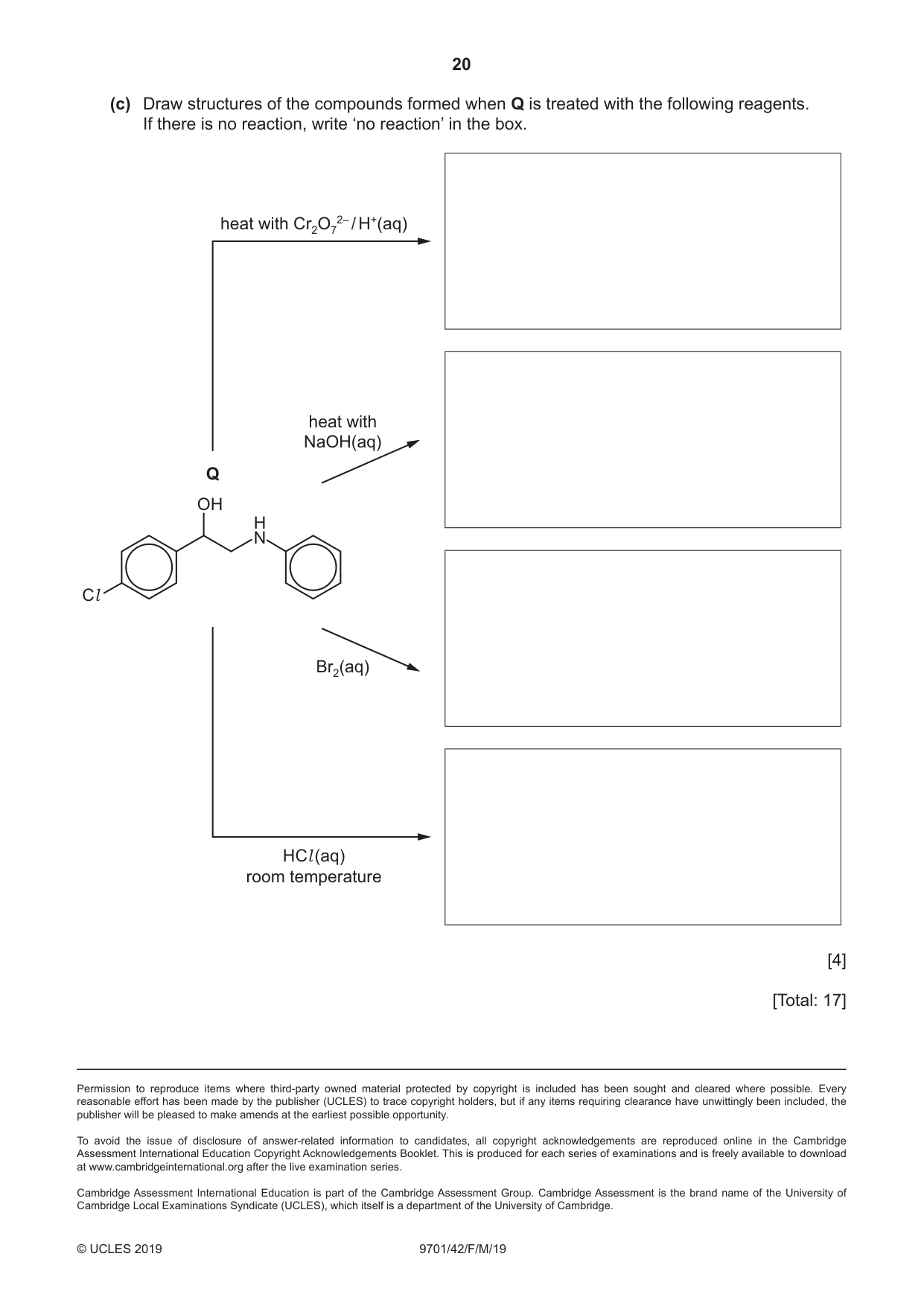
7 Ethanedioyl dichloride, Cl COCOCl, is a useful reagent in organic synthesis. It can be made from compound A in one step. O A C Cl Cl C O (a) (i) Suggest the identity of compound A by drawing its structure in the box. [1] (ii) State the reagents and conditions needed to convert A into Cl COCOCl. ....................................................................................................................................... [1] Ethanedioyl dichloride is used in the following synthesis of compound Q. It is used in a 1 : 1 stoichiometric ratio with B in step 2. step 1 step 3 B (C6H5Cl ) D Cl COCOCl step 2 step 4 + Al Cl 3 C (C8H4O2Cl 2) NH2 step 5 E (C14H10NO2Cl ) step 6 Q OH H N Cl (b) (i) Suggest the identities of the compounds B–E by drawing their structures in the boxes. [4] (ii) State the reagents and conditions for the following steps. step 1 .................................................................................................................................. step 3 .................................................................................................................................. step 4 .................................................................................................................................. step 6 .................................................................................................................................. [5] If the amount of Cl COCOCl used in step 2 is decreased, another compound is formed in step 2 with the molecular formula C14H8O2Cl 2. (iii) Suggest the structure of this compound. C14H8O2Cl 2 [1] (iv) Identify all the steps in the synthesis of Q from benzene that are electrophilic substitution reactions. ....................................................................................................................................... [1] Question 7 continues on page 20. (c) Draw structures of the compounds formed when Q is treated with the following reagents. If there is no reaction, write ‘no reaction’ in the box. heat with Cr2O72– / H+(aq) heat with NaOH(aq) Q OH H N Cl Br2(aq) HCl (aq) room temperature [4] [Total: 17]
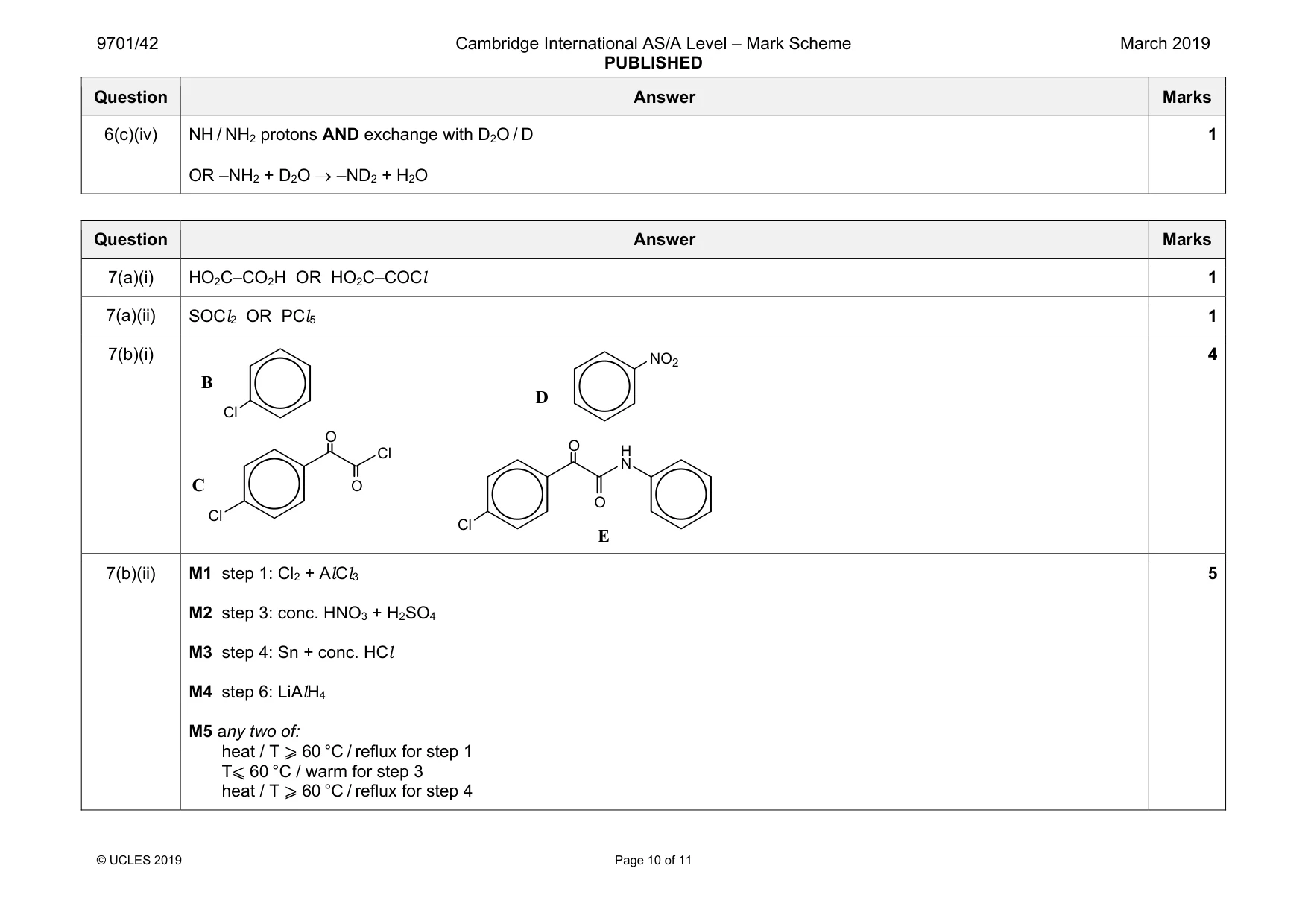
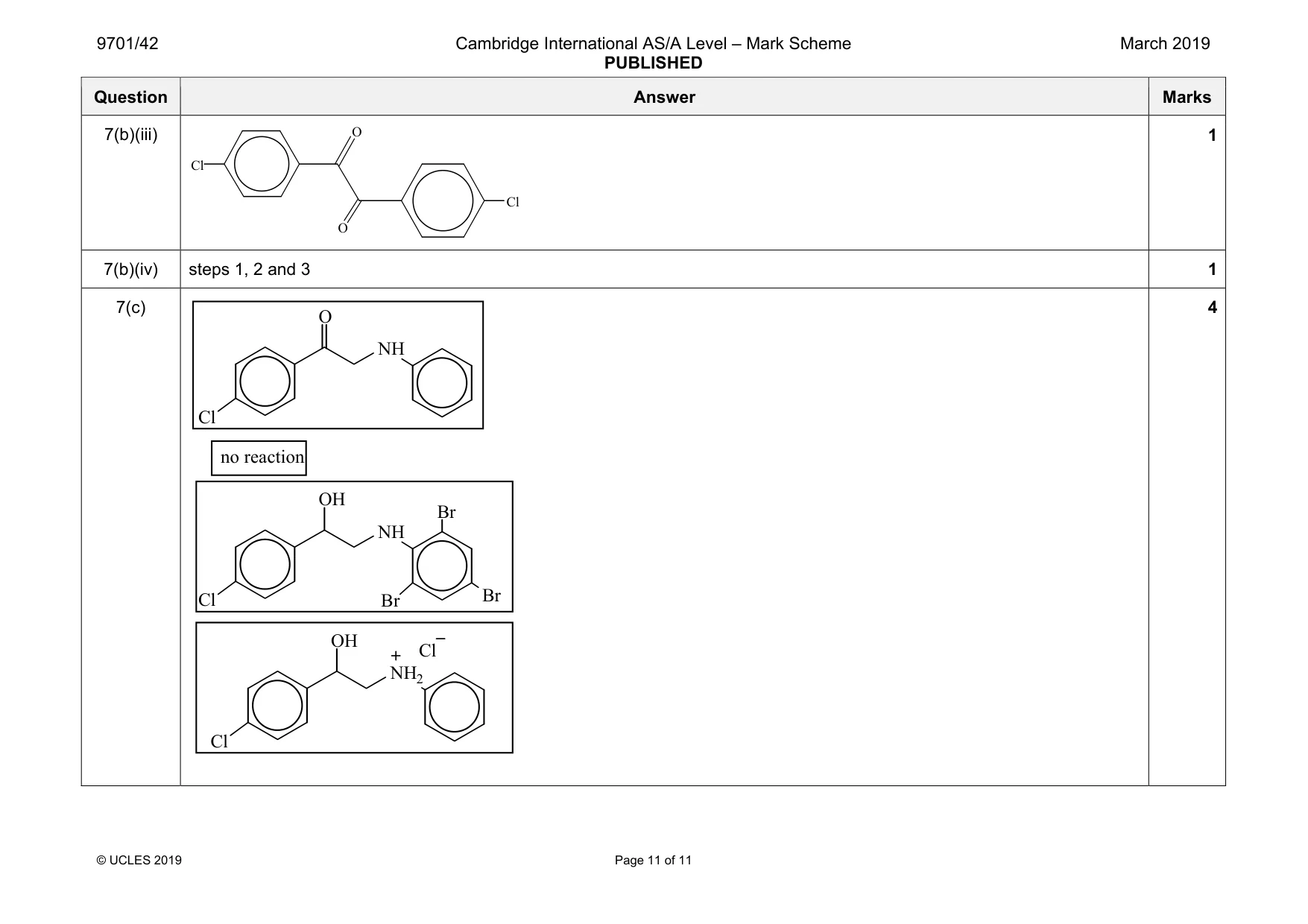
Mark scheme: 7(a)(i) 1 7(a)(ii) SOCl2 OR PCl5 1 7(b)(i) H N O O NO2 Cl Cl O O Cl B C D E Cl 4 7(b)(ii) M1 step 1: Cl2 + AlCl3 M2 step 3: conc. HNO3 + H2SO4 M3 step 4: Sn + conc. HCl M4 step 6: LiAlH4 M5 any two of: heat / T ⩾ 60 °C / reflux for step 1 T⩽ 60 °C / warm for step 3 heat / T ⩾ 60 °C / reflux for step 4 5 Question Answer Marks 7(b)(iii) O O Cl Cl 1 7(b)(iv) steps 1, 2 and 3 1 7(c) NH O Cl NH OH Cl NH2 OH Cl no reaction Br Br Br Cl 4
What was in this paper
The subtopics covered by these 7 questions, and how many questions each got. Open one in a new tab to see every Cambridge question on it.
What you needed in this session
Cambridge’s own grade thresholds for 2019 Feb/March, Paper 4 · Variant 2. A higher threshold means an easier paper — the bar moves with how the cohort did.