Cambridge A Level Chemistry 9701 — 2018 Oct/Nov Paper 3 · Variant 5
9701/35/O/N/18 · 2 questions · 40 marks · ≈45 min
The question paper and its mark scheme, free to read here and free to download. This is Cambridge’s own paper, exactly as it was sat.
Question paper12 pages
Mark scheme8 pages
Answers below. Sit the paper first if you are practising.
Questions as text
Q1 · In this experiment you will determine the percentage purity of a sample of impure…
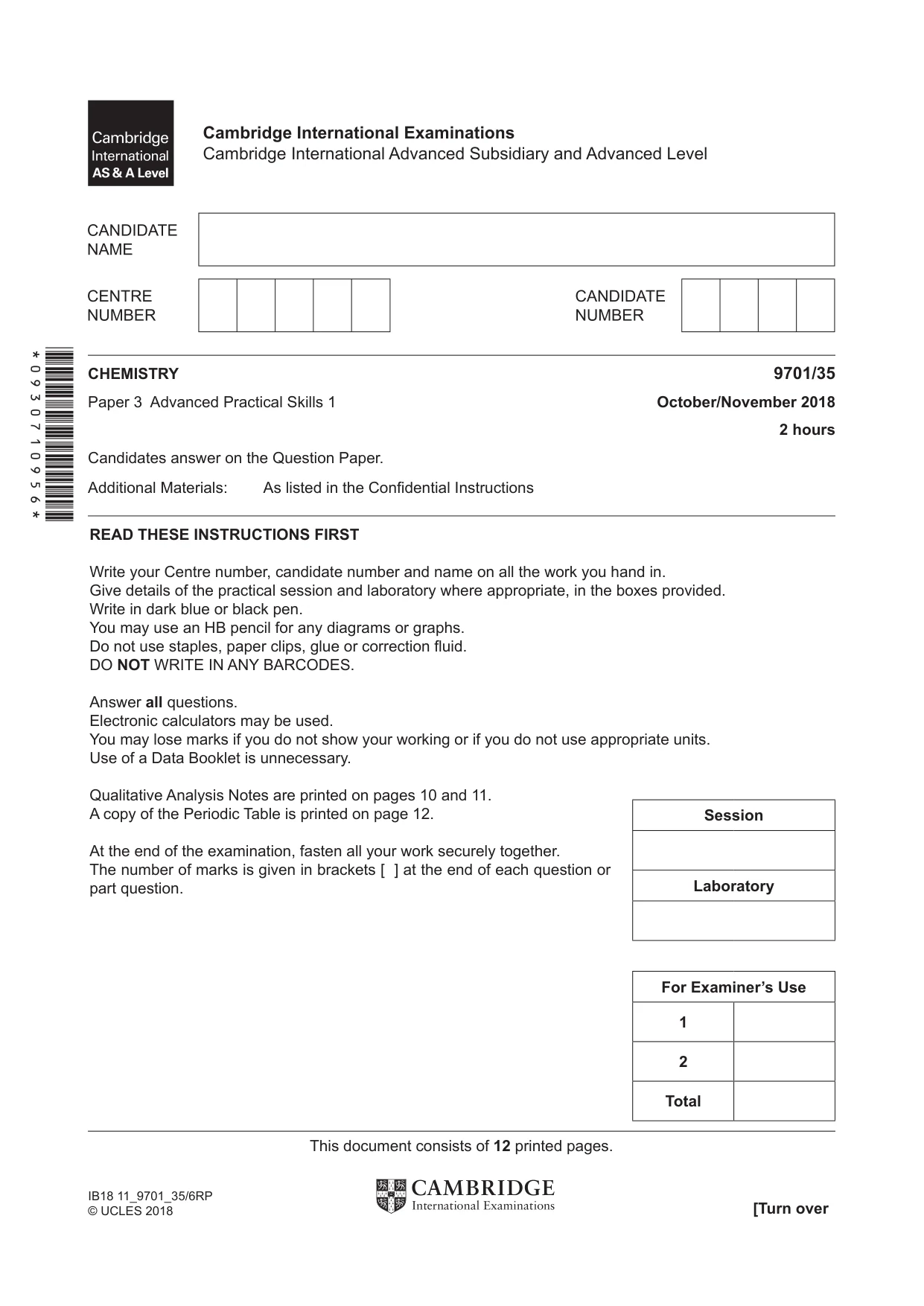
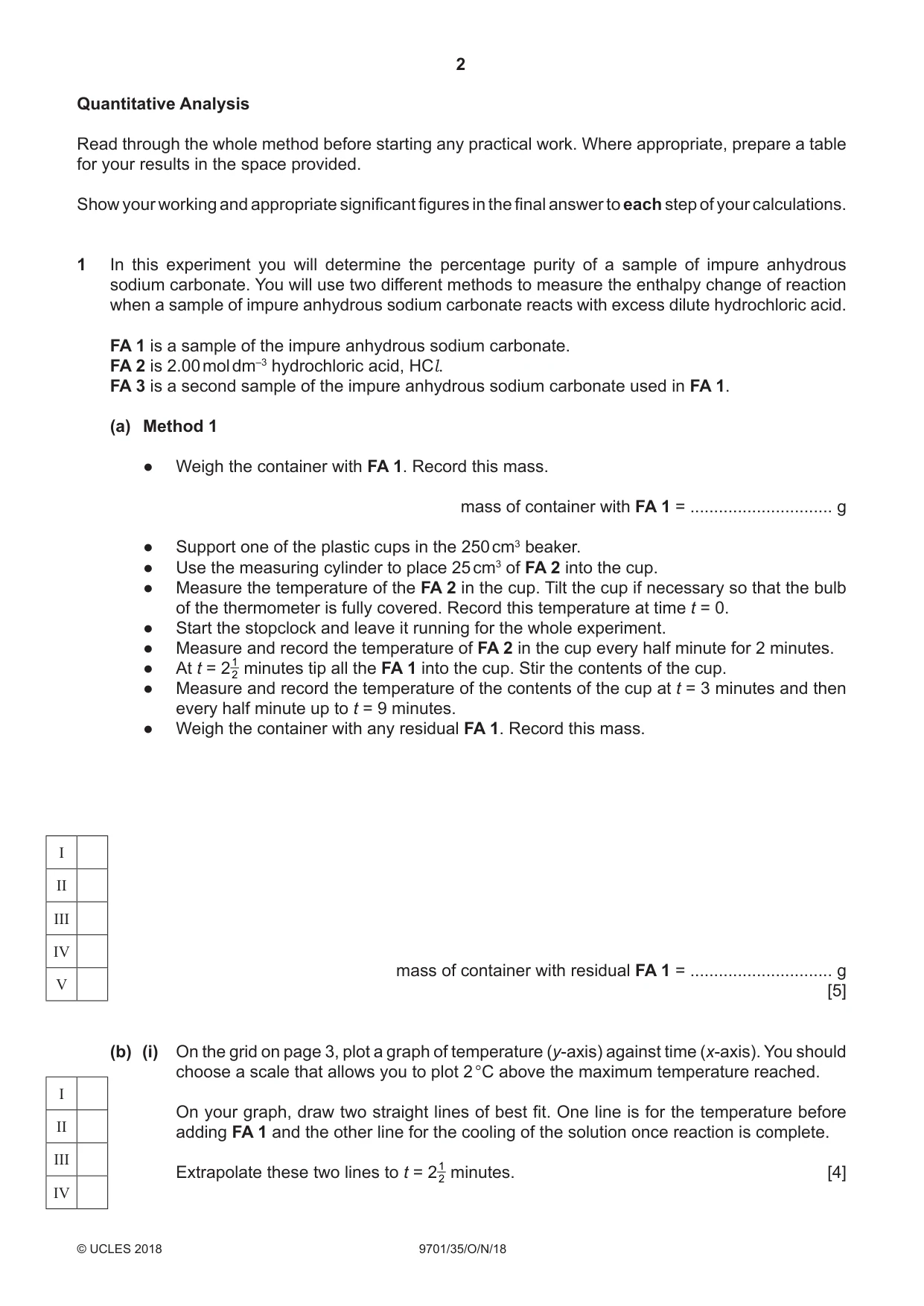
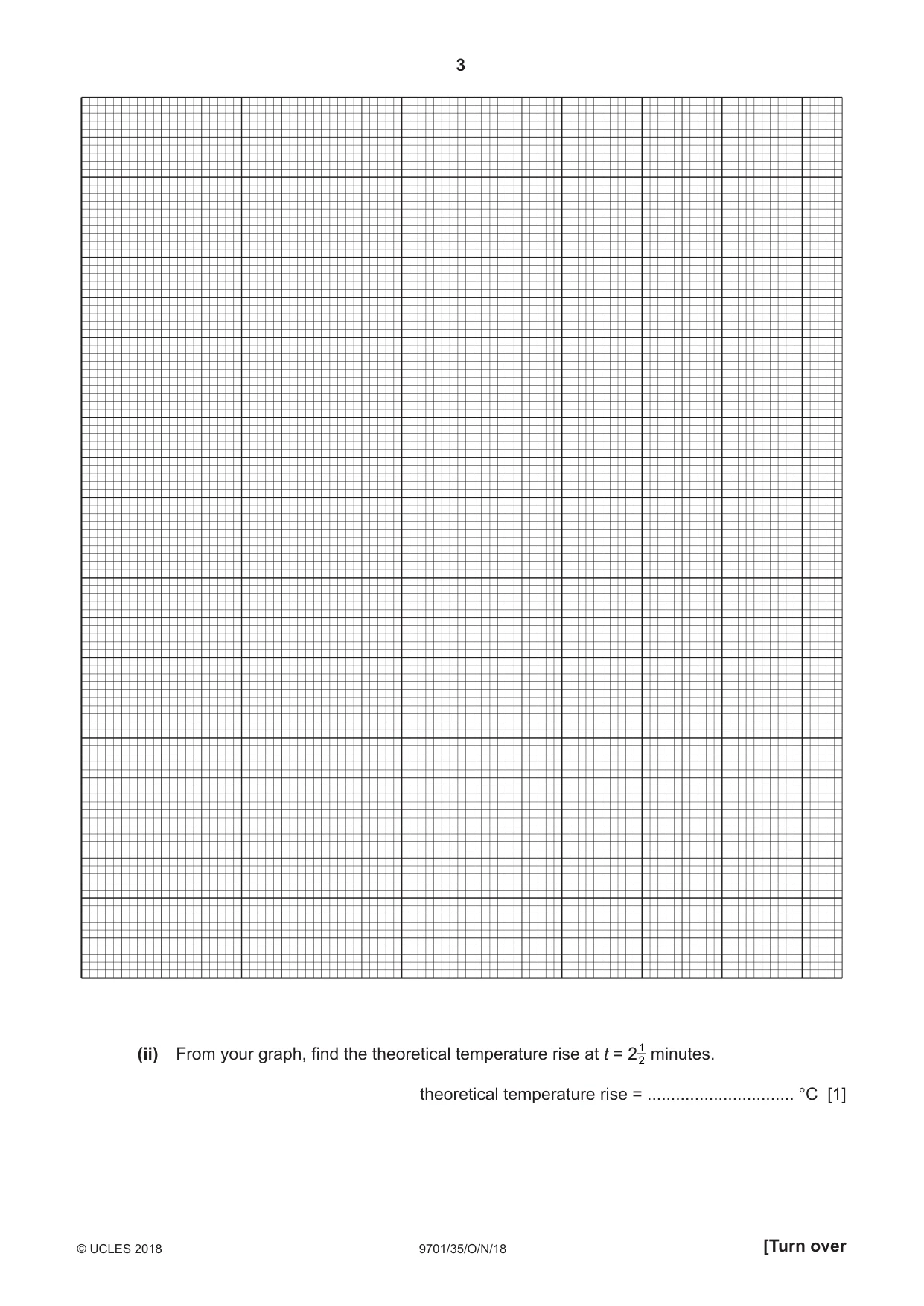
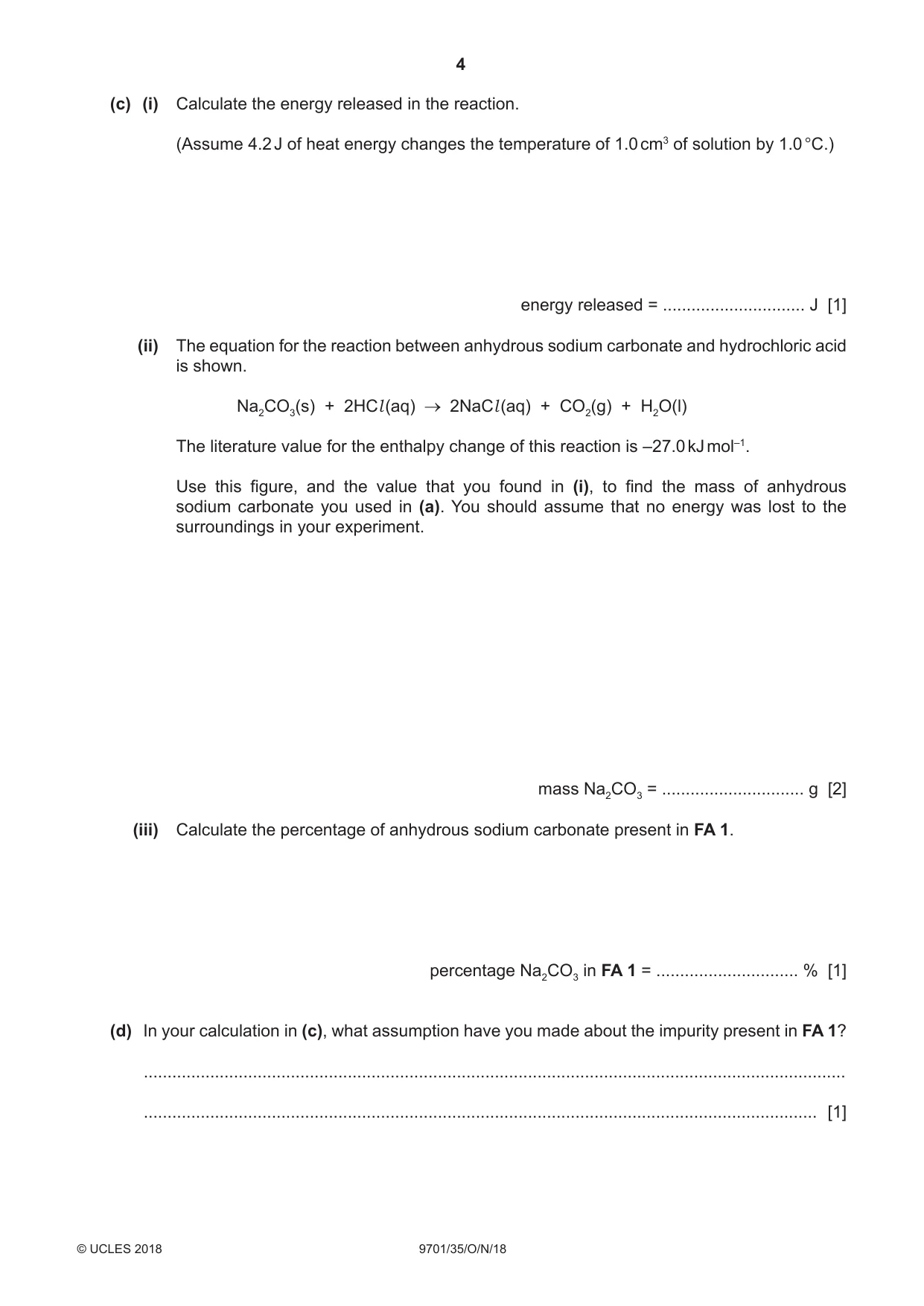
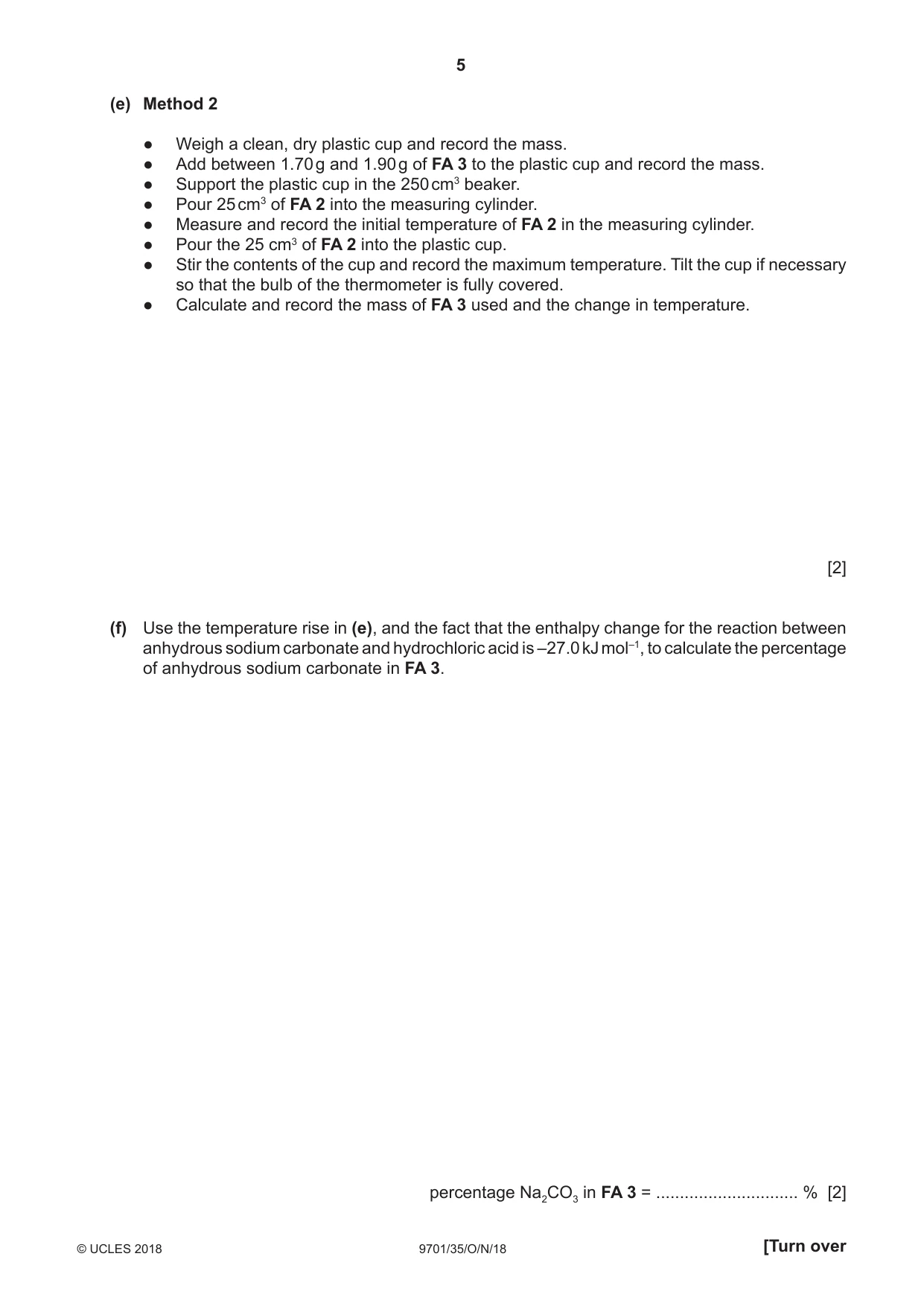
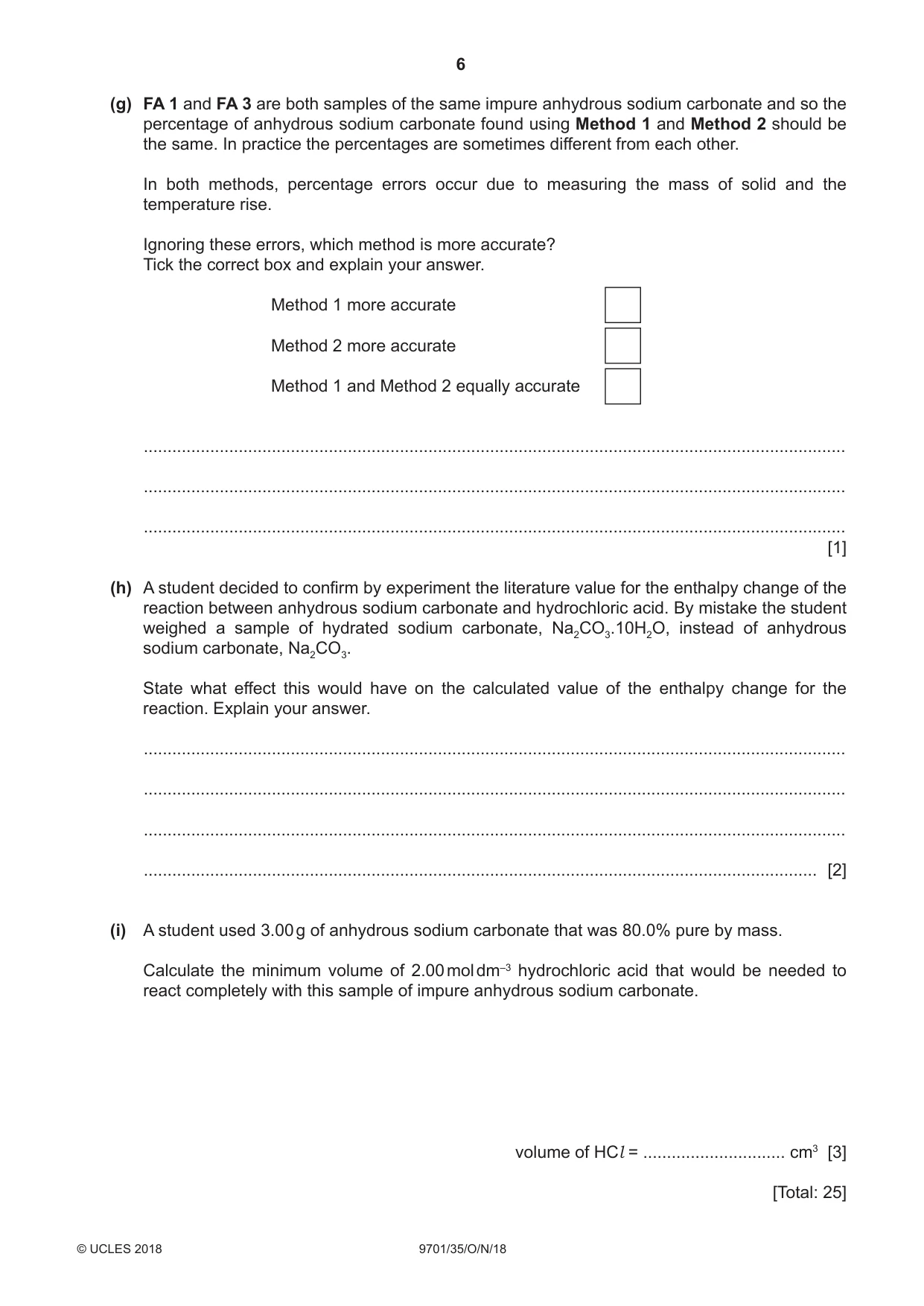
1 In this experiment you will determine the percentage purity of a sample of impure anhydrous sodium carbonate. You will use two different methods to measure the enthalpy change of reaction when a sample of impure anhydrous sodium carbonate reacts with excess dilute hydrochloric acid. FA 1 is a sample of the impure anhydrous sodium carbonate. FA 2 is 2.00 mol dm–3 hydrochloric acid, HCl. FA 3 is a second sample of the impure anhydrous sodium carbonate used in FA 1. (a) Method 1 ● Weigh the container with FA 1. Record this mass. mass of container with FA 1 = .............................. g ● Support one of the plastic cups in the 250 cm3 beaker. ● Use the measuring cylinder to place 25 cm3 of FA 2 into the cup. ● Measure the temperature of the FA 2 in the cup. Tilt the cup if necessary so that the bulb of the thermometer is fully covered. Record this temperature at time t = 0. ● Start the stopclock and leave it running for the whole experiment. ● Measure and record the temperature of FA 2 in the cup every half minute for 2 minutes. ● At t = 212 minutes tip all the FA 1 into the cup. Stir the contents of the cup. ● Measure and record the temperature of the contents of the cup at t = 3 minutes and then every half minute up to t = 9 minutes. ● Weigh the container with any residual FA 1. Record this mass. I II III IV mass of container with residual FA 1 = .............................. g V [5] (b) (i) On the grid on page 3, plot a graph of temperature (y-axis) against time (x-axis). You should choose a scale that allows you to plot 2 °C above the maximum temperature reached. I On your graph, draw two straight lines of best fit. One line is for the temperature before II adding FA 1 and the other line for the cooling of the solution once reaction is complete. III Extrapolate these two lines to t = 212 minutes. [4] IV l te reti (c) (i) Calculate the energy released in the reaction. (Assume 4.2 J of heat energy changes the temperature of 1.0 cm3 of solution by 1.0 °C.) energy released = .............................. J [1] (ii) The equation for the reaction between anhydrous sodium carbonate and hydrochloric acid is shown. Na2CO3(s) + 2HCl (aq) 2NaCl (aq) + CO2(g) + H2O(l) The literature value for the enthalpy change of this reaction is –27.0 kJ mol–1. Use this figure, and the value that you found in (i), to find the mass of anhydrous sodium carbonate you used in (a). You should assume that no energy was lost to the surroundings in your experiment. mass Na2CO3 = .............................. g [2] (iii) Calculate the percentage of anhydrous sodium carbonate present in FA 1. percentage Na2CO3 in FA 1 = .............................. % [1] (d) In your calculation in (c), what assumption have you made about the impurity present in FA 1? .................................................................................................................................................... .............................................................................................................................................. [1] (e) Method 2 ● Weigh a clean, dry plastic cup and record the mass. ● Add between 1.70 g and 1.90 g of FA 3 to the plastic cup and record the mass. ● Support the plastic cup in the 250 cm3 beaker. ● Pour 25 cm3 of FA 2 into the measuring cylinder. ● Measure and record the initial temperature of FA 2 in the measuring cylinder. ● Pour the 25 cm3 of FA 2 into the plastic cup. ● Stir the contents of the cup and record the maximum temperature. Tilt the cup if necessary so that the bulb of the thermometer is fully covered. ● Calculate and record the mass of FA 3 used and the change in temperature. [2] (f) Use the temperature rise in (e), and the fact that the enthalpy change for the reaction between anhydrous sodium carbonate and hydrochloric acid is –27.0 kJ mol–1, to calculate the percentage of anhydrous sodium carbonate in FA 3. percentage Na2CO3 in FA 3 = .............................. % [2] (g) FA 1 and FA 3 are both samples of the same impure anhydrous sodium carbonate and so the percentage of anhydrous sodium carbonate found using Method 1 and Method 2 should be the same. In practice the percentages are sometimes different from each other. In both methods, percentage errors occur due to measuring the mass of solid and the temperature rise. Ignoring these errors, which method is more accurate? Tick the correct box and explain your answer. Method 1 more accurate Method 2 more accurate Method 1 and Method 2 equally accurate .................................................................................................................................................... .................................................................................................................................................... .................................................................................................................................................... [1] (h) A student decided to confirm by experiment the literature value for the enthalpy change of the reaction between anhydrous sodium carbonate and hydrochloric acid. By mistake the student weighed a sample of hydrated sodium carbonate, Na2CO3.10H2O, instead of anhydrous sodium carbonate, Na2CO3. State what effect this would have on the calculated value of the enthalpy change for the reaction. Explain your answer. .................................................................................................................................................... .................................................................................................................................................... .................................................................................................................................................... .............................................................................................................................................. [2] (i) A student used 3.00 g of anhydrous sodium carbonate that was 80.0% pure by mass. Calculate the minimum volume of 2.00 mol dm–3 hydrochloric acid that would be needed to react completely with this sample of impure anhydrous sodium carbonate. volume of HCl = .............................. cm3 [3] [Total: 25] Qualitative Analysis Where reagents are selected for use in a test, the full name or correct formula of the element or compound must be given. At each stage of any test you are to record details of the following: ● colour changes seen; ● the formation of any precipitate and its solubility in an excess of the reagent added; ● the formation of any gas and its identification by a suitable test. You should indicate clearly at what stage in a test a change occurs. If any solution is warmed, a boiling tube must be used. Rinse and reuse test-tubes and boiling tubes where possible. No additional tests for ions present should be attempted.
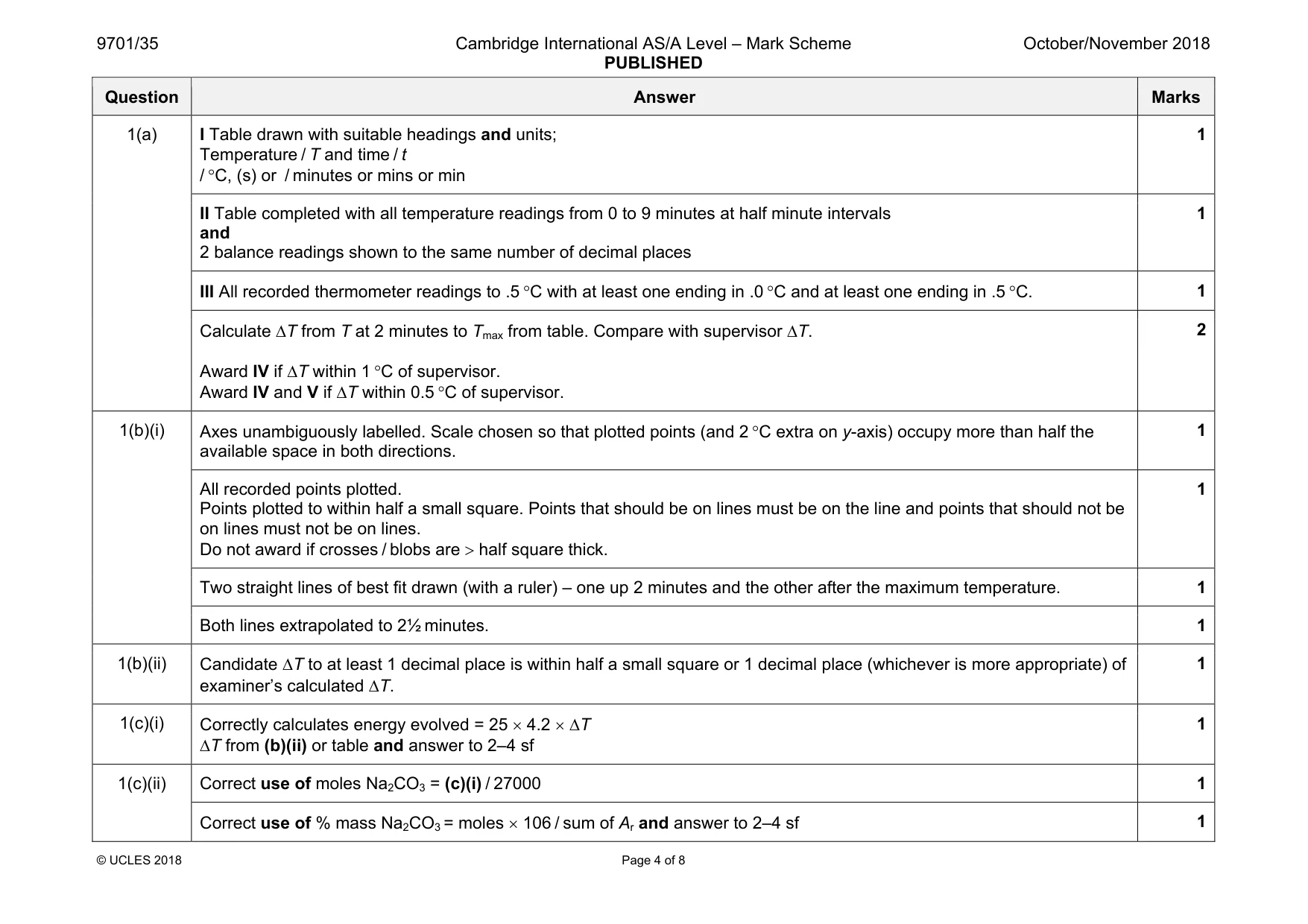
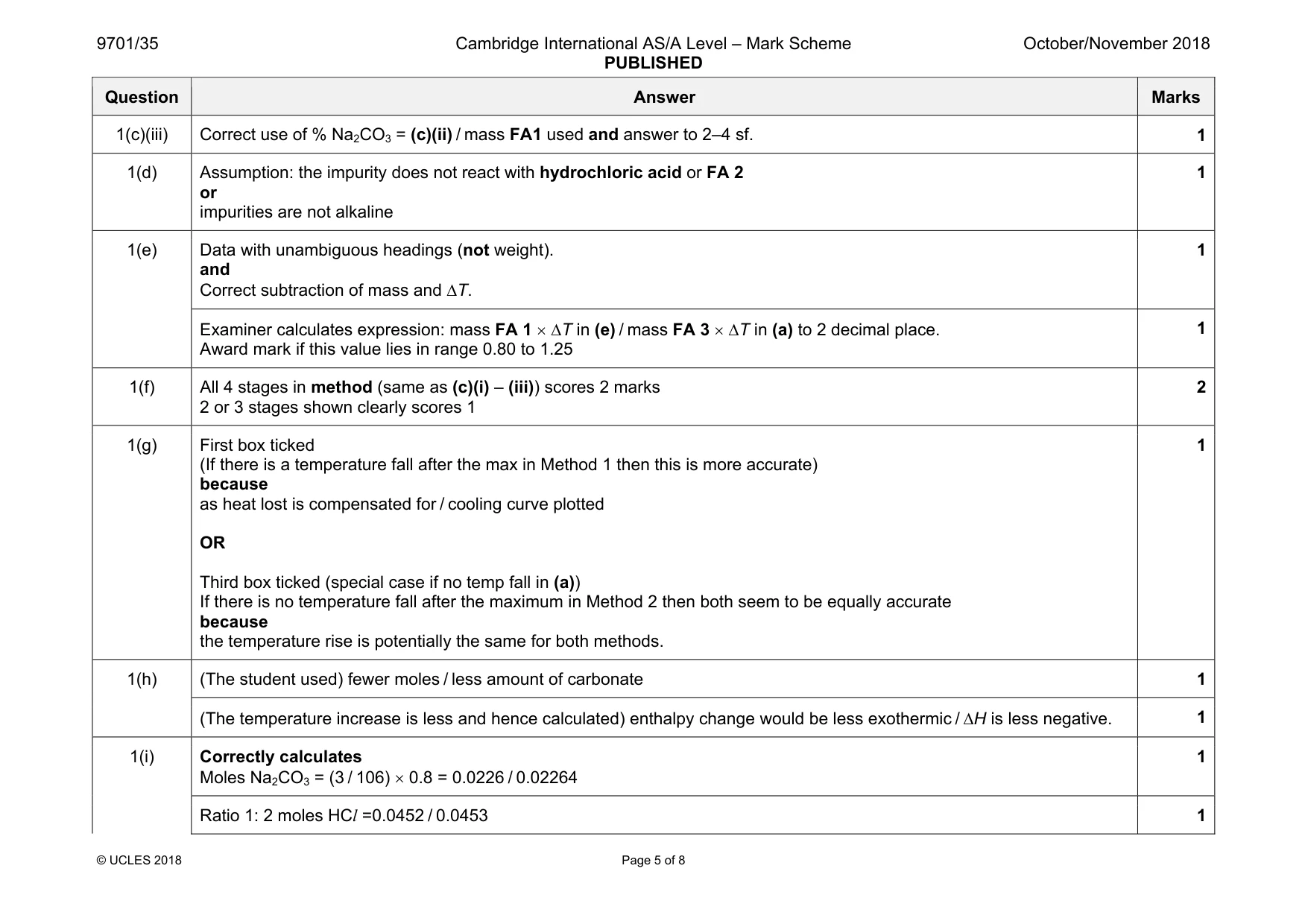
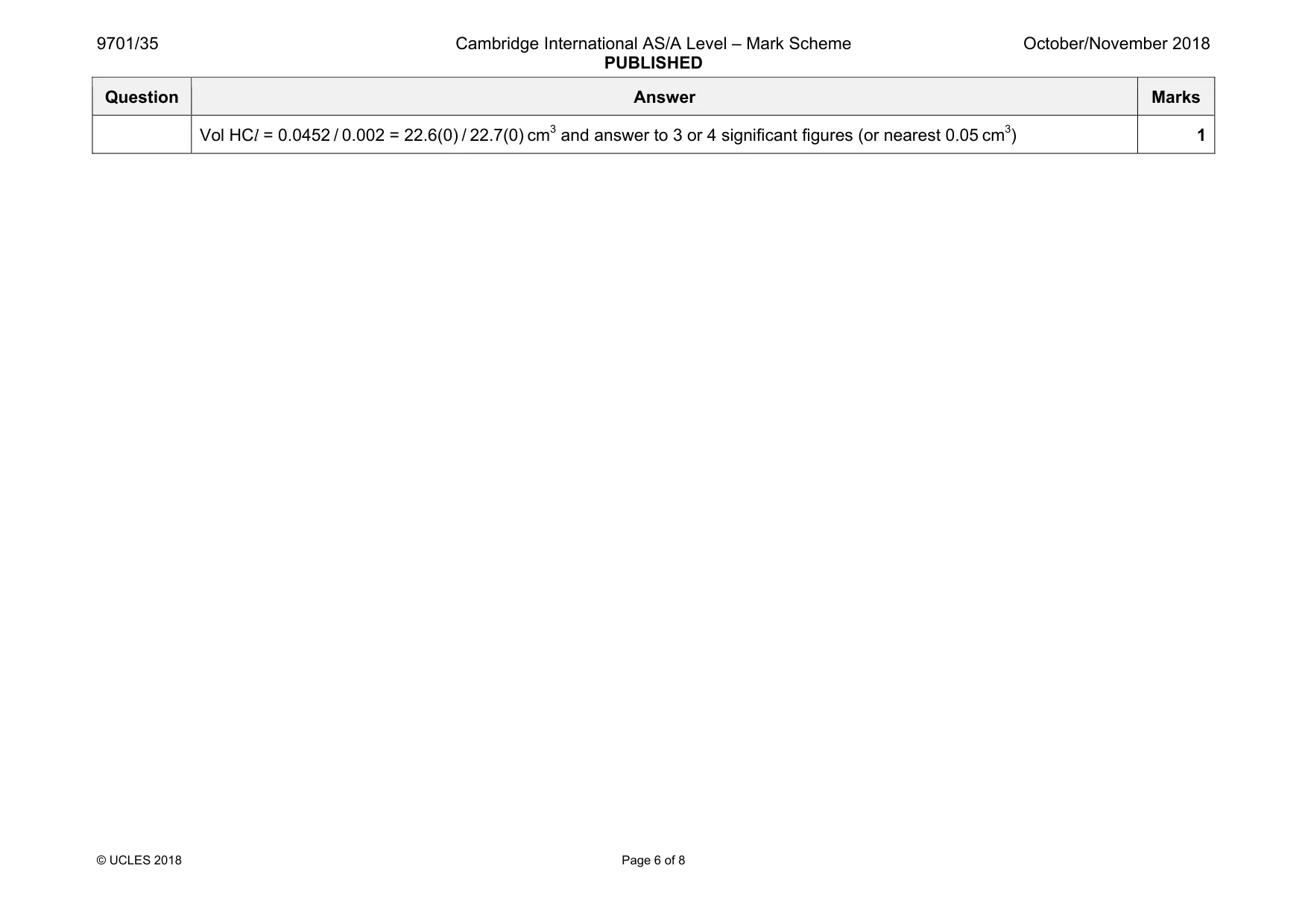
Mark scheme: 1(a) I Table drawn with suitable headings and units; Temperature / T and time / t / °C, (s) or / minutes or mins or min 1 II Table completed with all temperature readings from 0 to 9 minutes at half minute intervals and 2 balance readings shown to the same number of decimal places 1 III All recorded thermometer readings to .5 °C with at least one ending in .0 °C and at least one ending in .5 °C. 1 Calculate ∆T from T at 2 minutes to Tmax from table. Compare with supervisor ∆T. Award IV if ∆T within 1 °C of supervisor. Award IV and V if ∆T within 0.5 °C of supervisor. 2 1(b)(i) Axes unambiguously labelled. Scale chosen so that plotted points (and 2 °C extra on y-axis) occupy more than half the available space in both directions. 1 All recorded points plotted. Points plotted to within half a small square. Points that should be on lines must be on the line and points that should not be on lines must not be on lines. Do not award if crosses / blobs are > half square thick. 1 Two straight lines of best fit drawn (with a ruler) – one up 2 minutes and the other after the maximum temperature. 1 Both lines extrapolated to 2½ minutes. 1 1(b)(ii) Candidate ∆T to at least 1 decimal place is within half a small square or 1 decimal place (whichever is more appropriate) of examiner’s calculated ∆T. 1 1(c)(i) Correctly calculates energy evolved = 25 × 4.2 × ∆T ∆T from (b)(ii) or table and answer to 2–4 sf 1 1(c)(ii) Correct use of moles Na2CO3 = (c)(i) / 27000 1 Correct use of % mass Na2CO3 = moles × 106 / sum of Ar and answer to 2–4 sf 1 Question Answer Marks 1(c)(iii) Correct use of % Na2CO3 = (c)(ii) / mass FA1 used and answer to 2–4 sf. 1 1(d) Assumption: the impurity does not react with hydrochloric acid or FA 2 or impurities are not alkaline 1 1(e) Data with unambiguous headings (not weight). and Correct subtraction of mass and ∆T. 1 Examiner calculates expression: mass FA 1 × ∆T in (e) / mass FA 3 × ∆T in (a) to 2 decimal place. Award mark if this value lies in range 0.80 to 1.25 1 1(f) All 4 stages in method (same as (c)(i) – (iii)) scores 2 marks 2 or 3 stages shown clearly scores 1 2 1(g) First box ticked (If there is a temperature fall after the max in Method 1 then this is more accurate) because as heat lost is compensated for / cooling curve plotted OR Third box ticked (special case if no temp fall in (a)) If there is no temperature fall after the maximum in Method 2 then both seem to be equally accurate because the temperature rise is potentially the same for both methods. 1 1(h) (The student used) fewer moles / less amount of carbonate 1 (The temperature increase is less and hence calculated) enthalpy change would be less exothermic / ∆H is less negative. 1 1(i) Correctly calculates Moles Na2CO3 = (3 / 106) × 0.8 = 0.0226 / 0.02264 1 Ratio 1: 2 moles HCl =0.0452 / 0.0453 1 Question Answer Marks Vol HCl = 0.0452 / 0.002 = 22.6(0) / 22.7(0) cm3 and answer to 3 or 4 significant figures (or nearest 0.05 cm3) 1
Q2 · FA 4 is a sodium compound that was the impurity in the FA 1 and FA 3 that you used in…
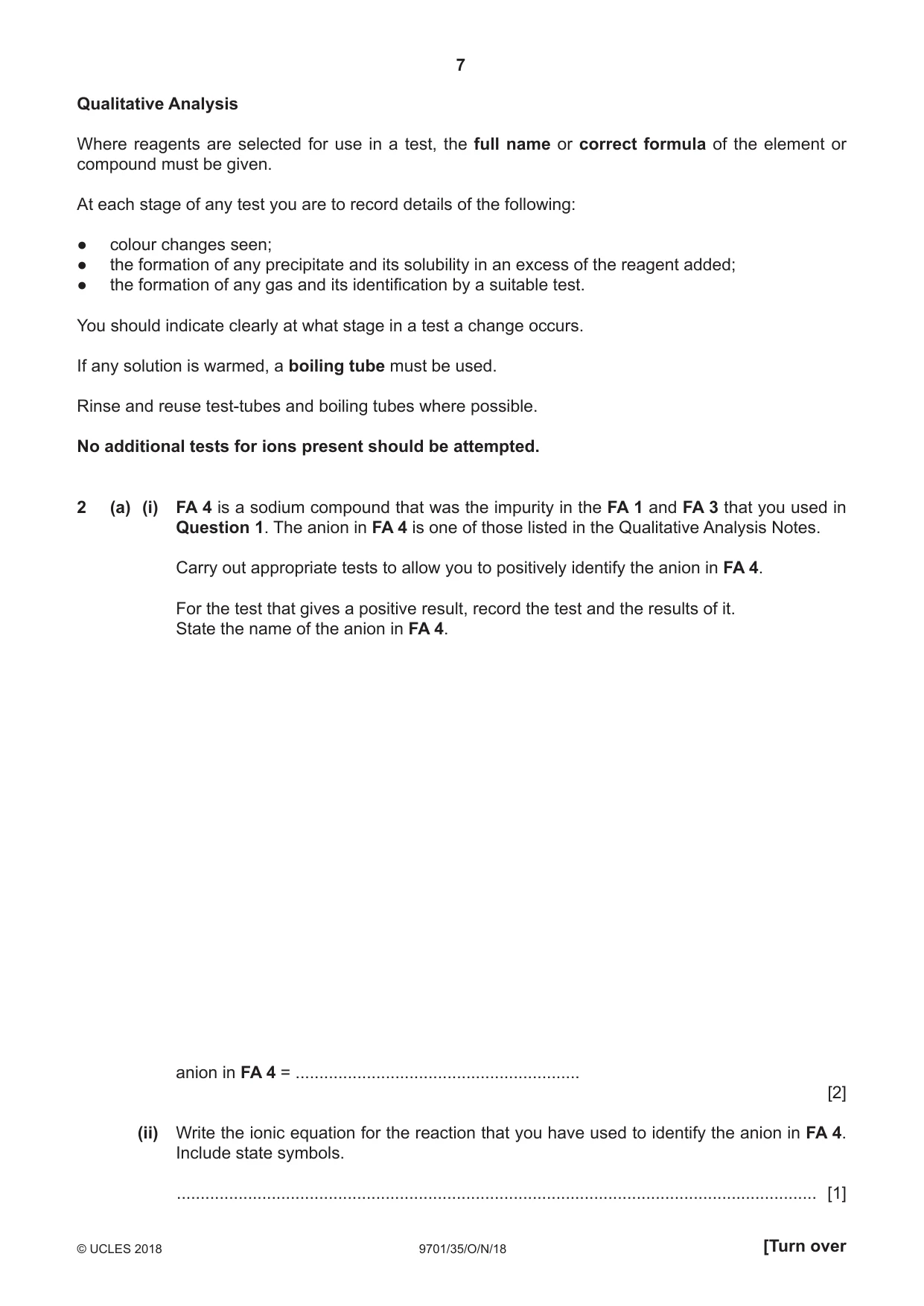
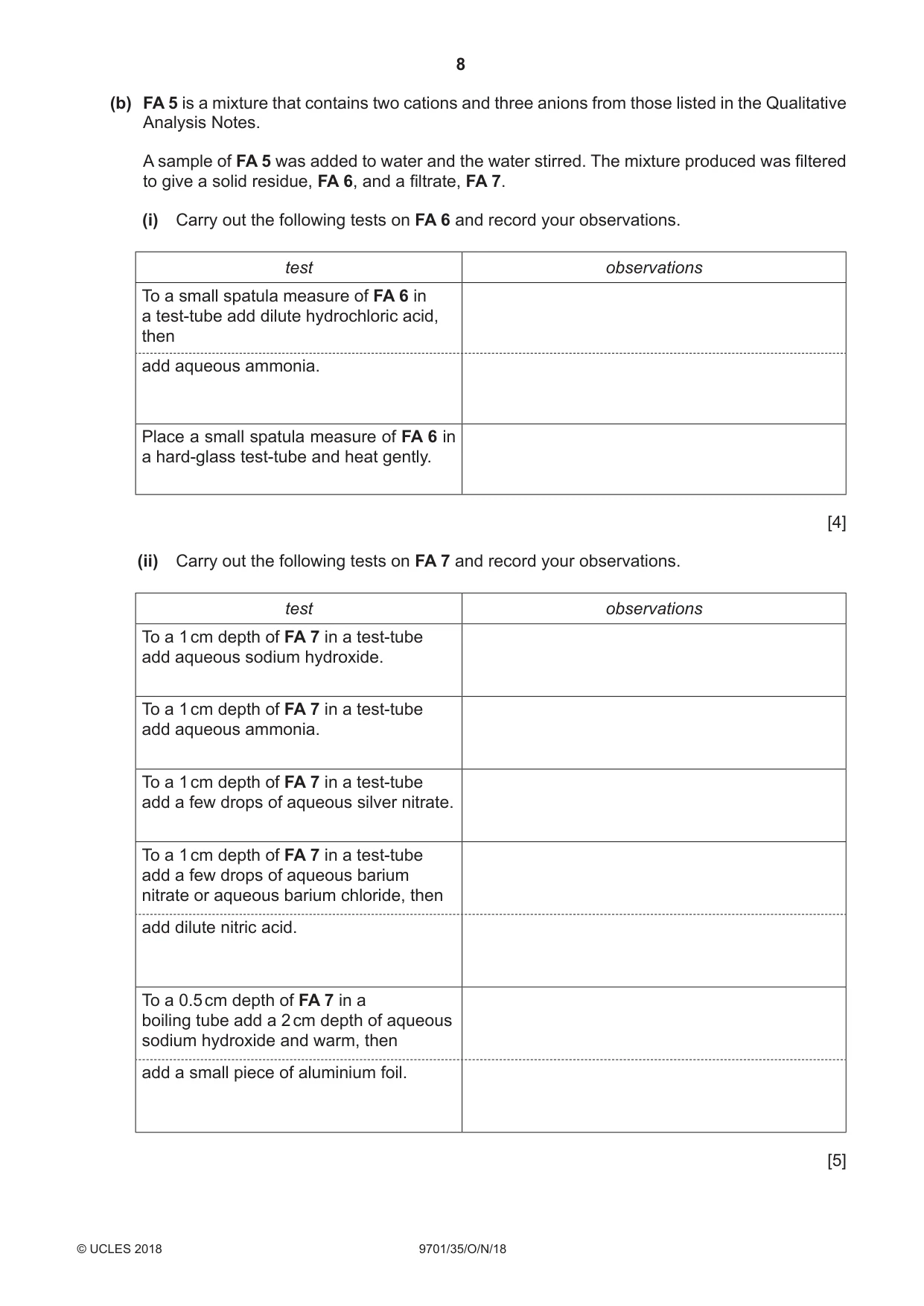
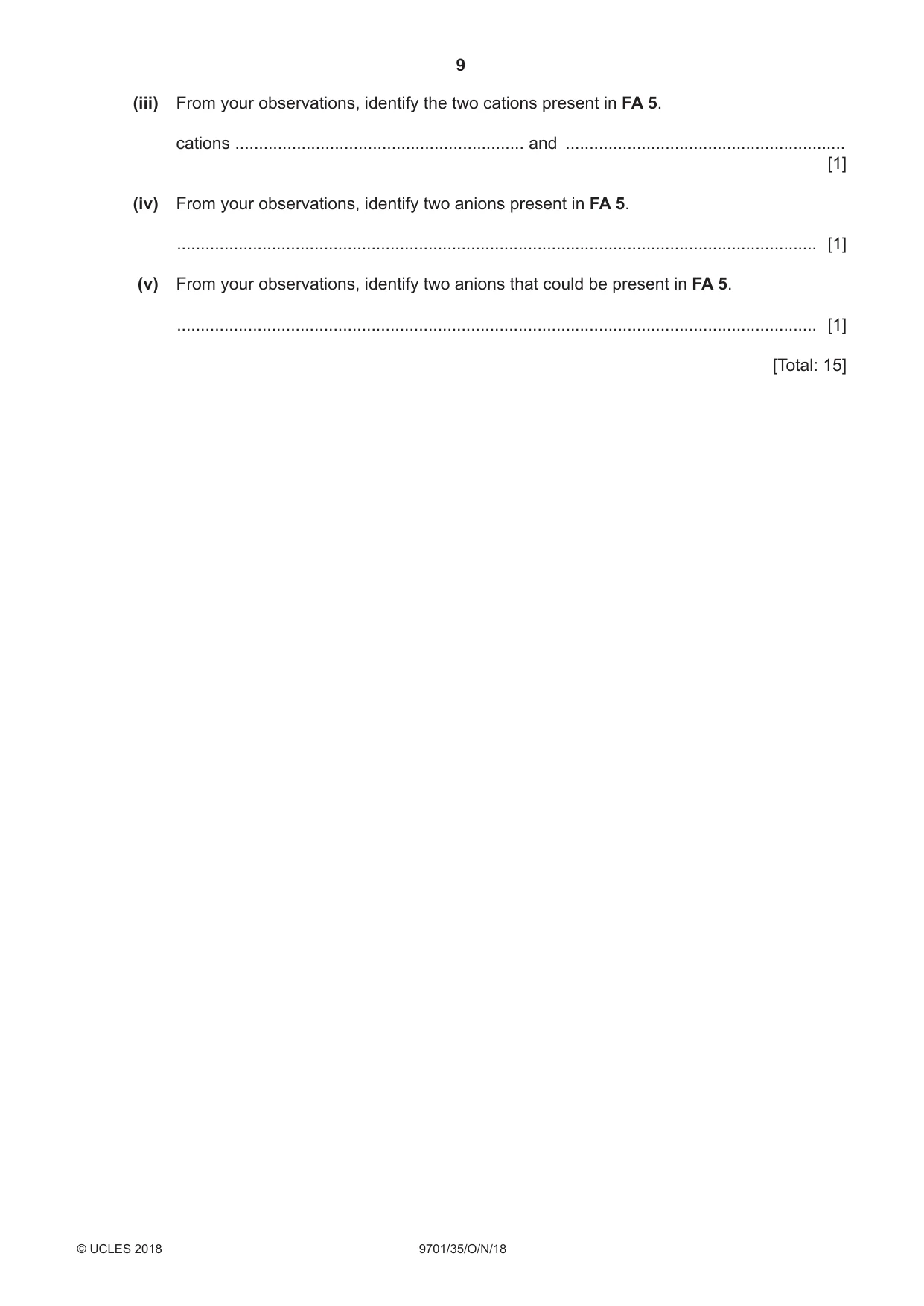
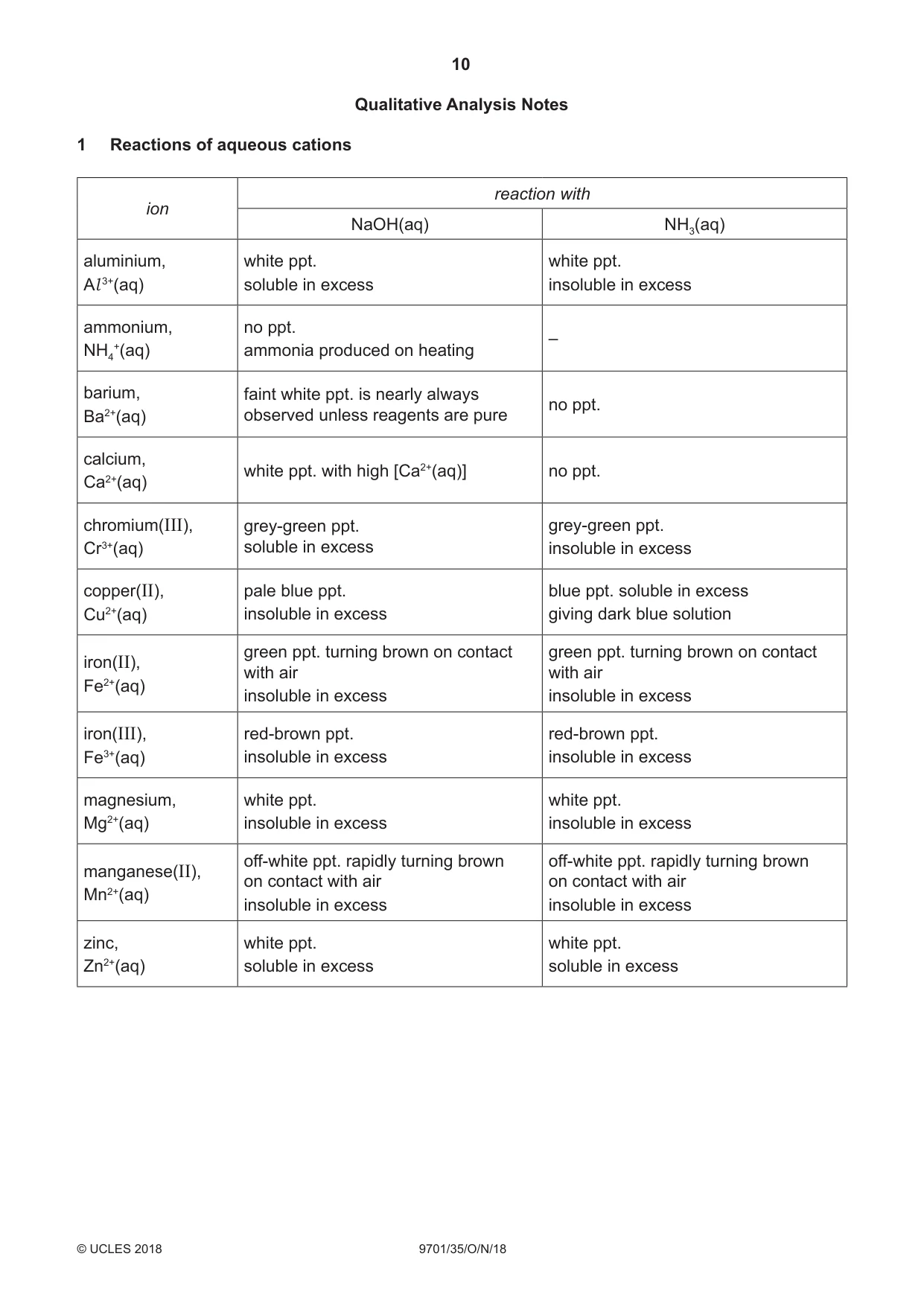
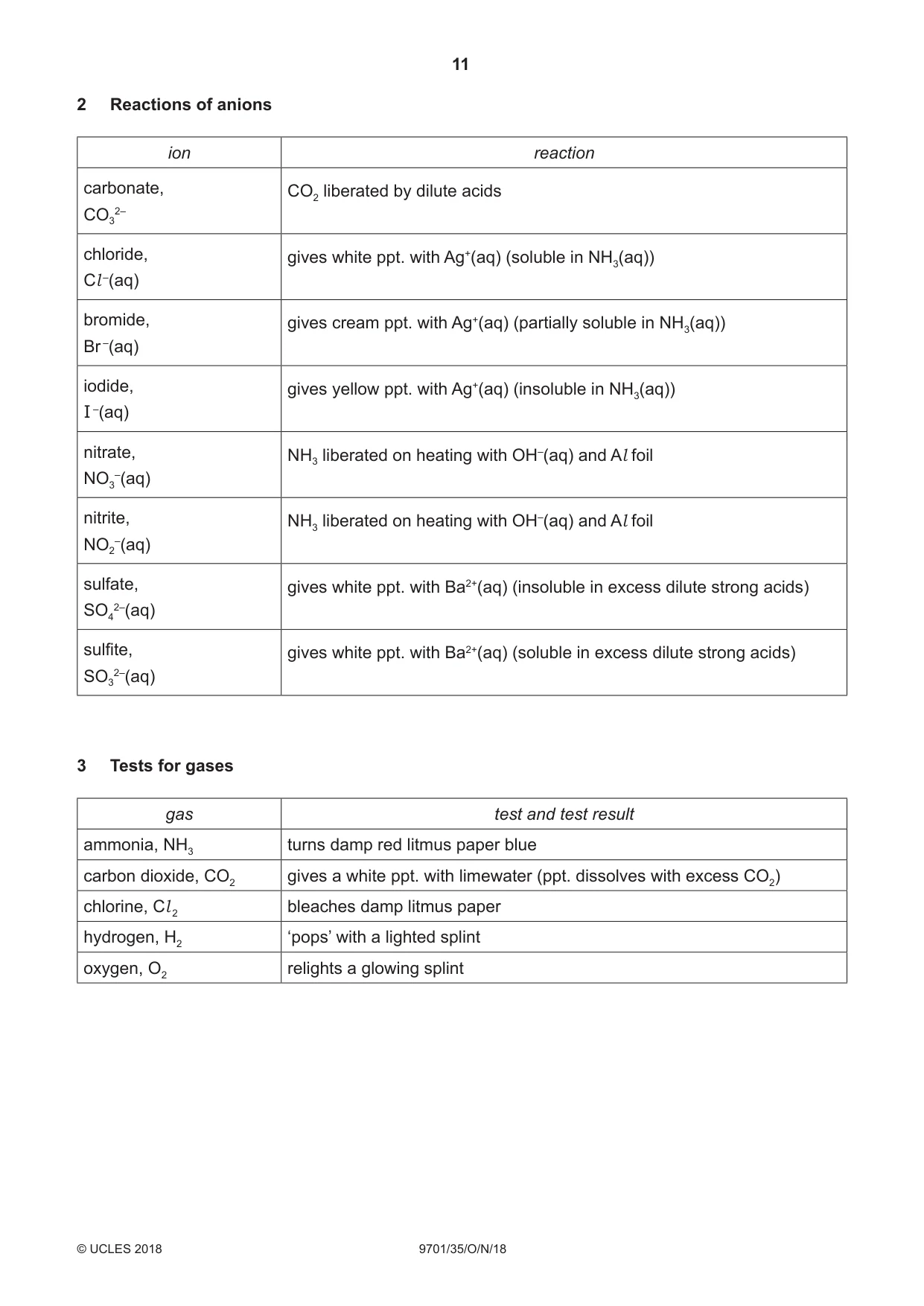
2 (a) (i) FA 4 is a sodium compound that was the impurity in the FA 1 and FA 3 that you used in Question 1. The anion in FA 4 is one of those listed in the Qualitative Analysis Notes. Carry out appropriate tests to allow you to positively identify the anion in FA 4. For the test that gives a positive result, record the test and the results of it. State the name of the anion in FA 4. anion in FA 4 = ............................................................ [2] (ii) Write the ionic equation for the reaction that you have used to identify the anion in FA 4. Include state symbols. ....................................................................................................................................... [1] (b) FA 5 is a mixture that contains two cations and three anions from those listed in the Qualitative Analysis Notes. A sample of FA 5 was added to water and the water stirred. The mixture produced was filtered to give a solid residue, FA 6, and a filtrate, FA 7. (i) Carry out the following tests on FA 6 and record your observations. test observations To a small spatula measure of FA 6 in a test‑tube add dilute hydrochloric acid, then add aqueous ammonia. Place a small spatula measure of FA 6 in a hard‑glass test‑tube and heat gently. [4] (ii) Carry out the following tests on FA 7 and record your observations. test observations To a 1 cm depth of FA 7 in a test‑tube add aqueous sodium hydroxide. To a 1 cm depth of FA 7 in a test‑tube add aqueous ammonia. To a 1 cm depth of FA 7 in a test‑tube add a few drops of aqueous silver nitrate. To a 1 cm depth of FA 7 in a test‑tube add a few drops of aqueous barium nitrate or aqueous barium chloride, then add dilute nitric acid. To a 0.5 cm depth of FA 7 in a boiling tube add a 2 cm depth of aqueous sodium hydroxide and warm, then add a small piece of aluminium foil. [5] (iv) From your observations, identify two anions present in FA 5. ....................................................................................................................................... [1] (v) From your observations, identify two anions that could be present in FA 5. ....................................................................................................................................... [1] [Total: 15]
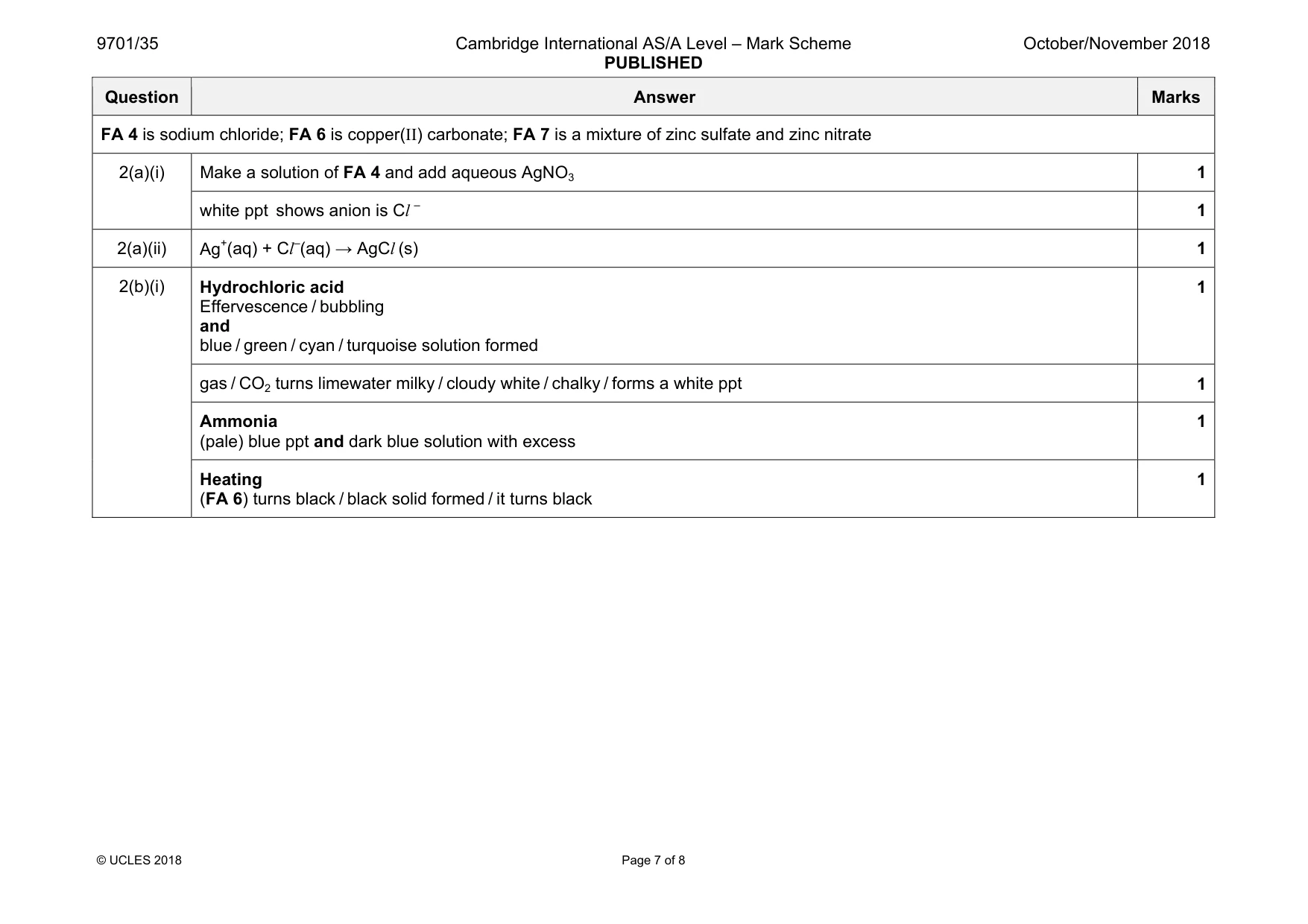
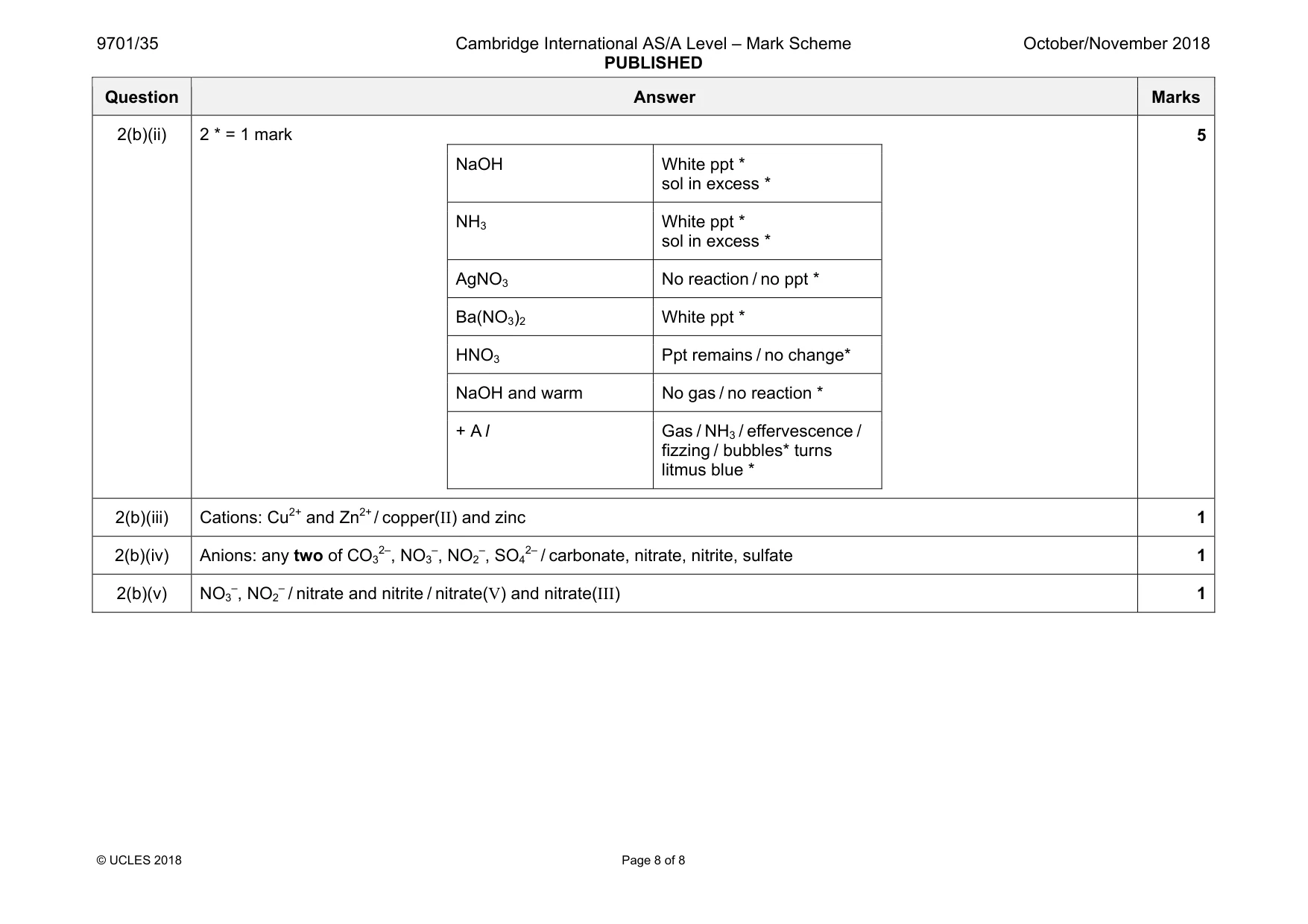
Mark scheme: 2(a)(i) Make a solution of FA 4 and add aqueous AgNO3 1 white ppt shows anion is Cl ‒ 1 2(a)(ii) Ag+(aq) + Cl‒(aq) → AgCl (s) 1 2(b)(i) Hydrochloric acid Effervescence / bubbling and blue / green / cyan / turquoise solution formed 1 gas / CO2 turns limewater milky / cloudy white / chalky / forms a white ppt 1 Ammonia (pale) blue ppt and dark blue solution with excess 1 Heating (FA 6) turns black / black solid formed / it turns black 1 Question Answer Marks 2(b)(ii) 2 * = 1 mark NaOH White ppt * sol in excess * NH3 White ppt * sol in excess * AgNO3 No reaction / no ppt * Ba(NO3)2 White ppt * HNO3 Ppt remains / no change* NaOH and warm No gas / no reaction * + A l Gas / NH3 / effervescence / fizzing / bubbles* turns litmus blue * 5 2(b)(iii) Cations: Cu2+ and Zn2+ / copper(II) and zinc 1 2(b)(iv) Anions: any two of CO3 2–, NO3 ‒, NO2 ‒, SO4 2– / carbonate, nitrate, nitrite, sulfate 1 2(b)(v) NO3 ‒, NO2 ‒ / nitrate and nitrite / nitrate(V) and nitrate(III) 1
What was in this paper
The subtopics covered by these 2 questions, and how many questions each got. Open one in a new tab to see every Cambridge question on it.
What you needed in this session
Cambridge’s own grade thresholds for 2018 Oct/Nov, Paper 3 · Variant 5. A higher threshold means an easier paper — the bar moves with how the cohort did.