Cambridge A Level Chemistry 9701 — 2023 May/June Paper 3 · Variant 5
9701/35/M/J/23 · 3 questions · 40 marks · ≈45 min
The question paper and its mark scheme, free to read here and free to download. This is Cambridge’s own paper, exactly as it was sat.
Question paper12 pages
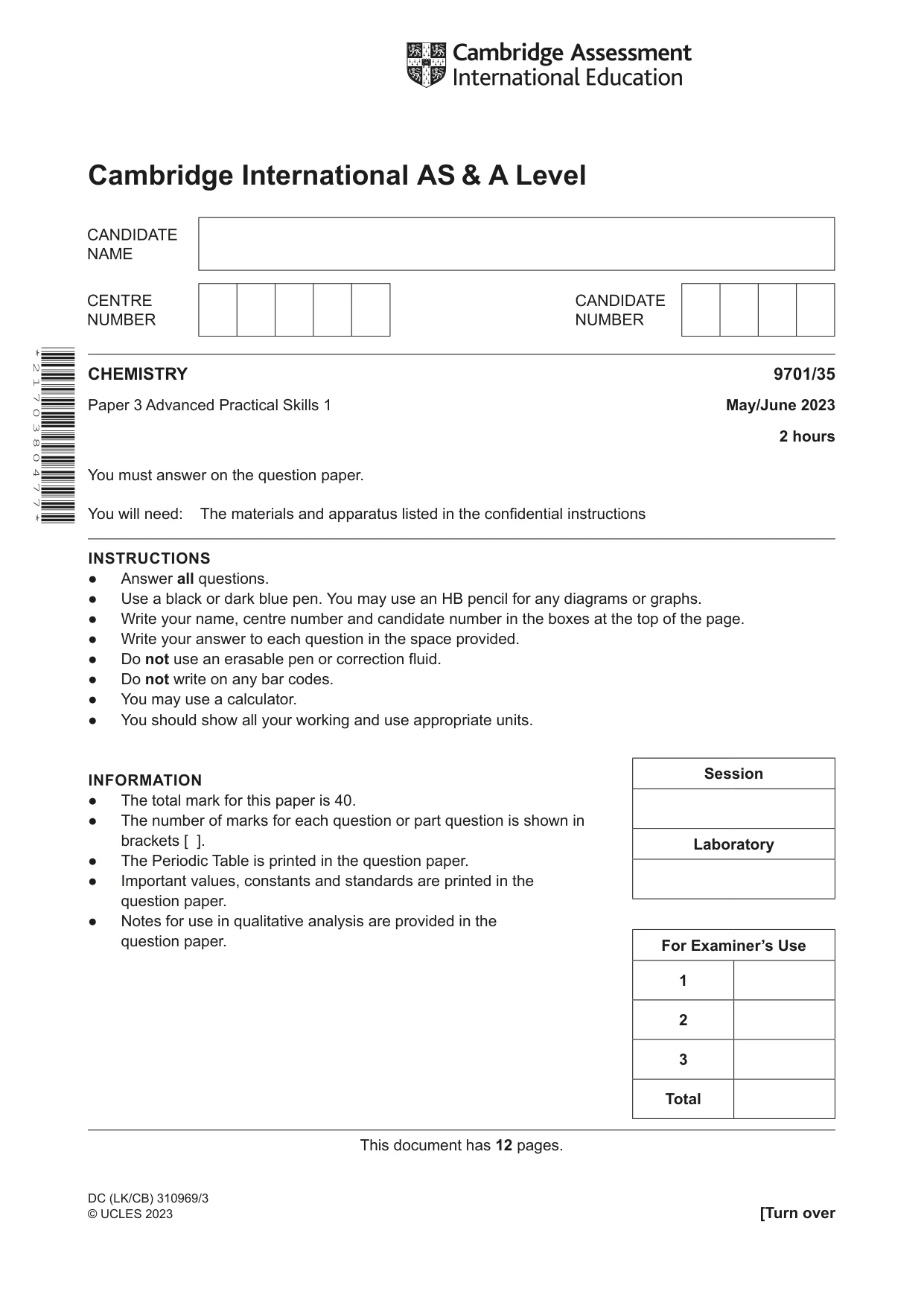
Mark scheme12 pages
Answers below. Sit the paper first if you are practising.
Questions as text
Q1 · Magnesium is a reactive metal which corrodes when left in air
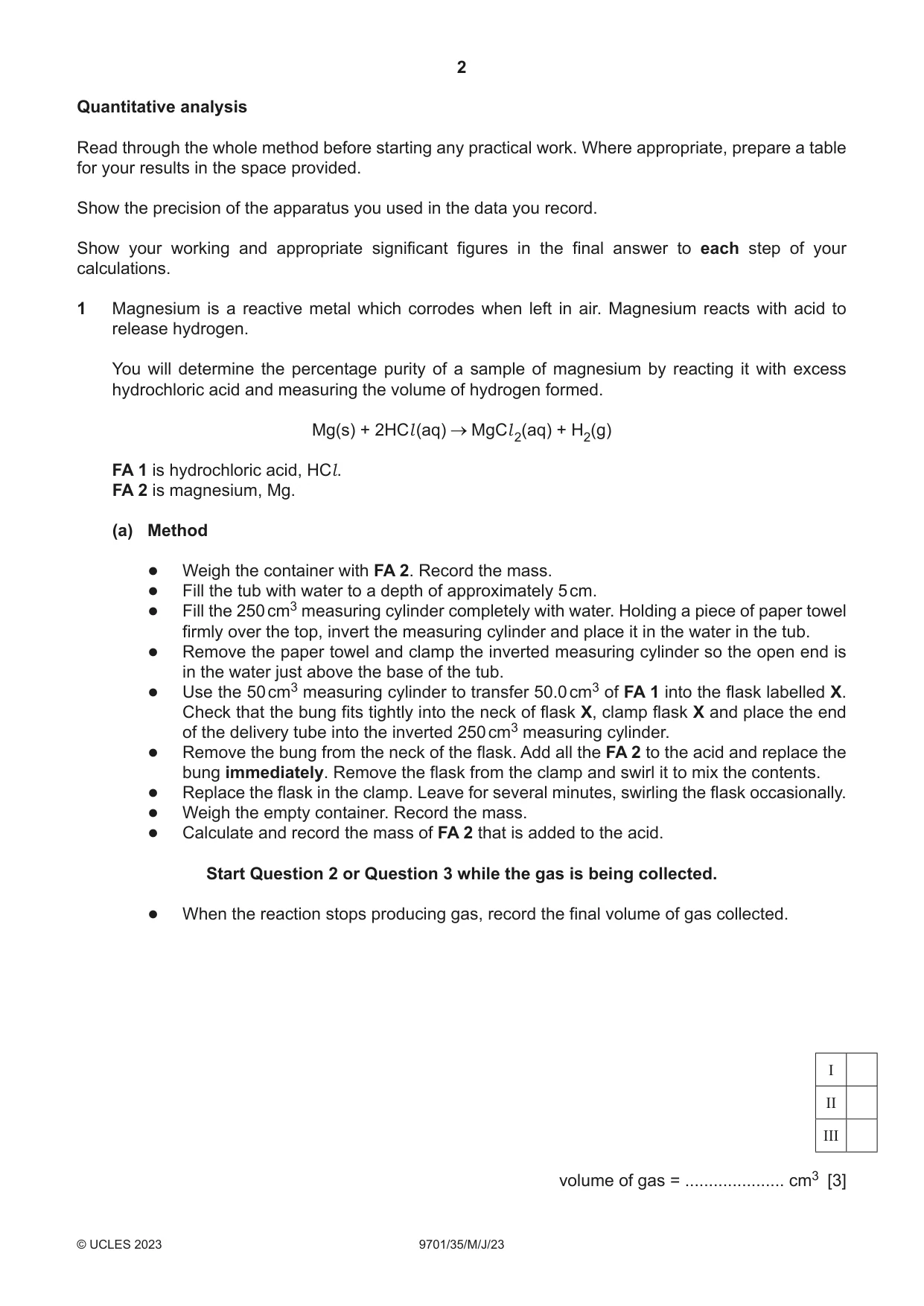
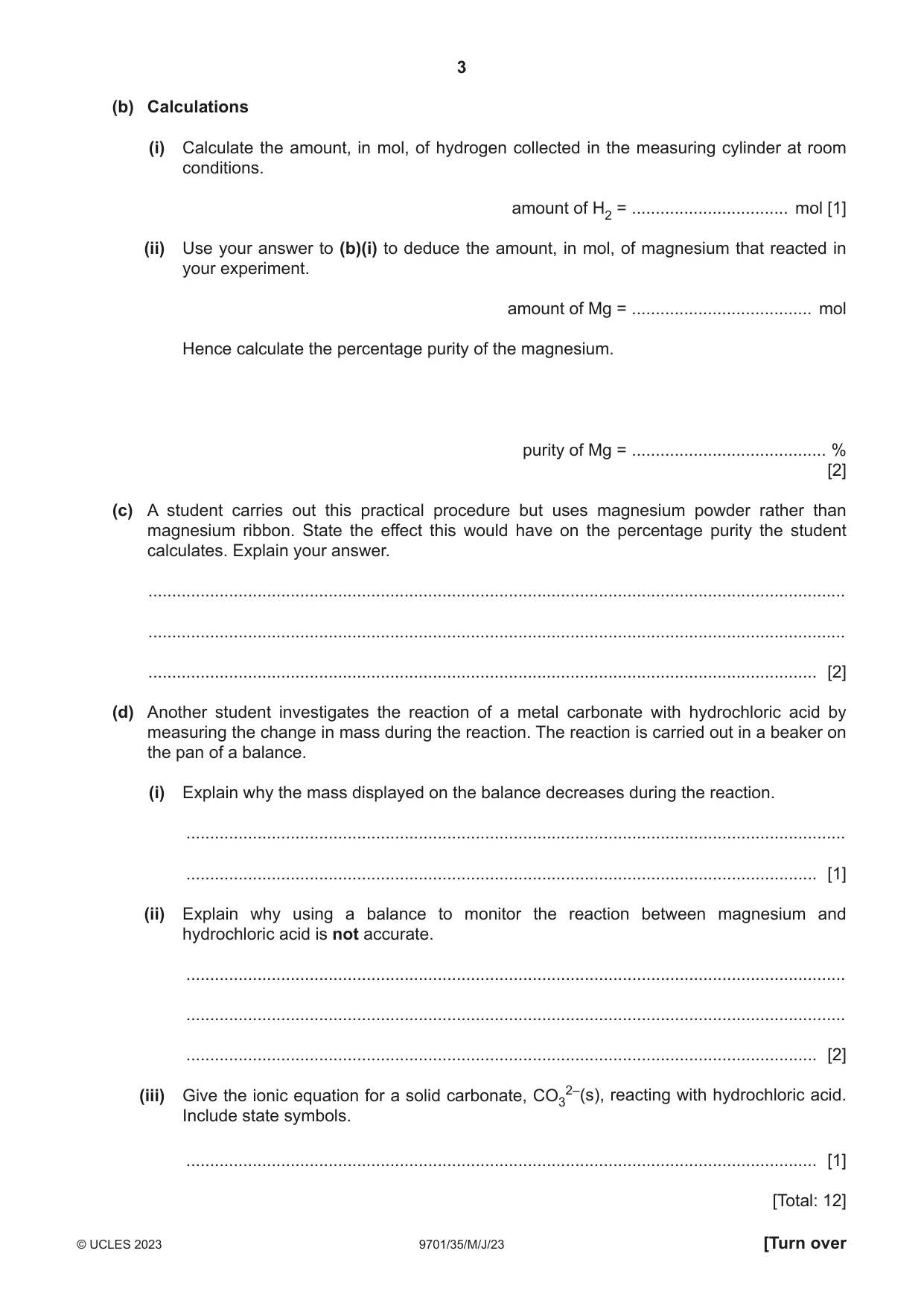
1 Magnesium is a reactive metal which corrodes when left in air. Magnesium reacts with acid to release hydrogen. You will determine the percentage purity of a sample of magnesium by reacting it with excess hydrochloric acid and measuring the volume of hydrogen formed. Mg(s) + 2HCl (aq) MgCl 2(aq) + H2(g) FA 1 is hydrochloric acid, HCl . FA 2 is magnesium, Mg. (a) Method ● Weigh the container with FA 2. Record the mass. ● Fill the tub with water to a depth of approximately 5 cm. ● Fill the 250 cm3 measuring cylinder completely with water. Holding a piece of paper towel firmly over the top, invert the measuring cylinder and place it in the water in the tub. ● Remove the paper towel and clamp the inverted measuring cylinder so the open end is in the water just above the base of the tub. ● Use the 50 cm3 measuring cylinder to transfer 50.0 cm3 of FA 1 into the flask labelled X. Check that the bung fits tightly into the neck of flask X, clamp flask X and place the end of the delivery tube into the inverted 250 cm3 measuring cylinder. ● Remove the bung from the neck of the flask. Add all the FA 2 to the acid and replace the bung immediately. Remove the flask from the clamp and swirl it to mix the contents. ● Replace the flask in the clamp. Leave for several minutes, swirling the flask occasionally. ● Weigh the empty container. Record the mass. ● Calculate and record the mass of FA 2 that is added to the acid. Start Question 2 or Question 3 while the gas is being collected. ● When the reaction stops producing gas, record the final volume of gas collected. I II III volume of gas = ..................... cm3 [3] (b) Calculations (i) Calculate the amount, in mol, of hydrogen collected in the measuring cylinder at room conditions. amount of H2 = ................................. mol [1] (ii) Use your answer to (b)(i) to deduce the amount, in mol, of magnesium that reacted in your experiment. amount of Mg = ...................................... mol Hence calculate the percentage purity of the magnesium. purity of Mg = ......................................... % [2] (c) A student carries out this practical procedure but uses magnesium powder rather than magnesium ribbon. State the effect this would have on the percentage purity the student calculates. Explain your answer. ................................................................................................................................................... ................................................................................................................................................... ............................................................................................................................................. [2] (d) Another student investigates the reaction of a metal carbonate with hydrochloric acid by measuring the change in mass during the reaction. The reaction is carried out in a beaker on the pan of a balance. (i) Explain why the mass displayed on the balance decreases during the reaction. ........................................................................................................................................... ..................................................................................................................................... [1] (ii) Explain why using a balance to monitor the reaction between magnesium and hydrochloric acid is not accurate. ........................................................................................................................................... ........................................................................................................................................... ..................................................................................................................................... [2] (iii) Give the ionic equation for a solid carbonate, CO32–(s), reacting with hydrochloric acid. Include state symbols. ..................................................................................................................................... [1] [Total: 12]
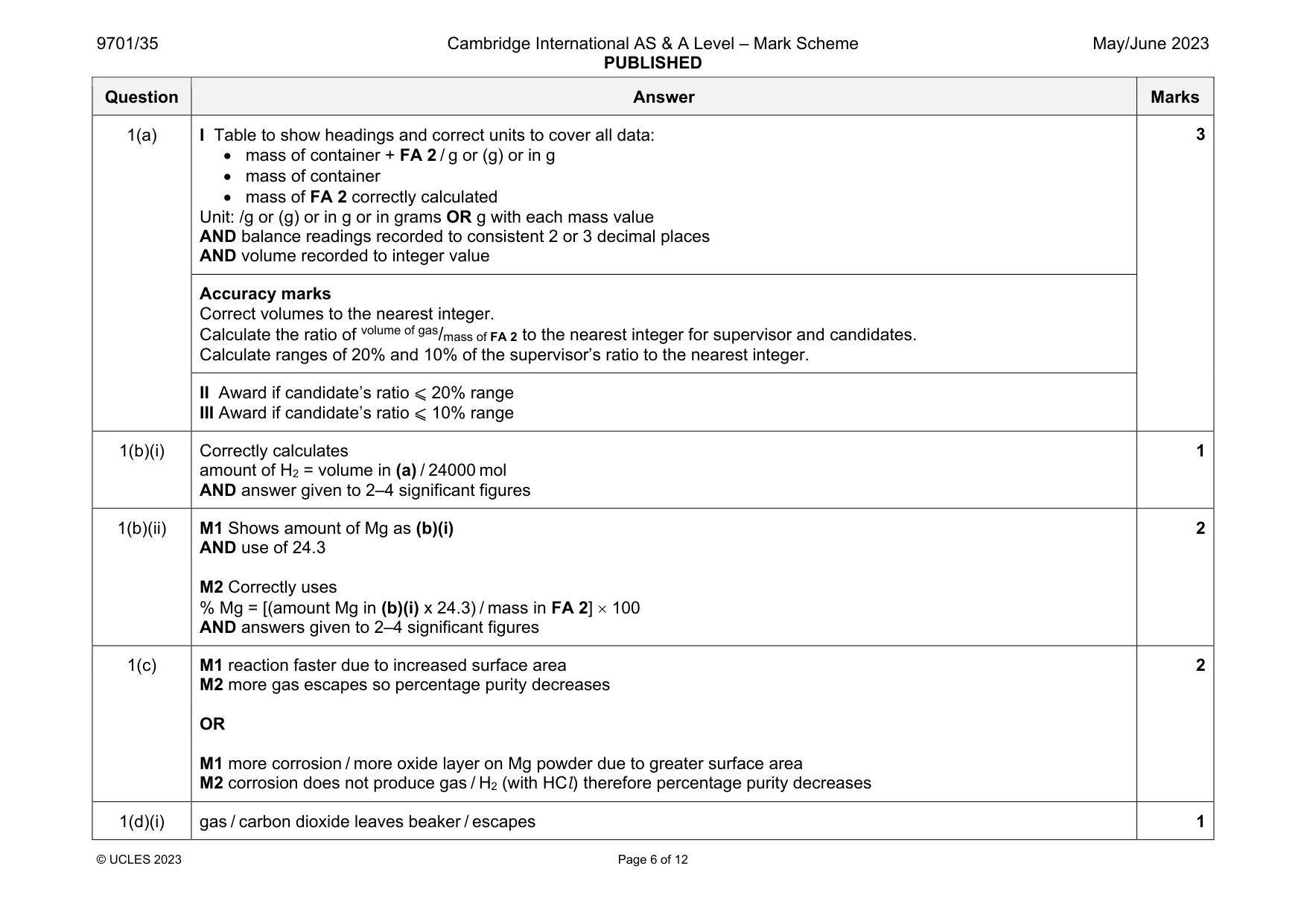
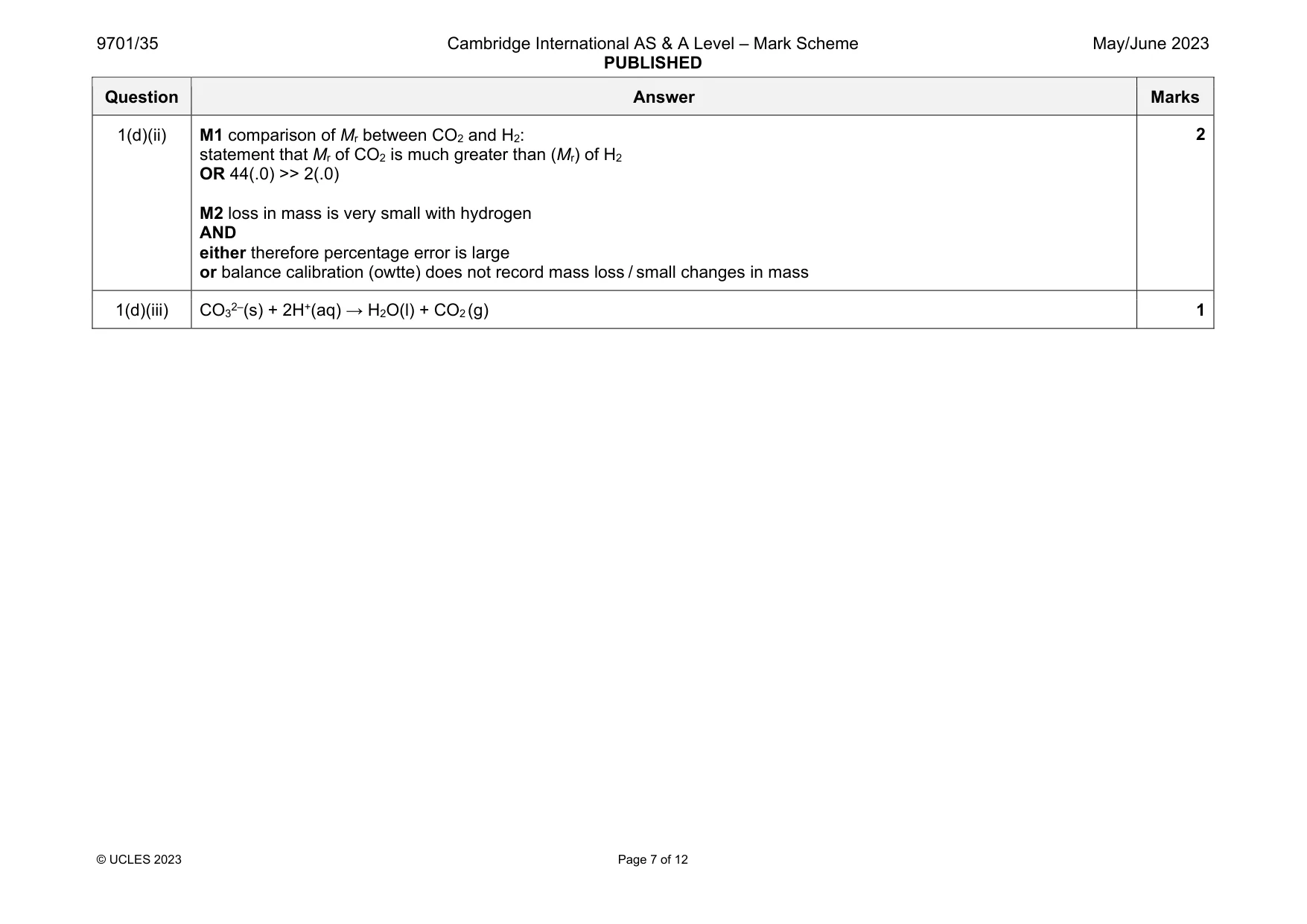
Mark scheme: 1(a) I Table to show headings and correct units to cover all data: mass of container + FA 2 / g or (g) or in g mass of container mass of FA 2 correctly calculated Unit: /g or (g) or in g or in grams OR g with each mass value AND balance readings recorded to consistent 2 or 3 decimal places AND volume recorded to integer value Accuracy marks Correct volumes to the nearest integer. Calculate the ratio of volume of gas/mass of FA 2 to the nearest integer for supervisor and candidates. Calculate ranges of 20% and 10% of the supervisor’s ratio to the nearest integer. II Award if candidate’s ratio ⩽ 20% range III Award if candidate’s ratio ⩽ 10% range 1(b)(i) Correctly calculates amount of H2 = volume in (a) / 24000 mol AND answer given to 2–4 significant figures 1 1(b)(ii) M1 Shows amount of Mg as (b)(i) AND use of 24.3 M2 Correctly uses % Mg = [(amount Mg in (b)(i) x 24.3) / mass in FA 2] 100 AND answers given to 2–4 significant figures 2 1(c) M1 reaction faster due to increased surface area M2 more gas escapes so percentage purity decreases OR M1 more corrosion / more oxide layer on Mg powder due to greater surface area M2 corrosion does not produce gas / H2 (with HCl) therefore percentage purity decreases 2 1(d)(i) gas / carbon dioxide leaves beaker / escapes 1 Question Answer Marks 1(d)(ii) M1 comparison of Mr between CO2 and H2: statement that Mr of CO2 is much greater than (Mr) of H2 OR 44(.0) >> 2(.0) M2 loss in mass is very small with hydrogen AND either therefore percentage error is large or balance calibration (owtte) does not record mass loss / small changes in mass 2 1(d)(iii) CO32–(s) + 2H+(aq) → H2O(l) + CO2(g) 1
More questions on Reacting masses and volumes (of solutions and gases)
Q2 · In Question 1 you determined the percentage purity of a sample of magnesium by measuring…
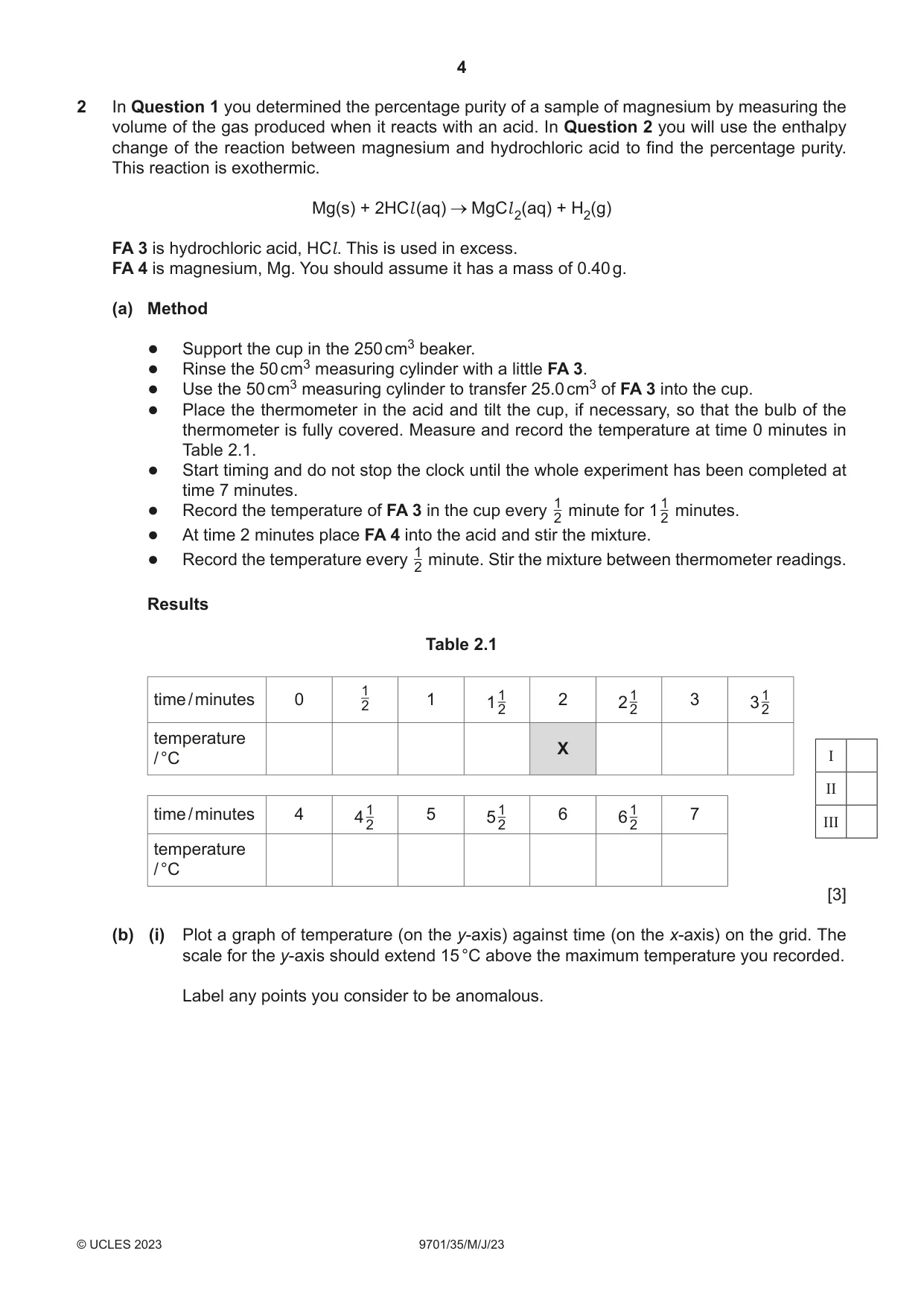
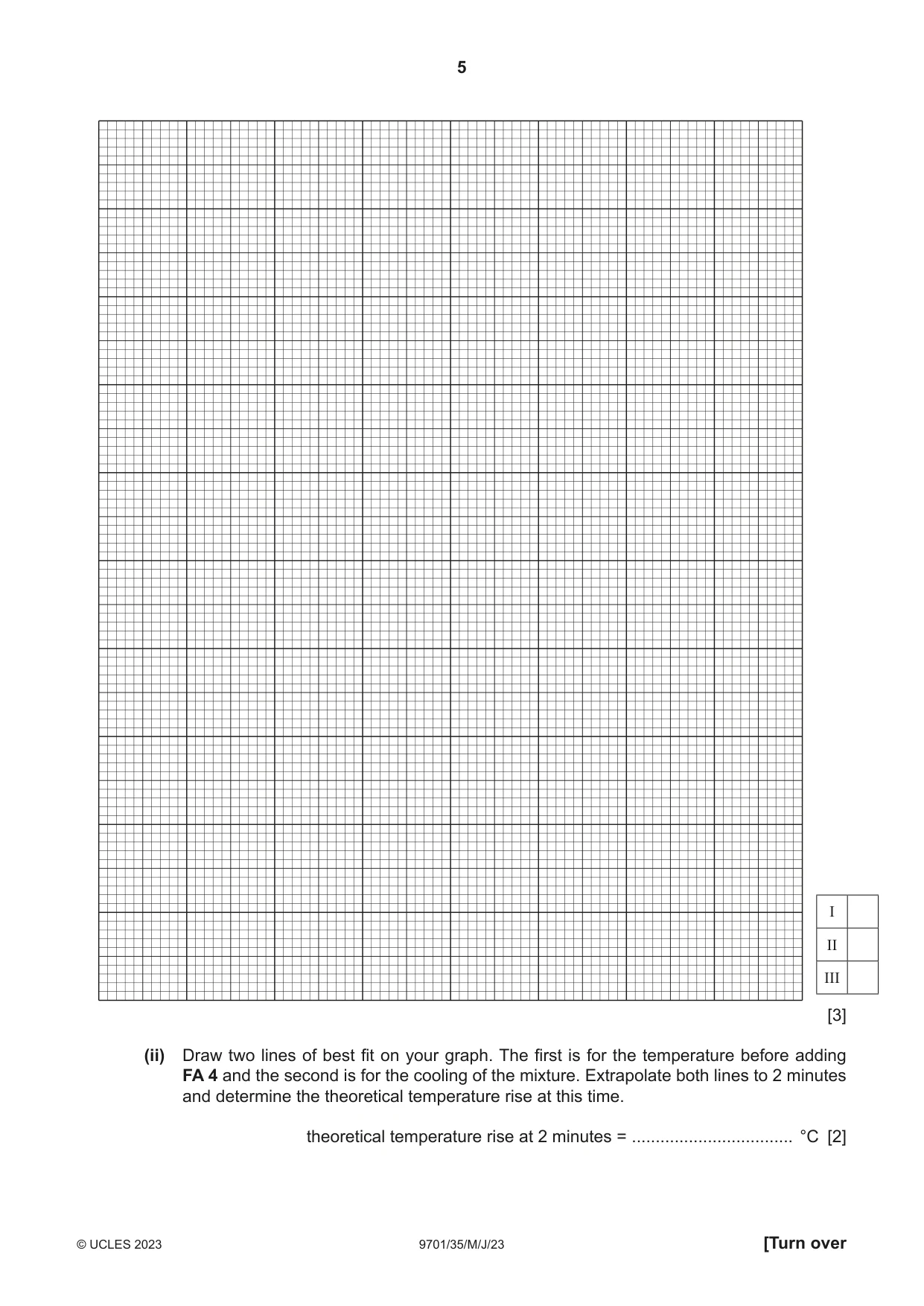
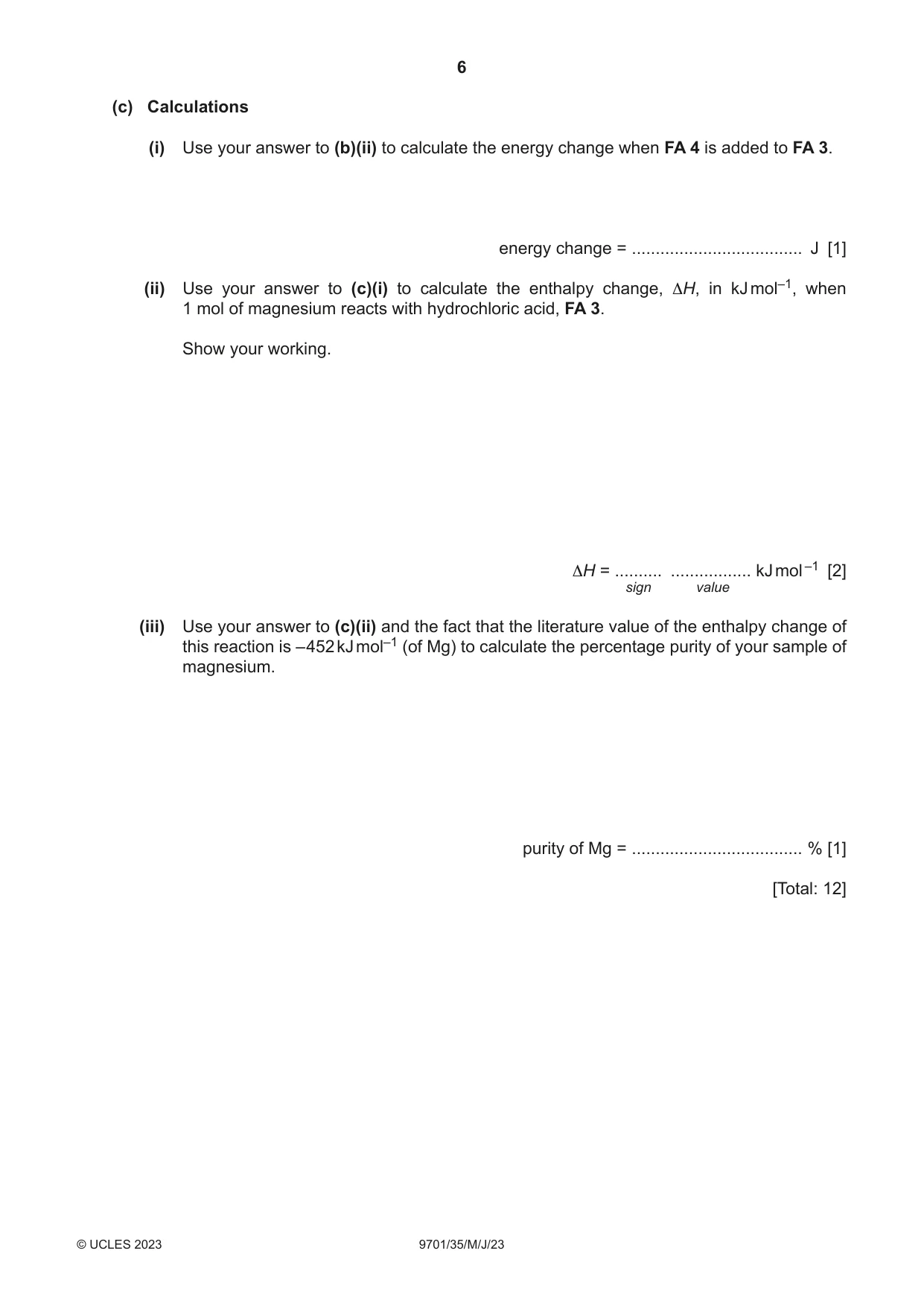
2 In Question 1 you determined the percentage purity of a sample of magnesium by measuring the volume of the gas produced when it reacts with an acid. In Question 2 you will use the enthalpy change of the reaction between magnesium and hydrochloric acid to find the percentage purity. This reaction is exothermic. Mg(s) + 2HCl (aq) MgCl 2(aq) + H2(g) FA 3 is hydrochloric acid, HCl . This is used in excess. FA 4 is magnesium, Mg. You should assume it has a mass of 0.40 g. (a) Method ● Support the cup in the 250 cm3 beaker. ● Rinse the 50 cm3 measuring cylinder with a little FA 3. ● Use the 50 cm3 measuring cylinder to transfer 25.0 cm3 of FA 3 into the cup. ● Place the thermometer in the acid and tilt the cup, if necessary, so that the bulb of the thermometer is fully covered. Measure and record the temperature at time 0 minutes in Table 2.1. ● Start timing and do not stop the clock until the whole experiment has been completed at time 7 minutes. ● Record the temperature of FA 3 in the cup every 1 minute for 11 minutes. 2 2 ● At time 2 minutes place FA 4 into the acid and stir the mixture. ● Record the temperature every 1 minute. Stir the mixture between thermometer readings. 2 Results Table 2.1 1 time / minutes 0 2 1 112 2 212 3 312 temperature X / °C I II 7 time / minutes 4 41 5 51 6 61 III 2 2 2 temperature / °C [3] (b) (i) Plot a graph of temperature (on the y-axis) against time (on the x-axis) on the grid. The scale for the y-axis should extend 15 °C above the maximum temperature you recorded. Label any points you consider to be anomalous. (c) Calculations (i) Use your answer to (b)(ii) to calculate the energy change when FA 4 is added to FA 3. energy change = .................................... J [1] (ii) Use your answer to (c)(i) to calculate the enthalpy change, ΔH, in kJ mol–1, when 1 mol of magnesium reacts with hydrochloric acid, FA 3. Show your working. ΔH = .......... ................. kJ mol –1 [2] sign value (iii) Use your answer to (c)(ii) and the fact that the literature value of the enthalpy change of this reaction is –452 kJ mol–1 (of Mg) to calculate the percentage purity of your sample of magnesium. purity of Mg = .................................... % [1] [Total: 12] Qualitative analysis For each test you should record all your observations in the spaces provided. Examples of observations include: ● colour changes seen ● the formation of any precipitate and its solubility (where appropriate) in an excess of the reagent added ● the formation of any gas and its identification (where appropriate) by a suitable test. You should record clearly at what stage in a test an observation is made. Where no change is observed you should write ‘no change’. Where reagents are selected for use in a test, the name or correct formula of the element or compound must be given. If any solution is warmed, a boiling tube must be used. Rinse and reuse test-tubes and boiling tubes where possible. No additional tests should be attempted.
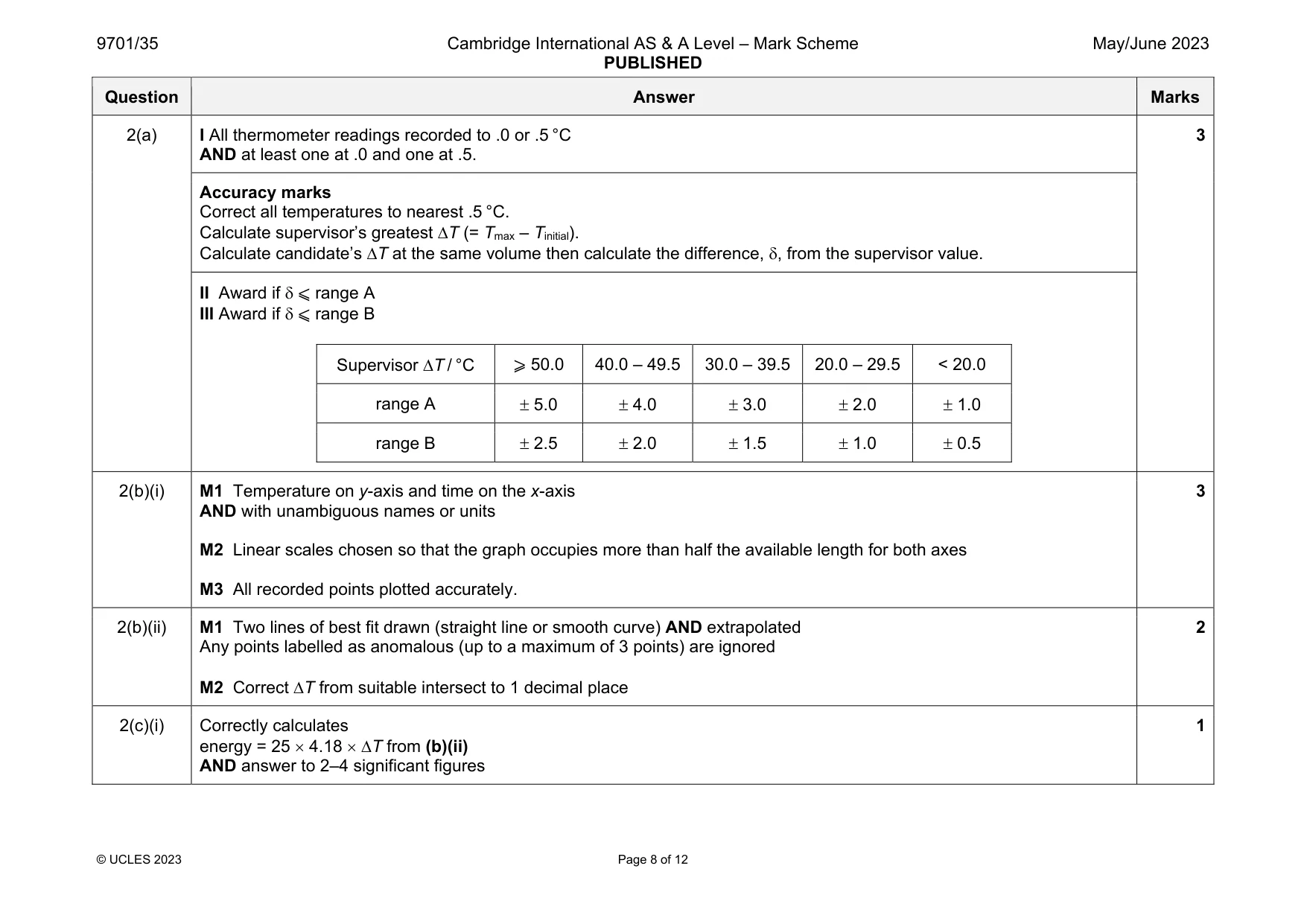
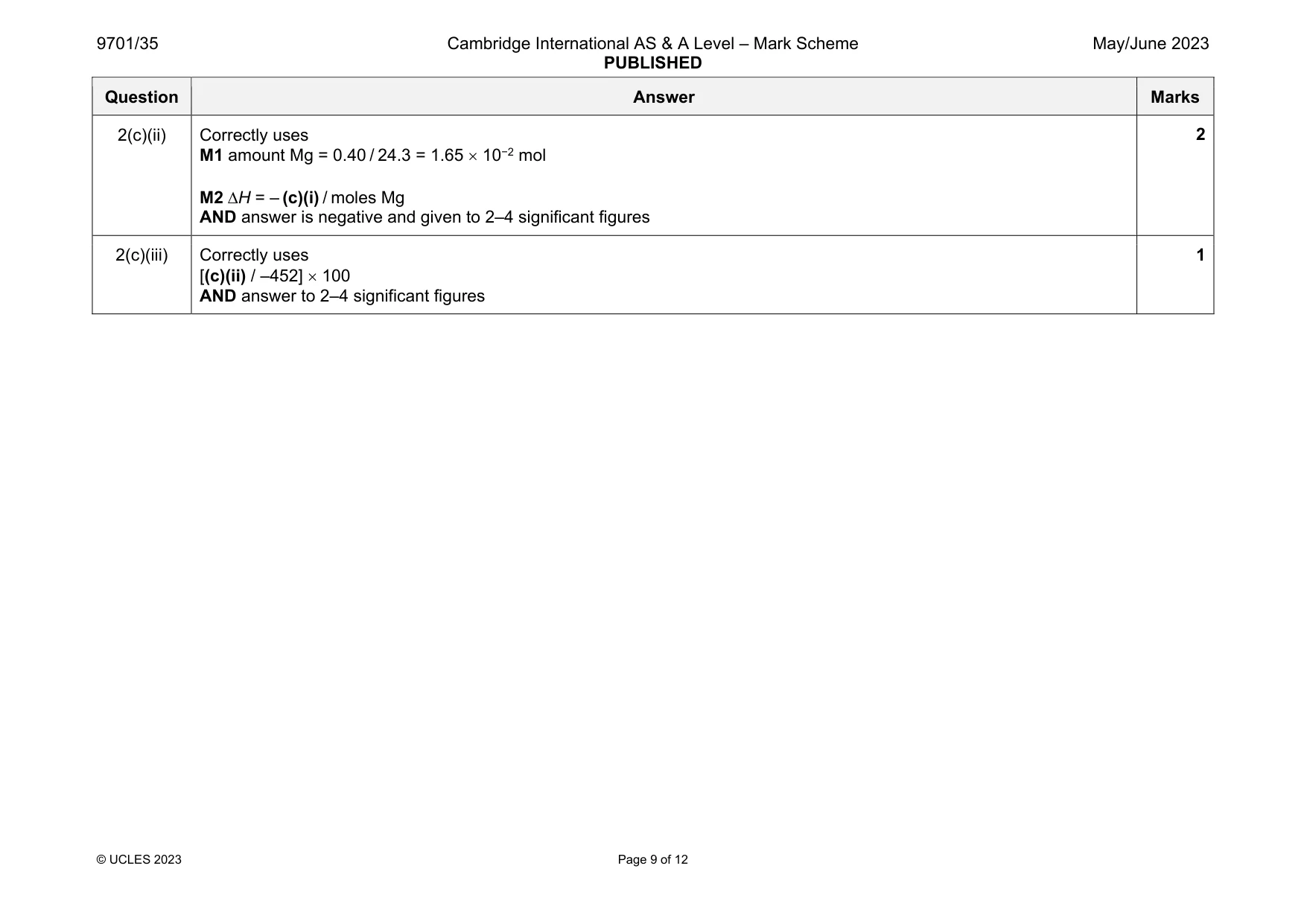
Mark scheme: 2(a) I All thermometer readings recorded to .0 or .5 °C AND at least one at .0 and one at .5. 3 Accuracy marks Correct all temperatures to nearest .5 °C. Calculate supervisor’s greatest T (= Tmax – Tinitial). Calculate candidate’s T at the same volume then calculate the difference, , from the supervisor value. II Award if ⩽ range A III Award if ⩽ range B Supervisor T / °C ⩾ 50.0 40.0 – 49.5 30.0 – 39.5 20.0 – 29.5 < 20.0 range A 5.0 4.0 3.0 2.0 1.0 range B 2.5 2.0 1.5 1.0 0.5 2(b)(i) M1 Temperature on y-axis and time on the x-axis AND with unambiguous names or units M2 Linear scales chosen so that the graph occupies more than half the available length for both axes M3 All recorded points plotted accurately. 3 2(b)(ii) M1 Two lines of best fit drawn (straight line or smooth curve) AND extrapolated Any points labelled as anomalous (up to a maximum of 3 points) are ignored M2 Correct T from suitable intersect to 1 decimal place 2 2(c)(i) Correctly calculates energy = 25 4.18 T from (b)(ii) AND answer to 2–4 significant figures 1 Question Answer Marks 2(c)(ii) Correctly uses M1 amount Mg = 0.40 / 24.3 = 1.65 10−2 mol M2H = – (c)(i) / moles Mg AND answer is negative and given to 2–4 significant figures 2 2(c)(iii) Correctly uses [(c)(ii) / –452] 100 AND answer to 2–4 significant figures 1
Q3 · Devise and carry out tests to determine whether FA 5 is magnesium carbonate
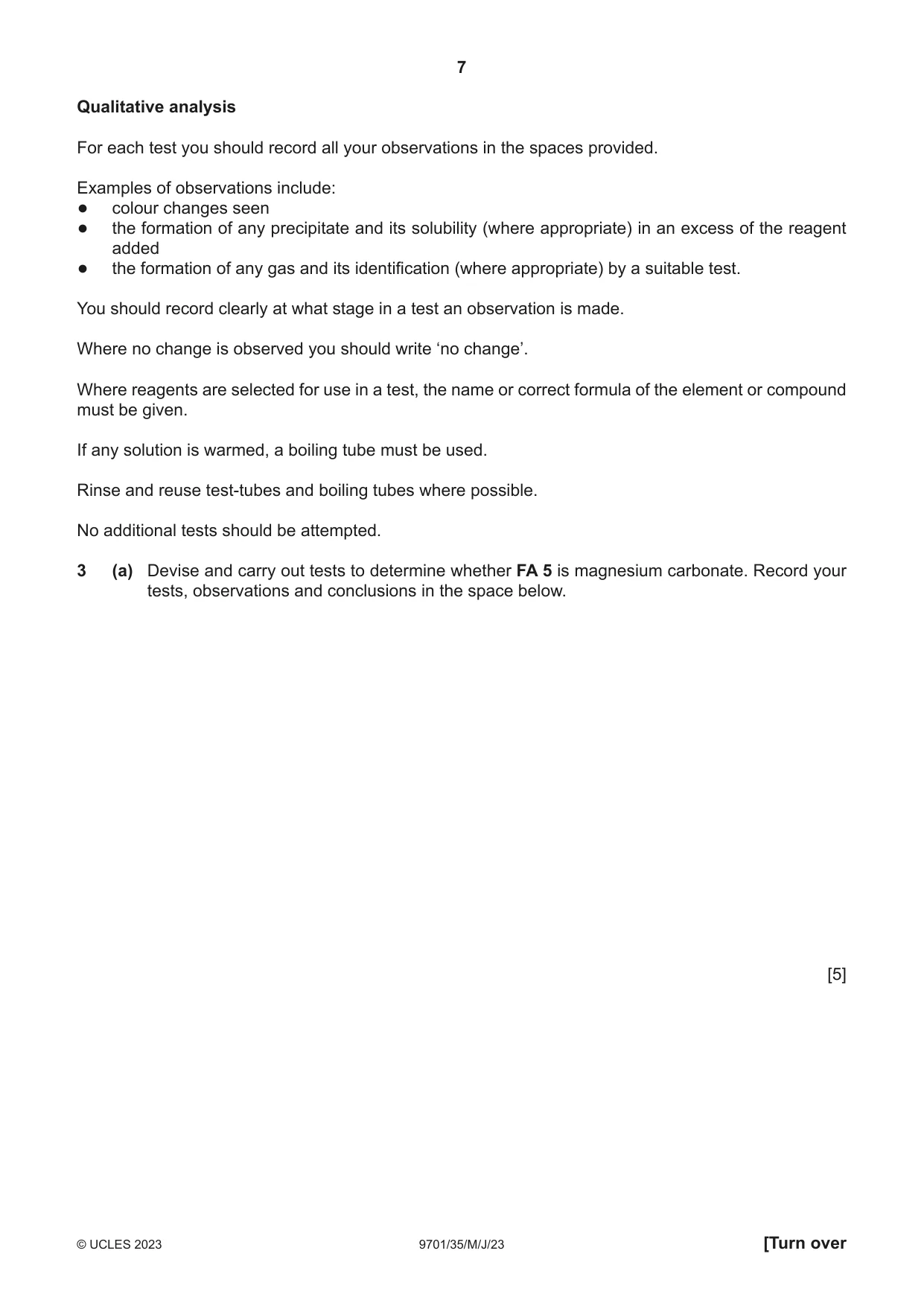
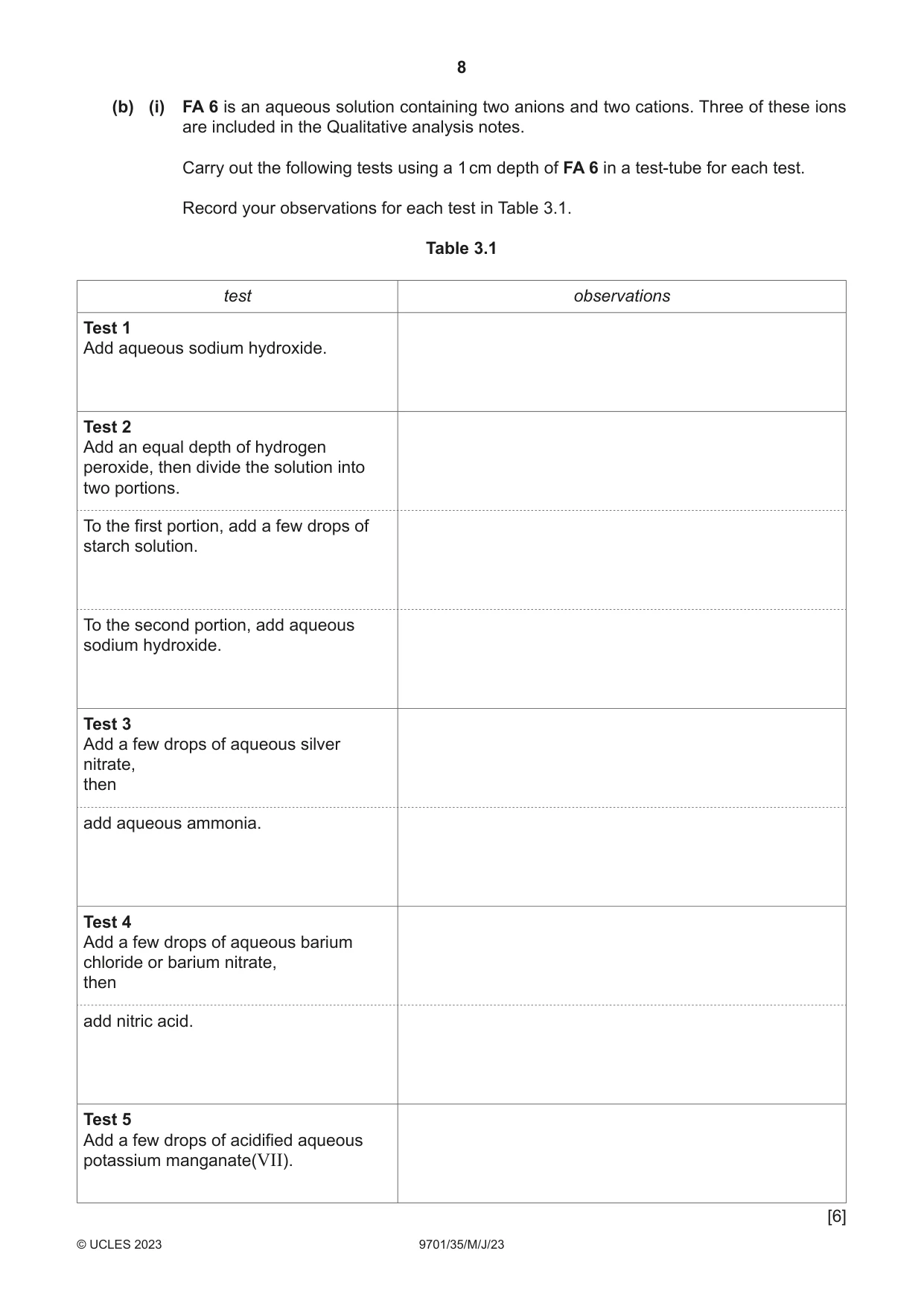
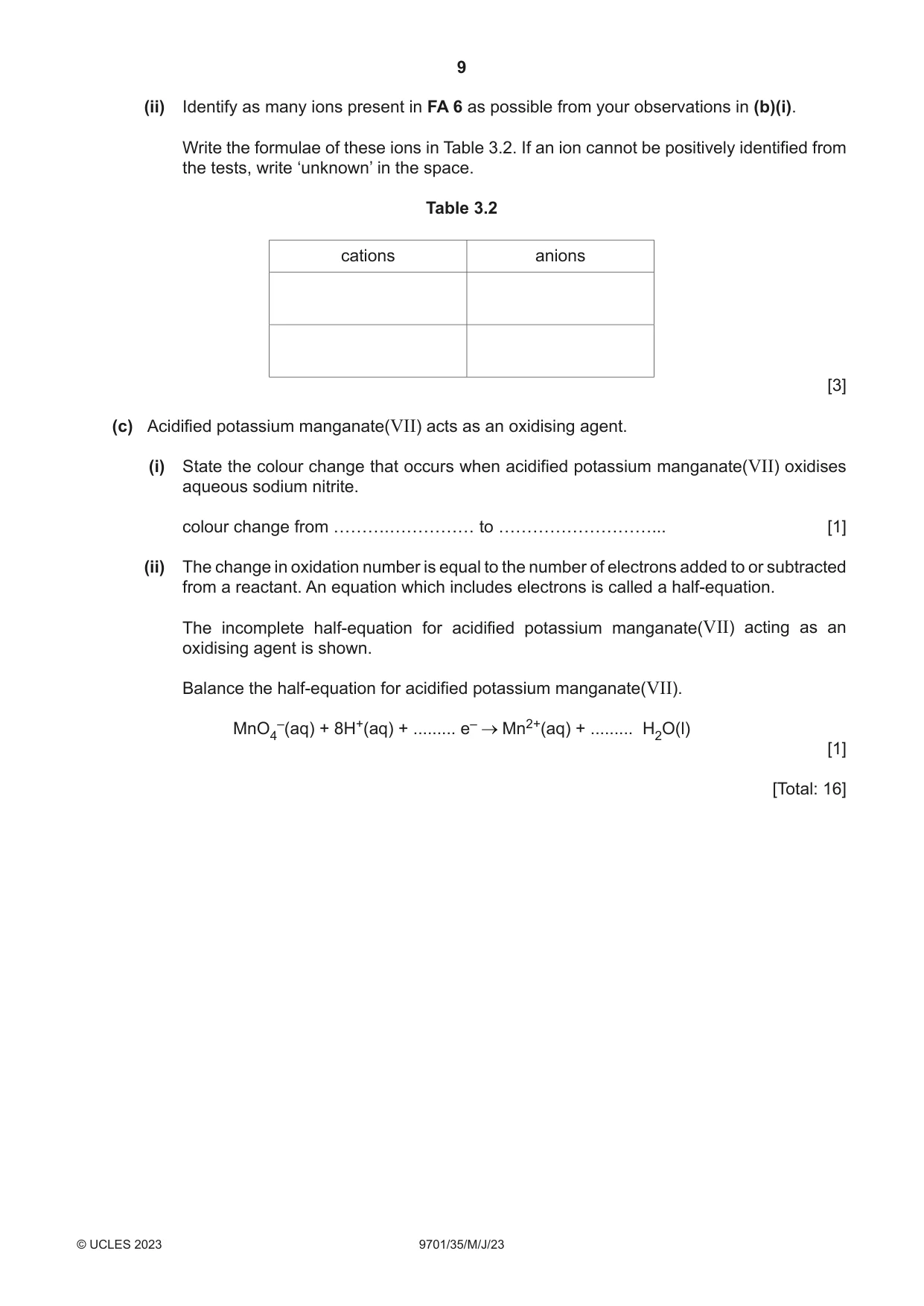
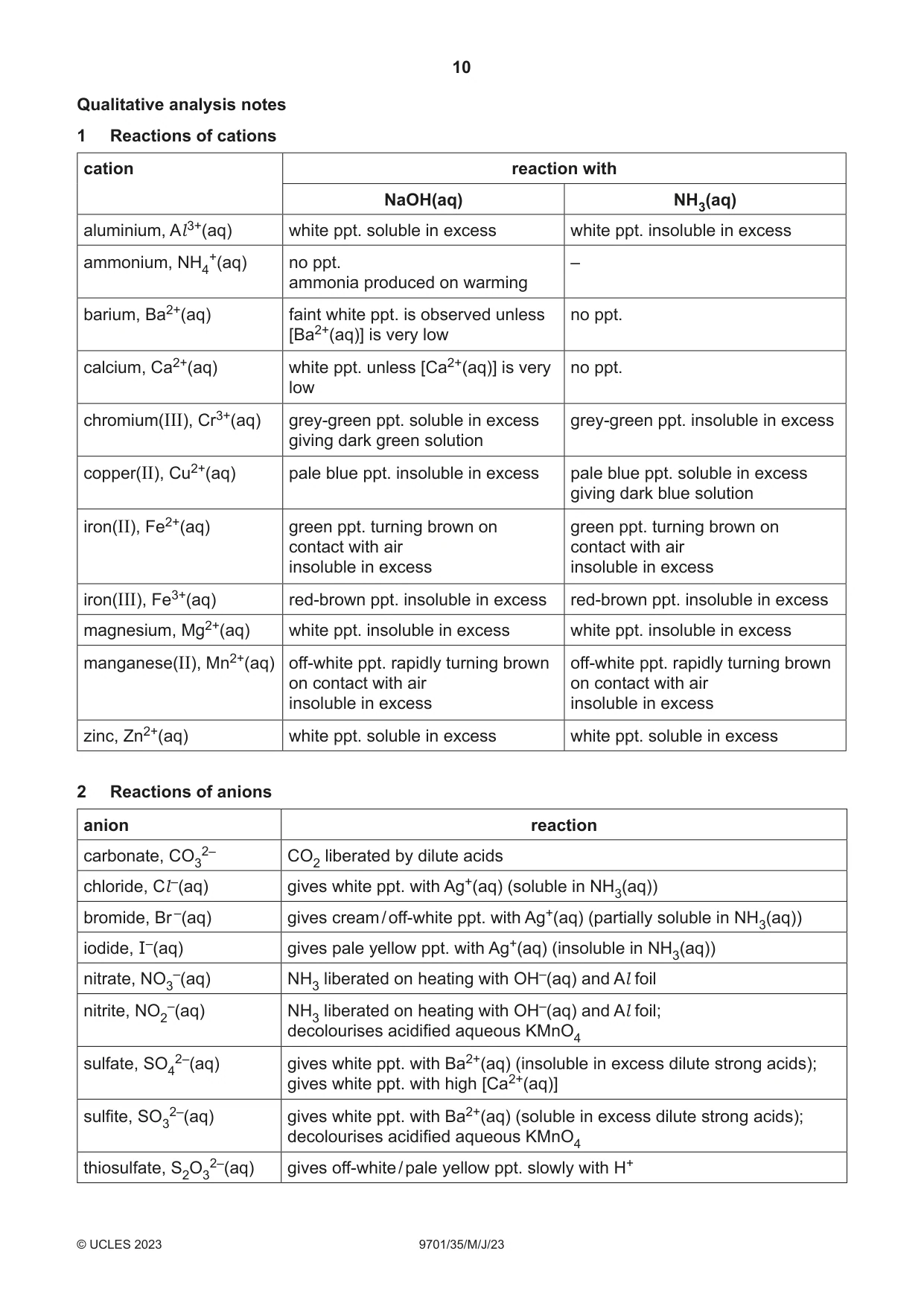
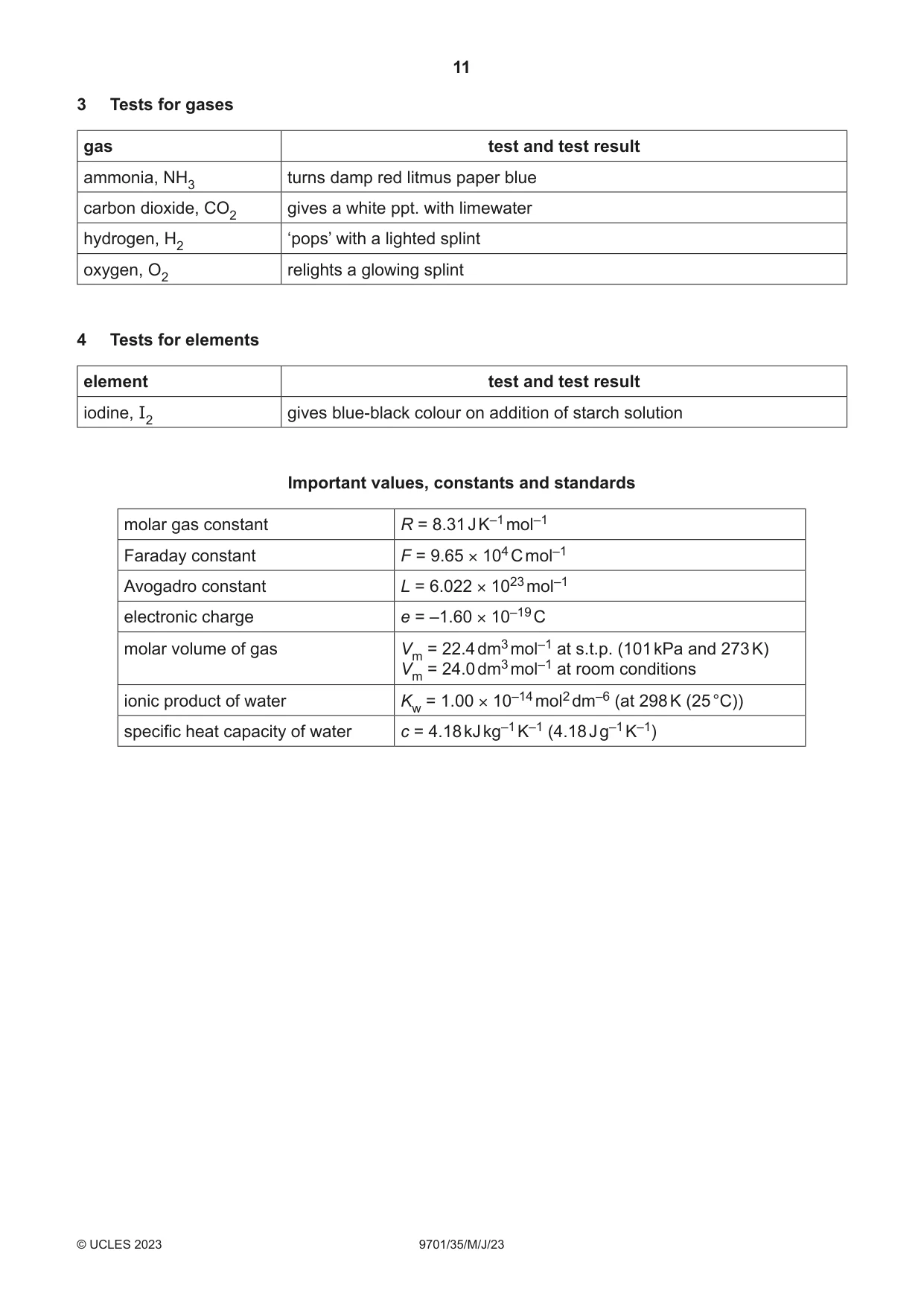
3 (a) Devise and carry out tests to determine whether FA 5 is magnesium carbonate. Record your tests, observations and conclusions in the space below. [5] (b) (i) FA 6 is an aqueous solution containing two anions and two cations. Three of these ions are included in the Qualitative analysis notes. Carry out the following tests using a 1 cm depth of FA 6 in a test-tube for each test. Record your observations for each test in Table 3.1. Table 3.1 test observations Test 1 Add aqueous sodium hydroxide. Test 2 Add an equal depth of hydrogen peroxide, then divide the solution into two portions. To the first portion, add a few drops of starch solution. To the second portion, add aqueous sodium hydroxide. Test 3 Add a few drops of aqueous silver nitrate, then add aqueous ammonia. Test 4 Add a few drops of aqueous barium chloride or barium nitrate, then add nitric acid. Test 5 Add a few drops of acidified aqueous potassium manganate(VII). [6] (ii) Identify as many ions present in FA 6 as possible from your observations in (b)(i). Write the formulae of these ions in Table 3.2. If an ion cannot be positively identified from the tests, write ‘unknown’ in the space. Table 3.2 cations anions [3] (c) Acidified potassium manganate(VII) acts as an oxidising agent. (i) State the colour change that occurs when acidified potassium manganate(VII) oxidises aqueous sodium nitrite. colour change from ……….…………… to ………………………... [1] (ii) The change in oxidation number is equal to the number of electrons added to or subtracted from a reactant. An equation which includes electrons is called a half-equation. The incomplete half-equation for acidified potassium manganate(VII) acting as an oxidising agent is shown. Balance the half-equation for acidified potassium manganate(VII). MnO4–(aq) + 8H+(aq) + ......... e– Mn2+(aq) + ......... H2O(l) [1] [Total: 16]
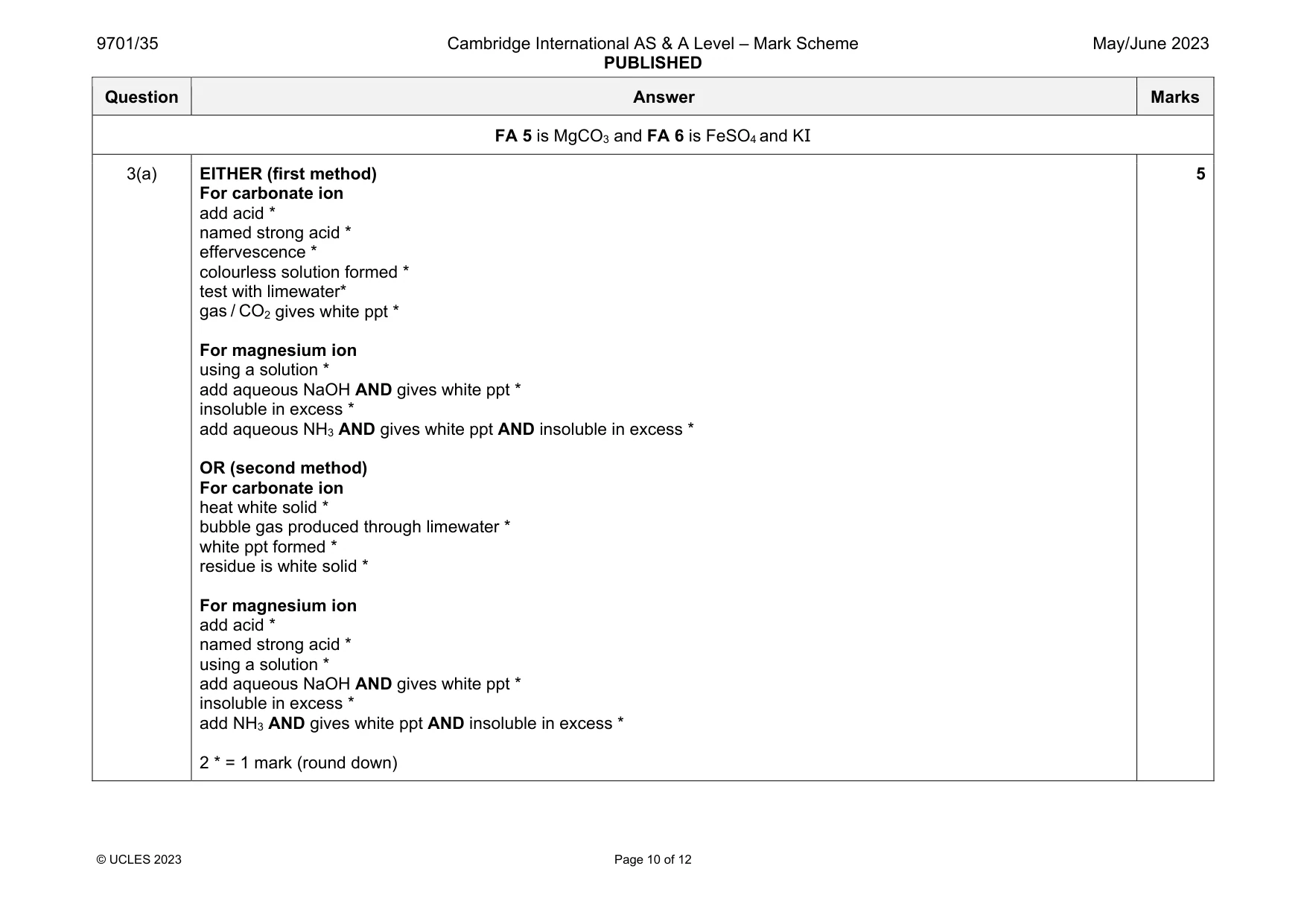
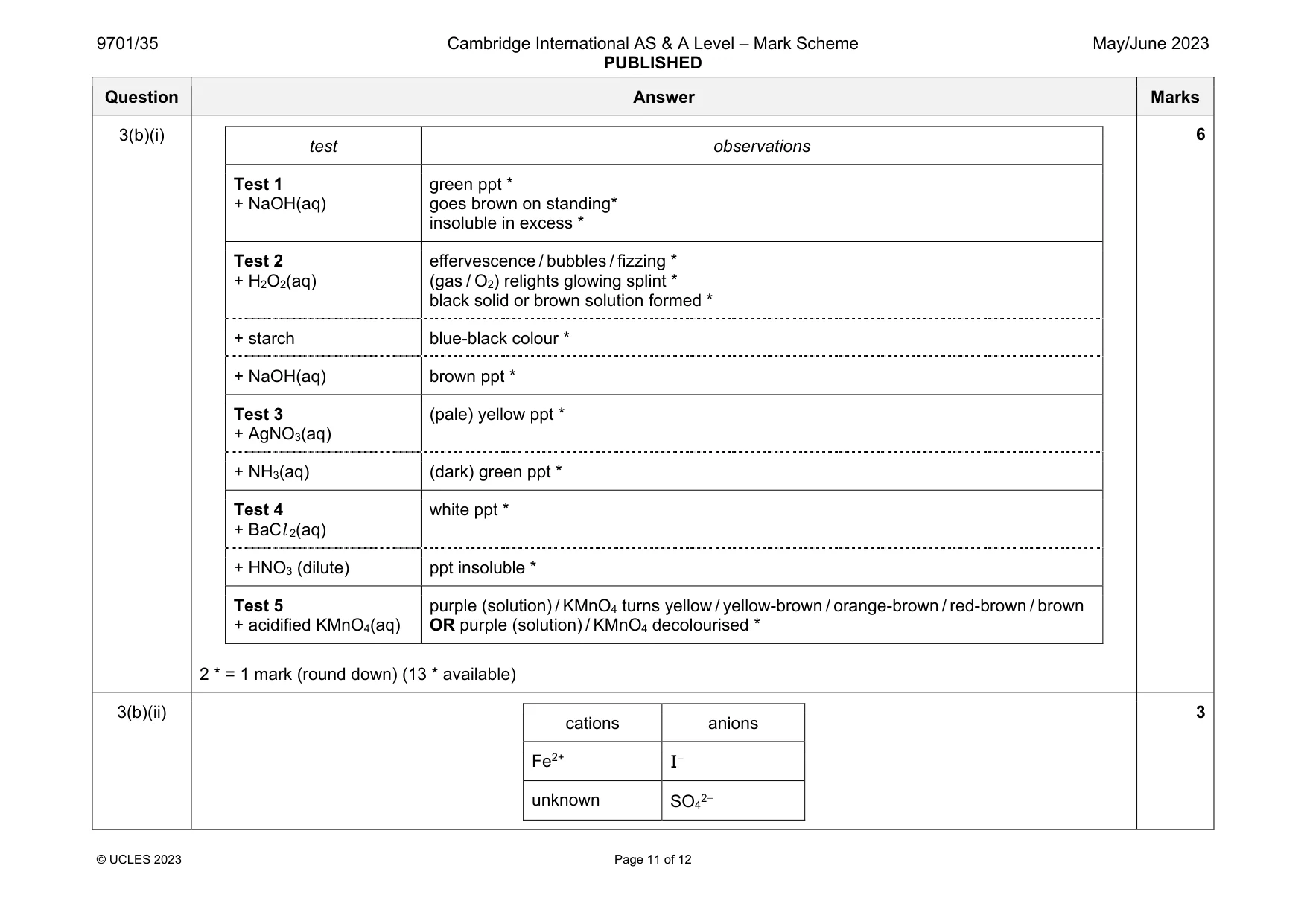
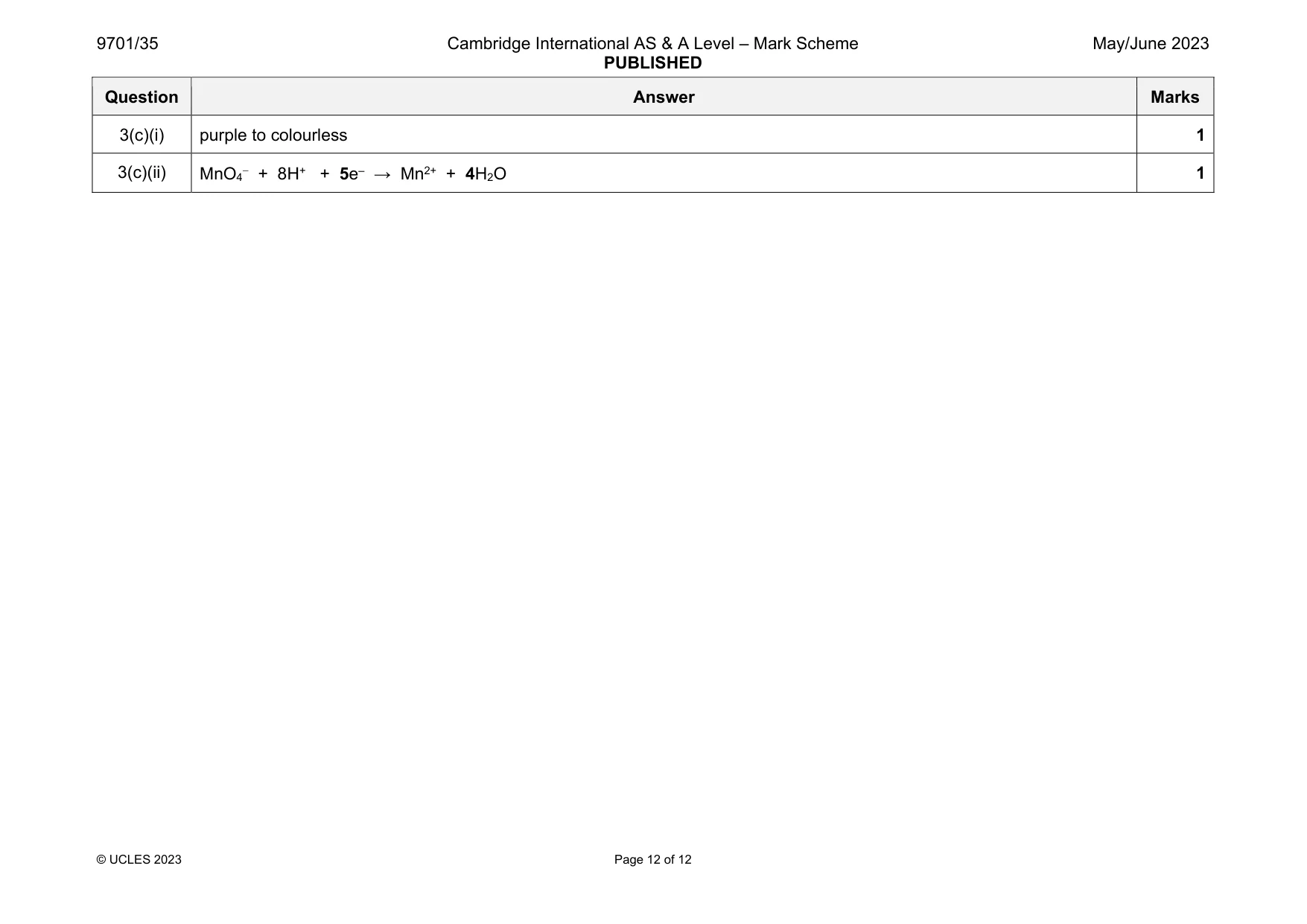
Mark scheme: 3(a) EITHER (first method) For carbonate ion add acid * named strong acid * effervescence * colourless solution formed * test with limewater* gas / CO2 gives white ppt * For magnesium ion using a solution * add aqueous NaOH AND gives white ppt * insoluble in excess * add aqueous NH3 AND gives white ppt AND insoluble in excess * OR (second method) For carbonate ion heat white solid * bubble gas produced through limewater * white ppt formed * residue is white solid * For magnesium ion add acid * named strong acid * using a solution * add aqueous NaOH AND gives white ppt * insoluble in excess * add NH3 AND gives white ppt AND insoluble in excess * 2 * = 1 mark (round down) 5 Question Answer Marks 3(b)(i) test observations Test 1 + NaOH(aq) green ppt * goes brown on standing* insoluble in excess * Test 2 + H2O2(aq) effervescence / bubbles / fizzing * (gas / O2) relights glowing splint * black solid or brown solution formed * + starch blue-black colour * + NaOH(aq) brown ppt * Test 3 + AgNO3(aq) (pale) yellow ppt * + NH3(aq) (dark) green ppt * Test 4 + BaCl 2(aq) white ppt * + HNO3 (dilute) ppt insoluble * Test 5 + acidified KMnO4(aq) purple (solution) / KMnO4 turns yellow / yellow-brown / orange-brown / red-brown / brown OR purple (solution) / KMnO4 decolourised * 2 * = 1 mark (round down) (13 * available) 6 3(b)(ii) cations anions Fe2+ I unknown SO42 3 Question Answer Marks 3(c)(i) purple to colourless 1 3(c)(ii) MnO4 + 8H+ + 5e– → Mn2+ + 4H2O 1
What was in this paper
The subtopics covered by these 3 questions, and how many questions each got. Open one in a new tab to see every Cambridge question on it.
What you needed in this session
Cambridge’s own grade thresholds for 2023 May/June, Paper 3 · Variant 5. A higher threshold means an easier paper — the bar moves with how the cohort did.