Cambridge A Level Chemistry 9701 — 2018 Oct/Nov Paper 3 · Variant 3
9701/33/O/N/18 · 3 questions · 40 marks · ≈45 min
The question paper and its mark scheme, free to read here and free to download. This is Cambridge’s own paper, exactly as it was sat.
Question paper16 pages
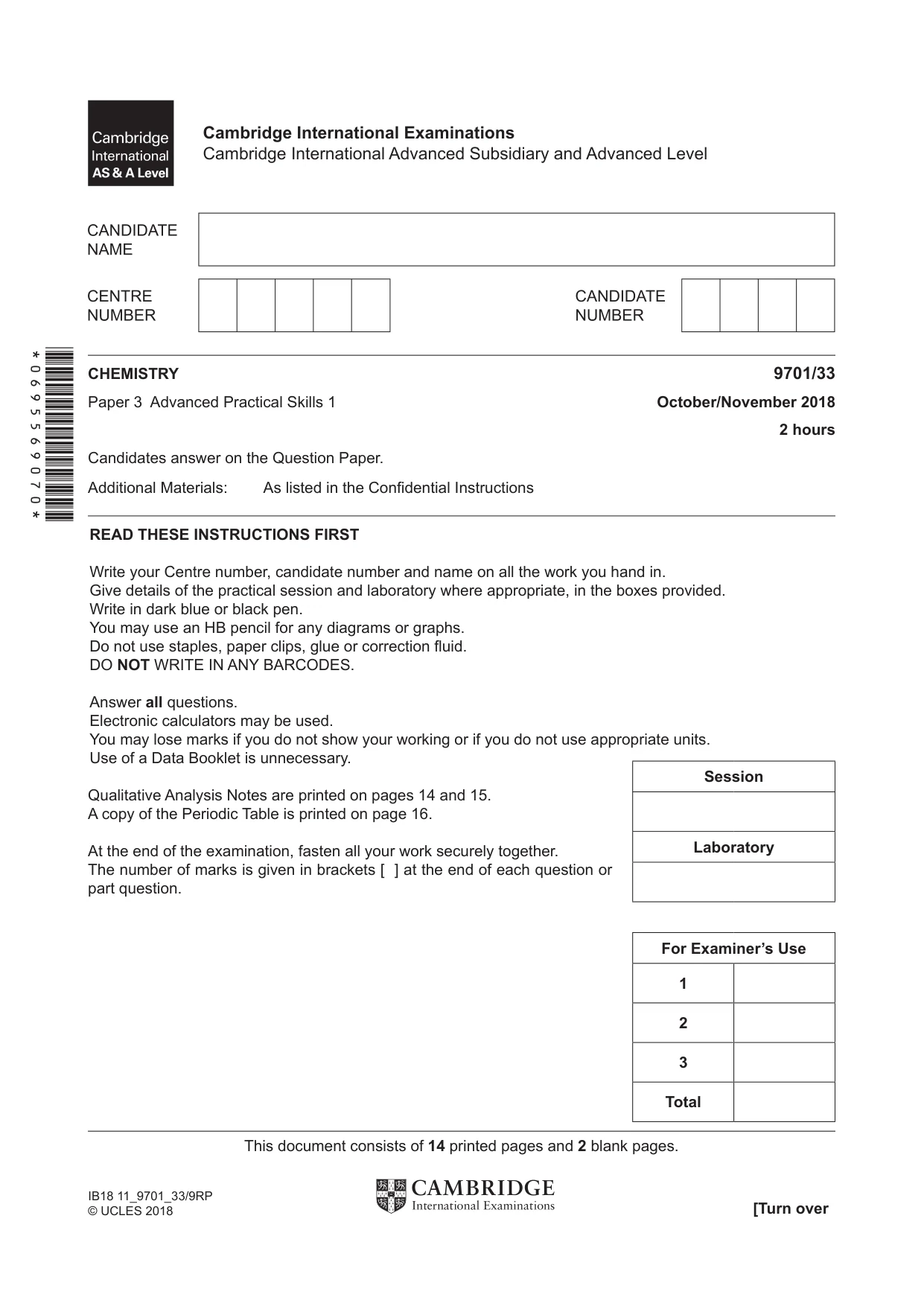


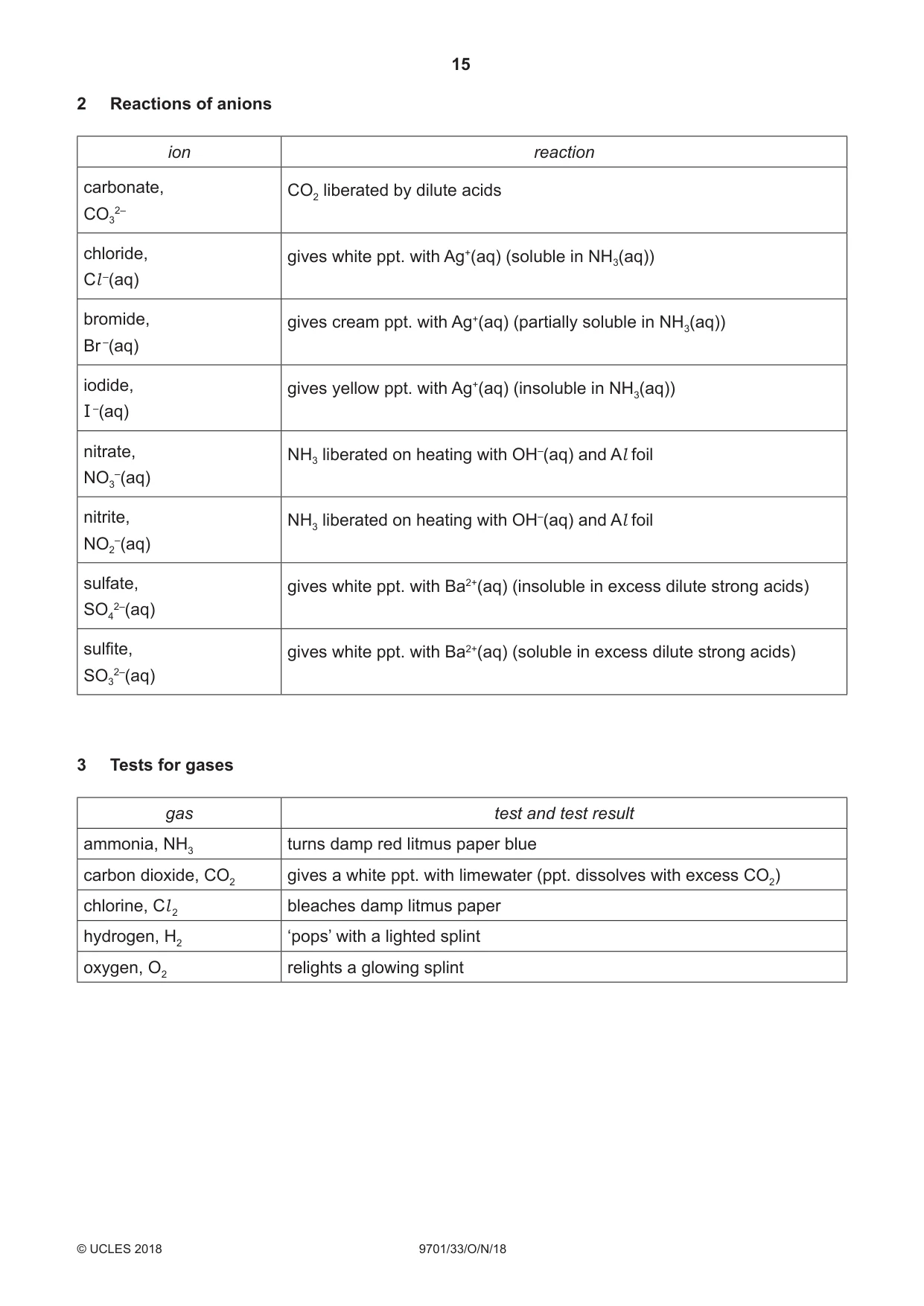
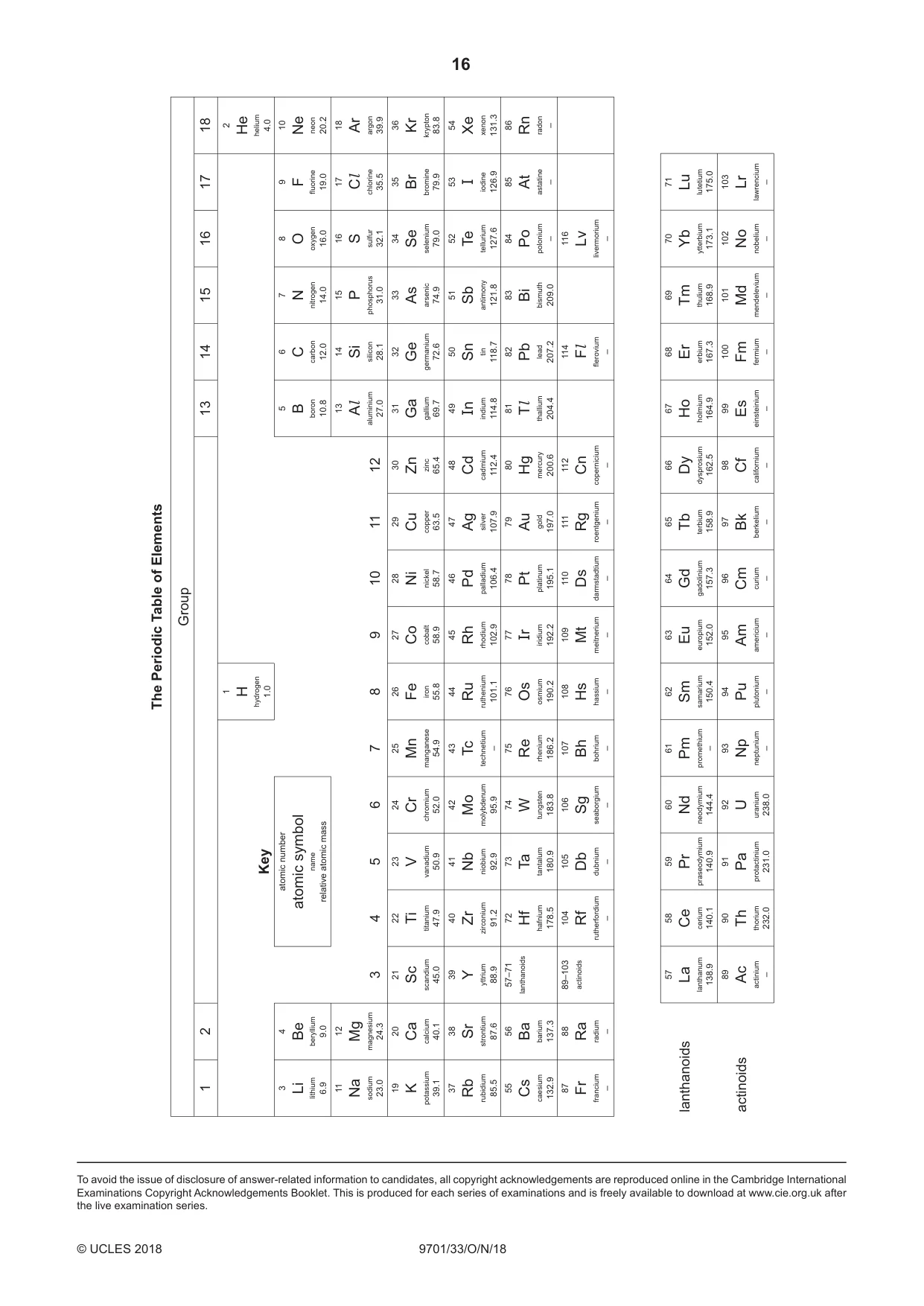
Mark scheme10 pages
Answers below. Sit the paper first if you are practising.
Questions as text
Q1 · You will determine the enthalpy change, ΔH, for the reaction between magnesium and…
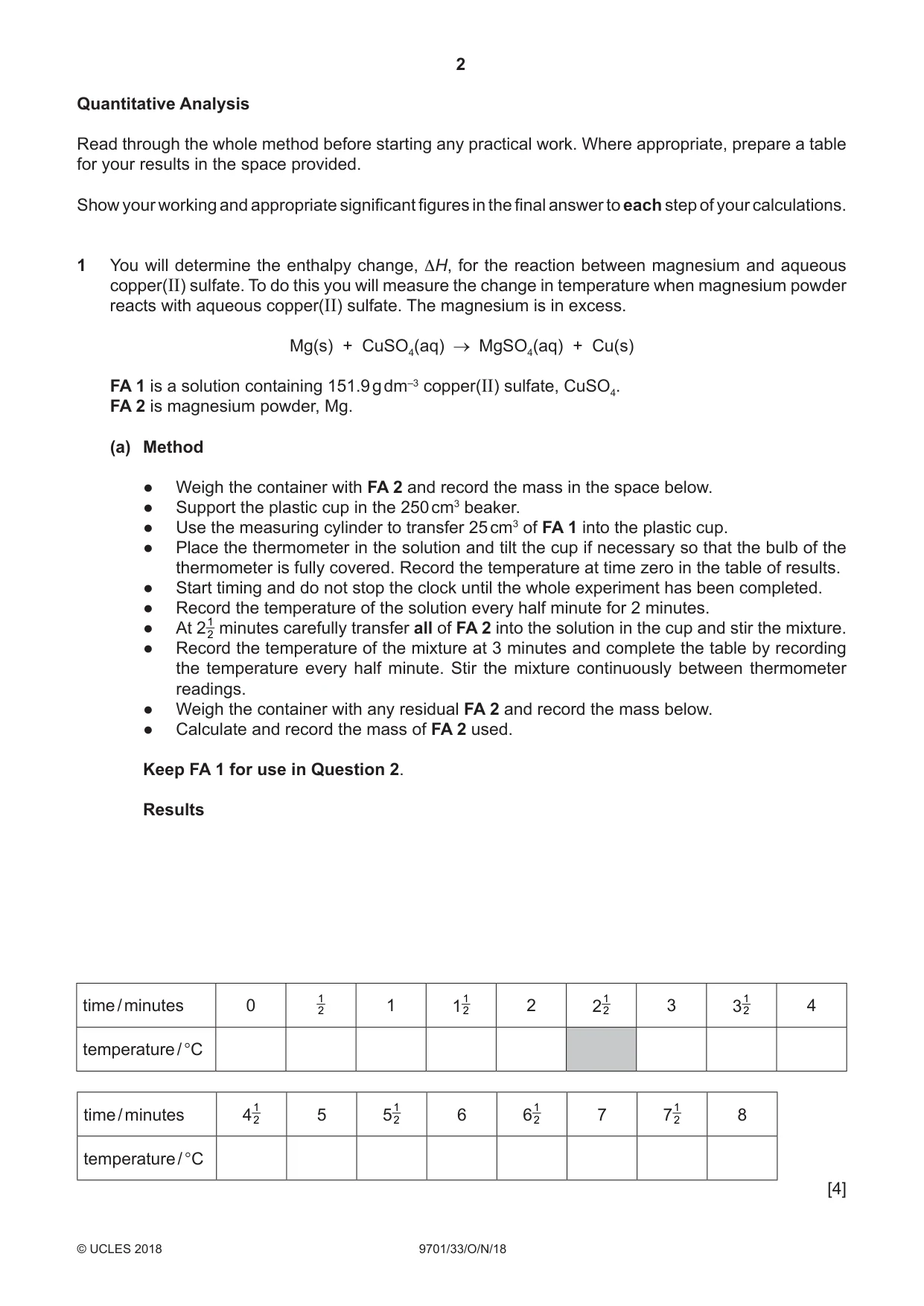
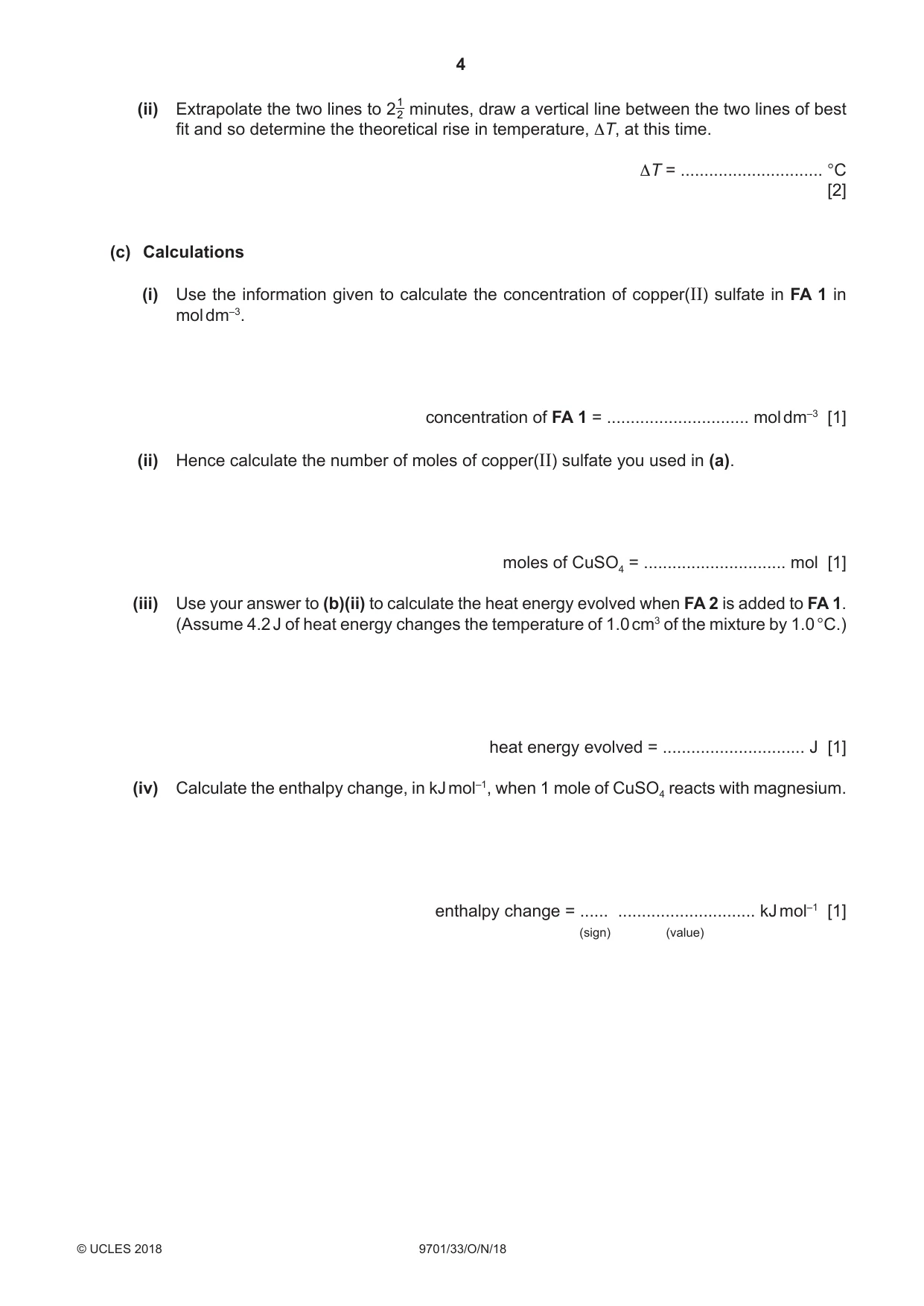
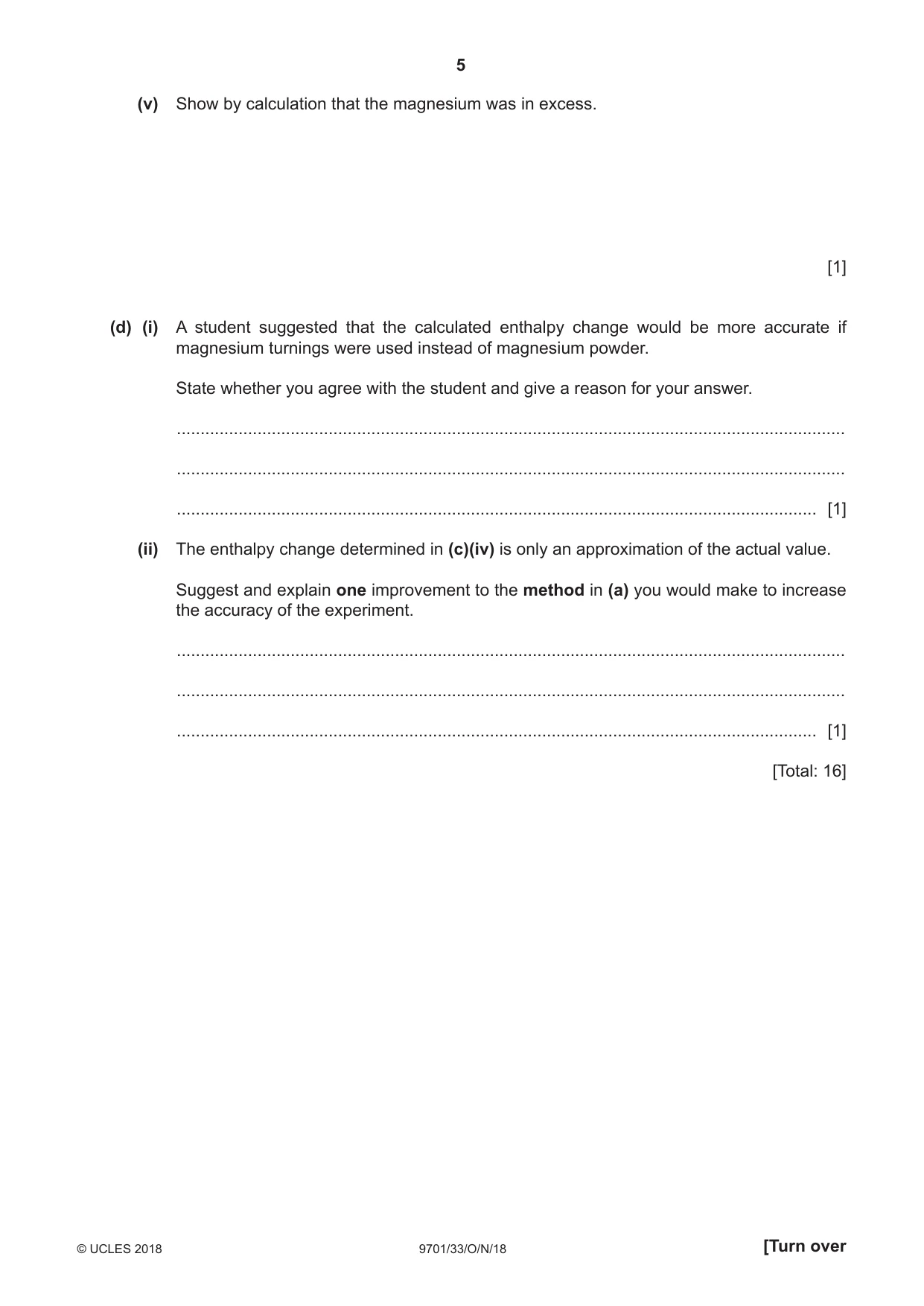
1 You will determine the enthalpy change, ΔH, for the reaction between magnesium and aqueous copper(II) sulfate. To do this you will measure the change in temperature when magnesium powder reacts with aqueous copper(II) sulfate. The magnesium is in excess. Mg(s) + CuSO4(aq) MgSO4(aq) + Cu(s) FA 1 is a solution containing 151.9 g dm–3 copper(II) sulfate, CuSO4. FA 2 is magnesium powder, Mg. (a) Method ● Weigh the container with FA 2 and record the mass in the space below. ● Support the plastic cup in the 250 cm3 beaker. ● Use the measuring cylinder to transfer 25 cm3 of FA 1 into the plastic cup. ● Place the thermometer in the solution and tilt the cup if necessary so that the bulb of the thermometer is fully covered. Record the temperature at time zero in the table of results. ● Start timing and do not stop the clock until the whole experiment has been completed. ● Record the temperature of the solution every half minute for 2 minutes. ● At 212 minutes carefully transfer all of FA 2 into the solution in the cup and stir the mixture. ● Record the temperature of the mixture at 3 minutes and complete the table by recording the temperature every half minute. Stir the mixture continuously between thermometer readings. ● Weigh the container with any residual FA 2 and record the mass below. ● Calculate and record the mass of FA 2 used. Keep FA 1 for use in Question 2. Results time / minutes 0 12 1 1 12 2 2 12 3 3 12 4 temperature / °C time / minutes 4 12 5 5 12 6 6 12 7 7 12 8 temperature / °C [4] (ii) Extrapolate the two lines to 212 minutes, draw a vertical line between the two lines of best fit and so determine the theoretical rise in temperature, ΔT, at this time. ΔT = .............................. °C [2] (c) Calculations (i) Use the information given to calculate the concentration of copper(II) sulfate in FA 1 in mol dm–3. concentration of FA 1 = .............................. mol dm–3 [1] (ii) Hence calculate the number of moles of copper(II) sulfate you used in (a). moles of CuSO4 = .............................. mol [1] (iii) Use your answer to (b)(ii) to calculate the heat energy evolved when FA 2 is added to FA 1. (Assume 4.2 J of heat energy changes the temperature of 1.0 cm3 of the mixture by 1.0 °C.) heat energy evolved = .............................. J [1] (iv) Calculate the enthalpy change, in kJ mol–1, when 1 mole of CuSO4 reacts with magnesium. enthalpy change = ...... ............................. kJ mol–1 [1] (sign) (value) (v) Show by calculation that the magnesium was in excess. [1] (d) (i) A student suggested that the calculated enthalpy change would be more accurate if magnesium turnings were used instead of magnesium powder. State whether you agree with the student and give a reason for your answer. ............................................................................................................................................. ............................................................................................................................................. ....................................................................................................................................... [1] (ii) The enthalpy change determined in (c)(iv) is only an approximation of the actual value. Suggest and explain one improvement to the method in (a) you would make to increase the accuracy of the experiment. ............................................................................................................................................. ............................................................................................................................................. ....................................................................................................................................... [1] [Total: 16]
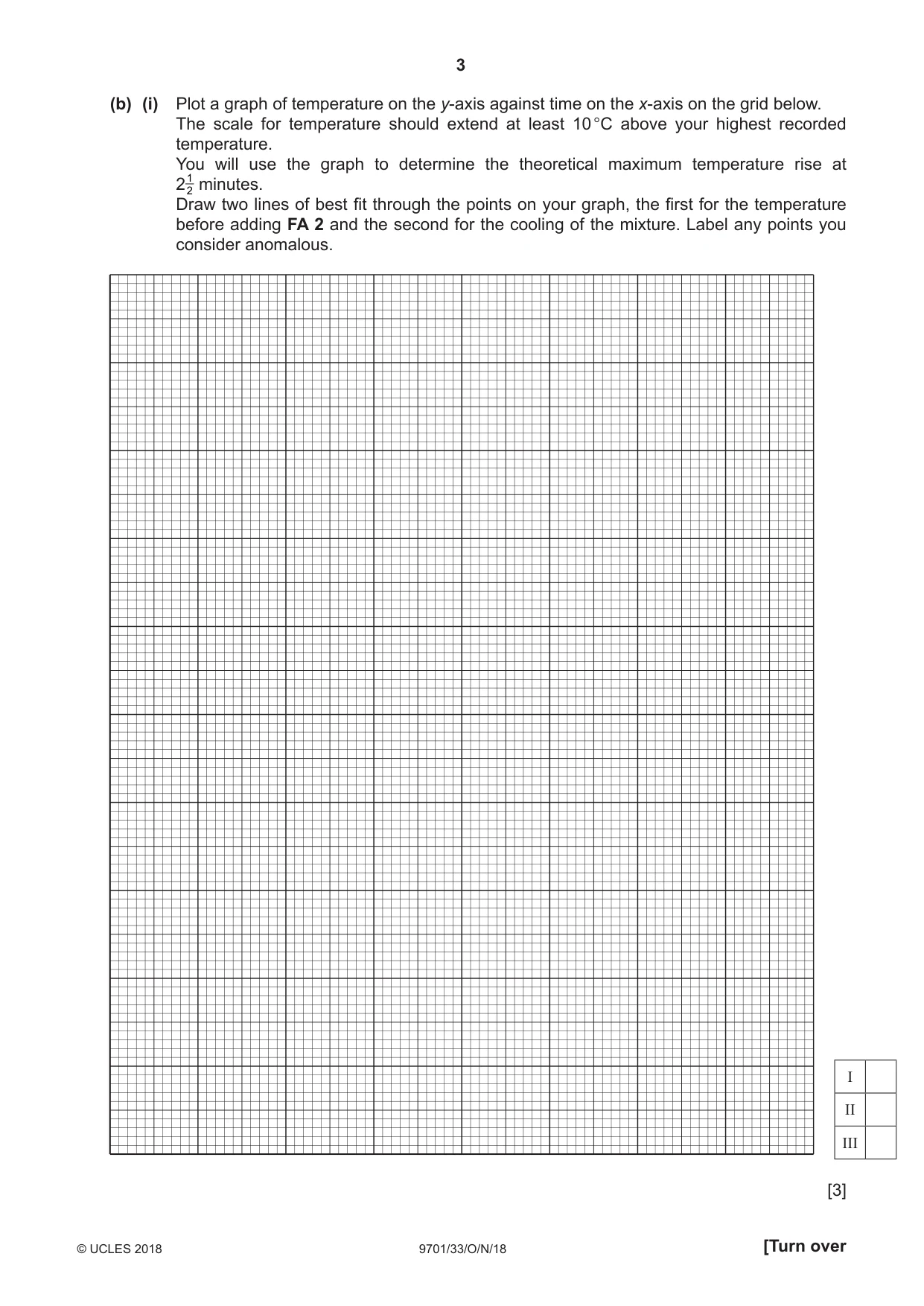
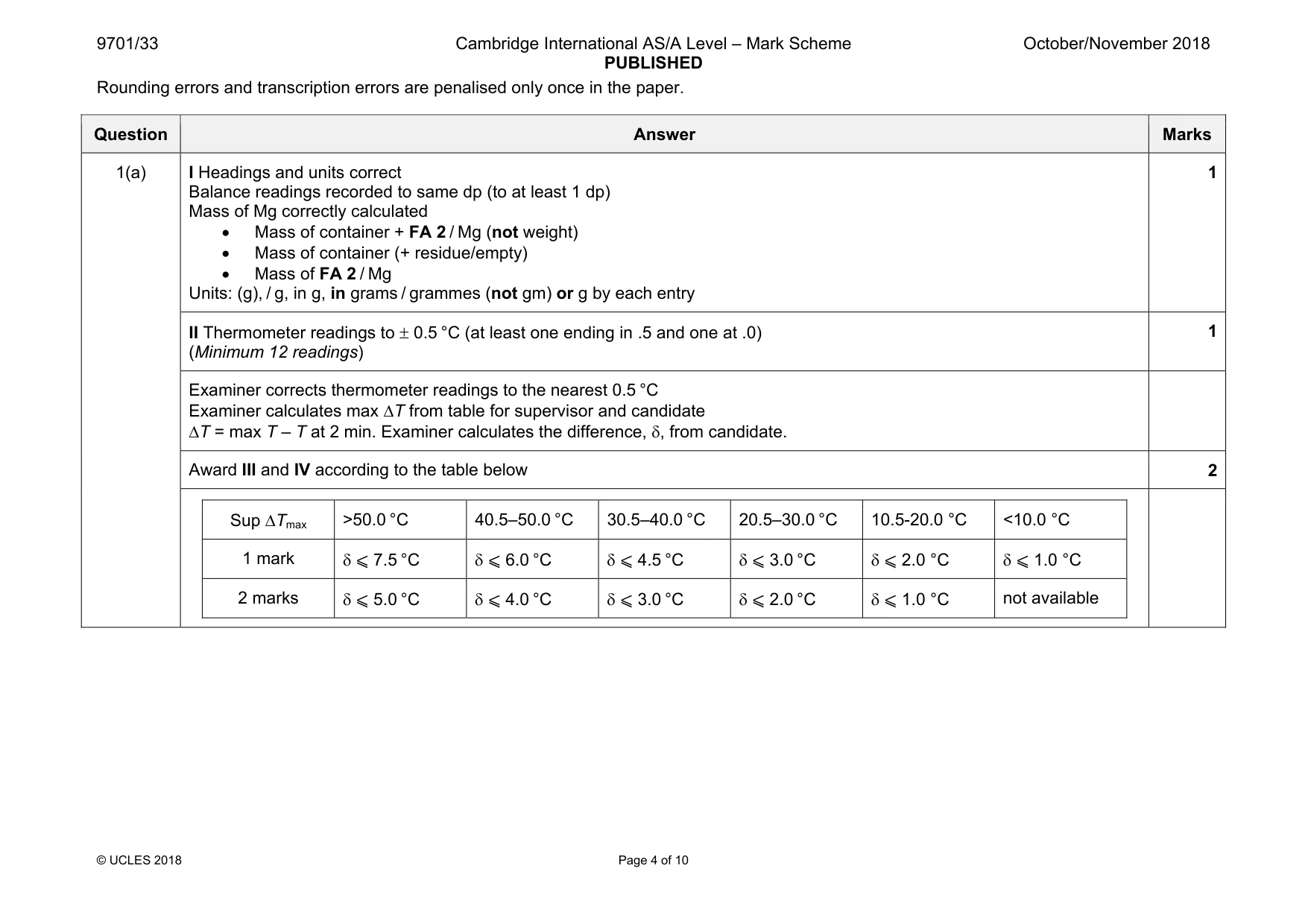
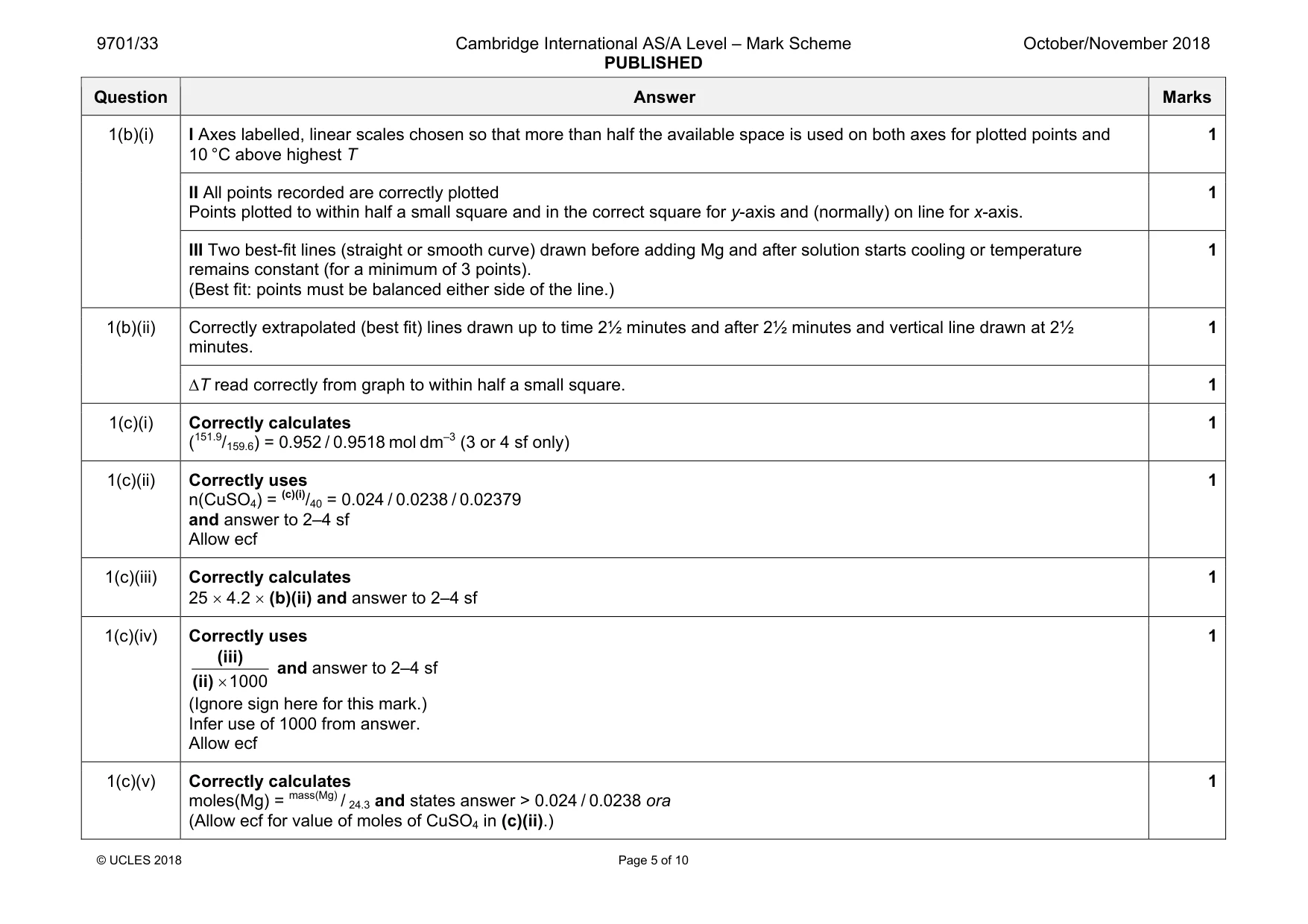
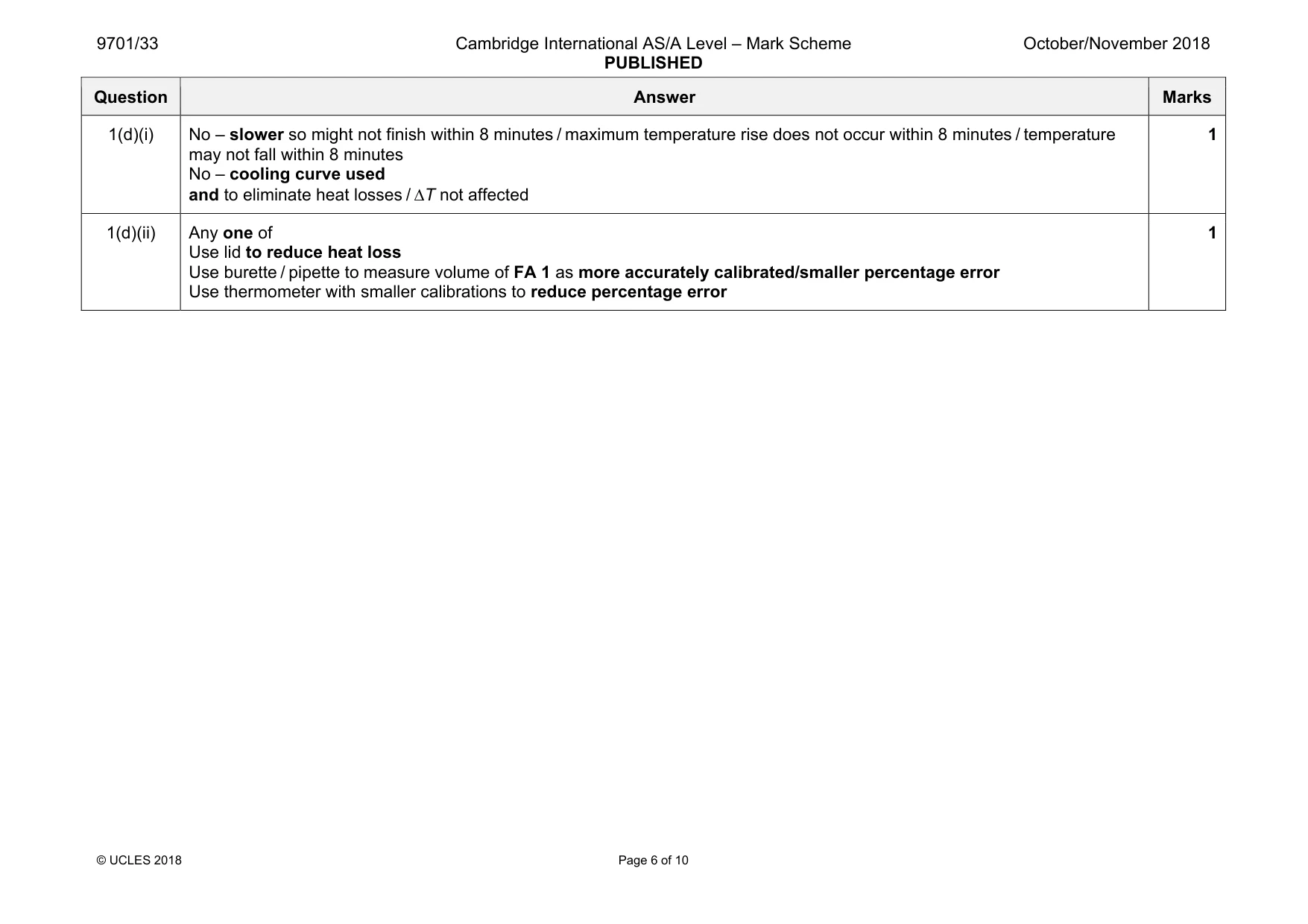
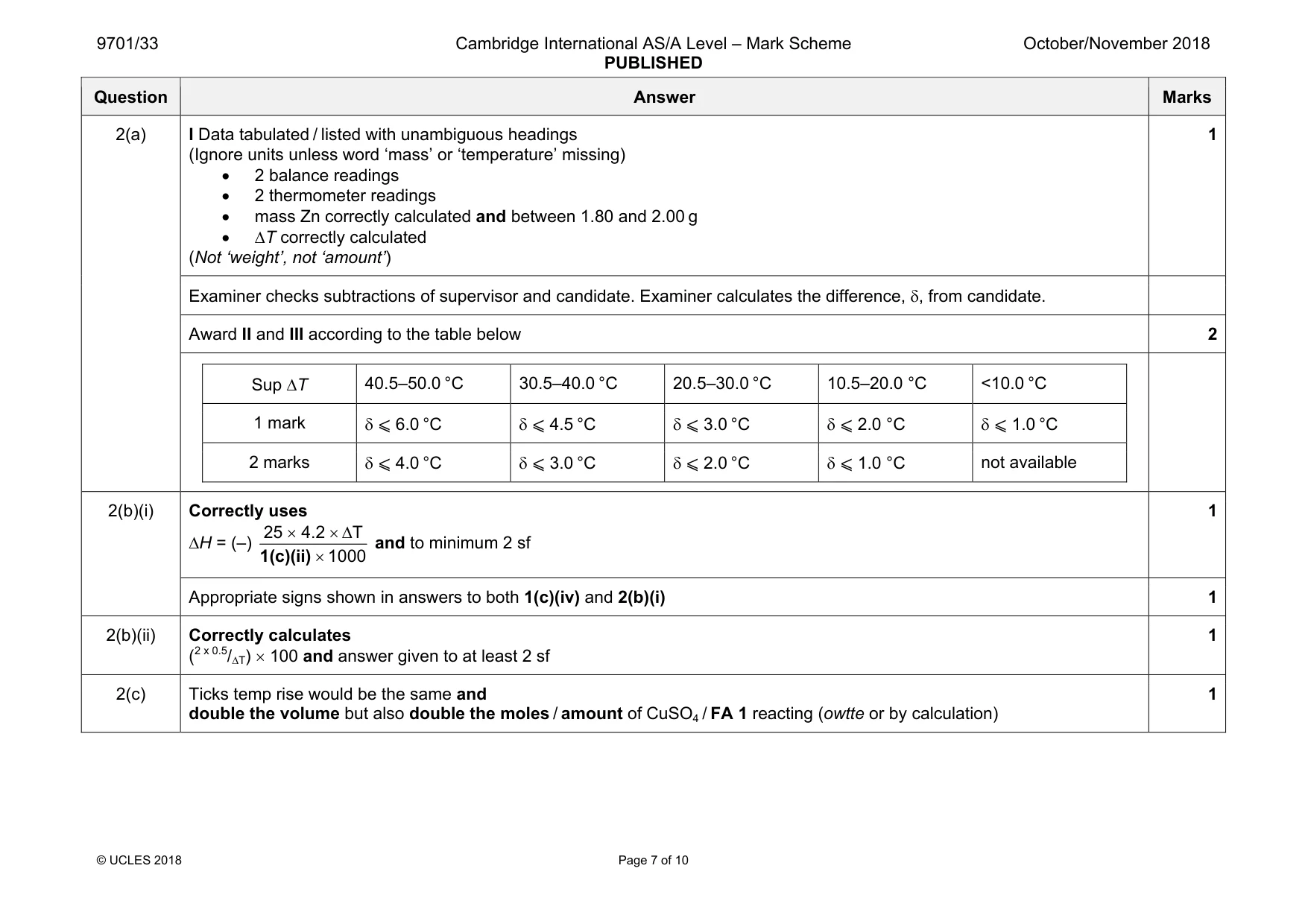
Mark scheme: 1(a) I Headings and units correct Balance readings recorded to same dp (to at least 1 dp) Mass of Mg correctly calculated • Mass of container + FA 2 / Mg (not weight) • Mass of container (+ residue/empty) • Mass of FA 2 / Mg Units: (g), / g, in g, in grams / grammes (not gm) or g by each entry 1 II Thermometer readings to ± 0.5 °C (at least one ending in .5 and one at .0) (Minimum 12 readings) 1 Examiner corrects thermometer readings to the nearest 0.5 °C Examiner calculates max ∆T from table for supervisor and candidate ∆T = max T – T at 2 min. Examiner calculates the difference, δ, from candidate. Award III and IV according to the table below 2 Sup ∆Tmax >50.0 °C 40.5–50.0 °C 30.5–40.0 °C 20.5–30.0 °C 10.5-20.0 °C <10.0 °C 1 mark δ ⩽ 7.5 °C δ ⩽ 6.0 °C δ ⩽ 4.5 °C δ ⩽ 3.0 °C δ ⩽ 2.0 °C δ ⩽ 1.0 °C 2 marks δ ⩽ 5.0 °C δ ⩽ 4.0 °C δ ⩽ 3.0 °C δ ⩽ 2.0 °C δ ⩽ 1.0 °C not available Question Answer Marks 1(b)(i) I Axes labelled, linear scales chosen so that more than half the available space is used on both axes for plotted points and 10 °C above highest T 1 II All points recorded are correctly plotted Points plotted to within half a small square and in the correct square for y-axis and (normally) on line for x-axis. 1 III Two best-fit lines (straight or smooth curve) drawn before adding Mg and after solution starts cooling or temperature remains constant (for a minimum of 3 points). (Best fit: points must be balanced either side of the line.) 1 1(b)(ii) Correctly extrapolated (best fit) lines drawn up to time 2½ minutes and after 2½ minutes and vertical line drawn at 2½ minutes. 1 ∆T read correctly from graph to within half a small square. 1 1(c)(i) Correctly calculates (151.9/159.6) = 0.952 / 0.9518 mol dm–3 (3 or 4 sf only) 1 1(c)(ii) Correctly uses n(CuSO4) = (c)(i)/40 = 0.024 / 0.0238 / 0.02379 and answer to 2–4 sf Allow ecf 1 1(c)(iii) Correctly calculates 25 × 4.2 × (b)(ii) and answer to 2–4 sf 1 1(c)(iv) Correctly uses ×1000 (iii) (ii) and answer to 2–4 sf (Ignore sign here for this mark.) Infer use of 1000 from answer. Allow ecf 1 1(c)(v) Correctly calculates moles(Mg) = mass(Mg) / 24.3 and states answer > 0.024 / 0.0238 ora (Allow ecf for value of moles of CuSO4 in (c)(ii).) 1 Question Answer Marks 1(d)(i) No – slower so might not finish within 8 minutes / maximum temperature rise does not occur within 8 minutes / temperature may not fall within 8 minutes No – cooling curve used and to eliminate heat losses / ∆T not affected 1 1(d)(ii) Any one of Use lid to reduce heat loss Use burette / pipette to measure volume of FA 1 as more accurately calibrated/smaller percentage error Use thermometer with smaller calibrations to reduce percentage error 1
Q2 · In this experiment you will determine the enthalpy change, ΔH, for the reaction between…
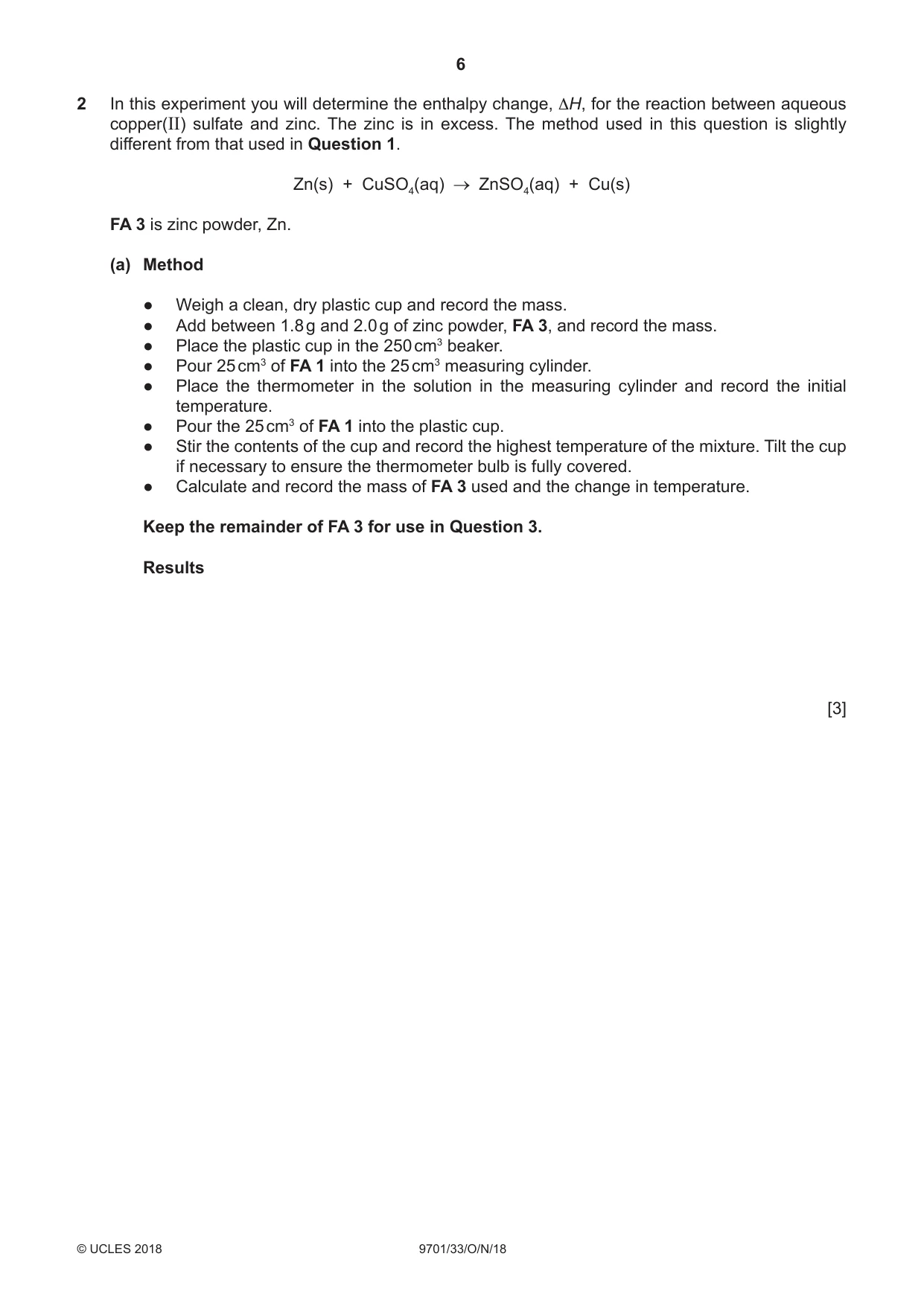
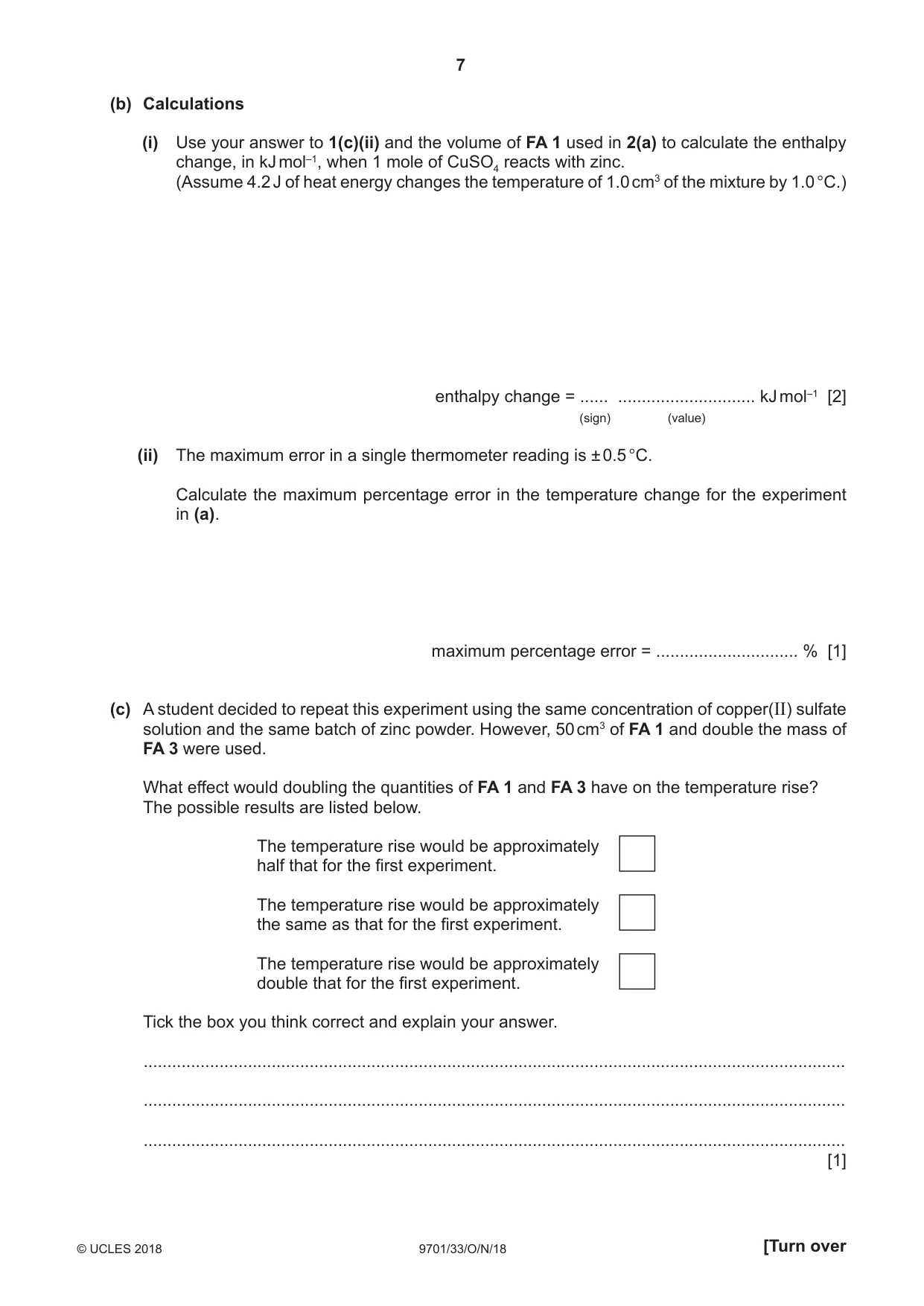
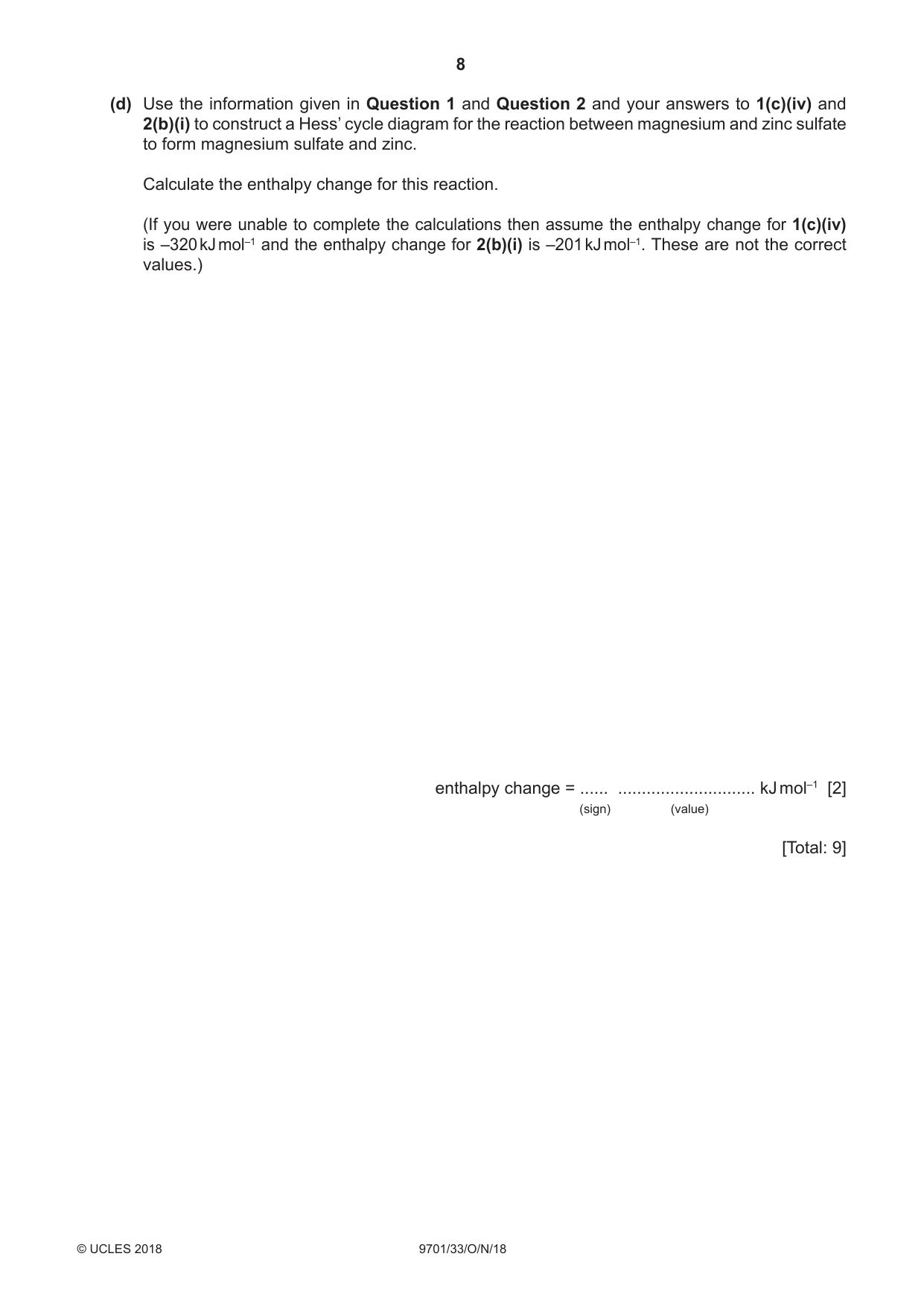
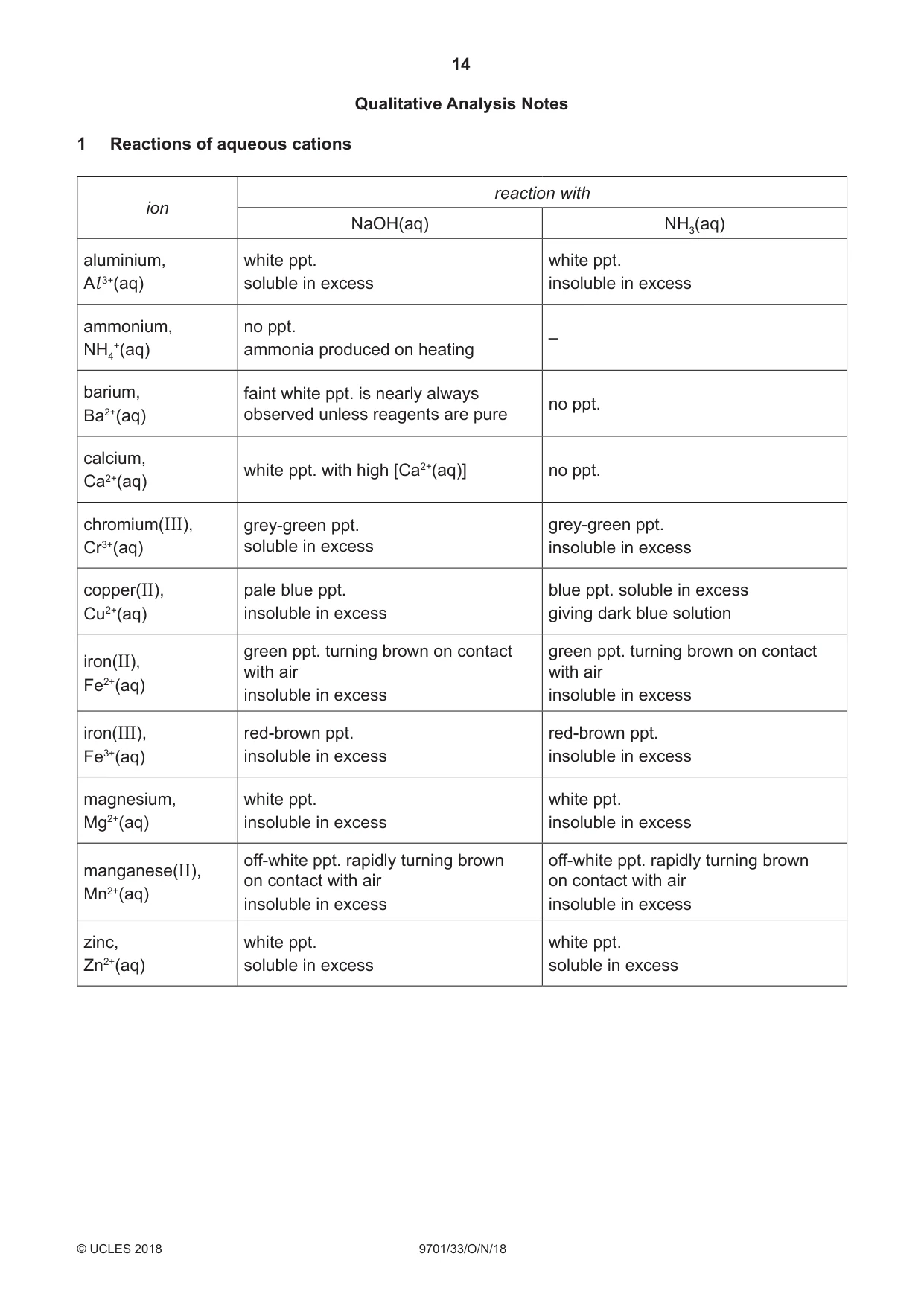
2 In this experiment you will determine the enthalpy change, ΔH, for the reaction between aqueous copper(II) sulfate and zinc. The zinc is in excess. The method used in this question is slightly different from that used in Question 1. Zn(s) + CuSO4(aq) ZnSO4(aq) + Cu(s) FA 3 is zinc powder, Zn. (a) Method ● Weigh a clean, dry plastic cup and record the mass. ● Add between 1.8 g and 2.0 g of zinc powder, FA 3, and record the mass. ● Place the plastic cup in the 250 cm3 beaker. ● Pour 25 cm3 of FA 1 into the 25 cm3 measuring cylinder. ● Place the thermometer in the solution in the measuring cylinder and record the initial temperature. ● Pour the 25 cm3 of FA 1 into the plastic cup. ● Stir the contents of the cup and record the highest temperature of the mixture. Tilt the cup if necessary to ensure the thermometer bulb is fully covered. ● Calculate and record the mass of FA 3 used and the change in temperature. Keep the remainder of FA 3 for use in Question 3. Results [3] (b) Calculations (i) Use your answer to 1(c)(ii) and the volume of FA 1 used in 2(a) to calculate the enthalpy change, in kJ mol–1, when 1 mole of CuSO4 reacts with zinc. (Assume 4.2 J of heat energy changes the temperature of 1.0 cm3 of the mixture by 1.0 °C.) enthalpy change = ...... ............................. kJ mol–1 [2] (sign) (value) (ii) The maximum error in a single thermometer reading is ± 0.5 °C. Calculate the maximum percentage error in the temperature change for the experiment in (a). maximum percentage error = .............................. % [1] (c) A student decided to repeat this experiment using the same concentration of copper(II) sulfate solution and the same batch of zinc powder. However, 50 cm3 of FA 1 and double the mass of FA 3 were used. What effect would doubling the quantities of FA 1 and FA 3 have on the temperature rise? The possible results are listed below. The temperature rise would be approximately half that for the first experiment. The temperature rise would be approximately the same as that for the first experiment. The temperature rise would be approximately double that for the first experiment. Tick the box you think correct and explain your answer. .................................................................................................................................................... .................................................................................................................................................... .................................................................................................................................................... [1] (d) Use the information given in Question 1 and Question 2 and your answers to 1(c)(iv) and 2(b)(i) to construct a Hess’ cycle diagram for the reaction between magnesium and zinc sulfate to form magnesium sulfate and zinc. Calculate the enthalpy change for this reaction. (If you were unable to complete the calculations then assume the enthalpy change for 1(c)(iv) is –320 kJ mol–1 and the enthalpy change for 2(b)(i) is –201 kJ mol–1. These are not the correct values.) enthalpy change = ...... ............................. kJ mol–1 [2] (sign) (value) [Total: 9] Qualitative Analysis Where reagents are selected for use in a test, the full name or correct formula of the element or compound must be given. At each stage of any test you are to record details of the following: ● colour changes seen; ● the formation of any precipitate and its solubility in an excess of the reagent added; ● the formation of any gas and its identification by a suitable test. You should indicate clearly at what stage in a test a change occurs. If any solution is warmed, a boiling tube must be used. Rinse and reuse test-tubes and boiling tubes where possible. No additional tests for ions present should be attempted.
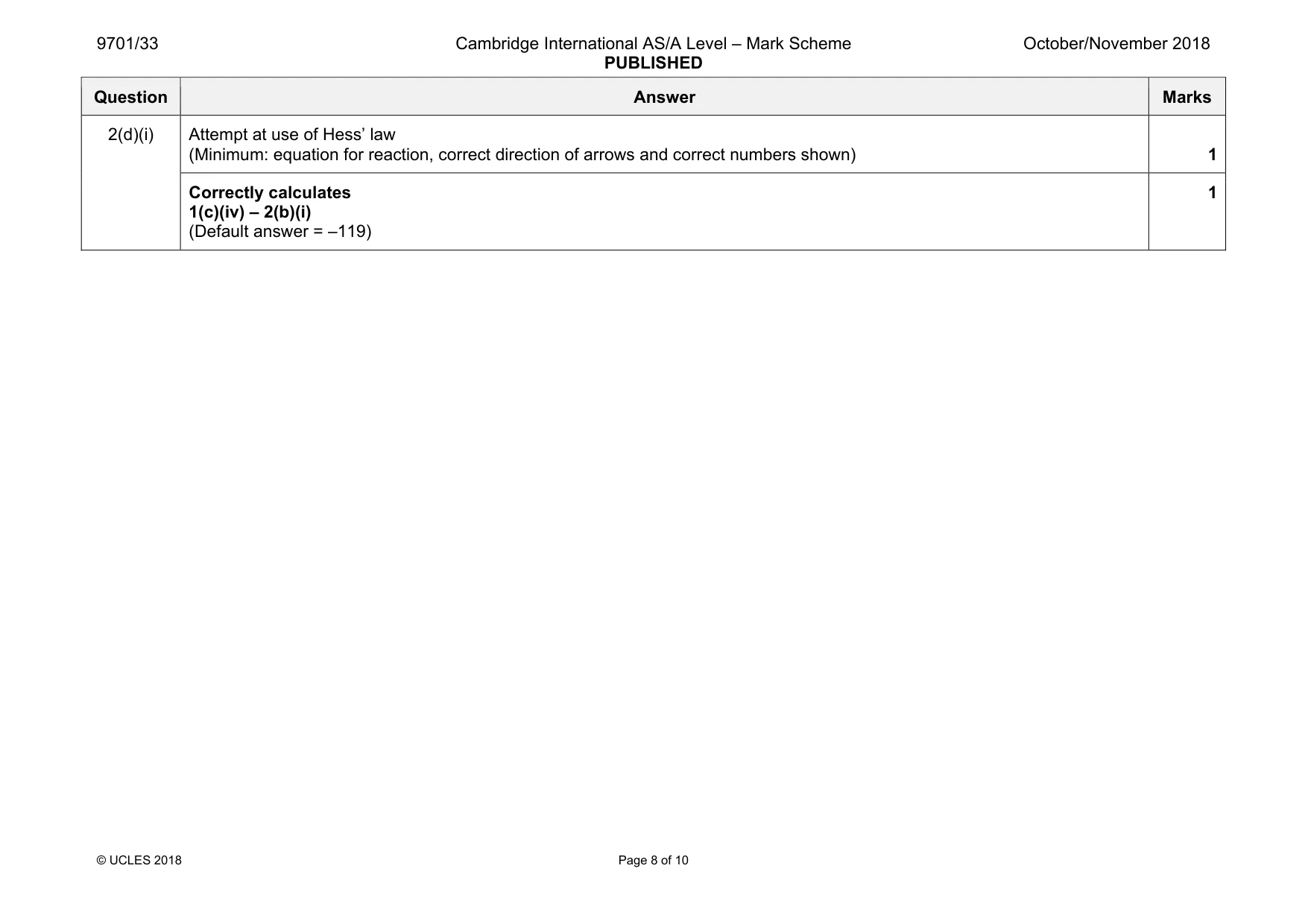
Mark scheme: 2(a) I Data tabulated / listed with unambiguous headings (Ignore units unless word ‘mass’ or ‘temperature’ missing) • 2 balance readings • 2 thermometer readings • mass Zn correctly calculated and between 1.80 and 2.00 g • ∆T correctly calculated (Not ‘weight’, not ‘amount’) 1 Examiner checks subtractions of supervisor and candidate. Examiner calculates the difference, δ, from candidate. Award II and III according to the table below 2 Sup ∆T 40.5–50.0 °C 30.5–40.0 °C 20.5–30.0 °C 10.5–20.0 °C <10.0 °C 1 mark δ ⩽ 6.0 °C δ ⩽ 4.5 °C δ ⩽ 3.0 °C δ ⩽ 2.0 °C δ ⩽ 1.0 °C 2 marks δ ⩽ 4.0 °C δ ⩽ 3.0 °C δ ⩽ 2.0 °C δ ⩽ 1.0 °C not available 2(b)(i) Correctly uses ∆H = (–) × × ∆ × 25 4.2 T 1 000 1(c)(ii) and to minimum 2 sf 1 Appropriate signs shown in answers to both 1(c)(iv) and 2(b)(i) 1 2(b)(ii) Correctly calculates (2 x 0.5/∆T) × 100 and answer given to at least 2 sf 1 2(c) Ticks temp rise would be the same and double the volume but also double the moles / amount of CuSO4 / FA 1 reacting (owtte or by calculation) 1 Question Answer Marks 2(d)(i) Attempt at use of Hess’ law (Minimum: equation for reaction, correct direction of arrows and correct numbers shown) 1 Correctly calculates 1(c)(iv) – 2(b)(i) (Default answer = –119) 1
Q3 · FA 4 is a solution of a transition metal compound dissolved in acid
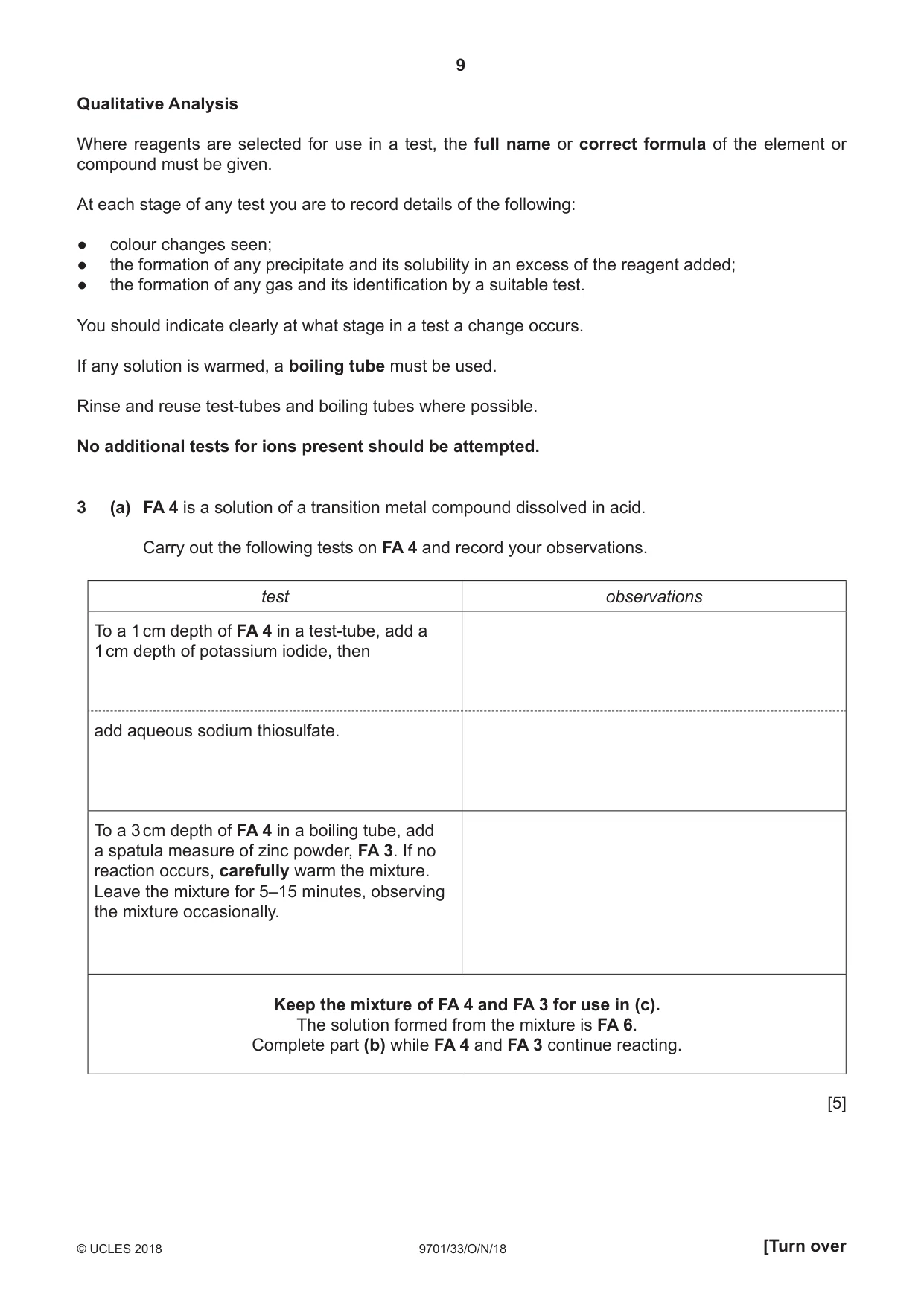
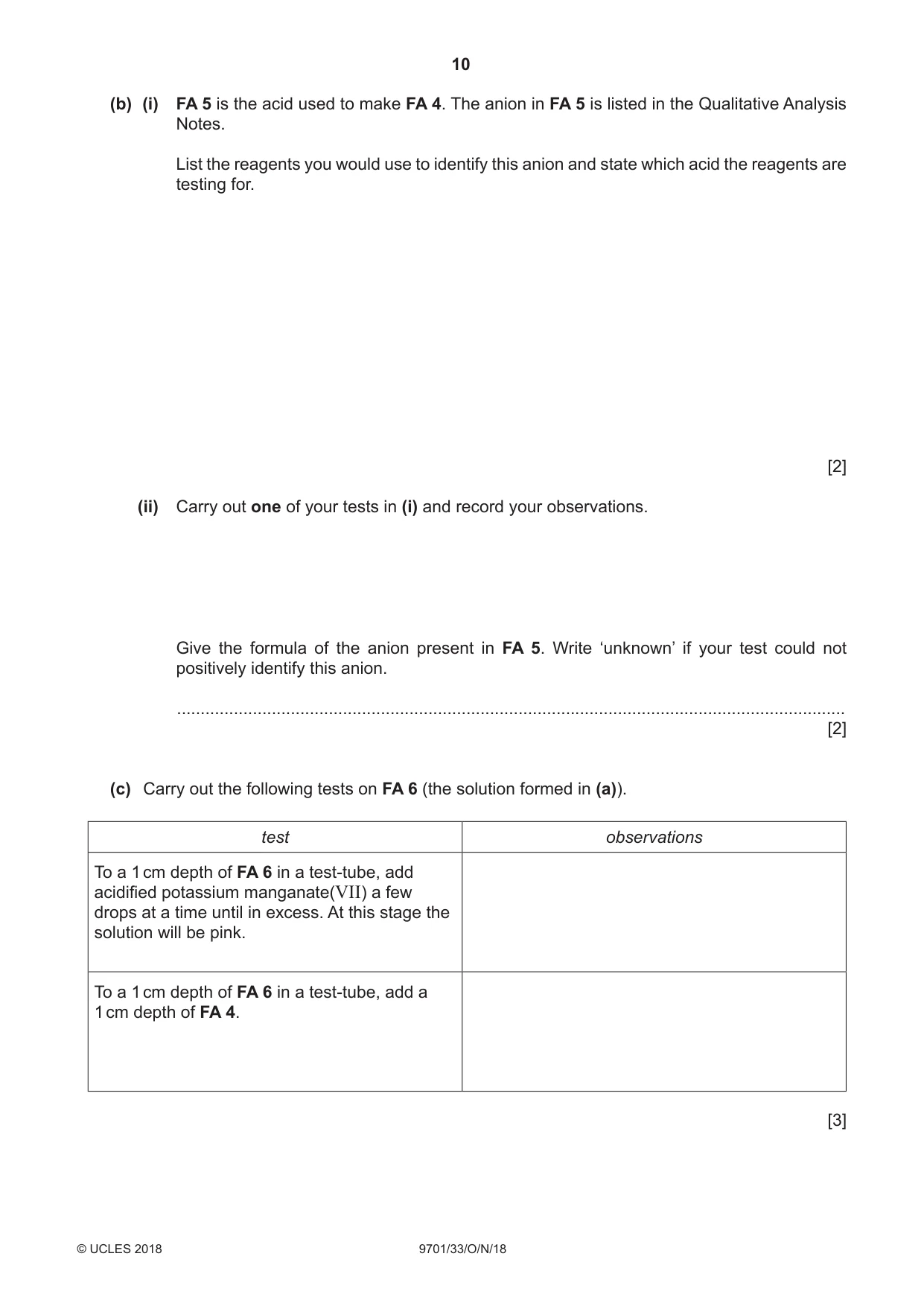
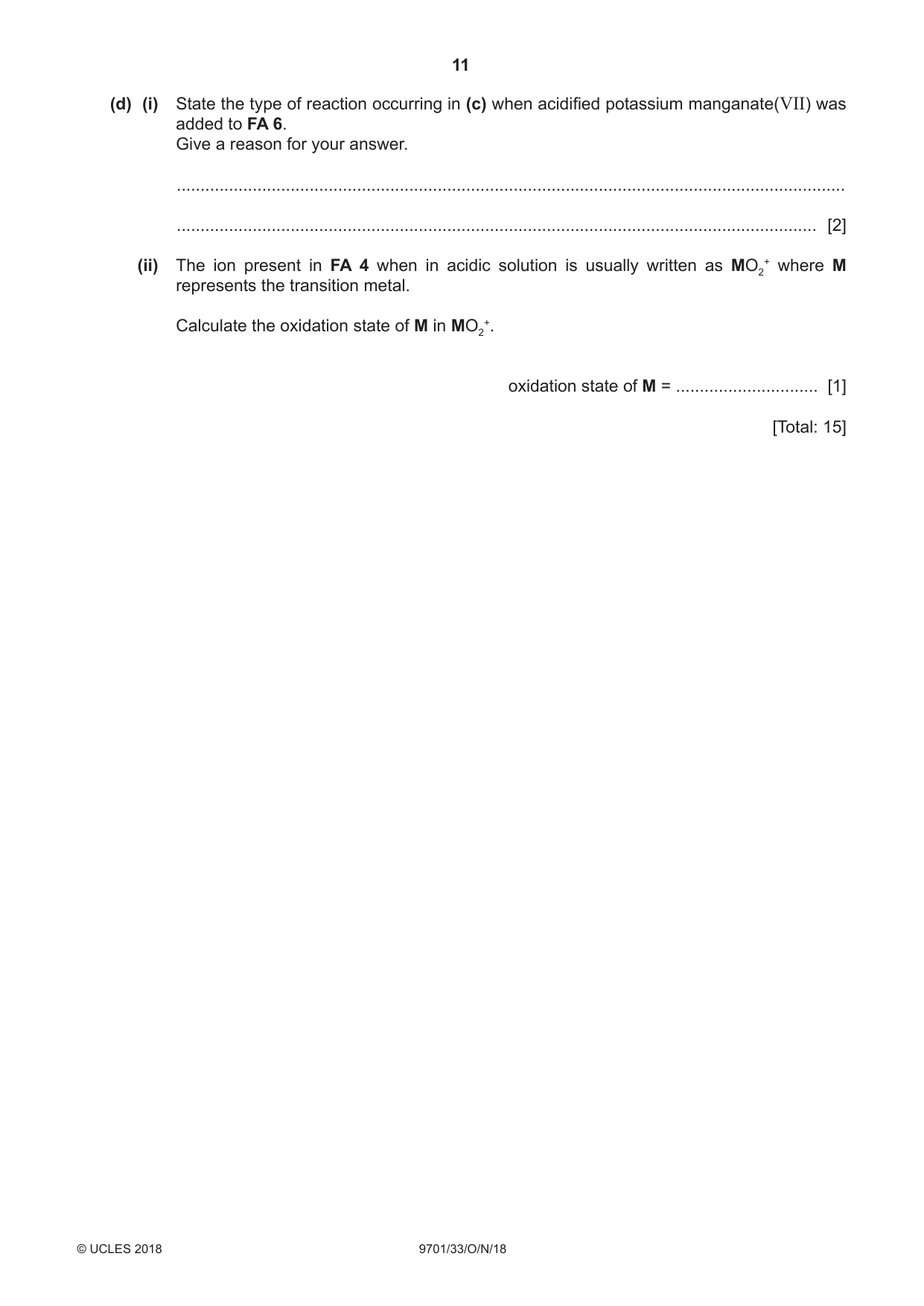
3 (a) FA 4 is a solution of a transition metal compound dissolved in acid. Carry out the following tests on FA 4 and record your observations. test observations To a 1 cm depth of FA 4 in a test-tube, add a 1 cm depth of potassium iodide, then add aqueous sodium thiosulfate. To a 3 cm depth of FA 4 in a boiling tube, add a spatula measure of zinc powder, FA 3. If no reaction occurs, carefully warm the mixture. Leave the mixture for 5–15 minutes, observing the mixture occasionally. Keep the mixture of FA 4 and FA 3 for use in (c). The solution formed from the mixture is FA 6. Complete part (b) while FA 4 and FA 3 continue reacting. [5] (b) (i) FA 5 is the acid used to make FA 4. The anion in FA 5 is listed in the Qualitative Analysis Notes. List the reagents you would use to identify this anion and state which acid the reagents are testing for. [2] (ii) Carry out one of your tests in (i) and record your observations. Give the formula of the anion present in FA 5. Write ‘unknown’ if your test could not positively identify this anion. ............................................................................................................................................. [2] (c) Carry out the following tests on FA 6 (the solution formed in (a)). test observations To a 1 cm depth of FA 6 in a test-tube, add acidified potassium manganate(VII) a few drops at a time until in excess. At this stage the solution will be pink. To a 1 cm depth of FA 6 in a test-tube, add a 1 cm depth of FA 4. [3] (d) (i) State the type of reaction occurring in (c) when acidified potassium manganate(VII) was added to FA 6. Give a reason for your answer. ............................................................................................................................................. ....................................................................................................................................... [2] (ii) The ion present in FA 4 when in acidic solution is usually written as MO2+ where M represents the transition metal. Calculate the oxidation state of M in MO2+. oxidation state of M = .............................. [1] [Total: 15]
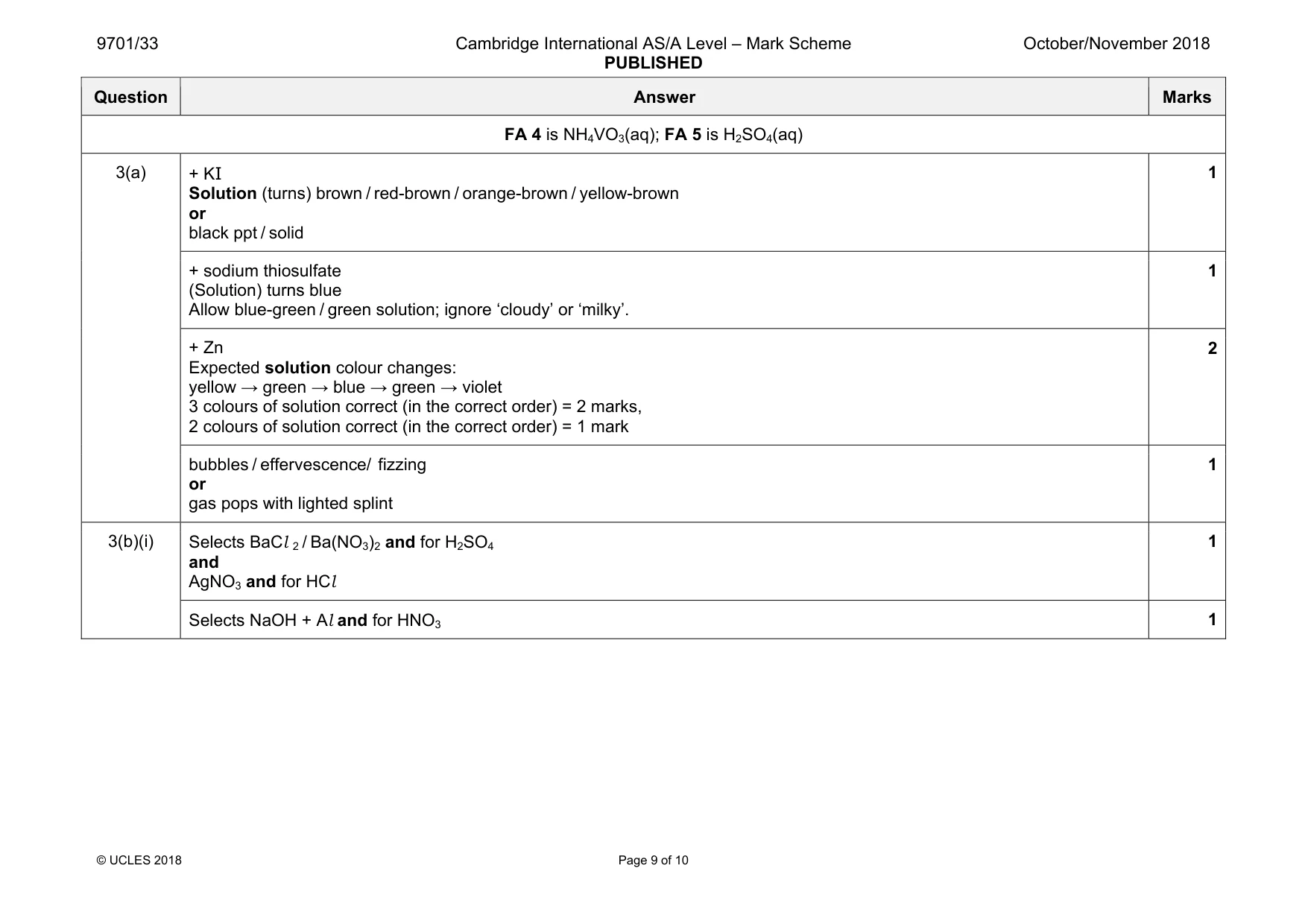
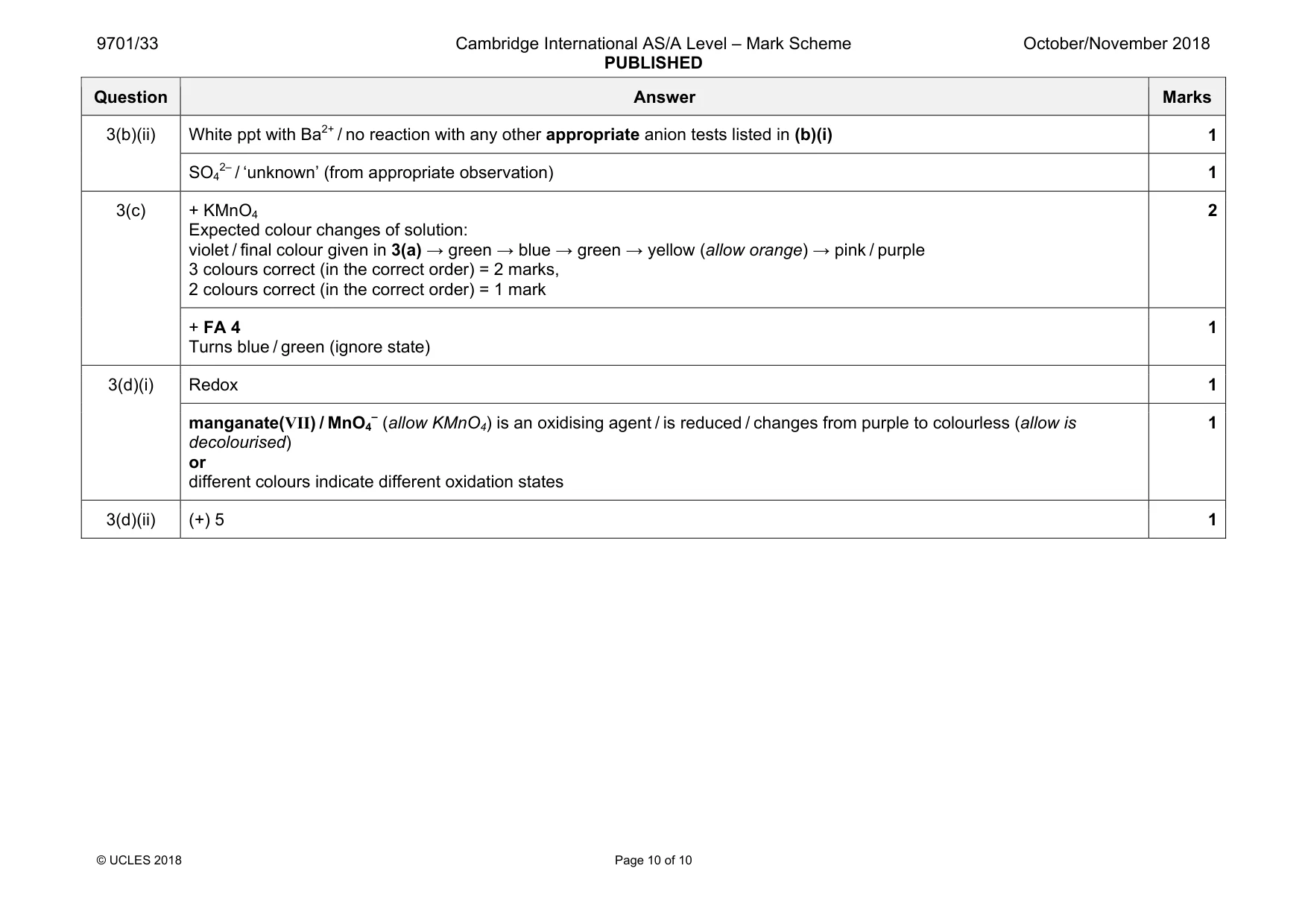
Mark scheme: 3(a) Solution (turns) brown / red-brown / orange-brown / yellow-brown or black ppt / solid 1 + sodium thiosulfate (Solution) turns blue Allow blue-green / green solution; ignore ‘cloudy’ or ‘milky’. 1 + Zn Expected solution colour changes: yellow → green → blue → green → violet 3 colours of solution correct (in the correct order) = 2 marks, 2 colours of solution correct (in the correct order) = 1 mark 2 bubbles / effervescence/ fizzing or gas pops with lighted splint 1 3(b)(i) Selects BaCl 2 / Ba(NO3)2 and for H2SO4 and AgNO3 and for HCl 1 Selects NaOH + Al and for HNO3 1 Question Answer Marks 3(b)(ii) White ppt with Ba2+ / no reaction with any other appropriate anion tests listed in (b)(i) 1 SO4 2– / ‘unknown’ (from appropriate observation) 1 3(c) + KMnO4 Expected colour changes of solution: violet / final colour given in 3(a) → green → blue → green → yellow (allow orange) → pink / purple 3 colours correct (in the correct order) = 2 marks, 2 colours correct (in the correct order) = 1 mark 2 + FA 4 Turns blue / green (ignore state) 1 3(d)(i) Redox 1 manganate(VII) / MnO4 – (allow KMnO4) is an oxidising agent / is reduced / changes from purple to colourless (allow is decolourised) or different colours indicate different oxidation states 1 3(d)(ii) (+) 5 1
What was in this paper
The subtopics covered by these 3 questions, and how many questions each got. Open one in a new tab to see every Cambridge question on it.
What you needed in this session
Cambridge’s own grade thresholds for 2018 Oct/Nov, Paper 3 · Variant 3. A higher threshold means an easier paper — the bar moves with how the cohort did.