Cambridge A Level Chemistry 9701 — 2018 May/June Paper 4 · Variant 2
9701/42/M/J/18 · 8 questions · 100 marks · ≈113 min
The question paper and its mark scheme, free to read here and free to download. This is Cambridge’s own paper, exactly as it was sat.
Question paper16 pages
Mark scheme14 pages
Answers below. Sit the paper first if you are practising.
Questions as text
Q1 · Silicon tetrachloride, SiCl 4, is formed when silicon reacts with chlorine under suitable…
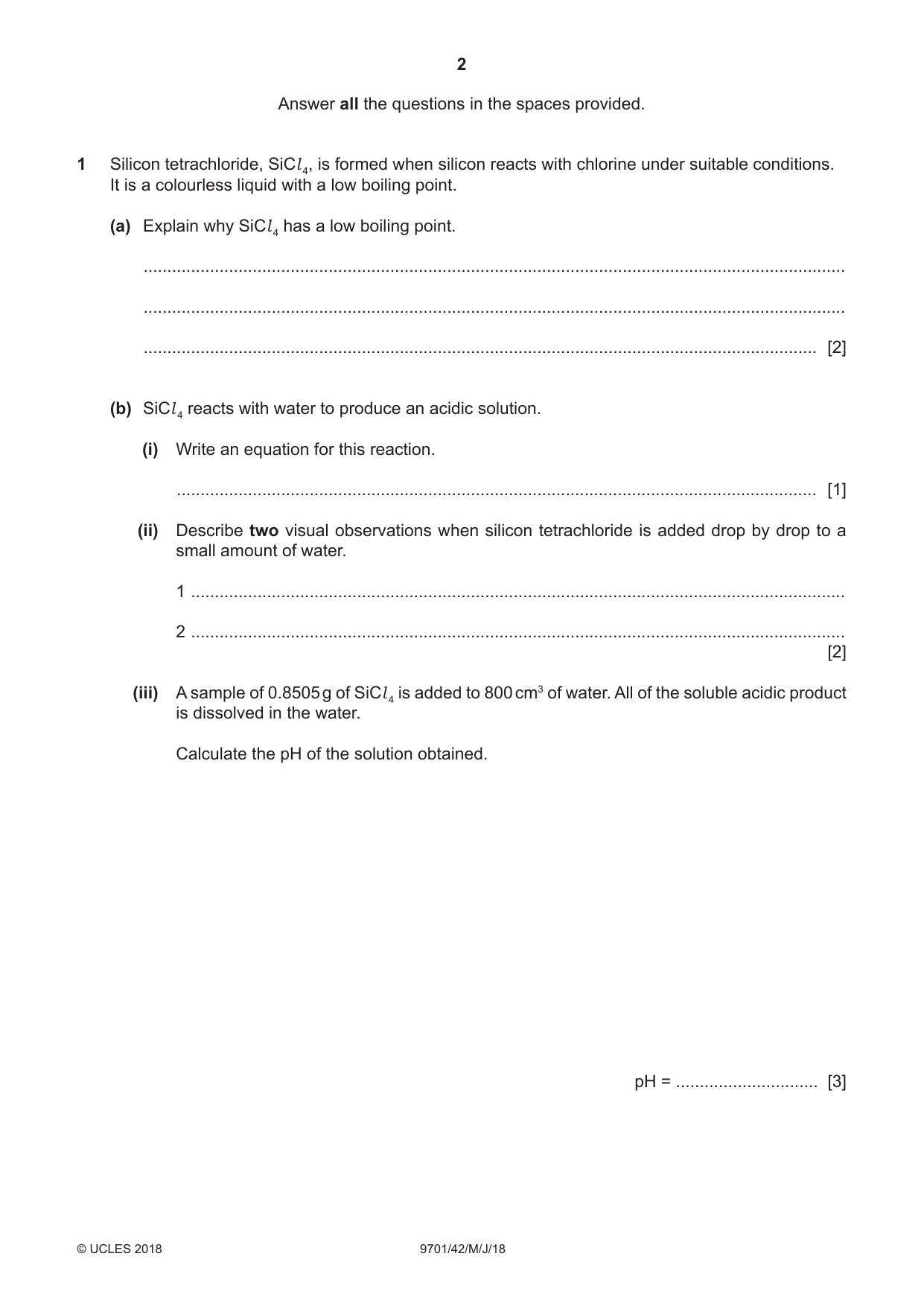
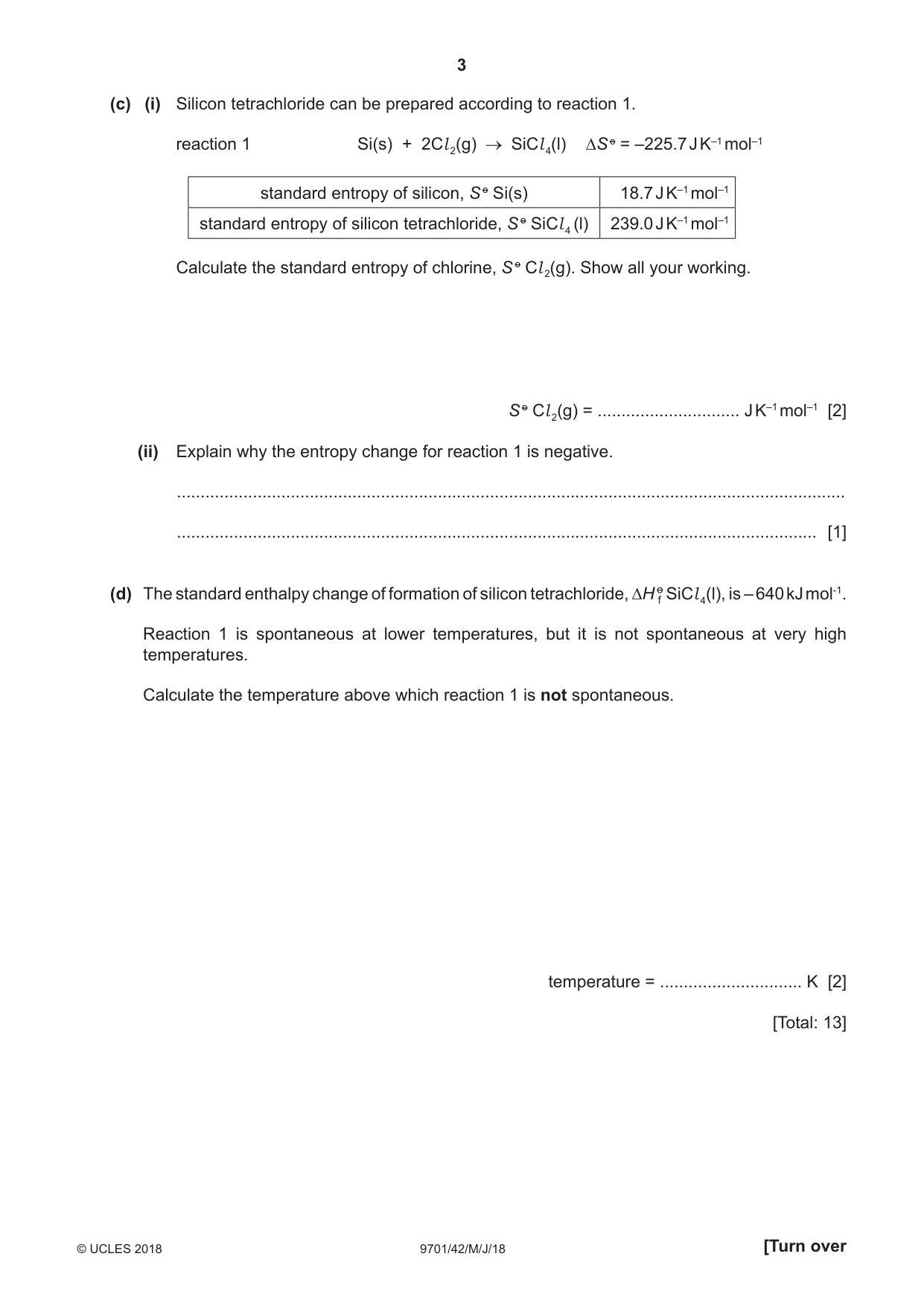
1 Silicon tetrachloride, SiCl 4, is formed when silicon reacts with chlorine under suitable conditions. It is a colourless liquid with a low boiling point. (a) Explain why SiCl 4 has a low boiling point. .................................................................................................................................................... .................................................................................................................................................... .............................................................................................................................................. [2] (b) SiCl 4 reacts with water to produce an acidic solution. (i) Write an equation for this reaction. ....................................................................................................................................... [1] (ii) Describe two visual observations when silicon tetrachloride is added drop by drop to a small amount of water. 1 .......................................................................................................................................... 2 .......................................................................................................................................... [2] (iii) A sample of 0.8505 g of SiCl 4 is added to 800 cm3 of water. All of the soluble acidic product is dissolved in the water. Calculate the pH of the solution obtained. pH = .............................. [3] (c) (i) Silicon tetrachloride can be prepared according to reaction 1. reaction 1 Si(s) + 2Cl 2(g) SiCl 4(l) ΔS o = –225.7 J K–1 mol–1 standard entropy of silicon, S o Si(s) 18.7 J K–1 mol–1 standard entropy of silicon tetrachloride, S o SiCl 4 (l) 239.0 J K–1 mol–1 Calculate the standard entropy of chlorine, S o Cl 2(g). Show all your working. S o Cl 2(g) = .............................. J K–1 mol–1 [2] (ii) Explain why the entropy change for reaction 1 is negative. ............................................................................................................................................. ....................................................................................................................................... [1] (d) The standard enthalpy change of formation of silicon tetrachloride, SiCl 4(l), is – 640 kJ mol‑1. Reaction 1 is spontaneous at lower temperatures, but it is not spontaneous at very high temperatures. Calculate the temperature above which reaction 1 is not spontaneous. temperature = .............................. K [2] [Total: 13]
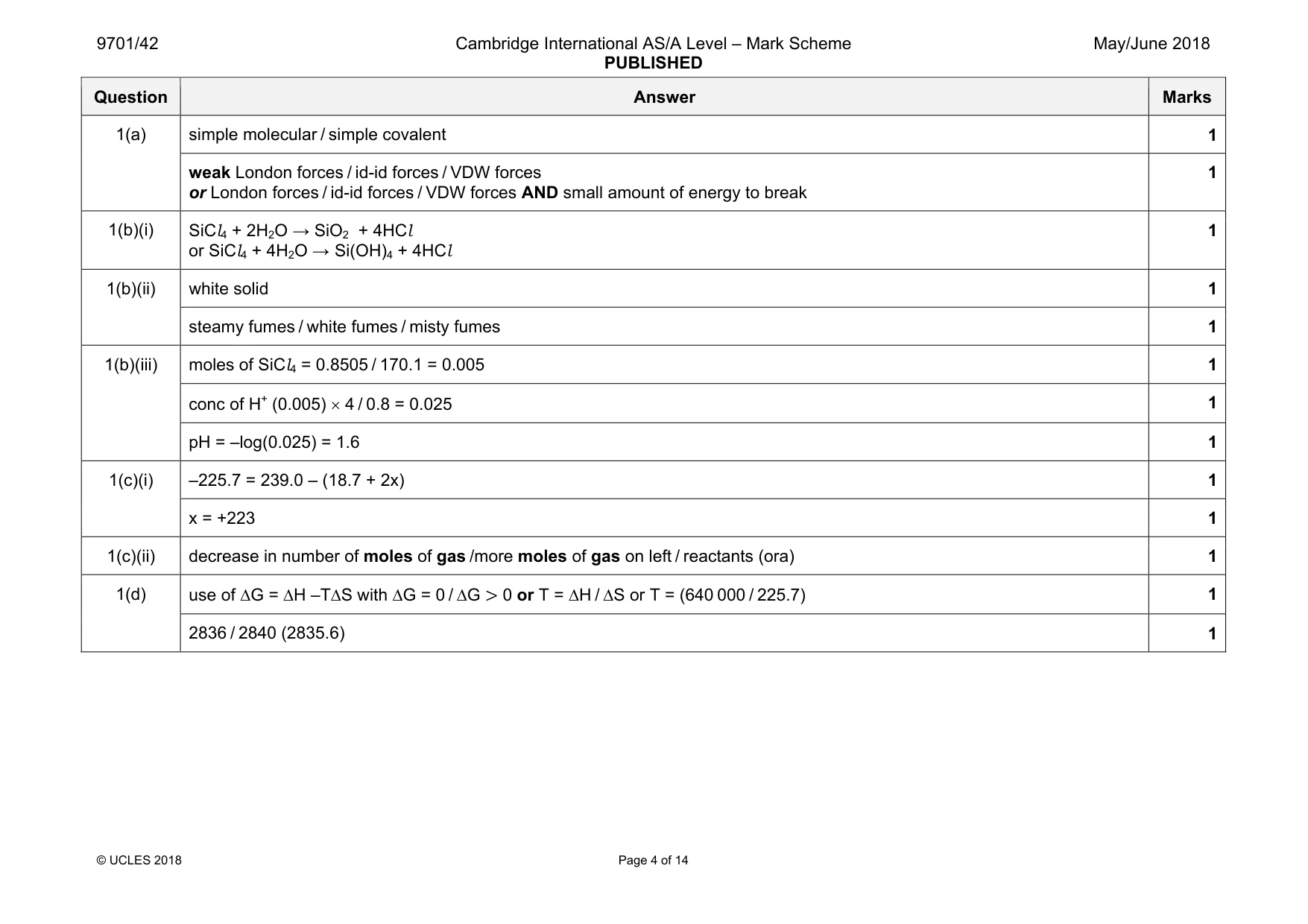
Mark scheme: 1(a) simple molecular / simple covalent 1 weak London forces / id-id forces / VDW forces or London forces / id-id forces / VDW forces AND small amount of energy to break 1 1(b)(i) SiCl4 + 2H2O → SiO2 + 4HCl or SiCl4 + 4H2O → Si(OH)4 + 4HCl 1 1(b)(ii) white solid 1 steamy fumes / white fumes / misty fumes 1 1(b)(iii) moles of SiCl4 = 0.8505 / 170.1 = 0.005 1 conc of H+ (0.005) × 4 / 0.8 = 0.025 1 pH = –log(0.025) = 1.6 1 1(c)(i) –225.7 = 239.0 – (18.7 + 2x) 1 x = +223 1 1(c)(ii) decrease in number of moles of gas /more moles of gas on left / reactants (ora) 1 1(d) use of ∆G = ∆H –T∆S with ∆G = 0 / ∆G > 0 or T = ∆H / ∆S or T = (640 000 / 225.7) 1 2836 / 2840 (2835.6) 1
More questions on Periodicity of chemical properties of the elements in Period 3
Q2 · Iodine monochloride, ICl, is a yellow-brown gas
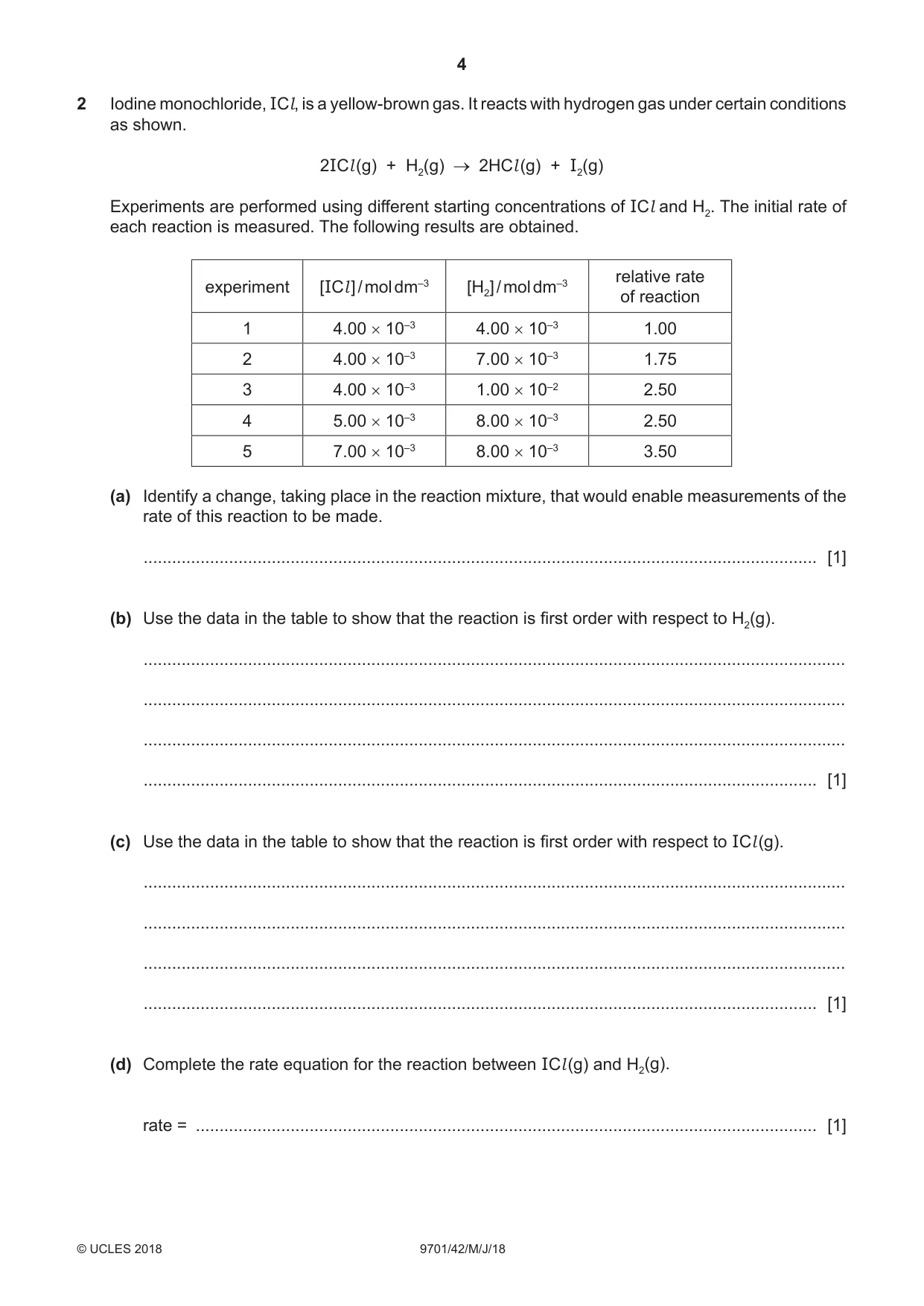
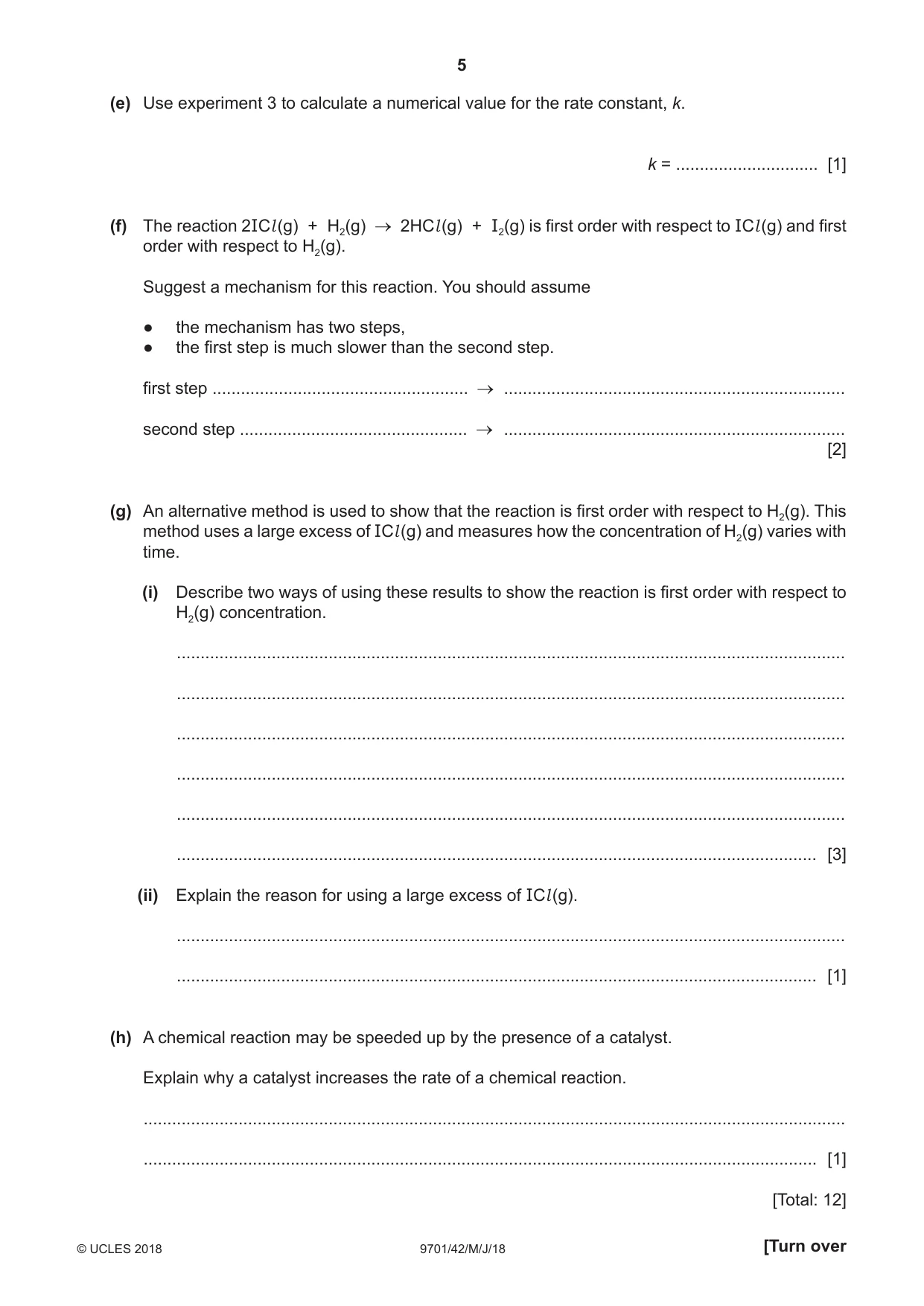
2 Iodine monochloride, ICl, is a yellow-brown gas. It reacts with hydrogen gas under certain conditions as shown. 2ICl (g) + H2(g) 2HCl (g) + I2(g) Experiments are performed using different starting concentrations of ICl and H2. The initial rate of each reaction is measured. The following results are obtained. relative rate experiment [ICl ] / mol dm–3 [H2] / mol dm–3 of reaction 1 4.00 × 10⁻³ 4.00 × 10⁻³ 1.00 2 4.00 × 10⁻³ 7.00 × 10⁻³ 1.75 3 4.00 × 10⁻³ 1.00 × 10⁻² 2.50 4 5.00 × 10⁻³ 8.00 × 10⁻³ 2.50 5 7.00 × 10⁻³ 8.00 × 10⁻³ 3.50 (a) Identify a change, taking place in the reaction mixture, that would enable measurements of the rate of this reaction to be made. .............................................................................................................................................. [1] (b) Use the data in the table to show that the reaction is first order with respect to H2(g). .................................................................................................................................................... .................................................................................................................................................... .................................................................................................................................................... .............................................................................................................................................. [1] (c) Use the data in the table to show that the reaction is first order with respect to ICl (g). .................................................................................................................................................... .................................................................................................................................................... .................................................................................................................................................... .............................................................................................................................................. [1] (d) Complete the rate equation for the reaction between ICl (g) and H2(g). rate = .................................................................................................................................... [1] (e) Use experiment 3 to calculate a numerical value for the rate constant, k. k = .............................. [1] (f) The reaction 2ICl (g) + H2(g) 2HCl (g) + I2(g) is first order with respect to ICl (g) and first order with respect to H2(g). Suggest a mechanism for this reaction. You should assume ● the mechanism has two steps, ● the first step is much slower than the second step. first step ...................................................... ........................................................................ second step ................................................ ......................................................................... [2] (g) An alternative method is used to show that the reaction is first order with respect to H2(g). This method uses a large excess of ICl (g) and measures how the concentration of H2(g) varies with time. (i) Describe two ways of using these results to show the reaction is first order with respect to H2(g) concentration. ............................................................................................................................................. ............................................................................................................................................. ............................................................................................................................................. ............................................................................................................................................. ............................................................................................................................................. ....................................................................................................................................... [3] (ii) Explain the reason for using a large excess of ICl (g). ............................................................................................................................................. ....................................................................................................................................... [1] (h) A chemical reaction may be speeded up by the presence of a catalyst. Explain why a catalyst increases the rate of a chemical reaction. .................................................................................................................................................... .............................................................................................................................................. [1] [Total: 12]
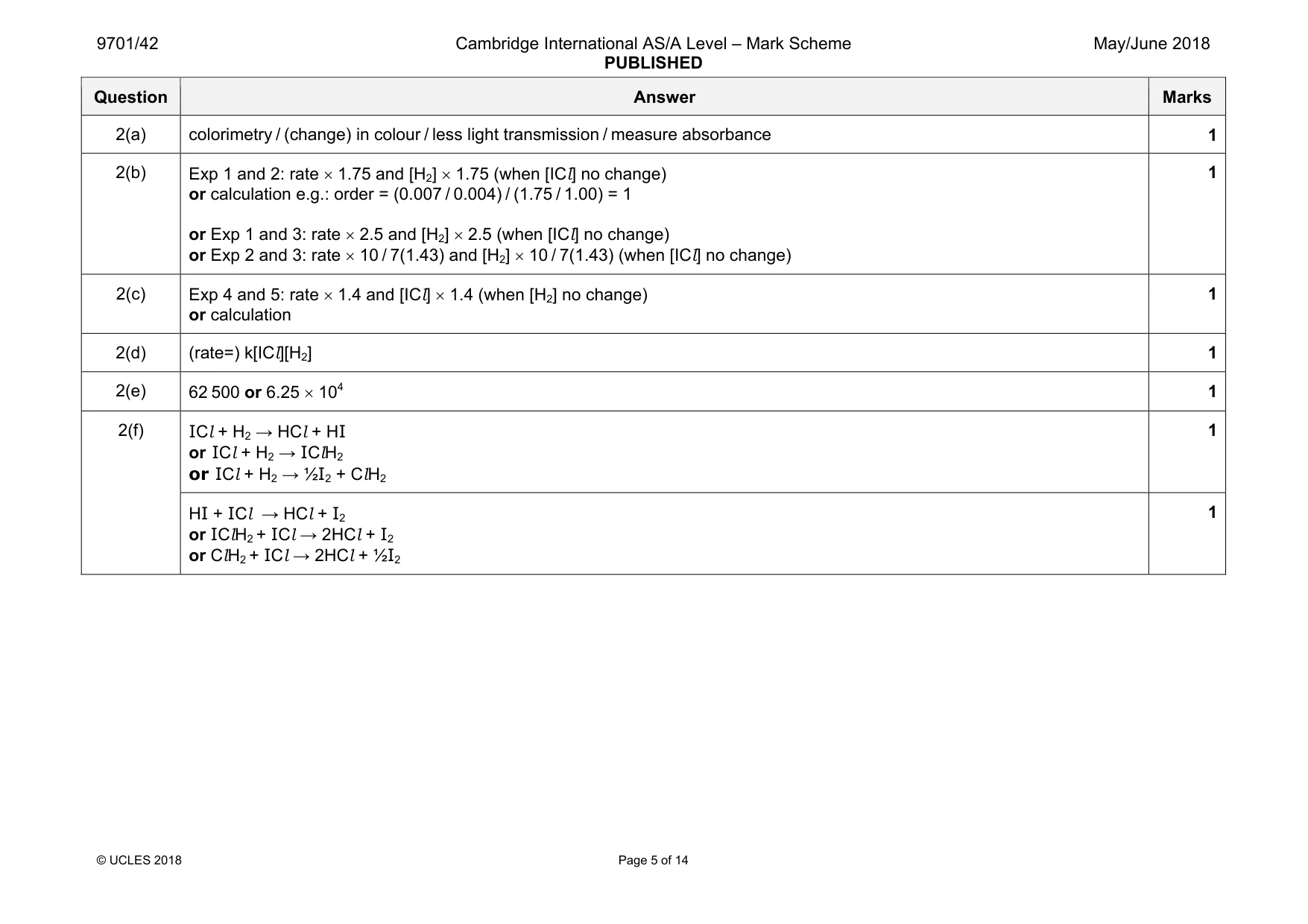
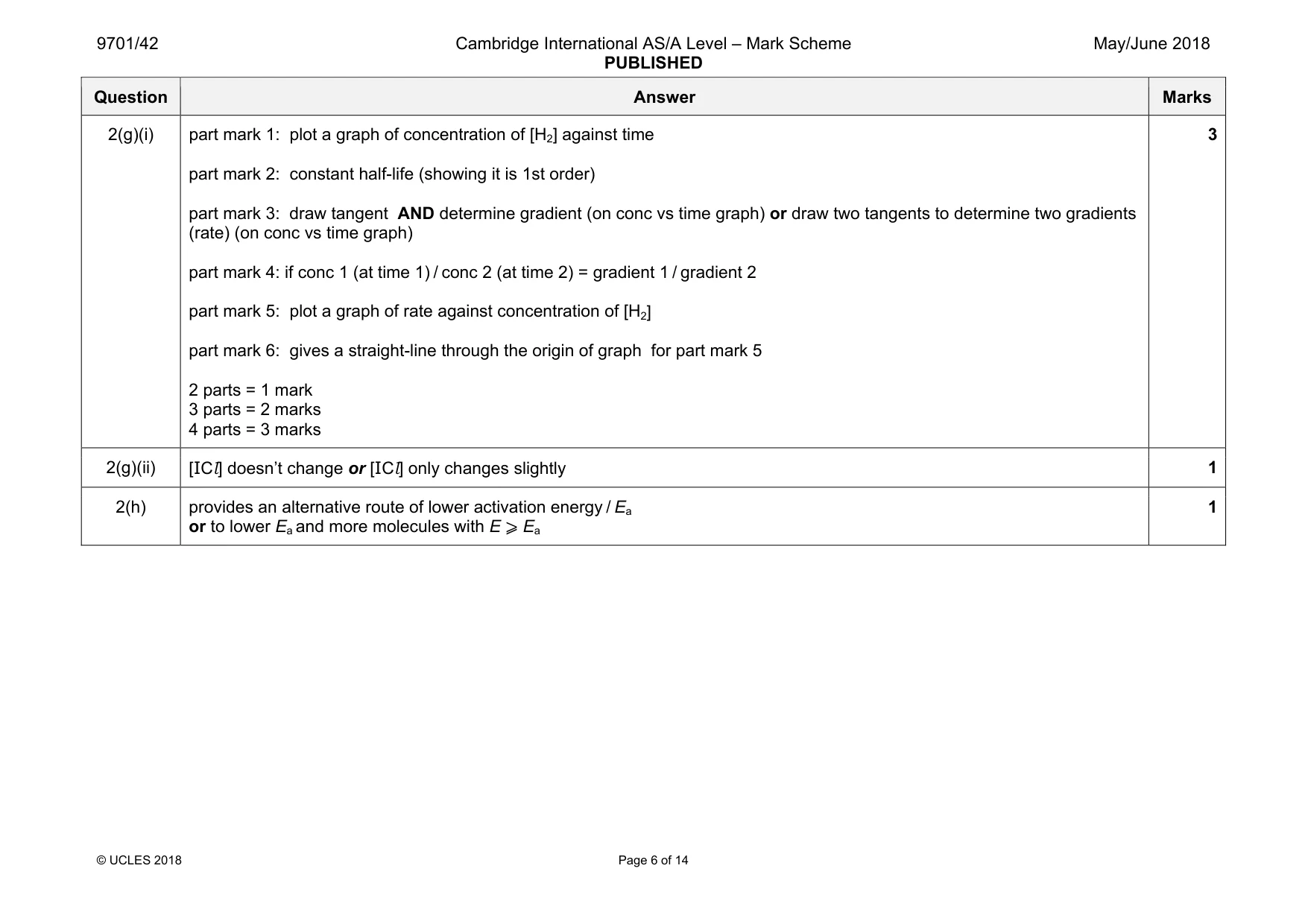
Mark scheme: 2(a) colorimetry / (change) in colour / less light transmission / measure absorbance 1 2(b) Exp 1 and 2: rate × 1.75 and [H2] × 1.75 (when [ICl] no change) or calculation e.g.: order = (0.007 / 0.004) / (1.75 / 1.00) = 1 or Exp 1 and 3: rate × 2.5 and [H2] × 2.5 (when [ICl] no change) or Exp 2 and 3: rate × 10 / 7(1.43) and [H2] × 10 / 7(1.43) (when [ICl] no change) 1 2(c) Exp 4 and 5: rate × 1.4 and [ICl] × 1.4 (when [H2] no change) or calculation 1 2(d) (rate=) k[ICl][H2] 1 2(e) 62 500 or 6.25 × 10⁴ 1 2(f) ICl + H2 → HCl + HI or ICl + H2 → IClH2 or ICl + H2 → ½I2 + ClH2 1 HI + ICl → HCl + I2 or IClH2 + ICl → 2HCl + I2 or ClH2 + ICl → 2HCl + ½I2 1 Question Answer Marks 2(g)(i) part mark 1: plot a graph of concentration of [H2] against time part mark 2: constant half-life (showing it is 1st order) part mark 3: draw tangent AND determine gradient (on conc vs time graph) or draw two tangents to determine two gradients (rate) (on conc vs time graph) part mark 4: if conc 1 (at time 1) / conc 2 (at time 2) = gradient 1 / gradient 2 part mark 5: plot a graph of rate against concentration of [H2] part mark 6: gives a straight-line through the origin of graph for part mark 5 2 parts = 1 mark 3 parts = 2 marks 4 parts = 3 marks 3 2(g)(ii) [ICl] doesn’t change or [ICl] only changes slightly 1 2(h) provides an alternative route of lower activation energy / Ea or to lower Ea and more molecules with E ⩾ Ea 1
More questions on Simple rate equations, orders of reaction and rate constants
Q3 · Complete the table by predicting the identity of the substance liberated at each…
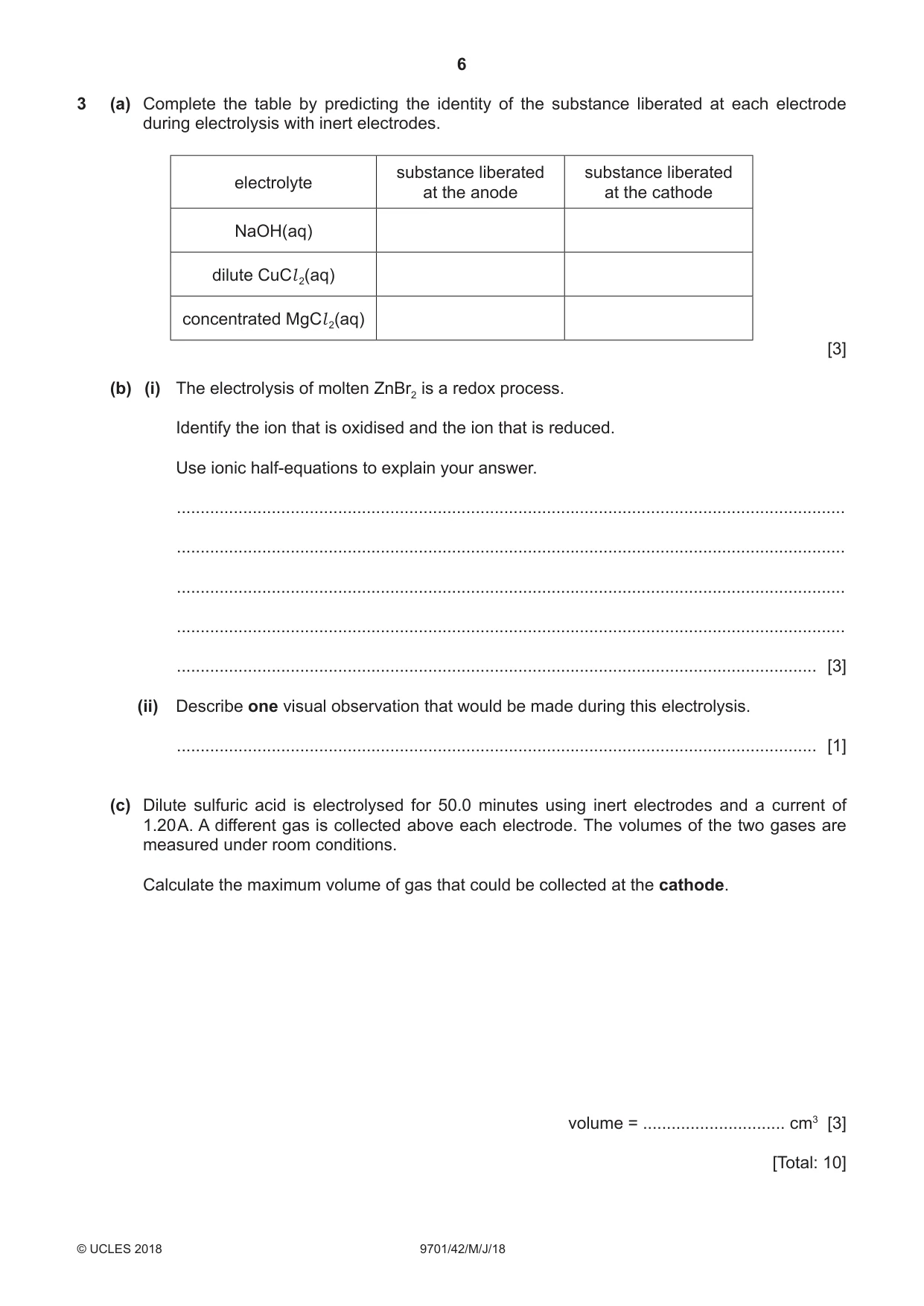
3 (a) Complete the table by predicting the identity of the substance liberated at each electrode during electrolysis with inert electrodes. substance liberated substance liberated electrolyte at the anode at the cathode NaOH(aq) dilute CuCl 2(aq) concentrated MgCl 2(aq) [3] (b) (i) The electrolysis of molten ZnBr2 is a redox process. Identify the ion that is oxidised and the ion that is reduced. Use ionic half-equations to explain your answer. ............................................................................................................................................. ............................................................................................................................................. ............................................................................................................................................. ............................................................................................................................................. ....................................................................................................................................... [3] (ii) Describe one visual observation that would be made during this electrolysis. ....................................................................................................................................... [1] (c) Dilute sulfuric acid is electrolysed for 50.0 minutes using inert electrodes and a current of 1.20 A. A different gas is collected above each electrode. The volumes of the two gases are measured under room conditions. Calculate the maximum volume of gas that could be collected at the cathode. volume = .............................. cm3 [3] [Total: 10]
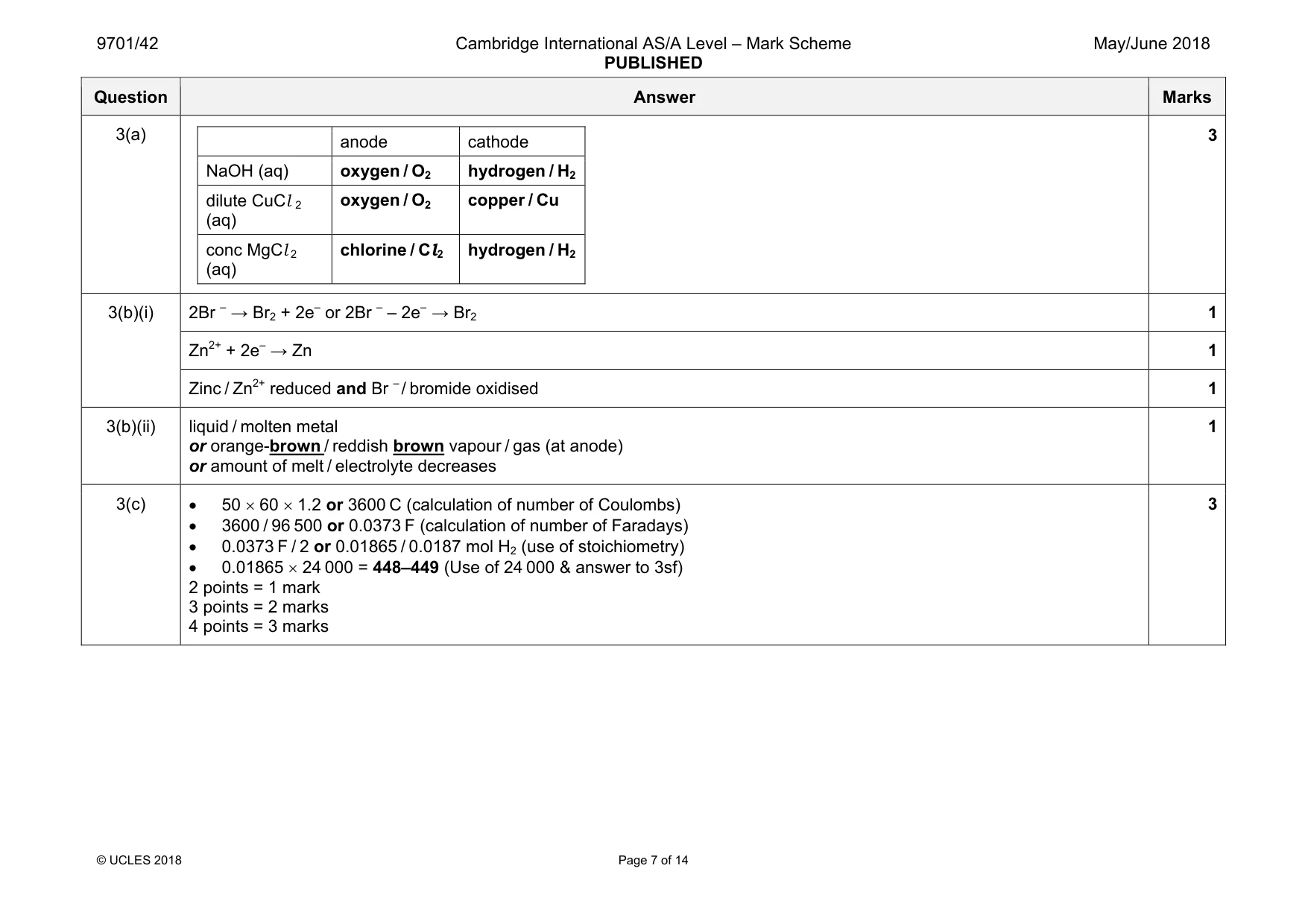
Mark scheme: 3(a) anode cathode NaOH (aq) oxygen / O2 hydrogen / H2 dilute CuCl 2 (aq) oxygen / O2 copper / Cu conc MgCl 2 (aq) chlorine / Cl2 hydrogen / H2 3 3(b)(i) 2Br – → Br2 + 2e– or 2Br – – 2e– → Br2 1 Zn2+ + 2e– → Zn 1 Zinc / Zn2+ reduced and Br –/ bromide oxidised 1 3(b)(ii) liquid / molten metal or orange-brown / reddish brown vapour / gas (at anode) or amount of melt / electrolyte decreases 1 3(c) • 50 × 60 × 1.2 or 3600 C (calculation of number of Coulombs) • 3600 / 96 500 or 0.0373 F (calculation of number of Faradays) • 0.0373 F / 2 or 0.01865 / 0.0187 mol H2 (use of stoichiometry) • 0.01865 × 24 000 = 448–449 (Use of 24 000 & answer to 3sf) 2 points = 1 mark 3 points = 2 marks 4 points = 3 marks 3
Q4 · Write an equation, including state symbols, for the reaction that takes place when a…
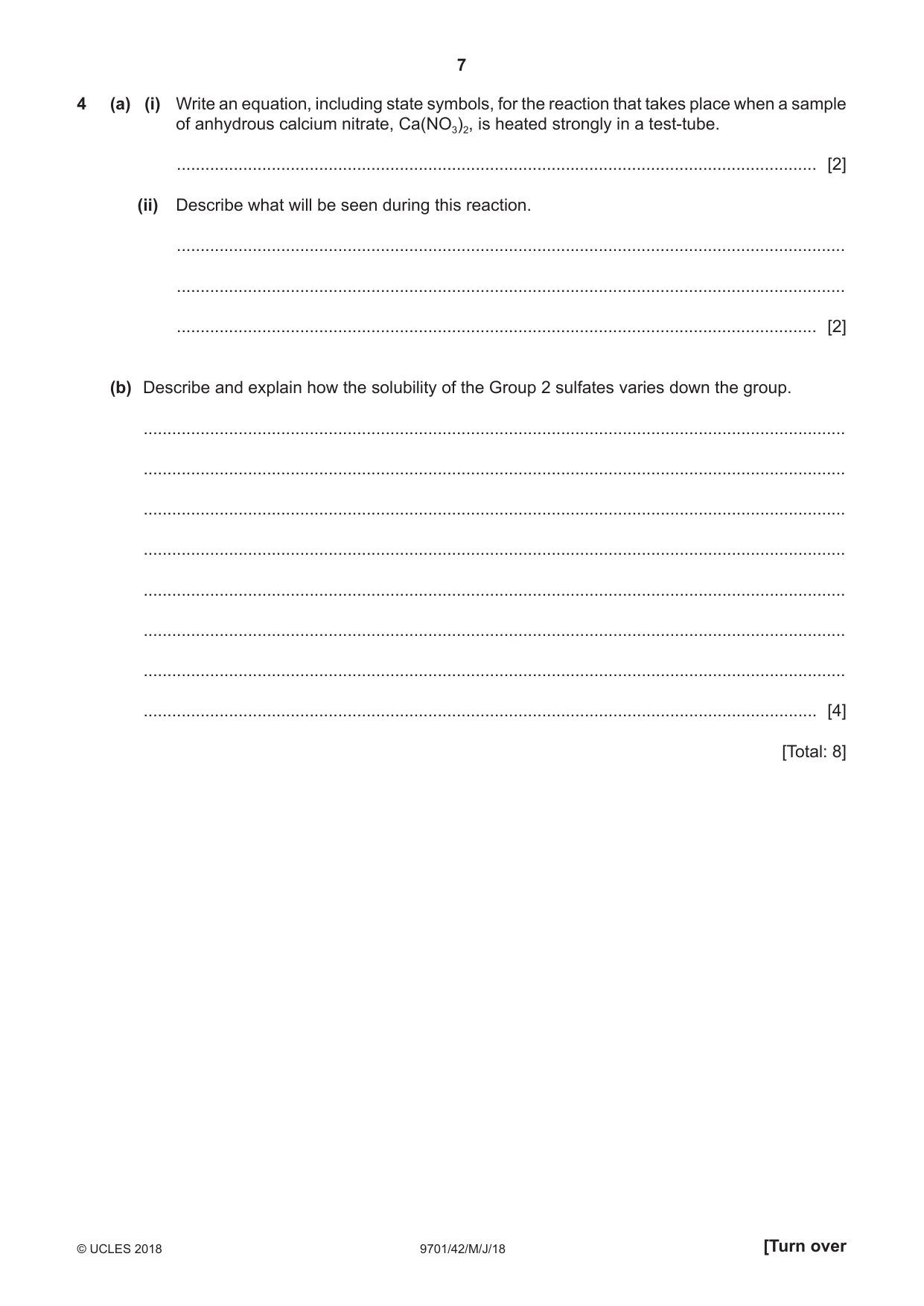
4 (a) (i) Write an equation, including state symbols, for the reaction that takes place when a sample of anhydrous calcium nitrate, Ca(NO3)2, is heated strongly in a test-tube. ....................................................................................................................................... [2] (ii) Describe what will be seen during this reaction. ............................................................................................................................................. ............................................................................................................................................. ....................................................................................................................................... [2] (b) Describe and explain how the solubility of the Group 2 sulfates varies down the group. .................................................................................................................................................... .................................................................................................................................................... .................................................................................................................................................... .................................................................................................................................................... .................................................................................................................................................... .................................................................................................................................................... .................................................................................................................................................... .............................................................................................................................................. [4] [Total: 8]
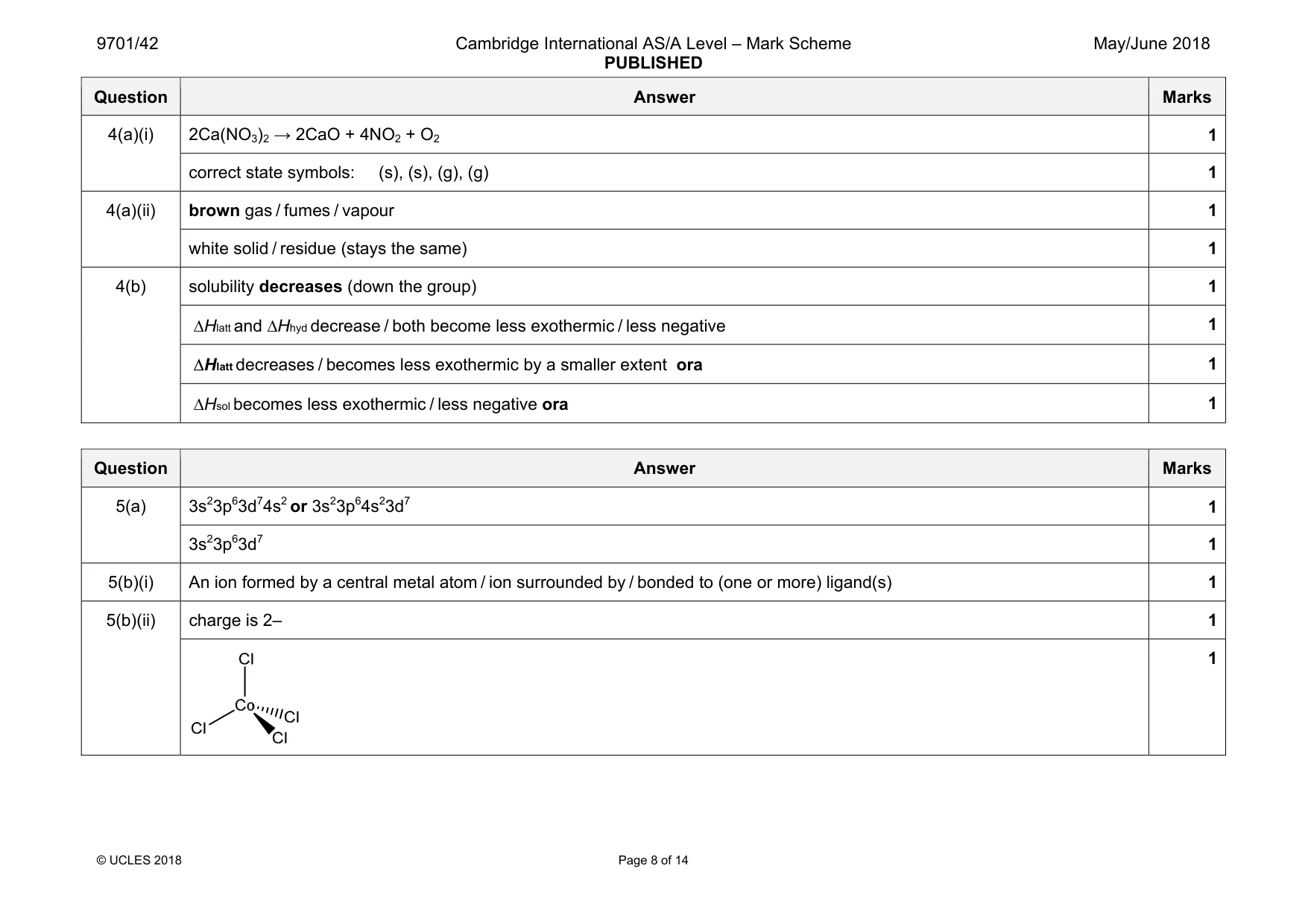
Mark scheme: 4(a)(i) 2Ca(NO3)2 → 2CaO + 4NO2 + O2 1 correct state symbols: (s), (s), (g), (g) 1 4(a)(ii) brown gas / fumes / vapour 1 white solid / residue (stays the same) 1 4(b) solubility decreases (down the group) 1 ∆Hlatt and ∆Hhyd decrease / both become less exothermic / less negative 1 ∆Hlatt decreases / becomes less exothermic by a smaller extent ora 1 ∆Hsol becomes less exothermic / less negative ora 1
Q5 · Cobalt is a transition element with atomic number 27
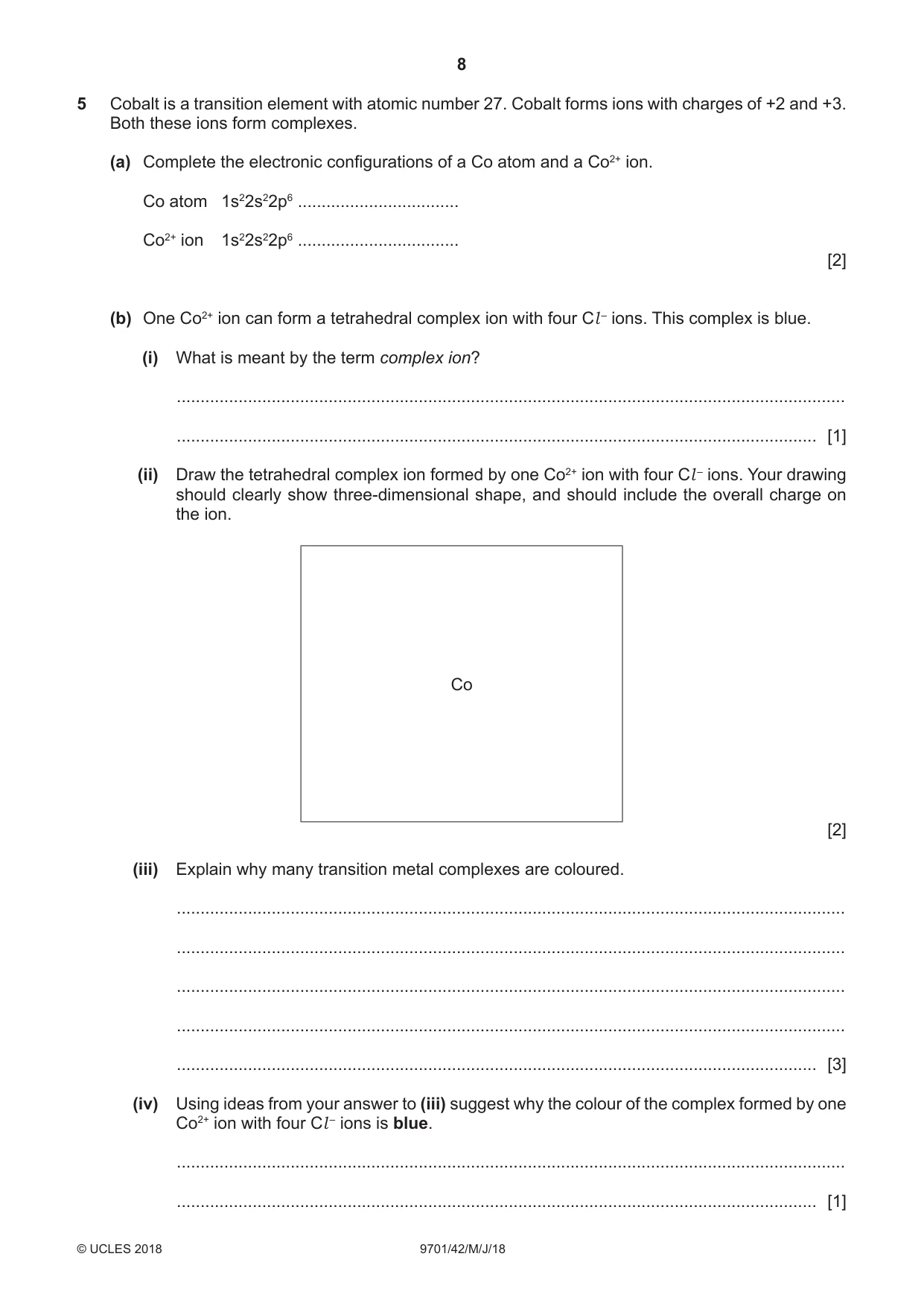
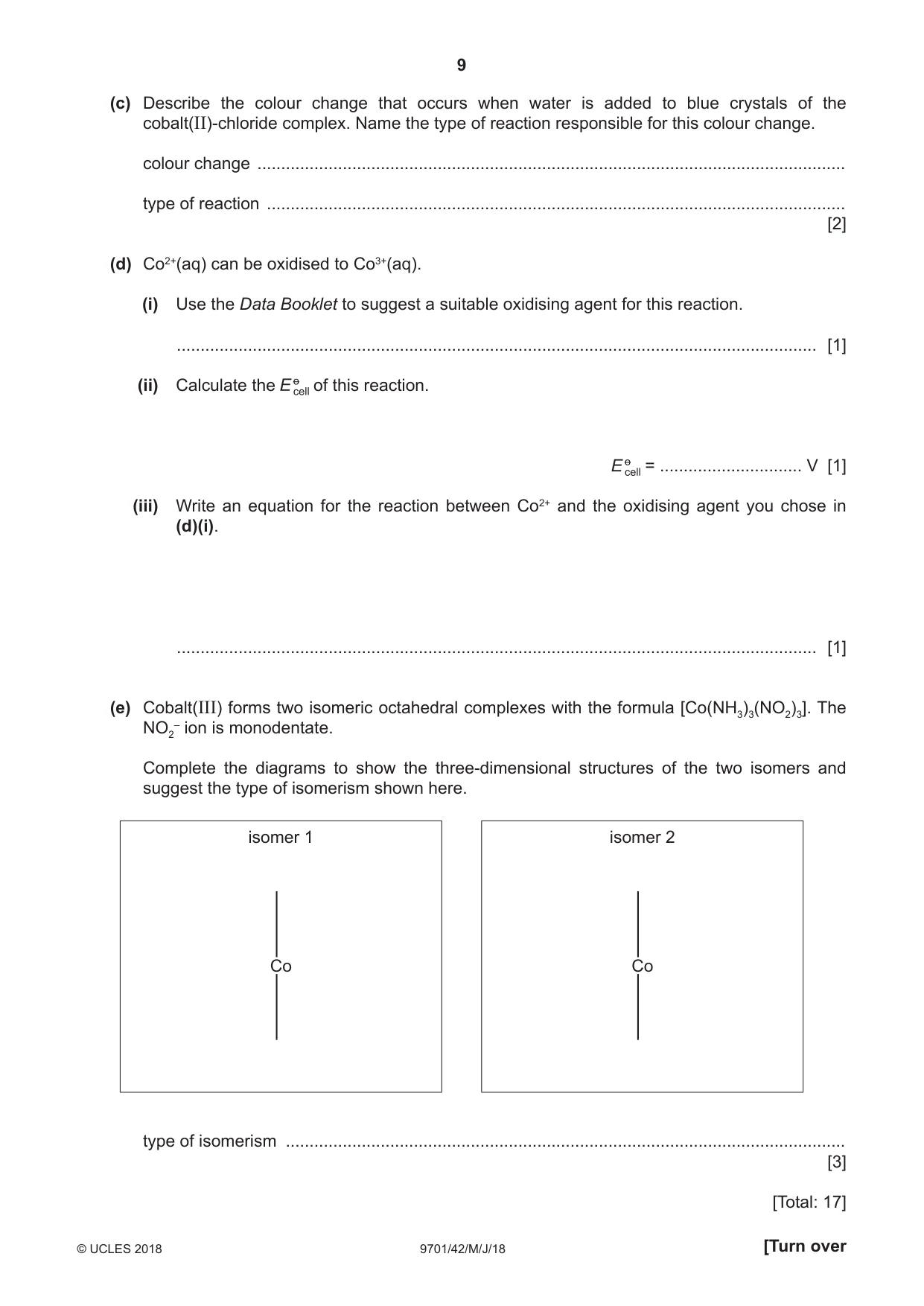
5 Cobalt is a transition element with atomic number 27. Cobalt forms ions with charges of +2 and +3. Both these ions form complexes. (a) Complete the electronic configurations of a Co atom and a Co2+ ion. Co atom 1s22s22p6 .................................. Co2+ ion 1s22s22p6 .................................. [2] (b) One Co2+ ion can form a tetrahedral complex ion with four Cl – ions. This complex is blue. (i) What is meant by the term complex ion? ............................................................................................................................................. ....................................................................................................................................... [1] (ii) Draw the tetrahedral complex ion formed by one Co2+ ion with four Cl – ions. Your drawing should clearly show three-dimensional shape, and should include the overall charge on the ion. Co [2] (iii) Explain why many transition metal complexes are coloured. ............................................................................................................................................. ............................................................................................................................................. ............................................................................................................................................. ............................................................................................................................................. ....................................................................................................................................... [3] (iv) Using ideas from your answer to (iii) suggest why the colour of the complex formed by one Co2+ ion with four Cl – ions is blue. ............................................................................................................................................. ....................................................................................................................................... [1] (c) Describe the colour change that occurs when water is added to blue crystals of the cobalt(II)‑chloride complex. Name the type of reaction responsible for this colour change. colour change ............................................................................................................................. type of reaction ........................................................................................................................... [2] (d) Co2+(aq) can be oxidised to Co3+(aq). (i) Use the Data Booklet to suggest a suitable oxidising agent for this reaction. ....................................................................................................................................... [1] (ii) Calculate the of this reaction. = .............................. V [1] (iii) Write an equation for the reaction between Co2+ and the oxidising agent you chose in (d)(i). ....................................................................................................................................... [1] (e) Cobalt(III) forms two isomeric octahedral complexes with the formula [Co(NH3)3(NO2)3]. The NO2– ion is monodentate. Complete the diagrams to show the three-dimensional structures of the two isomers and suggest the type of isomerism shown here. isomer 1 isomer 2 Co Co type of isomerism ....................................................................................................................... [3] [Total: 17]
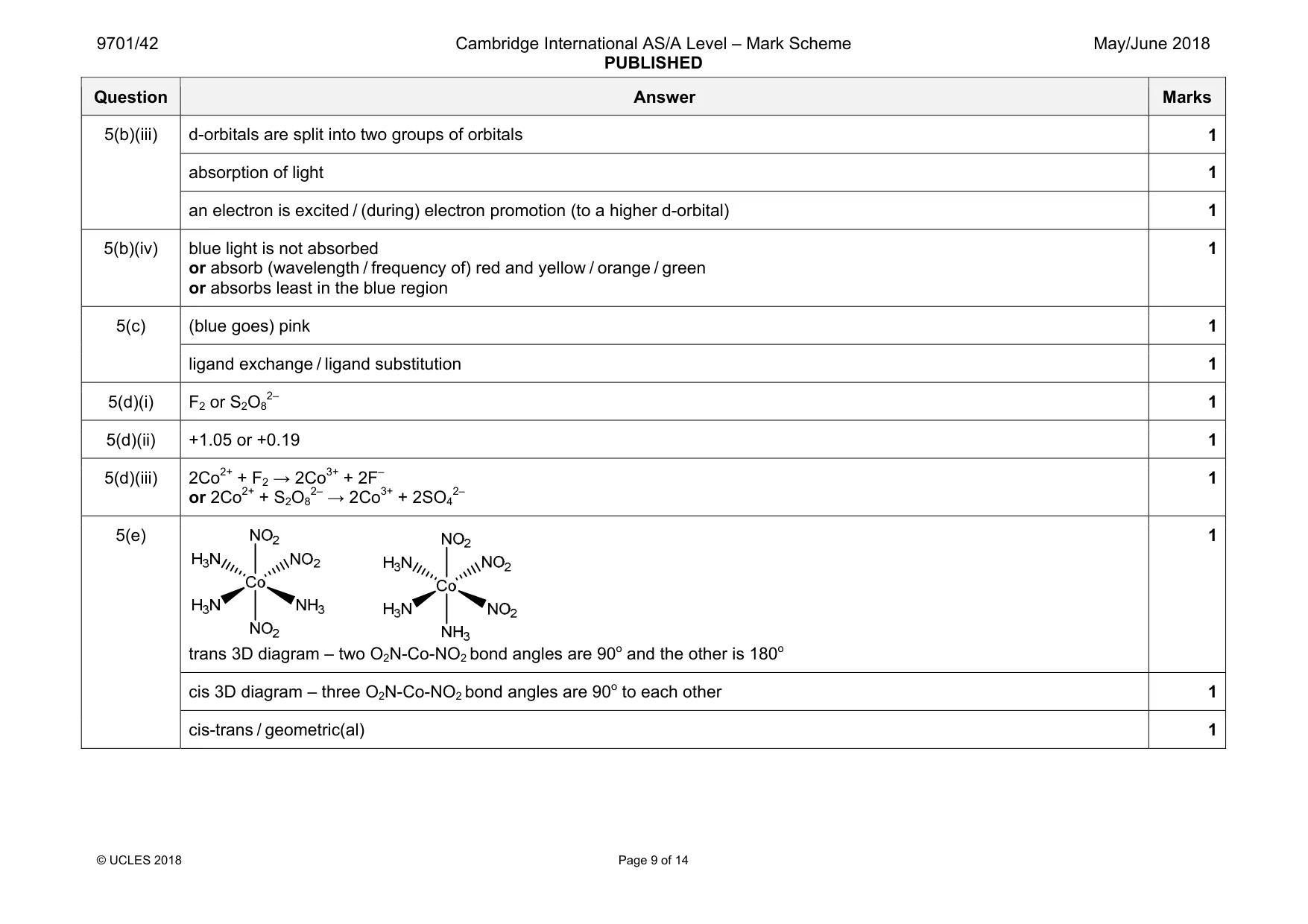
Mark scheme: 5(a) 1 3s23p63d7 1 5(b)(i) An ion formed by a central metal atom / ion surrounded by / bonded to (one or more) ligand(s) 1 5(b)(ii) charge is 2– 1 1 Question Answer Marks 5(b)(iii) d-orbitals are split into two groups of orbitals 1 absorption of light 1 an electron is excited / (during) electron promotion (to a higher d-orbital) 1 5(b)(iv) blue light is not absorbed or absorb (wavelength / frequency of) red and yellow / orange / green or absorbs least in the blue region 1 5(c) (blue goes) pink 1 ligand exchange / ligand substitution 1 5(d)(i) F2 or S2O8 2– 1 5(d)(ii) +1.05 or +0.19 1 5(d)(iii) 2Co2+ + F2 → 2Co3+ + 2F– or 2Co2+ + S2O8 2– → 2Co3+ + 2SO4 2– 1 5(e) trans 3D diagram – two O2N-Co-NO2 bond angles are 90o and the other is 180o 1 cis 3D diagram – three O2N-Co-NO2 bond angles are 90o to each other 1 cis-trans / geometric(al) 1
Q6 · Phenol is an important industrial chemical used in the manufacture of dyestuff and other…
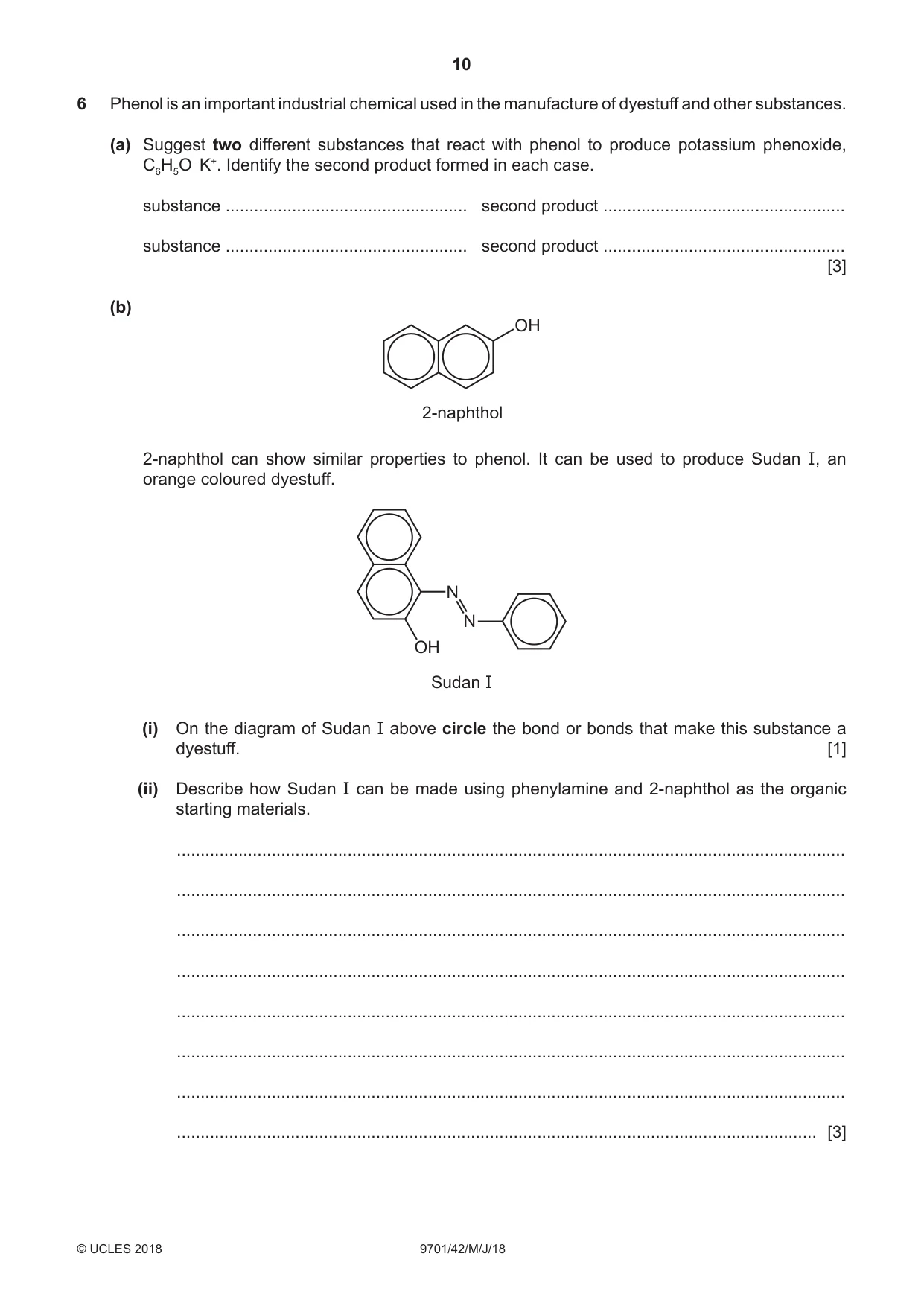
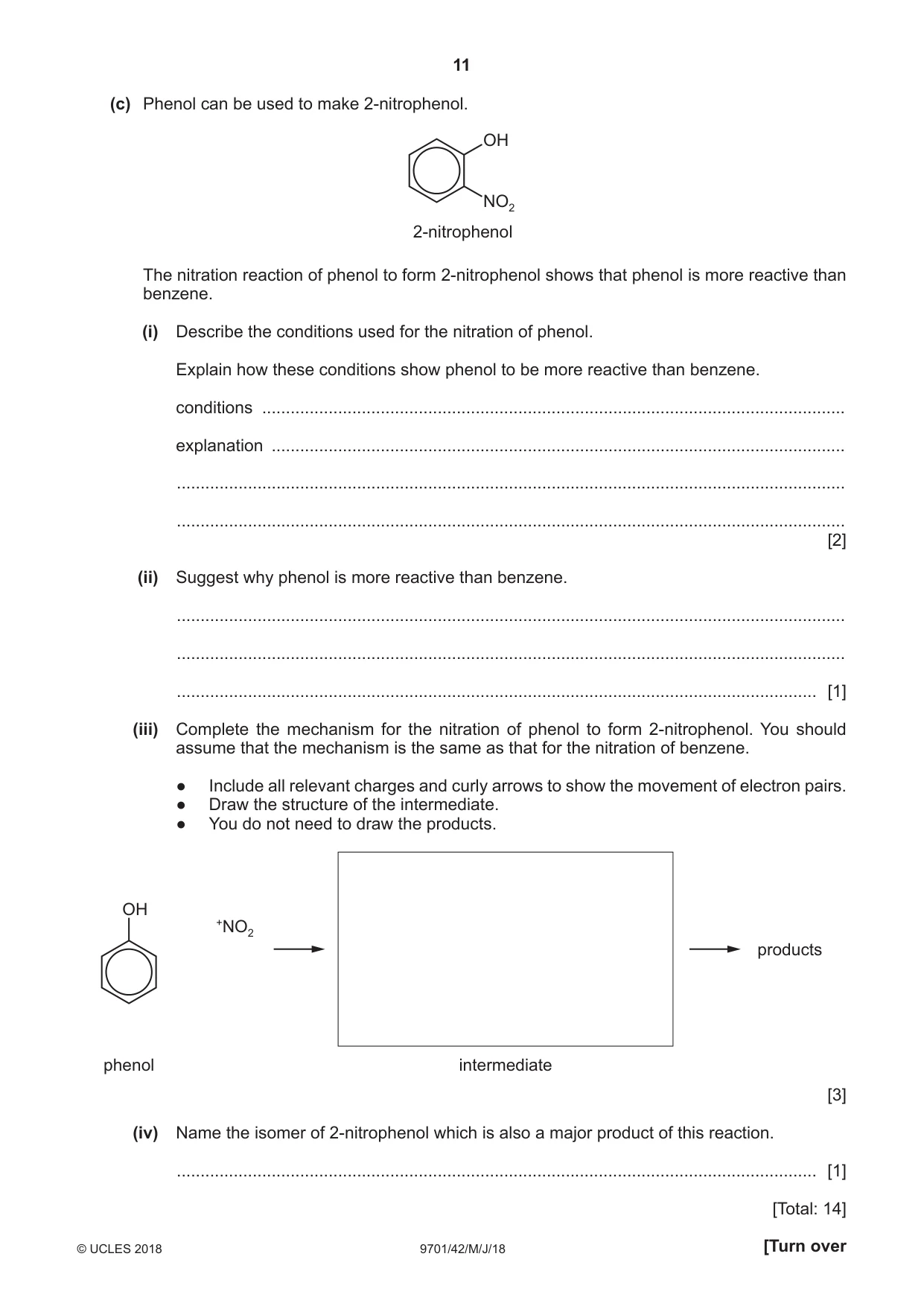
6 Phenol is an important industrial chemical used in the manufacture of dyestuff and other substances. (a) Suggest two different substances that react with phenol to produce potassium phenoxide, C6H5O– K+. Identify the second product formed in each case. substance ................................................... second product ................................................... substance ................................................... second product ................................................... [3] (b) OH 2-naphthol 2-naphthol can show similar properties to phenol. It can be used to produce Sudan I, an orange coloured dyestuff. N N OH Sudan I (i) On the diagram of Sudan I above circle the bond or bonds that make this substance a dyestuff. [1] (ii) Describe how Sudan I can be made using phenylamine and 2-naphthol as the organic starting materials. ............................................................................................................................................. ............................................................................................................................................. ............................................................................................................................................. ............................................................................................................................................. ............................................................................................................................................. ............................................................................................................................................. ............................................................................................................................................. ....................................................................................................................................... [3] (c) Phenol can be used to make 2-nitrophenol. OH NO2 2-nitrophenol The nitration reaction of phenol to form 2‑nitrophenol shows that phenol is more reactive than benzene. (i) Describe the conditions used for the nitration of phenol. Explain how these conditions show phenol to be more reactive than benzene. conditions ............................................................................................................................ explanation .......................................................................................................................... ............................................................................................................................................. ............................................................................................................................................. [2] (ii) Suggest why phenol is more reactive than benzene. ............................................................................................................................................. ............................................................................................................................................. ....................................................................................................................................... [1] (iii) Complete the mechanism for the nitration of phenol to form 2-nitrophenol. You should assume that the mechanism is the same as that for the nitration of benzene. ● Include all relevant charges and curly arrows to show the movement of electron pairs. ● Draw the structure of the intermediate. ● You do not need to draw the products. OH +NO2 products phenol intermediate [3] (iv) Name the isomer of 2‑nitrophenol which is also a major product of this reaction. ....................................................................................................................................... [1] [Total: 14]
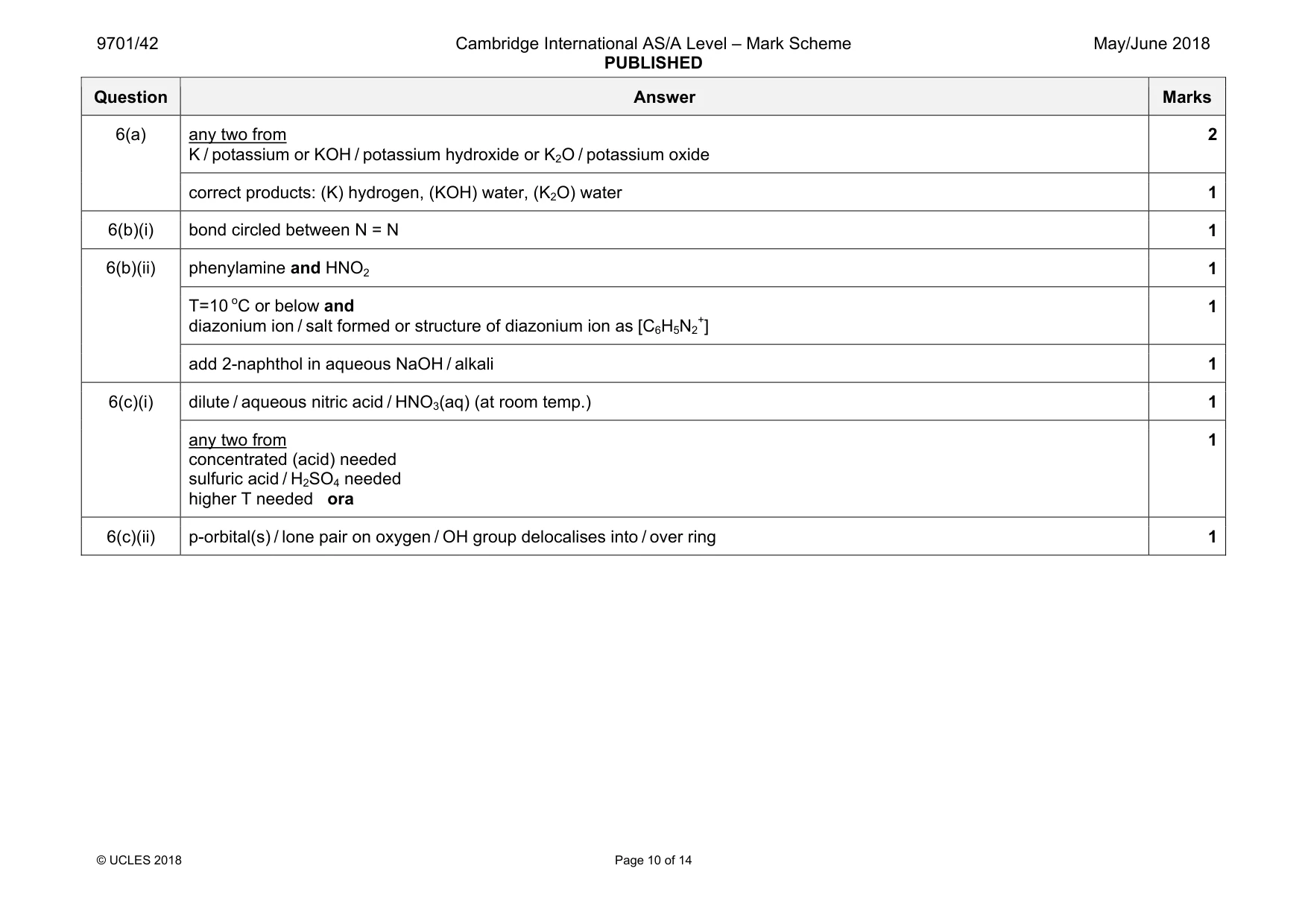
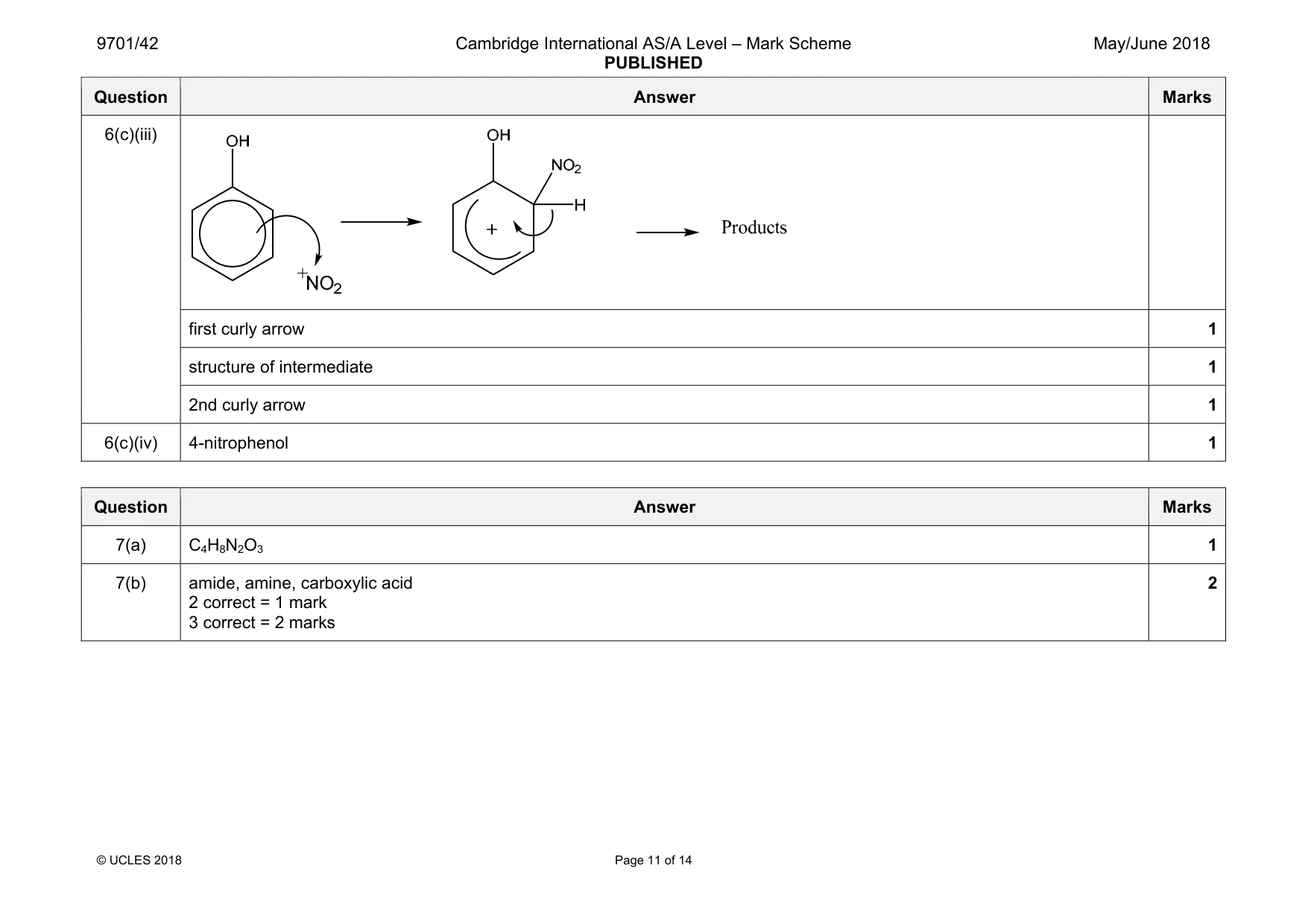
Mark scheme: 6(a) any two from K / potassium or KOH / potassium hydroxide or K2O / potassium oxide 2 correct products: (K) hydrogen, (KOH) water, (K2O) water 1 6(b)(i) bond circled between N = N 1 6(b)(ii) phenylamine and HNO2 1 T=10 oC or below and diazonium ion / salt formed or structure of diazonium ion as [C6H5N2 +] 1 add 2-naphthol in aqueous NaOH / alkali 1 6(c)(i) dilute / aqueous nitric acid / HNO3(aq) (at room temp.) 1 any two from concentrated (acid) needed sulfuric acid / H2SO4 needed higher T needed ora 1 6(c)(ii) p-orbital(s) / lone pair on oxygen / OH group delocalises into / over ring 1 Question Answer Marks 6(c)(iii) first curly arrow 1 structure of intermediate 1 2nd curly arrow 1 6(c)(iv) 4-nitrophenol 1
Q7 · Asparagine and valine are two naturally occurring amino acids
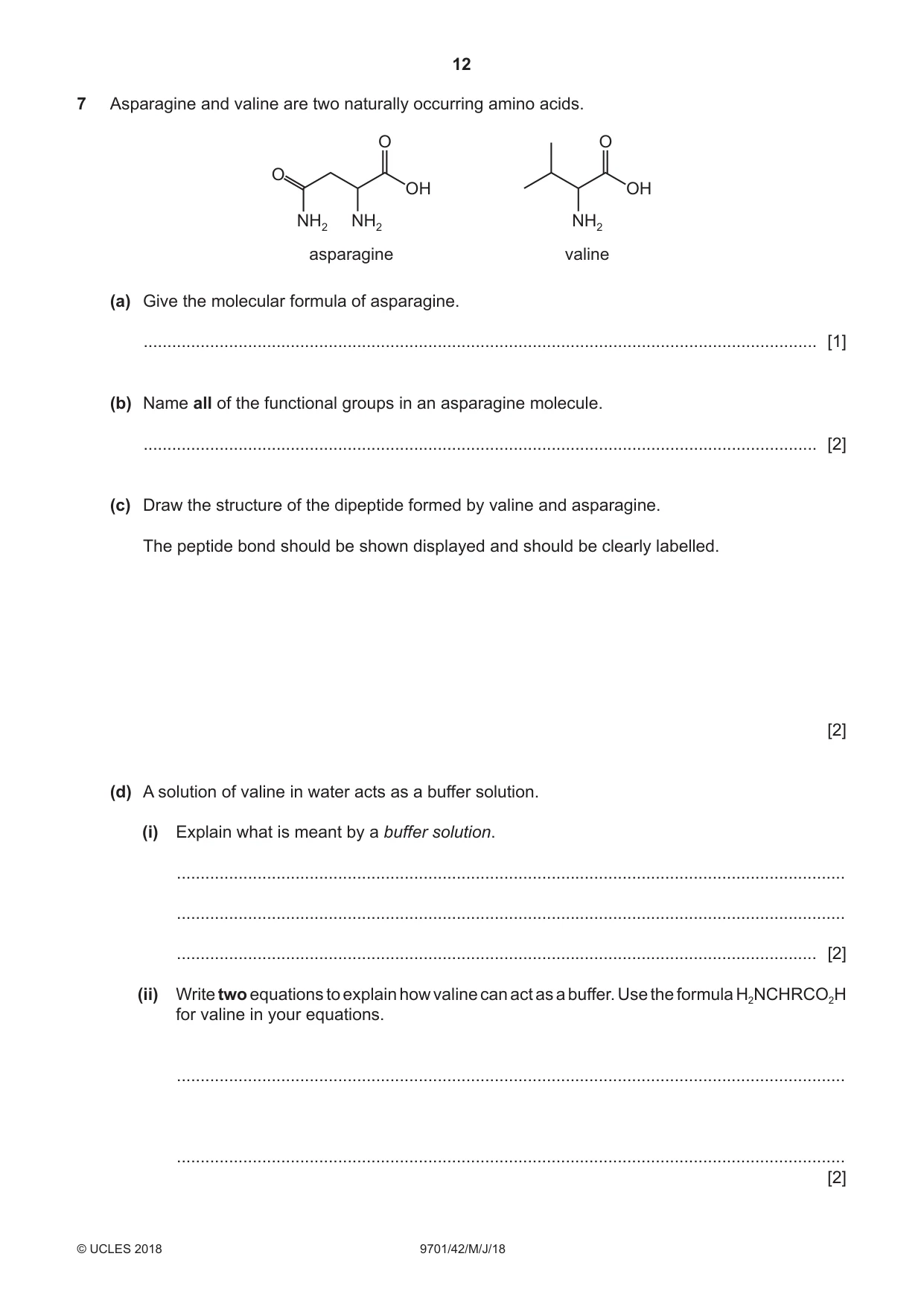
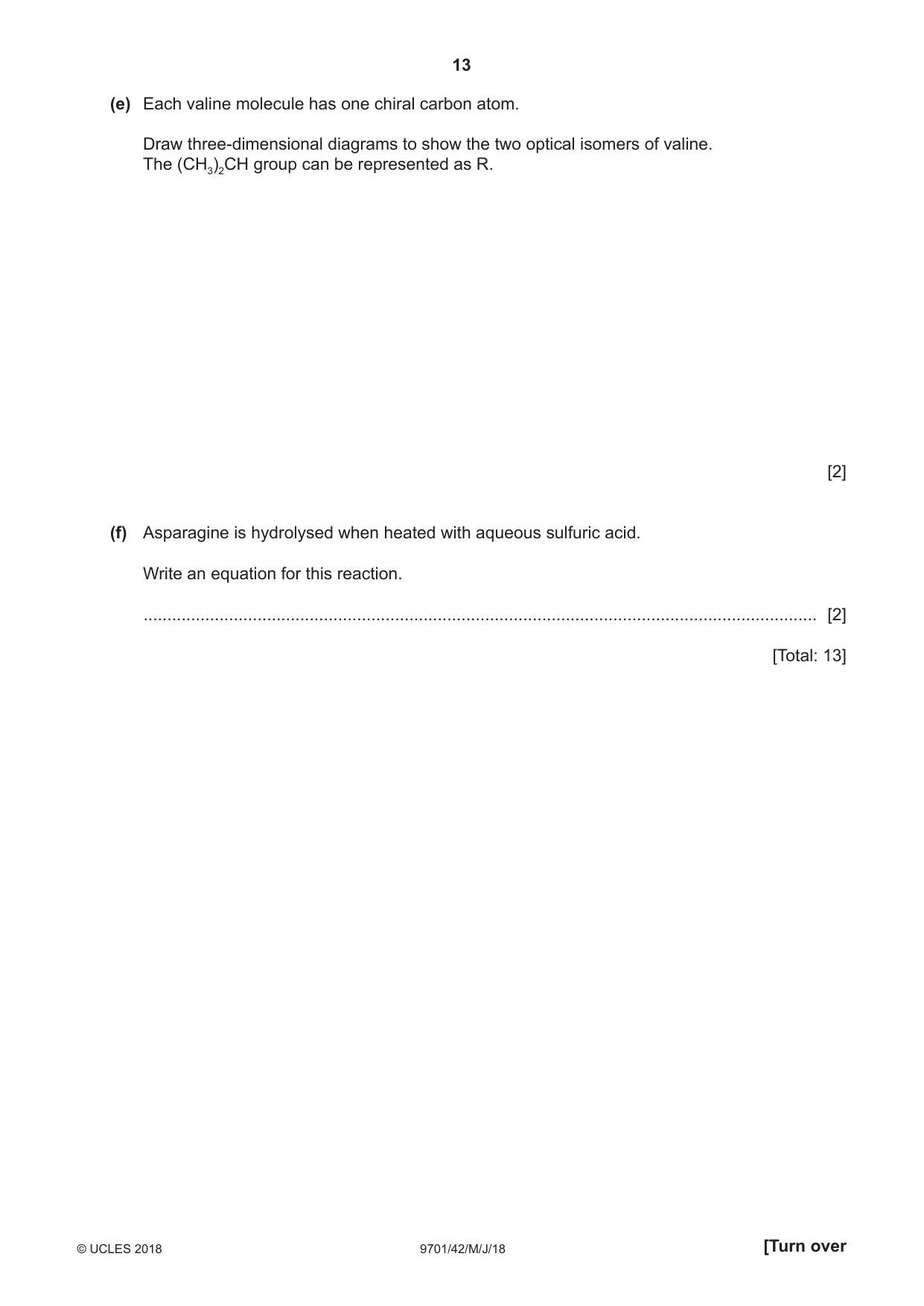
7 Asparagine and valine are two naturally occurring amino acids. O O O OH OH NH2 NH2 NH2 asparagine valine (a) Give the molecular formula of asparagine. .............................................................................................................................................. [1] (b) Name all of the functional groups in an asparagine molecule. .............................................................................................................................................. [2] (c) Draw the structure of the dipeptide formed by valine and asparagine. The peptide bond should be shown displayed and should be clearly labelled. [2] (d) A solution of valine in water acts as a buffer solution. (i) Explain what is meant by a buffer solution. ............................................................................................................................................. ............................................................................................................................................. ....................................................................................................................................... [2] (ii) Write two equations to explain how valine can act as a buffer. Use the formula H2NCHRCO2H for valine in your equations. ............................................................................................................................................. ............................................................................................................................................. [2] (e) Each valine molecule has one chiral carbon atom. Draw three-dimensional diagrams to show the two optical isomers of valine. The (CH3)2CH group can be represented as R. [2] (f) Asparagine is hydrolysed when heated with aqueous sulfuric acid. Write an equation for this reaction. .............................................................................................................................................. [2] [Total: 13]
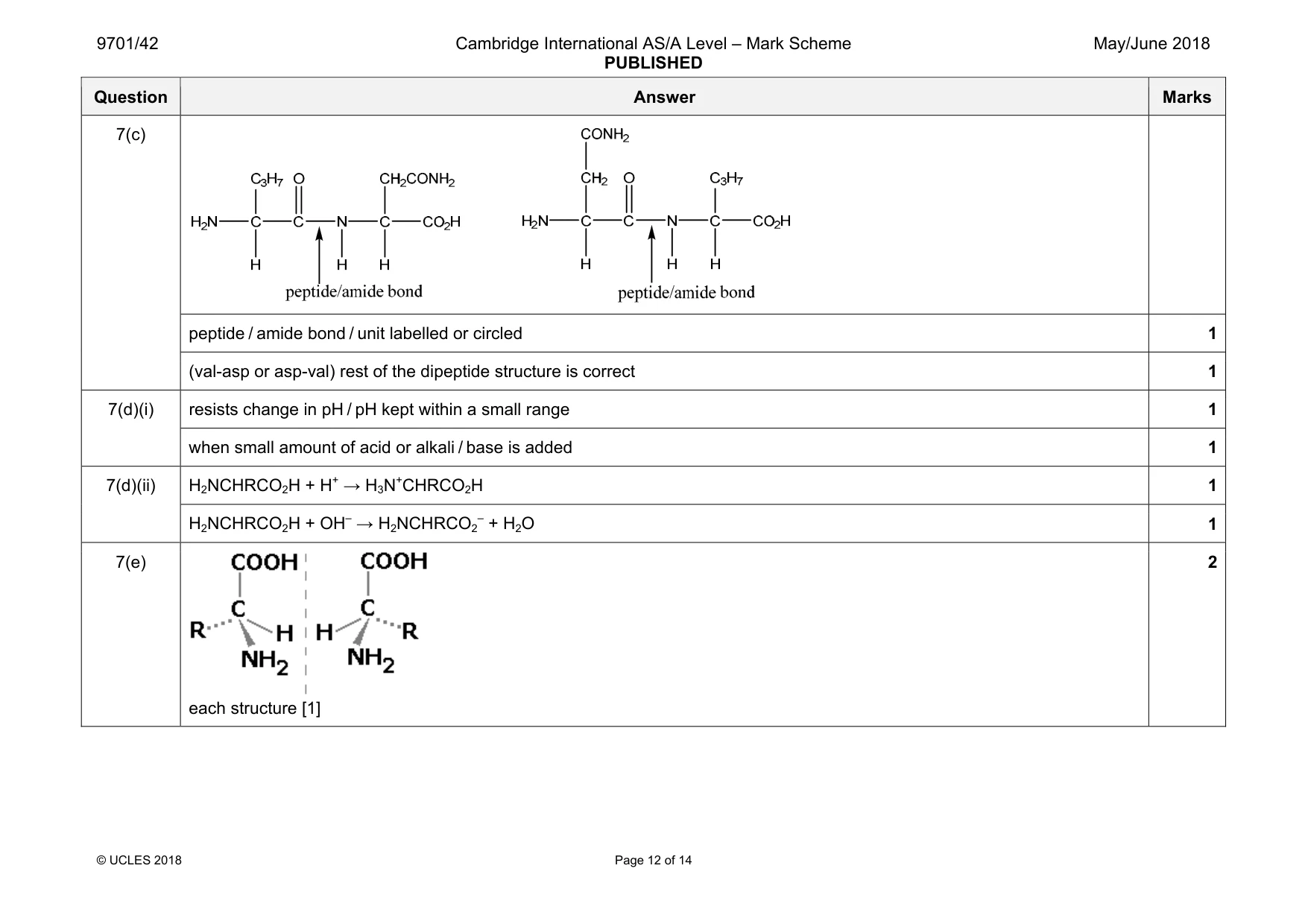
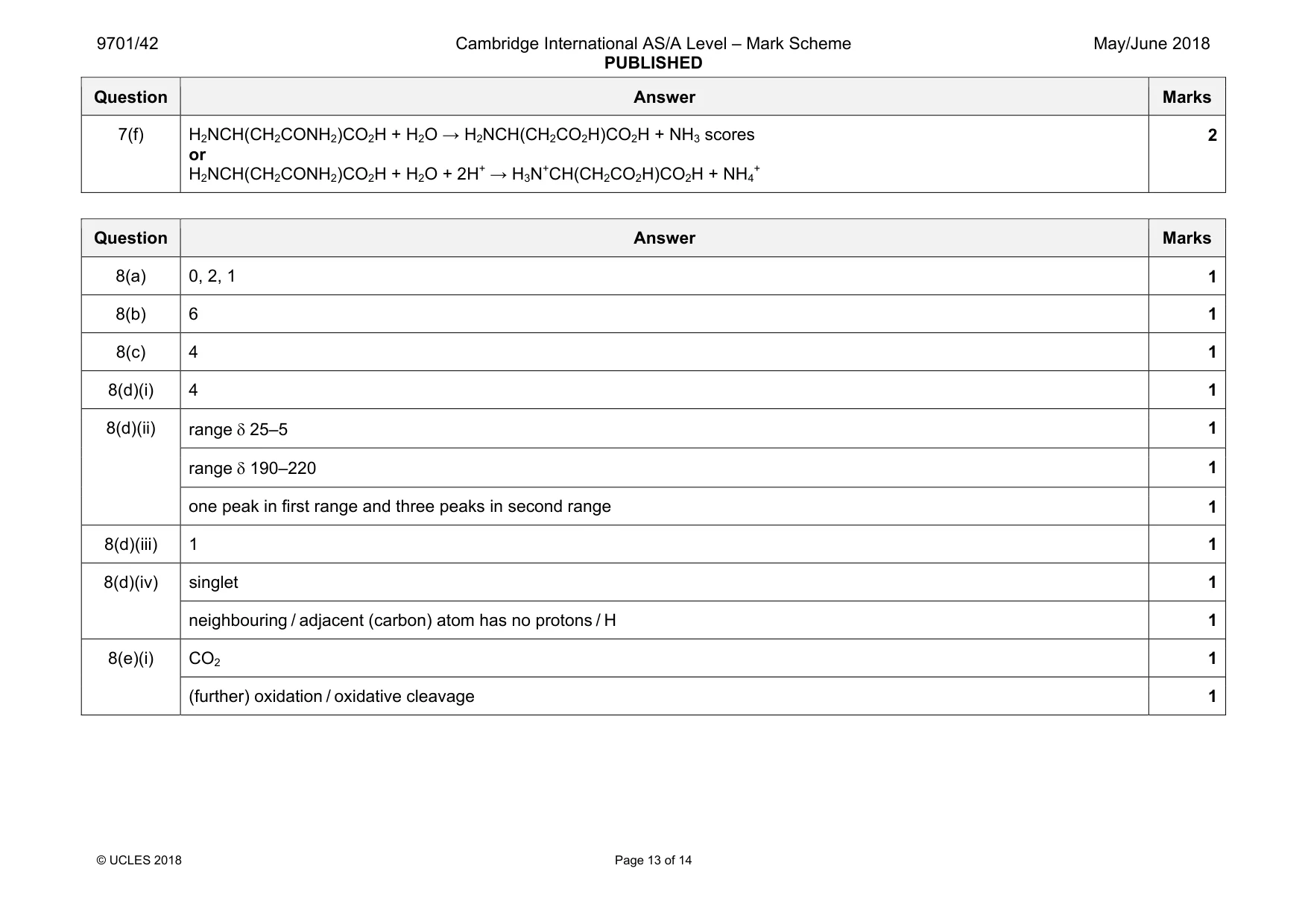
Mark scheme: 7(a) C4H8N2O3 1 7(b) amide, amine, carboxylic acid 2 correct = 1 mark 3 correct = 2 marks 2 Question Answer Marks 7(c) peptide / amide bond / unit labelled or circled 1 (val-asp or asp-val) rest of the dipeptide structure is correct 1 7(d)(i) resists change in pH / pH kept within a small range 1 when small amount of acid or alkali / base is added 1 7(d)(ii) H2NCHRCO2H + H+ → H3N+CHRCO2H 1 H2NCHRCO2H + OH– → H2NCHRCO2 – + H2O 1 7(e) each structure [1] 2 Question Answer Marks 7(f) H2NCH(CH2CONH2)CO2H + H2O → H2NCH(CH2CO2H)CO2H + NH3 scores or H2NCH(CH2CONH2)CO2H + H2O + 2H+ → H3N+CH(CH2CO2H)CO2H + NH4 + 2
Q8 · Calcitriol is a steroid hormone found in human blood
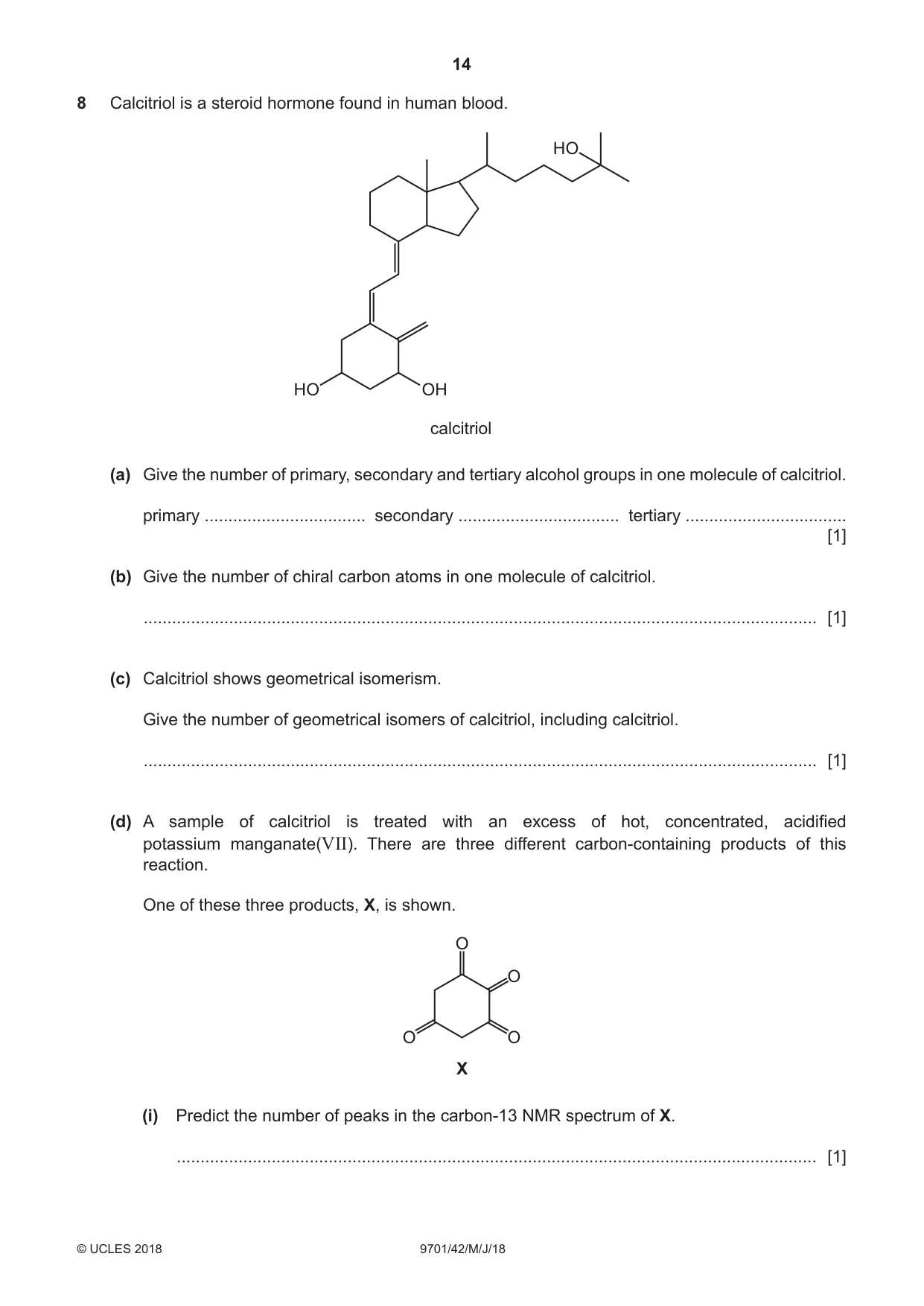
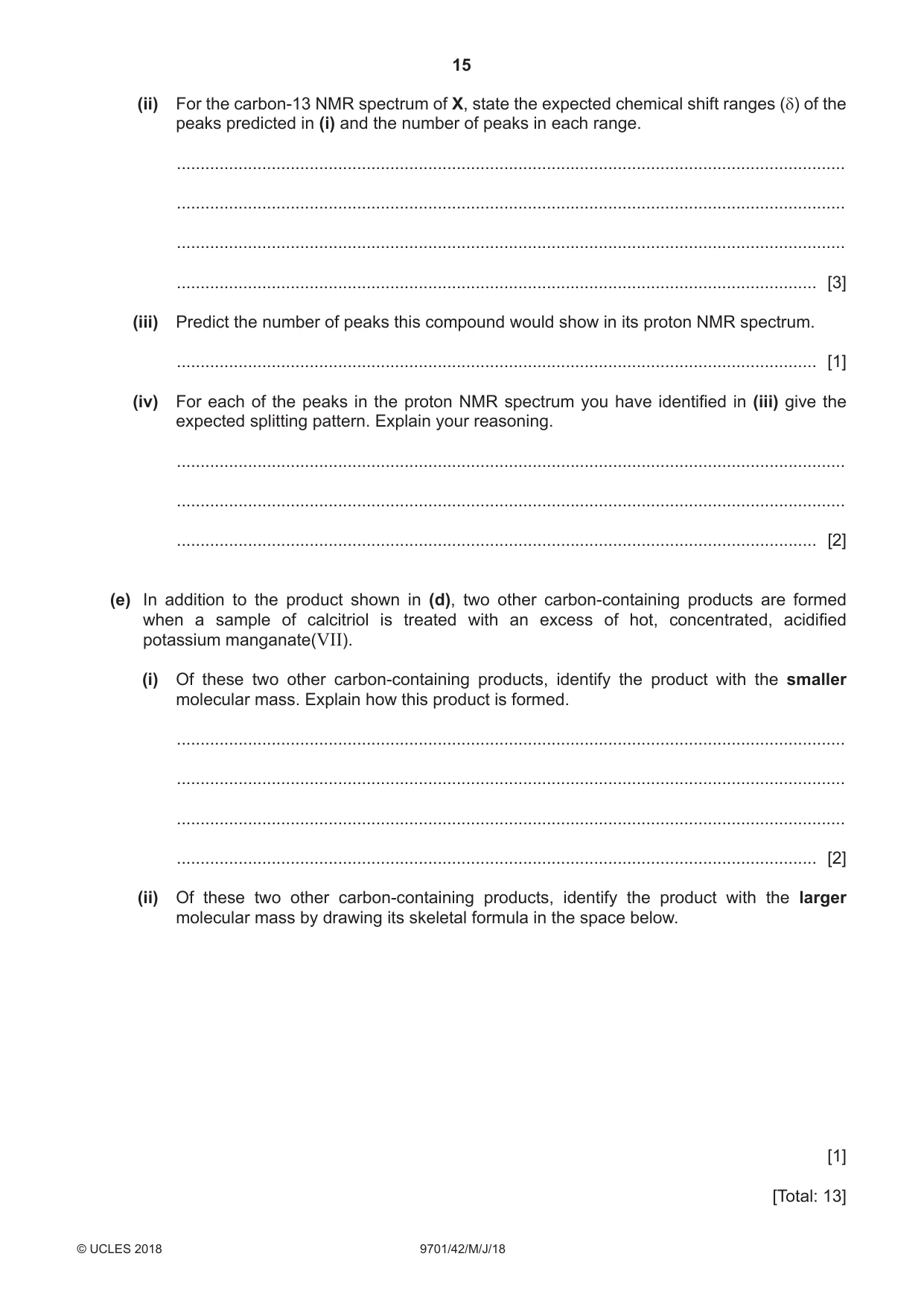
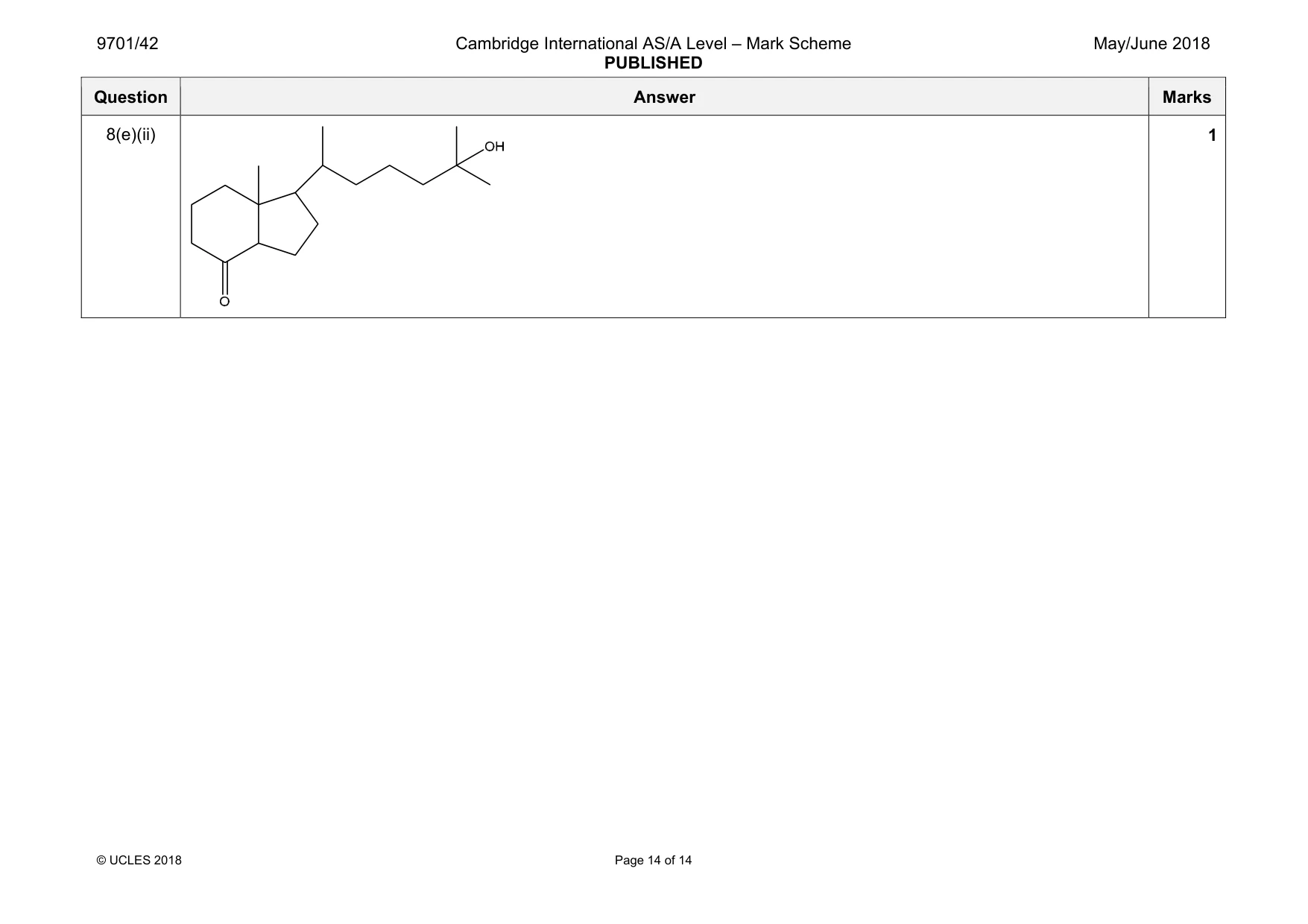
8 Calcitriol is a steroid hormone found in human blood. HO HO OH calcitriol (a) Give the number of primary, secondary and tertiary alcohol groups in one molecule of calcitriol. primary .................................. secondary .................................. tertiary .................................. [1] (b) Give the number of chiral carbon atoms in one molecule of calcitriol. .............................................................................................................................................. [1] (c) Calcitriol shows geometrical isomerism. Give the number of geometrical isomers of calcitriol, including calcitriol. .............................................................................................................................................. [1] (d) A sample of calcitriol is treated with an excess of hot, concentrated, acidified potassium manganate(VII). There are three different carbon‑containing products of this reaction. One of these three products, X, is shown. O O O O X (i) Predict the number of peaks in the carbon-13 NMR spectrum of X. ....................................................................................................................................... [1] (ii) For the carbon‑13 NMR spectrum of X, state the expected chemical shift ranges (δ) of the peaks predicted in (i) and the number of peaks in each range. ............................................................................................................................................. ............................................................................................................................................. ............................................................................................................................................. ....................................................................................................................................... [3] (iii) Predict the number of peaks this compound would show in its proton NMR spectrum. ....................................................................................................................................... [1] (iv) For each of the peaks in the proton NMR spectrum you have identified in (iii) give the expected splitting pattern. Explain your reasoning. ............................................................................................................................................. ............................................................................................................................................. ....................................................................................................................................... [2] (e) In addition to the product shown in (d), two other carbon-containing products are formed when a sample of calcitriol is treated with an excess of hot, concentrated, acidified potassium manganate(VII). (i) Of these two other carbon-containing products, identify the product with the smaller molecular mass. Explain how this product is formed. ............................................................................................................................................. ............................................................................................................................................. ............................................................................................................................................. ....................................................................................................................................... [2] (ii) Of these two other carbon-containing products, identify the product with the larger molecular mass by drawing its skeletal formula in the space below. [1] [Total: 13]
Mark scheme: 8(a) 0, 2, 1 1 8(b) 6 1 8(c) 4 1 8(d)(i) 4 1 8(d)(ii) range δ 25–5 1 range δ 190–220 1 one peak in first range and three peaks in second range 1 8(d)(iii) 1 1 8(d)(iv) singlet 1 neighbouring / adjacent (carbon) atom has no protons / H 1 8(e)(i) CO2 1 (further) oxidation / oxidative cleavage 1 Question Answer Marks 8(e)(ii) 1
What was in this paper
The subtopics covered by these 8 questions, and how many questions each got. Open one in a new tab to see every Cambridge question on it.
1Arenes1Carbon-13 NMR spectroscopy1Electrolysis1General characteristic chemical properties of the first set of transition elements, titanium to copper1Periodicity of chemical properties of the elements in Period 31Similarities and trends in the properties of the Group 2 metals, magnesium to barium, and their compounds1Simple rate equations, orders of reaction and rate constants1What you needed in this session
Cambridge’s own grade thresholds for 2018 May/June, Paper 4 · Variant 2. A higher threshold means an easier paper — the bar moves with how the cohort did.