Cambridge A Level Chemistry 9701 — 2017 Oct/Nov Paper 4 · Variant 2
9701/42/O/N/17 · 8 questions · 100 marks · ≈113 min
The question paper and its mark scheme, free to read here and free to download. This is Cambridge’s own paper, exactly as it was sat.
Question paper20 pages
Mark scheme12 pages
Answers below. Sit the paper first if you are practising.
Questions as text
Q1 · The compound chlorine dioxide, Cl O2, can be prepared by the reaction shown
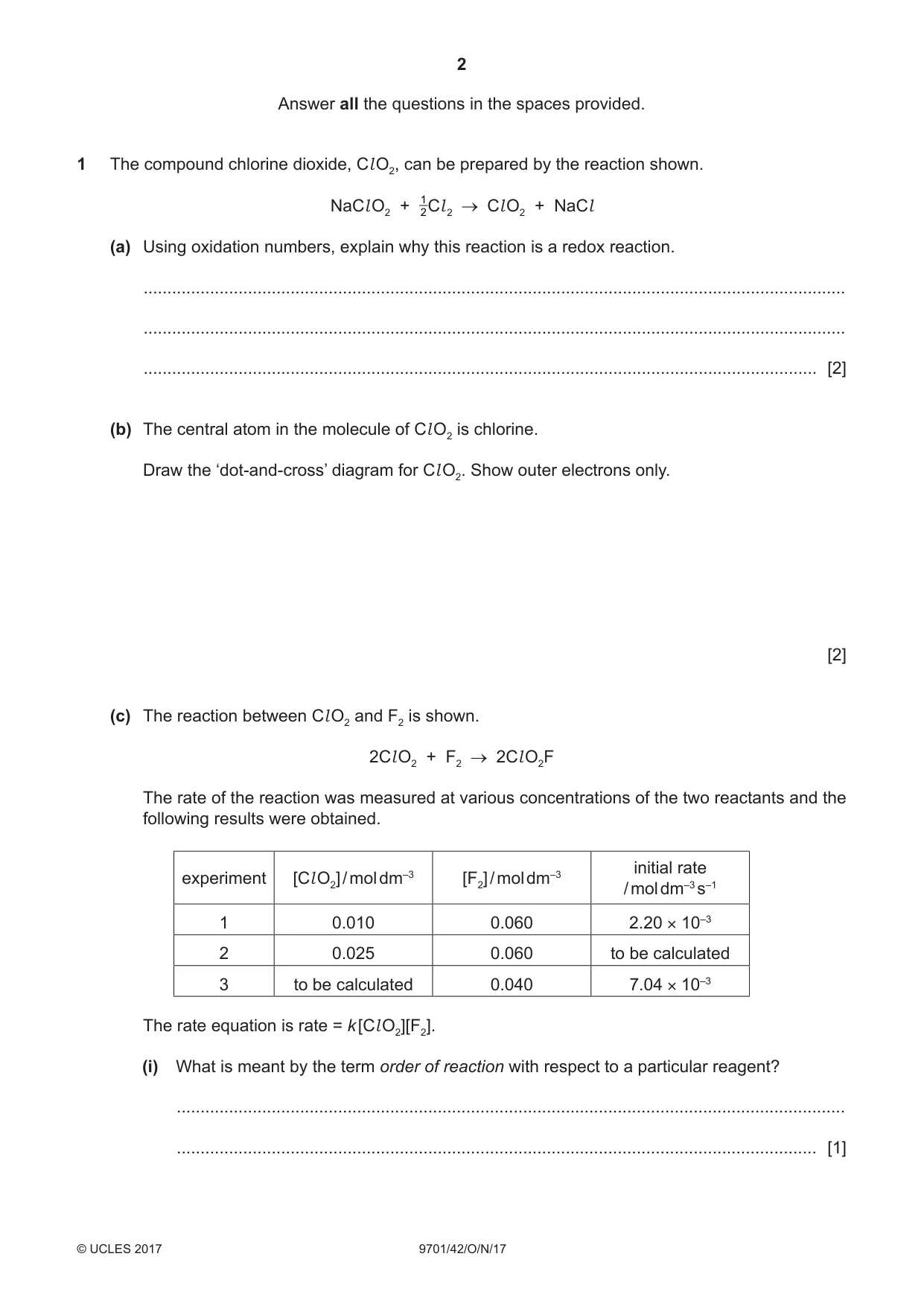
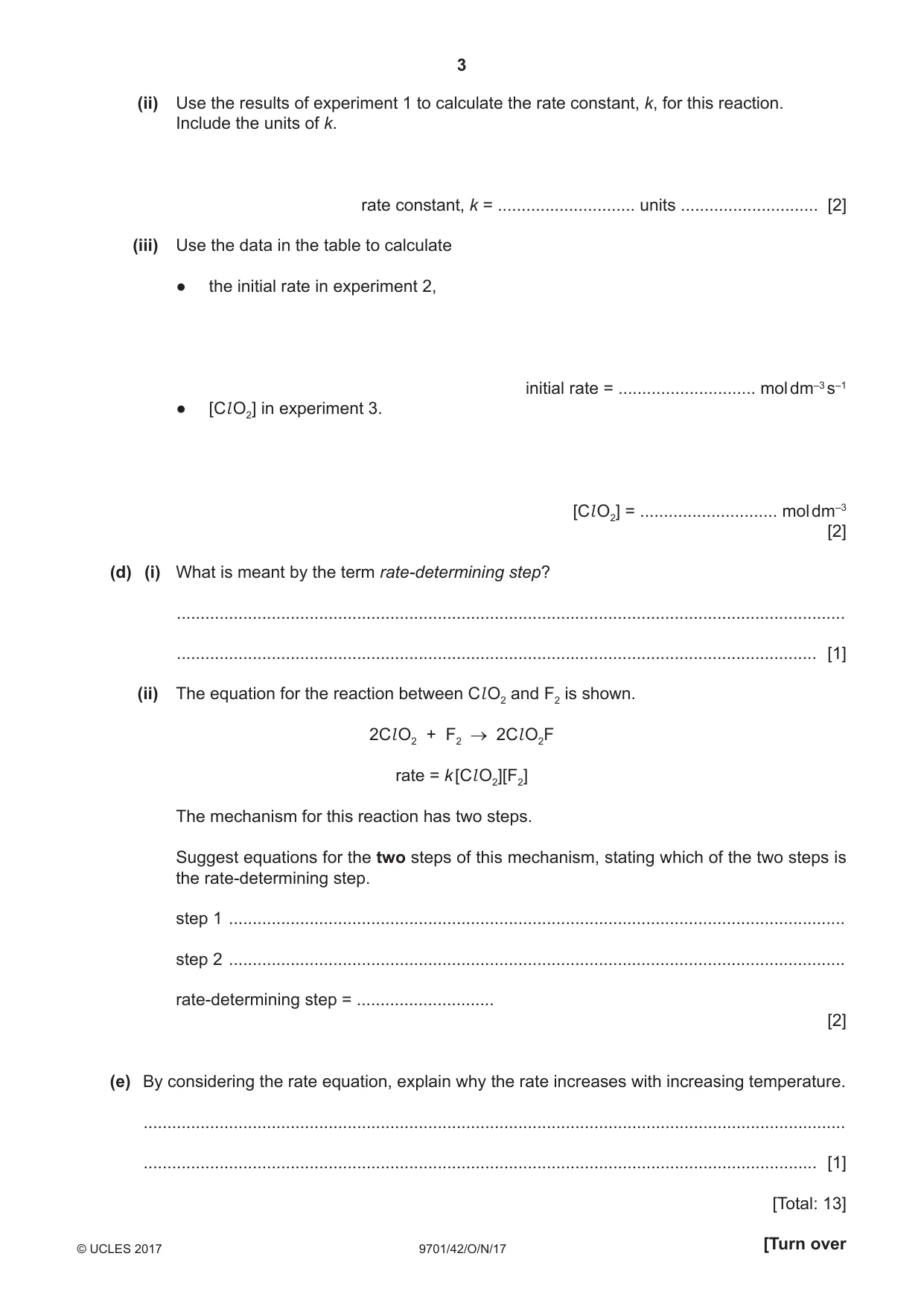
1 The compound chlorine dioxide, Cl O2, can be prepared by the reaction shown. NaCl O2 + 12Cl 2 Cl O2 + NaCl (a) Using oxidation numbers, explain why this reaction is a redox reaction. .................................................................................................................................................... .................................................................................................................................................... .............................................................................................................................................. [2] (b) The central atom in the molecule of Cl O2 is chlorine. Draw the ‘dot-and-cross’ diagram for Cl O2. Show outer electrons only. [2] (c) The reaction between Cl O2 and F2 is shown. 2Cl O2 + F2 2Cl O2F The rate of the reaction was measured at various concentrations of the two reactants and the following results were obtained. initial rate experiment [Cl O2] / mol dm–3 [F2] / mol dm–3 / mol dm–3 s–1 1 0.010 0.060 2.20 × 10⁻³ 2 0.025 0.060 to be calculated 3 to be calculated 0.040 7.04 × 10⁻³ The rate equation is rate = k [Cl O2][F2]. (i) What is meant by the term order of reaction with respect to a particular reagent? ............................................................................................................................................. ....................................................................................................................................... [1] (ii) Use the results of experiment 1 to calculate the rate constant, k, for this reaction. Include the units of k. rate constant, k = ............................. units ............................. [2] (iii) Use the data in the table to calculate ● the initial rate in experiment 2, initial rate = ............................. mol dm–3 s–1 ● [Cl O2] in experiment 3. [Cl O2] = ............................. mol dm–3 [2] (d) (i) What is meant by the term rate-determining step? ............................................................................................................................................. ....................................................................................................................................... [1] (ii) The equation for the reaction between Cl O2 and F2 is shown. 2Cl O2 + F2 2Cl O2F rate = k [Cl O2][F2] The mechanism for this reaction has two steps. Suggest equations for the two steps of this mechanism, stating which of the two steps is the rate-determining step. step 1 .................................................................................................................................. step 2 .................................................................................................................................. rate-determining step = ............................. [2] (e) By considering the rate equation, explain why the rate increases with increasing temperature. .................................................................................................................................................... .............................................................................................................................................. [1] [Total: 13]
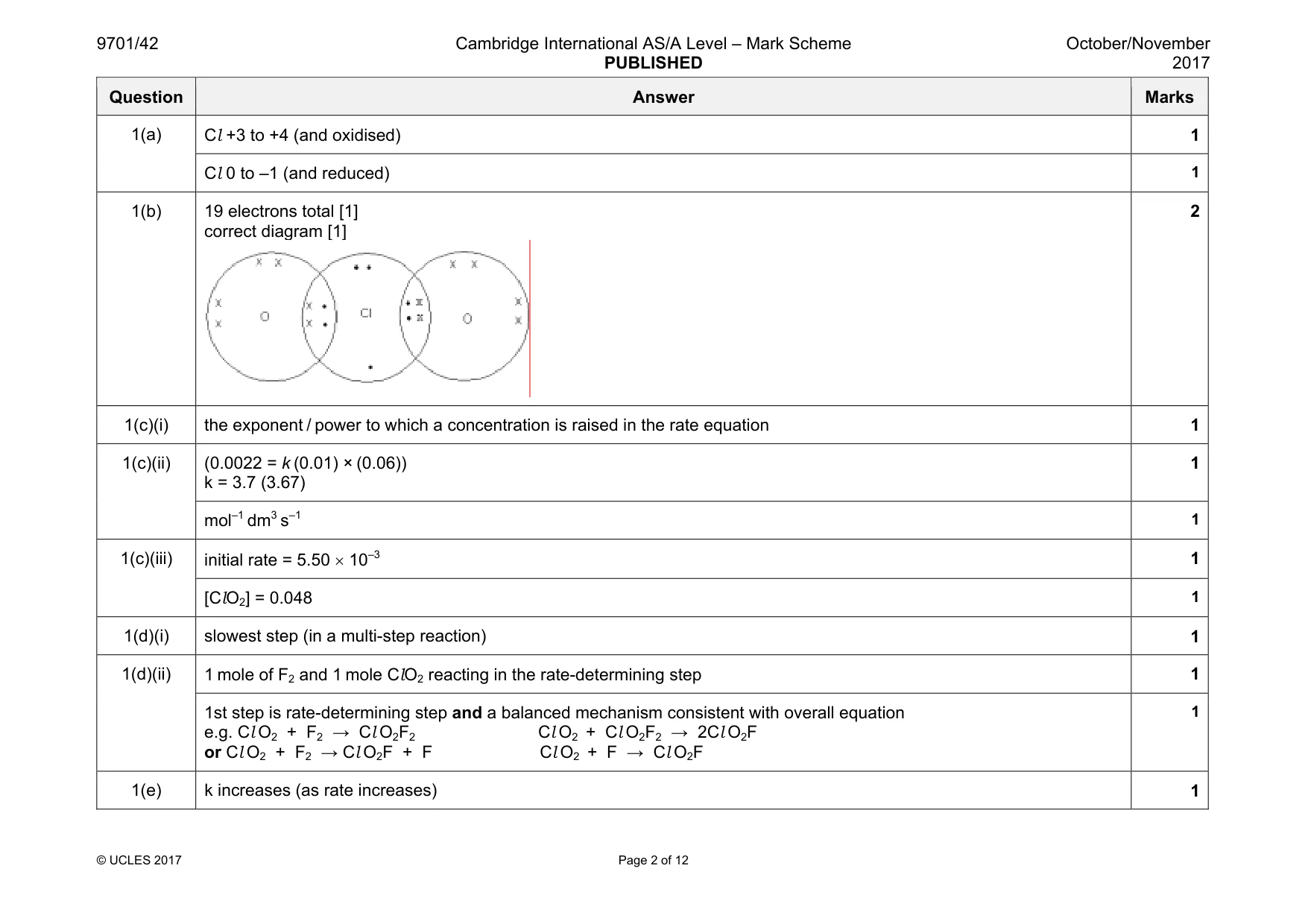
Mark scheme: 1(a) 1 Cl 0 to –1 (and reduced) 1 1(b) 19 electrons total [1] correct diagram [1] 2 1(c)(i) the exponent / power to which a concentration is raised in the rate equation 1 1(c)(ii) (0.0022 = k (0.01) × (0.06)) k = 3.7 (3.67) 1 mol–1 dm3 s–1 1 1(c)(iii) initial rate = 5.50 × 10⁻³ 1 [ClO2] = 0.048 1 1(d)(i) slowest step (in a multi-step reaction) 1 1(d)(ii) 1 mole of F2 and 1 mole ClO2 reacting in the rate-determining step 1 1st step is rate-determining step and a balanced mechanism consistent with overall equation e.g. Cl O2 + F2 → Cl O2F2 Cl O2 + Cl O2F2 → 2Cl O2F or Cl O2 + F2 → Cl O2F + F Cl O2 + F → Cl O2F 1 1(e) k increases (as rate increases) 1
More questions on Simple rate equations, orders of reaction and rate constants
Q2 · When water is added to magnesium nitride, Mg3N2, the products are a white suspension of…
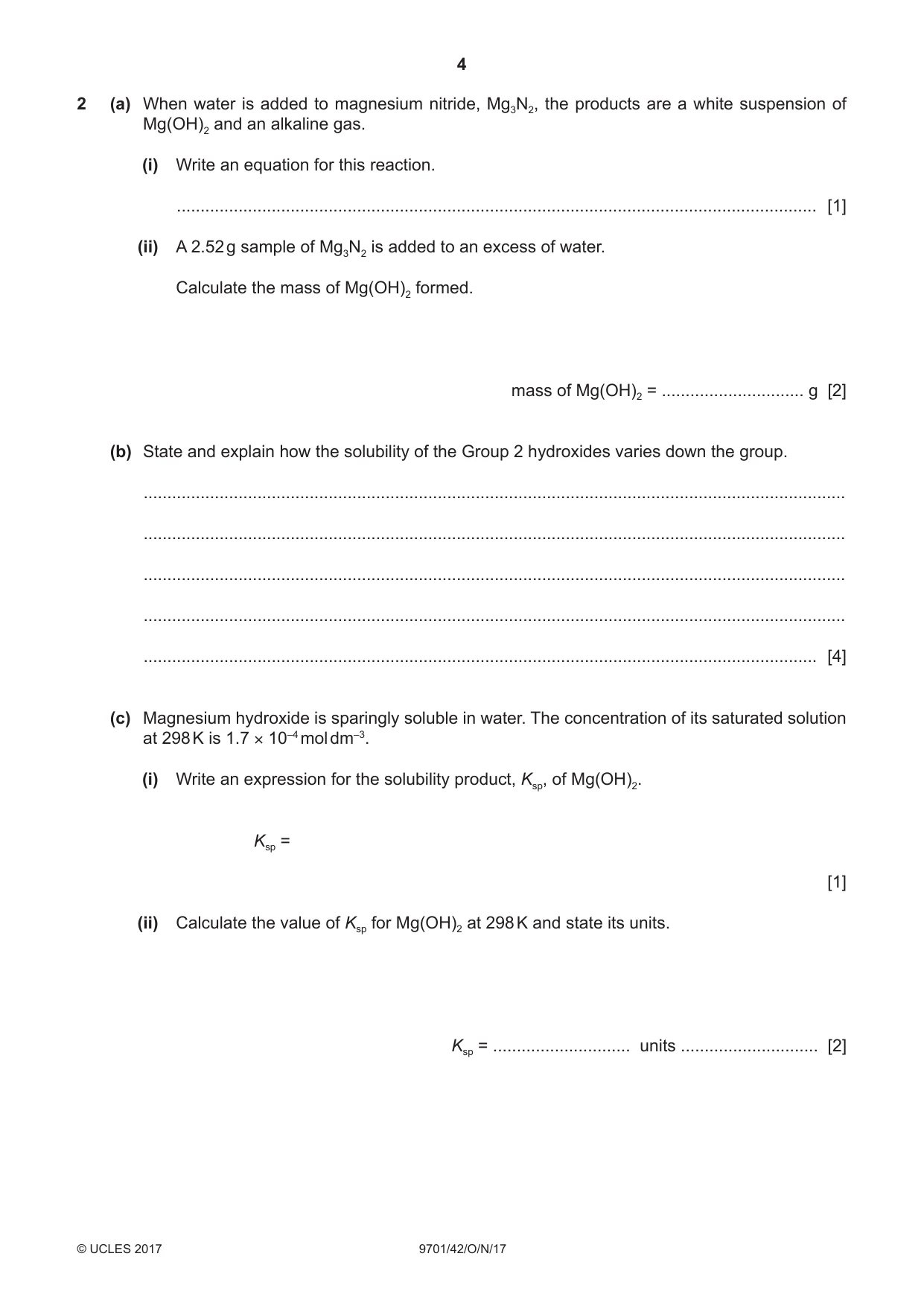
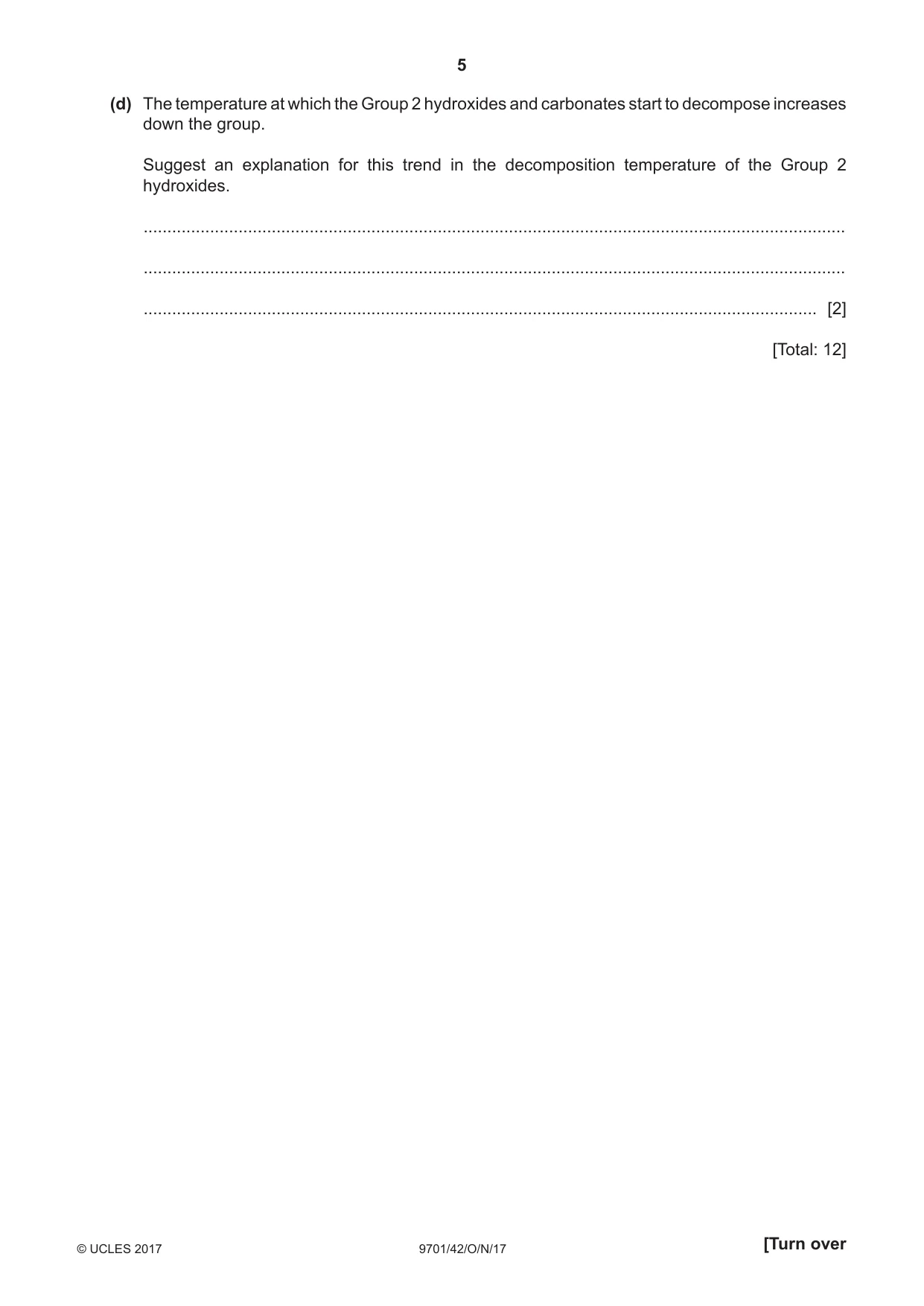
2 (a) When water is added to magnesium nitride, Mg3N2, the products are a white suspension of Mg(OH)2 and an alkaline gas. (i) Write an equation for this reaction. ....................................................................................................................................... [1] (ii) A 2.52 g sample of Mg3N2 is added to an excess of water. Calculate the mass of Mg(OH)2 formed. mass of Mg(OH)2 = .............................. g [2] (b) State and explain how the solubility of the Group 2 hydroxides varies down the group. .................................................................................................................................................... .................................................................................................................................................... .................................................................................................................................................... .................................................................................................................................................... .............................................................................................................................................. [4] (c) Magnesium hydroxide is sparingly soluble in water. The concentration of its saturated solution at 298 K is 1.7 × 10⁻⁴ mol dm–3. (i) Write an expression for the solubility product, Ksp, of Mg(OH)2. Ksp = [1] (ii) Calculate the value of Ksp for Mg(OH)2 at 298 K and state its units. Ksp = ............................. units ............................. [2] (d) The temperature at which the Group 2 hydroxides and carbonates start to decompose increases down the group. Suggest an explanation for this trend in the decomposition temperature of the Group 2 hydroxides. .................................................................................................................................................... .................................................................................................................................................... .............................................................................................................................................. [2] [Total: 12]
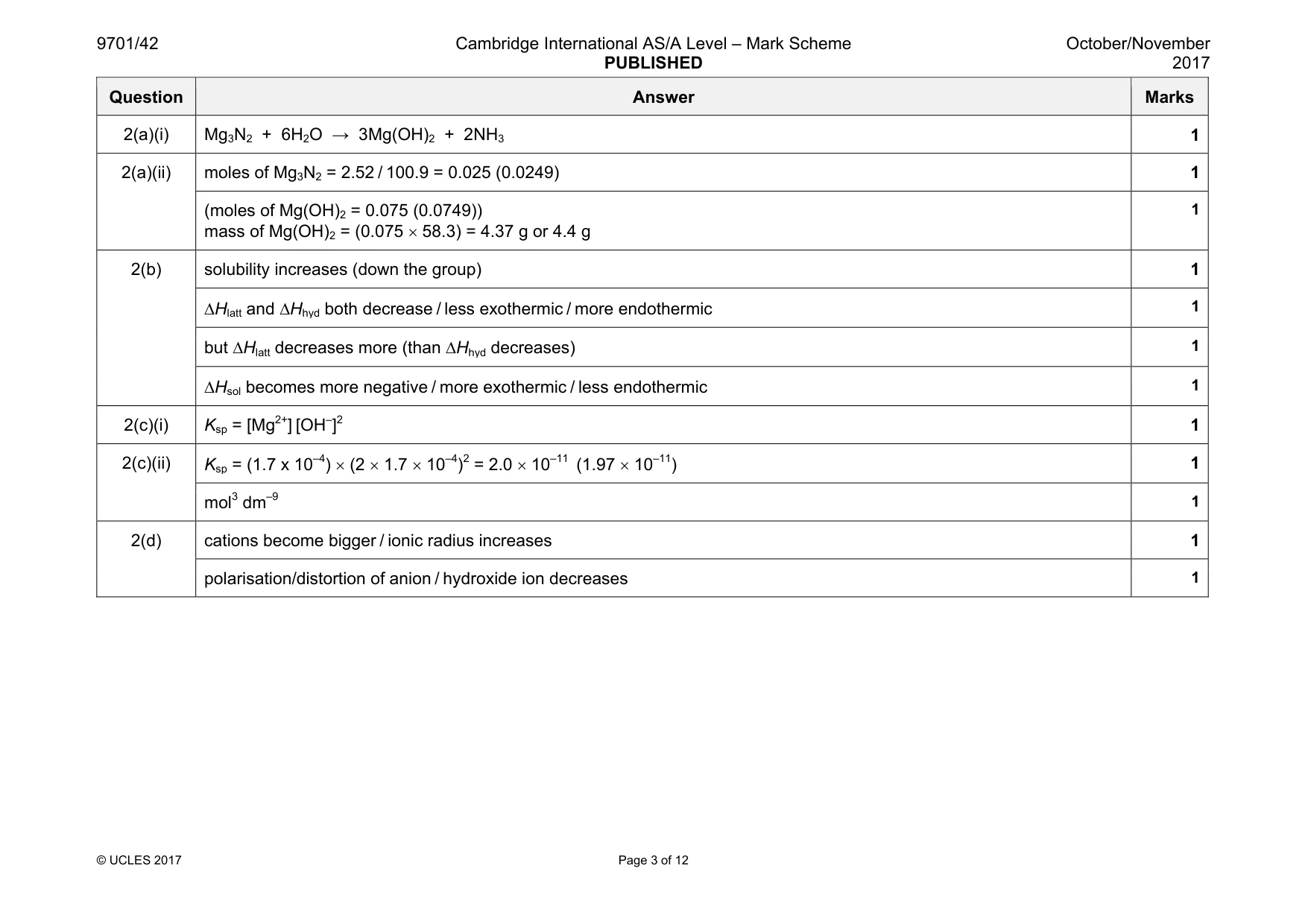
Mark scheme: 2(a)(i) Mg3N2 + 6H2O → 3Mg(OH)2 + 2NH3 1 2(a)(ii) moles of Mg3N2 = 2.52 / 100.9 = 0.025 (0.0249) 1 (moles of Mg(OH)2 = 0.075 (0.0749)) mass of Mg(OH)2 = (0.075 × 58.3) = 4.37 g or 4.4 g 1 2(b) solubility increases (down the group) 1 ∆Hlatt and ∆Hhyd both decrease / less exothermic / more endothermic 1 but ∆Hlatt decreases more (than ∆Hhyd decreases) 1 ∆Hsol becomes more negative / more exothermic / less endothermic 1 2(c)(i) Ksp = [Mg2+] [OH–]2 1 2(c)(ii) Ksp = (1.7 x 10–4) × (2 × 1.7 × 10–4)2 = 2.0 × 10⁻¹¹ (1.97 × 10⁻¹¹) 1 mol3 dm–9 1 2(d) cations become bigger / ionic radius increases 1 polarisation/distortion of anion / hydroxide ion decreases 1
Q3 · Serotonin can be synthesised from the amino acid tryptophan in two steps
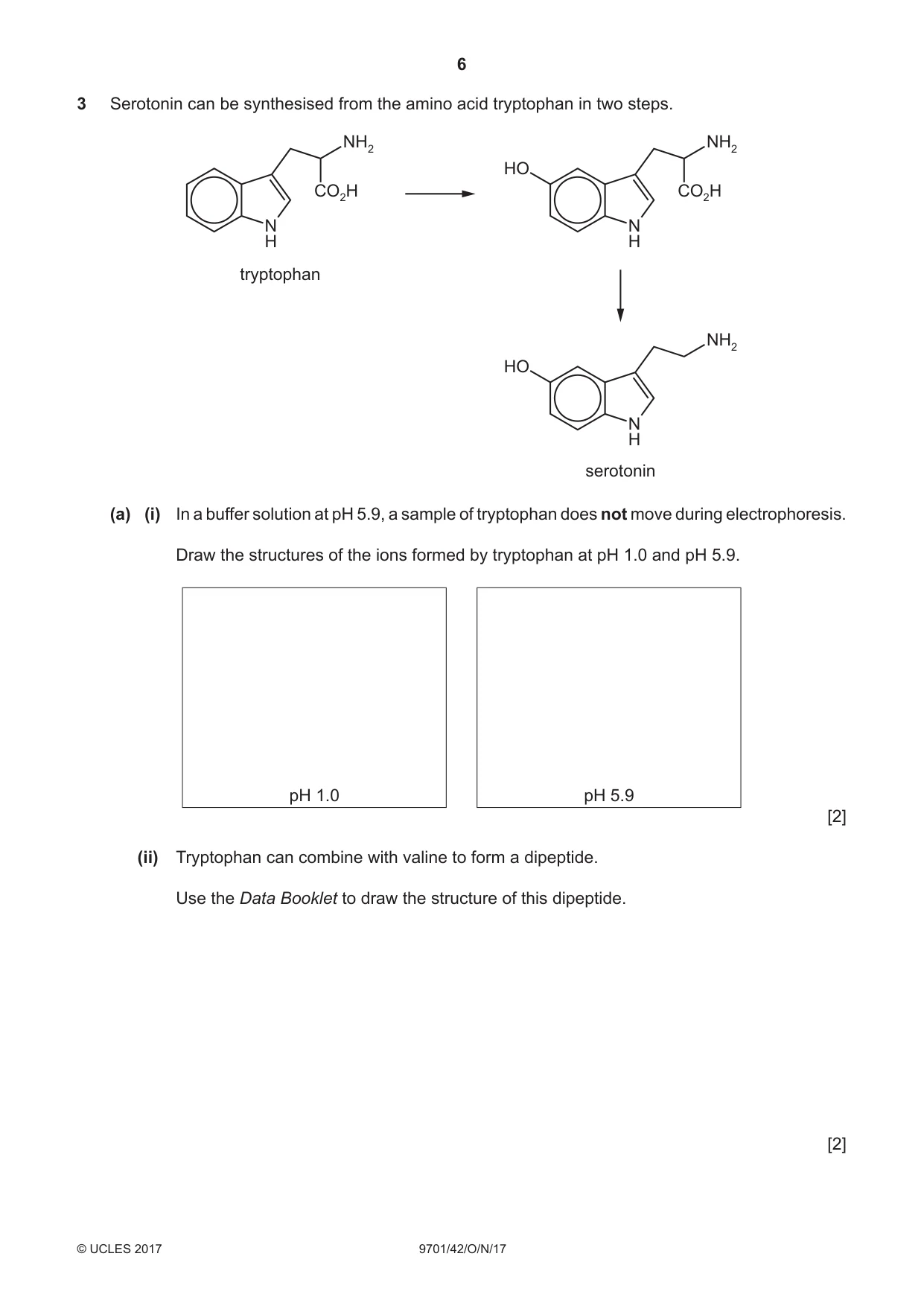
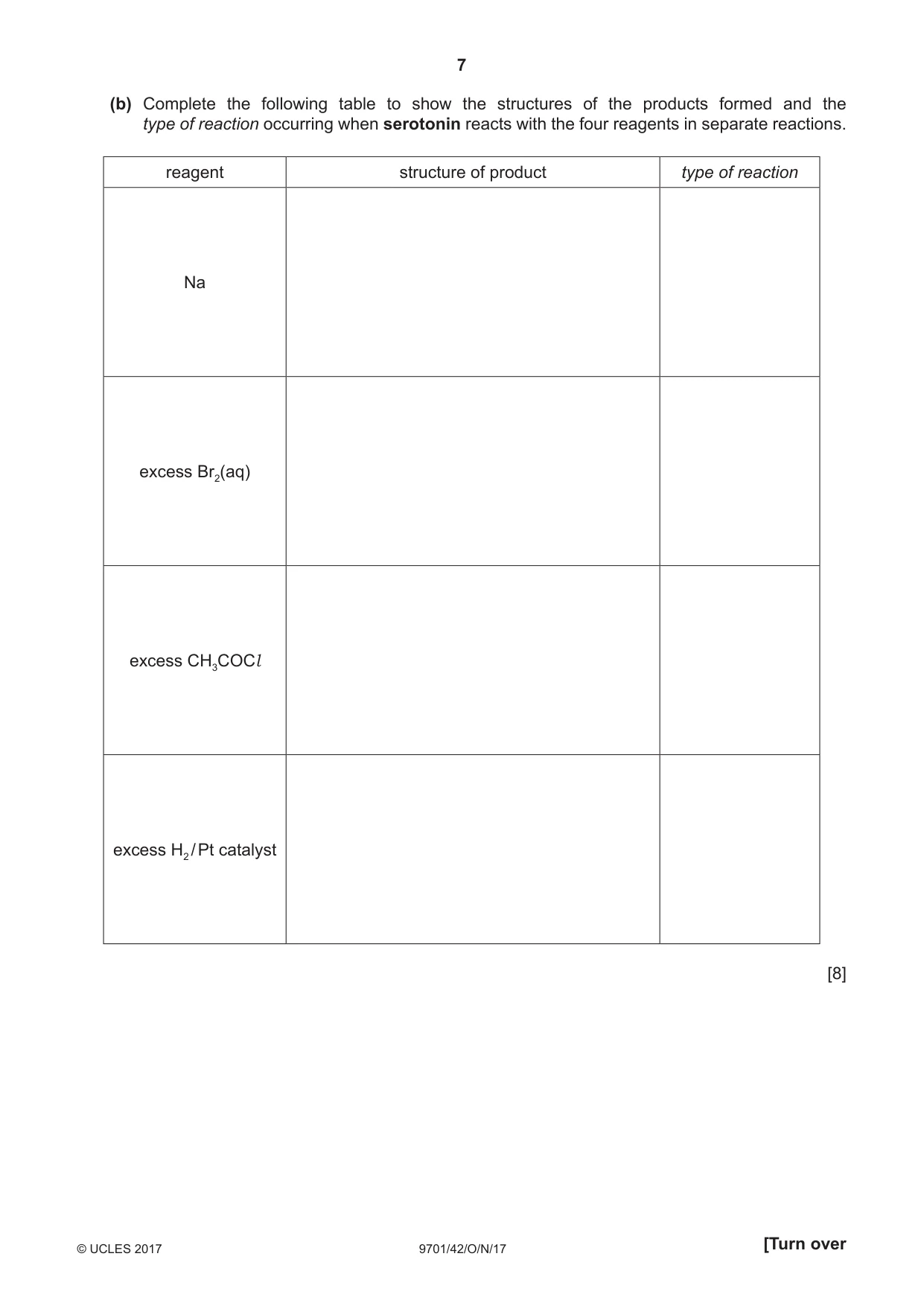
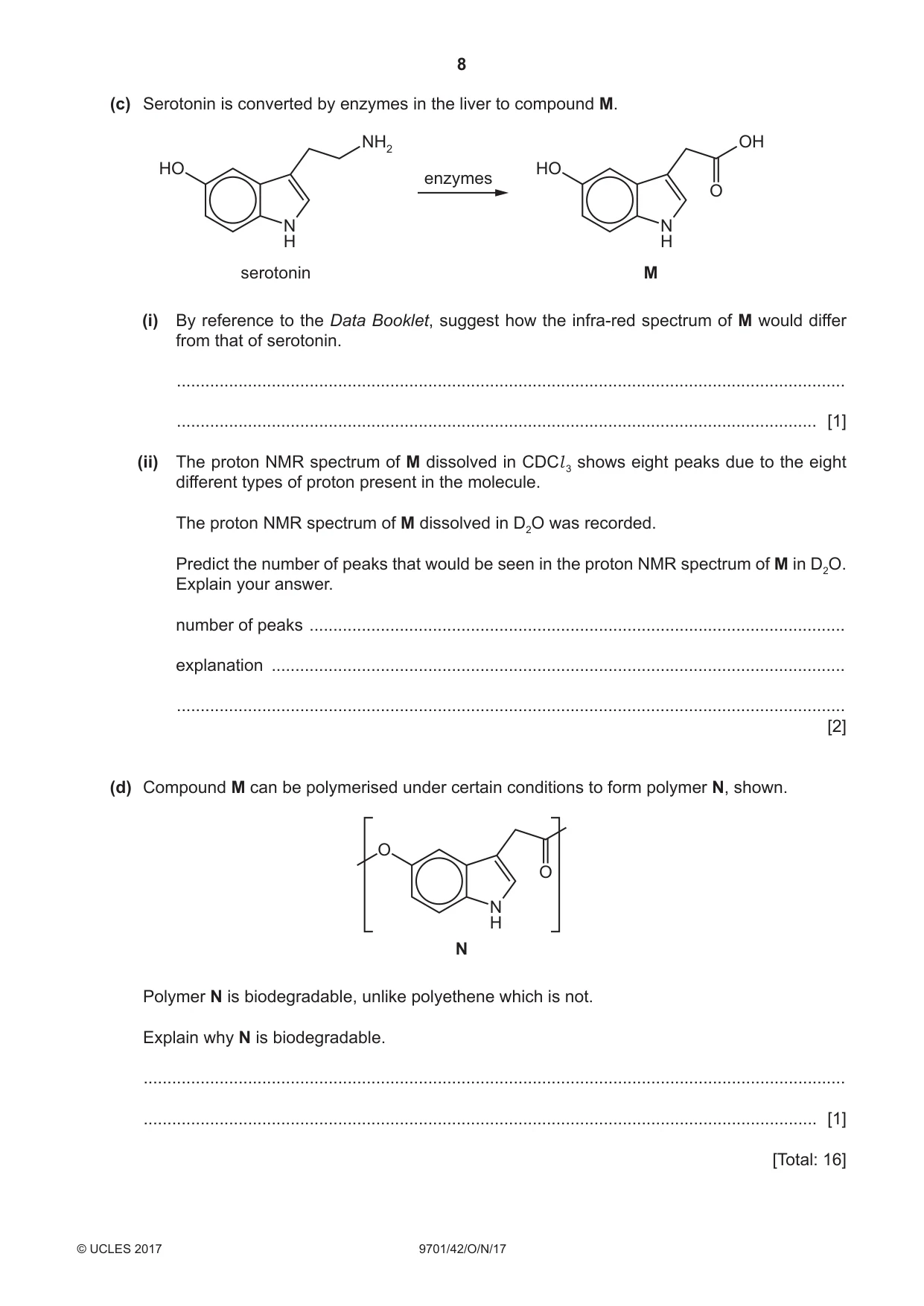
3 Serotonin can be synthesised from the amino acid tryptophan in two steps. NH2 NH2 HO CO2H CO2H N N H H tryptophan NH2 HO N H serotonin (a) (i) In a buffer solution at pH 5.9, a sample of tryptophan does not move during electrophoresis. Draw the structures of the ions formed by tryptophan at pH 1.0 and pH 5.9. pH 1.0 pH 5.9 [2] (ii) Tryptophan can combine with valine to form a dipeptide. Use the Data Booklet to draw the structure of this dipeptide. [2] (b) Complete the following table to show the structures of the products formed and the type of reaction occurring when serotonin reacts with the four reagents in separate reactions. reagent structure of product type of reaction Na excess Br2(aq) excess CH3COCl excess H2 / Pt catalyst [8] (c) Serotonin is converted by enzymes in the liver to compound M. NH2 OH HO HO enzymes O N N H H serotonin M (i) By reference to the Data Booklet, suggest how the infra-red spectrum of M would differ from that of serotonin. ............................................................................................................................................. ....................................................................................................................................... [1] (ii) The proton NMR spectrum of M dissolved in CDCl 3 shows eight peaks due to the eight different types of proton present in the molecule. The proton NMR spectrum of M dissolved in D2O was recorded. Predict the number of peaks that would be seen in the proton NMR spectrum of M in D2O. Explain your answer. number of peaks ................................................................................................................. explanation .......................................................................................................................... ............................................................................................................................................. [2] (d) Compound M can be polymerised under certain conditions to form polymer N, shown. O O N H N Polymer N is biodegradable, unlike polyethene which is not. Explain why N is biodegradable. .................................................................................................................................................... .............................................................................................................................................. [1] [Total: 16]
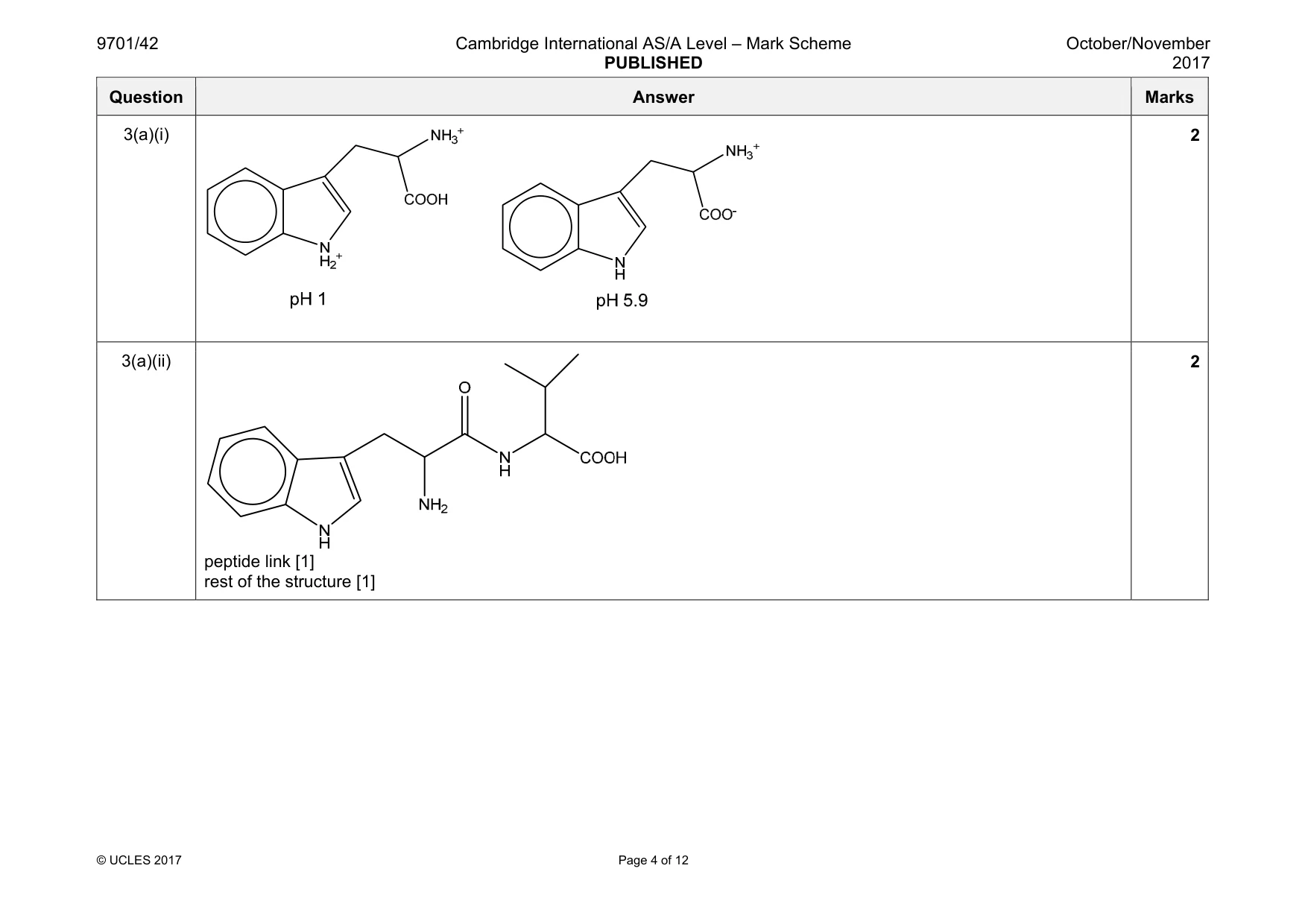
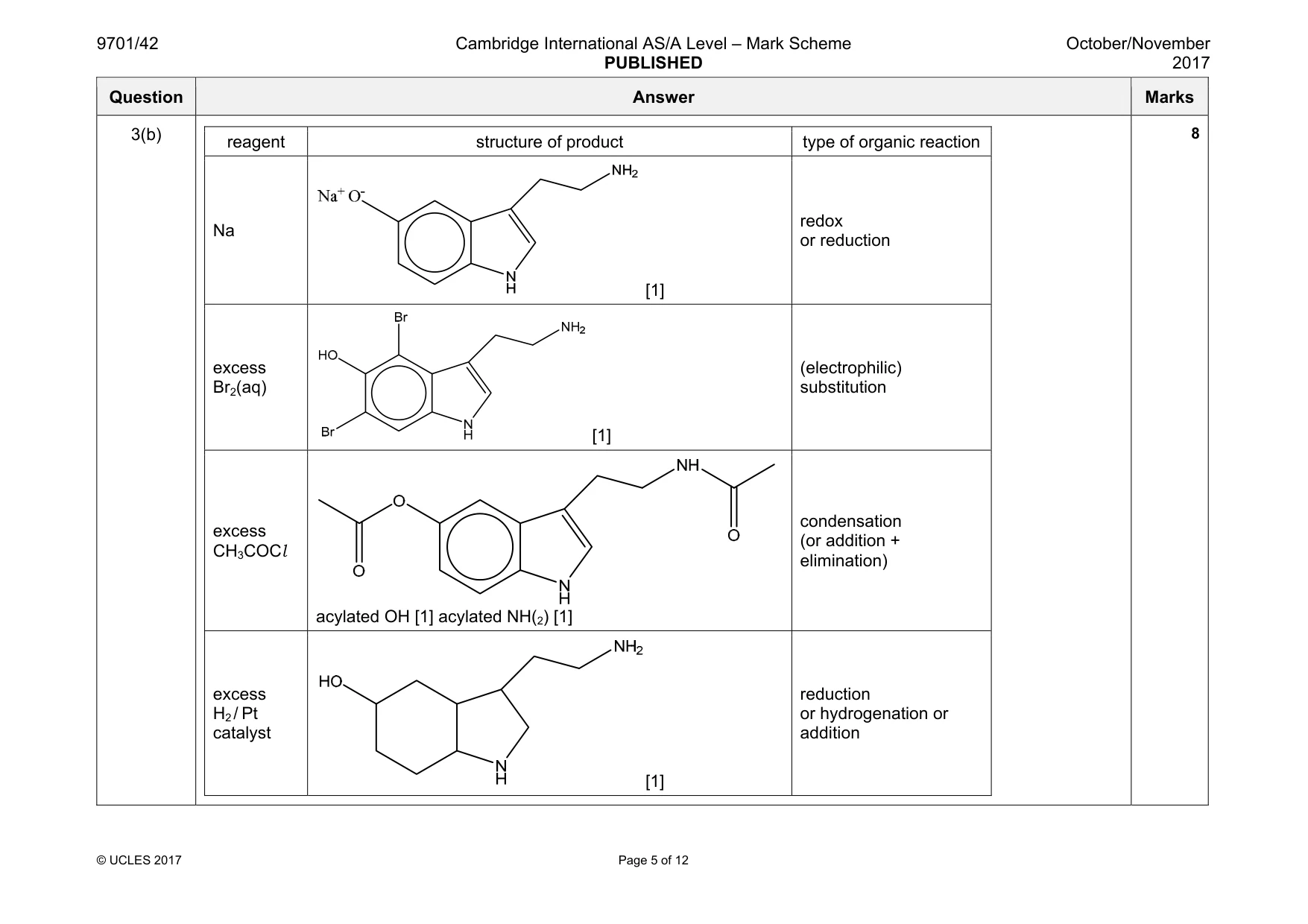
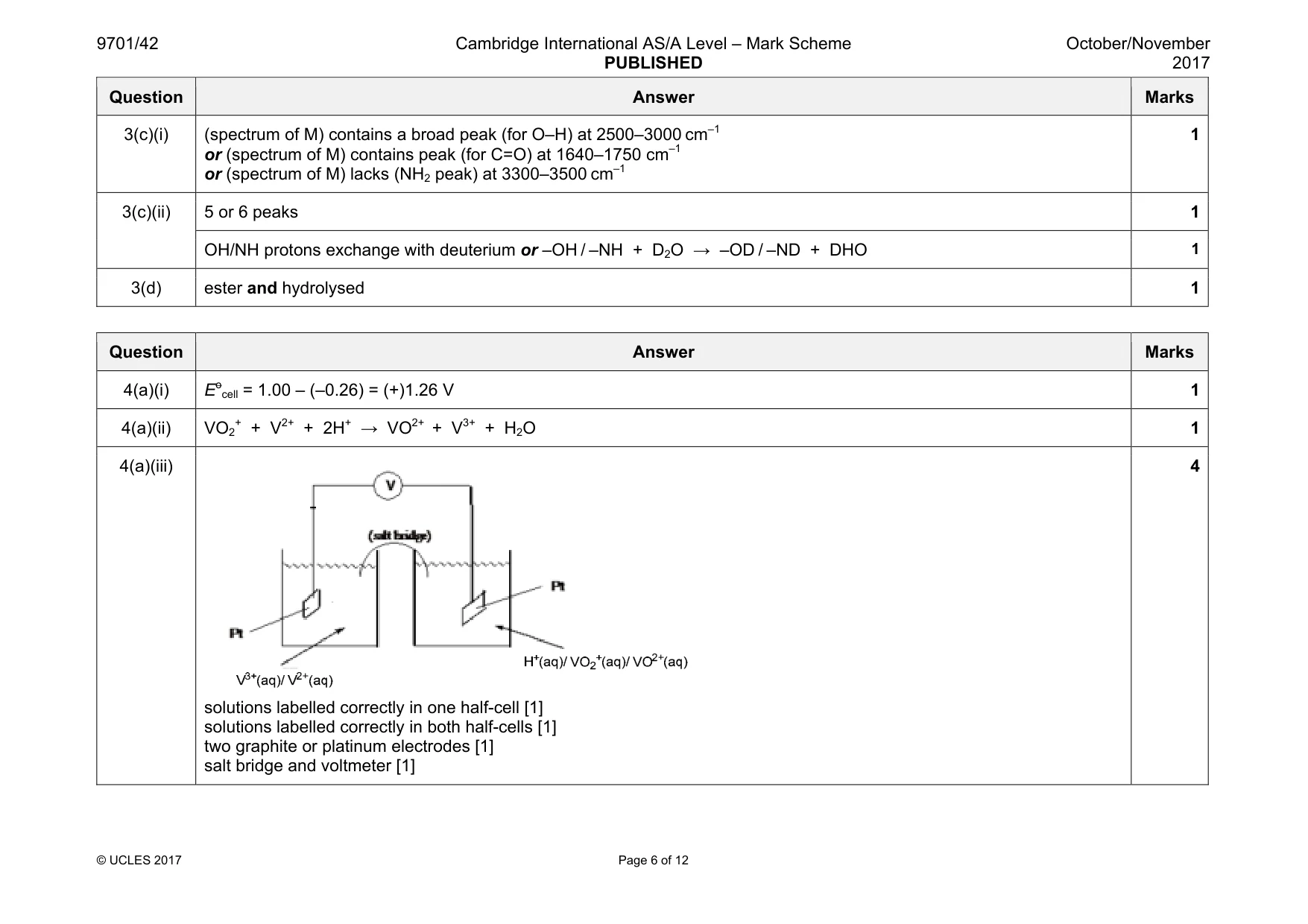
Mark scheme: 3(a)(i) 2 3(a)(ii) peptide link [1] rest of the structure [1] 2 Question Answer Marks 3(b) reagent structure of product type of organic reaction Na [1] redox or reduction excess Br2(aq) [1] (electrophilic) substitution excess CH3COCl acylated OH [1] acylated NH(2) [1] condensation (or addition + elimination) excess H2 / Pt catalyst [1] reduction or hydrogenation or addition 8 Question Answer Marks 3(c)(i) (spectrum of M) contains a broad peak (for O–H) at 2500–3000 cm–1 or (spectrum of M) contains peak (for C=O) at 1640–1750 cm–1 or (spectrum of M) lacks (NH2 peak) at 3300–3500 cm–1 1 3(c)(ii) 5 or 6 peaks 1 OH/NH protons exchange with deuterium or –OH / –NH + D2O → –OD / –ND + DHO 1 3(d) ester and hydrolysed 1
Q4 · An electrochemical cell consists of a half-cell containing V3+(aq) and V2+(aq) ions and…
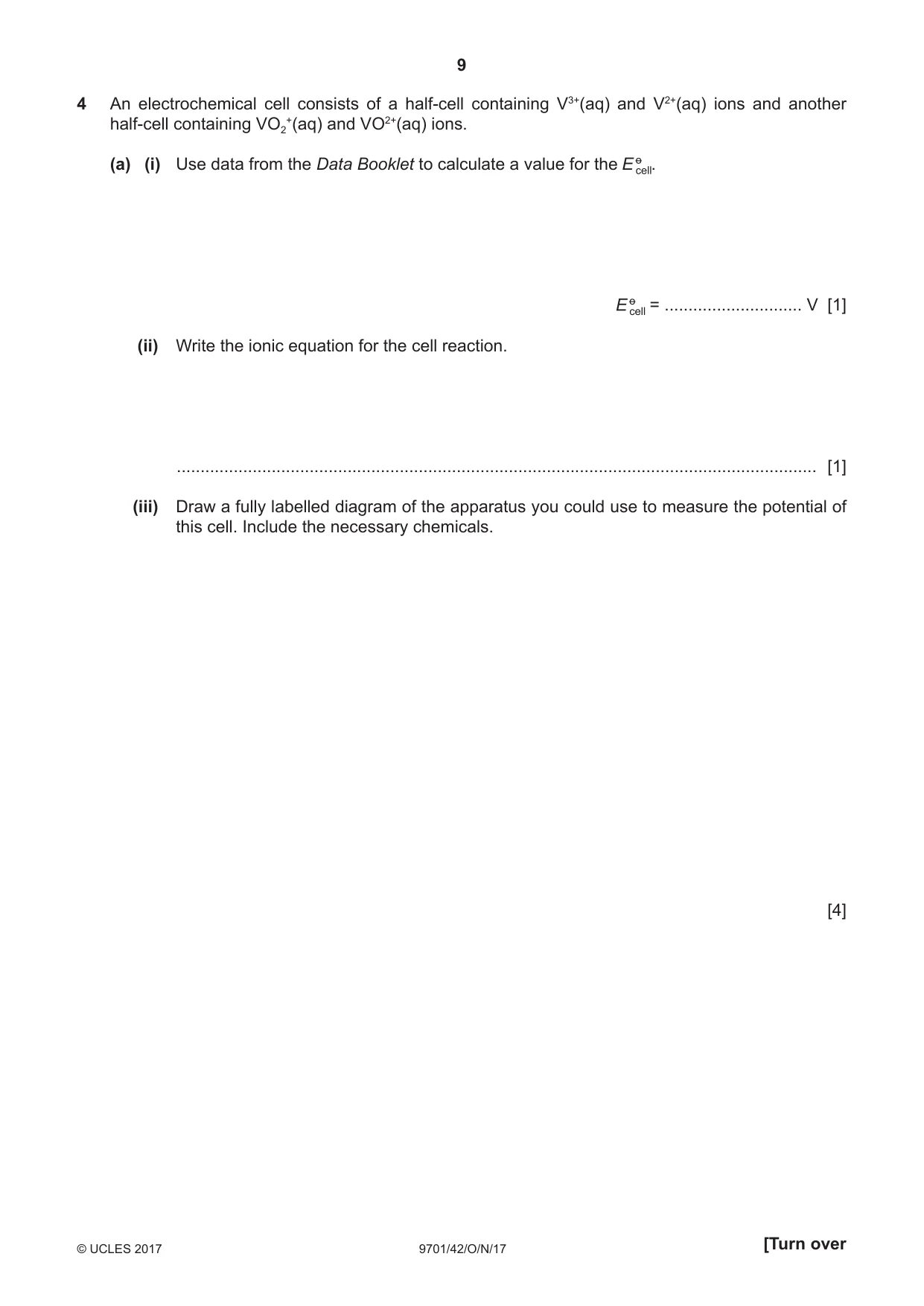
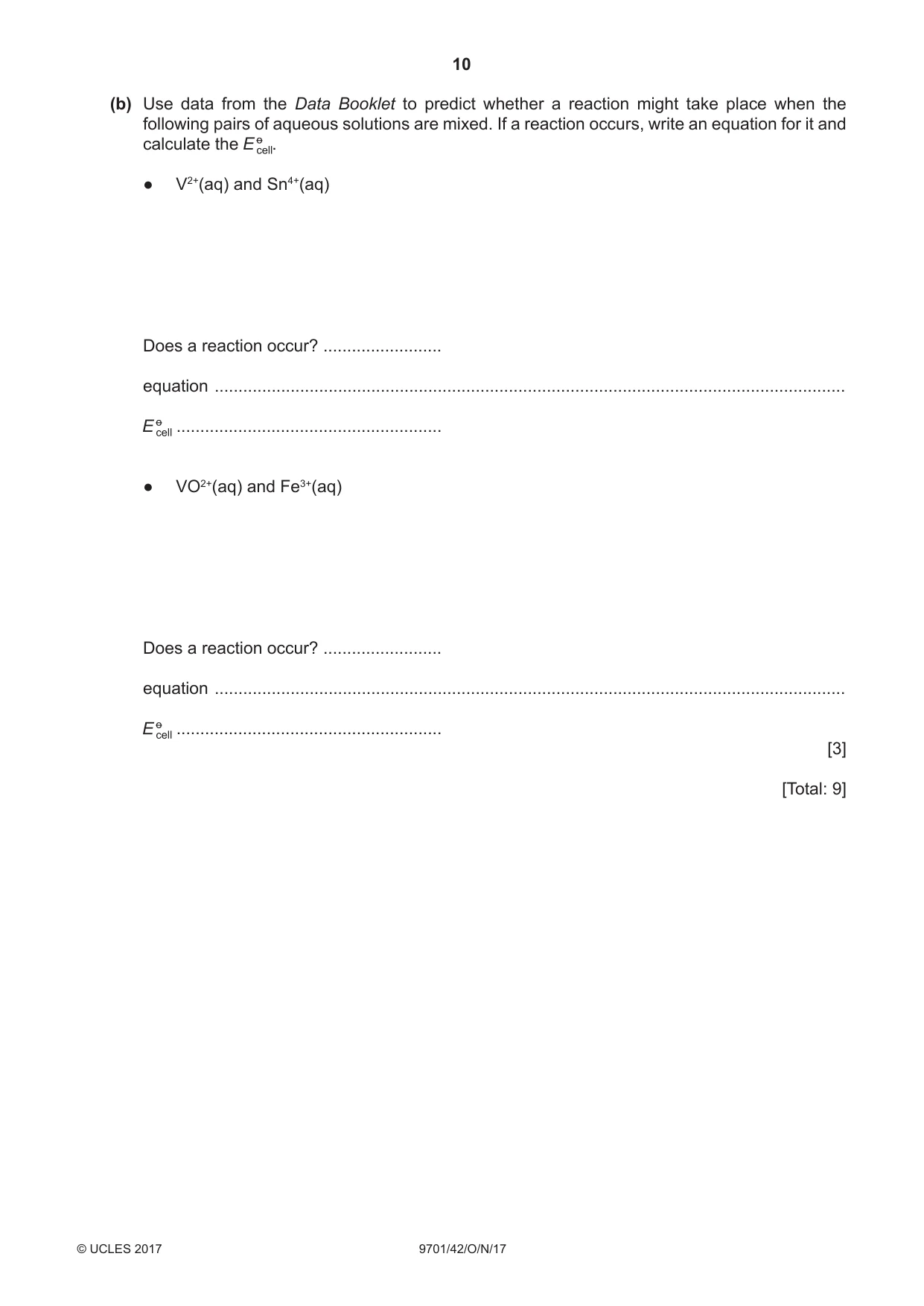
4 An electrochemical cell consists of a half-cell containing V3+(aq) and V2+(aq) ions and another half‑cell containing VO2+(aq) and VO2+(aq) ions. (a) (i) Use data from the Data Booklet to calculate a value for the . = ............................. V [1] (ii) Write the ionic equation for the cell reaction. ....................................................................................................................................... [1] (iii) Draw a fully labelled diagram of the apparatus you could use to measure the potential of this cell. Include the necessary chemicals. [4] (b) Use data from the Data Booklet to predict whether a reaction might take place when the following pairs of aqueous solutions are mixed. If a reaction occurs, write an equation for it and calculate the . ● V2+(aq) and Sn4+(aq) Does a reaction occur? ......................... equation ..................................................................................................................................... ........................................................ ● VO2+(aq) and Fe3+(aq) Does a reaction occur? ......................... equation ..................................................................................................................................... ........................................................ [3] [Total: 9]
Mark scheme: 4(a)(i) cell = 1.00 – (–0.26) = (+)1.26 V 1 4(a)(ii) VO2 + + V2+ + 2H+ → VO2+ + V3+ + H2O 1 4(a)(iii) solutions labelled correctly in one half-cell [1] solutions labelled correctly in both half-cells [1] two graphite or platinum electrodes [1] salt bridge and voltmeter [1] 4 Question Answer Marks 4(b) • V2+(aq) and Sn4+(aq): yes and Eo cell = +0.15 – (–0.26) = +0.41 V [1] 2V2+ + Sn4+ → 2V3+ + Sn2+ [1] • VO2+(aq) and Fe3+(aq) no reaction [1] 3
Q5 · The arrangement of the anions around a cation is called the geometry of the cation; e.g
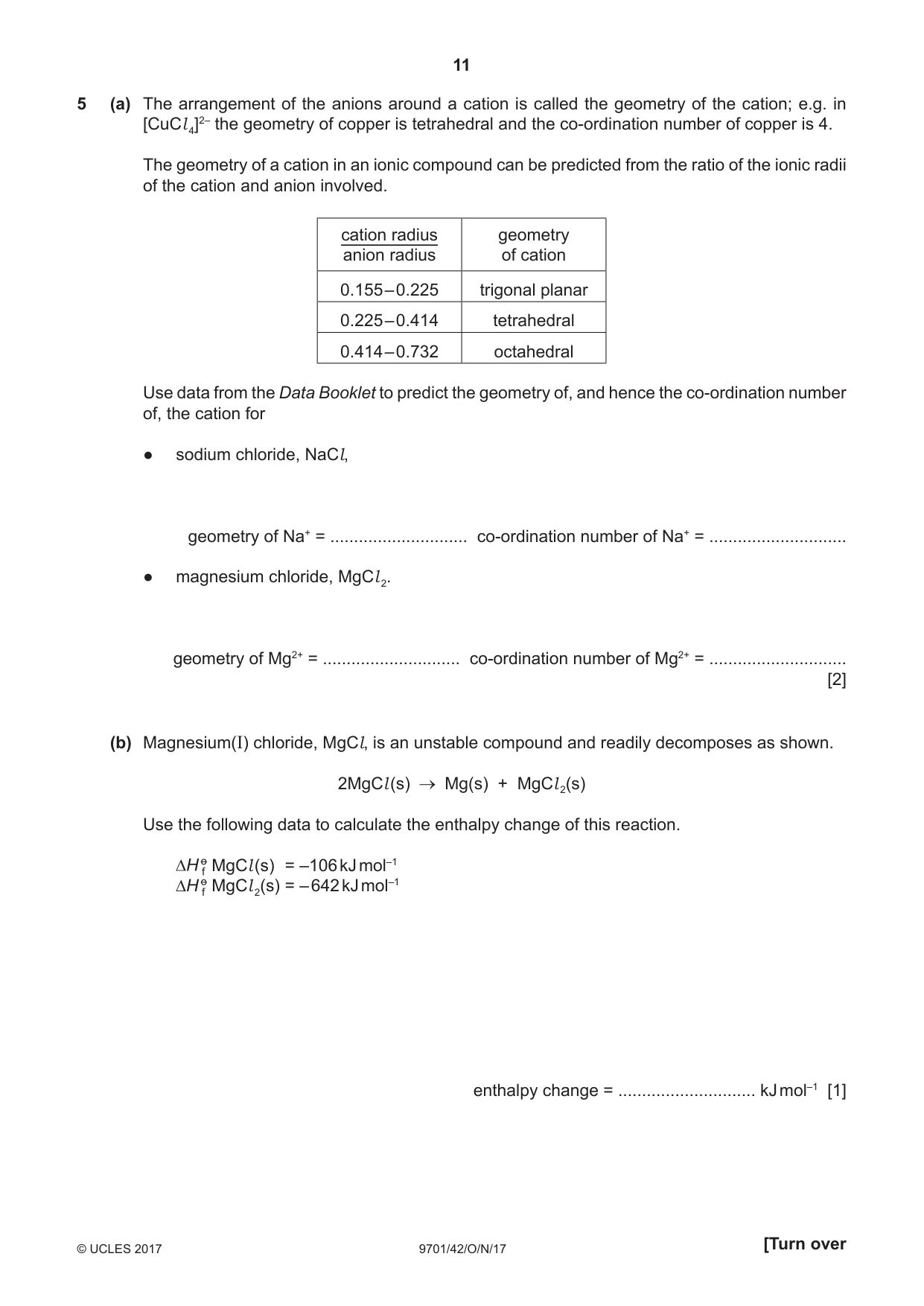
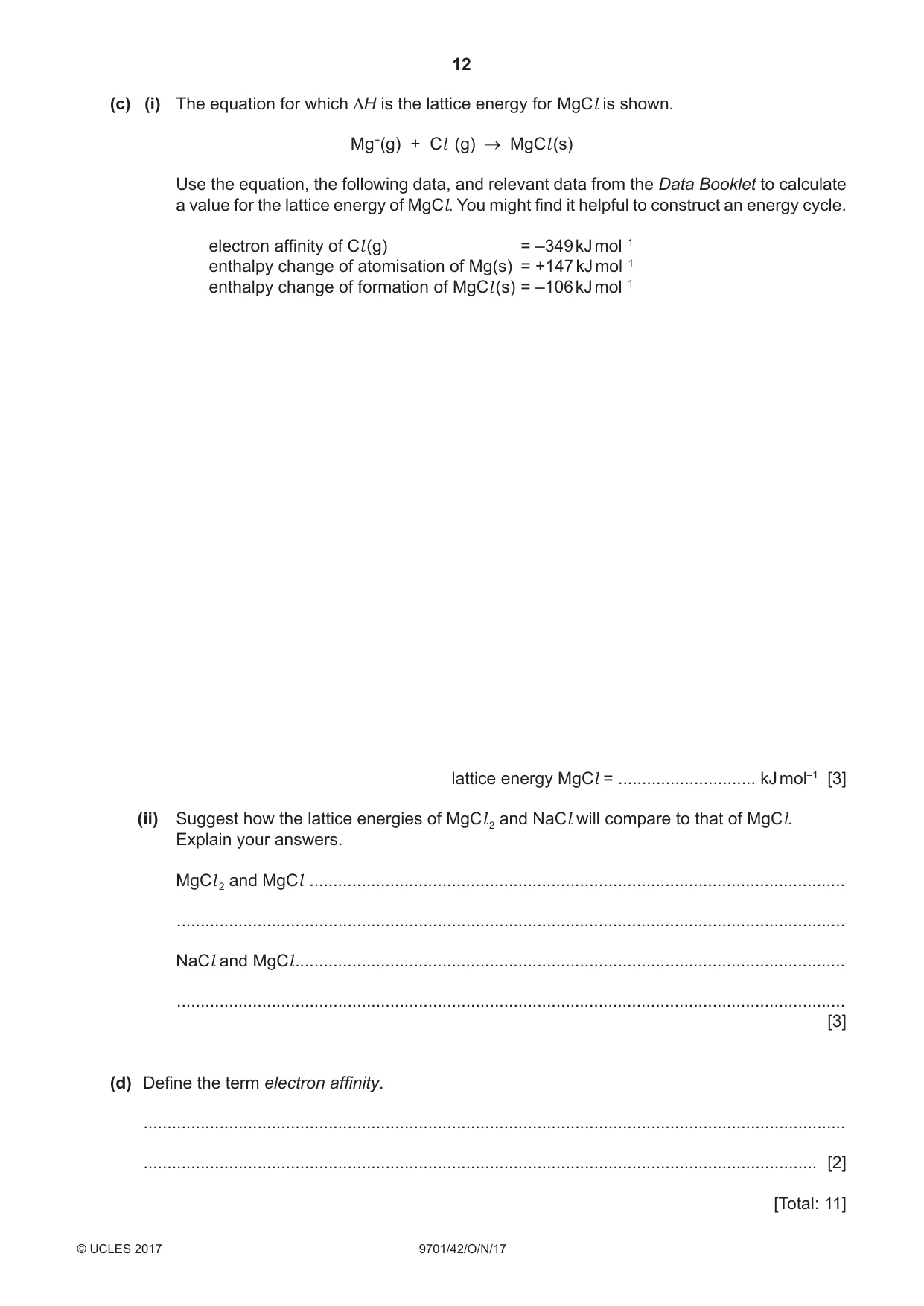
5 (a) The arrangement of the anions around a cation is called the geometry of the cation; e.g. in [CuCl 4]2– the geometry of copper is tetrahedral and the co-ordination number of copper is 4. The geometry of a cation in an ionic compound can be predicted from the ratio of the ionic radii of the cation and anion involved. cation radius geometry anion radius of cation 0.155 – 0.225 trigonal planar 0.225 – 0.414 tetrahedral 0.414 – 0.732 octahedral Use data from the Data Booklet to predict the geometry of, and hence the co-ordination number of, the cation for ● sodium chloride, NaCl, geometry of Na+ = ............................. co-ordination number of Na+ = ............................. ● magnesium chloride, MgCl 2. geometry of Mg2+ = ............................. co-ordination number of Mg2+ = ............................. [2] (b) Magnesium(I) chloride, MgCl, is an unstable compound and readily decomposes as shown. 2MgCl (s) Mg(s) + MgCl 2(s) Use the following data to calculate the enthalpy change of this reaction. MgCl (s) = –106 kJ mol–1 MgCl 2(s) = – 642 kJ mol–1 enthalpy change = ............................. kJ mol–1 [1] (c) (i) The equation for which ΔH is the lattice energy for MgCl is shown. Mg+(g) + Cl –(g) MgCl (s) Use the equation, the following data, and relevant data from the Data Booklet to calculate a value for the lattice energy of MgCl. You might find it helpful to construct an energy cycle. electron affinity of Cl (g) = –349 kJ mol–1 enthalpy change of atomisation of Mg(s) = +147 kJ mol–1 enthalpy change of formation of MgCl (s) = –106 kJ mol–1 lattice energy MgCl = ............................. kJ mol–1 [3] (ii) Suggest how the lattice energies of MgCl 2 and NaCl will compare to that of MgCl. Explain your answers. MgCl 2 and MgCl ................................................................................................................. ............................................................................................................................................. NaCl and MgCl.................................................................................................................... ............................................................................................................................................. [3] (d) Define the term electron affinity. .................................................................................................................................................... .............................................................................................................................................. [2] [Total: 11]
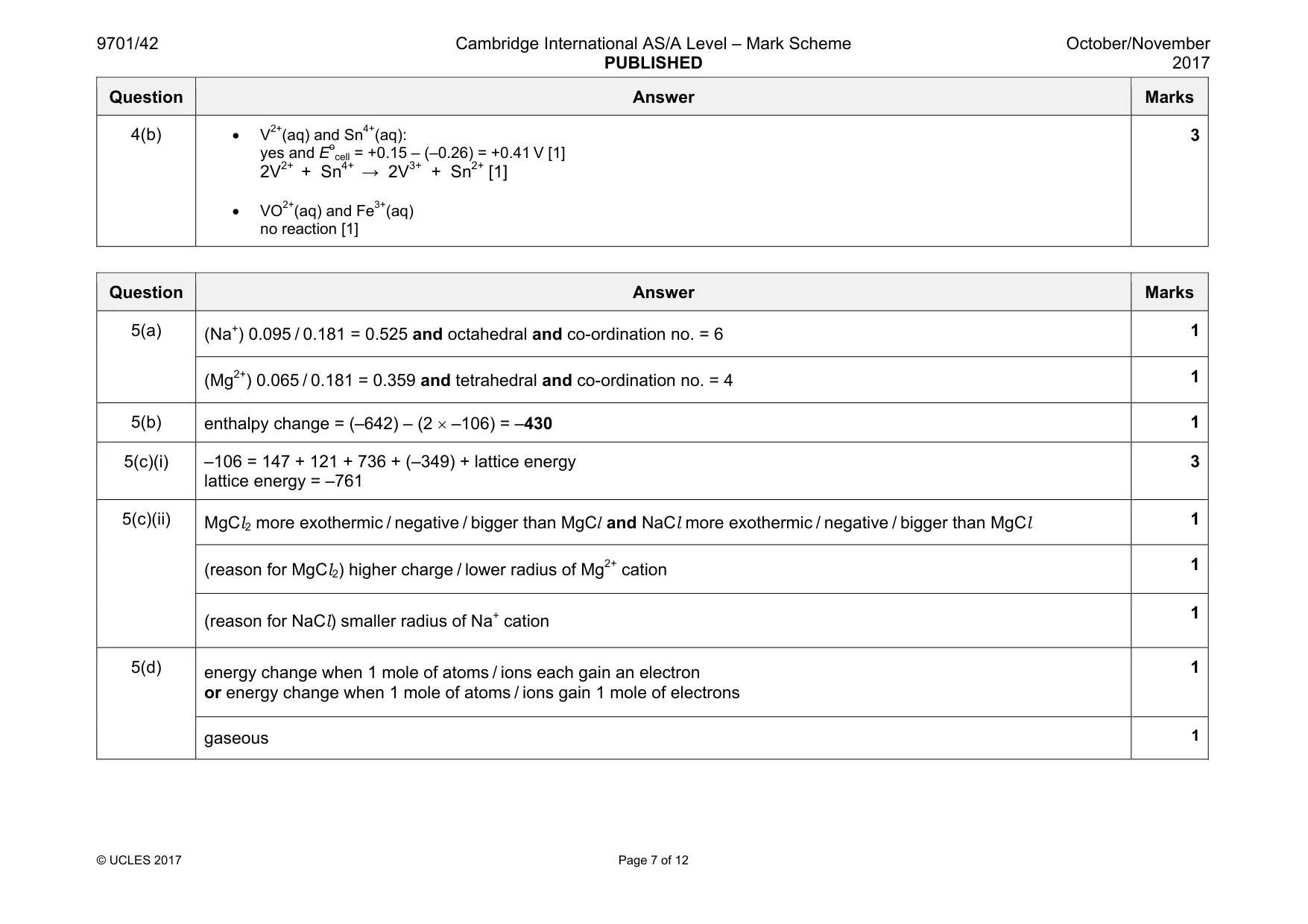
Mark scheme: 5(a) (Na+) 0.095 / 0.181 = 0.525 and octahedral and co-ordination no. = 6 1 (Mg2+) 0.065 / 0.181 = 0.359 and tetrahedral and co-ordination no. = 4 1 5(b) enthalpy change = (–642) – (2 × –106) = –430 1 5(c)(i) –106 = 147 + 121 + 736 + (–349) + lattice energy lattice energy = –761 3 5(c)(ii) MgCl2 more exothermic / negative / bigger than MgCl and NaCl more exothermic / negative / bigger than MgCl 1 (reason for MgCl2) higher charge / lower radius of Mg2+ cation 1 (reason for NaCl) smaller radius of Na+ cation 1 5(d) energy change when 1 mole of atoms / ions each gain an electron or energy change when 1 mole of atoms / ions gain 1 mole of electrons 1 gaseous 1
Q6 · Define the term transition metal complex
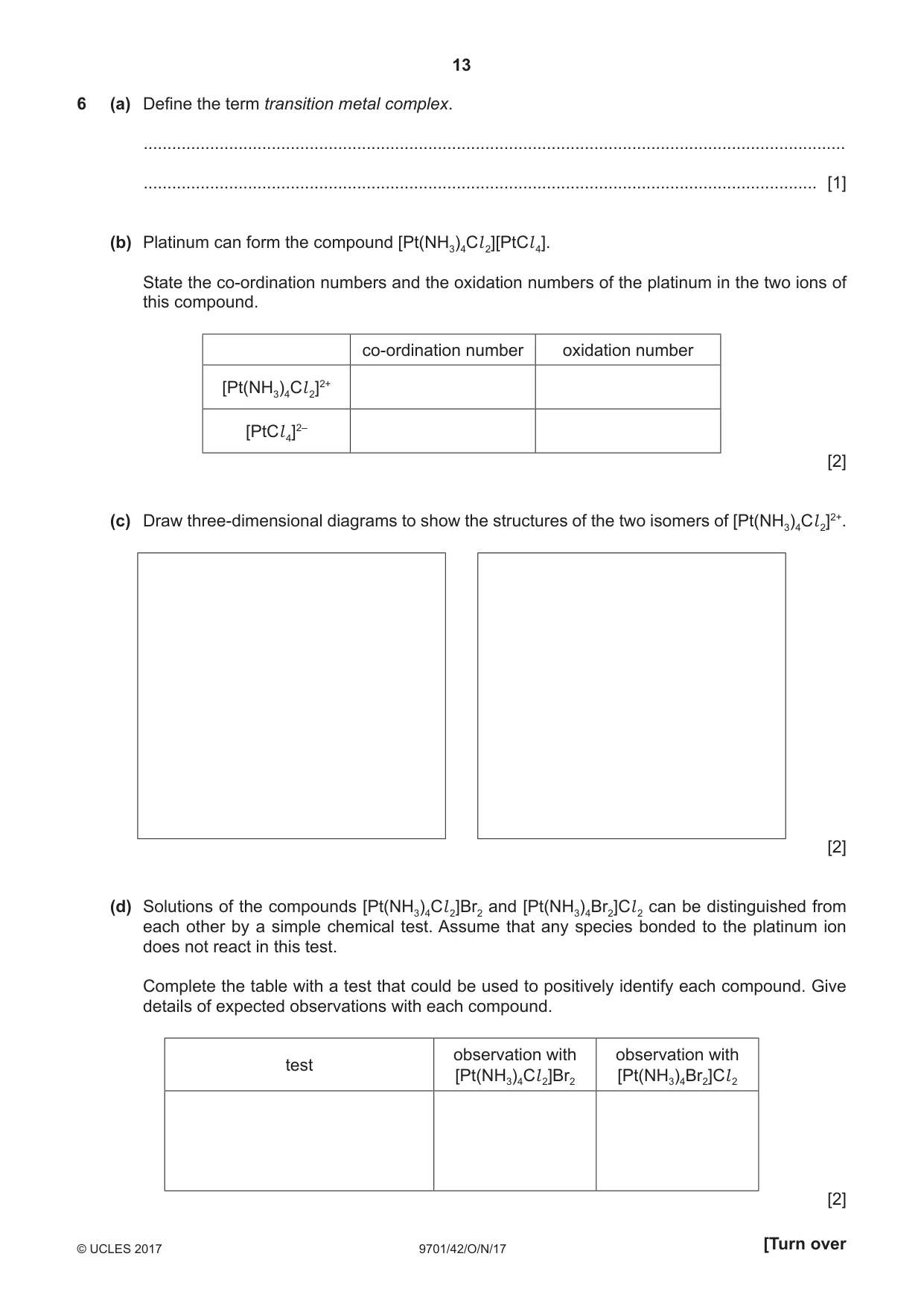
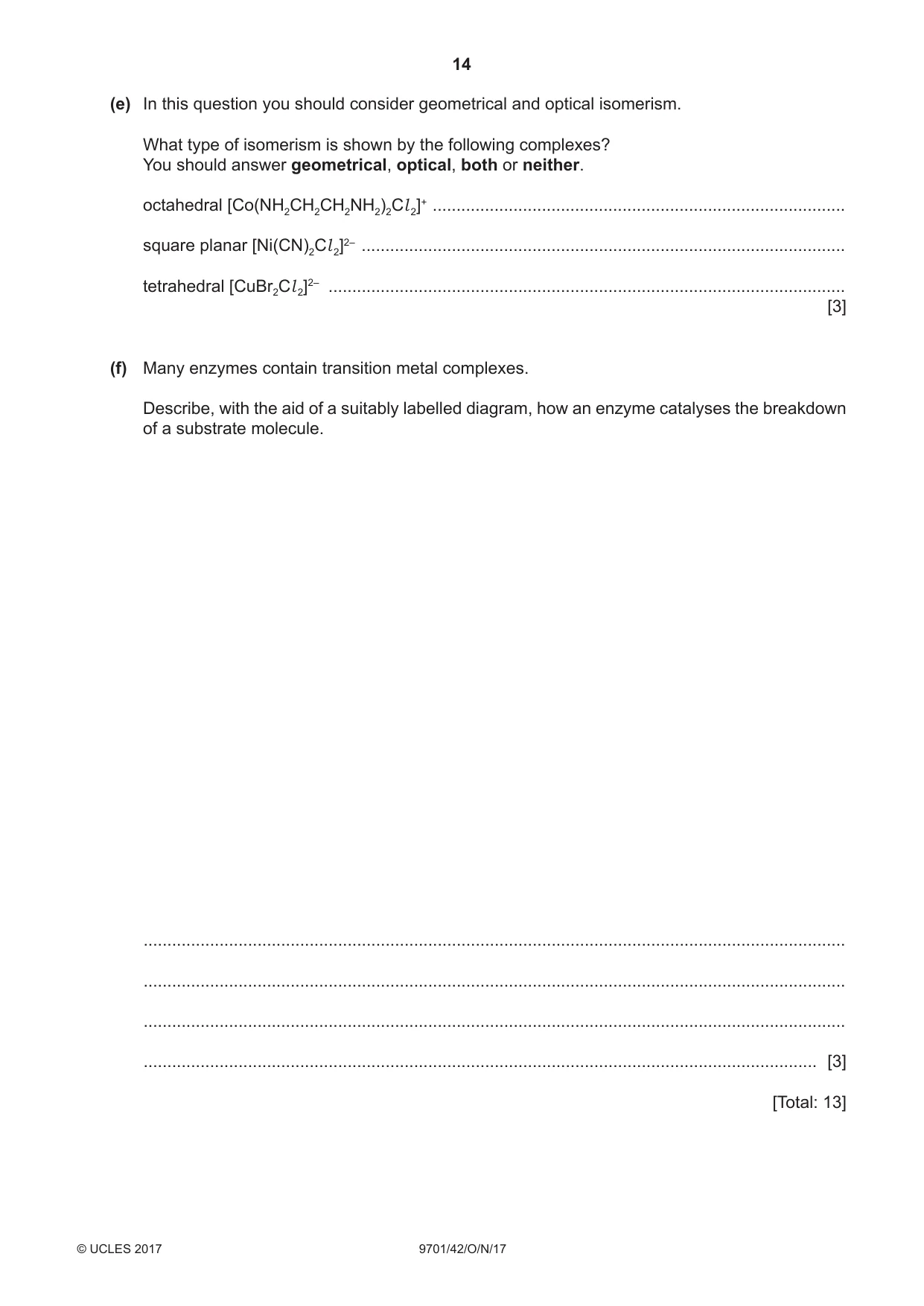
6 (a) Define the term transition metal complex. .................................................................................................................................................... .............................................................................................................................................. [1] (b) Platinum can form the compound [Pt(NH3)4Cl 2][PtCl 4]. State the co-ordination numbers and the oxidation numbers of the platinum in the two ions of this compound. co-ordination number oxidation number [Pt(NH3)4Cl 2]2+ [PtCl 4]2– [2] (c) Draw three-dimensional diagrams to show the structures of the two isomers of [Pt(NH3)4Cl 2]2+. [2] (d) Solutions of the compounds [Pt(NH3)4Cl 2]Br2 and [Pt(NH3)4Br2]Cl 2 can be distinguished from each other by a simple chemical test. Assume that any species bonded to the platinum ion does not react in this test. Complete the table with a test that could be used to positively identify each compound. Give details of expected observations with each compound. observation with observation with test [Pt(NH3)4Cl 2]Br2 [Pt(NH3)4Br2]Cl 2 [2] (e) In this question you should consider geometrical and optical isomerism. What type of isomerism is shown by the following complexes? You should answer geometrical, optical, both or neither. octahedral [Co(NH2CH2CH2NH2)2Cl 2]+ ....................................................................................... square planar [Ni(CN)2Cl 2]2– ...................................................................................................... tetrahedral [CuBr2Cl 2]2– .............................................................................................................. [3] (f) Many enzymes contain transition metal complexes. Describe, with the aid of a suitably labelled diagram, how an enzyme catalyses the breakdown of a substrate molecule. .................................................................................................................................................... .................................................................................................................................................... .................................................................................................................................................... .............................................................................................................................................. [3] [Total: 13]
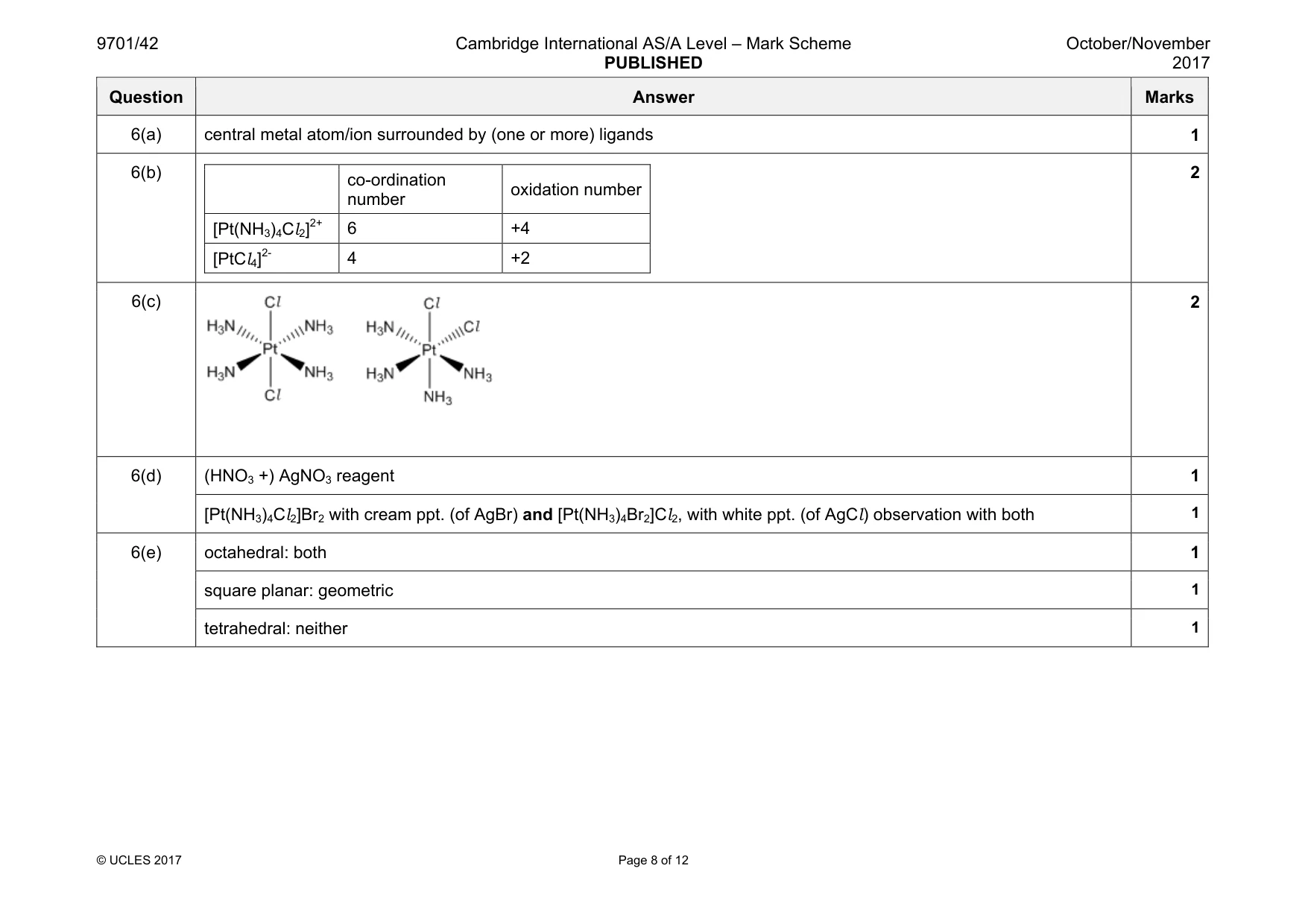
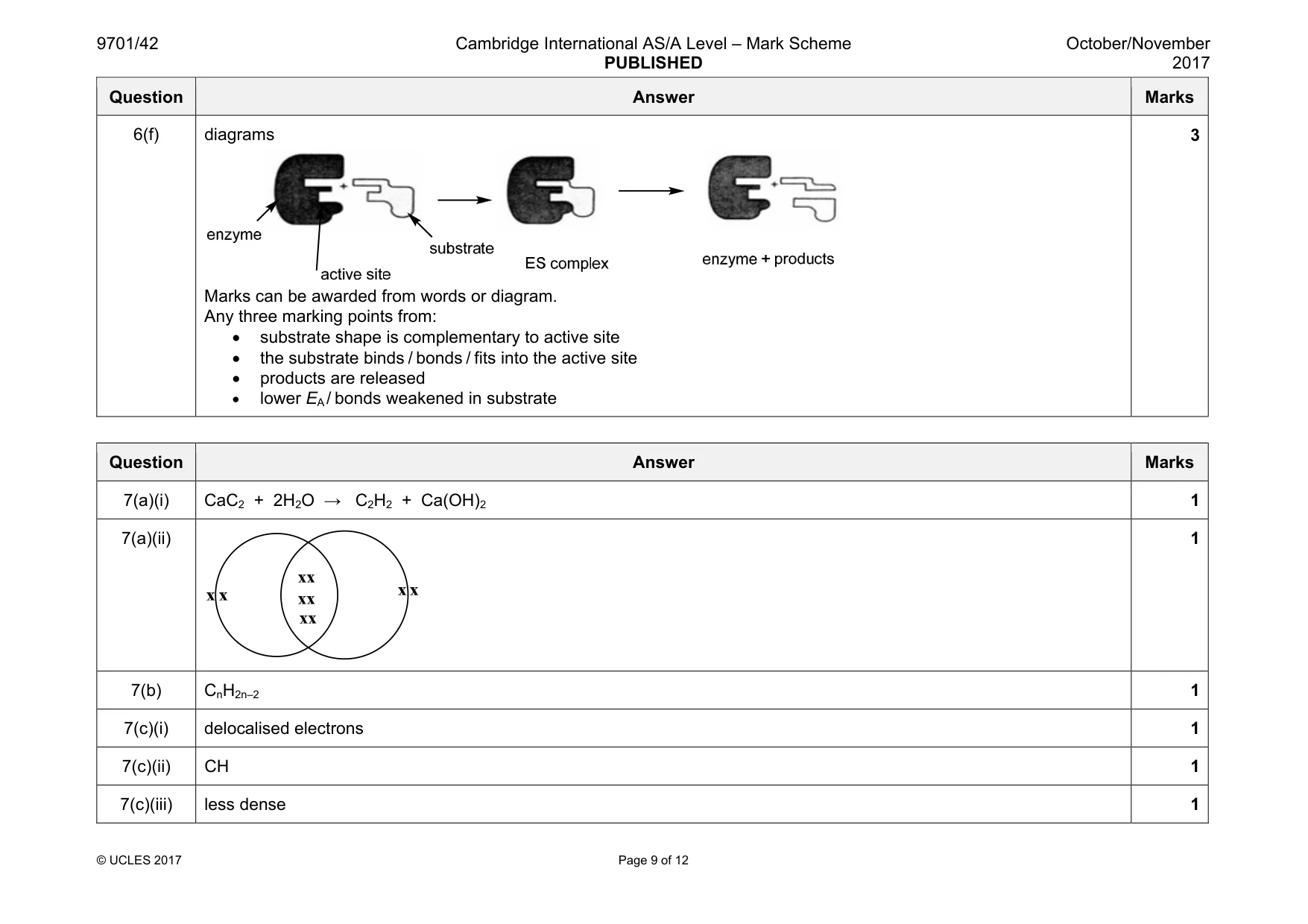
Mark scheme: 6(a) central metal atom/ion surrounded by (one or more) ligands 1 6(b) co-ordination number oxidation number [Pt(NH3)4Cl2]2+ 6 +4 [PtCl4]2- 4 +2 2 6(c) 2 6(d) (HNO3 +) AgNO3 reagent 1 [Pt(NH3)4Cl2]Br2 with cream ppt. (of AgBr) and [Pt(NH3)4Br2]Cl2, with white ppt. (of AgCl) observation with both 1 6(e) octahedral: both 1 square planar: geometric 1 tetrahedral: neither 1 Question Answer Marks 6(f) diagrams Marks can be awarded from words or diagram. Any three marking points from: • substrate shape is complementary to active site • the substrate binds / bonds / fits into the active site • products are released • lower EA / bonds weakened in substrate 3
More questions on Stereoisomerism in transition element complexes
Q7 · Calcium carbide, CaC2, reacts readily with water, forming ethyne, C2H2, and a sparingly…
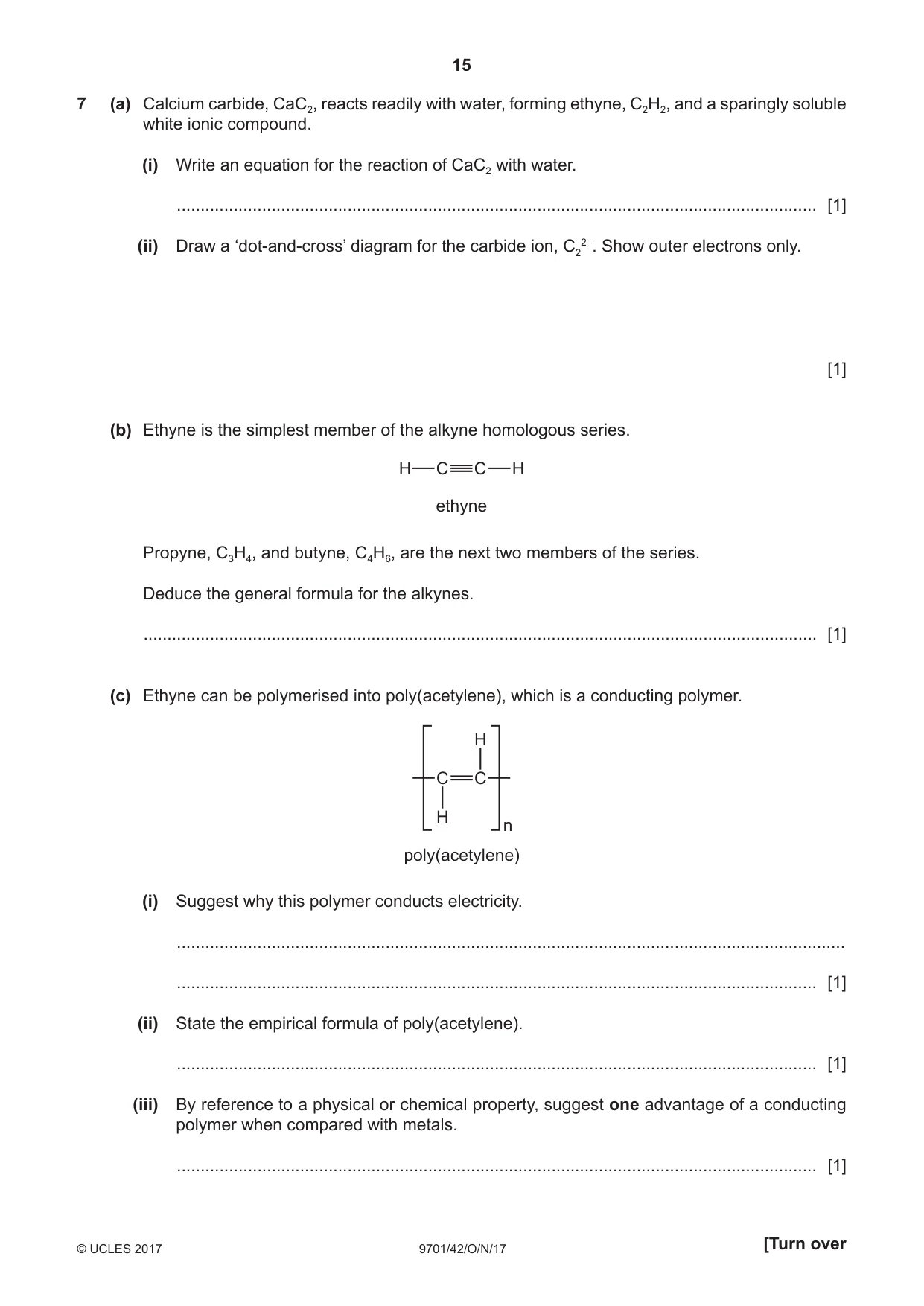
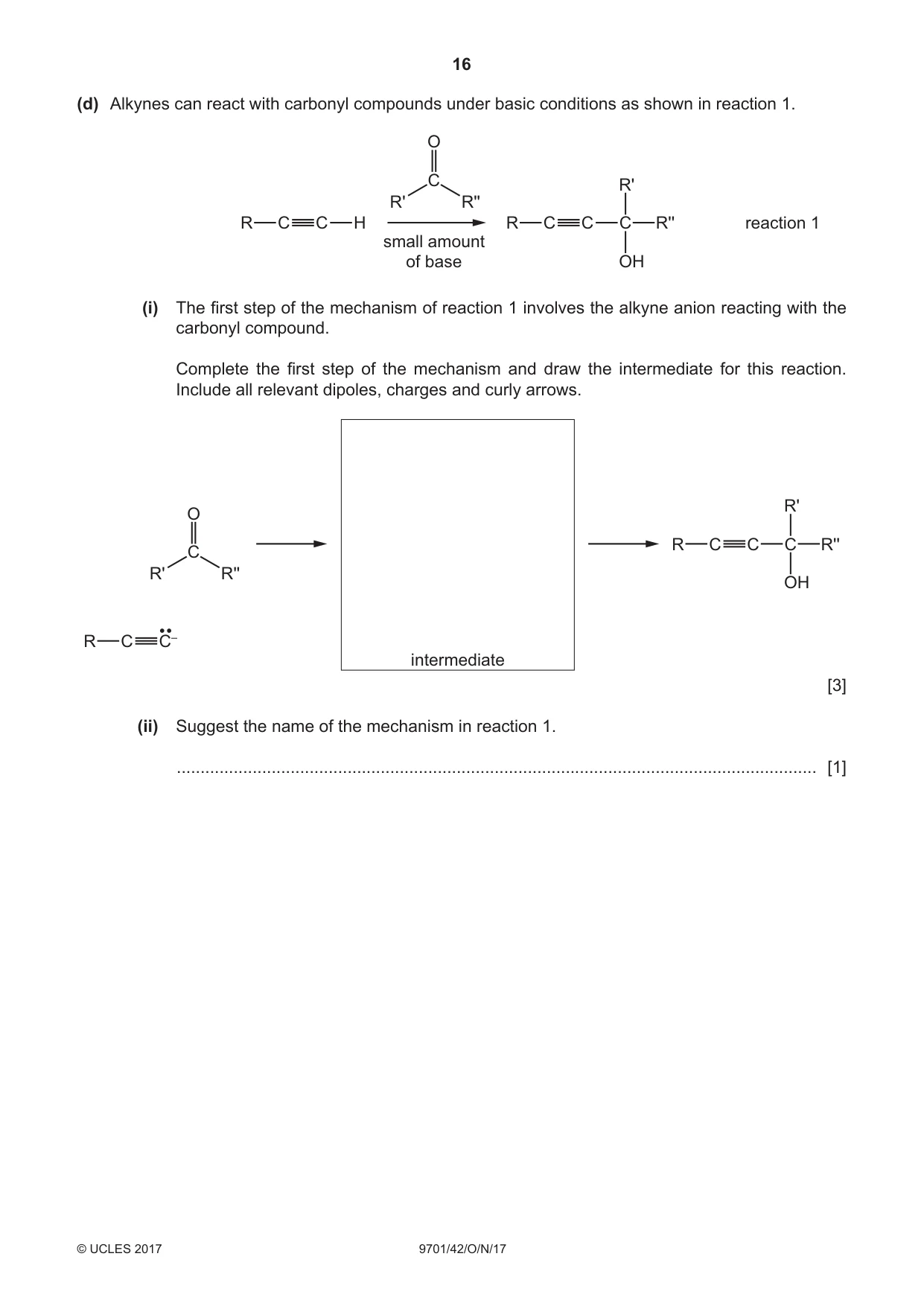
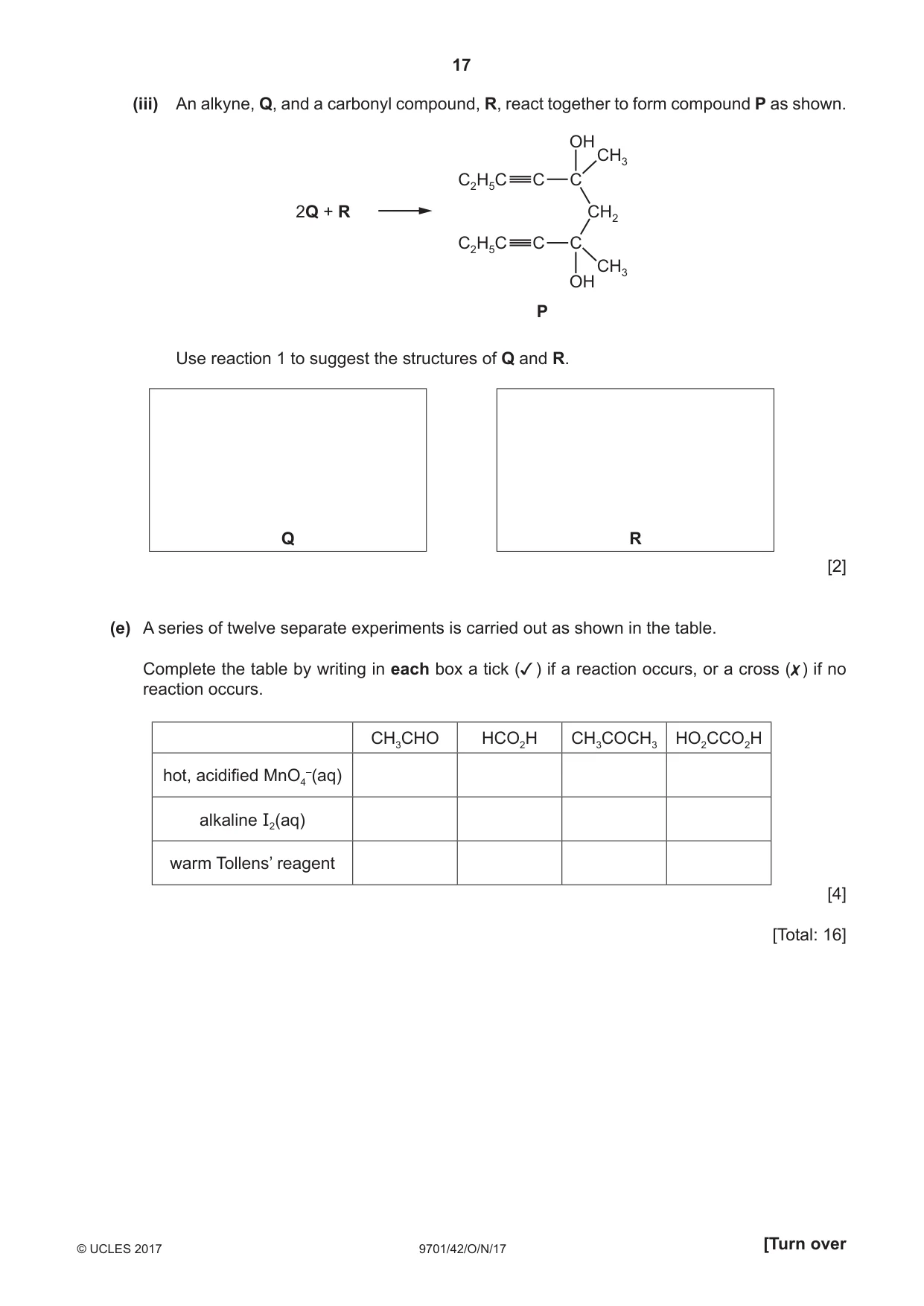
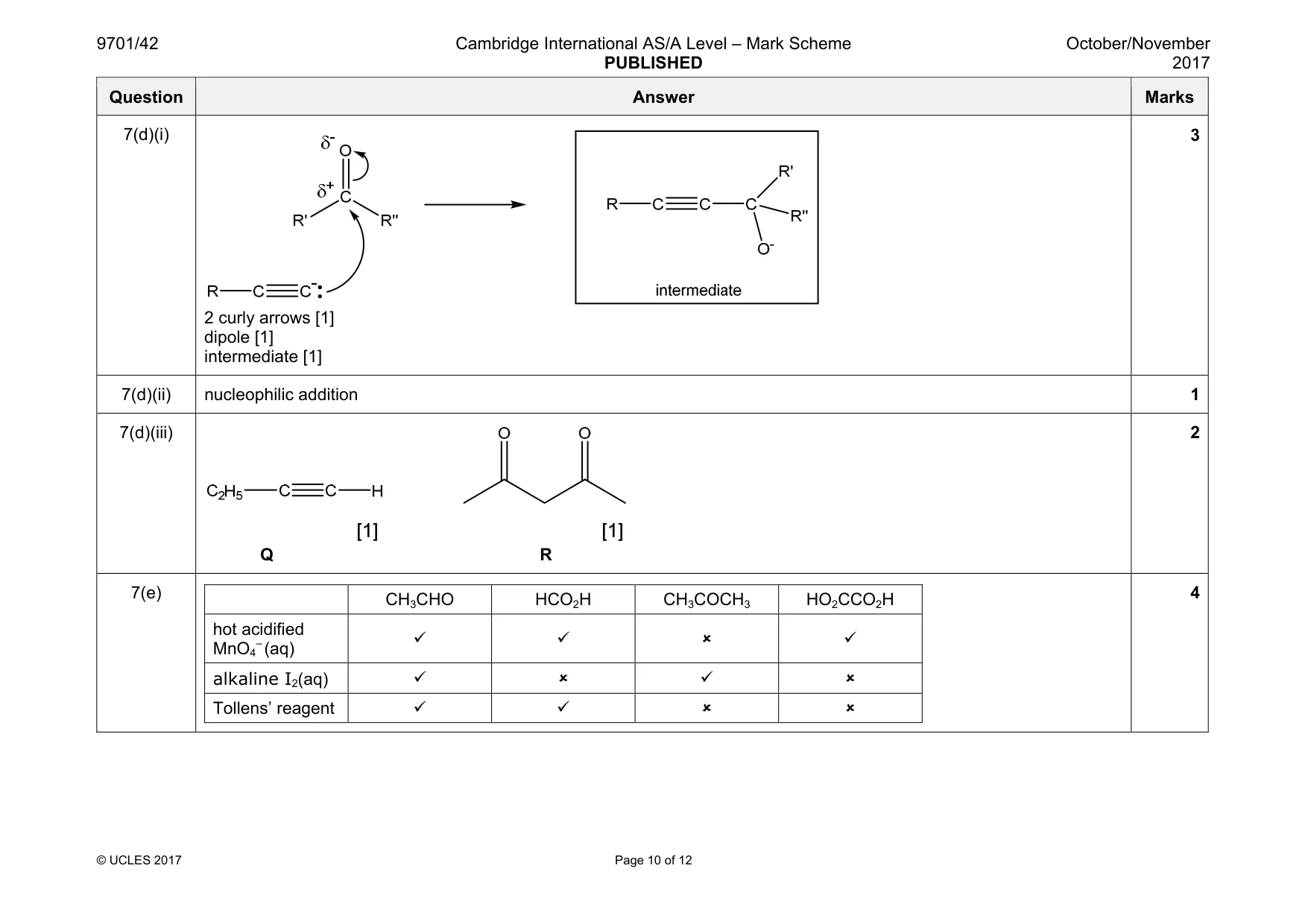
7 (a) Calcium carbide, CaC2, reacts readily with water, forming ethyne, C2H2, and a sparingly soluble white ionic compound. (i) Write an equation for the reaction of CaC2 with water. ....................................................................................................................................... [1] (ii) Draw a ‘dot-and-cross’ diagram for the carbide ion, C22–. Show outer electrons only. [1] (b) Ethyne is the simplest member of the alkyne homologous series. H C C H ethyne Propyne, C3H4, and butyne, C4H6, are the next two members of the series. Deduce the general formula for the alkynes. .............................................................................................................................................. [1] (c) Ethyne can be polymerised into poly(acetylene), which is a conducting polymer. H C C H n poly(acetylene) (i) Suggest why this polymer conducts electricity. ............................................................................................................................................. ....................................................................................................................................... [1] (ii) State the empirical formula of poly(acetylene). ....................................................................................................................................... [1] (iii) By reference to a physical or chemical property, suggest one advantage of a conducting polymer when compared with metals. ....................................................................................................................................... [1] (d) Alkynes can react with carbonyl compounds under basic conditions as shown in reaction 1. O C R' R' R'' R C C H R C C C R'' reaction 1 small amount of base OH (i) The first step of the mechanism of reaction 1 involves the alkyne anion reacting with the carbonyl compound. Complete the first step of the mechanism and draw the intermediate for this reaction. Include all relevant dipoles, charges and curly arrows. R' O R C C C R'' C R' R'' OH R C C– intermediate [3] (ii) Suggest the name of the mechanism in reaction 1. ....................................................................................................................................... [1] (iii) An alkyne, Q, and a carbonyl compound, R, react together to form compound P as shown. OH CH3 C2H5C C C 2Q + R CH2 C2H5C C C CH3 OH P Use reaction 1 to suggest the structures of Q and R. Q R [2] (e) A series of twelve separate experiments is carried out as shown in the table. Complete the table by writing in each box a tick () if a reaction occurs, or a cross () if no reaction occurs. CH3CHO HCO2H CH3COCH3 HO2CCO2H hot, acidified MnO4–(aq) alkaline I2(aq) warm Tollens’ reagent [4] [Total: 16]
Mark scheme: 7(a)(i) CaC2 + 2H2O → C2H2 + Ca(OH)2 1 7(a)(ii) 1 7(b) CnH2n–2 1 7(c)(i) delocalised electrons 1 7(c)(ii) CH 1 7(c)(iii) less dense 1 Question Answer Marks 7(d)(i) 2 curly arrows [1] dipole [1] intermediate [1] 3 7(d)(ii) nucleophilic addition 1 7(d)(iii) Q R 2 7(e) CH3CHO HCO2H CH3COCH3 HO2CCO2H hot acidified MnO4 – (aq) 9 9 8 9 alkaline I2(aq) 9 8 9 8 Tollens’ reagent 9 9 8 8 4
Q8 · Compound A can be produced from a plant hormone
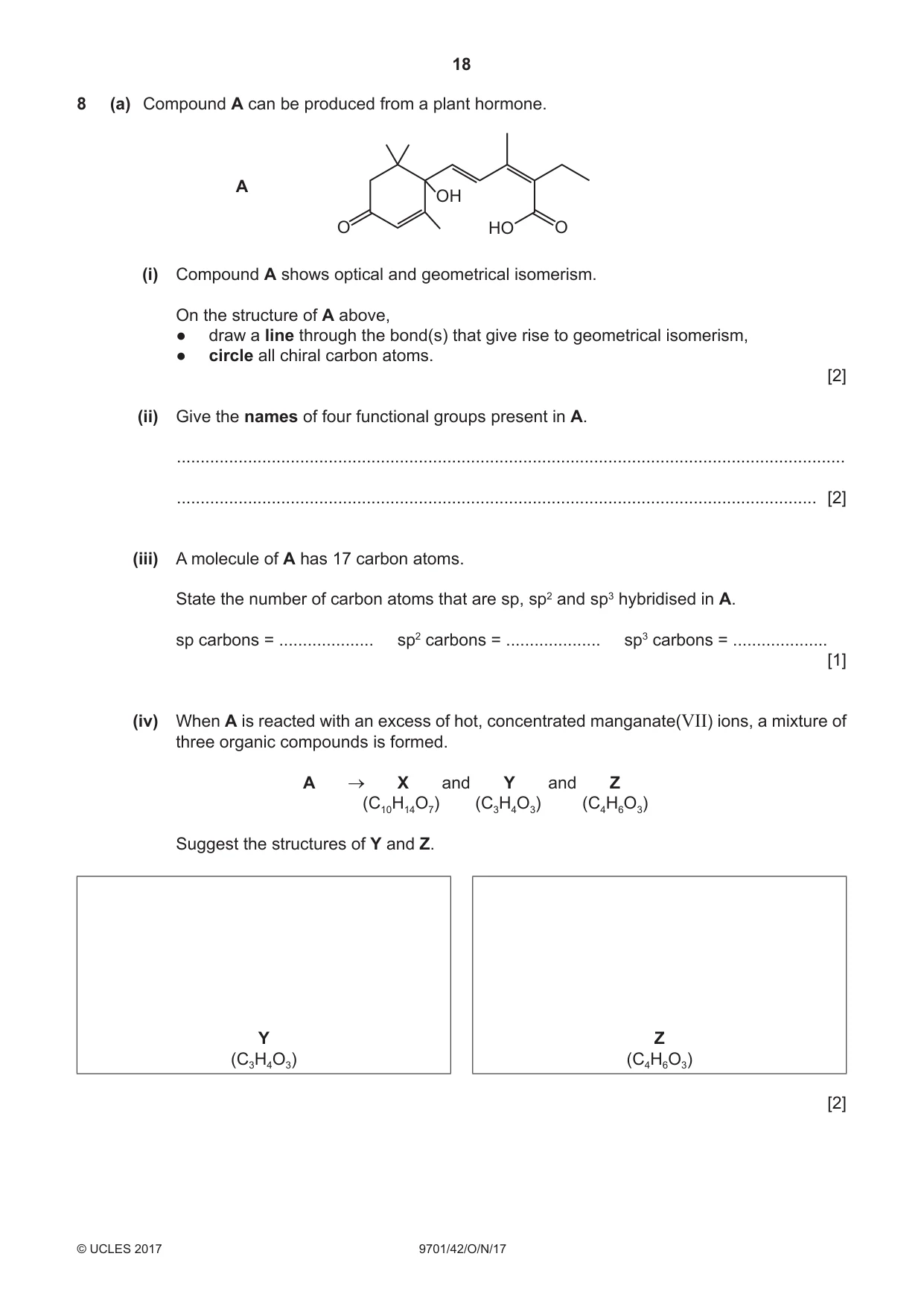
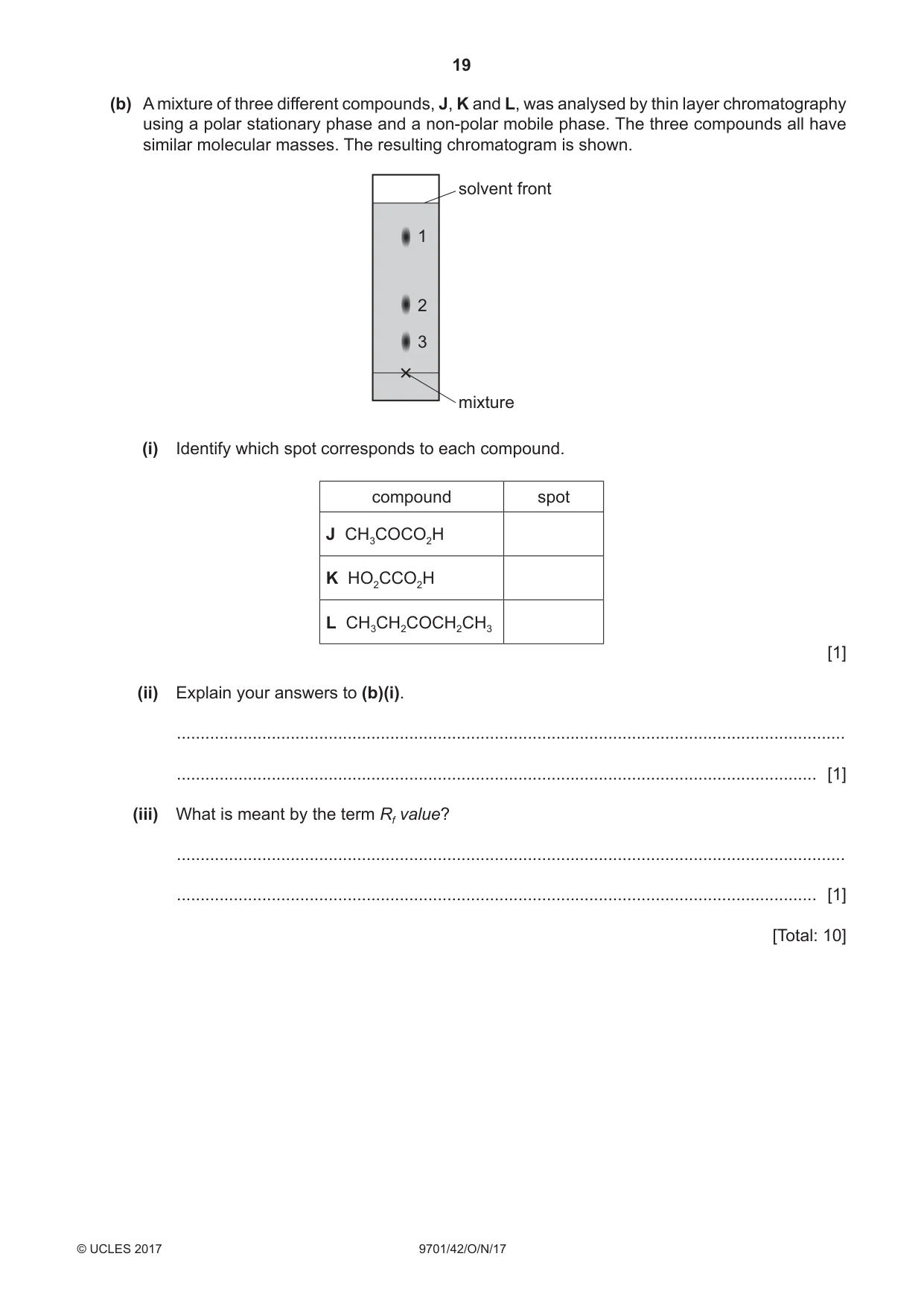
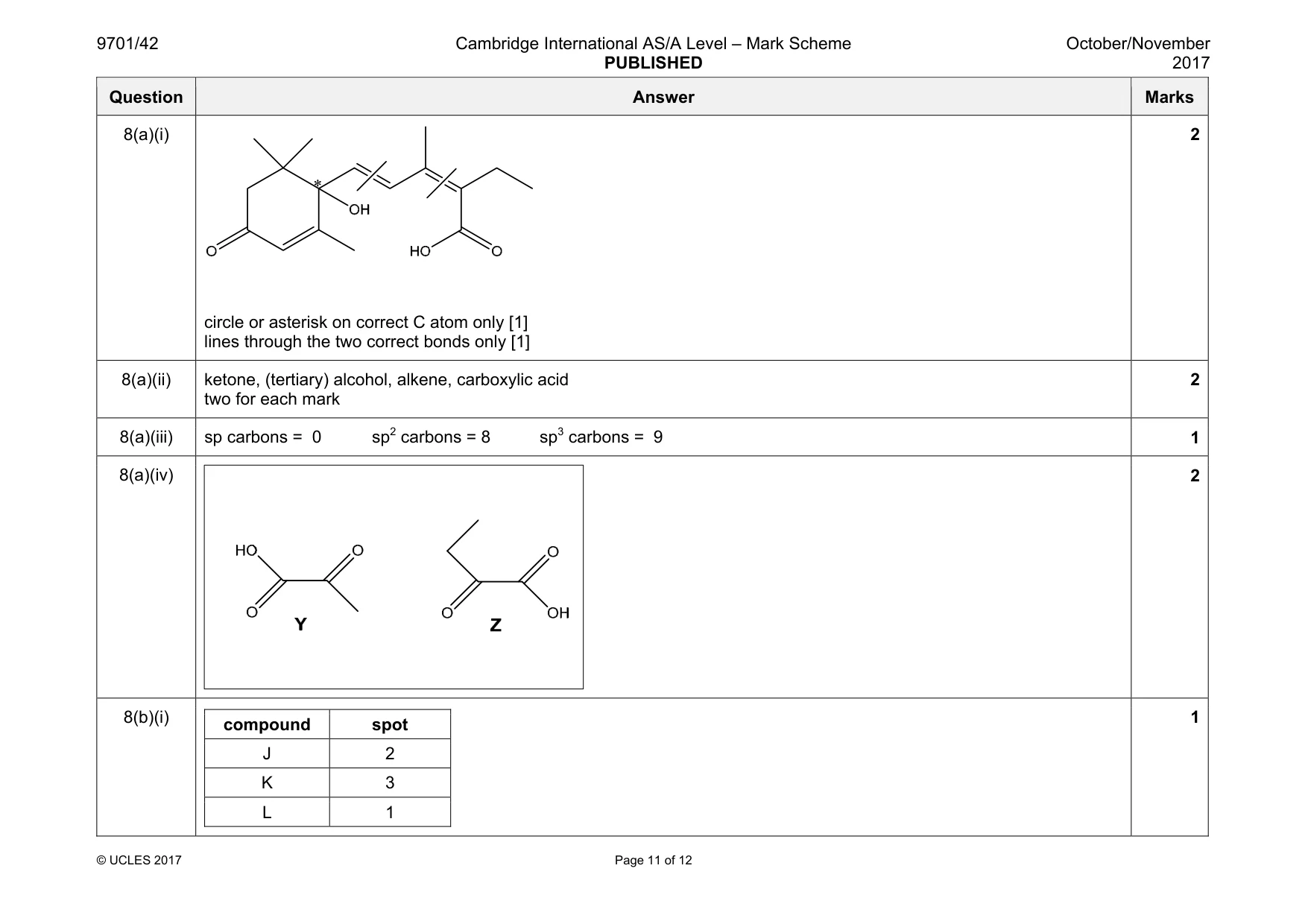
8 (a) Compound A can be produced from a plant hormone. A OH O HO O (i) Compound A shows optical and geometrical isomerism. On the structure of A above, ● draw a line through the bond(s) that give rise to geometrical isomerism, ● circle all chiral carbon atoms. [2] (ii) Give the names of four functional groups present in A. ............................................................................................................................................. ....................................................................................................................................... [2] (iii) A molecule of A has 17 carbon atoms. State the number of carbon atoms that are sp, sp2 and sp3 hybridised in A. sp carbons = .................... sp2 carbons = .................... sp3 carbons = .................... [1] (iv) When A is reacted with an excess of hot, concentrated manganate(VII) ions, a mixture of three organic compounds is formed. A X and Y and Z (C10H14O7) (C3H4O3) (C4H6O3) Suggest the structures of Y and Z. Y Z (C3H4O3) (C4H6O3) [2] (b) A mixture of three different compounds, J, K and L, was analysed by thin layer chromatography using a polar stationary phase and a non-polar mobile phase. The three compounds all have similar molecular masses. The resulting chromatogram is shown. solvent front 1 2 3 mixture (i) Identify which spot corresponds to each compound. compound spot J CH3COCO2H K HO2CCO2H L CH3CH2COCH2CH3 [1] (ii) Explain your answers to (b)(i). ............................................................................................................................................. ....................................................................................................................................... [1] (iii) What is meant by the term Rf value? ............................................................................................................................................. ....................................................................................................................................... [1] [Total: 10]
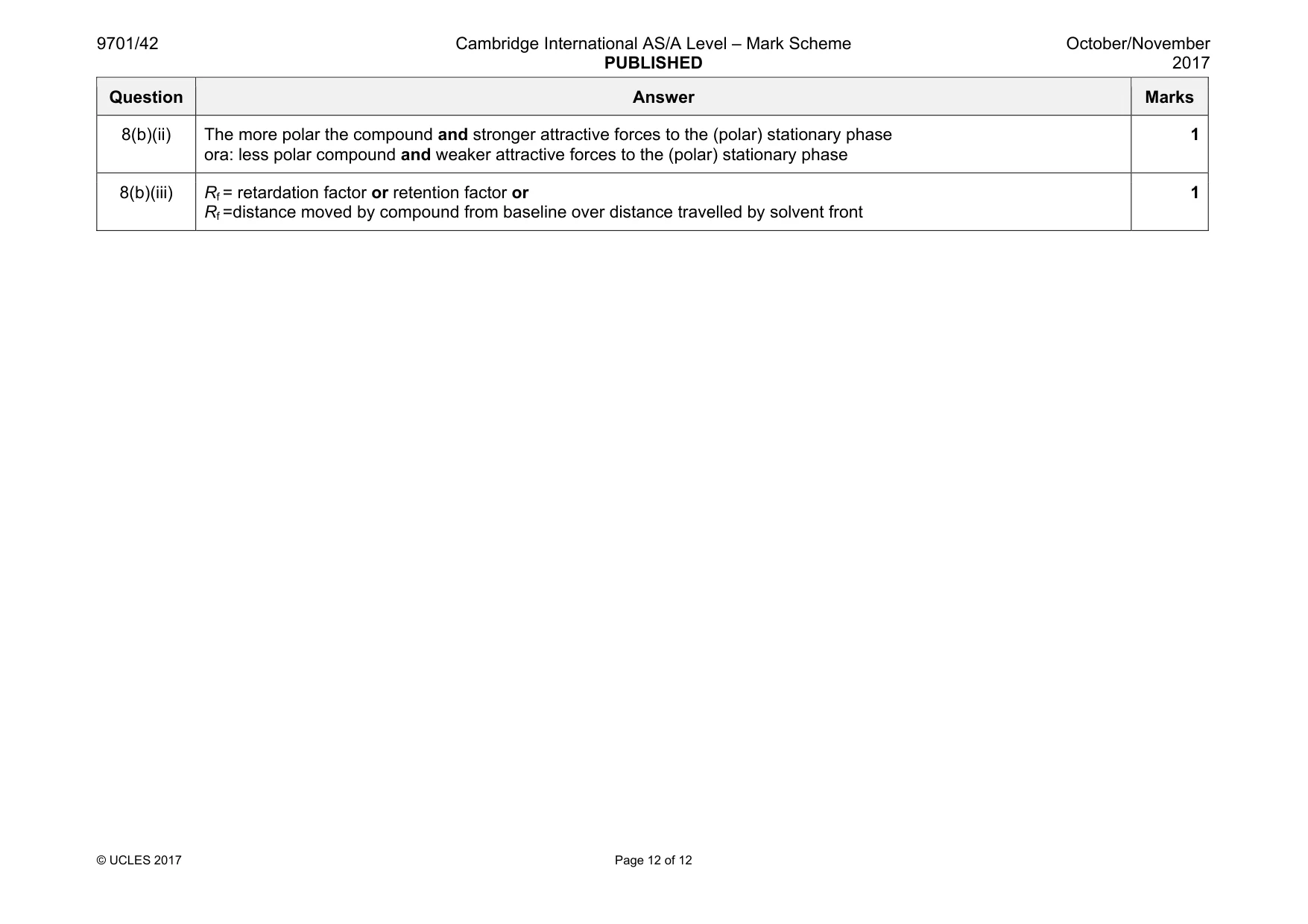
Mark scheme: 8(a)(i) circle or asterisk on correct C atom only [1] lines through the two correct bonds only [1] 2 8(a)(ii) ketone, (tertiary) alcohol, alkene, carboxylic acid two for each mark 2 8(a)(iii) sp carbons = 0 sp2 carbons = 8 sp3 carbons = 9 1 8(a)(iv) 2 8(b)(i) compound spot J 2 K 3 L 1 1 Question Answer Marks 8(b)(ii) The more polar the compound and stronger attractive forces to the (polar) stationary phase ora: less polar compound and weaker attractive forces to the (polar) stationary phase 1 8(b)(iii) Rf = retardation factor or retention factor or Rf =distance moved by compound from baseline over distance travelled by solvent front 1
More questions on Isomerism: structural isomerism and stereoisomerism
What was in this paper
The subtopics covered by these 8 questions, and how many questions each got. Open one in a new tab to see every Cambridge question on it.
1Infrared spectroscopy1Isomerism: structural isomerism and stereoisomerism1Lattice energy and Born-Haber cycles1Similarities and trends in the properties of the Group 2 metals, magnesium to barium, and their compounds1Simple rate equations, orders of reaction and rate constants1Standard electrode potentials E ⦵, standard cell potentials E ⦵ cell and the Nernst equation1Stereoisomerism in transition element complexes1What you needed in this session
Cambridge’s own grade thresholds for 2017 Oct/Nov, Paper 4 · Variant 2. A higher threshold means an easier paper — the bar moves with how the cohort did.