Cambridge A Level Chemistry 9701 — 2017 Oct/Nov Paper 3 · Variant 5
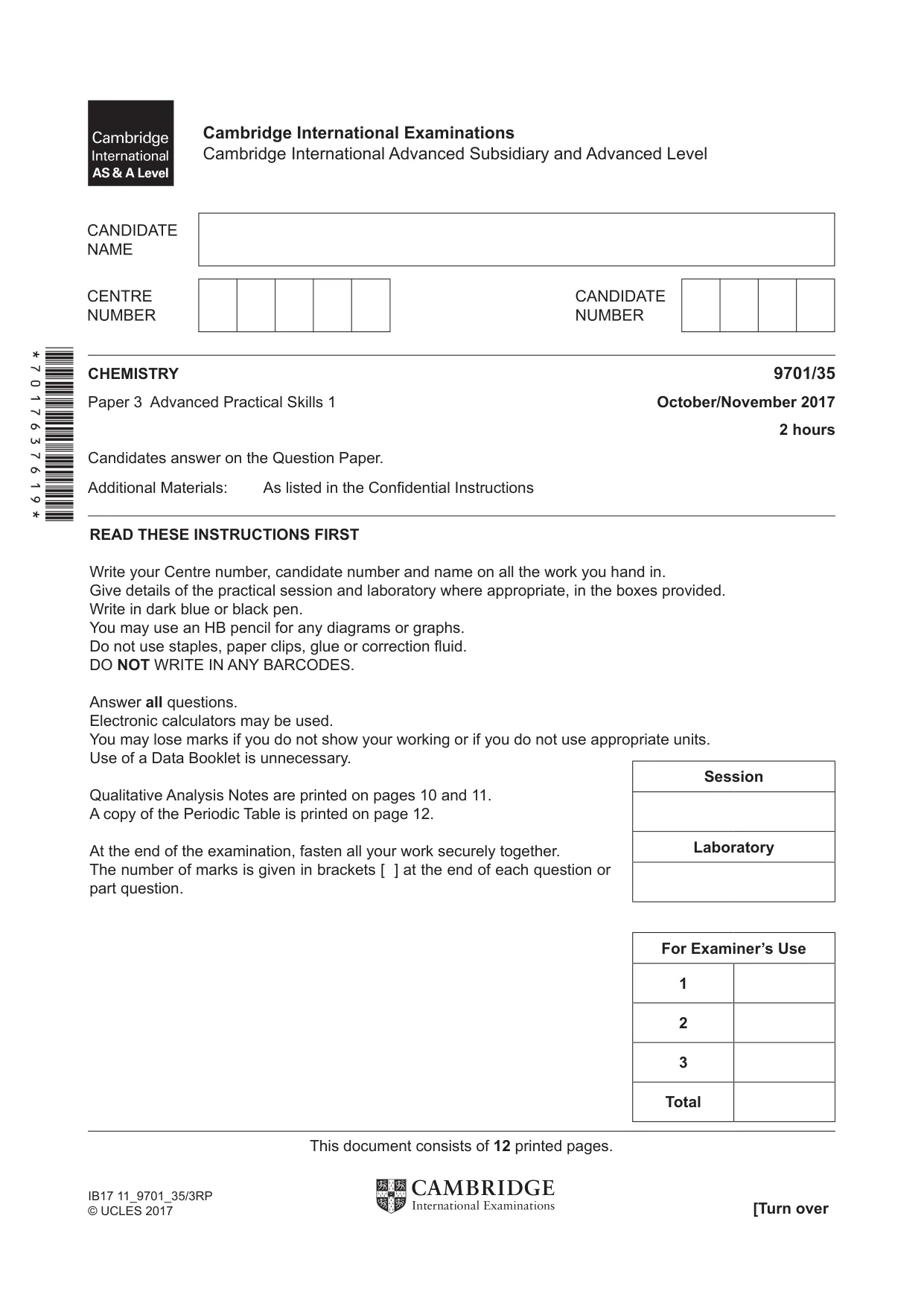
9701/35/O/N/17 · 3 questions · 40 marks · ≈45 min
The question paper and its mark scheme, free to read here and free to download. This is Cambridge’s own paper, exactly as it was sat.
Question paper12 pages
Mark scheme8 pages
Answers below. Sit the paper first if you are practising.
Questions as text
Q1 · In this experiment you will determine the oxidation number of iodine in one of its…
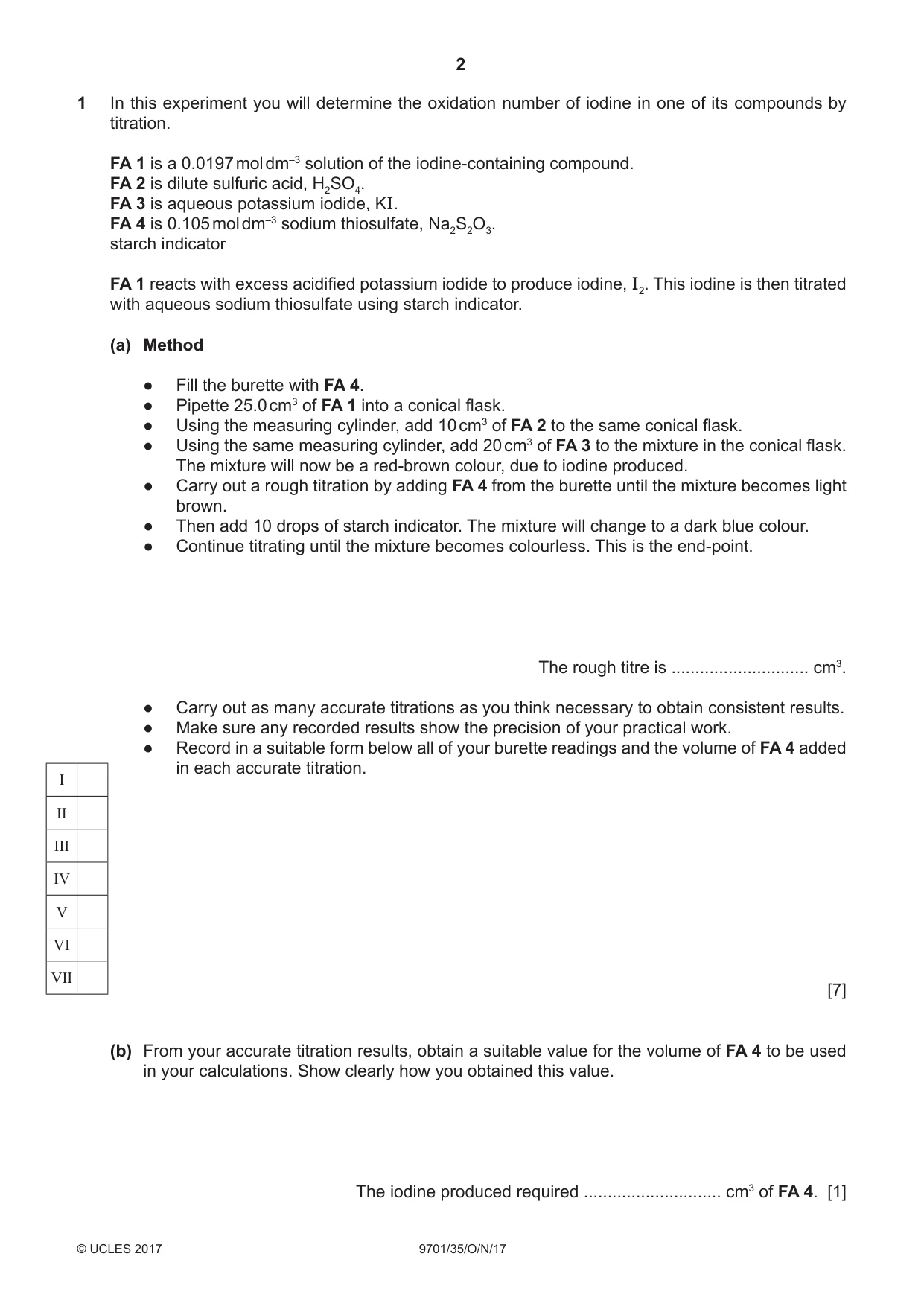
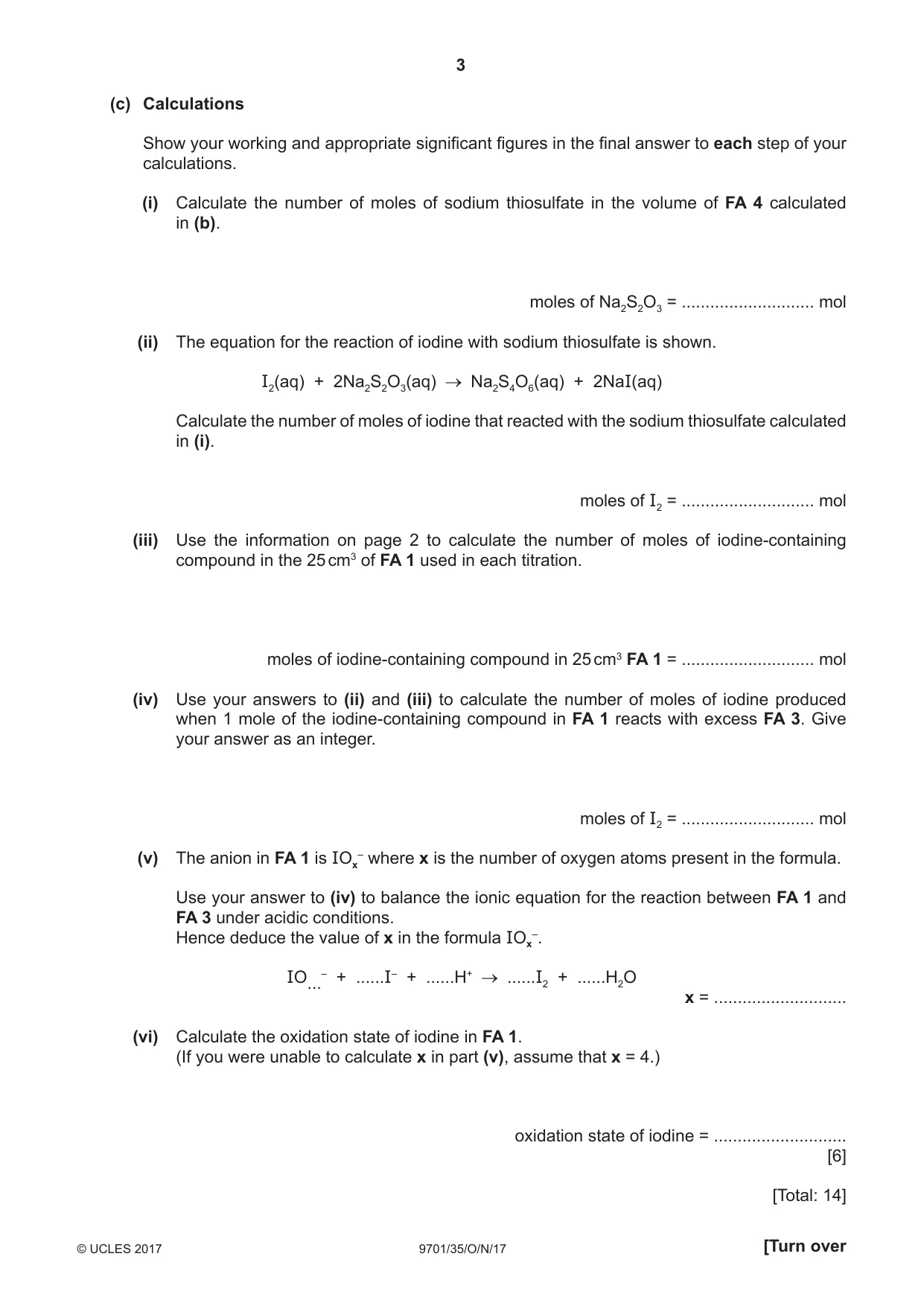
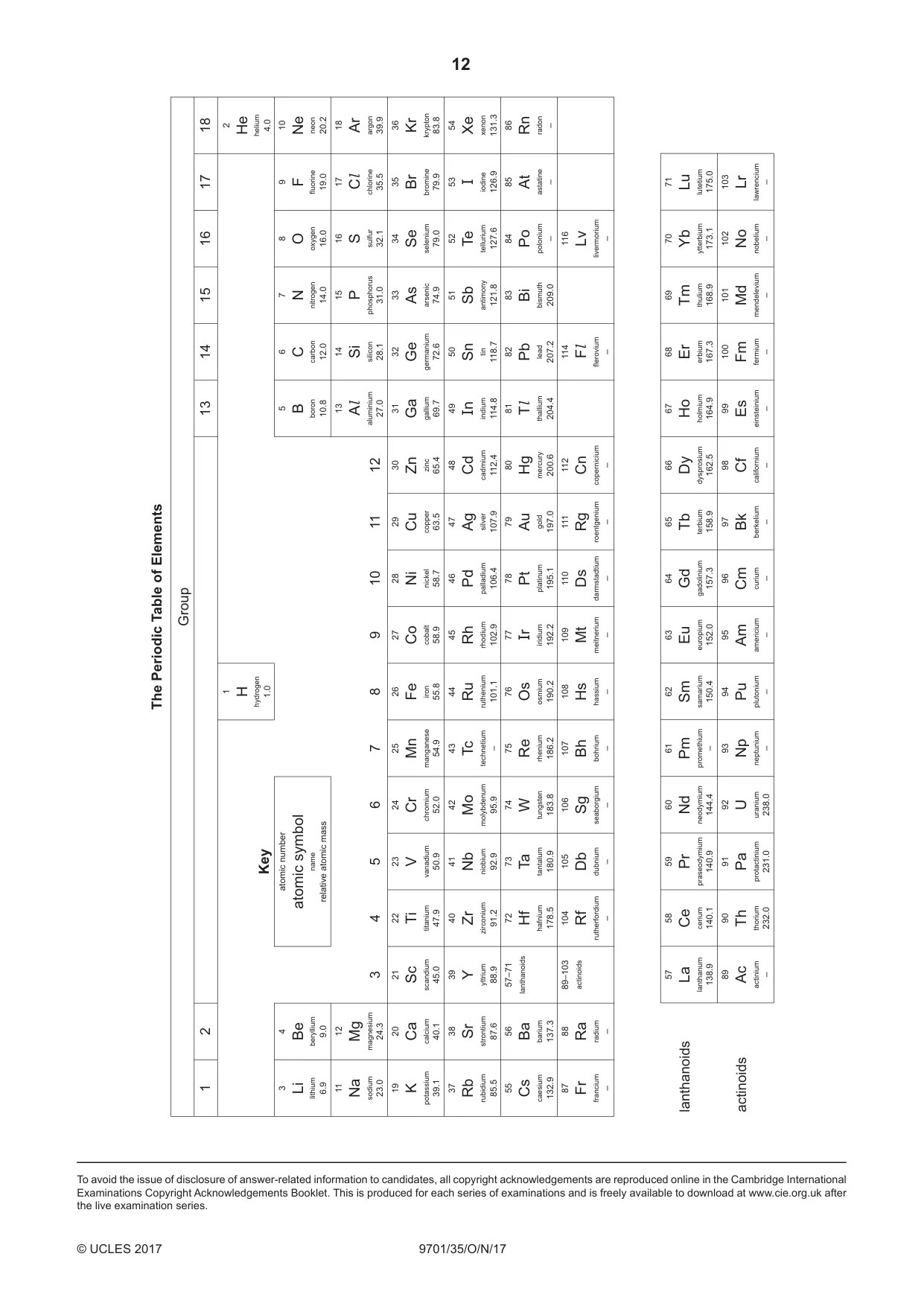
1 In this experiment you will determine the oxidation number of iodine in one of its compounds by titration. FA 1 is a 0.0197 mol dm–3 solution of the iodine-containing compound. FA 2 is dilute sulfuric acid, H2SO4. FA 3 is aqueous potassium iodide, KI. FA 4 is 0.105 mol dm–3 sodium thiosulfate, Na2S2O3. starch indicator FA 1 reacts with excess acidified potassium iodide to produce iodine, I2. This iodine is then titrated with aqueous sodium thiosulfate using starch indicator. (a) Method ● Fill the burette with FA 4. ● Pipette 25.0 cm3 of FA 1 into a conical flask. ● Using the measuring cylinder, add 10 cm3 of FA 2 to the same conical flask. ● Using the same measuring cylinder, add 20 cm3 of FA 3 to the mixture in the conical flask. The mixture will now be a red-brown colour, due to iodine produced. ● Carry out a rough titration by adding FA 4 from the burette until the mixture becomes light brown. ● Then add 10 drops of starch indicator. The mixture will change to a dark blue colour. ● Continue titrating until the mixture becomes colourless. This is the end-point. The rough titre is ............................. cm3. ● Carry out as many accurate titrations as you think necessary to obtain consistent results. ● Make sure any recorded results show the precision of your practical work. ● Record in a suitable form below all of your burette readings and the volume of FA 4 added in each accurate titration. I II III IV V VI VII [7] (b) From your accurate titration results, obtain a suitable value for the volume of FA 4 to be used in your calculations. Show clearly how you obtained this value. The iodine produced required ............................. cm3 of FA 4. [1] (c) Calculations Show your working and appropriate significant figures in the final answer to each step of your calculations. (i) Calculate the number of moles of sodium thiosulfate in the volume of FA 4 calculated in (b). moles of Na2S2O3 = ............................ mol (ii) The equation for the reaction of iodine with sodium thiosulfate is shown. I2(aq) + 2Na2S2O3(aq) Na2S4O6(aq) + 2NaI(aq) Calculate the number of moles of iodine that reacted with the sodium thiosulfate calculated in (i). moles of I2 = ............................ mol (iii) Use the information on page 2 to calculate the number of moles of iodine-containing compound in the 25 cm3 of FA 1 used in each titration. moles of iodine-containing compound in 25 cm3 FA 1 = ............................ mol (iv) Use your answers to (ii) and (iii) to calculate the number of moles of iodine produced when 1 mole of the iodine-containing compound in FA 1 reacts with excess FA 3. Give your answer as an integer. moles of I2 = ............................ mol (v) The anion in FA 1 is IOx– where x is the number of oxygen atoms present in the formula. Use your answer to (iv) to balance the ionic equation for the reaction between FA 1 and FA 3 under acidic conditions. Hence deduce the value of x in the formula IOx–. IO...– + ......I– + ......H+ ......I2 + ......H2O x = ............................ (vi) Calculate the oxidation state of iodine in FA 1. (If you were unable to calculate x in part (v), assume that x = 4.) oxidation state of iodine = ............................ [6] [Total: 14]
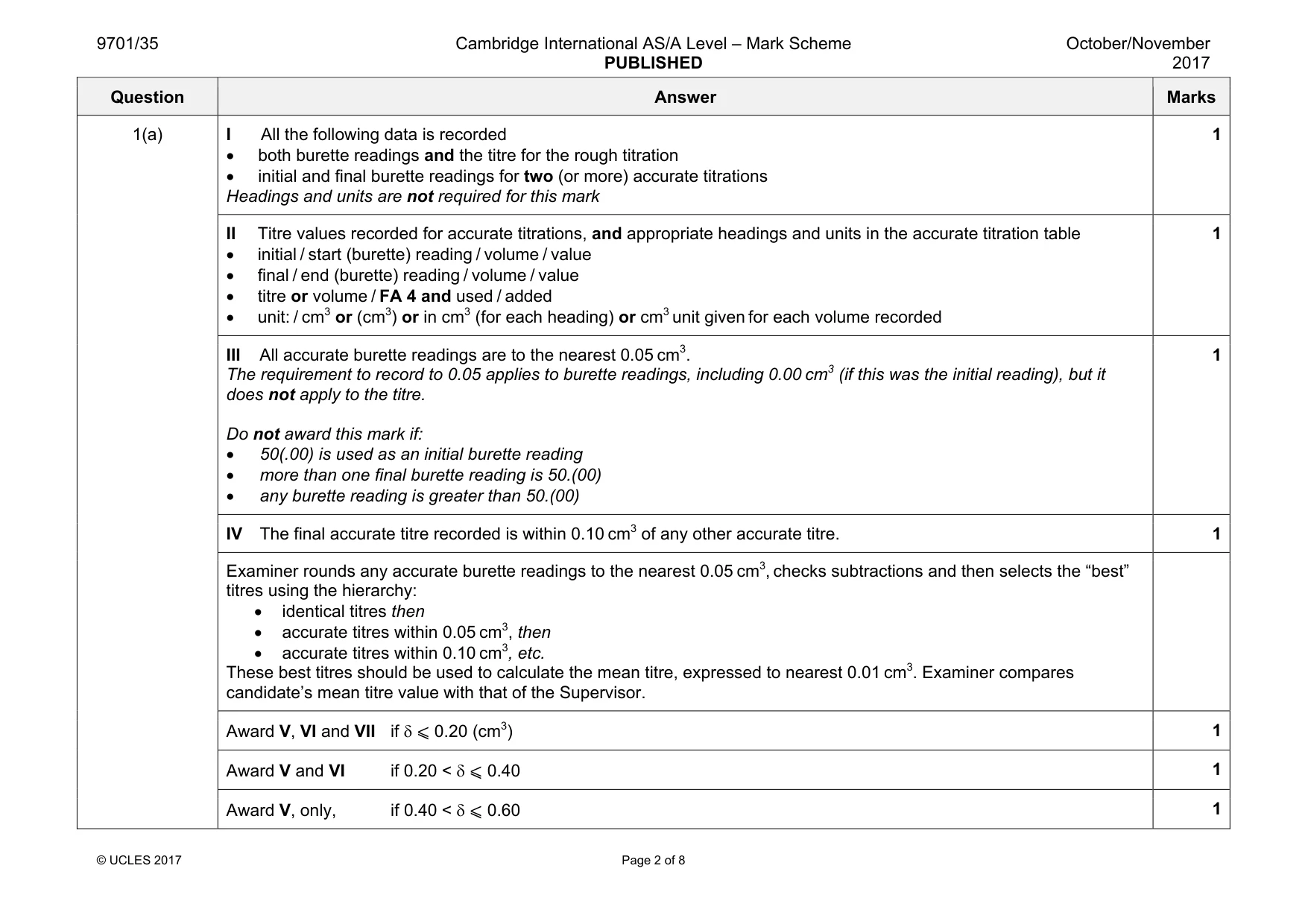
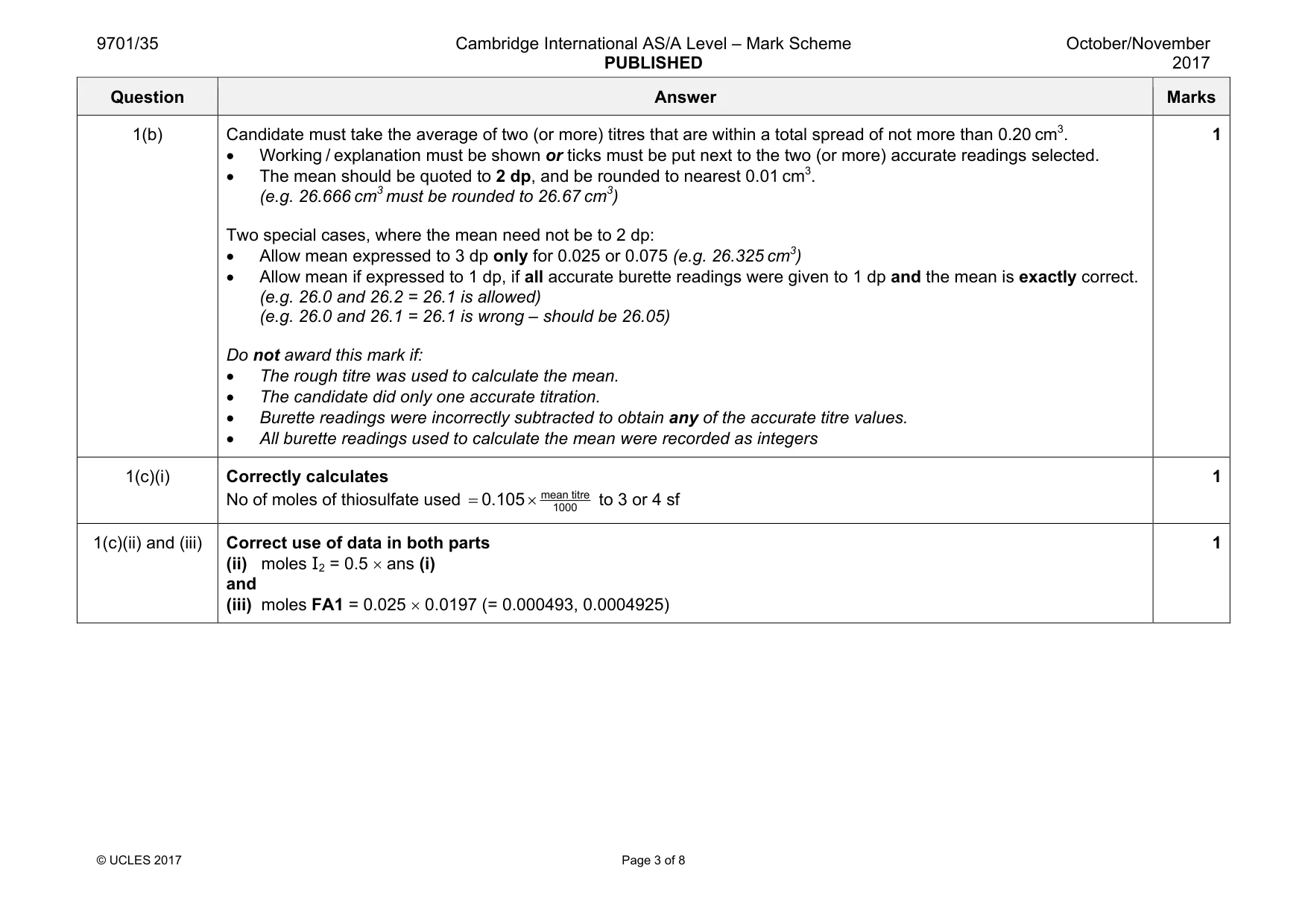
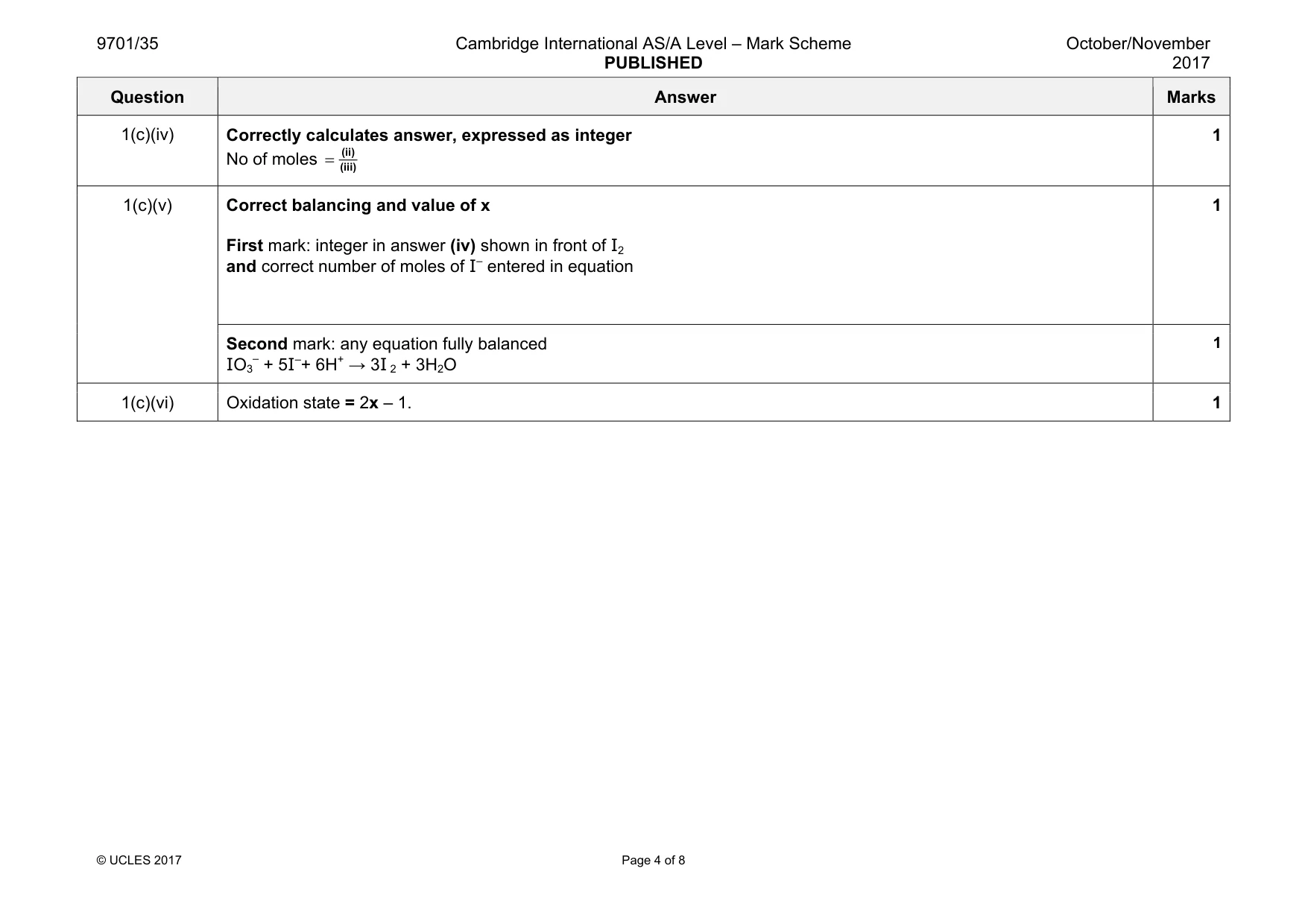
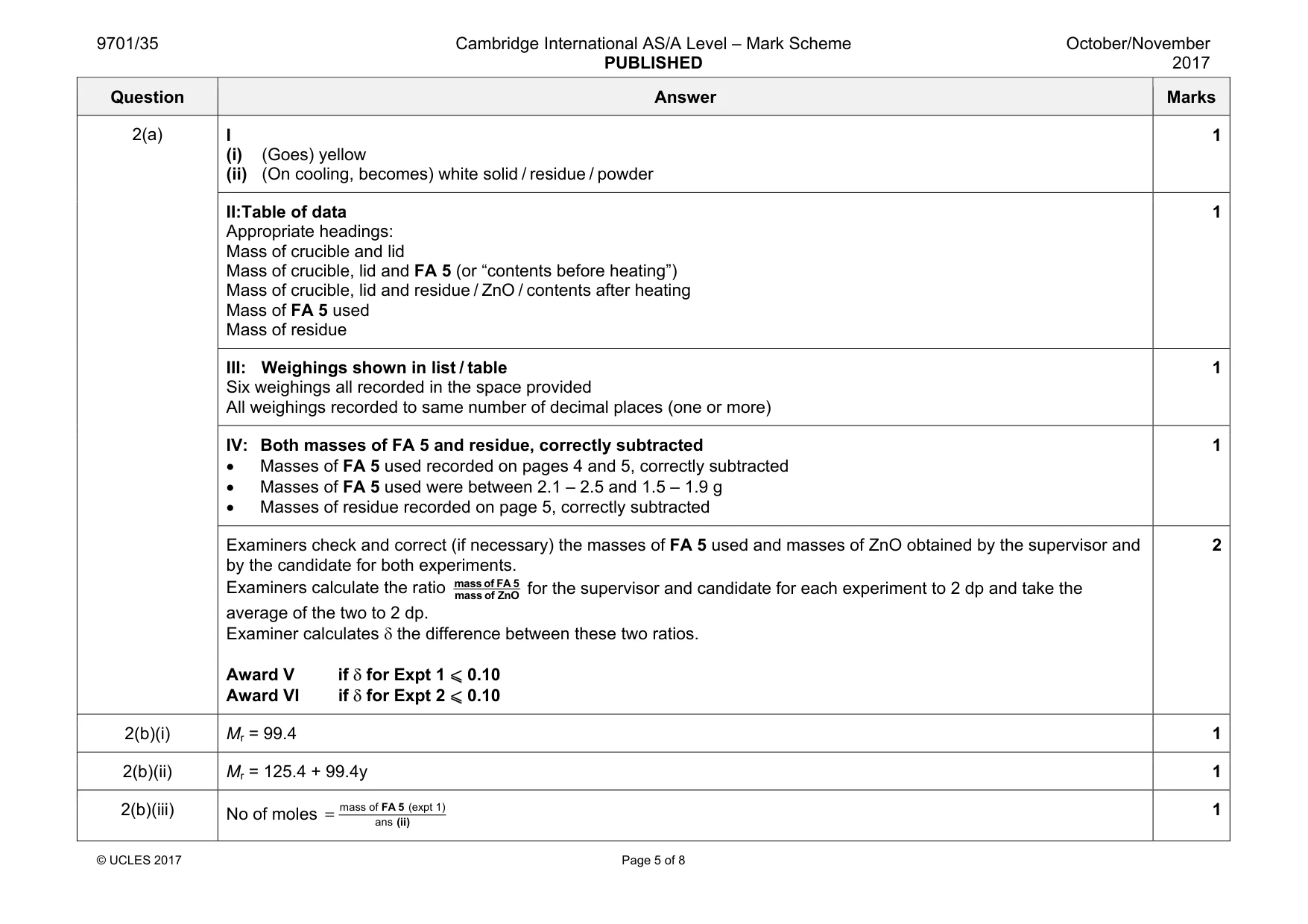
Mark scheme: 1(a) I All the following data is recorded • both burette readings and the titre for the rough titration • initial and final burette readings for two (or more) accurate titrations Headings and units are not required for this mark 1 II Titre values recorded for accurate titrations, and appropriate headings and units in the accurate titration table • initial / start (burette) reading / volume / value • final / end (burette) reading / volume / value • titre or volume / FA 4 and used / added • unit: / cm3 or (cm3) or in cm3 (for each heading) or cm3 unit given for each volume recorded 1 III All accurate burette readings are to the nearest 0.05 cm3. The requirement to record to 0.05 applies to burette readings, including 0.00 cm3 (if this was the initial reading), but it does not apply to the titre. Do not award this mark if: • 50(.00) is used as an initial burette reading • more than one final burette reading is 50.(00) • any burette reading is greater than 50.(00) 1 IV The final accurate titre recorded is within 0.10 cm3 of any other accurate titre. 1 Examiner rounds any accurate burette readings to the nearest 0.05 cm3, checks subtractions and then selects the “best” titres using the hierarchy: • identical titres then • accurate titres within 0.05 cm3, then • accurate titres within 0.10 cm3, etc. These best titres should be used to calculate the mean titre, expressed to nearest 0.01 cm3. Examiner compares candidate’s mean titre value with that of the Supervisor. Award V, VI and VII if δ ⩽ 0.20 (cm3) 1 Award V and VI if 0.20 < δ ⩽ 0.40 1 Award V, only, if 0.40 < δ ⩽ 0.60 1 Question Answer Marks 1(b) Candidate must take the average of two (or more) titres that are within a total spread of not more than 0.20 cm3. • Working / explanation must be shown or ticks must be put next to the two (or more) accurate readings selected. • The mean should be quoted to 2 dp, and be rounded to nearest 0.01 cm3. (e.g. 26.666 cm3 must be rounded to 26.67 cm3) Two special cases, where the mean need not be to 2 dp: • Allow mean expressed to 3 dp only for 0.025 or 0.075 (e.g. 26.325 cm3) • Allow mean if expressed to 1 dp, if all accurate burette readings were given to 1 dp and the mean is exactly correct. (e.g. 26.0 and 26.2 = 26.1 is allowed) (e.g. 26.0 and 26.1 = 26.1 is wrong – should be 26.05) Do not award this mark if: • The rough titre was used to calculate the mean. • The candidate did only one accurate titration. • Burette readings were incorrectly subtracted to obtain any of the accurate titre values. • All burette readings used to calculate the mean were recorded as integers 1 1(c)(i) Correctly calculates No of moles of thiosulfate used = × mean titre 1000 0.105 to 3 or 4 sf 1 1(c)(ii) and (iii) Correct use of data in both parts (ii) moles I2 = 0.5 × ans (i) and (iii) moles FA1 = 0.025 × 0.0197 (= 0.000493, 0.0004925) 1 Question Answer Marks 1(c)(iv) Correctly calculates answer, expressed as integer No of moles = (ii) (iii) 1 1(c)(v) Correct balancing and value of x First mark: integer in answer (iv) shown in front of I2 and correct number of moles of I– entered in equation 1 Second mark: any equation fully balanced IO3 – + 5I–+ 6H+ → 3I 2 + 3H2O 1 1(c)(vi) Oxidation state = 2x – 1. 1
Q2 · Zinc carbonate occurs in a basic form, which means that zinc hydroxide is also present
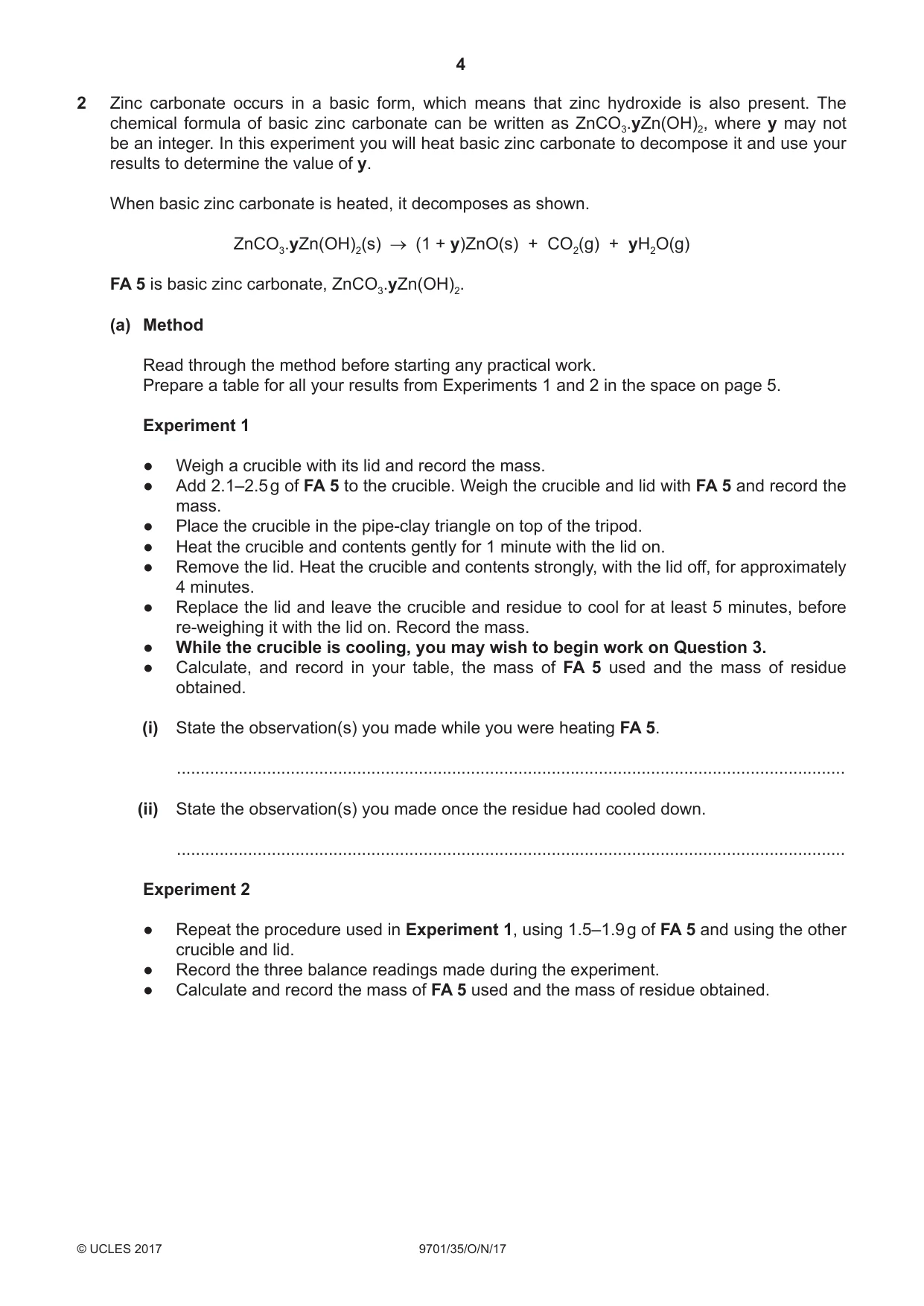
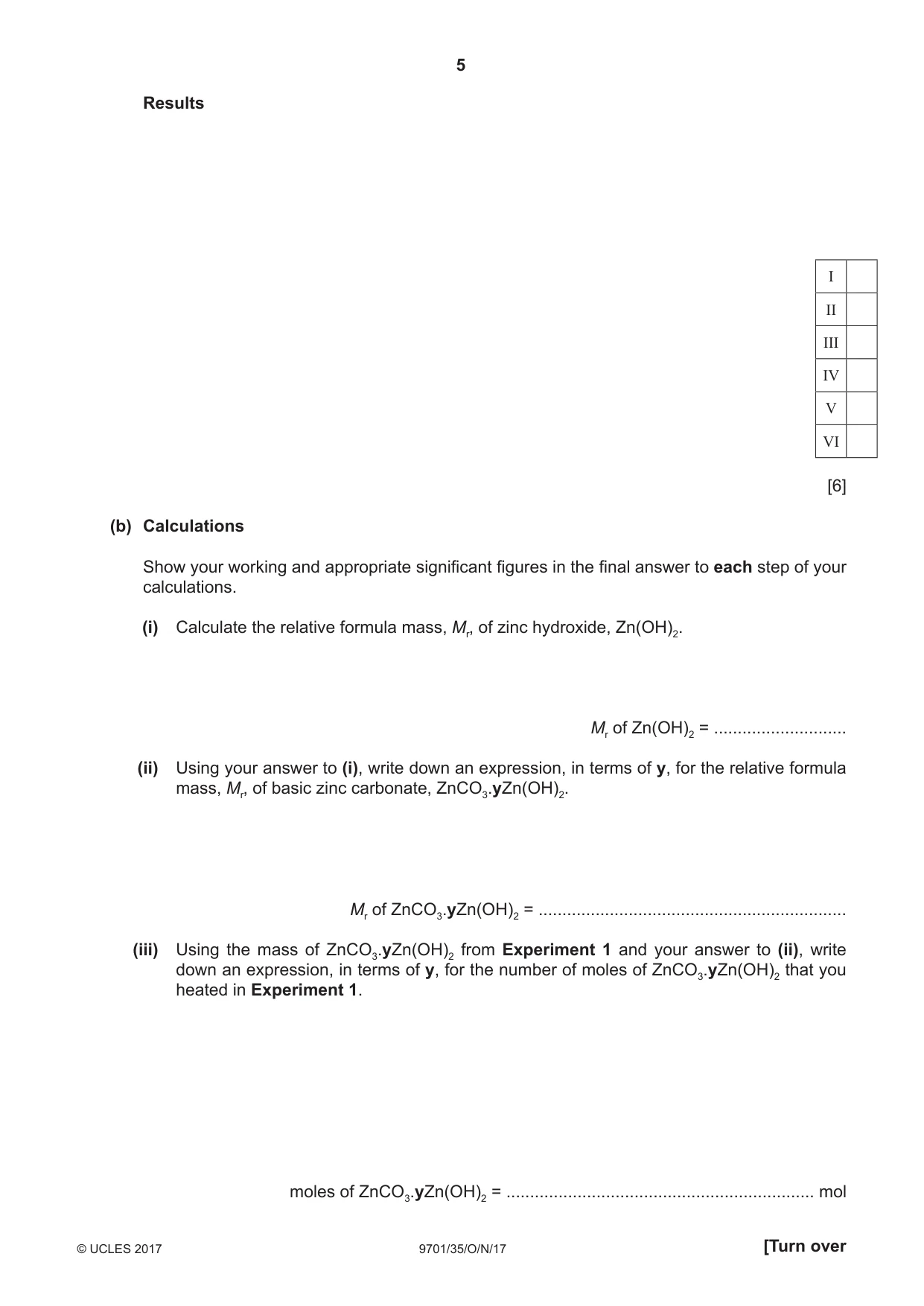
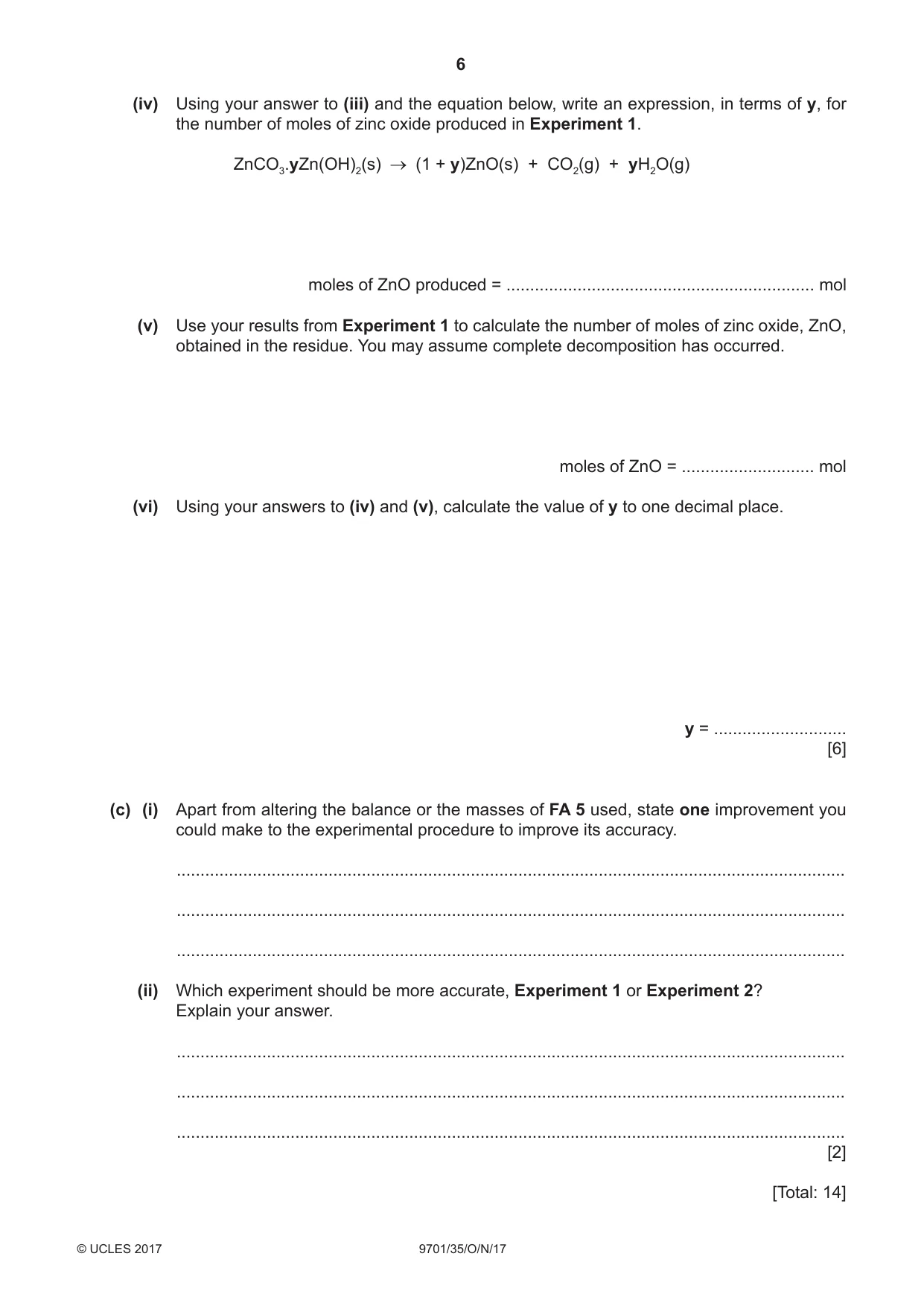
2 Zinc carbonate occurs in a basic form, which means that zinc hydroxide is also present. The chemical formula of basic zinc carbonate can be written as ZnCO3.yZn(OH)2, where y may not be an integer. In this experiment you will heat basic zinc carbonate to decompose it and use your results to determine the value of y. When basic zinc carbonate is heated, it decomposes as shown. ZnCO3.yZn(OH)2(s) (1 + y)ZnO(s) + CO2(g) + yH2O(g) FA 5 is basic zinc carbonate, ZnCO3.yZn(OH)2. (a) Method Read through the method before starting any practical work. Prepare a table for all your results from Experiments 1 and 2 in the space on page 5. Experiment 1 ● Weigh a crucible with its lid and record the mass. ● Add 2.1–2.5 g of FA 5 to the crucible. Weigh the crucible and lid with FA 5 and record the mass. ● Place the crucible in the pipe-clay triangle on top of the tripod. ● Heat the crucible and contents gently for 1 minute with the lid on. ● Remove the lid. Heat the crucible and contents strongly, with the lid off, for approximately 4 minutes. ● Replace the lid and leave the crucible and residue to cool for at least 5 minutes, before re-weighing it with the lid on. Record the mass. ● While the crucible is cooling, you may wish to begin work on Question 3. ● Calculate, and record in your table, the mass of FA 5 used and the mass of residue obtained. (i) State the observation(s) you made while you were heating FA 5. ............................................................................................................................................. (ii) State the observation(s) you made once the residue had cooled down. ............................................................................................................................................. Experiment 2 ● Repeat the procedure used in Experiment 1, using 1.5–1.9 g of FA 5 and using the other crucible and lid. ● Record the three balance readings made during the experiment. ● Calculate and record the mass of FA 5 used and the mass of residue obtained. Results I II III IV V VI [6] (b) Calculations Show your working and appropriate significant figures in the final answer to each step of your calculations. (i) Calculate the relative formula mass, Mr, of zinc hydroxide, Zn(OH)2. Mr of Zn(OH)2 = ............................ (ii) Using your answer to (i), write down an expression, in terms of y, for the relative formula mass, Mr, of basic zinc carbonate, ZnCO3.yZn(OH)2. Mr of ZnCO3.yZn(OH)2 = ................................................................. (iii) Using the mass of ZnCO3.yZn(OH)2 from Experiment 1 and your answer to (ii), write down an expression, in terms of y, for the number of moles of ZnCO3.yZn(OH)2 that you heated in Experiment 1. moles of ZnCO3.yZn(OH)2 = ................................................................. mol (iv) Using your answer to (iii) and the equation below, write an expression, in terms of y, for the number of moles of zinc oxide produced in Experiment 1. ZnCO3.yZn(OH)2(s) (1 + y)ZnO(s) + CO2(g) + yH2O(g) moles of ZnO produced = ................................................................. mol (v) Use your results from Experiment 1 to calculate the number of moles of zinc oxide, ZnO, obtained in the residue. You may assume complete decomposition has occurred. moles of ZnO = ............................ mol (vi) Using your answers to (iv) and (v), calculate the value of y to one decimal place. y = ............................ [6] (c) (i) Apart from altering the balance or the masses of FA 5 used, state one improvement you could make to the experimental procedure to improve its accuracy. ............................................................................................................................................. ............................................................................................................................................. ............................................................................................................................................. (ii) Which experiment should be more accurate, Experiment 1 or Experiment 2? Explain your answer. ............................................................................................................................................. ............................................................................................................................................. ............................................................................................................................................. [2] [Total: 14]
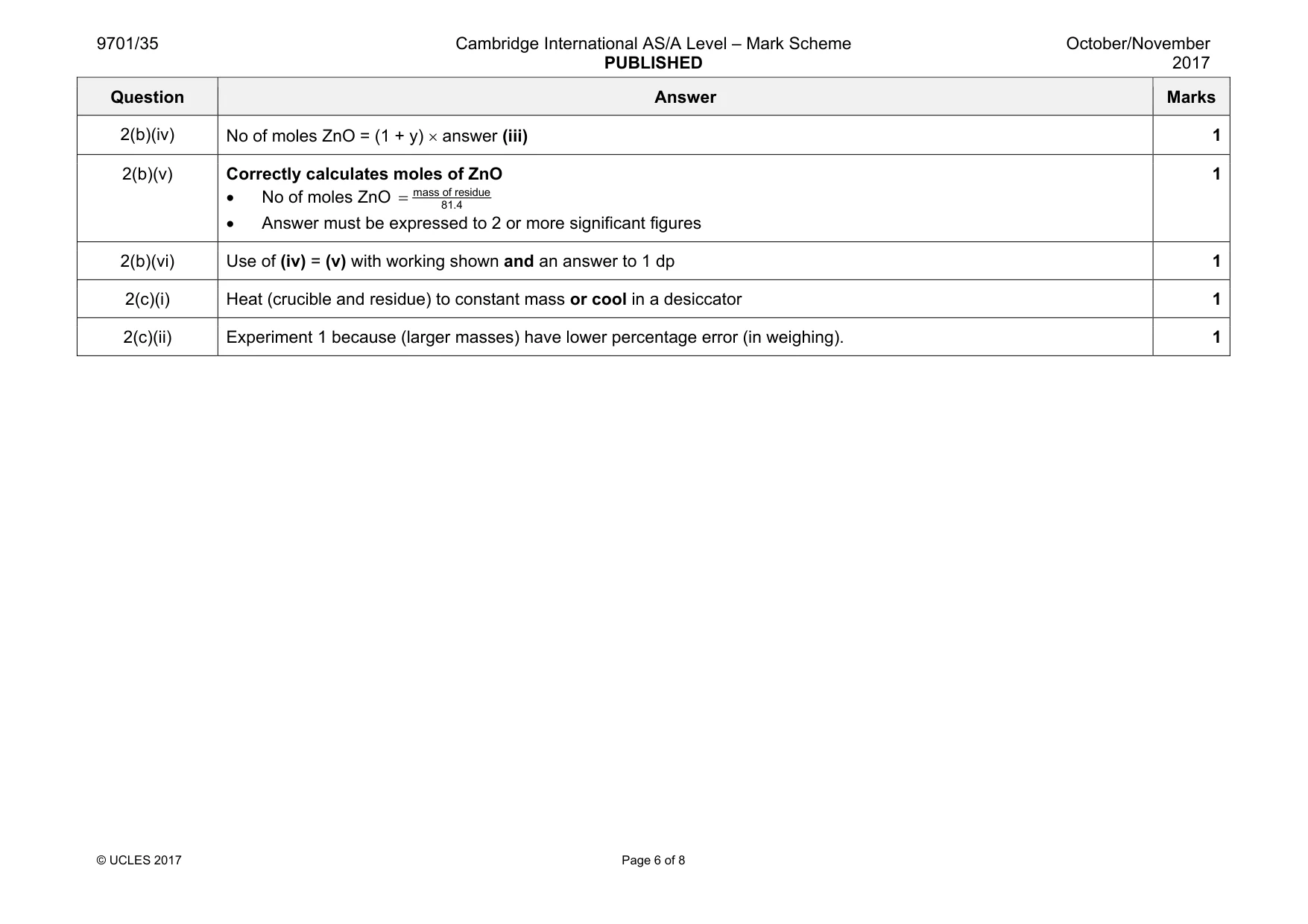
Mark scheme: 2(a) I (i) (Goes) yellow (ii) (On cooling, becomes) white solid / residue / powder 1 II:Table of data Appropriate headings: Mass of crucible and lid Mass of crucible, lid and FA 5 (or “contents before heating”) Mass of crucible, lid and residue / ZnO / contents after heating Mass of FA 5 used Mass of residue 1 III: Weighings shown in list / table Six weighings all recorded in the space provided All weighings recorded to same number of decimal places (one or more) 1 IV: Both masses of FA 5 and residue, correctly subtracted • Masses of FA 5 used recorded on pages 4 and 5, correctly subtracted • Masses of FA 5 used were between 2.1 – 2.5 and 1.5 – 1.9 g • Masses of residue recorded on page 5, correctly subtracted 1 Examiners check and correct (if necessary) the masses of FA 5 used and masses of ZnO obtained by the supervisor and by the candidate for both experiments. Examiners calculate the ratio mass of FA 5 mass of ZnO for the supervisor and candidate for each experiment to 2 dp and take the average of the two to 2 dp. Examiner calculates δ the difference between these two ratios. Award V if δ for Expt 1 ⩽ 0.10 Award VI if δ for Expt 2 ⩽ 0.10 2 2(b)(i) Mr = 99.4 1 2(b)(ii) Mr = 125.4 + 99.4y 1 2(b)(iii) No of moles mass of (expt 1) ans = FA 5 (ii) 1 Question Answer Marks 2(b)(iv) No of moles ZnO = (1 + y) × answer (iii) 1 2(b)(v) Correctly calculates moles of ZnO • No of moles ZnO = mass of residue 81.4 • Answer must be expressed to 2 or more significant figures 1 2(b)(vi) Use of (iv) = (v) with working shown and an answer to 1 dp 1 2(c)(i) Heat (crucible and residue) to constant mass or cool in a desiccator 1 2(c)(ii) Experiment 1 because (larger masses) have lower percentage error (in weighing). 1
More questions on Reacting masses and volumes (of solutions and gases)
Q3 · Qualitative Analysis At each stage of any test you are to record details of the…
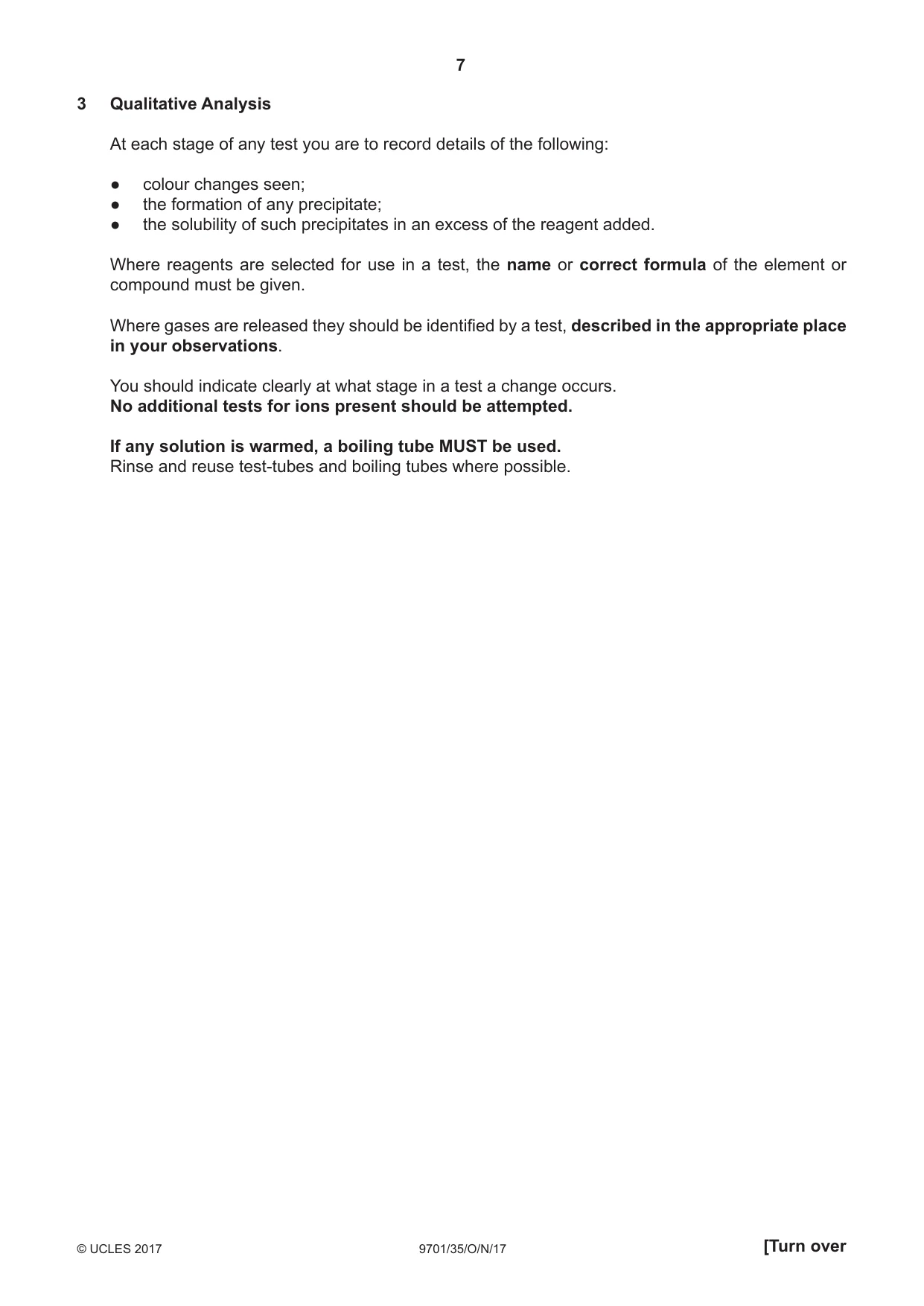
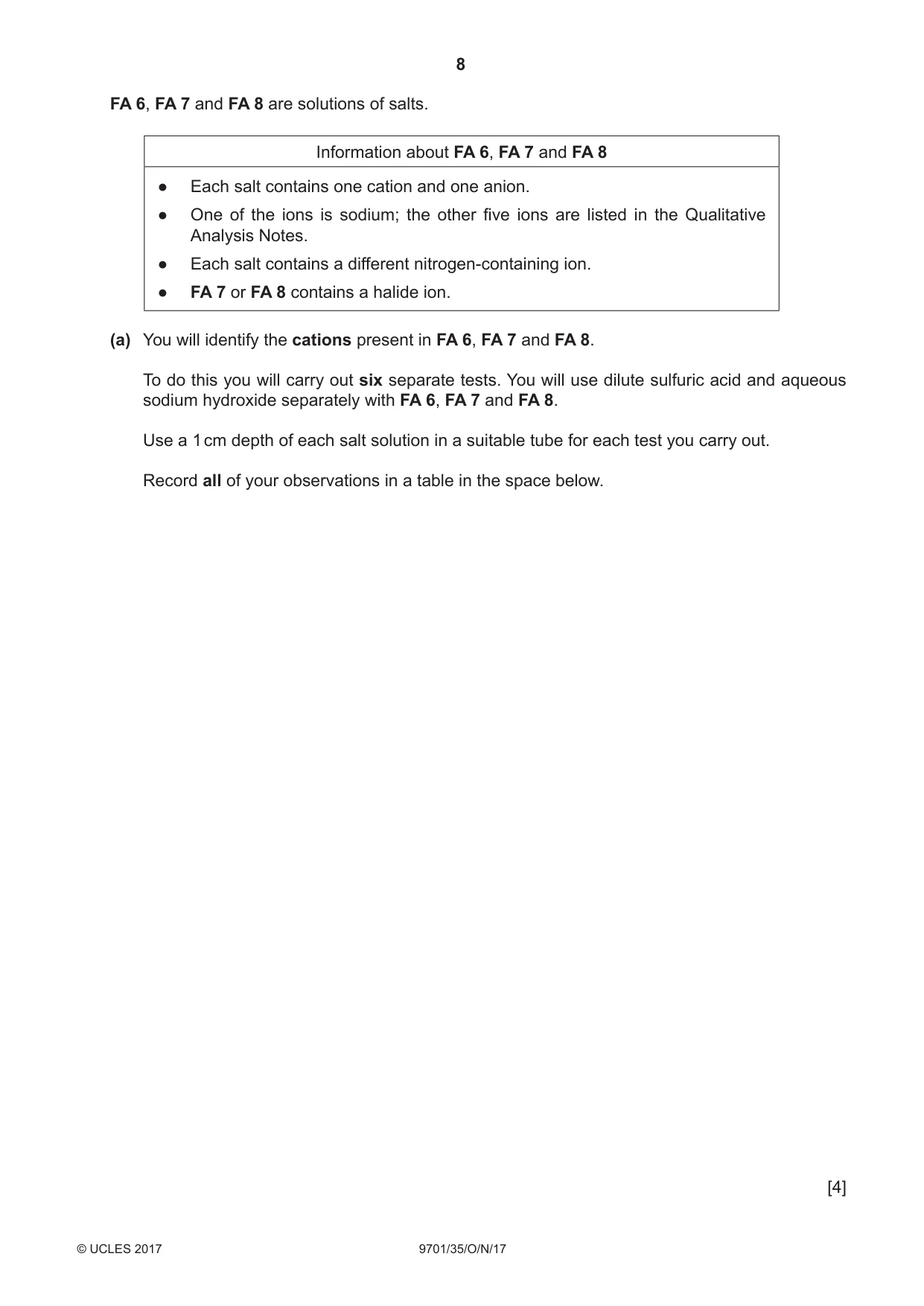
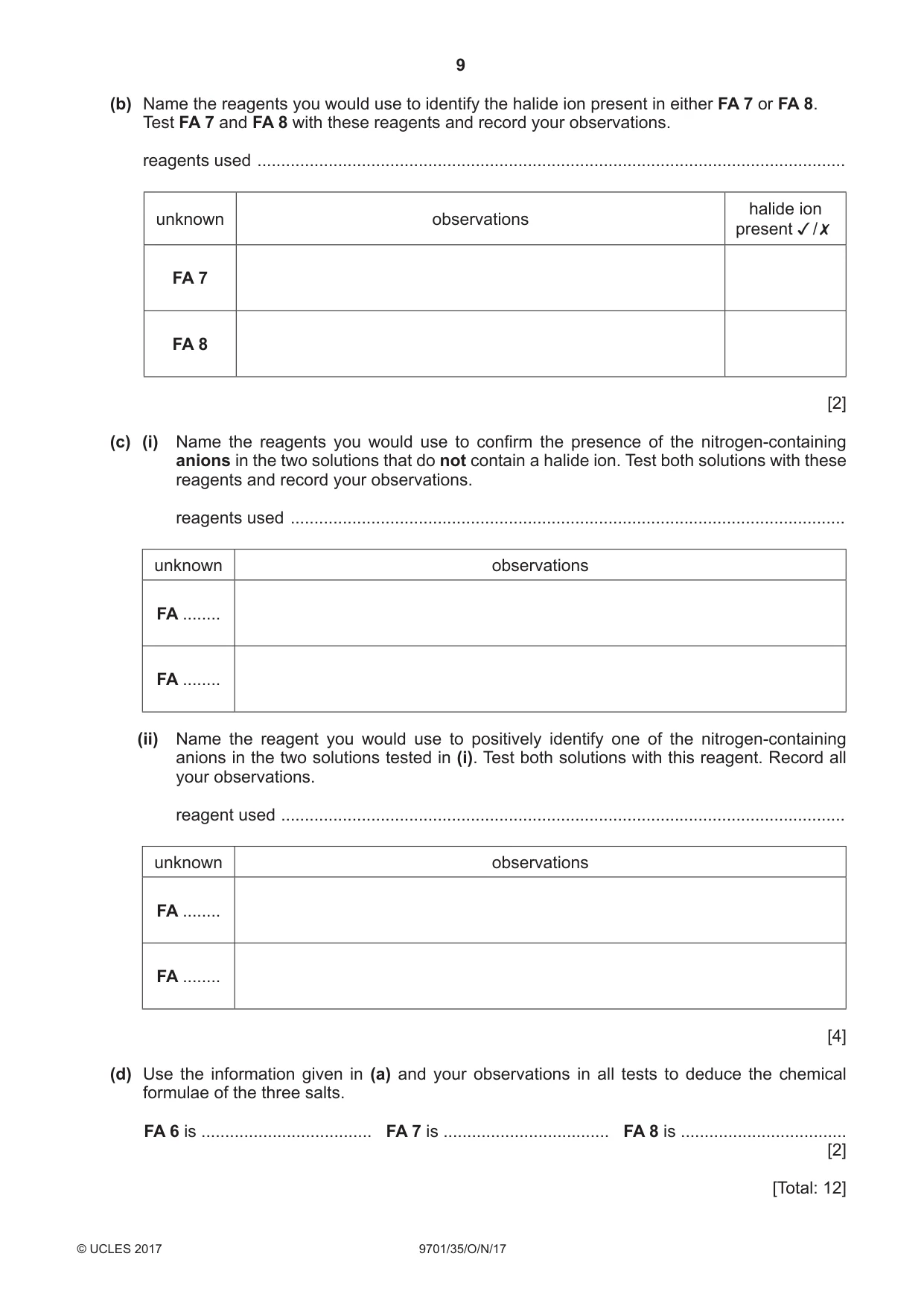
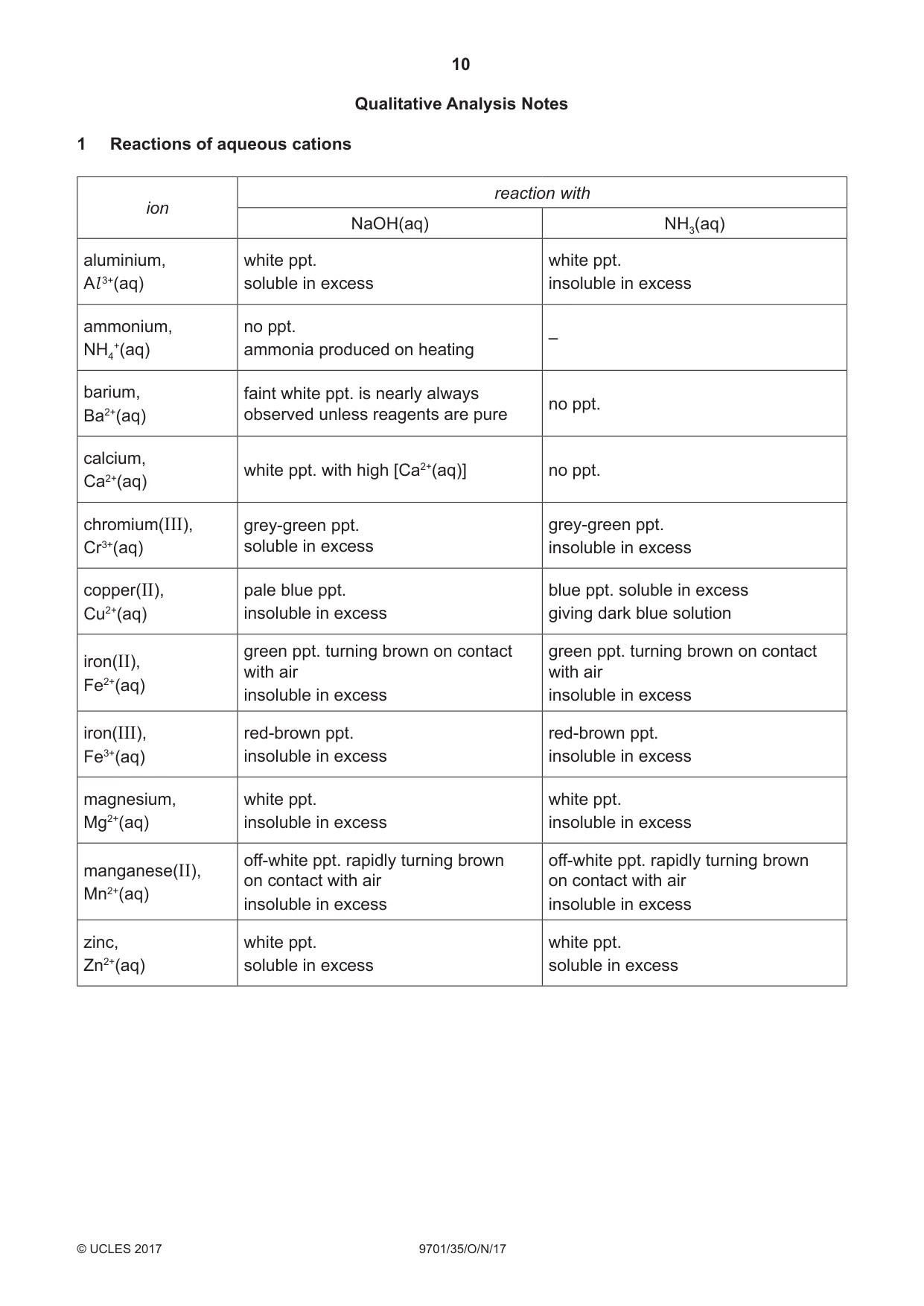
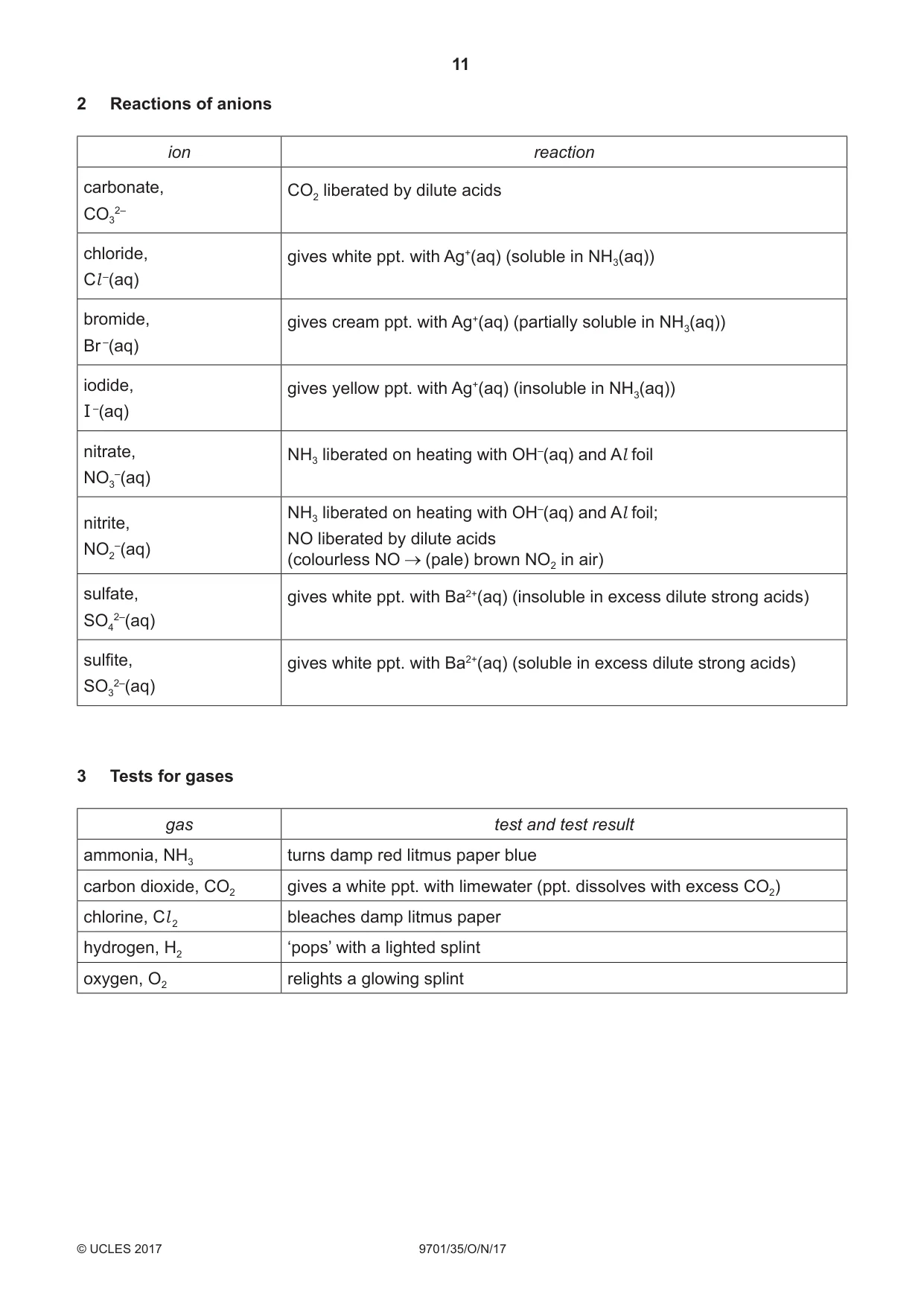
3 Qualitative Analysis At each stage of any test you are to record details of the following: ● colour changes seen; ● the formation of any precipitate; ● the solubility of such precipitates in an excess of the reagent added. Where reagents are selected for use in a test, the name or correct formula of the element or compound must be given. Where gases are released they should be identified by a test, described in the appropriate place in your observations. You should indicate clearly at what stage in a test a change occurs. No additional tests for ions present should be attempted. If any solution is warmed, a boiling tube MUST be used. Rinse and reuse test-tubes and boiling tubes where possible. FA 6, FA 7 and FA 8 are solutions of salts. Information about FA 6, FA 7 and FA 8 ● Each salt contains one cation and one anion. ● One of the ions is sodium; the other five ions are listed in the Qualitative Analysis Notes. ● Each salt contains a different nitrogen-containing ion. ● FA 7 or FA 8 contains a halide ion. (a) You will identify the cations present in FA 6, FA 7 and FA 8. To do this you will carry out six separate tests. You will use dilute sulfuric acid and aqueous sodium hydroxide separately with FA 6, FA 7 and FA 8. Use a 1 cm depth of each salt solution in a suitable tube for each test you carry out. Record all of your observations in a table in the space below. [4] (b) Name the reagents you would use to identify the halide ion present in either FA 7 or FA 8. Test FA 7 and FA 8 with these reagents and record your observations. reagents used ............................................................................................................................ halide ion unknown observations present / FA 7 FA 8 [2] (c) (i) Name the reagents you would use to confirm the presence of the nitrogen-containing anions in the two solutions that do not contain a halide ion. Test both solutions with these reagents and record your observations. reagents used ..................................................................................................................... unknown observations FA ........ FA ........ (ii) Name the reagent you would use to positively identify one of the nitrogen‑containing anions in the two solutions tested in (i). Test both solutions with this reagent. Record all your observations. reagent used ....................................................................................................................... unknown observations FA ........ FA ........ [4] (d) Use the information given in (a) and your observations in all tests to deduce the chemical formulae of the three salts. FA 6 is .................................... FA 7 is ................................... FA 8 is ................................... [2] [Total: 12]
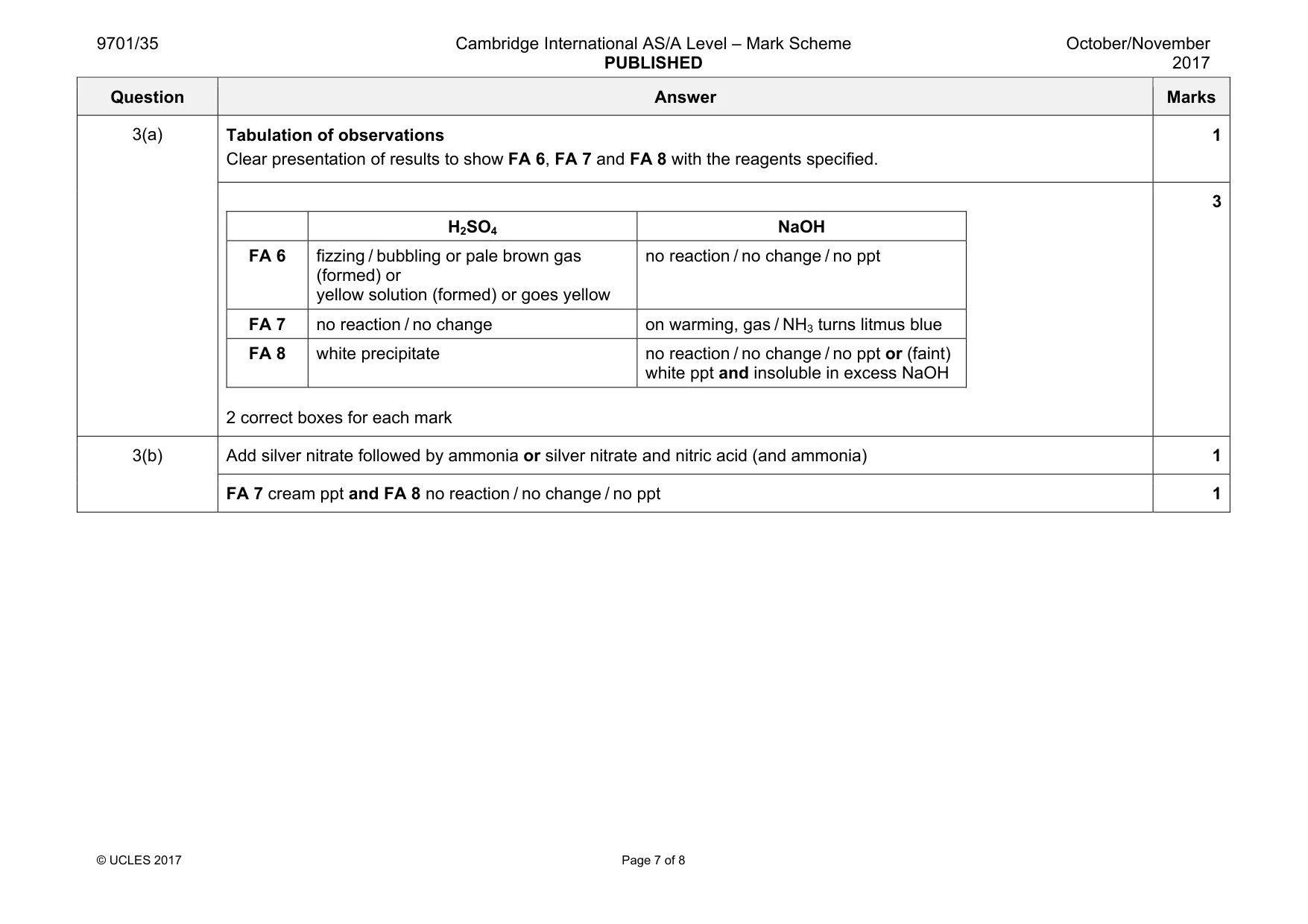
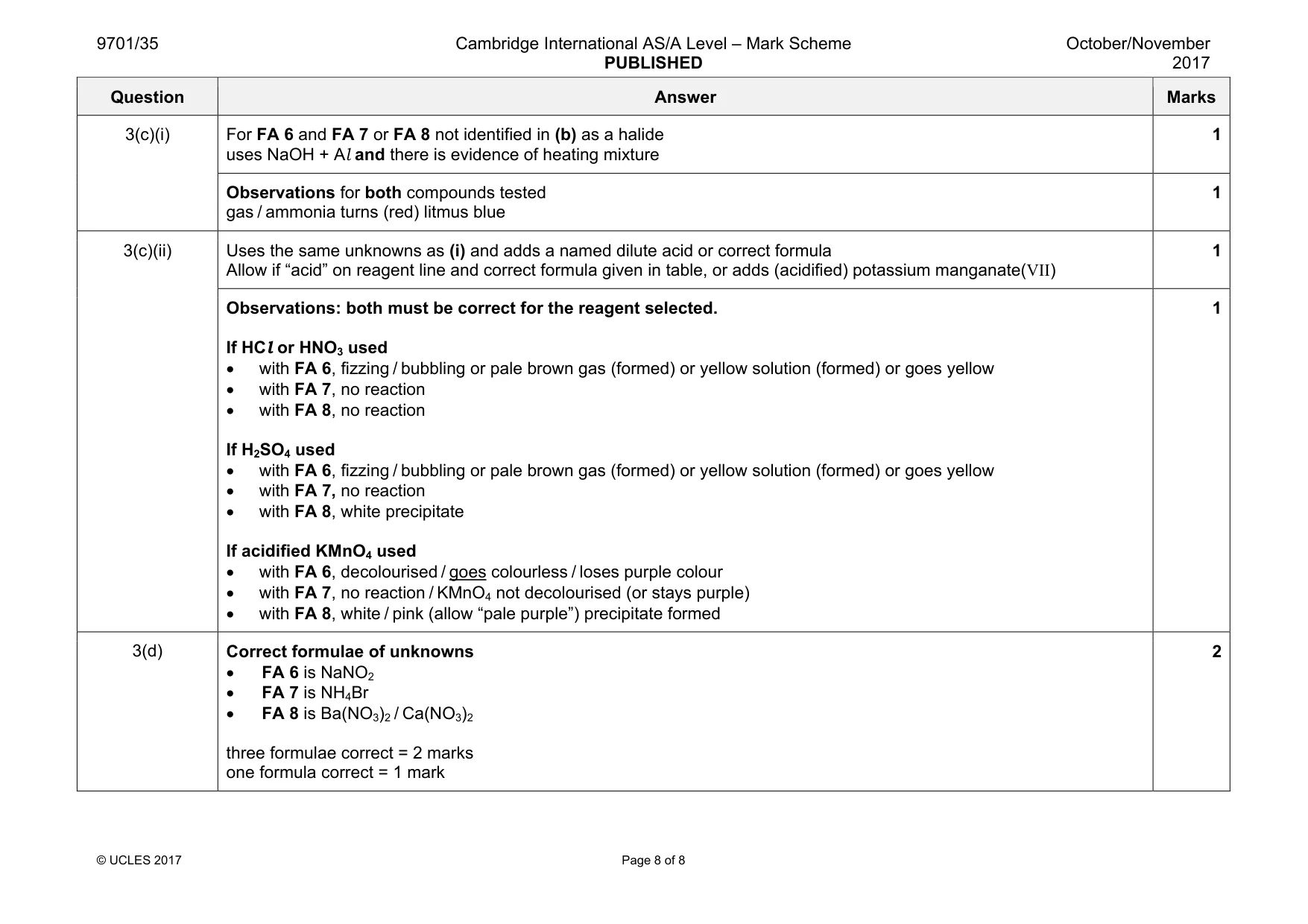
Mark scheme: 3(a) Tabulation of observations Clear presentation of results to show FA 6, FA 7 and FA 8 with the reagents specified. 1 H2SO4 NaOH FA 6 fizzing / bubbling or pale brown gas (formed) or yellow solution (formed) or goes yellow no reaction / no change / no ppt FA 7 no reaction / no change on warming, gas / NH3 turns litmus blue FA 8 white precipitate no reaction / no change / no ppt or (faint) white ppt and insoluble in excess NaOH 2 correct boxes for each mark 3 3(b) Add silver nitrate followed by ammonia or silver nitrate and nitric acid (and ammonia) 1 FA 7 cream ppt and FA 8 no reaction / no change / no ppt 1 Question Answer Marks 3(c)(i) For FA 6 and FA 7 or FA 8 not identified in (b) as a halide uses NaOH + Al and there is evidence of heating mixture 1 Observations for both compounds tested gas / ammonia turns (red) litmus blue 1 3(c)(ii) Uses the same unknowns as (i) and adds a named dilute acid or correct formula Allow if “acid” on reagent line and correct formula given in table, or adds (acidified) potassium manganate(VII) 1 Observations: both must be correct for the reagent selected. If HCl or HNO3 used • with FA 6, fizzing / bubbling or pale brown gas (formed) or yellow solution (formed) or goes yellow • with FA 7, no reaction • with FA 8, no reaction If H2SO4 used • with FA 6, fizzing / bubbling or pale brown gas (formed) or yellow solution (formed) or goes yellow • with FA 7, no reaction • with FA 8, white precipitate If acidified KMnO4 used • with FA 6, decolourised / goes colourless / loses purple colour • with FA 7, no reaction / KMnO4 not decolourised (or stays purple) • with FA 8, white / pink (allow “pale purple”) precipitate formed 1 3(d) Correct formulae of unknowns • FA 6 is NaNO2 • FA 7 is NH4Br • FA 8 is Ba(NO3)2 / Ca(NO3)2 three formulae correct = 2 marks one formula correct = 1 mark 2
What was in this paper
The subtopics covered by these 3 questions, and how many questions each got. Open one in a new tab to see every Cambridge question on it.
What you needed in this session
Cambridge’s own grade thresholds for 2017 Oct/Nov, Paper 3 · Variant 5. A higher threshold means an easier paper — the bar moves with how the cohort did.