Cambridge A Level Chemistry 9701 — 2017 Feb/March Paper 4 · Variant 2
9701/42/F/M/17 · 9 questions · 100 marks · ≈113 min
The question paper and its mark scheme, free to read here and free to download. This is Cambridge’s own paper, exactly as it was sat.
Question paper24 pages

Mark scheme12 pages
Answers below. Sit the paper first if you are practising.
Questions as text
Q1 · The mass spectrum of silicon is shown
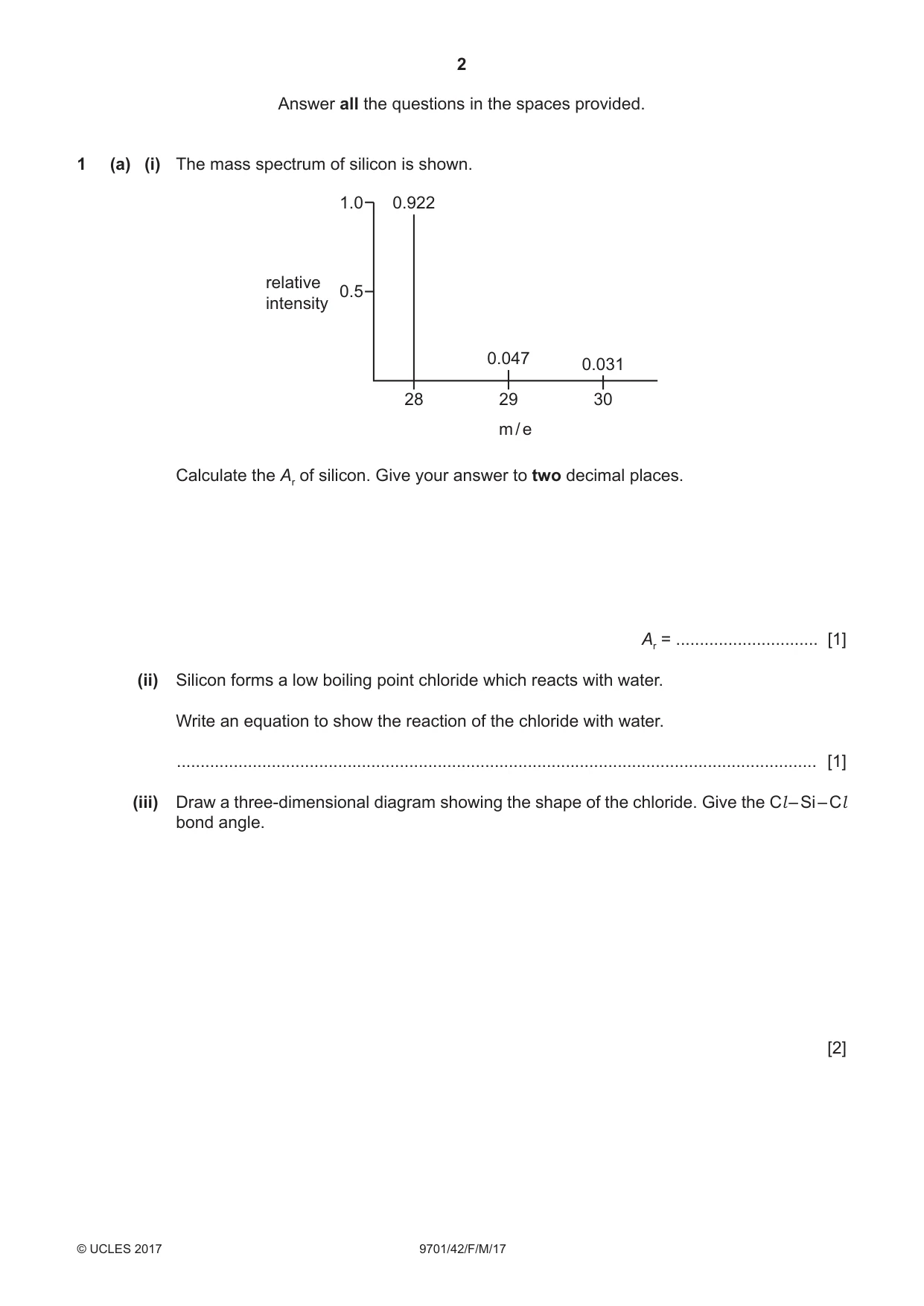
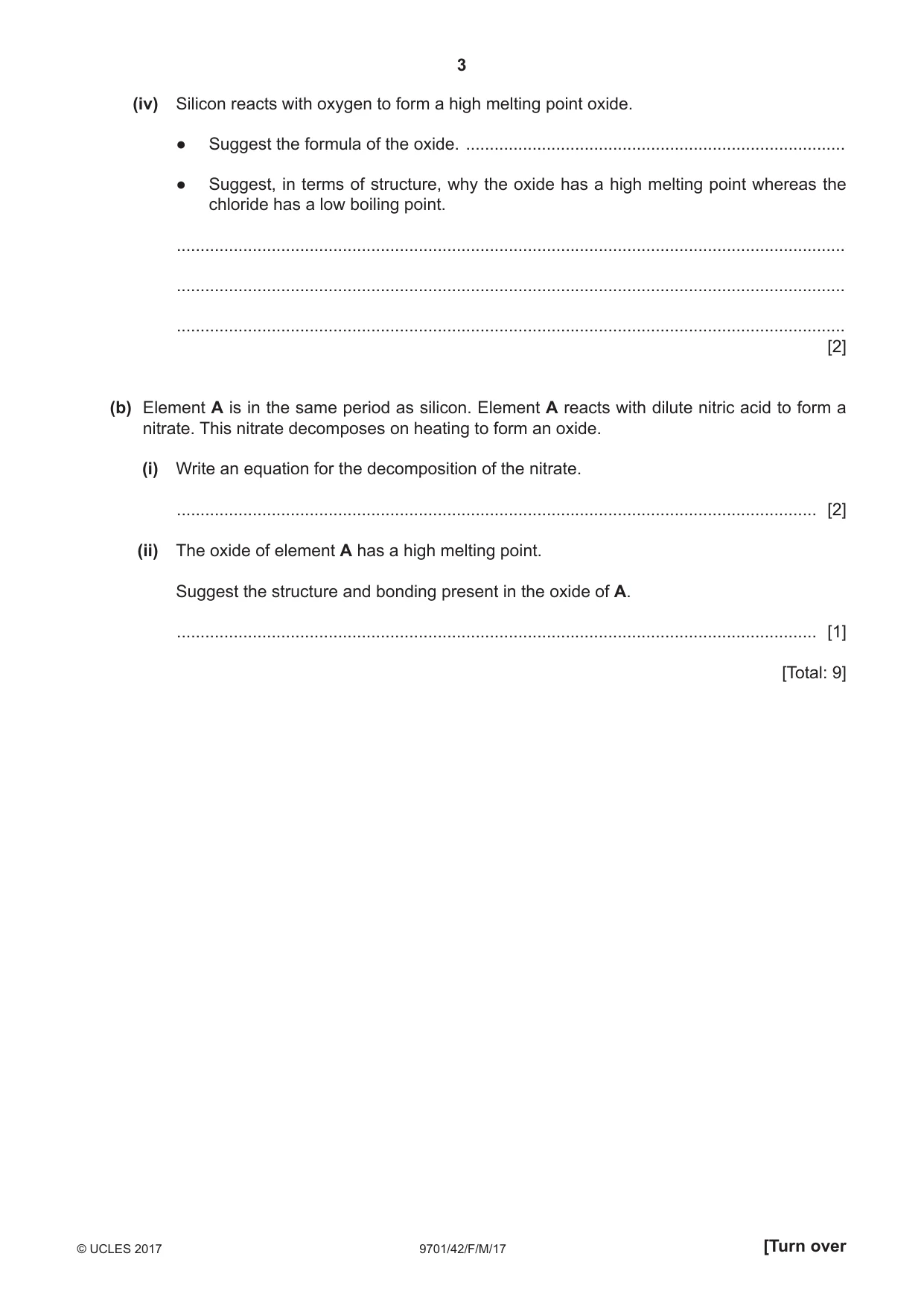
1 (a) (i) The mass spectrum of silicon is shown. 1.0 0.922 relative 0.5 intensity 0.047 0.031 28 29 30 m / e Calculate the Ar of silicon. Give your answer to two decimal places. Ar = .............................. [1] (ii) Silicon forms a low boiling point chloride which reacts with water. Write an equation to show the reaction of the chloride with water. ....................................................................................................................................... [1] (iii) Draw a three-dimensional diagram showing the shape of the chloride. Give the Cl – Si – Cl bond angle. [2] (iv) Silicon reacts with oxygen to form a high melting point oxide. ● Suggest the formula of the oxide. ................................................................................ ● Suggest, in terms of structure, why the oxide has a high melting point whereas the chloride has a low boiling point. ............................................................................................................................................. ............................................................................................................................................. ............................................................................................................................................. [2] (b) Element A is in the same period as silicon. Element A reacts with dilute nitric acid to form a nitrate. This nitrate decomposes on heating to form an oxide. (i) Write an equation for the decomposition of the nitrate. ....................................................................................................................................... [2] (ii) The oxide of element A has a high melting point. Suggest the structure and bonding present in the oxide of A. ....................................................................................................................................... [1] [Total: 9]
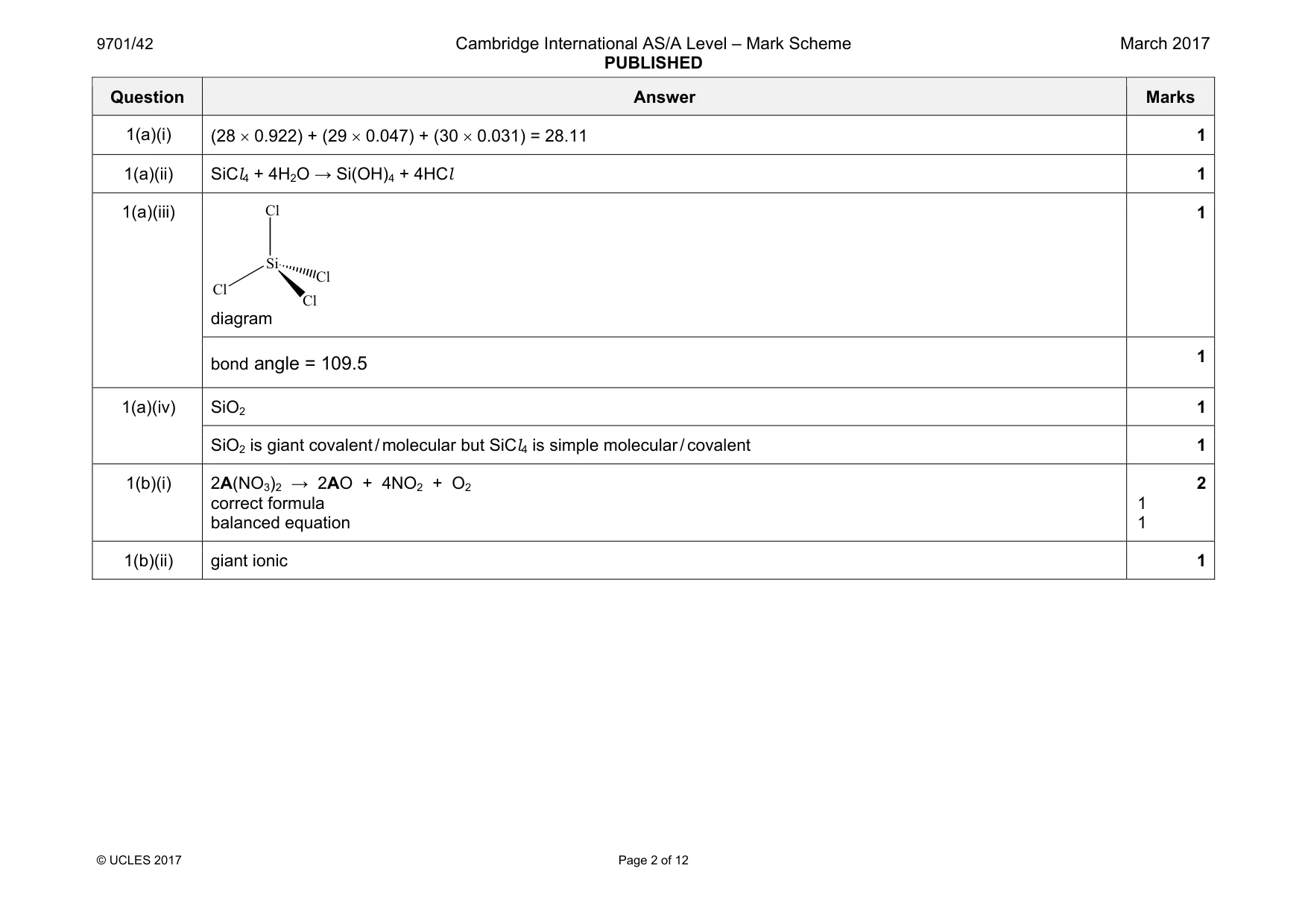
Mark scheme: 1(a)(i) 1(a)(ii) SiCl4 + 4H2O → Si(OH)4 + 4HCl 1 1(a)(iii) Cl Cl Si Cl Cl diagram 1 bond angle = 109.5 1 1(a)(iv) SiO2 1 SiO2 is giant covalent / molecular but SiCl4 is simple molecular / covalent 1 1(b)(i) 2A(NO3)2 → 2AO + 4NO2 + O2 correct formula balanced equation 2 1 1 1(b)(ii) giant ionic 1
Q2 · Complete the table using ticks () to indicate whether the sign of each type of energy…
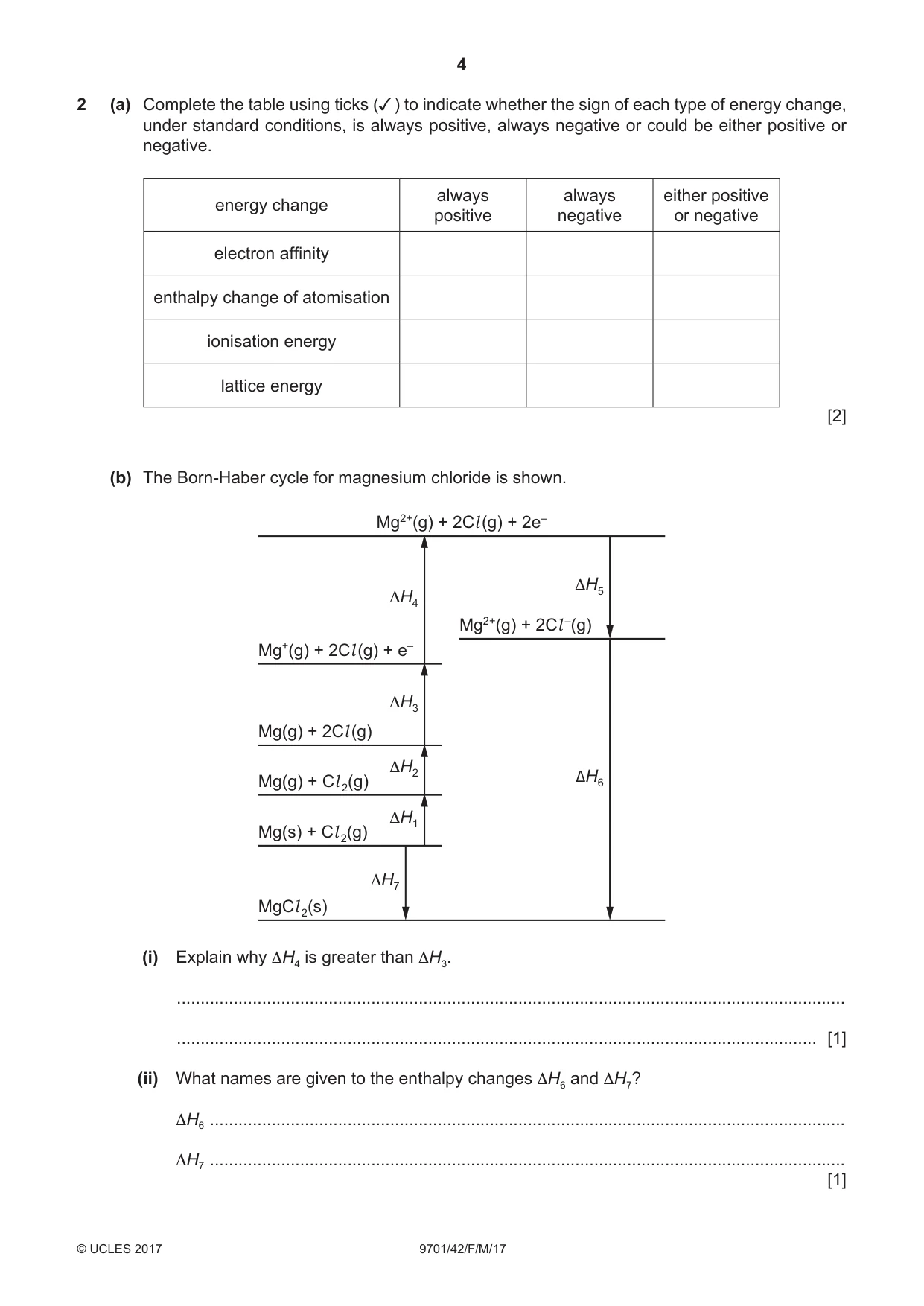
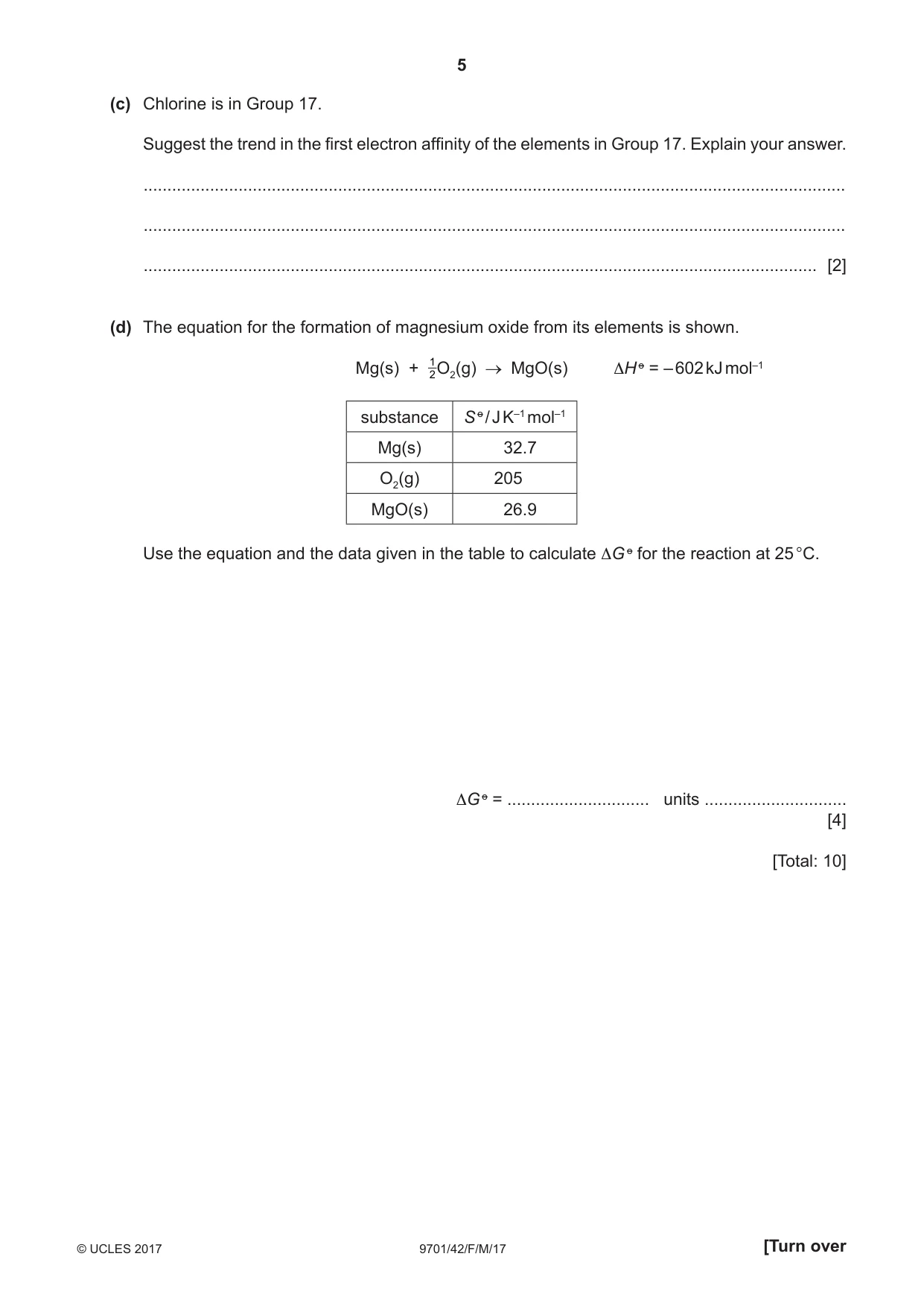
2 (a) Complete the table using ticks () to indicate whether the sign of each type of energy change, under standard conditions, is always positive, always negative or could be either positive or negative. always always either positive energy change positive negative or negative electron affinity enthalpy change of atomisation ionisation energy lattice energy [2] (b) The Born-Haber cycle for magnesium chloride is shown. Mg2+(g) + 2Cl (g) + 2e– ΔH5 ΔH4 Mg2+(g) + 2Cl –(g) Mg+(g) + 2Cl (g) + e– ΔH3 Mg(g) + 2Cl (g) ΔH2 Mg(g) + Cl 2(g) ∆H6 ΔH1 Mg(s) + Cl 2(g) ΔH7 MgCl 2(s) (i) Explain why ΔH4 is greater than ΔH3. ............................................................................................................................................. ....................................................................................................................................... [1] (ii) What names are given to the enthalpy changes ΔH6 and ΔH7? ΔH6 ...................................................................................................................................... ΔH7 ...................................................................................................................................... [1] (c) Chlorine is in Group 17. Suggest the trend in the first electron affinity of the elements in Group 17. Explain your answer. .................................................................................................................................................... .................................................................................................................................................... .............................................................................................................................................. [2] (d) The equation for the formation of magnesium oxide from its elements is shown. Mg(s) + 12O2(g) MgO(s) ΔH o = – 602 kJ mol–1 substance S o / J K–1 mol–1 Mg(s) 32.7 O2(g) 205 MgO(s) 26.9 Use the equation and the data given in the table to calculate ΔG o for the reaction at 25 °C. ΔG o = .............................. units .............................. [4] [Total: 10]
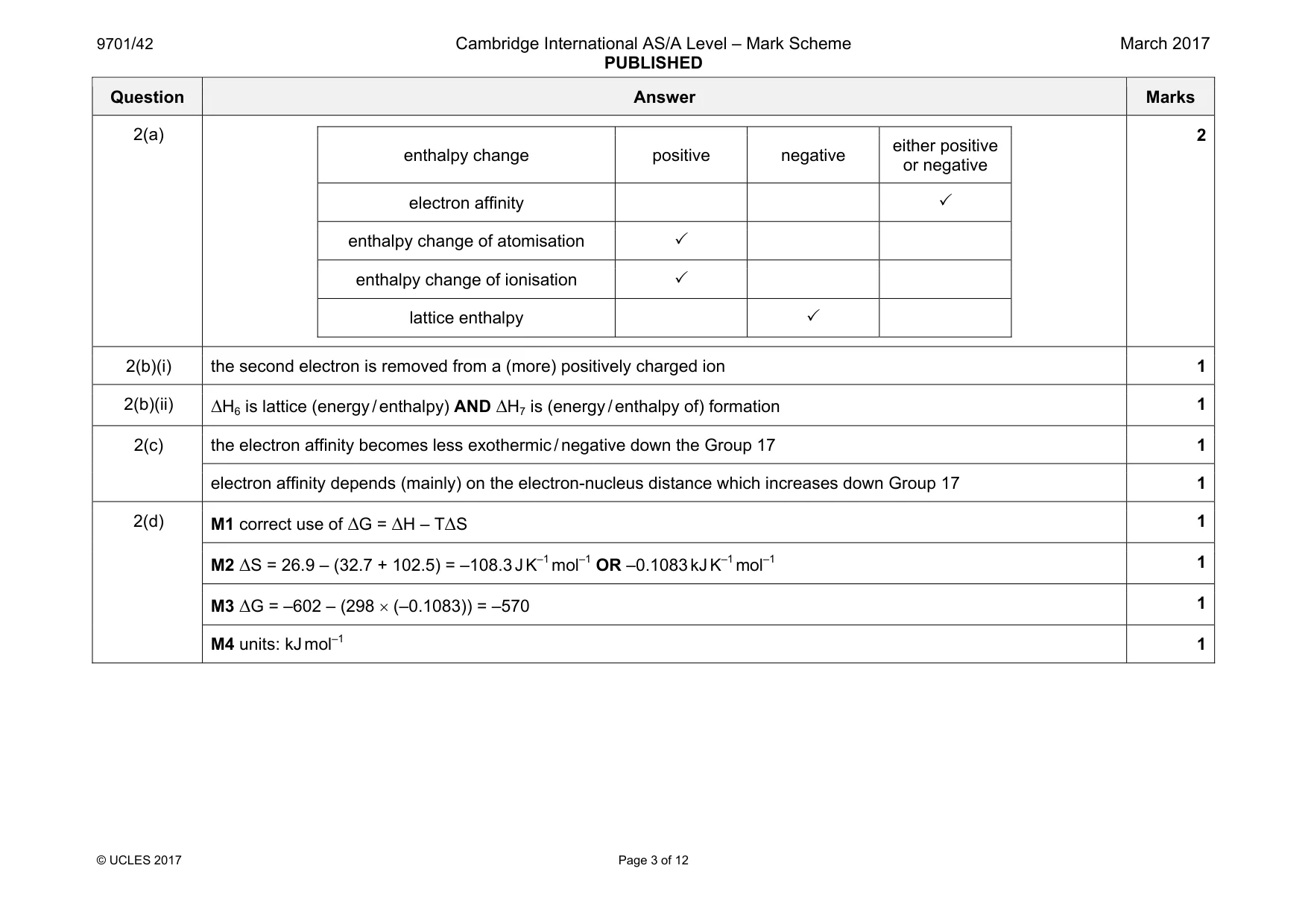
Mark scheme: 2(a) enthalpy change positive negative either positive or negative electron affinity 3 enthalpy change of atomisation 3 enthalpy change of ionisation 3 lattice enthalpy 3 2 2(b)(i) the second electron is removed from a (more) positively charged ion 1 2(b)(ii) ∆H6 is lattice (energy / enthalpy) AND ∆H7 is (energy / enthalpy of) formation 1 2(c) the electron affinity becomes less exothermic / negative down the Group 17 1 electron affinity depends (mainly) on the electron-nucleus distance which increases down Group 17 1 2(d) M1 correct use of ∆G = ∆H – T∆S 1 M2 ∆S = 26.9 – (32.7 + 102.5) = –108.3 J K–1 mol–1 OR –0.1083 kJ K–1 mol–1 1 M3 ∆G = –602 – (298 × (–0.1083)) = –570 1 M4 units: kJ mol–1 1
Q3 · The diagram shows the apparatus used to measure the standard electrode potential, E o, of…
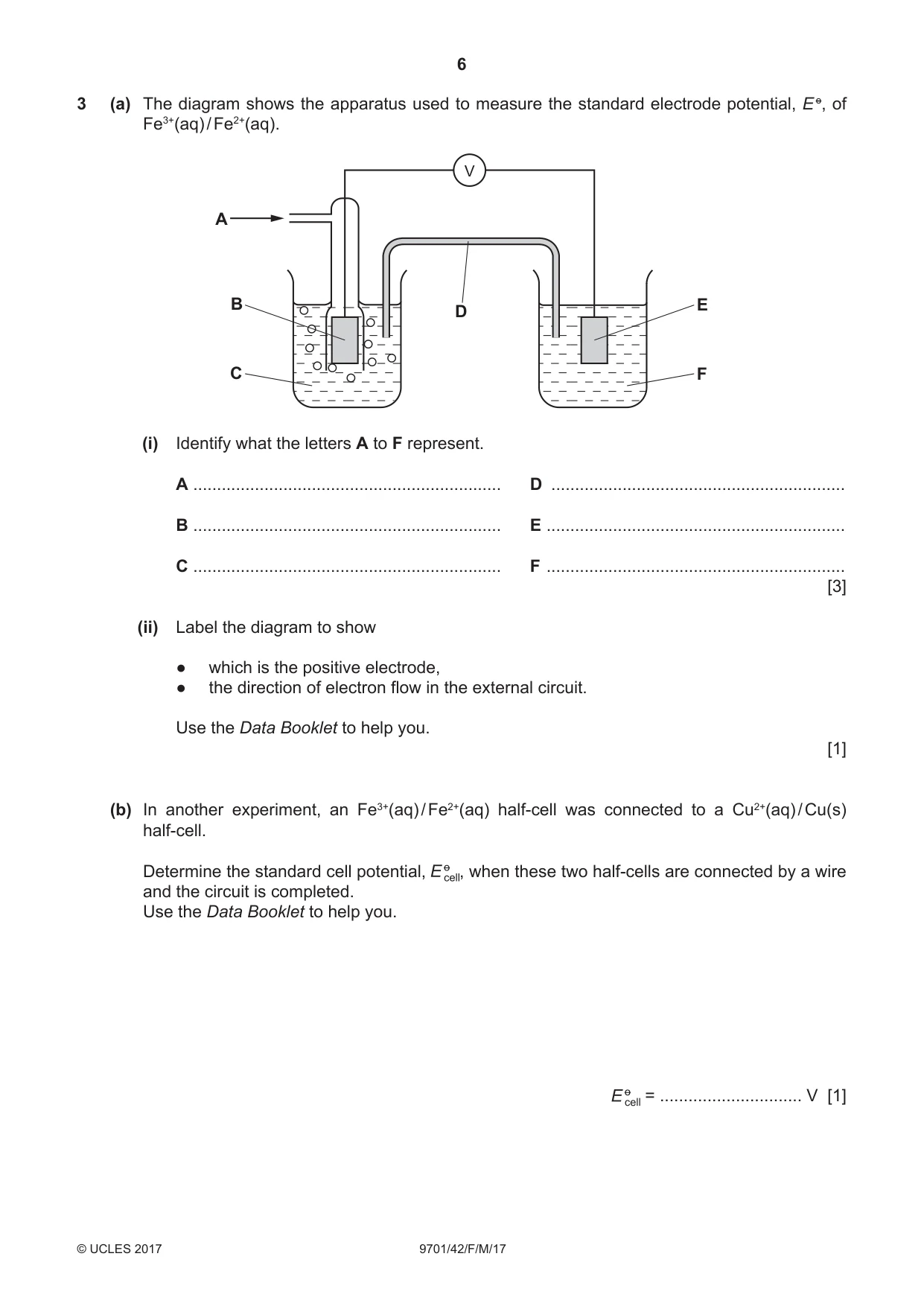
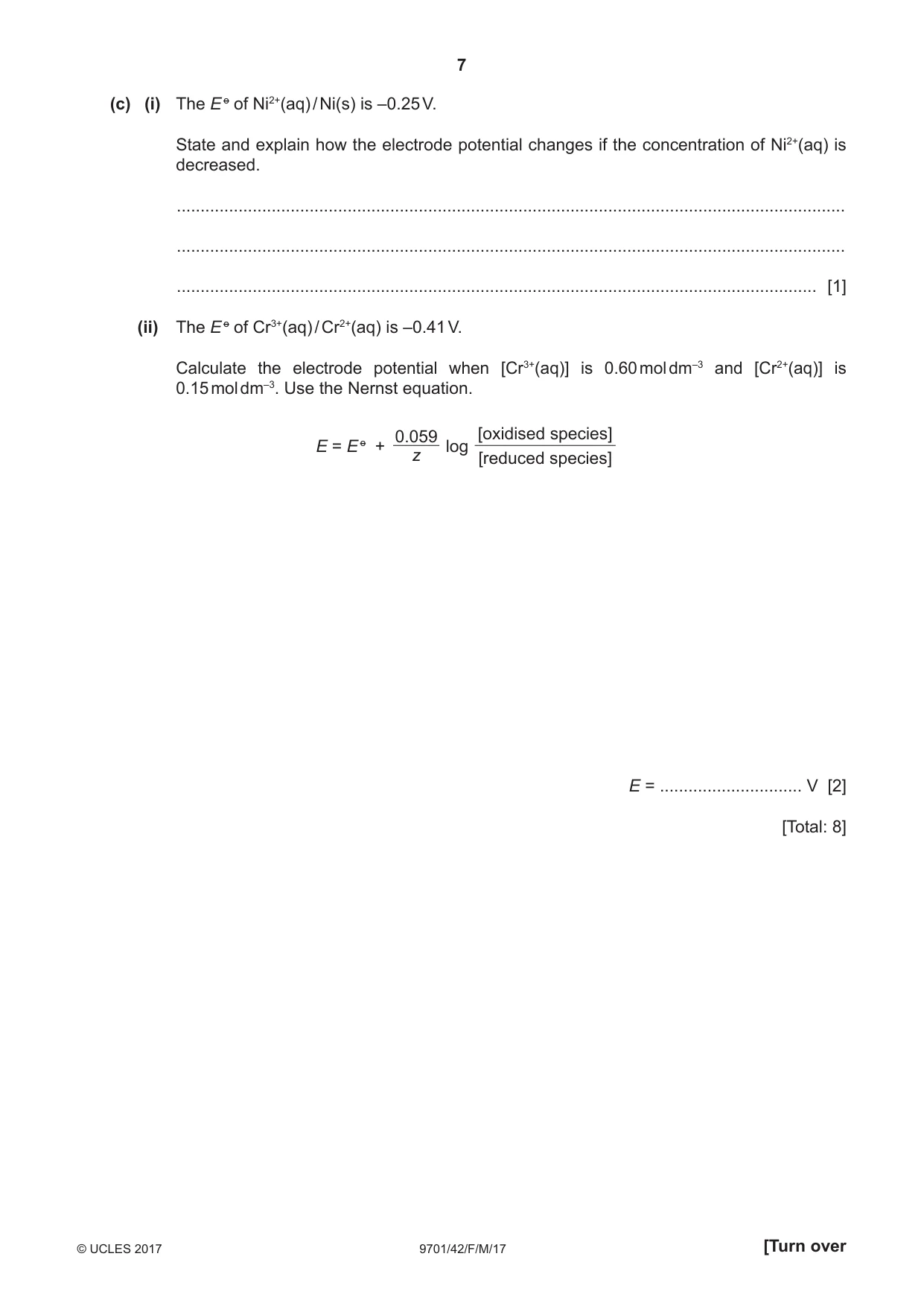
3 (a) The diagram shows the apparatus used to measure the standard electrode potential, E o, of Fe3+(aq) / Fe2+(aq). V A B E D C F (i) Identify what the letters A to F represent. A ................................................................. D ............................................................... B ................................................................. E ............................................................... C ................................................................. F ............................................................... [3] (ii) Label the diagram to show ● which is the positive electrode, ● the direction of electron flow in the external circuit. Use the Data Booklet to help you. [1] (b) In another experiment, an Fe3+(aq) / Fe2+(aq) half-cell was connected to a Cu2+(aq) / Cu(s) half-cell. Determine the standard cell potential, , when these two half-cells are connected by a wire and the circuit is completed. Use the Data Booklet to help you. = .............................. V [1] (c) (i) The E o of Ni2+(aq) / Ni(s) is –0.25 V. State and explain how the electrode potential changes if the concentration of Ni2+(aq) is decreased. ............................................................................................................................................. ............................................................................................................................................. ....................................................................................................................................... [1] (ii) The E o of Cr3+(aq) / Cr2+(aq) is –0.41 V. Calculate the electrode potential when [Cr3+(aq)] is 0.60 mol dm–3 and [Cr2+(aq)] is 0.15 mol dm–3. Use the Nernst equation. 0.059 [oxidised species] E = E o + log z [reduced species] E = .............................. V [2] [Total: 8]
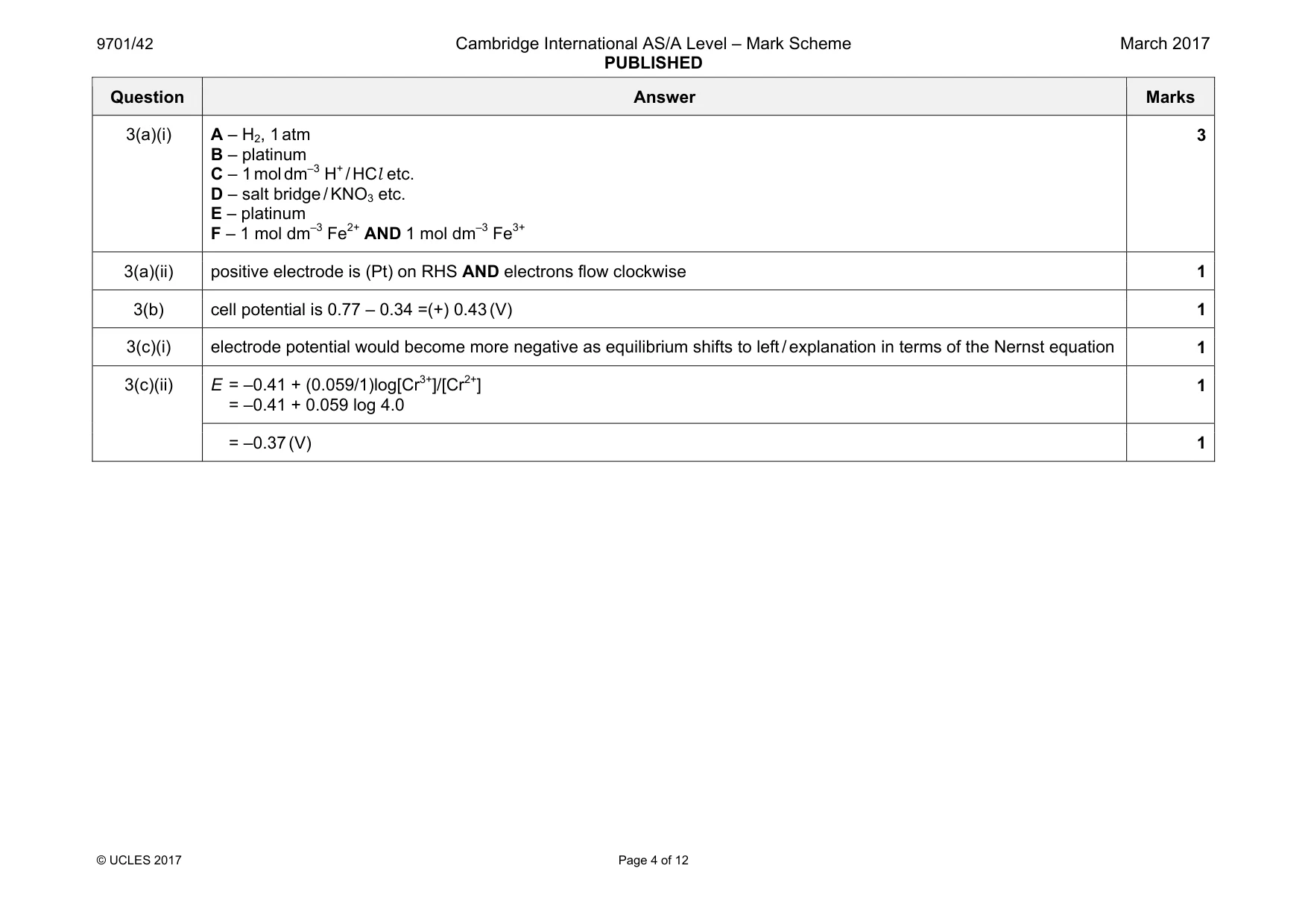
Mark scheme: 3(a)(i) A – H2, 1 atm B – platinum C – 1 mol dm–3 H+ / HCl etc. D – salt bridge / KNO3 etc. E – platinum F – 1 mol dm–3 Fe2+ AND 1 mol dm–3 Fe3+ 3 3(a)(ii) positive electrode is (Pt) on RHS AND electrons flow clockwise 1 3(b) cell potential is 0.77 – 0.34 =(+) 0.43 (V) 1 3(c)(i) electrode potential would become more negative as equilibrium shifts to left / explanation in terms of the Nernst equation 1 3(c)(ii) E = –0.41 + (0.059/1)log[Cr3+]/[Cr2+] = –0.41 + 0.059 log 4.0 1 = –0.37 (V) 1
Q4 · Chlorine dioxide undergoes the following reaction in aqueous solution
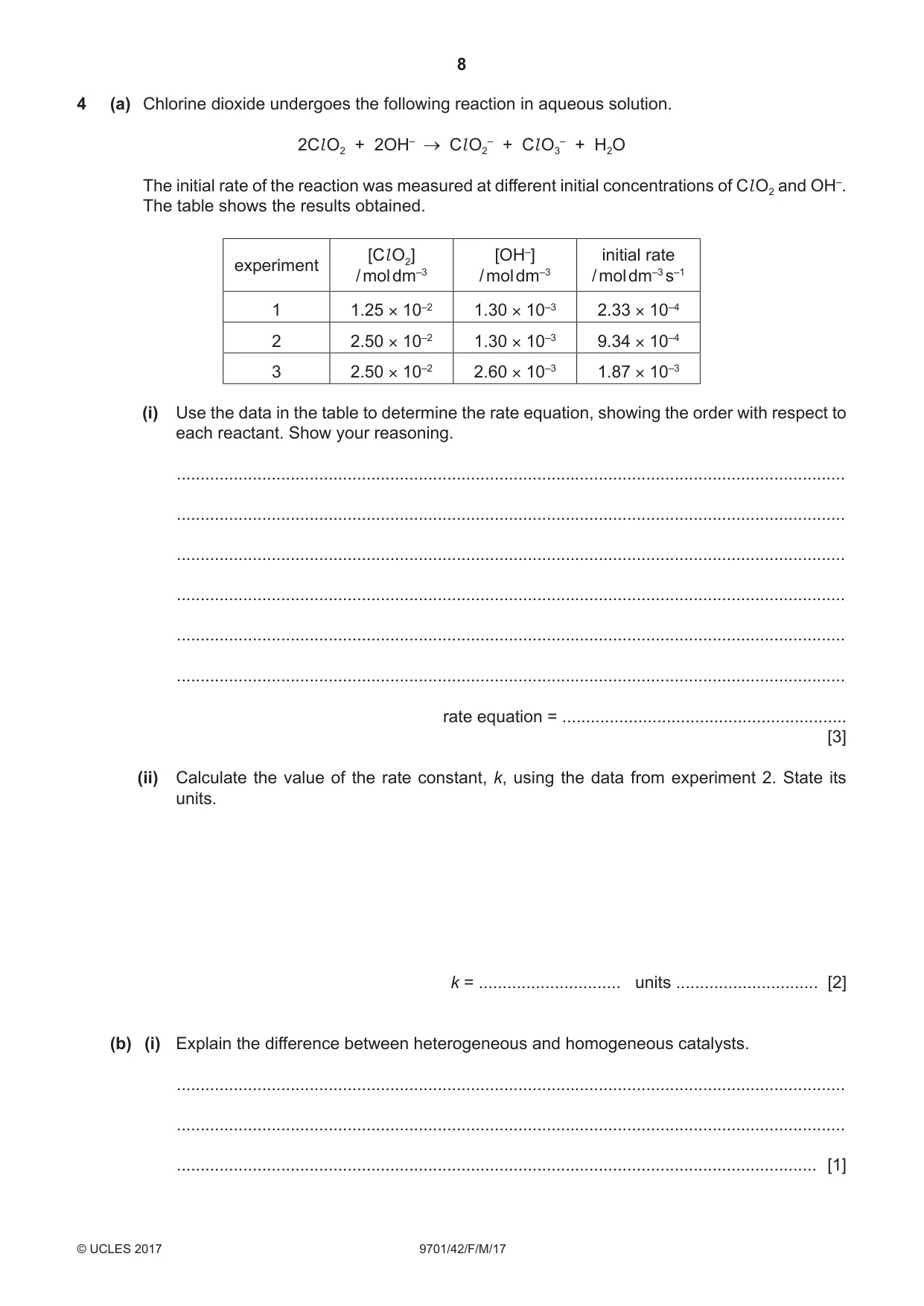
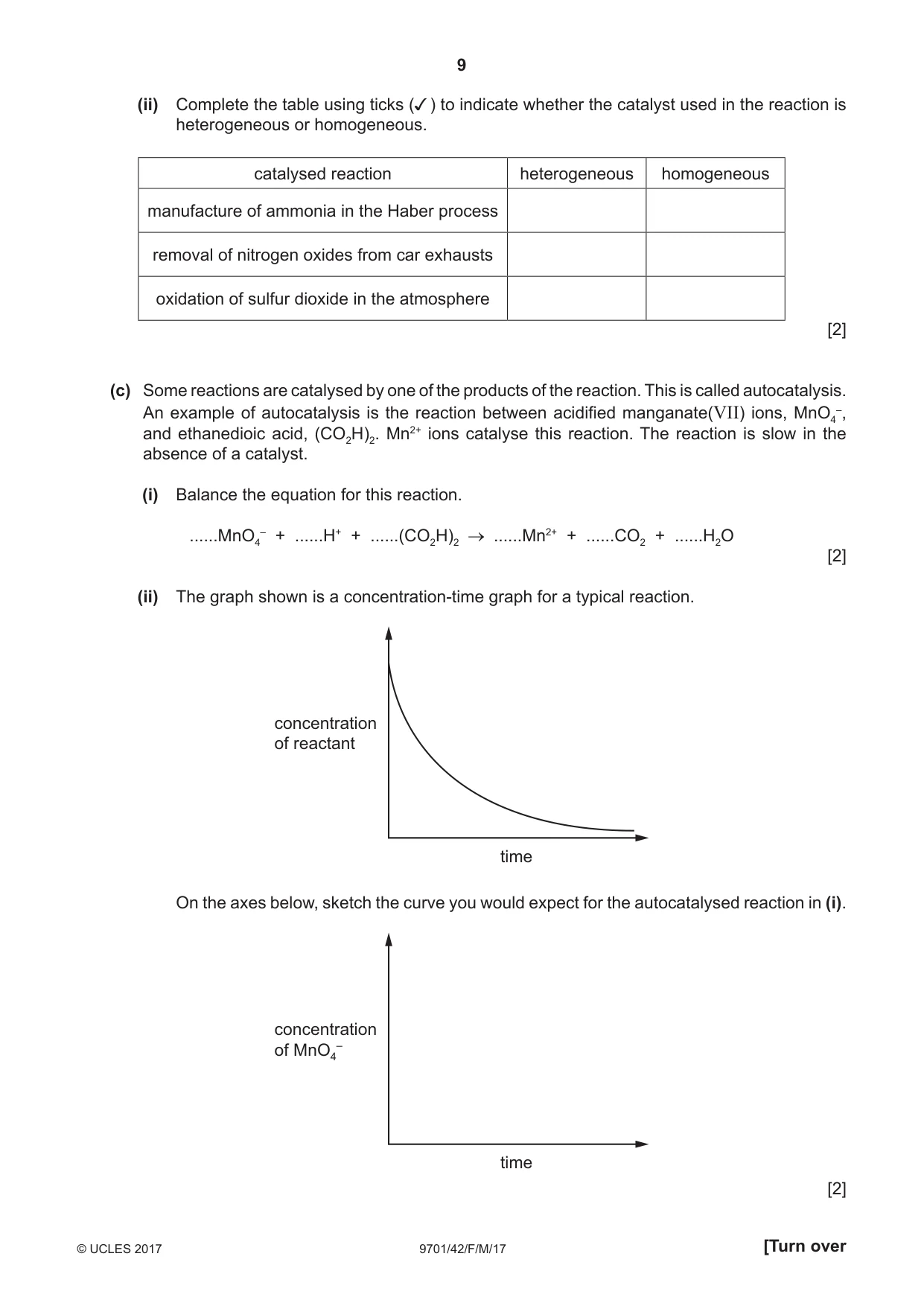
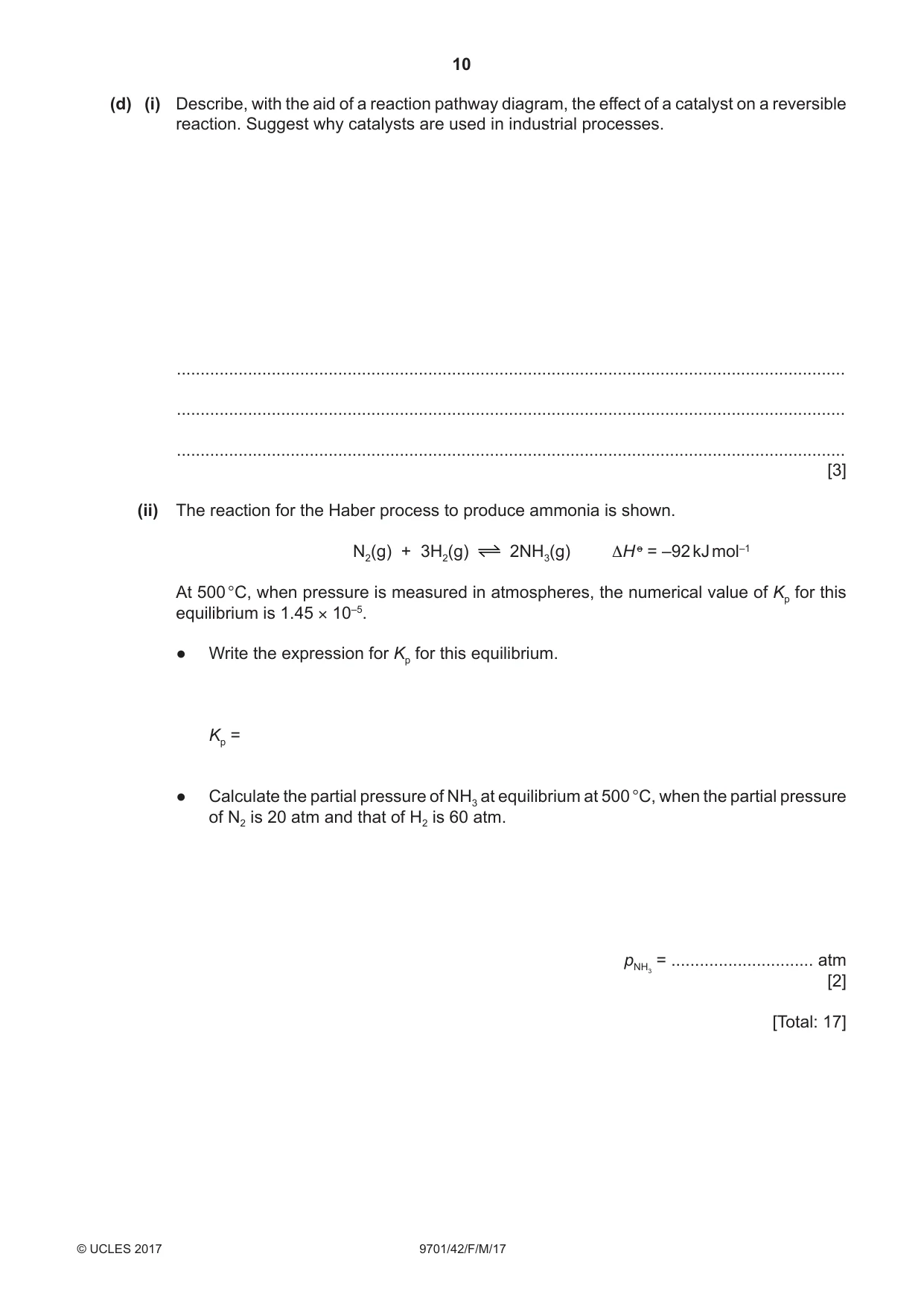
4 (a) Chlorine dioxide undergoes the following reaction in aqueous solution. 2Cl O2 + 2OH– Cl O2– + Cl O3– + H2O The initial rate of the reaction was measured at different initial concentrations of Cl O2 and OH–. The table shows the results obtained. [Cl O2] [OH–] initial rate experiment / mol dm–3 / mol dm–3 / mol dm–3 s–1 1 1.25 × 10⁻² 1.30 × 10⁻³ 2.33 × 10⁻⁴ 2 2.50 × 10⁻² 1.30 × 10⁻³ 9.34 × 10⁻⁴ 3 2.50 × 10⁻² 2.60 × 10⁻³ 1.87 × 10⁻³ (i) Use the data in the table to determine the rate equation, showing the order with respect to each reactant. Show your reasoning. ............................................................................................................................................. ............................................................................................................................................. ............................................................................................................................................. ............................................................................................................................................. ............................................................................................................................................. ............................................................................................................................................. rate equation = ............................................................ [3] (ii) Calculate the value of the rate constant, k, using the data from experiment 2. State its units. k = .............................. units .............................. [2] (b) (i) Explain the difference between heterogeneous and homogeneous catalysts. ............................................................................................................................................. ............................................................................................................................................. ....................................................................................................................................... [1] (ii) Complete the table using ticks () to indicate whether the catalyst used in the reaction is heterogeneous or homogeneous. catalysed reaction heterogeneous homogeneous manufacture of ammonia in the Haber process removal of nitrogen oxides from car exhausts oxidation of sulfur dioxide in the atmosphere [2] (c) Some reactions are catalysed by one of the products of the reaction. This is called autocatalysis. An example of autocatalysis is the reaction between acidified manganate(VII) ions, MnO4–, and ethanedioic acid, (CO2H)2. Mn2+ ions catalyse this reaction. The reaction is slow in the absence of a catalyst. (i) Balance the equation for this reaction. ......MnO4– + ......H+ + ......(CO2H)2 ......Mn2+ + ......CO2 + ......H2O [2] (ii) The graph shown is a concentration-time graph for a typical reaction. concentration of reactant time On the axes below, sketch the curve you would expect for the autocatalysed reaction in (i). concentration of MnO4– time [2] (d) (i) Describe, with the aid of a reaction pathway diagram, the effect of a catalyst on a reversible reaction. Suggest why catalysts are used in industrial processes. ............................................................................................................................................. ............................................................................................................................................. ............................................................................................................................................. [3] (ii) The reaction for the Haber process to produce ammonia is shown. N2(g) + 3H2(g) 2NH3(g) ΔH o = –92 kJ mol–1 At 500 °C, when pressure is measured in atmospheres, the numerical value of Kp for this equilibrium is 1.45 × 10⁻⁵. ● Write the expression for Kp for this equilibrium. Kp = ● Calculate the partial pressure of NH3 at equilibrium at 500 °C, when the partial pressure of N2 is 20 atm and that of H2 is 60 atm. pNH3 = .............................. atm [2] [Total: 17]
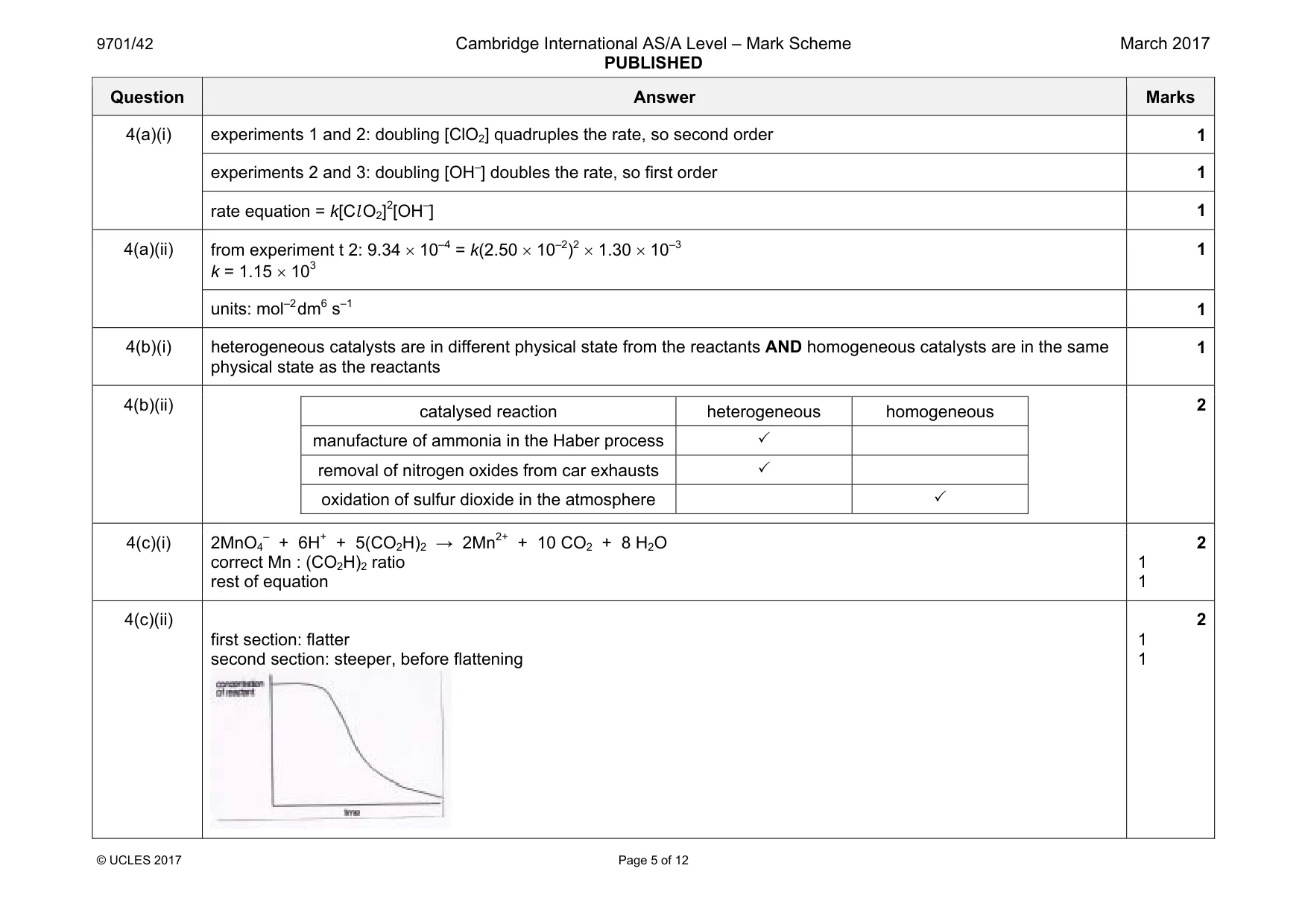
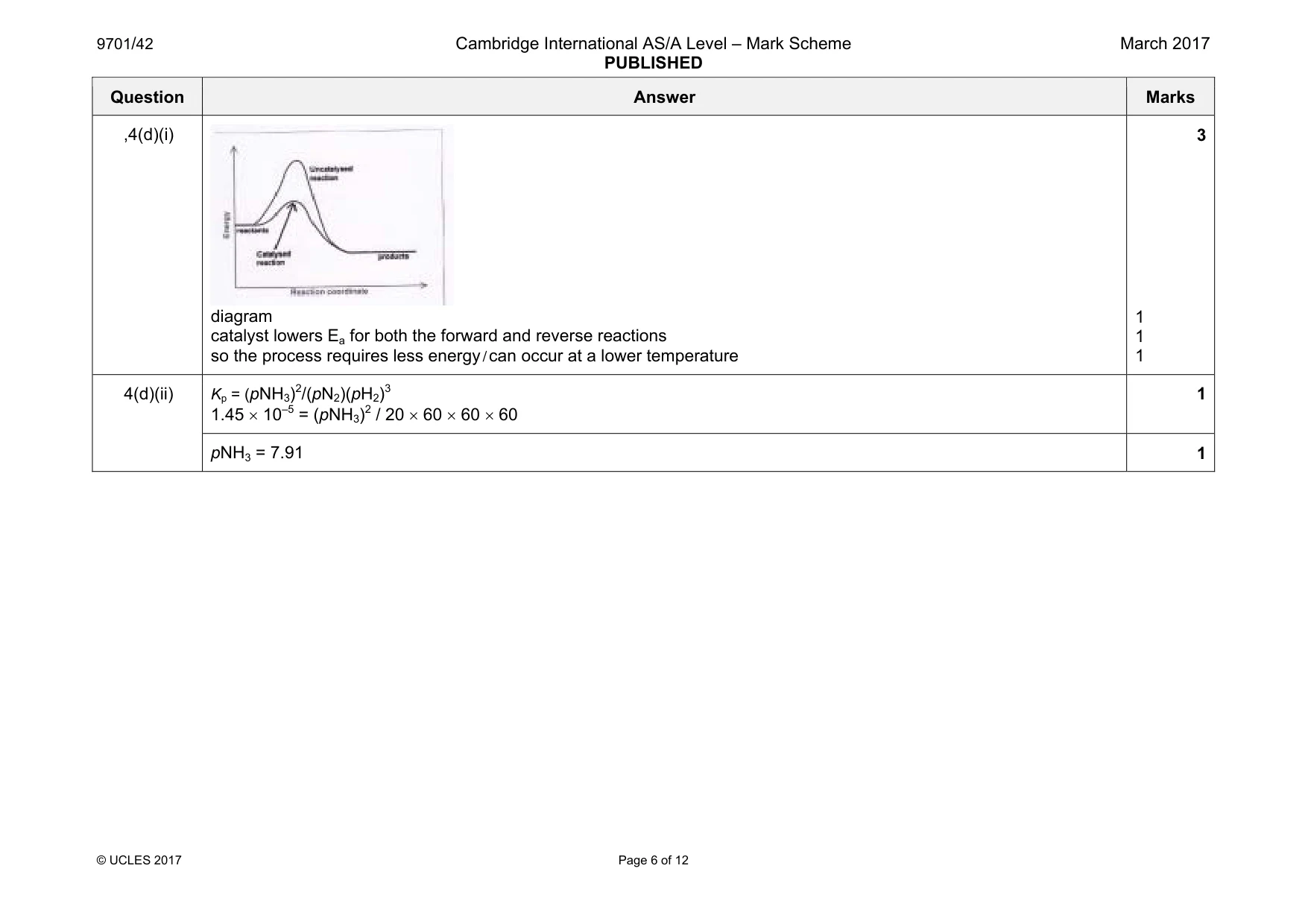
Mark scheme: 4(a)(i) experiments 1 and 2: doubling [ClO2] quadruples the rate, so second order 1 experiments 2 and 3: doubling [OH–] doubles the rate, so first order 1 rate equation = k[Cl O2]2[OH–] 1 4(a)(ii) from experiment t 2: 9.34 × 10–4 = k(2.50 × 10⁻²)2 × 1.30 × 10–3 k = 1.15 × 10³ 1 units: mol–2 dm6 s–1 1 4(b)(i) heterogeneous catalysts are in different physical state from the reactants AND homogeneous catalysts are in the same physical state as the reactants 1 4(b)(ii) catalysed reaction heterogeneous homogeneous manufacture of ammonia in the Haber process 3 removal of nitrogen oxides from car exhausts 3 oxidation of sulfur dioxide in the atmosphere 3 2 4(c)(i) 2MnO4 – + 6H+ + 5(CO2H)2 → 2Mn2+ + 10 CO2 + 8 H2O correct Mn : (CO2H)2 ratio rest of equation 2 1 1 4(c)(ii) first section: flatter second section: steeper, before flattening 2 1 1 Question Answer Marks ,4(d)(i) diagram catalyst lowers Ea for both the forward and reverse reactions so the process requires less energy / can occur at a lower temperature 3 1 1 1 4(d)(ii) Kp = (pNH3)2/(pN2)(pH2)3 1.45 × 10–5 = (pNH3)2 / 20 × 60 × 60 × 60 1 pNH3 = 7.91 1
Q5 · Compound H can be synthesised from benzene as shown
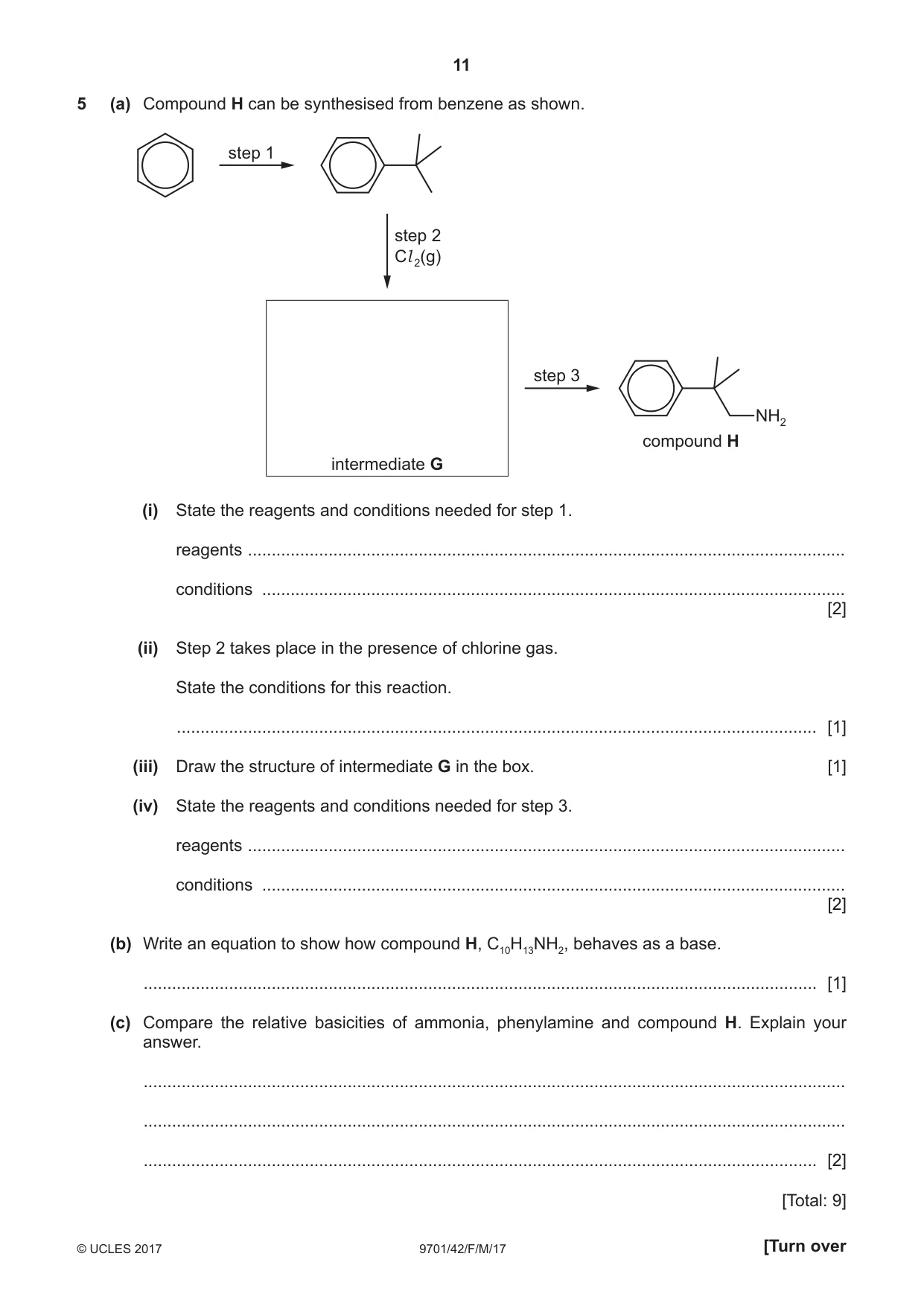
5 (a) Compound H can be synthesised from benzene as shown. step 1 step 2 Cl 2(g) step 3 NH2 compound H intermediate G (i) State the reagents and conditions needed for step 1. reagents .............................................................................................................................. conditions ............................................................................................................................ [2] (ii) Step 2 takes place in the presence of chlorine gas. State the conditions for this reaction. ....................................................................................................................................... [1] (iii) Draw the structure of intermediate G in the box. [1] (iv) State the reagents and conditions needed for step 3. reagents .............................................................................................................................. conditions ............................................................................................................................ [2] (b) Write an equation to show how compound H, C10H13NH2, behaves as a base. .............................................................................................................................................. [1] (c) Compare the relative basicities of ammonia, phenylamine and compound H. Explain your answer. .................................................................................................................................................... .................................................................................................................................................... .............................................................................................................................................. [2] [Total: 9]
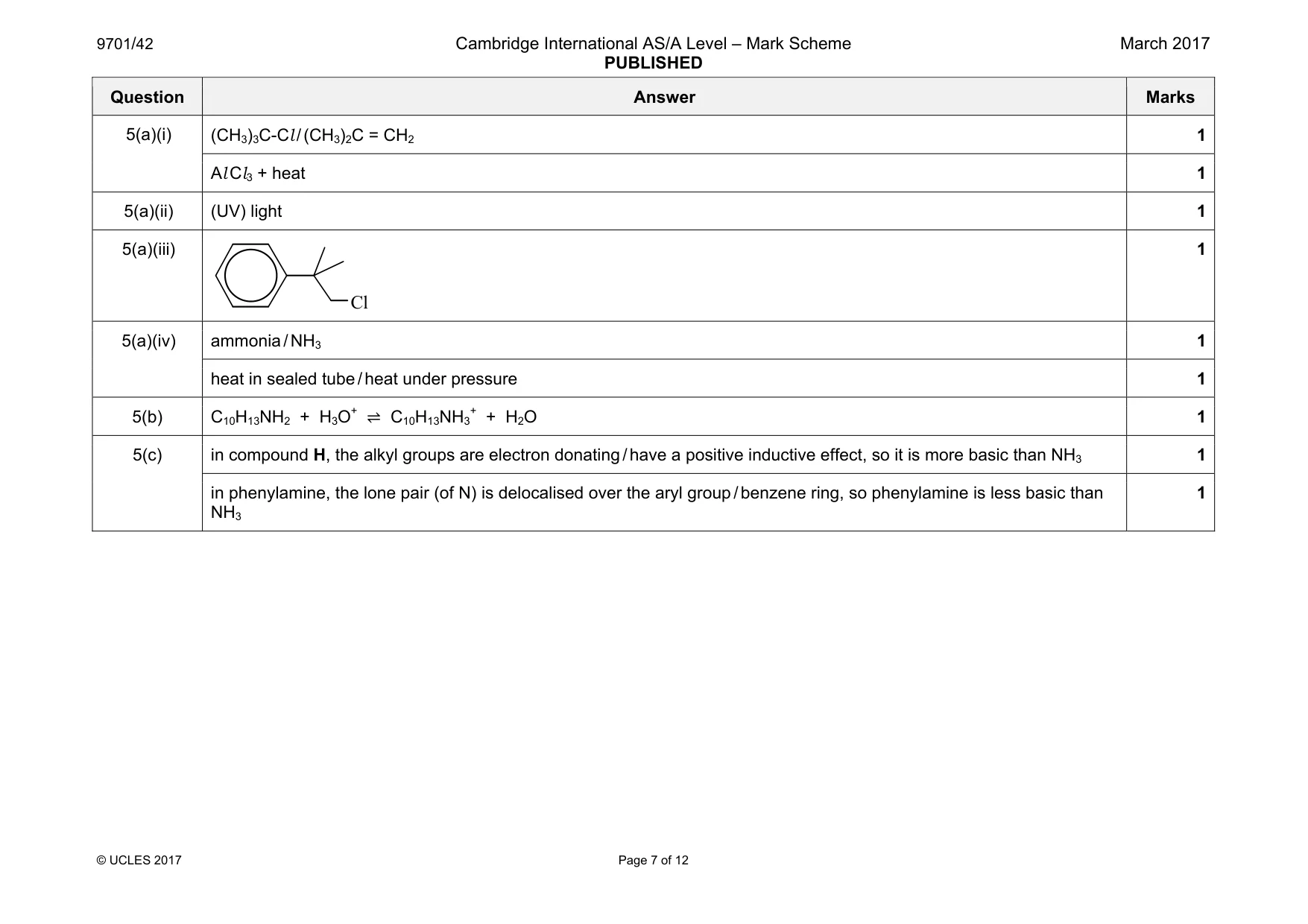
Mark scheme: 5(a)(i) 1 Al Cl3 + heat 1 5(a)(ii) (UV) light 1 5(a)(iii) Cl 1 5(a)(iv) ammonia / NH3 1 heat in sealed tube / heat under pressure 1 5(b) C10H13NH2 + H3O+ ⇌ C10H13NH3 + + H2O 1 5(c) in compound H, the alkyl groups are electron donating / have a positive inductive effect, so it is more basic than NH3 1 in phenylamine, the lone pair (of N) is delocalised over the aryl group / benzene ring, so phenylamine is less basic than NH3 1
Q6 · Draw the shape of one of the d orbitals
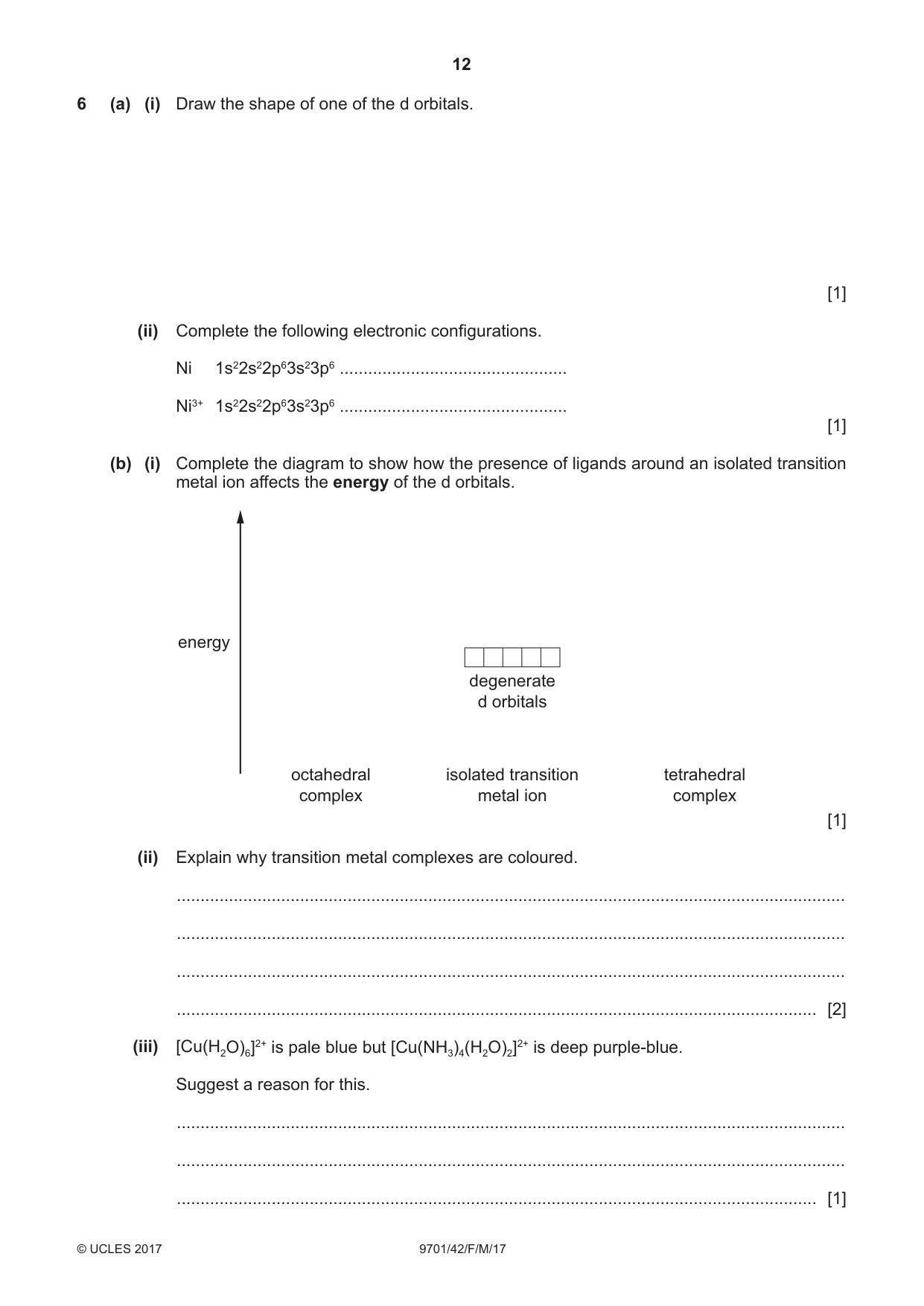
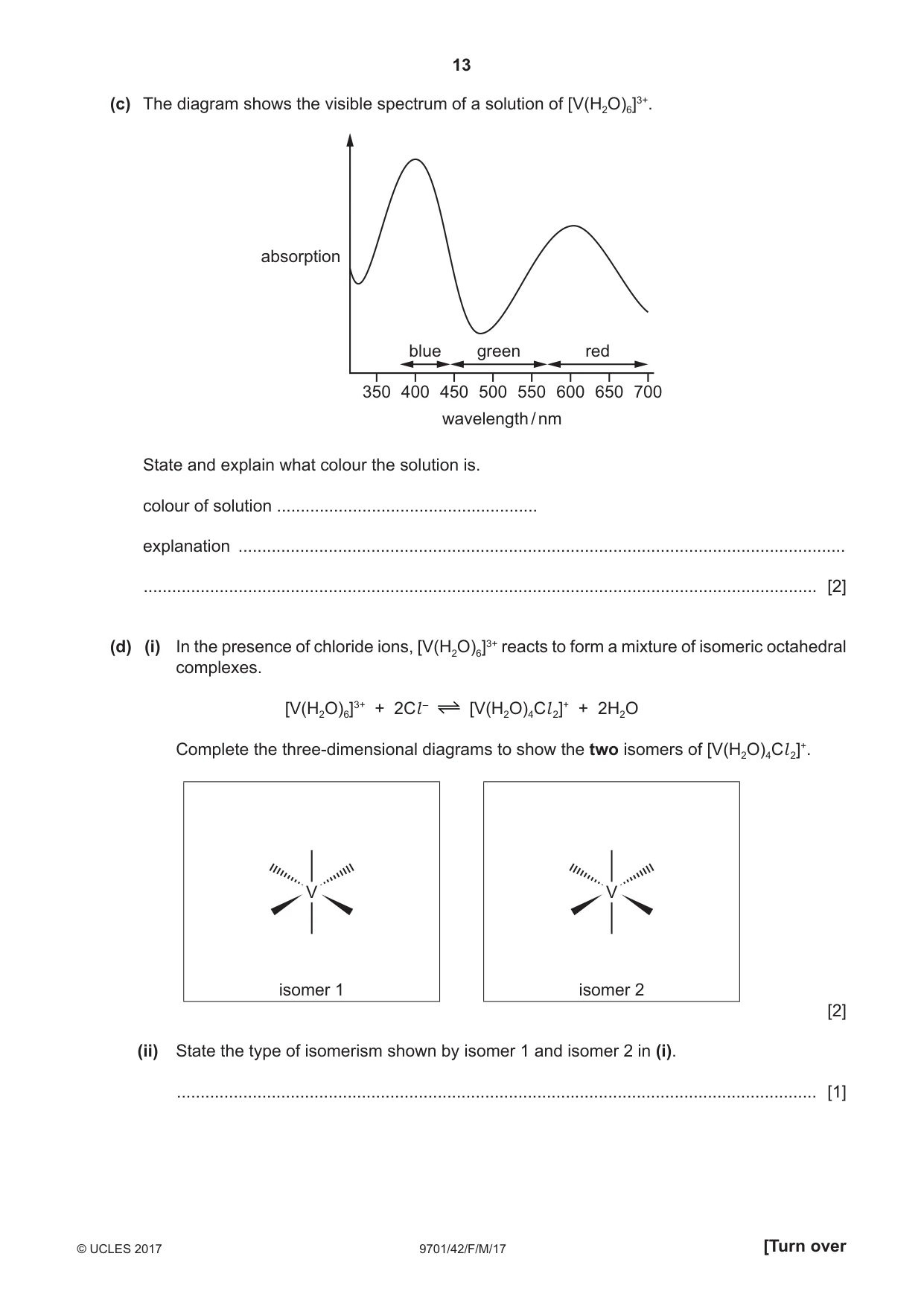
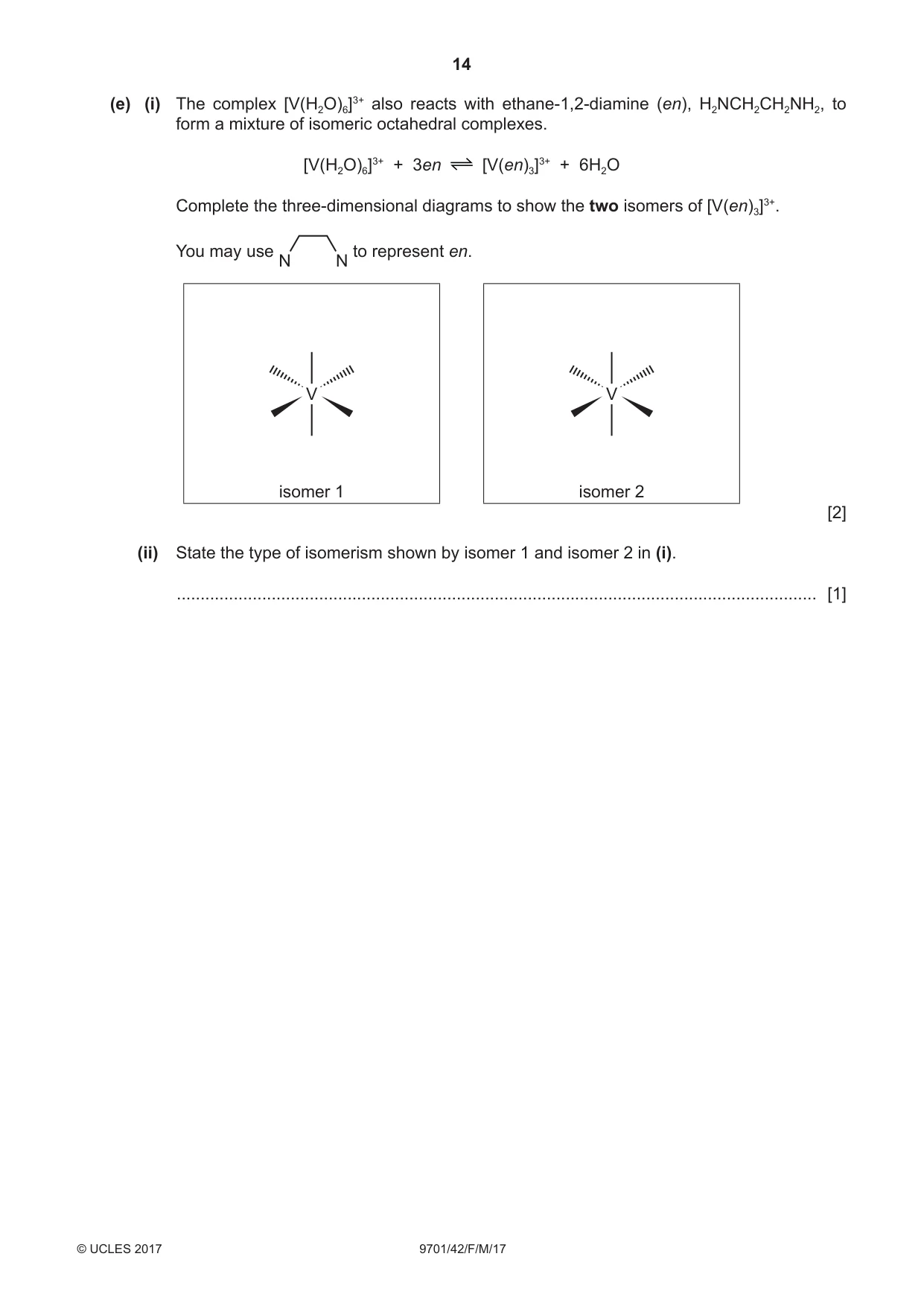
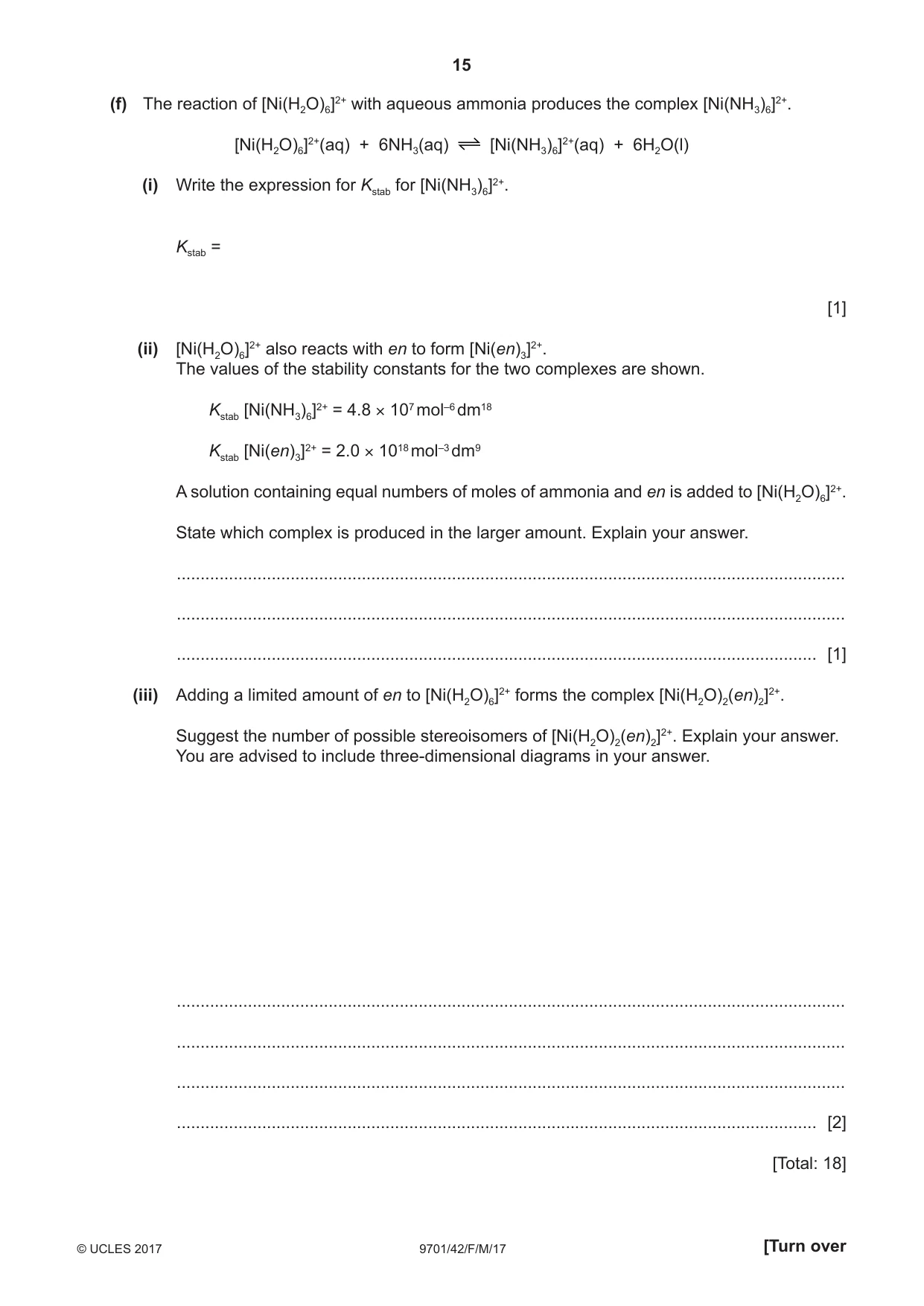
6 (a) (i) Draw the shape of one of the d orbitals. [1] (ii) Complete the following electronic configurations. Ni 1s22s22p63s23p6 ................................................ Ni3+ 1s22s22p63s23p6 ................................................ [1] (b) (i) Complete the diagram to show how the presence of ligands around an isolated transition metal ion affects the energy of the d orbitals. energy degenerate d orbitals octahedral isolated transition tetrahedral complex metal ion complex [1] (ii) Explain why transition metal complexes are coloured. ............................................................................................................................................. ............................................................................................................................................. ............................................................................................................................................. ....................................................................................................................................... [2] (iii) [Cu(H2O)6]2+ is pale blue but [Cu(NH3)4(H2O)2]2+ is deep purple-blue. Suggest a reason for this. ............................................................................................................................................. ............................................................................................................................................. ....................................................................................................................................... [1] (c) The diagram shows the visible spectrum of a solution of [V(H2O)6]3+. absorption blue green red 350 400 450 500 550 600 650 700 wavelength / nm State and explain what colour the solution is. colour of solution ....................................................... explanation ................................................................................................................................. .............................................................................................................................................. [2] (d) (i) In the presence of chloride ions, [V(H2O)6]3+ reacts to form a mixture of isomeric octahedral complexes. [V(H2O)6]3+ + 2Cl – [V(H2O)4Cl 2]+ + 2H2O Complete the three-dimensional diagrams to show the two isomers of [V(H2O)4Cl 2]+. V V isomer 1 isomer 2 [2] (ii) State the type of isomerism shown by isomer 1 and isomer 2 in (i). ....................................................................................................................................... [1] (e) (i) The complex [V(H2O)6]3+ also reacts with ethane-1,2-diamine (en), H2NCH2CH2NH2, to form a mixture of isomeric octahedral complexes. [V(H2O)6]3+ + 3en [V(en)3]3+ + 6H2O Complete the three-dimensional diagrams to show the two isomers of [V(en)3]3+. You may use to represent en. N N V V isomer 1 isomer 2 [2] (ii) State the type of isomerism shown by isomer 1 and isomer 2 in (i). ....................................................................................................................................... [1] (f) The reaction of [Ni(H2O)6]2+ with aqueous ammonia produces the complex [Ni(NH3)6]2+. [Ni(H2O)6]2+(aq) + 6NH3(aq) [Ni(NH3)6]2+(aq) + 6H2O(l) (i) Write the expression for Kstab for [Ni(NH3)6]2+. Kstab = [1] (ii) [Ni(H2O)6]2+ also reacts with en to form [Ni(en)3]2+. The values of the stability constants for the two complexes are shown. Kstab [Ni(NH3)6]2+ = 4.8 × 10⁷ mol–6 dm18 Kstab [Ni(en)3]2+ = 2.0 × 10¹⁸ mol–3 dm9 A solution containing equal numbers of moles of ammonia and en is added to [Ni(H2O)6]2+. State which complex is produced in the larger amount. Explain your answer. ............................................................................................................................................. ............................................................................................................................................. ....................................................................................................................................... [1] (iii) Adding a limited amount of en to [Ni(H2O)6]2+ forms the complex [Ni(H2O)2(en)2]2+. Suggest the number of possible stereoisomers of [Ni(H2O)2(en)2]2+. Explain your answer. You are advised to include three-dimensional diagrams in your answer. ............................................................................................................................................. ............................................................................................................................................. ............................................................................................................................................. ....................................................................................................................................... [2] [Total: 18]
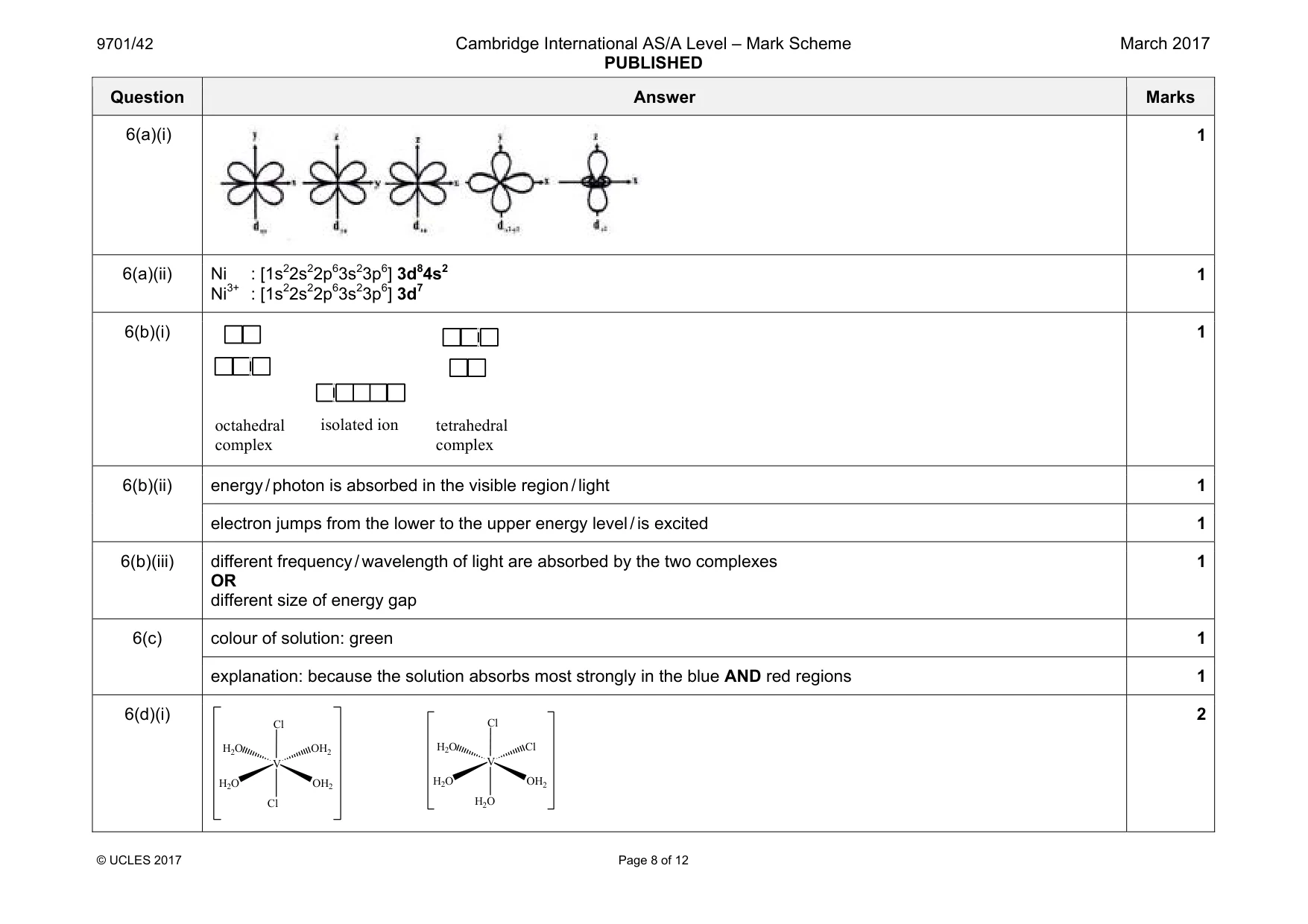
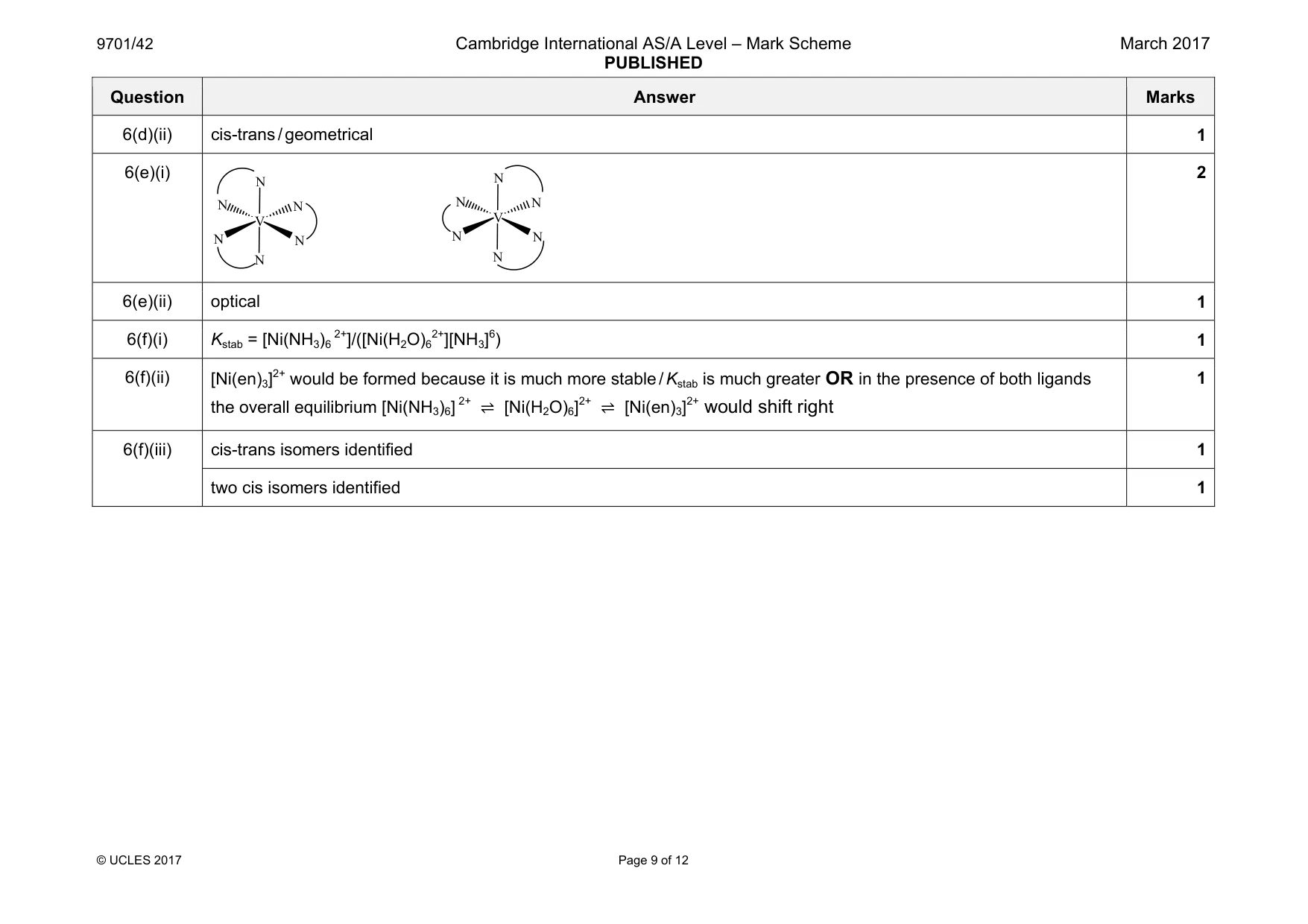
Mark scheme: 6(a)(i) 1 6(a)(ii) Ni : [1s22s22p63s23p6] 3d84s2 Ni3+ : [1s22s22p63s23p6] 3d7 1 6(b)(i) octahedral complex tetrahedral complex isolated ion 1 6(b)(ii) energy / photon is absorbed in the visible region / light 1 electron jumps from the lower to the upper energy level / is excited 1 6(b)(iii) different frequency / wavelength of light are absorbed by the two complexes OR different size of energy gap 1 6(c) colour of solution: green 1 explanation: because the solution absorbs most strongly in the blue AND red regions 1 6(d)(i) H2O V H2O OH2 OH2 Cl Cl H2O V H2O Cl OH2 Cl H2O 2 Question Answer Marks 6(d)(ii) cis-trans / geometrical 1 6(e)(i) N V N N N N N N V N N N N N 2 6(e)(ii) optical 1 6(f)(i) Kstab = [Ni(NH3)6 2+]/([Ni(H2O)6 2+][NH3]6) 1 6(f)(ii) [Ni(en)3]2+ would be formed because it is much more stable / Kstab is much greater OR in the presence of both ligands the overall equilibrium [Ni(NH3)6] 2+ ⇌ [Ni(H2O)6]2+ ⇌ [Ni(en)3]2+ would shift right 1 6(f)(iii) cis-trans isomers identified 1 two cis isomers identified 1
More questions on Electrons, energy levels and atomic orbitals
Q7 · The compound Advantame is a sweetener that tastes approximately 25 000 times sweeter than…
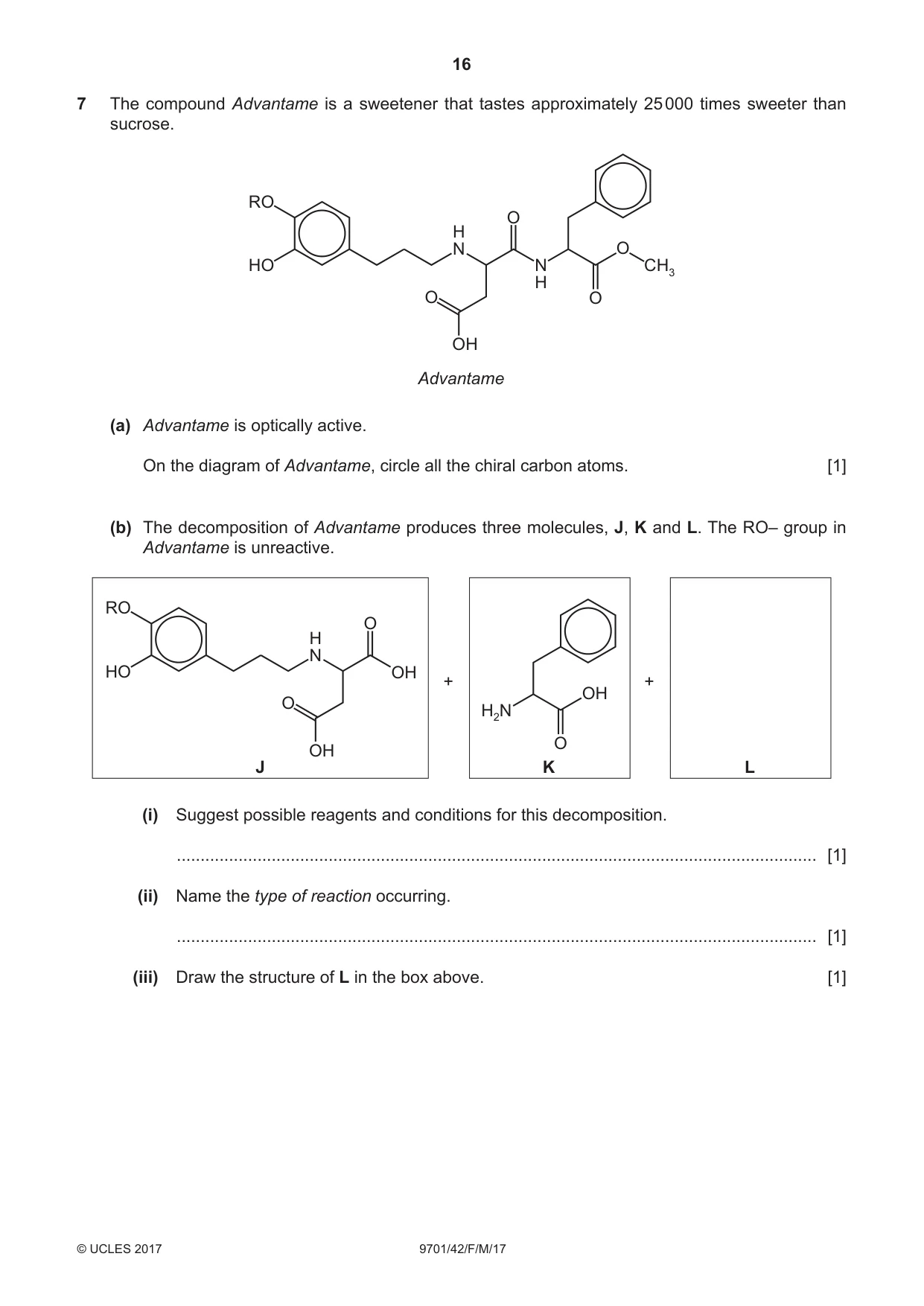
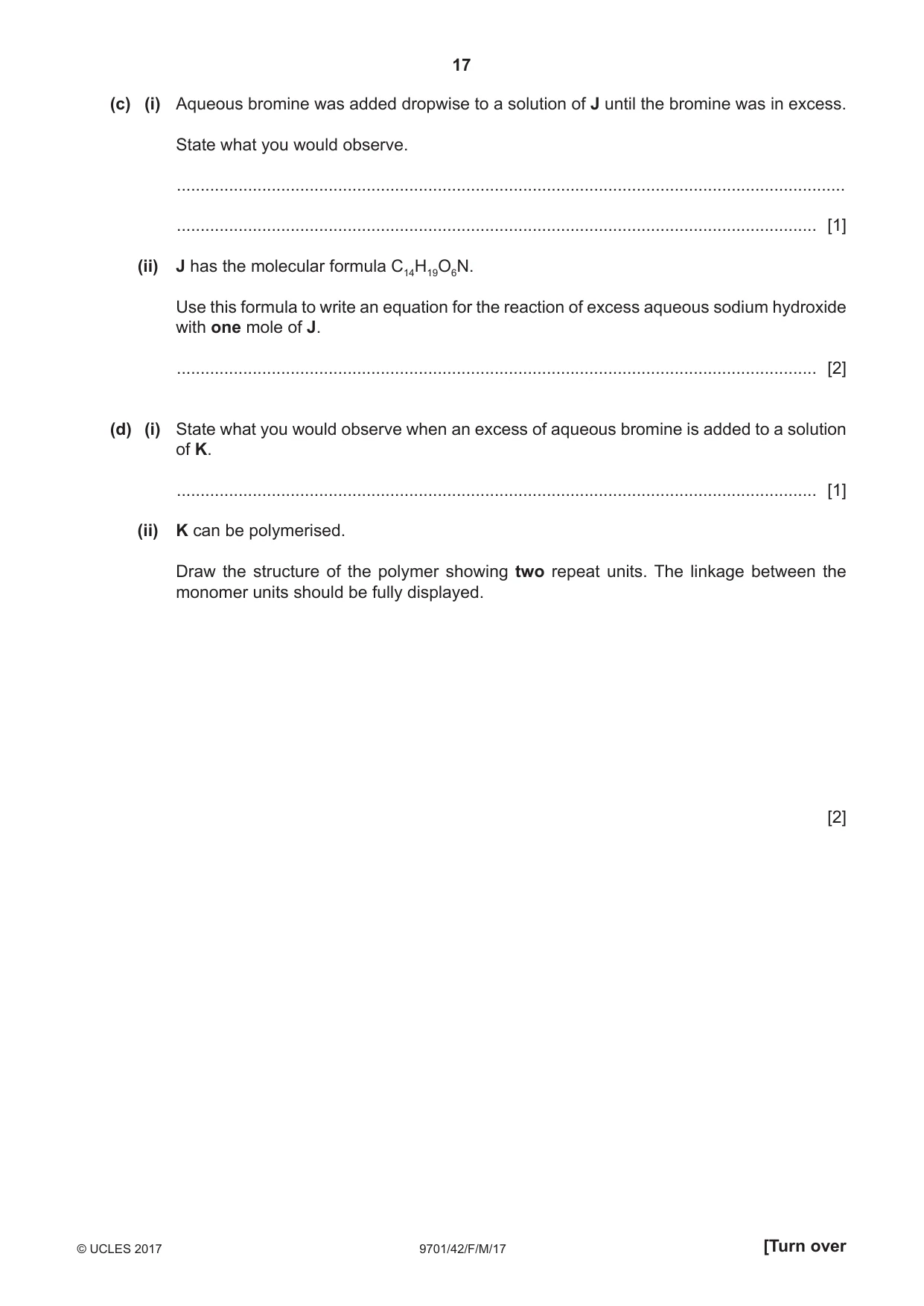
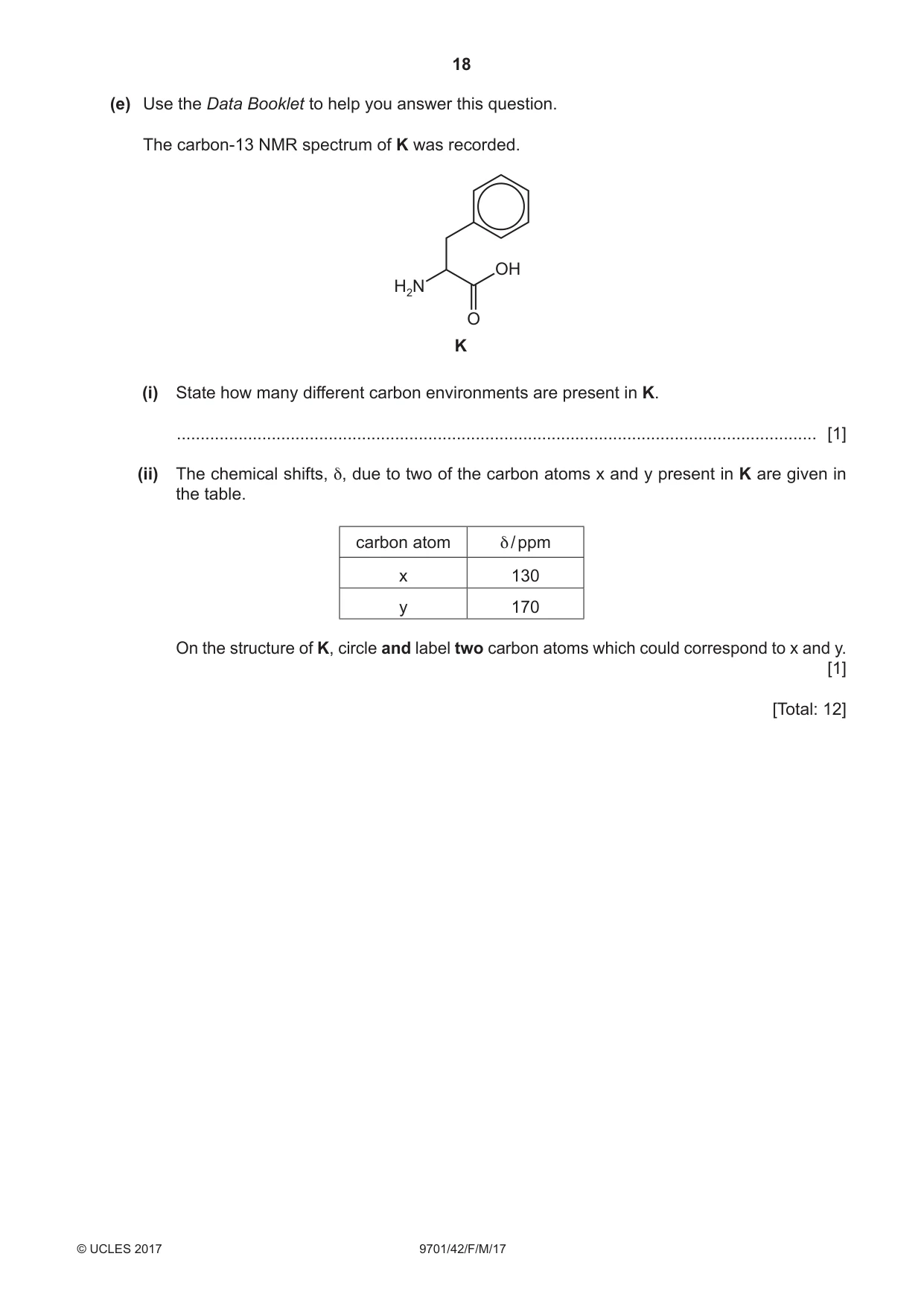
7 The compound Advantame is a sweetener that tastes approximately 25 000 times sweeter than sucrose. RO O H N O HO N CH3 H O O OH Advantame (a) Advantame is optically active. On the diagram of Advantame, circle all the chiral carbon atoms. [1] (b) The decomposition of Advantame produces three molecules, J, K and L. The RO– group in Advantame is unreactive. RO O H N HO OH + + OH O H2N O OH J K L (i) Suggest possible reagents and conditions for this decomposition. ....................................................................................................................................... [1] (ii) Name the type of reaction occurring. ....................................................................................................................................... [1] (iii) Draw the structure of L in the box above. [1] (c) (i) Aqueous bromine was added dropwise to a solution of J until the bromine was in excess. State what you would observe. ............................................................................................................................................. ....................................................................................................................................... [1] (ii) J has the molecular formula C14H19O6N. Use this formula to write an equation for the reaction of excess aqueous sodium hydroxide with one mole of J. ....................................................................................................................................... [2] (d) (i) State what you would observe when an excess of aqueous bromine is added to a solution of K. ....................................................................................................................................... [1] (ii) K can be polymerised. Draw the structure of the polymer showing two repeat units. The linkage between the monomer units should be fully displayed. [2] (e) Use the Data Booklet to help you answer this question. The carbon-13 NMR spectrum of K was recorded. OH H2N O K (i) State how many different carbon environments are present in K. ....................................................................................................................................... [1] (ii) The chemical shifts, δ, due to two of the carbon atoms x and y present in K are given in the table. carbon atom δ / ppm x 130 y 170 On the structure of K, circle and label two carbon atoms which could correspond to x and y. [1] [Total: 12] Question 8 starts on the next page.
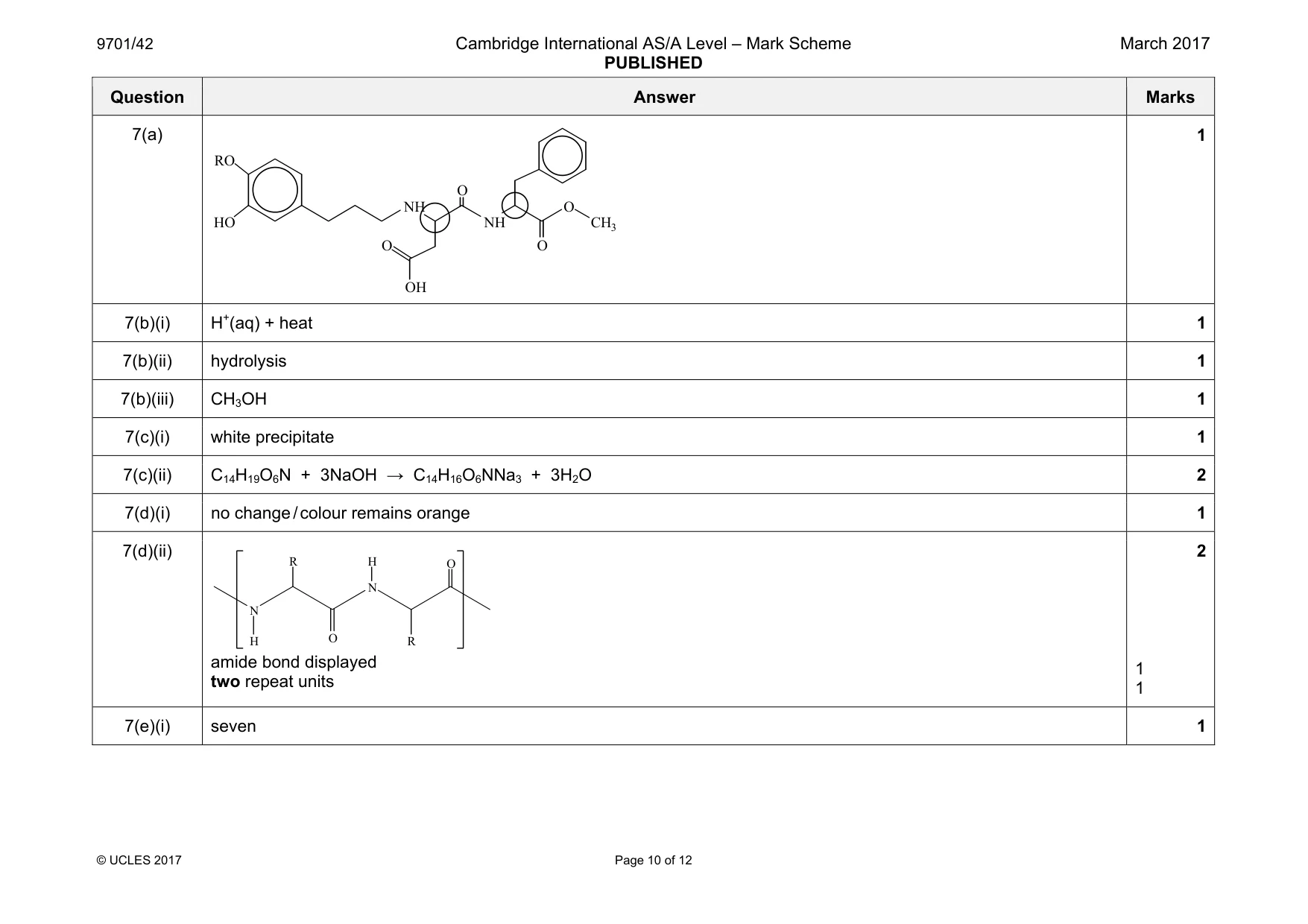
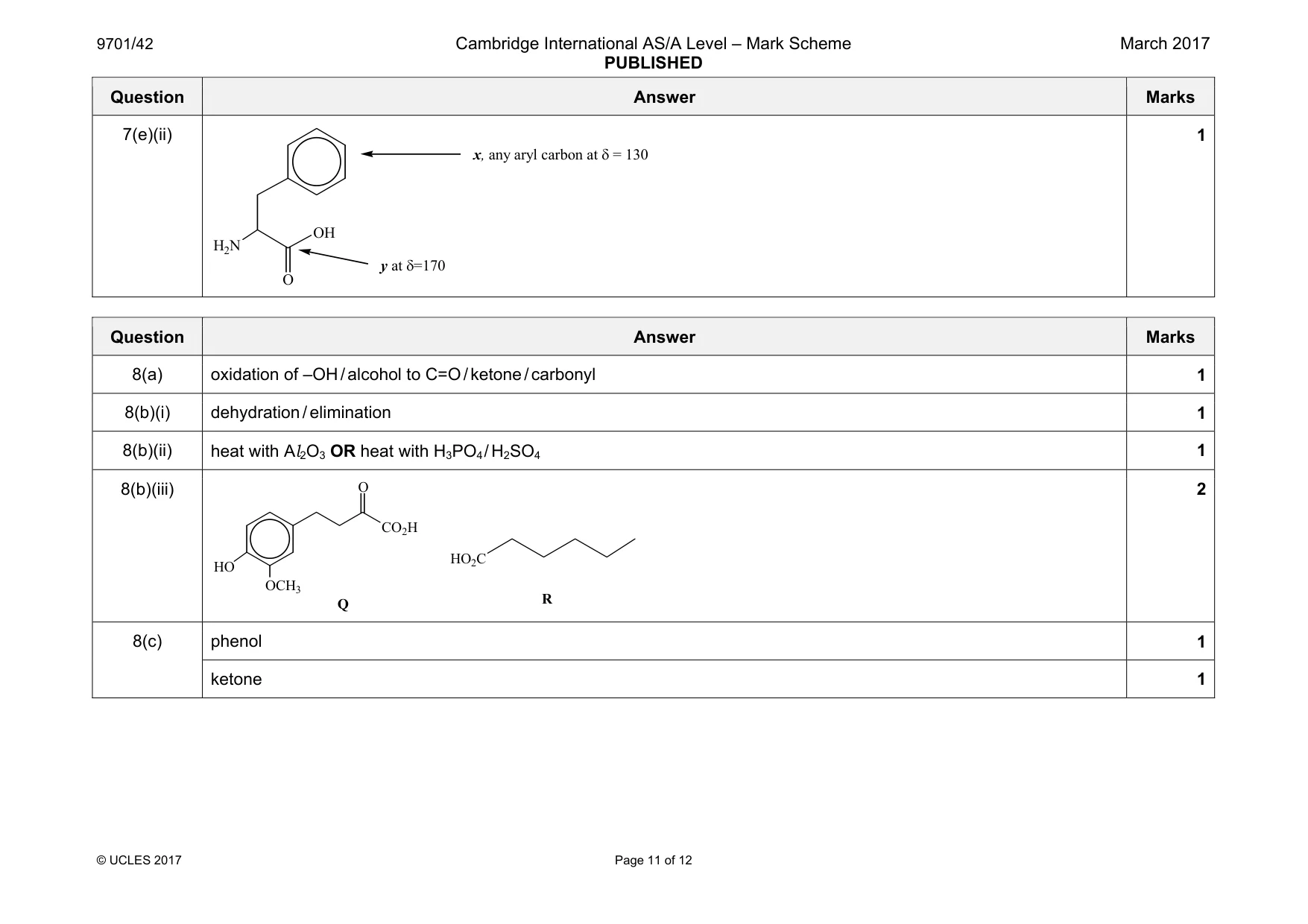
Mark scheme: 7(a) NH NH O CH3 O OH RO HO O O 1 7(b)(i) H+(aq) + heat 1 7(b)(ii) hydrolysis 1 7(b)(iii) CH3OH 1 7(c)(i) white precipitate 1 7(c)(ii) C14H19O6N + 3NaOH → C14H16O6NNa3 + 3H2O 2 7(d)(i) no change / colour remains orange 1 7(d)(ii) N N H R O H R O amide bond displayed two repeat units 2 1 1 7(e)(i) seven 1 Question Answer Marks 7(e)(ii) OH H2N O y at δ=170 x, any aryl carbon at δ = 130 1
Q8 · The root of the ginger plant contains compounds with medicinal and flavouring properties
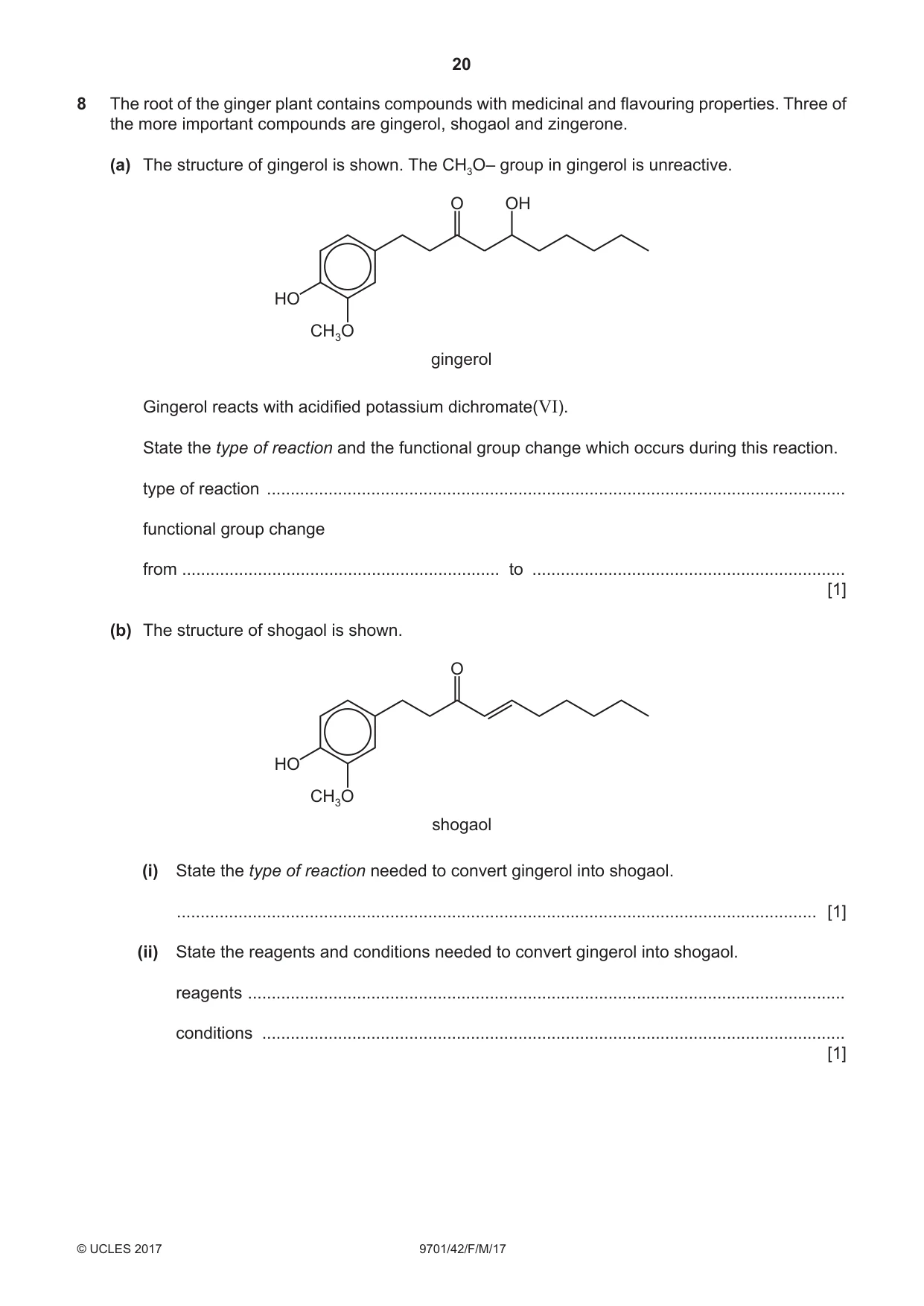
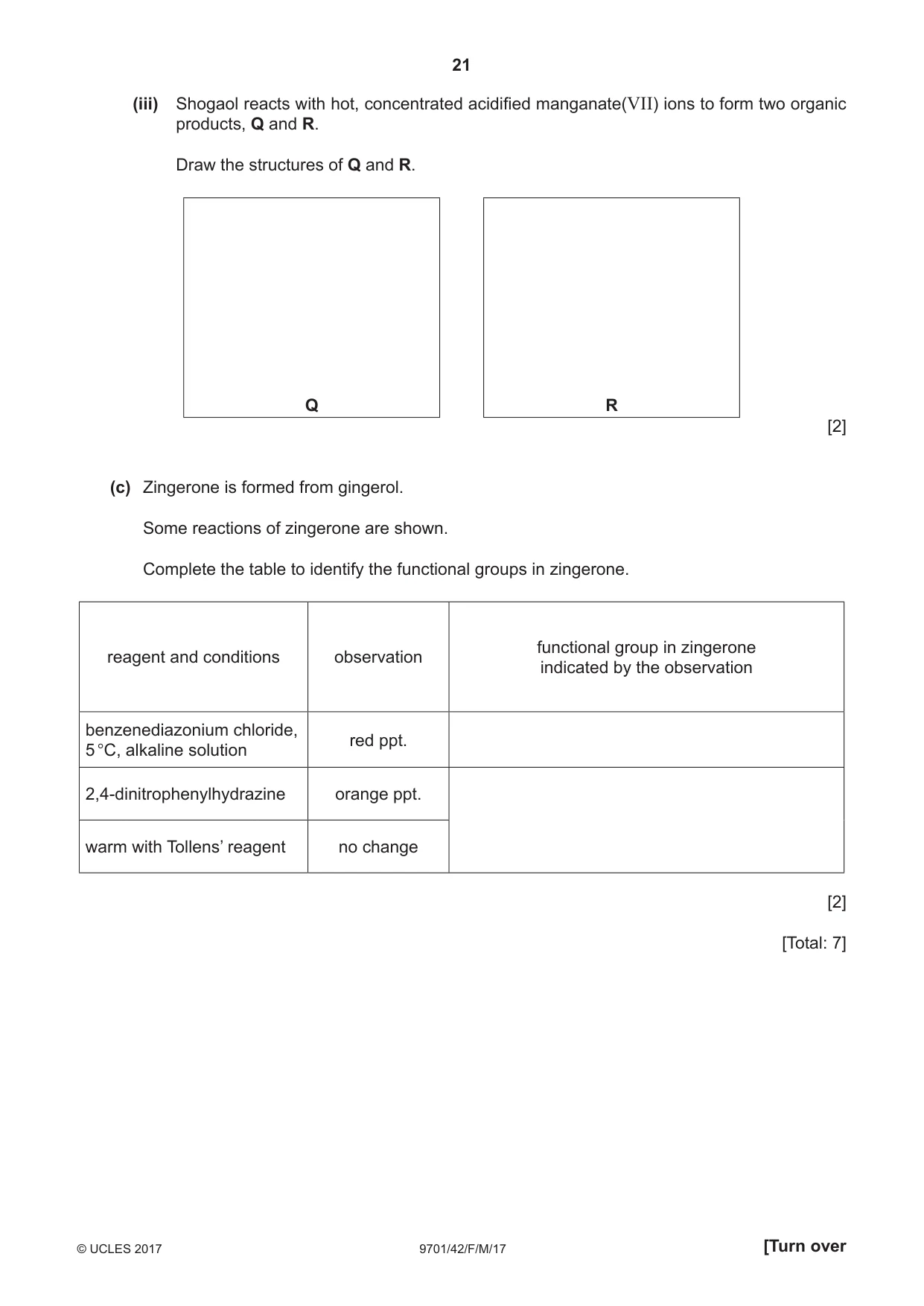
8 The root of the ginger plant contains compounds with medicinal and flavouring properties. Three of the more important compounds are gingerol, shogaol and zingerone. (a) The structure of gingerol is shown. The CH3O– group in gingerol is unreactive. O OH HO CH3O gingerol Gingerol reacts with acidified potassium dichromate(VI). State the type of reaction and the functional group change which occurs during this reaction. type of reaction ........................................................................................................................... functional group change from ................................................................... to ................................................................... [1] (b) The structure of shogaol is shown. O HO CH3O shogaol (i) State the type of reaction needed to convert gingerol into shogaol. ....................................................................................................................................... [1] (ii) State the reagents and conditions needed to convert gingerol into shogaol. reagents .............................................................................................................................. conditions ............................................................................................................................ [1] (iii) Shogaol reacts with hot, concentrated acidified manganate(VII) ions to form two organic products, Q and R. Draw the structures of Q and R. Q R [2] (c) Zingerone is formed from gingerol. Some reactions of zingerone are shown. Complete the table to identify the functional groups in zingerone. functional group in zingerone reagent and conditions observation indicated by the observation benzenediazonium chloride, red ppt.5 °C, alkaline solution 2,4-dinitrophenylhydrazine orange ppt. warm with Tollens’ reagent no change [2] [Total: 7]
Mark scheme: 8(a) oxidation of –OH / alcohol to C=O / ketone / carbonyl 1 8(b)(i) dehydration / elimination 1 8(b)(ii) heat with Al2O3 OR heat with H3PO4 / H2SO4 1 8(b)(iii) CO2H HO OCH3 O HO2C Q R 2 8(c) phenol 1 ketone 1
Q9 · This question is about compound T, CxHyOz
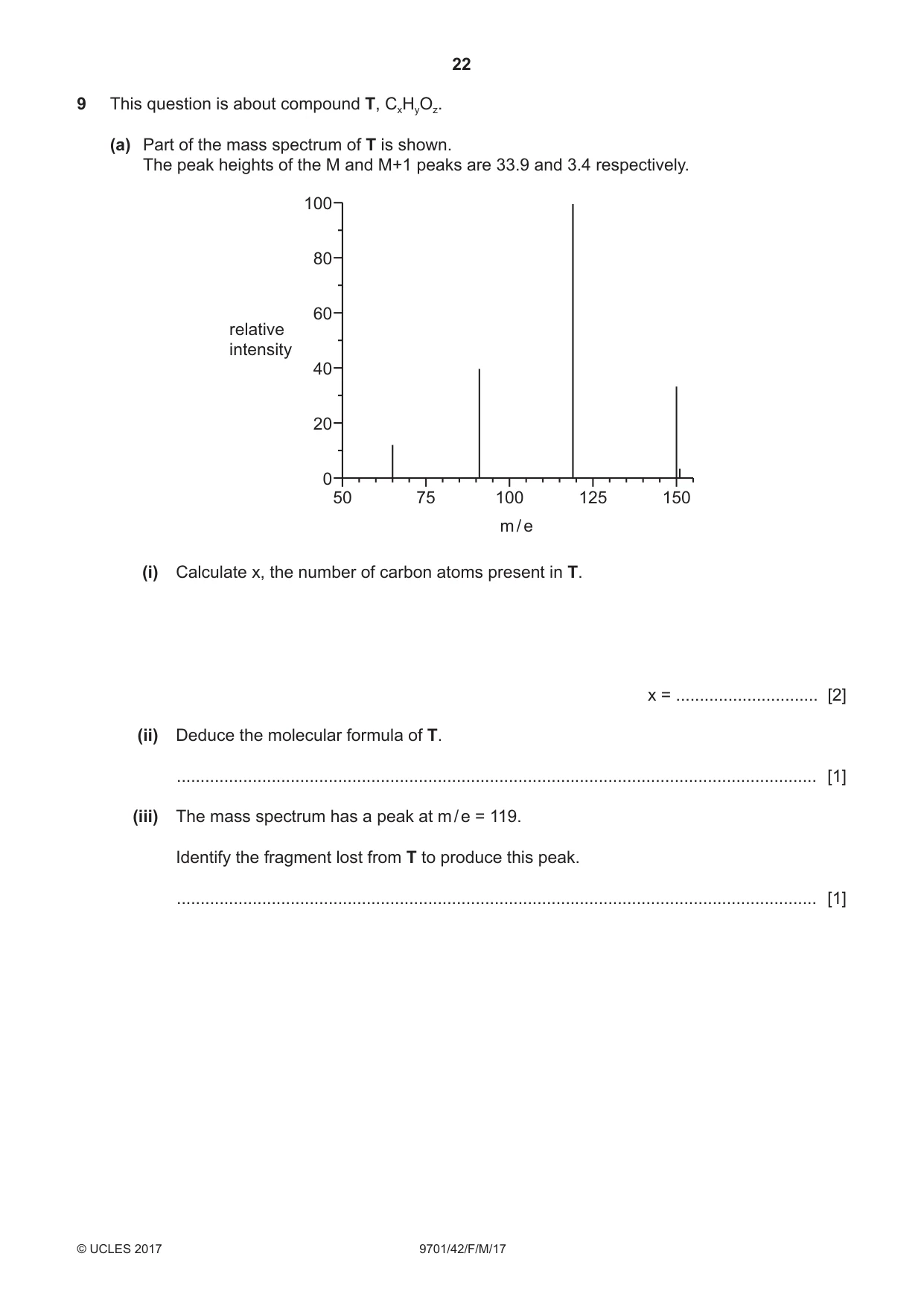
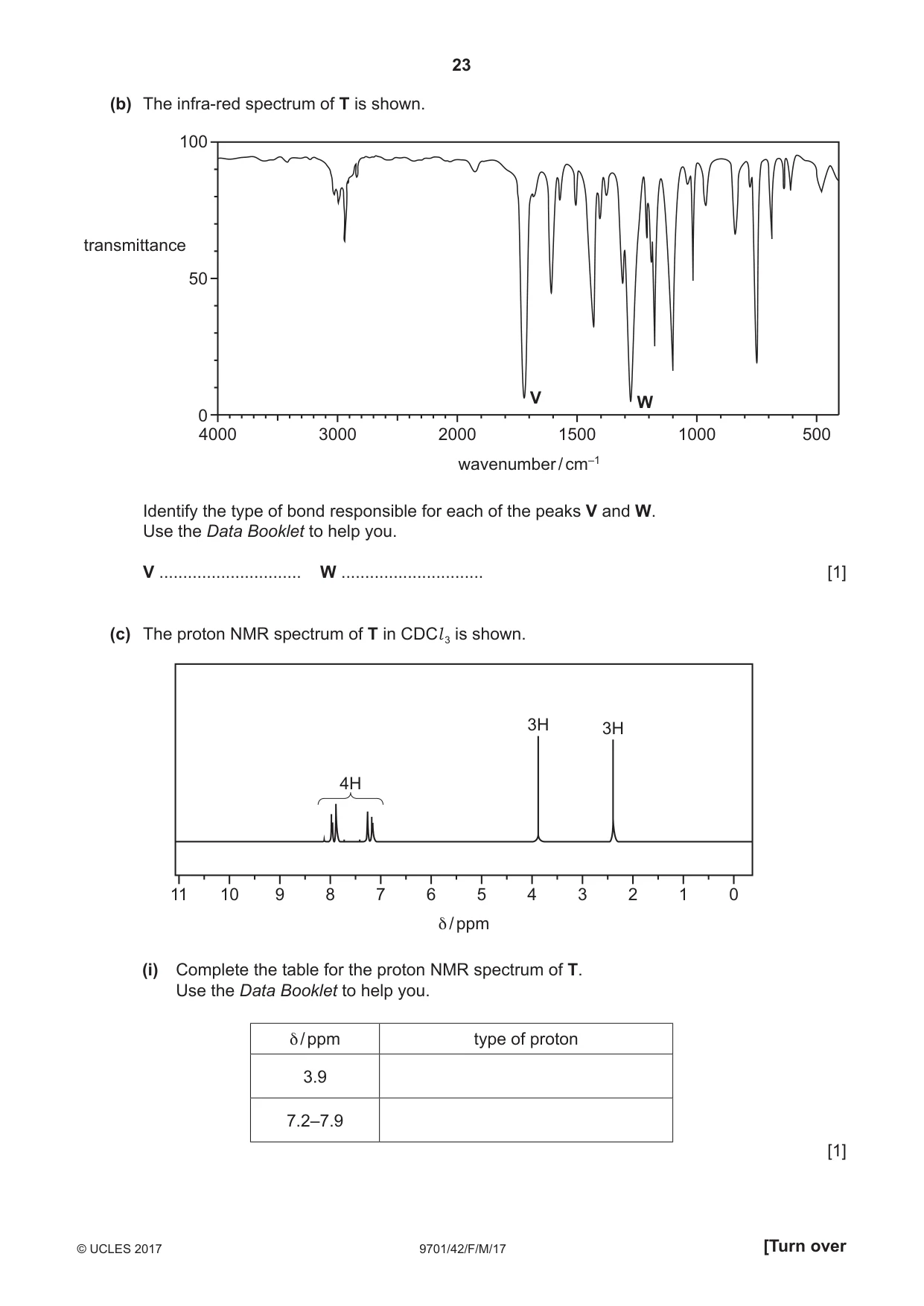
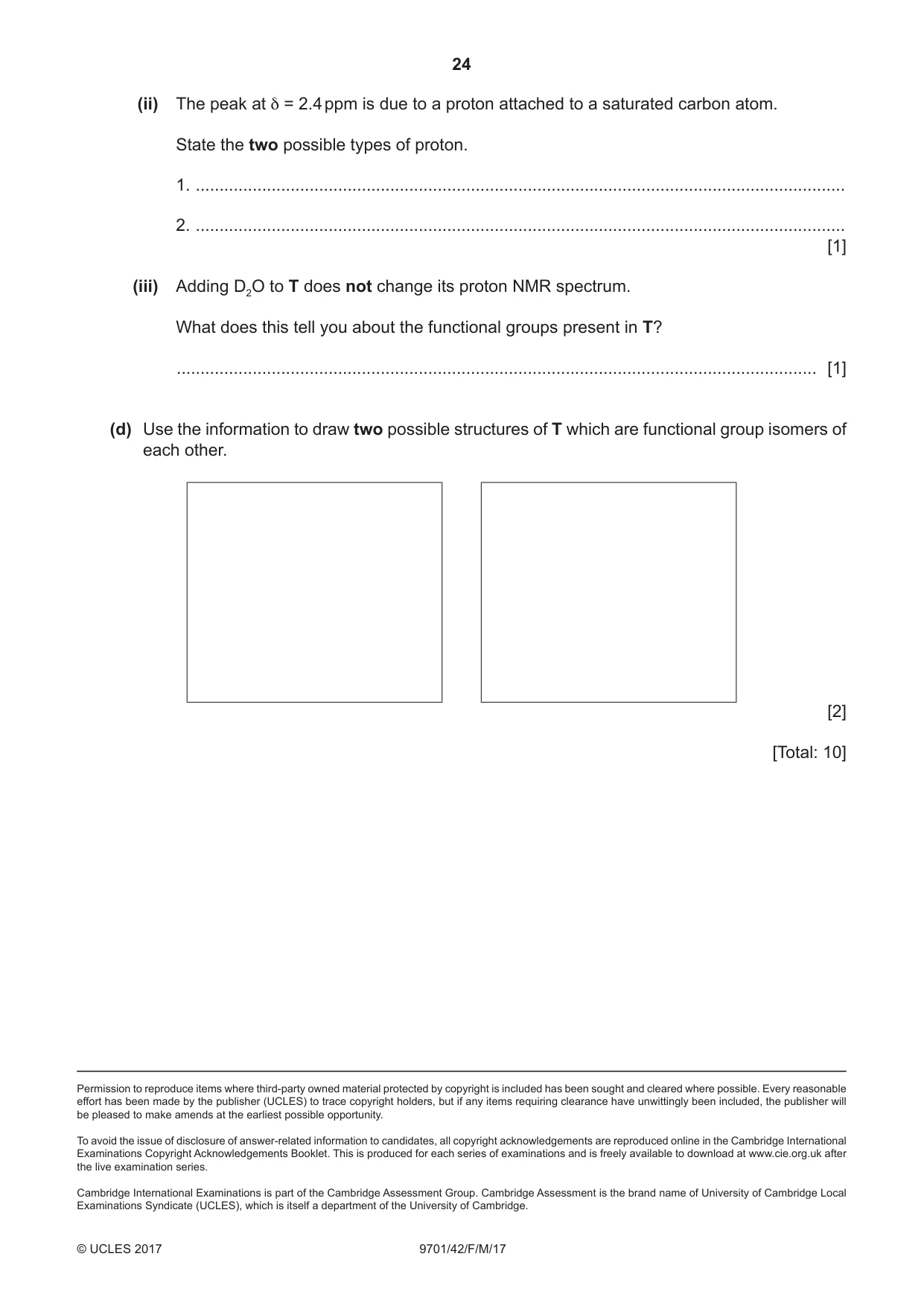
9 This question is about compound T, CxHyOz. (a) Part of the mass spectrum of T is shown. The peak heights of the M and M+1 peaks are 33.9 and 3.4 respectively. 100 80 60 relative intensity 40 20 0 50 75 100 125 150 m / e (i) Calculate x, the number of carbon atoms present in T. x = .............................. [2] (ii) Deduce the molecular formula of T. ....................................................................................................................................... [1] (iii) The mass spectrum has a peak at m / e = 119. Identify the fragment lost from T to produce this peak. ....................................................................................................................................... [1] (b) The infra-red spectrum of T is shown. 100 transmittance 50 V W 0 4000 3000 2000 1500 1000 500 wavenumber / cm–1 Identify the type of bond responsible for each of the peaks V and W. Use the Data Booklet to help you. V .............................. W .............................. [1] (c) The proton NMR spectrum of T in CDCl 3 is shown. 3H 3H 4H 11 10 9 8 7 6 5 4 3 2 1 0 δ / ppm (i) Complete the table for the proton NMR spectrum of T. Use the Data Booklet to help you. δ / ppm type of proton 3.9 7.2–7.9 [1] (ii) The peak at δ = 2.4 ppm is due to a proton attached to a saturated carbon atom. State the two possible types of proton. 1. ......................................................................................................................................... 2. ......................................................................................................................................... [1] (iii) Adding D2O to T does not change its proton NMR spectrum. What does this tell you about the functional groups present in T? ....................................................................................................................................... [1] (d) Use the information to draw two possible structures of T which are functional group isomers of each other. [2] [Total: 10]
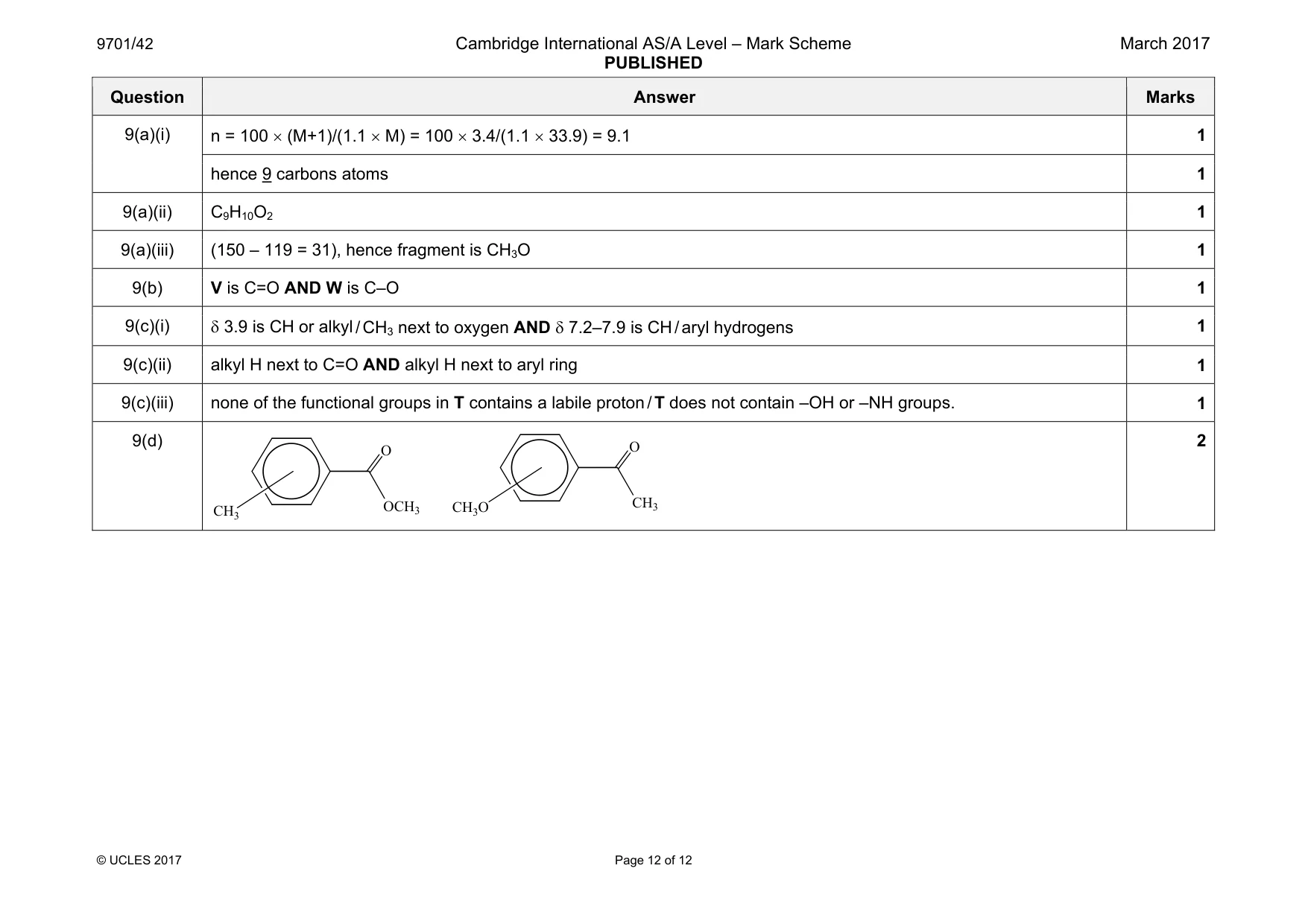
Mark scheme: 9(a)(i) 1 hence 9 carbons atoms 1 9(a)(ii) C9H10O2 1 9(a)(iii) (150 – 119 = 31), hence fragment is CH3O 1 9(b) V is C=O AND W is C–O 1 9(c)(i) δ 3.9 is CH or alkyl / CH3 next to oxygen AND δ 7.2–7.9 is CH / aryl hydrogens 1 9(c)(ii) alkyl H next to C=O AND alkyl H next to aryl ring 1 9(c)(iii) none of the functional groups in T contains a labile proton / T does not contain –OH or –NH groups. 1 9(d) OCH3 O CH3 CH3 O CH3O 2
What was in this paper
The subtopics covered by these 9 questions, and how many questions each got. Open one in a new tab to see every Cambridge question on it.
1Arenes1Electrons, energy levels and atomic orbitals1Homogeneous and heterogeneous catalysts1Lattice energy and Born-Haber cycles1Mass spectrometry1Organic synthesis1Relative masses of atoms and molecules1Standard electrode potentials E ⦵, standard cell potentials E ⦵ cell and the Nernst equation1What you needed in this session
Cambridge’s own grade thresholds for 2017 Feb/March, Paper 4 · Variant 2. A higher threshold means an easier paper — the bar moves with how the cohort did.