Cambridge A Level Chemistry 9701 — 2016 Oct/Nov Paper 4 · Variant 2
9701/42/O/N/16 · 100 marks · ≈113 min
The question paper and its mark scheme, free to read here and free to download. This is Cambridge’s own paper, exactly as it was sat.
Question paper20 pages
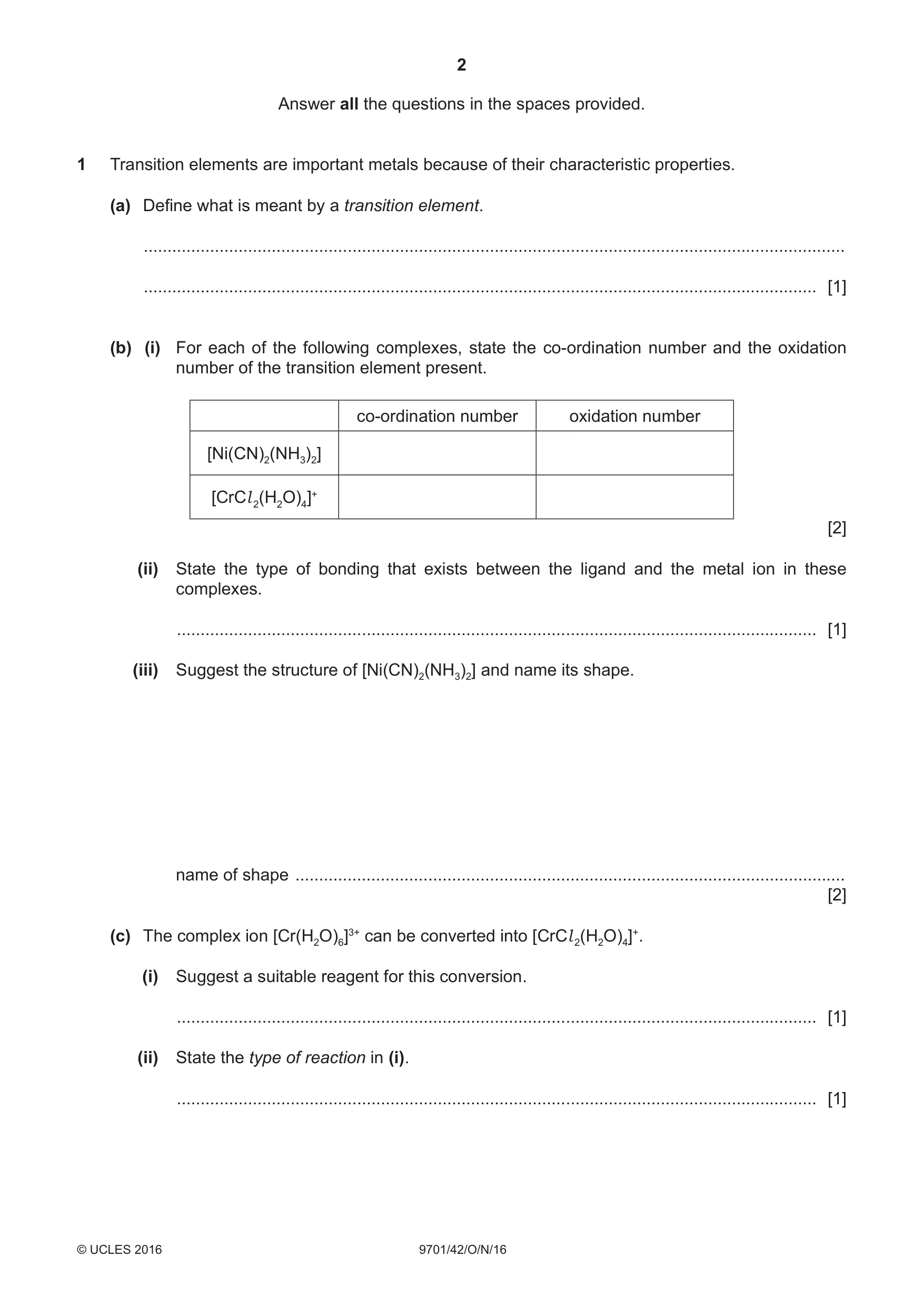
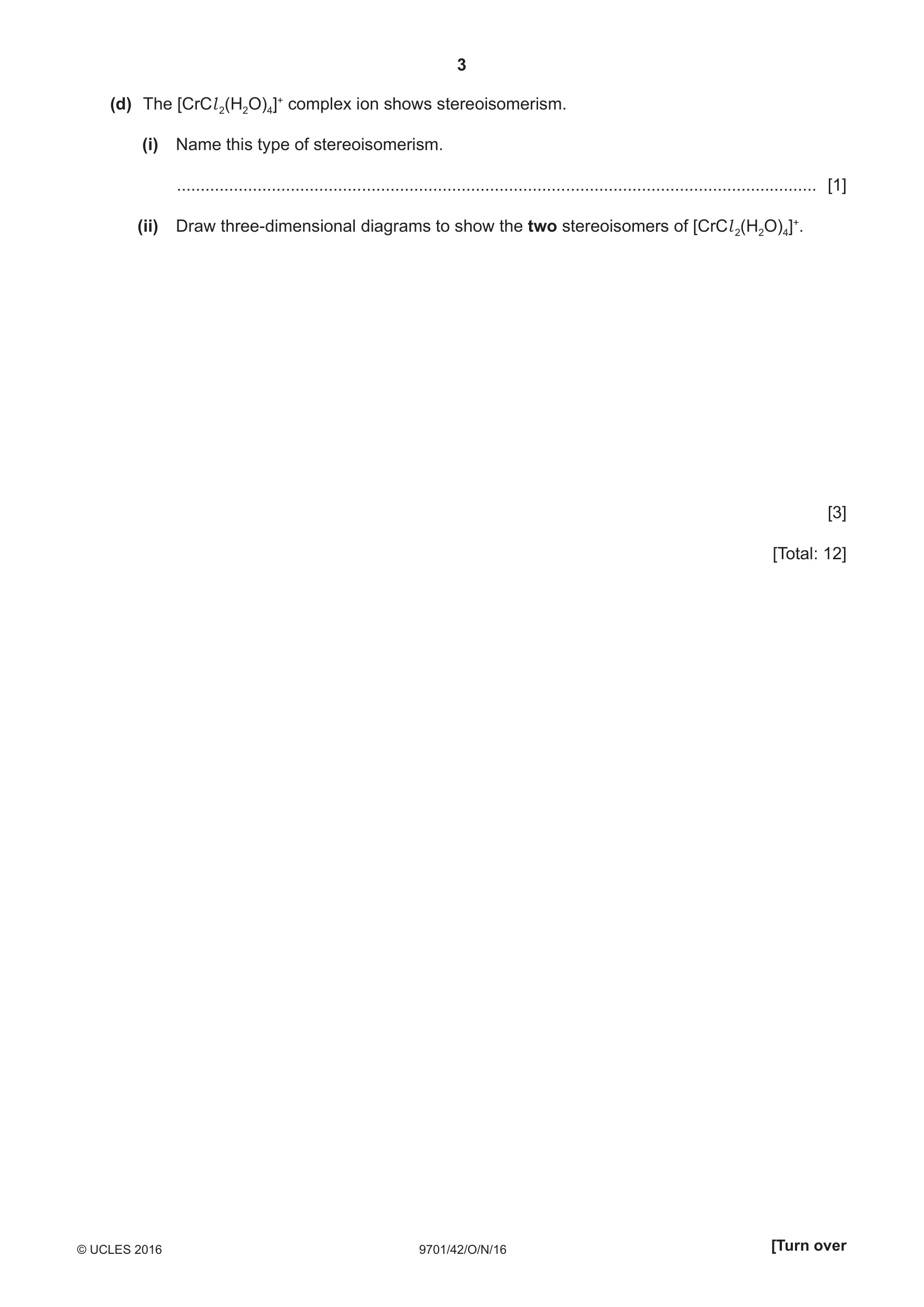
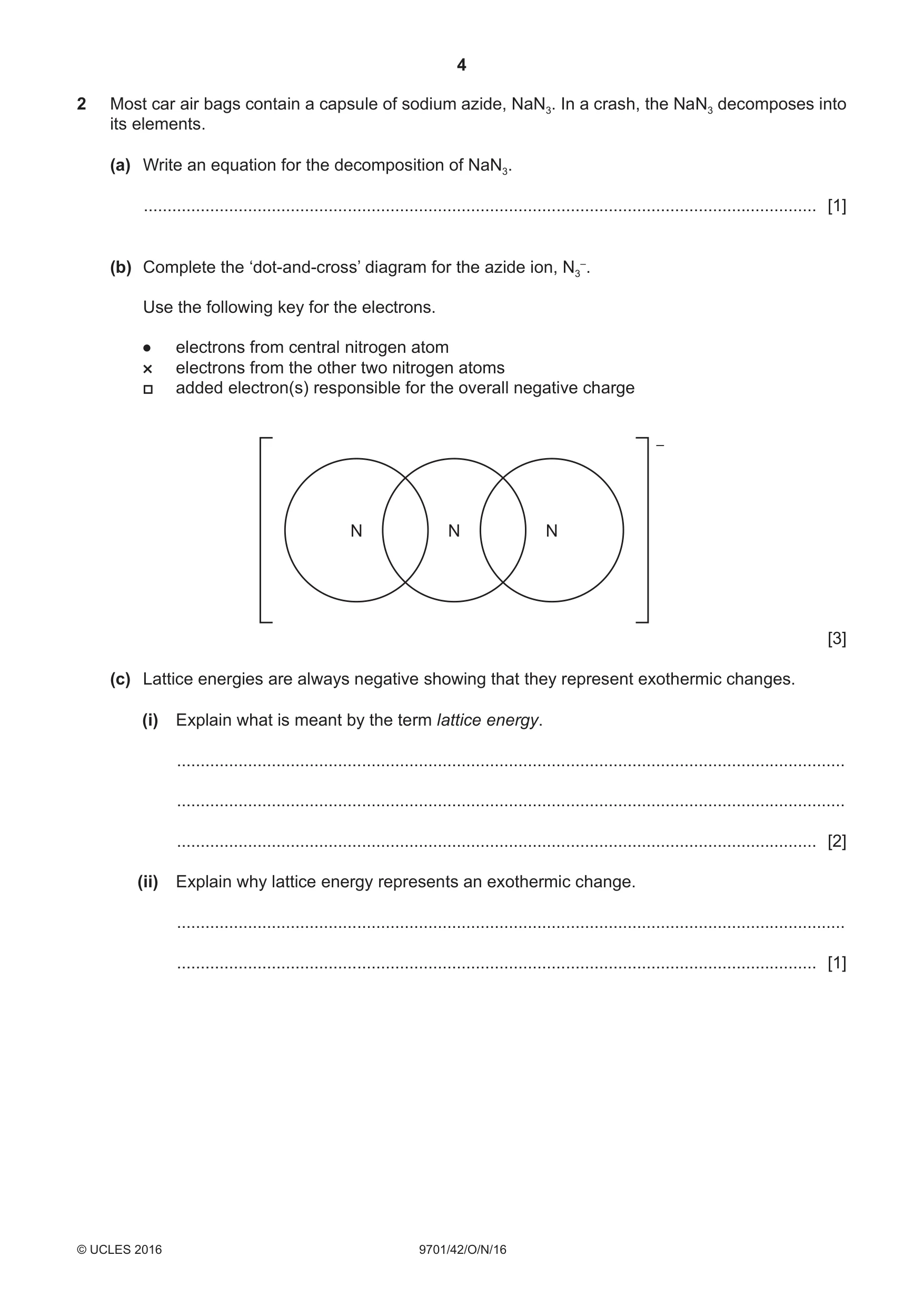

Mark scheme16 pages
Answers below. Sit the paper first if you are practising.
Paper as text
Question paper, page 1
READ THESE INSTRUCTIONS FIRST Write your Centre number, candidate number and name on all the work you hand in. Write in dark blue or black pen. You may use an HB pencil for any diagrams or graphs. Do not use staples, paper clips, glue or correction fl uid. DO NOT WRITE IN ANY BARCODES. Answer all questions. Electronic calculators may be used. You may lose marks if you do not show your working or if you do not use appropriate units. A Data Booklet is provided. At the end of the examination, fasten all your work securely together. The number of marks is given in brackets [ ] at the end of each question or part question. CHEMISTRY 9701/42 Paper 4 A Level Structured Questions October/November 2016 2 hours Candidates answer on the Question Paper. Additional Materials: Data Booklet This document consists of 18 printed pages and 2 blank pages. [Turn over IB16 11_9701_42/FP © UCLES 2016 Cambridge International Examinations Cambridge International Advanced Subsidiary and Advanced Level
Question paper, page 2
2 9701/42/O/N/16 © UCLES 2016 Answer all the questions in the spaces provided. 1 Transition elements are important metals because of their characteristic properties. (a) Defi ne what is meant by a transition element. … … [1] (b) (i) For each of the following complexes, state the co-ordination number and the oxidation number of the transition element present. co-ordination number oxidation number [Ni(CN)2(NH3)2] [CrCl 2(H2O)4]+ [2] (ii) State the type of bonding that exists between the ligand and the metal ion in these complexes. … [1] (iii) Suggest the structure of [Ni(CN)2(NH3)2] and name its shape. name of shape … [2] (c) The complex ion [Cr(H2O)6]3+ can be converted into [CrCl 2(H2O)4]+. (i) Suggest a suitable reagent for this conversion. … [1] (ii) State the type of reaction in (i). … [1]
Question paper, page 3
3 9701/42/O/N/16 © UCLES 2016 [Turn over (d) The [CrCl 2(H2O)4]+ complex ion shows stereoisomerism. (i) Name this type of stereoisomerism. … [1] (ii) Draw three-dimensional diagrams to show the two stereoisomers of [CrCl 2(H2O)4]+. [3] [Total: 12]
Question paper, page 4
4 9701/42/O/N/16 © UCLES 2016 2 Most car air bags contain a capsule of sodium azide, NaN3. In a crash, the NaN3 decomposes into its elements. (a) Write an equation for the decomposition of NaN3. … [1] (b) Complete the ‘dot-and-cross’ diagram for the azide ion, N3 –. Use the following key for the electrons. electrons from central nitrogen atom electrons from the other two nitrogen atoms □ added electron(s) responsible for the overall negative charge N N N – [3] (c) Lattice energies are always negative showing that they represent exothermic changes. (i) Explain what is meant by the term lattice energy. … … … [2] (ii) Explain why lattice energy represents an exothermic change. … … [1]
Question paper, page 5
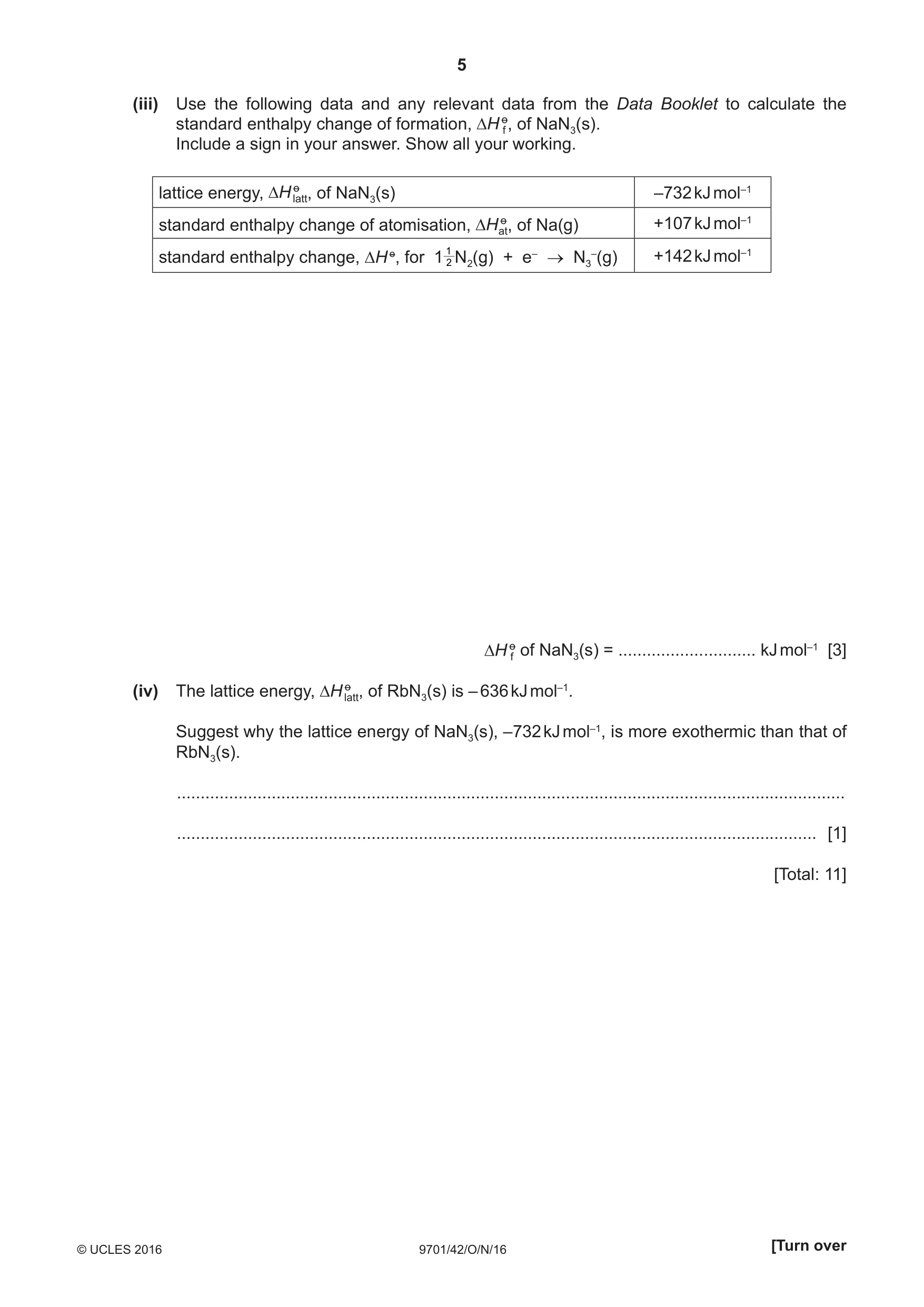
5 9701/42/O/N/16 © UCLES 2016 [Turn over (iii) Use the following data and any relevant data from the Data Booklet to calculate the standard enthalpy change of formation, , of NaN3(s). Include a sign in your answer. Show all your working. lattice energy, , of NaN3(s) –732 kJ mol–1 standard enthalpy change of atomisation, , of Na(g) +107 kJ mol–1 standard enthalpy change, H o, for 1 2 1 N2(g) + e– N3 –(g) +142 kJ mol–1 of NaN3(s) = … kJ mol–1 [3] (iv) The lattice energy, , of RbN3(s) is – 636 kJ mol–1. Suggest why the lattice energy of NaN3(s), –732 kJ mol–1, is more exothermic than that of RbN3(s). … … [1] [Total: 11]
Question paper, page 6
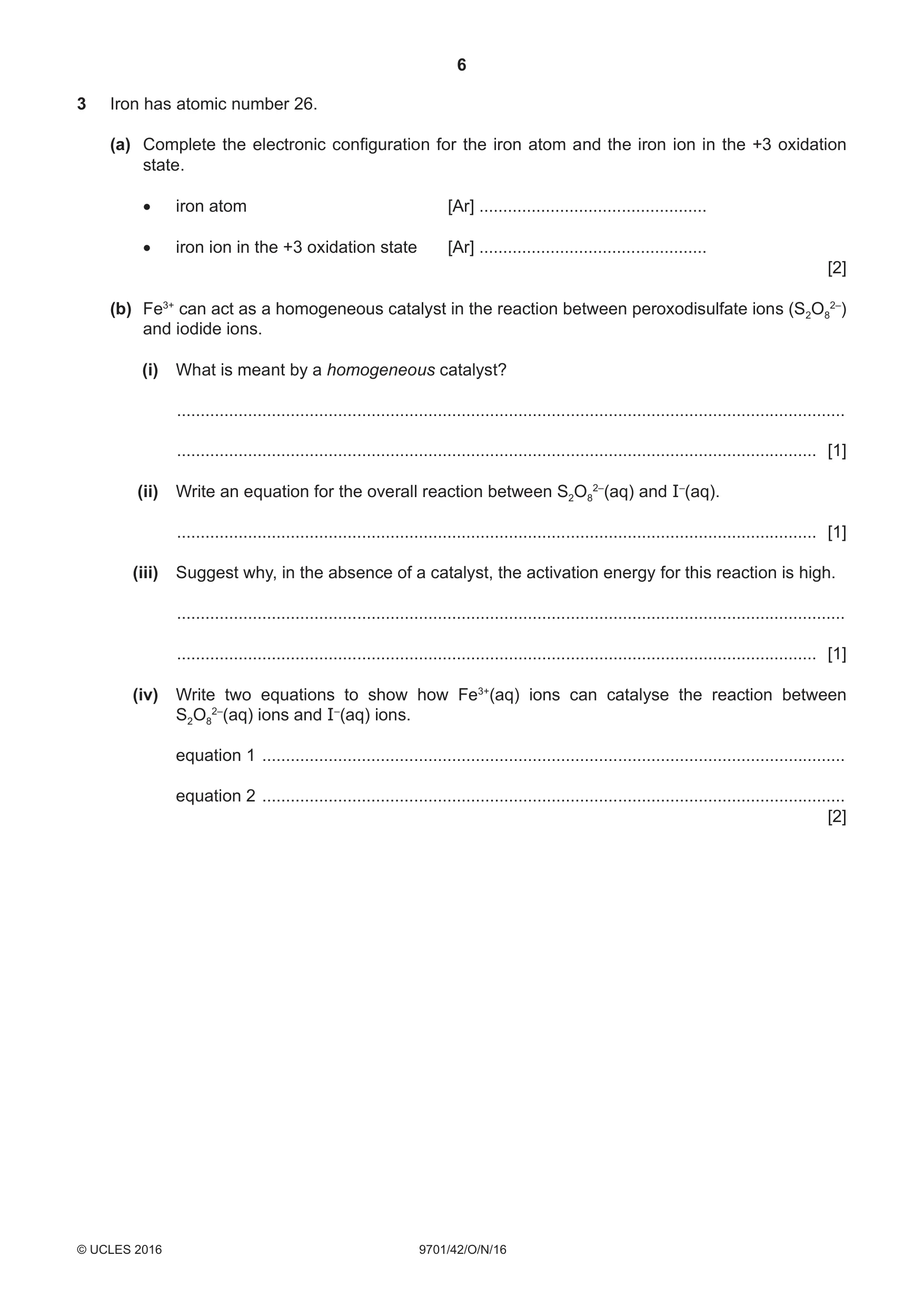
6 9701/42/O/N/16 © UCLES 2016 3 Iron has atomic number 26. (a) Complete the electronic confi guration for the iron atom and the iron ion in the +3 oxidation state. iron atom [Ar] … iron ion in the +3 oxidation state [Ar] … [2] (b) Fe3+ can act as a homogeneous catalyst in the reaction between peroxodisulfate ions (S2O8 2–) and iodide ions. (i) What is meant by a homogeneous catalyst? … … [1] (ii) Write an equation for the overall reaction between S2O8 2–(aq) and I–(aq). … [1] (iii) Suggest why, in the absence of a catalyst, the activation energy for this reaction is high. … … [1] (iv) Write two equations to show how Fe3+(aq) ions can catalyse the reaction between S2O8 2–(aq) ions and I–(aq) ions. equation 1 … equation 2 … [2]
Question paper, page 7
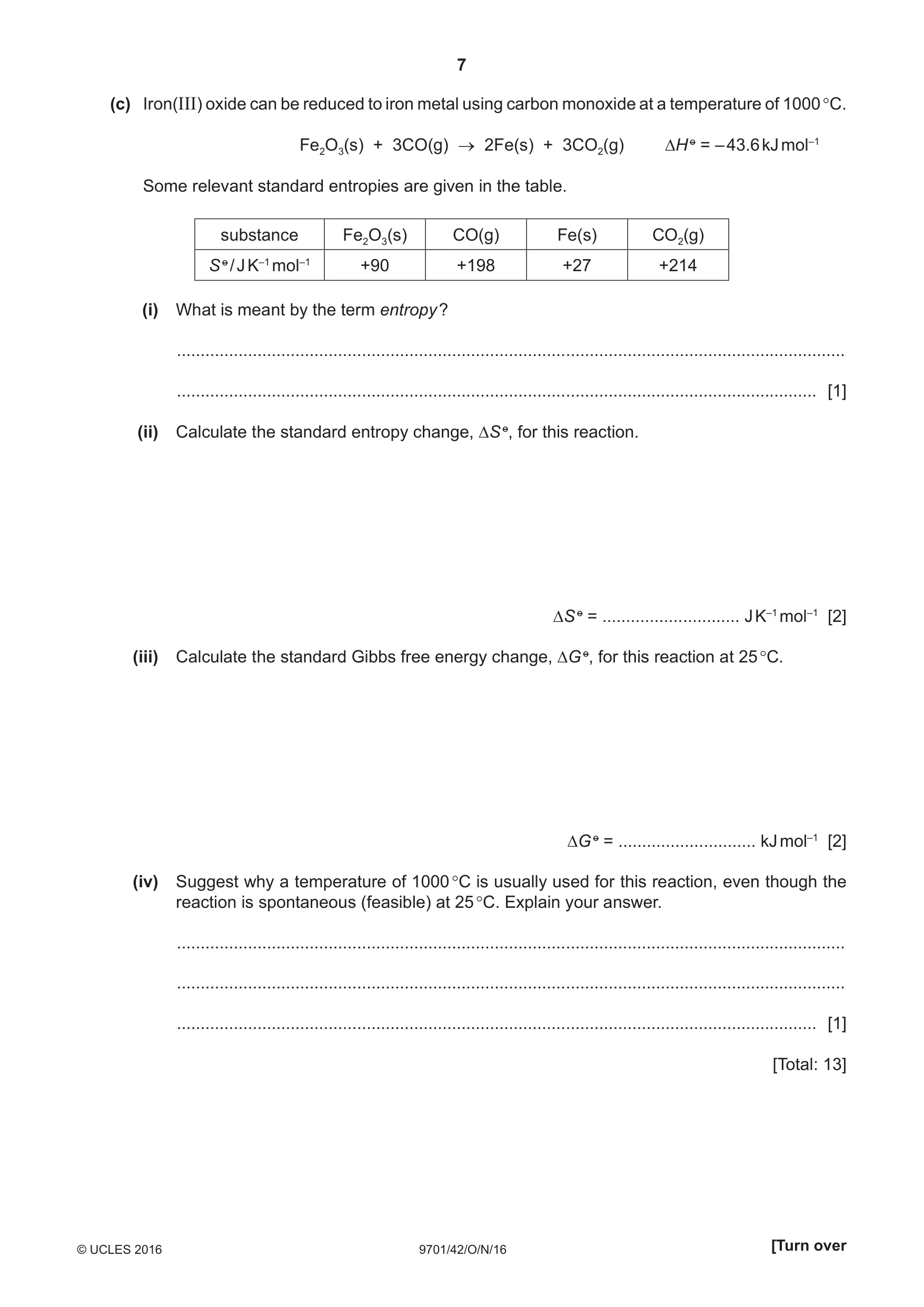
7 9701/42/O/N/16 © UCLES 2016 [Turn over (c) Iron(III) oxide can be reduced to iron metal using carbon monoxide at a temperature of 1000 C. Fe2O3(s) + 3CO(g) 2Fe(s) + 3CO2(g) H o = – 43.6 kJ mol–1 Some relevant standard entropies are given in the table. substance Fe2O3(s) CO(g) Fe(s) CO2(g) S o / J K–1 mol–1 +90 +198 +27 +214 (i) What is meant by the term entropy ? … … [1] (ii) Calculate the standard entropy change, S o, for this reaction. S o = … J K–1 mol–1 [2] (iii) Calculate the standard Gibbs free energy change, G o, for this reaction at 25 C. G o = … kJ mol–1 [2] (iv) Suggest why a temperature of 1000 C is usually used for this reaction, even though the reaction is spontaneous (feasible) at 25 C. Explain your answer. … … … [1] [Total: 13]
Question paper, page 8
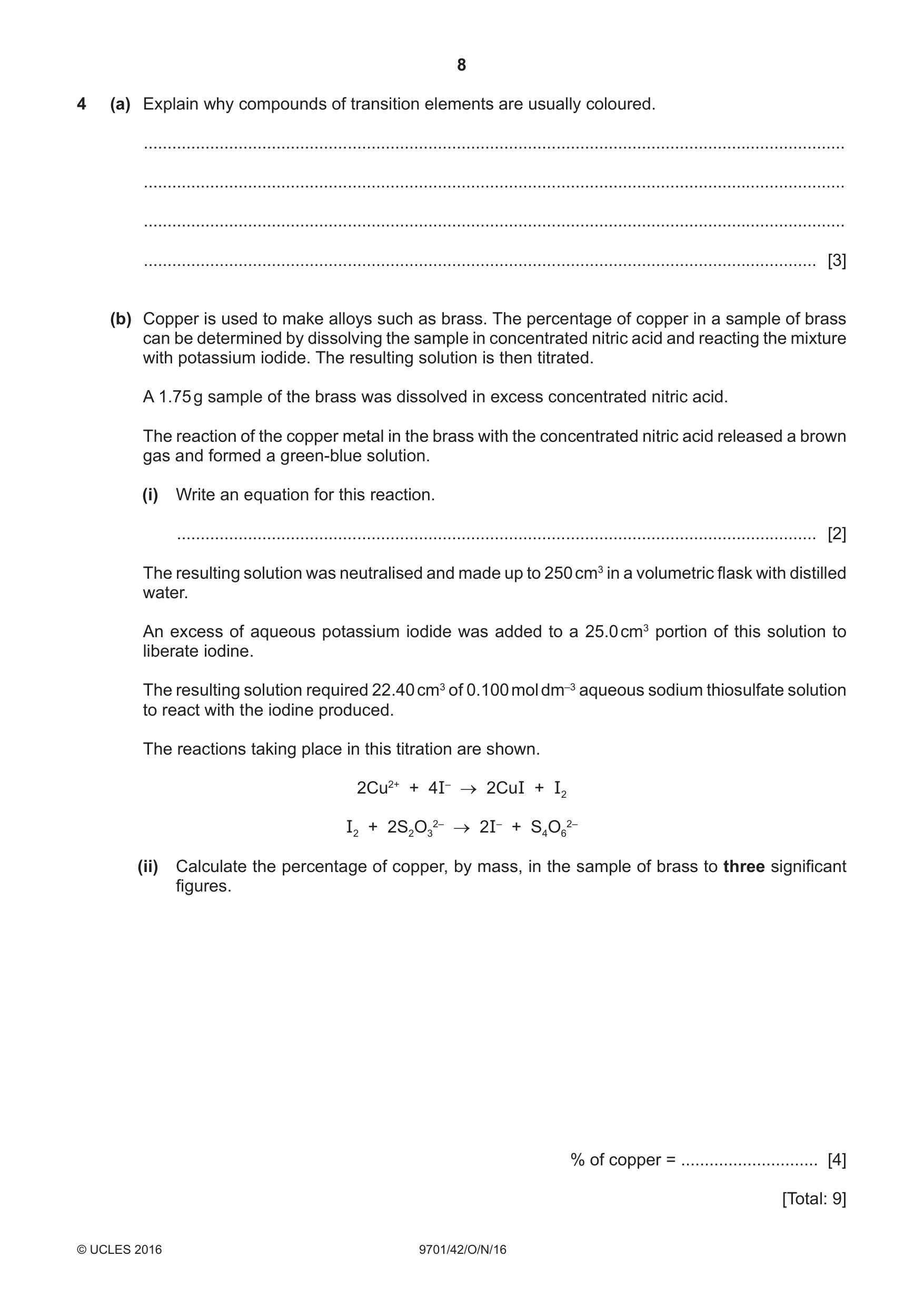
8 9701/42/O/N/16 © UCLES 2016 4 (a) Explain why compounds of transition elements are usually coloured. … … … … [3] (b) Copper is used to make alloys such as brass. The percentage of copper in a sample of brass can be determined by dissolving the sample in concentrated nitric acid and reacting the mixture with potassium iodide. The resulting solution is then titrated. A 1.75 g sample of the brass was dissolved in excess concentrated nitric acid. The reaction of the copper metal in the brass with the concentrated nitric acid released a brown gas and formed a green-blue solution. (i) Write an equation for this reaction. … [2] The resulting solution was neutralised and made up to 250 cm3 in a volumetric fl ask with distilled water. An excess of aqueous potassium iodide was added to a 25.0 cm3 portion of this solution to liberate iodine. The resulting solution required 22.40 cm3 of 0.100 mol dm–3 aqueous sodium thiosulfate solution to react with the iodine produced. The reactions taking place in this titration are shown. 2Cu2+ + 4I– 2CuI + I2 I2 + 2S2O3 2– 2I– + S4O6 2– (ii) Calculate the percentage of copper, by mass, in the sample of brass to three signifi cant fi gures. % of copper = … [4] [Total: 9]
Question paper, page 9
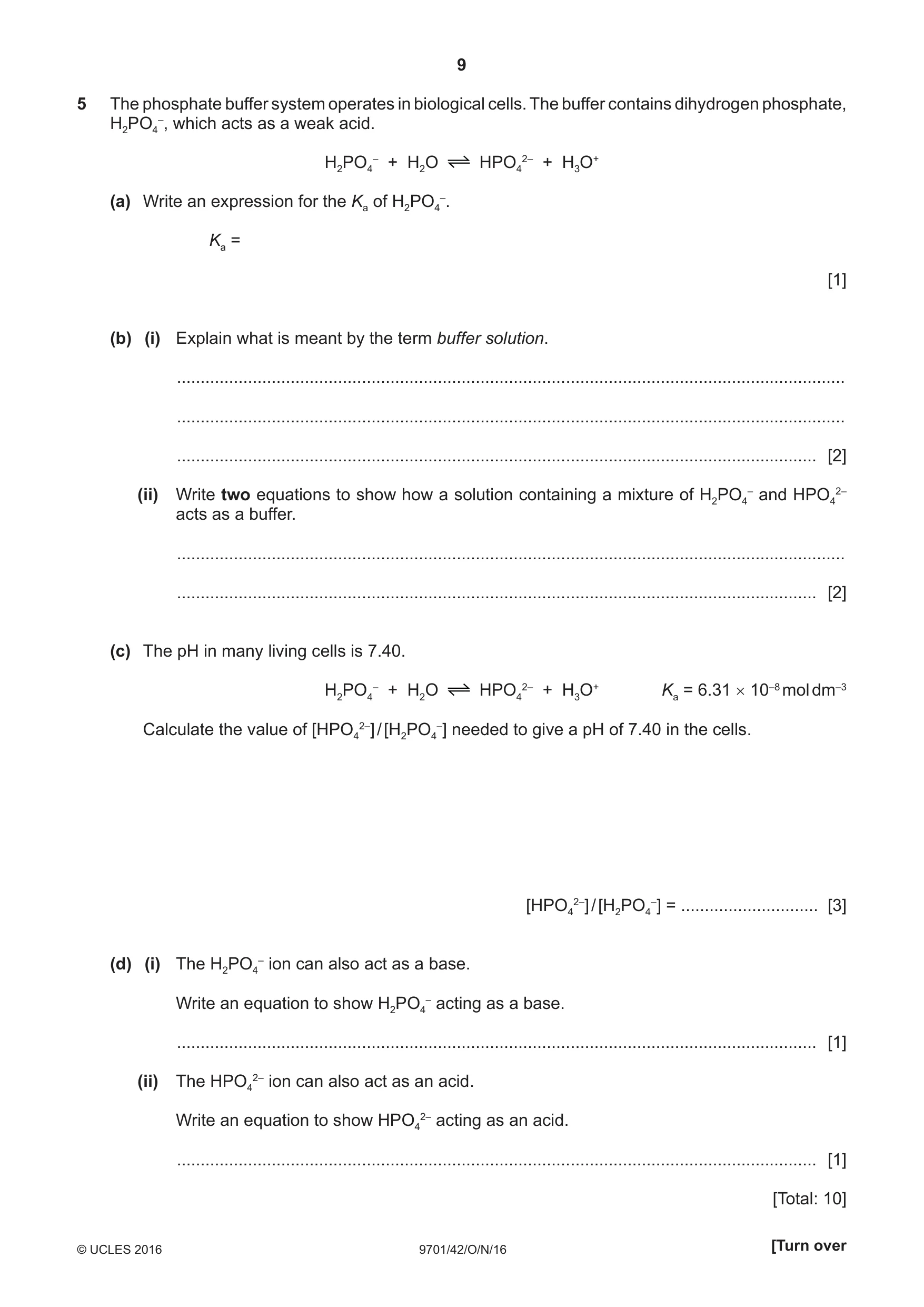
9 9701/42/O/N/16 © UCLES 2016 [Turn over 5 The phosphate buffer system operates in biological cells. The buffer contains dihydrogen phosphate, H2PO4 –, which acts as a weak acid. H2PO4 – + H2O HPO4 2– + H3O+ (a) Write an expression for the Ka of H2PO4 –. Ka = [1] (b) (i) Explain what is meant by the term buffer solution. … … … [2] (ii) Write two equations to show how a solution containing a mixture of H2PO4 – and HPO4 2– acts as a buffer. … … [2] (c) The pH in many living cells is 7.40. H2PO4 – + H2O HPO4 2– + H3O+ Ka = 6.31 10–8 mol dm–3 Calculate the value of [HPO4 2–] / [H2PO4 –] needed to give a pH of 7.40 in the cells. [HPO4 2–] / [H2PO4 –] = … [3] (d) (i) The H2PO4 – ion can also act as a base. Write an equation to show H2PO4 – acting as a base. … [1] (ii) The HPO4 2– ion can also act as an acid. Write an equation to show HPO4 2– acting as an acid. … [1] [Total: 10]
Question paper, page 10
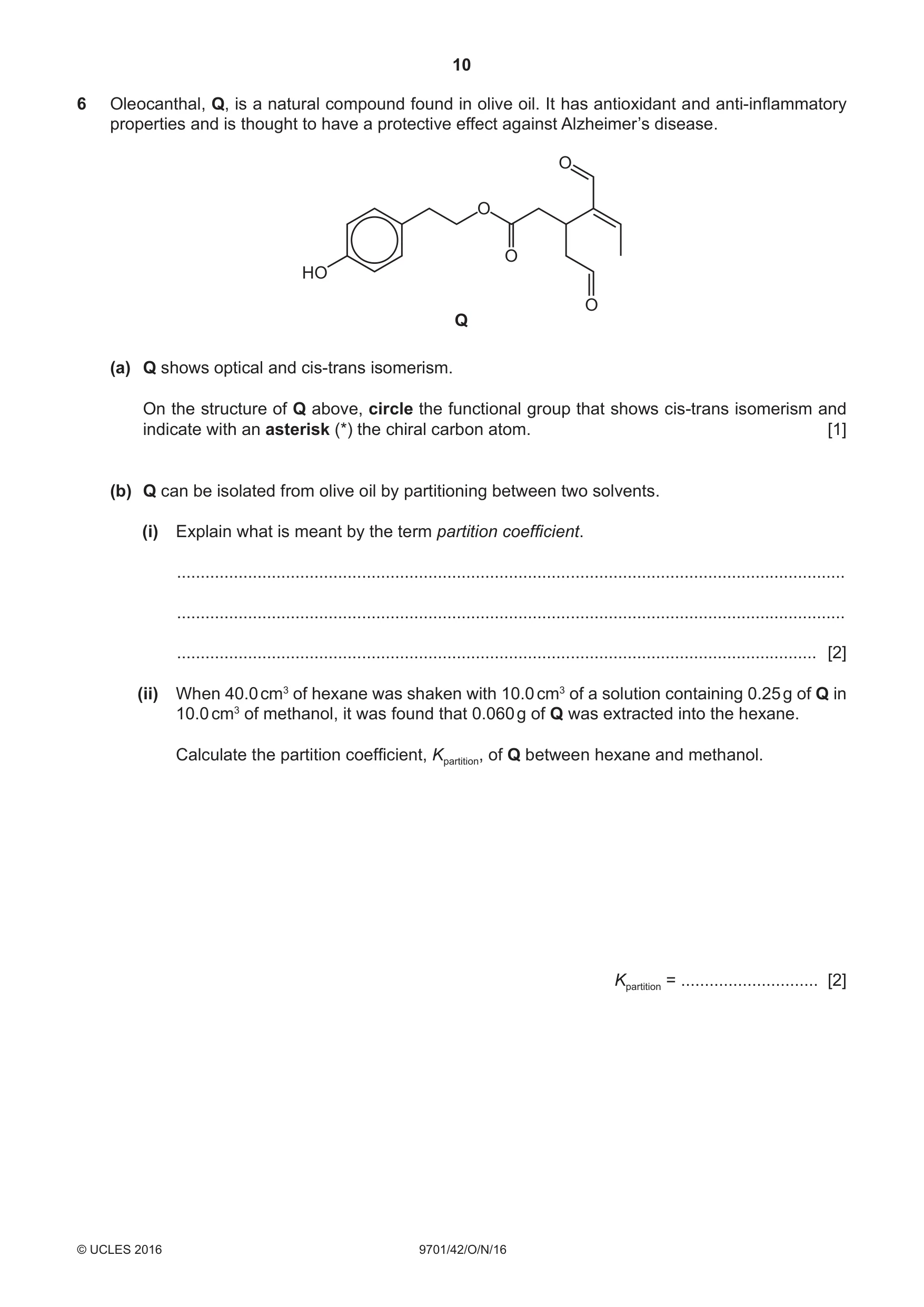
10 9701/42/O/N/16 © UCLES 2016 6 Oleocanthal, Q, is a natural compound found in olive oil. It has antioxidant and anti-infl ammatory properties and is thought to have a protective effect against Alzheimer’s disease. Q O HO O O O (a) Q shows optical and cis-trans isomerism. On the structure of Q above, circle the functional group that shows cis-trans isomerism and indicate with an asterisk (*) the chiral carbon atom. [1] (b) Q can be isolated from olive oil by partitioning between two solvents. (i) Explain what is meant by the term partition coeffi cient. … … … [2] (ii) When 40.0 cm3 of hexane was shaken with 10.0 cm3 of a solution containing 0.25 g of Q in 10.0 cm3 of methanol, it was found that 0.060 g of Q was extracted into the hexane. Calculate the partition coeffi cient, Kpartition, of Q between hexane and methanol. Kpartition = … [2]
Question paper, page 11
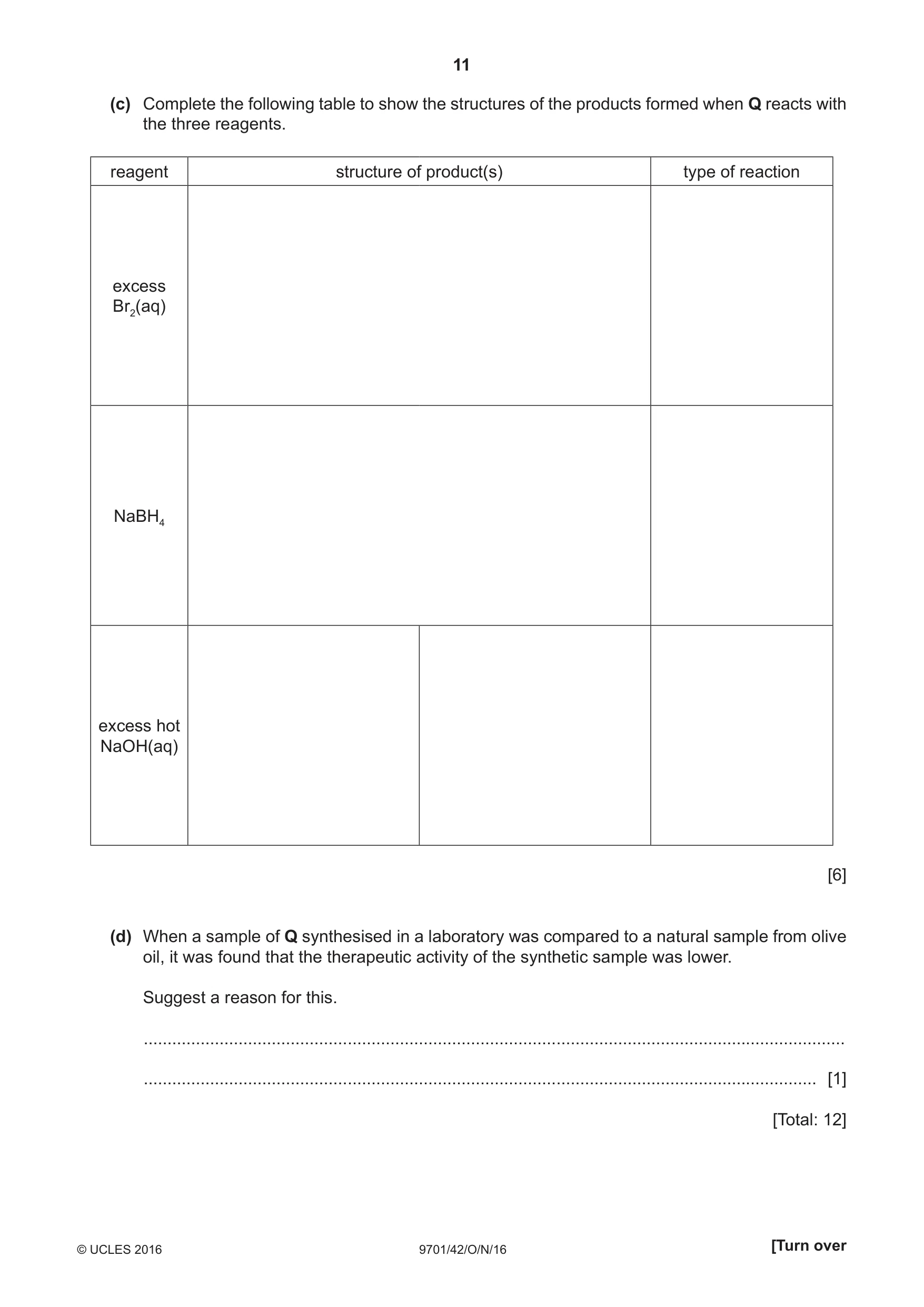
11 9701/42/O/N/16 © UCLES 2016 [Turn over (c) Complete the following table to show the structures of the products formed when Q reacts with the three reagents. reagent structure of product(s) type of reaction excess Br2(aq) NaBH4 excess hot NaOH(aq) [6] (d) When a sample of Q synthesised in a laboratory was compared to a natural sample from olive oil, it was found that the therapeutic activity of the synthetic sample was lower. Suggest a reason for this. … … [1] [Total: 12]
Question paper, page 12
12 9701/42/O/N/16 © UCLES 2016 BLANK PAGE
Question paper, page 13
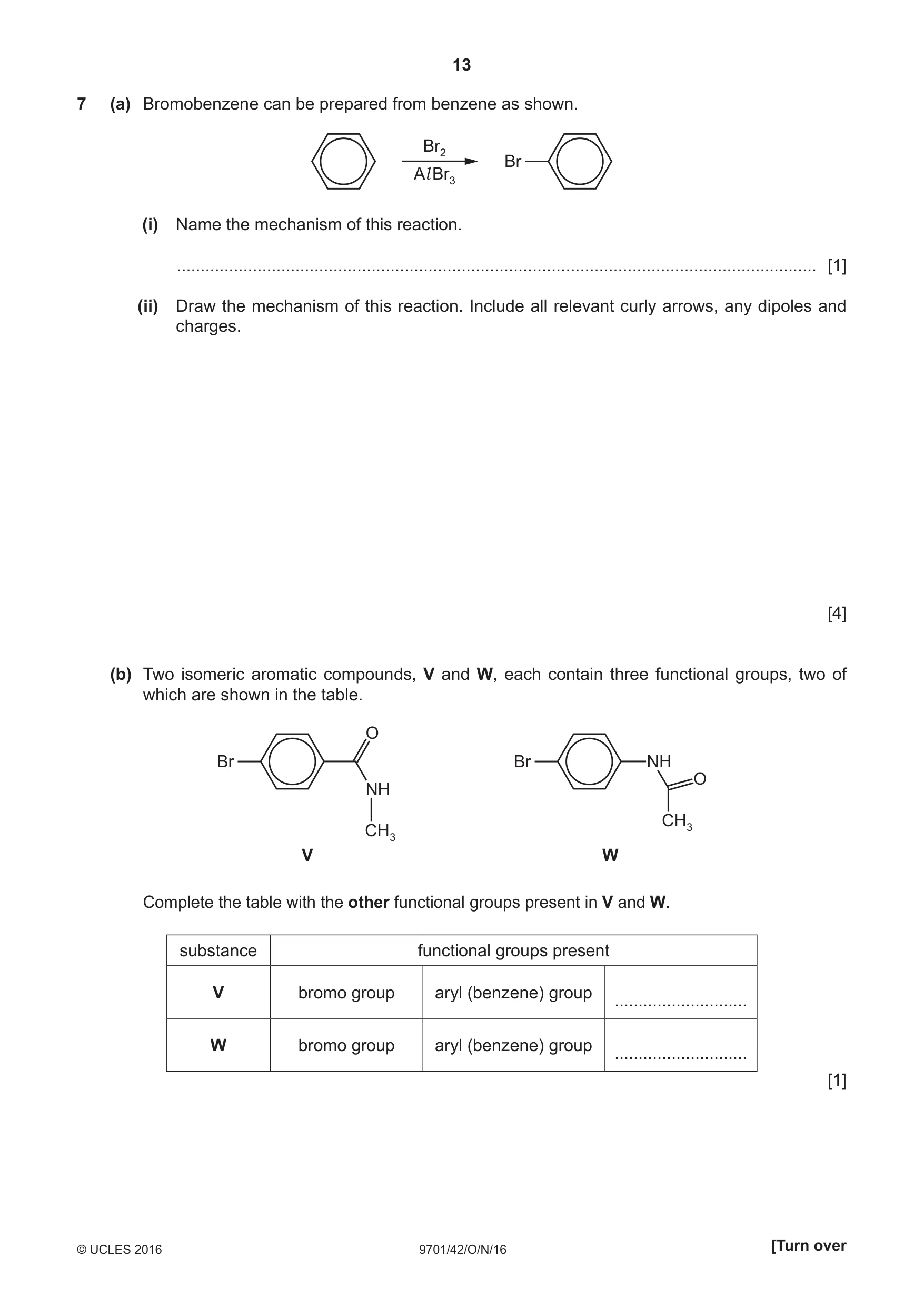
13 9701/42/O/N/16 © UCLES 2016 [Turn over 7 (a) Bromobenzene can be prepared from benzene as shown. Br2 Al Br3 Br (i) Name the mechanism of this reaction. … [1] (ii) Draw the mechanism of this reaction. Include all relevant curly arrows, any dipoles and charges. [4] (b) Two isomeric aromatic compounds, V and W, each contain three functional groups, two of which are shown in the table. V Br NH O CH3 W O Br NH CH3 Complete the table with the other functional groups present in V and W. substance functional groups present V bromo group aryl (benzene) group … W bromo group aryl (benzene) group … [1]
Question paper, page 14
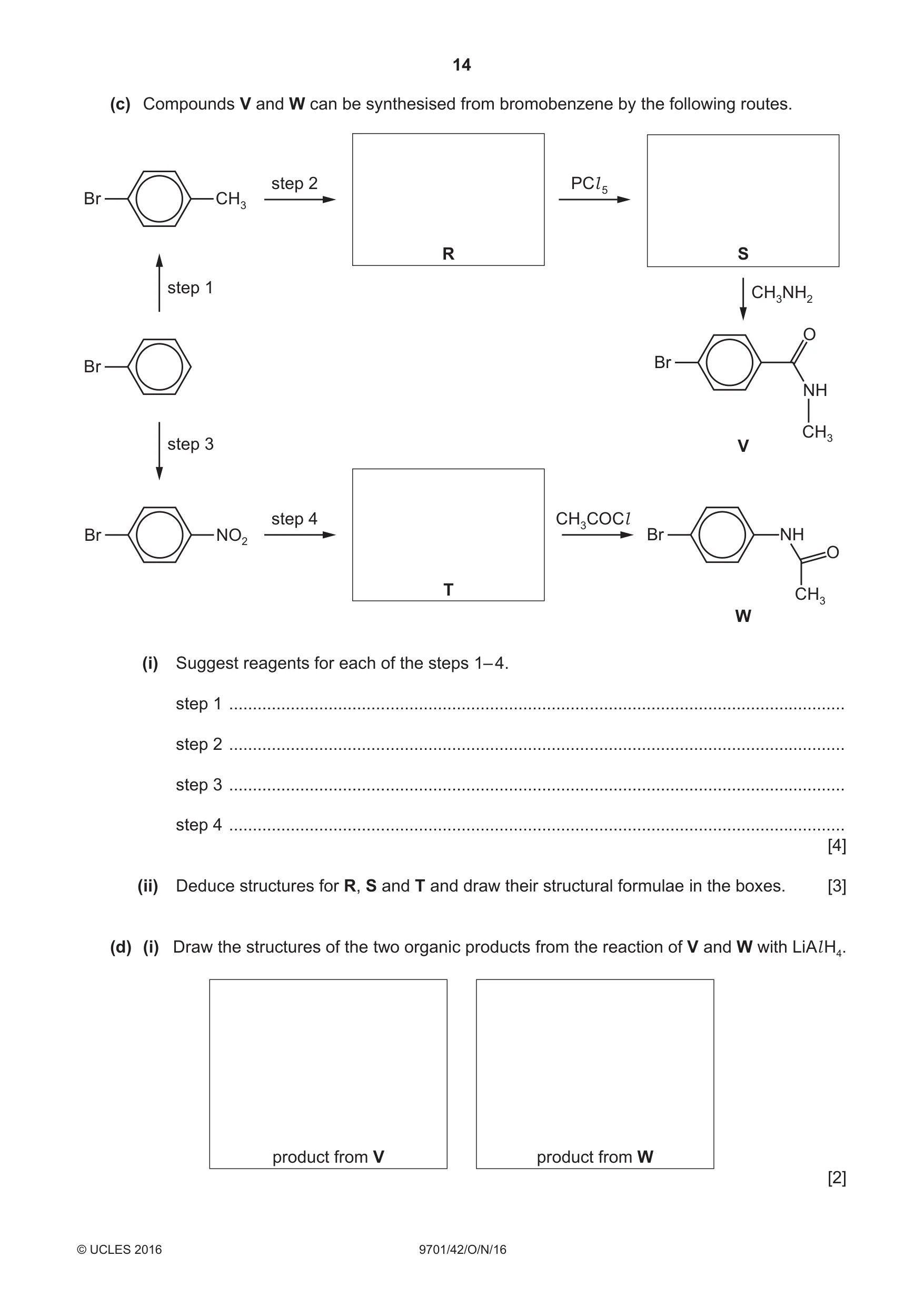
14 9701/42/O/N/16 © UCLES 2016 (c) Compounds V and W can be synthesised from bromobenzene by the following routes. Br Br CH3 Br NO2 step 2 step 4 step 1 step 3 PCl 5 CH3COCl CH3NH2 V W O Br NH CH3 R T S Br NH O CH3 (i) Suggest reagents for each of the steps 1– 4. step 1 … step 2 … step 3 … step 4 … [4] (ii) Deduce structures for R, S and T and draw their structural formulae in the boxes. [3] (d) (i) Draw the structures of the two organic products from the reaction of V and W with LiAl H4. product from V product from W [2]
Question paper, page 15
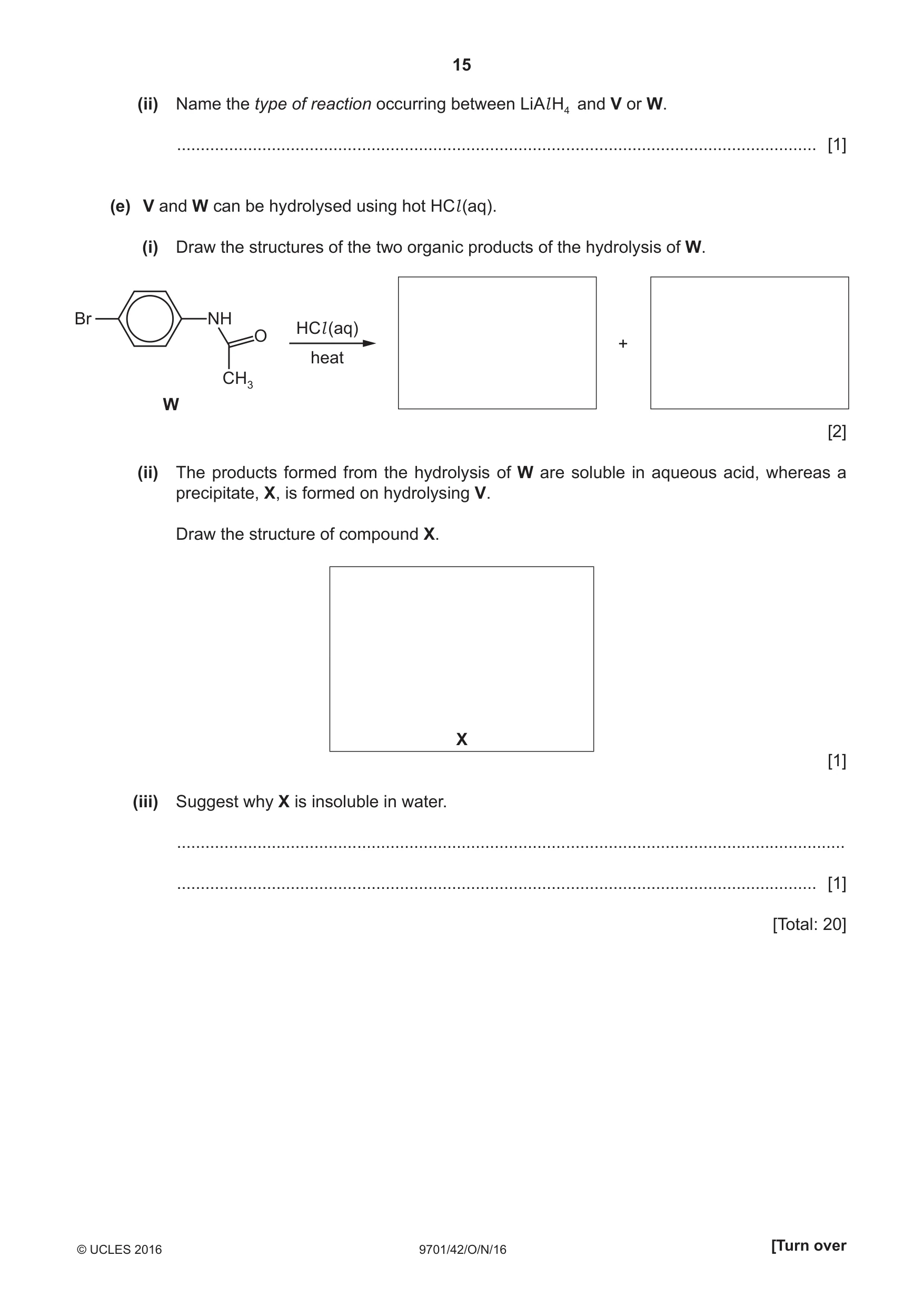
15 9701/42/O/N/16 © UCLES 2016 [Turn over (ii) Name the type of reaction occurring between LiAl H4 and V or W. … [1] (e) V and W can be hydrolysed using hot HCl (aq). (i) Draw the structures of the two organic products of the hydrolysis of W. W O Br NH CH3 HCl (aq) heat + [2] (ii) The products formed from the hydrolysis of W are soluble in aqueous acid, whereas a precipitate, X, is formed on hydrolysing V. Draw the structure of compound X. X [1] (iii) Suggest why X is insoluble in water. … … [1] [Total: 20]
Question paper, page 16
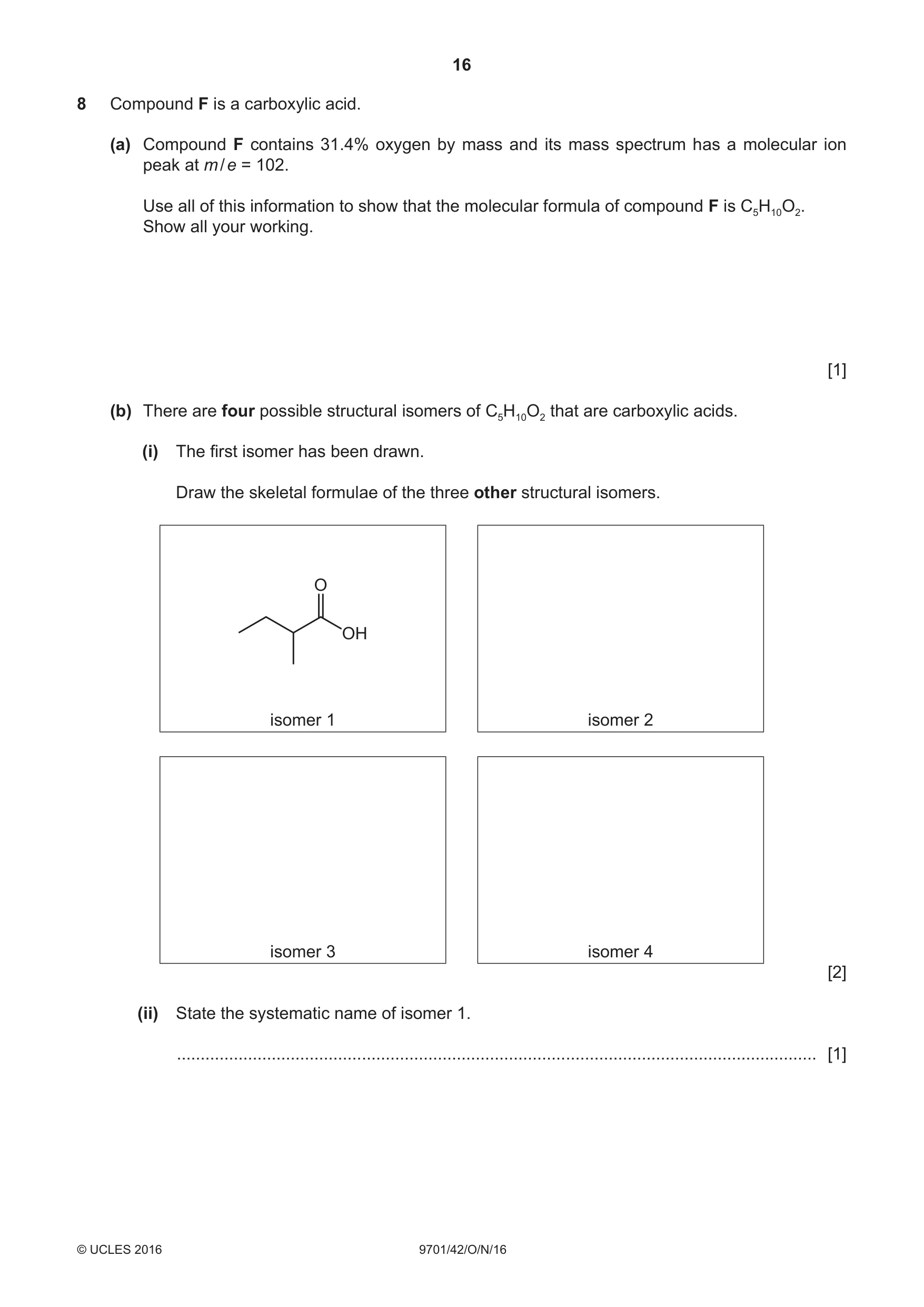
16 9701/42/O/N/16 © UCLES 2016 8 Compound F is a carboxylic acid. (a) Compound F contains 31.4% oxygen by mass and its mass spectrum has a molecular ion peak at m / e = 102. Use all of this information to show that the molecular formula of compound F is C5H10O2. Show all your working. [1] (b) There are four possible structural isomers of C5H10O2 that are carboxylic acids. (i) The fi rst isomer has been drawn. Draw the skeletal formulae of the three other structural isomers. O OH isomer 1 isomer 2 isomer 3 isomer 4 [2] (ii) State the systematic name of isomer 1. … [1]
Question paper, page 17
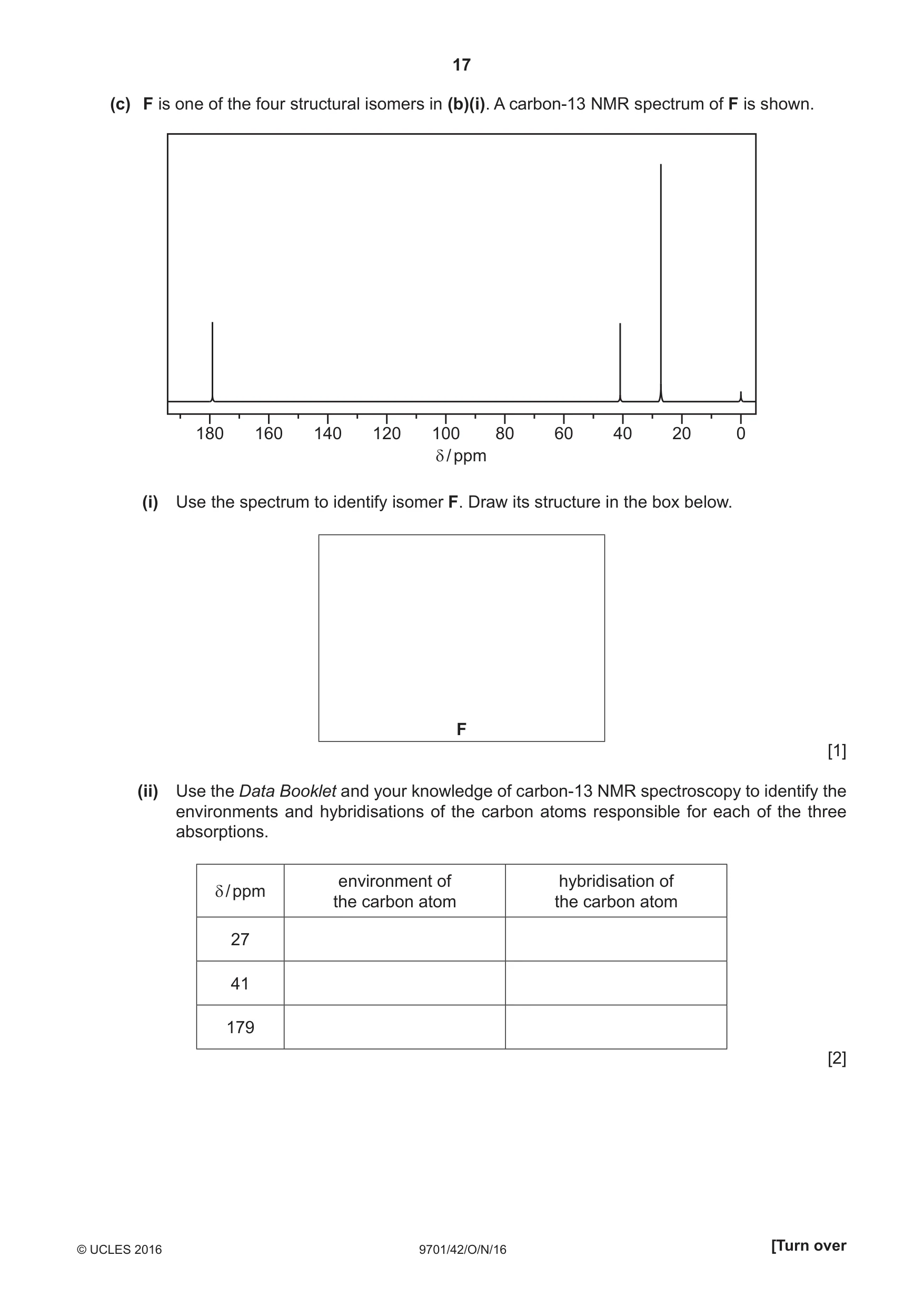
17 9701/42/O/N/16 © UCLES 2016 [Turn over (c) F is one of the four structural isomers in (b)(i). A carbon-13 NMR spectrum of F is shown. 180 160 140 120 100 80 60 40 20 0 δ / ppm (i) Use the spectrum to identify isomer F. Draw its structure in the box below. F [1] (ii) Use the Data Booklet and your knowledge of carbon-13 NMR spectroscopy to identify the environments and hybridisations of the carbon atoms responsible for each of the three absorptions. / ppm environment of the carbon atom hybridisation of the carbon atom 27 41 179 [2]
Question paper, page 18
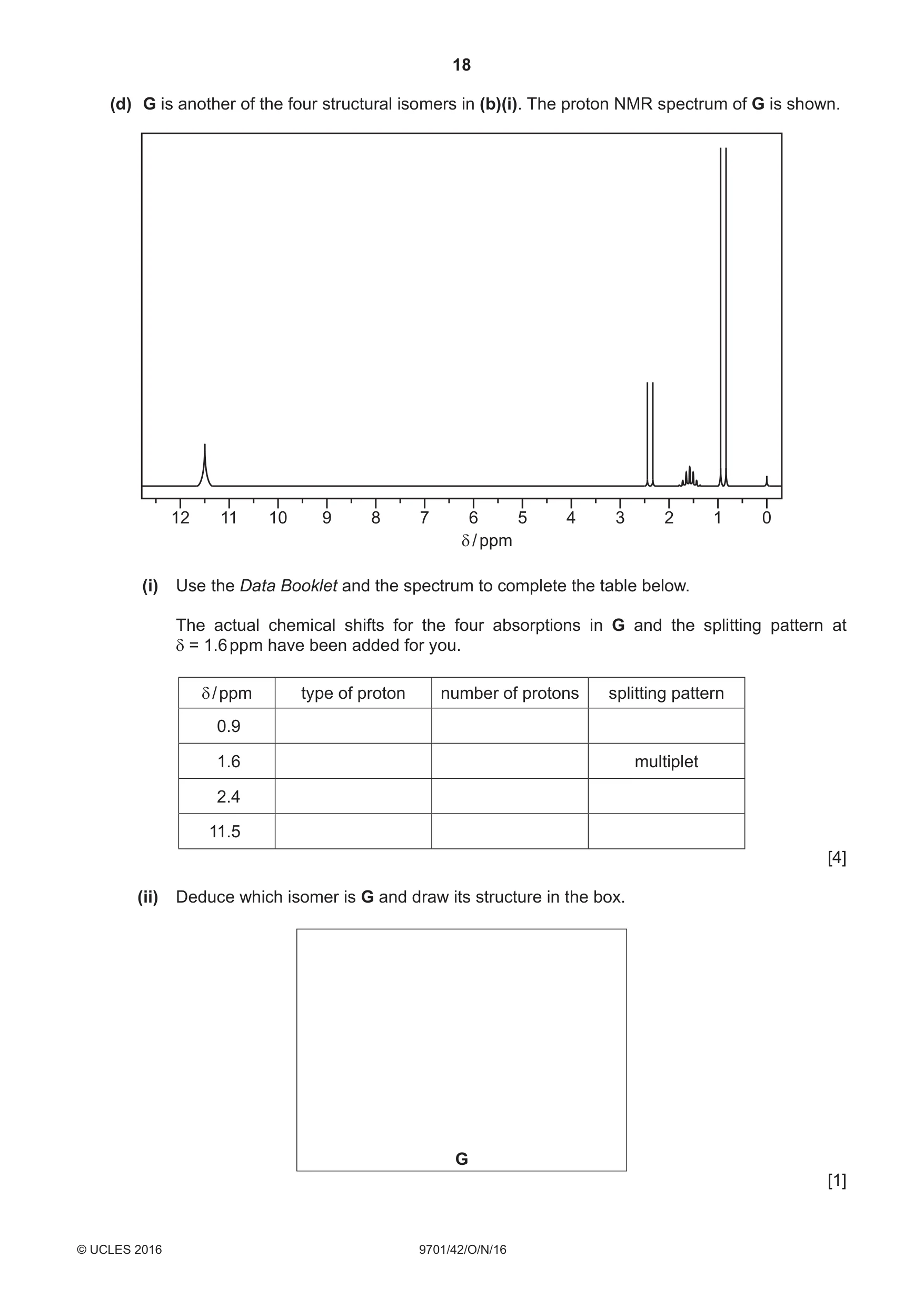
18 9701/42/O/N/16 © UCLES 2016 (d) G is another of the four structural isomers in (b)(i). The proton NMR spectrum of G is shown. 9 10 11 12 8 7 6 5 4 3 2 1 0 δ / ppm (i) Use the Data Booklet and the spectrum to complete the table below. The actual chemical shifts for the four absorptions in G and the splitting pattern at = 1.6 ppm have been added for you. / ppm type of proton number of protons splitting pattern 0.9 1.6 multiplet 2.4 11.5 [4] (ii) Deduce which isomer is G and draw its structure in the box. G [1]
Question paper, page 19
19 9701/42/O/N/16 © UCLES 2016 [Turn over (e) Name or give the formula of a suitable solvent for obtaining a proton NMR spectrum. … [1] [Total: 13]
Question paper, page 20
20 9701/42/O/N/16 © UCLES 2016 BLANK PAGE Permission to reproduce items where third-party owned material protected by copyright is included has been sought and cleared where possible. Every reasonable effort has been made by the publisher (UCLES) to trace copyright holders, but if any items requiring clearance have unwittingly been included, the publisher will be pleased to make amends at the earliest possible opportunity. To avoid the issue of disclosure of answer-related information to candidates, all copyright acknowledgements are reproduced online in the Cambridge International Examinations Copyright Acknowledgements Booklet. This is produced for each series of examinations and is freely available to download at www.cie.org.uk after the live examination series. Cambridge International Examinations is part of the Cambridge Assessment Group. Cambridge Assessment is the brand name of University of Cambridge Local Examinations Syndicate (UCLES), which is itself a department of the University of Cambridge.
Mark scheme, page 1
® IGCSE is the registered trademark of Cambridge International Examinations. This document consists of 16 printed pages. © UCLES 2016 [Turn over Cambridge International Examinations Cambridge International Advanced Subsidiary and Advanced Level CHEMISTRY 9701/42 Paper 4 A Level Structured Questions October/November 2016 MARK SCHEME Maximum Mark: 100 Published This mark scheme is published as an aid to teachers and candidates, to indicate the requirements of the examination. It shows the basis on which Examiners were instructed to award marks. It does not indicate the details of the discussions that took place at an Examiners’ meeting before marking began, which would have considered the acceptability of alternative answers. Mark schemes should be read in conjunction with the question paper and the Principal Examiner Report for Teachers. Cambridge will not enter into discussions about these mark schemes. Cambridge is publishing the mark schemes for the October/November 2016 series for most Cambridge IGCSE®, Cambridge International A and AS Level components and some Cambridge O Level components.
Mark scheme, page 2
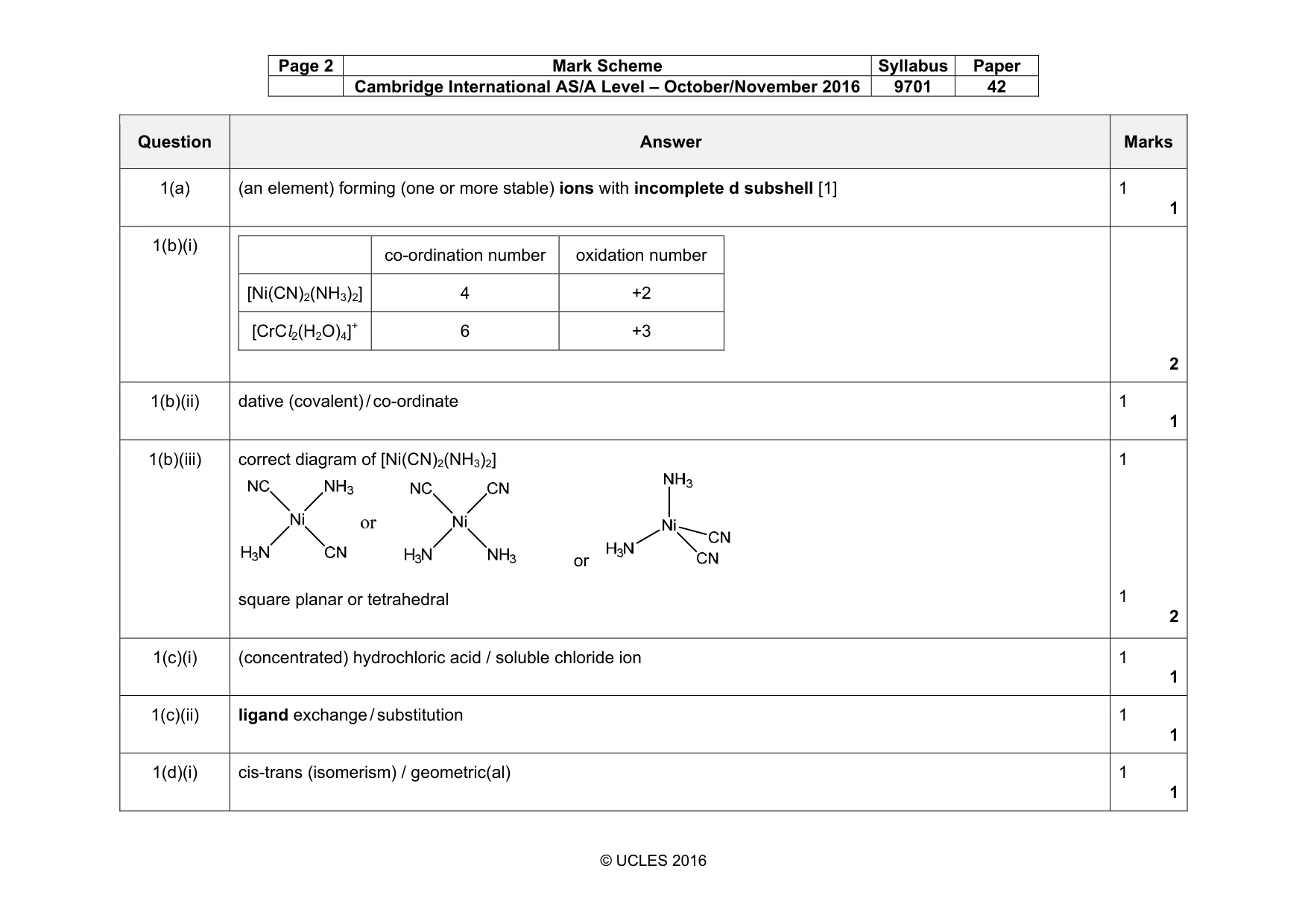
Page 2 Mark Scheme Syllabus Paper Cambridge International AS/A Level – October/November 2016 9701 42 © UCLES 2016 Question Answer Marks 1(a) (an element) forming (one or more stable) ions with incomplete d subshell [1] 1 1 1(b)(i) co-ordination number oxidation number [Ni(CN)2(NH3)2] 4 +2 [CrCl2(H2O)4]+ 6 +3 2 1(b)(ii) dative (covalent) / co-ordinate 1 1 1(b)(iii) correct diagram of [Ni(CN)2(NH3)2] or square planar or tetrahedral 1 1 2 1(c)(i) (concentrated) hydrochloric acid / soluble chloride ion 1 1 1(c)(ii) ligand exchange / substitution 1 1 1(d)(i) cis-trans (isomerism) / geometric(al) 1 1
Mark scheme, page 3
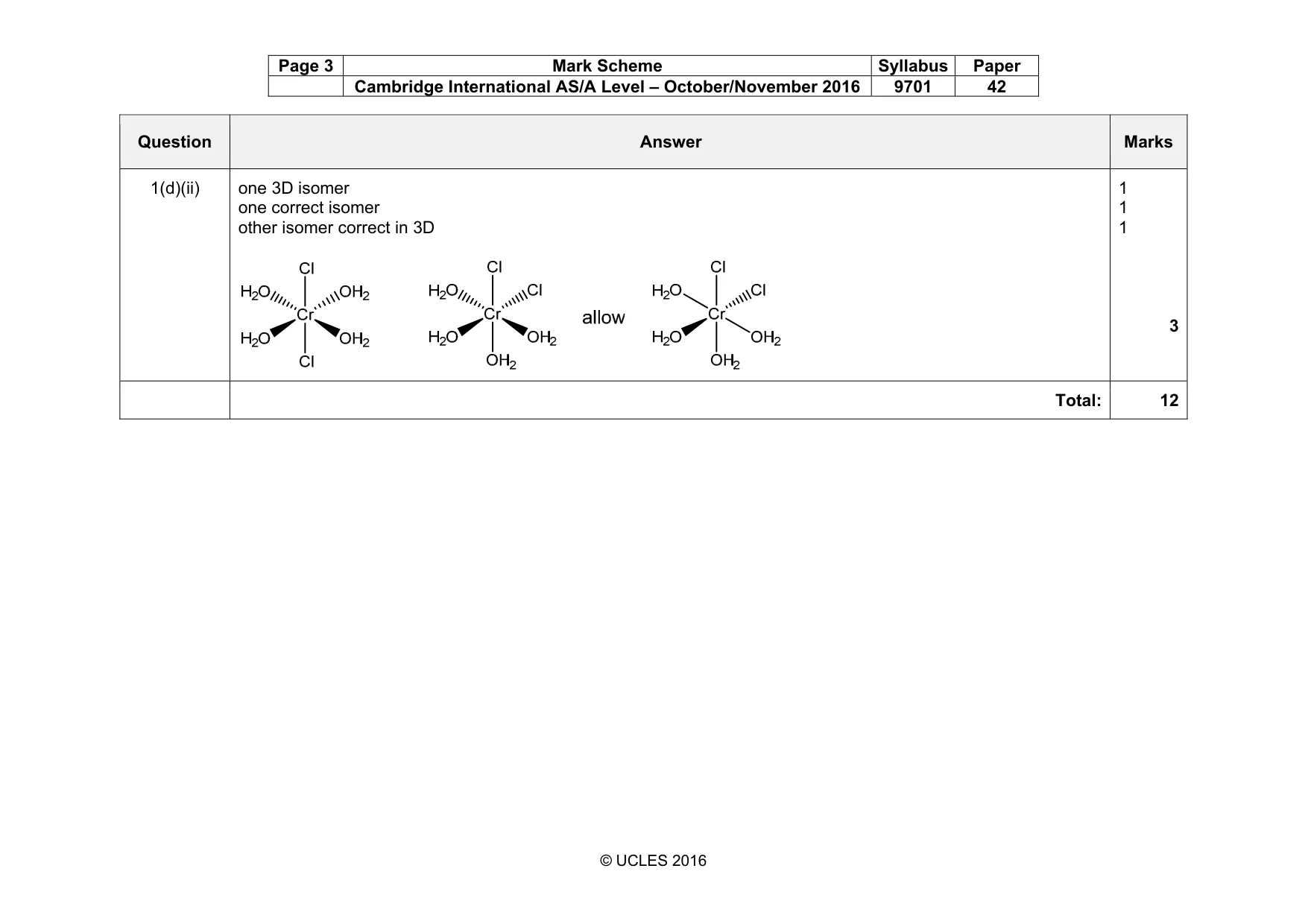
Page 3 Mark Scheme Syllabus Paper Cambridge International AS/A Level – October/November 2016 9701 42 © UCLES 2016 Question Answer Marks 1(d)(ii) one 3D isomer one correct isomer other isomer correct in 3D 1 1 1 3 Total: 12
Mark scheme, page 4
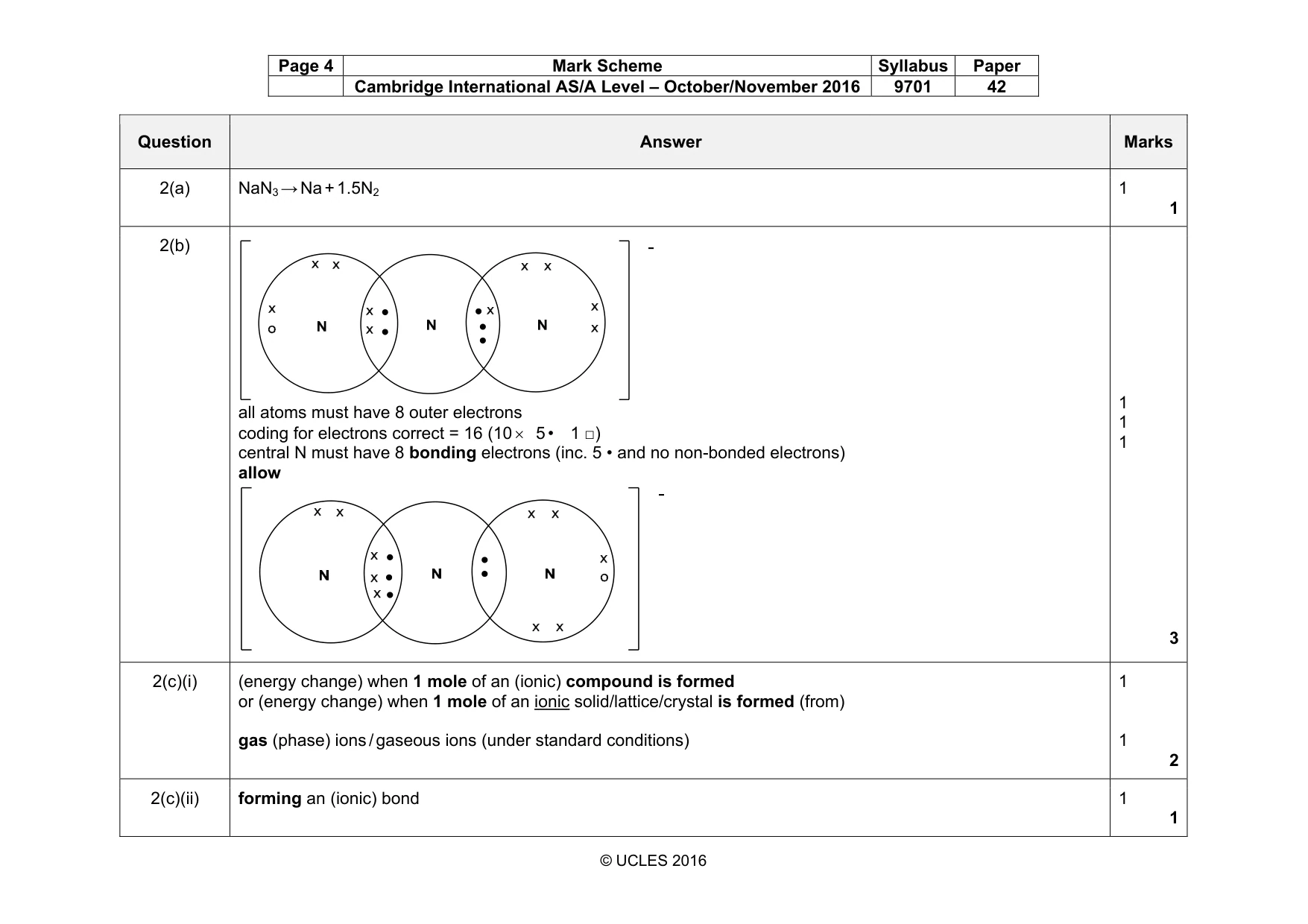
Page 4 Mark Scheme Syllabus Paper Cambridge International AS/A Level – October/November 2016 9701 42 © UCLES 2016 Question Answer Marks 2(a) NaN3 → Na + 1.5N2 1 1 2(b) all atoms must have 8 outer electrons coding for electrons correct = 16 (10 × 5 • 1 □) central N must have 8 bonding electrons (inc. 5 • and no non-bonded electrons) allow 1 1 1 3 2(c)(i) (energy change) when 1 mole of an (ionic) compound is formed or (energy change) when 1 mole of an ionic solid/lattice/crystal is formed (from) gas (phase) ions / gaseous ions (under standard conditions) 1 1 2 2(c)(ii) forming an (ionic) bond 1 1
Mark scheme, page 5
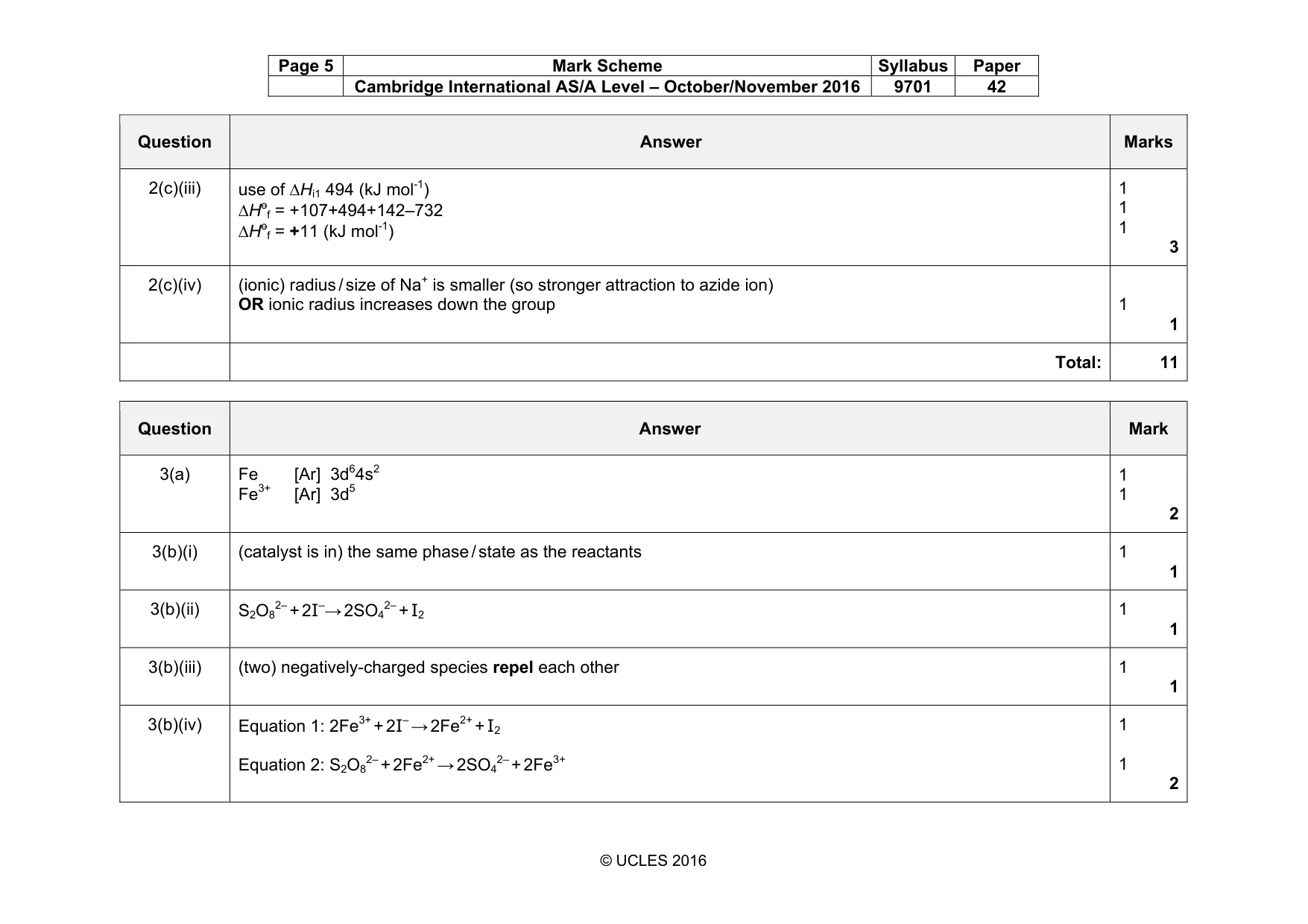
Page 5 Mark Scheme Syllabus Paper Cambridge International AS/A Level – October/November 2016 9701 42 © UCLES 2016 Question Answer Marks 2(c)(iii) use of ∆Hi1 494 (kJ mol-1) ∆Ho f = +107+494+142–732 ∆Ho f = +11 (kJ mol-1) 1 1 1 3 2(c)(iv) (ionic) radius / size of Na+ is smaller (so stronger attraction to azide ion) OR ionic radius increases down the group 1 1 Total: 11 Question Answer Mark 3(a) Fe [Ar] 3d64s2 Fe3+ [Ar] 3d5 1 1 2 3(b)(i) (catalyst is in) the same phase / state as the reactants 1 1 3(b)(ii) S2O8 2– + 2I–→ 2SO4 2– + I2 1 1 3(b)(iii) (two) negatively-charged species repel each other 1 1 3(b)(iv) Equation 1: 2Fe3+ + 2I– → 2Fe2+ + I2 Equation 2: S2O8 2– + 2Fe2+ → 2SO4 2– + 2Fe3+ 1 1 2
Mark scheme, page 6
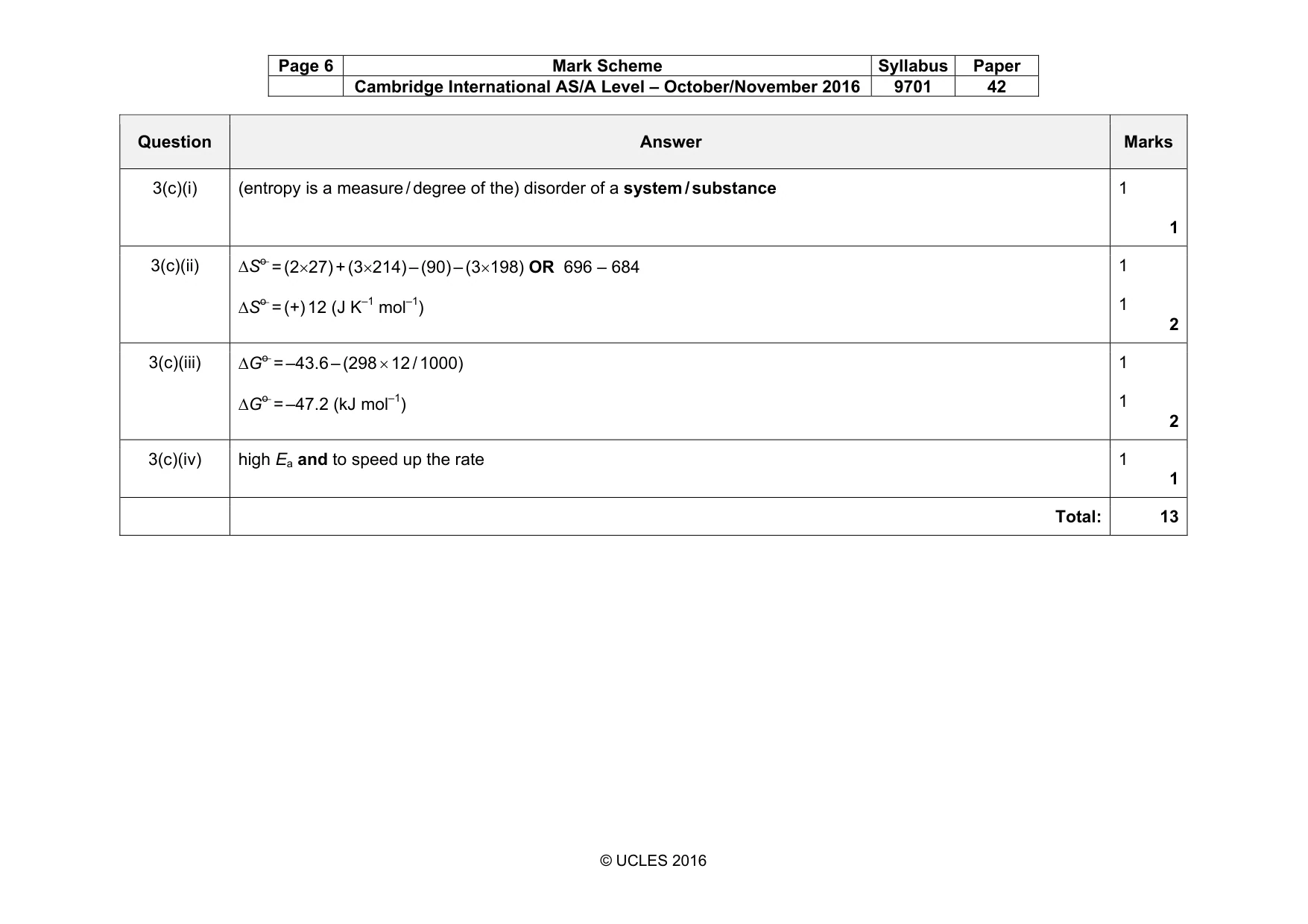
Page 6 Mark Scheme Syllabus Paper Cambridge International AS/A Level – October/November 2016 9701 42 © UCLES 2016 Question Answer Marks 3(c)(i) (entropy is a measure / degree of the) disorder of a system / substance 1 1 3(c)(ii) ∆So = (2×27) + (3×214) – (90) – (3×198) OR 696 – 684 ∆So = (+) 12 (J K–1 mol–1) 1 1 2 3(c)(iii) ∆Go = –43.6 – (298 × 12 / 1000) ∆Go = –47.2 (kJ mol–1) 1 1 2 3(c)(iv) high Ea and to speed up the rate 1 1 Total: 13
Mark scheme, page 7
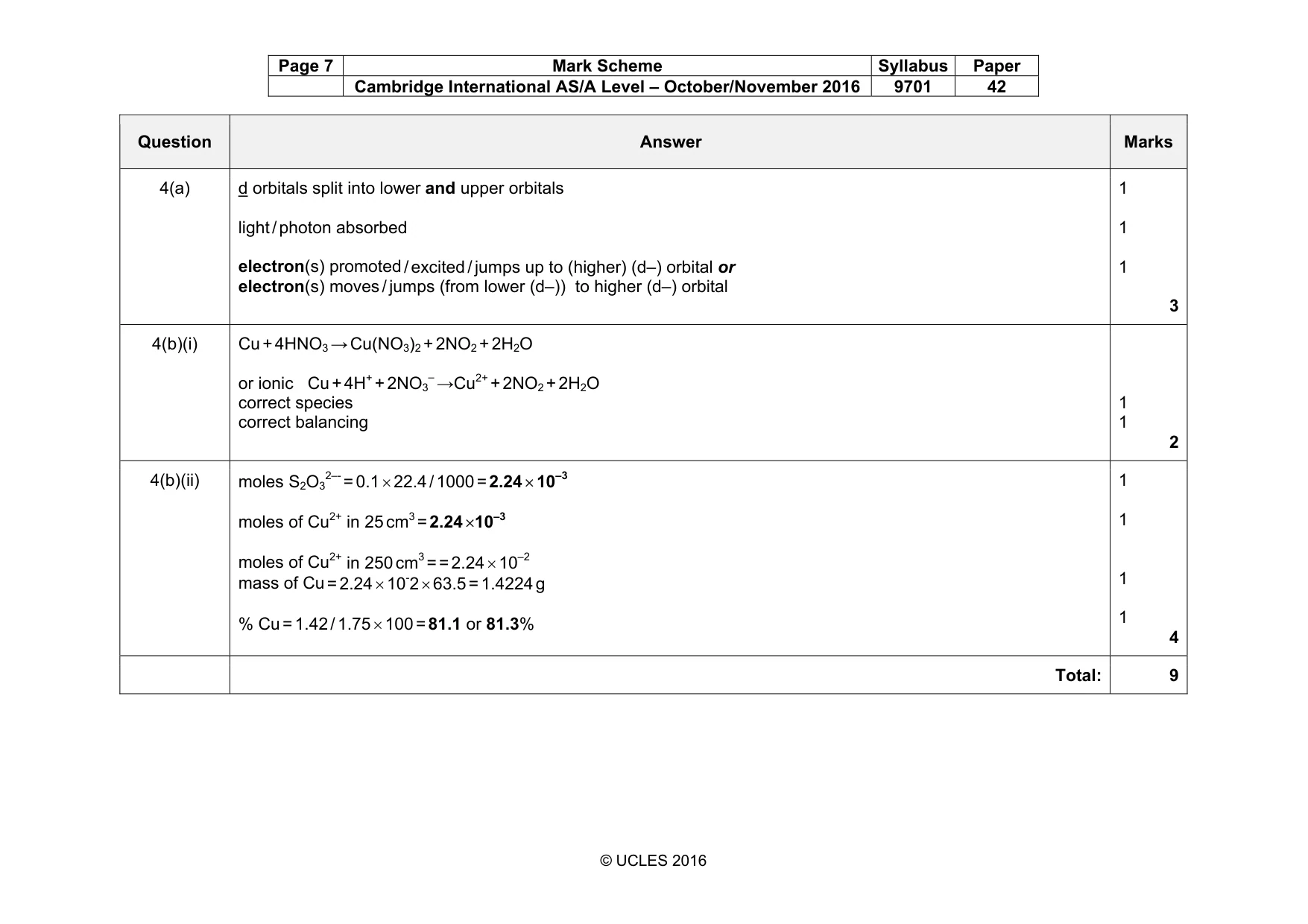
Page 7 Mark Scheme Syllabus Paper Cambridge International AS/A Level – October/November 2016 9701 42 © UCLES 2016 Question Answer Marks 4(a) d orbitals split into lower and upper orbitals light / photon absorbed electron(s) promoted / excited / jumps up to (higher) (d–) orbital or electron(s) moves / jumps (from lower (d–)) to higher (d–) orbital 1 1 1 3 4(b)(i) Cu + 4HNO3 → Cu(NO3)2 + 2NO2 + 2H2O or ionic Cu + 4H+ + 2NO3 – →Cu2+ + 2NO2 + 2H2O correct species correct balancing 1 1 2 4(b)(ii) moles S2O3 2–- = 0.1 × 22.4 / 1000 = 2.24 × 10⁻³ moles of Cu2+ in 25 cm3 = 2.24 ×10⁻³ moles of Cu2+ in 250 cm3 = = 2.24 × 10⁻² mass of Cu = 2.24 × 10-2 × 63.5 = 1.4224 g % Cu = 1.42 / 1.75 × 100 = 81.1 or 81.3% 1 1 1 1 4 Total: 9
Mark scheme, page 8
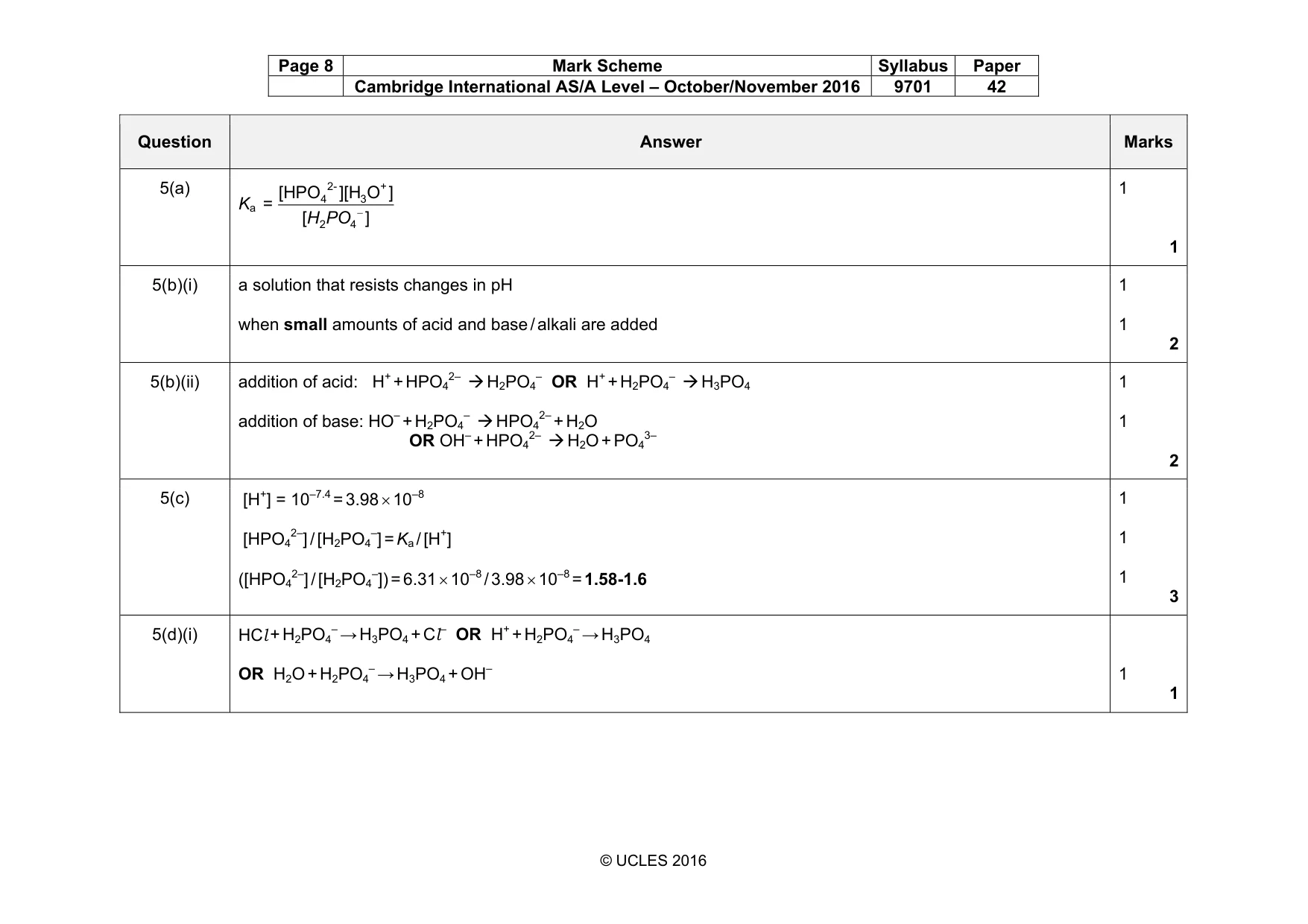
Page 8 Mark Scheme Syllabus Paper Cambridge International AS/A Level – October/November 2016 9701 42 © UCLES 2016 Question Answer Marks 5(a) Ka = 2- + 4 3 2 4 [HPO ][H O ] [ ] H PO − 1 1 5(b)(i) a solution that resists changes in pH when small amounts of acid and base / alkali are added 1 1 2 5(b)(ii) addition of acid: H+ + HPO4 2– Æ H2PO4 – OR H+ + H2PO4 – Æ H3PO4 addition of base: HO– + H2PO4 – Æ HPO4 2– + H2O OR OH– + HPO4 2– Æ H2O + PO4 3– 1 1 2 5(c) [H+] = 10–7.4 = 3.98 × 10⁻⁸ [HPO4 2–] / [H2PO4 –] = Ka / [H+] ([HPO4 2–] / [H2PO4 –]) = 6.31 × 10⁻⁸ / 3.98 × 10–8 = 1.58-1.6 1 1 1 3 5(d)(i) HCl + H2PO4 – → H3PO4 + Cl– OR H+ + H2PO4 – → H3PO4 OR H2O + H2PO4 – → H3PO4 + OH– 1 1
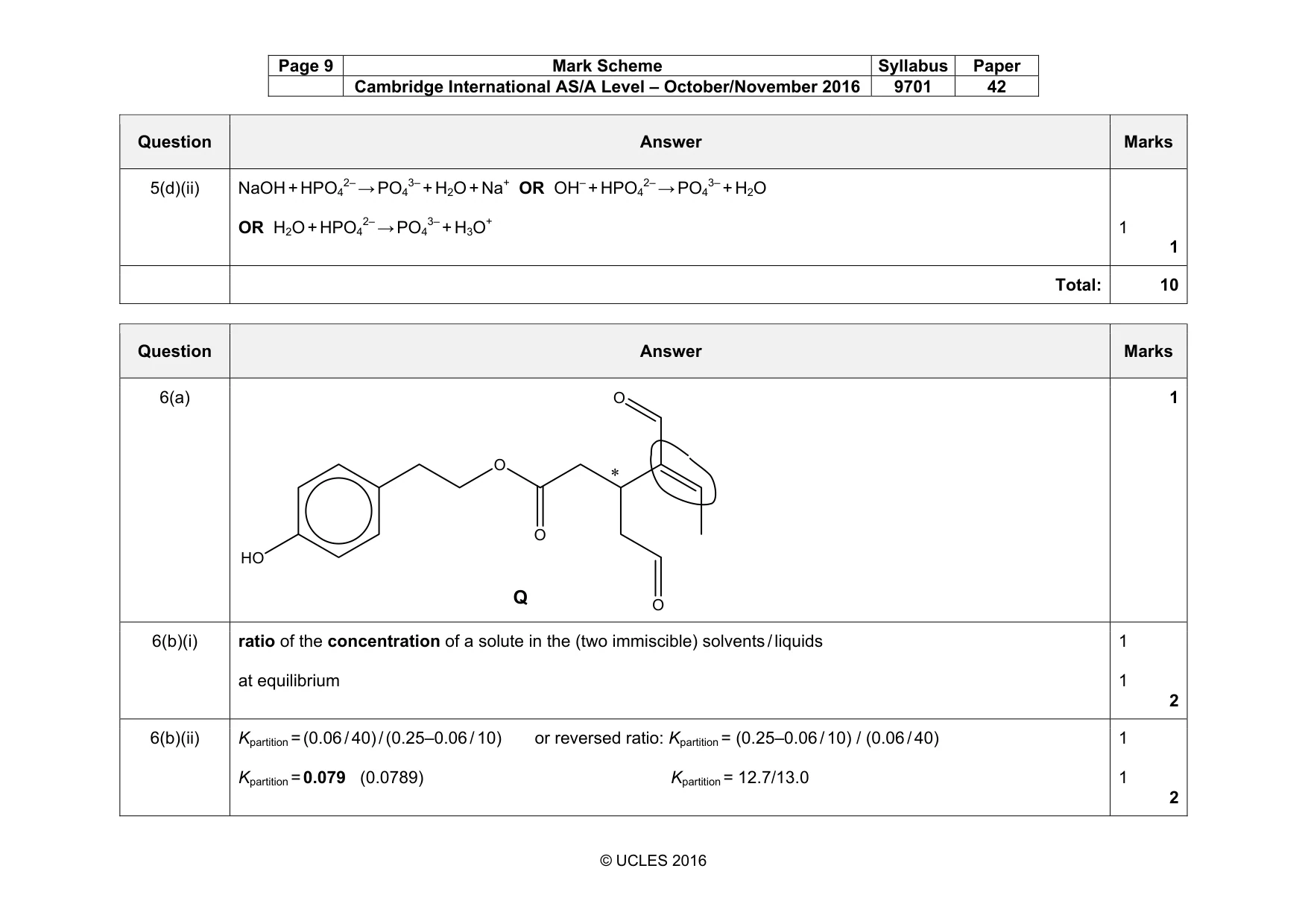
Mark scheme, page 9
Page 9 Mark Scheme Syllabus Paper Cambridge International AS/A Level – October/November 2016 9701 42 © UCLES 2016 Question Answer Marks 5(d)(ii) NaOH + HPO4 2– → PO4 3– + H2O + Na+ OR OH– + HPO4 2– → PO4 3– + H2O OR H2O + HPO4 2– → PO4 3– + H3O+ 1 1 Total: 10 Question Answer Marks 6(a) HO O O O O Q * 1 6(b)(i) ratio of the concentration of a solute in the (two immiscible) solvents / liquids at equilibrium 1 1 2 6(b)(ii) Kpartition = (0.06 / 40) / (0.25–0.06 / 10) or reversed ratio: Kpartition = (0.25–0.06 / 10) / (0.06 / 40) Kpartition = 0.079 (0.0789) Kpartition = 12.7/13.0 1 1 2
Mark scheme, page 10
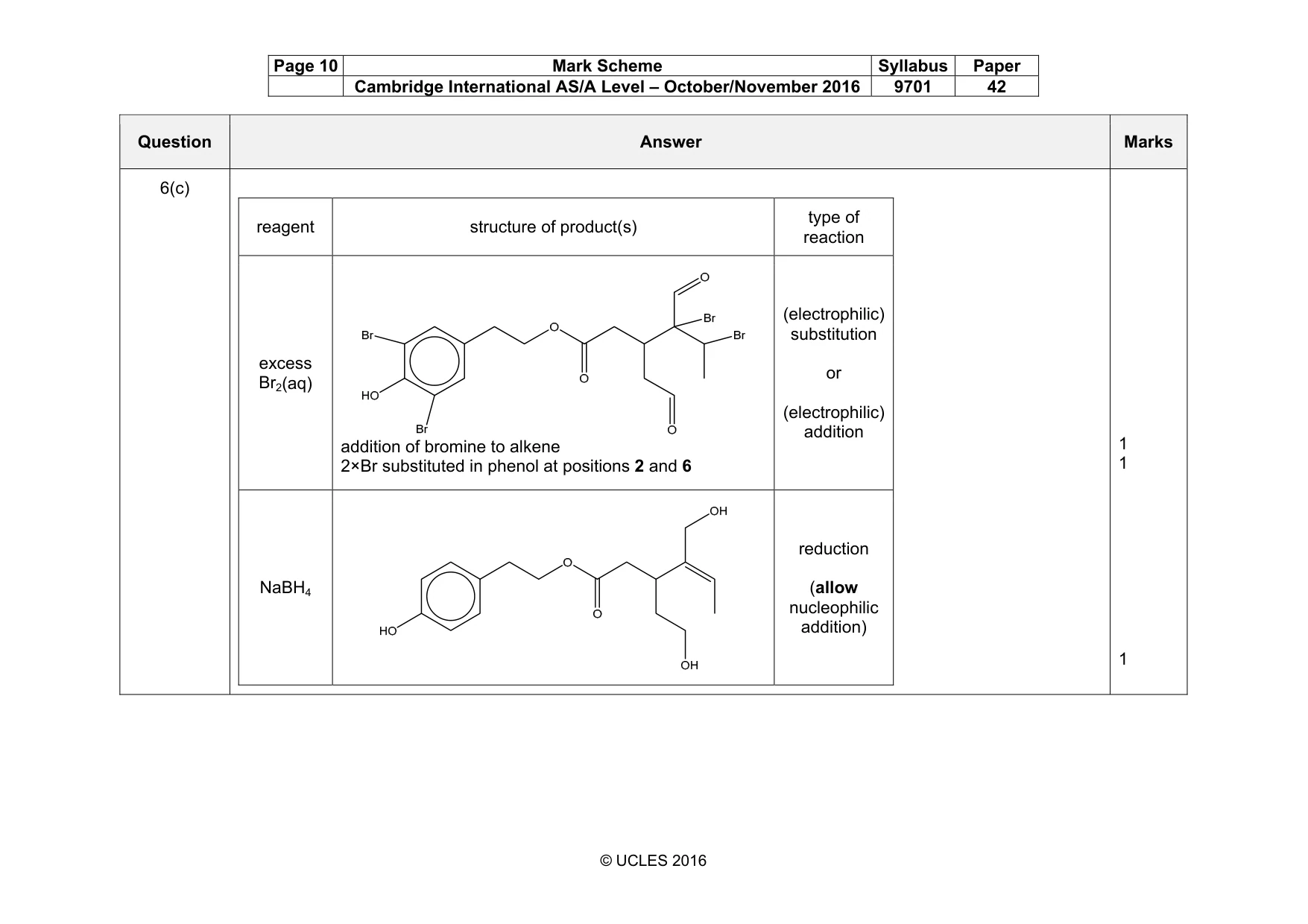
Page 10 Mark Scheme Syllabus Paper Cambridge International AS/A Level – October/November 2016 9701 42 © UCLES 2016 Question Answer Marks 6(c) reagent structure of product(s) type of reaction excess Br2(aq) addition of bromine to alkene 2×Br substituted in phenol at positions 2 and 6 (electrophilic) substitution or (electrophilic) addition NaBH4 reduction (allow nucleophilic addition) 1 1 1
Mark scheme, page 11
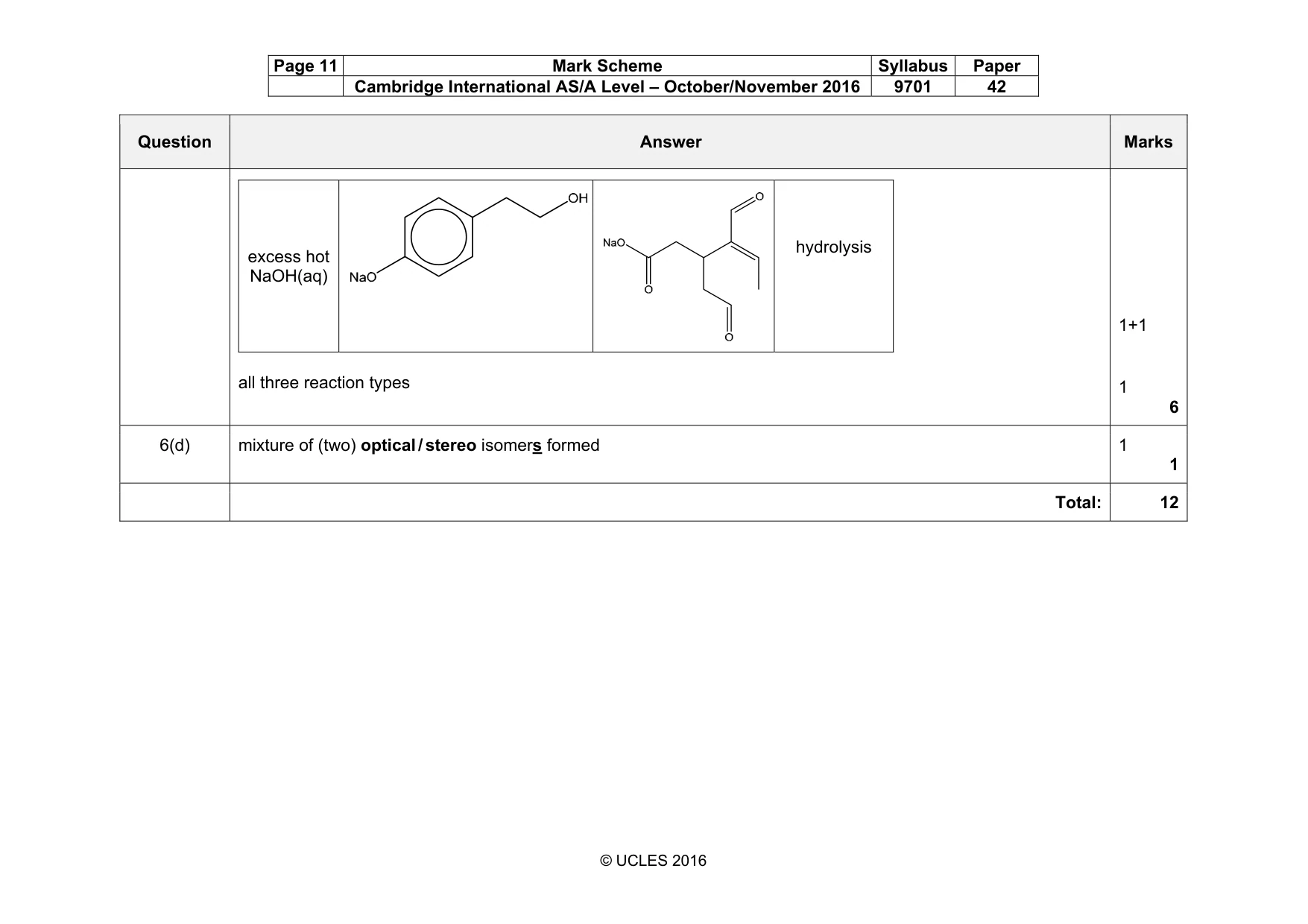
Page 11 Mark Scheme Syllabus Paper Cambridge International AS/A Level – October/November 2016 9701 42 © UCLES 2016 Question Answer Marks excess hot NaOH(aq) hydrolysis all three reaction types 1+1 1 6 6(d) mixture of (two) optical / stereo isomers formed 1 1 Total: 12
Mark scheme, page 12
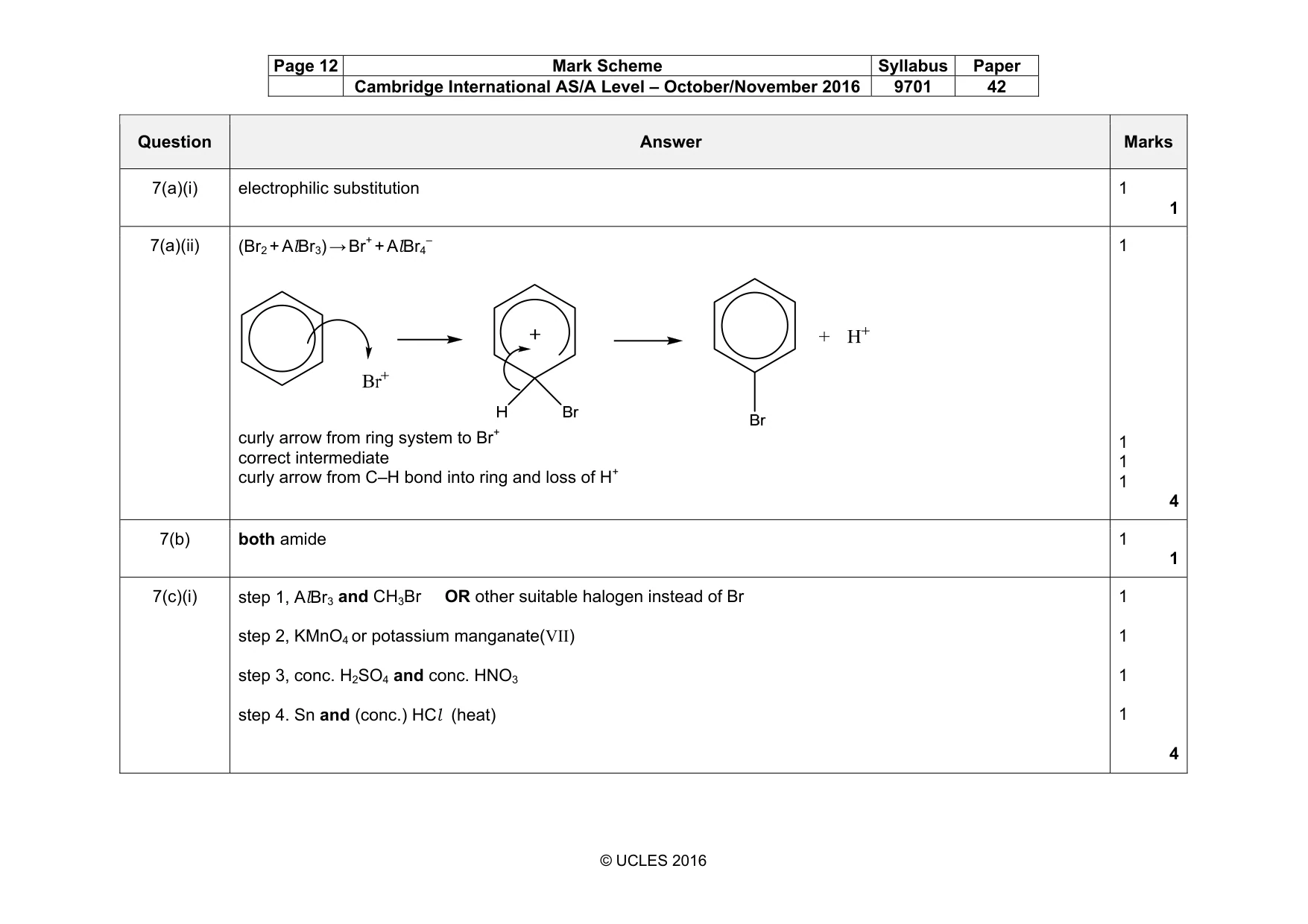
Page 12 Mark Scheme Syllabus Paper Cambridge International AS/A Level – October/November 2016 9701 42 © UCLES 2016 Question Answer Marks 7(a)(i) electrophilic substitution 1 1 7(a)(ii) (Br2 + AlBr3) → Br+ + AlBr4 – curly arrow from ring system to Br+ correct intermediate curly arrow from C–H bond into ring and loss of H+ 1 1 1 1 4 7(b) both amide 1 1 7(c)(i) step 1, AlBr3 and CH3Br OR other suitable halogen instead of Br step 2, KMnO4 or potassium manganate(VII) step 3, conc. H2SO4 and conc. HNO3 step 4. Sn and (conc.) HCl (heat) 1 1 1 1 4
Mark scheme, page 13
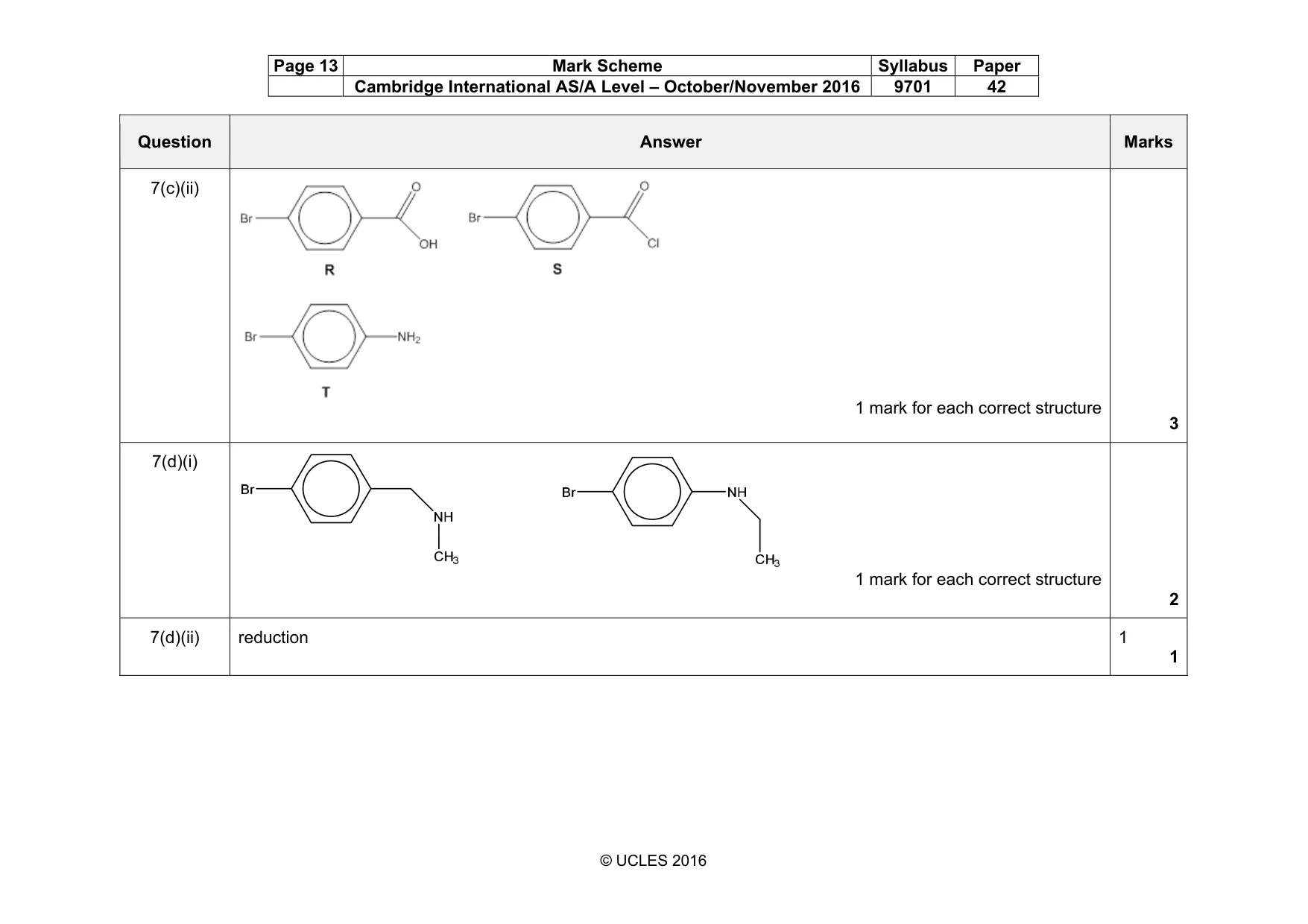
Page 13 Mark Scheme Syllabus Paper Cambridge International AS/A Level – October/November 2016 9701 42 © UCLES 2016 Question Answer Marks 7(c)(ii) 1 mark for each correct structure 3 7(d)(i) 1 mark for each correct structure 2 7(d)(ii) reduction 1 1
Mark scheme, page 14
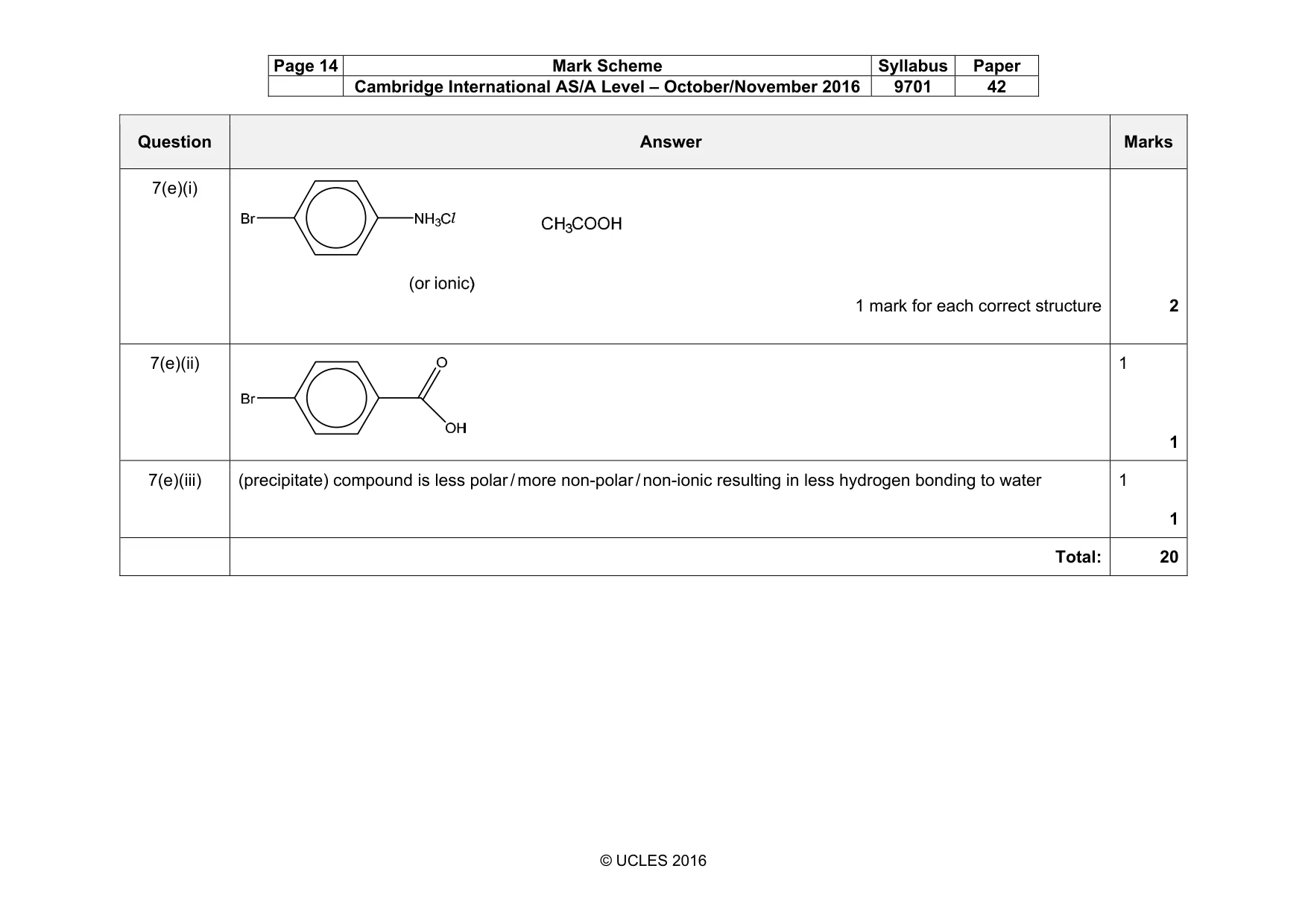
Page 14 Mark Scheme Syllabus Paper Cambridge International AS/A Level – October/November 2016 9701 42 © UCLES 2016 Question Answer Marks 7(e)(i) 1 mark for each correct structure 2 7(e)(ii) 1 1 7(e)(iii) (precipitate) compound is less polar / more non-polar / non-ionic resulting in less hydrogen bonding to water 1 1 Total: 20
Mark scheme, page 15
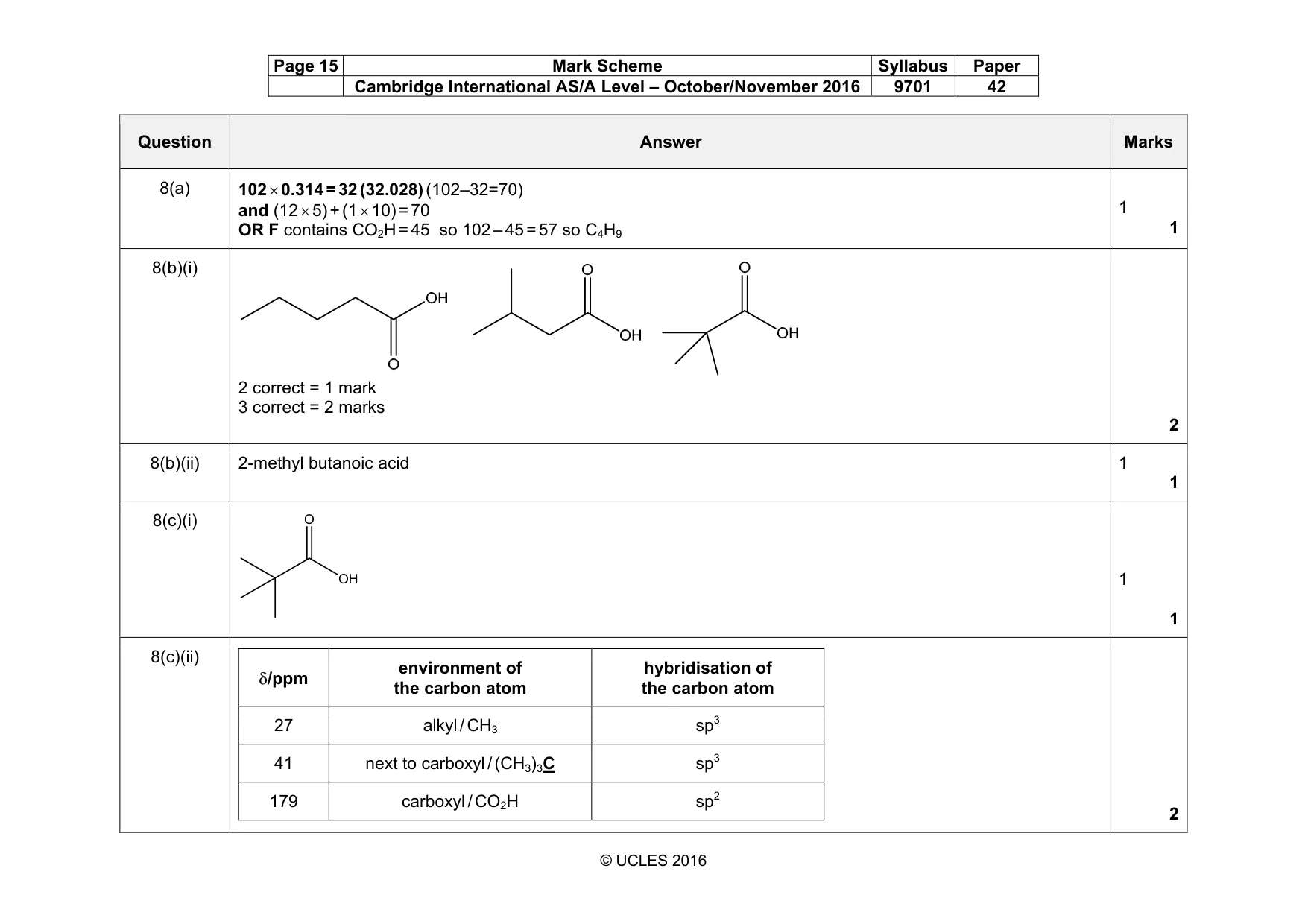
Page 15 Mark Scheme Syllabus Paper Cambridge International AS/A Level – October/November 2016 9701 42 © UCLES 2016 Question Answer Marks 8(a) 102 × 0.314 = 32 (32.028) (102–32=70) and (12 × 5) + (1 × 10) = 70 OR F contains CO2H = 45 so 102 – 45 = 57 so C4H9 1 1 8(b)(i) 2 correct = 1 mark 3 correct = 2 marks 2 8(b)(ii) 2-methyl butanoic acid 1 1 8(c)(i) OH O 1 1 8(c)(ii) δ/ppm environment of the carbon atom hybridisation of the carbon atom 27 alkyl / CH3 sp3 41 next to carboxyl / (CH3)3C sp3 179 carboxyl / CO2H sp2 2
Mark scheme, page 16
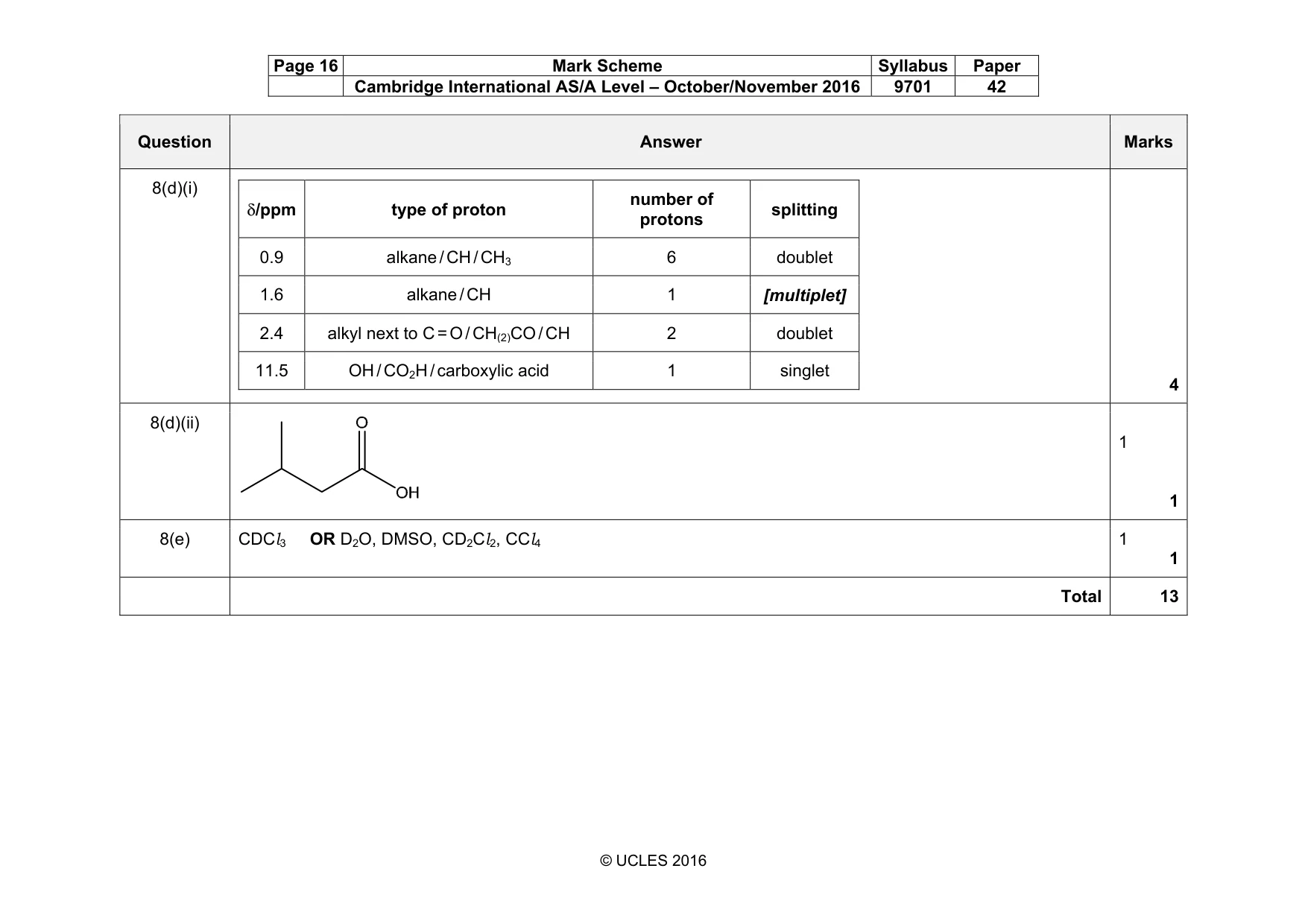
Page 16 Mark Scheme Syllabus Paper Cambridge International AS/A Level – October/November 2016 9701 42 © UCLES 2016 Question Answer Marks 8(d)(i) δ/ppm type of proton number of protons splitting 0.9 alkane / CH / CH3 6 doublet 1.6 alkane / CH 1 [multiplet] 2.4 alkyl next to C = O / CH(2)CO / CH 2 doublet 11.5 OH / CO2H / carboxylic acid 1 singlet 4 8(d)(ii) 1 1 8(e) CDCl3 OR D2O, DMSO, CD2Cl2, CCl4 1 1 Total 13
What you needed in this session
Cambridge’s own grade thresholds for 2016 Oct/Nov, Paper 4 · Variant 2. A higher threshold means an easier paper — the bar moves with how the cohort did.