Cambridge A Level Chemistry 9701 — 2015 Oct/Nov Paper 5 · Variant 1
9701/51/O/N/15 · 30 marks · ≈34 min
The question paper and its mark scheme, free to read here and free to download. This is Cambridge’s own paper, exactly as it was sat.
Question paper12 pages


Mark scheme4 pages
Answers below. Sit the paper first if you are practising.
Paper as text
Question paper, page 1
READ THESE INSTRUCTIONS FIRST Write your Centre number, candidate number and name on all the work you hand in. Write in dark blue or black pen. You may use an HB pencil for any diagrams or graphs. Do not use staples, paper clips, glue or correction fl uid. DO NOT WRITE IN ANY BARCODES. Answer all questions. Electronic calculators may be used. You may lose marks if you do not show your working or if you do not use appropriate units. Use of a Data Booklet is unnecessary. At the end of the examination, fasten all your work securely together. The number of marks is given in brackets [ ] at the end of each question or part question. CHEMISTRY 9701/51 Paper 5 Planning, Analysis and Evaluation October/November 2015 1 hour 15 minutes Candidates answer on the Question Paper. No Additional Materials are required. Cambridge International Examinations Cambridge International Advanced Level This document consists of 9 printed pages and 3 blank pages. [Turn over IB15 11_9701_51/4RP © UCLES 2015 *3961515302*
Question paper, page 2
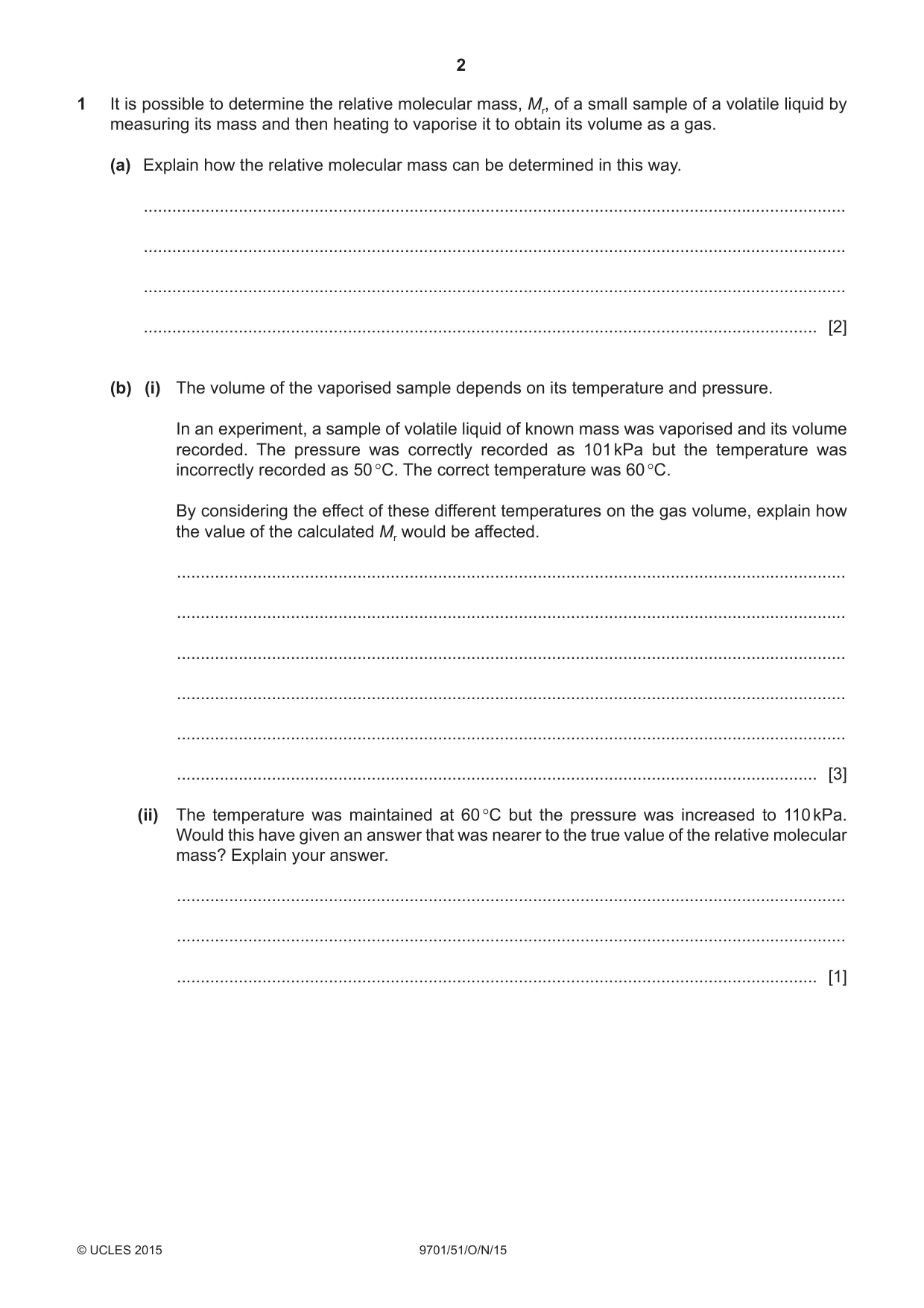
2 9701/51/O/N/15 © UCLES 2015 1 It is possible to determine the relative molecular mass, Mr, of a small sample of a volatile liquid by measuring its mass and then heating to vaporise it to obtain its volume as a gas. (a) Explain how the relative molecular mass can be determined in this way. … … … … [2] (b) (i) The volume of the vaporised sample depends on its temperature and pressure. In an experiment, a sample of volatile liquid of known mass was vaporised and its volume recorded. The pressure was correctly recorded as 101 kPa but the temperature was incorrectly recorded as 50 °C. The correct temperature was 60 °C. By considering the effect of these different temperatures on the gas volume, explain how the value of the calculated Mr would be affected. … … … … … … [3] (ii) The temperature was maintained at 60 °C but the pressure was increased to 110 kPa. Would this have given an answer that was nearer to the true value of the relative molecular mass? Explain your answer. … … … [1]
Question paper, page 3
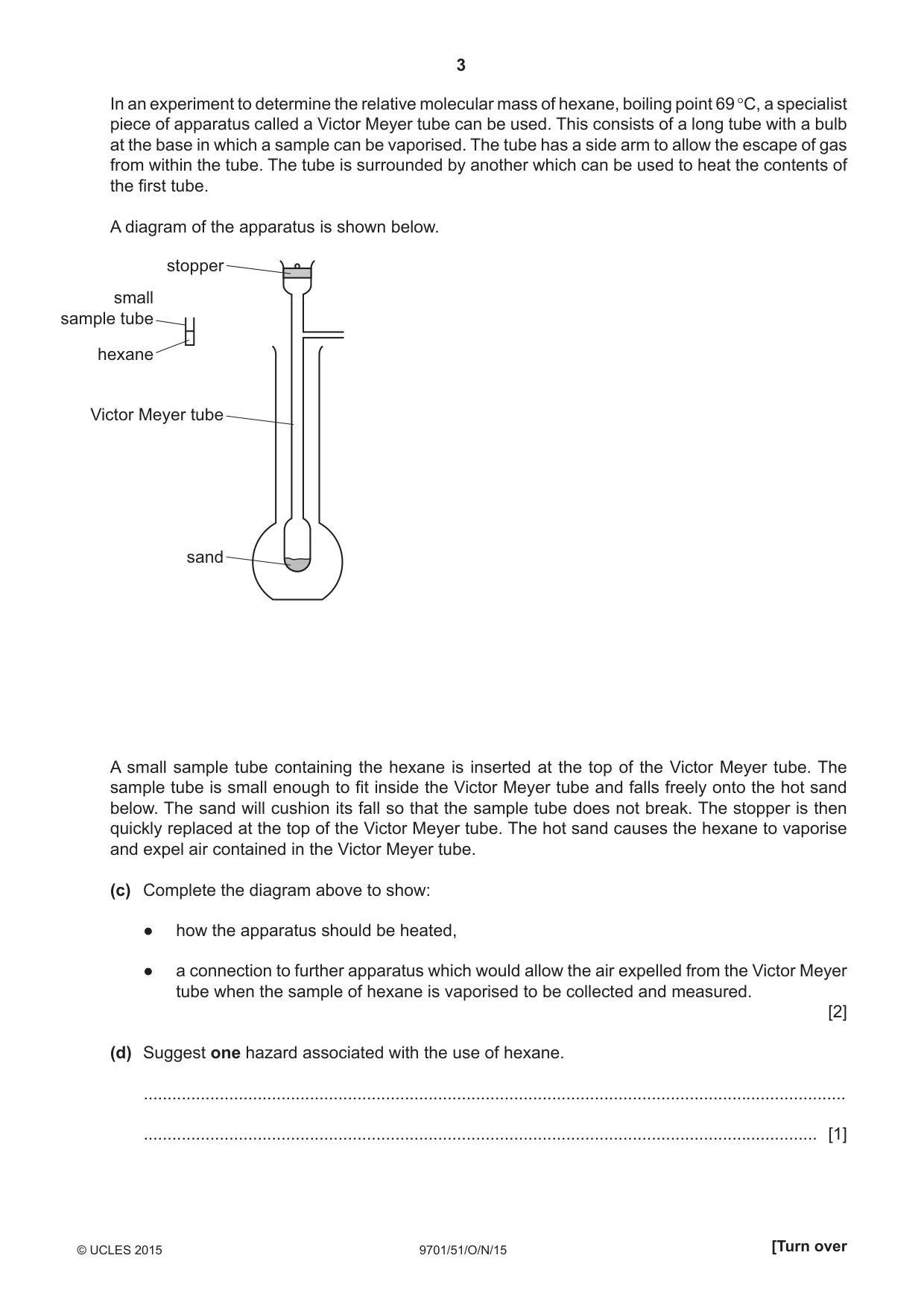
3 9701/51/O/N/15 © UCLES 2015 [Turn over In an experiment to determine the relative molecular mass of hexane, boiling point 69 °C, a specialist piece of apparatus called a Victor Meyer tube can be used. This consists of a long tube with a bulb at the base in which a sample can be vaporised. The tube has a side arm to allow the escape of gas from within the tube. The tube is surrounded by another which can be used to heat the contents of the fi rst tube. A diagram of the apparatus is shown below. Victor Meyer tube sand stopper small sample tube hexane A small sample tube containing the hexane is inserted at the top of the Victor Meyer tube. The sample tube is small enough to fi t inside the Victor Meyer tube and falls freely onto the hot sand below. The sand will cushion its fall so that the sample tube does not break. The stopper is then quickly replaced at the top of the Victor Meyer tube. The hot sand causes the hexane to vaporise and expel air contained in the Victor Meyer tube. (c) Complete the diagram above to show: ● how the apparatus should be heated, ● a connection to further apparatus which would allow the air expelled from the Victor Meyer tube when the sample of hexane is vaporised to be collected and measured. [2] (d) Suggest one hazard associated with the use of hexane. … … [1]
Question paper, page 4
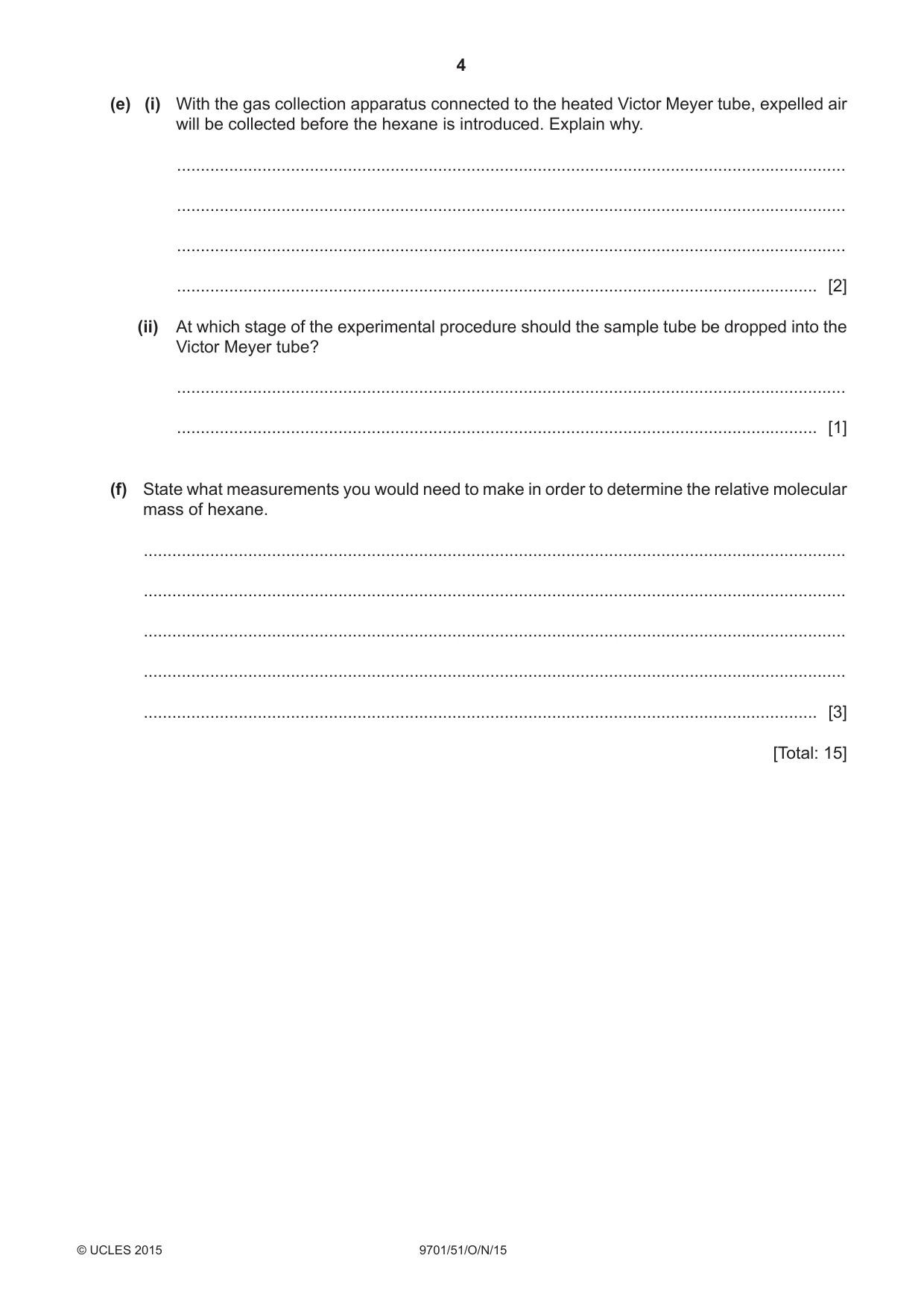
4 9701/51/O/N/15 © UCLES 2015 (e) (i) With the gas collection apparatus connected to the heated Victor Meyer tube, expelled air will be collected before the hexane is introduced. Explain why. … … … … [2] (ii) At which stage of the experimental procedure should the sample tube be dropped into the Victor Meyer tube? … … [1] (f) State what measurements you would need to make in order to determine the relative molecular mass of hexane. … … … … … [3] [Total: 15]
Question paper, page 5
5 9701/51/O/N/15 © UCLES 2015 [Turn over QUESTION 2 STARTS ON THE NEXT PAGE.
Question paper, page 6
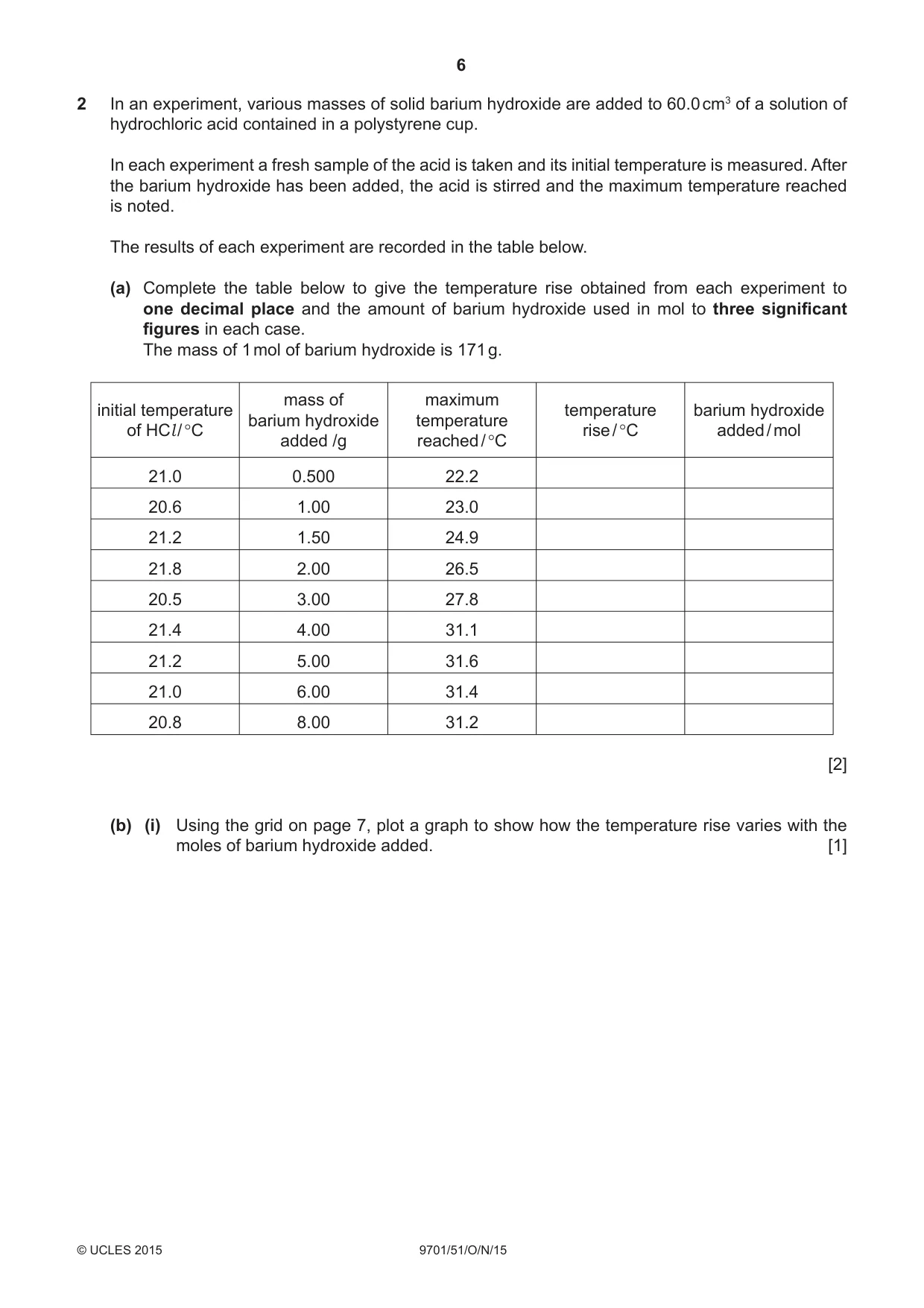
6 9701/51/O/N/15 © UCLES 2015 2 In an experiment, various masses of solid barium hydroxide are added to 60.0 cm3 of a solution of hydrochloric acid contained in a polystyrene cup. In each experiment a fresh sample of the acid is taken and its initial temperature is measured. After the barium hydroxide has been added, the acid is stirred and the maximum temperature reached is noted. The results of each experiment are recorded in the table below. (a) Complete the table below to give the temperature rise obtained from each experiment to one decimal place and the amount of barium hydroxide used in mol to three signifi cant fi gures in each case. The mass of 1 mol of barium hydroxide is 171 g. initial temperature of HCl / °C mass of barium hydroxide added /g maximum temperature reached / °C temperature rise / °C barium hydroxide added / mol 21.0 0.500 22.2 20.6 1.00 23.0 21.2 1.50 24.9 21.8 2.00 26.5 20.5 3.00 27.8 21.4 4.00 31.1 21.2 5.00 31.6 21.0 6.00 31.4 20.8 8.00 31.2 [2] (b) (i) Using the grid on page 7, plot a graph to show how the temperature rise varies with the moles of barium hydroxide added. [1]
Question paper, page 7
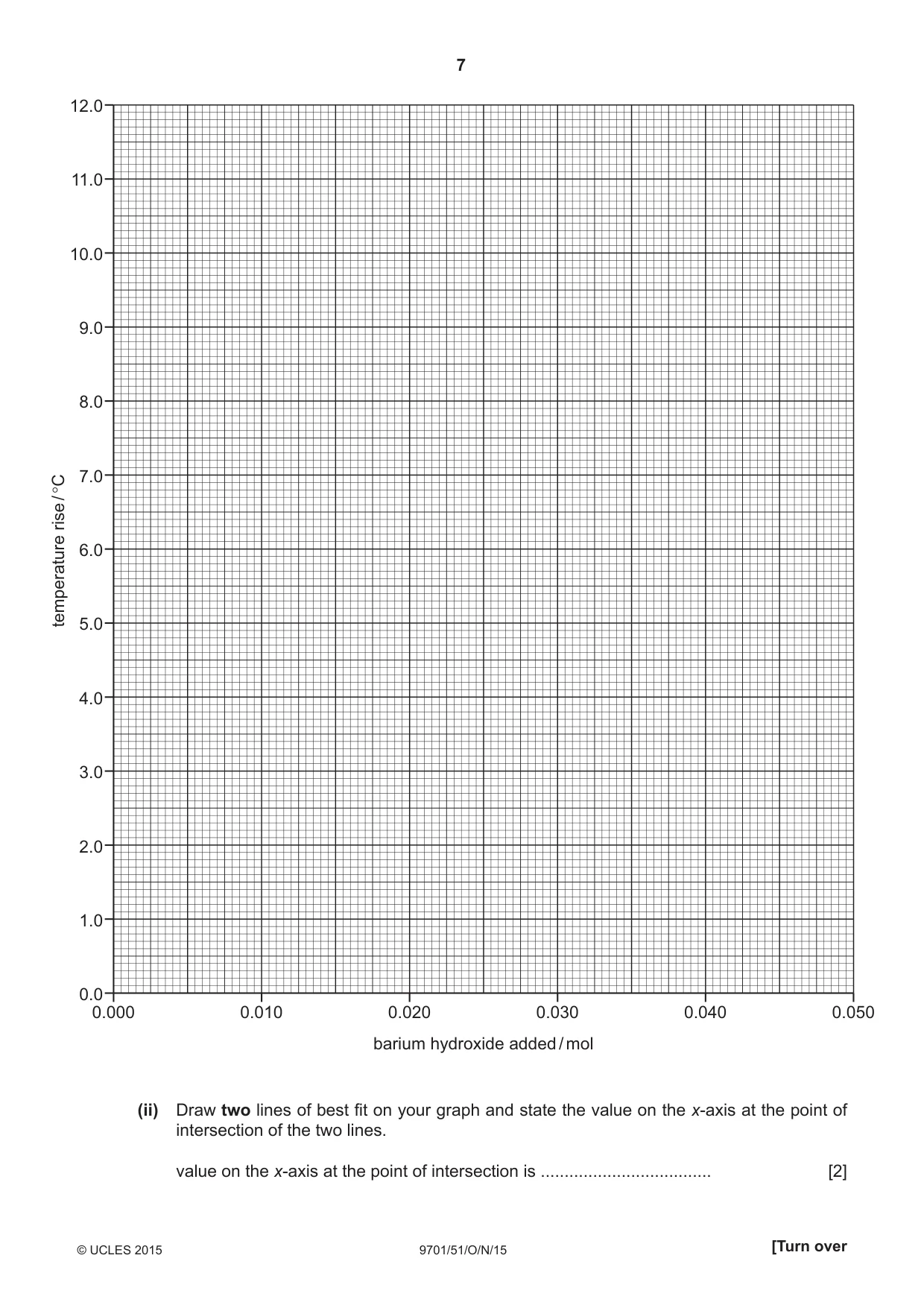
7 9701/51/O/N/15 © UCLES 2015 [Turn over 0.000 0.010 0.020 barium hydroxide added / mol temperature rise / °C 0.030 0.040 0.050 12.0 11.0 10.0 9.0 8.0 7.0 6.0 5.0 4.0 3.0 2.0 1.0 0.0 (ii) Draw two lines of best fi t on your graph and state the value on the x-axis at the point of intersection of the two lines. value on the x-axis at the point of intersection is … [2]
Question paper, page 8
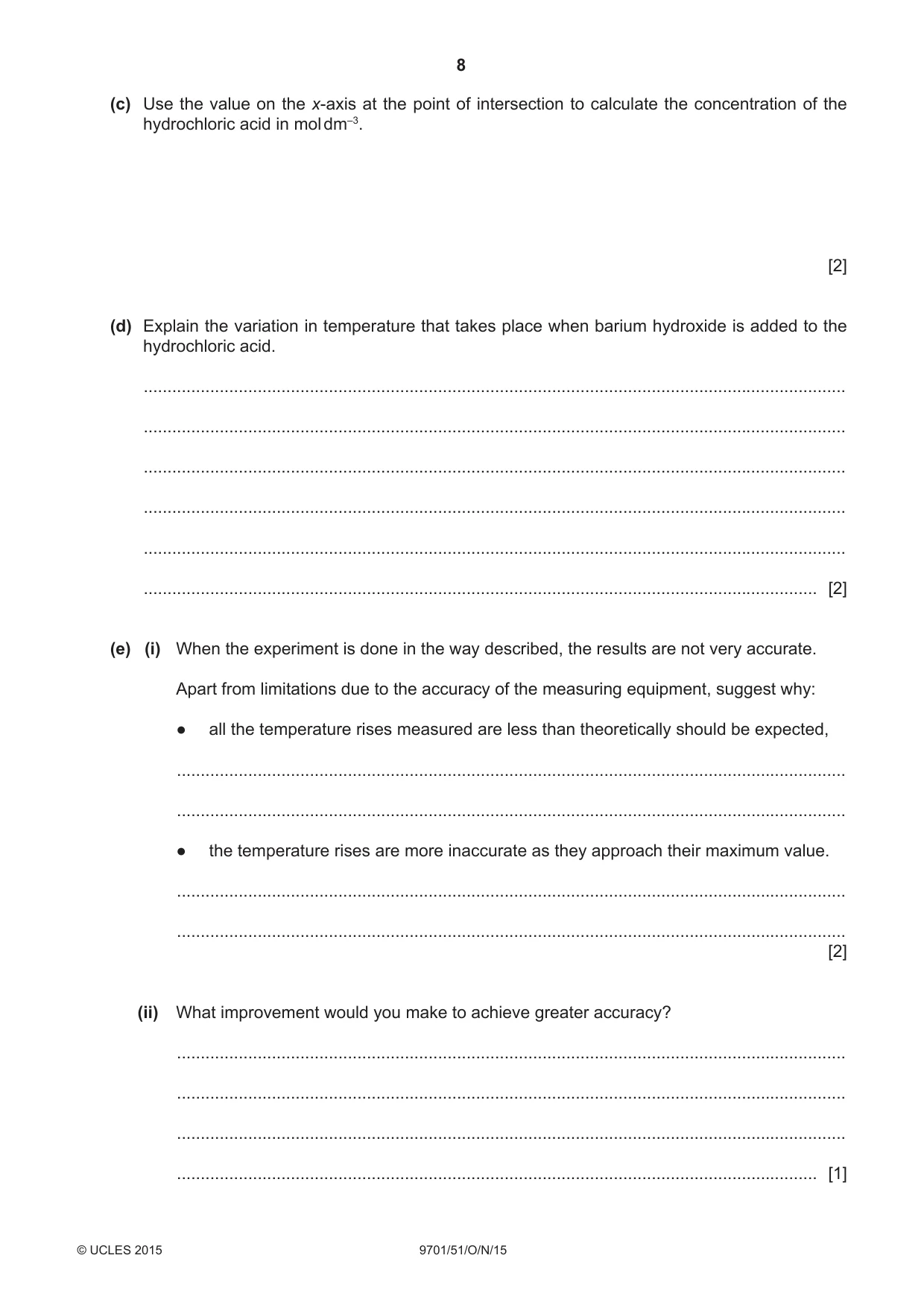
8 9701/51/O/N/15 © UCLES 2015 (c) Use the value on the x-axis at the point of intersection to calculate the concentration of the hydrochloric acid in mol dm–3. [2] (d) Explain the variation in temperature that takes place when barium hydroxide is added to the hydrochloric acid. … … … … … … [2] (e) (i) When the experiment is done in the way described, the results are not very accurate. Apart from limitations due to the accuracy of the measuring equipment, suggest why: ● all the temperature rises measured are less than theoretically should be expected, … … ● the temperature rises are more inaccurate as they approach their maximum value. … … [2] (ii) What improvement would you make to achieve greater accuracy? … … … … [1]
Question paper, page 9
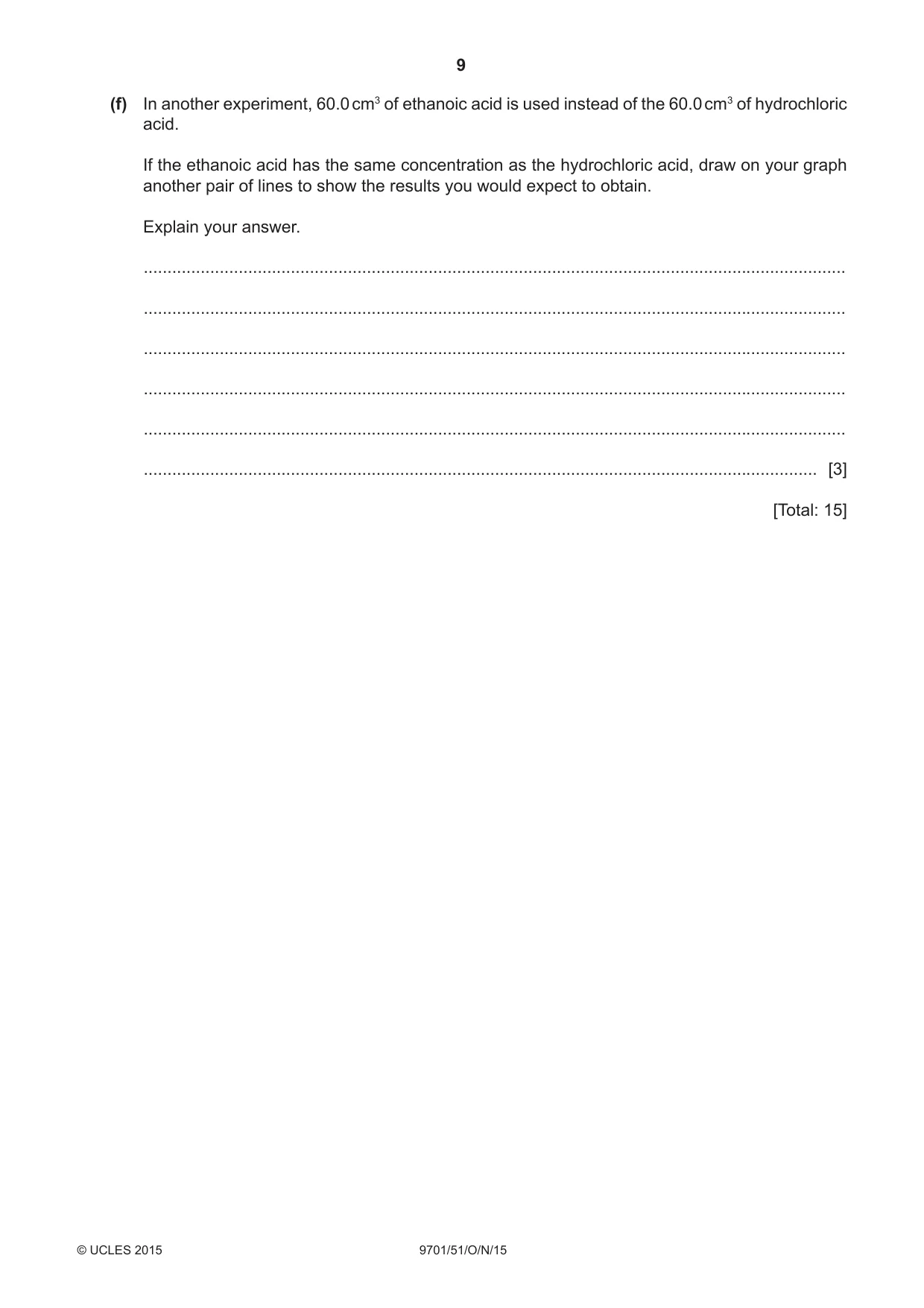
9 9701/51/O/N/15 © UCLES 2015 [Turn over (f) In another experiment, 60.0 cm3 of ethanoic acid is used instead of the 60.0 cm3 of hydrochloric acid. If the ethanoic acid has the same concentration as the hydrochloric acid, draw on your graph another pair of lines to show the results you would expect to obtain. Explain your answer. … … … … … … [3] [Total: 15]
Question paper, page 10
10 9701/51/O/N/15 © UCLES 2015 BLANK PAGE
Question paper, page 11
11 9701/51/O/N/15 © UCLES 2015 BLANK PAGE
Question paper, page 12
12 9701/51/O/N/15 © UCLES 2015 BLANK PAGE Permission to reproduce items where third-party owned material protected by copyright is included has been sought and cleared where possible. Every reasonable effort has been made by the publisher (UCLES) to trace copyright holders, but if any items requiring clearance have unwittingly been included, the publisher will be pleased to make amends at the earliest possible opportunity. To avoid the issue of disclosure of answer-related information to candidates, all copyright acknowledgements are reproduced online in the Cambridge International Examinations Copyright Acknowledgements Booklet. This is produced for each series of examinations and is freely available to download at www.cie.org.uk after the live examination series. Cambridge International Examinations is part of the Cambridge Assessment Group. Cambridge Assessment is the brand name of University of Cambridge Local Examinations Syndicate (UCLES), which is itself a department of the University of Cambridge.
Mark scheme, page 1
® IGCSE is the registered trademark of Cambridge International Examinations. CAMBRIDGE INTERNATIONAL EXAMINATIONS Cambridge International Advanced Level MARK SCHEME for the October/November 2015 series 9701 CHEMISTRY 9701/51 Paper 5 (Planning, Analysis and Evaluation), maximum raw mark 30 This mark scheme is published as an aid to teachers and candidates, to indicate the requirements of the examination. It shows the basis on which Examiners were instructed to award marks. It does not indicate the details of the discussions that took place at an Examiners’ meeting before marking began, which would have considered the acceptability of alternative answers. Mark schemes should be read in conjunction with the question paper and the Principal Examiner Report for Teachers. Cambridge will not enter into discussions about these mark schemes. Cambridge is publishing the mark schemes for the October/November 2015 series for most Cambridge IGCSE®, Cambridge International A and AS Level components and some Cambridge O Level components.
Mark scheme, page 2
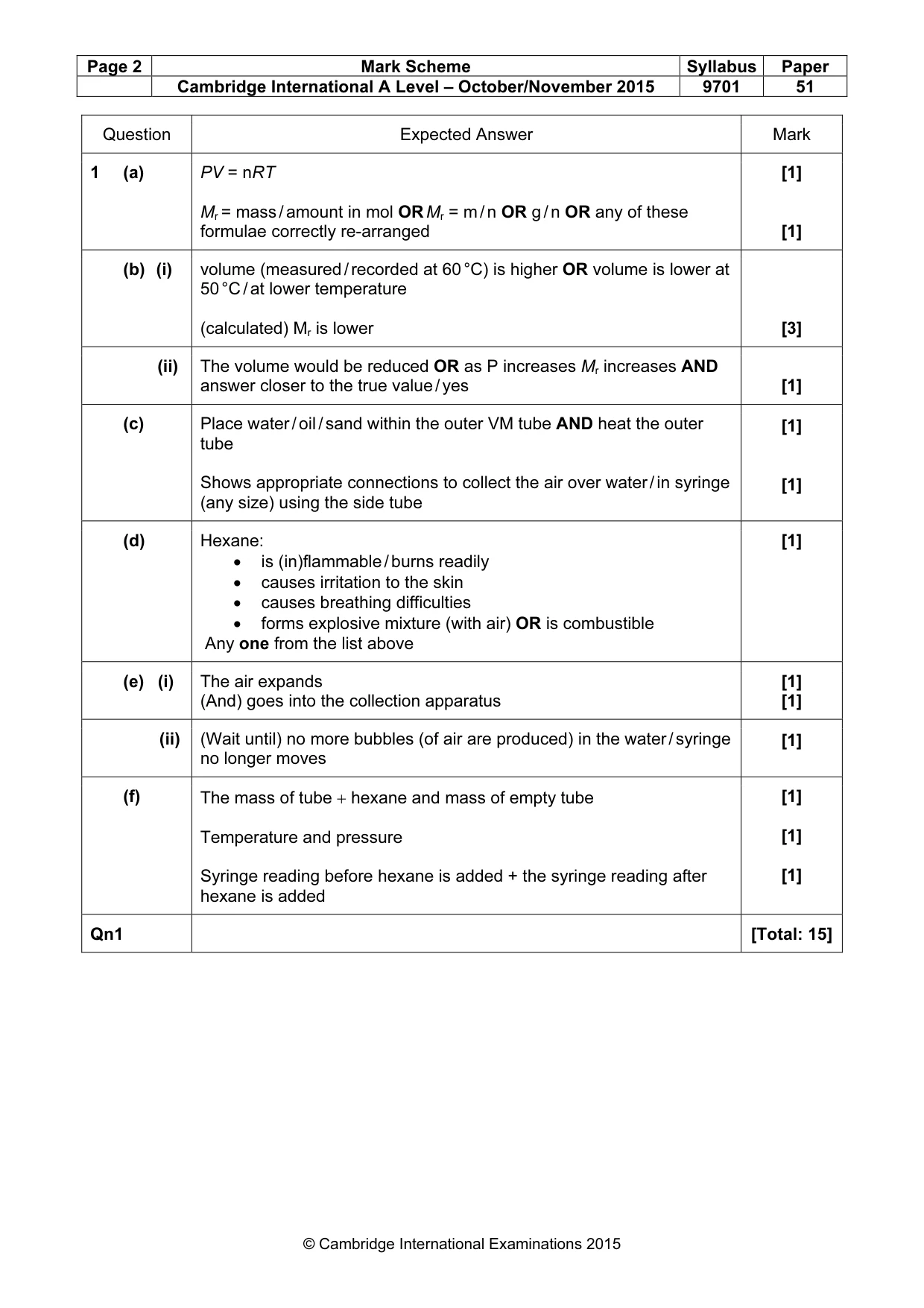
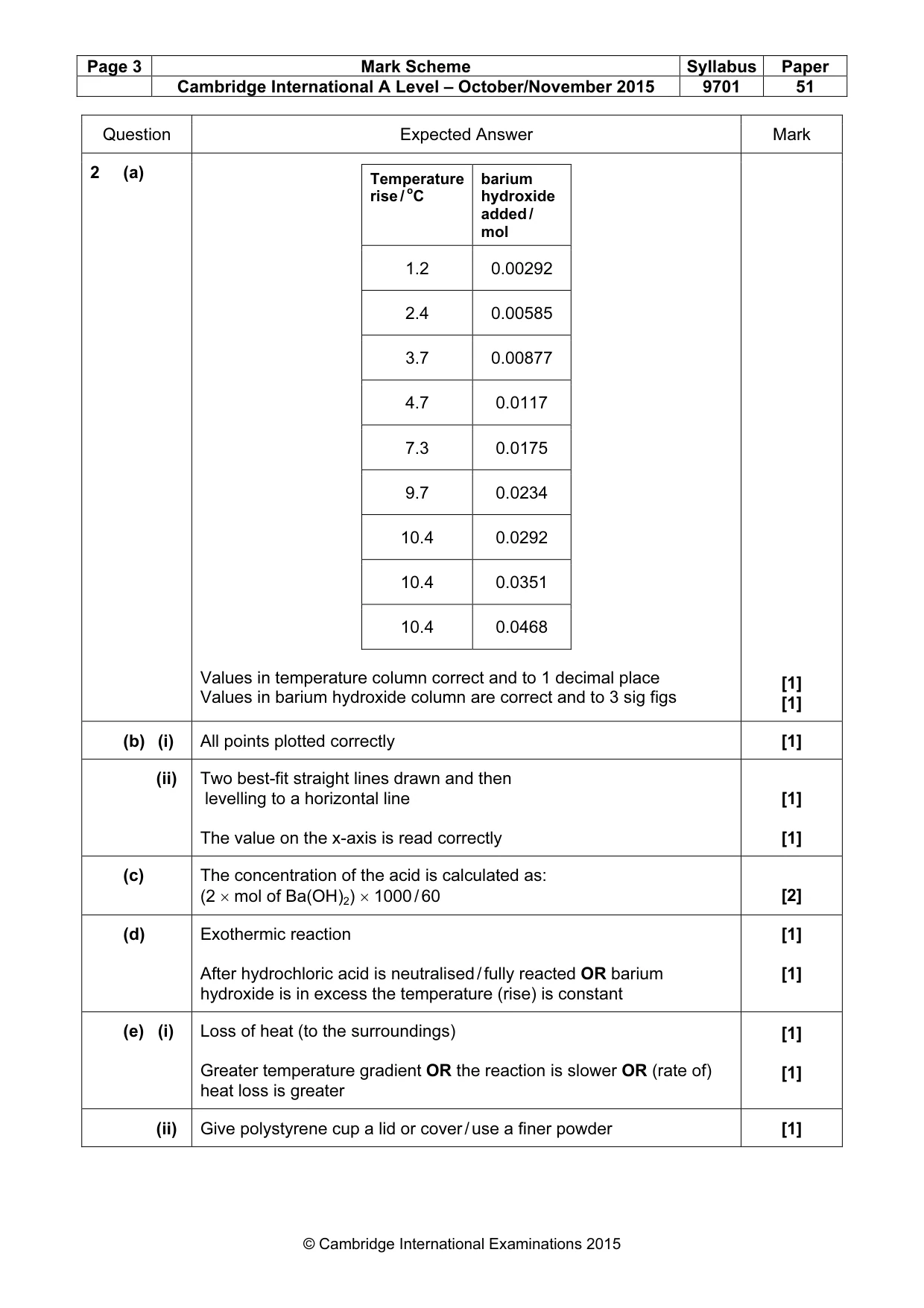
Page 2 Mark Scheme Syllabus Paper Cambridge International A Level – October/November 2015 9701 51 © Cambridge International Examinations 2015 Question Expected Answer Mark 1 (a) PV = nRT Mr = mass / amount in mol OR Mr = m / n OR g / n OR any of these formulae correctly re-arranged [1] [1] (b) (i) volume (measured / recorded at 60 °C) is higher OR volume is lower at 50 °C / at lower temperature (calculated) Mr is lower [3] (ii) The volume would be reduced OR as P increases Mr increases AND answer closer to the true value / yes [1] (c) Place water / oil / sand within the outer VM tube AND heat the outer tube Shows appropriate connections to collect the air over water / in syringe (any size) using the side tube [1] [1] (d) Hexane: • is (in)flammable / burns readily • causes irritation to the skin • causes breathing difficulties • forms explosive mixture (with air) OR is combustible Any one from the list above [1] (e) (i) The air expands (And) goes into the collection apparatus [1] [1] (ii) (Wait until) no more bubbles (of air are produced) in the water / syringe no longer moves [1] (f) The mass of tube + hexane and mass of empty tube Temperature and pressure Syringe reading before hexane is added + the syringe reading after hexane is added [1] [1] [1] Qn1 [Total: 15]
Mark scheme, page 3
Page 3 Mark Scheme Syllabus Paper Cambridge International A Level – October/November 2015 9701 51 © Cambridge International Examinations 2015 Question Expected Answer Mark 2 (a) Temperature rise / oC barium hydroxide added / mol 1.2 0.00292 2.4 0.00585 3.7 0.00877 4.7 0.0117 7.3 0.0175 9.7 0.0234 10.4 0.0292 10.4 0.0351 10.4 0.0468 Values in temperature column correct and to 1 decimal place Values in barium hydroxide column are correct and to 3 sig figs [1] [1] (b) (i) All points plotted correctly [1] (ii) Two best-fit straight lines drawn and then levelling to a horizontal line The value on the x-axis is read correctly [1] [1] (c) The concentration of the acid is calculated as: (2 × mol of Ba(OH)2) × 1000 / 60 [2] (d) Exothermic reaction After hydrochloric acid is neutralised / fully reacted OR barium hydroxide is in excess the temperature (rise) is constant [1] [1] (e) (i) Loss of heat (to the surroundings) Greater temperature gradient OR the reaction is slower OR (rate of) heat loss is greater [1] [1] (ii) Give polystyrene cup a lid or cover / use a finer powder [1]
Mark scheme, page 4
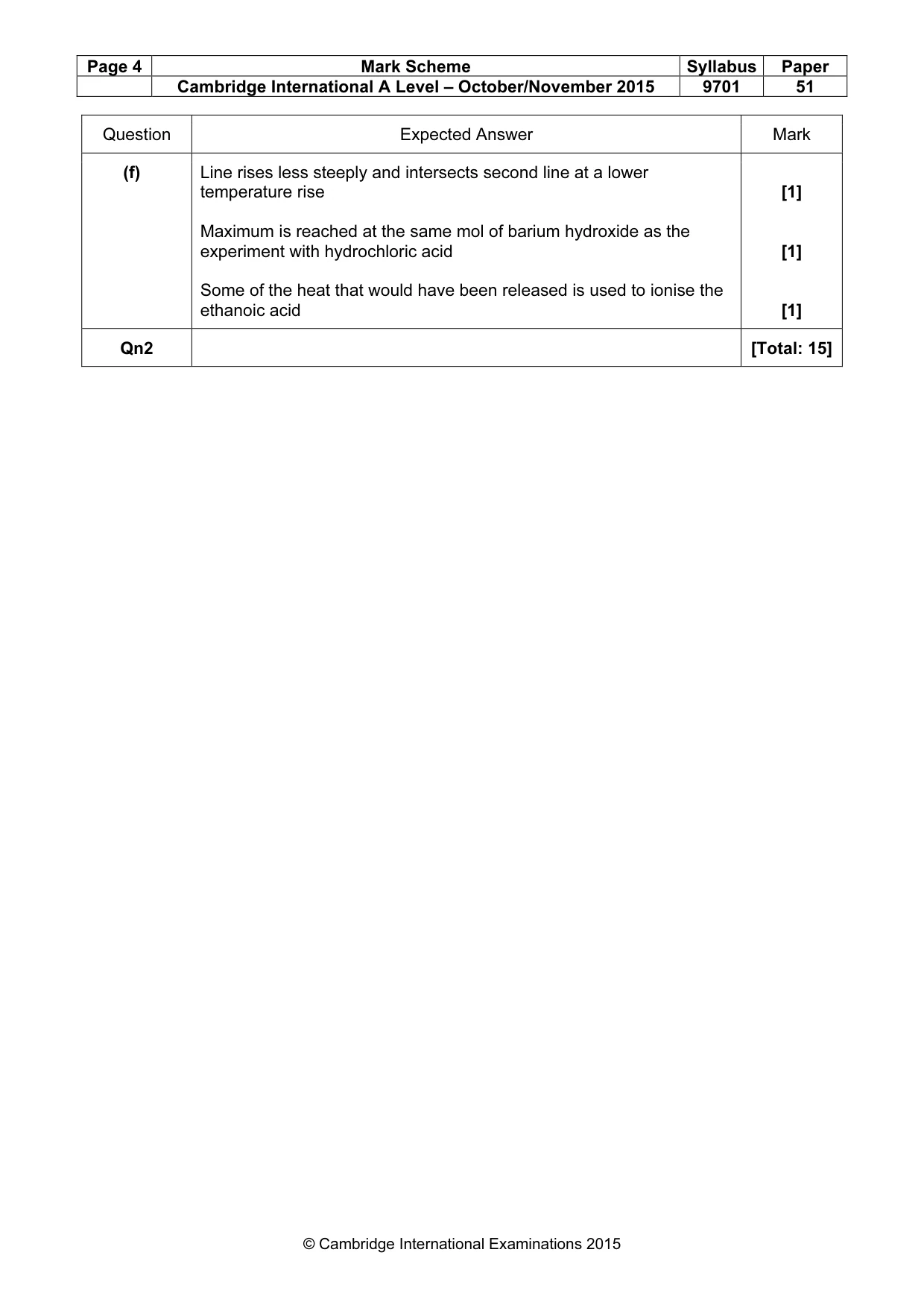
Page 4 Mark Scheme Syllabus Paper Cambridge International A Level – October/November 2015 9701 51 © Cambridge International Examinations 2015 Question Expected Answer Mark (f) Line rises less steeply and intersects second line at a lower temperature rise Maximum is reached at the same mol of barium hydroxide as the experiment with hydrochloric acid Some of the heat that would have been released is used to ionise the ethanoic acid [1] [1] [1] Qn2 [Total: 15]
What you needed in this session
Cambridge’s own grade thresholds for 2015 Oct/Nov, Paper 5 · Variant 1. A higher threshold means an easier paper — the bar moves with how the cohort did.