Cambridge A Level Chemistry 9701 — 2015 May/June Paper 2 · Variant 1
9701/21/M/J/15 · 60 marks · ≈68 min
The question paper and its mark scheme, free to read here and free to download. This is Cambridge’s own paper, exactly as it was sat.
Question paper12 pages
Mark scheme5 pages
Answers below. Sit the paper first if you are practising.
Paper as text
Question paper, page 1
READ THESE INSTRUCTIONS FIRST Write your Centre number, candidate number and name on all the work you hand in. Write in dark blue or black pen. You may use an HB pencil for any diagrams or graphs. Do not use staples, paper clips, glue or correction fl uid. DO NOT WRITE IN ANY BARCODES. Answer all questions. Electronic calculators may be used. You may lose marks if you do not show your working or if you do not use appropriate units. A Data Booklet is provided. At the end of the examination, fasten all your work securely together. The number of marks is given in brackets [ ] at the end of each question or part question. CHEMISTRY 9701/21 Paper 2 Structured Questions AS Core May/June 2015 1 hour 15 minutes Candidates answer on the Question Paper. Additional Materials: Data Booklet Cambridge International Examinations Cambridge International Advanced Subsidiary and Advanced Level This document consists of 11 printed pages and 1 blank page. [Turn over IB15 06_9701_21/FP © UCLES 2015 *8582611017*
Question paper, page 2
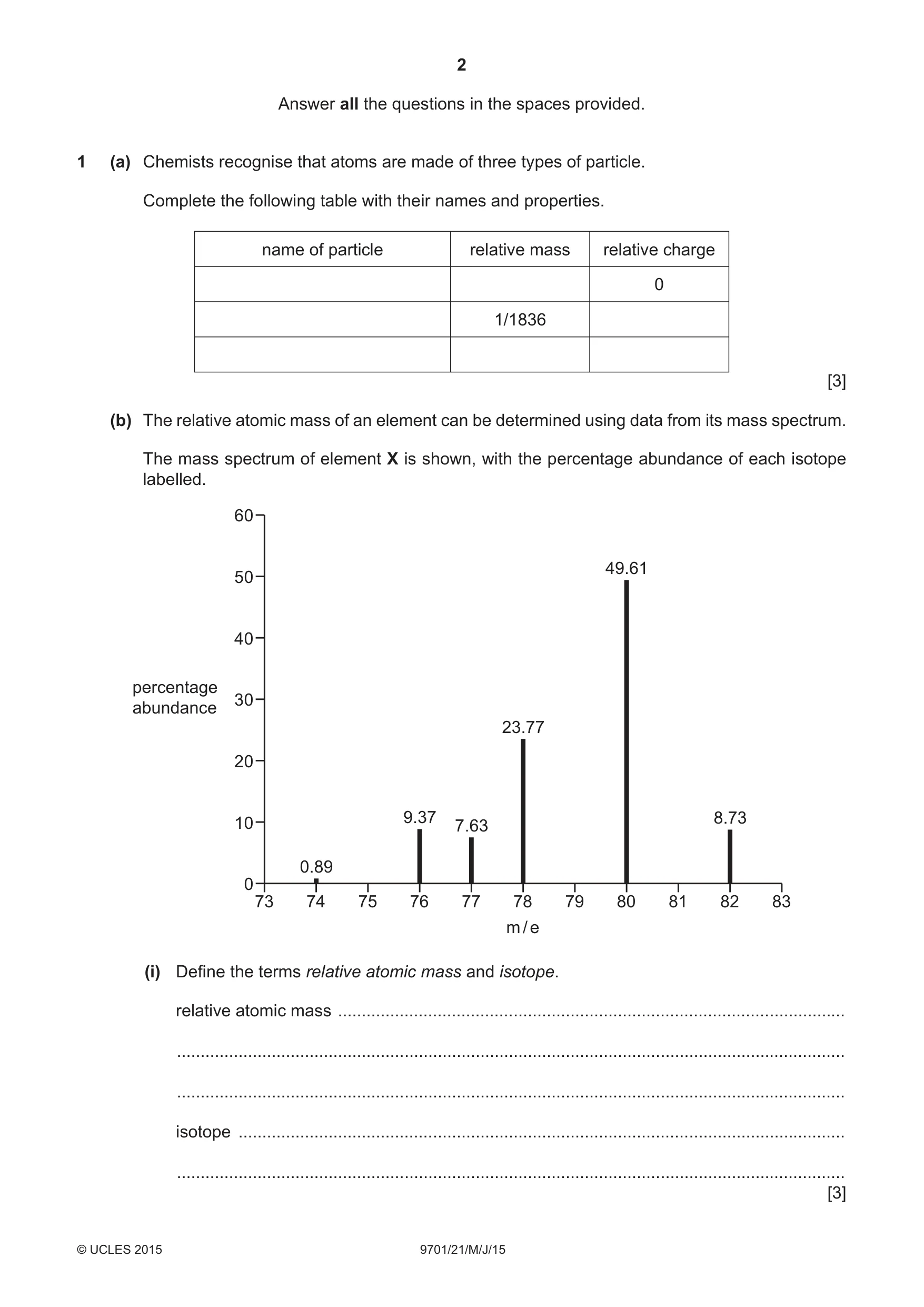
2 9701/21/M/J/15 © UCLES 2015 Answer all the questions in the spaces provided. 1 (a) Chemists recognise that atoms are made of three types of particle. Complete the following table with their names and properties. name of particle relative mass relative charge 0 1/1836 [3] (b) The relative atomic mass of an element can be determined using data from its mass spectrum. The mass spectrum of element X is shown, with the percentage abundance of each isotope labelled. 73 74 75 76 77 78 m / e 79 80 81 82 83 60 50 40 30 20 10 0 percentage abundance 0.89 9.37 7.63 8.73 23.77 49.61 (i) Defi ne the terms relative atomic mass and isotope. relative atomic mass … … … isotope … … [3]
Question paper, page 3
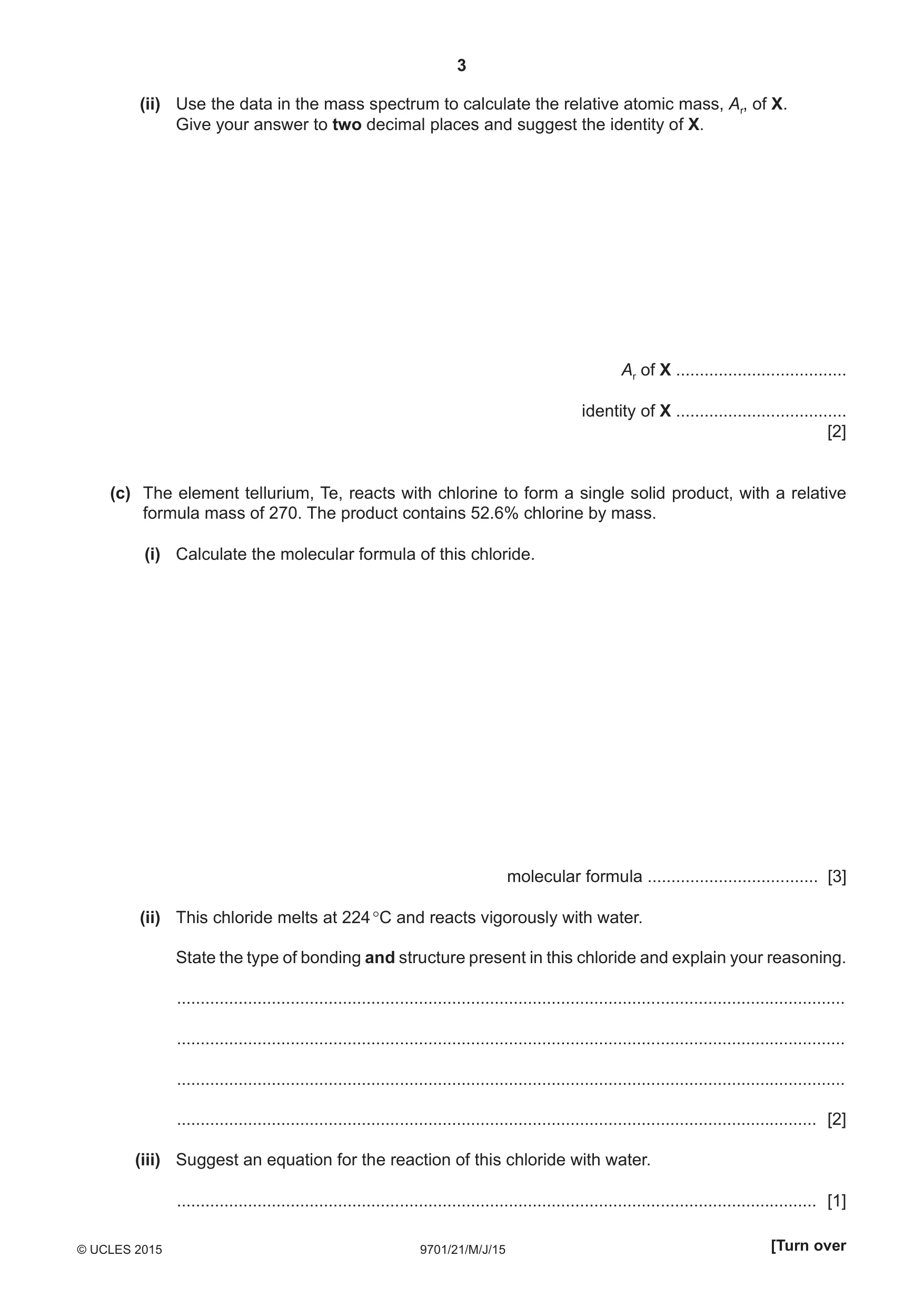
3 9701/21/M/J/15 © UCLES 2015 [Turn over (ii) Use the data in the mass spectrum to calculate the relative atomic mass, Ar, of X. Give your answer to two decimal places and suggest the identity of X. Ar of X … identity of X … [2] (c) The element tellurium, Te, reacts with chlorine to form a single solid product, with a relative formula mass of 270. The product contains 52.6% chlorine by mass. (i) Calculate the molecular formula of this chloride. molecular formula … [3] (ii) This chloride melts at 224 °C and reacts vigorously with water. State the type of bonding and structure present in this chloride and explain your reasoning. … … … … [2] (iii) Suggest an equation for the reaction of this chloride with water. … [1]
Question paper, page 4
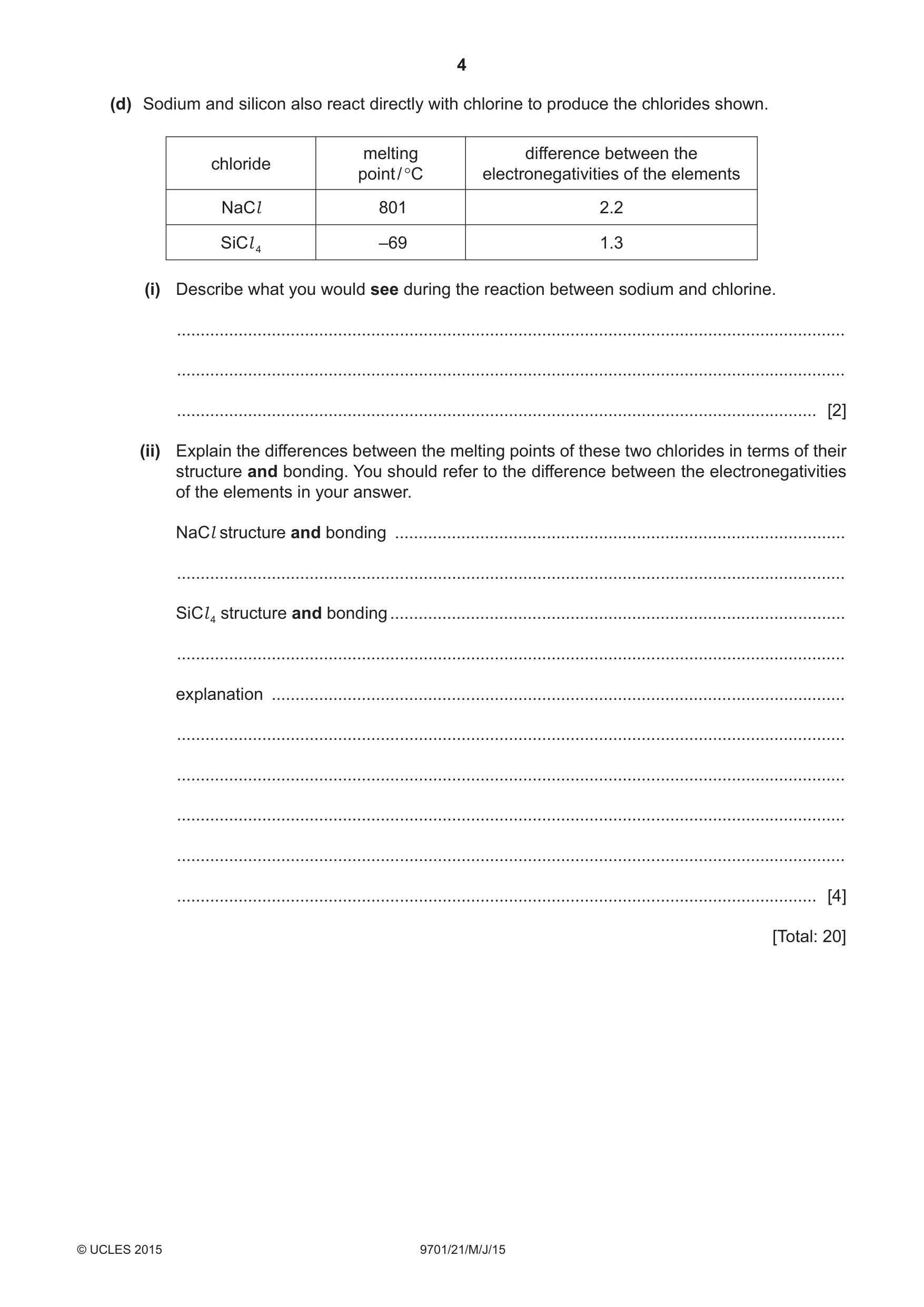
4 9701/21/M/J/15 © UCLES 2015 (d) Sodium and silicon also react directly with chlorine to produce the chlorides shown. chloride melting point / °C difference between the electronegativities of the elements NaCl 801 2.2 SiCl 4 –69 1.3 (i) Describe what you would see during the reaction between sodium and chlorine. … … … [2] (ii) Explain the differences between the melting points of these two chlorides in terms of their structure and bonding. You should refer to the difference between the electronegativities of the elements in your answer. NaCl structure and bonding … … SiCl 4 structure and bonding … … explanation … … … … … … [4] [Total: 20]
Question paper, page 5
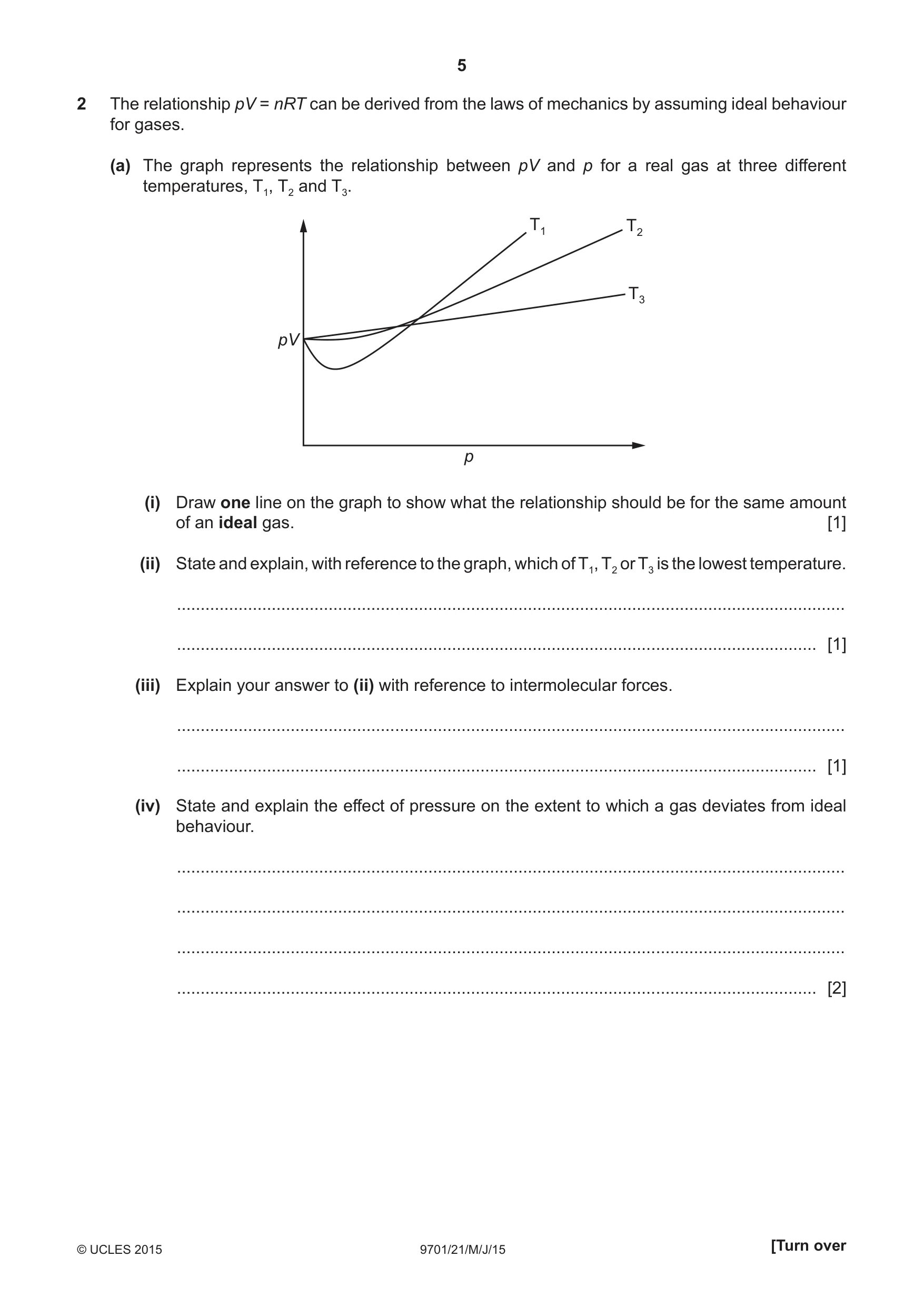
5 9701/21/M/J/15 © UCLES 2015 [Turn over 2 The relationship pV = nRT can be derived from the laws of mechanics by assuming ideal behaviour for gases. (a) The graph represents the relationship between pV and p for a real gas at three different temperatures, T1, T2 and T3. pV p T1 T2 T3 (i) Draw one line on the graph to show what the relationship should be for the same amount of an ideal gas. [1] (ii) State and explain, with reference to the graph, which of T1, T2 or T3 is the lowest temperature. … … [1] (iii) Explain your answer to (ii) with reference to intermolecular forces. … … [1] (iv) State and explain the effect of pressure on the extent to which a gas deviates from ideal behaviour. … … … … [2]
Question paper, page 6
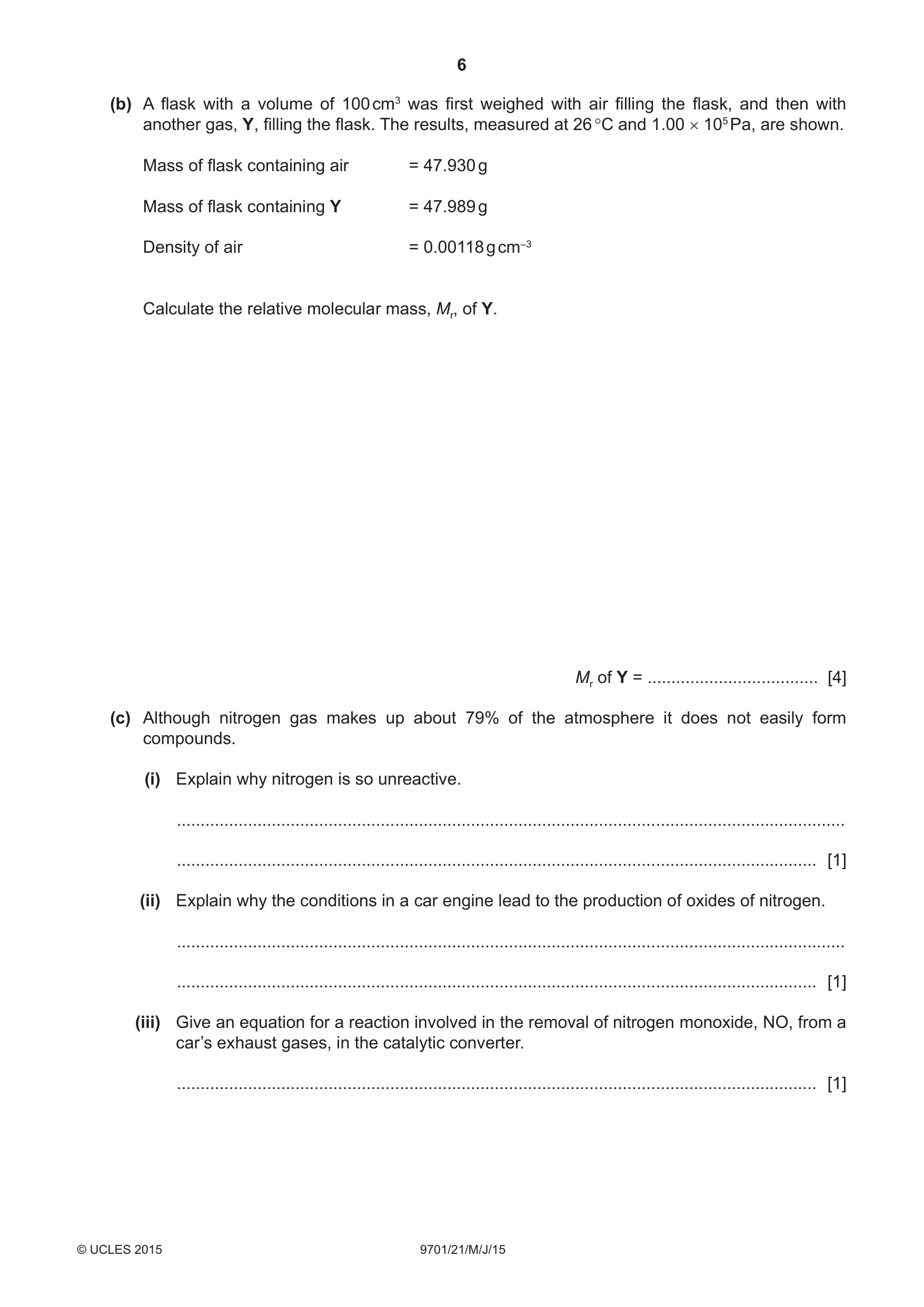
6 9701/21/M/J/15 © UCLES 2015 (b) A fl ask with a volume of 100 cm3 was fi rst weighed with air fi lling the fl ask, and then with another gas, Y, fi lling the fl ask. The results, measured at 26 °C and 1.00 × 10⁵ Pa, are shown. Mass of fl ask containing air = 47.930 g Mass of fl ask containing Y = 47.989 g Density of air = 0.00118 g cm–3 Calculate the relative molecular mass, Mr, of Y. Mr of Y = … [4] (c) Although nitrogen gas makes up about 79% of the atmosphere it does not easily form compounds. (i) Explain why nitrogen is so unreactive. … … [1] (ii) Explain why the conditions in a car engine lead to the production of oxides of nitrogen. … … [1] (iii) Give an equation for a reaction involved in the removal of nitrogen monoxide, NO, from a car’s exhaust gases, in the catalytic converter. … [1]
Question paper, page 7
7 9701/21/M/J/15 © UCLES 2015 [Turn over One of the main reasons for reducing the amounts of oxides of nitrogen in the atmosphere is their contribution to the formation of acid rain. (iv) Write an equation for the formation of nitric acid from nitrogen dioxide, NO2, in the atmosphere. … [1] (v) Write equations showing the catalytic role of nitrogen monoxide, NO, in the oxidation of atmospheric sulfur dioxide, SO2. … … [2] [Total: 15]
Question paper, page 8
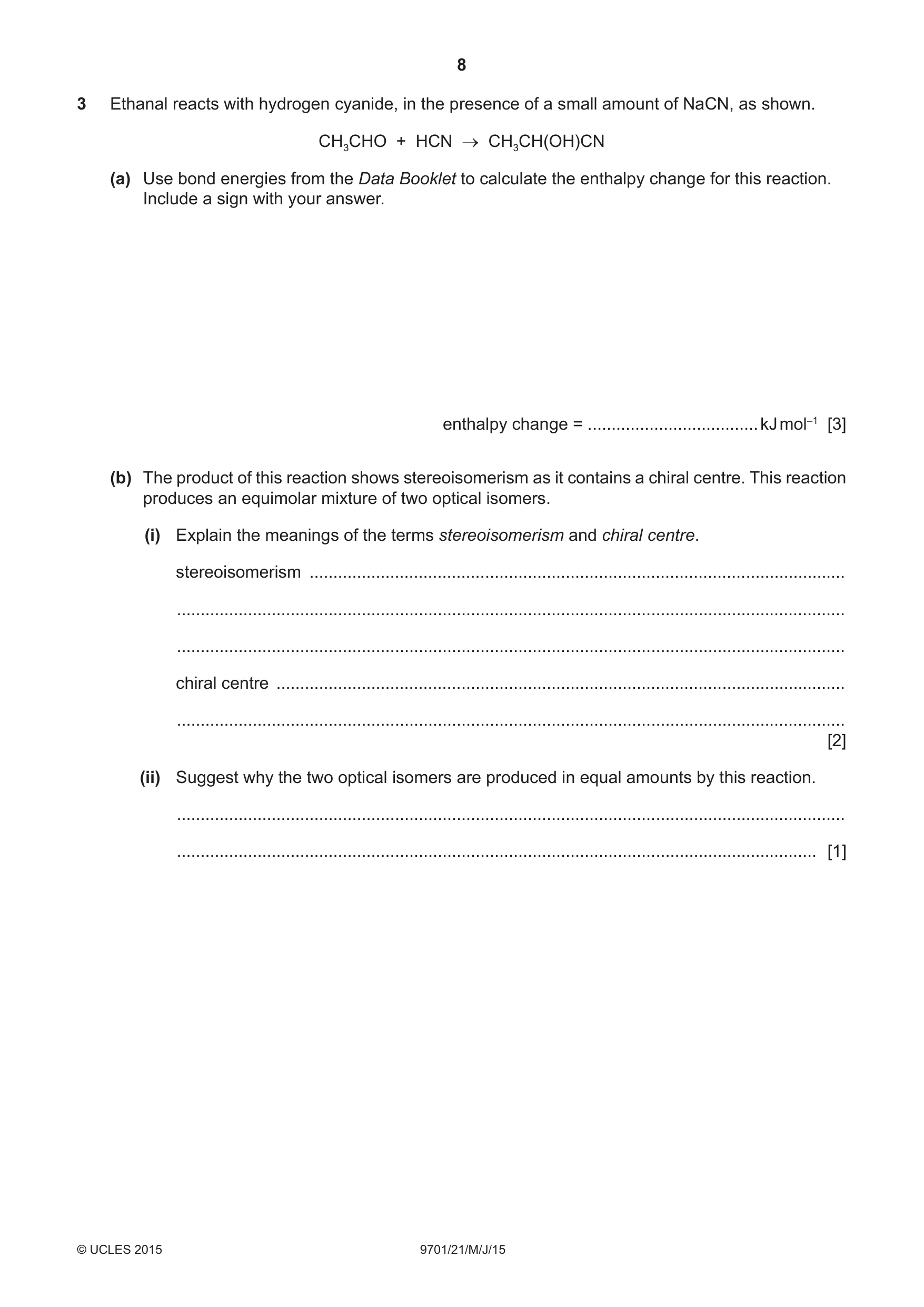
8 9701/21/M/J/15 © UCLES 2015 3 Ethanal reacts with hydrogen cyanide, in the presence of a small amount of NaCN, as shown. CH3CHO + HCN → CH3CH(OH)CN (a) Use bond energies from the Data Booklet to calculate the enthalpy change for this reaction. Include a sign with your answer. enthalpy change = … kJ mol–1 [3] (b) The product of this reaction shows stereoisomerism as it contains a chiral centre. This reaction produces an equimolar mixture of two optical isomers. (i) Explain the meanings of the terms stereoisomerism and chiral centre. stereoisomerism … … … chiral centre … … [2] (ii) Suggest why the two optical isomers are produced in equal amounts by this reaction. … … [1]
Question paper, page 9
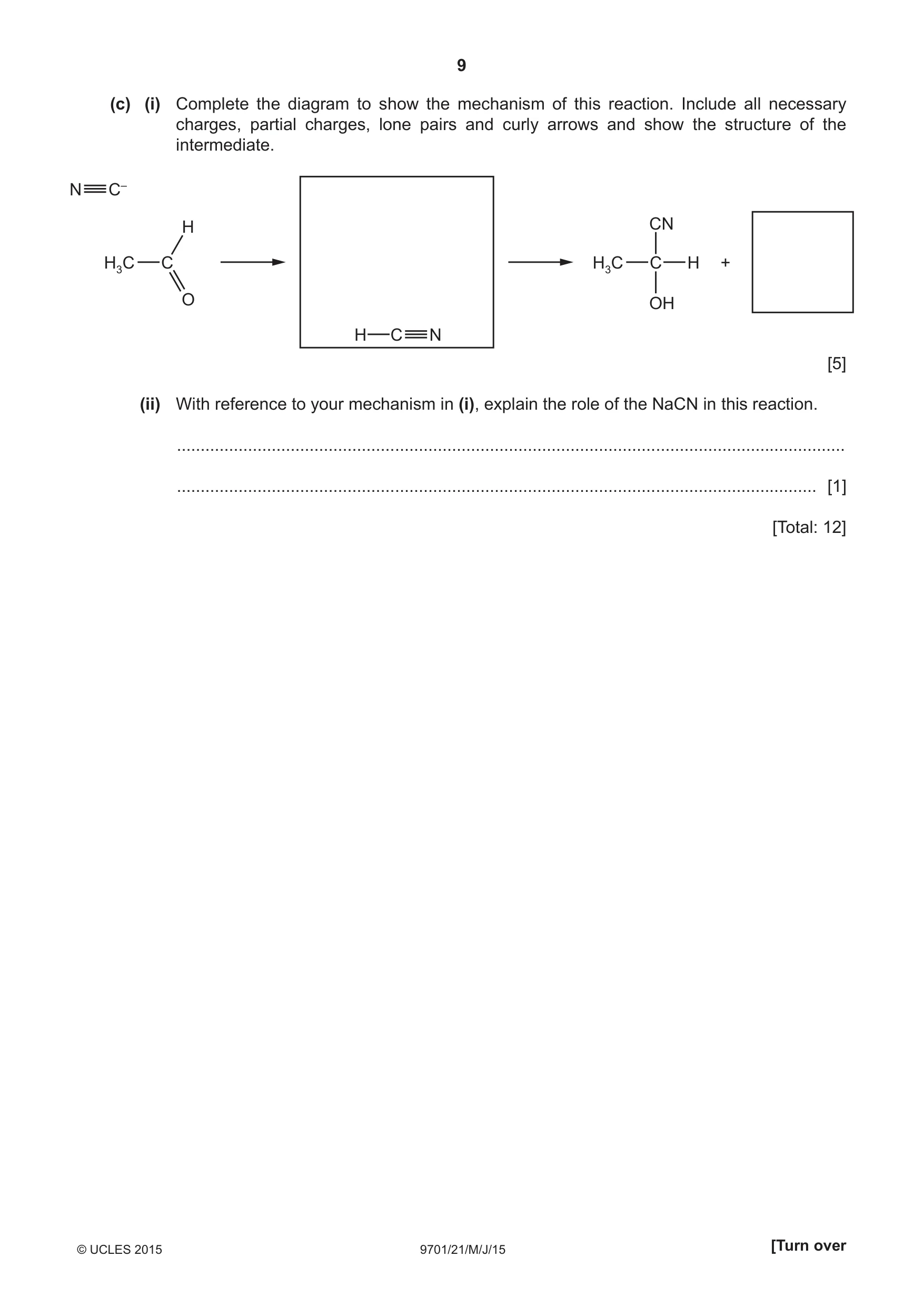
9 9701/21/M/J/15 © UCLES 2015 [Turn over (c) (i) Complete the diagram to show the mechanism of this reaction. Include all necessary charges, partial charges, lone pairs and curly arrows and show the structure of the intermediate. H3C C H O H3C C H + CN OH C– N N C H [5] (ii) With reference to your mechanism in (i), explain the role of the NaCN in this reaction. … … [1] [Total: 12]
Question paper, page 10
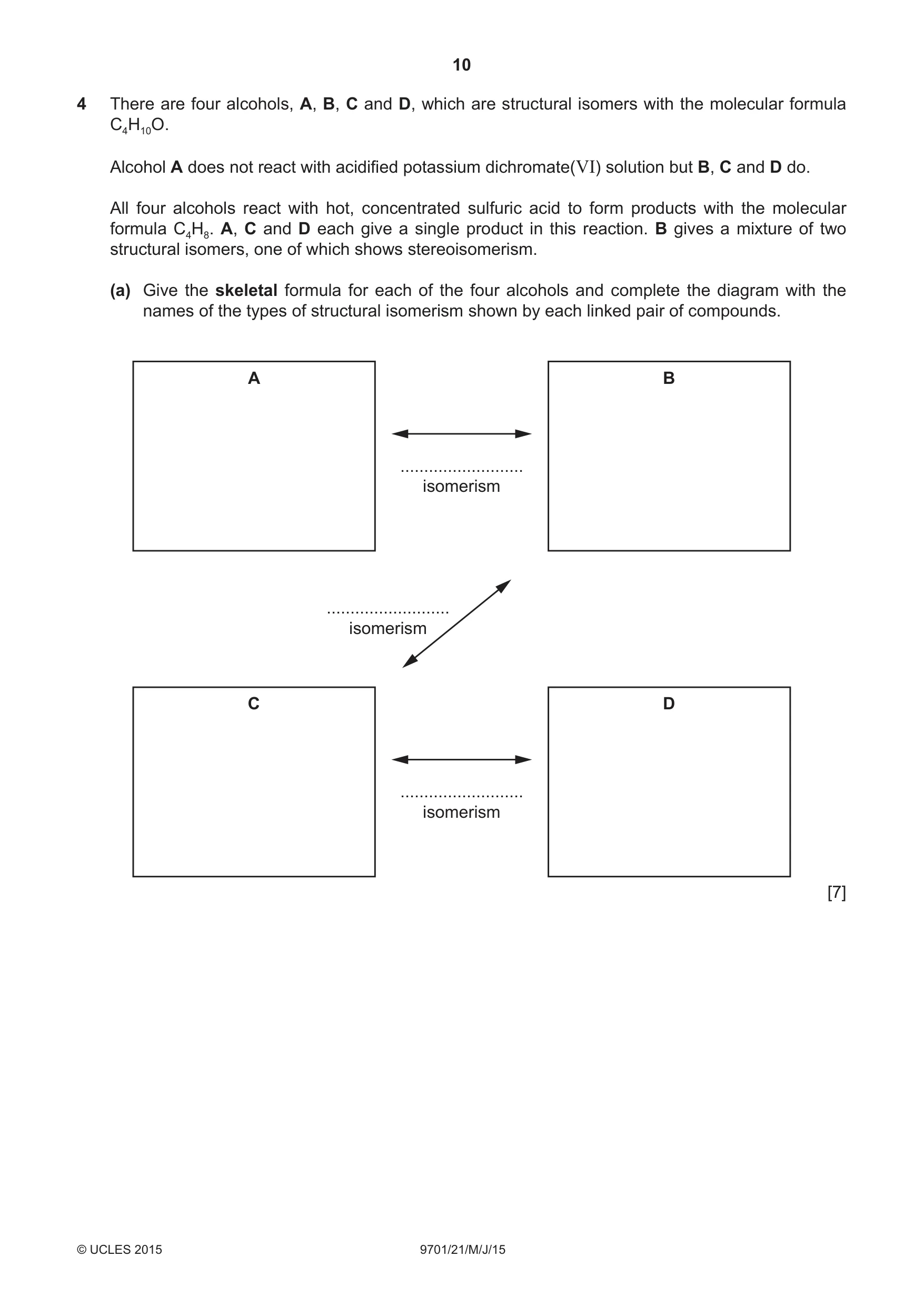
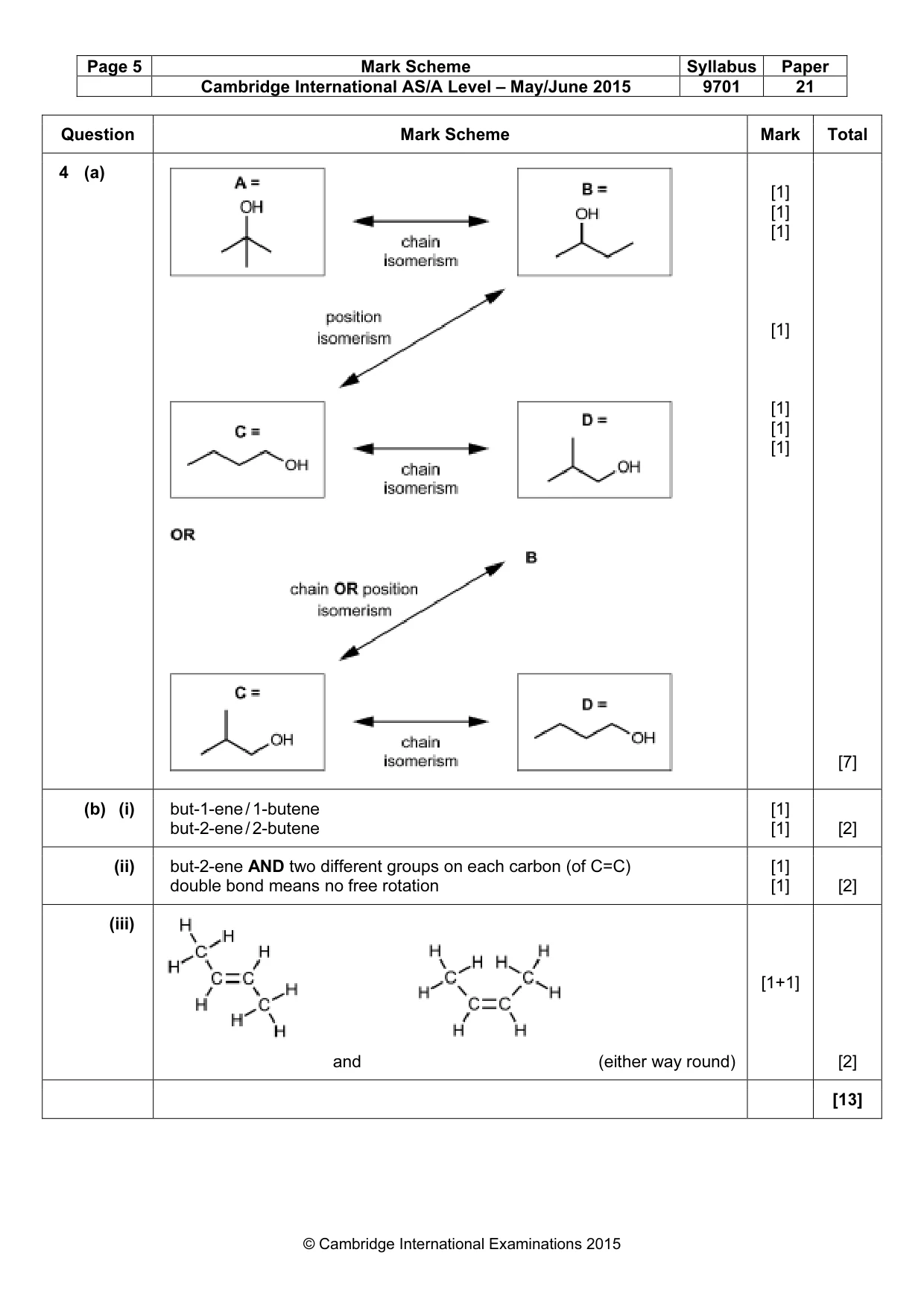
10 9701/21/M/J/15 © UCLES 2015 4 There are four alcohols, A, B, C and D, which are structural isomers with the molecular formula C4H10O. Alcohol A does not react with acidifi ed potassium dichromate(VI) solution but B, C and D do. All four alcohols react with hot, concentrated sulfuric acid to form products with the molecular formula C4H8. A, C and D each give a single product in this reaction. B gives a mixture of two structural isomers, one of which shows stereoisomerism. (a) Give the skeletal formula for each of the four alcohols and complete the diagram with the names of the types of structural isomerism shown by each linked pair of compounds. A B … isomerism … isomerism C D … isomerism [7]
Question paper, page 11
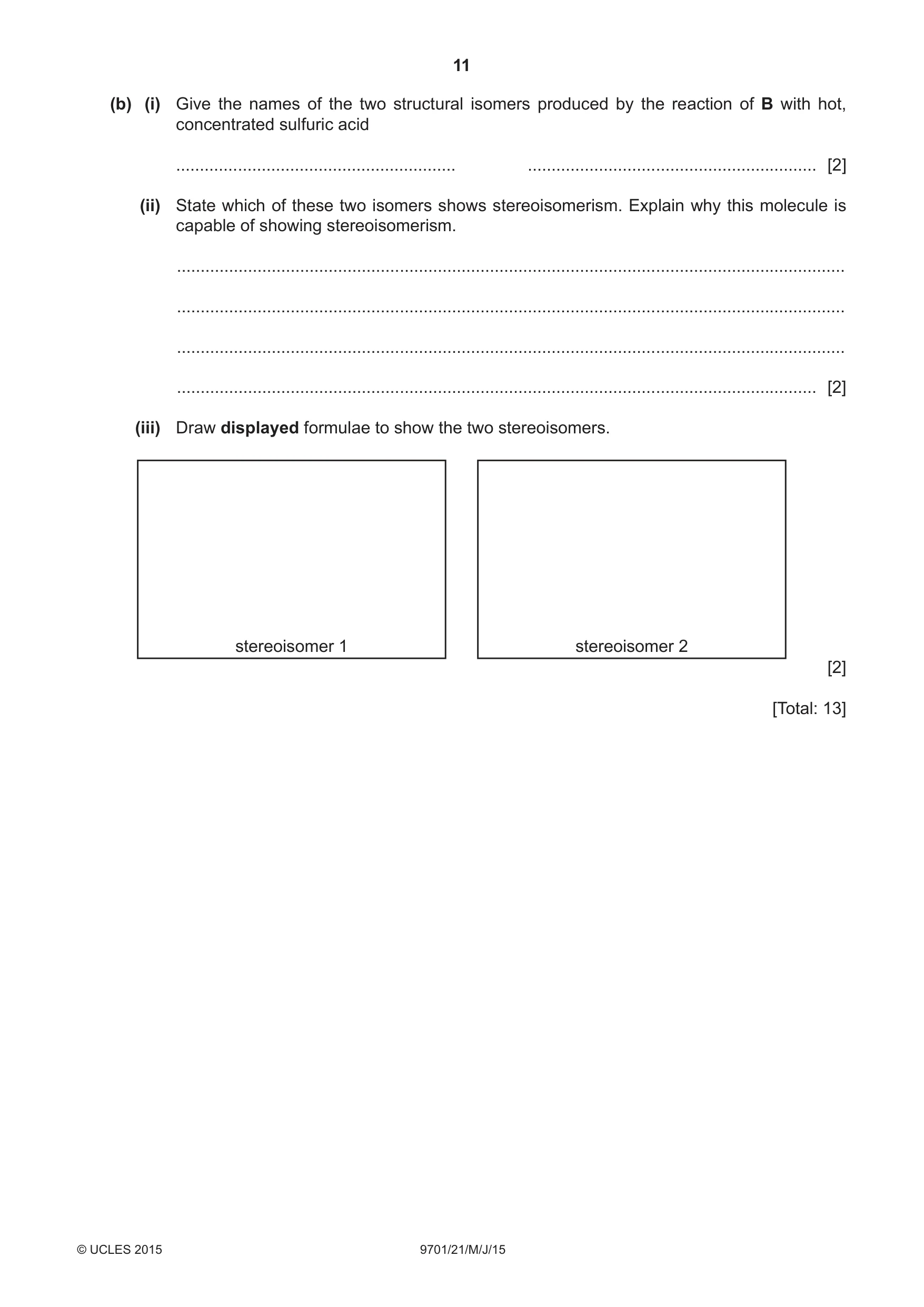
11 9701/21/M/J/15 © UCLES 2015 [Turn over (b) (i) Give the names of the two structural isomers produced by the reaction of B with hot, concentrated sulfuric acid … … [2] (ii) State which of these two isomers shows stereoisomerism. Explain why this molecule is capable of showing stereoisomerism. … … … … [2] (iii) Draw displayed formulae to show the two stereoisomers. stereoisomer 1 stereoisomer 2 [2] [Total: 13]
Question paper, page 12
12 9701/21/M/J/15 © UCLES 2015 BLANK PAGE Permission to reproduce items where third-party owned material protected by copyright is included has been sought and cleared where possible. Every reasonable effort has been made by the publisher (UCLES) to trace copyright holders, but if any items requiring clearance have unwittingly been included, the publisher will be pleased to make amends at the earliest possible opportunity. To avoid the issue of disclosure of answer-related information to candidates, all copyright acknowledgements are reproduced online in the Cambridge International Examinations Copyright Acknowledgements Booklet. This is produced for each series of examinations and is freely available to download at www.cie.org.uk after the live examination series. Cambridge International Examinations is part of the Cambridge Assessment Group. Cambridge Assessment is the brand name of University of Cambridge Local Examinations Syndicate (UCLES), which is itself a department of the University of Cambridge.
Mark scheme, page 1
® IGCSE is the registered trademark of Cambridge International Examinations. CAMBRIDGE INTERNATIONAL EXAMINATIONS Cambridge International Advanced Subsidiary and Advanced Level MARK SCHEME for the May/June 2015 series 9701 CHEMISTRY 9701/21 Paper 2 (Structured Questions AS Core), maximum raw mark 60 This mark scheme is published as an aid to teachers and candidates, to indicate the requirements of the examination. It shows the basis on which Examiners were instructed to award marks. It does not indicate the details of the discussions that took place at an Examiners’ meeting before marking began, which would have considered the acceptability of alternative answers. Mark schemes should be read in conjunction with the question paper and the Principal Examiner Report for Teachers. Cambridge will not enter into discussions about these mark schemes. Cambridge is publishing the mark schemes for the May/June 2015 series for most Cambridge IGCSE®, Cambridge International A and AS Level components and some Cambridge O Level components.
Mark scheme, page 2
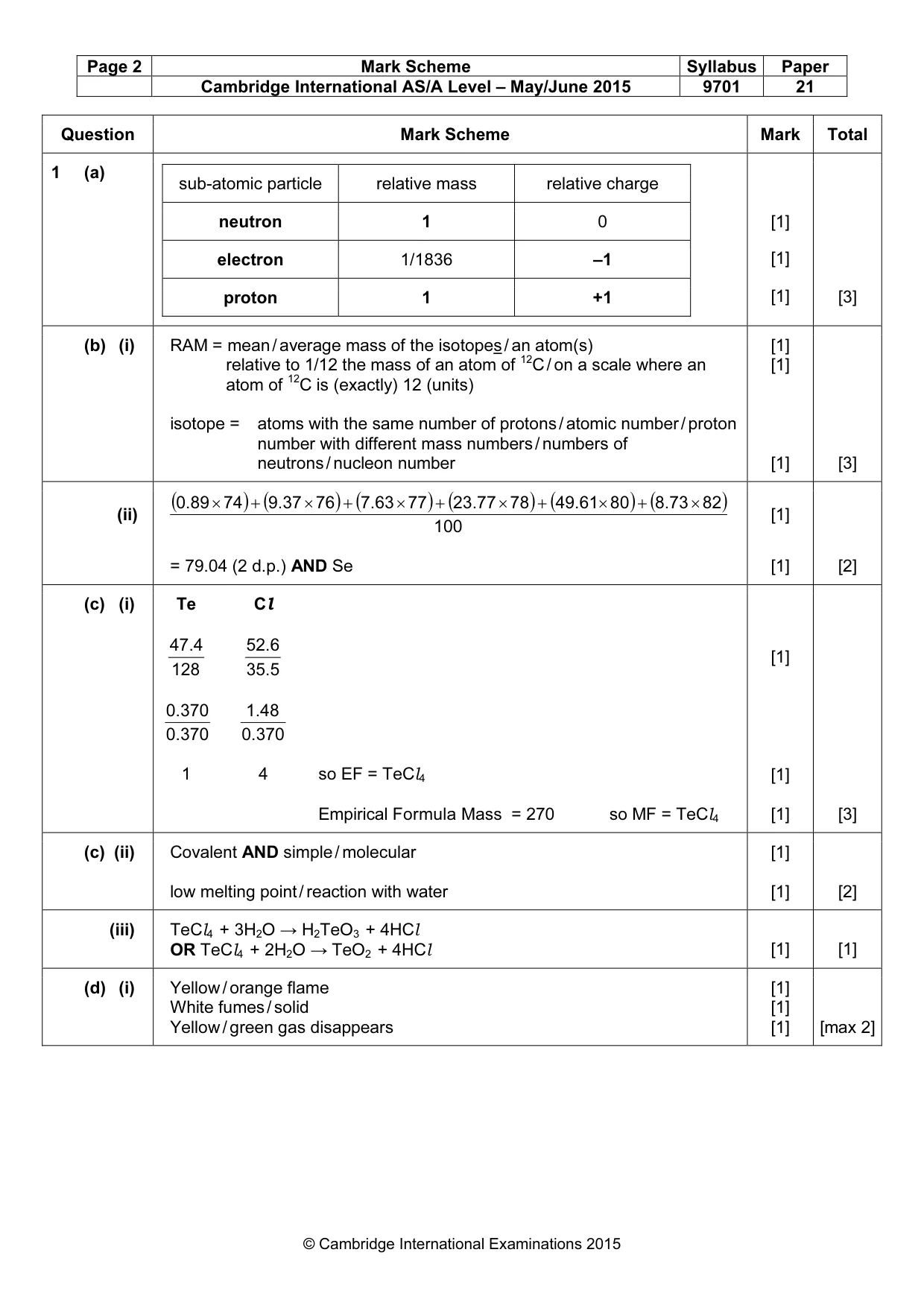
Page 2 Mark Scheme Syllabus Paper Cambridge International AS/A Level – May/June 2015 9701 21 © Cambridge International Examinations 2015 Question Mark Scheme Mark Total 1 (a) sub-atomic particle relative mass relative charge neutron 1 0 electron 1/1836 –1 proton 1 +1 [1] [1] [1] [3] (b) (i) RAM = mean / average mass of the isotopes / an atom(s) relative to 1/12 the mass of an atom of 12C / on a scale where an atom of 12C is (exactly) 12 (units) isotope = atoms with the same number of protons / atomic number / proton number with different mass numbers / numbers of neutrons / nucleon number [1] [1] [1] [3] (ii) ( ) ( ) ( ) ( ) ( ) ( ) 100 82 8.73 80 49.61 78 23.77 77 7.63 76 9.37 74 0.89 × + × + × + × + × + × = 79.04 (2 d.p.) AND Se [1] [1] [2] (c) (i) Te Cl 128 47.4 35.5 52.6 0.370 0.370 0.370 1.48 1 4 so EF = TeCl4 Empirical Formula Mass = 270 so MF = TeCl4 [1] [1] [1] [3] (c) (ii) Covalent AND simple / molecular low melting point / reaction with water [1] [1] [2] (iii) TeCl4 + 3H2O → H2TeO3 + 4HCl OR TeCl4 + 2H2O → TeO2 + 4HCl [1] [1] (d) (i) Yellow / orange flame White fumes / solid Yellow / green gas disappears [1] [1] [1] [max 2]
Mark scheme, page 3
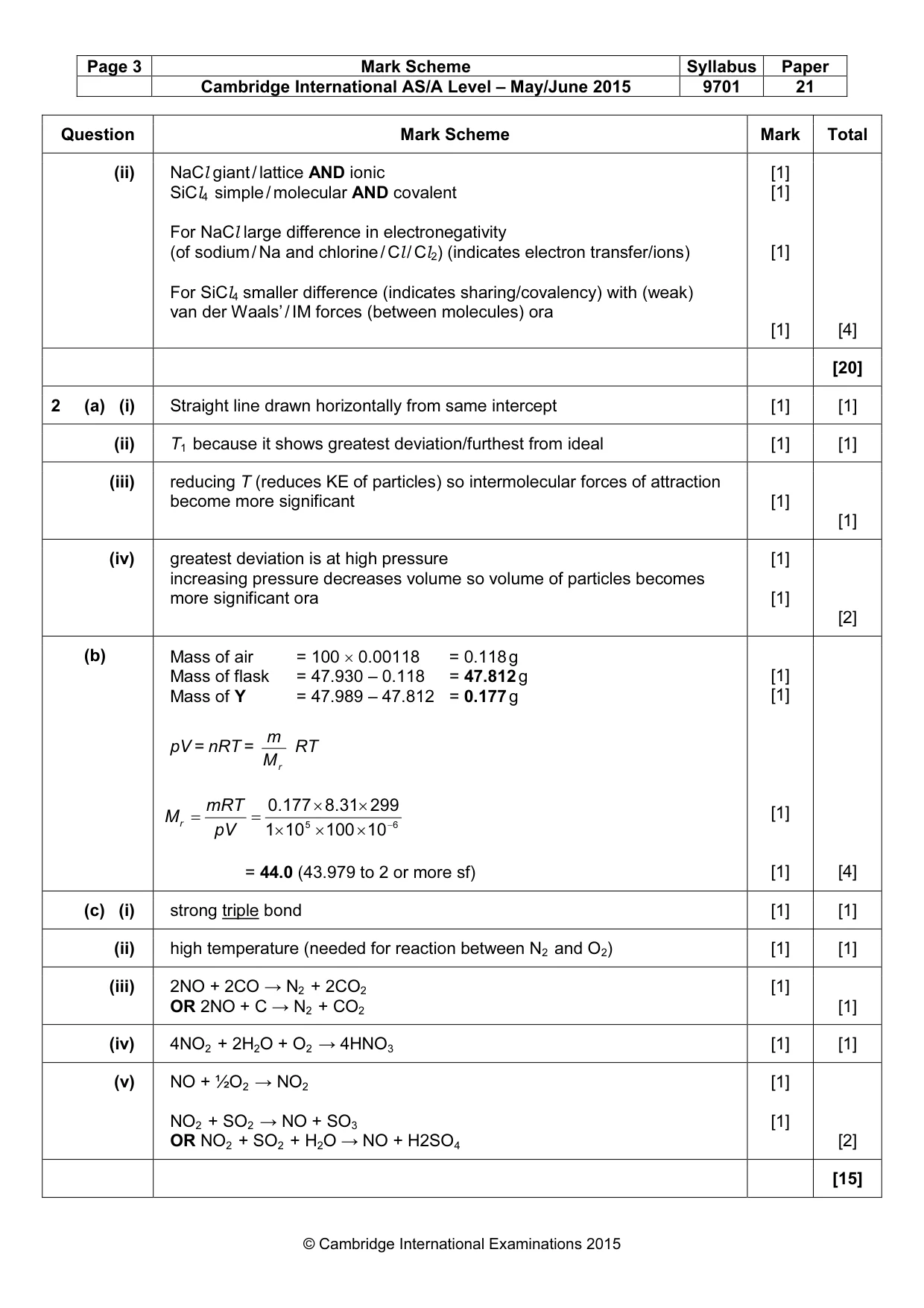
Page 3 Mark Scheme Syllabus Paper Cambridge International AS/A Level – May/June 2015 9701 21 © Cambridge International Examinations 2015 Question Mark Scheme Mark Total (ii) NaCl giant / lattice AND ionic SiCl4 simple / molecular AND covalent For NaCl large difference in electronegativity (of sodium / Na and chlorine / Cl / Cl2) (indicates electron transfer/ions) For SiCl4 smaller difference (indicates sharing/covalency) with (weak) van der Waals’ / IM forces (between molecules) ora [1] [1] [1] [1] [4] [20] 2 (a) (i) Straight line drawn horizontally from same intercept [1] [1] (ii) T1 because it shows greatest deviation/furthest from ideal [1] [1] (iii) reducing T (reduces KE of particles) so intermolecular forces of attraction become more significant [1] [1] (iv) greatest deviation is at high pressure increasing pressure decreases volume so volume of particles becomes more significant ora [1] [1] [2] (b) Mass of air = 100 × 0.00118 = 0.118 g Mass of flask = 47.930 – 0.118 = 47.812 g Mass of Y = 47.989 – 47.812 = 0.177 g pV = nRT = r M m RT 6 5 10 100 10 1 299 8.31 0.177 − × × × × × = = pV mRT Mr = 44.0 (43.979 to 2 or more sf) [1] [1] [1] [1] [4] (c) (i) strong triple bond [1] [1] (ii) high temperature (needed for reaction between N2 and O2) [1] [1] (iii) 2NO + 2CO → N2 + 2CO2 OR 2NO + C → N2 + CO2 [1] [1] (iv) 4NO2 + 2H2O + O2 → 4HNO3 [1] [1] (v) NO + ½O2 → NO2 NO2 + SO2 → NO + SO3 OR NO2 + SO2 + H2O → NO + H2SO4 [1] [1] [2] [15]
Mark scheme, page 4
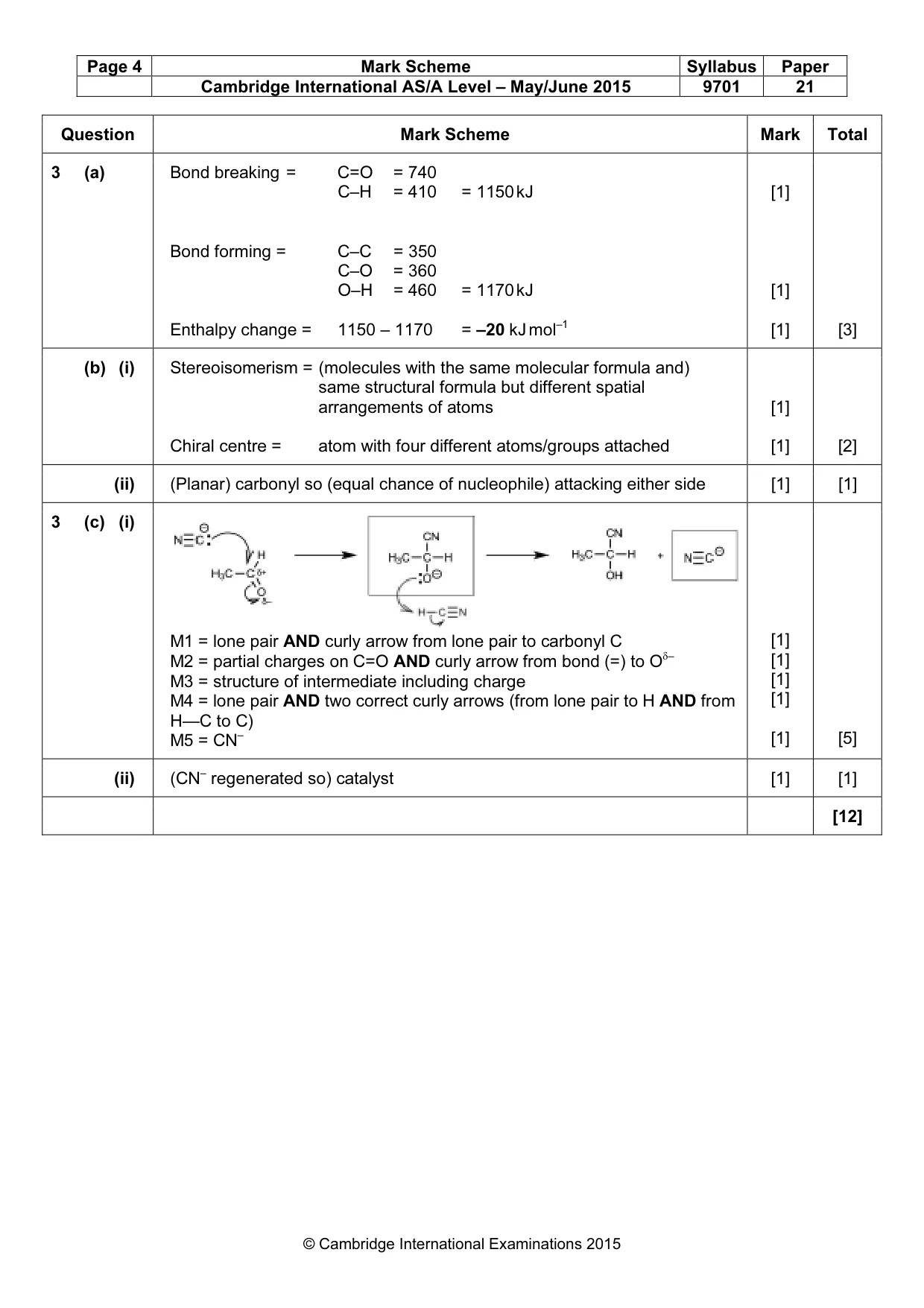
Page 4 Mark Scheme Syllabus Paper Cambridge International AS/A Level – May/June 2015 9701 21 © Cambridge International Examinations 2015 Question Mark Scheme Mark Total 3 (a) Bond breaking = C=O = 740 C–H = 410 = 1150 kJ Bond forming = C–C = 350 C–O = 360 O–H = 460 = 1170 kJ Enthalpy change = 1150 – 1170 = –20 kJ mol–1 [1] [1] [1] [3] (b) (i) Stereoisomerism = (molecules with the same molecular formula and) same structural formula but different spatial arrangements of atoms Chiral centre = atom with four different atoms/groups attached [1] [1] [2] (ii) (Planar) carbonyl so (equal chance of nucleophile) attacking either side [1] [1] 3 (c) (i) M1 = lone pair AND curly arrow from lone pair to carbonyl C M2 = partial charges on C=O AND curly arrow from bond (=) to Oδ– M3 = structure of intermediate including charge M4 = lone pair AND two correct curly arrows (from lone pair to H AND from H—C to C) M5 = CN– [1] [1] [1] [1] [1] [5] (ii) (CN– regenerated so) catalyst [1] [1] [12]
Mark scheme, page 5
Page 5 Mark Scheme Syllabus Paper Cambridge International AS/A Level – May/June 2015 9701 21 © Cambridge International Examinations 2015 Question Mark Scheme Mark Total 4 (a) [1] [1] [1] [1] [1] [1] [1] [7] (b) (i) but-1-ene / 1-butene but-2-ene / 2-butene [1] [1] [2] (ii) but-2-ene AND two different groups on each carbon (of C=C) double bond means no free rotation [1] [1] [2] (iii) and (either way round) [1+1] [2] [13]
What you needed in this session
Cambridge’s own grade thresholds for 2015 May/June, Paper 2 · Variant 1. A higher threshold means an easier paper — the bar moves with how the cohort did.