Cambridge A Level Chemistry 9701 — 2014 Oct/Nov Paper 2 · Variant 1
9701/21/O/N/14 · 60 marks · ≈68 min
The question paper and its mark scheme, free to read here and free to download. This is Cambridge’s own paper, exactly as it was sat.
Question paper12 pages


Mark scheme6 pages
Answers below. Sit the paper first if you are practising.
Paper as text
Question paper, page 1
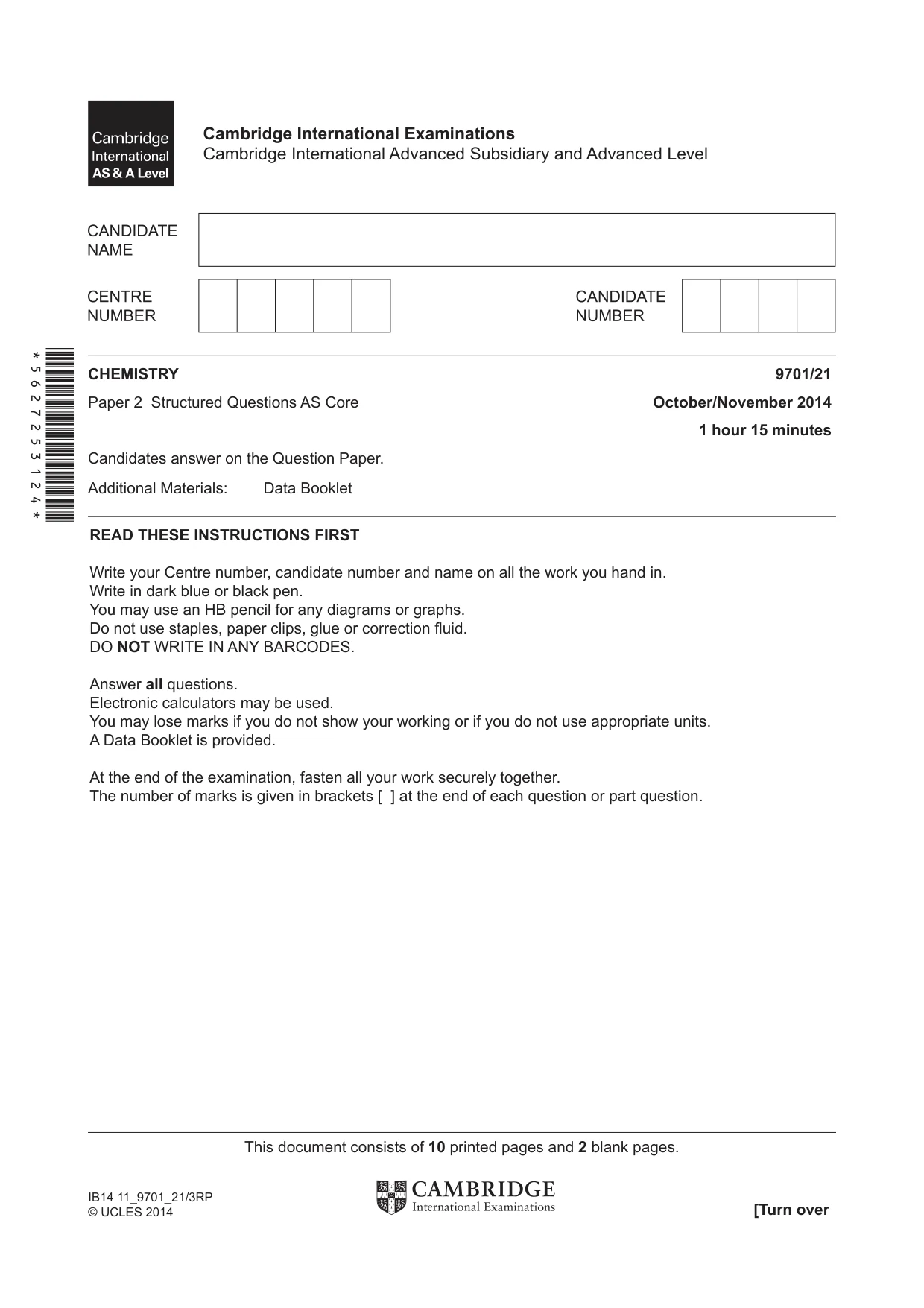
This document consists of 10 printed pages and 2 blank pages. [Turn over IB14 11_9701_21/3RP © UCLES 2014 *5627253124* READ THESE INSTRUCTIONS FIRST Write your Centre number, candidate number and name on all the work you hand in. Write in dark blue or black pen. You may use an HB pencil for any diagrams or graphs. Do not use staples, paper clips, glue or correction fl uid. DO NOT WRITE IN ANY BARCODES. Answer all questions. Electronic calculators may be used. You may lose marks if you do not show your working or if you do not use appropriate units. A Data Booklet is provided. At the end of the examination, fasten all your work securely together. The number of marks is given in brackets [ ] at the end of each question or part question. CHEMISTRY 9701/21 Paper 2 Structured Questions AS Core October/November 2014 1 hour 15 minutes Candidates answer on the Question Paper. Additional Materials: Data Booklet Cambridge International Examinations Cambridge International Advanced Subsidiary and Advanced Level
Question paper, page 2
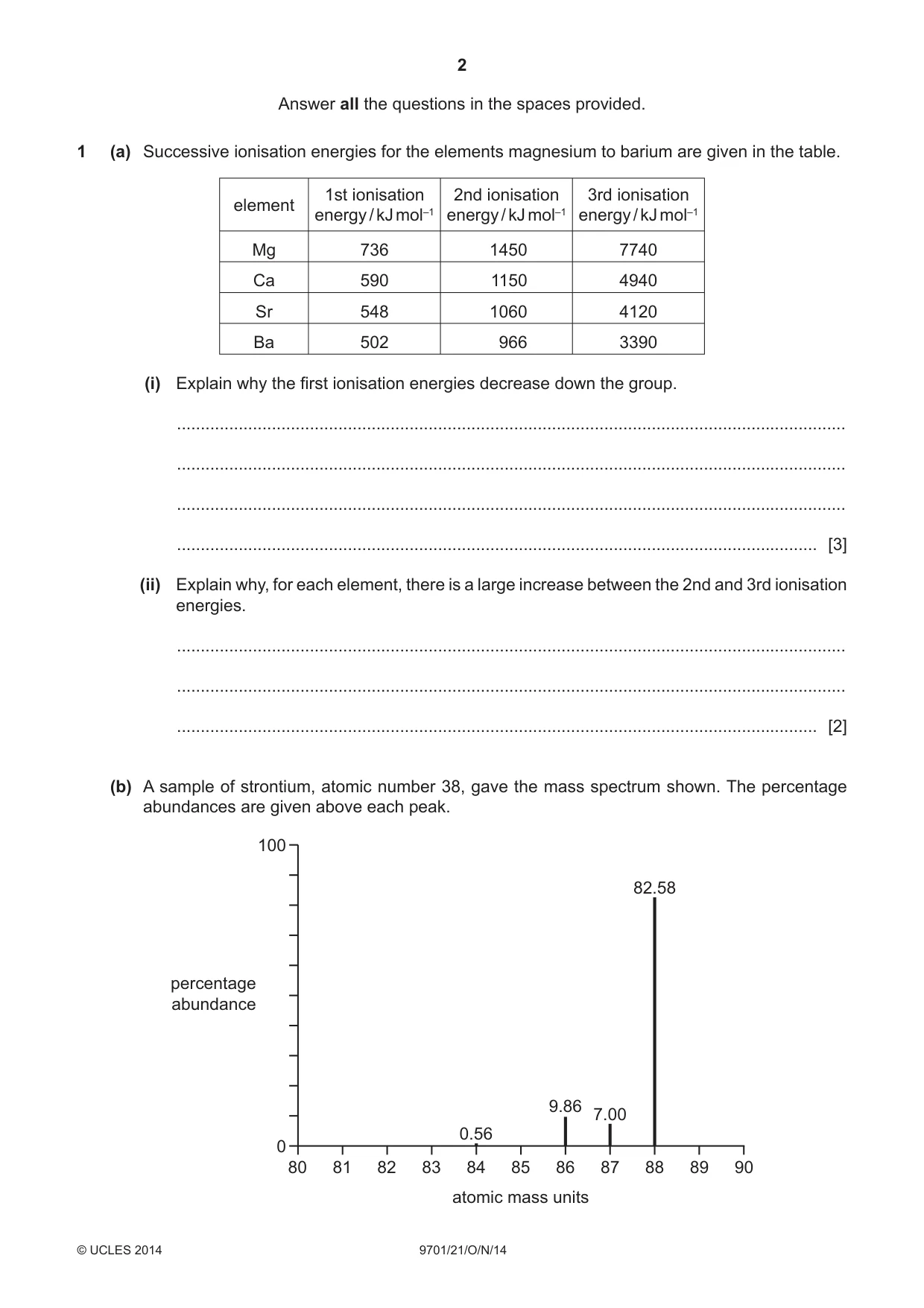
2 9701/21/O/N/14 © UCLES 2014 Answer all the questions in the spaces provided. 1 (a) Successive ionisation energies for the elements magnesium to barium are given in the table. element 1st ionisation energy / kJ mol–1 2nd ionisation energy / kJ mol–1 3rd ionisation energy / kJ mol–1 Mg 736 1450 7740 Ca 590 1150 4940 Sr 548 1060 4120 Ba 502 966 3390 (i) Explain why the fi rst ionisation energies decrease down the group. … … … … [3] (ii) Explain why, for each element, there is a large increase between the 2nd and 3rd ionisation energies. … … … [2] (b) A sample of strontium, atomic number 38, gave the mass spectrum shown. The percentage abundances are given above each peak. 100 0 80 81 82 83 84 85 atomic mass units 86 87 88 0.56 9.86 7.00 7.00 7.00 82.58 89 90 percentage abundance
Question paper, page 3
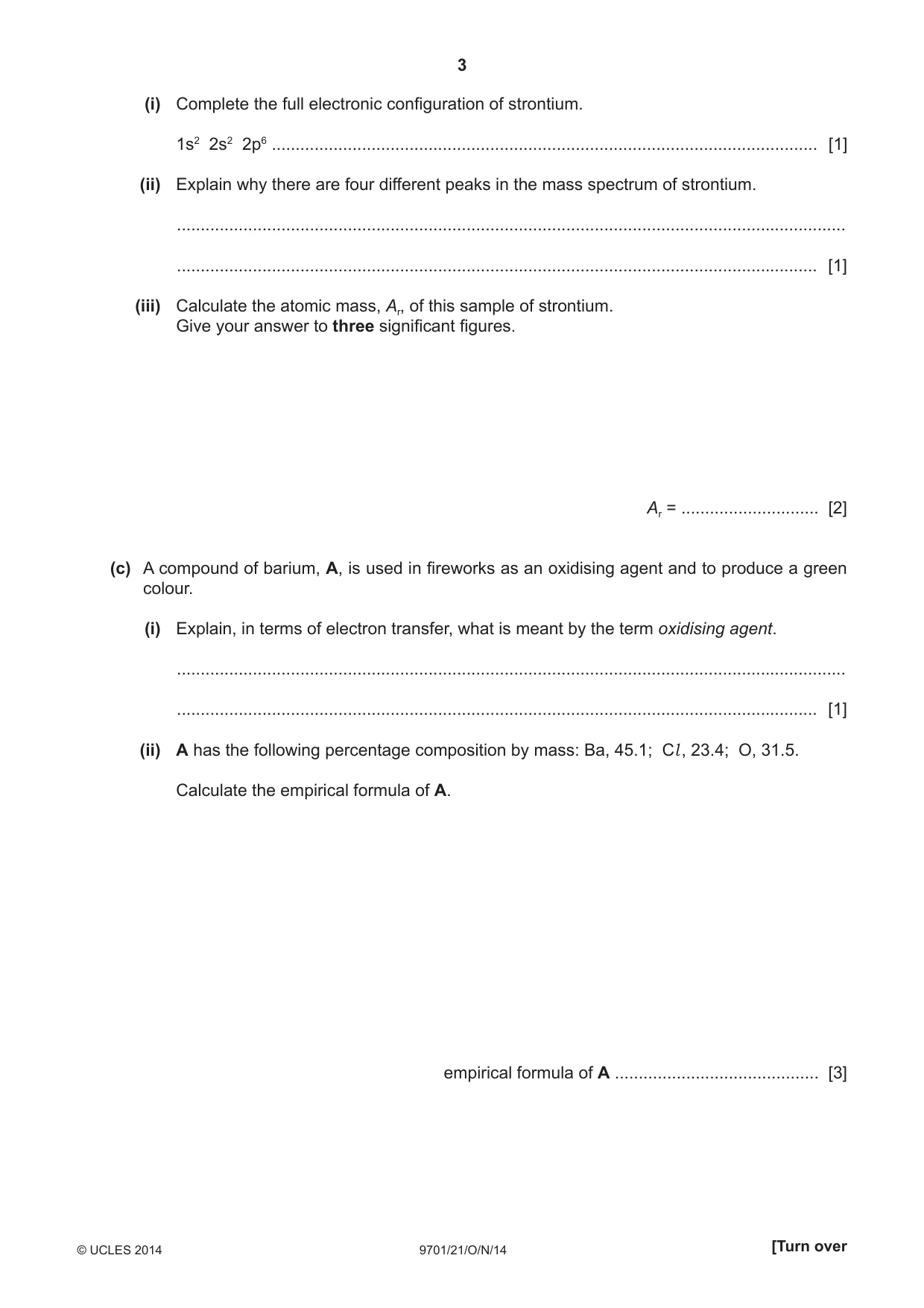
3 9701/21/O/N/14 © UCLES 2014 [Turn over (i) Complete the full electronic confi guration of strontium. 1s2 2s2 2p6 … [1] (ii) Explain why there are four different peaks in the mass spectrum of strontium. … … [1] (iii) Calculate the atomic mass, Ar, of this sample of strontium. Give your answer to three signifi cant fi gures. Ar = … [2] (c) A compound of barium, A, is used in fi reworks as an oxidising agent and to produce a green colour. (i) Explain, in terms of electron transfer, what is meant by the term oxidising agent. … … [1] (ii) A has the following percentage composition by mass: Ba, 45.1; Cl , 23.4; O, 31.5. Calculate the empirical formula of A. empirical formula of A … [3]
Question paper, page 4
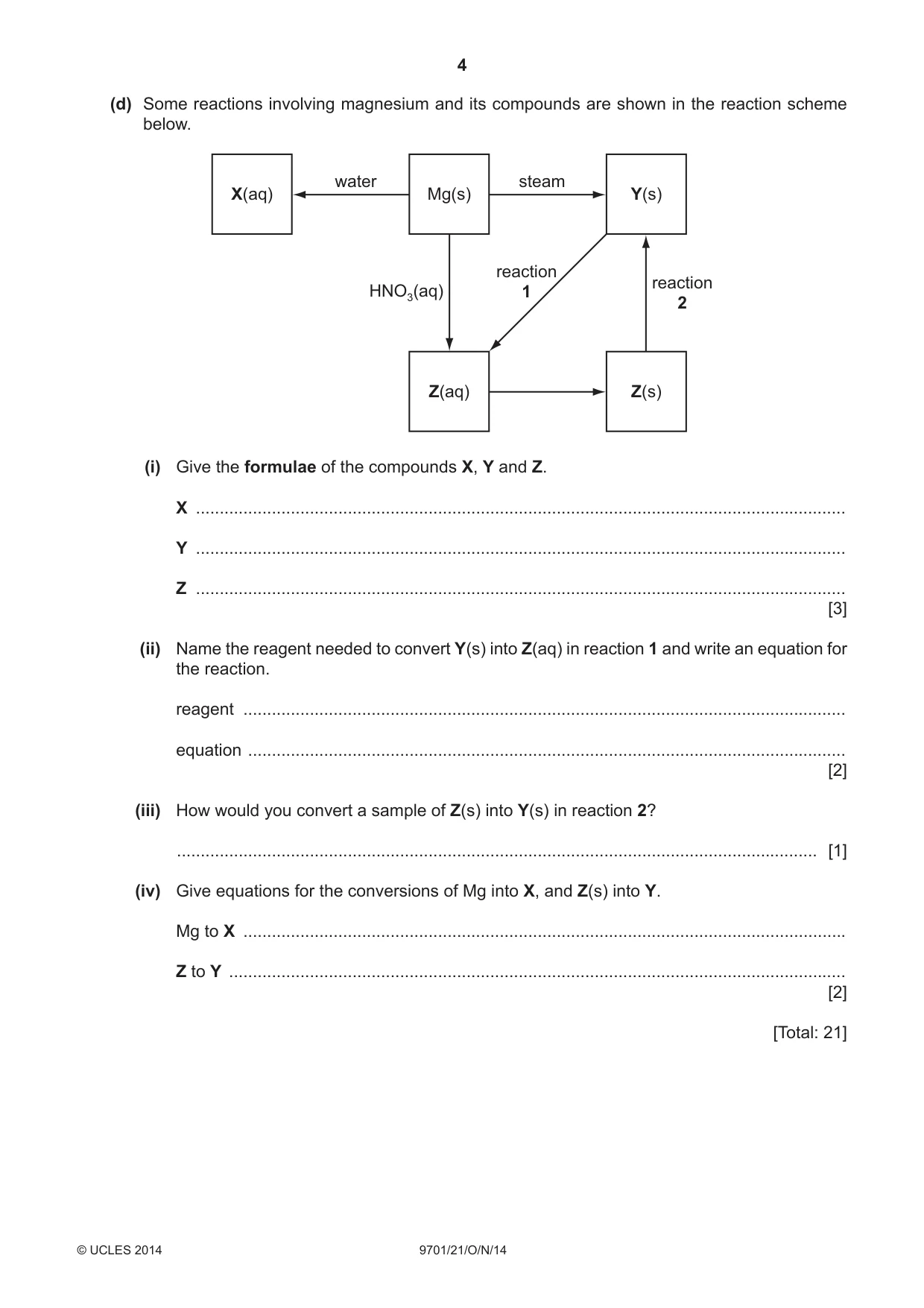
4 9701/21/O/N/14 © UCLES 2014 (d) Some reactions involving magnesium and its compounds are shown in the reaction scheme below. X(aq) Y(s) Z(s) Z(aq) Mg(s) water steam reaction 1 reaction 2 HNO3(aq) (i) Give the formulae of the compounds X, Y and Z. X … Y … Z … [3] (ii) Name the reagent needed to convert Y(s) into Z(aq) in reaction 1 and write an equation for the reaction. reagent … equation … [2] (iii) How would you convert a sample of Z(s) into Y(s) in reaction 2? … [1] (iv) Give equations for the conversions of Mg into X, and Z(s) into Y. Mg to X … Z to Y … [2] [Total: 21]
Question paper, page 5
5 9701/21/O/N/14 © UCLES 2014 [Turn over Question 2 starts on the next page.
Question paper, page 6
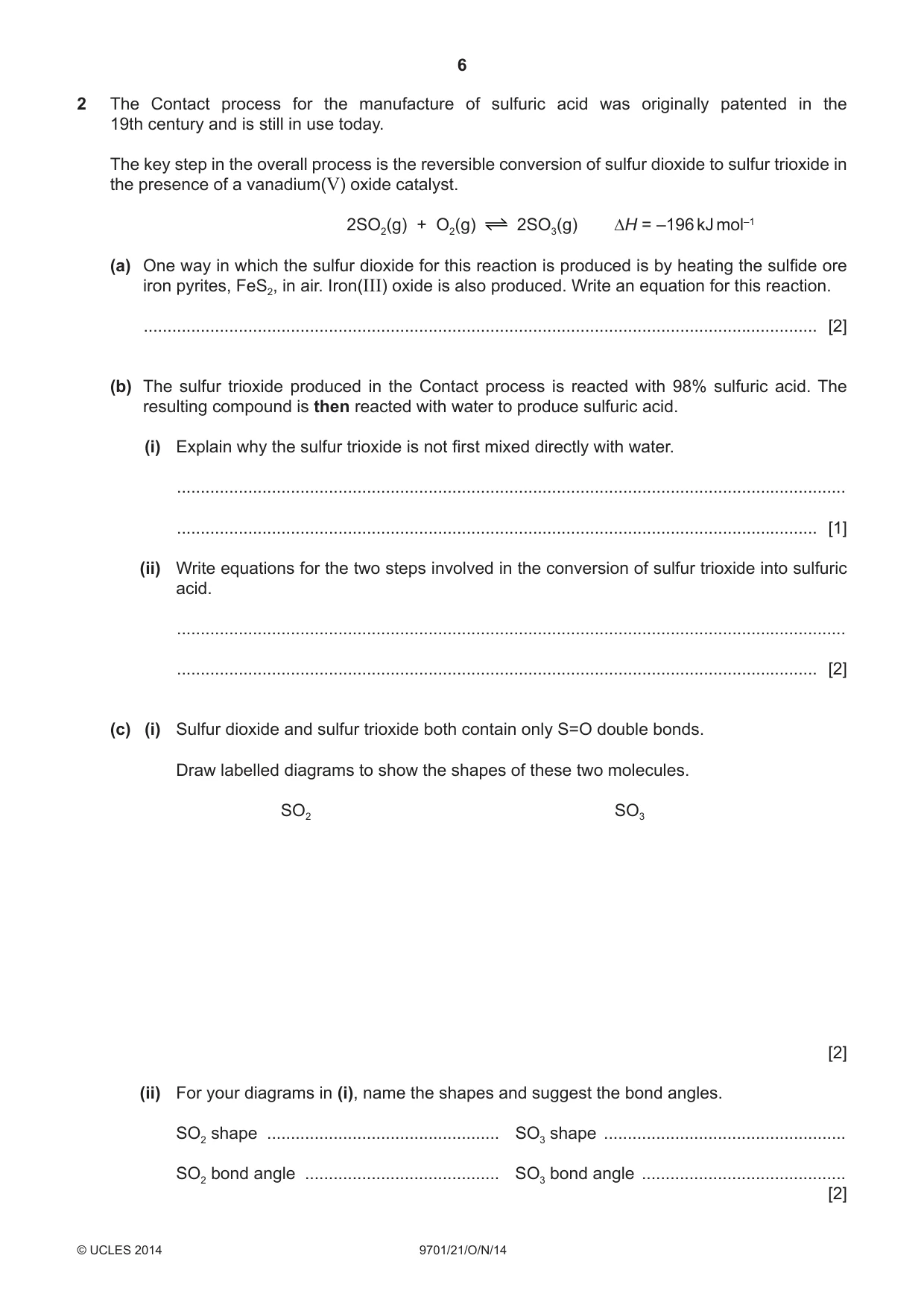
6 9701/21/O/N/14 © UCLES 2014 2 The Contact process for the manufacture of sulfuric acid was originally patented in the 19th century and is still in use today. The key step in the overall process is the reversible conversion of sulfur dioxide to sulfur trioxide in the presence of a vanadium(V) oxide catalyst. 2SO2(g) + O2(g) 2SO3(g) ∆H = –196 kJ mol–1 (a) One way in which the sulfur dioxide for this reaction is produced is by heating the sulfi de ore iron pyrites, FeS2, in air. Iron(III) oxide is also produced. Write an equation for this reaction. … [2] (b) The sulfur trioxide produced in the Contact process is reacted with 98% sulfuric acid. The resulting compound is then reacted with water to produce sulfuric acid. (i) Explain why the sulfur trioxide is not fi rst mixed directly with water. … … [1] (ii) Write equations for the two steps involved in the conversion of sulfur trioxide into sulfuric acid. … … [2] (c) (i) Sulfur dioxide and sulfur trioxide both contain only S=O double bonds. Draw labelled diagrams to show the shapes of these two molecules. SO2 SO3 [2] (ii) For your diagrams in (i), name the shapes and suggest the bond angles. SO2 shape … SO3 shape … SO2 bond angle … SO3 bond angle … [2]
Question paper, page 7
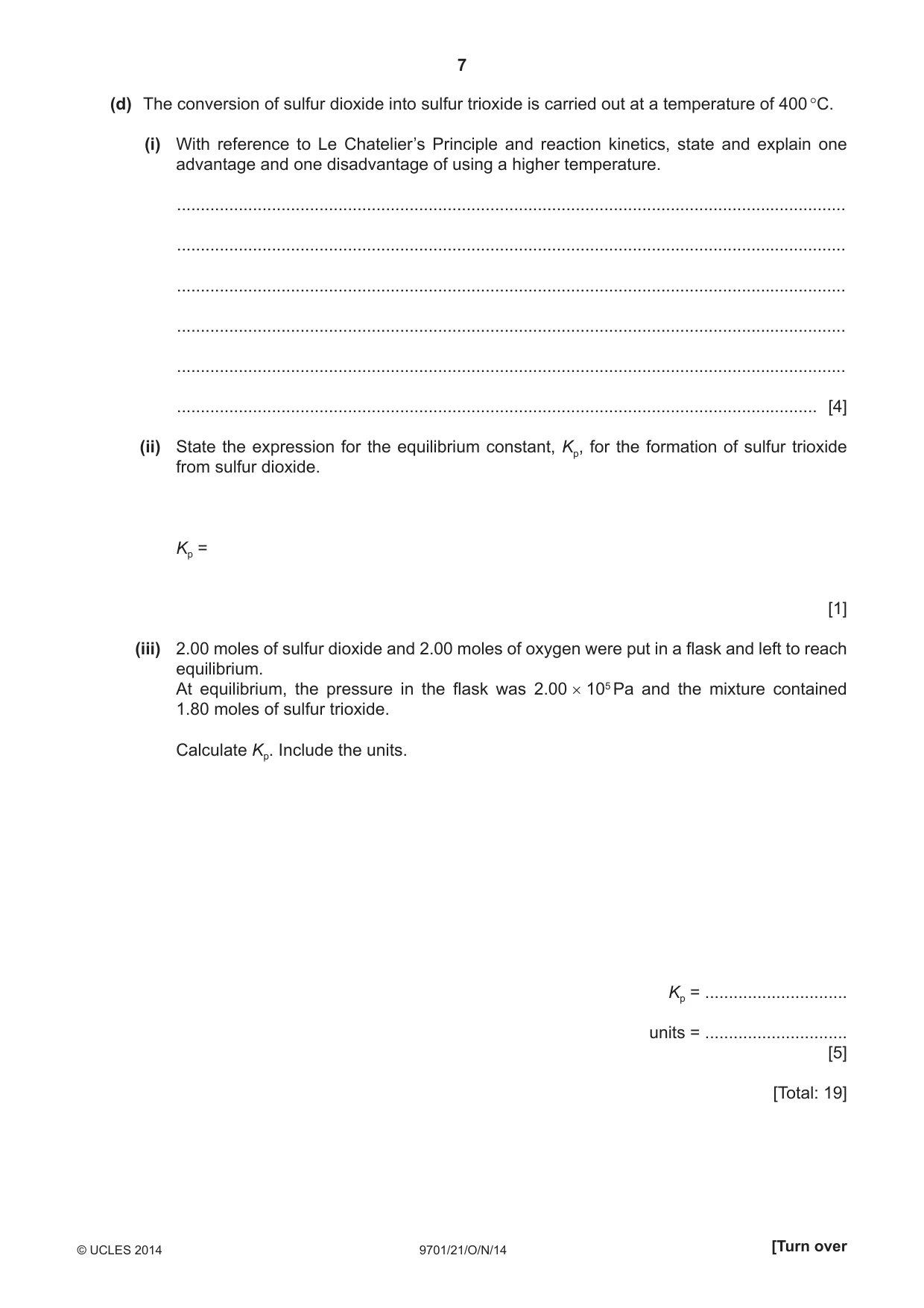
7 9701/21/O/N/14 © UCLES 2014 [Turn over (d) The conversion of sulfur dioxide into sulfur trioxide is carried out at a temperature of 400 °C. (i) With reference to Le Chatelier’s Principle and reaction kinetics, state and explain one advantage and one disadvantage of using a higher temperature. … … … … … … [4] (ii) State the expression for the equilibrium constant, Kp, for the formation of sulfur trioxide from sulfur dioxide. Kp = [1] (iii) 2.00 moles of sulfur dioxide and 2.00 moles of oxygen were put in a fl ask and left to reach equilibrium. At equilibrium, the pressure in the fl ask was 2.00 × 10⁵ Pa and the mixture contained 1.80 moles of sulfur trioxide. Calculate Kp. Include the units. Kp = … units = … [5] [Total: 19]
Question paper, page 8
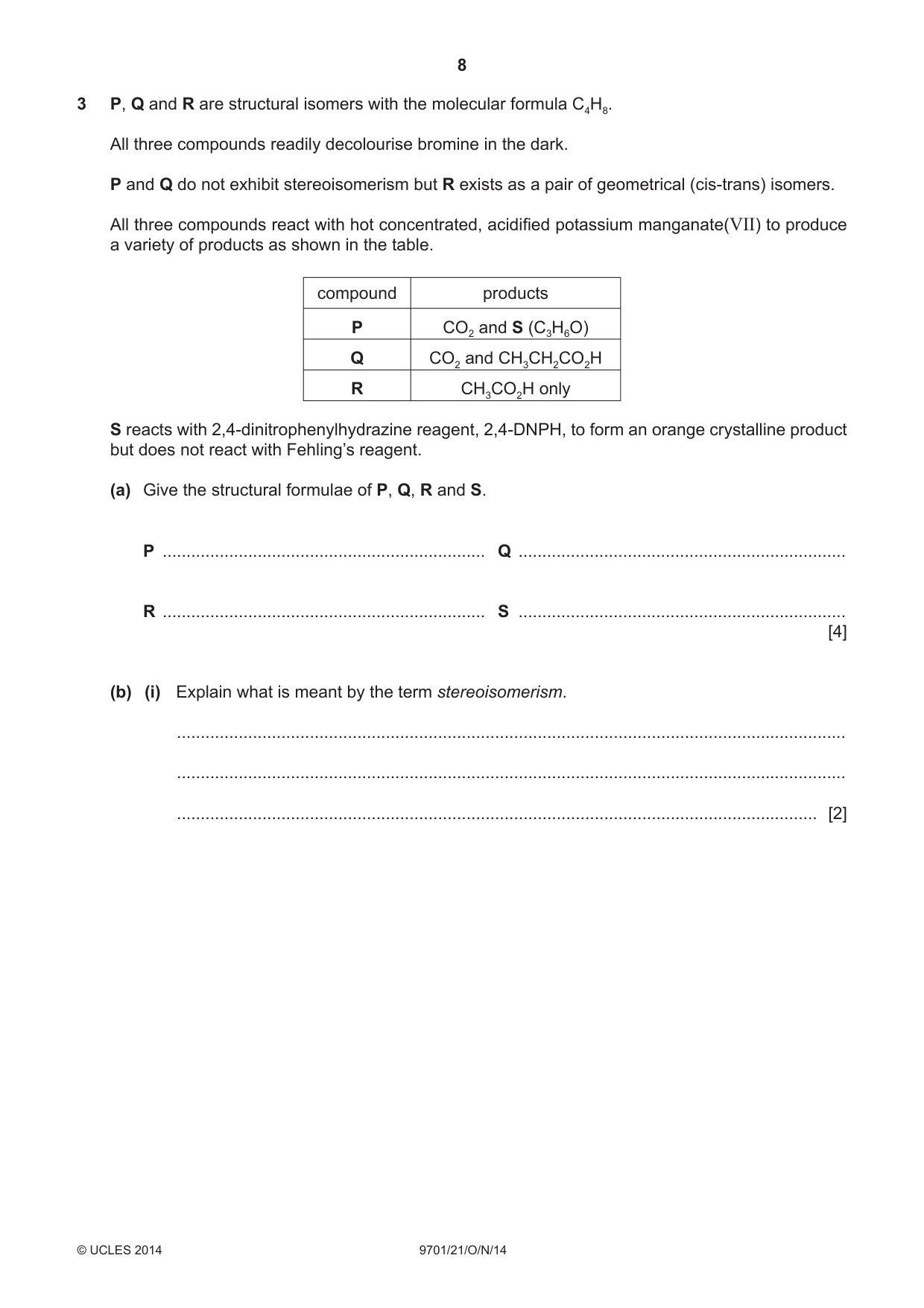
8 9701/21/O/N/14 © UCLES 2014 3 P, Q and R are structural isomers with the molecular formula C4H8. All three compounds readily decolourise bromine in the dark. P and Q do not exhibit stereoisomerism but R exists as a pair of geometrical (cis-trans) isomers. All three compounds react with hot concentrated, acidifi ed potassium manganate(VII) to produce a variety of products as shown in the table. compound products P CO2 and S (C3H6O) Q CO2 and CH3CH2CO2H R CH3CO2H only S reacts with 2,4-dinitrophenylhydrazine reagent, 2,4-DNPH, to form an orange crystalline product but does not react with Fehling’s reagent. (a) Give the structural formulae of P, Q, R and S. P … Q … R … S … [4] (b) (i) Explain what is meant by the term stereoisomerism. … … … [2]
Question paper, page 9
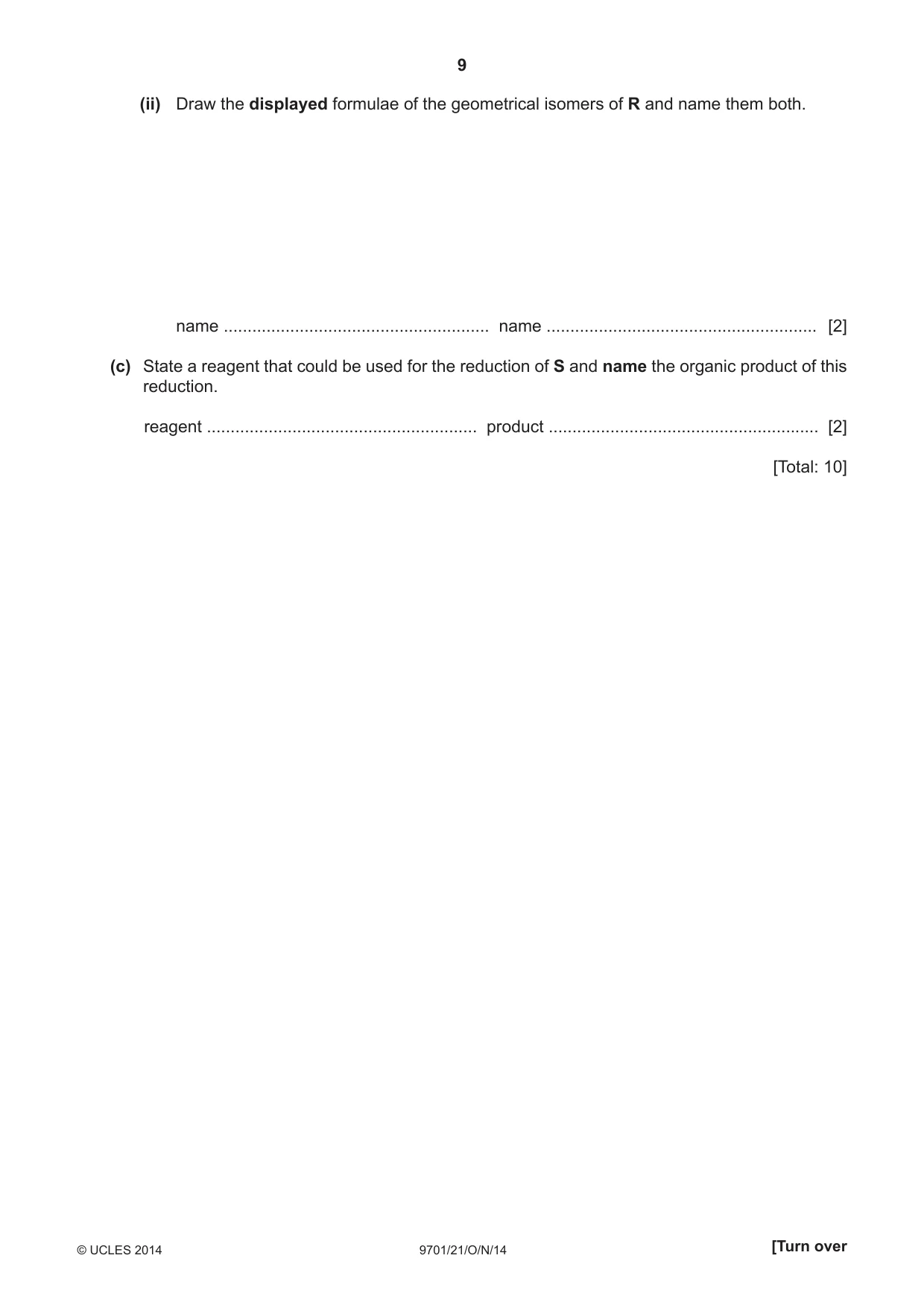
9 9701/21/O/N/14 © UCLES 2014 [Turn over (ii) Draw the displayed formulae of the geometrical isomers of R and name them both. name … name … [2] (c) State a reagent that could be used for the reduction of S and name the organic product of this reduction. reagent … product … [2] [Total: 10]
Question paper, page 10
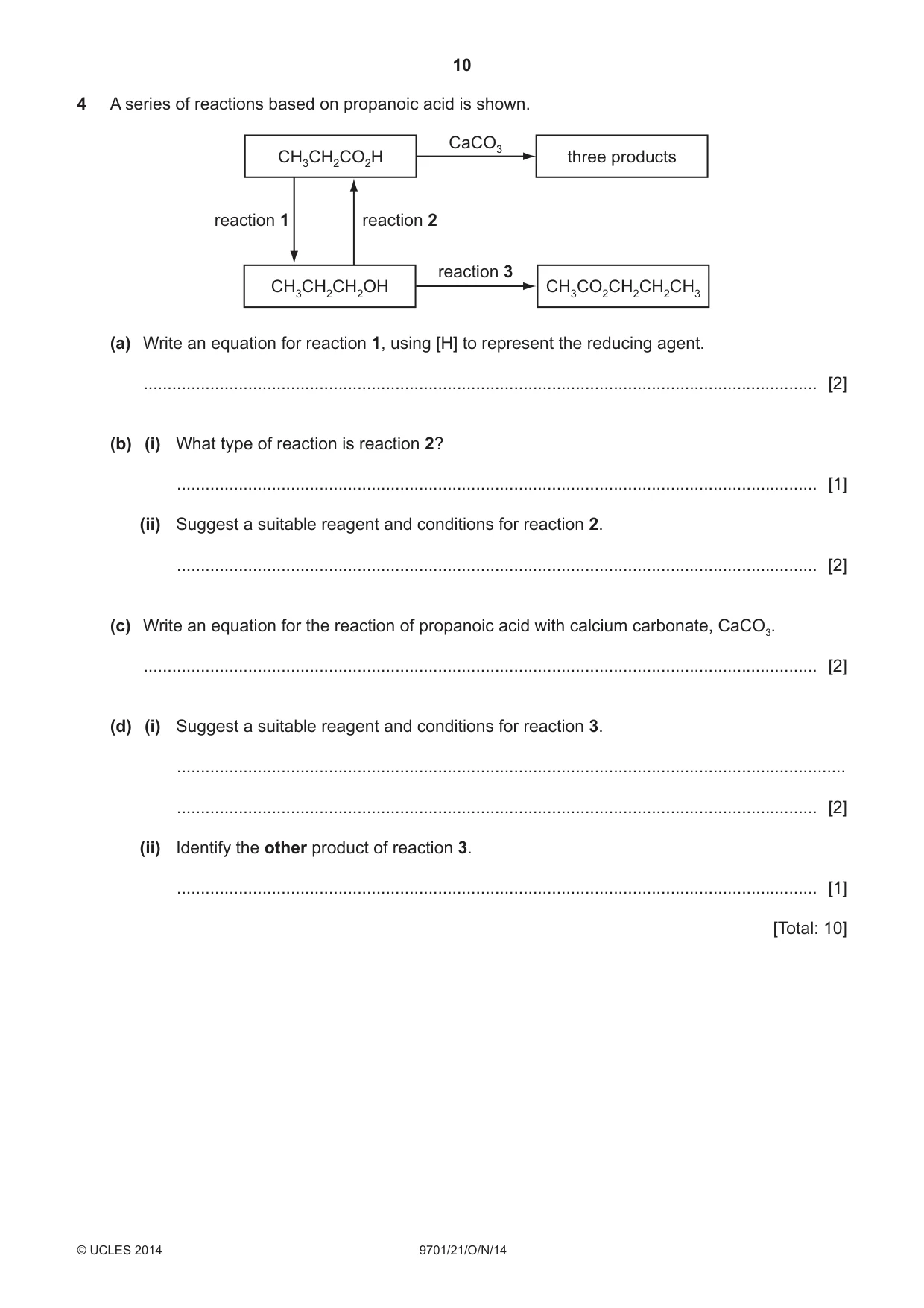
10 9701/21/O/N/14 © UCLES 2014 4 A series of reactions based on propanoic acid is shown. CH3CH2CH2OH CH3CH2CO2H three products CH3CO2CH2CH2CH3 reaction 1 reaction 2 reaction 3 CaCO3 (a) Write an equation for reaction 1, using [H] to represent the reducing agent. … [2] (b) (i) What type of reaction is reaction 2? … [1] (ii) Suggest a suitable reagent and conditions for reaction 2. … [2] (c) Write an equation for the reaction of propanoic acid with calcium carbonate, CaCO3. … [2] (d) (i) Suggest a suitable reagent and conditions for reaction 3. … … [2] (ii) Identify the other product of reaction 3. … [1] [Total: 10]
Question paper, page 11
11 9701/21/O/N/14 BLANK PAGE © UCLES 2014
Question paper, page 12
12 Permission to reproduce items where third-party owned material protected by copyright is included has been sought and cleared where possible. Every reasonable effort has been made by the publisher (UCLES) to trace copyright holders, but if any items requiring clearance have unwittingly been included the publisher will be pleased to make amends at the earliest possible opportunity. Cambridge International Examinations is part of the Cambridge Assessment Group. Cambridge Assessment is the brand name of University of Cambridge Local Examinations Syndicate (UCLES), which is itself a department of the University of Cambridge. 9701/21/O/N/14 © UCLES 2014 BLANK PAGE
Mark scheme, page 1
® IGCSE is the registered trademark of Cambridge International Examinations. CAMBRIDGE INTERNATIONAL EXAMINATIONS Cambridge International Advanced Subsidiary and Advanced Level MARK SCHEME for the October/November 2014 series 9701 CHEMISTRY 9701/21 Paper 2 (AS Structured Questions), maximum raw mark 60 This mark scheme is published as an aid to teachers and candidates, to indicate the requirements of the examination. It shows the basis on which Examiners were instructed to award marks. It does not indicate the details of the discussions that took place at an Examiners’ meeting before marking began, which would have considered the acceptability of alternative answers. Mark schemes should be read in conjunction with the question paper and the Principal Examiner Report for Teachers. Cambridge will not enter into discussions about these mark schemes. Cambridge is publishing the mark schemes for the October/November 2014 series for most Cambridge IGCSE®, Cambridge International A and AS Level components and some Cambridge O Level components.
Mark scheme, page 2
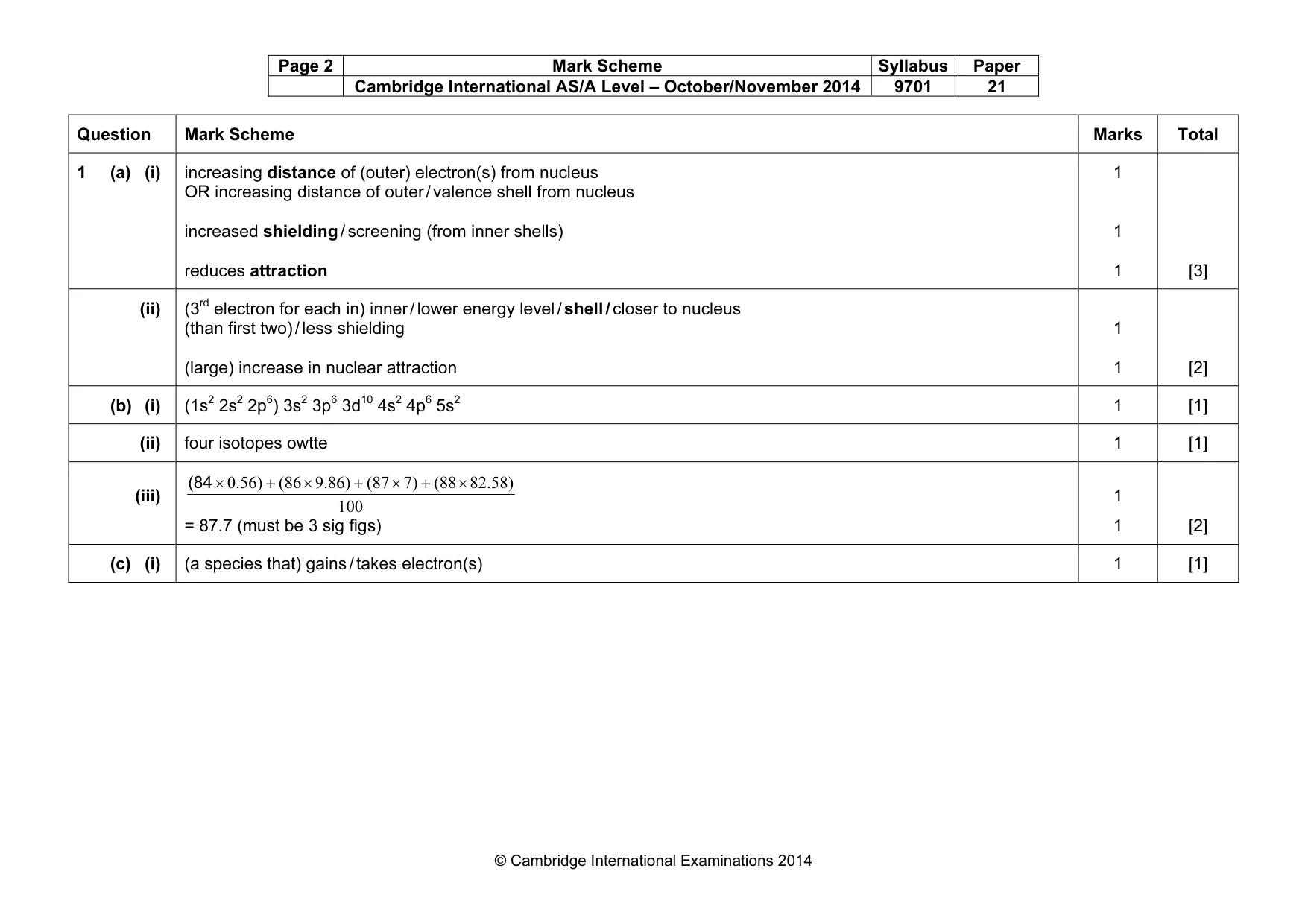
Page 2 Mark Scheme Syllabus Paper Cambridge International AS/A Level – October/November 2014 9701 21 © Cambridge International Examinations 2014 Question Mark Scheme Marks Total 1 (a) (i) increasing distance of (outer) electron(s) from nucleus OR increasing distance of outer / valence shell from nucleus increased shielding / screening (from inner shells) reduces attraction 1 1 1 [3] (ii) (3rd electron for each in) inner / lower energy level / shell / closer to nucleus (than first two) / less shielding (large) increase in nuclear attraction 1 1 [2] (b) (i) (1s2 2s2 2p6) 3s2 3p6 3d10 4s2 4p6 5s2 1 [1] (ii) four isotopes owtte 1 [1] (iii) 100 82.58) (88 7) (87 9.86) (86 0.56) × + × + × + × (84 = 87.7 (must be 3 sig figs) 1 1 [2] (c) (i) (a species that) gains / takes electron(s) 1 [1]
Mark scheme, page 3
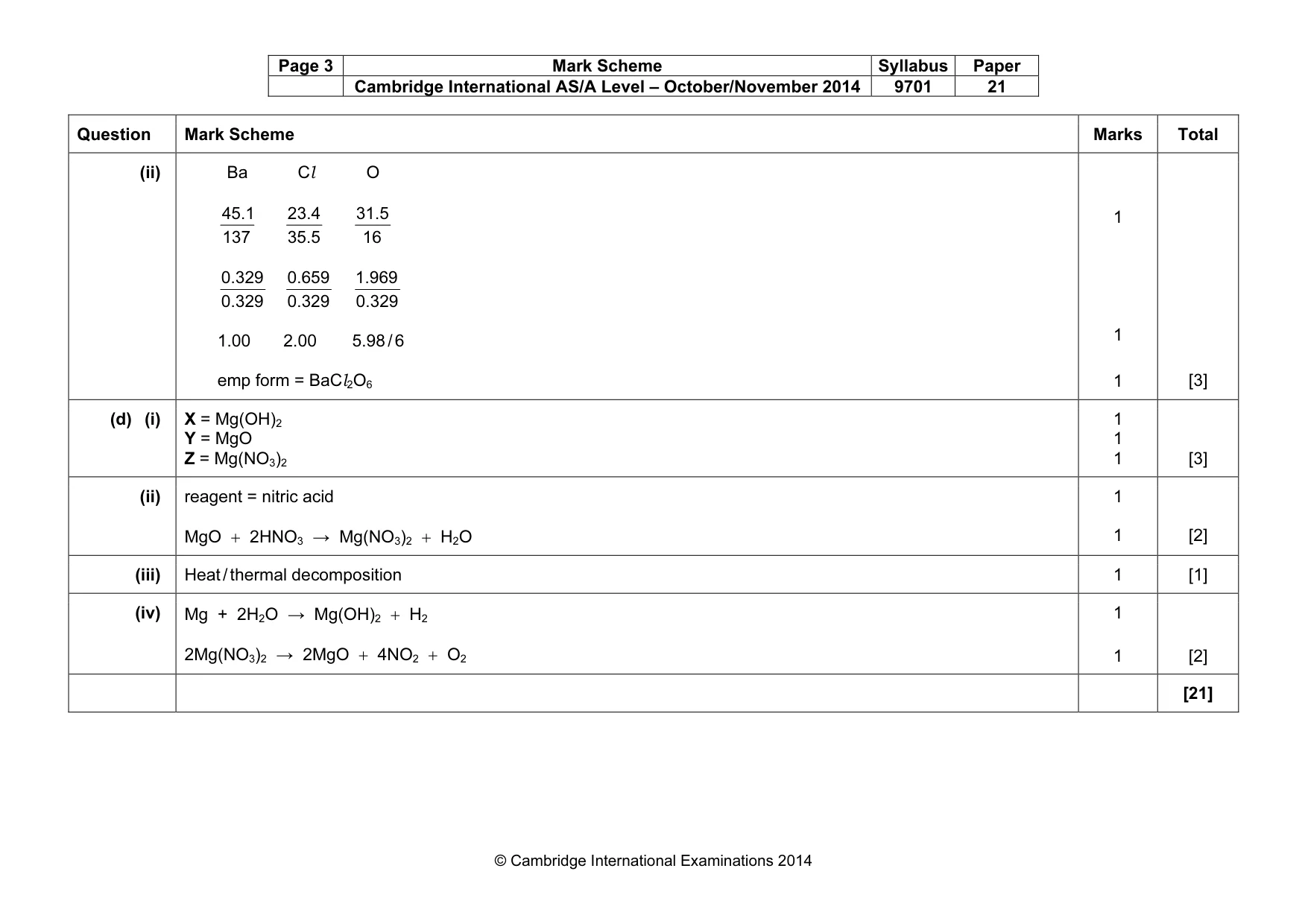
Page 3 Mark Scheme Syllabus Paper Cambridge International AS/A Level – October/November 2014 9701 21 © Cambridge International Examinations 2014 Question Mark Scheme Marks Total (ii) Ba Cl O 137 45.1 35.5 23.4 16 31.5 0.329 0.329 0.329 0.659 0.329 1.969 1.00 2.00 5.98 / 6 emp form = BaCl2O6 1 1 1 [3] (d) (i) X = Mg(OH)2 Y = MgO Z = Mg(NO3)2 1 1 1 [3] (ii) reagent = nitric acid MgO + 2HNO3 → Mg(NO3)2 + H2O 1 1 [2] (iii) Heat / thermal decomposition 1 [1] (iv) Mg + 2H2O → Mg(OH)2 + H2 2Mg(NO3)2 → 2MgO + 4NO2 + O2 1 1 [2] [21]
Mark scheme, page 4
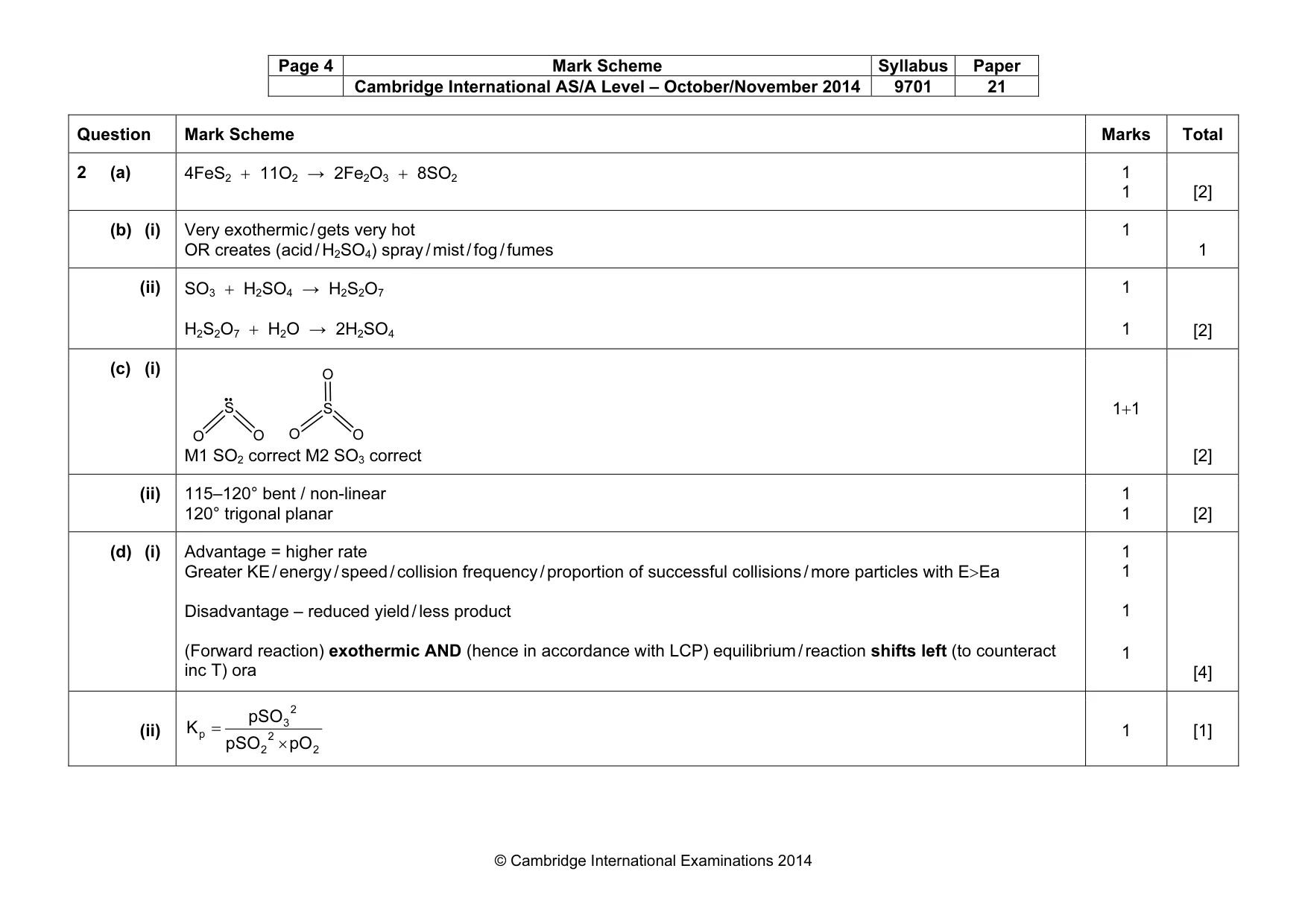
Page 4 Mark Scheme Syllabus Paper Cambridge International AS/A Level – October/November 2014 9701 21 © Cambridge International Examinations 2014 S O O S O O O Question Mark Scheme Marks Total 2 (a) 4FeS2 + 11O2 → 2Fe2O3 + 8SO2 1 1 [2] (b) (i) Very exothermic / gets very hot OR creates (acid / H2SO4) spray / mist / fog / fumes 1 1 (ii) SO3 + H2SO4 → H2S2O7 H2S2O7 + H2O → 2H2SO4 1 1 [2] (c) (i) M1 SO2 correct M2 SO3 correct 1+1 [2] (ii) 115–120° bent / non-linear 120° trigonal planar 1 1 [2] (d) (i) Advantage = higher rate Greater KE / energy / speed / collision frequency / proportion of successful collisions / more particles with E>Ea Disadvantage – reduced yield / less product (Forward reaction) exothermic AND (hence in accordance with LCP) equilibrium / reaction shifts left (to counteract inc T) ora 1 1 1 1 [4] (ii) 2 2 2 2 3 p pO pSO pSO K × = 1 [1]
Mark scheme, page 5
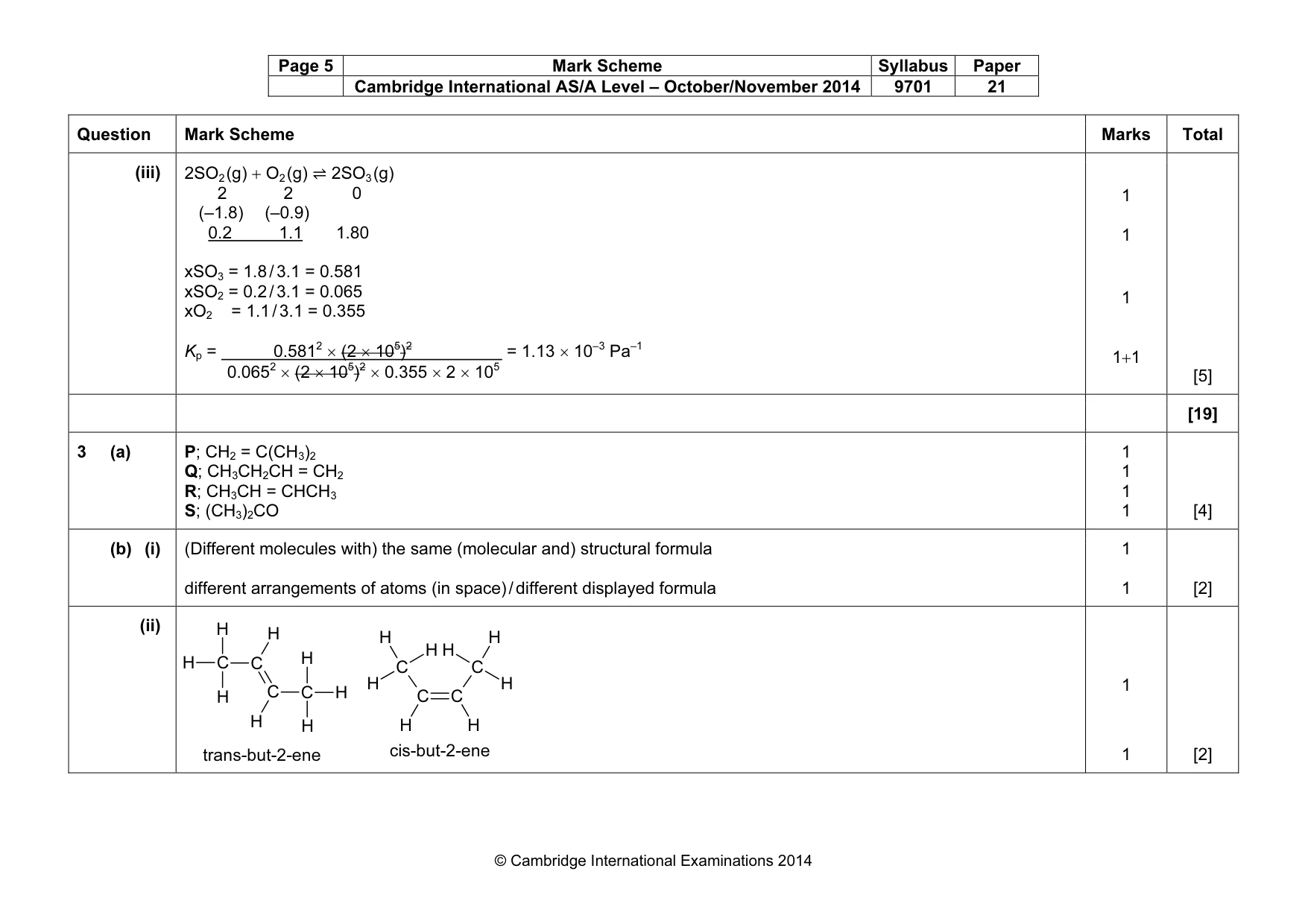
Page 5 Mark Scheme Syllabus Paper Cambridge International AS/A Level – October/November 2014 9701 21 © Cambridge International Examinations 2014 C C C C H H H H H H H H trans-but-2-ene C C C C H H H H H H H H cis-but-2-ene Question Mark Scheme Marks Total (iii) 2SO2 (g) + O2 (g) ⇌ 2SO3 (g) 2 2 0 (–1.8) (–0.9) 0.2 1.1 1.80 xSO3 = 1.8 / 3.1 = 0.581 xSO2 = 0.2 / 3.1 = 0.065 xO2 = 1.1 / 3.1 = 0.355 Kp = 0.5812 × (2 × 105)2 = 1.13 × 10⁻³ Pa–1 0.0652 × (2 × 105)2 × 0.355 × 2 × 105 1 1 1 1+1 [5] [19] 3 (a) P; CH2 = C(CH3)2 Q; CH3CH2CH = CH2 R; CH3CH = CHCH3 S; (CH3)2CO 1 1 1 1 [4] (b) (i) (Different molecules with) the same (molecular and) structural formula different arrangements of atoms (in space) / different displayed formula 1 1 [2] (ii) 1 1 [2]
Mark scheme, page 6
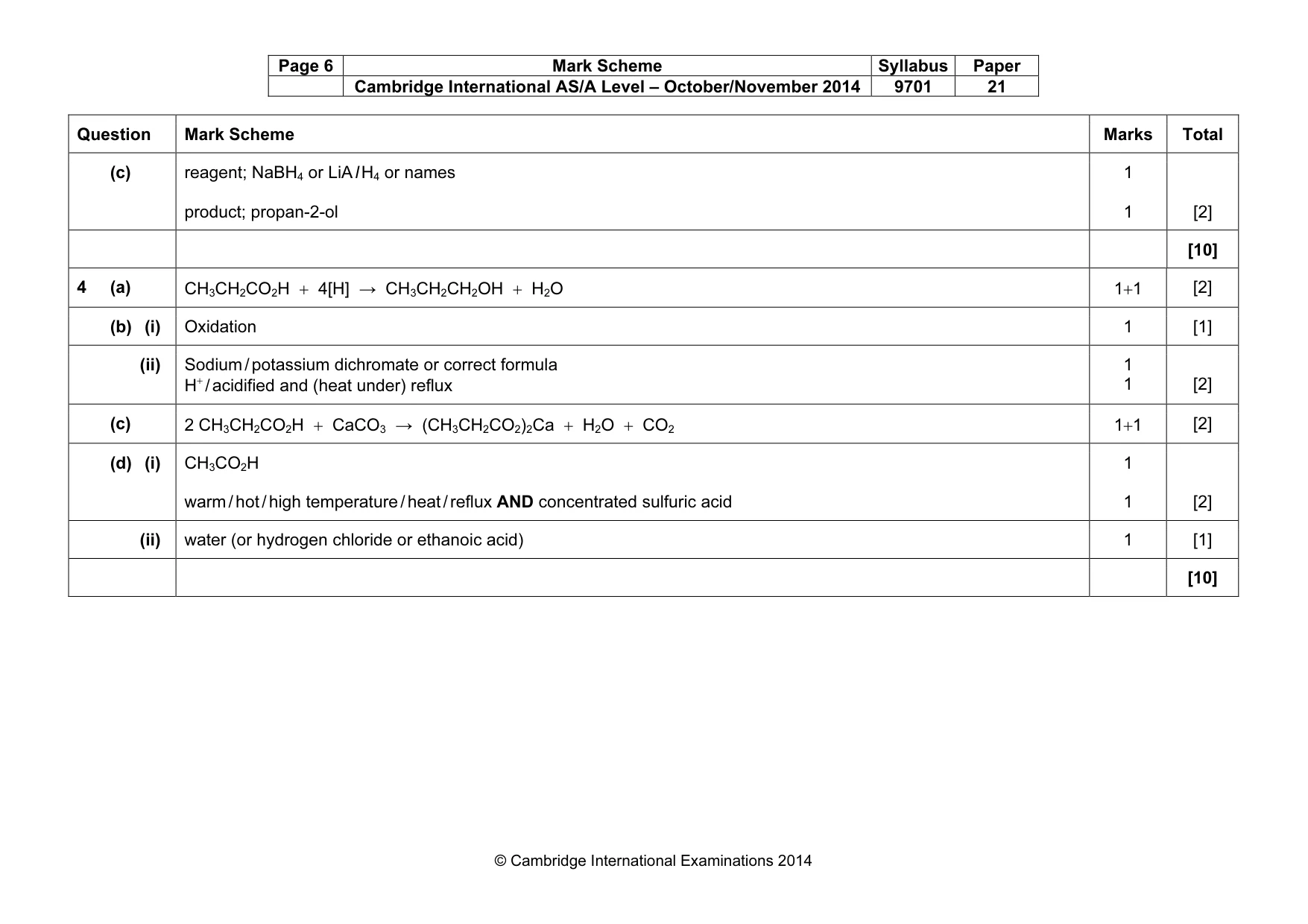
Page 6 Mark Scheme Syllabus Paper Cambridge International AS/A Level – October/November 2014 9701 21 © Cambridge International Examinations 2014 Question Mark Scheme Marks Total (c) reagent; NaBH4 or LiA l H4 or names product; propan-2-ol 1 1 [2] [10] 4 (a) CH3CH2CO2H + 4[H] → CH3CH2CH2OH + H2O 1+1 [2] (b) (i) Oxidation 1 [1] (ii) Sodium / potassium dichromate or correct formula H+ / acidified and (heat under) reflux 1 1 [2] (c) 2 CH3CH2CO2H + CaCO3 → (CH3CH2CO2)2Ca + H2O + CO2 1+1 [2] (d) (i) CH3CO2H warm / hot / high temperature / heat / reflux AND concentrated sulfuric acid 1 1 [2] (ii) water (or hydrogen chloride or ethanoic acid) 1 [1] [10]
What you needed in this session
Cambridge’s own grade thresholds for 2014 Oct/Nov, Paper 2 · Variant 1. A higher threshold means an easier paper — the bar moves with how the cohort did.