Cambridge A Level Chemistry 9701 — 2012 May/June Paper 2 · Variant 3
9701/23/M/J/12 · 60 marks · ≈68 min
The question paper and its mark scheme, free to read here and free to download. This is Cambridge’s own paper, exactly as it was sat.
Question paper12 pages
Mark scheme7 pages
Answers below. Sit the paper first if you are practising.
Paper as text
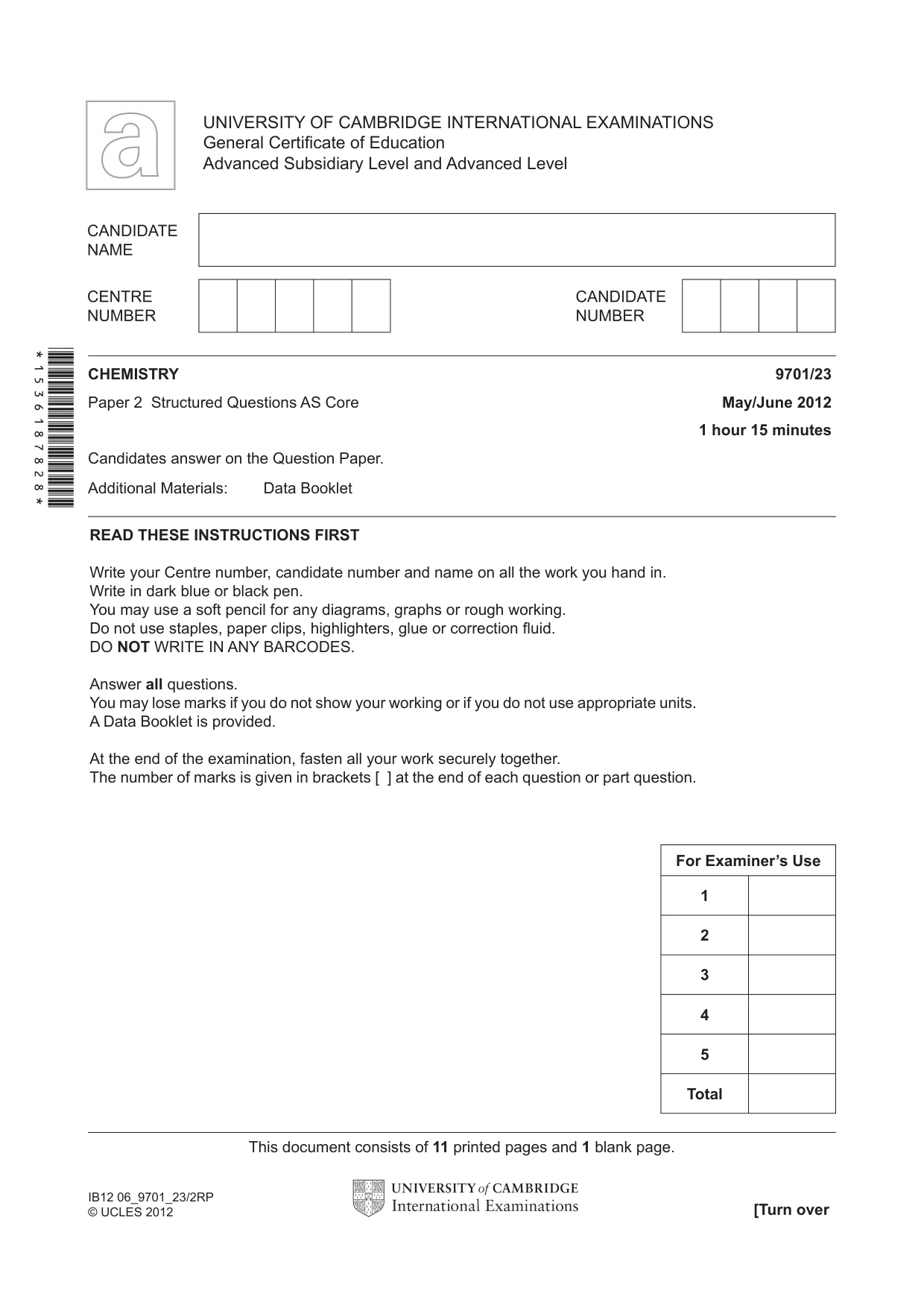
Question paper, page 1
READ THESE INSTRUCTIONS FIRST Write your Centre number, candidate number and name on all the work you hand in. Write in dark blue or black pen. You may use a soft pencil for any diagrams, graphs or rough working. Do not use staples, paper clips, highlighters, glue or correction fl uid. DO NOT WRITE IN ANY BARCODES. Answer all questions. You may lose marks if you do not show your working or if you do not use appropriate units. A Data Booklet is provided. At the end of the examination, fasten all your work securely together. The number of marks is given in brackets [ ] at the end of each question or part question. CHEMISTRY 9701/23 Paper 2 Structured Questions AS Core May/June 2012 1 hour 15 minutes Candidates answer on the Question Paper. Additional Materials: Data Booklet UNIVERSITY OF CAMBRIDGE INTERNATIONAL EXAMINATIONS General Certifi cate of Education Advanced Subsidiary Level and Advanced Level This document consists of 11 printed pages and 1 blank page. [Turn over IB12 06_9701_23/2RP © UCLES 2012 *1536187828* For Examiner’s Use 1 2 3 4 5 Total
Question paper, page 2
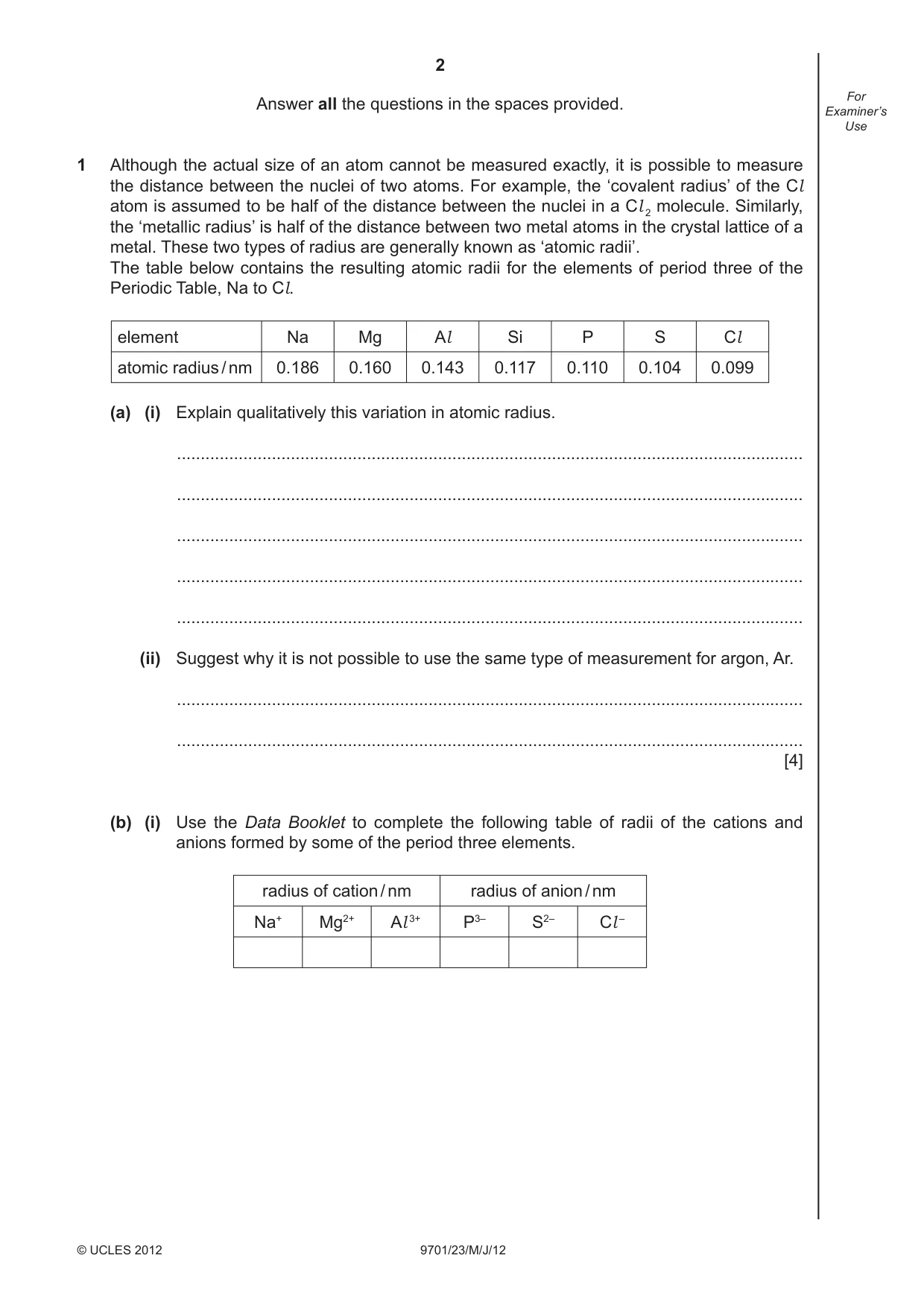
2 9701/23/M/J/12 © UCLES 2012 For Examiner’s Use Answer all the questions in the spaces provided. 1 Although the actual size of an atom cannot be measured exactly, it is possible to measure the distance between the nuclei of two atoms. For example, the ‘covalent radius’ of the Cl atom is assumed to be half of the distance between the nuclei in a Cl 2 molecule. Similarly, the ‘metallic radius’ is half of the distance between two metal atoms in the crystal lattice of a metal. These two types of radius are generally known as ‘atomic radii’. The table below contains the resulting atomic radii for the elements of period three of the Periodic Table, Na to Cl. element Na Mg Al Si P S Cl atomic radius / nm 0.186 0.160 0.143 0.117 0.110 0.104 0.099 (a) (i) Explain qualitatively this variation in atomic radius. … … … … … (ii) Suggest why it is not possible to use the same type of measurement for argon, Ar. … … [4] (b) (i) Use the Data Booklet to complete the following table of radii of the cations and anions formed by some of the period three elements. radius of cation / nm radius of anion / nm Na+ Mg2+ Al 3+ P3– S2– Cl –
Question paper, page 3
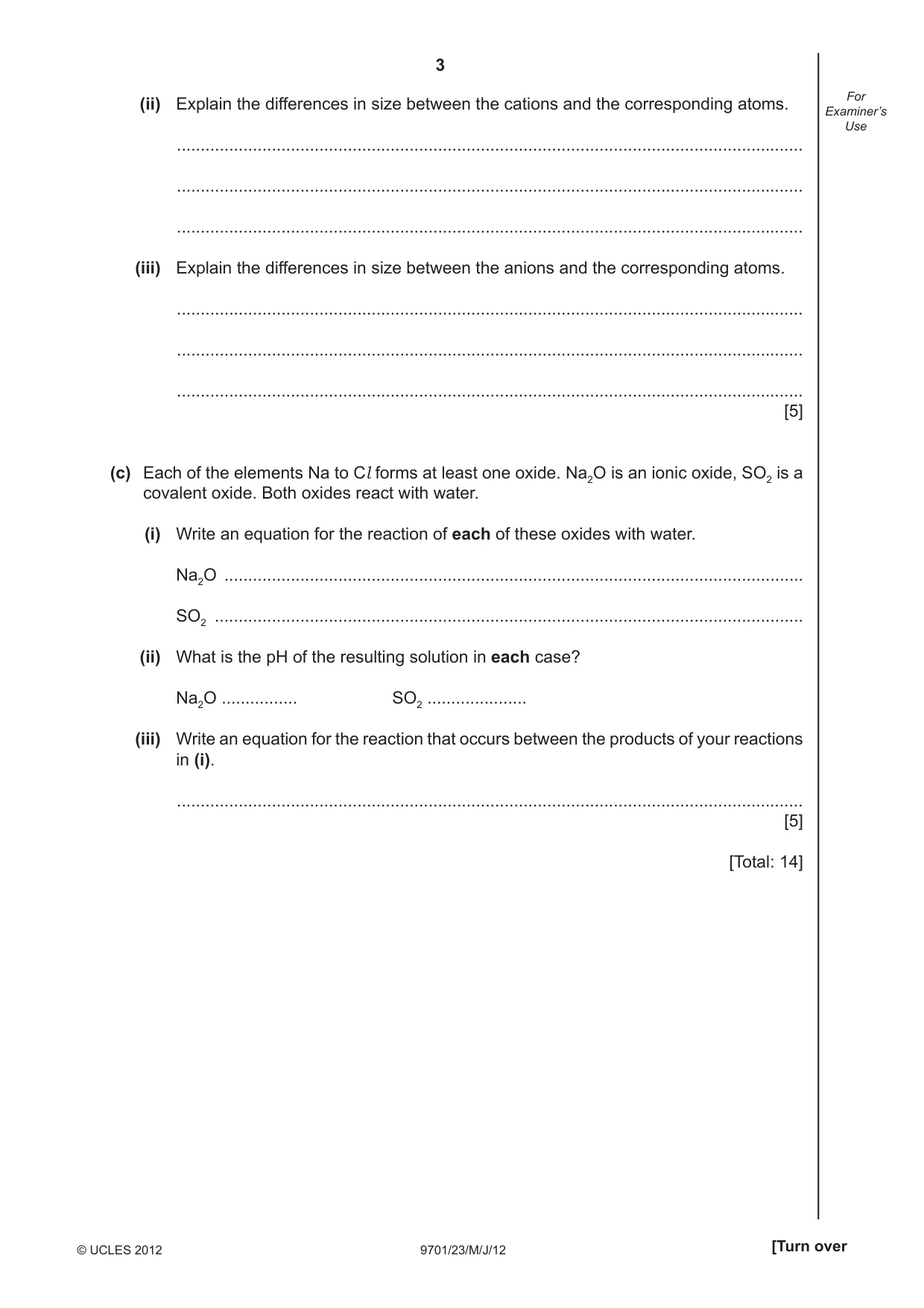
3 9701/23/M/J/12 © UCLES 2012 [Turn over For Examiner’s Use (ii) Explain the differences in size between the cations and the corresponding atoms. … … … (iii) Explain the differences in size between the anions and the corresponding atoms. … … … [5] (c) Each of the elements Na to Cl forms at least one oxide. Na2O is an ionic oxide, SO2 is a covalent oxide. Both oxides react with water. (i) Write an equation for the reaction of each of these oxides with water. Na2O … SO2 … (ii) What is the pH of the resulting solution in each case? Na2O … SO2 … (iii) Write an equation for the reaction that occurs between the products of your reactions in (i). … [5] [Total: 14]
Question paper, page 4
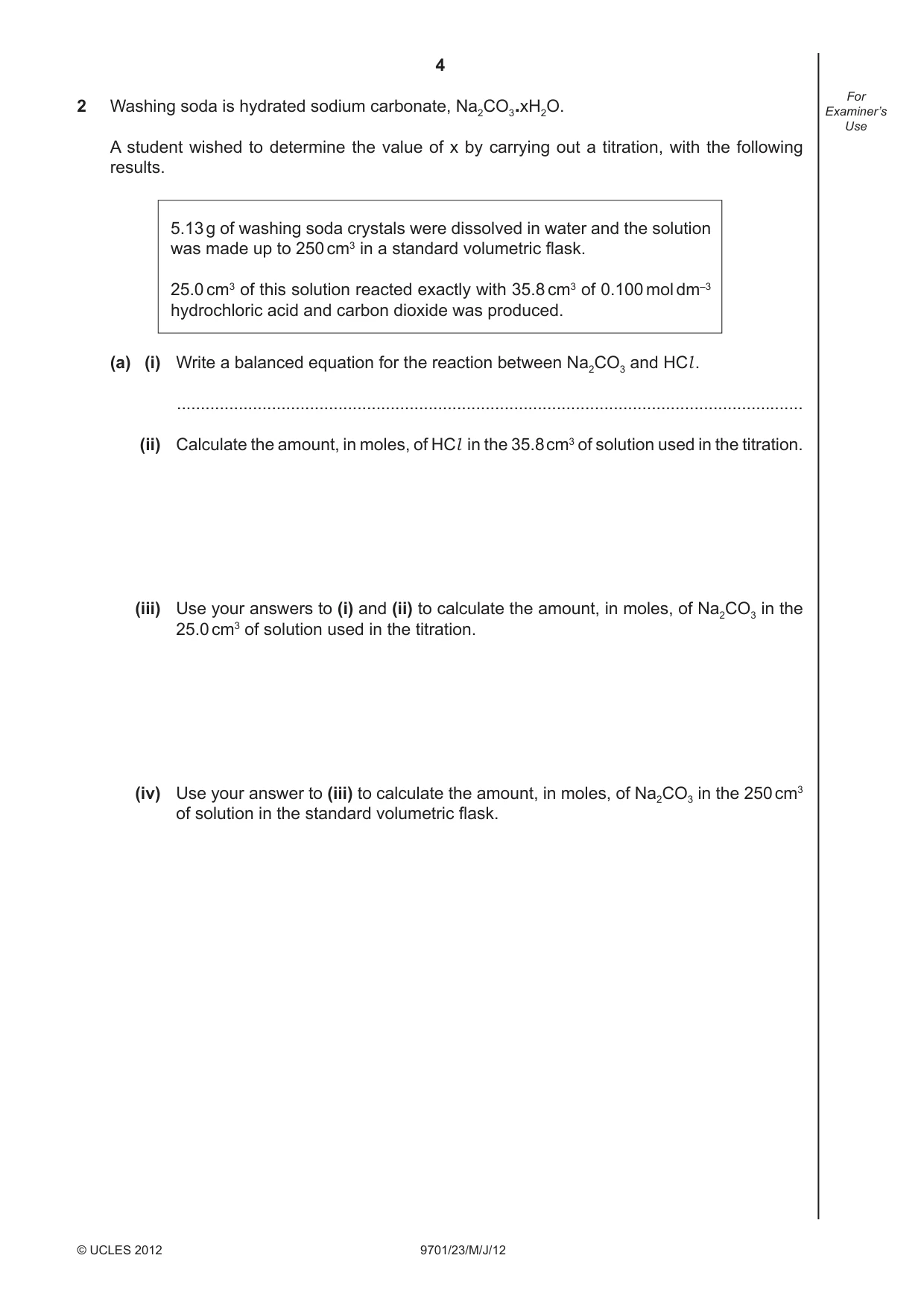
4 9701/23/M/J/12 © UCLES 2012 For Examiner’s Use 2 Washing soda is hydrated sodium carbonate, Na2CO3.xH2O. A student wished to determine the value of x by carrying out a titration, with the following results. 5.13 g of washing soda crystals were dissolved in water and the solution was made up to 250 cm3 in a standard volumetric fl ask. 25.0 cm3 of this solution reacted exactly with 35.8 cm3 of 0.100 mol dm–3 hydrochloric acid and carbon dioxide was produced. (a) (i) Write a balanced equation for the reaction between Na2CO3 and HCl . … (ii) Calculate the amount, in moles, of HCl in the 35.8 cm3 of solution used in the titration. (iii) Use your answers to (i) and (ii) to calculate the amount, in moles, of Na2CO3 in the 25.0 cm3 of solution used in the titration. (iv) Use your answer to (iii) to calculate the amount, in moles, of Na2CO3 in the 250 cm3 of solution in the standard volumetric fl ask.
Question paper, page 5
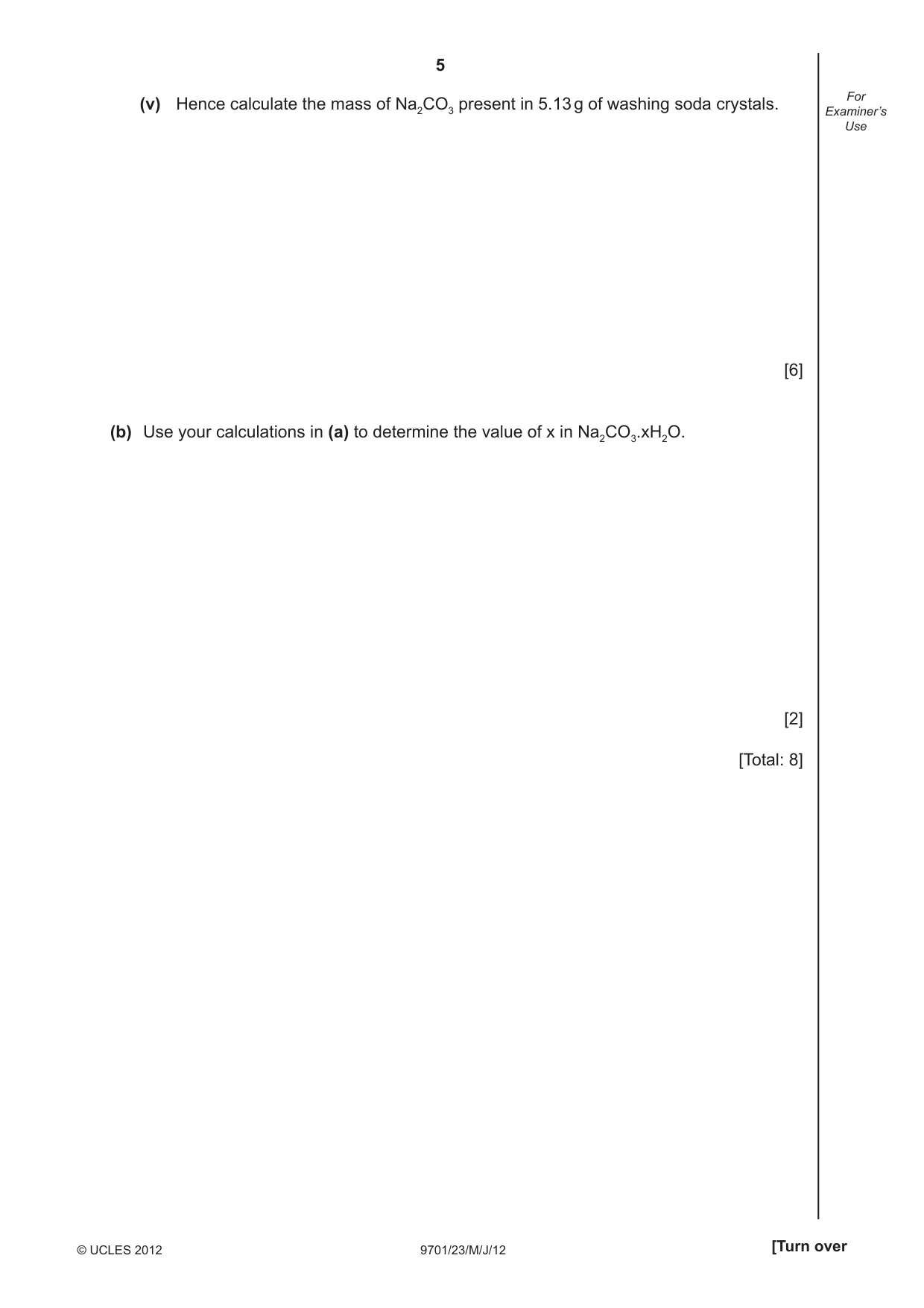
5 9701/23/M/J/12 © UCLES 2012 [Turn over For Examiner’s Use (v) Hence calculate the mass of Na2CO3 present in 5.13 g of washing soda crystals. [6] (b) Use your calculations in (a) to determine the value of x in Na2CO3.xH2O. [2] [Total: 8]
Question paper, page 6
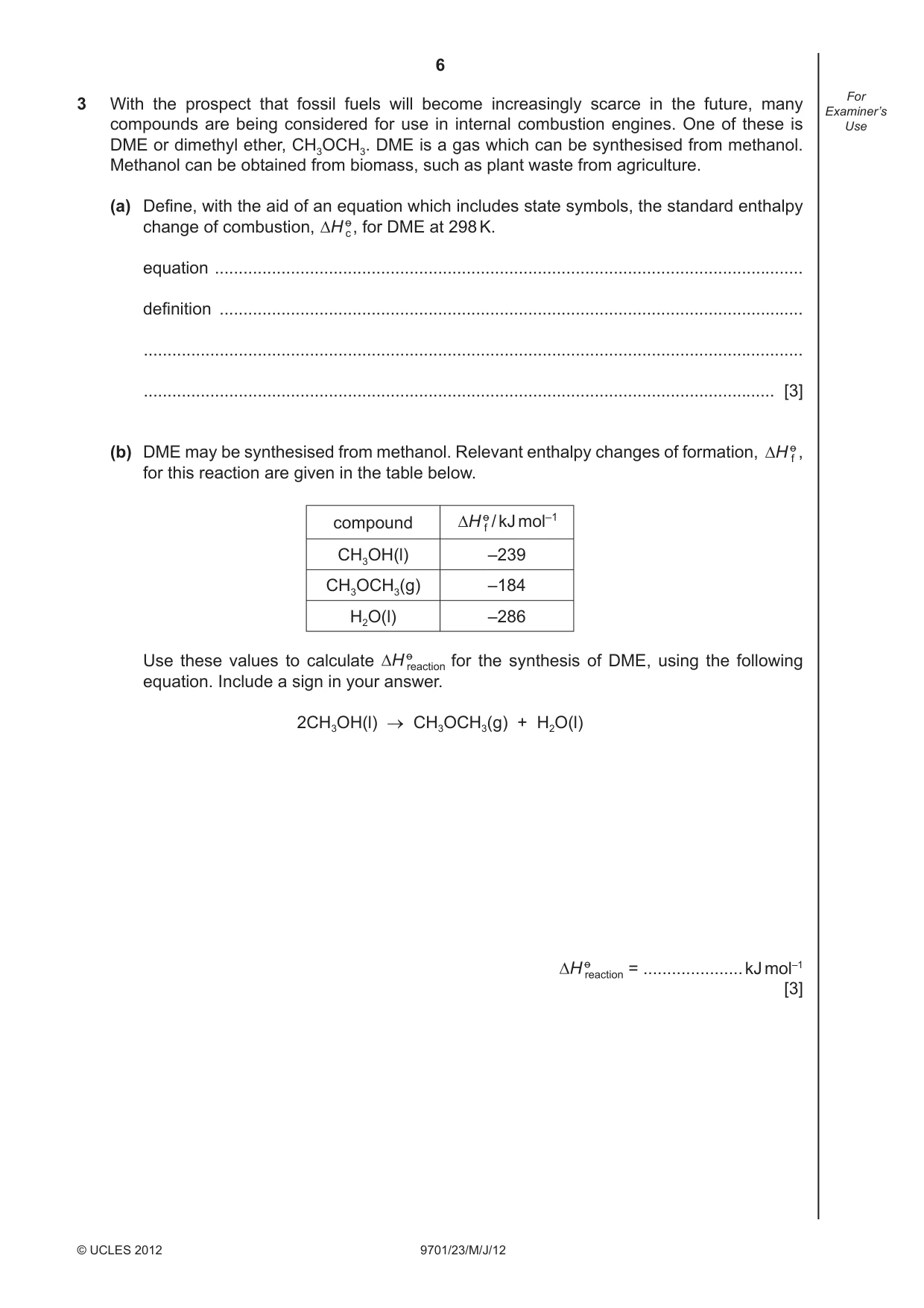
6 9701/23/M/J/12 © UCLES 2012 For Examiner’s Use 3 With the prospect that fossil fuels will become increasingly scarce in the future, many compounds are being considered for use in internal combustion engines. One of these is DME or dimethyl ether, CH3OCH3. DME is a gas which can be synthesised from methanol. Methanol can be obtained from biomass, such as plant waste from agriculture. (a) Defi ne, with the aid of an equation which includes state symbols, the standard enthalpy change of combustion, , for DME at 298 K. equation … defi nition … … … [3] (b) DME may be synthesised from methanol. Relevant enthalpy changes of formation, , for this reaction are given in the table below. compound CH3OH(l) –239 CH3OCH3(g) –184 H2O(l) –286 Use these values to calculate for the synthesis of DME, using the following equation. Include a sign in your answer. 2CH3OH(l) → CH3OCH3(g) + H2O(l) = … kJ mol–1 [3]
Question paper, page 7
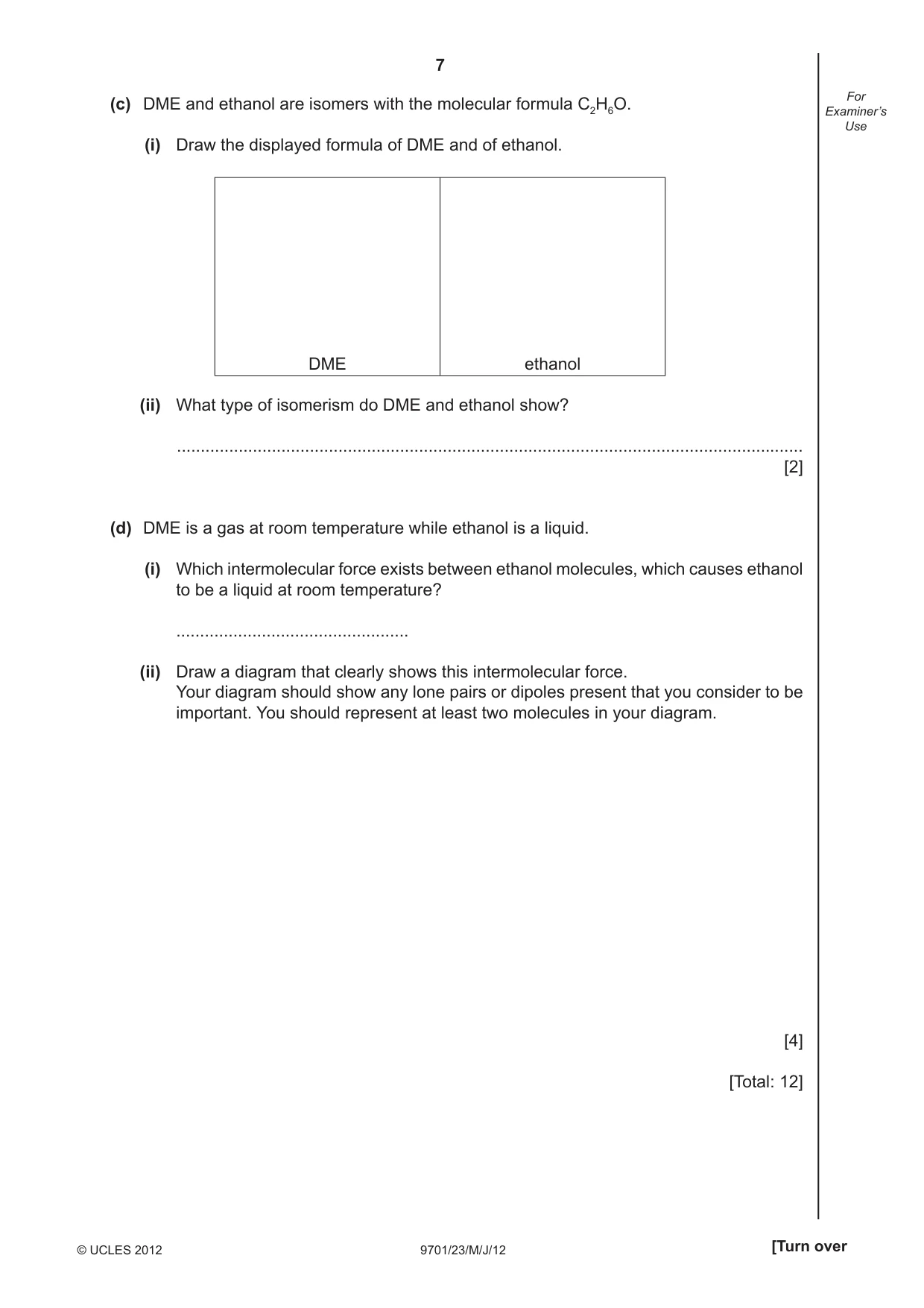
7 9701/23/M/J/12 © UCLES 2012 [Turn over For Examiner’s Use (c) DME and ethanol are isomers with the molecular formula C2H6O. (i) Draw the displayed formula of DME and of ethanol. DME ethanol (ii) What type of isomerism do DME and ethanol show? … [2] (d) DME is a gas at room temperature while ethanol is a liquid. (i) Which intermolecular force exists between ethanol molecules, which causes ethanol to be a liquid at room temperature? … (ii) Draw a diagram that clearly shows this intermolecular force. Your diagram should show any lone pairs or dipoles present that you consider to be important. You should represent at least two molecules in your diagram. [4] [Total: 12]
Question paper, page 8
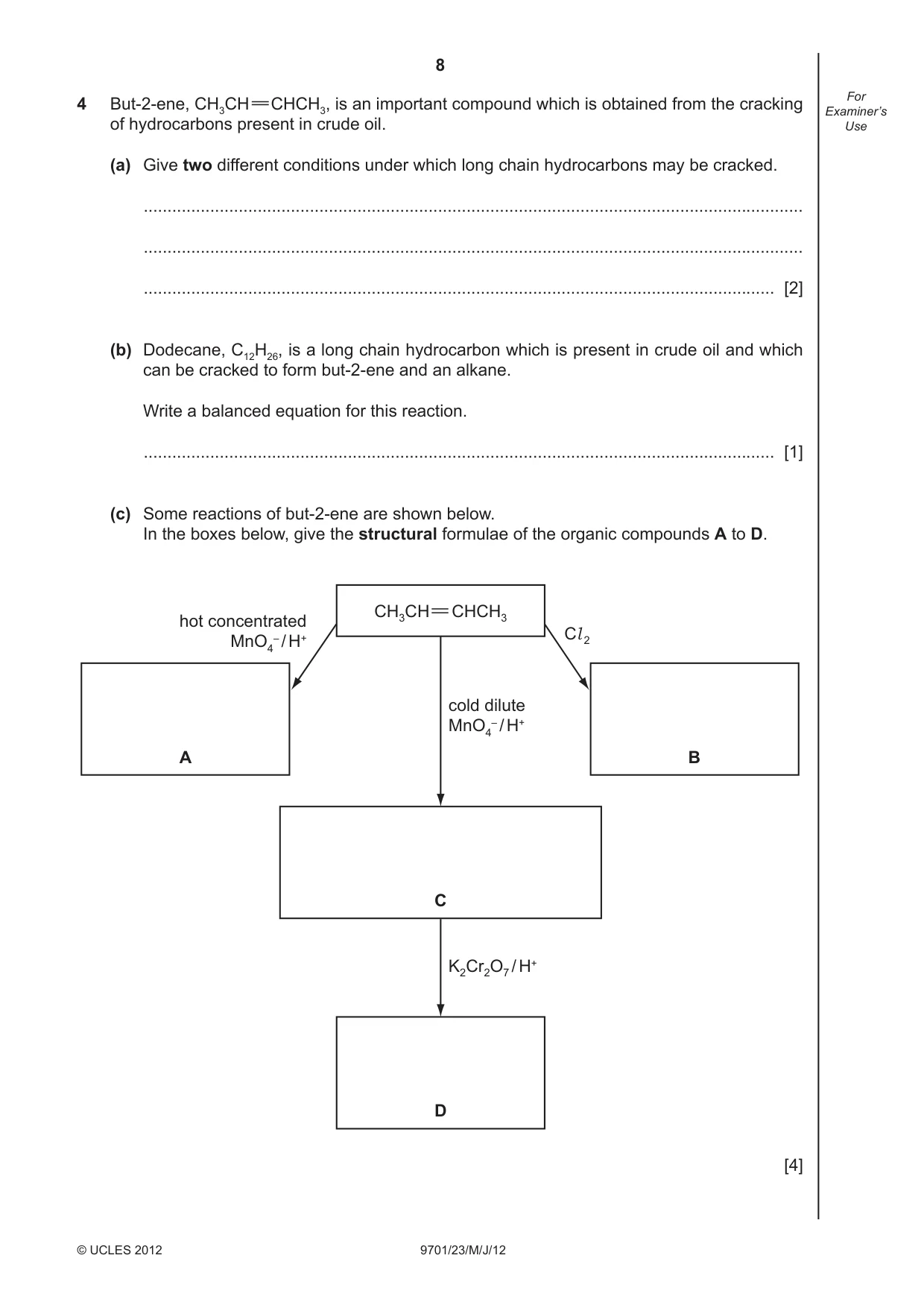
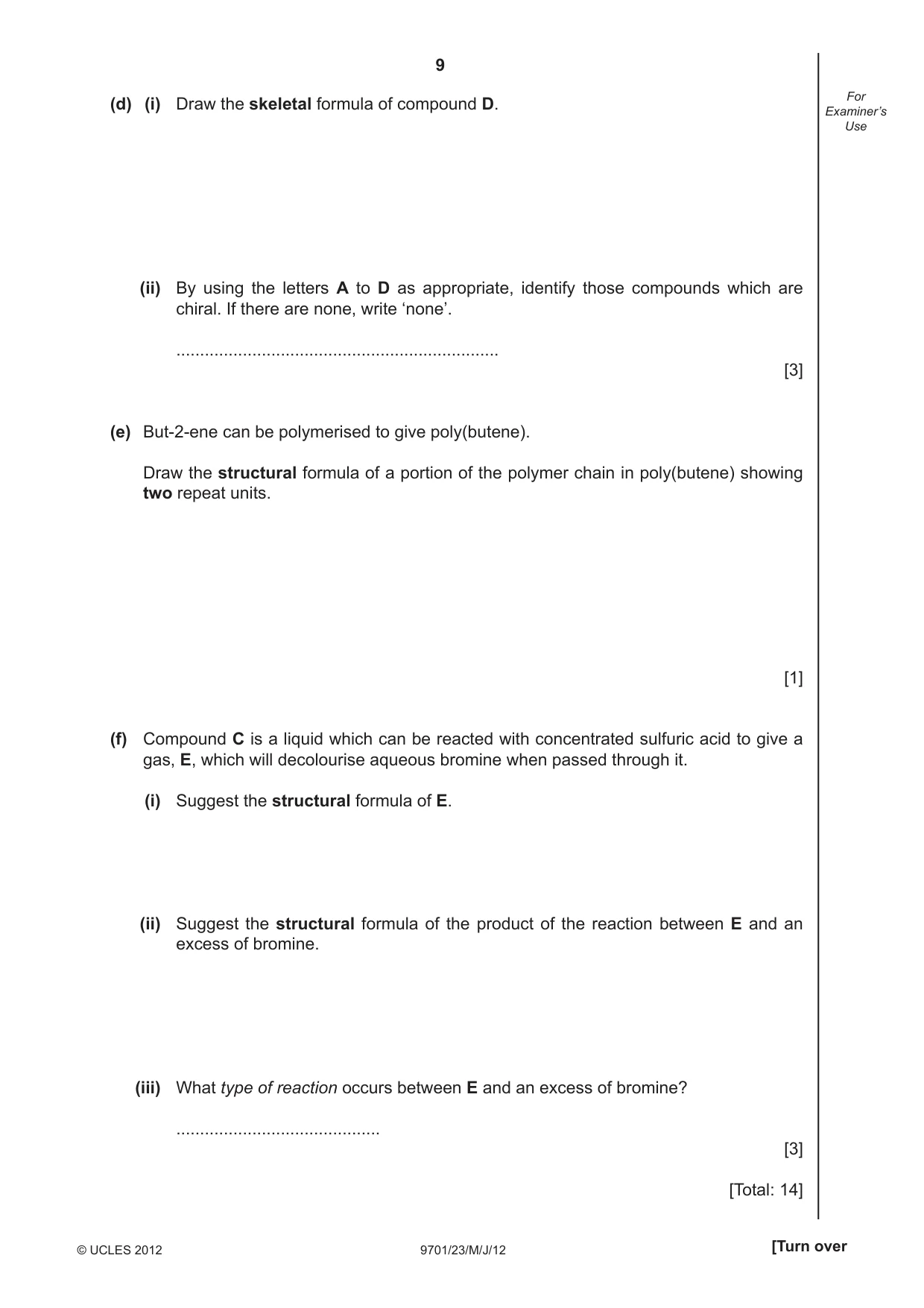
8 9701/23/M/J/12 © UCLES 2012 For Examiner’s Use 4 But-2-ene, CH3CH CHCH3, is an important compound which is obtained from the cracking of hydrocarbons present in crude oil. (a) Give two different conditions under which long chain hydrocarbons may be cracked. … … … [2] (b) Dodecane, C12H26, is a long chain hydrocarbon which is present in crude oil and which can be cracked to form but-2-ene and an alkane. Write a balanced equation for this reaction. … [1] (c) Some reactions of but-2-ene are shown below. In the boxes below, give the structural formulae of the organic compounds A to D. CH3CH CHCH3 cold dilute MnO4 – / H+ C K2Cr2O7 / H+ D A B Cl 2 hot concentrated MnO4 – / H+ [4]
Question paper, page 9
9 9701/23/M/J/12 © UCLES 2012 [Turn over For Examiner’s Use (d) (i) Draw the skeletal formula of compound D. (ii) By using the letters A to D as appropriate, identify those compounds which are chiral. If there are none, write ‘none’. … [3] (e) But-2-ene can be polymerised to give poly(butene). Draw the structural formula of a portion of the polymer chain in poly(butene) showing two repeat units. [1] (f) Compound C is a liquid which can be reacted with concentrated sulfuric acid to give a gas, E, which will decolourise aqueous bromine when passed through it. (i) Suggest the structural formula of E. (ii) Suggest the structural formula of the product of the reaction between E and an excess of bromine. (iii) What type of reaction occurs between E and an excess of bromine? … [3] [Total: 14]
Question paper, page 10
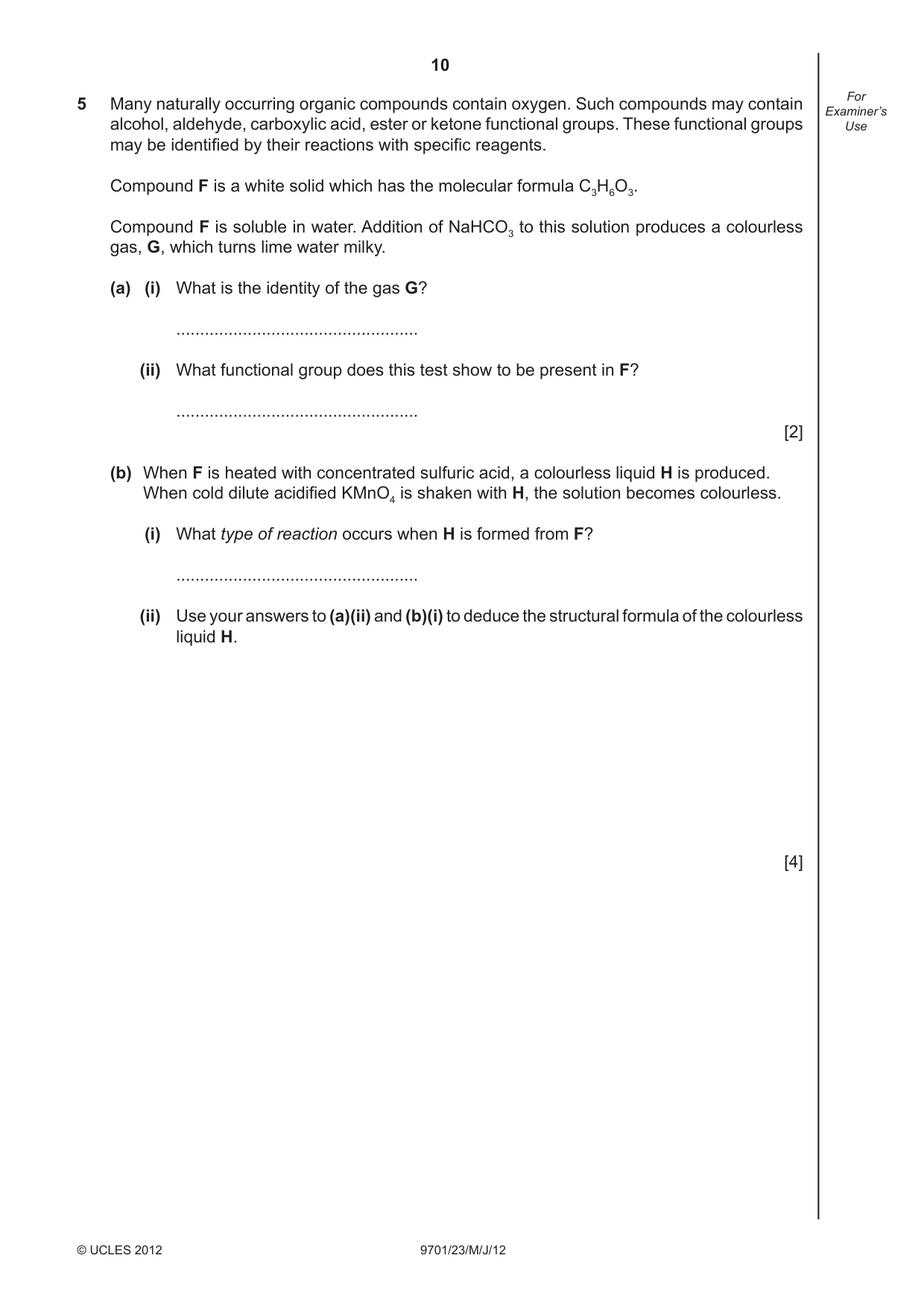
10 9701/23/M/J/12 © UCLES 2012 For Examiner’s Use 5 Many naturally occurring organic compounds contain oxygen. Such compounds may contain alcohol, aldehyde, carboxylic acid, ester or ketone functional groups. These functional groups may be identifi ed by their reactions with specifi c reagents. Compound F is a white solid which has the molecular formula C3H6O3. Compound F is soluble in water. Addition of NaHCO3 to this solution produces a colourless gas, G, which turns lime water milky. (a) (i) What is the identity of the gas G? … (ii) What functional group does this test show to be present in F? … [2] (b) When F is heated with concentrated sulfuric acid, a colourless liquid H is produced. When cold dilute acidifi ed KMnO4 is shaken with H, the solution becomes colourless. (i) What type of reaction occurs when H is formed from F? … (ii) Use your answers to (a)(ii) and (b)(i) to deduce the structural formula of the colourless liquid H. [4]
Question paper, page 11
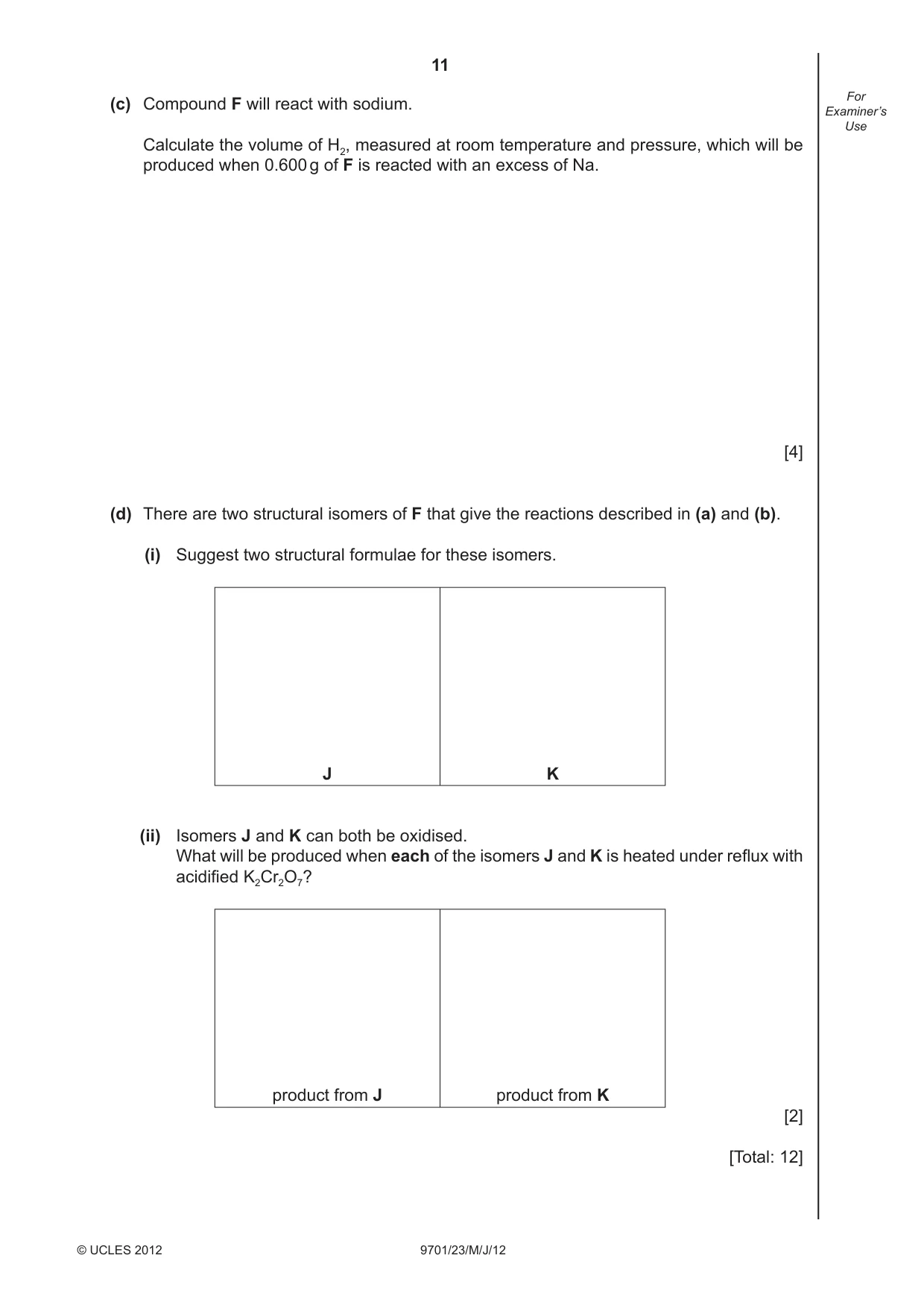
11 9701/23/M/J/12 © UCLES 2012 [Turn over For Examiner’s Use (c) Compound F will react with sodium. Calculate the volume of H2, measured at room temperature and pressure, which will be produced when 0.600 g of F is reacted with an excess of Na. [4] (d) There are two structural isomers of F that give the reactions described in (a) and (b). (i) Suggest two structural formulae for these isomers. J K (ii) Isomers J and K can both be oxidised. What will be produced when each of the isomers J and K is heated under refl ux with acidifi ed K2Cr2O7? product from J product from K [2] [Total: 12]
Question paper, page 12
12 Permission to reproduce items where third-party owned material protected by copyright is included has been sought and cleared where possible. Every reasonable effort has been made by the publisher (UCLES) to trace copyright holders, but if any items requiring clearance have unwittingly been included the publisher will be pleased to make amends at the earliest possible opportunity. University of Cambridge International Examinations is part of the Cambridge Assessment Group. Cambridge Assessment is the brand name of University of Cambridge Local Examinations Syndicate (UCLES), which is itself a department of the University of Cambridge. 9701/23/M/J/12 © UCLES 2012 BLANK PAGE
Mark scheme, page 1
UNIVERSITY OF CAMBRIDGE INTERNATIONAL EXAMINATIONS GCE Advanced Subsidiary Level and GCE Advanced Level MARK SCHEME for the May/June 2012 question paper for the guidance of teachers 9701 CHEMISTRY 9701/23 Paper 2 (AS Structured Questions), maximum raw mark 60 This mark scheme is published as an aid to teachers and candidates, to indicate the requirements of the examination. It shows the basis on which Examiners were instructed to award marks. It does not indicate the details of the discussions that took place at an Examiners’ meeting before marking began, which would have considered the acceptability of alternative answers. Mark schemes must be read in conjunction with the question papers and the report on the examination. • Cambridge will not enter into discussions or correspondence in connection with these mark schemes. Cambridge is publishing the mark schemes for the May/June 2012 question papers for most IGCSE, GCE Advanced Level and Advanced Subsidiary Level syllabuses and some Ordinary Level syllabuses.
Mark scheme, page 2
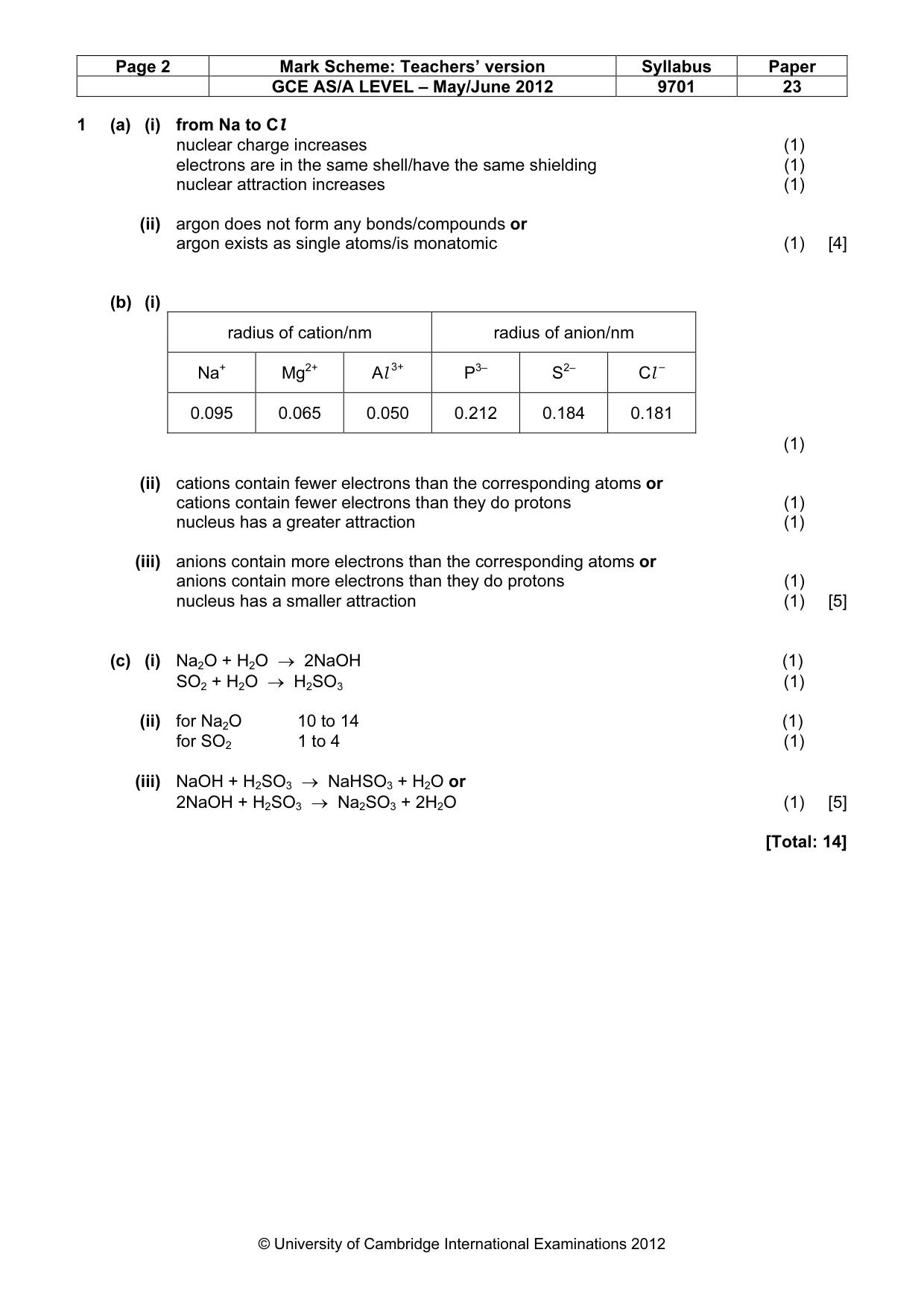
Page 2 Mark Scheme: Teachers’ version Syllabus Paper GCE AS/A LEVEL – May/June 2012 9701 23 © University of Cambridge International Examinations 2012 1 (a) (i) from Na to Cl nuclear charge increases (1) electrons are in the same shell/have the same shielding (1) nuclear attraction increases (1) (ii) argon does not form any bonds/compounds or argon exists as single atoms/is monatomic (1) [4] (b) (i) radius of cation/nm radius of anion/nm Na+ Mg2+ Al 3+ P3– S2– Cl – 0.095 0.065 0.050 0.212 0.184 0.181 (1) (ii) cations contain fewer electrons than the corresponding atoms or cations contain fewer electrons than they do protons (1) nucleus has a greater attraction (1) (iii) anions contain more electrons than the corresponding atoms or anions contain more electrons than they do protons (1) nucleus has a smaller attraction (1) [5] (c) (i) Na2O + H2O → 2NaOH (1) SO2 + H2O → H2SO3 (1) (ii) for Na2O 10 to 14 (1) for SO2 1 to 4 (1) (iii) NaOH + H2SO3 → NaHSO3 + H2O or 2NaOH + H2SO3 → Na2SO3 + 2H2O (1) [5] [Total: 14]
Mark scheme, page 3
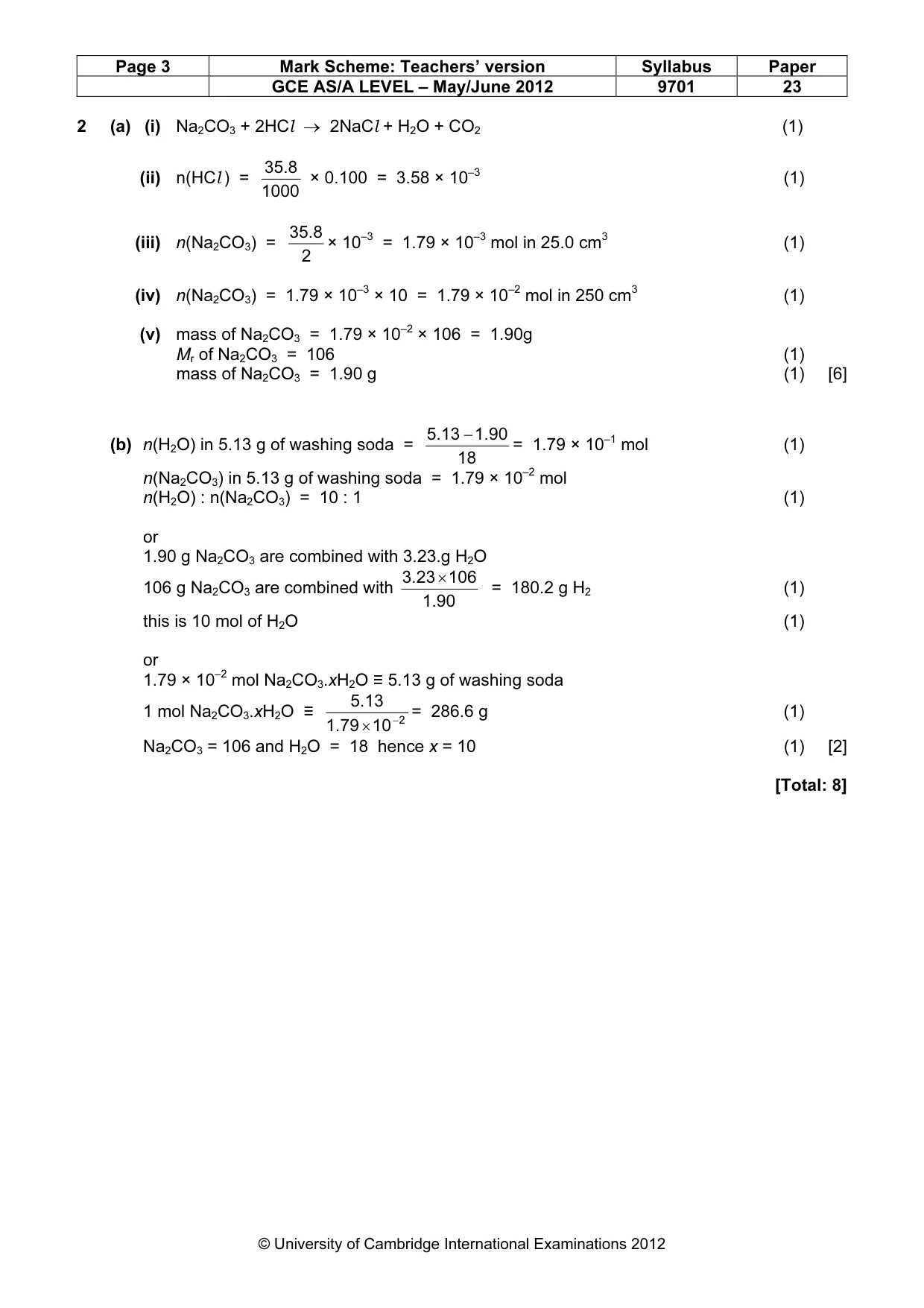
Page 3 Mark Scheme: Teachers’ version Syllabus Paper GCE AS/A LEVEL – May/June 2012 9701 23 © University of Cambridge International Examinations 2012 2 (a) (i) Na2CO3 + 2HCl → 2NaCl + H2O + CO2 (1) (ii) n(HCl ) = 1000 35.8 × 0.100 = 3.58 × 10⁻³ (1) (iii) n(Na2CO3) = 2 35.8 × 10–3 = 1.79 × 10⁻³ mol in 25.0 cm3 (1) (iv) n(Na2CO3) = 1.79 × 10–3 × 10 = 1.79 × 10⁻² mol in 250 cm3 (1) (v) mass of Na2CO3 = 1.79 × 10–2 × 106 = 1.90g Mr of Na2CO3 = 106 (1) mass of Na2CO3 = 1.90 g (1) [6] (b) n(H2O) in 5.13 g of washing soda = 18 1.90 5.13 − = 1.79 × 10⁻¹ mol (1) n(Na2CO3) in 5.13 g of washing soda = 1.79 × 10⁻² mol n(H2O) : n(Na2CO3) = 10 : 1 (1) or 1.90 g Na2CO3 are combined with 3.23.g H2O 106 g Na2CO3 are combined with 1.90 106 3.23× = 180.2 g H2 (1) this is 10 mol of H2O (1) or 1.79 × 10⁻² mol Na2CO3.xH2O ≡ 5.13 g of washing soda 1 mol Na2CO3.xH2O ≡ 2 10 1.79 5.13 − × = 286.6 g (1) Na2CO3 = 106 and H2O = 18 hence x = 10 (1) [2] [Total: 8]
Mark scheme, page 4
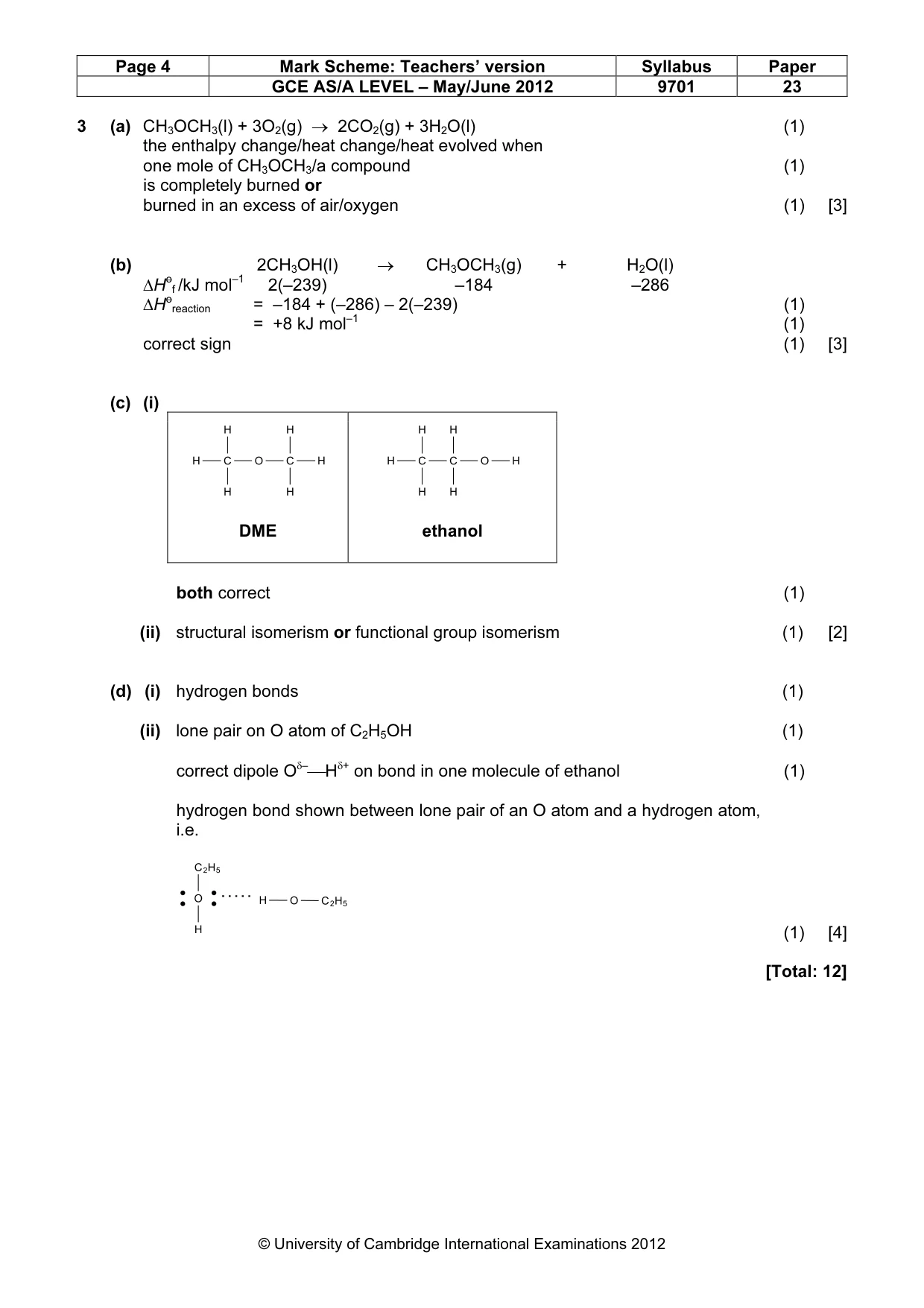
Page 4 Mark Scheme: Teachers’ version Syllabus Paper GCE AS/A LEVEL – May/June 2012 9701 23 © University of Cambridge International Examinations 2012 3 (a) CH3OCH3(l) + 3O2(g) → 2CO2(g) + 3H2O(l) (1) the enthalpy change/heat change/heat evolved when one mole of CH3OCH3/a compound (1) is completely burned or burned in an excess of air/oxygen (1) [3] (b) 2CH3OH(l) → CH3OCH3(g) + H2O(l) ∆Ho f /kJ mol–1 2(–239) –184 –286 ∆Ho reaction = –184 + (–286) – 2(–239) (1) = +8 kJ mol–1 (1) correct sign (1) [3] (c) (i) DME ethanol both correct (1) (ii) structural isomerism or functional group isomerism (1) [2] (d) (i) hydrogen bonds (1) (ii) lone pair on O atom of C2H5OH (1) correct dipole Oδ–Hδ+ on bond in one molecule of ethanol (1) hydrogen bond shown between lone pair of an O atom and a hydrogen atom, i.e. (1) [4] [Total: 12]
Mark scheme, page 5
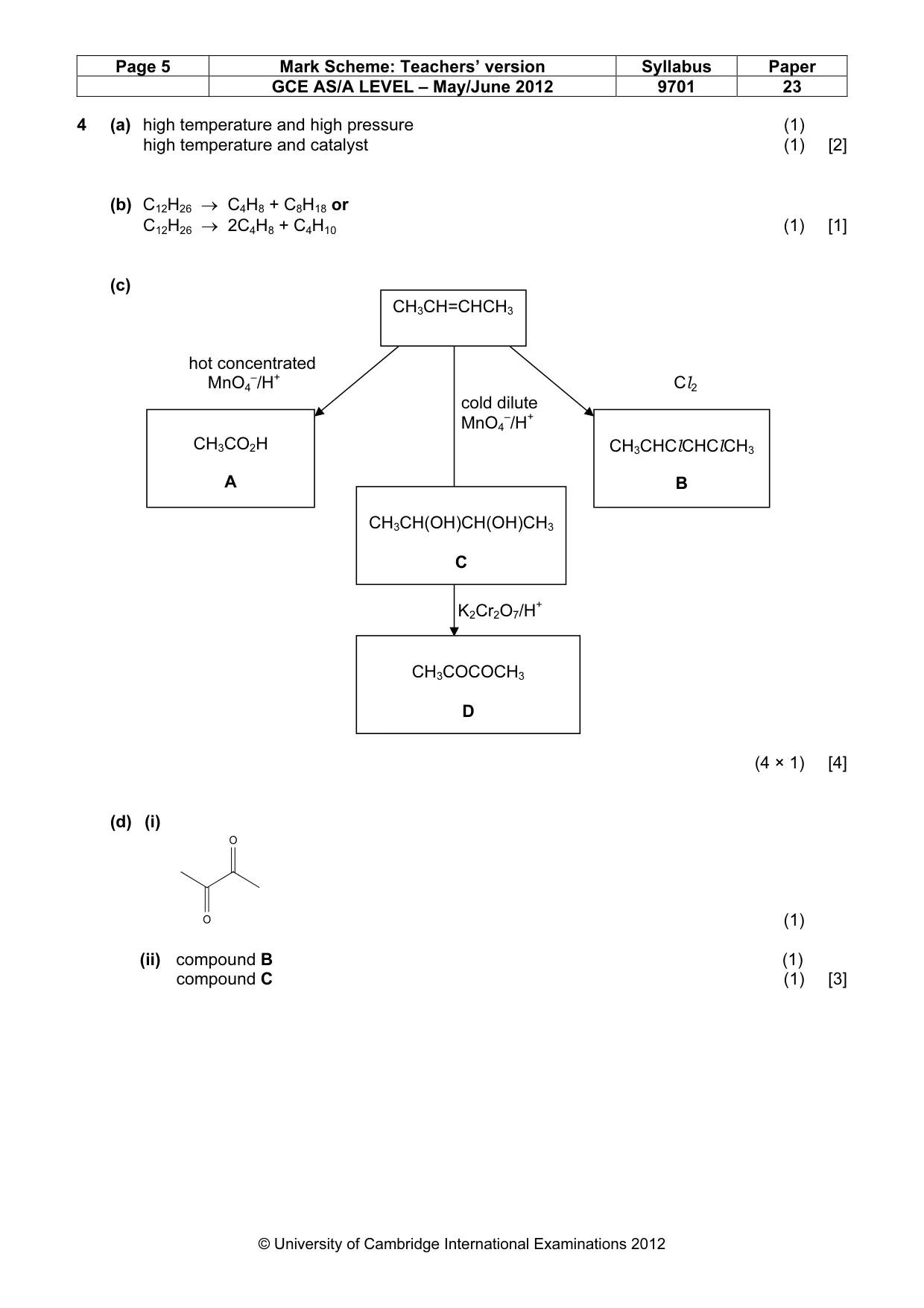
Page 5 Mark Scheme: Teachers’ version Syllabus Paper GCE AS/A LEVEL – May/June 2012 9701 23 © University of Cambridge International Examinations 2012 4 (a) high temperature and high pressure (1) high temperature and catalyst (1) [2] (b) C12H26 → C4H8 + C8H18 or C12H26 → 2C4H8 + C4H10 (1) [1] (c) hot concentrated MnO4 –/H+ Cl2 cold dilute MnO4 –/H+ K2Cr2O7/H+ (4 × 1) [4] (d) (i) (1) (ii) compound B (1) compound C (1) [3] CH3CO2H A CH3CH(OH)CH(OH)CH3 C CH3COCOCH3 D CH3CHClCHClCH3 B CH3CH=CHCH3
Mark scheme, page 6
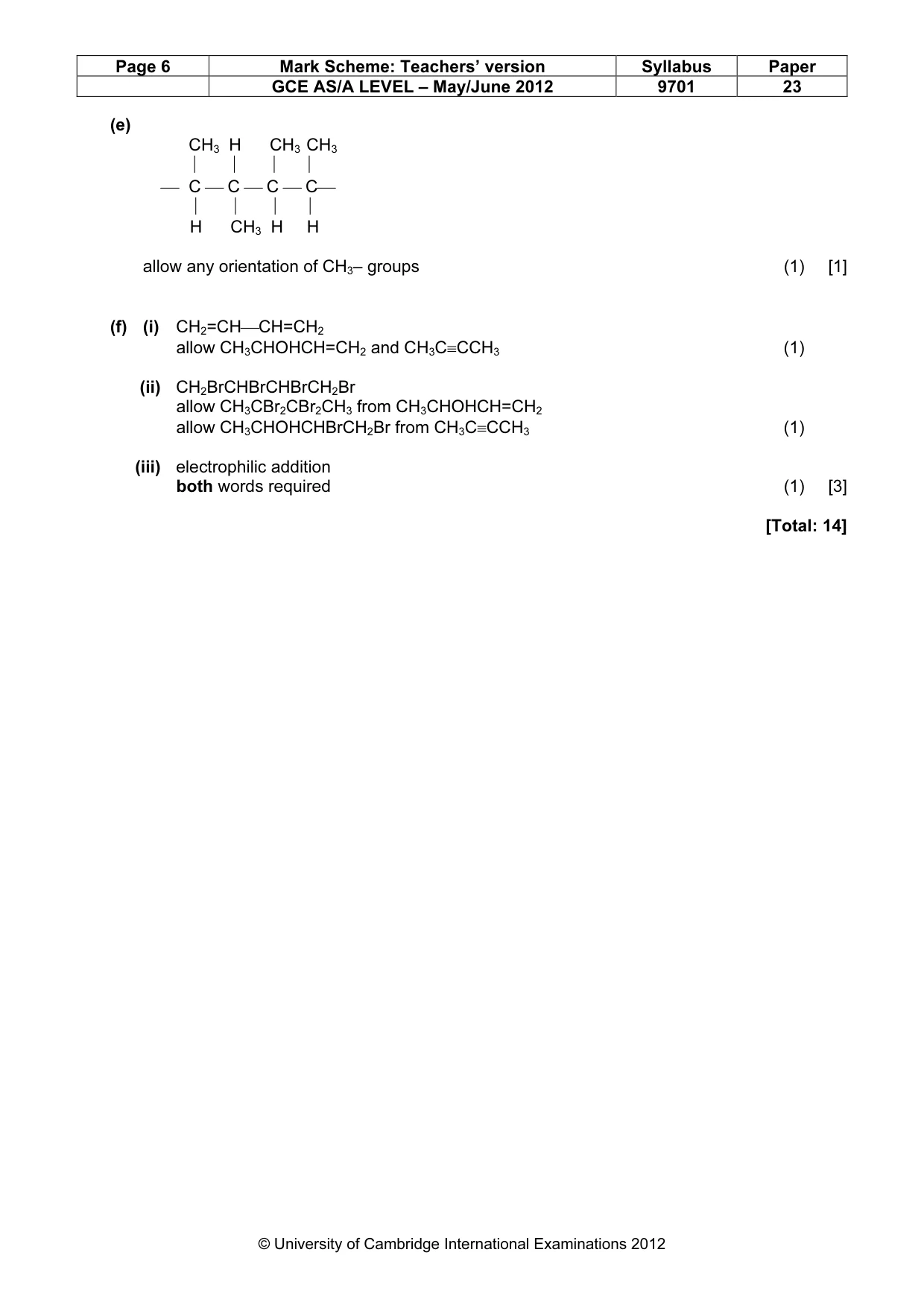
Page 6 Mark Scheme: Teachers’ version Syllabus Paper GCE AS/A LEVEL – May/June 2012 9701 23 © University of Cambridge International Examinations 2012 (e) CH3 H CH3 CH3 C C C C H CH3 H H allow any orientation of CH3– groups (1) [1] (f) (i) CH2=CHCH=CH2 allow CH3CHOHCH=CH2 and CH3C≡CCH3 (1) (ii) CH2BrCHBrCHBrCH2Br allow CH3CBr2CBr2CH3 from CH3CHOHCH=CH2 allow CH3CHOHCHBrCH2Br from CH3C≡CCH3 (1) (iii) electrophilic addition both words required (1) [3] [Total: 14]
Mark scheme, page 7
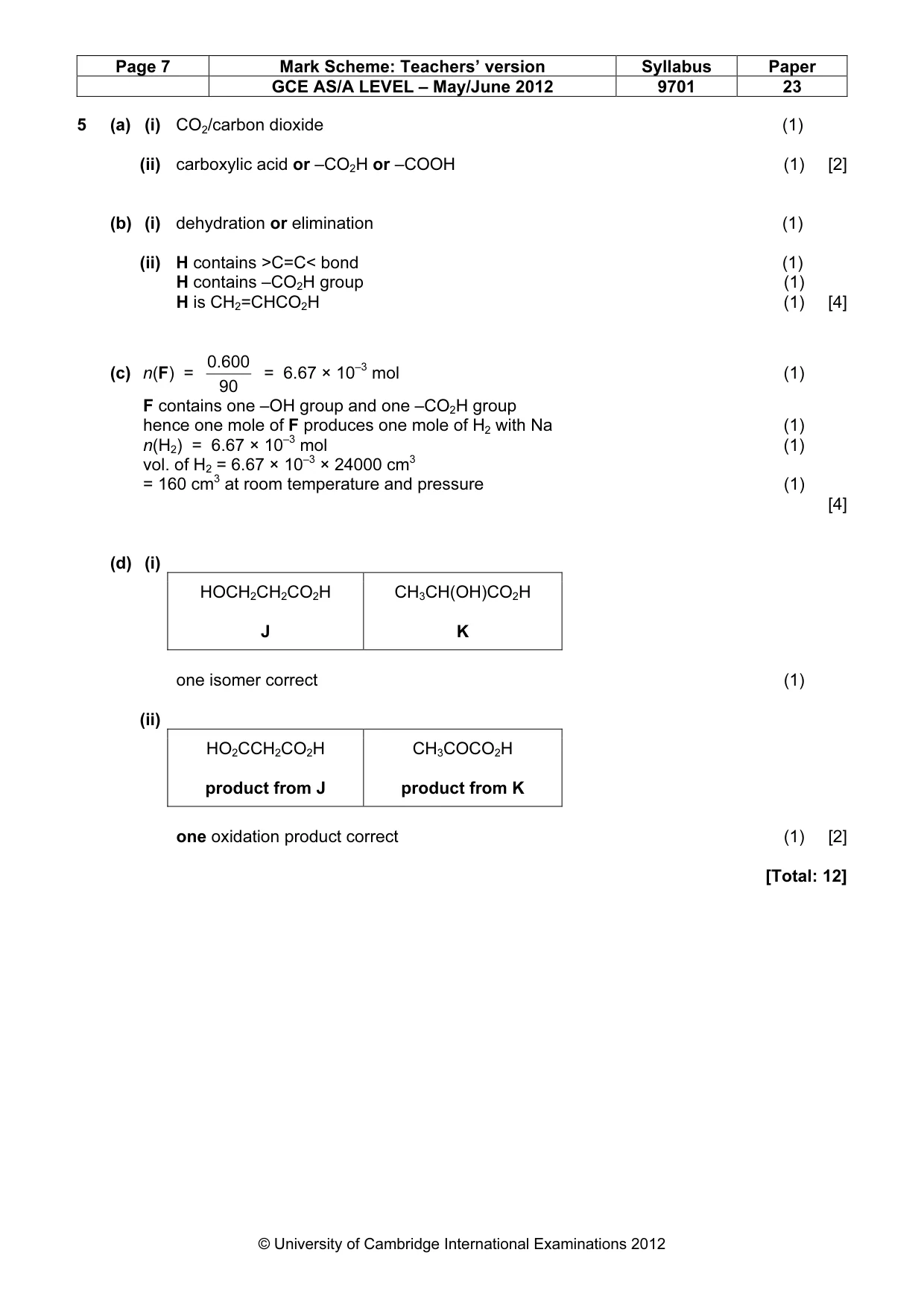
Page 7 Mark Scheme: Teachers’ version Syllabus Paper GCE AS/A LEVEL – May/June 2012 9701 23 © University of Cambridge International Examinations 2012 5 (a) (i) CO2/carbon dioxide (1) (ii) carboxylic acid or –CO2H or –COOH (1) [2] (b) (i) dehydration or elimination (1) (ii) H contains >C=C< bond (1) H contains –CO2H group (1) H is CH2=CHCO2H (1) [4] (c) n(F) = 90 0.600 = 6.67 × 10⁻³ mol (1) F contains one –OH group and one –CO2H group hence one mole of F produces one mole of H2 with Na (1) n(H2) = 6.67 × 10⁻³ mol (1) vol. of H2 = 6.67 × 10–3 × 24000 cm3 = 160 cm3 at room temperature and pressure (1) [4] (d) (i) HOCH2CH2CO2H J CH3CH(OH)CO2H K one isomer correct (1) (ii) HO2CCH2CO2H product from J CH3COCO2H product from K one oxidation product correct (1) [2] [Total: 12]
What you needed in this session
Cambridge’s own grade thresholds for 2012 May/June, Paper 2 · Variant 3. A higher threshold means an easier paper — the bar moves with how the cohort did.