Cambridge A Level Chemistry 9701 — 2011 May/June Paper 4 · Variant 2
9701/42/M/J/11 · 100 marks · ≈113 min
The question paper and its mark scheme, free to read here and free to download. This is Cambridge’s own paper, exactly as it was sat.
Question paper20 pages




Mark scheme10 pages
Answers below. Sit the paper first if you are practising.
Paper as text
Question paper, page 1
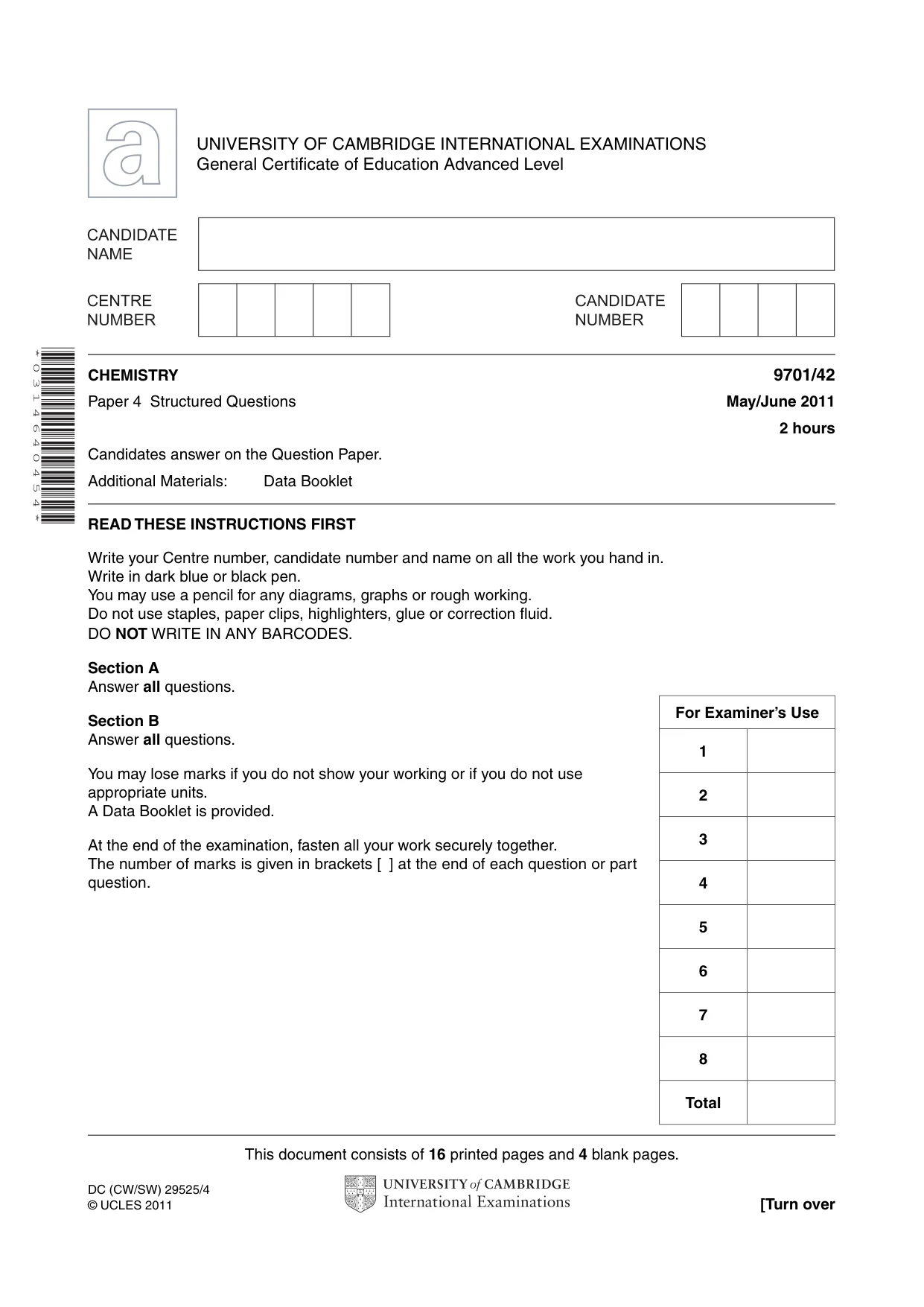
This document consists of 16 printed pages and 4 blank pages. DC (CW/SW) 29525/4 © UCLES 2011 [Turn over UNIVERSITY OF CAMBRIDGE INTERNATIONAL EXAMINATIONS General Certificate of Education Advanced Level READ THESE INSTRUCTIONS FIRST Write your Centre number, candidate number and name on all the work you hand in. Write in dark blue or black pen. You may use a pencil for any diagrams, graphs or rough working. Do not use staples, paper clips, highlighters, glue or correction fluid. DO NOT WRITE IN ANY BARCODES. Section A Answer all questions. Section B Answer all questions. You may lose marks if you do not show your working or if you do not use appropriate units. A Data Booklet is provided. At the end of the examination, fasten all your work securely together. The number of marks is given in brackets [ ] at the end of each question or part question. * 0 3 1 4 6 4 0 4 5 4 * CHEMISTRY 9701/42 Paper 4 Structured Questions May/June 2011 2 hours Candidates answer on the Question Paper. Additional Materials: Data Booklet For Examiner’s Use 1 2 3 4 5 6 7 8 Total
Question paper, page 2
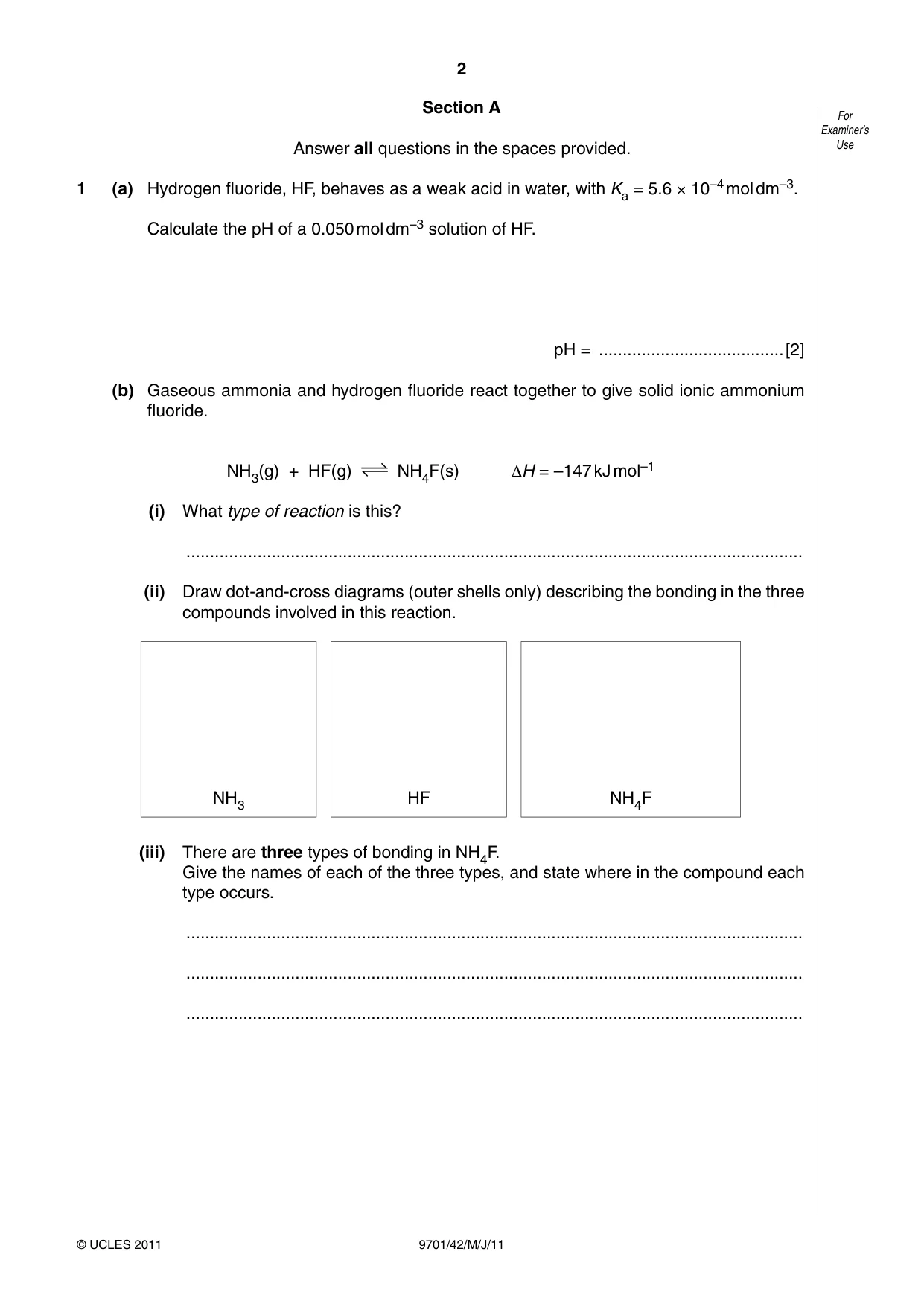
2 © UCLES 2011 9701/42/M/J/11 For Examiner’s Use Section A Answer all questions in the spaces provided. 1 (a) Hydrogen fluoride, HF, behaves as a weak acid in water, with Ka = 5.6 × 10⁻⁴ mol dm–3. Calculate the pH of a 0.050 mol dm–3 solution of HF. pH = …[2] (b) Gaseous ammonia and hydrogen fluoride react together to give solid ionic ammonium fluoride. NH3(g) + HF(g) NH4F(s) ΔH = –147 kJ mol–1 (i) What type of reaction is this? … (ii) Draw dot-and-cross diagrams (outer shells only) describing the bonding in the three compounds involved in this reaction. NH3 HF NH4F (iii) There are three types of bonding in NH4F. Give the names of each of the three types, and state where in the compound each type occurs. … … …
Question paper, page 3
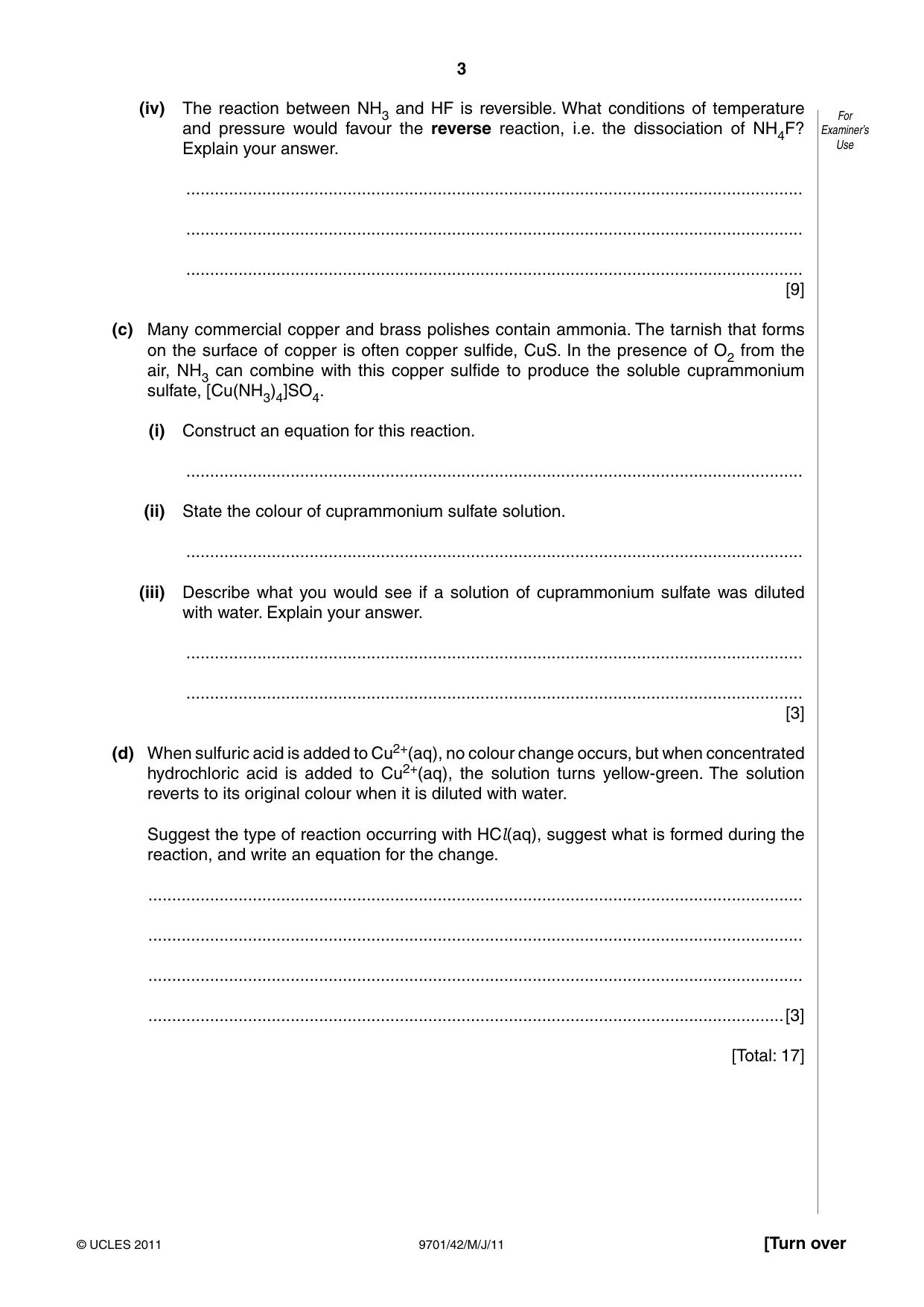
3 © UCLES 2011 [Turn over 9701/42/M/J/11 For Examiner’s Use (iv) The reaction between NH3 and HF is reversible. What conditions of temperature and pressure would favour the reverse reaction, i.e. the dissociation of NH4F? Explain your answer. … … … [9] (c) Many commercial copper and brass polishes contain ammonia. The tarnish that forms on the surface of copper is often copper sulfide, CuS. In the presence of O2 from the air, NH3 can combine with this copper sulfide to produce the soluble cuprammonium sulfate, [Cu(NH3)4]SO4. (i) Construct an equation for this reaction. … (ii) State the colour of cuprammonium sulfate solution. … (iii) Describe what you would see if a solution of cuprammonium sulfate was diluted with water. Explain your answer. … … [3] (d) When sulfuric acid is added to Cu2+(aq), no colour change occurs, but when concentrated hydrochloric acid is added to Cu2+(aq), the solution turns yellow-green. The solution reverts to its original colour when it is diluted with water. Suggest the type of reaction occurring with HCl(aq), suggest what is formed during the reaction, and write an equation for the change. … … … …[3] [Total: 17]
Question paper, page 4
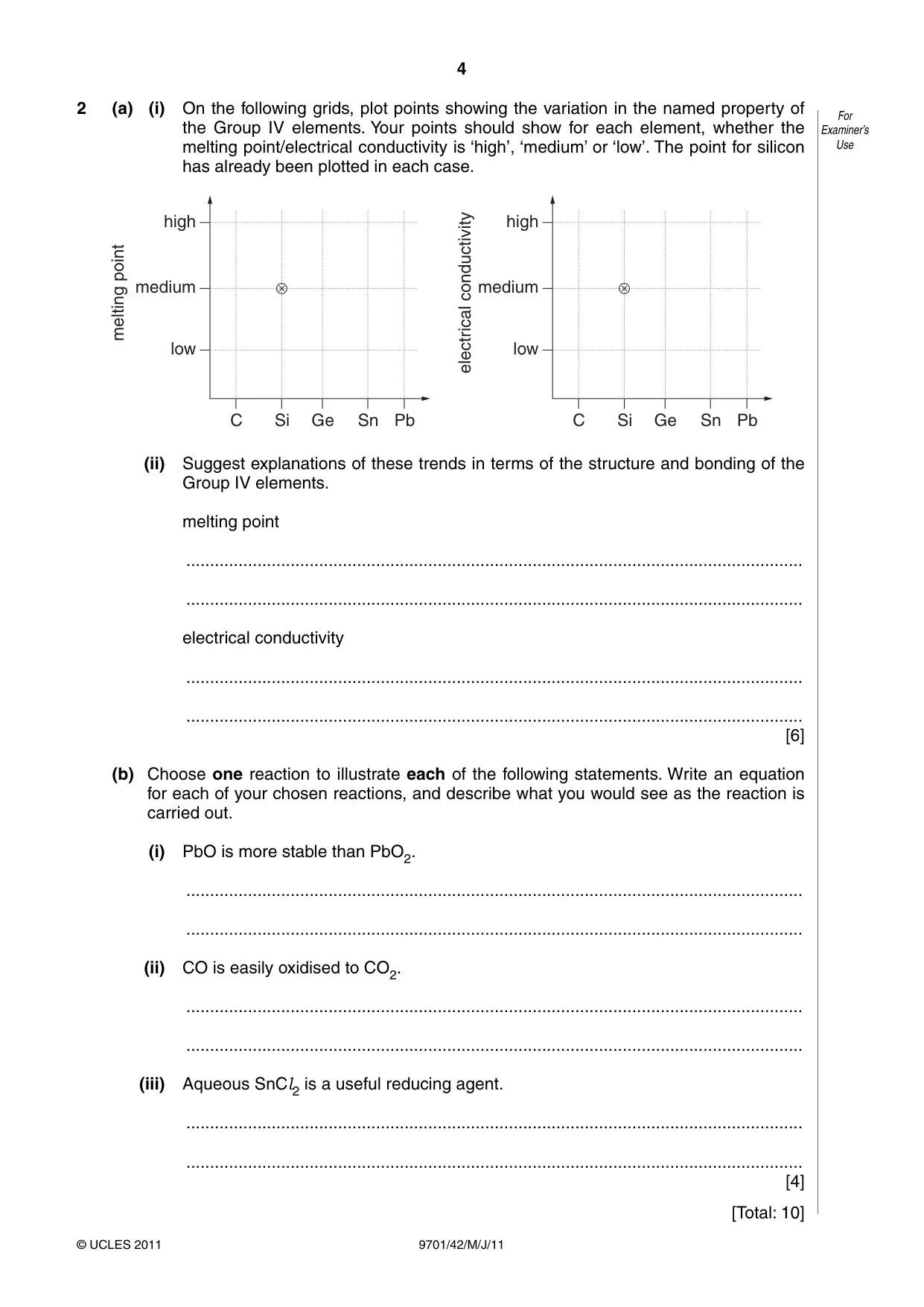
4 © UCLES 2011 9701/42/M/J/11 For Examiner’s Use 2 (a) (i) On the following grids, plot points showing the variation in the named property of the Group IV elements. Your points should show for each element, whether the melting point/electrical conductivity is ‘high’, ‘medium’ or ‘low’. The point for silicon has already been plotted in each case. high medium melting point low C Si Ge Sn Pb high medium electrical conductivity low C Si Ge Sn Pb (ii) Suggest explanations of these trends in terms of the structure and bonding of the Group IV elements. melting point … … electrical conductivity … … [6] (b) Choose one reaction to illustrate each of the following statements. Write an equation for each of your chosen reactions, and describe what you would see as the reaction is carried out. (i) PbO is more stable than PbO2. … … (ii) CO is easily oxidised to CO2. … … (iii) Aqueous SnCl2 is a useful reducing agent. … … [4] [Total: 10]
Question paper, page 5
5 9701/42/M/J/11 © UCLES 2011 [Turn over BLANK PAGE
Question paper, page 6
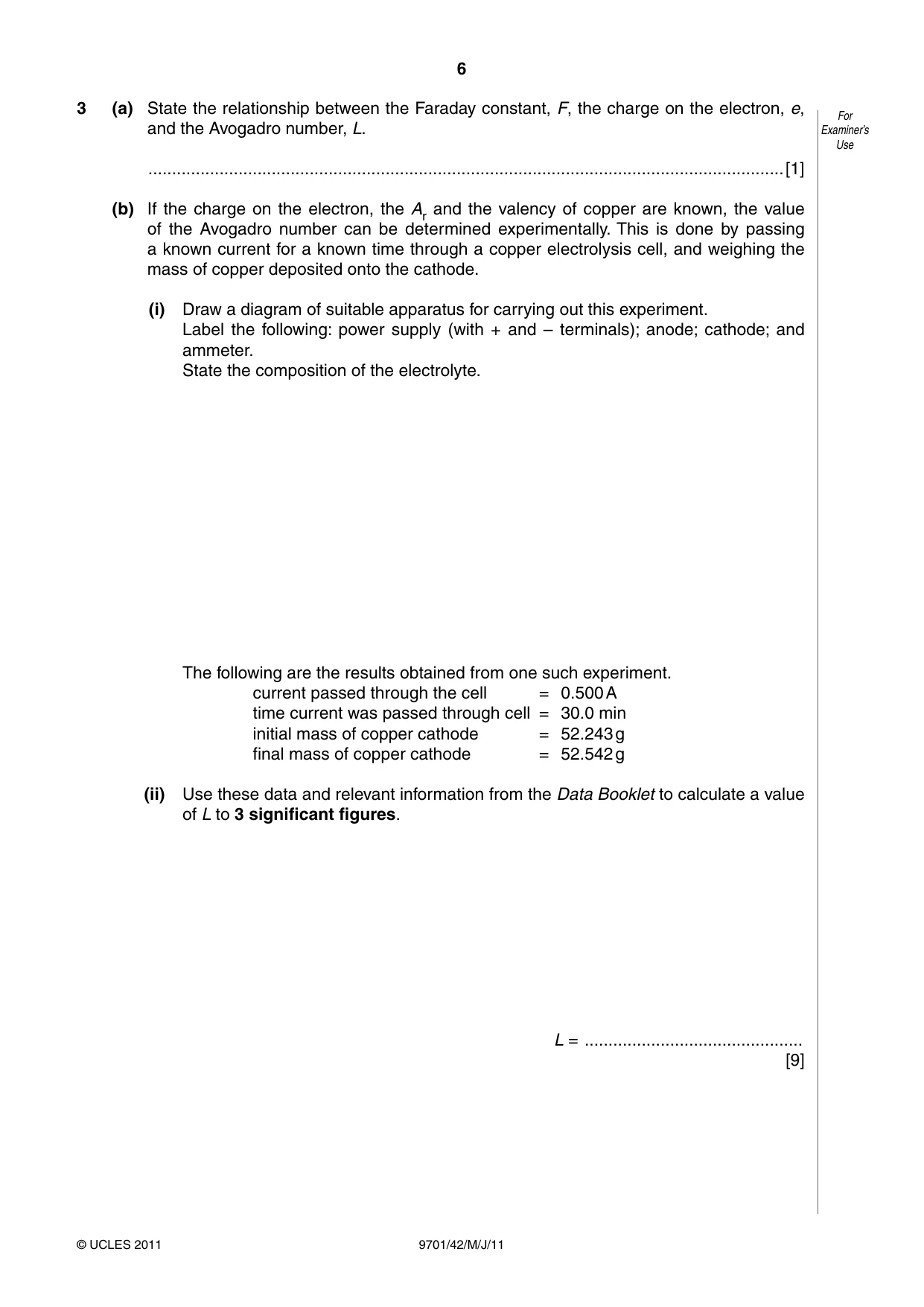
6 © UCLES 2011 9701/42/M/J/11 For Examiner’s Use 3 (a) State the relationship between the Faraday constant, F, the charge on the electron, e, and the Avogadro number, L. …[1] (b) If the charge on the electron, the Ar and the valency of copper are known, the value of the Avogadro number can be determined experimentally. This is done by passing a known current for a known time through a copper electrolysis cell, and weighing the mass of copper deposited onto the cathode. (i) Draw a diagram of suitable apparatus for carrying out this experiment. Label the following: power supply (with + and – terminals); anode; cathode; and ammeter. State the composition of the electrolyte. The following are the results obtained from one such experiment. current passed through the cell = 0.500 A time current was passed through cell = 30.0 min initial mass of copper cathode = 52.243 g final mass of copper cathode = 52.542 g (ii) Use these data and relevant information from the Data Booklet to calculate a value of L to 3 significant figures. L = … [9]
Question paper, page 7
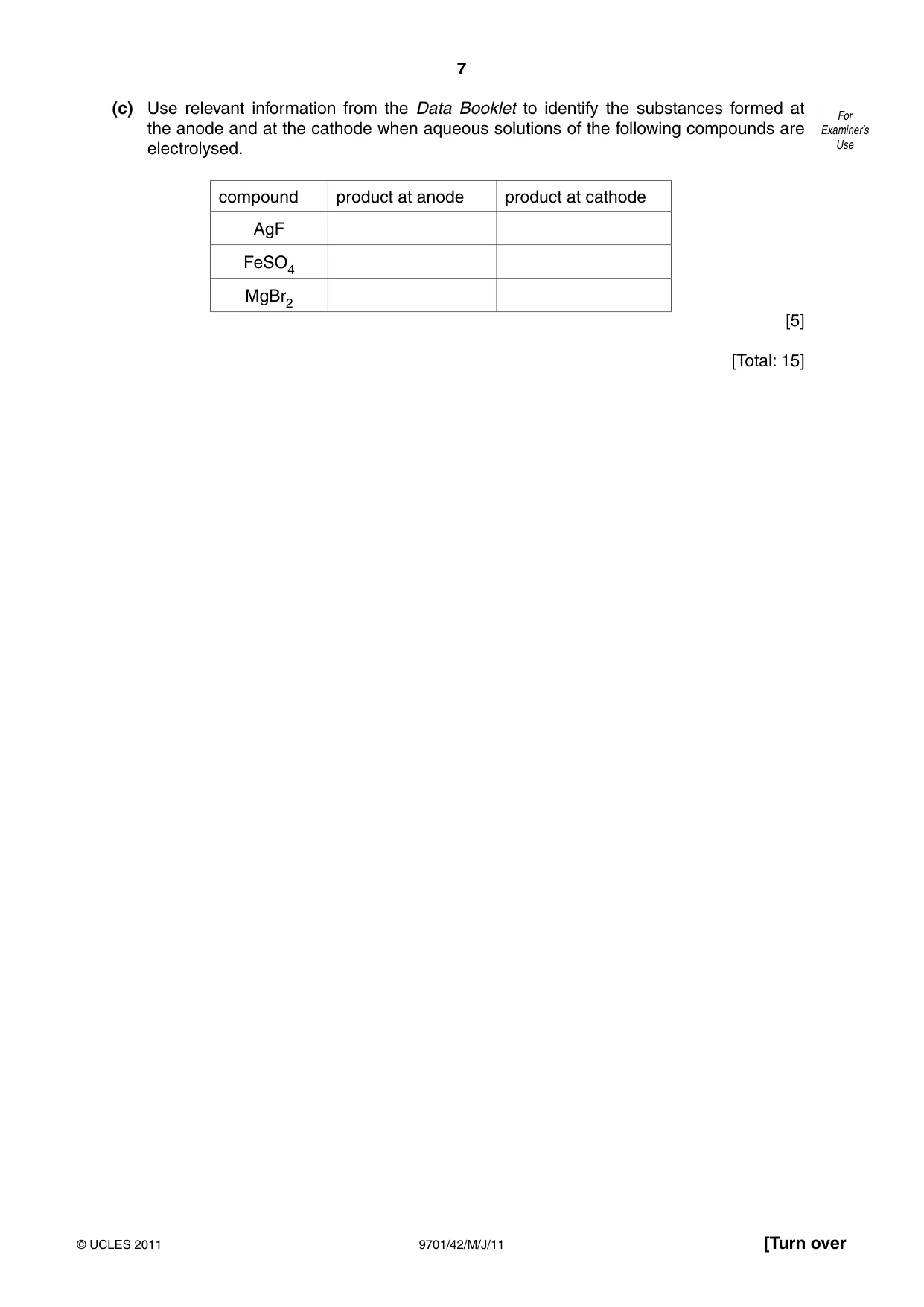
7 © UCLES 2011 [Turn over 9701/42/M/J/11 For Examiner’s Use (c) Use relevant information from the Data Booklet to identify the substances formed at the anode and at the cathode when aqueous solutions of the following compounds are electrolysed. compound product at anode product at cathode AgF FeSO4 MgBr2 [5] [Total: 15]
Question paper, page 8
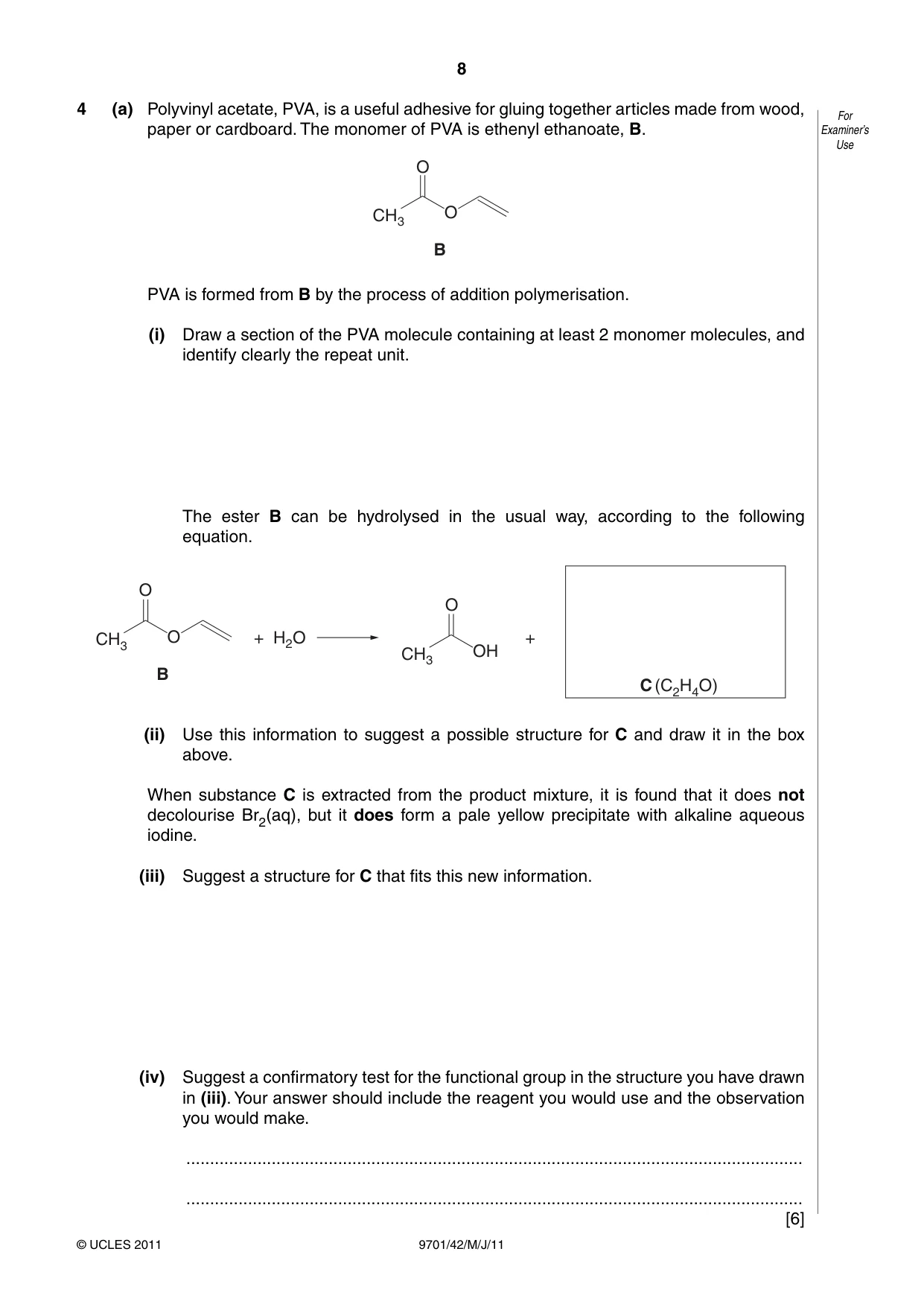
8 © UCLES 2011 9701/42/M/J/11 For Examiner’s Use 4 (a) Polyvinyl acetate, PVA, is a useful adhesive for gluing together articles made from wood, paper or cardboard. The monomer of PVA is ethenyl ethanoate, B. CH3 B O O PVA is formed from B by the process of addition polymerisation. (i) Draw a section of the PVA molecule containing at least 2 monomer molecules, and identify clearly the repeat unit. The ester B can be hydrolysed in the usual way, according to the following equation. CH3 B C (C2H4O) O O O + H2O + CH3 OH (ii) Use this information to suggest a possible structure for C and draw it in the box above. When substance C is extracted from the product mixture, it is found that it does not decolourise Br2(aq), but it does form a pale yellow precipitate with alkaline aqueous iodine. (iii) Suggest a structure for C that fits this new information. (iv) Suggest a confirmatory test for the functional group in the structure you have drawn in (iii). Your answer should include the reagent you would use and the observation you would make. … … [6]
Question paper, page 9
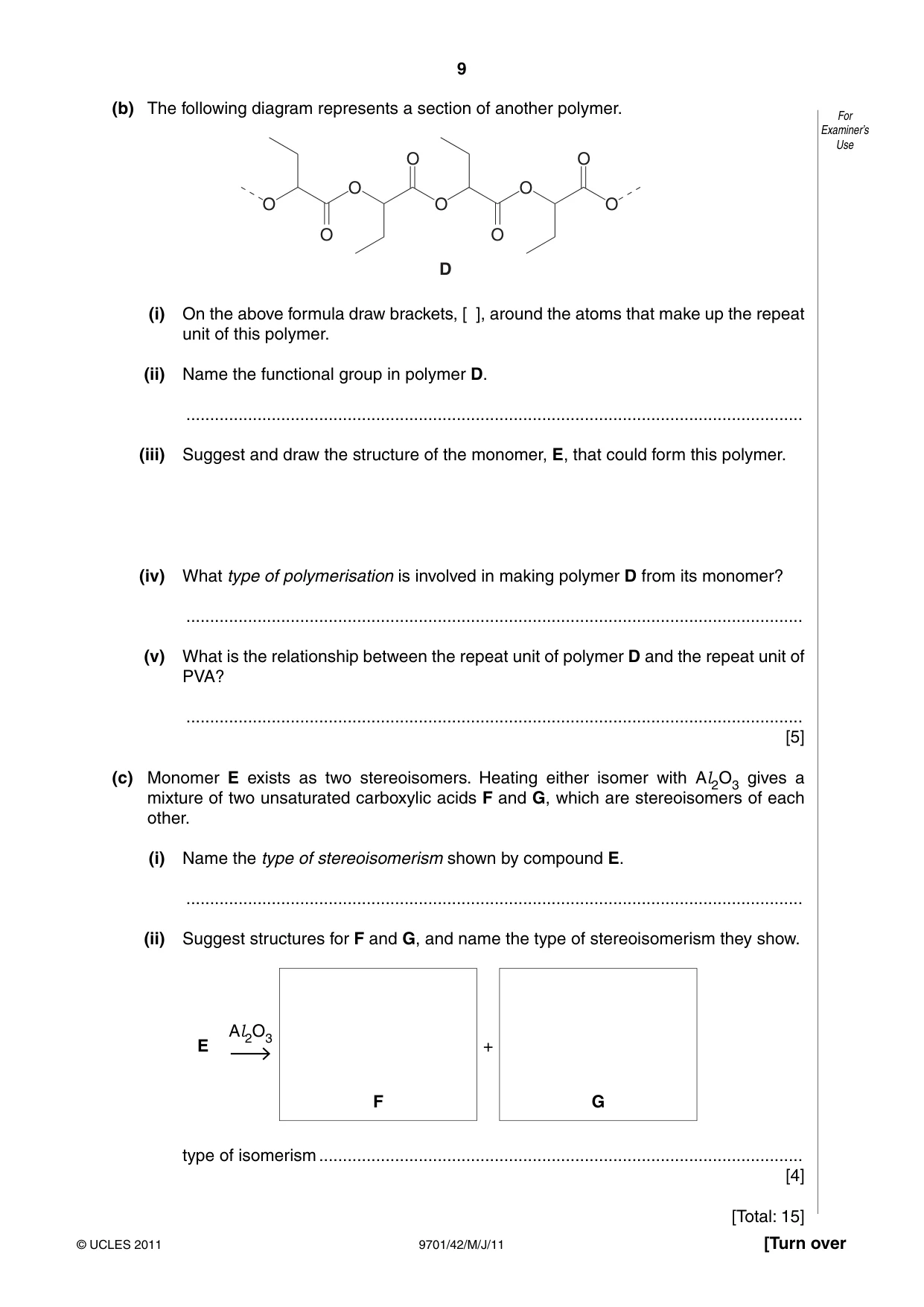
9 © UCLES 2011 [Turn over 9701/42/M/J/11 For Examiner’s Use (b) The following diagram represents a section of another polymer. D O O O O O O O O O (i) On the above formula draw brackets, [ ], around the atoms that make up the repeat unit of this polymer. (ii) Name the functional group in polymer D. … (iii) Suggest and draw the structure of the monomer, E, that could form this polymer. (iv) What type of polymerisation is involved in making polymer D from its monomer? … (v) What is the relationship between the repeat unit of polymer D and the repeat unit of PVA? … [5] (c) Monomer E exists as two stereoisomers. Heating either isomer with Al2O3 gives a mixture of two unsaturated carboxylic acids F and G, which are stereoisomers of each other. (i) Name the type of stereoisomerism shown by compound E. … (ii) Suggest structures for F and G, and name the type of stereoisomerism they show. E Al2O3 F + G type of isomerism … [4] [Total: 15]
Question paper, page 10
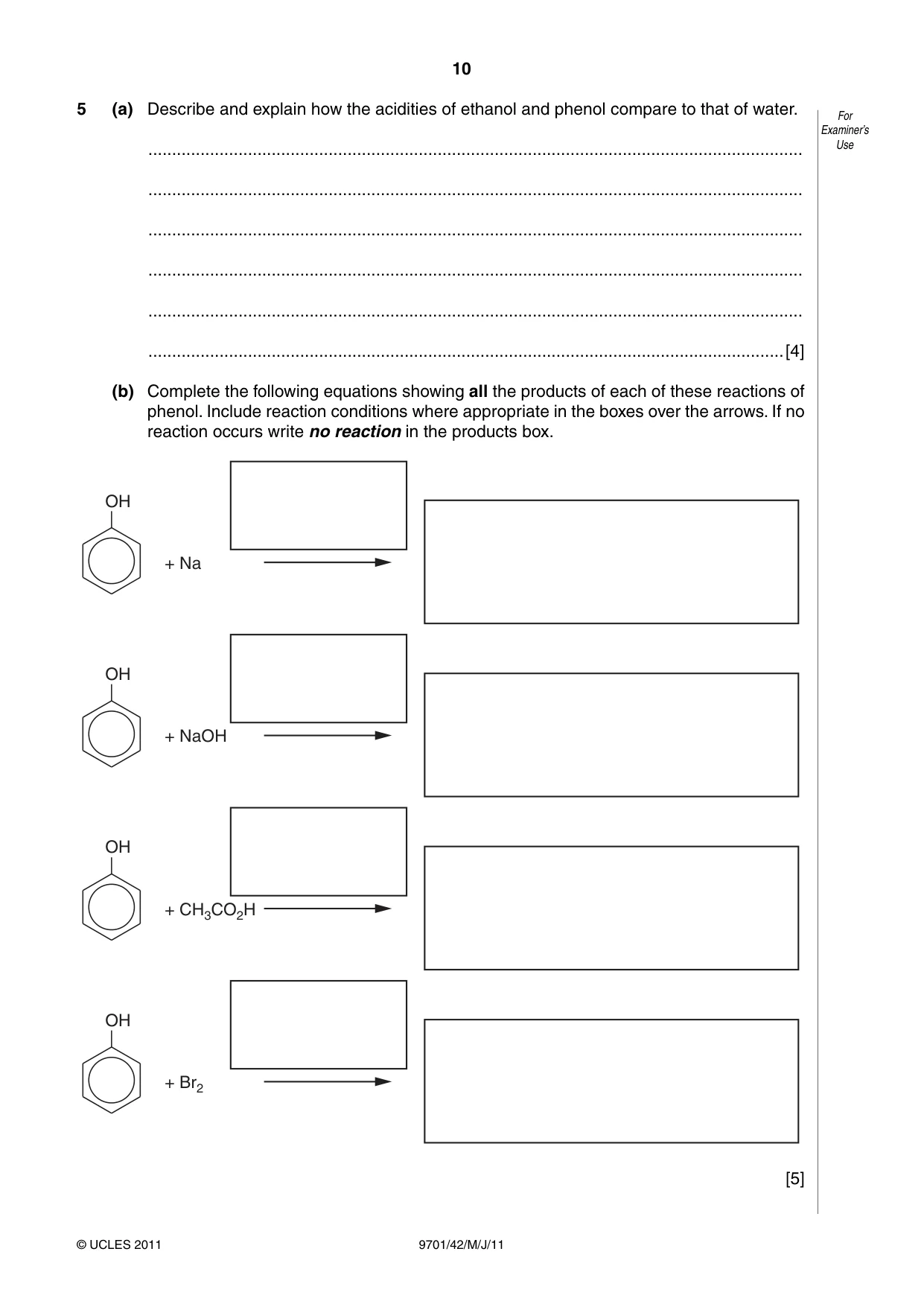
10 © UCLES 2011 9701/42/M/J/11 For Examiner’s Use 5 (a) Describe and explain how the acidities of ethanol and phenol compare to that of water. … … … … … …[4] (b) Complete the following equations showing all the products of each of these reactions of phenol. Include reaction conditions where appropriate in the boxes over the arrows. If no reaction occurs write no reaction in the products box. OH + Na OH + NaOH OH + CH3CO2H OH + Br2 [5]
Question paper, page 11
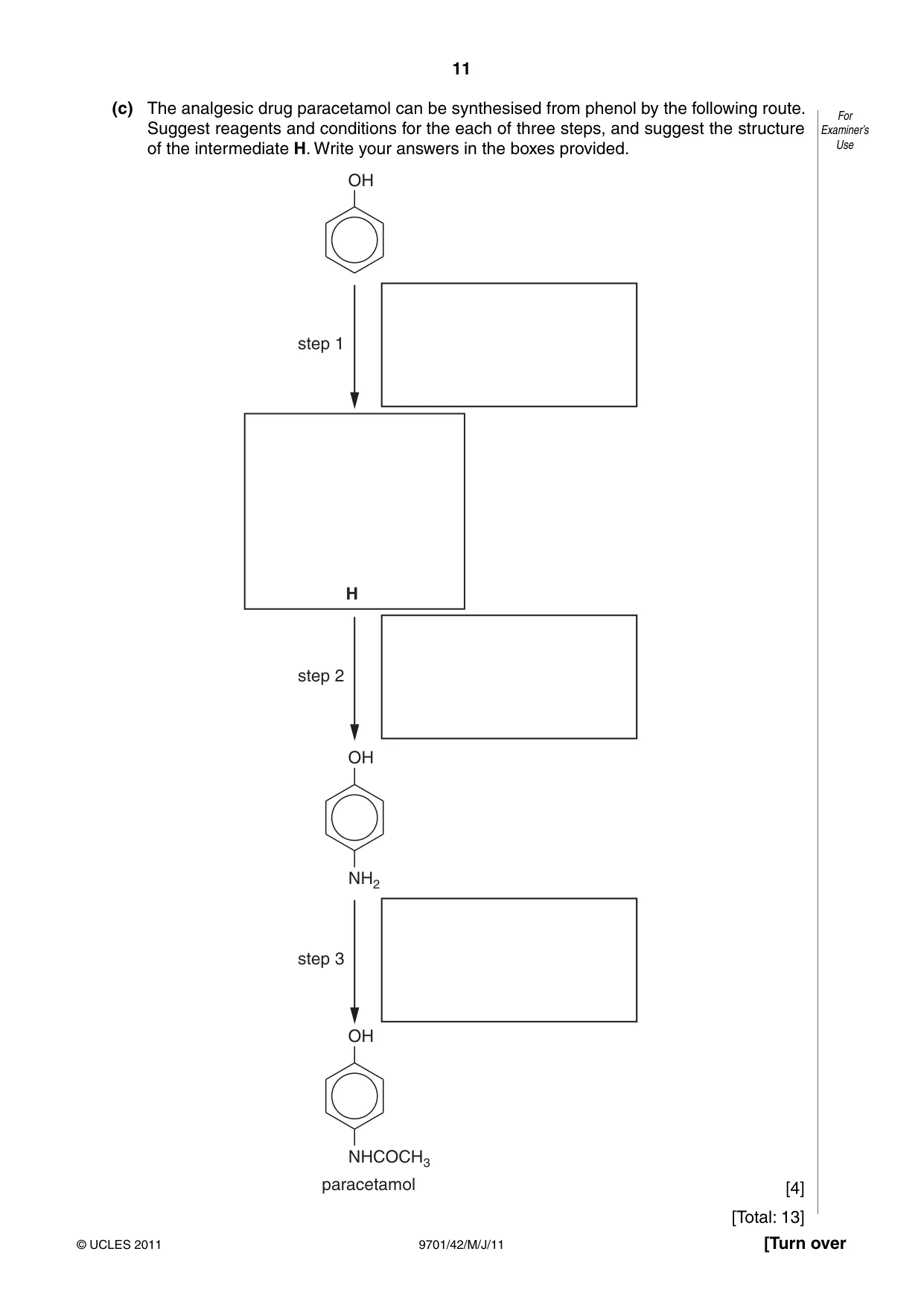
11 © UCLES 2011 [Turn over 9701/42/M/J/11 For Examiner’s Use (c) The analgesic drug paracetamol can be synthesised from phenol by the following route. Suggest reagents and conditions for the each of three steps, and suggest the structure of the intermediate H. Write your answers in the boxes provided. step 1 H NH2 OH OH NHCOCH3 OH step 2 step 3 paracetamol [4] [Total: 13]
Question paper, page 12
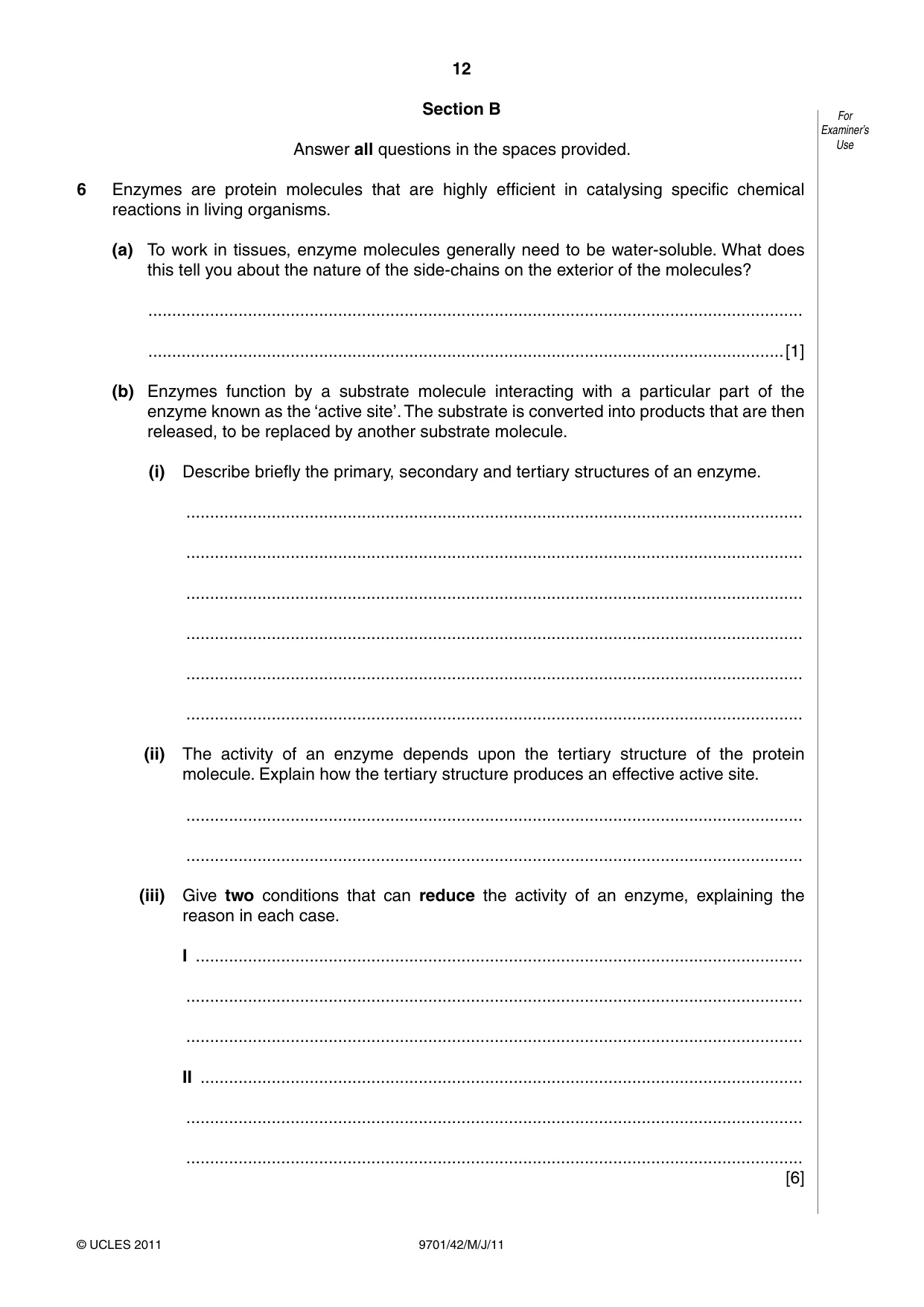
12 © UCLES 2011 9701/42/M/J/11 For Examiner’s Use Section B Answer all questions in the spaces provided. 6 Enzymes are protein molecules that are highly efficient in catalysing specific chemical reactions in living organisms. (a) To work in tissues, enzyme molecules generally need to be water-soluble. What does this tell you about the nature of the side-chains on the exterior of the molecules? … …[1] (b) Enzymes function by a substrate molecule interacting with a particular part of the enzyme known as the ‘active site’. The substrate is converted into products that are then released, to be replaced by another substrate molecule. (i) Describe briefly the primary, secondary and tertiary structures of an enzyme. … … … … … … (ii) The activity of an enzyme depends upon the tertiary structure of the protein molecule. Explain how the tertiary structure produces an effective active site. … … (iii) Give two conditions that can reduce the activity of an enzyme, explaining the reason in each case. I … … … II … … … [6]
Question paper, page 13
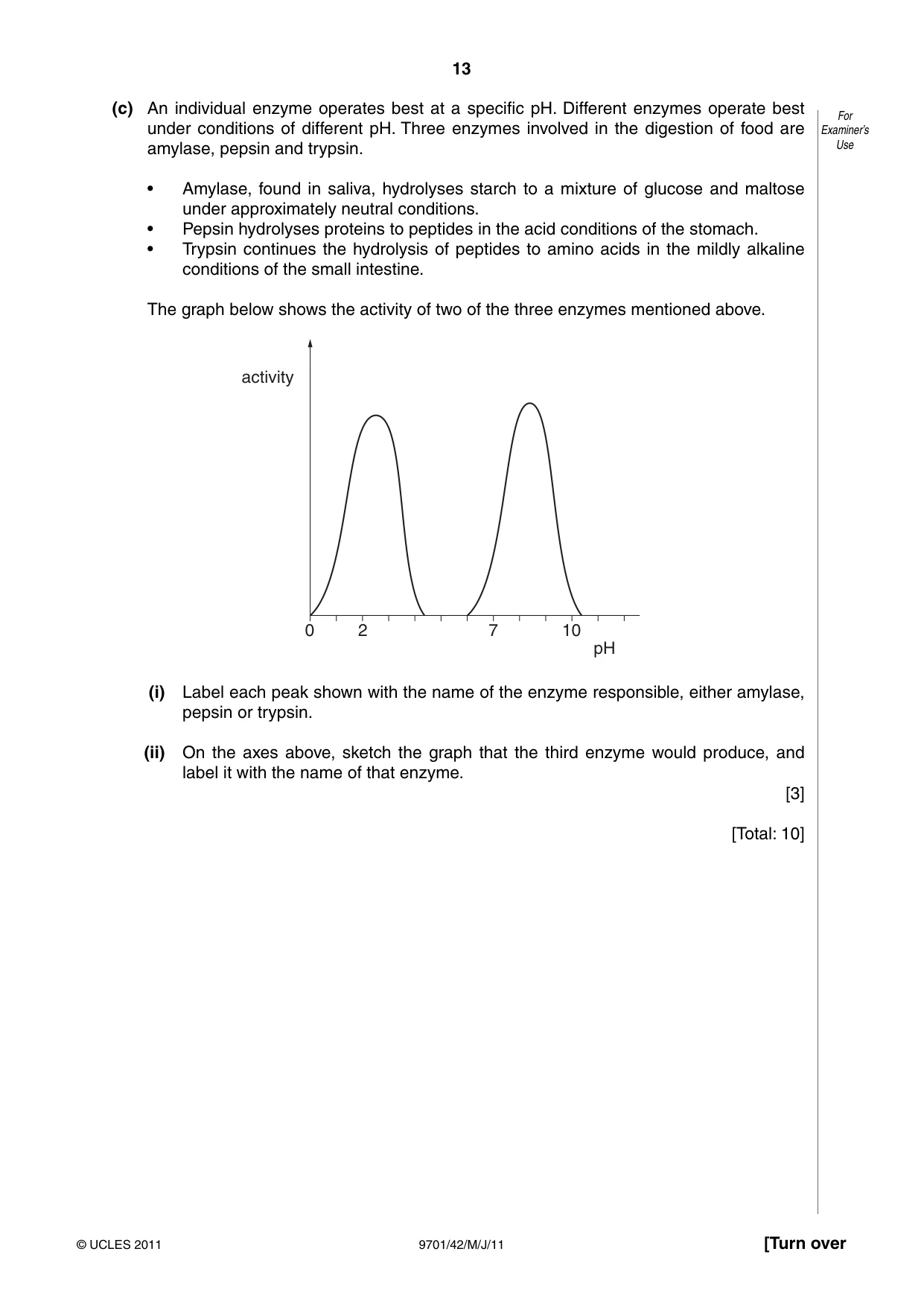
13 © UCLES 2011 [Turn over 9701/42/M/J/11 For Examiner’s Use (c) An individual enzyme operates best at a specific pH. Different enzymes operate best under conditions of different pH. Three enzymes involved in the digestion of food are amylase, pepsin and trypsin. • Amylase, found in saliva, hydrolyses starch to a mixture of glucose and maltose under approximately neutral conditions. • Pepsin hydrolyses proteins to peptides in the acid conditions of the stomach. • Trypsin continues the hydrolysis of peptides to amino acids in the mildly alkaline conditions of the small intestine. The graph below shows the activity of two of the three enzymes mentioned above. 0 2 7 10 pH activity (i) Label each peak shown with the name of the enzyme responsible, either amylase, pepsin or trypsin. (ii) On the axes above, sketch the graph that the third enzyme would produce, and label it with the name of that enzyme. [3] [Total: 10]
Question paper, page 14
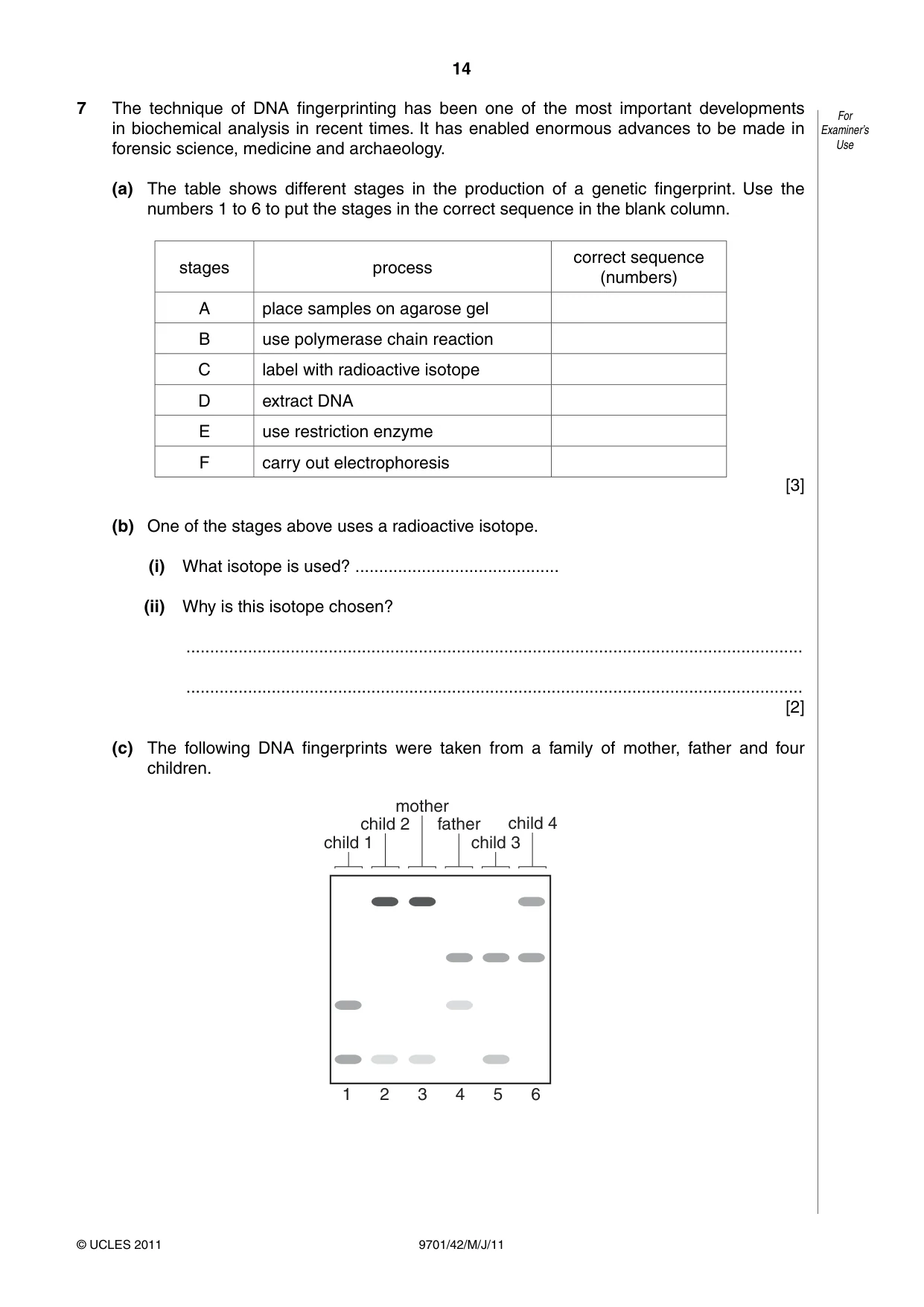
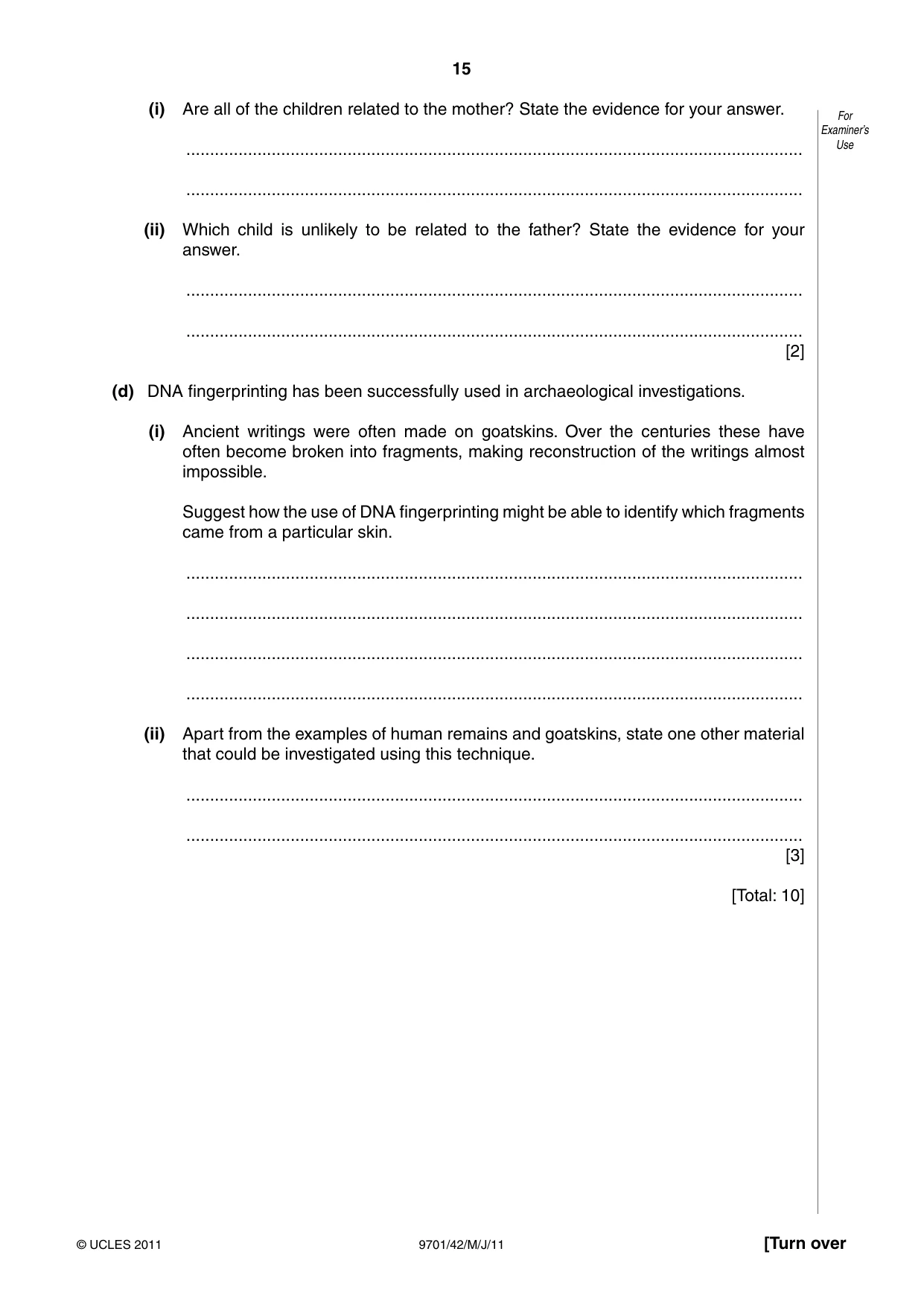
14 © UCLES 2011 9701/42/M/J/11 For Examiner’s Use 7 The technique of DNA fingerprinting has been one of the most important developments in biochemical analysis in recent times. It has enabled enormous advances to be made in forensic science, medicine and archaeology. (a) The table shows different stages in the production of a genetic fingerprint. Use the numbers 1 to 6 to put the stages in the correct sequence in the blank column. stages process correct sequence (numbers) A place samples on agarose gel B use polymerase chain reaction C label with radioactive isotope D extract DNA E use restriction enzyme F carry out electrophoresis [3] (b) One of the stages above uses a radioactive isotope. (i) What isotope is used? … (ii) Why is this isotope chosen? … … [2] (c) The following DNA fingerprints were taken from a family of mother, father and four children. 1 2 3 4 5 6 child 1 child 2 mother father child 3 child 4
Question paper, page 15
15 © UCLES 2011 [Turn over 9701/42/M/J/11 For Examiner’s Use (i) Are all of the children related to the mother? State the evidence for your answer. … … (ii) Which child is unlikely to be related to the father? State the evidence for your answer. … … [2] (d) DNA fingerprinting has been successfully used in archaeological investigations. (i) Ancient writings were often made on goatskins. Over the centuries these have often become broken into fragments, making reconstruction of the writings almost impossible. Suggest how the use of DNA fingerprinting might be able to identify which fragments came from a particular skin. … … … … (ii) Apart from the examples of human remains and goatskins, state one other material that could be investigated using this technique. … … [3] [Total: 10]
Question paper, page 16
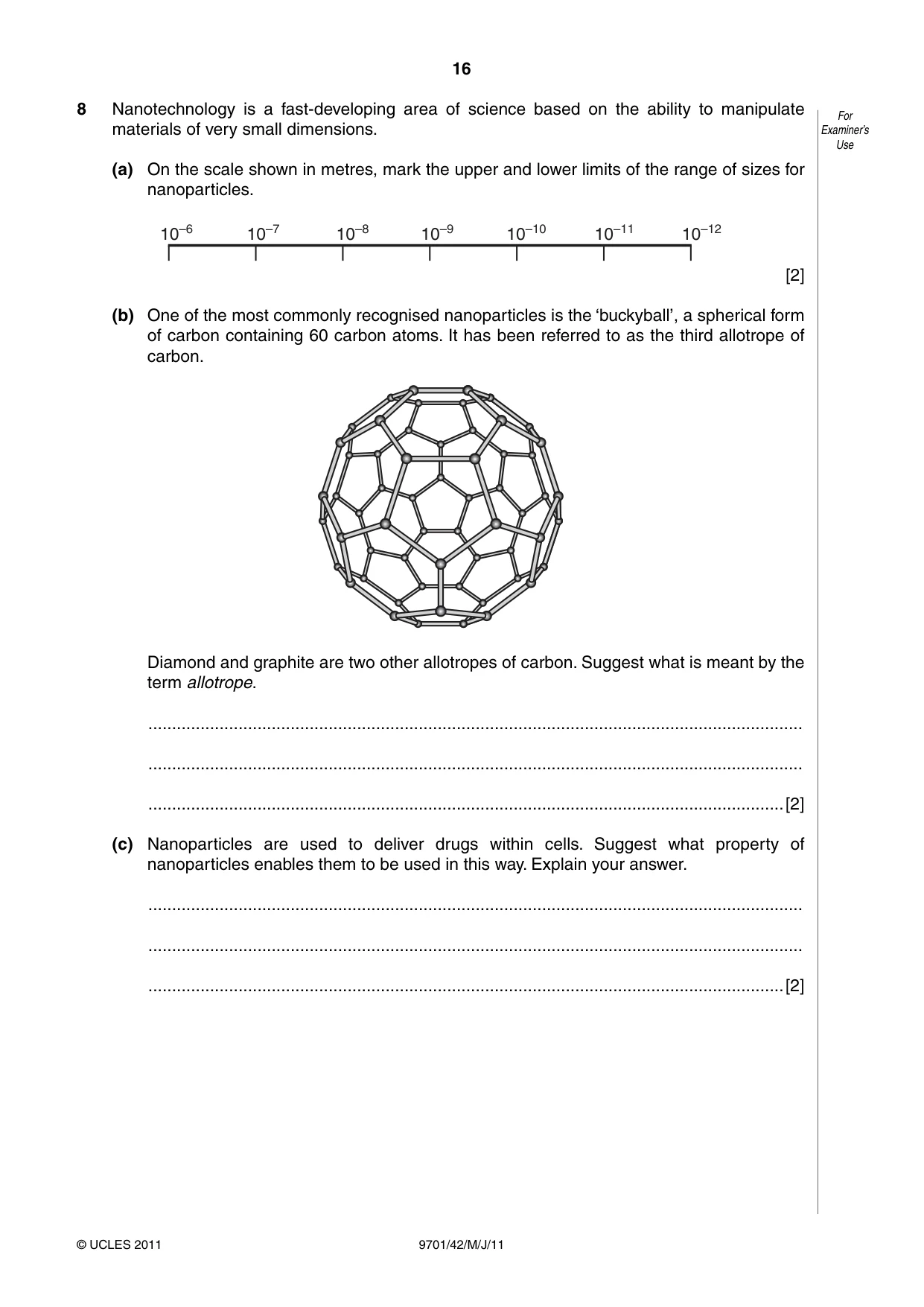
16 © UCLES 2011 9701/42/M/J/11 For Examiner’s Use 8 Nanotechnology is a fast-developing area of science based on the ability to manipulate materials of very small dimensions. (a) On the scale shown in metres, mark the upper and lower limits of the range of sizes for nanoparticles. 10–6 10–7 10–8 10–9 10–10 10–11 10–12 [2] (b) One of the most commonly recognised nanoparticles is the ‘buckyball’, a spherical form of carbon containing 60 carbon atoms. It has been referred to as the third allotrope of carbon. Diamond and graphite are two other allotropes of carbon. Suggest what is meant by the term allotrope. … … …[2] (c) Nanoparticles are used to deliver drugs within cells. Suggest what property of nanoparticles enables them to be used in this way. Explain your answer. … … …[2]
Question paper, page 17
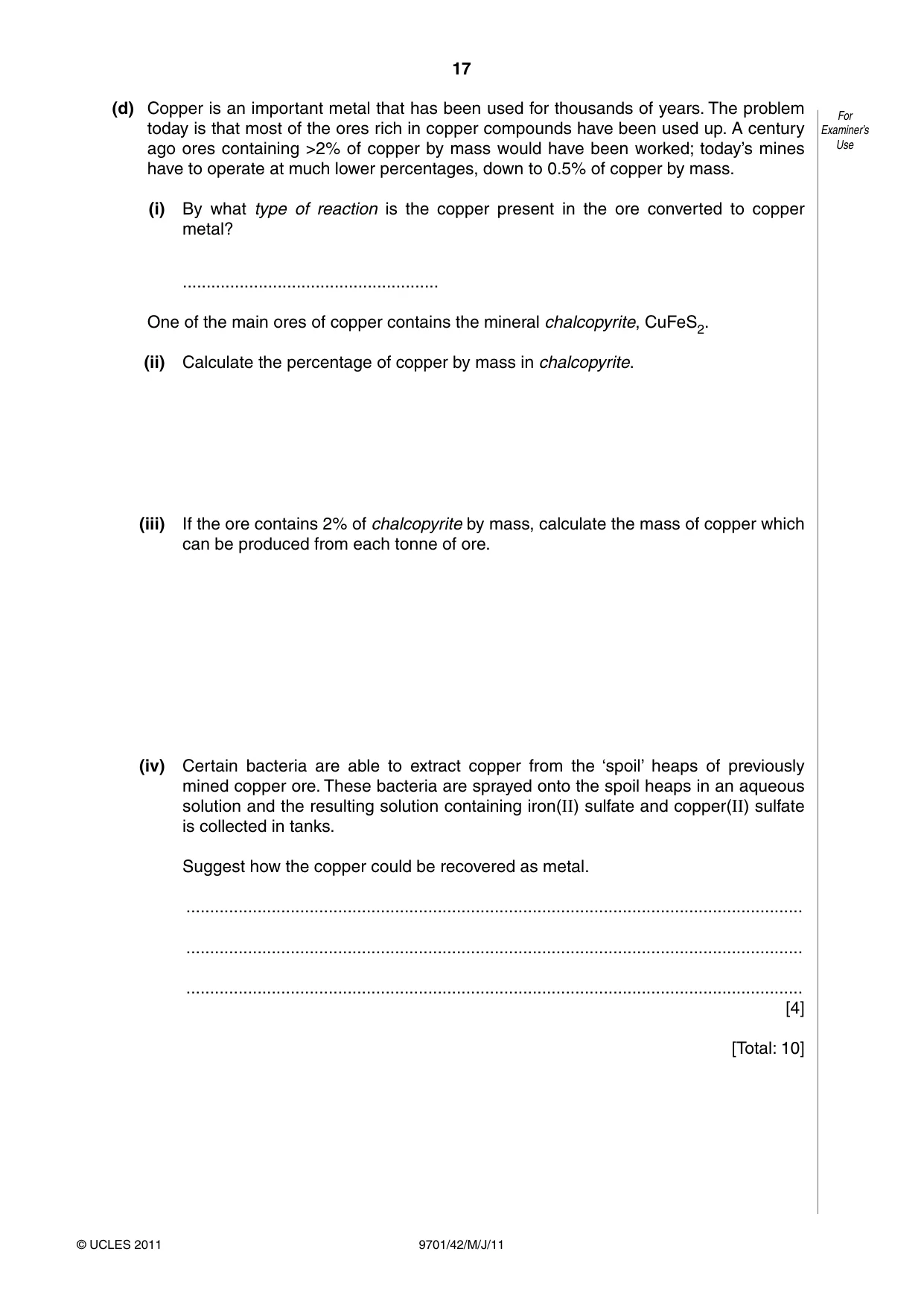
17 © UCLES 2011 9701/42/M/J/11 For Examiner’s Use (d) Copper is an important metal that has been used for thousands of years. The problem today is that most of the ores rich in copper compounds have been used up. A century ago ores containing >2% of copper by mass would have been worked; today’s mines have to operate at much lower percentages, down to 0.5% of copper by mass. (i) By what type of reaction is the copper present in the ore converted to copper metal? … One of the main ores of copper contains the mineral chalcopyrite, CuFeS2. (ii) Calculate the percentage of copper by mass in chalcopyrite. (iii) If the ore contains 2% of chalcopyrite by mass, calculate the mass of copper which can be produced from each tonne of ore. (iv) Certain bacteria are able to extract copper from the ‘spoil’ heaps of previously mined copper ore. These bacteria are sprayed onto the spoil heaps in an aqueous solution and the resulting solution containing iron(II) sulfate and copper(II) sulfate is collected in tanks. Suggest how the copper could be recovered as metal. … … … [4] [Total: 10]
Question paper, page 18
18 9701/42/M/J/11 © UCLES 2011 BLANK PAGE
Question paper, page 19
19 9701/42/M/J/11 © UCLES 2011 BLANK PAGE
Question paper, page 20
20 9701/42/M/J/11 © UCLES 2011 BLANK PAGE Permission to reproduce items where third-party owned material protected by copyright is included has been sought and cleared where possible. Every reasonable effort has been made by the publisher (UCLES) to trace copyright holders, but if any items requiring clearance have unwittingly been included, the publisher will be pleased to make amends at the earliest possible opportunity. University of Cambridge International Examinations is part of the Cambridge Assessment Group. Cambridge Assessment is the brand name of University of Cambridge Local Examinations Syndicate (UCLES), which is itself a department of the University of Cambridge.
Mark scheme, page 1
UNIVERSITY OF CAMBRIDGE INTERNATIONAL EXAMINATIONS GCE Advanced Level MARK SCHEME for the May/June 2011 question paper for the guidance of teachers 9701 CHEMISTRY 9701/42 Paper 4 (A2 Structured Questions), maximum raw mark 100 This mark scheme is published as an aid to teachers and candidates, to indicate the requirements of the examination. It shows the basis on which Examiners were instructed to award marks. It does not indicate the details of the discussions that took place at an Examiners’ meeting before marking began, which would have considered the acceptability of alternative answers. Mark schemes must be read in conjunction with the question papers and the report on the examination. • Cambridge will not enter into discussions or correspondence in connection with these mark schemes. Cambridge is publishing the mark schemes for the May/June 2011 question papers for most IGCSE, GCE Advanced Level and Advanced Subsidiary Level syllabuses and some Ordinary Level syllabuses.
Mark scheme, page 2
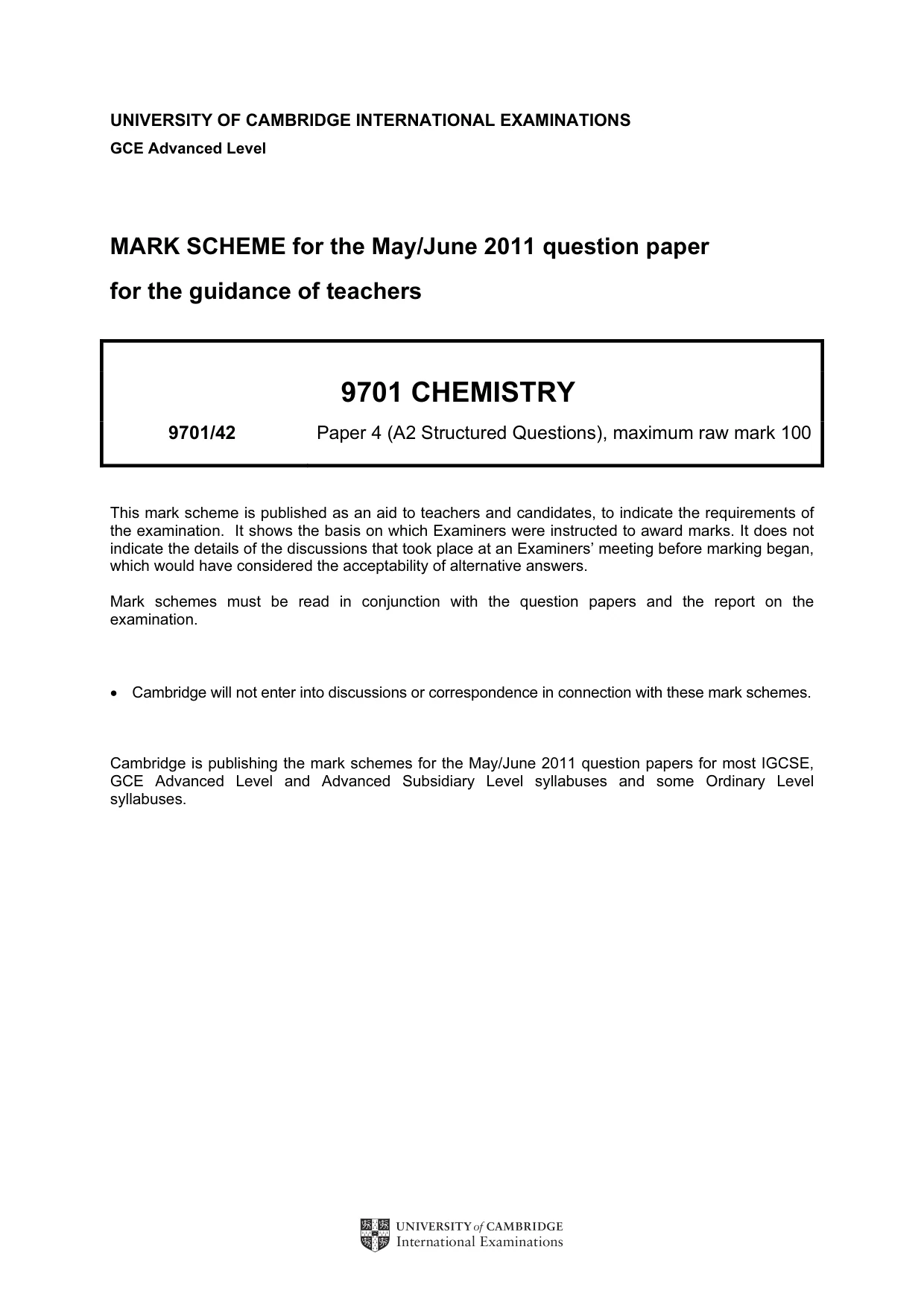
Page 2 Mark Scheme: Teachers’ version Syllabus Paper GCE A LEVEL – May/June 2011 9701 42 © University of Cambridge International Examinations 2011 1 (a) [H+] = √(0.05 × 5.6 × 10–4) = 5.29 × 10⁻³ mol dm–3 [1] pH = –log10(5.29 × 10⁻³) = 2.3 [1] [2] (b) (i) (Brønsted-Lowry) acid-base/proton transfer/neutralisation/exothermic/reversible/ equilibrium [1] (ii) H F H H H H F H H H N N [1] [1] [1] 3 x [1] (iii) (in NH4F): covalent: between N & H [1] dative: between N & H [1] ionic: between NH4 + & F– or N+ & F– or ammonium and fluoride (i.e. in words) or between (oppositely charge) ions [1] (iv) (reverse reaction, remember) high temperature, because reverse reaction is endothermic [1] low pressure, because reverse reaction causes an increase in no. of gaseous molecules or an increase in partial pressure/volume. [1] [9] (c) (i) 4NH3 + CuS + 2O2 → [Cu(NH3)4]SO4 [1] (ii) deep/dark/royal blue or purple [NOT violet] [1] (iii) deep blue colour would change to light blue [NOT intensity of colour decreases] [1] ⇒ hexaquocopper(II) ion or [Cu(H2O)6]2+ or [Cu(H2O)n(NH3)a–n]2+, where a = 4 or 6 or ligand exchange (of NH3) by H2O [1] [4] (d) ligand exchange/substitution/displacement/replacement [IN WORDS] [1] (use of named ligands are OK instead of ‘ligand’. e.g. “water is displaced by chloride”) formula of anion (see below for possibilities) [1] balanced equation. e.g.[Cu(H2O)6]2+ + nCl– → [Cu(H2O)6–nCln]2–n + nH2O [1] (Allow n=1 up to n=6. Also allow [CuCln]2–n as product. Examples from many possible are: [Cu(H2O)6]2+ + 2Cl– → [Cu(H2O)4Cl2] + 2H2O [Cu(H2O)6]2+ + 4Cl– → [CuCl4]2– + 6H2O equation could include HCl on the LHS, for example: [Cu(H2O)6]2+ + 4HCl → H2CuCl4 + 2H+ + 6H2O or → CuCl4 2– + 4H+ + 6H2O [3] [Total: 18 max 17]
Mark scheme, page 3
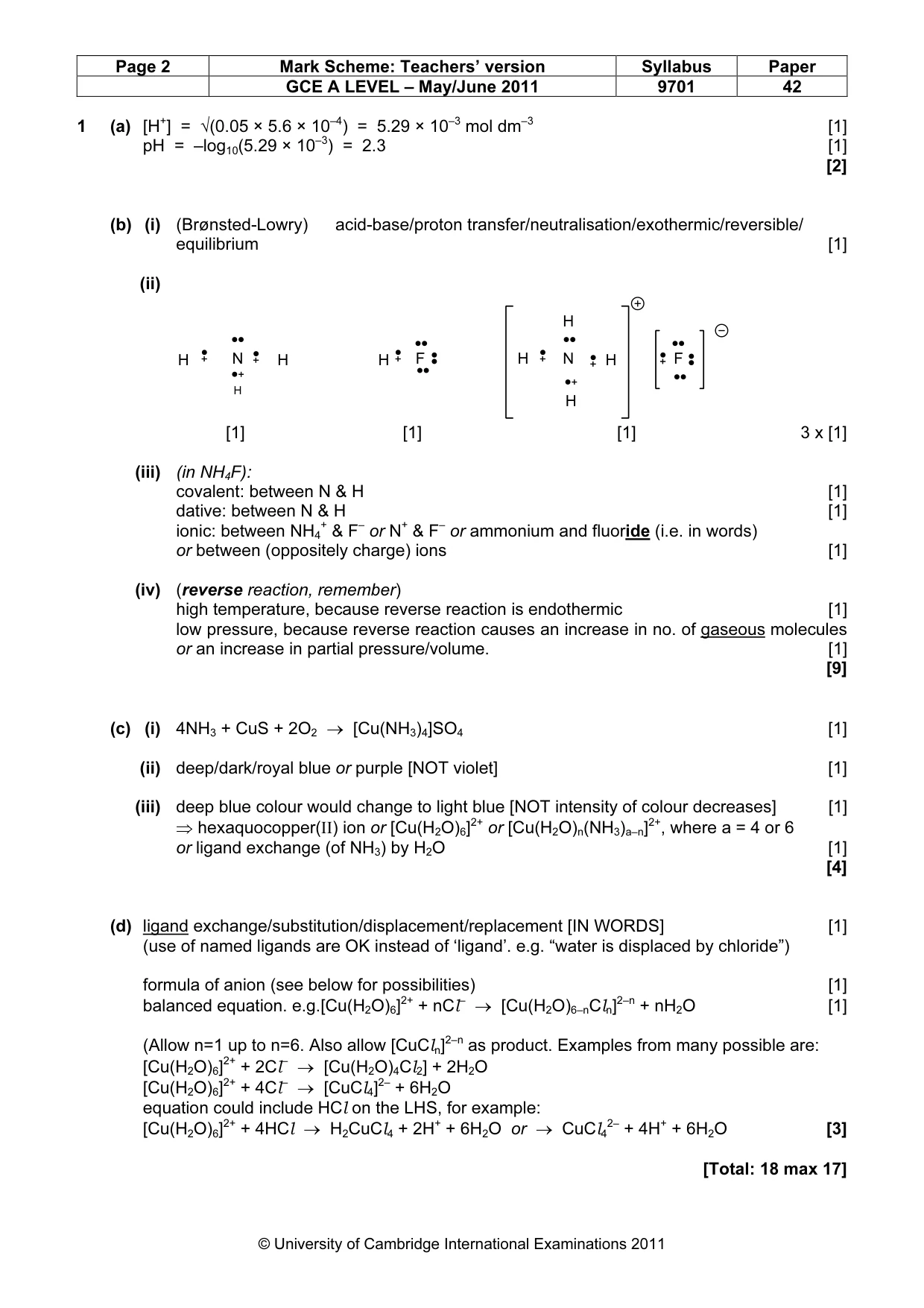
Page 3 Mark Scheme: Teachers’ version Syllabus Paper GCE A LEVEL – May/June 2011 9701 42 © University of Cambridge International Examinations 2011 2 (a) (i) C Si Ge Sn Pb high medium low C Si Ge Sn Pb high medium low melting point electrical conductivity or [2] + [2] (ii) m. pt. trend: (from) giant/macro molecular/covalent to metallic bonding (or implied from at least two specific examples, e.g. diamond and tin) [1] (mention of simple covalent anywhere negates this mark) conductivity trend: increasing delocalisation of electrons (down the group) [1] or e– are more free-moving (or implied from at least two examples, e.g. Si is semiconductor, lead has delocalised e–) [6] (b) (i) heat PbO2, or T > 200°C or ∆ on arrow: PbO2 → PbO + ½O2 (N.B. ½O2 NOT [O]) [1] (ii) (burning CO in air produces CO2):CO + ½O2 → CO2 [1] blue flame (ignore ref to limewater test) [1] (iii) e.g. SnCl2(aq) will turn KMnO4 from purple to colourless [1] 5Sn2+ + 2MnO4 – + 16H+ → 5Sn4+ + 2Mn2+ + 8H2O [1] or SnCl2(aq) will turn K2Cr2O7 from orange to green [1] 3Sn2+ + Cr2O7 2– + 14H+ → 3Sn4+ + 2Cr3+ + 7H2O [1] or SnCl2(aq) will turn Fe3+ from orange/brown/yellow to green/colourless [1] Sn2+ + 2Fe3+ → Sn4+ + 2Fe2+ [1] or SnCl2(aq) will turn Cu2+(aq) from blue to colourless or give a pink/brown/copper- coloured ppt. [1] Sn2+ + Cu2+ → Sn4+ + Cu [1] Other possible oxidants (Eo must be > +0.2V) include: S2O8 2–, H2O2, Cl2, Br2, I2 and Ag+. No observations with the first three of these, but this should be stated explicitly, e.g. “no colour change”. [5] [Total: 11 max 10]
Mark scheme, page 4
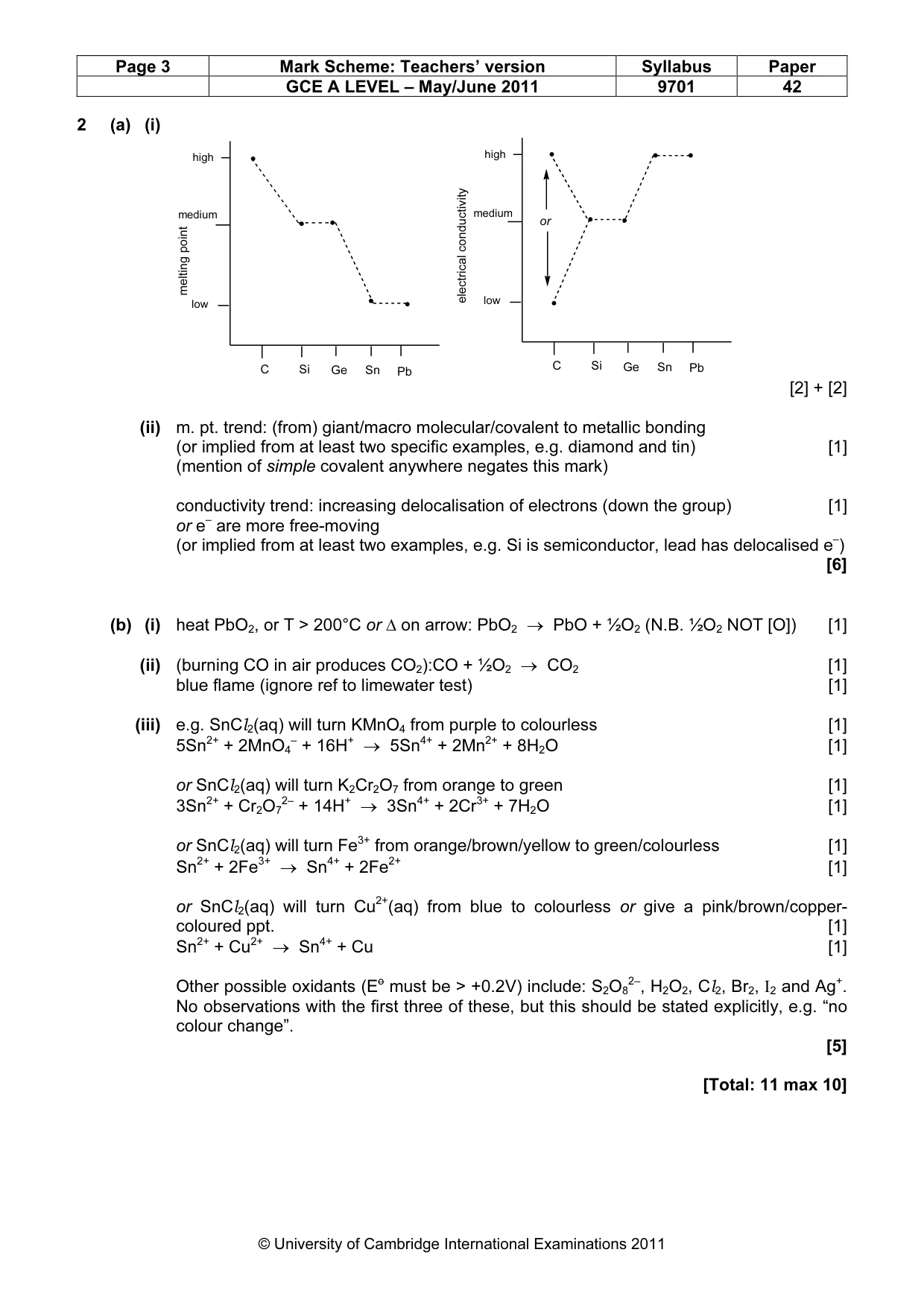
Page 4 Mark Scheme: Teachers’ version Syllabus Paper GCE A LEVEL – May/June 2011 9701 42 © University of Cambridge International Examinations 2011 3 (a) L = F/e or F = Le [1] [1] (b) (i) A P .S . + - anode cathode C uS O 4(aq) allow the conventional symbol to represent (the "P.S." is not required) correct cell (2 electrodes + PS circuit) [1] ammeter in series [1] anode and cathode of the right polarity [IN WORDS] [1] CuSO4(aq) or CuCl2(aq) or Cu2+(aq) or soln or 1 mol dm–3 [1] (ii) n(Cu) = (52.542–52.243)/63.5 = 4.71 × 10⁻³ mol (4.67 × 10⁻³) [1] n(e–) required = 4.71 × 10–3 × 2 = 9.42 × 10⁻³ mol (9.34 × 10⁻³) ecf [1] amount of electricity passed = 0.5 × 30 × 60 = 900 C [1] no. of electrons passed = 900/1.6 × 10–19 = 5.625 × 10²¹ ecf [1] no of electrons/n(e–) = L = 5.625 × 10²¹/9.42 × 10–3 = 5.97 × 10²³ mol–1 (6.02 × 10²³) ecf [1] (values in italics are if candidate has used Ar = 64, not 63.5. No last mark if not 3 s.f.: correct ans = [5]) [9] (c) compound product at anode product at cathode AgF O2 Ag FeSO4 O2 H2 MgBr2 Br2 H2 6 correct ⇒ [5] 5 correct⇒ [4] etc. Names can be used instead of symbols. If the atomic symbol (e.g. Br or H or O) is used instead of the molecular formula (e.g. Br2 etc.) then deduct [1] mark only for the whole table. [5] [Total: 15]
Mark scheme, page 5
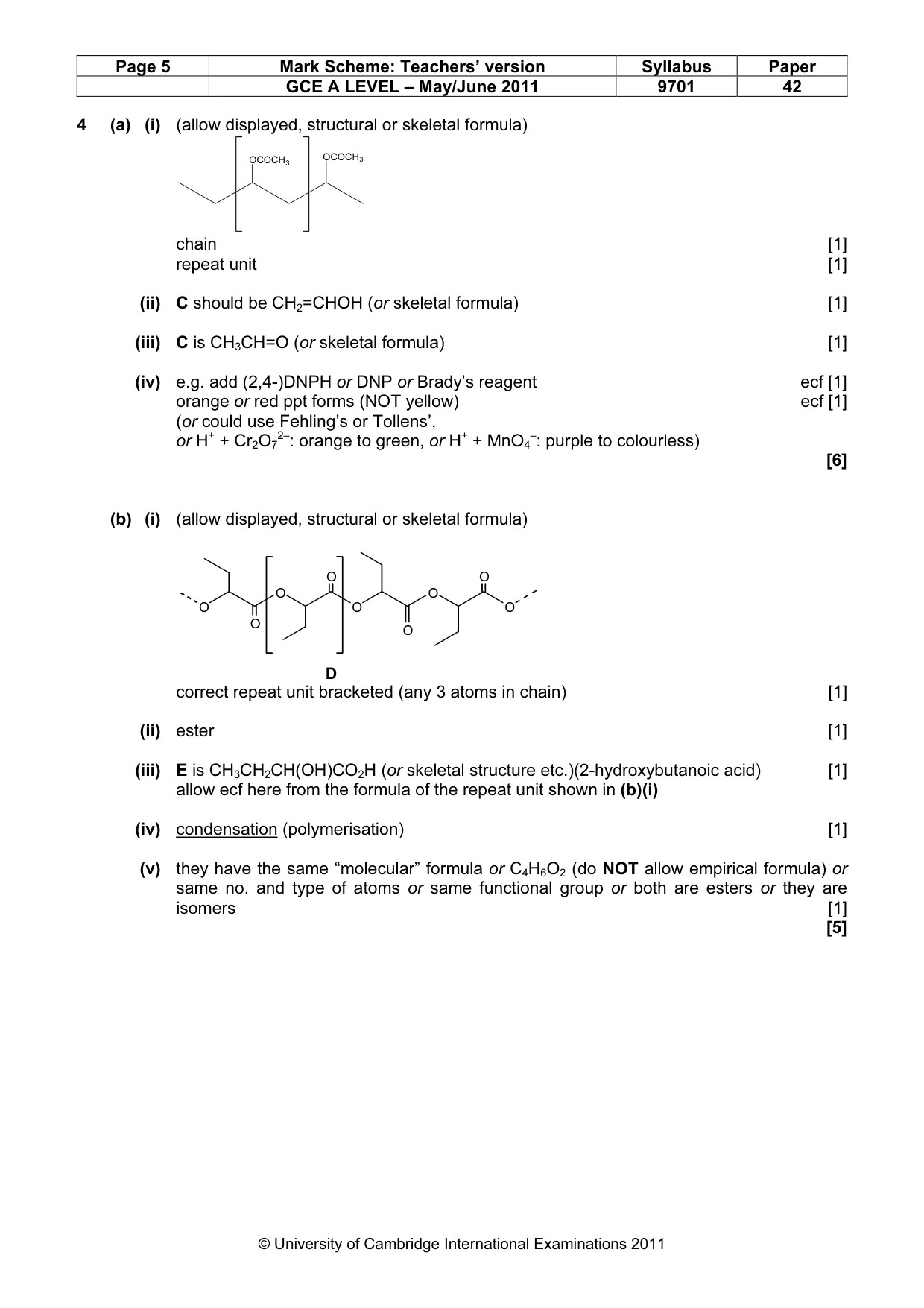
Page 5 Mark Scheme: Teachers’ version Syllabus Paper GCE A LEVEL – May/June 2011 9701 42 © University of Cambridge International Examinations 2011 4 (a) (i) (allow displayed, structural or skeletal formula) OCOCH3 OCOCH3 chain [1] repeat unit [1] (ii) C should be CH2=CHOH (or skeletal formula) [1] (iii) C is CH3CH=O (or skeletal formula) [1] (iv) e.g. add (2,4-)DNPH or DNP or Brady’s reagent ecf [1] orange or red ppt forms (NOT yellow) ecf [1] (or could use Fehling’s or Tollens’, or H+ + Cr2O7 2–: orange to green, or H+ + MnO4 –: purple to colourless) [6] (b) (i) (allow displayed, structural or skeletal formula) O O O O O O O O O D correct repeat unit bracketed (any 3 atoms in chain) [1] (ii) ester [1] (iii) E is CH3CH2CH(OH)CO2H (or skeletal structure etc.)(2-hydroxybutanoic acid) [1] allow ecf here from the formula of the repeat unit shown in (b)(i) (iv) condensation (polymerisation) [1] (v) they have the same “molecular” formula or C4H6O2 (do NOT allow empirical formula) or same no. and type of atoms or same functional group or both are esters or they are isomers [1] [5]
Mark scheme, page 6
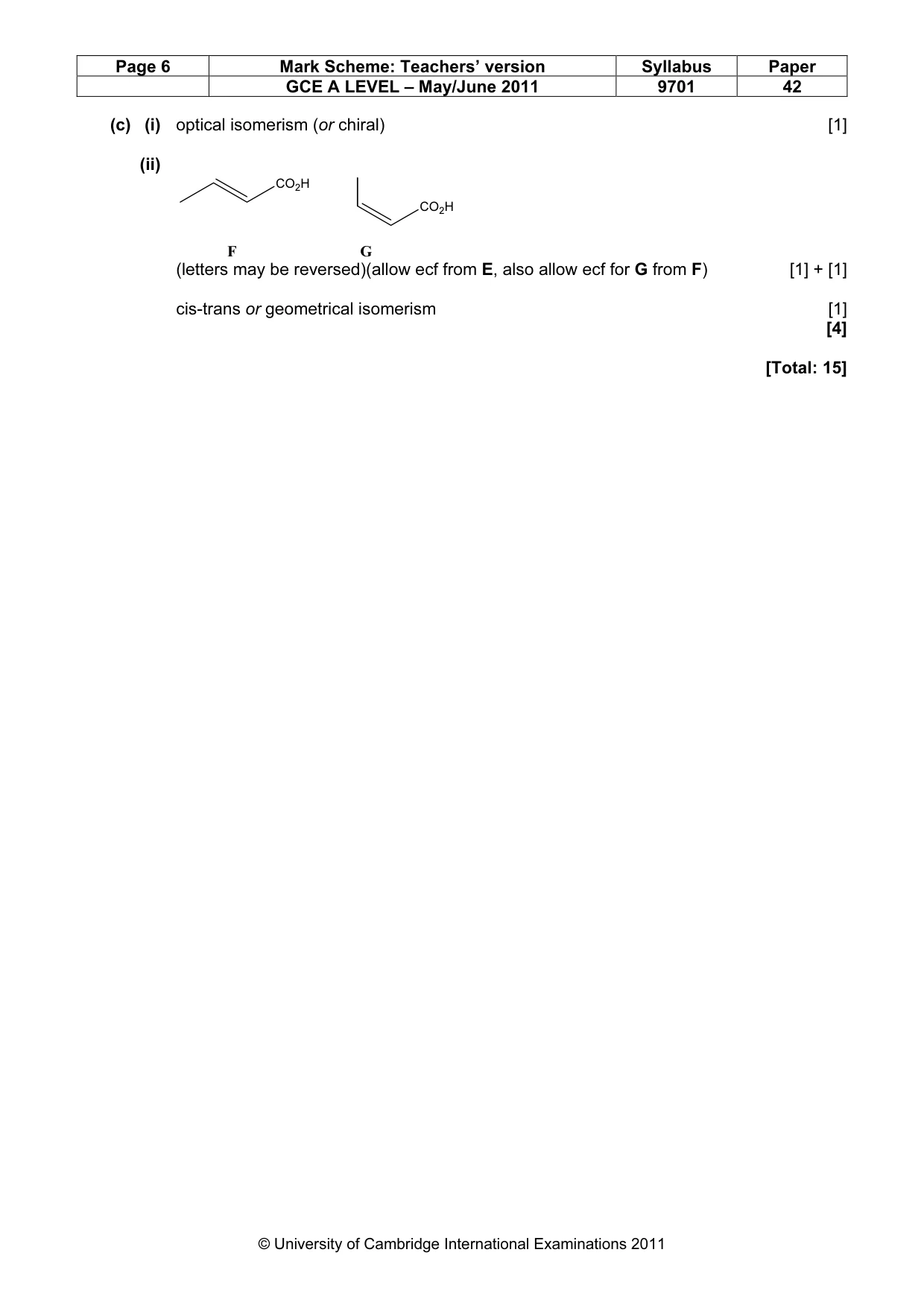
Page 6 Mark Scheme: Teachers’ version Syllabus Paper GCE A LEVEL – May/June 2011 9701 42 © University of Cambridge International Examinations 2011 (c) (i) optical isomerism (or chiral) [1] (ii) CO2H CO2H F G (letters may be reversed)(allow ecf from E, also allow ecf for G from F) [1] + [1] cis-trans or geometrical isomerism [1] [4] [Total: 15]
Mark scheme, page 7
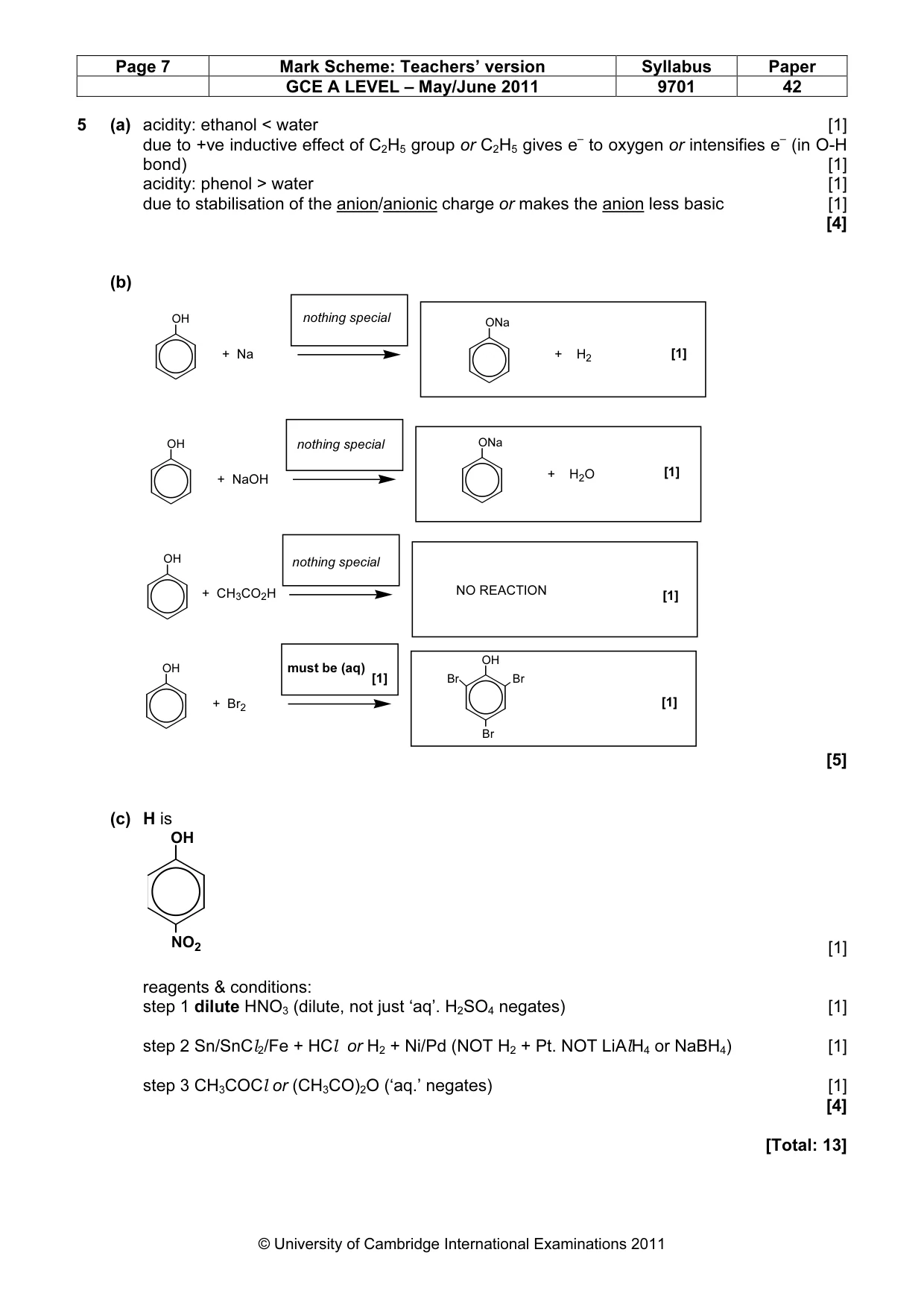
Page 7 Mark Scheme: Teachers’ version Syllabus Paper GCE A LEVEL – May/June 2011 9701 42 © University of Cambridge International Examinations 2011 5 (a) acidity: ethanol < water [1] due to +ve inductive effect of C2H5 group or C2H5 gives e– to oxygen or intensifies e– (in O-H bond) [1] acidity: phenol > water [1] due to stabilisation of the anion/anionic charge or makes the anion less basic [1] [4] (b) OH + Na OH + NaOH OH + CH3CO2H OH + Br2 ONa nothing special nothing special + H2 ONa + H2O NO REACTION nothing special must be (aq) OH Br Br Br [1] [1] [1] [1] [1] [5] (c) H is OH NO2 [1] reagents & conditions: step 1 dilute HNO3 (dilute, not just ‘aq’. H2SO4 negates) [1] step 2 Sn/SnCl2/Fe + HCl or H2 + Ni/Pd (NOT H2 + Pt. NOT LiAlH4 or NaBH4) [1] step 3 CH3COCl or (CH3CO)2O (‘aq.’ negates) [1] [4] [Total: 13]
Mark scheme, page 8
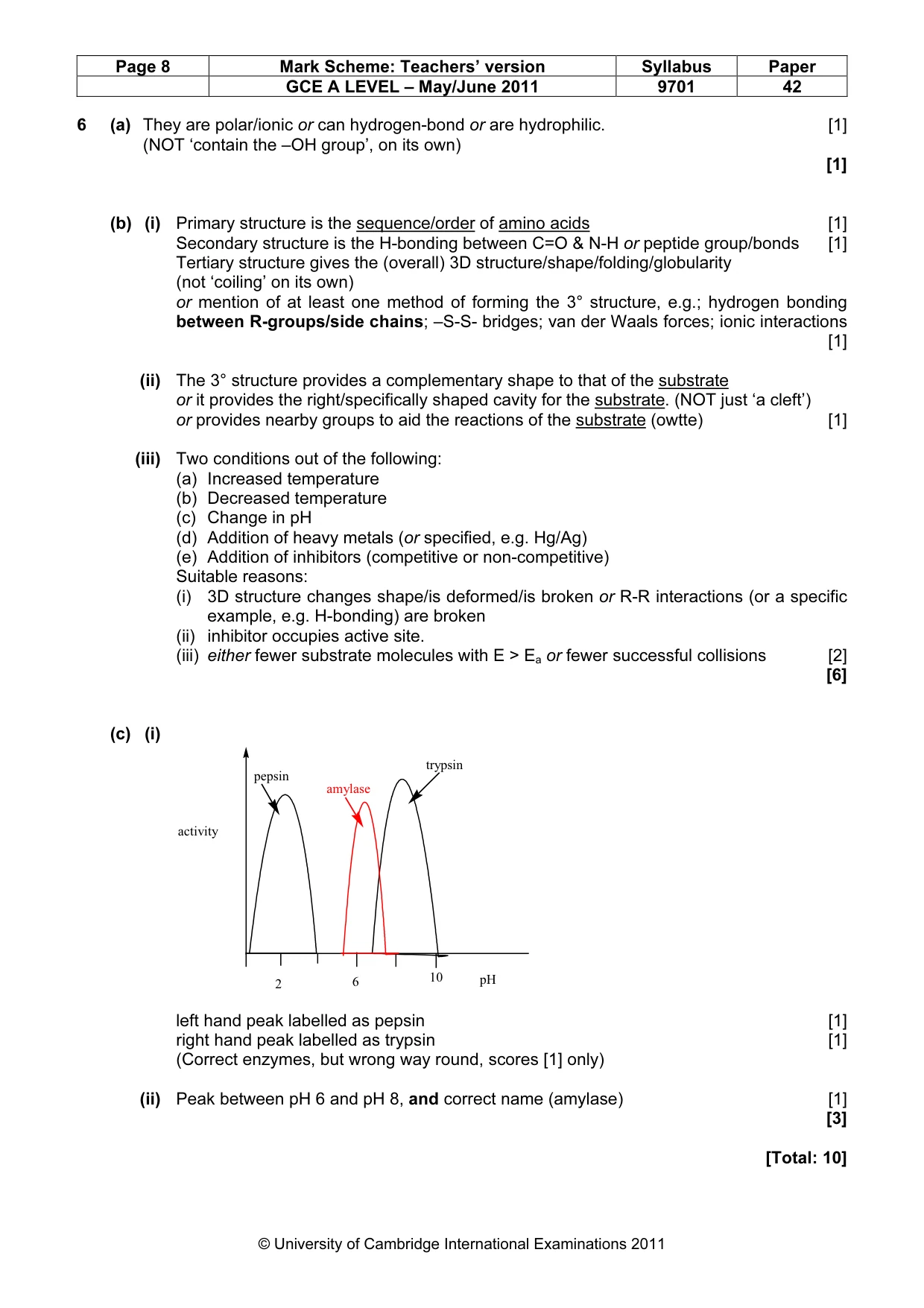
Page 8 Mark Scheme: Teachers’ version Syllabus Paper GCE A LEVEL – May/June 2011 9701 42 © University of Cambridge International Examinations 2011 6 (a) They are polar/ionic or can hydrogen-bond or are hydrophilic. [1] (NOT ‘contain the –OH group’, on its own) [1] (b) (i) Primary structure is the sequence/order of amino acids [1] Secondary structure is the H-bonding between C=O & N-H or peptide group/bonds [1] Tertiary structure gives the (overall) 3D structure/shape/folding/globularity (not ‘coiling’ on its own) or mention of at least one method of forming the 3° structure, e.g.; hydrogen bonding between R-groups/side chains; –S-S- bridges; van der Waals forces; ionic interactions [1] (ii) The 3° structure provides a complementary shape to that of the substrate or it provides the right/specifically shaped cavity for the substrate. (NOT just ‘a cleft’) or provides nearby groups to aid the reactions of the substrate (owtte) [1] (iii) Two conditions out of the following: (a) Increased temperature (b) Decreased temperature (c) Change in pH (d) Addition of heavy metals (or specified, e.g. Hg/Ag) (e) Addition of inhibitors (competitive or non-competitive) Suitable reasons: (i) 3D structure changes shape/is deformed/is broken or R-R interactions (or a specific example, e.g. H-bonding) are broken (ii) inhibitor occupies active site. (iii) either fewer substrate molecules with E > Ea or fewer successful collisions [2] [6] (c) (i) 2 6 10 pepsin trypsin amylase activity pH left hand peak labelled as pepsin [1] right hand peak labelled as trypsin [1] (Correct enzymes, but wrong way round, scores [1] only) (ii) Peak between pH 6 and pH 8, and correct name (amylase) [1] [3] [Total: 10]
Mark scheme, page 9
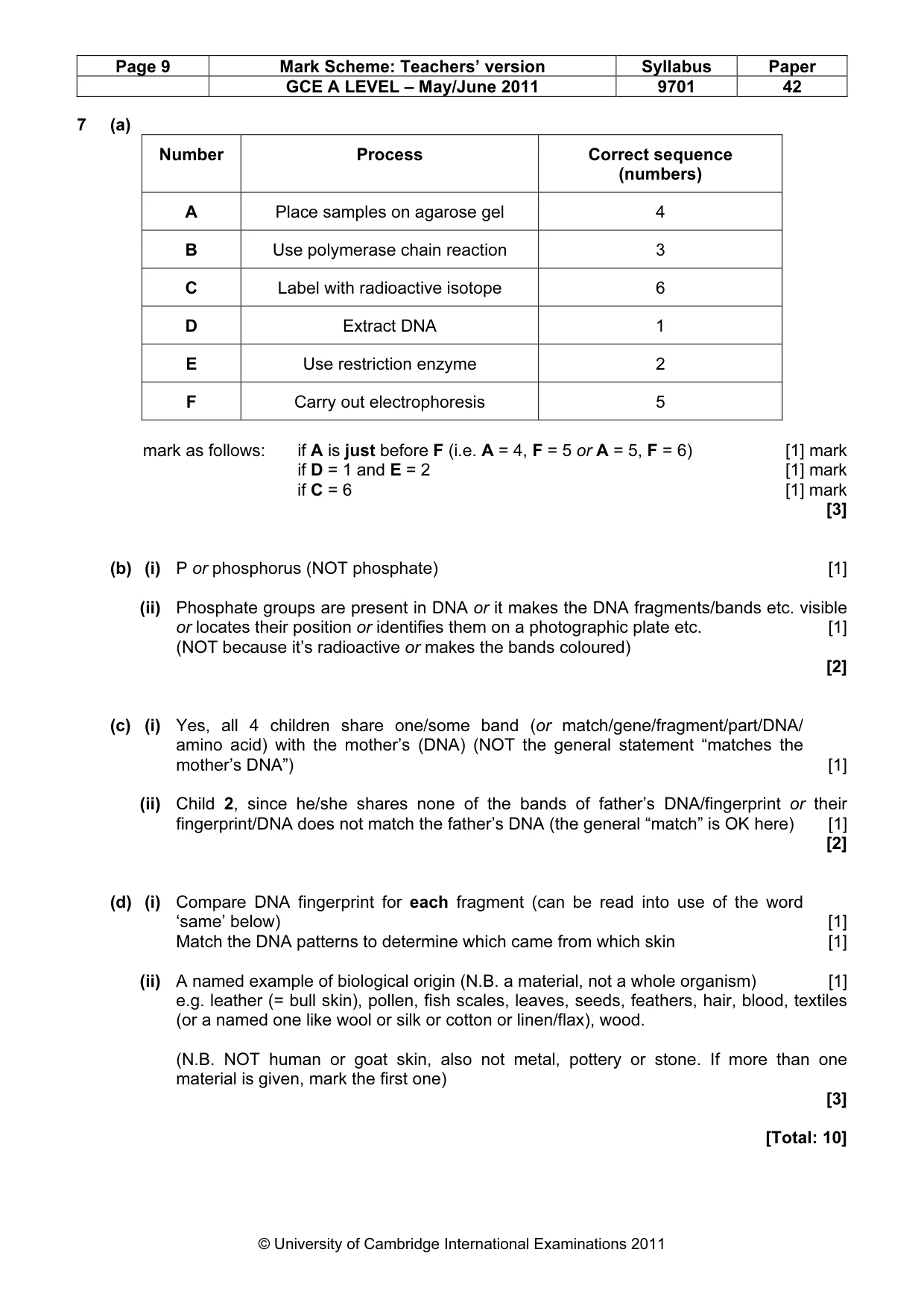
Page 9 Mark Scheme: Teachers’ version Syllabus Paper GCE A LEVEL – May/June 2011 9701 42 © University of Cambridge International Examinations 2011 7 (a) Number Process Correct sequence (numbers) A Place samples on agarose gel 4 B Use polymerase chain reaction 3 C Label with radioactive isotope 6 D Extract DNA 1 E Use restriction enzyme 2 F Carry out electrophoresis 5 mark as follows: if A is just before F (i.e. A = 4, F = 5 or A = 5, F = 6) [1] mark if D = 1 and E = 2 [1] mark if C = 6 [1] mark [3] (b) (i) P or phosphorus (NOT phosphate) [1] (ii) Phosphate groups are present in DNA or it makes the DNA fragments/bands etc. visible or locates their position or identifies them on a photographic plate etc. [1] (NOT because it’s radioactive or makes the bands coloured) [2] (c) (i) Yes, all 4 children share one/some band (or match/gene/fragment/part/DNA/ amino acid) with the mother’s (DNA) (NOT the general statement “matches the mother’s DNA”) [1] (ii) Child 2, since he/she shares none of the bands of father’s DNA/fingerprint or their fingerprint/DNA does not match the father’s DNA (the general “match” is OK here) [1] [2] (d) (i) Compare DNA fingerprint for each fragment (can be read into use of the word ‘same’ below) [1] Match the DNA patterns to determine which came from which skin [1] (ii) A named example of biological origin (N.B. a material, not a whole organism) [1] e.g. leather (= bull skin), pollen, fish scales, leaves, seeds, feathers, hair, blood, textiles (or a named one like wool or silk or cotton or linen/flax), wood. (N.B. NOT human or goat skin, also not metal, pottery or stone. If more than one material is given, mark the first one) [3] [Total: 10]
Mark scheme, page 10
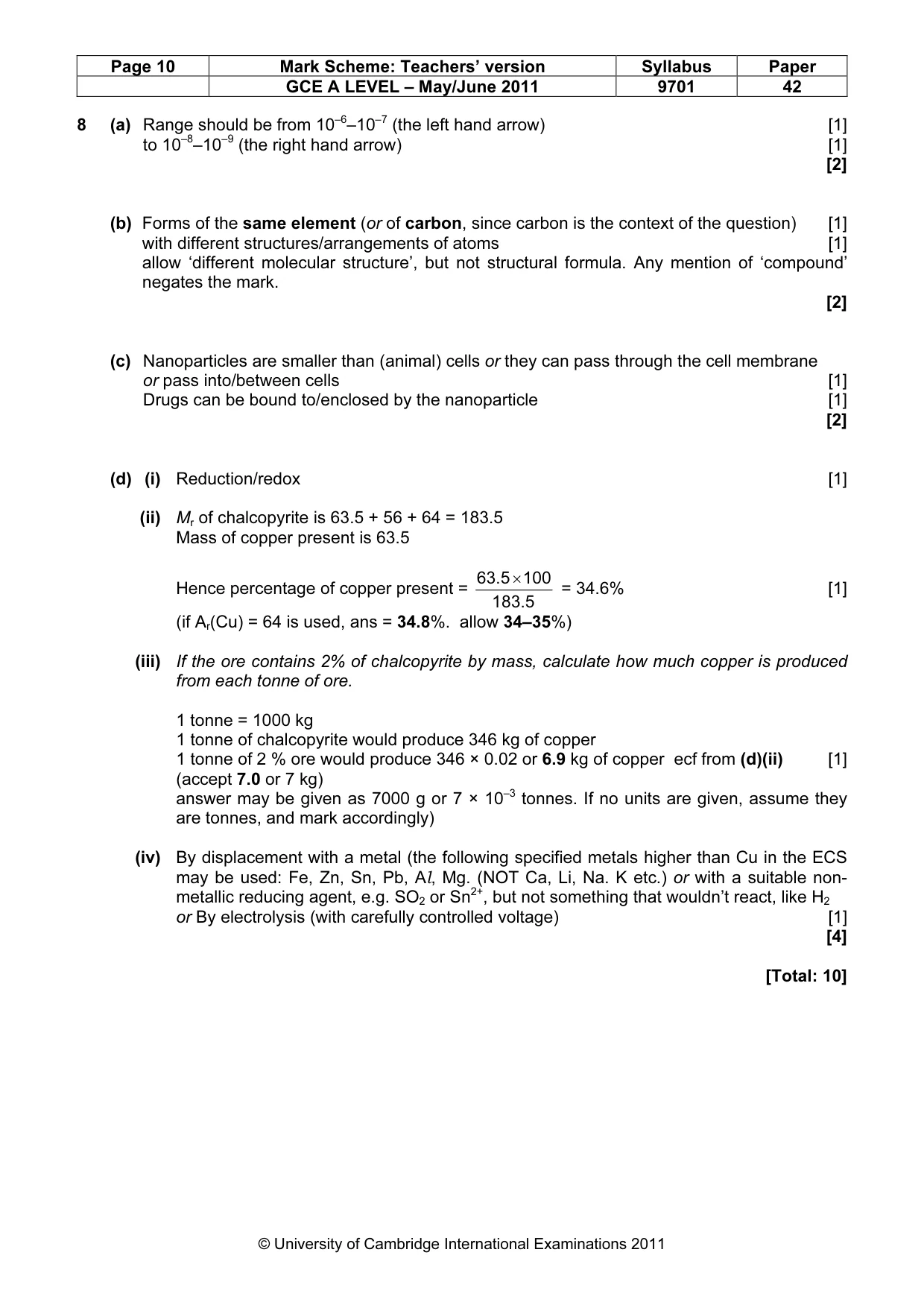
Page 10 Mark Scheme: Teachers’ version Syllabus Paper GCE A LEVEL – May/June 2011 9701 42 © University of Cambridge International Examinations 2011 8 (a) Range should be from 10–6–10–7 (the left hand arrow) [1] to 10–8–10–9 (the right hand arrow) [1] [2] (b) Forms of the same element (or of carbon, since carbon is the context of the question) [1] with different structures/arrangements of atoms [1] allow ‘different molecular structure’, but not structural formula. Any mention of ‘compound’ negates the mark. [2] (c) Nanoparticles are smaller than (animal) cells or they can pass through the cell membrane or pass into/between cells [1] Drugs can be bound to/enclosed by the nanoparticle [1] [2] (d) (i) Reduction/redox [1] (ii) Mr of chalcopyrite is 63.5 + 56 + 64 = 183.5 Mass of copper present is 63.5 Hence percentage of copper present = 183.5 100 63.5× = 34.6% [1] (if Ar(Cu) = 64 is used, ans = 34.8%. allow 34–35%) (iii) If the ore contains 2% of chalcopyrite by mass, calculate how much copper is produced from each tonne of ore. 1 tonne = 1000 kg 1 tonne of chalcopyrite would produce 346 kg of copper 1 tonne of 2 % ore would produce 346 × 0.02 or 6.9 kg of copper ecf from (d)(ii) [1] (accept 7.0 or 7 kg) answer may be given as 7000 g or 7 × 10⁻³ tonnes. If no units are given, assume they are tonnes, and mark accordingly) (iv) By displacement with a metal (the following specified metals higher than Cu in the ECS may be used: Fe, Zn, Sn, Pb, Al, Mg. (NOT Ca, Li, Na. K etc.) or with a suitable non- metallic reducing agent, e.g. SO2 or Sn2+, but not something that wouldn’t react, like H2 or By electrolysis (with carefully controlled voltage) [1] [4] [Total: 10]
What you needed in this session
Cambridge’s own grade thresholds for 2011 May/June, Paper 4 · Variant 2. A higher threshold means an easier paper — the bar moves with how the cohort did.