Cambridge A Level Chemistry 9701 — 2011 May/June Paper 2 · Variant 3
9701/23/M/J/11 · 60 marks · ≈68 min
The question paper and its mark scheme, free to read here and free to download. This is Cambridge’s own paper, exactly as it was sat.
Question paper12 pages
Mark scheme7 pages
Answers below. Sit the paper first if you are practising.
Paper as text
Question paper, page 1
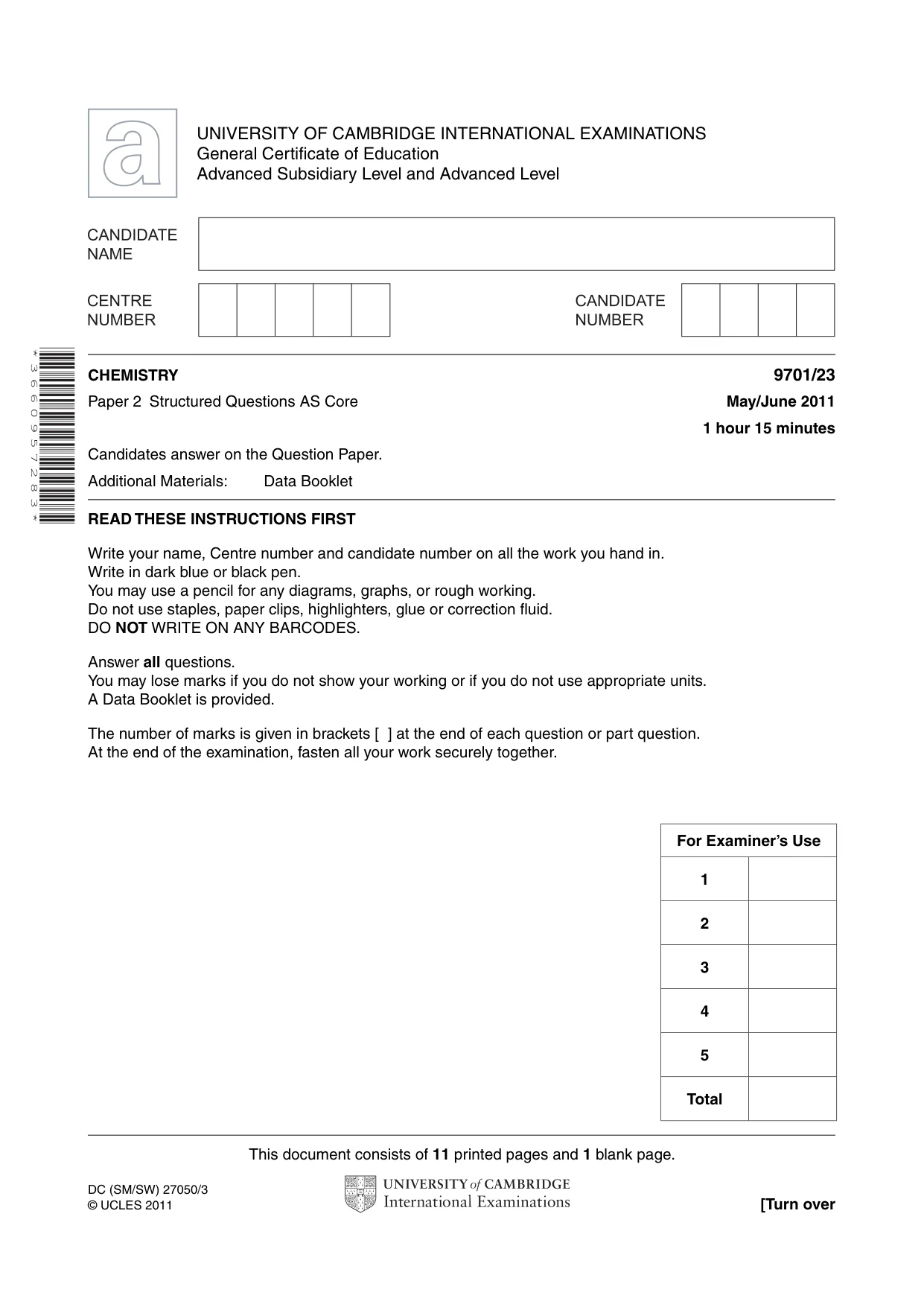
This document consists of 11 printed pages and 1 blank page. DC (SM/SW) 27050/3 © UCLES 2011 [Turn over UNIVERSITY OF CAMBRIDGE INTERNATIONAL EXAMINATIONS General Certificate of Education Advanced Subsidiary Level and Advanced Level READ THESE INSTRUCTIONS FIRST Write your name, Centre number and candidate number on all the work you hand in. Write in dark blue or black pen. You may use a pencil for any diagrams, graphs, or rough working. Do not use staples, paper clips, highlighters, glue or correction fluid. DO NOT WRITE ON ANY BARCODES. Answer all questions. You may lose marks if you do not show your working or if you do not use appropriate units. A Data Booklet is provided. The number of marks is given in brackets [ ] at the end of each question or part question. At the end of the examination, fasten all your work securely together. * 3 6 6 0 9 5 7 2 8 3 * CHEMISTRY 9701/23 Paper 2 Structured Questions AS Core May/June 2011 1 hour 15 minutes Candidates answer on the Question Paper. Additional Materials: Data Booklet For Examiner’s Use 1 2 3 4 5 Total
Question paper, page 2
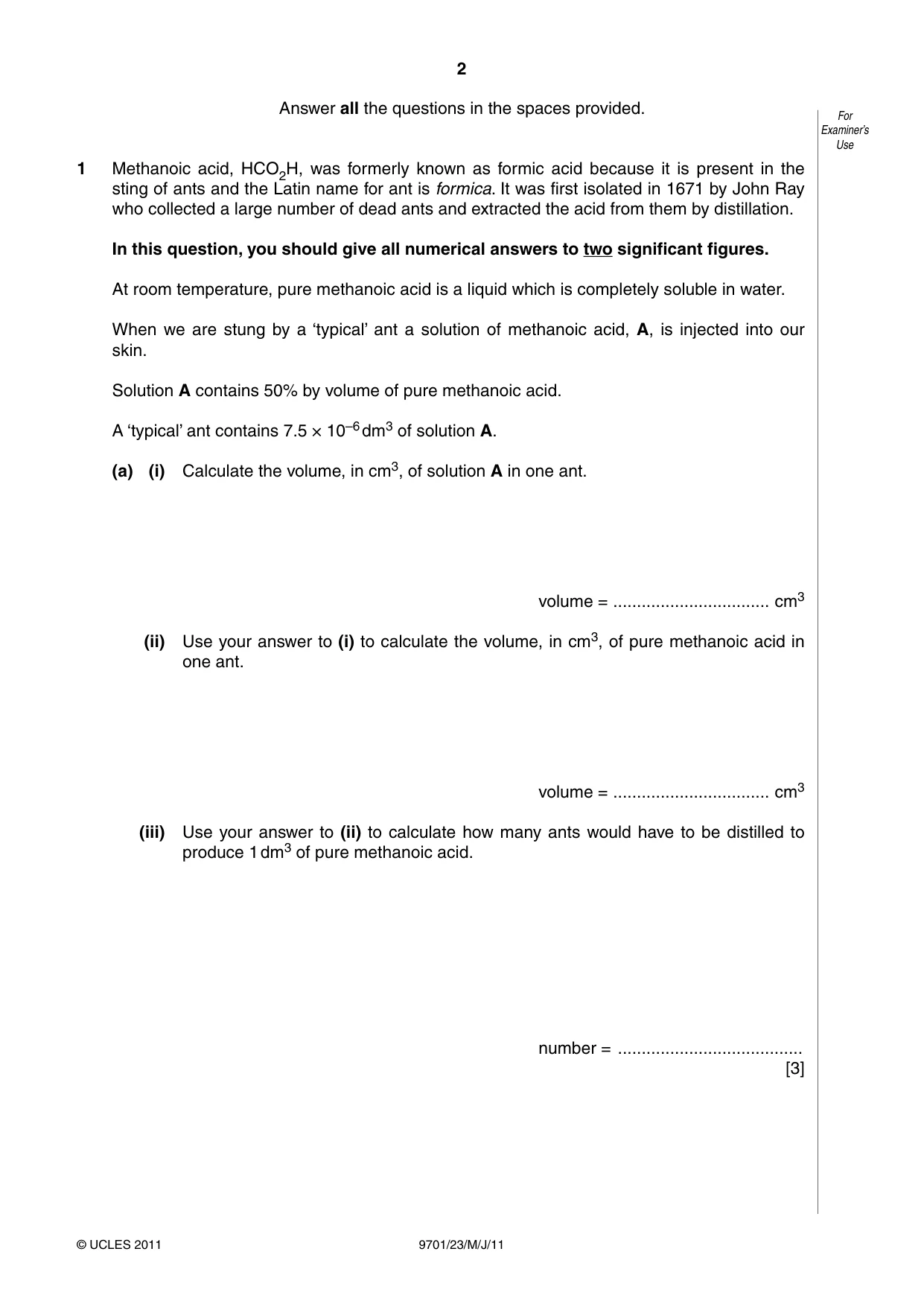
2 9701/23/M/J/11 © UCLES 2011 For Examiner’s Use Answer all the questions in the spaces provided. 1 Methanoic acid, HCO2H, was formerly known as formic acid because it is present in the sting of ants and the Latin name for ant is formica. It was first isolated in 1671 by John Ray who collected a large number of dead ants and extracted the acid from them by distillation. In this question, you should give all numerical answers to two significant figures. At room temperature, pure methanoic acid is a liquid which is completely soluble in water. When we are stung by a ‘typical’ ant a solution of methanoic acid, A, is injected into our skin. Solution A contains 50% by volume of pure methanoic acid. A ‘typical’ ant contains 7.5 × 10⁻⁶ dm3 of solution A. (a) (i) Calculate the volume, in cm3, of solution A in one ant. volume = … cm3 (ii) Use your answer to (i) to calculate the volume, in cm3, of pure methanoic acid in one ant. volume = … cm3 (iii) Use your answer to (ii) to calculate how many ants would have to be distilled to produce 1 dm3 of pure methanoic acid. number = … [3]
Question paper, page 3
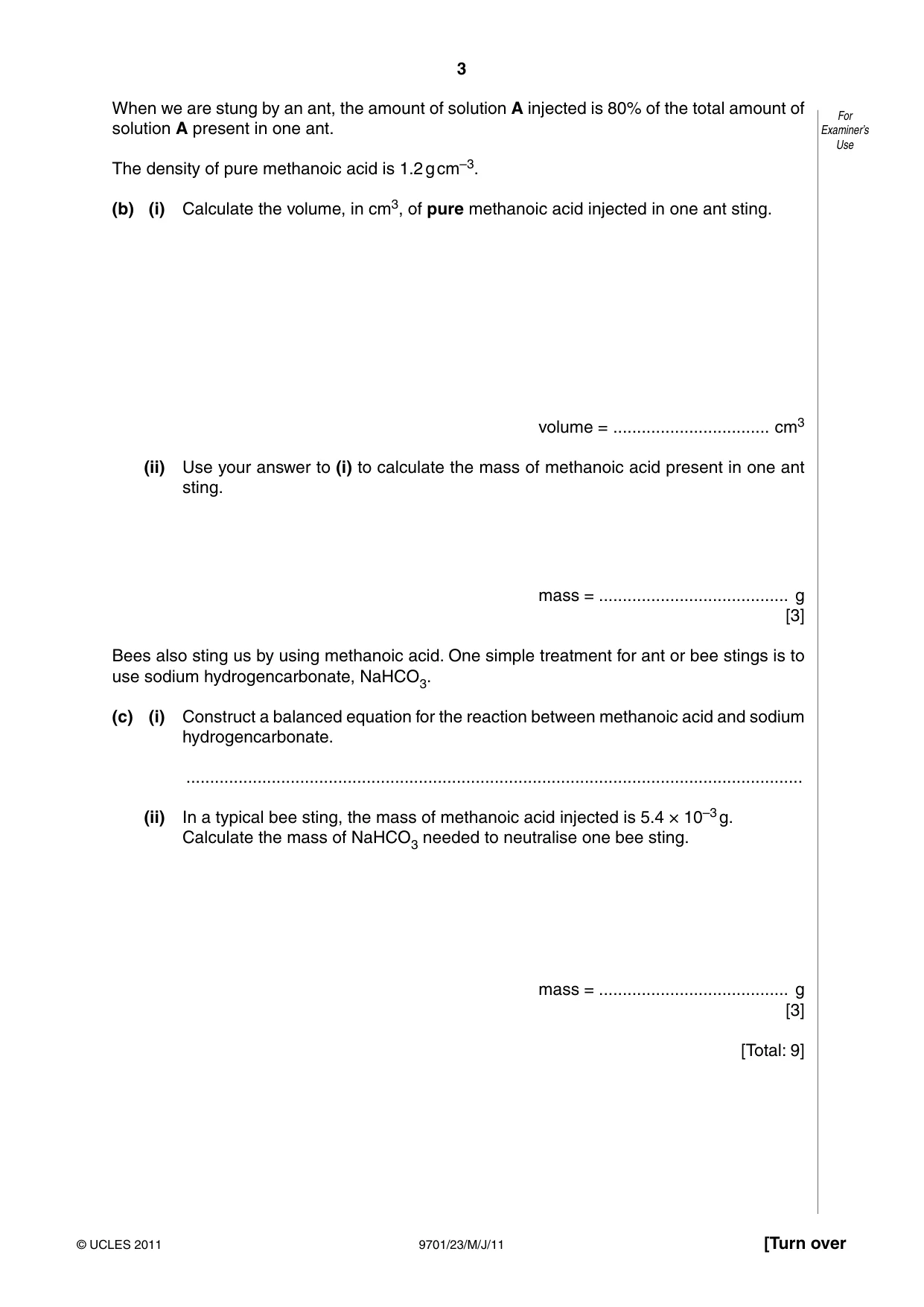
3 [Turn over 9701/23/M/J/11 © UCLES 2011 For Examiner’s Use When we are stung by an ant, the amount of solution A injected is 80% of the total amount of solution A present in one ant. The density of pure methanoic acid is 1.2 g cm–3. (b) (i) Calculate the volume, in cm3, of pure methanoic acid injected in one ant sting. volume = … cm3 (ii) Use your answer to (i) to calculate the mass of methanoic acid present in one ant sting. mass = … g [3] Bees also sting us by using methanoic acid. One simple treatment for ant or bee stings is to use sodium hydrogencarbonate, NaHCO3. (c) (i) Construct a balanced equation for the reaction between methanoic acid and sodium hydrogencarbonate. … (ii) In a typical bee sting, the mass of methanoic acid injected is 5.4 × 10⁻³ g. Calculate the mass of NaHCO3 needed to neutralise one bee sting. mass = … g [3] [Total: 9]
Question paper, page 4
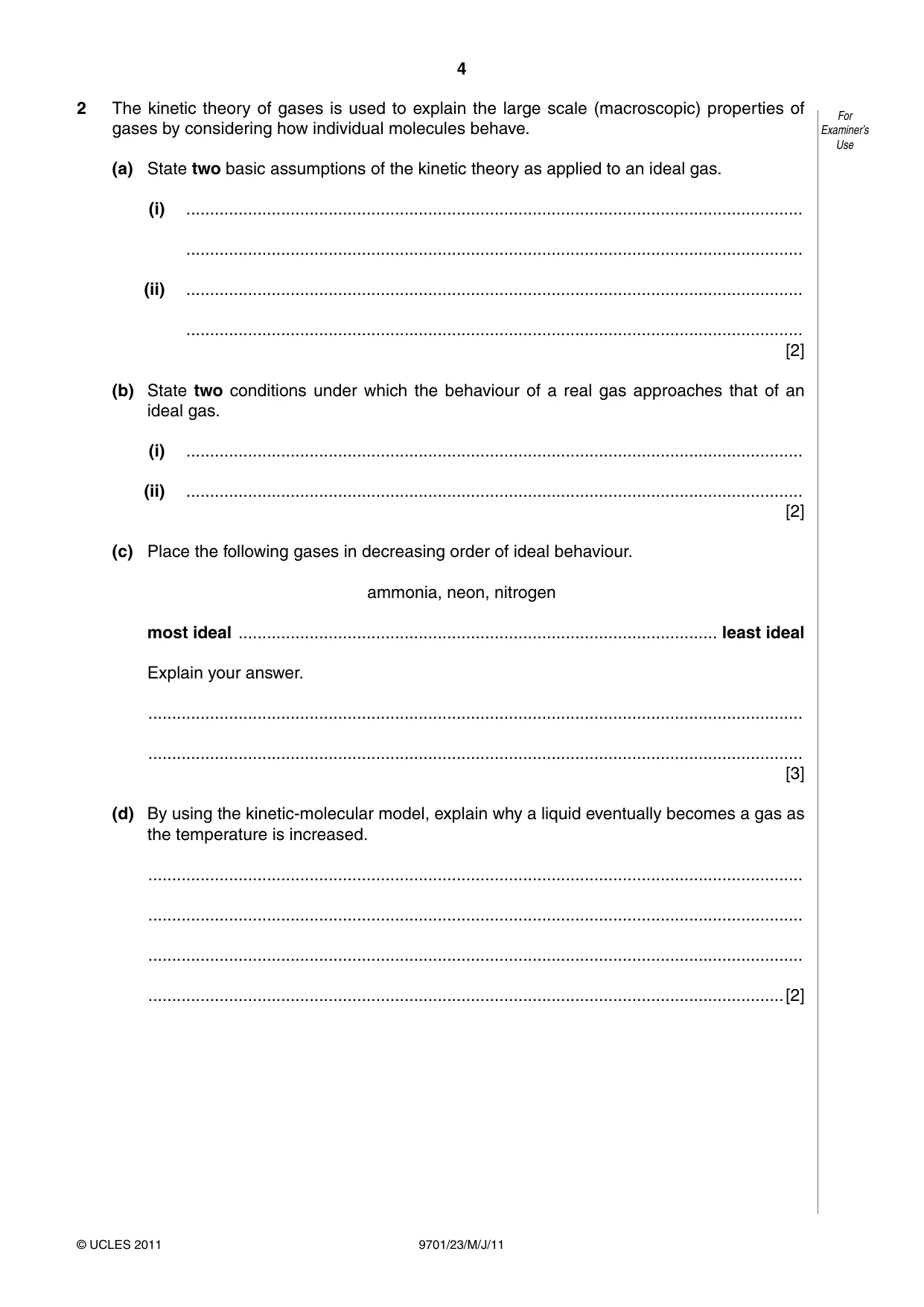
4 9701/23/M/J/11 © UCLES 2011 For Examiner’s Use 2 The kinetic theory of gases is used to explain the large scale (macroscopic) properties of gases by considering how individual molecules behave. (a) State two basic assumptions of the kinetic theory as applied to an ideal gas. (i) … … (ii) … … [2] (b) State two conditions under which the behaviour of a real gas approaches that of an ideal gas. (i) … (ii) … [2] (c) Place the following gases in decreasing order of ideal behaviour. ammonia, neon, nitrogen most ideal … least ideal Explain your answer. … … [3] (d) By using the kinetic-molecular model, explain why a liquid eventually becomes a gas as the temperature is increased. … … … …[2]
Question paper, page 5
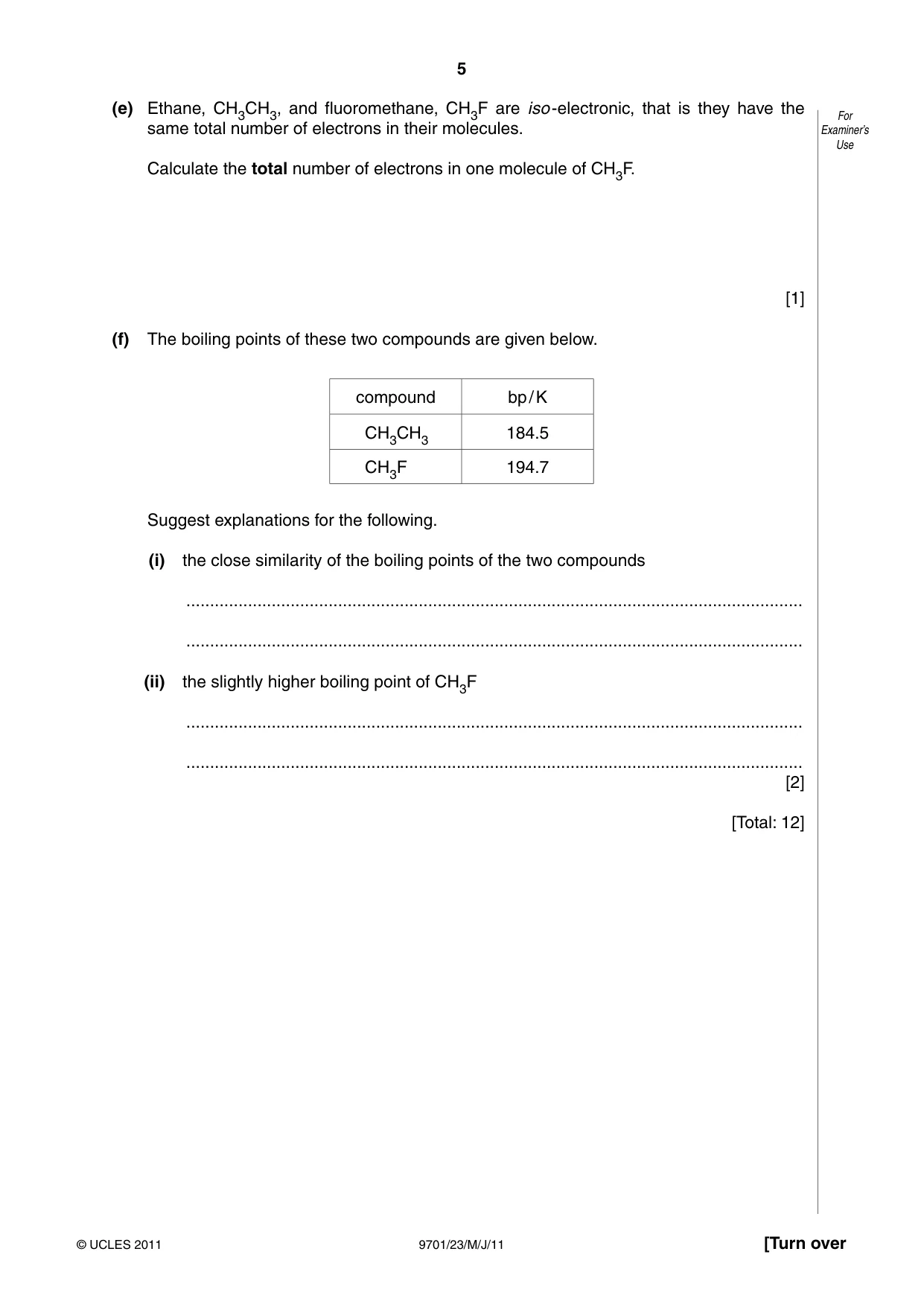
5 [Turn over 9701/23/M/J/11 © UCLES 2011 For Examiner’s Use (e) Ethane, CH3CH3, and fluoromethane, CH3F are iso -electronic, that is they have the same total number of electrons in their molecules. Calculate the total number of electrons in one molecule of CH3F. [1] (f) The boiling points of these two compounds are given below. compound bp / K CH3CH3 184.5 CH3F 194.7 Suggest explanations for the following. (i) the close similarity of the boiling points of the two compounds … … (ii) the slightly higher boiling point of CH3F … … [2] [Total: 12]
Question paper, page 6
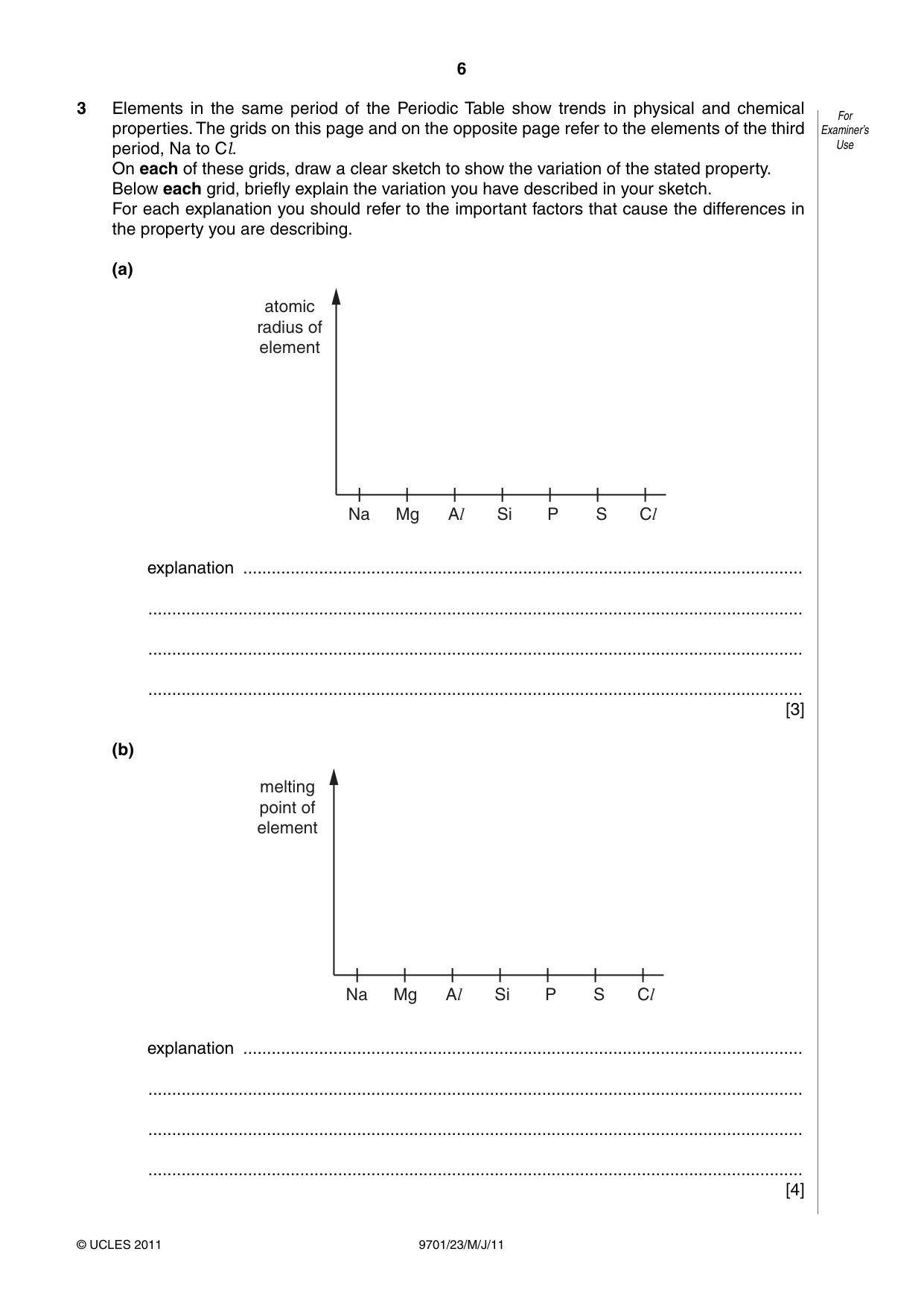
6 9701/23/M/J/11 © UCLES 2011 For Examiner’s Use 3 Elements in the same period of the Periodic Table show trends in physical and chemical properties. The grids on this page and on the opposite page refer to the elements of the third period, Na to Cl. On each of these grids, draw a clear sketch to show the variation of the stated property. Below each grid, briefly explain the variation you have described in your sketch. For each explanation you should refer to the important factors that cause the differences in the property you are describing. (a) Na Mg Al Si P S Cl atomic radius of element explanation … … … … [3] (b) Na Mg Al Si P S Cl melting point of element explanation … … … … [4]
Question paper, page 7
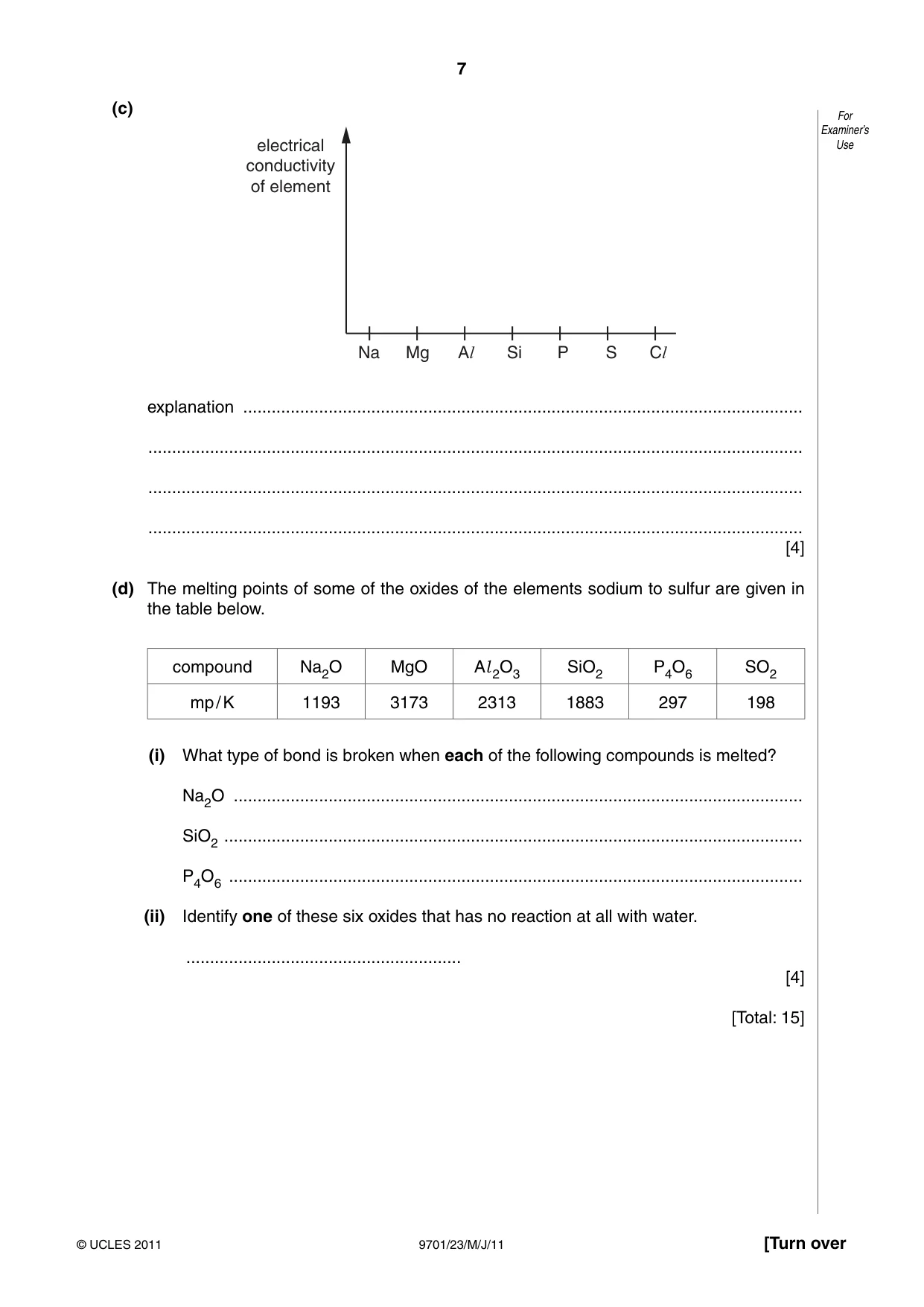
7 [Turn over 9701/23/M/J/11 © UCLES 2011 For Examiner’s Use (c) Na Mg Al Si P S Cl electrical conductivity of element explanation … … … … [4] (d) The melting points of some of the oxides of the elements sodium to sulfur are given in the table below. compound Na2O MgO Al 2O3 SiO2 P4O6 SO2 mp / K 1193 3173 2313 1883 297 198 (i) What type of bond is broken when each of the following compounds is melted? Na2O … SiO2 … P4O6 … (ii) Identify one of these six oxides that has no reaction at all with water. … [4] [Total: 15]
Question paper, page 8
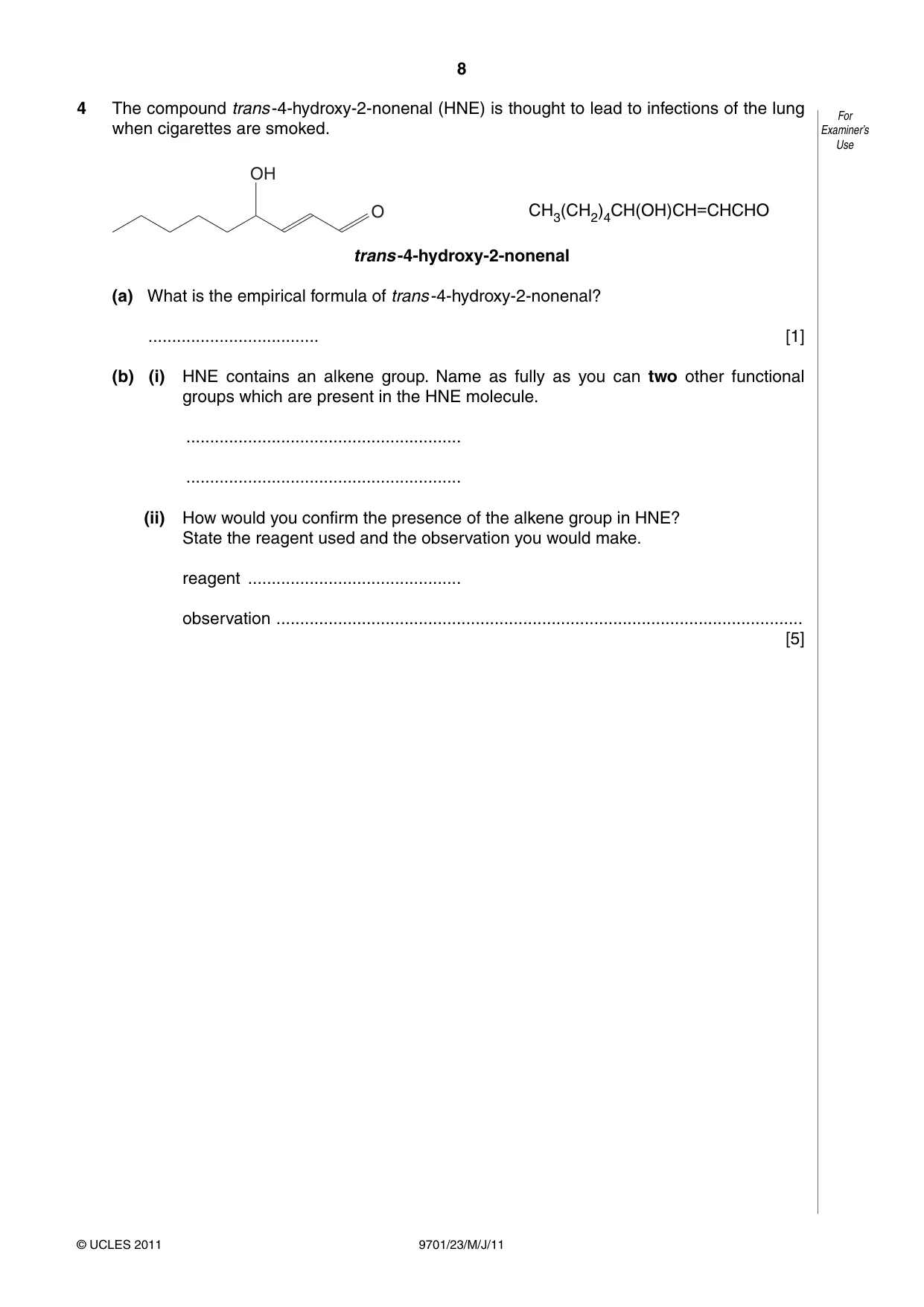
8 9701/23/M/J/11 © UCLES 2011 For Examiner’s Use 4 The compound trans -4-hydroxy-2-nonenal (HNE) is thought to lead to infections of the lung when cigarettes are smoked. O OH CH3(CH2)4CH(OH)CH=CHCHO trans -4-hydroxy-2-nonenal (a) What is the empirical formula of trans -4-hydroxy-2-nonenal? … [1] (b) (i) HNE contains an alkene group. Name as fully as you can two other functional groups which are present in the HNE molecule. … … (ii) How would you confirm the presence of the alkene group in HNE? State the reagent used and the observation you would make. reagent … observation … [5]
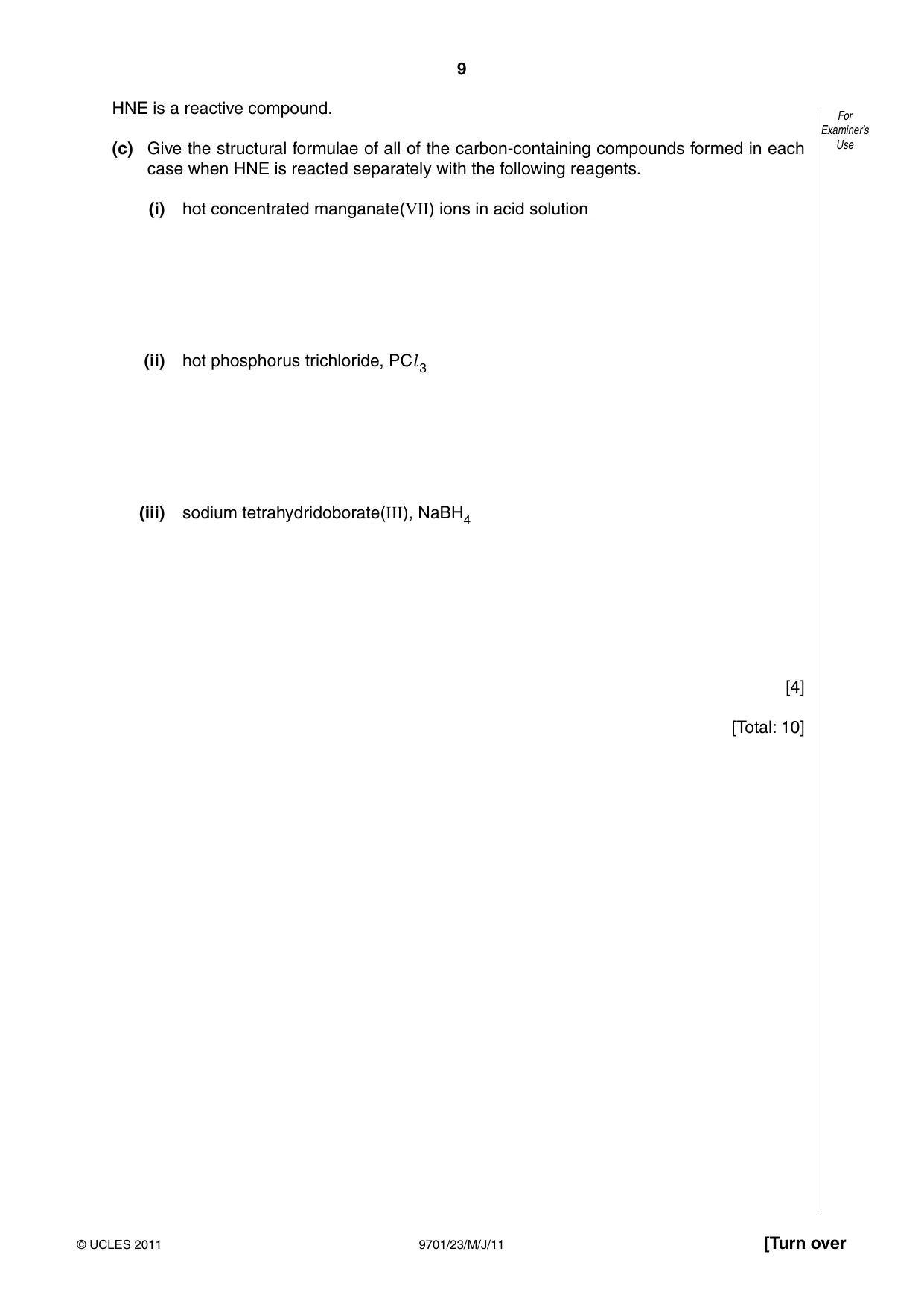
Question paper, page 9
9 [Turn over 9701/23/M/J/11 © UCLES 2011 For Examiner’s Use HNE is a reactive compound. (c) Give the structural formulae of all of the carbon-containing compounds formed in each case when HNE is reacted separately with the following reagents. (i) hot concentrated manganate(VII) ions in acid solution (ii) hot phosphorus trichloride, PCl 3 (iii) sodium tetrahydridoborate(III), NaBH4 [4] [Total: 10]
Question paper, page 10
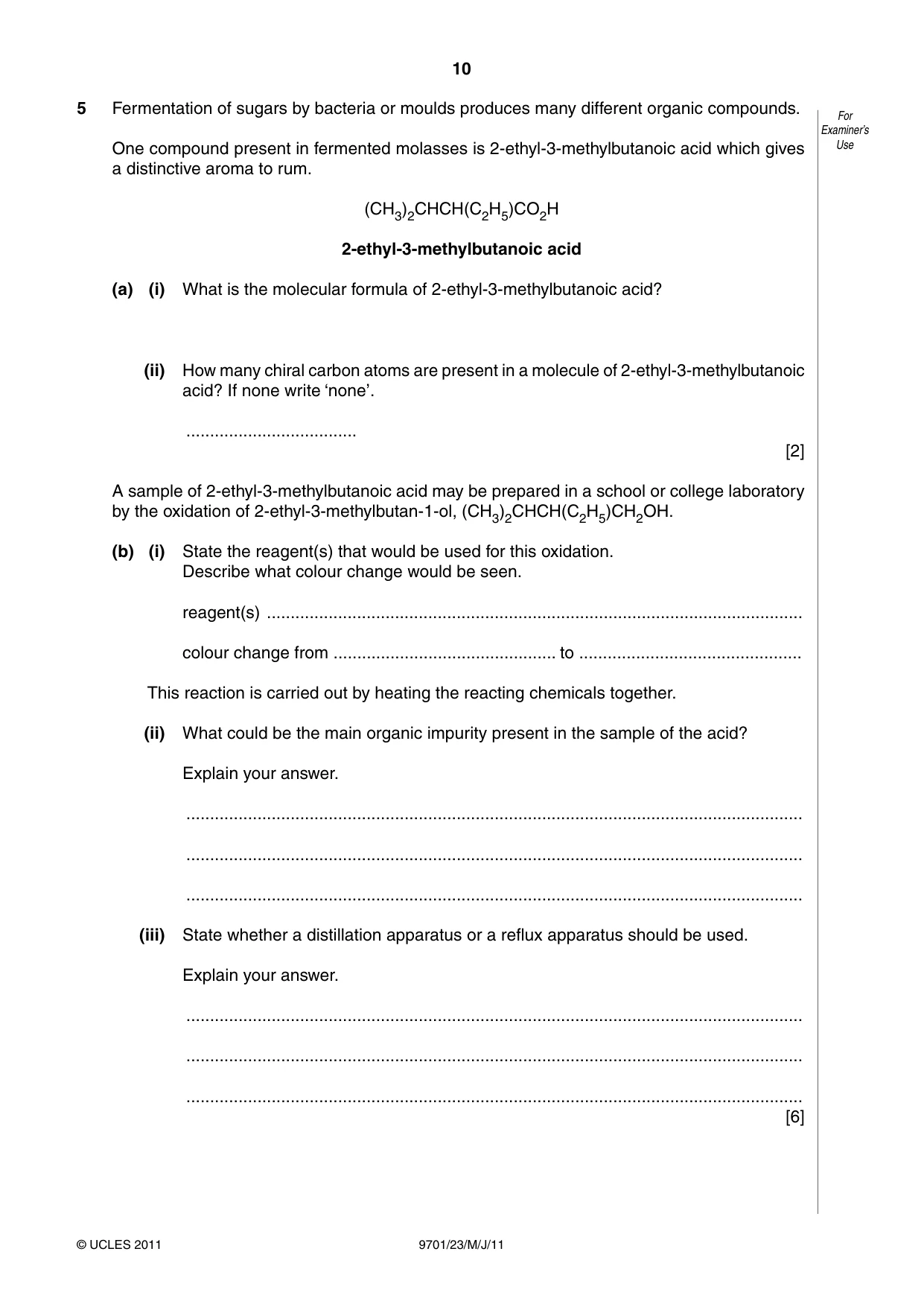
10 9701/23/M/J/11 © UCLES 2011 For Examiner’s Use 5 Fermentation of sugars by bacteria or moulds produces many different organic compounds. One compound present in fermented molasses is 2-ethyl-3-methylbutanoic acid which gives a distinctive aroma to rum. (CH3)2CHCH(C2H5)CO2H 2-ethyl-3-methylbutanoic acid (a) (i) What is the molecular formula of 2-ethyl-3-methylbutanoic acid? (ii) How many chiral carbon atoms are present in a molecule of 2-ethyl-3-methylbutanoic acid? If none write ‘none’. … [2] A sample of 2-ethyl-3-methylbutanoic acid may be prepared in a school or college laboratory by the oxidation of 2-ethyl-3-methylbutan-1-ol, (CH3)2CHCH(C2H5)CH2OH. (b) (i) State the reagent(s) that would be used for this oxidation. Describe what colour change would be seen. reagent(s) … colour change from … to … This reaction is carried out by heating the reacting chemicals together. (ii) What could be the main organic impurity present in the sample of the acid? Explain your answer. … … … (iii) State whether a distillation apparatus or a reflux apparatus should be used. Explain your answer. … … … [6]
Question paper, page 11
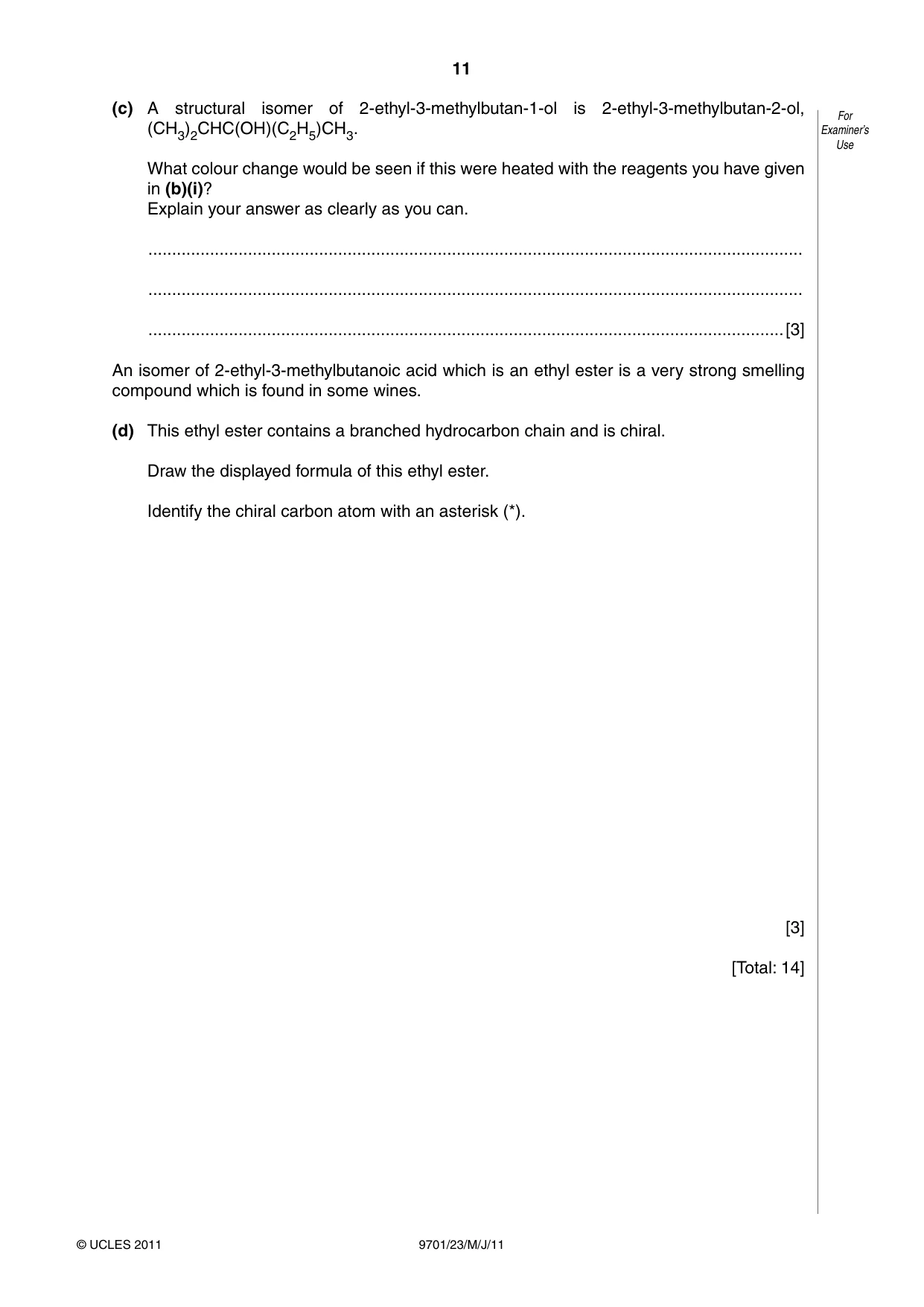
11 9701/23/M/J/11 © UCLES 2011 For Examiner’s Use (c) A structural isomer of 2-ethyl-3-methylbutan-1-ol is 2-ethyl-3-methylbutan-2-ol, (CH3)2CHC(OH)(C2H5)CH3. What colour change would be seen if this were heated with the reagents you have given in (b)(i)? Explain your answer as clearly as you can. … … …[3] An isomer of 2-ethyl-3-methylbutanoic acid which is an ethyl ester is a very strong smelling compound which is found in some wines. (d) This ethyl ester contains a branched hydrocarbon chain and is chiral. Draw the displayed formula of this ethyl ester. Identify the chiral carbon atom with an asterisk (*). [3] [Total: 14]
Question paper, page 12
12 9701/23/M/J/11 © UCLES 2011 BLANK PAGE Permission to reproduce items where third-party owned material protected by copyright is included has been sought and cleared where possible. Every reasonable effort has been made by the publisher (UCLES) to trace copyright holders, but if any items requiring clearance have unwittingly been included, the publisher will be pleased to make amends at the earliest possible opportunity. University of Cambridge International Examinations is part of the Cambridge Assessment Group. Cambridge Assessment is the brand name of University of Cambridge Local Examinations Syndicate (UCLES), which is itself a department of the University of Cambridge.
Mark scheme, page 1
UNIVERSITY OF CAMBRIDGE INTERNATIONAL EXAMINATIONS GCE Advanced Subsidiary Level and GCE Advanced Level MARK SCHEME for the May/June 2011 question paper for the guidance of teachers 9701 CHEMISTRY 9701/23 Paper 2 (AS Structured Questions), maximum raw mark 60 This mark scheme is published as an aid to teachers and candidates, to indicate the requirements of the examination. It shows the basis on which Examiners were instructed to award marks. It does not indicate the details of the discussions that took place at an Examiners’ meeting before marking began, which would have considered the acceptability of alternative answers. Mark schemes must be read in conjunction with the question papers and the report on the examination. • Cambridge will not enter into discussions or correspondence in connection with these mark schemes. Cambridge is publishing the mark schemes for the May/June 2011 question papers for most IGCSE, GCE Advanced Level and Advanced Subsidiary Level syllabuses and some Ordinary Level syllabuses.
Mark scheme, page 2
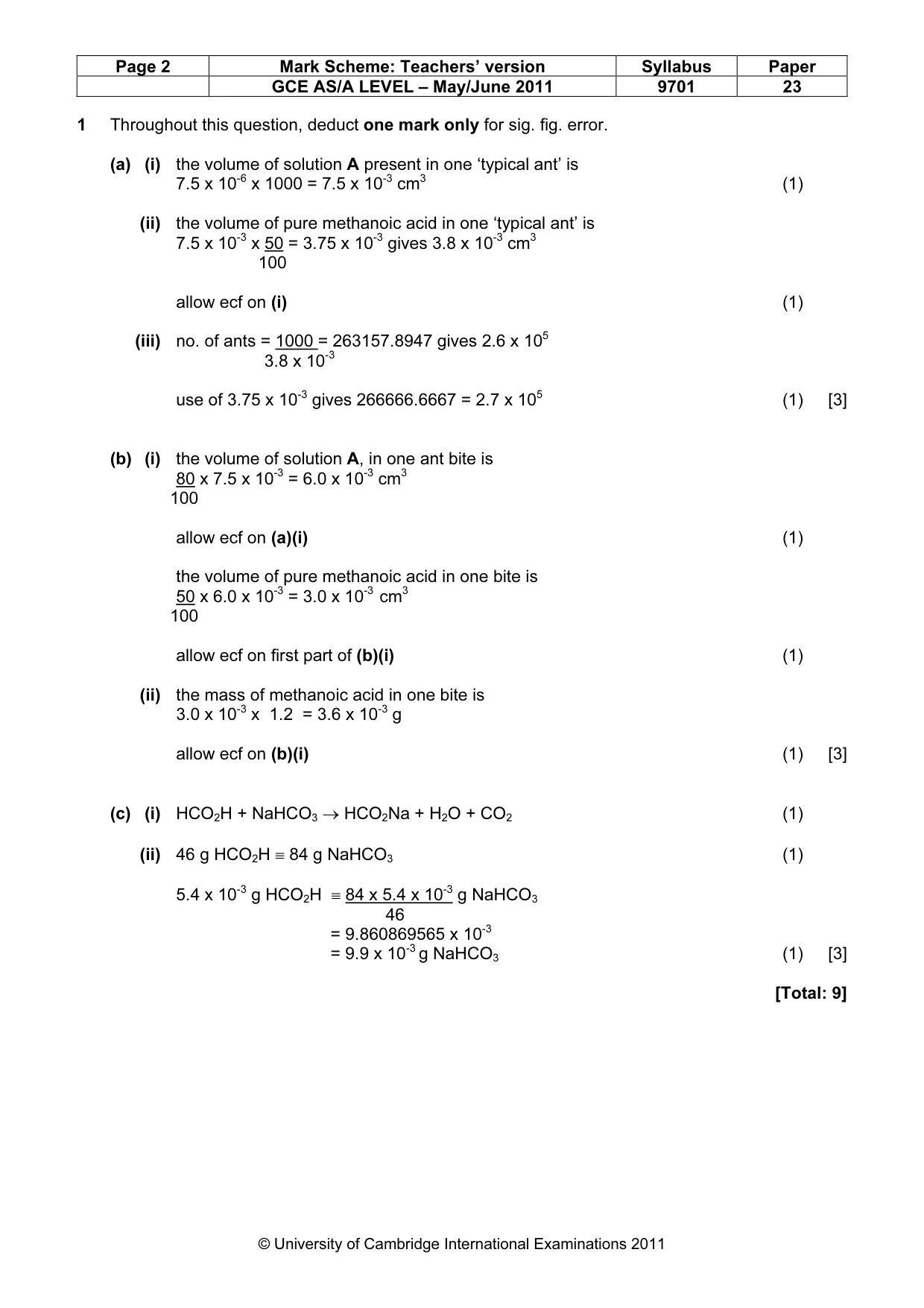
Page 2 Mark Scheme: Teachers’ version Syllabus Paper GCE AS/A LEVEL – May/June 2011 9701 23 © University of Cambridge International Examinations 2011 1 Throughout this question, deduct one mark only for sig. fig. error. (a) (i) the volume of solution A present in one ‘typical ant’ is 7.5 x 10-6 x 1000 = 7.5 x 10⁻³ cm3 (1) (ii) the volume of pure methanoic acid in one ‘typical ant’ is 7.5 x 10-3 x 50 = 3.75 x 10⁻³ gives 3.8 x 10⁻³ cm3 100 allow ecf on (i) (1) (iii) no. of ants = 1000 = 263157.8947 gives 2.6 x 10⁵ 3.8 x 10⁻³ use of 3.75 x 10⁻³ gives 266666.6667 = 2.7 x 10⁵ (1) [3] (b) (i) the volume of solution A, in one ant bite is 80 x 7.5 x 10-3 = 6.0 x 10⁻³ cm3 100 allow ecf on (a)(i) (1) the volume of pure methanoic acid in one bite is 50 x 6.0 x 10-3 = 3.0 x 10⁻³ cm3 100 allow ecf on first part of (b)(i) (1) (ii) the mass of methanoic acid in one bite is 3.0 x 10-3 x 1.2 = 3.6 x 10⁻³ g allow ecf on (b)(i) (1) [3] (c) (i) HCO2H + NaHCO3 → HCO2Na + H2O + CO2 (1) (ii) 46 g HCO2H ≡ 84 g NaHCO3 (1) 5.4 x 10⁻³ g HCO2H ≡ 84 x 5.4 x 10-3 g NaHCO3 46 = 9.860869565 x 10-3 = 9.9 x 10⁻³ g NaHCO3 (1) [3] [Total: 9]
Mark scheme, page 3
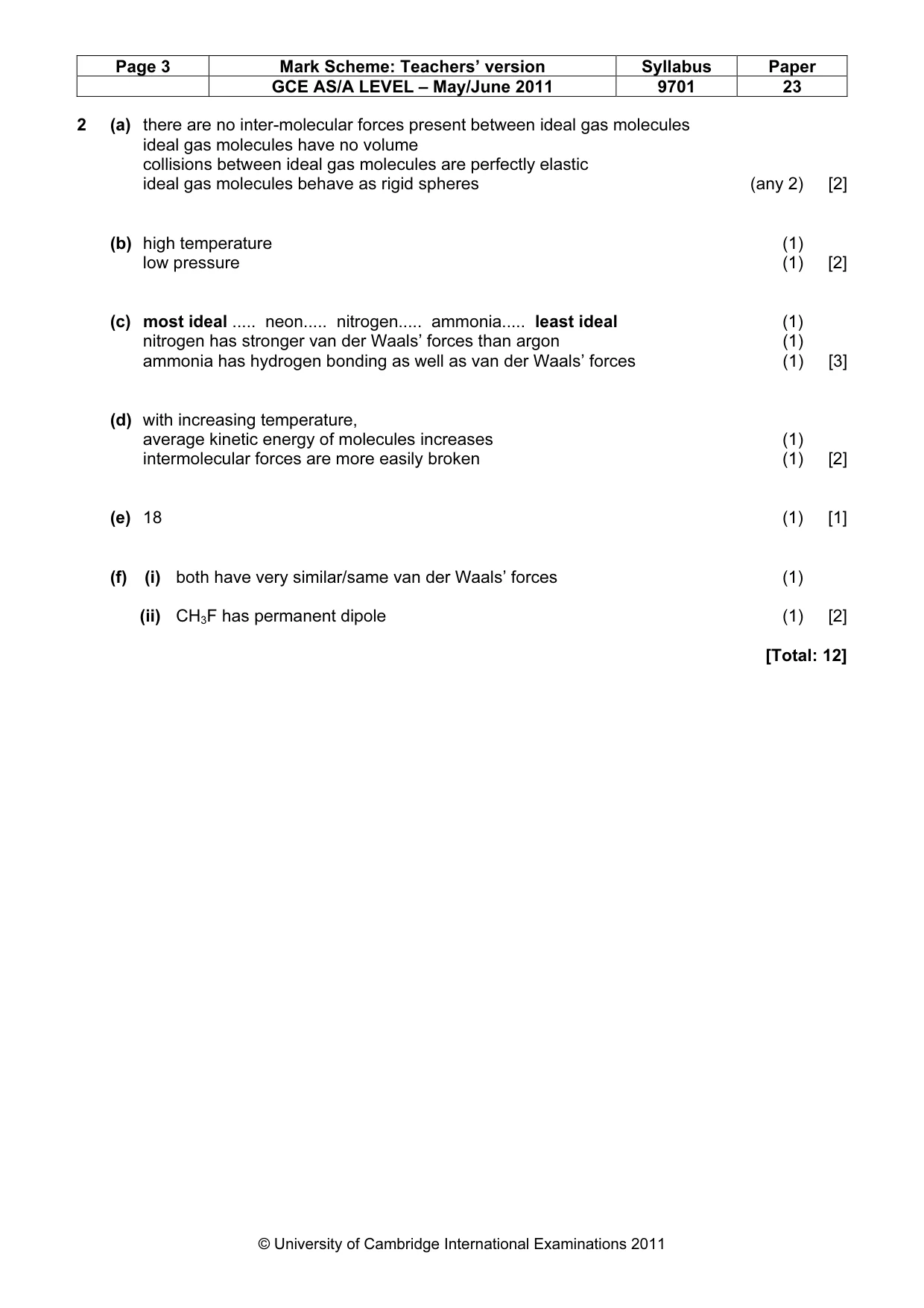
Page 3 Mark Scheme: Teachers’ version Syllabus Paper GCE AS/A LEVEL – May/June 2011 9701 23 © University of Cambridge International Examinations 2011 2 (a) there are no inter-molecular forces present between ideal gas molecules ideal gas molecules have no volume collisions between ideal gas molecules are perfectly elastic ideal gas molecules behave as rigid spheres (any 2) [2] (b) high temperature (1) low pressure (1) [2] (c) most ideal … neon… nitrogen… ammonia… least ideal (1) nitrogen has stronger van der Waals’ forces than argon (1) ammonia has hydrogen bonding as well as van der Waals’ forces (1) [3] (d) with increasing temperature, average kinetic energy of molecules increases (1) intermolecular forces are more easily broken (1) [2] (e) 18 (1) [1] (f) (i) both have very similar/same van der Waals’ forces (1) (ii) CH3F has permanent dipole (1) [2] [Total: 12]
Mark scheme, page 4
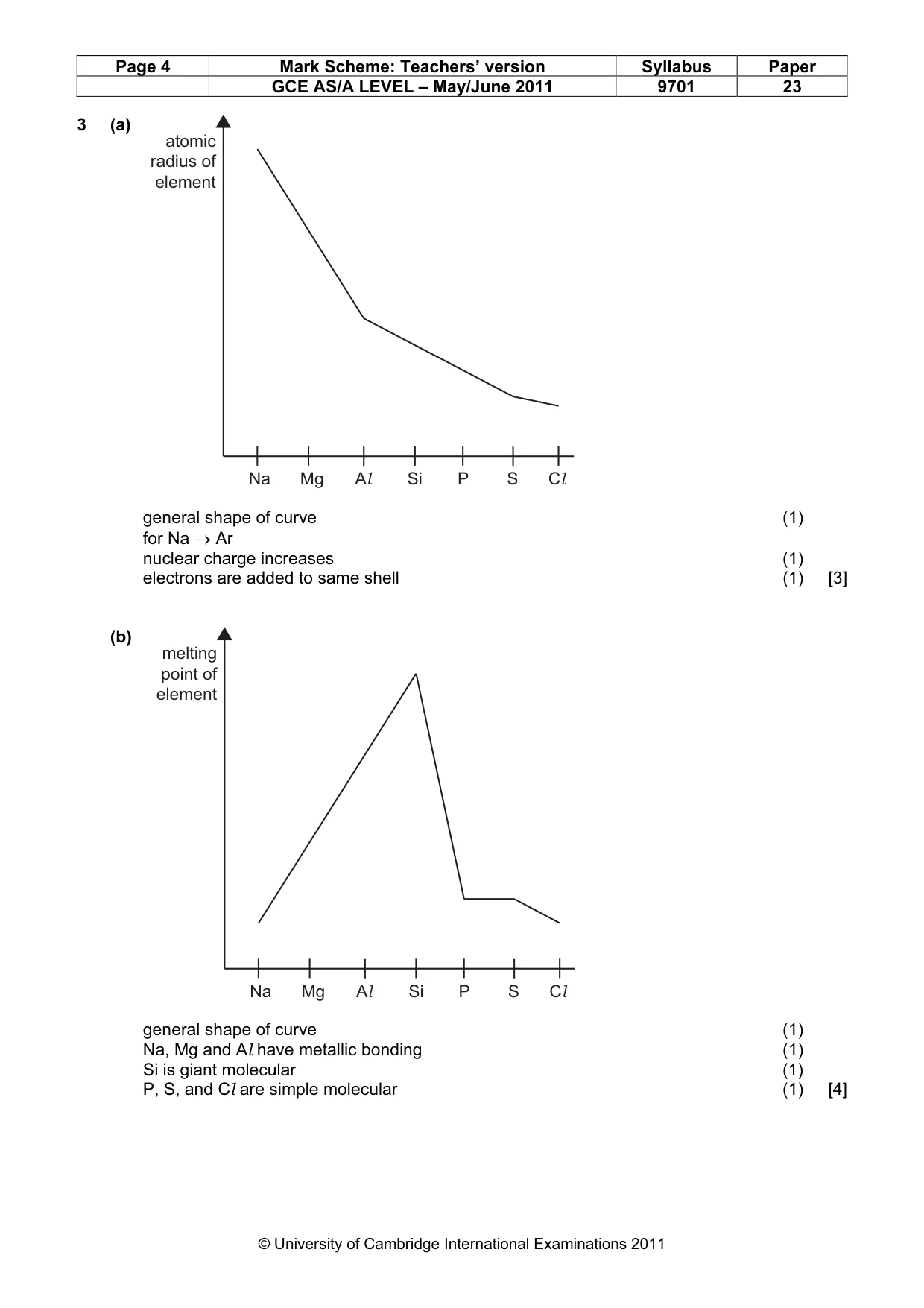
Page 4 Mark Scheme: Teachers’ version Syllabus Paper GCE AS/A LEVEL – May/June 2011 9701 23 © University of Cambridge International Examinations 2011 atomic radius of element Na Mg Cl S P Si Al melting point of element Na Mg Cl S P Si Al 3 (a) general shape of curve (1) for Na → Ar nuclear charge increases (1) electrons are added to same shell (1) [3] (b) general shape of curve (1) Na, Mg and Al have metallic bonding (1) Si is giant molecular (1) P, S, and Cl are simple molecular (1) [4]
Mark scheme, page 5
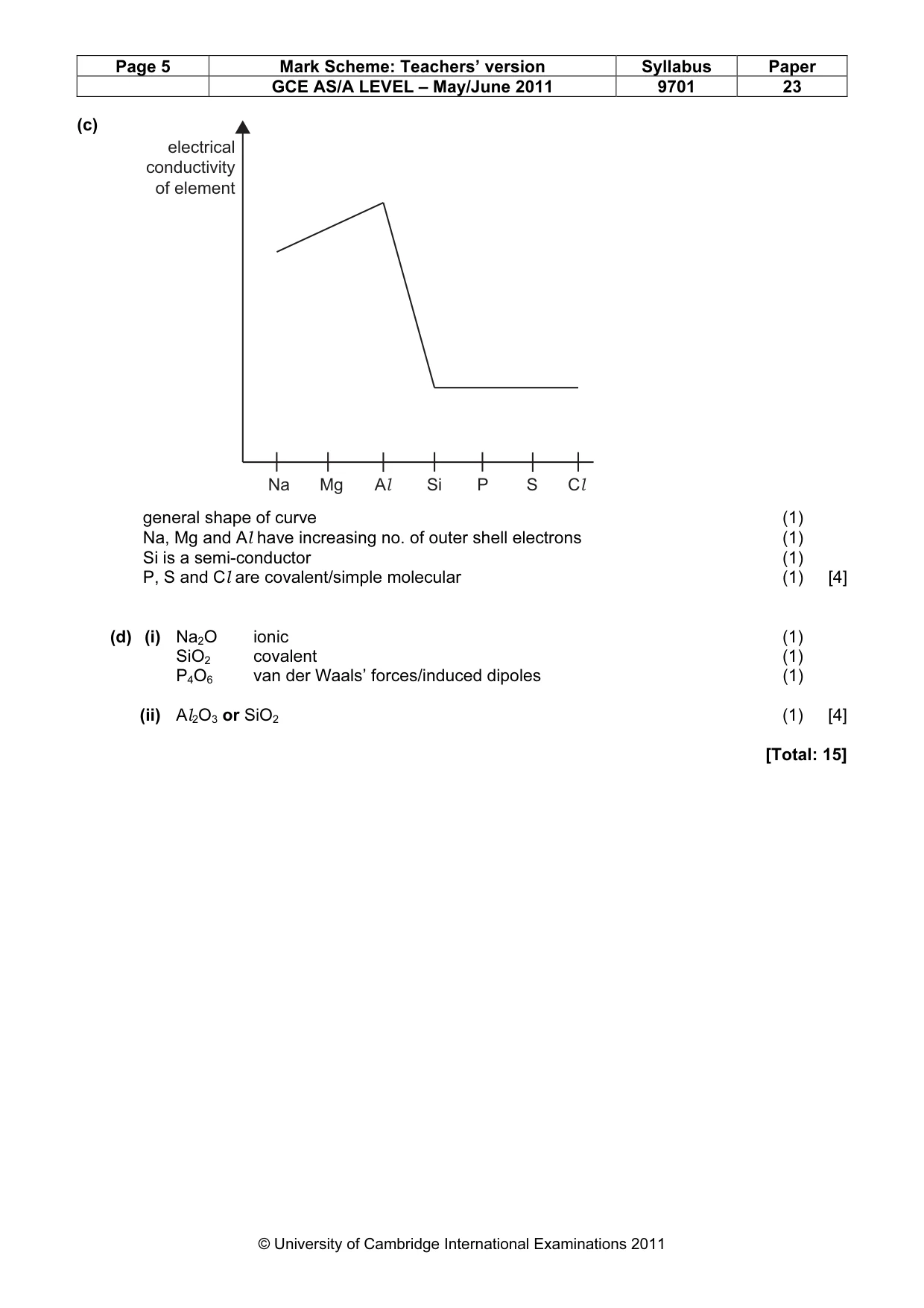
Page 5 Mark Scheme: Teachers’ version Syllabus Paper GCE AS/A LEVEL – May/June 2011 9701 23 © University of Cambridge International Examinations 2011 electrical conductivity of element Na Mg Cl S P Si Al (c) general shape of curve (1) Na, Mg and Al have increasing no. of outer shell electrons (1) Si is a semi-conductor (1) P, S and Cl are covalent/simple molecular (1) [4] (d) (i) Na2O ionic (1) SiO2 covalent (1) P4O6 van der Waals’ forces/induced dipoles (1) (ii) Al2O3 or SiO2 (1) [4] [Total: 15]
Mark scheme, page 6
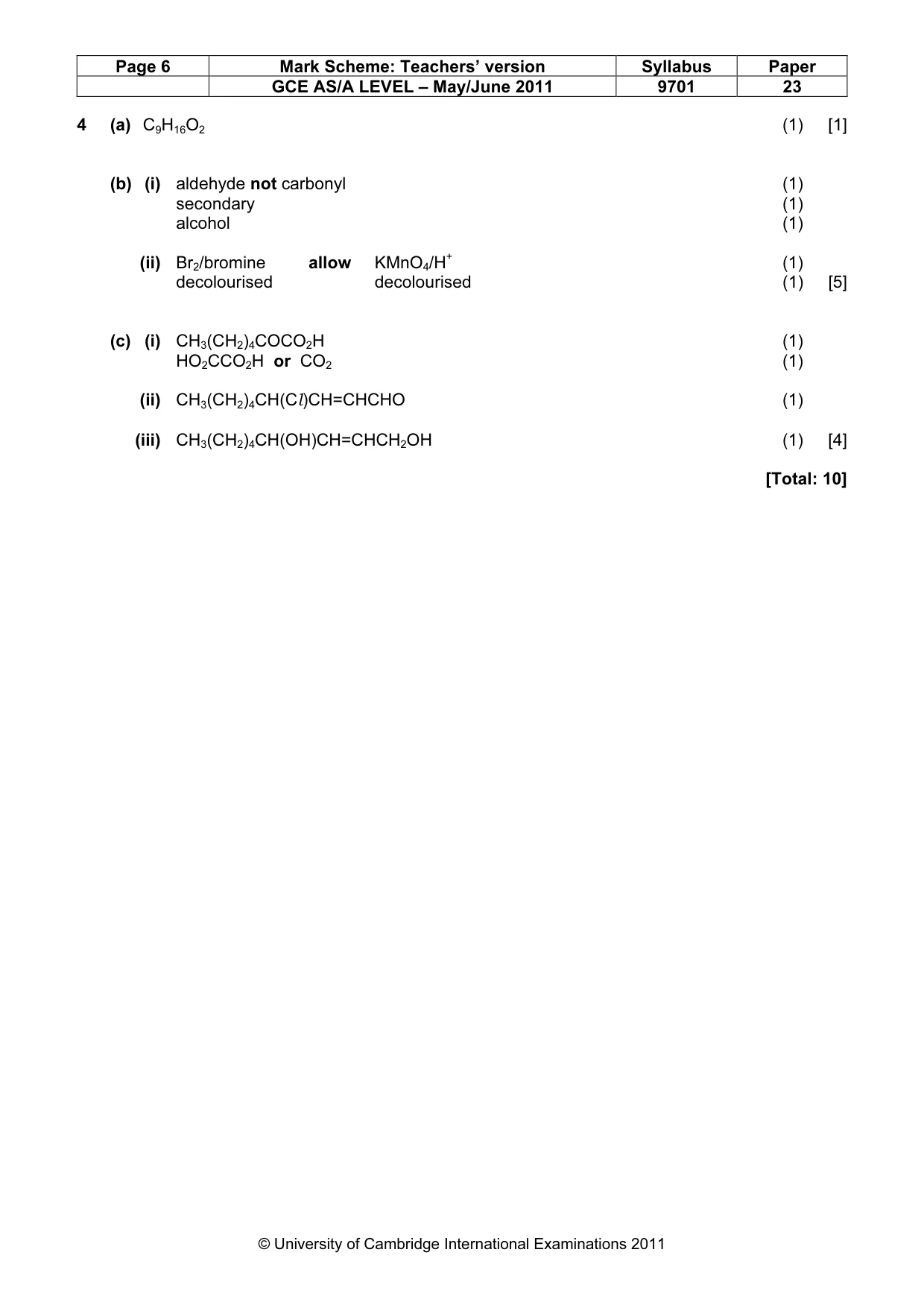
Page 6 Mark Scheme: Teachers’ version Syllabus Paper GCE AS/A LEVEL – May/June 2011 9701 23 © University of Cambridge International Examinations 2011 4 (a) C9H16O2 (1) [1] (b) (i) aldehyde not carbonyl (1) secondary (1) alcohol (1) (ii) Br2/bromine allow KMnO4/H+ (1) decolourised decolourised (1) [5] (c) (i) CH3(CH2)4COCO2H (1) HO2CCO2H or CO2 (1) (ii) CH3(CH2)4CH(Cl)CH=CHCHO (1) (iii) CH3(CH2)4CH(OH)CH=CHCH2OH (1) [4] [Total: 10]
Mark scheme, page 7
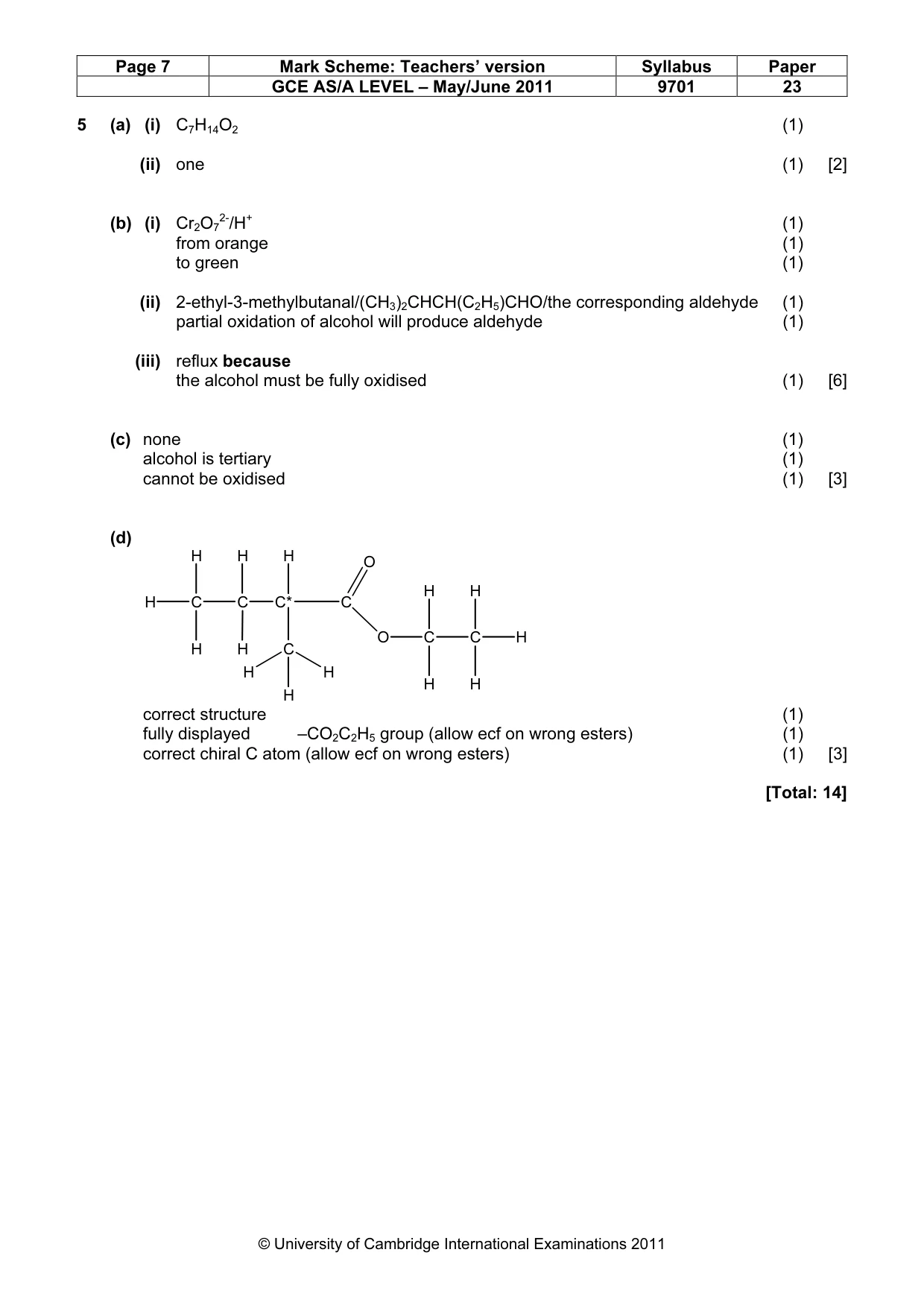
Page 7 Mark Scheme: Teachers’ version Syllabus Paper GCE AS/A LEVEL – May/June 2011 9701 23 © University of Cambridge International Examinations 2011 5 (a) (i) C7H14O2 (1) (ii) one (1) [2] (b) (i) Cr2O7 2-/H+ (1) from orange (1) to green (1) (ii) 2-ethyl-3-methylbutanal/(CH3)2CHCH(C2H5)CHO/the corresponding aldehyde (1) partial oxidation of alcohol will produce aldehyde (1) (iii) reflux because the alcohol must be fully oxidised (1) [6] (c) none (1) alcohol is tertiary (1) cannot be oxidised (1) [3] (d) H C H H C C* H H H C O O C C H H H H H C H H H correct structure (1) fully displayed –CO2C2H5 group (allow ecf on wrong esters) (1) correct chiral C atom (allow ecf on wrong esters) (1) [3] [Total: 14]
What you needed in this session
Cambridge’s own grade thresholds for 2011 May/June, Paper 2 · Variant 3. A higher threshold means an easier paper — the bar moves with how the cohort did.