Cambridge A Level Chemistry 9701 — 2010 May/June Paper 3 · Variant 5
9701/35/M/J/10 · 40 marks · ≈45 min
The question paper and its mark scheme, free to read here and free to download. This is Cambridge’s own paper, exactly as it was sat.
Question paper16 pages


Mark scheme8 pages
Answers below. Sit the paper first if you are practising.
Paper as text
Question paper, page 1
This document consists of 13 printed pages and 3 blank pages. DC (LEO/SW) 23108/2 © UCLES 2010 [Turn over * 5 8 0 3 5 3 9 2 4 9 * UNIVERSITY OF CAMBRIDGE INTERNATIONAL EXAMINATIONS General Certificate of Education Advanced Subsidiary Level and Advanced Level READ THESE INSTRUCTIONS FIRST Write your Centre number, candidate number and name on all the work you hand in. Give details of the practical session and laboratory where appropriate, in the boxes provided. Write in dark blue or black pen. You may use a soft pencil for any diagrams, graphs or rough working. Do not use staples, paper clips, highlighters, glue or correction fluid. DO NOT WRITE IN ANY BARCODES. Answer all questions. You may lose marks if you do not show your working or if you do not use appropriate units. Use of a Data Booklet is unnecessary. Qualitative Analysis Notes are printed on pages 14 and 15. At the end of the examination, fasten all your work securely together. The number of marks is given in brackets [ ] at the end of each question or part question. CHEMISTRY 9701/35 Paper 31 Advanced Practical Skills May/June 2010 2 hours Candidates answer on the Question Paper. Additional Materials: As listed in the Instructions to Supervisors For Examiner’s Use 1 2 Total Session Laboratory
Question paper, page 2
2 9701/35/M/J/10 © UCLES 2010 BLANK PAGE
Question paper, page 3
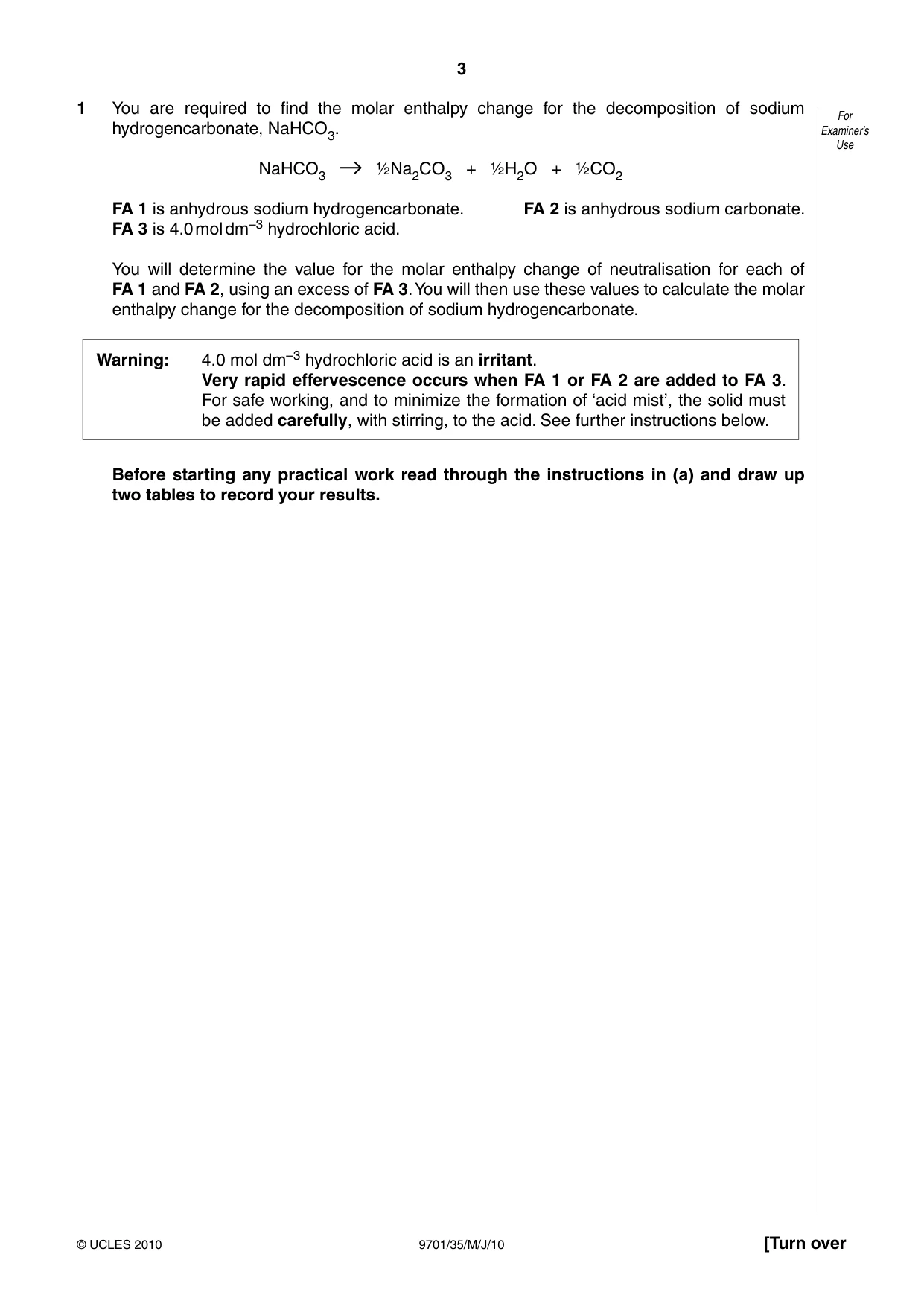
3 9701/35/M/J/10 © UCLES 2010 [Turn over For Examiner’s Use 1 You are required to find the molar enthalpy change for the decomposition of sodium hydrogencarbonate, NaHCO3. NaHCO3 ½Na2CO3 + ½H2O + ½CO2 FA 1 is anhydrous sodium hydrogencarbonate. FA 2 is anhydrous sodium carbonate. FA 3 is 4.0 mol dm–3 hydrochloric acid. You will determine the value for the molar enthalpy change of neutralisation for each of FA 1 and FA 2, using an excess of FA 3. You will then use these values to calculate the molar enthalpy change for the decomposition of sodium hydrogencarbonate. Warning: 4.0 mol dm–3 hydrochloric acid is an irritant. Very rapid effervescence occurs when FA 1 or FA 2 are added to FA 3. For safe working, and to minimize the formation of ‘acid mist’, the solid must be added carefully, with stirring, to the acid. See further instructions below. Before starting any practical work read through the instructions in (a) and draw up two tables to record your results.
Question paper, page 4
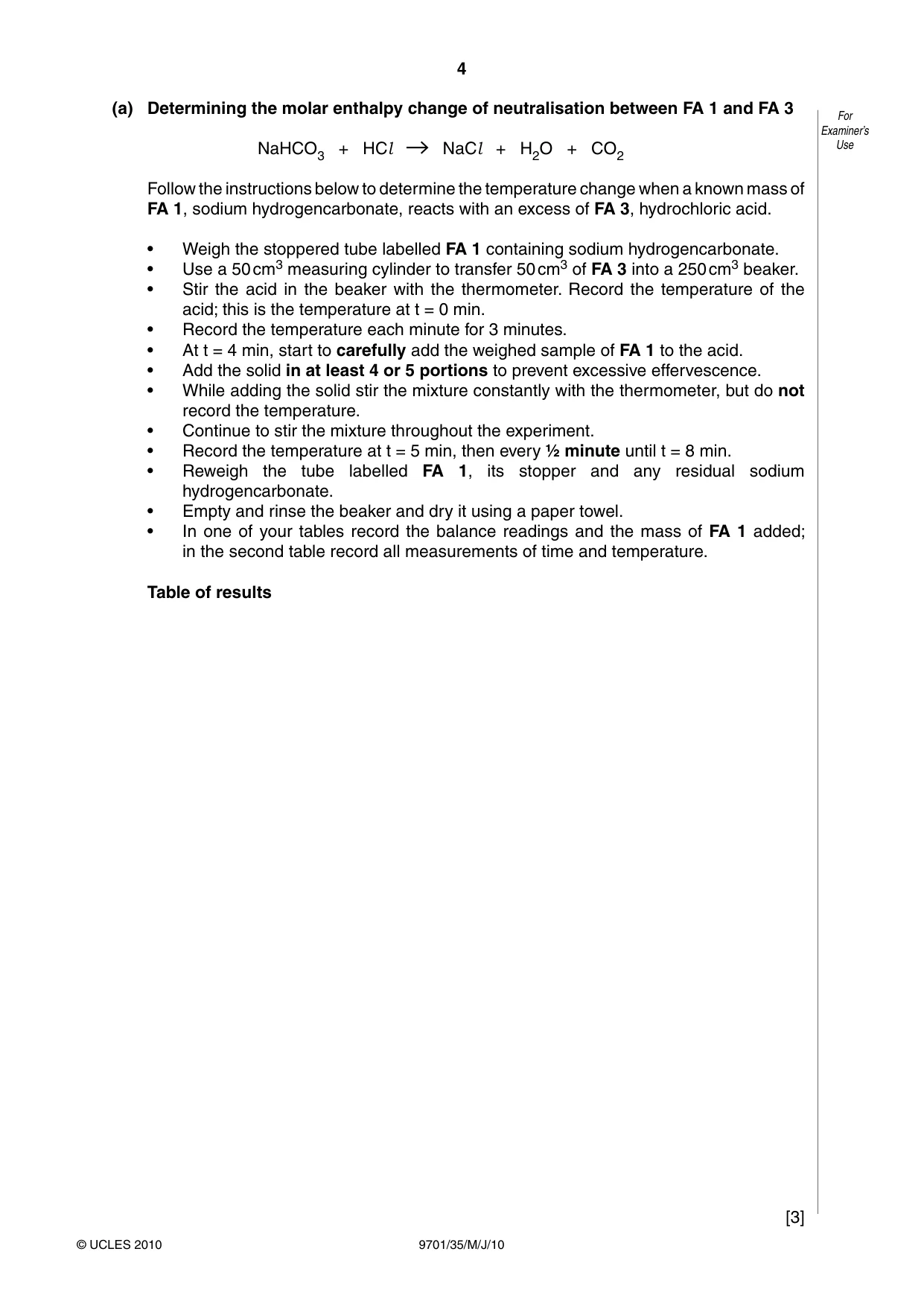
4 9701/35/M/J/10 © UCLES 2010 For Examiner’s Use (a) Determining the molar enthalpy change of neutralisation between FA 1 and FA 3 NaHCO3 + HCl NaCl + H2O + CO2 Follow the instructions below to determine the temperature change when a known mass of FA 1, sodium hydrogencarbonate, reacts with an excess of FA 3, hydrochloric acid. • Weigh the stoppered tube labelled FA 1 containing sodium hydrogencarbonate. • Use a 50 cm3 measuring cylinder to transfer 50 cm3 of FA 3 into a 250 cm3 beaker. • Stir the acid in the beaker with the thermometer. Record the temperature of the acid; this is the temperature at t = 0 min. • Record the temperature each minute for 3 minutes. • At t = 4 min, start to carefully add the weighed sample of FA 1 to the acid. • Add the solid in at least 4 or 5 portions to prevent excessive effervescence. • While adding the solid stir the mixture constantly with the thermometer, but do not record the temperature. • Continue to stir the mixture throughout the experiment. • Record the temperature at t = 5 min, then every ½ minute until t = 8 min. • Reweigh the tube labelled FA 1, its stopper and any residual sodium hydrogencarbonate. • Empty and rinse the beaker and dry it using a paper towel. • In one of your tables record the balance readings and the mass of FA 1 added; in the second table record all measurements of time and temperature. Table of results [3]
Question paper, page 5
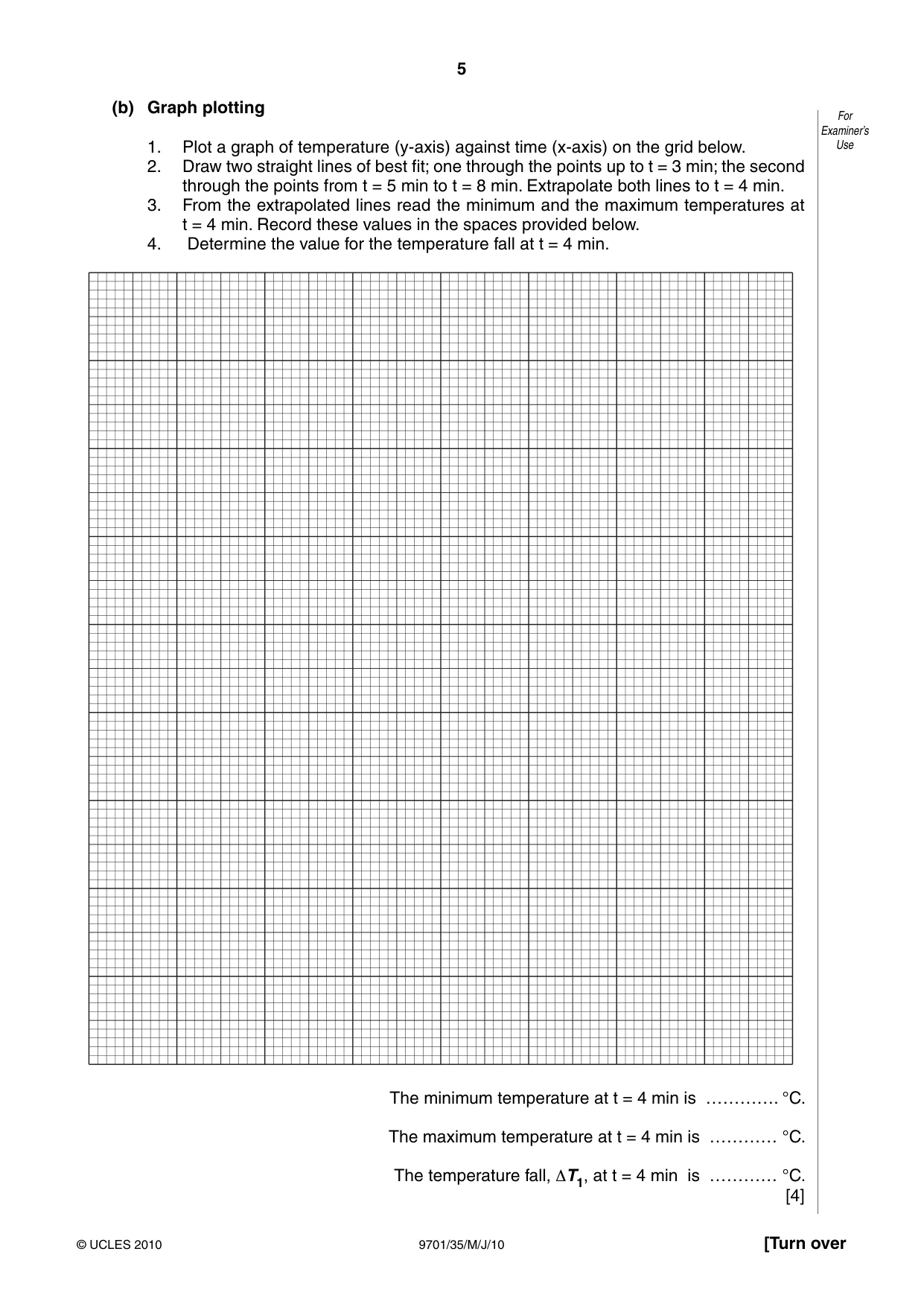
5 9701/35/M/J/10 © UCLES 2010 [Turn over For Examiner’s Use (b) Graph plotting 1. Plot a graph of temperature (y-axis) against time (x-axis) on the grid below. 2. Draw two straight lines of best fit; one through the points up to t = 3 min; the second through the points from t = 5 min to t = 8 min. Extrapolate both lines to t = 4 min. 3. From the extrapolated lines read the minimum and the maximum temperatures at t = 4 min. Record these values in the spaces provided below. 4. Determine the value for the temperature fall at t = 4 min. The minimum temperature at t = 4 min is …………. °C. The maximum temperature at t = 4 min is ………… °C. The temperature fall, ΔT1, at t = 4 min is ………… °C. [4]
Question paper, page 6
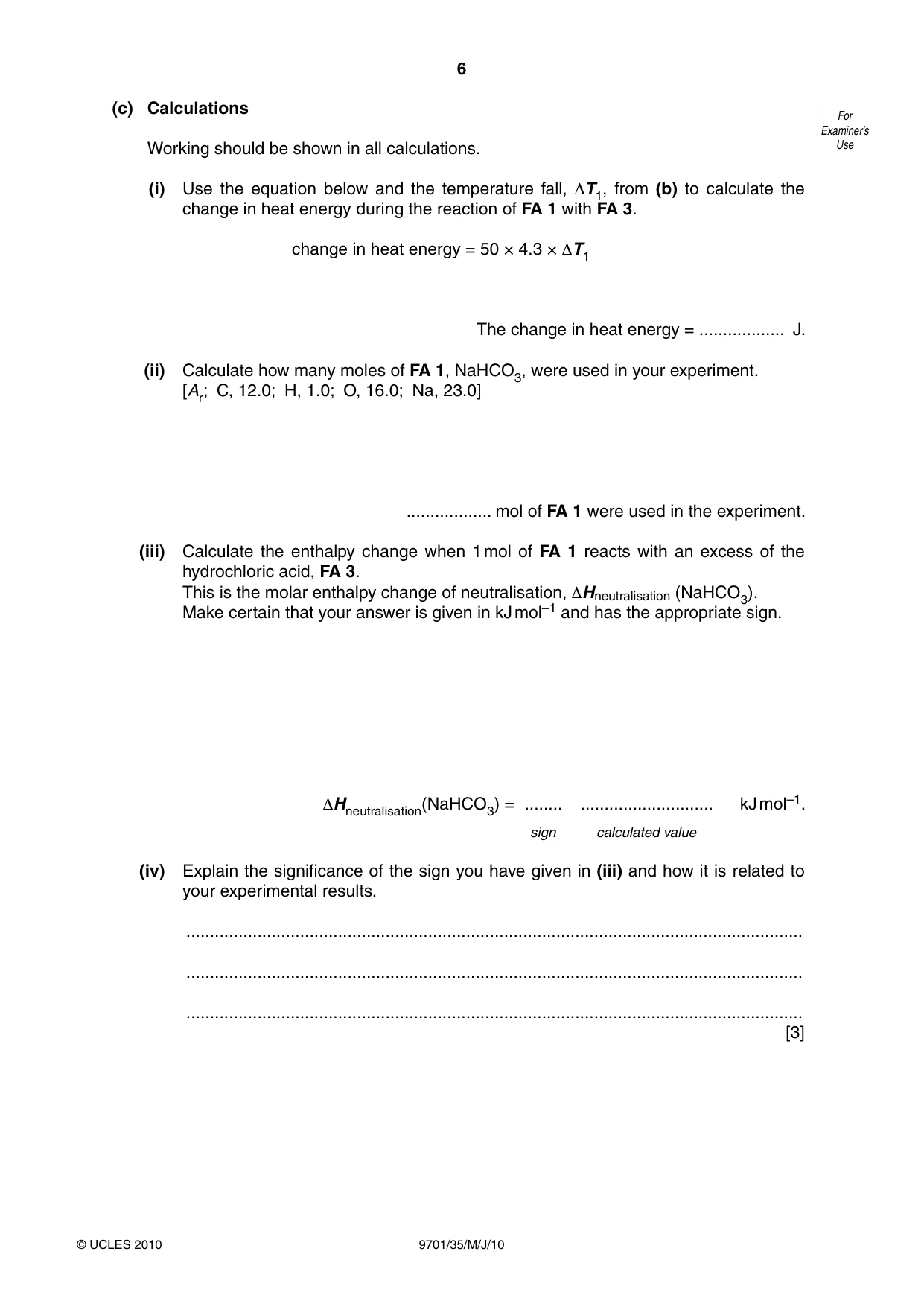
6 9701/35/M/J/10 © UCLES 2010 For Examiner’s Use (c) Calculations Working should be shown in all calculations. (i) Use the equation below and the temperature fall, ΔT1, from (b) to calculate the change in heat energy during the reaction of FA 1 with FA 3. change in heat energy = 50 × 4.3 × ΔT1 The change in heat energy = … J. (ii) Calculate how many moles of FA 1, NaHCO3, were used in your experiment. [Ar; C, 12.0; H, 1.0; O, 16.0; Na, 23.0] … mol of FA 1 were used in the experiment. (iii) Calculate the enthalpy change when 1 mol of FA 1 reacts with an excess of the hydrochloric acid, FA 3. This is the molar enthalpy change of neutralisation, ΔHneutralisation (NaHCO3). Make certain that your answer is given in kJ mol–1 and has the appropriate sign. ΔHneutralisation(NaHCO3) = … … kJ mol–1. sign calculated value (iv) Explain the significance of the sign you have given in (iii) and how it is related to your experimental results. … … … [3]
Question paper, page 7
7 9701/35/M/J/10 © UCLES 2010 [Turn over BLANK PAGE
Question paper, page 8
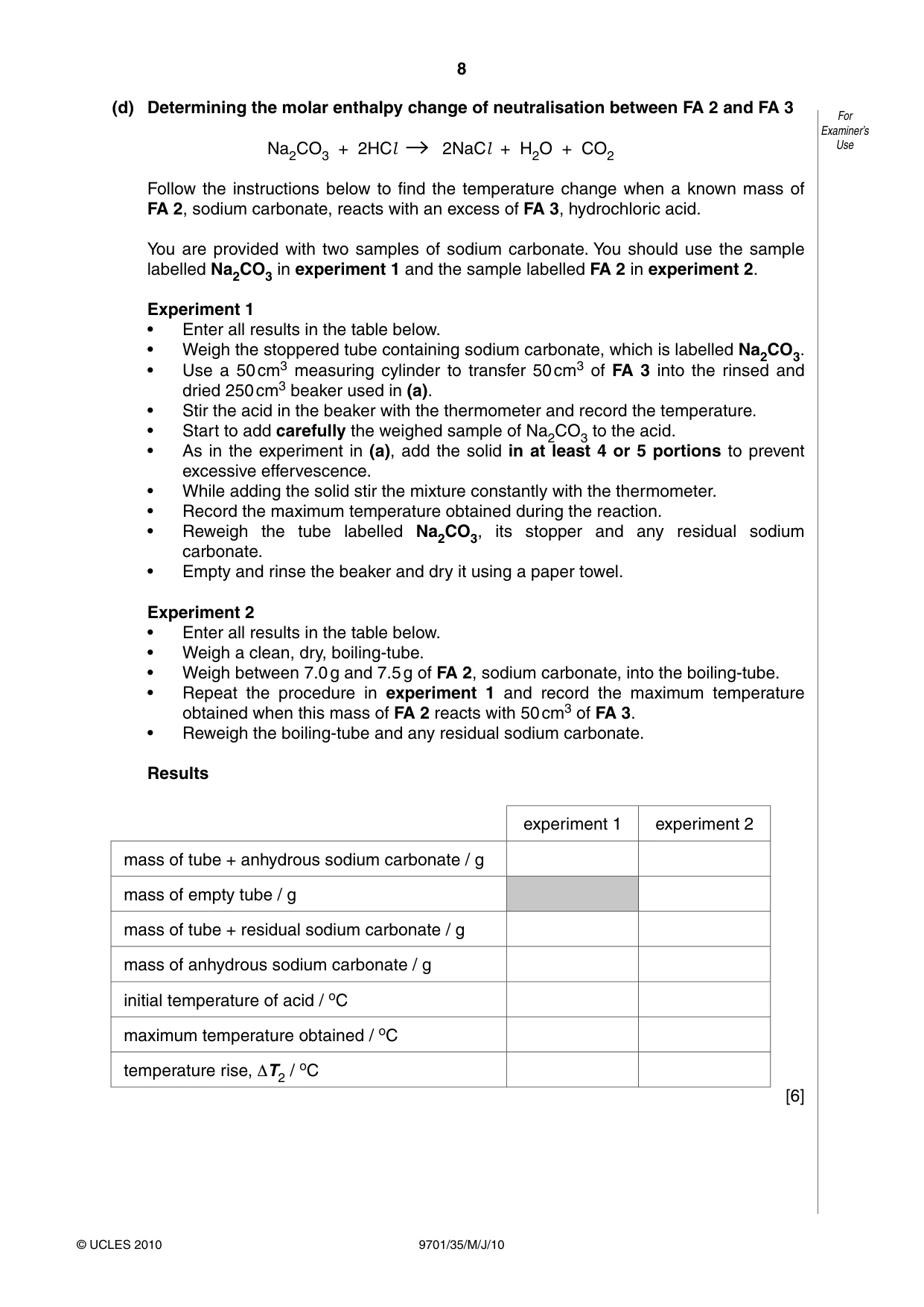
8 9701/35/M/J/10 © UCLES 2010 For Examiner’s Use (d) Determining the molar enthalpy change of neutralisation between FA 2 and FA 3 Na2CO3 + 2HCl 2NaCl + H2O + CO2 Follow the instructions below to find the temperature change when a known mass of FA 2, sodium carbonate, reacts with an excess of FA 3, hydrochloric acid. You are provided with two samples of sodium carbonate. You should use the sample labelled Na2CO3 in experiment 1 and the sample labelled FA 2 in experiment 2. Experiment 1 • Enter all results in the table below. • Weigh the stoppered tube containing sodium carbonate, which is labelled Na2CO3. • Use a 50 cm3 measuring cylinder to transfer 50 cm3 of FA 3 into the rinsed and dried 250 cm3 beaker used in (a). • Stir the acid in the beaker with the thermometer and record the temperature. • Start to add carefully the weighed sample of Na2CO3 to the acid. • As in the experiment in (a), add the solid in at least 4 or 5 portions to prevent excessive effervescence. • While adding the solid stir the mixture constantly with the thermometer. • Record the maximum temperature obtained during the reaction. • Reweigh the tube labelled Na2CO3, its stopper and any residual sodium carbonate. • Empty and rinse the beaker and dry it using a paper towel. Experiment 2 • Enter all results in the table below. • Weigh a clean, dry, boiling-tube. • Weigh between 7.0 g and 7.5 g of FA 2, sodium carbonate, into the boiling-tube. • Repeat the procedure in experiment 1 and record the maximum temperature obtained when this mass of FA 2 reacts with 50 cm3 of FA 3. • Reweigh the boiling-tube and any residual sodium carbonate. Results experiment 1 experiment 2 mass of tube + anhydrous sodium carbonate / g mass of empty tube / g mass of tube + residual sodium carbonate / g mass of anhydrous sodium carbonate / g initial temperature of acid / oC maximum temperature obtained / oC temperature rise, ΔT2 / oC [6]
Question paper, page 9
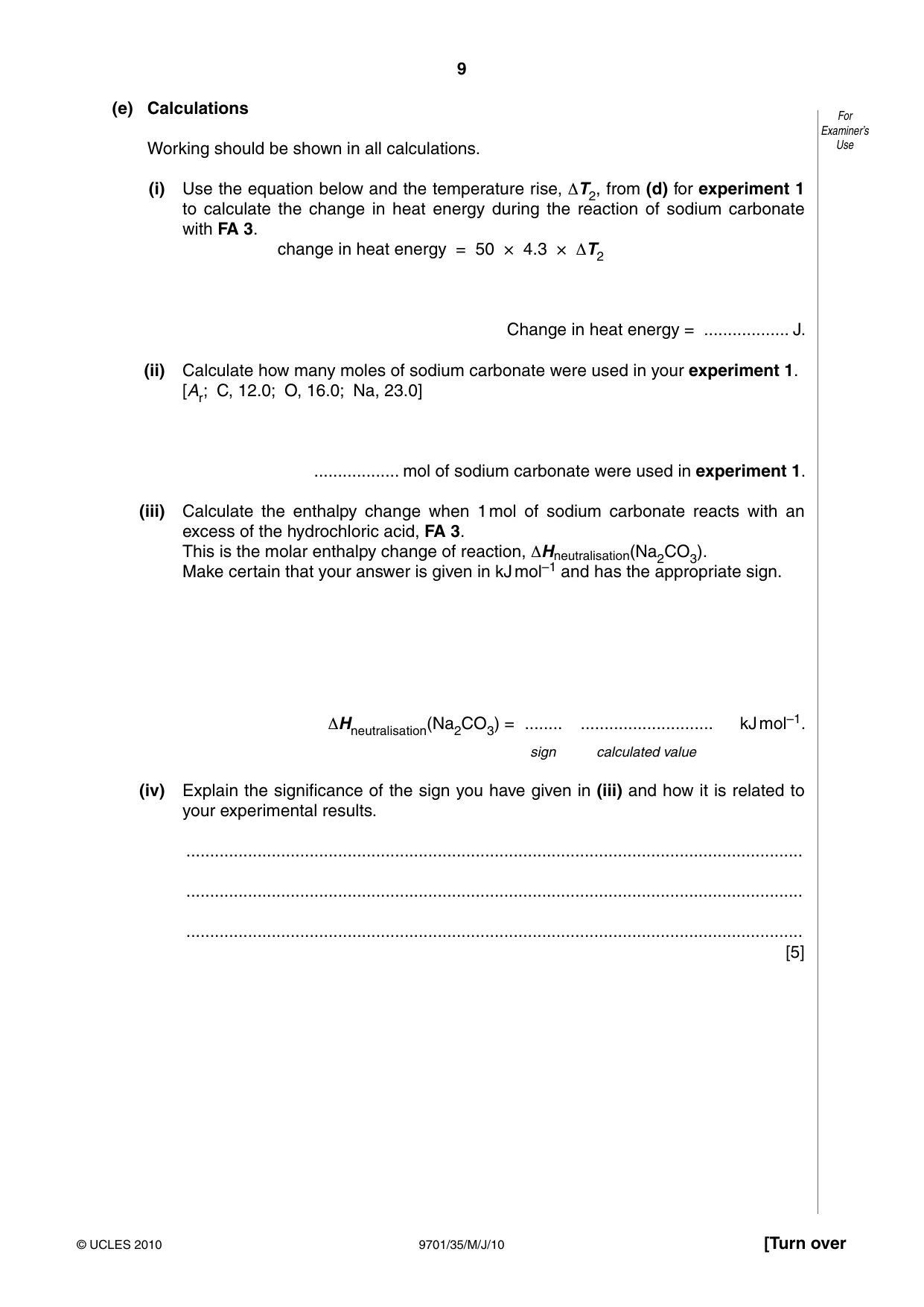
9 9701/35/M/J/10 © UCLES 2010 [Turn over For Examiner’s Use (e) Calculations Working should be shown in all calculations. (i) Use the equation below and the temperature rise, ΔT2, from (d) for experiment 1 to calculate the change in heat energy during the reaction of sodium carbonate with FA 3. change in heat energy = 50 × 4.3 × ΔT2 Change in heat energy = … J. (ii) Calculate how many moles of sodium carbonate were used in your experiment 1. [Ar; C, 12.0; O, 16.0; Na, 23.0] … mol of sodium carbonate were used in experiment 1. (iii) Calculate the enthalpy change when 1 mol of sodium carbonate reacts with an excess of the hydrochloric acid, FA 3. This is the molar enthalpy change of reaction, ΔHneutralisation(Na2CO3). Make certain that your answer is given in kJ mol–1 and has the appropriate sign. ΔHneutralisation(Na2CO3) = … … kJ mol–1. sign calculated value (iv) Explain the significance of the sign you have given in (iii) and how it is related to your experimental results. … … … [5]
Question paper, page 10
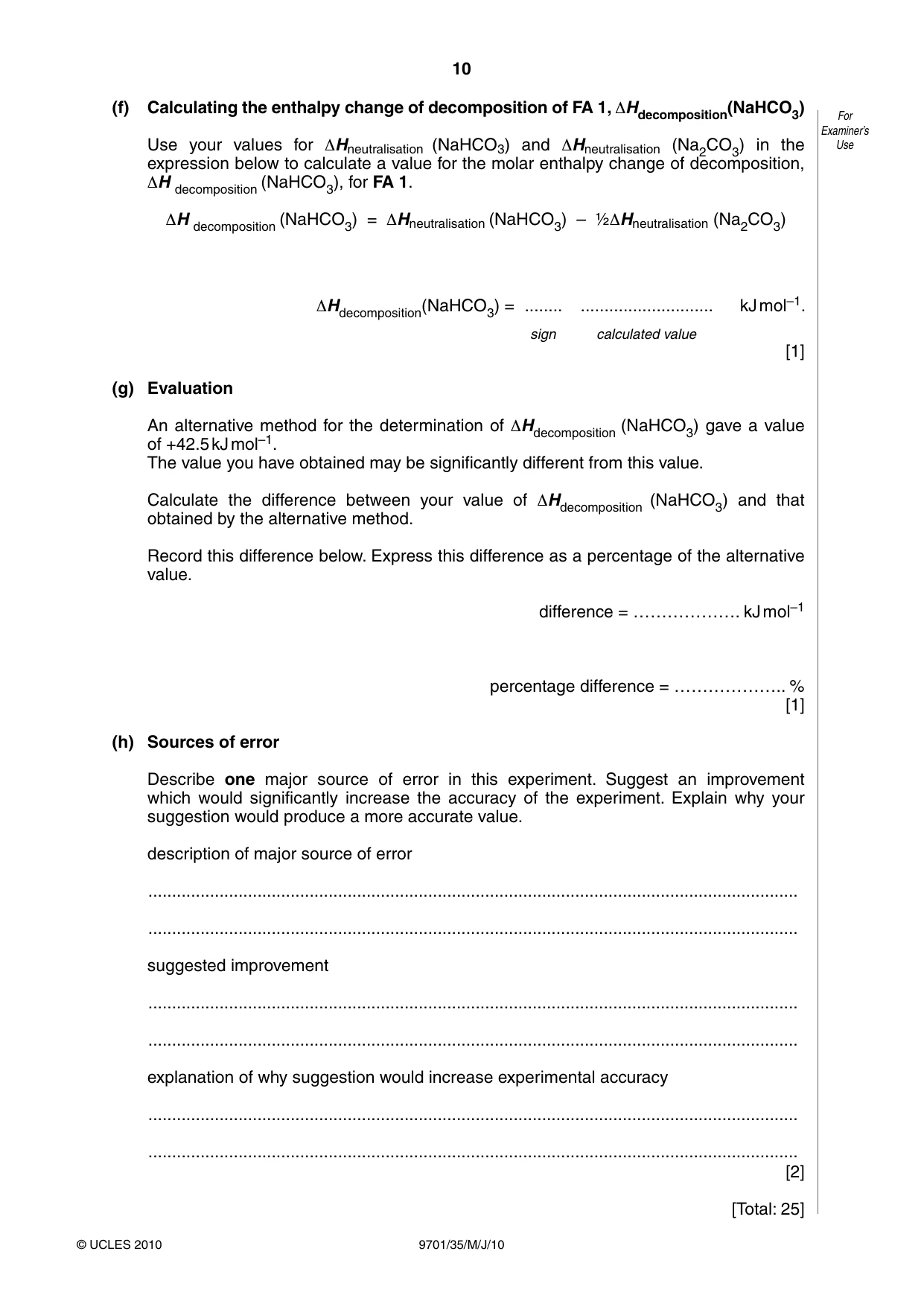
10 9701/35/M/J/10 © UCLES 2010 For Examiner’s Use (f) Calculating the enthalpy change of decomposition of FA 1, ΔHdecomposition(NaHCO3) Use your values for ΔHneutralisation (NaHCO3) and ΔHneutralisation (Na2CO3) in the expression below to calculate a value for the molar enthalpy change of decomposition, ΔH decomposition (NaHCO3), for FA 1. ΔH decomposition (NaHCO3) = ΔHneutralisation (NaHCO3) – ½ΔHneutralisation (Na2CO3) ΔHdecomposition(NaHCO3) = … … kJ mol–1. sign calculated value [1] (g) Evaluation An alternative method for the determination of ΔHdecomposition (NaHCO3) gave a value of +42.5 kJ mol–1. The value you have obtained may be significantly different from this value. Calculate the difference between your value of ΔHdecomposition (NaHCO3) and that obtained by the alternative method. Record this difference below. Express this difference as a percentage of the alternative value. difference = ………………. kJ mol–1 percentage difference = ……………….. % [1] (h) Sources of error Describe one major source of error in this experiment. Suggest an improvement which would significantly increase the accuracy of the experiment. Explain why your suggestion would produce a more accurate value. description of major source of error … … suggested improvement … … explanation of why suggestion would increase experimental accuracy … … [2] [Total: 25]
Question paper, page 11
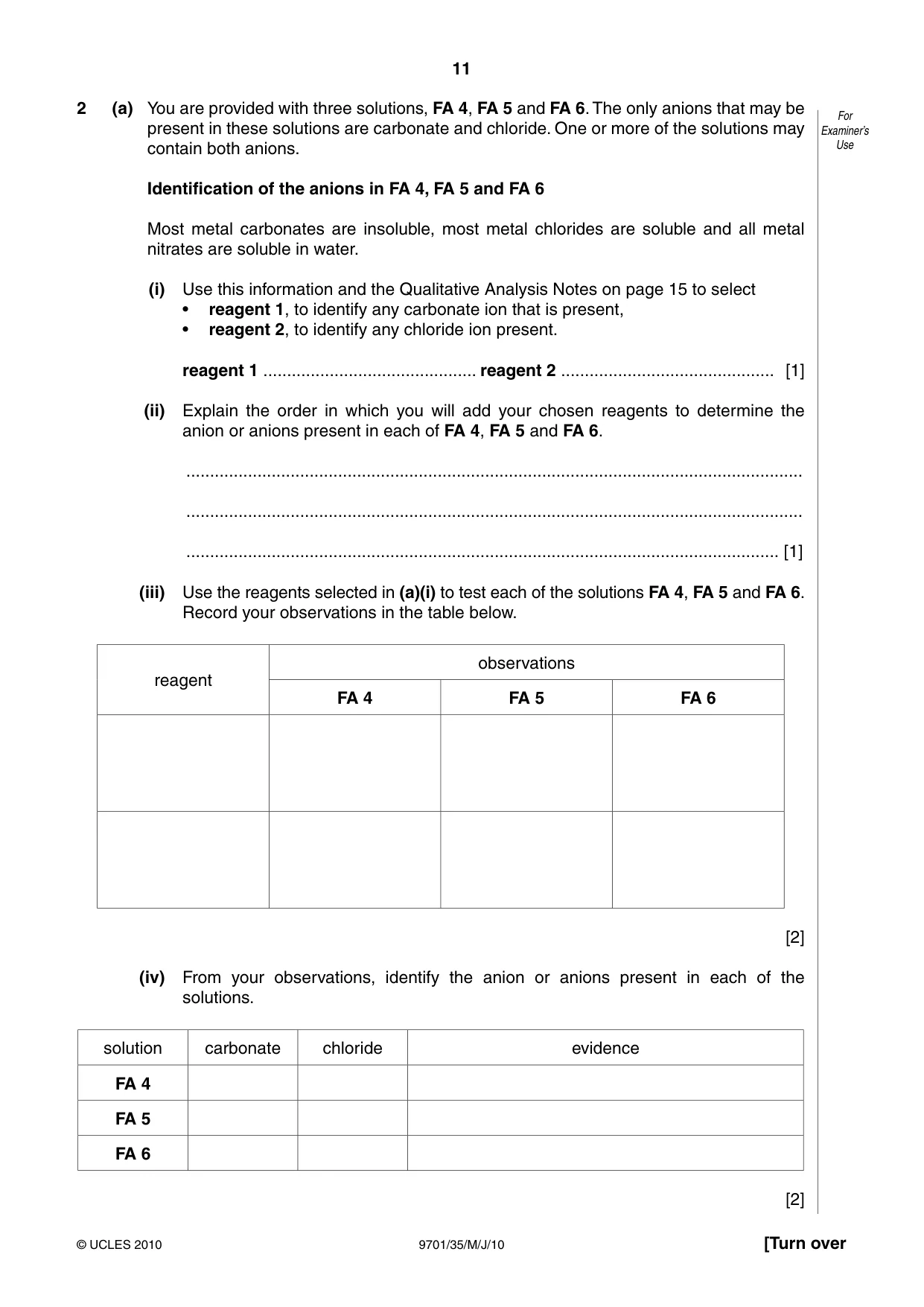
11 9701/35/M/J/10 © UCLES 2010 [Turn over For Examiner’s Use 2 (a) You are provided with three solutions, FA 4, FA 5 and FA 6. The only anions that may be present in these solutions are carbonate and chloride. One or more of the solutions may contain both anions. Identification of the anions in FA 4, FA 5 and FA 6 Most metal carbonates are insoluble, most metal chlorides are soluble and all metal nitrates are soluble in water. (i) Use this information and the Qualitative Analysis Notes on page 15 to select • reagent 1, to identify any carbonate ion that is present, • reagent 2, to identify any chloride ion present. reagent 1 … reagent 2 … [1] (ii) Explain the order in which you will add your chosen reagents to determine the anion or anions present in each of FA 4, FA 5 and FA 6. … … … [1] (iii) Use the reagents selected in (a)(i) to test each of the solutions FA 4, FA 5 and FA 6. Record your observations in the table below. reagent observations FA 4 FA 5 FA 6 [2] (iv) From your observations, identify the anion or anions present in each of the solutions. solution carbonate chloride evidence FA 4 FA 5 FA 6 [2]
Question paper, page 12
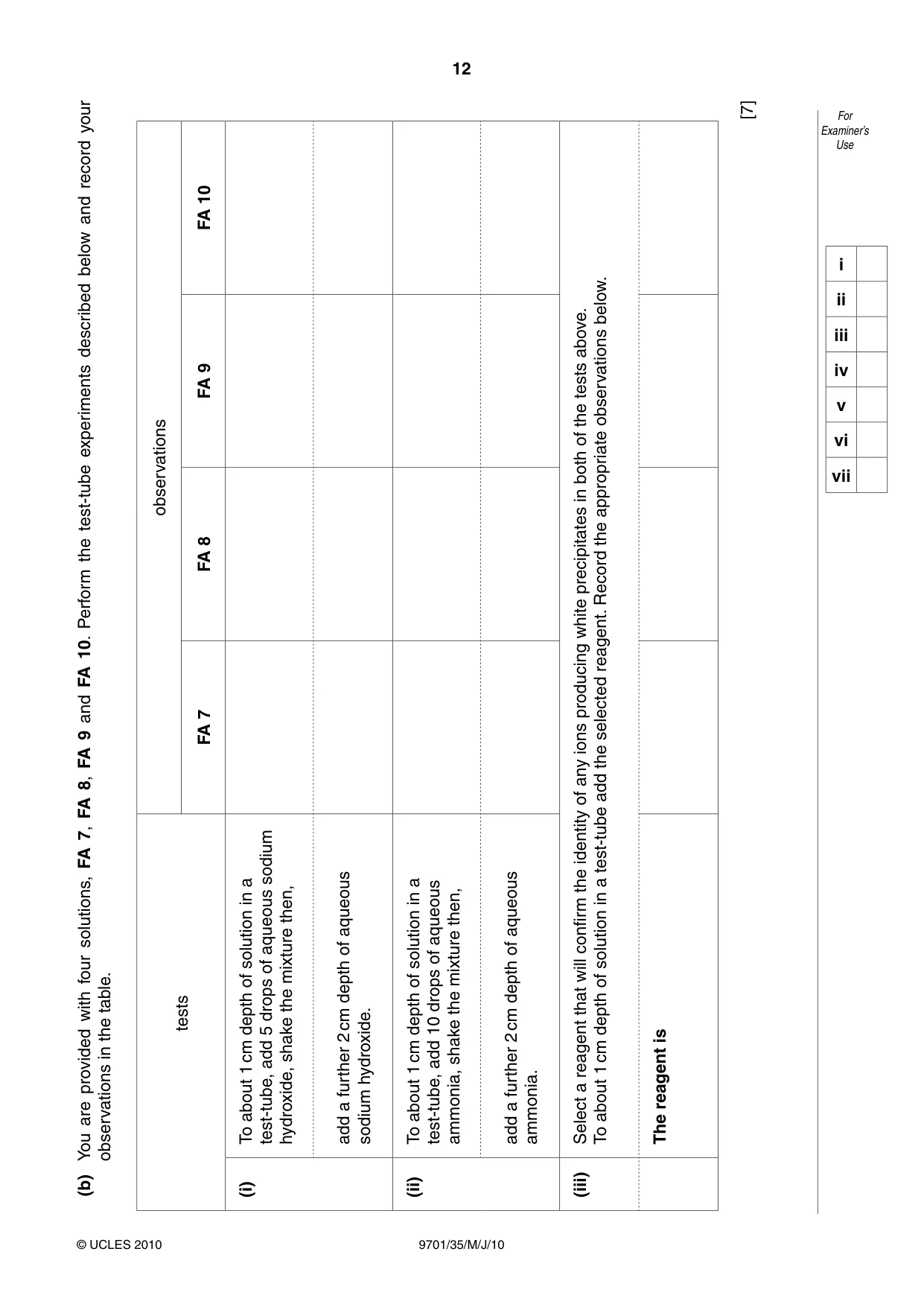
12 9701/35/M/J/10 © UCLES 2010 For Examiner’s Use (b) You are provided with four solutions, FA 7, FA 8, FA 9 and FA 10. Perform the test-tube experiments described below and record your observations in the table. tests observations FA 7 FA 8 FA 9 FA 10 (i) To about 1 cm depth of solution in a test-tube, add 5 drops of aqueous sodium hydroxide, shake the mixture then, add a further 2 cm depth of aqueous sodium hydroxide. (ii) To about 1 cm depth of solution in a test-tube, add 10 drops of aqueous ammonia, shake the mixture then, add a further 2 cm depth of aqueous ammonia. (iii) Select a reagent that will confirm the identity of any ions producing white precipitates in both of the tests above. To about 1 cm depth of solution in a test-tube add the selected reagent. Record the appropriate observations below. The reagent is [7] i ii iii iv v vi vii
Question paper, page 13
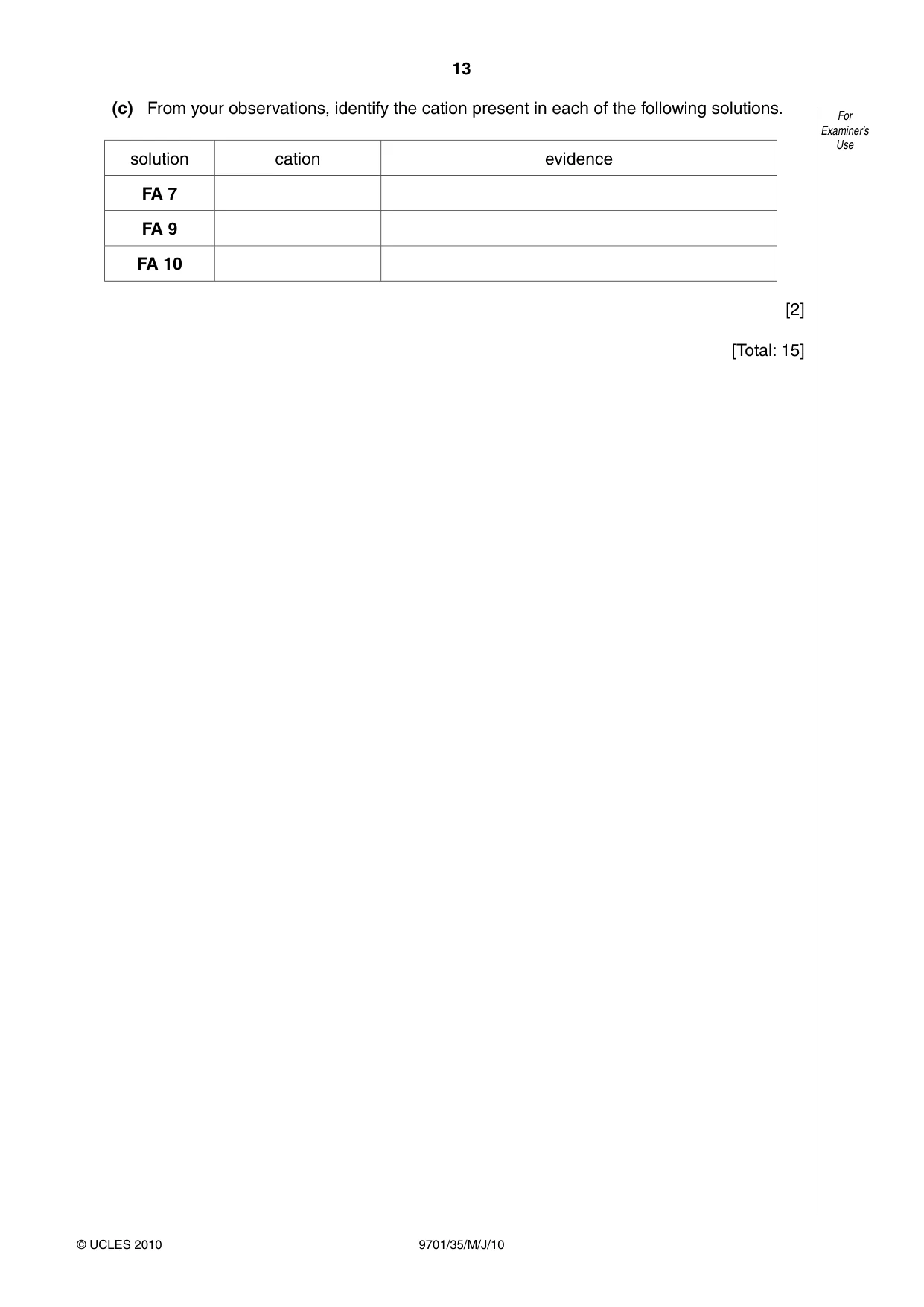
13 9701/35/M/J/10 © UCLES 2010 For Examiner’s Use (c) From your observations, identify the cation present in each of the following solutions. solution cation evidence FA 7 FA 9 FA 10 [2] [Total: 15]
Question paper, page 14
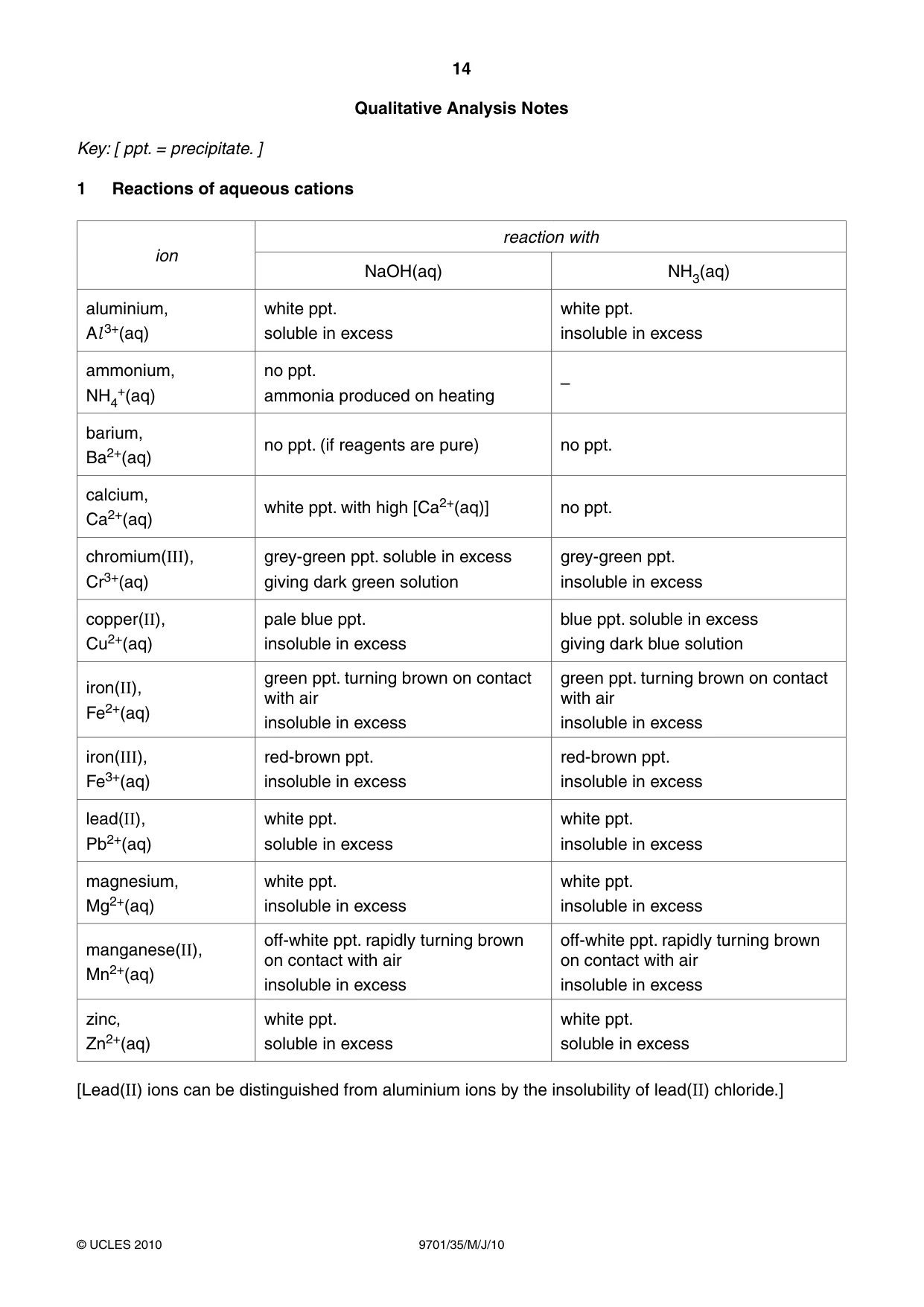
14 9701/35/M/J/10 © UCLES 2010 Qualitative Analysis Notes Key: [ ppt. = precipitate. ] 1 Reactions of aqueous cations ion reaction with NaOH(aq) NH3(aq) aluminium, Al 3+(aq) white ppt. soluble in excess white ppt. insoluble in excess ammonium, NH4 +(aq) no ppt. ammonia produced on heating – barium, Ba2+(aq) no ppt. (if reagents are pure) no ppt. calcium, Ca2+(aq) white ppt. with high [Ca2+(aq)] no ppt. chromium(III), Cr3+(aq) grey-green ppt. soluble in excess giving dark green solution grey-green ppt. insoluble in excess copper(II), Cu2+(aq) pale blue ppt. insoluble in excess blue ppt. soluble in excess giving dark blue solution iron(II), Fe2+(aq) green ppt. turning brown on contact with air insoluble in excess green ppt. turning brown on contact with air insoluble in excess iron(III), Fe3+(aq) red-brown ppt. insoluble in excess red-brown ppt. insoluble in excess lead(II), Pb2+(aq) white ppt. soluble in excess white ppt. insoluble in excess magnesium, Mg2+(aq) white ppt. insoluble in excess white ppt. insoluble in excess manganese(II), Mn2+(aq) off-white ppt. rapidly turning brown on contact with air insoluble in excess off-white ppt. rapidly turning brown on contact with air insoluble in excess zinc, Zn2+(aq) white ppt. soluble in excess white ppt. soluble in excess [Lead(II) ions can be distinguished from aluminium ions by the insolubility of lead(II) chloride.]
Question paper, page 15
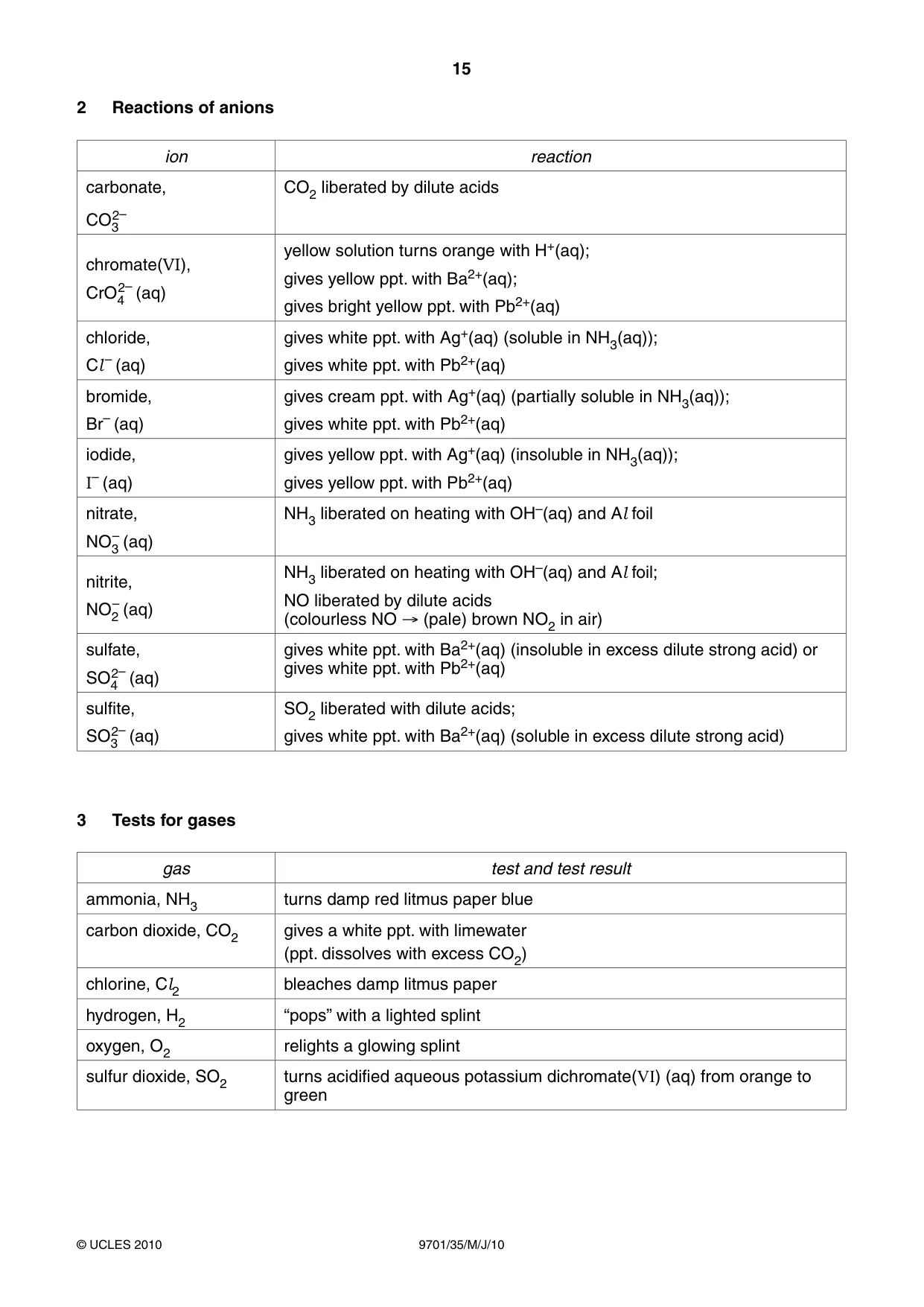
15 9701/35/M/J/10 © UCLES 2010 2 Reactions of anions ion reaction carbonate, CO3 2– CO2 liberated by dilute acids chromate(VI), CrO4 2– (aq) yellow solution turns orange with H+(aq); gives yellow ppt. with Ba2+(aq); gives bright yellow ppt. with Pb2+(aq) chloride, Cl– (aq) gives white ppt. with Ag+(aq) (soluble in NH3(aq)); gives white ppt. with Pb2+(aq) bromide, Br– (aq) gives cream ppt. with Ag+(aq) (partially soluble in NH3(aq)); gives white ppt. with Pb2+(aq) iodide, I– (aq) gives yellow ppt. with Ag+(aq) (insoluble in NH3(aq)); gives yellow ppt. with Pb2+(aq) nitrate, NO3 – (aq) NH3 liberated on heating with OH–(aq) and Al foil nitrite, NO2 – (aq) NH3 liberated on heating with OH–(aq) and Al foil; NO liberated by dilute acids (colourless NO → (pale) brown NO2 in air) sulfate, SO4 2– (aq) gives white ppt. with Ba2+(aq) (insoluble in excess dilute strong acid) or gives white ppt. with Pb2+(aq) sulfite, SO3 2– (aq) SO2 liberated with dilute acids; gives white ppt. with Ba2+(aq) (soluble in excess dilute strong acid) 3 Tests for gases gas test and test result ammonia, NH3 turns damp red litmus paper blue carbon dioxide, CO2 gives a white ppt. with limewater (ppt. dissolves with excess CO2) chlorine, Cl2 bleaches damp litmus paper hydrogen, H2 “pops” with a lighted splint oxygen, O2 relights a glowing splint sulfur dioxide, SO2 turns acidified aqueous potassium dichromate(VI) (aq) from orange to green
Question paper, page 16
16 9701/35/M/J/10 © UCLES 2010 BLANK PAGE Permission to reproduce items where third-party owned material protected by copyright is included has been sought and cleared where possible. Every reasonable effort has been made by the publisher (UCLES) to trace copyright holders, but if any items requiring clearance have unwittingly been included, the publisher will be pleased to make amends at the earliest possible opportunity. University of Cambridge International Examinations is part of the Cambridge Assessment Group. Cambridge Assessment is the brand name of University of Cambridge Local Examinations Syndicate (UCLES), which is itself a department of the University of Cambridge.
Mark scheme, page 1
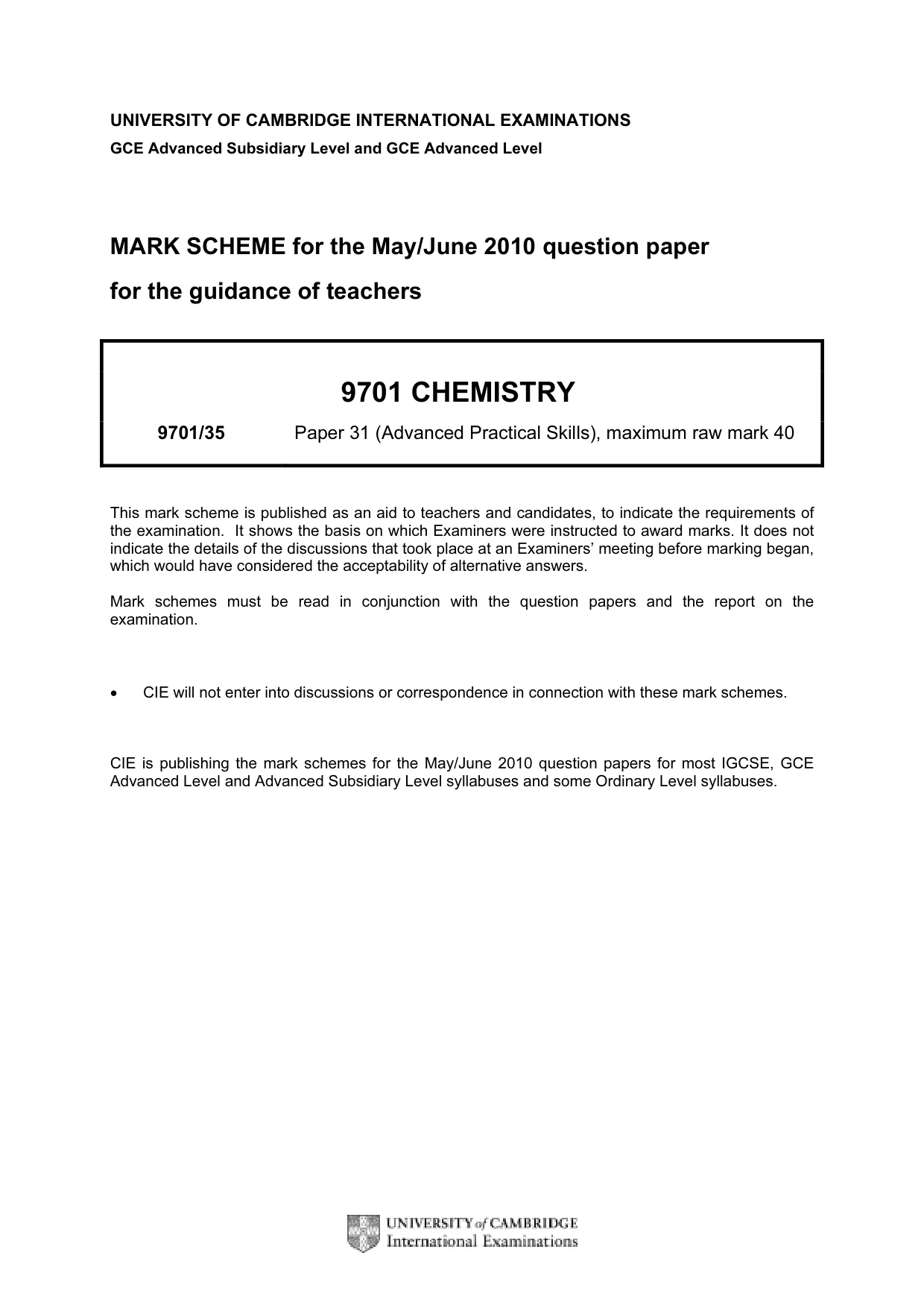
UNIVERSITY OF CAMBRIDGE INTERNATIONAL EXAMINATIONS GCE Advanced Subsidiary Level and GCE Advanced Level MARK SCHEME for the May/June 2010 question paper for the guidance of teachers 9701 CHEMISTRY 9701/35 Paper 31 (Advanced Practical Skills), maximum raw mark 40 This mark scheme is published as an aid to teachers and candidates, to indicate the requirements of the examination. It shows the basis on which Examiners were instructed to award marks. It does not indicate the details of the discussions that took place at an Examiners’ meeting before marking began, which would have considered the acceptability of alternative answers. Mark schemes must be read in conjunction with the question papers and the report on the examination. • CIE will not enter into discussions or correspondence in connection with these mark schemes. CIE is publishing the mark schemes for the May/June 2010 question papers for most IGCSE, GCE Advanced Level and Advanced Subsidiary Level syllabuses and some Ordinary Level syllabuses.
Mark scheme, page 2
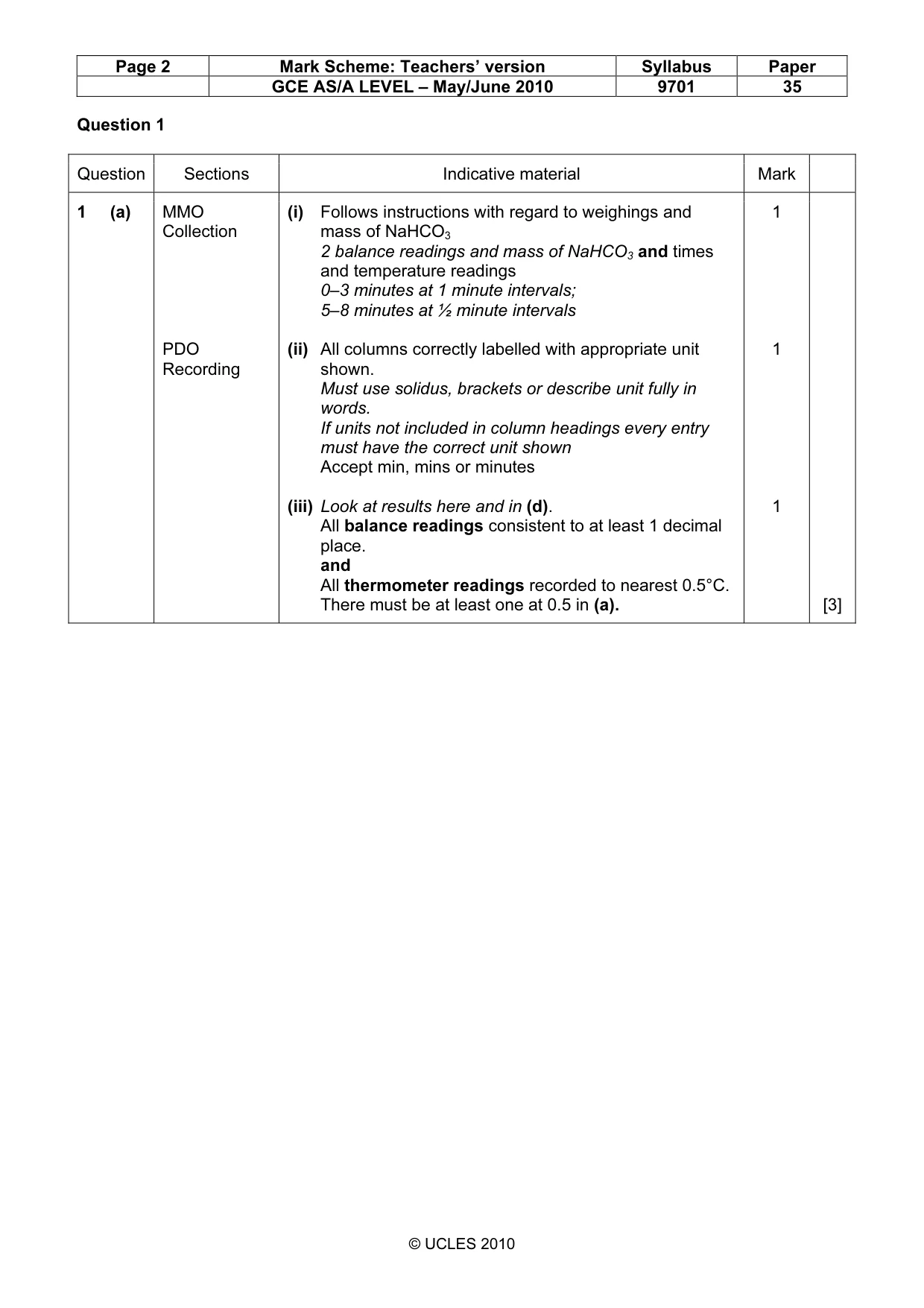
Page 2 Mark Scheme: Teachers’ version Syllabus Paper GCE AS/A LEVEL – May/June 2010 9701 35 © UCLES 2010 Question 1 Question Sections Indicative material Mark 1 (a) MMO Collection PDO Recording (i) Follows instructions with regard to weighings and mass of NaHCO3 2 balance readings and mass of NaHCO3 and times and temperature readings 0–3 minutes at 1 minute intervals; 5–8 minutes at ½ minute intervals (ii) All columns correctly labelled with appropriate unit shown. Must use solidus, brackets or describe unit fully in words. If units not included in column headings every entry must have the correct unit shown Accept min, mins or minutes (iii) Look at results here and in (d). All balance readings consistent to at least 1 decimal place. and All thermometer readings recorded to nearest 0.5°C. There must be at least one at 0.5 in (a). 1 1 1 [3]
Mark scheme, page 3
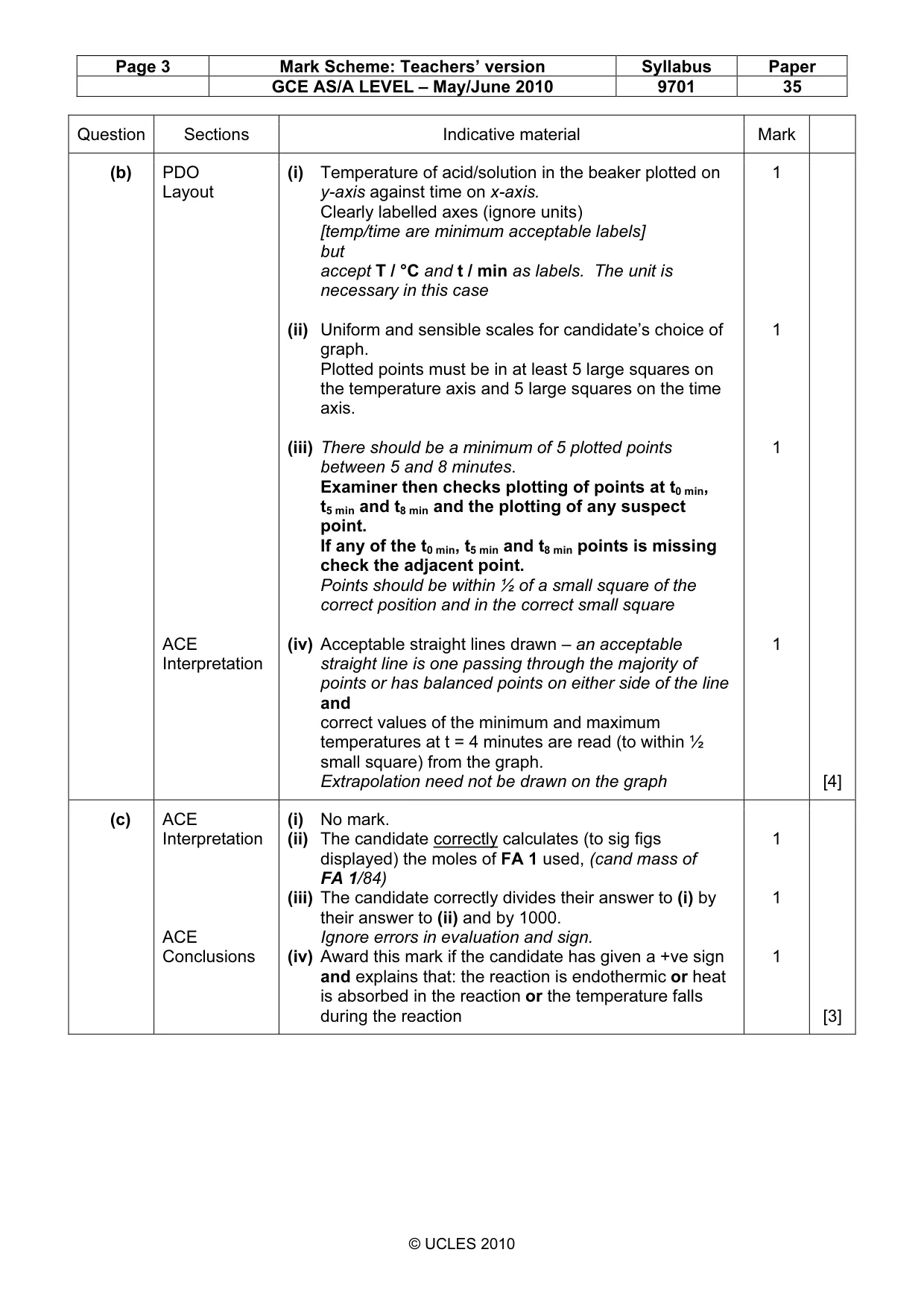
Page 3 Mark Scheme: Teachers’ version Syllabus Paper GCE AS/A LEVEL – May/June 2010 9701 35 © UCLES 2010 Question Sections Indicative material Mark (b) PDO Layout ACE Interpretation (i) Temperature of acid/solution in the beaker plotted on y-axis against time on x-axis. Clearly labelled axes (ignore units) [temp/time are minimum acceptable labels] but accept T / °C and t / min as labels. The unit is necessary in this case (ii) Uniform and sensible scales for candidate’s choice of graph. Plotted points must be in at least 5 large squares on the temperature axis and 5 large squares on the time axis. (iii) There should be a minimum of 5 plotted points between 5 and 8 minutes. Examiner then checks plotting of points at t0 min, t5 min and t8 min and the plotting of any suspect point. If any of the t0 min, t5 min and t8 min points is missing check the adjacent point. Points should be within ½ of a small square of the correct position and in the correct small square (iv) Acceptable straight lines drawn – an acceptable straight line is one passing through the majority of points or has balanced points on either side of the line and correct values of the minimum and maximum temperatures at t = 4 minutes are read (to within ½ small square) from the graph. Extrapolation need not be drawn on the graph 1 1 1 1 [4] (c) ACE Interpretation ACE Conclusions (i) No mark. (ii) The candidate correctly calculates (to sig figs displayed) the moles of FA 1 used, (cand mass of FA 1/84) (iii) The candidate correctly divides their answer to (i) by their answer to (ii) and by 1000. Ignore errors in evaluation and sign. (iv) Award this mark if the candidate has given a +ve sign and explains that: the reaction is endothermic or heat is absorbed in the reaction or the temperature falls during the reaction 1 1 1 [3]
Mark scheme, page 4
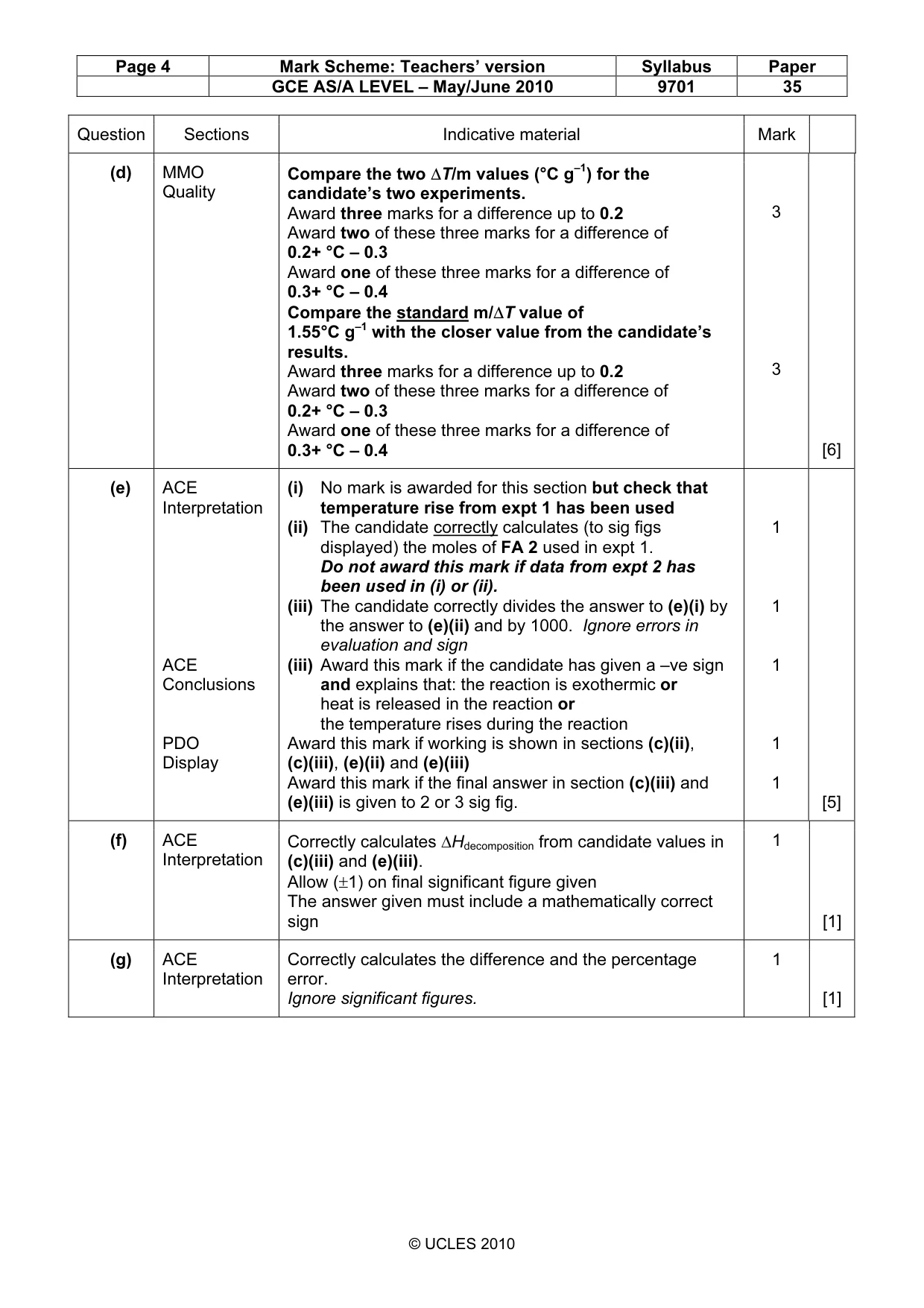
Page 4 Mark Scheme: Teachers’ version Syllabus Paper GCE AS/A LEVEL – May/June 2010 9701 35 © UCLES 2010 Question Sections Indicative material Mark (d) MMO Quality Compare the two ∆T/m values (°C g–1) for the candidate’s two experiments. Award three marks for a difference up to 0.2 Award two of these three marks for a difference of 0.2+ °C – 0.3 Award one of these three marks for a difference of 0.3+ °C – 0.4 Compare the standard m/∆T value of 1.55°C g–1 with the closer value from the candidate’s results. Award three marks for a difference up to 0.2 Award two of these three marks for a difference of 0.2+ °C – 0.3 Award one of these three marks for a difference of 0.3+ °C – 0.4 3 3 [6] (e) ACE Interpretation ACE Conclusions PDO Display (i) No mark is awarded for this section but check that temperature rise from expt 1 has been used (ii) The candidate correctly calculates (to sig figs displayed) the moles of FA 2 used in expt 1. Do not award this mark if data from expt 2 has been used in (i) or (ii). (iii) The candidate correctly divides the answer to (e)(i) by the answer to (e)(ii) and by 1000. Ignore errors in evaluation and sign (iii) Award this mark if the candidate has given a –ve sign and explains that: the reaction is exothermic or heat is released in the reaction or the temperature rises during the reaction Award this mark if working is shown in sections (c)(ii), (c)(iii), (e)(ii) and (e)(iii) Award this mark if the final answer in section (c)(iii) and (e)(iii) is given to 2 or 3 sig fig. 1 1 1 1 1 [5] (f) ACE Interpretation Correctly calculates ∆Hdecomposition from candidate values in (c)(iii) and (e)(iii). Allow (±1) on final significant figure given The answer given must include a mathematically correct sign 1 [1] (g) ACE Interpretation Correctly calculates the difference and the percentage error. Ignore significant figures. 1 [1]
Mark scheme, page 5
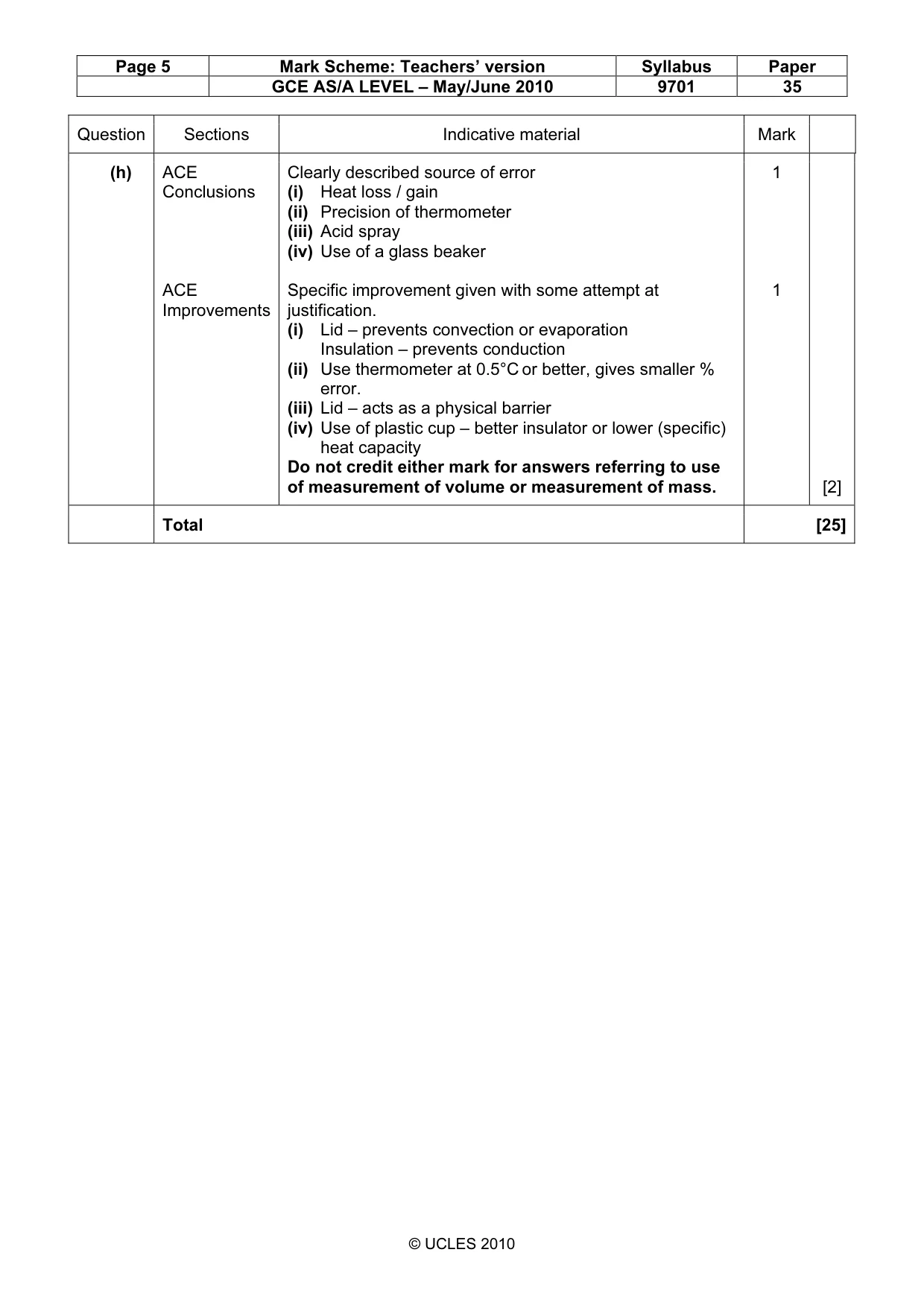
Page 5 Mark Scheme: Teachers’ version Syllabus Paper GCE AS/A LEVEL – May/June 2010 9701 35 © UCLES 2010 Question Sections Indicative material Mark (h) ACE Conclusions ACE Improvements Clearly described source of error (i) Heat loss / gain (ii) Precision of thermometer (iii) Acid spray (iv) Use of a glass beaker Specific improvement given with some attempt at justification. (i) Lid – prevents convection or evaporation Insulation – prevents conduction (ii) Use thermometer at 0.5°C or better, gives smaller % error. (iii) Lid – acts as a physical barrier (iv) Use of plastic cup – better insulator or lower (specific) heat capacity Do not credit either mark for answers referring to use of measurement of volume or measurement of mass. 1 1 [2] Total [25]
Mark scheme, page 6
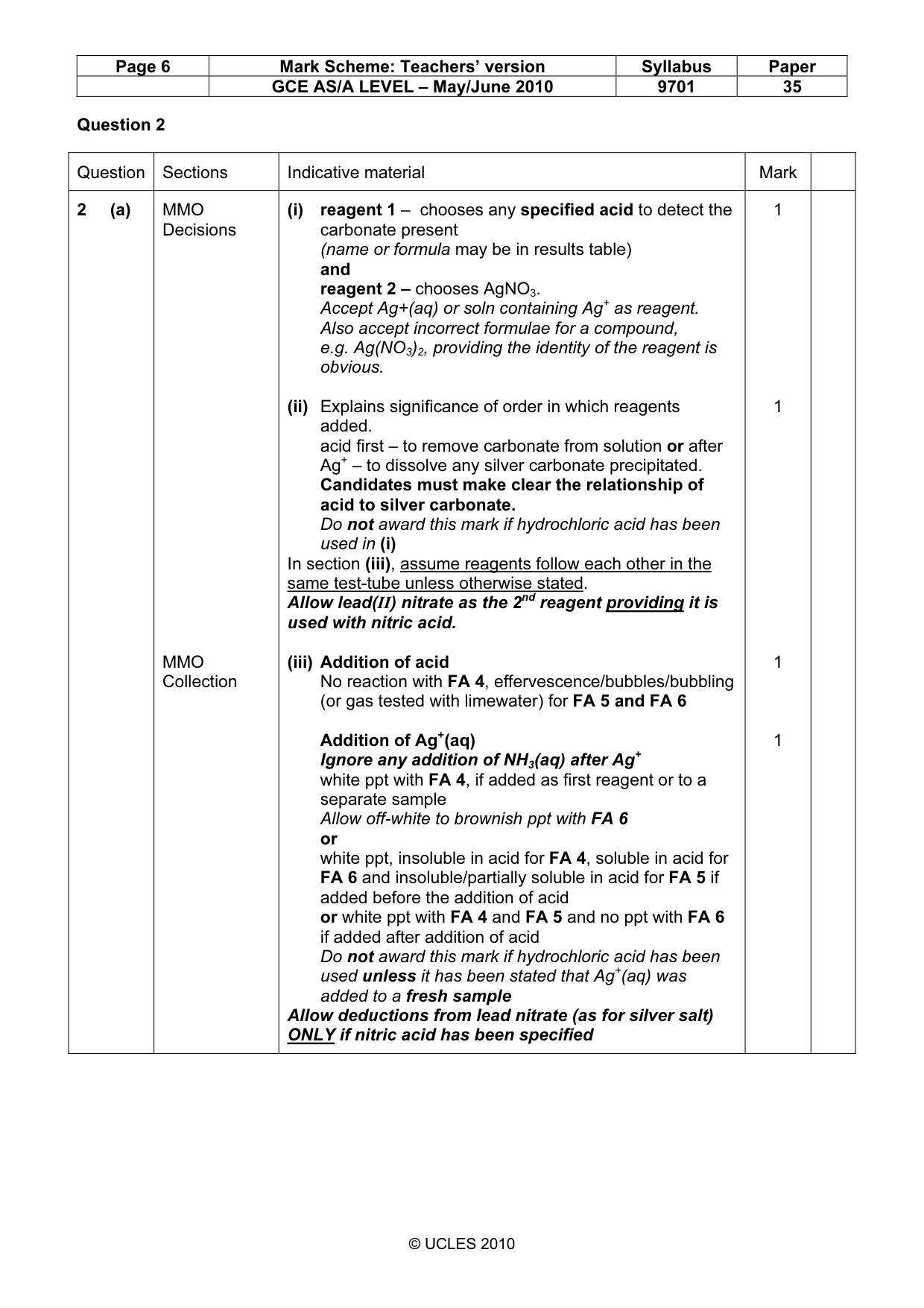
Page 6 Mark Scheme: Teachers’ version Syllabus Paper GCE AS/A LEVEL – May/June 2010 9701 35 © UCLES 2010 Question 2 Question Sections Indicative material Mark 2 (a) MMO Decisions MMO Collection (i) reagent 1 – chooses any specified acid to detect the carbonate present (name or formula may be in results table) and reagent 2 – chooses AgNO3. Accept Ag+(aq) or soln containing Ag+ as reagent. Also accept incorrect formulae for a compound, e.g. Ag(NO3)2, providing the identity of the reagent is obvious. (ii) Explains significance of order in which reagents added. acid first – to remove carbonate from solution or after Ag+ – to dissolve any silver carbonate precipitated. Candidates must make clear the relationship of acid to silver carbonate. Do not award this mark if hydrochloric acid has been used in (i) In section (iii), assume reagents follow each other in the same test-tube unless otherwise stated. Allow lead(II) nitrate as the 2nd reagent providing it is used with nitric acid. (iii) Addition of acid No reaction with FA 4, effervescence/bubbles/bubbling (or gas tested with limewater) for FA 5 and FA 6 Addition of Ag+(aq) Ignore any addition of NH3(aq) after Ag+ white ppt with FA 4, if added as first reagent or to a separate sample Allow off-white to brownish ppt with FA 6 or white ppt, insoluble in acid for FA 4, soluble in acid for FA 6 and insoluble/partially soluble in acid for FA 5 if added before the addition of acid or white ppt with FA 4 and FA 5 and no ppt with FA 6 if added after addition of acid Do not award this mark if hydrochloric acid has been used unless it has been stated that Ag+(aq) was added to a fresh sample Allow deductions from lead nitrate (as for silver salt) ONLY if nitric acid has been specified 1 1 1 1
Mark scheme, page 7
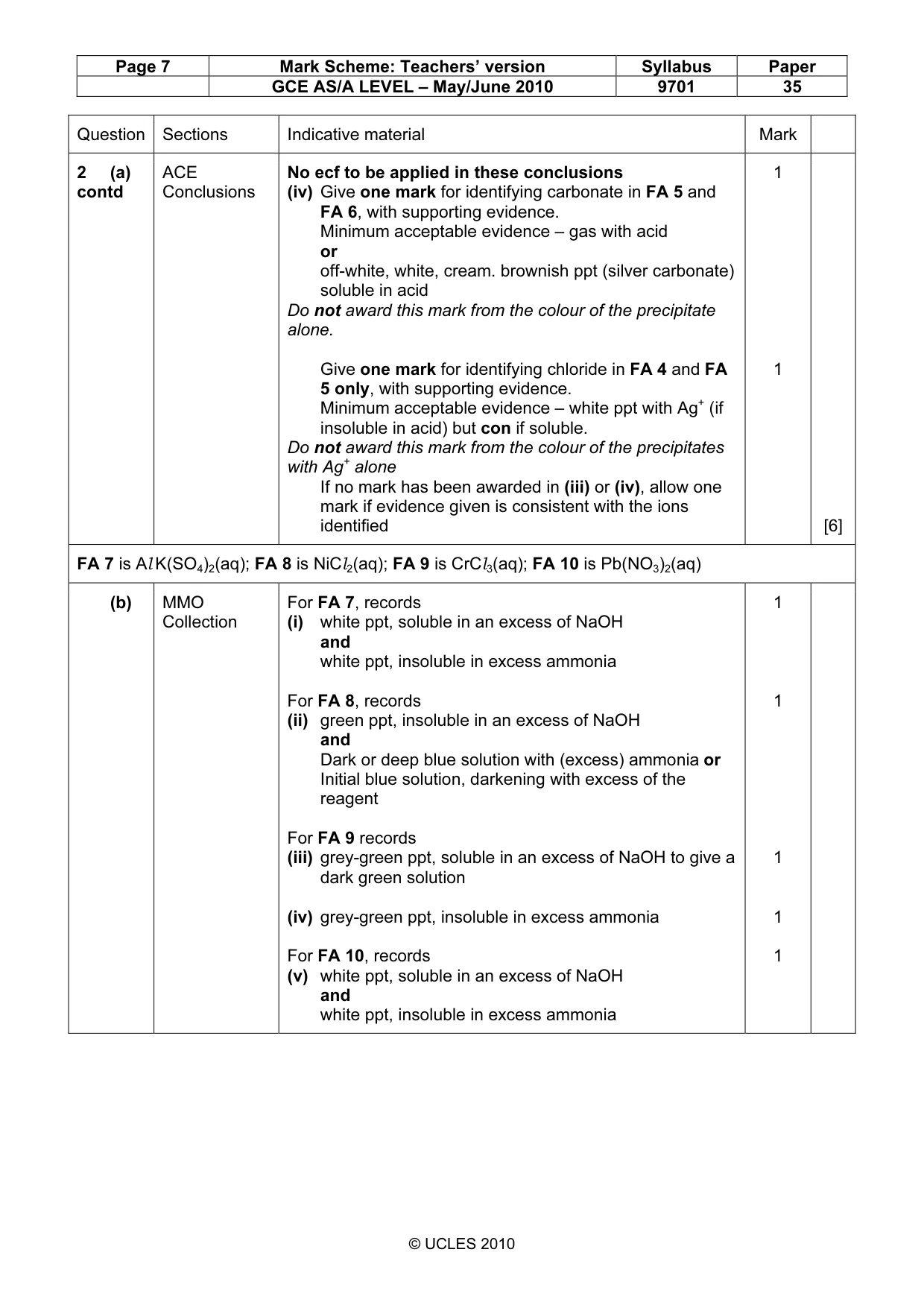
Page 7 Mark Scheme: Teachers’ version Syllabus Paper GCE AS/A LEVEL – May/June 2010 9701 35 © UCLES 2010 Question Sections Indicative material Mark 2 (a) contd ACE Conclusions No ecf to be applied in these conclusions (iv) Give one mark for identifying carbonate in FA 5 and FA 6, with supporting evidence. Minimum acceptable evidence – gas with acid or off-white, white, cream. brownish ppt (silver carbonate) soluble in acid Do not award this mark from the colour of the precipitate alone. Give one mark for identifying chloride in FA 4 and FA 5 only, with supporting evidence. Minimum acceptable evidence – white ppt with Ag+ (if insoluble in acid) but con if soluble. Do not award this mark from the colour of the precipitates with Ag+ alone If no mark has been awarded in (iii) or (iv), allow one mark if evidence given is consistent with the ions identified 1 1 [6] FA 7 is Al K(SO4)2(aq); FA 8 is NiCl2(aq); FA 9 is CrCl3(aq); FA 10 is Pb(NO3)2(aq) (b) MMO Collection For FA 7, records (i) white ppt, soluble in an excess of NaOH and white ppt, insoluble in excess ammonia For FA 8, records (ii) green ppt, insoluble in an excess of NaOH and Dark or deep blue solution with (excess) ammonia or Initial blue solution, darkening with excess of the reagent For FA 9 records (iii) grey-green ppt, soluble in an excess of NaOH to give a dark green solution (iv) grey-green ppt, insoluble in excess ammonia For FA 10, records (v) white ppt, soluble in an excess of NaOH and white ppt, insoluble in excess ammonia 1 1 1 1 1
Mark scheme, page 8
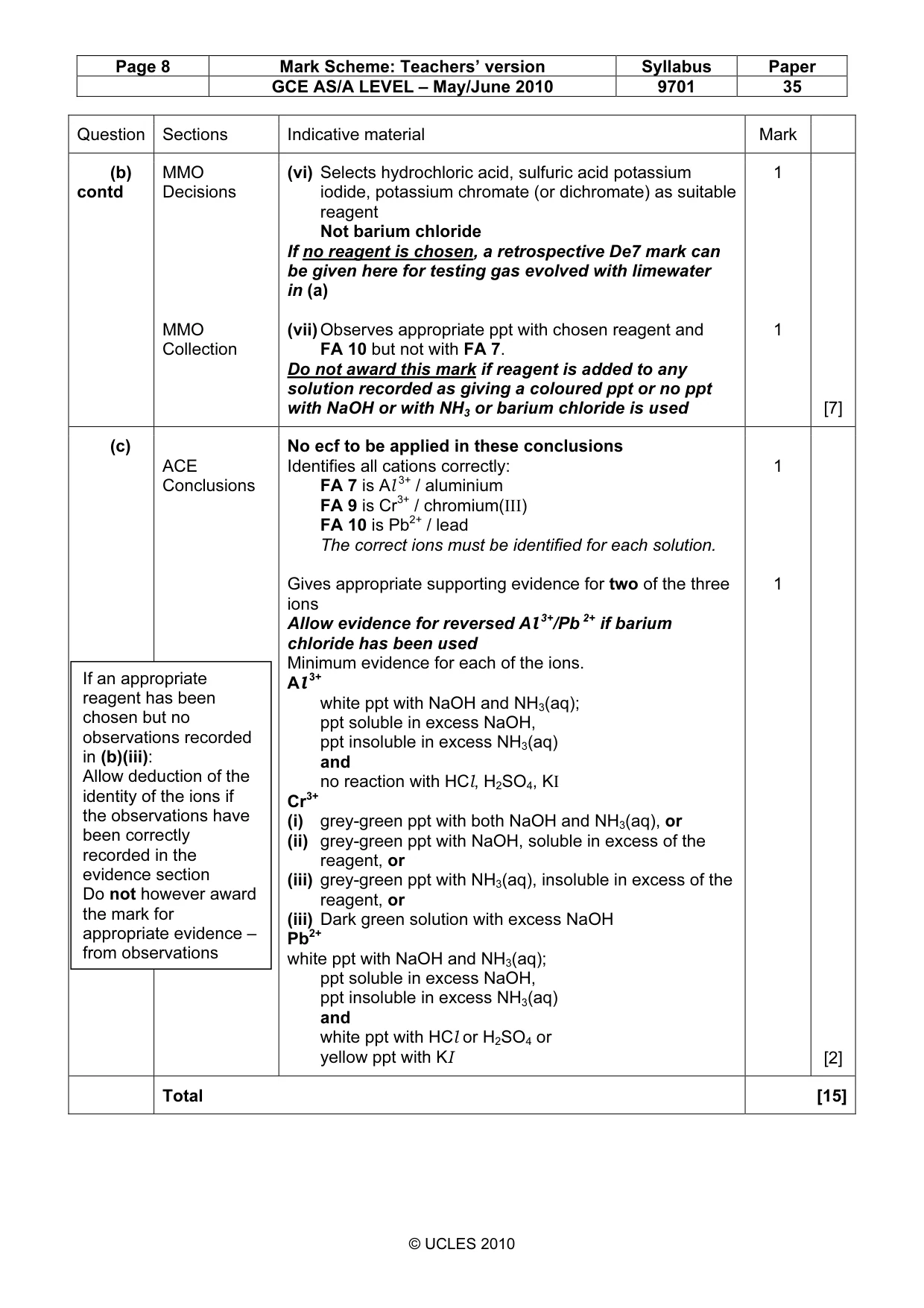
Page 8 Mark Scheme: Teachers’ version Syllabus Paper GCE AS/A LEVEL – May/June 2010 9701 35 © UCLES 2010 Question Sections Indicative material Mark (b) contd MMO Decisions MMO Collection (vi) Selects hydrochloric acid, sulfuric acid potassium iodide, potassium chromate (or dichromate) as suitable reagent Not barium chloride If no reagent is chosen, a retrospective De7 mark can be given here for testing gas evolved with limewater in (a) (vii) Observes appropriate ppt with chosen reagent and FA 10 but not with FA 7. Do not award this mark if reagent is added to any solution recorded as giving a coloured ppt or no ppt with NaOH or with NH3 or barium chloride is used 1 1 [7] (c) ACE Conclusions No ecf to be applied in these conclusions Identifies all cations correctly: FA 7 is Al 3+ / aluminium FA 9 is Cr3+ / chromium(III) FA 10 is Pb2+ / lead The correct ions must be identified for each solution. Gives appropriate supporting evidence for two of the three ions Allow evidence for reversed Al 3+/Pb 2+ if barium chloride has been used Minimum evidence for each of the ions. Al 3+ white ppt with NaOH and NH3(aq); ppt soluble in excess NaOH, ppt insoluble in excess NH3(aq) and no reaction with HCl, H2SO4, KI Cr3+ (i) grey-green ppt with both NaOH and NH3(aq), or (ii) grey-green ppt with NaOH, soluble in excess of the reagent, or (iii) grey-green ppt with NH3(aq), insoluble in excess of the reagent, or (iii) Dark green solution with excess NaOH Pb2+ white ppt with NaOH and NH3(aq); ppt soluble in excess NaOH, ppt insoluble in excess NH3(aq) and white ppt with HCl or H2SO4 or yellow ppt with KI 1 1 [2] Total [15] If an appropriate reagent has been chosen but no observations recorded in (b)(iii): Allow deduction of the identity of the ions if the observations have been correctly recorded in the evidence section Do not however award the mark for appropriate evidence – from observations
What you needed in this session
Cambridge’s own grade thresholds for 2010 May/June, Paper 3 · Variant 5. A higher threshold means an easier paper — the bar moves with how the cohort did.