Cambridge A Level Chemistry 9701 — 2009 Oct/Nov Paper 4 · Variant 2
9701/42/O/N/09
The question paper and its mark scheme, free to read here and free to download. This is Cambridge’s own paper, exactly as it was sat.
Question paper24 pages




Mark scheme8 pages
Answers below. Sit the paper first if you are practising.
Paper as text
Question paper, page 1
This document consists of 20 printed pages and 4 blank pages. DC (AT/CG) 14049/2 © UCLES 2009 [Turn over UNIVERSITY OF CAMBRIDGE INTERNATIONAL EXAMINATIONS General Certificate of Education Advanced Subsidiary Level and Advanced Level READ THESE INSTRUCTIONS FIRST Write your Centre number, candidate number and name on all the work you hand in. Write in dark blue or black pen. You may use a pencil for any diagrams, graphs or rough working. Do not use staples, paper clips, highlighters, glue or correction fluid. DO NOT WRITE IN ANY BARCODES. Section A Answer all questions. Section B Answer all questions. You may lose marks if you do not show your working or if you do not use appropriate units. A Data Booklet is provided. At the end of the examination, fasten all your work securely together. The number of marks is given in brackets [ ] at the end of each question or part question. CHEMISTRY 9701/42 Paper 4 Structured Questions October/November 2009 1 hour 45 minutes Candidates answer on the Question Paper. Additional Materials: Data Booklet For Examiner’s Use 1 2 3 4 5 6 7 8 9 Total * 7 7 2 9 7 7 7 2 3 1 *
Question paper, page 2
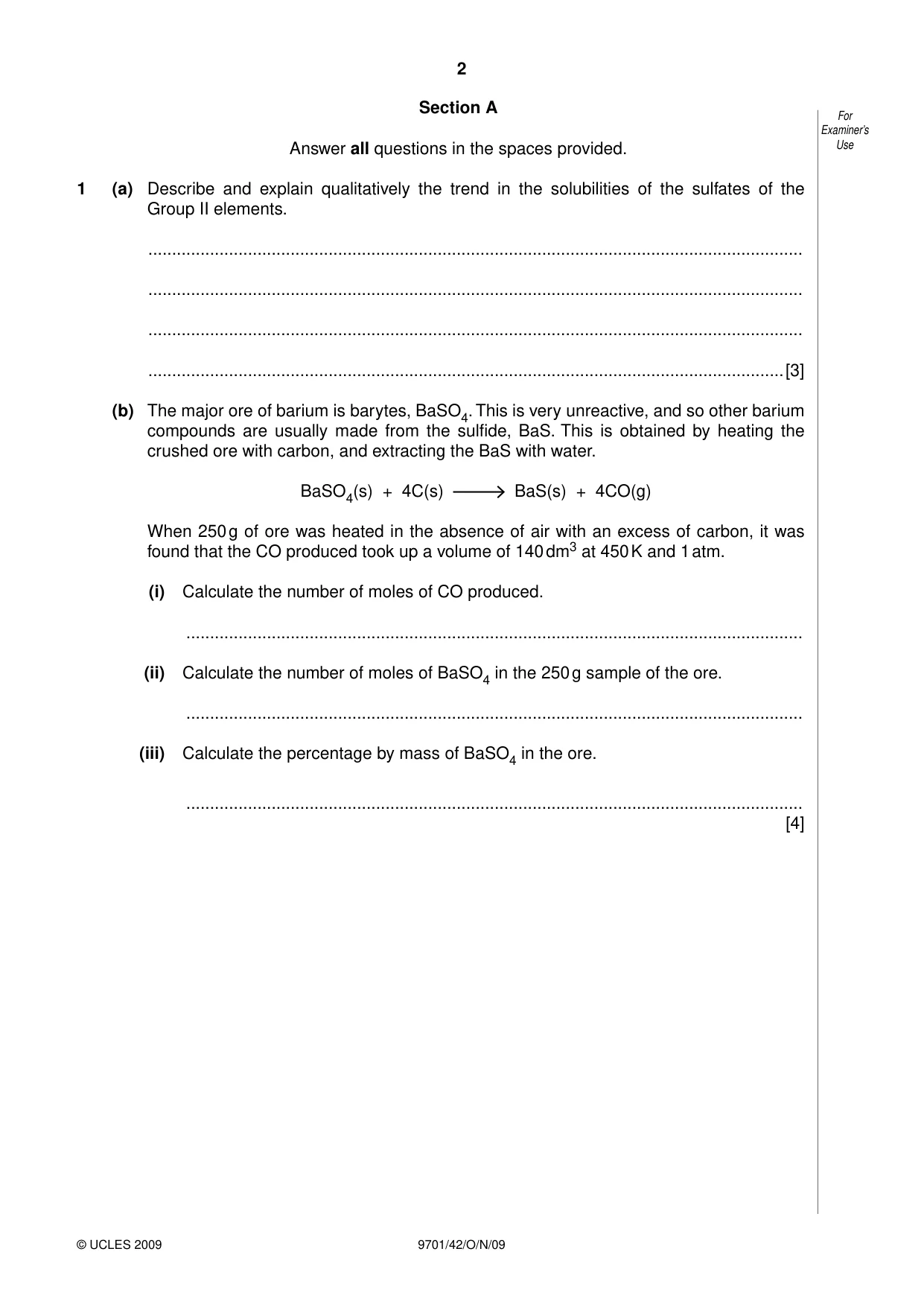
2 9701/42/O/N/09 © UCLES 2009 For Examiner’s Use Section A Answer all questions in the spaces provided. 1 (a) Describe and explain qualitatively the trend in the solubilities of the sulfates of the Group II elements. … … … …[3] (b) The major ore of barium is barytes, BaSO4. This is very unreactive, and so other barium compounds are usually made from the sulfide, BaS. This is obtained by heating the crushed ore with carbon, and extracting the BaS with water. BaSO4(s) + 4C(s) BaS(s) + 4CO(g) When 250 g of ore was heated in the absence of air with an excess of carbon, it was found that the CO produced took up a volume of 140 dm3 at 450 K and 1 atm. (i) Calculate the number of moles of CO produced. … (ii) Calculate the number of moles of BaSO4 in the 250 g sample of the ore. … (iii) Calculate the percentage by mass of BaSO4 in the ore. … [4]
Question paper, page 3
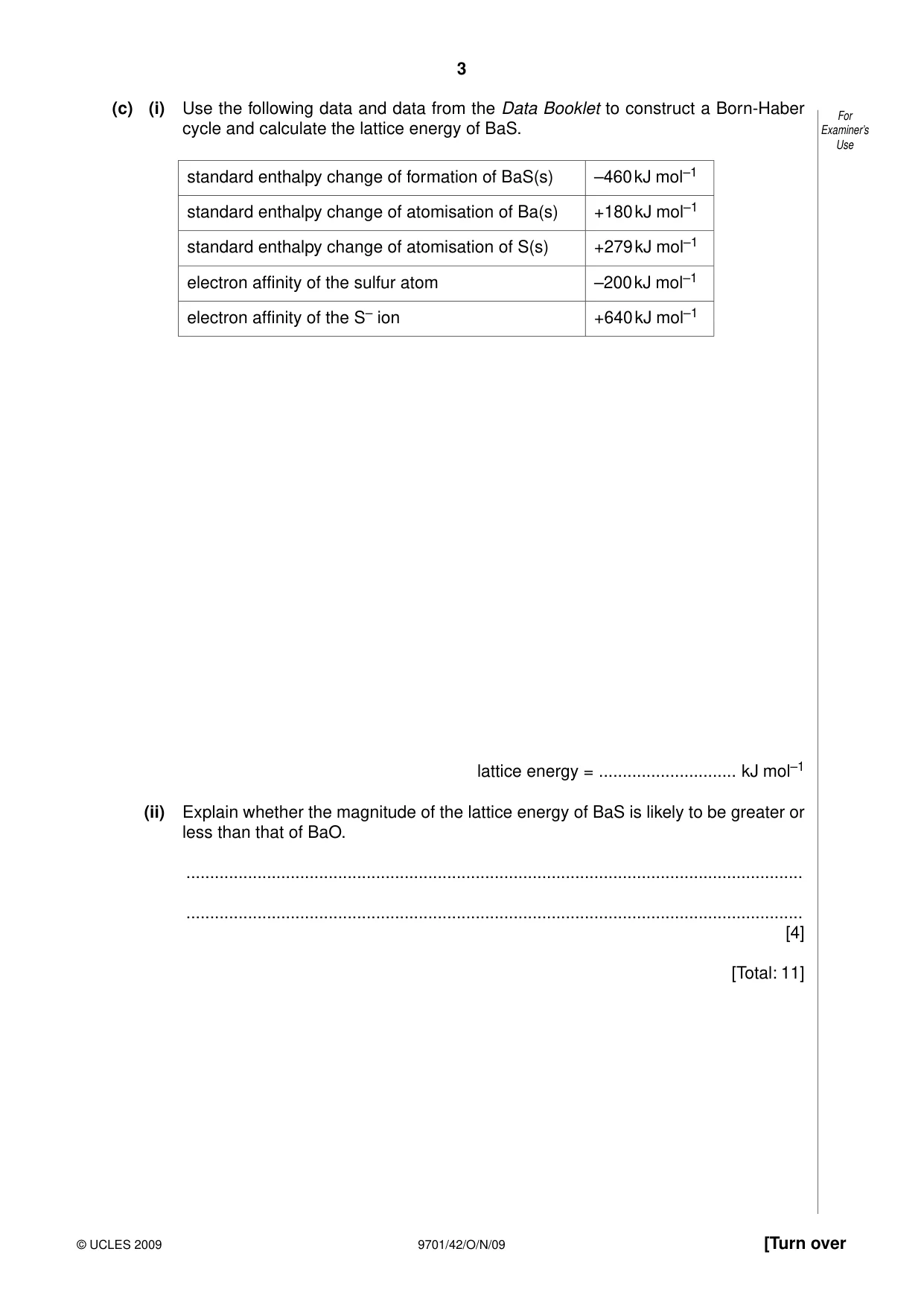
3 9701/42/O/N/09 © UCLES 2009 [Turn over For Examiner’s Use (c) (i) Use the following data and data from the Data Booklet to construct a Born-Haber cycle and calculate the lattice energy of BaS. standard enthalpy change of formation of BaS(s) –460 kJ mol–1 standard enthalpy change of atomisation of Ba(s) +180 kJ mol–1 standard enthalpy change of atomisation of S(s) +279 kJ mol–1 electron affinity of the sulfur atom –200 kJ mol–1 electron affinity of the S– ion +640 kJ mol–1 lattice energy = … kJ mol–1 (ii) Explain whether the magnitude of the lattice energy of BaS is likely to be greater or less than that of BaO. … … [4] [Total: 11]
Question paper, page 4
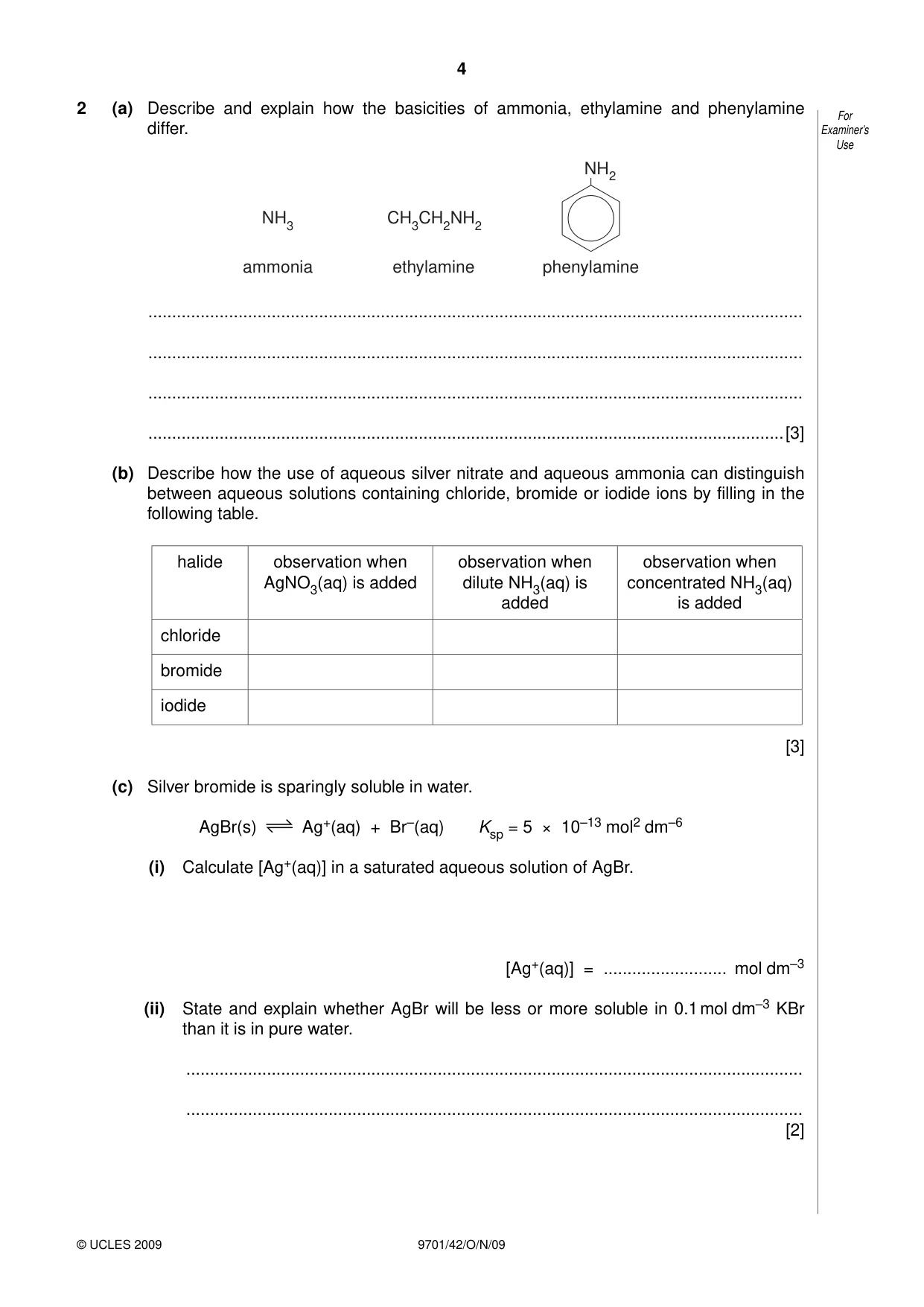
4 9701/42/O/N/09 © UCLES 2009 For Examiner’s Use 2 (a) Describe and explain how the basicities of ammonia, ethylamine and phenylamine differ. CH3CH2NH2 NH3 NH2 ammonia ethylamine phenylamine … … … …[3] (b) Describe how the use of aqueous silver nitrate and aqueous ammonia can distinguish between aqueous solutions containing chloride, bromide or iodide ions by filling in the following table. halide observation when AgNO3(aq) is added observation when dilute NH3(aq) is added observation when concentrated NH3(aq) is added chloride bromide iodide [3] (c) Silver bromide is sparingly soluble in water. AgBr(s) Ag+(aq) + Br–(aq) Ksp = 5 × 10–13 mol2 dm–6 (i) Calculate [Ag+(aq)] in a saturated aqueous solution of AgBr. [Ag+(aq)] = … mol dm–3 (ii) State and explain whether AgBr will be less or more soluble in 0.1 mol dm–3 KBr than it is in pure water. … … [2]
Question paper, page 5
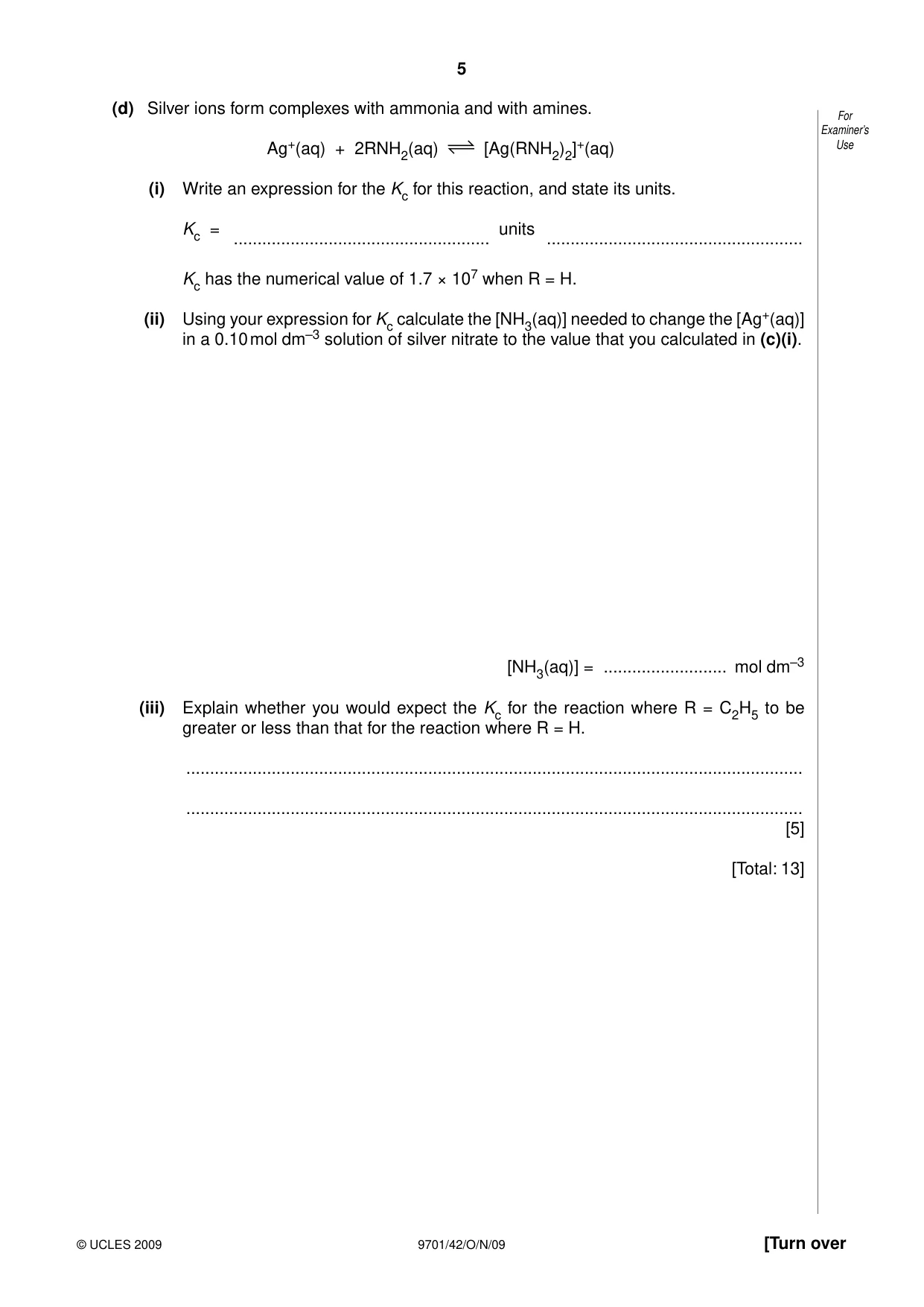
5 9701/42/O/N/09 © UCLES 2009 [Turn over For Examiner’s Use (d) Silver ions form complexes with ammonia and with amines. Ag+(aq) + 2RNH2(aq) [Ag(RNH2)2]+(aq) (i) Write an expression for the Kc for this reaction, and state its units. Kc = units … … Kc has the numerical value of 1.7 × 10⁷ when R = H. (ii) Using your expression for Kc calculate the [NH3(aq)] needed to change the [Ag+(aq)] in a 0.10 mol dm–3 solution of silver nitrate to the value that you calculated in (c)(i). [NH3(aq)] = … mol dm–3 (iii) Explain whether you would expect the Kc for the reaction where R = C2H5 to be greater or less than that for the reaction where R = H. … … [5] [Total: 13]
Question paper, page 6
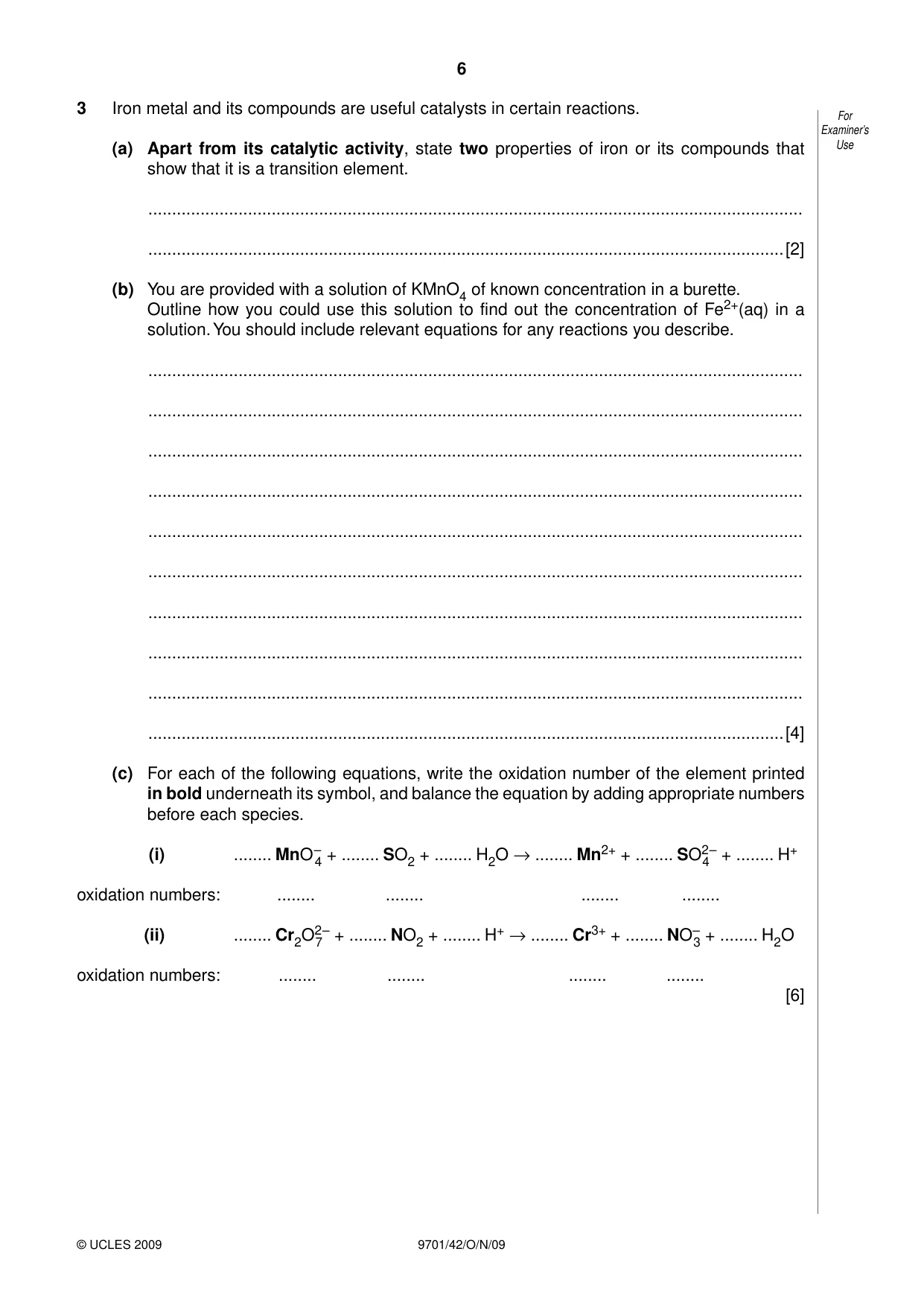
6 9701/42/O/N/09 © UCLES 2009 For Examiner’s Use 3 Iron metal and its compounds are useful catalysts in certain reactions. (a) Apart from its catalytic activity, state two properties of iron or its compounds that show that it is a transition element. … …[2] (b) You are provided with a solution of KMnO4 of known concentration in a burette. Outline how you could use this solution to find out the concentration of Fe2+(aq) in a solution. You should include relevant equations for any reactions you describe. … … … … … … … … … …[4] (c) For each of the following equations, write the oxidation number of the element printed in bold underneath its symbol, and balance the equation by adding appropriate numbers before each species. (i) … MnO– 4 + … SO2 + … H2O → … Mn2+ + … SO2 4 – + … H+ oxidation numbers: … … … … (ii) … Cr2O2 7 – + … NO2 + … H+ → … Cr3+ + … NO– 3 + … H2O oxidation numbers: … … … … [6]
Question paper, page 7
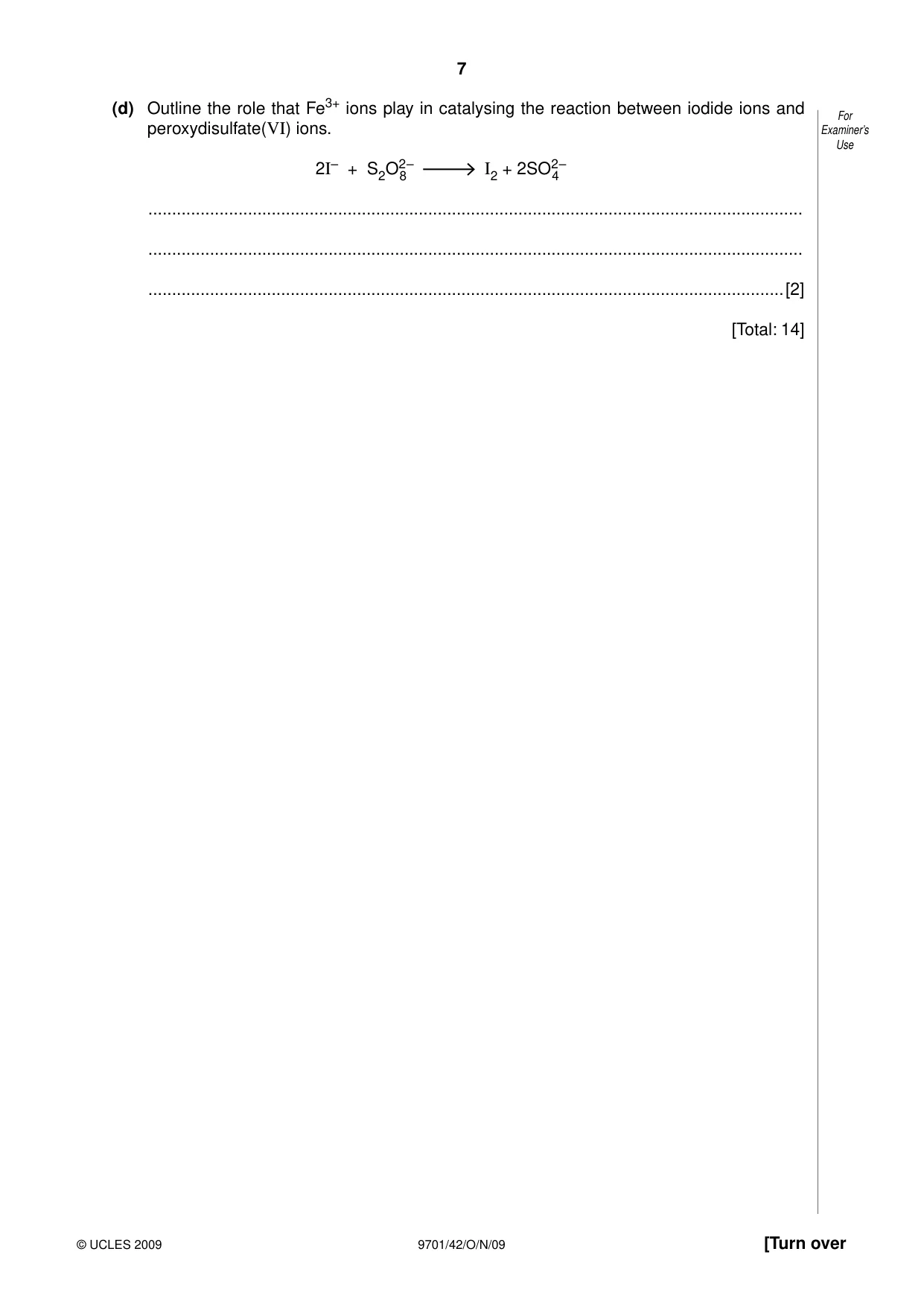
7 9701/42/O/N/09 © UCLES 2009 [Turn over For Examiner’s Use (d) Outline the role that Fe3+ ions play in catalysing the reaction between iodide ions and peroxydisulfate(VI) ions. 2I– + S2O2 8 – I2 + 2SO2 4 – … … …[2] [Total: 14]
Question paper, page 8
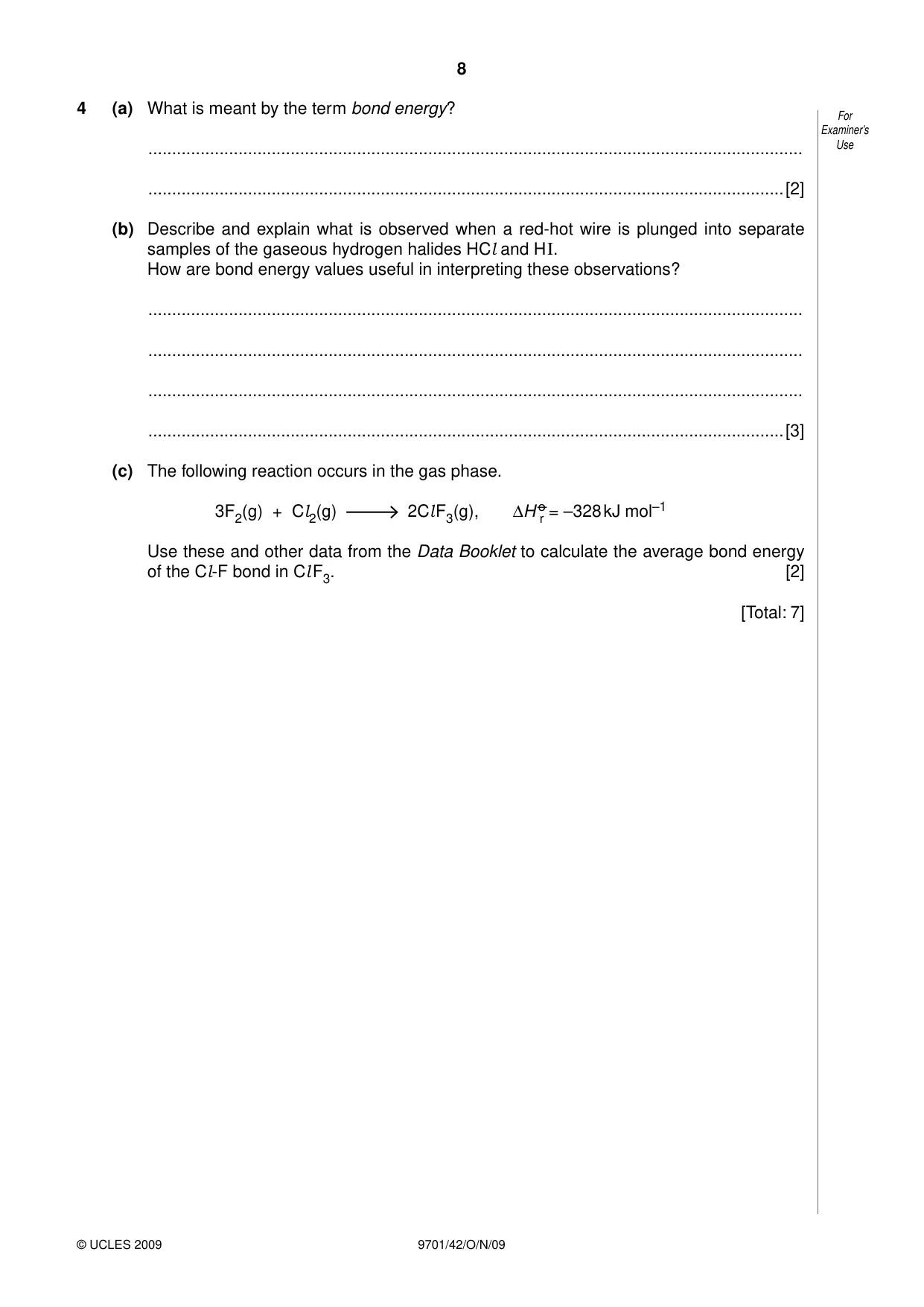
8 9701/42/O/N/09 © UCLES 2009 For Examiner’s Use 4 (a) What is meant by the term bond energy? … …[2] (b) Describe and explain what is observed when a red-hot wire is plunged into separate samples of the gaseous hydrogen halides HCl and HI. How are bond energy values useful in interpreting these observations? … … … …[3] (c) The following reaction occurs in the gas phase. 3F2(g) + Cl2(g) 2ClF3(g), ∆H o— r = –328 kJ mol–1 Use these and other data from the Data Booklet to calculate the average bond energy of the Cl-F bond in Cl F3. [2] [Total: 7]
Question paper, page 10
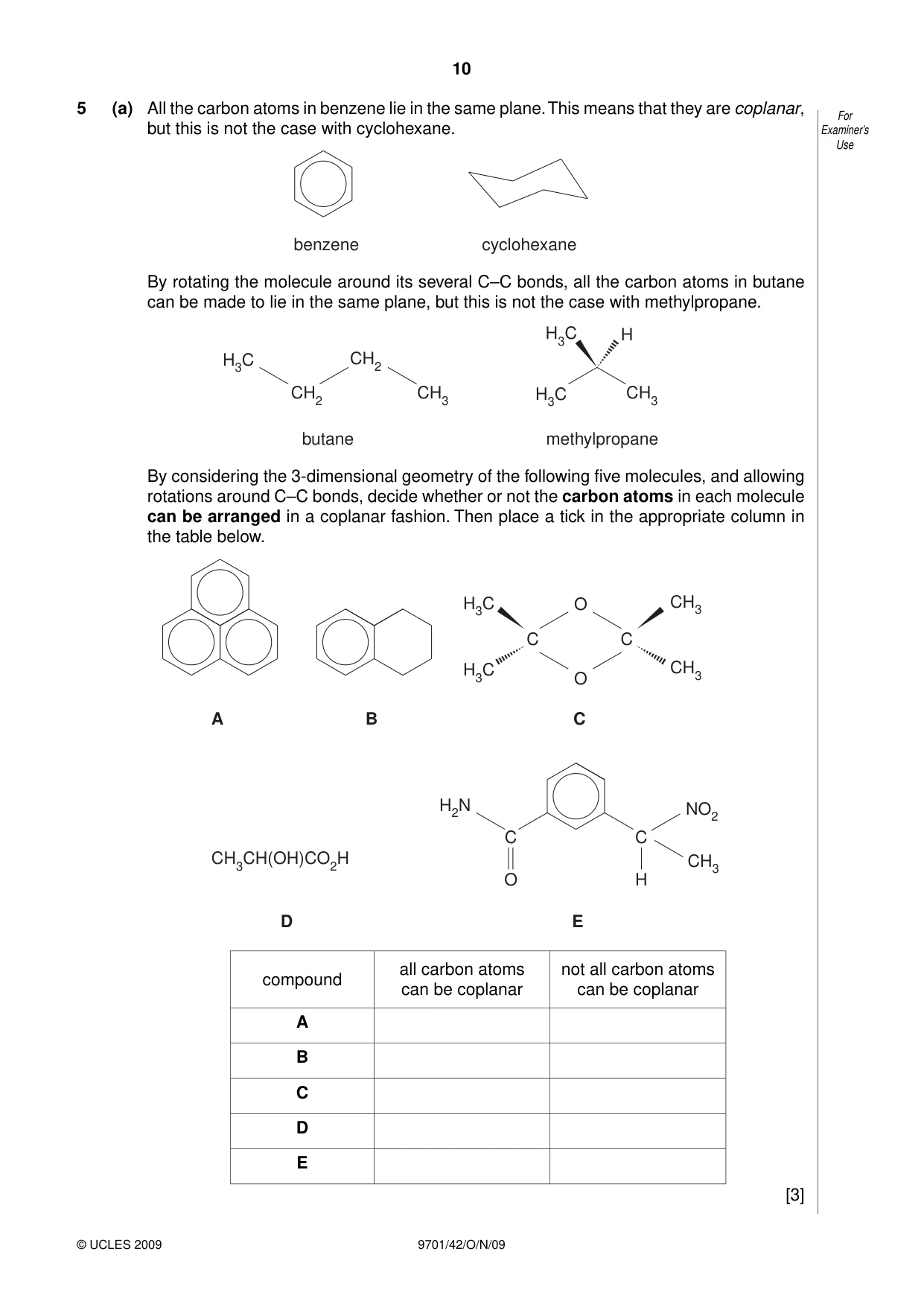
10 9701/42/O/N/09 © UCLES 2009 For Examiner’s Use 5 (a) All the carbon atoms in benzene lie in the same plane. This means that they are coplanar, but this is not the case with cyclohexane. benzene cyclohexane By rotating the molecule around its several C–C bonds, all the carbon atoms in butane can be made to lie in the same plane, but this is not the case with methylpropane. CH2 CH3 CH2 H3C CH3 H3C H3C H butane methylpropane By considering the 3-dimensional geometry of the following five molecules, and allowing rotations around C–C bonds, decide whether or not the carbon atoms in each molecule can be arranged in a coplanar fashion. Then place a tick in the appropriate column in the table below. A B C D E CH3 CH3 CH3CH(OH)CO2H CH3 H2N O O C C H3C H3C O C NO2 H C compound all carbon atoms can be coplanar not all carbon atoms can be coplanar A B C D E [3]
Question paper, page 11
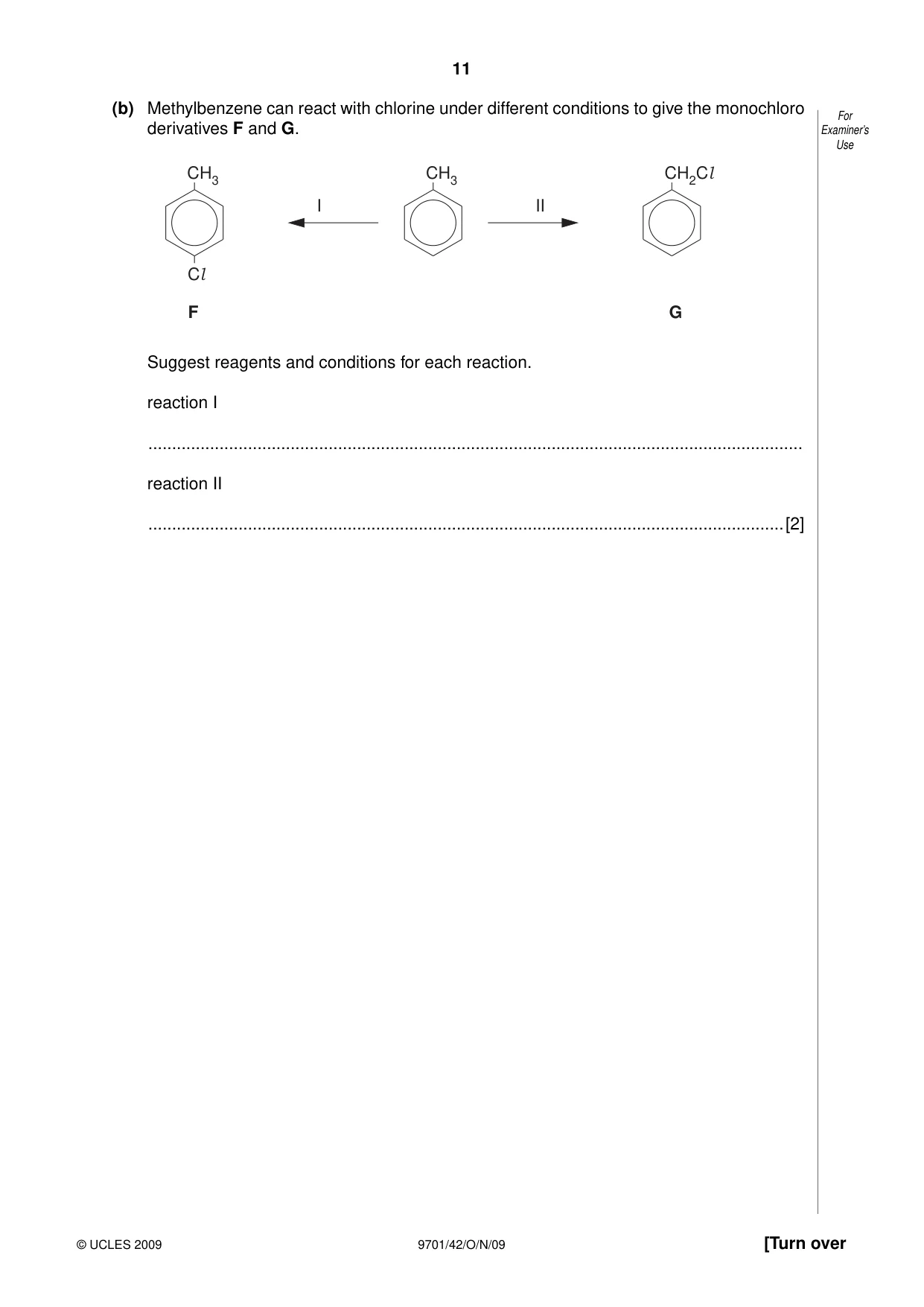
11 9701/42/O/N/09 © UCLES 2009 [Turn over For Examiner’s Use (b) Methylbenzene can react with chlorine under different conditions to give the monochloro derivatives F and G. F G CH3 CH3 I II CH2Cl Cl Suggest reagents and conditions for each reaction. reaction I … reaction II …[2]
Question paper, page 12
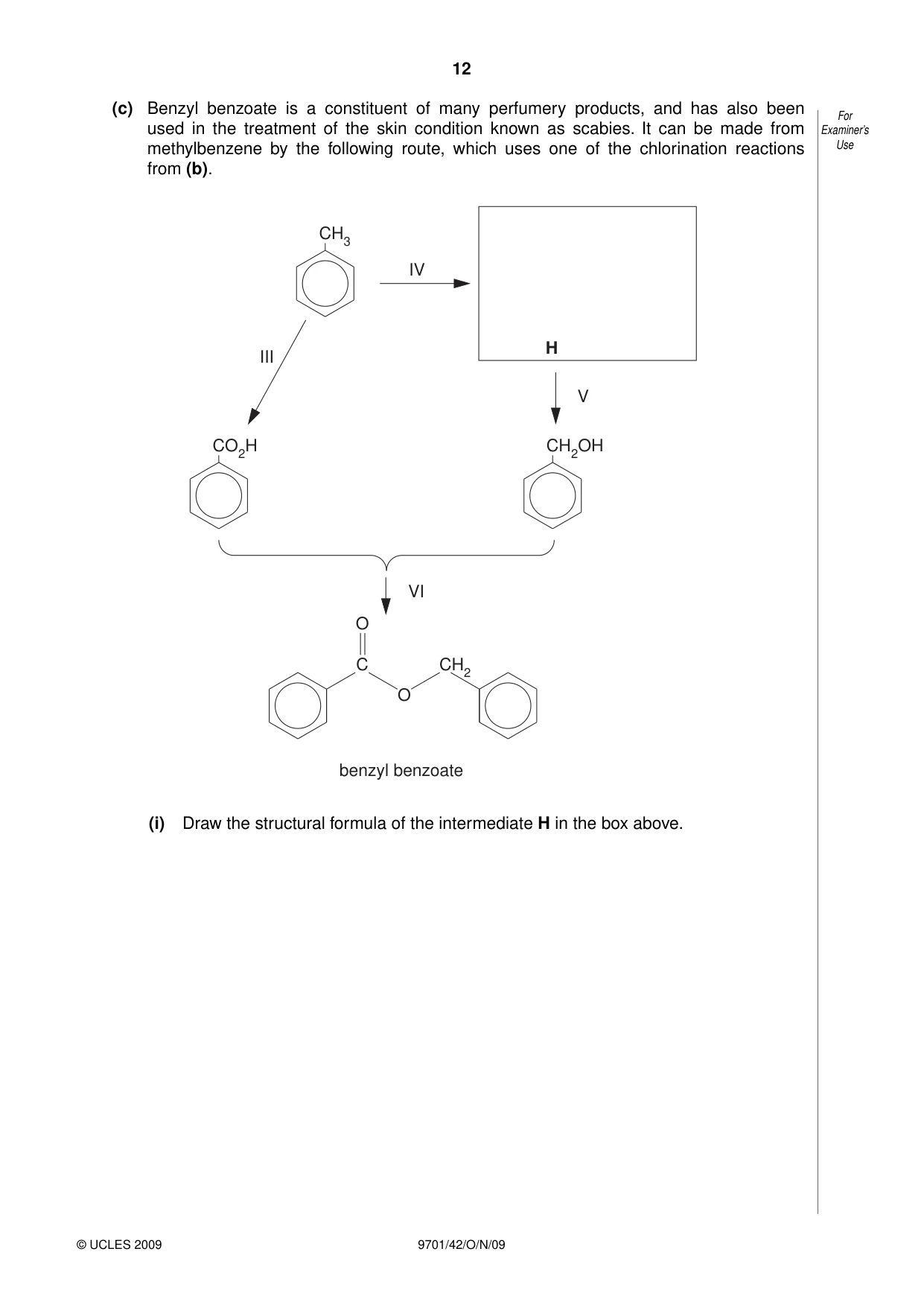
12 9701/42/O/N/09 © UCLES 2009 For Examiner’s Use (c) Benzyl benzoate is a constituent of many perfumery products, and has also been used in the treatment of the skin condition known as scabies. It can be made from methylbenzene by the following route, which uses one of the chlorination reactions from (b). CO2H CH2OH CH3 III IV V VI H C CH2 O O benzyl benzoate (i) Draw the structural formula of the intermediate H in the box above.
Question paper, page 13
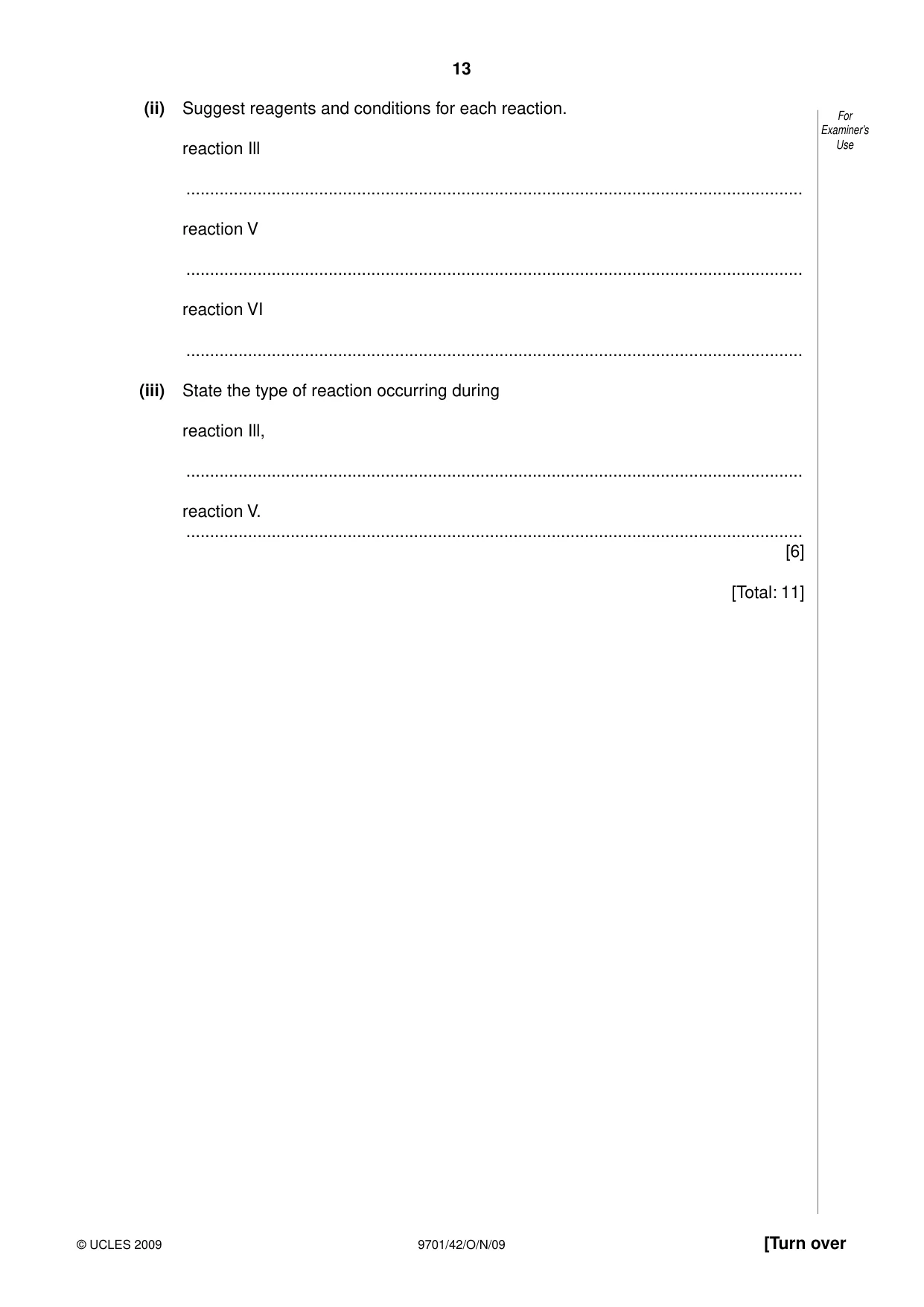
13 9701/42/O/N/09 © UCLES 2009 [Turn over For Examiner’s Use (ii) Suggest reagents and conditions for each reaction. reaction Ill … reaction V … reaction VI … (iii) State the type of reaction occurring during reaction Ill, … reaction V. … [6] [Total: 11]
Question paper, page 14
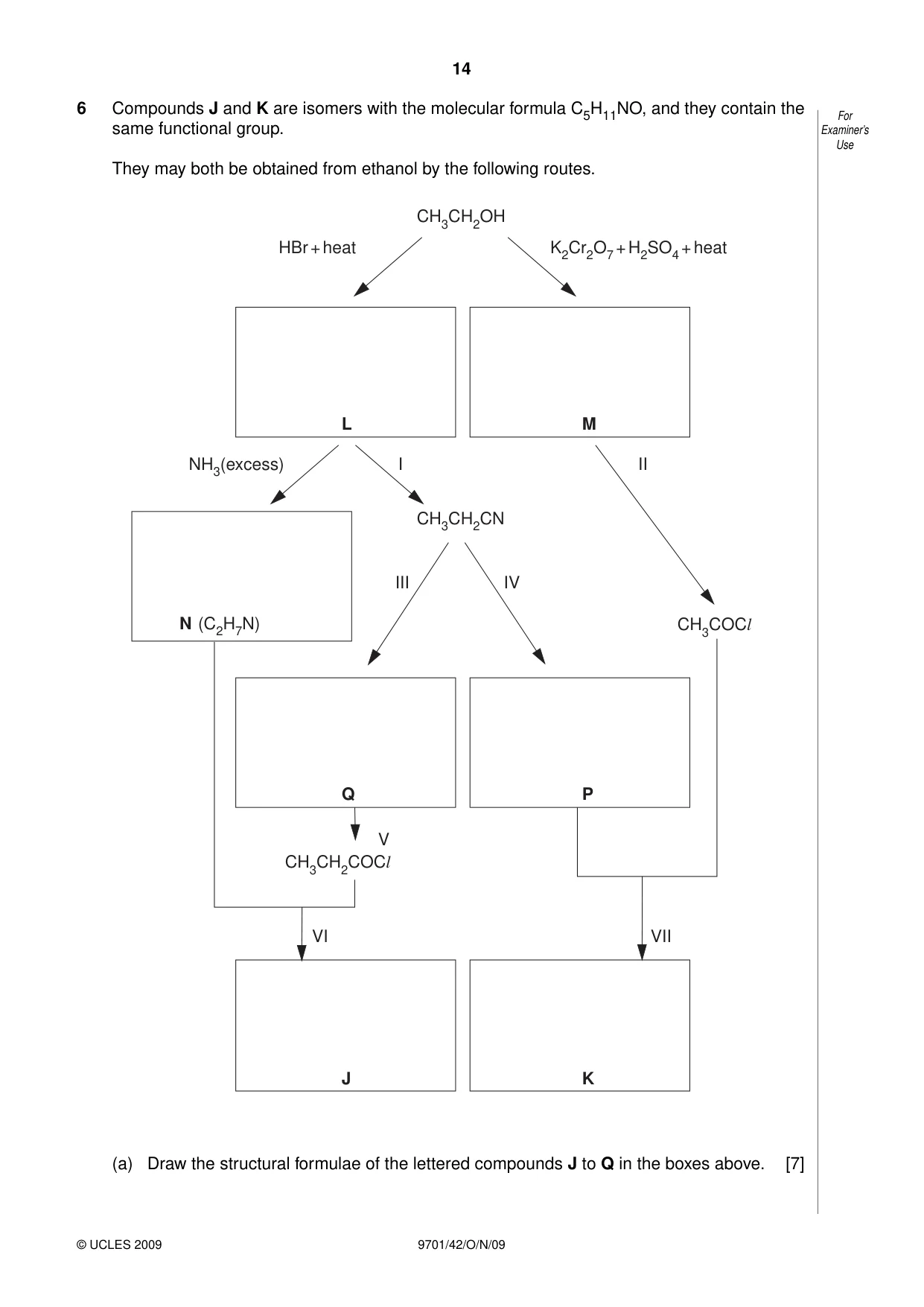
14 9701/42/O/N/09 © UCLES 2009 For Examiner’s Use 6 Compounds J and K are isomers with the molecular formula C5H11NO, and they contain the same functional group. They may both be obtained from ethanol by the following routes. CH3CH2OH CH3CH2CN CH3COCl CH3CH2COCl (C2H7N) NH3(excess) V K2Cr2O7 + H2SO4 + heat HBr + heat L M Q P J K N I II III IV VI VII (a) Draw the structural formulae of the lettered compounds J to Q in the boxes above. [7]
Question paper, page 15
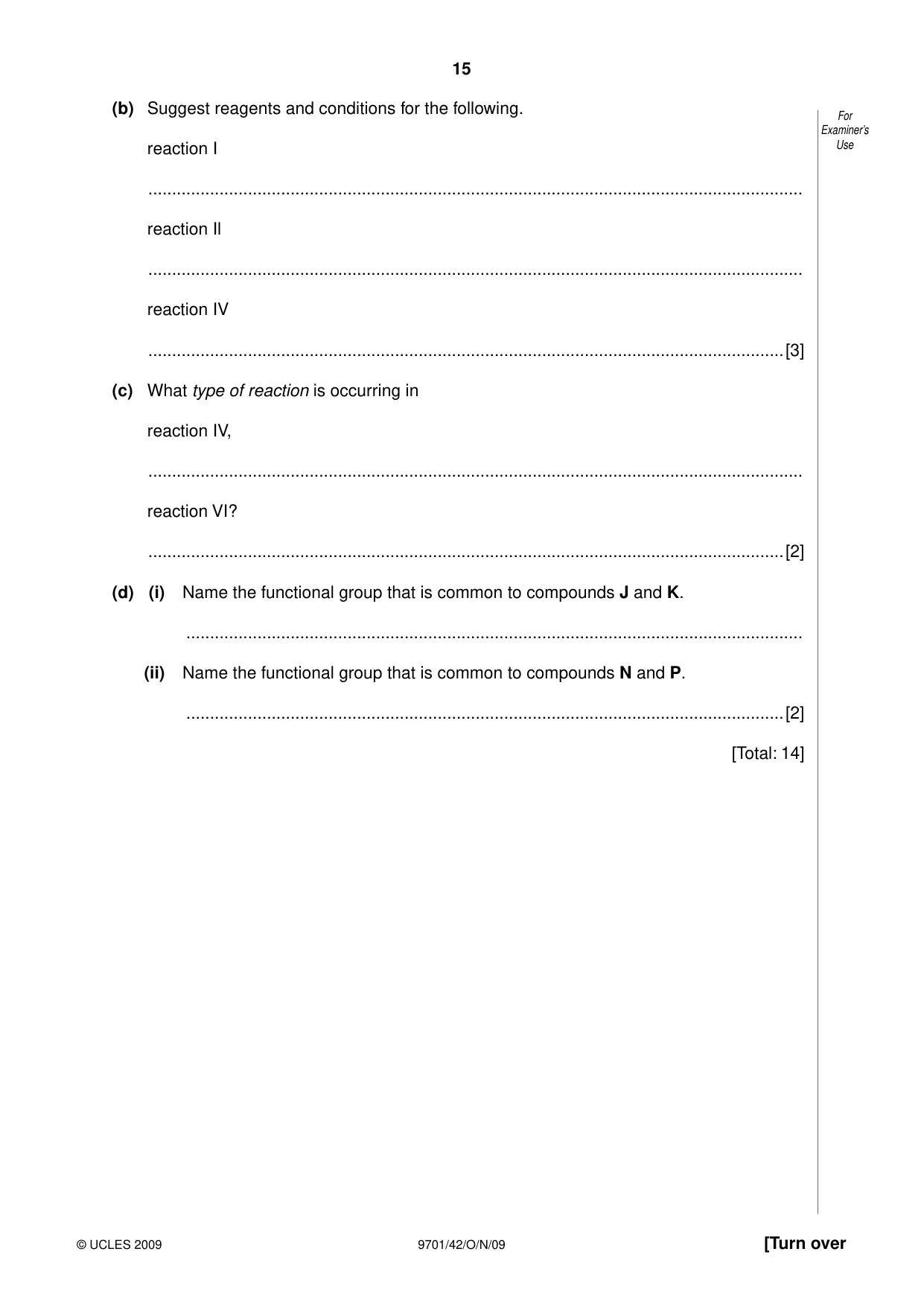
15 9701/42/O/N/09 © UCLES 2009 [Turn over For Examiner’s Use (b) Suggest reagents and conditions for the following. reaction I … reaction Il … reaction IV …[3] (c) What type of reaction is occurring in reaction IV, … reaction VI? …[2] (d) (i) Name the functional group that is common to compounds J and K. … (ii) Name the functional group that is common to compounds N and P. …[2] [Total: 14]
Question paper, page 16
16 9701/42/O/N/09 © UCLES 2009 For Examiner’s Use Section B Answer all questions in the spaces provided. 7 (a) Explain, using diagrams where appropriate, the types of interaction responsible for the primary, secondary and tertiary structure of a protein. primary structure … … … secondary structure … … … tertiary structure … … …[6]
Question paper, page 17
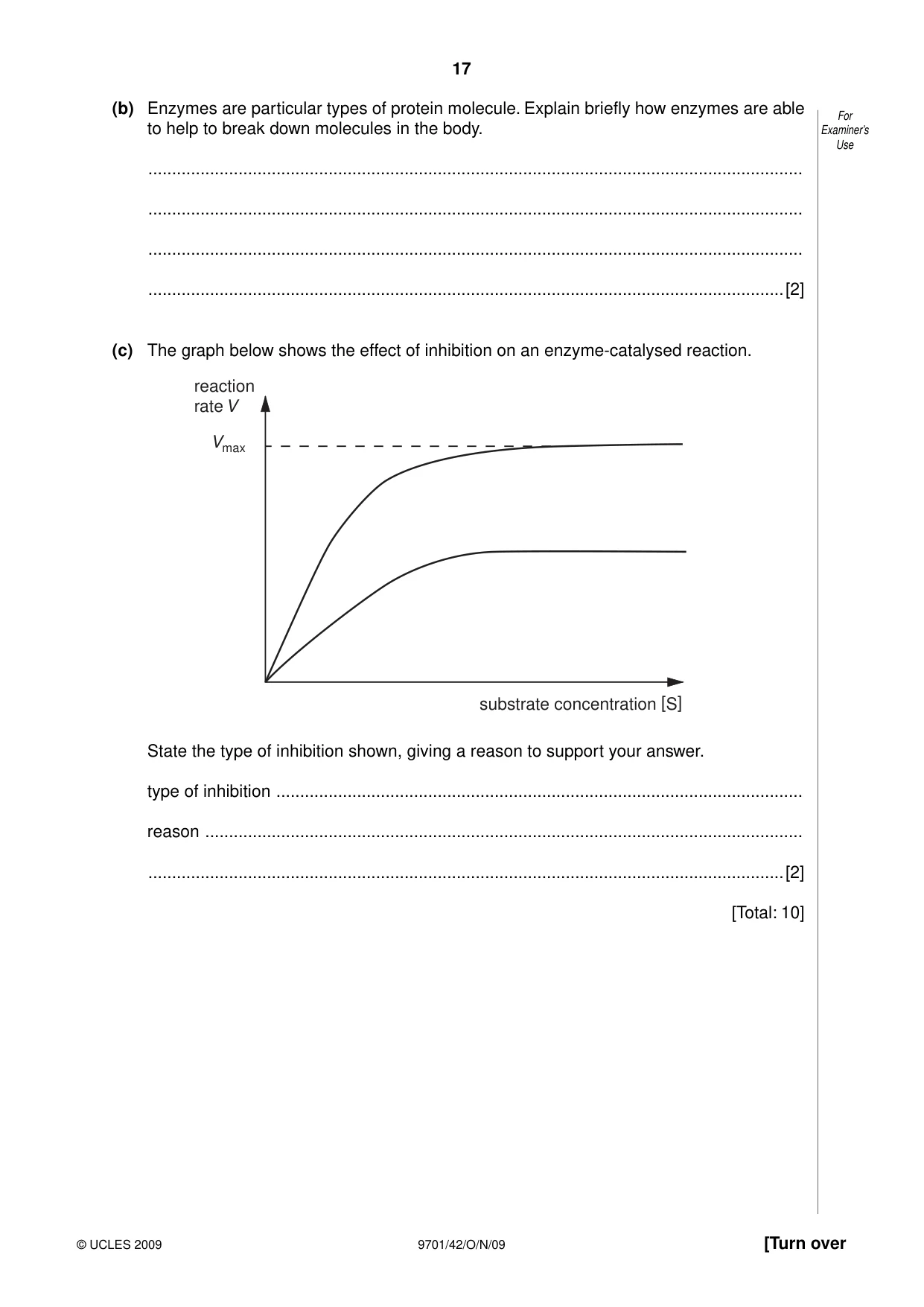
17 9701/42/O/N/09 © UCLES 2009 [Turn over For Examiner’s Use (b) Enzymes are particular types of protein molecule. Explain briefly how enzymes are able to help to break down molecules in the body. … … … …[2] (c) The graph below shows the effect of inhibition on an enzyme-catalysed reaction. reaction rate V Vmax substrate concentration [S] State the type of inhibition shown, giving a reason to support your answer. type of inhibition … reason … …[2] [Total: 10]
Question paper, page 18
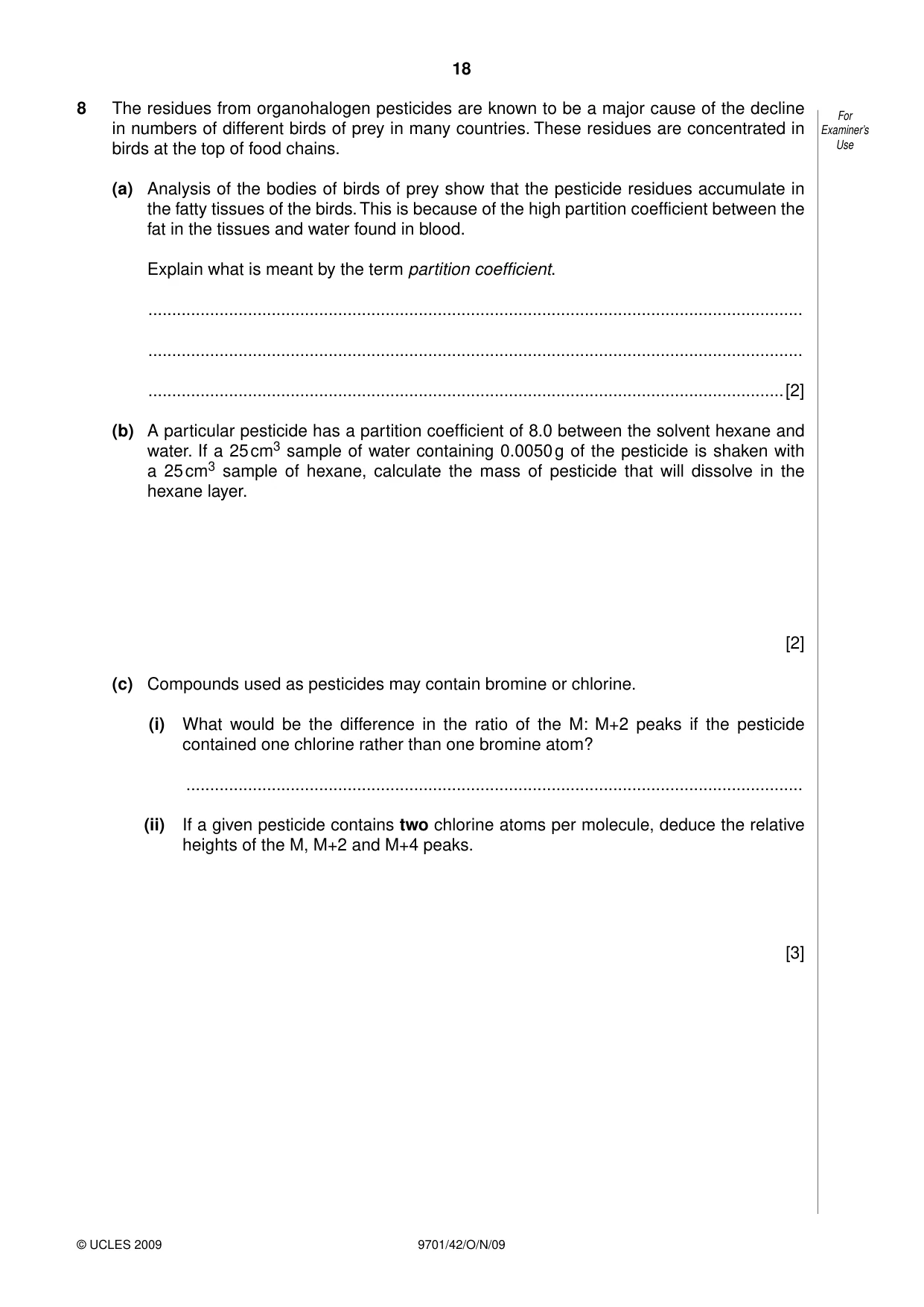
18 9701/42/O/N/09 © UCLES 2009 For Examiner’s Use 8 The residues from organohalogen pesticides are known to be a major cause of the decline in numbers of different birds of prey in many countries. These residues are concentrated in birds at the top of food chains. (a) Analysis of the bodies of birds of prey show that the pesticide residues accumulate in the fatty tissues of the birds. This is because of the high partition coefficient between the fat in the tissues and water found in blood. Explain what is meant by the term partition coefficient. … … …[2] (b) A particular pesticide has a partition coefficient of 8.0 between the solvent hexane and water. If a 25 cm3 sample of water containing 0.0050 g of the pesticide is shaken with a 25 cm3 sample of hexane, calculate the mass of pesticide that will dissolve in the hexane layer. [2] (c) Compounds used as pesticides may contain bromine or chlorine. (i) What would be the difference in the ratio of the M: M+2 peaks if the pesticide contained one chlorine rather than one bromine atom? … (ii) If a given pesticide contains two chlorine atoms per molecule, deduce the relative heights of the M, M+2 and M+4 peaks. [3]
Question paper, page 19
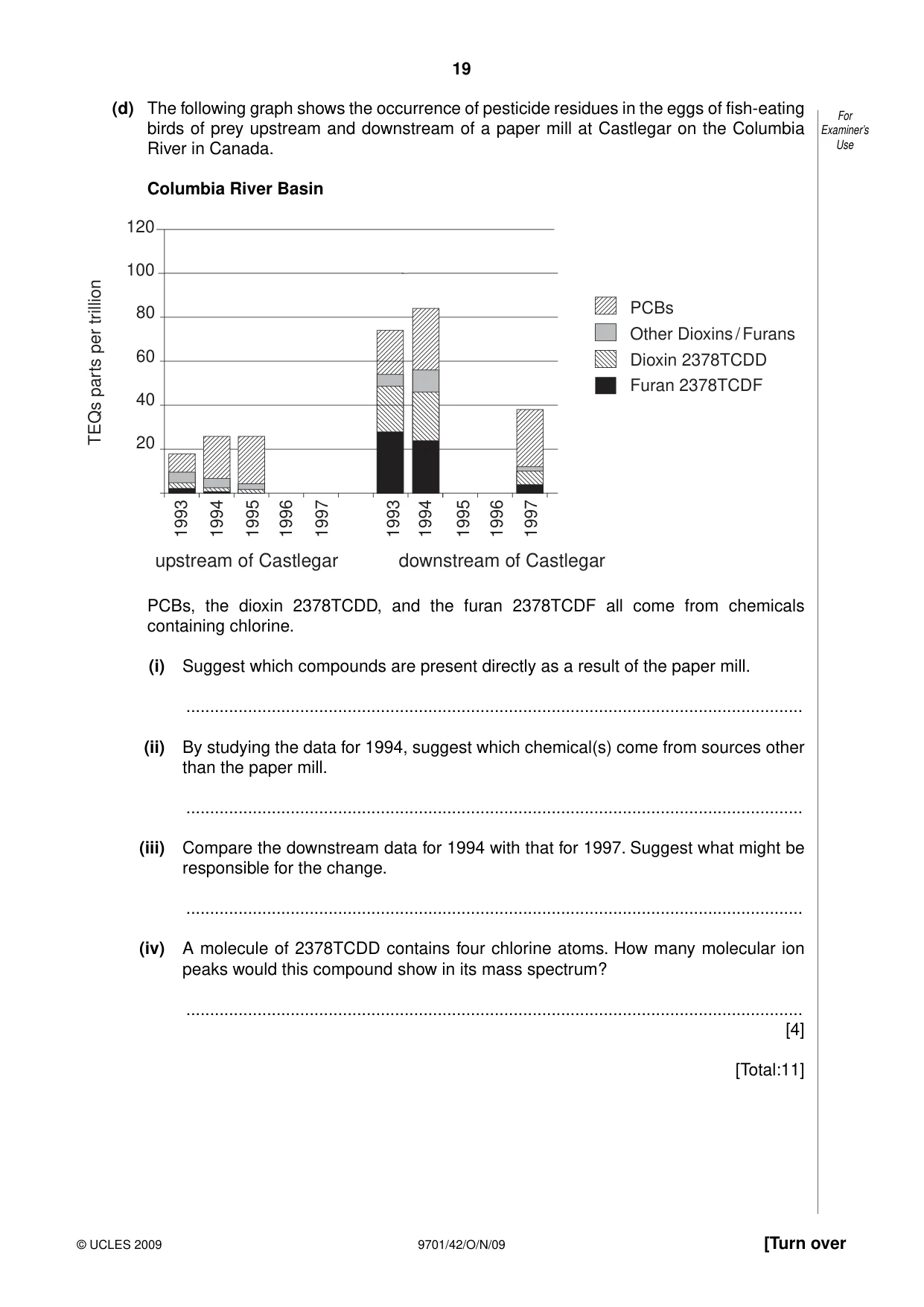
19 9701/42/O/N/09 © UCLES 2009 For Examiner’s Use [Turn over (d) The following graph shows the occurrence of pesticide residues in the eggs of fish-eating birds of prey upstream and downstream of a paper mill at Castlegar on the Columbia River in Canada. Columbia River Basin 1993 1994 1995 1996 1997 downstream of Castlegar 1993 TEQs parts per trillion 1994 1995 1996 1997 20 40 60 80 100 120 upstream of Castlegar Furan 2378TCDF Dioxin 2378TCDD Other Dioxins / Furans PCBs PCBs, the dioxin 2378TCDD, and the furan 2378TCDF all come from chemicals containing chlorine. (i) Suggest which compounds are present directly as a result of the paper mill. … (ii) By studying the data for 1994, suggest which chemical(s) come from sources other than the paper mill. … (iii) Compare the downstream data for 1994 with that for 1997. Suggest what might be responsible for the change. … (iv) A molecule of 2378TCDD contains four chlorine atoms. How many molecular ion peaks would this compound show in its mass spectrum? … [4] [Total:11]
Question paper, page 20
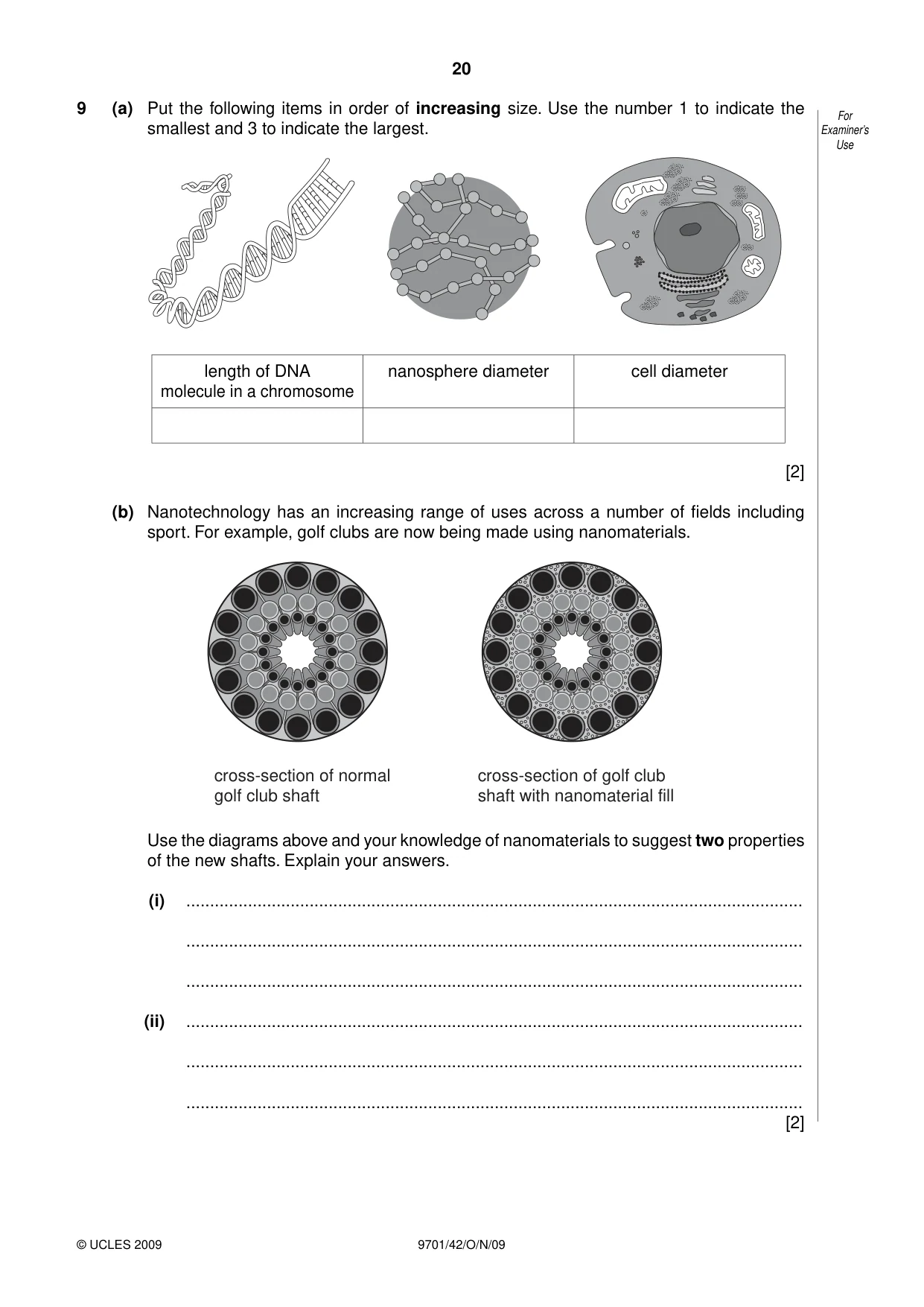
20 9701/42/O/N/09 © UCLES 2009 9 (a) Put the following items in order of increasing size. Use the number 1 to indicate the smallest and 3 to indicate the largest. length of DNA molecule in a chromosome nanosphere diameter cell diameter [2] (b) Nanotechnology has an increasing range of uses across a number of fields including sport. For example, golf clubs are now being made using nanomaterials. cross-section of normal golf club shaft cross-section of golf club shaft with nanomaterial fill Use the diagrams above and your knowledge of nanomaterials to suggest two properties of the new shafts. Explain your answers. (i) … … … (ii) … … … [2] For Examiner’s Use
Question paper, page 21
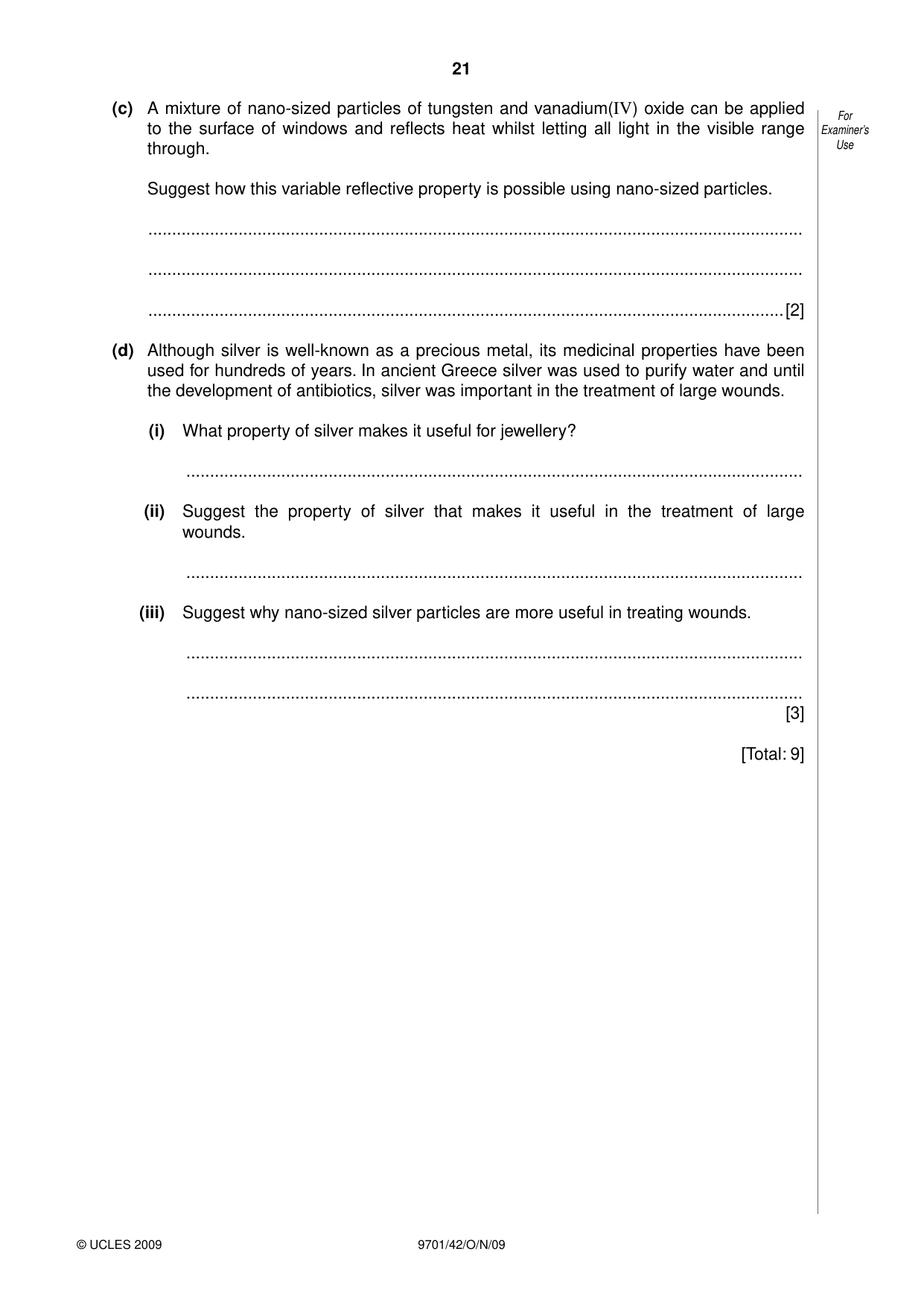
21 9701/42/O/N/09 © UCLES 2009 For Examiner’s Use (c) A mixture of nano-sized particles of tungsten and vanadium(IV) oxide can be applied to the surface of windows and reflects heat whilst letting all light in the visible range through. Suggest how this variable reflective property is possible using nano-sized particles. … … …[2] (d) Although silver is well-known as a precious metal, its medicinal properties have been used for hundreds of years. In ancient Greece silver was used to purify water and until the development of antibiotics, silver was important in the treatment of large wounds. (i) What property of silver makes it useful for jewellery? … (ii) Suggest the property of silver that makes it useful in the treatment of large wounds. … (iii) Suggest why nano-sized silver particles are more useful in treating wounds. … … [3] [Total: 9]
Question paper, page 24
24 9701/42/O/N/09 Permission to reproduce items where third-party owned material protected by copyright is included has been sought and cleared where possible. Every reasonable effort has been made by the publisher (UCLES) to trace copyright holders, but if any items requiring clearance have unwittingly been included, the publisher will be pleased to make amends at the earliest possible opportunity. University of Cambridge International Examinations is part of the Cambridge Assessment Group. Cambridge Assessment is the brand name of University of Cambridge Local Examinations Syndicate (UCLES), which is itself a department of the University of Cambridge. BLANK PAGE
Mark scheme, page 1
UNIVERSITY OF CAMBRIDGE INTERNATIONAL EXAMINATIONS GCE Advanced Subsidiary Level and GCE Advanced Level MARK SCHEME for the October/November 2009 question paper for the guidance of teachers 9701 CHEMISTRY 9701/42 Paper 42 (A2 Structured Questions), maximum raw mark 100 This mark scheme is published as an aid to teachers and candidates, to indicate the requirements of the examination. It shows the basis on which Examiners were instructed to award marks. It does not indicate the details of the discussions that took place at an Examiners’ meeting before marking began, which would have considered the acceptability of alternative answers. Mark schemes must be read in conjunction with the question papers and the report on the examination. • CIE will not enter into discussions or correspondence in connection with these mark schemes. CIE is publishing the mark schemes for the October/November 2009 question papers for most IGCSE, GCE Advanced Level and Advanced Subsidiary Level syllabuses and some Ordinary Level syllabuses.
Mark scheme, page 2
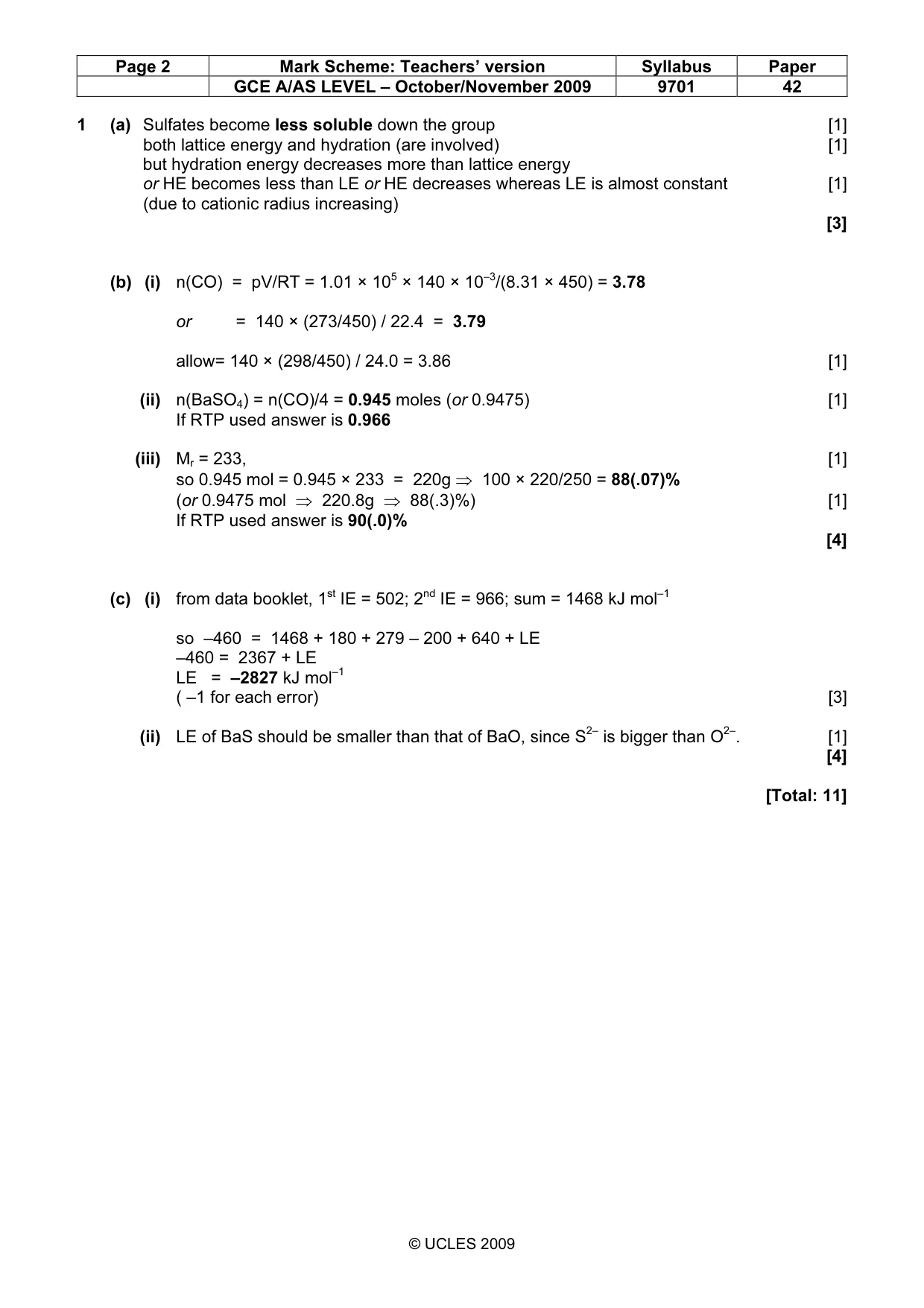
Page 2 Mark Scheme: Teachers’ version Syllabus Paper GCE A/AS LEVEL – October/November 2009 9701 42 © UCLES 2009 1 (a) Sulfates become less soluble down the group [1] both lattice energy and hydration (are involved) [1] but hydration energy decreases more than lattice energy or HE becomes less than LE or HE decreases whereas LE is almost constant [1] (due to cationic radius increasing) [3] (b) (i) n(CO) = pV/RT = 1.01 × 105 × 140 × 10–3/(8.31 × 450) = 3.78 or = 140 × (273/450) / 22.4 = 3.79 allow= 140 × (298/450) / 24.0 = 3.86 [1] (ii) n(BaSO4) = n(CO)/4 = 0.945 moles (or 0.9475) [1] If RTP used answer is 0.966 (iii) Mr = 233, [1] so 0.945 mol = 0.945 × 233 = 220g ⇒ 100 × 220/250 = 88(.07)% (or 0.9475 mol ⇒ 220.8g ⇒ 88(.3)%) [1] If RTP used answer is 90(.0)% [4] (c) (i) from data booklet, 1st IE = 502; 2nd IE = 966; sum = 1468 kJ mol–1 so –460 = 1468 + 180 + 279 – 200 + 640 + LE –460 = 2367 + LE LE = –2827 kJ mol–1 ( –1 for each error) [3] (ii) LE of BaS should be smaller than that of BaO, since S2– is bigger than O2–. [1] [4] [Total: 11]
Mark scheme, page 3
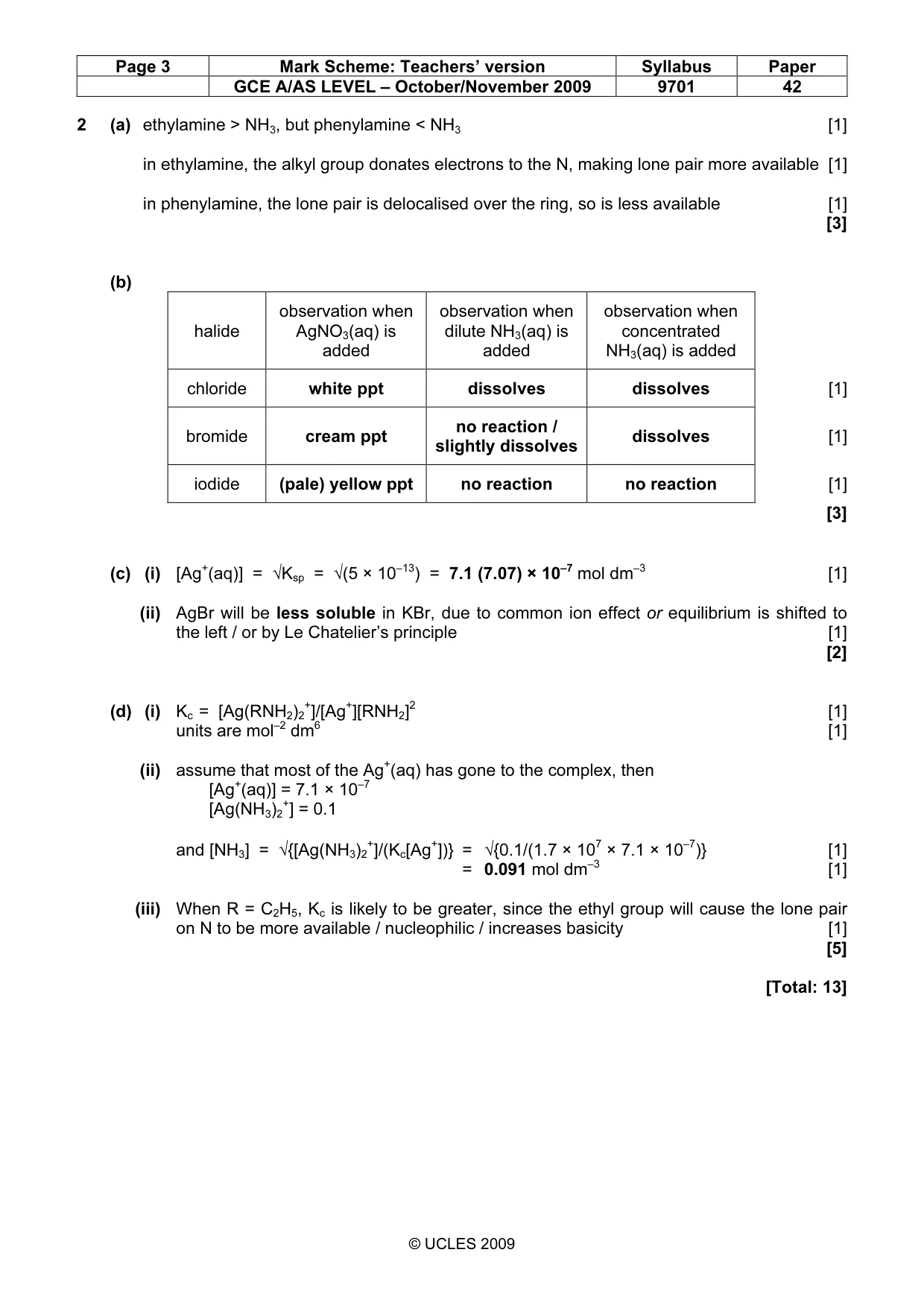
Page 3 Mark Scheme: Teachers’ version Syllabus Paper GCE A/AS LEVEL – October/November 2009 9701 42 © UCLES 2009 2 (a) ethylamine > NH3, but phenylamine < NH3 [1] in ethylamine, the alkyl group donates electrons to the N, making lone pair more available [1] in phenylamine, the lone pair is delocalised over the ring, so is less available [1] [3] (b) halide observation when AgNO3(aq) is added observation when dilute NH3(aq) is added observation when concentrated NH3(aq) is added chloride white ppt dissolves dissolves [1] bromide cream ppt no reaction / slightly dissolves dissolves [1] iodide (pale) yellow ppt no reaction no reaction [1] [3] (c) (i) [Ag+(aq)] = √Ksp = √(5 × 10–13) = 7.1 (7.07) × 10–7 mol dm–3 [1] (ii) AgBr will be less soluble in KBr, due to common ion effect or equilibrium is shifted to the left / or by Le Chatelier’s principle [1] [2] (d) (i) Kc = [Ag(RNH2)2 +]/[Ag+][RNH2]2 [1] units are mol–2 dm6 [1] (ii) assume that most of the Ag+(aq) has gone to the complex, then [Ag+(aq)] = 7.1 × 10⁻⁷ [Ag(NH3)2 +] = 0.1 and [NH3] = √{[Ag(NH3)2 +]/(Kc[Ag+])} = √{0.1/(1.7 × 107 × 7.1 × 10–7)} [1] = 0.091 mol dm–3 [1] (iii) When R = C2H5, Kc is likely to be greater, since the ethyl group will cause the lone pair on N to be more available / nucleophilic / increases basicity [1] [5] [Total: 13]
Mark scheme, page 4
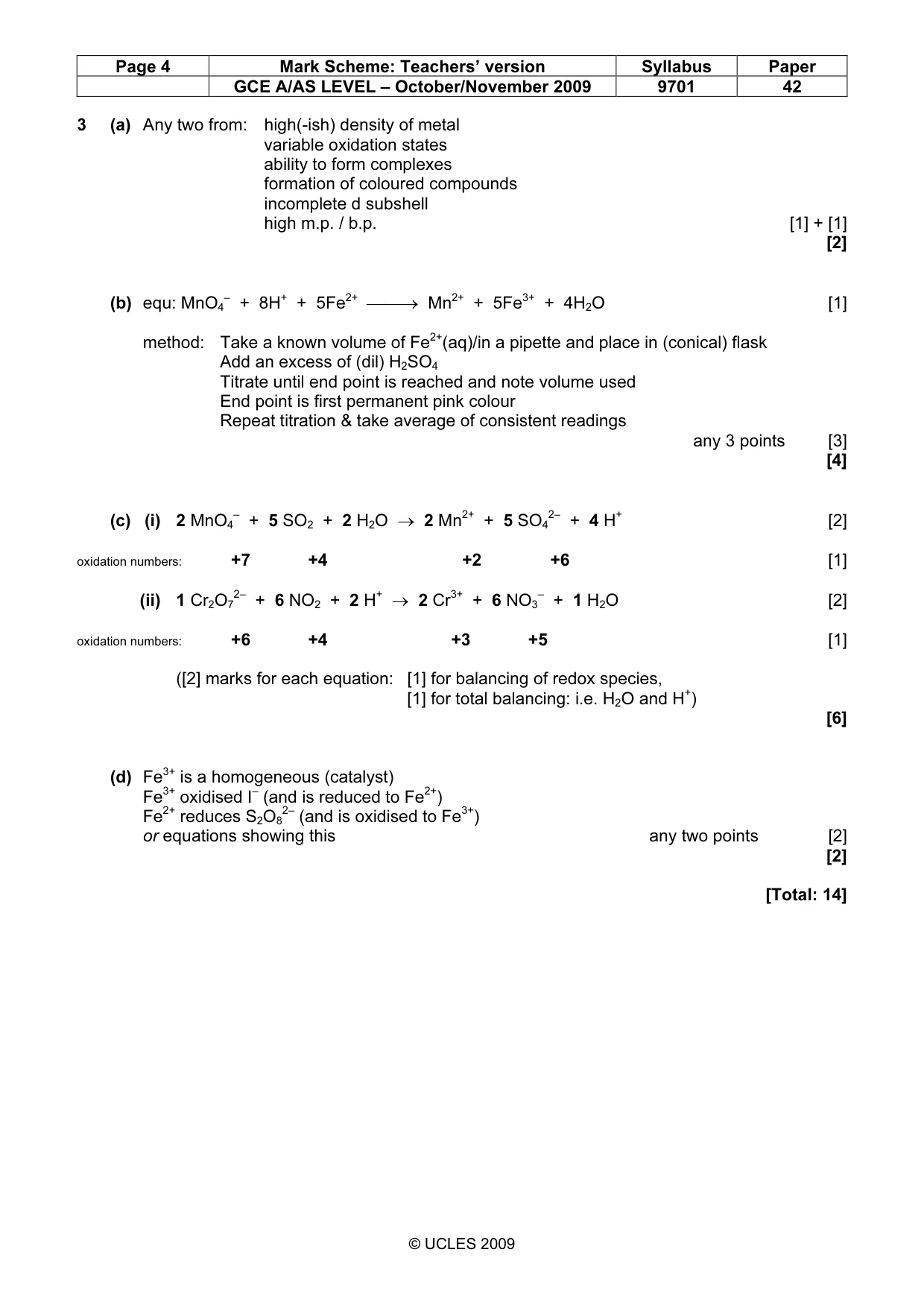
Page 4 Mark Scheme: Teachers’ version Syllabus Paper GCE A/AS LEVEL – October/November 2009 9701 42 © UCLES 2009 3 (a) Any two from: high(-ish) density of metal variable oxidation states ability to form complexes formation of coloured compounds incomplete d subshell high m.p. / b.p. [1] + [1] [2] (b) equ: MnO4 – + 8H+ + 5Fe2+ → Mn2+ + 5Fe3+ + 4H2O [1] method: Take a known volume of Fe2+(aq)/in a pipette and place in (conical) flask Add an excess of (dil) H2SO4 Titrate until end point is reached and note volume used End point is first permanent pink colour Repeat titration & take average of consistent readings any 3 points [3] [4] (c) (i) 2 MnO4 – + 5 SO2 + 2 H2O → 2 Mn2+ + 5 SO4 2– + 4 H+ [2] oxidation numbers: +7 +4 +2 +6 [1] (ii) 1 Cr2O7 2– + 6 NO2 + 2 H+ → 2 Cr3+ + 6 NO3 – + 1 H2O [2] oxidation numbers: +6 +4 +3 +5 [1] ([2] marks for each equation: [1] for balancing of redox species, [1] for total balancing: i.e. H2O and H+) [6] (d) Fe3+ is a homogeneous (catalyst) Fe3+ oxidised I– (and is reduced to Fe2+) Fe2+ reduces S2O8 2– (and is oxidised to Fe3+) or equations showing this any two points [2] [2] [Total: 14]
Mark scheme, page 5
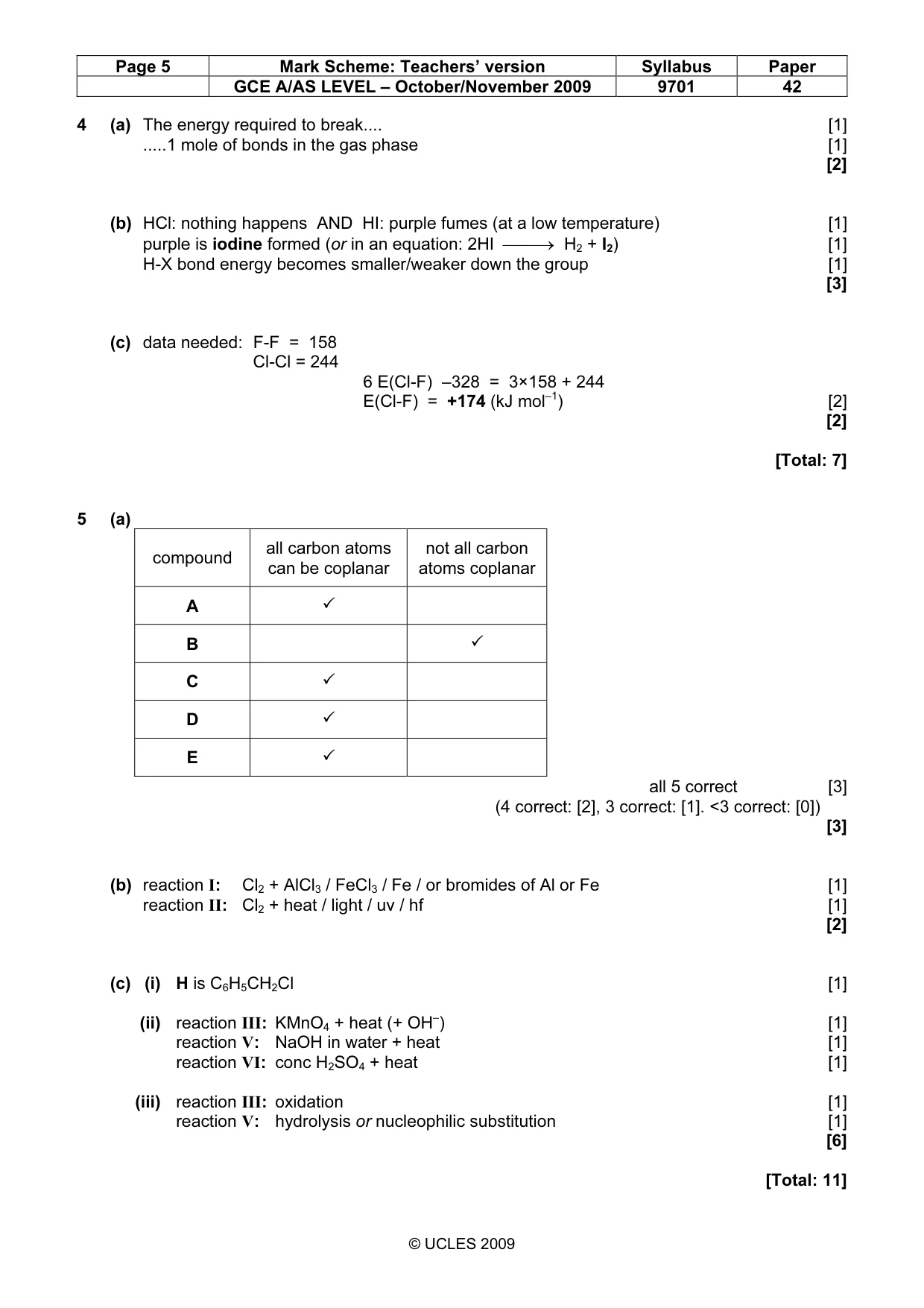
Page 5 Mark Scheme: Teachers’ version Syllabus Paper GCE A/AS LEVEL – October/November 2009 9701 42 © UCLES 2009 4 (a) The energy required to break… [1] …1 mole of bonds in the gas phase [1] [2] (b) HCl: nothing happens AND HI: purple fumes (at a low temperature) [1] purple is iodine formed (or in an equation: 2HI → H2 + I2) [1] H-X bond energy becomes smaller/weaker down the group [1] [3] (c) data needed: F-F = 158 Cl-Cl = 244 6 E(Cl-F) –328 = 3×158 + 244 E(Cl-F) = +174 (kJ mol–1) [2] [2] [Total: 7] 5 (a) compound all carbon atoms can be coplanar not all carbon atoms coplanar A ✓ B ✓ C ✓ D ✓ E ✓ all 5 correct [3] (4 correct: [2], 3 correct: [1]. <3 correct: [0]) [3] (b) reaction I: Cl2 + AlCl3 / FeCl3 / Fe / or bromides of Al or Fe [1] reaction II: Cl2 + heat / light / uv / hf [1] [2] (c) (i) H is C6H5CH2Cl [1] (ii) reaction III: KMnO4 + heat (+ OH–) [1] reaction V: NaOH in water + heat [1] reaction VI: conc H2SO4 + heat [1] (iii) reaction III: oxidation [1] reaction V: hydrolysis or nucleophilic substitution [1] [6] [Total: 11]
Mark scheme, page 6
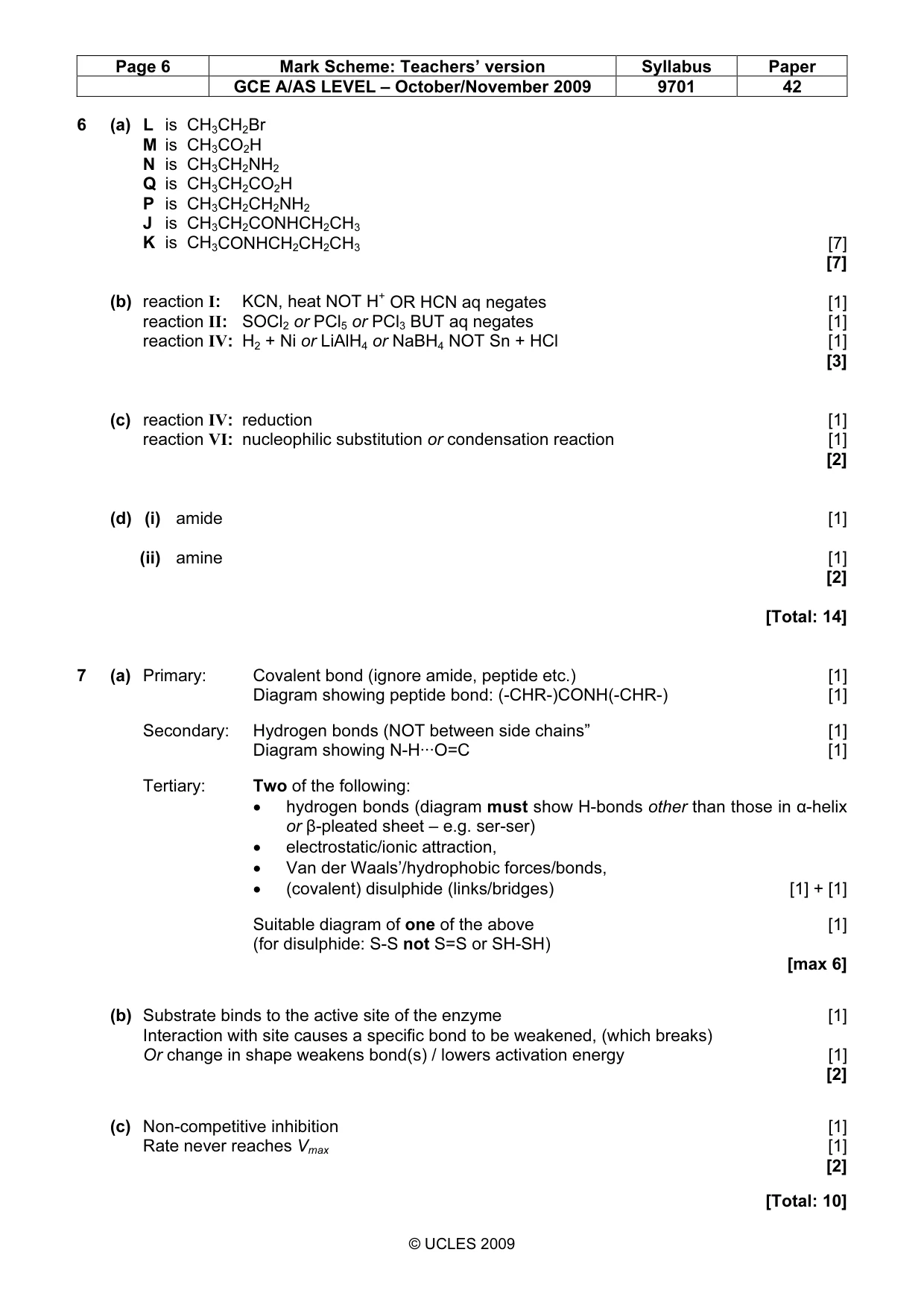
Page 6 Mark Scheme: Teachers’ version Syllabus Paper GCE A/AS LEVEL – October/November 2009 9701 42 © UCLES 2009 6 (a) L is CH3CH2Br M is CH3CO2H N is CH3CH2NH2 Q is CH3CH2CO2H P is CH3CH2CH2NH2 J is CH3CH2CONHCH2CH3 K is CH3CONHCH2CH2CH3 [7] [7] (b) reaction I: KCN, heat NOT H+ OR HCN aq negates [1] reaction II: SOCl2 or PCl5 or PCl3 BUT aq negates [1] reaction IV: H2 + Ni or LiAlH4 or NaBH4 NOT Sn + HCl [1] [3] (c) reaction IV: reduction [1] reaction VI: nucleophilic substitution or condensation reaction [1] [2] (d) (i) amide [1] (ii) amine [1] [2] [Total: 14] 7 (a) Primary: Covalent bond (ignore amide, peptide etc.) [1] Diagram showing peptide bond: (-CHR-)CONH(-CHR-) [1] Secondary: Hydrogen bonds (NOT between side chains” [1] Diagram showing N-H···O=C [1] Tertiary: Two of the following: • hydrogen bonds (diagram must show H-bonds other than those in α-helix or β-pleated sheet – e.g. ser-ser) • electrostatic/ionic attraction, • Van der Waals’/hydrophobic forces/bonds, • (covalent) disulphide (links/bridges) [1] + [1] Suitable diagram of one of the above [1] (for disulphide: S-S not S=S or SH-SH) [max 6] (b) Substrate binds to the active site of the enzyme [1] Interaction with site causes a specific bond to be weakened, (which breaks) Or change in shape weakens bond(s) / lowers activation energy [1] [2] (c) Non-competitive inhibition [1] Rate never reaches Vmax [1] [2] [Total: 10]
Mark scheme, page 7
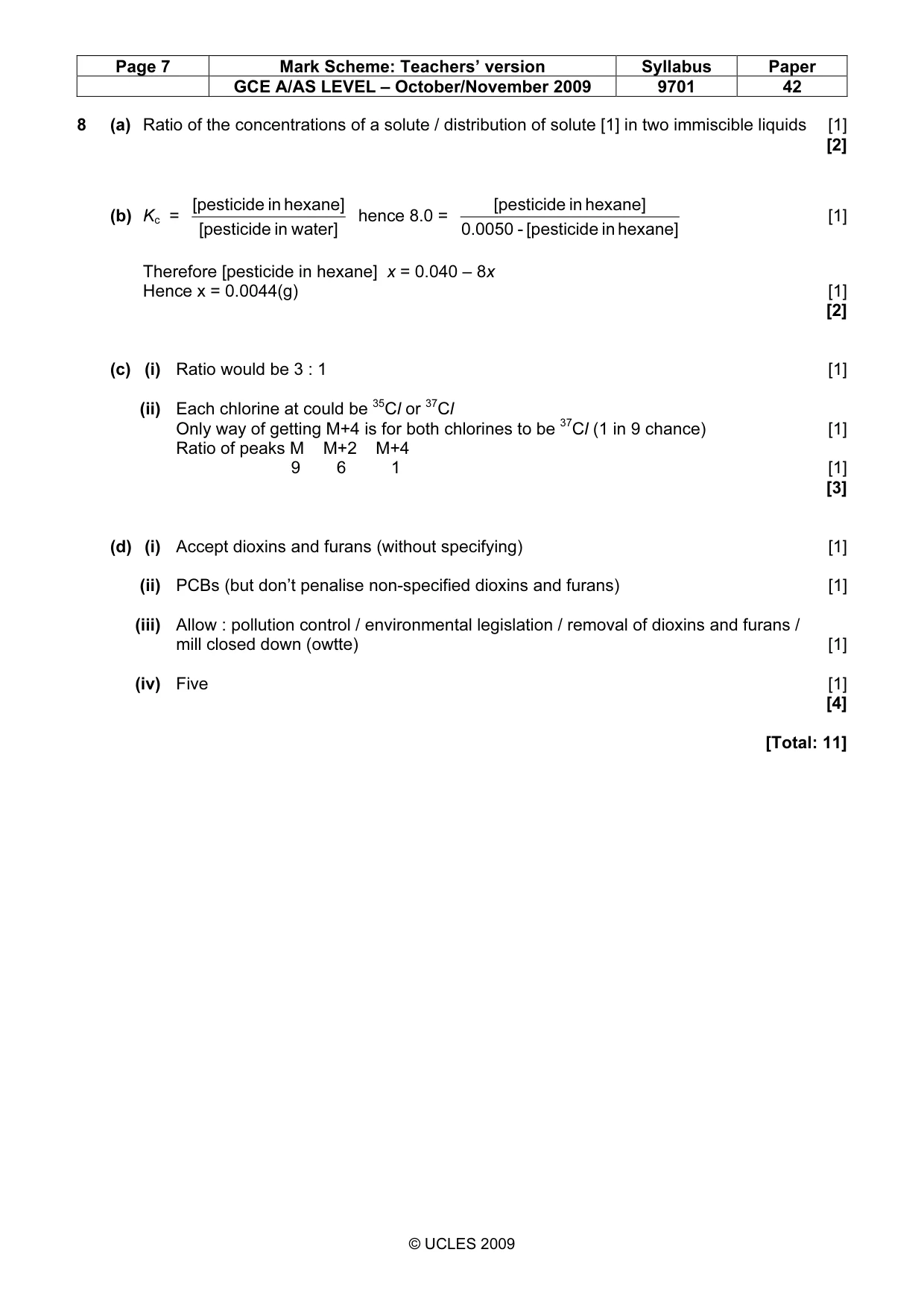
Page 7 Mark Scheme: Teachers’ version Syllabus Paper GCE A/AS LEVEL – October/November 2009 9701 42 © UCLES 2009 8 (a) Ratio of the concentrations of a solute / distribution of solute [1] in two immiscible liquids [1] [2] (b) Kc = water] in [pesticide hexane] in [pesticide hence 8.0 = hexane] in [pesticide - 0.0050 hexane] in [pesticide [1] Therefore [pesticide in hexane] x = 0.040 – 8x Hence x = 0.0044(g) [1] [2] (c) (i) Ratio would be 3 : 1 [1] (ii) Each chlorine at could be 35Cl or 37Cl Only way of getting M+4 is for both chlorines to be 37Cl (1 in 9 chance) [1] Ratio of peaks M M+2 M+4 9 6 1 [1] [3] (d) (i) Accept dioxins and furans (without specifying) [1] (ii) PCBs (but don’t penalise non-specified dioxins and furans) [1] (iii) Allow : pollution control / environmental legislation / removal of dioxins and furans / mill closed down (owtte) [1] (iv) Five [1] [4] [Total: 11]
Mark scheme, page 8
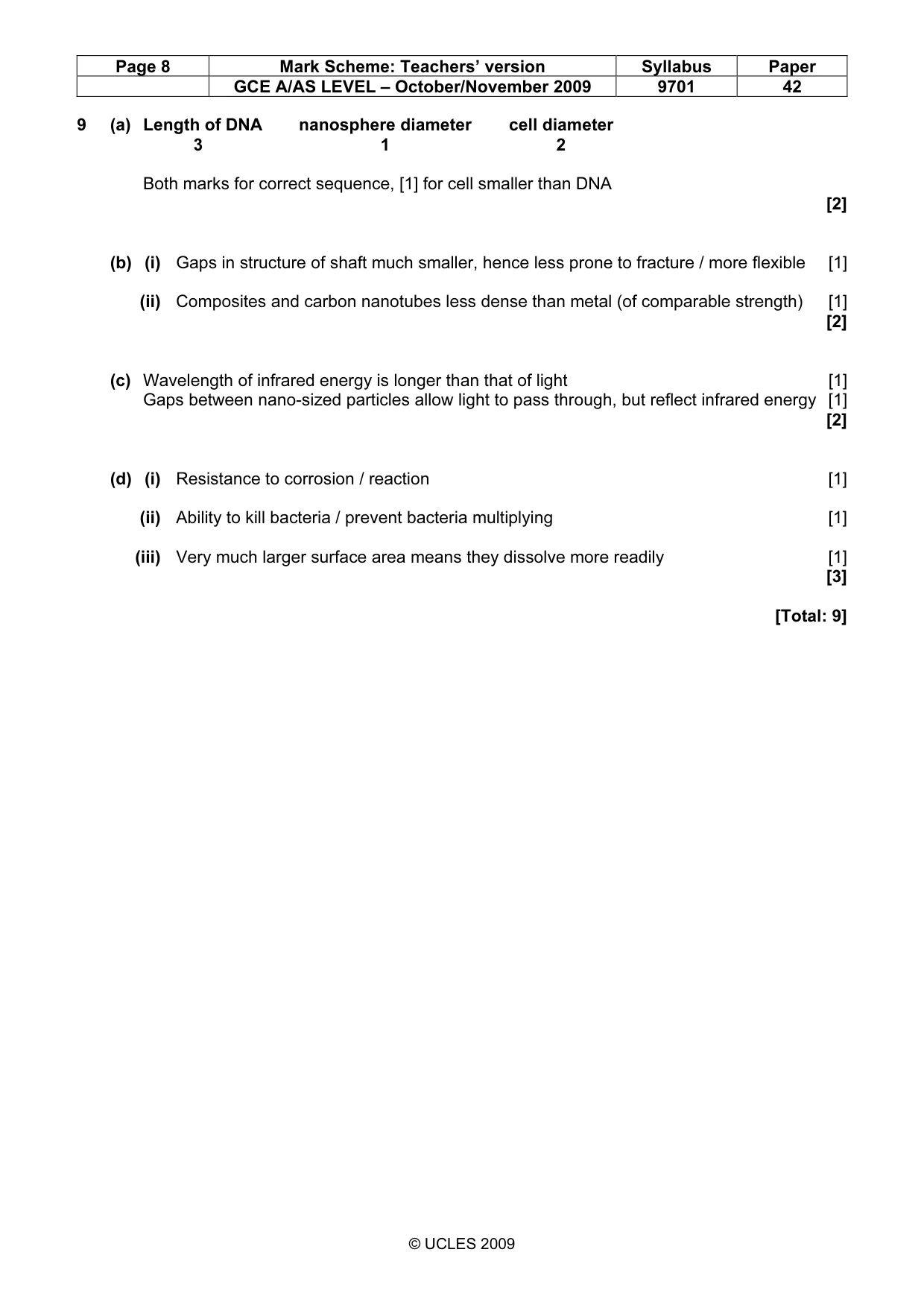
Page 8 Mark Scheme: Teachers’ version Syllabus Paper GCE A/AS LEVEL – October/November 2009 9701 42 © UCLES 2009 9 (a) Length of DNA nanosphere diameter cell diameter 3 1 2 Both marks for correct sequence, [1] for cell smaller than DNA [2] (b) (i) Gaps in structure of shaft much smaller, hence less prone to fracture / more flexible [1] (ii) Composites and carbon nanotubes less dense than metal (of comparable strength) [1] [2] (c) Wavelength of infrared energy is longer than that of light [1] Gaps between nano-sized particles allow light to pass through, but reflect infrared energy [1] [2] (d) (i) Resistance to corrosion / reaction [1] (ii) Ability to kill bacteria / prevent bacteria multiplying [1] (iii) Very much larger surface area means they dissolve more readily [1] [3] [Total: 9]